Product Optimization
Webinar 14-July-2016
VENKATRAMAN RM
Director of Products OLA CABS
Experience:
Manager, Product Management | PayPal
Product Marketing Manager | Synaptris
Senior Product Manager | Info Edge India
Ltd
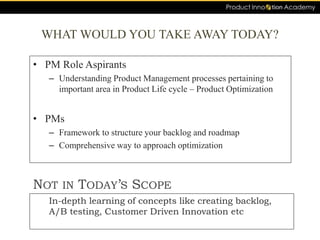
WHAT WOULD YOU TAKE AWAY TODAY?
• PM Role Aspirants
– Understanding Product Management processes pertaining to
important area in Product Life cycle – Product Optimization
• PMs
– Framework to structure your backlog and roadmap
– Comprehensive way to approach optimization
In-depth learning of concepts like creating backlog,
A/B testing, Customer Driven Innovation etc
NOT IN TODAY’S SCOPE
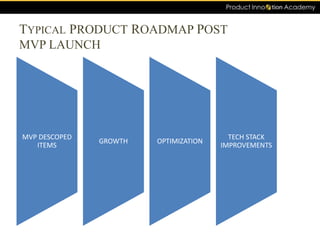
TYPICAL PRODUCT ROADMAP POST
MVP LAUNCH
MVP DESCOPED
ITEMS
GROWTH OPTIMIZATION
TECH STACK
IMPROVEMENTS
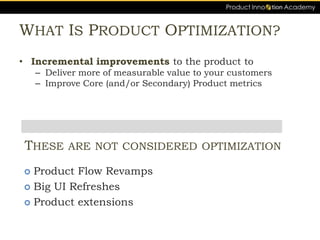
WHAT IS PRODUCT OPTIMIZATION?
• Incremental improvements to the product to
– Deliver more of measurable value to your customers
– Improve Core (and/or Secondary) Product metrics
THESE ARE NOT CONSIDERED OPTIMIZATION
 Product Flow Revamps
 Big UI Refreshes
 Product extensions
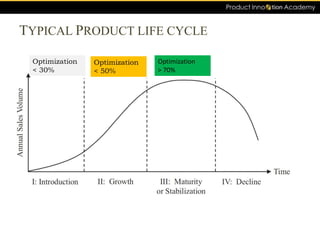
TYPICAL PRODUCT LIFE CYCLE
Optimization
< 50%
Optimization
> 70%
Optimization
< 30%
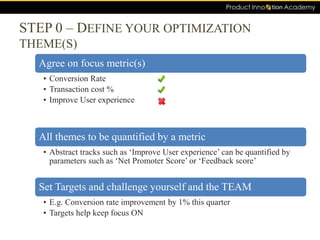
STEP 0 – DEFINE YOUR OPTIMIZATION
THEME(S)
Agree on focus metric(s)
• Conversion Rate
• Transaction cost %
• Improve User experience
All themes to be quantified by a metric
• Abstract tracks such as ‘Improve User experience’ can be quantified by
parameters such as ‘Net Promoter Score’ or ‘Feedback score’
Set Targets and challenge yourself and the TEAM
• E.g. Conversion rate improvement by 1% this quarter
• Targets help keep focus ON
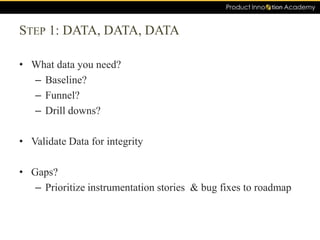
STEP 1: DATA, DATA, DATA
• What data you need?
– Baseline?
– Funnel?
– Drill downs?
• Validate Data for integrity
• Gaps?
– Prioritize instrumentation stories & bug fixes to roadmap
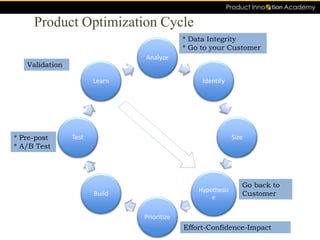
Product Optimization Cycle
Analyze
Identify
Size
Hypothesiz
e
Prioritize
Build
Test
Learn
* Data Integrity
* Go to your Customer
Go back to
Customer
* Pre-post
* A/B Test
Validation
Effort-Confidence-Impact
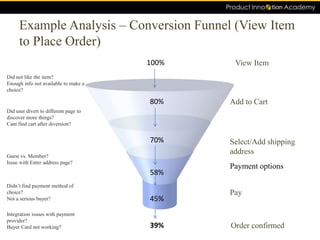
Example Analysis – Conversion Funnel (View Item
to Place Order)
100%
80%
70%
View Item
Add to Cart
Select/Add shipping
address
Payment options
58%
45%
Pay
39% Order confirmed
Did not like the item?
Enough info not available to make a
choice?
Did user divert to different page to
discover more things?
Cant find cart after diversion?
Guest vs. Member?
Issue with Enter address page?
Didn’t find payment method of
choice?
Not a serious buyer?
Integration issues with payment
provider?
Buyer Card not working?
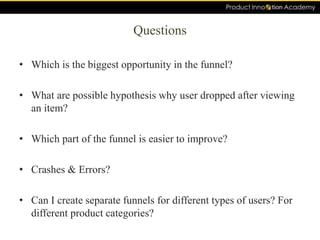
Questions
• Which is the biggest opportunity in the funnel?
• What are possible hypothesis why user dropped after viewing
an item?
• Which part of the funnel is easier to improve?
• Crashes & Errors?
• Can I create separate funnels for different types of users? For
different product categories?
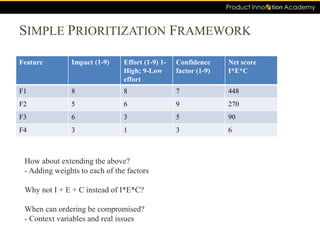
SIMPLE PRIORITIZATION FRAMEWORK
Feature Impact (1-9) Effort (1-9) 1-
High; 9-Low
effort
Confidence
factor (1-9)
Net score
I*E*C
F1 8 8 7 448
F2 5 6 9 270
F3 6 3 5 90
F4 3 1 3 6
How about extending the above?
- Adding weights to each of the factors
Why not I + E + C instead of I*E*C?
When can ordering be compromised?
- Context variables and real issues
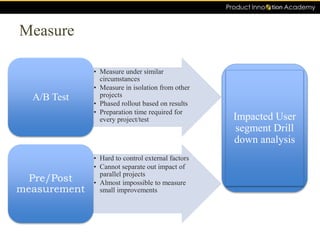
Measure
• Measure under similar
circumstances
• Measure in isolation from other
projects
• Phased rollout based on results
• Preparation time required for
every project/test
A/B Test
• Hard to control external factors
• Cannot separate out impact of
parallel projects
• Almost impossible to measure
small improvements
Pre/Post
measurement
Impacted User
segment Drill
down analysis
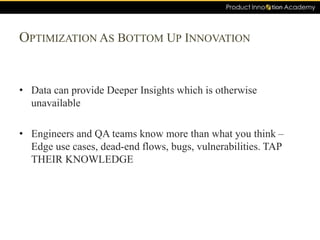
OPTIMIZATION AS BOTTOM UP INNOVATION
• Data can provide Deeper Insights which is otherwise
unavailable
• Engineers and QA teams know more than what you think –
Edge use cases, dead-end flows, bugs, vulnerabilities. TAP
THEIR KNOWLEDGE
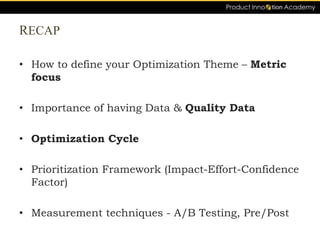
RECAP
• How to define your Optimization Theme – Metric
focus
• Importance of having Data & Quality Data
• Optimization Cycle
• Prioritization Framework (Impact-Effort-Confidence
Factor)
• Measurement techniques - A/B Testing, Pre/Post
Questions?
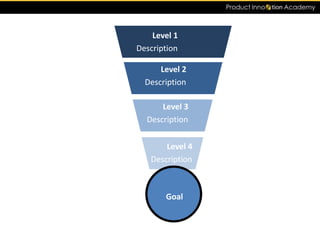
Description
Level 1
Description
Level 2
Description
Level 3
Description
Level 4
Goal
Webinar Product optimization

Webinar Product optimization

  • 1.
  • 2.
    VENKATRAMAN RM Director ofProducts OLA CABS Experience: Manager, Product Management | PayPal Product Marketing Manager | Synaptris Senior Product Manager | Info Edge India Ltd
  • 3.
    WHAT WOULD YOUTAKE AWAY TODAY? • PM Role Aspirants – Understanding Product Management processes pertaining to important area in Product Life cycle – Product Optimization • PMs – Framework to structure your backlog and roadmap – Comprehensive way to approach optimization In-depth learning of concepts like creating backlog, A/B testing, Customer Driven Innovation etc NOT IN TODAY’S SCOPE
  • 4.
    TYPICAL PRODUCT ROADMAPPOST MVP LAUNCH MVP DESCOPED ITEMS GROWTH OPTIMIZATION TECH STACK IMPROVEMENTS
  • 5.
    WHAT IS PRODUCTOPTIMIZATION? • Incremental improvements to the product to – Deliver more of measurable value to your customers – Improve Core (and/or Secondary) Product metrics THESE ARE NOT CONSIDERED OPTIMIZATION  Product Flow Revamps  Big UI Refreshes  Product extensions
  • 6.
    TYPICAL PRODUCT LIFECYCLE Optimization < 50% Optimization > 70% Optimization < 30%
  • 7.
    STEP 0 –DEFINE YOUR OPTIMIZATION THEME(S) Agree on focus metric(s) • Conversion Rate • Transaction cost % • Improve User experience All themes to be quantified by a metric • Abstract tracks such as ‘Improve User experience’ can be quantified by parameters such as ‘Net Promoter Score’ or ‘Feedback score’ Set Targets and challenge yourself and the TEAM • E.g. Conversion rate improvement by 1% this quarter • Targets help keep focus ON
  • 8.
    STEP 1: DATA,DATA, DATA • What data you need? – Baseline? – Funnel? – Drill downs? • Validate Data for integrity • Gaps? – Prioritize instrumentation stories & bug fixes to roadmap
  • 9.
    Product Optimization Cycle Analyze Identify Size Hypothesiz e Prioritize Build Test Learn *Data Integrity * Go to your Customer Go back to Customer * Pre-post * A/B Test Validation Effort-Confidence-Impact
  • 10.
    Example Analysis –Conversion Funnel (View Item to Place Order) 100% 80% 70% View Item Add to Cart Select/Add shipping address Payment options 58% 45% Pay 39% Order confirmed Did not like the item? Enough info not available to make a choice? Did user divert to different page to discover more things? Cant find cart after diversion? Guest vs. Member? Issue with Enter address page? Didn’t find payment method of choice? Not a serious buyer? Integration issues with payment provider? Buyer Card not working?
  • 11.
    Questions • Which isthe biggest opportunity in the funnel? • What are possible hypothesis why user dropped after viewing an item? • Which part of the funnel is easier to improve? • Crashes & Errors? • Can I create separate funnels for different types of users? For different product categories?
  • 12.
    SIMPLE PRIORITIZATION FRAMEWORK FeatureImpact (1-9) Effort (1-9) 1- High; 9-Low effort Confidence factor (1-9) Net score I*E*C F1 8 8 7 448 F2 5 6 9 270 F3 6 3 5 90 F4 3 1 3 6 How about extending the above? - Adding weights to each of the factors Why not I + E + C instead of I*E*C? When can ordering be compromised? - Context variables and real issues
  • 13.
    Measure • Measure undersimilar circumstances • Measure in isolation from other projects • Phased rollout based on results • Preparation time required for every project/test A/B Test • Hard to control external factors • Cannot separate out impact of parallel projects • Almost impossible to measure small improvements Pre/Post measurement Impacted User segment Drill down analysis
  • 14.
    OPTIMIZATION AS BOTTOMUP INNOVATION • Data can provide Deeper Insights which is otherwise unavailable • Engineers and QA teams know more than what you think – Edge use cases, dead-end flows, bugs, vulnerabilities. TAP THEIR KNOWLEDGE
  • 15.
    RECAP • How todefine your Optimization Theme – Metric focus • Importance of having Data & Quality Data • Optimization Cycle • Prioritization Framework (Impact-Effort-Confidence Factor) • Measurement techniques - A/B Testing, Pre/Post
  • 16.
  • 17.

Editor's Notes

  • #5 MVP Missed Out features – Non critical items, Descoped items due to timeline constraint, Half dones, Nice to haves. E.g. ecommerce example – Order Cancellation in-app, Accounting automation, Support for Multiple cards for payment Growth – Features targeted for New markets, new set of users; Going after 2ndry user persona; E.g. Expand to more cities, countries; payments company expanding from recharge to Utilities billing; Supporting low bandwidth users Tech stack improvements – Items that PMs with non-tech background fail to understand  E.g. Code Refactoring, supporting more simultaneous users and sessions, Performance Benchmarking, Data compression
  • #6 Product extensions - Features addressing different use case of the customer or targeting different customer segment E.g. FB launching FB messenger; Whatsapp introduced calling Grey Area – Product revamp sometimes is done as set of incremental improvements also.
  • #9 Baseline: E.g. What is the conversion baseline Funnel: What are the drop points in the funnel? Drill downs: Based on User segment – e.g. How is the guest user funnel different from member funnel? Based on User action (e.g. Registration form - User dropped off the form after filling how many fields?, how many users selected COD vs other payment options before dropping off) Data integrity issues: e.g. Users at different stages of the funnel doesn’t add up to the top of the funnel (site visitors) Gaps? What if the gaps are too big and takes few months to fix?
  • #10 Checkout funnel of ecommerce site for search: Visitors search  Select items  View items  Add to Cart  Enter address  Payment options  Pay  Order confirmed.
  • #11 Use fashion ecommerce example to reinforce each of the components in Optimization cycle. Focus on Drop off on each step
  • #13 Confidence factor example – Fixing payment provider integration issue is a High confidence backlog item because we know it works all the time after we fix. - Adding more info to ‘View Product’ page to reduce drop-off would be medium or low confidence backlog item.
  • #14 Introduce A/B test – Technique to test a change to small % of users and measure the impact