Strategies to cope up inflation in India
Presented to: Presented By:
Mr. Karan Sabharwal Akshu Grag (BM-18075)
Charu Kamboj (BM-18091)
Mayank Walia (BM-18122)
Bhoopendra Singh (BM-18087)
Digvijay Malik (BM-18104)
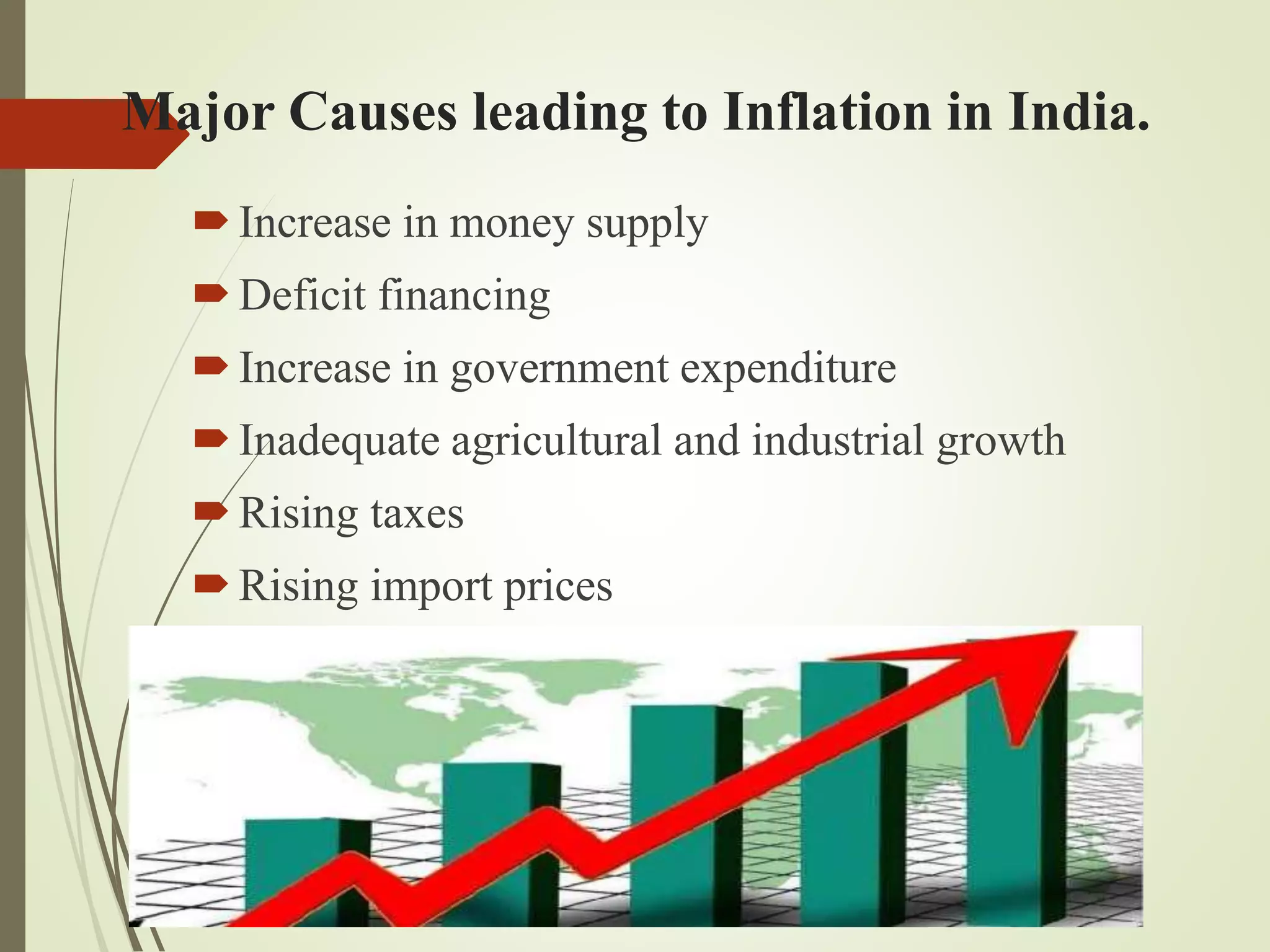
Major Causes leading to Inflation in India.
Increase in money supply
Deficit financing
Increase in government expenditure
Inadequate agricultural and industrial growth
Rising taxes
Rising import prices
Measures of inflation
1. Monetary Measures
I. Credit Control
II. Demonetisation of Currency
III. Issue of New Currency
2. Fiscal Measures
I. Reduction in Unnecessary Expenditure
II. Increase in Taxes
III. Increase in Savings
Price control
Price control and rationing is another measure
of direct control to check inflation. Price
control means fixing an upper limit for the
prices of essential consumer goods. They
are the maximum prices fixed by law and
anybody charging more than these prices is
punished by law. But it is difficult to
administer price control.
STEPS TAKEN TO CONTROL INFLATION
• Measures taken under Fiscal Development includes :-
• Measures under INDIRECT taxes :-
• Custom duties changes to incentivize “Make in India”
• Basic custom duty was reduced on inputs and raw material ex: solar tempered
glasses for solar panels.
• Basic custom duty was increased on specified goods manufactured in significant
quantity ex: stainless steel for manufacturing fibre cables , printers , mobile
phones .
• Export duty of 15% has been imposed on other Aluminium ores .
• Basic custom duty has increased on crude and edible oils ex: Palm Oil , sunflower
Oil.
• Under GST services providers were exempted to have registration if their annual
turnover is less than 20 lakh. This will reduce compliance cost i.e. (exp. of time and
money in confirming with govt. req. such as legislations) of small service
providers.
• Businesses with annual turnover up to 1.5 cores are required to file quarterly
returns. These businesses are also not required to pay GST at the time of advance
receipts on account of supply of goods.
• Measures under DIRECT taxes :-
• Individuals of income between 2.5-5 lakhs now to pay 5% tax from 10%.
• Surcharge is imposed on individuals of income between 50lakhs-1crores.
STEPS TAKEN TO CONTROL INFLATION
•Measures taken to control Food Inflation includes :-
• Issue of Advisories to State Governments to take strict actions on hoarding and black
marketing , effectively enforce Essential Commodity Act 1955 .
• Higher MSP has been announced to enhance production and availability of food items.
• A scheme called Price Stabilization Fund (PSF) is being implemented to control price of
agriculture commodities like Pulses , Onion.
• Government improved the buffer stock of Pulses from 1.5 lakh MT to 20 lakh MT .
• Export of edible oils was allowed only in branded consumer packs of up to 5kg with a
minimum price of 900 USD , To increase domestic production this restriction was
removed from oils except for Palm Oil , Mustard Oil , Sunflower Oil .
• Governments has imposed stock holding limits on stockers/dealers of sugar till April
2018 .
• Government has imposed 20% duty on export of sugar to promote availability .
• States and UTs are advised to impose stock limit on Onion and also requested to
indicate their need of same to reduce excess import.
•Financial Year (2017-18) started with annual inflation of 3% based at Consumer Price
Index.
•Lowest inflation rate was in JUNE 2017 i.e. 1.5 %.
•Inflation rate based on Wholesale Price Index was 2.9% for (April-December)2017-
18.
•5 states that recorded inflation of more than 4 % are J&K , Delhi , Kerala , Tamil
Nadu , Himachal Pradesh.
•Lowest inflation rate was in Orissa followed by U.P. , Bihar , Chhattisgarh .
Minimum Support Price
 MSP is a price fixed by the government of India to protect the farmers against
excessive fall in price during bumper production years.
Objectives of MSP
 To provide a fair return to the farmers and to protect the interests of consumers
by keeping the prices of food and other agriculture commodities at reasonable
levels.
Challenges Faced by the
Government to Implement MSP
 Method of calculating MSP
 Farmer’s Registration
 Infrastructure
 Method of calculating MSP: The farmers have not been happy about the method
government uses to calculate cost of production. The government includes
operational expenses (inputs costs and family labour), which excludes the
expenses farmer incurs on rent on land, or capital, while calculating the cost of
production.
 Farmer’s Registration: The government drafts specific definition of a farmer in
the law, whereby, if an agricultural labourer or a cultivation abides by those
definitions, they are registered with the government. The problem arises when
farmers do not fit within these definitions, that is, if the farmers do not have their
own agricultural land or if the size of the land is less than 1 hectare.
 Infrastructure: The government don’t have the sufficient infrastructure. An
initiative of electronic- National Agriculture Market (e-NAM) has not been yet
connected to all the required regions.
Price Stabilization fund Scheme
 This scheme helps to regulate the price volatility of important agro-
horticultural commodities like onions, potatoes and pulses.
 This scheme was aimed to provide relief to consumers but was mainly used to
provide relief to farmers.
Objectives of PSF
 The scheme promotes direct purchase from farmers/ farmers association at farm
gate/ Mandi.
 The fund allocated under PSF has been primarily utilized towards building the
buffer of up to 20lakh tonnes of pulses.
Challenges Faced by the Government to
Implement PSF
 The Price Stabilisation Fund scheme requires growers/farmers to possess
operational landholding of a minimum of 10 hectares; other farmers are not
covered under this scheme.
 If planters somehow receive a good price for the produce, they may not have the
incentive to contribute even meagre amount of INR 500 as required by the
scheme towards the fund.
 The aim of the Price Stabilisation Fund scheme is to provide relief to farmers
only during a distress crop year.
Wage control
What is wage push inflation ?
 It is an overall rise in the cost of goods that results from a rise in wages.
 The overall increased cost of goods and services has a circular effect on the
wage increase.
 As goods and services in the market overall increase, higher wages will be
needed to compensate for the increased prices of consumer goods.
 The most common reason for raising wages is an increase to the minimum
wage.
 Wage push inflation has an inflationary spiral effect.
 To check this vicious circle of wages-chasing prices, an important measure will be
to exercise control over wages.
 The Wage Control Method is typically used in the situation where the inflation is
of cost-push and wage-push nature.
 Under this method, a rise in the wage rate is restricted through a ceiling imposed
on the wage incomes in both the public and private sectors. This ceiling is called
as “wage-freeze.”
 It reduces the ability of affected workers to spend thus further slowing the
economy.
 a person would find themselves with less spending power than before.
 If the labor unions are strong and oppose the wage freeze; then the government uses a
weaker method called as “Jawboning” to control inflation.
 “ Wage Guideposts” is prepared with a consent and common agreement between the
government representatives, businessmen and trade unions.
 It is made to have a controlled and disciplined upward movement in the wages and
prices.
 Under this method, the wages and prices are administered by the board of
representatives.
 Wage and price controls suppress inflation, but do not cure it.
 If demand continues to rise, despite the controls, inflation is subdued, but not
eliminated.
 Excess demand creates inflationary pressures underneath the controls.
 If nothing is done to eliminate excess demand in the various markets, removal of the
controls will permit prices to rise to market levels.
LOW PRODUCTION LEVEL
Low
Productivity,
High
Production
Cost
Less Supply
More
Demand,
Rising Prices
Deteriorating Quality of life
and Economy
More Unskilled labour
added to the existing
pool
“THE PLAN”
SKILL DEVELOPMENT
Skill India
PMKVY
DDUGKY
PMKK
SMAM
SELF RELIANCE
MUDRA Yojana
Loan to MSME in 59 minutes
SFDA
MAFALDA
Seed Development
ENVIRONMENT
Less Paperwork
Import Restrictions
Export Restrictions
Improved Infrastructure
Make In India
SKILL INDIA
 Create opportunities
 Raise confidence
 Improve productivity
 Give direction through proper skill development
MUDRA YOJNA
 Provide seed funding
 Shishu loan (up to 50000 rupees)
 Kishore Loan (Rs. 50,000 to Rs. 500,000)
 Tarun Loan(Rs.500,000 to Rs.1000,000)
“THE PLAN”
SKILL DEVELOPMENT
Skill India
PMKVY
DDUGKY
PMKK
SMAM
SELF RELIANCE
MUDRA Yojana
Loan to MSME in 59 minutes
SFDA
MAFALDA
Seed Development
ENVIRONMENT
Less Paperwork
Import Restrictions
Export Restrictions
Improved Infrastructure
Make In India
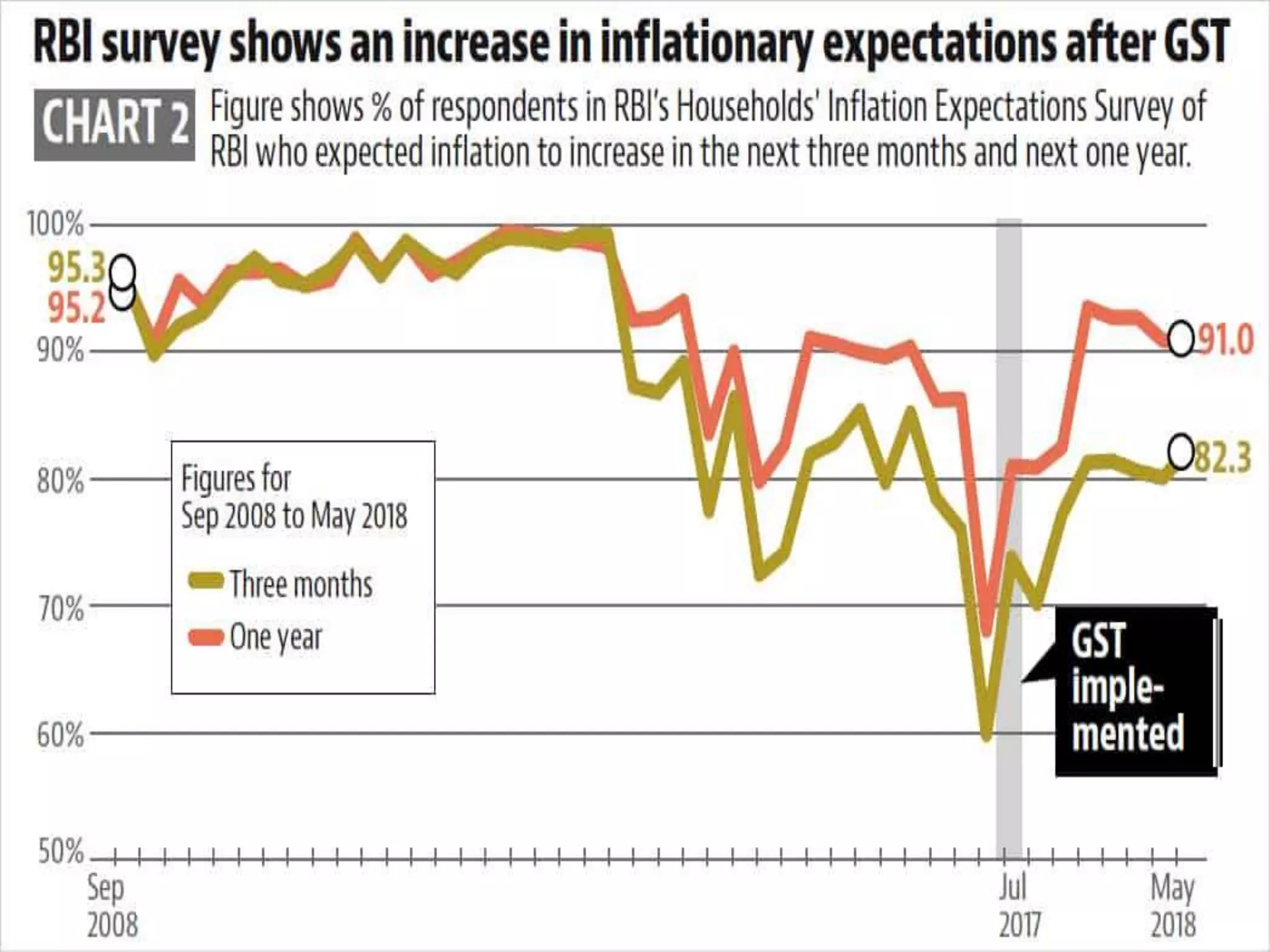
GST
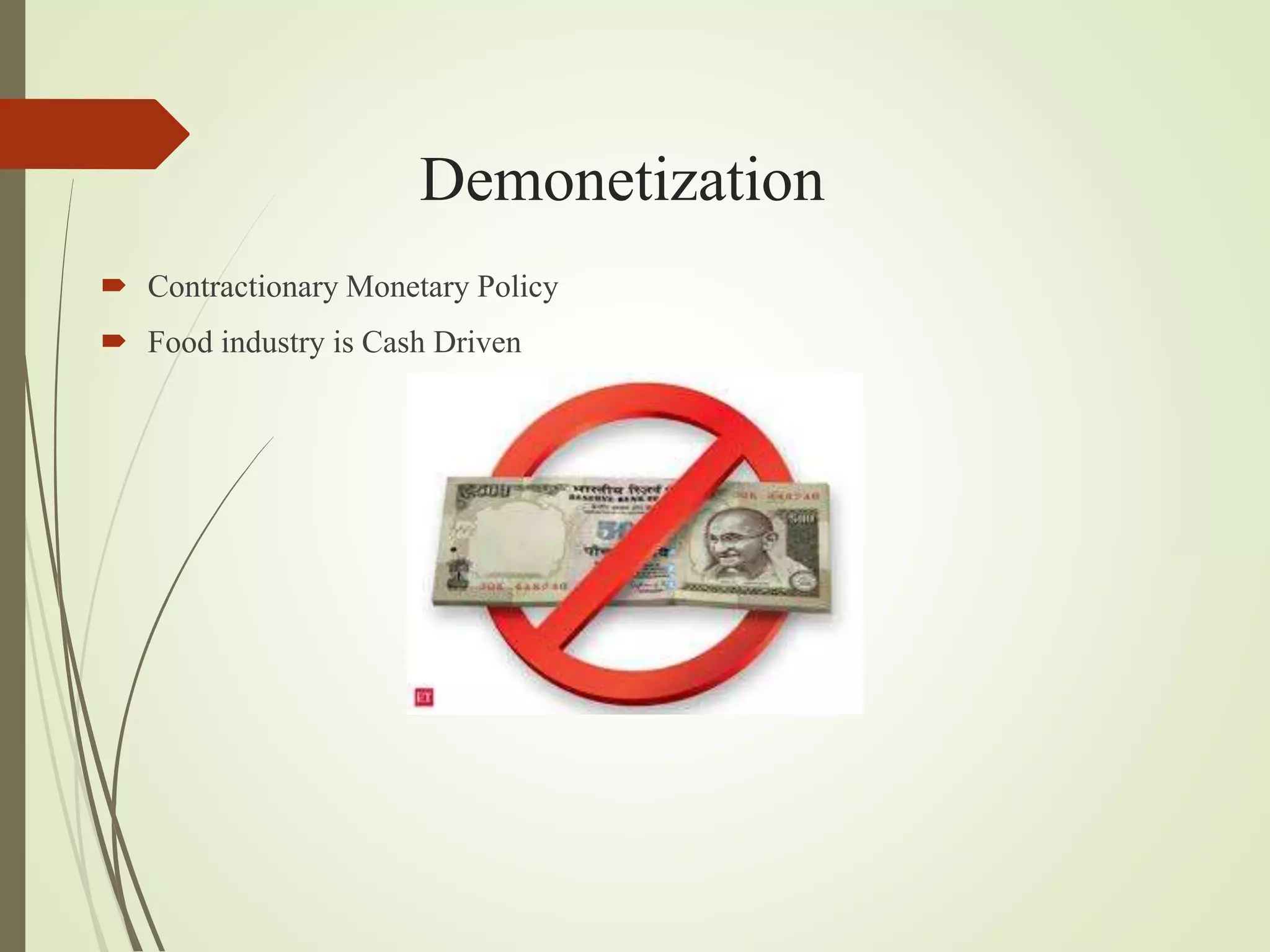
Demonetization
 Contractionary Monetary Policy
 Food industry is Cash Driven
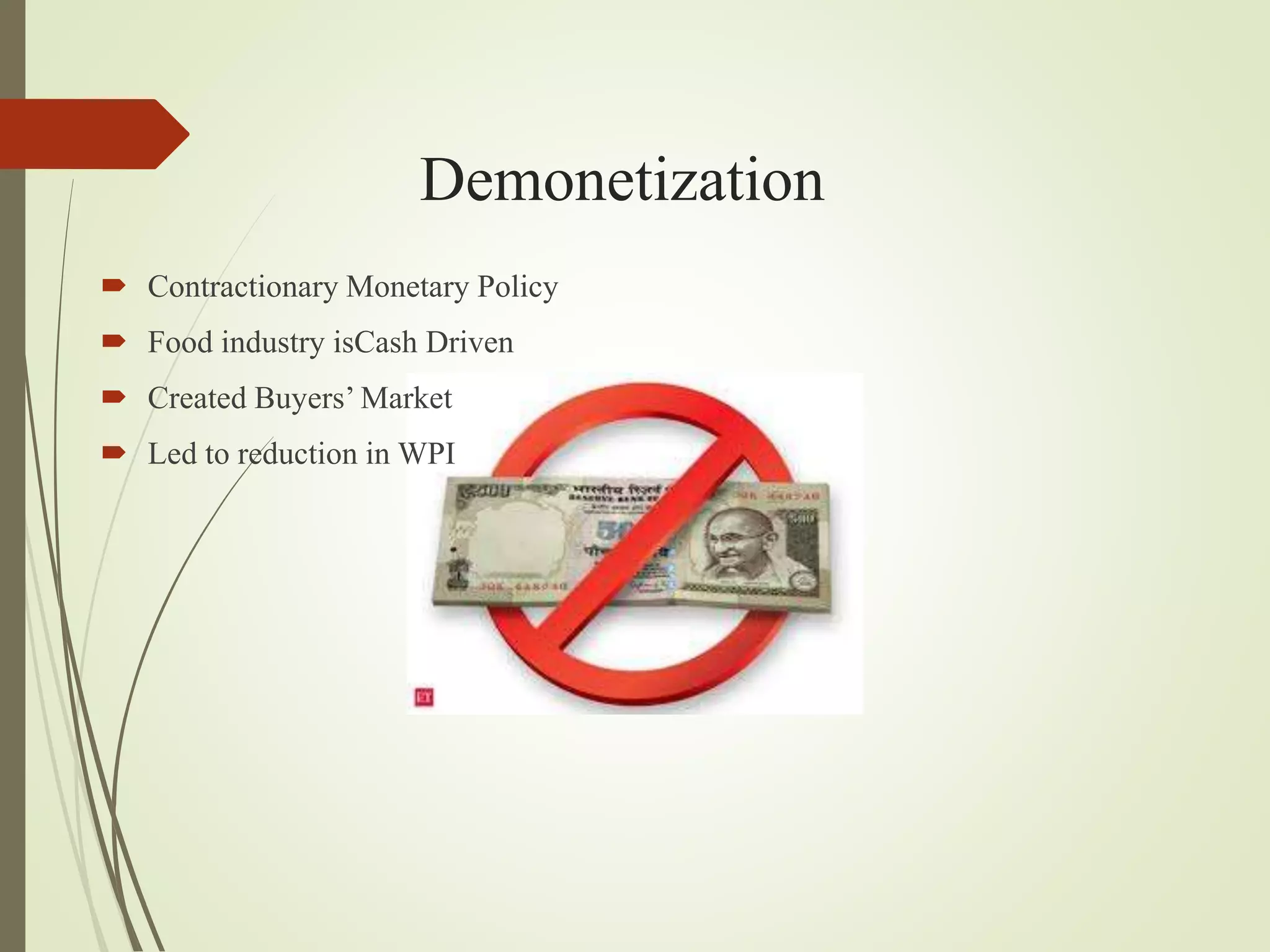
Demonetization
 Contractionary Monetary Policy
 Food industry isCash Driven
 Created Buyers’ Market
 Led to reduction in WPI
PRESENT SCENARIO
 Advisories are issued at regular interval for states
 Secretory Level inter ministerial committees are formed to monitor and control
food prices
 Higher MSP has been introduced for many crops
 Price Stabilisation Fund(PSF) has been implemented
 Stock holding limit for sugar
Strategies to control inflation in india

Strategies to control inflation in india

  • 1.
    Strategies to copeup inflation in India Presented to: Presented By: Mr. Karan Sabharwal Akshu Grag (BM-18075) Charu Kamboj (BM-18091) Mayank Walia (BM-18122) Bhoopendra Singh (BM-18087) Digvijay Malik (BM-18104)
  • 2.
    Major Causes leadingto Inflation in India. Increase in money supply Deficit financing Increase in government expenditure Inadequate agricultural and industrial growth Rising taxes Rising import prices
  • 3.
    Measures of inflation 1.Monetary Measures I. Credit Control II. Demonetisation of Currency III. Issue of New Currency 2. Fiscal Measures I. Reduction in Unnecessary Expenditure II. Increase in Taxes III. Increase in Savings
  • 4.
    Price control Price controland rationing is another measure of direct control to check inflation. Price control means fixing an upper limit for the prices of essential consumer goods. They are the maximum prices fixed by law and anybody charging more than these prices is punished by law. But it is difficult to administer price control.
  • 5.
    STEPS TAKEN TOCONTROL INFLATION • Measures taken under Fiscal Development includes :- • Measures under INDIRECT taxes :- • Custom duties changes to incentivize “Make in India” • Basic custom duty was reduced on inputs and raw material ex: solar tempered glasses for solar panels. • Basic custom duty was increased on specified goods manufactured in significant quantity ex: stainless steel for manufacturing fibre cables , printers , mobile phones . • Export duty of 15% has been imposed on other Aluminium ores . • Basic custom duty has increased on crude and edible oils ex: Palm Oil , sunflower Oil. • Under GST services providers were exempted to have registration if their annual turnover is less than 20 lakh. This will reduce compliance cost i.e. (exp. of time and money in confirming with govt. req. such as legislations) of small service providers. • Businesses with annual turnover up to 1.5 cores are required to file quarterly returns. These businesses are also not required to pay GST at the time of advance receipts on account of supply of goods. • Measures under DIRECT taxes :- • Individuals of income between 2.5-5 lakhs now to pay 5% tax from 10%. • Surcharge is imposed on individuals of income between 50lakhs-1crores.
  • 6.
    STEPS TAKEN TOCONTROL INFLATION •Measures taken to control Food Inflation includes :- • Issue of Advisories to State Governments to take strict actions on hoarding and black marketing , effectively enforce Essential Commodity Act 1955 . • Higher MSP has been announced to enhance production and availability of food items. • A scheme called Price Stabilization Fund (PSF) is being implemented to control price of agriculture commodities like Pulses , Onion. • Government improved the buffer stock of Pulses from 1.5 lakh MT to 20 lakh MT . • Export of edible oils was allowed only in branded consumer packs of up to 5kg with a minimum price of 900 USD , To increase domestic production this restriction was removed from oils except for Palm Oil , Mustard Oil , Sunflower Oil . • Governments has imposed stock holding limits on stockers/dealers of sugar till April 2018 . • Government has imposed 20% duty on export of sugar to promote availability . • States and UTs are advised to impose stock limit on Onion and also requested to indicate their need of same to reduce excess import. •Financial Year (2017-18) started with annual inflation of 3% based at Consumer Price Index. •Lowest inflation rate was in JUNE 2017 i.e. 1.5 %. •Inflation rate based on Wholesale Price Index was 2.9% for (April-December)2017- 18. •5 states that recorded inflation of more than 4 % are J&K , Delhi , Kerala , Tamil Nadu , Himachal Pradesh. •Lowest inflation rate was in Orissa followed by U.P. , Bihar , Chhattisgarh .
  • 7.
    Minimum Support Price MSP is a price fixed by the government of India to protect the farmers against excessive fall in price during bumper production years. Objectives of MSP  To provide a fair return to the farmers and to protect the interests of consumers by keeping the prices of food and other agriculture commodities at reasonable levels.
  • 8.
    Challenges Faced bythe Government to Implement MSP  Method of calculating MSP  Farmer’s Registration  Infrastructure
  • 9.
     Method ofcalculating MSP: The farmers have not been happy about the method government uses to calculate cost of production. The government includes operational expenses (inputs costs and family labour), which excludes the expenses farmer incurs on rent on land, or capital, while calculating the cost of production.  Farmer’s Registration: The government drafts specific definition of a farmer in the law, whereby, if an agricultural labourer or a cultivation abides by those definitions, they are registered with the government. The problem arises when farmers do not fit within these definitions, that is, if the farmers do not have their own agricultural land or if the size of the land is less than 1 hectare.  Infrastructure: The government don’t have the sufficient infrastructure. An initiative of electronic- National Agriculture Market (e-NAM) has not been yet connected to all the required regions.
  • 10.
    Price Stabilization fundScheme  This scheme helps to regulate the price volatility of important agro- horticultural commodities like onions, potatoes and pulses.  This scheme was aimed to provide relief to consumers but was mainly used to provide relief to farmers. Objectives of PSF  The scheme promotes direct purchase from farmers/ farmers association at farm gate/ Mandi.  The fund allocated under PSF has been primarily utilized towards building the buffer of up to 20lakh tonnes of pulses.
  • 11.
    Challenges Faced bythe Government to Implement PSF  The Price Stabilisation Fund scheme requires growers/farmers to possess operational landholding of a minimum of 10 hectares; other farmers are not covered under this scheme.  If planters somehow receive a good price for the produce, they may not have the incentive to contribute even meagre amount of INR 500 as required by the scheme towards the fund.  The aim of the Price Stabilisation Fund scheme is to provide relief to farmers only during a distress crop year.
  • 12.
  • 13.
    What is wagepush inflation ?  It is an overall rise in the cost of goods that results from a rise in wages.  The overall increased cost of goods and services has a circular effect on the wage increase.  As goods and services in the market overall increase, higher wages will be needed to compensate for the increased prices of consumer goods.  The most common reason for raising wages is an increase to the minimum wage.
  • 14.
     Wage pushinflation has an inflationary spiral effect.  To check this vicious circle of wages-chasing prices, an important measure will be to exercise control over wages.  The Wage Control Method is typically used in the situation where the inflation is of cost-push and wage-push nature.  Under this method, a rise in the wage rate is restricted through a ceiling imposed on the wage incomes in both the public and private sectors. This ceiling is called as “wage-freeze.”  It reduces the ability of affected workers to spend thus further slowing the economy.  a person would find themselves with less spending power than before.
  • 15.
     If thelabor unions are strong and oppose the wage freeze; then the government uses a weaker method called as “Jawboning” to control inflation.  “ Wage Guideposts” is prepared with a consent and common agreement between the government representatives, businessmen and trade unions.  It is made to have a controlled and disciplined upward movement in the wages and prices.  Under this method, the wages and prices are administered by the board of representatives.  Wage and price controls suppress inflation, but do not cure it.  If demand continues to rise, despite the controls, inflation is subdued, but not eliminated.  Excess demand creates inflationary pressures underneath the controls.  If nothing is done to eliminate excess demand in the various markets, removal of the controls will permit prices to rise to market levels.
  • 16.
  • 17.
    Low Productivity, High Production Cost Less Supply More Demand, Rising Prices DeterioratingQuality of life and Economy More Unskilled labour added to the existing pool
  • 18.
    “THE PLAN” SKILL DEVELOPMENT SkillIndia PMKVY DDUGKY PMKK SMAM SELF RELIANCE MUDRA Yojana Loan to MSME in 59 minutes SFDA MAFALDA Seed Development ENVIRONMENT Less Paperwork Import Restrictions Export Restrictions Improved Infrastructure Make In India
  • 19.
    SKILL INDIA  Createopportunities  Raise confidence  Improve productivity  Give direction through proper skill development
  • 20.
    MUDRA YOJNA  Provideseed funding  Shishu loan (up to 50000 rupees)  Kishore Loan (Rs. 50,000 to Rs. 500,000)  Tarun Loan(Rs.500,000 to Rs.1000,000)
  • 21.
    “THE PLAN” SKILL DEVELOPMENT SkillIndia PMKVY DDUGKY PMKK SMAM SELF RELIANCE MUDRA Yojana Loan to MSME in 59 minutes SFDA MAFALDA Seed Development ENVIRONMENT Less Paperwork Import Restrictions Export Restrictions Improved Infrastructure Make In India
  • 22.
  • 25.
    Demonetization  Contractionary MonetaryPolicy  Food industry is Cash Driven
  • 27.
    Demonetization  Contractionary MonetaryPolicy  Food industry isCash Driven  Created Buyers’ Market  Led to reduction in WPI
  • 28.
    PRESENT SCENARIO  Advisoriesare issued at regular interval for states  Secretory Level inter ministerial committees are formed to monitor and control food prices  Higher MSP has been introduced for many crops  Price Stabilisation Fund(PSF) has been implemented  Stock holding limit for sugar