Developing Strategies for Greater  KL/Klang Valley RICS Asia KL Conference 6 April 2011 Crowne Plaza Ahmad Suhaili Idrus Director, PEMANDU
Greater KL 20-20 by 2020 To be among the world’s  Top 20 performing cities on economic growth and liveability rankings by 2020 6 April 2011 RICS Conference Crowne Plaza KL
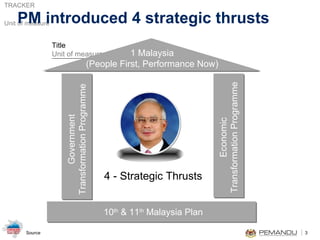
PM introduced 4 strategic thrusts 1 Malaysia (People First, Performance Now) Government Transformation Programme Economic Transformation Programme 10 th  & 11 th  Malaysia Plan 4 - Strategic Thrusts
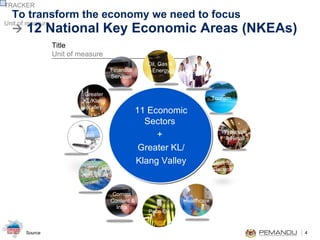
To transform the economy we need to focus     12 National Key Economic Areas (NKEAs) Comms Content & Infra 11 Economic Sectors  +  Greater KL/ Klang Valley Wholesale & Retail Business  Services Oil, Gas &  Energy Palm Oil Healthcare Financial Services Greater  KL/Klang Valley Agriculture Tourism Education Electrical & Electronics
Table of Contents 0 1 2 3 4 Overview Greater KL, Magnet Greater KL, Connect Greater KL, New Places Greater KL, Enhanced Services
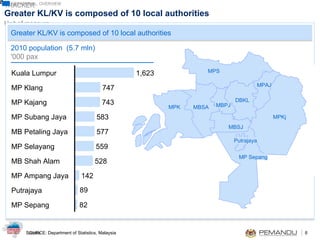
Greater KL/KV is composed of 10 local authorities 2 GREATER KL: OVERVIEW SOURCE: Department of Statistics, Malaysia Greater KL/KV is composed of 10 local authorities 2010 population  (5.7 mln) '000 pax MP Sepang Putrajaya  MP Ampang Jaya  142 MB Shah Alam  528 MP Selayang  559 MB Petaling Jaya  577 MP Subang Jaya  583 MP Kajang  743 MP Klang  747 Kuala Lumpur  1,623 MPKj MPAJ MPS DBKL MBPJ MBSJ MBSA Putrajaya MP Sepang MPK
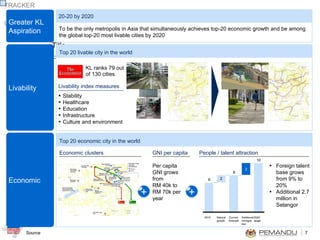
20-20 by 2020 Top 20 livable city in the world Economic clusters People / talent attraction Per capita GNI grows from  RM 40k to RM 70k per year Foreign talent base grows from 9% to 20% Additional 2.7 million in Selangor GNI per capita To be the only metropolis in Asia that simultaneously achieves top-20 economic growth and be among the global top-20 most livable cities by 2020 Stability Healthcare Education Infrastructure Culture and environment Livability index measures KL ranks 79 out of 130 cities Top 20  economic city in the world Current forecast 2010 Additional Immigra- tion Natural growth 3 2020 target Livability Greater KL Aspiration Economic + +
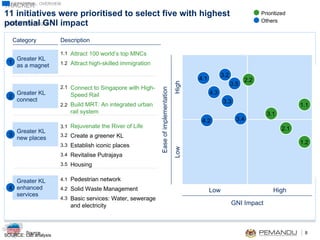
11 initiatives were prioritised to select five with highest  potential GNI impact SOURCE: Lab analysis Description Category Greater KL  as a magnet 1 Attract 100 world’s top MNCs Attract high-skilled immigration  1.1 1.2 Greater KL connect 2 Connect to Singapore with High-Speed Rail Build MRT: An integrated urban rail system 2.1 2.2 Greater KL new places 3 Rejuvenate the River of Life Create a greener KL Establish iconic places Revitalise Putrajaya Housing 3.1 3.3 3.2 Greater KL enhanced services 4 Pedestrian network Solid Waste Management  Basic services: Water, sewerage and electricity 4.1 4.2 Low GNI Impact High Low Ease of implementation High 3.2 1.1 1.2 2.1 2.2 3.1 4.2 4.1 3.3 3.4 4.3 3.4 4.3 Prioritized Others GREATER KL: OVERVIEW 3.5 3.5
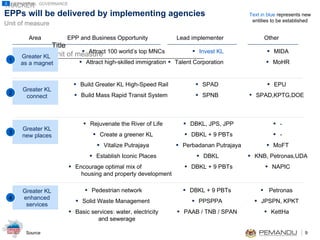
EPPs will be delivered by implementing agencies GREATER KL: GOVERNANCE 5 Greater KL  as a magnet 1 Attract 100 world’s top MNCs Attract high-skilled immigration  Greater KL connect 2 Build Greater KL High-Speed Rail Build Mass Rapid Transit System Greater KL new places 3 Rejuvenate the River of Life Create a greener KL Vitalize Putrajaya Establish Iconic Places Encourage optimal mix of  housing and property development Greater KL enhanced services 4 Pedestrian network Solid Waste Management  Basic services: water, electricity and sewerage Area EPP and Business Opportunity Invest KL  Talent Corporation  SPAD SPNB DBKL, JPS, JPP DBKL + 9 PBTs Perbadanan Putrajaya DBKL  DBKL + 9 PBTs DBKL + 9 PBTs PPSPPA PAAB / TNB / SPAN Lead implementer MIDA MoHR EPU SPAD,KPTG,DOE - - MoFT KNB, Petronas,UDA NAPIC Petronas JPSPN, KPKT KettHa Other Text in blue  represents new entities to be established
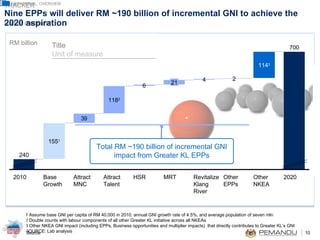
Nine EPPs will deliver RM ~190 billion of incremental GNI to achieve the 2020 aspiration  1 Assume base GNI per capita of RM 40,000 in 2010, annual GNI growth rate of 4.5%, and average population of seven mln  2 Double counts with labour components of all other Greater KL initiative across all NKEAs 3 Other NKEA GNI impact (including EPPs, Business opportunities and multiplier impacts)  that directly contributes to Greater KL’s GNI SOURCE: Lab analysis Attract Talent 118 2 Attract MNC 2010 240 155 1 Base Growth 700 Other NKEA 114 3 Other EPPs 2 Revitalize Klang River 4 MRT 21 HSR 6 2020 RM billion Total RM ~190 billion of incremental GNI impact from Greater KL EPPs GREATER KL: OVERVIEW
Greater KL, Magnet 1. 1 MNC Attraction 1. 2 Talent Attraction
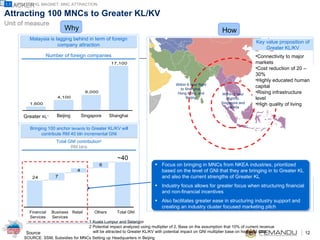
Attracting 100 MNCs to Greater KL/KV GREATER KL MAGNET: MNC ATTRACTION 1.1 How Why Key value proposition of Greater KL/KV Connectivity to major markets  Cost reduction of 20 – 30% Highly educated human capital Rising infrastructure level High quality of living Focus on bringing in MNCs from NKEA industries, prioritized based on the level of GNI that they are bringing in to Greater KL and also the current strengths of Greater KL Industry focus allows for greater focus when structuring financial and non-financial incentives Also facilitates greater ease in structuring industry support and creating an industry cluster focused marketing pitch SOURCE: SSM; Subsidies for MNCs Setting up Headquarters in Beijing  1 Kuala Lumpur and Selangor 2 Potential impact analyzed using multiplier of 2, Base on the assumption that 10% of current revenue  will be attracted to Greater KL/KV with potential impact on GNI multiplier base on historical data Shanghai Singapore Beijing Greater   KL 1 Number of foreign companies Malaysia is lagging behind in term of foreign company attraction Total GNI ~40 Others Retail Business Services Financial  S ervices Total GNI contribution 2 RM blns Bringing 100 anchor  tenants  to Greater KL/KV will contribute RM 40 bln incremental GNI Within 2 hour flight to Singapore and Jakarta Within 6 hour flight to Shanghai, Hong Kong, and Beijing
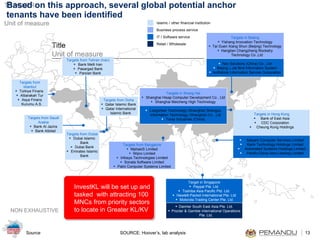
Based on this approach, several global potential anchor tenants have been identified SOURCE: Hoover’s, lab analysis NON EXHAUSTIVE Targets from Istanbul Türkiye Finans  Albarakah Tur Asya Finans Kurumu A.S. Targets from Dubai Dubai Islamic Bank Dubai Bank Emirates Islamic Bank Targets from Tehran (Iran) Bank Melli Iran Pasargad Bank Parsian Bank Targets from Doha Qatar Islamic Bank Qatar International Islamic Bank Targets in Beijing Yishang Innovation Technology Tai Guen Xiang Shun (Beijing) Technology Hangtian Changzheng Rocketry Technology Co ,Ltd Nec Solutions (China) Co , Ltd Beijing Jade Bird Information System Isoftstone Information Service Corporation Targets in Hong Kong Bank of East Asia CDC Corporation Cheung Kong Holdings Satyam Computer Services Limited Karin Technology Holdings Limited Automated Systems Holdings Limited Pacific-China Aero Leasing Limited Targets from Bangalore MphasiS Limited Wipro Limited Infosys Technologies Limited Sonata Software Limited Patni Computer Systems Limited Targets from Saudi Arabia Bank Al Jazira Bank Albilad InvestKL will be set up and tasked  w ith attracting 100 MNCs from priority sectors to locate in Greater KL/KV   Islamic / other financial institution Business process service IT / Software service Retail / Wholesale Targets in Shang Hai Shanghai Hisap Computer Development Co , Ltd Shanghai Meicheng High Technology Longcheer Technology (Shanghai) Shengqu Information Technology (Shanghai) Co , Ltd Toray Industries (China) Target in Singapore Paypal Pte. Ltd. Toshiba Asia Pacific Ptd. Ltd. Hewlett-Packet International Pte. Ltd Motorola Trading Center Pte. Ltd Daimler South East Asia Pte. Ltd. Procter & Gamble International Operations Pte. Ltd.
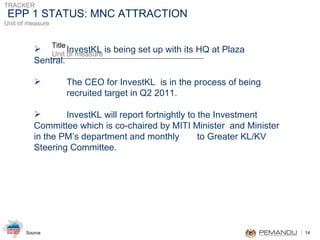
EPP 1 STATUS: MNC ATTRACTION InvestKL is being set up with its HQ at Plaza  Sentral. The CEO for InvestKL  is in the process of being  recruited target in Q2 2011.  InvestKL will report fortnightly to the Investment  Committee which is co-chaired by MITI Minister  and Minister in the PM’s department and monthly  to Greater KL/KV Steering Committee.
Greater KL, Magnet 1. 1 MNC Attraction 1. 2 Talent Attraction
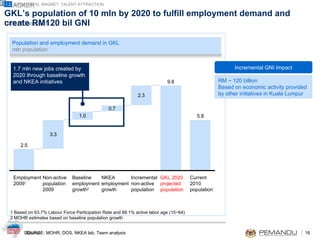
GKL’s population of 10 mln by 2020 to fulfill employment demand and create RM120 bil GNI 2 SOURCE: MOHR, DOS, NKEA lab, Team analysis Incremental GNI Impact RM ~ 120 billion Based on economic activity provided by other initiatives in Kuala Lumpur Employment 2009 1 Baseline employment growth 2 Non-active population 2009 Current 2010 population GKL 2020 projected population Incremental non-active population NKEA employment growth 1 Based on 63.7% Labour Force Participation Rate and 68.1% active labor age (15~64) 2 MOHR estimates based on baseline population growth  Population and employment demand in GKL mln population GREATER KL MAGNET: TALENT ATTRACTION 1.2 48% 1.7 mln new jobs created by 2020 through baseline growth and NKEA initiatives
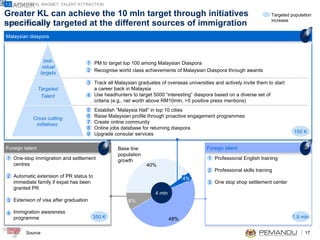
Greater KL can achieve the 10 mln target through initiatives specifically targeted at the different sources of immigration 8 Track all Malaysian graduates of overseas universities and actively invite them to start a career back in Malaysia Use headhunters to target 5000 “interesting” diaspora based on a diverse set of criteria (e.g., net worth above RM10mln, >5 positive press mentions) Establish ”Malaysia Hall” in top 10 cities Raise Malaysian profile through proactive engagement programmes Create online community Online jobs database for returning diaspora Upgrade consular services Indi- vidual targets Targeted Talent Cross cutting initiatives  One-stop immigration and settlement centres Automatic extension of PR status to immediate family if expat has been granted PR Extension of visa after graduation Immigration awareness  programme Base line population growth 40% 8% 48% 4% Targeted population increase 4 mln PM to target top 100 among Malaysian Diaspora  Recognise world class achievements of Malaysian Diaspora through awards  150 K 1 2 3 4 5 6 7 8 9 1 2 3 4 350 K Professional English training Professional skills training One stop shop settlement center 1 2 3 1.9 mln Malaysian diaspora Foreign talent Foreign talent GREATER KL MAGNET: TALENT ATTRACTION 1.2 A C B
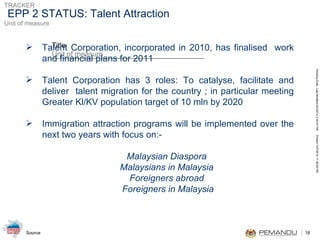
Talent Corporation, incorporated in 2010, has finalised  work and financial plans for 2011 Talent Corporation has 3 roles: To catalyse, facilitate and deliver  talent migration for the country ; in particular meeting Greater Kl/KV population target of 10 mln by 2020 Immigration attraction programs will be implemented over the next two years with focus on :-  Malaysian Diaspora  Malaysians in Malaysia  Foreigners abroad  Foreigners in Malaysia EPP 2 STATUS: Talent Attraction
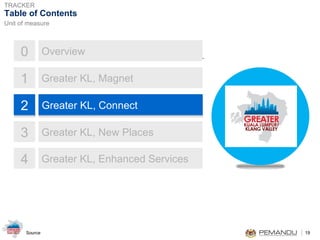
Table of Contents 0 1 2 3 4 Overview Greater KL, Magnet Greater KL, Connect Greater KL, New Places Greater KL, Enhanced Services
Greater KL, Connect 2. 1 High Speed Rail 2. 3 Mass Rapid Transit
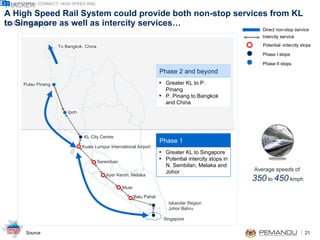
A High Speed Rail System could provide both non-stop services from KL to Singapore as well as intercity services… Average speeds of  350  to  450   kmph GREATER KL CONNECT: HIGH SPEED RAIL 2.1 Direct n on-stop service Potential -i ntercity stops Phase I stops Phase II stops Intercity  service Batu Pahat Iskandar Region Johor Bahru Ayer Keroh, Melaka Singapore KL City Centre Kuala Lumpur International Airport Seremban Muar Phase 2 and beyond Greater KL to P. Pinang P. Pinang to Bangkok and China Phase 1 Greater KL to Singapore Potential intercity stops in N. Sembilan, Melaka and Johor Pulau Pinang To Bangkok, China Ipoh
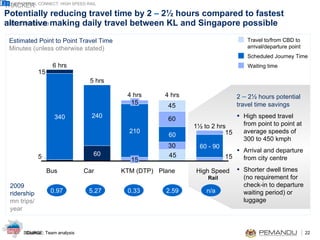
Potentially reducing travel time by 2  –  2 ½  hours compared to fastest alternative making daily travel between KL and Singapore possible 0.97 5.27 0.33 2.59 n/a Estimated Point to Point Travel Time Minutes (unless otherwise stated) 2009 ridership mn trips/ year 2  –  2 ½  hours potential travel time savings High speed travel from point to point at average speeds of 300 to 450 kmph Arrival and departure from city centre Shorter dwell times (no requirement for check-in to departure waiting period) or luggage  SOURCE: Team analysis High Speed Rail 1 ½  to 2 hrs 60 - 90 Plane 4 hrs 60 KTM (DTP) 4 hrs 15 210 15 Car 5 hrs 60 240 Bus  6 hrs 340 Waiting time Scheduled Journey Time Travel to/from CBD to arrival/departure point GREATER KL CONNECT: HIGH SPEED RAIL 2.1
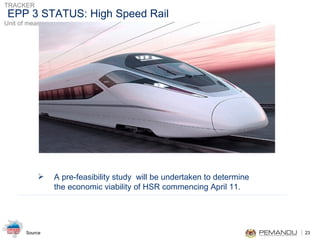
A pre-feasibility study  will be undertaken to determine  the economic viability of HSR commencing April 11.  EPP 3 STATUS: High Speed Rail
Greater KL, Connect 2. 1 High Speed Rail 2. 3 Mass Rapid Transit
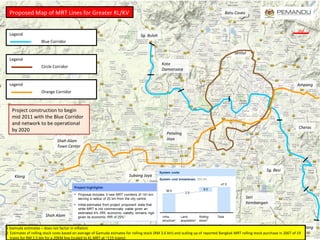
Seri Kembangan Putra Heights Shah Alam Klang Shah Alam Town Center Subang Jaya Batu Caves Proposed Map of MRT Lines for Greater KL/KV  Kajang Sg. Buloh Kota Damansara Petaling Jaya Sentul Cheras Sg. Besi Seri Kembangan Ampang Legend Circle Corridor Legend Orange Corridor 1  Gamuda estimates – does not factor in inflation 2 Estimates of rolling stock costs based on average of Gamuda esimates for rolling stock (RM 3.6 bln) and scaling up of reported Bangkok MRT rolling stock purchase in 2007 of 19 trains for RM 2.5 bln for a 20KM line (scaled to KL MRT at ~115 trains) Project construction to begin mid 2011 with the Blue Corridor and network to be operational by 2020 2km Legend Blue Corridor
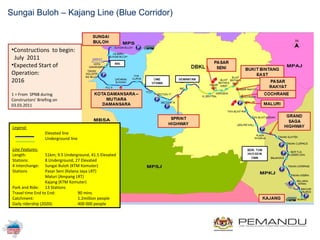
Legend: Elevated line Underground line Line Features: Length:  51km; 9.5 Underground, 41.5 Elevated Stations: 8 Underground, 27 Elevated 4 Interchange: Sungai Buloh (KTM Komuter) Stations Pasar Seni (Kelana Jaya LRT) Maluri (Ampang LRT) Kajang (KTM Komuter) Park and Ride: 13 Stations   Travel time End to End: 90 mins Catchment: 1.2million people Daily ridership (2020): 400 000 people Constructions  to begin:  July  2011 Expected Start of Operation:  2016 1 = From  SPNB during Constructors’ Briefing on 03.03.2011 Sungai Buloh – Kajang Line (Blue Corridor)
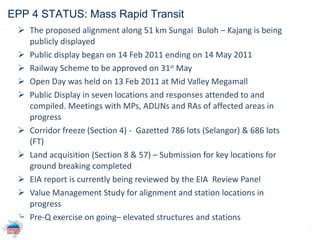
The proposed alignment along 51 km Sungai  Buloh – Kajang is being publicly displayed Public display began on 14 Feb 2011 ending on 14 May 2011 Railway Scheme to be approved on 31 st  May Open Day was held on 13 Feb 2011 at Mid Valley Megamall Public Display in seven locations and responses attended to and compiled.  Meetings with MPs, ADUNs and RAs of affected areas in progress Corridor freeze (Section 4) -  Gazetted 786 lots (Selangor) & 686 lots (FT) Land acquisition (Section 8 & 57) – Submission for key locations for ground breaking completed EIA report is currently being reviewed by the EIA  Review Panel  Value Management Study for alignment and station locations in progress Pre-Q exercise on going– elevated structures and stations   EPP 4 STATUS: Mass Rapid Transit
Table of Contents 0 1 2 3 4 Overview Greater KL, Magnet Greater KL, Connect Greater KL, New Places Greater KL, Enhanced Services
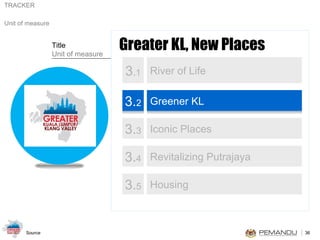
Greater KL, New Places 3. 1 River of Life  3. 2 Greener KL 3. 3 Iconic Places 3. 4 Revitalizing Putrajaya 3. 5 Housing
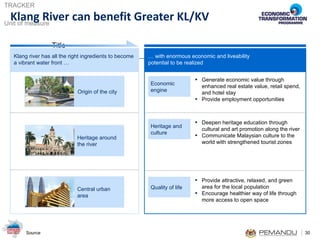
Klang River can benefit Greater KL/KV Klang river has all the right ingredients to become a vibrant water front … …  with enormous economic and liveability  potential to be realized Origin of the city Economic engine Generate economic value through enhanced real estate value, retail spend, and hotel stay Provide employment opportunities Central urban area Quality of life Provide attractive, relaxed, and green area for the local population Encourage healthier way of life through more access to open space Heritage around the river Heritage and culture Deepen heritage education through cultural and art promotion along the river Communicate Malaysian culture to the world with strengthened tourist zones
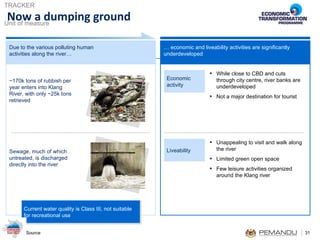
Now a dumping ground …  economic and liveability activities are significantly underdeveloped Due to the various polluting human  activities along the river… ~170k tons of rubbish per year enters into Klang River, with only ~25k tons retrieved Sewage, much of which untreated, is discharged directly into the river Current water quality is Class III, not suitable for recreational use Economic activity While close to CBD and cuts through city centre, river banks are underdeveloped  Not a major destination for tourist Liveability Unappealing to visit and walk along the river Limited green open space Few leisure activities organized around the Klang river
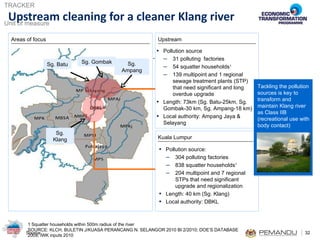
Upstream cleaning for a cleaner Klang river Pollution source 31 polluting  factories 54 squatter households 1 139 multipoint and 1 regional sewage treatment plants (STP) that need significant and long overdue upgrade Length: 73km (Sg. Batu-25km, Sg. Gombak-30 km, Sg. Ampang-18 km) Local authority: Ampang Jaya & Selayang Pollution source: 304 polluting factories 838 squatter households 1 204 multipoint and 7 regional STPs that need significant upgrade and regionalization Length: 40 km (Sg. Klang) Local authority: DBKL Sg. Batu Sg. Gombak Sg. Ampang 1 Squatter households within 500m radius of the river SOURCE: KLCH, BULETIN J/KUASA PERANCANG N. SELANGOR 2010 BI 2/2010; DOE’S DATABASE 2009, IWK inputs 2010 Aspiration in cleaning river Areas of focus Upstream Kuala Lumpur Sg. Klang Tackling the pollution sources is key to transform and maintain Klang river as Class IIB (recreational use with body contact)
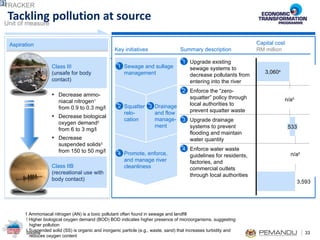
Tackling pollution at source 3 1 Ammoniacal nitrogen (AN) is a toxic pollutant often found in sewage and landfill 2 Higher biological oxygen demand (BOD) BOD indicates higher presence of microorganisms, suggesting higher pollution 3 Suspended solid (SS) is organic and inorganic particle (e.g., waste, sand) that increases turbidity and reduces oxygen content Aspiration Decrease ammo-niacal nitrogen 1  from 0.9 to 0.3 mg/l Decrease biological oxygen demand 2  from 6 to 3 mg/l Decrease suspended solids 3  from 150 to 50 mg/l Class III (unsafe for body contact) Class IIB (recreational use with body contact) Sewage and sullage management  Squatter relo-cation Drainage  and flow  manage-ment Promote, enforce, and manage river cleanliness Summary description Key initiatives Capital cost  RM million Upgrade existing sewage systems to decrease pollutants from entering into the river E nforc e  the “zero-squatter” policy through local authorities  to prevent squatter waste Upgrade drainage systems to  prevent flooding and maintain water quantity Enforce  water waste  guidelines for residents, factories, and commercial outlets through local authorities 3,593 n/a 5 533 n/a 5 3,060 4 1 2 3 4 1 2 3 4
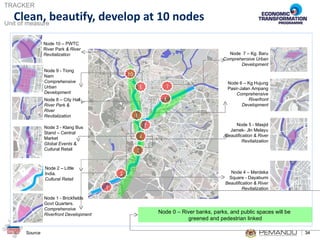
Clean, beautify, develop at 10 nodes   1 3 5 6 8 9 7 2 4 10 Node 0 – River banks, parks, and public spaces will be  greened and pedestrian linked Node 1 - Brickfields Govt Quarters. Comprehensive Riverfront Development Node 3 - Klang Bus Stand – Central Market Global Events & Cultu ral Retail Node 4 – Merdeka Square - Dayabumi  Beautification & River Revitalization Node 8 – City Hall River Park & River Revitalization Node 5 - Masjid Jamek- Jln Melayu Beautification & River Revitalization Node 10 – PWTC  River Park  & River Revitalization Node 9 - Tiong Nam Comprehensive Urban Development Node 6 – Kg Hujung Pasir-Jalan Ampang Comprehensive Riverfront Development Node  7 – Kg. Baru Comprehensive Urban Development Node 2 – Little India. Cultural Retail
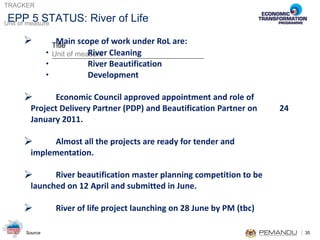
Main scope of work under RoL are:  River Cleaning River Beautification Development Economic Council approved appointment and role of  Project Delivery Partner (PDP) and Beautification Partner on  24 January 2011. Almost all the projects are ready for tender and  implementation. River beautification master planning competition to be  launched on 12 April and submitted in June. River of life project launching on 28 June by PM (tbc) EPP 5 STATUS: River of Life
Greater KL, New Places 3 . 1 River of Life  3. 2 Greener KL 3. 3 Iconic Places 3. 4 Revitalizing Putrajaya 3. 5 Housing
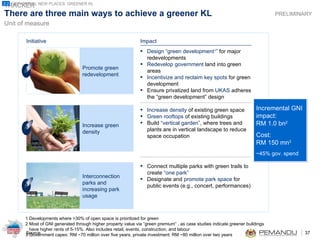
There are three main ways to achieve a greener KL PRELIMINARY 1 Developments where >30% of open space is prioritized for green 2 Most of GNI generated through higher property value via “green premium” , as case studies indicate greener buildings have higher rents of 5-15%. Also includes retail, events, construction, and labour 3 Government capex: RM ~70 million over five years; private investment: RM ~80 million over two years Impact  Initiative  Promote green redevelopment  Design “green development 1 ”  for major redevelopments Redevelop government  land into green areas  Incentivize and reclaim key spots  for green development Ensure privatized land from  UKAS  adheres the “green development” design Increase green density  Increase density  of existing green space Green rooftops  of existing buildings Build  “vertical garden” , where trees and plants are in vertical landscape to reduce space occupation Interconnection parks and increasing park usage Connect multiple parks with green trails to create  “one park” Designate and  promote park space  for public events (e.g., concert, performances)  Incremental GNI impact:  RM 1.0 bn 2 Cost:  RM 150 mn 3 ~45% gov. spend GREATER KL NEW PLACES: GREENER KL 3.2 1 2 3
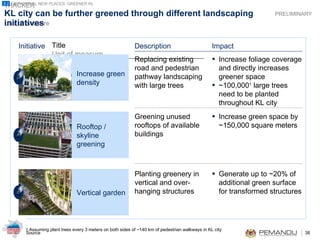
KL city  can be further greened through different   landscaping  initiatives PRELIMINARY Initiative  Increase green density Replacing existing road and pedestrian pathway landscaping with large trees Increase foliage coverage and directly increases greener space ~100,000 1  large trees need to be planted throughout KL city Greening unused rooftops of available buildings Increase green space by ~150,000 square meters Planting greenery in vertical and over-hanging structures Generate up to ~20% of additional green surface for transformed structures Description  Impact  GREATER KL NEW PLACES: GREENER KL 3.2 1 Assuming plant trees every 3 meters on both sides of ~140 km of pedestrian walkways in KL city Rooftop / skyline greening 2 Vertical garden  3 1
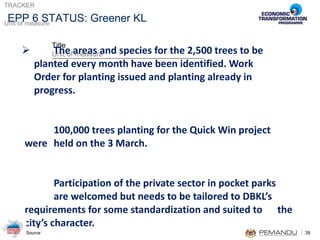
The areas and species for the 2,500 trees to be  planted every month have been identified. Work  Order for planting issued and planting already in  progress. 100,000 trees planting for the Quick Win project  were  held on the 3 March.  Participation of the private sector in pocket parks  are welcomed but needs to be tailored to DBKL’s  requirements for some standardization and suited to  the city’s character.    EPP 6 STATUS: Greener KL
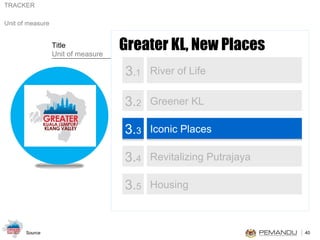
Greater KL, New Places 3 . 1 River of Life  3. 2 Greener KL 3. 3 Iconic Places 3. 4 Revitalizing Putrajaya 3. 5 Housing
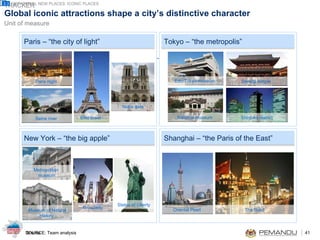
Global iconic attractions shape a city’s distinctive character Paris – “the city of light” New York – “the big apple” Tokyo – “the metropolis”  Shanghai – “the Paris of the East” SOURCE: Team analysis Paris night  Seine river  Eifel tower  Notre dam Metropolitan  museum Museum of Natural History  Broadway Statue of Liberty Shinjuku district National museum  Sensoji temple  Edo-Tokyo museum  Oriental Pearl  The Bund GREATER KL NEW PLACES: ICONIC PLACES 3.3
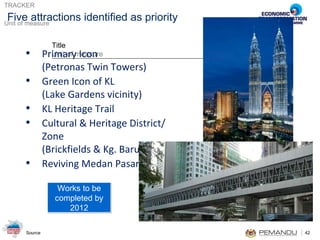
Primary Icon  (Petronas Twin Towers) Green Icon of KL  (Lake Gardens vicinity) KL Heritage Trail Cultural & Heritage District/Zone (Brickfields & Kg. Baru) Reviving Medan Pasar Five attractions identified as priority Works to be completed by 2012
EPP 7 STATUS: Iconic Places Initiatives on Primary Icon are underway as they  will be  carried out by private sector stakeholders.  Their initiatives will include among others, a One- Stop- Centre for tourists and travel trade, website  and visit packages. There is a proposal for a tram route around the  area around Lake Gardens; the type of tram have  been identified. A schematic design of Medan Pasar has been  completed. A detailed design is currently being  worked on.
Greater KL,  Enhanced Services 4. 1 Pedestrian Network 4. 2 Solid Waste Management 4. 3 Basic Services
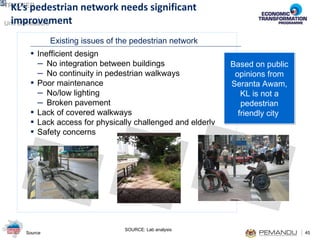
KL’s pedestrian network needs significant  improvement 5 Existing issues of the pedestrian network Inefficient design No integration between buildings No continuity in pedestrian walkways Poor maintenance No/low lighting Broken pavement Lack of covered walkways Lack access for physically challenged and elderly Safety concerns SOURCE: Lab analysis Based on public opinions from Seranta Awam, KL is not a pedestrian friendly city
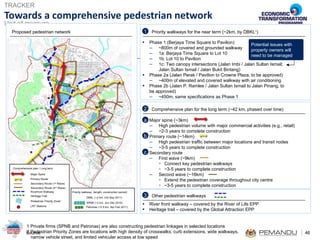
Towards a comprehensive pedestrian network Proposed pedestrian network Priority walkways for the near term (~2km, by DBKL 1 )  1 Phase 1 (Berjaya Time Square to Pavilion) ~800m of covered and grounded walkway 1a: Berjaya Time Square to Lot 10 1b: Lot 10 to Pavilion 1c: Two canopy intersections (Jalan Imbi / Jalan Sultan Ismail; Jalan Sultan Ismail / Jalan Bukit Bintang) Phase 2a (Jalan Perak / Pavilion to Crowne Plaza, to be approved) ~400m of elevated and covered walkway with air conditioning Phase 2b (Jalan P. Ramlee / Jalan Sultan Ismail to Jalan Pinang, to be approved) ~450m, same specifications as Phase 1 Comprehensive plan for the long term (~42 km, phased over time) 2 Major spine (~3km) High pedestrian volume with major commercial activities (e.g., retail) ~2-3 years to complete construction Primary route (~14km) High pedestrian traffic between major locations and transit nodes ~3-5 years to complete construction Secondary route First wave (~9km) Connect key pedestrian walkways ~3-5 years to complete construction Second wave (~16km) Extend the pedestrian coverage throughout city centre ~3-5 years to complete construction Other pedestrian walkways 3 River front walkway – covered by the River of Life EPP Heritage trail – covered by the Global Attraction EPP  a b c 1 Private firms (SPNB and Petronas) are also constructing pedestrian linkages in selected locations 2 Pedestrian Priority Zones are locations with high density of crosswalks, curb extensions, wide walkways,  narrow vehicle street, and limited vehicular access at low speed Major Spine Primary Route Secondary Route (1 st  Wave) Secondary Route (2 nd  Wave) Riverfront Walkway Heritage Trail Pedestrian Priority Zone 2 Comprehensive plan / Long term Priority walkway  (length, construction period) SPNB (~2 km, Jun-Dec 2010) Petronas (~0.5 km, Apr-Feb 2011) DBKL (~2 km, Oct-Sep 2011) LRT Stations Potential issues with property owners will need to be managed
Scope is to improve existing pedestrian walkway for  42 km around the city. Works to remove signages  and advertisement  to deliver barrier free walkways  commenced middle of February. Greener KL and Pedestrian Network are  collaborating on the pedestrian walkway designs on  Jalan Sultan Ismail to create a canopy covered, safe  city concept pedestrian walkway.  Construction scheduled to begin in May.    EPP 8 STATUS: Pedestrian Walkway
Greater KL,  Enhanced Services 4. 1 Pedestrian Network 4. 2 Solid Waste Management 4. 3 Basic Services
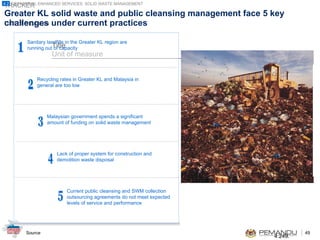
Greater KL solid waste and public cleansing management face 5 key challenges under current practices 4.2 . GREATER KL ENHANCED SERVICES: SOLID WASTE MANAGEMENT 4.2 1 1 Sanitary landfills in the Greater KL region are running out of capacity Malaysian government spends a significant amount of funding on solid waste management 3 3 2 2 Recycling rates in Greater KL and Malaysia in general are too low Lack of proper system for construction and demolition waste disposal 4 4 Current public cleansing and SWM collection outsourcing agreements do not meet expected levels of service and performance 5 5
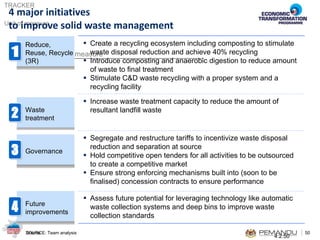
4 major initiatives  to improve solid waste management 4.2. SOURCE: Team analysis Create a recycling ecosystem including composting to stimulate waste disposal reduction and achieve 40% recycling Introduce composting and anaerobic digestion to reduce amount of waste to final treatment Stimulate C&D waste recycling with a proper system and a recycling facility  Reduce, Reuse, Recycle (3R) Increase waste treatment capacity to reduce the amount of resultant landfill waste Waste treatment  Segregate and restructure tariffs to incentivize waste disposal reduction and separation at source Hold competitive open tenders for all activities to be outsourced to create a competitive market  Ensure strong enforcing mechanisms built into (soon to be finalised) concession contracts to ensure performance Governance  Assess future potential for leveraging technology like automatic waste collection systems and deep bins to improve waste collection standards Future improvements 1 2 3 4
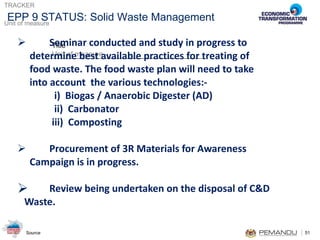
Seminar conducted and study in progress to  determine best available practices for treating of  food waste. The food waste plan will need to take  into account  the various technologies:-     i)  Biogas / Anaerobic Digester (AD)     ii)  Carbonator    iii)  Composting Procurement of 3R Materials for Awareness  Campaign is in progress. Review being undertaken on the disposal of C&D  Waste. EPP 9 STATUS: Solid Waste Management
THANK YOU

Ahmad Suhaili Idrus RICS KL Conference April 2011

  • 1.
    Developing Strategies forGreater KL/Klang Valley RICS Asia KL Conference 6 April 2011 Crowne Plaza Ahmad Suhaili Idrus Director, PEMANDU
  • 2.
    Greater KL 20-20by 2020 To be among the world’s Top 20 performing cities on economic growth and liveability rankings by 2020 6 April 2011 RICS Conference Crowne Plaza KL
  • 3.
    PM introduced 4strategic thrusts 1 Malaysia (People First, Performance Now) Government Transformation Programme Economic Transformation Programme 10 th & 11 th Malaysia Plan 4 - Strategic Thrusts
  • 4.
    To transform theeconomy we need to focus  12 National Key Economic Areas (NKEAs) Comms Content & Infra 11 Economic Sectors + Greater KL/ Klang Valley Wholesale & Retail Business Services Oil, Gas & Energy Palm Oil Healthcare Financial Services Greater KL/Klang Valley Agriculture Tourism Education Electrical & Electronics
  • 5.
    Table of Contents0 1 2 3 4 Overview Greater KL, Magnet Greater KL, Connect Greater KL, New Places Greater KL, Enhanced Services
  • 6.
    Greater KL/KV iscomposed of 10 local authorities 2 GREATER KL: OVERVIEW SOURCE: Department of Statistics, Malaysia Greater KL/KV is composed of 10 local authorities 2010 population (5.7 mln) '000 pax MP Sepang Putrajaya MP Ampang Jaya 142 MB Shah Alam 528 MP Selayang 559 MB Petaling Jaya 577 MP Subang Jaya 583 MP Kajang 743 MP Klang 747 Kuala Lumpur 1,623 MPKj MPAJ MPS DBKL MBPJ MBSJ MBSA Putrajaya MP Sepang MPK
  • 7.
    20-20 by 2020Top 20 livable city in the world Economic clusters People / talent attraction Per capita GNI grows from RM 40k to RM 70k per year Foreign talent base grows from 9% to 20% Additional 2.7 million in Selangor GNI per capita To be the only metropolis in Asia that simultaneously achieves top-20 economic growth and be among the global top-20 most livable cities by 2020 Stability Healthcare Education Infrastructure Culture and environment Livability index measures KL ranks 79 out of 130 cities Top 20 economic city in the world Current forecast 2010 Additional Immigra- tion Natural growth 3 2020 target Livability Greater KL Aspiration Economic + +
  • 8.
    11 initiatives wereprioritised to select five with highest potential GNI impact SOURCE: Lab analysis Description Category Greater KL as a magnet 1 Attract 100 world’s top MNCs Attract high-skilled immigration 1.1 1.2 Greater KL connect 2 Connect to Singapore with High-Speed Rail Build MRT: An integrated urban rail system 2.1 2.2 Greater KL new places 3 Rejuvenate the River of Life Create a greener KL Establish iconic places Revitalise Putrajaya Housing 3.1 3.3 3.2 Greater KL enhanced services 4 Pedestrian network Solid Waste Management Basic services: Water, sewerage and electricity 4.1 4.2 Low GNI Impact High Low Ease of implementation High 3.2 1.1 1.2 2.1 2.2 3.1 4.2 4.1 3.3 3.4 4.3 3.4 4.3 Prioritized Others GREATER KL: OVERVIEW 3.5 3.5
  • 9.
    EPPs will bedelivered by implementing agencies GREATER KL: GOVERNANCE 5 Greater KL as a magnet 1 Attract 100 world’s top MNCs Attract high-skilled immigration Greater KL connect 2 Build Greater KL High-Speed Rail Build Mass Rapid Transit System Greater KL new places 3 Rejuvenate the River of Life Create a greener KL Vitalize Putrajaya Establish Iconic Places Encourage optimal mix of housing and property development Greater KL enhanced services 4 Pedestrian network Solid Waste Management Basic services: water, electricity and sewerage Area EPP and Business Opportunity Invest KL Talent Corporation SPAD SPNB DBKL, JPS, JPP DBKL + 9 PBTs Perbadanan Putrajaya DBKL DBKL + 9 PBTs DBKL + 9 PBTs PPSPPA PAAB / TNB / SPAN Lead implementer MIDA MoHR EPU SPAD,KPTG,DOE - - MoFT KNB, Petronas,UDA NAPIC Petronas JPSPN, KPKT KettHa Other Text in blue represents new entities to be established
  • 10.
    Nine EPPs willdeliver RM ~190 billion of incremental GNI to achieve the 2020 aspiration 1 Assume base GNI per capita of RM 40,000 in 2010, annual GNI growth rate of 4.5%, and average population of seven mln 2 Double counts with labour components of all other Greater KL initiative across all NKEAs 3 Other NKEA GNI impact (including EPPs, Business opportunities and multiplier impacts) that directly contributes to Greater KL’s GNI SOURCE: Lab analysis Attract Talent 118 2 Attract MNC 2010 240 155 1 Base Growth 700 Other NKEA 114 3 Other EPPs 2 Revitalize Klang River 4 MRT 21 HSR 6 2020 RM billion Total RM ~190 billion of incremental GNI impact from Greater KL EPPs GREATER KL: OVERVIEW
  • 11.
    Greater KL, Magnet1. 1 MNC Attraction 1. 2 Talent Attraction
  • 12.
    Attracting 100 MNCsto Greater KL/KV GREATER KL MAGNET: MNC ATTRACTION 1.1 How Why Key value proposition of Greater KL/KV Connectivity to major markets Cost reduction of 20 – 30% Highly educated human capital Rising infrastructure level High quality of living Focus on bringing in MNCs from NKEA industries, prioritized based on the level of GNI that they are bringing in to Greater KL and also the current strengths of Greater KL Industry focus allows for greater focus when structuring financial and non-financial incentives Also facilitates greater ease in structuring industry support and creating an industry cluster focused marketing pitch SOURCE: SSM; Subsidies for MNCs Setting up Headquarters in Beijing 1 Kuala Lumpur and Selangor 2 Potential impact analyzed using multiplier of 2, Base on the assumption that 10% of current revenue will be attracted to Greater KL/KV with potential impact on GNI multiplier base on historical data Shanghai Singapore Beijing Greater KL 1 Number of foreign companies Malaysia is lagging behind in term of foreign company attraction Total GNI ~40 Others Retail Business Services Financial S ervices Total GNI contribution 2 RM blns Bringing 100 anchor tenants to Greater KL/KV will contribute RM 40 bln incremental GNI Within 2 hour flight to Singapore and Jakarta Within 6 hour flight to Shanghai, Hong Kong, and Beijing
  • 13.
    Based on thisapproach, several global potential anchor tenants have been identified SOURCE: Hoover’s, lab analysis NON EXHAUSTIVE Targets from Istanbul Türkiye Finans Albarakah Tur Asya Finans Kurumu A.S. Targets from Dubai Dubai Islamic Bank Dubai Bank Emirates Islamic Bank Targets from Tehran (Iran) Bank Melli Iran Pasargad Bank Parsian Bank Targets from Doha Qatar Islamic Bank Qatar International Islamic Bank Targets in Beijing Yishang Innovation Technology Tai Guen Xiang Shun (Beijing) Technology Hangtian Changzheng Rocketry Technology Co ,Ltd Nec Solutions (China) Co , Ltd Beijing Jade Bird Information System Isoftstone Information Service Corporation Targets in Hong Kong Bank of East Asia CDC Corporation Cheung Kong Holdings Satyam Computer Services Limited Karin Technology Holdings Limited Automated Systems Holdings Limited Pacific-China Aero Leasing Limited Targets from Bangalore MphasiS Limited Wipro Limited Infosys Technologies Limited Sonata Software Limited Patni Computer Systems Limited Targets from Saudi Arabia Bank Al Jazira Bank Albilad InvestKL will be set up and tasked w ith attracting 100 MNCs from priority sectors to locate in Greater KL/KV Islamic / other financial institution Business process service IT / Software service Retail / Wholesale Targets in Shang Hai Shanghai Hisap Computer Development Co , Ltd Shanghai Meicheng High Technology Longcheer Technology (Shanghai) Shengqu Information Technology (Shanghai) Co , Ltd Toray Industries (China) Target in Singapore Paypal Pte. Ltd. Toshiba Asia Pacific Ptd. Ltd. Hewlett-Packet International Pte. Ltd Motorola Trading Center Pte. Ltd Daimler South East Asia Pte. Ltd. Procter & Gamble International Operations Pte. Ltd.
  • 14.
    EPP 1 STATUS:MNC ATTRACTION InvestKL is being set up with its HQ at Plaza Sentral. The CEO for InvestKL is in the process of being recruited target in Q2 2011. InvestKL will report fortnightly to the Investment Committee which is co-chaired by MITI Minister and Minister in the PM’s department and monthly to Greater KL/KV Steering Committee.
  • 15.
    Greater KL, Magnet1. 1 MNC Attraction 1. 2 Talent Attraction
  • 16.
    GKL’s population of10 mln by 2020 to fulfill employment demand and create RM120 bil GNI 2 SOURCE: MOHR, DOS, NKEA lab, Team analysis Incremental GNI Impact RM ~ 120 billion Based on economic activity provided by other initiatives in Kuala Lumpur Employment 2009 1 Baseline employment growth 2 Non-active population 2009 Current 2010 population GKL 2020 projected population Incremental non-active population NKEA employment growth 1 Based on 63.7% Labour Force Participation Rate and 68.1% active labor age (15~64) 2 MOHR estimates based on baseline population growth Population and employment demand in GKL mln population GREATER KL MAGNET: TALENT ATTRACTION 1.2 48% 1.7 mln new jobs created by 2020 through baseline growth and NKEA initiatives
  • 17.
    Greater KL canachieve the 10 mln target through initiatives specifically targeted at the different sources of immigration 8 Track all Malaysian graduates of overseas universities and actively invite them to start a career back in Malaysia Use headhunters to target 5000 “interesting” diaspora based on a diverse set of criteria (e.g., net worth above RM10mln, >5 positive press mentions) Establish ”Malaysia Hall” in top 10 cities Raise Malaysian profile through proactive engagement programmes Create online community Online jobs database for returning diaspora Upgrade consular services Indi- vidual targets Targeted Talent Cross cutting initiatives One-stop immigration and settlement centres Automatic extension of PR status to immediate family if expat has been granted PR Extension of visa after graduation Immigration awareness programme Base line population growth 40% 8% 48% 4% Targeted population increase 4 mln PM to target top 100 among Malaysian Diaspora Recognise world class achievements of Malaysian Diaspora through awards 150 K 1 2 3 4 5 6 7 8 9 1 2 3 4 350 K Professional English training Professional skills training One stop shop settlement center 1 2 3 1.9 mln Malaysian diaspora Foreign talent Foreign talent GREATER KL MAGNET: TALENT ATTRACTION 1.2 A C B
  • 18.
    Talent Corporation, incorporatedin 2010, has finalised work and financial plans for 2011 Talent Corporation has 3 roles: To catalyse, facilitate and deliver talent migration for the country ; in particular meeting Greater Kl/KV population target of 10 mln by 2020 Immigration attraction programs will be implemented over the next two years with focus on :- Malaysian Diaspora Malaysians in Malaysia Foreigners abroad Foreigners in Malaysia EPP 2 STATUS: Talent Attraction
  • 19.
    Table of Contents0 1 2 3 4 Overview Greater KL, Magnet Greater KL, Connect Greater KL, New Places Greater KL, Enhanced Services
  • 20.
    Greater KL, Connect2. 1 High Speed Rail 2. 3 Mass Rapid Transit
  • 21.
    A High SpeedRail System could provide both non-stop services from KL to Singapore as well as intercity services… Average speeds of 350 to 450 kmph GREATER KL CONNECT: HIGH SPEED RAIL 2.1 Direct n on-stop service Potential -i ntercity stops Phase I stops Phase II stops Intercity service Batu Pahat Iskandar Region Johor Bahru Ayer Keroh, Melaka Singapore KL City Centre Kuala Lumpur International Airport Seremban Muar Phase 2 and beyond Greater KL to P. Pinang P. Pinang to Bangkok and China Phase 1 Greater KL to Singapore Potential intercity stops in N. Sembilan, Melaka and Johor Pulau Pinang To Bangkok, China Ipoh
  • 22.
    Potentially reducing traveltime by 2 – 2 ½ hours compared to fastest alternative making daily travel between KL and Singapore possible 0.97 5.27 0.33 2.59 n/a Estimated Point to Point Travel Time Minutes (unless otherwise stated) 2009 ridership mn trips/ year 2 – 2 ½ hours potential travel time savings High speed travel from point to point at average speeds of 300 to 450 kmph Arrival and departure from city centre Shorter dwell times (no requirement for check-in to departure waiting period) or luggage SOURCE: Team analysis High Speed Rail 1 ½ to 2 hrs 60 - 90 Plane 4 hrs 60 KTM (DTP) 4 hrs 15 210 15 Car 5 hrs 60 240 Bus 6 hrs 340 Waiting time Scheduled Journey Time Travel to/from CBD to arrival/departure point GREATER KL CONNECT: HIGH SPEED RAIL 2.1
  • 23.
    A pre-feasibility study will be undertaken to determine the economic viability of HSR commencing April 11. EPP 3 STATUS: High Speed Rail
  • 24.
    Greater KL, Connect2. 1 High Speed Rail 2. 3 Mass Rapid Transit
  • 25.
    Seri Kembangan PutraHeights Shah Alam Klang Shah Alam Town Center Subang Jaya Batu Caves Proposed Map of MRT Lines for Greater KL/KV Kajang Sg. Buloh Kota Damansara Petaling Jaya Sentul Cheras Sg. Besi Seri Kembangan Ampang Legend Circle Corridor Legend Orange Corridor 1 Gamuda estimates – does not factor in inflation 2 Estimates of rolling stock costs based on average of Gamuda esimates for rolling stock (RM 3.6 bln) and scaling up of reported Bangkok MRT rolling stock purchase in 2007 of 19 trains for RM 2.5 bln for a 20KM line (scaled to KL MRT at ~115 trains) Project construction to begin mid 2011 with the Blue Corridor and network to be operational by 2020 2km Legend Blue Corridor
  • 26.
    Legend: Elevated lineUnderground line Line Features: Length: 51km; 9.5 Underground, 41.5 Elevated Stations: 8 Underground, 27 Elevated 4 Interchange: Sungai Buloh (KTM Komuter) Stations Pasar Seni (Kelana Jaya LRT) Maluri (Ampang LRT) Kajang (KTM Komuter) Park and Ride: 13 Stations Travel time End to End: 90 mins Catchment: 1.2million people Daily ridership (2020): 400 000 people Constructions to begin: July 2011 Expected Start of Operation: 2016 1 = From SPNB during Constructors’ Briefing on 03.03.2011 Sungai Buloh – Kajang Line (Blue Corridor)
  • 27.
    The proposed alignmentalong 51 km Sungai Buloh – Kajang is being publicly displayed Public display began on 14 Feb 2011 ending on 14 May 2011 Railway Scheme to be approved on 31 st May Open Day was held on 13 Feb 2011 at Mid Valley Megamall Public Display in seven locations and responses attended to and compiled. Meetings with MPs, ADUNs and RAs of affected areas in progress Corridor freeze (Section 4) - Gazetted 786 lots (Selangor) & 686 lots (FT) Land acquisition (Section 8 & 57) – Submission for key locations for ground breaking completed EIA report is currently being reviewed by the EIA Review Panel Value Management Study for alignment and station locations in progress Pre-Q exercise on going– elevated structures and stations EPP 4 STATUS: Mass Rapid Transit
  • 28.
    Table of Contents0 1 2 3 4 Overview Greater KL, Magnet Greater KL, Connect Greater KL, New Places Greater KL, Enhanced Services
  • 29.
    Greater KL, NewPlaces 3. 1 River of Life 3. 2 Greener KL 3. 3 Iconic Places 3. 4 Revitalizing Putrajaya 3. 5 Housing
  • 30.
    Klang River canbenefit Greater KL/KV Klang river has all the right ingredients to become a vibrant water front … … with enormous economic and liveability potential to be realized Origin of the city Economic engine Generate economic value through enhanced real estate value, retail spend, and hotel stay Provide employment opportunities Central urban area Quality of life Provide attractive, relaxed, and green area for the local population Encourage healthier way of life through more access to open space Heritage around the river Heritage and culture Deepen heritage education through cultural and art promotion along the river Communicate Malaysian culture to the world with strengthened tourist zones
  • 31.
    Now a dumpingground … economic and liveability activities are significantly underdeveloped Due to the various polluting human activities along the river… ~170k tons of rubbish per year enters into Klang River, with only ~25k tons retrieved Sewage, much of which untreated, is discharged directly into the river Current water quality is Class III, not suitable for recreational use Economic activity While close to CBD and cuts through city centre, river banks are underdeveloped Not a major destination for tourist Liveability Unappealing to visit and walk along the river Limited green open space Few leisure activities organized around the Klang river
  • 32.
    Upstream cleaning fora cleaner Klang river Pollution source 31 polluting factories 54 squatter households 1 139 multipoint and 1 regional sewage treatment plants (STP) that need significant and long overdue upgrade Length: 73km (Sg. Batu-25km, Sg. Gombak-30 km, Sg. Ampang-18 km) Local authority: Ampang Jaya & Selayang Pollution source: 304 polluting factories 838 squatter households 1 204 multipoint and 7 regional STPs that need significant upgrade and regionalization Length: 40 km (Sg. Klang) Local authority: DBKL Sg. Batu Sg. Gombak Sg. Ampang 1 Squatter households within 500m radius of the river SOURCE: KLCH, BULETIN J/KUASA PERANCANG N. SELANGOR 2010 BI 2/2010; DOE’S DATABASE 2009, IWK inputs 2010 Aspiration in cleaning river Areas of focus Upstream Kuala Lumpur Sg. Klang Tackling the pollution sources is key to transform and maintain Klang river as Class IIB (recreational use with body contact)
  • 33.
    Tackling pollution atsource 3 1 Ammoniacal nitrogen (AN) is a toxic pollutant often found in sewage and landfill 2 Higher biological oxygen demand (BOD) BOD indicates higher presence of microorganisms, suggesting higher pollution 3 Suspended solid (SS) is organic and inorganic particle (e.g., waste, sand) that increases turbidity and reduces oxygen content Aspiration Decrease ammo-niacal nitrogen 1 from 0.9 to 0.3 mg/l Decrease biological oxygen demand 2 from 6 to 3 mg/l Decrease suspended solids 3 from 150 to 50 mg/l Class III (unsafe for body contact) Class IIB (recreational use with body contact) Sewage and sullage management Squatter relo-cation Drainage and flow manage-ment Promote, enforce, and manage river cleanliness Summary description Key initiatives Capital cost RM million Upgrade existing sewage systems to decrease pollutants from entering into the river E nforc e the “zero-squatter” policy through local authorities to prevent squatter waste Upgrade drainage systems to prevent flooding and maintain water quantity Enforce water waste guidelines for residents, factories, and commercial outlets through local authorities 3,593 n/a 5 533 n/a 5 3,060 4 1 2 3 4 1 2 3 4
  • 34.
    Clean, beautify, developat 10 nodes 1 3 5 6 8 9 7 2 4 10 Node 0 – River banks, parks, and public spaces will be greened and pedestrian linked Node 1 - Brickfields Govt Quarters. Comprehensive Riverfront Development Node 3 - Klang Bus Stand – Central Market Global Events & Cultu ral Retail Node 4 – Merdeka Square - Dayabumi Beautification & River Revitalization Node 8 – City Hall River Park & River Revitalization Node 5 - Masjid Jamek- Jln Melayu Beautification & River Revitalization Node 10 – PWTC River Park & River Revitalization Node 9 - Tiong Nam Comprehensive Urban Development Node 6 – Kg Hujung Pasir-Jalan Ampang Comprehensive Riverfront Development Node 7 – Kg. Baru Comprehensive Urban Development Node 2 – Little India. Cultural Retail
  • 35.
    Main scope ofwork under RoL are: River Cleaning River Beautification Development Economic Council approved appointment and role of Project Delivery Partner (PDP) and Beautification Partner on 24 January 2011. Almost all the projects are ready for tender and implementation. River beautification master planning competition to be launched on 12 April and submitted in June. River of life project launching on 28 June by PM (tbc) EPP 5 STATUS: River of Life
  • 36.
    Greater KL, NewPlaces 3 . 1 River of Life 3. 2 Greener KL 3. 3 Iconic Places 3. 4 Revitalizing Putrajaya 3. 5 Housing
  • 37.
    There are threemain ways to achieve a greener KL PRELIMINARY 1 Developments where >30% of open space is prioritized for green 2 Most of GNI generated through higher property value via “green premium” , as case studies indicate greener buildings have higher rents of 5-15%. Also includes retail, events, construction, and labour 3 Government capex: RM ~70 million over five years; private investment: RM ~80 million over two years Impact Initiative Promote green redevelopment Design “green development 1 ” for major redevelopments Redevelop government land into green areas Incentivize and reclaim key spots for green development Ensure privatized land from UKAS adheres the “green development” design Increase green density Increase density of existing green space Green rooftops of existing buildings Build “vertical garden” , where trees and plants are in vertical landscape to reduce space occupation Interconnection parks and increasing park usage Connect multiple parks with green trails to create “one park” Designate and promote park space for public events (e.g., concert, performances) Incremental GNI impact: RM 1.0 bn 2 Cost: RM 150 mn 3 ~45% gov. spend GREATER KL NEW PLACES: GREENER KL 3.2 1 2 3
  • 38.
    KL city can be further greened through different landscaping initiatives PRELIMINARY Initiative Increase green density Replacing existing road and pedestrian pathway landscaping with large trees Increase foliage coverage and directly increases greener space ~100,000 1 large trees need to be planted throughout KL city Greening unused rooftops of available buildings Increase green space by ~150,000 square meters Planting greenery in vertical and over-hanging structures Generate up to ~20% of additional green surface for transformed structures Description Impact GREATER KL NEW PLACES: GREENER KL 3.2 1 Assuming plant trees every 3 meters on both sides of ~140 km of pedestrian walkways in KL city Rooftop / skyline greening 2 Vertical garden 3 1
  • 39.
    The areas andspecies for the 2,500 trees to be planted every month have been identified. Work Order for planting issued and planting already in progress. 100,000 trees planting for the Quick Win project were held on the 3 March. Participation of the private sector in pocket parks are welcomed but needs to be tailored to DBKL’s requirements for some standardization and suited to the city’s character. EPP 6 STATUS: Greener KL
  • 40.
    Greater KL, NewPlaces 3 . 1 River of Life 3. 2 Greener KL 3. 3 Iconic Places 3. 4 Revitalizing Putrajaya 3. 5 Housing
  • 41.
    Global iconic attractionsshape a city’s distinctive character Paris – “the city of light” New York – “the big apple” Tokyo – “the metropolis” Shanghai – “the Paris of the East” SOURCE: Team analysis Paris night Seine river Eifel tower Notre dam Metropolitan museum Museum of Natural History Broadway Statue of Liberty Shinjuku district National museum Sensoji temple Edo-Tokyo museum Oriental Pearl The Bund GREATER KL NEW PLACES: ICONIC PLACES 3.3
  • 42.
    Primary Icon (Petronas Twin Towers) Green Icon of KL (Lake Gardens vicinity) KL Heritage Trail Cultural & Heritage District/Zone (Brickfields & Kg. Baru) Reviving Medan Pasar Five attractions identified as priority Works to be completed by 2012
  • 43.
    EPP 7 STATUS:Iconic Places Initiatives on Primary Icon are underway as they will be carried out by private sector stakeholders. Their initiatives will include among others, a One- Stop- Centre for tourists and travel trade, website and visit packages. There is a proposal for a tram route around the area around Lake Gardens; the type of tram have been identified. A schematic design of Medan Pasar has been completed. A detailed design is currently being worked on.
  • 44.
    Greater KL, Enhanced Services 4. 1 Pedestrian Network 4. 2 Solid Waste Management 4. 3 Basic Services
  • 45.
    KL’s pedestrian networkneeds significant improvement 5 Existing issues of the pedestrian network Inefficient design No integration between buildings No continuity in pedestrian walkways Poor maintenance No/low lighting Broken pavement Lack of covered walkways Lack access for physically challenged and elderly Safety concerns SOURCE: Lab analysis Based on public opinions from Seranta Awam, KL is not a pedestrian friendly city
  • 46.
    Towards a comprehensivepedestrian network Proposed pedestrian network Priority walkways for the near term (~2km, by DBKL 1 ) 1 Phase 1 (Berjaya Time Square to Pavilion) ~800m of covered and grounded walkway 1a: Berjaya Time Square to Lot 10 1b: Lot 10 to Pavilion 1c: Two canopy intersections (Jalan Imbi / Jalan Sultan Ismail; Jalan Sultan Ismail / Jalan Bukit Bintang) Phase 2a (Jalan Perak / Pavilion to Crowne Plaza, to be approved) ~400m of elevated and covered walkway with air conditioning Phase 2b (Jalan P. Ramlee / Jalan Sultan Ismail to Jalan Pinang, to be approved) ~450m, same specifications as Phase 1 Comprehensive plan for the long term (~42 km, phased over time) 2 Major spine (~3km) High pedestrian volume with major commercial activities (e.g., retail) ~2-3 years to complete construction Primary route (~14km) High pedestrian traffic between major locations and transit nodes ~3-5 years to complete construction Secondary route First wave (~9km) Connect key pedestrian walkways ~3-5 years to complete construction Second wave (~16km) Extend the pedestrian coverage throughout city centre ~3-5 years to complete construction Other pedestrian walkways 3 River front walkway – covered by the River of Life EPP Heritage trail – covered by the Global Attraction EPP a b c 1 Private firms (SPNB and Petronas) are also constructing pedestrian linkages in selected locations 2 Pedestrian Priority Zones are locations with high density of crosswalks, curb extensions, wide walkways, narrow vehicle street, and limited vehicular access at low speed Major Spine Primary Route Secondary Route (1 st Wave) Secondary Route (2 nd Wave) Riverfront Walkway Heritage Trail Pedestrian Priority Zone 2 Comprehensive plan / Long term Priority walkway (length, construction period) SPNB (~2 km, Jun-Dec 2010) Petronas (~0.5 km, Apr-Feb 2011) DBKL (~2 km, Oct-Sep 2011) LRT Stations Potential issues with property owners will need to be managed
  • 47.
    Scope is toimprove existing pedestrian walkway for 42 km around the city. Works to remove signages and advertisement to deliver barrier free walkways commenced middle of February. Greener KL and Pedestrian Network are collaborating on the pedestrian walkway designs on Jalan Sultan Ismail to create a canopy covered, safe city concept pedestrian walkway. Construction scheduled to begin in May. EPP 8 STATUS: Pedestrian Walkway
  • 48.
    Greater KL, Enhanced Services 4. 1 Pedestrian Network 4. 2 Solid Waste Management 4. 3 Basic Services
  • 49.
    Greater KL solidwaste and public cleansing management face 5 key challenges under current practices 4.2 . GREATER KL ENHANCED SERVICES: SOLID WASTE MANAGEMENT 4.2 1 1 Sanitary landfills in the Greater KL region are running out of capacity Malaysian government spends a significant amount of funding on solid waste management 3 3 2 2 Recycling rates in Greater KL and Malaysia in general are too low Lack of proper system for construction and demolition waste disposal 4 4 Current public cleansing and SWM collection outsourcing agreements do not meet expected levels of service and performance 5 5
  • 50.
    4 major initiatives to improve solid waste management 4.2. SOURCE: Team analysis Create a recycling ecosystem including composting to stimulate waste disposal reduction and achieve 40% recycling Introduce composting and anaerobic digestion to reduce amount of waste to final treatment Stimulate C&D waste recycling with a proper system and a recycling facility Reduce, Reuse, Recycle (3R) Increase waste treatment capacity to reduce the amount of resultant landfill waste Waste treatment Segregate and restructure tariffs to incentivize waste disposal reduction and separation at source Hold competitive open tenders for all activities to be outsourced to create a competitive market Ensure strong enforcing mechanisms built into (soon to be finalised) concession contracts to ensure performance Governance Assess future potential for leveraging technology like automatic waste collection systems and deep bins to improve waste collection standards Future improvements 1 2 3 4
  • 51.
    Seminar conducted andstudy in progress to determine best available practices for treating of food waste. The food waste plan will need to take into account the various technologies:- i) Biogas / Anaerobic Digester (AD) ii) Carbonator iii) Composting Procurement of 3R Materials for Awareness Campaign is in progress. Review being undertaken on the disposal of C&D Waste. EPP 9 STATUS: Solid Waste Management
  • 52.

Editor's Notes

  • #5 SIN-AAA123-20090609-
  • #14 KLA-MSG017-20100514-NM KLA-MSG017-20100514-NM