Biyani's Think Tank
Concept based notes
Business Policy and Strategic
Management
MBA
Dr Tripti Vijaywargia
Dept. of Commerce and Management
Biyani Institute of Science and Management
2
For free study notes log on: www.gurukpo.com
Published by :
Think Tanks
Biyani Group of Colleges
Concept & Copyright :
Biyani Shikshan Samiti
Sector-3, Vidhyadhar Nagar,
Jaipur-302 023 (Rajasthan)
Ph : 0141-2338371, 2338591-95 Fax : 0141-2338007
E-mail : acad@biyanicolleges.org
Website :www.gurukpo.com; www.biyanicolleges.org
Edition : 2012
Leaser Type Setted by :
Biyani College Printing Department
While every effort is taken to avoid errors or omissions in this Publication, any mistake or
omission that may have crept in is not intentional. It may be taken note of that neither the
publisher nor the author will be responsible for any damage or loss of any kind arising to
anyone in any manner on account of such errors and omissions.
BPSM 3
For free study notes log on: www.gurukpo.com
Preface
I am glad to present this book, especially designed to serve the needs of
the students. The book has been written keeping in mind the general weakness
in understanding the fundamental concepts of the topics. The book is self-
explanatory and adopts the “Teach Yourself” style. It is based on question-
answer pattern. The language of book is quite easy and understandable based
on scientific approach.
Any further improvement in the contents of the book by making corrections,
omission and inclusion is keen to be achieved based on suggestions from the
readers for which the author shall be obliged.
I acknowledge special thanks to Mr. Rajeev Biyani, Chairman & Dr. Sanjay
Biyani, Director (Acad.) Biyani Group of Colleges, who are the backbones and
main concept provider and also have been constant source of motivation
throughout this endeavour. They played an active role in coordinating the various
stages of this endeavour and spearheaded the publishing work.
I look forward to receiving valuable suggestions from professors of various
educational institutions, other faculty members and students for improvement of
the quality of the book. The reader may feel free to send in their comments and
suggestions to the under mentioned address.
Author
4
For free study notes log on: www.gurukpo.com
M-302
BUSINESS POLICY AND STRATEGIC MANAGEMENT
Course/Paper : 302 MBA
Semester-III
Max.Marks : 70
Time : 3 Hrs.
Objective:
The objective of the course to equip the students with analytical tools for Cracking case
studies by scanning the business environment and coming to a decision. The students will
benefit by acquiring new ways and means of developing strategic decision making skills.
Section-A
Introduction: Business policy-evolution of the concept. Difference between business policy
and strategic management. Corporate governance- concept, issues, models, evolution and
significance. Introduction to Strategic Management-Concept importance of strategic
Management, Strategy & Competitive Advantage, Strategy Planning & Decisions, strategic
Management Process.
Top management perspective: Establishing company direction-developing strategic vision,
setting objectives and crafting a strategy-Internal & External Environment, Formulating Long
Term objective & Strategy, Strategic Analysis & Choice.
Analyzing business environment: Analysis of Business environment at 3 levels-Macro
external environment analysis, external environment analysis (Industry analysis and
competitor analysis) porter’s five forces and competitor analysis framework, and firm level
internal analysis.
Identifying alternative strategies: Grand strategies: stability, growth, retrenchment &
combination strategies.
Competitive strategy and competitive advantage: Industry and competitive analysis,
strategy and competitive advantage, Principles of Competitive Advantage-Identifying Value
Activities, Competitive Scope and the Value Chain, the Value Chain and Generic Strategies,
Mergers & Acquisitions Strategies.
Section-B
Case Study
BPSM 5
For free study notes log on: www.gurukpo.com
Unit 1
Introduction
Q.1 What is Business Policy?
Ans. The term "Business Policy" comprises of two words, Business and Policy.
Business : "Business means exchange of commodities and services for increasing
utilities."
Policy : Policies may be defined as "the mode of thought and the principles
underlying the activities of an organization or an institution." Policies are plans in
they are general statements of principles which guide the thinking, decision-
making and action in an organization.
Business policy as a principle or a group of related principles, along with their
consequent rule (s) of action that provide for the successful achievement of
specific organization / business objectives. Accordingly, a policy contains both a
"principle" and a "rule of action." Both should be there for the maximum
effectiveness of a policy.
Q.2 What do you understand by evolution of business policy?
Ans. Due to the increasing environmental changes in the 1930s and 40s in the US,
planned policy formulation replaced ad hoc policy-making. Based on this second
paradigm, the emphasis shifted to the integration of functional areas in a rapidly
changing environment.
Increasing complexity and accelerating changes in the environment made the
planned policy paradigm irrelevant since the needs of a business could no longer
be served by policy-making and functional-area integration only. By the 1960s,
there was a demand for a critical look at the basic concept of business and its
relationship to the environment. The concept of strategy satisfied this requirement
and the third phase, based on & strategy paradigm, emerged in the early sixties.
The current thinking- which emerged in the eighties- is based on the fourth
paradigm of strategic management. The initial focus of strategic management was
on the intersection of two broad fields of enquiry: the processes of business firms
and the responsibilities of general management.
Q.3 Differentiate between business policy & strategic management?
Ans. Difference between Strategic Management and Business Policy
6
For free study notes log on: www.gurukpo.com
Strategic Management Business Policy
1) Deals with strategic decisions that
decide the long-term health of an
enterprise. It is a comprehensive
plan of action designed to meet
certain specific goals.
It offers guidelines for managers to take
appropriate decisions.
2) It is a means of putting a policy into
effect within certain time limits.
It is a general course of action with no
defined time limits.
3) Deals with those decisions which
have not been encountered before in
quite the same form, for which no
predetermined and explicit set or
ordered responses exist in the
organization and which are
important in terms of the resources
committed or the precedents set.
It is a guide to action in areas of
repetitive activity.
4) It deals with crucial decisions,
whose implementation requires
constant attention of top
management.
Once policy decisions are formulated,
these can be delegated and implemented
by others independently.
5) Strategies are specific actions
suggested to achieve the objectives.
Policies are statements or a commonly
accepted understanding of decision
making.
6) Strategies are action oriented. Policies are thought oriented.
7) Everyone is empowered to
implement the strategy.
Power is delegated to the subordinates
for implementation.
8) Strategies are means to an end. Policies are guidelines.
9) Strategy is concerned with
uncertainties, competitive situations,
and risks etc that are likely to take
place at a future date.
Policy is in general concerned with the
course of action to fulfill the set
objectivies.
10) Strategy is deployed to mobilize the
available resources the best interest
of the company.
Policy is an overall guide that governs
and controls the managerial action.
BPSM 7
For free study notes log on: www.gurukpo.com
Q.4 What is corporate governance?
Ans. Corporate governance is a system of structuring, operating and controlling a
company with a view to achieve long-term strategic goals to satisfy shareholders,
creditors, employees, customers and suppliers, and complying with the legal and
regulatory, apart from meeting environmental and local community needs."
Corporate governance can be defined as a set of systems and processes which
ensure that a company is managed to the best interests of all the stakeholders. The
set systems that help the task of corporate governance should include certain
structural and organizational aspects; the process that helps corporate governance
will embrace how things are done within such structure and organizational
systems.
Corporate governance is of interest to us as it determines the strategy of the
organization and how it is to be implemented. It is also important to us because
the Corporate Governance framework determines who the organization is there to
serve and how the priorities and purpose of the organization are determines.
Corporate governance is the set of mechanisms used to manage the relationship
among stakeholders that is used to determine and control the strategic directions
and performance of organization.
Q.5 Elaborate the significance of Corporate Governance?
Ans. Good corporate governance has assumed great importance and urgency in India
due to the following reasons:
1) Changing Ownership Structure: The profile of corporate ownership has
changed significantly. Public financial institutions are the single largest
shareholder in most of the large corporation in the private sector. Institutional
shareholders have reversed the trend of scattered shareholders. Institutional
investors (foreign as well as Indian) and mutual funds have now become singly or
jointly direct challenges to managements of companies. Due to threat of hostile
takeover bids and the growth of institutional investors the big business houses
started talking about corporate governance.
2) Social Responsibility: A company is a legal entity without physical existence.
Therefore, it is managed by board of directors which is accountable and
responsible to shareholders who provide the funds. Directors are also required to
act in the interests of customers, lenders, suppliers and the local community of
enhancing shareholders' value. An effective system of corporate governance
provides a mechanism for regulating the duties of directors so that they act in the
best interests of the companies. Control systems are established either through law
or self-regulations.
3) Scams: In recent years several corporate frauds have shaken the public
confidence. Harshad Mehta scandal, CRB Capital case and other frauds have
8
For free study notes log on: www.gurukpo.com
caused tremendous loss to the small meetings. Shareholders, associations,
investors, education and awareness have not emerged as a countervailing force.
4) Globalization: As Indian companies went to overseas markets for capital,
corporate governance became a buzzword. Sinking capital markets in India from
1994 through 1998 and the desire of more and more companies in India to get
listed on international stock exchanges also prompted them to pay attention to
corporate governance. We must, however, remember that corporate governance is
not a trick to prop up the sensex of to bring in foreign capital. It implies
management of the corporate sector within the constraints of fair play,
responsibility and conscience with regard to all the stakeholders.
Q.6 Detail about concerning issues of corporate governance?
Ans. Basic issues
1) Ethical Issues: Ethical issues are concerned with the problem of fraud,
which is becoming wide spread in capitalist economies. Corporations
often employ fraudulent means to achieve their goals. They form cartels to
exert tremendous pressure on the government to formulate public policy,
which may sometimes go against the interests of individuals and society at
large. At times corporations may resort to unethical means like bribes,
giving gifts to potential customers and lobbying under the cover of public
relations in order to achieve their goal of maximizing long-term owner
value.
2) Efficiency issues: Efficiency issues are concerned with the performance
of management. Management is responsible for ensuring reasonable
returns on investment made by shareholders. In developed countries,
individuals usually invest money through mutual, retirement and tax
funds. In India, however small shareholders are still an important source
of capital for corporations as the mutual funds industry is still emerging.
The issues relating to efficiency of management is of concern to
shareholders as, there is no control mechanism through which they can
control the activities of the management, whose efficiency is unfavorable
for returns on their (shareholders) investments.
3) Accountability Issues: Accountability issues emerge out of the
stakeholders' need for transparency of management in the conduct of
business. Since the activities of a corporation influence the workers,
customers and society at large, some of the accountability issues are
concerned with the social responsibility that a corporation must shoulder.
Structural Issues
Corporate governance is viewed as interactions among participants in managerial
functions (e.g., management), oversight functions (e.g., the board of directors and
BPSM 9
For free study notes log on: www.gurukpo.com
audit committee), audit functions (e.g., internal auditors and external auditors),
monitoring functions (e.g., the SEC, standard setters, regulations), and user
functions (e.g., investors, creditors, and other stakeholders) in the governance
system of corporations.
Corporate governance consists of internal and external mechanisms, directing,
and monitoring corporate activities to create and increase shareholder value.
Organizations that strive to develop effective corporate governance systems
consider a number of internal and external issues.
These issues affect most organizations, although individual businesses may face
unique factors that create additional governance questions. For example, a
company operating in several countries will need to resolve issues related to
international governance policy
1) Boards of Directors: Members of a company's board of directors assume legal
and ethical responsibility for the firm's resources and decisions, and they appoint
its top executive officers. Board members have fiduciary duty, meaning they have
assumed a position of trust and confidence that entails certain requisite
responsibilities, including acting in the best interests of those they serve. Thus,
board membership is not designed as a vehicle for personal financial gain; rather,
it provides the intangible benefit of ensuring the success of the organization and
the stakeholders affected and involved in the fiduciary arrangement.
2) Shareholders and Investors: Because they have allocated scarce resources to the
organization, shareholders and investors expect to reap rewards from their
investments. This type of financial exchange represents a formal contractual
arrangement that provides the capital necessary to fund all types of organizational
initiatives, such as developing new products and constructing new facilities.
Shareholders are concerned with their ownership investment in publicly traded
firms, whereas "investor" is a more general term for any individual or
organization that provides capital to a firm. Investments include financial, human,
and intellectual capital.
3) Internal Control and Risk Management: Controls and a strong risk
management system are fundamental to effective operations because they allow
for comparisons between the actual performance and the planned performance
and goals of the organization. Controls are used to safeguard corporate assets and
resources, protect the reliability of organizational information, and ensure
compliance with regulations, laws, and contracts. Risk management is the process
used to anticipate and shield the organization from unnecessary or overwhelming
circumstances, while ensuring that executive leadership is taking the appropriate
steps to move the organization and its strategy forward.
10
For free study notes log on: www.gurukpo.com
4) CEO Compensation: How executives are compensated for their leadership,
organizational service, and performance has become an extremely troublesome
topic.
Many people believe that no executive is worth millions of dollars in annual
salary and stock options, even one who has brought great financial returns to
investors. The reality, however, is that some executives continue to receive
extremely high pay packages while their companies fall into ruin.
Q.7 Describe the factors which have contributed to the evolution of corporate
governance?
Ans. Many factors have contributed to the evolution of corporate governance. Some of
these are:
1) The Responsibility for Ensuring Good Corporate Shifted from Government
to a Free market Economy: With the relaxation of direct indirect administrative
controls by the government, alternative mechanisms became necessary to monitor
the performance of corporations in free-markets. Shareholders believed that
market forces could ensure good corporate conduct (self imposed) by way of
rewarding success and punishing failures of corporations. Many free-market
economies laid down effective regulations to monitor the corporations. However,
regulations alone not ensure good governance. To become effective, they must be
enforceable by law.
2) Active Participation of individual and Institutional Investors: The second
factor that boosted corporate governance is the growth of global fund
management business. Institutional investors such as insurance companies,
pension and tax funds account for more than half the capital in the corporations of
USA. This trend is also growing in India. Earlier Institutional investors did not
monitor the activities of the corporations in which they invested. But the
competition in the fund management business has forced them to take an active
role in governance in order to safeguard their investments in the corporations.
Now, many institutional investors express their views strongly with regard to
various matters such as financial and operational performance, business strategy,
remuneration of top-level managers etc. Along with the non-executive directors,
these institutional investors monitor the performance of corporations.
The active investor demands good performance in the form of return on
investment and they also expect timely and accurate information regarding the
performance of the company. Institutional investors can exert pressure on the
management as they own a considerable share in the capital and any criticism
from these investors can have a major impact on the share prices. Investors
believe that only strong corporate governance mechanisms and practices can save
BPSM 11
For free study notes log on: www.gurukpo.com
them fro m the ever-growing power of corporations, which can influence
public policy to the detriment of investors.
3) Increasing Competition in Global Economy : The enhanced competition in the
global economy has compelled corporations to perform better by going in for
cost-cutting, corporate restructuring, mergers and acquisitions, downsizing, etc.
All these activities can be carried out successfully only if there is proper corporate
governance. Thus, market forces, active individual and institutional investor
participation, and enhanced governance. Thus market forces, active individual and
institutional investor participation, and enhanced competition have helped
corporate governance to evolve beyond a set of static rules. In India, the concept
of corporate governance is still in its nascent stage.
Q.8 Detail Strategic Management Process?
Ans. Strategic Management Process
1) Environment Scanning: Environmental scanning is the monitoring, evaluating,
and disseminating of information from the external and internal environments to
key people within the corporation. Its purpose is to identify strategic factors -
those external and internal elements that will determine the future of the
corporation. The simplest way to conduct environmental scanning is through
SWOT analysis. SWOT is an acronym used to describe those particular Strengths,
Weaknesses, Opportunities, and Threats that are strategic factors for a specific
company.
i) External Environment: External environment consists of variables
(Opportunities and Threats) that are outside the organization and not typically
within the short-run control of top management. These variables form the context
within which the corporation exists.
ii) Internal Environment: Internet environment of a corporation consists of
variables (Strengths and Weaknesses) that are within the organization itself and
are not usually within the short-run control of top management. These variables
form the context in which work is done. They include the corporation's structure,
culture, and resources. Key strengths form a set of core competencies that the
corporation can use to gain competitive advantage.
2) Strategy Formulation: Strategy formulation is the development of long-range
plans for the effective management of environmental opportunities and threats, in
light of corporate strengths and weaknesses. It includes defining the corporate
mission, specifying achievable objectives, developing strategies, and setting
policy guidelines.
i) Vision of the Company: Vision of a company is rather a permanent statement
articulated by the CEO of the company who may be Managing Director,
President, Chairman, etc. The purpose of a vision statement is to:
12
For free study notes log on: www.gurukpo.com
a) Communicate with the people of the organization and to those who are in some
way connected or concerned with the organization about its very existence in
terms of corporate purpose, business scope, and the competitive leadership.
b) Cast a framework that would lead to development of interrelationships between
firm and stakeholders viz. employees, shareholders, suppliers, customers, and
various communities that may be directly or indirectly involved with the firm.
c) Define broad objective regarding performance of the firm and its growth in
various fields vital to the firm.
Vision is a theme, which gives a focused view of a company. It is a unifying
statement and a vital challenge to all different units of an organization that may be
busy pursuing their independent objectives. It consists of a sense of achievable
ideals and is a fountain of inspiration for performing the daily activities. It
motivates people of an organization to behave in a way, which would be
congruent with the corporate ethics and values.
The major components of a vision statement must consist the following:
a) Mission of the firm in terms of product, markets, and geographical scope and a
way to attain a desired competitive position.
b) Clear identification of business units and their interrelationship in terms of shared
resources and concerns.
c) Statement of corporate philosophy, corporate policy and values.
ii) Business Mission: The basic concept of mission of business is expressed in terms
of products, markets, geographical scope along with a statement of uniqueness. At
business levels the mission statement becomes sharper and gets focused on
specifics. It is detailing out of the vision statement that reflects the strategic
posture of a company. The mission statement is an expression of business purpose
as well as needed excellence to achieve a position of comp0etitive leadership.
The primary information contained in a mission statement should be the required
degree of excellence for assuming a position of competitive leadership, a clear
definition of the present position, and future expected scope in business. The
description is usually broad and goals are achievable in reasonably short span of a
time frame of 3 to 5 years. Business scope is explicit in starting what is to be
included and excluded. Purpose of defining business scope is to clearly enumerate
specification of current and future product, market and geographic coverage of
business.
Many firms suffer from marketing myopia and the contrast between the current
and future scope is an effective diagnostic tool to caution against the myopic
position of company. Information contained in mission statement should provide
a way of selecting a method of pursue a position of either leadership or definite
competitive advantageous positions.
BPSM 13
For free study notes log on: www.gurukpo.com
iii) Objectives: Organizations plan for long-terms and develop long-term objective.
These objectives cover various areas viz. return on investment, competitive
position, leadership in a definite field, productivity, public image, employee
development, profitability, etc. It is important that objective should not be
ambiguous and on the contrary these should be clear and measurable. It should
also be possible to achieve these objectives although it may be slightly difficult to
do so. The objectives are the results one expects to get out of business one does,
and the way one does the business is called the business process, which must be
long term. Objectives can be; increasing value added reduction of inventory to a
certain level, training a specific number of employees in some skill, achieving
business excellence, multifold earning per share, capturing certain markets etc.
iv) Strategies: A strategy of a corporation forms a comprehensive master plan stating
how the corporation will achieve its mission and objectives. It maximizes
competitive advantage and minimizes competitive disadvantages. For example,
after the Tata Group of companies realized that it could no longer achieve its
objectives by continuing with its strategy of diversification into multiple lines of
businesses, it sold its companies like Tumco, Lakme, etc. to Hindustan Lever
Limited. Tata's instead chose to concentrate on basic industries like steel,
automobiles etc. an area that management felt had greater opportunities for
growth.
The typical business firm usually considers three types of strategy: corporate,
business and functional.
v) Policies: A policy is a broad guideline for decision - making that links the
formulation of strategy with its implementation. Companies use policies to make
sure that employees throughout the firm make decisions and take actions that
support the corporation's mission, objectives, and strategies
3) Strategy Implementation: Strategy implementation is the process by which
strategies and policies are put into action through the development of programs,
budgets and procedures. The process might involve changes within the overall
culture, structure, and / or management system of the entire organization. Except
when such drastic corporate-wide changes are needed, however, the
implementation of strategy is typically conducted by middle and lower level
managers with review by top management.
i) Programs: A program is a statement of the activities or steps needed to
accomplish a single - use plan. It makes the strategy action-oriented. It may
involve restructuring the corporation, changing the company's internal culture, or
beginning a new research effort.
ii) Budgets: A budget is a statement of a corporation's programs in terms of dollars.
Used in planning and control, a budget lists the detailed cost of each program.
Many corporations demand a certain percentage return on investment, often called
14
For free study notes log on: www.gurukpo.com
a "hurdle rate," before management will approve a new program. This ensures
that the new program will significantly add to the corporation's profit performance
and thus, build shareholder value. The budget, thus, not only serves as a detailed
plan of the new strategy in action, but also specified through preformed financial
statement the expected impact on the firm's financial future.
iii) Procedures: Procedures, sometimes termed Standard Operating Procedures
(SOP), are a system of sequential steps or techniques that describe in detail how a
particular task or job is to be done. They typically detail the various activities that
must be carried out in order to complete the corporation's programs.
4) Evaluation and control: A continual process of evaluation of strategies is
necessary. Evaluation process must be an integral part of strategy implementation
because it keeps the entire program on the tracks. Evaluation is done on the basis
of objectives defined and measures decided for evaluation of effective
implementation. The purpose of evaluation is to introduce objectivity in meeting
the target clearly defined by the strategy. Managers must keep an eye on the likely
responses from various functional groups and the parts of business processes
where strategies are implemented. The market response measurement is also
important for evaluation of strategy.
The amount of control required is dependent on many factors viz. the size of
organization, the business process, number of business segments, structure of
organization etc. Control should be such that it should yield the desired corrective
action. The required control, which is to be exercised, depends on variation in
results. It may be important for some companies to even decide on the control
strategies that they would adopt.
Performance: Performance is the end result of activities. It includes the actual
outcomes of the strategic management process. The practice of strategic
management is justified in terms of its ability to improve an organization's
performance, typically measured in terms of profits and return on investment. For
evaluation and control to be effective, managers must obtain clear, prompt and
unblessed in information from the people below them in the corporation's
hierarchy. Using this information, managers compare what is actually happening
with what was originally planned in the formulation stage.
5) Feedback: Arrows are drawn coming out of each part of the model and taking
information to each of the previous parts of the model. As a firm or business unit
develops strategies, programs and the like it often must go back to revise or
correct decisions. For example, poor performance (as measured in evaluation and
BPSM 15
For free study notes log on: www.gurukpo.com
control) usually indicates that something has gone wrong with either strategy
formulation or implementation.
Case
TELCO opened bookings for different models of its proud small car Indica in late 1998.
The consumer response was overwhelming. Most of the bookings were for the AC
models, DLE and DLX. The DLE model accounted for more than 70 percent of the
bookings.
Telco has planned to commence delivery of the vehicles by early 1999. However,
delivery schedules for the AC models were upset because of some problems on the roll
out front. According to a report in The Economic Times dated 13 March 1999. Telco
officials attributed the delay to non-availability of air conditioning kits.
Subros Ltd. supplies AC kits for the DLE version and Voltas is the vendor for the DLX
version. Incidentally, Subros is also the AC supplier to Maruti Udyog Ltd.
Telco officials alleged that Subros was being pressured by the competitor to delay the
supply of kits. "If this continues, we will be forced to ask Voltas to supply kits for the
DLE version too, "a company official said.
Case Questions
1) Why did Telco land itself in the problem (supply problem in respect of AC kits)?
2) If the allegation about the supplier is right, discuss its implications for the
supplier.
3) Evaluate the ethical issues involved in the case. (Also consider the fact Maruti
was 50 percent Government owned).
MULTIPLE CHOICE QUESTIONS
1. Which one is not the approach to strategic decision making-
A rational-analytical B intuitive- emotional
C external –internal D behavioral-political
2. Corporate level strategy is concerned with-
16
For free study notes log on: www.gurukpo.com
A think B reach
C management practices D managing activities and interrelationship
3. Strategic management helps –
A to define organization’s objectives and directions
B to deploy the firm’s resources more pragmatically
C keeps all levels of management informed about changes in environment
D maintain records of one financial year
4. Alternatives regarding right choice of strategy should not-
A Suitability to the strategy B feasibility in terms of physical,
financial and human resources C exception ability
D acceptability of the various stakeholders
5. Which of the following statements is not true when describing a successful
strategy?
A It provides some property that is unique or distinctive
B It provides the means for renewing competitive advantage
C It addresses changes in the external environment
D It guarantees long term survival
6. In the context of strategic management resources can be defined as-
A The knowledge and skills within the organization
B Something that an organization owns or controls that cannot be copied
C Something that an organization owns, has access to on a semi-permanent basis
D The physical assets of the organization
7. 'Reputation' in the context of an organization's resources can provide
competitive advantage because:
A It is difficult to copy
B It is based on word-of-mouth
C It is a threshold resource
D It is explicit
8 A strategic decision can be distinguished from other types of decisions by
three factors these are magnitude, time-scale and:
A Commitment B Riskiness
C Impact D Longevity
BPSM 17
For free study notes log on: www.gurukpo.com
9. Porter's generic strategies are:
A Low price, differentiation, focus
B Cost leadership, differentiation, cost focus, focus differentiation
C Price leadership, differentiation, focus
D Low cost, differentiation, focus differentiation
10. In the value chain, primary activities are:
A Directly involved in the production, marketing and delivery of the product or
service
B Those activities that is all undertaken in-house
C Those activities that support the production, marketing and delivery of the product
D Directly involved in the production and delivery of the product or service
Answers 1(C) 2 (D) 3(C) 4(C) 5(D) 6(C) 7(A) 8(A) 9(B) 10(A)
18
For free study notes log on: www.gurukpo.com
Unit 2
Top Management Perspective
Q.1 What do you understand by vision? Describe the process for
formulating a vision.
Ans. A vision is more dreamt of than it is articulated. This is the reason why it
is difficult to say, what vision an organization has. Sometimes it is not
even evident to the entrepreneur who usually thinks of the vision. By its
nature, it could be as hazy and vague as a dream that one experienced the
previous night and is not able to recall perfectly in broad daylight. Yet it is
a powerful motivator to action. And it is from the actions that a vision
could often be derived.
Vision has been defined in several different ways.
According to Kottler, "Vision is a description of something (an
organization, corporate culture, a business, a technology, an activity) in
the future".
Features of Strategic Vision
1) Forming a strategic vision is not merely a words-meting exercise designed
to create a catchy slogan; rather it is an exercise in thinking carefully about
where a company needs to head to be successful.
2) It involves selecting the market arenas in which to participate, putting the
company on a strategic path, and making a commitment to follow that
path.
3) Management's views and conclusions about what the organization's long-
term direction should be, the technology-product-customer focus it
intends to pursue, and its future business scope constitute a strategic
vision for the company.
A seven-step process for formulating a vision:
1) Understand the Organization: To formulate a vision for an organization,
strategic leader first must understand it. Essential questions to be
answered include what its mission and purpose are, what value it
provides to society, what the character of the industry is, what
BPSM 19
For free study notes log on: www.gurukpo.com
institutional framework the organization operates in, what the
organization's position is within that framework, what it takes for the
organization to succeed, who the critical stakeholders are, both inside and
outside the organization, and what their interests and expectations are.
2) Conduct a Vision Audit: This step involves assessing the current direction
and momentum of the organization. Key questions to be answered
include: Does the organization have a clearly stated vision? What is the
organization's current direction? Do the key leaders of the organization
know where the organization is headed and agree on the direction? Do the
organization's structures, processes, personnel, incentives, and
information systems support the current direction?
3) Target the Vision: This step involves starting to narrow in on a vision. Key
questions: What are the boundaries or constraints to the vision? What
must be vision accomplish? What critical issues must be addressed in the
vision?
4) Set the Vision Context: This is where strategic leader should look the
future, and where the process of formulating a vision gets difficult. Vision
is a desirable future for the organization. To craft that vision he must think
about what the organization's future environment might look like. This
doesn't mean he need to predict the future, only to make some informed
estimates about what future environments might look like. First,
categorize future developments in the environment which might affect
vision. Second, list expectations for the future in each category. Third,
determine which of these expectations is most likely to occur. And fourth,
assign a probability of occurrence to each expectation.
5) Develop Future Scenarios: This step follows directly from the fourth step.
Having determined, as best can, those expectations most likely to occur,
and those with the most impact on your vision, combine those
expectations into a few brief scenarios to include the range of possible
futures you anticipate. The scenarios should represent, in the aggregate,
the alternative "futures" the organization is likely to operate within.
6) Generate Alternative Visions: Just as there are several alternative futures
for the environment, there are several directions the organization might
take in the future. The purpose of this step is to generate visions reflecting
those different directions. Do not evaluate possible visions at this point,
but use a relatively unconstrained approach.
20
For free study notes log on: www.gurukpo.com
7) Choose the Final Vision: Here's the decision point where strategic leader
selects the best possible vision for your organization. To do this, first look
at the properties of a good vision, and what it takes for a vision to
succeed, including consistency with the organization's culture and values.
Next, compare the visions generated with the alternative scenarios, and
determine which of the possible visions will apply to the broadest range of
scenarios. The final vision should be the one which best meets the criteria
of a good vision, is compatible with the organization's culture and values,
and applies to a broad range of alternative scenarios.
Q.2 What is establishing objectives? What is its role in business?
Ans. Objectives refer to the ultimate end results which are to be accomplished
by the overall plan over a specified period of time. They represent desired
results the organization wishes to attain through its operations. They
indicate specific sphere of aims, activities and accomplishments. Business
organizations are primarily concerned with a particular type of goods or
service within specific cost and profit constraints. This concern is reflected
in objectives for such area as, profitability and productivity.
Role of Objective
Objective plays an important role in strategic management. We could
identify the various facets of such a role as shown below:
1) Objective defines the Organization's Relationship with its Environment:
By stating its objectives, and organization commits itself to what it has to
achieve for its employees, customers and society at large.
2) Objectives help an Organization to pursue its Vision and Mission: By
defining the long -term position that an organization wishes to attain and
the short-term targets to be achieved, objectives help an organization in
pursuing its vision and mission.
3) Objectives Provide the Standards for Performance Appraisal: By stating
the targets to be achieved in given time period, and the measures to be
adopted to achieve them, objectives lay down the standards against which
organizational as well as individual performance could be judged. In the
absence of objective, an organization would have no clear and definite
basis for evaluation its performance.
4) Legitimacy: Objectives describe the purpose of the organization so that
people know what it stands for and will accept its existence and
continuance. Thus, Ford sells 'American transportation', Chrysler sells
BPSM 21
For free study notes log on: www.gurukpo.com
'know-how' and Godrej sells 'quality products'. Objectives help to
legitimize the presence of organization in its environment.
5) Direction: Objectives provide guidelines for organizational efforts. They
keep attention focused on common purposes. Once objectives are
formulated, they become the polar star by which the voyage is navigated.
Every activity is directed toward the objectives, every individual
contributes to meet the goals.
Q.3 Differentiate between Goals & Objectives.
Ans. Distinction between Goals and Objectives
In strategic management literature there has been confusion with regard
to the usage of these terms: goals and objectives. The difference between
objective and goals may be drawn in terms of the following four
dimensions.
1) Time Frame: Objectives are timeless, enduring, and unending; goals are
temporal, time-phased, and intended to be superseded by subsequent
goals. Because objectives relate to the ongoing activities of an
organization, their achievement tends to be open-ended in the sense of not
being bounded by time.
2) Specificity: Objectives are stated in broad general terms, dealing, with
matters of image, style and self-perception. These are aspirations to be
worked in the future. Goals are much more specific, stated in terms of
particular result that will be accomplished by a specific date.
3) Focus: Objectives are usually stated in terms of some relevant
environment which is external to the organization goals are more
internally focused and carry important implications about how resources
of the organization are utilize or will be utilized in future.
4) Nature: Objectives are more generalized statements like maintaining
market leadership, striving continuously for technological superiority, etc.
A goal may imply a resource commitment requiring the organization to
use those resources in order to achieve the desired outcomes.
5) Measurement: Both objective and goals can be stated in terms, which are
quantitatively measured, but the character of measurement is different.
Generally quantitative objectives are set in relative terms.
22
For free study notes log on: www.gurukpo.com
Q.4 What do you understand by crafting a strategy? What factors influence
in shaping company's strategy?
Ans. Strategy making is not just a task for senior executives. In large
enterprises, decisions about what business approaches to take and what
new moves to initiate involve senior executives in the corporate office,
heads of business units and product divisions, the heads of major
functional areas within a business or division (manufacturing, marketing
and sales, finance, human resources, and the like), plant managers,
product managers, district and regional sales managers, and lower-level
supervisors. In diversified enterprises, strategies are initiated at four
distinct organization levels.
1) Corporate strategy
2) Business strategy
3) Functional strategy
4) Operational strategy
1) Corporate Strategy: Corporate strategy is the overall managerial game
plan for a diversified company; it extends companywide - an umbrella
over all a diversified company's businesses. Corporate strategy consists of
the moves made to establish business positions in different industries and
the approaches used to manage the company's group of businesses.
2) Business Strategy: The term business strategy (or business-level strategy)
refers to the managerial game for a single business. It is mirrored in the
pattern of approaches and moves crafted by management to produce
successful performance is one specific line of business.
3) Functional Strategy: The term functional strategy refers to the managerial
game plan for a particular functional activity, business process, or key
department within a business. A company needs a functional strategy for
every major business activity and organizational unit. Functional strategy,
while narrower in scope than business strategy, adds relevant detail to the
overall business game plan. It aims at establishing or strengthening
specific competencies calculated to enhance the company's market
position.
4) Operating Strategy : Operating strategy concerns the even narrower
strategic initiatives and approaches for managing key operating units
(plans, sales districts, distribution centers) and for handling daily
operating tasks with strategic significance (advertising campaigns,
materials purchasing, inventory control, maintenance, shipping).
BPSM 23
For free study notes log on: www.gurukpo.com
Factors Shaping Company's Strategy
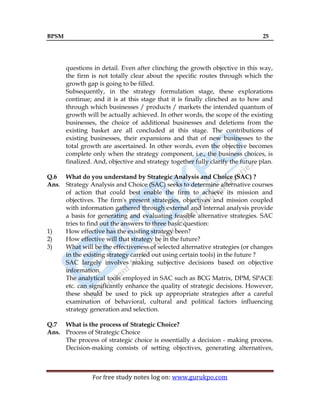
Many situational considerations enter into crafting strategy. Figure below
depicts the primary factors that shape a company's strategic approaches.
The interplay of these factors and the influence that each has on the
strategy-making process vary from situation to situation.
This is why carefully sizing-up all the various situational factors, both
external and internal, is the starting point in crafting strategy.
1) Societal, Political, Regulatory, and Citizenship Considerations: All
organizations operate within the broader community of society. What an
enterprise can and cannot do strategy-wise is always constrained by what
is legal, by what complies with government policies and regulatory
requirements, by what is considered ethical, and by what is in accord with
societal expectations and the standards of good community citizenship.
Outside pressures also come from other sources - special - interest groups,
the glare of investigative reporting, a fear of unwanted political action,
and the stigma of negative opinion.
2) Competitive Conditions and Overall Industry Attractiveness: An
industry's competitive conditions and overall attractiveness are big
strategy - determining factors. A company's strategy has to be tailored to
the nature and mix of competitive factors in play - price, product quality,
performance features, service, warranties, and so on. When competitive
conditions intensify significantly, a company must respond with strategic
actions to protect its position.
3) Company's Market Opportunities and External Threats: The particular
business opportunities open to a company and the threatening external
developments that it faces are key influences on strategy. Both point to the
need for strategic action. A company's strategy needs to be deliberately
aimed at capturing its best growth opportunities, especially the ones that
hold the most promise for building sustainable competitive advantage
and enhancing profitability. Likewise, strategy should provide a defense
against external threats to the company's well-being and future
performance.
4) Company Resource Strengths, Competencies, and Competitive
Capabilities: One of the most pivotal strategy-shaping internal
considerations is whether a company has or can acquire the resources,
competencies, and capabilities needed to execute a strategy proficiently.
These are the factors that can enable an enterprise to capitalize on a
24
For free study notes log on: www.gurukpo.com
particular opportunity, give the firm a competitive edge in the
marketplace, and become a cornerstone of the enterprise's strategy.
5) Personal Ambitions, Business Philosophies and Ethical Beliefs of
Managers: Managers do not dispassionately assess what strategic course
to steer. Their choices are typically influenced by their own vision of how
to compete and how to position the enterprise and by what image and
standing they want the company to have. Both casual observation and
formal studies indicate that manager's ambitions, values, business
philosophies, attitudes toward risk, and ethical beliefs have important
influences on strategy. Sometimes the influence of a manager's personal
values, experiences, and emotions is conscious and deliberate; at other
times it may be unconscious.
Attitudes toward risk also have a big influence on strategy.
6) Influence of Shared Values and Company Culture on Strategy: An
organization's policies, practices, traditions, philosophical beliefs and
ways of doing things combine to create a distinctive culture. Typically, the
stronger a company's culture, the more that culture is likely to shape the
company's strategic actions, sometimes even dominating the choice of
strategic moves.
Q.5 What is linkage between corporate objective & corporate strategy?
Ans. Linkage between Corporate Objective and Corporate Strategy While
objectives indicate where the firm wants to reach, strategy provides the
design for getting there. While the objective specifies the results the firm
seeks in a given timeframe, the strategy spells out the programmed of
action for achieving the results. In finally deciding the business- product -
market choices for the firm, corporate strategy fills in those areas left
blank in the objective formulation stage.
Objectives and Strategy together describe the Firm's Concept of Strategy
The firm raises many questions before finally clinching its growth
objective. For instance, it agitates questions such as; what part of its
overall growth ambition it should target for realization during the present
planning period? To what extent can its existing businesses contribute to
this target? To what extent they can grow and to what extent can new
markets be found for these businesses? From where else can the desired
growth come? To what extent do the firm's capabilities match the desired
growth? The firm clinches its growth objective after agitating all such
BPSM 25
For free study notes log on: www.gurukpo.com
questions in detail. Even after clinching the growth objective in this way,
the firm is not totally clear about the specific routes through which the
growth gap is going to be filled.
Subsequently, in the strategy formulation stage, these explorations
continue; and it is at this stage that it is finally clinched as to how and
through which businesses / products / markets the intended quantum of
growth will be actually achieved. In other words, the scope of the existing
businesses, the choice of additional businesses and deletions from the
existing basket are all concluded at this stage. The contributions of
existing businesses, their expansions and that of new businesses to the
total growth are ascertained. In other words, even the objective becomes
complete only when the strategy component, i.e., the business choices, is
finalized. And, objective and strategy together fully clarify the future plan.
Q.6 What do you understand by Strategic Analysis and Choice (SAC) ?
Ans. Strategy Analysis and Choice (SAC) seeks to determine alternative courses
of action that could best enable the firm to achieve its mission and
objectives. The firm's present strategies, objectives and mission coupled
with information gathered through external and internal analysis provide
a basis for generating and evaluating feasible alternative strategies. SAC
tries to find out the answers to three basic question:
1) How effective has the existing strategy been?
2) How effective will that strategy be in the future?
3) What will be the effectiveness of selected alternative strategies (or changes
in the existing strategy carried out using certain tools) in the future ?
SAC largely involves making subjective decisions based on objective
information.
The analytical tools employed in SAC such as BCG Matrix, DPM, SPACE
etc. can significantly enhance the quality of strategic decisions. However,
these should be used to pick up appropriate strategies after a careful
examination of behavioral, cultural and political factors influencing
strategy generation and selection.
Q.7 What is the process of Strategic Choice?
Ans. Process of Strategic Choice
The process of strategic choice is essentially a decision - making process.
Decision-making consists of setting objectives, generating alternatives,
26
For free study notes log on: www.gurukpo.com
choosing one or more alternatives that will help the organization achieve
its objectives in the best possible manner, and finally, implementing the
chosen alternative.
To make a choice from among the alternatives, a decision - maker has to
set certain on which to accept or reject alternatives. These criteria are the
selection factors. They act as guides to decision - making and considerably
simplify the process of selection which would otherwise be a very difficult
task.
Strategic choice could be defined as "the decision to select from among the
grand strategies considered, the strategy which will best meet the
enterprise's objectives. The decision involves focusing on a few
alternatives, considering the selection factors, evaluating the alternatives
against these criteria, and making the actual choice."
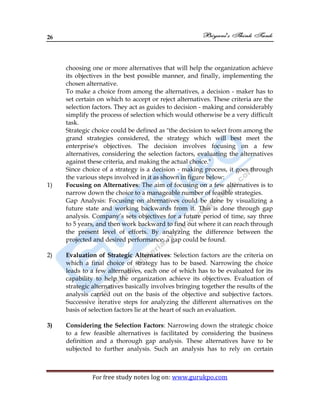
Since choice of a strategy is a decision - making process, it goes through
the various steps involved in it as shown in figure below:
1) Focusing on Alternatives: The aim of focusing on a few alternatives is to
narrow down the choice to a manageable number of feasible strategies.
Gap Analysis: Focusing on alternatives could be done by visualizing a
future state and working backwards from it. This is done through gap
analysis. Company’s sets objectives for a future period of time, say three
to 5 years, and then work backward to find out where it can reach through
the present level of efforts. By analyzing the difference between the
projected and desired performance, a gap could be found.
2) Evaluation of Strategic Alternatives: Selection factors are the criteria on
which a final choice of strategy has to be based. Narrowing the choice
leads to a few alternatives, each one of which has to be evaluated for its
capability to help the organization achieve its objectives. Evaluation of
strategic alternatives basically involves bringing together the results of the
analysis carried out on the basis of the objective and subjective factors.
Successive iterative steps for analyzing the different alternatives on the
basis of selection factors lie at the heart of such an evaluation.
3) Considering the Selection Factors: Narrowing down the strategic choice
to a few feasible alternatives is facilitated by considering the business
definition and a thorough gap analysis. These alternatives have to be
subjected to further analysis. Such an analysis has to rely on certain
BPSM 27
For free study notes log on: www.gurukpo.com
factors. These factors are termed as selection factors. They determine the
criteria on which the evaluation of strategic alternatives can be based.
The selection factors can be broadly divided into two groups:
i) Objective Factors: Objective factors are based on analytical techniques and
are hard facts or data used to facilitate a strategic choice. They could also
be termed as rational, normative, or prescriptive factors.
ii) Subjective Factors: Subjective factors are based on one's personal
judgment and collective or descriptive factors. For the present, it is
important to note that the alternatives that are generated in the first step
have to be subjected to analysis on the basis of these selection factors.
4) Making the Strategic Choice: An evaluation of strategic choice should lead
to a clear assessment of which alternative is the most suitable under the
existing conditions. The final step, therefore, is to make the strategic
choice. One or more strategies have to be chosen for implementation. A
blueprint that will describe the strategies and the conditions under which
they would operate has to be made. This blueprint is the strategic plan.
Case
For as long as business existed, people involved in it have been subjected
to the whims of the economy. The only constant in business has been
change and economic uncertainty has been just another day at office for
all those who ever thought of financial success. Pervasive market
fluctuations and economic volatility are here to stay. An interesting
research in the recent past threw up mind boggling statistics. Of the total
companies in the 1955, Fortune 500 list, 70% are now out of business and
those listed in 1979, 40% no longer exist as corporate entities.
This trend is widely seen across the world. Today, if corporations are
being formed before one can blink one's eye, almost as many are being
shut down daily. Big corporate names of yesterday are either shutting
shop or are on the brink of closure and bankruptcies. If a third of the
Fortune 500 companies of 1970 can disappear by 1983 and the average life
span is decreasing by the day, there is little wonder that smaller
28
For free study notes log on: www.gurukpo.com
companies are also feeling the pinch. At the core of the problem lies not
just the lack of sustainable business plans. It is a larger issue. It is the
result of the organizations' ability to change; to evolve, to accept
challenges and to seek new avenues of growth. To be big and strong is one
thing; to be evolving with the times is another matter.
So it is the capability of the organization to reengineer, transform and
adjust to the rapidly changing business environment that separates the
boys from the men or the haves from the have not’s. Building adaptive
capabilities that will enable an organization to move with the market is
the call of the day. Adaptive organizations revolve around dynamic real
time processes; Performed anywhere and anytime using adaptive
solutions. An organization's operating teams may be dynamic and
effective but market conditions are beyond one's control and they do not
look likely to rebound. One must, therefore, adjust and adapt and defy the
economy.
Case Questions
1) What do you think, an organization should do to cape with the changing
business environment ?
2) "To change or to close down" Comment on this statement in the light of
the changing environment.
MULTIPLE CHOICE QUESTIONS
1. Substantial changes to the range of offerings or the markets served or
both are known as:
A Differentiation B Diversification
C Relocation D Brand extension
2. Which of the following might be sources of synergy between two
business units?
A They have similar customers and use the same distribution channels
B The profits from one can be used to finance the other when its gets into
trouble
C They both have a website
D They are both located in the same town
BPSM 29
For free study notes log on: www.gurukpo.com
3. In the value chain, primary activities are:
A Directly involved in the production, marketing and delivery of the
product or service
B Those activities that is all undertaken in-house
C Those activities that support the production, marketing and delivery of
the product or
Service
D Directly involved in the production and delivery of the product or service
4. What will make some organizations more successful, and therefore
more likely to survive and prosper, than others?
A Creating cultures and systems in which staff can use their talents
B Creating management systems to ensure high performance from everyone
C Creating superior organizations
D Only recruiting talented people
5. Many schemes that reward employees and managers for something
additional to their normal level of performance fail. Why?
A The link between extra pay and achievement is unclear
B They are detrimental to trade union agreements
C PRP is controversial
D Everyone should receive the same
6. As little as 20% of all human performance problems are attributable to
individual employees; as much as 80% of all such problems are
attributable to the work environments or systems in which employees
work. An example of such problems would be:
A Because people are often absent from work
B Because people at work don't perform
C Because low standards of performance are legitimized
D Because of barriers created to reduce performance
7. The timescale for performance appraisals are usually:
A One year
B Quarterly
C monthly
30
For free study notes log on: www.gurukpo.com
D At irregular intervals
8. A performance rating system is:
A A grade or score relating to overall performance
B Details of the extent to which work objectives were met
C Last year’s objectives
D Achievements during the year
9. .Objective-based rating scales are:
A Subjectively determined
B Based on a points-based system
C Measures of performance against objectives set
D Manager-allocated rating scales
10 To be effective a point based rating systems require:
A Close management control
B Comprehensive, reliable and consistent information
C Objectivity in assessments
D 360% assessments
Answers 1(B) 2 (A) 3(A) 4(B) 5(A) 6(D) 7(A) 8(A) 9(C) 10(B)
BPSM 31
For free study notes log on: www.gurukpo.com
Unit 3
Analyzing Business Environment
Q.1 What is Environmental Scanning or Environmental Analysis?
Ans. Environmental analysis (scanning or appraisal) is the process by which
corporate planners monitor the economic, governmental, supplier,
technological and market setting to determine the opportunities for and
threats to their enterprise. In other words, environmental scanning
consists of identifying and analyzing environmental influences
individually and collectively to determine their potential effects on an
organization and the consequent problems and opportunities.
The process by which organizations monitor their relevant environment to
identify opportunities and threats affecting their business is known as
'environmental scanning'.
The importance of environmental analysis lies in its usefulness for
evaluating the present strategy, setting strategic objectives and
formulating future strategies. The fortunes of business enterprises are
known to have been determined by changes in the social, economic,
political, business and industrial conditions.
According to L.R. Jauch and W.F. Glueck, "Environmental analysis
is the process by which strategists monitor the environmental factors to
determine opportunities for and threats to their firms. Environmental
diagnosis consists of managerial decisions made by assessing the
significance of the data of the environmental decisions made by assessing
the significance of the data of the environmental analysis."
Q.2 Describe the process of Environment Analysis.
Ans. Procedure of Environmental Analysis
Step 1: Assess the Nature of the Environment: It is useful to take a view of
the nature of the organization's environment in terms of how uncertain it
is. Is it relatively static or does it show signs of change, and in what ways;
32
For free study notes log on: www.gurukpo.com
and is it simple or complex to comprehend? This helps in deciding what
focus of the rest of the analysis is to take.
Step 2: Audit Environmental Influences: The aim is to identify which of
the many different environmental influences have affected the
organization's development or performance in the past. It may also be
helpful to construct pictures - or scenario - of possible futures to consider
the extent to which strategies might need to change.
Step 3: Identify key Competitive Forces through Structural Analysis: It
aims to identify the key forces at work in the immediate or competitive
environment and why they are significant.
Step 4: Identify Strategic Position: It means to analyze the organization's
strategic position, i.e., how it stands in relation to those other
organizations competing for the same resources, or customers, as itself.
This may be done in number of ways
a) Competitor analysis;
b) Strategic group analysis, in terms of similarities and dissimilarities of the
strategies they follow;
c) The analysis of market segments and market power;
d) Building on growth / share analysis, and
e) Attractiveness analysis
Step 5: Identify key Opportunities and Threats: Develop and
understanding of opportunities which can be built upon the threats which
have to be overcome or circumvented. An understanding which needs to
be considered in terms of the resource base of the organization and which
will contribute to strategy choice is very important.
Q.3 What is Industry analysis?
Ans. Every firm holds a position or role in the chain of activities necessary to
convert physical, financial and human resources into more valued goods
or services and markets them. Upstream from the incumbent firms are the
suppliers who contribute (Components, materials, services or other
inputs) the inputs that industry players use. Downstream from the
incumbent firms are buyers (other manufacturers, wholesale and retail
distributors and consumers) who buy from the firms in the industry.
The basic purpose of industry analysis is to assess the relative strengths
and weaknesses of an organization relative to other players in the
BPSM 33
For free study notes log on: www.gurukpo.com
industry. It tries to highlight the structural realities of a particular industry
and the extent of competition within that industry.
Q.4 Explain the purpose of competitive analysis.
Ans. Competitive analysis focuses on each company with which a firm
competes directly. Competitive analysis, therefore, deals with the actions
and reactions of individual firms within an industry or strategic group. It
becomes especially important in the case of oligopolistic industries where
there are a few powerful competitors and each needs to keep track of the
strategic moves of the others.
According to Porter, the purpose of conducting a competitive analysis is
to :
1) Determine each competitor's probable reaction to the industry and
environmental changes.
2) Anticipate the response of each competitor to the likely strategic moves by
the other firm, and
3) Develop a profile of the nature and success of the possible strategic
changes each competitor might undertake.
Q.5 Interpret the five force model.
Ans. Porter's model is one of the most useful conceptual frameworks used to
assess the nature of the competitive environment and to describe an
industry's structure. A highly attractive industry is one where a firm is
able to make profits easily. In an unattractive industry, the profitability is
generally low or consistently depressed. To remain an effective
competitor, a firm should:
i) Appreciate which of the five forces is the most significant (it can be
different for different industries), and concentrate strategic attention in
this area.
ii) Position itself for the best possible defense against any threats from rivals.
iii) Influence the forces detailed above through its own corporate and
competitive strategies.
iv) Anticipate changes or shifts in the forces - the factors that are generating
success in the short-term may not succeed long-term
34
For free study notes log on: www.gurukpo.com
Case
James Emery is the father of four children. He was raised in a
hardworking immigrant family. His needs for achievement and power
were developed while he was growing up. Now he finds himself in a low-
paying, dead-end assembly line job with a large manufacturing firm. It is
all he can do to get through the day, so he has started daydreaming on the
job. On payday he often goes to the tavern across the street and generally
spends a lot of money. The next day he is not only hung over but also very
depressed because he knows that his wife cannot make ends meet and his
children often go without the essentials.
Now he cannot take it any longer. At first he thought of going to his boss
for some help and advice, but he really does not understand himself well
enough, and he certainly does not know or trust his boss enough to
discuss him problems openly with him. Instead, he went to his union
steward and told him about his financial problems and how much he
hated his job. The steward told James exactly what he wanted to hear.
"This darn company is the source of all your problems. The working
conditions are not suited for a slave, let alone us. The pay also stinks. We
are all going to have to stick together when our present contract runs out
and get what we deserve - better working conditions and more money."
Case Questions
1) Explain James's behavior in terms of the frustration model.
2) Cite a specific example of role conflict in this case.
3) What type of conflict resolution strategy is the union steward suggesting?
Do you think the real problems facing James are working conditions and
pay? Why or why not?
BPSM 35
For free study notes log on: www.gurukpo.com
Multiple Choice Questions
1.When there is a fit between the goals of the organization and the goals
of individuals, this is known as:
a) Goal fit
b) Goal congruence
c) Goal hierarchy fit
d) Goal coordination
Question 2
Which of the following is correct?
a) An organization's structure would be expected to evolve as it grew
larger and more diverse
b) Every organization starts out with a simple structure, then moves to a
functional structure before becoming divisional zed
c) Network structures are superior to functional ones
d) Organizational performance will suffer if the structure is not stable
Question 3
The shape or format of reporting and decision making relationships can
be defined as the organizational:
a) Span of control
b) Architecture
c) Hierarchy
d) Chain of command
Question 4
The main components of an organization's architecture are structural
hierarchy, values and belief systems, contracts and relationships and (two
more):
a) Control systems and ways of working
36
For free study notes log on: www.gurukpo.com
b) Information infrastructure and power structures
c) Control systems and power structures
d) Control systems and information infrastructure
Question 5
A 'vertical architecture' is one which:
a) Has a tall hierarchy
b) Has many layers of management
c) Extends beyond the boundaries of legal ownership
d) Is very bureaucratic
Question 6
Organizational structures and systems can be judged using five dimensions
(ABCDE) to assess whether they are achieving an appropriate balance. These
five dimensions are Autonomy, Bureaucracy, Cultural Control, and
Decentralization:
a) Equal Opportunities
b) Economic Incentives
c) Equality and Diversity
d) Evidence of Learning
Question 7
Employees who work in an autonomous fashion are:
a) Given freedom to make decisions
b) Closely monitored
c) Heavily influenced by organizational culture
d) Motivated by non-financial rewards
Question 8
BPSM 37
For free study notes log on: www.gurukpo.com
Bureaucracy is sometimes seen as a negative thing but it has some benefits for
organizations. Which of the following is NOT a benefit of bureaucracy?
a) It can make information easier to share
b) It can reduce errors
c) It can increase organizational flexibility
d) It can ensure that stakeholders are treated consistently
Question 9
Successful business relationships tend to:
a) Combine relational contracts - to build trust in the long term - with
transactional contracts to cover specific situations
b) Depend upon tightly written legal contracts that take account of every
potential problem or issue
c) Rely upon firms being able to trust their employees and partners
d) Be treated as finite games that both partners know will end sooner or later
Question 10
Goffee and Jones use two variables to classify organizational cultures. These
are:
a) Sociability and Synergy
b) Cohesion and Synergy
c) Sociability and Solidarity
38
For free study notes log on: www.gurukpo.com
Unit- 4
Identifying Alternative Strategies
Q.1 What is the objective of identification of Strategic alternatives?
Ans. The basic objective of identification of strategic alternatives is twofold:
1) The Manager should the aware about the various courses of action
available to them;
2) Even if, large numbers of possible alternative actions are available, they
should be in a position to limit themselves to various relevant alternatives
so that unnecessary exercises are not taken up. From this point of view,
how far an organization goes, for searching strategic alternatives depends
on the approach it adopts for strategic decision-making.
Q.2 What is Grand Strategy?
Ans. A grand strategy is one which provides guidance for major actions for the
purpose of meeting long-them objectives. These provide a basic direction
for strategic action in line with major corporate objectives of a company.
These grand strategies are thus a blue print for action.
Selection of grand strategies has been limited for their application due to
the following reasons:
1) Traditional managers usually build their action plans from status quo,
which leads to myopic attitudes towards growth, which is incremental in
nature and not with quantum improvements. Thus a treasure of potential
grand strategies remains unexplored by them.
2) Strategy managers who are aware of grand strategies lack the knowledge
and experience of selecting and implementing grand strategies. Thus,
managers must be trained not only on available grand strategies but also
on ways and means of implementing them.
Q.3 Explain Major Strategy options?
Ans. Major Strategy Options-
BPSM 39
For free study notes log on: www.gurukpo.com
Broadly speaking, the major options in strategy formation may be divided
into four categories:
1) Stability strategy;
2) Growth strategy;
3) Retrenchment strategy, and
4) Combination strategy.
These alternatives are sometimes called grand strategy alternatives.
Within each category, again, the strategic planners may consider several
sub-options or sub-strategies. A bird's-eye view of the four grand
strategies before the details of each of these is as follows :
1) STABILITY STRATEGIES: The stability grand strategy is adopted by an
organization when it attempts at an incremental improvement of its
functional performance by marginally changing one or more of its
business in terms of their respective customer groups, customer functions,
and alternative technologies - either singly or collectively.
Examples: In order to understand how stability strategies work, here are
three examples to illustrate how organizations could aim at stability in
each of the three dimensions of customer groups, customer functions, and
alternative technologies, respectively.
i) A packaged-tea company provides a special service to its institutional
buyers, apart from its consumer sales through market intermediaries, in
order to encourage bulk buying and thus improve its marketing
efficiency.
ii) A copier machine company provides better after-sales service to its
existing customers to improve its company and product image, and
increase the sale of accessories and consumables.
iii) A steel company modernizes its plant to improve efficiency and
productivity.
Note that all the three companies here do not go beyond what they are
presently doing; they serve the same markets with the present products
using the existing technology.
2) GROWTH / EXPANSION STRATEGIES : The expansion grand strategy
is followed when an organization aims at high growth by substantially
broadening the scope of one or more of its businesses in terms of their
respective customer groups, customer functions, and alternative
40
For free study notes log on: www.gurukpo.com
technologies - singly or jointly - in order to improve its overall
performance.
Examples: Given below are three examples to show how company’s cam
aim at expansion either in terms of customer groups, customer functions,
or alternative technologies.
i) A chocolate manufacturer expands its customer groups to include middle-
aged and old persons among its existing customers comprising of children
and adolescents.
ii) A stockbroker's firm offers personalized financial services to small
investors apart from its normal functions of dealing in shares and
debentures in order to increase the scope of its business and spread its
risks.
iii) A printing firm changes from the traditional letter-press printing to desk-
top publishing in order to increase its production and efficiency.
In each of the above cases, the company moved in one or the other
direction is as to substantially alter its present business definition.
3) RETRENCHMENT STRATEGIES : A retrenchment grand strategy is
followed when an organization aims at a contraction of its activities
through substantial reduction or the elimination of the scope of one or
more of its businesses, in terms of their respective customer groups,
customer function, or alternative technologies - either singly or jointly - in
order to improve is overall performance.
Examples: Retrenchment involves a total or partial withdrawal from either
a customer group, customer function, or the use of an alternative
technology in one or more of a firm's businesses, as can be seen from the
situations given below:
i) A pharmaceutical firm pulls out from retail selling to concentrate on
institutional selling in order to reduce the size of its sales force and
increase marketing efficiency.
ii) A corporate hospital decides to focus only on specialty treatment ad
realize higher revenues by reducing its commitment to general cases
which are typically less profitable to deal with.
iii) A training institution attempts to serve a large clientele through the
distance learning system and to discard its face-to-face interaction
methodology or training in order to reduce its expenses and use the
existing facilities and personnel more efficiently.
BPSM 41
For free study notes log on: www.gurukpo.com
In this manner, retrenchment attempts to 'trim the fat' resulting in a
'slimmer' organization bereft of unprofitable customer groups, customer
functions or alternative technologies.
4) COMBINATION STRATEGIES: The combination grand strategy is
followed when an organization adopts a mixture of stability, expansion,
and retrenchment, either at the same time in its different businesses, or at
different times in the same business with the aim of improving its
performance. Combination strategies are the complex solutions that
strategists have to offer when faced with the difficulties of real-life
business.
Q.4 What are the characteristics and scope of stability strategy?
Ans. Characteristics and Scope of Stability Strategy-
1) A firm opting for stability strategy stays with the same business, same
product-market posture and functions, maintaining same level of effort as
at present.
2) The endeavor is to enhance functional efficiencies in an incremental way,
through better deployment and utilization of resources. The assessment of
the firm is t hat the desired income and profits would be forthcoming
through such incremental improvements in functional efficiencies.
3) Naturally, the growth objective of firms employing this strategy will be
quite modest. Conversely, only firms with modest growth objective will
vote for this strategy.
4) Stability strategy does not involve a redefinition of the business of the
corporation.
5) It is basically a safety-oriented, status quo-oriented strategy.
6) It does not warrant much of fresh investments.
7) The risk is also less.
8) It is a fairly frequently employed strategy.
9) With the stability strategy, the firm has the benefit of concentrating its
resources and attention on the existing businesses / products and
markets.
But the strategy does not permit the renewal process of bringing in fresh
investments and new products and markets for the firm.
Q.5 What is Growth & Expansion Strategy?
42
For free study notes log on: www.gurukpo.com
Ans. A growth strategy signifies something different from stable growth
strategy or stability strategy. When a firm increases the level of objectives
higher than what it has achieved in the immediate past, in terms of (say)
market share, sales revenue, etc., or strategic decision centre round
increased functional performance in major respects, we have typical cases
of growth strategy. Another kind of growth strategy is typically found
when new products are added to the existing line, or dissimilar products
are taken up for production and sale, or business activities are expanded
through acquisition, merger, or amalgamation of firms. In a sense, growth
strategy differs from stability strategy in that the former implies
exponential growth while the latter implies an extrapolation of growth
based on past performance.
Characteristics and Scope of Expansion Strategy-
1) Expansion strategy is the opposite of stability strategy. Wile in stability
strategy. While in stability strategy, rewards are limited; in expansion
strategy they are very high. In the matter of risks, too, the two are the
opposites of each other.
2) Expansion strategy is the most frequently employed generic strategy.
3) Expansion strategy is the true growth strategy. A firm with a mammoth
growth ambition can meet its objective only through the expansion
strategy.
4) Expansion strategy involves a redefinition of the business of the
corporation.
5) The process of renewal of the firm through fresh investments and new
businesses/products/markets is facilitated only by expansion strategy.
6) Expansion strategy is a highly versatile strategy; it offers several
permutations and combinations for growth. A firm opting for the
expansion strategy can generate many alternatives within the strategy by
altering its propositions regarding products, markets and functions and
pick the one that suits it most.
7) Expansion strategy holds within its fold two major strategy routes :
i) Intensification,
ii) Diversification.
Both of them are growth strategies; the difference lies in the way in
which the firm actually pursues the growth.
BPSM 43
For free study notes log on: www.gurukpo.com
Q.6 Differentiate between intensification and diversification strategy.
Ans. With intensification strategy, the firm pursues growth by working with its
current businesses.
Intensification, in turn, encompasses three alternative routes:
i) Market penetration strategy,
ii) Market development strategy,
iii) Product development strategy.
Diversification strategy involves expansion into new businesses that are
outside the current businesses and markets.
There are three broad types of diversification:
i) Vertically integrated diversification,
ii) Concentric diversification,
iii) Conglomerate diversification.
Vertically integrated diversification involves going into new businesses
that are related to the current ones.
It has two components - forward integration and backward integration.
The firm remains vertically within the given product-process
sequence; the intermediaries in the chain become new businesses.
In concentric diversification, too, the new products are connected to the
firm's existing process / technology. But the new products are not
vertically linked to the existing ones. They are not intermediates. They
serve new functions in new markets. A new business is shinned - off from
the firm's existing facilities.
In conglomerate diversification too, a new business is added to the firm's
portfolio. But, it is disjointed from the existing businesses ; in process /
technology / function, there is no connection between the new business
and the existing ones. It is unrelated diversification.
Q.7 Detail the variants of Growth Strategy?
Ans. Variants of Growth Strategy
1) Intensification Strategy (Internal Growth)
Internal growth, which consists of increasing the sales revenue, profits
and market share of the existing product line or services, is generally
known as, intensive growth strategy.
44
For free study notes log on: www.gurukpo.com
When a firm selects the intensification strategy, it means that the firm is
opting to go deeper in its existing business. As the very word denotes, in
intensification, the firm is intensifying, i.e., deepening and strengthening
its involvement and position in its existing business. In the first place, it
finds additional opportunities in that business and secondly, it
consciously commits itself to exploiting these opportunities. It is ready to
put in more investment in the existing business, seeking a new position
therein.
Thus, intensification basically means product-market expansion in
existing businesses. And, intensification strategies provide ways to
intensify the firm's position in existing businesses.
Type of Intensification strategy
i) Market penetration
ii) Market development
iii) Product development
i) Market Penetration Strategy: Under market penetration strategy the firm
tries to achieve growth through existing products in existing markets. The
firm opts to penetrate the existing markets deeper, using the existing
products. In other words, it tries to increase its market share through
penetrating the market further, staying with the same products and same
markets.
ii) Market Development Strategy: Market Development strategy tries to
achieve growth through existing products in new markets. There might be
limits to penetrating the existing market; so, the firm decides to locate and
tap new market and/or new market segments. As in market penetration
strategy, here too, the firm stays with the same product, but moves on to
new markets/ market segments/new uses.
iii) Product Development Strategy: Product development strategy tries to
achieve growth through new products in existing markets. The new
products in this context are not intrinsically new products, but improved
products or substitutes serving the same need and carrying the same
product mission. The firm develops improved products for marketing in
the same markets; these products are not really distinct from the existing
products.
It involves concentration of resources in a high-growth product or market
segment and is a widely used growth strategy. If the product is not in the
BPSM 45
For free study notes log on: www.gurukpo.com
maturity stage of the life-cycle, this is a particularly attractive strategy. It is
often suited to firms with a small market share irrespective of whether the
product is in the high-growth stage or maturity stage of its life-cycle.
2) Diversification Strategy
At some point of time in the process of intensive growth, it is no longer
possible for a firm to expand in the basic product market. It is not able to
grow any more through market penetration. Then is must consider adding
new products or markets to its existing business line. This approach
toward growth is known as diversification. Diversification Strategy is thus
defined as a strategy in which the growth objective is ought to be achieved
by adding new products or services to the existing product or service line.
Type of Diversification strategy
i) Related
a) Vertical integration
Backward integration
Forward integration
b) Concentric diversification
Market related
Technology related
Market and technology related
c) Unrelated
Conglomerate diversification
Reasons Underlying Growth Strategies
1) Growth is often a cherished cultural value. A company tat is not
expanding is said to be falling behind; a stigma is associated with the
failure to grow. On the other hand, a growth company is better known
and attracts better management. It is a source of strength.
2) In industries, which are subject to frequent changes in technology and
other external conditions, growth is necessary for survival. Opportunities
must be availed of and threats must be overcome so as to survive.
3) Growth strategy is associated with strong managerial motivation in its
favor. Expansion is a rewarding phenomenon in several ways. Larger size
means higher executive compensation. It satisfies power and recognition
needs. To seize market share from competitors or to enter challenging new
fields is not only exciting and satisfying but also leads to a sense of
achievement.
46
For free study notes log on: www.gurukpo.com
Q.8 Why is Diversification Strategies Adopted?
Ans The three basic and important reasons are:
i) Diversification strategies are adopted to minimize risk by spreading it
over several businesses.
ii) Diversification may be used to capitalize on organizational strengths or
minimize weaknesses.
iii) Diversification may be the only way out if growth in existing businesses is
blocked due to environmental and regulatory factors.
Different Types of Diversification Strategies
i) Related Strategy
a) Vertical Integration : Vertical diversification, commonly describe as
vertical integration, is a type of growth strategy wherein new products or
services are added which are complementary to the existing products or
service line. It is characterized by the extension of the firm's business
definition in two possible directions from the present - backward or
forward. In other works, vertical integration is a growth strategy that
involves the expansion of business by moving backward or forward from
the present products or services establishing linkages of products,
processes or distribution system. Thus, vertical integration may be of two
types: Backward Vertical Integration or Forward Vertical Integration.
Vertical Backward Integration: Also known as 'upstream development',
backward integration strategy involves addition of activities to ensure the
supply of a firm's present inputs. It is aimed at moving lower on the
production process scale so that; the firm is able to supply its own raw
materials or basic components. Many sugar mills in India have developed
sugarcane farming. T.V. manufactures may produce picture tubes and
other components. Steel plants have set up their own coke ovens and
acquired mining rights to secure the supply of coal and coke. All these are
instances of backward vertical integration.
.
Vertical Forward integration: Forward integration is a type of
diversification strategy which involves the entry of a firm into the
business of finishing, distributing, or selling of some of its present
outputs. It is sometimes described as 'downstream' expansion and refers
to moving higher up in the production / distribution process towards the
end consumer. Many a firm in India which started business with a
spinning mill has later added loom sheds to produce fabrics. Large textile
BPSM 47
For free study notes log on: www.gurukpo.com
mills (DCM, Mafatlal, Binny, National Textile Corporation, and other)
have set up their own retail distribution systems. These are examples of
forward integration.
b) Concentric Diversification: When an organization takes up an activity in
such a manner that it is related to the existing business definition of one or
more of a firm's businesses, either in terms of customer groups, customer
functions or alternative technologies, it is called concentric diversification.
Concentric diversification may be of three types :
Marketing-Related Concentric Diversification: When a similar type of
product is offered with the help of unrelated technology, for example, a
company in the sewing machine business diversifies into kitchenware and
household appliances, which are sold to housewives through a chain of
retail stores.
Technology-Related Concentric Diversification: When a new type of
product or service is provided with the help of related technology, for
example, a leasing firm offering hire-purchase services to institutional
customers also starts consumer financing for the purchase of durables to
individual customers.
Marketing and Technology Related Concentric Diversification : When a
similar type of product (of service) is provided with the help of related
technology, for example, a raincoat manufacturer makes other rubber-
based items, such as, waterproof shoes and rubber gloves, sold through
the same retail outlets.
ii) Unrelated Diversification
a) Conglomerate Diversification: When an organization adopts a strategy
which requires taking up those activities which are unrelated to the
existing business definition of one or more its businesses, either in terms
of their respective customer groups, customer functions or alternative
technologies, it is called conglomerate diversification. There are several
examples of Indian companies, which have adopted a path of growth and
expansion through conglomerate diversification. The classic examples are
of ITC, a cigarette company diversifying into the hotel industry. Some
other examples are those of the Essar Group (shipping, marine
construction, oil support services, and iron and steel) ; Shriram Fibers Ltd.
48
For free study notes log on: www.gurukpo.com
(nylon industrial yarn, synthetic industrial fabrics, nylon tyre cords,
fluorochemicals, fluorocarbon refrigerant gases, ball and needle bearings,
auto-electrical, hire-purchase and leasing, and financial services); the Polar
group (fans, marbles, and granite), and the TTK group (pressure cooker,
chemicals, pharmaceuticals, hosiery, contraceptives, publishing etc.).
Objectives of Conglomerate Diversification
The reasons underlying the use of conglomerate diversification strategy
may be:
o To achieve a growth rate higher than what can be realized through
expansion;
o To make better use of financial resources with retained profits
exceeding immediate investment needs;
o To avail of potential opportunities of profitable investments;
o To achieve distinct competitive advantage and broader stability;
o To spread the risk or gain increased stability, and
o To improve the price-earnings ratio and bring about a higher
market price of share.
Q.9 What is Retrenchment Strategy?
Ans. A strategic option, which involves reduction of any existing product or
service line along with the level of objectives set below the past
achievement, is know as, retrenchment strategy. It is essentially a
defensive strategy adopted as a reaction to operating problems stemming
from either internal mismanagement, unanticipated actions by
competitors, or changes in market conditions.
1) Poor Performance: When a firm suffers from poor performance in terms of
lower earnings and profits, and is unable to recover its position by any
other means, it may be required to shut down units of activity or segments
of business, which continue to be a drag on total performance.
2) Threat to Survival: When the survival of a firm is threatened by
unanticipated problem in the product market, the management may be
under pressure form shareholders and employees to improve
performance by all means including cutback of operation.
3) Redeployment of Resources: When alternative investment opportunities
promise higher returns, some of the existing business units or segments of
BPSM 49
For free study notes log on: www.gurukpo.com
activity may be shed and resources thus released utilized for increased
profitability and growth.
4) Insufficiency of Resources: To sustain and develop satisfactory earning
position in a product-market, it may be necessary to deploy large financial
resources. If the firm is not in a position to provide adequate funds for
that purpose, the best thing to do may be divestment of the particular
product-market for better use of the finances released thereby.
5) To secure better Management and improved Efficiency: It may be
necessary to cut down some of the existing operations to simplify the
range of enterprise activities and thus secure high efficiency of operations.
Q.10 Explain the Variants of Retrenchment Strategy?
Ans. Variants of Retrenchment Strategy -
1) Turnaround Strategies: Retrenchment may be done either internally or
externally. For internal retrenchment to take place, emphasis is laid on
improving internal efficiency. This usually takes the form of an operating
turnaround strategy. In contrast, a strategic turnaround is a more serious
form of external retrenchment and leads to divestment or liquidation.
Turnaround strategies derive their name from the action, involved, that is,
reversing a negative trend.
Condition for Turnaround Strategies
There are certain conditions or indicators, which point out that a
turnaround is needed if the organization has to survive. These danger
signs are :
i) The existing chief executive and management team handles the entire
turnaround strategy with the advisory support of a specialist external
consultant. The use of this method can only be successful if the chief
executive has a reasonable amount of creditability left with the banks and
financial institutions and a qualified consultant is available. This type of
turnaround management, that is, under an existing team, is rarely
attempted.
ii) In another situation, the existing team withdraws temporarily and an
executive consultant or turnaround specialist is employed to do the job.
This person is usually deputed by the banks and financial institutions and
after the job is over, reverts to the original position. This method is also
very rarely used in India.
50
For free study notes log on: www.gurukpo.com
iii) The last method - the one most difficult to attempt but that is most often
used - involves the replacement of the existing team, specially the chief
executive, or merging the sick organization with a healthy one.
Action Plans for Turnaround
For turnaround strategies to be successful, it is imperative to focus on the
short-and long-term financing needs (as banks and financial institutions
do) as well as on strategic issues. A workable action plan for a turnaround
should include :
i) Analysis of product, market, production processes, competition, and
market segment positioning
ii) Clear thinking about the market place and production logic
iii) Implementation of plans by target setting, feedback and remedial action.
2) Divestment Strategic: Divestment (also called divestiture or cutback)
strategy involves the sale or liquidation of portion of business, or a major
division, profit centre or SBU. Divestment is usually a part of
rehabilitation or restructuring plan and is adopted when a turnaround has
been attempted but has proved to be unsuccessful. The option of a
turnaround may even be ignored if it is obvious that divestment is the
only answer.
Divestment Strategy: Characteristics and Scope
i) Divestment strategy involves retrenchment of some of the activities in a
given business of the firm or sell-out of some of the businesses as such.
ii) Divestment is to be viewed as an integral part of corporate strategy
without any stigma attached.
iii) Like expansion strategy, divestment, too, involves a redefinition of the
business of the corporation.
iv) Compulsions for business can be many and varied, such as:
i) Obsolescence of product / process.
ii) Business becoming unprofitable.
iii) High competition.
iv) Industry overcapacity.
v) Failure of strategy.
BPSM 51
For free study notes log on: www.gurukpo.com
Reasons for Divestment
i) A business that had been acquired proves to be a mismatch and cannot be
integrated within the company. Similarly, a project that proves to be
inviable in the long-term is divested.
ii) Persistent negative cash flows from a particular business create financial
problems for the whole company, creating the need for divestment of that
business.
iii) Severity of competition and the inability of a firm to cope with it may
cause it do divest.
iv) Technological up gradation is required if the business is to survive but
where it is not possible for the firm to invest in it, a preferable option
would be to divest.
v) Divestment may be done because by selling off a part of a business the
company may be in a position to survive.
vi) A better alternative may be available for investment, causing a firm to
divest a part of its unprofitable business.
vii)Divestment by one firm may be part of merger plan executed with another
firm, where mutual exchange of unprofitable divisions may take place.
The assumption is that such an exchange is in mutual strategic interest.
viii) Lastly, a firm ma divest in order not to attract the provisions of the
MRTP Act or owing to oversize and the resultant inability to manage a
large business.
Approaches to Divestment: A firm may choose to divest in two ways. A
part of the company is divested by spinning it off as a financially and
managerially independent company, with the parent company retaining
or not retaining partial ownership. Alternatively, the firm may sell a unit
outright. In the latter case, a 'marketing concept' approach is advisable
where a buyer is found who may consider the divested unit (by the selling
firm) to be a 'strategic fit'. In this way, the likelihood of the unit being sold
profitably is high.
3) Liquidation Strategies: A retrenchment strategy, which is considered the
most extreme and unattractive, is the liquidation strategy, which involves
closing down a firm and selling its assets. It is considered as the last resort
because it leads to serious consequences such as loss of employment of
workers and other employees, termination of opportunities where a firm
could pursue any future activities, and the stigma of failure.
52
For free study notes log on: www.gurukpo.com
Q.11 What is Combination Strategy?
Ans. Combination strategy is not an independent classification but it is a
combination of different strategies - stability, growth, retrenchment - in
various forms. This is usually followed by organizations having different
business portfolios with each business facing different problems. Thus the
possible combinations of strategies for such organizations at a time may
be :
1) Stability in some businesses and growth in other businesses;
2) Stability in some businesses and retrenchment in other businesses;
3) Growth in some businesses and retrenchment in other businesses;
4) Stability growth and retrenchment in different businesses.
Q.12 Elaborate the conditions under which firms adopt stability strategy?
Ans. Stability Strategy: Firms prefer stability strategy under the following
conditions / circumstances :
i) When the firm's assessment indicates that it enjoys a comfortable position
in its present business, that an acceptable level of income and profits
would be forthcoming by staying with the present business and that its
future well being, too, would be ensured by staying with the present
business.
ii) When the firm's growth ambitions are very modest and the firm is content
with incremental growth.
iii) When the industry concerned is mature and the firm is currently in a
comfortable position in the industry.
iv) When environmental turbulence is minimal and the firm does not foresee
any major threat to itself and the industry concerned as a whole.
v) In general, small firms it a useful strategy, as by relying on it, they can
reduce their risks and protect their hard earned positions.
Q.13 Explain various situation under which firms adopt Expansion / Growth
Strategy ?
Ans. Expansion / Growth Strategy: Firm opt for expansion strategy under the
following conditions / circumstances:
i) When the corporate ambitions and objectives are high and keep rising, i.e.,
when the firm desires continuous and big growth in assets, income and
profits, expansion becomes the choice; stability cannot be the route in such
cases.
BPSM 53
For free study notes log on: www.gurukpo.com
ii) When enormous new opportunities are coming up in the environment
and the firm is ready and willing to expand its business scope, it pursues
the expansion strategy.
iii) For fighting competition in a growing business, firms find expansion
through intensification the inevitable route. The sheer size translates into
superior clout relative to competition.
iv) When a firm which is a leader / an aggressive contender in its industry
wants to protect its position, it has to constantly resort to expansion
through intensification; if it stops expanding it may cease to be the leader.
Q.14 Detain different circumstances under which firms adopt Retrenchment
Strategy?
Ans. Retrenchment Strategy-
i) A firm considers divestment strategy when it finds that some of its
businesses have become unattractive, unprofitable and unviable.
ii) Obsolescence of product / process can be another setting for divestment.
iii) High competition can be another setting; firms that are unable to compete
successfully, whatever the reason, may consider divestment.
iv) When the industry as a whole is in dire straits, firms may consider
divestment. Industry overcapacity can be one of the settings in this
category.
v) When a business is in the decline stage of the PLC, more attempts at
divestment are usually seen.
vi) When a firm perceives some environmental threats, it sometimes turns
towards divestment strategy. As a general rule, in times of environmental
flux more moves are seen on the divestment front.
Case
Mr. Southern, the managing director of a company manufacturing office
machines, was for the last few months toying with the idea of embarking on the
production of computers. One consideration that had deterred him from going
ahead was that, given the present lack of interest for computers among business
houses, there was no immediate prospect of sizable increase in the demand for
the new product.
54
For free study notes log on: www.gurukpo.com
Another consideration was an enormous investment involved in the
manufacture of computers. Not that the company lacked funds, but he feared
that his idea might not attract many members of the board. He could also guess
the reasons.
The company was doing extremely well, both sales-wise and profit-wise. The
research department, on which the company spent a bare five per cent of its
turnover, had been successfully designing new models of the existing line of
products to serve consumer need and desires. Then, as some directors with
socialistic leaning might say, in a country affected with massive unemployment,
a company ought not to product computers that would render thousands of
workers jobless.
Case Question
1) As a director of the company, would you go along with Mr. Southern?
2) Are the constraints visualized by Mr. Southern really formidable?
MULTIPLE CHOISE QUESTIONS:
1. Which one of these is not related to business definition-?
A The market niches severed B The functions performed
C Competitor’s Strategic D The product /services provided
2. Which is one of the methods of Growth/Expansion Strategy-?
A Diversification B Ownership
C Concentric D Conglomerate
3. Corporate Strategy is concerned to know –
A Market B Divestment
C Management D Investment
4. One of these is not the basis of strategic choices-
A Business Definition B Strategic Intent
C Ownership Structure D Quality of Product/Services
5. Which situation is not to related to improve efficiency of operations
during a decline in an organization’s financial situations-
A Decreased Demand
BPSM 55
For free study notes log on: www.gurukpo.com
B Management Problems
C Better Opportunity to Hold Market
D Higher Cost of Raw Material
6. Which is not the type of stability strategy-?
A pause with caution strategy B profit strategy
C market research strategy D no change strategy
7. Ansoff’s matrix model is related with which type of strategy-
A Diversification Strategy B intensification strategy
C conglomerate strategy D product oriented strategy
8. Cooperative strategy may be of these types. One of these is not the type
of cooperative strategy-
A mergers B acquisition
C joint ventures D investigate
9. There are four type of international strategy. Which one is not concern
with that-?
A global strategy B multi domestic strategic
C transnational strategic D crosses culture strategy
10. Which element is not related with turnaround management-?
A changes in the top management B review of old strategies
C Initial control D better internal coordination
Answers 1(C) 2 (A) 3(B) 4(D) 5(C) 6(C) 7(A) 8(D) 9(D) 10(B)
56
For free study notes log on: www.gurukpo.com
Unit 5
Competitive Strategy and Competitive
Advantage
Q.1 Explain Value - Chain Approach.
Ans. This approach consists of identifying the series of activities, which are
undertaken by the firm and are strategically relevant for meeting
customer demand and in respect of which the firm may potentially have
an edge over its competitors. Thus the internal factors of key importance
are sought o be linked with the chain of value activities through
systematic identification of the discrete activities as potential sources of
strengths and weaknesses.
VCA involves the following steps:
1) Identify Activities: VCA requires a firm to divide its operations
into primary and support activity categories. Within each category
a firm may typically perform a number of discrete activities that
may reflect its key strengths or weaknesses. At this stage managers
should desegregate what actually goes into various activities in a
detailed manner.
2) Allocate Costs: VCA requires managers to assign costs and assets
to each activity, which is totally different from what one finds in
traditional Cost Accounting methods.
3) Identify Activities that Differentiate the Firm: Here managers
should try to identify several sources of differentiation advantage
relative to competitors. Alex Miller has listed some of these
advantages thus:
4) Examine the Value Chain: Once the value chain has been
described, managers should list the activities that are important to
BPSM 57
For free study notes log on: www.gurukpo.com
buyer satisfaction and market success. Keeping costs under strict
vigil, offering value added services at each stage, doing things
better than rivals are all part of this strategy.
VCA is most effective when managers try to draw comparisons
with key competitors and improve the internal processes with a
view of offer 'value for money' kind of services to customers.
Q.2 Explain the requirements for generic competitive strategies.
Ans. Requirements for Generic Competitive Strategies
Generic Strategy
Overall Cost
Leadership
Commonly Requirements
skills and Resources
1) Sustained capital
investment and access to
capital.
2) Process engineering skills.
3) Intense supervision of
labor.
4) Products designed for ease
of manufacture.
5) Low-cost distribution
system.
6) Strong marketing abilities
Common Organizational
Requirements
1) Tight cost control.
2) Frequent detailed
control reports.
3) Structured organization
and responsibilities.
4) Incentives based on
meeting strict quantitative
targets.
Differentiation 1) Product engineering
2) Creative flair.
3) Strong capability in basic
research.
4) Corporate reputation for
quality or technological
leadership.
5) Long tradition in the
industry or unique
combination of skills drawn
from other businesses.
6) Strong co-operation from
other channels.
1) Strong co-ordination
among functions in R&D,
product development and
marketing.
2) Subjective measurement
and incentives instead of
quantitative measures.
3) Amenities to attract
highly skilled labor,
scientists or creative
people.
58
For free study notes log on: www.gurukpo.com
Focus Combination of the above
policies directed at the
particular strategic target.
Combination of the above
policies directed at the
particular strategic target.
Q.3 What are reasons for mergers?
Ans. Reasons for Mergers
For a merger to take place, two organizations have to act. One is the buyer
organization and the other is the seller. Both these types of organizations
have a set of reasons on the basis of which they merge.
1) Why the Buyer Whishes to Merge
i) To increase the value of the organization's stock
ii) To increase the growth rate and make a good investment
iii) To improve stability of earning and sales
iv) To balance, complete, or diversify product line
v) To reduce competition
vi) To acquire needed resources quickly
vii) To avail tax concessions and benefits
viii) To take advantages of synergy
2) Why the Seller Wishes to Merge
i) To increase the value of the owner's stock and investment
ii) To increase the growth rate
iii) To acquire resources to stabilize operations
iv) To benefit from tax legislation
v) To deal with top management succession problem.
Q.4 Write about types of takeover.
Ans. Types of Takeovers or Acquisitions
The acquisition or takeover can be any one of the following four:
1) Amalgamations: The intending companies will voluntarily go into
liquidation form a new company that will take over agreed assets and
liabilities of the both at an agreed purchase consideration. Thus, A and B
will be dissolved to form a new company C which takes over the A and Bs
net assets.
2) Acquisitions / Takeovers: It is a case where one company acquires
another company's total or controlling interest. Subsequently, the acquired
BPSM 59
For free study notes log on: www.gurukpo.com
company operates as a separate division or subsidiary. Here no firm dies
but will be under the full control of acquiring company.
3) Sale of Assets: A company can sell its assets to another company and
cease to
exist. It company A sells its assets to B company, it is acquired and A
companies goes out of existence.
4) Holding Company Acquisition: It is a quasi form of merger. It involves
the Acquisition of either the total or the majority of firm's share capital or
stock by a company. The purpose is to manage and control another
company. If a company buys 66.67% and more of the equity capital in B, B
company is the subsidiary of A company where B does not go into
liquidation but its management and control is resting with company A.
Q.5 Write about management by objectives (MBO).
Ans. The “Management by Objective” (MBO) approach, in the sense that it
requires all managers to set specific objectives to be achieved in the future
and encourages them to continually ask what more can be done, is offered
as a partial answer to this question of organizational vitality and
creativity. As a term, “Management by Objectives” was first used by Peter
Drucker in 1954.
Advantages
No matter what form the MBO approach takes in a given organization, it
is essentially a process that helps to (a) direct managers’ attention toward
results, (b) force members of the organization to commit themselves to
specific achievement, and (c) facilitate their thinking in terms of their
organization’s future needs and the setting of objectives to meet those
needs. In addition, the MBO approach can supply the manager with
greater measures of three of the tools he or she needs to make the best use
of the organization’s greatest resource: people. The manager can:
1. Gain greater commitment and desire to contribute from subordinates
by
(a) Allowing them to feel that the objectives they are working toward
were not just handed to them but are really theirs because they
played a part in formulating them,
60
For free study notes log on: www.gurukpo.com
(b) Giving subordinates a better sense of where they fit in the
organization by making clear how the subordinates’ objectives fit
into the overall picture, and
(c) Injecting a vitality into organizational life that comes with the
energy
produced as a worker strives to achieve a goal to which he or she
has taken the psychological and (sometimes economic) risk to
commit.
2. Gain better control and coordination toward goal accomplishment by
(a) having a clearer picture of who is doing what and how the parts all
fit together,
(b) having subordinates who are more likely to control and coordinate
their own activities because they know what will help and what
will hinder their goal achievement, and
(c) being able to see which subordinates consistently produce and
which do not.
3. Gain an increased ability to help subordinates develop by
(a) being better able to see their strengths and weakness in operation
on a specific objective and
(b) using a management approach that teaches the subordinates to
think in terms of results in the future.
The most important tool the manager has in setting and achieving
forward-looking goals is people, and to achieve results with this tool the
manager must: first, be able to instill in the workers a sense of vital
commitment and desire to contribute to organizational goals; second,
control and coordinate the efforts of the workers toward goal
accomplishment; and, last, help his or her subordinates to grow in ability
so that they can make greater contributions.
BPSM 61
For free study notes log on: www.gurukpo.com
Case
ABC Computers was founded in 1975 and it enjoyed a fast early growth.
However, success did not last long because of the introduction of personal
computer and stiff competition in the market. Several executives were of the
opinion that the company needed a more professional approach. The pros and
cons were weighed and a CEO with a proven track record from an MNC was
appointed to give ABC Computers the much needed direction.
The new CEO employed cost-cutting measures to improve the company's
profitability. He also resorted to other measures like minimizing duplication of
efforts, improving R&D, and promoting a healthy interpersonal relationship
amongst departments. These and other steps taken resulted a tremendous
increase in the company's earnings.
Case Questions
1) Explain the relationship between planning and controlling.
2) What other types of plans can be used for controlling ABC Compute
62
For free study notes log on: www.gurukpo.com
Key Words
Strategic Implementation: Strategy implementation is the translation of chosen strategy
into organizational action so as to achieve strategic goals and objectives. Strategy
implementation is also defined as the manner in which an organization should develop,
utilize, and amalgamate organizational structure, control systems, and culture to follow
strategies that lead to competitive advantage and a better performance.
Harshad Shantilal Mehta Scams: Harshad Shantilal Mehta (1954-2002) was an Indian
stockbroker who grabbed headlines for the notorious BSE security scam of 1992. Mehta,
along with his associates, was accused of manipulating the rise in the Bombay Stock
Exchange (BSE) in 1992. They took advantage of the many loopholes in the banking
system and drained off funds from inter-bank transactions. Subsequently, they bought
huge amounts of shares at a premium across many industry verticals causing the Sensex
to rise dramatically. However, this was not to continue. The exposure of Mehta's modus
operandi led banks to start demanding their money back, causing the Sensex to plunge
almost dramatically as it had risen. Mehta was later charged with 72 criminal offences
while over 600 civil action suits were filed against him.
CRB Capital Case: The collapse of the CRB group seemed to be a fraud allowed by
supervisors despite the regulations in place. The lack of clear communication channels
between the banks, RBI and the government seemed to have worked to Bhansali's
advantage to a great extent.
Frequent clashes occurred between RBI and SEBI in the media, with both of them trying
to prove how the other was responsible for not acting early enough. The RBI claimed that
it had no powers to examine the asset quality of the CRB group and thereby was not in a
position to pass any judgment on the character of asset generation or deployment of the
funds raised by the group.
Business Mission: A company's mission statement is a constant reminder to its
employees of why the company exists and what the founders envisioned when they put
BPSM 63
For free study notes log on: www.gurukpo.com
their fame and fortune at risk to breathe life into their dreams. Woe to the company that
loses sight of its Mission
Environment Scanning: Environmental scanning is the internal and external collection
of data to assess current company performance and to forecast future performance.
Internal scanning involves an evaluation of the company's performance through analysis
of the effectiveness of operations, quality of personnel and financial success. External
scanning involves customer satisfaction, review of the marketplace and product, and
nationwide and global economic factors.
Budgets: is a list of all planned expenses and revenues.
Vision: An inspirational description of what an organization would like to achieve or
accomplish in the mid-term or long-term future. It is intended to serves as a clear guide
for choosing current and future courses of action.
Objectives: Objectives are basic tools that underlie all planning and strategic activities.
They serve as the basis for creating policy and performance evaluation. Some business
objectives are minimizing expenses, expanding internationally or making a profit.
Political Legitimacy: Political legitimacy is a virtue of political institutions and of the
decisions—about laws, policies, and candidates for political office—made within them.
Legitimate political authority should be grounded on the principle of utility. This
conception of legitimacy is necessarily a moralized one: the legitimacy of political
authority depends on what morality requires.
Crafting: occupation requiring special skill.
Proficient: having or showing knowledge and skill and aptitude.
64
For free study notes log on: www.gurukpo.com
Scenario: Scenarios describe possible future developments. They can be used in an
exploratory manner or for a scientific assessment in order to understand the functioning
of an investigated system an outline of the plot of a dramatic work, giving particulars as
to the scenes, characters, situations, etc. scenarios are directed at exploring possible
future emissions pathways, their main underlying driving forces and how these might be
affected by policy interventions.
.
Incumbent: Imposed as an obligation or duty. This term is usually used in reference to
elections, in which races can often be defined as being between an incumbent and non-
incumbent(s).
Oligopolistic: A market condition in which sellers are so few that the actions of any one of them
will materially affect price and have a measurable impact on competitors.
Generating: give rise to.
Market Penetration Strategy- The most common growth strategy is to focus on what
you do best by emphasizing your current products in your current markets. It strives to
increase the sale of the current products in the current markets.
Diversification – Diversification is a method of portfolio management whereby an
investor reduces the volatility (and thus risk) of his or her portfolio by holding a variety
of different investments that have low correlations with each other.
Generic- applicable or referring to a whole class or group; general.
Liquidation- To settle the affairs of (a business firm, for example) by determining the
liabilities and applying the assets to their discharge. To convert into cash.
Conglomerate – A corporation made up of a number of different companies that operate
in diversified fields. To gather into mass.
Core Values: The Government recognizes the importance of the core values to the
community. These values represent the aspirations and beliefs of the community as a
whole, including concern for equity, excellence and the promotion of a caring, civil and
just society. They are common to a range of secular and religious world-views and are
found in most cultures.
BPSM 65
For free study notes log on: www.gurukpo.com
Arenas: It implies a specification of what businesses the firm wishes to active in. It is
composed of a large open space surrounded on most or all sides by tiered seating for
spectators. The key feature of an arena is that the event space is the lowest point,
allowing for maximum visibility. Usually, an arena is designed to accommodate a fairly
large number of spectators.
Business Level Strategy: Business-level strategies represent plans or methods
companies use to conduct various functions in their business operations. Larger
companies often use more business strategies since they often have several departments
with different business functions. Small businesses may adapt these strategies to their
operations and assign them to different employees. Companies often use business-level
strategies to provide guidelines for owners, managers and employees to follow when
working in the business.
Diversification: refers to a strategy by which firm enter in multiple businesses.
Strategic Business Units: It is group of businesses within firm with specific strategic
missions. A business unit is a section or department of a business that runs as an
autonomous entity. Their profits are usually treated separately than those of the business
as a whole. ―All SBUs (small business units) are a single business (or collection of
businesses), have their own competitors and a manager accountable for operations, and
can be independently planned for,‖ reports Reference for Business.
66
For free study notes log on: www.gurukpo.com
Roll No.----------------------------- Total
Printed Page -2
M.B.A. (Sem.IlI ) Examination, January — 2009 _
(Elective Major - 302) Business Policy & Strategic
Management(Compulsory)
3M6302
3 M 6 3 0 2
Time : 3 Hours
TMM :70
The question Paper is divided in two Sections.
Section A contains 6 questions out of which the candidate is required to attempt any 4
questions. Section B contains short case study /application based one question which is
compulsory.
All question are carrying equal marks.
Use of following supporting material is permitted during examination .
(Mentioned in form No. 205 )
1------------------NIL------------------ 2.-------------------NIL------------------------
SECTION-A
1- Define strategic planning.How will you distinguish between strategic planning
and operational planning? Why there is need ofr coordination between strategic
planning and operational planning ?.
2- How are the objectives set in the organisations? Give guidelines for objective
setting with examples of good and bad objective setting.
BPSM 67
For free study notes log on: www.gurukpo.com
3- "The ends for which organisation strive are referred to as mission,purpose
,objective or goal,through there are some differences in these terms." How do you
make difference in these terms?
4- What are the various environment factors which affect the business? What are
their relative importance?
5- Write a comprehansive note detailing the different types of grand strategies and
the dimensions along which they may be defined.
6- Write short notes on any two:
(a) Mergers strategies
(b) Advantages of globalisation
(c) MBO
(d)
SECTION - B
7- CASE STUDY :
On March 14,2000,Stephen King ,the horro writer ,published his new
book, Riding the Bullet on the internet before it appeared in print .Within 24
hrs.,around 400.00 people had downloaded the book-even though most of them
needed to download the software in order to read the book. The unexpected
demand crashed servers. According to Jack Romanos, President of Simon and
Schuster, ''I don't think anybody could have anticipated how many people were
out there who are willing to accept the written word in a paperless format.'' To
many, this announced the coming of the electronic novel. Environmentalists
applauded that e-books would soon replace paper books and newspapers, thus
reducing pollution coming from paper mills and landfills. The King book was
easy to download and took less time than a trip to the book store. Critics argued
that the King book used the Internet because at 66 pages, it was too short to be a
standard printed novel. It was also free, so there was nothing to discourage natural
curiosity. Some people in the industry remarked that 75% of those who
downloaded the book did not read it.
Questions :
(a) What are the pros and cons of electronic publishing ?
68
For free study notes log on: www.gurukpo.com
(b) Should newspaper and book publishers convert to electronic publishing
over paper ?
(c) Would you prefer this textbook and others in an electronic format?
(d) How would publishers distribute books and text books ?
BPSM 69
For free study notes log on: www.gurukpo.com
Bibliography
Drucker, P. (1954). The practice of management. New York: Harper & Row.
Humble, J. (1968). Improving business results. New York: McGraw-Hill.
Humble, J. (1970). Management by objectives in action. New York: McGraw-
Hill.
McGregor, D. (1966). Leadership and motivation. Cambridge, MA: M.I.T. Press.
Odiorne, G. (1970). Management by objectives. New York: Pitman.
Reddin, W.J. (1971). Managerial effectiveness. New York: McGraw-Hill.
Business Policy and Strategic Management by Azhar Kazmi
Strategic Management and Business Policy by Wheelen, Hunger and
Rangarajan
Strategic Management and Competitive Advantage by Jay B. Barney and
Hestealy
Business Policy and Strategic Management by Gupta Gollakota and
Srinivasan
Business Policy and Strategic Management by Dr. M. J. Mathew
Business Policy and Strategic Management by Garg, Chauhan, Purohit and
Pareek

Bpsm

  • 1.
    Biyani's Think Tank Conceptbased notes Business Policy and Strategic Management MBA Dr Tripti Vijaywargia Dept. of Commerce and Management Biyani Institute of Science and Management
  • 2.
    2 For free studynotes log on: www.gurukpo.com Published by : Think Tanks Biyani Group of Colleges Concept & Copyright : Biyani Shikshan Samiti Sector-3, Vidhyadhar Nagar, Jaipur-302 023 (Rajasthan) Ph : 0141-2338371, 2338591-95 Fax : 0141-2338007 E-mail : acad@biyanicolleges.org Website :www.gurukpo.com; www.biyanicolleges.org Edition : 2012 Leaser Type Setted by : Biyani College Printing Department While every effort is taken to avoid errors or omissions in this Publication, any mistake or omission that may have crept in is not intentional. It may be taken note of that neither the publisher nor the author will be responsible for any damage or loss of any kind arising to anyone in any manner on account of such errors and omissions.
  • 3.
    BPSM 3 For freestudy notes log on: www.gurukpo.com Preface I am glad to present this book, especially designed to serve the needs of the students. The book has been written keeping in mind the general weakness in understanding the fundamental concepts of the topics. The book is self- explanatory and adopts the “Teach Yourself” style. It is based on question- answer pattern. The language of book is quite easy and understandable based on scientific approach. Any further improvement in the contents of the book by making corrections, omission and inclusion is keen to be achieved based on suggestions from the readers for which the author shall be obliged. I acknowledge special thanks to Mr. Rajeev Biyani, Chairman & Dr. Sanjay Biyani, Director (Acad.) Biyani Group of Colleges, who are the backbones and main concept provider and also have been constant source of motivation throughout this endeavour. They played an active role in coordinating the various stages of this endeavour and spearheaded the publishing work. I look forward to receiving valuable suggestions from professors of various educational institutions, other faculty members and students for improvement of the quality of the book. The reader may feel free to send in their comments and suggestions to the under mentioned address. Author
  • 4.
    4 For free studynotes log on: www.gurukpo.com M-302 BUSINESS POLICY AND STRATEGIC MANAGEMENT Course/Paper : 302 MBA Semester-III Max.Marks : 70 Time : 3 Hrs. Objective: The objective of the course to equip the students with analytical tools for Cracking case studies by scanning the business environment and coming to a decision. The students will benefit by acquiring new ways and means of developing strategic decision making skills. Section-A Introduction: Business policy-evolution of the concept. Difference between business policy and strategic management. Corporate governance- concept, issues, models, evolution and significance. Introduction to Strategic Management-Concept importance of strategic Management, Strategy & Competitive Advantage, Strategy Planning & Decisions, strategic Management Process. Top management perspective: Establishing company direction-developing strategic vision, setting objectives and crafting a strategy-Internal & External Environment, Formulating Long Term objective & Strategy, Strategic Analysis & Choice. Analyzing business environment: Analysis of Business environment at 3 levels-Macro external environment analysis, external environment analysis (Industry analysis and competitor analysis) porter’s five forces and competitor analysis framework, and firm level internal analysis. Identifying alternative strategies: Grand strategies: stability, growth, retrenchment & combination strategies. Competitive strategy and competitive advantage: Industry and competitive analysis, strategy and competitive advantage, Principles of Competitive Advantage-Identifying Value Activities, Competitive Scope and the Value Chain, the Value Chain and Generic Strategies, Mergers & Acquisitions Strategies. Section-B Case Study
  • 5.
    BPSM 5 For freestudy notes log on: www.gurukpo.com Unit 1 Introduction Q.1 What is Business Policy? Ans. The term "Business Policy" comprises of two words, Business and Policy. Business : "Business means exchange of commodities and services for increasing utilities." Policy : Policies may be defined as "the mode of thought and the principles underlying the activities of an organization or an institution." Policies are plans in they are general statements of principles which guide the thinking, decision- making and action in an organization. Business policy as a principle or a group of related principles, along with their consequent rule (s) of action that provide for the successful achievement of specific organization / business objectives. Accordingly, a policy contains both a "principle" and a "rule of action." Both should be there for the maximum effectiveness of a policy. Q.2 What do you understand by evolution of business policy? Ans. Due to the increasing environmental changes in the 1930s and 40s in the US, planned policy formulation replaced ad hoc policy-making. Based on this second paradigm, the emphasis shifted to the integration of functional areas in a rapidly changing environment. Increasing complexity and accelerating changes in the environment made the planned policy paradigm irrelevant since the needs of a business could no longer be served by policy-making and functional-area integration only. By the 1960s, there was a demand for a critical look at the basic concept of business and its relationship to the environment. The concept of strategy satisfied this requirement and the third phase, based on & strategy paradigm, emerged in the early sixties. The current thinking- which emerged in the eighties- is based on the fourth paradigm of strategic management. The initial focus of strategic management was on the intersection of two broad fields of enquiry: the processes of business firms and the responsibilities of general management. Q.3 Differentiate between business policy & strategic management? Ans. Difference between Strategic Management and Business Policy
  • 6.
    6 For free studynotes log on: www.gurukpo.com Strategic Management Business Policy 1) Deals with strategic decisions that decide the long-term health of an enterprise. It is a comprehensive plan of action designed to meet certain specific goals. It offers guidelines for managers to take appropriate decisions. 2) It is a means of putting a policy into effect within certain time limits. It is a general course of action with no defined time limits. 3) Deals with those decisions which have not been encountered before in quite the same form, for which no predetermined and explicit set or ordered responses exist in the organization and which are important in terms of the resources committed or the precedents set. It is a guide to action in areas of repetitive activity. 4) It deals with crucial decisions, whose implementation requires constant attention of top management. Once policy decisions are formulated, these can be delegated and implemented by others independently. 5) Strategies are specific actions suggested to achieve the objectives. Policies are statements or a commonly accepted understanding of decision making. 6) Strategies are action oriented. Policies are thought oriented. 7) Everyone is empowered to implement the strategy. Power is delegated to the subordinates for implementation. 8) Strategies are means to an end. Policies are guidelines. 9) Strategy is concerned with uncertainties, competitive situations, and risks etc that are likely to take place at a future date. Policy is in general concerned with the course of action to fulfill the set objectivies. 10) Strategy is deployed to mobilize the available resources the best interest of the company. Policy is an overall guide that governs and controls the managerial action.
  • 7.
    BPSM 7 For freestudy notes log on: www.gurukpo.com Q.4 What is corporate governance? Ans. Corporate governance is a system of structuring, operating and controlling a company with a view to achieve long-term strategic goals to satisfy shareholders, creditors, employees, customers and suppliers, and complying with the legal and regulatory, apart from meeting environmental and local community needs." Corporate governance can be defined as a set of systems and processes which ensure that a company is managed to the best interests of all the stakeholders. The set systems that help the task of corporate governance should include certain structural and organizational aspects; the process that helps corporate governance will embrace how things are done within such structure and organizational systems. Corporate governance is of interest to us as it determines the strategy of the organization and how it is to be implemented. It is also important to us because the Corporate Governance framework determines who the organization is there to serve and how the priorities and purpose of the organization are determines. Corporate governance is the set of mechanisms used to manage the relationship among stakeholders that is used to determine and control the strategic directions and performance of organization. Q.5 Elaborate the significance of Corporate Governance? Ans. Good corporate governance has assumed great importance and urgency in India due to the following reasons: 1) Changing Ownership Structure: The profile of corporate ownership has changed significantly. Public financial institutions are the single largest shareholder in most of the large corporation in the private sector. Institutional shareholders have reversed the trend of scattered shareholders. Institutional investors (foreign as well as Indian) and mutual funds have now become singly or jointly direct challenges to managements of companies. Due to threat of hostile takeover bids and the growth of institutional investors the big business houses started talking about corporate governance. 2) Social Responsibility: A company is a legal entity without physical existence. Therefore, it is managed by board of directors which is accountable and responsible to shareholders who provide the funds. Directors are also required to act in the interests of customers, lenders, suppliers and the local community of enhancing shareholders' value. An effective system of corporate governance provides a mechanism for regulating the duties of directors so that they act in the best interests of the companies. Control systems are established either through law or self-regulations. 3) Scams: In recent years several corporate frauds have shaken the public confidence. Harshad Mehta scandal, CRB Capital case and other frauds have
  • 8.
    8 For free studynotes log on: www.gurukpo.com caused tremendous loss to the small meetings. Shareholders, associations, investors, education and awareness have not emerged as a countervailing force. 4) Globalization: As Indian companies went to overseas markets for capital, corporate governance became a buzzword. Sinking capital markets in India from 1994 through 1998 and the desire of more and more companies in India to get listed on international stock exchanges also prompted them to pay attention to corporate governance. We must, however, remember that corporate governance is not a trick to prop up the sensex of to bring in foreign capital. It implies management of the corporate sector within the constraints of fair play, responsibility and conscience with regard to all the stakeholders. Q.6 Detail about concerning issues of corporate governance? Ans. Basic issues 1) Ethical Issues: Ethical issues are concerned with the problem of fraud, which is becoming wide spread in capitalist economies. Corporations often employ fraudulent means to achieve their goals. They form cartels to exert tremendous pressure on the government to formulate public policy, which may sometimes go against the interests of individuals and society at large. At times corporations may resort to unethical means like bribes, giving gifts to potential customers and lobbying under the cover of public relations in order to achieve their goal of maximizing long-term owner value. 2) Efficiency issues: Efficiency issues are concerned with the performance of management. Management is responsible for ensuring reasonable returns on investment made by shareholders. In developed countries, individuals usually invest money through mutual, retirement and tax funds. In India, however small shareholders are still an important source of capital for corporations as the mutual funds industry is still emerging. The issues relating to efficiency of management is of concern to shareholders as, there is no control mechanism through which they can control the activities of the management, whose efficiency is unfavorable for returns on their (shareholders) investments. 3) Accountability Issues: Accountability issues emerge out of the stakeholders' need for transparency of management in the conduct of business. Since the activities of a corporation influence the workers, customers and society at large, some of the accountability issues are concerned with the social responsibility that a corporation must shoulder. Structural Issues Corporate governance is viewed as interactions among participants in managerial functions (e.g., management), oversight functions (e.g., the board of directors and
  • 9.
    BPSM 9 For freestudy notes log on: www.gurukpo.com audit committee), audit functions (e.g., internal auditors and external auditors), monitoring functions (e.g., the SEC, standard setters, regulations), and user functions (e.g., investors, creditors, and other stakeholders) in the governance system of corporations. Corporate governance consists of internal and external mechanisms, directing, and monitoring corporate activities to create and increase shareholder value. Organizations that strive to develop effective corporate governance systems consider a number of internal and external issues. These issues affect most organizations, although individual businesses may face unique factors that create additional governance questions. For example, a company operating in several countries will need to resolve issues related to international governance policy 1) Boards of Directors: Members of a company's board of directors assume legal and ethical responsibility for the firm's resources and decisions, and they appoint its top executive officers. Board members have fiduciary duty, meaning they have assumed a position of trust and confidence that entails certain requisite responsibilities, including acting in the best interests of those they serve. Thus, board membership is not designed as a vehicle for personal financial gain; rather, it provides the intangible benefit of ensuring the success of the organization and the stakeholders affected and involved in the fiduciary arrangement. 2) Shareholders and Investors: Because they have allocated scarce resources to the organization, shareholders and investors expect to reap rewards from their investments. This type of financial exchange represents a formal contractual arrangement that provides the capital necessary to fund all types of organizational initiatives, such as developing new products and constructing new facilities. Shareholders are concerned with their ownership investment in publicly traded firms, whereas "investor" is a more general term for any individual or organization that provides capital to a firm. Investments include financial, human, and intellectual capital. 3) Internal Control and Risk Management: Controls and a strong risk management system are fundamental to effective operations because they allow for comparisons between the actual performance and the planned performance and goals of the organization. Controls are used to safeguard corporate assets and resources, protect the reliability of organizational information, and ensure compliance with regulations, laws, and contracts. Risk management is the process used to anticipate and shield the organization from unnecessary or overwhelming circumstances, while ensuring that executive leadership is taking the appropriate steps to move the organization and its strategy forward.
  • 10.
    10 For free studynotes log on: www.gurukpo.com 4) CEO Compensation: How executives are compensated for their leadership, organizational service, and performance has become an extremely troublesome topic. Many people believe that no executive is worth millions of dollars in annual salary and stock options, even one who has brought great financial returns to investors. The reality, however, is that some executives continue to receive extremely high pay packages while their companies fall into ruin. Q.7 Describe the factors which have contributed to the evolution of corporate governance? Ans. Many factors have contributed to the evolution of corporate governance. Some of these are: 1) The Responsibility for Ensuring Good Corporate Shifted from Government to a Free market Economy: With the relaxation of direct indirect administrative controls by the government, alternative mechanisms became necessary to monitor the performance of corporations in free-markets. Shareholders believed that market forces could ensure good corporate conduct (self imposed) by way of rewarding success and punishing failures of corporations. Many free-market economies laid down effective regulations to monitor the corporations. However, regulations alone not ensure good governance. To become effective, they must be enforceable by law. 2) Active Participation of individual and Institutional Investors: The second factor that boosted corporate governance is the growth of global fund management business. Institutional investors such as insurance companies, pension and tax funds account for more than half the capital in the corporations of USA. This trend is also growing in India. Earlier Institutional investors did not monitor the activities of the corporations in which they invested. But the competition in the fund management business has forced them to take an active role in governance in order to safeguard their investments in the corporations. Now, many institutional investors express their views strongly with regard to various matters such as financial and operational performance, business strategy, remuneration of top-level managers etc. Along with the non-executive directors, these institutional investors monitor the performance of corporations. The active investor demands good performance in the form of return on investment and they also expect timely and accurate information regarding the performance of the company. Institutional investors can exert pressure on the management as they own a considerable share in the capital and any criticism from these investors can have a major impact on the share prices. Investors believe that only strong corporate governance mechanisms and practices can save
  • 11.
    BPSM 11 For freestudy notes log on: www.gurukpo.com them fro m the ever-growing power of corporations, which can influence public policy to the detriment of investors. 3) Increasing Competition in Global Economy : The enhanced competition in the global economy has compelled corporations to perform better by going in for cost-cutting, corporate restructuring, mergers and acquisitions, downsizing, etc. All these activities can be carried out successfully only if there is proper corporate governance. Thus, market forces, active individual and institutional investor participation, and enhanced governance. Thus market forces, active individual and institutional investor participation, and enhanced competition have helped corporate governance to evolve beyond a set of static rules. In India, the concept of corporate governance is still in its nascent stage. Q.8 Detail Strategic Management Process? Ans. Strategic Management Process 1) Environment Scanning: Environmental scanning is the monitoring, evaluating, and disseminating of information from the external and internal environments to key people within the corporation. Its purpose is to identify strategic factors - those external and internal elements that will determine the future of the corporation. The simplest way to conduct environmental scanning is through SWOT analysis. SWOT is an acronym used to describe those particular Strengths, Weaknesses, Opportunities, and Threats that are strategic factors for a specific company. i) External Environment: External environment consists of variables (Opportunities and Threats) that are outside the organization and not typically within the short-run control of top management. These variables form the context within which the corporation exists. ii) Internal Environment: Internet environment of a corporation consists of variables (Strengths and Weaknesses) that are within the organization itself and are not usually within the short-run control of top management. These variables form the context in which work is done. They include the corporation's structure, culture, and resources. Key strengths form a set of core competencies that the corporation can use to gain competitive advantage. 2) Strategy Formulation: Strategy formulation is the development of long-range plans for the effective management of environmental opportunities and threats, in light of corporate strengths and weaknesses. It includes defining the corporate mission, specifying achievable objectives, developing strategies, and setting policy guidelines. i) Vision of the Company: Vision of a company is rather a permanent statement articulated by the CEO of the company who may be Managing Director, President, Chairman, etc. The purpose of a vision statement is to:
  • 12.
    12 For free studynotes log on: www.gurukpo.com a) Communicate with the people of the organization and to those who are in some way connected or concerned with the organization about its very existence in terms of corporate purpose, business scope, and the competitive leadership. b) Cast a framework that would lead to development of interrelationships between firm and stakeholders viz. employees, shareholders, suppliers, customers, and various communities that may be directly or indirectly involved with the firm. c) Define broad objective regarding performance of the firm and its growth in various fields vital to the firm. Vision is a theme, which gives a focused view of a company. It is a unifying statement and a vital challenge to all different units of an organization that may be busy pursuing their independent objectives. It consists of a sense of achievable ideals and is a fountain of inspiration for performing the daily activities. It motivates people of an organization to behave in a way, which would be congruent with the corporate ethics and values. The major components of a vision statement must consist the following: a) Mission of the firm in terms of product, markets, and geographical scope and a way to attain a desired competitive position. b) Clear identification of business units and their interrelationship in terms of shared resources and concerns. c) Statement of corporate philosophy, corporate policy and values. ii) Business Mission: The basic concept of mission of business is expressed in terms of products, markets, geographical scope along with a statement of uniqueness. At business levels the mission statement becomes sharper and gets focused on specifics. It is detailing out of the vision statement that reflects the strategic posture of a company. The mission statement is an expression of business purpose as well as needed excellence to achieve a position of comp0etitive leadership. The primary information contained in a mission statement should be the required degree of excellence for assuming a position of competitive leadership, a clear definition of the present position, and future expected scope in business. The description is usually broad and goals are achievable in reasonably short span of a time frame of 3 to 5 years. Business scope is explicit in starting what is to be included and excluded. Purpose of defining business scope is to clearly enumerate specification of current and future product, market and geographic coverage of business. Many firms suffer from marketing myopia and the contrast between the current and future scope is an effective diagnostic tool to caution against the myopic position of company. Information contained in mission statement should provide a way of selecting a method of pursue a position of either leadership or definite competitive advantageous positions.
  • 13.
    BPSM 13 For freestudy notes log on: www.gurukpo.com iii) Objectives: Organizations plan for long-terms and develop long-term objective. These objectives cover various areas viz. return on investment, competitive position, leadership in a definite field, productivity, public image, employee development, profitability, etc. It is important that objective should not be ambiguous and on the contrary these should be clear and measurable. It should also be possible to achieve these objectives although it may be slightly difficult to do so. The objectives are the results one expects to get out of business one does, and the way one does the business is called the business process, which must be long term. Objectives can be; increasing value added reduction of inventory to a certain level, training a specific number of employees in some skill, achieving business excellence, multifold earning per share, capturing certain markets etc. iv) Strategies: A strategy of a corporation forms a comprehensive master plan stating how the corporation will achieve its mission and objectives. It maximizes competitive advantage and minimizes competitive disadvantages. For example, after the Tata Group of companies realized that it could no longer achieve its objectives by continuing with its strategy of diversification into multiple lines of businesses, it sold its companies like Tumco, Lakme, etc. to Hindustan Lever Limited. Tata's instead chose to concentrate on basic industries like steel, automobiles etc. an area that management felt had greater opportunities for growth. The typical business firm usually considers three types of strategy: corporate, business and functional. v) Policies: A policy is a broad guideline for decision - making that links the formulation of strategy with its implementation. Companies use policies to make sure that employees throughout the firm make decisions and take actions that support the corporation's mission, objectives, and strategies 3) Strategy Implementation: Strategy implementation is the process by which strategies and policies are put into action through the development of programs, budgets and procedures. The process might involve changes within the overall culture, structure, and / or management system of the entire organization. Except when such drastic corporate-wide changes are needed, however, the implementation of strategy is typically conducted by middle and lower level managers with review by top management. i) Programs: A program is a statement of the activities or steps needed to accomplish a single - use plan. It makes the strategy action-oriented. It may involve restructuring the corporation, changing the company's internal culture, or beginning a new research effort. ii) Budgets: A budget is a statement of a corporation's programs in terms of dollars. Used in planning and control, a budget lists the detailed cost of each program. Many corporations demand a certain percentage return on investment, often called
  • 14.
    14 For free studynotes log on: www.gurukpo.com a "hurdle rate," before management will approve a new program. This ensures that the new program will significantly add to the corporation's profit performance and thus, build shareholder value. The budget, thus, not only serves as a detailed plan of the new strategy in action, but also specified through preformed financial statement the expected impact on the firm's financial future. iii) Procedures: Procedures, sometimes termed Standard Operating Procedures (SOP), are a system of sequential steps or techniques that describe in detail how a particular task or job is to be done. They typically detail the various activities that must be carried out in order to complete the corporation's programs. 4) Evaluation and control: A continual process of evaluation of strategies is necessary. Evaluation process must be an integral part of strategy implementation because it keeps the entire program on the tracks. Evaluation is done on the basis of objectives defined and measures decided for evaluation of effective implementation. The purpose of evaluation is to introduce objectivity in meeting the target clearly defined by the strategy. Managers must keep an eye on the likely responses from various functional groups and the parts of business processes where strategies are implemented. The market response measurement is also important for evaluation of strategy. The amount of control required is dependent on many factors viz. the size of organization, the business process, number of business segments, structure of organization etc. Control should be such that it should yield the desired corrective action. The required control, which is to be exercised, depends on variation in results. It may be important for some companies to even decide on the control strategies that they would adopt. Performance: Performance is the end result of activities. It includes the actual outcomes of the strategic management process. The practice of strategic management is justified in terms of its ability to improve an organization's performance, typically measured in terms of profits and return on investment. For evaluation and control to be effective, managers must obtain clear, prompt and unblessed in information from the people below them in the corporation's hierarchy. Using this information, managers compare what is actually happening with what was originally planned in the formulation stage. 5) Feedback: Arrows are drawn coming out of each part of the model and taking information to each of the previous parts of the model. As a firm or business unit develops strategies, programs and the like it often must go back to revise or correct decisions. For example, poor performance (as measured in evaluation and
  • 15.
    BPSM 15 For freestudy notes log on: www.gurukpo.com control) usually indicates that something has gone wrong with either strategy formulation or implementation. Case TELCO opened bookings for different models of its proud small car Indica in late 1998. The consumer response was overwhelming. Most of the bookings were for the AC models, DLE and DLX. The DLE model accounted for more than 70 percent of the bookings. Telco has planned to commence delivery of the vehicles by early 1999. However, delivery schedules for the AC models were upset because of some problems on the roll out front. According to a report in The Economic Times dated 13 March 1999. Telco officials attributed the delay to non-availability of air conditioning kits. Subros Ltd. supplies AC kits for the DLE version and Voltas is the vendor for the DLX version. Incidentally, Subros is also the AC supplier to Maruti Udyog Ltd. Telco officials alleged that Subros was being pressured by the competitor to delay the supply of kits. "If this continues, we will be forced to ask Voltas to supply kits for the DLE version too, "a company official said. Case Questions 1) Why did Telco land itself in the problem (supply problem in respect of AC kits)? 2) If the allegation about the supplier is right, discuss its implications for the supplier. 3) Evaluate the ethical issues involved in the case. (Also consider the fact Maruti was 50 percent Government owned). MULTIPLE CHOICE QUESTIONS 1. Which one is not the approach to strategic decision making- A rational-analytical B intuitive- emotional C external –internal D behavioral-political 2. Corporate level strategy is concerned with-
  • 16.
    16 For free studynotes log on: www.gurukpo.com A think B reach C management practices D managing activities and interrelationship 3. Strategic management helps – A to define organization’s objectives and directions B to deploy the firm’s resources more pragmatically C keeps all levels of management informed about changes in environment D maintain records of one financial year 4. Alternatives regarding right choice of strategy should not- A Suitability to the strategy B feasibility in terms of physical, financial and human resources C exception ability D acceptability of the various stakeholders 5. Which of the following statements is not true when describing a successful strategy? A It provides some property that is unique or distinctive B It provides the means for renewing competitive advantage C It addresses changes in the external environment D It guarantees long term survival 6. In the context of strategic management resources can be defined as- A The knowledge and skills within the organization B Something that an organization owns or controls that cannot be copied C Something that an organization owns, has access to on a semi-permanent basis D The physical assets of the organization 7. 'Reputation' in the context of an organization's resources can provide competitive advantage because: A It is difficult to copy B It is based on word-of-mouth C It is a threshold resource D It is explicit 8 A strategic decision can be distinguished from other types of decisions by three factors these are magnitude, time-scale and: A Commitment B Riskiness C Impact D Longevity
  • 17.
    BPSM 17 For freestudy notes log on: www.gurukpo.com 9. Porter's generic strategies are: A Low price, differentiation, focus B Cost leadership, differentiation, cost focus, focus differentiation C Price leadership, differentiation, focus D Low cost, differentiation, focus differentiation 10. In the value chain, primary activities are: A Directly involved in the production, marketing and delivery of the product or service B Those activities that is all undertaken in-house C Those activities that support the production, marketing and delivery of the product D Directly involved in the production and delivery of the product or service Answers 1(C) 2 (D) 3(C) 4(C) 5(D) 6(C) 7(A) 8(A) 9(B) 10(A)
  • 18.
    18 For free studynotes log on: www.gurukpo.com Unit 2 Top Management Perspective Q.1 What do you understand by vision? Describe the process for formulating a vision. Ans. A vision is more dreamt of than it is articulated. This is the reason why it is difficult to say, what vision an organization has. Sometimes it is not even evident to the entrepreneur who usually thinks of the vision. By its nature, it could be as hazy and vague as a dream that one experienced the previous night and is not able to recall perfectly in broad daylight. Yet it is a powerful motivator to action. And it is from the actions that a vision could often be derived. Vision has been defined in several different ways. According to Kottler, "Vision is a description of something (an organization, corporate culture, a business, a technology, an activity) in the future". Features of Strategic Vision 1) Forming a strategic vision is not merely a words-meting exercise designed to create a catchy slogan; rather it is an exercise in thinking carefully about where a company needs to head to be successful. 2) It involves selecting the market arenas in which to participate, putting the company on a strategic path, and making a commitment to follow that path. 3) Management's views and conclusions about what the organization's long- term direction should be, the technology-product-customer focus it intends to pursue, and its future business scope constitute a strategic vision for the company. A seven-step process for formulating a vision: 1) Understand the Organization: To formulate a vision for an organization, strategic leader first must understand it. Essential questions to be answered include what its mission and purpose are, what value it provides to society, what the character of the industry is, what
  • 19.
    BPSM 19 For freestudy notes log on: www.gurukpo.com institutional framework the organization operates in, what the organization's position is within that framework, what it takes for the organization to succeed, who the critical stakeholders are, both inside and outside the organization, and what their interests and expectations are. 2) Conduct a Vision Audit: This step involves assessing the current direction and momentum of the organization. Key questions to be answered include: Does the organization have a clearly stated vision? What is the organization's current direction? Do the key leaders of the organization know where the organization is headed and agree on the direction? Do the organization's structures, processes, personnel, incentives, and information systems support the current direction? 3) Target the Vision: This step involves starting to narrow in on a vision. Key questions: What are the boundaries or constraints to the vision? What must be vision accomplish? What critical issues must be addressed in the vision? 4) Set the Vision Context: This is where strategic leader should look the future, and where the process of formulating a vision gets difficult. Vision is a desirable future for the organization. To craft that vision he must think about what the organization's future environment might look like. This doesn't mean he need to predict the future, only to make some informed estimates about what future environments might look like. First, categorize future developments in the environment which might affect vision. Second, list expectations for the future in each category. Third, determine which of these expectations is most likely to occur. And fourth, assign a probability of occurrence to each expectation. 5) Develop Future Scenarios: This step follows directly from the fourth step. Having determined, as best can, those expectations most likely to occur, and those with the most impact on your vision, combine those expectations into a few brief scenarios to include the range of possible futures you anticipate. The scenarios should represent, in the aggregate, the alternative "futures" the organization is likely to operate within. 6) Generate Alternative Visions: Just as there are several alternative futures for the environment, there are several directions the organization might take in the future. The purpose of this step is to generate visions reflecting those different directions. Do not evaluate possible visions at this point, but use a relatively unconstrained approach.
  • 20.
    20 For free studynotes log on: www.gurukpo.com 7) Choose the Final Vision: Here's the decision point where strategic leader selects the best possible vision for your organization. To do this, first look at the properties of a good vision, and what it takes for a vision to succeed, including consistency with the organization's culture and values. Next, compare the visions generated with the alternative scenarios, and determine which of the possible visions will apply to the broadest range of scenarios. The final vision should be the one which best meets the criteria of a good vision, is compatible with the organization's culture and values, and applies to a broad range of alternative scenarios. Q.2 What is establishing objectives? What is its role in business? Ans. Objectives refer to the ultimate end results which are to be accomplished by the overall plan over a specified period of time. They represent desired results the organization wishes to attain through its operations. They indicate specific sphere of aims, activities and accomplishments. Business organizations are primarily concerned with a particular type of goods or service within specific cost and profit constraints. This concern is reflected in objectives for such area as, profitability and productivity. Role of Objective Objective plays an important role in strategic management. We could identify the various facets of such a role as shown below: 1) Objective defines the Organization's Relationship with its Environment: By stating its objectives, and organization commits itself to what it has to achieve for its employees, customers and society at large. 2) Objectives help an Organization to pursue its Vision and Mission: By defining the long -term position that an organization wishes to attain and the short-term targets to be achieved, objectives help an organization in pursuing its vision and mission. 3) Objectives Provide the Standards for Performance Appraisal: By stating the targets to be achieved in given time period, and the measures to be adopted to achieve them, objectives lay down the standards against which organizational as well as individual performance could be judged. In the absence of objective, an organization would have no clear and definite basis for evaluation its performance. 4) Legitimacy: Objectives describe the purpose of the organization so that people know what it stands for and will accept its existence and continuance. Thus, Ford sells 'American transportation', Chrysler sells
  • 21.
    BPSM 21 For freestudy notes log on: www.gurukpo.com 'know-how' and Godrej sells 'quality products'. Objectives help to legitimize the presence of organization in its environment. 5) Direction: Objectives provide guidelines for organizational efforts. They keep attention focused on common purposes. Once objectives are formulated, they become the polar star by which the voyage is navigated. Every activity is directed toward the objectives, every individual contributes to meet the goals. Q.3 Differentiate between Goals & Objectives. Ans. Distinction between Goals and Objectives In strategic management literature there has been confusion with regard to the usage of these terms: goals and objectives. The difference between objective and goals may be drawn in terms of the following four dimensions. 1) Time Frame: Objectives are timeless, enduring, and unending; goals are temporal, time-phased, and intended to be superseded by subsequent goals. Because objectives relate to the ongoing activities of an organization, their achievement tends to be open-ended in the sense of not being bounded by time. 2) Specificity: Objectives are stated in broad general terms, dealing, with matters of image, style and self-perception. These are aspirations to be worked in the future. Goals are much more specific, stated in terms of particular result that will be accomplished by a specific date. 3) Focus: Objectives are usually stated in terms of some relevant environment which is external to the organization goals are more internally focused and carry important implications about how resources of the organization are utilize or will be utilized in future. 4) Nature: Objectives are more generalized statements like maintaining market leadership, striving continuously for technological superiority, etc. A goal may imply a resource commitment requiring the organization to use those resources in order to achieve the desired outcomes. 5) Measurement: Both objective and goals can be stated in terms, which are quantitatively measured, but the character of measurement is different. Generally quantitative objectives are set in relative terms.
  • 22.
    22 For free studynotes log on: www.gurukpo.com Q.4 What do you understand by crafting a strategy? What factors influence in shaping company's strategy? Ans. Strategy making is not just a task for senior executives. In large enterprises, decisions about what business approaches to take and what new moves to initiate involve senior executives in the corporate office, heads of business units and product divisions, the heads of major functional areas within a business or division (manufacturing, marketing and sales, finance, human resources, and the like), plant managers, product managers, district and regional sales managers, and lower-level supervisors. In diversified enterprises, strategies are initiated at four distinct organization levels. 1) Corporate strategy 2) Business strategy 3) Functional strategy 4) Operational strategy 1) Corporate Strategy: Corporate strategy is the overall managerial game plan for a diversified company; it extends companywide - an umbrella over all a diversified company's businesses. Corporate strategy consists of the moves made to establish business positions in different industries and the approaches used to manage the company's group of businesses. 2) Business Strategy: The term business strategy (or business-level strategy) refers to the managerial game for a single business. It is mirrored in the pattern of approaches and moves crafted by management to produce successful performance is one specific line of business. 3) Functional Strategy: The term functional strategy refers to the managerial game plan for a particular functional activity, business process, or key department within a business. A company needs a functional strategy for every major business activity and organizational unit. Functional strategy, while narrower in scope than business strategy, adds relevant detail to the overall business game plan. It aims at establishing or strengthening specific competencies calculated to enhance the company's market position. 4) Operating Strategy : Operating strategy concerns the even narrower strategic initiatives and approaches for managing key operating units (plans, sales districts, distribution centers) and for handling daily operating tasks with strategic significance (advertising campaigns, materials purchasing, inventory control, maintenance, shipping).
  • 23.
    BPSM 23 For freestudy notes log on: www.gurukpo.com Factors Shaping Company's Strategy Many situational considerations enter into crafting strategy. Figure below depicts the primary factors that shape a company's strategic approaches. The interplay of these factors and the influence that each has on the strategy-making process vary from situation to situation. This is why carefully sizing-up all the various situational factors, both external and internal, is the starting point in crafting strategy. 1) Societal, Political, Regulatory, and Citizenship Considerations: All organizations operate within the broader community of society. What an enterprise can and cannot do strategy-wise is always constrained by what is legal, by what complies with government policies and regulatory requirements, by what is considered ethical, and by what is in accord with societal expectations and the standards of good community citizenship. Outside pressures also come from other sources - special - interest groups, the glare of investigative reporting, a fear of unwanted political action, and the stigma of negative opinion. 2) Competitive Conditions and Overall Industry Attractiveness: An industry's competitive conditions and overall attractiveness are big strategy - determining factors. A company's strategy has to be tailored to the nature and mix of competitive factors in play - price, product quality, performance features, service, warranties, and so on. When competitive conditions intensify significantly, a company must respond with strategic actions to protect its position. 3) Company's Market Opportunities and External Threats: The particular business opportunities open to a company and the threatening external developments that it faces are key influences on strategy. Both point to the need for strategic action. A company's strategy needs to be deliberately aimed at capturing its best growth opportunities, especially the ones that hold the most promise for building sustainable competitive advantage and enhancing profitability. Likewise, strategy should provide a defense against external threats to the company's well-being and future performance. 4) Company Resource Strengths, Competencies, and Competitive Capabilities: One of the most pivotal strategy-shaping internal considerations is whether a company has or can acquire the resources, competencies, and capabilities needed to execute a strategy proficiently. These are the factors that can enable an enterprise to capitalize on a
  • 24.
    24 For free studynotes log on: www.gurukpo.com particular opportunity, give the firm a competitive edge in the marketplace, and become a cornerstone of the enterprise's strategy. 5) Personal Ambitions, Business Philosophies and Ethical Beliefs of Managers: Managers do not dispassionately assess what strategic course to steer. Their choices are typically influenced by their own vision of how to compete and how to position the enterprise and by what image and standing they want the company to have. Both casual observation and formal studies indicate that manager's ambitions, values, business philosophies, attitudes toward risk, and ethical beliefs have important influences on strategy. Sometimes the influence of a manager's personal values, experiences, and emotions is conscious and deliberate; at other times it may be unconscious. Attitudes toward risk also have a big influence on strategy. 6) Influence of Shared Values and Company Culture on Strategy: An organization's policies, practices, traditions, philosophical beliefs and ways of doing things combine to create a distinctive culture. Typically, the stronger a company's culture, the more that culture is likely to shape the company's strategic actions, sometimes even dominating the choice of strategic moves. Q.5 What is linkage between corporate objective & corporate strategy? Ans. Linkage between Corporate Objective and Corporate Strategy While objectives indicate where the firm wants to reach, strategy provides the design for getting there. While the objective specifies the results the firm seeks in a given timeframe, the strategy spells out the programmed of action for achieving the results. In finally deciding the business- product - market choices for the firm, corporate strategy fills in those areas left blank in the objective formulation stage. Objectives and Strategy together describe the Firm's Concept of Strategy The firm raises many questions before finally clinching its growth objective. For instance, it agitates questions such as; what part of its overall growth ambition it should target for realization during the present planning period? To what extent can its existing businesses contribute to this target? To what extent they can grow and to what extent can new markets be found for these businesses? From where else can the desired growth come? To what extent do the firm's capabilities match the desired growth? The firm clinches its growth objective after agitating all such
  • 25.
    BPSM 25 For freestudy notes log on: www.gurukpo.com questions in detail. Even after clinching the growth objective in this way, the firm is not totally clear about the specific routes through which the growth gap is going to be filled. Subsequently, in the strategy formulation stage, these explorations continue; and it is at this stage that it is finally clinched as to how and through which businesses / products / markets the intended quantum of growth will be actually achieved. In other words, the scope of the existing businesses, the choice of additional businesses and deletions from the existing basket are all concluded at this stage. The contributions of existing businesses, their expansions and that of new businesses to the total growth are ascertained. In other words, even the objective becomes complete only when the strategy component, i.e., the business choices, is finalized. And, objective and strategy together fully clarify the future plan. Q.6 What do you understand by Strategic Analysis and Choice (SAC) ? Ans. Strategy Analysis and Choice (SAC) seeks to determine alternative courses of action that could best enable the firm to achieve its mission and objectives. The firm's present strategies, objectives and mission coupled with information gathered through external and internal analysis provide a basis for generating and evaluating feasible alternative strategies. SAC tries to find out the answers to three basic question: 1) How effective has the existing strategy been? 2) How effective will that strategy be in the future? 3) What will be the effectiveness of selected alternative strategies (or changes in the existing strategy carried out using certain tools) in the future ? SAC largely involves making subjective decisions based on objective information. The analytical tools employed in SAC such as BCG Matrix, DPM, SPACE etc. can significantly enhance the quality of strategic decisions. However, these should be used to pick up appropriate strategies after a careful examination of behavioral, cultural and political factors influencing strategy generation and selection. Q.7 What is the process of Strategic Choice? Ans. Process of Strategic Choice The process of strategic choice is essentially a decision - making process. Decision-making consists of setting objectives, generating alternatives,
  • 26.
    26 For free studynotes log on: www.gurukpo.com choosing one or more alternatives that will help the organization achieve its objectives in the best possible manner, and finally, implementing the chosen alternative. To make a choice from among the alternatives, a decision - maker has to set certain on which to accept or reject alternatives. These criteria are the selection factors. They act as guides to decision - making and considerably simplify the process of selection which would otherwise be a very difficult task. Strategic choice could be defined as "the decision to select from among the grand strategies considered, the strategy which will best meet the enterprise's objectives. The decision involves focusing on a few alternatives, considering the selection factors, evaluating the alternatives against these criteria, and making the actual choice." Since choice of a strategy is a decision - making process, it goes through the various steps involved in it as shown in figure below: 1) Focusing on Alternatives: The aim of focusing on a few alternatives is to narrow down the choice to a manageable number of feasible strategies. Gap Analysis: Focusing on alternatives could be done by visualizing a future state and working backwards from it. This is done through gap analysis. Company’s sets objectives for a future period of time, say three to 5 years, and then work backward to find out where it can reach through the present level of efforts. By analyzing the difference between the projected and desired performance, a gap could be found. 2) Evaluation of Strategic Alternatives: Selection factors are the criteria on which a final choice of strategy has to be based. Narrowing the choice leads to a few alternatives, each one of which has to be evaluated for its capability to help the organization achieve its objectives. Evaluation of strategic alternatives basically involves bringing together the results of the analysis carried out on the basis of the objective and subjective factors. Successive iterative steps for analyzing the different alternatives on the basis of selection factors lie at the heart of such an evaluation. 3) Considering the Selection Factors: Narrowing down the strategic choice to a few feasible alternatives is facilitated by considering the business definition and a thorough gap analysis. These alternatives have to be subjected to further analysis. Such an analysis has to rely on certain
  • 27.
    BPSM 27 For freestudy notes log on: www.gurukpo.com factors. These factors are termed as selection factors. They determine the criteria on which the evaluation of strategic alternatives can be based. The selection factors can be broadly divided into two groups: i) Objective Factors: Objective factors are based on analytical techniques and are hard facts or data used to facilitate a strategic choice. They could also be termed as rational, normative, or prescriptive factors. ii) Subjective Factors: Subjective factors are based on one's personal judgment and collective or descriptive factors. For the present, it is important to note that the alternatives that are generated in the first step have to be subjected to analysis on the basis of these selection factors. 4) Making the Strategic Choice: An evaluation of strategic choice should lead to a clear assessment of which alternative is the most suitable under the existing conditions. The final step, therefore, is to make the strategic choice. One or more strategies have to be chosen for implementation. A blueprint that will describe the strategies and the conditions under which they would operate has to be made. This blueprint is the strategic plan. Case For as long as business existed, people involved in it have been subjected to the whims of the economy. The only constant in business has been change and economic uncertainty has been just another day at office for all those who ever thought of financial success. Pervasive market fluctuations and economic volatility are here to stay. An interesting research in the recent past threw up mind boggling statistics. Of the total companies in the 1955, Fortune 500 list, 70% are now out of business and those listed in 1979, 40% no longer exist as corporate entities. This trend is widely seen across the world. Today, if corporations are being formed before one can blink one's eye, almost as many are being shut down daily. Big corporate names of yesterday are either shutting shop or are on the brink of closure and bankruptcies. If a third of the Fortune 500 companies of 1970 can disappear by 1983 and the average life span is decreasing by the day, there is little wonder that smaller
  • 28.
    28 For free studynotes log on: www.gurukpo.com companies are also feeling the pinch. At the core of the problem lies not just the lack of sustainable business plans. It is a larger issue. It is the result of the organizations' ability to change; to evolve, to accept challenges and to seek new avenues of growth. To be big and strong is one thing; to be evolving with the times is another matter. So it is the capability of the organization to reengineer, transform and adjust to the rapidly changing business environment that separates the boys from the men or the haves from the have not’s. Building adaptive capabilities that will enable an organization to move with the market is the call of the day. Adaptive organizations revolve around dynamic real time processes; Performed anywhere and anytime using adaptive solutions. An organization's operating teams may be dynamic and effective but market conditions are beyond one's control and they do not look likely to rebound. One must, therefore, adjust and adapt and defy the economy. Case Questions 1) What do you think, an organization should do to cape with the changing business environment ? 2) "To change or to close down" Comment on this statement in the light of the changing environment. MULTIPLE CHOICE QUESTIONS 1. Substantial changes to the range of offerings or the markets served or both are known as: A Differentiation B Diversification C Relocation D Brand extension 2. Which of the following might be sources of synergy between two business units? A They have similar customers and use the same distribution channels B The profits from one can be used to finance the other when its gets into trouble C They both have a website D They are both located in the same town
  • 29.
    BPSM 29 For freestudy notes log on: www.gurukpo.com 3. In the value chain, primary activities are: A Directly involved in the production, marketing and delivery of the product or service B Those activities that is all undertaken in-house C Those activities that support the production, marketing and delivery of the product or Service D Directly involved in the production and delivery of the product or service 4. What will make some organizations more successful, and therefore more likely to survive and prosper, than others? A Creating cultures and systems in which staff can use their talents B Creating management systems to ensure high performance from everyone C Creating superior organizations D Only recruiting talented people 5. Many schemes that reward employees and managers for something additional to their normal level of performance fail. Why? A The link between extra pay and achievement is unclear B They are detrimental to trade union agreements C PRP is controversial D Everyone should receive the same 6. As little as 20% of all human performance problems are attributable to individual employees; as much as 80% of all such problems are attributable to the work environments or systems in which employees work. An example of such problems would be: A Because people are often absent from work B Because people at work don't perform C Because low standards of performance are legitimized D Because of barriers created to reduce performance 7. The timescale for performance appraisals are usually: A One year B Quarterly C monthly
  • 30.
    30 For free studynotes log on: www.gurukpo.com D At irregular intervals 8. A performance rating system is: A A grade or score relating to overall performance B Details of the extent to which work objectives were met C Last year’s objectives D Achievements during the year 9. .Objective-based rating scales are: A Subjectively determined B Based on a points-based system C Measures of performance against objectives set D Manager-allocated rating scales 10 To be effective a point based rating systems require: A Close management control B Comprehensive, reliable and consistent information C Objectivity in assessments D 360% assessments Answers 1(B) 2 (A) 3(A) 4(B) 5(A) 6(D) 7(A) 8(A) 9(C) 10(B)
  • 31.
    BPSM 31 For freestudy notes log on: www.gurukpo.com Unit 3 Analyzing Business Environment Q.1 What is Environmental Scanning or Environmental Analysis? Ans. Environmental analysis (scanning or appraisal) is the process by which corporate planners monitor the economic, governmental, supplier, technological and market setting to determine the opportunities for and threats to their enterprise. In other words, environmental scanning consists of identifying and analyzing environmental influences individually and collectively to determine their potential effects on an organization and the consequent problems and opportunities. The process by which organizations monitor their relevant environment to identify opportunities and threats affecting their business is known as 'environmental scanning'. The importance of environmental analysis lies in its usefulness for evaluating the present strategy, setting strategic objectives and formulating future strategies. The fortunes of business enterprises are known to have been determined by changes in the social, economic, political, business and industrial conditions. According to L.R. Jauch and W.F. Glueck, "Environmental analysis is the process by which strategists monitor the environmental factors to determine opportunities for and threats to their firms. Environmental diagnosis consists of managerial decisions made by assessing the significance of the data of the environmental decisions made by assessing the significance of the data of the environmental analysis." Q.2 Describe the process of Environment Analysis. Ans. Procedure of Environmental Analysis Step 1: Assess the Nature of the Environment: It is useful to take a view of the nature of the organization's environment in terms of how uncertain it is. Is it relatively static or does it show signs of change, and in what ways;
  • 32.
    32 For free studynotes log on: www.gurukpo.com and is it simple or complex to comprehend? This helps in deciding what focus of the rest of the analysis is to take. Step 2: Audit Environmental Influences: The aim is to identify which of the many different environmental influences have affected the organization's development or performance in the past. It may also be helpful to construct pictures - or scenario - of possible futures to consider the extent to which strategies might need to change. Step 3: Identify key Competitive Forces through Structural Analysis: It aims to identify the key forces at work in the immediate or competitive environment and why they are significant. Step 4: Identify Strategic Position: It means to analyze the organization's strategic position, i.e., how it stands in relation to those other organizations competing for the same resources, or customers, as itself. This may be done in number of ways a) Competitor analysis; b) Strategic group analysis, in terms of similarities and dissimilarities of the strategies they follow; c) The analysis of market segments and market power; d) Building on growth / share analysis, and e) Attractiveness analysis Step 5: Identify key Opportunities and Threats: Develop and understanding of opportunities which can be built upon the threats which have to be overcome or circumvented. An understanding which needs to be considered in terms of the resource base of the organization and which will contribute to strategy choice is very important. Q.3 What is Industry analysis? Ans. Every firm holds a position or role in the chain of activities necessary to convert physical, financial and human resources into more valued goods or services and markets them. Upstream from the incumbent firms are the suppliers who contribute (Components, materials, services or other inputs) the inputs that industry players use. Downstream from the incumbent firms are buyers (other manufacturers, wholesale and retail distributors and consumers) who buy from the firms in the industry. The basic purpose of industry analysis is to assess the relative strengths and weaknesses of an organization relative to other players in the
  • 33.
    BPSM 33 For freestudy notes log on: www.gurukpo.com industry. It tries to highlight the structural realities of a particular industry and the extent of competition within that industry. Q.4 Explain the purpose of competitive analysis. Ans. Competitive analysis focuses on each company with which a firm competes directly. Competitive analysis, therefore, deals with the actions and reactions of individual firms within an industry or strategic group. It becomes especially important in the case of oligopolistic industries where there are a few powerful competitors and each needs to keep track of the strategic moves of the others. According to Porter, the purpose of conducting a competitive analysis is to : 1) Determine each competitor's probable reaction to the industry and environmental changes. 2) Anticipate the response of each competitor to the likely strategic moves by the other firm, and 3) Develop a profile of the nature and success of the possible strategic changes each competitor might undertake. Q.5 Interpret the five force model. Ans. Porter's model is one of the most useful conceptual frameworks used to assess the nature of the competitive environment and to describe an industry's structure. A highly attractive industry is one where a firm is able to make profits easily. In an unattractive industry, the profitability is generally low or consistently depressed. To remain an effective competitor, a firm should: i) Appreciate which of the five forces is the most significant (it can be different for different industries), and concentrate strategic attention in this area. ii) Position itself for the best possible defense against any threats from rivals. iii) Influence the forces detailed above through its own corporate and competitive strategies. iv) Anticipate changes or shifts in the forces - the factors that are generating success in the short-term may not succeed long-term
  • 34.
    34 For free studynotes log on: www.gurukpo.com Case James Emery is the father of four children. He was raised in a hardworking immigrant family. His needs for achievement and power were developed while he was growing up. Now he finds himself in a low- paying, dead-end assembly line job with a large manufacturing firm. It is all he can do to get through the day, so he has started daydreaming on the job. On payday he often goes to the tavern across the street and generally spends a lot of money. The next day he is not only hung over but also very depressed because he knows that his wife cannot make ends meet and his children often go without the essentials. Now he cannot take it any longer. At first he thought of going to his boss for some help and advice, but he really does not understand himself well enough, and he certainly does not know or trust his boss enough to discuss him problems openly with him. Instead, he went to his union steward and told him about his financial problems and how much he hated his job. The steward told James exactly what he wanted to hear. "This darn company is the source of all your problems. The working conditions are not suited for a slave, let alone us. The pay also stinks. We are all going to have to stick together when our present contract runs out and get what we deserve - better working conditions and more money." Case Questions 1) Explain James's behavior in terms of the frustration model. 2) Cite a specific example of role conflict in this case. 3) What type of conflict resolution strategy is the union steward suggesting? Do you think the real problems facing James are working conditions and pay? Why or why not?
  • 35.
    BPSM 35 For freestudy notes log on: www.gurukpo.com Multiple Choice Questions 1.When there is a fit between the goals of the organization and the goals of individuals, this is known as: a) Goal fit b) Goal congruence c) Goal hierarchy fit d) Goal coordination Question 2 Which of the following is correct? a) An organization's structure would be expected to evolve as it grew larger and more diverse b) Every organization starts out with a simple structure, then moves to a functional structure before becoming divisional zed c) Network structures are superior to functional ones d) Organizational performance will suffer if the structure is not stable Question 3 The shape or format of reporting and decision making relationships can be defined as the organizational: a) Span of control b) Architecture c) Hierarchy d) Chain of command Question 4 The main components of an organization's architecture are structural hierarchy, values and belief systems, contracts and relationships and (two more): a) Control systems and ways of working
  • 36.
    36 For free studynotes log on: www.gurukpo.com b) Information infrastructure and power structures c) Control systems and power structures d) Control systems and information infrastructure Question 5 A 'vertical architecture' is one which: a) Has a tall hierarchy b) Has many layers of management c) Extends beyond the boundaries of legal ownership d) Is very bureaucratic Question 6 Organizational structures and systems can be judged using five dimensions (ABCDE) to assess whether they are achieving an appropriate balance. These five dimensions are Autonomy, Bureaucracy, Cultural Control, and Decentralization: a) Equal Opportunities b) Economic Incentives c) Equality and Diversity d) Evidence of Learning Question 7 Employees who work in an autonomous fashion are: a) Given freedom to make decisions b) Closely monitored c) Heavily influenced by organizational culture d) Motivated by non-financial rewards Question 8
  • 37.
    BPSM 37 For freestudy notes log on: www.gurukpo.com Bureaucracy is sometimes seen as a negative thing but it has some benefits for organizations. Which of the following is NOT a benefit of bureaucracy? a) It can make information easier to share b) It can reduce errors c) It can increase organizational flexibility d) It can ensure that stakeholders are treated consistently Question 9 Successful business relationships tend to: a) Combine relational contracts - to build trust in the long term - with transactional contracts to cover specific situations b) Depend upon tightly written legal contracts that take account of every potential problem or issue c) Rely upon firms being able to trust their employees and partners d) Be treated as finite games that both partners know will end sooner or later Question 10 Goffee and Jones use two variables to classify organizational cultures. These are: a) Sociability and Synergy b) Cohesion and Synergy c) Sociability and Solidarity
  • 38.
    38 For free studynotes log on: www.gurukpo.com Unit- 4 Identifying Alternative Strategies Q.1 What is the objective of identification of Strategic alternatives? Ans. The basic objective of identification of strategic alternatives is twofold: 1) The Manager should the aware about the various courses of action available to them; 2) Even if, large numbers of possible alternative actions are available, they should be in a position to limit themselves to various relevant alternatives so that unnecessary exercises are not taken up. From this point of view, how far an organization goes, for searching strategic alternatives depends on the approach it adopts for strategic decision-making. Q.2 What is Grand Strategy? Ans. A grand strategy is one which provides guidance for major actions for the purpose of meeting long-them objectives. These provide a basic direction for strategic action in line with major corporate objectives of a company. These grand strategies are thus a blue print for action. Selection of grand strategies has been limited for their application due to the following reasons: 1) Traditional managers usually build their action plans from status quo, which leads to myopic attitudes towards growth, which is incremental in nature and not with quantum improvements. Thus a treasure of potential grand strategies remains unexplored by them. 2) Strategy managers who are aware of grand strategies lack the knowledge and experience of selecting and implementing grand strategies. Thus, managers must be trained not only on available grand strategies but also on ways and means of implementing them. Q.3 Explain Major Strategy options? Ans. Major Strategy Options-
  • 39.
    BPSM 39 For freestudy notes log on: www.gurukpo.com Broadly speaking, the major options in strategy formation may be divided into four categories: 1) Stability strategy; 2) Growth strategy; 3) Retrenchment strategy, and 4) Combination strategy. These alternatives are sometimes called grand strategy alternatives. Within each category, again, the strategic planners may consider several sub-options or sub-strategies. A bird's-eye view of the four grand strategies before the details of each of these is as follows : 1) STABILITY STRATEGIES: The stability grand strategy is adopted by an organization when it attempts at an incremental improvement of its functional performance by marginally changing one or more of its business in terms of their respective customer groups, customer functions, and alternative technologies - either singly or collectively. Examples: In order to understand how stability strategies work, here are three examples to illustrate how organizations could aim at stability in each of the three dimensions of customer groups, customer functions, and alternative technologies, respectively. i) A packaged-tea company provides a special service to its institutional buyers, apart from its consumer sales through market intermediaries, in order to encourage bulk buying and thus improve its marketing efficiency. ii) A copier machine company provides better after-sales service to its existing customers to improve its company and product image, and increase the sale of accessories and consumables. iii) A steel company modernizes its plant to improve efficiency and productivity. Note that all the three companies here do not go beyond what they are presently doing; they serve the same markets with the present products using the existing technology. 2) GROWTH / EXPANSION STRATEGIES : The expansion grand strategy is followed when an organization aims at high growth by substantially broadening the scope of one or more of its businesses in terms of their respective customer groups, customer functions, and alternative
  • 40.
    40 For free studynotes log on: www.gurukpo.com technologies - singly or jointly - in order to improve its overall performance. Examples: Given below are three examples to show how company’s cam aim at expansion either in terms of customer groups, customer functions, or alternative technologies. i) A chocolate manufacturer expands its customer groups to include middle- aged and old persons among its existing customers comprising of children and adolescents. ii) A stockbroker's firm offers personalized financial services to small investors apart from its normal functions of dealing in shares and debentures in order to increase the scope of its business and spread its risks. iii) A printing firm changes from the traditional letter-press printing to desk- top publishing in order to increase its production and efficiency. In each of the above cases, the company moved in one or the other direction is as to substantially alter its present business definition. 3) RETRENCHMENT STRATEGIES : A retrenchment grand strategy is followed when an organization aims at a contraction of its activities through substantial reduction or the elimination of the scope of one or more of its businesses, in terms of their respective customer groups, customer function, or alternative technologies - either singly or jointly - in order to improve is overall performance. Examples: Retrenchment involves a total or partial withdrawal from either a customer group, customer function, or the use of an alternative technology in one or more of a firm's businesses, as can be seen from the situations given below: i) A pharmaceutical firm pulls out from retail selling to concentrate on institutional selling in order to reduce the size of its sales force and increase marketing efficiency. ii) A corporate hospital decides to focus only on specialty treatment ad realize higher revenues by reducing its commitment to general cases which are typically less profitable to deal with. iii) A training institution attempts to serve a large clientele through the distance learning system and to discard its face-to-face interaction methodology or training in order to reduce its expenses and use the existing facilities and personnel more efficiently.
  • 41.
    BPSM 41 For freestudy notes log on: www.gurukpo.com In this manner, retrenchment attempts to 'trim the fat' resulting in a 'slimmer' organization bereft of unprofitable customer groups, customer functions or alternative technologies. 4) COMBINATION STRATEGIES: The combination grand strategy is followed when an organization adopts a mixture of stability, expansion, and retrenchment, either at the same time in its different businesses, or at different times in the same business with the aim of improving its performance. Combination strategies are the complex solutions that strategists have to offer when faced with the difficulties of real-life business. Q.4 What are the characteristics and scope of stability strategy? Ans. Characteristics and Scope of Stability Strategy- 1) A firm opting for stability strategy stays with the same business, same product-market posture and functions, maintaining same level of effort as at present. 2) The endeavor is to enhance functional efficiencies in an incremental way, through better deployment and utilization of resources. The assessment of the firm is t hat the desired income and profits would be forthcoming through such incremental improvements in functional efficiencies. 3) Naturally, the growth objective of firms employing this strategy will be quite modest. Conversely, only firms with modest growth objective will vote for this strategy. 4) Stability strategy does not involve a redefinition of the business of the corporation. 5) It is basically a safety-oriented, status quo-oriented strategy. 6) It does not warrant much of fresh investments. 7) The risk is also less. 8) It is a fairly frequently employed strategy. 9) With the stability strategy, the firm has the benefit of concentrating its resources and attention on the existing businesses / products and markets. But the strategy does not permit the renewal process of bringing in fresh investments and new products and markets for the firm. Q.5 What is Growth & Expansion Strategy?
  • 42.
    42 For free studynotes log on: www.gurukpo.com Ans. A growth strategy signifies something different from stable growth strategy or stability strategy. When a firm increases the level of objectives higher than what it has achieved in the immediate past, in terms of (say) market share, sales revenue, etc., or strategic decision centre round increased functional performance in major respects, we have typical cases of growth strategy. Another kind of growth strategy is typically found when new products are added to the existing line, or dissimilar products are taken up for production and sale, or business activities are expanded through acquisition, merger, or amalgamation of firms. In a sense, growth strategy differs from stability strategy in that the former implies exponential growth while the latter implies an extrapolation of growth based on past performance. Characteristics and Scope of Expansion Strategy- 1) Expansion strategy is the opposite of stability strategy. Wile in stability strategy. While in stability strategy, rewards are limited; in expansion strategy they are very high. In the matter of risks, too, the two are the opposites of each other. 2) Expansion strategy is the most frequently employed generic strategy. 3) Expansion strategy is the true growth strategy. A firm with a mammoth growth ambition can meet its objective only through the expansion strategy. 4) Expansion strategy involves a redefinition of the business of the corporation. 5) The process of renewal of the firm through fresh investments and new businesses/products/markets is facilitated only by expansion strategy. 6) Expansion strategy is a highly versatile strategy; it offers several permutations and combinations for growth. A firm opting for the expansion strategy can generate many alternatives within the strategy by altering its propositions regarding products, markets and functions and pick the one that suits it most. 7) Expansion strategy holds within its fold two major strategy routes : i) Intensification, ii) Diversification. Both of them are growth strategies; the difference lies in the way in which the firm actually pursues the growth.
  • 43.
    BPSM 43 For freestudy notes log on: www.gurukpo.com Q.6 Differentiate between intensification and diversification strategy. Ans. With intensification strategy, the firm pursues growth by working with its current businesses. Intensification, in turn, encompasses three alternative routes: i) Market penetration strategy, ii) Market development strategy, iii) Product development strategy. Diversification strategy involves expansion into new businesses that are outside the current businesses and markets. There are three broad types of diversification: i) Vertically integrated diversification, ii) Concentric diversification, iii) Conglomerate diversification. Vertically integrated diversification involves going into new businesses that are related to the current ones. It has two components - forward integration and backward integration. The firm remains vertically within the given product-process sequence; the intermediaries in the chain become new businesses. In concentric diversification, too, the new products are connected to the firm's existing process / technology. But the new products are not vertically linked to the existing ones. They are not intermediates. They serve new functions in new markets. A new business is shinned - off from the firm's existing facilities. In conglomerate diversification too, a new business is added to the firm's portfolio. But, it is disjointed from the existing businesses ; in process / technology / function, there is no connection between the new business and the existing ones. It is unrelated diversification. Q.7 Detail the variants of Growth Strategy? Ans. Variants of Growth Strategy 1) Intensification Strategy (Internal Growth) Internal growth, which consists of increasing the sales revenue, profits and market share of the existing product line or services, is generally known as, intensive growth strategy.
  • 44.
    44 For free studynotes log on: www.gurukpo.com When a firm selects the intensification strategy, it means that the firm is opting to go deeper in its existing business. As the very word denotes, in intensification, the firm is intensifying, i.e., deepening and strengthening its involvement and position in its existing business. In the first place, it finds additional opportunities in that business and secondly, it consciously commits itself to exploiting these opportunities. It is ready to put in more investment in the existing business, seeking a new position therein. Thus, intensification basically means product-market expansion in existing businesses. And, intensification strategies provide ways to intensify the firm's position in existing businesses. Type of Intensification strategy i) Market penetration ii) Market development iii) Product development i) Market Penetration Strategy: Under market penetration strategy the firm tries to achieve growth through existing products in existing markets. The firm opts to penetrate the existing markets deeper, using the existing products. In other words, it tries to increase its market share through penetrating the market further, staying with the same products and same markets. ii) Market Development Strategy: Market Development strategy tries to achieve growth through existing products in new markets. There might be limits to penetrating the existing market; so, the firm decides to locate and tap new market and/or new market segments. As in market penetration strategy, here too, the firm stays with the same product, but moves on to new markets/ market segments/new uses. iii) Product Development Strategy: Product development strategy tries to achieve growth through new products in existing markets. The new products in this context are not intrinsically new products, but improved products or substitutes serving the same need and carrying the same product mission. The firm develops improved products for marketing in the same markets; these products are not really distinct from the existing products. It involves concentration of resources in a high-growth product or market segment and is a widely used growth strategy. If the product is not in the
  • 45.
    BPSM 45 For freestudy notes log on: www.gurukpo.com maturity stage of the life-cycle, this is a particularly attractive strategy. It is often suited to firms with a small market share irrespective of whether the product is in the high-growth stage or maturity stage of its life-cycle. 2) Diversification Strategy At some point of time in the process of intensive growth, it is no longer possible for a firm to expand in the basic product market. It is not able to grow any more through market penetration. Then is must consider adding new products or markets to its existing business line. This approach toward growth is known as diversification. Diversification Strategy is thus defined as a strategy in which the growth objective is ought to be achieved by adding new products or services to the existing product or service line. Type of Diversification strategy i) Related a) Vertical integration Backward integration Forward integration b) Concentric diversification Market related Technology related Market and technology related c) Unrelated Conglomerate diversification Reasons Underlying Growth Strategies 1) Growth is often a cherished cultural value. A company tat is not expanding is said to be falling behind; a stigma is associated with the failure to grow. On the other hand, a growth company is better known and attracts better management. It is a source of strength. 2) In industries, which are subject to frequent changes in technology and other external conditions, growth is necessary for survival. Opportunities must be availed of and threats must be overcome so as to survive. 3) Growth strategy is associated with strong managerial motivation in its favor. Expansion is a rewarding phenomenon in several ways. Larger size means higher executive compensation. It satisfies power and recognition needs. To seize market share from competitors or to enter challenging new fields is not only exciting and satisfying but also leads to a sense of achievement.
  • 46.
    46 For free studynotes log on: www.gurukpo.com Q.8 Why is Diversification Strategies Adopted? Ans The three basic and important reasons are: i) Diversification strategies are adopted to minimize risk by spreading it over several businesses. ii) Diversification may be used to capitalize on organizational strengths or minimize weaknesses. iii) Diversification may be the only way out if growth in existing businesses is blocked due to environmental and regulatory factors. Different Types of Diversification Strategies i) Related Strategy a) Vertical Integration : Vertical diversification, commonly describe as vertical integration, is a type of growth strategy wherein new products or services are added which are complementary to the existing products or service line. It is characterized by the extension of the firm's business definition in two possible directions from the present - backward or forward. In other works, vertical integration is a growth strategy that involves the expansion of business by moving backward or forward from the present products or services establishing linkages of products, processes or distribution system. Thus, vertical integration may be of two types: Backward Vertical Integration or Forward Vertical Integration. Vertical Backward Integration: Also known as 'upstream development', backward integration strategy involves addition of activities to ensure the supply of a firm's present inputs. It is aimed at moving lower on the production process scale so that; the firm is able to supply its own raw materials or basic components. Many sugar mills in India have developed sugarcane farming. T.V. manufactures may produce picture tubes and other components. Steel plants have set up their own coke ovens and acquired mining rights to secure the supply of coal and coke. All these are instances of backward vertical integration. . Vertical Forward integration: Forward integration is a type of diversification strategy which involves the entry of a firm into the business of finishing, distributing, or selling of some of its present outputs. It is sometimes described as 'downstream' expansion and refers to moving higher up in the production / distribution process towards the end consumer. Many a firm in India which started business with a spinning mill has later added loom sheds to produce fabrics. Large textile
  • 47.
    BPSM 47 For freestudy notes log on: www.gurukpo.com mills (DCM, Mafatlal, Binny, National Textile Corporation, and other) have set up their own retail distribution systems. These are examples of forward integration. b) Concentric Diversification: When an organization takes up an activity in such a manner that it is related to the existing business definition of one or more of a firm's businesses, either in terms of customer groups, customer functions or alternative technologies, it is called concentric diversification. Concentric diversification may be of three types : Marketing-Related Concentric Diversification: When a similar type of product is offered with the help of unrelated technology, for example, a company in the sewing machine business diversifies into kitchenware and household appliances, which are sold to housewives through a chain of retail stores. Technology-Related Concentric Diversification: When a new type of product or service is provided with the help of related technology, for example, a leasing firm offering hire-purchase services to institutional customers also starts consumer financing for the purchase of durables to individual customers. Marketing and Technology Related Concentric Diversification : When a similar type of product (of service) is provided with the help of related technology, for example, a raincoat manufacturer makes other rubber- based items, such as, waterproof shoes and rubber gloves, sold through the same retail outlets. ii) Unrelated Diversification a) Conglomerate Diversification: When an organization adopts a strategy which requires taking up those activities which are unrelated to the existing business definition of one or more its businesses, either in terms of their respective customer groups, customer functions or alternative technologies, it is called conglomerate diversification. There are several examples of Indian companies, which have adopted a path of growth and expansion through conglomerate diversification. The classic examples are of ITC, a cigarette company diversifying into the hotel industry. Some other examples are those of the Essar Group (shipping, marine construction, oil support services, and iron and steel) ; Shriram Fibers Ltd.
  • 48.
    48 For free studynotes log on: www.gurukpo.com (nylon industrial yarn, synthetic industrial fabrics, nylon tyre cords, fluorochemicals, fluorocarbon refrigerant gases, ball and needle bearings, auto-electrical, hire-purchase and leasing, and financial services); the Polar group (fans, marbles, and granite), and the TTK group (pressure cooker, chemicals, pharmaceuticals, hosiery, contraceptives, publishing etc.). Objectives of Conglomerate Diversification The reasons underlying the use of conglomerate diversification strategy may be: o To achieve a growth rate higher than what can be realized through expansion; o To make better use of financial resources with retained profits exceeding immediate investment needs; o To avail of potential opportunities of profitable investments; o To achieve distinct competitive advantage and broader stability; o To spread the risk or gain increased stability, and o To improve the price-earnings ratio and bring about a higher market price of share. Q.9 What is Retrenchment Strategy? Ans. A strategic option, which involves reduction of any existing product or service line along with the level of objectives set below the past achievement, is know as, retrenchment strategy. It is essentially a defensive strategy adopted as a reaction to operating problems stemming from either internal mismanagement, unanticipated actions by competitors, or changes in market conditions. 1) Poor Performance: When a firm suffers from poor performance in terms of lower earnings and profits, and is unable to recover its position by any other means, it may be required to shut down units of activity or segments of business, which continue to be a drag on total performance. 2) Threat to Survival: When the survival of a firm is threatened by unanticipated problem in the product market, the management may be under pressure form shareholders and employees to improve performance by all means including cutback of operation. 3) Redeployment of Resources: When alternative investment opportunities promise higher returns, some of the existing business units or segments of
  • 49.
    BPSM 49 For freestudy notes log on: www.gurukpo.com activity may be shed and resources thus released utilized for increased profitability and growth. 4) Insufficiency of Resources: To sustain and develop satisfactory earning position in a product-market, it may be necessary to deploy large financial resources. If the firm is not in a position to provide adequate funds for that purpose, the best thing to do may be divestment of the particular product-market for better use of the finances released thereby. 5) To secure better Management and improved Efficiency: It may be necessary to cut down some of the existing operations to simplify the range of enterprise activities and thus secure high efficiency of operations. Q.10 Explain the Variants of Retrenchment Strategy? Ans. Variants of Retrenchment Strategy - 1) Turnaround Strategies: Retrenchment may be done either internally or externally. For internal retrenchment to take place, emphasis is laid on improving internal efficiency. This usually takes the form of an operating turnaround strategy. In contrast, a strategic turnaround is a more serious form of external retrenchment and leads to divestment or liquidation. Turnaround strategies derive their name from the action, involved, that is, reversing a negative trend. Condition for Turnaround Strategies There are certain conditions or indicators, which point out that a turnaround is needed if the organization has to survive. These danger signs are : i) The existing chief executive and management team handles the entire turnaround strategy with the advisory support of a specialist external consultant. The use of this method can only be successful if the chief executive has a reasonable amount of creditability left with the banks and financial institutions and a qualified consultant is available. This type of turnaround management, that is, under an existing team, is rarely attempted. ii) In another situation, the existing team withdraws temporarily and an executive consultant or turnaround specialist is employed to do the job. This person is usually deputed by the banks and financial institutions and after the job is over, reverts to the original position. This method is also very rarely used in India.
  • 50.
    50 For free studynotes log on: www.gurukpo.com iii) The last method - the one most difficult to attempt but that is most often used - involves the replacement of the existing team, specially the chief executive, or merging the sick organization with a healthy one. Action Plans for Turnaround For turnaround strategies to be successful, it is imperative to focus on the short-and long-term financing needs (as banks and financial institutions do) as well as on strategic issues. A workable action plan for a turnaround should include : i) Analysis of product, market, production processes, competition, and market segment positioning ii) Clear thinking about the market place and production logic iii) Implementation of plans by target setting, feedback and remedial action. 2) Divestment Strategic: Divestment (also called divestiture or cutback) strategy involves the sale or liquidation of portion of business, or a major division, profit centre or SBU. Divestment is usually a part of rehabilitation or restructuring plan and is adopted when a turnaround has been attempted but has proved to be unsuccessful. The option of a turnaround may even be ignored if it is obvious that divestment is the only answer. Divestment Strategy: Characteristics and Scope i) Divestment strategy involves retrenchment of some of the activities in a given business of the firm or sell-out of some of the businesses as such. ii) Divestment is to be viewed as an integral part of corporate strategy without any stigma attached. iii) Like expansion strategy, divestment, too, involves a redefinition of the business of the corporation. iv) Compulsions for business can be many and varied, such as: i) Obsolescence of product / process. ii) Business becoming unprofitable. iii) High competition. iv) Industry overcapacity. v) Failure of strategy.
  • 51.
    BPSM 51 For freestudy notes log on: www.gurukpo.com Reasons for Divestment i) A business that had been acquired proves to be a mismatch and cannot be integrated within the company. Similarly, a project that proves to be inviable in the long-term is divested. ii) Persistent negative cash flows from a particular business create financial problems for the whole company, creating the need for divestment of that business. iii) Severity of competition and the inability of a firm to cope with it may cause it do divest. iv) Technological up gradation is required if the business is to survive but where it is not possible for the firm to invest in it, a preferable option would be to divest. v) Divestment may be done because by selling off a part of a business the company may be in a position to survive. vi) A better alternative may be available for investment, causing a firm to divest a part of its unprofitable business. vii)Divestment by one firm may be part of merger plan executed with another firm, where mutual exchange of unprofitable divisions may take place. The assumption is that such an exchange is in mutual strategic interest. viii) Lastly, a firm ma divest in order not to attract the provisions of the MRTP Act or owing to oversize and the resultant inability to manage a large business. Approaches to Divestment: A firm may choose to divest in two ways. A part of the company is divested by spinning it off as a financially and managerially independent company, with the parent company retaining or not retaining partial ownership. Alternatively, the firm may sell a unit outright. In the latter case, a 'marketing concept' approach is advisable where a buyer is found who may consider the divested unit (by the selling firm) to be a 'strategic fit'. In this way, the likelihood of the unit being sold profitably is high. 3) Liquidation Strategies: A retrenchment strategy, which is considered the most extreme and unattractive, is the liquidation strategy, which involves closing down a firm and selling its assets. It is considered as the last resort because it leads to serious consequences such as loss of employment of workers and other employees, termination of opportunities where a firm could pursue any future activities, and the stigma of failure.
  • 52.
    52 For free studynotes log on: www.gurukpo.com Q.11 What is Combination Strategy? Ans. Combination strategy is not an independent classification but it is a combination of different strategies - stability, growth, retrenchment - in various forms. This is usually followed by organizations having different business portfolios with each business facing different problems. Thus the possible combinations of strategies for such organizations at a time may be : 1) Stability in some businesses and growth in other businesses; 2) Stability in some businesses and retrenchment in other businesses; 3) Growth in some businesses and retrenchment in other businesses; 4) Stability growth and retrenchment in different businesses. Q.12 Elaborate the conditions under which firms adopt stability strategy? Ans. Stability Strategy: Firms prefer stability strategy under the following conditions / circumstances : i) When the firm's assessment indicates that it enjoys a comfortable position in its present business, that an acceptable level of income and profits would be forthcoming by staying with the present business and that its future well being, too, would be ensured by staying with the present business. ii) When the firm's growth ambitions are very modest and the firm is content with incremental growth. iii) When the industry concerned is mature and the firm is currently in a comfortable position in the industry. iv) When environmental turbulence is minimal and the firm does not foresee any major threat to itself and the industry concerned as a whole. v) In general, small firms it a useful strategy, as by relying on it, they can reduce their risks and protect their hard earned positions. Q.13 Explain various situation under which firms adopt Expansion / Growth Strategy ? Ans. Expansion / Growth Strategy: Firm opt for expansion strategy under the following conditions / circumstances: i) When the corporate ambitions and objectives are high and keep rising, i.e., when the firm desires continuous and big growth in assets, income and profits, expansion becomes the choice; stability cannot be the route in such cases.
  • 53.
    BPSM 53 For freestudy notes log on: www.gurukpo.com ii) When enormous new opportunities are coming up in the environment and the firm is ready and willing to expand its business scope, it pursues the expansion strategy. iii) For fighting competition in a growing business, firms find expansion through intensification the inevitable route. The sheer size translates into superior clout relative to competition. iv) When a firm which is a leader / an aggressive contender in its industry wants to protect its position, it has to constantly resort to expansion through intensification; if it stops expanding it may cease to be the leader. Q.14 Detain different circumstances under which firms adopt Retrenchment Strategy? Ans. Retrenchment Strategy- i) A firm considers divestment strategy when it finds that some of its businesses have become unattractive, unprofitable and unviable. ii) Obsolescence of product / process can be another setting for divestment. iii) High competition can be another setting; firms that are unable to compete successfully, whatever the reason, may consider divestment. iv) When the industry as a whole is in dire straits, firms may consider divestment. Industry overcapacity can be one of the settings in this category. v) When a business is in the decline stage of the PLC, more attempts at divestment are usually seen. vi) When a firm perceives some environmental threats, it sometimes turns towards divestment strategy. As a general rule, in times of environmental flux more moves are seen on the divestment front. Case Mr. Southern, the managing director of a company manufacturing office machines, was for the last few months toying with the idea of embarking on the production of computers. One consideration that had deterred him from going ahead was that, given the present lack of interest for computers among business houses, there was no immediate prospect of sizable increase in the demand for the new product.
  • 54.
    54 For free studynotes log on: www.gurukpo.com Another consideration was an enormous investment involved in the manufacture of computers. Not that the company lacked funds, but he feared that his idea might not attract many members of the board. He could also guess the reasons. The company was doing extremely well, both sales-wise and profit-wise. The research department, on which the company spent a bare five per cent of its turnover, had been successfully designing new models of the existing line of products to serve consumer need and desires. Then, as some directors with socialistic leaning might say, in a country affected with massive unemployment, a company ought not to product computers that would render thousands of workers jobless. Case Question 1) As a director of the company, would you go along with Mr. Southern? 2) Are the constraints visualized by Mr. Southern really formidable? MULTIPLE CHOISE QUESTIONS: 1. Which one of these is not related to business definition-? A The market niches severed B The functions performed C Competitor’s Strategic D The product /services provided 2. Which is one of the methods of Growth/Expansion Strategy-? A Diversification B Ownership C Concentric D Conglomerate 3. Corporate Strategy is concerned to know – A Market B Divestment C Management D Investment 4. One of these is not the basis of strategic choices- A Business Definition B Strategic Intent C Ownership Structure D Quality of Product/Services 5. Which situation is not to related to improve efficiency of operations during a decline in an organization’s financial situations- A Decreased Demand
  • 55.
    BPSM 55 For freestudy notes log on: www.gurukpo.com B Management Problems C Better Opportunity to Hold Market D Higher Cost of Raw Material 6. Which is not the type of stability strategy-? A pause with caution strategy B profit strategy C market research strategy D no change strategy 7. Ansoff’s matrix model is related with which type of strategy- A Diversification Strategy B intensification strategy C conglomerate strategy D product oriented strategy 8. Cooperative strategy may be of these types. One of these is not the type of cooperative strategy- A mergers B acquisition C joint ventures D investigate 9. There are four type of international strategy. Which one is not concern with that-? A global strategy B multi domestic strategic C transnational strategic D crosses culture strategy 10. Which element is not related with turnaround management-? A changes in the top management B review of old strategies C Initial control D better internal coordination Answers 1(C) 2 (A) 3(B) 4(D) 5(C) 6(C) 7(A) 8(D) 9(D) 10(B)
  • 56.
    56 For free studynotes log on: www.gurukpo.com Unit 5 Competitive Strategy and Competitive Advantage Q.1 Explain Value - Chain Approach. Ans. This approach consists of identifying the series of activities, which are undertaken by the firm and are strategically relevant for meeting customer demand and in respect of which the firm may potentially have an edge over its competitors. Thus the internal factors of key importance are sought o be linked with the chain of value activities through systematic identification of the discrete activities as potential sources of strengths and weaknesses. VCA involves the following steps: 1) Identify Activities: VCA requires a firm to divide its operations into primary and support activity categories. Within each category a firm may typically perform a number of discrete activities that may reflect its key strengths or weaknesses. At this stage managers should desegregate what actually goes into various activities in a detailed manner. 2) Allocate Costs: VCA requires managers to assign costs and assets to each activity, which is totally different from what one finds in traditional Cost Accounting methods. 3) Identify Activities that Differentiate the Firm: Here managers should try to identify several sources of differentiation advantage relative to competitors. Alex Miller has listed some of these advantages thus: 4) Examine the Value Chain: Once the value chain has been described, managers should list the activities that are important to
  • 57.
    BPSM 57 For freestudy notes log on: www.gurukpo.com buyer satisfaction and market success. Keeping costs under strict vigil, offering value added services at each stage, doing things better than rivals are all part of this strategy. VCA is most effective when managers try to draw comparisons with key competitors and improve the internal processes with a view of offer 'value for money' kind of services to customers. Q.2 Explain the requirements for generic competitive strategies. Ans. Requirements for Generic Competitive Strategies Generic Strategy Overall Cost Leadership Commonly Requirements skills and Resources 1) Sustained capital investment and access to capital. 2) Process engineering skills. 3) Intense supervision of labor. 4) Products designed for ease of manufacture. 5) Low-cost distribution system. 6) Strong marketing abilities Common Organizational Requirements 1) Tight cost control. 2) Frequent detailed control reports. 3) Structured organization and responsibilities. 4) Incentives based on meeting strict quantitative targets. Differentiation 1) Product engineering 2) Creative flair. 3) Strong capability in basic research. 4) Corporate reputation for quality or technological leadership. 5) Long tradition in the industry or unique combination of skills drawn from other businesses. 6) Strong co-operation from other channels. 1) Strong co-ordination among functions in R&D, product development and marketing. 2) Subjective measurement and incentives instead of quantitative measures. 3) Amenities to attract highly skilled labor, scientists or creative people.
  • 58.
    58 For free studynotes log on: www.gurukpo.com Focus Combination of the above policies directed at the particular strategic target. Combination of the above policies directed at the particular strategic target. Q.3 What are reasons for mergers? Ans. Reasons for Mergers For a merger to take place, two organizations have to act. One is the buyer organization and the other is the seller. Both these types of organizations have a set of reasons on the basis of which they merge. 1) Why the Buyer Whishes to Merge i) To increase the value of the organization's stock ii) To increase the growth rate and make a good investment iii) To improve stability of earning and sales iv) To balance, complete, or diversify product line v) To reduce competition vi) To acquire needed resources quickly vii) To avail tax concessions and benefits viii) To take advantages of synergy 2) Why the Seller Wishes to Merge i) To increase the value of the owner's stock and investment ii) To increase the growth rate iii) To acquire resources to stabilize operations iv) To benefit from tax legislation v) To deal with top management succession problem. Q.4 Write about types of takeover. Ans. Types of Takeovers or Acquisitions The acquisition or takeover can be any one of the following four: 1) Amalgamations: The intending companies will voluntarily go into liquidation form a new company that will take over agreed assets and liabilities of the both at an agreed purchase consideration. Thus, A and B will be dissolved to form a new company C which takes over the A and Bs net assets. 2) Acquisitions / Takeovers: It is a case where one company acquires another company's total or controlling interest. Subsequently, the acquired
  • 59.
    BPSM 59 For freestudy notes log on: www.gurukpo.com company operates as a separate division or subsidiary. Here no firm dies but will be under the full control of acquiring company. 3) Sale of Assets: A company can sell its assets to another company and cease to exist. It company A sells its assets to B company, it is acquired and A companies goes out of existence. 4) Holding Company Acquisition: It is a quasi form of merger. It involves the Acquisition of either the total or the majority of firm's share capital or stock by a company. The purpose is to manage and control another company. If a company buys 66.67% and more of the equity capital in B, B company is the subsidiary of A company where B does not go into liquidation but its management and control is resting with company A. Q.5 Write about management by objectives (MBO). Ans. The “Management by Objective” (MBO) approach, in the sense that it requires all managers to set specific objectives to be achieved in the future and encourages them to continually ask what more can be done, is offered as a partial answer to this question of organizational vitality and creativity. As a term, “Management by Objectives” was first used by Peter Drucker in 1954. Advantages No matter what form the MBO approach takes in a given organization, it is essentially a process that helps to (a) direct managers’ attention toward results, (b) force members of the organization to commit themselves to specific achievement, and (c) facilitate their thinking in terms of their organization’s future needs and the setting of objectives to meet those needs. In addition, the MBO approach can supply the manager with greater measures of three of the tools he or she needs to make the best use of the organization’s greatest resource: people. The manager can: 1. Gain greater commitment and desire to contribute from subordinates by (a) Allowing them to feel that the objectives they are working toward were not just handed to them but are really theirs because they played a part in formulating them,
  • 60.
    60 For free studynotes log on: www.gurukpo.com (b) Giving subordinates a better sense of where they fit in the organization by making clear how the subordinates’ objectives fit into the overall picture, and (c) Injecting a vitality into organizational life that comes with the energy produced as a worker strives to achieve a goal to which he or she has taken the psychological and (sometimes economic) risk to commit. 2. Gain better control and coordination toward goal accomplishment by (a) having a clearer picture of who is doing what and how the parts all fit together, (b) having subordinates who are more likely to control and coordinate their own activities because they know what will help and what will hinder their goal achievement, and (c) being able to see which subordinates consistently produce and which do not. 3. Gain an increased ability to help subordinates develop by (a) being better able to see their strengths and weakness in operation on a specific objective and (b) using a management approach that teaches the subordinates to think in terms of results in the future. The most important tool the manager has in setting and achieving forward-looking goals is people, and to achieve results with this tool the manager must: first, be able to instill in the workers a sense of vital commitment and desire to contribute to organizational goals; second, control and coordinate the efforts of the workers toward goal accomplishment; and, last, help his or her subordinates to grow in ability so that they can make greater contributions.
  • 61.
    BPSM 61 For freestudy notes log on: www.gurukpo.com Case ABC Computers was founded in 1975 and it enjoyed a fast early growth. However, success did not last long because of the introduction of personal computer and stiff competition in the market. Several executives were of the opinion that the company needed a more professional approach. The pros and cons were weighed and a CEO with a proven track record from an MNC was appointed to give ABC Computers the much needed direction. The new CEO employed cost-cutting measures to improve the company's profitability. He also resorted to other measures like minimizing duplication of efforts, improving R&D, and promoting a healthy interpersonal relationship amongst departments. These and other steps taken resulted a tremendous increase in the company's earnings. Case Questions 1) Explain the relationship between planning and controlling. 2) What other types of plans can be used for controlling ABC Compute
  • 62.
    62 For free studynotes log on: www.gurukpo.com Key Words Strategic Implementation: Strategy implementation is the translation of chosen strategy into organizational action so as to achieve strategic goals and objectives. Strategy implementation is also defined as the manner in which an organization should develop, utilize, and amalgamate organizational structure, control systems, and culture to follow strategies that lead to competitive advantage and a better performance. Harshad Shantilal Mehta Scams: Harshad Shantilal Mehta (1954-2002) was an Indian stockbroker who grabbed headlines for the notorious BSE security scam of 1992. Mehta, along with his associates, was accused of manipulating the rise in the Bombay Stock Exchange (BSE) in 1992. They took advantage of the many loopholes in the banking system and drained off funds from inter-bank transactions. Subsequently, they bought huge amounts of shares at a premium across many industry verticals causing the Sensex to rise dramatically. However, this was not to continue. The exposure of Mehta's modus operandi led banks to start demanding their money back, causing the Sensex to plunge almost dramatically as it had risen. Mehta was later charged with 72 criminal offences while over 600 civil action suits were filed against him. CRB Capital Case: The collapse of the CRB group seemed to be a fraud allowed by supervisors despite the regulations in place. The lack of clear communication channels between the banks, RBI and the government seemed to have worked to Bhansali's advantage to a great extent. Frequent clashes occurred between RBI and SEBI in the media, with both of them trying to prove how the other was responsible for not acting early enough. The RBI claimed that it had no powers to examine the asset quality of the CRB group and thereby was not in a position to pass any judgment on the character of asset generation or deployment of the funds raised by the group. Business Mission: A company's mission statement is a constant reminder to its employees of why the company exists and what the founders envisioned when they put
  • 63.
    BPSM 63 For freestudy notes log on: www.gurukpo.com their fame and fortune at risk to breathe life into their dreams. Woe to the company that loses sight of its Mission Environment Scanning: Environmental scanning is the internal and external collection of data to assess current company performance and to forecast future performance. Internal scanning involves an evaluation of the company's performance through analysis of the effectiveness of operations, quality of personnel and financial success. External scanning involves customer satisfaction, review of the marketplace and product, and nationwide and global economic factors. Budgets: is a list of all planned expenses and revenues. Vision: An inspirational description of what an organization would like to achieve or accomplish in the mid-term or long-term future. It is intended to serves as a clear guide for choosing current and future courses of action. Objectives: Objectives are basic tools that underlie all planning and strategic activities. They serve as the basis for creating policy and performance evaluation. Some business objectives are minimizing expenses, expanding internationally or making a profit. Political Legitimacy: Political legitimacy is a virtue of political institutions and of the decisions—about laws, policies, and candidates for political office—made within them. Legitimate political authority should be grounded on the principle of utility. This conception of legitimacy is necessarily a moralized one: the legitimacy of political authority depends on what morality requires. Crafting: occupation requiring special skill. Proficient: having or showing knowledge and skill and aptitude.
  • 64.
    64 For free studynotes log on: www.gurukpo.com Scenario: Scenarios describe possible future developments. They can be used in an exploratory manner or for a scientific assessment in order to understand the functioning of an investigated system an outline of the plot of a dramatic work, giving particulars as to the scenes, characters, situations, etc. scenarios are directed at exploring possible future emissions pathways, their main underlying driving forces and how these might be affected by policy interventions. . Incumbent: Imposed as an obligation or duty. This term is usually used in reference to elections, in which races can often be defined as being between an incumbent and non- incumbent(s). Oligopolistic: A market condition in which sellers are so few that the actions of any one of them will materially affect price and have a measurable impact on competitors. Generating: give rise to. Market Penetration Strategy- The most common growth strategy is to focus on what you do best by emphasizing your current products in your current markets. It strives to increase the sale of the current products in the current markets. Diversification – Diversification is a method of portfolio management whereby an investor reduces the volatility (and thus risk) of his or her portfolio by holding a variety of different investments that have low correlations with each other. Generic- applicable or referring to a whole class or group; general. Liquidation- To settle the affairs of (a business firm, for example) by determining the liabilities and applying the assets to their discharge. To convert into cash. Conglomerate – A corporation made up of a number of different companies that operate in diversified fields. To gather into mass. Core Values: The Government recognizes the importance of the core values to the community. These values represent the aspirations and beliefs of the community as a whole, including concern for equity, excellence and the promotion of a caring, civil and just society. They are common to a range of secular and religious world-views and are found in most cultures.
  • 65.
    BPSM 65 For freestudy notes log on: www.gurukpo.com Arenas: It implies a specification of what businesses the firm wishes to active in. It is composed of a large open space surrounded on most or all sides by tiered seating for spectators. The key feature of an arena is that the event space is the lowest point, allowing for maximum visibility. Usually, an arena is designed to accommodate a fairly large number of spectators. Business Level Strategy: Business-level strategies represent plans or methods companies use to conduct various functions in their business operations. Larger companies often use more business strategies since they often have several departments with different business functions. Small businesses may adapt these strategies to their operations and assign them to different employees. Companies often use business-level strategies to provide guidelines for owners, managers and employees to follow when working in the business. Diversification: refers to a strategy by which firm enter in multiple businesses. Strategic Business Units: It is group of businesses within firm with specific strategic missions. A business unit is a section or department of a business that runs as an autonomous entity. Their profits are usually treated separately than those of the business as a whole. ―All SBUs (small business units) are a single business (or collection of businesses), have their own competitors and a manager accountable for operations, and can be independently planned for,‖ reports Reference for Business.
  • 66.
    66 For free studynotes log on: www.gurukpo.com Roll No.----------------------------- Total Printed Page -2 M.B.A. (Sem.IlI ) Examination, January — 2009 _ (Elective Major - 302) Business Policy & Strategic Management(Compulsory) 3M6302 3 M 6 3 0 2 Time : 3 Hours TMM :70 The question Paper is divided in two Sections. Section A contains 6 questions out of which the candidate is required to attempt any 4 questions. Section B contains short case study /application based one question which is compulsory. All question are carrying equal marks. Use of following supporting material is permitted during examination . (Mentioned in form No. 205 ) 1------------------NIL------------------ 2.-------------------NIL------------------------ SECTION-A 1- Define strategic planning.How will you distinguish between strategic planning and operational planning? Why there is need ofr coordination between strategic planning and operational planning ?. 2- How are the objectives set in the organisations? Give guidelines for objective setting with examples of good and bad objective setting.
  • 67.
    BPSM 67 For freestudy notes log on: www.gurukpo.com 3- "The ends for which organisation strive are referred to as mission,purpose ,objective or goal,through there are some differences in these terms." How do you make difference in these terms? 4- What are the various environment factors which affect the business? What are their relative importance? 5- Write a comprehansive note detailing the different types of grand strategies and the dimensions along which they may be defined. 6- Write short notes on any two: (a) Mergers strategies (b) Advantages of globalisation (c) MBO (d) SECTION - B 7- CASE STUDY : On March 14,2000,Stephen King ,the horro writer ,published his new book, Riding the Bullet on the internet before it appeared in print .Within 24 hrs.,around 400.00 people had downloaded the book-even though most of them needed to download the software in order to read the book. The unexpected demand crashed servers. According to Jack Romanos, President of Simon and Schuster, ''I don't think anybody could have anticipated how many people were out there who are willing to accept the written word in a paperless format.'' To many, this announced the coming of the electronic novel. Environmentalists applauded that e-books would soon replace paper books and newspapers, thus reducing pollution coming from paper mills and landfills. The King book was easy to download and took less time than a trip to the book store. Critics argued that the King book used the Internet because at 66 pages, it was too short to be a standard printed novel. It was also free, so there was nothing to discourage natural curiosity. Some people in the industry remarked that 75% of those who downloaded the book did not read it. Questions : (a) What are the pros and cons of electronic publishing ?
  • 68.
    68 For free studynotes log on: www.gurukpo.com (b) Should newspaper and book publishers convert to electronic publishing over paper ? (c) Would you prefer this textbook and others in an electronic format? (d) How would publishers distribute books and text books ?
  • 69.
    BPSM 69 For freestudy notes log on: www.gurukpo.com Bibliography Drucker, P. (1954). The practice of management. New York: Harper & Row. Humble, J. (1968). Improving business results. New York: McGraw-Hill. Humble, J. (1970). Management by objectives in action. New York: McGraw- Hill. McGregor, D. (1966). Leadership and motivation. Cambridge, MA: M.I.T. Press. Odiorne, G. (1970). Management by objectives. New York: Pitman. Reddin, W.J. (1971). Managerial effectiveness. New York: McGraw-Hill. Business Policy and Strategic Management by Azhar Kazmi Strategic Management and Business Policy by Wheelen, Hunger and Rangarajan Strategic Management and Competitive Advantage by Jay B. Barney and Hestealy Business Policy and Strategic Management by Gupta Gollakota and Srinivasan Business Policy and Strategic Management by Dr. M. J. Mathew Business Policy and Strategic Management by Garg, Chauhan, Purohit and Pareek