SAMSUNG ELECTRONICS:
SUCCESS BY DESIGN
STRATEGIC
MANAGEMENT
SUMMARY
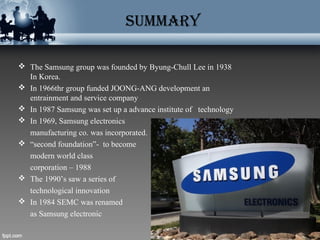
 The Samsung group was founded by Byung-Chull Lee in 1938
In Korea.
 In 1966thr group funded JOONG-ANG development an
entrainment and service company
 In 1987 Samsung was set up a advance institute of technology
 In 1969, Samsung electronics
manufacturing co. was incorporated.
 “second foundation”- to become
modern world class
corporation – 1988
 The 1990’s saw a series of
technological innovation
 In 1984 SEMC was renamed
as Samsung electronic
SAMSUNG’S FOCUS ON DESIGN
INNOVATION
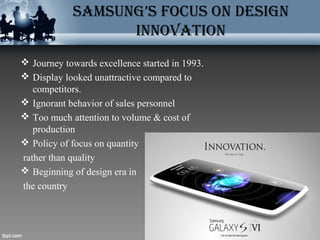
 Journey towards excellence started in 1993.
 Display looked unattractive compared to
competitors.
 Ignorant behavior of sales personnel
 Too much attention to volume & cost of
production
 Policy of focus on quantity
rather than quality
 Beginning of design era in
the country
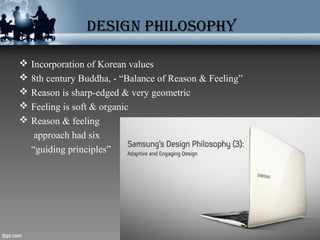
DESIGN PhILOSOPhY
 Incorporation of Korean values
 8th century Buddha, - “Balance of Reason & Feeling”
 Reason is sharp-edged & very geometric
 Feeling is soft & organic
 Reason & feeling
approach had six
“guiding principles”
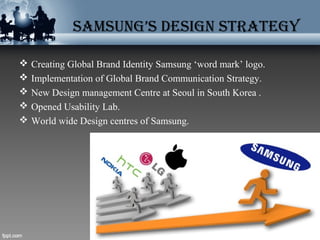
SAMSUNG’S DESIGN STRATEGY
 Creating Global Brand Identity Samsung ‘word mark’ logo.
 Implementation of Global Brand Communication Strategy.
 New Design management Centre at Seoul in South Korea .
 Opened Usability Lab.
 World wide Design centres of Samsung.
BRINGING cUlTURAl chANGES
 Efforts were made to first create a design-friendly culture.
 But ACCD curriculum just did not suit the culture at
Samsung initially.
 E.g. south Korean encouraged to ask question to elders
according to curriculum.
 Realisation of to come out
of environment.
SYSTEMATIc & pRocESS
chANGES
 Samsung redesigned its system and process to improve the design
delivery process.
 Designers began to enjoy as much, if not more ,authority as
engineers and marketers.
 Collaboration between different departments
became a key aspect of
new product development.
SAMSUNG’S DESIGN SUccESSES
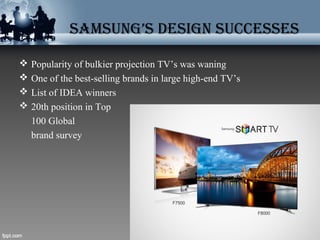
 Popularity of bulkier projection TV’s was waning
 One of the best-selling brands in large high-end TV’s
 List of IDEA winners
 20th position in Top
100 Global
brand survey
ConvergenCe produCts
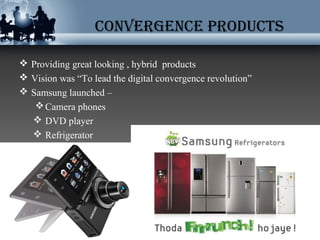
 Providing great looking , hybrid products
 Vision was “To lead the digital convergence revolution”
 Samsung launched –
Camera phones
 DVD player
 Refrigerator
CritiCism
 Lack of coherent design.
 Some designs were poor.
 Unrealistic price.
 Poor user interface.
 Development goof-up.
design for a Competitive
edge
 Design a differentiating factor.
 Price premium.
 Customer loyalty.
outlook
 Sync master 971P
 New Partnership
 Elite CNB (Creating New Business) Group
 Net profit of $ 2.16 trillion
 SAMSUNG ELECTRONICS: SUCCESS BY DESIGN case study (Strategic management)

SAMSUNG ELECTRONICS: SUCCESS BY DESIGN case study (Strategic management)

  • 1.
    SAMSUNG ELECTRONICS: SUCCESS BYDESIGN STRATEGIC MANAGEMENT
  • 2.
    SUMMARY  The Samsunggroup was founded by Byung-Chull Lee in 1938 In Korea.  In 1966thr group funded JOONG-ANG development an entrainment and service company  In 1987 Samsung was set up a advance institute of technology  In 1969, Samsung electronics manufacturing co. was incorporated.  “second foundation”- to become modern world class corporation – 1988  The 1990’s saw a series of technological innovation  In 1984 SEMC was renamed as Samsung electronic
  • 3.
    SAMSUNG’S FOCUS ONDESIGN INNOVATION  Journey towards excellence started in 1993.  Display looked unattractive compared to competitors.  Ignorant behavior of sales personnel  Too much attention to volume & cost of production  Policy of focus on quantity rather than quality  Beginning of design era in the country
  • 4.
    DESIGN PhILOSOPhY  Incorporationof Korean values  8th century Buddha, - “Balance of Reason & Feeling”  Reason is sharp-edged & very geometric  Feeling is soft & organic  Reason & feeling approach had six “guiding principles”
  • 5.
    SAMSUNG’S DESIGN STRATEGY Creating Global Brand Identity Samsung ‘word mark’ logo.  Implementation of Global Brand Communication Strategy.  New Design management Centre at Seoul in South Korea .  Opened Usability Lab.  World wide Design centres of Samsung.
  • 6.
    BRINGING cUlTURAl chANGES Efforts were made to first create a design-friendly culture.  But ACCD curriculum just did not suit the culture at Samsung initially.  E.g. south Korean encouraged to ask question to elders according to curriculum.  Realisation of to come out of environment.
  • 7.
    SYSTEMATIc & pRocESS chANGES Samsung redesigned its system and process to improve the design delivery process.  Designers began to enjoy as much, if not more ,authority as engineers and marketers.  Collaboration between different departments became a key aspect of new product development.
  • 8.
    SAMSUNG’S DESIGN SUccESSES Popularity of bulkier projection TV’s was waning  One of the best-selling brands in large high-end TV’s  List of IDEA winners  20th position in Top 100 Global brand survey
  • 9.
    ConvergenCe produCts  Providinggreat looking , hybrid products  Vision was “To lead the digital convergence revolution”  Samsung launched – Camera phones  DVD player  Refrigerator
  • 10.
    CritiCism  Lack ofcoherent design.  Some designs were poor.  Unrealistic price.  Poor user interface.  Development goof-up.
  • 11.
    design for aCompetitive edge  Design a differentiating factor.  Price premium.  Customer loyalty.
  • 12.
    outlook  Sync master971P  New Partnership  Elite CNB (Creating New Business) Group  Net profit of $ 2.16 trillion