BENAZIR BHUTTO SHAHEED
UNIVERSITY
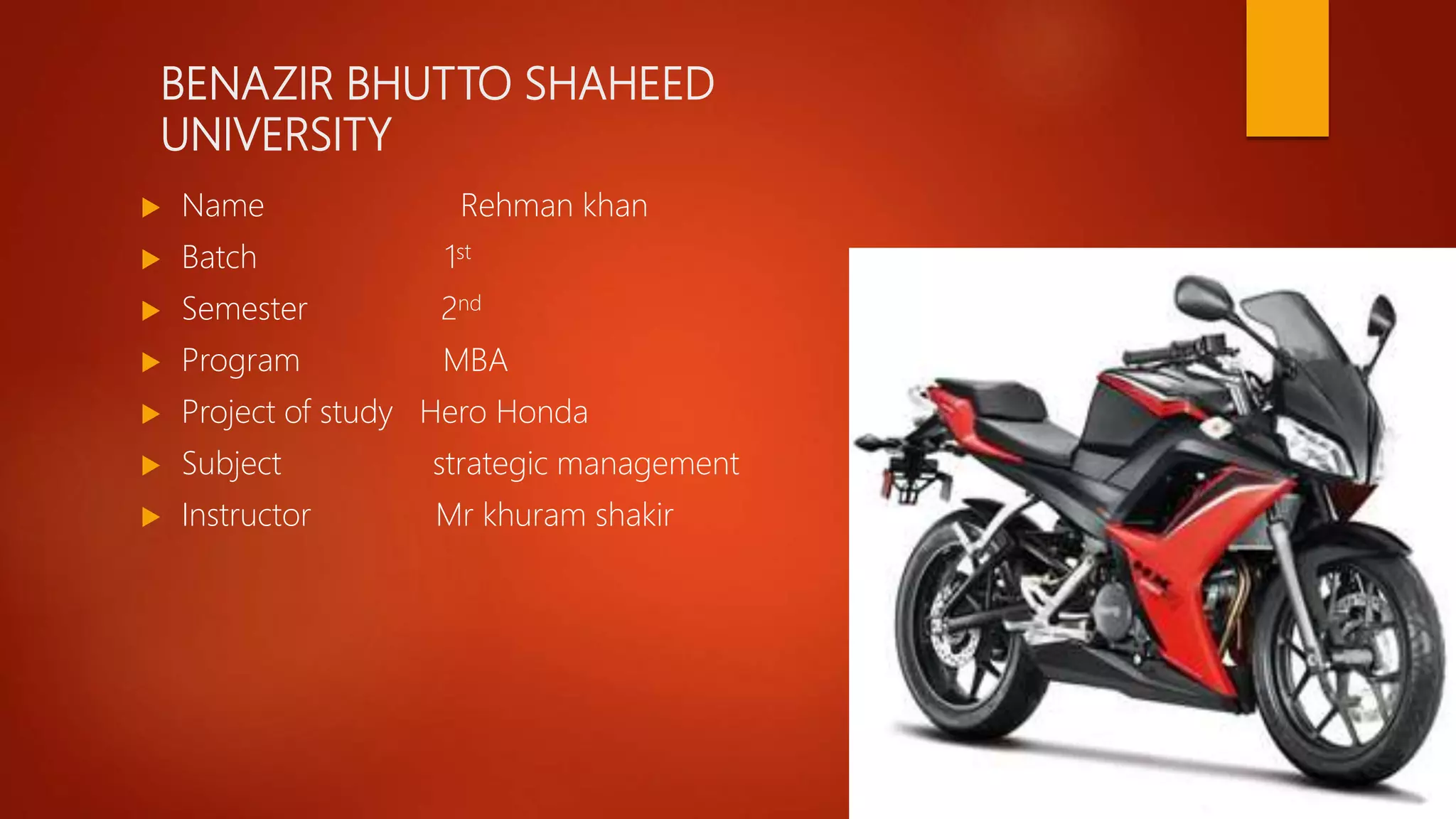
 Name Rehman khan
 Batch 1st
 Semester 2nd
 Program MBA
 Project of study Hero Honda
 Subject strategic management
 Instructor Mr khuram shakir
0
10
20
30
40
50
(VISION) Competative
mission
Growth mission Marketing mission Customer service
mission
Products mission Technology
mission
Organization
mission
Team
management
mission
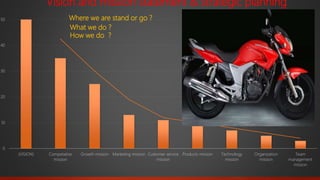
Vision and mission statement & strategic planning
Where we are stand or go ?
What we do ?
How we do ?
Successful hero Honda industry reason
 Geographically (Lower middle and middle class household )
 Youth new generation
 Financial institute (credit household)
 Advertising promotion .(overall india)
 Punjab national bank(financing hero Honda 0n 11.5 % for 5 years)
 Bajaj capitation end (joint venture Kawasaki in Philippine)
 Entry allow to Indian market (1944 To 1980)
Brij mohan lal 2002.3 18 million bike sale (due to consumer financing)
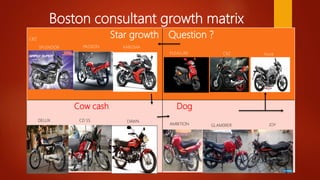
Boston consultant growth matrix
Star growth Question ?
Cow cash Dog
DELUX CD SS DAWN
JOY
GLAM0RER
AMBITION
Hunk
CBZ
PLEASURE
SPLENDOR PASSION KARIZMA
CBZ
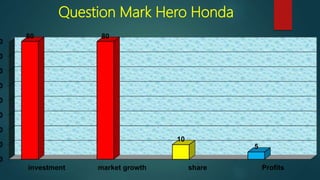
Question Mark Hero Honda
0
0
0
0
0
0
0
0
0
investment market growth share Profits
80 80
10
5
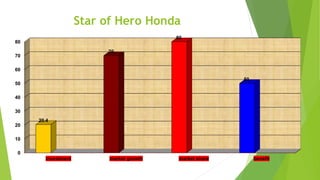
Star of Hero Honda
0
10
20
30
40
50
60
70
80
investment market growth market share benefit
20.4
70
80
50
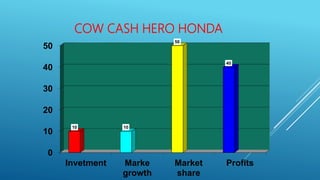
COW CASH HERO HONDA
0
10
20
30
40
50
Invetment Marke
growth
Market
share
Profits
10 10
50
40
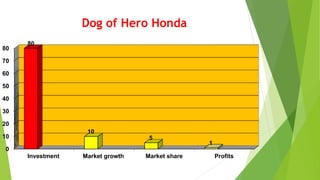
Dog of Hero Honda
0
10
20
30
40
50
60
70
80
Investment Market growth Market share Profits
80
10
5
1
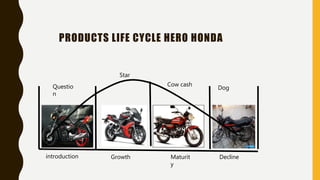
PRODUCTS LIFE CYCLE HERO HONDA
Questio
n
Star
Cow cash
Dog
introduction Growth Maturit
y
Decline
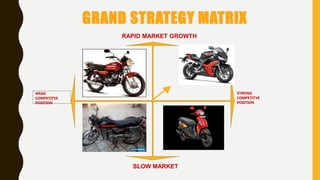
GRAND STRATEGY MATRIX
RAPID MARKET GROWTH
STRONG
COMPETITVE
POSITION
WEAK
COMPETITVE
POSITION
SLOW MARKET
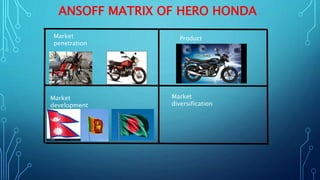
ANSOFF MATRIX OF HERO HONDA
Market
penetration
Product
development
Market
development
Market
diversification
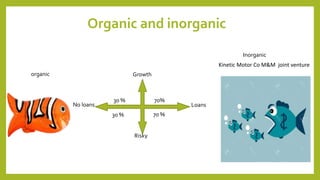
Organic and inorganic
70%
Growth
30 %
Inorganic
organic
30 % 70 %
Risky
No loans Loans
Kinetic Motor Co M&M joint venture
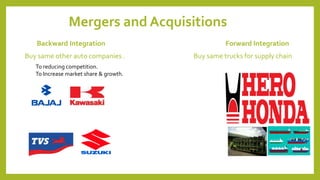
Mergers and Acquisitions
Backward Integration Forward Integration
Buy same other auto companies . Buy same trucks for supply chain
To reducing competition.
To Increase market share & growth.
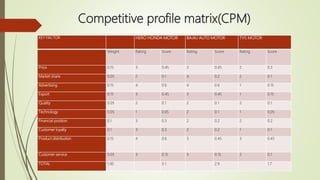
Competitive profile matrix(CPM)
KEY FACTOR HERO HONDA MOTOR BAJAJ AUTO MOTOR TVS MOTOR
Weight Rating Score Rating Score Rating Score
Price 0.15 3 0.45 3 0.45 2 0.3
Market share 0.05 2 0.1 4 0.2 2 0.1
Advertising 0.15 4 0.6 4 0.6 1 0.15
Export 0.15 3 0.45 3 0.45 1 0.15
Quality 0.05 2 0.1 2 0.1 2 0.1
Technology 0.05 1 0.05 2 0.1 1 0.05
Financial position 0.1 3 0.3 2 0.2 2 0.2
Customer loyalty 0.1 3 0.3 2 0.2 1 0.1
Product distribution 0.15 4 0.6 3 0.45 3 0.45
Customer service 0.05 3 0.15 3 0.15 2 0.1
TOTAL 1.00 3.1 2.9 1.7
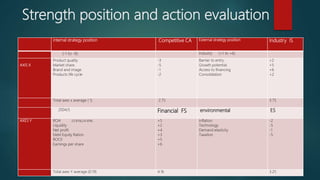
Strength position and action evaluation
internal strategy position Competitive CA External strategy position Industry IS
(-1 to -6) Industry (+1 to +6)
AXIS X
Product quality
Market share.
Brand and image
Products life cycle
-3
-5
-1
-2
Barrier to entry.
Growth potential.
Access to financing
Consolidation
+2
+5
+6
+2
Total axes x average ( 1) 2.75 3.75
2004/5 Financial FS environmental ES
AXES Y ROA 23.85%/24.69%
Liquidity
Net profit
Debt Equity Ration
ROCE
Earnings per share
+5
+2
+4
+3
+5
+6
Inflation
Technology
Demand elasticity
Taxation
-2
-5
-1
-5
Total axes Y average (0.19) 4.16 3.25
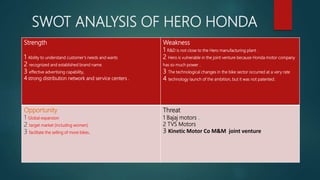
SWOT ANALYSIS OF HERO HONDA
Strength
1 Ability to understand customer’s needs and wants
2 recognized and established brand name.
3 effective advertising capability,
4 strong distribution network and service centers .
Weakness
1 R&D is not close to the Hero manufacturing plant .
2 Hero is vulnerable in the joint venture because Honda motor company
has so much power .
3 The technological changes in the bike sector occurred at a very rate
4 technology launch of the ambition, but it was not patented.
Opportunity
1 Global expansion
2 target market (including women)
3 facilitate the selling of more bikes.
Threat
1 Bajaj motors .
2 TVS Motors
3 Kinetic Motor Co M&M joint venture
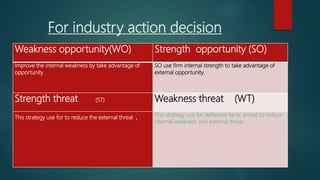
For industry action decision
Weakness opportunity(WO) Strength opportunity (SO)
Improve the internal weakness by take advantage of
opportunity .
SO use firm internal strength to take advantage of
external opportunity.
Strength threat (ST) Weakness threat (WT)
This strategy use for to reduce the external threat . This strategy use for defensive tactic aimed to reduce
internal weakness and external threat .
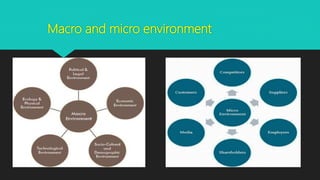
Macro and micro environment
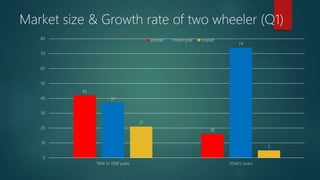
Market size & Growth rate of two wheeler (Q1)
42
16
37
74
21
5
0
10
20
30
40
50
60
70
80
1994 to 1998 years 2004/5 years
scooter motercycle moped
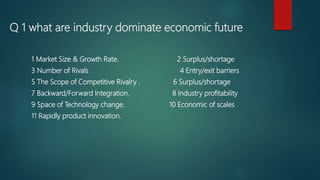
Q 1 what are industry dominate economic future
1 Market Size & Growth Rate. 2 Surplus/shortage
3 Number of Rivals 4 Entry/exit barriers
5 The Scope of Competitive Rivalry . 6 Surplus/shortage
7 Backward/Forward Integration. 8 Industry profitability
9 Space of Technology change. 10 Economic of scales
11 Rapidly product innovation.
Q2 WHAT IS COMPETITIVE LIKE& HOW ARE STRONG ARE
THE COMPETITIVE FORCES)
Porter's 5 Forces Model
People .
Organizational Culture & Structure
Products & Intellectual Property
Capital & Natural Resources
Technology
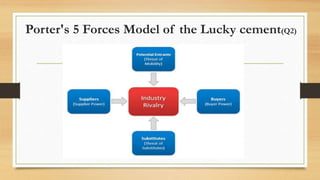
Porter's 5 Forces Model of the Lucky cement(Q2)
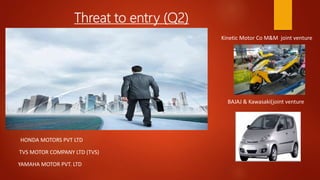
Threat to entry (Q2)

BAJAJ & Kawasaki(joint venture
TVS MOTOR COMPANY LTD (TVS)
YAMAHA MOTOR PVT. LTD
HONDA MOTORS PVT LTD
Kinetic Motor Co M&M joint venture
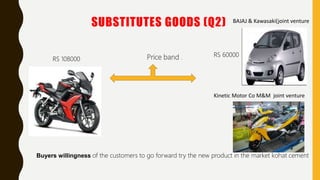
SUBSTITUTES GOODS (Q2)
Price band . RS 60000
RS 108000
Buyers willingness of the customers to go forward try the new product in the market kohat cement
Kinetic Motor Co M&M joint venture
BAJAJ & Kawasaki(joint venture
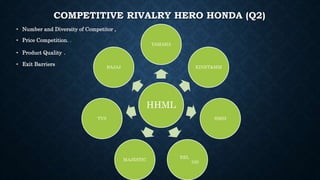
COMPETITIVE RIVALRY HERO HONDA (Q2)
• Number and Diversity of Competitor ,
• Price Competition. .
• Product Quality .
• Exit Barriers
HHML
YAMAHA
KINET&MM
HMSI
REL
550
MAJESTIC
TVS
BAJAJ
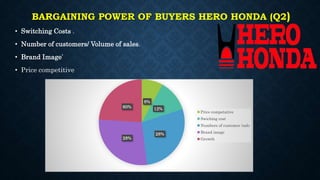
BARGAINING POWER OF BUYERS HERO HONDA (Q2)
• Switching Costs .
• Number of customers/ Volume of sales.
• Brand Image’
• Price competitive
8%
12%
28%
28%
60%
Price competative
Swiching cost
Numbers of customer /sale
Brand image
Growth
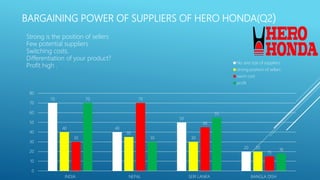
BARGAINING POWER OF SUPPLIERS OF HERO HONDA(Q2)
70
40
50
20
40
35
30
20
30
70
45
15
70
30
55
18
0
10
20
30
40
50
60
70
80
INDIA NEPAL SERI LANKA BANGLA DISH
No and size of suppliers
strong position of sellars
swich cost
profit
Strong is the position of sellers
Few potential suppliers
Switching costs.
Differentiation of your product?
Profit high .
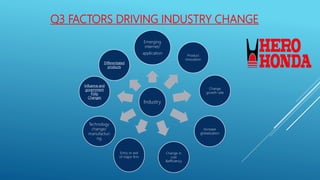
Q3 FACTORS DRIVING INDUSTRY CHANGE
Industry
Emerging
internet/
application
Product
innovation
Change
growth rate
Increase
globalization
Change in
cost
&efficiency
Technology
change/
manufacturi
ng
Entry or exit
of major firm
Influence and
government
Poliy
Changes
Differentiated
products
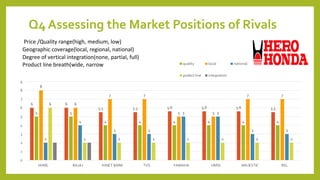
Q4 Assessing the Market Positions of Rivals
6 6
5.5 5.5 5.6 5.6 5.6 5.5
5 5
4 4 4 4 4 4
8
6
7 7
5 5
7 7
2
4
3 3
5 5
3 3
6
2 2 2 2 2 2 2
0
1
2
3
4
5
6
7
8
9
HHML BAJAJ KINET &MM TVS YAMAHA HMSI MAJESTIC REL
quality local national
podect line integration
Price /Quality range(high, medium, low)
Geographic coverage(local, regional, national)
Degree of vertical integration(none, partial, full)
Product line breath(wide, narrow
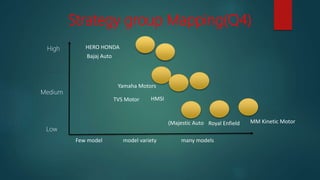
High
Low
Strategy group Mapping(Q4)
Few model model variety many models
Medium
HERO HONDA
Bajaj Auto
TVS Motor
Yamaha Motors
(Majestic Auto Royal Enfield
HMSI
MM Kinetic Motor
Q5 What Strategic moves are Rivals likely to make next
 Competitive intelligence about rivals’
 Strategies, their latest actions and announcements,
 Their resources strengths and weaknesses, the efforts being made to improve Their
situation
 Managers who fail to study competitors closely risk being overtaken by rivals’ fresh
strategic moves.
6 Q = Key Success Factors
 1. Technology-related.
 2. Manufacturing related
 3. Distribution related.
 4. Marketing related;
 5. Skills and capability related ,
 6. Finance capital related.
7 Q = Does the outlook for the industry offer the company a good opportunity to
earn attractive profits
 Industry market size and growth rate potential .
 Competitive condition conductive rising industry profitability .
 Competitive force become strongly or weak .
 Potential for entry /exit of major firms.
 Degree of the risk uncertainly in industry future .
 Competitive analysis (sweeping industry )
Q/A
thanks

Strategic Hero Honda

  • 1.
    BENAZIR BHUTTO SHAHEED UNIVERSITY Name Rehman khan  Batch 1st  Semester 2nd  Program MBA  Project of study Hero Honda  Subject strategic management  Instructor Mr khuram shakir
  • 2.
    0 10 20 30 40 50 (VISION) Competative mission Growth missionMarketing mission Customer service mission Products mission Technology mission Organization mission Team management mission Vision and mission statement & strategic planning Where we are stand or go ? What we do ? How we do ?
  • 3.
    Successful hero Hondaindustry reason  Geographically (Lower middle and middle class household )  Youth new generation  Financial institute (credit household)  Advertising promotion .(overall india)  Punjab national bank(financing hero Honda 0n 11.5 % for 5 years)  Bajaj capitation end (joint venture Kawasaki in Philippine)  Entry allow to Indian market (1944 To 1980) Brij mohan lal 2002.3 18 million bike sale (due to consumer financing)
  • 4.
    Boston consultant growthmatrix Star growth Question ? Cow cash Dog DELUX CD SS DAWN JOY GLAM0RER AMBITION Hunk CBZ PLEASURE SPLENDOR PASSION KARIZMA CBZ
  • 5.
    Question Mark HeroHonda 0 0 0 0 0 0 0 0 0 investment market growth share Profits 80 80 10 5
  • 6.
    Star of HeroHonda 0 10 20 30 40 50 60 70 80 investment market growth market share benefit 20.4 70 80 50
  • 7.
    COW CASH HEROHONDA 0 10 20 30 40 50 Invetment Marke growth Market share Profits 10 10 50 40
  • 8.
    Dog of HeroHonda 0 10 20 30 40 50 60 70 80 Investment Market growth Market share Profits 80 10 5 1
  • 9.
    PRODUCTS LIFE CYCLEHERO HONDA Questio n Star Cow cash Dog introduction Growth Maturit y Decline
  • 10.
    GRAND STRATEGY MATRIX RAPIDMARKET GROWTH STRONG COMPETITVE POSITION WEAK COMPETITVE POSITION SLOW MARKET
  • 11.
    ANSOFF MATRIX OFHERO HONDA Market penetration Product development Market development Market diversification
  • 12.
    Organic and inorganic 70% Growth 30% Inorganic organic 30 % 70 % Risky No loans Loans Kinetic Motor Co M&M joint venture
  • 13.
    Mergers and Acquisitions BackwardIntegration Forward Integration Buy same other auto companies . Buy same trucks for supply chain To reducing competition. To Increase market share & growth.
  • 14.
    Competitive profile matrix(CPM) KEYFACTOR HERO HONDA MOTOR BAJAJ AUTO MOTOR TVS MOTOR Weight Rating Score Rating Score Rating Score Price 0.15 3 0.45 3 0.45 2 0.3 Market share 0.05 2 0.1 4 0.2 2 0.1 Advertising 0.15 4 0.6 4 0.6 1 0.15 Export 0.15 3 0.45 3 0.45 1 0.15 Quality 0.05 2 0.1 2 0.1 2 0.1 Technology 0.05 1 0.05 2 0.1 1 0.05 Financial position 0.1 3 0.3 2 0.2 2 0.2 Customer loyalty 0.1 3 0.3 2 0.2 1 0.1 Product distribution 0.15 4 0.6 3 0.45 3 0.45 Customer service 0.05 3 0.15 3 0.15 2 0.1 TOTAL 1.00 3.1 2.9 1.7
  • 15.
    Strength position andaction evaluation internal strategy position Competitive CA External strategy position Industry IS (-1 to -6) Industry (+1 to +6) AXIS X Product quality Market share. Brand and image Products life cycle -3 -5 -1 -2 Barrier to entry. Growth potential. Access to financing Consolidation +2 +5 +6 +2 Total axes x average ( 1) 2.75 3.75 2004/5 Financial FS environmental ES AXES Y ROA 23.85%/24.69% Liquidity Net profit Debt Equity Ration ROCE Earnings per share +5 +2 +4 +3 +5 +6 Inflation Technology Demand elasticity Taxation -2 -5 -1 -5 Total axes Y average (0.19) 4.16 3.25
  • 16.
    SWOT ANALYSIS OFHERO HONDA Strength 1 Ability to understand customer’s needs and wants 2 recognized and established brand name. 3 effective advertising capability, 4 strong distribution network and service centers . Weakness 1 R&D is not close to the Hero manufacturing plant . 2 Hero is vulnerable in the joint venture because Honda motor company has so much power . 3 The technological changes in the bike sector occurred at a very rate 4 technology launch of the ambition, but it was not patented. Opportunity 1 Global expansion 2 target market (including women) 3 facilitate the selling of more bikes. Threat 1 Bajaj motors . 2 TVS Motors 3 Kinetic Motor Co M&M joint venture
  • 17.
    For industry actiondecision Weakness opportunity(WO) Strength opportunity (SO) Improve the internal weakness by take advantage of opportunity . SO use firm internal strength to take advantage of external opportunity. Strength threat (ST) Weakness threat (WT) This strategy use for to reduce the external threat . This strategy use for defensive tactic aimed to reduce internal weakness and external threat .
  • 18.
    Macro and microenvironment
  • 19.
    Market size &Growth rate of two wheeler (Q1) 42 16 37 74 21 5 0 10 20 30 40 50 60 70 80 1994 to 1998 years 2004/5 years scooter motercycle moped
  • 20.
    Q 1 whatare industry dominate economic future 1 Market Size & Growth Rate. 2 Surplus/shortage 3 Number of Rivals 4 Entry/exit barriers 5 The Scope of Competitive Rivalry . 6 Surplus/shortage 7 Backward/Forward Integration. 8 Industry profitability 9 Space of Technology change. 10 Economic of scales 11 Rapidly product innovation.
  • 21.
    Q2 WHAT ISCOMPETITIVE LIKE& HOW ARE STRONG ARE THE COMPETITIVE FORCES) Porter's 5 Forces Model People . Organizational Culture & Structure Products & Intellectual Property Capital & Natural Resources Technology
  • 22.
    Porter's 5 ForcesModel of the Lucky cement(Q2)
  • 23.
    Threat to entry(Q2)  BAJAJ & Kawasaki(joint venture TVS MOTOR COMPANY LTD (TVS) YAMAHA MOTOR PVT. LTD HONDA MOTORS PVT LTD Kinetic Motor Co M&M joint venture
  • 24.
    SUBSTITUTES GOODS (Q2) Priceband . RS 60000 RS 108000 Buyers willingness of the customers to go forward try the new product in the market kohat cement Kinetic Motor Co M&M joint venture BAJAJ & Kawasaki(joint venture
  • 25.
    COMPETITIVE RIVALRY HEROHONDA (Q2) • Number and Diversity of Competitor , • Price Competition. . • Product Quality . • Exit Barriers HHML YAMAHA KINET&MM HMSI REL 550 MAJESTIC TVS BAJAJ
  • 26.
    BARGAINING POWER OFBUYERS HERO HONDA (Q2) • Switching Costs . • Number of customers/ Volume of sales. • Brand Image’ • Price competitive 8% 12% 28% 28% 60% Price competative Swiching cost Numbers of customer /sale Brand image Growth
  • 27.
    BARGAINING POWER OFSUPPLIERS OF HERO HONDA(Q2) 70 40 50 20 40 35 30 20 30 70 45 15 70 30 55 18 0 10 20 30 40 50 60 70 80 INDIA NEPAL SERI LANKA BANGLA DISH No and size of suppliers strong position of sellars swich cost profit Strong is the position of sellers Few potential suppliers Switching costs. Differentiation of your product? Profit high .
  • 28.
    Q3 FACTORS DRIVINGINDUSTRY CHANGE Industry Emerging internet/ application Product innovation Change growth rate Increase globalization Change in cost &efficiency Technology change/ manufacturi ng Entry or exit of major firm Influence and government Poliy Changes Differentiated products
  • 29.
    Q4 Assessing theMarket Positions of Rivals 6 6 5.5 5.5 5.6 5.6 5.6 5.5 5 5 4 4 4 4 4 4 8 6 7 7 5 5 7 7 2 4 3 3 5 5 3 3 6 2 2 2 2 2 2 2 0 1 2 3 4 5 6 7 8 9 HHML BAJAJ KINET &MM TVS YAMAHA HMSI MAJESTIC REL quality local national podect line integration Price /Quality range(high, medium, low) Geographic coverage(local, regional, national) Degree of vertical integration(none, partial, full) Product line breath(wide, narrow
  • 30.
    High Low Strategy group Mapping(Q4) Fewmodel model variety many models Medium HERO HONDA Bajaj Auto TVS Motor Yamaha Motors (Majestic Auto Royal Enfield HMSI MM Kinetic Motor
  • 31.
    Q5 What Strategicmoves are Rivals likely to make next  Competitive intelligence about rivals’  Strategies, their latest actions and announcements,  Their resources strengths and weaknesses, the efforts being made to improve Their situation  Managers who fail to study competitors closely risk being overtaken by rivals’ fresh strategic moves.
  • 32.
    6 Q =Key Success Factors  1. Technology-related.  2. Manufacturing related  3. Distribution related.  4. Marketing related;  5. Skills and capability related ,  6. Finance capital related.
  • 33.
    7 Q =Does the outlook for the industry offer the company a good opportunity to earn attractive profits  Industry market size and growth rate potential .  Competitive condition conductive rising industry profitability .  Competitive force become strongly or weak .  Potential for entry /exit of major firms.  Degree of the risk uncertainly in industry future .  Competitive analysis (sweeping industry )
  • 34.