S.Ducasse 1
QuickTime™ and aTIFF (Uncompressed) decompressorare needed to see this picture.
Stéphane Ducasse
Stephane.Ducasse@univ-savoie.fr
http://www.listic.univ-savoie.fr/~ducasse/
Some Points on Classes
S.Ducasse 2
License: CC-Attribution-ShareAlike 2.0
http://creativecommons.org/licenses/by-sa/2.0/
S.Ducasse 3
Outline
• Class definition
• Method definition
• Basic class instantiation
S.Ducasse 4
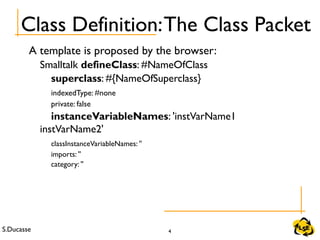
A template is proposed by the browser:
Smalltalk defineClass: #NameOfClass
superclass: #{NameOfSuperclass}
indexedType: #none
private: false
instanceVariableNames: 'instVarName1
instVarName2'
classInstanceVariableNames: ''
imports: ''
category: ''
Class Definition:The Class Packet
S.Ducasse 5
Fill the Template
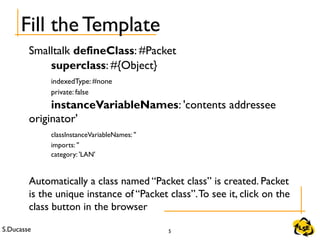
Smalltalk defineClass: #Packet
superclass: #{Object}
indexedType: #none
private: false
instanceVariableNames: 'contents addressee
originator'
classInstanceVariableNames: ''
imports: ''
category: 'LAN'
Automatically a class named “Packet class” is created. Packet
is the unique instance of “Packet class”.To see it, click on the
class button in the browser
S.Ducasse 6
Class Definition
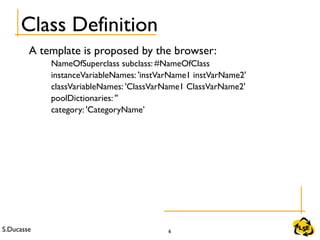
A template is proposed by the browser:
NameOfSuperclass subclass: #NameOfClass
instanceVariableNames: 'instVarName1 instVarName2'
classVariableNames: 'ClassVarName1 ClassVarName2'
poolDictionaries: ''
category: 'CategoryName’
S.Ducasse 7
Filling the Templates
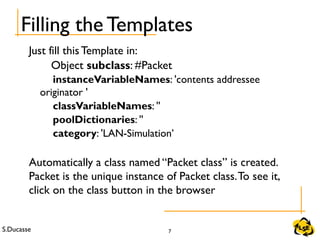
Just fill this Template in:
Object subclass: #Packet
instanceVariableNames: 'contents addressee
originator '
classVariableNames: ''
poolDictionaries: ''
category: 'LAN-Simulation’
Automatically a class named “Packet class” is created.
Packet is the unique instance of Packet class.To see it,
click on the class button in the browser
S.Ducasse 8
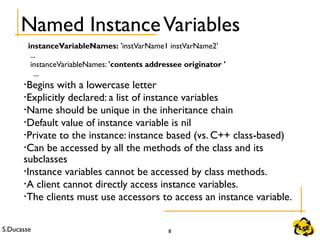
Named InstanceVariables
instanceVariableNames: 'instVarName1 instVarName2'
...
instanceVariableNames: 'contents addressee originator '
...
•Begins with a lowercase letter
•Explicitly declared: a list of instance variables
•Name should be unique in the inheritance chain
•Default value of instance variable is nil
•Private to the instance: instance based (vs. C++ class-based)
•Can be accessed by all the methods of the class and its
subclasses
•Instance variables cannot be accessed by class methods.
•A client cannot directly access instance variables.
•The clients must use accessors to access an instance variable.
S.Ducasse 9
Roadmap
• Class definition
• Method definition
• Basic class instantiation
S.Ducasse 10
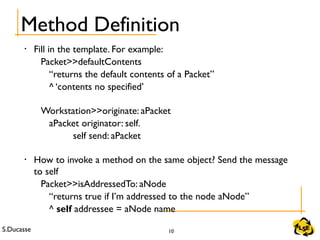
Method Definition
• Fill in the template. For example:
Packet>>defaultContents
“returns the default contents of a Packet”
^ ‘contents no specified’
Workstation>>originate: aPacket
aPacket originator: self.
self send: aPacket
• How to invoke a method on the same object? Send the message
to self
Packet>>isAddressedTo: aNode
“returns true if I’m addressed to the node aNode”
^ self addressee = aNode name
S.Ducasse 11
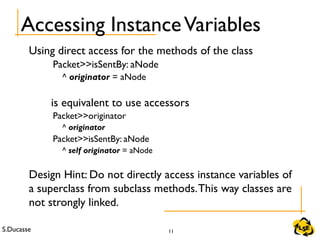
Accessing InstanceVariables
Using direct access for the methods of the class
Packet>>isSentBy: aNode
^ originator = aNode
is equivalent to use accessors
Packet>>originator
^ originator
Packet>>isSentBy: aNode
^ self originator = aNode
Design Hint: Do not directly access instance variables of
a superclass from subclass methods.This way classes are
not strongly linked.
S.Ducasse 12
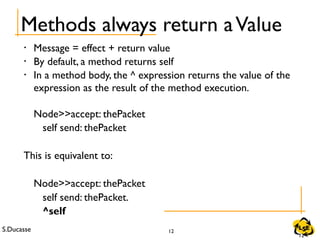
Methods always return aValue
• Message = effect + return value
• By default, a method returns self
• In a method body, the ^ expression returns the value of the
expression as the result of the method execution.
Node>>accept: thePacket
self send: thePacket
This is equivalent to:
Node>>accept: thePacket
self send: thePacket.
^self
12
S.Ducasse 13
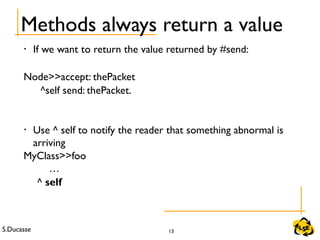
Methods always return a value
• If we want to return the value returned by #send:
Node>>accept: thePacket
^self send: thePacket.
• Use ^ self to notify the reader that something abnormal is
arriving
MyClass>>foo
…
^ self
S.Ducasse 14
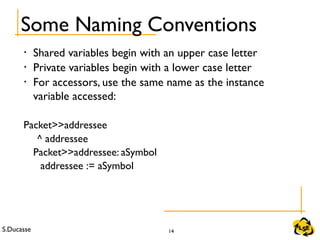
Some Naming Conventions
• Shared variables begin with an upper case letter
• Private variables begin with a lower case letter
• For accessors, use the same name as the instance
variable accessed:
Packet>>addressee
^ addressee
Packet>>addressee: aSymbol
addressee := aSymbol
S.Ducasse 15
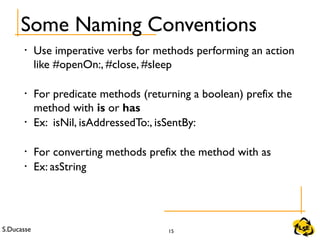
Some Naming Conventions
• Use imperative verbs for methods performing an action
like #openOn:, #close, #sleep
• For predicate methods (returning a boolean) prefix the
method with is or has
• Ex: isNil, isAddressedTo:, isSentBy:
• For converting methods prefix the method with as
• Ex: asString
S.Ducasse 16
Roadmap
• Class definition
• Method definition
• Basic class instantiation
S.Ducasse 17
Object Instantiation
Objects can be created by:
- Direct Instance creation: new/new:
- Messages to instances that create other objects
- Class specific instantiation messages
S.Ducasse 18
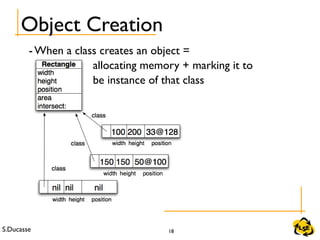
Object Creation
-When a class creates an object =
allocating memory + marking it to
be instance of that class
S.Ducasse 19
Instance Creation with new
aClass new
returns a newly and UNINITIALIZED instance
OrderedCollection new -> OrderedCollection ()
Packet new -> aPacket
Default instance variable values are nil
nil is an instance of UndefinedObject and only
understands a limited set of messages
S.Ducasse 20
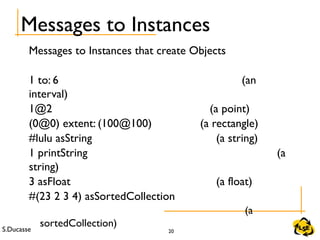
Messages to Instances
Messages to Instances that create Objects
1 to: 6 (an
interval)
1@2 (a point)
(0@0) extent: (100@100) (a rectangle)
#lulu asString (a string)
1 printString (a
string)
3 asFloat (a float)
#(23 2 3 4) asSortedCollection
(a
sortedCollection)
S.Ducasse 21
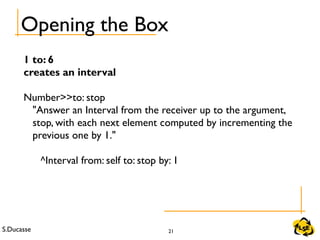
Opening the Box
1 to: 6
creates an interval
Number>>to: stop
"Answer an Interval from the receiver up to the argument,
stop, with each next element computed by incrementing the
previous one by 1."
^Interval from: self to: stop by: 1
S.Ducasse 22
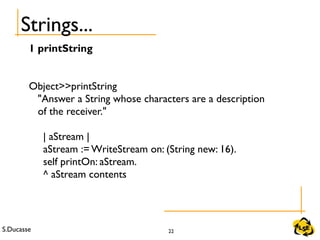
Strings...
1 printString
Object>>printString
"Answer a String whose characters are a description
of the receiver."
| aStream |
aStream := WriteStream on: (String new: 16).
self printOn: aStream.
^ aStream contents
S.Ducasse 23
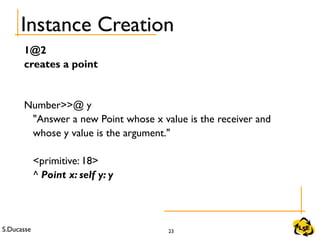
Instance Creation
1@2
creates a point
Number>>@ y
"Answer a new Point whose x value is the receiver and
whose y value is the argument."
<primitive: 18>
^ Point x: self y: y
S.Ducasse 24
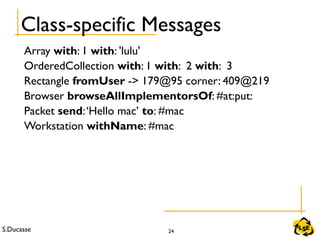
Class-specific Messages
Array with: 1 with: 'lulu'
OrderedCollection with: 1 with: 2 with: 3
Rectangle fromUser -> 179@95 corner: 409@219
Browser browseAllImplementorsOf: #at:put:
Packet send:‘Hello mac’ to: #mac
Workstation withName: #mac
S.Ducasse 25
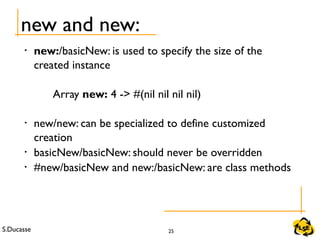
new and new:
• new:/basicNew: is used to specify the size of the
created instance
Array new: 4 -> #(nil nil nil nil)
• new/new: can be specialized to define customized
creation
• basicNew/basicNew: should never be overridden
• #new/basicNew and new:/basicNew: are class methods
S.Ducasse 26
Summary
How to define a class?
What are instance variables?
How to define a method?
Instances creation methods

9 - OOP - Smalltalk Classes (b)

  • 1.
    S.Ducasse 1 QuickTime™ andaTIFF (Uncompressed) decompressorare needed to see this picture. Stéphane Ducasse Stephane.Ducasse@univ-savoie.fr http://www.listic.univ-savoie.fr/~ducasse/ Some Points on Classes
  • 2.
    S.Ducasse 2 License: CC-Attribution-ShareAlike2.0 http://creativecommons.org/licenses/by-sa/2.0/
  • 3.
    S.Ducasse 3 Outline • Classdefinition • Method definition • Basic class instantiation
  • 4.
    S.Ducasse 4 A templateis proposed by the browser: Smalltalk defineClass: #NameOfClass superclass: #{NameOfSuperclass} indexedType: #none private: false instanceVariableNames: 'instVarName1 instVarName2' classInstanceVariableNames: '' imports: '' category: '' Class Definition:The Class Packet
  • 5.
    S.Ducasse 5 Fill theTemplate Smalltalk defineClass: #Packet superclass: #{Object} indexedType: #none private: false instanceVariableNames: 'contents addressee originator' classInstanceVariableNames: '' imports: '' category: 'LAN' Automatically a class named “Packet class” is created. Packet is the unique instance of “Packet class”.To see it, click on the class button in the browser
  • 6.
    S.Ducasse 6 Class Definition Atemplate is proposed by the browser: NameOfSuperclass subclass: #NameOfClass instanceVariableNames: 'instVarName1 instVarName2' classVariableNames: 'ClassVarName1 ClassVarName2' poolDictionaries: '' category: 'CategoryName’
  • 7.
    S.Ducasse 7 Filling theTemplates Just fill this Template in: Object subclass: #Packet instanceVariableNames: 'contents addressee originator ' classVariableNames: '' poolDictionaries: '' category: 'LAN-Simulation’ Automatically a class named “Packet class” is created. Packet is the unique instance of Packet class.To see it, click on the class button in the browser
  • 8.
    S.Ducasse 8 Named InstanceVariables instanceVariableNames:'instVarName1 instVarName2' ... instanceVariableNames: 'contents addressee originator ' ... •Begins with a lowercase letter •Explicitly declared: a list of instance variables •Name should be unique in the inheritance chain •Default value of instance variable is nil •Private to the instance: instance based (vs. C++ class-based) •Can be accessed by all the methods of the class and its subclasses •Instance variables cannot be accessed by class methods. •A client cannot directly access instance variables. •The clients must use accessors to access an instance variable.
  • 9.
    S.Ducasse 9 Roadmap • Classdefinition • Method definition • Basic class instantiation
  • 10.
    S.Ducasse 10 Method Definition •Fill in the template. For example: Packet>>defaultContents “returns the default contents of a Packet” ^ ‘contents no specified’ Workstation>>originate: aPacket aPacket originator: self. self send: aPacket • How to invoke a method on the same object? Send the message to self Packet>>isAddressedTo: aNode “returns true if I’m addressed to the node aNode” ^ self addressee = aNode name
  • 11.
    S.Ducasse 11 Accessing InstanceVariables Usingdirect access for the methods of the class Packet>>isSentBy: aNode ^ originator = aNode is equivalent to use accessors Packet>>originator ^ originator Packet>>isSentBy: aNode ^ self originator = aNode Design Hint: Do not directly access instance variables of a superclass from subclass methods.This way classes are not strongly linked.
  • 12.
    S.Ducasse 12 Methods alwaysreturn aValue • Message = effect + return value • By default, a method returns self • In a method body, the ^ expression returns the value of the expression as the result of the method execution. Node>>accept: thePacket self send: thePacket This is equivalent to: Node>>accept: thePacket self send: thePacket. ^self 12
  • 13.
    S.Ducasse 13 Methods alwaysreturn a value • If we want to return the value returned by #send: Node>>accept: thePacket ^self send: thePacket. • Use ^ self to notify the reader that something abnormal is arriving MyClass>>foo … ^ self
  • 14.
    S.Ducasse 14 Some NamingConventions • Shared variables begin with an upper case letter • Private variables begin with a lower case letter • For accessors, use the same name as the instance variable accessed: Packet>>addressee ^ addressee Packet>>addressee: aSymbol addressee := aSymbol
  • 15.
    S.Ducasse 15 Some NamingConventions • Use imperative verbs for methods performing an action like #openOn:, #close, #sleep • For predicate methods (returning a boolean) prefix the method with is or has • Ex: isNil, isAddressedTo:, isSentBy: • For converting methods prefix the method with as • Ex: asString
  • 16.
    S.Ducasse 16 Roadmap • Classdefinition • Method definition • Basic class instantiation
  • 17.
    S.Ducasse 17 Object Instantiation Objectscan be created by: - Direct Instance creation: new/new: - Messages to instances that create other objects - Class specific instantiation messages
  • 18.
    S.Ducasse 18 Object Creation -Whena class creates an object = allocating memory + marking it to be instance of that class
  • 19.
    S.Ducasse 19 Instance Creationwith new aClass new returns a newly and UNINITIALIZED instance OrderedCollection new -> OrderedCollection () Packet new -> aPacket Default instance variable values are nil nil is an instance of UndefinedObject and only understands a limited set of messages
  • 20.
    S.Ducasse 20 Messages toInstances Messages to Instances that create Objects 1 to: 6 (an interval) 1@2 (a point) (0@0) extent: (100@100) (a rectangle) #lulu asString (a string) 1 printString (a string) 3 asFloat (a float) #(23 2 3 4) asSortedCollection (a sortedCollection)
  • 21.
    S.Ducasse 21 Opening theBox 1 to: 6 creates an interval Number>>to: stop "Answer an Interval from the receiver up to the argument, stop, with each next element computed by incrementing the previous one by 1." ^Interval from: self to: stop by: 1
  • 22.
    S.Ducasse 22 Strings... 1 printString Object>>printString "Answera String whose characters are a description of the receiver." | aStream | aStream := WriteStream on: (String new: 16). self printOn: aStream. ^ aStream contents
  • 23.
    S.Ducasse 23 Instance Creation 1@2 createsa point Number>>@ y "Answer a new Point whose x value is the receiver and whose y value is the argument." <primitive: 18> ^ Point x: self y: y
  • 24.
    S.Ducasse 24 Class-specific Messages Arraywith: 1 with: 'lulu' OrderedCollection with: 1 with: 2 with: 3 Rectangle fromUser -> 179@95 corner: 409@219 Browser browseAllImplementorsOf: #at:put: Packet send:‘Hello mac’ to: #mac Workstation withName: #mac
  • 25.
    S.Ducasse 25 new andnew: • new:/basicNew: is used to specify the size of the created instance Array new: 4 -> #(nil nil nil nil) • new/new: can be specialized to define customized creation • basicNew/basicNew: should never be overridden • #new/basicNew and new:/basicNew: are class methods
  • 26.
    S.Ducasse 26 Summary How todefine a class? What are instance variables? How to define a method? Instances creation methods