S.Ducasse 1
QuickTime™ and aTIFF (Uncompressed) decompressorare needed to see this picture.
Stéphane Ducasse
Stephane.Ducasse@univ-savoie.fr
http://www.listic.univ-savoie.fr/~ducasse/
Classes and Metaclasses
- an Analysis
S.Ducasse 2
License: CC-Attribution-ShareAlike 2.0
http://creativecommons.org/licenses/by-sa/2.0/
S.Ducasse 3
Goals
“Some books are to be tasted,
others to be swallowed,
and some few to be chewed and
digested”
— Francis Bacon, Of Studies
•Recap on Instantiation
•Recap on Inheritance
S.Ducasse 4
At first sight, a difficult topic!
You can live without really understanding them, but
metaclasses provide a uniform model, and you will make
less errors if you learn how they work, and you will
really understand the object model
Warning
S.Ducasse 5
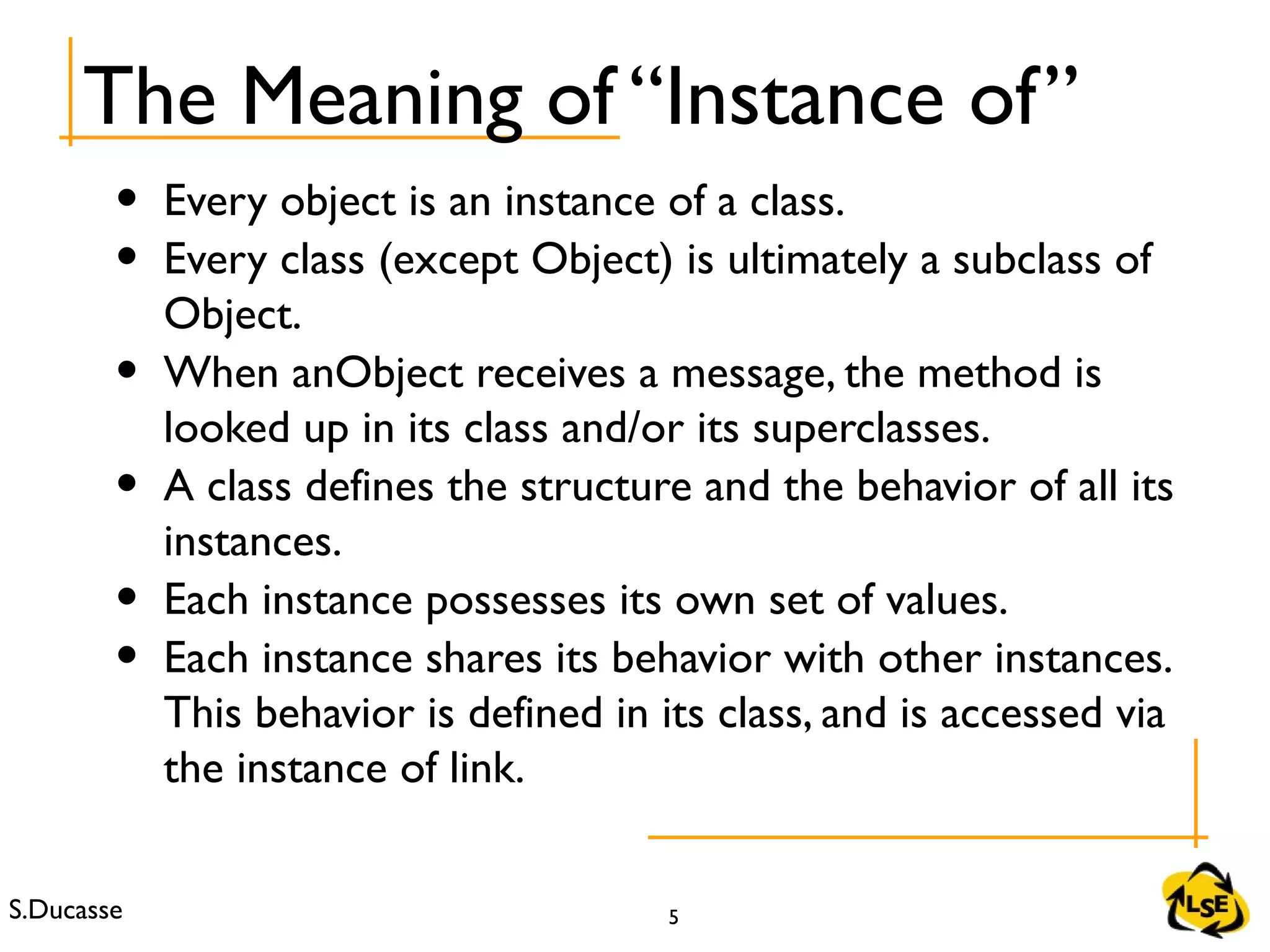
• Every object is an instance of a class.
• Every class (except Object) is ultimately a subclass of
Object.
• When anObject receives a message, the method is
looked up in its class and/or its superclasses.
• A class defines the structure and the behavior of all its
instances.
• Each instance possesses its own set of values.
• Each instance shares its behavior with other instances.
This behavior is defined in its class, and is accessed via
the instance of link.
The Meaning of “Instance of”
S.Ducasse 6
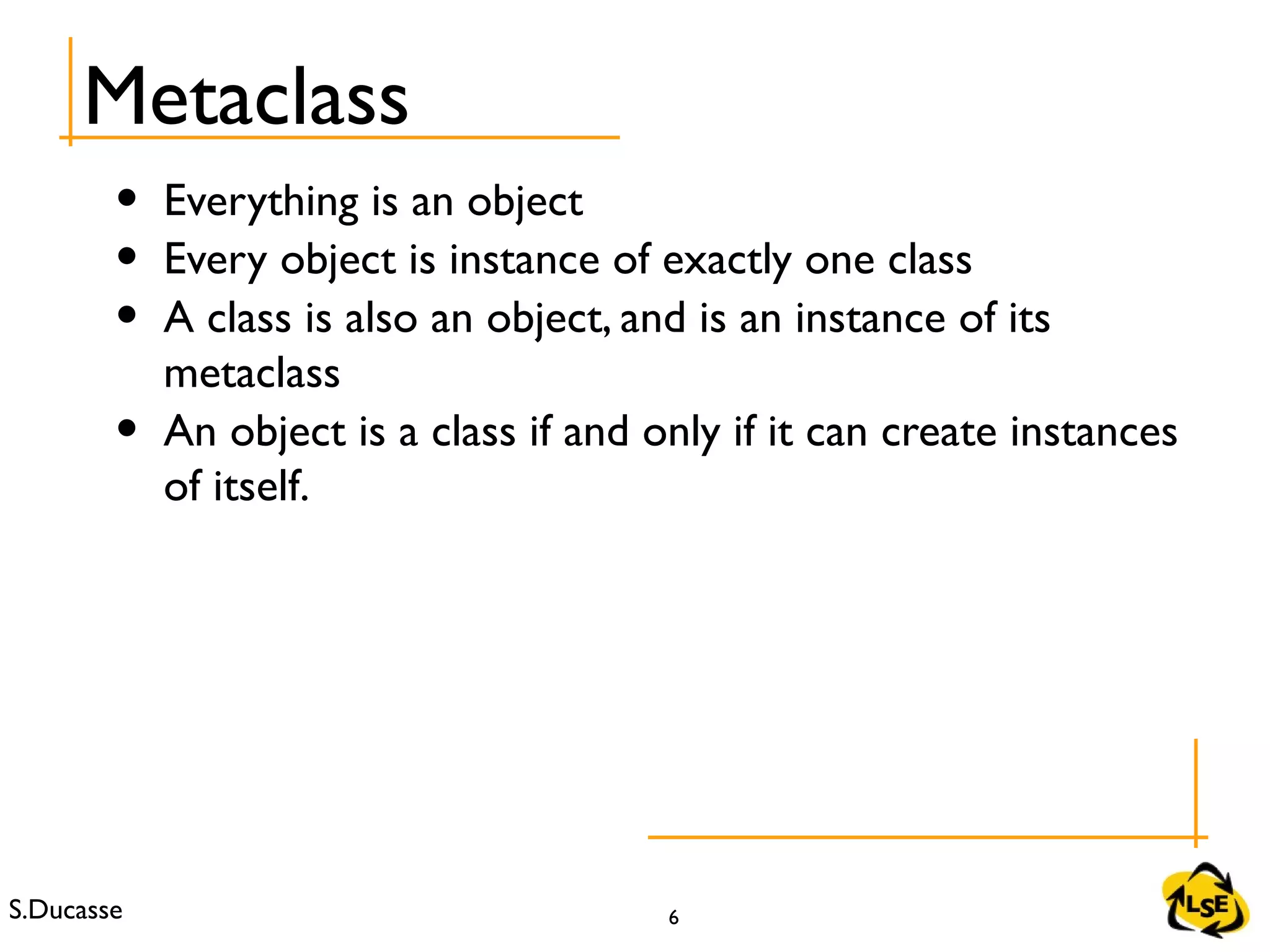
• Everything is an object
• Every object is instance of exactly one class
• A class is also an object, and is an instance of its
metaclass
• An object is a class if and only if it can create instances
of itself.
Metaclass
S.Ducasse 7
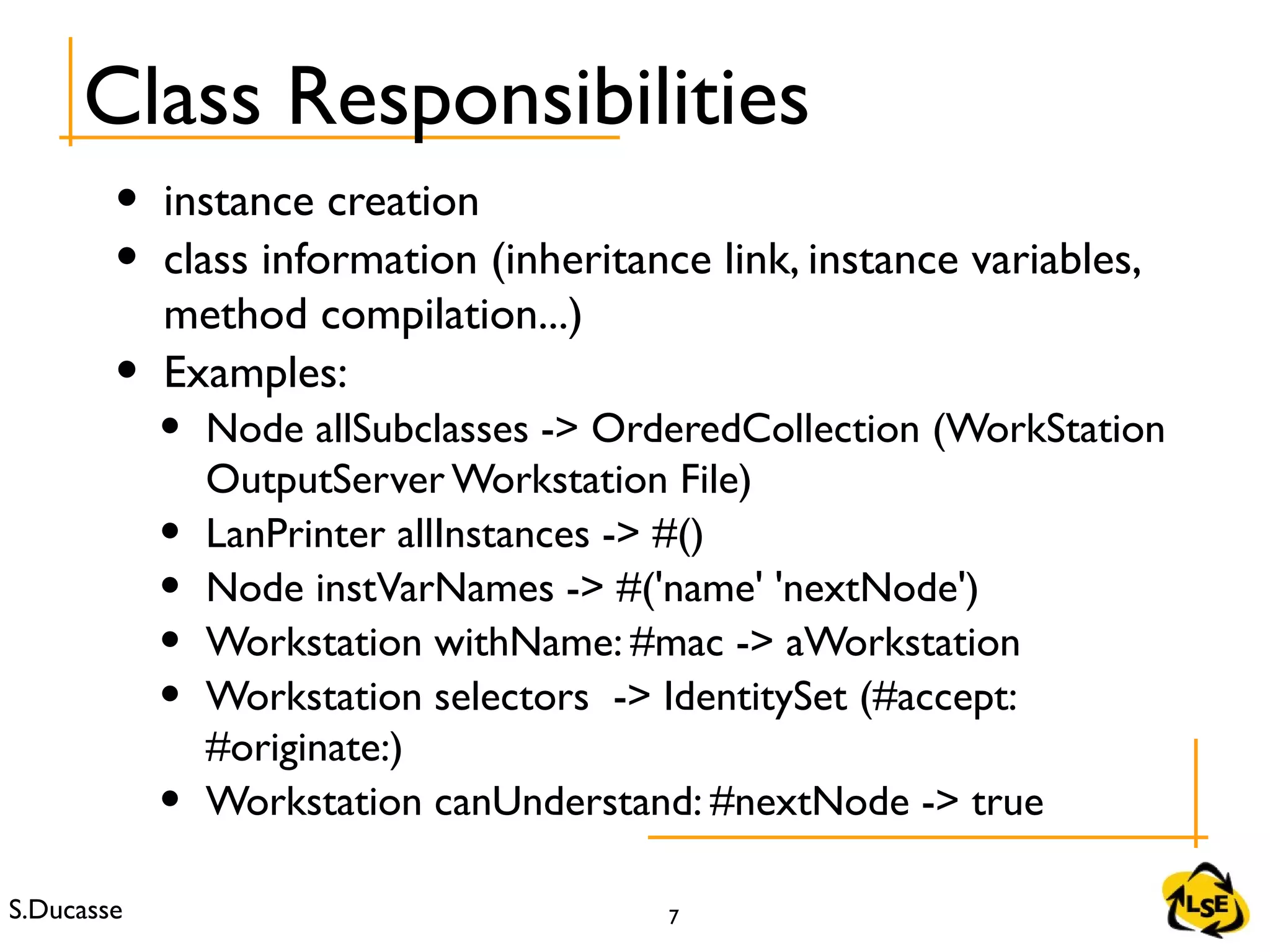
Class Responsibilities
• instance creation
• class information (inheritance link, instance variables,
method compilation...)
• Examples:
• Node allSubclasses -> OrderedCollection (WorkStation
OutputServer Workstation File)
• LanPrinter allInstances -> #()
• Node instVarNames -> #('name' 'nextNode')
• Workstation withName: #mac -> aWorkstation
• Workstation selectors -> IdentitySet (#accept:
#originate:)
• Workstation canUnderstand: #nextNode -> true
S.Ducasse 8
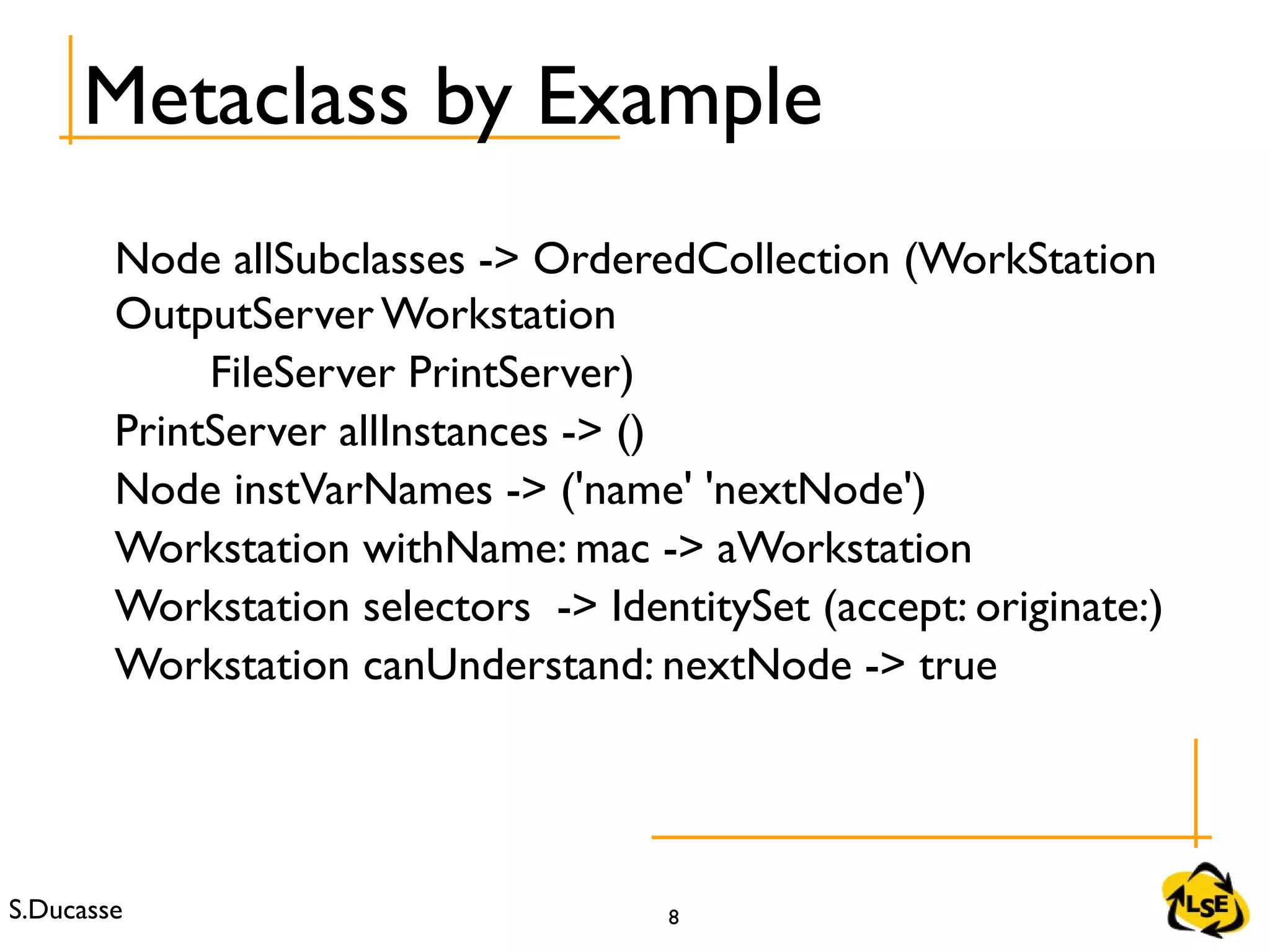
Node allSubclasses -> OrderedCollection (WorkStation
OutputServer Workstation
FileServer PrintServer)
PrintServer allInstances -> ()
Node instVarNames -> ('name' 'nextNode')
Workstation withName: mac -> aWorkstation
Workstation selectors -> IdentitySet (accept: originate:)
Workstation canUnderstand: nextNode -> true
Metaclass by Example
S.Ducasse 9
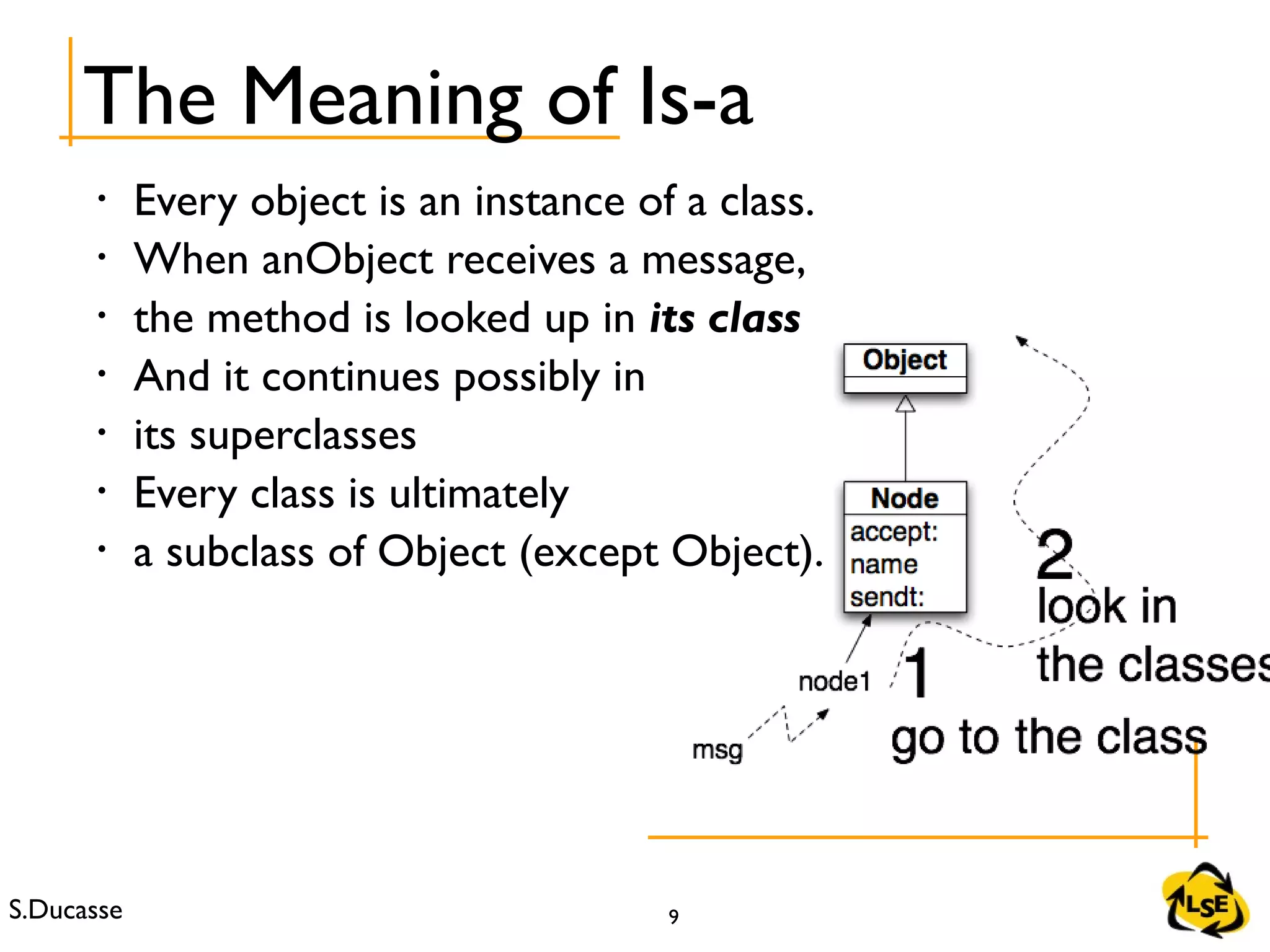
The Meaning of Is-a
• Every object is an instance of a class.
• When anObject receives a message,
• the method is looked up in its class
• And it continues possibly in
• its superclasses
• Every class is ultimately
• a subclass of Object (except Object).
S.Ducasse 10
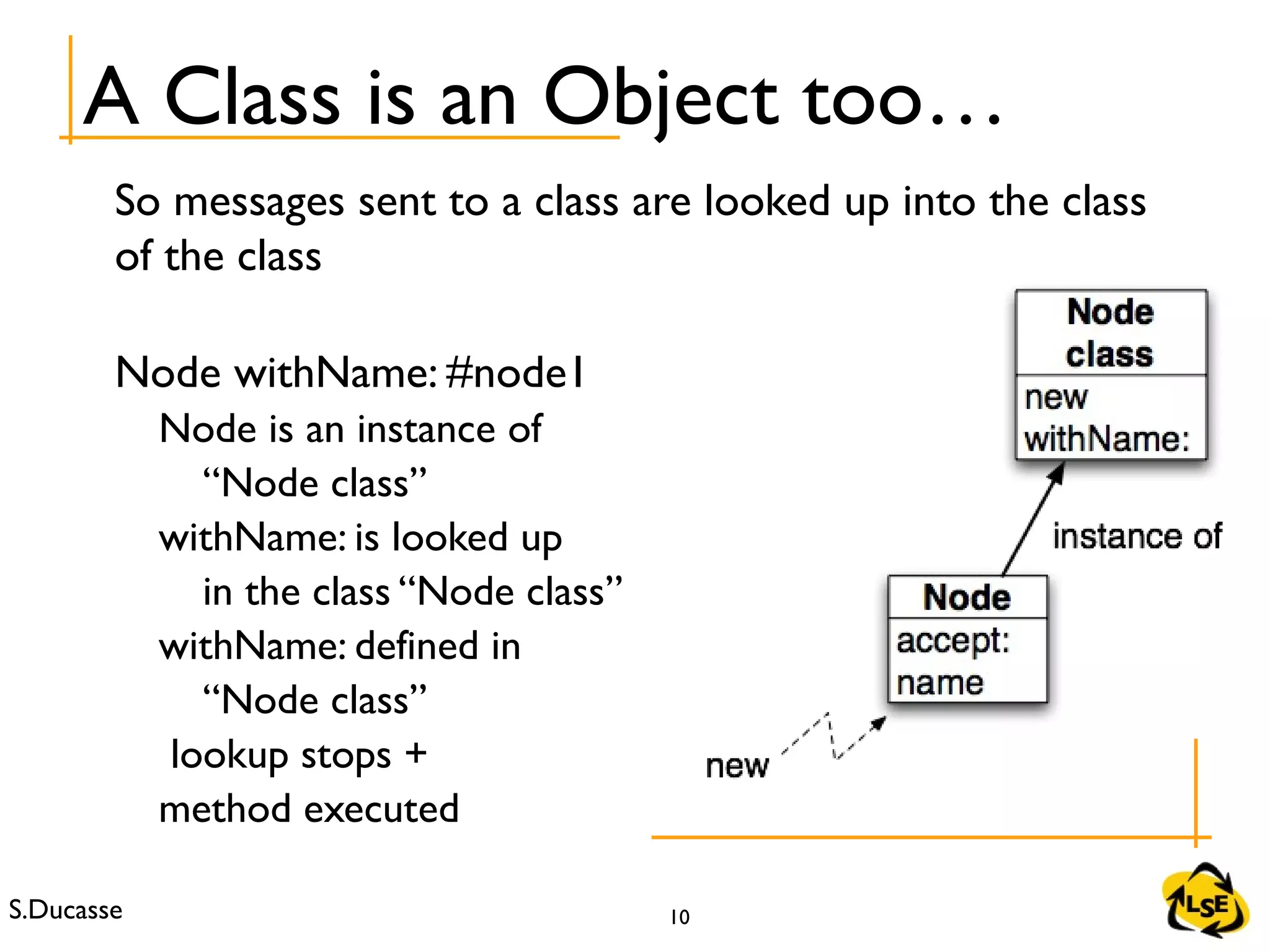
A Class is an Object too…
So messages sent to a class are looked up into the class
of the class
Node withName: #node1
Node is an instance of
“Node class”
withName: is looked up
in the class “Node class”
withName: defined in
“Node class”
lookup stops +
method executed
S.Ducasse 11
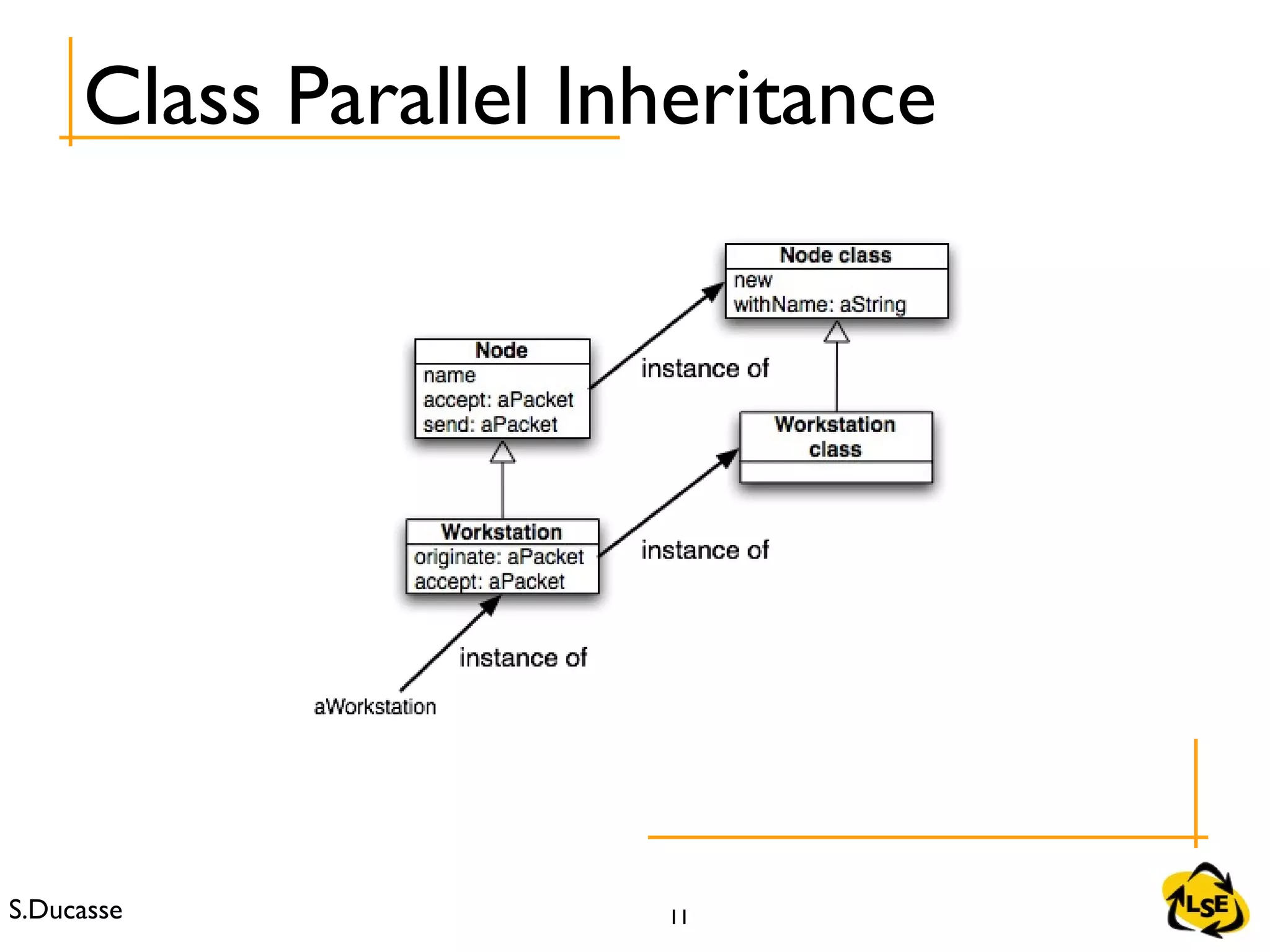
Class Parallel Inheritance
S.Ducasse 12
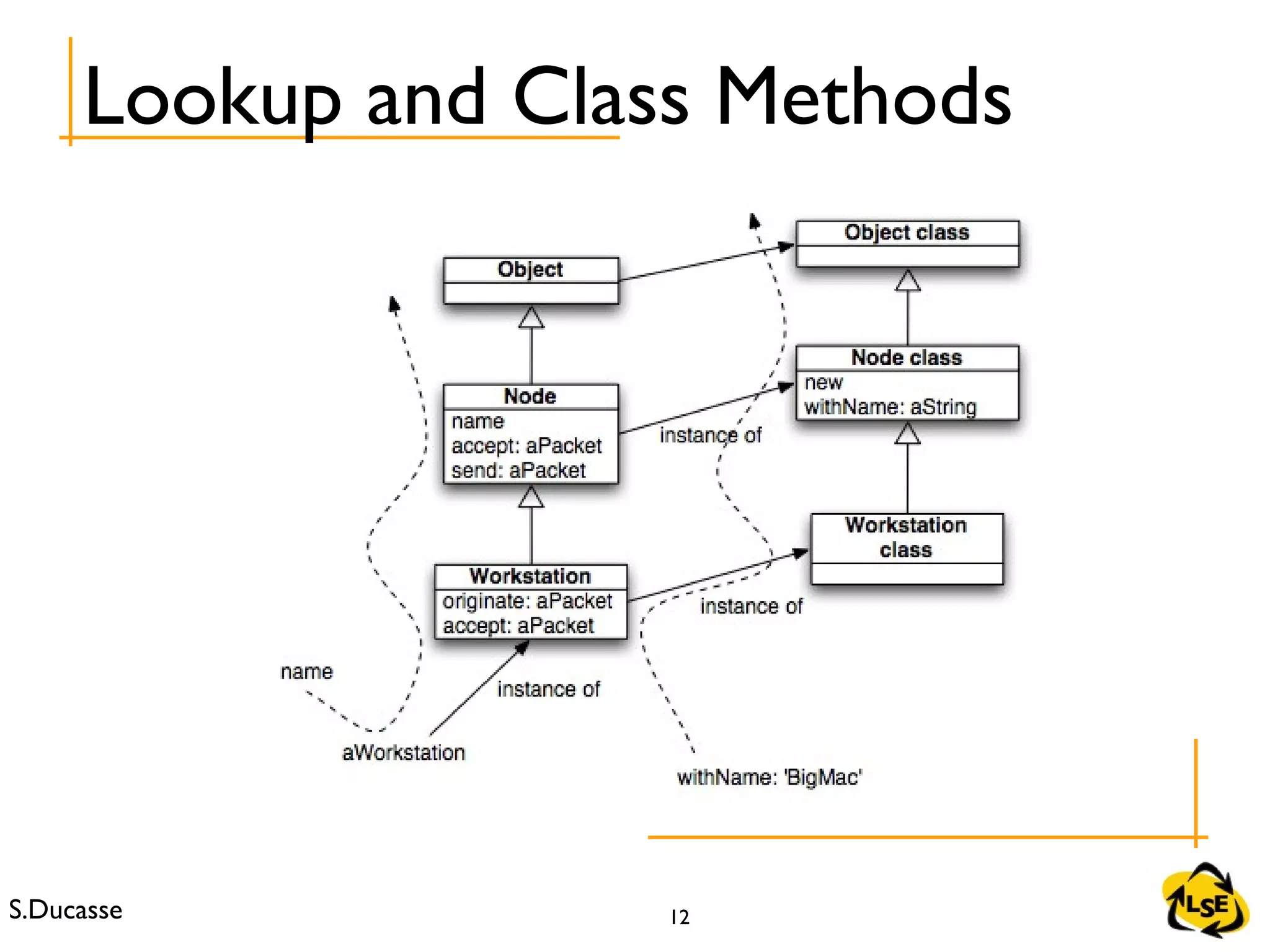
Lookup and Class Methods
S.Ducasse 13
Class Parallel inheritance
• Workstation withName: #mac
• Workstation is an instance of Workstation class
• => withName: is looked up in the class Workstation
class
• withName: is not defined in Workstation class
• => lookup continues in the superclass of Workstation
class = Node class
• withName: is defined in Node class
• => lookup stops + method executed
S.Ducasse 14
Object
represents the common behavior (like error, halting...)
shared by all the instances (final instances and classes)
all the classes should inherit ultimately from Object
-> Workstation inherits from Node
-> Node inherits from Object
Class
represents the common behavior of all the classes
(compilation, method storing, instance variable storing)
Class inherits from Object because Class is an Object,
although a special one -> Class knows how to create
instances
So all the classes should inherit ultimately from Class
Responsibilities of Object & Class
S.Ducasse 15
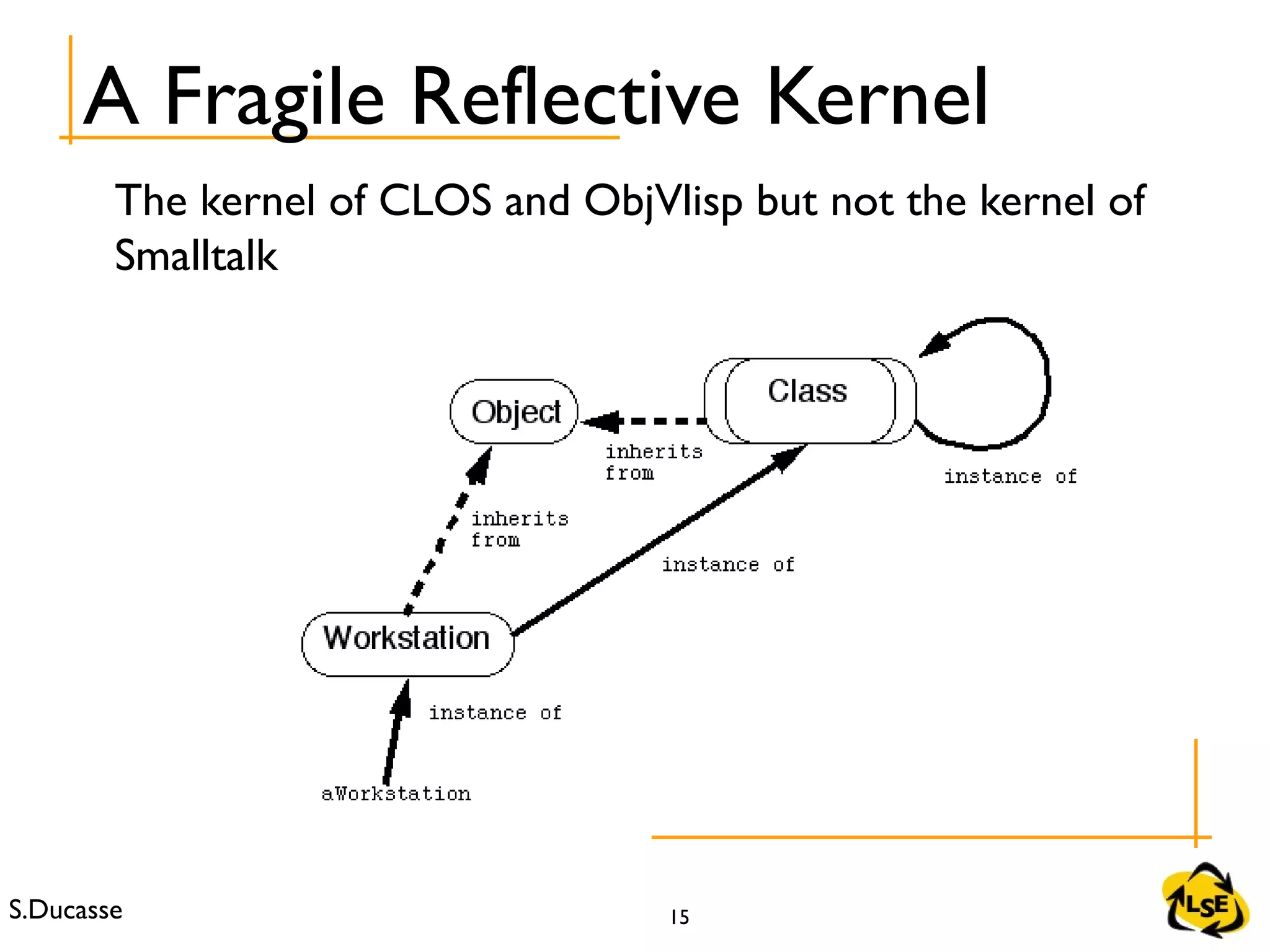
The kernel of CLOS and ObjVlisp but not the kernel of
Smalltalk
A Fragile Reflective Kernel
S.Ducasse 16
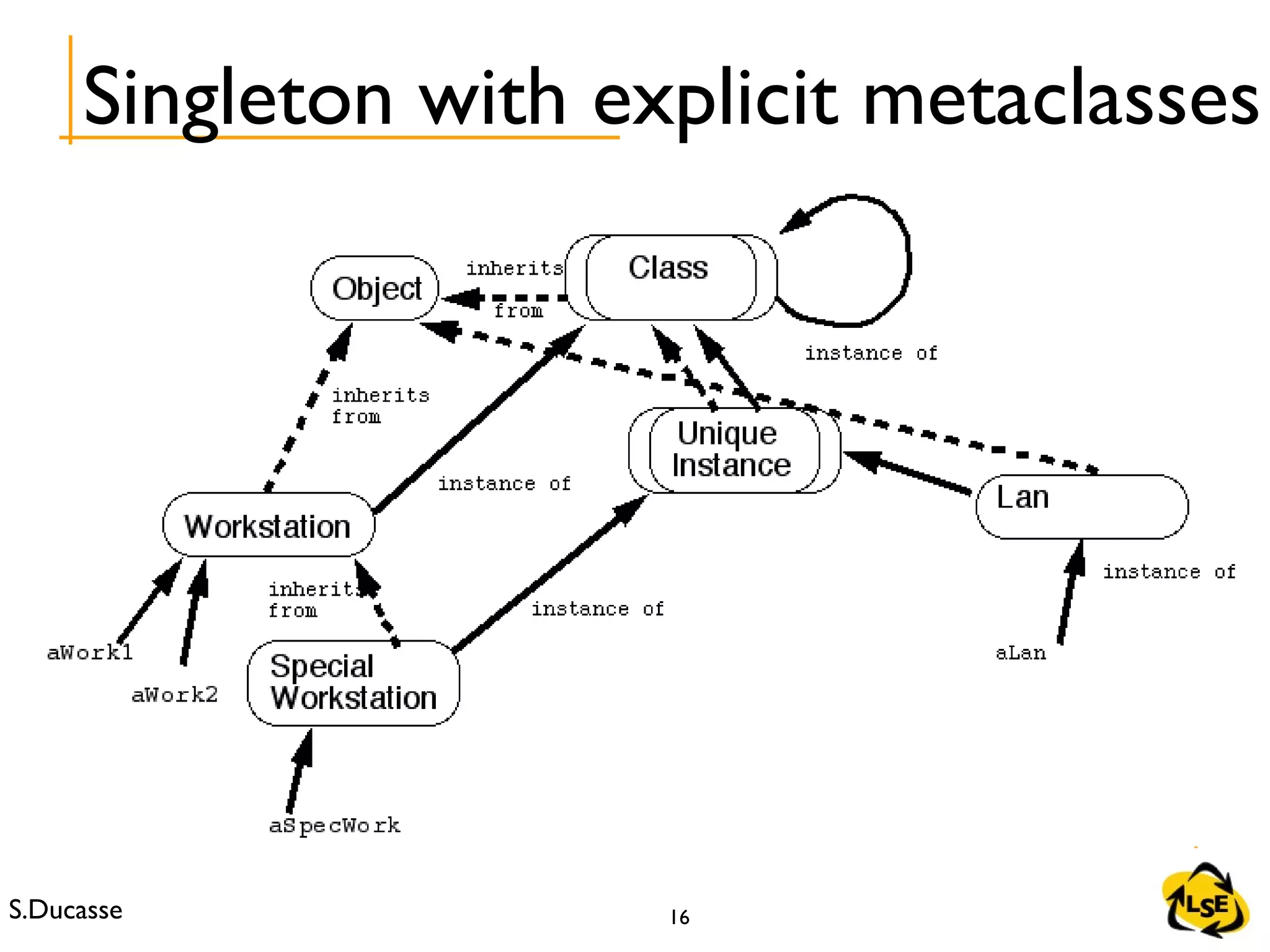
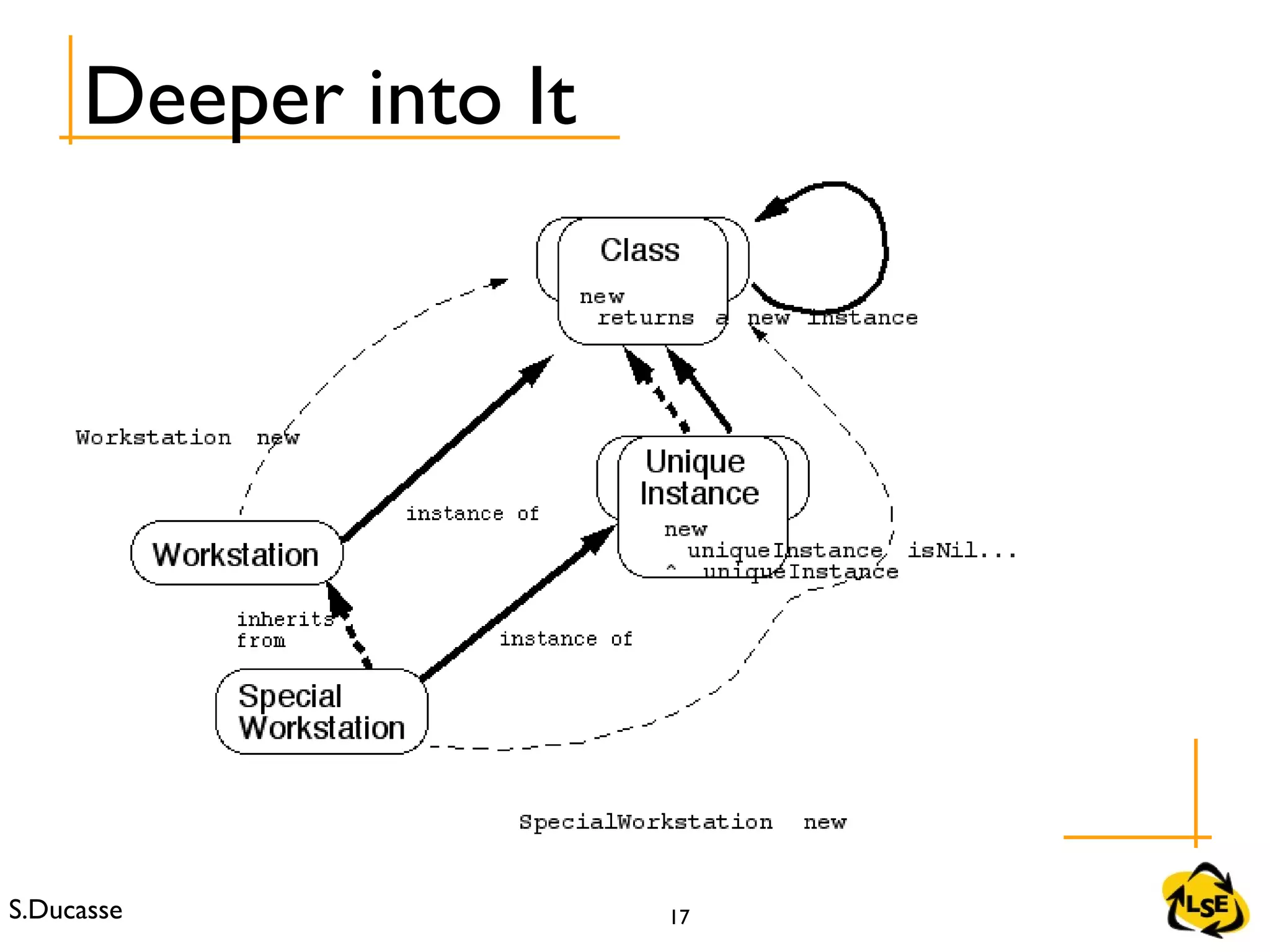
Singleton with explicit metaclasses
S.Ducasse 17
Deeper into It
S.Ducasse 18
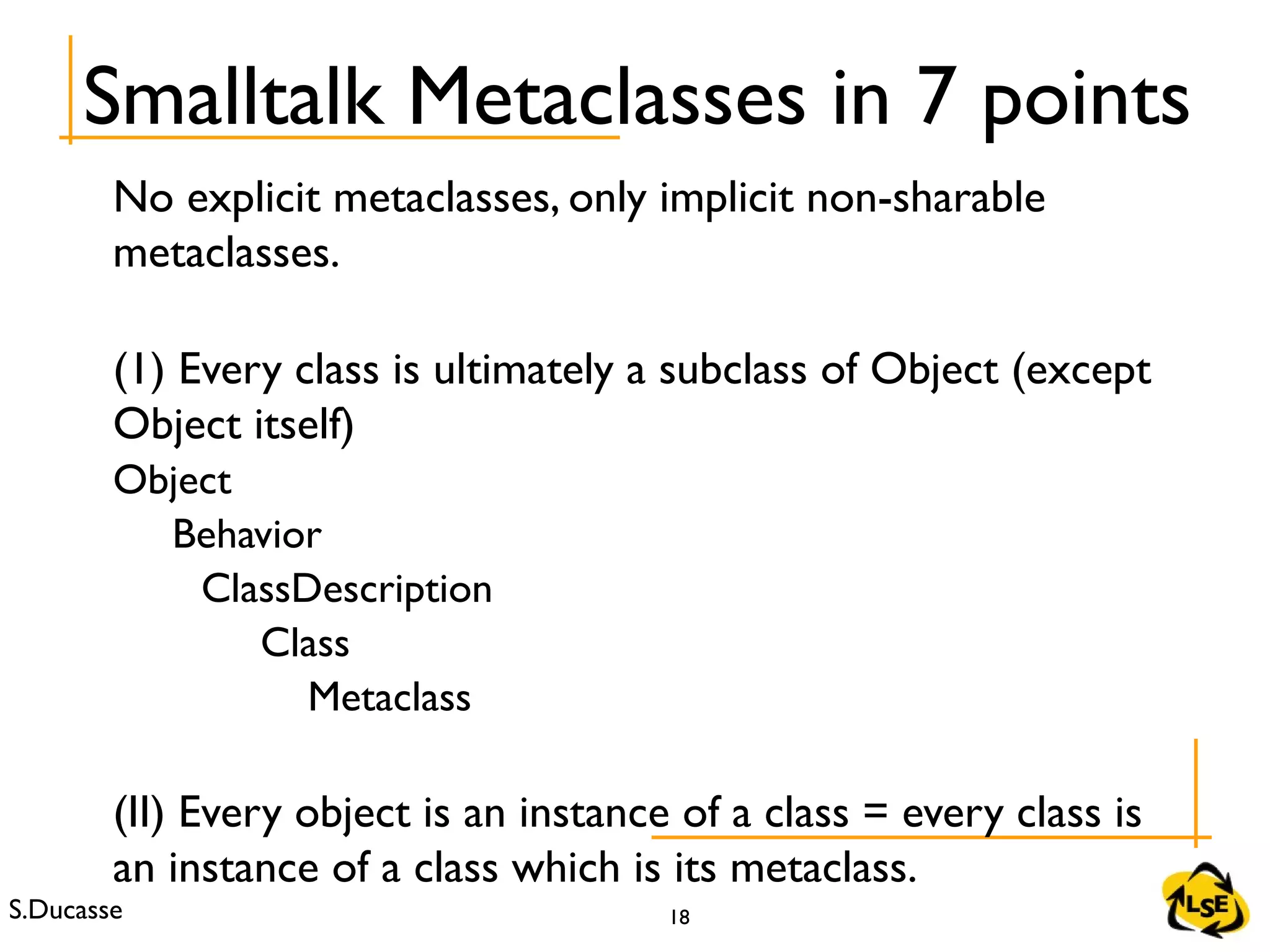
No explicit metaclasses, only implicit non-sharable
metaclasses.
(1) Every class is ultimately a subclass of Object (except
Object itself)
Object
Behavior
ClassDescription
Class
Metaclass
(II) Every object is an instance of a class = every class is
an instance of a class which is its metaclass.
Smalltalk Metaclasses in 7 points
S.Ducasse 19
(3) Every class is an instance of a metaclass.
Every user defined class is the sole instance of another
class (a metaclass).
Metaclasses are system generated and they are unnamed.
You can access them by sending the message class to a
class.
Point class name -> ‘Point class’
Smalltalk Metaclasses in 7 points
S.Ducasse 20
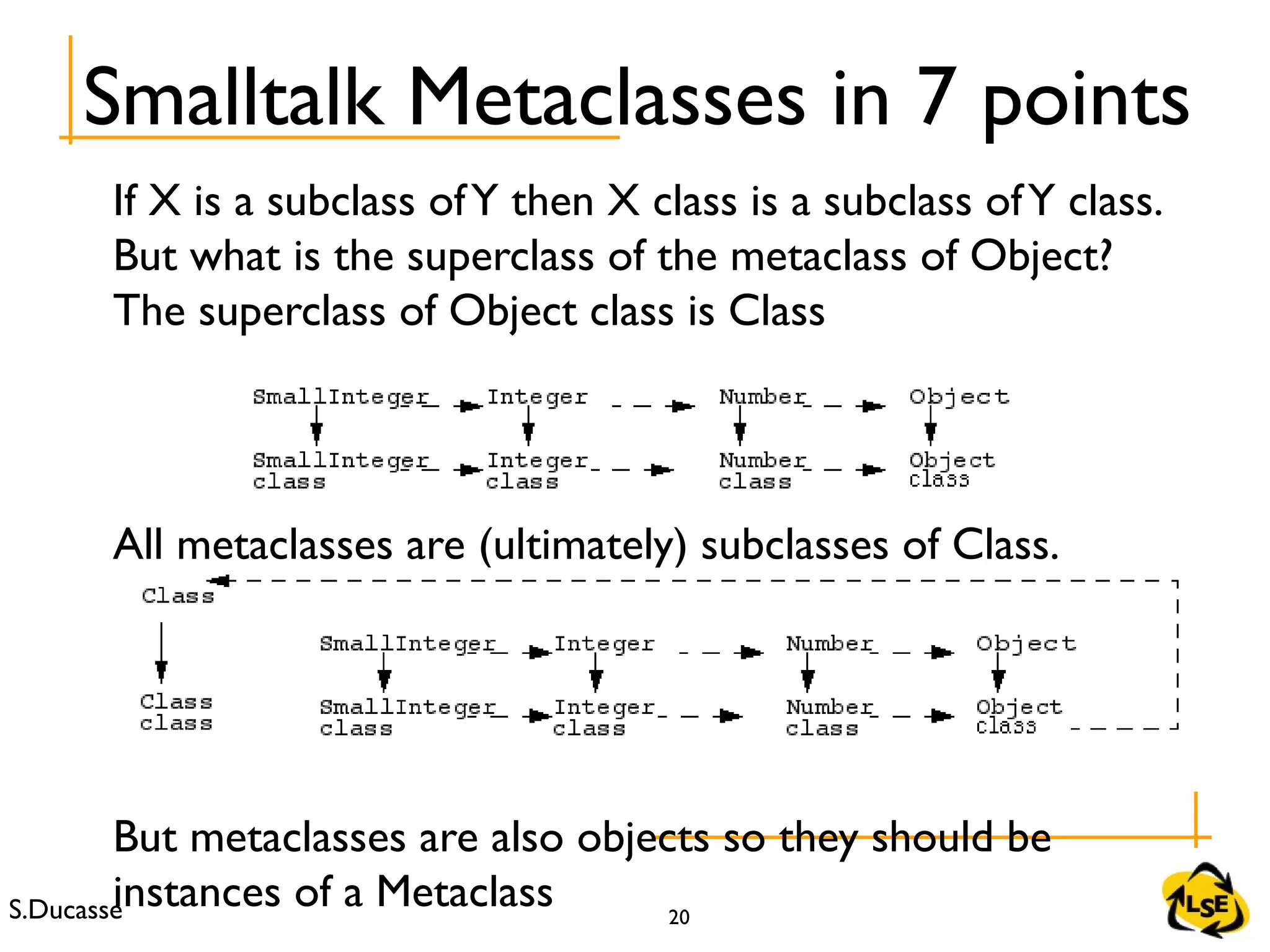
If X is a subclass ofY then X class is a subclass ofY class.
But what is the superclass of the metaclass of Object?
The superclass of Object class is Class
All metaclasses are (ultimately) subclasses of Class.
But metaclasses are also objects so they should be
instances of a Metaclass
Smalltalk Metaclasses in 7 points
S.Ducasse 21
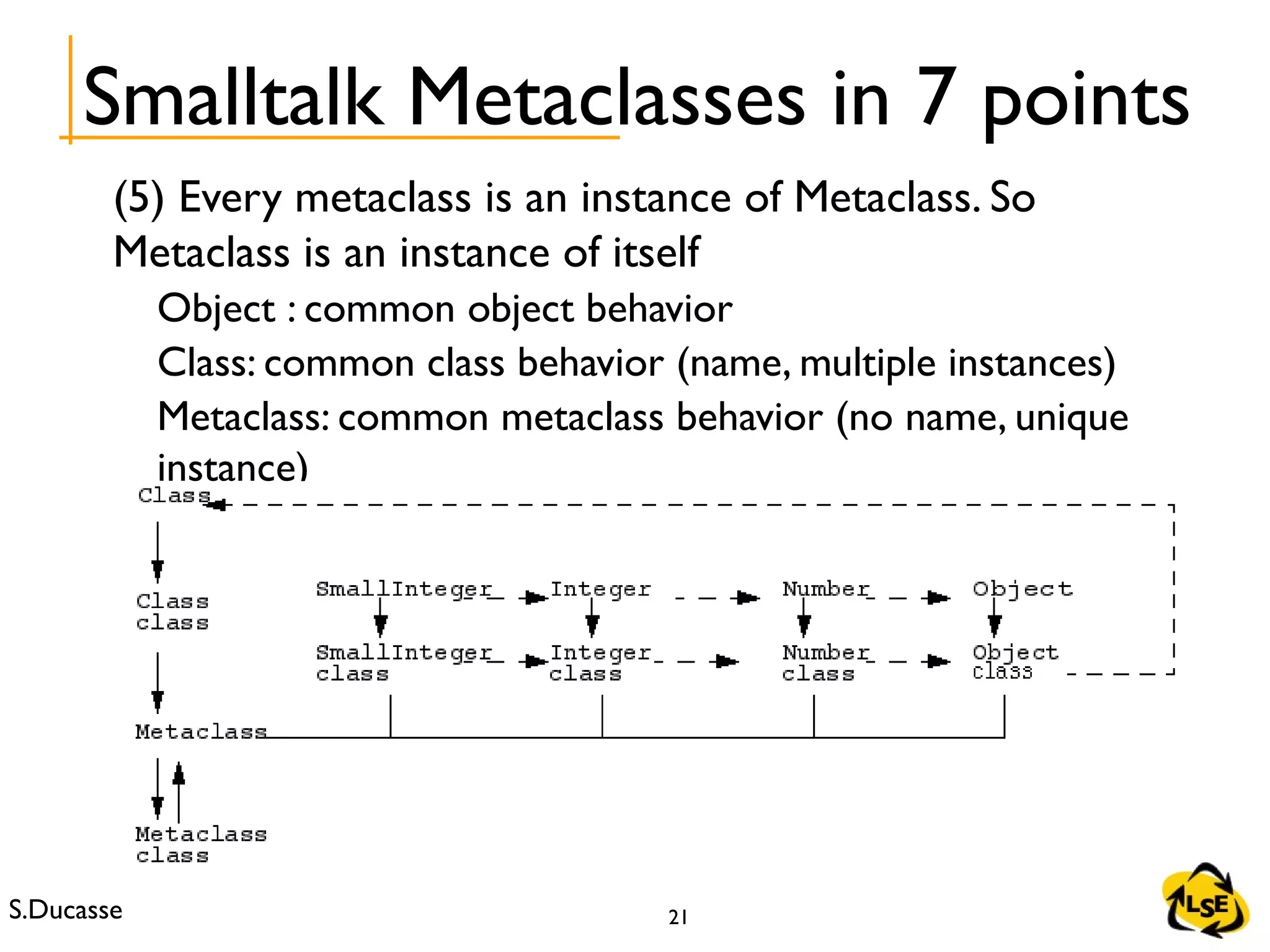
(5) Every metaclass is an instance of Metaclass. So
Metaclass is an instance of itself
Object : common object behavior
Class: common class behavior (name, multiple instances)
Metaclass: common metaclass behavior (no name, unique
instance)
Smalltalk Metaclasses in 7 points
S.Ducasse 22
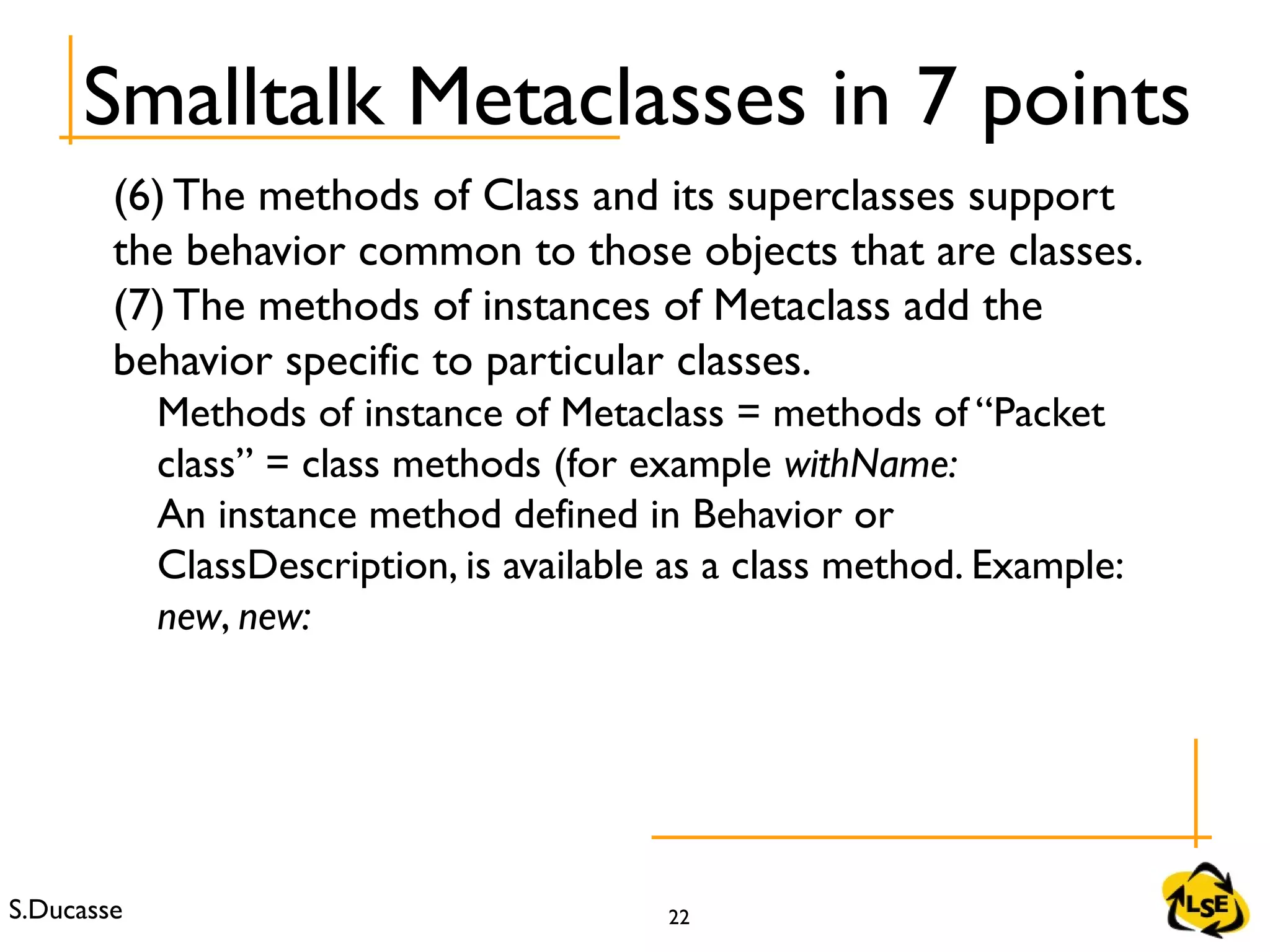
(6) The methods of Class and its superclasses support
the behavior common to those objects that are classes.
(7) The methods of instances of Metaclass add the
behavior specific to particular classes.
Methods of instance of Metaclass = methods of “Packet
class” = class methods (for example withName:
An instance method defined in Behavior or
ClassDescription, is available as a class method. Example:
new, new:
Smalltalk Metaclasses in 7 points
S.Ducasse 23
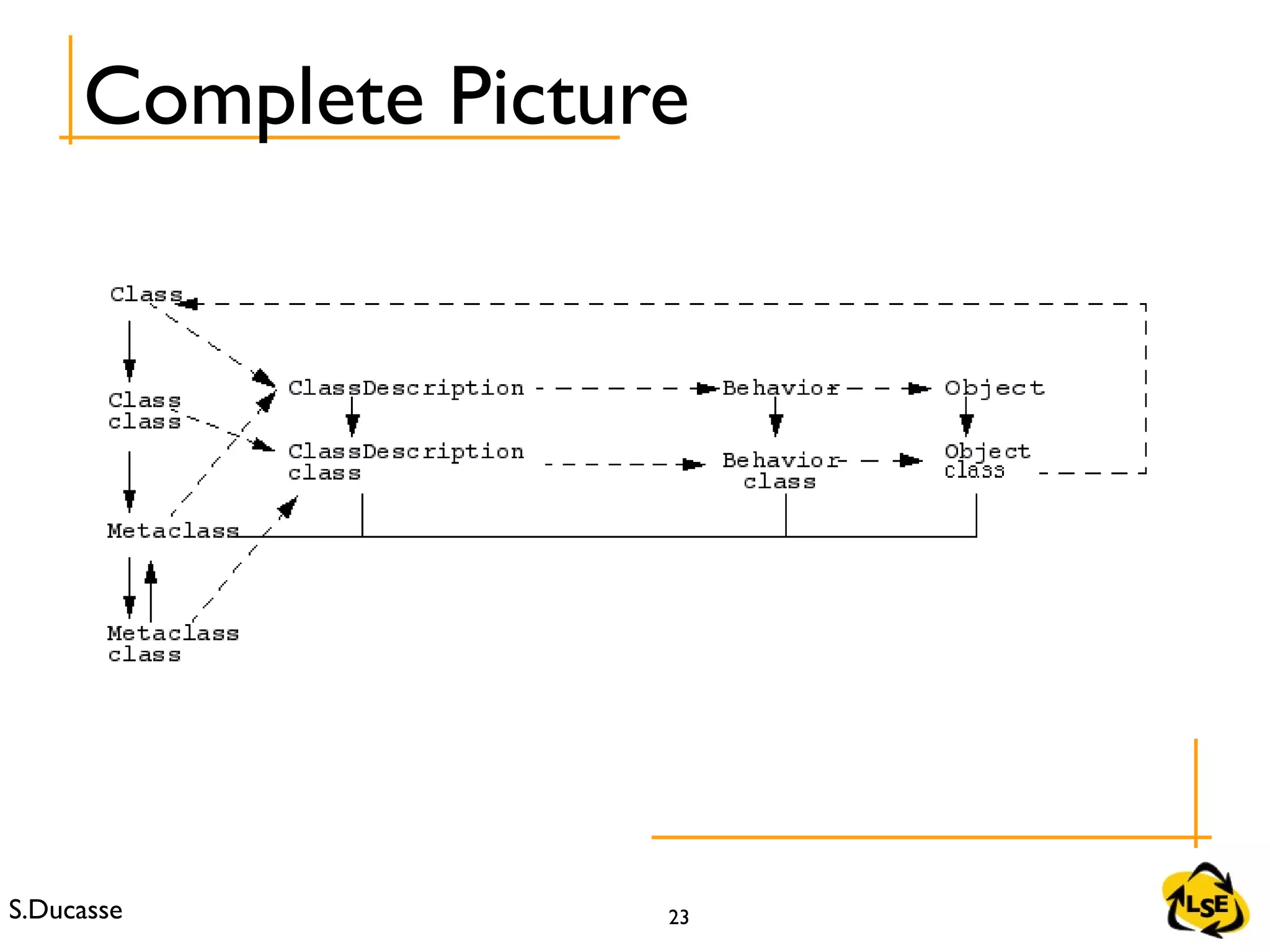
Complete Picture
S.Ducasse 24
Final Thoughts
Finally it is not sure that the Smalltalk model is more
complex than the one of ObjVlisp.
If we consider the programmer view of a class, Smalltalk
is simpler
If we consider the meta-programmer, ObjVlisp is simpler
S.Ducasse 25
Responsibilities
S.Ducasse 26
Minimum state necessary for objects that have instances.
Basic interface to the compiler.
State: class hierarchy link, method dictionary, description of
instances (representation and number)
Methods:
creating a method dictionary, compiling method
instance creation (new, basicNew, new:, basicNew:)
class into hierarchy ( superclass:, addSubclass:
accessing (selectors, allSelectors, compiledMethodAt: )
accessing instances and variables (allInstances,
instVarNames)
accessing class hierarchy (superclass, subclasses)
testing (hasMethods, includesSelector, canUnderstand:,
inheritsFrom:, isVariable)
Behavior Responsibilities
S.Ducasse 27
ClassDescription adds a number of facilities to basic
Behavior:
named instance variables
category organization for methods
the notion of a name (abstract)
the maintenance of the Changes set, and logging changes
most of the mechanisms needed for fileOut
ClassDescription is an abstract class: its facilities are
intended for inheritance by the two subclasses, Class and
Metaclass.
ClassDescription Responsibilities
S.Ducasse 28
Metaclass
initialization of class variables
creating initialized instances of the metaclass’s sole instance
instance creation (subclassOf:)
metaclass instance protocol
(name:inEnvironment:subclassOf:....)
Class
Class adds naming for class
Class adds the representation for classVariable names and
shared pool variables (addClassVaraNames, addSharedPool:,
initialize)
Metaclass and Class Responsibilities
S.Ducasse 29
Summary
Classes are objects too
A class is the unique instance of another class, its
metaclass

Stoop 304-metaclasses

  • 1.
    S.Ducasse 1 QuickTime™ andaTIFF (Uncompressed) decompressorare needed to see this picture. Stéphane Ducasse Stephane.Ducasse@univ-savoie.fr http://www.listic.univ-savoie.fr/~ducasse/ Classes and Metaclasses - an Analysis
  • 2.
    S.Ducasse 2 License: CC-Attribution-ShareAlike2.0 http://creativecommons.org/licenses/by-sa/2.0/
  • 3.
    S.Ducasse 3 Goals “Some booksare to be tasted, others to be swallowed, and some few to be chewed and digested” — Francis Bacon, Of Studies •Recap on Instantiation •Recap on Inheritance
  • 4.
    S.Ducasse 4 At firstsight, a difficult topic! You can live without really understanding them, but metaclasses provide a uniform model, and you will make less errors if you learn how they work, and you will really understand the object model Warning
  • 5.
    S.Ducasse 5 • Everyobject is an instance of a class. • Every class (except Object) is ultimately a subclass of Object. • When anObject receives a message, the method is looked up in its class and/or its superclasses. • A class defines the structure and the behavior of all its instances. • Each instance possesses its own set of values. • Each instance shares its behavior with other instances. This behavior is defined in its class, and is accessed via the instance of link. The Meaning of “Instance of”
  • 6.
    S.Ducasse 6 • Everythingis an object • Every object is instance of exactly one class • A class is also an object, and is an instance of its metaclass • An object is a class if and only if it can create instances of itself. Metaclass
  • 7.
    S.Ducasse 7 Class Responsibilities •instance creation • class information (inheritance link, instance variables, method compilation...) • Examples: • Node allSubclasses -> OrderedCollection (WorkStation OutputServer Workstation File) • LanPrinter allInstances -> #() • Node instVarNames -> #('name' 'nextNode') • Workstation withName: #mac -> aWorkstation • Workstation selectors -> IdentitySet (#accept: #originate:) • Workstation canUnderstand: #nextNode -> true
  • 8.
    S.Ducasse 8 Node allSubclasses-> OrderedCollection (WorkStation OutputServer Workstation FileServer PrintServer) PrintServer allInstances -> () Node instVarNames -> ('name' 'nextNode') Workstation withName: mac -> aWorkstation Workstation selectors -> IdentitySet (accept: originate:) Workstation canUnderstand: nextNode -> true Metaclass by Example
  • 9.
    S.Ducasse 9 The Meaningof Is-a • Every object is an instance of a class. • When anObject receives a message, • the method is looked up in its class • And it continues possibly in • its superclasses • Every class is ultimately • a subclass of Object (except Object).
  • 10.
    S.Ducasse 10 A Classis an Object too… So messages sent to a class are looked up into the class of the class Node withName: #node1 Node is an instance of “Node class” withName: is looked up in the class “Node class” withName: defined in “Node class” lookup stops + method executed
  • 11.
  • 12.
  • 13.
    S.Ducasse 13 Class Parallelinheritance • Workstation withName: #mac • Workstation is an instance of Workstation class • => withName: is looked up in the class Workstation class • withName: is not defined in Workstation class • => lookup continues in the superclass of Workstation class = Node class • withName: is defined in Node class • => lookup stops + method executed
  • 14.
    S.Ducasse 14 Object represents thecommon behavior (like error, halting...) shared by all the instances (final instances and classes) all the classes should inherit ultimately from Object -> Workstation inherits from Node -> Node inherits from Object Class represents the common behavior of all the classes (compilation, method storing, instance variable storing) Class inherits from Object because Class is an Object, although a special one -> Class knows how to create instances So all the classes should inherit ultimately from Class Responsibilities of Object & Class
  • 15.
    S.Ducasse 15 The kernelof CLOS and ObjVlisp but not the kernel of Smalltalk A Fragile Reflective Kernel
  • 16.
    S.Ducasse 16 Singleton withexplicit metaclasses
  • 17.
  • 18.
    S.Ducasse 18 No explicitmetaclasses, only implicit non-sharable metaclasses. (1) Every class is ultimately a subclass of Object (except Object itself) Object Behavior ClassDescription Class Metaclass (II) Every object is an instance of a class = every class is an instance of a class which is its metaclass. Smalltalk Metaclasses in 7 points
  • 19.
    S.Ducasse 19 (3) Everyclass is an instance of a metaclass. Every user defined class is the sole instance of another class (a metaclass). Metaclasses are system generated and they are unnamed. You can access them by sending the message class to a class. Point class name -> ‘Point class’ Smalltalk Metaclasses in 7 points
  • 20.
    S.Ducasse 20 If Xis a subclass ofY then X class is a subclass ofY class. But what is the superclass of the metaclass of Object? The superclass of Object class is Class All metaclasses are (ultimately) subclasses of Class. But metaclasses are also objects so they should be instances of a Metaclass Smalltalk Metaclasses in 7 points
  • 21.
    S.Ducasse 21 (5) Everymetaclass is an instance of Metaclass. So Metaclass is an instance of itself Object : common object behavior Class: common class behavior (name, multiple instances) Metaclass: common metaclass behavior (no name, unique instance) Smalltalk Metaclasses in 7 points
  • 22.
    S.Ducasse 22 (6) Themethods of Class and its superclasses support the behavior common to those objects that are classes. (7) The methods of instances of Metaclass add the behavior specific to particular classes. Methods of instance of Metaclass = methods of “Packet class” = class methods (for example withName: An instance method defined in Behavior or ClassDescription, is available as a class method. Example: new, new: Smalltalk Metaclasses in 7 points
  • 23.
  • 24.
    S.Ducasse 24 Final Thoughts Finallyit is not sure that the Smalltalk model is more complex than the one of ObjVlisp. If we consider the programmer view of a class, Smalltalk is simpler If we consider the meta-programmer, ObjVlisp is simpler
  • 25.
  • 26.
    S.Ducasse 26 Minimum statenecessary for objects that have instances. Basic interface to the compiler. State: class hierarchy link, method dictionary, description of instances (representation and number) Methods: creating a method dictionary, compiling method instance creation (new, basicNew, new:, basicNew:) class into hierarchy ( superclass:, addSubclass: accessing (selectors, allSelectors, compiledMethodAt: ) accessing instances and variables (allInstances, instVarNames) accessing class hierarchy (superclass, subclasses) testing (hasMethods, includesSelector, canUnderstand:, inheritsFrom:, isVariable) Behavior Responsibilities
  • 27.
    S.Ducasse 27 ClassDescription addsa number of facilities to basic Behavior: named instance variables category organization for methods the notion of a name (abstract) the maintenance of the Changes set, and logging changes most of the mechanisms needed for fileOut ClassDescription is an abstract class: its facilities are intended for inheritance by the two subclasses, Class and Metaclass. ClassDescription Responsibilities
  • 28.
    S.Ducasse 28 Metaclass initialization ofclass variables creating initialized instances of the metaclass’s sole instance instance creation (subclassOf:) metaclass instance protocol (name:inEnvironment:subclassOf:....) Class Class adds naming for class Class adds the representation for classVariable names and shared pool variables (addClassVaraNames, addSharedPool:, initialize) Metaclass and Class Responsibilities
  • 29.
    S.Ducasse 29 Summary Classes areobjects too A class is the unique instance of another class, its metaclass