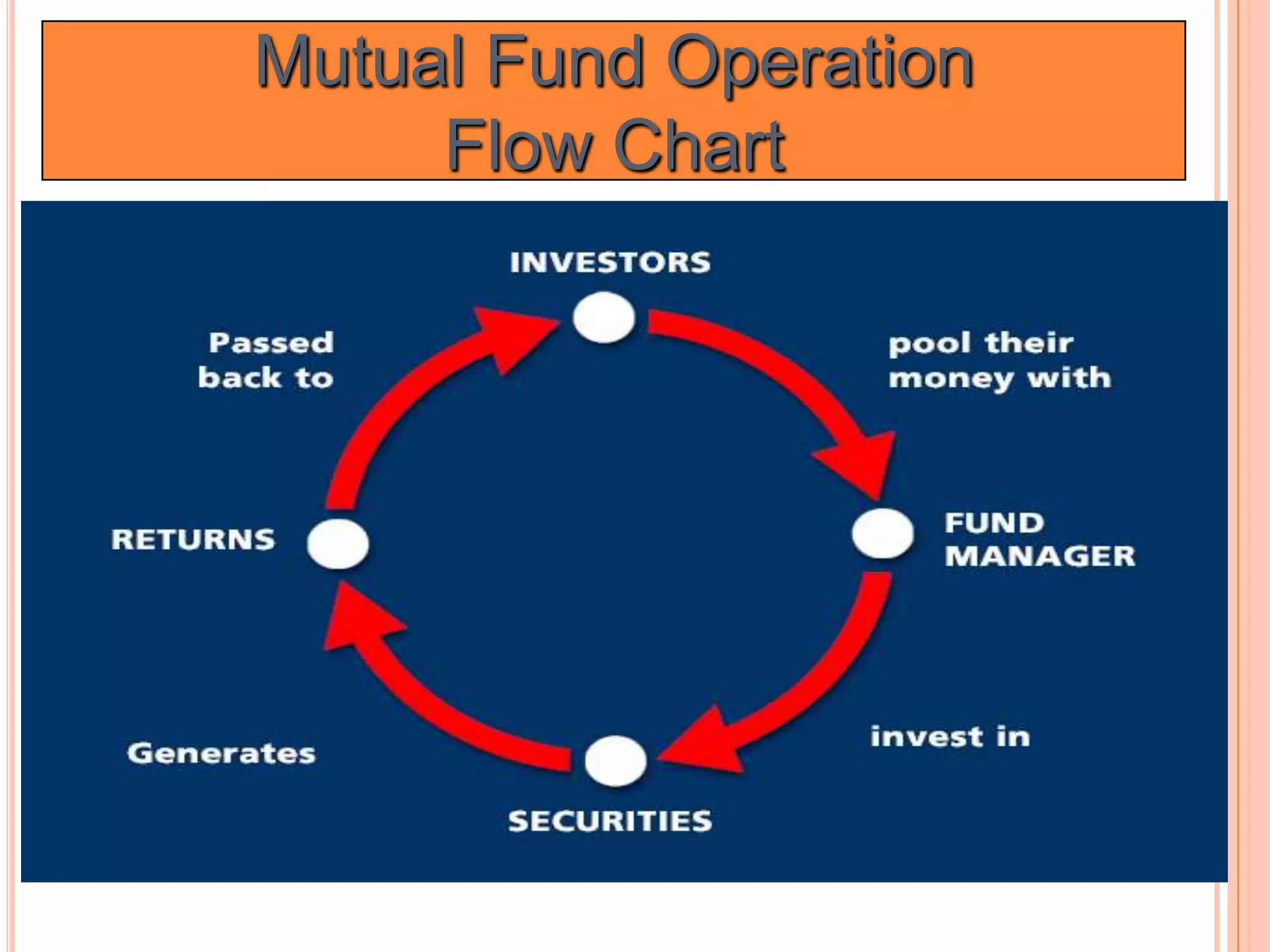
Mutual funds are professionally managed investment funds that pool money from many investors to purchase securities like stocks, bonds, and money market instruments. The fund is overseen by a fund manager who buys and sells assets according to the fund's investment objective. Investors share in the income and capital gains of the fund proportionate to their investment. Mutual funds offer diversification, affordability, and professional management for individual investors. Some disadvantages include lack of a tailored portfolio and potential underperformance. Mutual funds are regulated in India by SEBI and operate through a trust structure with sponsors, trustees, asset management companies, and third party administrators.
WHAT IS MUTUAL FUND?A mutual fund is a professionally managed type of collective investment scheme that pools money from many investors and invests typically in investment securities like stocks, bonds, short-term money market instruments, other mutual funds, other securities, and/or commodities such as precious metals
4.
WHAT IS MUTUAL FUND?The mutual fund will have a fund manager that trades (buys and sells) the fund's investments in accordance with the fund's investment objectiveThe income earned through these investments and the capital appreciation realized are shared by its unit holders(investors) in proportion to the number of units owned by them
5.
Why invest ina MUTUAL FUND?Mutual Fund is the most suitable investment for the common man as it offers an opportunity to invest in a diversified, professionally managed basket of securities at a relatively low cost
6.
ADVANTAGES OF MUTUALFUNDSAffordableProfessional Management Diversification Liquidity Tax benefits Well regulated and low cost Transparency Flexibility Choice of schemes
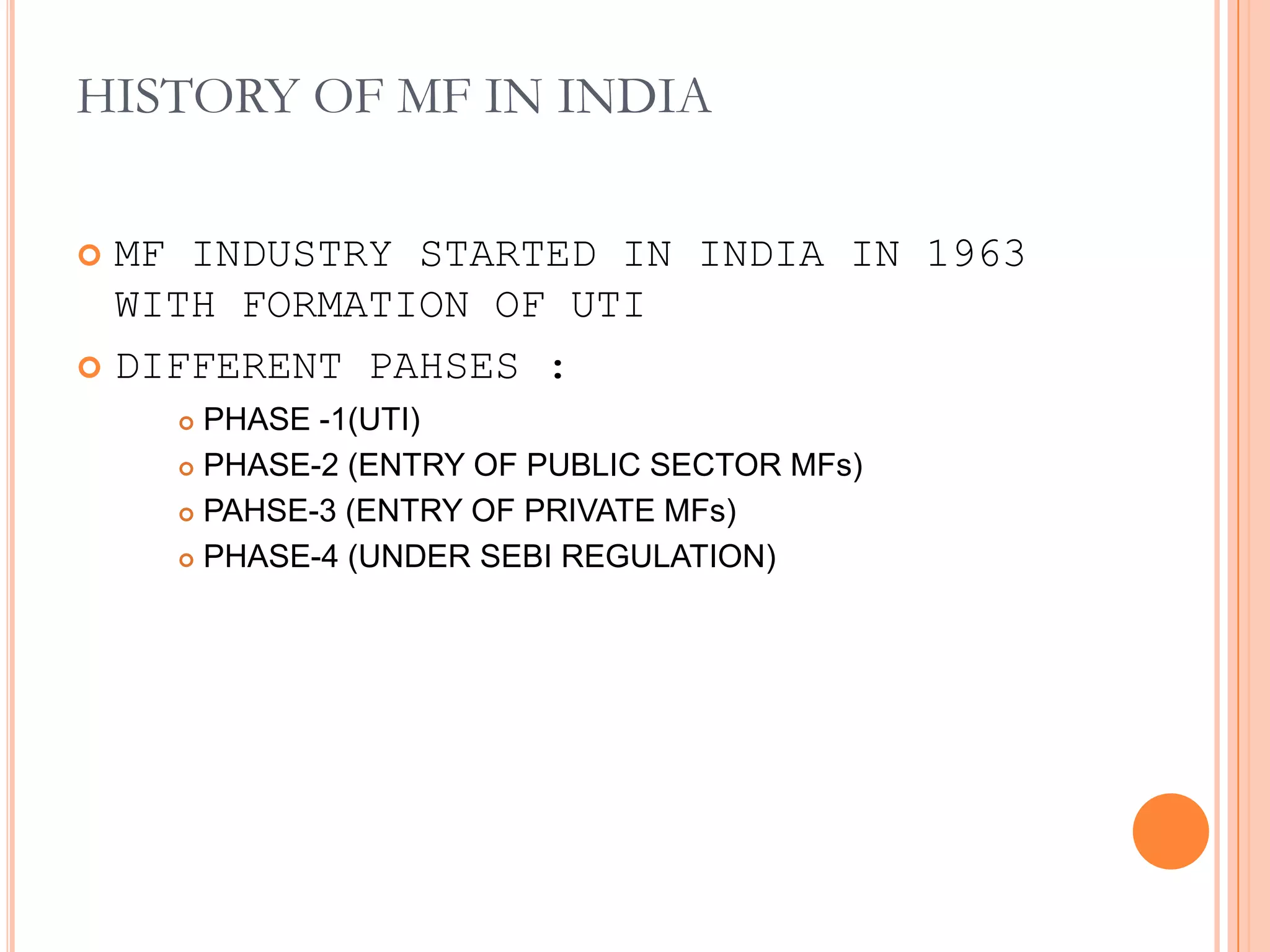
HISTORY OF MFIN INDIAMF INDUSTRY STARTED IN INDIA IN 1963 WITH FORMATION OF UTIDIFFERENT PAHSES : PHASE -1(UTI)PHASE-2 (ENTRY OF PUBLIC SECTOR MFs)PAHSE-3 (ENTRY OF PRIVATE MFs)PHASE-4 (UNDER SEBI REGULATION)
10.
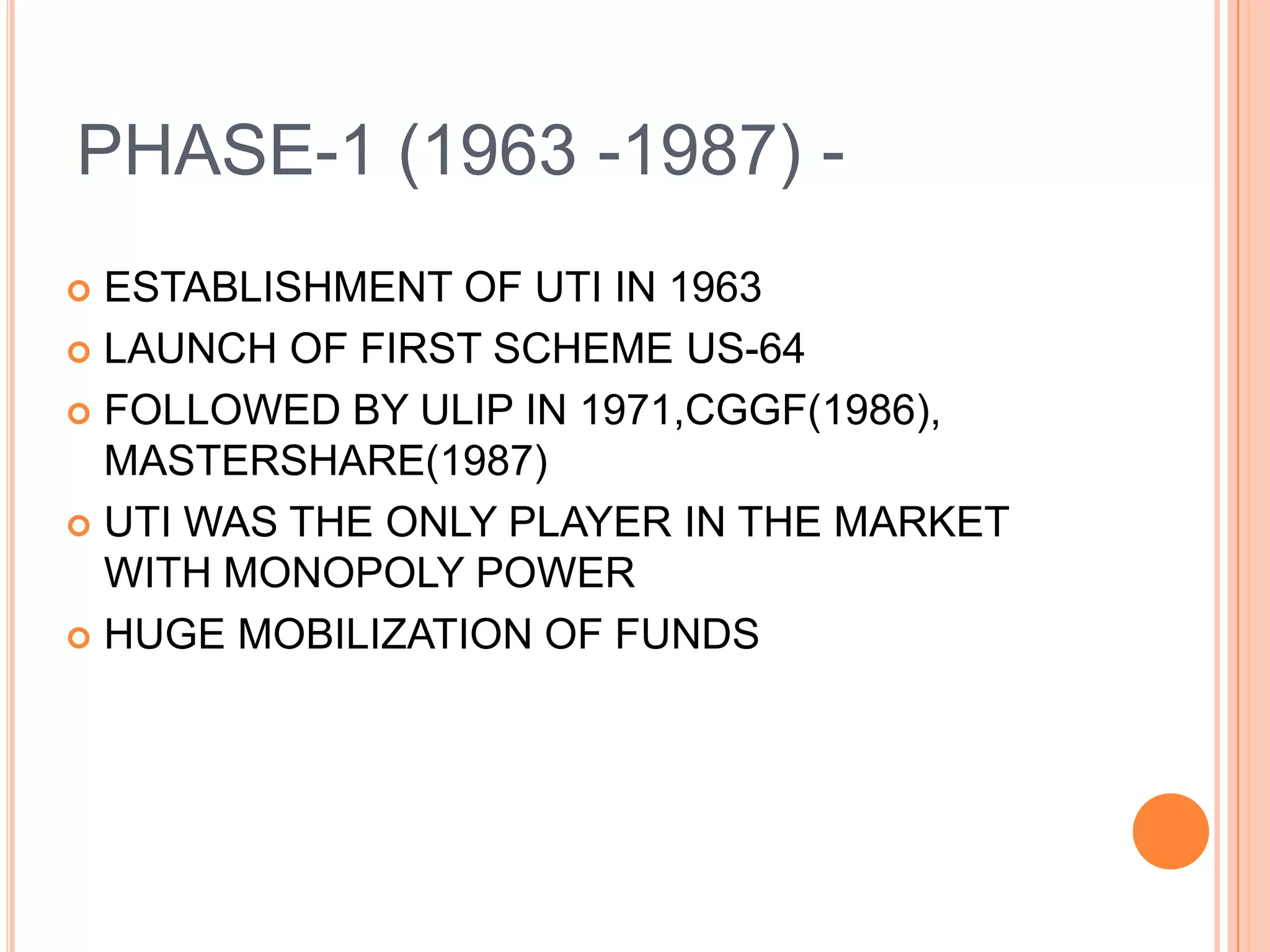
PHASE-1 (1963 -1987)-ESTABLISHMENT OF UTI IN 1963LAUNCH OF FIRST SCHEME US-64FOLLOWED BY ULIP IN 1971,CGGF(1986), MASTERSHARE(1987)UTI WAS THE ONLY PLAYER IN THE MARKET WITH MONOPOLY POWERHUGE MOBILIZATION OF FUNDS
11.
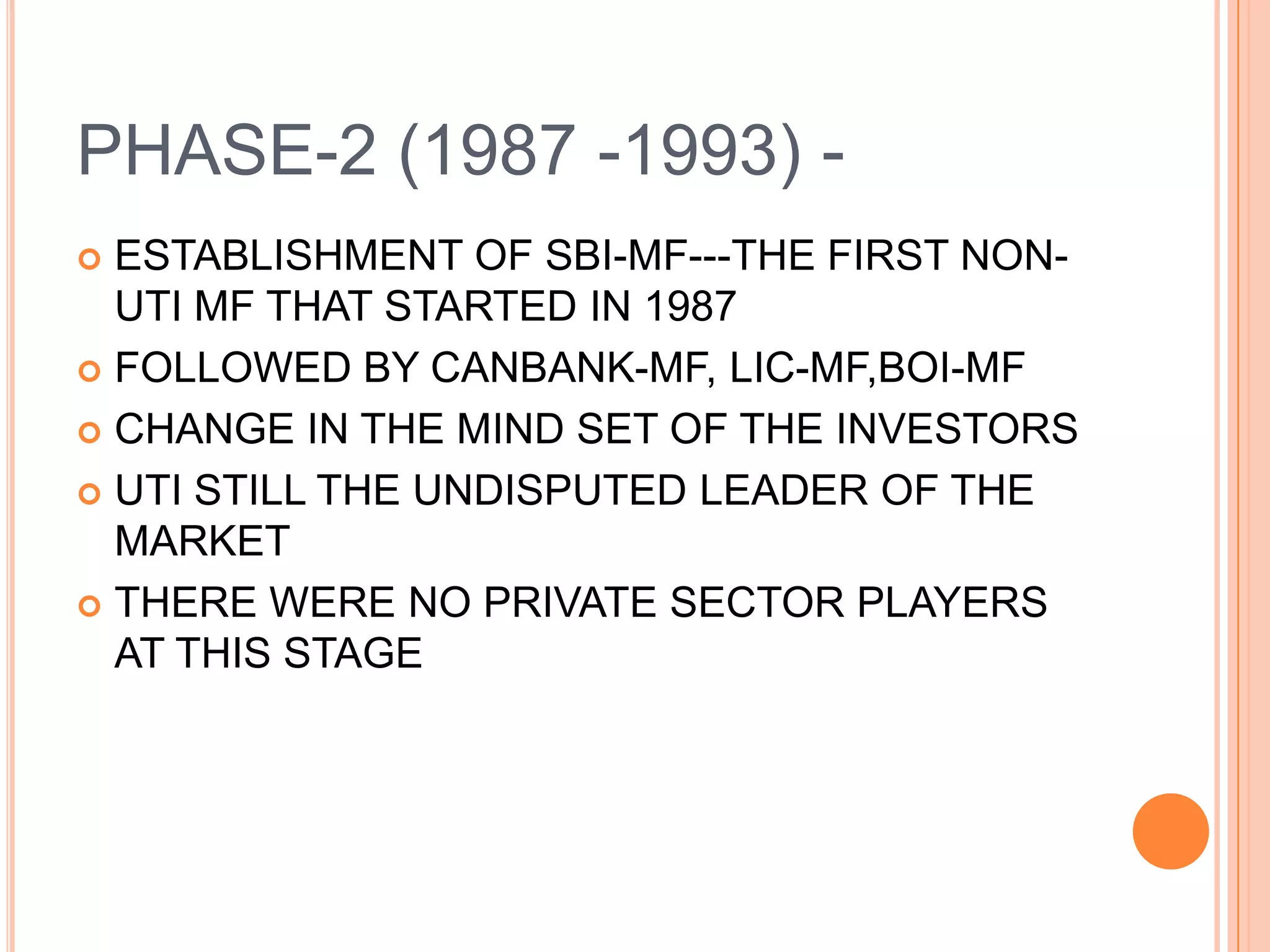
PHASE-2 (1987 -1993)-ESTABLISHMENT OF SBI-MF---THE FIRST NON-UTI MF THAT STARTED IN 1987FOLLOWED BY CANBANK-MF, LIC-MF,BOI-MFCHANGE IN THE MIND SET OF THE INVESTORSUTI STILL THE UNDISPUTED LEADER OF THE MARKETTHERE WERE NO PRIVATE SECTOR PLAYERS AT THIS STAGE
12.
PHASE-3(1993 -1996) -ENTRYOF THE PRIVATE SECTOR FUNDS IN 1993JV OF FOREIGN FUND MANANGEMENT COMPANIES WITH INDIAN PROMOTERSMORE COMPETITIVE PRODUCT INNOVATION, INVESTMENT MANAGEMENT TECHNIQUES, INVESTORS SERVICING TECHNIQUES CAME INTO INDIAINVESTORS STARTED BECOME SELECTIVE
13.
PHASE-4 ( 1996onwards )SEBI- THE REGULATORY AUTHORITY SEBI MF REGULATION 1996UTI CAME UNDER SEBI REGULATION VOLUNTARILYGOVT.’S STEPS FOR INVESTORS’ PROTECTION
14.
TYPES OF Mutualfunds – by structureOpen ended -theses schemes do not have a fixed maturity period –they are available for subscription and repurchase on a continuous basisClose ended –these have a stipulated maturity period of 5-7 years – they are open to subscription only during the period of launch. They can be bought and sold in stock exchanges where they are listed. Exit routes are also provided by the fund through repurchase at specific points of time.
15.
TYPES OF Mutualfunds – by investment objectivesGrowth equity schemes –they provide capital appreciation over medium to long term – they carry risk of equity exposure.Income /Debt schemes –these aim at providing regular income to the investors by investing in debt instruments like bonds, corporate debentures, govt securities, money market instruments etc.Balanced funds –these provide a mix of regular income and capital appreciation –these invest in a mix of equity and debt instruments
16.
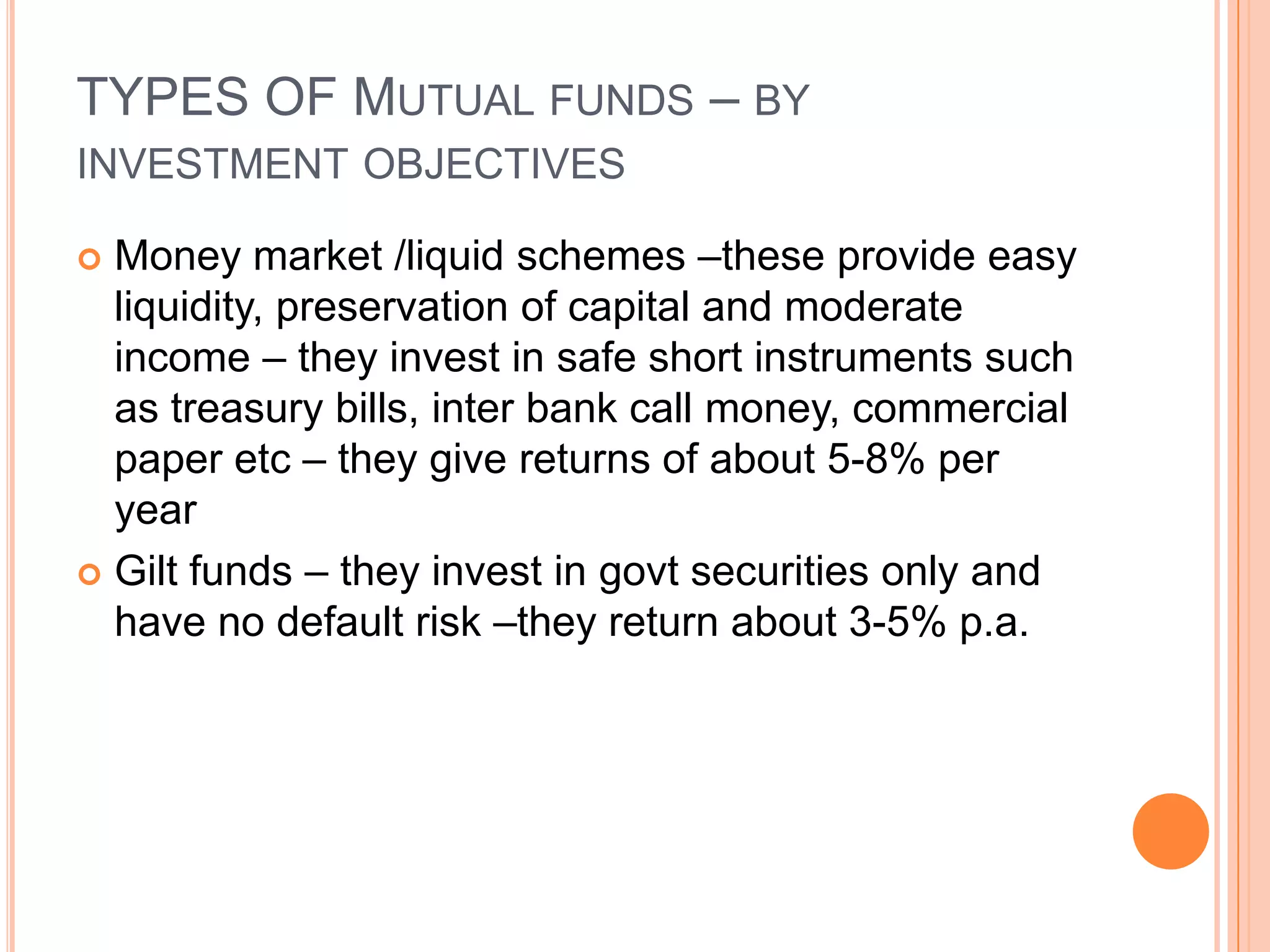
TYPES OF Mutualfunds – by investment objectivesMoney market /liquid schemes –these provide easy liquidity, preservation of capital and moderate income – they invest in safe short instruments such as treasury bills, inter bank call money, commercial paper etc – they give returns of about 5-8% per yearGilt funds – they invest in govt securities only and have no default risk –they return about 3-5% p.a.
17.
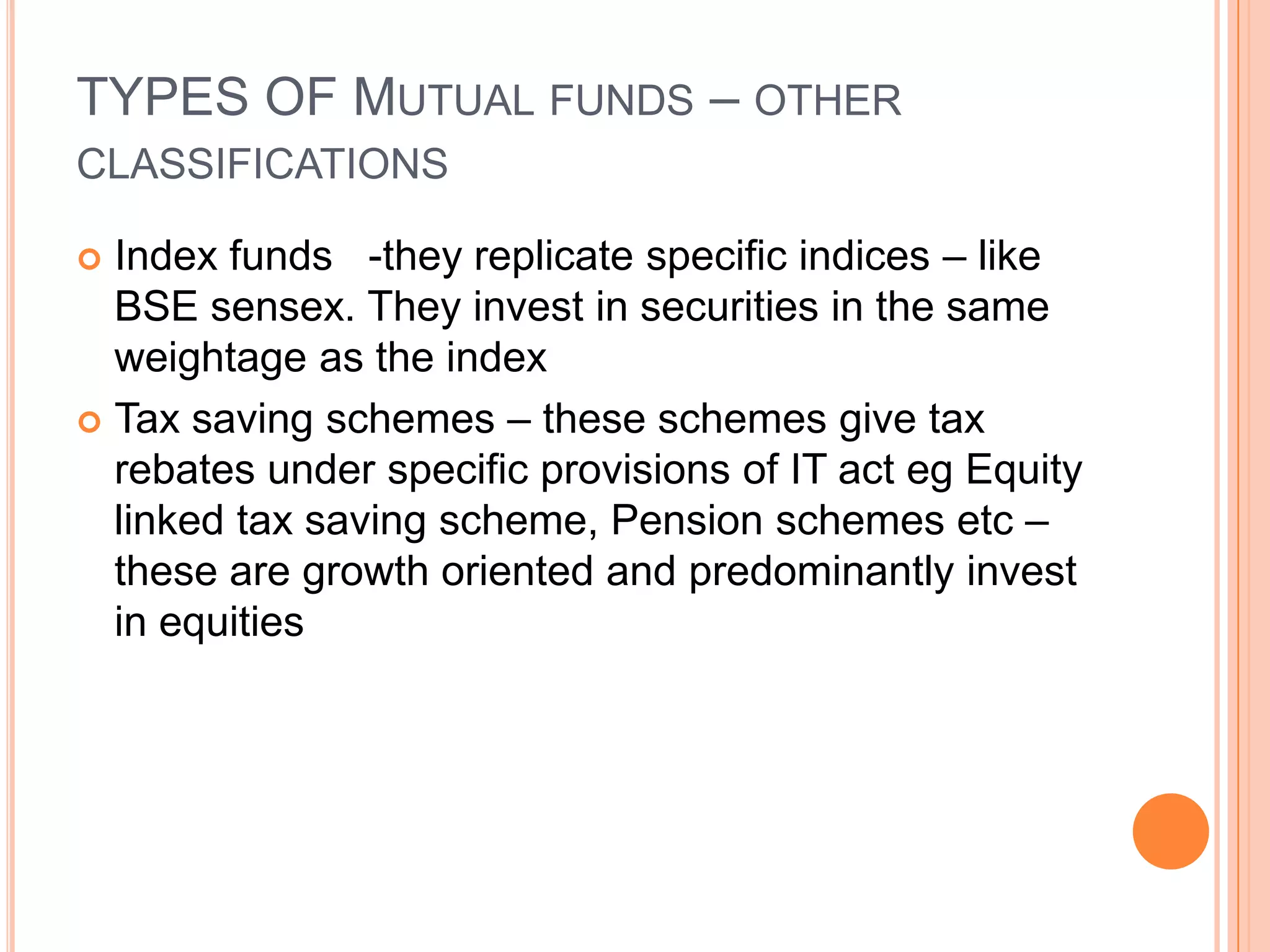
TYPES OF Mutualfunds – other classificationsIndex funds -they replicate specific indices – like BSE sensex. They invest in securities in the same weightage as the indexTax saving schemes – these schemes give tax rebates under specific provisions of IT act eg Equity linked tax saving scheme, Pension schemes etc – these are growth oriented and predominantly invest in equities
18.
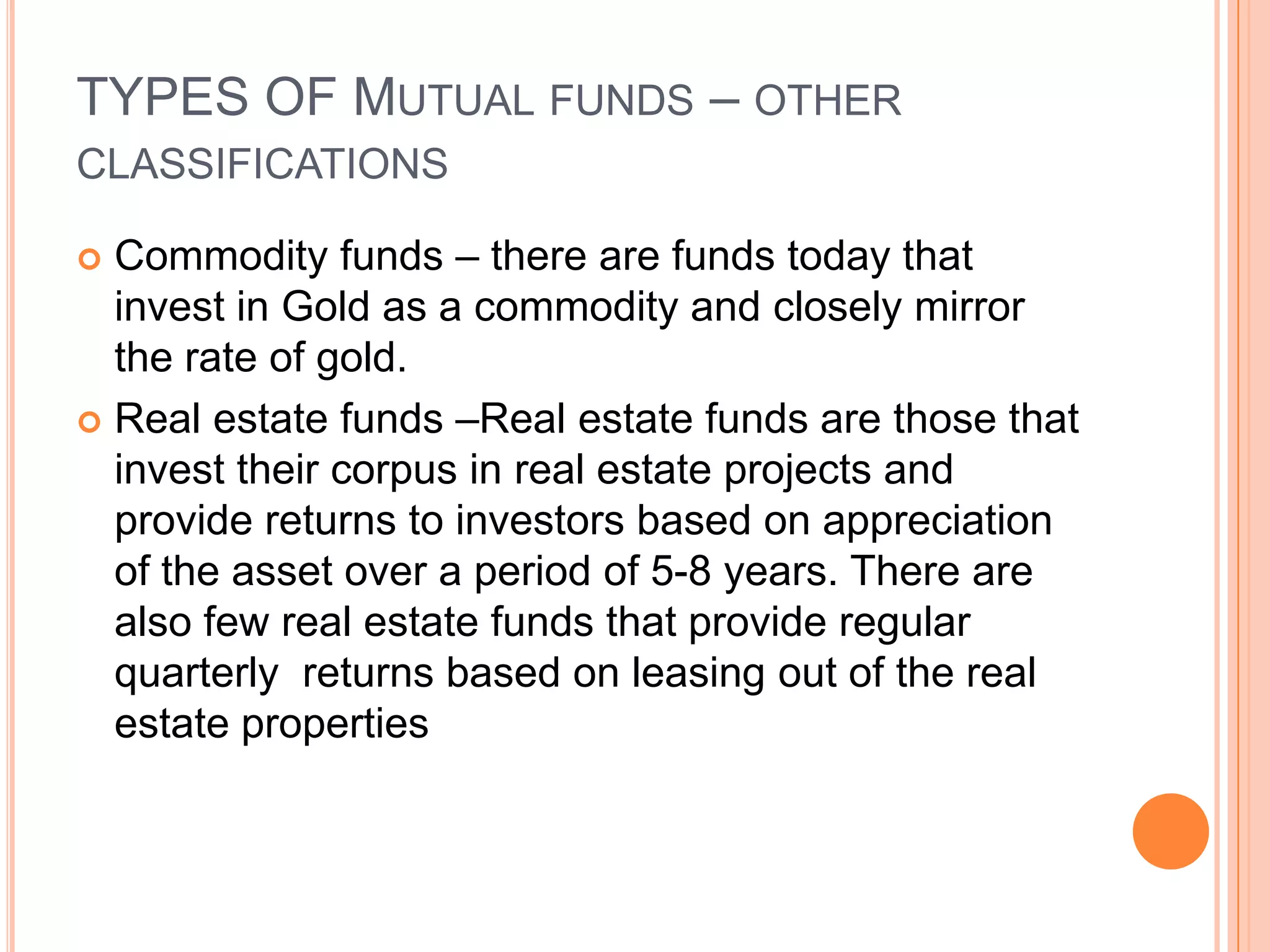
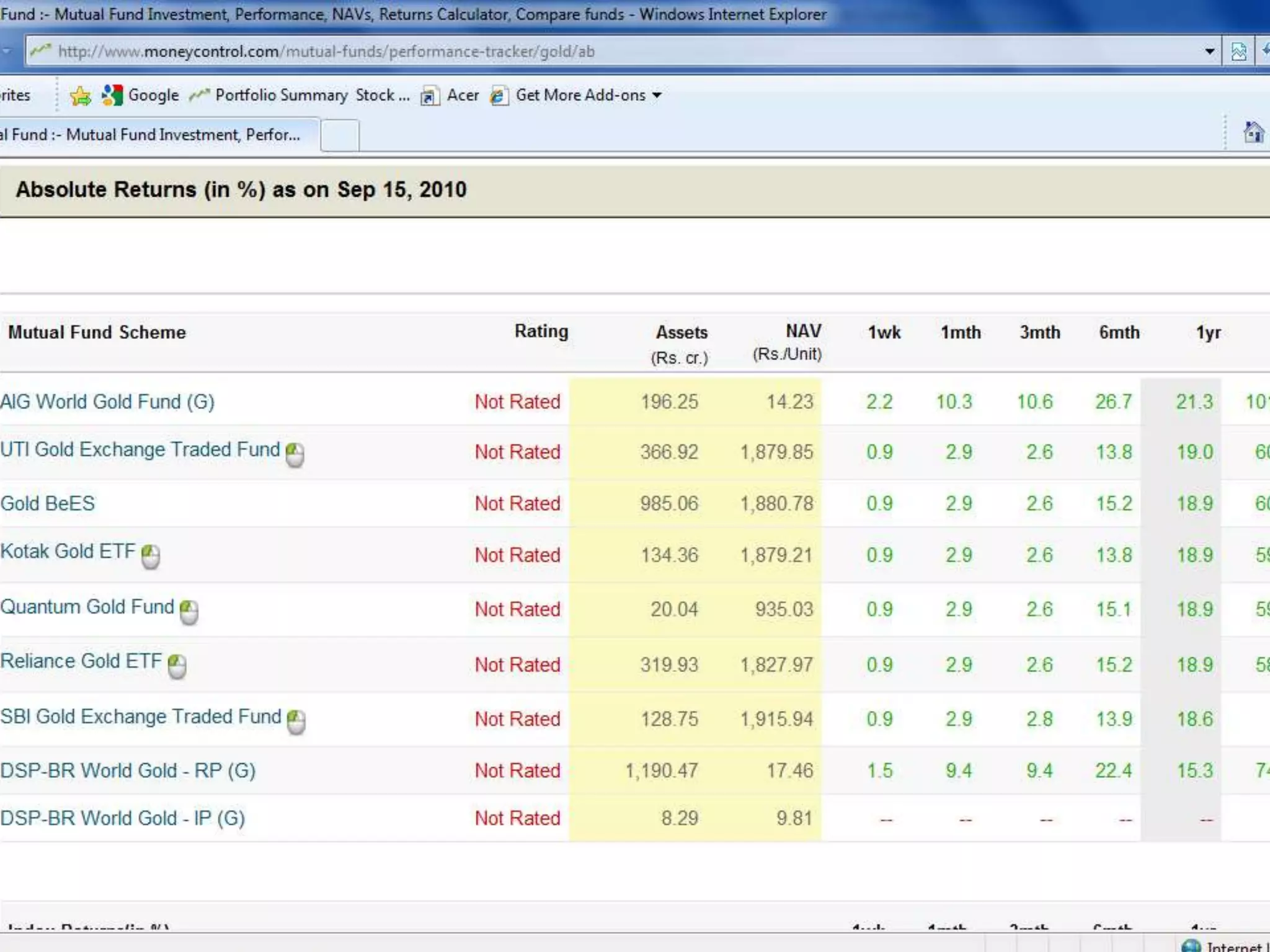
TYPES OF Mutualfunds – other classificationsCommodity funds – there are funds today that invest in Gold as a commodity and closely mirror the rate of gold.Real estate funds –Real estate funds are those that invest their corpus in real estate projects and provide returns to investors based on appreciation of the asset over a period of 5-8 years. There are also few real estate funds that provide regular quarterly returns based on leasing out of the real estate properties
19.
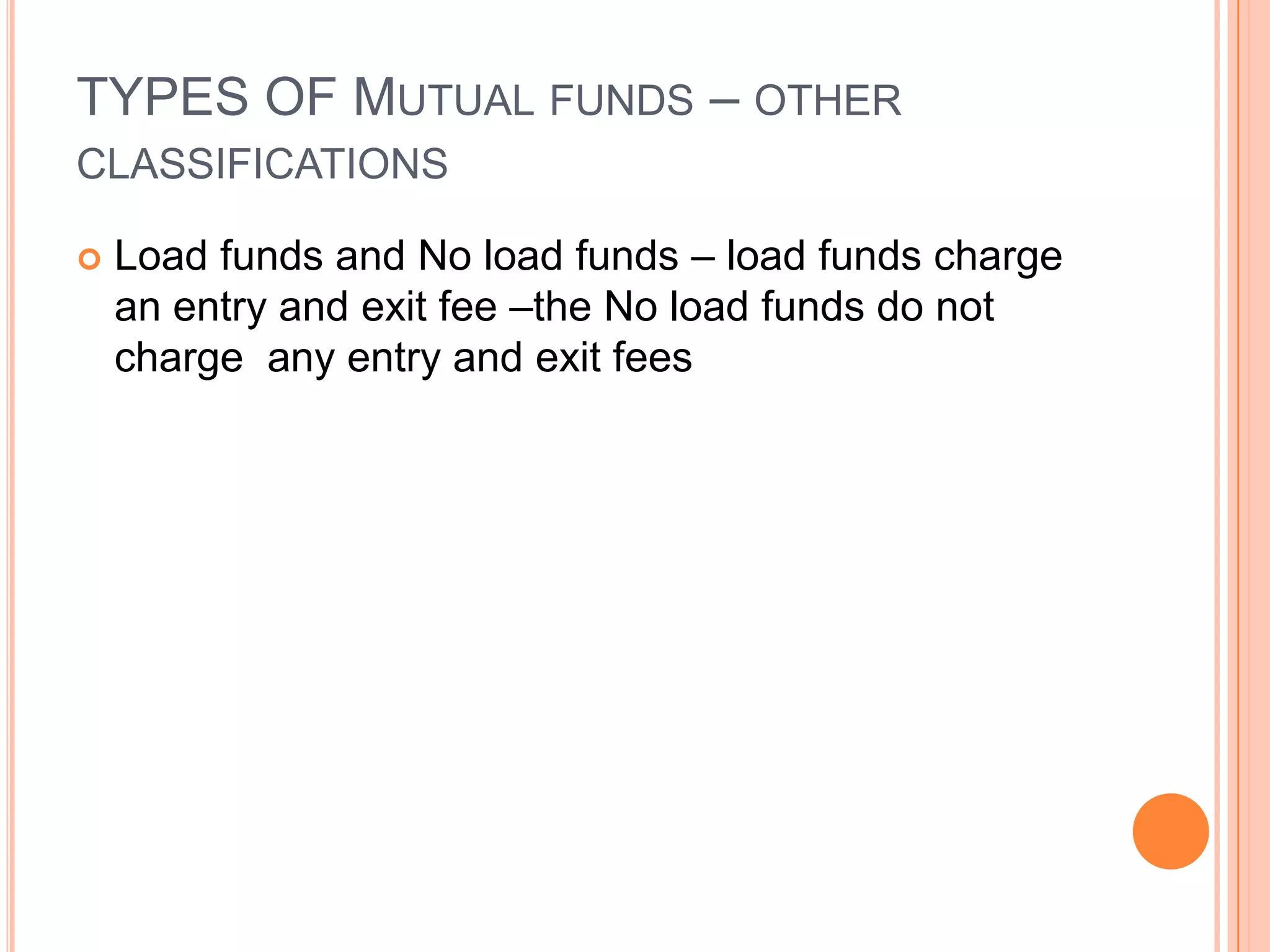
TYPES OF Mutualfunds – other classificationsLoad funds and No load funds – load funds charge an entry and exit fee –the No load funds do not charge any entry and exit fees
25.
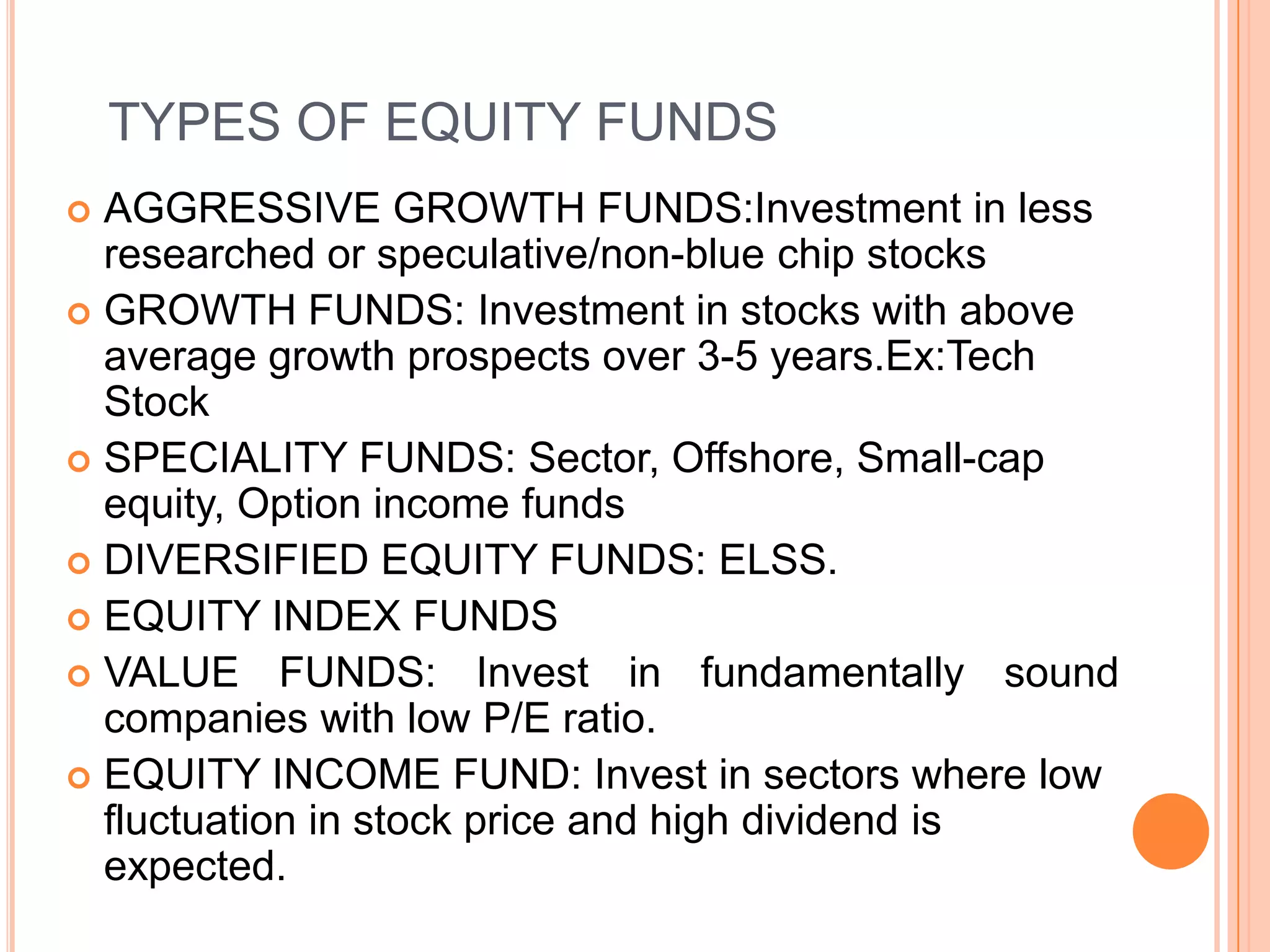
TYPES OF EQUITYFUNDSAGGRESSIVE GROWTH FUNDS:Investment in less researched or speculative/non-blue chip stocksGROWTH FUNDS: Investment in stocks with above average growth prospects over 3-5 years.Ex:Tech StockSPECIALITY FUNDS: Sector, Offshore, Small-cap equity, Option income fundsDIVERSIFIED EQUITY FUNDS: ELSS. EQUITY INDEX FUNDSVALUE FUNDS: Invest in fundamentally sound companies with low P/E ratio.EQUITY INCOME FUND: Invest in sectors where low fluctuation in stock price and high dividend is expected.
26.
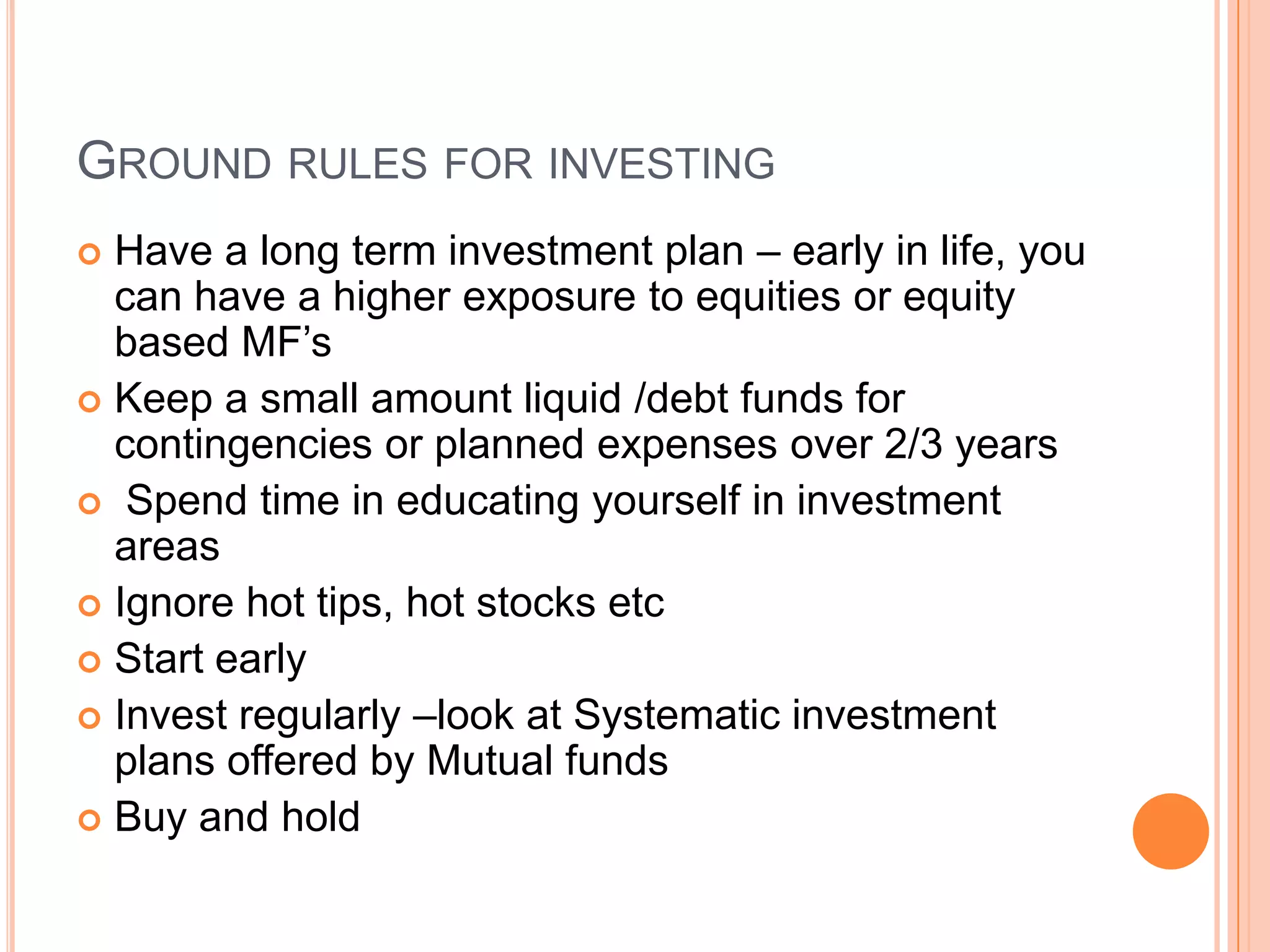
Ground rules forinvestingHave a long term investment plan – early in life, you can have a higher exposure to equities or equity based MF’s Keep a small amount liquid /debt funds for contingencies or planned expenses over 2/3 years Spend time in educating yourself in investment areasIgnore hot tips, hot stocks etcStart earlyInvest regularly –look at Systematic investment plans offered by Mutual fundsBuy and hold
27.
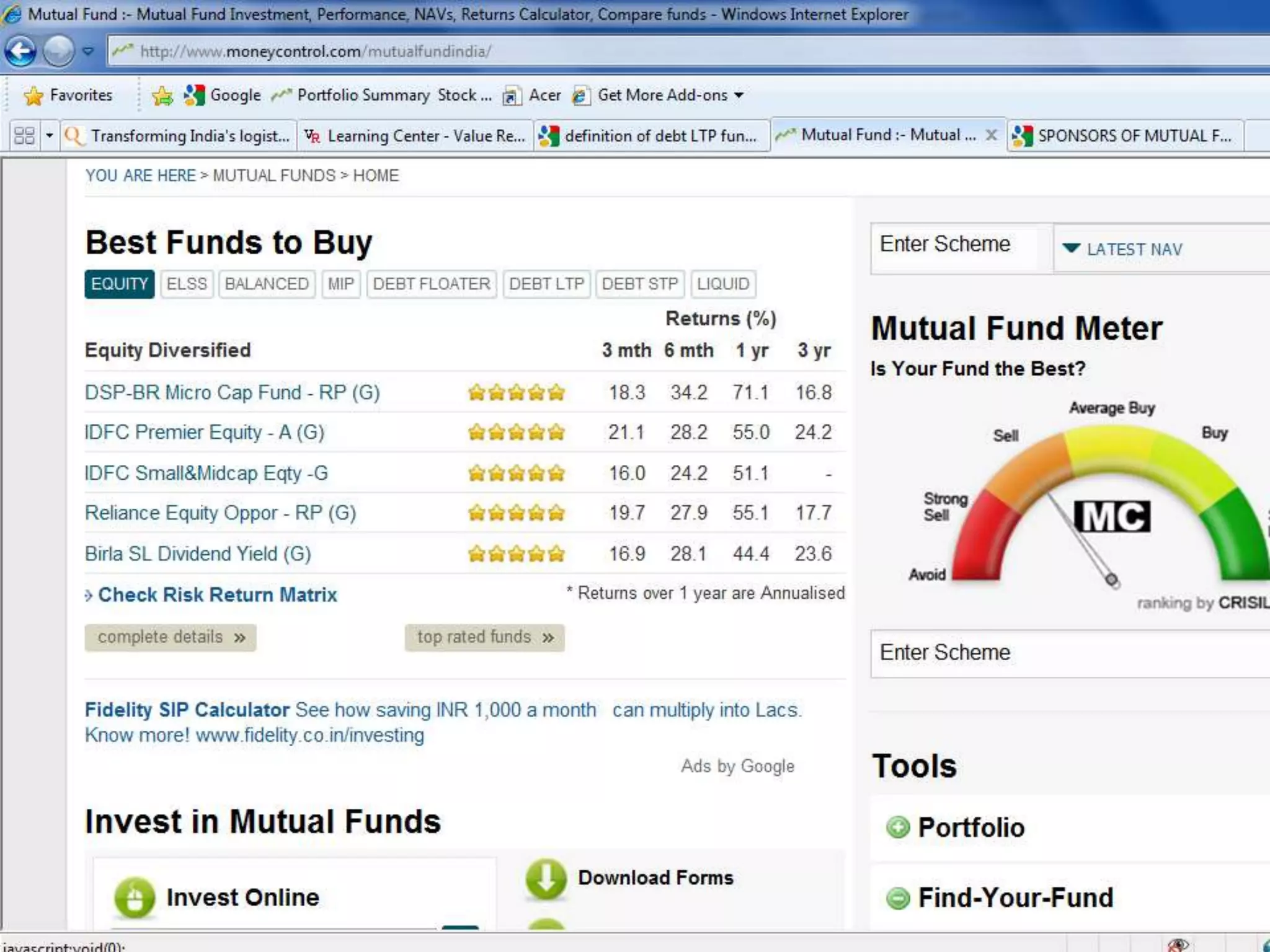
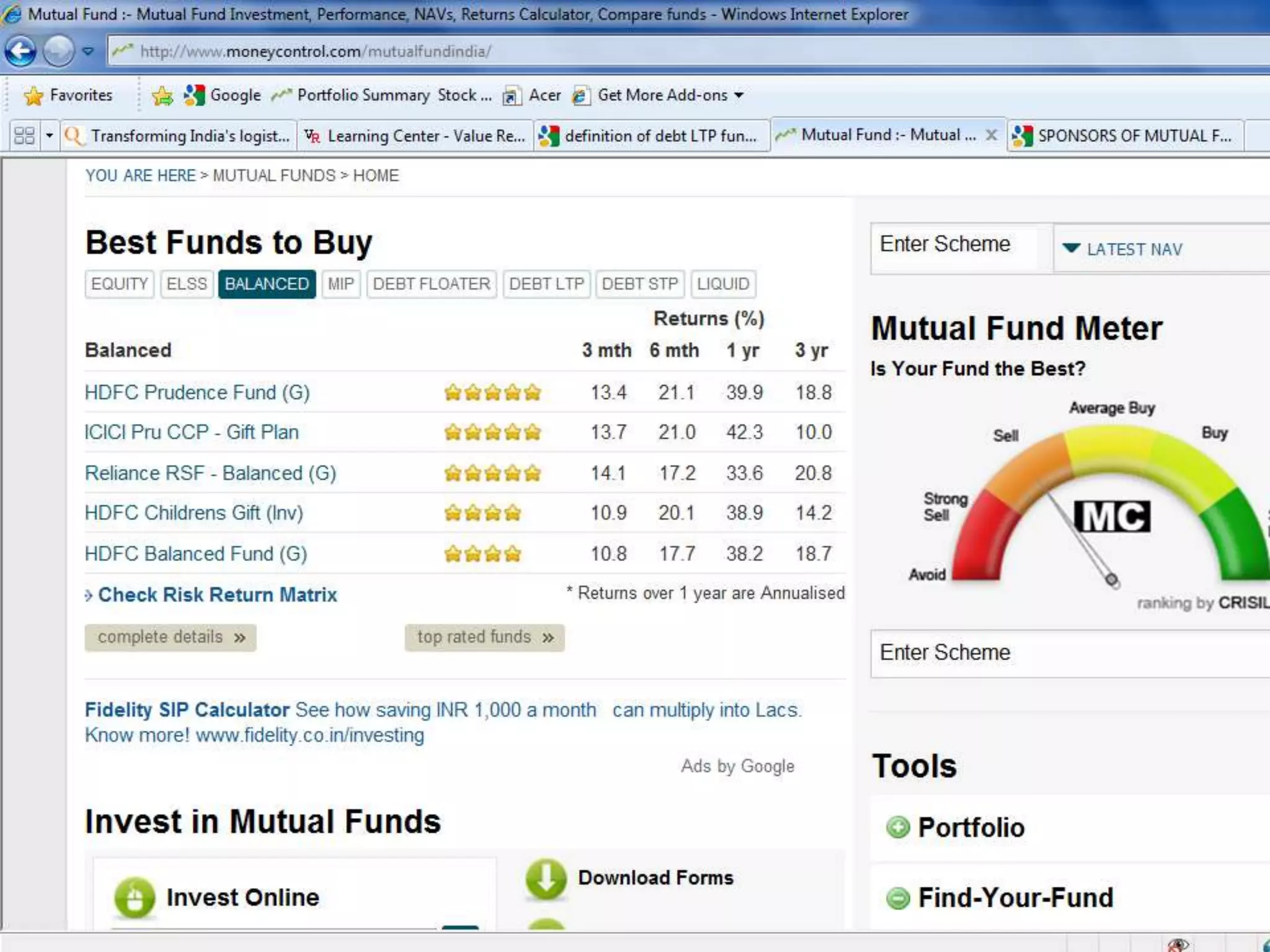
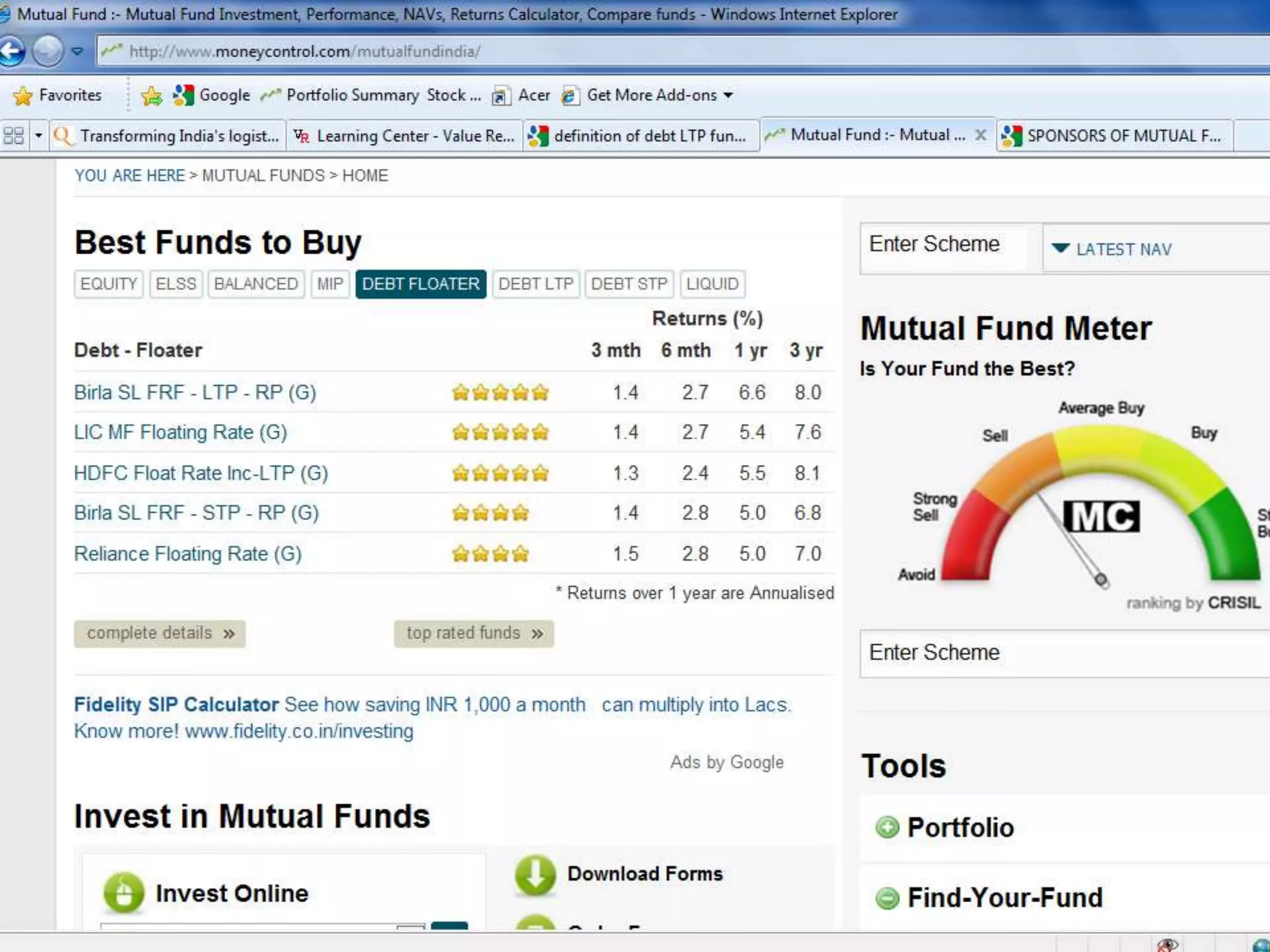
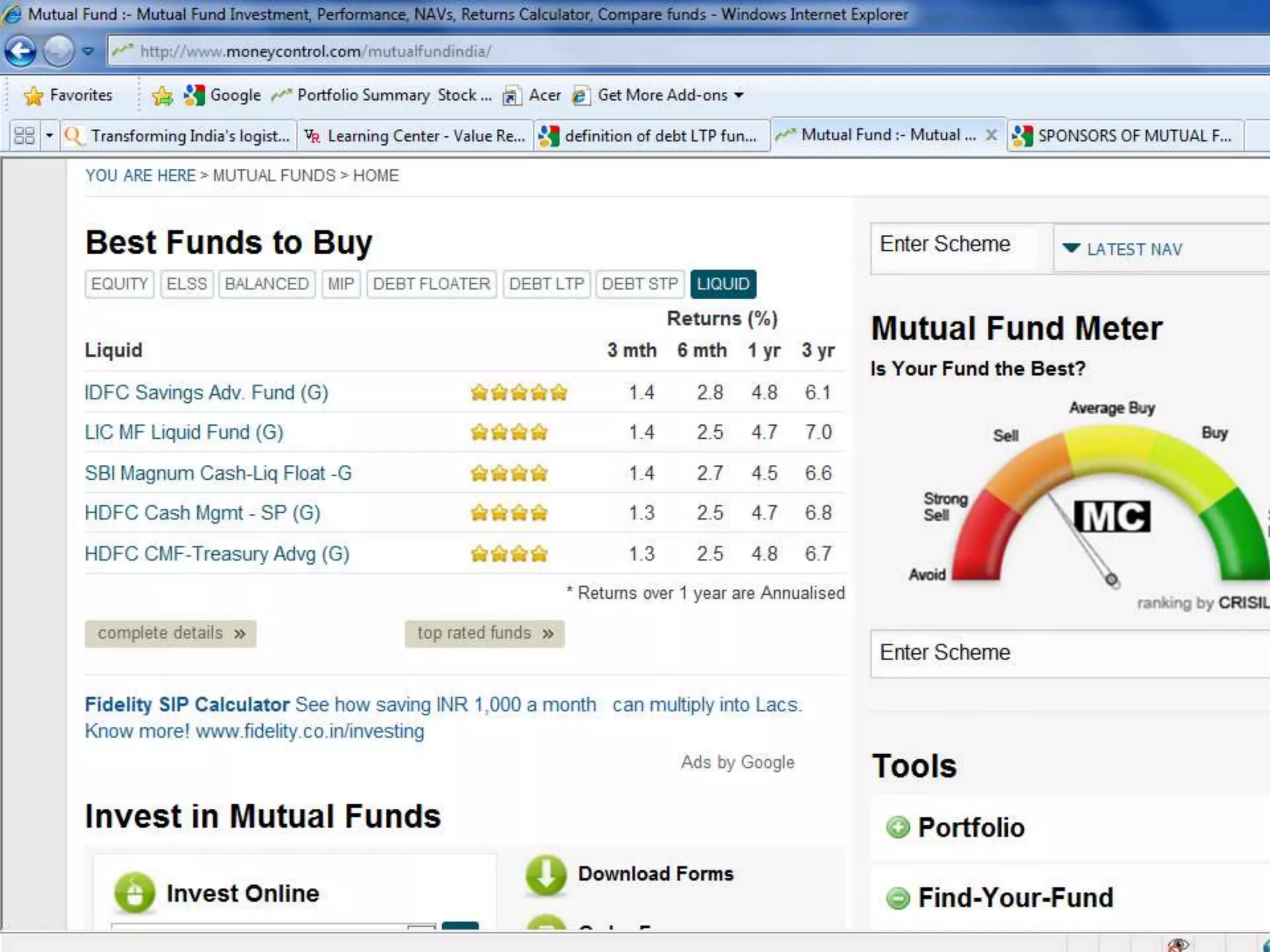
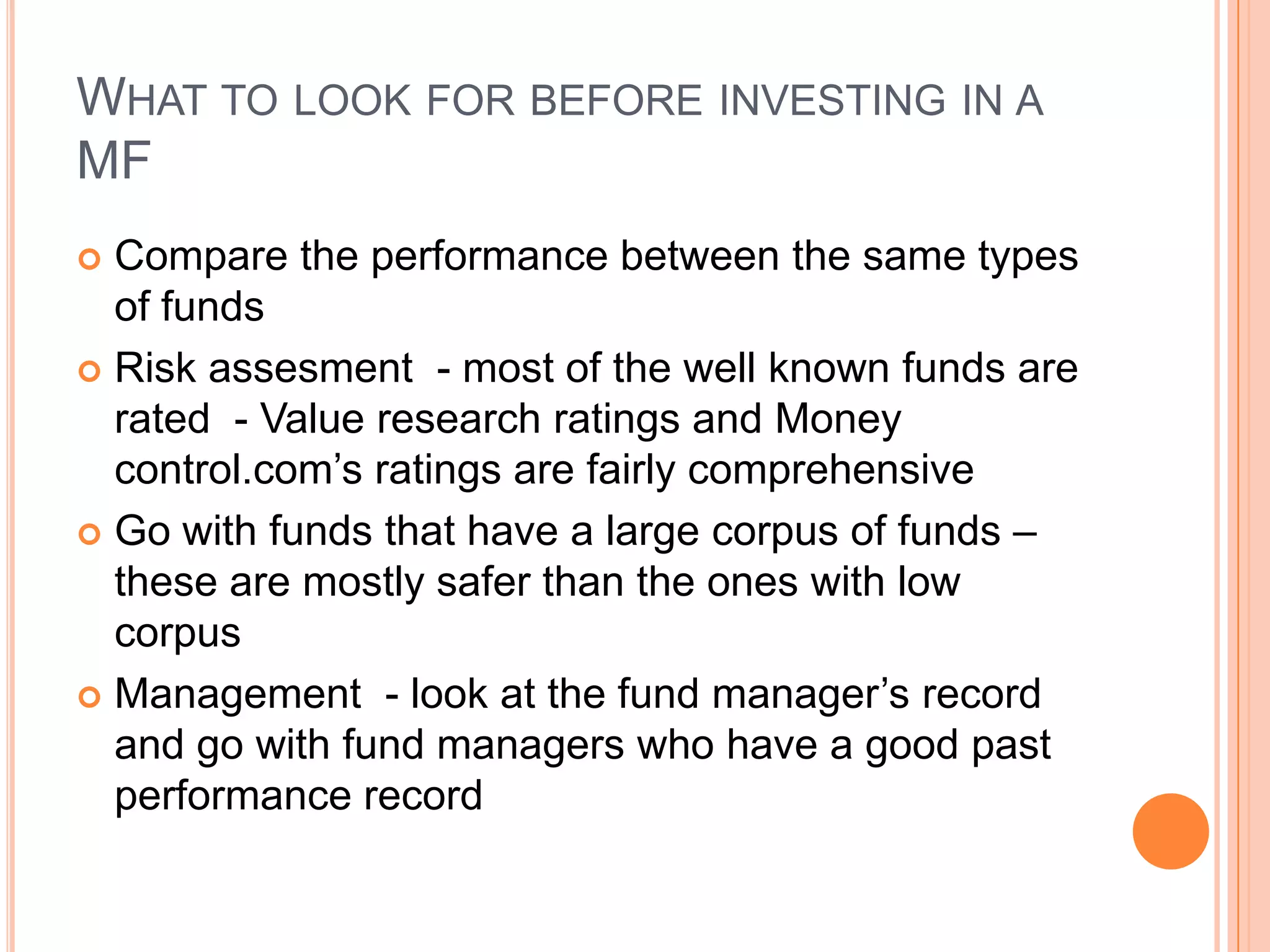
What to lookfor before investing in a MFCompare the performance between the same types of fundsRisk assesment - most of the well known funds are rated - Value research ratings and Money control.com’s ratings are fairly comprehensiveGo with funds that have a large corpus of funds – these are mostly safer than the ones with low corpusManagement - look at the fund manager’s record and go with fund managers who have a good past performance record
A Systematic InvestmentPlan (SIP) is an option that allows you to invest a fixed sum at periodic intervals on specific dates.A Systematic Investment Plan works for you in three ways:-It helps you to save regularly and thus inculcates a sense of discipline It harnesses the power of compounding It is the best possible way you to reign in impulsive buys-and-sells that otherwise one is gripped by in times of market volatility. - Rupee cost averaging You are free to choose any amount (minimum Rs 500 and in multiples of Re 1/-) and any date as per your convenience.
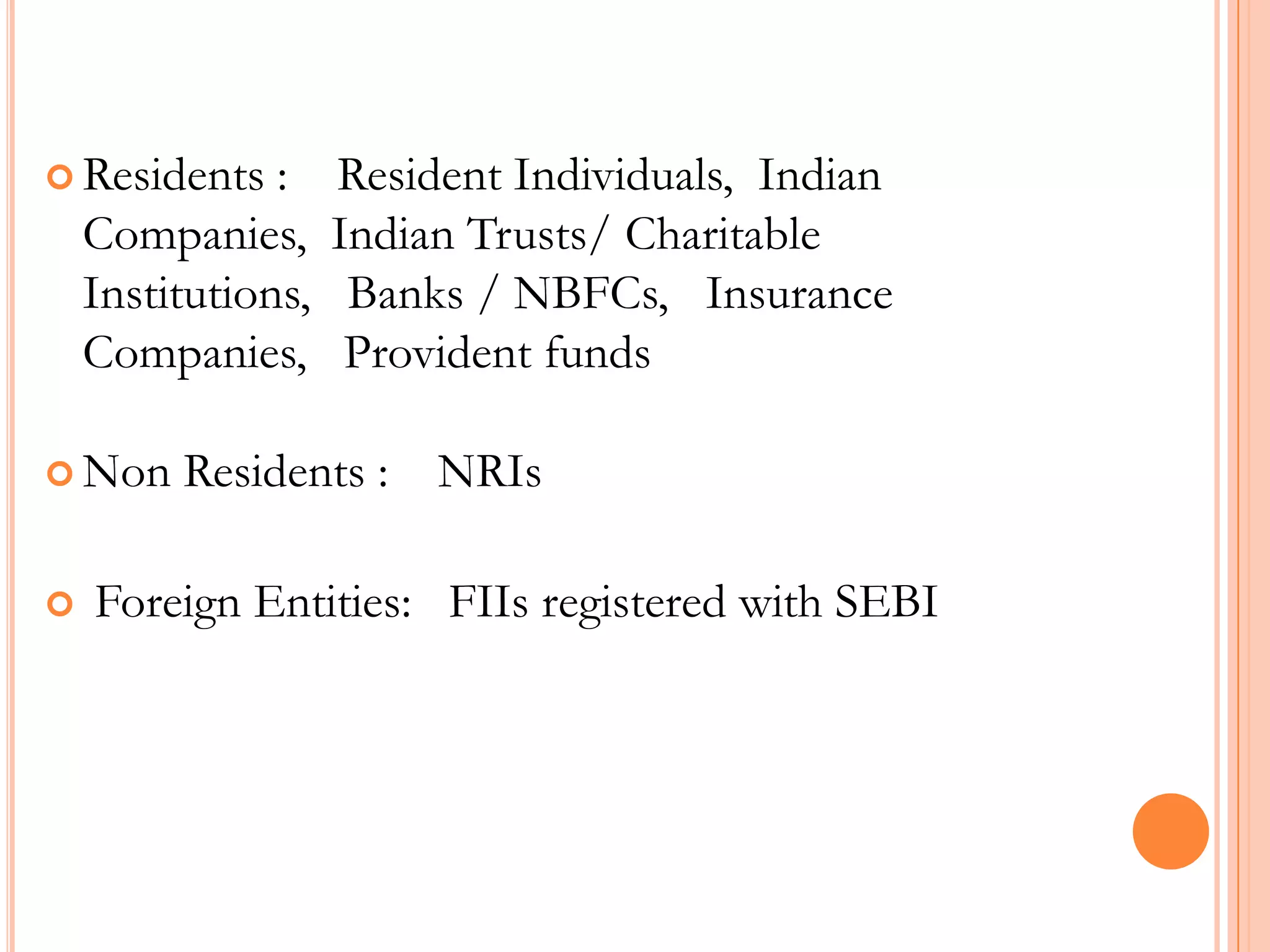
Offer Document(OD)A legal document issued by AMC or SponsorOD describes the productVery important document from the perspective of prospective investorPrimary vehicle for investment decision
32.
Contents of theOffer DocumentSummary informationDefinitionsRisk FactorsLegal and Regulatory ComplianceFinancial InformationConstitution of the Mutual FundInvestment objectives and policiesManagement of the FundOffer Related information
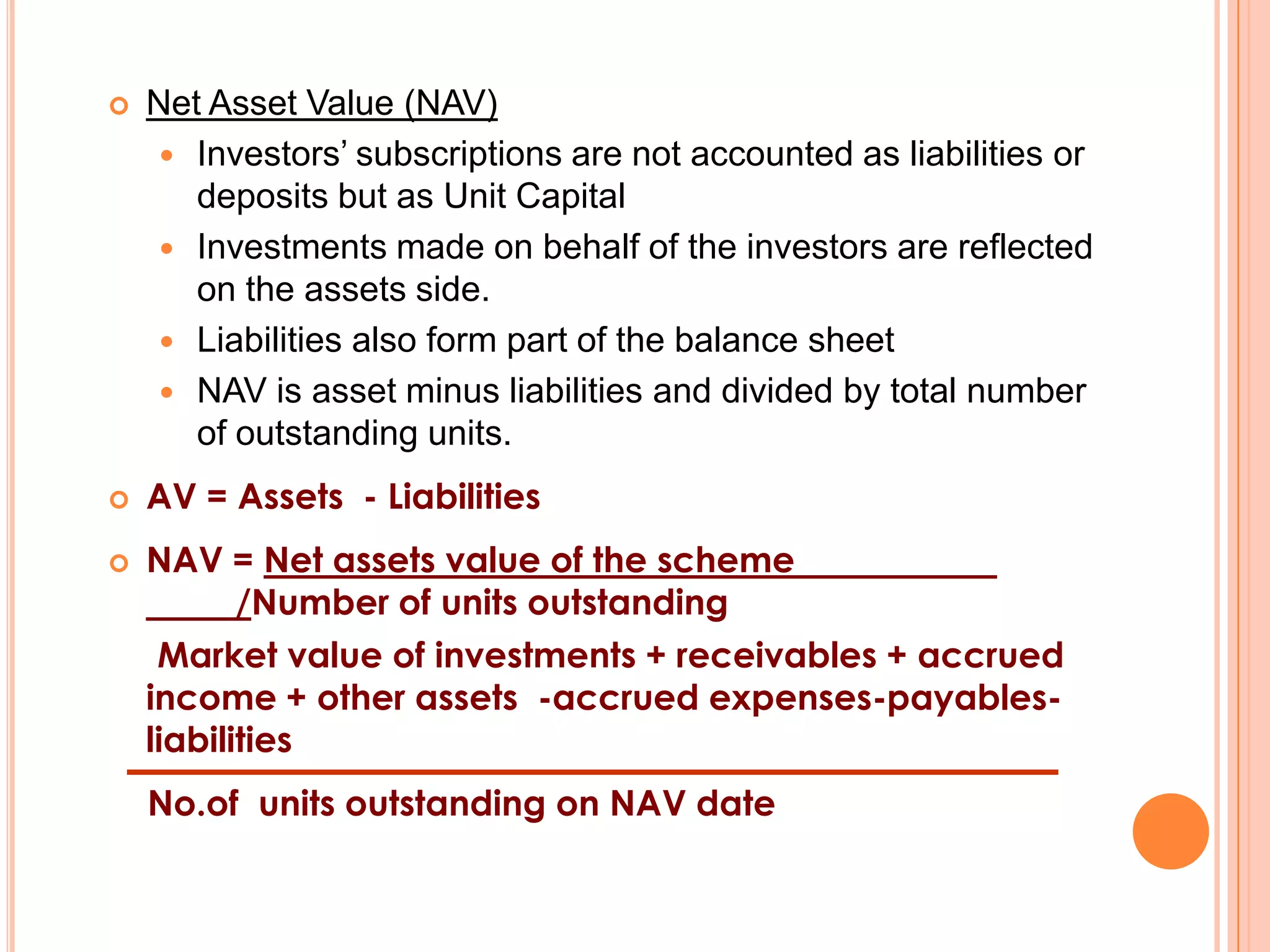
Net Asset Value(NAV)Investors’ subscriptions are not accounted as liabilities or deposits but as Unit CapitalInvestments made on behalf of the investors are reflected on the assets side.Liabilities also form part of the balance sheetNAV is asset minus liabilities and divided by total number of outstanding units.AV = Assets - LiabilitiesNAV = Net assets value of the scheme /Number of units outstanding Market value of investments + receivables + accrued income + other assets -accrued expenses-payables- liabilitiesNo.of units outstanding on NAV date
37.
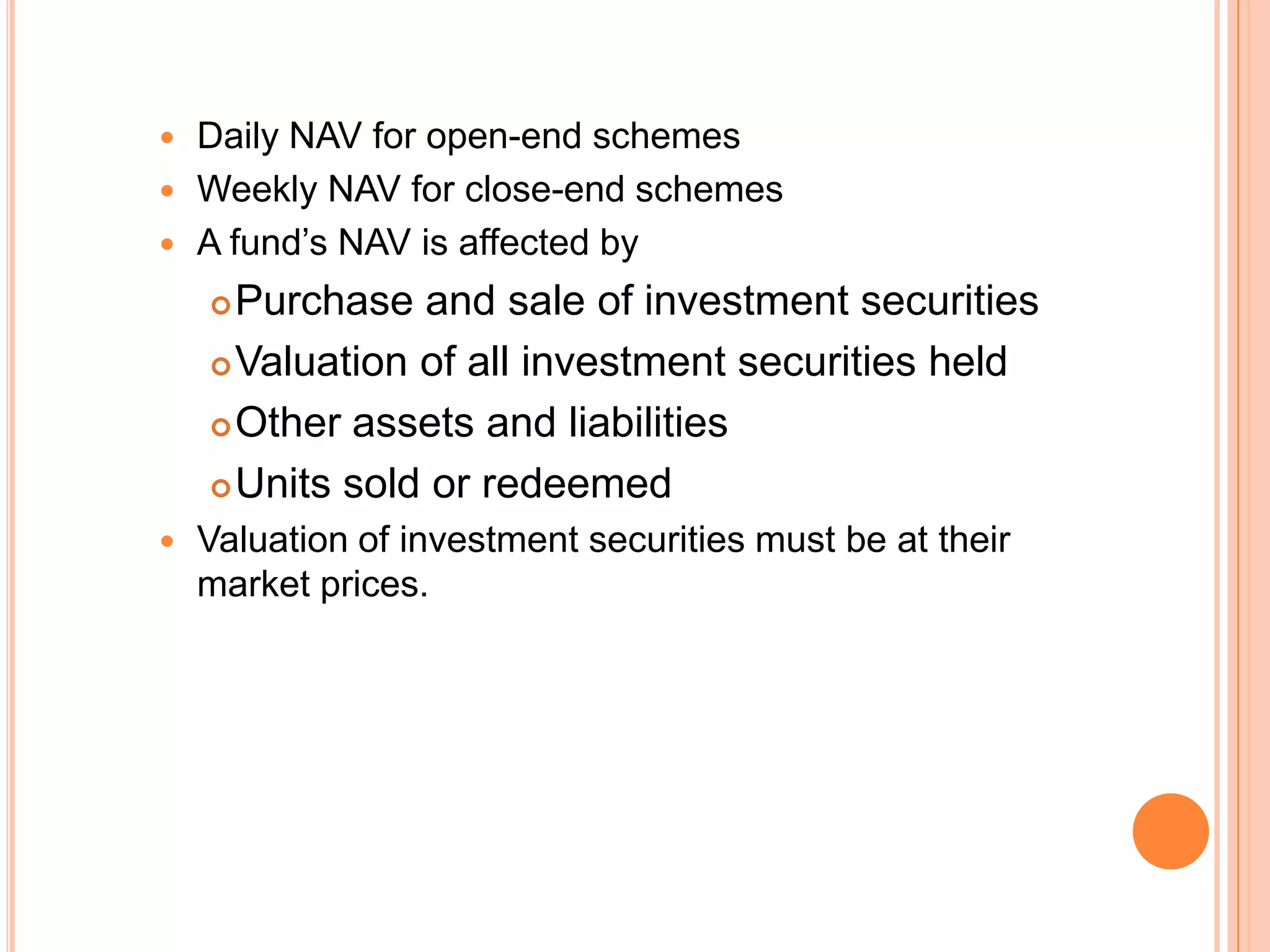
Daily NAV foropen-end schemes Weekly NAV for close-end schemesA fund’s NAV is affected byPurchase and sale of investment securitiesValuation of all investment securities heldOther assets and liabilitiesUnits sold or redeemedValuation of investment securities must be at their market prices.

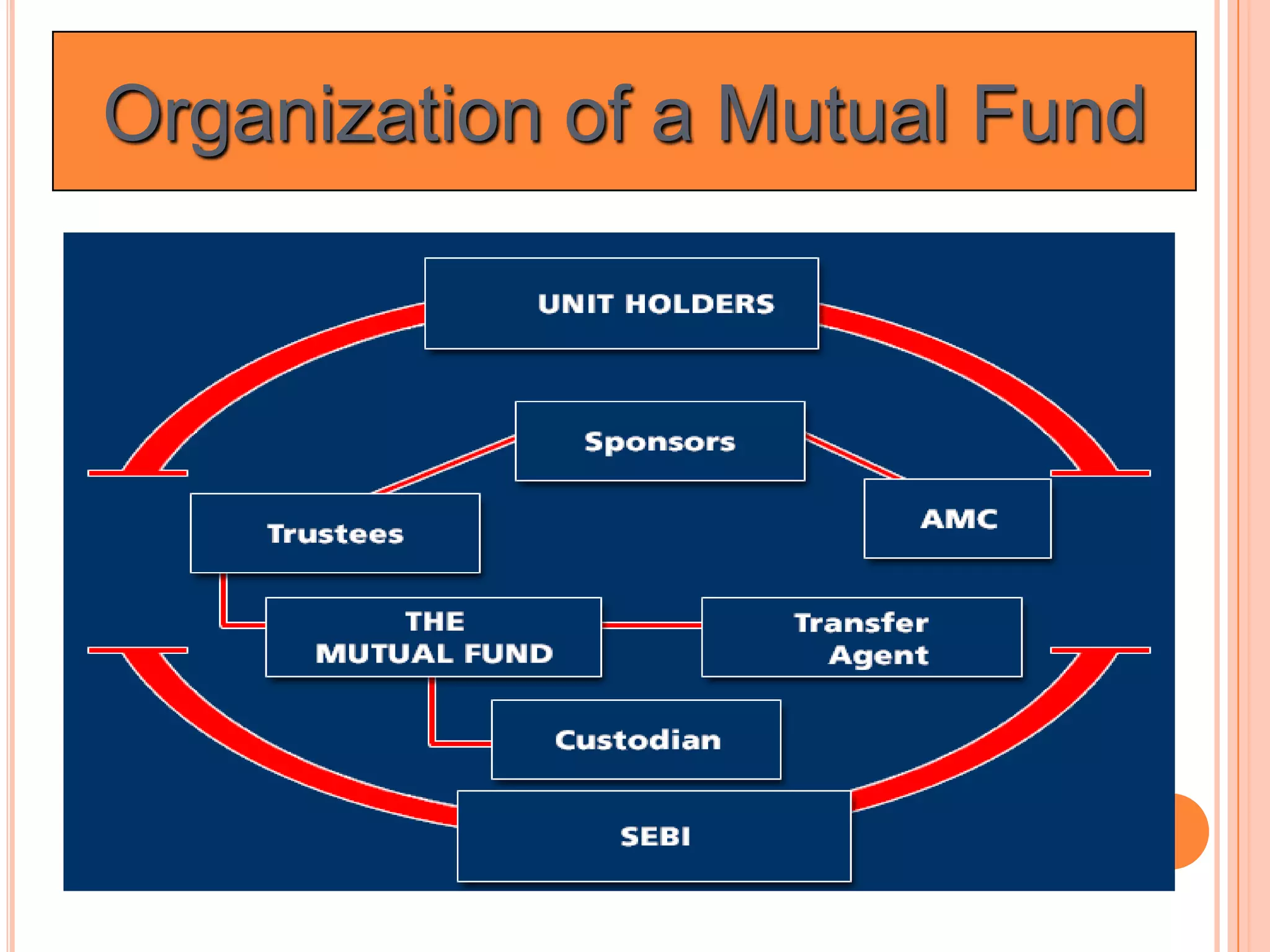
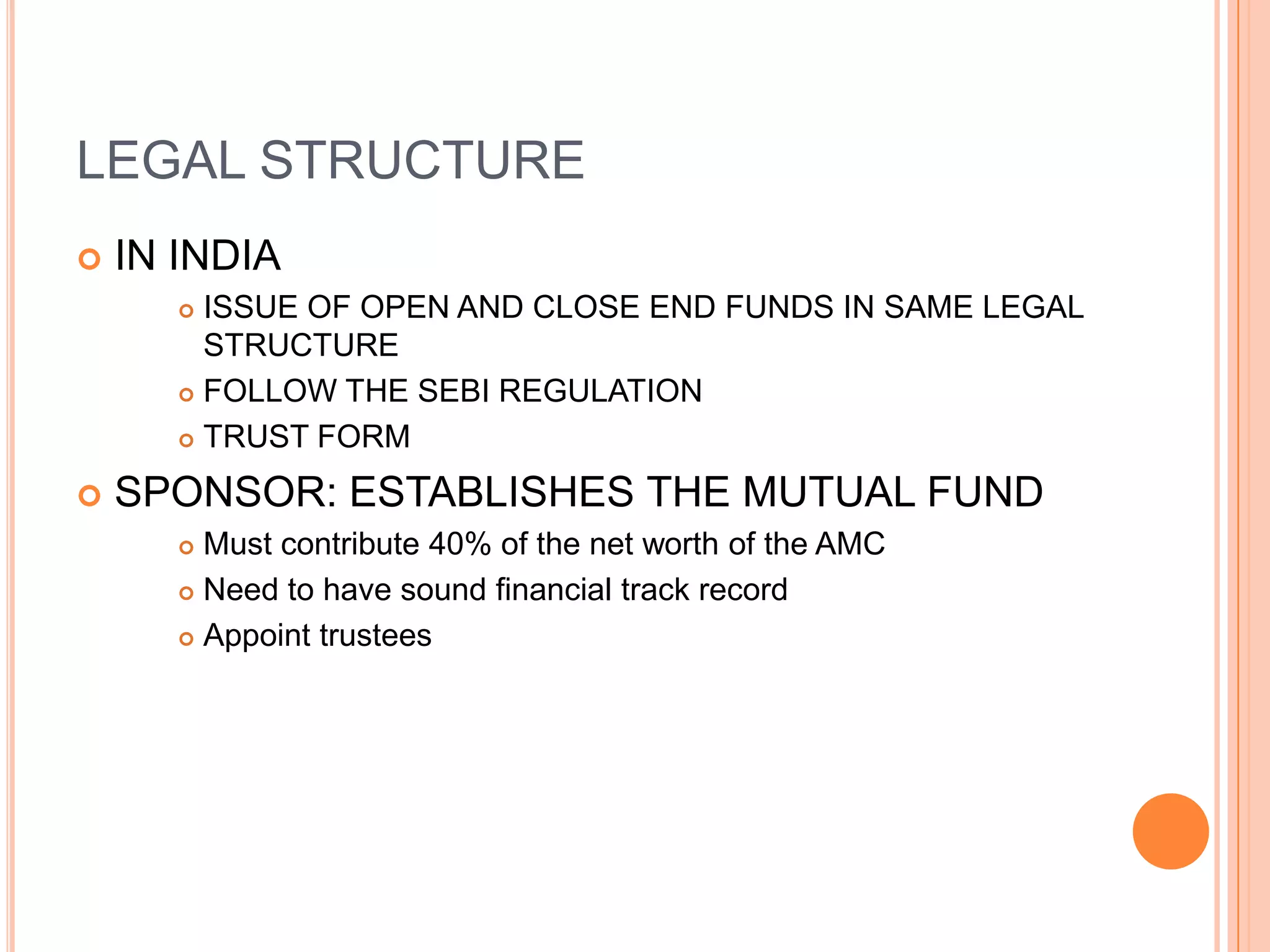
LEGAL STRUCTURE ININDIA ISSUE OF OPEN AND CLOSE END FUNDS IN SAME LEGAL STRUCTUREFOLLOW THE SEBI REGULATIONTRUST FORM SPONSOR: ESTABLISHES THE MUTUAL FUNDMust contribute 40% of the net worth of the AMCNeed to have sound financial track recordAppoint trustees
41.
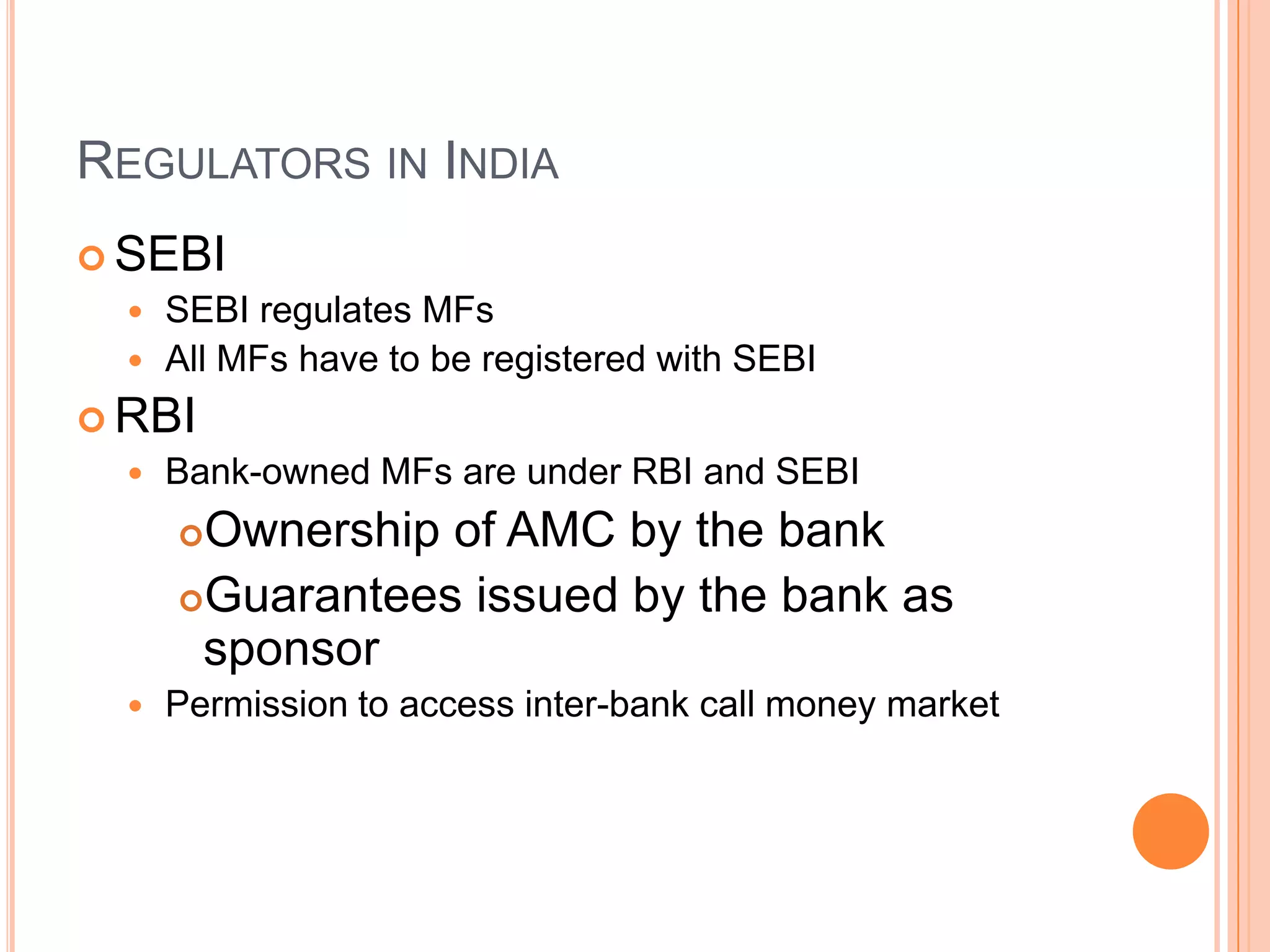
Regulators in IndiaSEBISEBIregulates MFsAll MFs have to be registered with SEBIRBIBank-owned MFs are under RBI and SEBIOwnership of AMC by the bankGuarantees issued by the bank as sponsorPermission to access inter-bank call money market
42.
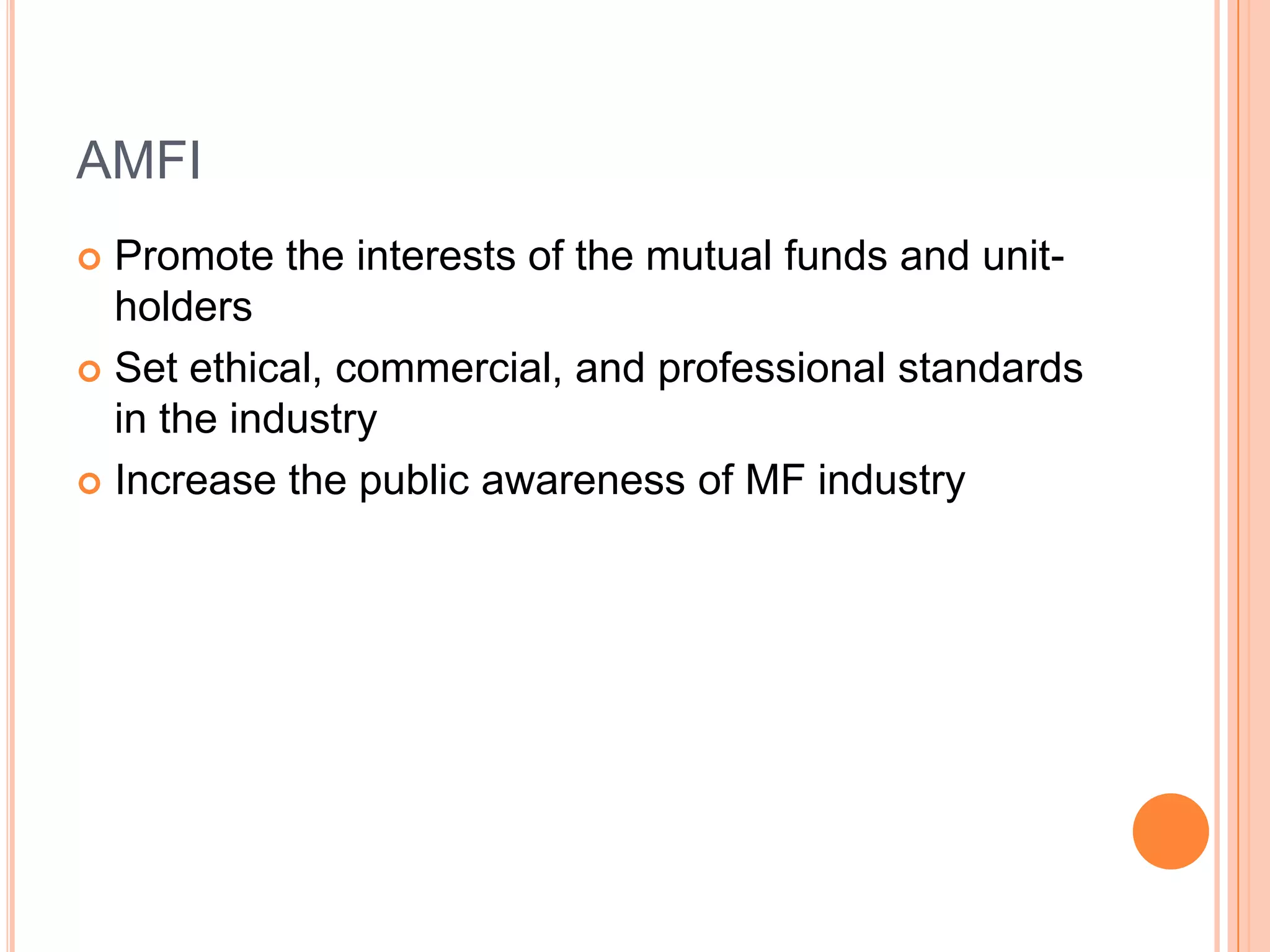
AMFIPromote the interestsof the mutual funds and unit-holdersSet ethical, commercial, and professional standards in the industryIncrease the public awareness of MF industry
43.
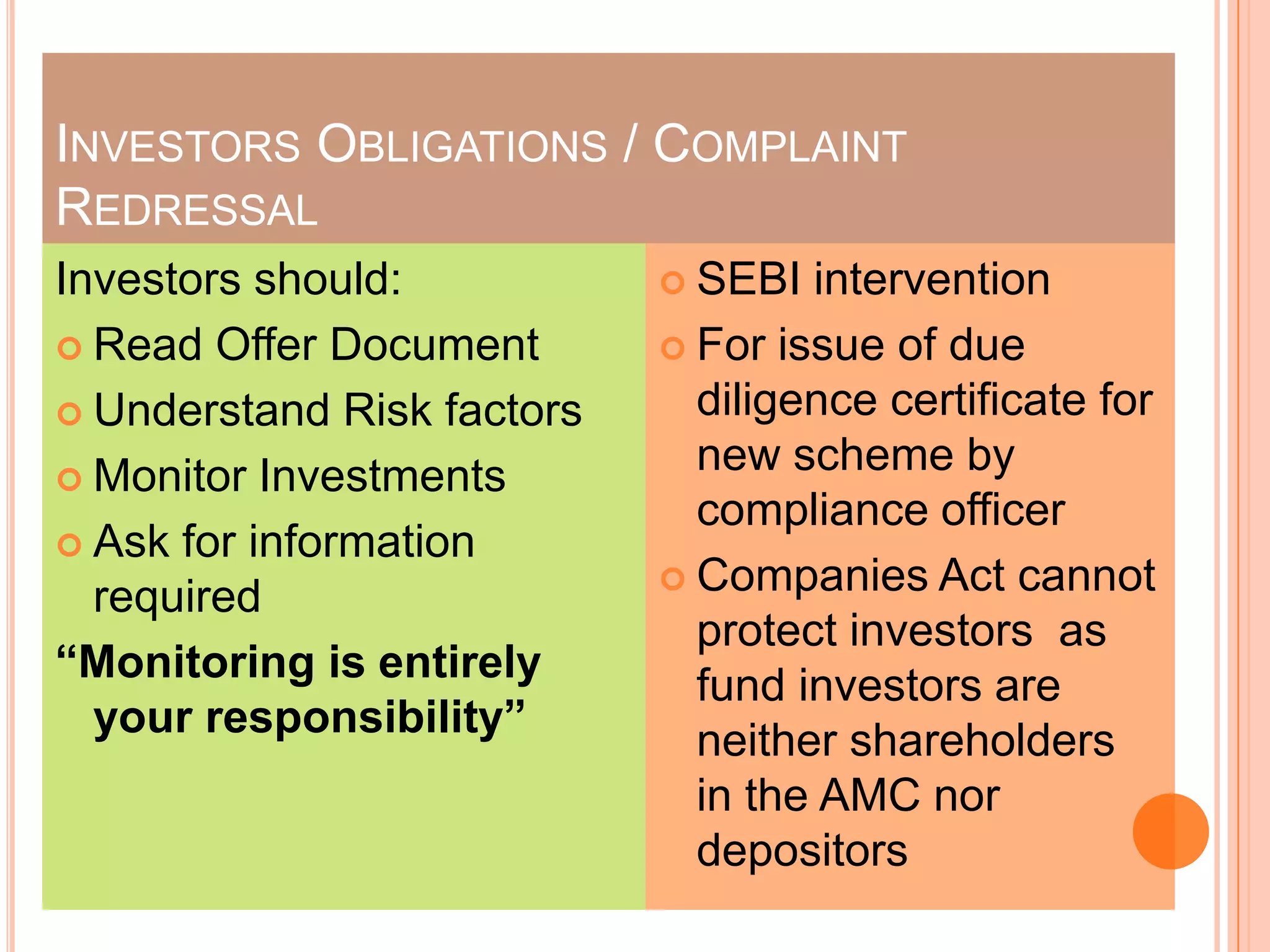
Investors Obligations /Complaint RedressalInvestors should:Read Offer DocumentUnderstand Risk factorsMonitor InvestmentsAsk for information required “Monitoring is entirely your responsibility”SEBI intervention For issue of due diligence certificate for new scheme by compliance officerCompanies Act cannot protect investors as fund investors are neither shareholders in the AMC nor depositors