Improving Reliability & Safety
Performance of Solenoid Valves
by Stroke Testing
exida Web Seminar
Audio is provided via internet. Please enable your speaker
(in all places) and mute your microphone.
There is a Q&A tab at the top of your screen. Please use this
mechanism to type any questions you may have at any time.
Questions will be read and answered.
A recording of this session and a copy of the slides will be posted
on the exida website and made available for you.
Copyright © 2000-2013 exida
Improving Reliability & Safety
Performance of Solenoid Valves
by Stroke Testing
Web Seminar April 24, 2013
Loren L. Stewart
exida
Sellersville, PA USA
Audio is provided
via internet.
Please enable
your speaker (in
all places) and
mute your
microphone.
Copyright © 2000-2013 exida
Loren Stewart
Bio
Loren Stewart graduated from Virginia Tech with
a BSME.
She has 5 years of professional experience. She
currently works for exida consulting as a safety
engineer, focusing on the mechanical aspects of
their customers. Along with assessing the safety
of products and creating FMEDAs and reports,
she researches stiction and is creating a
database for the 2H initiative according to 61508.
Copyright © 2000-2013 exida
4
William Goble has over 40 years of professional experience. His
areas of expertise include safety and high availability
automation systems, automation probabilistic analysis, new
product development and market analysis. He developed many
of the techniques used for probabilistic evaluation of safety and
high availability automation systems. He was formerly Director,
Critical Systems at a successful North American safety
company where job duties included marketing, research and
development including computer design, software design and
development and engineering project management. He has
written three books on topics of safety and reliability modeling.
He is a fellow member of ISA. He has published many papers
and magazine articles. Dr. Goble has a BSEE from Penn State,
a MSEE from Villanova and a PhD from Eindhoven University of
Technology in Eindhoven, Netherlands.
Copyright © 2000-2012 exida
Dr. William Goble
network of excellence in dependable
automation
Europe
Asia Pacific
North America
Development
former Development Managers
(Siemens Moore )
Instrumentation Engineers
(UOP, BAYER, PDVSA, etc.)
Application Design + Operation
Africa
Safety Certification
former TÜV Managers
former Safety PLC Product Manager
(Siemens)
Copyright © 2000-2013 exida
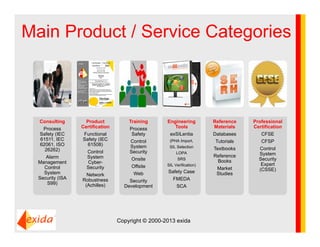
Main Product / Service Categories
Consulting
Process
Safety (IEC
61511, IEC
62061, ISO
26262)
Alarm
Management
Control
System
Security (ISA
S99)
Product
Certification
Functional
Safety (IEC
61508)
Control
System
Cyber-
Security
Network
Robustness
(Achilles)
Training
Process
Safety
Control
System
Security
Onsite
Offsite
Web
Security
Development
Engineering
Tools
exSILentia
(PHA Import,
SIL Selection
LOPA
SRS
SIL Verification)
Safety Case
FMEDA
SCA
Reference
Materials
Databases
Tutorials
Textbooks
Reference
Books
Market
Studies
Professional
Certification
CFSE
CFSP
Control
System
Security
Expert
(CSSE)
Copyright © 2000-2013 exida
Engineering Tools
 SILAlarm - Alarm Management Tool
 PHAx – HAZOP Tool / Import
 SIL Selection Tool
 Hazard Matrix or Risk Graph
 Layers of Protection Analysis built-in
 Cost effectively implement functional safety standards
 SRS Tool
 SIL Verification Tool
 Direct average calculation engine
 Instrumentation failure database built-in
 Variables include reality – test coverage, service
 Proof Test Tool
 SILStat – Field Data Collection Tool
Copyright © 2000-2013 exida
Reference Material
exida authored most
industry references for
automation safety and
reliability
exida authored industry
data handbook on
equipment failure data
exida authored the most
comprehensive book on
functional safety in the
market.
www.exida.com
Copyright © 2000-2013 exida
Improving Reliability &
Safety Performance of
Solenoid Valves by Stroke
Testing
Copyright © 2000-2013 exida
Overview
• Mechanical Failure Rates
• Cycle Testing – scaling cycle failure values
• What is Stiction?
• Evidence of Stiction Analyzed
• Assessing Solenoid Valve Stroke Testing
• Implications of Stroke Testing and 
Stiction
• Recommended Best Practices 
Copyright © 2000-2013 exida
Mechanical Device Failure Rates
• Cycle Testing 
• Accelerated motion testing until failure or a given number 
of cycles, used to simulate years
• For high or constant demand applications only 
• FMEDA – Failure Modes Effects and Diagnostic 
Analysis
• Identifies the failure mode within the device which could 
relate those failures to the operation of the safety 
instrumented function
• For both high and low demand ‐ all applications
Copyright © 2000-2013 exida
Cycle Testing
• Cycle testing is used to estimate failure 
rates in dynamic (high demand) 
applications.  
• Assumption is that premature wearout 
is the dominant failure mechanism and 
that no other failure mechanisms are 
significant.
Copyright © 2000-2013 exida
Cycle Test Scaling
Copyright © 2000-2013 exida
•A cycle test is done on a set of products
(>20) until 10% of the units under test fail.
•The number of cycles until failure is called
the B10 point.
14
Copyright © 2000-2011 exida
B10d Failure Data
•Table of example
values from ISO
13849-1: 2006
Cycle Test Scaling
Copyright © 2000-2013 exida
•The B10 number of cycles is converted to a time
period by knowing the cycles per time period in any
particular application.
•A failure rate is calculated by dividing the 10%
failure count by the time period.
High Demand Certifications
Some certifications
are based on failure
data derived from
“cycle testing” or
other methods that
require frequent
movement of
electro-mechanical
products. This
assessment is not
valid for typical low
demand process
applications.
Copyright © 2000-2013 exida
10 demands
per year =
870 hours per
cycle
What time period is valid? 
Copyright © 2000-2013 exida
•A failure rate is calculated by dividing the 10%
failure count by the time period.
•One year? 8760 hrs.
•One month? 730 hrs.
•One week? 168 hrs.
•How long can a device with a seal remain
motionless before other failure mechanisms
become significant such that premature wearout
no longer dominates?
What is Stiction?
• Stiction – Static + Friction
• The resistance to the start of motion usually measured as 
the difference between the external force being applied in 
order to over come the static friction and the force to 
maintain movement between the two contacting or 
working surfaces.
• Can result from: corrosion, cold welding, break down of 
lubrication, build‐up of deposits, chemical reactions, 
breakdown of the sealing components…
Copyright © 2000-2013 exida
Who cares about Stiction?
• Started studying stiction to 
determine the maximum time 
period before stiction impacts 
failure rates.  
• This is the maximum time period for 
scaling cycle test results.
Copyright © 2000-2013 exida
Evidence of Stiction Analyzed
• Expert Knowledge
• Technicians and engineers routinely work on valves
• Stiction occurring after a month or more
• O‐ring Manufacturer's Guides
• Stationary between 1 week and 1 month
• “Delay between cycles” plateaus at approximately 300 hours 
• Experimental Study 
• Studies conducted on lubrication thickness in magnetic thin‐filmed disks. 
• As equilibrium rest time increases, stiction increases to a plateau or 
around 275 hours, depending on lubrication type 
• ISO 13849
• “Valve must be operated at least once per week or once per shift to insure 
the intended function” 
Copyright © 2000-2013 exida
Impact of Stiction 
• We discovered that stiction becomes 
significant after one week therefore 
never scale cycle test results beyond 
275 hours.
• We also realized that improvements in 
safety and reliability can be obtained 
with stroke testing.
Copyright © 2000-2013 exida
Solenoid Background
• Solenoid Valves
Open Solenoid Valve Closed Solenoid Valve
Cross section of an open and closed solenoid valve, showing how the plunger 
movement directly controls the process fluid flow. 
Copyright © 2000-2013 exida
Copyright © 2012 exida.com LLC
Assessing Solenoid Valve Stroke Testing
PFDavg
Impact of Stiction 
• We also discovered that once stiction is 
overcome via movement, bonds 
creating the binding are destroyed and 
must start reforming.
• Even with a small movement.
Copyright © 2000-2013 exida
Assessing Solenoid Valve Stroke Testing
Values of failure rates from the solenoid valve
(manufacturer X, model Y) used in computing PFDavg
( ) p g g
Parameter failures/109
hrs operation
λDstiction 103.7
λDnon-stictionDetectable 84.3
λDnon-stictionUndetectable 1.9
Copyright © 2000-2013 exida
Assessing Solenoid Valve Stroke Testing
• Case 1: No Valve Stroke Testing
• λD = λDStiction + λDnon-StictionDetectable + λDnon-StictionUndetectable
• λD = 103.7 + 84.3 + 1.9 = 189.9 fits
• Case 2: Infrequent Valve Stroke Testing
• λD = λDStiction + λDnon-StictionDetectable + λDnon-StictionUndetectable
• λD = 103.7 + 84.3 + 1.9 = 189.9 fits
• Case 3: Frequent Valve Stroke Testing
• λD = λDnon-StictionDetectable + λDnon-StictionUndetectable
• λD = 84.3 + 1.9 = 86.2 fits
Copyright © 2000-2013 exida
Implications of Stoke Testing and 
Stiction
Case 1: proof testing every 2 years
Case 2: valve stoke testing performed once every 6 months
Case 3: valve stoke testing performed once every week
Copyright © 2000-2013 exida
PFD
PFDavg
Implications of Stoke Testing and 
Stiction
Case 3: valve stoke testing performed once every week
0.00E+00
2.00E‐04
4.00E‐04
6.00E‐04
8.00E‐04
1.00E‐03
1.20E‐03
0 0.5 1 1.5 2 2.5 3 3.5 4 4.5 5 5.5 6
PFD avg (t)
Time in years
Case 3
Upper Limit SIL 3
Copyright © 2000-2013 exida
Implications of Stroke Testing 
and Stiction
Copyright © 2000-2013 exida
Recommended Best Practices
• Implement automatic or semi‐automatic 
stroke testing in final element designs.
• Make certain that the movement in actuator‐
valve assemblies is small so as to not cause 
process disturbances.
• Do not let actuator pressure drop too far as 
stiction bonds might let loose can cause a 
false trip.
Copyright © 2000-2013 exida
Recommended Best Practices
• Begin valve stroke testing on a weekly basis 
unless maximum cycle ratings are below 52 * 
useful life (years)
• After a few months of testing, if the number 
of times the valve is found stuck, cut the 
testing period in half
• Repeat the testing procedures until an 
optimum test interval is identified.
Copyright © 2000-2013 exida
Recommended Best Practices
• Valve stroke testing can have significant 
beneficial impacts on safety 
• Most beneficial practice would be a frequent 
valve stroke testing of once per week or more.
• We believe there is a reduction in false trip 
rate as well but need more research.
Copyright © 2000-2013 exida
Future Web Seminar: Design Options for
Partial Stroke Testing of Final Element
Assemblies, May 2013
Questions ? Comments?
More Information:
1. Free Web Seminars – see www.exida.com
2. White Papers
3. Safety Automation Equipment List – www.sael-
online.com
4. Books: www.isa.org, www.exida.com
Email me at: Lstewart@exida.com
Copyright © 2000-2013 exida

Stiction webinar 2013