Accessing Diabetes 
Education Through 
Telehealth 
M. Dianne Brown, MS, RDN, LD, CDE 
OU Physicians Diabetes Life Clinic at the Harold Hamm Diabetes Center 
Cynthia Scheideman-Miller, MHSA 
Heartland Telehealth Resource Center 
Oklahoma Telemedicine Conference 2014 
October 16, 2014
Objectives: 
1. Discus the benefits of a diabetes telehealth program for 
patients and how it can be partnered with provider 
education to improve diabetes management 
2. List processes involved when selecting a diabetes 
telehealth program for your patients 
3. Outline key components of a diabetes telehealth 
program including patient and provider site 
requirements.
Why Diabetes 
Tele-education?
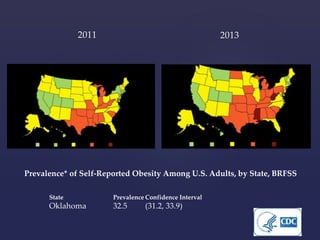
2011 2013 
Prevalence* of Self-Reported Obesity Among U.S. Adults, by State, BRFSS 
State PrevalenceConfidence Interval 
Oklahoma 32.5 (31.2, 33.9)
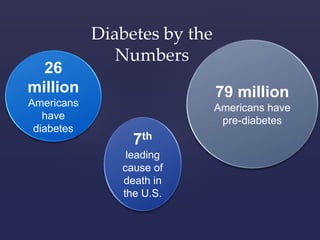
26 
million 
Americans 
have 
diabetes 
7th 
leading 
cause of 
death in 
the U.S. 
79 million 
Americans have 
pre-diabetes 
Diabetes by the 
Numbers
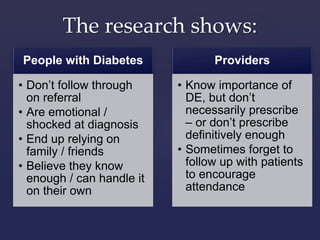
The research shows: 
People with Diabetes 
• Don’t follow through 
on referral 
• Are emotional / 
shocked at diagnosis 
• End up relying on 
family / friends 
• Believe they know 
enough / can handle it 
on their own 
Providers 
• Know importance of 
DE, but don’t 
necessarily prescribe 
– or don’t prescribe 
definitively enough 
• Sometimes forget to 
follow up with patients 
to encourage 
attendance
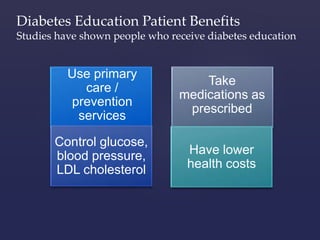
Diabetes Education Patient Benefits 
Studies have shown people who receive diabetes education 
Use primary 
care / 
prevention 
services 
Take 
medications as 
prescribed 
Control glucose, 
blood pressure, 
LDL cholesterol 
Have lower 
health costs
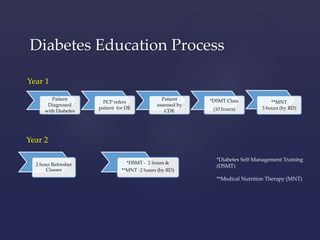
Diabetes Education Process 
Year 1 
Patient 
Diagnosed 
with Diabetes 
PCP refers 
patient for DE 
Patient 
assessed by 
CDE 
*DSMT Class 
(10 hours) 
**MNT 
3 hours (by RD) 
Year 2 
2 hour Refresher 
Classes 
*DSMT - 2 hours & 
**MNT -2 hours (by RD) 
*Diabetes Self-Management Training 
(DSMT) 
**Medical Nutrition Therapy (MNT)
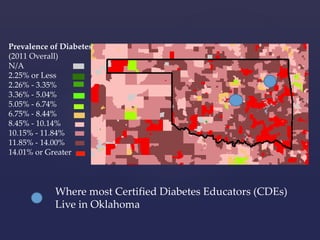
Prevalence of Diabetes 
(2011 Overall) 
N/A 
2.25% or Less 
2.26% - 3.35% 
3.36% - 5.04% 
5.05% - 6.74% 
6.75% - 8.44% 
8.45% - 10.14% 
10.15% - 11.84% 
11.85% - 14.00% 
14.01% or Greater 
Where most Certified Diabetes Educators (CDEs) 
Live in Oklahoma
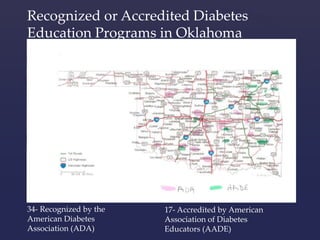
Recognized or Accredited Diabetes 
Education Programs in Oklahoma 
34- Recognized by the 
American Diabetes 
Association (ADA) 
17- Accredited by American 
Association of Diabetes 
Educators (AADE)
Telehealth benefit # 1 
Provides access- multiple sites may 
be used 
 patients 
 other health care providers 
Telehealth benefit #2 
Saves money 
 patient & CDE saves “gas” money 
 remote site “borrows” CDE 
 informed patients reduce hospital admission
Telehealth benefit #3 
Saves time 
 patients & CDE do not lose 
time with travel and information 
is delivered in “real time” 
 CDE can see more patients, reducing service 
wait time for patients 
Telehealth benefit #4 
 Helps to address cultural diversity which 
contributes to challenges of education, patient 
compliance, and cooperation with treatment 
regimens 
 Increased ability for participation with diabetes 
care team
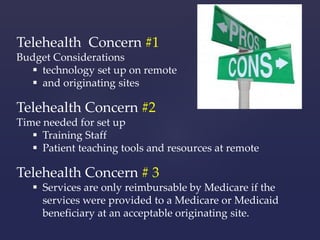
Telehealth Concern #1 
Budget Considerations 
 technology set up on remote 
 and originating sites 
Telehealth Concern #2 
Time needed for set up 
 Training Staff 
 Patient teaching tools and resources at remote 
Telehealth Concern # 3 
 Services are only reimbursable by Medicare if the 
services were provided to a Medicare or Medicaid 
beneficiary at an acceptable originating site.
Selecting a Diabetes 
Tele-education Program
Define what you want vs need 
 ADA program for Medicare reimbursement 
 Champions 
 Technology – fits in your needs and budget 
 A program that is right for your organization 
and population served 
 Sales pitches can be misleading
Selecting a program 
 Is this a program you want as a partner in 
patient care or contract with for total delivery? 
 Do they follow the same State laws, Hospital 
by-laws as on-site programs are required to 
supply? 
 What are their references? 
 Are the providers (distant site) in Oklahoma?
Double Check the Contract 
 What if expectations aren’t met? 
 Who is responsible for what? 
 What staff will be needed at the originating site 
before, during, after the classes? 
 Who gets the data? 
 Who tracks patient satisfaction? 
 Is there training for staff at the patient site? 
 No-Show policy 
 Telehealth Consent Form – who is responsible to 
get this signed prior to services?
Developing a Diabetes 
Tele-Education Program
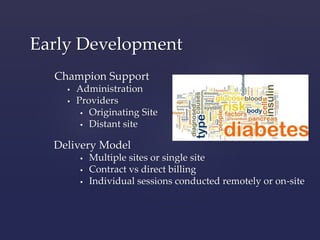
Early Development 
Champion Support 
 Administration 
 Providers 
 Originating Site 
 Distant site 
Delivery Model 
 Multiple sites or single site 
 Contract vs direct billing 
 Individual sessions conducted remotely or on-site
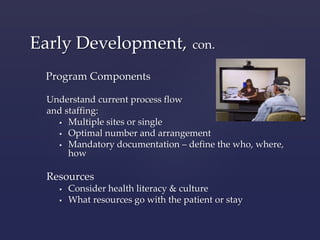
Early Development, con. 
Program Components 
Understand current process flow 
and staffing: 
 Multiple sites or single 
 Optimal number and arrangement 
 Mandatory documentation – define the who, where, 
how 
Resources 
 Consider health literacy & culture 
 What resources go with the patient or stay
Budget 
 Budget 
 Start up costs 
 Equipment 
 Broadband 
 Marketing 
 Staff time 
 Contract development 
 Liaisons 
 Staff prep for sessions 
 Consultants
Technology 
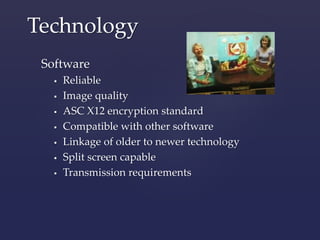
Software 
 Reliable 
 Image quality 
 ASC X12 encryption standard 
 Compatible with other software 
 Linkage of older to newer technology 
 Split screen capable 
 Transmission requirements
Technology 
Distant (Provider) End 
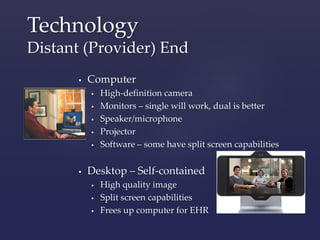
 Computer 
 High-definition camera 
 Monitors – single will work, dual is better 
 Speaker/microphone 
 Projector 
 Software – some have split screen capabilities 
 Desktop – Self-contained 
 High quality image 
 Split screen capabilities 
 Frees up computer for EHR
Technology 
Originating (Patient) Site 
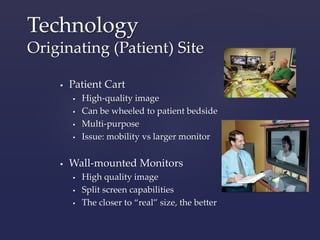
 Patient Cart 
 High-quality image 
 Can be wheeled to patient bedside 
 Multi-purpose 
 Issue: mobility vs larger monitor 
 Wall-mounted Monitors 
 High quality image 
 Split screen capabilities 
 The closer to “real” size, the better
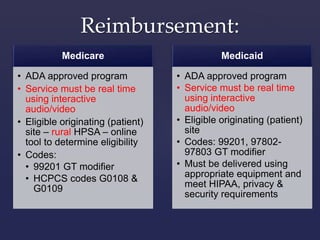
Reimbursement: 
Medicare 
• ADA approved program 
• Service must be real time 
using interactive 
audio/video 
• Eligible originating (patient) 
site – rural HPSA – online 
tool to determine eligibility 
• Codes: 
• 99201 GT modifier 
• HCPCS codes G0108 & 
G0109 
Medicaid 
• ADA approved program 
• Service must be real time 
using interactive 
audio/video 
• Eligible originating (patient) 
site 
• Codes: 99201, 97802- 
97803 GT modifier 
• Must be delivered using 
appropriate equipment and 
meet HIPAA, privacy & 
security requirements
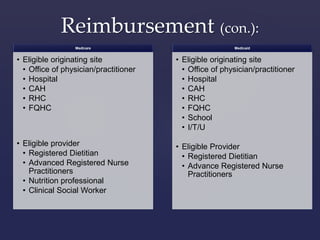
Reimbursement (con.): 
Medicare 
• Eligible originating site 
• Office of physician/practitioner 
• Hospital 
• CAH 
• RHC 
• FQHC 
• Eligible provider 
• Registered Dietitian 
• Advanced Registered Nurse 
Practitioners 
• Nutrition professional 
• Clinical Social Worker 
Medicaid 
• Eligible originating site 
• Office of physician/practitioner 
• Hospital 
• CAH 
• RHC 
• FQHC 
• School 
• I/T/U 
• Eligible Provider 
• Registered Dietitian 
• Advance Registered Nurse 
Practitioners
Handouts such as: My Carbohydrate 
Guide 
Food Models
Organize the 
classroom 
-Pens, highlighters, 
sharpies 
-Ketone chart and 
strips 
-Glucose wands 
-Food models 
-Sample of fast 
acting glucose 
-Etc.
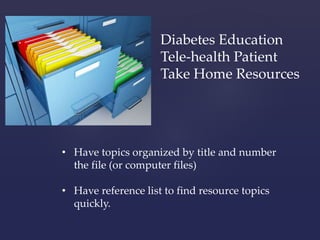
Diabetes Education 
Tele-health Patient 
Take Home Resources 
• Have topics organized by title and number 
the file (or computer files) 
• Have reference list to find resource topics 
quickly.
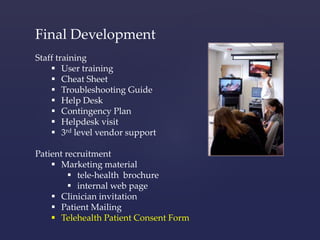
Final Development 
Staff training 
 User training 
 Cheat Sheet 
 Troubleshooting Guide 
 Help Desk 
 Contingency Plan 
 Helpdesk visit 
 3rd level vendor support 
Patient recruitment 
 Marketing material 
 tele-health brochure 
 internal web page 
 Clinician invitation 
 Patient Mailing 
 Telehealth Patient Consent Form
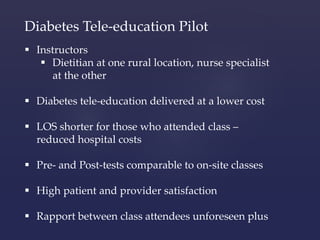
Diabetes Tele-education Pilot 
 Instructors 
 Dietitian at one rural location, nurse specialist 
at the other 
 Diabetes tele-education delivered at a lower cost 
 LOS shorter for those who attended class – 
reduced hospital costs 
 Pre- and Post-tests comparable to on-site classes 
 High patient and provider satisfaction 
 Rapport between class attendees unforeseen plus
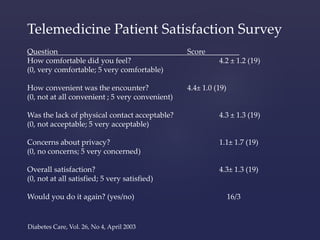
Telemedicine Patient Satisfaction Survey 
Question Score_________ 
How comfortable did you feel? 4.2 ± 1.2 (19) 
(0, very comfortable; 5 very comfortable) 
How convenient was the encounter? 4.4± 1.0 (19) 
(0, not at all convenient ; 5 very convenient) 
Was the lack of physical contact acceptable? 4.3 ± 1.3 (19) 
(0, not acceptable; 5 very acceptable) 
Concerns about privacy? 1.1± 1.7 (19) 
(0, no concerns; 5 very concerned) 
Overall satisfaction? 4.3± 1.3 (19) 
(0, not at all satisfied; 5 very satisfied) 
Would you do it again? (yes/no) 16/3 
Diabetes Care, Vol. 26, No 4, April 2003
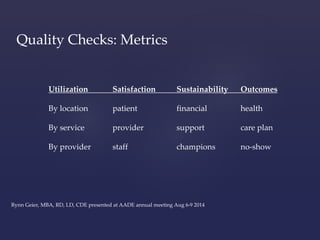
Quality Checks: Metrics 
Utilization Satisfaction Sustainability Outcomes 
By location patient financial health 
By service provider support care plan 
By provider staff champions no-show 
Rynn Geier, MBA, RD, LD, CDE presented at AADE annual meeting Aug 6-9 2014
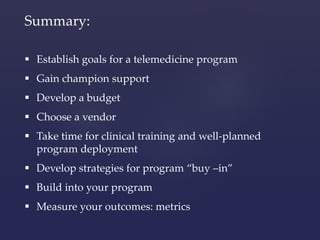
Summary: 
 Establish goals for a telemedicine program 
 Gain champion support 
 Develop a budget 
 Choose a vendor 
 Take time for clinical training and well-planned 
program deployment 
 Develop strategies for program “buy –in” 
 Build into your program 
 Measure your outcomes: metrics
Don’t Forget Diabetes Education 
for Providers 
Providers have the same information as their 
patients 
 Increases provider’s confidence that they have 
the latest diabetes information 
 Reinforcement – patient’s hear the same message 
 Providers have a contact/mentor 
“Prior to the study it was almost impossible for this type of 
patient to get the consultation and specialized care that is not 
accessible in a small rural community.” Rural Home Health 
Administrator
Who knows what future 
telehealth will look like?

Accessing Diabetes Education Through Telehealth

  • 1.
    Accessing Diabetes EducationThrough Telehealth M. Dianne Brown, MS, RDN, LD, CDE OU Physicians Diabetes Life Clinic at the Harold Hamm Diabetes Center Cynthia Scheideman-Miller, MHSA Heartland Telehealth Resource Center Oklahoma Telemedicine Conference 2014 October 16, 2014
  • 2.
    Objectives: 1. Discusthe benefits of a diabetes telehealth program for patients and how it can be partnered with provider education to improve diabetes management 2. List processes involved when selecting a diabetes telehealth program for your patients 3. Outline key components of a diabetes telehealth program including patient and provider site requirements.
  • 3.
  • 4.
    2011 2013 Prevalence*of Self-Reported Obesity Among U.S. Adults, by State, BRFSS State PrevalenceConfidence Interval Oklahoma 32.5 (31.2, 33.9)
  • 5.
    26 million Americans have diabetes 7th leading cause of death in the U.S. 79 million Americans have pre-diabetes Diabetes by the Numbers
  • 6.
    The research shows: People with Diabetes • Don’t follow through on referral • Are emotional / shocked at diagnosis • End up relying on family / friends • Believe they know enough / can handle it on their own Providers • Know importance of DE, but don’t necessarily prescribe – or don’t prescribe definitively enough • Sometimes forget to follow up with patients to encourage attendance
  • 7.
    Diabetes Education PatientBenefits Studies have shown people who receive diabetes education Use primary care / prevention services Take medications as prescribed Control glucose, blood pressure, LDL cholesterol Have lower health costs
  • 8.
    Diabetes Education Process Year 1 Patient Diagnosed with Diabetes PCP refers patient for DE Patient assessed by CDE *DSMT Class (10 hours) **MNT 3 hours (by RD) Year 2 2 hour Refresher Classes *DSMT - 2 hours & **MNT -2 hours (by RD) *Diabetes Self-Management Training (DSMT) **Medical Nutrition Therapy (MNT)
  • 9.
    Prevalence of Diabetes (2011 Overall) N/A 2.25% or Less 2.26% - 3.35% 3.36% - 5.04% 5.05% - 6.74% 6.75% - 8.44% 8.45% - 10.14% 10.15% - 11.84% 11.85% - 14.00% 14.01% or Greater Where most Certified Diabetes Educators (CDEs) Live in Oklahoma
  • 10.
    Recognized or AccreditedDiabetes Education Programs in Oklahoma 34- Recognized by the American Diabetes Association (ADA) 17- Accredited by American Association of Diabetes Educators (AADE)
  • 11.
    Telehealth benefit #1 Provides access- multiple sites may be used  patients  other health care providers Telehealth benefit #2 Saves money  patient & CDE saves “gas” money  remote site “borrows” CDE  informed patients reduce hospital admission
  • 12.
    Telehealth benefit #3 Saves time  patients & CDE do not lose time with travel and information is delivered in “real time”  CDE can see more patients, reducing service wait time for patients Telehealth benefit #4  Helps to address cultural diversity which contributes to challenges of education, patient compliance, and cooperation with treatment regimens  Increased ability for participation with diabetes care team
  • 13.
    Telehealth Concern #1 Budget Considerations  technology set up on remote  and originating sites Telehealth Concern #2 Time needed for set up  Training Staff  Patient teaching tools and resources at remote Telehealth Concern # 3  Services are only reimbursable by Medicare if the services were provided to a Medicare or Medicaid beneficiary at an acceptable originating site.
  • 14.
    Selecting a Diabetes Tele-education Program
  • 15.
    Define what youwant vs need  ADA program for Medicare reimbursement  Champions  Technology – fits in your needs and budget  A program that is right for your organization and population served  Sales pitches can be misleading
  • 16.
    Selecting a program  Is this a program you want as a partner in patient care or contract with for total delivery?  Do they follow the same State laws, Hospital by-laws as on-site programs are required to supply?  What are their references?  Are the providers (distant site) in Oklahoma?
  • 17.
    Double Check theContract  What if expectations aren’t met?  Who is responsible for what?  What staff will be needed at the originating site before, during, after the classes?  Who gets the data?  Who tracks patient satisfaction?  Is there training for staff at the patient site?  No-Show policy  Telehealth Consent Form – who is responsible to get this signed prior to services?
  • 18.
    Developing a Diabetes Tele-Education Program
  • 19.
    Early Development ChampionSupport  Administration  Providers  Originating Site  Distant site Delivery Model  Multiple sites or single site  Contract vs direct billing  Individual sessions conducted remotely or on-site
  • 20.
    Early Development, con. Program Components Understand current process flow and staffing:  Multiple sites or single  Optimal number and arrangement  Mandatory documentation – define the who, where, how Resources  Consider health literacy & culture  What resources go with the patient or stay
  • 21.
    Budget  Budget  Start up costs  Equipment  Broadband  Marketing  Staff time  Contract development  Liaisons  Staff prep for sessions  Consultants
  • 22.
    Technology Software Reliable  Image quality  ASC X12 encryption standard  Compatible with other software  Linkage of older to newer technology  Split screen capable  Transmission requirements
  • 23.
    Technology Distant (Provider)End  Computer  High-definition camera  Monitors – single will work, dual is better  Speaker/microphone  Projector  Software – some have split screen capabilities  Desktop – Self-contained  High quality image  Split screen capabilities  Frees up computer for EHR
  • 24.
    Technology Originating (Patient)Site  Patient Cart  High-quality image  Can be wheeled to patient bedside  Multi-purpose  Issue: mobility vs larger monitor  Wall-mounted Monitors  High quality image  Split screen capabilities  The closer to “real” size, the better
  • 25.
    Reimbursement: Medicare •ADA approved program • Service must be real time using interactive audio/video • Eligible originating (patient) site – rural HPSA – online tool to determine eligibility • Codes: • 99201 GT modifier • HCPCS codes G0108 & G0109 Medicaid • ADA approved program • Service must be real time using interactive audio/video • Eligible originating (patient) site • Codes: 99201, 97802- 97803 GT modifier • Must be delivered using appropriate equipment and meet HIPAA, privacy & security requirements
  • 26.
    Reimbursement (con.): Medicare • Eligible originating site • Office of physician/practitioner • Hospital • CAH • RHC • FQHC • Eligible provider • Registered Dietitian • Advanced Registered Nurse Practitioners • Nutrition professional • Clinical Social Worker Medicaid • Eligible originating site • Office of physician/practitioner • Hospital • CAH • RHC • FQHC • School • I/T/U • Eligible Provider • Registered Dietitian • Advance Registered Nurse Practitioners
  • 27.
    Handouts such as:My Carbohydrate Guide Food Models
  • 28.
    Organize the classroom -Pens, highlighters, sharpies -Ketone chart and strips -Glucose wands -Food models -Sample of fast acting glucose -Etc.
  • 29.
    Diabetes Education Tele-healthPatient Take Home Resources • Have topics organized by title and number the file (or computer files) • Have reference list to find resource topics quickly.
  • 30.
    Final Development Stafftraining  User training  Cheat Sheet  Troubleshooting Guide  Help Desk  Contingency Plan  Helpdesk visit  3rd level vendor support Patient recruitment  Marketing material  tele-health brochure  internal web page  Clinician invitation  Patient Mailing  Telehealth Patient Consent Form
  • 31.
    Diabetes Tele-education Pilot  Instructors  Dietitian at one rural location, nurse specialist at the other  Diabetes tele-education delivered at a lower cost  LOS shorter for those who attended class – reduced hospital costs  Pre- and Post-tests comparable to on-site classes  High patient and provider satisfaction  Rapport between class attendees unforeseen plus
  • 32.
    Telemedicine Patient SatisfactionSurvey Question Score_________ How comfortable did you feel? 4.2 ± 1.2 (19) (0, very comfortable; 5 very comfortable) How convenient was the encounter? 4.4± 1.0 (19) (0, not at all convenient ; 5 very convenient) Was the lack of physical contact acceptable? 4.3 ± 1.3 (19) (0, not acceptable; 5 very acceptable) Concerns about privacy? 1.1± 1.7 (19) (0, no concerns; 5 very concerned) Overall satisfaction? 4.3± 1.3 (19) (0, not at all satisfied; 5 very satisfied) Would you do it again? (yes/no) 16/3 Diabetes Care, Vol. 26, No 4, April 2003
  • 33.
    Quality Checks: Metrics Utilization Satisfaction Sustainability Outcomes By location patient financial health By service provider support care plan By provider staff champions no-show Rynn Geier, MBA, RD, LD, CDE presented at AADE annual meeting Aug 6-9 2014
  • 34.
    Summary:  Establishgoals for a telemedicine program  Gain champion support  Develop a budget  Choose a vendor  Take time for clinical training and well-planned program deployment  Develop strategies for program “buy –in”  Build into your program  Measure your outcomes: metrics
  • 35.
    Don’t Forget DiabetesEducation for Providers Providers have the same information as their patients  Increases provider’s confidence that they have the latest diabetes information  Reinforcement – patient’s hear the same message  Providers have a contact/mentor “Prior to the study it was almost impossible for this type of patient to get the consultation and specialized care that is not accessible in a small rural community.” Rural Home Health Administrator
  • 36.
    Who knows whatfuture telehealth will look like?

Editor's Notes

  • #2 Tele-health is the use of telecommunication technologies to provide health care services and access to medical and surgical information for training and education health care professionals and consumers, to increase awareness and educate the public about health-related issues and to facilitate medical research across distance. Two prong approach: for patients or for training the trainer
  • #3 The purpose of this session is to outline the benefits of a diabetes tele-education program for patients and how it can be partnered with provider education to improve diabetes management. This session will outline key components of a diabetes tele-health program including patient site requirements, provider site requirements and what to look for if selecting a diabetes tele-education program for your patients.
  • #5 Prevalence of Self-Reported Obesity Among U.S. Adults, by State Definitions Obesity: Body Mass Index (BMI) of 30 or higher. Body Mass Index (BMI): A measure of an adult’s weight in relation to his or her height, calculated by using the adult’s weight in kilograms divided by the square of his or her height in meters. Source of the Data The data were collected through the Behavioral Risk Factor Surveillance System (BRFSS), an ongoing, state-based, telephone interview survey conducted by state health departments with assistance from CDC. Height and weight data used in the BMI calculations were self-reported. BRFSS Methodological Changes Started in 2011
  • #6 As you no doubt see almost every day, diabetes is a growing epidemic. The condition affects 26 million Americans and 79 million people have pre-diabetes. Currently, there are 17,000 CDEs in the US. (about 1,530 patients per CDE) And, as overwhelming as those numbers are, the incidence of the disease is projected to double or triple by 2050. Diabetes is a major cause of heart disease and stroke, and is the seventh leading cause of death in the U.S. In Oklahoma, it was the 6th leading cause of death. Complicating matters, many people with diabetes have multiple comorbidities including hypertension, dyslipidemia, cardiovascular disease and obesity.
  • #7 And we’ve identified some reasons why this may be the case. The American Association of Diabetes Educators conducted a survey of both healthcare providers and people with diabetes. We found that often times, patients are shocked by their diagnosis and feeling overwhelmed may cause them to “tune out” when you talk to them about how to manage the condition – particularly at the point of diagnosis. Diabetes educators can help with this time consuming follow up. The research also found that although many prescribers know the importance of diabetes education, some don’t prescribe it for all their patients. And sometimes, providers don’t follow up during patient visits to ask about whether the patient is participating in diabetes education. This type of follow up would help reinforce the importance of diabetes education.
  • #8 This is because research shows that people who have received diabetes education are more likely to: Use primary care and preventive services, and be more proactive in their care, Take medications as prescribed, Control their glucose, blood pressure and LDL cholesterol, and Have lower health care related costs.
  • #10 Diabetes is an insidious disease that is a leading cause of death, disability and blindness. It is often a co-morbidity of high risk/high cost readmissions. Costly readmissions for rural hospitals can be reduced through improved diabetes management 10.75% Prevalence of Diabetes (Overall) 10th Ranking among States and US Territories for Prevalence of Diabetes 303,244 Total Number of Diabetics (Overall) Diabetes Programs and Interventions Based on findings of the 2007 AADE National Practice Survey Diabetes education/instruction is provided as: One-on-one and Group ............................................. 51% One-on-one (individual) ............................................. 31% Group ......................................................................... 16% Telemedicine ............................................................. 02% According to the OU Center for Telemedicine, more than 400 facilities, including 67 hospitals, in Oklahoma use tele-health platforms to connect patients and physicians.
  • #11 Diabetes education is an essential part of a quality plan of care. Shortage of diabetes educators and ADA recognized education programs in rural and underserved areas of the state makes it difficult for rural residents to access this valuable service. Programs tend to cluster around major cities and highways. Enid and Clinton did tele-health diabetes education When asked if they would go to OKC, 80% said no Even when there are multiple opportunities in OKC, some outlying urban areas such as Edmond, Mid West City, South OKC do not want to travel to the health science center for diabetes education.
  • #12 Using tele-health, patients avoid the expense of traveling to another city for treatment and physicians are able to see more patients,” said Casady. “These patients have access to health care resources that are otherwise unavailable in their hometown.” The OSU College of Osteopathic Medicine utilizes tele-health while training medical students in the Rural Medical Track. These students, who are in rotations at hospitals and clinics across the state, can use videoconferencing technology for classes and meetings with professors and classmates in Tulsa. Expenditures on Diabetes Education For the Medicare population in 2005, CMS reimbursed only $4.8 million on diabetes self management training (DSMT) codes G108 and G109.4
  • #13 Data shows that diabetes education saves money and decreases healthcare utilization · Robbins et al found that hospitalization rates for patients who had no educational visits during follow-up was 38.1 per person per 100 years; the hospitalization rate was 25.0 per person per 100 years- or 34 % lower for patients who had at least one educational visit.
  • #14 #1Must be Stark Compliant. The federal Stark self – referral law prohibits physician from referring Medicare beneficiaries to an entity in which the physician has a financial interest for designated health services reimbursable by Medicare. Telemedicine arrangements that involve free telemedicine equipment or services, volume discounts, “per click” payments or advertisement on physician’s website should be analyzed for possible self referral risks Medicare also requires another tele-presenter to be physically present with the Medicare beneficiary.
  • #21 Think multi-dimensional – at each step, who does what (patient, CDE, support staff) and in what order
  • #26 Medicaid – Individual Medical Nutrition Therapy Medicare: practitioner must be licensed under state law to provide the telemedicine service registered dietitian or nutrition professional. RDs can In order to bill for Medicare reimbursement of tele-medicine services, the practitioner must be licensed under state law to provide the telemedicine service and must be one of the following types of health care practitioner: nurse practitioner, physician assistant; nurse-midwife, clinical nurse specialist, clinical psychologist, clinical social worker or registered dietitian or nutrition professional.
  • #27 I/T/U – Indian Health Service facility, a Tribal Health facility, or an Urban Indian Clinic
  • #32 Need MA at remote who knows how to run equipment. A 2nd person needs to be identified for back up due to vacation and illness of staff.
  • #33 In Diabetes Care, Vo.l 26, No 4 April 2003 there was an article: A Comparison of Diabetes Education Administered Through Telemedicine Versus in Person. Total of 56 adults with diabetes were randomized to receive diabetes education in person (control group) or via telemedicine. Education consisted of 3 consultative visits with diabetes nurse and nutrition educators. The in person and telemedicine groups were compared using measures of A1C and questionnairs to assess patient satisfaction and psychosocial functioning as related to diabetes. Results: Patient satisfaction was high in the telemedicine group and A1C improved in both groups along with post test scores on diabetes related topics. (A1C went from 8.6% + - 1.8% to 7.8% + - 1.5%. 3 months after the education)
  • #35 Developmental Process and Steps- from Best Practices in Implementing a Telehealth Program by Krista Kelly, RN & Jill Christians, MBA Establish your agency’s goals for a tele-medicine program reduce ER visit? Reduce nursing visits? Empower your staff with information so they can offer greater clinical impact at patient visits?...... Champion Support- Administration and Providers Budget- start up cost : equipment, marketing, resources staff time consultant Develop a financial plan and define the measurements that will be used to drive achievement of the plan’s goal. Make sure the measurements are understood and accepted by management. Choose a vendor: Company reputation; long term stability, rental vs purchase; ease of use (wireless devices and web based software) use of technology, sturdy and ready to use equipment Take time for clinical training and well-planned program deployment- training in layers is most effective. First layer is best delivered right before the lessons are used. For training to be valued it must be perceived as valuable. It should be as formal as possible.: sign in sheet, written currculum, learning objectives, reference materials and hands on competency test. Successful attendees should be given a certificate. Develop strategies for program “buy –in” Build into your program- scheduling, measurement, documentation and billing protocols and systems. Measure your outcomes: metrics
  • #37 Crystal ball: may be using tablet, home technology, smart phones Recently :The Tele-health Project, funded by AT&T through the AADE Education and Research Foundation, examined the feasibility of providing diabetes self-management education (DSME) via smartphone. The project has been completed, and a paper, Receptivity to Smartphone-Delivered Diabetes Self-Management Education and Training in an Underserved Urban Population of Adults, has been published in the Journal of Telemedicine and Tele-care. From the May Clinic Healthy Lifestyle: consumer health newsletter: Consider how people with diabetes could use tele-health to manage their health — all without having to leave home: Use a mobile phone or other device to upload food logs, medications, dosing and blood sugar levels for review by a nurse who responds electronically. Watch a how-to video on carbohydrate counting and download an application (app) for it to your mobile phone. Use the same app to estimate, based on your diet and exercise level, how much insulin you need. Send an email or text message to a nurse or diabetes educator when you have questions. Order testing supplies and medications online. Research the pros and cons of alternate treatments, such as insulin pumps. Get email, text or phone reminders when you need a flu shot, foot exam or other preventive care.