STEPUPVOLUNTEERING: RECRUITMENT

        Takoma, it's time to step up volunteering!


1
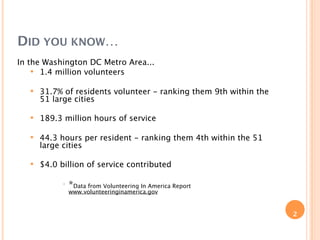
DID YOU KNOW…
In the Washington DC Metro Area...
     1.4 million volunteers


      31.7% of residents volunteer - ranking them 9th within the
       51 large cities

      189.3 million hours of service

      44.3 hours per resident - ranking them 4th within the 51
       large cities

      $4.0 billion of service contributed

               *Data from Volunteering In America Report
                www.volunteeringinamerica.gov


                                                                    2
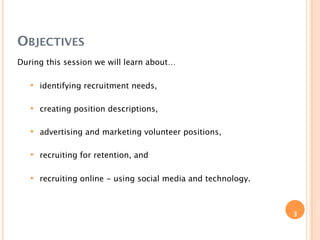
OBJECTIVES
During this session we will learn about…

      identifying recruitment needs,

      creating position descriptions,

      advertising and marketing volunteer positions,

      recruiting for retention, and

      recruiting online - using social media and technology.


                                                                3
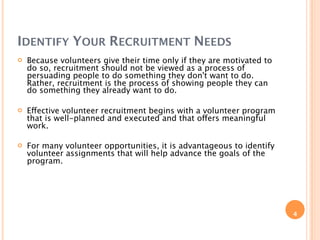
IDENTIFY YOUR RECRUITMENT NEEDS
   Because volunteers give their time only if they are motivated to
    do so, recruitment should not be viewed as a process of
    persuading people to do something they don't want to do.
    Rather, recruitment is the process of showing people they can
    do something they already want to do.

   Effective volunteer recruitment begins with a volunteer program
    that is well-planned and executed and that offers meaningful
    work.

   For many volunteer opportunities, it is advantageous to identify
    volunteer assignments that will help advance the goals of the
    program.


                                                                       4
IDENTIFY YOUR RECRUITMENT NEEDS
   Clarify the work that needs to be done to achieve the goals
    of the project/program; then segment the work into
    components that reflect the reality of the potential volunteer
    force.

   Consider the type(s) of volunteers needed. During the
    planning stage, think beyond traditional or long-term
    volunteers. Do you need someone with many hours to devote to
    the project, or people who want to serve only one afternoon? Is
    the project appropriate for children, seniors, or other people
    with different abilities and needs?

   Determine volunteer needs by developing a task
    list. Consider what you want to accomplish and the steps
    required to get there; then create a comprehensive list of the
    assignments and the number of volunteers needed for each
    task.

   Create volunteer position descriptions to outline what the
    volunteers will be doing.                                         5
SOME TRENDS TO CONSIDER...
   Long-term volunteering provides volunteers the opportunity
    to commit to a project or program that spans an extended
    period of time. This is volunteering as people traditionally think
    of it.

   Short-term or episodic volunteering provides opportunities
    that include those of short duration and those that occur at
    regular intervals, such as annual events.

   Family volunteering provides volunteers the opportunity to
    participate in meaningful service while spending time with their
    families.


                                                                         6
SOME TRENDS TO CONSIDER...
   Student volunteering provides the opportunity to volunteer
    with schools and youth groups, so that young people gain
    valuable knowledge and skills.

   Internships, fellowships, and apprenticeships, offer students
    and others the ability to gain beneficial experience while
    assisting the community service organization.

   Virtual volunteering allows anyone with access to a computer
    and the Internet to contribute time and expertise without ever
    leaving his or her home.


                                                                     7
IDENTIFY YOUR RECRUITMENT NEEDS
   Start by defining volunteer roles and assets
      Understanding what you expect your volunteers to be able
       to do and what they will get out of the position will help you
       find and evaluate candidates.

   Start by identifying:
      The number of volunteers needed
      The role of each volunteer
      The skills, knowledge, attitudes and aptitudes needed for
       each position
      The opportunities and benefits a member will get through
       the assignment


                                                                        8
CREATE A POSITION DESCRIPTION
   Find the volunteers best suited to your program and sites

   Before you can begin to recruit, be certain about the tasks that
    need to be accomplished, where the volunteer will serve, what
    resources the volunteer will need, volunteer supervision and
    communication, and other important details of the position.

   During the recruiting process, a properly prepared position
    description will aid you in:
      Crafting your recruitment message to target potential
       volunteers who possess the skills your program needs
      Writing appropriate interview questions (yes, you should
       interview volunteers!)
      Determining whether a person is qualified to perform the
       essential functions of the position


                                                                       9
CREATE A POSITION DESCRIPTION
Seven steps to a great position description
The best position descriptions are concise, use action verbs, and
avoid jargon. Include these seven elements, and you'll be on your
way to attracting the right members for your program:

   Ensure an accurate service assignment title is included.
   Write a 1–2 sentence summary of the assignment's general
    purpose and primary service assignment functions.
   List 5–8 essential duties in descending order of importance.
   Identify skills, interests, methods, and tools member will need
    or use to complete the work.
   Explain the position's relationship with others in the
    organization; address supervision and collaboration with
    partners.
   Provide other pertinent facts, such as required travel, physical
    requirements, working conditions, etc.
   Include other responsibilities or requirements, such as
    mandatory training, hours of service, etc.                         10
EXERCISE
   Create your volunteer positions descriptions


                                                   11
ADVERTISE AND MARKET YOUR POSITION
Target your audience to attract members best suited for your
mission

   Once you know who you are looking for, you can target your
    advertising and marketing efforts to reach the most qualified
    and diverse applicants. Keep the following tips in mind:

       Determine target populations. Identify potential
        populations for the types of volunteers you want.

       Research communication channels. There are many ways
        to communicate your opportunities to potential volunteers
        —choose strategies and media used by your target
        populations.

       Use your partners. Identify individuals, organizations and
        networks that can reach out to your target populations.
                                                                     12
ADVERTISE AND MARKET YOUR POSITION
    Don't limit yourself. Develop varied recruitment tools and
     introduce them over time to build momentum.

    Look for opportunities to increase diversity. Working with
     people from different cultural, ethnic, educational, and
     socio-economic backgrounds is one of the most important
     aspects of service. Look for ways to increase diversity to
     make a richer team for everyone.

    Make retention a recruiting goal. Understanding the vital
     connection between how you recruit and the experience
     your volunteers will have helps you recruit volunteers who
     embrace service for the duration of the position and
     beyond.


                                                                  13
RECRUITING FOR RETENTION
Making a match that lasts

   Being upfront about both the benefits and challenges can help
    you place volunteers who are more likely to stay.

   Provide position descriptions that are accurate

   Posting success stories online on program web sites



                                                                   14
RECRUITING FOR RETENTION
Seasoned program directors offer these tips about responding to
volunteer inquirers:

   Send a response within 24 hours of receiving an application or
    inquiry

   When potential volunteers call, answer their questions fully and
    make them feel you'll give them all the time they need

   Give them info that tells them what your mission is and what
    their role would be

   Send a volunteer description that details responsibilities and
    needed skills

   Ask current volunteers to review the applicant materials to see
    if they cover what they would have wanted to know
                                                                       15
RECRUITING FOR RETENTION
   Reaching the most qualified and diverse applicant pool leads
    to more successful placements. You'll want to get the word
    out in a number of different ways to reach many different
    audiences.

   Identify community leaders who can help you spread the
    word about your service positions to different constituencies.
    This could include members of professional associations,
    religious leaders, local politicians, and community activists.

   Identify individuals and groups that can help you reach out to
    specific populations. Inform similar programs about your
    program's position and look for opportunities to post the
    opening on free listservs and volunteer boards.


                                                                     16
RECRUITING FOR RETENTION
Brainstorm with current volunteers...

   Get members' perspective on where to find the best candidate

       What makes this program/organization so special?

       What skill sets/qualifications should volunteers have?

       What is the time commitment/workload for volunteers?

       What is the ideal volunteer like?

       What is our selection process? Who should we involve in the
        selection of volunteers?

       Where does this ideal volunteer come from? How do we
        reach them? Who should be involved in recruiting?             17
    
RECRUITING ONLINE
Using the Web to attract new members

   Your organization’s Web site, e-mail distribution lists, and
    newsletter are great ways to publicize your positions! Make sure
    they are easily accessible from your homepage. Post in the job,
    internship, or volunteer opportunities sections.


   Encourage your community partners to link to your
    organization’s Web site. Doing this will help your site become
    more prominent in the various search engines.


   Craigslist (www.craigslist.org/) is an online bulletin board that’s
    well known nationally. Craigslist sites are organized by city
    (usually large cities) and postings are free.
                                                                          18
RECRUITING ONLINE
Idealist(www.idealist.org) is another site that is fairly well known
 nationally. You can list an organization description and volunteer
 positions for free. Idealist also hosts several very visible
 nonprofit volunteers fairs around the country.


Use  Yahoo groups and other community listservs. Many
 organizations use listservs that they have set up on their own or
 through free services such as Yahoo groups to distribute job
 information to job seekers.


Check   out your local college and university web sites. Most
 provide an opportunity to post positions for free through a
 volunteer center. If you know of other colleges or universities
 that have degree programs that closely match your position’s
 focus, be sure to check out those sites, too.
                                                                        19
RECRUITING ONLINE
   Volunteermatch.org, justvolunteer.org and serve.gov are three
    volunteer boards that are fairly well known. Typically, in any
    given area, there are one or more volunteer-based web sites.


   Use your organization’s social media presence to advertise your
    volunteer positions and let people know more about what you
    are doing. (Facebook, Twitter, YouTube).


                                                                      20
USING THE STEPUP TAKOMA SITE


                               21
QUESTIONS?


             22

StepUp Takoma

  • 1.
    STEPUPVOLUNTEERING: RECRUITMENT Takoma, it's time to step up volunteering! 1
  • 2.
    DID YOU KNOW… Inthe Washington DC Metro Area...  1.4 million volunteers  31.7% of residents volunteer - ranking them 9th within the 51 large cities  189.3 million hours of service  44.3 hours per resident - ranking them 4th within the 51 large cities  $4.0 billion of service contributed  *Data from Volunteering In America Report www.volunteeringinamerica.gov 2
  • 3.
    OBJECTIVES During this sessionwe will learn about…  identifying recruitment needs,  creating position descriptions,  advertising and marketing volunteer positions,  recruiting for retention, and  recruiting online - using social media and technology. 3
  • 4.
    IDENTIFY YOUR RECRUITMENTNEEDS  Because volunteers give their time only if they are motivated to do so, recruitment should not be viewed as a process of persuading people to do something they don't want to do. Rather, recruitment is the process of showing people they can do something they already want to do.  Effective volunteer recruitment begins with a volunteer program that is well-planned and executed and that offers meaningful work.  For many volunteer opportunities, it is advantageous to identify volunteer assignments that will help advance the goals of the program. 4
  • 5.
    IDENTIFY YOUR RECRUITMENTNEEDS  Clarify the work that needs to be done to achieve the goals of the project/program; then segment the work into components that reflect the reality of the potential volunteer force.  Consider the type(s) of volunteers needed. During the planning stage, think beyond traditional or long-term volunteers. Do you need someone with many hours to devote to the project, or people who want to serve only one afternoon? Is the project appropriate for children, seniors, or other people with different abilities and needs?  Determine volunteer needs by developing a task list. Consider what you want to accomplish and the steps required to get there; then create a comprehensive list of the assignments and the number of volunteers needed for each task.  Create volunteer position descriptions to outline what the volunteers will be doing. 5
  • 6.
    SOME TRENDS TOCONSIDER...  Long-term volunteering provides volunteers the opportunity to commit to a project or program that spans an extended period of time. This is volunteering as people traditionally think of it.  Short-term or episodic volunteering provides opportunities that include those of short duration and those that occur at regular intervals, such as annual events.  Family volunteering provides volunteers the opportunity to participate in meaningful service while spending time with their families. 6
  • 7.
    SOME TRENDS TOCONSIDER...  Student volunteering provides the opportunity to volunteer with schools and youth groups, so that young people gain valuable knowledge and skills.  Internships, fellowships, and apprenticeships, offer students and others the ability to gain beneficial experience while assisting the community service organization.  Virtual volunteering allows anyone with access to a computer and the Internet to contribute time and expertise without ever leaving his or her home. 7
  • 8.
    IDENTIFY YOUR RECRUITMENTNEEDS  Start by defining volunteer roles and assets  Understanding what you expect your volunteers to be able to do and what they will get out of the position will help you find and evaluate candidates.  Start by identifying:  The number of volunteers needed  The role of each volunteer  The skills, knowledge, attitudes and aptitudes needed for each position  The opportunities and benefits a member will get through the assignment 8
  • 9.
    CREATE A POSITIONDESCRIPTION  Find the volunteers best suited to your program and sites  Before you can begin to recruit, be certain about the tasks that need to be accomplished, where the volunteer will serve, what resources the volunteer will need, volunteer supervision and communication, and other important details of the position.  During the recruiting process, a properly prepared position description will aid you in:  Crafting your recruitment message to target potential volunteers who possess the skills your program needs  Writing appropriate interview questions (yes, you should interview volunteers!)  Determining whether a person is qualified to perform the essential functions of the position 9
  • 10.
    CREATE A POSITIONDESCRIPTION Seven steps to a great position description The best position descriptions are concise, use action verbs, and avoid jargon. Include these seven elements, and you'll be on your way to attracting the right members for your program:  Ensure an accurate service assignment title is included.  Write a 1–2 sentence summary of the assignment's general purpose and primary service assignment functions.  List 5–8 essential duties in descending order of importance.  Identify skills, interests, methods, and tools member will need or use to complete the work.  Explain the position's relationship with others in the organization; address supervision and collaboration with partners.  Provide other pertinent facts, such as required travel, physical requirements, working conditions, etc.  Include other responsibilities or requirements, such as mandatory training, hours of service, etc. 10
  • 11.
    EXERCISE  Create your volunteer positions descriptions 11
  • 12.
    ADVERTISE AND MARKETYOUR POSITION Target your audience to attract members best suited for your mission  Once you know who you are looking for, you can target your advertising and marketing efforts to reach the most qualified and diverse applicants. Keep the following tips in mind:  Determine target populations. Identify potential populations for the types of volunteers you want.  Research communication channels. There are many ways to communicate your opportunities to potential volunteers —choose strategies and media used by your target populations.  Use your partners. Identify individuals, organizations and networks that can reach out to your target populations. 12
  • 13.
    ADVERTISE AND MARKETYOUR POSITION  Don't limit yourself. Develop varied recruitment tools and introduce them over time to build momentum.  Look for opportunities to increase diversity. Working with people from different cultural, ethnic, educational, and socio-economic backgrounds is one of the most important aspects of service. Look for ways to increase diversity to make a richer team for everyone.  Make retention a recruiting goal. Understanding the vital connection between how you recruit and the experience your volunteers will have helps you recruit volunteers who embrace service for the duration of the position and beyond. 13
  • 14.
    RECRUITING FOR RETENTION Makinga match that lasts  Being upfront about both the benefits and challenges can help you place volunteers who are more likely to stay.  Provide position descriptions that are accurate  Posting success stories online on program web sites  14
  • 15.
    RECRUITING FOR RETENTION Seasonedprogram directors offer these tips about responding to volunteer inquirers:  Send a response within 24 hours of receiving an application or inquiry  When potential volunteers call, answer their questions fully and make them feel you'll give them all the time they need  Give them info that tells them what your mission is and what their role would be  Send a volunteer description that details responsibilities and needed skills  Ask current volunteers to review the applicant materials to see if they cover what they would have wanted to know 15
  • 16.
    RECRUITING FOR RETENTION  Reaching the most qualified and diverse applicant pool leads to more successful placements. You'll want to get the word out in a number of different ways to reach many different audiences.  Identify community leaders who can help you spread the word about your service positions to different constituencies. This could include members of professional associations, religious leaders, local politicians, and community activists.  Identify individuals and groups that can help you reach out to specific populations. Inform similar programs about your program's position and look for opportunities to post the opening on free listservs and volunteer boards. 16
  • 17.
    RECRUITING FOR RETENTION Brainstormwith current volunteers...  Get members' perspective on where to find the best candidate  What makes this program/organization so special?  What skill sets/qualifications should volunteers have?  What is the time commitment/workload for volunteers?  What is the ideal volunteer like?  What is our selection process? Who should we involve in the selection of volunteers?  Where does this ideal volunteer come from? How do we reach them? Who should be involved in recruiting? 17 
  • 18.
    RECRUITING ONLINE Using theWeb to attract new members  Your organization’s Web site, e-mail distribution lists, and newsletter are great ways to publicize your positions! Make sure they are easily accessible from your homepage. Post in the job, internship, or volunteer opportunities sections.  Encourage your community partners to link to your organization’s Web site. Doing this will help your site become more prominent in the various search engines.  Craigslist (www.craigslist.org/) is an online bulletin board that’s well known nationally. Craigslist sites are organized by city (usually large cities) and postings are free. 18
  • 19.
    RECRUITING ONLINE Idealist(www.idealist.org) isanother site that is fairly well known nationally. You can list an organization description and volunteer positions for free. Idealist also hosts several very visible nonprofit volunteers fairs around the country. Use Yahoo groups and other community listservs. Many organizations use listservs that they have set up on their own or through free services such as Yahoo groups to distribute job information to job seekers. Check out your local college and university web sites. Most provide an opportunity to post positions for free through a volunteer center. If you know of other colleges or universities that have degree programs that closely match your position’s focus, be sure to check out those sites, too. 19
  • 20.
    RECRUITING ONLINE  Volunteermatch.org, justvolunteer.org and serve.gov are three volunteer boards that are fairly well known. Typically, in any given area, there are one or more volunteer-based web sites.  Use your organization’s social media presence to advertise your volunteer positions and let people know more about what you are doing. (Facebook, Twitter, YouTube). 20
  • 21.
    USING THE STEPUPTAKOMA SITE 21
  • 22.