Inclusive business models
www.fao.org/economic/esa/ © FAO, 2017
Step 1: Understanding the business model
SESSION 7
Inclusive business models
2
Understanding the BM
Session 7
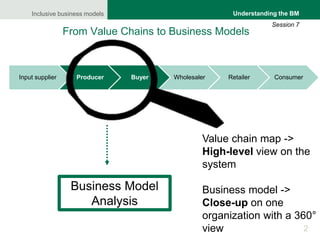
From Value Chains to Business Models
Value chain map ->
High-level view on the
system
Business model ->
Close-up on one
organization with a 360°
view
Business Model
Analysis
Input supplier Producer Buyer Wholesaler Retailer Consumer
Inclusive business models
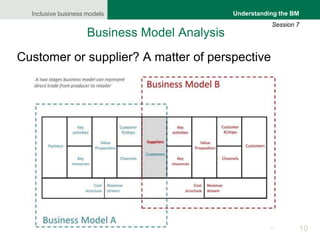
3
Understanding the BM
Session 7
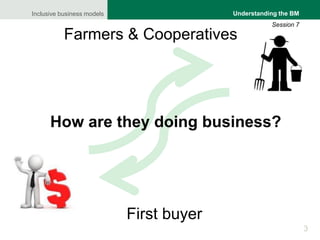
Farmers & Cooperatives
First buyer
How are they doing business?
Inclusive business models
4
Understanding the BM
Session 7
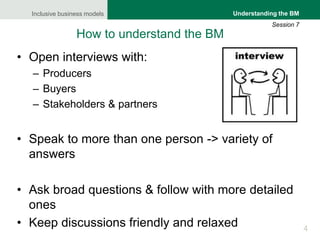
How to understand the BM
• Open interviews with:
– Producers
– Buyers
– Stakeholders & partners
• Speak to more than one person -> variety of
answers
• Ask broad questions & follow with more detailed
ones
• Keep discussions friendly and relaxed
Inclusive business models
5
Understanding the BM
Session 7
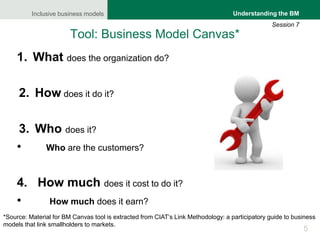
Tool: Business Model Canvas*
1. What does the organization do?
2. How does it do it?
3. Who does it?
• Who are the customers?
4. How much does it cost to do it?
• How much does it earn?
*Source: Material for BM Canvas tool is extracted from CIAT’s Link Methodology: a participatory guide to business
models that link smallholders to markets.
Inclusive business models
6
Understanding the BM
Session 7
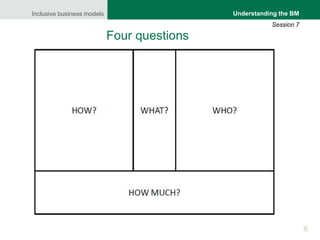
Four questions
Inclusive business models
7
Understanding the BM
Session 7
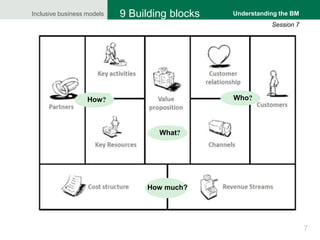
How?
How much?
What?
Who?
9 Building blocks
Inclusive business models
8
Understanding the BM
Session 7
1. Understanding Producer Organization BM
• Organizational structure
• Members
• Resources
• Capacities
• Product characteristics
• Logistical process
Inclusive business models
9
Understanding the BM
Session 7
2. Understanding Buyers BM
• Why procuring from smallholders
• Final clients
• Needs
• Challenges
• Product requirements
• Risks
Inclusive business models
10
Understanding the BM
Session 7
Business Model Analysis
Customer or supplier? A matter of perspective
Inclusive business models
11
Understanding the BM
Session 7
1. Customers
• For whom is the organization creating value?
• Who are the customers paying for the product?
-> Without customers no business can survive
-> Important to understand their needs to satisfy
them
Inclusive business models
12
Understanding the BM
Session 7
2. Value proposition
• Products and services
• Reason why customers buy the product
• Specific characteristics
• Need or problem your product satisfies
• What value is offered to customers?
• Which customer need it satisfies?
Inclusive business models
13
Understanding the BM
Session 7
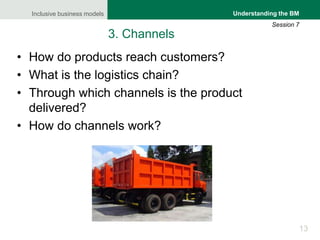
3. Channels
• How do products reach customers?
• What is the logistics chain?
• Through which channels is the product
delivered?
• How do channels work?
Inclusive business models
14
Understanding the BM
Session 7
4. Customer relationships
• How is the relationship with customers?
• How costly is the relationship?
• Is the relationship what customers want?
• How do we communicate with customers?
Inclusive business models
15
Understanding the BM
Session 7
5. Revenue Stream
• How is the organization capturing value?
• What are the pricing mechanisms?
• How is income created?
• For what do customers pay?
• How do customers pay?
• How stable is the income?
Inclusive business models
16
Understanding the BM
Session 7
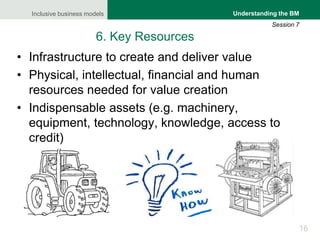
6. Key Resources
• Infrastructure to create and deliver value
• Physical, intellectual, financial and human
resources needed for value creation
• Indispensable assets (e.g. machinery,
equipment, technology, knowledge, access to
credit)
Inclusive business models
17
Understanding the BM
Session 7
7. Key Activities
• What does the organization do to function?
• Actions to create value
• Production, processing, marketing, logistics and
quality control
Inclusive business models
18
Understanding the BM
Session 7
8. Key Partners
• Who interacts with your business model?
• Direct partners: producers, transporters,
suppliers
• Indirect partners: financial institutions, research
centres, NGOs, public organizations
Inclusive business models
19
Understanding the BM
Session 7
9. Cost Structure
• Cost for the creation of value
• Fixed costs
• Variable costs
• Economies of scale
• Economies of scope
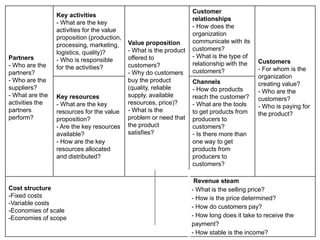
Partners
- Who are the
partners?
- Who are the
suppliers?
- What are the
activities the
partners
perform?
Key activities
- What are the key
activities for the value
proposition (production,
processing, marketing,
logistics, quality)?
- Who is responsible
for the activities?
Value proposition
- What is the product
offered to
customers?
- Why do customers
buy the product
(quality, reliable
supply, available
resources, price)?
- What is the
problem or need that
the product
satisfies?
Customer
relationships
- How does the
organization
communicate with its
customers?
- What is the type of
relationship with the
customers?
Customers
- For whom is the
organization
creating value?
- Who are the
customers?
- Who is paying for
the product?
Key resources
- What are the key
resources for the value
proposition?
- Are the key resources
available?
- How are the key
resources allocated
and distributed?
Channels
- How do products
reach the customer?
- What are the tools
to get products from
producers to
customers?
- Is there more than
one way to get
products from
producers to
customers?
Cost structure
-Fixed costs
-Variable costs
-Economies of scale
-Economies of scope
Revenue steam
- What is the selling price?
- How is the price determined?
- How do customers pay?
- How long does it take to receive the
payment?
- How stable is the income?

Step 1: Understanding the business model - Session 7B

  • 1.
    Inclusive business models www.fao.org/economic/esa/© FAO, 2017 Step 1: Understanding the business model SESSION 7
  • 2.
    Inclusive business models 2 Understandingthe BM Session 7 From Value Chains to Business Models Value chain map -> High-level view on the system Business model -> Close-up on one organization with a 360° view Business Model Analysis Input supplier Producer Buyer Wholesaler Retailer Consumer
  • 3.
    Inclusive business models 3 Understandingthe BM Session 7 Farmers & Cooperatives First buyer How are they doing business?
  • 4.
    Inclusive business models 4 Understandingthe BM Session 7 How to understand the BM • Open interviews with: – Producers – Buyers – Stakeholders & partners • Speak to more than one person -> variety of answers • Ask broad questions & follow with more detailed ones • Keep discussions friendly and relaxed
  • 5.
    Inclusive business models 5 Understandingthe BM Session 7 Tool: Business Model Canvas* 1. What does the organization do? 2. How does it do it? 3. Who does it? • Who are the customers? 4. How much does it cost to do it? • How much does it earn? *Source: Material for BM Canvas tool is extracted from CIAT’s Link Methodology: a participatory guide to business models that link smallholders to markets.
  • 6.
    Inclusive business models 6 Understandingthe BM Session 7 Four questions
  • 7.
    Inclusive business models 7 Understandingthe BM Session 7 How? How much? What? Who? 9 Building blocks
  • 8.
    Inclusive business models 8 Understandingthe BM Session 7 1. Understanding Producer Organization BM • Organizational structure • Members • Resources • Capacities • Product characteristics • Logistical process
  • 9.
    Inclusive business models 9 Understandingthe BM Session 7 2. Understanding Buyers BM • Why procuring from smallholders • Final clients • Needs • Challenges • Product requirements • Risks
  • 10.
    Inclusive business models 10 Understandingthe BM Session 7 Business Model Analysis Customer or supplier? A matter of perspective
  • 11.
    Inclusive business models 11 Understandingthe BM Session 7 1. Customers • For whom is the organization creating value? • Who are the customers paying for the product? -> Without customers no business can survive -> Important to understand their needs to satisfy them
  • 12.
    Inclusive business models 12 Understandingthe BM Session 7 2. Value proposition • Products and services • Reason why customers buy the product • Specific characteristics • Need or problem your product satisfies • What value is offered to customers? • Which customer need it satisfies?
  • 13.
    Inclusive business models 13 Understandingthe BM Session 7 3. Channels • How do products reach customers? • What is the logistics chain? • Through which channels is the product delivered? • How do channels work?
  • 14.
    Inclusive business models 14 Understandingthe BM Session 7 4. Customer relationships • How is the relationship with customers? • How costly is the relationship? • Is the relationship what customers want? • How do we communicate with customers?
  • 15.
    Inclusive business models 15 Understandingthe BM Session 7 5. Revenue Stream • How is the organization capturing value? • What are the pricing mechanisms? • How is income created? • For what do customers pay? • How do customers pay? • How stable is the income?
  • 16.
    Inclusive business models 16 Understandingthe BM Session 7 6. Key Resources • Infrastructure to create and deliver value • Physical, intellectual, financial and human resources needed for value creation • Indispensable assets (e.g. machinery, equipment, technology, knowledge, access to credit)
  • 17.
    Inclusive business models 17 Understandingthe BM Session 7 7. Key Activities • What does the organization do to function? • Actions to create value • Production, processing, marketing, logistics and quality control
  • 18.
    Inclusive business models 18 Understandingthe BM Session 7 8. Key Partners • Who interacts with your business model? • Direct partners: producers, transporters, suppliers • Indirect partners: financial institutions, research centres, NGOs, public organizations
  • 19.
    Inclusive business models 19 Understandingthe BM Session 7 9. Cost Structure • Cost for the creation of value • Fixed costs • Variable costs • Economies of scale • Economies of scope
  • 20.
    Partners - Who arethe partners? - Who are the suppliers? - What are the activities the partners perform? Key activities - What are the key activities for the value proposition (production, processing, marketing, logistics, quality)? - Who is responsible for the activities? Value proposition - What is the product offered to customers? - Why do customers buy the product (quality, reliable supply, available resources, price)? - What is the problem or need that the product satisfies? Customer relationships - How does the organization communicate with its customers? - What is the type of relationship with the customers? Customers - For whom is the organization creating value? - Who are the customers? - Who is paying for the product? Key resources - What are the key resources for the value proposition? - Are the key resources available? - How are the key resources allocated and distributed? Channels - How do products reach the customer? - What are the tools to get products from producers to customers? - Is there more than one way to get products from producers to customers? Cost structure -Fixed costs -Variable costs -Economies of scale -Economies of scope Revenue steam - What is the selling price? - How is the price determined? - How do customers pay? - How long does it take to receive the payment? - How stable is the income?

Editor's Notes

  • #2 This session goes in detail on the first step of the IBM approach – understanding the business model. In order to identify opportunities for improvement, it is important to clearly understand the current situation and how actors are doing business. This section will provide practical tools for analyzing a business model.   To perform a business model analysis, two tools are included: Option 1: FAO checklist Option 2: Business Model Canvas   The facilitator can choose which tool to use based on which would be more useful and easy to use for the participants.   Outputs Participants will be able to: List the different business model components Perform a general business model analysis
  • #3 Refresh the concept of the IBM. Strengthening business models begins with an appraisal of how target farmers and buyers are doing business. The analysis looks first at the farmers’ groups to understand their organizational structure, members, resources, capacities, suppliers and buyers, commodity characteristics and marketable surpluses of members. The buyers’ business models are similarly analysed to understand their management structure, resources, capacities, product description, operational capacity and clients. In order to identify areas of improvement, the business model analysis should be a reflection of the business reality on the ground, not a desired or ideal situation.
  • #11 Its necessary to do a business model analysis for the producers and the buyers