Esophageal Stenting for Malignant and Benign Disease: 133 Cases on a Thoracic Surgical Service  A Dubecz, TJ Watson, A Matousek, J Allen, M Polomsky,  R Salvador, CE Jones, DP Raymond, JH Peters Society of Thoracic Surgeons  45th Annual Meeting, January 26-28, 2009, San Francisco, CA Division of Thoracic and Foregut Surgery, Department of Surgery  University of Rochester School of Medicine and Dentistry Rochester, NY
The authors have nothing to disclose
Background Stents have been increasingly utilized to treat a variety of malignant and benign esophageal disorders.  easy inexpensive low morbidity increased indications with removable stents for benign disease
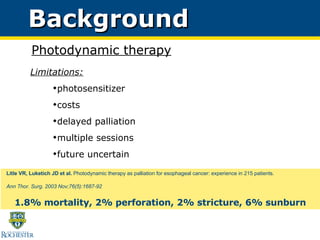
Background Photodynamic therapy Limitations: photosensitizer costs delayed palliation multiple sessions future uncertain Litle VR, Luketich JD et al.  Photodynamic therapy as palliation for esophageal cancer: experience in 215 patients.  Ann Thor. Surg. 2003 Nov;76(5):1687-92 1.8% mortality, 2% perforation, 2% stricture, 6% sunburn
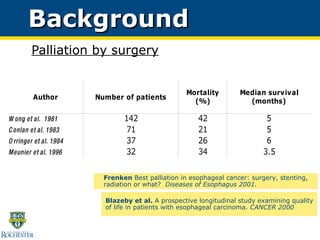
Background Palliation by surgery   Blazeby et al.  A prospective longitudinal study examining quality of life in patients with esophageal carcinoma.  CANCER 2000 Frenken  Best palliation in esophageal cancer: surgery, stenting, radiation or what?  Diseases of Esophagus 2001.
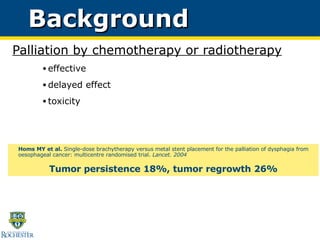
Background Palliation by chemotherapy or radiotherapy effective delayed effect toxicity Homs MY et al.  Single-dose brachytherapy versus metal stent placement for the palliation of dysphagia from oesophageal cancer: multicentre randomised trial.  Lancet. 2004  Tumor persistence 18%, tumor regrowth 26%
Aim To evaluate our recent experience with self-expanding metal, plastic and hybrid stents in the treatment of esophageal disease on a thoracic surgical service.
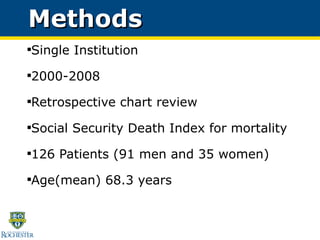
Methods Single Institution 2000-2008  Retrospective chart review Social Security Death Index for mortality 126 Patients (91 men and 35 women)‏ Age(mean) 68.3 years
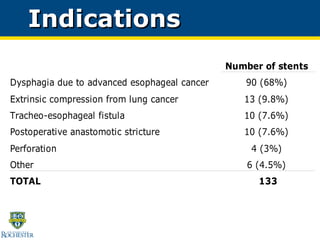
Indications
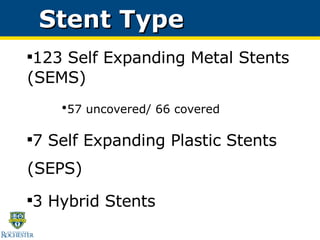
Stent Type 123 Self Expanding Metal Stents (SEMS)‏  57 uncovered/ 66 covered   7 Self Expanding Plastic Stents (SEPS)‏ 3 Hybrid Stents
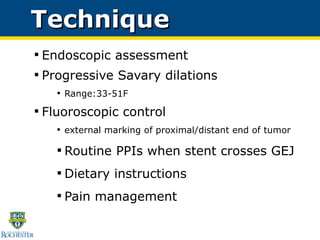
Technique Endoscopic assessment Progressive Savary dilations Range:33-51F Fluoroscopic control external marking of proximal/distant end of tumor Routine PPIs when stent crosses GEJ Dietary instructions Pain management
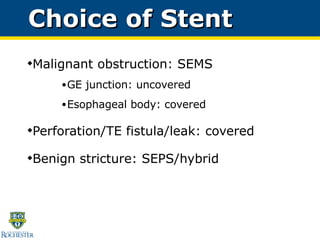
Malignant obstruction: SEMS GE junction: uncovered Esophageal body: covered Perforation/TE fistula/leak: covered Benign stricture: SEPS/hybrid  Choice of Stent
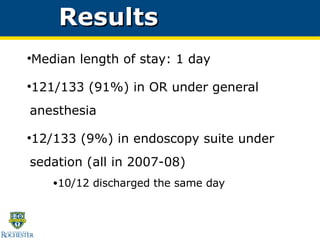
Results Median length of stay: 1 day 121/133 (91%) in OR under general anesthesia 12/133 (9%) in endoscopy suite under sedation (all in 2007-08)‏ 10/12 discharged the same day
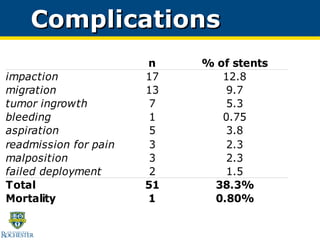
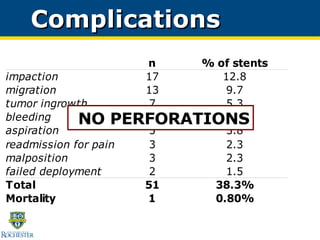
Complications
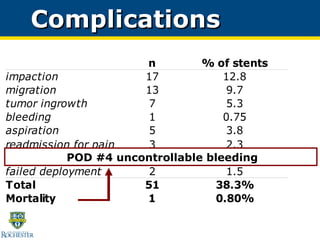
Complications POD #4 uncontrollable bleeding
Complications NO PERFORATIONS
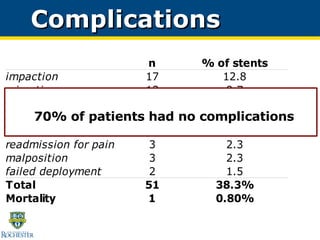
Complications 70% of patients had no complications
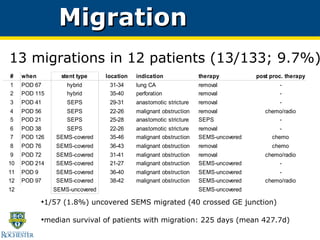
1/57 (1.8%) uncovered SEMS migrated (40 crossed GE junction)‏ median survival of patients with migration: 225 days (mean 427.7d)‏ 13 migrations in 12 patients (13/133; 9.7%)‏ Migration
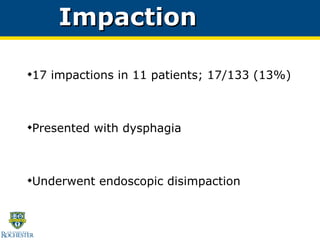
Impaction 17 impactions in 11 patients; 17/133 (13%)‏ Presented with dysphagia Underwent endoscopic disimpaction
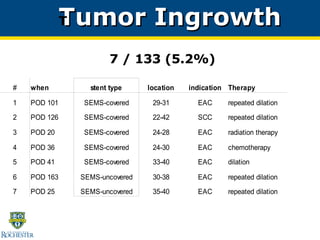
Tumor Ingrowth 7 / 133 (5.2%)‏ ‏
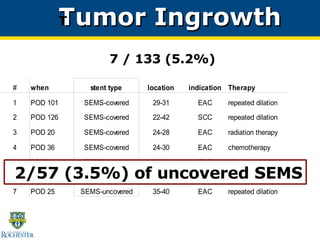
Tumor Ingrowth 7 / 133 (5.2%)‏ ‏ 2/57 (3.5%) of uncovered SEMS
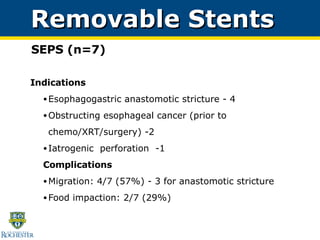
SEPS (n=7)‏ Indications Esophagogastric anastomotic stricture - 4 Obstructing esophageal cancer (prior to chemo/XRT/surgery) -2 Iatrogenic  perforation  -1 Complications Migration: 4/7 (57%)‏ - 3 for anastomotic stricture Food impaction: 2/7 (29%)‏ Removable Stents
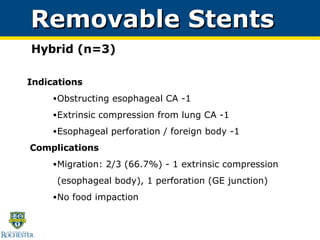
Hybrid (n=3)‏ Indications Obstructing esophageal CA -1 Extrinsic compression from lung CA -1 Esophageal perforation / foreign body -1 Complications Migration: 2/3 (66.7%)‏ - 1 extrinsic compression (esophageal body), 1 perforation (GE junction)‏ No food impaction‏ Removable Stents
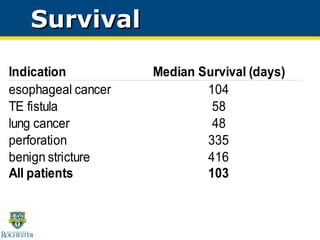
Survival
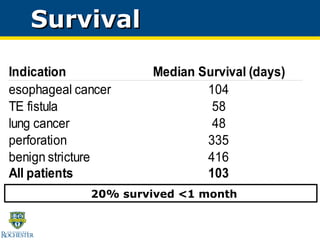
Survival 20% survived <1 month
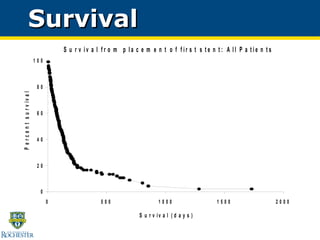
Survival
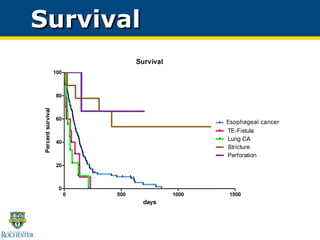
Survival
Conclusions Safe, quick and reliable  Majority require no further interventions Short life-expectancy Patient selection may be difficult
Conclusions Most complications are secondary to stent obstruction  Tumor ingrowth rare with uncovered stents  Stent migration an issue with any covered stent Esophageal surgeons should be adept at stent placement
Thank You!

Stent Presentation at STS 2009 San francisco

  • 1.
    Esophageal Stenting forMalignant and Benign Disease: 133 Cases on a Thoracic Surgical Service A Dubecz, TJ Watson, A Matousek, J Allen, M Polomsky, R Salvador, CE Jones, DP Raymond, JH Peters Society of Thoracic Surgeons 45th Annual Meeting, January 26-28, 2009, San Francisco, CA Division of Thoracic and Foregut Surgery, Department of Surgery University of Rochester School of Medicine and Dentistry Rochester, NY
  • 2.
    The authors havenothing to disclose
  • 3.
    Background Stents havebeen increasingly utilized to treat a variety of malignant and benign esophageal disorders. easy inexpensive low morbidity increased indications with removable stents for benign disease
  • 4.
    Background Photodynamic therapyLimitations: photosensitizer costs delayed palliation multiple sessions future uncertain Litle VR, Luketich JD et al. Photodynamic therapy as palliation for esophageal cancer: experience in 215 patients. Ann Thor. Surg. 2003 Nov;76(5):1687-92 1.8% mortality, 2% perforation, 2% stricture, 6% sunburn
  • 5.
    Background Palliation bysurgery Blazeby et al. A prospective longitudinal study examining quality of life in patients with esophageal carcinoma. CANCER 2000 Frenken Best palliation in esophageal cancer: surgery, stenting, radiation or what? Diseases of Esophagus 2001.
  • 6.
    Background Palliation bychemotherapy or radiotherapy effective delayed effect toxicity Homs MY et al. Single-dose brachytherapy versus metal stent placement for the palliation of dysphagia from oesophageal cancer: multicentre randomised trial. Lancet. 2004 Tumor persistence 18%, tumor regrowth 26%
  • 7.
    Aim To evaluateour recent experience with self-expanding metal, plastic and hybrid stents in the treatment of esophageal disease on a thoracic surgical service.
  • 8.
    Methods Single Institution2000-2008 Retrospective chart review Social Security Death Index for mortality 126 Patients (91 men and 35 women)‏ Age(mean) 68.3 years
  • 9.
  • 10.
    Stent Type 123Self Expanding Metal Stents (SEMS)‏ 57 uncovered/ 66 covered 7 Self Expanding Plastic Stents (SEPS)‏ 3 Hybrid Stents
  • 11.
    Technique Endoscopic assessmentProgressive Savary dilations Range:33-51F Fluoroscopic control external marking of proximal/distant end of tumor Routine PPIs when stent crosses GEJ Dietary instructions Pain management
  • 12.
    Malignant obstruction: SEMSGE junction: uncovered Esophageal body: covered Perforation/TE fistula/leak: covered Benign stricture: SEPS/hybrid Choice of Stent
  • 13.
    Results Median lengthof stay: 1 day 121/133 (91%) in OR under general anesthesia 12/133 (9%) in endoscopy suite under sedation (all in 2007-08)‏ 10/12 discharged the same day
  • 14.
  • 15.
    Complications POD #4uncontrollable bleeding
  • 16.
  • 17.
    Complications 70% ofpatients had no complications
  • 18.
    1/57 (1.8%) uncoveredSEMS migrated (40 crossed GE junction)‏ median survival of patients with migration: 225 days (mean 427.7d)‏ 13 migrations in 12 patients (13/133; 9.7%)‏ Migration
  • 19.
    Impaction 17 impactionsin 11 patients; 17/133 (13%)‏ Presented with dysphagia Underwent endoscopic disimpaction
  • 20.
    Tumor Ingrowth 7/ 133 (5.2%)‏ ‏
  • 21.
    Tumor Ingrowth 7/ 133 (5.2%)‏ ‏ 2/57 (3.5%) of uncovered SEMS
  • 22.
    SEPS (n=7)‏ IndicationsEsophagogastric anastomotic stricture - 4 Obstructing esophageal cancer (prior to chemo/XRT/surgery) -2 Iatrogenic perforation -1 Complications Migration: 4/7 (57%)‏ - 3 for anastomotic stricture Food impaction: 2/7 (29%)‏ Removable Stents
  • 23.
    Hybrid (n=3)‏ IndicationsObstructing esophageal CA -1 Extrinsic compression from lung CA -1 Esophageal perforation / foreign body -1 Complications Migration: 2/3 (66.7%)‏ - 1 extrinsic compression (esophageal body), 1 perforation (GE junction)‏ No food impaction‏ Removable Stents
  • 24.
  • 25.
  • 26.
  • 27.
  • 28.
    Conclusions Safe, quickand reliable Majority require no further interventions Short life-expectancy Patient selection may be difficult
  • 29.
    Conclusions Most complicationsare secondary to stent obstruction Tumor ingrowth rare with uncovered stents Stent migration an issue with any covered stent Esophageal surgeons should be adept at stent placement
  • 30.

Editor's Notes

  • #2 Dr Low, Dr Meyers, I would like to thank the society for the privilage of presenting our data today. This study describes our recent experience with esophageal stenting for both malignant and benign indications. ,