


Trauma de esófago y 
estómago 
VARGAS FLORES EDGAR R2CG
TRAUMA DE ESÓFAGO
INCIDENCIA Y MECANISMO 
• <1% de lesiones traumáticas 
• >80% son por lesiones penetrantes de 
cuello (0.5 a 7%) 
• 0.7% lesión intratorácica 
• HPAF: 43 – 95% 
• Punzocortante: 7 – 57% 
• Contusión <0.1% 
Feliciano DV, Mattox KL et al. Trauma. 6th edition. McGraw Hill; 2008
DIAGNÓSTICO 
• Mecanismo 
• Síntomas 
• Disfonía 
• Enfisema 
• Desviación traqueal 
• No detectado 
• Infección 
•Mediastinitis 
Feliciano DV, Mattox KL et al. Trauma. 6th edition. McGraw Hill; 2008
DIAGNÓSTICO 
• Trago hidrosoluble 
• Falla hasta en 15% 
• Esofagoscopía + estudio contrastado 
Feliciano DV, Mattox KL et al. Trauma. 6th edition. McGraw Hill; 2008
MANEJO 
• Control de fuga 
• Desbridamiento 
• Drenaje 
• Apoyo nutricional 
Feliciano DV, Mattox KL et al. Trauma. 6th edition. McGraw Hill; 2008
ABORDAJE QUIRÚRGICO 
• Cervical 
• Incisión en collar 
• 2/3 superiores 
• Toracotomía posterolateral derecha 
• 1/3 inferior 
• Toracotomía posterolateral izquierda 
Feliciano DV, Mattox KL et al. Trauma. 6th edition. McGraw Hill; 2008
REPARACIÓN 
• Cierre primario (24 horas) 
• Parches 
• Pericardio 
• Grasa pericárdica 
• Diafragmático 
• Dorsal ancho o romboides. 
• Esofagostomía 
• Drenaje 
• Diagnóstico tardío 
• Sonda en T 
Feliciano DV, Mattox KL et al. Trauma. 6th edition. McGraw Hill; 2008
TRAUMA DE ESTÓMAGO
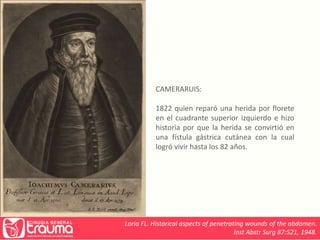
CAMERARUIS: 
1822 quien reparó una herida por florete 
en el cuadrante superior izquierdo e hizo 
historia por que la herida se convirtió en 
una fístula gástrica cutánea con la cual 
logró vivir hasta los 82 años. 
Loria FL. Historical aspects of penetrating wounds of the abdomen. 
Inst Abstr Surg 87:521, 1948.
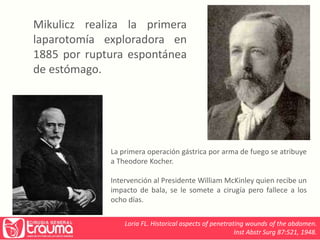
Mikulicz realiza la primera 
laparotomía exploradora en 
1885 por ruptura espontánea 
de estómago. 
La primera operación gástrica por arma de fuego se atribuye 
a Theodore Kocher. 
Intervención al Presidente William McKinley quien recibe un 
impacto de bala, se le somete a cirugía pero fallece a los 
ocho días. 
Loria FL. Historical aspects of penetrating wounds of the abdomen. 
Inst Abstr Surg 87:521, 1948.
INCIDENCIA Y MECANISMO 
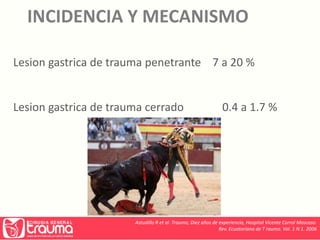
Lesion gastrica de trauma penetrante 7 a 20 % 
Lesion gastrica de trauma cerrado 0.4 a 1.7 % 
Astudillo R et al. Trauma, Diez años de experiencia, Hospital Vicente Corral Moscoso. 
Rev. Ecuatoriana de T rauma. Vol. 1 N 1. 2006
MORTALIDAD: 
TRAUMA CERRADO: 
0% - 66 % ( Media 30% ) 
TRAUMA ABIERTO: 
14% - 20% 
Shinkawa H, Yasuhara H, Nika S, et al: Characteristic features of abdominal organ injuries associated with 
gastric rupture in blunt abdominal trauma. Am J Surg 187:394–397, 2004.
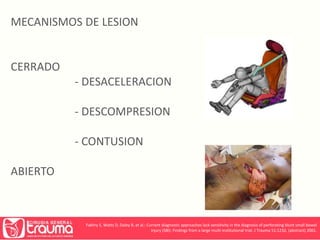
MECANISMOS DE LESION 
CERRADO 
- DESACELERACION 
- DESCOMPRESION 
- CONTUSION 
ABIERTO 
Fakhry S, Watts D, Daley B, et al.: Current diagnostic approaches lack sensitivity in the diagnosis of perforating blunt small bowel 
injury (SBI): Findings from a large multi-institutional trial. J Trauma 51:1232, (abstract) 2001.
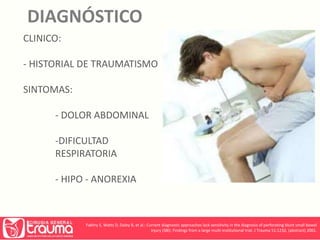
DIAGNÓSTICO 
CLINICO: 
- HISTORIAL DE TRAUMATISMO 
SINTOMAS: 
- DOLOR ABDOMINAL 
-DIFICULTAD 
RESPIRATORIA 
- HIPO - ANOREXIA 
Fakhry S, Watts D, Daley B, et al.: Current diagnostic approaches lack sensitivity in the diagnosis of perforating blunt small bowel 
injury (SBI): Findings from a large multi-institutional trial. J Trauma 51:1232, (abstract) 2001.
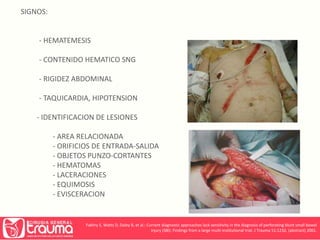
SIGNOS: 
- HEMATEMESIS 
- CONTENIDO HEMATICO SNG 
- RIGIDEZ ABDOMINAL 
- TAQUICARDIA, HIPOTENSION 
- IDENTIFICACION DE LESIONES 
- AREA RELACIONADA 
- ORIFICIOS DE ENTRADA-SALIDA 
- OBJETOS PUNZO-CORTANTES 
- HEMATOMAS 
- LACERACIONES 
- EQUIMOSIS 
- EVISCERACION 
Fakhry S, Watts D, Daley B, et al.: Current diagnostic approaches lack sensitivity in the diagnosis of perforating blunt small bowel 
injury (SBI): Findings from a large multi-institutional trial. J Trauma 51:1232, (abstract) 2001.
LABORATORIO: 
- LEUCOCITOSIS 
- AMILASA 
- ACIDOSIS METABOLICA 
Fakhry S, Watts D, Daley B, et al.: Current diagnostic approaches lack sensitivity in the diagnosis of perforating blunt small bowel 
injury (SBI): Findings from a large multi-institutional trial. J Trauma 51:1232, (abstract) 2001.
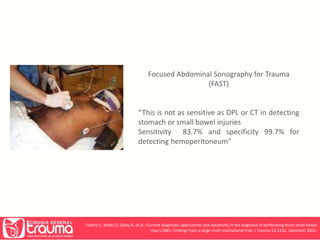
Focused Abdominal Sonography for Trauma 
(FAST) 
“This is not as sensitive as DPL or CT in detecting 
stomach or small bowel injuries 
Sensitivity 83.7% and specificity 99.7% for 
detecting hemoperitoneum” 
Fakhry S, Watts D, Daley B, et al.: Current diagnostic approaches lack sensitivity in the diagnosis of perforating blunt small bowel 
injury (SBI): Findings from a large multi-institutional trial. J Trauma 51:1232, (abstract) 2001.
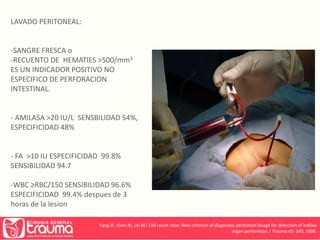
LAVADO PERITONEAL: 
-SANGRE FRESCA o 
-RECUENTO DE HEMATIES >500/mm3 
ES UN INDICADOR POSITIVO NO 
ESPECIFICO DE PERFORACION 
INTESTINAL. 
- AMILASA >20 IU/L SENSBILIDAD 54%, 
ESPECIFICIDAD 48% 
- FA >10 IU ESPECIFICIDAD 99.8% 
SENSIBILIDAD 94.7 
-WBC ≥RBC/150 SENSIBILIDAD 96.6% 
ESPECIFICIDAD 99.4% despues de 3 
horas de la lesion 
Fang JF, Chen RJ, Lin BC: Cell count ratio: New criterion of diagnostic peritoneal lavage for detection of hollow 
organ perforation. J Trauma 45: 540, 1998.
Fakhry S, Watts D, Daley B, et al.: Current diagnostic approaches lack sensitivity in the diagnosis of perforating blunt 
small bowel injury (SBI): Findings from a large multi-institutional trial. J Trauma 51:1232, (abstract) 2001.
TOMOGRAFIA COMPUTARIZADA 
Mas común en la evaluacion del abdomen en paciente 
hemodinamicamente estables 
-Traumas cerrados 
- Ocasionalmente en traumas abiertos 
Econtrando: fluido intraperitoneal, pneuoperitoneo, 
inflamacion de grasaperitoneal, hematomas 
mesentericos, extravasacion del contraste 
Sensibilidad 88.3% especificidad 99.4% 
Fakhry S, Watts D, Daley B, et al.: Current diagnostic approaches lack sensitivity in the diagnosis of perforating blunt 
small bowel injury (SBI): Findings from a large multi-institutional trial. J Trauma 51:1232, (abstract) 2001.
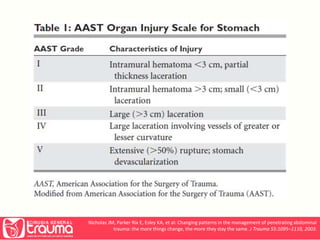
Nicholas JM, Parker Rix E, Esley KA, et al: Changing patterns in the management of penetrating abdominal 
trauma: the more things change, the more they stay the same. J Trauma 55:1095–1110, 2003.
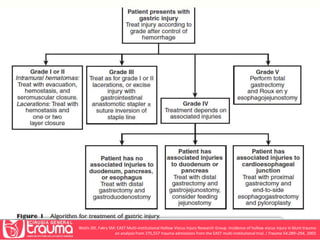
Watts DD, Fakry SM: EAST Multi-Institutional Hollow Viscus Injury Research Group. Incidence of hollow viscus injury in blunt trauma: 
an analysis from 275,557 trauma admissions from the EAST multi-institutional trial. J Trauma 54:289–294, 2003.
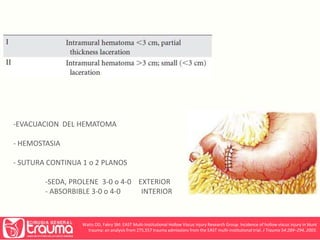
-EVACUACION DEL HEMATOMA 
- HEMOSTASIA 
- SUTURA CONTINUA 1 o 2 PLANOS 
-SEDA, PROLENE 3-0 o 4-0 EXTERIOR 
- ABSORBIBLE 3-0 o 4-0 INTERIOR 
Watts DD, Fakry SM: EAST Multi-Institutional Hollow Viscus Injury Research Group. Incidence of hollow viscus injury in blunt 
trauma: an analysis from 275,557 trauma admissions from the EAST multi-institutional trial. J Trauma 54:289–294, 2003.
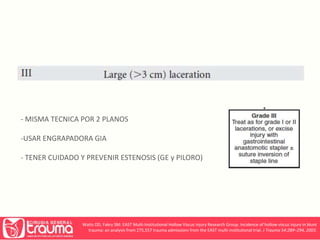
- MISMA TECNICA POR 2 PLANOS 
-USAR ENGRAPADORA GIA 
- TENER CUIDADO Y PREVENIR ESTENOSIS (GE y PILORO) 
Watts DD, Fakry SM: EAST Multi-Institutional Hollow Viscus Injury Research Group. Incidence of hollow viscus injury in blunt 
trauma: an analysis from 275,557 trauma admissions from the EAST multi-institutional trial. J Trauma 54:289–294, 2003.
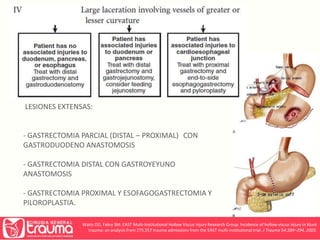
LESIONES EXTENSAS: 
- GASTRECTOMIA PARCIAL (DISTAL – PROXIMAL) CON 
GASTRODUODENO ANASTOMOSIS 
- GASTRECTOMIA DISTAL CON GASTROYEYUNO 
ANASTOMOSIS 
- GASTRECTOMIA PROXIMAL Y ESOFAGOGASTRECTOMIA Y 
PILOROPLASTIA. 
Watts DD, Fakry SM: EAST Multi-Institutional Hollow Viscus Injury Research Group. Incidence of hollow viscus injury in blunt 
trauma: an analysis from 275,557 trauma admissions from the EAST multi-institutional trial. J Trauma 54:289–294, 2003.
Gracias

Trauma de esófago y estómago

  • 1.
    Trauma de esófagoy estómago VARGAS FLORES EDGAR R2CG
  • 2.
  • 3.
    INCIDENCIA Y MECANISMO • <1% de lesiones traumáticas • >80% son por lesiones penetrantes de cuello (0.5 a 7%) • 0.7% lesión intratorácica • HPAF: 43 – 95% • Punzocortante: 7 – 57% • Contusión <0.1% Feliciano DV, Mattox KL et al. Trauma. 6th edition. McGraw Hill; 2008
  • 4.
    DIAGNÓSTICO • Mecanismo • Síntomas • Disfonía • Enfisema • Desviación traqueal • No detectado • Infección •Mediastinitis Feliciano DV, Mattox KL et al. Trauma. 6th edition. McGraw Hill; 2008
  • 5.
    DIAGNÓSTICO • Tragohidrosoluble • Falla hasta en 15% • Esofagoscopía + estudio contrastado Feliciano DV, Mattox KL et al. Trauma. 6th edition. McGraw Hill; 2008
  • 6.
    MANEJO • Controlde fuga • Desbridamiento • Drenaje • Apoyo nutricional Feliciano DV, Mattox KL et al. Trauma. 6th edition. McGraw Hill; 2008
  • 7.
    ABORDAJE QUIRÚRGICO •Cervical • Incisión en collar • 2/3 superiores • Toracotomía posterolateral derecha • 1/3 inferior • Toracotomía posterolateral izquierda Feliciano DV, Mattox KL et al. Trauma. 6th edition. McGraw Hill; 2008
  • 8.
    REPARACIÓN • Cierreprimario (24 horas) • Parches • Pericardio • Grasa pericárdica • Diafragmático • Dorsal ancho o romboides. • Esofagostomía • Drenaje • Diagnóstico tardío • Sonda en T Feliciano DV, Mattox KL et al. Trauma. 6th edition. McGraw Hill; 2008
  • 9.
  • 10.
    CAMERARUIS: 1822 quienreparó una herida por florete en el cuadrante superior izquierdo e hizo historia por que la herida se convirtió en una fístula gástrica cutánea con la cual logró vivir hasta los 82 años. Loria FL. Historical aspects of penetrating wounds of the abdomen. Inst Abstr Surg 87:521, 1948.
  • 11.
    Mikulicz realiza laprimera laparotomía exploradora en 1885 por ruptura espontánea de estómago. La primera operación gástrica por arma de fuego se atribuye a Theodore Kocher. Intervención al Presidente William McKinley quien recibe un impacto de bala, se le somete a cirugía pero fallece a los ocho días. Loria FL. Historical aspects of penetrating wounds of the abdomen. Inst Abstr Surg 87:521, 1948.
  • 12.
    INCIDENCIA Y MECANISMO Lesion gastrica de trauma penetrante 7 a 20 % Lesion gastrica de trauma cerrado 0.4 a 1.7 % Astudillo R et al. Trauma, Diez años de experiencia, Hospital Vicente Corral Moscoso. Rev. Ecuatoriana de T rauma. Vol. 1 N 1. 2006
  • 13.
    MORTALIDAD: TRAUMA CERRADO: 0% - 66 % ( Media 30% ) TRAUMA ABIERTO: 14% - 20% Shinkawa H, Yasuhara H, Nika S, et al: Characteristic features of abdominal organ injuries associated with gastric rupture in blunt abdominal trauma. Am J Surg 187:394–397, 2004.
  • 14.
    MECANISMOS DE LESION CERRADO - DESACELERACION - DESCOMPRESION - CONTUSION ABIERTO Fakhry S, Watts D, Daley B, et al.: Current diagnostic approaches lack sensitivity in the diagnosis of perforating blunt small bowel injury (SBI): Findings from a large multi-institutional trial. J Trauma 51:1232, (abstract) 2001.
  • 15.
    DIAGNÓSTICO CLINICO: -HISTORIAL DE TRAUMATISMO SINTOMAS: - DOLOR ABDOMINAL -DIFICULTAD RESPIRATORIA - HIPO - ANOREXIA Fakhry S, Watts D, Daley B, et al.: Current diagnostic approaches lack sensitivity in the diagnosis of perforating blunt small bowel injury (SBI): Findings from a large multi-institutional trial. J Trauma 51:1232, (abstract) 2001.
  • 16.
    SIGNOS: - HEMATEMESIS - CONTENIDO HEMATICO SNG - RIGIDEZ ABDOMINAL - TAQUICARDIA, HIPOTENSION - IDENTIFICACION DE LESIONES - AREA RELACIONADA - ORIFICIOS DE ENTRADA-SALIDA - OBJETOS PUNZO-CORTANTES - HEMATOMAS - LACERACIONES - EQUIMOSIS - EVISCERACION Fakhry S, Watts D, Daley B, et al.: Current diagnostic approaches lack sensitivity in the diagnosis of perforating blunt small bowel injury (SBI): Findings from a large multi-institutional trial. J Trauma 51:1232, (abstract) 2001.
  • 17.
    LABORATORIO: - LEUCOCITOSIS - AMILASA - ACIDOSIS METABOLICA Fakhry S, Watts D, Daley B, et al.: Current diagnostic approaches lack sensitivity in the diagnosis of perforating blunt small bowel injury (SBI): Findings from a large multi-institutional trial. J Trauma 51:1232, (abstract) 2001.
  • 18.
    Focused Abdominal Sonographyfor Trauma (FAST) “This is not as sensitive as DPL or CT in detecting stomach or small bowel injuries Sensitivity 83.7% and specificity 99.7% for detecting hemoperitoneum” Fakhry S, Watts D, Daley B, et al.: Current diagnostic approaches lack sensitivity in the diagnosis of perforating blunt small bowel injury (SBI): Findings from a large multi-institutional trial. J Trauma 51:1232, (abstract) 2001.
  • 19.
    LAVADO PERITONEAL: -SANGREFRESCA o -RECUENTO DE HEMATIES >500/mm3 ES UN INDICADOR POSITIVO NO ESPECIFICO DE PERFORACION INTESTINAL. - AMILASA >20 IU/L SENSBILIDAD 54%, ESPECIFICIDAD 48% - FA >10 IU ESPECIFICIDAD 99.8% SENSIBILIDAD 94.7 -WBC ≥RBC/150 SENSIBILIDAD 96.6% ESPECIFICIDAD 99.4% despues de 3 horas de la lesion Fang JF, Chen RJ, Lin BC: Cell count ratio: New criterion of diagnostic peritoneal lavage for detection of hollow organ perforation. J Trauma 45: 540, 1998.
  • 20.
    Fakhry S, WattsD, Daley B, et al.: Current diagnostic approaches lack sensitivity in the diagnosis of perforating blunt small bowel injury (SBI): Findings from a large multi-institutional trial. J Trauma 51:1232, (abstract) 2001.
  • 21.
    TOMOGRAFIA COMPUTARIZADA Mascomún en la evaluacion del abdomen en paciente hemodinamicamente estables -Traumas cerrados - Ocasionalmente en traumas abiertos Econtrando: fluido intraperitoneal, pneuoperitoneo, inflamacion de grasaperitoneal, hematomas mesentericos, extravasacion del contraste Sensibilidad 88.3% especificidad 99.4% Fakhry S, Watts D, Daley B, et al.: Current diagnostic approaches lack sensitivity in the diagnosis of perforating blunt small bowel injury (SBI): Findings from a large multi-institutional trial. J Trauma 51:1232, (abstract) 2001.
  • 22.
    Nicholas JM, ParkerRix E, Esley KA, et al: Changing patterns in the management of penetrating abdominal trauma: the more things change, the more they stay the same. J Trauma 55:1095–1110, 2003.
  • 23.
    Watts DD, FakrySM: EAST Multi-Institutional Hollow Viscus Injury Research Group. Incidence of hollow viscus injury in blunt trauma: an analysis from 275,557 trauma admissions from the EAST multi-institutional trial. J Trauma 54:289–294, 2003.
  • 24.
    -EVACUACION DEL HEMATOMA - HEMOSTASIA - SUTURA CONTINUA 1 o 2 PLANOS -SEDA, PROLENE 3-0 o 4-0 EXTERIOR - ABSORBIBLE 3-0 o 4-0 INTERIOR Watts DD, Fakry SM: EAST Multi-Institutional Hollow Viscus Injury Research Group. Incidence of hollow viscus injury in blunt trauma: an analysis from 275,557 trauma admissions from the EAST multi-institutional trial. J Trauma 54:289–294, 2003.
  • 25.
    - MISMA TECNICAPOR 2 PLANOS -USAR ENGRAPADORA GIA - TENER CUIDADO Y PREVENIR ESTENOSIS (GE y PILORO) Watts DD, Fakry SM: EAST Multi-Institutional Hollow Viscus Injury Research Group. Incidence of hollow viscus injury in blunt trauma: an analysis from 275,557 trauma admissions from the EAST multi-institutional trial. J Trauma 54:289–294, 2003.
  • 26.
    LESIONES EXTENSAS: -GASTRECTOMIA PARCIAL (DISTAL – PROXIMAL) CON GASTRODUODENO ANASTOMOSIS - GASTRECTOMIA DISTAL CON GASTROYEYUNO ANASTOMOSIS - GASTRECTOMIA PROXIMAL Y ESOFAGOGASTRECTOMIA Y PILOROPLASTIA. Watts DD, Fakry SM: EAST Multi-Institutional Hollow Viscus Injury Research Group. Incidence of hollow viscus injury in blunt trauma: an analysis from 275,557 trauma admissions from the EAST multi-institutional trial. J Trauma 54:289–294, 2003.
  • 28.