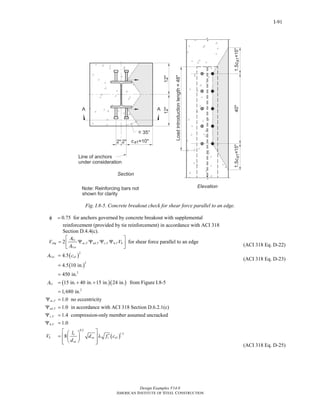
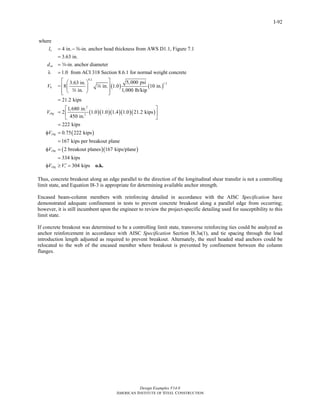
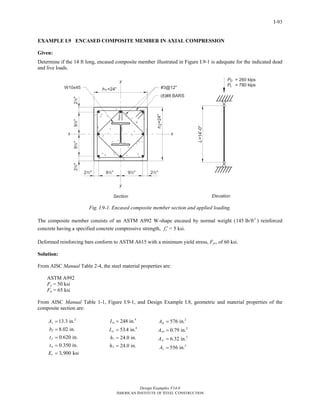
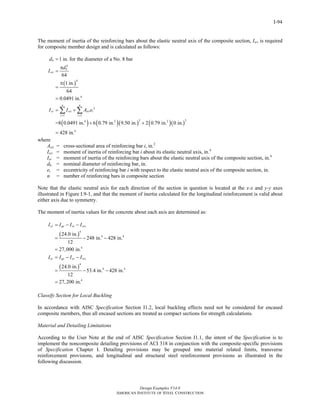
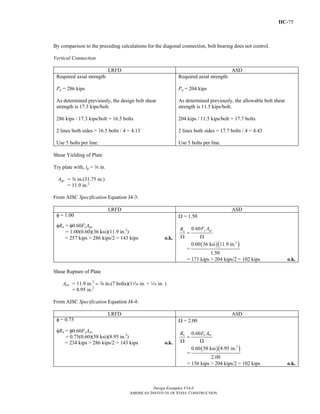
DESIGN EXAMPLES
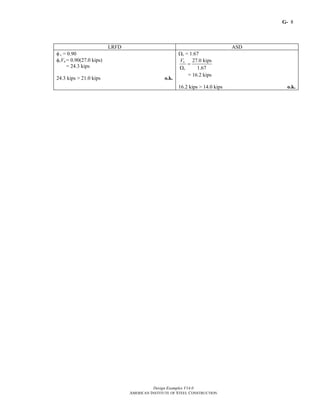
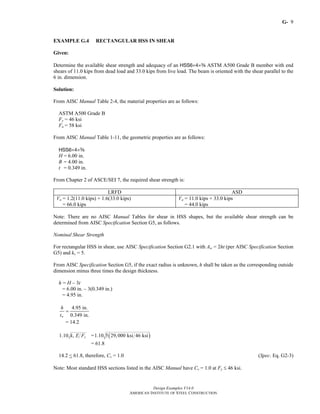
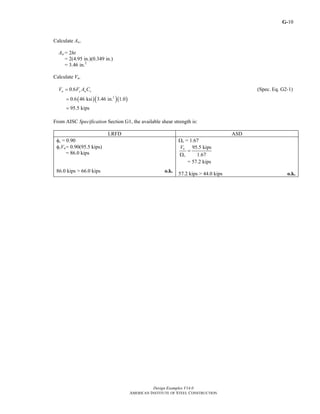
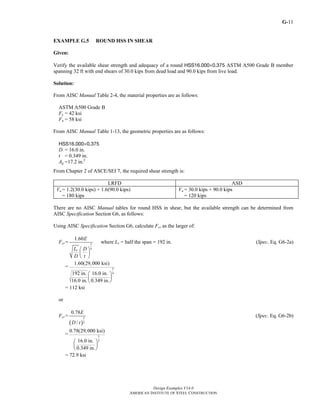
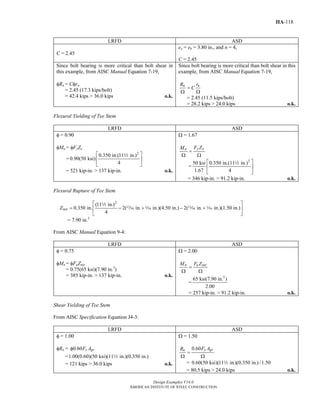
Version 14.0
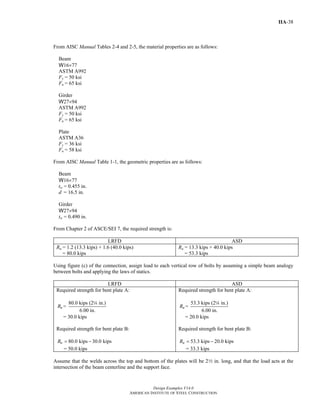
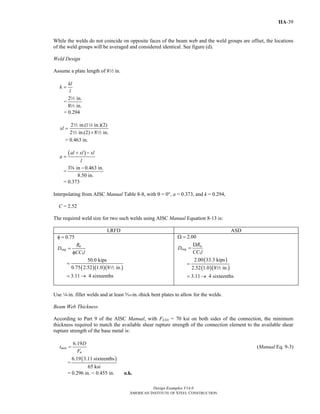
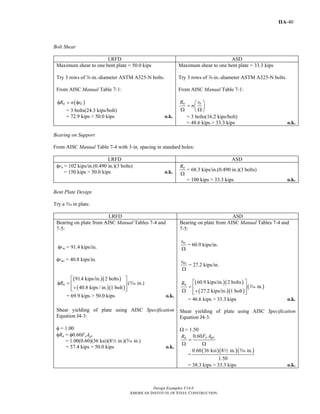
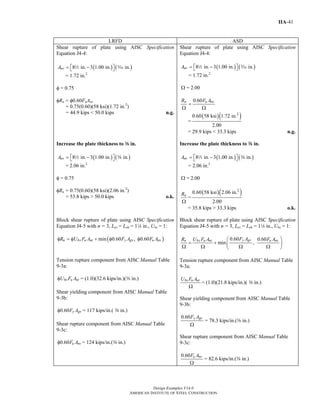
AMERICAN INSTITUTE
OF
STEEL CONSTRUCTION
Design Examples V14.0
AMERICAN INSTITUTE OF STEEL CONSTRUCTION
ii
Copyright © 2011
by
American Institute of Steel Construction
All rights reserved. This publication or any part thereof
must not be reproduced in any form without the
written permission of the publisher.
The AISC logo is a registered trademark of AISC.
The information presented in this publication has been prepared in accordance with recognized engineering principles
and is for general information only. While it is believed to be accurate, this information should not be used or relied
upon for any specific application without competent professional examination and verification of its accuracy,
suitability, and applicability by a licensed professional engineer, designer, or architect. The publication of the material
contained herein is not intended as a representation or warranty on the part of the American Institute of Steel
Construction or of any other person named herein, that this information is suitable for any general or particular use or
of freedom from infringement of any patent or patents. Anyone making use of this information assumes all liability
arising from such use.
Caution must be exercised when relying upon other specifications and codes developed by other bodies and
incorporated by reference herein since such material may be modified or amended from time to time subsequent to the
printing of this edition. The Institute bears no responsibility for such material other than to refer to it and incorporate it
by reference at the time of the initial publication of this edition.
Printed in the United States of America
First Printing, October 2011
Design Examples V14.0
AMERICAN INSTITUTE OF STEEL CONSTRUCTION
iii
PREFACE
The primary objective of these design examples is to provide illustrations of the use of the 2010 AISC Specification
for Structural Steel Buildings (ANSI/AISC 360-10) and the 14th Edition of the AISC Steel Construction Manual.
The design examples provide coverage of all applicable limit states whether or not a particular limit state controls the
design of the member or connection.
In addition to the examples which demonstrate the use of the Manual tables, design examples are provided for
connection designs beyond the scope of the tables in the Manual. These design examples are intended to demonstrate
an approach to the design, and are not intended to suggest that the approach presented is the only approach. The
committee responsible for the development of these design examples recognizes that designers have alternate
approaches that work best for them and their projects. Design approaches that differ from those presented in these
examples are considered viable as long as the Specification, sound engineering, and project specific requirements are
satisfied.
Part I of these examples is organized to correspond with the organization of the Specification. The Chapter titles
match the corresponding chapters in the Specification.
Part II is devoted primarily to connection examples that draw on the tables from the Manual, recommended design
procedures, and the breadth of the Specification. The chapters of Part II are labeled II-A, II-B, II-C, etc.
Part III addresses aspects of design that are linked to the performance of a building as a whole. This includes
coverage of lateral stability and second order analysis, illustrated through a four-story braced-frame and moment-
frame building.
The Design Examples are arranged with LRFD and ASD designs presented side by side, for consistency with the
AISC Manual. Design with ASD and LRFD are based on the same nominal strength for each element so that the
only differences between the approaches are which set of load combinations from ASCE/SEI 7-10 are used for
design and whether the resistance factor for LRFD or the safety factor for ASD is used.
CONVENTIONS
The following conventions are used throughout these examples:
1. The 2010 AISC Specification for Structural Steel Buildings is referred to as the AISC Specification and the
14th Edition AISC Steel Construction Manual, is referred to as the AISC Manual.
2. The source of equations or tabulated values taken from the AISC Specification or AISC Manual is noted
along the right-hand edge of the page.
3. When the design process differs between LRFD and ASD, the designs equations are presented side-by-side.
This rarely occurs, except when the resistance factor, φ, and the safety factor, Ω, are applied.
4. The results of design equations are presented to three significant figures throughout these calculations.
ACKNOWLEDGMENTS
The AISC Committee on Manuals reviewed and approved V14.0 of the AISC Design Examples:
William A. Thornton, Chairman
Mark V. Holland, Vice Chairman
Abbas Aminmansour
Charles J. Carter
Harry A. Cole
Douglas B. Davis
Robert O. Disque
Bo Dowswell
Edward M. Egan
Marshall T. Ferrell
Design Examples V14.0
AMERICAN INSTITUTE OF STEEL CONSTRUCTION
iv
Lanny J. Flynn
Patrick J. Fortney
Louis F. Geschwindner
W. Scott Goodrich
Christopher M. Hewitt
W. Steven Hofmeister
Bill R. Lindley, II
Ronald L. Meng
Larry S. Muir
Thomas M. Murray
Charles R. Page
Davis G. Parsons, II
Rafael Sabelli
Clifford W. Schwinger
William N. Scott
William T. Segui
Victor Shneur
Marc L. Sorenson
Gary C. Violette
Michael A. West
Ronald G. Yeager
Cynthia J. Duncan, Secretary
The AISC Committee on Manuals gratefully acknowledges the contributions of the following individuals who
assisted in the development of this document: Leigh Arber, Eric Bolin, Janet Cummins, Thomas Dehlin, William
Jacobs, Richard C. Kaehler, Margaret Matthew, Heath Mitchell, Thomas J. Schlafly, and Sriramulu Vinnakota.
Design Examples V14.0
AMERICAN INSTITUTE OF STEEL CONSTRUCTION
v
TABLE OF CONTENTS
PART I. EXAMPLES BASED ON THE AISC SPECIFICATION
CHAPTER A GENERAL PROVISIONS.........................................................................................................A-1
Chapter A
References ......................................................................................................................................................A-2
CHAPTER B DESIGN REQUIREMENTS .....................................................................................................B-1
Chapter B
References ......................................................................................................................................................B-2
CHAPTER C DESIGN FOR STABILITY.......................................................................................................C-1
Example C.1A Design of a Moment Frame by the Direct Analysis Method ........................................................C-2
Example C.1B Design of a Moment Frame by the Effective Length Method ......................................................C-6
Example C.1C Design of a Moment Frame by the First-Order Method .............................................................C-11
CHAPTER D DESIGN OF MEMBERS FOR TENSION...............................................................................D-1
Example D.1 W-Shape Tension Member ..........................................................................................................D-2
Example D.2 Single Angle Tension Member ....................................................................................................D-5
Example D.3 WT-Shape Tension Member ........................................................................................................D-8
Example D.4 Rectangular HSS Tension Member ............................................................................................D-11
Example D.5 Round HSS Tension Member ....................................................................................................D-14
Example D.6 Double Angle Tension Member .................................................................................................D-17
Example D.7 Pin-Connected Tension Member ...............................................................................................D-20
Example D.8 Eyebar Tension Member ............................................................................................................D-23
Example D.9 Plate with Staggered Bolts .........................................................................................................D-25
CHAPTER E DESIGN OF MEMBERS FOR COMPRESSION...................................................................E-1
Example E.1A W-Shape Column Design with Pinned Ends ............................................................................... E-4
Example E.1B W-Shape Column Design with Intermediate Bracing.................................................................. E-6
Example E.1C W-Shape Available Strength Calculation .................................................................................... E-8
Example E.1D W-Shape Available Strength Calculation .................................................................................... E-9
Example E.2 Built-up Column with a Slender Web........................................................................................ E-11
Example E.3 Built-up Column with Slender Flanges ...................................................................................... E-16
Example E.4A W-Shape Compression Member (Moment Frame) .................................................................... E-21
Example E.4B W-Shape Compression Member (Moment Frame) .................................................................... E-25
Example E.5 Double Angle Compression Member without Slender Elements ............................................... E-26
Example E.6 Double Angle Compression Member with Slender Elements .................................................... E-31
Example E.7 WT Compression Member without Slender Elements ............................................................... E-37
Example E.8 WT Compression Member with Slender Elements .................................................................... E-42
Example E.9 Rectangular HSS Compression Member without Slender Elements ......................................... E-47
Example E.10 Rectangular HSS Compression Member with Slender Elements ............................................... E-50
Example E.11 Pipe Compression Member ........................................................................................................ E-54
Example E.12 Built-up I-Shaped Member with Different Flange Sizes ............................................................ E-57
Example E.13 Double WT Compression Member............................................................................................. E-63
CHAPTER F DESIGN OF MEMBERS FOR FLEXURE.............................................................................. F-1
Example F.1-1A W-Shape Flexural Member Design in Strong-Axis Bending, Continuously Braced ................... F-6
Example F.1-1B W-Shape Flexural Member Design in Strong-Axis Bending, Continuously Braced................... F-8
Example F.1-2A W-Shape Flexural Member Design in Strong-Axis Bending, Braced at Third Points ................. F-9
Example F.1-2B W-Shape Flexural Member Design in Strong-Axis Bending, Braced at Third Points............... F-10
Design Examples V14.0
AMERICAN INSTITUTE OF STEEL CONSTRUCTION
vi
Example F.1-3A W-Shape Flexural Member Design in Strong-Axis Bending, Braced at Midspan..................... F-12
Example F.1-3B W-Shape Flexural Member Design in Strong-Axis Bending, Braced at Midspan..................... F-14
Example F.2-1A Compact Channel Flexural Member, Continuously Braced ...................................................... F-16
Example F.2-1B Compact Channel Flexural Member, Continuously Braced ...................................................... F-18
Example F.2-2A Compact Channel Flexural Member with Bracing at Ends and Fifth Points ............................. F-19
Example F.2-2B Compact Channel Flexural Member with Bracing at End and Fifth Points ............................... F-20
Example F.3A W-Shape Flexural Member with Noncompact Flanges in Strong-Axis Bending ...................... F-22
Example F.3B W-Shape Flexural Member with Noncompact Flanges in Strong-Axis Bending ...................... F-24
Example F.4 W-Shape Flexural Member, Selection by Moment of Inertia for Strong-Axis Bending ............ F-26
Example F.5 I-Shaped Flexural Member in Minor-Axis Bending .................................................................. F-28
Example F.6 HSS Flexural Member with Compact Flanges ........................................................................... F-30
Example F.7A HSS Flexural Member with Noncompact Flanges ..................................................................... F-32
Example F.7B HSS Flexural Member with Noncompact Flanges ..................................................................... F-34
Example F.8A HSS Flexural Member with Slender Flanges ............................................................................. F-36
Example F.8B HSS Flexural Member with Slender Flanges ............................................................................. F-38
Example F.9A Pipe Flexural Member ................................................................................................................ F-41
Example F.9B Pipe Flexural Member ................................................................................................................ F-42
Example F.10 WT-Shape Flexural Member ..................................................................................................... F-44
Example F.11A Single Angle Flexural Member .................................................................................................. F-47
Example F.11B Single Angle Flexural Member .................................................................................................. F-50
Example F.11C Single Angle Flexural Member .................................................................................................. F-53
Example F.12 Rectangular Bar in Strong-Axis Bending .................................................................................. F-59
Example F.13 Round Bar in Bending ............................................................................................................... F-61
Example F.14 Point-Symmetrical Z-shape in Strong-Axis Bending................................................................. F-63
Chapter F
Design Example
References .................................................................................................................................................... F-69
CHAPTER G DESIGN OF MEMBERS FOR SHEAR...................................................................................G-1
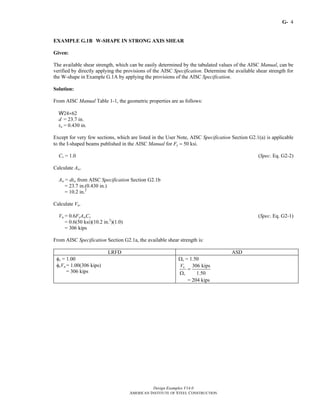
Example G.1A W-Shape in Strong-Axis Shear ....................................................................................................G-3
Example G.1B W-Shape in Strong-Axis Shear ....................................................................................................G-4
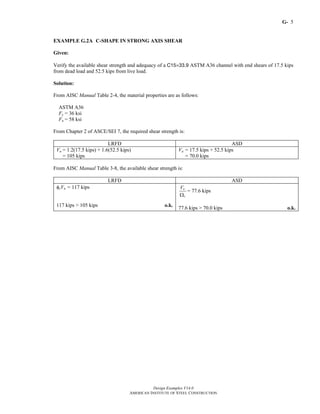
Example G.2A C-Shape in Strong-Axis Shear .....................................................................................................G-5
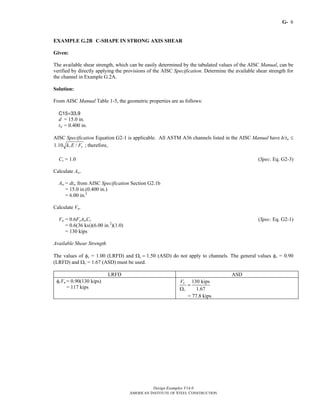
Example G.2B C-Shape in Strong-Axis Shear .....................................................................................................G-6
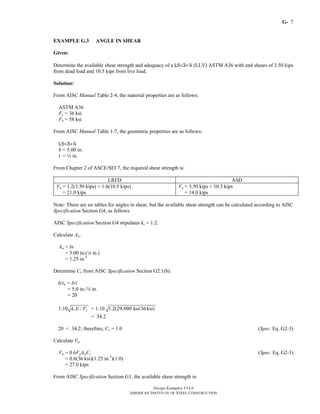
Example G.3 Angle in Shear .............................................................................................................................G-7
Example G.4 Rectangular HSS in Shear ............................................................................................................G-9
Example G.5 Round HSS in Shear ..................................................................................................................G-11
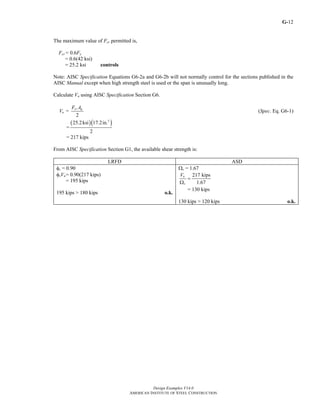
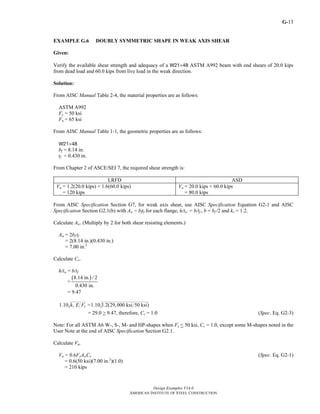
Example G.6 Doubly Symmetric Shape in Weak-Axis Shear .........................................................................G-13
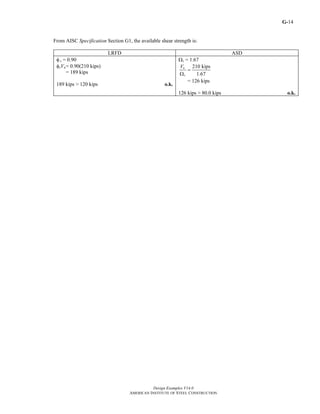
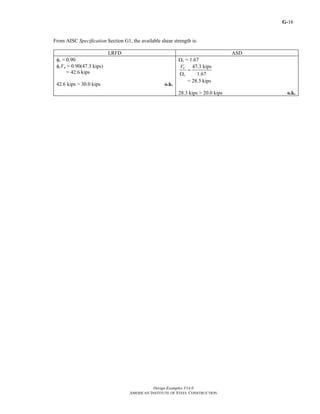
Example G.7 Singly Symmetric Shape in Weak-Axis Shear ...........................................................................G-15
Example G.8A Built-up Girder with Transverse Stiffeners ................................................................................G-17
Example G.8B Built-up Girder with Transverse Stiffeners ................................................................................G-21
Chapter G
Design Example
References ....................................................................................................................................................G-24
CHAPTER H DESIGN OF MEMBERS FOR COMBINED FORCES AND TORSION ............................H-1
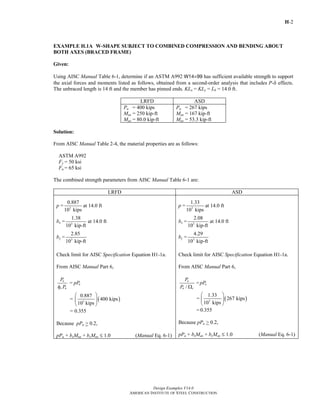
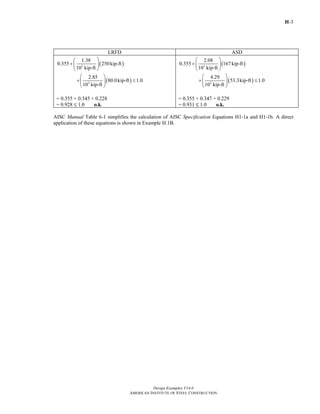
Example H.1A W-shape Subject to Combined Compression and Bending
About Both Axes (Braced Frame) ...............................................................................................H-2
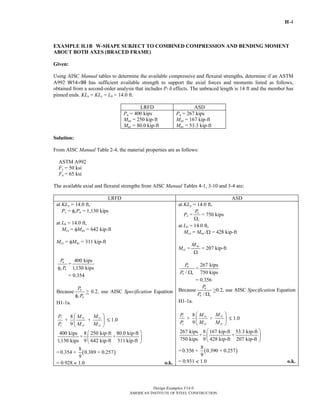
Example H.1B W-shape Subject to Combined Compression and Bending Moment
About Both Axes (Braced Frame) ................................................................................................H-4
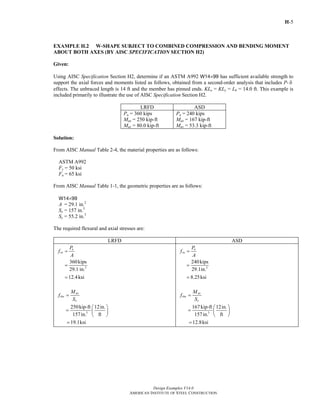
Example H.2 W-Shape Subject to Combined Compression and Bending Moment
About Both Axes (By AISC Specification Section H2) ..............................................................H-5
Example H.3 W-Shape Subject to Combined Axial Tension and Flexure......................................................... H-8
Example H.4 W-Shape Subject to Combined Axial Compression and Flexure ..............................................H-12
Example H.5A Rectangular HSS Torsional Strength .........................................................................................H-16
Design Examples V14.0
AMERICAN INSTITUTE OF STEEL CONSTRUCTION
vii
Example H.5B Round HSS Torsional Strength ..................................................................................................H-17
Example H.5C HSS Combined Torsional and Flexural Strength .......................................................................H-19
Example H.6 W-Shape Torsional Strength ......................................................................................................H-23
Chapter H
Design Example
References ....................................................................................................................................................H-30
CHAPTER I DESIGN OF COMPOSITE MEMBERS...................................................................................I-1
Example I.1 Composite Beam Design ............................................................................................................... I-8
Example I.2 Composite Girder Design ........................................................................................................... I-18
Example I.3 Concrete Filled Tube (CFT) Force Allocation and Load Transfer .............................................. I-35
Example I.4 Concrete Filled Tube (CFT) in Axial Compression .................................................................... I-45
Example I.5 Concrete Filled Tube (CFT) in Axial Tension ............................................................................ I-50
Example I.6 Concrete Filled Tube (CFT) in Combined Axial Compression, Flexure and Shear ................... I-52
Example I.7 Concrete Filled Box Column with Noncompact/Slender Elements ............................................ I-66
Example I.8 Encased Composite Member Force Allocation and Load Transfer ............................................ I-80
Example I.9 Encased Composite Member in Axial Compression ................................................................... I-93
Example I.10 Encased Composite Member in Axial Tension ......................................................................... I-100
Example I.11 Encased Composite Member in Combined Axial Compression, Flexure and Shear ................ I-103
Example I.12 Steel Anchors in Composite Components ................................................................................. I-119
Chapter I
Design Example
References ................................................................................................................................................... I-123
CHAPTER J DESIGN OF CONNECTIONS...................................................................................................J-1
Example J.1 Fillet Weld in Longitudinal Shear .................................................................................................J-2
Example J.2 Fillet Weld Loaded at an Angle ....................................................................................................J-4
Example J.3 Combined Tension and Shear in Bearing Type Connections........................................................ J-6
Example J.4A Slip-Critical Connection with Short-Slotted Holes .......................................................................J-8
Example J.4B Slip-Critical Connection with Long-Slotted Holes .................................................J-10
Example J.5 Combined Tension and Shear in a Slip-Critical Connection .................................................J-12
Example J.6 Bearing Strength of a Pin in a Drilled Hole ................................................................................ J-15
Example J.7 Base Plate Bearing on Concrete...................................................................................................J-16
CHAPTER K DESIGN OF HSS AND BOX MEMBER CONNECTIONS...................................................K-1
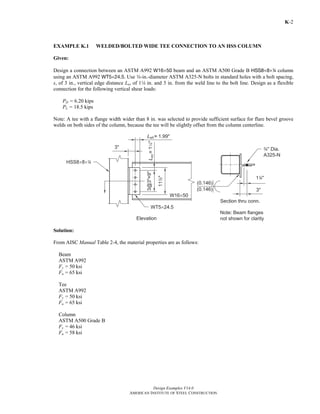
Example K.1 Welded/Bolted Wide Tee Connection to an HSS Column ...........................................................K-2
Example K.2 Welded/Bolted Narrow Tee Connection to an HSS Column .....................................................K-10
Example K.3 Double Angle Connection to an HSS Column ...........................................................................K-13
Example K.4 Unstiffened Seated Connection to an HSS Column ...................................................................K-16
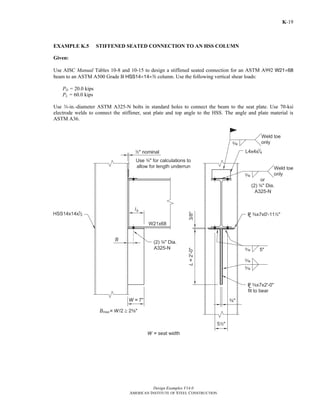
Example K.5 Stiffened Seated Connection to an HSS Column .......................................................................K-19
Example K.6 Single-Plate Connection to Rectangular HSS Column ..............................................................K-24
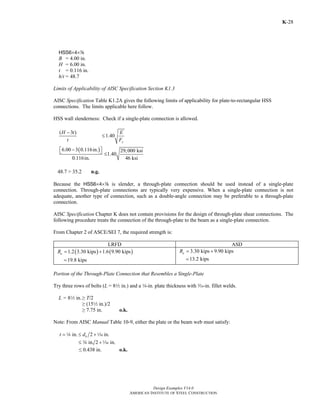
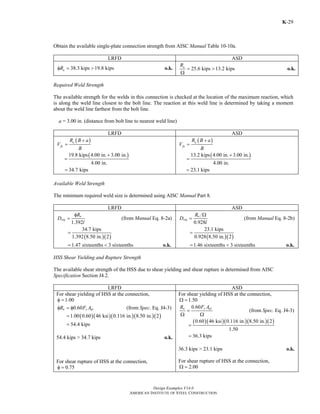
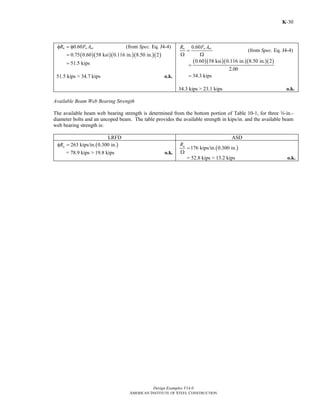
Example K.7 Through-Plate Connection .........................................................................................................K-27
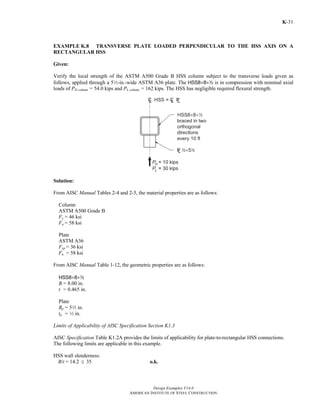
Example K.8 Transverse Plate Loaded Perpendicular to the HSS Axis on a Rectangular HSS .......................K-31
Example K.9 Longitudinal Plate Loaded Perpendicular to the HSS Axis on a Round HSS ............................K-34
Example K.10 HSS Brace Connection to a W-Shape Column...........................................................................K-36
Example K.11 Rectangular HSS Column with a Cap Plate, Supporting a Continuous Beam ...........................K-39
Example K.12 Rectangular HSS Column Base Plate ........................................................................................K-42
Example K.13 Rectangular HSS Strut End Plate ...............................................................................................K-45
Chapter K
Design Example
References ....................................................................................................................................................K-49
Design Examples V14.0
AMERICAN INSTITUTE OF STEEL CONSTRUCTION
viii
PART II. EXAMPLES BASED ON THE AISC STEEL CONSTRUCTION MANUAL
CHAPTER IIA SIMPLE SHEAR CONNECTIONS.......................................................................................IIA-1
Example II.A-1 All-Bolted Double-Angle Connection ...................................................................................... IIA-2
Example II.A-2 Bolted/Welded Double-Angle Connection ............................................................................... IIA-4
Example II.A-3 All-Welded Double-Angle Connection .................................................................................... IIA-6
Example II.A-4 All-Bolted Double-Angle Connection in a Coped Beam .......................................................... IIA-9
Example II.A-5 Welded/ Bolted Double-Angle Connection (Beam-to-Girder Web). ...................................... IIA-13
Example II.A-6 Beam End Coped at the Top Flange Only .............................................................................. IIA-16
Example II.A-7 Beam End Coped at the Top and Bottom Flanges.................................................................. IIA-23
Example II.A-8 All-Bolted Double-Angle Connections (Beams-to-Girder Web) ........................................... IIA-26
Example II.A-9 Offset All-Bolted Double-Angle Connections (Beams-to-Girder Web) ................................ IIA-34
Example II.A-10 Skewed Double Bent-Plate Connection (Beam-to-Girder Web)............................................. IIA-37
Example II.A-11 Shear End-Plate Connection (Beam to Girder Web). ............................................................. IIA-43
Example II.A-12 All-Bolted Unstiffened Seated Connection (Beam-to-Column Web) ..................................... IIA-45
Example II.A-13 Bolted/Welded Unstiffened Seated Connection (Beam-to-Column Flange) .......................... IIA-48
Example II.A-14 Stiffened Seated Connection (Beam-to-Column Flange) ........................................................ IIA-51
Example II.A-15 Stiffened Seated Connection (Beam-to-Column Web) ........................................................... IIA-54
Example II.A-16 Offset Unstiffened Seated Connection (Beam-to-Column Flange)......................................... IIA-57
Example II.A-17 Single-Plate Connection (Conventional – Beam-to-Column Flange) ..................................... IIA-60
Example II.A-18 Single-Plate Connection (Beam-to-Girder Web) .................................................................... IIA-62
Example II.A-19 Extended Single-Plate Connection (Beam-to-Column Web) .................................................. IIA-64
Example II.A-20 All-Bolted Single-Plate Shear Splice ...................................................................................... IIA-70
Example II.A-21 Bolted/Welded Single-Plate Shear Splice ............................................................................... IIA-75
Example II.A-22 Bolted Bracket Plate Design ................................................................................................... IIA-80
Example II.A-23 Welded Bracket Plate Design. ................................................................................................ IIA-86
Example II.A-24 Eccentrically Loaded Bolt Group (IC Method) ....................................................................... IIA-91
Example II.A-25 Eccentrically Loaded Bolt Group (Elastic Method)................................................................ IIA-93
Example II.A-26 Eccentrically Loaded Weld Group (IC Method)..................................................................... IIA-95
Example II.A-27 Eccentrically Loaded Weld Group (Elastic Method) .............................................................. IIA-98
Example II.A-28 All-Bolted Single-Angle Connection (Beam-to-Girder Web) .............................................. IIA-100
Example II.A-29 Bolted/Welded Single-Angle Connection (Beam-to-Column Flange).................................. IIA-105
Example II.A-30 All-Bolted Tee Connection (Beam-to-Column Flange) ........................................................ IIA-108
Example II.A-31 Bolted/Welded Tee Connection (Beam-to-Column Flange) ................................................. IIA-115
CHAPTER IIB FULLY RESTRAINED (FR) MOMENT CONNECTIONS............................................... IIB-1
Example II.B-1 Bolted Flange-Plate FR Moment Connection (Beam-to-Column Flange) ............................... IIB-2
Example II.B-2 Welded Flange-Plated FR Moment Connection (Beam-to-Column Flange) ......................... IIB-14
Example II.B-3 Directly Welded Flange FR Moment Connection (Beam-to-Column Flange). ..................... IIB-20
Example II.B-4 Four-Bolt Unstiffened Extended End-Plate
FR Moment Connection (Beam-to-Column Flange) ............................................................. IIB-22
Chapter IIB
Design Example
References ................................................................................................................................................. IIB-33
CHAPTER IIC BRACING AND TRUSS CONNECTIONS.......................................................................... IIC-1
Example II.C-1 Truss Support Connection........................................................................................................ IIC-2
Example II.C-2 Bracing Connection ............................................................................................................... IIC-13
Example II.C-3 Bracing Connection ............................................................................................................... IIC-41
Example II.C-4 Truss Support Connection...................................................................................................... IIC-50
Example II.C-5 HSS Chevron Brace Connection ............................................................................................ IIC-57
Example II.C-6 Heavy Wide Flange Compression Connection (Flanges on the Outside) .............................. IIC-69
CHAPTER IID MISCELLANEOUS CONNECTIONS.................................................................................. ID-1
Design Examples V14.0
AMERICAN INSTITUTE OF STEEL CONSTRUCTION
ix
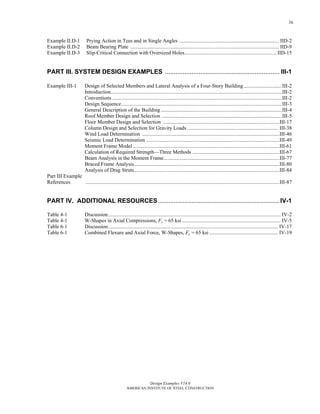
Example II.D-1 Prying Action in Tees and in Single Angles ............................................................................ IID-2
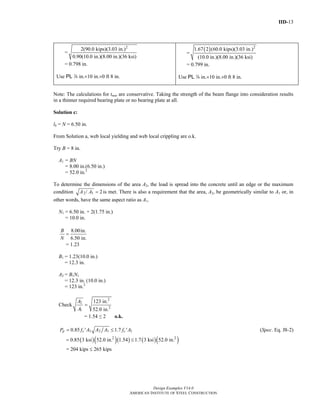
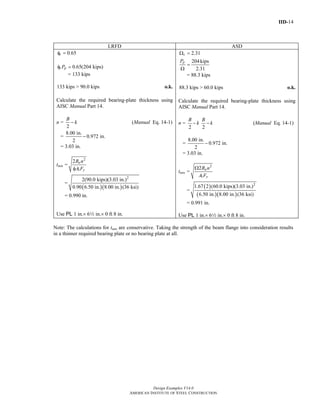
Example II.D-2 Beam Bearing Plate ................................................................................................................. IID-9
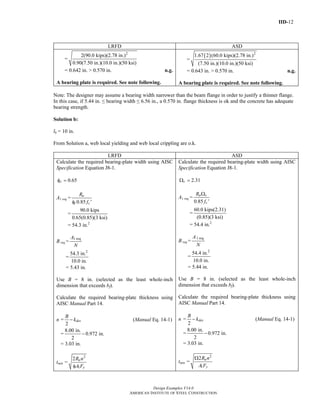
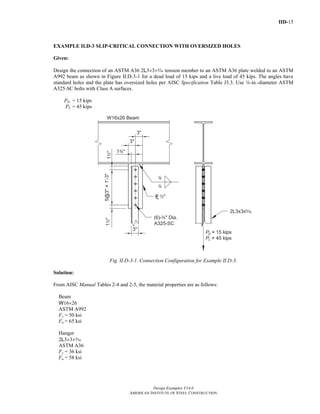
Example II.D-3 Slip-Critical Connection with Oversized Holes...................................................................... IID-15
PART III. SYSTEM DESIGN EXAMPLES ................................................................. III-1
Example III-1 Design of Selected Members and Lateral Analysis of a Four-Story Building .............................III-2
Introduction..................................................................................................................................III-2
Conventions .................................................................................................................................III-2
Design Sequence..........................................................................................................................III-3
General Description of the Building ............................................................................................III-4
Roof Member Design and Selection ...........................................................................................III-5
Floor Member Design and Selection ........................................................................................III-17
Column Design and Selection for Gravity Loads ..................................................................... III-38
Wind Load Determination ........................................................................................................III-46
Seismic Load Determination .....................................................................................................III-49
Moment Frame Model ...............................................................................................................III-61
Calculation of Required Strength—Three Methods ..................................................................III-67
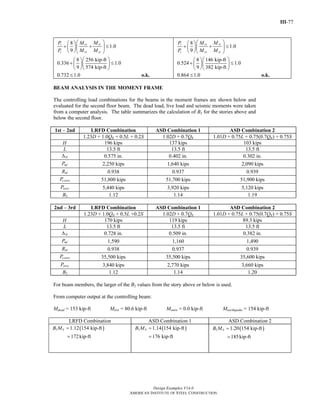
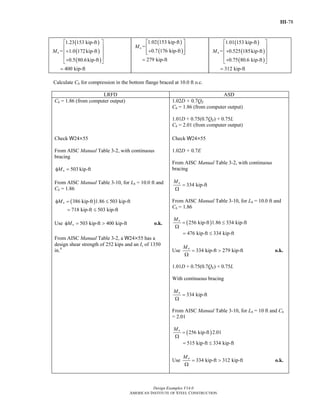
Beam Analysis in the Moment Frame........................................................................................III-77
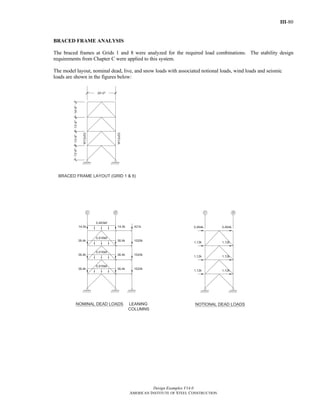
Braced Frame Analysis..............................................................................................................III-80
Analysis of Drag Struts..............................................................................................................III-84
Part III Example
References ...................................................................................................................................................III-87
PART IV. ADDITIONAL RESOURCES.....................................................................IV-1
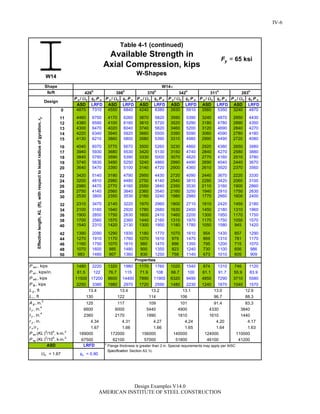
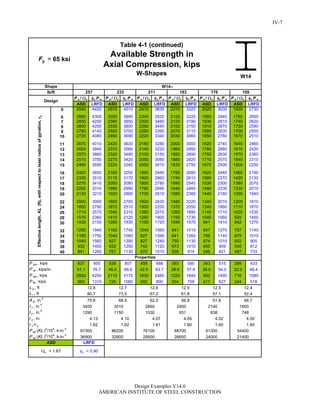
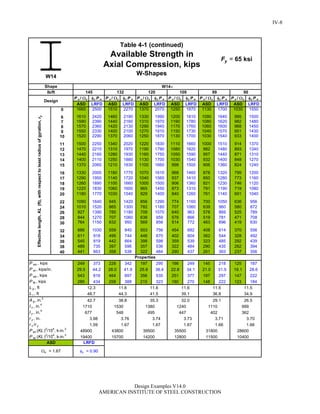
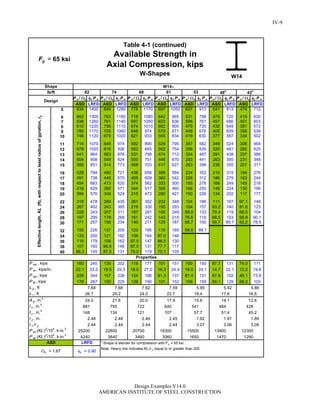
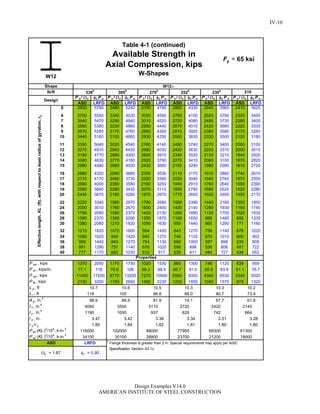
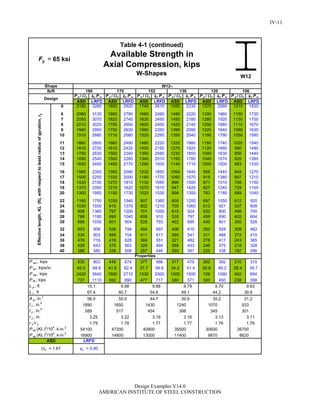
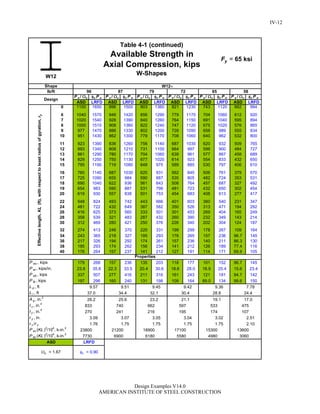
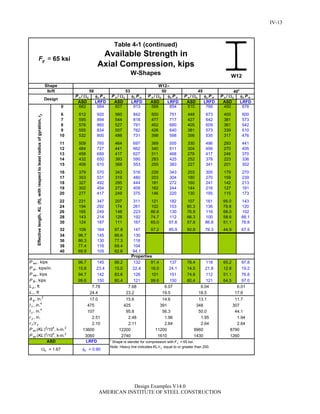
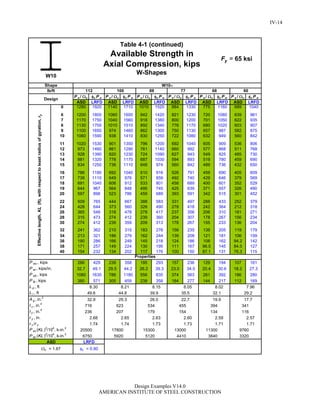
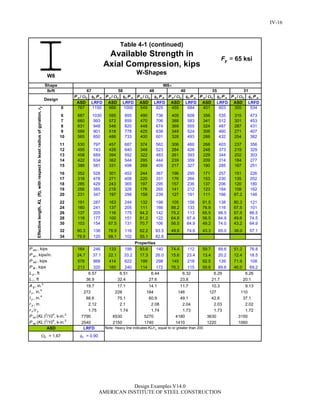
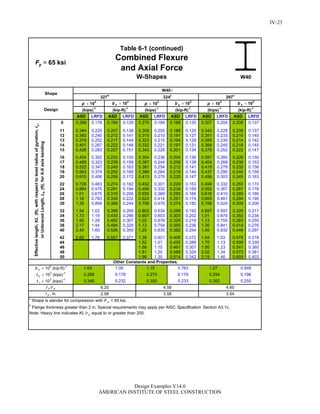
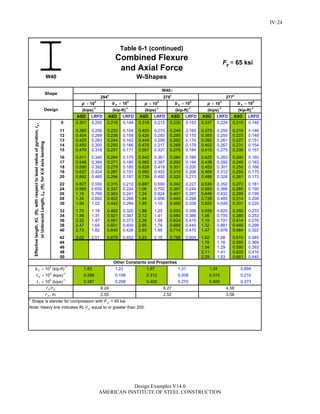
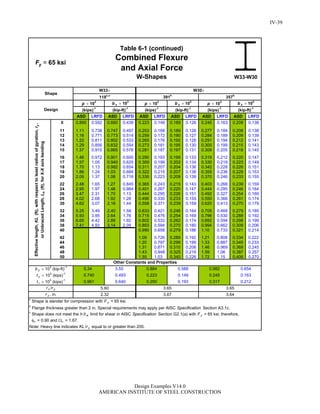
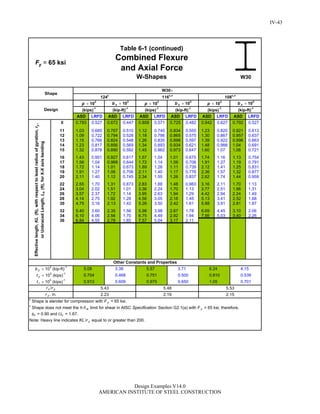
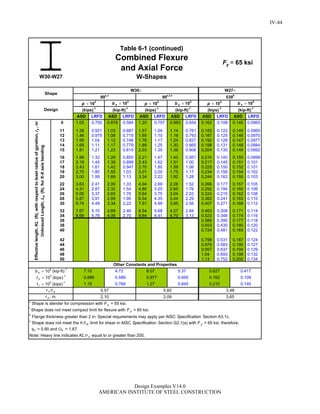
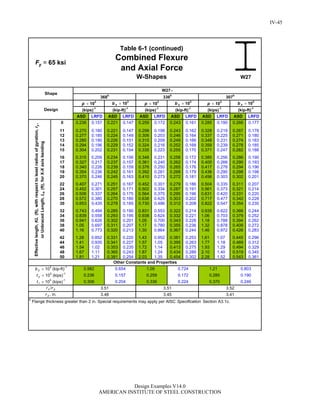
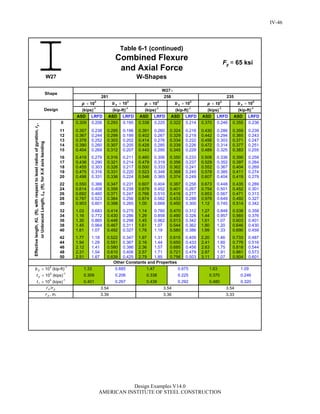
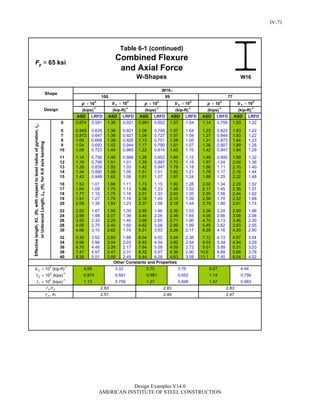
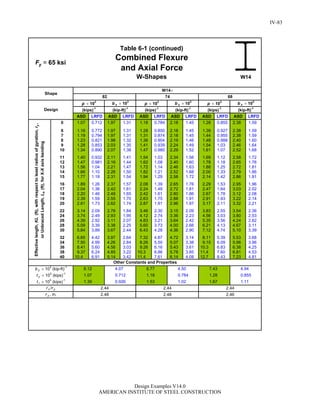
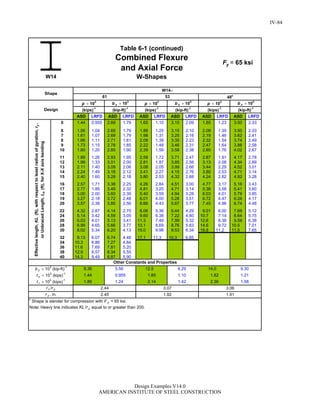
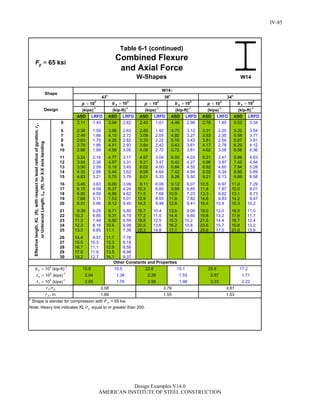
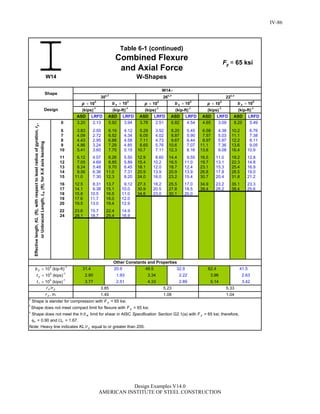
Table 4-1 Discussion................................................................................................................................... IV-2
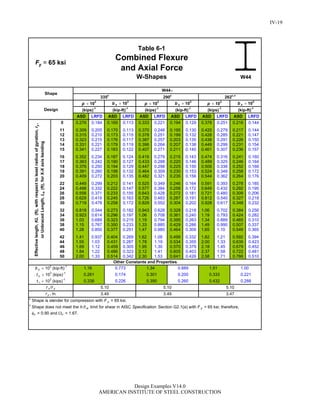
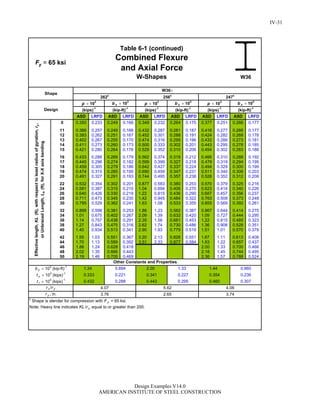
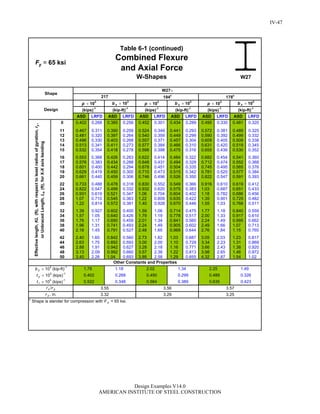
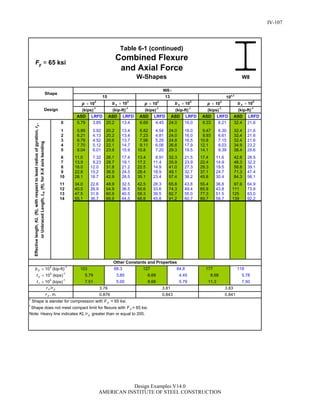
Table 4-1 W-Shapes in Axial Compressions, Fy = 65 ksi ........................................................................... IV-5
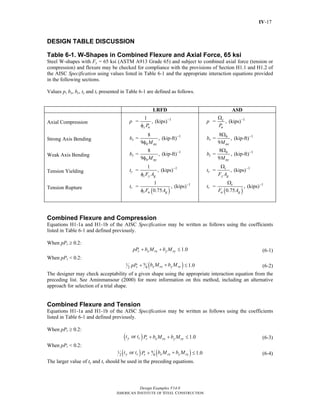
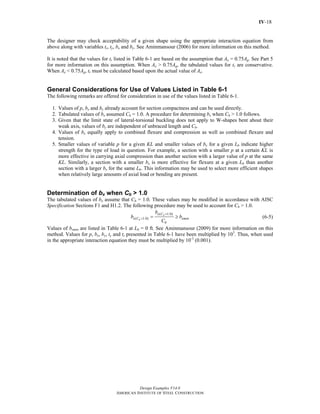
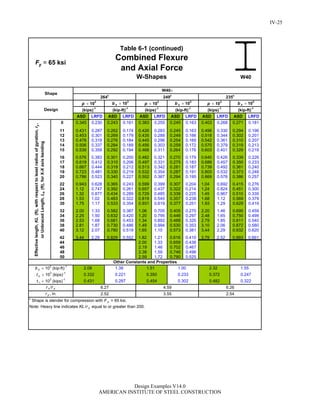
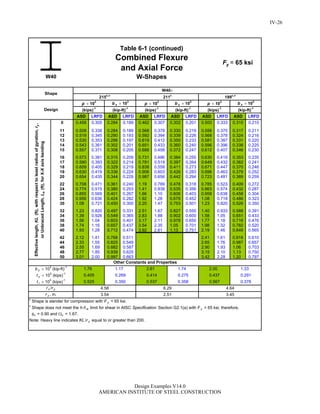
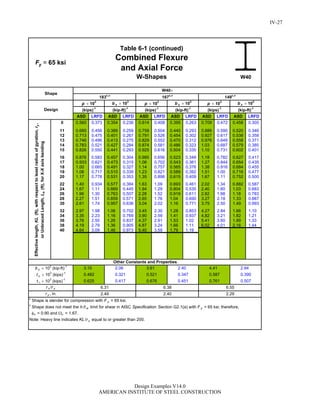
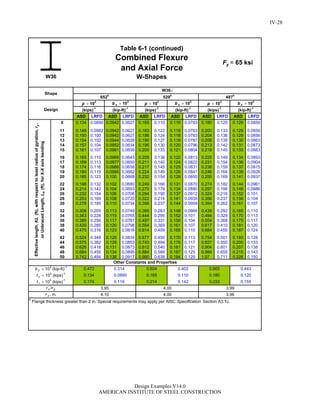
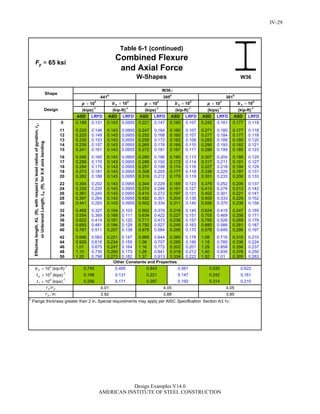
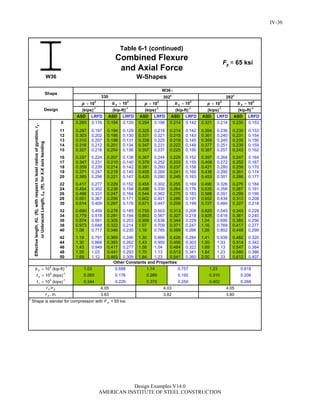
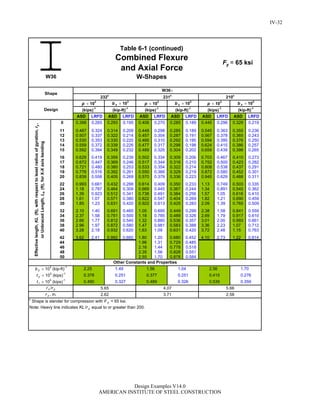
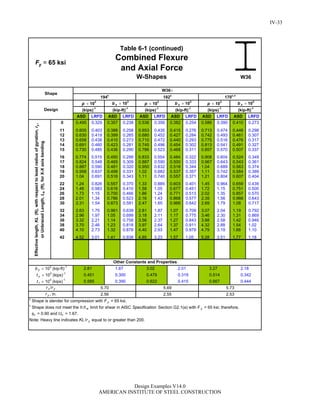
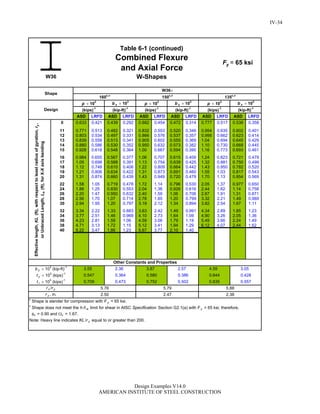
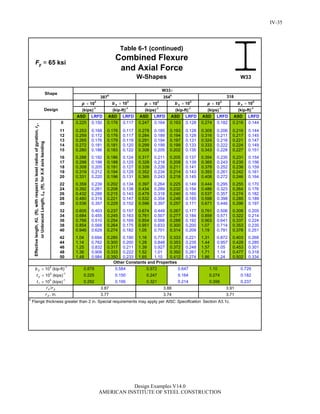
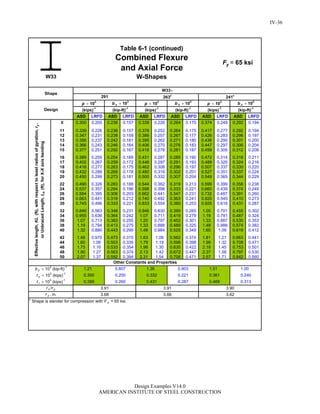
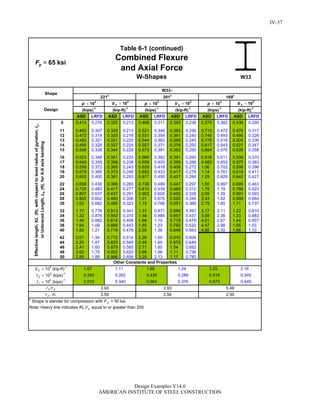
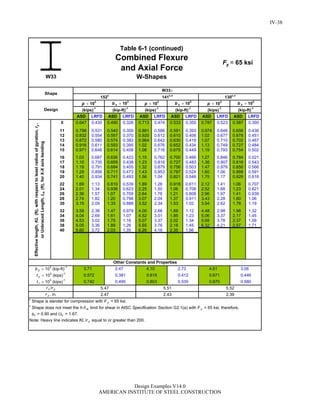
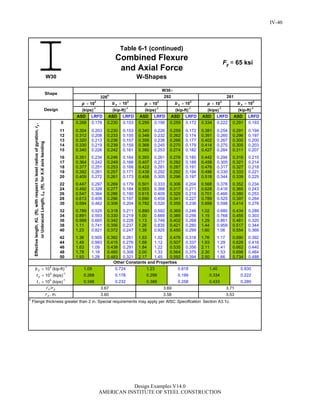
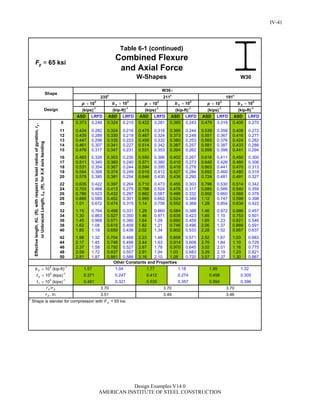
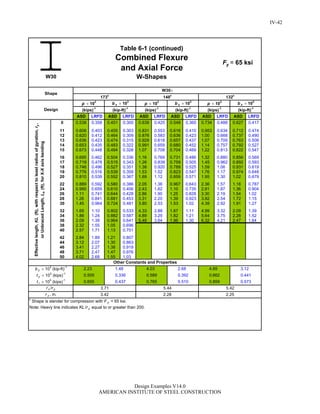
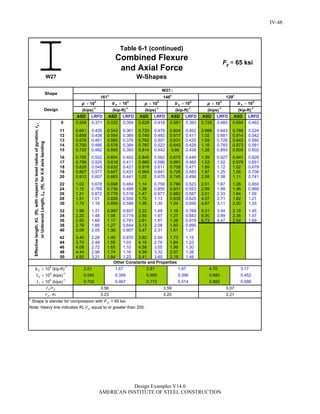
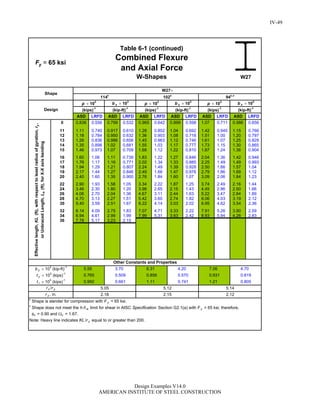
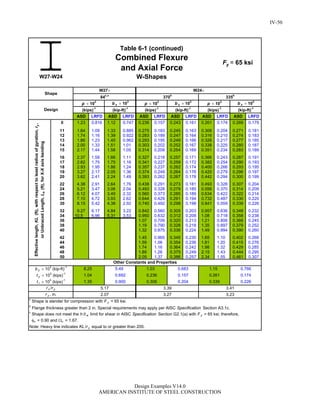
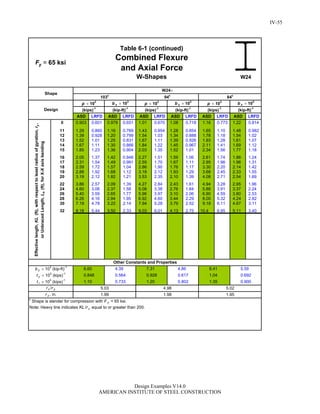
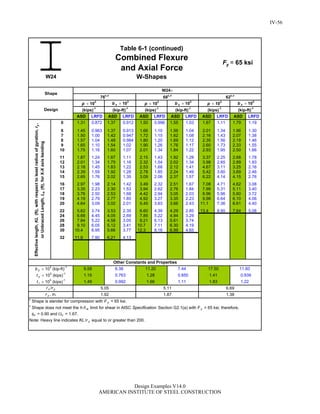
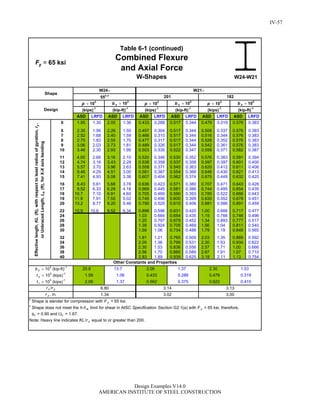
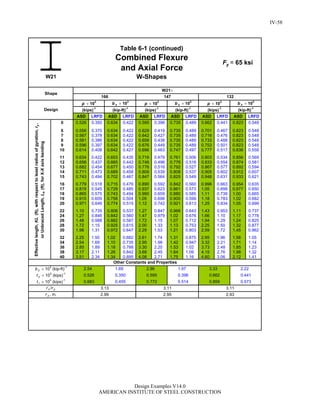
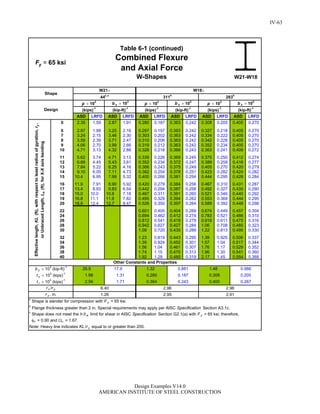
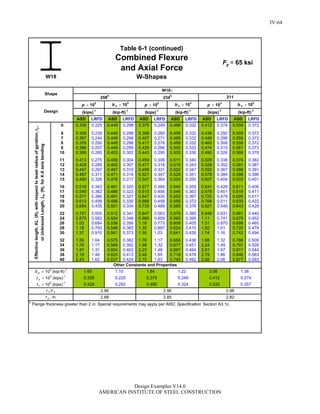
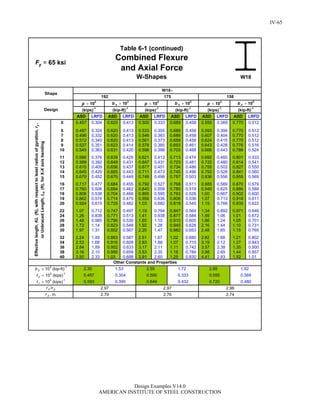
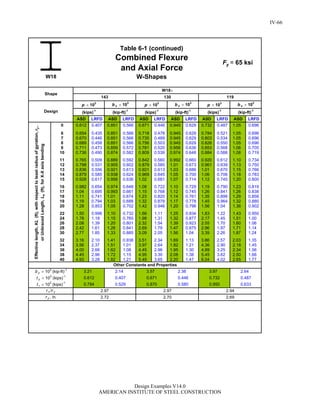
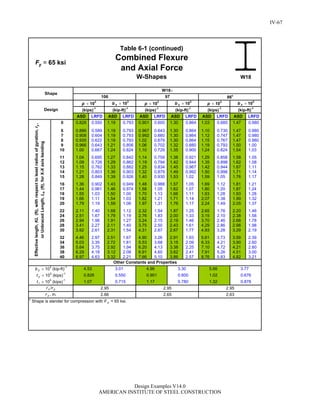
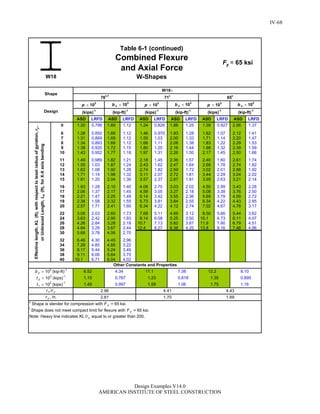
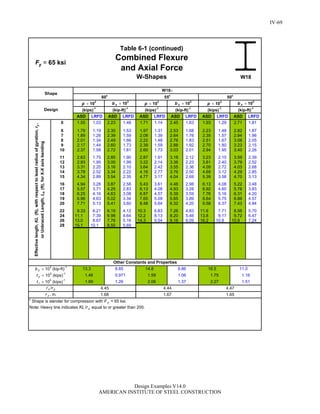
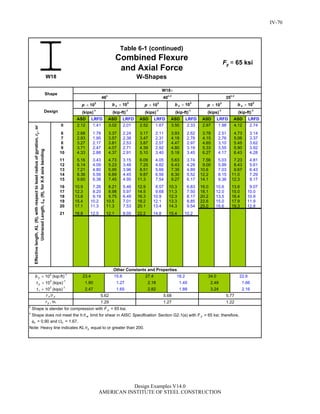
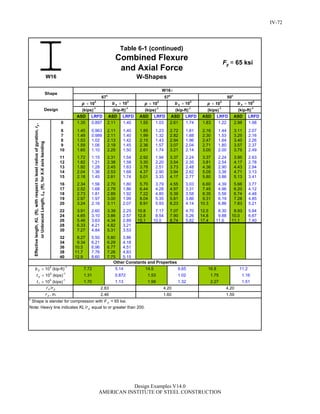
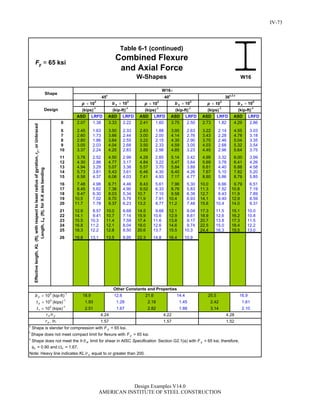
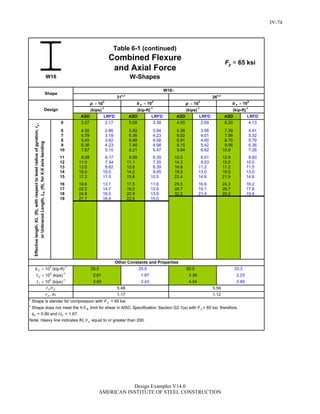
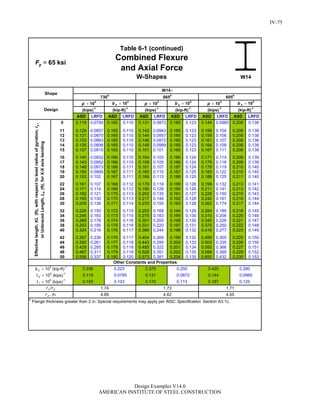
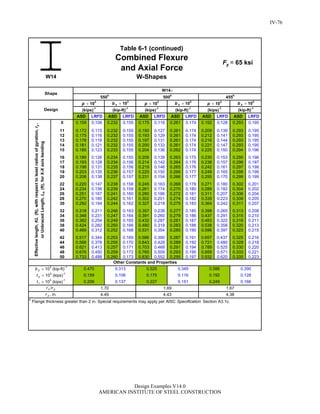
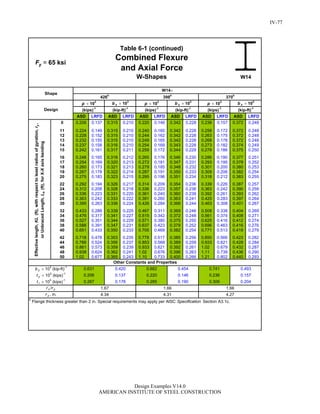
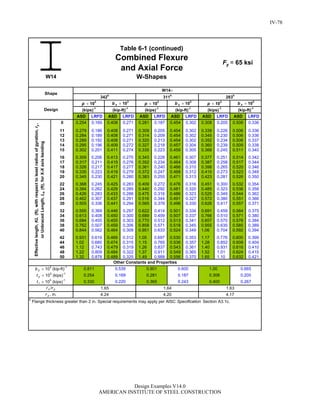
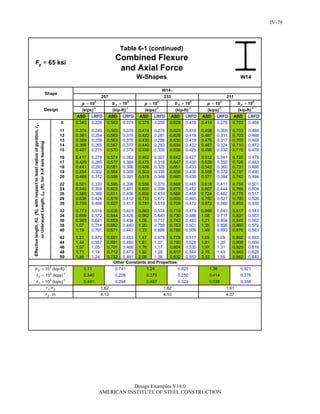
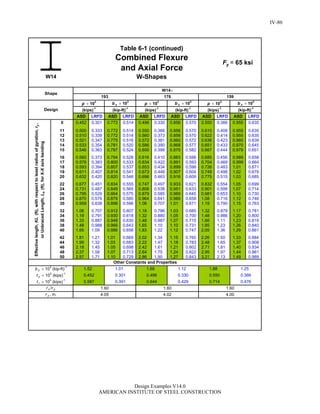
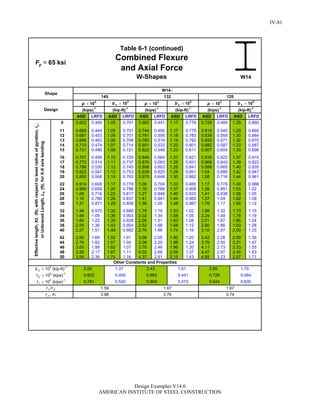
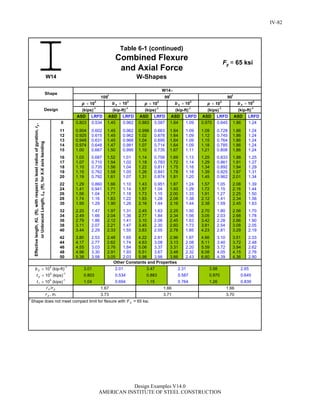
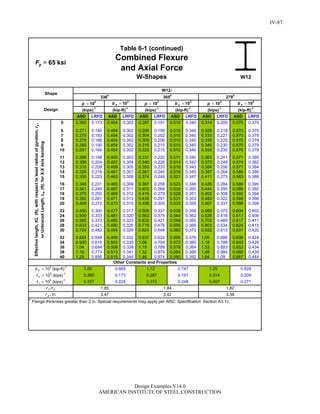
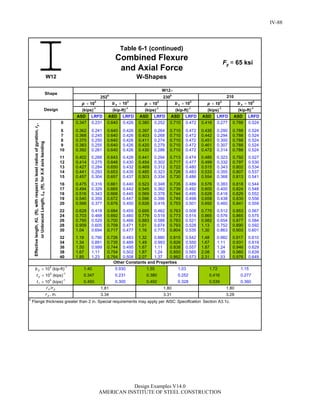
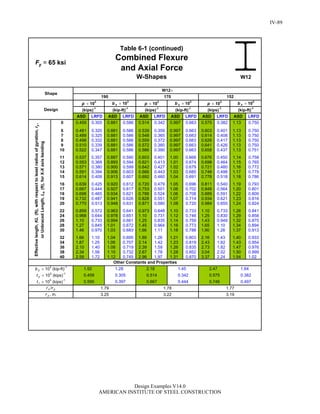
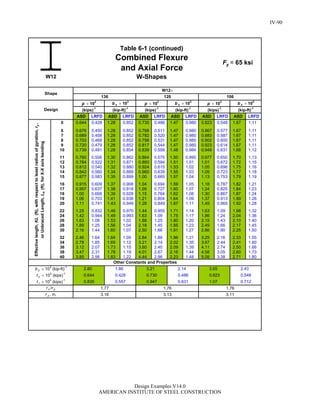
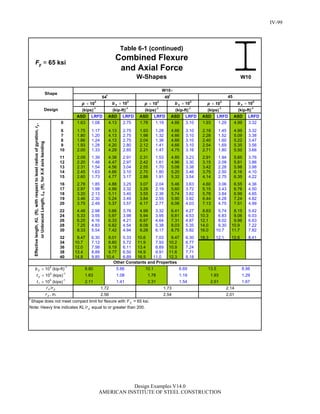
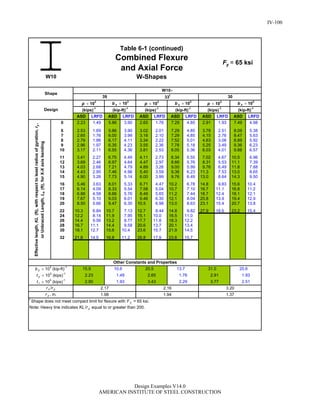
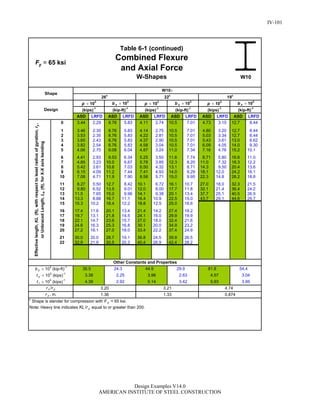
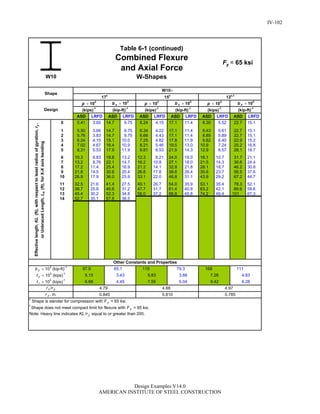
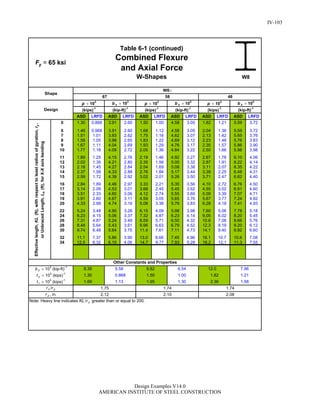
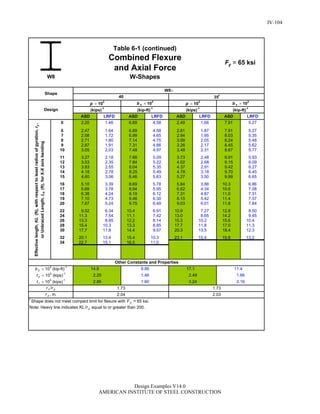
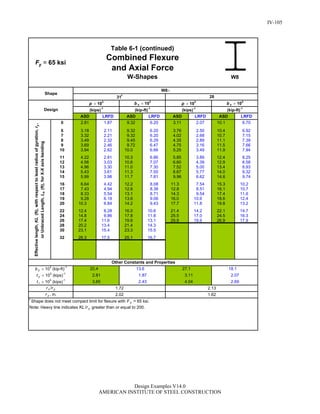
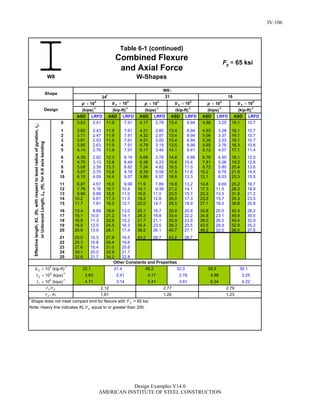
Table 6-1 Discussion................................................................................................................................. IV-17
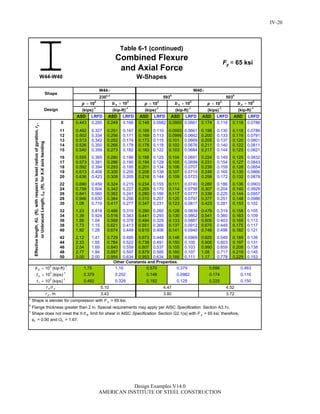
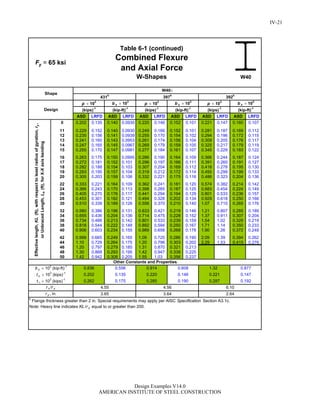
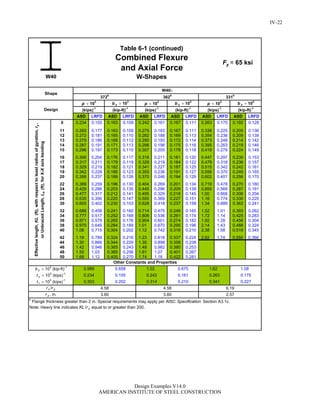
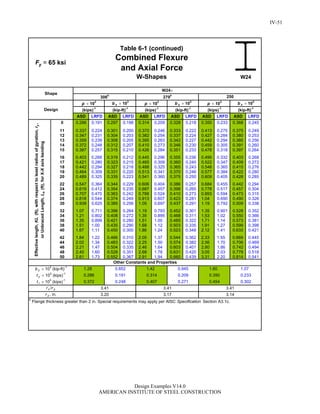
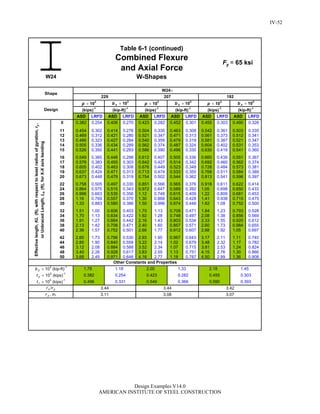
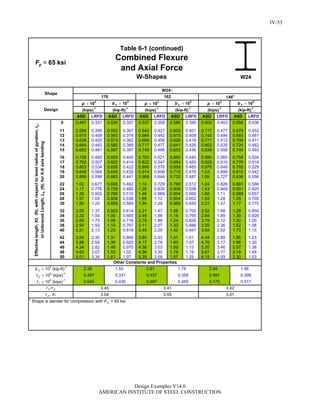
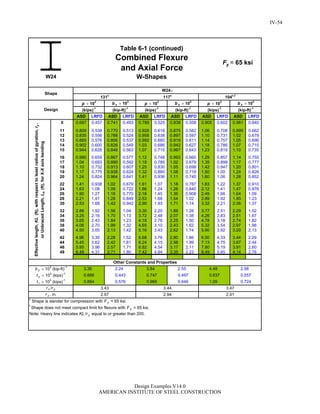
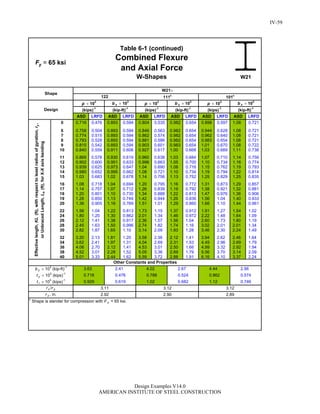
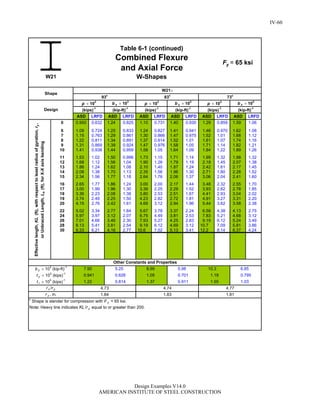
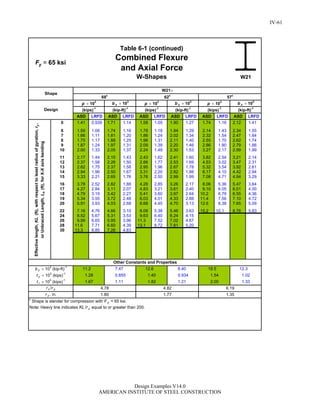
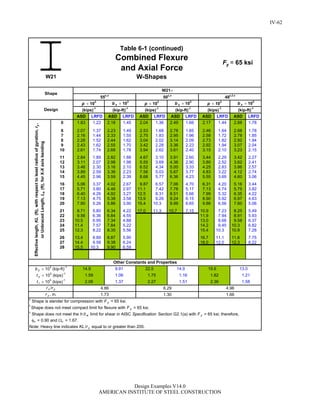
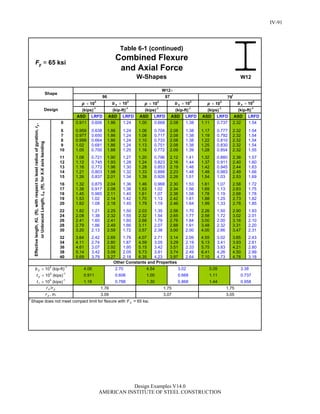
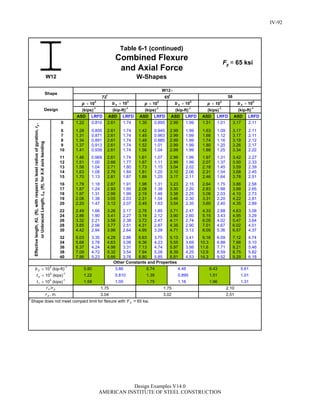
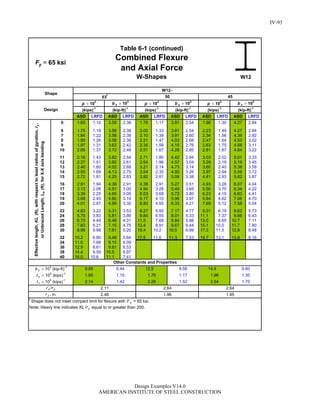
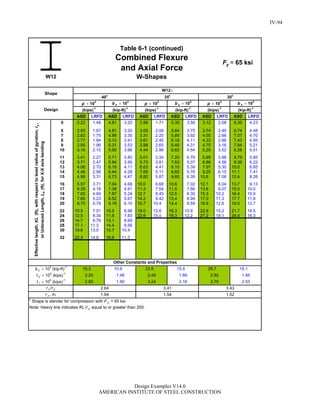
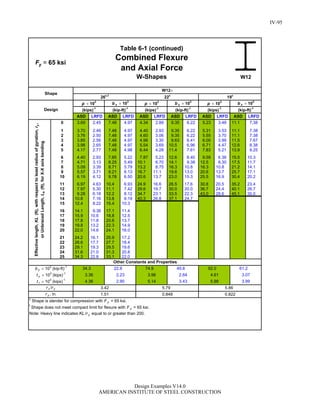
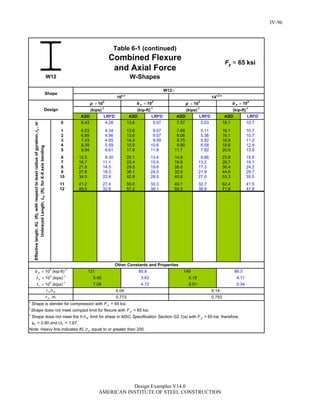
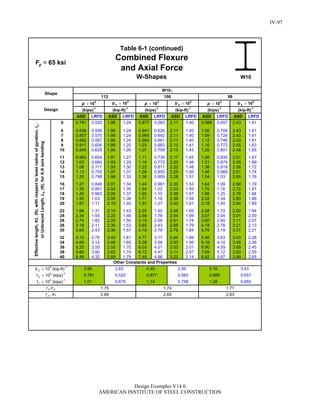
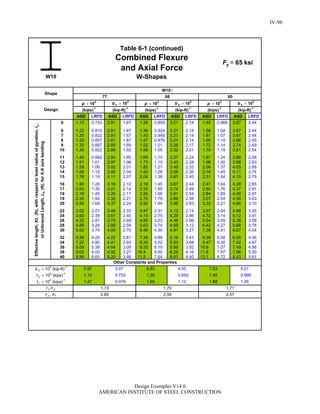
Table 6-1 Combined Flexure and Axial Force, W-Shapes, Fy = 65 ksi .................................................... IV-19
A-1
Design Examples V14.0
AMERICAN INSTITUTE OF STEEL CONSTRUCTION
Chapter A
General Provisions
A1. SCOPE
These design examples are intended to illustrate the application of the 2010 AISC Specification for Structural
Steel Buildings (ANSI/AISC 360-10) (AISC, 2010) and the AISC Steel Construction Manual, 14th Edition
(AISC, 2011) in low-seismic applications. For information on design applications requiring seismic detailing, see
the AISC Seismic Design Manual.
A2. REFERENCED SPECIFICATIONS, CODES AND STANDARDS
Section A2 includes a detailed list of the specifications, codes and standards referenced throughout the AISC
Specification.
A3. MATERIAL
Section A3 includes a list of the steel materials that are approved for use with the AISC Specification. The
complete ASTM standards for the most commonly used steel materials can be found in Selected ASTM Standards
for Structural Steel Fabrication (ASTM, 2011).
A4. STRUCTURAL DESIGN DRAWINGS AND SPECIFICATIONS
Section A4 requires that structural design drawings and specifications meet the requirements in the AISC Code of
Standard Practice for Steel Buildings and Bridges (AISC, 2010b).
Return to Table of Contents
A-2
Design Examples V14.0
AMERICAN INSTITUTE OF STEEL CONSTRUCTION
CHAPTER A REFERENCES
AISC (2010a), Specification for Structural Steel Buildings, ANSI/AISC 360-10, American Institute for Steel
Construction, Chicago, IL.
AISC (2010b), Code of Standard Practice for Steel Buildings and Bridges, American Institute for Steel
Construction, Chicago, IL.
AISC (2011), Steel Construction Manual, 14th Ed., American Institute for Steel Construction, Chicago, IL.
ASTM (2011), Selected ASTM Standards for Structural Steel Fabrication, ASTM International, West
Conshohocken, PA.
Return to Table of Contents
B-1
Design Examples V14.0
AMERICAN INSTITUTE OF STEEL CONSTRUCTION
Chapter B
Design Requirements
B1. GENERAL PROVISIONS
B2. LOADS AND LOAD COMBINATIONS
In the absence of an applicable building code, the default load combinations to be used with this Specification are
those from Minimum Design Loads for Buildings and Other Structures (ASCE/SEI 7-10) (ASCE, 2010).
B3. DESIGN BASIS
Chapter B of the AISC Specification and Part 2 of the AISC Manual describe the basis of design, for both LRFD
and ASD.
This Section describes three basic types of connections: simple connections, fully restrained (FR) moment
connections, and partially restrained (PR) moment connections. Several examples of the design of each of these
types of connection are given in Part II of these design examples.
Information on the application of serviceability and ponding provisions may be found in AISC Specification
Chapter L and AISC Specification Appendix 2, respectively, and their associated commentaries. Design examples
and other useful information on this topic are given in AISC Design Guide 3, Serviceability Design
Considerations for Steel Buildings, Second Edition (West et al., 2003).
Information on the application of fire design provisions may be found in AISC Specification Appendix 4 and its
associated commentary. Design examples and other useful information on this topic are presented in AISC Design
Guide 19, Fire Resistance of Structural Steel Framing (Ruddy et al., 2003).
Corrosion protection and fastener compatibility are discussed in Part 2 of the AISC Manual.
B4. MEMBER PROPERTIES
AISC Specification Tables B4.1a and B4.1b give the complete list of limiting width-to-thickness ratios for all
compression and flexural members defined by the AISC Specification.
Except for one section, the W-shapes presented in the compression member selection tables as column sections
meet the criteria as nonslender element sections. The W-shapes presented in the flexural member selection tables
as beam sections meet the criteria for compact sections, except for 10 specific shapes. When noncompact or
slender-element sections are tabulated in the design aids, local buckling criteria are accounted for in the tabulated
design values.
The shapes listing and other member design tables in the AISC Manual also include footnoting to highlight
sections that exceed local buckling limits in their most commonly available material grades. These footnotes
include the following notations:
c
Shape is slender for compression.
f
Shape exceeds compact limit for flexure.
g
The actual size, combination and orientation of fastener components should be compared with the geometry of
the cross section to ensure compatibility.
h
Flange thickness greater than 2 in. Special requirements may apply per AISC Specification Section A3.1c.
v
Shape does not meet the h/tw limit for shear in AISC Specification Section G2.1a.
Return to Table of Contents
B-2
Design Examples V14.0
AMERICAN INSTITUTE OF STEEL CONSTRUCTION
CHAPTER B REFERENCES
ASCE (2010), Minimum Design Loads for Buildings and Other Structures, ASCE/SEI 7-10, American Society of
Civil Engineers, Reston, VA.
West, M., Fisher, J. and Griffis, L.G. (2003), Serviceability Design Considerations for Steel Buildings, Design
Guide 3, 2nd Ed., AISC, Chicago, IL.
Ruddy, J.L., Marlo, J.P., Ioannides, S.A. and Alfawakhiri, F. (2003), Fire Resistance of Structural Steel Framing,
Design Guide 19, AISC, Chicago, IL.
Return to Table of Contents
C-1
Design Examples V14.0
AMERICAN INSTITUTE OF STEEL CONSTRUCTION
Chapter C
Design for Stability
C1. GENERAL STABILITY REQUIREMENTS
The AISC Specification requires that the designer account for both the stability of the structural system as a
whole, and the stability of individual elements. Thus, the lateral analysis used to assess stability must include
consideration of the combined effect of gravity and lateral loads, as well as member inelasticity, out-of-
plumbness, out-of-straightness and the resulting second-order effects, P-Δ and P-δ. The effects of “leaning
columns” must also be considered, as illustrated in the examples in this chapter and in the four-story building
design example in Part III of AISC Design Examples.
P-Δ and P-δ effects are illustrated in AISC Specification Commentary Figure C-C2.1. Methods for addressing
stability, including P-Δ and P-δ effects, are provided in AISC Specification Section C2 and Appendix 7.
C2. CALCULATION OF REQUIRED STRENGTHS
The calculation of required strengths is illustrated in the examples in this chapter and in the four-story building
design example in Part III of AISC Design Examples.
C3. CALCULATION OF AVAILABLE STRENGTHS
The calculation of available strengths is illustrated in the four-story building design example in Part III of AISC
Design Examples.
Return to Table of Contents
C-2
Design Examples V14.0
AMERICAN INSTITUTE OF STEEL CONSTRUCTION
EXAMPLE C.1A DESIGN OF A MOMENT FRAME BY THE DIRECT ANALYSIS METHOD
Given:
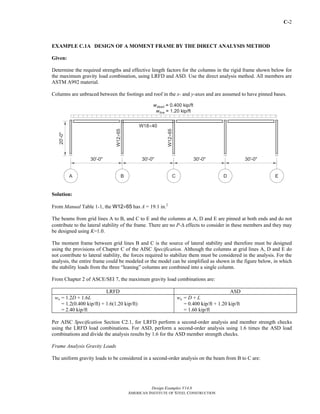
Determine the required strengths and effective length factors for the columns in the rigid frame shown below for
the maximum gravity load combination, using LRFD and ASD. Use the direct analysis method. All members are
ASTM A992 material.
Columns are unbraced between the footings and roof in the x- and y-axes and are assumed to have pinned bases.
Solution:
From Manual Table 1-1, the W12×65 has A = 19.1 in.2
The beams from grid lines A to B, and C to E and the columns at A, D and E are pinned at both ends and do not
contribute to the lateral stability of the frame. There are no P-Δ effects to consider in these members and they may
be designed using K=1.0.
The moment frame between grid lines B and C is the source of lateral stability and therefore must be designed
using the provisions of Chapter C of the AISC Specification. Although the columns at grid lines A, D and E do
not contribute to lateral stability, the forces required to stabilize them must be considered in the analysis. For the
analysis, the entire frame could be modeled or the model can be simplified as shown in the figure below, in which
the stability loads from the three “leaning” columns are combined into a single column.
From Chapter 2 of ASCE/SEI 7, the maximum gravity load combinations are:
LRFD ASD
wu = 1.2D + 1.6L
= 1.2(0.400 kip/ft) + 1.6(1.20 kip/ft)
= 2.40 kip/ft
wa = D + L
= 0.400 kip/ft + 1.20 kip/ft
= 1.60 kip/ft
Per AISC Specification Section C2.1, for LRFD perform a second-order analysis and member strength checks
using the LRFD load combinations. For ASD, perform a second-order analysis using 1.6 times the ASD load
combinations and divide the analysis results by 1.6 for the ASD member strength checks.
Frame Analysis Gravity Loads
The uniform gravity loads to be considered in a second-order analysis on the beam from B to C are:
Return to Table of Contents
C-3
Design Examples V14.0
AMERICAN INSTITUTE OF STEEL CONSTRUCTION
LRFD ASD
wu' = 2.40 kip/ft wa' = 1.6(1.60 kip/ft)
= 2.56 kip/ft
Concentrated gravity loads to be considered in a second-order analysis on the columns at B and C contributed by
adjacent beams are:
LRFD ASD
Pu'= (15.0 ft)(2.40 kip/ft)
= 36.0 kips
Pa' = 1.6(15.0 ft)(1.60 kip/ft)
= 38.4 kips
Concentrated Gravity Loads on the Pseudo “Leaning” Column
The load in this column accounts for all gravity loading that is stabilized by the moment frame, but is not directly
applied to it.
LRFD ASD
PuL' = (60.0 ft)(2.40 kip/ft)
= 144 kips
PaL' = 1.6(60.0 ft)(1.60 kip/ft)
= 154 kips
Frame Analysis Notional Loads
Per AISC Specification Section C2.2, frame out-of-plumbness must be accounted for either by explicit modeling
of the assumed out-of-plumbness or by the application of notional loads. Use notional loads.
From AISC Specification Equation C2-1, the notional loads are:
LRFD ASD
α = 1.0
Yi = (120 ft)(2.40 kip/ft)
= 288 kips
Ni = 0.002αYi (Spec. Eq. C2-1)
= 0.002(1.0)(288 kips)
= 0.576 kips
α = 1.6
Yi = (120 ft)(1.60 kip/ft)
= 192 kips
Ni = 0.002αYi (Spec. Eq. C2-1)
= 0.002(1.6)(192 kips)
= 0.614 kips
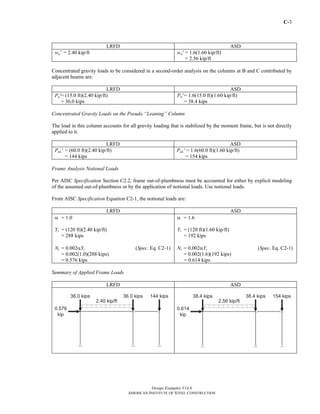
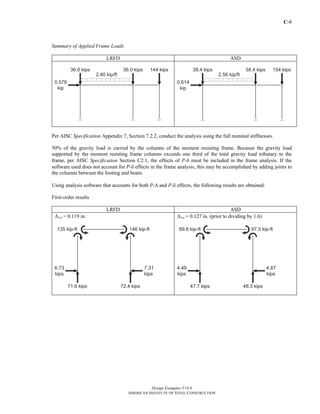
Summary of Applied Frame Loads
LRFD ASD
Return to Table of Contents
C-4
Design Examples V14.0
AMERICAN INSTITUTE OF STEEL CONSTRUCTION
Per AISC Specification Section C2.3, conduct the analysis using 80% of the nominal stiffnesses to account for the
effects of inelasticity. Assume, subject to verification, that αPr /Py is no greater than 0.5; therefore, no additional
stiffness reduction is required.
50% of the gravity load is carried by the columns of the moment resisting frame. Because the gravity load
supported by the moment resisting frame columns exceeds one third of the total gravity load tributary to the
frame, per AISC Specification Section C2.1, the effects of P-δ upon P-Δ must be included in the frame analysis. If
the software used does not account for P-δ effects in the frame analysis, this may be accomplished by adding
joints to the columns between the footing and beam.
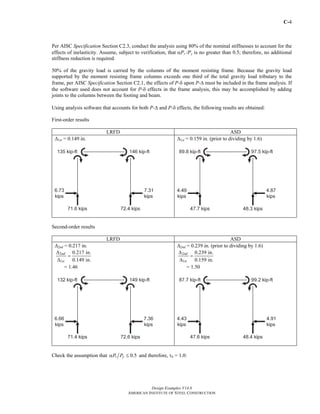
Using analysis software that accounts for both P-Δ and P-δ effects, the following results are obtained:
First-order results
LRFD ASD
Δ1st = 0.149 in. Δ1st = 0.159 in. (prior to dividing by 1.6)
Second-order results
LRFD ASD
Δ2nd = 0.217 in.
2
1
0.217 in.
0.149 in.
nd
st
Δ
=
Δ
= 1.46
Δ2nd = 0.239 in. (prior to dividing by 1.6)
2
1
0.239 in.
0.159 in.
nd
st
Δ
=
Δ
= 1.50
Check the assumption that 0.5r yP Pα ≤ and therefore, τb = 1.0:
Return to Table of Contents
C-5
Design Examples V14.0
AMERICAN INSTITUTE OF STEEL CONSTRUCTION
Py = FyAg
= 50 ksi(19.1 in.2
)
= 955 kips
LRFD ASD
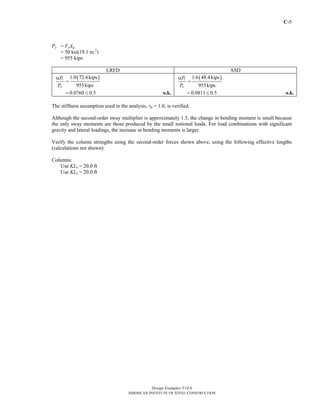
( )1.0 72.6kips
955kips
r
y
P
P
α
=
0.0760 0.5= ≤ o.k.
( )1.6 48.4kips
955kips
r
y
P
P
α
=
0.0811 0.5= ≤ o.k.
The stiffness assumption used in the analysis, τb = 1.0, is verified.
Although the second-order sway multiplier is approximately 1.5, the change in bending moment is small because
the only sway moments are those produced by the small notional loads. For load combinations with significant
gravity and lateral loadings, the increase in bending moments is larger.
Verify the column strengths using the second-order forces shown above, using the following effective lengths
(calculations not shown):
Columns:
Use KLx = 20.0 ft
Use KLy = 20.0 ft
Return to Table of Contents
C-6
Design Examples V14.0
AMERICAN INSTITUTE OF STEEL CONSTRUCTION
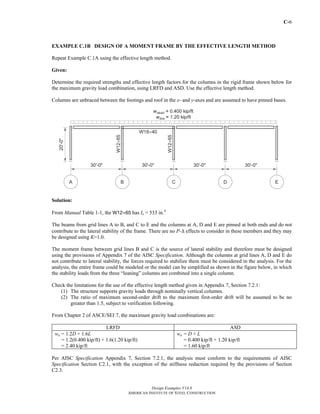
EXAMPLE C.1B DESIGN OF A MOMENT FRAME BY THE EFFECTIVE LENGTH METHOD
Repeat Example C.1A using the effective length method.
Given:
Determine the required strengths and effective length factors for the columns in the rigid frame shown below for
the maximum gravity load combination, using LRFD and ASD. Use the effective length method.
Columns are unbraced between the footings and roof in the x- and y-axes and are assumed to have pinned bases.
Solution:
From Manual Table 1-1, the W12×65 has Ix = 533 in.4
The beams from grid lines A to B, and C to E and the columns at A, D and E are pinned at both ends and do not
contribute to the lateral stability of the frame. There are no P-Δ effects to consider in these members and they may
be designed using K=1.0.
The moment frame between grid lines B and C is the source of lateral stability and therefore must be designed
using the provisions of Appendix 7 of the AISC Specification. Although the columns at grid lines A, D and E do
not contribute to lateral stability, the forces required to stabilize them must be considered in the analysis. For the
analysis, the entire frame could be modeled or the model can be simplified as shown in the figure below, in which
the stability loads from the three “leaning” columns are combined into a single column.
Check the limitations for the use of the effective length method given in Appendix 7, Section 7.2.1:
(1) The structure supports gravity loads through nominally vertical columns.
(2) The ratio of maximum second-order drift to the maximum first-order drift will be assumed to be no
greater than 1.5, subject to verification following.
From Chapter 2 of ASCE/SEI 7, the maximum gravity load combinations are:
LRFD ASD
wu = 1.2D + 1.6L
= 1.2(0.400 kip/ft) + 1.6(1.20 kip/ft)
= 2.40 kip/ft
wa = D + L
= 0.400 kip/ft + 1.20 kip/ft
= 1.60 kip/ft
Per AISC Specification Appendix 7, Section 7.2.1, the analysis must conform to the requirements of AISC
Specification Section C2.1, with the exception of the stiffness reduction required by the provisions of Section
C2.3.
Return to Table of Contents
C-7
Design Examples V14.0
AMERICAN INSTITUTE OF STEEL CONSTRUCTION
Per AISC Specification Section C2.1, for LRFD perform a second-order analysis and member strength checks
using the LRFD load combinations. For ASD, perform a second-order analysis at 1.6 times the ASD load
combinations and divide the analysis results by 1.6 for the ASD member strength checks.
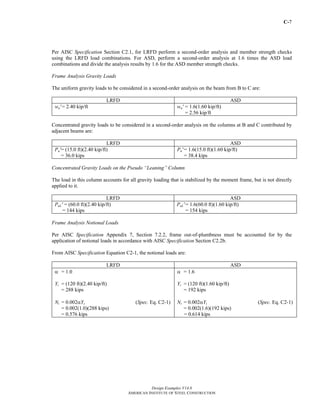
Frame Analysis Gravity Loads
The uniform gravity loads to be considered in a second-order analysis on the beam from B to C are:
LRFD ASD
wu' = 2.40 kip/ft wa' = 1.6(1.60 kip/ft)
= 2.56 kip/ft
Concentrated gravity loads to be considered in a second-order analysis on the columns at B and C contributed by
adjacent beams are:
LRFD ASD
Pu'= (15.0 ft)(2.40 kip/ft)
= 36.0 kips
Pa' = 1.6(15.0 ft)(1.60 kip/ft)
= 38.4 kips
Concentrated Gravity Loads on the Pseudo “Leaning” Column
The load in this column accounts for all gravity loading that is stabilized by the moment frame, but is not directly
applied to it.
LRFD ASD
PuL' = (60.0 ft)(2.40 kip/ft)
= 144 kips
PaL'= 1.6(60.0 ft)(1.60 kip/ft)
= 154 kips
Frame Analysis Notional Loads
Per AISC Specification Appendix 7, Section 7.2.2, frame out-of-plumbness must be accounted for by the
application of notional loads in accordance with AISC Specification Section C2.2b.
From AISC Specification Equation C2-1, the notional loads are:
LRFD ASD
α = 1.0
Yi = (120 ft)(2.40 kip/ft)
= 288 kips
Ni = 0.002αYi (Spec. Eq. C2-1)
= 0.002(1.0)(288 kips)
= 0.576 kips
α = 1.6
Yi = (120 ft)(1.60 kip/ft)
= 192 kips
Ni = 0.002αYi (Spec. Eq. C2-1)
= 0.002(1.6)(192 kips)
= 0.614 kips
Return to Table of Contents
C-8
Design Examples V14.0
AMERICAN INSTITUTE OF STEEL CONSTRUCTION
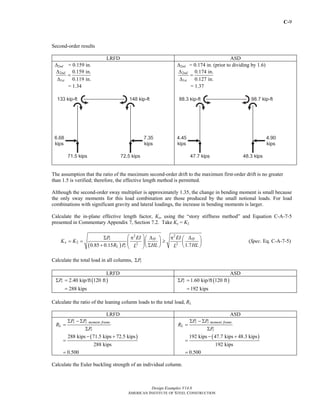
Summary of Applied Frame Loads
LRFD ASD
Per AISC Specification Appendix 7, Section 7.2.2, conduct the analysis using the full nominal stiffnesses.
50% of the gravity load is carried by the columns of the moment resisting frame. Because the gravity load
supported by the moment resisting frame columns exceeds one third of the total gravity load tributary to the
frame, per AISC Specification Section C2.1, the effects of P-δ must be included in the frame analysis. If the
software used does not account for P-δ effects in the frame analysis, this may be accomplished by adding joints to
the columns between the footing and beam.
Using analysis software that accounts for both P-Δ and P-δ effects, the following results are obtained:
First-order results
LRFD ASD
Δ1st = 0.119 in. Δ1st = 0.127 in. (prior to dividing by 1.6)
Return to Table of Contents
C-9
Design Examples V14.0
AMERICAN INSTITUTE OF STEEL CONSTRUCTION
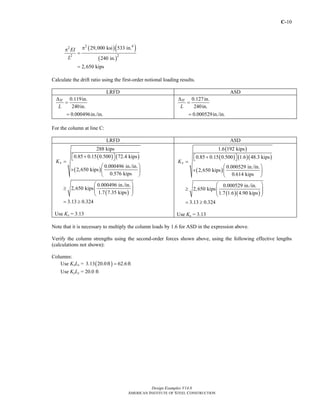
Second-order results
LRFD ASD
Δ2nd = 0.159 in.
2
1
0.159 in.
0.119 in.
nd
st
Δ
=
Δ
= 1.34
Δ2nd = 0.174 in. (prior to dividing by 1.6)
2
1
0.174 in.
0.127 in.
nd
st
Δ
=
Δ
= 1.37
The assumption that the ratio of the maximum second-order drift to the maximum first-order drift is no greater
than 1.5 is verified; therefore, the effective length method is permitted.
Although the second-order sway multiplier is approximately 1.35, the change in bending moment is small because
the only sway moments for this load combination are those produced by the small notional loads. For load
combinations with significant gravity and lateral loadings, the increase in bending moments is larger.
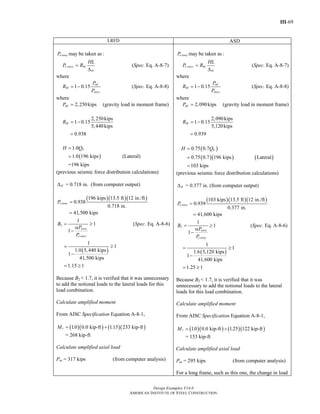
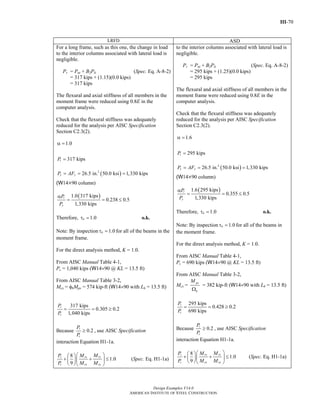
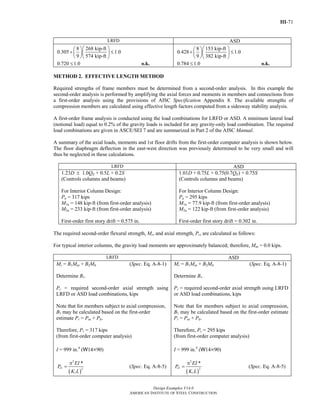
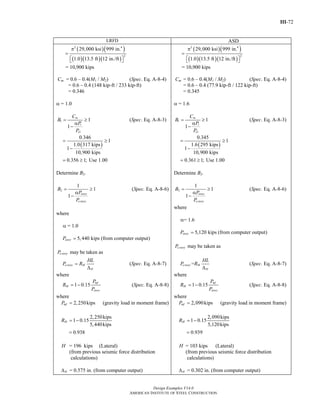
Calculate the in-plane effective length factor, Kx, using the “story stiffness method” and Equation C-A-7-5
presented in Commentary Appendix 7, Section 7.2. Take Kx = K2
( )
2 2
2 2 2
0.85 0.15 1.7
r H H
x
L r
P EI EI
K K
R P HL HLL L
⎛ ⎞Σ π Δ π Δ⎛ ⎞ ⎛ ⎞
= = ≥⎜ ⎟⎜ ⎟ ⎜ ⎟⎜ ⎟+ Σ⎝ ⎠ ⎝ ⎠⎝ ⎠
(Spec. Eq. C-A-7-5)
Calculate the total load in all columns, rPΣ
LRFD ASD
( )2.40 kip/ft 120 ft
288 kips
rPΣ =
=
( )1.60 kip/ft 120 ft
192 kips
rPΣ =
=
Calculate the ratio of the leaning column loads to the total load, RL
LRFD ASD
( )288 kips 71.5 kips 72.5 kips
288 kips
0.500
r r moment frame
L
r
P P
R
P
Σ − Σ
=
Σ
− +
=
=
( )192 kips 47.7 kips 48.3 kips
192 kips
0.500
r r moment frame
L
r
P P
R
P
Σ − Σ
=
Σ
− +
=
=
Calculate the Euler buckling strength of an individual column.
Return to Table of Contents
C-10
Design Examples V14.0
AMERICAN INSTITUTE OF STEEL CONSTRUCTION
( )( )
( )
2 42
2 2
29,000 ksi 533 in.
240 in.
2,650 kips
EI
L
ππ
=
=
Calculate the drift ratio using the first-order notional loading results.
LRFD ASD
0.119in.
240in.
0.000496in./in.
H
L
Δ
=
=
0.127in.
240in.
0.000529in./in.
H
L
Δ
=
=
For the column at line C:
LRFD ASD
( ) ( )
( )
( )
288 kips
0.85 0.15 0.500 72.4 kips
0.000496 in./in.
2,650 kips
0.576 kips
0.000496 in./in.
2,650 kips
1.7 7.35 kips
3.13 0.324
xK
+⎡ ⎤⎣ ⎦
=
⎛ ⎞
× ⎜ ⎟
⎝ ⎠
⎛ ⎞
≥ ⎜ ⎟⎜ ⎟
⎝ ⎠
= ≥
Use Kx = 3.13
( )
( ) ( )( )
( )
( )( )
1.6 192 kips
0.85 0.15 0.500 1.6 48.3 kips
0.000529 in./in.
2,650 kips
0.614 kips
0.000529 in./in.
2,650 kips
1.7 1.6 4.90 kips
3.13 0.324
xK
+⎡ ⎤⎣ ⎦
=
⎛ ⎞
× ⎜ ⎟
⎝ ⎠
⎛ ⎞
≥ ⎜ ⎟⎜ ⎟
⎝ ⎠
= ≥
Use Kx = 3.13
Note that it is necessary to multiply the column loads by 1.6 for ASD in the expression above.
Verify the column strengths using the second-order forces shown above, using the following effective lengths
(calculations not shown):
Columns:
Use KxLx = ( )3.13 20.0ft 62.6ft=
Use KyLy = 20.0 ft
Return to Table of Contents
C-11
Design Examples V14.0
AMERICAN INSTITUTE OF STEEL CONSTRUCTION
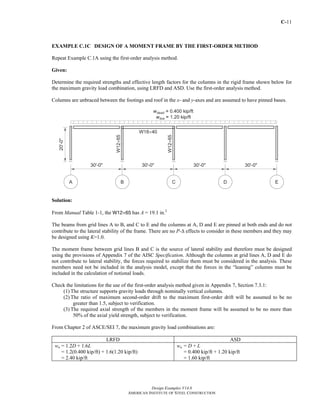
EXAMPLE C.1C DESIGN OF A MOMENT FRAME BY THE FIRST-ORDER METHOD
Repeat Example C.1A using the first-order analysis method.
Given:
Determine the required strengths and effective length factors for the columns in the rigid frame shown below for
the maximum gravity load combination, using LRFD and ASD. Use the first-order analysis method.
Columns are unbraced between the footings and roof in the x- and y-axes and are assumed to have pinned bases.
Solution:
From Manual Table 1-1, the W12×65 has A = 19.1 in.2
The beams from grid lines A to B, and C to E and the columns at A, D and E are pinned at both ends and do not
contribute to the lateral stability of the frame. There are no P-Δ effects to consider in these members and they may
be designed using K=1.0.
The moment frame between grid lines B and C is the source of lateral stability and therefore must be designed
using the provisions of Appendix 7 of the AISC Specification. Although the columns at grid lines A, D and E do
not contribute to lateral stability, the forces required to stabilize them must be considered in the analysis. These
members need not be included in the analysis model, except that the forces in the “leaning” columns must be
included in the calculation of notional loads.
Check the limitations for the use of the first-order analysis method given in Appendix 7, Section 7.3.1:
(1) The structure supports gravity loads through nominally vertical columns.
(2) The ratio of maximum second-order drift to the maximum first-order drift will be assumed to be no
greater than 1.5, subject to verification.
(3) The required axial strength of the members in the moment frame will be assumed to be no more than
50% of the axial yield strength, subject to verification.
From Chapter 2 of ASCE/SEI 7, the maximum gravity load combinations are:
LRFD ASD
wu = 1.2D + 1.6L
= 1.2(0.400 kip/ft) + 1.6(1.20 kip/ft)
= 2.40 kip/ft
wa = D + L
= 0.400 kip/ft + 1.20 kip/ft
= 1.60 kip/ft
Return to Table of Contents
C-12
Design Examples V14.0
AMERICAN INSTITUTE OF STEEL CONSTRUCTION
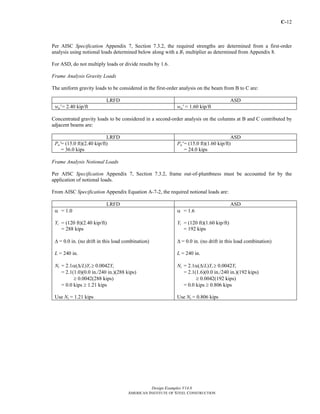
Per AISC Specification Appendix 7, Section 7.3.2, the required strengths are determined from a first-order
analysis using notional loads determined below along with a B1 multiplier as determined from Appendix 8.
For ASD, do not multiply loads or divide results by 1.6.
Frame Analysis Gravity Loads
The uniform gravity loads to be considered in the first-order analysis on the beam from B to C are:
LRFD ASD
wu' = 2.40 kip/ft wa' = 1.60 kip/ft
Concentrated gravity loads to be considered in a second-order analysis on the columns at B and C contributed by
adjacent beams are:
LRFD ASD
Pu'= (15.0 ft)(2.40 kip/ft)
= 36.0 kips
Pa' = (15.0 ft)(1.60 kip/ft)
= 24.0 kips
Frame Analysis Notional Loads
Per AISC Specification Appendix 7, Section 7.3.2, frame out-of-plumbness must be accounted for by the
application of notional loads.
From AISC Specification Appendix Equation A-7-2, the required notional loads are:
LRFD ASD
α = 1.0
Yi = (120 ft)(2.40 kip/ft)
= 288 kips
Δ = 0.0 in. (no drift in this load combination)
L = 240 in.
Ni = 2.1α(Δ/L)Yi ≥ 0.0042Yi
= 2.1(1.0)(0.0 in./240 in.)(288 kips)
≥ 0.0042(288 kips)
= 0.0 kips ≥ 1.21 kips
Use Ni = 1.21 kips
α = 1.6
Yi = (120 ft)(1.60 kip/ft)
= 192 kips
Δ = 0.0 in. (no drift in this load combination)
L = 240 in.
Ni = 2.1α(Δ/L)Yi ≥ 0.0042Yi
= 2.1(1.6)(0.0 in./240 in.)(192 kips)
≥ 0.0042(192 kips)
= 0.0 kips ≥ 0.806 kips
Use Ni = 0.806 kips
Return to Table of Contents
C-13
Design Examples V14.0
AMERICAN INSTITUTE OF STEEL CONSTRUCTION
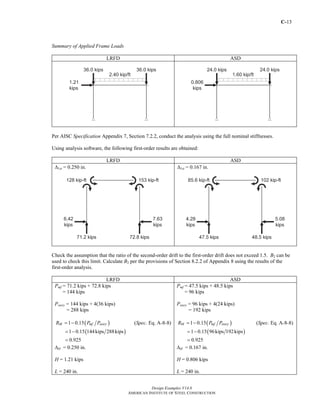
Summary of Applied Frame Loads
LRFD ASD
Per AISC Specification Appendix 7, Section 7.2.2, conduct the analysis using the full nominal stiffnesses.
Using analysis software, the following first-order results are obtained:
LRFD ASD
Δ1st = 0.250 in. Δ1st = 0.167 in.
Check the assumption that the ratio of the second-order drift to the first-order drift does not exceed 1.5. B2 can be
used to check this limit. Calculate B2 per the provisions of Section 8.2.2 of Appendix 8 using the results of the
first-order analysis.
LRFD ASD
Pmf = 71.2 kips + 72.8 kips
= 144 kips
Pstory = 144 kips + 4(36 kips)
= 288 kips
( )1 0.15M mf storyR P P= − (Spec. Eq. A-8-8)
( )1 0.15 144kips 288kips
0.925
= −
=
ΔH = 0.250 in.
H = 1.21 kips
L = 240 in.
Pmf = 47.5 kips + 48.5 kips
= 96 kips
Pstory = 96 kips + 4(24 kips)
= 192 kips
( )1 0.15M mf storyR P P= − (Spec. Eq. A-8-8)
( )1 0.15 96kips 192kips
0.925
= −
=
ΔH = 0.167 in.
H = 0.806 kips
L = 240 in.
Return to Table of Contents
C-14
Design Examples V14.0
AMERICAN INSTITUTE OF STEEL CONSTRUCTION
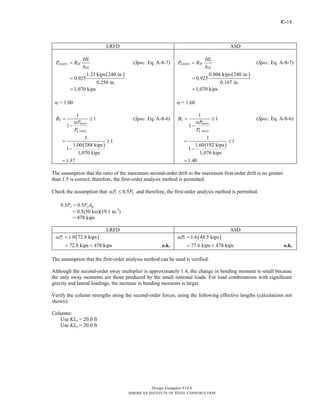
LRFD ASD
estory M
H
HL
P R=
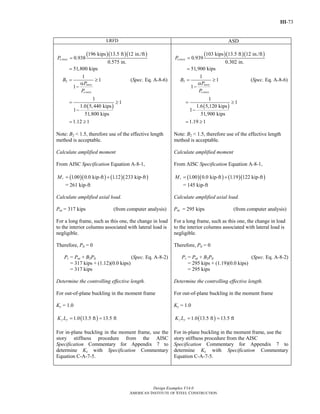
Δ
(Spec. Eq. A-8-7)
( )1.21 kips 240 in.
0.925
0.250 in.
1,070 kips
=
=
α = 1.00
2
1
1
1
story
e story
B
P
P
= ≥
α
−
(Spec. Eq. A-8-6)
( )
1
1
1.00 288 kips
1
1,070 kips
1.37
= ≥
−
=
estory M
H
HL
P R=
Δ
(Spec. Eq. A-8-7)
( )0.806 kips 240 in.
0.925
0.167 in.
1,070 kips
=
=
α = 1.60
2
1
1
1
story
e story
B
P
P
= ≥
α
−
(Spec. Eq. A-8-6)
( )
1
1
1.60 192 kips
1
1,070 kips
1.40
= ≥
−
=
The assumption that the ratio of the maximum second-order drift to the maximum first-order drift is no greater
than 1.5 is correct; therefore, the first-order analysis method is permitted.
Check the assumption that 0.5r yP Pα ≤ and therefore, the first-order analysis method is permitted.
0.5Py = 0.5FyAg
= 0.5(50 ksi)(19.1 in.2
)
= 478 kips
LRFD ASD
( )1.0 72.8 kipsrPα =
72.8 kips 478 kips= < o.k.
( )1.6 48.5 kipsrPα =
77.6 kips 478 kips= < o.k.
The assumption that the first-order analysis method can be used is verified.
Although the second-order sway multiplier is approximately 1.4, the change in bending moment is small because
the only sway moments are those produced by the small notional loads. For load combinations with significant
gravity and lateral loadings, the increase in bending moments is larger.
Verify the column strengths using the second-order forces, using the following effective lengths (calculations not
shown):
Columns:
Use KLx = 20.0 ft
Use KLy = 20.0 ft
Return to Table of Contents
D-1
Design Examples V14.0
AMERICAN INSTITUTE OF STEEL CONSTRUCTION
Chapter D
Design of Members for Tension
D1. SLENDERNESS LIMITATIONS
Section D1 does not establish a slenderness limit for tension members, but recommends limiting L/r to a
maximum of 300. This is not an absolute requirement. Rods and hangers are specifically excluded from this
recommendation.
D2. TENSILE STRENGTH
Both tensile yielding strength and tensile rupture strength must be considered for the design of tension members.
It is not unusual for tensile rupture strength to govern the design of a tension member, particularly for small
members with holes or heavier sections with multiple rows of holes.
For preliminary design, tables are provided in Part 5 of the AISC Manual for W-shapes, L-shapes, WT-shapes,
rectangular HSS, square HSS, round HSS, Pipe and 2L-shapes. The calculations in these tables for available
tensile rupture strength assume an effective area, Ae, of 0.75Ag. If the actual effective area is greater than 0.75Ag,
the tabulated values will be conservative and calculations can be performed to obtain higher available strengths. If
the actual effective area is less than 0.75Ag, the tabulated values will be unconservative and calculations are
necessary to determine the available strength.
D3. EFFECTIVE NET AREA
The gross area, Ag, is the total cross-sectional area of the member.
In computing net area, An, AISC Specification Section B4.3 requires that an extra z in. be added to the bolt hole
diameter.
A computation of the effective area for a chain of holes is presented in Example D.9.
Unless all elements of the cross section are connected, Ae = AnU, where U is a reduction factor to account for
shear lag. The appropriate values of U can be obtained from Table D3.1 of the AISC Specification.
D4. BUILT-UP MEMBERS
The limitations for connections of built-up members are discussed in Section D4 of the AISC Specification.
D5. PIN-CONNECTED MEMBERS
An example of a pin-connected member is given in Example D.7.
D6. EYEBARS
An example of an eyebar is given in Example D.8. The strength of an eyebar meeting the dimensional
requirements of AISC Specification Section D6 is governed by tensile yielding of the body.
Return to Table of Contents
D-2
Design Examples V14.0
AMERICAN INSTITUTE OF STEEL CONSTRUCTION
EXAMPLE D.1 W-SHAPE TENSION MEMBER
Given:
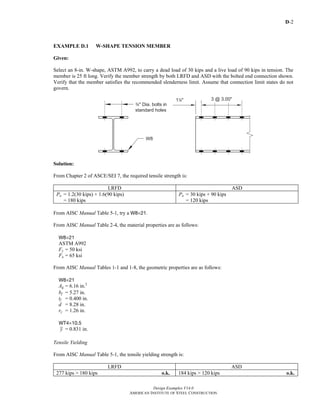
Select an 8-in. W-shape, ASTM A992, to carry a dead load of 30 kips and a live load of 90 kips in tension. The
member is 25 ft long. Verify the member strength by both LRFD and ASD with the bolted end connection shown.
Verify that the member satisfies the recommended slenderness limit. Assume that connection limit states do not
govern.
Solution:
From Chapter 2 of ASCE/SEI 7, the required tensile strength is:
LRFD ASD
Pu = 1.2(30 kips) + 1.6(90 kips)
= 180 kips
Pa = 30 kips + 90 kips
= 120 kips
From AISC Manual Table 5-1, try a W8×21.
From AISC Manual Table 2-4, the material properties are as follows:
W8×21
ASTM A992
Fy = 50 ksi
Fu = 65 ksi
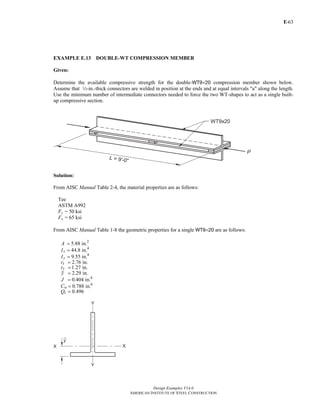
From AISC Manual Tables 1-1 and 1-8, the geometric properties are as follows:
W8×21
Ag = 6.16 in.2
bf = 5.27 in.
tf = 0.400 in.
d = 8.28 in.
ry = 1.26 in.
WT4×10.5
y = 0.831 in.
Tensile Yielding
From AISC Manual Table 5-1, the tensile yielding strength is:
LRFD ASD
277 kips > 180 kips o.k. 184 kips > 120 kips o.k.
Return to Table of Contents
D-3
Design Examples V14.0
AMERICAN INSTITUTE OF STEEL CONSTRUCTION
Tensile Rupture
Verify the table assumption that Ae/Ag ≥ 0.75 for this connection.
Calculate the shear lag factor, U, as the larger of the values from AISC Specification Section D3, Table D3.1 case
2 and case 7.
From AISC Specification Section D3, for open cross sections, U need not be less than the ratio of the gross area of
the connected element(s) to the member gross area.
U =
2 f f
g
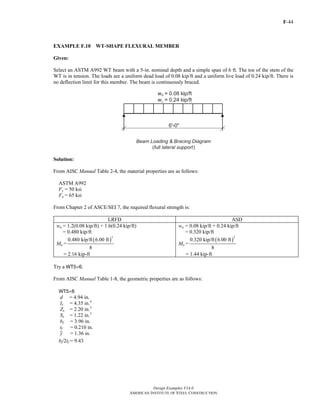
b t
A
= 2
2(5.27 in.)(0.400 in.)
6.16 in.
= 0.684
Case 2: Check as two WT-shapes per AISC Specification Commentary Figure C-D3.1, with 0.831 in.x y= =
U =1
x
l
−
=
0.831 in.
1
9.00 in.
−
= 0.908
Case 7:
bf = 5.27 in.
d = 8.28 in.
bf < qd
U = 0.85
Use U = 0.908.
Calculate An using AISC Specification Section B4.3.
An = Ag – 4(dh + z in.)tf
= 6.16 in.2
– 4(m in. + z in.)(0.400 in.)
= 4.76 in.2
Calculate Ae using AISC Specification Section D3.
Ae = AnU (Spec. Eq. D3-1)
= 4.76 in.2
(0.908)
= 4.32 in.2
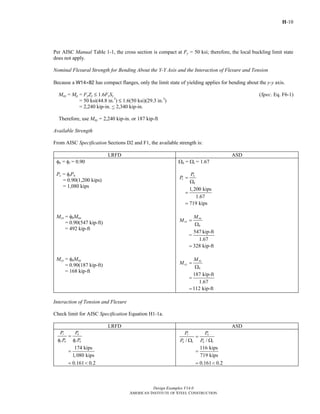
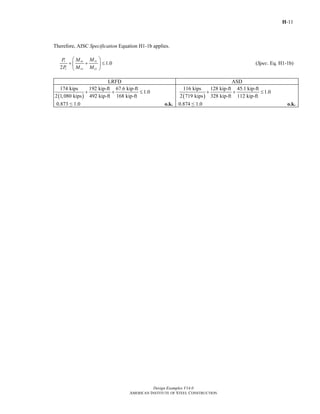
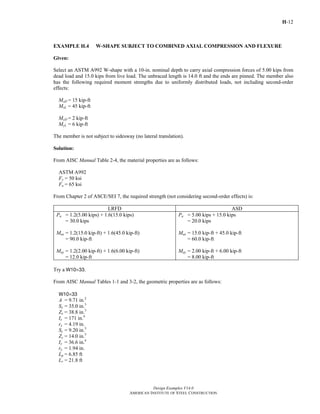
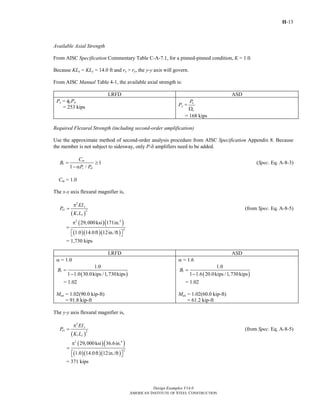
2
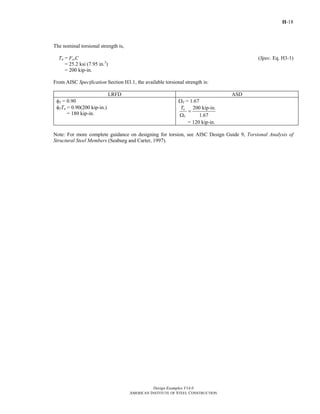
2
4.32 in.
6.16 in.
e
g
A
A
=
= 0.701 < 0.75; therefore, table values for rupture are not valid.
The available tensile rupture strength is,
Return to Table of Contents
D-4
Design Examples V14.0
AMERICAN INSTITUTE OF STEEL CONSTRUCTION
Pn = FuAe (Spec. Eq. D2-2)
= 65 ksi(4.32 in.2
)
= 281 kips
From AISC Specification Section D2, the available tensile rupture strength is:
LRFD ASD
φt = 0.75
φtPn = 0.75(281 kips)
= 211 kips
211 kips > 180 kips o.k.
Ωt = 2.00
281 kips
2.00
n
t
P
=
Ω
= 141 kips
141 kips > 120 kips o.k.
Check Recommended Slenderness Limit
25.0 ft 12.0 in.
1.26 in. ft
L
r
⎛ ⎞⎛ ⎞
= ⎜ ⎟⎜ ⎟
⎝ ⎠⎝ ⎠
= 238 < 300 from AISC Specification Section D1 o.k.
The W8×21 available tensile strength is governed by the tensile rupture limit state at the end connection.
See Chapter J for illustrations of connection limit state checks.
Return to Table of Contents
D-5
Design Examples V14.0
AMERICAN INSTITUTE OF STEEL CONSTRUCTION
EXAMPLE D.2 SINGLE ANGLE TENSION MEMBER
Given:
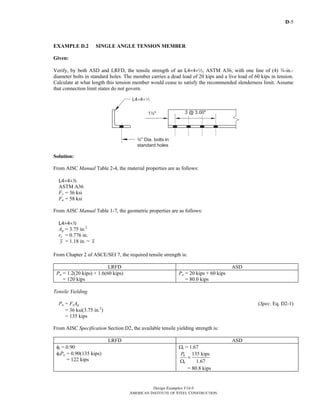
Verify, by both ASD and LRFD, the tensile strength of an L4×4×2, ASTM A36, with one line of (4) w-in.-
diameter bolts in standard holes. The member carries a dead load of 20 kips and a live load of 60 kips in tension.
Calculate at what length this tension member would cease to satisfy the recommended slenderness limit. Assume
that connection limit states do not govern.
Solution:
From AISC Manual Table 2-4, the material properties are as follows:
L4×4×2
ASTM A36
Fy = 36 ksi
Fu = 58 ksi
From AISC Manual Table 1-7, the geometric properties are as follows:
L4×4×2
Ag = 3.75 in.2
rz = 0.776 in.
y = 1.18 in. = x
From Chapter 2 of ASCE/SEI 7, the required tensile strength is:
LRFD ASD
Pu = 1.2(20 kips) + 1.6(60 kips)
= 120 kips
Pa = 20 kips + 60 kips
= 80.0 kips
Tensile Yielding
Pn = FyAg (Spec. Eq. D2-1)
= 36 ksi(3.75 in.2
)
= 135 kips
From AISC Specification Section D2, the available tensile yielding strength is:
LRFD ASD
φt = 0.90
φtPn = 0.90(135 kips)
= 122 kips
Ωt = 1.67
135 kips
1.67
n
t
P
=
Ω
= 80.8 kips
Return to Table of Contents
D-6
Design Examples V14.0
AMERICAN INSTITUTE OF STEEL CONSTRUCTION
Tensile Rupture
Calculate U as the larger of the values from AISC Specification Section D3, Table D3.1 Case 2 and Case 8.
From AISC Specification Section D3, for open cross sections, U need not be less than the ratio of the gross area of
the connected element(s) to the member gross area, therefore,
U = 0.500
Case 2:
U =1
x
l
−
=
1.18in.
1
9.00in.
−
= 0.869
Case 8, with 4 or more fasteners per line in the direction of loading:
U = 0.80
Use U = 0.869.
Calculate An using AISC Specification Section B4.3.
An = Ag – (dh + z)t
= 3.75 in.2
– (m in. + z in.)(2 in.)
= 3.31 in.2
Calculate Ae using AISC Specification Section D3.
Ae = AnU (Spec. Eq. D3-1)
= 3.31 in.2
(0.869)
= 2.88 in.2
Pn = FuAe (Spec. Eq. D2-2)
= 58 ksi(2.88 in.2
)
= 167 kips
From AISC Specification Section D2, the available tensile rupture strength is:
LRFD ASD
φt = 0.75
φtPn = 0.75(167 kips)
= 125 kips
Ωt = 2.00
167 kips
2.00
n
t
P
=
Ω
= 83.5 kips
The L4×4×2 available tensile strength is governed by the tensile yielding limit state.
LRFD ASD
φtPn = 122 kips
122 kips > 120 kips o.k.
80.8 kipsn
t
P
=
Ω
80.8 kips > 80.0 kips o.k.
Return to Table of Contents
D-7
Design Examples V14.0
AMERICAN INSTITUTE OF STEEL CONSTRUCTION
Recommended Lmax
Using AISC Specification Section D1:
Lmax = 300rz
=
ft
(300)(0.776in.)
12.0 in.
⎛ ⎞
⎜ ⎟
⎝ ⎠
= 19.4 ft
Note: The L/r limit is a recommendation, not a requirement.
See Chapter J for illustrations of connection limit state checks.
Return to Table of Contents
D-8
Design Examples V14.0
AMERICAN INSTITUTE OF STEEL CONSTRUCTION
EXAMPLE D.3 WT-SHAPE TENSION MEMBER
Given:
A WT6×20, ASTM A992 member has a length of 30 ft and carries a dead load of 40 kips and a live load of 120
kips in tension. The end connection is fillet welded on each side for 16 in. Verify the member tensile strength by
both LRFD and ASD. Assume that the gusset plate and the weld are satisfactory.
Solution:
From AISC Manual Table 2-4, the material properties are as follows:
WT6×20
ASTM A992
Fy = 50 ksi
Fu = 65 ksi
From AISC Manual Table 1-8, the geometric properties are as follows:
WT6×20
Ag = 5.84 in.2
bf = 8.01 in.
tf = 0.515 in.
rx = 1.57 in.
y = 1.09 in. = x (in equation for U)
From Chapter 2 of ASCE/SEI 7, the required tensile strength is:
LRFD ASD
Pu = 1.2(40 kips) + 1.6(120 kips)
= 240 kips
Pa = 40 kips + 120 kips
= 160 kips
Tensile Yielding
Check tensile yielding limit state using AISC Manual Table 5-3.
LRFD ASD
φtPn = 263 kips > 240 kips o.k. n
t
P
Ω
= 175 kips > 160 kips o.k.
Return to Table of Contents
D-9
Design Examples V14.0
AMERICAN INSTITUTE OF STEEL CONSTRUCTION
Tensile Rupture
Check tensile rupture limit state using AISC Manual Table 5-3.
LRFD ASD
φtPn = 214 kips < 240 kips n.g. n
t
P
Ω
= 142 kips < 160 kips n.g.
The tabulated available rupture strengths may be conservative for this case; therefore, calculate the exact solution.
Calculate U as the larger of the values from AISC Specification Section D3 and Table D3.1 case 2.
From AISC Specification Section D3, for open cross-sections, U need not be less than the ratio of the gross area
of the connected element(s) to the member gross area.
U =
f f
g
b t
A
= 2
8.01 in.(0.515 in.)
5.84 in.
= 0.706
Case 2:
U =1
x
l
−
=
1.09in.
1
16.0in.
−
= 0.932
Use U = 0.932.
Calculate An using AISC Specification Section B4.3.
An = Ag (because there are no reductions due to holes or notches)
= 5.84 in.2
Calculate Ae using AISC Specification Section D3.
Ae = AnU (Spec. Eq. D3-1)
= 5.84 in.2
(0.932)
= 5.44 in.2
Calculate Pn.
Pn = FuAe (Spec. Eq. D2-2)
= 65 ksi(5.44 in.2
)
= 354 kips
Return to Table of Contents
D-10
Design Examples V14.0
AMERICAN INSTITUTE OF STEEL CONSTRUCTION
From AISC Specification Section D2, the available tensile rupture strength is:
LRFD ASD
φt = 0.75
φtPn = 0.75(354 kips)
= 266 kips
266 kips > 240 kips o.k.
Ωt = 2.00
354 kips
2.00
n
t
P
=
Ω
= 177 kips
177 kips > 160 kips o.k.
Alternately, the available tensile rupture strengths can be determined by modifying the tabulated values. The
available tensile rupture strengths published in the tension member selection tables are based on the assumption
that Ae = 0.75Ag. The actual available strengths can be determined by adjusting the values from AISC Manual
Table 5-3 as follows:
LRFD ASD
φtPn = 214 kips
0.75
e
g
A
A
⎛ ⎞
⎜ ⎟
⎝ ⎠
= 214 kips
( )
2
2
5.44 in.
0.75 5.84 in.
⎛ ⎞
⎜ ⎟
⎜ ⎟
⎝ ⎠
= 266 kips
n
t
P
Ω
= 142 kips
0.75
e
g
A
A
⎛ ⎞
⎜ ⎟
⎝ ⎠
= 142 kips
( )
2
2
5.44 in.
0.75 5.84 in.
⎛ ⎞
⎜ ⎟
⎜ ⎟
⎝ ⎠
= 176 kips
The WT6×20 available tensile strength is governed by the tensile yielding limit state.
LRFD ASD
φtPn = 263 kips
263 kips > 240 kips o.k.
n
t
P
Ω
= 175 kips
175 kips > 160 kips o.k.
Recommended Slenderness Limit
30.0 ft 12.0 in.
1.57 in. ft
L
r
⎛ ⎞⎛ ⎞
= ⎜ ⎟⎜ ⎟
⎝ ⎠⎝ ⎠
= 229 < 300 from AISC Specification Section D1 o.k.
See Chapter J for illustrations of connection limit state checks.
Return to Table of Contents
D-11
Design Examples V14.0
AMERICAN INSTITUTE OF STEEL CONSTRUCTION
EXAMPLE D.4 RECTANGULAR HSS TENSION MEMBER
Given:
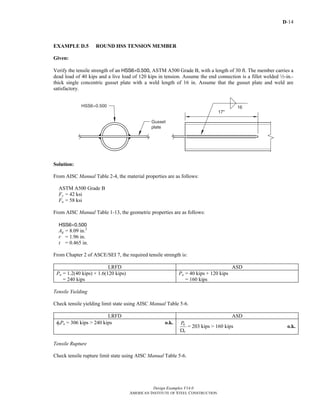
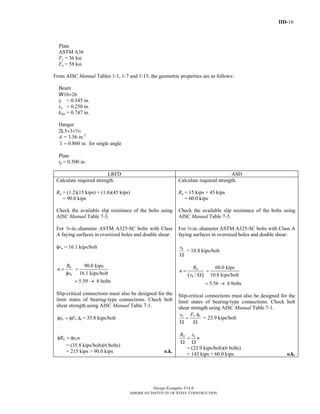
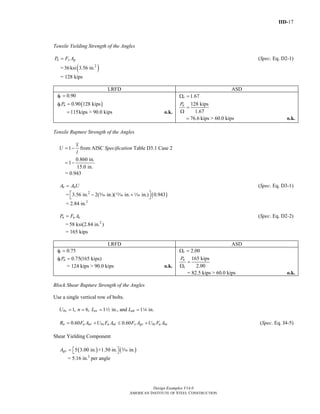
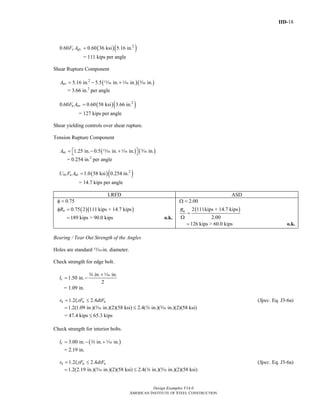
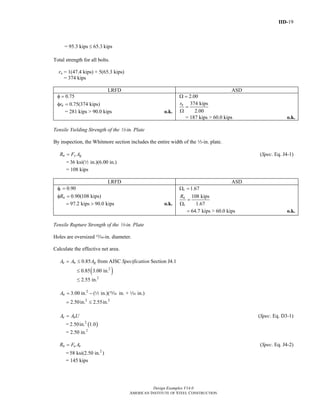
Verify the tensile strength of an HSS6×4×a, ASTM A500 Grade B, with a length of 30 ft. The member is
carrying a dead load of 35 kips and a live load of 105 kips in tension. The end connection is a fillet welded 2-in.-
thick single concentric gusset plate with a weld length of 16 in. Assume that the gusset plate and weld are
satisfactory.
Solution:
From AISC Manual Table 2-4, the material properties are as follows:
ASTM A500 Grade B
Fy = 46 ksi
Fu = 58 ksi
From AISC Manual Table 1-11, the geometric properties are as follows:
HSS6×4×a
Ag = 6.18 in.2
ry = 1.55 in.
t = 0.349 in.
From Chapter 2 of ASCE/SEI 7, the required tensile strength is:
LRFD ASD
Pu = 1.2(35 kips) + 1.6(105 kips)
= 210 kips
Pa = 35 kips + 105 kips
= 140 kips
Tensile Yielding
Check tensile yielding limit state using AISC Manual Table 5-4.
LRFD ASD
φtPn = 256 kips > 210 kips o.k. n
t
P
Ω
= 170 kips > 140 kips o.k.
Tensile Rupture
Check tensile rupture limit state using AISC Manual Table 5-4.
Return to Table of Contents
D-12
Design Examples V14.0
AMERICAN INSTITUTE OF STEEL CONSTRUCTION
LRFD ASD
φtPn = 201 kips < 210 kips n.g. n
t
P
Ω
= 134 kips < 140 kips n.g.
The tabulated available rupture strengths may be conservative in this case; therefore, calculate the exact solution.
Calculate U from AISC Specification Table D3.1 case 6.
x =
2
2
4( )
B BH
B H
+
+
=
( ) ( )( )
( )
2
4.00 in. 2 4.00 in. 6.00 in.
4 4.00 in. 6.00 in.
+
+
= 1.60 in.
U =1
x
l
−
=
1.60in.
1
16.0in.
−
= 0.900
Allowing for a z-in. gap in fit-up between the HSS and the gusset plate:
An = Ag – 2(tp + z in.)t
= 6.18 in.2
– 2(2 in. + z in.)(0.349 in.)
= 5.79 in.2
Calculate Ae using AISC Specification Section D3.
Ae =AnU (Spec. Eq. D3-1)
= 5.79 in.2
(0.900)
= 5.21 in.2
Calculate Pn.
Pn = FuAe (Spec. Eq. D2-2)
= 58 ksi(5.21 in2
)
= 302 kips
From AISC Specification Section D2, the available tensile rupture strength is:
LRFD ASD
φt = 0.75
φtPn = 0.75(302 kips)
= 227 kips
227 kips > 210 kips o.k.
Ωt = 2.00
302 kips
2.00
n
t
P
=
Ω
= 151 kips
151 kips > 140 kips o.k.
The HSS available tensile strength is governed by the tensile rupture limit state.
Return to Table of Contents
D-13
Design Examples V14.0
AMERICAN INSTITUTE OF STEEL CONSTRUCTION
Recommended Slenderness Limit
30.0 ft 12.0 in.
1.55 in. ft
L
r
⎛ ⎞⎛ ⎞
= ⎜ ⎟⎜ ⎟
⎝ ⎠⎝ ⎠
= 232 < 300 from AISC Specification Section D1 o.k.
See Chapter J for illustrations of connection limit state checks.
Return to Table of Contents
D-14
Design Examples V14.0
AMERICAN INSTITUTE OF STEEL CONSTRUCTION
EXAMPLE D.5 ROUND HSS TENSION MEMBER
Given:
Verify the tensile strength of an HSS6×0.500, ASTM A500 Grade B, with a length of 30 ft. The member carries a
dead load of 40 kips and a live load of 120 kips in tension. Assume the end connection is a fillet welded 2-in.-
thick single concentric gusset plate with a weld length of 16 in. Assume that the gusset plate and weld are
satisfactory.
Solution:
From AISC Manual Table 2-4, the material properties are as follows:
ASTM A500 Grade B
Fy = 42 ksi
Fu = 58 ksi
From AISC Manual Table 1-13, the geometric properties are as follows:
HSS6×0.500
Ag = 8.09 in.2
r = 1.96 in.
t = 0.465 in.
From Chapter 2 of ASCE/SEI 7, the required tensile strength is:
LRFD ASD
Pu = 1.2(40 kips) + 1.6(120 kips)
= 240 kips
Pa = 40 kips + 120 kips
= 160 kips
Tensile Yielding
Check tensile yielding limit state using AISC Manual Table 5-6.
LRFD ASD
φtPn = 306 kips > 240 kips o.k. n
t
P
Ω
= 203 kips > 160 kips o.k.
Tensile Rupture
Check tensile rupture limit state using AISC Manual Table 5-6.
Return to Table of Contents
D-15
Design Examples V14.0
AMERICAN INSTITUTE OF STEEL CONSTRUCTION
LRFD ASD
φtPn = 264 kips > 240 kips o.k. n
t
P
Ω
= 176 kips > 160 kips o.k.
Check that Ae/Ag ≥ 0.75 as assumed in table.
Determine U from AISC Specification Table D3.1 Case 5.
L = 16.0 in.
D = 6.00 in.
16.0 in.
6.00 in.
L
D
=
= 2.67 > 1.3, therefore U = 1.0
Allowing for a z-in. gap in fit-up between the HSS and the gusset plate,
An = Ag – 2(tp + z in.)t
= 8.09 in.2
– 2(0.500 in. + z in.)(0.465 in.)
= 7.57 in.2
Calculate Ae using AISC Specification Section D3.
Ae = AnU (Spec. Eq. D3-1)
= 7.57 in.2
(1.0)
= 7.57 in.2
2
2
7.57 in.
8.09 in.
e
g
A
A
=
= 0.936 > 0.75 o.k., but conservative
Calculate Pn.
Pn = FuAe (Spec. Eq. D2-2)
= (58 ksi)(7.57 in.2
)
= 439 kips
From AISC Specification Section D2, the available tensile rupture strength is:
LRFD ASD
φt = 0.75
φtPn = 0.75(439 kips)
= 329 kips
329 kips > 240 kips o.k.
Ωt = 2.00
439 kips
2.00
n
t
P
=
Ω
= 220 kips
220 kips > 160 kips o.k.
Recommended Slenderness Limit
30.0 ft 12.0 in.
1.96 in. ft
L
r
⎛ ⎞⎛ ⎞
= ⎜ ⎟⎜ ⎟
⎝ ⎠⎝ ⎠
= 184 < 300 from AISC Specification Section D1 o.k.
Return to Table of Contents
D-16
Design Examples V14.0
AMERICAN INSTITUTE OF STEEL CONSTRUCTION
See Chapter J for illustrations of connection limit state checks.
Return to Table of Contents
D-17
Design Examples V14.0
AMERICAN INSTITUTE OF STEEL CONSTRUCTION
EXAMPLE D.6 DOUBLE ANGLE TENSION MEMBER
Given:
A 2L4×4×2 (a-in. separation), ASTM A36, has one line of (8) ¾-in.-diameter bolts in standard holes and is 25 ft
in length. The double angle is carrying a dead load of 40 kips and a live load of 120 kips in tension. Verify the
member tensile strength. Assume that the gusset plate and bolts are satisfactory.
Solution:
From AISC Manual Table 2-4, the material properties are as follows:
ASTM A36
Fy = 36 ksi
Fu = 58 ksi
From AISC Manual Tables 1-7 and 1-15, the geometric properties are as follows:
L4×4×2
Ag = 3.75 in.2
x = 1.18 in.
2L4×4×2 (s = a in.)
ry = 1.83 in.
rx = 1.21 in.
From Chapter 2 of ASCE/SEI 7, the required tensile strength is:
LRFD ASD
Pn = 1.2(40 kips) + 1.6(120 kips)
= 240 kips
Pn = 40 kips + 120 kips
= 160 kips
Tensile Yielding
Pn = FyAg (Spec. Eq. D2-1)
= 36 ksi(2)(3.75 in.2
)
= 270 kips
Return to Table of Contents
D-18
Design Examples V14.0
AMERICAN INSTITUTE OF STEEL CONSTRUCTION
From AISC Specification Section D2, the available tensile yielding strength is:
LRFD ASD
φt = 0.90
φtPn = 0.90(270 kips)
= 243 kips
Ωt = 1.67
270 kips
1.67
n
t
P
=
Ω
= 162 kips
Tensile Rupture
Calculate U as the larger of the values from AISC Specification Section D3, Table D3.1 case 2 and case 8.
From AISC Specification Section D3, for open cross-sections, U need not be less than the ratio of the gross area
of the connected element(s) to the member gross area.
U = 0.500
Case 2:
U = 1
x
l
−
=
1.18in.
1
21.0in.
−
= 0.944
Case 8, with 4 or more fasteners per line in the direction of loading:
U = 0.80
Use U = 0.944.
Calculate An using AISC Specification Section B4.3.
An = Ag – 2(dh + z in.)t
= 2(3.75 in.2
) – 2(m in. + z in.)(2 in.)
= 6.63 in.2
Calculate Ae using AISC Specification Section D3.
Ae = AnU (Spec. Eq. D3-1)
= 6.63 in.2
(0.944)
= 6.26 in.2
Calculate Pn.
Pn = FuAe (Spec. Eq. D2-2)
= 58 ksi(6.26 in.2
)
= 363 kips
From AISC Specification Section D2, the available tensile rupture strength is:
Return to Table of Contents
D-19
Design Examples V14.0
AMERICAN INSTITUTE OF STEEL CONSTRUCTION
LRFD ASD
φt = 0.75
φtPn = 0.75(363 kips)
= 272 kips
Ωt = 2.00
363 kips
2.00
n
t
P
=
Ω
= 182 kips
The double angle available tensile strength is governed by the tensile yielding limit state.
LRFD ASD
243 kips > 240 kips o.k. 162 kips > 160 kips o.k.
Recommended Slenderness Limit
25.0 ft 12.0 in.
1.21 in. ftx
L
r
⎛ ⎞⎛ ⎞
= ⎜ ⎟⎜ ⎟
⎝ ⎠⎝ ⎠
= 248 < 300 from AISC Specification Section D1 o.k.
Note: From AISC Specification Section D4, the longitudinal spacing of connectors between components of built-
up members should preferably limit the slenderness ratio in any component between the connectors to a maximum
of 300.
See Chapter J for illustrations of connection limit state checks.
Return to Table of Contents
D-20
Design Examples V14.0
AMERICAN INSTITUTE OF STEEL CONSTRUCTION
EXAMPLE D.7 PIN-CONNECTED TENSION MEMBER
Given:
An ASTM A36 pin-connected tension member with the dimensions shown as follows carries a dead load of 4 kips
and a live load of 12 kips in tension. The diameter of the pin is 1 inch, in a Q-in. oversized hole. Assume that the
pin itself is adequate. Verify the member tensile strength.
Solution:
From AISC Manual Table 2-5, the material properties are as follows:
Plate
ASTM A36
Fy = 36 ksi
Fu = 58 ksi
The geometric properties are as follows:
w = 4.25 in.
t = 0.500 in.
d = 1.00 in.
a = 2.25 in.
c = 2.50 in.
dh = 1.03 in.
Check dimensional requirements using AISC Specification Section D5.2.
1. be = 2t + 0.63 in.
= 2(0.500 in.) + 0.63 in.
= 1.63 in. ≤ 1.61 in.
be = 1.61 in. controls
2. a > 1.33be
2.25 in. > 1.33(1.61 in.)
= 2.14 in. o.k.
Return to Table of Contents
D-21
Design Examples V14.0
AMERICAN INSTITUTE OF STEEL CONSTRUCTION
3. w > 2be + d
4.25 in. > 2(1.61 in.) + 1.00 in.
= 4.22 in. o.k.
4. c > a
2.50 in. > 2.25 in. o.k.
From Chapter 2 of ASCE/SEI 7, the required tensile strength is:
LRFD ASD
Pu = 1.2(4 kips) + 1.6(12 kips)
= 24.0 kips
Pa = 4 kips + 12 kips
= 16.0 kips
Tensile Rupture
Calculate the available tensile rupture strength on the effective net area.
Pn = Fu(2tbe) (Spec. Eq. D5-1)
= 58 ksi (2)(0.500 in.)(1.61 in.)
= 93.4 kips
From AISC Specification Section D5.1, the available tensile rupture strength is:
LRFD ASD
φt = 0.75
φtPn = 0.75(93.4 kips)
= 70.1 kips
Ωt = 2.00
93.4 kips
2.00
n
t
P
=
Ω
= 46.7 kips
Shear Rupture
Asf = 2t(a + d/2)
= 2(0.500 in.)[2.25 in. + (1.00 in./2)]
= 2.75 in.2
Pn = 0.6FuAsf (Spec. Eq. D5-2)
= 0.6(58 ksi)(2.75 in.2
)
= 95.7 kips
From AISC Specification Section D5.1, the available shear rupture strength is:
LRFD ASD
φsf = 0.75
φsfPn = 0.75(95.7 kips)
= 71.8 kips
Ωsf = 2.00
95.7 kips
2.00
n
sf
P
=
Ω
= 47.9 kips
Bearing
Apb = 0.500 in.(1.00 in.)
= 0.500 in.2
Return to Table of Contents
D-22
Design Examples V14.0
AMERICAN INSTITUTE OF STEEL CONSTRUCTION
Rn = 1.8FyApb (Spec. Eq. J7-1)
= 1.8(36 ksi)(0.500 in.2
)
= 32.4 kips
From AISC Specification Section J7, the available bearing strength is:
LRFD ASD
φ = 0.75
φPn = 0.75(32.4 kips)
= 24.3 kips
Ω = 2.00
32.4 kips
2.00
nP
=
Ω
= 16.2 kips
Tensile Yielding
Ag = wt
= 4.25 in. (0.500 in.)
= 2.13 in.2
Pn = FyAg (Spec. Eq. D2-1)
= 36 ksi (2.13 in.2
)
= 76.7 kips
From AISC Specification Section D2, the available tensile yielding strength is:
LRFD ASD
φt = 0.90
φtPn = 0.90(76.7 kips)
= 69.0 kips
Ωt = 1.67
76.7 kips
1.67
n
t
P
=
Ω
= 45.9 kips
The available tensile strength is governed by the bearing strength limit state.
LRFD ASD
φPn = 24.3 kips
24.3 kips > 24.0 kips o.k.
nP
Ω
= 16.2 kips
16.2 kips > 16.0 kips o.k.
See Example J.6 for an illustration of the limit state calculations for a pin in a drilled hole.
Return to Table of Contents
D-23
Design Examples V14.0
AMERICAN INSTITUTE OF STEEL CONSTRUCTION
EXAMPLE D.8 EYEBAR TENSION MEMBER
Given:
A s-in.-thick, ASTM A36 eyebar member as shown, carries a dead load of 25 kips and a live load of 15 kips in
tension. The pin diameter, d, is 3 in. Verify the member tensile strength.
Solution:
From AISC Manual Table 2-5, the material properties are as follows:
Plate
ASTM A36
Fy = 36 ksi
Fu = 58 ksi
The geometric properties are as follows:
w = 3.00 in.
b = 2.23 in.
t = s in.
dhead = 7.50 in.
d = 3.00 in.
dh = 3.03 in.
R = 8.00 in.
Check dimensional requirements using AISC Specification Section D6.1 and D6.2.
1. t > 2 in.
s in. > 2 in. o.k.
2. w < 8t
3.00 in. < 8(s in.)
= 5.00 in. o.k.
Return to Table of Contents
D-24
Design Examples V14.0
AMERICAN INSTITUTE OF STEEL CONSTRUCTION
3. d > d w
3.00 in. > d(3.00 in.)
= 2.63 in. o.k.
4. dh < d + Q in.
3.03 in. < 3.00 in. + (Q in.)
= 3.03 in. o.k.
5. R > dhead
8.00 in. > 7.50 in. o.k.
6. q w < b < w w
q(3.00 in.) < 2.23 in. < w(3.00 in.)
2.00 in. < 2.23 in. < 2.25 in. o.k.
From Chapter 2 of ASCE/SEI 7, the required tensile strength is:
LRFD ASD
Pu = 1.2(25.0 kips) + 1.6(15.0 kips)
= 54.0 kips
Pa = 25.0 kips + 15.0 kips
= 40.0 kips
Tensile Yielding
Calculate the available tensile yielding strength at the eyebar body (at w).
Ag = wt
= 3.00 in.(s in.)
= 1.88 in.2
Pn = FyAg (Spec. Eq. D2-1)
= 36 ksi(1.88 in.2
)
= 67.7 kips
From AISC Specification Section D2, the available tensile yielding strength is:
LRFD ASD
φt = 0.90
φtPn = 0.90(67.7 kips)
= 60.9 kips
60.9 kips > 54.0 kips o.k.
Ωt = 1.67
67.7 kips
1.67
n
t
P
=
Ω
= 40.5 kips
40.5 kips > 40.0 kips o.k.
The eyebar tension member available strength is governed by the tensile yielding limit state.
Note: The eyebar detailing limitations ensure that the tensile yielding limit state at the eyebar body will control
the strength of the eyebar itself. The pin should also be checked for shear yielding, and, if the material strength is
less than that of the eyebar, bearing.
See Example J.6 for an illustration of the limit state calculations for a pin in a drilled hole.
Return to Table of Contents
D-25
Design Examples V14.0
AMERICAN INSTITUTE OF STEEL CONSTRUCTION
EXAMPLE D.9 PLATE WITH STAGGERED BOLTS
Given:
Compute An and Ae for a 14-in.-wide and 2-in.-thick plate subject to tensile loading with staggered holes as
shown.
Solution:
Calculate net hole diameter using AISC Specification Section B4.3.
dnet = dh + z in.
= m in. + z in.
= 0.875 in.
Compute the net width for all possible paths across the plate. Because of symmetry, many of the net widths are
identical and need not be calculated.
2
14.0
4
net
s
w d
g
= − Σ + Σ from AISC Specification Section B4.3.
Line A-B-E-F: w = 14.0 in. − 2(0.875 in.)
= 12.3 in.
Line A-B-C-D-E-F: ( )
( )
( )
( )
( )
2 2
2.50in. 2.50in.
14.0in. 4 0.875in.
4 3.00in. 4 3.00in.
w = − + +
= 11.5 in. controls
Line A-B-C-D-G: ( )
( )
( )
2
2.50in.
14.0in. 3 0.875in.
4 3.00in.
w = − +
= 11.9 in.
Line A-B-D-E-F: ( )
( )
( )
( )
( )
2 2
2.50in. 2.50in.
14.0in. 3 0.875in.
4 7.00in. 4 3.00in.
w = − + +
= 12.1 in.
Therefore, 11.5 in.(0.500 in.)nA =
Return to Table of Contents
D-26
Design Examples V14.0
AMERICAN INSTITUTE OF STEEL CONSTRUCTION
= 5.75 in.2
Calculate U.
From AISC Specification Table D3.1 case 1, because tension load is transmitted to all elements by the fasteners,
U = 1.0
Ae = AnU (Spec. Eq. D3-1)
= 5.75 in.2
(1.0)
= 5.75 in.2
Return to Table of Contents
E-
Design Examples V14.0
AMERICAN INSTITUTE OF STEEL CONSTRUCTION
1
Chapter E
Design of Members for Compression
This chapter covers the design of compression members, the most common of which are columns. The AISC
Manual includes design tables for the following compression member types in their most commonly available
grades.
• wide-flange column shapes
• HSS
• double angles
• single angles
LRFD and ASD information is presented side-by-side for quick selection, design or verification. All of the tables
account for the reduced strength of sections with slender elements.
The design and selection method for both LRFD and ASD designs is similar to that of previous AISC
Specifications, and will provide similar designs. In this AISC Specification, ASD and LRFD will provide identical
designs when the live load is approximately three times the dead load.
The design of built-up shapes with slender elements can be tedious and time consuming, and it is recommended
that standard rolled shapes be used, when possible.
E1. GENERAL PROVISIONS
The design compressive strength, φcPn, and the allowable compressive strength, Pn/Ωc, are determined as follows:
Pn = nominal compressive strength based on the controlling buckling mode
φc = 0.90 (LRFD) Ωc = 1.67 (ASD)
Because Fcr is used extensively in calculations for compression members, it has been tabulated in AISC Manual
Table 4-22 for all of the common steel yield strengths.
E2. EFFECTIVE LENGTH
In the AISC Specification, there is no limit on slenderness, KL/r. Per the AISC Specification Commentary, it is
recommended that KL/r not exceed 200, as a practical limit based on professional judgment and construction
economics.
Although there is no restriction on the unbraced length of columns, the tables of the AISC Manual are stopped at
common or practical lengths for ordinary usage. For example, a double L3×3×¼, with a a-in. separation has an ry
of 1.38 in. At a KL/r of 200, this strut would be 23’-0” long. This is thought to be a reasonable limit based on
fabrication and handling requirements.
Throughout the AISC Manual, shapes that contain slender elements when supplied in their most common material
grade are footnoted with the letter “c”. For example, see a W14×22c
.
E3. FLEXURAL BUCKLING OF MEMBERS WITHOUT SLENDER ELEMENTS
Return to Table of Contents
E-
Design Examples V14.0
AMERICAN INSTITUTE OF STEEL CONSTRUCTION
2
Nonslender sections, including nonslender built-up I-shaped columns and nonslender HSS columns, are governed
by these provisions. The general design curve for critical stress versus KL/r is shown in Figure E-1.
The term L is used throughout this chapter to describe the length between points that are braced against lateral
and/or rotational displacement.
TRANSITION POINT LIMITING VALUES OF KL/r
yF , ksi Limiting KL/r 0.44 yF , ksi
36 134 15.8
50 113 22.0
60 104 26.4
70 96 30.8
E4. TORSIONAL AND FLEXURAL-TORSIONAL BUCKLING OF MEMBERS WITHOUT SLENDER
ELEMENTS
This section is most commonly applicable to double angles and WT sections, which are singly-symmetric shapes
subject to torsional and flexural-torsional buckling. The available strengths in axial compression of these shapes
are tabulated in Part 4 of the AISC Manual and examples on the use of these tables have been included in this
chapter for the shapes with KLz = KLy.
E5. SINGLE ANGLE COMPRESSION MEMBERS
The available strength of single angle compression members is tabulated in Part 4 of the AISC Manual.
E6. BUILT-UP MEMBERS
There are no tables for built-up shapes in the AISC Manual, due to the number of possible geometries. This
section suggests the selection of built-up members without slender elements, thereby making the analysis
relatively straightforward.
Fig. E-1. Standard column curve.
E3-3
Elastic
buckling
E3-2
Inelastic
buckling
Transition between
equations (location
varies by Fy)
Critical
stress,
ksi
KL/r
Return to Table of Contents
E-
Design Examples V14.0
AMERICAN INSTITUTE OF STEEL CONSTRUCTION
3
E7. MEMBERS WITH SLENDER ELEMENTS
The design of these members is similar to members without slender elements except that the formulas are
modified by a reduction factor for slender elements, Q. Note the similarity of Equation E7-2 with Equation E3-2,
and the similarity of Equation E7-3 with Equation E3-3.
The tables of Part 4 of the AISC Manual incorporate the appropriate reductions in available strength to account
for slender elements.
Design examples have been included in this Chapter for built-up I-shaped members with slender webs and slender
flanges. Examples have also been included for a double angle, WT and an HSS shape with slender elements.
Return to Table of Contents
E-
Design Examples V14.0
AMERICAN INSTITUTE OF STEEL CONSTRUCTION
4
EXAMPLE E.1A W-SHAPE COLUMN DESIGN WITH PINNED ENDS
Given:
Select an ASTM A992 (Fy = 50 ksi) W-shape column to carry an axial dead load of
140 kips and live load of 420 kips. The column is 30 ft long and is pinned top and
bottom in both axes. Limit the column size to a nominal 14-in. shape.
Solution:
From Chapter 2 of ASCE/SEI 7, the required compressive strength is:
LRFD ASD
Pu = 1.2(140 kips) + 1.6(420 kips)
= 840 kips
Pa = 140 kips + 420 kips
= 560 kips
Column Selection
From AISC Specification Commentary Table C-A-7.1, for a pinned-pinned condition, K = 1.0.
Because the unbraced length is the same in both the x-x and y-y directions and rx exceeds ry for all W-shapes, y-y
axis bucking will govern.
Enter the table with an effective length, KLy, of 30 ft, and proceed across the table until reaching the least weight
shape with an available strength that equals or exceeds the required strength. Select a W14×132.
Return to Table of Contents
E-
Design Examples V14.0
AMERICAN INSTITUTE OF STEEL CONSTRUCTION
5
From AISC Manual Table 4-1, the available strength for a y-y axis effective length of 30 ft is:
LRFD ASD
φcPn = 893 kips > 840 kips o.k. n
c
P
Ω
= 594 kips > 560 kips o.k.
Return to Table of Contents
E-
Design Examples V14.0
AMERICAN INSTITUTE OF STEEL CONSTRUCTION
6
EXAMPLE E.1B W-SHAPE COLUMN DESIGN WITH INTERMEDIATE BRACING
Given:
Redesign the column from Example E.1A assuming the column is
laterally braced about the y-y axis and torsionally braced at the midpoint.
Solution:
From Chapter 2 of ASCE/SEI 7, the required compressive strength is:
LRFD ASD
Pu = 1.2(140 kips) + 1.6(420 kips)
= 840 kips
Pa = 140 kips + 420 kips
= 560 kips
Column Selection
From AISC Specification Commentary Table C-A-7.1, for a pinned-pinned condition, K = 1.0.
Because the unbraced lengths differ in the two axes, select the member using the y-y axis then verify the strength
in the x-x axis.
Enter AISC Manual Table 4-1 with a y-y axis effective length, KLy, of 15 ft and proceed across the table until
reaching a shape with an available strength that equals or exceeds the required strength. Try a W14×90. A 15 ft
long W14×90 provides an available strength in the y-y direction of:
LRFD ASD
φcPn = 1,000 kips n
c
P
Ω
= 667 kips
The rx /ry ratio for this column, shown at the bottom of AISC Manual Table 4-1, is 1.66. The equivalent y-y axis
effective length for strong axis buckling is computed as:
30.0ft
1.66
KL =
= 18.1 ft
Return to Table of Contents
E-
Design Examples V14.0
AMERICAN INSTITUTE OF STEEL CONSTRUCTION
7
From AISC Manual Table 4-1, the available strength of a W14×90 with an effective length of 18 ft is:
LRFD ASD
φcPn = 929 kips > 840 kips o.k. n
c
P
Ω
= 618 kips > 560 kips o.k.
The available compressive strength is governed by the x-x axis flexural buckling limit state.
The available strengths of the columns described in Examples E.1A and E.1B are easily selected directly from the
AISC Manual Tables. The available strengths can also be verified by hand calculations, as shown in the following
Examples E.1C and E.1D.
Return to Table of Contents
E-
Design Examples V14.0
AMERICAN INSTITUTE OF STEEL CONSTRUCTION
8
EXAMPLE E.1C W-SHAPE AVAILABLE STRENGTH CALCULATION
Given:
Calculate the available strength of a W14×132 column with unbraced lengths of 30 ft in both axes. The material
properties and loads are as given in Example E.1A.
Solution:
From AISC Manual Table 2-4, the material properties are as follows:
ASTM A992
Fy = 50 ksi
Fu = 65 ksi
From AISC Manual Table 1-1, the geometric properties are as follows:
W14×132
Ag = 38.8 in.2
rx = 6.28 in.
ry = 3.76 in.
Slenderness Check
From AISC Specification Commentary Table C-A-7.1, for a pinned-pinned condition, K = 1.0.
Because the unbraced length is the same for both axes, the y-y axis will govern.
( )1.0 30.0 ft 12.0in
3.76 in. ft
y y
y
K L
r
⎛ ⎞⎛ ⎞
= ⎜ ⎟⎜ ⎟
⎝ ⎠⎝ ⎠
= 95.7
For Fy = 50 ksi, the available critical stresses, φcFcr and Fcr/Ωc for KL/r = 95.7 are interpolated from AISC Manual
Table 4-22 as follows:
LRFD ASD
φcFcr = 23.0 ksi
( )2
38.8 in. 23.0 ksic nPφ =
= 892 kips > 840 kips o.k.
cr
c
F
Ω
= 15.4 ksi
( )2
38.8 in. 15.4 ksin
c
P
=
Ω
= 598 kips > 560 kips o.k.
Note that the calculated values are approximately equal to the tabulated values.
Return to Table of Contents
E-
Design Examples V14.0
AMERICAN INSTITUTE OF STEEL CONSTRUCTION
9
EXAMPLE E.1D W-SHAPE AVAILABLE STRENGTH CALCULATION
Given:
Calculate the available strength of a W14×90 with a strong axis unbraced length of 30.0 ft and weak axis and
torsional unbraced lengths of 15.0 ft. The material properties and loads are as given in Example E.1A.
Solution:
From AISC Manual Table 2-4, the material properties are as follows:
ASTM A992
Fy = 50 ksi
Fu = 65 ksi
From AISC Manual Table 1-1, the geometric properties are as follows:
W14×90
Ag = 26.5 in.2
rx = 6.14 in.
ry = 3.70 in.
Slenderness Check
From AISC Specification Commentary Table C-A-7.1, for a pinned-pinned condition, K = 1.0.
( )1.0 30.0 ft 12in.
6.14 in. ft
x
x
KL
r
⎛ ⎞
= ⎜ ⎟
⎝ ⎠
= 58.6 governs
( )1.0 15.0 ft 12 in.
3.70 in. ft
y
y
KL
r
⎛ ⎞
= ⎜ ⎟
⎝ ⎠
= 48.6
Critical Stresses
The available critical stresses may be interpolated from AISC Manual Table 4-22 or calculated directly as
follows:
Calculate the elastic critical buckling stress, Fe.
2
2e
E
F
KL
r
π
=
⎛ ⎞
⎜ ⎟
⎝ ⎠
(Spec. Eq. E3-4)
( )
( )
2
2
29,000ksi
58.6
π
=
= 83.3 ksi
Calculate the flexural buckling stress, Fcr.
Return to Table of Contents
E-
Design Examples V14.0
AMERICAN INSTITUTE OF STEEL CONSTRUCTION
10
29,000ksi
4.71 4.71
50ksiy
E
F
=
= 113
Because 58.6 113,
KL
r
= ≤
0.658
y
e
F
F
cr yF F
⎡ ⎤
= ⎢ ⎥
⎢ ⎥⎣ ⎦
(Spec. Eq. E3-2)
50.0 ksi
83.3 ksi
0.658 50.0ksi
⎡ ⎤
= ⎢ ⎥
⎣ ⎦
= 38.9 ksi
Nominal Compressive Strength
Pn = FcrAg (Spec. Eq. E3-1)
= ( )2
38.9ksi 26.5in.
= 1,030 kips
From AISC Specification Section E1, the available compressive strength is:
LRFD ASD
φc = 0.90
φcPn = 0.90(1,030 kips)
= 927 kips > 840 kips o.k.
Ωc = 1.67
1,030 kips
1.67
n
c
P
=
Ω
= 617 kips > 560 kips o.k.
Return to Table of Contents
E-
Design Examples V14.0
AMERICAN INSTITUTE OF STEEL CONSTRUCTION
11
EXAMPLE E.2 BUILT-UP COLUMN WITH A SLENDER WEB
Given:
Verify that a built-up, ASTM A572 Grade 50 column with PL1 in. × 8 in. flanges and a PL4 in. × 15 in. web is
sufficient to carry a dead load of 70 kips and live load of 210 kips in axial compression. The column length is 15
ft and the ends are pinned in both axes.
Solution:
From AISC Manual Table 2-5, the material properties are as follows:
Built-Up Column
ASTM A572 Grade 50
Fy = 50 ksi
Fu = 65 ksi
The geometric properties are as follows:
Built-Up Column
d = 17.0 in.
bf = 8.00 in.
tf = 1.00 in.
h = 15.0 in.
tw = 4 in.
From Chapter 2 of ASCE/SEI 7, the required compressive strength is:
LRFD ASD
Pu = 1.2(70 kips) + 1.6(210 kips)
= 420 kips
Pa = 70 kips + 210 kips
= 280 kips
Built-Up Section Properties (ignoring fillet welds)
A = 2(8.00 in.)(1.00 in.) + 15.0 in.(4 in.)
= 19.8 in.2
Return to Table of Contents
E-
Design Examples V14.0
AMERICAN INSTITUTE OF STEEL CONSTRUCTION
12
( )( ) ( )
3 3
2 1.00 in. 8.00 in. 15.0 in. in.
12 12
yI = +
4
= 85.4 in.4
y
y
I
r
A
=
4
2
85.4 in.
19.8 in.
=
= 2.08 in.
( )( )
( )( ) ( )( )
3
2
3 3
22
4
12
in. 15.00 in. 2 8.00 in. 1.00 in.
2 8.00 in. 8.00 in. + +
12 12
1,100 in.
x
bh
I Ad= +
=
=
∑ ∑
4
Elastic Flexural Buckling Stress
From AISC Specification Commentary Table C-A-7.1, for a pinned-pinned condition, K = 1.0.
Because the unbraced length is the same for both axes, the y-y axis will govern by inspection.
( )1.0 15.0 ft 12.0in.
2.08 in. ft
y
y
KL
r
⎛ ⎞
= ⎜ ⎟
⎝ ⎠
= 86.5
Fe =
2
2
E
KL
r
π
⎛ ⎞
⎜ ⎟
⎝ ⎠
(Spec. Eq. E3-4)
=
( )
2
2
(29,000 ksi)
86.5
π
= 38.3 ksi
Elastic Critical Torsional Buckling Stress
Note: Torsional buckling generally will not govern if KLy ≥ KLz; however, the check is included here to illustrate
the calculation.
From the User Note in AISC Specification Section E4,
Cw =
2
4
y oI h
=
4 2
85.4 in. (16.0 in.)
4
= 5,470 in.6
Return to Table of Contents
E-
Design Examples V14.0
AMERICAN INSTITUTE OF STEEL CONSTRUCTION
13
From AISC Design Guide 9, Equation 3.4,
J =
3
3
bt
∑
=
( )( ) ( )( )
3 3
2 8.00 in. 1.00 in. + 15.0 in. in.
3
4
= 5.41 in4
Fe =
( )
2
2
1
+
+
w
x yz
EC
GJ
I IK L
⎡ ⎤π
⎢ ⎥
⎢ ⎥⎣ ⎦
(Spec. Eq. E4-4)
=
( )( )
( )( )( )
( )( )
2 6
4
2 4 4
29,000ksi 5,470in. 1
+ 11,200ksi 5.41in.
1,100in. 85.4in.1.0 15ft 12
⎡ ⎤π ⎛ ⎞⎢ ⎥⎜ ⎟
+⎢ ⎥⎝ ⎠⎡ ⎤⎣ ⎦⎣ ⎦
= 91.9 ksi > 38.3 ksi
Therefore, the flexural buckling limit state controls.
Use Fe = 38.3 ksi.
Slenderness
Check for slender flanges using AISC Specification Table B4.1a, then determine Qs, the unstiffened element
(flange) reduction factor using AISC Specification Section E7.1.
Calculate kc using AISC Specification Table B4.1b note [a].
kc =
4
wh t
=
4
15.0 in. in.4
= 0.516, which is between 0.35 and 0.76
For the flanges,
b
t
λ =
=
4.00in.
1.00in.
= 4.00
Determine the flange limiting slenderness ratio, λr, from AISC Specification Table B4.1a case 2
0.64
c
r
y
k E
F
λ =
=
( )0.516 29,000 ksi
0.64
50 ksi
= 11.1
rλ < λ ; therefore, the flange is not slender and Qs = 1.0.
Return to Table of Contents
E-
Design Examples V14.0
AMERICAN INSTITUTE OF STEEL CONSTRUCTION
14
Check for a slender web, then determine Qa, the stiffened element (web) reduction factor using AISC
Specification Section E7.2.
h
t
λ =
15.0 in.
in.
=
4
= 60.0
Determine the slender web limit from AISC Specification Table B4.1a case 5
1.49r
y
E
F
λ =
29,000 ksi
1.49
50 ksi
35.9
=
=
rλ > λ ; therefore, the web is slender
Qa = e
g
A
A
(Spec. Eq. E7-16)
where Ae = effective area based on the reduced effective width, be
For AISC Specification Equation E7-17, take f as Fcr with Fcr calculated based on Q = 1.0.
Select between AISC Specification Equations E7-2 and E7-3 based on KL/ry.
KL/r = 86.5 as previously calculated
4.71
y
E
QF
=
( )
29,000ksi
4.71
1.0 50ksi
= 113 > 86.5
Because
KL
r
M 4.71 ,
y
E
QF
Fcr 0.658
y
e
QF
F
yQ F
⎡ ⎤
= ⎢ ⎥
⎢ ⎥⎣ ⎦
(Spec. Eq. E7-2)
( )
( )
1.0 50 ksi
38.3 ksi
1.0 0.658 50 ksi
⎡ ⎤
= ⎢ ⎥
⎢ ⎥⎣ ⎦
= 29.0 ksi
( )
0.34
1.92 1 , wheree
E E
b t b b h
f b t f
⎡ ⎤
= − ≤ =⎢ ⎥
⎢ ⎥⎣ ⎦
(Spec. Eq. E7-17)
( )
( )
29,000 ksi 0.34 29,000 ksi
1.92 in. 1 15.0 in.
29.0 ksi 15.0 in. in. 29.0 ksi
⎡ ⎤
= − ≤⎢ ⎥
⎢ ⎥⎣ ⎦
4
4
Return to Table of Contents
E-
Design Examples V14.0
AMERICAN INSTITUTE OF STEEL CONSTRUCTION
15
= 12.5 in. < 15.0 in.; therefore, compute Ae with reduced effective web width
2e e w f fA b t b t= +
( ) ( )( )12.5 in. in. 2 8.00 in. 1.00 in.= +4
= 19.1 in.2
e
a
A
Q
A
= (Spec. Eq. E7-16)
2
2
19.1 in.
19.8 in.
=
= 0.965
Q = QsQa from AISC Specification Section E7
= 1.00(0.965)
= 0.965
Flexural Buckling Stress
Determine whether AISC Specification Equation E7-2 or E7-3 applies.
KL/r = 86.5 as previously calculated
4.71
y
E
QF
=
29,000ksi
4.71
0.965(50ksi)
= 115 > 86.5
Therefore, AISC Specification Equation E7-2 applies.
0.658
y
e
QF
F
cr yF Q F
⎡ ⎤
= ⎢ ⎥
⎢ ⎥⎣ ⎦
(Spec. Eq. E7-2)
( )
( )
0.965 50 ksi
38.3 ksi
0.965 0.658 50 ksi
⎡ ⎤
= ⎢ ⎥
⎢ ⎥⎣ ⎦
= 28.5 ksi
Nominal Compressive Strength
Pn = FcrAg (Spec. Eq. E7-1)
= 28.5 ksi(19.8 in.2
)
= 564 kips
From AISC Specification Section E1, the available compressive strength is:
LRFD ASD
φc = 0.90
( )0.90 564 kipsc nPφ =
= 508 kips > 420 kips o.k.
Ωc = 1.67
564 kips
1.67
n
c
P
=
Ω
= 338 kips > 280 kips o.k.
Return to Table of Contents
E-
Design Examples V14.0
AMERICAN INSTITUTE OF STEEL CONSTRUCTION
16
EXAMPLE E.3 BUILT-UP COLUMN WITH SLENDER FLANGES
Given:
Determine if a built-up, ASTM A572 Grade 50 column with PLa in. × 102 in. flanges and a PL4 in. × 74 in.
web has sufficient available strength to carry a dead load of 40 kips and a live load of 120 kips in axial
compression. The column’s unbraced length is 15.0 ft in both axes and the ends are pinned.
Solution:
From AISC Manual Table 2-5, the material properties are as follows:
Built-Up Column
ASTM A572 Grade 50
Fy = 50 ksi
Fu = 65 ksi
The geometric properties are as follows:
Built-Up Column
d = 8.00 in.
bf = 102 in.
tf = a in.
h = 74 in.
tw = 4 in.
From Chapter 2 of ASCE/SEI 7, the required compressive strength is:
LRFD ASD
Pu = 1.2(40 kips) + 1.6(120 kips)
= 240 kips
Pa = 40 kips + 120 kips
= 160 kips
Built-Up Section Properties (ignoring fillet welds)
Ag = 2(102 in.)(a in.) + 74 in.(4 in.)
= 9.69 in.2
Because the unbraced length is the same for both axes, the weak axis will govern.
Return to Table of Contents
E-
Design Examples V14.0
AMERICAN INSTITUTE OF STEEL CONSTRUCTION
17
( )( ) ( )( )
3 3
in. 10 in. 7 in. in.
2
12 12
yI
⎡ ⎤
= +⎢ ⎥
⎢ ⎥⎣ ⎦
a 2 4 4
= 72.4 in.4
y
y
I
r
A
=
4
2
72.4 in.
9.69 in.
=
= 2.73 in.
Ix = ( )( )( )
( )( ) ( )( )
3 3
2 in. 7 in. 2 10 in. in.
2 10 in. in. 3.81 in. + +
12 12
4 4 2 a
2 a
= 122 in.4
Web Slenderness
Determine the limiting slenderness ratio, λr, from AISC Specification Table B4.1a case 5:
1.49r
y
E
F
λ =
29,000 ksi
1.49
50 ksi
=
= 35.9
w
h
t
λ =
7 in.
in.
=
4
4
= 29.0
rλ < λ ; therefore, the web is not slender.
Note that the fillet welds are ignored in the calculation of h for built up sections.
Flange Slenderness
Calculate kc.
4
c
w
k
h t
= from AISC Specification Table B4.1b note [a]
4
7 in. in.
=
4 4
= 0.743, where 0.35 M kc M 0.76 o.k.
Use kc = 0.743
Return to Table of Contents
E-
Design Examples V14.0
AMERICAN INSTITUTE OF STEEL CONSTRUCTION
18
Determine the limiting slenderness ratio, λr, from AISC Specification Table B4.1a case 2.
0.64
c
r
y
k E
F
λ =
29,000 ksi(0.743)
0.64
50 ksi
=
= 13.3
b
t
λ =
5.25 in.
in.
=
a
= 14.0
rλ > λ ; therefore, the flanges are slender
For compression members with slender elements, Section E7 of the AISC Specification applies. The nominal
compressive strength, Pn, shall be determined based on the limit states of flexural, torsional and flexural-torsional
buckling. Depending on the slenderness of the column, AISC Specification Equation E7-2 or E7-3 applies. Fe is
used in both equations and is calculated as the lesser of AISC Specification Equations E3-4 and E4-4.
From AISC Specification Commentary Table C-A-7.1, for a pinned-pinned condition, K = 1.0.
Because the unbraced length is the same for both axes, the weak axis will govern.
( )1.0 15.0 ft 12 in.
2.73 in. ft
y y
y
K L
r
⎛ ⎞
= ⎜ ⎟
⎝ ⎠
= 65.9
Elastic Critical Stress, Fe, for Flexural Buckling
Fe =
2
2
E
KL
r
π
⎛ ⎞
⎜ ⎟
⎝ ⎠
(Spec. Eq. E3-4)
=
( )
( )
2
2
29,000 ksi
65.9
π
= 65.9 ksi
Elastic Critical Stress, Fe, for Torsional Buckling
Note: This limit state is not likely to govern, but the check is included here for completeness.
From the User Note in AISC Specification Section E4,
Cw =
2
4
y oI h
=
4 2
72.4 in. (7.63 in.)
4
Return to Table of Contents
E-
Design Examples V14.0
AMERICAN INSTITUTE OF STEEL CONSTRUCTION
19
= 1,050 in.6
From AISC Design Guide 9, Equation 3.4,
J =
3
3
bt
∑
=
( )( ) ( )
3 3
2 10 in. in. + 7 in. in.
3
2 a 4 4
= 0.407 in.4
Fe =
( )
2
2
1
+
+
w
x yz
EC
GJ
I IK L
⎡ ⎤π
⎢ ⎥
⎢ ⎥⎣ ⎦
(Spec. Eq. E4-4)
=
( )( )
( )
( )( )
2 6
4
2 4 4
29,000ksi 1,050in. 1
+ 11,200ksi 0.407in.
122in. 72.4in.180in.
⎡ ⎤π ⎛ ⎞
⎢ ⎥⎜ ⎟
+⎢ ⎥⎝ ⎠⎣ ⎦
= 71.2 ksi > 65.9 ksi
Therefore, use Fe = 65.9 ksi.
Slenderness Reduction Factor, Q
Q = QsQa from AISC Specification Section E7, where Qa = 1.0 because the web is not slender.
Calculate Qs, the unstiffened element (flange) reduction factor from AISC Specification Section E7.1(b).
Determine the proper equation for Qs by checking limits for AISC Specification Equations E7-7 to E7-9.
14.0
b
t
= as previously calculated
29,000 ksi(0.743)
0.64 0.64
50 ksi
c
y
Ek
F
=
= 13.3
29,000 ksi(0.743)
1.17 1.17
50 ksi
c
y
Ek
F
=
= 24.3
0.64
c
y
Ek
F
<
b
t
M 1.17
c
y
Ek
F
therefore, AISC Specification Equation E7-8 applies
1.415 0.65
y
s
c
Fb
Q
t Ek
⎛ ⎞
= − ⎜ ⎟
⎝ ⎠
(Spec. Eq. E7-8)
( )
( )( )
50 ksi
1.415 0.65 14.0
29,000 ksi 0.743
= −
= 0.977
Q =QsQa
Return to Table of Contents
E-
Design Examples V14.0
AMERICAN INSTITUTE OF STEEL CONSTRUCTION
20
= 0.977(1.0)
= 0.977
Nominal Compressive Strength
( )
29,000 ksi
4.71 4.71
0.977 50 ksiy
E
QF
=
= 115 > 65.9, therefore, AISC Specification Equation E7-2 applies
0.658
y
e
QF
F
cr yF Q F
⎡ ⎤
= ⎢ ⎥
⎢ ⎥⎣ ⎦
(Spec. Eq. E7-2)
( )
( )
0.977 50 ksi
65.9 ksi
0.977 0.658 50 ksi
⎡ ⎤
= ⎢ ⎥
⎢ ⎥⎣ ⎦
= 35.8 ksi
Pn = FcrAg (Spec. Eq. E7-1)
= 35.8 ksi(9.69 in.2
)
= 347 kips
From AISC Specification Section E1, the available compressive strength is:
LRFD ASD
φc = 0.90
( )0.90 347 kipsc nPφ =
= 312 kips > 240 kips o.k.
Ωc = 1.67
347 kips
1.67
n
c
P
=
Ω
= 208 kips > 160 kips o.k.
Note: Built-up sections are generally more expensive than standard rolled shapes; therefore, a standard compact
shape, such as a W8×35 might be a better choice even if the weight is somewhat higher. This selection could be
taken directly from AISC Manual Table 4-1.
Return to Table of Contents
E-
Design Examples V14.0
AMERICAN INSTITUTE OF STEEL CONSTRUCTION
21
EXAMPLE E.4A W-SHAPE COMPRESSION MEMBER (MOMENT FRAME)
This example is primarily intended to illustrate
the use of the alignment chart for sidesway
uninhibited columns in conjunction with the
effective length method.
Given:
The member sizes shown for the moment
frame illustrated here (sidesway uninhibited in
the plane of the frame) have been determined
to be adequate for lateral loads. The material
for both the column and the girders is ASTM
A992. The loads shown at each level are the
accumulated dead loads and live loads at that
story. The column is fixed at the base about
the x-x axis of the column.
Determine if the column is adequate to support
the gravity loads shown. Assume the column
is continuously supported in the transverse
direction (the y-y axis of the column).
Solution:
From AISC Manual Table 2-4, the material properties are as follows:
ASTM A992
Fy = 50 ksi
Fu = 65 ksi
From AISC Manual Table 1-1, the geometric properties are as follows:
W18×50
Ix = 800 in.4
W24×55
Ix = 1,350 in.4
W14×82
Ag = 24.0 in.2
Ix = 881 in.4
Column B-C
From Chapter 2 of ASCE/SEI 7, the required compressive strength for the column between the roof and floor is:
LRFD ASD
( ) ( )1.2 41.5 kips 1.6 125 kipsuP = +
= 250 kips
41.5 125aP = +
= 167 kips
Return to Table of Contents
E-
Design Examples V14.0
AMERICAN INSTITUTE OF STEEL CONSTRUCTION
22
Effective Length Factor
Calculate the stiffness reduction parameter, τb, using AISC Manual Table 4-21.
LRFD ASD
2
250 kips
24.0 in.
u
g
P
A
=
= 10.4 ksi
1.00bτ =
2
167 kips
=
24.0 in.
a
g
P
A
= 6.96 ksi
1.00bτ =
Therefore, no reduction in stiffness for inelastic buckling will be required.
Determine Gtop and Gbottom.
Gtop =
( / )
( / )
c c c
g g g
E I L
E I L
τ
∑
∑
(from Spec. Comm. Eq. C-A-7-3)
=
4
4
881 in.
29,000 ksi
14.0 ft
(1.00)
800 in.
2(29,000 ksi)
35.0 ft
⎛ ⎞
⎜ ⎟
⎝ ⎠
⎛ ⎞
⎜ ⎟
⎝ ⎠
= 1.38
Gbottom =
( / )
( / )
c c c
g g g
E I L
E I L
τ
∑
∑
(from Spec. Comm. Eq. C-A-7-3)
=
4
4
881 in.
2(29,000 ksi)
14.0 ft
(1.00)
1,350 in.
2(29,000 ksi)
35.0 ft
⎛ ⎞
⎜ ⎟
⎝ ⎠
⎛ ⎞
⎜ ⎟
⎝ ⎠
= 1.63
From the alignment chart, AISC Specification Commentary Figure C-A-7.2, K is slightly less than 1.5; therefore
use K = 1.5. Because the column available strength tables are based on the KL about the y-y axis, the equivalent
effective column length of the upper segment for use in the table is:
( )x
x
y
KL
KL
r
r
=
⎛ ⎞
⎜ ⎟
⎝ ⎠
( )1.5 14.0 ft
2.44
=
= 8.61 ft
Take the available strength of the W14×82 from AISC Manual Table 4-1.
At KL = 9 ft, the available strength in axial compression is:
Return to Table of Contents
E-
Design Examples V14.0
AMERICAN INSTITUTE OF STEEL CONSTRUCTION
23
LRFD ASD
940 kips > 250 kipsc nPφ = o.k.
626 kips > 167 kips
n
c
P
=
Ω
o.k.
Column A-B
From Chapter 2 of ASCE/SEI 7, the required compressive strength for the column between the floor and the
foundation is:
LRFD ASD
Pu = 1.2(100 kips) + 1.6(300 kips)
= 600 kips
Pa = 100 kips + 300 kips
= 400 kips
Effective Length Factor
Calculate the stiffness reduction parameter, τb, using AISC Manual Table 4-21.
LRFD ASD
2
600 kips
24.0 in.
u
g
P
A
=
= 25.0 ksi
1.00bτ =
2
400 kips
=
24.0 in.
a
g
P
A
= 16.7 ksi
0.994bτ =
Determine Gtop and Gbottom accounting for column inelasticity by replacing EcIc with τb(EcIc). Use τb = 0.994.
( )
( )
/
/
c c c
top
g g g
E I L
G
E I L
Σ
= τ
Σ
(from Spec. Comm. Eq. C-A-7-3)
( )
( )
( )
4
4
29,000 ksi 881 in.
2
14.0 ft
0.994
29,000 ksi 1,350 in.
2
35.0 ft
⎛ ⎞
⎜ ⎟
⎜ ⎟
⎝ ⎠=
⎛ ⎞
⎜ ⎟
⎜ ⎟
⎝ ⎠
= 1.62
( )1.0 fixedbottomG = from AISC Specification Commentary Appendix 7, Section 7.2
From the alignment chart, AISC Specification Commentary Figure C-A-7.2, K is approximately 1.40. Because the
column available strength tables are based on the KL about the y-y axis, the effective column length of the lower
segment for use in the table is:
( )x
x
y
KL
KL
r
r
=
⎛ ⎞
⎜ ⎟
⎝ ⎠
( )1.40 14.0 ft
2.44
=
= 8.03 ft
Return to Table of Contents
E-
Design Examples V14.0
AMERICAN INSTITUTE OF STEEL CONSTRUCTION
24
Take the available strength of the W14×82 from AISC Manual Table 4-1.
At KL = 9 ft, (conservative) the available strength in axial compression is:
LRFD ASD
940 kips > 600 kipsc nPφ = o.k.
626 kips > 400 kips
n
c
P
=
Ω
o.k.
A more accurate strength could be determined by interpolation from AISC Manual Table 4-1.
Return to Table of Contents
E-
Design Examples V14.0
AMERICAN INSTITUTE OF STEEL CONSTRUCTION
25
EXAMPLE E.4B W-SHAPE COMPRESSION MEMBER (MOMENT FRAME)
Given:
Using the effective length method,
determine the available strength of the
column shown subject to the same gravity
loads shown in Example E.4A with the
column pinned at the base about the x-x
axis. All other assumptions remain the
same.
Solution:
As determined in Example E.4A, for the column segment B-C between the roof and the floor, the column strength
is adequate.
As determined in Example E.4A, for the column segment A-B between the floor and the foundation,
Gtop = 1.62
At the base,
Gbottom = 10 (pinned) from AISC Specification Commentary Appendix 7, Section 7.2
Note: this is the only change in the analysis.
From the alignment chart, AISC Specification Commentary Figure C-A-7.2, K is approximately equal to 2.00.
Because the column available strength tables are based on the effective length, KL, about the y-y axis, the
effective column length of the segment A-B for use in the table is:
( )x
x
y
KL
KL
r
r
=
⎛ ⎞
⎜ ⎟
⎝ ⎠
( )2.00 14.0 ft
2.44
=
= 11.5 ft
Interpolate the available strength of the W14×82 from AISC Manual Table 4-1.
LRFD ASD
861 kips > 600 kipsc nPφ = o.k.
573 kips > 400 kips
n
c
P
=
Ω
o.k.
Return to Table of Contents
E-
Design Examples V14.0
AMERICAN INSTITUTE OF STEEL CONSTRUCTION
26
EXAMPLE E.5 DOUBLE ANGLE COMPRESSION MEMBER WITHOUT SLENDER ELEMENTS
Given:
Verify the strength of a 2L4×32×a LLBB (w-in. separation) strut, ASTM A36,
with a length of 8 ft and pinned ends carrying an axial dead load of 20 kips and live
load of 60 kips. Also, calculate the required number of pretensioned bolted or
welded intermediate connectors required.
Solution:
From AISC Manual Table 2-4, the material properties are as follows:
ASTM A36
Fy = 36 ksi
Fu = 58 ksi
From AISC Manual Tables 1-7 and 1-15, the geometric properties are as follows:
L4×32×a LLBB
rz = 0.719 in.
2L4×32×a LLBB
rx = 1.25 in.
ry = 1.55 in. for a-in. separation
ry = 1.69 in. for w-in. separation
From Chapter 2 of ASCE/SEI 7, the required compressive strength is:
LRFD ASD
Pu = 1.2(20 kips) + 1.6(60 kips)
= 120 kips
Pa = 20 kips + 60 kips
= 80.0 kips
Table Solution
From AISC Specification Commentary Table C-A-7.1, for a pinned-pinned condition, K = 1.0.
For (KL)x = 8 ft, the available strength in axial compression is taken from the upper (X-X) portion of AISC
Manual Table 4-9 as:
LRFD ASD
127 kips > 120 kipsc nPφ = o.k.
84.7 kips > 80.0 kipsn
c
P
=
Ω
o.k.
For buckling about the y-y axis, the values are tabulated for a separation of a in.
To adjust to a spacing of w in., (KL)y is multiplied by the ratio of the ry for a a-in. separation to the ry for a w-in.
separation. Thus,
( ) ( )
1.55 in.
1.0 8.00 ft
1.69 in.y
KL
⎛ ⎞
= ⎜ ⎟
⎝ ⎠
Return to Table of Contents
E-
Design Examples V14.0
AMERICAN INSTITUTE OF STEEL CONSTRUCTION
27
= 7.34 ft
The calculation of the equivalent (KL)y in the preceding text is a simplified approximation of AISC Specification
Section E6.1. To ensure a conservative adjustment for a ¾-in. separation, take (KL)y = 8 ft.
The available strength in axial compression is taken from the lower (Y-Y) portion of AISC Manual Table 4-9 as:
LRFD ASD
130 kips > 120 kipsc nPφ = o.k.
86.3 kips > 80.0 kips
n
c
P
=
Ω
o.k.
Therefore, x-x axis flexural buckling governs.
Intermediate Connectors
From AISC Manual Table 4-9, at least two welded or pretensioned bolted intermediate connectors are required.
This can be verified as follows:
a = distance between connectors
=
( )8.00 ft 12 in./ft
3 spaces
= 32.0 in.
From AISC Specification Section E6.2, the effective slenderness ratio of the individual components of the built-up
member based upon the distance between intermediate connectors, a, must not exceed three-fourths of the
governing slenderness ratio of the built-up member.
Therefore,
3
4i max
Ka Kl
r r
⎛ ⎞
≤ ⎜ ⎟
⎝ ⎠
Solving for a gives,
3
4
i
max
KL
r
r
a
K
⎛ ⎞
⎜ ⎟
⎝ ⎠
≤
( )( )1.0 8.00 ft 12 in./ft
1.25 in.x
KL
r
=
= 76.8 controls
( )( )1.0 8.00 ft 12 in./ft
1.69 in.y
KL
r
=
= 56.8
Return to Table of Contents
E-
Design Examples V14.0
AMERICAN INSTITUTE OF STEEL CONSTRUCTION
28
Thus,
3
4
z
max
KL
r
r
a
K
⎛ ⎞
⎜ ⎟
⎝ ⎠
≤
( )( )
( )
3 0.719in. 76.8
4 1.0
=
= 41.4 in. > 32.0 in. o.k.
Note that one connector would not be adequate as 48.0 in. > 41.4 in. The available strength can be easily
determined by using the tables of the AISC Manual. Available strength values can be verified by hand
calculations, as follows:
Calculation Solution
From AISC Manual Tables 1-7 and 1-15, the geometric properties are as follows:
L4×32×a
J = 0.132 in.4
ry = 1.05 in.
0.947 in.x =
2L4×32×a LLBB (w in. separation)
Ag= 5.36 in.2
ry = 1.69 in.
2.33 in.or =
H = 0.813
Slenderness Check
b
t
λ =
4.00 in.
in.
=
a
= 10.7
Determine the limiting slenderness ratio, λr, from AISC Specification Table B4.1a Case 3
λr = 0.45 yE F
0.45 29,000 ksi 36 ksi=
= 12.8
rλ < λ ; therefore, there are no slender elements.
For compression members without slender elements, AISC Specification Sections E3 and E4 apply.
The nominal compressive strength, Pn, shall be determined based on the limit states of flexural, torsional and
flexural-torsional buckling.
Flexural Buckling about the x-x Axis
Return to Table of Contents
E-
Design Examples V14.0
AMERICAN INSTITUTE OF STEEL CONSTRUCTION
29
1.0(8.00ft)(12 in./ft)
1.25 in.x
KL
r
=
= 76.8
e
E
F
KL
r
π
⎛ ⎞
⎜ ⎟
⎝ ⎠
2
2
= (Spec. Eq. E3-4)
( )29,000
76.8
π2
2
ksi
=
( )
= 48.5 ksi
29,000 ksi
4.71 4.71
36 ksiy
E
F
=
= 134 > 76.8, therefore
0.658
y
e
F
F
cr yF F
⎡ ⎤
= ⎢ ⎥
⎢ ⎥⎣ ⎦
(Spec. Eq. E3-2)
( )
36 ksi
48.5 ksi
0.658 36 ksi
⎡ ⎤
= ⎢ ⎥
⎣ ⎦
= 26.4 ksi controls
Torsional and Flexural-Torsional Buckling
For nonslender double angle compression members, AISC Specification Equation E4-2 applies.
Fcry is taken as Fcr, for flexural buckling about the y-y axis from AISC Specification Equation E3-2 or E3-3 as
applicable.
Using AISC Specification Section E6, compute the modified KL/ry for built up members with pretensioned bolted
or welded connectors. Assume two connectors are required.
a = 96.0 in./3
= 32.0 in.
ri = rz (single angle)
= 0.719 in.
32in.
0.719 in.i
a
r
=
= 44.5 > 40, therefore
22
i
im o
KL KL K a
r r r
⎛ ⎞⎛ ⎞ ⎛ ⎞
= +⎜ ⎟ ⎜ ⎟ ⎜ ⎟
⎝ ⎠ ⎝ ⎠ ⎝ ⎠
where Ki = 0.50 for angles back-to-back (Spec. Eq. E6-2b)
( )
( )
2
2 0.50 32.0in.
56.8
0.719in.
⎛ ⎞
= + ⎜ ⎟
⎝ ⎠
Return to Table of Contents
E-
Design Examples V14.0
AMERICAN INSTITUTE OF STEEL CONSTRUCTION
30
= 61.0 < 134
2
2e
E
F
KL
r
π
=
⎛ ⎞
⎜ ⎟
⎝ ⎠
(Spec. Eq. E3-4)
( )
( )
2
2
29,000 ksi
61.0
π
=
= 76.9 ksi
0.658
y
e
F
F
cry yF F
⎡ ⎤
= ⎢ ⎥
⎢ ⎥⎣ ⎦
(Spec. Eq. E3-2)
( )
36 ksi
76.9 ksi
0.658 36 ksi
⎡ ⎤
= ⎢ ⎥
⎣ ⎦
= 29.6 ksi
2crz
g o
GJ
F
A r
= (Spec. Eq. E4-3)
( ) ( )
( )( )
4
22
11,200 ksi (2 angles) 0.132 in.
5.36 in. 2.33 in.
=
= 102 ksi
( )
2
4
1 1
2
cry crz cry crz
cr
cry crz
F F F F H
F
H F F
⎡ ⎤+⎛ ⎞
⎢ ⎥= − −⎜ ⎟
⎢ ⎥⎝ ⎠ +⎣ ⎦
(Spec. Eq. E4-2)
( )
( )( )( )
( )
2
4 29.6ksi 102ksi 0.81329.6ksi 102ksi
1 1
2 0.813 29.6ksi 102ksi
⎡ ⎤⎛ ⎞+
⎢ ⎥= − −⎜ ⎟⎜ ⎟⎢ ⎥+⎝ ⎠⎣ ⎦
= 27.7 ksi does not control
Nominal Compressive Strength
n cr gP F A= (Spec. Eq. E4-1)
( )2
26.4 ksi 5.36 in.=
= 142 kips
From AISC Specification Section E1, the available compressive strength is:
LRFD ASD
φc = 0.90
( )0.90 142 kipsc nPφ =
= 128 kips > 120 kips o.k.
Ωc = 1.67
142 kips
1.67
n
c
P
=
Ω
= 85.0 kips > 80.0 kips o.k.
Return to Table of Contents
E-
Design Examples V14.0
AMERICAN INSTITUTE OF STEEL CONSTRUCTION
31
EXAMPLE E.6 DOUBLE ANGLE COMPRESSION MEMBER WITH SLENDER ELEMENTS
Given:
Determine if a 2L5×3×4 LLBB (w-in. separation) strut, ASTM A36, with a length
of 8 ft and pinned ends has sufficient available strength to support a dead load of 10
kips and live load of 30 kips in axial compression. Also, calculate the required
number of pretensioned bolted or welded intermediate connectors.
Solution:
From AISC Manual Table 2-4, the material properties are as follows:
ASTM A36
Fy = 36 ksi
Fu = 58 ksi
From AISC Manual Tables 1-7 and 1-15, the geometric properties are as follows:
L5×3×4
rz = 0.652 in.
2L5×3×4 LLBB
rx = 1.62 in.
ry = 1.19 in. for a-in. separation
ry = 1.33 in. for w-in. separation
From Chapter 2 of ASCE/SEI 7, the required compressive strength is:
LRFD ASD
( ) ( )1.2 10 kips 1.6 30 kipsuP = +
= 60.0 kips
10 kips 30 kipsaP = +
= 40.0 kips
Table Solution
From AISC Specification Commentary Table C-A-7.1, for a pinned-pinned condition, K = 1.0.
From the upper portion of AISC Manual Table 4-9, the available strength for buckling about the x-x axis, with
(KL)x = 8 ft is:
LRFD ASD
87.1 kips > 60.0 kipsc nxPφ = o.k.
58.0 kips > 40.0 kips
nx
c
P
=
Ω
o.k.
Return to Table of Contents
E-
Design Examples V14.0
AMERICAN INSTITUTE OF STEEL CONSTRUCTION
32
For buckling about the y-y axis, the tabulated values are based on a separation of a in. To adjust for a spacing of
w in., (KL)y is multiplied by the ratio of ry for a a-in. separation to ry for a w-in. separation.
( ) ( )
1.19 in.
1.0 8.0 ft
1.33 in.y
KL
⎛ ⎞
= ⎜ ⎟
⎝ ⎠
= 7.16 ft
This calculation of the equivalent (KL)y does not completely take into account the effect of AISC Specification
Section E6.1 and is slightly unconservative.
From the lower portion of AISC Manual Table 4-9, interpolate for a value at (KL)y = 7.16 ft.
The available strength in compression is:
LRFD ASD
65.2 kips > 60.0 kipsc nyPφ = o.k.
43.3 kips > 40.0 kips
ny
c
P
=
Ω
o.k.
These strengths are approximate due to the linear interpolation from the table and the approximate value of the
equivalent (KL)y noted in the preceding text. These can be compared to the more accurate values calculated in
detail as follows:
Intermediate Connectors
From AISC Manual Table 4-9, it is determined that at least two welded or pretensioned bolted intermediate
connectors are required. This can be confirmed by calculation, as follows:
a = distance between connectors
=
( )(8.00 ft) 12in. ft
3 spaces
= 32.0 in.
From AISC Specification Section E6.2, the effective slenderness ratio of the individual components of the built-up
member based upon the distance between intermediate connectors, a, must not exceed three-fourths of the
governing slenderness ratio of the built-up member.
Therefore,
3
4i max
Ka Kl
r r
⎛ ⎞
≤ ⎜ ⎟
⎝ ⎠
Solving for a gives,
3
4
i
max
KL
r
r
a
K
⎛ ⎞
⎜ ⎟
⎝ ⎠
≤
i zr r= = 0.652 in.
( )( )1.0 8.0 ft 12.0 in./ft
1.62 in.
x
x
KL
r
=
= 59.3
Return to Table of Contents
E-
Design Examples V14.0
AMERICAN INSTITUTE OF STEEL CONSTRUCTION
33
( )( )1.0 8.0 ft 12.0 in./ft
1.33 in.
y
y
KL
r
=
= 72.2 controls
Thus,
3
4
z
max
KL
r
r
a
K
⎛ ⎞
⎜ ⎟
⎝ ⎠
≤
( )( )
( )
3 0.652 in. 72.2
4 1.0
=
= 35.3 in. > 32.0 in. o.k.
The governing slenderness ratio used in the calculations of the AISC Manual tables includes the effects of the
provisions of Section E6.1 and is slightly higher as a result. See the following for these calculations. As a result,
the maximum connector spacing calculated here is slightly conservative.
Available strength values can be verified by hand calculations, as follows.
Calculation Solution
From AISC Manual Tables 1-7 and 1-15, the geometric properties are as follows.
L5×3×4
J = 0.0438 in.4
ry = 0.853 in.
x = 0.648 in.
2L5×3×4 LLBB
Ag = 3.88 in.2
ry = 1.33 in.
2.59 in.or =
H = 0.657
Slenderness Check
b
t
λ =
5.00 in.
in.
=
4
= 20.0
Calculate the limiting slenderness ratio, λr, from AISC Specification Table B4.1a Case 3.
0.45r
y
E
F
λ =
29,000 ksi
0.45
36 ksi
=
= 12.8
rλ > λ ; therefore, the angle has a slender element
Return to Table of Contents
E-
Design Examples V14.0
AMERICAN INSTITUTE OF STEEL CONSTRUCTION
34
For a double angle compression member with slender elements, AISC Specification Section E7 applies. The
nominal compressive strength, Pn, shall be determined based on the limit states of flexural, torsional and flexural-
torsional buckling. Fcr will be determined by AISC Specification Equation E7-2 or E7-3.
Calculate the slenderness reduction factor, Q.
Q = QsQa from AISC Specification Section E7.
Calculate Qs for the angles individually using AISC Specification Section E7.1c.
0.45 12.8 20.0
y
E
F
= <
29,000 ksi
0.91 0.91
36 ksiy
E
F
=
= 25.8 ≥ 20.0
Therefore, AISC Specification Equation E7-11 applies.
1.34 0.76
y
s
Fb
Q
t E
⎛ ⎞
= − ⎜ ⎟
⎝ ⎠
(Spec. Eq. E7-11)
( )
36 ksi
1.34 0.76 20.0
29,000 ksi
= −
= 0.804
1.0aQ = (no stiffened elements)
Therefore, s aQ Q Q=
( )0.804 1.0=
= 0.804
Critical Stress, Fcr
From the preceding text, K = 1.0.
AISC Specification Equations E7-2 and E7-3 require the computation of Fe. For singly symmetric members, AISC
Specification Equations E3-4 and E4-5 apply.
Flexural Buckling about the x-x Axis
( )( )1.0 8.0 ft 12.0 in./ft
1.62 in.
x
x
K L
r
=
= 59.3
2
2e
x
x
E
F
K L
r
π
=
⎛ ⎞
⎜ ⎟
⎝ ⎠
(Spec. Eq. E3-4)
Return to Table of Contents
E-
Design Examples V14.0
AMERICAN INSTITUTE OF STEEL CONSTRUCTION
35
( )
( )
2
2
29,000 ksi
59.3
π
=
= 81.4 ksi does not govern
Torsional and Flexural-Torsional Buckling
( )( )1.0 8.0 ft 12.0 in./ft
1.33 in.
y
y
K L
r
=
= 72.2
Using AISC Specification Section E6, compute the modified KL/ry for built-up members with pretensioned bolted
or welded connectors.
a = 96.0 in./3
= 32.0 in.
ri = rz (single angle)
= 0.652 in.
32in.
0.652 in.i
a
r
=
= 49.1 > 40, therefore,
22
i
im o
KL KL K a
r r r
⎛ ⎞⎛ ⎞ ⎛ ⎞
= +⎜ ⎟ ⎜ ⎟ ⎜ ⎟
⎝ ⎠ ⎝ ⎠ ⎝ ⎠
where Ki = 0.50 for angles back-to-back (Spec. Eq. E6-2b)
( )
( )
2
2 0.50 32.0in.
72.2
0.652in.
⎛ ⎞
= + ⎜ ⎟
⎝ ⎠
= 76.3
2
2ey
y
y m
E
F
K L
r
π
=
⎛ ⎞
⎜ ⎟
⎝ ⎠
(from Spec. Eq. E4-8)
( )
( )
2
2
29,000 ksi
76.3
π
=
49.2 ksi=
( )
2
2 2
1w
ez
g oz
EC
F GJ
A rK L
⎛ ⎞π
⎜ ⎟= +
⎜ ⎟
⎝ ⎠
(Spec. Eq. E4-9)
For double angles, omit term with Cw per the User Note at the end of AISC Specification Section E4.
2ez
g o
GJ
F
A r
=
Return to Table of Contents
E-
Design Examples V14.0
AMERICAN INSTITUTE OF STEEL CONSTRUCTION
36
( )( )( )
( )( )
4
22
11,200ksi 2angles 0.0438in.
3.88in. 2.59in.
=
= 37.7 ksi
( )
2
4
1 1
2
ey ez ey ez
e
ey ez
F F F F H
F
H F F
⎡ ⎤+⎛ ⎞
⎢ ⎥= − −⎜ ⎟
⎢ ⎥⎝ ⎠ +⎣ ⎦
(Spec. Eq. E4-5)
( )
( )( )( )
( )
2
4 49.2ksi 37.7ksi 0.65749.2ksi 37.7ksi
1 1
2 0.657 49.2ksi 37.7ksi
⎡ ⎤⎛ ⎞+
⎢ ⎥= − −⎜ ⎟⎜ ⎟ ⎢ ⎥+⎝ ⎠ ⎣ ⎦
= 26.8 ksi governs
Use the limits based on Fe to determine whether to apply Specification Equation E7-2 or E7-3.
( )0.804 36 ksi
2.25 2.25
yQF
=
= 12.9 ksi < 26.8 ksi, therefore AISC Specification Equation E7-2 applies
0.658
y
e
QF
F
cr yF Q F
⎡ ⎤
= ⎢ ⎥
⎢ ⎥⎣ ⎦
(Spec. Eq. E7-2)
( )( )
( )
0.804 36 ksi
26.8 ksi
0.804 0.658 36 ksi
⎡ ⎤
= ⎢ ⎥
⎢ ⎥⎣ ⎦
18.4 ksi=
Nominal Compressive Strength
n cr gP F A= (Spec. Eq. E7-1)
( )2
18.4 ksi 3.88 in.=
= 71.4 kips
From AISC Specification Section E1, the available compressive strength is:
LRFD ASD
φc = 0.90 Ωc = 1.67
( )0.90 71.4 kipsc nPφ =
71.4 kips
1.67
n
c
P
=
Ω
= 64.3 kips > 60.0 kips o.k. = 42.8 kips > 40.0 kips o.k.
Return to Table of Contents
E-
Design Examples V14.0
AMERICAN INSTITUTE OF STEEL CONSTRUCTION
37
EXAMPLE E.7 WT COMPRESSION MEMBER WITHOUT SLENDER ELEMENTS
Given:
Select an ASTM A992 nonslender WT-shape compression member with a length of
20 ft to support a dead load of 20 kips and live load of 60 kips in axial compression.
The ends are pinned.
Solution:
From AISC Manual Table 2-4, the material properties are as follows:
ASTM A992
Fy = 50 ksi
Fu = 65 ksi
From Chapter 2 of ASCE/SEI 7, the required compressive strength is:
LRFD ASD
( ) ( )1.2 20 kips 1.6 60 kipsuP = +
= 120 kips
20 kips 60 kipsaP = +
= 80.0 kips
Table Solution
From AISC Specification Commentary Table C-A-7.1, for a pinned-pinned condition, K = 1.0.
Therefore, (KL)x = (KL)y = 20.0 ft.
Select the lightest nonslender member from AISC Manual Table 4-7 with sufficient available strength about both
the x-x axis (upper portion of the table) and the y-y axis (lower portion of the table) to support the required
strength.
Try a WT7×34.
The available strength in compression is:
LRFD ASD
128 kipsc nxPφ = > 120 kips controls o.k.
221 kipsc nyPφ = > 120 kips o.k.
85.5 kips
nx
c
P
=
Ω
> 80.0 kips controls o.k.
147 kips
ny
c
P
=
Ω
> 80.0 kips o.k.
The available strength can be easily determined by using the tables of the AISC Manual. Available strength
values can be verified by hand calculations, as follows.
Calculation Solution
From AISC Manual Table 1-8, the geometric properties are as follows.
WT7×34
Return to Table of Contents
E-
Design Examples V14.0
AMERICAN INSTITUTE OF STEEL CONSTRUCTION
38
Ag = 10.0 in.2
rx = 1.81 in.
ry = 2.46 in.
J = 1.50 in.4
1.29 in.y =
Ix = 32.6 in.4
Iy = 60.7 in.4
d = 7.02 in.
tw = 0.415 in.
bf = 10.0 in.
tf = 0.720 in.
Stem Slenderness Check
w
d
t
λ =
7.02in.
0.415in.
=
= 16.9
Determine the stem limiting slenderness ratio, λr, from AISC Specification Table B4.1a Case 4
0.75r
y
E
F
λ =
29,000ksi
0.75
50ksi
=
= 18.1
rλ < λ ; therefore, the stem is not slender
Flange Slenderness Check
2
f
f
b
t
λ =
10 in.
=
2(0.720 in.)
= 6.94
Determine the flange limiting slenderness ratio, λr, from AISC Specification Table B4.1a Case 1
0.56r
y
E
F
λ =
29,000 ksi
0.56
50 ksi
=
= 13.5
rλ < λ ; therefore, the flange is not slender
There are no slender elements.
Return to Table of Contents
E-
Design Examples V14.0
AMERICAN INSTITUTE OF STEEL CONSTRUCTION
39
For compression members without slender elements, AISC Specification Sections E3 and E4 apply. The nominal
compressive strength, Pn, shall be determined based on the limit states of flexural, torsional and flexural-torsional
buckling.
Flexural Buckling About the x-x Axis
1.0(20.0 ft)(12 in./ft)
1.81 in.x
KL
r
=
= 133
29,000 ksi
4.71 4.71
50 ksiy
E
F
=
= 113 < 133, therefore, AISC Specification Equation E3-3 applies
2
2e
E
F
KL
r
π
=
⎛ ⎞
⎜ ⎟
⎝ ⎠
(Spec. Eq. E3-4)
( )
( )
2
2
29,000 ksi
133
π
=
= 16.2 ksi
0.877cr eF F= (Spec. Eq. E3-3)
0.877(16.2 ksi)=
= 14.2 ksi controls
Torsional and Flexural-Torsional Buckling
Because the WT7×34 section does not have any slender elements, AISC Specification Section E4 will be
applicable for torsional and flexural-torsional buckling. Fcr will be calculated using AISC Specification Equation
E4-2.
Calculate Fcry.
Fcry is taken as Fcr from AISC Specification Section E3, where KL/r = KL/ry.
( )( )1.0 20.0 ft 12 in./ft
2.46 in.y
KL
r
=
= 97.6 < 113, therefore, AISC Specification Equation E3-2 applies
2
2e
E
F
KL
r
π
=
⎛ ⎞
⎜ ⎟
⎝ ⎠
(Spec. Eq. E3-4)
( )
( )
2
2
29,000 ksi
97.6
π
=
= 30.0 ksi
Return to Table of Contents
E-
Design Examples V14.0
AMERICAN INSTITUTE OF STEEL CONSTRUCTION
40
0.658
y
e
F
F
cry cr yF F F
⎡ ⎤
= = ⎢ ⎥
⎢ ⎥⎣ ⎦
(Spec. Eq. E3-2)
50.0ksi
30.0ksi
0.658 50.0ksi
⎡ ⎤
= ⎢ ⎥
⎢ ⎥⎣ ⎦
= 24.9 ksi
The shear center for a T-shaped section is located on the axis of symmetry at the mid-depth of the flange.
0.0ox = in.
2
f
o
t
y y= −
0.720 in.
1.29 in.
2
= −
= 0.930 in.
2 2 2 x y
o o o
g
I I
r x y
A
+
= + + (Spec. Eq. E4-11)
( ) ( )
4 4
2 2
2
32.6 in. 60.7 in.
0.0 in. 0.930 in.
10.0 in.
+
= + +
= 10.2 in.2
2
o or r=
2
10.2 in.
3.19 in.
=
=
2 2
2
1 o o
o
x y
H
r
+
= − (Spec. Eq. E4-10)
( ) ( )
2 2
2
0.0 in. 0.930 in.
1
10.2 in.
+
= −
= 0.915
2crz
g o
GJ
F
A r
= (Spec. Eq. E4-3)
( )( )
( )( )
4
2 2
11,200 ksi 1.50 in.
10.0 in. 10.2 in.
=
= 165 ksi
( )
2
4
1 1
2
cry crz cry crz
cr
cry crz
F F F F H
F
H F F
⎡ ⎤+⎛ ⎞
⎢ ⎥= − −⎜ ⎟
⎢ ⎥⎝ ⎠ +⎣ ⎦
(Spec. Eq. E4-2)
Return to Table of Contents
E-
Design Examples V14.0
AMERICAN INSTITUTE OF STEEL CONSTRUCTION
41
( )
( )( )( )
( )
2
4 24.9 ksi 165 ksi 0.91524.9 ksi 165 ksi
1 1
2 0.915 24.9 ksi 165 ksi
⎡ ⎤⎛ ⎞+
⎢ ⎥= − −⎜ ⎟⎜ ⎟ ⎢ ⎥+⎝ ⎠ ⎣ ⎦
= 24.5 ksi does not control
x-x axis flexural buckling governs, therefore,
n cr gP F A= (Spec. Eq. E3-1)
( )2
14.2 ksi 10.0 in.=
= 142 kips
From AISC Specification Section E1, the available compressive strength is:
LRFD ASD
( )0.90 142kipsc nPφ = 142kips
1.67
n
c
P
=
Ω
128 kips= > 120 kips o.k. 85.0 kips= > 80.0 kips o.k.
Return to Table of Contents
E-
Design Examples V14.0
AMERICAN INSTITUTE OF STEEL CONSTRUCTION
42
EXAMPLE E.8 WT COMPRESSION MEMBER WITH SLENDER ELEMENTS
Given:
Select an ASTM A992 WT-shape compression member with a length of 20 ft to
support a dead load of 6 kips and live load of 18 kips in axial compression. The ends
are pinned.
Solution:
From AISC Manual Table 2-4, the material properties are as follows:
ASTM A992
Fy = 50 ksi
Fu = 65 ksi
From Chapter 2 of ASCE/SEI 7, the required compressive strength is:
LRFD ASD
( ) ( )1.2 6 kips 1.6 18 kipsuP = +
= 36.0 kips
6 kips 18 kipsaP = +
= 24.0 kips
Table Solution
From AISC Specification Commentary Table C-A-7.1, for a pinned-pinned condition, K = 1.0.
Therefore, (KL)x = (KL)y = 20.0 ft.
Select the lightest member from AISC Manual Table 4-7 with sufficient available strength about the both the x-x
axis (upper portion of the table) and the y-y axis (lower portion of the table) to support the required strength.
Try a WT7×15.
The available strength in axial compression from AISC Manual Table 4-7 is:
LRFD ASD
66.7 kipsc nxPφ = > 36.0 kips o.k.
36.6 kipsc nyPφ = > 36.0 kips controls o.k.
44.4 kipsnx
c
P
=
Ω
> 24.0 kips o.k.
24.4 kips
ny
c
P
=
Ω
> 24.0 kips controls o.k.
The available strength can be easily determined by using the tables of the AISC Manual. Available strength
values can be verified by hand calculations, as follows.
Calculation Solution
From AISC Manual Table 1-8, the geometric properties are as follows:
WT7×15
Ag = 4.42 in.2
rx = 2.07 in.
Return to Table of Contents
E-
Design Examples V14.0
AMERICAN INSTITUTE OF STEEL CONSTRUCTION
43
ry = 1.49 in.
J = 0.190 in.4
Qs = 0.611
1.58 in.y =
Ix = 19.0 in.4
Iy = 9.79 in.4
d = 6.92 in.
tw = 0.270 in.
bf = 6.73 in.
tf = 0.385 in.
Stem Slenderness Check
w
d
t
λ =
6.92 in.
=
0.270 in.
= 25.6
Determine stem limiting slenderness ratio, λr, from AISC Specification Table B4.1a case 4
0.75r
y
E
F
λ =
29,000 ksi
0.75
50 ksi
=
= 18.1
rλ > λ ; therefore, the web is slender
Flange Slenderness Check
f
f
b
2t
λ =
( )
6.73 in.
2 0.385 in.
8.74
=
=
Determine flange limiting slenderness ratio, λr, from AISC Specification Table B4.1a Case 1
0.56r
y
E
F
λ =
29,000 ksi
0.56
50 ksi
13.5
=
=
rλ < λ ; therefore, the flange is not slender
Because this WT7×15 has a slender web, AISC Specification Section E7 is applicable. The nominal compressive
strength, Pn, shall be determined based on the limit states of flexural, torsional and flexural-torsional buckling.
x-x Axis Critical Elastic Flexural Buckling Stress
Return to Table of Contents
E-
Design Examples V14.0
AMERICAN INSTITUTE OF STEEL CONSTRUCTION
44
( )( )1.0 20.0 ft 12 in./ft
2.07 in.
x
x
K L
r
=
= 116
2
2e
E
F
KL
r
π
=
⎛ ⎞
⎜ ⎟
⎝ ⎠
(Spec. Eq. E3-4)
( )
2
2
(29,000 ksi)
116
π
=
= 21.3 ksi
Critical Elastic Torsional and Flexural-Torsional Buckling Stress
( )( )1.0 20.0 ft 12 in./ft
1.49 in.
161
y
y
K L
r
=
=
Fey =
2
2
y
y
E
K L
r
π
⎛ ⎞
⎜ ⎟
⎝ ⎠
(Spec. Eq. E4-8)
=
( )
( )
2
2
29,000 ksi
161
π
= 11.0 ksi
Torsional Parameters
The shear center for a T-shaped section is located on the axis of symmetry at the mid-depth of the flange.
0.0ox = in.
2
f
o
t
y y= −
0.385 in.
1.58 in.
2
= −
= 1.39 in.
2 2 2 x y
o o o
g
I I
r x y
A
+
= + + (Spec. Eq. E4-11)
( ) ( )
4 4
2 2
2
19.0 in. 9.79 in.
0.0 in. 1.39 in.
4.42 in.
+
= + +
= 8.45 in.2
2
o or r=
2
8.45 in.=
Return to Table of Contents
E-
Design Examples V14.0
AMERICAN INSTITUTE OF STEEL CONSTRUCTION
45
= 2.91 in.
2 2
0 0
2
0
1
x y
H
r
+
= − (Spec. Eq. E4-10)
( ) ( )
2 2
2
0.0 in. 1.39 in.
1
8.45 in.
+
= −
= 0.771
( )
2
2 2
1w
ez
g oz
EC
F GJ
A rK L
⎛ ⎞π
⎜ ⎟= +
⎜ ⎟
⎝ ⎠
(Spec. Eq. E4-9)
Omit term with Cw per User Note at end of AISC Specification Section E4.
2ez
g o
GJ
F
A r
=
4
2 2
11,200 ksi(0.190 in. )
4.42 in. (8.45 in. )
=
= 57.0 ksi
2
4
1 1
2 ( )
ey ez ey ez
e
ey ez
F F F F H
F
H F F
⎡ ⎤+⎛ ⎞
= − −⎢ ⎥⎜ ⎟ +⎝ ⎠ ⎢ ⎥⎣ ⎦
(Spec. Eq. E4-5)
2
11.0 ksi 57.0 ksi 4(11.0 ksi)(57.0 ksi)(0.771)
1 1
2(0.771) (11.0 ksi 57.0 ksi)
⎡ ⎤⎛ ⎞+
= − −⎢ ⎥⎜ ⎟
+⎝ ⎠⎣ ⎦
= 10.5 ksi controls
Check limit for the applicable equation.
( )( )0.611 50 ksi
2.25 2.25
yQF
=
= 13.6 ksi > 10.5 ksi, therefore, AISC Specification Equation E7-3 applies
0.877cr eF F= (Spec. Eq. E7-3)
( )0.877 10.5 ksi=
= 9.21 ksi
n cr gP F A= (Spec. Eq. E7-1)
( )2
9.21 ksi 4.42 in.=
= 40.7 kips
Return to Table of Contents
E-
Design Examples V14.0
AMERICAN INSTITUTE OF STEEL CONSTRUCTION
46
From AISC Specification Section E1, the available compressive strength is:
LRFD ASD
φc = 0.90 Ωc = 1.67
( )0.90 40.7kipsc nPφ =
36.6 kips= > 36.0 kips o.k.
40.7kips
1.67
n
c
P
=
Ω
= 24.4 kips > 24.0 kips o.k.
Return to Table of Contents
E-
Design Examples V14.0
AMERICAN INSTITUTE OF STEEL CONSTRUCTION
47
EXAMPLE E.9 RECTANGULAR HSS COMPRESSION MEMBER WITHOUT SLENDER ELEMENTS
Given:
Select an ASTM A500 Grade B rectangular HSS compression member, with a
length of 20 ft, to support a dead load of 85 kips and live load of 255 kips in axial
compression. The base is fixed and the top is pinned.
Solution:
From AISC Manual Table 2-4, the material properties are as follows:
ASTM A500 Grade B
Fy = 46 ksi
Fu = 58 ksi
From Chapter 2 of ASCE/SEI 7, the required compressive strength is:
LRFD ASD
( ) ( )1.2 85 kips 1.6 255 kipsuP = +
= 510 kips
85 kips 255 kipsaP = +
= 340 kips
Table Solution
From AISC Specification Commentary Table C-A-7.1, for a fixed-pinned condition, K = 0.8.
(KL)x = (KL)y = 0.8(20.0 ft) = 16.0 ft
Enter AISC Manual Table 4-3 for rectangular sections or AISC Manual Table 4-4 for square sections.
Try an HSS12×10×a.
From AISC Manual Table 4-3, the available strength in axial compression is:
LRFD ASD
518 kipsc nPφ = > 510 kips o.k.
345 kips
n
c
P
=
Ω
> 340 kips o.k.
The available strength can be easily determined by using the tables of the AISC Manual. Available strength
values can be verified by hand calculations, as follows.
Calculation Solution
From AISC Manual Table 1-11, the geometric properties are as follows:
HSS12×10×a
Ag = 14.6 in.2
rx = 4.61 in.
ry = 4.01 in.
tdes = 0.349 in.
Slenderness Check
Return to Table of Contents
E-
Design Examples V14.0
AMERICAN INSTITUTE OF STEEL CONSTRUCTION
48
Note: According to AISC Specification Section B4.1b, if the corner radius is not known, b and h shall be taken as
the outside dimension minus three times the design wall thickness. This is generally a conservative assumption.
Calculate b/t of the most slender wall.
h
t
λ =
12.0in.-3(0.349in.)
0.349in.
=
= 31.4
Determine the wall limiting slenderness ratio, λr, from AISC Specification Table B4.1a Case 6
1.40r
y
E
F
λ =
=
29,000 ksi
1.40
46 ksi
= 35.2
rλ < λ ; therefore, the section does not contain slender elements.
Because ry < rx and (KL)x = (KL)y, ry will govern the available strength.
Determine the applicable equation.
( )( )0.8 20.0 ft 12 in./ft
4.01 in.
y
y
K L
r
=
= 47.9
29,000 ksi
4.71 4.71
46 ksiy
E
F
=
= 118 > 47.9, therefore, use AISC Specification Equation E3-2
2
2e
E
F
KL
r
π
=
⎛ ⎞
⎜ ⎟
⎝ ⎠
(Spec. Eq. E3-4)
( )
2
2
(29,000 ksi)
47.9
π
=
= 125 ksi
0.658
y
e
F
F
cr yF F
⎛ ⎞
= ⎜ ⎟
⎜ ⎟
⎝ ⎠
(Spec. Eq. E3-2)
( )
46 ksi
125 ksi
0.658 46 ksi
⎛ ⎞
= ⎜ ⎟
⎝ ⎠
= 39.4 ksi
Return to Table of Contents
E-
Design Examples V14.0
AMERICAN INSTITUTE OF STEEL CONSTRUCTION
49
n cr gP F A= (Spec. Eq. E3-1)
( )2
39.4 ksi 14.6 in.=
= 575 kips
From AISC Specification Section E1, the available compressive strength is:
LRFD ASD
φc = 0.90 Ωc = 1.67
( )0.90 575 kipsc nPφ =
575 kips
1.67
n
c
P
=
Ω
= 518 kips > 510 kips o.k. = 344 kips > 340 kips o.k.
Return to Table of Contents
E-
Design Examples V14.0
AMERICAN INSTITUTE OF STEEL CONSTRUCTION
50
EXAMPLE E.10 RECTANGULAR HSS COMPRESSION MEMBER WITH SLENDER ELEMENTS
Given:
Select an ASTM A500 Grade B rectangular HSS12×8 compression member with a
length of 30 ft, to support an axial dead load of 26 kips and live load of 77 kips. The
base is fixed and the top is pinned.
A column with slender elements has been selected to demonstrate the design of such a
member.
Solution:
From AISC Manual Table 2-4, the material properties are as follows:
ASTM A500 Grade B
Fy = 46 ksi
Fu = 58 ksi
From Chapter 2 of ASCE/SEI 7, the required compressive strength is:
LRFD ASD
( ) ( )1.2 26 kips 1.6 77 kipsuP = +
= 154 kips
26 kips 77 kipsaP = +
= 103 kips
Table Solution
From AISC Specification Commentary Table C-A-7.1, for a fixed-pinned condition, K = 0.8.
(KL)x = (KL)y = 0.8(30.0 ft) = 24.0 ft
Enter AISC Manual Table 4-3, for the HSS12×8 section and proceed to the lightest section with an available
strength that is equal to or greater than the required strength, in this case an HSS 12×8×x.
From AISC Manual Table 4-3, the available strength in axial compression is:
LRFD ASD
156 kipsc nPφ = > 154 kips o.k.
103 kips
n
c
P
=
Ω
? 103 kips o.k.
The available strength can be easily determined by using the tables of the AISC Manual. Available strength
values can be verified by hand calculations, as follows, including adjustments for slender elements.
Calculation Solution
From AISC Manual Table 1-11, the geometric properties are as follows:
Return to Table of Contents
E-
Design Examples V14.0
AMERICAN INSTITUTE OF STEEL CONSTRUCTION
51
HSS12×8×x
Ag = 6.76 in.2
rx = 4.56 in.
ry = 3.35 in.
43.0
b
t
=
66.0
h
t
=
tdes = 0.174 in.
Slenderness Check
Calculate the limiting slenderness ratio, λr, from AISC Specification Table B4.1a case 6 for walls of HSS.
1.40r
y
E
F
λ =
29,000 ksi
1.40
46 ksi
=
= 35.2 < 43.0 and 35.2 < 66.0, therefore both the 8-in. and 12-in. walls are slender elements
Note that for determining the width-to-thickness ratio, b is taken as the outside dimension minus three times the
design wall thickness per AISC Specification Section B4.1b(d).
For the selected shape,
b = 8.0 in. – 3(0.174 in.)
= 7.48 in.
h = 12.0 in. – 3(0.174 in.)
= 11.5 in.
AISC Specification Section E7 is used for an HSS member with slender elements. The nominal compressive
strength, Pn, is determined based upon the limit states of flexural buckling. Torsional buckling will not govern for
HSS unless the torsional unbraced length greatly exceeds the controlling flexural unbraced length.
Effective Area, Ae
Qa = e
g
A
A
(Spec. Eq. E7-16)
where Ae = summation of the effective areas of the cross section based on the reduced effective widths, be
For flanges of square and rectangular slender-element sections of uniform thickness,
be =
( )
0.38
1.92 1
E E
t
f b t f
⎡ ⎤
−⎢ ⎥
⎢ ⎥⎣ ⎦
M b (Spec. Eq. E7-18)
where f = Pn /Ae, but can conservatively be taken as Fy according to the User Note in Specification Section E7.2.
Return to Table of Contents
E-
Design Examples V14.0
AMERICAN INSTITUTE OF STEEL CONSTRUCTION
52
For the 8-in. walls,
be =
( )
0.38
1.92 1
y y
E E
t
F b t F
⎡ ⎤
−⎢ ⎥
⎢ ⎥⎣ ⎦
(Spec. Eq. E7-18)
=
( )
29,000 ksi 0.38 29,000 ksi
1.92(0.174 in.) 1
46 ksi 43.0 46 ksi
⎡ ⎤
−⎢ ⎥
⎢ ⎥⎣ ⎦
= 6.53 in. M 7.48 in.
Length that is ineffective = b – be
= 7.48 in. – 6.53 in.
= 0.950 in.
For the 12-in. walls,
be =
( )
0.38
1.92 1
y y
E E
t
F b t F
⎡ ⎤
−⎢ ⎥
⎢ ⎥⎣ ⎦
(Spec. Eq. E7-18)
=
( )
29,000 ksi 0.38 29,000 ksi
1.92(0.174 in.) 1
46 ksi 66.0 46 ksi
⎡ ⎤
−⎢ ⎥
⎢ ⎥⎣ ⎦
= 7.18 in. M 11.5 in.
Length that is ineffective = b – be
= 11.5 in. – 7.18 in.
= 4.32 in.
Ae = 6.76 in.2
– 2(0.174 in.)(0.950 in.) – 2(0.174 in.)(4.32 in.)
= 4.93 in.2
For cross sections composed of only stiffened slender elements, Q = Qa (Qs = 1.0).
Q = e
g
A
A
(Spec. Eq. E7-16)
=
2
2
4.93 in.
6.76 in.
= 0.729
Critical Stress, Fcr
y
y
K L
r
=
0.8(30.0 ft)(12 in./ ft)
3.35in.
= 86.0
4.71
y
E
QF
=
29,000 ksi
4.71
0.729(46 ksi)
= 139 > 86.0, therefore AISC Specification Equation E7-2 applies
For the limit state of flexural buckling.
Return to Table of Contents
E-
Design Examples V14.0
AMERICAN INSTITUTE OF STEEL CONSTRUCTION
53
2
2e
E
F
KL
r
π
=
⎛ ⎞
⎜ ⎟
⎝ ⎠
(Spec. Eq. E3-4)
2
2
(29,000 ksi)
(86.0)
π
=
= 38.7 ksi
Fcr = 0.658
y
e
QF
F
yQ F
⎡ ⎤
⎢ ⎥
⎢ ⎥⎣ ⎦
(Spec. Eq. E7-2)
=
0.729(46 ksi)
38.7 ksi
0.729 0.658 46 ksi
⎡ ⎤
⎢ ⎥
⎣ ⎦
= 23.3 ksi
Nominal Compressive Strength
Pn = FcrAg (Spec. Eq. E7-1)
= 23.3 ksi(6.76 in.2
)
= 158 kips
From AISC Specification Section E1, the available compressive strength is:
LRFD ASD
φc = 0.90 Ωc = 1.67
( )0.90 158 kipsc nPφ =
= 142 kips < 154 kips
158 kips
1.67
n
c
P
=
Ω
= 94.6 kips < 103 kips
See following note. See following note.
Note: A smaller available strength is calculated here because a conservative initial assumption (f = Fy) was made
in applying AISC Specification Equation E7-18. A more exact solution is obtained by iterating from the effective
area, Ae, step using n ef P A= until the value of f converges. The HSS column strength tables in the AISC
Manual were calculated using this iterative procedure.
Return to Table of Contents
E-
Design Examples V14.0
AMERICAN INSTITUTE OF STEEL CONSTRUCTION
54
EXAMPLE E.11 PIPE COMPRESSION MEMBER
Given:
Select an ASTM A53 Grade B Pipe compression member with a length
of 30 ft to support a dead load of 35 kips and live load of 105 kips in
axial compression. The column is pin-connected at the ends in both axes
and braced at the midpoint in the y-y direction.
Solution:
From AISC Manual Table 2-4, the material properties are as follows:
ASTM A53 Grade B
Fy = 35 ksi
Fu = 60 ksi
From Chapter 2 of ASCE/SEI 7, the required compressive strength is:
LRFD ASD
( ) ( )1.2 35 kips 1.6 105 kipsuP = +
= 210 kips
35 kips 105 kipsaP = +
= 140 kips
Table Solution
From AISC Specification Commentary Table C-A-7.1, for a pinned-pinned condition, K = 1.0.
Therefore, (KL)x = 30.0 ft and (KL)y = 15.0 ft. Buckling about the x-x axis controls.
Enter AISC Manual Table 4-6 with a KL of 30 ft and proceed across the table until reaching the lightest section
with sufficient available strength to support the required strength.
Try a 10-in. Standard Pipe.
From AISC Manual Table 4-6, the available strength in axial compression is:
LRFD ASD
222 kipsc nPφ = > 210 kips o.k.
148 kips
n
c
P
=
Ω
> 140 kips o.k.
The available strength can be easily determined by using the tables of the AISC Manual. Available strength
values can be verified by hand calculations, as follows.
Calculation Solution
From AISC Manual Table 1-14, the geometric properties are as follows:
Return to Table of Contents
E-
Design Examples V14.0
AMERICAN INSTITUTE OF STEEL CONSTRUCTION
55
Pipe 10 Std.
Ag = 11.5 in.2
r = 3.68 in.
λ = 31.6
D
t
=
No Pipes shown in AISC Manual Table 4-6 are slender at 35 ksi, so no local buckling check is required; however,
some round HSS are slender at higher steel strengths. The following calculations illustrate the required check.
Limiting Width-to-Thickness Ratio
0.11r yE Fλ = from AISC Specification Table B4.1a case 9
( )0.11 29,000ksi 35ksi=
= 91.1
rλ < λ ; therefore, the pipe is not slender
Critical Stress, Fcr
( )( )30.0 ft 12 in./ft
3.68 in.
KL
r
=
= 97.8
29,000 ksi
4.71 4.71
35 ksiy
E
F
=
= 136 > 97.8, therefore AISC Specification Equation E3-2 applies
2
2e
E
F
KL
r
π
=
⎛ ⎞
⎜ ⎟
⎝ ⎠
(Spec. Eq. E3-4)
( )
2
2
(29,000 ksi)
97.8
π
=
= 29.9 ksi
0.658
y
e
F
F
cr yF F
⎛ ⎞
= ⎜ ⎟
⎜ ⎟
⎝ ⎠
(Spec. Eq. E3-2)
( )
35 ksi
29.9 ksi
0.658 35 ksi
⎛ ⎞
= ⎜ ⎟
⎝ ⎠
= 21.4 ksi
Nominal Compressive Strength
n cr gP F A= (Spec. Eq. E3-1)
( )2
21.4 ksi 11.5 in.=
= 246 kips
Return to Table of Contents
E-
Design Examples V14.0
AMERICAN INSTITUTE OF STEEL CONSTRUCTION
56
From AISC Specification Section E1, the available compressive strength is:
LRFD ASD
φc = 0.90 Ωc = 1.67
( )0.90 246 kipsc nPφ =
246 kips
1.67
n
c
P
=
Ω
221 kips= > 210 kips o.k. 147 kips= > 140 kips o.k.
Note that the design procedure would be similar for a round HSS column.
Return to Table of Contents
E-
Design Examples V14.0
AMERICAN INSTITUTE OF STEEL CONSTRUCTION
57
EXAMPLE E.12 BUILT-UP I-SHAPED MEMBER WITH DIFFERENT FLANGE SIZES
Given:
Compute the available strength of a built-up compression member with a length of 14 ft. The ends are pinned.
The outside flange is PLw-in.×5-in., the inside flange is PLw-in.×8-in., and the web is PLa-in.×102-in. Material
is ASTM A572 Grade 50.
Solution:
From AISC Manual Table 2-5, the material properties are as follows:
ASTM A572 Grade 50
Fy = 50 ksi
Fu = 65 ksi
There are no tables for special built-up shapes; therefore the available strength is calculated as follows.
Slenderness Check
Check outside flange slenderness.
Calculate kc.
4
c
w
k
h t
= from AISC Specification Table B4.1b note [a]
4
=
10 in. in.2 a
= 0.756, 0.35 0.76ck≤ ≤ o.k.
For the outside flange, the slenderness ratio is,
b
t
λ =
2.50 in.
in.
=
w
Return to Table of Contents
E-
Design Examples V14.0
AMERICAN INSTITUTE OF STEEL CONSTRUCTION
58
= 3.33
Determine the limiting slenderness ratio, λr, from AISC Specification Table B4.1a case 2
0.64
c
r
y
k E
F
λ =
( )0.756 29,000 ksi
0.64
50 ksi
=
= 13.4
rλ ≤ λ ; therefore, the outside flange is not slender
Check inside flange slenderness.
b
t
λ =
4.0 in.
in.
=
w
= 5.33
rλ ≤ λ ; therefore, the inside flange is not slender
Check web slenderness.
h
t
λ =
10 in.
in.
=
2
a
= 28.0
Determine the limiting slenderness ratio, λr, for the web from AISC Specification Table B4.1a Case 8
1.49r
y
E
F
λ =
29,000 ksi
1.49
50 ksi
=
= 35.9
rλ ≤ λ ; therefore, the web is not slender
Section Properties (ignoring welds)
1 1 2 2g f f w f fA b t ht b t= + +
( )( ) ( )( ) ( )( )
2
8.00 in. in. 10 in. in. 5.00 in. in.
13.7 in.
= + +
=
w 2 a w
i i
i
A y
y
A
Σ
=
Σ
Return to Table of Contents
E-
Design Examples V14.0
AMERICAN INSTITUTE OF STEEL CONSTRUCTION
59
( )( ) ( )( ) ( )( )
( ) ( ) ( )
2 2 2
2 2 2
6.00 in. 11.6 in. 3.94 in. 6.00 in. 3.75 in. 0.375 in.
6.00 in. 3.94 in. 3.75 in.
6.91 in.
+ +
=
+ +
=
Note that the center of gravity about the x-axis is measured from the bottom of the outside flange.
( )( )
( )( )( )
( )( )
( )( )( )
( )( )
( )( )( )
3
2
3
2
3
2
8.00 in. in.
8.00 in. in. 4.72 in.
12
in. 10 in.
in. 10 in. 0.910 in.
12
5.00 in. in.
5.00 in. in. 6.54 in.
12
xI
⎡ ⎤
= + +⎢ ⎥
⎢ ⎥⎣ ⎦
⎡ ⎤
+ +⎢ ⎥
⎢ ⎥⎣ ⎦
⎡ ⎤
+⎢ ⎥
⎢ ⎥⎣ ⎦
w
w
a 2
a 2
w
w
= 334 in.4
x
x
I
r
A
=
4
2
334 in.
13.7 in.
4.94 in.
=
=
( )( ) ( )( ) ( )( )
3 3 3
4
in. 8.00 in. 10 in. in. in. 5.00 in.
12 12 12
39.9 in.
yI
⎡ ⎤ ⎡ ⎤ ⎡ ⎤
= + +⎢ ⎥ ⎢ ⎥ ⎢ ⎥
⎢ ⎥ ⎢ ⎥ ⎢ ⎥⎣ ⎦ ⎣ ⎦ ⎣ ⎦
=
w 2 a w
y
y
I
r
A
=
4
2
39.9 in.
13.7 in.
1.71 in.
=
=
x-x Axis Flexural Elastic Critical Buckling Stress, Fe
( )( )1.0 14.0 ft 12 in./ft
4.94 in.
34.0
x
x
K L
r
=
=
2
2e
E
F
KL
r
π
=
⎛ ⎞
⎜ ⎟
⎝ ⎠
(Spec. Eq. E3-4)
Return to Table of Contents
E-
Design Examples V14.0
AMERICAN INSTITUTE OF STEEL CONSTRUCTION
60
( )
2
2
(29,000 ksi)
34.0
248 ksi
π
=
= does not control
Flexural-Torsional Critical Elastic Buckling Stress
Calculate torsional constant, J.
3
3
bt
J
⎛ ⎞
= Σ⎜ ⎟
⎝ ⎠
from AISC Design Guide 9
( )( ) ( )( ) ( )( )
3 3 3
8.00 in. in. 10 in. in. 5.00 in. in.
3 3 3
= + +
w 2 a w
= 2.01 in.4
Distance between flange centroids:
1 2
2 2
f f
o
t t
h d= − −
in. in.
12.0 in.
2 2
= − −
w w
= 11.3 in.
Warping constant:
2 3 3
1 2
3 3
1 212
f o
w
t h b b
C
b b
⎛ ⎞
= ⎜ ⎟
+⎝ ⎠
( )( ) ( ) ( )
( ) ( )
2 3 3
3 3
in. 11.3 in. 8.00 in. 5.00 in.
12 8.00 in. 5.00 in.
⎛ ⎞
⎜ ⎟=
⎜ ⎟+⎝ ⎠
w
= 802 in.6
Due to symmetry, both the centroid and the shear center lie on the y-axis. Therefore 0.ox = The distance from the
center of the outside flange to the shear center is:
3
1
3 3
1 2
o
b
e h
b b
⎛ ⎞
= ⎜ ⎟
+⎝ ⎠
( ) ( )
3
3 3
(8.00 in.)
11.3 in.
8.00 in. 5.00 in.
⎛ ⎞
⎜ ⎟=
⎜ ⎟+⎝ ⎠
= 9.08 in.
Add one-half the flange thickness to determine the shear center location measured from the bottom of the outside
flange.
in.
9.08 in.
2 2
ft
e + = +
w
= 9.46 in.
Return to Table of Contents
E-
Design Examples V14.0
AMERICAN INSTITUTE OF STEEL CONSTRUCTION
61
2
f
o
t
y e y
⎛ ⎞
= + −⎜ ⎟
⎝ ⎠
9.46 in. 6.91 in.= −
= 2.55 in.
2 2 2
0 0 0
x y
g
I I
r x y
A
+
= + + (Spec. Eq. E4-11)
4 4
2
2
334 in. 39.9 in.
0.0 (2.55 in.)
13.7 in.
+
= + +
= 33.8 in.2
2 2
0 0
2
0
1
x y
H
r
+
= − (Spec. Eq. E4-10)
( )
2
2
0.0 2.55 in.
1
33.8 in.
+
= −
= 0.808
From AISC Specification Commentary Table C-A-7.1, for a pinned-pinned condition, K = 1.0.
( )( )1.0 14.0 ft 12.0 in./ft
1.71 in.y
KL
r
=
= 98.2
2
2ey
y
y
E
F
K L
r
π
=
⎛ ⎞
⎜ ⎟
⎝ ⎠
(Spec. Eq. E4-8)
( )
( )
2
2
29,000 ksi
98.2
π
=
= 29.7 ksi
( )
2
2 2
1w
ez
g oz
EC
F GJ
A rK L
⎡ ⎤⎛ ⎞π
= +⎢ ⎥⎜ ⎟
⎢ ⎥⎝ ⎠⎣ ⎦
(Spec. Eq. E4-9)
( )( )
( )( )( )
( )( )
( )( )
2 6
4
2 2 2
29,000 ksi 802 in. 1
11,200 ksi 2.01 in.
13.7 in. 33.8 in.1.0 14.0 ft 12 in./ft
⎡ ⎤⎛ ⎞π
⎢ ⎥⎜ ⎟= +
⎜ ⎟⎢ ⎥⎡ ⎤ ⎝ ⎠⎣ ⎦⎣ ⎦
= 66.2 ksi
( )
2
4
1 1
2
ey ez ey ez
e
ey ez
F F F F H
F
H F F
⎡ ⎤+⎛ ⎞
⎢ ⎥= − −⎜ ⎟
⎢ ⎥⎝ ⎠ +⎣ ⎦
(Spec. Eq. E4-5)
( )
( )( )( )
( )
2
4 29.7 ksi 66.2 ksi 0.80829.7 ksi 66.2 ksi
1 1
2 0.808 29.7 ksi 66.2 ksi
⎡ ⎤⎛ ⎞+
⎢ ⎥= − −⎜ ⎟⎜ ⎟ ⎢ ⎥+⎝ ⎠ ⎣ ⎦
Return to Table of Contents
E-
Design Examples V14.0
AMERICAN INSTITUTE OF STEEL CONSTRUCTION
62
26.4 ksi= controls
Torsional and flexural-torsional buckling governs.
50 ksi
2.25 2.25
yF
=
= 22.2 ksi < 26.4 ksi, therefore, AISC Specification Equation E3-2 applies
0.658
y
e
F
F
cr yF F
⎡ ⎤
= ⎢ ⎥
⎢ ⎥⎣ ⎦
(Spec. Eq. E3-2)
( )
50 ksi
26.4ksi
0.658 50 ksi
⎡ ⎤
= ⎢ ⎥
⎢ ⎥⎣ ⎦
= 22.6 ksi
n cr gP F A= (Spec. Eq. E3-1)
( )2
22.6 ksi 13.7 in.=
= 310 kips
From AISC Specification Section E1, the available compressive strength is:
LRFD ASD
φc = 0.90 Ωc = 1.67
( )0.90 310 kipsc nPφ =
= 279 kips
310 kips
1.67
n
c
P
=
Ω
= 186 kips
Return to Table of Contents
E-
Design Examples V14.0
AMERICAN INSTITUTE OF STEEL CONSTRUCTION
63
EXAMPLE E.13 DOUBLE-WT COMPRESSION MEMBER
Given:
Determine the available compressive strength for the double-WT9×20 compression member shown below.
Assume that 2-in.-thick connectors are welded in position at the ends and at equal intervals "a" along the length.
Use the minimum number of intermediate connectors needed to force the two WT-shapes to act as a single built-
up compressive section.
Solution:
From AISC Manual Table 2-4, the material properties are as follows:
Tee
ASTM A992
Fy = 50 ksi
Fu = 65 ksi
From AISC Manual Table 1-8 the geometric properties for a single WT9×20 are as follows:
2
4
4
4
6
5.88 in.
44.8 in.
9.55 in.
2.76 in.
1.27 in.
2.29 in.
0.404 in.
0.788 in.
0.496
=
=
=
=
=
=
=
=
=
x
y
x
y
w
s
A
I
I
r
r
y
J
C
Q
Return to Table of Contents
E-
Design Examples V14.0
AMERICAN INSTITUTE OF STEEL CONSTRUCTION
64
From mechanics of materials, the combined section properties for two WT9×20’s, flange-to-flange, spaced 0.50
in. apart, are as follows:
2
2
2
4 2 2
4
4
2
4
4
2(5.88 in. )
11.8 in.
( )
2 44.8 in. (5.88 in. )(2.29 in. in.)
165 in.
165 in.
11.8 in.
3.74 in.
2(9.55 in. )
19.1 in.
single tee
x x
x
x
y y single tee
A A
I I Ay
I
r
A
I I
= Σ
=
=
= Σ +
⎡ ⎤= + +
⎣ ⎦
=
=
=
=
= Σ
=
=
4
4
2
4
4
19.1 in.
11.8 in.
1.27 in.
2(0.404 in. )
0.808 in.
y
y
single tee
I
r
A
J J
=
=
=
= Σ
=
=
For the double-WT (cruciform) shape it is reasonable to take Cw = 0 and ignore any warping contribution to
column strength.
The y-axis of the combined section is the same as the y-axis of the single section. When buckling occurs about the
y-axis, there is no relative slip between the two WTs. For buckling about the x-axis of the combined section, the
WT’s will slip relative to each other unless restrained by welded or slip-critical end connections.
Intermediate Connectors
Determine the minimum adequate number of intermediate connectors.
From AISC Specification Section E6.2, the maximum slenderness ratio of each tee may not exceed three-quarters
of the maximum slenderness ratio of the double-tee built-up section. For a WT9×20, the minimum radius of
gyration, ri = ry = 1.27 in.
Return to Table of Contents
E-
Design Examples V14.0
AMERICAN INSTITUTE OF STEEL CONSTRUCTION
65
Use K = 1.0 for both the single tee and the double tee:
0.75
i minsingle tee double tee
Ka KL
r r
⎛ ⎞ ⎛ ⎞
≤⎜ ⎟ ⎜ ⎟
⎝ ⎠ ⎝ ⎠
( )
( )
( )( )( )
0.75
1.0 9.00 ft 12 in./ft1.27 in.
0.75
1.27 in. 1.0
81.0 in.
y single tee double tee
y single teedouble tee
r K L
a
r K
⎛ ⎞
≤ ⎜ ⎟
⎝ ⎠
⎛ ⎞
= ⎜ ⎟
⎝ ⎠
=
Thus, one intermediate connector at mid-length (a = 4.5 ft = 54 in.) satisfies AISC Specification Section E6.2.
Flexural Buckling and Torsional Buckling Strength
The nominal compressive strength, Pn, is computed using
n cr gP F A= (Spec. Eq. E3-1 or Eq. E7-1)
where the critical stress is determined using AISC Specification equations in Sections E3, E4 or E7, as
appropriate.
For the WT9×20, the stem is slender because d /tw = 28.4 > 0.75 29,000 ksi 50ksi =18.1. Therefore, the
member is a slender element member and the provisions of Section E7 must be followed. Determine the elastic
buckling stress for flexural buckling about the y- and x-axes, and torsional buckling. Then, using Qs, determine the
critical buckling stress and the nominal strength.
Flexural buckling about the y-axis:
ry = 1.27 in.
Return to Table of Contents
E-
Design Examples V14.0
AMERICAN INSTITUTE OF STEEL CONSTRUCTION
66
1.0(9.0 ft)(12 in./ft)
1.27 in.
85.0
y
KL
r
=
=
2
2
π
=
⎛ ⎞
⎜ ⎟
⎝ ⎠
e
E
F
KL
r
(Spec. Eq. E3-4)
2
2
(29,000 ksi)
(85.0)
39.6 ksi
π
=
=
Flexural buckling about the x-axis:
Flexural buckling about the x-axis is determined using the modified slenderness ratio to account for shear
deformation of the intermediate connectors.
Note that the provisions of AISC Specification Section E6.1, which require that KL/r be replaced with (KL/r)m,
apply if “the buckling mode involves relative deformations that produce shear forces in the connectors between
individual shapes…”. Relative slip between the two sections occurs for buckling about the x-axis so the provisions
of the section apply only to buckling about the x-axis.
The connectors are welded at the ends and the intermediate point. The modified slenderness is calculated using
the spacing between intermediate connectors:
a = 4.5 ft(12.0 in./ft) = 54.0 in.
1.27 in.
ib yr r=
=
54.0 in.
1.27 in.
42.5
=
=
ib
a
r
Because a/rib >40, use AISC Specification Equation E6-2b.
22
⎛ ⎞⎛ ⎞ ⎛ ⎞
= + ⎜ ⎟⎜ ⎟ ⎜ ⎟
⎝ ⎠ ⎝ ⎠ ⎝ ⎠
i
im o
K aKL KL
r r r
(Spec. Eq. E6-2b)
where
( )( )
( )( )
1.0 9.00 ft. 12.0 in./ft
28.9
3.74 in.
0.86 4.50 ft. 12.0 in./ft
36.6
1.27 in.
⎛ ⎞⎛ ⎞
= =⎜ ⎟⎜ ⎟
⎝ ⎠ ⎝ ⎠
⎛ ⎞⎛ ⎞
= =⎜ ⎟⎜ ⎟
⎝ ⎠ ⎝ ⎠
o
i
i
KL
r
K a
r
Return to Table of Contents
E-
Design Examples V14.0
AMERICAN INSTITUTE OF STEEL CONSTRUCTION
67
Thus,
( ) ( )2 2
28.9 36.6 46.6
⎛ ⎞
= + =⎜ ⎟
⎝ ⎠m
KL
r
and
2
2e
x m
E
F
KL
r
π
=
⎛ ⎞
⎜ ⎟
⎝ ⎠
(from Spec. Eq. E3-4)
2
2
(29,000 ksi)
(46.6)
132 ksi
π
=
=
Torsional buckling:
2
2
1
( )
w
e
x yz
EC
F GJ
I IK L
⎡ ⎤π
= +⎢ ⎥
+⎢ ⎥⎣ ⎦
(Spec. Eq. E4-4)
The cruciform section made up of two back-to-back WT's has virtually no warping resistance, thus the warping
contribution is ignored and Equation E4-4 becomes
4
4 4
(11,200 ksi)(0.808 in. )
(165 in. 19.1 in. )
49.2 ksi
e
x y
GJ
F
I I
=
+
=
+
=
Use the smallest elastic buckling stress, Fe, from the limit states considered above to determine Fcr by AISC
Specification Equation E7-2 or Equation E7-3, as follows:
Qs = 0.496
Fe = Fe(smallest)
= 39.6 ksi (y-axis flexural buckling)
( )0.496 50 ksi
0.626 2.25
39.6 ksi
= = <
y
e
QF
F
Therefore use Equation E7-2,
[ ]0.626
0.658
0.496 0.658 (50 ksi)
19.1 ksi
y
e
QF
F
cr yF Q F
⎡ ⎤
⎢ ⎥= ⎣ ⎦
=
=
Determine the nominal compressive strength, Pn:
Return to Table of Contents
E-
Design Examples V14.0
AMERICAN INSTITUTE OF STEEL CONSTRUCTION
68
2
( . Eq. E7-1)
(19.1 ksi)(11.8 in. )
225 kips
=
=
=
n cr gP F A Spec
Determine the available compressive strength:
LRFD ASD
φc = 0.90
0.90(225 kips)
203 kips
c nPφ =
=
Ωc = 1.67
225 kips
1.67
135 kips
n
c
P
=
Ω
=
Return to Table of Contents
F-1
Design Examples V14.0
AMERICAN INSTITUTE OF STEEL CONSTRUCTION
Chapter F
Design of Members for Flexure
INTRODUCTION
This Specification chapter contains provisions for calculating the flexural strength of members subject to simple
bending about one principal axis. Included are specific provisions for I-shaped members, channels, HSS, tees,
double angles, single angles, rectangular bars, rounds and unsymmetrical shapes. Also included is a section with
proportioning requirements for beams and girders.
There are selection tables in the AISC Manual for standard beams in the commonly available yield strengths. The
section property tables for most cross sections provide information that can be used to conveniently identify
noncompact and slender element sections. LRFD and ASD information is presented side-by-side.
Most of the formulas from this chapter are illustrated by the following examples. The design and selection
techniques illustrated in the examples for both LRFD and ASD will result in similar designs.
F1. GENERAL PROVISIONS
Selection and evaluation of all members is based on deflection requirements and strength, which is determined as
the design flexural strength, φbMn, or the allowable flexural strength, Mn/Ωb,
where
Mn = the lowest nominal flexural strength based on the limit states of yielding, lateral torsional-buckling, and
local buckling, where applicable
φb = 0.90 (LRFD) Ωb = 1.67 (ASD)
This design approach is followed in all examples.
The term Lb is used throughout this chapter to describe the length between points which are either braced against
lateral displacement of the compression flange or braced against twist of the cross section. Requirements for
bracing systems and the required strength and stiffness at brace points are given in AISC Specification Appendix
6.
The use of Cb is illustrated in several of the following examples. AISC Manual Table 3-1 provides tabulated Cb
values for some common situations.
F2. DOUBLY SYMMETRIC COMPACT I-SHAPED MEMBERS AND CHANNELS BENT ABOUT
THEIR MAJOR AXIS
AISC Specification Section F2 applies to the design of compact beams and channels. As indicated in the User
Note in Section F2 of the AISC Specification, the vast majority of rolled I-shaped beams and channels fall into
this category. The curve presented as a solid line in Figure F-1 is a generic plot of the nominal flexural strength,
Mn, as a function of the unbraced length, Lb. The horizontal segment of the curve at the far left, between Lb = 0 ft
and Lp, is the range where the strength is limited by flexural yielding. In this region, the nominal strength is taken
as the full plastic moment strength of the section as given by AISC Specification Equation F2-1. In the range of
the curve at the far right, starting at Lr, the strength is limited by elastic buckling. The strength in this region is
given by AISC Specification Equation F2-3. Between these regions, within the linear region of the curve between
Mn = Mp at Lp on the left, and Mn = 0.7My = 0.7FySx at Lr on the right, the strength is limited by inelastic buckling.
The strength in this region is provided in AISC Specification Equation F2-2.
Return to Table of Contents
F-2
Design Examples V14.0
AMERICAN INSTITUTE OF STEEL CONSTRUCTION
The curve plotted as a heavy solid line represents the case where Cb = 1.0, while the heavy dashed line represents
the case where Cb exceeds 1.0. The nominal strengths calculated in both AISC Specification Equations F2-2 and
F2-3 are linearly proportional to Cb, but are limited to Mp as shown in the figure.
Fig. F-1. Beam strength versus unbraced length.
Mn = Mp = FyZx (Spec. Eq. F2-1)
Mn = ( )0.7
b p
b p p y x p
r p
L L
C M M F S M
L L
⎡ ⎤⎛ ⎞−
− − ≤⎢ ⎥⎜ ⎟
−⎢ ⎥⎝ ⎠⎣ ⎦
(Spec. Eq. F2-2)
Mn = FcrSx ≤ Mp (Spec. Eq. F2-3)
where
Fcr =
2
2
2
1 0.078b b
x o tsb
ts
C E LJc
S h rL
r
⎛ ⎞π
+ ⎜ ⎟
⎛ ⎞ ⎝ ⎠
⎜ ⎟
⎝ ⎠
(Spec. Eq. F2-4)
The provisions of this section are illustrated in Example F.1(W-shape beam) and Example F.2 (channel).
Plastic design provisions are given in AISC Specification Appendix 1. Lpd, the maximum unbraced length for
prismatic member segments containing plastic hinges is less than Lp.
Return to Table of Contents
F-3
Design Examples V14.0
AMERICAN INSTITUTE OF STEEL CONSTRUCTION
F3. DOUBLY SYMMETRIC I-SHAPED MEMBERS WITH COMPACT WEBS AND NONCOMPACT
OR SLENDER FLANGES BENT ABOUT THEIR MAJOR AXIS
The strength of shapes designed according to this section is limited by local buckling of the compression flange.
Only a few standard wide flange shapes have noncompact flanges. For these sections, the strength reduction for Fy
= 50 ksi steel varies. The approximate percentages of Mp about the strong axis that can be developed by
noncompact members when braced such that Lb ≤ Lp are shown as follows:
W21×48 = 99% W14×99 = 99% W14×90 = 97% W12×65 = 98%
W10×12 = 99% W8×31 = 99% W8×10 = 99% W6×15 = 94%
W6×8.5 = 97%
The strength curve for the flange local buckling limit state, shown in Figure F-2, is similar in nature to that of the
lateral-torsional buckling curve. The horizontal axis parameter is λ=bf /2tf. The flat portion of the curve to the left
of λpf is the plastic yielding strength, Mp. The curved portion to the right of λrf is the strength limited by elastic
buckling of the flange. The linear transition between these two regions is the strength limited by inelastic flange
buckling.
Fig, F-2. Flange local buckling strength.
Mn = Mp = FyZx (Spec. Eq. F2-1)
Mn = ( )0.7
pf
p p y x
rf pf
M M F S
⎡ ⎤⎛ ⎞λ − λ
− −⎢ ⎥⎜ ⎟
λ − λ⎢ ⎥⎝ ⎠⎣ ⎦
(Spec. Eq. F3-1)
Mn = 2
0.9 c xEk S
λ
(Spec. Eq. F3-2)
where
kc =
4
wh t
from AISC Specification Table B4.1b footnote [a], where 0.35 ≤ kc ≤ 0.76
The strength reductions due to flange local buckling of the few standard rolled shapes with noncompact flanges
are incorporated into the design tables in Chapter 3 of the AISC Manual.
Return to Table of Contents
F-4
Design Examples V14.0
AMERICAN INSTITUTE OF STEEL CONSTRUCTION
There are no standard I-shaped members with slender flanges. The noncompact flange provisions of this section
are illustrated in Example F.3.
F4. OTHER I-SHAPED MEMBERS WITH COMPACT OR NONCOMPACT WEBS BENT ABOUT
THEIR MAJOR AXIS
This section of the AISC Specification applies to doubly symmetric I-shaped members with noncompact webs and
singly symmetric I-shaped members (those having different flanges) with compact or noncompact webs.
F5. DOUBLY SYMMETRIC AND SINGLY SYMMETRIC I-SHAPED MEMBERS WITH SLENDER
WEBS BENT ABOUT THEIR MAJOR AXIS
This section applies to I-shaped members with slender webs, formerly designated as “plate girders”.
F6. I-SHAPED MEMBERS AND CHANNELS BENT ABOUT THEIR MINOR AXIS
I-shaped members and channels bent about their minor axis are not subject to lateral-torsional buckling. Rolled or
built-up shapes with noncompact or slender flanges, as determined by AISC Specification Tables B4.1a and
B4.1b, must be checked for strength based on the limit state of flange local buckling using Equations F6-2 or F6-3
as applicable.
The vast majority of W, M, C and MC shapes have compact flanges, and can therefore develop the full plastic
moment, Mp, about the minor axis. The provisions of this section are illustrated in Example F.5.
F7. SQUARE AND RECTANGULAR HSS AND BOX-SHAPED MEMBERS
Square and rectangular HSS need only be checked for the limit states of yielding and local buckling. Although
lateral-torsional buckling is theoretically possible for very long rectangular HSS bent about the strong axis,
deflection will control the design as a practical matter.
The design and section property tables in the AISC Manual were calculated using a design wall thickness of 93%
of the nominal wall thickness. Strength reductions due to local buckling have been accounted for in the AISC
Manual design tables. The selection of rectangular or square HSS with compact flanges is illustrated in Example
F.6. The provisions for rectangular or square HSS with noncompact flanges are illustrated in Example F.7. The
provisions for HSS with slender flanges are illustrated in Example F.8. Available flexural strengths of rectangular
and square HSS are listed in Tables 3-12 and 3-13, respectively.
F8. ROUND HSS
The definition of HSS encompasses both tube and pipe products. The lateral-torsional buckling limit state does
not apply, but round HSS are subject to strength reductions from local buckling. Available strengths of round HSS
and Pipes are listed in AISC Manual Tables 3-14 and 3-15, respectively. The tabulated properties and available
flexural strengths of these shapes in the AISC Manual are calculated using a design wall thickness of 93% of the
nominal wall thickness. The design of a Pipe is illustrated in Example F.9.
F9. TEES AND DOUBLE ANGLES LOADED IN THE PLANE OF SYMMETRY
The AISC Specification provides a check for flange local buckling, which applies only when the flange is in
compression due to flexure. This limit state will seldom govern. A check for local buckling of the web was added
in the 2010 edition of the Specification. Attention should be given to end conditions of tees to avoid inadvertent
fixed end moments which induce compression in the web unless this limit state is checked. The design of a WT-
shape in bending is illustrated in Example F.10.
Return to Table of Contents
F-5
Design Examples V14.0
AMERICAN INSTITUTE OF STEEL CONSTRUCTION
F10. SINGLE ANGLES
Section F10 permits the flexural design of single angles using either the principal axes or geometric axes (x-x and
y-y axes). When designing single angles without continuous bracing using the geometric axis design provisions,
My must be multiplied by 0.80 for use in Equations F10-1, F10-2 and F10-3. The design of a single angle in
bending is illustrated in Example F.11.
F11. RECTANGULAR BARS AND ROUNDS
There are no design tables in the AISC Manual for these shapes. The local buckling limit state does not apply to
any bars. With the exception of rectangular bars bent about the strong axis, solid square, rectangular and round
bars are not subject to lateral-torsional buckling and are governed by the yielding limit state only. Rectangular
bars bent about the strong axis are subject to lateral-torsional buckling and are checked for this limit state with
Equations F11-2 and F11-3, as applicable.
These provisions can be used to check plates and webs of tees in connections. A design example of a rectangular
bar in bending is illustrated in Example F.12. A design example of a round bar in bending is illustrated in
Example F.13.
F12. UNSYMMETRICAL SHAPES
Due to the wide range of possible unsymmetrical cross sections, specific lateral-torsional and local buckling
provisions are not provided in this Specification section. A general template is provided, but appropriate literature
investigation and engineering judgment are required for the application of this section. A Z-shaped section is
designed in Example F.14.
F13. PROPORTIONS OF BEAMS AND GIRDERS
This section of the Specification includes a limit state check for tensile rupture due to holes in the tension flange
of beams, proportioning limits for I-shaped members, detail requirements for cover plates and connection
requirements for built-up beams connected side-to-side. Also included are unbraced length requirements for
beams designed using the moment redistribution provisions of AISC Specification Section B3.7.
Return to Table of Contents
F-6
Design Examples V14.0
AMERICAN INSTITUTE OF STEEL CONSTRUCTION
EXAMPLE F.1-1A W-SHAPE FLEXURAL MEMBER DESIGN IN STRONG-AXIS BENDING,
CONTINUOUSLY BRACED
Given:
Select an ASTM A992 W-shape beam with a simple span of 35 ft. Limit the member to a maximum nominal
depth of 18 in. Limit the live load deflection to L/360. The nominal loads are a uniform dead load of 0.45 kip/ft
and a uniform live load of 0.75 kip/ft. Assume the beam is continuously braced.
Solution:
From AISC Manual Table 2-4, the material properties are as follows:
ASTM A992
Fy = 50 ksi
Fu = 65 ksi
From Chapter 2 of ASCE/SEI 7, the required flexural strength is:
LRFD ASD
wu = 1.2(0.45 kip/ft) +1.6 (0.75 kip/ft)
= 1.74 kip/ft
Mu =
( )
2
1.74kip/ft 35.0 ft
8
= 266 kip-ft
wa = 0.45 kip/ft + 0.75 kip/ft
= 1.20 kip/ft
Ma =
( )
2
1.20kip/ft 35.0 ft
8
= 184 kip-ft
Required Moment of Inertia for Live-Load Deflection Criterion of L/360
360
max
L
Δ =
35.0ft(12 in./ft)
360
=
= 1.17 in.
Ix(reqd) =
4
5
384
L
max
w l
EΔ
from AISC Manual Table 3-23 Case 1
4 3
5(0.750 kip/ft)(35.0 ft) (12 in./ft)
384 (29,000 ksi)(1.17 in.)
=
= 746 in.4
Return to Table of Contents
F-7
Design Examples V14.0
AMERICAN INSTITUTE OF STEEL CONSTRUCTION
Beam Selection
Select a W18×50 from AISC Manual Table 3-2.
Per the User Note in AISC Specification Section F2, the section is compact. Because the beam is continuously
braced and compact, only the yielding limit state applies.
From AISC Manual Table 3-2, the available flexural strength is:
LRFD ASD
b n b pxM Mφ = φ
379kip-ft > 266 kip-ft= o.k.
pxn
b b
MM
=
Ω Ω
252kip-ft > 184 kip-ft= o.k.
From AISC Manual Table 3-2, Ix = 800 in.4
> 746 in.4
o.k.
Return to Table of Contents
F-8
Design Examples V14.0
AMERICAN INSTITUTE OF STEEL CONSTRUCTION
EXAMPLE F.1-1B W-SHAPE FLEXURAL MEMBER DESIGN IN STRONG-AXIS BENDING,
CONTINUOUSLY BRACED
Given:
Verify the available flexural strength of the W18×50, ASTM A992 beam selected in Example F.1-1A by applying
the requirements of the AISC Specification directly.
Solution:
From AISC Manual Table 2-4, the material properties are as follows:
W18×50
ASTM A992
Fy = 50 ksi
Fu = 65 ksi
From AISC Manual Table 1-1, the geometric properties are as follows:
W18×50
Zx = 101 in.3
The required flexural strength from Example F.1-1A is:
LRFD ASD
Mu = 266 kip-ft Ma = 184 kip-ft
Nominal Flexural Strength, Mn
Per the User Note in AISC Specification Section F2, the section is compact. Because the beam is continuously
braced and compact, only the yielding limit state applies.
Mn = Mp
= Fy Zx (Spec. Eq. F2-1)
= 50 ksi(101 in.3
)
= 5,050 kip-in. or 421 kip-ft
From AISC Specification Section F1, the available flexural strength is:
LRFD ASD
φb = 0.90
φbMn = 0.90(421 kip-ft)
Ωb = 1.67
n
b
M
Ω
=
421 kip-ft
1.67
= 379 kip-ft > 266 kip-ft o.k. = 252 kip-ft > 184 kip-ft o.k.
Return to Table of Contents
F-9
Design Examples V14.0
AMERICAN INSTITUTE OF STEEL CONSTRUCTION
EXAMPLE F.1-2A W-SHAPE FLEXURAL MEMBER DESIGN IN STRONG-AXIS BENDING,
BRACED AT THIRD POINTS
Given:
Verify the available flexural strength of the W18×50, ASTM A992 beam selected in Example F.1-1A with the
beam braced at the ends and third points. Use the AISC Manual tables.
Solution:
The required flexural strength at midspan from Example F.1-1A is:
LRFD ASD
Mu = 266 kip-ft Ma = 184 kip-ft
Unbraced Length
35.0 ft
3
bL =
= 11.7 ft
By inspection, the middle segment will govern. From AISC Manual Table 3-1, for a uniformly loaded beam
braced at the ends and third points, Cb = 1.01 in the middle segment. Conservatively neglect this small adjustment
in this case.
Available Strength
Enter AISC Manual Table 3-10 and find the intersection of the curve for the W18×50 with an unbraced length of
11.7 ft. Obtain the available strength from the appropriate vertical scale to the left.
From AISC Manual Table 3-10, the available flexural strength is:
LRFD ASD
φbMn ≈ 302 kip-ft > 266 kip-ft o.k.
201kip-ftn
b
M
≈
Ω
> 184 kip-ft o.k.
Return to Table of Contents
F-10
Design Examples V14.0
AMERICAN INSTITUTE OF STEEL CONSTRUCTION
EXAMPLE F.1-2B W-SHAPE FLEXURAL MEMBER DESIGN IN STRONG-AXIS BENDING,
BRACED AT THIRD POINTS
Given:
Verify the available flexural strength of the W18×50, ASTM A992 beam selected in Example F.1-1A with the
beam braced at the ends and third points. Apply the requirements of the AISC Specification directly.
Solution:
From AISC Manual Table 2-4, the material properties are as follows:
ASTM A992
Fy = 50 ksi
Fu = 65 ksi
From AISC Manual Table 1-1, the geometric properties are as follows:
W18×50
Sx = 88.9 in.3
The required flexural strength from Example F.1-1A is:
LRFD ASD
Mu = 266 kip-ft Ma = 184 kip-ft
Nominal Flexural Strength, Mn
Calculate Cb.
For the lateral-torsional buckling limit state, the nonuniform moment modification factor can be calculated using
AISC Specification Equation F1-1.
12.5
2.5 3 4 3
max
b
max A B C
M
C
M M M M
=
+ + +
(Spec. Eq. F1-1)
For the center segment of the beam, the required moments for AISC Specification Equation F1-1 can be calculated
as a percentage of the maximum midspan moment as: Mmax = 1.00, MA = 0.972, MB = 1.00, and MC = 0.972.
( )
( ) ( ) ( ) ( )
12.5 1.00
2.5 1.00 3 0.972 4 1.00 3 0.972
bC =
+ + +
= 1.01
For the end-span beam segments, the required moments for AISC Specification Equation F1-1 can be calculated
as a percentage of the maximum midspan moment as: Mmax = 0.889, MA = 0.306, MB = 0.556, and MC = 0.750.
( )
( ) ( ) ( ) ( )
12.5 0.889
2.5 0.889 3 0.306 4 0.556 3 0.750
bC =
+ + +
= 1.46
Thus, the center span, with the higher required strength and lower Cb, will govern.
From AISC Manual Table 3-2:
Return to Table of Contents
F-11
Design Examples V14.0
AMERICAN INSTITUTE OF STEEL CONSTRUCTION
Lp = 5.83 ft
Lr = 16.9 ft
For a compact beam with an unbraced length of Lp < Lb ≤ Lr, the lesser of either the flexural yielding limit state or
the inelastic lateral-torsional buckling limit state controls the nominal strength.
Mp = 5,050 kip-in. (from Example F.1-1B)
Mn = ( 0.7 )
b p
b p p y x p
r p
L L
C M M F S M
L L
⎡ ⎤⎛ ⎞−
− − ≤⎢ ⎥⎜ ⎟
−⎢ ⎥⎝ ⎠⎣ ⎦
(Spec. Eq. F2-2)
= ( )( )3 11.7 ft 5.83 ft
1.01 5,050 kip-in. 5,050 kip-in. 0.7 50 ksi 88.9 in.
16.9 ft 5.83 ft
⎧ − ⎫⎛ ⎞⎡ ⎤− −⎨ ⎬⎜ ⎟⎣ ⎦ −⎝ ⎠⎩ ⎭
5,050kip-in.≤
= 4,060 kip-in. or 339 kip-ft
From AISC Specification Section F1, the available flexural strength is:
LRFD ASD
φb = 0.90
φbMn = 0.90(339 kip-ft)
Ωb = 1.67
n
b
M
Ω
=
339 kip-ft
1.67
= 305 kip-ft > 266 kip-ft o.k. = 203 kip-ft > 184 kip-ft o.k.
Return to Table of Contents
F-12
Design Examples V14.0
AMERICAN INSTITUTE OF STEEL CONSTRUCTION
EXAMPLE F.1-3A W-SHAPE FLEXURAL MEMBER DESIGN IN STRONG-AXIS BENDING,
BRACED AT MIDSPAN
Given:
Verify the available flexural strength of the W18×50, ASTM A992 beam selected in Example F.1-1A with the
beam braced at the ends and center point. Use the AISC Manual tables.
Solution:
The required flexural strength at midspan from Example F.1-1A is:
LRFD ASD
Mu = 266 kip-ft Ma = 184 kip-ft
Unbraced Length
35.0ft
2
bL =
= 17.5 ft
From AISC Manual Table 3-1, for a uniformly loaded beam braced at the ends and at the center point, Cb = 1.30.
There are several ways to make adjustments to AISC Manual Table 3-10 to account for Cb greater than 1.0.
Procedure A
Available moments from the sloped and curved portions of the plots from AISC Manual Table 3-10 may be
multiplied by Cb, but may not exceed the value of the horizontal portion (φMp for LRFD, Mp/Ω for ASD).
Obtain the available strength of a W18×50 with an unbraced length of 17.5 ft from AISC Manual Table 3-10.
Enter AISC Manual Table 3-10 and find the intersection of the curve for the W18×50 with an unbraced length of
17.5 ft. Obtain the available strength from the appropriate vertical scale to the left.
LRFD ASD
φbMn ≈ 222 kip-ft
From Manual Table 3-2,
φbMp = 379 kip-ft (upper limit on CbMn)
n
b
M
Ω
≈ 148 kip-ft
From Manual Table 3-2,
p
b
M
Ω
= 252 kip-ft (upper limit on CbMn)
Return to Table of Contents
F-13
Design Examples V14.0
AMERICAN INSTITUTE OF STEEL CONSTRUCTION
LRFD ASD
Adjust for Cb.
1.30(222 kip-ft) = 289 kip-ft
Check Limit.
289 kip-ft ≤ φbMp = 379 kip-ft o.k.
Check available versus required strength.
289 kip-ft > 266 kip-ft o.k.
Adjust for Cb.
1.30(147 kip-ft) = 191 kip-ft
Check Limit.
191 kip-ft ≤
p
b
M
Ω
= 252 kip-ft o.k.
Check available versus required strength.
191 kip-ft > 184 kip-ft o.k.
Procedure B
For preliminary selection, the required strength can be divided by Cb and directly compared to the strengths in
AISC Manual Table 3-10. Members selected in this way must be checked to ensure that the required strength does
not exceed the available plastic moment strength of the section.
Calculate the adjusted required strength.
LRFD ASD
Mu′ = 266 kip-ft/1.30
= 205 kip-ft
Ma′ = 184 kip-ft/1.30
= 142 kip-ft
Obtain the available strength for a W18×50 with an unbraced length of 17.5 ft from AISC Manual Table 3-10.
LRFD ASD
φbMn ≈ 222 kip-ft > 205 kip-ft o.k.
φbMp = 379 kip-ft > 266 kip-ft o.k.
n
b
M
Ω
≈ 148 kip-ft > 142 kip-ft o.k.
p
b
M
Ω
= 252 kip-ft > 184 kip-ft o.k.
Return to Table of Contents
F-14
Design Examples V14.0
AMERICAN INSTITUTE OF STEEL CONSTRUCTION
EXAMPLE F.1-3B W-SHAPE FLEXURAL MEMBER DESIGN IN STRONG-AXIS BENDING,
BRACED AT MIDSPAN
Given:
Verify the available flexural strength of the W18×50, ASTM A992 beam selected in Example F.1-1A with the
beam braced at the ends and center point. Apply the requirements of the AISC Specification directly.
Solution:
From AISC Manual Table 2-4, the material properties are as follows:
ASTM A992
Fy = 50 ksi
Fu = 65 ksi
From AISC Manual Table 1-1, the geometric properties are as follows:
W18×50
rts = 1.98 in.
Sx = 88.9 in.3
J = 1.24 in.4
ho = 17.4 in.
The required flexural strength from Example F.1-1A is:
LRFD ASD
Mu = 266 kip-ft Ma = 184 kip-ft
Nominal Flexural Strength, Mn
Calculate Cb.
12.5
2.5 3 4 3
max
b
max A B C
M
C
M M M M
=
+ + +
(Spec. Eq. F1-1)
The required moments for AISC Specification Equation F1-1 can be calculated as a percentage of the maximum
midspan moment as: Mmax= 1.00, MA = 0.438, MB = 0.751, and MC = 0.938.
( )
( ) ( ) ( ) ( )
12.5 1.00
2.5 1.00 3 0.438 4 0.751 3 0.938
bC =
+ + +
= 1.30
From AISC Manual Table 3-2:
Lp = 5.83 ft
Lr = 16.9 ft
For a compact beam with an unbraced length Lb > Lr, the limit state of elastic lateral-torsional buckling applies.
Return to Table of Contents
F-15
Design Examples V14.0
AMERICAN INSTITUTE OF STEEL CONSTRUCTION
Calculate Fcr with Lb = 17.5 ft.
Fcr =
22
2
1 0.0078b b
x o tsb
ts
C E Jc L
S h rL
r
π ⎛ ⎞
+ ⎜ ⎟
⎝ ⎠⎛ ⎞
⎜ ⎟
⎝ ⎠
where c = 1.0 for doubly symmetric I-shapes (Spec. Eq. F2-4)
=
( )
( )( )
242
2 3
1.24in. 1.01.30 (29,000 ksi) 17.5ft(12 in./ft)
1 0.078
1.98in.88.9in. 17.4in.17.5ft(12 in./ft)
1.98 in.
⎛ ⎞π
+ ⎜ ⎟
⎛ ⎞ ⎝ ⎠
⎜ ⎟
⎝ ⎠
= 43.2 ksi
Mn = FcrSx ≤ Mp (Spec. Eq. F2-3)
= 43.2 ksi(88.9 in.3
)
= 3,840 kip-in. < 5,050 kip-in. (from Example F.1-1B)
Mn = 3,840 kip-in or 320 kip-ft
From AISC Specification Section F1, the available flexural strength is:
LRFD ASD
φb = 0.90 Ωb = 1.67
φbMn = 0.90(320 kip-ft)
= 288 kip-ft
n
b
M
Ω
=
320 kip-ft
1.67
= 192 kip-ft
288 kip-ft > 266 kip-ft o.k. 192 kip-ft > 184 kip-ft o.k.
Return to Table of Contents
F-16
Design Examples V14.0
AMERICAN INSTITUTE OF STEEL CONSTRUCTION
EXAMPLE F.2-1A COMPACT CHANNEL FLEXURAL MEMBER, CONTINUOUSLY BRACED
Given:
Select an ASTM A36 channel to serve as a roof edge beam with a simple span of 25 ft. Limit the live load
deflection to L/360. The nominal loads are a uniform dead load of 0.23 kip/ft and a uniform live load of 0.69
kip/ft. The beam is continuously braced.
Solution:
From AISC Manual Table 2-4, the material properties are as follows:
ASTM A36
Fy = 36 ksi
Fu = 58 ksi
From Chapter 2 of ASCE/SEI 7, the required flexural strength is:
LRFD ASD
wu = 1.2(0.23 kip/ft) + 1.6(0.69 kip/ft)
= 1.38 kip/ft
wa = 0.23 kip/ft + 0.69 kip/ft
= 0.920 kip/ft
Mu =
( )
2
1.38 kip/ft 25.0 ft
8
= 108 kip-ft
Ma =
( )
2
0.920 kip/ft 25.0 ft
8
= 71.9 kip-ft
Beam Selection
Per the User Note in AISC Specification Section F2, all ASTM A36 channels are compact. Because the beam is
compact and continuously braced, the yielding limit state governs and Mn = Mp. Try C15×33.9 from AISC
Manual Table 3-8.
LRFD ASD
φbMn = φbMp
= 137 kip-ft > 108 kip-ft o.k.
n
b
M
Ω
=
p
b
M
Ω
= 91.3 kip-ft > 71.9 kip-ft o.k.
Return to Table of Contents
F-17
Design Examples V14.0
AMERICAN INSTITUTE OF STEEL CONSTRUCTION
Live Load Deflection
Assume the live load deflection at the center of the beam is limited to L/360.
360
max
L
Δ =
( )25.0 ft 12 in./ft
360
=
= 0.833 in.
For C15×33.9, Ix = 315 in.4
from AISC Manual Table 1-5.
The maximum calculated deflection is:
Δmax =
4
5
384
Lw l
EI
from AISC Manual Table 3-23 Case 1
=
( )( ) ( )
( )( )
4 3
4
5 0.69 kip/ft 25.0 ft 12 in./ft
384 29,000 ksi 315 in.
= 0.664 in. < 0.833 in. o.k.
Return to Table of Contents
F-18
Design Examples V14.0
AMERICAN INSTITUTE OF STEEL CONSTRUCTION
EXAMPLE F.2-1B COMPACT CHANNEL FLEXURAL MEMBER, CONTINUOUSLY BRACED
Given:
Example F.2-1A can be easily solved by utilizing the tables of the AISC Manual. Verify the results by applying
the requirements of the AISC Specification directly.
Solution:
From AISC Manual Table 2-4, the material properties are as follows:
ASTM A36
Fy = 36 ksi
Fu = 58 ksi
From AISC Manual Table 1-5, the geometric properties are as follows:
C15×33.9
Zx = 50.8 in.3
The required flexural strength from Example F.2-1A is:
LRFD ASD
Mu = 108 kip-ft Ma = 71.9 kip-ft
Nominal Flexural Strength, Mn
Per the User Note in AISC Specification Section F2, all ASTM A36 C- and MC-shapes are compact.
A channel that is continuously braced and compact is governed by the yielding limit state.
Mn= Mp = FyZx (Spec. Eq. F2-1)
= 36 ksi(50.8 in.3
)
= 1,830 kip-in. or 152 kip-ft
From AISC Specification Section F1, the available flexural strength is:
LRFD ASD
φb = 0.90 Ωb = 1.67
φbMn = 0.90(152 kip-ft)
n
b
M
Ω
=
152 kip-ft
1.67
= 137 kip-ft > 108 kip-ft o.k. = 91.0 kip-ft > 71.9 kip-ft o.k.
Return to Table of Contents
F-19
Design Examples V14.0
AMERICAN INSTITUTE OF STEEL CONSTRUCTION
EXAMPLE F.2-2A COMPACT CHANNEL FLEXURAL MEMBER WITH BRACING AT ENDS AND
FIFTH POINTS
Given:
Check the C15×33.9 beam selected in Example F.2-1A, assuming it is braced at the ends and the fifth points
rather than continuously braced.
Solution:
From AISC Manual Table 2-4, the material properties are as follows:
ASTM A36
Fy = 36 ksi
Fu = 58 ksi
The center segment will govern by inspection.
The required flexural strength at midspan from Example F.2-1A is:
LRFD ASD
Mu = 108 kip-ft Ma = 71.9 kip-ft
From AISC Manual Table 3-1, with an almost uniform moment across the center segment, Cb = 1.00; therefore,
no adjustment is required.
Unbraced Length
25.0ft
5
bL =
= 5.00 ft
Obtain the strength of the C15×33.9 with an unbraced length of 5.00 ft from AISC Manual Table 3-11.
Enter AISC Manual Table 3-11 and find the intersection of the curve for the C15×33.9 with an unbraced length of
5.00 ft. Obtain the available strength from the appropriate vertical scale to the left.
LRFD ASD
φbMn ≈ 130 kip-ft > 108 kip-ft o.k. n
b
M
Ω
≈ 87.0 kip-ft > 71.9 kip-ft o.k.
Return to Table of Contents
F-20
Design Examples V14.0
AMERICAN INSTITUTE OF STEEL CONSTRUCTION
EXAMPLE F.2-2B COMPACT CHANNEL FLEXURAL MEMBER WITH BRACING AT ENDS AND
FIFTH POINTS
Given:
Verify the results from Example F.2-2A by calculation using the provisions of the AISC Specification.
Solution:
From AISC Manual Table 2-4, the material properties are as follows:
ASTM A36
Fy = 36 ksi
Fu = 58 ksi
From AISC Manual Table 1-5, the geometric properties are as follows:
C15×33.9
Sx = 42.0 in.3
The required flexural strength from Example F.2-1A is:
LRFD ASD
Mu = 108 kip-ft Ma = 71.9 kip-ft
Nominal Flexural Strength, Mn
Per the User Note in AISC Specification Section F2, all ASTM A36 C- and MC-shapes are compact.
From AISC Manual Table 3-1, for the center segment of a uniformly loaded beam braced at the ends and the fifth
points:
Cb = 1.00
From AISC Manual Table 3-8, for a C15×33.9:
Lp = 3.75 ft
Lr = 14.5 ft
For a compact channel with Lp < Lb ≤ Lr, the lesser of the flexural yielding limit state or the inelastic lateral-
torsional buckling limit-state controls the available flexural strength.
The nominal flexural strength based on the flexural yielding limit state, from Example F.2-1B, is:
Mn = Mp = 1,830 kip-in.
The nominal flexural strength based on the lateral-torsional buckling limit state is:
Return to Table of Contents
F-21
Design Examples V14.0
AMERICAN INSTITUTE OF STEEL CONSTRUCTION
Mn = ( )0.7
b p
b p p y x p
r p
L L
C M M F S M
L L
⎡ ⎤⎛ ⎞−
− − ≤⎢ ⎥⎜ ⎟
−⎢ ⎥⎝ ⎠⎣ ⎦
(Spec. Eq. F2-2)
= ( )( )3 5.00 ft 3.75 ft
1.0 1,830 kip-in. 1,830 kip-in. 0.7 36 ksi 42.0 in. 1,830 kip-in.
14.5 ft 3.75 ft
⎧ − ⎫⎛ ⎞⎡ ⎤− − ≤⎨ ⎬⎜ ⎟⎣ ⎦ −⎝ ⎠⎩ ⎭
= 1,740 kip-in. < 1,830 kip-in. o.k.
Mn = 1,740 kip-in. or 145 kip-ft
From AISC Specification Section F1, the available flexural strength is:
LRFD ASD
φb = 0.90 Ωb = 1.67
φbMn = 0.90(145 kip-ft)
= 131 kip-ft
n
b
M
Ω
=
145 kip-ft
1.67
= 86.8 kip-ft
131 kip-ft > 108 kip-ft o.k. 86.8 kip-ft > 71.9 kip-ft o.k.
Return to Table of Contents
F-22
Design Examples V14.0
AMERICAN INSTITUTE OF STEEL CONSTRUCTION
EXAMPLE F.3A W-SHAPE FLEXURAL MEMBER WITH NONCOMPACT FLANGES IN STRONG-
AXIS BENDING
Given:
Select an ASTM A992 W-shape beam with a simple span of 40 ft. The nominal loads are a uniform dead load of
0.05 kip/ft and two equal 18 kip concentrated live loads acting at the third points of the beam. The beam is
continuously braced. Also calculate the deflection.
Note: A beam with noncompact flanges will be selected to demonstrate that the tabulated values of the AISC
Manual account for flange compactness.
Solution:
From AISC Manual Table 2-4, the material properties are as follows:
ASTM A992
Fy = 50 ksi
Fu = 65 ksi
From Chapter 2 of ASCE/SEI 7, the required flexural strength at midspan is:
LRFD ASD
wu = 1.2(0.05 kip/ft)
= 0.0600 kip/ft
Pu = 1.6(18 kips)
= 28.8 kips
Mu =
( )( )
2
0.0600 kip/ft 40.0 ft
8
+ ( )
40.0 ft
28.8kips
3
= 396 kip-ft
wa = 0.05 kip/ft
Pa = 18 kips
Ma =
( )( )
2
0.0500 kip/ft 40.0 ft
8
+ ( )
40.0 ft
18.0kips
3
= 250 kip-ft
Beam Selection
For a continuously braced W-shape, the available flexural strength equals the available plastic flexural strength.
Select the lightest section providing the required strength from the bold entries in AISC Manual Table 3-2.
Try a W21×48.
This beam has a noncompact compression flange at Fy = 50 ksi as indicated by footnote “f” in AISC Manual
Table 3-2. This shape is also footnoted in AISC Manual Table 1-1.
Return to Table of Contents
F-23
Design Examples V14.0
AMERICAN INSTITUTE OF STEEL CONSTRUCTION
From AISC Manual Table 3-2, the available flexural strength is:
LRFD ASD
φbMn = φbMpx
= 398 kip-ft > 396 kip-ft o.k.
n
b
M
Ω
=
px
b
M
Ω
= 265 kip-ft > 250 kip-ft o.k.
Note: The value Mpx in AISC Manual Table 3-2 includes the strength reductions due to the noncompact nature of
the shape.
Deflection
Ix = 959 in.4
from AISC Manual Table 1-1
The maximum deflection occurs at the center of the beam.
Δmax =
4
5
384
Dw l
EI
+
3
28
LP l
EI
from AISC Manual Table 3-23 cases 1 and 9
=
( )( ) ( )
( )( )
4 3
4
5 0.0500 kip/ft 40.0 ft 12 in./ft
384 29,000 ksi 959 in.
+
( ) ( )
( )( )
3 3
4
18.0 kips 40.0 ft 12 in./ft
28 29,000ksi 959in
= 2.66 in.
This deflection can be compared with the appropriate deflection limit for the application. Deflection will often be
more critical than strength in beam design.
Return to Table of Contents
F-24
Design Examples V14.0
AMERICAN INSTITUTE OF STEEL CONSTRUCTION
EXAMPLE F.3B W-SHAPE FLEXURAL MEMBER WITH NONCOMPACT FLANGES IN STRONG-
AXIS BENDING
Given:
Verify the results from Example F.3A by calculation using the provisions of the AISC Specification.
Solution:
From AISC Manual Table 2-4, the material properties are as follows:
ASTM A992
Fy = 50 ksi
Fu = 65 ksi
From AISC Manual Table 1-1, the geometric properties are as follows:
W21×48
Sx = 93.0 in.3
Zx = 107 in.3
2
f
f
b
t
= 9.47
The required flexural strength from Example F.3A is:
LRFD ASD
Mu = 396 kip-ft Ma = 250 kip-ft
Flange Slenderness
λ =
2
f
f
b
t
= 9.47
The limiting width-to-thickness ratios for the compression flange are:
λpf = 0.38
y
E
F
from AISC Specification Table B4.1b Case 10
=
29,000 ksi
0.38
50 ksi
= 9.15
λrf =1.0
y
E
F
from AISC Specification Table B4.1b Case 10
=
29,000 ksi
1.0
50 ksi
= 24.1
λrf > λ > λpf, therefore, the compression flange is noncompact. This could also be determined from the footnote
“f” in AISC Manual Table 1-1.
Return to Table of Contents
F-25
Design Examples V14.0
AMERICAN INSTITUTE OF STEEL CONSTRUCTION
Nominal Flexural Strength, Mn
Because the beam is continuously braced, and therefore not subject to lateral-torsional buckling, the available
strength is governed by AISC Specification Section F3.2, Compression Flange Local Buckling.
Mp = FyZx
= 50 ksi(107 in.3
)
= 5,350 kip-in. or 446 kip-ft
Mn = ( )0.7
pf
p p y x
rf pf
M M F S
⎡ ⎤⎛ ⎞λ − λ
− −⎢ ⎥⎜ ⎟
λ − λ⎢ ⎥⎝ ⎠⎣ ⎦
(Spec. Eq. F3-1)
= ( )( )3 9.47 9.15
5,350 kip-in. 5,350 kip-in 0.7 50 ksi 93.0 in.
24.1 9.15
⎧ − ⎫⎛ ⎞⎡ ⎤− −⎨ ⎬⎜ ⎟⎣ ⎦ −⎝ ⎠⎩ ⎭
= 5,310 kip-in. or 442 kip-ft
From AISC Specification Section F1, the available flexural strength is:
LRFD ASD
0.90bφ =
( )0.90 442 kip-ftb nMφ =
398kip-ft 396kip-ft= > o.k.
1.67bΩ =
442kip-ft
1.67
n
b
M
=
Ω
265kip-ft 250kip-ft= > o.k.
Note that these available strengths are identical to the tabulated values in AISC Manual Table 3-2, which account
for the noncompact flange.
Return to Table of Contents
F-26
Design Examples V14.0
AMERICAN INSTITUTE OF STEEL CONSTRUCTION
EXAMPLE F.4 W-SHAPE FLEXURAL MEMBER, SELECTION BY MOMENT OF INERTIA FOR
STRONG-AXIS BENDING
Given:
Select an ASTM A992 W-shape flexural member by the moment of inertia, to limit the live load deflection to 1
in. The span length is 30 ft. The loads are a uniform dead load of 0.80 kip/ft and a uniform live load of 2 kip/ft.
The beam is continuously braced.
Solution:
From AISC Manual Table 2-4, the material properties are as follows:
ASTM A992
Fy = 50 ksi
Fu = 65 ksi
From Chapter 2 of ASCE/SEI 7, the required flexural strength is:
LRFD ASD
wu = 1.2(0.800 kip/ft) + 1.6(2 kip/ft)
= 4.16 kip/ft
Mu =
( )
2
4.16 kip/ft 30.0 ft
8
= 468 kip-ft
wa = 0.80 kip/ft + 2 kip/ft
= 2.80 kip/ft
Ma =
( )
2
2.80 kip/ft 30.0 ft
8
= 315 kip-ft
Minimum Required Moment of Inertia
The maximum live load deflection, Δmax, occurs at midspan and is calculated as:
Δmax =
4
5
384
Lw l
EI
from AISC Manual Table 3-23 case 1
Rearranging and substituting Δmax = 1.00 in.,
Imin =
( )( ) ( )
( )( )
4 3
5 2 kips/ft 30.0 ft 12 in./ft
384 29,000 ksi 1.00 in.
= 1,260 in.4
Beam Selection
Select the lightest section with the required moment of inertia from the bold entries in AISC Manual Table 3-3.
Return to Table of Contents
F-27
Design Examples V14.0
AMERICAN INSTITUTE OF STEEL CONSTRUCTION
Try a W24×55.
Ix = 1,350 in.4
> 1,260 in.4
o.k.
Because the W24×55 is continuously braced and compact, its strength is governed by the yielding limit state and
AISC Specification Section F2.1
From AISC Manual Table 3-2, the available flexural strength is:
LRFD ASD
φbMn = φbMpx
= 503 kip-ft
503 kip-ft > 468 kip-ft o.k.
n
b
M
Ω
=
px
b
M
Ω
= 334 kip-ft
334 kip-ft > 315 kip-ft o.k.
Return to Table of Contents
F-28
Design Examples V14.0
AMERICAN INSTITUTE OF STEEL CONSTRUCTION
EXAMPLE F.5 I-SHAPED FLEXURAL MEMBER IN MINOR-AXIS BENDING
Given:
Select an ASTM A992 W-shape beam loaded in its minor axis with a simple span of 15 ft. The loads are a total
uniform dead load of 0.667 kip/ft and a uniform live load of 2 kip/ft. Limit the live load deflection to L/240. The
beam is braced at the ends only.
Note: Although not a common design case, this example is being used to illustrate AISC Specification Section F6
(I-shaped members and channels bent about their minor axis).
Solution:
From AISC Manual Table 2-4, the material properties are as follows:
ASTM A992
Fy = 50 ksi
Fu = 65 ksi
From Chapter 2 of ASCE/SEI 7, the required flexural strength is:
LRFD ASD
wu = 1.2(0.667 kip/ft) + 1.6(2 kip/ft)
= 4.00 kip/ft
Mu =
( )
2
4.00kip/ft 15.0 ft
8
= 113 kip-ft
wa = 0.667 kip/ft + 2 kip/ft
= 2.67 kip/ft
Ma =
( )
2
2.67kip/ft 15.0 ft
8
= 75.1 kip-ft
Minimum Required Moment of Inertia
The maximum live load deflection permitted is:
Δmax =
240
L
=
15.0 ft(12 in./ft)
240
= 0.750 in.
Ιreq =
4
5
384
L
max
w l
EΔ
from AISC Manual Table 3-23 case 1
=
( )( ) ( )
( )( )
4 3
5 2.00 kip/ft 15.0 ft 12 in./ft
384 29,000 ksi 0.750 in.
Return to Table of Contents
F-29
Design Examples V14.0
AMERICAN INSTITUTE OF STEEL CONSTRUCTION
= 105 in.4
Beam Selection
Select the lightest section from the bold entries in AISC Manual Table 3-5, due to the likelihood that deflection
will govern this design.
Try a W12×58.
From AISC Manual Table 1-1, the geometric properties are as follows:
W12×58
Sy = 21.4 in.3
Zy = 32.5 in.3
Iy = 107 in.4
> 105 in.4
o.k.
AISC Specification Section F6 applies. Because the W12×58 has compact flanges per the User Note in this
Section, the yielding limit state governs the design.
Mn = Mp = FyZy ≤ 1.6FySy (Spec. Eq. F6-1)
= 50 ksi(32.5 in.3
) ≤ 1.6(50 ksi)(21.4 in.3
)
= 1,630 kip-in. ≤ 1,710 kip-in. o.k.
Mn = 1,630 kip-in. or 136 kip-ft
From AISC Specification Section F1, the available flexural strength is:
LRFD ASD
φb = 0.90 Ωb = 1.67
φbMn = 0.90(136 kip-ft)
= 122 kip-ft
n
b
M
Ω
=
136 kip-ft
1.67
= 81.4 kip-ft
122 kip-ft > 113 kip-ft o.k. 81.4 kip-ft > 75.1 kip-ft o.k.
Return to Table of Contents
F-30
Design Examples V14.0
AMERICAN INSTITUTE OF STEEL CONSTRUCTION
EXAMPLE F.6 HSS FLEXURAL MEMBER WITH COMPACT FLANGES
Given:
Select a square ASTM A500 Grade B HSS beam to span 7.5 ft. The loads are a uniform dead load of 0.145 kip/ft
and a uniform live load of 0.435 kip/ft. Limit the live load deflection to L/240. The beam is continuously braced.
Solution:
From AISC Manual Table 2-4, the material properties are as follows:
ASTM A500 Grade B
Fy = 46 ksi
Fu = 58 ksi
From Chapter 2 of ASCE/SEI 7, the required flexural strength is:
LRFD ASD
wu = 1.2(0.145 kip/ft) + 1.6(0.435 kip/ft)
= 0.870 kip/ft
Mu =
( )( )
2
0.870 kip/ft 7.50 ft
8
= 6.12 kip-ft
wa = 0.145 kip/ft + 0.435 kip/ft
= 0.580 kip/ft
Ma =
( )( )
2
0.580 kip/ft 7.50 ft
8
= 4.08 kip-ft
Minimum Required Moment of Inertia
The maximum live load deflection permitted is:
Δmax =
240
L
=
7.50 ft(12 in./ft)
240
= 0.375 in.
Determine the minimum required I as follows.
Ιreq =
4
5
384
L
max
w l
EΔ
from AISC Manual Table 3-23 Case 1
=
( )( ) ( )
( )( )
4 3
5 0.435 kip/ft 7.50 ft 12 in./ft
384 29,000 ksi 0.375 in.
= 2.85 in.4
Return to Table of Contents
F-31
Design Examples V14.0
AMERICAN INSTITUTE OF STEEL CONSTRUCTION
Beam Selection
Select an HSS with a minimum Ix of 2.85 in.4
, using AISC Manual Table 1-12, and having adequate available
strength, using AISC Manual Table 3-13.
Try an HSS32×32×8.
From AISC Manual Table 1-12, Ix = 2.90 in.4
> 2.85 in.4
o.k.
From AISC Manual Table 3-13, the available flexural strength is:
LRFD ASD
6.67 kip-ftb nMφ = > 6.12 kip-ft o.k.
4.44 kip-ftn
b
M
=
Ω
> 4.08 kip-ft o.k.
Return to Table of Contents
F-32
Design Examples V14.0
AMERICAN INSTITUTE OF STEEL CONSTRUCTION
EXAMPLE F.7A HSS FLEXURAL MEMBER WITH NONCOMPACT FLANGES
Given:
Select a rectangular ASTM A500 Grade B HSS beam with a span of 21 ft. The loads include a uniform dead load
of 0.15 kip/ft and a uniform live load of 0.4 kip/ft. Limit the live load deflection to L/240. The beam is braced at
the end points only. A noncompact member was selected here to illustrate the relative ease of selecting
noncompact shapes from the AISC Manual, as compared to designing a similar shape by applying the AISC
Specification requirements directly, as shown in Example F.7B.
Solution:
From AISC Manual Table 2-4, the material properties are as follows:
ASTM A500 Grade B
Fy = 46 ksi
Fu = 58 ksi
From Chapter 2 of ASCE/SEI 7, the required flexural strength is:
LRFD ASD
wu = 1.2(0.15 kip/ft) + 1.6(0.4 kip/ft)
= 0.820 kip/ft
Mu =
( )
2
0.820 kip/ft 21.0 ft
8
= 45.2 kip-ft
wa = 0.15 kip/ft + 0.4 kip/ft
= 0.550 kip/ft
Ma =
( )
2
0.550 kip/ft 21.0 ft
8
= 30.3 kip-ft
Minimum Required Moment of Inertia
The maximum live load deflection permitted is:
Δmax =
240
L
=
( )21.0 ft 12 in./ft
240
= 1.05 in.
The maximum calculated deflection is:
Δmax =
4
5
384
Lw l
EI
from AISC Manual Table 3-23 case 1
Rearranging and substituting Δmax = 1.05 in.,
Return to Table of Contents
F-33
Design Examples V14.0
AMERICAN INSTITUTE OF STEEL CONSTRUCTION
Imin =
( )( ) ( )
( )( )
4 3
5 0.4 kip/ft 21.0 ft 12 in./ft
384 29,000 ksi 1.05 in.
= 57.5 in.4
Beam Selection
Select a rectangular HSS with a minimum Ix of 57.5 in.4
, using AISC Manual Table 1-11, and having adequate
available strength, using AISC Manual Table 3-12.
Try an HSS10×6×x oriented in the strong direction. This rectangular HSS section was purposely selected for
illustration purposes because it has a noncompact flange. See AISC Manual Table 1-12A for compactness criteria.
Ix = 74.6 in.4
> 57.5 in.4
o.k.
From AISC Manual Table 3-12, the available flexural strength is:
LRFD ASD
57.0 kip-ftb nMφ = > 45.2 kip-ft o.k.
37.9 kip-ft
n
b
M
=
Ω
> 30.3 kip-ft o.k.
Return to Table of Contents
F-34
Design Examples V14.0
AMERICAN INSTITUTE OF STEEL CONSTRUCTION
EXAMPLE F.7B HSS FLEXURAL MEMBER WITH NONCOMPACT FLANGES
Given:
Notice that in Example F.7A the required information was easily determined by consulting the tables of the AISC
Manual. The purpose of the following calculation is to demonstrate the use of the AISC Specification equations to
calculate the flexural strength of an HSS member with a noncompact compression flange.
Solution:
From AISC Manual Table 2-4, the material properties are as follows:
ASTM A500 Grade B
Fy = 46 ksi
Fu = 58 ksi
From AISC Manual Table 1-11, the geometric properties are as follows:
HSS10×6×x
Zx = 18.0 in.3
Sx = 14.9 in.3
Flange Compactness
λ =
b
t
31.5= from AISC Manual Table 1-11
Determine the limiting ratio for a compact HSS flange in flexure from AISC Specification Table B4.1b Case 17.
λp =1.12
y
E
F
=
29,000 ksi
1.12
46 ksi
= 28.1
Flange Slenderness
Determine the limiting ratio for a slender HSS flange in flexure from AISC Specification Table B4.1b Case 17.
λr =1.40
y
E
F
=
29,000 ksi
1.40
46 ksi
= 35.2
λp < λ < λr; therefore, the flange is noncompact. For this situation, AISC Specification Equation F7-2 applies.
Return to Table of Contents
F-35
Design Examples V14.0
AMERICAN INSTITUTE OF STEEL CONSTRUCTION
Web Slenderness
λ =
h
t
= 54.5 from AISC Manual Table 1-11
Determine the limiting ratio for a compact HSS web in flexure from AISC Specification Table B4.1b Case 19.
λp = 2.42
y
E
F
=
29,000 ksi
2.42
46 ksi
= 60.8
pλ < λ ; therefore, the web is compact
For HSS with noncompact flanges and compact webs, AISC Specification Section F7.2(b) applies.
Mp = FyZx
= 46 ksi(18.0 in.3
)
= 828 kip-in.
Mn = ( ) 3.57 4.0
y
p p y p
f
Fb
M M F S M
t E
⎛ ⎞
− − − ≤⎜ ⎟⎜ ⎟
⎝ ⎠
(Spec. Eq. F7-2)
= ( ) ( )3 46 ksi
828 kip-in. 828 kip-in. 46 ksi 14.9 in. 3.57 31.5 4.0
29,000 ksi
⎛ ⎞
⎡ ⎤− − −⎜ ⎟⎣ ⎦⎜ ⎟
⎝ ⎠
= 760 kip-in. or 63.3 kip-ft
From AISC Specification Section F1, the available flexural strength is:
LRFD ASD
φb = 0.90 Ωb = 1.67
( )0.90 63.3 kip-ftb nMφ =
= 57.0 kip-ft
63.3 kip-ft
1.67
n
b
M
=
Ω
= 37.9 kip-ft
Return to Table of Contents
F-36
Design Examples V14.0
AMERICAN INSTITUTE OF STEEL CONSTRUCTION
EXAMPLE F.8A HSS FLEXURAL MEMBER WITH SLENDER FLANGES
Given:
Verify the strength of an ASTM A500 Grade B HSS8×8×x with a span of 21 ft. The loads are a dead load of
0.125 kip/ft and a live load of 0.375 kip/ft. Limit the live load deflection to L/240. The beam is continuously
braced.
Solution:
From AISC Manual Table 2-4, the material properties are as follows:
ASTM A500 Grade B (rectangular HSS)
Fy = 46 ksi
Fu = 58 ksi
From Chapter 2 of ASCE/SEI 7, the required flexural strength is:
LRFD ASD
wu = 1.2(0.125 kip/ft) + 1.6(0.375 kip/ft)
= 0.750 kip/ft
Mu =
( )
2
0.750 kip/ft 21.0 ft
8
= 41.3 kip-ft
wa = 0.125 kip/ft + 0.375 kip/ft
= 0.500 kip/ft
Ma =
( )
2
0.500 kip/ft 21.0 ft
8
= 27.6 kip-ft
Obtain the available flexural strength of the HSS8×8×x from AISC Manual Table 3-13.
LRFD ASD
43.3 kip-ftb nMφ = > 41.3 kip-ft o.k. 28.8 kip-ft
n
b
M
=
Ω
> 27.6 kip-ft o.k.
Note that the strengths given in AISC Manual Table 3-13 incorporate the effects of noncompact and slender
elements.
Return to Table of Contents
F-37
Design Examples V14.0
AMERICAN INSTITUTE OF STEEL CONSTRUCTION
Deflection
The maximum live load deflection permitted is:
240
max
L
Δ =
( )21.0 ft 12 in./ft
240
=
= 1.05 in.
Ix = 54.4 in.4
from AISC Manual Table 1-12
The maximum calculated deflection is:
4
5
384
L
max
w l
EI
Δ = from AISC Manual Table 3-23 Case 1
( )( ) ( )
( )( )
4 3
4
5 0.375 kip/ft 21.0ft 12in./ft
384 29,000 ksi 54.4 in.
=
= 1.04 in. < 1.05 in. o.k.
Return to Table of Contents
F-38
Design Examples V14.0
AMERICAN INSTITUTE OF STEEL CONSTRUCTION
EXAMPLE F.8B HSS FLEXURAL MEMBER WITH SLENDER FLANGES
Given:
In Example F.8A the available strengths were easily determined from the tables of the AISC Manual. The purpose
of the following calculation is to demonstrate the use of the AISC Specification equations to calculate the flexural
strength of an HSS member with slender flanges.
Solution:
From AISC Manual Table 2-4, the material properties are as follows:
ASTM A500 Grade B (rectangular HSS)
Fy = 46 ksi
Fu = 58 ksi
From AISC Manual Table 1-12, the geometric properties are as follows:
HSS8×8×x
Ix = 54.4 in.4
Zx = 15.7 in.3
Sx = 13.6 in.3
B = 8.00 in.
H = 8.00 in.
t = 0.174 in.
b/t = 43.0
h/t = 43.0
The required flexural strength from Example F.8A is:
LRFD ASD
Mu = 41.3 kip-ft Ma = 27.6 kip-ft
Flange Slenderness
The assumed outside radius of the corners of HSS shapes is 1.5t. The design thickness is used to check
compactness.
Determine the limiting ratio for a slender HSS flange in flexure from AISC Specification Table B4.1b Case 17.
1.40r
y
E
F
λ =
29,000 ksi
1.40
46 ksi
=
= 35.2
λ =
b
t
= 43.0 > λr; therefore, the flange is slender
Return to Table of Contents
F-39
Design Examples V14.0
AMERICAN INSTITUTE OF STEEL CONSTRUCTION
Web Slenderness
Determine the limiting ratio for a compact web in flexure from AISC Specification Table B4.1b Case 19.
2.42p
y
E
F
λ =
29,000 ksi
2.42
46 ksi
=
= 60.8
λ =
h
t
= 43.0 < λp, therefore the web is compact
Nominal Flexural Strength, Mn
For HSS sections with slender flanges and compact webs, AISC Specification Section F7.2(c) applies.
Mn = FySe (Spec. Eq. F7-3)
Where Se is the effective section modulus determined with the effective width of the compression flange taken as:
be =
0.38
1.92 1
/
f
y f y
E E
t b
F b t F
⎡ ⎤
− ≤⎢ ⎥
⎢ ⎥⎣ ⎦
(Spec. Eq. F7-4)
= ( )
29,000 ksi 0.38 29,000 ksi
1.92 0.174 in. 1
46 ksi 43.0 46 ksi
⎡ ⎤
−⎢ ⎥
⎣ ⎦
= 6.53 in.
( )8.00 in. 3 0.174 in.b = − from AISC Specification Section B4.1b(d)
= 7.48 in. > 6.53 in. o.k.
The ineffective width of the compression flange is:
b − be = 7.48 in. – 6.53 in.
= 0.950 in.
An exact calculation of the effective moment of inertia and section modulus could be performed taking into
account the ineffective width of the compression flange and the resulting neutral axis shift. Alternatively, a
simpler but slightly conservative calculation can be performed by removing the ineffective width symmetrically
from both the top and bottom flanges.
Ieff ≈
( )
( )( )( )
3
24 0.950 in. (0.174 in.)
54.4 in. 2 0.950 in. 0.174 in. 3.91
12
⎡ ⎤
− +⎢ ⎥
⎢ ⎥⎣ ⎦
= 49.3 in.4
Return to Table of Contents
F-40
Design Examples V14.0
AMERICAN INSTITUTE OF STEEL CONSTRUCTION
The effective section modulus can now be calculated as follows:
/ 2
eff
e
I
S
d
=
4
49.3 in.
8.00 in./ 2
=
= 12.3 in.3
Mn = Fy Se (Spec. Eq. F7-3)
= 46 ksi(12.3 in.3
)
= 566 kip-in. or 47.2 kip-ft
From AISC Specification Section F1, the available flexural strength is:
LRFD ASD
0.90bφ = 1.67bΩ =
( )0.90 47.2 kip-ftb nMφ =
47.2 kip-ft
1.67
n
b
M
=
Ω
= 42.5 kip-ft > 41.3 kip-ft o.k. = 28.3 kip-ft > 27.6 kip-ft o.k.
Note that the calculated available strengths are somewhat lower than those in AISC Manual Table 3-13 due to the
use of the conservative calculation of the effective section modulus.
Return to Table of Contents
F-41
Design Examples V14.0
AMERICAN INSTITUTE OF STEEL CONSTRUCTION
EXAMPLE F.9A PIPE FLEXURAL MEMBER
Given:
Select an ASTM A53 Grade B Pipe shape with an 8-in. nominal depth and a simple span of 16 ft. The loads are a
total uniform dead load of 0.32 kip/ft and a uniform live load of 0.96 kip/ft. There is no deflection limit for this
beam. The beam is braced only at the ends.
Solution:
From AISC Manual Table 2-4, the material properties are as follows:
ASTM A53 Grade B
Fy = 35 ksi
Fu = 60 ksi
From Chapter 2 of ASCE/SEI 7, the required flexural strength is:
LRFD ASD
wu = 1.2(0.32 kip/ft) + 1.6(0.96 kip/ft)
= 1.92 kip/ft
Mu =
( )
2
1.92 kip/ft 16.0 ft
8
= 61.4 kip-ft
wa = 0.32 kip/ft + 0.96 kip/ft
= 1.28 kip/ft
Ma =
( )
2
1.28 kip/ft 16.0 ft
8
= 41.0 kip-ft
Pipe Selection
Select a member from AISC Manual Table 3-15 having the required strength.
Select Pipe 8 x-Strong.
From AISC Manual Table 3-15, the available flexural strength is:
LRFD ASD
81.4 kip-ftb nMφ = > 61.4 kip-ft o.k.
54.1 kip-ftn
b
M
=
Ω
> 41.0 kip-ft o.k.
Return to Table of Contents
F-42
Design Examples V14.0
AMERICAN INSTITUTE OF STEEL CONSTRUCTION
EXAMPLE F.9B PIPE FLEXURAL MEMBER
Given:
The available strength in Example F.9A was easily determined using AISC Manual Table 3-15. The following
example demonstrates the calculation of the available strength by directly applying the requirements of the AISC
Specification.
Solution:
From AISC Manual Table 2-4, the material properties are as follows:
ASTM A53 Grade B
Fy = 35 ksi
Fu = 60 ksi
From AISC Manual Table 1-14, the geometric properties are as follows:
Pipe 8 x-Strong
Z = 31.0 in.3
D = 8.63 in.
t = 0.465 in.
D/t = 18.5
The required flexural strength from Example F.9A is:
LRFD ASD
Mu = 61.4 kip-ft Ma = 41.0 kip-ft
Slenderness Check
Determine the limiting diameter-to-thickness ratio for a compact section from AISC Specification Table B4.1b
Case 20.
0.07
p
y
E
F
λ =
( )0.07 29,000 ksi
35 ksi
=
= 58.0
D
t
λ =
18.5 p= < λ ; therefore, the section is compact and the limit state of flange local buckling does not apply
0.45
y
D E
t F
<
373,= therefore AISC Specification Section F8 applies
Return to Table of Contents
F-43
Design Examples V14.0
AMERICAN INSTITUTE OF STEEL CONSTRUCTION
Nominal Flexural Strength Based on Flexural Yielding
n pM M= (Spec. Eq. F8-1)
y xF Z=
( )3
35 ksi 31.0 in.=
1,090 kip-in. or 90.4 kip-ft=
From AISC Specification Section F1, the available flexural strength is:
LRFD ASD
0.90bφ = 1.67bΩ =
( )0.90 90.4 kip-ftb nMφ =
90.4 kip-ft
1.67
n
b
M
=
Ω
81.4 kip-ft 61.4 kip-ft= > o.k. 54.1 kip-ft 41.0 kip-ft= > o.k.
Return to Table of Contents
F-44
Design Examples V14.0
AMERICAN INSTITUTE OF STEEL CONSTRUCTION
EXAMPLE F.10 WT-SHAPE FLEXURAL MEMBER
Given:
Select an ASTM A992 WT beam with a 5-in. nominal depth and a simple span of 6 ft. The toe of the stem of the
WT is in tension. The loads are a uniform dead load of 0.08 kip/ft and a uniform live load of 0.24 kip/ft. There is
no deflection limit for this member. The beam is continuously braced.
Solution:
From AISC Manual Table 2-4, the material properties are as follows:
ASTM A992
Fy = 50 ksi
Fu = 65 ksi
From Chapter 2 of ASCE/SEI 7, the required flexural strength is:
LRFD ASD
wu = 1.2(0.08 kip/ft) + 1.6(0.24 kip/ft)
= 0.480 kip/ft
Mu =
( )
2
0.480 kip/ft 6.00 ft
8
= 2.16 kip-ft
wa = 0.08 kip/ft + 0.24 kip/ft
= 0.320 kip/ft
Ma =
( )
2
0.320 kip/ft 6.00 ft
8
= 1.44 kip-ft
Try a WT5×6.
From AISC Manual Table 1-8, the geometric properties are as follows:
WT5×6
d = 4.94 in.
Ix = 4.35 in.4
Zx = 2.20 in.3
Sx = 1.22 in.3
bf = 3.96 in.
tf = 0.210 in.
y = 1.36 in.
bf/2tf = 9.43
Return to Table of Contents
F-45
Design Examples V14.0
AMERICAN INSTITUTE OF STEEL CONSTRUCTION
x
xc
I
S
y
=
4
4.35 in.
1.36 in.
=
= 3.20 in.3
Flexural Yielding
Mn = Mp (Spec. Eq. F9-1)
1.6 for stems in tensionp y x yM F Z M= ≤ (Spec. Eq. F9-2)
1.6 1.6y y xM F S=
( )( )3
1.6 50 ksi 1.22 in.=
= 97.6 kip-in.
p y xM F Z=
( )3
50 ksi 2.20 in.=
110 kip-in. 97.6 kip-in.,= > therefore, use
Mp = 97.6 kip-in. or 8.13 kip-ft
Lateral-Torsional Buckling (AISC Specification Section F9.2)
Because the WT is continuously braced, no check of the lateral-torsional buckling limit state is required.
Flange Local Buckling (AISC Specification Section F9.3)
Check flange compactness.
Determine the limiting slenderness ratio for a compact flange from AISC Specification Table B4.1b Case 10.
y
0.38pf
E
F
λ =
29,000 ksi
0.38
50 ksi
=
= 9.15
2
f
f
b
t
λ =
9.43 pf= > λ ; therefore, the flange is not compact
Return to Table of Contents
F-46
Design Examples V14.0
AMERICAN INSTITUTE OF STEEL CONSTRUCTION
Check flange slenderness.
y
1.0rf
E
F
λ = from AISC Specification Table B4.1b Case 10
29,000 ksi
1.0
50 ksi
=
= 24.1
2
f
f
b
t
λ =
9.43 rf= < λ ; therefore, the flange is not slender
For a WT with a noncompact flange, the nominal flexural strength due to flange local buckling is:
Mn = ( )0.7
pf
p p y xc
rf pf
M M F S
⎡ ⎤⎛ ⎞λ − λ
− −⎢ ⎥⎜ ⎟
λ − λ⎢ ⎥⎝ ⎠⎣ ⎦
< 1.6My (Spec. Eq. F9-6)
= ( )( )3 9.43 9.15
110 kip-in. 110 kip-in. 0.7 50 ksi 3.20 in.
24.1 9.15
⎧ − ⎫⎛ ⎞⎡ ⎤− −⎨ ⎬⎜ ⎟⎣ ⎦ −⎝ ⎠⎩ ⎭
< 97.6 kip-in.
= 110 kip-in. > 97.6 kip-in.
Therefore use:
Mn = 97.6 kip-in. or 8.13 kip-ft
Mn = Mp
= 8.13 kip-ft yielding limit state controls (Spec. Eq. F9-1)
From AISC Specification Section F1, the available flexural strength is:
LRFD ASD
0.90bφ = 1.67bΩ =
( )0.90 8.13 kip-ftb nMφ =
8.13 kip-ft
1.67
n
b
M
=
Ω
7.32 kip-ft 2.16 kip-ft= > o.k. 4.87 kip-ft 1.44 kip-ft= > o.k.
Return to Table of Contents
F-47
Design Examples V14.0
AMERICAN INSTITUTE OF STEEL CONSTRUCTION
EXAMPLE F.11A SINGLE ANGLE FLEXURAL MEMBER
Given:
Select an ASTM A36 single angle with a simple span of 6 ft. The vertical leg of the single angle is up and the toe
is in compression. The vertical loads are a uniform dead load of 0.05 kip/ft and a uniform live load of 0.15 kip/ft.
There are no horizontal loads. There is no deflection limit for this angle. The angle is braced at the end points
only. Assume bending about the geometric x-x axis and that there is no lateral-torsional restraint.
Solution:
From AISC Manual Table 2-4, the material properties are as follows:
ASTM A36
Fy = 36 ksi
Fu = 58 ksi
From Chapter 2 of ASCE/SEI 7, the required flexural strength is:
LRFD ASD
wux = 1.2(0.05 kip/ft) + 1.6(0.15 kip/ft)
= 0.300 kip/ft
Mux =
( )
2
0.300 kip/ft 6 ft
8
= 1.35 kip-ft
wax = 0.05 kip/ft + 0.15 kip/ft
= 0.200 kip/ft
Max =
( )
2
0.200 kip/ft 6 ft
8
= 0.900 kip-ft
Try a L4×4×4.
From AISC Manual Table 1-7, the geometric properties are as follows:
L4×4×4
Sx = 1.03 in.3
Nominal Flexural Strength, Mn
Flexural Yielding
From AISC Specification Section F10.1, the nominal flexural strength due to the limit state of flexural yielding is:
1.5n yM M= (Spec. Eq. F10-1)
1.5 y xF S=
( )( )3
1.5 36 ksi 1.03in.=
55.6 kip-in.=
Return to Table of Contents
F-48
Design Examples V14.0
AMERICAN INSTITUTE OF STEEL CONSTRUCTION
Lateral-Torsional Buckling
From AISC Specification Section F10.2, for single angles bending about a geometric axis with no lateral-torsional
restraint, My is taken as 0.80 times the yield moment calculated using the geometric section modulus.
0.80y y xM F S=
( )( )3
0.80 36ksi 1.03in.=
= 29.7 kip-in.
Determine Me.
For bending moment about one of the geometric axes of an equal-leg angle with no axial compression, with no
lateral-torsional restraint, and with maximum compression at the toe, use AISC Specification Section
F10.2(b)(iii)(a)(i), Equation F10-6a.
Cb = 1.14 from AISC Manual Table 3-1
24
2 2
0.66
1 0.78 1
b b
e
b
Eb tC L t
M
L b
⎛ ⎞⎛ ⎞⎜ ⎟= + −⎜ ⎟⎜ ⎟⎝ ⎠⎝ ⎠
(Spec. Eq. F10-6a)
( )( ) ( )( )
( )
( )( )
( )
24
2 2
0.66 29,000 ksi 4.00 in. in. 1.14 72.0 in. in.
1 0.78 1
72.0 in. 4.00 in.
⎛ ⎞⎛ ⎞⎜ ⎟⎜ ⎟= + −⎜ ⎟⎜ ⎟⎜ ⎟⎝ ⎠⎝ ⎠
4 4
= 110 kip-in. > 29.7 kip-in.; therefore, AISC Specification Equation F10-3 is applicable
1.92 1.17 1.5
y
n y y
e
M
M M M
M
⎛ ⎞
= − ≤⎜ ⎟⎜ ⎟
⎝ ⎠
(Spec. Eq. F10-3)
( )
29.7 kip-in.
1.92 1.17 29.7 kip-in. 1.5 29.7kip-in.
110 kip-in.
⎛ ⎞
= − ≤⎜ ⎟⎜ ⎟
⎝ ⎠
=39.0 kip-in. ≤ 44.6 kip-in.; therefore, Mn = 39.0 kip-in.
Leg Local Buckling
AISC Specification Section F10.3 applies when the toe of the leg is in compression.
Check slenderness of the leg in compression.
=
b
t
λ
4.00 in.
=
in.4
= 16.0
Determine the limiting compact slenderness ratios from AISC Specification Table B4.1b Case 12.
= 0.54p
y
E
F
λ
Return to Table of Contents
F-49
Design Examples V14.0
AMERICAN INSTITUTE OF STEEL CONSTRUCTION
29,000ksi
= 0.54
36ksi
= 15.3
Determine the limiting noncompact slenderness ratios from AISC Specification Table B4.1b Case 12.
= 0.91r
y
E
F
λ
29,000 ksi
= 0.91
36 ksi
= 25.8
< < , therefore, the leg is noncompact in flexurep rλ λ λ
= 2.43 1.72
y
n y c
Fb
M F S
t E
⎛ ⎞⎛ ⎞
−⎜ ⎟⎜ ⎟⎜ ⎟⎝ ⎠⎝ ⎠
(Spec. Eq. F10-7)
= 0.80c xS S
= ( )3
0.80 1.03in.
= 0.824 in.3
( )3 36 ksi
= 36ksi 0.824 in. 2.43 1.72(16.0)
29,000 ksi
nM
⎛ ⎞
−⎜ ⎟⎜ ⎟
⎝ ⎠
= 43.3 kip-in.
The lateral-torsional buckling limit state controls.
Mn = 39.0 kip-in. or 3.25 kip-ft
From AISC Specification Section F1, the available flexural strength is:
LRFD ASD
0.90bφ = 1.67bΩ =
( )0.90 3.25 kip-ftb nMφ =
= 2.93 kip-ft > 1.35 kip-ft o.k.
3.25kip-ft
1.67
n
b
M
=
Ω
= 1.95 kip-ft > 0.900 kip-ft o.k.
Return to Table of Contents
F-50
Design Examples V14.0
AMERICAN INSTITUTE OF STEEL CONSTRUCTION
EXAMPLE F.11B SINGLE ANGLE FLEXURAL MEMBER
Given:
Select an ASTM A36 single angle with a simple span of 6 ft. The vertical leg of the single angle is up and the toe
is in compression. The vertical loads are a uniform dead load of 0.05 kip/ft and a uniform live load of 0.15 kip/ft.
There are no horizontal loads. There is no deflection limit for this angle. The angle is braced at the end points and
at the midspan. Assume bending about the geometric x-x axis and that there is lateral-torsional restraint at the
midspan and ends only.
Solution:
From AISC Manual Table 2-4, the material properties are as follows:
ASTM A36
Fy = 36 ksi
Fu = 58 ksi
From Chapter 2 of ASCE/SEI 7, the required flexural strength is:
LRFD ASD
wux = 1.2(0.05 kip/ft) + 1.6(0.15 kip/ft)
= 0.300 kip/ft
Mux =
( )
2
0.300 kip/ft 6 ft
8
= 1.35 kip-ft
wax = 0.05 kip/ft + 0.15 kip/ft
= 0.200 kip/ft
Max =
( )
2
0.200 kip/ft 6 ft
8
= 0.900 kip-ft
Try a L4×4×4.
From AISC Manual Table 1-7, the geometric properties are as follows:
L4×4×4
Sx = 1.03 in.3
Nominal Flexural Strength, Mn
Flexural Yielding
From AISC Specification Section F10.1, the nominal flexural strength due to the limit state of flexural yielding is:
1.5n yM M= (Spec. Eq. F10-1)
1.5 y xF S=
Return to Table of Contents
F-51
Design Examples V14.0
AMERICAN INSTITUTE OF STEEL CONSTRUCTION
( )( )3
1.5 36 ksi 1.03in.=
55.6 kip-in.=
Lateral-Torsional Buckling
From AISC Specification Section F10.2(b)(iii)(b), for single angles with lateral-torsional restraint at the point of
maximum moment, My is taken as the yield moment calculated using the geometric section modulus.
y y xM F S=
( )3
36ksi 1.03in.=
= 37.1 kip-in.
Determine Me.
For bending moment about one of the geometric axes of an equal-leg angle with no axial compression, with
lateral-torsional restraint at the point of maximum moment only (at midspan in this case), and with maximum
compression at the toe, Me shall be taken as 1.25 times Me computed using AISC Specification Equation F10-6a.
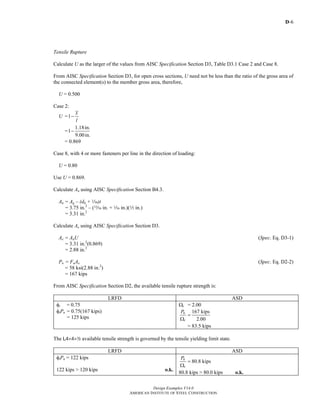
Cb = 1.30 from AISC Manual Table 3-1
24
2 2
0.66
1.25 1 0.78 1
b b
e
b
Eb tC L t
M
L b
⎛ ⎞⎛ ⎞ ⎛ ⎞⎜ ⎟= + −⎜ ⎟ ⎜ ⎟⎜ ⎟⎝ ⎠⎝ ⎠⎝ ⎠
(Spec. Eq. F10-6a)
( )( ) ( )( )
( )
( )( )
( )
24
2 2
0.66 29,000 ksi 4.00 in. in. 1.30 36.0 in. in.
1.25 1 0.78 1
36.0 in. 4.00 in.
⎛ ⎞⎡ ⎤ ⎛ ⎞⎜ ⎟⎜ ⎟= + −⎢ ⎥⎜ ⎟⎜ ⎟⎢ ⎥⎜ ⎟⎣ ⎦ ⎝ ⎠⎝ ⎠
4 4
= 179 kip-in. > 37.1 kip-in., therefore, AISC Specification Equation F10-3 is applicable
1.92 1.17 1.5
y
n y y
e
M
M M M
M
⎛ ⎞
= − ≤⎜ ⎟⎜ ⎟
⎝ ⎠
(Spec. Eq. F10-3)
( )
37.1 kip-in.
1.92 1.17 37.1 kip-in. 1.5 37.1kip-in.
179 kip-in.
⎛ ⎞
= − ≤⎜ ⎟⎜ ⎟
⎝ ⎠
=51.5 kip-in. ≤ 55.7 kip-in., therefore, Mn = 51.5 kip-in.
Leg Local Buckling
Mn = 43.3 kip-in. from Example F.11A.
The leg local buckling limit state controls.
Mn = 43.3 kip-in. or 3.61 kip-ft
From AISC Specification Section F1, the available flexural strength is:
Return to Table of Contents
F-52
Design Examples V14.0
AMERICAN INSTITUTE OF STEEL CONSTRUCTION
LRFD ASD
0.90bφ = 1.67bΩ =
( )0.90 3.61 kip-ftb nMφ =
= 3.25 kip-ft > 1.35 kip-ft o.k.
3.61kip-ft
1.67
n
b
M
=
Ω
= 2.16 kip-ft > 0.900 kip-ft o.k.
Return to Table of Contents
F-53
Design Examples V14.0
AMERICAN INSTITUTE OF STEEL CONSTRUCTION
EXAMPLE F.11C SINGLE ANGLE FLEXURAL MEMBER
Given:
Select an ASTM A36 single angle with a simple span of 6 ft. The vertical loads are a uniform dead load of 0.05
kip/ft and a uniform live load of 0.15 kip/ft. The horizontal load is a uniform wind load of 0.12 kip/ft. There is no
deflection limit for this angle. The angle is braced at the end points only and there is no lateral-torsional restraint.
Use load combination 4 from Section 2.3.2 of ASCE/SEI 7 for LRFD and load combination 6a from Section 2.4.1
of ASCE/SEI 7 for ASD.
Solution:
From AISC Manual Table 2-4, the material properties are as follows:
ASTM A36
Fy = 36 ksi
Fu = 58 ksi
From Chapter 2 of ASCE/SEI 7, the required flexural strength is:
LRFD ASD
wux = 1.2(0.05 kip/ft) + 0.15 kip/ft
= 0.210 kip/ft
wuy = 1.0(0.12 kip/ft)
= 0.12 kip/ft
Mux =
( )
2
0.210 kip/ft 6 ft
8
= 0.945 kip-ft
Muy =
( )
2
0.12 kip/ft 6 ft
8
= 0.540 kip-ft
wax = 0.05 kip/ft + 0.75(0.15 kip/ft)
= 0.163 kip/ft
way = 0.75[(0.6)(0.12 kip/ft)]
= 0.054 kip/ft
Max =
( )
2
0.163 kip/ft 6 ft
8
= 0.734 kip-ft
May =
( )
2
0.054 kip/ft 6 ft
8
= 0.243 kip-ft
Try a L4×4×4.
Return to Table of Contents
F-54
Design Examples V14.0
AMERICAN INSTITUTE OF STEEL CONSTRUCTION
Fig. F.11C-1. Example F.11C single angle geometric and principal axes moments.
Sign convention for geometric axes moments are:
LRFD ASD
Mux = −0.945 kip-ft
Muy = 0.540 kip-ft
Max = −0.734 kip-ft
May = 0.243 kip-ft
Principal axes moments are:
LRFD ASD
Muw = Mux cos α + Muy sin α
= −0.945 kip-ft (cos 45°) + 0.540 kip-ft (sin 45°)
= −0.286 kip-ft
Muz = −Mux sin α + Muy cos α
= −(−0.945 kip-ft)(sin 45°) + 0.540kip-ft (cos 45°)
= 1.05 kip-ft
Maw = Max cos α + May sin α
= −0.734 kip-ft (cos 45°) + 0.243 kip-ft (sin 45°)
= −0.347 kip-ft
Maz = −Max sin α + May cos α
= −(−0.734 kip-ft)(sin 45°) + 0.243 kip-ft (cos 45°)
= 0.691 kip-ft
From AISC Manual Table 1-7, the geometric properties are as follows:
L4×4×4
Sx = Sy = 1.03 in.3
Ix = Iy = 3.00 in.4
Iz = 1.18 in.4
Additional properties from the angle geometry are as follows:
wB= 1.53 in.
wC= 1.39 in.
zC = 2.74 in.
Return to Table of Contents
F-55
Design Examples V14.0
AMERICAN INSTITUTE OF STEEL CONSTRUCTION
Additional principal axes properties from the AISC Shapes Database are as follows:
Iw = 4.82 in.4
SzB = 0.779 in.3
SzC = 0.857 in.3
SwC = 1.76 in.3
Z-Axis Nominal Flexural Strength, Mnz
Note that Muz and Maz are positive; therefore, the toes of the angle are in compression.
Flexural Yielding
From AISC Specification Section F10.1, the nominal flexural strength due to the limit state of flexural yielding is:
1.5nz yM M= (Spec. Eq. F10-1)
1.5 y zBF S=
( )( )3
1.5 36 ksi 0.779 in.=
42.1 kip-in.=
Lateral-Torsional Buckling
From the User Note in AISC Specification Section F10, the limit state of lateral-torsional buckling does not apply
for bending about the minor axis.
Leg Local Buckling
Check slenderness of outstanding leg in compression.
=
b
t
λ
4.00 in.
=
in.4
= 16.0
The limiting width-to-thickness ratios are:
= 0.54p
y
E
F
λ from AISC Specification Table B4.1b Case 12
29,000ksi
= 0.54
36ksi
= 15.3
= 0.91r
y
E
F
λ from AISC Specification Table B4.1b Case 12
29,000 ksi
= 0.91
36 ksi
= 25.8
Return to Table of Contents
F-56
Design Examples V14.0
AMERICAN INSTITUTE OF STEEL CONSTRUCTION
< < , therefore, the leg is noncompact in flexurep rλ λ λ
= 2.43 1.72
y
nz y c
Fb
M F S
t E
⎛ ⎞⎛ ⎞
−⎜ ⎟⎜ ⎟⎜ ⎟⎝ ⎠⎝ ⎠
(Spec. Eq. F10-7)
=c zCS S (to toe in compression)
= 0.857 in.3
( )3 36 ksi
= 36 ksi 0.857 in. 2.43 1.72(16.0)
29,000 ksi
nzM
⎡ ⎤
−⎢ ⎥
⎣ ⎦
= 45.1 kip-in.
The flexural yielding limit state controls.
Mnz = 42.1 kip-in.
From AISC Specification Section F1, the available flexural strength is:
LRFD ASD
0.90bφ = 1.67bΩ =
( )0.90 42.1 kip-in.b nzMφ =
= 37.9 kip-in.
42.1 kip-in.
1.67
nz
b
M
=
Ω
= 25.2 kip-in..
W-Axis Nominal Flexural Strength, Mnw
Flexural Yielding
1.5nw yM M= (Spec. Eq. F10-1)
1.5 y wCF S=
( )( )3
1.5 36 ksi 1.76 in.=
95.0 kip-in.=
Lateral-Torsional Buckling
Determine Me.
For bending about the major principal axis of an equal-leg angle without continuous lateral-torsional restraint, use
AISC Specification Equation F10-4.
Cb = 1.14 from AISC Manual Table 3-1
2 2
0.46 b
e
b
Eb t C
M
L
= (Spec. Eq. F10-4)
( )( ) ( ) ( )
2 2
0.46 29,000 ksi 4.00 in. in. 1.14
72.0 in.
=
4
= 211 kip-in.
Return to Table of Contents
F-57
Design Examples V14.0
AMERICAN INSTITUTE OF STEEL CONSTRUCTION
My = FySwC
= 36 ksi(1.76 in.3
)
= 63.4 kip-in.
Me > My, therefore, AISC Specification Equation F10-3 is applicable
1.92 1.17 1.5
y
nw y y
e
M
M M M
M
⎛ ⎞
= − ≤⎜ ⎟⎜ ⎟
⎝ ⎠
(Spec. Eq. F10-3)
( )
63.4 kip-in.
1.92 1.17 63.4 kip-in. 1.5 63.4kip-in.
211 kip-in.
⎛ ⎞
= − ≤⎜ ⎟⎜ ⎟
⎝ ⎠
= 81.1 kip-in. ≤ 95.1 kip-in., therefore, Mnw = 81.1 kip-in.
Leg Local Buckling
From the preceding calculations, the leg is noncompact in flexure.
= 2.43 1.72
y
nw y c
Fb
M F S
t E
⎛ ⎞⎛ ⎞
−⎜ ⎟⎜ ⎟⎜ ⎟⎝ ⎠⎝ ⎠
(Spec. Eq. F10-7)
=c wCS S (to toe in compression)
= 1.76 in.3
( )3 36 ksi
= 36 ksi 1.76 in. 2.43 1.72(16.0)
29,000 ksi
nwM
⎡ ⎤
−⎢ ⎥
⎣ ⎦
= 92.5 kip-in.
The lateral-torsional buckling limit state controls.
Mnw = 81.1 kip-in.
From AISC Specification Section F1, the available flexural strength is:
LRFD ASD
0.90bφ = 1.67bΩ =
( )0.90 81.1 kip-in.b nwMφ =
= 73.0 kip-in.
81.1 kip-in.
1.67
nw
b
M
=
Ω
= 48.6 kip-in.
The moment resultant has components about both principal axes; therefore, the combined stress ratio must be
checked using the provisions of AISC Specification Section H2.
1.0
ra rbw rbz
ca cbw cbz
f f f
F F F
+ + ≤ (Spec. Eq. H2-1)
Note: Rather than convert moments into stresses, it is acceptable to simply use the moments in the interaction
equation because the section properties that would be used to convert the moments to stresses are the same in the
numerator and denominator of each term. It is also important for the designer to keep track of the signs of the
stresses at each point so that the proper sign is applied when the terms are combined. The sign of the moments
Return to Table of Contents
F-58
Design Examples V14.0
AMERICAN INSTITUTE OF STEEL CONSTRUCTION
used to convert geometric axis moments to principal axis moments will indicate which points are in tension and
which are in compression but those signs will not be used in the interaction equations directly.
Based on Figure F.11C-1, the required flexural strength and available flexural strength for this beam can be
summarized as:
LRFD ASD
0.286 kip-ft
73.0 kip-in.
12 in./ft
6.08 kip-ft
uw
b nw
M
M
=
φ =
=
1.05 kip-ft
37.9 kip-in.
12 in./ft
3.16 kip-ft
uz
b nz
M
M
=
φ =
=
0.347 kip-ft
48.6 kip-in.
12 in./ft
4.05 kip-ft
aw
nw
b
M
M
=
=
Ω
=
0.691 kip-ft
25.2 kip-in.
12 in./ft
2.10 kip-ft
az
nz
b
M
M
=
=
Ω
=
At point B:
Mw causes no stress at point B; therefore, the stress ratio is set to zero. Mz causes tension at point B; therefore it
will be taken as negative.
LRFD ASD
0 1.05 kip-ft
0.332 1.0
3.16 kip-ft
−
= ≤ o.k.
0 0.691 kip-ft
0.329 1.0
2.10 kip-ft
−
= ≤ o.k.
At point C:
Mw causes tension at point C; therefore, it will be taken as negative. Mz causes compression at point C; therefore,
it will be taken as positive.
LRFD ASD
0.286 kip-ft 1.05 kip-ft
0.285 1.0
6.08 kip-ft 3.16 kip-ft
− + = ≤ o.k.
0.347 kip-ft 0.691 kip-ft
0.243 1.0
4.05 kip-ft 2.10 kip-ft
− + = ≤ o.k.
At point A:
Mw and Mz cause compression at point A; therefore, both will be taken as positive.
LRFD ASD
0.286 kip-ft 1.05 kip-ft
0.379 1.0
6.08 kip-ft 3.16 kip-ft
+ = ≤ o.k.
0.347 kip-ft 0.691 kip-ft
0.415 1.0
4.05 kip-ft 2.10 kip-ft
+ = ≤ o.k.
Thus, the interaction of stresses at each point is seen to be less than 1.0 and this member is adequate to carry the
required load. Although all three points were checked, it was expected that point A would be the controlling point
because compressive stresses add at this point.
Return to Table of Contents
F-59
Design Examples V14.0
AMERICAN INSTITUTE OF STEEL CONSTRUCTION
EXAMPLE F.12 RECTANGULAR BAR IN STRONG-AXIS BENDING
Given:
Select an ASTM A36 rectangular bar with a span of 12 ft. The bar is braced at the ends and at the midpoint.
Conservatively use Cb = 1.0. Limit the depth of the member to 5 in. The loads are a total uniform dead load of
0.44 kip/ft and a uniform live load of 1.32 kip/ft.
Solution:
From AISC Manual Table 2-5, the material properties are as follows:
ASTM A36
Fy = 36 ksi
Fu = 58 ksi
From Chapter 2 of ASCE/SEI 7, the required flexural strength is:
LRFD ASD
wu = 1.2(0.44 kip/ft) + 1.6(1.32 kip/ft)
= 2.64 kip/ft
Mu =
( )
2
2.64 kip/ft 12.0 ft
8
= 47.5 kip-ft
wa = 0.44 kip/ft + 1.32 kip/ft
= 1.76 kip/ft
Ma =
( )
2
1.76 kip/ft 12.0 ft
8
= 31.7 kip-ft
Try a BAR 5 in.×3 in.
From AISC Manual Table 17-27, the geometric properties are as follows:
2
6
x
bd
S =
( )( )
2
3.00 in. 5.00 in.
6
=
= 12.5 in.3
Return to Table of Contents
F-60
Design Examples V14.0
AMERICAN INSTITUTE OF STEEL CONSTRUCTION
2
4
x
bd
Z =
( )( )
2
3.00 in. 5.00 in.
4
=
= 18.8 in.3
Nominal Flexural Strength, Mn
Flexural Yielding
Check limit from AISC Specification Section F11.1.
2
0.08b
y
L d E
Ft
≤
( )
( )
( )
2
72.0 in. 5.00 in. 0.08 29,000 ksi
36 ksi3.00 in.
≤
40.0 < 64.4, therefore, the yielding limit state applies
n pM M= (Spec. Eq. F11-1)
1.6y yF Z M= ≤
1.6 1.6y y xM F S=
( )( )3
1.6 36 ksi 12.5 in.=
= 720 kip-in.
p y xM F Z=
( )3
36 ksi 18.8 in.=
677 kip-in. 720 kip-in.= ≤
Use
677 kip-in. or 56.4 kip-ft
n pM M=
=
Lateral-Torsional Buckling (AISC Specification Section F11.2)
As previously calculated, Lbd/t2
≤ 0.08E/Fy, therefore, the lateral-torsional buckling limit state does not apply.
From AISC Specification Section F1, the available flexural strength is:
LRFD ASD
φb = 0.90 Ωb = 1.67
( )0.90 56.4 kip-ftb nMφ = 56.4 kip-ft
1.67
n
b
M
=
Ω
50.8 kip-ft 47.5 kip-ft= > o.k. 33.8 kip-ft 31.7 kip-ft= > o.k.
Return to Table of Contents
F-61
Design Examples V14.0
AMERICAN INSTITUTE OF STEEL CONSTRUCTION
EXAMPLE F.13 ROUND BAR IN BENDING
Given:
Select an ASTM A36 round bar with a span of 2.50 ft. The bar is braced at end points only. Assume Cb = 1.0.
Limit the diameter to 2 in. The loads are a concentrated dead load of 0.10 kip and a concentrated live load of 0.25
kip at the center. The weight of the bar is negligible.
Solution:
From AISC Manual Table 2-5, the material properties are as follows:
ASTM A36
Fy = 36 ksi
Fu = 58 ksi
From Chapter 2 of ASCE/SEI 7 and AISC Manual Table 3-23 diagram 7, the required flexural strength is:
LRFD ASD
Pu = 1.2(0.10 kip) + 1.6(0.25 kip)
= 0.520 kip
Mu =
( )( )0.520 kip 2.50 ft
4
= 0.325 kip-ft
Pa = 0.10 kip + 0.25 kip
= 0.350 kip
Ma =
( )( )0.350 kip 2.50 ft
4
= 0.219 kip-ft
Try a BAR 1 in. diameter.
From AISC Manual Table 17-27, the geometric properties are as follows:
Round bar
3
32
x
d
S
π
=
( )
3
1.00 in.
32
π
=
= 0.0982 in.3
Return to Table of Contents
F-62
Design Examples V14.0
AMERICAN INSTITUTE OF STEEL CONSTRUCTION
3
6
x
d
Z =
( )
3
1.00 in.
6
=
= 0.167 in.3
Nominal Flexural Strength, Mn
Flexural Yielding
From AISC Specification Section F11.1, the nominal flexural strength based on the limit state of flexural yielding
is,
Mn = Mp (Spec. Eq. F11-1)
= FyZ M 1.6My
1.6My = 1.6 y xF S
= 1.6(36 ksi)(0.0982 in.3
)
= 5.66 kip-in.
FyZx = 36 ksi(0.167 in.3
)
= 6.01 kip-in. > 5.66 kip-in.
Therefore, Mn = 5.66 kip-in.
The limit state lateral-torsional buckling (AISC Specification Section F11.2) need not be considered for rounds.
The flexural yielding limit state controls.
Mn = 5.66 kip-in. or 0.472 kip-ft
From AISC Specification Section F1, the available flexural strength is:
LRFD ASD
φb = 0.90 Ωb = 1.67
φbMn = 0.90(0.472 kip-ft)
0.472 kip-ft
1.67
n
b
M
=
Ω
= 0.425 kip-ft > 0.325 kip-ft o.k. 0.283 kip-ft 0.219 kip-ft= > o.k.
Return to Table of Contents
F-63
Design Examples V14.0
AMERICAN INSTITUTE OF STEEL CONSTRUCTION
EXAMPLE F.14 POINT-SYMMETRICAL Z-SHAPE IN STRONG-AXIS BENDING
Given:
Determine the available flexural strength of the ASTM A36 Z-shape shown for a simple span of 18 ft. The Z-
shape is braced at 6 ft on center. Assume Cb = 1.0. The loads are a uniform dead load of 0.025 kip/ft and a
uniform live load of 0.10 kip/ft. Assume the beam is loaded through the shear center. The profile of the purlin is
shown below.
Return to Table of Contents
F-64
Design Examples V14.0
AMERICAN INSTITUTE OF STEEL CONSTRUCTION
Solution:
From AISC Manual Table 2-5, the material properties are as follows:
ASTM A36
Fy = 36 ksi
Fu = 58 ksi
The geometric properties are as follows:
tw = tf
= 4 in.
( )( )( ) ( )( )( ) ( )( )2.50 in. in. 2 in. in. 2 11.5 in. in.A = + +4 4 4 4
= 4.25 in.2
( )( )
( ) ( ) ( )
( )( )
( )( )( ) ( )
( )( )
3
2 2
3
2
3
4
in. in.
0.25 in. 5.63 in. 2
12
2.50 in. in.
+ 2.50 in. in. 5.88 in. 2
12
in. 11.5 in.
+
12
78.9 in.
xI
⎡ ⎤
= +⎢ ⎥
⎢ ⎥⎣ ⎦
⎡ ⎤
+⎢ ⎥
⎢ ⎥⎣ ⎦
=
4 4
4
4
4
6.00 in.y =
x
x
I
S
y
=
4
78.9 in.
6.00 in.
=
= 13.2 in.3
( )( )
( ) ( ) ( )
( )( )
( )( )( ) ( )
( )( )
3
2 2
3
2
3
4
in. in.
in. 2.25 in. 2
12
in. 2.50 in.
+ 2.50 in. in. 1.13 in. 2
12
11.5 in. in.
+
12
2.90 in.
yI
⎡ ⎤
= +⎢ ⎥
⎢ ⎥⎣ ⎦
⎡ ⎤
+⎢ ⎥
⎢ ⎥⎣ ⎦
=
4 4
4
4
4
4
y
y
I
r
A
=
4
2
2.90 in.
4.25 in.
=
= 0.826 in.
Return to Table of Contents
F-65
Design Examples V14.0
AMERICAN INSTITUTE OF STEEL CONSTRUCTION
1
12 1
6
f
ts
w
f f
b
r
ht
b t
≈
⎛ ⎞
+⎜ ⎟
⎝ ⎠
from AISC Specification Section F2.2 User Note
( )( )
( )( )
2.50 in.
11.5 in. in.1
12 1
6 2.50 in. in.
=
⎧ ⎫⎡ ⎤⎪ ⎪
+⎨ ⎬⎢ ⎥
⎪ ⎪⎣ ⎦⎩ ⎭
4
4
= 0.543 in.
From Chapter 2 of ASCE/SEI 7, the required flexural strength is:
LRFD ASD
wu = 1.2(0.025 kip/ft) + 1.6(0.10 kip/ft)
= 0.190 kip/ft
Mu =
( )( )
2
0.190 kip/ft 18.0 ft
8
= 7.70 kip-ft
wa = 0.025 kip/ft + 0.10 kip/ft
= 0.125 kip/ft
Ma =
( )( )
2
0.125 kip/ft 18.0 ft
8
= 5.06 kip-ft
Nominal Flexural Strength, Mn
Flexural Yielding
From AISC Specification Section F12.1, the nominal flexural strength based on the limit state of flexural yielding
is,
Fn = Fy (Spec. Eq. F12-2)
= 36 ksi
Mn = FnSmin (Spec. Eq. F12-1)
= 36 ksi(13.2 in.3
)
= 475 kip-in.
Local Buckling
There are no specific local buckling provisions for Z-shapes in the AISC Specification. Use provisions for rolled
channels from AISC Specification Table B4.1b, Cases 10 and 15.
Flange Slenderness
Conservatively neglecting the end return,
f
b
t
λ =
2.50 in.
in.
=
4
= 10.0
0.38p
y
E
F
λ = from AISC Specification Table B4.1b case 10
Return to Table of Contents
F-66
Design Examples V14.0
AMERICAN INSTITUTE OF STEEL CONSTRUCTION
29,000ksi
0.38
36ksi
=
= 10.8
pλ < λ ; therefore, the flange is compact
Web Slenderness
w
h
t
λ =
11.5 in.
in.
=
4
= 46.0
3.76p
y
E
F
λ = from AISC Specification Table B4.1b case 15
29,000 ksi
3.76
36 ksi
=
= 107
pλ < λ ; therefore, the web is compact
Therefore, the local buckling limit state does not apply.
Lateral-Torsional Buckling
Per the User Note in AISC Specification Section F12, take the critical lateral-torsional buckling stress as half that
of the equivalent channel. This is a conservative approximation of the lateral-torsional buckling strength which
accounts for the rotation between the geometric and principal axes of a Z-shaped cross-section, and is adopted
from the North American Specification for the Design of Cold-Formed Steel Structural Members (AISC, 2007).
Calculate limiting unbraced lengths.
For bracing at 6 ft on center,
( )6.00 ft 12 in./ftbL =
= 72.0 in.
1.76p y
y
E
L r
F
= (Spec. Eq. F2-5)
( )
29,000 ksi
1.76 0.826 in.
36 ksi
=
= 41.3 in. < 72.0 in.
2 2
0 0
0.7
1.95 6.76
0.7
y
r ts
y x x
FE Jc Jc
L r
F S h S h E
⎛ ⎞ ⎛ ⎞ ⎛ ⎞
= + +⎜ ⎟ ⎜ ⎟⎜ ⎟
⎝ ⎠⎝ ⎠⎝ ⎠
(Spec. Eq. F2-6)
Return to Table of Contents
F-67
Design Examples V14.0
AMERICAN INSTITUTE OF STEEL CONSTRUCTION
Per the User Note in AISC Specification Section F2, the square root term in AISC Specification Equation F2-4
can conservatively be taken equal to one. Therefore, Equation F2-6 can also be simplified. Substituting 0.7Fy for
Fcr in Equation F2-4 and solving for Lb = Lr, AISC Specification Equation F2-6 becomes:
0.7
r ts
y
E
L r
F
= π
( )
( )
29,000 ksi
0.543 in.
0.7 36 ksi
= π
= 57.9 in. < 72.0 in.
Calculate one half of the critical lateral-torsional buckling stress of the equivalent channel.
Lb > Lr, therefore,
( )
22
2
0
0.5 1 0.078b b
cr
x tsb
ts
C E Jc L
F
S h rL
r
π ⎛ ⎞⎛ ⎞
= + ⎜ ⎟⎜ ⎟
⎝ ⎠⎝ ⎠⎛ ⎞
⎜ ⎟
⎝ ⎠
(Spec. Eq. F2-4)
Conservatively taking the square root term as 1.0,
( )
2
2
0.5
b
cr
b
ts
C E
F
L
r
π
=
⎛ ⎞
⎜ ⎟
⎝ ⎠
( )
( ) ( )
2
2
1.0 29,000 ksi
0.5
72.0 in.
0.543 in.
π
=
⎛ ⎞
⎜ ⎟
⎝ ⎠
= 8.14 ksi
Fn = Fcr M Fy (Spec. Eq. F12-3)
= 8.14 ksi < 36 ksi o.k.
n n minM F S= (Spec. Eq. F12-1)
( )3
8.14 ksi 13.2 in.=
= 107 kip-in.
The lateral-torsional buckling limit state controls.
Mn = 107 kip-in. or 8.95 kip-ft
From AISC Specification Section F1, the available flexural strength is:
LRFD ASD
φb = 0.90 Ωb = 1.67
( )0.90 8.95 kip-ftb nMφ =
8.95 kip-ft
1.67
n
b
M
=
Ω
8.06 kip-ft > 7.70 kip-ft= o.k. 5.36 kip-ft > 5.06 kip-ft= o.k.
Return to Table of Contents
F-68
Design Examples V14.0
AMERICAN INSTITUTE OF STEEL CONSTRUCTION
Because the beam is loaded through the shear center, consideration of a torsional moment is unnecessary. If the
loading produced torsion, the torsional effects should be evaluated using AISC Design Guide 9, Torsional
Analysis of Structural Steel Members (Seaburg and Carter, 1997).
Return to Table of Contents
F-69
Design Examples V14.0
AMERICAN INSTITUTE OF STEEL CONSTRUCTION
CHAPTER F DESIGN EXAMPLE REFERENCES
AISI (2007), North American Specification for the Design of Cold-Formed Steel Structural Members, ANSI/AISI
Standard S100, Washington D.C.
Seaburg, P.A. and Carter, C.J. (1997), Torsional Analysis of Structural Steel Members, Design Guide 9, AISC,
Chicago, IL.
Return to Table of Contents
G-
Design Examples V14.0
AMERICAN INSTITUTE OF STEEL CONSTRUCTION
1
Chapter G
Design of Members for Shear
INTRODUCTION
This chapter covers webs of singly or doubly symmetric members subject to shear in the plane of the web, single
angles, HSS sections, and shear in the weak direction of singly or doubly symmetric shapes.
Most of the equations from this chapter are illustrated by example. Tables for all standard ASTM A992 W-shapes
and ASTM A36 channels are included in the AISC Manual. In the tables, where applicable, LRFD and ASD shear
information is presented side-by-side for quick selection, design and verification.
LRFD and ASD will produce identical designs for the case where the live load effect is approximately three times
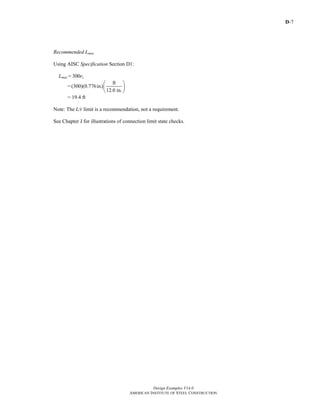
the dead load effect.
G1. GENERAL PROVISIONS
The design shear strength, φvVn, and the allowable shear strength, Vn /Ωv, are determined as follows:
Vn = nominal shear strength based on shear yielding or shear buckling
0.6n y w vV F A C= (Spec. Eq. G2-1)
φv = 0.90 (LRFD) Ωv = 1.67 (ASD)
Exception: For all current ASTM A6, W, S and HP shapes except W44×230, W40×149, W36×135, W33×118,
W30×90, W24×55, W16×26 and W12×14 for Fy = 50 ksi:
φv = 1.00 (LRFD) Ωv = 1.50 (ASD)
AISC Specification Section G2 does not utilize tension field action. AISC Specification Section G3 specifically
addresses the use of tension field action.
Strong axis shear values are tabulated for W-shapes in AISC Manual Tables 3-2 and 3-6, for S-shapes in AISC
Manual Table 3-7, for C-shapes in AISC Manual Table 3-8, and for MC-shapes in AISC Manual Table 3-9. Weak
axis shear values for W-shapes, S-shapes, C-shapes and MC-shapes, and shear values for angles, rectangular HSS
and box members, and round HSS are not tabulated.
G2. MEMBERS WITH UNSTIFFENED OR STIFFENED WEBS
As indicated in the User Note of this section, virtually all W, S and HP shapes are not subject to shear buckling
and are also eligible for the more liberal safety and resistance factors, φv = 1.00 (LRFD) and Ωv = 1.50 (ASD).
This is presented in Example G.1 for a W-shape. A channel shear strength design is presented in Example G.2.
G3. TENSION FIELD ACTION
A built-up girder with a thin web and transverse stiffeners is presented in Example G.8.
G4. SINGLE ANGLES
Rolled angles are typically made from ASTM A36 steel. A single angle example is illustrated in Example G.3.
G5. RECTANGULAR HSS AND BOX-SHAPED MEMBERS
Return to Table of Contents
G-
Design Examples V14.0
AMERICAN INSTITUTE OF STEEL CONSTRUCTION
2
The shear height, h, is taken as the clear distance between the flanges less the inside corner radius on each side. If
the corner radii are unknown, h shall be taken as the corresponding outside dimension minus 3 times the
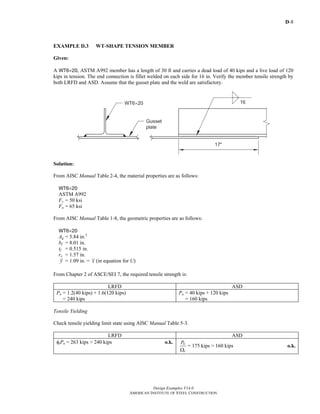
thickness. A rectangular HSS example is provided in Example G.4.
G6. ROUND HSS
For all round HSS and pipes of ordinary length listed in the AISC Manual, Fcr can be taken as 0.6Fy in AISC
Specification Equation G6-1. A round HSS example is illustrated in Example G.5.
G7. WEAK AXIS SHEAR IN DOUBLY SYMMETRIC AND SINGLY SYMMETRIC SHAPES
For examples of weak axis shear, see Example G.6 and Example G.7.
G8. BEAMS AND GIRDERS WITH WEB OPENINGS
For a beam and girder with web openings example, see AISC Design Guide 2, Steel and Composite Beams with
Web Openings (Darwin, 1990).
Return to Table of Contents
G-
Design Examples V14.0
AMERICAN INSTITUTE OF STEEL CONSTRUCTION
3
EXAMPLE G.1A W-SHAPE IN STRONG AXIS SHEAR
Given:
Determine the available shear strength and adequacy of a W24×62 ASTM A992 beam using the AISC Manual
with end shears of 48 kips from dead load and 145 kips from live load.
Solution:
From AISC Manual Table 2-4, the material properties are as follows:
ASTM A992
Fy = 50 ksi
Fu = 65 ksi
From Chapter 2 of ASCE/SEI 7, the required shear strength is:
LRFD ASD
Vu = 1.2(48.0 kips) + 1.6(145 kips)
= 290 kips
Va = 48.0 kips + 145 kips
= 193 kips
From AISC Manual Table 3-2, the available shear strength is:
LRFD ASD
φvVn = 306 kips
306 kips > 290 kips o.k.
n
v
V
Ω
= 204 kips
204 kips > 193 kips o.k.
Return to Table of Contents
G-
Design Examples V14.0
AMERICAN INSTITUTE OF STEEL CONSTRUCTION
4
EXAMPLE G.1B W-SHAPE IN STRONG AXIS SHEAR
Given:
The available shear strength, which can be easily determined by the tabulated values of the AISC Manual, can be
verified by directly applying the provisions of the AISC Specification. Determine the available shear strength for
the W-shape in Example G.1A by applying the provisions of the AISC Specification.
Solution:
From AISC Manual Table 1-1, the geometric properties are as follows:
W24×62
d = 23.7 in.
tw = 0.430 in.
Except for very few sections, which are listed in the User Note, AISC Specification Section G2.1(a) is applicable
to the I-shaped beams published in the AISC Manual for Fy = 50 ksi.
Cv = 1.0 (Spec. Eq. G2-2)
Calculate Aw.
Aw = dtw from AISC Specification Section G2.1b
= 23.7 in.(0.430 in.)
= 10.2 in.2
Calculate Vn.
Vn = 0.6FyAwCv (Spec. Eq. G2-1)
= 0.6(50 ksi)(10.2 in.2
)(1.0)
= 306 kips
From AISC Specification Section G2.1a, the available shear strength is:
LRFD ASD
φv = 1.00
φvVn = 1.00(306 kips)
= 306 kips
Ωv = 1.50
306 kips
1.50
n
v
V
=
Ω
= 204 kips
Return to Table of Contents
G-
Design Examples V14.0
AMERICAN INSTITUTE OF STEEL CONSTRUCTION
5
EXAMPLE G.2A C-SHAPE IN STRONG AXIS SHEAR
Given:
Verify the available shear strength and adequacy of a C15×33.9 ASTM A36 channel with end shears of 17.5 kips
from dead load and 52.5 kips from live load.
Solution:
From AISC Manual Table 2-4, the material properties are as follows:
ASTM A36
Fy = 36 ksi
Fu = 58 ksi
From Chapter 2 of ASCE/SEI 7, the required shear strength is:
LRFD ASD
Vu = 1.2(17.5 kips) + 1.6(52.5 kips)
= 105 kips
Va = 17.5 kips + 52.5 kips
= 70.0 kips
From AISC Manual Table 3-8, the available shear strength is:
LRFD ASD
φvVn = 117 kips
117 kips > 105 kips o.k.
n
v
V
Ω
= 77.6 kips
77.6 kips > 70.0 kips o.k.
Return to Table of Contents
G-
Design Examples V14.0
AMERICAN INSTITUTE OF STEEL CONSTRUCTION
6
EXAMPLE G.2B C-SHAPE IN STRONG AXIS SHEAR
Given:
The available shear strength, which can be easily determined by the tabulated values of the AISC Manual, can be
verified by directly applying the provisions of the AISC Specification. Determine the available shear strength for
the channel in Example G.2A.
Solution:
From AISC Manual Table 1-5, the geometric properties are as follows:
C15×33.9
d = 15.0 in.
tw = 0.400 in.
AISC Specification Equation G2-1 is applicable. All ASTM A36 channels listed in the AISC Manual have h/tw ≤
1.10 /v yk E F ; therefore,
Cv = 1.0 (Spec. Eq. G2-3)
Calculate Aw.
Aw = dtw from AISC Specification Section G2.1b
= 15.0 in.(0.400 in.)
= 6.00 in.2
Calculate Vn.
Vn = 0.6FyAwCv (Spec. Eq. G2-1)
= 0.6(36 ksi)(6.00 in.2
)(1.0)
= 130 kips
Available Shear Strength
The values of φv = 1.00 (LRFD) and Ωv = 1.50 (ASD) do not apply to channels. The general values φv = 0.90
(LRFD) and Ωv = 1.67 (ASD) must be used.
LRFD ASD
φvVn = 0.90(130 kips)
= 117 kips
130 kips
1.67
n
v
V
=
Ω
= 77.8 kips
Return to Table of Contents
G-
Design Examples V14.0
AMERICAN INSTITUTE OF STEEL CONSTRUCTION
7
EXAMPLE G.3 ANGLE IN SHEAR
Given:
Determine the available shear strength and adequacy of a L5×3×4 (LLV) ASTM A36 with end shears of 3.50 kips
from dead load and 10.5 kips from live load.
Solution:
From AISC Manual Table 2-4, the material properties are as follows:
ASTM A36
Fy = 36 ksi
Fu = 58 ksi
From AISC Manual Table 1-7, the geometric properties are as follows:
L5×3×4
b = 5.00 in.
t = 4 in.
From Chapter 2 of ASCE/SEI 7, the required shear strength is:
LRFD ASD
Vu = 1.2(3.50 kips) + 1.6(10.5 kips)
= 21.0 kips
Va = 3.50 kips + 10.5 kips
= 14.0 kips
Note: There are no tables for angles in shear, but the available shear strength can be calculated according to AISC
Specification Section G4, as follows.
AISC Specification Section G4 stipulates kv = 1.2.
Calculate Aw.
Aw = bt
= 5.00 in.(4 in.)
= 1.25 in.2
Determine Cv from AISC Specification Section G2.1(b).
h/tw = b/t
= 5.0 in./4 in.
= 20
1.10 /v yk E F = 1.10 1.2(29,000 ksi/36ksi)
= 34.2
20 < 34.2; therefore, Cv = 1.0 (Spec. Eq. G2-3)
Calculate Vn.
Vn = 0.6FyAwCv (Spec. Eq. G2-1)
= 0.6(36 ksi)(1.25 in.2
)(1.0)
= 27.0 kips
From AISC Specification Section G1, the available shear strength is:
Return to Table of Contents
G-
Design Examples V14.0
AMERICAN INSTITUTE OF STEEL CONSTRUCTION
8
LRFD ASD
φ v = 0.90
φvVn = 0.90(27.0 kips)
= 24.3 kips
24.3 kips > 21.0 kips o.k.
Ωv = 1.67
27.0 kips
1.67
n
v
V
=
Ω
= 16.2 kips
16.2 kips > 14.0 kips o.k.
Return to Table of Contents
G-
Design Examples V14.0
AMERICAN INSTITUTE OF STEEL CONSTRUCTION
9
EXAMPLE G.4 RECTANGULAR HSS IN SHEAR
Given:
Determine the available shear strength and adequacy of an HSS6×4×a ASTM A500 Grade B member with end
shears of 11.0 kips from dead load and 33.0 kips from live load. The beam is oriented with the shear parallel to the
6 in. dimension.
Solution:
From AISC Manual Table 2-4, the material properties are as follows:
ASTM A500 Grade B
Fy = 46 ksi
Fu = 58 ksi
From AISC Manual Table 1-11, the geometric properties are as follows:
HSS6×4×a
H = 6.00 in.
B = 4.00 in.
t = 0.349 in.
From Chapter 2 of ASCE/SEI 7, the required shear strength is:
LRFD ASD
Vu = 1.2(11.0 kips) + 1.6(33.0 kips)
= 66.0 kips
Va = 11.0 kips + 33.0 kips
= 44.0 kips
Note: There are no AISC Manual Tables for shear in HSS shapes, but the available shear strength can be
determined from AISC Specification Section G5, as follows.
Nominal Shear Strength
For rectangular HSS in shear, use AISC Specification Section G2.1 with Aw = 2ht (per AISC Specification Section
G5) and kv = 5.
From AISC Specification Section G5, if the exact radius is unknown, h shall be taken as the corresponding outside
dimension minus three times the design thickness.
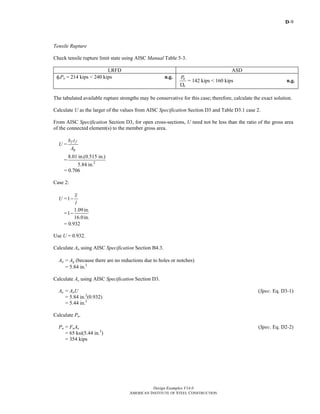
h = H – 3t
= 6.00 in. – 3(0.349 in.)
= 4.95 in.
4.95 in.
0.349 in.w
h
t
=
= 14.2
1.10 v yk E F = ( )1.10 5 29,000 ksi 46 ksi
= 61.8
14.2 < 61.8, therefore, Cv = 1.0 (Spec. Eq. G2-3)
Note: Most standard HSS sections listed in the AISC Manual have Cv = 1.0 at Fy ≤ 46 ksi.
Return to Table of Contents
G-
Design Examples V14.0
AMERICAN INSTITUTE OF STEEL CONSTRUCTION
10
Calculate Aw.
Aw = 2ht
= 2(4.95 in.)(0.349 in.)
= 3.46 in.2
Calculate Vn.
0.6n y w vV F A C= (Spec. Eq. G2-1)
( )( )( )2
0.6 46 ksi 3.46 in. 1.0
95.5 kips
=
=
From AISC Specification Section G1, the available shear strength is:
LRFD ASD
φv = 0.90
φvVn= 0.90(95.5 kips)
= 86.0 kips
86.0 kips > 66.0 kips o.k.
Ωv = 1.67
95.5 kips
1.67
n
v
V
=
Ω
= 57.2 kips
57.2 kips > 44.0 kips o.k.
Return to Table of Contents
G-
Design Examples V14.0
AMERICAN INSTITUTE OF STEEL CONSTRUCTION
11
EXAMPLE G.5 ROUND HSS IN SHEAR
Given:
Verify the available shear strength and adequacy of a round HSS16.000×0.375 ASTM A500 Grade B member
spanning 32 ft with end shears of 30.0 kips from dead load and 90.0 kips from live load.
Solution:
From AISC Manual Table 2-4, the material properties are as follows:
ASTM A500 Grade B
Fy = 42 ksi
Fu = 58 ksi
From AISC Manual Table 1-13, the geometric properties are as follows:
HSS16.000×0.375
D = 16.0 in.
t = 0.349 in.
Ag =17.2 in.2
From Chapter 2 of ASCE/SEI 7, the required shear strength is:
LRFD ASD
Vu = 1.2(30.0 kips) + 1.6(90.0 kips)
= 180 kips
Va = 30.0 kips + 90.0 kips
= 120 kips
There are no AISC Manual tables for round HSS in shear, but the available strength can be determined from
AISC Specification Section G6, as follows:
Using AISC Specification Section G6, calculate Fcr as the larger of:
Fcr= 5
4
1.60
v
E
L D
D t
⎛ ⎞
⎜ ⎟
⎝ ⎠
where Lv = half the span = 192 in. (Spec. Eq. G6-2a)
= 5
4
1.60(29,000 ksi)
192 in. 16.0 in.
16.0 in. 0.349 in.
⎛ ⎞
⎜ ⎟
⎝ ⎠
= 112 ksi
or
Fcr=
( )
3
2
0.78
/
E
D t
(Spec. Eq. G6-2b)
= 3
2
0.78(29,000 ksi)
16.0 in.
0.349 in.
⎛ ⎞
⎜ ⎟
⎝ ⎠
= 72.9 ksi
Return to Table of Contents
G-
Design Examples V14.0
AMERICAN INSTITUTE OF STEEL CONSTRUCTION
12
The maximum value of Fcr permitted is,
Fcr= 0.6Fy
= 0.6(42 ksi)
= 25.2 ksi controls
Note: AISC Specification Equations G6-2a and G6-2b will not normally control for the sections published in the
AISC Manual except when high strength steel is used or the span is unusually long.
Calculate Vn using AISC Specification Section G6.
=
2
cr g
n
F A
V (Spec. Eq. G6-1)
=
( )( )2
25.2ksi 17.2in.
2
= 217 kips
From AISC Specification Section G1, the available shear strength is:
LRFD ASD
φv = 0.90
φvVn= 0.90(217 kips)
= 195 kips
195 kips > 180 kips o.k.
Ωv = 1.67
217 kips
1.67
n
v
V
=
Ω
= 130 kips
130 kips > 120 kips o.k.
Return to Table of Contents
G-
Design Examples V14.0
AMERICAN INSTITUTE OF STEEL CONSTRUCTION
13
EXAMPLE G.6 DOUBLY SYMMETRIC SHAPE IN WEAK AXIS SHEAR
Given:
Verify the available shear strength and adequacy of a W21×48 ASTM A992 beam with end shears of 20.0 kips
from dead load and 60.0 kips from live load in the weak direction.
Solution:
From AISC Manual Table 2-4, the material properties are as follows:
ASTM A992
Fy = 50 ksi
Fu = 65 ksi
From AISC Manual Table 1-1, the geometric properties are as follows:
W21×48
bf = 8.14 in.
tf = 0.430 in.
From Chapter 2 of ASCE/SEI 7, the required shear strength is:
LRFD ASD
Vu = 1.2(20.0 kips) + 1.6(60.0 kips)
= 120 kips
Va = 20.0 kips + 60.0 kips
= 80.0 kips
From AISC Specification Section G7, for weak axis shear, use AISC Specification Equation G2-1 and AISC
Specification Section G2.1(b) with Aw = bftf for each flange, h/tw = b/tf , b = bf /2 and kv = 1.2.
Calculate Aw. (Multiply by 2 for both shear resisting elements.)
Aw = 2bf tf
= 2(8.14 in.)(0.430 in.)
= 7.00 in.2
Calculate Cv.
h/tw = b/tf
=
( )8.14 in. / 2
0.430 in.
= 9.47
1.10 v yk E F =1.10 1.2(29,000 ksi 50 ksi)
= 29.0 > 9.47, therefore, Cv = 1.0 (Spec. Eq. G2-3)
Note: For all ASTM A6 W-, S-, M- and HP-shapes when Fy < 50 ksi, Cv = 1.0, except some M-shapes noted in the
User Note at the end of AISC Specification Section G2.1.
Calculate Vn.
Vn = 0.6FyAwCv (Spec. Eq. G2-1)
= 0.6(50 ksi)(7.00 in.2
)(1.0)
= 210 kips
Return to Table of Contents
G-
Design Examples V14.0
AMERICAN INSTITUTE OF STEEL CONSTRUCTION
14
From AISC Specification Section G1, the available shear strength is:
LRFD ASD
φ v = 0.90
φvVn= 0.90(210 kips)
= 189 kips
189 kips > 120 kips o.k.
Ωv = 1.67
210 kips
1.67
n
v
V
=
Ω
= 126 kips
126 kips > 80.0 kips o.k.
Return to Table of Contents
G-
Design Examples V14.0
AMERICAN INSTITUTE OF STEEL CONSTRUCTION
15
EXAMPLE G.7 SINGLY SYMMETRIC SHAPE IN WEAK AXIS SHEAR
Given:
Verify the available shear strength and adequacy of a C9×20 ASTM A36 channel with end shears of 5.00 kips
from dead load and 15.0 kips from live load in the weak direction.
Solution:
From AISC Manual Table 2-4, the material properties are as follows:
ASTM A36
Fy = 36 ksi
Fu = 58 ksi
From AISC Manual Table 1-5, the geometric properties are as follows:
C9×20
bf = 2.65 in.
tf = 0.413 in.
From Chapter 2 of ASCE/SEI 7, the required shear strength is:
LRFD ASD
Vu = 1.2(5.00 kips) + 1.6(15.0 kips)
= 30.0 kips
Va = 5.00 kips + 15.0 kips
= 20.0 kips
Note: There are no AISC Manual tables for weak-axis shear in channel sections, but the available strength can be
determined from AISC Specification Section G7.
From AISC Specification Section G7, for weak axis shear, use AISC Specification Equation G2-1 and AISC
Specification Section G2.1(b) with Aw = bftf for each flange, h/tw = b/tf , b = bf and kv = 1.2.
Calculate Aw. (Multiply by 2 for both shear resisting elements.)
Aw = 2bf tf
= 2(2.65 in.)(0.413 in.)
= 2.19 in.2
Calculate Cv.
2.65 in.
0.413 in.
f
f
b
t
=
= 6.42
1.10 v yk E F =1.10 1.2(29,000 ksi 36 ksi)
= 34.2 > 6.42, therefore, Cv = 1.0 (Spec. Eq. G2-3)
Calculate Vn.
Vn = 0.6FyAwCv (Spec. Eq. G2-1)
= 0.6(36 ksi)(2.19 in.2
)(1.0)
= 47.3 kips
Return to Table of Contents
G-
Design Examples V14.0
AMERICAN INSTITUTE OF STEEL CONSTRUCTION
16
From AISC Specification Section G1, the available shear strength is:
LRFD ASD
φv = 0.90
φvVn = 0.90(47.3 kips)
= 42.6 kips
42.6 kips > 30.0 kips o.k.
Ωv = 1.67
47.3 kips
1.67
n
v
V
=
Ω
= 28.3 kips
28.3 kips > 20.0 kips o.k.
Return to Table of Contents
G-
Design Examples V14.0
AMERICAN INSTITUTE OF STEEL CONSTRUCTION
17
EXAMPLE G.8A BUILT-UP GIRDER WITH TRANSVERSE STIFFENERS
Given:
A built-up ASTM A36 I-shaped girder spanning 56 ft has a uniformly distributed dead load of 0.920 klf and a live
load of 2.74 klf in the strong direction. The girder is 36 in. deep with 12-in. × 1½-in. flanges and a c-in. web.
Determine if the member has sufficient available shear strength to support the end shear, without and with tension
field action. Use transverse stiffeners, as required.
Note: This built-up girder was purposely selected with a thin web in order to illustrate the design of transverse
stiffeners. A more conventionally proportioned plate girder would have at least a ½-in. web and slightly smaller
flanges.
Solution:
From AISC Manual Table 2-5, the material properties are as follows:
ASTM A36
Fy = 36 ksi
Fu = 58 ksi
The geometric properties are as follows:
Built-up girder
tw = c in.
d = 36.0 in.
bft = bfc = 12.0 in.
tf = 12 in.
h = 33.0 in.
From Chapter 2 of ASCE/SEI 7, the required shear strength at the support is:
LRFD ASD
Ru = wl/2
= [1.2(0.920 klf) + 1.6(2.74 klf)](56.0 ft/2)
= 154 kips
Ra = wl/2
= (0.920 klf + 2.74 klf)(56.0 ft/2)
= 102 kips
Stiffener Requirement Check
Aw = dtw from AISC Specification Section G2.1(b)
= 36.0 in.(c in.)
= 11.3 in.2
Return to Table of Contents
G-
Design Examples V14.0
AMERICAN INSTITUTE OF STEEL CONSTRUCTION
18
33.0 in.
in.w
h
t
=
c
= 106
106 < 260; therefore kv = 5 for webs without transverse stiffeners from AISC Specification Section G2.1(b)
1.37 /vk E Fy = 1.37 ( )5 29,000 ksi / 36 ksi
= 86.9
106 > 86.9; therefore, use AISC Specification Equation G2-5 to calculate Cv
Cv = 2
1.51
( / )
v
w y
k E
h t F
(Spec. Eq. G2-5)
= 2
1.51(5)(29,000 ksi)
(106) (36 ksi)
= 0.541
Calculate Vn.
Vn = 0.6FyAwCv (Spec. Eq. G2-1)
= 0.6(36 ksi)(11.3 in.2
)(0.541)
= 132 kips
From AISC Specification Section G1, the available shear strength without stiffeners is:
LRFD ASD
φv = 0.90
φvVn = 0.90(132 kips)
= 119 kips
119 kips < 154 kips n.g.
Therefore, stiffeners are required.
Ωv = 1.67
132 kips
1.67
n
v
V
=
Ω
= 79.0 kips
79.0 kips < 102 kips n.g.
Therefore, stiffeners are required.
Limits on the Use of Tension Field
AISC Manual Tables 3-16a and 3-16b can be used to select stiffener spacings needed to develop the required
stress in the web.
From AISC Specification Section G3.1, consideration of tension field action is not permitted for any of the
following conditions:
(a) end panels in all members with transverse stiffeners
(b) members when a/h exceeds 3.0 or [260/(h/tw)]2
(c) 2Aw /(Afc + Aft) > 2.5; 2(11.3)/[2(12 in.)(12 in.)] = 0.628 < 2.5
(d) h/bfc or h/bft > 6.0; 33 in./12 in. = 2.75 < 6.0
Items (c) and (d) are satisfied by the configuration provided. Item (b) is accounted for in AISC Manual Tables 3-
16a and 3-16b.
Stiffener Spacing for End Panel
Tension field action is not permitted for end panels, therefore use AISC Manual Table 3-16a.
Return to Table of Contents
G-
Design Examples V14.0
AMERICAN INSTITUTE OF STEEL CONSTRUCTION
19
LRFD ASD
Use Vu = φvVn to determine the required stress in the
web by dividing by the web area.
v n
w
V
A
φ
= u
w
V
A
= 2
154 kips
11.3in.
= 13.6 ksi
Use Va = Vn /Ωv to determine the required stress in the
web by dividing by the web area.
n
v w
V
AΩ
= a
w
V
A
= 2
102 kips
11.3 in.
= 9.03 ksi
Use Table 3-16a from the AISC Manual to select the required stiffener ratio a/h based on the h/tw ratio of the
girder and the required stress. Interpolate and follow an available stress curve, φvVn/Aw= 13.6 ksi for LRFD,
Vn/ΩvAw = 9.03 ksi for ASD, until it intersects the horizontal line for a h/tw value of 106. Project down from this
intersection and take the maximum a/h value of 2.00 from the axis across the bottom. Because h = 33.0 in.,
stiffeners are required at (2.00)(33.0 in.) = 66.0 in. maximum. Conservatively, use 60.0 in. spacing.
Stiffener Spacing for the Second Panel
From AISC Specification Section G3.1, tension field action is allowed because the second panel is not an end
panel.
The required shear strength at the start of the second panel, 60 in. from the end is:
LRFD ASD
[ ]
60.0in.
154 kips 1.2(0.920 klf) 1.6(2.74 klf)
12in./ft
uV
⎛ ⎞
= − + ⎜ ⎟
⎝ ⎠
= 127 kips
60.0 in
102 kips (0.920 klf + 2.74 klf)
12 in./ft
a
.
V
⎛ ⎞
= − ⎜ ⎟
⎝ ⎠
= 83.7 kips
From AISC Specification Section G1, the available shear strength without stiffeners is:
LRFD ASD
φv = 0.90
From previous calculations,
φvVn= 119 kips
119 kips < 127 kips n.g.
Therefore additional stiffeners are required.
Use Vu = φvVn to determine the required stress in the
web by dividing by the web area.
v n
w
V
A
φ
= u
w
V
A
= 2
127 kips
11.3in.
= 11.2 ksi
Ωv = 1.67
From previous calculations,
n
v
V
=
Ω
79.0 kips
79.0 kips < 83.7 kips n.g.
Therefore additional stiffeners are required.
Use Va = Vn /Ωv to determine the required stress in the
web by dividing by the web area.
n
v w
V
AΩ
= a
w
V
A
= 2
83.7 kips
11.3 in.
= 7.41 ksi
Return to Table of Contents
G-
Design Examples V14.0
AMERICAN INSTITUTE OF STEEL CONSTRUCTION
20
Use Table 3-16b from the AISC Manual, including tension field action, to select the required stiffener ratio a/h
based on the h/tw ratio of the girder and the required stress. Interpolate and follow an available stress curve,
φvVn/Aw = 11.2 ksi for LRFD, Vn/ΩvAw = 7.41 ksi for ASD, until it intersects the horizontal line for a h/tw value of
106. Because the available stress does not intersect the h/tw value of 106, the maximum value of 3.0 for a/h may
be used. Because h = 33.0 in., an additional stiffener is required at (3.0)(33.0 in.) = 99.0 in. maximum from the
previous one.
Stiffener Spacing for the Third Panel
From AISC Specification Section G3.1, tension field action is allowed because the next panel is not an end panel.
The required shear strength at the start of the third panel, 159 in. from the end is:
LRFD ASD
Vu = 154 kips − [1.2(0.920 klf) + 1.6(2.74 klf)]
×
159 in.
12 in./ft
⎛ ⎞
⎜ ⎟
⎝ ⎠
= 81.3 kips
Va = 102 kips − (0.920 klf + 2.74 klf)
159 in.
12 in./ft
⎛ ⎞
⎜ ⎟
⎝ ⎠
= 53.5 kips
From AISC Specification Section G1, the available shear strength without stiffeners is:
LRFD ASD
φv = 0.90
From previous calculations,
φvVn = 119 kips
119 kips > 81.3 kips o.k.
Therefore additional stiffeners are not required.
Ωv = 1.67
From previous calculations,
n
v
V
=
Ω
79.0 kips
79.0 kips > 53.5 kips o.k.
Therefore additional stiffeners are not required.
The four Available Shear Stress tables, AISC Manual Tables 3-16a, 3-16b, 3-17a and 3-17b, are useful because
they permit a direct solution for the required stiffener spacing. Alternatively, you can select a stiffener spacing and
check the resulting strength, although this process is likely to be iterative. In Example G.8B, the stiffener spacings
used are taken from this example.
Return to Table of Contents
G-
Design Examples V14.0
AMERICAN INSTITUTE OF STEEL CONSTRUCTION
21
EXAMPLE G.8B BUILT-UP GIRDER WITH TRANSVERSE STIFFENERS
Given:
Verify the stiffener spacings from Example G.8A, which were easily determined from the tabulated values of the
AISC Manual, by directly applying the provisions of the AISC Specification.
Solution:
Shear Strength of End Panel
Determine kv based on AISC Specification Section G2.1(b) and check a/h limits.
a/h =
60.0 in.
33.0 in.
= 1.82
kv =
( )
2
5
5
/a h
+ (Spec. Eq. G2-6)
=
( )
2
5
5
1.82
+
= 6.51
Based on AISC Specification Section G2.1, kv = 5 when a/h > 3.0 or a/h >
2
260
( / )wh t
⎡ ⎤
⎢ ⎥
⎣ ⎦
33.0 in.
in.w
h
t
=
c
= 106
a/h = 1.82 ≤ 3.0
a/h = 1.82 ≤
2
260
( / )wh t
⎡ ⎤
⎢ ⎥
⎣ ⎦
2
260
( / )wh t
⎡ ⎤
⎢ ⎥
⎣ ⎦
=
2
260
106
⎡ ⎤
⎢ ⎥
⎣ ⎦
= 6.02
1.82 ≤ 6.02
Therefore, use kv = 6.51.
Tension field action is not allowed because the panel is an end panel.
Because / wh t > 1.37 /v yk E F
( )1.37 6.51 29,000 ksi / 36 ksi=
= 99.2
Cv = 2
1.51
( / )
v
w y
k E
h t F
(Spec. Eq. G2-5)
=
( )( )
2
1.51 6.51 29,000 ksi
(106) (36 ksi)
= 0.705
Return to Table of Contents
G-
Design Examples V14.0
AMERICAN INSTITUTE OF STEEL CONSTRUCTION
22
Vn = 0.6FyAwCv (Spec. Eq. G2-1)
= 0.6(36 ksi)(11.3 in.2
)(0.705)
= 172 kips
From AISC Specification Section G1, the available shear strength is:
LRFD ASD
φv = 0.90
φvVn = 0.90(172 kips)
= 155 kips
155 kips > 154 kips o.k.
Ωv = 1.67
172 kips
1.67
n
v
V
=
Ω
= 103 kips
103 kips > 102 kips o.k.
Shear Strength of the Second Panel (AISC Specification Section G2.1b)
Determine kv and check a/h limits based on AISC Specification Section G2.1(b).
a/h for the second panel is 3.0
kv =
( )
2
5
5
/a h
+ (Spec. Eq. G2-6)
=
( )
2
5
5
3.0
+
= 5.56
Check a/h limits.
a/h = 3.00 ≤ 3.0
a/h = 3.00 ≤
2
260
( / )wh t
⎡ ⎤
⎢ ⎥
⎣ ⎦
≤ 6.02 as previously calculated
Therefore, use kv = 5.56.
Because / wh t > 1.37 /v yk E F
( )1.37 5.56 29,000 ksi / 36 ksi=
= 91.7
Cv = 2
1.51
( / )
v
w y
k E
h t F
(Spec. Eq. G2-5)
= 2
1.51(5.56)(29,000 ksi)
(106) (36 ksi)
= 0.602
Return to Table of Contents
G-
Design Examples V14.0
AMERICAN INSTITUTE OF STEEL CONSTRUCTION
23
Check the additional limits from AISC Specification Section G3.1 for the use of tension field action:
Note the limits of a/h ≤ 3.0 and a/h ≤ [260/(h/tw)]2
have already been calculated.
( )
( )
( )( )
2
2 11.3 in.2
2 12.0 in. 1 in.
w
fc ft
A
A A
=
+ 2
= 0.628 ≤ 2.5
33.0 in.
12.0 in.
fc ft
h h
b b
=
=
= 2.75 ≤ 6.0
Tension field action is permitted because the panel under consideration is not an end panel and the other limits
indicated in AISC Specification Section G3.1 have been met.
From AISC Specification Section G3.2,
1.10 /v yk E F =1.10 5.56(29,000 ksi / 36 ksi)
= 73.6
because / wh t > 73.6, use AISC Specification Equation G3-2
2
1
0.6
1.15 1 ( / )
v
n y w v
C
V F A C
a h
⎡ ⎤−
= +⎢ ⎥
+⎣ ⎦
(Spec. Eq. G3-2)
= ( )( )
( )
2
2
1 0.602
0.6 36 ksi 11.3 in. 0.602
1.15 1 3.00
⎡ ⎤−
⎢ ⎥+
⎢ ⎥+⎣ ⎦
= 174 kips
From AISC Specification Section G1, the available shear strength is:
LRFD ASD
φv= 0.90
φvVn = 0.90(174 kips)
= 157 kips
157 kips > 127 kips o.k.
Ωv = 1.67
174 kips
1.67
n
v
V
=
Ω
= 104 kips
104 kips > 83.7 kips o.k.
Return to Table of Contents
G-
Design Examples V14.0
AMERICAN INSTITUTE OF STEEL CONSTRUCTION
24
CHAPTER G DESIGN EXAMPLE REFERENCES
Darwin, D. (1990), Steel and Composite Beams with Web Openings, Design Guide 2, AISC, Chicago, IL.
Return to Table of Contents
H-1
Design Examples V14.0
AMERICAN INSTITUTE OF STEEL CONSTRUCTION
Chapter H
Design of Members for Combined Forces and
Torsion
For all interaction equations in AISC Specification Chapter H, the required forces and moments must include
second-order effects, as required by Chapter C of the AISC Specification. ASD users of the 1989 AISC
Specification are accustomed to using an interaction equation that includes a partial second-order amplification.
Second order effects are now calculated in the analysis and are not included in these interaction equations.
Return to Table of Contents
H-2
Design Examples V14.0
AMERICAN INSTITUTE OF STEEL CONSTRUCTION
EXAMPLE H.1A W-SHAPE SUBJECT TO COMBINED COMPRESSION AND BENDING ABOUT
BOTH AXES (BRACED FRAME)
Given:
Using AISC Manual Table 6-1, determine if an ASTM A992 W14×99 has sufficient available strength to support
the axial forces and moments listed as follows, obtained from a second-order analysis that includes P-δ effects.
The unbraced length is 14 ft and the member has pinned ends. KLx = KLy = Lb = 14.0 ft.
LRFD ASD
Pu = 400 kips
Mux = 250 kip-ft
Muy = 80.0 kip-ft
Pa = 267 kips
Max = 167 kip-ft
May = 53.3 kip-ft
Solution:
From AISC Manual Table 2-4, the material properties are as follows:
ASTM A992
Fy = 50 ksi
Fu = 65 ksi
The combined strength parameters from AISC Manual Table 6-1 are:
LRFD ASD
p = 3
0.887
10 kips
at 14.0 ft
bx = 3
1.38
10 kip-ft
at 14.0 ft
by = 3
2.85
10 kip-ft
p = 3
1.33
10 kips
at 14.0 ft
bx = 3
2.08
10 kip-ft
at 14.0 ft
by = 3
4.29
10 kip-ft
Check limit for AISC Specification Equation H1-1a. Check limit for AISC Specification Equation H1-1a.
From AISC Manual Part 6,
=
u
u
c n
P
pP
Pφ
( )3
0.887
= 400 kips
10 kips
⎛ ⎞
⎜ ⎟
⎝ ⎠
= 0.355
Because pPu > 0.2,
pPu + bxMux + byMuy M 1.0 (Manual Eq. 6-1)
From AISC Manual Part 6,
=
/
a
a
n c
P
pP
P Ω
( )3
1.33
= 267 kips
10 kips
⎛ ⎞
⎜ ⎟
⎝ ⎠
= 0.355
Because pPa > 0.2,
pPa + bxMax + byMay M 1.0 (Manual Eq. 6-1)
Return to Table of Contents
H-3
Design Examples V14.0
AMERICAN INSTITUTE OF STEEL CONSTRUCTION
LRFD ASD
( )
( )
3
3
1.38
0.355 250kip-ft
10 kip-ft
2.85
80.0kip-ft 1.0
10 kip-ft
⎛ ⎞
+ ⎜ ⎟
⎝ ⎠
⎛ ⎞
+ ≤⎜ ⎟
⎝ ⎠
= 0.355 + 0.345 + 0.228
= 0.928 M 1.0 o.k.
( )
( )
3
3
2.08
0.355 167kip-ft
10 kip-ft
4.29
53.3kip-ft 1.0
10 kip-ft
⎛ ⎞
+ ⎜ ⎟
⎝ ⎠
⎛ ⎞
+ ≤⎜ ⎟
⎝ ⎠
= 0.355 + 0.347 + 0.229
= 0.931 M 1.0 o.k.
AISC Manual Table 6-1 simplifies the calculation of AISC Specification Equations H1-1a and H1-1b. A direct
application of these equations is shown in Example H.1B.
Return to Table of Contents
H-4
Design Examples V14.0
AMERICAN INSTITUTE OF STEEL CONSTRUCTION
EXAMPLE H.1B W-SHAPE SUBJECT TO COMBINED COMPRESSION AND BENDING MOMENT
ABOUT BOTH AXES (BRACED FRAME)
Given:
Using AISC Manual tables to determine the available compressive and flexural strengths, determine if an ASTM
A992 W14×99 has sufficient available strength to support the axial forces and moments listed as follows,
obtained from a second-order analysis that includes P- δ effects. The unbraced length is 14 ft and the member has
pinned ends. KLx = KLy = Lb = 14.0 ft.
LRFD ASD
Pu = 400 kips
Mux = 250 kip-ft
Muy = 80.0 kip-ft
Pa = 267 kips
Max = 167 kip-ft
May = 53.3 kip-ft
Solution:
From AISC Manual Table 2-4, the material properties are as follows:
ASTM A992
Fy = 50 ksi
Fu = 65 ksi
The available axial and flexural strengths from AISC Manual Tables 4-1, 3-10 and 3-4 are:
LRFD ASD
at KLy = 14.0 ft,
Pc = φcPn = 1,130 kips
at Lb = 14.0 ft,
Mcx = φMnx = 642 kip-ft
Mcy = φMny = 311 kip-ft
u
c n
P
Pφ
=
400 kips
1,130 kips
= 0.354
Because u
c n
P
Pφ
> 0.2, use AISC Specification Equation
H1-1a.
8
+ +
9
ryr rx
c cx cy
MP M
P M M
⎛ ⎞
⎜ ⎟
⎝ ⎠
M 1.0
400 kips 8 250 kip-ft 80.0 kip-ft
+ +
1,130 kips 9 642 kip-ft 311 kip-ft
⎛ ⎞
⎜ ⎟
⎝ ⎠
= ( )
8
0.354 + 0.389 + 0.257
9
= 0.928 < 1.0 o.k.
at KLy = 14.0 ft,
Pc =
n
c
P
Ω
= 750 kips
at Lb = 14.0 ft,
Mcx = Mnx /Ω = 428 kip-ft
Mcy =
nyM
Ω
= 207 kip-ft
/
a
n c
P
P Ω
=
267 kips
750 kips
= 0.356
Because
/
a
n c
P
P Ω
>0.2, use AISC Specification Equation
H1-1a.
8
+ +
9
ryr rx
c cx cy
MP M
P M M
⎛ ⎞
⎜ ⎟
⎝ ⎠
M 1.0
267 kips 8 167 kip-ft 53.3 kip-ft
+ +
750 kips 9 428 kip-ft 207 kip-ft
⎛ ⎞
⎜ ⎟
⎝ ⎠
= ( )
8
0.356 + 0.390 + 0.257
9
= 0.931 < 1.0 o.k.
Return to Table of Contents
H-5
Design Examples V14.0
AMERICAN INSTITUTE OF STEEL CONSTRUCTION
EXAMPLE H.2 W-SHAPE SUBJECT TO COMBINED COMPRESSION AND BENDING MOMENT
ABOUT BOTH AXES (BY AISC SPECIFICATION SECTION H2)
Given:
Using AISC Specification Section H2, determine if an ASTM A992 W14×99 has sufficient available strength to
support the axial forces and moments listed as follows, obtained from a second-order analysis that includes P- δ
effects. The unbraced length is 14 ft and the member has pinned ends. KLx = KLy = Lb = 14.0 ft. This example is
included primarily to illustrate the use of AISC Specification Section H2.
LRFD ASD
Pu = 360 kips
Mux = 250 kip-ft
Muy = 80.0 kip-ft
Pa = 240 kips
Max = 167 kip-ft
May = 53.3 kip-ft
Solution:
From AISC Manual Table 2-4, the material properties are as follows:
ASTM A992
Fy = 50 ksi
Fu = 65 ksi
From AISC Manual Table 1-1, the geometric properties are as follows:
W14×99
A = 29.1 in.2
Sx = 157 in.3
Sy = 55.2 in.3
The required flexural and axial stresses are:
LRFD ASD
u
ra
P
f
A
=
2
360kips
29.1 in.
=
12.4ksi=
ux
rbx
x
M
f
S
=
3
250kip-ft 12in.
ft157in.
⎛ ⎞
= ⎜ ⎟
⎝ ⎠
19.1ksi=
a
ra
P
f
A
=
2
240kips
29.1in.
=
8.25ksi=
ax
rbx
x
M
f
S
=
3
167kip-ft 12in.
ft157in.
⎛ ⎞
= ⎜ ⎟
⎝ ⎠
12.8ksi=
Return to Table of Contents
H-6
Design Examples V14.0
AMERICAN INSTITUTE OF STEEL CONSTRUCTION
LRFD ASD
uy
rby
y
M
f
S
=
3
80.0kip-ft 12in.
ft55.2in.
⎛ ⎞
= ⎜ ⎟
⎝ ⎠
17.4ksi=
ay
rby
y
M
f
S
=
3
53.3kip-ft 12in.
ft55.2in.
⎛ ⎞
= ⎜ ⎟
⎝ ⎠
11.6ksi=
Calculate the available flexural and axial stresses from the available strengths in Example H.1B.
LRFD ASD
ca c crF F= φ
c nP
A
φ
=
2
1,130kips
29.1in.
=
38.8ksi=
b nx
cbx
x
M
F
S
φ
=
3
642kip-ft 12in.
ft157in.
⎛ ⎞
= ⎜ ⎟
⎝ ⎠
49.1ksi=
b ny
cby
y
M
F
S
φ
=
3
311kip-ft 12in.
ft55.2in.
⎛ ⎞
= ⎜ ⎟
⎝ ⎠
67.6ksi=
cr
ca
c
F
F =
Ω
n
c
P
A
=
Ω
2
750kips
29.1in.
=
25.8ksi=
nx
cbx
b x
M
F
S
=
Ω
3
428kip-ft 12in.
ft157in.
⎛ ⎞
= ⎜ ⎟
⎝ ⎠
32.7ksi=
ny
cby
b y
M
F
S
=
Ω
3
207kip-ft 12in.
ft55.2in.
⎛ ⎞
= ⎜ ⎟
⎝ ⎠
45.0ksi=
As shown in the LRFD calculation of Fcby in the preceding text, the available flexural stresses can exceed the yield
stress in cases where the available strength is governed by yielding and the yielding strength is calculated using
the plastic section modulus.
Combined Stress Ratio
From AISC Specification Section H2, check the combined stress ratios as follows:
LRFD ASD
+ +
rbyra rbx
ca cbx cby
ff f
F F F
M 1.0 (from Spec. Eq. H2-1)
12.4 ksi 19.1 ksi 17.4 ksi
+ +
38.8 ksi 49.1 ksi 67.6 ksi
= 0.966 < 1.0 o.k.
+ +
rbyra rbx
ca cbx cby
ff f
F F F
M 1.0 (from Spec. Eq. H2-1)
8.25 ksi 12.8 ksi 11.6 ksi
+ +
25.8 ksi 32.7 ksi 45.0 ksi
= 0.969 < 1.0 o.k.
Return to Table of Contents
H-7
Design Examples V14.0
AMERICAN INSTITUTE OF STEEL CONSTRUCTION
A comparison of these results with those from Example H.1B shows that AISC Specification Equation H1-1a will
produce less conservative results than AISC Specification Equation H2-1 when its use is permitted.
Note: This check is made at a point on the cross-section (extreme fiber, in this example). The designer must
therefore determine which point on the cross-section is critical, or check multiple points if the critical point cannot
be readily determined.
Return to Table of Contents
H-8
Design Examples V14.0
AMERICAN INSTITUTE OF STEEL CONSTRUCTION
EXAMPLE H.3 W-SHAPE SUBJECT TO COMBINED AXIAL TENSION AND FLEXURE
Given:
Select an ASTM A992 W-shape with a 14-in. nominal depth to carry forces of 29.0 kips from dead load and 87.0
kips from live load in axial tension, as well as the following moments due to uniformly distributed loads:
MxD = 32.0 kip-ft
MxL = 96.0 kip-ft
MyD = 11.3 kip-ft
MyL = 33.8 kip-ft
The unbraced length is 30.0 ft and the ends are pinned. Assume the connections are made with no holes.
Solution:
From AISC Manual Table 2-4, the material properties are as follows:
ASTM A992
Fy = 50 ksi
Fu = 65 ksi
From Chapter 2 of ASCE/SEI 7, the required strength is:
LRFD ASD
Pu = 1.2(29.0 kips) + 1.6(87.0 kips)
= 174 kips
Mux = 1.2(32.0 kip-ft) + 1.6(96.0 kip-ft)
= 192 kip-ft
Muy = 1.2(11.3 kip-ft) + 1.6(33.8 kip-ft)
= 67.6 kip-ft
Pa = 29.0 kips + 87.0 kips
= 116 kips
Max = 32.0 kip-ft + 96 kip-ft
= 128 kip-ft
May = 11.3 kip-ft + 33.8 kip-ft
= 45.1 kip-ft
Try a W14×82.
From AISC Manual Tables 1-1 and 3-2, the geometric properties are as follows:
W14×82
A = 24.0 in.2
Sx = 123 in.3
Zx = 139 in.3
Sy = 29.3 in.3
Zy = 44.8 in.3
Iy = 148 in.4
Lp = 8.76 ft
Lr = 33.2 ft
Nominal Tensile Strength
From AISC Specification Section D2(a), the nominal tensile strength due to tensile yielding on the gross section
is:
Pn = FyAg (Spec. Eq. D2-1)
= 50 ksi(24.0 in.2
)
= 1,200 kips
Return to Table of Contents
H-9
Design Examples V14.0
AMERICAN INSTITUTE OF STEEL CONSTRUCTION
Note that for a member with holes, the rupture strength of the member would also have to be computed using
AISC Specification Equation D2-2.
Nominal Flexural Strength for Bending About the X-X Axis
Yielding
From AISC Specification Section F2.1, the nominal flexural strength due to yielding (plastic moment) is:
Mnx = Mp
= FyZx (Spec. Eq. F2-1)
= 50 ksi(139 in.3
)
= 6,950 kip-in.
Lateral-Torsional Buckling
From AISC Specification Section F2.2, the nominal flexural strength due to lateral-torsional buckling is
determined as follows:
Because Lp < Lb M Lr, i.e., 8.76 ft < 30.0 ft < 33.2 ft, AISC Specification Equation F2-2 applies.
Lateral-Torsional Buckling Modification Factor, Cb
From AISC Manual Table 3-1, Cb = 1.14, without considering the beneficial effects of the tension force.
However, per AISC Specification Section H1.2, Cb may be increased because the column is in axial tension.
2
2
y
ey
b
EI
P
L
π
=
( )( )
( )
2 4
2
29,000 ksi 148 in.
30.0 ft 12.0 in./ft
π
=
⎡ ⎤⎣ ⎦
= 327 kips
LRFD ASD
( )1.0 174kips
1 1
327kips
u
ey
P
P
α
+ = +
1.24=
( )1.6 116kips
1 1
327kips
a
ey
P
P
α
+ = +
1.25=
( )1.24 1.14bC =
= 1.41
Mn = ( )0.7
b p
b p p y x
r p
L L
C M M F S
L L
⎡ ⎤⎛ ⎞−
− −⎢ ⎥⎜ ⎟
−⎢ ⎥⎝ ⎠⎣ ⎦
M Mp (Spec. Eq. F2-2)
= ( )( )3 30.0ft 8.76ft
1.41 6,950 kip-in. 6,950 kip-in. 0.7 50 ksi 123 in.
33.2ft 8.76ft
⎧ ⎫⎛ ⎞−⎪ ⎪⎡ ⎤− −⎨ ⎬⎜ ⎟⎣ ⎦ −⎪ ⎪⎝ ⎠⎩ ⎭
= 6,560 kip-in. < Mp
Therefore, use Mn = 6,560 kip-in. or 547 kip-ft controls
Local Buckling
Return to Table of Contents
H-10
Design Examples V14.0
AMERICAN INSTITUTE OF STEEL CONSTRUCTION
Per AISC Manual Table 1-1, the cross section is compact at Fy = 50 ksi; therefore, the local buckling limit state
does not apply.
Nominal Flexural Strength for Bending About the Y-Y Axis and the Interaction of Flexure and Tension
Because a W14×82 has compact flanges, only the limit state of yielding applies for bending about the y-y axis.
Mny = Mp = FyZy M 1.6FySy (Spec. Eq. F6-1)
= 50 ksi(44.8 in.3
) M 1.6(50 ksi)(29.3 in.3
)
= 2,240 kip-in. < 2,340 kip-in.
Therefore, use Mny = 2,240 kip-in. or 187 kip-ft
Available Strength
From AISC Specification Sections D2 and F1, the available strength is:
LRFD ASD
φb = φt = 0.90
Pc = φtPn
= 0.90(1,200 kips)
= 1,080 kips
Mcx = φbMnx
= 0.90(547 kip-ft)
= 492 kip-ft
Mcy = φbMny
= 0.90(187 kip-ft)
= 168 kip-ft
Ωb = Ωt = 1.67
1,200 kips
1.67
719 kips
n
c
P
P =
Ω
=
=
t
547 kip-ft
1.67
328 kip-ft
nx
cx
b
M
M
=
=
Ω
=
187 kip-ft
1.67
112 kip-ft
ny
cy
b
M
M =
Ω
=
=
Interaction of Tension and Flexure
Check limit for AISC Specification Equation H1-1a.
LRFD ASD
174 kips
1,080 kips
0.161 0.2
r u
t n t n
P P
P P
=
φ φ
=
= <
/ /
116 kips
719 kips
0.161 0.2
r a
n t n t
P P
P P
=
Ω Ω
=
= <
Return to Table of Contents
H-11
Design Examples V14.0
AMERICAN INSTITUTE OF STEEL CONSTRUCTION
Therefore, AISC Specification Equation H1-1b applies.
1.0
2
ryr rx
c cx cy
MP M
P M M
⎛ ⎞
+ + ≤⎜ ⎟
⎝ ⎠
(Spec. Eq. H1-1b)
LRFD ASD
( )
174 kips 192 kip-ft 67.6 kip-ft
1.0
2 1,080 kips 492 kip-ft 168 kip-ft
+ + ≤
0.873 ≤ 1.0 o.k.
( )
116 kips 128 kip-ft 45.1 kip-ft
1.0
2 719 kips 328 kip-ft 112 kip-ft
+ + ≤
0.874 ≤ 1.0 o.k.
Return to Table of Contents
H-12
Design Examples V14.0
AMERICAN INSTITUTE OF STEEL CONSTRUCTION
EXAMPLE H.4 W-SHAPE SUBJECT TO COMBINED AXIAL COMPRESSION AND FLEXURE
Given:
Select an ASTM A992 W-shape with a 10-in. nominal depth to carry axial compression forces of 5.00 kips from
dead load and 15.0 kips from live load. The unbraced length is 14.0 ft and the ends are pinned. The member also
has the following required moment strengths due to uniformly distributed loads, not including second-order
effects:
MxD = 15 kip-ft
MxL = 45 kip-ft
MyD = 2 kip-ft
MyL = 6 kip-ft
The member is not subject to sidesway (no lateral translation).
Solution:
From AISC Manual Table 2-4, the material properties are as follows:
ASTM A992
Fy = 50 ksi
Fu = 65 ksi
From Chapter 2 of ASCE/SEI 7, the required strength (not considering second-order effects) is:
LRFD ASD
Pu = 1.2(5.00 kips) + 1.6(15.0 kips)
= 30.0 kips
Mux = 1.2(15.0 kip-ft) + 1.6(45.0 kip-ft)
= 90.0 kip-ft
Muy = 1.2(2.00 kip-ft) + 1.6(6.00 kip-ft)
= 12.0 kip-ft
Pa = 5.00 kips + 15.0 kips
= 20.0 kips
Max = 15.0 kip-ft + 45.0 kip-ft
= 60.0 kip-ft
May = 2.00 kip-ft + 6.00 kip-ft
= 8.00 kip-ft
Try a W10×33.
From AISC Manual Tables 1-1 and 3-2, the geometric properties are as follows:
W10×33
A = 9.71 in.2
Sx = 35.0 in.3
Zx = 38.8 in.3
Ix = 171 in.4
rx = 4.19 in.
Sy = 9.20 in.3
Zy = 14.0 in.3
Iy = 36.6 in.4
ry = 1.94 in.
Lp = 6.85 ft
Lr = 21.8 ft
Return to Table of Contents
H-13
Design Examples V14.0
AMERICAN INSTITUTE OF STEEL CONSTRUCTION
Available Axial Strength
From AISC Specification Commentary Table C-A-7.1, for a pinned-pinned condition, K = 1.0.
Because KLx = KLy = 14.0 ft and rx > ry, the y-y axis will govern.
From AISC Manual Table 4-1, the available axial strength is:
LRFD ASD
Pc = φcPn
= 253 kips Pc = n
c
P
Ω
= 168 kips
Required Flexural Strength (including second-order amplification)
Use the approximate method of second-order analysis procedure from AISC Specification Appendix 8. Because
the member is not subject to sidesway, only P-δ amplifiers need to be added.
1
1
1
1 /
m
r e
C
B
P P
= ≥
− α
(Spec. Eq. A-8-3)
Cm = 1.0
The x-x axis flexural magnifier is,
( )
2
1 2
1
x
e
x
EI
P
K L
π
= (from Spec. Eq. A-8-5)
( )( )
( )( )( )
2 4
2
29,000ksi 171in.
1.0 14.0ft 12in./ft
π
=
⎡ ⎤⎣ ⎦
= 1,730 kips
LRFD ASD
α = 1.0
( )
1
1.0
1 1.0 30.0kips /1,730kips
B =
−
= 1.02
Mux = 1.02(90.0 kip-ft)
= 91.8 kip-ft
α = 1.6
( )
1
1.0
1 1.6 20.0kips /1,730kips
B =
−
= 1.02
Max = 1.02(60.0 kip-ft)
= 61.2 kip-ft
The y-y axis flexural magnifier is,
( )
2
1 2
1
y
e
y
EI
P
K L
π
= (from Spec. Eq. A-8-5)
( )( )
( )( )( )
2 4
2
29,000ksi 36.6in.
1.0 14.0ft 12in./ft
π
=
⎡ ⎤⎣ ⎦
= 371 kips
Return to Table of Contents
H-14
Design Examples V14.0
AMERICAN INSTITUTE OF STEEL CONSTRUCTION
LRFD ASD
α = 1.0
( )
1
1.0
1 1.0 30.0kips / 371kips
B =
−
= 1.09
Muy = 1.09(12.0 kip-ft)
= 13.1 kip-ft
α = 1.6
( )
1
1.0
1 1.6 20.0kips / 371kips
B =
−
= 1.09
May = 1.09(8.00 kip-ft)
= 8.72 kip-ft
Nominal Flexural Strength about the X-X Axis
Yielding
Mnx = Mp = FyZx (Spec. Eq. F2-1)
= 50 ksi(38.8 in.3
)
= 1,940 kip-in
Lateral-Torsional Buckling
Because Lp < Lb < Lr, i.e., 6.85 ft < 14.0 ft < 21.8 ft, AISC Specification Equation F2-2 applies.
From AISC Manual Table 3-1, Cb = 1.14
Mnx = ( )0.7
b p
b p p y x
r p
L L
C M M F S
L L
⎡ ⎤⎛ ⎞−
− −⎢ ⎥⎜ ⎟
−⎢ ⎥⎝ ⎠⎣ ⎦
M Mp (Spec. Eq. F2-2)
= ( )( )3 14.0ft 6.85ft
1.14 1,940kip-in. 1,940 kip-in. 0.7 50ksi 35.0 in.
21.8 ft 6.85ft
⎧ ⎫⎛ ⎞−⎪ ⎪⎡ ⎤− −⎨ ⎬⎜ ⎟⎣ ⎦ −⎪ ⎪⎝ ⎠⎩ ⎭
= 1,820 kip-in. M 1,940 kip-in.
Therefore, use Mnx = 1,820 kip-in. or 152 kip-ft controls
Local Buckling
Per AISC Manual Table 1-1, the member is compact for Fy = 50 ksi, so the local buckling limit state does not
apply.
Nominal Flexural Strength about the Y-Y Axis
Determine the nominal flexural strength for bending about the y-y axis from AISC Specification Section F6.
Because a W10×33 has compact flanges, only the yielding limit state applies.
From AISC Specification Section F6.2,
Mny = Mp = FyZy M 1.6FySy (Spec. Eq. F6-1)
= 50 ksi(14.0 in.3
) M 1.6(50 ksi)(9.20 in.3
)
= 700 kip-in M 736 kip-in.
Therefore, use Mny = 700 kip-in. or 58.3 kip-ft
From AISC Specification Section F1, the available flexural strength is:
Return to Table of Contents
H-15
Design Examples V14.0
AMERICAN INSTITUTE OF STEEL CONSTRUCTION
LRFD ASD
φb = 0.90
Mcx = φbMnx
= 0.90(152 kip-ft)
= 137 kip-ft
Mcy = φbMny
= 0.90(58.3 kip-ft)
= 52.5 kip-ft
Ωb = 1.67
Mcx =
nx
b
M
Ω
152 kip-ft
1.67
=
= 91.0 kip-ft
Mcy =
ny
b
M
Ω
58.3 kip-ft
1.67
=
= 34.9 kip-ft
Check limit for AISC Specification Equations H1-1a and H1-1b.
LRFD ASD
r u
c c n
P P
P P
=
φ
=
30.0 kips
253 kips
= 0.119 < 0.2, therefore, use AISC Specification
Equation H1-1b
+ +
2
ryr rx
c cx cy
MP M
P M M
⎛ ⎞
⎜ ⎟
⎝ ⎠
M 1.0 (Spec. Eq. H1-1b)
30.0 kips 91.8 kip-ft 13.1 kip-ft
+ +
2(253 kips) 137 kip-ft 52.5 kip-ft
⎛ ⎞
⎜ ⎟
⎝ ⎠
0.0593 + 0.920 = 0.979 M 1.0 o.k.
/
r a
c n c
P P
P P
=
Ω
=
20.0 kips
168 kips
= 0.119 < 0.2, therefore, use AISC Specification
Equation H1-1b
+ +
2
ryr rx
c cx cy
MP M
P M M
⎛ ⎞
⎜ ⎟
⎝ ⎠
M 1.0 (Spec. Eq. H1-1b)
20.0 kips 61.2 kip-ft 8.72 kip-ft
+ +
2(168 kips) 91.0 kip-ft 34.9 kip-ft
⎛ ⎞
⎜ ⎟
⎝ ⎠
0.0595 + 0.922 = 0.982 M 1.0 o.k.
Return to Table of Contents
H-16
Design Examples V14.0
AMERICAN INSTITUTE OF STEEL CONSTRUCTION
EXAMPLE H.5A RECTANGULAR HSS TORSIONAL STRENGTH
Given:
Determine the available torsional strength of an ASTM A500 Grade B HSS6×4×4.
Solution:
From AISC Manual Table 2-4, the material properties are as follows:
ASTM A500 Grade B
Fy = 46 ksi
Fu = 58 ksi
From AISC Manual Table 1-11, the geometric properties are as follows:
HSS6×4×4
h/t = 22.8
b/t = 14.2
t = 0.233 in.
C = 10.1 in.3
The available torsional strength for rectangular HSS is stipulated in AISC Specification Section H3.1(b).
h/t > b/t, therefore, h/t governs
h/t ≤ 2.45
y
E
F
29,000 ksi
22.8 2.45
46 ksi
≤
= 61.5, therefore, use AISC Specification Equation H3-3
Fcr = 0.6Fy (Spec. Eq. H3-3)
= 0.6(46 ksi)
= 27.6 ksi
The nominal torsional strength is,
Tn = FcrC (Spec. Eq. H3-1)
= 27.6 ksi (10.1 in.3
)
= 279 kip-in.
From AISC Specification Section H3.1, the available torsional strength is:
LRFD ASD
φT = 0.90
φTTn = 0.90(279 kip-in.)
= 251 kip-in.
ΩT = 1.67
279 kip-in.
1.67
n
T
T
=
Ω
= 167 kip-in.
Note: For more complete guidance on designing for torsion, see AISC Design Guide 9, Torsional Analysis of
Structural Steel Members (Seaburg and Carter, 1997).
Return to Table of Contents
H-17
Design Examples V14.0
AMERICAN INSTITUTE OF STEEL CONSTRUCTION
EXAMPLE H.5B ROUND HSS TORSIONAL STRENGTH
Given:
Determine the available torsional strength of an ASTM A500 Grade B HSS5.000×0.250 that is 14 ft long.
Solution:
From AISC Manual Table 2-4, the material properties are as follows:
ASTM A500 Grade B
Fy = 42 ksi
Fu = 58 ksi
From AISC Manual Table 1-13, the geometric properties are as follows:
HSS5.000×0.250
D/t = 21.5
t = 0.233 in.
D = 5.00 in.
C = 7.95 in.3
The available torsional strength for round HSS is stipulated in AISC Specification Section H3.1(a).
Calculate the critical stress as the larger of:
5
4
1.23
=cr
E
F
L D
D t
⎛ ⎞
⎜ ⎟
⎝ ⎠
(Spec. Eq. H3-2a)
( )
( )
5
4
1.23 29,000 ksi
=
14.0 ft (12 in./ft)
21.5
5.00 in.
= 133 ksi
and
3
2
0.60
=cr
E
F
D
t
⎛ ⎞
⎜ ⎟
⎝ ⎠
(Spec. Eq. H3-2b)
( )
( )
3
2
0.60 29,000 ksi
=
21.5
= 175 ksi
However, Fcr shall not exceed the following:
0.6Fy = 0.6(42 ksi)
= 25.2 ksi
Therefore, Fcr = 25.2 ksi.
Return to Table of Contents
H-18
Design Examples V14.0
AMERICAN INSTITUTE OF STEEL CONSTRUCTION
The nominal torsional strength is,
Tn = FcrC (Spec. Eq. H3-1)
= 25.2 ksi (7.95 in.3
)
= 200 kip-in.
From AISC Specification Section H3.1, the available torsional strength is:
LRFD ASD
φT = 0.90
φTTn = 0.90(200 kip-in.)
= 180 kip-in.
ΩT = 1.67
200 kip-in.
1.67
n
T
T
=
Ω
= 120 kip-in.
Note: For more complete guidance on designing for torsion, see AISC Design Guide 9, Torsional Analysis of
Structural Steel Members (Seaburg and Carter, 1997).
Return to Table of Contents
H-19
Design Examples V14.0
AMERICAN INSTITUTE OF STEEL CONSTRUCTION
EXAMPLE H.5C RECTANGULAR HSS COMBINED TORSIONAL AND FLEXURAL STRENGTH
Given:
Verify the strength of an ASTM A500 Grade B HSS6×4×4 loaded as shown. The beam is simply supported and
is torsionally fixed at the ends. Bending is about the strong axis.
Solution:
From AISC Manual Table 2-4, the material properties are as follows:
ASTM A500 Grade B
Fy = 46 ksi
Fu = 58 ksi
From AISC Manual Table 1-11, the geometric properties are as follows:
HSS6×4×4
h/t = 22.8
b/t = 14.2
t = 0.233 in.
Zx = 8.53 in.3
From Chapter 2 of ASCE/SEI 7, the required strength is:
LRFD ASD
wu = 1.2(0.460 kip/ft) + 1.6(1.38 kip/ft)
= 2.76 kip/ft
wa = 0.460 kip/ft + 1.38 kip/ft
= 1.84 kip/ft
Calculate the maximum shear (at the supports) using AISC Manual Table 3-23, Case 1.
LRFD ASD
Vr = Vu
=
2
uw l
=
( )2.76 kip/ft 8.00 ft
2
= 11.0 kips
Vr = Va
=
2
aw l
=
( )1.84 kip/ft 8.00 ft
2
= 7.36 kips
Calculate the maximum torsion (at the supports).
LRFD ASD
Tr = Tu
=
2
uw le
Tr = Ta
=
2
aw le
Return to Table of Contents
H-20
Design Examples V14.0
AMERICAN INSTITUTE OF STEEL CONSTRUCTION
( )( )2.76 kip/ft 8.00 ft 6.00in.
2
=
66.2 kip-in.=
( )1.84 kip/ft 8.00 ft (6.00 in.)
2
=
44.2 kip-in.=
Available Shear Strength
Determine the available shear strength from AISC Specification Section G5.
h = 6.00 in. − 3(0.233 in.)
= 5.30 in.
Aw = 2ht from AISC Specification Section G5
= 2(5.30 in.)(0.233 in.)
= 2.47 in.2
kv = 5
The web shear coefficient is determined from AISC Specification Section G2.1(b).
v
= 22.8 1.10
w y
h k E
t F
≤
5(29,000ksi)
= 1.10
46 ksi
= 61.8, therefore, = 1.0vC (Spec. Eq. G2-3)
The nominal shear strength from AISC Specification Section G2.1 is,
Vn = 0.6FyAwCv (Spec. Eq. G2-1)
= 0.6(46 ksi)(2.47 in.2
)(1.0)
= 68.2 kips
From AISC Specification Section G1, the available shear strength is:
LRFD ASD
φv = 0.90
Vc = φvVn
= 0.90(68.2 kips)
= 61.4 kips
Ω v = 1.67
Vc = n
v
V
Ω
68.2 kips
1.67
=
= 40.8 kips
Available Flexural Strength
The available flexural strength is determined from AISC Specification Section F7 for rectangular HSS. For the
limit state of flexural yielding, the nominal flexural strength is,
Mn = Mp = FyZx (Spec. Eq. F7-1)
= 46 ksi(8.53 in.3
)
= 392 kip-in.
Return to Table of Contents
H-21
Design Examples V14.0
AMERICAN INSTITUTE OF STEEL CONSTRUCTION
Determine if the limit state of flange local buckling applies as follows:
b
t
λ =
= 14.2
Determine the flange compact slenderness limit from AISC Specification Table B4.1b Case 17.
1.12p
y
E
F
λ =
29,000 ksi
= 1.12
46 ksi
= 28.1
pλ < λ ; therefore, the flange is compact and the flange local buckling limit state does not apply.
Determine if the limit state of web local buckling applies as follows:
h
t
λ =
= 22.8
Determine the web compact slenderness limit from AISC Specification Table B4.1b Case 19.
29,000 ksi
2.42
46 ksi
pλ =
= 60.8
pλ < λ ; therefore, the web is compact and the web local buckling limit state does not apply.
Therefore, Mn = 392 kip-in., controlled by the flexural yielding limit state.
From AISC Specification Section F1, the available flexural strength is:
LRFD ASD
φb = 0.90
Mc = φbMn
= 0.90(392 kip-in.)
= 353 kip-in.
Ω b = 1.67
392 kip-in.
1.67
235 kip-in.
n
c
b
M
M =
Ω
=
=
From Example H.5A, the available torsional strength is:
LRFD ASD
Tc = φTTn
= 0.90(279 kip-in.)
= 251 kip-in.
279 kip-in.
1.67
n
c
T
T
T =
Ω
=
Return to Table of Contents
H-22
Design Examples V14.0
AMERICAN INSTITUTE OF STEEL CONSTRUCTION
= 167 kip-in.
Using AISC Specification Section H3.2, check combined strength at several locations where Tr > 0.2Tc.
Check at the supports, the point of maximum shear and torsion.
LRFD ASD
66.2 kip-in.
=
251 kip-in.
r
c
T
T
= 0.264 > 0.20
Therefore, use AISC Specification Equation H3-6
2
+ + + 1.0r r r r
c c c c
P M V T
P M V T
⎛ ⎞ ⎛ ⎞
≤⎜ ⎟ ⎜ ⎟
⎝ ⎠ ⎝ ⎠
( )
2
11.0 kips 66.2 kip-in.
0 0 +
61.4 kips 251 kip-in.
⎛ ⎞
+ + ⎜ ⎟
⎝ ⎠
= 0.196 ≤ 1.0 o.k.
44.2 kip-in.
=
167 kip-in.
r
c
T
T
= 0.265 > 0.20
Therefore, use AISC Specification Equation H3-6
2
+ + + 1.0r r r r
c c c c
P M V T
P M V T
⎛ ⎞ ⎛ ⎞
≤⎜ ⎟ ⎜ ⎟
⎝ ⎠ ⎝ ⎠
( )
2
7.36 kips 44.2 kip-in.
0 0 +
40.8 kips 167 kip-in.
⎛ ⎞
+ + ⎜ ⎟
⎝ ⎠
= 0.198 ≤ 1.0 o.k.
Check near the location where Tr = 0.2Tc. This is the location with the largest bending moment required to be
considered in the interaction.
Calculate the shear and moment at this location, x.
LRFD ASD
( )( )
( )
66.2kip-in. 0.20 251kip-in.
2.76kip/ft 6.00 in.
x
−
=
= 0.966 ft
0.20r
c
T
T
=
( )11.0kips 0.966ft 2.76kips/ft
8.33kips
rV = −
=
( )
( )
2
2.76kip/ft 0.966ft
8.33kips 0.966 ft
2
9.33kip-ft = 112 kip-in.
rM = +
=
2
112 kip-in. 8.33 kips
0 + 0.20
353 kip-in. 61.4 kips
⎛ ⎞ ⎛ ⎞
+ +⎜ ⎟ ⎜ ⎟
⎝ ⎠ ⎝ ⎠
0.430 1.0= ≤ o.k.
( )( )
( )
44.2kip-in. 0.20 167kip-in.
1.84kip/ft 6.00 in.
x
−
=
= 0.978 ft
0.20r
c
T
T
=
( )7.36kips 0.978ft 1.84kips/ft
5.56kips
rV = −
=
( )
( )
2
1.84kip/ft 0.978ft
5.56kips 0.978 ft
2
6.32kip-ft = 75.8 kip-in.
rM = +
=
2
75.8 kip-in. 5.56 kips
0 + + + 0.20
235 kip-in. 40.8 kips
⎛ ⎞ ⎛ ⎞
⎜ ⎟ ⎜ ⎟
⎝ ⎠ ⎝ ⎠
= 0.436 M 1.0 o.k.
Note: The remainder of the beam, where Tr M Tc, must also be checked to determine if the strength without torsion
controls over the interaction with torsion.
Return to Table of Contents
H-23
Design Examples V14.0
AMERICAN INSTITUTE OF STEEL CONSTRUCTION
EXAMPLE H.6 W-SHAPE TORSIONAL STRENGTH
Given:
This design example is taken from AISC Design Guide 9, Torsional Analysis of Structural Steel Members. As
shown in the following diagram, an ASTM A992 W10×49 spans 15 ft and supports concentrated loads at midspan
that act at a 6-in. eccentricity with respect to the shear center. Determine the stresses on the cross section, the
adequacy of the section to support the loads, and the maximum rotation.
The end conditions are assumed to be flexurally pinned and unrestrained for warping torsion. The eccentric load
can be resolved into a torsional moment and a load applied through the shear center.
Solution:
From AISC Manual Table 2-4, the material properties are as follows:
ASTM A992
Fy = 50 ksi
Fu = 65 ksi
From AISC Manual Table 1-1, the geometric properties are as follows:
W10×49
Ix = 272 in.4
Sx = 54.6 in.3
tf = 0.560 in.
tw = 0.340 in.
J = 1.39 in.4
Cw = 2,070 in.6
Zx = 60.4 in.3
From the AISC Shapes Database, the additional torsional properties are as follows:
W10×49
Sw1 = 33.0 in.4
Wno = 23.6 in.2
Qf = 12.8 in.3
Qw = 29.8 in.3
From AISC Design Guide 9 (Seaburg and Carter, 1997), the torsional property, a, is calculated as follows:
Return to Table of Contents
H-24
Design Examples V14.0
AMERICAN INSTITUTE OF STEEL CONSTRUCTION
6
4
(29,000ksi)(2,070in. )
(11,200ksi)(1.39 in. )
wEC
a
GJ
=
=
= 62.1 in.
From Chapter 2 of ASCE/SEI 7, the required strength is:
LRFD ASD
Pu = 1.2(2.50 kips) + 1.6(7.50 kips)
= 15.0 kips
Vu =
2
uP
15.0 kips
2
=
= 7.50 kips
Mu =
4
uP l
15.0 kips(15.0 ft)(12 in./ft)
4
=
675 kip-in.=
Tu = Pue
= 15.0 kips(6.00 in.)
= 90.0 kip-in.
Pa = 2.50 kips + 7.50 kips
= 10.0 kips
Va =
2
aP
10.0 kips
2
=
= 5.00 kips
Ma =
4
aP l
10.0 kips(15.0 ft)(12 in./ft)
4
=
450 kip-in.=
Ta = Pae
= 10.0 kips(6.00 in.)
= 60.0 kip-in.
Normal and Shear Stresses from Flexure
The normal and shear stresses from flexure are determined from AISC Design Guide 9, as follows:
LRFD ASD
=
u
ub
x
M
S
σ (from Design Guide 9 Eq. 4.5)
3
675 kip-in.
=
54.6 in.
= 12.4 ksi (compression at top, tension at bottom)
=
u w
ub web
x w
V Q
I t
τ (from Design Guide 9 Eq. 4.6)
( )
( )
3
4
7.50 kips 29.8 in.
=
272 in. 0.340 in.
= 2.42 ksi
=
u f
ub flange
x f
V Q
I t
τ (from Design Guide 9 Eq. 4.6)
=
a
ab
x
M
S
σ (from Design Guide 9 Eq. 4.5)
3
450 kip-in.
=
54.6 in.
= 8.24 ksi (compression at top, tension at bottom)
=
a w
ab web
x w
V Q
I t
τ (from Design Guide 9 Eq. 4.6)
( )
( )
3
4
5.00 kips 29.8 in.
=
272 in. 0.340 in.
= 1.61 ksi
=
a f
ab flange
x f
V Q
I t
τ (from Design Guide 9 Eq. 4.6)
Return to Table of Contents
H-25
Design Examples V14.0
AMERICAN INSTITUTE OF STEEL CONSTRUCTION
( )
( )
3
4
7.50 kips 12.8 in.
=
272 in. 0.560 in.
= 0.630 ksi
( )
( )
3
4
5.00 kips 12.8 in.
=
272 in. 0.560 in.
= 0.420 ksi
Torsional Stresses
The following functions are taken from AISC Design Guide 9, Torsional Analysis of Structural Steel Members,
Appendix B, Case 3, with α = 0.5.
180 in.
=
62.1 in.
l
a
= 2.90
At midspan (z/l = 0.5):
Using the graphs for , , and , select values
1
For : +0.09 Solve for = +0.09
For : 0.44 Solve for = 0.44
For
r
r
r
r
GJ T l
T l GJ
GJ T
a
T GJa
θ θ″ θ′ θ″′
⎛ ⎞⎛ ⎞
θ θ× = θ⎜ ⎟⎜ ⎟
⎝ ⎠⎝ ⎠
⎛ ⎞
θ″ θ″× = − θ″ −⎜ ⎟
⎝ ⎠
θ′
2
2
: 0 Therefore = 0
For : = 0.50 Solve for = 0.50
r
r
r
GJ
T
GJ T
a
T GJa
⎛ ⎞
θ′× = θ′⎜ ⎟
⎝ ⎠
⎛ ⎞
θ″′ θ″′× − θ″′ −⎜ ⎟
⎝ ⎠
At the support (z/l = 0):
1
For : 0 Therefore = 0
For : = 0 Therefore = 0
For : +0.28 Solve for = +0.28
For
r
r
r
r
GJ
T l
GJ
a
T
GJ T
T GJ
⎛ ⎞⎛ ⎞
θ θ× = θ⎜ ⎟⎜ ⎟
⎝ ⎠⎝ ⎠
⎛ ⎞
θ″ θ″× θ″⎜ ⎟
⎝ ⎠
⎛ ⎞
θ′ θ′× = θ′⎜ ⎟
⎝ ⎠
2
2
: 0.22 Solve for = 0.22 r
r
GJ T
a
T GJa
⎛ ⎞
θ″′ θ″′× = − θ″′ −⎜ ⎟
⎝ ⎠
In the preceding calculations, note that the applied torque is negative with the sign convention used.
Calculate Tr/GJ for use as follows:
LRFD ASD
( )4
-3
90.0 kip-in.
=
11,200 ksi 1.39 in.
= 5.78 x 10 rad/in.
uT
GJ
−
−
( )4
-3
60.0 kip-in.
=
11,200 ksi 1.39 in.
= 3.85 x 10 rad/in.
aT
GJ
−
−
Shear Stresses Due to Pure Torsion
The shear stresses due to pure torsion are determined from AISC Design Guide 9 as follows:
Return to Table of Contents
H-26
Design Examples V14.0
AMERICAN INSTITUTE OF STEEL CONSTRUCTION
t Gtτ = θ′ (Design Guide 9 Eq. 4.1)
LRFD ASD
At midspan:
0; 0utθ′ = τ =
At midspan:
0; 0atθ′ = τ =
At the support, for the web:
( )( ) 3
5.78 rad
11,200 ksi 0.340 in. 0.28
10 in.
= 6.16 ksi
ut
−⎛ ⎞
τ = ⎜ ⎟
⎝ ⎠
−
At the support, for the flange:
3
5.78 rad
11,200 ksi(0.560 in.)(0.28)
10 in.
= 10.2 ksi
ut
−⎛ ⎞
τ = ⎜ ⎟
⎝ ⎠
−
At the support, for the web:
3
3.85 rad
11,200 ksi(0.340 in.)(0.28)
10 in.
= 4.11 ksi
at
−⎛ ⎞
τ = ⎜ ⎟
⎝ ⎠
−
At the support, for the flange:
3
3.85rad
11,200 ksi(0.560 in.)(0.28)
10 in.
= 6.76 ksi
at
−⎛ ⎞
τ = ⎜ ⎟
⎝ ⎠
−
Shear Stresses Due to Warping
The shear stresses due to warping are determined from AISC Design Guide 9 as follows:
1w
w
f
ES
t
− θ″′
τ = (from Design Guide 9 Eq. 4.2a)
LRFD ASD
At midspan:
( ) ( )
( ) ( )
4
2 3
29,000 ksi 33.0 in. 0.50 5.78 rad
0.560 in. 62.1 in. 10 in.
= 1.28 ksi
uw
⎡ ⎤− − −
⎢ ⎥τ =
⎢ ⎥
⎣ ⎦
−
At the support:
( ) ( )
( ) ( )
4
2 3
29,000 ksi 33.0 in. 0.22 5.78 rad
0.560 in. 62.1 in. 10 in.
= 0.563 ksi
uw
⎡ ⎤− − −
⎢ ⎥τ =
⎢ ⎥
⎣ ⎦
−
At midspan:
( ) ( )
( ) ( )
4
2 3
29,000 ksi 33.0 in. 0.50 3.85 rad
0.560 in. 62.1 in. 10 in.
= 0.853 ksi
aw
⎡ ⎤− − −
⎢ ⎥τ =
⎢ ⎥
⎣ ⎦
−
At the support:
( ) ( )
( ) ( )
4
2 3
29,000 ksi 33.0 in. 0.22 3.85 rad
0.560 in. 62.1 in. 10 in.
= 0.375 ksi
aw
⎡ ⎤− − −
⎢ ⎥τ =
⎢ ⎥
⎣ ⎦
−
Normal Stresses Due to Warping
The normal stresses due to warping are determined from AISC Design Guide 9 as follows:
w noEWσ = θ″ (from Design Guide 9 Eq. 4.3a)
LRFD ASD
At midspan:
( ) ( )
( )
2
3
0.44 5.78 rad
29,000 ksi 23.6 in.
62.1 in. 10 in.
= 28.0 ksi
uw
⎡ ⎤− −
⎢ ⎥σ =
⎢ ⎥⎣ ⎦
At the support:
Because 0, 0uwθ″ = σ =
At midspan:
( ) ( )
( )
2
3
0.44 3.85 rad
29,000 ksi 23.6in.
62.1 in. 10 in.
= 18.7 ksi
aw
⎡ ⎤− −
⎢ ⎥σ =
⎢ ⎥⎣ ⎦
At the support:
Because 0, 0awθ″ = σ =
Return to Table of Contents
H-27
Design Examples V14.0
AMERICAN INSTITUTE OF STEEL CONSTRUCTION
Combined Stresses
The stresses are summarized in the following table and shown in Figure H.6-1.
Summary of Stresses Due to Flexure and Torsion, ksi
LFRD ASD
Location Normal Stresses Shear Stresses Normal Stresses Shear Stresses
uwσ ubσ unf utτ uwτ ubτ uvf awσ abσ anf atτ awτ abτ avf
Midspan
Flange |28.0 |12.4 |40.4 0 -1.28 |0.630 -1.91 |18.7 |8.24 |26.9 0 -0.853 |0.420 -1.27
Web ---- ---- ---- 0 ---- |2.42 ±2.42 ---- ---- ---- 0 ---- |1.61 |1.61
Support
Flange 0 0 0 -10.2 -0.563 |0.630 -11.4 0 0 0 -6.76 -0.375 |0.420 -7.56
Web ---- ---- ---- -6.16 ---- |2.42 -8.58 ---- ---- ---- -4.11 ---- |1.61 -5.72
Maximum |40.4 -11.4 |26.9 -7.56
Fig. H.6-1. Stresses due to flexure and torsion.
Return to Table of Contents
H-28
Design Examples V14.0
AMERICAN INSTITUTE OF STEEL CONSTRUCTION
LRFD ASD
The maximum normal stress due to flexure and torsion
occurs at the edge of the flange at midspan and is equal
to 40.4 ksi.
The maximum shear stress due to flexure and torsion
occurs in the middle of the flange at the support and is
equal to 11.4 ksi.
The maximum normal stress due to flexure and torsion
occurs at the edge of the flange at midspan and is equal
to 26.9 ksi.
The maximum shear stress due to flexure and torsion
occurs in the middle of the flange at the support and is
equal to 7.56 ksi.
Available Torsional Strength
The available torsional strength is the lowest value determined for the limit states of yielding under normal stress,
shear yielding under shear stress, or buckling in accordance with AISC Specification Section H3.3. The nominal
torsional strength due to the limit states of yielding under normal stress and shear yielding under shear stress are
compared to the applicable buckling limit states.
Buckling
For the buckling limit state, lateral-torsional buckling and local buckling must be evaluated. The nominal
torsional strength due to the limit state of lateral-torsional buckling is determined as follows:
LRFD ASD
Cb = 1.32 from AISC Manual Table 3-1.
Compute Fn for a W10×49 using values from AISC
Manual Table 3-10 with Lb = 15.0 ft and Cb = 1.0.
φbMn = 204 kip-ft
Fn = Fcr (Spec. Eq. H3-9)
=
b n
b
b x
M
C
S
φ
φ
( )3
204kip-ft 12in.
1.32
ft0.90 54.6in.
⎛ ⎞
= ⎜ ⎟
⎝ ⎠
65.8 ksi=
Cb = 1.32 from AISC Manual Table 3-1.
Compute Fn for a W10×49 using values from AISC
Manual Table 3-10 with Lb = 15.0 ft and Cb = 1.0.
136 kip-ftn
b
M
=
Ω
Fn = Fcr (Spec. Eq. H3-9)
=
/n b
b b
x
M
C
S
Ω
Ω
( ) 3
136kip-ft 12in.
1.32 1.67
ft54.6in.
⎛ ⎞
= ⎜ ⎟
⎝ ⎠
65.9 ksi=
The limit state of local buckling does not apply because a W10×49 is compact in flexure per the user note in AISC
Specification Section F2.
Yielding Under Normal Stress
The nominal torsional strength due to the limit state of yielding under normal stress is determined as follows:
Fn = Fy (Spec. Eq. H3-7)
= 50 ksi
Therefore, the limit state of yielding under normal stress controls over buckling. The available torsional strength
for yielding under normal stress is determined as follows, from AISC Specification Section H3:
Return to Table of Contents
H-29
Design Examples V14.0
AMERICAN INSTITUTE OF STEEL CONSTRUCTION
LRFD ASD
φT = 0.90
φTFn = 0.90(50 ksi)
= 45.0 ksi > 40.4 ksi o.k.
ΩT = 1.67
50 ksi
1.67
n
T
F
=
Ω
= 29.9 ksi > 26.9 ksi o.k.
Shear Yielding Under Shear Stress
The nominal torsional strength due to the limit state of shear yielding under shear stress is:
Fn = 0.6Fy (Spec. Eq. H3-8)
= 0.6(50 ksi)
= 30 ksi
The limit state of shear yielding under shear stress controls over buckling. The available torsional strength for
shear yielding under shear stress determined as follows, from AISC Specification Section H3:
LRFD ASD
φT = 0.90
φTFn = 0.90(0.6)(50 ksi)
= 27.0 ksi > 11.4 ksi o.k.
ΩT = 1.67
( )0.6 50 ksi
1.67
n
T
F
=
Ω
= 18.0 ksi > 7.56 ksi o.k.
Maximum Rotation at Service Load
The maximum rotation occurs at midspan. The service load torque is:
T Pe=
( )( )2.50 kips 7.50 kips 6.00 in.= − +
= −60.0 kip-in.
From AISC Design Guide 9, Appendix B, Case 3 with α = 0.5, the maximum rotation is:
0.09
Tl
GJ
θ = +
( )( )
( )4
0.09 60.0 kip-in. 180 in.
11,200 ksi 1.39 in.
−
=
0.0624 rads or 3.58= − − °
See AISC Design Guide 9, Torsional Analysis of Structural Steel Members for additional guidance.
Return to Table of Contents
H-30
Design Examples V14.0
AMERICAN INSTITUTE OF STEEL CONSTRUCTION
CHAPTER H DESIGN EXAMPLE REFERENCES
Seaburg, P.A. and Carter, C.J. (1997), Torsional Analysis of Structural Steel Members, Design Guide 9, AISC,
Chicago, IL.
Return to Table of Contents
Design Examples V14.0
AMERICAN INSTITUTE OF STEEL CONSTRUCTION
I-1
Chapter I
Design of Composite Members
I1. GENERAL PROVISIONS
Design, detailing, and material properties related to the concrete and steel reinforcing portions of composite
members are governed by ACI 318 as modified with composite-specific provisions by the AISC Specification.
The available strength of composite sections may be calculated by one of two methods; the plastic stress
distribution method, or the strain-compatibility method. The composite design tables in the Steel Construction
Manual and the Examples are based on the plastic stress distribution method.
Filled composite sections are classified for local buckling according to the slenderness of the compression steel
elements as illustrated in AISC Specification Table I1.1 and Examples I.4, I.6 and I.7. Local buckling effects
do not need to be considered for encased composite members.
Terminology used within the Examples for filled composite section geometry is illustrated in Figure I-2.
I2. AXIAL FORCE
The available compressive strength of a composite member is based on a summation of the strengths of all of
the components of the column with reductions applied for member slenderness and local buckling effects where
applicable.
For tension members, the concrete tensile strength is ignored and only the strength of the steel member and
properly connected reinforcing is permitted to be used in the calculation of available tensile strength.
The available compressive strengths given in AISC Manual Tables 4-13 through 4-20 reflect the requirements
given in AISC Specification Sections I1.4 and I2.2. The design of filled composite compression and tension
members is presented in Examples I.4 and I.5.
The design of encased composite compression and tension members is presented in Examples I.9 and I.10.
There are no tables in the Manual for the design of these members.
Note that the AISC Specification stipulates that the available compressive strength need not be less than that
specified for the bare steel member.
I3. FLEXURE
The design of typical composite beams with steel anchors is illustrated in Examples I.1 and I.2. AISC Manual
Table 3-19 provides available flexural strengths for composite beams, Table 3-20 provides lower-bound
moments of inertia for plastic composite sections, and Table 3-21 provides shear strengths of steel stud anchors
utilized for composite action in composite beams.
The design of filled composite members for flexure is illustrated within Examples I.6 and I.7, and the design
of encased composite members for flexure is illustrated within Example I.11.
I4. SHEAR
For composite beams with formed steel deck, the available shear strength is based upon the properties of the
steel section alone in accordance with AISC Specification Chapter G as illustrated in Examples I.1 and I.2.
For filled and encased composite members, either the shear strength of the steel section alone, the steel section
plus the reinforcing steel, or the reinforced concrete alone are permitted to be used in the calculation of
Return to Table of Contents
Design Examples V14.0
AMERICAN INSTITUTE OF STEEL CONSTRUCTION
I-2
available shear strength. The calculation of shear strength for filled composite members is illustrated within
Examples I.6 and I.7 and for encased composite members within Example I.11.
I5. COMBINED FLEXURE AND AXIAL FORCE
Design for combined axial force and flexure may be accomplished using either the strain compatibility method
or the plastic-distribution method. Several different procedures for employing the plastic-distribution method
are outlined in the Commentary, and each of these procedures is demonstrated for concrete filled members in
Example I.6 and for concrete encased members in Example I.11. Interaction calculations for non-compact and
slender concrete filled members are illustrated in Example I.7.
To assist in developing the interaction curves illustrated within the design examples, a series of equations is
provided in Figure I-1. These equations define selected points on the interaction curve, without consideration of
slenderness effects. Figures I-1a through I-1d outline specific cases, and the applicability of the equations to a
cross-section that differs should be carefully considered. As an example, the equations in Figure I-1a are
appropriate for the case of side bars located at the centerline, but not for other side bar locations. In contrast,
these equations are appropriate for any amount of reinforcing at the extreme reinforcing bar location. In Figure
I-1b, the equations are appropriate only for the case of 4 reinforcing bars at the corners of the encased section.
When design cases deviate from those presented the appropriate interaction equations can be derived from first
principles.
I6. LOAD TRANSFER
The AISC Specification provides several requirements to ensure that the concrete and steel portions of the
section act together. These requirements address both force allocation - how much of the applied loads are
resisted by the steel versus the reinforced concrete, and force transfer mechanisms - how the force is transferred
between the two materials. These requirements are illustrated in Example I.3 for concrete filled members and
Example I.8 for encased composite members.
I7. COMPOSITE DIAPHRAGMS AND COLLECTOR BEAMS
The Commentary provides guidance on design methodologies for both composite diaphragms and composite
collector beams.
I8. STEEL ANCHORS
AISC Specification Section I8 addresses the strength of steel anchors in composite beams and in composite
components. Examples I.1 and I.2 illustrates the design of composite beams with steel headed stud anchors.
The application of steel anchors in composite component provisions have strict limitations as summarized in the
User Note provided at the beginning of AISC Specification Section I8.3. These provisions do not apply to
typical composite beam designs nor do they apply to hybrid construction where the steel and concrete do not
resist loads together via composite action such as in embed plates. The most common application for these
provisions is for the transfer of longitudinal shear within the load introduction length of composite columns as
demonstrated in Example I.8. The application of these provisions to an isolated anchor within an applicable
composite system is illustrated in Example I.12.
Return to Table of Contents
Design Examples V14.0
AMERICAN INSTITUTE OF STEEL CONSTRUCTION
I-3
Fig. I-1a. W-shapes, strong-axis anchor points.
Return to Table of Contents
Design Examples V14.0
AMERICAN INSTITUTE OF STEEL CONSTRUCTION
I-4
Fig. I-1b. W-shapes, weak-axis anchor points.
Return to Table of Contents
Design Examples V14.0
AMERICAN INSTITUTE OF STEEL CONSTRUCTION
I-5
Fig. I-1c. Filled rectangular or square HSS, strong-axis anchor points.
Return to Table of Contents
Design Examples V14.0
AMERICAN INSTITUTE OF STEEL CONSTRUCTION
I-6
Fig. I-1d. Filled round HSS anchor points.
Return to Table of Contents
Design Examples V14.0
AMERICAN INSTITUTE OF STEEL CONSTRUCTION
I-7
Fig. I-2. Terminology used for filled members.
Return to Table of Contents
Design Examples V14.0
AMERICAN INSTITUTE OF STEEL CONSTRUCTION
I-8
EXAMPLE I.1 COMPOSITE BEAM DESIGN
Given:
A typical bay of a composite floor system is illustrated in Figure I.1-1. Select an appropriate ASTM A992 W-shaped
beam and determine the required number of w-in.-diameter steel headed stud anchors. The beam will not be shored
during construction.
Fig. I.1-1. Composite bay and beam section.
To achieve a two-hour fire rating without the application of spray applied fire protection material to the composite
deck, 42 in. of normal weight 3
(145 lb/ft ) concrete will be placed above the top of the deck. The concrete has a
specified compressive strength, cf ′ = 4 ksi.
Applied loads are as follows:
Dead Loads:
Pre-composite:
Slab = 2
75 lb/ft (in accordance with metal deck manufacturer’s data)
Self weight = 2
5 lb/ft (assumed uniform load to account for beam weight)
Composite (applied after composite action has been achieved):
Miscellaneous = 2
10 lb/ft (HVAC, ceiling, floor covering, etc.)
Live Loads:
Pre-composite:
Construction = 2
25 lb/ft (temporary loads during concrete placement)
Composite (applied after composite action has been achieved):
Non-reducible = 2
100 lb/ft (assembly occupancy)
Return to Table of Contents
Design Examples V14.0
AMERICAN INSTITUTE OF STEEL CONSTRUCTION
I-9
Solution:
From AISC Manual Table 2-4, the material properties are as follows:
ASTM A992
Fy = 50 ksi
Fu = 65 ksi
Applied Loads
For slabs that are to be placed at a constant elevation, AISC Design Guide 3 (West and Fisher, 2003) recommends
an additional 10% of the nominal slab weight be applied to account for concrete ponding due to deflections resulting
from the wet weight of the concrete during placement. For the slab under consideration, this would result in an
additional load of 2
8 lb/ft ; however, for this design the slab will be placed at a constant thickness thus no additional
weight for concrete ponding is required.
For pre-composite construction live loading, 2
25 lb/ft will be applied in accordance with recommendations from
ASCE/SEI 37-02 Design Loads on Structures During Construction (ASCE, 2002) for a light duty operational class
which includes concrete transport and placement by hose.
Composite Deck and Anchor Requirements
Check composite deck and anchor requirements stipulated in AISC Specification Sections I1.3, I3.2c and I8.
(1) Concrete Strength: 3 ksi 10 ksicf ′≤ ≤
4 ksicf ′ = o.k.
(2) Rib height: 3 in.rh ≤
3 in.rh = o.k.
(3) Average rib width: 2 in.rw ≥
6 in.rw = (from deck manufacturer’s literature) o.k.
(4) Use steel headed stud anchors w in. or less in diameter.
Use w-in.-diameter steel anchors per problem statement o.k.
(5) Steel headed stud anchor diameter: ( )2.5sa fd t≤
In accordance with AISC Specification Section I8.1, this limit only applies if steel headed stud
anchors are not welded to the flange directly over the web. The w-in.-diameter anchors will be
placed in pairs transverse to the web in some locations, thus this limit must be satisfied. Select
a beam size with a minimum flange thickness of 0.30 in., as determined below:
2.5
in.
=
2.5 2.5
0.30 in.
sa
f
sa
d
t
d
≥
=
w
(6) Steel headed stud anchors, after installation, shall extend not less than 12 in. above the top of
the steel deck.
Return to Table of Contents
Design Examples V14.0
AMERICAN INSTITUTE OF STEEL CONSTRUCTION
I-10
A minimum anchor length of 42 in. is required to meet this requirement for 3 in. deep deck.
From steel headed stud anchor manufacturer’s data, a standard stock length of 4d in. is
selected. Using a a-in. length reduction to account for burn off during anchor installation
through the deck yields a final installed length of 42 in.
42 in. = 42 in. o.k.
(7) Minimum length of stud anchors 4 sad=
42 in. > 4(w in.) = 3.00 in. o.k.
(8) There shall be at least 2 in. of specified concrete cover above the top of the headed stud anchors.
As discussed in AISC Specification Commentary to Section I3.2c, it is advisable to provide
greater than 2 in. minimum cover to assure anchors are not exposed in the final condition,
particularly for intentionally cambered beams.
7 in. 4 in. 3.00 in. in.− = > o.k.2 2 2
(9) Slab thickness above steel deck ≥ 2 in.
4 in. 2 in.> o.k.2
Design for Pre-Composite Condition
Construction (Pre-Composite) Loads
The beam is uniformly loaded by its tributary width as follows:
( )( ) ( )2 2
10 ft 75 lb/ft 5 lb/ft 0.001 kip/lb
0.800 kip/ft
Dw ⎡ ⎤= +⎣ ⎦
=
( )( ) ( )2
10 ft 25 lb/ft 0.001 kip/lb
0.250 kip/ft
Lw ⎡ ⎤= ⎣ ⎦
=
Construction (Pre-Composite) Flexural Strength
From Chapter 2 of ASCE/SEI 7, the required flexural strength is:
LRFD ASD
( ) ( )
( )( )
2
2
1.2 0.800 kip/ft 1.6 0.250 kip/ft
1.36 kip/ft
8
1.36 kip/ft 45 ft
8
344 kip-ft
u
u
u
w
w L
M
= +
=
=
=
=
( )( )
2
2
0.800 kip/ft 0.250 kip/ft
1.05 kip/ft
8
1.05 kip/ft 45 ft
8
266 kip-ft
a
a
a
w
w L
M
= +
=
=
=
=
Return to Table of Contents
Design Examples V14.0
AMERICAN INSTITUTE OF STEEL CONSTRUCTION
I-11
Beam Selection
Assume that attachment of the deck perpendicular to the beam provides adequate bracing to the compression flange
during construction, thus the beam can develop its full plastic moment capacity. The required plastic section
modulus, Zx, is determined as follows, from AISC Specification Equation F2-1:
LRFD ASD
( )( )
( )
,
3
0.90
344 kip-ft 12 in./ft
0.90 50 ksi
91.7 in.
b
u
x min
b y
M
Z
F
φ =
=
φ
=
=
( )( )
,
3
1.67
1.67 266 kip-ft 12 in./ft
50 ksi
107 in.
b
b a
x min
y
M
Z
F
Ω =
Ω
=
=
=
From AISC Manual Table 3-2 select a W21×50 with a Zx value of 3
110 in.
Note that for the member size chosen, the self weight on a pounds per square foot basis is 50 plf 10 ft 5.00 psf ;=
thus the initial self weight assumption is adequate.
From AISC Manual Table 1-1, the geometric properties are as follows:
W21×50
A = 14.7 in.2
Ix = 984 in.4
Pre-Composite Deflections
AISC Design Guide 3 recommends deflections due to concrete plus self weight not exceed the minimum of L/360 or
1.0 in.
From AISC Manual Table 3-23, Case 1:
4
5
384
D
nc
w L
EI
Δ =
Substituting for the moment of inertia of the non-composite section, 4
984 in. ,I = yields a dead load deflection of:
( )
( )( )
( )( )
4
4
0.800 kip/ft
5 45.0 ft 12 in./ft
12 in./ft
384 29,000 ksi 984 in.
2.59 in.
/ 208 / 360
nc
L L
⎡ ⎤
⎡ ⎤⎢ ⎥ ⎣ ⎦
⎣ ⎦Δ =
=
= > n.g.
Pre-composite deflections exceed the recommended limit. One possible solution is to increase the member size. A
second solution is to induce camber into the member. For this example, the second solution is selected, and the beam
will be cambered to reduce the net pre-composite deflections.
Return to Table of Contents
Design Examples V14.0
AMERICAN INSTITUTE OF STEEL CONSTRUCTION
I-12
Reducing the estimated simple span deflections to 80% of the calculated value to reflect the partial restraint of the
end connections as recommended in AISC Design Guide 3 yields a camber of:
( )Camber = 0.8 2.59 in.
2.07 in.=
Rounding down to the nearest 4-in. increment yields a specified camber of 2 in.
Select a W21×50 with 2 in. of camber.
Design for Composite Condition
Required Flexural Strength
Using tributary area calculations, the total uniform loads (including pre-composite dead loads in addition to dead
and live loads applied after composite action has been achieved) are determined as:
( )( ) ( )2 2 2
10.0 ft 75 lb/ft 5 lb/ft 10 lb/ft 0.001 kip/lb
0.900 kip/ft
Dw ⎡ ⎤= + +⎣ ⎦
=
( )( ) ( )2
10.0 ft 100 lb/ft 0.001 kip/lb
1.00 kip/ft
Lw ⎡ ⎤= ⎣ ⎦
=
From ASCE/SEI 7 Chapter 2, the required flexural strength is:
LRFD ASD
( ) ( )
( )( )
2
2
1.2 0.900 kip/ft 1.6 1.00 kip/ft
2.68 kip/ft
8
2.68 kip/ft 45.0 ft
8
678 kip-ft
u
u
u
w
w L
M
= +
=
=
=
=
( )( )
2
2
0.900 kip/ft 1.00 kip/ft
1.90 kip/ft
8
1.90 kip/ft 45.0 ft
8
481 kip-ft
a
a
a
w
w L
M
= +
=
=
=
=
Determine b
The effective width of the concrete slab is the sum of the effective widths to each side of the beam centerline as
determined by the minimum value of the three widths set forth in AISC Specification Section I3.1a:
(1) one-eighth of the beam span center-to-center of supports
( )
45.0 ft
2 sides 11.3 ft
8
=
(2) one-half the distance to the centerline of the adjacent beam
( )
10.0 ft
2 sides 10.0 ft
2
= controls
(3) distance to the edge of the slab
not applicable for an interior member
Return to Table of Contents
Design Examples V14.0
AMERICAN INSTITUTE OF STEEL CONSTRUCTION
I-13
Available Flexural Strength
According to AISC Specification Section I3.2a, the nominal flexural strength shall be determined from the plastic
stress distribution on the composite section when / 3.76 /w yh t E F≤ .
From AISC Manual Table 1-1, h/tw for a W21×50 = 49.4.
49.4 3.76 29,000 ksi / 50 ksi
90.6
≤
≤
Therefore, use the plastic stress distribution to determine the nominal flexural strength.
According to the User Note in AISC Specification Section I3.2a, this check is generally unnecessary as all current
W-shapes satisfy this limit for 50 ksi.yF ≤
Flexural strength can be determined using AISC Manual Table 3-19 or calculated directly using the provisions of
AISC Specification Chapter I. This design example illustrates the use of the Manual table only. For an illustration of
the direct calculation procedure, refer to Design Example I.2.
To utilize AISC Manual Table 3-19, the distance from the compressive concrete flange force to beam top flange, Y2,
must first be determined as illustrated by Manual Figure 3-3. Fifty percent composite action [ΣQn ≈ 0.50(AsFy)] is
used to calculate a trial value of the compression block depth, atrial, for determining Y2 as follows:
0.85
n
trial
c
Q
a
f b
∑
=
′
(from Manual. Eq. 3-7)
( )
( )( )
( )( )( )
2
0.50
0.85
0.50 14.7 in. 50 ksi
0.85 4 ksi 10.0 ft 12 in./ft
0.90 in. say 1.0 in.
s y
c
A F
f b
=
′
=
= →
Note that a trial value of 1.0 in.a = is a common starting point in many design problems.
2
2
trial
con
a
Y Y= − (from Manual. Eq. 3-6)
where
distance from top of steel beam to top of slab, in.
7.50 in.
conY =
=
1.0 in.
2 7.50 in.
2
7.00 in.
Y = −
=
Enter AISC Manual Table 3-19 with the required strength and Y2 = 7.00 in. to select a plastic neutral axis location for
the W21×50 that provides sufficient available strength.
Selecting PNA location 5 (BFL) with 386 kipsnQ∑ = provides a flexural strength of:
Return to Table of Contents
Design Examples V14.0
AMERICAN INSTITUTE OF STEEL CONSTRUCTION
I-14
LRFD ASD
769kip-ft 678 kip-ft
b n u
b n
M M
M
φ ≥
φ = ≥ o.k.
/
/ 512 kip-ft 481 kip-ft
n b a
n b
M M
M
Ω ≥
Ω = ≥ o.k.
Based on the available flexural strength provided in Table 3-19, the required PNA location for ASD and LRFD
design methodologies differ. This discrepancy is due to the live to dead load ratio in this example, which is not equal
to the ratio of 3 at which ASD and LRFD design methodologies produce equivalent results as discussed in AISC
Specification Commentary Section B3.4. The selected PNA location 5 is acceptable for ASD design, and more
conservative for LRFD design.
The actual value for the compression block depth, a, is determined as follows:
0.85
n
c
Q
a
f b
∑
=
′
(Manual. Eq. 3-7)
( )( )( )
386 kips
0.85 4 ksi 10 ft 12 in./ft
0.946 in.
0.946 in. 1.0 in.triala a
=
=
= < = o.k.
Live Load Deflection
Deflections due to live load applied after composite action has been achieved will be limited to / 360L under the
design live load as required by Table 1604.3 of the 2009 International Building Code (IBC) (ICC, 2009), or 1 in.
using a 50% reduction in design live load as recommended by AISC Design Guide 3.
Deflections for composite members may be determined using the lower bound moment of inertia provided by
Specification Commentary Equation C-I3-1 and tabulated in AISC Manual Table 3-20. The Specification Commentary
also provides an alternate method for determining deflections of a composite member through the calculation of an
effective moment of inertia. This design example illustrates the use of the Manual table. For an illustration of the
direct calculation procedure for each method, refer to Design Example I.2.
Entering Table 3-20, for a W21×50 with PNA location 5 and Y2 = 7.00 in., provides a lower bound moment of inertia
of 4
2,520 in.LBI =
Inserting ILB into AISC Manual Table 3-23, Case 1, to determine the live load deflection under the full design live
load for comparison to the IBC limit yields:
( )
( )( )
( )( )
4
4
4
5
384
1.00 kip/ft
5 45.0 ft 12 in./ft
12 in./ft
384 29,000 ksi 2,520 in.
1.26 in.
/ 429 / 360
L
c
LB
w L
EI
L L
Δ =
⎡ ⎤
⎡ ⎤⎢ ⎥ ⎣ ⎦
⎣ ⎦=
=
= < o.k.
Performing the same check with 50% of the design live load for comparison to the AISC Design Guide 3 limit
yields:
Return to Table of Contents
Design Examples V14.0
AMERICAN INSTITUTE OF STEEL CONSTRUCTION
I-15
( )0.50 1.26 in.
0.630 in. 1.0 in.
cΔ =
= < o.k.
Steel Anchor Strength
Steel headed stud anchor strengths are tabulated in AISC Manual Table 3-21 for typical conditions. Conservatively
assuming that all anchors are placed in the weak position, the strength for w-in.-diameter anchors in normal weight
concrete with 4 ksicf ′ = and deck oriented perpendicular to the beam is:
1 anchor per rib: 17.2 kips/anchornQ =
2 anchors per rib: 14.6 kips/anchornQ =
Number and Spacing of Anchors
Deck flutes are spaced at 12 in. on center according to the deck manufacturer’s literature. The minimum number of
deck flutes along each half of the 45-ft-long beam, assuming the first flute begins a maximum of 12 in. from the
support line at each end, is:
( )( )
( )
1
45.0 ft 2 12 in. 1 ft/12 in.
1
2 1 ft per space
22.5 say 22 flutes
flutes spacesn n= +
−
= +
= →
According to AISC Specification Section I8.2c, the number of steel headed stud anchors required between the
section of maximum bending moment and the nearest point of zero moment is determined by dividing the required
horizontal shear, nQ∑ , by the nominal shear strength per anchor, nQ . Assuming one anchor per flute:
386 kips
17.2 kips/anchor
22.4 place 23 anchors on each side of the beam centerline
n
anchors
n
Q
n
Q
∑
=
=
= →
As the number of anchors exceeds the number of available flutes by one, place two anchors in the first flute. The
revised horizontal shear capacity of the anchors taking into account the reduced strength for two anchors in one flute
is:
( ) ( )2 14.6 kips 21 17.2 kips
390 kips 386 kips
nQ∑ = +
= ≥ o.k.
The final anchor pattern chosen is illustrated in Figure I.1-2.
Return to Table of Contents
Design Examples V14.0
AMERICAN INSTITUTE OF STEEL CONSTRUCTION
I-16
Fig. I.1-2. Steel headed stud anchor layout.
Review steel headed stud anchor spacing requirements of AISC Specification Sections I8.2d and I3.2c.
(1) Maximum anchor spacing along beam: ( )8 8 7.5 in. 60.0 in. or 36 in.slabt = =
12 in. 36 in.< o.k.
(2) Minimum anchor spacing along beam: ( )6 6 in. 4.50 in.sad = =w
12 in. 4.50 in.> o.k.
(3) Minimum transverse spacing between anchor pairs: ( )4 4 in. 3.00 in.sad = =w
3.00 in. 3.00 in.= o.k.
(4) Minimum distance to free edge in the direction of the horizontal shear force:
AISC Specification Section I8.2d requires that the distance from the center of an anchor to a free edge in the
direction of the shear force be a minimum of 8 in. for normal weight concrete slabs.
(5) Maximum spacing of deck attachment:
AISC Specification Section I3.2c(4) requires that steel deck be anchored to all supporting members at a
maximum spacing of 18 in. The stud anchors are welded through the metal deck at a maximum spacing of 12
inches in this example, thus this limit is met without the need for additional puddle welds or mechanical
fasteners.
Available Shear Strength
According to AISC Specification Section I4.2, the beam should be assessed for available shear strength as a bare
steel beam using the provisions of Chapter G.
Applying the loads previously determined for the governing ASCE/SEI 7-10 load combinations and using available
shear strengths from AISC Manual Table 3-2 for a W21×50 yields the following:
Return to Table of Contents
Design Examples V14.0
AMERICAN INSTITUTE OF STEEL CONSTRUCTION
I-17
LRFD ASD
( )( )
2
2.68 kips/ft 45.0 ft
2
60.3 kips
237 kips 60.3 kips
u
u
v n u
v n
w L
V
V V
V
=
=
=
φ >
φ = ≥ o.k.
( )( )
2
1.90 kips/ft 45.0 ft
2
42.8 kips
/
/ 158 kips 42.8 kips
a
a
n v a
n v
w L
V
V V
V
=
=
=
Ω ≥
Ω = > o.k.
Serviceability
Depending on the intended use of this bay, vibrations might need to be considered. See AISC Design Guide 11
(Murray et al., 1997) for additional information.
Summary
From Figure I.1-2, the total number of stud anchors used is equal to( )( )2 2 21 46+ = . A plan layout illustrating the
final beam design is provided in Figure I.1-3:
Fig. I.1-3. Revised plan.
A W21×50 with 2 in. of camber and 46, w-in.-diameter by 4d-in.-long steel headed stud anchors is adequate to
resist the imposed loads.
Return to Table of Contents
Design Examples V14.0
AMERICAN INSTITUTE OF STEEL CONSTRUCTION
I-18
EXAMPLE I.2 COMPOSITE GIRDER DESIGN
Given:
Two typical bays of a composite floor system are illustrated in Figure I.2-1. Select an appropriate ASTM A992 W-
shaped girder and determine the required number of steel headed stud anchors. The girder will not be shored during
construction.
Fig. I.2-1. Composite bay and girder section.
To achieve a two-hour fire rating without the application of spray applied fire protection material to the composite
deck, 42 in. of normal weight 3
(145 lb/ft ) concrete will be placed above the top of the deck. The concrete has a
specified compressive strength, cf ′ = 4 ksi.
Applied loads are as follows:
Dead Loads:
Pre-composite:
Slab = 2
75 lb/ft (in accordance with metal deck manufacturer’s data)
Self weight = 80 lb/ft (trial girder weight)
= 50 lb/ft (beam weight from Design Example I.1)
Composite (applied after composite action has been achieved):
Miscellaneous = 2
10 lb/ft (HVAC, ceiling, floor covering, etc.)
Live Loads:
Pre-composite:
Construction = 2
25 lb/ft (temporary loads during concrete placement)
Return to Table of Contents
Design Examples V14.0
AMERICAN INSTITUTE OF STEEL CONSTRUCTION
I-19
Composite (applied after composite action has been achieved):
Non-reducible = 2
100 lb/ft (assembly occupancy)
Solution:
From AISC Manual Table 2-4, the material properties are as follows:
ASTM A992
Fy = 50 ksi
Fu = 65 ksi
Applied Loads
For slabs that are to be placed at a constant elevation, AISC Design Guide 3 (West and Fisher, 2003) recommends
an additional 10% of the nominal slab weight be applied to account for concrete ponding due to deflections resulting
from the wet weight of the concrete during placement. For the slab under consideration, this would result in an
additional load of 2
8 lb/ft ; however, for this design the slab will be placed at a constant thickness thus no additional
weight for concrete ponding is required.
For pre-composite construction live loading, 2
25 lb/ft will be applied in accordance with recommendations from
ASCE/SEI 37-02 Design Loads on Structures During Construction (ASCE, 2002) for a light duty operational class
which includes concrete transport and placement by hose.
Composite Deck and Anchor Requirements
Check composite deck and anchor requirements stipulated in AISC Specification Sections I1.3, I3.2c and I8.
(1) Concrete Strength: 3 ksi 10 ksicf ′≤ ≤
4 ksicf ′ = o.k.
(2) Rib height: 3 in.rh ≤
3 in.rh = o.k.
(3) Average rib width: 2 in.rw ≥
6 in.rw = (See Figure I.2-1) o.k.
(4) Use steel headed stud anchors w in. or less in diameter.
Select w-in.-diameter steel anchors o.k.
(5) Steel headed stud anchor diameter: ( )2.5sa fd t≤
In accordance with AISC Specification Section I8.1, this limit only applies if steel headed stud
anchors are not welded to the flange directly over the web. The w-in.-diameter anchors will be
attached in a staggered pattern, thus this limit must be satisfied. Select a girder size with a
minimum flange thickness of 0.30 in., as determined below:
2.5
in.
2.5 2.5
0.30 in.
sa
f
sa
d
t
d
≥
=
=
w
Return to Table of Contents
Design Examples V14.0
AMERICAN INSTITUTE OF STEEL CONSTRUCTION
I-20
(6) Steel headed stud anchors, after installation, shall extend not less than 12 in. above the top of
the steel deck.
A minimum anchor length of 42 in. is required to meet this requirement for 3 in. deep deck.
From steel headed stud anchor manufacturer’s data, a standard stock length of 4d in. is
selected. Using a x-in. length reduction to account for burn off during anchor installation
directly to the girder flange yields a final installed length of 4n in.
4n in. > 42 in. o.k.
(7) Minimum length of stud anchors = 4dsa
4n in. > 4(w in.) = 3.00 in. o.k.
(8) There shall be at least 2 in. of specified concrete cover above the top of the headed stud anchors.
As discussed in the Specification Commentary to Section I3.2c, it is advisable to provide
greater than 2 in. minimum cover to assure anchors are not exposed in the final condition.
7 in. 4 in. 2 in. in.− = > o.k.2 n m 2
(9) Slab thickness above steel deck ≥ 2 in.
4 in. 2 in.> o.k.2
Design for Pre-Composite Condition
Construction (Pre-Composite) Loads
The girder will be loaded at third points by the supported beams. Determine point loads using tributary areas.
( )( )( ) ( )( ) ( )2
45.0 ft 10.0 ft 75 lb/ft 45.0 ft 50 lb/ft 0.001 kip/lb
36.0 kips
DP ⎡ ⎤= +⎣ ⎦
=
( )( )( ) ( )2
45.0 ft 10.0 ft 25 lb/ft 0.001 kip/lb
11.3 kips
LP ⎡ ⎤= ⎣ ⎦
=
Construction (Pre-Composite) Flexural Strength
From Chapter 2 of ASCE/SEI 7, the required flexural strength is:
LRFD ASD
( ) ( )
( )( )
( )( )
( )( )
2
2
1.2 36.0 kips 1.6 11.3 kips
61.3 kips
1.2 80 lb/ft 0.001 kip/lb
0.0960 kip/ft
8
0.0960 kip/ft 30.0 ft
61.3 kips 10.0 ft
8
624 kip-ft
u
u
u
u u
P
w
w L
M P a
= +
=
=
=
= +
= +
=
( )( )
( )( )
( )( )
2
2
36.0 kips 11.3 kips
47.3 kips
80 lb/ft 0.001 kip/lb
0.0800 kip/ft
8
0.0800 kip/ft 30.0 ft
47.3 kips 10.0 ft
8
482 kip-ft
a
a
a
a a
P
w
w L
M P a
= +
=
=
=
= +
= +
=
Return to Table of Contents
Design Examples V14.0
AMERICAN INSTITUTE OF STEEL CONSTRUCTION
I-21
Girder Selection
Based on the required flexural strength under construction loading, a trial member can be selected utilizing
AISC Manual Table 3-2. For the purposes of this example, the unbraced length of the girder prior to hardening of
the concrete is taken as the distance between supported beams (one third of the girder length).
Try a W24×76
10.0 ft
6.78 ft
19.5 ft
b
p
r
L
L
L
=
=
=
LRFD ASD
22.6 kips
750 kip-ft
462 kip-ft
b
b px
b rx
BF
M
M
φ =
φ =
φ =
/ 15.1 kips
/ 499 kip-ft
/ 307 kip-ft
b
px b
rx b
BF
M
M
Ω =
Ω =
Ω =
Because Lp<Lb<Lr, use AISC Manual Equations 3-4a and 3-4b with 1.0bC = within the center girder segment in
accordance with Manual Table 3-1:
LRFD ASD
[ ]( )
1.0[750 kip-ft 22.6 kips(10.0 ft 6.78 ft)
677 kip-ft 750 kip-ft
677 kip-ft 624 kip-ft
]
b n b b px b b p b px
b n u
M C M BF L L M
M M
φ = φ − φ − ≤ φ
= − −
= ≤
φ ≥
> o.k.
( )
( )
1.0[499 kip-ft 15.1 kips 10.0 ft 6.78 ft
450 kip-ft 499 kip-ft
450 kip-ft 482 kip-ft
]
px pxn
b b p
b b b b
n
a
b
M MM BF
C L L
M
M
⎡ ⎤
= − − ≤⎢ ⎥Ω Ω Ω Ω⎣ ⎦
= − −
= ≤
≥
Ω
< n.g.
For this example, the relatively low live load to dead load ratio results in a lighter member when LRFD methodology
is employed. When ASD methodology is employed, a heavier member is required, and it can be shown that a W24×84
is adequate for pre-composite flexural strength. This example uses a W24×76 member to illustrate the determination
of flexural strength of the composite section using both LRFD and ASD methodologies; however, this is done for
comparison purposes only, and calculations for a W24×84 would be required to provide a satisfactory ASD design.
Calculations for the heavier section are not shown as they would essentially be a duplication of the calculations
provided for the W24×76 member.
Note that for the member size chosen, 76 lb/ft 80 lb/ft,≤ thus the initial weight assumption is adequate.
From AISC Manual Table 1-1, the geometric properties are as follows:
W24×76
A = 22.4 in.2
Ix = 2,100 in.4
bf = 8.99 in.
tf = 0.680 in.
d = 23.9 in.
Return to Table of Contents
Design Examples V14.0
AMERICAN INSTITUTE OF STEEL CONSTRUCTION
I-22
Pre-Composite Deflections
AISC Design Guide 3 recommends deflections due to concrete plus self weight not exceed the minimum of L/360 or
1.0 in.
From the superposition of AISC Manual Table 3-23, Cases 1 and 9:
3 4
5
28 384
D D
nc
P L w L
EI EI
Δ = +
Substituting for the moment of inertia of the non-composite section, 4
2,100 in. ,I = yields a dead load deflection of:
( )( )
( )( )
( )
( )( )
( )( )
4
3
4 4
0.0760 kip/ft
5 30.0 ft 12 in./ft
36.0 kips 30.0 ft 12 in./ft 12 in./ft
28 29,000 ksi 2,100 in. 384 29,000 ksi 2,100 in.
nc
⎡ ⎤
⎡ ⎤⎢ ⎥ ⎣ ⎦⎡ ⎤⎣ ⎦ ⎣ ⎦Δ = +
1.01 in.
/ 356 / 360L L
=
= > n.g.
Pre-composite deflections slightly exceed the recommended value. One possible solution is to increase the member
size. A second solution is to induce camber into the member. For this example, the second solution is selected, and
the girder will be cambered to reduce pre-composite deflections.
Reducing the estimated simple span deflections to 80% of the calculated value to reflect the partial restraint of the
end connections as recommended in AISC Design Guide 3 yields a camber of:
( )Camber = 0.8 1.01 in.
0.808 in.=
Rounding down to the nearest 4-in. increment yields a specified camber of w in.
Select a W24×76 with w in. of camber.
Design for Composite Flexural Strength
Required Flexural Strength
Using tributary area calculations, the total applied point loads (including pre-composite dead loads in addition to
dead and live loads applied after composite action has been achieved) are determined as:
( )( )( ) ( )( ) ( )
( )( )( ) ( )
2 2
2
45.0 ft 10.0 ft 75 lb/ft 10 lb/ft 45.0 ft 50 lb/ft 0.001 kip/lb
40.5 kips
45.0 ft 10.0 ft 100 lb/ft 0.001 kip/lb
45.0 kips
D
L
P
P
⎡ ⎤= + +⎣ ⎦
=
⎡ ⎤= ⎣ ⎦
=
The required flexural strength diagram is illustrated by Figure I.2-2:
Return to Table of Contents
Design Examples V14.0
AMERICAN INSTITUTE OF STEEL CONSTRUCTION
I-23
Fig. I.2-2. Required flexural strength.
From ASCE/SEI 7-10 Chapter 2, the required flexural strength is:
LRFD ASD
( ) ( )
( )
1.2 40.5 kips 1.6 45.0 kips
121 kips
1.2 0.0760 kip/ft
0.0912 kip/ft from self weight of ×
r u
u
P P
w
=
= +
=
=
= W24 76
From AISC Manual Table 3-23, Case 1 and 9.
( )
( )( )
( )( )
( )
( )( )
( )( )
1 3
2
2
2
2
121 kips 10.0 ft
0.0912 kip/ft 10.0 ft
30.0 ft 10.0 ft
2
1,220 kip -ft
8
121 kips 10.0 ft
0.0912 kip/ft 30.0 ft
8
1,220 kip -ft
u u
u
u
u
u u
M M
w a
P a L a
w L
M P a
=
= + −
=
+ −
=
= +
=
+
=
40.5 kips 45.0 kips
85.5 kips
0.0760 kip/ft from self weight of ×
r a
a
P P
w
=
= +
=
= W24 76
From AISC Manual Table 3-23, Case 1 and 9.
( )
( )( )
( )( )
( )
( )( )
( )( )
1 3
2
2
2
2
85.5 kips 10.0 ft
0.0760 kip/ft 10.0 ft
30.0 ft 10.0 ft
2
863 kip-ft
8
85.5 kips 10.0 ft
0.0760 kip/ft 30.0 ft
8
864 kip-ft
a a
a
a
a
a a
M M
w a
P a L a
w L
M P a
=
= + −
=
+ −
=
= +
=
+
=
Determine b
The effective width of the concrete slab is the sum of the effective widths to each side of the beam centerline as
determined by the minimum value of the three conditions set forth in AISC Specification Section I3.1a:
(1) one-eighth of the girder span center-to-center of supports
( )
30.0 ft
2 sides 7.50 ft
8
= controls
Return to Table of Contents
Design Examples V14.0
AMERICAN INSTITUTE OF STEEL CONSTRUCTION
I-24
(2) one-half the distance to the centerline of the adjacent girder
( )
45 ft
2 sides 45.0 ft
2
=
(3) distance to the edge of the slab
not applicable for an interior member
Available Flexural Strength
According to AISC Specification Section I3.2a, the nominal flexural strength shall be determined from the plastic
stress distribution on the composite section when / 3.76 /w yh t E F≤ .
From AISC Manual Table 1-1, h/tw for a W24×76 = 49.0.
49.0 3.76 29,000 ksi / 50 ksi
90.6
≤
≤
Therefore, use the plastic stress distribution to determine the nominal flexural strength.
According to the User Note in AISC Specification Section I3.2a, this check is generally unnecessary as all current
W-shapes satisfy this limit for 50 ksi.yF ≤
AISC Manual Table 3-19 can be used to facilitate the calculation of flexural strength for composite beams.
Alternately, the available flexural strength can be determined directly using the provisions of AISC Specification
Chapter I. Both methods will be illustrated for comparison in the following calculations.
Method 1: AISC Manual
To utilize AISC Manual Table 3-19, the distance from the compressive concrete flange force to beam top flange, Y2,
must first be determined as illustrated by Manual Figure 3-3. Fifty percent composite action [ΣQn ≈ 0.50(AsFy)] is
used to calculate a trial value of the compression block depth, atrial, for determining Y2 as follows:
0.85
n
trial
c
Q
a
f b
∑
=
′
(from Manual. Eq. 3-7)
( )
( )( )
( )( )( )
2
0.50
0.85
0.50 22.4 in. 50 ksi
0.85 4 ksi 7.50 ft 12 in./ft
1.83 in.
s y
c
A F
f b
=
′
=
=
2
2
trial
con
a
Y Y= − (from Manual. Eq. 3-6)
where
distance from top of steel beam to top of slab
7.50 in.
conY =
=
Return to Table of Contents
Design Examples V14.0
AMERICAN INSTITUTE OF STEEL CONSTRUCTION
I-25
1.83 in.
2 7.50 in.
2
6.59 in.
Y = −
≈
Enter AISC Manual Table 3-19 with the required strength and 2 6.50 in.Y = to select a plastic neutral axis location
for the W24×76 that provides sufficient available strength. Based on the available flexural strength provided in
Table 3-19, the required PNA location for ASD and LRFD design methodologies differ. This discrepancy is due to
the live to dead load ratio in this example, which is not equal to the ratio of 3 at which ASD and LRFD design
methodologies produce equivalent results as discussed in AISC Specification Commentary Section B3.4.
Selecting PNA location 5 (BFL) with 509 kipsnQ∑ = provides a flexural strength of:
LRFD ASD
1,240 kip-ft 1,220 kip-ft
b n u
b n
M M
M
φ ≥
φ = > o.k.
/
/ 823 kip-ft 864 kip-ft
n b a
n b
M M
M
Ω ≥
Ω = < n.g.
The selected PNA location 5 is acceptable for LRFD design, but inadequate for ASD design. For ASD design, it can
be shown that a W24×76 is adequate if a higher composite percentage of approximately 60% is employed. However,
as discussed previously, this beam size is not adequate for construction loading and a larger section is necessary
when designing utilizing ASD.
The actual value for the compression block depth, a, for the chosen PNA location is determined as follows:
0.85
n
c
Q
a
f b
∑
=
′
(Manual. Eq. 3-7)
( )( )( )
509 kips
0.85 4 ksi 7.50 ft 12 in./ft
1.66 in.
1.66 in. 1.83 in.triala a
=
=
= < = o.k.for LRFDdesign
Method 2: Direct Calculation
According to AISC Specification Commentary Section I3.2a, the number and strength of steel headed stud anchors
will govern the compressive force, C, for a partially composite beam. The composite percentage is based on the
minimum of the limit states of concrete crushing and steel yielding as follows:
(1) Concrete crushing
( ) ( )( )
( )( )( )
( )( )
( )
2
Area of concrete slab within effective width. Assume that the deck profile is 50% void and 50%
concrete fill.
4 in. / 2 3.00 in.
7.50 ft 12 in./ft
7.50 ft 12 in./ft 4 in. 3.00 in.
2
540 in.
c
eff eff
A
b b
=
= +
⎡ ⎤
= + ⎢ ⎥
⎣ ⎦
=
2
2
0.85 c cC f A′= (Comm. Eq. C-I3-7)
( )( )2
0.85 4 ksi 540 in.
1,840 kips
=
=
(2) Steel yielding
Return to Table of Contents
Design Examples V14.0
AMERICAN INSTITUTE OF STEEL CONSTRUCTION
I-26
s yC A F= (from Comm. Eq. C-I3-6)
( )( )2
22.4 in. 50 ksi
1,120 kips
=
=
(3) Shear transfer
Fifty percent is used as a trial percentage of composite action as follows:
nC Q= Σ (Comm. Eq. C-I3-8)
1,840 kips
50% Min
1,120 kips
560 kips to achieve 50% composite action
⎛ ⎞⎧ ⎫
= ⎜ ⎟⎨ ⎬
⎩ ⎭⎝ ⎠
=
Location of the Plastic Neutral Axis
The plastic neutral axis (PNA) is located by determining the axis above and below which the sum of horizontal
forces is equal. This concept is illustrated in Figure I.2-3, assuming the trial PNA location is within the top flange of
the girder.
( )
above PNA below PNA
f y s f y
F F
C xb F A b x F
Σ = Σ
+ = −
Solving for x:
( )( )
( )( )
2
2
22.4 in. 50 ksi 560 kips
2 8.99 in. 50 ksi
0.623 in.
s y
f y
A F C
x
b F
−
=
−
=
=
0.623 in. 0.680 in. PNA in flangefx t= ≤ =
Fig. I.2-3. Plastic neutral axis location.
Return to Table of Contents
Design Examples V14.0
AMERICAN INSTITUTE OF STEEL CONSTRUCTION
I-27
Determine the nominal moment resistance of the composite section following the procedure in Specification
Commentary Section I3.2a as illustrated in Figure C-I3.3.
( ) ( )
( )( )( )
1 2 3 2
1
2
0.85
560 kips
0.85 4 ksi 7.50 ft 12 in./ft
1.83 in.<4.5 in.
/ 2
7.50 in. 1.83 in./2
6.59 in.
/ 2
0.623 in./2
0.312 in.
n y
c
slab
M C d d P d d
C
a
f b
d t a
d x
= + + −
=
′
=
=
= −
= −
=
=
=
=
Above top of deck
( )
( )( ) ( )( )
3
2
/ 2
23.9 in./2
12.0 in.
22.4 in. 50 ksi
1,120 kips
560 kips 6.59 in. 0.312 in. 1,120 kips 12.0 in. 0.312 in. 12 in./ft
17,000 kip-in.
12 in./ft
1,420 kip-ft
y s y
n
d d
P A F
M
=
=
=
=
=
=
= + + −⎡ ⎤⎣ ⎦
=
=
(Comm. Eq. C-I3-10)
(Comm. Eq. C-I3-9)
Note that Equation C-I3-10 is based on summation of moments about the centroid of the compression force in the
steel; however, the same answer may be obtained by summing moments about any arbitrary point.
LRFD ASD
( )
0.90
0.90 1,420 kip-ft
1,280 kip-ft 1,220 kip-ft
b
b n u
b n
M M
M
φ =
φ ≥
φ =
= > o.k.
1.67
/
1,420 kip-ft
/
1.67
850 kip-ft 864 kip-ft
b
n b a
n b
M M
M
Ω =
Ω ≥
Ω =
= < n.g.
As was determined previously using the Manual Tables, a W24×76 with 50% composite action is acceptable when
LRFD methodology is employed, while for ASD design the beam is inadequate at this level of composite action.
Continue with the design using a W24×76 with 50% composite action.
Steel Anchor Strength
Steel headed stud anchor strengths are tabulated in AISC Manual Table 3-21 for typical conditions and may be
calculated according to AISC Specification Section I8.2a as follows:
Return to Table of Contents
Design Examples V14.0
AMERICAN INSTITUTE OF STEEL CONSTRUCTION
I-28
0.5n sa c c g p sa uQ A f E R R A F′= ≤ (Spec. Eq. I8-1)
( )
( )
2
2
2
1.5
1.53
/ 4
in. / 4
0.442 in.
4 ksi
145 lb/ft 4 ksi
3,490 ksi
1.0 Stud anchors welded directly to the steel shape within the slab haunch
0.75 Stud anchors welded di
sa sa
c
c c c
g
p
A d
f
E w f
R
R
= π
= π
=
′ =
′=
=
=
=
=
w
( )( ) ( )( ) ( )( )( )( )2 2
rectly to the steel shape
65 ksi From AISC Table 2-6 for ASTM A108 steel anchors
0.5 0.442 in. 4 ksi 3,490ksi 1.0 0.75 0.442 in. 65 ksi
26.1 kips 21.5 kips
u
n
F Manual
Q
=
= ≤
= >
use 21.5 kipsnQ =
Number and Spacing of Anchors
According to AISC Specification Section I8.2c, the number of steel headed stud anchors required between any
concentrated load and the nearest point of zero moment shall be sufficient to develop the maximum moment
required at the concentrated load point.
From Figure I.2-2 the moment at the concentrated load points, Mr1 and Mr3, is approximately equal to the maximum
beam moment, Mr2 . The number of anchors between the beam ends and the point loads should therefore be
adequate to develop the required compressive force associated with the maximum moment, C, previously
determined to be 560 kips.
560 kips
21.5 kips/anchor
26 anchors from each end to concentrated load points
n
anchors
n
n
Q
N
Q
C
Q
∑
=
=
=
=
In accordance with AISC Specification Section I8.2d, anchors between point loads should be spaced at a maximum
of:
8 60.0 in.
or 36 in.
slabt =
controls
For beams with deck running parallel to the span such as the one under consideration, spacing of the stud anchors is
independent of the flute spacing of the deck. Single anchors can therefore be spaced as needed along the beam
length provided a minimum longitudinal spacing of six anchor diameters in accordance with AISC Specification
Section I8.2d is maintained. Anchors can also be placed in aligned or staggered pairs provided a minimum
transverse spacing of four stud diameters = 3 in. is maintained. For this design, it was chosen to use pairs of anchors
along each end of the girder to meet strength requirements and single anchors along the center section of the girder
to meet maximum spacing requirements as illustrated in Figure I.2-4.
Return to Table of Contents
Design Examples V14.0
AMERICAN INSTITUTE OF STEEL CONSTRUCTION
I-29
Fig. I.2-4. Steel headed stud anchor layout.
AISC Specification Section I8.2d requires that the distance from the center of an anchor to a free edge in the
direction of the shear force be a minimum of 8 in. for normal weight concrete slabs. For simply-supported composite
beams this provision could apply to the distance between the slab edge and the first anchor at each end of the beam.
Assuming the slab edge is coincident to the centerline of support, Figure I.2-4 illustrates an acceptable edge distance
of 9 in., though in this case the column flange would prevent breakout and negate the need for this check. The slab
edge is often uniformly supported by a column flange or pour stop in typical composite construction thus preventing
the possibility of a concrete breakout failure and nullifying the edge distance requirement as discussed in AISC
Specification Commentary Section I8.3.
For this example, the minimum number of headed stud anchors required to meet the maximum spacing limit
previously calculated is used within the middle third of the girder span. Note also that AISC Specification Section
I3.2c(1)(4) requires that steel deck be anchored to all supporting members at a maximum spacing of 18 in.
Additionally, ANSI/SDI C1.0-2006, Standard for Composite Steel Floor Deck (SDI, 2006), requires deck
attachment at an average of 12 in. but no more than 18 in.
From the previous discussion and Figure I.2-4, the total number of stud anchors used is equal
to ( )( ) ( )( )13 2 3 13 2 55+ + = . A plan layout illustrating the final girder design is provided in Figure I.2-5.
Fig. I.2-5. Revised plan.
Return to Table of Contents
Design Examples V14.0
AMERICAN INSTITUTE OF STEEL CONSTRUCTION
I-30
Live Load Deflection Criteria
Deflections due to live load applied after composite action has been achieved will be limited to / 360L under the
design live load as required by Table 1604.3 of the 2009 International Building Code (IBC) (ICC, 2009), or 1 in.
using a 50% reduction in design live load as recommended by AISC Design Guide 3.
Deflections for composite members may be determined using the lower bound moment of inertia provided in AISC
Specification Commentary Equation C-I3-1 and tabulated in AISC Manual Table 3-20. The Specification
Commentary also provides an alternate method for determining deflections through the calculation of an effective
moment of inertia. Both methods are acceptable and are illustrated in the following calculations for comparison
purposes:
Method 1: Calculation of the lower bound moment of inertia, ILB
( ) ( )
2 2
3 3 12
n
LB s s ENA ENA
y
Q
I I A Y d d d Y
F
⎛ ⎞∑
= + − + + −⎜ ⎟
⎝ ⎠
(Comm. Eq. C-I3-1)
Variables d1, d2 and d3 in AISC Specification Commentary Equation C-I3-1 are determined using the same
procedure previously illustrated for calculating nominal moment resistance. However, for the determination of LBI
the nominal strength of steel anchors is calculated between the point of maximum positive moment and the point of
zero moment as opposed to between the concentrated load and point of zero moment used previously. The
maximum moment is located at the center of the span and it can be seen from Figure I.2-4 that 27 anchors are
located between the midpoint of the beam and each end.
( )( )27 anchors 21.5 kips/anchor
581 kips
nQΣ =
=
0.85 c
C
a
f b
=
′
(Comm. Eq. C-I3-9)
( )( )( )
0.85
581 kips
0.85 4 ksi 7.50 ft 12 in./ft
1.90 in.
n
c
Q
f b
∑
=
′
=
=
( )( )
( )( )
1
2
2
3
/ 2
7.50 in. 1.90 in./2
6.55 in.
=
2
22.4 in. 50 ksi 581 kips
2 8.99 in. 50 ksi
0.600 in. t 0.680 in. (PNA within flange)
/ 2
0.600 in./ 2
0.300 in.
/ 2
23.9 in./2
12.0 in.
f
slab
s y n
f y
d t a
A F Q
x
b F
d x
d d
= −
= −
=
− ∑
−
=
= < =
=
=
=
=
=
=
Return to Table of Contents
Design Examples V14.0
AMERICAN INSTITUTE OF STEEL CONSTRUCTION
I-31
The distance from the top of the steel section to the elastic neutral axis, YENA, for use in Equation C-I3-1 is calculated
using the procedure provided in AISC Specification Commentary Section I3.2 as follows:
( )
( )( ) ( )
3 3 1
2
2
2
581 kips
22.4 in. 12.0 in. 2 12.0 in. 6.55 in.
50 ksi
581 kips
22.4 in.
50 ksi
18.3 in.
n
s
y
ENA
n
s
y
Q
A d d d
F
Y
Q
A
F
⎛ ⎞∑
+ +⎜ ⎟
⎝ ⎠=
⎛ ⎞∑
+ ⎜ ⎟
⎝ ⎠
⎛ ⎞
+ +⎡ ⎤⎜ ⎟⎣ ⎦
⎝ ⎠=
⎛ ⎞
+ ⎜ ⎟
⎝ ⎠
=
(Comm. Eq. C-I3-2)
Substituting these values into AISC Specification Commentary Equation C-I3-1 yields the following lower bound
moment of inertia:
( )( ) ( )
224
4
581 kips
2,100 in. 22.4 in. 18.3 in. 12.0 in. 2 12.0 in. 6.55 in. 18.3 in.
50 ksi
4,730 in.
LBI
⎛ ⎞
= + − + + −⎡ ⎤⎜ ⎟⎣ ⎦
⎝ ⎠
=
Alternately, this value can be determined directly from AISC Manual Table 3-20 as illustrated in Design Example I.1.
Method 2: Calculation of the effective moment of inertia, Ieff
An alternate procedure for determining a moment of inertia for deflections of the composite section is presented in
AISC Specification Commentary Section I3.2 as follows:
Transformed Moment of Inertia, Itr
The effective width of the concrete below the top of the deck may be approximated with the deck profile resulting in a
50% effective width as depicted in Figure I.2-6. The effective width, beff = 7.50 ft(12 in./ft) = 90.0 in.
Transformed slab widths are calculated as follows:
( )
1
2
/
29,000 ksi /3,490 ksi
8.31
/
90.0 in./8.31
=10.8 in.
0.5 /
0.5 90.0 in. /8.31
5.42 in.
s c
tr eff
tr eff
n E E
b b n
b b n
=
=
=
=
=
=
=
=
The transformed model is illustrated in Figure I.2-7.
Return to Table of Contents
Design Examples V14.0
AMERICAN INSTITUTE OF STEEL CONSTRUCTION
I-32
Determine the elastic neutral axis of the transformed section (assuming fully composite action) and calculate the
transformed moment of inertia using the information provided in Table I.2-1 and Figure I.2-7. For this problem, a
trial location for the elastic neutral axis (ENA) is assumed to be within the depth of the composite deck.
Table I.2-1. Properties for Elastic Neutral Axis Determination of
Transformed Section
Part A (in.2
) y (in.) I (in.4
)
A1 48.6 2.25+x 82.0
A2 5.42x x/2 0.452x3
W24×76 22.4 x − 15.0 2,100
Fig. I.2-6. Effective concrete width.
Fig. I.2-7. Transformed area model.
Return to Table of Contents
Design Examples V14.0
AMERICAN INSTITUTE OF STEEL CONSTRUCTION
I-33
( )( ) ( ) ( )( )
2
2 2
about Elastic Neutral Axis 0
48.6 in. 2.25 in. 5.42 in. 22.4 in. 15 in. 0
2
solve for 2.88 in.
Ay
x
x x
x x
∑ =
⎛ ⎞
+ + + − =⎜ ⎟
⎝ ⎠
→ =
Verify trial location:
2.88 in. 3 in.rh< = Elastic Neutral Axis within composite deck
Utilizing the parallel axis theorem and substituting for x yields:
( )( ) ( )( )
( )( )
( )( )
2
3 24 4 2
3
22
4
82.0 in. 0.452 in. 2.88 in. 2,100 in. 48.6 in. 2.25 in. 2.88 in.
5.42 in. 2.88 in.
22.4 in. 2.88 in. 15.0 in.
4
6,800 in.
trI I Ay= Σ + Σ
= + + + +
+ + −
=
Determine the equivalent moment of inertia, Iequiv
( )( )
4
/
581 kips (previously determined in Method 1)
C Compression force for fully composite beam previously determined to be
controlled by 1,120 kips
2,100 in. 581 k
equiv s n f tr s
n
f
s y
equiv
I I Q C I I
Q
A F
I
= + Σ −
Σ =
=
=
= + ( )( )4 4
4
ips /1,120 kips 6,800 in. 2,100 in.
5,490 in.
−
=
(Comm. Eq. C-I3-4)
According to Specification Commentary Section I3.2:
( )4
4
0.75
0.75 5,490 in.
4,120 in.
eff equivI I=
=
=
Comparison of Methods and Final Deflection Calculation
ILB was determined to be 4,730 in.4
and Ieff was determined to be 4,120 in.4
ILB will be used for the remainder of this
example.
From AISC Manual Table 3-23, Case 9:
( ) ( )( )
( )( )
3
3
4
28
45.0 kips 30.0 ft 12 in./ft
28 29,000 ksi 4,730 in.
L
LL
LB
P L
EI
Δ =
⎡ ⎤⎣ ⎦=
Return to Table of Contents
Design Examples V14.0
AMERICAN INSTITUTE OF STEEL CONSTRUCTION
I-34
0.547 in. 1.00 in.
(50% reduction in design live load as allowed by Design Guide 3 was not necessary to meet this limit)
/ 658 / 360L L
= <
= <
o.k. for AISC Design Guide 3 limit
o.k. for IBC 2009 Table1604.3 limit
Available Shear Strength
According to AISC Specification Section I4.2, the girder should be assessed for available shear strength as a bare
steel beam using the provisions of Chapter G.
Applying the loads previously determined for the governing load combination of ASCE/SEI 7-10 and obtaining
available shear strengths from AISC Manual Table 3-2 for a W24×76 yields the following:
LRFD ASD
( )( )121 kips+ 0.0912 kip/ft 30.0 ft/2
122 kips
315 kips 122 kips
u
v n u
v n
V
V V
V
=
=
φ ≥
φ = > o.k.
( )( )85.5 kips+ 0.0760 kip/ft 30.0 ft/2
86.6 kips
/
/ 210 kips 86.6 kips
a
n v a
n v
V
V V
V
=
=
Ω ≥
Ω = > o.k.
Serviceability
Depending on the intended use of this bay, vibrations might need to be considered. See AISC Design Guide 11
(Murray et al., 1997) for additional information.
It has been observed that cracking of composite slabs can occur over girder lines. The addition of top reinforcing
steel transverse to the girder span will aid in mitigating this effect.
Summary
Using LRFD design methodology, it has been determined that a W24×76 with w in. of camber and 55, w-in.-
diameter by 4d-in.-long steel headed stud anchors as depicted in Figure I.2-4, is adequate for the imposed loads and
deflection criteria. Using ASD design methodology, a W24×84 with a steel headed stud anchor layout determined
using a procedure analogous to the one demonstrated in this example would be required.
Return to Table of Contents
Design Examples V14.0
AMERICAN INSTITUTE OF STEEL CONSTRUCTION
I-35
EXAMPLE I.3 FILLED COMPOSITE MEMBER FORCE ALLOCATION AND LOAD TRANSFER
Given:
Refer to Figure I.3-1.
Part I: For each loading condition (a) through (c) determine the required longitudinal shear force, rV ′ , to be
transferred between the steel section and concrete fill.
Part II: For loading condition (a), investigate the force transfer mechanisms of direct bearing, shear connection,
and direct bond interaction.
The composite member consists of an ASTM A500 Grade B HSS with normal weight ( 3
145 lb/ft ) concrete fill
having a specified concrete compressive strength, cf ′ = 5 ksi. Use ASTM A36 material for the bearing plate.
Applied loading, Pr, for each condition illustrated in Figure I.3-1 is composed of the following nominal loads:
PD = 32.0 kips
PL = 84.0 kips
Fig. I.3-1. Concrete filled member in compression.
Return to Table of Contents
Design Examples V14.0
AMERICAN INSTITUTE OF STEEL CONSTRUCTION
I-36
Solution:
Part I—Force Allocation
From AISC Manual Table 2-4, the material properties are as follows:
ASTM A500 Grade B
Fy = 46 ksi
Fu = 58 ksi
From AISC Manual Table 1-11 and Figure I.3-1, the geometric properties are as follows:
HSS10×6×a
As = 10.4 in.2
H = 10.0 in.
B = 6.00 in.
tnom = a in. (nominal wall thickness)
t = 0.349 in. (design wall thickness in accordance with AISC Specification Section B4.2)
h/t = 25.7
b/t = 14.2
Calculate the concrete area using geometry compatible with that used in the calculation of the steel area in AISC
Manual Table 1-11 (taking into account the design wall thickness and a corner radii of two times the design wall
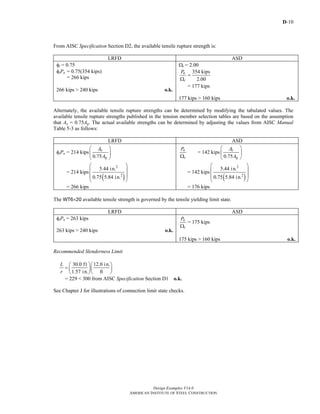
thickness in accordance with AISC Manual Part 1), as follows:
( )
( )
( )
( )( ) ( ) ( )
2
2
2
2
10.0 in. 2 0.349 in.
9.30 in.
2
6.00 in. 2 0.349 in.
5.30 in.
4
5.30 in. 9.30 in. 0.349 4
49.2 in.
i
i
c i i
h H t
b B t
A b h t
= −
= −
=
= −
= −
=
= − − π
= − − π
=
From Chapter 2 of ASCE/SEI 7, the required compressive strength is:
LRFD ASD
( ) ( )1.2 32.0 kips 1.6 84.0 kips
173 kips
r uP P=
= +
=
32.0 kips 84.0 kips
116 kips
r aP P=
= +
=
Composite Section Strength for Force Allocation
In order to determine the composite section strength, the member is first classified as compact, noncompact or
slender in accordance with AISC Specification Table I1.1a. However, the results of this check do not affect force
allocation calculations as Specification Section I6.2 requires the use of Equation I2-9a regardless of the local
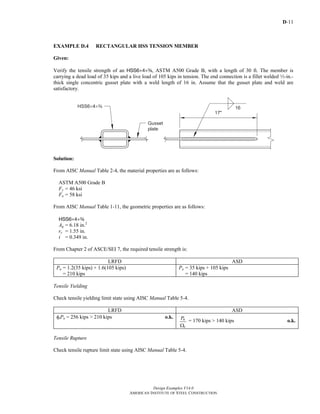
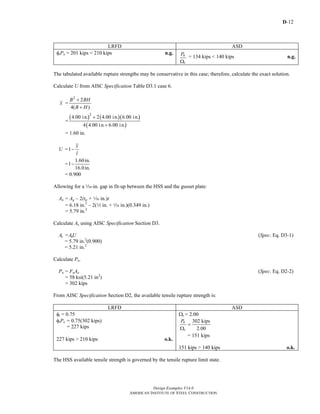
buckling classification, thus this calculation is omitted for this example. The nominal axial compressive strength
without consideration of length effects, Pno, used for force allocation calculations is therefore determined as:
Return to Table of Contents
Design Examples V14.0
AMERICAN INSTITUTE OF STEEL CONSTRUCTION
I-37
2
no p
s
y s c c sr
c
P P
E
F A C f A A
E
=
⎛ ⎞
′= + +⎜ ⎟
⎝ ⎠
where
C2 = 0.85 for rectangular sections
Asr = 0 when no reinforcing steel is present within the HSS
( )( ) ( )( )2 2 2
46 ksi 10.4 in. 0.85 5 ksi 49.2 in. 0.0 in.
688 kips
noP = + +
=
(Spec. Eq. I2-9a)
(Spec. Eq. I2-9b)
Transfer Force for Condition (a)
Refer to Figure I.3-1(a). For this condition, the entire external force is applied to the steel section only, and the
provisions of AISC Specification Section I6.2a apply.
( )( )2
1
46 ksi 10.4 in.
1
688 kips
0.305
y s
r r
no
r
r
F A
V P
P
P
P
⎛ ⎞
′ = −⎜ ⎟
⎝ ⎠
⎡ ⎤
⎢ ⎥= −
⎢ ⎥⎣ ⎦
=
(Spec. Eq. I6-1)
LRFD ASD
( )0.305 173 kips
52.8 kips
rV ′ =
=
( )0.305 116 kips
35.4 kips
rV ′ =
=
Transfer Force for Condition (b)
Refer to Figure I.3-1(b). For this condition, the entire external force is applied to the concrete fill only, and the
provisions of AISC Specification Section I6.2b apply.
( )( )2
46 ksi 10.4 in.
688 kips
0.695
y s
r r
no
r
r
F A
V P
P
P
P
⎛ ⎞
′ = ⎜ ⎟
⎝ ⎠
⎡ ⎤
⎢ ⎥=
⎢ ⎥⎣ ⎦
=
(Spec. Eq. I6-2)
LRFD ASD
( )0.695 173 kips
120 kips
rV ′ =
=
( )0.695 116 kips
80.6 kips
rV ′ =
=
Transfer Force for Condition (c)
Refer to Figure I.3-1(c). For this condition, external force is applied to the steel section and concrete fill
concurrently, and the provisions of AISC Specification Section I6.2c apply.
AISC Specification Commentary Section I6.2 states that when loads are applied to both the steel section and
concrete fill concurrently, rV ′ can be taken as the difference in magnitudes between the portion of the external force
Return to Table of Contents
Design Examples V14.0
AMERICAN INSTITUTE OF STEEL CONSTRUCTION
I-38
applied directly to the steel section and that required by Equation I6-2. Using the plastic distribution approach
employed in Specification Equations I6-1 and I6-2, this concept can be written in equation form as follows:
s y
r rs r
no
A F
V P P
P
⎛ ⎞
′ = − ⎜ ⎟
⎝ ⎠
where
Prs = portion of external force applied directly to the steel section, kips
(Eq. 1)
Currently the Specification provides no specific requirements for determining the distribution of the applied force
for the determination of Prs, so it is left to engineering judgment. For a bearing plate condition such as the one
represented in Figure I.3-1(c), one possible method for determining the distribution of applied forces is to use an
elastic distribution based on the material axial stiffness ratios as follows:
( )
1.5
1.53
145 lb/ft 5 ksi
3,900 ksi
c c cE w f ′=
=
=
( )
( )( )
( )( ) ( )( )
( )
2
2 2
29,000 ksi 10.4 in.
29,000 ksi 10.4 in. 3,900 ksi 49.2 in.
0.611
s s
rs r
s s c c
r
r
E A
P P
E A E A
P
P
⎛ ⎞
= ⎜ ⎟+⎝ ⎠
⎡ ⎤
⎢ ⎥=
+⎢ ⎥⎣ ⎦
=
Substituting the results into Equation 1 yields:
( )( )2
0.611
10.4 in. 46 ksi
0.611
688 kips
0.0843
s y
r r r
no
r r
r
A F
V P P
P
P P
P
⎛ ⎞
′ = − ⎜ ⎟
⎝ ⎠
⎡ ⎤
⎢ ⎥= −
⎢ ⎥⎣ ⎦
=
LRFD ASD
( )0.0843 173 kips
14.6 kips
rV ′ =
=
( )0.0843 116 kips
9.78 kips
rV ′ =
=
An alternate approach would be the use of a plastic distribution method whereby the load is partitioned to each
material in accordance with their contribution to the composite section strength given in Equation I2-9b. This
method eliminates the need for longitudinal shear transfer provided the local bearing strength of the concrete and
steel are adequate to resist the forces resulting from this distribution.
Additional Discussion
• The design and detailing of the connections required to deliver external forces to the composite member
should be performed according to the applicable sections of AISC Specification Chapters J and K. Note that
for checking bearing strength on concrete confined by a steel HSS or box member, the 2 1/A A term in
Equation J8-2 may be taken as 2.0 according to the User Note in Specification Section I6.2.
Return to Table of Contents
Design Examples V14.0
AMERICAN INSTITUTE OF STEEL CONSTRUCTION
I-39
• The connection cases illustrated by Figure I.3-1 are idealized conditions representative of the mechanics of
actual connections. For instance, a standard shear connection welded to the face of an HSS column is an
example of a condition where all external force is applied directly to the steel section only. Note that the
connection configuration can also impact the strength of the force transfer mechanism as illustrated in Part
II of this example.
Solution:
Part II—Load Transfer
The required longitudinal force to be transferred, rV ′ , determined in Part I condition (a) will be used to investigate
the three applicable force transfer mechanisms of AISC Specification Section I6.3: direct bearing, shear connection,
and direct bond interaction. As indicated in the Specification, these force transfer mechanisms may not be
superimposed; however, the mechanism providing the greatest nominal strength may be used.
Direct Bearing
Trial Layout of Bearing Plate
For investigating the direct bearing load transfer mechanism, the external force is delivered directly to the HSS
section by standard shear connections on each side of the member as illustrated in Figure I.3-2. One method for
utilizing direct bearing in this instance is through the use of an internal bearing plate. Given the small clearance
within the HSS section under consideration, internal access for welding is limited to the open ends of the HSS;
therefore, the HSS section will be spliced at the bearing plate location. Additionally, it is a practical consideration
that no more than 50% of the internal width of the HSS section be obstructed by the bearing plate in order to
facilitate concrete placement. It is essential that concrete mix proportions and installation of concrete fill produce
full bearing above and below the projecting plate. Based on these considerations, the trial bearing plate layout
depicted in Figure I.3-2 was selected using an internal plate protrusion, Lp, of 1.0 in.
Fig. I.3-2. Internal bearing plate configuration.
Location of Bearing Plate
The bearing plate is placed within the load introduction length discussed in AISC Specification Section I6.4b. The
load introduction length is defined as two times the minimum transverse dimension of the HSS both above and
below the load transfer region. The load transfer region is defined in Specification Commentary Section I6.4 as the
depth of the connection. For the configuration under consideration, the bearing plate should be located within 2(B =
6 in.) = 12 in. of the bottom of the shear connection. From Figure I.3-2, the location of the bearing plate is 6 in. from
the bottom of the shear connection and is therefore adequate.
Return to Table of Contents
Design Examples V14.0
AMERICAN INSTITUTE OF STEEL CONSTRUCTION
I-40
Available Strength for the Limit State of Direct Bearing
The contact area between the bearing plate and concrete, A1, may be determined as follows:
1 ( 2 )( 2 )c i p i pA A b L h L= − − −
where
(Eq. 2)
typical protrusion of bearing plate inside HSS
1.0 in.
pL =
=
Substituting for the appropriate geometric properties previously determined in Part I into Equation 2 yields:
( ) ( )2
1
2
49.2 in. 5.30 in. 2 1.0 in. 9.30 in. 2 1.0 in.
25.1 in.
A = − − −⎡ ⎤ ⎡ ⎤⎣ ⎦ ⎣ ⎦
=
The available strength for the direct bearing force transfer mechanism is:
11.7n cR f A′= (Spec. Eq. I6-3)
LRFD ASD
( )( )( )2
0.65
0.65 1.7 5 ksi 25.1 in.
139 kips 52.8 kips
B
B n r
B n
R V
R
φ =
′φ ≥
φ =
= > o.k.
( )( )2
2.31
/
1.7 5 ksi 25.1 in.
/
2.31
92.4 kips 35.4 kips
B
n B r
n B
R V
R
Ω =
′Ω ≥
Ω =
= > o.k.
Required Thickness of Internal Bearing Plate
There are several methods available for determining the bearing plate thickness. For round HSS sections with
circular bearing plate openings, a closed-form elastic solution such as those found in Roark’s Formulas for Stress
and Strain (Young and Budynas, 2002) may be used. Alternately, the use of computational methods such as finite
element analysis may be employed.
For this example, yield line theory can be employed to determine a plastic collapse mechanism of the plate. In this
case, the walls of the HSS lack sufficient stiffness and strength to develop plastic hinges at the perimeter of the
bearing plate. Utilizing only the plate material located within the HSS walls, and ignoring the HSS corner radii, the
yield line pattern is as depicted in Figure I.3-3.
Fig. I.3-3. Yield line pattern.
Return to Table of Contents
Design Examples V14.0
AMERICAN INSTITUTE OF STEEL CONSTRUCTION
I-41
Utilizing the results of the yield line analysis with 36 ksiyF = plate material, the plate thickness may be determined
as follows:
LRFD ASD
( )
2
1
2
0.90
8
3
where
bearing pressure on plate determined
using LRFD load combinations
52.8 kips
25.1 in.
2.10 ksi
pu
p p i i
y
u
r
Lw
t L b h
F
w
V
A
φ =
⎡ ⎤
= + −⎢ ⎥
2φ ⎣ ⎦
=
′
=
=
=
( )
( )( )
( )( )
( )2
2.10 ksi 8 1.0in.
1.0in. 5.30in. 9.30in.
36 ksi 3
0.622 in.
pt + −
2 0.9
⎡ ⎤
= ⎢ ⎥
⎣ ⎦
=
( )
2
1
2
1.67
8
3
where
bearing pressure on plate determined
using ASD load combinations
35.4 kips
25.1 in.
1.41 ksi
pa
p p i i
y
a
r
Lw
t L b h
F
w
V
A
Ω =
⎡ ⎤Ω
= + −⎢ ⎥
2 ⎣ ⎦
=
′
=
=
=
( )( )
( )
( )( )
( )2
1.41ksi 8 1.0in.
1.0in. 5.30in. 9.30in.
36 ksi 3
0.625 in.
pt
1.67
+ −
2
⎡ ⎤
= ⎢ ⎥
⎣ ⎦
=
Thus, select a w-in.-thick bearing plate.
Splice Weld
The HSS is in compression due to the imposed loads, therefore the splice weld indicated in Figure I.3-2 is sized
according to the minimum weld size requirements of Chapter J. Should uplift or flexure be applied in other loading
conditions, the splice should be designed to resist these forces using the applicable provisions of AISC Specification
Chapters J and K.
Shear Connection
Shear connection involves the use of steel headed stud or channel anchors placed within the HSS section to transfer
the required longitudinal shear force. The use of the shear connection mechanism for force transfer in filled HSS is
usually limited to large HSS sections and built-up box shapes, and is not practical for the composite member in
question. Consultation with the fabricator regarding their specific capabilities is recommended to determine the
feasibility of shear connection for HSS and box members. Should shear connection be a feasible load transfer
mechanism, AISC Specification Section I6.3b in conjunction with the steel anchors in composite component
provisions of Section I8.3 apply.
Direct Bond Interaction
The use of direct bond interaction for load transfer is limited to filled HSS and depends upon the location of the load
transfer point within the length of the member being considered (end or interior) as well as the number of faces to
which load is being transferred.
From AISC Specification Section I6.3c, the nominal bond strength for a rectangular section is:
2
n in inR B C F= (Spec. Eq. I6-5)
Return to Table of Contents
Design Examples V14.0
AMERICAN INSTITUTE OF STEEL CONSTRUCTION
I-42
where
= overall width of rectangular steel section along face transferring load, in.
2 if the filled composite member extends to one side of the point of force transfer
4 if the filled composite memb
in
B
C =
= er extends to both sides of the point of force transfer
0.06 ksiinF =
For the design of this load transfer mechanism, two possible cases will be considered:
Case 1: End Condition – Load Transferred to Member from Four Sides Simultaneously
For this case the member is loaded at an end condition (the composite member only extends to one side of the point
of force transfer). Force is applied to all four sides of the section simultaneously thus allowing the full perimeter of
the section to be mobilized for bond strength.
From AISC Specification Equation I6-5:
LRFD ASD
( ) ( ) ( )( )
2 2
0.45
0.45 2 6.00 in. 2 10.0 in. 2 0.06 ksi
14.7 kips 52.8 kips
n r
n
R V
R
φ =
′φ ≥
⎡ ⎤φ = +
⎣ ⎦
= < n.g.
( ) ( ) ( )( )
2 2
3.33
/
2 6.00 in. 2 10.0 in. 2 0.06 ksi
/
3.33
9.80 kips 35.4 kips
n r
n
R V
R
Ω =
′Ω ≥
⎡ ⎤+
⎣ ⎦Ω =
= < n.g.
Bond strength is inadequate and another force transfer mechanism such as direct bearing must be used to meet the
load transfer provisions of AISC Specification Section I6.
Alternately, the detail could be revised so that the external force is applied to both the steel section and concrete fill
concurrently as schematically illustrated in Figure I.3-1(c). Comparing bond strength to the load transfer
requirements for concurrent loading determined in Part I of this example yields:
LRFD ASD
0.45
14.7 kips 14.6 kips
n r
n
R V
R
φ =
′φ ≥
φ = > o.k.
3.33
/
/ 9.80 kips 9.78 kips
n r
n
R V
R
Ω =
′Ω ≥
Ω = > o.k.
Case 2: Interior Condition – Load Transferred to Three Faces
For this case the composite member is loaded from three sides away from the end of the member (the composite
member extends to both sides of the point of load transfer) as indicated in Figure I.3-4.
Return to Table of Contents
Design Examples V14.0
AMERICAN INSTITUTE OF STEEL CONSTRUCTION
I-43
Fig. I.3-4. Case 2 load transfer.
Longitudinal shear forces to be transferred at each face of the HSS are calculated using the relationship to external
forces determined in Part I of the example for condition (a) shown in Figure I.3-1, and the applicable ASCE/SEI 7-
10 load combinations as follows:
LRFD ASD
( ) ( )
( )
( ) ( )
( )
1
1 1
2 3
2 3 2 3
Face 1:
1.2 2.00 kips 1.6 6.00 kips
12.0 kips
0.305
0.305 12.0 kips
3.66 kips
Faces 2 and 3:
1.2 15.0 kips 1.6 39.0 kips
80.4 kips
0.305
0.305 80.4 kips
24.5 kips
r u
r r
r u
r r
P P
V P
P P
V P
−
− −
=
= +
=
′ =
=
=
=
= +
=
′ =
=
=
( )
( )
1
1 1
2 3
2 3 2 3
Face 1:
2.00 kips 6.00 kips
8.00 kips
0.305
0.305 8.00 kips
2.44 kips
Faces 2 and 3:
15.0 kips 39.0 kips
54.0 kips
0.305
0.305 54.0 kips
16.5 kips
r a
r r
r u
r r
P P
V P
P P
V P
−
− −
=
= +
=
′ =
=
=
=
= +
=
′ =
=
=
Load transfer at each face of the section is checked separately for the longitudinal shear at that face using Equation
I6-5 as follows:
LRFD ASD
( ) ( )( )
1 1
2
1
0.45
Face 1:
0.45 6.00 in. 4 0.06 ksi
3.89 kips 3.66 kips
n r
n
R V
R
φ =
′φ ≥
φ =
= > o.k.
( ) ( )( )
1 1
2
1
3.33
Face 1:
/
6.00 in. 4 0.06 ksi
/
3.33
2.59 kips 2.44 kips
n r
n
R V
R
Ω =
′Ω ≥
Ω =
= > o.k.
Return to Table of Contents
Design Examples V14.0
AMERICAN INSTITUTE OF STEEL CONSTRUCTION
I-44
LRFD ASD
( ) ( )( )
2 3 2 3
2
2 3
Faces 2 and 3:
0.45 10.0 in. 4 0.06 ksi
10.8 kips 24.5 kips
n r
n
R V
R
− −
−
′φ ≥
φ =
= < n.g.
( ) ( )( )
2 3 2 3
2
2 3
Faces 2 and 3:
/
10.0 in. 4 0.06 ksi
/
3.33
7.21 kips 16.5 kips
n r
n
R V
R
− −
−
′Ω ≥
Ω =
= < n.g.
The calculations indicate that the bond strength is inadequate for two of the three loaded faces, thus an alternate
means of load transfer such as the use of internal bearing plates as demonstrated previously in this example is
necessary.
As demonstrated by this example, direct bond interaction provides limited available strength for transfer of
longitudinal shears and is generally only acceptable for lightly loaded columns or columns with low shear transfer
requirements such as those with loads applied to both concrete fill and steel encasement simultaneously.
Return to Table of Contents
Design Examples V14.0
AMERICAN INSTITUTE OF STEEL CONSTRUCTION
I-45
EXAMPLE I.4 FILLED COMPOSITE MEMBER IN AXIAL COMPRESSION
Given:
Determine if the 14 ft long, filled composite member illustrated in Figure I.4-1 is adequate for the indicated dead
and live loads.
The composite member consists of an ASTM A500 Grade B HSS with normal weight ( 3
145 lb/ft ) concrete fill
having a specified concrete compressive strength, cf ′ = 5 ksi.
Fig. I.4-1. Concrete filled member section and applied loading.
Solution:
From AISC Manual Table 2-4, the material properties are:
ASTM A500 Grade B
Fy = 46 ksi
Fu = 58 ksi
From Chapter 2 of ASCE/SEI 7, the required compressive strength is:
LRFD ASD
( ) ( )1.2 32.0 kips 1.6 84.0 kips
173 kips
r uP P=
= +
=
32.0 kips 84.0 kips
116 kips
r aP P=
= +
=
Method 1: AISC Manual Tables
The most direct method of calculating the available compressive strength is through the use of AISC Manual Table
4-14. A K factor of 1.0 is used for a pin-ended member. Because the unbraced length is the same in both the x-x and
y-y directions, and Ix exceeds Iy, y-y axis buckling will govern.
Return to Table of Contents
Design Examples V14.0
AMERICAN INSTITUTE OF STEEL CONSTRUCTION
I-46
Entering Table 4-14 with KLy = 14 ft yields:
LRFD ASD
354 kips
354kips 173 kips
c n
c n u
P
P P
φ =
φ ≥
> o.k.
/ 236 kips
/
236 kips 116 kips
n c
n c a
P
P P
Ω =
Ω ≥
> o.k.
Method 2: AISC Specification Calculations
As an alternate to the AISC Manual tables, the available compressive strength can be calculated directly using the
provisions of AISC Specification Chapter I.
From AISC Manual Table 1-11 and Figure I.4-1, the geometric properties of an HSS10×6×a are as follows:
As = 10.4 in.2
H = 10.0 in.
B = 6.00 in.
tnom = a in. (nominal wall thickness)
t = 0.349 in. (design wall thickness in accordance with AISC Specification Section B4.2)
h/t = 25.7
b/t = 14.2
Isx = 137 in.4
Isy = 61.8 in.4
Internal clear distances are determined as:
( )
( )
2
10.0 in. 2 0.349 in.
9.30 in.
2
6.0 in. 2 0.349 in.
5.30 in.
i
i
h H t
b B t
= −
= −
=
= −
= −
=
From Design Example I.3, the area of concrete, 2
, equals 49.2 in.cA The steel and concrete areas can be used to
calculate the gross cross-sectional area as follows:
2 2
2
10.4 in. 49.2 in.
59.6 in.
g s cA A A= +
= +
=
Calculate the concrete moment of inertia using geometry compatible with that used in the calculation of the steel
area in AISC Manual Table 1-11 (taking into account the design wall thickness and corner radii of two times the
design wall thickness in accordance with AISC Manual Part 1), the following equations may be used, based on the
terminology given in Figure I-2 of the introduction to these examples:
For bending about the x-x axis:
( ) ( ) ( )3 2 4 23
2
9 644 4 4 4
12 6 36 2 3
i
cx
tB t h t H t H t t
I t
π −− − −⎛ ⎞
= + + + π +⎜ ⎟
π π⎝ ⎠
Return to Table of Contents
Design Examples V14.0
AMERICAN INSTITUTE OF STEEL CONSTRUCTION
I-47
( ) ( ) ( ) ( ) ( )( )
( )
( ) ( )
3 43 2
2
2
4
9 64 0.349 in.6.00 in. 4 0.349 in. 9.30 in. 0.349 in. 10.0 in. 4 0.349 in.
12 6 36
10.0 in. 4 0.349 in. 4 0.349 in.
0.349 in.
2 3
353 in.
cxI
π −− −⎡ ⎤ ⎡ ⎤⎣ ⎦ ⎣ ⎦= + +
π
−⎛ ⎞
+ π +⎜ ⎟
π⎝ ⎠
=
For bending about the y-y axis:
( ) ( ) ( )3 2 4 23
2
9 644 4 4 4
12 6 36 2 3
i
cy
tH t b t B t B t t
I t
π −− − −⎛ ⎞
= + + + π +⎜ ⎟
π π⎝ ⎠
( ) ( ) ( ) ( ) ( )( )
( )
( ) ( )
3 43 2
2
2
4
9 64 0.349 in.10.0 in. 4 0.349 in. 5.30 in. 0.349 in. 6.00 in. 4 0.349 in.
12 6 36
6.00 in. 4 0.349 in. 4 0.349 in.
0.349 in.
2 3
115 in.
cyI
π −− −⎡ ⎤ ⎡ ⎤⎣ ⎦ ⎣ ⎦= + +
π
−⎛ ⎞
+ π +⎜ ⎟
π⎝ ⎠
=
Limitations of AISC Specification Sections I1.3 and I2.2a
(1) Concrete Strength: 3 ksi 10 ksicf ′≤ ≤
5 ksicf ′ = o.k.
(2) Specified minimum yield stress of structural steel: 75 ksiyF ≤
46 ksiyF = o.k.
(3) Cross-sectional area of steel section: 0.01s gA A≥
( )( )2 2
2
10.4 in. 0.01 59.6 in.
0.596 in.
≥
> o.k.
There are no minimum longitudinal reinforcement requirements in the AISC Specification within filled composite
members; therefore, the area of reinforcing bars, Asr, for this example is zero.
Classify Section for Local Buckling
In order to determine the strength of the composite section subject to axial compression, the member is first
classified as compact, noncompact or slender in accordance with AISC Specification Table I1.1A.
2.26
29,000 ksi
2.26
46 ksi
56.7
/ 25.7
max
/ 14.2
25.7
p
y
controlling
controlling p
E
F
h t
b t
λ =
=
=
=⎛ ⎞
λ = ⎜ ⎟
=⎝ ⎠
=
λ ≤ λ section is compact
Return to Table of Contents
Design Examples V14.0
AMERICAN INSTITUTE OF STEEL CONSTRUCTION
I-48
Available Compressive Strength
The nominal axial compressive strength for compact sections without consideration of length effects, Pno, is
determined from AISC Specification Section I2.2b as:
2
no p
s
y s c c sr
c
P P
E
F A C f A A
E
=
⎛ ⎞
′= + +⎜ ⎟
⎝ ⎠
where C2 = 0.85 for rectangular sections
( )( ) ( )( )2 2 2
46 ksi 10.4 in. 0.85 5 ksi 49.2 in. 0.0 in.
688 kips
noP = + +
=
(Spec. Eq. I2-9a)
(Spec. Eq. I2-9b)
Because the unbraced length is the same in both the x-x and y-y directions, the column will buckle about the weaker
y-y axis (the axis having the lower moment of inertia). Icy and Isy will therefore be used for calculation of length
effects in accordance with AISC Specification Sections I2.2b and I2.1b as follows:
( )
( )( ) ( )( )
3
2
2 2
1.5
1.53
3
4 4
0.6 2 0.9
10.4 in.
0.6 2 0.9
49.2 in. 10.4 in.
0.949 0.9
145 lb/ft 5 ksi
3,900 ksi
29,000 ksi 61.8 in. 0 0.9 3,900 ksi 115 in.
s
c s
c c c
eff s sy s sr c cy
A
C
A A
E w f
EI E I E I C E I
⎛ ⎞
= + ≤⎜ ⎟+⎝ ⎠
⎛ ⎞
= + ≤⎜ ⎟
+⎝ ⎠
= >
′=
=
=
= + +
= + +
=
0.9 controls
( ) ( )
2
22
2,200,000 kip-in.
/e effP EI KL= π
where K=1.0 for a pin-ended member
( )
( )( )( )
2 2
2
2,200,000 kip-in.
1.0 14.0 ft 12 in./ft
769 kips
688 kips
769 kips
0.895 2.25
e
no
e
P
P
P
π
=
⎡ ⎤⎣ ⎦
=
=
= <
Therefore, use AISC Specification Equation I2-2.
( )( )
0.895
0.658
688 kips 0.658
473 kips
⎡ ⎤
= ⎢ ⎥
⎢ ⎥⎣ ⎦
=
=
no
e
P
P
n noP P
(Spec. Eq. I2-13)
(Spec. Eq. I2-12)
(from Spec. Eq. I2-5)
( ). Eq. I2 2−Spec
Return to Table of Contents
Design Examples V14.0
AMERICAN INSTITUTE OF STEEL CONSTRUCTION
I-49
Check adequacy of the composite column for the required axial compressive strength:
LRFD ASD
( )
0.75
0.75 473 kips
355 kips 173 kips
c
c n u
c n
P P
P
φ =
φ ≥
φ =
= > o.k.
2.00
/
473 kips
/
2.00
237 kips 116 kips
c
n c a
n c
P P
P
Ω =
Ω ≥
Ω =
= > o.k.
The slight differences between these values and those tabulated in the AISC Manual are due to the number of
significant digits carried through the calculations.
Available Compressive Strength of Bare Steel Section
Due to the differences in resistance and safety factors between composite and noncomposite column provisions, it is
possible to calculate a lower available compressive strength for a composite column than one would calculate for the
corresponding bare steel section. However, in accordance with AISC Specification Section I2.1b, the available
compressive strength need not be less than that calculated for the bare steel member in accordance with Chapter E.
From AISC Manual Table 4-3, for an HSS10×6×a, KLy = 14.0 ft:
LRFD ASD
313kips
313 kips 355 kips
c nPφ =
<
/ 208 kips
208 kips 237 kips
n cP Ω =
<
Thus, the composite section strength controls and is adequate for the required axial compressive strength as
previously demonstrated.
Force Allocation and Load Transfer
Load transfer calculations for external axial forces should be performed in accordance with AISC Specification
Section I6. The specific application of the load transfer provisions is dependent upon the configuration and detailing
of the connecting elements. Expanded treatment of the application of load transfer provisions is provided in Design
Example I.3.
Return to Table of Contents
Design Examples V14.0
AMERICAN INSTITUTE OF STEEL CONSTRUCTION
I-50
EXAMPLE I.5 FILLED COMPOSITE MEMBER IN AXIAL TENSION
Given:
Determine if the 14 ft long, filled composite member illustrated in Figure I.5-1 is adequate for the indicated dead
load compression and wind load tension. The entire load is applied to the steel section.
Fig. I.5-1. Concrete filled member section and applied loading.
The composite member consists of an ASTM A500 Grade B HSS with normal weight ( 3
145 lb/ft ) concrete fill
having a specified concrete compressive strength, cf ′ = 5 ksi.
Solution:
From AISC Manual Table 2-4, the material properties are:
ASTM A500 Grade B
Fy = 46 ksi
Fu = 58 ksi
From AISC Manual Table 1-11, the geometric properties are as follows:
HSS10×6×a
As = 10.4 in.2
There are no minimum requirements for longitudinal reinforcement in the AISC Specification; therefore it is
common industry practice to use filled shapes without longitudinal reinforcement, thus Asr =0.
From Chapter 2 of ASCE/SEI 7, the required compressive strength is (taking compression as negative and tension as
positive):
Return to Table of Contents
Design Examples V14.0
AMERICAN INSTITUTE OF STEEL CONSTRUCTION
I-51
LRFD ASD
Governing Uplift Load Combination 0.9 1.0D W= +
( ) ( )0.9 32.0 kips 1.0 100 kips
71.2 kips
r uP P=
= − +
=
Governing Uplift Load Combination 0.6 0.6D W= +
( ) ( )0.6 32.0 kips 0.6 100 kips
40.8 kips
r aP P=
= − +
=
Available Tensile Strength
Available tensile strength for a filled composite member is determined in accordance with AISC Specification
Section I2.2c.
( )( ) ( )( )2 2
10.4 in. 46 ksi 0.0 in. 60 ksi
478 kips
n s y sr ysrP A F A F= +
= +
=
(Spec. Eq. I2-14)
LRFD ASD
( )
0.90
0.90 478 kips
430 kips 71.2 kips
t
t n u
t n
P P
P
φ =
φ ≥
φ =
= > o.k.
1.67
/
478 kips
/
1.67
286 kips 40.8 kips
t
n t a
n t
P P
P
Ω =
Ω ≥
Ω =
= > o.k.
For concrete filled HSS members with no internal longitudinal reinforcing, the values for available tensile strength
may also be taken directly from AISC Manual Table 5-4.
Force Allocation and Load Transfer
Load transfer calculations are not required for concrete filled members in axial tension that do not contain
longitudinal reinforcement, such as the one under investigation, as only the steel section resists tension.
Return to Table of Contents
Design Examples V14.0
AMERICAN INSTITUTE OF STEEL CONSTRUCTION
I-52
EXAMPLE I.6 FILLED COMPOSITE MEMBER IN COMBINED AXIAL COMPRESSION, FLEXURE
AND SHEAR
Given:
Determine if the 14 ft long, filled composite member illustrated in Figure I.6-1 is adequate for the indicated axial
forces, shears and moments that have been determined in accordance with the direct analysis method of AISC
Specification Chapter C for the controlling ASCE/SEI 7-10 load combinations.
LRFD ASD
Pr (kips) 129 98.2
Mr (kip-ft) 120 54.0
Vr (kips) 17.1 10.3
Fig. I.6-1. Concrete filled member section and member forces.
The composite member consists of an ASTM A500 Grade B HSS with normal weight ( 3
145 lb/ft ) concrete fill
having a specified concrete compressive strength, cf ′ = 5 ksi.
Solution:
From AISC Manual Table 2-4, the material properties are:
ASTM A500 Grade B
Fy = 46 ksi
Fu = 58 ksi
From AISC Manual Table 1-11 and Figure I.6-1, the geometric properties are as follows:
HSS10×6×a
H = 10.0 in.
B = 6.00 in.
Return to Table of Contents
Design Examples V14.0
AMERICAN INSTITUTE OF STEEL CONSTRUCTION
I-53
tnom = a in. (nominal wall thickness)
t = 0.349 in. (design wall thickness)
h/t = 25.7
b/t = 14.2
As = 10.4 in.2
Isx = 137 in.4
Isy = 61.8 in.4
Zsx = 33.8 in.3
Additional geometric properties used for composite design are determined in Design Examples I.3 and I.4 as
follows:
hi = 9.30 in. clear distance between HSS walls (longer side)
bi = 5.30 in. clear distance between HSS walls (shorter side)
Ac = 49.2 in.2
cross-sectional area of concrete fill
Ag = 59.6 in.2
gross cross-sectional area of composite member
Asr = 0 in.2
area of longitudinal reinforcement
Ec = 3,900 ksi modulus of elasticity of concrete
Icx = 353 in.4
moment of inertia of concrete fill about the x-x axis
Icy = 115 in.4
moment of inertia of concrete fill about the y-y axis
Limitations of AISC Specification Sections I1.3 and I2.2a
(1) Concrete Strength: 3 ksi 10 ksicf ′≤ ≤
5 ksicf ′ = o.k.
(2) Specified minimum yield stress of structural steel: 75 ksiyF ≤
46 ksiyF = o.k.
(3) Cross-sectional area of steel section: 0.01s gA A≥
( )( )2 2
2
10.4 in. 0.01 59.6 in.
0.596 in.
≥
> o.k.
Classify Section for Local Buckling
The composite member in question was shown to be compact for pure compression in Design Example I.4 in
accordance with AISC Specification Table I1.1a. The section must also be classified for local buckling due to
flexure in accordance with Specification Table I1.1b; however, since the limits for members subject to flexure are
equal to or less stringent than those for members subject to compression, the member is compact for flexure.
Interaction of Axial Force and Flexure
The interaction between axial forces and flexure in composite members is governed by AISC Specification
Section I5 which, for compact members, permits the use of a strain compatibility method or plastic stress
distribution method, with the option to use the interaction equations of Section H1.1.
The strain compatibility method is a generalized approach that allows for the construction of an interaction diagram
based upon the same concepts used for reinforced concrete design. Application of the strain compatibility method is
required for irregular/nonsymmetrical sections, and its general application may be found in reinforced concrete
design texts and will not be discussed further here.
Plastic stress distribution methods are discussed in AISC Specification Commentary Section I5 which provides three
acceptable procedures for filled members. The first procedure, Method 1, invokes the interaction equations of
Return to Table of Contents
Design Examples V14.0
AMERICAN INSTITUTE OF STEEL CONSTRUCTION
I-54
Section H1. This is the only method applicable to sections with noncompact or slender elements. The second
procedure, Method 2, involves the construction of a piecewise-linear interaction curve using the plastic strength
equations provided in Figure I.1c located within the front matter of the Chapter I Design Examples. The third
procedure, Method 2 – Simplified, is a reduction of the piecewise-linear interaction curve that allows for the use of
less conservative interaction equations than those presented in Chapter H.
For this design example, each of the three applicable plastic stress distribution procedures are reviewed and
compared.
Method 1: Interaction Equations of Section H1
The most direct and conservative method of assessing interaction effects is through the use of the interaction
equations of AISC Specification Section H1. For HSS shapes, both the available compressive and flexural strengths
can be determined from Manual Table 4-14. In accordance with the direct analysis method, a K factor of 1 is used.
Because the unbraced length is the same in both the x-x and y-y directions, and Ix exceeds Iy, y-y axis buckling will
govern for the compressive strength. Flexural strength is determined for the x-x axis to resist the applied moment
about this axis indicated in Figure I.6-1.
Entering Table 4-14 with KLy = 14 ft yields:
LRFD ASD
354 kips
130 kip-ft
129 kips
354 kips
0.364 0.2
c n
b nx
r u
c c n
P
M
P P
P P
φ =
φ =
=
φ
=
= ≥
Therefore, use AISC Specification Equation H1-1a.
8
1.0
9
129 kips 8 120 kip-ft
1.0
354 kips 9 130 kip-ft
1.18 1.0
u u
c n b n
P M
P M
⎛ ⎞
+ ≤⎜ ⎟
φ φ⎝ ⎠
⎛ ⎞
+ ≤⎜ ⎟
⎝ ⎠
> n.g.
/ 236 kips
/ 86.6 kip-ft
/
98.2 kips
236 kips
0.416 0.2
n c
nx c
r a
c n c
P
M
P P
P P
Ω =
Ω =
=
Ω
=
= ≥
Therefore, use AISC Specification Equation H1-1a.
8
1.0
/ 9 /
98.2 kips 8 54.0 kip-ft
1.0
236 kips 9 86.6 kip-ft
0.97 1.0
a a
n c n b
P M
P M
⎛ ⎞
+ ≤⎜ ⎟Ω Ω⎝ ⎠
⎛ ⎞
+ ≤⎜ ⎟
⎝ ⎠
< o.k.
Using LRFD methodology, Method 1 indicates that the section is inadequate for the applied loads. The designer can
elect to choose a new section that passes the interaction check or re-analyze the current section using a less
conservative design method such as Method 2. The use of Method 2 is illustrated in the following section.
Method 2: Interaction Curves from the Plastic Stress Distribution Model
The procedure for creating an interaction curve using the plastic stress distribution model is illustrated graphically in
Figure I.6-2.
Return to Table of Contents
Design Examples V14.0
AMERICAN INSTITUTE OF STEEL CONSTRUCTION
I-55
Fig. I.6-2. Interaction diagram for composite beam-column —Method 2.
Referencing Figure I.6-2, the nominal strength interaction surface A,B,C,D,E is first determined using the equations
of Figure I-1c found in the introduction of the Chapter I Design Examples. This curve is representative of the short
column member strength without consideration of length effects. A slenderness reduction factor, λ, is then
calculated and applied to each point to create surface A , B , C , D , E .′ ′ ′ ′ ′ The appropriate resistance or safety factors
are then applied to create the design surface A , B , C , D , E .′′ ′′ ′′ ′′ ′′ Finally, the required axial and flexural strengths
from the applicable load combinations of ASCE/SEI 7-10 are plotted on the design surface, and the member is
acceptable for the applied loading if all points fall within the design surface. These steps are illustrated in detail by
the following calculations.
Step 1: Construct nominal strength interaction surface A, B, C, D, E without length effects
Using the equations provided in Figure I-1c for bending about the x-x axis yields:
Point A (pure axial compression):
( )( ) ( )( )2 2
0.85
46 ksi 10.4 in. 0.85 5 ksi 49.2 in.
688 kips
0 kip-ft
A y s c c
A
P F A f A
M
′= +
= +
=
=
Point D (maximum nominal moment strength):
( )( )2
3
0.85
2
0.85 5 ksi 49.2 in.
2
105 kips
33.8 in.
c c
D
sx
f A
P
Z
′
=
=
=
=
Return to Table of Contents
Design Examples V14.0
AMERICAN INSTITUTE OF STEEL CONSTRUCTION
I-56
( )( )
( )
( )( )
( )( )
2
3
2
3
3
3
3
0.192 where
4
5.30 in. 9.30 in.
0.192 0.349 in.
4
115 in.
0.85
2
0.85 5 ksi 115 in.
46 ksi 33.8 in.
2
1,800 kip-in.
12 in./ft
150 kip-ft
i i
c i i
c c
D y sx
b h
Z r r t
f Z
M F Z
= − =
= −
=
′
= +
= +
=
=
Point B (pure flexure):
( )
( )( )
( )( ) ( )( )
( )( )
( )( )
2
2
2
3
2
2
3
0 kips
0.85
2 0.85 4 2
0.85 5 ksi 49.2 in. 9.30 in.
22 0.85 5 ksi 5.30 in. 4 0.349 in. 46 ksi
1.21 in. 4.65 in.
1.21 in.
2
2 0.349 in. 1.21 in.
1.02 in.
5.30 in. 1.21 in.
7.76 in.
B
c c i
n
c i y
sn n
cn i n
B
P
f A h
h
f b tF
Z th
Z b h
M M
=
′
= ≤
′ +
= ≤
+⎡ ⎤⎣ ⎦
= ≤
=
=
=
=
=
=
=
=
( )( )
( )( )3
3
0.85
2
0.85 5 ksi 7.76 in.
1,800 kip-in. 46 ksi 1.02 in.
2
1,740 kip-in.
12 in./ft
145 kip-ft
c cn
D y sn
f Z
F Z
′
− −
= − −
=
=
Point C (intermediate point):
( )( )2
0.85
0.85 5 ksi 49.2 in.
209 kips
C c cP f A′=
=
=
145 kip-ft
C BM M=
=
Return to Table of Contents
Design Examples V14.0
AMERICAN INSTITUTE OF STEEL CONSTRUCTION
I-57
Point E (optional):
Point E is an optional point that helps better define the interaction curve.
( )( )
( )( )( ) ( )( )( )
( )( )
2
2
2
where 1.21 in. from Point B
2 4
1.21 in. 10.0 in.
2 4
3.11 in.
0.85
0.85 4
2
0.85 5 ksi 49.2 in.
0.85 5 ksi 5.30 in. 3.11 in. 4 46 ksi 0.349 in. 3.11 in.
2
374 kips
5.30 in. 3.11 in.
51.
n
E n
c c
E c i E y E
cE i E
h H
h h
f A
P f b h F th
Z b h
= + =
= +
=
′
′= + +
= + +
=
=
=
=
( )( )
( )( )
( )( )
3
2
2
3
3
3
3 in.
2
2 0.349 in. 3.11 in.
6.75 in.
0.85
2
0.85 5 ksi 51.3 in.
1,800 kip-in. 46 ksi 6.75 in.
2
1,380 kip-in.
12 in./ft
115 kip-ft
sE E
c cE
E D y sE
Z th
f Z
M M F Z
=
=
=
′
= − −
= − −
=
=
The calculated points are plotted to construct the nominal strength interaction surface without length effects as
depicted in Figure I.6-3.
Return to Table of Contents
Design Examples V14.0
AMERICAN INSTITUTE OF STEEL CONSTRUCTION
I-58
Fig. I.6-3. Nominal strength interaction surface without length effects.
Step 2: Construct nominal strength interaction surface A , B , C , D , E′ ′ ′ ′ ′ with length effects
The slenderness reduction factor, λ, is calculated for Point A using AISC Specification Section I2.2 in accordance
with Specification Commentary Section I5.
( )( ) ( )( )
( )
3
2
2 2
3
4 4
2
688 kips
0.6 2 0.9
10.4 in.
0.6 2 0.9
49.2 in. 10.4 in.
0.949 0.9
29,000 ksi 61.8 in. 0 0.9 3,900 ksi 115 in.
2,200,000 ksi
no A
s
c s
eff s sy s sr c cy
e eff
P P
A
C
A A
EI E I E I C E I
P EI
=
=
⎛ ⎞
= + ≤⎜ ⎟+⎝ ⎠
⎛ ⎞
= + ≤⎜ ⎟
+⎝ ⎠
= >
= + +
= + +
=
= π
0.9 controls
( )
( )
( )( )
2
2
2
/ where 1.0 in accordance with the direct analysis method
2,200,000 ksi
14.0 ft 12 in./ft
769 kips
688 kips
769 kips
0.895 2.25
no
e
KL K
P
P
=
π
=
⎡ ⎤⎣ ⎦
=
=
= <
Use AISC Specification Equation I2-2.
(Spec. Eq. I2-13)
(from Spec. Eq. I2-12)
(Spec. Eq. I2-5)
Return to Table of Contents
Design Examples V14.0
AMERICAN INSTITUTE OF STEEL CONSTRUCTION
I-59
( )
0.895
0.658
688 kips 0.658
473 kips
473 kips
688 kips
0.688
no
e
P
P
n no
n
no
P P
P
P
⎡ ⎤
= ⎢ ⎥
⎢ ⎥⎣ ⎦
=
=
λ =
=
=
(Spec. Eq. I2-2)
In accordance with AISC Specification Commentary Section I5, the same slenderness reduction is applied to each of
the remaining points on the interaction surface as follows:
( )
( )
( )
0.688 688 kips
473 kips
0.688 0 kips
0 kips
0.688 209 kips
144 kips
A A
B B
C C
P P
P P
P P
′
′
′
= λ
=
=
= λ
=
=
= λ
=
=
( )
( )
0.688 105 kips
72.2 kips
0.688 374 kips
257 kips
D D
E E
P P
P P
′
′
= λ
=
=
= λ
=
=
The modified axial strength values are plotted with the flexural strength values previously calculated to construct the
nominal strength interaction surface including length effects. These values are superimposed on the nominal strength
surface not including length effects for comparison purposes in Figure I.6-4.
Return to Table of Contents
Design Examples V14.0
AMERICAN INSTITUTE OF STEEL CONSTRUCTION
I-60
Fig. I.6-4. Nominal strength interaction surfaces (with and without length effects).
Step 3: Construct design interaction surface A , B , C , D , E′′ ′′ ′′ ′′ ′′ and verify member adequacy
The final step in the Method 2 procedure is to reduce the interaction surface for design using the appropriate
resistance or safety factors.
LRFD ASD
Design compressive strength:
( )
( )
( )
( )
( )
0.75
where X = A, B, C, D or E
0.75 473 kips
355 kips
0.75 0 kips
0 kips
0.75 144 kips
108 kips
0.75 72.2 kips
54.2 kips
0.75 257 kips
193 kips
c
X c X
A
B
C
D
E
P P
P
P
P
P
P
′′ ′
′′
′′
′′
′′
′′
φ =
= φ
=
=
=
=
=
=
=
=
=
=
Design flexural strength:
0.90
where X = A, B, C, D or E
b
X b XM M ′′′
φ =
= φ
Allowable compressive strength:
2.00
/
where X = A, B, C, D or E
473 kips / 2.00
237 kips
0 kips / 2.00
0 kips
144 kips / 2.00
72 kips
72.2 kips / 2.00
36.1 kips
257 kips / 2.00
129 kips
c
X X c
A
B
C
D
E
P P
P
P
P
P
P
′′′
′′
′′
′′
′′
′′
Ω =
= Ω
=
=
=
=
=
=
=
=
=
=
Allowable flexural strength:
1.67
/
where X = A, B, C, D or E
b
X X bM M ′′′
Ω =
= Ω
Return to Table of Contents
Design Examples V14.0
AMERICAN INSTITUTE OF STEEL CONSTRUCTION
I-61
LRFD ASD
( )
( )
( )
( )
( )
0.90 0 kip-ft
0 kip-ft
0.90 145 kip-ft
131 kip-ft
0.90 145 kip-ft
131 kip-ft
0.90 150 kip-ft
135 kip-ft
0.90 115 kip-ft
104 kip-ft
A
B
C
D
E
M
M
M
M
M
′′
′′
′′
′′
′′
=
=
=
=
=
=
=
=
=
=
0 kip-ft /1.67
0 kip-ft
145 kip-ft /1.67
86.8 kip-ft
145 kip-ft /1.67
86.8 kip-ft
150 kip-ft /1.67
89.8 kip-ft
115 kip-ft /1.67
68.9 kip-ft
A
B
C
D
E
M
M
M
M
M
′′
′′
′′
′′
′′
=
=
=
=
=
=
=
=
=
=
The available strength values for each design method can now be plotted. These values are superimposed on the
nominal strength surfaces (with and without length effects) previously calculated for comparison purposes in
Figure I.6-5.
Fig. I.6-5. Available and nominal interaction surfaces.
By plotting the required axial and flexural strength values determined for the governing load combinations on the
available strength surfaces indicated in Figure I.6-5, it can be seen that both ASD (Ma, Pa) and LRFD (Mu, Pu) points
lie within their respective design surfaces. The member in question is therefore adequate for the applied loads.
Designers should carefully review the proximity of the available strength values in relation to point D′′ on
Figure I.6-5 as it is possible for point D′′ to fall outside of the nominal strength curve, thus resulting in an unsafe
design. This possibility is discussed further in AISC Commentary Section I5 and is avoided through the use of
Method 2 – Simplified as illustrated in the following section.
Method 2: Simplified
The simplified version of Method 2 involves the removal of points D and E′′ ′′ from the Method 2 interaction surface
leaving only points A ,B and C′′ ′′ ′′ as illustrated in the comparison of the two methods in Figure I.6-6.
Return to Table of Contents
Design Examples V14.0
AMERICAN INSTITUTE OF STEEL CONSTRUCTION
I-62
Fig. I.6-6. Comparison of Method 2 and Method 2 – Simplified.
Reducing the number of interaction points allows for a bilinear interaction check defined by AISC Specification
Commentary Equations C-I5-1a and C-I5-1b to be performed. Using the available strength values previously
calculated in conjunction with the Commentary equations, interaction ratios are determined as follows:
LRFD ASD
129 kips
108 kips
r u
r C
P P
P P ′′
=
=
≥
≥
Use AISC Specification Commentary Equation
C-I5-1b.
1.0
which for LRFD equals:
1.0
129 kips 108 kips 120 kip-ft
1.0
355 kips 108 kips 131 kip-ft
1.00 1.0
r C r
A C C
u C u
A C C
P P M
P P M
P P M
P P M
′′
′′ ′′ ′′
−
+ ≤
−
−
+ ≤
−
−
+ ≤
−
= o.k.
98.2 kips
72 kips
r a
r C
P P
P P ′′
=
=
≥
≥
Use AISC Specification Commentary Equation
C-I5-1b.
1.0
which for ASD equals:
1.0
98.2 kips 72.0 kips 54.0 kip-ft
1.0
237 kips 72.0 kips 86.8 kip-ft
0.781 1.0
r C r
A C C
a C a
A C C
P P M
P P M
P P M
P P M
′′
′′ ′′ ′′
−
+ ≤
−
−
+ ≤
−
−
+ ≤
−
< o.k.
Thus, the member is adequate for the applied loads.
Comparison of Methods
The composite member was found to be inadequate using Method 1—Chapter H interaction equations, but was
found to be adequate using both Method 2 and Method 2—Simplified procedures. A comparison between the
methods is most easily made by overlaying the design curves from each method as illustrated in Figure I.6-7 for
LRFD design.
Return to Table of Contents
Design Examples V14.0
AMERICAN INSTITUTE OF STEEL CONSTRUCTION
I-63
Fig. I.6-7. Comparison of interaction methods (LRFD).
From Figure I.6-7, the conservative nature of the Chapter H interaction equations can be seen. Method 2 provides
the highest available strength; however, the Method 2—Simplified procedure also provides a good representation of
the complete design curve. By using Part 4 of the AISC Manual to determine the available strength of the composite
member in compression and flexure (Points A and B′′ ′′ respectively), the modest additional effort required to
calculate the available compressive strength at Point C′′ can result in appreciable gains in member strength when
using Method 2—Simplified as opposed to Method 1.
Available Shear Strength
AISC Specification Section I4.1 provides three methods for determining the available shear strength of a filled
member: available shear strength of the steel section alone in accordance with Chapter G, available shear strength
of the reinforced concrete portion alone per ACI 318, or available shear strength of the steel section plus the
reinforcing steel ignoring the contribution of the concrete.
Available Shear Strength of Steel Section
From AISC Specification Section G5, the nominal shear strength, Vn, of HSS members is determined using the
provisions of Section G2.1(b) with 5.vk = The provisions define the width of web resisting the shear force, h, as the
outside dimension minus three times the design wall thickness.
( )
( )( )
2
3
10.0 in. 3 0.349 in.
8.95 in.
2
2 8.95 in. 0.349 in.
6.25 in.
w
h H t
A ht
= −
= −
=
=
=
=
The slenderness value, h/tw, used to determine the web shear coefficient, Cv, is provided in AISC Manual Table 1-11
as 25.7.
Return to Table of Contents
Design Examples V14.0
AMERICAN INSTITUTE OF STEEL CONSTRUCTION
I-64
1.10
29,000 ksi
1.10 5
46 ksi
25.7 61.8
v y
w
h
k E F
t
≤
⎛ ⎞
≤ ⎜ ⎟
⎝ ⎠
<
Use AISC Specification Equation G2-3.
1.0vC =
(Spec. Eq. G2-3)
The nominal shear strength is calculated as:
( )( )( )2
0.6
0.6 46 ksi 6.25 in. 1.0
173 kips
n y w vV F A C=
=
=
(Spec. Eq. G2-1)
The available shear strength of the steel section is:
LRFD ASD
( )
17.1 kips
0.90
0.90 173 kips
156 kips 17.1 kips
u
v
v n u
v n
V
V V
V
=
φ =
φ ≥
φ =
= > o.k.
10.3 kips
1.67
/
173 kips
/
1.67
104 kips 10.3 kips
a
v
n v a
n v
V
V V
V
=
Ω =
Ω ≥
Ω =
= > o.k.
Available Shear Strength of the Reinforced Concrete
The available shear strength of the steel section alone has been shown to be sufficient, but the available shear
strength of the concrete will be calculated for demonstration purposes. Considering that the member does not have
longitudinal reinforcing, the method of shear strength calculation involving reinforced concrete is not valid;
however, the design shear strength of the plain concrete using Chapter 22 of ACI 318 can be determined as follows:
φ = 0.60 for plain concrete design from ACI 318 Section 9.3.5
λ = 1.0 for normal weight concrete from ACI 318 Section 8.6.1
4
3
n c w
w i
i
V f b h
b b
h h
⎛ ⎞ ′= λ⎜ ⎟
⎝ ⎠
=
=
( ) ( )( )
( )
4 1 kip
1.0 5,000 psi 5.30 in. 9.30 in.
3 1,000 lb
4.65 kips
0.60 4.65 kips
2.79 kips
n
n
V
V
⎛ ⎞⎛ ⎞
= ⎜ ⎟ ⎜ ⎟
⎝ ⎠ ⎝ ⎠
=
φ =
=
2.79 kips 17.1 kips
n uV Vφ ≥
< n.g.
(ACI 318 Eq. 22-9)
(ACI 318 Eq. 22-8)
Return to Table of Contents
Design Examples V14.0
AMERICAN INSTITUTE OF STEEL CONSTRUCTION
I-65
As can be seen from this calculation, the shear resistance provided by plain concrete is small and the strength of the
steel section alone is generally sufficient.
Force Allocation and Load Transfer
Load transfer calculations for applied axial forces should be performed in accordance with AISC Specification
Section I6. The specific application of the load transfer provisions is dependent upon the configuration and detailing
of the connecting elements. Expanded treatment of the application of load transfer provisions is provided in
Design Example I.3.
Return to Table of Contents
Design Examples V14.0
AMERICAN INSTITUTE OF STEEL CONSTRUCTION
I-66
EXAMPLE I.7 CONCRETE FILLED BOX COLUMN WITH NONCOMPACT/SLENDER ELEMENTS
Given:
Determine the required ASTM A36 plate thickness of the 30 ft long, composite box column illustrated in Figure I.7-
1 to resist the indicated axial forces, shears and moments that have been determined in accordance with the direct
analysis method of AISC Specification Chapter C for the controlling ASCE/SEI 7-10 load combinations. The core is
composed of normal weight (145 lb/ft3
) concrete fill having a specified concrete compressive strength, cf ′ = 7 ksi.
LRFD ASD
Pr (kips) 1,310 1,370
Mr (kip-ft) 552 248
Vr (kips) 36.8 22.1
Fig. I.7-1. Composite box column section and member forces.
Solution:
From AISC Manual Table 2-4, the material properties are:
ASTM A36
Fy = 36 ksi
Fu = 58 ksi
Trial Size 1 (Noncompact)
For ease of calculation the contribution of the plate extensions to the member strength will be ignored as illustrated
by the analytical model in Figure I.7-1.
Return to Table of Contents
Design Examples V14.0
AMERICAN INSTITUTE OF STEEL CONSTRUCTION
I-67
Trial Plate Thickness and Geometric Section Properties of the Composite Member
Select a trial plate thickness, t, of a in. Note that the design wall thickness reduction of AISC Specification Section
B4.2 applies only to electric-resistance-welded HSS members and does not apply to built-up sections such as the one
under consideration.
The calculated geometric properties of the 30 in. by 30 in. steel box column are:
30.0 in.
30.0 in.
2 29.25 in.
2 29.25 in.
i
i
B
H
b B t
h H t
=
=
= − =
= − =
2
900 in.gA =
2
856 in.cA =
2
44.4 in.sA =
( )
1.5
1.53
145 lb/ft 7 ksi
4,620 ksi
c c cE w f ′=
=
=
3
4
/12
67,500 in.
gxI BH=
=
3
4
/12
61,000 in.
cx i iI b h=
=
4
6,500 in.
sx gx cxI I I= −
=
Limitations of AISC Specification Sections I1.3 and I2.2a
(1) Concrete Strength: 3 ksi 10 ksicf ′≤ ≤
7 ksicf ′ = o.k.
(2) Specified minimum yield stress of structural steel: 75 ksiyF ≤
36 ksiyF = o.k.
(3) Cross-sectional area of steel section: 0.01s gA A≥
( )( )2 2
2
44.4 in. 0.01 900 in.
9.00 in.
≥
> o.k.
Classify Section for Local Buckling
Classification of the section for local buckling is performed in accordance with AISC Specification Table I1.1A for
compression and Table I1.1B for flexure. As noted in Specification Section I1.4, the definitions of width, depth and
thickness used in the evaluation of slenderness are provided in Tables B4.1a and B4.1b.
For box columns, the widths of the stiffened compression elements used for slenderness checks, b and h, are equal to
the clear distances between the column walls, bi and hi. The slenderness ratios are determined as follows:
29.25 in.
in.
78.0
i
i
b
t
h
t
λ =
=
=
=
a
Classify section for local buckling in steel elements subject to axial compression from AISC Specification Table
I1.1A:
Return to Table of Contents
Design Examples V14.0
AMERICAN INSTITUTE OF STEEL CONSTRUCTION
I-68
2.26
29,000 ksi
2.26
36 ksi
64.1
3.00
29,000 ksi
3.00
36 ksi
85.1
p
y
r
y
E
F
E
F
λ =
=
=
λ =
=
=
64.1 78.0 85.1; therefore, the section is noncompact for compression.
p rλ ≤ λ ≤ λ
≤ ≤
According to AISC Specification Section I1.4, if any side of the section in question is noncompact or slender, then
the entire section is treated as noncompact or slender. For the square section under investigation; however, this
distinction is unnecessary as all sides are equal in length.
Classification of the section for local buckling in elements subject to flexure is performed in accordance with AISC
Specification Table I1.1B. Note that flanges and webs are treated separately; however, for the case of a square
section only the most stringent limitations, those of the flange, need be applied. Noting that the flange limitations for
bending are the same as those for compression,
64.1 78.0 85.1; therefore, the section is noncompact for flexure
p rλ ≤ λ ≤ λ
≤ ≤
Available Compressive Strength
Compressive strength for noncompact filled members is determined in accordance with AISC Specification Section
I2.2b(b).
( )( ) ( )( )
( )( ) ( )( )
( )
2 2
2 2
2 2
where 0.85 for rectangular sections
36 ksi 44.4 in. 0.85 7 ksi 856 in. 0
6,690 kips
0.7
36 ksi 44.4 in. 0.7 7 ksi 856 in. 0
5,790 kips
s
p y s c c sr
c
s
y y s c c sr
c
p y
no p
r p
E
P F A C f A A C
E
E
P F A f A A
E
P P
P P
⎛ ⎞
′= + + =⎜ ⎟
⎝ ⎠
= + +
=
⎛ ⎞
′= + +⎜ ⎟
⎝ ⎠
= + +
=
−
= −
λ − λ
( )
( )
( )
2
2
2
2
6,690 kips 5,790 kips
6,690 kips 78.0 64.1
85.1 64.1
6,300 kips
pλ − λ
−
= − −
−
=
(Spec. Eq. I2-9b)
(Spec. Eq. I2-9d)
(Spec. Eq. I2-9c)
Return to Table of Contents
Design Examples V14.0
AMERICAN INSTITUTE OF STEEL CONSTRUCTION
I-69
( )( ) ( )( )
( ) ( )
3
2
2 2
3
4 4
22
0.6 2 0.9
44.4 in.
0.6 2 0.9
856 in. 44.4 in.
0.699 0.9
29,000 ksi 6,500 in. 0.0 0.699 4,620 ksi 61,000 in.
385,000,000 ksi
/ where =1.0 in acco
s
c s
eff s s s sr c c
e eff
A
C
A A
EI E I E I C E I
P EI KL K
⎛ ⎞
= + ≤⎜ ⎟+⎝ ⎠
⎛ ⎞
= + ≤⎜ ⎟
+⎝ ⎠
= ≤
= + +
= + +
=
= π rdance with the direct analysis method
( )
( )( )
2
2
385,000,000 ksi
30.0 ft 12 in./ft
29,300 kips
6,300 kips
29,300 kips
0.215 2.25
no
e
P
P
π
=
⎡ ⎤⎣ ⎦
=
=
= <
Therefore, use AISC Specification Equation I2-2.
( )
0.215
0.658
6,300 kips 0.658
5,760 kips
no
e
P
P
n noP P
⎡ ⎤
= ⎢ ⎥
⎢ ⎥⎣ ⎦
=
=
(Spec. Eq. I2-13)
(Spec. Eq. I2-12)
(Spec. Eq. I2-5)
(Spec. Eq. I2-2)
According to AISC Specification Section I2.2b, the compression strength need not be less than that specified for the
bare steel member as determined by Specification Chapter E. It can be shown that the compression strength of the
bare steel for this section is equal to 955 kips, thus the strength of the composite section controls.
The available compressive strength is:
LRFD ASD
( )
0.75
0.75 5,760 kips
4,320 kips
c
c nP
φ =
φ =
=
2.00
/ 5,760 kips/2.00
2,880 kips
c
n cP
Ω =
Ω =
=
Available Flexural Strength
Flexural strength of noncompact filled composite members is determined in accordance with AISC Specification
Section I3.4b(b):
( )
( )
( )
p
n p p y
r p
M M M M
λ − λ
= − −
λ − λ
(Spec. Eq. I3-3b)
In order to utilize Equation I3-3b, both the plastic moment strength of the section, Mp, and the yield moment
strength of the section, My, must be calculated.
Return to Table of Contents
Design Examples V14.0
AMERICAN INSTITUTE OF STEEL CONSTRUCTION
I-70
Plastic Moment Strength
The first step in determining the available flexural strength of a noncompact section is to calculate the moment
corresponding to the plastic stress distribution over the composite cross section. This concept is illustrated
graphically in AISC Specification Commentary Figure C-I3.7(a) and follows the force distribution depicted in
Figure I.7-2 and detailed in Table I.7-1.
Figure I.7-2. Plastic moment stress blocks and force distribution.
Table I.7-1. Plastic Moment Equations
Component Force Moment Arm
Compression in steel flange 1 i f yC b t F= 1
2
f
C p
t
y a= −
Compression in concrete ( )2 0.85 c p f iC f a t b′= − 2
2
p f
C
a t
y
−
=
Compression in steel web 3 2p w yC a t F= 3
2
p
C
a
y =
Tension in steel web ( )1 2p w yT H a t F= − 1
2
p
T
H a
y
−
=
Tension in steel flange 2 i f yT b t F= 2
2
f
T p
t
y H a= − −
where:
( )( )
2 0.85
4 0.85
force moment arm
y w c i f
p
w y c i
p
F Ht f bt
a
t F f b
M
′+
=
′+
= ∑
Using the equations provided in Table I.7-1 for the section in question results in the following:
( )( )( ) ( )( )( )
( )( ) ( )( )
2 36 ksi 30.0 in. in. 0.85 7 ksi 29.25 in. in.
4 in. 36 ksi 0.85 7 ksi 29.25 in.
3.84 in.
pa
+
=
+
=
a a
a
Return to Table of Contents
Design Examples V14.0
AMERICAN INSTITUTE OF STEEL CONSTRUCTION
I-71
Force Moment Arm Force ~ Moment Arm
( )( )( )1 29.25 in. in. 36 ksi
395 kips
C =
=
a 1
in.
3.84 in.
2
3.65 in.
Cy = −
=
a
1 1 1,440 kip-in.CC y =
( )( )( )2 0.85 7 ksi 3.84 in. in. 29.25 in.
603 kips
C = −
=
a 2
3.84 in. in.
2
1.73 in.
Cy
−
=
=
a
2 2 1,040 kip-in.CC y =
( )( )( )( )3 3.84 in. 2 in. 36 ksi
104 kips
C =
=
a 3
3.84 in.
2
1.92 in.
Cy =
=
3 3 200 kip-in.CC y =
( )( )( )( )1 30.0 in. 3.84 in. 2 in. 36 ksi
706 kips
T = −
=
a 1
30.0 in. 3.84 in.
2
13.1 in.
Ty
−
=
=
1 1 9,250 kip-in.TT y =
( )( )( )2 29.25 in. in. 36 ksi
395 kips
T =
=
a 2
in.
30.0 in. 3.84 in.
2
26.0 in.
Ty = − −
=
a
2 2 10,300 kip-in.TT y =
( )( )force moment arm
1,440 kip-in. 1,040 kip-in. 200 kip-in. 9,250 kip-in. 10,300 kip-in.
12 in./ft
1,850 kip-ft
pM =
+ + + +
=
=
∑
Yield Moment Strength
The next step in determining the available flexural strength of a noncompact filled member is to determine the yield
moment strength. The yield moment is defined in AISC Specification Section I3.4b(b) as the moment corresponding
to first yield of the compression flange calculated using a linear elastic stress distribution with a maximum concrete
compressive stress of 0.7 cf ′ . This concept is illustrated diagrammatically in Specification Commentary
Figure C-I3.7(b) and follows the force distribution depicted in Figure I.7-3 and detailed in Table I.7-2.
Figure I.7-3. Yield moment stress blocks and force distribution.
Return to Table of Contents
Design Examples V14.0
AMERICAN INSTITUTE OF STEEL CONSTRUCTION
I-72
Table I.7-2. Yield Moment Equations
Component Force Moment Arm
Compression in steel flange 1 i f yC b t F= 1
2
f
C y
t
y a= −
Compression in concrete ( )2 0.35 c y f iC f a t b′= −
( )
2
2
3
y f
C
a t
y
−
=
Compression in steel web 3 2 0.5y w yC a t F= 3
2
3
y
C
a
y =
Tension in steel web
( )
1
2
2 0.5
2 2
y w y
y w y
T a t F
T H a t F
=
= −
1
2
3
y
T
a
y =
2
2
T
H
y =
Tension in steel flange 3 i f yT b t F= 3
2
f
T y
t
y H a= − −
where:
( )( )
2 0.35
4 0.35
force moment arm
y w c i f
y
w y c i
y
F Ht f b t
a
t F f b
M
′+
=
′+
= ∑
Using the equations provided in Table I.7-2 for the section in question results in the following:
( )( )( ) ( )( )( )
( )( ) ( )( )
2 36 ksi 30.0 in. in. 0.35 7 ksi 29.25 in. in.
4 in. 36 ksi 0.35 7 ksi 29.25 in.
6.66 in.
ya
+
=
+
=
a a
a
Force Moment Arm Force ~ Moment Arm
( )( )( )1 29.25 in. in. 36 ksi
395 kips
C =
=
a 1
in.
6.66 in.
2
6.47 in.
Cy = −
=
a
1 1 2,560 kip-in.CC y =
( )( )( )2 0.35 7 ksi 6.66 in. in. 29.25 in.
450 kips
C = −
=
a
( )
2
2 6.66 in. in.
3
4.19 in.
Cy
−
=
=
a
2 2 1,890 kip-in.CC y =
( )( )( )( )( )3 6.66 in. 2 in. 0.5 36 ksi
89.9 kips
C =
=
a
( )
3
2 6.66 in.
3
4.44 in.
Cy =
=
3 3 399 kip-in.CC y =
( )( )( )( )( )1 6.66 in. 2 in. 0.5 36 ksi
89.9 kips
T =
=
a
( )
1
2 6.66 in.
3
4.44 in.
Ty =
=
1 1 399 kip-in.TT y =
( ) ( )( )( )2 30.0 2 6.66 in. 2 in. 36 ksi
450 kips
T = −⎡ ⎤⎣ ⎦
=
a 2
30.0 in.
2
15.0 in.
Ty =
=
2 2 6,750 kip-in.TT y =
( )( )( )3 29.25 in. in. 36 ksi
395 kips
T =
=
a 3
in.
30.0 in. 6.66 in.
2
23.2 in.
Ty = − −
=
a
3 3 9,160 kip-in.TT y =
Return to Table of Contents
Design Examples V14.0
AMERICAN INSTITUTE OF STEEL CONSTRUCTION
I-73
( )( )force moment arm
2,560 kip-in. 1,890 kip-in. 399 kip-in. 399 kip-in. 6,750 kip-in. 9,160 kip-in.
12 in./ft
1,760 kip-ft
yM =
+ + + + +
=
=
∑
Now that both Mp and My have been determined, Equation I3-3b may be used in conjunction with the flexural
slenderness values previously calculated to determine the nominal flexural strength of the composite section as
follows:
( )
( )
( )
p
n p p y
r p
M M M M
λ − λ
= − −
λ − λ
( )
( )
( )
78.0 64.1
1,850 kip-ft 1,850 kip-ft 1,760 kip-ft
85.1 64.1
1,790 kip-ft
nM
−
= − −
−
=
(Spec. Eq. I3-3b)
The available flexural strength is:
LRFD ASD
φb = 0.90
( )0.90 1,790 kip-ft
1,610 kip-ft
b nMφ =
=
Ωb = 1.67
1,790 kip-ft 1.67
1,070 kip-ft
n bM Ω =
=
Interaction of Flexure and Compression
Design of members for combined forces is performed in accordance with AISC Specification Section I5. For filled
composite members with noncompact or slender sections, interaction is determined in accordance with Section H1.1
as follows:
LRFD ASD
1,310 kips
552 kip-ft
1,310 kips
4,320 kips
0.303 0.2
u
u
r u
c c n
P
M
P P
P P
=
=
=
φ
=
= ≥
Use Specification Equation H1-1a.
8
1.0
9
1,310 kips 8 552 kip-ft
1.0
4,320 kips 9 1,610 kip-ft
0.608 1.0
u u
c n b n
P M
P M
⎛ ⎞
+ ≤⎜ ⎟
φ φ⎝ ⎠
⎛ ⎞
+ ≤⎜ ⎟
⎝ ⎠
< o.k.
1,370 kips
248 kip-ft
/
1,370 kips
2,880 kips
0.476 0.2
a
a
r a
c n c
P
M
P P
P P
=
=
=
Ω
=
= ≥
Use Specification Equation H1-1a.
8
1.0
/ 9 /
1,370 kips 8 248 kip-ft
1.0
2,880 kips 9 1,070 kip-ft
0.682 1.0
a a
n c n b
P M
P M
⎛ ⎞
+ ≤⎜ ⎟Ω Ω⎝ ⎠
⎛ ⎞
+ ≤⎜ ⎟
⎝ ⎠
< o.k.
Return to Table of Contents
Design Examples V14.0
AMERICAN INSTITUTE OF STEEL CONSTRUCTION
I-74
The composite section is adequate; however, as there is available strength remaining for the trial plate thickness
chosen, re-analyze the section to determine the adequacy of a reduced plate thickness.
Trial Size 2 (Slender)
The calculated geometric section properties using a reduced plate thickness of t = 4 in. are:
30.0 in.
30.0 in.
2 29.50 in.
2 29.50 in.
i
i
B
H
b B t
h H t
=
=
= − =
= − =
2
900 in.gA =
2
870 in.cA =
2
29.8 in.sA =
( )
1.5
1.53
145 lb/ft 7 ksi
4,620 ksi
c c cE w f ′=
=
=
3
4
/12
67,500 in.
gxI BH=
=
3
4
/12
63,100 in.
cx i iI b h=
=
4
4,400 in.
sx gx cxI I I= −
=
Limitations of AISC Specification Sections I1.3 and I2.2a
(1) Concrete Strength: 3 ksi 10 ksicf ′≤ ≤
7 ksicf ′ = o.k.
(2) Specified minimum yield stress of structural steel: 75 ksiyF ≤
36 ksiyF = o.k.
(3) Cross sectional area of steel section: 0.01s gA A≥
( )( )2 2
2
29.8 in. 0.01 900 in.
9.00 in.
≥
> o.k.
Classify Section for Local Buckling
As noted previously, the definitions of width, depth and thickness used in the evaluation of slenderness are provided
in AISC Specification Tables B4.1a and B4.1b.
For a box column, the slenderness ratio is determined as the ratio of clear distance to wall thickness:
29.5 in.
in.
118
i
i
b
t
h
t
λ =
=
=
=
4
Classify section for local buckling in steel elements subject to axial compression from AISC Specification Table
I1.1A. As determined previously, λr = 85.1.
Return to Table of Contents
Design Examples V14.0
AMERICAN INSTITUTE OF STEEL CONSTRUCTION
I-75
5.00
29,000 ksi
5.00
36 ksi
142
85.1 118 142; therefore, the section is slender for compression
max
y
r max
E
F
λ =
=
=
λ ≤ λ ≤ λ
≤ ≤
Classification of the section for local buckling in elements subject to flexure occurs separately per AISC
Specification Table I1.1B. Because the flange limitations for bending are the same as those for compression,
85.1 118 142; therefore, the section is slender for flexure
r maxλ ≤ λ ≤ λ
≤ ≤
Available Compressive Strength
Compressive strength for a slender filled member is determined in accordance with AISC Specification Section
I2.2b(c).
( )
( )
( )( ) ( )( )
2
2
2 2
3
2
2 2
9
9 29,000 ksi
118
18.7 ksi
0.7
18.7 ksi 29.8 in. 0.7 7 ksi 870 in. 0
4,820 kips
0.6 2 0.9
29.8 in.
0.6 2 0.9
870 in. 29.8 in.
0.666 0.9
s
cr
s
no cr s c c sr
c
s
c s
ef
E
F
b
t
E
P F A f A A
E
A
C
A A
EI
=
⎛ ⎞
⎜ ⎟
⎝ ⎠
=
=
⎛ ⎞
′= + +⎜ ⎟
⎝ ⎠
= + +
=
⎛ ⎞
= + ≤⎜ ⎟+⎝ ⎠
⎛ ⎞
= + ≤⎜ ⎟
+⎝ ⎠
= <
( )( ) ( )( )
( ) ( )
( )
( )( )
3
4 4
22
2
2
29,000 ksi 4,400 in. 0 0.666 4,620 ksi 63,100 in.
322,000,000 ksi
/ where 1.0 in accordance with the direct analysis method
322,000,000 ksi
30.0 ft 12 in./ft
24,500 kips
f s s s sr c c
e eff
E I E I C E I
P EI KL K
= + +
= + +
=
= π =
π
=
⎡ ⎤⎣ ⎦
=
(Spec. Eq. I2-10)
(Spec. Eq. I2-9e)
(Spec. Eq. I2-13)
(Spec. Eq. I2-12)
(Spec. Eq. I2-5)
Return to Table of Contents
Design Examples V14.0
AMERICAN INSTITUTE OF STEEL CONSTRUCTION
I-76
4,820 kips
24,500 kips
0.197 2.25
no
e
P
P
=
= <
Therefore, use AISC Specification Equation I2-2.
( )
0.197
0.658
4,820 kips 0.658
4,440 kips
no
e
P
P
n noP P
⎡ ⎤
= ⎢ ⎥
⎢ ⎥⎣ ⎦
=
=
(Spec. Eq. I2-2)
According to AISC Specification Section I2.2b the compression strength need not be less than that determined for
the bare steel member using Specification Chapter E. It can be shown that the compression strength of the bare steel
for this section is equal to 450 kips, thus the strength of the composite section controls.
The available compressive strength is:
LRFD ASD
( )
0.75
0.75 4,440 kips
3,330 kips
c
c nP
φ =
φ =
=
2.00
4,440 kips 2.00
2,220 kips
c
n cP
Ω =
Ω =
=
Available Flexural Strength
Flexural strength of slender filled composite members is determined in accordance with AISC Specification
Section I3.4b(c). The nominal flexural strength is determined as the first yield moment, Mcr, corresponding to a
flange compression stress of Fcr using a linear elastic stress distribution with a maximum concrete compressive
stress of 0.7 cf ′ . This concept is illustrated diagrammatically in Specification Commentary Figure C-I3.7(c) and
follows the force distribution depicted in Figure I.7-4 and detailed in Table I.7-3.
Figure I.7-4. First yield moment stress blocks and force distribution.
Return to Table of Contents
Design Examples V14.0
AMERICAN INSTITUTE OF STEEL CONSTRUCTION
I-77
Table I.7-3. First Yield Moment Equations
Component Force Moment arm
Compression in steel flange 1 i f crC b t F= 1
2
f
C cr
t
y a= −
Compression in concrete ( )2 0.35 c cr f iC f a t b′= −
( )
2
2
3
cr f
C
a t
y
−
=
Compression in steel web 3 2 0.5cr w crC a t F= 3
2
3
cr
C
a
y =
Tension in steel web ( )1 2 0.5cr w yT H a t F= −
( )
1
2
3
cr
T
H a
y
−
=
Tension in steel flange 2 i f yT b t F= 2
2
f
T cr
t
y H a= − −
where:
( )
( )
( )( )
0.35
0.35
force moment arm
y w c y cr i f
cr
w cr y c i
cr
F Ht f F F b t
a
t F F f b
M
′+ + −
=
′+ +
= ∑
Using the equations provided in Table I.7-3 for the section in question results in the following:
( )( )( ) ( ) ( )( )
( )( ) ( )( )
36 ksi 30.0 in. in. 0.35 7 ksi 36 ksi 18.7 ksi 29.5 in. in.
in. 18.7 ksi 36 ksi 0.35 7 ksi 29.5 in.
4.84 in.
cra
+ + −⎡ ⎤⎣ ⎦=
+ +
=
4 4
4
Force Moment Arm Force ~ Moment Arm
( )( )( )1 29.5 in. in. 18.7 ksi
138 kips
C =
=
4 1
in.
4.84 in.
2
4.72 in.
Cy = −
=
4
1 1 651 kip-in.CC y =
( )( )( )2 0.35 7 ksi 4.84 in. in. 29.5 in.
332 kips
C = −
=
4
( )
2
2 4.84 in. in.
3
3.06 in.
Cy
−
=
=
4
2 2 1,020 kip-in.CC y =
( )( )( )( )( )3 4.84 in. 2 in. 0.5 18.7 ksi
22.6 kips
C =
=
4
( )
3
2 4.84 in.
3
3.23 in.
Cy =
=
3 3 73.0 kip-in.CC y =
( )( )( )( )( )1 30.0 in. 4.84 in. 2 in. 0.5 36 ksi
226 kips
T = −
=
4 ( )
1
2 30.0 in. 4.84 in.
3
16.8 in.
Ty
−
=
=
1 1 3,800 kip-in.TT y =
( )( )( )2 29.5 in. in. 36 ksi
266 kips
T =
=
4 2
in
30.0 in. 4.84 in.
2
25.0 in.
Ty = − −
=
4
2 2 6,650 kip-in.TT y =
( )( )force component moment arm
651 kip-in. 1,020 kip-in. 73.0 kip-in. 3,800 kip-in. 6,650 kip-in.
12 in./ft
1,020 kip-ft
crM =
+ + + +
=
=
∑
Return to Table of Contents
Design Examples V14.0
AMERICAN INSTITUTE OF STEEL CONSTRUCTION
I-78
The available flexural strength is:
LRFD ASD
( )
0.90
0.90 1,020 kip-ft
918 kip-ft
b
nM
φ =
=
=
1.67
1,020 kip-ft 1.67
611 kip-ft
b
n bM
Ω =
Ω =
=
Interaction of Flexure and Compression
The interaction of flexure and compression is determined in accordance with AISC Specification Section H1.1 as
follows:
LRFD ASD
1,310 kips
552 kip-ft
1,310 kips
3,330 kips
0.393 0.2
u
u
r u
c c n
P
M
P P
P P
=
=
=
φ
=
= ≥
Use AISC Specification Equation H1-1a.
8
1.0
9
1,310 kips 8 552 kip-ft
1.0
3,330 kips 9 918 kip-ft
0.928 1.0
u u
c n b n
P M
P M
⎛ ⎞
+ ≤⎜ ⎟
φ φ⎝ ⎠
⎛ ⎞
+ ≤⎜ ⎟
⎝ ⎠
< o.k.
1,370 kips
248 kip-ft
/
1,370 kips
2,220 kips
0.617 0.2
a
a
r a
c n c
P
M
P P
P P
=
=
=
Ω
=
= ≥
Use AISC Specification Equation H1-1a.
8
1.0
/ 9 /
1,370 kips 8 248 kip-ft
1.0
2,220 kips 9 611 kip-ft
0.978 1.0
a a
n c n c
P M
P M
⎛ ⎞
+ ≤⎜ ⎟Ω Ω⎝ ⎠
⎛ ⎞
+ ≤⎜ ⎟
⎝ ⎠
< o.k.
Thus, a plate thickness of 4 in. is adequate.
Note that in addition to the design checks performed for the composite condition, design checks for other load stages
should be performed as required by AISC Specification Section I1. These checks should take into account the effect
of hydrostatic loads from concrete placement as well as the strength of the steel section alone prior to composite
action.
Available Shear Strength
According to AISC Specification Section I4.1 there are three acceptable methods for determining the available shear
strength of the member: available shear strength of the steel section alone in accordance with Chapter G, available
shear strength of the reinforced concrete portion alone per ACI 318, or available shear strength of the steel section in
addition to the reinforcing steel ignoring the contribution of the concrete. Considering that the member in question
does not have longitudinal reinforcing, it is determined by inspection that the shear strength will be controlled by the
steel section alone using the provisions of Chapter G.
From AISC Specification Section G5 the nominal shear strength, Vn, of box members is determined using the
provisions of Section G2.1 with 5.vk = As opposed to HSS sections which require the use of a reduced web area to
take into account the corner radii, the full web area of a box section may be used as follows:
Return to Table of Contents
Design Examples V14.0
AMERICAN INSTITUTE OF STEEL CONSTRUCTION
I-79
2w wA dt= where d = full depth of section parallel to the required shear force
( )( )
2
2 30.0 in. in.
15.0 in.
=
=
4
The slenderness value, h/tw, for the web used in Specification Section G2.1(b) is the same as that calculated
previously for use in local buckling classification, λ = 118.
1.37
29,000 ksi
1.37 5
36 ksi
118 86.9
v y
w
w
h
k E F
t
h
t
>
⎛ ⎞
> ⎜ ⎟
⎝ ⎠
>
Therefore, use AISC Specification Equation G2-5.
The web shear coefficient and nominal shear strength are calculated as:
( )
2
1.51
/
v
v
w y
k E
C
h t F
=
( )( )
( ) ( )
( )( )( )
2
2
1.51 5 29,000 ksi
118 36 ksi
0.437
0.6
0.6 36 ksi 15.0 in. 0.437
142 kips
n y w vV F A C
=
=
=
=
=
(Spec. Eq. G2-5)
(Spec. Eq. G2-1)
The available shear strength is checked as follows:
LRFD ASD
( )
36.8 kips
0.9
0.9 142 kips
128 kips>36.8 kips
u
v
v n u
v n
V
V V
V
=
φ =
φ ≥
φ =
= o.k.
22.1 kips
1.67
/
142 kips
/
1.67
85.0 kips 22.1 kips
a
v
n v a
n v
V
V V
V
=
Ω =
Ω ≥
Ω =
= > o.k.
Force allocation and load transfer
Load transfer calculations for applied axial forces should be performed in accordance with AISC Specification
Section I6. The specific application of the load transfer provisions is dependent upon the configuration and detailing
of the connecting elements. Expanded treatment of the application of load transfer provisions is provided in Design
Example I.3.
Summary
It has been determined that a 30 in. ~ 30 in. composite box column composed of 4-in.-thick plate is adequate for the
imposed loads.
Return to Table of Contents
Design Examples V14.0
AMERICAN INSTITUTE OF STEEL CONSTRUCTION
I-80
EXAMPLE I.8 ENCASED COMPOSITE MEMBER FORCE ALLOCATION AND LOAD TRANSFER
Given:
Refer to Figure I.8-1.
Part I: For each loading condition (a) through (c) determine the required longitudinal shear force, rV ′ , to be
transferred between the embedded steel section and concrete encasement.
Part II: For loading condition (b), investigate the force transfer mechanisms of direct bearing and shear connection.
The composite member consists of an ASTM A992 W-shape encased by normal weight (145 lb/ft3
) reinforced
concrete having a specified concrete compressive strength, cf ′ = 5 ksi.
Deformed reinforcing bars conform to ASTM A615 with a minimum yield stress, Fyr, of 60 ksi.
Applied loading, Pr, for each condition illustrated in Figure I.8-1 is composed of the following loads:
PD = 260 kips
PL = 780 kips
Fig. I.8-1. Encased composite member in compression.
Solution:
Part I—Force Allocation
Return to Table of Contents
Design Examples V14.0
AMERICAN INSTITUTE OF STEEL CONSTRUCTION
I-81
From AISC Manual Table 2-4, the steel material properties are:
ASTM A992
Fy = 50 ksi
Fu = 65 ksi
From AISC Manual Table 1-1 and Figure I.8-1, the geometric properties of the encased W10×45 are as follows:
2
13.3 in.
8.02 in.
0.620 in.
s
f
f
A
b
t
=
=
=
0.350 in.
10.1 in.
wt
d
=
=
1
2
24.0 in.
24.0 in.
h
h
=
=
Additional geometric properties of the composite section used for force allocation and load transfer are calculated as
follows:
( )( )
1 2
2
2
24.0 in. 24.0 in.
576 in.
0.79 in. for a No. 8 bar
g
sri
A h h
A
=
=
=
=
( )
1
2
2
8 0.79 in.
6.32 in.
n
sr sri
i
A A
=
=
=
=
∑
2 2 2
2
576 in. 13.3 in. 6.32 in.
556 in.
c g s srA A A A= − −
= − −
=
where
Ac = cross-sectional area of concrete encasement, in.2
Ag = gross cross-sectional area of composite section, in.2
Asri = cross-sectional area of reinforcing bar i, in.2
Asr = cross-sectional area of continuous reinforcing bars, in.2
n = number of continuous reinforcing bars in composite section
From Chapter 2 of ASCE/SEI 7, the required strength is:
LRFD ASD
( ) ( )1.2 260 kips 1.6 780 kips
1,560 kips
r uP P=
= +
=
260 kips 780 kips
1,040 kips
r aP P=
= +
=
Composite Section Strength for Force Allocation
In accordance with AISC Specification Section I6, force allocation calculations are based on the nominal axial
compressive strength of the encased composite member without length effects, Pno. This section strength is defined
in Section I2.1b as:
( )( ) ( )( ) ( )( )2 2 2
0.85
50 ksi 13.3 in. 60 ksi 6.32 in. 0.85 5 ksi 556 in.
3,410 kips
no y s ysr sr c cP F A F A f A′= + +
= + +
=
(Spec. Eq. I2-4)
Transfer Force for Condition (a)
Refer to Figure I.8-1(a). For this condition, the entire external force is applied to the steel section only, and the
provisions of AISC Specification Section I6.2a apply.
Return to Table of Contents
Design Examples V14.0
AMERICAN INSTITUTE OF STEEL CONSTRUCTION
I-82
( )( )2
1
50 ksi 13.3 in.
1
3,410 kips
0.805
y s
r r
no
r
r
F A
V P
P
P
P
⎛ ⎞
′ = −⎜ ⎟
⎝ ⎠
⎡ ⎤
⎢ ⎥= −
⎢ ⎥⎣ ⎦
=
(Spec. Eq. I6-1)
LRFD ASD
( )0.805 1,560 kips
1,260 kips
rV ′ =
=
( )0.805 1,040 kips
837 kips
rV ′ =
=
Transfer Force for Condition (b)
Refer to Figure I.8-1(b). For this condition, the entire external force is applied to the concrete encasement only, and
the provisions of AISC Specification Section I6.2b apply.
( )( )2
50 ksi 13.3 in.
3,410 kips
0.195
y s
r r
no
r
r
F A
V P
P
P
P
⎛ ⎞
′ = ⎜ ⎟
⎝ ⎠
⎡ ⎤
⎢ ⎥=
⎢ ⎥⎣ ⎦
=
(Spec. Eq. I6-2)
LRFD ASD
( )0.195 1,560 kips
304 kips
rV ′ =
=
( )0.195 1,040 kips
203 kips
rV ′ =
=
Transfer Force for Condition (c)
Refer to Figure I.8-1(c). For this condition, external force is applied to the steel section and concrete encasement
concurrently, and the provisions of AISC Specification Section I6.2c apply.
AISC Specification Commentary Section I6.2 states that when loads are applied to both the steel section and
concrete encasement concurrently, rV ′ can be taken as the difference in magnitudes between the portion of the
external force applied directly to the steel section and that required by Equation I6-2. This concept can be written in
equation form as follows:
y s
r rs r
no
F A
V P P
P
⎛ ⎞
′ = − ⎜ ⎟
⎝ ⎠
where
Prs = portion of external force applied directly to the steel section (kips)
(Eq. 1)
Currently the Specification provides no specific requirements for determining the distribution of the applied force
for the determination of Prs, so it is left to engineering judgment. For a bearing plate condition such as the one
represented in Figure I.8-1(c), one possible method for determining the distribution of applied forces is to use an
elastic distribution based on the material axial stiffness ratios as follows:
Return to Table of Contents
Design Examples V14.0
AMERICAN INSTITUTE OF STEEL CONSTRUCTION
I-83
( )
1.5
1.53
145 lb/ft 5 ksi
3,900 ksi
c c cE w f ′=
=
=
( )( )
( )( ) ( )( ) ( )( )
2
2 2 2
29,000 ksi 13.3 in.
29,000 ksi 13.3 in. 3,900 ksi 556 in. 29,000 ksi 6.32 in.
0.141
s s
rs r
s s c c sr sr
r
r
E A
P P
E A E A E A
P
P
⎛ ⎞
= ⎜ ⎟+ +⎝ ⎠
⎡ ⎤
⎢ ⎥=
+ +⎢ ⎥⎣ ⎦
=
Substituting the results into Equation 1 yields:
( )( )2
0.141
50 ksi 13.3 in.
0.141
3,410 kips
0.0540
y s
r r r
no
r r
r
F A
V P P
P
P P
P
⎛ ⎞
′ = − ⎜ ⎟
⎝ ⎠
⎡ ⎤
⎢ ⎥= −
⎢ ⎥⎣ ⎦
=
LRFD ASD
( )0.0540 1,560 kips
84.2 kips
rV ′ =
=
( )0.0540 1,040 kips
56.2 kips
rV ′ =
=
An alternate approach would be use of a plastic distribution method whereby the load is partitioned to each material
in accordance with their contribution to the composite section strength given in Equation I2-4. This method
eliminates the need for longitudinal shear transfer provided the local bearing strength of the concrete and steel are
adequate to resist the forces resulting from this distribution.
Additional Discussion
• The design and detailing of the connections required to deliver external forces to the composite member
should be performed according to the applicable sections of AISC Specification Chapters J and K.
• The connection cases illustrated by Figure I.8-1 are idealized conditions representative of the mechanics of
actual connections. For instance, an extended single plate connection welded to the flange of the W10 and
extending out beyond the face of concrete to attach to a steel beam is an example of a condition where it
may be assumed that all external force is applied directly to the steel section only.
Solution:
Part II—Load Transfer
The required longitudinal force to be transferred, rV ′ , determined in Part I condition (b) is used to investigate the
applicable force transfer mechanisms of AISC Specification Section I6.3: direct bearing and shear connection. As
indicated in the Specification, these force transfer mechanisms may not be superimposed; however, the mechanism
providing the greatest nominal strength may be used. Note that direct bond interaction is not applicable to encased
composite members as the variability of column sections and connection configurations makes confinement and
bond strength more difficult to quantify than in filled HSS.
Return to Table of Contents
Design Examples V14.0
AMERICAN INSTITUTE OF STEEL CONSTRUCTION
I-84
Direct Bearing
Determine Layout of Bearing Plates
One method of utilizing direct bearing as a load transfer mechanism is through the use of internal bearing plates
welded between the flanges of the encased W-shape as indicated in Figure I.8-2.
Fig. I.8-2. Composite member with internal bearing plates.
When using bearing plates in this manner, it is essential that concrete mix proportions and installation techniques
produce full bearing at the plates. Where multiple sets of bearing plates are used as illustrated in Figure I.8-2, it is
recommended that the minimum spacing between plates be equal to the depth of the encased steel member to
enhance constructability and concrete consolidation. For the configuration under consideration, this guideline is met
with a plate spacing of 24 in. 10.1 in.d≥ =
Bearing plates should be located within the load introduction length given in AISC Specification Section I6.4a. The
load introduction length is defined as two times the minimum transverse dimension of the composite member both
above and below the load transfer region. The load transfer region is defined in Specification Commentary
Section I6.4 as the depth of the connection. For the connection configuration under consideration, where the
majority of the required force is being applied from the concrete column above, the depth of connection is
conservatively taken as zero. Because the composite member only extends to one side of the point of force transfer,
the bearing plates should be located within 2h2 = 48 in. of the top of the composite member as indicated in
Figure I.8-2.
Available Strength for the Limit State of Direct Bearing
Assuming two sets of bearing plates are to be used as indicated in Figure I.8-2, the total contact area between the
bearing plates and the concrete, A1, may be determined as follows:
Return to Table of Contents
Design Examples V14.0
AMERICAN INSTITUTE OF STEEL CONSTRUCTION
I-85
( )( )
( )( ) ( ) ( )
2
1
2
2
2
8.02 in. 0.350 in.
2
3.84 in.
2
10.1 in. 2(0.620 in.)
8.86 in.
width of clipped corners
in.
2 2 number of bearing plate sets
2 3.84 in. 8.86 in. 2 in. 2
134 in.
f w
f
b t
a
b d t
c
A ab c
−
=
−
=
=
= −
= −
=
=
=
= −
⎡ ⎤= −
⎣ ⎦
=
w
w
The available strength for the direct bearing force transfer mechanism is:
( )( )
1
2
1.7
1.7 5 ksi 134 in.
1,140 kips
n cR f A′=
=
=
(Spec. Eq. I6-3)
LRFD ASD
( )
0.65
0.65 1,140 kips
741 kips 304 kips
B
B n r
B n
R V
R
φ =
′φ ≥
φ =
= > o.k.
2.31
/
1,140 kips
/
2.31
494 kips 203 kips
B
n B r
n B
R V
R
Ω =
′Ω ≥
Ω =
= > o.k.
Thus two sets of bearing plates are adequate. From these calculations it can be seen that one set of bearing plates are
adequate for force transfer purposes; however, the use of two sets of bearing plates serves to reduce the bearing plate
thickness calculated in the following section.
Required Bearing Plate Thickness
There are several methods available for determining the bearing plate thickness. For rectangular plates supported on
three sides, elastic solutions for plate stresses such as those found in Roark’s Formulas for Stress and Strain (Young
and Budynas, 2002) may be used in conjunction with AISC Specification Section F12 for thickness calculations.
Alternately, yield line theory or computational methods such as finite element analysis may be employed.
For this example, yield line theory is employed. Results of the yield line analysis depend on an assumption of
column flange strength versus bearing plate strength in order to estimate the fixity of the bearing plate to column
flange connection. In general, if the thickness of the bearing plate is less than the column flange thickness, fixity and
plastic hinging can occur at this interface; otherwise, the use of a pinned condition is conservative. Ignoring the
fillets of the W-shape and clipped corners of the bearing plate, the yield line pattern chosen for the fixed condition is
depicted in Figure I.8-3. Note that the simplifying assumption of 45° yield lines illustrated in Figure I.8-3 has been
shown to provide reasonably accurate results (Park and Gamble, 2000), and that this yield line pattern is only valid
where 2 .b a≥
Return to Table of Contents
Design Examples V14.0
AMERICAN INSTITUTE OF STEEL CONSTRUCTION
I-86
Fig. I.8-3. Internal bearing plate yield line pattern (fixed condition).
The plate thickness using 36 ksiyF = material may be determined as:
LRFD ASD
( )
( )
( )
( )
2
2
0.90
If :
2 3 2
4
If :
2 3 2
6
p f
u
p
y
p f
u
p
y
t t
a w b a
t
F a b
t t
a w b a
t
F a b
φ =
≥
−
=
3φ +
<
−
=
3φ +
where
1
2
bearing pressure on plate determined
using LRFD load combinations
304 kips
134 in.
2.27 ksi
u
r
w
V
A
=
′
=
=
=
Assuming tp ≥ tf
( ) ( ) ( ) ( )[ ]
( )( ) ( )[ ]
2
2 3.84 in. 2.27 ksi 3 8.86 in. 2 3.84 in.
36ksi 4 3.84 in. 8.86 in.
0.733 in.
pt
−
=
3 0.90 +
=
Select w-in. plate.
in. 0.620 in.p ft t= > = assumption o.k.w
( )
( )
( )
( )
2
2
1.67
If :
3 2
3 4
If :
3 2
3 6
p f
u
p
y
p f
u
p
y
t t
a w b a
t
F a b
t t
a w b a
t
F a b
Ω =
≥
⎡ ⎤−⎛ ⎞2Ω
= ⎢ ⎥⎜ ⎟
+⎢ ⎥⎝ ⎠ ⎣ ⎦
<
⎡ ⎤−⎛ ⎞2Ω
= ⎢ ⎥⎜ ⎟
+⎢ ⎥⎝ ⎠ ⎣ ⎦
where
1
2
bearing pressure on plate determined
using ASD load combinations
203 kips
134 in.
1.51 ksi
u
r
w
V
A
=
′
=
=
=
Assuming tp ≥ tf
( )( ) ( ) ( ) ( )[ ]
( ) ( )[ ]
2
2 1.67 3.84 in. 1.51ksi 3 8.86 in. 2 3.84 in.
3 36 ksi 4 3.84 in. 8.86 in.
0.733 in.
pt
−
=
+
=
Select w-in. plate
in. 0.620 in.p ft t= > = assumption o.k.w
Thus, select w-in.-thick bearing plates.
Bearing Plate to Encased Steel Member Weld
Return to Table of Contents
Design Examples V14.0
AMERICAN INSTITUTE OF STEEL CONSTRUCTION
I-87
The bearing plates should be connected to the encased steel member using welds designed in accordance with AISC
Specification Chapter J to develop the full strength of the plate. For fillet welds, a weld size of stp will serve to
develop the strength of either a 36- or 50-ksi plate as discussed in AISC Manual Part 10.
Shear Connection
Shear connection involves the use of steel headed stud or channel anchors placed on at least two faces of the steel
shape in a generally symmetric configuration to transfer the required longitudinal shear force. For this example,
w-in.-diameter ~ 4x-in.-long steel headed stud anchors composed of ASTM A108 material are selected. From
AISC Manual Table 2-6, the specified minimum tensile strength, Fu, of ASTM A108 material is 65 ksi.
Available Shear Strength of Steel Headed Stud Anchors
The available shear strength of an individual steel headed stud anchor is determined in accordance with the
composite component provisions of AISC Specification Section I8.3 as directed by Section I6.3b.
( )
2
2
in.
4
0.442 in.
nv u sa
sa
Q F A
A
=
π
=
=
w
(Spec. Eq. I8-3)
LRFD ASD
( )( )2
0.65
0.65 65 ksi 0.442 in.
18.7 kips per steel headed stud anchor
v
v nvQ
φ =
φ =
=
( )( )2
2.31
65 ksi 0.442 in.
/
2.31
12.4 kips per steel headed stud anchor
v
nv vQ
Ω =
Ω =
=
Required Number of Steel Headed Stud Anchors
The number of steel headed stud anchors required to transfer the longitudinal shear is calculated as follows:
LRFD ASD
304 kips
18.7 kips
16.3 steel headed stud anchors
r
anchors
v nv
V
n
Q
′
=
φ
=
=
203 kips
12.4 kips
16.4 steel headed stud anchors
r
anchors
nv v
V
n
Q
′
=
Ω
=
=
With anchors placed in pairs on each flange, select 20 anchors to satisfy the symmetry provisions of AISC
Specification Section I6.4a.
Placement of Steel Headed Stud Anchors
Steel headed stud anchors are placed within the load introduction length in accordance with AISC Specification
Section I6.4a. Since the composite member only extends to one side of the point of force transfer, the steel anchors
are located within 2h2 = 48 in. of the top of the composite member.
Placing two anchors on each flange provides four anchors per group, and maximum stud spacing within the load
introduction length is determined as:
Return to Table of Contents
Design Examples V14.0
AMERICAN INSTITUTE OF STEEL CONSTRUCTION
I-88
( )
( )
( )
( )
load introduction length distance to first anchor group from upper end of encased shape
total number of anchors
1
number of anchors per group
48 in. 6 in.
20 anchors
1
4 anchors per group
1
maxs
−
=
⎡ ⎤
−⎢ ⎥
⎣ ⎦
−
=
⎡ ⎤
−⎢ ⎥
⎣ ⎦
= 0.5 in.
Use 10.0 in. spacing beginning 6 in. from top of encased member.
In addition to anchors placed within the load introduction length, anchors must also be placed along the remainder of
the composite member at a maximum spacing of 32 times the anchor shank diameter = 24 in. in accordance with
AISC Specification Sections I6.4a and I8.3e.
The chosen anchor layout and spacing is illustrated in Figure I.8-4.
Fig. I.8-4. Composite member with steel anchors.
Return to Table of Contents
Design Examples V14.0
AMERICAN INSTITUTE OF STEEL CONSTRUCTION
I-89
Steel Headed Stud Anchor Detailing Limitations of AISC Specification Sections I6.4a, I8.1 and I8.3
Steel headed stud anchor detailing limitations are reviewed in this section with reference to the anchor configuration
provided in Figure I.8-4 for anchors having a shank diameter, dsa, of w in. Note that these provisions are specific to
the detailing of the anchors themselves and that additional limitations for the structural steel, concrete and
reinforcing components of composite members should be reviewed as demonstrated in Design Example I.9.
(1) Anchors must be placed on at least two faces of the steel shape in a generally symmetric configuration:
Anchors are located in pairs on both faces. o.k.
(2) Maximum anchor diameter: ( )2.5sa fd t≤
( )in. 2.5 0.620 in. 1.55 in.< = o.k.w
(3) Minimum steel headed stud anchor height-to-diameter ratio: / 5sah d ≥
The minimum ratio of installed anchor height (base to top of head), h, to shank diameter, dsa, must meet the
provisions of AISC Specification Section I8.3 as summarized in the User Note table at the end of the section.
For shear in normal weight concrete the limiting ratio is five. As previously discussed, a 4x-in.-long anchor
was selected from anchor manufacturer’s data. As the h/dsa ratio is based on the installed length, a length
reduction for burn off during installation of x in. is taken to yield the final installed length of 4 in.
4 in.
5.33 5
in.sa
h
d
= = > o.k.
w
(4) Minimum lateral clear concrete cover = 1 in.
From AWS D1.1 Figure 7.1, the head diameter of a w-in.-diameter stud anchor is equal to 1.25 in.
1 lateral spacing between anchor centerlines anchor head diameter
lateral clear cover
2 2 2
24 in. 4 in. 1.25 in.
2 2 2
9.38 in. 1.0 in.
h⎛ ⎞ ⎛ ⎞ ⎛ ⎞
= − −⎜ ⎟ ⎜ ⎟⎜ ⎟
⎝ ⎠ ⎝ ⎠⎝ ⎠
⎛ ⎞ ⎛ ⎞ ⎛ ⎞
= − −⎜ ⎟ ⎜ ⎟ ⎜ ⎟
⎝ ⎠ ⎝ ⎠ ⎝ ⎠
= > o.k.
(5) Minimum anchor spacing:
( )
4
4 in.
3.00 in.
min sas d=
=
=
w
In accordance with AISC Specification Section I8.3e, this spacing limit applies in any direction.
4 in. s
10 in. s
transverse min
longitudinal min
s
s
= ≥
= ≥
o.k.
o.k.
(6) Maximum anchor spacing:
( )
32
32 in.
24.0 in.
max sas d=
=
=
w
Return to Table of Contents
Design Examples V14.0
AMERICAN INSTITUTE OF STEEL CONSTRUCTION
I-90
In accordance with AISC Specification Section I6.4a, the spacing limits of Section I8.1 apply to steel anchor
spacing both within and outside of the load introduction region.
24.0 in. maxs s= ≤ o.k.
(7) Clear cover above the top of the steel headed stud anchors:
Minimum clear cover over the top of the steel headed stud anchors is not explicitly specified for steel anchors in
composite components; however, in keeping with the intent of AISC Specification Section I1.1, it is
recommended that the clear cover over the top of the anchor head follow the cover requirements of ACI 318
Section 7.7. For concrete columns, ACI 318 specifies a clear cover of 12 in.
2
clear cover above anchor installed anchor length
2 2
24 in. 10.1 in.
4 in.
2 2
2.95 in. 1 in.
h d
= − −
= − −
= > o.k.2
Concrete Breakout
AISC Specification Section I8.3a states that in order to use Equation I8-3 for shear strength calculations as
previously demonstrated, concrete breakout strength in shear must not be an applicable limit state. If concrete
breakout is deemed to be an applicable limit state, the Specification provides two alternatives: either the concrete
breakout strength can be determine explicitly using ACI 318 Appendix D in accordance with Specification Section
I8.3a(2), or anchor reinforcement can be provided to resist the breakout force as discussed in Specification Section
I8.3a(1).
Determining whether concrete breakout is a viable failure mode is left to the engineer. According to AISC
Specification Commentary Section I8.3, “it is important that it be deemed by the engineer that a concrete breakout
failure mode in shear is directly avoided through having the edges perpendicular to the line of force supported, and
the edges parallel to the line of force sufficiently distant that concrete breakout through a side edge is not deemed
viable.”
For the composite member being designed, no free edge exists in the direction of shear transfer along the length of
the column, and concrete breakout in this direction is not an applicable limit state. However, it is still incumbent
upon the engineer to review the possibility of concrete breakout through a side edge parallel to the line of force.
One method for explicitly performing this check is through the use of the provisions of ACI 318 Appendix D as
follows:
ACI 318 Section D.6.2.1(c) specifies that concrete breakout shall be checked for shear force parallel to the edge of a
group of anchors using twice the value for the nominal breakout strength provided by ACI 318 Equation D-22 when
the shear force in question acts perpendicular to the edge.
For the composite member being designed, symmetrical concrete breakout planes form to each side of the encased
shape, one of which is illustrated in Figure I.8-5.
Return to Table of Contents
Design Examples V14.0
AMERICAN INSTITUTE OF STEEL CONSTRUCTION
I-91
Fig. I.8-5. Concrete breakout check for shear force parallel to an edge.
0.75φ = for anchors governed by concrete breakout with supplemental
reinforcement (provided by tie reinforcement) in accordance with ACI 318
Section D.4.4(c).
, , , ,2 Vc
cbg ec V ed V c V h V b
Vco
A
V V
A
⎡ ⎤
= Ψ Ψ Ψ Ψ⎢ ⎥
⎣ ⎦
for shear force parallel to an edge
( )
( )
( )( )
2
1
2
2
2
,
,
,
4.5
4.5 10 in.
450 in.
15 in. 40 in. 15 in. 24 in. from Figure I.8-5
1,680 in.
1.0 no eccentricity
1.0 in accordance with ACI 318 Section D.6.2.1(c)
1.4 compression-only me
Vco a
Vc
ec V
ed V
c V
A c
A
=
=
=
= + +
=
Ψ =
Ψ =
Ψ =
( )
,
0.2
1.5
1
mber assumed uncracked
1.0
8
h V
e
b sa c a
sa
l
V d f c
d
Ψ =
⎡ ⎤⎛ ⎞
′= λ⎢ ⎥⎜ ⎟
⎝ ⎠⎢ ⎥⎣ ⎦
(ACI 318 Eq. D-22)
(ACI 318 Eq. D-23)
(ACI 318 Eq. D-25)
Return to Table of Contents
Design Examples V14.0
AMERICAN INSTITUTE OF STEEL CONSTRUCTION
I-92
where
4 in. -in. anchor head thickness from AWS D1.1, Figure 7.1
3.63 in.
-in. anchor diameter
1.0 from ACI 318 Section 8.6.1 for normal weight concrete
3.63 in.
= 8
in
e
sa
b
l
d
V
= −
=
=
λ =
a
w
w
( ) ( )
( )( )( )( )( )
( )
( )( )
0.2
1.5
2
2
5,000 psi
in. 1.0 10 in.
. 1,000 lb/kip
21.2 kips
1,680 in.
2 1.0 1.0 1.4 1.0 21.2 kips
450 in.
222 kips
0.75 222 kips
167 kips per breakout plane
2 breakout planes 167 kips/plane
3
cbg
cbg
cbg
V
V
V
⎡ ⎤⎛ ⎞
⎢ ⎥⎜ ⎟
⎢ ⎥⎝ ⎠⎣ ⎦
=
⎡ ⎤
= ⎢ ⎥
⎣ ⎦
=
φ =
=
φ =
=
w
34 kips
304 kipscbg rV V ′φ ≥ = o.k.
Thus, concrete breakout along an edge parallel to the direction of the longitudinal shear transfer is not a controlling
limit state, and Equation I8-3 is appropriate for determining available anchor strength.
Encased beam-column members with reinforcing detailed in accordance with the AISC Specification have
demonstrated adequate confinement in tests to prevent concrete breakout along a parallel edge from occurring;
however, it is still incumbent upon the engineer to review the project-specific detailing used for susceptibility to this
limit state.
If concrete breakout was determined to be a controlling limit state, transverse reinforcing ties could be analyzed as
anchor reinforcement in accordance with AISC Specification Section I8.3a(1), and tie spacing through the load
introduction length adjusted as required to prevent breakout. Alternately, the steel headed stud anchors could be
relocated to the web of the encased member where breakout is prevented by confinement between the column
flanges.
Return to Table of Contents
Design Examples V14.0
AMERICAN INSTITUTE OF STEEL CONSTRUCTION
I-93
EXAMPLE I.9 ENCASED COMPOSITE MEMBER IN AXIAL COMPRESSION
Given:
Determine if the 14 ft long, encased composite member illustrated in Figure I.9-1 is adequate for the indicated dead
and live loads.
Fig. I.9-1. Encased composite member section and applied loading.
The composite member consists of an ASTM A992 W-shape encased by normal weight ( 3
145 lb/ft ) reinforced
concrete having a specified concrete compressive strength, cf ′ = 5 ksi.
Deformed reinforcing bars conform to ASTM A615 with a minimum yield stress, Fyr, of 60 ksi.
Solution:
From AISC Manual Table 2-4, the steel material properties are:
ASTM A992
Fy = 50 ksi
Fu = 65 ksi
From AISC Manual Table 1-1, Figure I.9-1, and Design Example I.8, geometric and material properties of the
composite section are:
2
13.3 in.
8.02 in.
0.620 in.
0.350 in.
3,900 ksi
s
f
f
w
c
A
b
t
t
E
=
=
=
=
=
4
4
1
2
248 in.
53.4 in.
24.0 in.
24.0 in.
sx
sy
I
I
h
h
=
=
=
=
2
2
2
2
576 in.
0.79 in.
6.32 in.
556 in.
g
sri
sr
c
A
A
A
A
=
=
=
=
Return to Table of Contents
Design Examples V14.0
AMERICAN INSTITUTE OF STEEL CONSTRUCTION
I-94
The moment of inertia of the reinforcing bars about the elastic neutral axis of the composite section, Isr, is required
for composite member design and is calculated as follows:
( )
( ) ( )( ) ( )( )
4
4
4
2
1 1
2 24 2 2
4
1 in. for the diameter of a No. 8 bar
64
1 in.
64
0.0491 in.
=8 0.0491 in. 6 0.79 in. 9.50 in. 2 0.79 in. 0 in.
428 in.
b
b
sri
n n
sr sri sri i
i i
d
d
I
I I A e
= =
=
π
=
π
=
=
= +
+ +
=
∑ ∑
where
Asri = cross-sectional area of reinforcing bar i, in.2
Isri = moment of inertia of reinforcing bar i about its elastic neutral axis, in.4
Isr = moment of inertia of the reinforcing bars about the elastic neutral axis of the composite section, in.4
db = nominal diameter of reinforcing bar, in.
ei = eccentricity of reinforcing bar i with respect to the elastic neutral axis of the composite section, in.
n = number of reinforcing bars in composite section
Note that the elastic neutral axis for each direction of the section in question is located at the x-x and y-y axes
illustrated in Figure I.9-1, and that the moment of inertia calculated for the longitudinal reinforcement is valid about
either axis due to symmetry.
The moment of inertia values for the concrete about each axis are determined as:
( )
( )
4
4 4
4
4
4 4
4
24.0 in.
248 in. 428 in.
12
27,000 in.
24.0 in.
53.4 in. 428 in.
12
27,200 in.
cx gx sx srx
cy gy sy sry
I I I I
I I I I
= − −
= − −
=
= − −
= − −
=
Classify Section for Local Buckling
In accordance with AISC Specification Section I1.2, local buckling effects need not be considered for encased
composite members, thus all encased sections are treated as compact sections for strength calculations.
Material and Detailing Limitations
According to the User Note at the end of AISC Specification Section I1.1, the intent of the Specification is to
implement the noncomposite detailing provisions of ACI 318 in conjunction with the composite-specific provisions
of Specification Chapter I. Detailing provisions may be grouped into material related limits, transverse
reinforcement provisions, and longitudinal and structural steel reinforcement provisions as illustrated in the
following discussion.
Return to Table of Contents
Design Examples V14.0
AMERICAN INSTITUTE OF STEEL CONSTRUCTION
I-95
Material limits are provided in AISC Specification Sections I1.1(2) and I1.3 as follows:
(1) Concrete strength: 3 ksi 10 ksicf ′≤ ≤
5 ksicf ′ = o.k.
(2) Specified minimum yield stress of structural steel: 75 ksiyF ≤
50 ksiyF = o.k.
(3) Specified minimum yield stress of reinforcing bars: 75 ksiyrF ≤
60 ksiyrF = o.k.
Transverse reinforcement limitations are provided in AISC Specification Section I1.1(3), I2.1a(2) and ACI 318 as
follows:
(1) Tie size and spacing limitations:
The AISC Specification requires that either lateral ties or spirals be used for transverse reinforcement.
Where lateral ties are used, a minimum of either No. 3 bars spaced at a maximum of 12 in. on center or No.
4 bars or larger spaced at a maximum of 16 in. on center are required.
No. 3 lateral ties at 12 in. o.c. are provided. o.k.
Note that AISC Specification Section I1.1(1) specifically excludes the composite column provisions of ACI
318 Section 10.13, so it is unnecessary to meet the tie reinforcement provisions of ACI 318 Section 10.13.8
when designing composite columns using the provisions of AISC Specification Chapter I.
If spirals are used, the requirements of ACI 318 Sections 7.10 and 10.9.3 should be met according to the
User Note at the end of AISC Specification Section I2.1a.
(2) Additional tie size limitation:
No. 4 ties or larger are required where No. 11 or larger bars are used as longitudinal reinforcement in
accordance with ACI 318 Section 7.10.5.1.
No. 3 lateral ties are provided for No. 8 longitudinal bars. o.k.
(3) Maximum tie spacing should not exceed 0.5 times the least column dimension:
1
2
24.0 in.
0.5min
24.0 in.
12.0 in.
12.0 in.
max
max
h
s
h
s s
=⎧ ⎫
= ⎨ ⎬
=⎩ ⎭
=
= ≤ o.k.
(4) Concrete cover:
ACI 318 Section 7.7 contains concrete cover requirements. For concrete not exposed to weather or in
contact with ground, the required cover for column ties is 12 in.
cover 2.5 in. diameter of No. 3 tie
2
2.5 in. in. in.
1.63 in. 1 in.
bd
= − −
= − −
= > o.k.
2 a
2
Return to Table of Contents
Design Examples V14.0
AMERICAN INSTITUTE OF STEEL CONSTRUCTION
I-96
(5) Provide ties as required for lateral support of longitudinal bars:
AISC Specification Commentary Section I2.1a references Chapter 7 of ACI 318 for additional transverse
tie requirements. In accordance with ACI 318 Section 7.10.5.3 and Figure R7.10.5, ties are required to
support longitudinal bars located farther than 6 in. clear on each side from a laterally supported bar. For
corner bars, support is typically provided by the main perimeter ties. For intermediate bars, Figure I.9-1
illustrates one method for providing support through the use of a diamond-shaped tie.
Longitudinal and structural steel reinforcement limits are provided in AISC Specification Sections I1.1(4), I2.1 and
ACI 318 as follows:
(1) Structural steel minimum reinforcement ratio: 0.01s gA A ≥
2
2
13.3 in.
0.0231
576 in.
= o.k.
An explicit maximum reinforcement ratio for the encased steel shape is not provided in the AISC
Specification; however, a range of 8 to 12% has been noted in the literature to result in economic composite
members for the resistance of gravity loads (Leon and Hajjar, 2008).
(2) Minimum longitudinal reinforcement ratio: 0.004sr gA A ≥
2
2
6.32 in.
0.0110
576 in.
= o.k.
As discussed in AISC Specification Commentary Section I2.1a(3), only continuously developed
longitudinal reinforcement is included in the minimum reinforcement ratio, so longitudinal restraining bars
and other discontinuous longitudinal reinforcement is excluded. Note that this limitation is used in lieu of
the minimum ratio provided in ACI 318 as discussed in Specification Commentary Section I1.1(4).
(3) Maximum longitudinal reinforcement ratio: 0.08sr gA A ≤
2
2
6.32 in.
0.0110
576 in.
= o.k.
This longitudinal reinforcement limitation is provided in ACI 318 Section 10.9.1. It is recommended that
all longitudinal reinforcement, including discontinuous reinforcement not used in strength calculations, be
included in this ratio as it is considered a practical limitation to mitigate congestion of reinforcement. If
longitudinal reinforcement is lap spliced as opposed to mechanically coupled, this limit is effectively
reduced to 4% in areas away from the splice location.
(4) Minimum number of longitudinal bars:
ACI 318 Section 10.9.2 requires a minimum of four longitudinal bars within rectangular or circular
members with ties and six bars for columns utilizing spiral ties. The intent for rectangular sections is to
provide a minimum of one bar in each corner, so irregular geometries with multiple corners require
additional longitudinal bars.
8 bars provided. o.k.
(5) Clear spacing between longitudinal bars:
ACI 318 Section 7.6.3 requires a clear distance between bars of 1.5db or 12 in.
Return to Table of Contents
Design Examples V14.0
AMERICAN INSTITUTE OF STEEL CONSTRUCTION
I-97
1.5 1 in.
max
1 in.
1 in. clear
9.5 in. 1.0 in.
8.5 in. 1 in.
b
min
d
s
s
=⎧ ⎫
= ⎨ ⎬
⎩ ⎭
=
= −
= > o.k.
2
2
2
2
(6) Clear spacing between longitudinal bars and the steel core:
AISC Specification Section I2.1e requires a minimum clear spacing between the steel core and longitudinal
reinforcement of 1.5 reinforcing bar diameters, but not less than 12 in.
1.5 1 in.
max
1 in.
1 in. clear
b
min
d
s
=⎧ ⎫
= ⎨ ⎬
⎩ ⎭
=
2
2
2
Closest reinforcing bars to the encased section are the center bars adjacent to each flange:
2
2.5 in.
2 2 2
24 in. 10.1 in. 1 in.
2.5 in.
2 2 2
3.95 in.
3.95 in. =1 in.
b
min
h d d
s
s s
= − − −
= − − −
=
= ≥ o.k.2
(7) Concrete cover for longitudinal reinforcement:
ACI 318 Section 7.7 provides concrete cover requirements for reinforcement. The cover requirements for
column ties and primary reinforcement are the same, and the tie cover was previously determined to be
acceptable, thus the longitudinal reinforcement cover is acceptable by inspection.
From Chapter 2 of ASCE/SEI, the required compressive strength is:
LRFD ASD
( ) ( )1.2 260 kips 1.6 780 kips
1,560 kips
r uP P=
= +
=
260 kips 780 kips
1,040 kips
r aP P=
= +
=
Available Compressive Strength
The nominal axial compressive strength without consideration of length effects, Pno, is determined from AISC
Specification Section I2.1b as:
( )( ) ( )( ) ( )( )2 2 2
0.85
50 ksi 13.3 in. 60 ksi 6.32 in. 0.85 5 ksi 556 in.
3,410 kips
no y s ysr sr c cP F A F A f A′= + +
= + +
=
(Spec. Eq. I2-4)
Because the unbraced length is the same in both the x-x and y-y directions, the column will buckle about the axis
having the smaller effective composite section stiffness, EIeff. Noting the moment of inertia values determined
previously for the concrete and reinforcing steel are similar about each axis, the column will buckle about the weak
Return to Table of Contents
Design Examples V14.0
AMERICAN INSTITUTE OF STEEL CONSTRUCTION
I-98
axis of the steel shape by inspection. Icy, Isy and Isry are therefore used for calculation of length effects in accordance
with AISC Specification Section I2.1b as follows:
( )( ) ( )( )
( )( )
1
2
2 2
1
4 4
4
0.1 2 0.3
13.3 in.
0.1 2 0.3
556 in. 13.3 in.
0.147 0.3
0.5
29,000 ksi 53.4 in. 0.5 29,000 ksi 428 in.
0.147 3,900 ksi 27,200 in.
23,300,000 k
s
c s
eff s sy s sry c cy
A
C
A A
EI E I E I C E I
⎛ ⎞
= + ≤⎜ ⎟+⎝ ⎠
⎛ ⎞
= + ≤⎜ ⎟
+⎝ ⎠
= <
= + +
= +
+
=
0.147 controls
( ) ( )
( )
( )( )( )
22
2
2
si
/ where 1.0 for a pin-ended member
23,300,000 ksi
1.0 14 ft 12 in./ft
8,150 kips
3,410 kips
8,150 kips
0.418 2.25
Therefore, use AISC Equation I2-2.
0.6
e eff
no
e
n no
P EI KL K
P
P
Specification
P P
= π =
π
=
⎡ ⎤⎣ ⎦
=
=
= <
=
( )( )
0.418
58
3,410 kips 0.658
2,860 kips
no
e
P
P
⎡ ⎤
⎢ ⎥
⎢ ⎥⎣ ⎦
=
=
(Spec. Eq. I2-7)
(from Spec. Eq. I2-6)
(Spec. Eq. I2-5)
(Spec. Eq. I2-2)
Check adequacy of the composite column for the required axial compressive strength:
LRFD ASD
( )
0.75
0.75 2,860 kips
2,150 kips 1,560 kips
c
c n u
c n
P P
P
φ =
φ ≥
φ =
= > o.k.
2.00
/
2,860 kips
/
2.00
1,430 kips 1,040 kips
c
n c a
n c
P P
P
Ω =
Ω ≥
Ω =
= > o.k.
Available Compressive Strength of Composite Section Versus Bare Steel Section
Due to the differences in resistance and safety factors between composite and noncomposite column provisions, it is
possible in rare instances to calculate a lower available compressive strength for an encased composite column than
one would calculate for the corresponding bare steel section. However, in accordance with AISC Specification
Section I2.1b, the available compressive strength need not be less than that calculated for the bare steel member in
accordance with Chapter E.
Return to Table of Contents
Design Examples V14.0
AMERICAN INSTITUTE OF STEEL CONSTRUCTION
I-99
From AISC Manual Table 4-1:
LRFD ASD
359kips
359 kips 2,150 kips
c nPφ =
<
/ 239 kips
239 kips 1,430 kips
n cP Ω =
<
Thus, the composite section strength controls and is adequate for the required axial compressive strength as
previously demonstrated.
Force Allocation and Load Transfer
Load transfer calculations for external axial forces should be performed in accordance with AISC Specification
Section I6. The specific application of the load transfer provisions is dependent upon the configuration and detailing
of the connecting elements. Expanded treatment of the application of load transfer provisions for encased composite
members is provided in Design Example I.8.
Typical Detailing Convention
Designers are directed to AISC Design Guide 6 (Griffis, 1992) for additional discussion and typical details of
encased composite columns not explicitly covered in this example.
Return to Table of Contents
Design Examples V14.0
AMERICAN INSTITUTE OF STEEL CONSTRUCTION
I-100
EXAMPLE I.10 ENCASED COMPOSITE MEMBER IN AXIAL TENSION
Given:
Determine if the 14 ft long, encased composite member illustrated in Figure I.10-1 is adequate for the indicated dead
load compression and wind load tension. The entire load is applied to the encased steel section.
Fig. I.10-1. Encased composite member section and applied loading.
The composite member consists of an ASTM A992 W-shape encased by normal weight ( 3
145 lb/ft ) reinforced
concrete having a specified concrete compressive strength, cf ′ = 5 ksi.
Deformed reinforcing bars conform to ASTM A615 with a minimum yield stress, Fyr, of 60 ksi.
Solution:
From AISC Manual Table 2-4, the steel material properties are:
ASTM A992
Fy = 50 ksi
Fu = 65 ksi
From AISC Manual Table 1-1 and Figure I.10-1, the relevant properties of the composite section are:
2
2
13.3 in.
6.32 in. (area of eight No. 8 bars)
s
sr
A
A
=
=
Material and Detailing Limitations
Refer to Design Example I.9 for a check of material and detailing limitations specified in AISC Specification
Chapter I for encased composite members.
Taking compression as negative and tension as positive, from Chapter 2 of ASCE/SEI 7, the required strength is:
Return to Table of Contents
Design Examples V14.0
AMERICAN INSTITUTE OF STEEL CONSTRUCTION
I-101
LRFD ASD
Governing Uplift Load Combination 0.9D 1.0W= +
( ) ( )0.9 260 kips 1.0 980 kips
746 kips
r uP P=
= − +
=
Governing Uplift Load Combination 0.6D 0.6W= +
( ) ( )0.6 260 kips 0.6 980 kips
432 kips
r aP P=
= − +
=
Available Tensile Strength
Available tensile strength for an encased composite member is determined in accordance with AISC Specification
Section I2.1c.
( )( ) ( )( )2 2
50 ksi 13.3 in. 60 ksi 6.32 in.
1,040 kips
n y s ysr srP F A F A= +
= +
=
(Spec. Eq. I2-8)
LRFD ASD
( )
0.90
0.90 1,040 kips
936 kips 746 kips
t
t n u
t n
P P
P
φ =
φ ≥
φ =
= > o.k.
1.67
/
1,040 kips
/
1.67
623 kips 432 kips
t
n t a
n t
P P
P
Ω =
Ω ≥
Ω =
= > o.k.
Force Allocation and Load Transfer
In cases where all of the tension is applied to either the reinforcing steel or the encased steel shape, and the available
strength of the reinforcing steel or encased steel shape by itself is adequate, no additional load transfer calculations
are required.
In cases such as the one under consideration, where the available strength of both the reinforcing steel and the
encased steel shape are needed to provide adequate tension resistance, AISC Specification Section I6 can be
modified for tensile load transfer requirements by replacing the Pno term in Equations I6-1 and I6-2 with the nominal
tensile strength, Pn, determined from Equation I2-8.
For external tensile force applied to the encased steel section:
1
y s
r r
n
F A
V P
P
⎛ ⎞
′ = −⎜ ⎟
⎝ ⎠
(Eq. 1)
For external tensile force applied to the longitudinal reinforcement of the concrete encasement:
y s
r r
n
F A
V P
P
⎛ ⎞
′ = ⎜ ⎟
⎝ ⎠
(Eq. 2)
where
required external tensile force applied to the composite member, kips
nominal tensile strength of encased composite member from Equation I2-8, kips
r
n
P
P
=
=
Return to Table of Contents
Design Examples V14.0
AMERICAN INSTITUTE OF STEEL CONSTRUCTION
I-102
Per the problem statement, the entire external force is applied to the encased steel section, thus Equation 1 is used as
follows:
( )( )2
50 ksi 13.3 in.
1
1,040 kips
0.361
r r
r
V P
P
⎡ ⎤
′ ⎢ ⎥= −
⎢ ⎥⎣ ⎦
=
LRFD ASD
( )0.361 746 kips
269 kips
rV ′ =
=
( )0.361 432 kips
156 kips
rV ′ =
=
The longitudinal shear force must be transferred between the encased steel shape and longitudinal reinforcing using
the force transfer mechanisms of direct bearing or shear connection in accordance with AISC Specification Section
I6.3 as illustrated in Design Example I.8.
Return to Table of Contents
Design Examples V14.0
AMERICAN INSTITUTE OF STEEL CONSTRUCTION
I-103
EXAMPLE I.11 ENCASED COMPOSITE MEMBER IN COMBINED AXIAL COMPRESSION,
FLEXURE AND SHEAR
Given:
Determine if the 14 ft long, encased composite member illustrated in Figure I.11-1 is adequate for the indicated axial
forces, shears and moments that have been determined in accordance with the direct analysis method of AISC
Specification Chapter C for the controlling ASCE/SEI 7-10 load combinations.
LRFD ASD
Pr (kips) 1,170 879
Mr (kip-ft) 670 302
Vr (kips) 95.7 57.4
Fig. I.11-1. Encased composite member section and member forces.
The composite member consists of an ASTM A992 W-shape encased by normal weight ( 3
145 lb/ft ) reinforced
concrete having a specified concrete compressive strength, cf ′ = 5 ksi.
Deformed reinforcing bars conform to ASTM A615 with a minimum yield stress, Fyr, of 60 ksi.
Solution:
From AISC Manual Table 2-4, the steel material properties are:
ASTM A992
Fy = 50 ksi
Fu = 65 ksi
From AISC Manual Table 1-1, Figure I.11-1, and Design Examples I.8 and I.9, the geometric and material
properties of the composite section are:
Return to Table of Contents
Design Examples V14.0
AMERICAN INSTITUTE OF STEEL CONSTRUCTION
I-104
2
13.3 in.
10.1 in.
8.02 in.
0.620 in.
0.350 in.
s
f
f
w
A
d
b
t
t
=
=
=
=
=
4
3
3
53.4 in.
54.9 in.
49.1 in.
3,900 ksi
sy
sx
sx
c
I
Z
S
E
=
=
=
=
2
2
2
4
576 in.
6.32 in.
556 in.
428 in.
g
sr
c
sr
A
A
A
I
=
=
=
=
1
2
4
4
24.0 in.
24.0 in.
2 in.
27,000 in.
27,200 in.
cx
cy
h
h
c
I
I
=
=
=
=
=
2
The area of continuous reinforcing located at the centerline of the composite section, Asrs, is determined from
Figure I.11-1 as follows:
( )
( )2
2
2
2 0.79 in.
1.58 in.
srs srsiA A=
=
=
where
2
area of reinforcing bar at centerline of composite section
0.79 in. for a No. 8 bar
srsiA i=
=
For the section under consideration, Asrs is equal about both the x-x and y-y axis.
Classify Section for Local Buckling
In accordance with AISC Specification Section I1.2, local buckling effects need not be considered for encased
composite members, thus all encased sections are treated as compact sections for strength calculations.
Material and Detailing Limitations
Refer to Design Example I.9 for a check of material and detailing limitations.
Interaction of Axial Force and Flexure
Interaction between axial forces and flexure in composite members is governed by AISC Specification Section I5
which permits the use of a strain compatibility method or plastic stress distribution method.
The strain compatibility method is a generalized approach that allows for the construction of an interaction diagram
based upon the same concepts used for reinforced concrete design. Application of the strain compatibility method is
required for irregular/nonsymmetrical sections, and its general implementation may be found in reinforced concrete
design texts and will not be discussed further here.
Plastic stress distribution methods are discussed in AISC Specification Commentary Section I5 which provides four
procedures. The first procedure, Method 1, invokes the interaction equations of Section H1. The second procedure,
Method 2, involves the construction of a piecewise-linear interaction curve using the plastic strength equations
provided in Figure I-1 located within the front matter of the Chapter I Design Examples. The third procedure,
Method 2—Simplified, is a reduction of the piecewise-linear interaction curve that allows for the use of less
conservative interaction equations than those presented in Chapter H. The fourth and final procedure, Method 3,
utilizes AISC Design Guide 6 (Griffis, 1992).
For this design example, three of the available plastic stress distribution procedures are reviewed and compared.
Method 3 is not demonstrated as it is not applicable to the section under consideration due to the area of the encased
steel section being smaller than the minimum limit of 4% of the gross area of the composite section provided in the
earlier Specification upon which Design Guide 6 is based.
Return to Table of Contents
Design Examples V14.0
AMERICAN INSTITUTE OF STEEL CONSTRUCTION
I-105
Method 1—Interaction Equations of Section H1
The most direct and conservative method of assessing interaction effects is through the use of the interaction
equations of AISC Specification Section H1. Unlike concrete filled HSS shapes, the available compressive and
flexural strengths of encased members are not tabulated in the AISC Manual due to the large variety of possible
combinations. Calculations must therefore be performed explicitly using the provisions of Chapter I.
Available Compressive Strength
The available compressive strength is calculated as illustrated in Design Example I.9.
LRFD ASD
2,150 kipsc nPφ = / 1,430 kipsn cP Ω =
Nominal Flexural Strength
The applied moment illustrated in Figure I.11-1 is resisted by the flexural strength of the composite section about its
strong (x-x) axis. The strength of the section in pure flexure is calculated using the equations of Figure I-1a found in
the front matter of the Chapter I Design Examples for Point B. Note that the calculation of the flexural strength at
Point B first requires calculation of the flexural strength at Point D as follows:
( )
( )
( )( )
( )
( )( ) ( )( )
2
2 2
3
2
1 2
2
3 3
3
3
3 3
2
24.0 in.
6.32 in. 1.58 in. 2.5 in.
2
45.0 in.
4
24.0 in. 24.0 in.
54.9 in. 45.0 in.
4
3,360 in.
0.85
2
3,360 in.
54.9 in. 50 ksi 45.0 in. 60 ksi 0.8
2
r sr srs
c s r
c
D s y r yr c
h
Z A A c
h h
Z Z Z
Z
M Z F Z F f
⎛ ⎞
= − −⎜ ⎟
⎝ ⎠
⎛ ⎞
= − −⎜ ⎟
⎝ ⎠
=
= − −
= − −
=
′= + +
= + + ( )( )5 5 ksi
12,600 kip-in.
12 in./ft
1,050 kip-ft
=
=
Assuming is within the flange :
2 2
n f n
d d
h t h
⎛ ⎞
− < ≤⎜ ⎟
⎝ ⎠
( ) ( )
( )
( ) ( )( ) ( ) ( )( ){
( )( )} ( )( )
1
2 2 2 2
2
0.85 2 2
2 0.85 2
0.85 5 ksi 556 in. 13.3 in. 10.1 in. 8.02 in. 1.58 in. 2 50 ksi 13.3 in. 10.1 in. 8.02 in.
2 60 ksi 1.58 in. 2 0.85 5 ksi 24.0 in. 8.02 in. 2 50 ks
c c s f srs y s f yr srs
n
c f y f
f A A db A F A db F A
h
f h b F b
′ + − + − − −
=
′ − +⎡ ⎤⎣ ⎦
⎡ ⎤ ⎡ ⎤= + − + − −⎣ ⎦ ⎣ ⎦
− − + ( )( )i 8.02 in.
4.98 in.
⎡ ⎤⎣ ⎦
=
Return to Table of Contents
Design Examples V14.0
AMERICAN INSTITUTE OF STEEL CONSTRUCTION
I-106
Check assumption:
10.1 in. 10.1 in.
0.620 in.
2 2
4.43 in. 4.98 in. 5.05 in. assumption
n
n
h
h
⎛ ⎞
− ≤ ≤⎜ ⎟
⎝ ⎠
< = < o.k.
( )
( )( )
( )
( )( )
3
3
2
1
2 3
3
3
2 2
10.1 in. 10.1 in.
54.9 in. 8.02 in. 4.98 in. 4.98 in.
2 2
49.3 in.
24.0 in. 4.98 in. 49.3 in.
546 in.
0.85
2
5
12,600 kip-in. 49.3 in. 50 ksi
sn s f n n
cn n sn
cn c
B D sn y
d d
Z Z b h h
Z h h Z
Z f
M M Z F
⎛ ⎞⎛ ⎞
= − − +⎜ ⎟⎜ ⎟
⎝ ⎠⎝ ⎠
⎛ ⎞⎛ ⎞
= − − +⎜ ⎟⎜ ⎟
⎝ ⎠⎝ ⎠
=
= −
= −
=
′
= − −
= − −
( )( )( )3
46 in. 0.85 5 ksi
2
8,970 kip-in.
12 in./ft
748 kip-ft
=
=
Available Flexural Strength
LRFD ASD
( )
0.90
0.90 748 kip-ft
673 kip-ft
b
b nM
φ =
φ =
=
1.67
748 kip-ft
1.67
448 kip-ft
b
n
b
M
Ω =
=
Ω
=
Interaction of Axial Compression and Flexure
LRFD ASD
2,150 kips
673 kip-ft
1,170 kips
2,150 kips
0.544 0.2
c n
b n
r u
c c n
P
M
P P
P P
φ =
φ =
=
φ
=
= >
Use AISC Specification Equation H1-1a.
8
1.0
9
u u
c n b n
P M
P M
⎛ ⎞
+ ≤⎜ ⎟
φ φ⎝ ⎠
/ 1,430 kips
/ 448 kip-ft
/
879 kips
1,430 kips
0.615 0.2
n c
n c
r a
c n c
P
M
P P
P P
Ω =
Ω =
=
Ω
=
= >
Use AISC Specification Equation H1-1a.
8
1.0
/ 9 /
a a
n c n b
P M
P M
⎛ ⎞
+ ≤⎜ ⎟Ω Ω⎝ ⎠
Return to Table of Contents
Design Examples V14.0
AMERICAN INSTITUTE OF STEEL CONSTRUCTION
I-107
LRFD ASD
1,170 kips 8 670 kip-ft
1.0
2,150 kips 9 673 kip-ft
1.43 1.0
⎛ ⎞
+ ≤⎜ ⎟
⎝ ⎠
> n.g.
879 kips 8 302 kip-ft
1.0
1,430 kips 9 448 kip-ft
1.21 1.0
⎛ ⎞
+ ≤⎜ ⎟
⎝ ⎠
> n.g.
Method 1 indicates that the section is inadequate for the applied loads. The designer can elect to choose a new
section that passes the interaction check or re-analyze the current section using a less conservative design method
such as Method 2. The use of Method 2 is illustrated in the following section.
Method 2—Interaction Curves from the Plastic Stress Distribution Model
The procedure for creating an interaction curve using the plastic stress distribution model is illustrated graphically in
AISC Specification Commentary Figure C-I5.2, and repeated here.
Fig. C-I5.2. Interaction diagram for composite beam-columns – Method 2.
Referencing Figure C.I5.2, the nominal strength interaction surface A, B, C, D is first determined using the
equations of Figure I-1a found in the front matter of the Chapter I Design Examples. This curve is representative of
the short column member strength without consideration of length effects. A slenderness reduction factor, λ, is then
calculated and applied to each point to create surface A , B , C , D′ ′ ′ ′ . The appropriate resistance or safety factors are
then applied to create the design surface A ,B ,C ,D′′ ′′ ′′ ′′ . Finally, the required axial and flexural strengths from the
applicable load combinations of ASCE/SEI 7-10 are plotted on the design surface. The member is then deemed
acceptable for the applied loading if all points fall within the design surface. These steps are illustrated in detail by
the following calculations.
Step 1: Construct nominal strength interaction surface A, B, C, D without length effects
Using the equations provided in Figure I-1a for bending about the x-x axis yields:
Point A (pure axial compression):
( )( ) ( )( ) ( )( )2 2 2
0.85
13.3 in. 50 ksi 6.32 in. 60 ksi 0.85 5 ksi 556 in.
3,410 kips
0 kip-ft
A s y sr yr c c
A
P A F A F f A
M
′= + +
= + +
=
=
Return to Table of Contents
Design Examples V14.0
AMERICAN INSTITUTE OF STEEL CONSTRUCTION
I-108
Point D (maximum nominal moment strength):
( )( )2
0.85
2
0.85 5 ksi 556 in.
2
1,180 kips
c c
D
f A
P
′
=
=
=
Calculation of MD was demonstrated previously in Method 1.
1,050 kip-ftDM =
Point B (pure flexure):
0 kipsBP =
Calculation of MB was demonstrated previously in Method 1.
748 kip-ftBM =
Point C (intermediate point):
( )( )2
0.85
0.85 5 ksi 556 in.
2,360 kips
C c cP f A′=
=
=
748 kip-ft
C BM M=
=
The calculated points are plotted to construct the nominal strength interaction surface without length effects as
depicted in Figure I.11-2.
Fig. I.11-2. Nominal strength interaction surface without length effects.
Return to Table of Contents
Design Examples V14.0
AMERICAN INSTITUTE OF STEEL CONSTRUCTION
I-109
Step 2: Construct nominal strength interaction surface A , B , C , D′ ′ ′ ′ with length effects
The slenderness reduction factor, λ, is calculated for Point A using AISC Specification Section I2.1 in accordance
with Specification Commentary Section I5.
Because the unbraced length is the same in both the x-x and y-y directions, the column will buckle about the axis
having the smaller effective composite section stiffness, EIeff. Noting the moment of inertia values for the concrete
and reinforcing steel are similar about each axis, the column will buckle about the weak axis of the steel shape by
inspection. Icy, Isy and Isry are therefore used for calculation of length effects in accordance with AISC Specification
Section I2.1b.
( )( ) ( )( )
( )
1
2
2 2
1
1
4 4
3,410 kips
0.1 2 0.3
13.3 in.
0.1 2 0.3
556 in. 13.3 in.
0.147 0.3; therefore 0.147.
0.5
29,000 ksi 53.4 in. 0.5 29,000 ksi 428 in.
0.147 3,900 ksi 2
no A
s
c s
eff s sy s sry c cy
P P
A
C
A A
C
EI E I E I C E I
=
=
⎛ ⎞
= + ≤⎜ ⎟
+⎝ ⎠
⎛ ⎞
= + ≤⎜ ⎟
+⎝ ⎠
= < =
= + +
= +
+ ( )
( ) ( )
( )
( )( )( )
4
22
2
2
7,200 in.
23,300,000 ksi
/ where 1.0 in accordance with the direct analysis method
23,300,000 ksi
1.0 14 ft 12 in./ft
8,150 kips
3,410 kips
8,150 kips
0.418 2.25
e eff
no
e
P EI KL K
P
P
=
= π =
π
=
⎡ ⎤⎣ ⎦
=
=
= <
Therefore, use AISC Specification Equation I2-2.
( )
0.418
0.658
3,410 kips 0.658
2,860 kips
2,860 kips
3,410 kips
0.839
no
e
P
P
n no
n
no
P P
P
P
⎡ ⎤
= ⎢ ⎥
⎢ ⎥⎣ ⎦
=
=
λ =
=
=
(Spec. Eq. I2-7)
(Spec. Eq. I2-6)
(Spec. Eq. I2-5)
(Spec. Eq. I2-2)
In accordance with AISC Specification Commentary Section I5, the same slenderness reduction is applied to each of
the remaining points on the interaction surface as follows:
Return to Table of Contents
Design Examples V14.0
AMERICAN INSTITUTE OF STEEL CONSTRUCTION
I-110
( )
( )
( )
( )
0.839 3,410 kips
2,860 kips
0.839 0 kips
0 kips
0.839 2,360 kips
1,980 kips
0.839 1,180 kips
990 kips
A A
B B
C C
D D
P P
P P
P P
P P
′
′
′
′
= λ
=
=
= λ
=
=
= λ
=
=
= λ
=
=
The modified axial strength values are plotted with the flexural strength values previously calculated to construct the
nominal strength interaction surface including length effects. These values are superimposed on the nominal strength
surface not including length effects for comparison purposes in Figure I.11-3.
The consideration of length effects results in a vertical reduction of the nominal strength curve as illustrated by
Figure I.11-3. This vertical movement creates an unsafe zone within the shaded area of the figure where flexural
capacities of the nominal strength (with length effects) curve exceed the section capacity. Application of resistance
or safety factors reduces this unsafe zone as illustrated in the following step; however, designers should be cognizant
of the potential for unsafe designs with loads approaching the predicted flexural capacity of the section. Alternately,
the use of Method 2—Simplified eliminates this possibility altogether.
Step 3: Construct design interaction surface A , B , C , D′′ ′′ ′′ ′′ and verify member adequacy
The final step in the Method 2 procedure is to reduce the interaction surface for design using the appropriate
resistance or safety factors.
Fig. I.11-3. Nominal strength interaction surfaces (with and without length effects).
Return to Table of Contents
Design Examples V14.0
AMERICAN INSTITUTE OF STEEL CONSTRUCTION
I-111
The available compressive and flexural strengths are determined as follows:
LRFD ASD
Design compressive strength:
( )
( )
( )
( )
0.75
where = , , or
0.75 2,860 kips
2,150 kips
0.75 0 kips
0 kips
0.75 1,980 kips
1,490 kips
0.75 990 kips
743 kips
c
X c X
A
B
C
D
P P
X A B C D
P
P
P
P
′′′
′′
′′
′′
′′
φ =
= φ
=
=
=
=
=
=
=
=
Design flexural strength:
( )
( )
( )
( )
0.90
where , , or
0.90 0 kip-ft
0 kip-ft
0.90 748 kip-ft
673 kip-ft
0.90 748 kip-ft
673 kip-ft
0.90 1,050 kip-ft
945 kip-ft
b
X b X
A
B
C
D
M M
X A B C D
M
M
M
M
′′′
′′
′′
′′
′′
φ =
= φ
=
=
=
=
=
=
=
=
=
Allowable compressive strength:
2.00
/
where = , , or
2,860 kips / 2.00
1,430 kips
0 kips / 2.00
0 kips
1,980 kips / 2.00
990 kips
990 kips / 2.00
495 kips
c
X X c
A
B
C
D
P P
X A B C D
P
P
P
P
′′′
′′
′′
′′
′′
Ω =
= Ω
=
=
=
=
=
=
=
=
Allowable flexural strength:
1.67
/
where , , or
0 kip-ft /1.67
0 kip-ft
748 kip-ft /1.67
448 kip-ft
748 kip-ft /1.67
448 kip-ft
1,050 kip-ft /1.67
629 kip-ft
b
X X b
A
B
C
D
M M
X A B C D
M
M
M
M
′′′
′′
′′
′′
′′
Ω =
= Ω
=
=
=
=
=
=
=
=
=
The available strength values for each design method can now be plotted. These values are superimposed on the
nominal strength surfaces (with and without length effects) previously calculated for comparison purposes in
Figure I.11-4.
Return to Table of Contents
Design Examples V14.0
AMERICAN INSTITUTE OF STEEL CONSTRUCTION
I-112
Fig. I.11-4. Available and nominal interaction surfaces.
By plotting the required axial and flexural strength values on the available strength surfaces indicated in
Figure I.11-4, it can be seen that both ASD (Ma,Pa) and LRFD (Mu,Pu) points lie within their respective design
surfaces. The member in question is therefore adequate for the applied loads.
As discussed previously in Step 2 as well as in AISC Specification Commentary Section I5, when reducing the
flexural strength of Point D for length effects and resistance or safety factors, an unsafe situation could result
whereby additional flexural strength is permitted at a lower axial compressive strength than predicted by the cross
section strength of the member. This effect is highlighted by the magnified portion of Figure I.11-4, where LRFD
design point D′′ falls slightly below the nominal strength curve. Designs falling within this zone are unsafe and not
permitted.
Method 2—Simplified
The unsafe zone discussed in the previous section for Method 2 is avoided in the Method 2—Simplified procedure
by the removal of Point D′′ from the Method 2 interaction surface leaving only points A′′, B′′ and C′′ as illustrated
in Figure I.11-5. Reducing the number of interaction points also allows for a bilinear interaction check defined by
AISC Specification Commentary Equations C-I5-1a and C-I5-1b to be performed.
Return to Table of Contents
Design Examples V14.0
AMERICAN INSTITUTE OF STEEL CONSTRUCTION
I-113
Fig. I.11-5. Comparison of Method 2 and Method 2 —Simplified.
Using the available strength values previously calculated in conjunction with the Commentary equations, interaction
ratios are determined as follows:
LRFD ASD
1,170 kips
1,490 kips
r u
r C
P P
P P ′′
=
=
<
<
Therefore, use Commentary Equation C-I5-1a.
1.0
670 kip-ft
1.0
673 kip-ft
1.0 1.0
r u
C C
M M
M M ′′
= ≤
≤
= o.k.
879 kips
990 kips
r a
r C
P P
P P ′′
=
=
<
<
Therefore, use Commentary Equation C-I5-1a.
1.0
302 kip-ft
1.0
448 kip-ft
0.67 1.0
r a
C C
M M
M M ′′
= ≤
≤
< o.k.
Thus, the member is adequate for the applied loads.
Comparison of Methods
The composite member was found to be inadequate using Method 1—Chapter H interaction equations, but was
found to be adequate using both Method 2 and Method 2—Simplified procedures. A comparison between the
methods is most easily made by overlaying the design curves from each method as illustrated in Figure I.11-6 for
LRFD design.
Return to Table of Contents
Design Examples V14.0
AMERICAN INSTITUTE OF STEEL CONSTRUCTION
I-114
Fig. I.11-6. Comparison of interaction methods (LRFD).
From Figure I.11-6, the conservative nature of the Chapter H interaction equations can be seen. Method 2 provides
the highest available strength; however, the Method 2—Simplified procedure also provides a good representation of
the design curve. The procedure in Figure I-1 for calculating the flexural strength of Point C′′ first requires the
calculation of the flexural strength for Point D′′. The design effort required for the Method 2—Simplified procedure,
which utilizes Point C′′, is therefore not greatly reduced from Method 2.
Available Shear Strength
According to AISC Specification Section I4.1, there are three acceptable options for determining the available shear
strength of an encased composite member:
• Option 1—Available shear strength of the steel section alone in accordance with AISC Specification
Chapter G.
• Option 2—Available shear strength of the reinforced concrete portion alone per ACI 318.
• Option 3—Available shear strength of the steel section in addition to the reinforcing steel ignoring the
contribution of the concrete.
Option 1—Available Shear Strength of Steel Section
A W10×45 member meets the criteria of AISC Specification Section G2.1(a) according to the User Note at the end
of the section. As demonstrated in Design Example I.9, No. 3 ties at 12 in. on center as illustrated in Figure I.11-1
satisfy the minimum detailing requirements of the Specification. The nominal shear strength may therefore be
determined as:
Return to Table of Contents
Design Examples V14.0
AMERICAN INSTITUTE OF STEEL CONSTRUCTION
I-115
( )( )
2
1.0
10.1 in. 0.350 in.
3.54 in.
v
w w
C
A dt
=
=
=
=
( )( )( )2
0.6
0.6 50 ksi 3.54 in. 1.0
106 kips
n y w vV F A C=
=
=
(Spec. Eq. G2-2)
(Spec. Eq. G2-1)
The available shear strength of the steel section is:
LRFD ASD
( )
95.7 kips
1.0
1.0 106 kips
106 kips 95.7 kips
u
v
v n u
v n
V
V V
V
=
φ =
φ ≥
φ =
= > o.k.
57.4 kips
1.50
/
106 kips
/
1.50
70.7 kips 57.4 kips
a
v
n v a
n v
V
V V
V
=
Ω =
Ω ≥
Ω =
= > o.k.
Option 2—Available Shear Strength of the Reinforced Concrete (Concrete and Transverse Steel Reinforcement)
The available shear strength of the steel section alone has been shown to be sufficient; however, the amount of
transverse reinforcement required for shear resistance in accordance with AISC Specification Section I4.1(b) will be
determined for demonstration purposes.
Tie Requirements for Shear Resistance
The nominal concrete shear strength is:
2c c wV f b d′= λ (ACI 318 Eq. 11-3)
where
( ) ( )
1
1.0 for normal weight concrete from ACI 318 Section 8.6.1
distance from extreme compression fiber to centroid of longitudinal tension reinforcement
24 in. 2 in.
21.5 in.
2 1.0 5,000 psi 24 in. 21.
w
c
b h
d
V
λ =
=
=
= −
=
=
2
( )
1 kip
5 in.
1,000 lb
73.0 kips
⎛ ⎞
⎜ ⎟
⎝ ⎠
=
The tie requirements for shear resistance are determined from ACI 318 Chapter 11 and AISC Specification Section
I4.1(b), as follows:
Return to Table of Contents
Design Examples V14.0
AMERICAN INSTITUTE OF STEEL CONSTRUCTION
I-116
LRFD ASD
95.7 kips
0.75
u
v
V =
φ =
( )
( )( )
95.7 kips 0.75 73.0 kips
0.75 60 ksi 21.5 in.
0.0423 in.
v u v c
v yr
A V V
s f d
− φ
=
φ
−
=
=
Using two legs of No. 3 ties with Av = 0.11 in.2
from
ACI 318 Appendix E:
( )2
2 0.11 in.
0.0423 in.
5.20 in.
s
s
=
=
Using two legs of the No. 4 ties with Av = 0.20 in.2
:
( )2
2 0.20 in.
0.0423 in.
9.46 in.
s
s
=
=
From ACI 318 Section 11.4.5.1, the maximum spacing
is:
2
21.5 in.
2
10.8 in.
max
d
s =
=
=
Use No. 3 ties at 5 in. o.c. or No. 4 ties at 9 in. o.c.
57.4 kips
2.00
a
v
V =
Ω =
( )
( )( )
73.0 kips
57.4 kips
2.00
60 ksi 21.5 in.
2.00
0.0324 in.
a c vv
yr v
V VA
s f d
− Ω
=
Ω
⎛ ⎞
−⎜ ⎟
⎝ ⎠=
=
Using two legs of No. 3 ties with Av = 0.11 in.2
from
ACI 318 Appendix E:
( )2
2 0.11 in.
0.0324 in.
6.79 in.
s
s
=
=
Using two legs of the No. 4 ties with Av = 0.20 in.2
:
( )2
2 0.20 in.
0.0324 in.
12.3 in.
s
s
=
=
From ACI 318 Section 11.4.5.1, the maximum spacing
is:
2
21.5 in.
2
10.8 in.
max
d
s =
=
=
Use No. 3 ties at 6 in. o.c. or No. 4 ties at 10 in. o.c.
Minimum Reinforcing Limits
Check that the minimum shear reinforcement is provided as required by ACI 318, Section 11.4.6.3.
( ) ( )
,
,
50
0.75
0.75 5,000 psi 24 in. 50 24 in.
60,000 psi 60,000 psi
0.0212 0.0200
w w
v min c
yr yr
v min
b s b s
A f
f f
A
s
⎛ ⎞
′= ≥⎜ ⎟
⎝ ⎠
= ≥
= ≥
(from ACI 318 Eq. 11-13)
LRFD ASD
0.0423 in. 0.0212vA
s
= > o.k. 0.0324 in. 0.0212vA
s
= > o.k.
Return to Table of Contents
Design Examples V14.0
AMERICAN INSTITUTE OF STEEL CONSTRUCTION
I-117
Maximum Reinforcing Limits
From ACI 318 Section 11.4.5.3, maximum stirrup spacing is reduced to d/4 if 4 .s c wV f b d′≥ If No. 4 ties at 9 in. on
center are selected:
( )( )( )
( )( )
2
,
2 0.20 in. 60 ksi 21.5 in.
9 in.
57.3 kips
4
1 kip
4 5,000 psi 24 in. 21.5 in.
1,000 lb
146 kips 57.3 kips
v yr
s
s max c w
A f d
V
s
V f b d
=
=
=
′=
⎛ ⎞
= ⎜ ⎟
⎝ ⎠
= >
(ACI 318 Eq. 11-15)
Therefore, the stirrup spacing is acceptable.
Option 3—Determine Available Shear Strength of the Steel Section Plus Reinforcing Steel
The third procedure combines the shear strength of the reinforcing steel with that of the encased steel section,
ignoring the contribution of the concrete. AISC Specification Section I4.1(c) provides a combined resistance and
safety factor for this procedure. Note that the combined resistance and safety factor takes precedence over the
factors in Chapter G used for the encased steel section alone in Option 1. The amount of transverse reinforcement
required for shear resistance is determined as follows:
Tie Requirements for Shear Resistance
The nominal shear strength of the encased steel section was previously determined to be:
, 106 kipsn steelV =
The tie requirements for shear resistance are determined from ACI 318 Chapter 11 and AISC Specification Section
I4.1(c), as follows:
LRFD ASD
( )
( )( )
,
95.7 kips as
0.75
95.7 kips 0.75 106 kips
0.75 60 ksi 21.5 in.
0.0167 in.
u
v
v u v n steel
v yr
V
A V V
s f d
=
φ =
− φ
=
φ
−
=
=
( )
( )
( )( )
,
57.4 kips
2.00
57.4 kips 106 kips 2.00
60 ksi 21.5 in.
2.00
0.00682 in.
a
v
a n steel vv
yr v
V
V VA
s f d
=
Ω =
− Ω
=
Ω
−
=
⎡ ⎤
⎢ ⎥
⎣ ⎦
=
Return to Table of Contents
Design Examples V14.0
AMERICAN INSTITUTE OF STEEL CONSTRUCTION
I-118
As determined in Option 2, the minimum value of 0.0212vA s = , and the maximum tie spacing for shear resistance
is 10.8 in. Using two legs of No. 3 ties for Av:
( )2
2 0.11 in.
0.0212 in.
10.4 in. 10.8 in.max
s
s s
=
= < =
Use No. 3 ties at 10 in. o.c.
Summary and Comparison of Available Shear Strength Calculations
The use of the steel section alone is the most expedient method for calculating available shear strength and allows
the use of a tie spacing which may be greater than that required for shear resistance by ACI 318. Where the strength
of the steel section alone is not adequate, Option 3 will generally result in reduced tie reinforcement requirements as
compared to Option 2.
Force Allocation and Load Transfer
Load transfer calculations should be performed in accordance with AISC Specification Section I6. The specific
application of the load transfer provisions is dependent upon the configuration and detailing of the connecting
elements. Expanded treatment of the application of load transfer provisions for encased composite members is
provided in Design Example I.8 and AISC Design Guide 6.
Return to Table of Contents
Design Examples V14.0
AMERICAN INSTITUTE OF STEEL CONSTRUCTION
I-119
EXAMPLE I.12 STEEL ANCHORS IN COMPOSITE COMPONENTS
Given:
Select an appropriate w-in.-diameter, Type B steel headed stud anchor to resist the dead and live loads indicated in
Figure I.12-1. The anchor is part of a composite system that may be designed using the steel anchor in composite
components provisions of AISC Specification Section I8.3.
Fig. I.12-1. Steel headed stud anchor and applied loading.
The steel headed stud anchor is encased by normal weight ( 3
145 lb/ft ) reinforced concrete having a specified
concrete compressive strength, cf ′ = 5 ksi. In accordance with AWS D1.1, steel headed stud anchors shall be made
from material conforming to the requirements of ASTM A108. From AISC Manual Table 2-6, the specified
minimum tensile stress, Fu, for ASTM A108 material is 65 ksi.
The anchor is located away from edges such that concrete breakout in shear is not a viable limit state, and the
nearest anchor is located 24 in. away. The concrete is considered to be uncracked.
Solution:
Minimum Anchor Length
AISC Specification Section I8.3 provides minimum length to shank diameter ratios for anchors subjected to shear,
tension, and interaction of shear and tension in both normal weight and lightweight concrete. These ratios are also
summarized in the User Note provided within Section I8.3. For normal weight concrete subject to shear and
tension, / 8h d ≥ , thus:
( )
8
8 in.
6.00 in.
h d≥
≥
≥
w
This length is measured from the base of the steel headed stud anchor to the top of the head after installation. From
anchor manufacturer’s data, a standard stock length of 6x in. is selected. Using a x-in. length reduction to account
for burn off during installation yields a final installed length of 6.00 in.
6.00 in. 6.00 in.= o.k.
Select a w-in.-diameter × 6x-in.-long headed stud anchor.
Return to Table of Contents
Design Examples V14.0
AMERICAN INSTITUTE OF STEEL CONSTRUCTION
I-120
Required Shear and Tensile Strength
From Chapter 2 of ASCE/SEI 7, the required shear and tensile strengths are:
LRFD ASD
Governing Load Combination for interaction:
( ) ( )
( ) ( )
1.2 1.6
1.2 2.00 kips 1.6 5.00 kips
10.4 kips (shear)
1.2 3.00 kips 1.6 7.50 kips
15.6 kips (tension)
uv
ut
D L
Q
Q
= +
= +
=
= +
=
Governing Load Combination for interaction:
D L= +
2.00 kips 5.00 kips
7.00 kips (shear)
3.00 kips 7.50 kips
10.5 kips (tension)
av
at
Q
Q
= +
=
= +
=
Available Shear Strength
Per the problem statement, concrete breakout is not considered to be an applicable limit state. AISC Equation I8-3
may therefore be used to determine the available shear strength of the steel headed stud anchor as follows:
nv u saQ F A=
where
( )
( )( )
2
2
2
cross-sectional area of steel headed stud anchor
in.
4
0.442 in.
65 ksi 0.442 in.
28.7 kips
sa
nv
A
Q
=
π
=
=
=
=
w
(Spec. Eq. I8-3)
LRFD ASD
( )
0.65
0.65 28.7 kips
18.7 kips
v
v nvQ
φ =
φ =
=
2.31
28.7 kips
/
2.31
12.4 kips
v
nv vQ
Ω =
Ω =
=
Alternately, available shear strengths can be selected directly from Table I.12-1 located at the end of this example.
Available Tensile Strength
The nominal tensile strength of a steel headed stud anchor is determined using AISC Specification Equation I8-4
provided the edge and spacing limitations of AISC Specification Section I8.3b are met as follows:
(1) Minimum distance from centerline of anchor to free edge: ( )1.5 1.5 6.00 in. 9.00 in.h = =
There are no free edges, therefore this limitation does not apply.
(2) Minimum distance between centerlines of adjacent anchors: ( )3 3 6.00 in. 18.0 in.h = =
18.0 in. 24 in.< o.k.
Return to Table of Contents
Design Examples V14.0
AMERICAN INSTITUTE OF STEEL CONSTRUCTION
I-121
Equation I8-4 may therefore be used as follows:
( )( )2
65 ksi 0.442 in.
28.7 kips
nt u sa
nt
Q F A
Q
=
=
=
(Spec. Eq. I8-4)
LRFD ASD
( )
0.75
0.75 28.7 kips
21.5 kips
t
t ntQ
φ =
φ =
=
2.00
28.7 kips
2.00
14.4 kips
t
nt
t
Q
Ω =
=
Ω
=
Alternately, available tension strengths can be selected directly from Table I.12-1 located at the end of this example.
Interaction of Shear and Tension
The detailing limits on edge distances and spacing imposed by AISC Specification Section I8.3c for shear and
tension interaction are the same as those previously reviewed separately for tension and shear alone. Tension and
shear interaction is checked using Specification Equation I8-5 which can be written in terms of LRFD and ASD
design as follows:
LRFD ASD
5/3 5/3
5/3 5/3
1.0
15.6 kips 10.4 kips
0.96
21.5 kips 18.7 kips
0.96 1.0
ut uv
t nt v nv
Q Q
Q Q
⎡ ⎤⎛ ⎞ ⎛ ⎞
⎢ ⎥+ ≤⎜ ⎟ ⎜ ⎟
φ φ⎢ ⎥⎝ ⎠ ⎝ ⎠⎣ ⎦
⎡ ⎤⎛ ⎞ ⎛ ⎞
⎢ ⎥+ =⎜ ⎟ ⎜ ⎟
⎢ ⎥⎝ ⎠ ⎝ ⎠⎣ ⎦
< o.k.
5/3 5/3
5/3 5/3
1.0
10.5 kips 7.00 kips
0.98
14.4 kips 12.4 kips
0.98 1.0
at av
nt t nv v
Q Q
Q Q
⎡ ⎤⎛ ⎞ ⎛ ⎞
⎢ ⎥+ ≤⎜ ⎟ ⎜ ⎟
Ω Ω⎢ ⎥⎝ ⎠ ⎝ ⎠⎣ ⎦
⎡ ⎤⎛ ⎞ ⎛ ⎞
⎢ ⎥+ =⎜ ⎟ ⎜ ⎟
⎢ ⎥⎝ ⎠ ⎝ ⎠⎣ ⎦
< o.k.
Thus, a w-in.-diameter × 6x-in.-long headed stud anchor is adequate for the applied loads.
Limits of Application
The application of the steel anchors in composite component provisions have strict limitations as summarized in the
User Note provided at the beginning of AISC Specification Section I8.3. These provisions do not apply to typical
composite beam designs nor do they apply to hybrid construction where the steel and concrete do not resist loads
together via composite action such as in embed plates. This design example is intended solely to illustrate the
calculations associated with an isolated anchor that is part of an applicable composite system.
Available Strength Table
Table I.12-1 provides available shear and tension strengths for standard Type B steel headed stud anchors
conforming to the requirements of AWS D1.1 for use in composite components.
Return to Table of Contents
Design Examples V14.0
AMERICAN INSTITUTE OF STEEL CONSTRUCTION
I-122
Return to Table of Contents
Design Examples V14.0
AMERICAN INSTITUTE OF STEEL CONSTRUCTION
I-123
CHAPTER I DESIGN EXAMPLE REFERENCES
ASCE (2002), Design Loads on Structures During Construction, SEI/ASCE 37-02, American Society of Civil
Engineers, Reston, VA.
Griffis, L.G. (1992), Load and Resistance Factor Design of W-Shapes, Design Guide 6, AISC, Chicago, IL.
ICC (2009), International Building Code, International Code Council, Falls Church, VA.
Leon, R.T. and Hajjar, J.F. (2008), “Limit State Response of Composite Columns and Beam-Columns Part 2:
Application of Design Provisions for the 2005 AISC Specification,” Engineering Journal, AISC, Vol. 45, No. 1,
1st Quarter, pp. 21–46.
Murray, T.M., Allen, D.E. and Ungar, E.E. (1997), Floor Vibrations Due to Human Activity, Design Guide 11,
AISC, Chicago, IL.
Park, R. and Gamble, W.L. (2000), Reinforced Concrete Slabs, 2nd Ed., John Wiley & Sons, New York, NY.
SDI (2006), Standard for Composite Steel Floor Deck, ANSI/SDI C1.0-2006, Fox River Grove, IL.
West, M.A. and Fisher, J.M. (2003), Serviceability Design Consideration for Steel Buildings, Design Guide 3, 2nd
Ed., AISC, Chicago, IL.
Young, W.C. and Budynas, R.C. (2002), Roark’s Formulas for Stress and Strain, 7th Ed., McGraw-Hill, New York,
NY.
Return to Table of Contents
J-1
Design Examples V14.0
AMERICAN INSTITUTE OF STEEL CONSTRUCTION
Chapter J
Design of Connections
Chapter J of the AISC Specification addresses the design and review of connections. The chapter’s primary focus
is the design of welded and bolted connections. Design requirements for fillers, splices, column bases,
concentrated forces, anchors rods and other threaded parts are also covered. Special requirements for connections
subject to fatigue are not covered in this chapter.
Return to Table of Contents
J-2
Design Examples V14.0
AMERICAN INSTITUTE OF STEEL CONSTRUCTION
EXAMPLE J.1 FILLET WELD IN LONGITUDINAL SHEAR
Given:
A ¼-in. × 18-in. wide plate is fillet welded to a a-in. plate. The plates are ASTM A572 Grade 50 and have been
properly sized. Use 70-ksi electrodes. Note that the plates would normally be specified as ASTM A36, but Fy = 50
ksi plate has been used here to demonstrate the requirements for long welds.
Verify the welds for the loads shown.
Solution:
From Chapter 2 of ASCE/SEI 7, the required strength is:
LRFD ASD
Pu = 1.2(33.0 kips) + 1.6(100 kips)
= 200 kips
Pa = 33.0 kips + 100 kips
= 133 kips
Maximum and Minimum Weld Size
Because the thickness of the overlapping plate is ¼ in., the maximum fillet weld size that can be used without
special notation per AISC Specification Section J2.2b, is a x-in. fillet weld. A x-in. fillet weld can be deposited
in the flat or horizontal position in a single pass (true up to c-in.).
From AISC Specification Table J2.4, the minimum size of fillet weld, based on a material thickness of 4 in. is 8
in.
Length of Weld Required
The nominal weld strength per inch of x-in. weld, determined from AISC Specification Section J2.4(a) is:
Rn = FnwAwe (Spec. Eq. J2-4)
= (0.60 FEXX)(Awe)
= 0.60(70 ksi) ( )in. 2x
= 5.57 kips/in.
Return to Table of Contents
J-3
Design Examples V14.0
AMERICAN INSTITUTE OF STEEL CONSTRUCTION
LRFD ASD
( )
200 kips
=
0.75 5.57 kips/in.
u
n
P
Rφ
= 47.9 in. or 24 in. of weld on each side
( )133 kips 2.00
=
5.57 kips/in.
a
n
P
R
Ω
= 47.8 in. or 24 in. of weld on each side
From AISC Specification Section J2.2b, for longitudinal fillet welds used alone in end connections of flat-bar
tension members, the length of each fillet weld shall be not less than the perpendicular distance between them.
24 in. 18 in.≥ o.k.
From AISC Specification Section J2.2b, check the weld length to weld size ratio, because this is an end loaded
fillet weld.
24 in.
=
in.
L
w x
= 128 > 100. therefore, AISC Specification Equation J2-1 must be applied, and the length of weld increased,
because the resulting β will reduce the available strength below the required strength.
Try a weld length of 27 in.
The new length to weld size ratio is:
27.0 in.
144
in.
=
x
For this ratio:
β = 1.2 – 0.002(l/w) M 1.0 (Spec. Eq. J2-1)
= 1.2 – 0.002(144)
= 0.912
Recheck the weld at its reduced strength.
LRFD ASD
( )( )( )( )= 0.912 0.75 5.57 kips/in. 54.0 in.nRφ
= 206 kips > = 200 kipsuP o.k.
Therefore, use 27 in. of weld on each side.
( )( )(0.912) 5.57 kips/in. 54.0 in.
=
2.00
nR
Ω
= 137 kips > = 133 kipsaP o.k.
Therefore, use 27 in. of weld on each side.
Return to Table of Contents
J-4
Design Examples V14.0
AMERICAN INSTITUTE OF STEEL CONSTRUCTION
EXAMPLE J.2 FILLET WELD LOADED AT AN ANGLE
Given:
Design a fillet weld at the edge of a gusset plate to carry a force of 50.0 kips due to dead load and 150 kips due to
live load, at an angle of 60° relative to the weld. Assume the beam and the gusset plate thickness and length have
been properly sized. Use a 70-ksi electrode.
Solution:
From Chapter 2 of ASCE/SEI 7, the required tensile strength is:
LRFD ASD
Pu = 1.2(50.0 kips) + 1.6(150 kips)
= 300 kips
Pa = 50.0 kips + 150 kips
= 200 kips
Assume a c-in. fillet weld is used on each side of the plate.
Note that from AISC Specification Table J2.4, the minimum size of fillet weld, based on a material thickness of w
in. is 4 in.
Available Shear Strength of the Fillet Weld Per Inch of Length
From AISC Specification Section J2.4(a), the nominal strength of the fillet weld is determined as follows:
in.
=
2
weA
c
= 0.221 in.
( )1.5
= 0.60 1.0 + 0.5sinnw EXXF F θ (Spec. Eq. J2-5)
( )1.5
= 0.60(70 ksi) 1.0 + 0.5sin 60
= 58.9 ksi
=n nw weR F A (Spec. Eq. J2-4)
= 58.9 ksi(0.221 in.)
= 13.0 kip/in.
Return to Table of Contents
J-5
Design Examples V14.0
AMERICAN INSTITUTE OF STEEL CONSTRUCTION
From AISC Specification Section J2.4(a), the available shear strength per inch of weld length is:
LRFD ASD
φ = 0.75
= 0.75(13.0 kip/in.)nRφ
= 9.75 kip/in.
For 2 sides:
( )= 2 0.75 (13.0 kip/in.)nRφ
= 19.5 kip/in.
Ω = 2.00
13.0 kip/in.
2.00
nR
=
Ω
= 6.50 kip/in.
For 2 sides:
( )2 13.0 kip/in.
2.00
nR
=
Ω
= 13.0 kip/in.
Required Length of Weld
LRFD ASD
300 kips
19.5 kip/in.
l =
= 15.4 in.
Use 16 in. on each side of the plate.
200 kips
13.0 kip/in.
l =
= 15.4 in.
Use 16 in. on each side of the plate.
Return to Table of Contents
J-6
Design Examples V14.0
AMERICAN INSTITUTE OF STEEL CONSTRUCTION
EXAMPLE J.3 COMBINED TENSION AND SHEAR IN BEARING TYPE CONNECTIONS
Given:
A ¾-in.-diameter ASTM A325-N bolt is subjected to a tension force of 3.5 kips due to dead load and 12 kips due
to live load, and a shear force of 1.33 kips due to dead load and 4 kips due to live load. Check the combined
stresses according to AISC Specification Equations J3-3a and J3-3b.
Solution:
From Chapter 2 of ASCE/SEI 7, the required tensile and shear strengths are:
LRFD ASD
Tension:
Tu = 1.2(3.50 kips) +1.6(12.0 kips)
= 23.4 kips
Shear:
Vu = 1.2(1.33 kips) + 1.6(4.00 kips)
= 8.00 kips
Tension:
Ta = 3.50 kips + 12.0 kips
= 15.5 kips
Shear:
Va = 1.33 kips + 4.00 kips
= 5.33 kips
Available Tensile Strength
When a bolt is subject to combined tension and shear, the available tensile strength is determined according to the
limit states of tension and shear rupture, from AISC Specification Section J3.7 as follows.
From AISC Specification Table J3.2,
Fnt = 90 ksi, Fnv = 54 ksi
From AISC Manual Table 7-1, for a w-in.-diameter bolt,
Ab = 0.442 in.2
The available shear stress is determined as follows and must equal or exceed the required shear stress.
LRFD ASD
φ = 0.75
φFnv = 0.75(54 ksi)
= 40.5 ksi
2
8.00 kips
0.442 in.
18.1 ksi 40.5ksi
u
rv
b
V
f
A
=
=
= ≤
Ω = 2.00
54ksi
2.00
nvF
=
Ω
= 27.0
2
5.33 kips
0.442 in.
12.1 ksi 27.0ksi
a
rv
b
V
f
A
=
=
= ≤
o.k.
The available tensile strength of a bolt subject to combined tension and shear is as follows:
Return to Table of Contents
J-7
Design Examples V14.0
AMERICAN INSTITUTE OF STEEL CONSTRUCTION
LRFD ASD
( ) ( )
1.3 ( . Eq. J3.3a)
90 ksi
1.3 90 ksi 18.1 ksi
0.75(54 ksi)
nt
nt nt rv nt
nv
F
F F f F Spec
F
′ = − ≤
φ
= −
= 76.8 ksi < 90 ksi
n nt bR F A′= (Spec. Eq. J3-2)
( )2
76.8 ksi 0.442 in.=
= 33.9 kips
For combined tension and shear,
φ = 0.75 from AISC Specification Section J3.7
Design tensile strength:
( )0.75 33.9 kipsnRφ =
= 25.4 kips > 23.4 kips o.k.
( )
( )
( )
1.3 ( . Eq. J3.3b)
2.00 90 ksi
1.3 90 ksi 12.1 ksi
54 ksi
nt
nt nt rv nt
nv
F
F F f F Spec
F
Ω
′ = − ≤
= −
= 76.7 ksi < 90 ksi
n nt bR F A′= (Spec. Eq. J3-2)
( )2
76.7 ksi 0.442 in.=
= 33.9 kips
For combined tension and shear,
Ω = 2.00 from AISC Specification Section J3.7
Allowable tensile strength:
33.9 kips
2.00
nR
=
Ω
= 17.0 kips > 15.5 kips o.k.
Return to Table of Contents
J-8
Design Examples V14.0
AMERICAN INSTITUTE OF STEEL CONSTRUCTION
EXAMPLE J.4A SLIP-CRITICAL CONNECTION WITH SHORT-SLOTTED HOLES
Slip-critical connections shall be designed to prevent slip and for the limit states of bearing-type connections.
Given:
Select the number of ¾-in.-diameter ASTM A325 slip-critical bolts with a Class A faying surface that are required
to support the loads shown when the connection plates have short slots transverse to the load and no fillers are
provided. Select the number of bolts required for slip resistance only.
Solution:
From Chapter 2 of ASCE/SEI 7, the required strength is:
LRFD ASD
Pu = 1.2(17.0 kips) + 1.6(51.0 kips)
= 102 kips
Pa = 17.0 kips + 51.0 kips
= 68.0 kips
From AISC Specification Section J3.8(a), the available slip resistance for the limit state of slip for standard size
and short-slotted holes perpendicular to the direction of the load is determined as follows:
φ = 1.00 Ω = 1.50
μ = 0.30 for Class A surface
Du = 1.13
hf = 1.0, factor for fillers, assuming no more than one filler
Tb = 28 kips, from AISC Specification Table J3.1
ns = 2, number of slip planes
Rn = μDuhfTbns (Spec. Eq. J3-4)
= 0.30(1.13)(1.0)(28 kips)(2)
= 19.0 kips/bolt
The available slip resistance is:
LRFD ASD
φRn = 1.00(19.0 kips/bolt)
= 19.0 kips/bolt
19.0kips/bolt
1.50
nR
=
Ω
= 12.7 kips/bolt
Return to Table of Contents
J-9
Design Examples V14.0
AMERICAN INSTITUTE OF STEEL CONSTRUCTION
Required Number of Bolts
LRFD ASD
u
b
n
P
n
R
=
φ
102 kips
19.0 kips/bolt
=
= 5.37 bolts
a
b
n
P
n
R
=
⎛ ⎞
⎜ ⎟
Ω⎝ ⎠
( )
68.0 kips
12.7kips/bolt
=
= 5.37 bolts
Use 6 bolts Use 6 bolts
Note: To complete the design of this connection, the limit states of bolt shear, bolt bearing, tensile yielding,
tensile rupture, and block shear rupture must be determined.
Return to Table of Contents
J-10
Design Examples V14.0
AMERICAN INSTITUTE OF STEEL CONSTRUCTION
EXAMPLE J.4B SLIP-CRITICAL CONNECTION WITH LONG-SLOTTED HOLES
Given:
Repeat Example J.4A with the same loads, but assuming that the connected pieces have long-slotted holes in the
direction of the load.
Solution:
The required strength from Example J.4A is:
LRFD ASD
Pu = 102 kips Pa = 68.0 kips
From AISC Specification Section J3.8(c), the available slip resistance for the limit state of slip for long-slotted
holes is determined as follows:
φ = 0.70 Ω = 2.14
μ = 0.30 for Class A surface
Du = 1.13
hf = 1.0, factor for fillers, assuming no more than one filler
Tb = 28 kips, from AISC Specification Table J3.1
ns = 2, number of slip planes
Rn = μDuhfTbns (Spec. Eq. J3-4)
( )( )( )( )0.30 1.13 1.0 28 kips 2=
= 19.0 kips/bolt
The available slip resistance is:
LRFD ASD
φRn = 0.70(19.0 kips/bolt)
= 13.3 kips/bolt
19.0kips/bolt
2.14
nR
=
Ω
= 8.88 kips/bolt
Return to Table of Contents
J-11
Design Examples V14.0
AMERICAN INSTITUTE OF STEEL CONSTRUCTION
Required Number of Bolts
LRFD ASD
u
b
n
P
n
R
=
φ
102 kips
13.3 kips/bolt
=
= 7.67 bolts
Use 8 bolts
a
b
n
P
n
R
=
⎛ ⎞
⎜ ⎟
Ω⎝ ⎠
68.0 kips
8.88kips/bolt
=
= 7.66 bolts
Use 8 bolts
Note: To complete the design of this connection, the limit states of bolt shear, bolt bearing, tensile yielding,
tensile rupture, and block shear rupture must be determined.
Return to Table of Contents
J-12
Design Examples V14.0
AMERICAN INSTITUTE OF STEEL CONSTRUCTION
EXAMPLE J.5 COMBINED TENSION AND SHEAR IN A SLIP-CRITICAL CONNECTION
Because the pretension of a bolt in a slip-critical connection is used to create the clamping force that produces the
shear strength of the connection, the available shear strength must be reduced for any load that produces tension in
the connection.
Given:
The slip-critical bolt group shown as follows is subjected to tension and shear. Use ¾-in.-diameter ASTM A325
slip-critical Class A bolts in standard holes. This example shows the design for bolt slip resistance only, and
assumes that the beams and plates are adequate to transmit the loads. Determine if the bolts are adequate.
Solution:
μ = 0.30 for Class A surface
Du = 1.13
nb = 8, number of bolts carrying the applied tension
hf = 1.0, factor for fillers, assuming no more than one filler
Tb = 28 kips, from AISC Specification Table J3.1
ns = 1, number of slip planes
From Chapter 2 of ASCE/SEI 7, the required strength is:
LRFD ASD
Pu = 1.2(15.0 kips)+1.6(45.0 kips)
= 90.0 kips
By geometry,
Tu =
4
5
(90.0 kips) = 72.0 kips
Vu =
3
5
(90.0 kips) = 54.0 kips
Pa = 15.0 kips + 45.0 kips
= 60.0 kips
By geometry,
Ta =
4
5
(60.0 kips) = 48.0 kips
Va =
3
5
(60.0 kips) = 36.0 kips
Available Bolt Tensile Strength
The available tensile strength is determined from AISC Specification Section J3.6.
Return to Table of Contents
J-13
Design Examples V14.0
AMERICAN INSTITUTE OF STEEL CONSTRUCTION
From AISC Specification Table J3.2 for Group A bolts, the nominal tensile strength in ksi is, = 90 ksintF . From
AISC Manual Table 7-1, Ab = 0.442 in.2
( )
2
in.
=
4
bA
π w
= 0.442 in.2
The nominal tensile strength in kips is,
=n nt bR F A (from Spec. Eq. J3-1)
( )2
= 90 ksi 0.442 in.
= 39.8 kips
The available tensile strength is,
LRFD ASD
39.8 kips 72.0 kips
0.75
bolt 8 bolts
nR
⎛ ⎞
φ = >⎜ ⎟
⎝ ⎠
29.9 kips/bolt 9.00 kips/bolt= > o.k.
39.8 kips bolt 48.0 kips
2.00 8 bolts
nR ⎛ ⎞
= >⎜ ⎟
Ω ⎝ ⎠
19.9 kips/bolt 6.00 kips/bolt= > o.k.
Available Slip Resistance Per Bolt
The available slip resistance of one bolt is determined using AISC Specification Equation J3-4 and Section J3.8.
LRFD ASD
Determine the available slip resistance (Tu = 0) of a
bolt.
φ = 1.00
n u f b sR D h T nφ = φμ
= 1.00(0.30)(1.13)(1.0)(28 kips)(1)
= 9.49 kips/bolt
Determine the available slip resistance (Ta = 0) of a
bolt.
Ω = 1.50
=
u f b sn D h T nR μ
Ω Ω
( )( )( )( )0.30 1.13 1.0 28 kips 1
=
1.50
= 6.33 kips/bolt
Available Slip Resistance of the Connection
Because the clip-critical connection is subject to combined tension and shear, the available slip resistance is
multiplied by a reduction factor provided in AISC Specification Section J3.9.
LRFD ASD
Slip-critical combined tension and shear coefficient:
ksc =1
u
u b b
T
D T n
− (Spec. Eq. J3-5a)
=
( )( )
72.0 kips
1
1.13 28 kips 8
−
= 0.716
φ = 1.00
Slip-critical combined tension and shear coefficient:
ksc =
1.5
1 a
u b b
T
D T n
− (Spec. Eq. J3-5b)
=
( )
( )( )
1.5 48.0 kips
1
1.13 28 kips 8
−
= 0.716
Ω = 1.50
Return to Table of Contents
J-14
Design Examples V14.0
AMERICAN INSTITUTE OF STEEL CONSTRUCTION
=n n s bR R k nφ φ
= 9.49 kips/bolt(0.716)(8 bolts)
= 54.4 kips > 54.0 kips o.k.
n n
s b
R R
k n=
Ω Ω
= 6.33 kips/bolt(0.716)(8 bolts)
= 36.3 kips > 36.0 kips o.k.
Note: The bolt group must still be checked for all applicable strength limit states for a bearing-type connection.
Return to Table of Contents
J-15
Design Examples V14.0
AMERICAN INSTITUTE OF STEEL CONSTRUCTION
EXAMPLE J.6 BEARING STRENGTH OF A PIN IN A DRILLED HOLE
Given:
A 1-in.-diameter pin is placed in a drilled hole in a 12-in. ASTM A36 plate. Determine the available bearing
strength of the pinned connection, assuming the pin is stronger than the plate.
Solution:
From AISC Manual Table 2-5, the material properties are as follows:
ASTM A36
Fy = 36 ksi
Fu = 58 ksi
The available bearing strength is determined from AISC Specification Section J7, as follows:
The projected bearing area is,
pb pA dt=
= 1.00 in.(1.50 in.)
= 1.50 in.2
The nominal bearing strength is,
1.8n y pbR F A= (Spec. Eq. J7-1)
( )( )2
1.8 36 ksi 1.50 in.=
= 97.2 kips
The available bearing strength of the plate is:
LRFD ASD
φ = 0.75 Ω = 2.00
( )0.75 97.2 kipsnRφ =
= 72.9 kips
97.2 kips
2.00
nR
=
Ω
= 48.6 kips
Return to Table of Contents
J-16
Design Examples V14.0
AMERICAN INSTITUTE OF STEEL CONSTRUCTION
EXAMPLE J.7 BASE PLATE BEARING ON CONCRETE
Given:
An ASTM A992 W12×96 column bears on a 24-in. × 24-in. concrete pedestal with f′c = 3 ksi. The space between
the base plate and the concrete pedestal has grout with f′c = 4 ksi. Design the ASTM A36 base plate to support the
following loads in axial compression:
PD = 115 kips
PL = 345 kips
Solution:
From AISC Manual Tables 2-4 and 2-5, the material properties are as follows:
Column
ASTM A992
Fy = 50 ksi
Fu = 65 ksi
Base Plate
ASTM A36
Fy = 36 ksi
Fu = 58 ksi
From AISC Manual Table 1-1, the geometric properties are as follows:
Column
W12×96
d = 12.7 in.
bf = 12.2 in.
tf = 0.900 in.
tw = 0.550 in.
From Chapter 2 of ASCE/SEI 7, the required tensile strength is:
Return to Table of Contents
J-17
Design Examples V14.0
AMERICAN INSTITUTE OF STEEL CONSTRUCTION
LRFD ASD
( ) ( )1.2 115 kips 1.6 345 kipsuP = +
= 690 kips
115 kips 345 kipsaP = +
= 460 kips
Base Plate Dimensions
Determine the required base plate area from AISC Specification Section J8 assuming bearing on the full area of
the concrete support.
LRFD ASD
φc = 0.65
( )1
0.85
u
req
c c
P
A
f
=
′φ
( )( )
690 kips
0.65 0.85 3 ksi
=
= 416 in.2
Ωc = 2.31
( )1
0.85
c a
req
c
P
A
f
Ω
=
′
( )
( )
2.31 460 kips
0.85 3 ksi
=
= 417 in.2
Note: The strength of the grout has conservatively been neglected, as its strength is greater than that of the
concrete pedestal.
Try a 22.0 in. × 22.0 in. base plate.
Verify ( )2 3.00 in.N d≥ + and ( )2 3.00 in.fB b≥ + for anchor rod pattern shown in diagram:
( ) ( )2 3.00 in. 12.7 in. 2 3.00 in.d + = +
= 18.7 in. < 22 in. o.k.
( ) ( )2 3.00 in. 12.2 in. 2 3.00 in.fb + = +
= 18.2 in. < 22 in. o.k.
Base plate area:
1A NB=
= 22.0 in.(22.0 in.)
= 484 in.2
> 417 in.2
o.k.
Note: A square base plate with a square anchor rod pattern will be used to minimize the chance for field and shop
problems.
Concrete Bearing Strength
Use AISC Specification Equation J8-2 because the base plate covers less than the full area of the concrete support.
Because the pedestal is square and the base plate is a concentrically located square, the full pedestal area is also
the geometrically similar area. Therefore,
( )2 24.0 in. 24.0 in.A =
= 576 in.2
The available bearing strength is,
Return to Table of Contents
J-18
Design Examples V14.0
AMERICAN INSTITUTE OF STEEL CONSTRUCTION
LRFD ASD
φc = 0.65
2
1 1
1
0.85 1.7c p c c c c
A
P f A f A
A
φ = φ ′ ≤ φ ′
( )( )( )
2
2
2
576 in.
0.65 0.85 3 ksi 484 in.
484 in.
=
2
0.65(1.7)(3 ksi)(484 in. )≤
= 875 kips 1,600 kips,≤ use 875 kips
875 kips > 690 kips o.k.
Ωc = 2.31
1 2 1
1
0.85 1.7c cp
c c c
f A A f AP
A
′ ′
= ≤
Ω Ω Ω
( )( )2 2
2
0.85 3 ksi 484 in. 576 in.
2.31 484 in.
=
( )( )2
1.7 3 ksi 484 in.
2.31
≤
583kips 1,070kips,= ≤ use 583 kips
583 kips > 460 kips o.k.
Notes:
1. A2/A1 ≤ 4; therefore, the upper limit in AISC Specification Equation J8-2 does not control.
2. As the area of the base plate approaches the area of concrete, the modifying ratio, 2 1 ,A A approaches unity
and AISC Specification Equation J8-2 converges to AISC Specification Equation J8-1.
Required Base Plate Thickness
The base plate thickness is determined in accordance with AISC Manual Part 14.
0.95
2
N d
m
−
= (Manual Eq. 14-2)
( )22.0 in. 0.95 12.7 in.
2
−
=
= 4.97 in.
0.8
2
fB b
n
−
= (Manual Eq. 14-3)
( )22.0 in. 0.8 12.2 in.
2
−
=
= 6.12 in.
4
fdb
n′ = (Manual Eq. 14-4)
( )12.7 in. 12.2 in.
4
=
= 3.11 in.
Return to Table of Contents
J-19
Design Examples V14.0
AMERICAN INSTITUTE OF STEEL CONSTRUCTION
LRFD ASD
( )
2
4 f u
c pf
db P
X
Pd b
⎡ ⎤
= ⎢ ⎥
φ+⎢ ⎥⎣ ⎦
(Manual Eq. 14-6a)
( )( )
( )
2
4 12.7 in. 12.2 in. 690 kips
875 kips12.7 in. 12.2 in.
⎡ ⎤
= ⎢ ⎥
+⎢ ⎥⎣ ⎦
0.788=
( )
2
4 f c a
pf
db P
X
Pd b
⎡ ⎤ Ω
= ⎢ ⎥
+⎢ ⎥⎣ ⎦
(Manual Eq. 14-6b)
( )( )
( )
2
4 12.7 in. 12.2 in. 460 kips
583 kips12.7 in. 12.2 in.
⎡ ⎤
= ⎢ ⎥
+⎢ ⎥⎣ ⎦
0.789=
2
1
1 1
X
X
λ = ≤
+ −
(Manual Eq. 14-5)
2 0.788
1 1 0.788
=
+ −
1.22 1, use 1= > λ =
Note: λ can always be conservatively taken equal to 1.
( )( )1 3.11 in.nλ ′ =
= 3.11 in.
( )max , ,l m n n= λ ′
( )max 4.97 in., 6.12 in., 3.11 in.=
= 6.12 in.
LRFD ASD
u
pu
P
f
BN
=
( )
690 kips
22.0 in. 22.0 in.
=
= 1.43 ksi
From AISC Manual Equation 14-7a:
2
0.9
pu
min
y
f
t l
F
=
=
( )
( )
2 1.43 ksi
6.12 in.
0.9 36 ksi
= 1.82 in.
a
pa
P
f
BN
=
( )
460 kips
22.0 in. 22.0 in.
=
= 0.950 ksi
From AISC Manual Equation 14-7b:
3.33 pa
min
y
f
t l
F
=
=
( )3.33 0.950 ksi
6.12 in.
36 ksi
= 1.81 in.
Use a 2.00-in.-thick base plate.
Return to Table of Contents
Design Examples V14.0
AMERICAN INSTITUTE OF STEEL CONSTRUCTION
K-1
Chapter K
Design of HSS and Box Member Connections
Examples K.1 through K.6 illustrate common beam to column shear connections that have been adapted for use
with HSS columns. Example K.7 illustrates a through-plate shear connection, which is unique to HSS columns.
Calculations for transverse and longitudinal forces applied to HSS are illustrated in Examples K.8 and K.9. An
example of an HSS truss connection is given in Example K.10. Examples of HSS cap plate, base plate and end
plate connections are given in Examples K.11 through K.13.
Return to Table of Contents
Design Examples V14.0
AMERICAN INSTITUTE OF STEEL CONSTRUCTION
K-2
EXAMPLE K.1 WELDED/BOLTED WIDE TEE CONNECTION TO AN HSS COLUMN
Given:
Design a connection between an ASTM A992 W16×50 beam and an ASTM A500 Grade B HSS8×8×4 column
using an ASTM A992 WT5×24.5. Use w-in.-diameter ASTM A325-N bolts in standard holes with a bolt spacing,
s, of 3 in., vertical edge distance Lev of 14 in. and 3 in. from the weld line to the bolt line. Design as a flexible
connection for the following vertical shear loads:
PD = 6.20 kips
PL = 18.5 kips
Note: A tee with a flange width wider than 8 in. was selected to provide sufficient surface for flare bevel groove
welds on both sides of the column, because the tee will be slightly offset from the column centerline.
Solution:
From AISC Manual Table 2-4, the material properties are as follows:
Beam
ASTM A992
Fy = 50 ksi
Fu = 65 ksi
Tee
ASTM A992
Fy = 50 ksi
Fu = 65 ksi
Column
ASTM A500 Grade B
Fy = 46 ksi
Fu = 58 ksi
Return to Table of Contents
Design Examples V14.0
AMERICAN INSTITUTE OF STEEL CONSTRUCTION
K-3
From AISC Manual Tables 1-1, 1-8 and 1-12, the geometric properties are as follows:
W16×50
tw = 0.380 in.
d = 16.3 in.
tf = 0.630 in.
T = 13s in.
WT5×24.5
ts = tw = 0.340 in.
d = 4.99 in.
tf = 0.560 in.
bf = 10.0 in.
k1 = m in.
HSS8×8×4
t = 0.233 in.
B = 8.00 in.
From Chapter 2 of ASCE/SEI 7, the required strength is:
LRFD ASD
Pu = 1.2(6.20 kips) + 1.6(18.5 kips)
= 37.0 kips
Pa = 6.20 kips + 18.5 kips
= 24.7 kips
Calculate the available strength assuming the connection is flexible.
Required Number of Bolts
The required number of bolts will ultimately be determined using the coefficient, C, from AISC Manual Table 7-
6. First, the available strength per bolt must be determined.
Determine the available shear strength of a single bolt.
LRFD ASD
φrn = 17.9 kips from AISC Manual Table 7-1 nr
Ω
= 11.9 kips from AISC Manual Table 7-1
Determine single bolt bearing strength based on edge distance.
LRFD ASD
Lev = 14 in. ≥ 1 in. from AISC Specification Table
J3.4
From AISC Manual Table 7-5,
φrn = 49.4 kips/in.(0.340 in.)
= 16.8 kips
Lev = 14 in. ≥ 1 in. from AISC Specification Table J3.4
From AISC Manual Table 7-5,
nr
Ω
= 32.9 kips/in.(0.340 in.)
= 11.2 kips
Determine single bolt bearing capacity based on spacing and AISC Specification Section J3.3.
Return to Table of Contents
Design Examples V14.0
AMERICAN INSTITUTE OF STEEL CONSTRUCTION
K-4
LRFD ASD
s = 3.00 in. > 2q(w in.)
= 2.00 in.
From AISC Manual Table 7-4,
φrn = 87.8 kips/in.(0.340 in.)
= 29.9 kips
s = 3.00 in. > 2q(w in.)
= 2.00 in.
From AISC Manual Table 7-4,
nr
Ω
= 58.5 kips/in.(0.340 in.)
= 19.9 kips
Bolt bearing strength based on edge distance controls over available shear strength of the bolt.
Determine the coefficient for the eccentrically loaded bolt group.
LRFD ASD
37.0 kips
16.8 kips
2.20
u
min
n
P
C
r
=
φ
=
=
Using e = 3.00 in. and s = 3.00 in., determine C from
AISC Manual Table 7-6.
Try four rows of bolts,
C = 2.81 > 2.20 o.k.
/
24.7 kips
11.2 kips
2.21
a
min
n
P
C
r
=
Ω
=
=
Using e = 3.00 in. and s = 3.00 in., determine C from
AISC Manual Table 7-6.
Try four rows of bolts,
C = 2.81 > 2.21 o.k.
WT Stem Thickness and Length
AISC Manual Part 9 stipulates a maximum tee stem thickness that should be provided for rotational ductility as
follows:
in.
2
b
s max
d
t = +z (Manual Eq. 9-38)
( )in.
in.
2
= +
w
z
= 0.438 in. > 0.340 in. o.k.
Note: The beam web thickness is greater than the WT stem thickness. If the beam web were thinner than the WT
stem, this check could be satisfied by checking the thickness of the beam web.
Determine the length of the WT required as follows:
A W16×50 has a T-dimension of 13s in.
Lmin = T/2 from AISC Manual Part 10
= (13s in.)/2
= 6.81 in.
Determine WT length required for bolt spacing and edge distances.
Return to Table of Contents
Design Examples V14.0
AMERICAN INSTITUTE OF STEEL CONSTRUCTION
K-5
L= 3(3.00 in.) + 2(14 in.)
= 11.5 in. < T = 13 s in. o.k.
Try L = 11.5 in.
Stem Shear Yielding Strength
Determine the available shear strength of the tee stem based on the limit state of shear yielding from AISC
Specification Section J4.2.
0.6n y gvR F A= (Spec. Eq. J4-3)
0.6(50 ksi)(11.5 in.)(0.340 in.)
117 kips
=
=
LRFD ASD
φRn = 1.00(117 kips)
= 117 kips
117 kips
1.50
nR
=
Ω
= 78.0 kips
117 kips > 37.0 kips o.k. 78.0 kips > 24.7 kips o.k.
Because of the geometry of the WT and because the WT flange is thicker than the stem and carries only half of
the beam reaction, flexural yielding and shear yielding of the flange are not critical limit states.
Stem Shear Rupture Strength
Determine the available shear strength of the tee stem based on the limit state of shear rupture from AISC
Specification Section J4.2.
0.6n u nvR F A= (Spec. Eq. J4-4)
[ ]( )0.6 ( in.)u h sF L n d t= − +z
= 0.6(65 ksi)[11.5 in. – 4(m in. + z in.)](0.340 in.)
= 106 kips
LRFD ASD
φRn = 0.75(106 kips)
= 79.5 kips
106 kips
2.00
nR
=
Ω
= 53.0 kips
79.5 kips > 37.0 kips o.k. 53.0 kips > 24.7 kips o.k.
Stem Block Shear Rupture Strength
Determine the available strength for the limit state of block shear rupture from AISC Specification Section J4.3.
For this case Ubs = 1.0.
Use AISC Manual Tables 9-3a, 9-3b and 9-3c. Assume Leh = 1.99 in. ≈ 2.00 in.
Return to Table of Contents
Design Examples V14.0
AMERICAN INSTITUTE OF STEEL CONSTRUCTION
K-6
LRFD ASD
76.2 kips/in.
0.60
231 kips/in.
0.60
210 kips/in.
u nt
y gv
u nv
F A
t
F A
t
F A
t
φ
=
φ
=
φ
=
φRn = φ0.60FuAnv + φUbsFuAnt
≤ φ0.60FyAgv + φUbsFuAnt (from Spec. Eq. J4-5)
50.8 kips/in.
0.60
154 kips/in.
0.60
140 kips/in.
u nt
y gv
u nv
F A
t
F A
t
F A
t
=
Ω
=
Ω
=
Ω
0.60
= +n u nv bs u ntR F A U F A
Ω Ω Ω
0.60
+
y gv bs u nt
F A U F A
≤
Ω Ω
(from Spec. Eq. J4-5)
φRn = 0.340 in.(210 kips/in.+76.2 kips/in.)
≤ 0.340 in.(231kips/in.+76.2 kips/in.)
= 97.3 kips ≤ 104 kips
97.3 kips > 37.0 kips o.k.
nR
=
Ω
0.340 in.(140 kips/in. + 50.8 kips/in.)
≤ 0.340 in.(154 kips/in. + 50.8 kips/in.)
= 64.9 kips ≤ 69.6 kips
64.9 kips > 24.7 kips o.k.
Stem Flexural Strength
The required flexural strength for the tee stem is,
LRFD ASD
Mu = Pue
= 37.0 kips(3.00 in.)
= 111 kip-in.
Ma = Pae
= 24.7 kips(3.00 in.)
= 74.1 kip-in.
The tee stem available flexural strength due to yielding is determined as follows, from AISC Specification Section
F11.1. The stem, in this case, is treated as a rectangular bar.
2
4
st d
Z =
( )
2
3
0.340 in. 11.5 in.
4
11.2 in.
=
=
2
6
st d
S =
( )
2
3
0.340 in. 11.5 in.
6
7.49 in.
=
=
1.6n p y yM M F Z M= = ≤ (Spec. Eq. F11-1)
( ) ( )( )3 3
50 ksi 11.2 in. 1.6 50 ksi 7.49 in.
560 kip-in. 599 kip-in.
= ≤
= ≤
Return to Table of Contents
Design Examples V14.0
AMERICAN INSTITUTE OF STEEL CONSTRUCTION
K-7
Therefore, use Mn = 560 kip-in.
Note: The 1.6 limit will never control for a plate, because the shape factor for a plate is 1.5.
The tee stem available flexural yielding strength is:
LRFD ASD
φMn = 0.90(560 kip-in.)
560 kip-in.
1.67
nM
=
Ω
= 504 kip-in. > 111 kip-in. o.k. = 335 kip-in. > 74.1 kip-in. o.k.
The tee stem available flexural strength due to lateral-torsional buckling is determined from Section F11.2.
2 2
(3.00in.)(11.5in.)
(0.340in.)
298
b
s
L d
t
=
=
0.08 0.08(29,000ksi)
50ksi
46.4
y
E
F
=
=
( )1.9 29,000ksi1.9
50ksi
1,102
y
E
F
=
=
Because 46.4 < 298 < 1,102, Equation F11-2 is applicable.
2
3
1.52 0.274 ( . Eq. F11-2)
50ksi
= 1.00 1.52 0.274(298) (50ksi)(7.49ksi) (50ksi)(11.2in. )
29,000ksi
517kip-in. 560kip-in.
yb
n b y p
FL d
M C M M Spec
Et
⎡ ⎤⎛ ⎞
= − ≤⎜ ⎟⎢ ⎥
⎝ ⎠⎣ ⎦
⎡ ⎤
− ≤⎢ ⎥
⎣ ⎦
= ≤
LRFD ASD
φ = 0.90
φMn = 0.90(517 kip-in.)
= 465 kip-in. > 111 kip-in. o.k.
Ω = 1.67
517kip-in.
1.67
310kip-in.> 74.1kip-in.
n
b
M
=
Ω
= o.k.
The tee stem available flexural rupture strength is determined from Part 9 of the AISC Manual as follows:
( )( )
2
2 in. 1.5in. 4.5in.
4
net h
td
Z t d= − + +z
( )
( )( )( )
2
3
0.340in. 11.5in.
2 0.340in. in. in. 1.5in. 4.5in.
4
7.67 in.
= − + +
=
m z
Return to Table of Contents
Design Examples V14.0
AMERICAN INSTITUTE OF STEEL CONSTRUCTION
K-8
n u netM F Z= (Manual Eq. 9-4)
( )3
65 ksi 7.67 in.
499 kip-in.
=
=
LRFD ASD
φMn = 0.75(499 kip-in.)
499 kip-in.
2.00
nM
=
Ω
= 374 kip-in. > 111 kip-in. o.k. = 250 kip-in. > 74.1 kip-in. o.k.
Beam Web Bearing
w st t>
0.380 in. 0.340 in.>
Beam web is satisfactory for bearing by comparison with the WT.
Weld Size
Because the flange width of the WT is larger than the width of the HSS, a flare bevel groove weld is required.
Taking the outside radius as 2(0.233 in.) = 0.466 in. and using AISC Specification Table J2.2, the effective throat
thickness of the flare bevel weld is E = c(0.466 in.) = 0.146 in.
Using AISC Specification Table J2.3, the minimum effective throat thickness of the flare bevel weld, based on the
0.233 in. thickness of the HSS column, is 8 in.
E = 0.146 in. > 8 in.
The equivalent fillet weld that provides the same throat dimension is:
1
0.146
16 2
D ⎛ ⎞⎛ ⎞
=⎜ ⎟⎜ ⎟
⎝ ⎠⎝ ⎠
( )16 2 0.146
3.30 sixteenths of an inch
D =
=
The equivalent fillet weld size is used in the following calculations.
Weld Ductility
Let bf = B = 8.00 in.
Return to Table of Contents
Design Examples V14.0
AMERICAN INSTITUTE OF STEEL CONSTRUCTION
K-9
12
2
fb k
b
−
=
( )8.00 in. 2 in.
2
3.19 in.
−
=
=
m
( )
2 2
2
0.0155 2
y f
min s
F t b
w t
b L
⎛ ⎞
= + ≤⎜ ⎟
⎝ ⎠
s (Manual Eq. 9-36)
( ) ( )
( )
( )( )
2 2
2
50 ksi 0.560 in. 3.19 in.
0.0155 2 0.340 in.
3.19 in. 11.5 in.
⎡ ⎤
= + ≤⎢ ⎥
⎢ ⎥⎣ ⎦
s
0.158 in. 0.213= ≤ in.
0.158 in. = 2.53 sixteenths of an inch
2.53 3.30minD = < sixteenths of an inch o.k.
Nominal Weld Shear Strength
The load is assumed to act concentrically with the weld group (flexible connection).
a = 0, therefore, C = 3.71 from AISC Manual Table 8-4
Rn = CC1Dl
= 3.71(1.00)(3.30 sixteenths of an inch)(11.5 in.)
= 141 kips
Shear Rupture of the HSS at the Weld
3.09
min
u
D
t
F
= (Manual Eq. 9-2)
( )3.09 3.30 sixteenths
58 ksi
0.176 in. 0.233 in.
=
= <
By inspection, shear rupture of the WT flange at the welds will not control.
Therefore, the weld controls.
From AISC Specification Section J2.4, the available weld strength is:
LRFD ASD
φ = 0.75 2.00Ω =
φRn = 0.75(141 kips) 141kips
2.00
nR
=
Ω
= 106 kips > 37.0 kips o.k. = 70.5 kips > 24.7 kips o.k.
Return to Table of Contents
Design Examples V14.0
AMERICAN INSTITUTE OF STEEL CONSTRUCTION
K-10
EXAMPLE K.2 WELDED/BOLTED NARROW TEE CONNECTION TO AN HSS COLUMN
Given:
Design a connection for an ASTM A992 W16×50 beam to an ASTM A500 Grade B HSS8×8×4 column using a
tee with fillet welds against the flat width of the HSS. Use w-in.-diameter A325-N bolts in standard holes with a
bolt spacing, s, of 3.00 in., vertical edge distance Lev of 14 in. and 3.00 in. from the weld line to the center of the
bolt line. Use 70-ksi electrodes. Assume that, for architectural purposes, the flanges of the WT from the previous
example have been stripped down to a width of 5 in. Design as a flexible connection for the following vertical
shear loads:
PD = 6.20 kips
PL = 18.5 kips
Note: This is the same problem as Example K.1 with the exception that a narrow tee will be selected which will
permit fillet welds on the flat of the column. The beam will still be centered on the column centerline; therefore,
the tee will be slightly offset.
Solution:
From AISC Manual Table 2-4, the material properties are as follows:
Beam
ASTM A992
Fy = 50 ksi
Fu = 65 ksi
Tee
ASTM A992
Fy = 50 ksi
Fu = 65 ksi
Column
ASTM A500 Grade B
Fy = 46 ksi
Fu = 58 ksi
Return to Table of Contents
Design Examples V14.0
AMERICAN INSTITUTE OF STEEL CONSTRUCTION
K-11
From AISC Manual Tables 1-1, 1-8 and 1-12, the geometric properties are as follows:
W16×50
tw = 0.380 in.
d = 16.3 in.
tf = 0.630 in.
HSS8×8×4
t = 0.233 in.
B = 8.00 in.
WT5×24.5
ts = tw = 0.340 in.
d = 4.99 in.
tf = 0.560 in.
k1 = m in.
From Chapter 2 of ASCE/SEI 7, the required strength is:
LRFD ASD
Pu = 1.2(6.20 kips) + 1.6(18.5 kips)
= 37.0 kips
Pa = 6.20 kips + 18.5 kips
= 24.7 kips
The WT stem thickness, WT length, WT stem strength and beam web bearing strength are verified in Example
K.1. The required number of bolts is also determined in Example K.1.
Maximum WT Flange Width
Assume 4-in. welds and HSS corner radius equal to 2.25 times the nominal thickness 2.25(4 in.) = b in.
The recommended minimum shelf dimension for 4-in. fillet welds from AISC Manual Figure 8-11 is 2 in.
Connection offset:
0.380 in. 0.340 in.
+ = 0.360 in.
2 2
( ) ( ) ( )8.00in. 2 in. 2 in. 2 0.360 in.fb ≤ − − −b 2
5.00 in. ≤ 5.16 in. o.k.
Minimum Fillet Weld Size
From AISC Specification Table J2.4, the minimum fillet weld size = 8 in. (D = 2) for welding to 0.233-in.
material.
Weld Ductility
As defined in Figure 9-5 of the AISC Manual Part 9,
12
2
fb k
b
−
=
Return to Table of Contents
Design Examples V14.0
AMERICAN INSTITUTE OF STEEL CONSTRUCTION
K-12
( )5.00 in. 2 in.
2
1.69 in.
−
=
=
m
( )
2 2
2
0.0155 2
y f
min s
F t b
w t
b L
⎛ ⎞
= + ≤⎜ ⎟
⎝ ⎠
s (Manual Eq. 9-36)
( ) ( )
( )
( )( )
2 2
2
50 ksi 0.560 in. 1.69 in.
0.0155 2 0.340 in.
1.69 in. 11.5 in.
⎡ ⎤
= + ≤⎢ ⎥
⎢ ⎥⎣ ⎦
s
0.291 in. 0.213 in.= ≤ , use 0.213 in.
Dmin = 0.213 in.(16)
= 3.41 sixteenths of an inch.
Try a 4-in. fillet weld as a practical minimum, which is less than the maximum permitted weld size of tf – z in.
= 0.560 in. – z in. = 0.498 in. Provide 2-in. return welds at the top of the WT to meet the criteria listed in AISC
Specification Section J2.2b.
Minimum HSS Wall Thickness to Match Weld Strength
3.09
min
u
D
t
F
= (Manual Eq. 9-2)
( )3.09 4
58 ksi
=
= 0.213 in. < 0.233 in.
By inspection, shear rupture of the flange of the WT at the welds will not control.
Therefore, the weld controls.
Available Weld Shear Strength
The load is assumed to act concentrically with the weld group (flexible connection).
a = 0, therefore, C = 3.71 from AISC Manual Table 8-4
Rn = CC1Dl
= 3.71(1.00)(4 sixteenths of an inch)(11.5 in.)
= 171 kips
From AISC Specification Section J2.4, the available fillet weld shear strength is:
LRFD ASD
φ = 0.75 2.00Ω =
φRn = 0.75(171 kips)
= 128 kips
171 kips
2.00
nR
=
Ω
= 85.5 kips
128 kips > 37.0 kips o.k. 85.5 kips > 24.7 kips o.k.
Return to Table of Contents
Design Examples V14.0
AMERICAN INSTITUTE OF STEEL CONSTRUCTION
K-13
EXAMPLE K.3 DOUBLE ANGLE CONNECTION TO AN HSS COLUMN
Given:
Use AISC Manual Tables 10-1 and 10-2 to design a double-angle connection for an ASTM A992 W36×231 beam
to an ASTM A500 Grade B HSS14×14×2 column. Use w-in.-diameter ASTM A325-N bolts in standard holes.
The angles are ASTM A36 material. Use 70-ksi electrodes. The bottom flange cope is required for erection. Use
the following vertical shear loads:
PD = 37.5 kips
PL = 113 kips
Solution:
From AISC Manual Table 2-4, the material properties are as follows:
Beam
ASTM A992
Fy = 50 ksi
Fu = 65 ksi
Column
ASTM A500 Grade B
Fy = 46 ksi
Fu = 58 ksi
Angles
ASTM A36
Fy = 36 ksi
Fu = 58 ksi
Return to Table of Contents
Design Examples V14.0
AMERICAN INSTITUTE OF STEEL CONSTRUCTION
K-14
From AISC Manual Tables 1-1 and 1-12, the geometric properties are as follows:
W36×231
tw = 0.760 in.
T = 31a in.
HSS14×14×2
t = 0.465 in.
B = 14.0 in.
From Chapter 2 of ASCE/SEI 7, the required strength is:
LRFD ASD
Ru = 1.2(37.5 kips) + 1.6(113 kips)
= 226 kips
Ra = 37.5 kips + 113 kips
= 151 kips
Bolt and Weld Design
Try 8 rows of bolts and c-in. welds.
Obtain the bolt group and angle available strength from AISC Manual Table 10-1.
LRFD ASD
φRn = 286 kips > 226 kips o.k. nR
Ω
= 191 kips > 151 kips o.k.
Obtain the available weld strength from AISC Manual Table 10-2 (welds B).
LRFD ASD
φRn = 279 kips > 226 kips o.k. nR
Ω
= 186 kips > 151 kips o.k.
Minimum Support Thickness
The minimum required support thickness using Table 10-2 is determined as follow for Fu = 58 ksi material.
65 ksi
0.238 in. = 0.267 in.
58 ksi
⎛ ⎞
⎜ ⎟
⎝ ⎠
< 0.465 in. o.k.
Minimum Angle Thickness
tmin = w + z in., from AISC Specification Section J2.2b
= c in. + z in.
= a in.
Use a-in. angle thickness to accommodate the welded legs of the double angle connection.
Use 2L4×32×a×1′-112″.
Minimum Angle Length
L = 23.5 in. > T/2
Return to Table of Contents
Design Examples V14.0
AMERICAN INSTITUTE OF STEEL CONSTRUCTION
K-15
> 31a in./2
> 15.7 in. o.k.
Minimum Column Width
The workable flat for the HSS column is 14.0 in. – 2(2.25)(2 in.) = 11.8 in.
The recommended minimum shelf dimension for c-in. fillet welds from AISC Manual Figure 8-11 is b in.
The minimum acceptable width to accommodate the connection is:
2(4.00 in.) + 0.760 in. + 2(b in.) = 9.89 in. < 11.8 in. o.k.
Available Beam Web Strength
The available beam web strength, from AISC Manual Table 10-1 for an uncoped beam with Leh= 1w in., is:
LRFD ASD
φRn = 702 kips/in.(0.760 in.)
= 534 kips
534 kips > 226 kips o.k.
nR
Ω
= 468 kips/in.(0.760 in.)
= 356 kips
356 kips > 151 kips o.k.
Return to Table of Contents
Design Examples V14.0
AMERICAN INSTITUTE OF STEEL CONSTRUCTION
K-16
EXAMPLE K.4 UNSTIFFENED SEATED CONNECTION TO AN HSS COLUMN
Given:
Use AISC Manual Table 10-6 to design an unstiffened seated connection for an ASTM A992 W21×62 beam to an
ASTM A500 Grade B HSS12×12×2 column. The angles are ASTM A36 material. Use 70-ksi electrodes. Use
the following vertical shear loads:
PD = 9.00 kips
PL = 27.0 kips
Solution:
From AISC Manual Table 2-4, the material properties are as follows:
Beam
ASTM A992
Fy = 50 ksi
Fu = 65 ksi
Column
ASTM A500 Grade B
Fy = 46 ksi
Fu = 58 ksi
Angles
ASTM A36
Fy = 36 ksi
Fu = 58 ksi
Return to Table of Contents
Design Examples V14.0
AMERICAN INSTITUTE OF STEEL CONSTRUCTION
K-17
From AISC Manual Tables 1-1 and 1-12, the geometric properties are as follows:
W21×62
tw = 0.400 in.
d = 21.0 in.
kdes = 1.12 in.
HSS12×12×2
t = 0.465 in.
B = 12.0 in.
From Chapter 2 of ASCE/SEI 7, the required strength is:
LRFD ASD
Ru = 1.2(9.00 kips) + 1.6(27.0 kips)
= 54.0 kips
Ra = 9.00 kips + 27.0 kips
= 36.0 kips
Seat Angle and Weld Design
Check local web yielding of the W21×62 using AISC Manual Table 9-4 and Part 10.
LRFD ASD
From AISC Manual Equation 9-45a and Table 9-4,
1
2
u
b min des
R R
l k
R
− φ
= ≥
φ
54.0 kips 56.0 kips
1.12 in.
20.0 kips/in.
−
= ≥
Use lb min = 1.12 in.
Check web crippling when lb/d M 0.2.
From AISC Manual Equation 9-47a,
3
4
u
b min
R R
l
R
− φ
=
φ
54.0 kips 71.7 kips
5.37 kips/in.
−
=
which results in a negative quantity.
Check web crippling when lb/d > 0.2.
From AISC Manual Equation 9-48a,
5
6
u
b min
R R
l
R
− φ
=
φ
54.0 kips 64.2 kips
7.16 kips/in.
−
=
which results in a negative quantity.
From AISC Manual Equation 9-45b and Table 9-4,
1
2
/
/
a
b min des
R R
l k
R
− Ω
= ≥
Ω
36.0 kips 37.3 kips
1.12 in.
13.3 kips/in.
−
= ≥
Use lb min = 1.12 in.
Check web crippling when lb/d M 0.2.
From AISC Manual Equation 9-47b,
3
4
/
/
a
b min
R R
l
R
− Ω
=
Ω
36.0 kips 47.8 kips
3.58 kips/in.
−
=
which results in a negative quantity.
Check web crippling when lb/d > 0.2.
From AISC Manual Equation 9-48b,
5
6
/
/
a
b min
R R
l
R
− Ω
=
Ω
36.0 kips 42.8 kips
4.77 kips/in.
−
=
which results in a negative quantity.
Return to Table of Contents
Design Examples V14.0
AMERICAN INSTITUTE OF STEEL CONSTRUCTION
K-18
Note: Generally, the value of lb/d is not initially known and the larger value determined from the web crippling
equations in the preceding text can be used conservatively to determine the bearing length required for web
crippling.
For this beam and end reaction, the beam web strength exceeds the required strength (hence the negative bearing
lengths) and the lower-bound bearing length controls (lb req = kdes = 1.12 in.). Thus, lb min = 1.12 in.
Try an L8×4×s seat with c-in. fillet welds.
Outstanding Angle Leg Available Strength
From AISC Manual Table 10-6 for an 8-in. angle length and lb,req = 1.12 in.≈18 in., the outstanding angle leg
available strength is:
LRFD ASD
81.0 kipsnRφ = > 54.0 kips o.k. 53.9 kipsnR
=
Ω
> 36.0 kips o.k.
Available Weld Strength
From AISC Manual Table 10-6, for an 8 in. x 4 in. angle and c-in. weld size, the available weld strength is:
LRFD ASD
66.7 kipsnRφ = > 54.0 kips o.k. 44.5 kipsnR
=
Ω
> 36.0 kips o.k.
Minimum HSS Wall Thickness to Match Weld Strength
3.09
min
u
D
t
F
= (Manual Eq. 9-2)
( )3.09 5
58 ksi
=
= 0.266 in. < 0.465 in.
Because t of the HSS is greater than tmin for the c-in. weld, no reduction in the weld strength is required to
account for the shear in the HSS.
Connection to Beam and Top Angle (AISC Manual Part 10)
Use a L4×4×4 top angle. Use a x-in. fillet weld across the toe of the angle for attachment to the HSS. Attach
both the seat and top angles to the beam flanges with two w-in.-diameter ASTM A325-N bolts.
Return to Table of Contents
Design Examples V14.0
AMERICAN INSTITUTE OF STEEL CONSTRUCTION
K-19
EXAMPLE K.5 STIFFENED SEATED CONNECTION TO AN HSS COLUMN
Given:
Use AISC Manual Tables 10-8 and 10-15 to design a stiffened seated connection for an ASTM A992 W21×68
beam to an ASTM A500 Grade B HSS14×14×2 column. Use the following vertical shear loads:
PD = 20.0 kips
PL = 60.0 kips
Use w-in.-diameter ASTM A325-N bolts in standard holes to connect the beam to the seat plate. Use 70-ksi
electrode welds to connect the stiffener, seat plate and top angle to the HSS. The angle and plate material is
ASTM A36.
Return to Table of Contents
Design Examples V14.0
AMERICAN INSTITUTE OF STEEL CONSTRUCTION
K-20
Solution:
From AISC Manual Tables 2-4 and 2-5, the material properties are as follows:
Beam
ASTM A992
Fy = 50 ksi
Fu = 65 ksi
Column
ASTM A500 Grade B
Fy = 46 ksi
Fu = 58 ksi
Angles and Plates
ASTM A36
Fy = 36 ksi
Fu = 58 ksi
From AISC Manual Tables 1-1 and 1-12, the geometric properties are as follows:
W21×68
tw = 0.430 in.
d = 21.1 in.
kdes = 1.19 in.
HSS14×14×2
t = 0.465 in.
B = 14.0 in.
From Chapter 2 of ASCE/SEI 7, the required strength is:
LRFD ASD
( ) ( )1.2 20.0 kips 1.6 60.0 kipsuP = +
= 120 kips
20.0 kips 60.0 kipsaP = +
= 80.0 kips
Limits of Applicability for AISC Specification Section K1.3
AISC Specification Table K1.2A gives the limits of applicability for plate-to-rectangular HSS connections. The
limits that are applicable here are:
Strength: 46 ksi 52 ksiyF = ≤ o.k.
Ductility:
46 ksi
58 ksi
y
u
F
F
=
= 0.793 ≤ 0.8 o.k.
Stiffener Width, W, Required for Web Local Crippling and Web Local Yielding
The stiffener width is determined based on web local crippling and web local yielding of the beam.
For web local crippling, assume lb/d > 0.2 and use constants R5 and R6 from AISC Manual Table 9-4. Assume a
w-in. setback for the beam end.
Return to Table of Contents
Design Examples V14.0
AMERICAN INSTITUTE OF STEEL CONSTRUCTION
K-21
LRFD ASD
5
6
75.9 kips
7.95 kips
R
R
φ =
φ =
5
6
setback setback
u
min des
R R
W k
R
− φ
= + ≥ +
φ
120 kips 75.9 kips
in. 1.19 in. in.
7.95 kips/in.
−
= + ≥ +w w
6.30 in. 1.94 in.= ≥
5
6
50.6 kips
5.30 kips
R
R
Ω =
Ω =
5
6
/
setback setback
/
a
min des
R R
W k
R
− Ω
= + ≥ +
Ω
80.0 kips 50.6 kips
in. 1.19 in. in.
5.30 kips/in.
−
= + ≥ +w w
6.30 in. 1.94 in.= ≥
For web local yielding, use constants R1 and R2 from AISC Manual Table 9-4. Assume a w-in. setback for the
beam end.
LRFD ASD
1
2
64.0 kips
21.5 kips
R
R
φ =
φ =
1
2
setbacku
min
R R
W
R
− φ
= +
φ
120 kips 64.0 kips
in.
21.5 kips/in.
−
= + w
3.35 in.=
1
2
42.6 kips
14.3 kips
R
R
Ω =
Ω =
1
2
/
setback
/
a
min
R R
W
R
− Ω
= +
Ω
80.0 kips 42.6 kips
in.
14.3 kips/in.
−
= + w
3.37 in.=
The minimum stiffener width, Wmin, for web local crippling controls. Use W = 7.00 in.
Check the assumption that lb/d > 0.2.
7.00 in. in.bl = − w
= 6.25 in.
6.25 in.
21.1 in.
bl
d
=
= 0.296 > 0.2, as assumed
Weld Strength Requirements for the Seat Plate
Try a stiffener of length, L = 24 in. with c-in. fillet welds. Enter AISC Manual Table 10-8 using W = 7 in. as
determined in the preceding text.
LRFD ASD
293 kips 120 kipsnRφ = > o.k. 195 kips 80.0 kipsnR
= >
Ω
o.k.
From AISC Manual Part 10, Figure 10-10(b), the minimum length of the seat-plate-to-HSS weld on each side of
the stiffener is 0.2L = 4.8 in. This establishes the minimum weld between the seat plate and stiffener; use 5 in. of
c-in. weld on each side of the stiffener.
Minimum HSS Wall Thickness to Match Weld Strength
The minimum HSS wall thickness required to match the shear rupture strength of the base metal to that of the
weld is:
Return to Table of Contents
Design Examples V14.0
AMERICAN INSTITUTE OF STEEL CONSTRUCTION
K-22
3.09
min
u
D
t
F
= (Manual Eq. 9-2)
( )3.09 5
58 ksi
=
= 0.266 in. < 0.465 in.
Because t of the HSS is greater than tmin for the c-in. fillet weld, no reduction in the weld strength to account for
shear in the HSS is required.
Stiffener Plate Thickness
From AISC Manual Part 10, Design Table 10-8 discussion, to develop the stiffener-to-seat-plate welds, the
minimum stiffener thickness is:
( )
2
2 in.
in.
p mint w=
=
=
c
s
For a stiffener with Fy = 36 ksi and a beam with Fy = 50 ksi, the minimum stiffener thickness is:
( )
50ksi
0.430 in.
36ksi
0.597 in.
ybeam
p min w
y stiffener
F
t t
F
⎛ ⎞
= ⎜ ⎟⎜ ⎟
⎝ ⎠
⎛ ⎞
= ⎜ ⎟
⎝ ⎠
=
For a stiffener with Fy = 36 ksi and a column with Fu = 58 ksi, the maximum stiffener thickness is determined
from AISC Specification Table K1.2 as follows:
u
p max
yp
F t
t
F
= (from Spec. Eq. K1-3)
( )58 ksi 0.465 in.
36 ksi
0.749 in.
=
=
Use stiffener thickness of s in.
Determine the stiffener length using AISC Manual Table 10-15.
LRFD ASD
( )
( )
2 2
120 kips 7.00in.
0.465in.
3,880 kips/in.
u
req
R W
t
⎛ ⎞
=⎜ ⎟
⎝ ⎠
=
( )
( )
2 2
80.0 kips 7.00in.
0.465in.
2,590 kips/in.
a
req
R W
t
⎛ ⎞
=⎜ ⎟
⎝ ⎠
=
Return to Table of Contents
Design Examples V14.0
AMERICAN INSTITUTE OF STEEL CONSTRUCTION
K-23
To satisfy the minimum, select a stiffener L = 24 in. from AISC Manual Table 10-15.
LRFD ASD
2
uR W
t
= 3,910 kips/in. > 3,880 kips/in. o.k. 2
aR W
t
= 2,600 kips/in. > 2,590 kips/in. o.k.
Use PLs in.×7 in.×2 ft-0 in. for the stiffener.
HSS Width Check
The minimum width is 0.4L + tp + 2(2.25t)
( ) ( )( )14.0 in. 0.4 24.0 in. in. 2 2.25 0.465 in.B = > + +s
= 12.3 in.
Seat Plate Dimensions
To accommodate two w-in.-diameter ASTM A325-N bolts on a 52-in. gage connecting the beam flange to the
seat plate, a width of 8 in. is required. To accommodate the seat-plate-to-HSS weld, the required width is:
( )2 5.00 in. in. 10.6 in.+ =s
Note: To allow room to start and stop welds, an 11.5 in. width is used.
Use PLa in.×7 in.×0 ft-112 in. for the seat plate.
Top Angle, Bolts and Welds (AISC Manual Part 10)
The minimum weld size for the HSS thickness according to AISC Specification Table J2.4 is x in. The angle
thickness should be z in. larger.
Use L4×4×4 with x-in. fillet welds along the toes of the angle to the beam flange and HSS. Alternatively, two
w-in.-diameter ASTM A325-N bolts may be used to connect the leg of the angle to the beam flange.
Return to Table of Contents
Design Examples V14.0
AMERICAN INSTITUTE OF STEEL CONSTRUCTION
K-24
EXAMPLE K.6 SINGLE-PLATE CONNECTION TO A RECTANGULAR HSS COLUMN
Given:
Use AISC Manual Table 10-10a to design a single-plate connection for an ASTM A992 W18×35 beam framing
into an ASTM A500 Grade B HSS6×6×a column. Use w-in.-diameter ASTM A325-N bolts in standard holes
and 70-ksi weld electrodes. The plate material is ASTM A36. Use the following vertical shear loads:
PD = 6.50 kips
PL = 19.5 kips
Solution:
From AISC Manual Tables 2-4 and 2-5, the material properties are as follows:
Beam
ASTM A992
Fy = 50 ksi
Fu = 65 ksi
Column
ASTM A500 Grade B
Fy = 46 ksi
Fu = 58 ksi
Plate
ASTM A36
Fy = 36 ksi
Fu = 58 ksi
From AISC Manual Tables 1-1 and 1-12, the geometric properties are as follows:
W18×35
d = 17.7 in.
tw = 0.300 in.
T = 152 in.
Return to Table of Contents
Design Examples V14.0
AMERICAN INSTITUTE OF STEEL CONSTRUCTION
K-25
HSS6×6×a
B = H = 6.00 in.
t = 0.349 in.
b/t = 14.2
From Chapter 2 of ASCE/SEI 7, the required strength is:
LRFD ASD
( ) ( )1.2 6.50 kips 1.6 19.5 kipsuR = +
= 39.0 kips
6.50 kips 19.5 kipsaR = +
26.0 kips=
Limits of Applicability of AISC Specification Section K1.3
AISC Specification Table K1.2A gives the following limits of applicability for plate-to-rectangular HSS
connections. The limits applicable here are:
HSS wall slenderness:
( 3 )
1.40
[6.00 in. 3(0.349in.)] 29,000 ksi
1.40
0.349in. 46 ksi
y
B t E
t F
−
≤
−
≤
14.2 < 35.2 o.k.
Material Strength:
46 ksi 52 ksiyF = ≤ o.k.
Ductility:
46 ksi
58 ksi
y
u
F
F
=
= 0.793 ≤ 0.8 o.k.
Using AISC Manual Part 10, determine if a single-plate connection is suitable (the HSS wall is not slender).
Maximum Single-Plate Thickness
From AISC Specification Table K1.2, the maximum single-plate thickness is:
u
p
yp
F
t t
F
≤ (Spec. Eq. K1-3)
58 ksi
(0.349 in.)
36 ksi
=
= 0.562 in.
Note: Limiting the single-plate thickness precludes a shear yielding failure of the HSS wall.
Single-Plate Connection
Try 3 bolts and a c-in. plate thickness with 4-in. fillet welds.
in. 0.562 in.pt = <c o.k.
Return to Table of Contents
Design Examples V14.0
AMERICAN INSTITUTE OF STEEL CONSTRUCTION
K-26
Note: From AISC Manual Table 10-9, either the plate or the beam web must satisfy:
in. 2 in.t d= ≤ +c z
in. 2+ in.≤ w z
≤ 0.438 in. o.k.
Obtain the available single-plate connection strength from AISC Manual Table 10-10a.
LRFD ASD
43.4 kips 39.0 kipsnRφ = > o.k. 28.8 kips 26.0 kipsnR
= >
Ω
o.k.
Use a PLc×42×0′-82″.
HSS Shear Rupture at Welds
The minimum HSS wall thickness required to match the shear rupture strength of the HSS wall to that of the weld
is:
3.09
u
D
t
F
=min (Manual Eq. 9-2)
( )3.09 4
58 ksi
=
= 0.213 in. < t = 0.349 in. o.k.
Available Beam Web Bearing Strength (AISC Manual Table 10-1)
For three w-in.-diameter bolts and Leh = 12 in., the bottom of AISC Manual Table 10-1 gives the uncoped beam
web available bearing strength per inch of thickness. The available beam web bearing strength can then be
calculated as follows:
LRFD ASD
( )263 kips/in. 0.300 in.nRφ =
= 78.9 kips > 39.0 kips o.k.
( )176 kips/in. 0.300 in.nR
=
Ω
= 52.8 kips > 26.0 kips o.k.
Return to Table of Contents
Design Examples V14.0
AMERICAN INSTITUTE OF STEEL CONSTRUCTION
K-27
EXAMPLE K.7 THROUGH-PLATE CONNECTION
Given:
Use AISC Manual Table 10-10a to check a through-plate connection between an ASTM A992 W18×35 beam and
an ASTM A500 Grade B HSS6×4×8 with the connection to one of the 6 in. faces, as shown in the figure. A thin-
walled column is used to illustrate the design of a through-plate connection. Use w-in.-diameter ASTM A325-N
bolts in standard holes and 70-ksi weld electrodes. The plate is ASTM A36 material. Use the following vertical
shear loads:
PD = 3.30 kips
PL = 9.90 kips
Solution:
From AISC Manual Tables 2-4 and 2-5, the material properties are as follows:
Beam
ASTM A992
Fy = 50 ksi
Fu = 65 ksi
Column
ASTM A500 Grade B
Fy = 46 ksi
Fu = 58 ksi
Plate
ASTM A36
Fy = 36 ksi
Fu = 58 ksi
From AISC Manual Tables 1-1 and 1-11, the geometric properties are as follows:
W18×35
d = 17.7 in.
tw = 0.300 in.
T = 152 in.
Return to Table of Contents
Design Examples V14.0
AMERICAN INSTITUTE OF STEEL CONSTRUCTION
K-28
HSS6×4×8
B = 4.00 in.
H = 6.00 in.
t = 0.116 in.
h/t = 48.7
Limits of Applicability of AISC Specification Section K1.3
AISC Specification Table K1.2A gives the following limits of applicability for plate-to-rectangular HSS
connections. The limits applicable here follow.
HSS wall slenderness: Check if a single-plate connection is allowed.
( )
( 3 )
1.40
6.00 3 0.116in. 29,000 ksi
1.40
0.116in. 46 ksi
y
H t E
t F
−
≤
−⎡ ⎤⎣ ⎦ ≤
48.7 > 35.2 n.g.
Because the HSS6×4×8 is slender, a through-plate connection should be used instead of a single-plate
connection. Through-plate connections are typically very expensive. When a single-plate connection is not
adequate, another type of connection, such as a double-angle connection may be preferable to a through-plate
connection.
AISC Specification Chapter K does not contain provisions for the design of through-plate shear connections. The
following procedure treats the connection of the through-plate to the beam as a single-plate connection.
From Chapter 2 of ASCE/SEI 7, the required strength is:
LRFD ASD
( ) ( )1.2 3.30 kips 1.6 9.90 kipsuR = +
19.8 kips=
3.30 kips 9.90 kipsaR = +
13.2 kips=
Portion of the Through-Plate Connection that Resembles a Single-Plate
Try three rows of bolts (L = 82 in.) and a 4-in. plate thickness with x-in. fillet welds.
L = 82 in.≥ T/2
≥ (152 in.)/2
≥ 7.75 in. o.k.
Note: From AISC Manual Table 10-9, either the plate or the beam web must satisfy:
in. 2 in.bt d= ≤ +4 z
in. 2 in.≤ +w z
≤ 0.438 in. o.k.
Return to Table of Contents
Design Examples V14.0
AMERICAN INSTITUTE OF STEEL CONSTRUCTION
K-29
Obtain the available single-plate connection strength from AISC Manual Table 10-10a.
LRFD ASD
38.3 kips 19.8 kipsnRφ = > o.k. 25.6 kips 13.2 kipsnR
= >
Ω
o.k.
Required Weld Strength
The available strength for the welds in this connection is checked at the location of the maximum reaction, which
is along the weld line closest to the bolt line. The reaction at this weld line is determined by taking a moment
about the weld line farthest from the bolt line.
a = 3.00 in. (distance from bolt line to nearest weld line)
LRFD ASD
( )u
fu
R B a
V
B
+
=
( )19.8 kips 4.00 in. 3.00 in.
4.00 in.
+
=
34.7 kips=
( )a
fa
R B a
V
B
+
=
( )13.2 kips 4.00 in. 3.00 in.
4.00 in.
+
=
23.1 kips=
Available Weld Strength
The minimum required weld size is determined using AISC Manual Part 8.
LRFD ASD
1.392
n
req
R
D
l
φ
= (from Manual Eq. 8-2a)
( )( )
34.7 kips
1.392 8.50 in. 2
1.47 sixteenths 3 sixteenths
=
= < o.k.
0.928
n
req
R
D
l
Ω
= (from Manual Eq. 8-2b)
( )( )
23.1 kips
0.928 8.50 in. 2
1.46 sixteenths 3 sixteenths
=
= < o.k.
HSS Shear Yielding and Rupture Strength
The available shear strength of the HSS due to shear yielding and shear rupture is determined from AISC
Specification Section J4.2.
LRFD ASD
For shear yielding of HSS at the connection,
1.00φ =
0.60n y gvR F Aφ = φ (from Spec. Eq. J4-3)
( )( )( )( )( )1.00 0.60 46 ksi 0.116 in. 8.50 in. 2
54.4 kips
=
=
54.4 kips > 34.7 kips o.k.
For shear rupture of HSS at the connection,
0.75φ =
For shear yielding of HSS at the connection,
1.50Ω =
0.60 y gvn F AR
=
Ω Ω
(from Spec. Eq. J4-3)
( )( )( )( )( )0.60 46 ksi 0.116 in. 8.50 in. 2
1.50
36.3 kips
=
=
36.3 kips > 23.1 kips o.k.
For shear rupture of HSS at the connection,
2.00Ω =
Return to Table of Contents
Design Examples V14.0
AMERICAN INSTITUTE OF STEEL CONSTRUCTION
K-30
0.60n u nvR F Aφ = φ (from Spec. Eq. J4-4)
( )( )( )( )( )0.75 0.60 58 ksi 0.116 in. 8.50 in. 2
51.5 kips
=
=
51.5 kips > 34.7 kips o.k.
0.60n u nvR F A
=
Ω Ω
(from Spec. Eq. J4-4)
( )( )( )( )( )0.60 58 ksi 0.116 in. 8.50 in. 2
2.00
34.3 kips
=
=
34.3 kips > 23.1 kips o.k.
Available Beam Web Bearing Strength
The available beam web bearing strength is determined from the bottom portion of Table 10-1, for three w-in.-
diameter bolts and an uncoped beam. The table provides the available strength in kips/in. and the available beam
web bearing strength is:
LRFD ASD
( )263 kips/in. 0.300 in.nRφ =
= 78.9 kips > 19.8 kips o.k.
( )176 kips/in. 0.300 in.nR
=
Ω
= 52.8 kips > 13.2 kips o.k.
Return to Table of Contents
Design Examples V14.0
AMERICAN INSTITUTE OF STEEL CONSTRUCTION
K-31
EXAMPLE K.8 TRANSVERSE PLATE LOADED PERPENDICULAR TO THE HSS AXIS ON A
RECTANGULAR HSS
Given:
Verify the local strength of the ASTM A500 Grade B HSS column subject to the transverse loads given as
follows, applied through a 52-in.-wide ASTM A36 plate. The HSS8×8×2 is in compression with nominal axial
loads of PD column = 54.0 kips and PL column = 162 kips. The HSS has negligible required flexural strength.
Solution:
From AISC Manual Tables 2-4 and 2-5, the material properties are as follows:
Column
ASTM A500 Grade B
Fy = 46 ksi
Fu = 58 ksi
Plate
ASTM A36
Fyp = 36 ksi
Fu = 58 ksi
From AISC Manual Table 1-12, the geometric properties are as follows:
HSS8×8×2
B = 8.00 in.
t = 0.465 in.
Plate
Bp = 52 in.
tp = 2 in.
Limits of Applicability of AISC Specification Section K1.3
AISC Specification Table K1.2A provides the limits of applicability for plate-to-rectangular HSS connections.
The following limits are applicable in this example.
HSS wall slenderness:
B/t = 14.2 ≤ 35 o.k.
Return to Table of Contents
Design Examples V14.0
AMERICAN INSTITUTE OF STEEL CONSTRUCTION
K-32
Width ratio:
Bp/B = 52 in./8.00 in.
= 0.688
0.25 ≤ Bp/B ≤ 1.0 o.k.
Material strength:
Fy = 46 ksi ≤ 52 ksi for HSS o.k.
Ductility:
Fy/Fu = 46 ksi/58 ksi
= 0.793 ≤ 0.8 for HSS o.k.
From Chapter 2 of ASCE/SEI 7, the required strength is:
LRFD ASD
Transverse force from the plate:
Pu = 1.2(10.0 kips) + 1.6(30.0 kips)
= 60.0 kips
Column axial force:
Pr = Pu column
= 1.2(54.0 kips) + 1.6(162 kips)
= 324 kips
Transverse force from the plate:
Pa = 10.0 kips + 30.0 kips
= 40.0 kips
Column axial force:
Pr = Pa column
= 54.0 kips + 162 kips
= 216 kips
Available Local Yielding Strength of Plate from AISC Specification Table K1.2
The available local yielding strength of the plate is determined from AISC Specification Table K1.2.
10
n y p yp p pR F tB F t B
B t
= ≤ (Spec. Eq. K1-7)
10
(46 ksi)(0.465 in.)(5 in.) 36 ksi( in.)(5 in.)
8.00 in. 0.465 in.
= ≤2 2 2
= 68.4 kips ≤ 99.0 kips o.k.
LRFD ASD
φ = 0.95 Ω = 1.58
φRn = 0.95(68.4 kips)
68.4 kips
1.58
nR
=
Ω
= 65.0 kips > 60.0 kips o.k. = 43.3 kips > 40.0 kips o.k.
HSS Shear Yielding (Punching)
The available shear yielding (punching) strength of the HSS is determined from AISC Specification Table K1.2.
This limit state need not be checked when Bp > B − 2t, nor when Bp < 0.85B.
B – 2t = 8.00 in. – 2(0.465 in.)
= 7.07 in.
0.85B = 0.85(8.00 in.)
= 6.80 in.
Return to Table of Contents
Design Examples V14.0
AMERICAN INSTITUTE OF STEEL CONSTRUCTION
K-33
Therefore, because Bp < 6.80 in., this limit state does not control.
Other Limit States
The other limit states listed in AISC Specification Table K1.2 apply only when β = 1.0. Because
1.0,pB B < these limit states do not apply.
Return to Table of Contents
Design Examples V14.0
AMERICAN INSTITUTE OF STEEL CONSTRUCTION
K-34
EXAMPLE K.9 LONGITUDINAL PLATE LOADED PERPENDICULAR TO THE HSS AXIS ON A
ROUND HSS
Given:
Verify the local strength of the ASTM A500 Grade B HSS6.000×0.375 tension chord subject to transverse loads,
PD = 4.00 kips and PL = 12.0 kips, applied through a 4 in. wide ASTM A36 plate.
Solution:
From AISC Manual Tables 2-4 and 2-5, the material properties are as follows:
Chord
ASTM A500 Grade B
Fy = 42 ksi
Fu = 58 ksi
Plate
ASTM A36
Fyp = 36 ksi
Fu = 58 ksi
From AISC Manual Table 1-13, the geometric properties are as follows:
HSS6.000×0.375
D = 6.00 in.
t = 0.349 in.
Limits of Applicability of AISC Specification Section K1.2, Table K1.1A
AISC Specification Table K1.1A provides the limits of applicability for plate-to-round connections. The
applicable limits for this example are:
HSS wall slenderness:
D/t = 6.00 in./0.349 in.
= 17.2 ≤ 50 for T-connections o.k.
Material strength:
Fy = 42 ksi ≤ 52 ksi for HSS o.k.
Ductility:
Return to Table of Contents
Design Examples V14.0
AMERICAN INSTITUTE OF STEEL CONSTRUCTION
K-35
Fy/Fu = 42 ksi/58 ksi
= 0.724 ≤ 0.8 for HSS o.k.
From Chapter 2 of ASCE/SEI 7, the required strength is:
LRFD ASD
Pu = 1.2(4.00 kips) + 1.6(12.0 kips)
= 24.0 kips
Pa = 4.00 kips + 12.0 kips
= 16.0 kips
HSS Plastification Limit State
The limit state of HSS plastification applies and is determined from AISC Specification Table K1.1.
2
5.5 1 0.25 b
n y f
l
R F t Q
D
⎛ ⎞
= +⎜ ⎟
⎝ ⎠
(Spec. Eq. K1-2)
From the AISC Specification Table K1.1 Functions listed at the bottom of the table, for an HSS connecting
surface in tension, Qf = 1.0.
( )( ) ( )
2 4.00 in.
5.5 42 ksi 0.349 in. 1 0.25 1.0
6.00 in.
nR
⎛ ⎞
= +⎜ ⎟
⎝ ⎠
= 32.8 kips
The available strength is:
LRFD ASD
φRn = 0.90(32.8 kips)
32.8 kips
1.67
nR
=
Ω
= 29.5 kips > 24.0 kips o.k. = 19.6 kips > 16.0 kips o.k.
Return to Table of Contents
Design Examples V14.0
AMERICAN INSTITUTE OF STEEL CONSTRUCTION
K-36
EXAMPLE K.10 HSS BRACE CONNECTION TO A W-SHAPE COLUMN
Given:
Verify the strength of an ASTM A500 Grade B HSS32×32×4 brace for required axial forces of 80.0 kips
(LRFD) and 52.0 kips (ASD). The axial force may be either tension or compression. The length of the brace is 6
ft. Design the connection of the HSS brace to the gusset plate. Allow z in. for fit of the slot over the gusset
plate.
Solution:
From AISC Manual Tables 2-4 and 2-5, the material properties are as follows:
Brace
ASTM A500 Grade B
Fy = 46 ksi
Fu = 58 ksi
Plate
ASTM A36
Fyp = 36 ksi
Fu = 58 ksi
From AISC Manual Table 1-12, the geometric properties are as follows:
HSS32×32×4
A = 2.91 in.2
r = 1.32 in.
t = 0.233 in.
Available Compressive Strength of Brace
Obtain the available axial compressive strength of the brace from AISC Manual Table 4-4.
K = 1.0
Lb = 6.00 ft
Return to Table of Contents
Design Examples V14.0
AMERICAN INSTITUTE OF STEEL CONSTRUCTION
K-37
LRFD ASD
φcPn = 98.6 kips > 80.0 kips o.k.
n
c
P
Ω
= 65.6 kips > 52.0 kips o.k.
Available Tensile Yielding Strength of Brace
Obtain the available tensile yielding strength of the brace from AISC Manual Table 5-5.
LRFD ASD
φtPn = 120 kips > 80.0 kips o.k.
n
t
P
Ω
= 80.2 kips > 52.0 kips o.k.
Available Tensile Rupture Strength of the Brace
Due to plate geometry, 8w in. of overlap occurs. Try four x-in. fillet welds, each 7-in. long. Based on AISC
Specification Table J2.4 and the HSS thickness of 4 in., the minimum weld size is an 8-in. fillet weld.
Determine the available tensile strength of the brace from AISC Specification Section D2.
Ae = AnU (Spec. Eq. D3-1)
where
An = Ag – ( )( )2 gusset plate thickness + in.t z
= 2.91 in.2
− ( )( )2 0.233 in. in. in.+a z
= 2.71 in.2
Because l = 7 in. > H = 32 in., from AISC Specification Table D3.1, Case 6,
U =1
x
l
−
x =
2
2
4( )
B BH
B H
+
+
from AISC Specification Table D3.1
=
( ) ( )( )
( )
2
3 in. 2 3 in. 3 in.
4 3 in. 3 in.
+
+
2 2 2
2 2
= 1.31 in.
Therefore,
U =1
x
l
−
=
1.31 in.
1
7.00 in.
−
= 0.813
And,
Ae = AnU (Spec. Eq. D3-1)
= 2.71 in.2
(0.813)
= 2.20 in.2
Pn = FuAe (Spec. Eq. D2-2)
= 58 ksi(2.20 in.2
)
Return to Table of Contents
Design Examples V14.0
AMERICAN INSTITUTE OF STEEL CONSTRUCTION
K-38
= 128 kips
Using AISC Specification Section D2, the available tensile rupture strength is:
LRFD ASD
φt = 0.75
φtPn = 0.75(128 kips)
= 96.0 kips > 80.0 kips o.k.
Ωt = 2.00
128 kips
2.00
n
c
P
=
Ω
= 64.0 kips > 52.0 kips o.k.
Available Strength of x-in. Weld of Plate to HSS
From AISC Manual Part 8, the available strength of a x-in. fillet weld is:
LRFD ASD
= 4(1.392 )nR Dlφ (from Manual Eq. 8-2a)
4(1.392)(3 sixteenths)(7.00 in.)=
= 117 kips > 80.0 kips o.k.
= 4(0.928 )nR
Dl
Ω
(from Manual Eq. 8-2b)
4(0.928)(3 sixteenths)(7.00 in.)=
= 78.0 kips > 52.0 kips o.k.
HSS Shear Rupture Strength at Welds (weld on one side)
3.09
min
u
D
t
F
= (Manual Eq. 9-2)
( )3.09 3
58
=
= 0.160 in. < 0.233 in. o.k.
Gusset Plate Shear Rupture Strength at Welds (weld on two sides)
6.19
min
u
D
t
F
= (Manual Eq. 9-3)
6.19(3)
58
=
= 0.320 in. < a in. o.k.
A complete check of the connection would also require consideration of the limit states of the other connection
elements, such as:
• Whitmore buckling
• Local capacity of column web yielding and crippling
• Yielding of gusset plate at gusset-to-column intersection
Return to Table of Contents
Design Examples V14.0
AMERICAN INSTITUTE OF STEEL CONSTRUCTION
K-39
EXAMPLE K.11 RECTANGULAR HSS COLUMN WITH A CAP PLATE, SUPPORTING A
CONTINUOUS BEAM
Given:
Verify the local strength of the ASTM A500 Grade B HSS8×8×4 column subject to the given ASTM A992
W18×35 beam reactions through the ASTM A36 cap plate. Out of plane stability of the column top is provided by
the beam web stiffeners; however, the stiffeners will be neglected in the column strength calculations. The column
axial forces are RD = 24 kips and RL = 30 kips.
Solution:
From AISC Manual Tables 2-4 and 2-5, the material properties are as follows:
Beam
ASTM A992
Fy = 50 ksi
Fu = 65 ksi
Column
ASTM A500 Grade B
Fy = 46 ksi
Fu = 58 ksi
Cap Plate
ASTM A36
Fyp = 36 ksi
Fu = 58 ksi
From AISC Manual Tables 1-1 and 1-12, the geometric properties are as follows:
W18×35
d = 17.7 in.
bf = 6.00 in.
tw = 0.300 in.
tf = 0.425 in.
k1 = w in.
HSS8×8×4
t = 0.233 in.
Return to Table of Contents
Design Examples V14.0
AMERICAN INSTITUTE OF STEEL CONSTRUCTION
K-40
From Chapter 2 of ASCE/SEI 7, the required strength is:
LRFD ASD
Ru = 1.2(24.0 kips) + 1.6(30.0 kips)
= 76.8 kips
Ra = 24.0 kips + 30.0 kips
= 54.0 kips
Assume the vertical beam reaction is transmitted to the HSS through bearing of the cap plate at the two column
faces perpendicular to the beam.
Bearing Length, lb, at Bottom of W18×35
Assume the dispersed load width, lb = 5tp + 2k1. With tp = tf.
lb = 5tf + 2k1
= 5(0.425 in.) + 2(w in.)
= 3.63 in.
Available Strength: Local Yielding of HSS Sidewalls
Determine the applicable equation from AISC Specification Table K1.2.
( )5 5 in. 3.63 in.p bt l+ = +2
= 6.13 in. < 8.00 in.
Therefore, only two walls contribute and AISC Specification Equation K1-14a applies.
( )2 5n y p bR F t t l= + (Spec. Eq. K1-14a)
( )( )( )2 46ksi 0.233in. 6.13in.=
131 kips=
The available wall local yielding strength of the HSS is:
LRFD ASD
φ= 1.00
φRn = 1.00(131 kips)
= 131 kips > 76.8 kips o.k.
Ω = 1.50
131 kips
1.50
nR
=
Ω
= 87.3 kips > 54.0 kips o.k.
Available Strength: Local Crippling of HSS Sidewalls
From AISC Specification Table K1.2, the available wall local crippling strength of the HSS is determined as
follows:
1.5
2 6
1.6 1
pb
n y
p
tl t
R t EF
B t t
⎡ ⎤⎛ ⎞
⎢ ⎥= + ⎜ ⎟⎜ ⎟⎢ ⎥⎝ ⎠⎣ ⎦
(Spec. Eq. K1-15)
( )
( )
( )
1.5
2 6 6.13 in. 0.233 in. in.
1.6 0.233 in. 1 29,000 ksi 46 ksi
8.00 in. in. 0.233 in.
⎡ ⎤⎛ ⎞⎛ ⎞
= +⎢ ⎥⎜ ⎟⎜ ⎟
⎝ ⎠⎢ ⎥⎝ ⎠⎣ ⎦
2
2
= 362 kips
Return to Table of Contents
Design Examples V14.0
AMERICAN INSTITUTE OF STEEL CONSTRUCTION
K-41
LRFD ASD
φ = 0.75
φRn = 0.75(362 kips)
= 272 kips > 76.8 kips o.k.
Ω = 2.00
362 kips
2.00
nR
=
Ω
= 181 kips > 54.0 kips o.k.
Note: This example illustrates the application of the relevant provisions of Chapter K of the AISC Specification.
Other limit states should also be checked to complete the design.
Return to Table of Contents
Design Examples V14.0
AMERICAN INSTITUTE OF STEEL CONSTRUCTION
K-42
EXAMPLE K.12 RECTANGULAR HSS COLUMN BASE PLATE
Given:
An ASTM A500 Grade B HSS6×6×2 column is supporting loads of 40.0 kips of dead load and 120 kips of live
load. The column is supported by a 7 ft-6 in. × 7 ft-6 in. concrete spread footing with cf ′ = 3,000 psi. Size an
ASTM A36 base plate for this column.
Solution:
From AISC Manual Tables 2-4 and 2-5, the material properties are as follows:
Column
ASTM A500 Grade B
Fy = 46 ksi
Fu = 58 ksi
Base Plate
ASTM A36
Fy = 36 ksi
Fu = 58 ksi
From AISC Manual Table 1-12, the geometric properties are as follows:
HSS6×6×2
B = H = 6.00 in.
From Chapter 2 of ASCE/SEI 7, the required strength is:
LRFD ASD
Pu = 1.2(40.0 kips) + 1.6(120 kips)
= 240 kips
Pa = 40.0 kips + 120 kips
= 160 kips
Note: The procedure illustrated here is similar to that presented in AISC Design Guide 1, Base Plate and Anchor
Rod Design (Fisher and Kloiber, 2006), and Part 14 of the AISC Manual.
Try a base plate which extends 32 in. from each face of the HSS column, or 13 in. × 13 in.
Return to Table of Contents
Design Examples V14.0
AMERICAN INSTITUTE OF STEEL CONSTRUCTION
K-43
Available Strength for the Limit State of Concrete Crushing
On less than the full area of a concrete support,
Pp = 1 2 1 10.85 1.7 Ac cf A A A f′ ′≤ (Spec. Eq. J8-2)
A1 = BN
= 13.0 in.(13.0 in.)
= 169 in.2
A2 = 90.0 in.(90.0 in.)
= 8,100 in.2
Pp = ( )( ) ( )( )
2
2 2
2
8,100in.
0.85 3 ksi 169 in. 1.7 3ksi 169in.
169in.
≤
= 2,980 kips 862kips≤
Use Pp = 862 kips.
Note: The limit on the right side of AISC Specification Equation J8-2 will control when A2/A1 exceeds 4.0.
LRFD ASD
φc = 0.65 from AISC Specification Section J8
φcPp = 0.65(862 kips)
= 560 kips > 240 kips o.k.
Ωc = 2.31 from AISC Specification Section J8
862 kips
2.31
p
c
P
=
Ω
= 373 kips > 160 kips o.k.
Pressure Under Bearing Plate and Required Thickness
For a rectangular HSS, the distance m or n is determined using 0.95 times the depth and width of the HSS.
m = n =
0.95(outside dimension)
2
N −
(Manual Eq. 14-2)
13.0 in. 0.95(6.00 in.)
2
−
=
= 3.65 in.
The critical bending moment is the cantilever moment outside the HSS perimeter. Therefore, m = n = l.
LRFD ASD
1
u
pu
P
f
A
=
2
240kips
169in.
=
= 1.42 ksi
2
2
pu
u
f l
M =
Z =
2
4
pt
1
a
pa
P
f
A
=
2
160kips
169in.
=
= 0.947 ksi
2
2
pa
a
f l
M =
Z =
2
4
pt
Return to Table of Contents
Design Examples V14.0
AMERICAN INSTITUTE OF STEEL CONSTRUCTION
K-44
LRFD ASD
φb = 0.90
Mn = Mp = FyZ (Spec. Eq. F11-1)
Equating:
Mu = φbMn and solving for tp gives:
2
( )
2 pu
p req
b y
f l
t
F
=
φ
( )( )
( )
2
2 1.42ksi 3.65in.
0.90 36ksi
=
= 1.08 in.
Or use AISC Manual Equation 14-7a:
,( )
2
0.9
2(240kips)
3.65
0.9(36ksi)(13.0in.)(13.0in.)
1.08in.
u
p req
y
P
t l
F BN
=
=
=
Ωb = 1.67
Mn = Mp = FyZ (Spec. Eq. F11-1)
Equating:
Ma = Mn/Ωb and solving for tp gives:
2
( )
2
/
pa
p req
y b
f l
t
F
=
Ω
( )( )
( )
2
2 0.947ksi 3.65in.
36ksi /1.67
=
= 1.08 in.
Or use AISC Manual Equation 14-7b:
,( )
3.33
3.33(160kips)
3.65
(36ksi)(13.0in.)(13.0in.)
1.08in.
a
p req
y
P
t l
F BN
=
=
=
Therefore, use a 14 in.-thick base plate.
Return to Table of Contents
Design Examples V14.0
AMERICAN INSTITUTE OF STEEL CONSTRUCTION
K-45
EXAMPLE K.13 RECTANGULAR HSS STRUT END PLATE
Given:
Determine the weld leg size, end plate thickness, and the size of ASTM A325 bolts required to resist forces of 16
kips from dead load and 50 kips from live load on an ASTM A500 Grade B HSS4×4×4 section. The end plate is
ASTM A36. Use 70-ksi weld electrodes.
Solution:
From AISC Manual Tables 2-4 and 2-5, the material properties are as follows:
Strut
ASTM A500 Grade B
Fy = 46 ksi
Fu = 58 ksi
End Plate
ASTM A36
Fy = 36 ksi
Fu = 58 ksi
From AISC Manual Table 1-12, the geometric properties are as follows:
HSS4×4×4
t = 0.233 in.
A = 3.37 in.2
From Chapter 2 of ASCE/SEI 7, the required tensile strength is:
LRFD ASD
Pu = 1.2(16.0 kips) + 1.6(50.0 kips)
= 99.2 kips
Pa = 16.0 kips + 50.0 kips
= 66.0 kips
Return to Table of Contents
Design Examples V14.0
AMERICAN INSTITUTE OF STEEL CONSTRUCTION
K-46
Preliminary Size of the (4) ASTM A325 Bolts
LRFD ASD
u
ut
P
r
n
=
99.2kips
4
=
= 24.8 kips
Using AISC Manual Table 7-2, try w-in.-diameter
ASTM A325 bolts.
nrφ = 29.8 kips
a
at
P
r
n
=
66.0kips
4
=
= 16.5 kips
Using AISC Manual Table 7-2, try w-in.-diameter
ASTM A325 bolts.
nr
Ω
= 19.9 kips
End-Plate Thickness with Consideration of Prying Action (AISC Manual Part 9)
1.25
2 2
b bd d
a a b
⎛ ⎞ ⎛ ⎞
′ = + ≤ +⎜ ⎟ ⎜ ⎟
⎝ ⎠ ⎝ ⎠
(Manual Eq. 9-27)
( )
in. in.
1.50 in. 1.25 1.50 in.
2 2
1.88 in. 2.25 in.
= + ≤ +
= ≤ o.k.
w w
2
bd
b b′ = − (Manual Eq. 9-21)
in.
1.50 in.
2
1.13 in.
= −
=
w
b
a
′
ρ =
′
(Manual Eq. 9-26)
1.13
1.88
0.601
=
=
d′ = m in.
The tributary length per bolt,
p = (full plate width)/(number of bolts per side)
= 10.0 in./1
= 10.0 in.
1
d
p
′
δ = − (Manual Eq. 9-24)
in.
1
10.0 in.
0.919
= −
=
m
Return to Table of Contents
Design Examples V14.0
AMERICAN INSTITUTE OF STEEL CONSTRUCTION
K-47
LRFD ASD
1
1n
ut
r
r
⎛ ⎞φ
β = −⎜ ⎟
ρ ⎝ ⎠
(Manual Eq. 9-25)
=
1 29.8 kips
1
0.601 24.8 kips
⎛ ⎞
−⎜ ⎟
⎝ ⎠
= 0.335
1
'
1
⎛ ⎞β
α = ⎜ ⎟
δ −β⎝ ⎠
=
1 0.335
0.919 1 0.335
⎛ ⎞
⎜ ⎟
−⎝ ⎠
= 0.548 ≤ 1.0
/1
1n
at
r
r
⎛ ⎞Ω
β = −⎜ ⎟
ρ ⎝ ⎠
(Manual Eq. 9-25)
=
1 19.9 kips
1
0.601 16.5 kips
⎛ ⎞
−⎜ ⎟
⎝ ⎠
= 0.343
1
'
1
⎛ ⎞β
α = ⎜ ⎟
δ −β⎝ ⎠
1 0.343
0.919 1 0.343
⎛ ⎞
= ⎜ ⎟
−⎝ ⎠
= 0.568 ≤ 1.0
Use Equation 9-23 for treq in Chapter 9 of the AISC Manual, except that Fu is replaced by Fy per recommendation
of Willibald, Packer and Puthli (2003) and Packer et al. (2010).
LRFD ASD
4
(1 )
ut
req
y
r b
t
pF
′
=
φ + δα′
( )( )
( )( ) ( )( )
4 24.8 kips 1.13 in.
0.9 10.0 in. 36 ksi 1 0.919 0.548
=
+
= 0.480 in.
Use a 2-in. end plate, 1t > 0.480 in., further bolt check
for prying not required.
Use (4) w-in.-diameter A325 bolts.
4
(1 )
at
req
y
r b
t
pF
Ω ′
=
+ δα′
( )( )( )
( ) ( )( )
1.67 4 16.5 kips 1.13 in.
10.0 in. 36 ksi 1 0.919 0.568
=
+
= 0.477 in.
Use a 2-in. end plate, 1t > 0.477 in., further bolt check
for prying not required.
Use (4) w-in.-diameter A325 bolts.
Required Weld Size
Rn = FnwAwe (Spec. Eq. J2-4)
( )1.5
0.60 1.0 0.50sinnw EXXF F= + θ (Spec. Eq. J2-5)
( )( )1.5
0.60 70 ksi 1.0 0.50sin 0.90= + °
= 63.0 ksi
( )4 4.00 in.
16.0 in.
l =
=
Note: This weld length is approximate. A more accurate length could be determined by taking into account the
curved corners of the HSS.
From AISC Specification Table J2.5:
Return to Table of Contents
Design Examples V14.0
AMERICAN INSTITUTE OF STEEL CONSTRUCTION
K-48
LRFD ASD
For shear load on fillet welds φ = 0.75
w ≥
(0.707)
u
nw
P
F lφ
from AISC Manual Part 8
≥
( )( )( )
99.2 kips
0.75 63.0 ksi 0.707 16.0 in.
≥ 0.186 in.
For shear load on fillet welds Ω = 2.00
w ≥
(0.707)
a
nw
P
F l
Ω
from AISC Manual Part 8
≥
( )
( )( )( )
2.00 66.0 kips
63.0 ksi 0.707 16.0 in.
≥ 0.185 in.
Try w = x in. > 0.186 in.
Minimum Weld Size Requirements
For t = 4 in., the minimum weld size = 8 in. from AISC Specification Table J2.4.
Results:
Use x-in. weld with 2-in. end plate and (4) ¾-in.-diameter ASTM A325 bolts, as required for strength in the
previous calculation.
Return to Table of Contents
Design Examples V14.0
AMERICAN INSTITUTE OF STEEL CONSTRUCTION
K-49
CHAPTER K DESIGN EXAMPLE REFERENCES
Fisher, J.M. and Kloiber, L.A. (2006), Base Plate and Anchor Rod Design, Design Guide 1, 2nd Ed., AISC,
Chicago, IL
Packer, J.A., Sherman, D. and Lecce, M. (2010), Hollow Structural Section Connections, Design Guide 24, AISC,
Chicago, IL.
Willibald, S., Packer, J.A. and Puthli, R.S. (2003), “Design Recommendations for Bolted Rectangular HSS
Flange Plate Connections in Axial Tension,” Engineering Journal, AISC, Vol. 40, No. 1, 1st Quarter, pp. 15-
24.
Return to Table of Contents
Design Examples V14.0
AMERICAN INSTITUTE OF STEEL CONSTRUCTION
IIA-1
Chapter IIA
Simple Shear Connections
The design of simple shear connections is covered in Part 10 of the AISC Steel Construction Manual.
Return to Table of Contents
Design Examples V14.0
AMERICAN INSTITUTE OF STEEL CONSTRUCTION
IIA-2
EXAMPLE II.A-1 ALL-BOLTED DOUBLE-ANGLE CONNECTION
Given:
Select an all-bolted double-angle connection between an ASTM A992 W36×231 beam and an ASTM A992
W14×90 column flange to support the following beam end reactions:
RD = 37.5 kips
RL = 113 kips
Use w-in.-diameter ASTM A325-N or F1852-N bolts in standard holes and ASTM A36 angles.
Solution:
From AISC Manual Table 2-4, the material properties are as follows:
Beam
ASTM A992
Fy = 50 ksi
Fu = 65 ksi
Column
ASTM A992
Fy = 50 ksi
Fu = 65 ksi
Angles
Return to Table of Contents
Design Examples V14.0
AMERICAN INSTITUTE OF STEEL CONSTRUCTION
IIA-3
ASTM A36
Fy = 36 ksi
Fu = 58 ksi
From AISC Manual Table 1-1, the geometric properties are as follows:
Beam
W36×231
tw = 0.760 in.
Column
W14×90
tf = 0.710 in.
From Chapter 2 of ASCE/SEI 7, the required strength is:
LRFD ASD
Ru = 1.2(37.5 kips) + 1.6(113 kips)
= 226 kips
Ra = 37.5 kips + 113 kips
= 151 kips
Connection Design
AISC Manual Table 10-1 includes checks for the limit states of bearing, shear yielding, shear rupture, and block
shear rupture on the angles, and shear on the bolts.
Try 8 rows of bolts and 2L5×32×c (SLBB).
LRFD ASD
φRn = 247 kips > 226 kips o.k.
165 kips 151 kipsnR
= >
Ω
o.k.
Beam web strength from AISC Manual Table 10-1:
Uncoped, Leh = 1w in.
φRn = 702 kips/in.(0.760 in.)
= 534 kips > 226 kips o.k.
Beam web strength from AISC Manual Table 10-1:
Uncoped, Leh = 1w in.
468 kips/in.(0.760 in.)nR
=
Ω
= 356 kips > 151 kips o.k.
Bolt bearing on column flange from AISC Manual
Table 10-1:
φRn = 1,400 kips/in.(0.710 in.)
= 994 kips > 226 kips o.k.
Bolt bearing on column flange from AISC Manual
Table 10-1:
936 kips/in.(0.710 in.)nR
=
Ω
= 665 kips > 151 kips o.k.
Return to Table of Contents
Design Examples V14.0
AMERICAN INSTITUTE OF STEEL CONSTRUCTION
IIA-4
EXAMPLE II.A-2 BOLTED/WELDED DOUBLE-ANGLE CONNECTION
Given:
Repeat Example II.A-1 using AISC Manual Table 10-2 to substitute welds for bolts in the support legs of the
double-angle connection (welds B). Use 70-ksi electrodes.
Note: Bottom flange coped for erection.
Solution:
From AISC Manual Table 2-4, the material properties are as follows:
Beam
ASTM A992
Fy = 50 ksi
Fu = 65 ksi
Column
ASTM A992
Fy = 50 ksi
Fu = 65 ksi
Angles
ASTM A36
Fy = 36 ksi
Fu = 58 ksi
From AISC Manual Table 1-1, the geometric properties are as follows:
Beam
W36×231
tw = 0.760 in.
Return to Table of Contents
Design Examples V14.0
AMERICAN INSTITUTE OF STEEL CONSTRUCTION
IIA-5
Column
W14×90
tf = 0.710 in.
From Chapter 2 of ASCE/SEI 7, the required strength is:
LRFD ASD
Ru = 1.2(37.5 kips) + 1.6(113 kips)
= 226 kips
Ra = 37.5 kips + 113 kips
= 151 kips
Weld Design using AISC Manual Table 10-2 (welds B)
Try c-in. weld size, L = 23 2 in.
tf min = 0.238 in. < 0.710 in. o.k.
LRFD ASD
φRn = 279 kips > 226 kips o.k.
186 kips > 151 kipsnR
=
Ω
o.k.
Angle Thickness
The minimum angle thickness for a fillet weld from AISC Specification Section J2.2b is:
tmin = w + z in.
= c in. + z in.
= a in.
Try 2L4×32×a (SLBB).
Angle and Bolt Design
AISC Manual Table 10-1 includes checks for the limit states of bearing, shear yielding, shear rupture, and block
shear rupture on the angles, and shear on the bolts.
Check 8 rows of bolts and a-in. angle thickness.
LRFD ASD
φRn = 286 kips > 226 kips o.k.
191kips > 151 kipsnR
=
Ω
o.k.
Beam web strength:
Uncoped, Leh = 1w in.
φRn = 702 kips/in.(0.760 in.)
= 534 kips > 226 kips o.k.
Beam web strength:
Uncoped, Leh = 1w in.
468 kips/in.(0.760 in.)nR
=
Ω
= 356 kips > 151 kips o.k.
Note: In this example, because of the relative size of the cope to the overall beam size, the coped section does not
control. When this cannot be determined by inspection, see AISC Manual Part 9 for the design of the coped
section.
Return to Table of Contents
Design Examples V14.0
AMERICAN INSTITUTE OF STEEL CONSTRUCTION
IIA-6
EXAMPLE II.A-3 ALL-WELDED DOUBLE-ANGLE CONNECTION
Given:
Repeat Example II.A-1 using AISC Manual Table 10-3 to design an all-welded double-angle connection between
an ASTM A992 W36×231 beam and an ASTM A992 W14×90 column flange. Use 70-ksi electrodes and ASTM
A36 angles.
Solution:
From AISC Manual Table 2-4, the material properties are as follows:
Beam
ASTM A992
Fy = 50 ksi
Fu = 65 ksi
Column
ASTM A992
Fy = 50 ksi
Fu = 65 ksi
Angles
ASTM A36
Fy = 36 ksi
Fu = 58 ksi
From AISC Manual Table 1-1, the geometric properties are as follows:
Beam
W36×231
tw = 0.760 in.
Return to Table of Contents
Design Examples V14.0
AMERICAN INSTITUTE OF STEEL CONSTRUCTION
IIA-7
Column
W14×90
tf = 0.710 in.
From Chapter 2 of ASCE/SEI 7, the required strength is:
LRFD ASD
Ru = 1.2(37.5 kips) + 1.6(113 kips)
= 226 kips
Ra = 37.5 kips + 113 kips
= 151 kips
Design of Weld Between Beam Web and Angle (welds A)
Try x-in. weld size, L = 24 in.
tw min = 0.286 in. < 0.760 in. o.k.
From AISC Manual Table 10-3:
LRFD ASD
φRn = 257 kips > 226 kips o.k. nR
=
Ω
171 kips > 151 kips o.k.
Design of Weld Between Column Flange and Angle (welds B)
Try 4-in. weld size, L = 24 in.
tf min = 0.190 in. < 0.710 in. o.k.
From AISC Manual Table 10-3:
LRFD ASD
φRn = 229 kips > 226 kips o.k. nR
=
Ω
153 kips > 151 kips o.k.
Angle Thickness
Minimum angle thickness for weld from AISC Specification Section J2.2b:
tmin = w + z in.
= 4 in. + z in.
= c in.
Try 2L4×3×c (SLBB).
Shear Yielding of Angles (AISC Specification Section J4.2)
( )( )2 24.0 in. in.gvA = c
= 15.0 in.2
0.60n y gvR F A= (Spec. Eq. J4-3)
= ( )( )2
0.60 36 ksi 15.0 in.
= 324 kips
Return to Table of Contents
Design Examples V14.0
AMERICAN INSTITUTE OF STEEL CONSTRUCTION
IIA-8
LRFD ASD
φ = 1.00
φRn = 1.00(324 kips)
= 324 kips > 226 kips o.k.
= 1.50Ω
324 kips
1.50
nR
=
Ω
216 kips 151 kips= > o.k.
Return to Table of Contents
Design Examples V14.0
AMERICAN INSTITUTE OF STEEL CONSTRUCTION
IIA-9
EXAMPLE II.A-4 ALL-BOLTED DOUBLE-ANGLE CONNECTION IN A COPED BEAM
Given:
Use AISC Manual Table 10-1 to select an all-bolted double-angle connection between an ASTM A992 W18×50
beam and an ASTM A992 W21×62 girder web to support the following beam end reactions:
RD = 10 kips
RL = 30 kips
The beam top flange is coped 2 in. deep by 4 in. long, Lev = 14 in., Leh = 1w in. Use w-in.-diameter ASTM A325-
N or F1852-N bolts in standard holes and ASTM A36 angles.
Solution:
From AISC Manual Table 2-4, the material properties are as follows:
Beam
W18×50
ASTM A992
Fy = 50 ksi
Fu = 65 ksi
Girder
W21×62
ASTM A992
Fy = 50 ksi
Fu = 65 ksi
Angles
ASTM A36
Fy = 36 ksi
Fu = 58 ksi
Return to Table of Contents
Design Examples V14.0
AMERICAN INSTITUTE OF STEEL CONSTRUCTION
IIA-10
From AISC Manual Tables 1-1 and 9-2 and AISC Manual Figure 9-2, the geometric properties are as follows:
Beam
W18×50
d = 18.0 in.
tw = 0.355 in.
Snet = 23.4 in.3
c = 4.00 in.
dc = 2.00 in.
e = 4.00 in. + 0.500 in.
= 4.50 in.
ho = 16.0 in.
Girder
W21×62
tw = 0.400 in.
From Chapter 2 of ASCE/SEI 7, the required strength is:
LRFD ASD
Ru = 1.2(10 kips) + 1.6(30 kips)
= 60.0 kips
Ra = 10 kips + 30 kips
= 40.0 kips
Connection Design
AISC Manual Table 10-1 includes checks for the limit states of bearing, shear yielding, shear rupture, and block
shear rupture on the angles, and shear on the bolts.
Try 3 rows of bolts and 2L4×32×4 (SLBB).
LRFD ASD
φRn = 76.4 kips > 60.0 kips o.k.
50.9 kips > 40.0 kipsnR
=
Ω
o.k.
Beam web strength from AISC Manual Table 10-1:
Top flange coped, Lev = 14 in., Leh = 1w in.
φRn = 200 kips/in.(0.355 in.)
= 71.0 kips > 60.0 kips o.k.
Beam web strength from AISC Manual Table 10-1:
Top flange coped, Lev = 14 in., Leh = 1w in.
133 kips/in.(0.355 in.)nR
=
Ω
= 47.2 kips > 40.0 kips o.k.
Bolt bearing on girder web from AISC Manual Table
10-1:
526 kips/in.(0.400 in.)nRφ =
= 210 kips > 60.0 kips o.k.
Bolt bearing on girder web from AISC Manual Table
10-1:
351 kips/in.(0.400 in.)nR
=
Ω
= 140 kips > 40.0 kips o.k.
Note: The middle portion of AISC Manual Table 10-1 includes checks of the limit-state of bolt bearing on the
beam web and the limit-state of block shear rupture on coped beams. AISC Manual Tables 9-3a, 9-3b and 9-3c
may be used to determine the available block shear strength for values of Lev and Leh beyond the limits of AISC
Manual Table 10-1. For coped members, the limit states of flexural yielding and local buckling must be checked
independently per AISC Manual Part 9.
Return to Table of Contents
Design Examples V14.0
AMERICAN INSTITUTE OF STEEL CONSTRUCTION
IIA-11
Coped Beam Strength (AISC Manual Part 9)
Flexural Local Web Buckling
Verify 2 and .
2
c
d
c d d≤ ≤
( )4.00 in. 2 18.0 in. 36.0 in.c = ≤ = o.k.
18.0 in.
2.00 in. 9.00 in.
2
cd = ≤ = o.k.
4.00 in.
18.0 in.
c
d
=
= 0.222
4.00 in.
16.0 in.o
c
h
=
= 0.250
Since 1.0,
c
d
≤
2c
f
d
= (Manual Eq. 9-8)
= 2(0.222)
= 0.444
Since 1.0,
o
c
h
≤
1.65
2.2 oh
k
c
⎛ ⎞
= ⎜ ⎟
⎝ ⎠
(Manual Eq. 9-10)
=
1.65
16.0 in.
2.2
4.00 in.
⎛ ⎞
⎜ ⎟
⎝ ⎠
= 21.7
2
26,210 w
cr
o
t
F fk
h
⎛ ⎞
= ⎜ ⎟
⎝ ⎠
(Manual Eq. 9-7)
= ( )( )
2
0.355 in.
26,210 0.444 21.7
16.0 in.
⎛ ⎞
⎜ ⎟
⎝ ⎠
= 124 ksi ≤ 50 ksi
Use Fcr = 50 ksi.
cr net
n
F S
R
e
= from AISC Manual Equation 9-6
=
( )3
50 ksi 23.4 in.
4.50 in.
= 260 kips
Return to Table of Contents
Design Examples V14.0
AMERICAN INSTITUTE OF STEEL CONSTRUCTION
IIA-12
LRFD ASD
φ = 0.90
0.90(260 kips)nRφ =
234 kips= > 60.0 kips o.k.
Ω=1.67
260 kips
1.67
nR
=
Ω
156 kips= > 40.0 kips o.k.
Shear Yielding of Beam Web (AISC Specification Section J4.2)
Rn = 0.60FyAgv (Spec. Eq. J4-3)
= 0.60(50 ksi)(0.355 in.)(16.0 in)
= 170 kips
LRFD ASD
φ = 1.00
1.00(170 kips)nRφ =
170 kips= > 60.0 kips o.k.
Ω=1.50
170 kips
1.50
nR
=
Ω
113 kips= > 40.0 kips o.k.
Shear Rupture of Beam Web (AISC Specification Section J4.2)
( )3 in. + in.nv w oA t h= −⎡ ⎤⎣ ⎦m z
= ( )0.355 in. 16.0 in. 2.63 in.−
= 4.75 in.2
0.60n u nvR F A= (Spec. Eq. J4-4)
= ( )( )2
0.60 65.0 ksi 4.75 in.
= 185 kips
LRFD ASD
φ = 0.75 Ω=2.00
0.75(185 kips)nRφ =
185 kips
2.00
nR
=
Ω
= 139 kips > 60.0 kips o.k. = 92.5 kips > 40.0 kips o.k.
Because the cope is not greater than the length of the connection angle, it is assumed that other flexural limit
states of rupture and lateral-torsional buckling do not control.
Return to Table of Contents
Design Examples V14.0
AMERICAN INSTITUTE OF STEEL CONSTRUCTION
IIA-13
EXAMPLE II.A-5 WELDED/BOLTED DOUBLE-ANGLE CONNECTION IN A COPED BEAM
Given:
Repeat Example II.A-4 using AISC Manual Table 10-2 to substitute welds for bolts in the supported-beam-web
legs of the double-angle connection (welds A). Use 70-ksi electrodes and w-in.-diameter ASTM A325-N or
F1852-N bolts in standard holes and ASTM A36 angles..
Solution:
From AISC Manual Table 2-4, the material properties are as follows:
Beam
W18×50
ASTM A992
Fy = 50 ksi
Fu = 65 ksi
Girder
W21×62
ASTM A992
Fy = 50 ksi
Fu = 65 ksi
Angles
ASTM A36
Fy = 36 ksi
Fu = 58 ksi
From AISC Manual Tables 1-1 and 9-2 and AISC Manual Figure 9-2, the geometric properties are as follows:
Beam
W18×50
d = 18.0 in.
tw = 0.355 in.
Snet = 23.4 in.3
c = 4.00 in.
dc = 2.00 in.
e = 4.00 in. + 0.500 in.
Return to Table of Contents
Design Examples V14.0
AMERICAN INSTITUTE OF STEEL CONSTRUCTION
IIA-14
= 4.50 in.
ho = 16.0 in.
Girder
W21×62
tw = 0.400 in.
From Chapter 2 of ASCE/SEI 7, the required strength is:
LRFD ASD
Ru = 1.2(10 kips) + 1.6(30 kips)
= 60.0 kips
Ra = 10 kips + 30 kips
=40.0 kips
Weld Design (welds A)
Try x-in. weld size, L = 82 in from AISC Manual Table 10-2.
tw min = 0.286 in. < 0.355 in. o.k.
From AISC Manual Table 10-2:
LRFD ASD
φRn = 110 kips > 60.0 kips o.k. nR
=
Ω
73.5 kips > 40.0 kips o.k.
Minimum Angle Thickness for Weld
w = weld size
tmin = w + z in. from AISC Specification Section J2.2b
= x in. + z in.
= 4 in.
Bolt Bearing on Supporting Member Web
From AISC Manual Table 10-1:
LRFD ASD
526 kips/in.(0.400in.)nRφ =
= 210 kips > 60.0 kips o.k.
( )351 kips/in. 0.400 in.nR
=
Ω
= 140 kips > 40.0 kips o.k.
Bearing, Shear and Block Shear for Bolts and Angles
From AISC Manual Table 10-1:
LRFD ASD
76.4 kips 60.0 kipsnRφ = > o.k. 50.9 kips 40.0 kipsnRφ = > o.k.
Note: The middle portion of AISC Manual Table 10-1 includes checks of the limit state of bolt bearing on the
beam web and the limit state of block shear rupture on the beam web. AISC Manual Tables 9-3a, 9-3b and 9-3c
may be used to determine the available block shear strength for values of Lev and Leh beyond the limits of AISC
Manual Table 10-1. For coped members, the limit states of flexural yielding and local buckling must be checked
independently per AISC Manual Part 9.
Return to Table of Contents
Design Examples V14.0
AMERICAN INSTITUTE OF STEEL CONSTRUCTION
IIA-15
Coped Beam Strength (AISC Manual Part 9)
The coped beam strength is verified in Example II.A-4.
Shear Yielding of Beam Web
0.60n y gvR F A= (Spec. Eq. J4-3)
= ( )( )( )0.60 50.0 ksi 0.355 in. 16.0 in.
= 170 kips
From AISC Specification Section J4.2:
LRFD ASD
φ = 1.00
1.00(170 kips)nRφ =
170 kips= > 60.0 kips o.k.
Ω = 1.50
170 kips
1.50
nR
=
Ω
113 kips= > 40.0 kips o.k.
Shear Rupture of Beam Web
0.60n u nvR F A= (Spec. Eq. J4-4)
= ( )( )( )0.60 65.0 ksi 0.355 in. 16.0in.
= 222 kips
From AISC Specification Section J4.2:
LRFD ASD
φ = 0.75 Ω = 2.00
( )0.75 222 kipsnRφ =
222 kips
2.00
nR
=
Ω
= 167 kips > 60.0 kips o.k. = 111 kips > 40.0 kips o.k.
Return to Table of Contents
Design Examples V14.0
AMERICAN INSTITUTE OF STEEL CONSTRUCTION
IIA-16
EXAMPLE II.A-6 BEAM END COPED AT THE TOP FLANGE ONLY
Given:
For an ASTM A992 W21×62 coped 8 in. deep by 9 in. long at the top flange only, assuming e = 9½ in. and
using an ASTM A36 plate:
A. Calculate the available strength of the beam end, considering the limit states of flexural yielding, local
buckling, shear yielding and shear rupture.
B. Choose an alternate ASTM A992 W21 shape to eliminate the need for stiffening for an end reaction of RD
= 16.5 kips and RL = 47 kips.
C. Determine the size of doubler plate needed to stiffen the W21×62 for the given end reaction in Solution B.
D. Determine the size of longitudinal stiffeners needed to stiffen the W2 for the given end reaction in Solution
B.
From AISC Manual Tables 2-4 and 2-5, the material properties are as follows:
Beam
W21×62
ASTM A992
Fy = 50 ksi
Fu = 65 ksi
Plate
ASTM A36
Fy = 36 ksi
Fu = 58 ksi
Return to Table of Contents
Design Examples V14.0
AMERICAN INSTITUTE OF STEEL CONSTRUCTION
IIA-17
From AISC Manual Tables 1-1 and 9-2 and AISC Manual Figure 9-2, the geometric properties are as follows:
Beam
W21×62
d = 21.0 in.
tw = 0.400 in.
bf = 8.24 in.
tw = 0.615 in.
Snet = 17.8 in.3
c = 9.00 in.
dc = 8.00 in.
e = 9.50 in.
ho = 13.0 in.
Solution A:
Flexural Yielding and Local Web Buckling (AISC Manual Part 9)
Verify parameters.
c ≤ 2d
( )9.00 in. 2 21.0 in.
42.0 in.
≤
≤ o.k.
dc ≤
2
d
21.0 in.
8.00 in.
2
10.5 in.
≤
≤ o.k.
9.00 in.
21.0 in.
c
d
=
= 0.429
9.00 in.
13.0 in.o
c
h
=
= 0.692
Because 1.0,
c
d
≤
2
c
f
d
⎛ ⎞
= ⎜ ⎟
⎝ ⎠
(Manual Eq. 9-8)
= 2(0.429)
= 0.858
Because 1.0,
o
c
h
≤
1.65
2.2 oh
k
c
⎛ ⎞
= ⎜ ⎟
⎝ ⎠
(Manual Eq. 9-10)
=
1.65
13.0 in.
2.2
9.00 in.
⎛ ⎞
⎜ ⎟
⎝ ⎠
= 4.04
Return to Table of Contents
Design Examples V14.0
AMERICAN INSTITUTE OF STEEL CONSTRUCTION
IIA-18
For a top cope only, the critical buckling stress is:
2
26,210 w
cr y
o
t
F fk F
h
⎛ ⎞
= ≤⎜ ⎟
⎝ ⎠
(Manual Eq. 9-7)
=
2
0.400 in.
26,210 (0.858)(4.04)
13.0 in.
yF
⎛ ⎞
≤⎜ ⎟
⎝ ⎠
=86.0 ksi yF≤
Use Fcr = Fy = 50 ksi
cr net
n
F S
R
e
= from AISC Manual Equation 9-6
=
( )3
50 ksi 17.8 in.
9.50 in.
= 93.7 kips
LRFD ASD
φ = 0.90
0.90(93.7 kips)nRφ =
= 84.3 kips
Ω = 1.67
93.7 kips
1.67
nR
=
Ω
= 56.1 kips
Shear Yielding of Beam Web
Rn = 0.60FyAgv (Spec. Eq. J4-3)
= 0.60(50 ksi)(0.400 in.)(13.0 in.)
= 156 kips
From AISC Specification Section J4.2:
LRFD ASD
φ = 1.00
1.00(156 kips)nRφ =
= 156 kips
Ω = 1.50
156 kips
1.50
nR
=
Ω
= 104 kips
Shear Rupture of Beam Web
Rn = 0.60FuAnv (Spec. Eq. J4-4)
= 0.60(65 ksi)(0.400 in.)(13.0 in.)
= 203 kips
Return to Table of Contents
Design Examples V14.0
AMERICAN INSTITUTE OF STEEL CONSTRUCTION
IIA-19
From AISC Specification Section J4.2:
LRFD ASD
φ = 0.75
0.75(203 kips)nRφ =
= 152 kips
Ω = 2.00
203 kips
2.00
nR
=
Ω
= 102 kips
Thus, the available strength is controlled by local bucking.
LRFD ASD
φRn = 84.3 kips nR
Ω
= 56.1 kips
Solution B:
From Chapter 2 of ASCE/SEI 7, the required strength is:
LRFD ASD
( )1.2(16.5 kips) 1.6 47 kipsuR = +
= 95.0 kips
16.5 kips 47 kipsaR = +
= 63.5 kips
As determined in Solution A, the available critical stress due to local buckling for a W21×62 with an 8-in.-deep
cope is limited to the yield stress.
Required Section Modulus Based on Local Buckling
From AISC Manual Equations 9-5 and 9-6:
LRFD ASD
u
req
y
R e
S
F
=
φ
=
95.0 kips(9.50 in.)
0.90(50.0 ksi)
= 20.1 in.3
a
req
y
R e
S
F
Ω
=
=
63.5 kips(9.50 in.)(1.67)
50.0 ksi
= 20.1 in.3
Try a W21×73.
From AISC Manual Table 9-2:
3 3
21.0 in. 20.1 in.netS = > o.k.
Note: By comparison to a W21×62, a W21×73 has sufficient shear strength.
Return to Table of Contents
Design Examples V14.0
AMERICAN INSTITUTE OF STEEL CONSTRUCTION
IIA-20
Solution C:
Doubler Plate Design (AISC Manual Part 9)
LRFD ASD
Doubler plate must provide a required strength of:
95.0 kips – 84.3 kips = 10.7 kips
Doubler plate must provide a required strength of:
63.5 kips – 56.1 kips = 7.40 kips
( )u n beam
req
y
R R e
S
F
− φ
=
φ
=
( )( )
( )
95.0 kips 84.3 kips 9.50 in.
0.90 50 ksi
−
= 2.26 in.3
For an 8-in.-deep plate,
2
6 req
req
S
t
d
=
=
( )
( )
3
2
6 2.26 in.
8.00 in.
= 0.212 in.
( )/a n beam
req
y
R R e
S
F
− Ω Ω
=
=
( )( )( )63.5 kips 56.1 kips 9.50 in. 1.67
50 ksi
−
= 2.35 in.3
For an 8-in.-deep plate,
2
6 req
req
S
t
d
=
=
( )
( )
3
2
6 2.35 in.
8.00 in.
= 0.220 in.
Note: ASTM A572 Grade 50 plate is recommended in order to match the beam yield strength.
Thus, since the doubler plate must extend at least dc beyond the cope, use a PL4 in×8 in.×1ft 5 in. with x-in.
welds top and bottom.
Solution D:
Longitudinal Stiffener Design
Try PL4 in.×4 in. slotted to fit over the beam web with Fy = 50 ksi.
From section property calculations for the neutral axis and moment of inertia, conservatively ignoring the beam
fillets, the neutral axis is located 4.39 in. from the bottom flange (8.86 in. from the top of the stiffener).
Io (in.4
) Ad 2
(in.4
) Io + Ad 2
(in.4
)
Stiffener 0.00521 76.3 76.3
W21×62 web 63.3 28.9 92.2
W21×62 bottom flange 0.160 84.5 84.7
Σ = Ix = 253 in.4
Slenderness of the Longitudinal Stiffener
0.95r c Lk E Fλ = from AISC Specification Table B4.1b Case 11
Return to Table of Contents
Design Examples V14.0
AMERICAN INSTITUTE OF STEEL CONSTRUCTION
IIA-21
4
where 0.35 0.76c c
w
k k
h t
= ≤ ≤
=
4
11.9 in. 0.400 in.
= 0.733
use 0.733ck =
x
xc
I
S
c
=
=
4
253 in.
8.86 in.
= 28.6 in.3
4
253 in.
4.39 in.
xtS =
= 57.6 in.3
3
3
57.6 in.
28.6 in.
xt
xc
S
S
=
= 2.01 0.7,≥ therefore,
0.7L yF F=
= 0.7(50 ksi)
= 35.0 ksi
( )= 0.95 0.733 29,000 ksi 35.0 ksirλ
= 23.4
4.00 in.
2( in.)
b
t
=
4
=8.00 23.4,< therefore, the stiffener is not slender
net xcS S=
The nominal strength of the reinforced section using AISC Manual Equation 9-6 is:
y net
n
F S
R
e
=
=
( )3
50 ksi 28.6 in.
9.50 in.
= 151 kips
LRFD ASD
φ = 0.90
0.90(151 kips)nRφ =
Ω = 1.67
Return to Table of Contents
Design Examples V14.0
AMERICAN INSTITUTE OF STEEL CONSTRUCTION
IIA-22
136 kips 95.0 kips= > o.k. 151 kips
1.67
nR
=
Ω
90.4 kips 63.5 kips= > o.k.
Note: ASTM A572 Grade 50 plate is recommended in order to match the beam yield strength.
Plate Dimensions
Since the longitudinal stiffening must extend at least dc beyond the cope, use PL4 in.×4 in.×1 ft 5 in. with ¼-in.
welds.
Return to Table of Contents
Design Examples V14.0
AMERICAN INSTITUTE OF STEEL CONSTRUCTION
IIA-23
EXAMPLE II.A-7 BEAM END COPED AT THE TOP AND BOTTOM FLANGES
Given:
For an ASTM A992 W16×40 coped 32 in. deep by 92 in. wide at the top flange and 2 in. deep by 112 in. wide
at the bottom flange calculate the available strength of the beam end, considering the limit states of flexural
yielding and local buckling. Assume a 2-in. setback from the face of the support to the end of the beam.
Solution:
From AISC Manual Table 2-4, the material properties are as follows:
Beam
ASTM A992
Fy = 50 ksi
Fu = 65 ksi
From AISC Manual Table 1-1 and AISC Manual Figure 9-3, the geometric properties are as follows:
d = 16.0 in.
tw = 0.305 in.
tf = 0.505 in.
bf = 7.00 in.
ct = 9.50 in.
dct = 3.50 in.
cb = 11.5 in.
dcb = 2.00 in.
eb = 11.5 in. + 0.50 in.
= 12.0 in.
et = 9.50 in. + 0.50 in.
= 10.0 in.
ho = 16.0 in. - 2.00 in. - 3.50 in.
= 10.5 in.
Local Buckling at the Compression (Top) Flange Cope
Because the bottom cope (tension) is longer than the top cope (compression) and dc > 0.2d, the available buckling
stress is calculated using AISC Manual Equation 9-14.
Return to Table of Contents
Design Examples V14.0
AMERICAN INSTITUTE OF STEEL CONSTRUCTION
IIA-24
2
10 475 280
o y
o
w
t
h F
h
t
c
λ =
⎛ ⎞
+ ⎜ ⎟
⎝ ⎠
(Manual Eq. 9-18)
( )
2
10.5 in. 50 ksi
10.5 in.
10 0.305 in. 475 280
9.50 in.
0.852
=
⎛ ⎞
+ ⎜ ⎟
⎝ ⎠
=
Because, 0.7 < λ ≤ 1.41:
Q = 1.34 − 0.486λ (Manual Eq. 9-16)
= 1.34 − 0.486(0.852)
= 0.926
Available Buckling Stress
Fcr = FyQ (Manual Eq. 9-14)
= 50 ksi(0.926)
= 46.3 ksi < 50 ksi (buckling controls)
Determine the net elastic section modulus:
( )
2
22
3
6
(0.305 in.) 10.5 in.
6
5.60 in.
w o
net
t h
S =
=
=
The strength based on flexural local buckling is determined as follows:
Mn =FcrSnet (Manual Eq. 9-6)
= 46.3 ksi(5.60 in.3
)
= 259 kip-in.
259 kip-in.
10.0 in.
25.9 kips
n
n
t
M
R
e
=
=
=
LRFD ASD
φb = 0.90
φbRn = 0.90(25.9 kips)
= 23.3 kips
Ωb = 1.67
25.9 kips
1.67
15.5 kips
n
b
R
=
Ω
=
Check flexural yielding of the tension (bottom) flange cope.
Return to Table of Contents
Design Examples V14.0
AMERICAN INSTITUTE OF STEEL CONSTRUCTION
IIA-25
From AISC Manual Table 9-2 the elastic section modulus of the remaining section is Snet = 15.6 in.3
The strength based on flexural yielding is determined as follows:
Mn = FySnet
= 50 ksi(15.6 in.3
)
= 780 kip-in.
780 kip-in.
12.0 in.
65.0 kips
n
n
b
M
R
e
=
=
=
LRFD ASD
φb = 0.90
φbRn = 0.90(65.0 kips)
= 58.5 kips
Ωb = 1.67
65.0 kips
1.67
38.9 kips
n
b
R
=
Ω
=
Thus, the available strength is controlled by local buckling in the top (compression) cope of the beam.
LRFD ASD
φb = 0.90
φbRn = 23.3 kips
Ωb = 1.67
n
b
R
=
Ω
15.5 kips
Return to Table of Contents
Design Examples V14.0
AMERICAN INSTITUTE OF STEEL CONSTRUCTION
IIA-26
EXAMPLE II.A-8 ALL-BOLTED DOUBLE-ANGLE CONNECTIONS (BEAMS-TO-GIRDER WEB)
Given:
Design the all-bolted double-angle connections between the ASTM A992 W12×40 beam (A) and ASTM A992
W21×50 beam (B) and the ASTM A992 W30×99 girder-web to support the following beam end reactions:
Beam A Beam B
RDA = 4.17 kips RDB = 18.3 kips
RLA = 12.5 kips RLB = 55.0 kips
Use w-in.-diameter ASTM A325-N or F1852-N bolts in standard holes and assume e = 5.50 in. Use ASTM A36
angles.
Solution:
From AISC Manual Table 2-4, the material properties are as follows:
Beam A
W12×40
ASTM A992
Fy = 50 ksi
Fu = 65 ksi
Beam B
W21×50
ASTM A992
Fy = 50 ksi
Fu = 65 ksi
Return to Table of Contents
Design Examples V14.0
AMERICAN INSTITUTE OF STEEL CONSTRUCTION
IIA-27
Girder
W30×99
ASTM A992
Fy = 50 ksi
Fu = 65 ksi
Angle
ASTM A36
Fy = 36 ksi
Fu = 58 ksi
From AISC Manual Tables 1-1 and 9-2, the geometric properties are as follows:
Beam A
W12×40
tw = 0.295 in.
d = 11.9 in.
ho = 9.90 in.
Snet = 8.03 in.3
dc = 2.00 in.
c = 5.00 in.
e = 5.50 in.
Beam B
W21×50
tw = 0.380 in.
d = 20.8 in.
ho = 18.8 in.
Snet = 32.5 in.3
dc = 2.00 in.
c = 5.00 in.
e = 5.50 in.
Girder
W30×99
tw = 0.520 in.
d = 29.7 in.
Beam A:
From Chapter 2 of ASCE/SEI 7, the required strength is:
LRFD ASD
RAu = 1.2(4.17 kips) + 1.6(12.5 kips)
= 25.0 kips
RAa = 4.17 kips + 12.5 kips
= 16.7 kips
Return to Table of Contents
Design Examples V14.0
AMERICAN INSTITUTE OF STEEL CONSTRUCTION
IIA-28
Bolt Shear and Bolt Bearing, Shear Yielding, Shear Rupture and Block Shear Rupture of Angles
From AISC Manual Table 10-1, for two rows of bolts and 4-in. angle thickness:
LRFD ASD
φRn = 48.9 kips > 25.0 kips o.k. nR
Ω
= 32.6 kips > 16.7 kips o.k.
Bolt Bearing and Block Shear Rupture of Beam Web
From AISC Manual Table 10-1, for two rows of bolts and Lev = 14 in. and Leh = 12 in.:
LRFD ASD
φRn = 126 kips/in.(0.295 in.)
= 37.2 kips > 25.0 kips o.k.
nR
Ω
= 83.7 kips/in.(0.295 in.)
= 24.7 kips > 16.7 kips o.k.
Coped Beam Strength (AISC Manual Part 9)
Flexural Yielding and Local Web Buckling
Verify parameters.
c M 2d
5.00 in. M 2(11.9 in.)
≤ 23.8 in. o.k.
dc M
2
d
2.00 in. M
11.9 in.
2
≤ 5.95 in. o.k.
5.00 in.
11.9 in.
c
d
=
= 0.420 ≤ 1.0
5.00 in.
9.90 in.o
c
h
=
= 0.505 ≤ 1.0
Because 1.0
c
d
≤ , the plate buckling model adjustment factor:
2
c
f
d
⎛ ⎞
= ⎜ ⎟
⎝ ⎠
(Manual Eq. 9-8)
= 2(0.420)
= 0.840
Because 1.0,
o
c
h
≤ the plate buckling coefficient is:
Return to Table of Contents
Design Examples V14.0
AMERICAN INSTITUTE OF STEEL CONSTRUCTION
IIA-29
1.65
2.2
oh
k
c
⎛ ⎞
= ⎜ ⎟
⎝ ⎠
(Manual Eq. 9-10)
=
1.65
9.90 in.
2.2
5.00 in.
⎛ ⎞
⎜ ⎟
⎝ ⎠
= 6.79
For top cope only, the critical buckling stress is:
2
26,210 w
cr
o
t
F f k
h
⎛ ⎞
= ⎜ ⎟
⎝ ⎠
yF≤ (Manual Eq. 9-7)
( )( )
2
0.295 in.
26,210 0.840 6.79
9.90 in.
⎛ ⎞
= ⎜ ⎟
⎝ ⎠
133 ksi yF= ≤
Use Fcr = Fy = 50 ksi.
From AISC Manual Equation 9-6:
LRFD ASD
φ = 0.90
cr net
n
F S
R
e
φ
φ =
=
( )( )3
0.90 50 ksi 8.03 in.
5.50 in.
= 65.7 kips > 25.0 kips o.k.
Ω = 1.67
n cr netR F S
e
=
Ω Ω
=
( )
( )
3
50 ksi 8.03 in.
1.67 5.50 in.
= 43.7 kips > 16.7 kips o.k.
Shear Yielding of Beam Web
Rn = 0.60FyAgv (Spec. Eq. J4-3)
= 0.60(50 ksi)(0.295 in.)(9.90 in.)
= 87.6 kips
From AISC Specification Section J4.2:
LRFD ASD
φ = 1.00
1.00(87.6 kips)nRφ =
87.6 kips > 25.0 kips= o.k.
Ω = 1.50
87.6 kips
1.50
nR
=
Ω
58.4kips > 16.7 kips= o.k.
Shear Rupture of Beam Web
Anv = tw[ho – 2(m in.+ z in.)]
= 0.295 in.(9.90 in. – 1.75 in.)
= 2.40 in.2
Rn = 0.60FuAnv (Spec. Eq. J4-4)
= 0.60(65 ksi)(2.40 in.2
)
Return to Table of Contents
Design Examples V14.0
AMERICAN INSTITUTE OF STEEL CONSTRUCTION
IIA-30
= 93.6 kips
From AISC Specification Section J4.2:
LRFD ASD
φ = 0.75
0.75(93.6 kips)nRφ =
= 70.2 kips > 25.0 kips o.k.
Ω = 2.00
93.6 kips
2.00
nR
=
Ω
= 46.8 kips > 16.7 kips o.k.
Beam B:
From Chapter 2 of ASCE/SEI 7, the required strength is:
LRFD ASD
RBu = 1.2(18.3 kips) + 1.6(55.0 kips)
= 110 kips
RBa = 18.3 kips + 55.0 kips
= 73.3 kips
Bolt Shear and Bolt Bearing, Shear Yielding, Shear Rupture and Block Shear Rupture of Angles
From AISC Manual Table 10-1, for five rows of bolts and 4-in. angle thickness:
LRFD ASD
φRn = 125 kips > 110 kips o.k. nR
Ω
= 83.3 kips > 73.3 kips o.k.
Bolt Bearing and Block Shear Rupture of Beam Web
From AISC Manual Table 10-1, for five rows of bolts and Lev = 14 in. and Leh = 12 in.:
LRFD ASD
φRn = 312 kips/in.(0.380 in.)
= 119 kips > 110 kips o.k.
nR
Ω
= 208 kips/in.(0.380 in.)
= 79.0 kips > 73.3 kips o.k.
Coped Beam Strength (AISC Manual Part 9)
Flexural Yielding and Local Web Buckling
Verify parameters.
c M 2d
5.00 in. M 2(20.8 in.)
≤ 41.6 in. o.k.
dc M
2
d
2.00 in. M
20.8 in.
2
≤ 10.4 in. o.k.
Return to Table of Contents
Design Examples V14.0
AMERICAN INSTITUTE OF STEEL CONSTRUCTION
IIA-31
5.00 in.
20.8 in.
c
d
=
= 0.240 ≤ 1.0
5.00 in.
18.8 in.o
c
h
=
= 0.266 ≤ 1.0
Because 1.0,
c
d
≤ the plate buckling model adjustment factor is:
2c
f
d
= (Manual Eq. 9-8)
= 2(0.240)
= 0.480
Because 1.0,
o
c
h
≤ the plate buckling coefficient is:
1.65
2.2 oh
k
c
⎛ ⎞
= ⎜ ⎟
⎝ ⎠
(Manual Eq. 9-10)
=
1.65
18.8 in.
2.2
5.00 in.
⎛ ⎞
⎜ ⎟
⎝ ⎠
= 19.6
2
26,210 w
cr
o
t
F f k
h
⎛ ⎞
= ⎜ ⎟
⎝ ⎠
yF≤ (Manual Eq. 9-7)
( )( )
2
0.380 in.
26,210 0.480 19.6
18.8 in.
⎛ ⎞
= ⎜ ⎟
⎝ ⎠
101 ksi yF= ≤
Use Fcr = Fy = 50 ksi.
From AISC Manual Equation 9-6:
LRFD ASD
φ = 0.90
cr net
n
F S
R
e
φ
φ =
=
( )( )3
0.90 50 ksi 32.5 in.
5.50 in.
= 266 kips > 110 kips o.k.
Ω = 1.67
n cr netR F S
e
=
Ω Ω
=
( )
( )
3
50 ksi 32.5 in.
1.67 5.50 in.
= 177 kips > 73.3 kips o.k.
Shear Yielding of Beam Web
Return to Table of Contents
Design Examples V14.0
AMERICAN INSTITUTE OF STEEL CONSTRUCTION
IIA-32
Rn = 0.60FyAgv (Spec. Eq. J4-3)
= 0.60(50 ksi)(0.380 in.)(18.8 in.)
= 214 kips
From AISC Specification Section J4.2:
LRFD ASD
φ = 1.00
( )1.00 214 kips
214 kips > 110 kips
nRφ =
= o.k.
Ω = 1.50
214 kips
1.50
143 kips > 73.3 kips
nR
=
Ω
= o.k.
Shear Rupture of Beam Web
Anv = tw[ho – (5)(m in. + z in.)]
= 0.380 in.(18.8 in. – 4.38 in.)
= 5.48 in.2
Rn = 0.60FuAnv (Spec. Eq. J4-4)
= 0.60(65 ksi)(5.48 in.2
)
= 214 kips
From AISC Specification Section J4.2:
LRFD ASD
φ = 0.75
( )0.75 214 kips
161 kips > 110 kips
nRφ =
= o.k.
Ω = 2.00
214 kips
2.00
107 kips > 73.3 kips
nR
=
Ω
= o.k.
Supporting Girder
Supporting Girder Web
The required bearing strength per bolt is greatest for the bolts that are loaded by both connections. Thus, for the
design of these four critical bolts, the required strength is determined as follows:
LRFD ASD
From Beam A, each bolt must support one-fourth of
25.0 kips or 6.25 kips/bolt.
From Beam B, each bolt must support one-tenth of 110
kips or 11.0 kips/bolt.
Thus,
Ru = 6.25 kips/bolt + 11.0 kips/bolt
= 17.3 kips/bolt
From AISC Manual Table 7-4, the allowable bearing
strength per bolt is:
From Beam A, each bolt must support one-fourth of
16.7 kips or 4.18 kips/bolt.
From Beam B, each bolt must support one-tenth of 73.3
kips or 7.33 kips/bolt.
Thus,
Ra = 4.18 kips/bolt + 7.33 kips/bolt
= 11.5 kips/bolt
From AISC Manual Table 7-4, the allowable bearing
strength per bolt is:
Return to Table of Contents
Design Examples V14.0
AMERICAN INSTITUTE OF STEEL CONSTRUCTION
IIA-33
φrn = 87.8 kips/in.(0.520 in.)
= 45.7 kips/bolt > 17.3 kips/bolt o.k.
nr
Ω
= 58.5 kips/in.(0.520 in.)
= 30.4 kips/bolt > 11.5 kips/bolt o.k.
The tabulated values may be verified by hand calculations, as follows:
From AISC Specification Equation J3-6a:
LRFD ASD
φ = 0.75
φrn = φ1.2lctFu M φ2.4dtFu
3.00in. 0.875in.cl = −
= 2.13 in.
Ω = 2.00
nr
Ω
=
1.2 c ul tF
Ω
M
2.4 udtF
Ω
3.00in. 0.875in.cl = −
= 2.13 in.
φ1.2lctFu = ( )( )( )( )0.75 1.2 2.13 in. 0.520 in. 65 ksi
= 64.8 kips
( )2.4 udtFφ = ( )( )0.75(2.4)(0.750 in.) 0.520 in. 65 ksi
= 45.6 kips < 64.8 kips
φrn = 45.6 kips/bolt > 17.3 kips/bolt o.k.
1.2 c ul tF
=
Ω
( )( )( )1.2 2.13 in. 0.520 in. 65 ksi
2.00
= 43.2 kips
2.4 udtF
=
Ω
( )( )( )2.4 0.750 in. 0.520 in. 65.0 ksi
2.00
= 30.4 kips < 43.2 kips
nr
Ω
= 30.4 kips/bolt > 11.5 kips/bolt o.k.
Return to Table of Contents
Design Examples V14.0
AMERICAN INSTITUTE OF STEEL CONSTRUCTION
IIA-34
EXAMPLE II.A-9 OFFSET ALL-BOLTED DOUBLE-ANGLE CONNECTIONS (BEAMS-TO-
GIRDER WEB)
Given:
Two all-bolted double-angle connections are made back-to-back with offset beams. Design the connections to
accommodate an offset of 6 in. Use an ASTM A992 beam, and ASTM A992 beam and ASTM A36 angles.
Solution:
From AISC Manual Table 2-4, the material properties are as follows:
Girder
W18×50
ASTM A992
Fy = 50 ksi
Fu = 65 ksi
Return to Table of Contents
Design Examples V14.0
AMERICAN INSTITUTE OF STEEL CONSTRUCTION
IIA-35
Beam
W16×45
ASTM A992
Fy = 50 ksi
Fu = 65 ksi
Angles
ASTM A36
Fy = 36 ksi
Fu = 58 ksi
From AISC Manual Table 1-1, the geometric properties are as follows:
Girder
W18×50
tw = 0.355 in.
d = 18.0 in.
Beam
W16×45
tw = 0.345 in.
d = 16.1 in.
Modify the 2L4×32×4 SLBB connection designed in Example II.A-4 to work in the configuration shown in the
preceding figure. The offset dimension (6 in.) is approximately equal to the gage on the support from the previous
example (6¼ in.) and, therefore, is not recalculated.
Thus, the bearing strength of the middle vertical row of bolts (through both connections), which carries a portion
of the reaction for both connections, must be verified for this new configuration.
For each beam,
RD = 10 kips
RL = 30 kips
From Chapter 2 of ASCE 7, the required strength is:
LRFD ASD
Ru = 1.2(10 kips) + 1.6(30 kips)
= 60.0 kips
Ra = 10 kips + 30 kips
= 40.0 kips
Bolt Shear
LRFD ASD
60.0 kips
6 bolts
ur =
= 10.0 kips/bolt
From AISC Manual Table 7-1, the available shear
strength of a single bolt in double shear is:
17.9 kips/bolt > 10.0 kips/bolt o.k.
40.0 kips
6 bolts
ar =
= 6.67 kips/bolt
From AISC Manual Table 7-1, the available shear
strength of a single bolt in single shear is:
11.9 kips/bolt > 6.67 kips/bolt o.k.
Return to Table of Contents
Design Examples V14.0
AMERICAN INSTITUTE OF STEEL CONSTRUCTION
IIA-36
Supporting Girder Web
At the middle vertical row of bolts, the required bearing strength for one bolt is the sum of the required shear
strength per bolt for each connection. The available bearing strength per bolt is determined from AISC Manual
Table 7-4.
LRFD ASD
ru = 2(10.0 kips/bolt)
= 20.0 kips/bolt
φrn = 87.8 kips/in(0.355 in.)
= 31.2 kips/bolt > 20.0 kips/bolt o.k.
ra = 2(6.67 kips/bolt)
= 13.3 kips/bolt
nr
Ω
= 58.5 kips/in.(0.355 in.)
= 20.8 kips/bolt > 13.3 kips/bolt o.k.
Note: If the bolts are not spaced equally from the supported beam web, the force in each column of bolts should
be determined by using a simple beam analogy between the bolts, and applying the laws of statics.
Return to Table of Contents
Design Examples V14.0
AMERICAN INSTITUTE OF STEEL CONSTRUCTION
IIA-37
EXAMPLE II.A-10 SKEWED DOUBLE BENT-PLATE CONNECTION (BEAM-TO-GIRDER WEB)
Given:
Design the skewed double bent-plate connection between an ASTM A992 W16×77 beam and ASTM A992
W27×94 girder-web to support the following beam end reactions:
RD = 13.3 kips
RL = 40.0 kips
Use d-in.-diameter ASTM A325-N or F1852-N bolts in standard holes through the support and ASTM A36
plates. Use 70-ksi electrode welds to the supported beam.
Fig. II.A-10. Skewed Double Bent-Plate Connection (Beam-to-Girder Web)
Solution:
Return to Table of Contents
Design Examples V14.0
AMERICAN INSTITUTE OF STEEL CONSTRUCTION
IIA-38
From AISC Manual Tables 2-4 and 2-5, the material properties are as follows:
Beam
W16×77
ASTM A992
Fy = 50 ksi
Fu = 65 ksi
Girder
W27×94
ASTM A992
Fy = 50 ksi
Fu = 65 ksi
Plate
ASTM A36
Fy = 36 ksi
Fu = 58 ksi
From AISC Manual Table 1-1, the geometric properties are as follows:
Beam
W16×77
tw = 0.455 in.
d = 16.5 in.
Girder
W27×94
tw = 0.490 in.
From Chapter 2 of ASCE/SEI 7, the required strength is:
LRFD ASD
Ru = 1.2 (13.3 kips) + 1.6 (40.0 kips)
= 80.0 kips
Ra = 13.3 kips + 40.0 kips
= 53.3 kips
Using figure (c) of the connection, assign load to each vertical row of bolts by assuming a simple beam analogy
between bolts and applying the laws of statics.
LRFD ASD
Required strength for bent plate A:
80.0 kips (2 in.)
=
6.00 in.
uR
4
= 30.0 kips
Required strength for bent plate B:
80.0 kips 30.0 kipsuR = −
= 50.0 kips
Required strength for bent plate A:
53.3 kips (2 in.)
=
6.00 in.
aR
4
= 20.0 kips
Required strength for bent plate B:
53.3 kips 20.0 kipsaR = −
= 33.3 kips
Assume that the welds across the top and bottom of the plates will be 22 in. long, and that the load acts at the
intersection of the beam centerline and the support face.
Return to Table of Contents
Design Examples V14.0
AMERICAN INSTITUTE OF STEEL CONSTRUCTION
IIA-39
While the welds do not coincide on opposite faces of the beam web and the weld groups are offset, the locations
of the weld groups will be averaged and considered identical. See figure (d).
Weld Design
Assume a plate length of 82 in.
kl
k
l
=
=
2 in.
8 in.
2
2
= 0.294
2 in.(1 in.)(2)
2 in.(2) 8 in.
xl =
+
2 4
2 2
= 0.463 in.
( )al xl xl
a
l
+ −
=
=
3 in 0.463 in.
8.50 in.
−s
= 0.373
Interpolating from AISC Manual Table 8-8, with θ = 0°, a = 0.373, and k = 0.294,
C = 2.52
The required weld size for two such welds using AISC Manual Equation 8-13 is:
LRFD ASD
( )( )( )
1
0.75
50.0 kips
0.75 2.52 1.0 8 in.
3.11 4 sixteenths
u
req
R
D
CC l
φ =
=
φ
=
= →
2
( )
( )( )
1
2.00
2.00 33.3 kips
2.52 1.0 8 in.
3.11 4 sixteenths
a
req
R
D
CC l
Ω =
Ω
=
=
= →
2
Use 4-in. fillet welds and at least c-in.-thick bent plates to allow for the welds.
Beam Web Thickness
According to Part 9 of the AISC Manual, with FEXX = 70 ksi on both sides of the connection, the minimum
thickness required to match the available shear rupture strength of the connection element to the available shear
rupture strength of the base metal is:
6.19
min
u
D
t
F
= (Manual Eq. 9-3)
=
( )6.19 3.11 sixteenths
65 ksi
= 0.296 in. < 0.455 in. o.k.
Return to Table of Contents
Design Examples V14.0
AMERICAN INSTITUTE OF STEEL CONSTRUCTION
IIA-40
Bolt Shear
LRFD ASD
Maximum shear to one bent plate = 50.0 kips
Try 3 rows of d-in.-diameter ASTM A325-N bolts.
From AISC Manual Table 7-1:
( )n nR n rφ = φ
= 3 bolts(24.3 kips/bolt)
= 72.9 kips > 50.0 kips o.k.
Maximum shear to one bent plate = 33.3 kips
Try 3 rows of d-in.-diameter ASTM A325-N bolts.
From AISC Manual Table 7-1:
n nR r
n
⎛ ⎞
= ⎜ ⎟
Ω Ω⎝ ⎠
= 3 bolts(16.2 kips/bolt)
= 48.6 kips > 33.3 kips o.k.
Bearing on Support
From AISC Manual Table 7-4 with 3-in. spacing in standard holes:
LRFD ASD
φrn = 102 kips/in.(0.490 in.)(3 bolts)
= 150 kips > 50.0 kips o.k.
nR
Ω
= 68.3 kips/in.(0.490 in.)(3 bolts)
= 100 kips > 33.3 kips o.k.
Bent Plate Design
Try a c in plate.
LRFD ASD
Bearing on plate from AISC Manual Tables 7-4 and
7-5:
φrni = 91.4 kips/in.
φrno = 40.8 kips/in.
( )( )
( )( )
91.4 kips/in. 2 bolts
( in.)
40.8 kips / in. 1 bolt
nR
⎡ ⎤
φ = ⎢ ⎥
+⎢ ⎥⎣ ⎦
c
= 69.9 kips > 50.0 kips o.k.
Shear yielding of plate using AISC Specification
Equation J4-3:
φ = 1.00
φRn = φ0.60FyAgv
= 1.00(0.60)(36 ksi)(82 in.)(c in.)
= 57.4 kips > 50.0 kips o.k.
Bearing on plate from AISC Manual Tables 7-4 and
7-5:
nir
Ω
= 60.9 kips/in.
nor
Ω
= 27.2 kips/in.
( )( )
( )( )
( )
60.9 kips/in. 2 bolts
in.
27.2 kips/in. 1 bolt
nR ⎡ ⎤
= ⎢ ⎥
Ω +⎢ ⎥⎣ ⎦
c
= 46.6 kips > 33.3 kips o.k.
Shear yielding of plate using AISC Specification
Equation J4-3:
Ω = 1.50
0.60 y gvn F AR
=
Ω Ω
=
( )( )( )0.60 36 ksi 8 in. in.
1.50
2 c
= 38.3 kips > 33.3 kips o.k.
Return to Table of Contents
Design Examples V14.0
AMERICAN INSTITUTE OF STEEL CONSTRUCTION
IIA-41
LRFD ASD
Shear rupture of plate using AISC Specification
Equation J4-4:
( ) ( )8 in. 3 1.00 in. in.nvA = −⎡ ⎤⎣ ⎦2 c
= 1.72 in.2
φ = 0.75
φRn = φ0.60FuAnv
= 0.75(0.60)(58 ksi)(1.72 in.2
)
= 44.9 kips < 50.0 kips n.g.
Shear rupture of plate using AISC Specification
Equation J4-4:
( ) ( )8 in. 3 1.00 in. in.nvA = −⎡ ⎤⎣ ⎦2 c
= 1.72 in.2
Ω = 2.00
0.60n u nvR F A
=
Ω Ω
=
( )( )2
0.60 58 ksi 1.72 in.
2.00
= 29.9 kips < 33.3 kips n.g.
Increase the plate thickness to a in.
( ) ( )8 in. 3 1.00 in. in.nvA = −⎡ ⎤⎣ ⎦2 a
= 2.06 in.2
φ = 0.75
φRn = 0.75(0.60)(58 ksi)(2.06 in.2
)
= 53.8 kips > 50.0 kips o.k.
Increase the plate thickness to a in.
( ) ( )8 in. 3 1.00 in. in.nvA = −⎡ ⎤⎣ ⎦2 a
= 2.06 in.2
Ω = 2.00
nR
Ω
=
( )( )2
0.60 58 ksi 2.06 in.
2.00
= 35.8 kips > 33.3 kips o.k.
Block shear rupture of plate using AISC Specification
Equation J4-5 with n = 3, Lev = Leh = 14 in., Ubs = 1:
( )min 0.60 , 0.60n bs u nt y gv u nvR U F A F A F Aφ = φ + φ φ
Tension rupture component from AISC Manual Table
9-3a:
bs u ntU F Aφ = (1.0)(32.6 kips/in.)(a in.)
Shear yielding component from AISC Manual Table
9-3b:
0.60 y gvF Aφ = 117 kips/in.( a in.)
Shear rupture component from AISC Manual Table
9-3c:
0.60 u nvF Aφ = 124 kips/in.(a in.)
Block shear rupture of plate using AISC Specification
Equation J4-5 with n = 3, Lev = Leh = 14 in., Ubs = 1:
0.60 0.60
min ,
y gvn bs u nt u nvF AR U F A F A⎛ ⎞
= + ⎜ ⎟Ω Ω Ω Ω⎝ ⎠
Tension rupture component from AISC Manual Table
9-3a:
bs u ntU F A
Ω
= (1.0)(21.8 kips/in.)( a in.)
Shear yielding component from AISC Manual Table
9-3b:
0.60 y gvF A
Ω
= 78.3 kips/in.(a in.)
Shear rupture component from AISC Manual Table
9-3c:
0.60 u nvF A
Ω
= 82.6 kips/in.(a in.)
Return to Table of Contents
Design Examples V14.0
AMERICAN INSTITUTE OF STEEL CONSTRUCTION
IIA-42
LRFD ASD
φRn = (32.6 kips/in. + 117 kips/in.)(a in.)
= 56.1 kips > 50.0 kips o.k.
nR
Ω
= (21.8 kips/in.+ 78.3 kips/in.)(a in.)
= 37.5 kips > 33.3 kips o.k.
Thus, the configuration shown in Figure II.A-10 can be supported using a-in. bent plates, and 4-in. fillet welds.
Return to Table of Contents
Design Examples V14.0
AMERICAN INSTITUTE OF STEEL CONSTRUCTION
IIA-43
EXAMPLE II.A-11 SHEAR END-PLATE CONNECTION (BEAM TO GIRDER WEB)
Given:
Design a shear end-plate connection to connect an ASTM A992 W18×50 beam to an ASTM A992 W21×62 girder
web, to support the following beam end reactions:
RD = 10 kips
RL = 30 kips
Use w-in.-diameter ASTM A325-N or F1852-N bolts in standard holes, 70-ksi electrodes and ASTM A36 plates.
Solution:
From AISC Manual Tables 2-4 and 2-5, the material properties are as follows:
Beam
W18×50
ASTM A992
Fy = 50 ksi
Fu = 65 ksi
Girder
W21×62
ASTM A992
Fy = 50 ksi
Fu = 65 ksi
Plate
ASTM A36
Fy = 36 ksi
Fu = 58 ksi
From AISC Manual Tables 1-1 and 9-2 and AISC Manual Figure 9-2, the geometric properties are as follows:
Beam
W18×50
d = 18.0 in.
tw = 0.355 in.
Snet = 23.4 in.3
c = 44 in.
dc = 2 in.
e = 42 in.
Return to Table of Contents
Design Examples V14.0
AMERICAN INSTITUTE OF STEEL CONSTRUCTION
IIA-44
ho = 16.0 in.
Girder
W21×62
tw = 0.400 in.
From Chapter 2 of ASCE/SEI 7, the required strength is:
LRFD ASD
Ru = 1.2 (10 kips) + 1.6 (30 kips)
= 60.0 kips
Ra = 10 kips + 30 kips
= 40.0 kips
Bolt Shear and Bolt Bearing, Shear Yielding, Shear Rupture, and Block Shear Rupture of End-Plate
From AISC Manual Table 10-4, for 3 rows of bolts and 4-in. plate thickness:
LRFD ASD
φRn = 76.4 kips > 60.0 kips o.k.
50.9 kips 40.0 kipsnR
= >
Ω
o.k.
Weld Shear and Beam Web Shear Rupture
Try x-in. weld. From AISC Manual Table 10-4, the minimum beam web thickness is,
tw min = 0.286 in. < 0.355 in. o.k.
From AISC Manual Table 10-4:
LRFD ASD
φRn = 67.9 kips > 60.0 kips o.k.
45.2 kips 40.0 kipsnR
= >
Ω
o.k.
Bolt Bearing on Girder Web
From AISC Manual Table 10-4:
LRFD ASD
φRn = 526 kip/in.(0.400 in.)
= 210 kips > 60.0 kips o.k. 351 kip/in.(0.400 in.)nR
=
Ω
= 140 kips > 40.0 kips o.k.
Coped Beam Strength
As was shown in Example II.A-4, the coped section does not control the design. o.k.
Beam Web Shear
As was shown in Example II.A-4, beam web shear does not control the design. o.k.
Return to Table of Contents
Design Examples V14.0
AMERICAN INSTITUTE OF STEEL CONSTRUCTION
IIA-45
EXAMPLE II.A-12 ALL-BOLTED UNSTIFFENED SEATED CONNECTION (BEAM-TO-COLUMN
WEB)
Given:
Design an all-bolted unstiffened seated connection between an ASTM A992 W16×50 beam and an ASTM A992
W14×90 column web to support the following end reactions:
RD = 9.0 kips
RL = 27.5 kips
Use w-in.-diameter ASTM A325-N or F1852-N bolts in standard holes and ASTM A36 angles.
Note: For calculation purposes, assume setback is equal to w in. to account for possible beam underrun.
Solution:
From AISC Manual Table 2-4, the material properties are as follows:
Beam
W16×50
ASTM A992
Fy = 50 ksi
Fu = 65 ksi
Column
W14×90
ASTM A992
Fy = 50 ksi
Fu = 65 ksi
Angles
ASTM A36
Fy = 36 ksi
Fu = 58 ksi
From AISC Manual Table 1-1, the geometric properties are as follows:
Beam
W16×50
tw = 0.380 in.
Return to Table of Contents
Design Examples V14.0
AMERICAN INSTITUTE OF STEEL CONSTRUCTION
IIA-46
d = 16.3 in.
bf = 7.07 in.
tf = 0.630 in.
kdes = 1.03 in.
Column
W14×90
tw = 0.440 in.
From Chapter 2 of ASCE/SEI 7, the required strength is:
LRFD ASD
Ru = 1.2 (9.0 kips) + 1.6 (27.5 kips)
= 54.8 kips
Ra = 9.0 kips + 27.5 kips
= 36.5 kips
Web Local Yielding Bearing Length (AISC Specification Section J10.2):
lb min is the length of bearing required for the limit states of web local yielding and web local crippling on the
beam, but not less than kdes.
From AISC Manual Table 9-4:
LRFD ASD
1
2
u
b min des
R R
l k
R
− φ
= ≥
φ
(from Manual Eq. 9-45a)
54.8 kips 48.9 kips
1.03 in.
19.0 kips/in.
−
= ≥
0.311 in. 1.03 in.= <
Use lbmin 1.03 in.=
1
2
/
/
a
b min des
R R
l k
R
− Ω
= ≥
Ω
(from Manual Eq. 9-45b)
36.5 kips 32.6 kips
1.03 in.
12.7 kips/in.
−
= ≥
0.307 in. 1.03 in.= <
Use lbmin 1.03 in.=
Web Local Crippling Bearing Length (AISC Specification Section J10.3):
max
3.25 in.
16.3 in.
0.199 0.2
bl
d
⎛ ⎞
=⎜ ⎟
⎝ ⎠
= <
From AISC Manual Table 9-4, when 0.2,
bl
d
≤
LRFD ASD
3
4
u
b min
R R
l
R
− φ
=
φ
(from Manual Eq. 9-47a)
54.8 kips 67.2 kips
5.79 kips/in.
−
=
which results in a negative quantity.
Therefore, 1.03 in.b min desl k= =
3
4
/
/
a
b min
R R
l
R
− Ω
=
Ω
(from Manual Eq. 9-47b)
36.5 kips 44.8 kips
3.86 kips/in.
−
=
which results in a negative quantity.
Therefore, 1.03 in.b min desl k= =
Shear Yielding and Flexural Yielding of Angle and Local Yielding and Crippling of Beam Web
Try an 8-in. angle length with a s in. thickness, a 32-in. minimum outstanding leg and lb req = 1.03 in.
Return to Table of Contents
Design Examples V14.0
AMERICAN INSTITUTE OF STEEL CONSTRUCTION
IIA-47
Conservatively, use lb =1z in.
From AISC Manual Table 10-5:
LRFD ASD
φRn = 90.0 kips > 54.8 kips o.k. nR
Ω
= 59.9 kips > 36.5 kips o.k.
Try L6×4×s (4-in. OSL), 8-in. long with 52-in. bolt gage, connection type B (four bolts).
From AISC Manual Table 10-5, for w-in. diameter ASTM A325-N bolts:
LRFD ASD
nRφ = 71.6 kips > 54.8 kips o.k. nR
Ω
= 47.7 kips > 36.5 kips o.k.
Bolt Bearing on the Angle
LRFD ASD
Required bearing strength:
54.8 kips
4 bolts
ur =
= 13.7 kips/bolt
By inspection, tear-out does not control; therefore, only
the limit on AISC Specification Equation J3-6a need be
checked.
From AISC Specification Equation J3-6a:
2.4n uR dtFφ = φ
= 0.75(2.4)(w in.)(s in.)(58 ksi)
= 48.9 kips > 13.7 kips o.k.
Required bearing strength:
36.5 kips
4 bolts
ar =
= 9.13 kips/bolt
By inspection, tear-out does not control; therefore, only
the limit on AISC Specification Equation J3-6a need be
checked.
From AISC Specification Equation J3-6a:
2.4n uR dtF
=
Ω Ω
=
( )( )( )2.4 in. in. 58 ksi
2.00
w s
= 32.6 kips > 9.13 kips o.k.
Bolt Bearing on the Column
LRFD ASD
2.4n uR dtFφ = φ
= 0.75(2.4)(w in.)(0.440 in.)(65 ksi)
= 38.6 kips > 13.7 kips o.k.
2.4n uR dtF
=
Ω Ω
=
( )( )( )2.4 in. 0.440 in. 65 ksi
2.00
w
= 25.7 kips > 9.13 kips o.k.
Top Angle and Bolts
Use an L4×4×4 with two w-in.-diameter ASTM A325-N or F1852-N bolts through each leg.
Return to Table of Contents
Design Examples V14.0
AMERICAN INSTITUTE OF STEEL CONSTRUCTION
IIA-48
EXAMPLE II.A-13 BOLTED/WELDED UNSTIFFENED SEATED CONNECTION (BEAM-TO-
COLUMN FLANGE)
Given:
Design an unstiffened seated connection between an ASTM A992 W21×62 beam and an ASTM A992 W14×61
column flange to support the following beam end reactions:
RD = 9.0 kips
RL = 27.5 kips
Use w-in.-diameter ASTM A325-N or F1852-N bolts in standard holes to connect the supported beam to the seat
and top angles. Use 70-ksi electrode welds to connect the seat and top angles to the column flange and ASTM
A36 angles.
Note: For calculation purposes, assume setback is equal to ¾ in. to account for possible beam underrun.
Solution:
From AISC Manual Table 2-4, the material properties are as follows:
Beam
W21×62
ASTM A992
Fy = 50 ksi
Fu = 65 ksi
Column
W14×61
ASTM A992
Fy = 50 ksi
Fu = 65 ksi
Return to Table of Contents
Design Examples V14.0
AMERICAN INSTITUTE OF STEEL CONSTRUCTION
IIA-49
Angles
ASTM A36
Fy = 36 ksi
Fu = 58 ksi
From AISC Manual Table 1-1, the geometric properties are as follows:
Beam
W21×62
tw = 0.400 in.
d = 21.0 in.
bf = 8.24 in.
tf = 0.615 in.
kdes = 1.12 in.
Column
W14×61
tf = 0.645 in.
From Chapter 2 of ASCE/SEI 7, the required strength is:
LRFD ASD
Ru = 1.2 (9.0 kips) + 1.6 (27.5 kips)
= 54.8 kips
Ra = 9.0 kips + 27.5 kips
= 36.5 kips
Web Local Yielding Bearing Length (AISC Specification Section J10.2):
lb min is the length of bearing required for the limit states of web local yielding and web local crippling of the
beam, but not less than kdes.
From AISC Manual Table 9-4:
LRFD ASD
1
2
u
b min des
R R
l k
R
− φ
= ≥
φ
(from Manual Eq. 9-45a)
54.8 kips 56.0 kips
1.12 in.
20.0 kips/in.
−
= ≥
which results in a negative quantity.
Therefore, 1.12 in.b min desl k= =
1
2
/
/
a
b min des
R R
l k
R
− Ω
= ≥
Ω
(from Manual Eq. 9-45b)
36.5 kips 37.3 kips
1.12 in.
13.3 kips/in.
−
= ≥
which results in a negative quantity.
Therefore, 1.12 in.b min desl k= =
Web Local Crippling Bearing Length (AISC Specification Section J10.3):
max
3 in.
21.0 in.
0.155 0.2
bl
d
⎛ ⎞
=⎜ ⎟
⎝ ⎠
= <
4
Return to Table of Contents
Design Examples V14.0
AMERICAN INSTITUTE OF STEEL CONSTRUCTION
IIA-50
From AISC Manual Table 9-4, when 0.2,
bl
d
≤
LRFD ASD
3
4
u
b min
R R
l
R
− φ
=
φ
(from Manual Eq. 9-47a)
54.8 kips 71.7 kips
5.37 kips/in.
−
=
which results in a negative quantity.
Therefore, 1.12 in.b min desl k= =
3
4
/
/
a
b min
R R
l
R
− Ω
=
Ω
(from Manual Eq. 9-47b)
36.5 kips 47.8 kips
3.58 kips/in.
−
=
which results in a negative quantity.
Therefore, 1.12 in.b min desl k= =
Shear Yielding and Flexural Yielding of Angle and Local Yielding and Crippling of Beam Web
Try an 8-in. angle length with a s-in. thickness and a 32-in. minimum outstanding leg.
Conservatively, use lb = 18 in.
From AISC Manual Table 10-6:
LRFD ASD
φRn =81.0 kips > 54.8 kips o.k. nR
Ω
= 53.9 kips > 36.5 kips o.k.
Try an L8×4×s (4 in. OSL), 8 in. long with c-in. fillet welds.
From AISC Manual Table 10-6:
LRFD ASD
φRn = 66.7 kips > 54.8 kips o.k. nR
Ω
= 44.5 kips > 36.5 kips o.k.
Use two w-in.-diameter ASTM A325-N bolts to connect the beam to the seat angle.
The strength of the bolts, welds and angles must be verified if horizontal forces are added to the connection.
Top Angle, Bolts and Welds
Use an L4×4×4 with two w-in.-diameter ASTM A325-N or F1852-N bolts through the supported beam leg of the
angle. Use a x-in. fillet weld along the toe of the angle to the column flange. See the discussion in AISC Manual
Part 10.
Return to Table of Contents
Design Examples V14.0
AMERICAN INSTITUTE OF STEEL CONSTRUCTION
IIA-51
EXAMPLE II.A-14 STIFFENED SEATED CONNECTION (BEAM-TO-COLUMN FLANGE)
Given:
Design a stiffened seated connection between an ASTM A992 W21×68 beam and an ASTM A992 W14×90
column flange, to support the following end reactions:
RD = 21 kips
RL = 62.5 kips
Use w-in.-diameter ASTM A325-N or F1852-N bolts in standard holes to connect the supported beam to the seat
plate and top angle. Use 70-ksi electrode welds to connect the stiffener and top angle to the column flange and
ASTM A36 plates and angles.
Note: For calculation purposes, assume setback is equal to ¾ in. to account for possible beam underrun.
Solution:
From AISC Manual Tables 2-4 and 2-5, the material properties are as follows:
Beam
W21×68
ASTM A992
Fy = 50 ksi
Fu = 65 ksi
Column
W14×90
ASTM A992
Fy = 50 ksi
Fu = 65 ksi
Return to Table of Contents
Design Examples V14.0
AMERICAN INSTITUTE OF STEEL CONSTRUCTION
IIA-52
Angles and plates
ASTM A36
Fy = 36 ksi
Fu = 58 ksi
From AISC Manual Table 1-1, the geometric properties are as follows:
Beam
W21×68
tw = 0.430 in.
d = 21.1 in.
bf = 8.27 in.
tf = 0.685 in.
kdes = 1.19 in.
Column
W14×90
tf = 0.710 in.
From Chapter 2 of ASCE/SEI 7, the required strength is:
LRFD ASD
Ru = 1.2 (21 kips) + 1.6 (62.5 kips)
= 125 kips
Ra = 21 kips + 62.5 kips
= 83.5 kips
Required Stiffener Width, W
For web local crippling, assume lb/d > 0.2.
From AISC Manual Table 9-4, Wmin for local crippling is:
LRFD ASD
5
6
setback
u
min
R R
W
R
− φ
= +
φ
=
125 kips 75.9 kips
in.
7.95 kips / in.
−
+ w
= 6.93 in.
5
6
/
setback
/
a
min
R R
W
R
− Ω
= +
Ω
=
83.5 kips 50.6 kips
in.
5.30 kips / in.
−
+ w
= 6.96 in.
From AISC Manual Table 9-4, Wmin for web local yielding is:
LRFD ASD
1
2
setbacku
min
R R
W
R
− φ
= +
φ
=
125 kips 64.0 kips
in.
21.5 kips / in.
−
+ w
= 3.59 in. < 6.93 in.
1
2
/
setback
/
a
min
R R
W
R
− Ω
= +
Ω
=
83.5 kips 42.6 kips
in.
14.3 kips / in.
−
+ w
= 3.61 in. < 6.96 in.
Use W = 7 in.
Check assumption:
7.00 in. in.
21.1in.
bl
d
−
=
w
Return to Table of Contents
Design Examples V14.0
AMERICAN INSTITUTE OF STEEL CONSTRUCTION
IIA-53
= 0.296 > 0.2 o.k.
Stiffener Length, L, and Stiffener to Column Flange Weld Size
Try a stiffener with L = 15 in. and c-in. fillet welds.
From AISC Manual Table 10-8:
LRFD ASD
φRn = 139 kips > 125 kips o.k. nR
Ω
= 93.0 kips > 83.5 kips o.k.
Seat Plate Welds (AISC Manual Part 10)
Use c-in. fillet welds on each side of the stiffener. Minimum length of seat plate to column flange weld is 0.2(L)
= 3 in. The weld between the seat plate and stiffener plate is required to have a strength equal to or greater than
the weld between the seat plate and the column flange, use c-in. fillet welds on each side of the stiffener to the
seat plate; length of weld = 6 in.
Seat Plate Dimensions (AISC Manual Part 10)
A width of 9 in. is adequate to accommodate two w-in.-diameter ASTM A325-N bolts on a 52 in. gage
connecting the beam flange to the seat plate.
Use a PLa in.×7 in.×9 in. for the seat.
Stiffener Plate Thickness (AISC Manual Part 10)
Determine the minimum plate thickness to develop the stiffener to the seat plate weld.
2mint w=
= 2(c in.)
= s in.
Determine the minimum plate thickness for a stiffener with Fy = 36 ksi and a beam with Fy = 50 ksi.
50 ksi
36 ksi
min wt t=
= ( )
50 ksi
0.430 in.
36 ksi
= 0.597 in. < s in.
Use a PL s in.×7 in.×1 ft 3 in.
Top Angle, Bolts and Welds
Use an L4×4×4 with two w-in.-diameter A325-N or F1852-N bolts through the supported beam leg of the angle.
Use a x-in. fillet weld along the toe of the angle to the column flange.
Return to Table of Contents
Design Examples V14.0
AMERICAN INSTITUTE OF STEEL CONSTRUCTION
IIA-54
EXAMPLE II.A-15 STIFFENED SEATED CONNECTION (BEAM-TO-COLUMN WEB)
Given:
Design a stiffened seated connection between an ASTM A992 W21×68 beam and an ASTM A992 W14×90
column web to support the following beam end reactions:
RD = 21 kips
RL = 62.5 kips
Use w-in.-diameter ASTM A325-N or F1852-N bolts in standard holes to connect the supported beam to the seat
plate and top angle. Use 70-ksi electrode welds to connect the stiffener and top angle to the column web. Use
ASTM A36 angles and plates.
Solution:
From AISC Manual Tables 2-4 and 2-5, the material properties are as follows:
Beam
W21×68
ASTM A992
Fy = 50 ksi
Fu = 65 ksi
Column
W14×90
ASTM A992
Fy = 50 ksi
Fu = 65 ksi
Return to Table of Contents
Design Examples V14.0
AMERICAN INSTITUTE OF STEEL CONSTRUCTION
IIA-55
Angles and Plates
ASTM A36
Fy = 36 ksi
Fu = 58 ksi
From AISC Manual Table 1-1, the geometric properties are as follows:
Beam
W21×68
tw = 0.430 in.
d = 21.1 in.
bf = 8.27 in.
tf = 0.685 in.
kdes = 1.19 in.
Column
W14×90
tw = 0.440 in.
T = 10 in.
From Chapter 2 of ASCE/SEI 7, the required strength is:
LRFD ASD
Ru = 1.2 (21 kips) + 1.6 (62.5 kips)
= 125 kips
Ra = 21 kips + 62.5 kips
= 83.5 kips
Required Stiffener Width, W
As calculated in Example II.A-14, use W = 7 in.
Stiffener Length, L, and Stiffener to Column Web Weld Size
As calculated in Example II.A-14, use L = 15 in. and c-in. fillet welds.
Seat Plate Welds (AISC Manual Part 10)
As calculated in Example II.A-14, use 3 in. of c-in. weld on both sides of the seat plate for the seat plate to
column web welds and for the seat plate to stiffener welds.
Seat Plate Dimensions (AISC Manual Part 10)
For a column web support, the maximum distance from the face of the support to the line of the bolts between the
beam flange and seat plate is 32 in. The PLa in.×7 in.×9 in. selected in Example II.A-14 will accommodate these
bolts.
Stiffener Plate Thickness (AISC Manual Part 10)
As calculated in Example II.A-14, use a PLs in.×7 in.×1 ft 3 in.
Top Angle, Bolts and Welds
Use an L4×4×4 with two w-in.-diameter ASTM A325-N bolts through the supported beam leg of the angle. Use a
x-in. fillet weld along the toe of the angle to the column web.
Column Web
Return to Table of Contents
Design Examples V14.0
AMERICAN INSTITUTE OF STEEL CONSTRUCTION
IIA-56
If only one side of the column web has a stiffened seated connection, then,
3.09
w min
u
D
t
F
= (Manual Eq. 9-2)
=
( )3.09 5sixteenths
65ksi
= 0.238 in.
If both sides of the column web have a stiffened seated connection, then,
6.19
w min
u
D
t
F
= (Manual Eq. 9-3)
=
( )6.19 5sixteenths
65ksi
= 0.476 in.
Column tw = 0.440 in., which is sufficient for the one-sided stiffened seated connection shown.
Note: Additional detailing considerations for stiffened seated connections are given in Part 10 of the AISC
Manual.
Return to Table of Contents
Design Examples V14.0
AMERICAN INSTITUTE OF STEEL CONSTRUCTION
IIA-57
EXAMPLE II.A-16 OFFSET UNSTIFFENED SEATED CONNECTION (BEAM-TO-COLUMN
FLANGE)
Given:
Determine the seat angle and weld size required for the unstiffened seated connection between an ASTM A992
W14×48 beam and an ASTM A992 W12×65 column flange connection with an offset of 5½ in., to support the
following beam end reactions:
RD = 5.0 kips
RL = 15 kips
Use 70-ksi electrode welds to connect the seat angle to the column flange and an ASTM A36 angle.
Solution:
From AISC Manual Tables 2-4 and 2-5, the material properties are as follows:
Beam
W14×48
ASTM A992
Fy = 50 ksi
Fu = 65 ksi
Column
W12×65
ASTM A992
Fy = 50 ksi
Fu = 65 ksi
Angle
Return to Table of Contents
Design Examples V14.0
AMERICAN INSTITUTE OF STEEL CONSTRUCTION
IIA-58
ASTM A36
Fy = 36 ksi
Fu = 58 ksi
From AISC Manual Table 1-1, the geometric properties are as follows:
Beam
W14×48
tw = 0.340 in.
d = 13.8 in.
bf = 8.03 in.
tf = 0.595 in.
kdes = 1.19 in.
Column
W12×65
bf = 12.0 in.
tf = 0.605 in.
From Chapter 2 of ASCE/SEI 7, the required strength is:
LRFD ASD
Ru = 1.2 (5.0 kips) + 1.6 (15 kips)
= 30.0 kips
Ra = 5.0 kips + 15 kips
= 20.0 kips
Web Local Yielding Bearing Length (AISC Specification Section J10.2):
lb min is the length of bearing required for the limit states of web local yielding and web local crippling, but not less
than kdes.
From AISC Manual Table 9-4:
LRFD ASD
1
2
u
b min des
R R
l k
R
− φ
= ≥
φ
(from Manual Eq. 9-45a)
=
30.0 kips 50.6 kips
17.0 kips / in.
−
> 1.19 in.
which results in a negative quantity.
Therefore, lb min = kdes = 1.19 in.
( )
( )
1
2
/
/
a
b min des
R R
l k
R
− Ω
= ≥
Ω
(from Manual Eq. 9-45b)
=
20.0 kips 33.7 kips
11.3 kips / in.
−
> 1.19 in.
which results in a negative quantity.
Therefore, lb min = kdes = 1.19 in.
Web Local Crippling Bearing Length (AISC Specification Section J10.3):
From AISC Manual Table 9-4, when 0.2,bl
d
≤
LRFD ASD
3
4
u
b min
R R
l
R
− φ
=
φ
(from Manual Eq. 9-47a)
30.0 kips 55.2 kips
5.19 kips/in.
−
=
( )
( )
3
4
/
/
a
b min
R R
l
R
− Ω
=
Ω
(from Manual Eq. 9-47b)
20.0 kips 36.8 kips
3.46 kips/in.
−
=
which results in a negative quantity.
Return to Table of Contents
Design Examples V14.0
AMERICAN INSTITUTE OF STEEL CONSTRUCTION
IIA-59
which results in a negative quantity.
Therefore, lb,req = kdes = 1.19 in.
Seat Angle and Welds
The required strength for the righthand weld can be determined by summing moments about the lefthand weld.
LRFD ASD
( )30.0 kips 3.00 in.
3.50 in.
uRR =
= 25.7 kips
( )20.0 kips 3.00 in.
3.50 in.
aRR =
= 17.1 kips
Conservatively design the seat for twice the force in the more highly loaded weld. Therefore design the seat for
the following:
LRFD ASD
Ru = 2(25.7 kips)
= 51.4 kips
Ra = 2(17.1 kips)
= 34.2 kips
Try a 6-in. angle length with a s-in. thickness.
From AISC Manual Table 10-6, with lb,req = 1x in.:
LRFD ASD
φRn = 55.2 kips > 51.4 kips o.k. nR
Ω
= 36.7 kips > 34.2 kips o.k.
For an L7×4 (OSL) angle with c-in. fillet welds, the weld strength from AISC Manual Table 10-6 is:
LRFD ASD
φRn = 53.4 kips > 51.4 kips o.k. nR
Ω
= 35.6 kips > 34.2 kips o.k.
Use L7×4×s×6 in. for the seat angle. Use two w-in.-diameter ASTM A325-N or F1852-N bolts to connect the
beam to the seat angle. Weld the angle to the column with c-in. fillet welds.
Top Angle, Bolts and Welds
Use an L4×4×4 with two w-in.-diameter ASTM A325-N or F1852-N bolts through the outstanding leg of the
angle.
Use a x-in. fillet weld along the toe of the angle to the column flange (maximum size permitted by AISC
Specification Section J2.2b).
Return to Table of Contents
Design Examples V14.0
AMERICAN INSTITUTE OF STEEL CONSTRUCTION
IIA-60
EXAMPLE II.A-17 SINGLE-PLATE CONNECTION (CONVENTIONAL – BEAM-TO-COLUMN
FLANGE)
Given:
Design a single-plate connection between an ASTM A992 W16×50 beam and an ASTM A992 W14×90 column
flange to support the following beam end reactions:
RD = 8.0 kips
RL = 25 kips
Use w-in.-diameter ASTM A325-N or F1852-N bolts in standard holes, 70-ksi electrode welds and an ASTM
A36 plate.
Solution:
From AISC Manual Tables 2-4 and 2-5, the material properties are as follows:
Beam
W16×50
ASTM A992
Fy = 50 ksi
Fu = 65 ksi
Column
W14×90
ASTM A992
Fy = 50 ksi
Fu = 65 ksi
Plate
ASTM A36
Fy = 36 ksi
Fu = 58 ksi
Return to Table of Contents
Design Examples V14.0
AMERICAN INSTITUTE OF STEEL CONSTRUCTION
IIA-61
From AISC Manual Table 1-1, the geometric properties are as follows:
Beam
W16×50
tw = 0.380 in.
d = 16.3 in.
tf = 0.630 in.
Column
W14×90
tf = 0.710 in.
From Chapter 2 of ASCE/SEI 7, the required strength is:
LRFD ASD
Ru = 1.2(8.0 kips) + 1.6(25 kips)
= 49.6 kips
Ra = 8.0 kips + 25 kips
= 33.0 kips
Bolt Shear, Weld Shear, and Bolt Bearing, Shear Yielding, Shear Rupture, and Block Shear Rupture of the Plate
Try four rows of bolts, 4-in. plate thickness, and x-in. fillet weld size.
From AISC Manual Table 10-10a:
LRFD ASD
φRn = 52.2 kips > 49.6 kips o.k.
34.8 kips 33.0 kipsnR
= >
Ω
o.k.
Bolt Bearing for Beam Web
Block shear rupture, shear yielding and shear rupture will not control for an uncoped section.
From AISC Manual Table 10-1, for an uncoped section, the beam web available strength is:
LRFD ASD
φRn = 351 kips/in.(0.380 in.)
= 133 kips > 49.6 kips o.k. ( )234 kips/in. 0.380 in.nR
=
Ω
= 88.9 kips > 33.0 kips o.k.
Note: To provide for stability during erection, it is recommended that the minimum plate length be one-half the T-
dimension of the beam to be supported. AISC Manual Table 10-1 may be used as a reference to determine the
recommended maximum and minimum connection lengths for a supported beam.
Return to Table of Contents
Design Examples V14.0
AMERICAN INSTITUTE OF STEEL CONSTRUCTION
IIA-62
EXAMPLE II.A-18 SINGLE-PLATE CONNECTION (BEAM-TO-GIRDER WEB)
Given:
Design a single-plate connection between an ASTM A992 W18×35 beam and an ASTM A992 W21×62 girder
web to support the following beam end reactions:
RD = 6.5 kips
RL = 20 kips
The top flange is coped 2 in. deep by 4 in. long, Lev = 1½ in. Use w-in.-diameter ASTM A325-N or F1852-N bolts
in standard holes, 70-ksi electrode welds and an ASTM A36 plate.
Solution:
From AISC Manual Tables 2-4 and 2-5, the material properties are as follows:
Beam
W18×35
ASTM A992
Fy = 50 ksi
Fu = 65 ksi
Girder
W21×62
ASTM A992
Fy = 50 ksi
Fu = 65 ksi
Plate
ASTM A36
Fy = 36 ksi
Fu = 58 ksi
Return to Table of Contents
Design Examples V14.0
AMERICAN INSTITUTE OF STEEL CONSTRUCTION
IIA-63
From AISC Manual Table 1-1 and Figure 9-2, the geometric properties are as follows:
Beam
W18×35
tw = 0.300 in.
d = 17.7 in.
tf = 0.425 in.
c = 4.00 in.
dc = 2.00 in.
e = 4.50 in.
ho = 15.7 in.
Girder
W21×62
tw = 0.400 in.
From Chapter 2 of ASCE/SEI 7, the required strength is:
LRFD ASD
Ru = 1.2(6.5 kips) + 1.6(20 kips)
= 39.8 kips
Ra = 6.5 kips + 20 kips
= 26.5 kips
Bolt Shear, Weld Shear, and Bolt Bearing, Shear Yielding, Shear Rupture, and Block Shear Rupture of the Plate
Try four rows of bolts, 4-in. plate thickness, and x-in. fillet weld size.
From AISC Manual Table 10-10a:
LRFD ASD
φRn = 52.2 kips > 39.8 kips o.k.
34.8 kips 26.5 kipsnR
= >
Ω
o.k.
Bolt Bearing and Block Shear Rupture for Beam Web
From AISC Manual Table 10-1, for a coped section with n = 4, Lev = 12 in., and Leh > 1w in.:
LRFD ASD
φRn = 269 kips/in.(0.300 in.)
= 80.7 kips > 39.8 kips o.k. ( )180 kips/in. 0.300 in.nR
=
Ω
= 54.0 kips > 26.5 kips o.k.
Shear Rupture of the Girder Web at the Weld
3.09
min
u
D
t
F
= (Manual Eq. 9-2)
=
( )3.09 3sixteenths
65 ksi
= 0.143 in. < 0.400 in. o.k.
Note: For coped beam sections, the limit states of flexural yielding and local buckling should be checked
independently per AISC Manual Part 9. The supported beam web should also be checked for shear yielding and
shear rupture per AISC Specification Section J4.2. However, for the shallow cope in this example, these limit
states do not govern. For an illustration of these checks, see Example II.A-4.
Return to Table of Contents
Design Examples V14.0
AMERICAN INSTITUTE OF STEEL CONSTRUCTION
IIA-64
EXAMPLE II.A-19 EXTENDED SINGLE-PLATE CONNECTION (BEAM-TO-COLUMN WEB)
Given:
Design the connection between an ASTM A992 W16×36 beam and the web of an ASTM A992 W14×90 column,
to support the following beam end reactions:
RD = 6.0 kips
RL = 18 kips
Use w-in.-diameter ASTM A325-N or F1852-N bolts in standard holes and an ASTM A36 plate. The beam is
braced by the floor diaphragm. The plate is assumed to be thermally cut.
Note: All dimensional limitations are satisfied.
Solution:
From AISC Manual Tables 2-4 and 2-5, the material properties are as follows:
Beam
W16×36
ASTM A992
Fy = 50 ksi
Fu = 65 ksi
Column
W14×90
ASTM A992
Fy = 50 ksi
Fu = 65 ksi
Plate
ASTM A36
Fy = 36 ksi
Fu = 58 ksi
From AISC Manual Table 1-1, the geometric properties are as follows:
Beam
Return to Table of Contents
Design Examples V14.0
AMERICAN INSTITUTE OF STEEL CONSTRUCTION
IIA-65
W16×36
tw = 0.295 in.
d = 15.9 in.
Column
W14×90
tw = 0.440 in.
bf = 14.5 in.
From Chapter 2 of ASCE/SEI 7, the required strength is:
LRFD ASD
Ru = 1.2(6.0 kips) + 1.6(18 kips)
= 36.0 kips
Ra = 6.0 kips + 18 kips
= 24.0 kips
Determine the distance from the support to the first line of bolts and the distance to the center of gravity of the
bolt group.
= 9.00 in.a
e = 9.00 in. +1.50 in.
= 10.5 in.
Bearing Strength of One Bolt on the Beam Web
Tear out does not control by inspection.
From AISC Manual Table 7-4, determine the bearing strength (right side of AISC Specification Equation J3-6a):
LRFD ASD
nrφ = ( )87.8 kips in. 0.295 in.
= 25.9 kips
( )= 58.5 kips in. 0.295 in.nr
Ω
= 17.3 kips
Shear Strength of One Bolt
From AISC Manual Table 7-1:
LRFD ASD
17.9 kipsnrφ =
11.9 kipsnr
=
Ω
Therefore, shear controls over bearing.
Strength of the Bolt Group
By interpolating AISC Manual Table 7-7, with e = 10.5 in.:
C = 2.33
Return to Table of Contents
Design Examples V14.0
AMERICAN INSTITUTE OF STEEL CONSTRUCTION
IIA-66
LRFD ASD
2.33(17.9 kips)
=41.7 kips > 36.0 kips
n nR C rφ = φ
=
o.k. 2.33(11.9 kips)
= 27.7 kips > 24.0 kips
n nR Cr
=
Ω Ω
=
o.k.
Maximum Plate Thickness
Determine the maximum plate thickness, tmax, that will result in the plate yielding before the bolts shear.
Fnv = 54 ksi from AISC Specification Table J3.2
C′ = 26.0 in. from AISC Manual Table 7-7 for the moment-only case
( )
0.90
nv
max b
F
M A C'= (Manual Eq. 10-3)
= ( )( )254ksi
0.442 in. 26.0 in.
0.90
= 690 kip-in.
2
6
=
max
max
y
M
t
F d
(Manual Eq. 10-2)
=
( )
( )2
6 690 kip-in.
36 ksi 12.0 in.
= 0.799 in.
Try a plate thickness of ½ in.
Bolt Bearing on Plate
in.
1.50in.
2
cl = −
m
= 1.09 in.
1.2 2.4n c u uR l tF dtF= ≤ (Spec. Eq. J3-6a)
1.2(1.09 in.)( in.)(58 ksi) 2.4( in.)( in.)(58 ksi)
37.9 kips/bolt 52.2 kips/bolt
≤
≤
2 w 2
LRFD ASD
φ = 0.75
φRn = 0.75(37.9 kips/bolt)
= 28.4 kips/bolt > 17.9 kip/bolt
Ω = 2.00
37.9 kips/bolt
=
2.00
nR
Ω
=19.0 kips/bolt > 11.9 kip/bolt
Therefore, bolt shear controls.
Shear Yielding of Plate
Using AISC Specification Equation J4-3:
Return to Table of Contents
Design Examples V14.0
AMERICAN INSTITUTE OF STEEL CONSTRUCTION
IIA-67
LRFD ASD
φ = 1.00
φRn = φ0.60FyAgv
= 1.00(0.60)(36 ksi)(12.0 in.)(2 in.)
= 130 kips > 36.0 kips o.k.
Ω = 1.50
0.60
=
y gvn F AR
Ω Ω
=
( )( )( )0.60 36 ksi 12.0 in. in.
1.50
2
= 86.4 kips > 24.0 kips o.k.
Shear Rupture of Plate
( )
( )
2
in.
in. 12.0 in. 4 in. in.
4.25 in.
nv p bt d n dA = − +⎡ ⎤⎣ ⎦
= − +⎡ ⎤⎣ ⎦
=
8
2 m z
Using AISC Specification Equation J4-4:
LRFD ASD
φ = 0.75
0.60n u nvR F Aφ = φ
= ( )( )2
0.75(0.60) 58 ksi 4.25 in.
= 111 kips > 36.0 kips o.k.
Ω = 2.00
0.60n u nvR F A
=
Ω Ω
=
( )( )2
0.60 58 ksi 4.25 in.
2.00
= 74.0 kips > 24.0 kips o.k.
Block Shear Rupture of Plate
n = 4, Lev = 12 in., Leh = 44 in.
Using AISC Specification Equation J4-5:
LRFD ASD
φRn = φUbsFuAnt + min(φ0.60FyAgv, φ0.60FuAnv) 0.60 0.60
min ,
y gvn bs u nt u nvF AR U F A F A⎛ ⎞
= + ⎜ ⎟
Ω Ω Ω Ω⎝ ⎠
Tension rupture component:
= 0.5bsU from AISC Specification Section J4.3
( )
2
in. 4 in. 1.5 in. in.
1.47 in.
ntA = − +⎡ ⎤⎣ ⎦
=
2 4 m z
2
0.75(0.5)(58 ksi)(1.47 in. )
32.0 kips
bs u ntU F Aφ =
=
Tension rupture component:
= 0.5bsU from AISC Specification Section J4.3
( )
2
in. 4 in. 1.5 in. in.
1.47 in.
ntA = − +⎡ ⎤⎣ ⎦
=
2 4 m z
( )( )2
0.5 58 ksi 1.47 in.
2.00
21.3 kips
bs u ntU F A
=
Ω
=
Return to Table of Contents
Design Examples V14.0
AMERICAN INSTITUTE OF STEEL CONSTRUCTION
IIA-68
LRFD ASD
Shear yielding component from AISC Manual Table
9-3b:
( )0.60 170 kips/in. in.
85.0 kips
y gvF Aφ =
=
2
Shear yielding component from AISC Manual Table
9-3b:
( )
0.60
113 kips/in. in.
56.5 kips
y gvF A
=
Ω
=
2
Shear rupture component from AISC Manual Table
9-3c:
( )0.60 194 kips/in. in.
97.0 kips
u nvF Aφ =
=
2
Shear rupture component from AISC Manual Table
9-3c:
( )
0.60
129 kips/in. in.
64.5 kips
u nvF A
=
Ω
=
2
32.0 kips 85.0 kipsnRφ = +
= 117 kips > 36.0 kips o.k.
21.3 kips + 56.5 kipsnR
=
Ω
= 77.8 kips > 24.0 kips o.k.
Shear Yielding, Shear Buckling and Flexural Yielding of Plate
From AISC Manual Equation 10-4:
LRFD ASD
2 2
1.0u u
v n b n
V M
V M
⎛ ⎞ ⎛ ⎞
+ ≤⎜ ⎟ ⎜ ⎟
φ φ⎝ ⎠ ⎝ ⎠
From preceding calculations:
Vu = 36.0 kips
φvVn = 130 kips
2 2
1.0
/ /
a a
n v n b
V M
V M
⎛ ⎞ ⎛ ⎞
+ ≤⎜ ⎟ ⎜ ⎟Ω Ω⎝ ⎠ ⎝ ⎠
From preceding calculations:
Va = 24.0 kips
n
v
V
Ω
= 86.4 kips
Mu = Vue
= 36.0 kips(9.00 in.)
= 324 kip-in.
φb = 0.90
φbMn = φbFyZpl
= ( )
( )2
in. 12.0 in.
0.90 36 ksi
4
2
= 583 kip-in.
Ma = Vae
= 24.0 kips(9.00 in.)
= 216 kip-in.
Ω = 1.67
y pln
b b
F ZM
=
Ω Ω
=
( )2
in. 12.0 in. 4
36 ksi
1.67
2
= 388 kip-in.
2 2
36.0 kips 324 kip-in.
0.386 1.0
130 kips 583 kip-in.
⎛ ⎞ ⎛ ⎞
+ = ≤⎜ ⎟ ⎜ ⎟
⎝ ⎠ ⎝ ⎠
o.k.
2 2
24.0 kips 216 kip-in.
0.387 1.0
86.4 kips 388 kip-in.
⎛ ⎞ ⎛ ⎞
+ = ≤⎜ ⎟ ⎜ ⎟
⎝ ⎠ ⎝ ⎠
o.k.
Return to Table of Contents
Design Examples V14.0
AMERICAN INSTITUTE OF STEEL CONSTRUCTION
IIA-69
Local Buckling of Plate
This check is analogous to the local buckling check for doubly coped beams as illustrated in AISC Manual Part 9,
where c = 9 in. and ho = 12 in.
2
10 475 280
o y
o
w
h F
h
t
c
λ =
⎛ ⎞
+ ⎜ ⎟
⎝ ⎠
(Manual Eq. 9-18)
=
( )
( )
2
12.0 in. 36 ksi
12.0 in.
10 in. 475 280
9.00 in.
⎛ ⎞
+ ⎜ ⎟
⎝ ⎠
2
= 0.462
λ ≤ 0.7, therefore, Q = 1.0
QFy = Fy
Therefore, plate buckling is not a controlling limit state.
Flexural Rupture of Plate
3
12.8 in.netZ = from AISC Manual Table 15-3
From AISC Manual Equation 9-4:
LRFD ASD
φ = 0.75
3
0.75(58 ksi)(12.8 in. )
557 kip-in. > 324 kip-in.
n u netM F Zφ = φ
=
= o.k.
Ω = 2.00
3
58 ksi(12.8 in. )
2.00
371 kip-in. > 216 kip-in.
n u netM F Z
=
Ω Ω
=
= o.k.
Weld Between Plate and Column Web (AISC Manual Part 10)
pw t= s
= ( )in.s 2
= 0.313 in., therefore, use a c-in. fillet weld on both sides of the plate.
Strength of Column Web at Weld
3.09
=min
u
D
t
F
(Manual Eq. 9-2)
=
( )3.09 5sixteenths
65 ksi
= 0.238 in. < 0.440 in. o.k.
Return to Table of Contents
Design Examples V14.0
AMERICAN INSTITUTE OF STEEL CONSTRUCTION
IIA-70
EXAMPLE II.A-20 ALL-BOLTED SINGLE-PLATE SHEAR SPLICE
Given:
Design an all-bolted single-plate shear splice between an ASTM A992 W24×55 beam and an ASTM A992
W24×68 beam.
RD = 10 kips
RL = 30 kips
Use d-in.-diameter ASTM A325-N or F1852-N bolts in standard holes with 5 in. between vertical bolt rows and
an ASTM A36 plate.
Solution:
From AISC Manual Tables 2-4 and 2-5, the material properties are as follows:
Beam
W24×55
ASTM A992
Fy = 50 ksi
Fu = 65 ksi
Beam
W24×68
ASTM A992
Fy = 50 ksi
Fu = 65 ksi
Plate
ASTM A36
Fy = 36 ksi
Fu = 58 ksi
From AISC Manual Table 1-1, the geometric properties are as follows:
Beam
W24×55
Return to Table of Contents
Design Examples V14.0
AMERICAN INSTITUTE OF STEEL CONSTRUCTION
IIA-71
tw = 0.395 in.
Beam
W24×68
tw = 0.415 in.
Bolt Group Design
Note: When the splice is symmetrical, the eccentricity of the shear to the center of gravity of either bolt group is
equal to half the distance between the centroids of the bolt groups. Therefore, each bolt group can be designed for
the shear, Ru or Ra, and one-half the eccentric moment, Rue or Rae.
Using a symmetrical splice, each bolt group will carry one-half the eccentric moment. Thus, the eccentricity on
each bolt group, e/2 = 22 in.
From Chapter 2 of ASCE/SEI 7, the required strength is:
LRFD ASD
Ru = 1.2(10 kips) + 1.6(30 kips)
= 60.0 kips
Ra = 10 kips + 30 kips
= 40.0 kips
Bolt Shear
From AISC Manual Table 7-1:
LRFD ASD
φrn = 24.3 kips/bolt nr
Ω
= 16.2 kips/bolt
Bolt Bearing on a-in. Plate
Note: The available bearing strength based on edge distance will conservatively be used for all of the bolts.
in.
1.50in.
2
1.03 in.
cl = −
=
,
rn = 1.2lctFu ≤ 2.4dtFu (Spec. Eq. J3-6a)
= 1.2(1.03 in.)(a in.)(58 ksi) ≤ 2.4(d in.)(a in.)(58 ksi)
= 26.9 kips/bolt ≤ 45.7 kips/bolt
LRFD ASD
( )
= 0.75
= 0.75 26.9 kipsnr
φ
φ
= 20.2 kips/bolt
= 2.00
26.9 kips
2.00
nr
Ω
=
Ω
= 13.5 kips/bolt
Note: By inspection, bearing on the webs of the W24 beams will not govern.
Return to Table of Contents
Design Examples V14.0
AMERICAN INSTITUTE OF STEEL CONSTRUCTION
IIA-72
Since bearing is more critical,
LRFD ASD
u
min
n
R
C
r
=
φ
=
60.0 kips
20.2 kips/bolt
= 2.97
By interpolating AISC Manual Table 7-6, with n = 4, θ
= 00 and ex = 22 in.:
C = 3.07 > 2.97 o.k.
/
a
min
n
R
C
r
=
Ω
=
40.0 kips
13.5 kips/bolt
= 2.96
By interpolating AISC Manual Table 7-6, with n = 4, θ
= 00 and ex = 22 in.:
C = 3.07 > 2.96 o.k.
Flexural Yielding of Plate
Try PLa in. × 8 in. × 1’-0”.
The required flexural strength is:
LRFD ASD
2
u
u
R e
M =
=
( )60.0 kips 5.00 in.
2
= 150 kip-in.
φ = 0.90
φMn = φFyZx
= ( )
( )2
in. 12.0 in.
0.90 36ksi
4
⎡ ⎤
⎢ ⎥
⎢ ⎥⎣ ⎦
a
= 437 kip-in. > 150 kip-in. o.k.
2
a
a
R e
M =
=
( )40.0 kips 5.00 in.
2
= 100 kip-in.
Ω = 1.67
y xn F ZM
=
Ω Ω
=
( )2
in. 12.0 in.36 ksi
1.67 4
⎡ ⎤
⎢ ⎥
⎢ ⎥⎣ ⎦
a
= 291 kip-in. > 100 kip-in. o.k.
Flexural Rupture of Plate
3
= 9.00 in.netZ from AISC Manual Table 15-3
From AISC Manual Equation 9-4:
LRFD ASD
φ = 0.75
φMn = φFuZnet
= 0.75(58 ksi)(9.00 in3
)
= 392 kip-in. > 150 kip-in. o.k.
Ω = 2.00
n u netM F Z
=
Ω Ω
=
( )3
58 ksi 9.00 in.
2.00
= 261 kip-in. > 100 kip-in. o.k.
Return to Table of Contents
Design Examples V14.0
AMERICAN INSTITUTE OF STEEL CONSTRUCTION
IIA-73
Shear Yielding of Plate
From AISC Specification Equation J4-3:
LRFD ASD
φ = 1.00
0.60
1.00(0.60)(36 ksi)(12.0 in.)( in.)
97.2 kips > 60.0 kips
n y gvR F Aφ = φ
=
= o.k.
a
Ω = 1.50
0.60
0.60(36 ksi)(12.0 in.)( in.)
1.50
64.8 kips > 40.0 kips
y gvn F AR
=
Ω Ω
=
= o.k.
a
Shear Rupture of Plate
Anv = a in.[12.0 in. – 4(, in. + z in.)]
= 3.00 in.2
From AISC Specification Equation J4-4:
LRFD ASD
φ = 0.75
0.60n u nvR F Aφ = φ
= ( )( )( )2
0.75 0.60 58 ksi 3.00in.
= 78.3 kips > 60.0 kips o.k.
Ω = 2.00
0.60n u nvR F A
=
Ω Ω
=
( )( )2
0.60 58 ksi 3.00 in.
2.00
= 52.2 kips > 40.0 kips o.k.
Block Shear Rupture of Plate
Leh = Lev = 12 in.
From AISC Specification Equation J4-5:
LRFD ASD
min( 0.60 , 0.60 )n bs u nt y gv u nvR U F A F A F Aφ = φ + φ φ
Ubs = 1.0
0.60 0.60
min ,
y gvn bs u nt u nvF AR U F A F A⎛ ⎞
= + ⎜ ⎟Ω Ω Ω Ω⎝ ⎠
Ubs = 1.0
Tension rupture component from AISC Manual Table
9-3a:
bs u ntU F Aφ = 1.0(43.5 kips/in.)(a in.)
Tension rupture component from AISC Manual Table
9-3a:
bs u ntU F A
Ω
= 1.0(29.0 kips/in.)(a in.)
Return to Table of Contents
Design Examples V14.0
AMERICAN INSTITUTE OF STEEL CONSTRUCTION
IIA-74
LRFD ASD
Shear yielding component from AISC Manual Table
9-3b:
0.60 y gvF Aφ = 170 kips/in.(a in.)
Shear rupture component from AISC Manual Table
9-3c:
0.60 u nvF Aφ = 183 kips/in.(a in.)
φRn = (43.5 kips/in. + 170 kips/in.)(a in.)
= 80.1 kips > 60.0 kips o.k.
Shear yielding component from AISC Manual Table
9-3b:
0.60 y gvF A
Ω
= 113 kips/in.(a in.)
Shear rupture component from AISC Manual Table
9-3c:
0.60 u nvF A
Ω
= 122 kips/in.(a in.)
nR
Ω
= (29.0 kips/in. 113 kips/in.)( in.)+ a
= 53.3 kips > 40.0 kips o.k.
Use PLa in. × 8 in. × 1 ft 0 in.
Return to Table of Contents
Design Examples V14.0
AMERICAN INSTITUTE OF STEEL CONSTRUCTION
IIA-75
EXAMPLE II.A-21 BOLTED/WELDED SINGLE-PLATE SHEAR SPLICE
Given:
Design a single-plate shear splice between an ASTM A992 W16×31 beam and an ASTM A992 W16×50 beam to
support the following beam end reactions:
RD = 8.0 kips
RL = 24.0 kips
Use ¾-in.-diameter ASTM A325-N or F1852-N bolts through the web of the W16×50 and 70-ksi electrode welds
to the web of the W16×31. Use an ASTM A36 plate.
Solution:
From AISC Manual Tables 2-4 and 2-5, the material properties are as follows:
Beam
W16×31
ASTM A992
Fy = 50 ksi
Fu = 65 ksi
Beam
W16×50
ASTM A992
Fy = 50 ksi
Fu = 65 ksi
Plate
ASTM A36
Fy = 36 ksi
Fu = 58 ksi
From AISC Manual Table 1-1, the geometric properties are as follows:
Beam
W16×31
tw = 0.275 in.
Return to Table of Contents
Design Examples V14.0
AMERICAN INSTITUTE OF STEEL CONSTRUCTION
IIA-76
Beam
W16×50
tw = 0.380 in.
From Chapter 2 of ASCE/SEI 7, the required strength is:
LRFD ASD
Ru = 1.2(8.0 kips) + 1.6(24 kips)
= 48.0 kips
Ra = 8.0 kips + 24 kips
= 32.0 kips
Weld Design
Since the splice is unsymmetrical and the weld group is more rigid, it will be designed for the full moment from
the eccentric shear.
Assume PLa in. × 8 in. × 1 ft 0 in. This plate size meets the dimensional and other limitations of a single-plate
connection with a conventional configuration from AISC Manual Part 10.
Use AISC Manual Table 8-8 to determine the weld size.
kl
k
l
=
=
3 in.
12.0 in.
2
= 0.292
( )2
2( )
kl
xl
kl l
=
+
=
2
(3 in)
2(3 in.) 12.0in.+
2
2
= 0.645 in.
al = 6.50 in. – 0.645 in.
= 5.86 in.
al
a
l
=
=
5.86 in.
12.0 in.
= 0.488
By interpolating AISC Manual Table 8-8, with °,θ = 0
C = 2.15
The required weld size is:
LRFD ASD
1
u
req
P
D
CC l
=
φ 1
a
req
P
D
CC l
Ω
=
Return to Table of Contents
Design Examples V14.0
AMERICAN INSTITUTE OF STEEL CONSTRUCTION
IIA-77
=
( )( )( )
48.0 kips
0.75 2.15 1.0 12.0 in.
= 2.48 3 sixteenths→
=
( )
( )( )
32.0 kips 2.00
2.15 1.0 12.0 in.
= 2.48 3 sixteenths→
The minimum weld size from AISC Specification Table J2.4 is x in.
Use a x-in. fillet weld.
Shear Rupture of W16×31 Beam Web at Weld
For fillet welds with FEXX = 70 ksi on one side of the connection, the minimum thickness required to match the
available shear rupture strength of the connection element to the available shear rupture strength of the base metal
is:
min
3.09
u
D
t
F
= (Manual Eq. 9-2)
=
( )3.09 2.48 sixteenths
65 ksi
= 0.118 < 0.275 in. o.k.
Bolt Group Design
Since the weld group was designed for the full eccentric moment, the bolt group will be designed for shear only.
LRFD ASD
Bolt shear strength from AISC Manual Table 7-1:
φrn = 17.9 kips/bolt
Bolt shear strength from AISC Manual Table 7-1:
nr
Ω
= 11.9 kips/bolt
For bearing on the a-in.-thick single plate,
conservatively use the design values provided for Le =
14 in.
Note: By inspection, bearing on the web of the
W16×50 beam will not govern.
From AISC Manual Table 7-5:
( )44.0 kips/in./bolt in.nrφ = a
= 16.5 kips/bolt
Since bolt bearing is more critical than bolt shear,
min
u
n
R
n
r
=
φ
=
48.0 kips
16.5 kips/bolt
= 2.91 bolts < 4 bolts o.k.
For bearing on the a-in.-thick single plate,
conservatively use the design values provided for Le =
14 in.
Note: By inspection, bearing on the web of the
W16×50 beam will not govern.
From AISC Manual Table 7-5:
( )29.4 kips/in./bolt in.nr
=
Ω
a
= 11.0 kips/bolt
Since bolt bearing is more critical than bolt shear,
min
/
u
n
R
n
r
=
Ω
=
32.0 kips
11.0 kips/bolt
= 2.91 bolts < 4 bolts o.k.
Return to Table of Contents
Design Examples V14.0
AMERICAN INSTITUTE OF STEEL CONSTRUCTION
IIA-78
Flexural Yielding of Plate
As before, try a PLa in. × 8 in. × 1 ft 0 in.
The required flexural strength is:
LRFD ASD
Mu = Rue
= 48.0 kips(5.86 in.)
= 281 kip-in.
φ = 0.90
φMn = φFyZx
= ( )
( )2
in. 12.0 in.
0.9 36 ksi
4
⎡ ⎤
⎢ ⎥
⎢ ⎥⎣ ⎦
a
= 437 kip-in. > 281 kip-in. o.k.
Ma = Rae
= 32.0 kips(5.86 in.)
= 188 kip-in.
Ω = 1.67
y xn F ZM
=
Ω Ω
=
( )2
in. 12.0 in.36 ksi
1.67 4
⎡ ⎤
⎢ ⎥
⎢ ⎥⎣ ⎦
a
= 291 kip-in. > 188 kip-in. o.k.
Shear Yielding of Plate
From AISC Specification Equation J4-3:
LRFD ASD
φ = 1.00
0.60
1.00(0.60)(36 ksi)(12.0 in.)( in.)
97.2 kips > 48.0 kips
n y gvR F Aφ = φ
=
= o.k.
a
Ω = 1.50
0.60 y gvn F AR
=
Ω Ω
=
( )( )( )0.60 36 ksi 12.0 in. in.
1.50
a
= 64.8 kips > 32.0 kips o.k.
Shear Rupture of Plate
( )in. 12.0 in. 4 in. in.nvA = − +⎡ ⎤⎣ ⎦a m z
= 3.19 in.2
From AISC Specification Equation J4-4:
LRFD ASD
φ = 0.75
0.60n u nvR F Aφ = φ
= ( )( )( )2
0.75 0.60 58 ksi 3.19in.
= 83.3 kips > 48.0 kip o.k.
Ω = 2.00
0.60n u nvR F A
=
Ω Ω
=
( )( )2
0.60 58 ksi 3.19 in.
2.00
= 55.5 kips > 32.0 kips o.k.
Return to Table of Contents
Design Examples V14.0
AMERICAN INSTITUTE OF STEEL CONSTRUCTION
IIA-79
Block Shear Rupture of Plate
Leh = Lev = 12 in.
From AISC Specification Equation J4-5:
LRFD ASD
min( 0.60 , 0.60 )n bs u nt y gv u nvR U F A F A F Aφ = φ + φ φ
Ubs = 1.0
0.60 0.60
min ,
y gvn bs u nt u nvF AR U F A F A⎛ ⎞
= + ⎜ ⎟Ω Ω Ω Ω⎝ ⎠
Ubs = 1.0
Tension rupture component from AISC Manual Table
9-3a:
bs u ntU F Aφ = 1.0(46.2 kips/in.)(a in.)
Shear yielding component from AISC Manual Table
9-3b:
0.60 y gvF Aφ = 170 kips/in.(a in.)
Shear rupture component from AISC Manual Table
9-3c:
0.60 u nvF Aφ = 194 kips/in.(a in.)
φRn = (46.2 kips/in. + 170 kips/in.)(a in.)
= 81.1 kips > 48.0 kips o.k.
Tension rupture component from AISC Manual Table
9-3a:
bs u ntU F A
Ω
= 1.0(30.8 kips/in.)(a in.)
Shear yielding component from AISC Manual Table
9-3b:
0.60 y gvF A
Ω
= 113 kips/in.(a in.)
Shear rupture component from AISC Manual Table
9-3c:
0.60 u nvF A
Ω
= 129 kips/in.(a in.)
nR
Ω
= (30.8 kips/in. + 113 kips/in.)(a in.)
= 53.9 kips > 32.0 kips o.k.
Use PLa in. × 8 in. × 1 ft 0 in.
Return to Table of Contents
Design Examples V14.0
AMERICAN INSTITUTE OF STEEL CONSTRUCTION
IIA-80
EXAMPLE II.A-22 BOLTED BRACKET PLATE DESIGN
Given:
Design a bracket plate to support the following loads:
PD = 6 kips
PL = 18 kips
Use w-in.-diameter ASTM A325-N or F1852-N bolts in standard holes and an ASTM A36 plate. Assume the
column has sufficient available strength for the connection.
Return to Table of Contents
Design Examples V14.0
AMERICAN INSTITUTE OF STEEL CONSTRUCTION
IIA-81
Solution:
For discussion of the design of a bracket plate, see AISC Manual Part 15.
From AISC Manual Table 2-5, the material properties are as follows:
Plate
ASTM A36
Fy = 36 ksi
Fu = 58 ksi
From Chapter 2 of ASCE/SEI 7, the required strength is:
LRFD ASD
Ru = 1.2(6 kips) + 1.6(18 kips)
= 36.0 kips
Ra = 6 kips + 18 kips
= 24.0 kips
Bolt Design
LRFD ASD
Bolt shear from AISC Manual Table 7-1:
17.9 kipsnrφ =
Bolt shear from AISC Manual Table 7-1:
= 11.9 kipsnr
Ω
For bearing on the bracket plate:
Try PLa in. × 20 in., Le ≥ 2 in.
From AISC Manual Table 7-5:
φrn = 78.3 kips/bolt/in.(a in.)
= 29.4 kips/bolt
Bolt shear controls.
By interpolating AISC Manual Table 7-8 with θ = 00, a
52 in. gage with s = 3 in., ex = 12.0 in., n = 6 and C =
4.53:
u
min
n
R
C
r
=
φ
=
36.0 kips
17.9 kips/bolt
= 2.01
C = 4.53 > 2.01 o.k.
For bearing on the bracket plate:
Try PLa in. × 20 in., Le ≥ 2 in.
From AISC Manual Table 7-5:
rn /Ω = 52.2 kips/bolt/in.(a in.)
= 19.6 kips/bolt
Bolt shear controls.
By interpolating AISC Manual Table 7-8 with θ = 00, a
52 in. gage with s = 3 in., ex = 12.0 in., n = 6, and C =
4.53:
a
min
n
R
C
r
Ω
=
=
24.0 kips
11.9 kips/bolt
= 2.02
C = 4.53 > 2.02 o.k.
Flexural Yielding of Bracket Plate on Line K
The required strength is:
Return to Table of Contents
Design Examples V14.0
AMERICAN INSTITUTE OF STEEL CONSTRUCTION
IIA-82
LRFD ASD
u uM P e= (Manual Eq. 15-1a)
= (36.0 kips)(12.0 in. – 2w in.)
= 333 kip-in.
a aM P e= (Manual Eq. 15-1b)
= (24.0 kips)(12.0 in. – 2w in.)
= 222 kip-in.
From AISC Manual Equation 15-2:
LRFD ASD
φ = 0.90
n yM F Zφ = φ
= ( )
( )2
in. 20.0 in.
0.90 36 ksi
4
⎛ ⎞
⎜ ⎟
⎜ ⎟
⎝ ⎠
a
= 1,220 kip-in. > 333 kip-in. o.k.
1.67Ω =
yn F ZM
=
Ω Ω
=
( )2
in. 20.0 in.
36 ksi
4
1.67
⎛ ⎞
⎜ ⎟
⎜ ⎟
⎝ ⎠
a
= 808 kip-in. > 222 kip-in. o.k.
Flexural Rupture of Bracket Plate on Line K
From Table 15-3, for a a-in.-thick bracket plate, with w-in. bolts and six bolts in a row, Znet = 21.5 in.3
.
From AISC Manual Equation 15-3:
LRFD ASD
φ = 0.75
n u netM F Zφ = φ
= 3
0.75(58 ksi)(21.5 in. )
= 935 kip-in. > 333 kip-in. o.k.
2.00Ω =
n u netM F Z
=
Ω Ω
=
( )3
58 ksi 21.5 in.
2.00
= 624 kip-in. > 222 kip-in. o.k.
Shear Yielding of Bracket Plate on Line J
tan θ =
b
a
=
15 in.
20.0 in.
4
θ = 37.3°
b′ = a sin θ
= 20.0 in. (sin 37.3°)
= 12.1 in.
LRFD ASD
Vr = Vu = Pu sin θ (Manual Eq. 15-6a)
= 36.0 kips(sin 37.3°)
= 21.8 kips
Vn = 0.6Fytb′ (Manual Eq. 15-7)
= 0.6(36 ksi)(a in.)(12.1 in.)
= 98.0 kips
Vr = Va = Pa sin θ (Manual Eq. 15-6b)
= 24.0 kips(sin 37.3°)
= 14.5 kips
Vn = 0.6Fytb′ (Manual Eq. 15-7)
= 0.6(36 ksi)(a in.)(12.1 in.)
= 98.0 kips
Return to Table of Contents
Design Examples V14.0
AMERICAN INSTITUTE OF STEEL CONSTRUCTION
IIA-83
LRFD ASD
φ = 1.00
φVn = 1.00(98.0 kips)
= 98.0 kips > 21.8 kips o.k.
Ω = 1.50
98.0 kips
1.50
nV
=
Ω
= 65.3 kips > 14.5 kips o.k.
Local Yielding and Local Buckling of Bracket Plate on Line J
For local yielding:
Fcr = Fy (Manual Eq. 15-13)
= 36 ksi
For local buckling:
Fcr = QFy (Manual Eq. 15-14)
where
a' =
cos
a
θ
(Manual Eq. 15-18)
=
20.0 in.
cos 37.3
= 25.1 in.
2
'
'
5 475 1,120
'
y
b
F
t
b
a
⎛ ⎞
⎜ ⎟
⎝ ⎠λ =
⎛ ⎞
+ ⎜ ⎟
⎝ ⎠
(Manual Eq. 15-17)
=
2
12.1 in.
36 ksi
in.
12.1 in.
5 475 1,120
25.1 in.
⎛ ⎞
⎜ ⎟
⎝ ⎠
⎛ ⎞
+ ⎜ ⎟
⎝ ⎠
a
= 1.43
Because 1.41< λ
2
1.30
Q =
λ
(Manual Eq. 15-16)
2
1.30
(1.43)
0.636
=
=
Fcr = QFy (Manual Eq. 15-14)
= 0.636(36 ksi)
= 22.9 ksi
Local buckling controls over local yielding.
Interaction of Normal and Flexural Strengths
Check that Manual Equation 15-10 is satisfied:
Return to Table of Contents
Design Examples V14.0
AMERICAN INSTITUTE OF STEEL CONSTRUCTION
IIA-84
LRFD ASD
Nr = Nu = Pu cos θ (Manual Eq. 15-9a)
= 36.0 kips(cos 37.3°)
= 28.6 kips
Nn = Fcrtb′ (Manual Eq. 15-11)
= 22.9 ksi(a in.)(12.1 in.)
= 104 kips
φ = 0.90
Nc = φNn = 0.90(104 kips)
= 93.6 kips
Nr = Na = Pa cos θ (Manual Eq. 15-9b)
= 24.0 kips(cos 37.3°)
= 19.1 kips
Nn = Fcrtb′ (Manual Eq. 15-11)
= 22.9 ksi(a in.)(12.1 in.)
= 104 kips
Ω = 1.67
Nc =
104 kips
1.67
nN
=
Ω
= 62.3 kips
Mr = Mu = Pue – Nu(b′/2) (Manual Eq. 15-8a)
= 36.0 kips(94 in.) – 28.6 kips(12.1 in./2)
= 160 kip-in.
Mn =
( )2
'
4
crF t b
(Manual Eq. 15-12)
=
( )( )2
22.9 ksi in. 12.1 in.
4
a
= 314 kip-in.
Mc = φMn = 0.90(314 kip-in.)
= 283 kip-in.
Mr = Ma = Pae – Na(b′/2) (Manual Eq. 15-8b)
= 24.0 kips(94 in.) – 19.1 kips(12.1 in./2)
= 106 kip-in.
Mn =
( )2
'
4
crF t b
(Manual Eq. 15-12)
=
( )( )2
22.9 ksi in. 12.1 in.
4
a
= 314 kip-in.
Mc =
314 kip-in.
1.67
nM
=
Ω
= 188 kip-in.
1.0r r
c c
N M
N M
+ ≤ (Manual Eq. 15-10)
=
28.6 kips 160 kip-in.
1.0
93.6 kips 283 kip-in.
+ ≤
= 0.871 ≤ 1.0 o.k.
1.0r r
c c
N M
N M
+ ≤ (Manual Eq. 15-10)
=
19.1 kips 106 kip-in.
1.0
62.3 kips 188 kip-in.
+ ≤
= 0.870 ≤ 1.0 o.k.
Shear Yielding of Bracket Plate on Line K (using AISC Specification Equation J4-3)
Rn = 0.60FyAgv (Spec. Eq. J4-3)
= 0.6(36 ksi)(20.0 in.)(a in.)
= 162 kips
LRFD ASD
φ = 1.00
φRn = 1.00(162 kips)
= 162 kips > 36.0 kips o.k.
Ω = 1.50
162 kips
1.50
nR
=
Ω
= 108 kips > 24.0 kips o.k.
Shear Rupture of Bracket Plate on Line K (using AISC Specification Equation J4-4)
( ) ( )20.0 in. 6 in. in. in.nvA = − +⎡ ⎤⎣ ⎦m z a
= 5.53 in.2
Return to Table of Contents
Design Examples V14.0
AMERICAN INSTITUTE OF STEEL CONSTRUCTION
IIA-85
LRFD ASD
φ = 0.75
0.60n u nvR F Aφ = φ
= ( )( )( )2
0.75 0.60 58 ksi 5.53in.
= 144 kips > 36.0 kips o.k.
Ω = 2.00
0.60n u nvR F A
=
Ω Ω
=
( )( )2
0.60 58 ksi 5.53 in.
2.00
= 96.2 kips > 24.0 kips o.k.
Return to Table of Contents
Design Examples V14.0
AMERICAN INSTITUTE OF STEEL CONSTRUCTION
IIA-86
EXAMPLE II.A-23 WELDED BRACKET PLATE DESIGN
Given:
Design a welded bracket plate, using 70-ksi electrodes, to support the following loads:
PD = 9 kips
PL = 27 kips
Assume the column has sufficient available strength for the connection. Use an ASTM A36 plate.
Solution:
From AISC Manual Table 2-5, the material properties are as follows:
Plate
ASTM A36
Fy = 36 ksi
Fu = 58 ksi
From Chapter 2 of ASCE/SEI 7, the required strength is:
Return to Table of Contents
Design Examples V14.0
AMERICAN INSTITUTE OF STEEL CONSTRUCTION
IIA-87
LRFD ASD
Ru = 1.2(9 kips) + 1.6(27 kips)
= 54.0 kips
Ra = 9 kips + 27 kips
= 36.0 kips
Try PL2 in. × 18 in.
Try a C-shaped weld with kl = 3 in. and l = 18 in.
kl
k
l
=
=
3.00 in.
18.0 in.
= 0.167
( )
( )
2
2
( )
2( )
3.00 in.
2 3.00 in. 18.00 in.
0.375 in.
kl
xl
kl l
=
+
=
+
=
al = 11.0 in. − 0.375 in.
= 10.6 in.
10.6 in.
18.0 in.
0.589
al
al
l
=
=
=
Interpolate AISC Manual Table 8-8 using θ = 00, k = 0.167, and a = 0.589.
C = 1.49
From AISC Manual Table 8-3:
C1 = 1.0 for E70 electrode
From AISC Manual Equation 8-13:
LRFD ASD
φ = 0.75
1
u
min
P
D
CC l
=
φ
54.0 kips
0.75(1.49)(1.0)(18.0 in.)
=
2.68 3 sixteenths= →
Ω = 2.00
1
a
min
P
D
CC l
Ω
=
2.00(36.0 kips)
1.49(1.0)(18.0 in.)
=
2.68 3 sixteenths= →
From AISC Specification Section J2.2(b):
Return to Table of Contents
Design Examples V14.0
AMERICAN INSTITUTE OF STEEL CONSTRUCTION
IIA-88
wmax = ½ in. – z in.
= v in. ≥ x in. o.k.
From AISC Specification Table J2.4:
wmin = x in.
Use a x-in. fillet weld.
Flexural Yielding of Bracket Plate
Conservatively taking the required moment strength of the plate as equal to the moment strength of the weld
group,
LRFD ASD
Mu = Pu(al)
= 54.0 kips(10.6 in.)
= 572 kip-in.
Ma = Pa(al)
= 36.0 kips(10.6 in.)
= 382 kip-in.
Mn = FyZ (Manual Eq. 15-2)
= ( )
( )2
in. 18.0 in.
36 ksi
4
2
= 1,460 kip-in.
LRFD ASD
φ = 0.90
0.90(1,460 kip-in.)nMφ =
= 1,310 kip-in.
1,310 kip-in. > 572 kip-in. o.k.
1.67Ω =
1,460 kip-in.
1.67
nM
=
Ω
= 874 kip-in.
874 kip-in. > 382 kip-in. o.k.
Shear Yielding of Bracket Plate on Line J
tan θ =
b
a
=
11 in.
18.0 in.
w
θ = 33.1°
b′ = a sin θ
= 18.0 in. (sin 33.1°)
= 9.83 in.
LRFD ASD
Vr = Vu = Pu sin θ (Manual Eq. 15-6a)
= 54.0 kips(sin 33.1°)
= 29.5 kips
Vn = 0.6Fytb′ (Manual Eq. 15-7)
= 0.6(36 ksi)(2 in.)(9.83 in.)
= 106 kips
Vr = Va = Pa sin θ (Manual Eq. 15-6b)
= 36.0 kips(sin 33.1°)
= 19.7 kips
Vn = 0.6Fytb′ (Manual Eq. 15-7)
= 0.6(36 ksi)(2 in.)(9.83 in.)
= 106 kips
Return to Table of Contents
Design Examples V14.0
AMERICAN INSTITUTE OF STEEL CONSTRUCTION
IIA-89
LRFD ASD
φ = 1.00
φVn = 1.00(106 kips)
= 106 kips > 29.5 kips o.k.
Ω = 1.50
106 kips
1.50
nV
=
Ω
= 70.7 kips > 19.7 kips o.k.
Local Yielding and Local Buckling of Bracket Plate on Line J
For local yielding:
Fcr = Fy (Manual Eq. 15-13)
= 36 ksi
For local buckling:
Fcr = QFy (Manual Eq. 15-14)
where
a' =
cos
a
θ
(Manual Eq. 15-18)
=
18.0 in.
cos 33.1
= 21.5 in.
2
'
'
5 475 1,120
'
y
b
F
t
b
a
⎛ ⎞
⎜ ⎟
⎝ ⎠λ =
⎛ ⎞
+ ⎜ ⎟
⎝ ⎠
(Manual Eq. 15-17)
=
2
9.83 in.
36 ksi
in.
9.83 in.
5 475 1,120
21.5 in.
⎛ ⎞
⎜ ⎟
⎝ ⎠
⎛ ⎞
+ ⎜ ⎟
⎝ ⎠
2
= 0.886
Because 0.70 1.41,< λ ≤
Q =1.34 0.486− λ (Manual Eq. 15-15)
= 1.34 – 0.486(0.886)
= 0.909
Fcr = QFy (Manual Eq. 15-14)
= 0.909(36 ksi)
= 32.7 ksi
Local buckling controls over local yielding. Therefore, the required and available normal and flexural strengths
are determined as follows:
Return to Table of Contents
Design Examples V14.0
AMERICAN INSTITUTE OF STEEL CONSTRUCTION
IIA-90
LRFD ASD
Nr = Nu = Pu cos θ (Manual Eq. 15-9a)
= 54.0 kips(cos 33.1°)
= 45.2 kips
Nn = Fcrtb′ (Manual Eq. 15-11)
= 32.7 ksi(2 in.)(9.83 in.)
= 161 kips
φ = 0.90
Nc = φNn = 0.90(161 kips)
= 145 kips
Nr = Na = Pa cos θ (Manual Eq. 15-9b)
= 36.0 kips(cos 33.1°)
= 30.2 kips
Nn = Fcrtb′ (Manual Eq. 15-11)
= 32.7 ksi(2 in.)(9.83 in.)
= 161 kips
Ω = 1.67
Nc =
161 kips
1.67
nN
=
Ω
= 96.4 kips
Mr = Mu = Pue – Nu(b′/2) (Manual Eq. 15-8a)
= 54.0 kips(8.00 in.) – 45.2 kips(9.83 in./2)
= 210 kip-in.
Mn =
( )2
'
4
crF t b
(Manual Eq. 15-12)
=
( )( )2
32.7 ksi in. 9.83 in.
4
2
= 395 kip-in.
Mc = φMn = 0.90(395 kip-in.)
= 356 kip-in.
Mr = Ma = Pae – Na(b′/2) (Manual Eq. 15-8b)
= 36.0 kips(8.00 in.) – 30.1 kips(9.83 in./2)
= 140 kip-in.
Mn =
( )2
'
4
crF t b
(Manual Eq. 15-12)
=
( )( )2
32.7 ksi in. 9.83 in.
4
2
= 395 kip-in.
Mc =
395 kip-in.
1.67
nM
=
Ω
= 237 kip-in.
1.0
r r
c c
N M
N M
+ ≤ (Manual Eq. 15-10)
=
45.2 kips 210 kip-in.
1.0
145 kips 356 kip-in.
+ ≤
= 0.902 ≤ 1.0 o.k.
1.0
r r
c c
N M
N M
+ ≤ (Manual Eq. 15-10)
=
30.2 kips 140 kip-in.
1.0
96.4 kips 237 kip-in.
+ ≤
= 0.902 ≤ 1.0 o.k.
Shear Yielding of Bracket Plate on Line K
0.60n y gvR F A= (Spec. Eq. J4-3)
= 0.60(36 ksi)(18.0 in.)( in.)2
= 194 kips
LRFD ASD
φ = 1.00
1.00(194 kips)nRφ =
= 194 kips > 54.0 kips o.k.
1.50Ω =
194 kips
1.50
nR
=
Ω
= 129 kips > 36.0 kips o.k.
Return to Table of Contents
Design Examples V14.0
AMERICAN INSTITUTE OF STEEL CONSTRUCTION
IIA-91
EXAMPLE II.A-24 ECCENTRICALLY LOADED BOLT GROUP (IC METHOD)
Given:
Determine the largest eccentric force, acting vertically and at a 15° angle, which can be supported by the available
shear strength of the bolts using the instantaneous center of rotation method. Use d-in.-diameter ASTM A325-N
or F1852-N bolts in standard holes. Assume that bolt shear controls over bearing. Use AISC Manual Table 7-8.
Solution A (θ = 0°):
Assume the load is vertical (θ = 00) as shown:
From AISC Manual Table 7-8, with θ = 00, s = 3.00 in., ex = 16.0 in. and n = 6:
3.55C =
From AISC Manual Table 7-1:
LRFD ASD
φrn = 24.3 kips
φRn = Cφrn
= 3.55(24.3 kips)
= 86.3 kips
nr
Ω
= 16.2 kips
n nR r
C=
Ω Ω
= 3.55(16.2 kips)
= 57.5 kips
Thus, Pu must be less than or equal to 86.3 kips. Thus, Pa must be less than or equal to 57.5 kips.
Note: The eccentricity of the load significantly reduces the shear strength of the bolt group.
Return to Table of Contents
Design Examples V14.0
AMERICAN INSTITUTE OF STEEL CONSTRUCTION
IIA-92
Solution B (θ = 15°):
Assume the load acts at an angle of 150 with respect to vertical (θ = 150) as shown:
ex = 16.0 in. + 9.00 in.(tan 15°)
= 18.4 in.
By interpolating AISC Manual Table 7-8, with θ = 150, s = 3.00 in., ex = 18.4 in., and n = 6:
3.21C =
LRFD ASD
φRn = Cφrn
= 3.21(24.3 kips)
= 78.0 kips
n nR r
C=
Ω Ω
= 3.21(16.2 kips)
= 52.0 kips
Thus, Pu must be less than or equal to 78.0 kips. Thus, Pa must be less than or equal to 52.0 kips.
Return to Table of Contents
Design Examples V14.0
AMERICAN INSTITUTE OF STEEL CONSTRUCTION
IIA-93
EXAMPLE II.A-25 ECCENTRICALLY LOADED BOLT GROUP (ELASTIC METHOD)
Given:
Determine the largest eccentric force that can be supported by the available shear strength of the bolts using the
elastic method for θ = 0°. Compare the result with that of the previous example. Use d-in.-diameter ASTM A325-
N or F1852-N bolts in standard holes. Assume that bolt shear controls over bearing.
Solution:
LRFD ASD
Direct shear force per bolt:
0pxur =
u
pyu
P
r
n
= (Manual Eq. 7-2a)
=
12
uP
Additional shear force due to eccentricity:
Polar moment of inertia:
2
xI y≈ Σ
= 2 2 2
4(7.50 in.) + 4(4.50 in.) + 4(1.50 in.)
=
4
2
in.
315
in.
2
yI x≈ Σ
= 2
12(2.75 in.)
=
4
2
in.
90.8
in.
Direct shear force per bolt:
0pxar =
a
pya
P
r
n
= (Manual Eq. 7-2b)
=
12
aP
Additional shear force due to eccentricity:
Polar moment of inertia:
2
xI y≈ Σ
= 2 2 2
4(7.50 in.) + 4(4.50 in.) + 4(1.50 in.)
=
4
2
in.
315
in.
2
yI x≈ Σ
= 2
12(2.75 in.)
=
4
2
in.
90.8
in.
Return to Table of Contents
Design Examples V14.0
AMERICAN INSTITUTE OF STEEL CONSTRUCTION
IIA-94
LRFD ASD
p x yI Ι I≈ +
=
4 4
2 2
in. in.
315 90.8
in. in.
+
=
4
2
in.
406
in.
u y
mxu
p
P ec
r
I
= (Manual Eq. 7-6a)
= 4 2
(16.0 in.)(7.50 in.)
406 in. /in.
uP
= 0.296Pu
u x
myu
p
P ec
r
I
= (Manual Eq. 7-7a)
= 4 2
(16.0 in.)(2.75 in.)
406 in. /in.
uP
= 0.108Pu
Resultant shear force:
( ) ( )2 2
u pxu mxu pyu myur r r r r= + + + (Manual Eq. 7-8a)
( )
2
2
0 0.296 0.108
12
0.353
u
u u
u
P
P P
P
⎛ ⎞
= + + +⎜ ⎟
⎝ ⎠
=
Since ru must be less than or equal to the available
strength,
0.353
n
u
r
P
φ
≤
=
24.3 kips
0.353
= 68.8 kips
p x yI Ι I≈ +
=
4 4
2 2
in. in.
315 90.8
in. in.
+
=
4
2
in.
406
in.
a y
mxa
p
P ec
r
I
= (Manual Eq. 7-6b)
= 4 2
(16.0 in.)(7.50 in.)
406 in. /in.
aP
= 0.296Pa
a x
mya
p
P ec
r
I
= (Manual Eq. 7-7b)
= 4 2
(16.0 in.)(2.75 in.)
406 in. /in.
aP
= 0.108Pa
Resultant shear force:
( ) ( )2 2
a pxa mxa pya myar r r r r= + + + (Manual Eq. 7-8b)
( )
2
2
0 0.296 0.108
12
0.353
a
a a
a
P
P P
P
⎛ ⎞
= + + +⎜ ⎟
⎝ ⎠
=
Since ra must be less than or equal to the available
strength,
/
0.353
n
a
r
P
Ω
≤
=
16.2 kips
0.353
= 45.9 kips
Note: The elastic method, shown here, is more conservative than the instantaneous center of rotation method,
shown in Example II.A-24.
Return to Table of Contents
Design Examples V14.0
AMERICAN INSTITUTE OF STEEL CONSTRUCTION
IIA-95
EXAMPLE II.A-26 ECCENTRICALLY LOADED WELD GROUP (IC METHOD)
Given:
Determine the largest eccentric force, acting vertically and at a 75° angle, that can be supported by the available
shear strength of the weld group, using the instantaneous center of rotation method. Use a a-in. fillet weld and
70-ksi electrodes. Use AISC Manual Table 8-8.
Solution A (θ = 0°):
Assume that the load is vertical (θ = 0°) as shown:
l = 10.0 in.
kl = 5.00 in.
kl
k
l
=
=
5.00 in.
10.0 in.
= 0.500
2
2
( )
2( )
(5.00 in.)
2(5.00 in.) 10.0 in.
kl
xl
kl l
=
+
=
+
= 1.25 in.
10.0 in.
1.25 in. (10.0 in.) 10.0 in.
0.875
xl al
a
a
+ =
+ =
=
By interpolating AISC Manual Table 8-8, with θ = 0°, a = 0.875 and k = 0.500:
1.88C =
Return to Table of Contents
Design Examples V14.0
AMERICAN INSTITUTE OF STEEL CONSTRUCTION
IIA-96
From AISC Manual Equation 8-13:
LRFD ASD
φ = 0.75
1
0.75(1.88)(1.0)(6 sixteenths)(10.0 in.)
84.6 kips
nR CC Dlφ = φ
=
=
Ω = 2.00
1
1.88(1.0)(6 sixteenths)(10.0 in.)
2.00
56.4 kips
nR CC Dl
=
Ω Ω
=
=
Thus, Pu must be less than or equal to 84.6 kips. Thus, Pa must be less than or equal to 56.4 kips.
Note: The eccentricity of the load significantly reduces the shear strength of this weld group as compared to the
concentrically loaded case.
Solution B (θ = 75°):
Assume that the load acts at an angle of 75° with respect to vertical (θ = 75°) as shown:
As determined in Solution A,
k = 0.500 and xl = 1.25 in.
ex = al
=
7.00 in.
sin15°
= 27.0 in.
xe
a
l
=
=
27.0 in.
10.0 in.
= 2.70
Return to Table of Contents
Design Examples V14.0
AMERICAN INSTITUTE OF STEEL CONSTRUCTION
IIA-97
By interpolating AISC Manual Table 8-8, with θ = 75o
, a = 2.70 and k = 0.500:
1.99C =
From AISC Manual Equation 8-13:
LRFD ASD
1nR CC Dlφ = φ
= 0.75(1.99)(1.0)(6 sixteenths)(10.0 in.)
= 89.6 kips
1nR CC Dl
=
Ω Ω
=
1.99(1.0)(6 sixteenths)(10.0 in.)
2.00
= 59.7 kips
Thus, Pu must be less than or equal to 89.6 kips. Thus, Pa must be less than or equal to 59.7 kips.
Return to Table of Contents
Design Examples V14.0
AMERICAN INSTITUTE OF STEEL CONSTRUCTION
IIA-98
EXAMPLE II.A-27 ECCENTRICALLY LOADED WELD GROUP (ELASTIC METHOD)
Given:
Determine the largest eccentric force that can be supported by the available shear strength of the welds in the
connection, using the elastic method. Compare the result with that of the previous example. Use a-in. fillet welds
and 70-ksi electrodes.
Solution:
Direct Shear Force per Inch of Weld
LRFD ASD
0puxr =
u
puy
P
r
l
= (Manual Eq. 8-5a)
20.0 in.
uP
=
= 0.0500
in.
uP
0paxr =
a
pay
P
r
l
= (Manual Eq. 8-5b)
20.0 in.
aP
=
0.0500
in.
aP
=
Additional Shear Force due to Eccentricity
Determine the polar moment of inertia referring to the AISC Manual Figure 8-6:
3
2
2( )( )
12
x
l
I kl y= +
=
3
2(10.0in.)
2(5.00 in.)(5.00in.)
12
+
= 333 in.4
/in.
( )
( ) ( )
3 2
22
2
12 2
y
kl kl
I kl xl l xl
⎛ ⎞
= + − +⎜ ⎟
⎝ ⎠
=
( )
( )( ) ( )( )
3
2 22 5.00in.
2 5.00in. 2.50in. 1 in. 10.0in. 1 in.
12
+ − +4 4
= 52.1 in.4
/in.
Return to Table of Contents
Design Examples V14.0
AMERICAN INSTITUTE OF STEEL CONSTRUCTION
IIA-99
p x yI I I= +
= 333 in.4
/in. + 52.1 in.4
/in.
= 385 in.4
/in.
LRFD ASD
u y
mux
p
P ec
r
I
= (Manual Eq. 8-9a)
4
(8.75 in.)(5.00 in.)
385 in. /in.
uP
=
0.114
in.
uP
=
u x
muy
p
P ec
r
I
= (Manual Eq. 8-10a)
( )
4
(8.75 in.) 3.75 in.
385 in. /in.
uP
=
0.0852
in.
uP
=
Resultant shear force:
( ) ( )2 2
u pux mux puy muyr r r r r= + + + (Manual Eq. 8-11a)
2 2
0.114 0.0500 0.0852
0
in. in. in.
u u uP P P⎛ ⎞ ⎛ ⎞
= + + +⎜ ⎟ ⎜ ⎟
⎝ ⎠ ⎝ ⎠
0.177
in.
uP
=
Since ru must be less than or equal to the available
strength, from AISC Manual Equation 8-2a,
( )
0.177
0.177
1.392kips/in. in.
6 sixteenths
sixteenth 0.177
47.2 kips
u u n
n
u
r P r
r
P
= ≤ φ
φ
≤
⎛ ⎞
≤ ⎜ ⎟
⎝ ⎠
≤
a y
max
p
P ec
r
I
= (Manual Eq. 8-9b)
4
(8.75 in.)(5.00 in.)
385 in. /in.
aP
=
0.114
in.
aP
=
a x
may
p
P ec
r
I
= (Manual Eq. 8-10b)
( )
4
(8.75 in.) 3.75 in.
385 in. /in.
aP
=
0.0852
in.
aP
=
Resultant shear force:
( ) ( )2 2
a pax max pay mayr r r r r= + + + (Manual Eq. 8-11b)
2 2
0.114 0.0500 0.0852
0
in. in. in.
a a aP P P⎛ ⎞ ⎛ ⎞
= + + +⎜ ⎟ ⎜ ⎟
⎝ ⎠ ⎝ ⎠
0.177
in.
aP
=
Since ra must be less than or equal to the available
strength, from AISC Manual Equation 8-2b,
( )
0.177
0.177
0.928kip/in. in.
6 sixteenths
sixteeth 0.177
31.5 kips
a a n
n
a
r P r
r
P
= ≤ Ω
Ω
≤
⎛ ⎞
≤ ⎜ ⎟
⎝ ⎠
≤
Note: The strength of the weld group predicted by the elastic method, as shown here, is significantly less than that
predicted by the instantaneous center of rotation method in Example II.A-26.
Return to Table of Contents
Design Examples V14.0
AMERICAN INSTITUTE OF STEEL CONSTRUCTION
IIA-100
EXAMPLE II.A-28 ALL-BOLTED SINGLE-ANGLE CONNECTION (BEAM-TO-GIRDER WEB)
Given:
Design an all-bolted single-angle connection (Case I in Table 10-11) between an ASTM A992 W18×35 beam and
an ASTM A992 W21×62 girder web, to support the following beam end reactions:
RD = 6.5 kips
RL = 20 kips
The top flange is coped 2 in. deep by 4 in. long, Lev = 1½ in. and Leh = 1½ in. (assumed to be 1¼ in. for calculation
purposes to account for possible underrun in beam length). Use ¾-in.-diameter A325-N or F1852-N bolts in
standard holes and an ASTM A36 angle.
Solution:
From AISC Manual Table 2-4, the material properties are as follows:
Beam
W18×35
ASTM A992
Fy = 50 ksi
Fu = 65 ksi
Girder
W21×62
ASTM A992
Fy = 50 ksi
Fu = 65 ksi
Angle
ASTM A36
Fy = 36 ksi
Fu = 58 ksi
Return to Table of Contents
Design Examples V14.0
AMERICAN INSTITUTE OF STEEL CONSTRUCTION
IIA-101
From AISC Manual Table 1-1 and Figure 9-2, the geometric properties are as follows:
Beam
W18×35
tw = 0.300 in.
d = 17.7 in.
tf = 0.425 in.
c = 4.00 in.
dc = 2.00 in.
e = 5.25 in.
h0 = 15.7 in.
Girder
W21×62
tw = 0.400 in.
From Chapter 2 of ASCE/SEI 7, the required strength is:
LRFD ASD
Ru = 1.2(6.5 kips) + 1.6(20 kips)
= 39.8 kips
Ra = 6.5 kips + 20 kips
= 26.5 kips
Bolt Design
Check eccentricity of connection.
For the 4-in. angle leg attached to the supported beam (W18x35):
e = 2.75 ≤ 3.00 in., therefore, eccentricity does not need to be considered for this leg.
For the 3-in. angle leg attached to the supporting girder (W21x62):
0.300in.
1.75 in.
2
e = +
= 1.90 in. ≤ 2.50 in., therefore, AISC Manual Table 10-11 may conservatively be used for bolt shear.
From AISC Manual Table 7-1, the single bolt shear strength is:
LRFD ASD
17.9 kipsnrφ =
11.9 kipsnr
=
Ω
From AISC Manual Table 7-5, the single bolt bearing strength on a a-in.-thick angle is:
LRFD ASD
44.0kips/in.( in.)nrφ = a
= 16.5 kips
29.4kips/in.( in.)nr
=
Ω
a
= 11.0 kips
Bolt bearing is more critical than bolt shear in this
example; thus, φrn = 16.5 kips.
u
min
n
R
C
r
=
φ
Bolt bearing is more critical than bolt shear in this
example; thus, rn /Ω = 11.0 kips.
/
a
min
n
R
C
r
=
Ω
Return to Table of Contents
Design Examples V14.0
AMERICAN INSTITUTE OF STEEL CONSTRUCTION
IIA-102
LRFD ASD
=
39.8 kips
16.5 kips/bolt
= 2.41
Try a four-bolt connection.
From AISC Manual Table 10-11:
C = 3.07 > 2.41 o.k.
=
26.5 kips
11.0 kips/bolt
= 2.41
Try a four-bolt connection.
From AISC Manual Table 10-11:
C = 3.07 > 2.41 o.k.
The 3-in. leg will be shop bolted to the girder web and the 4-in. leg will be field bolted to the beam web.
Shear Yielding of Angle
Rn = 0.60FyAgv (Spec. Eq. J4-3)
= 0.60(36 ksi)(112 in.)(a in.)
= 93.2 kips
From AISC Specification Section J4.2:
LRFD ASD
φ = 1.00
φRn = 1.00(93.2 kips)
= 93.2 kips > 39.8 kips o.k.
Ω = 1.50
93.2 kips
1.50
62.1 kips > 26.5
nR
=
Ω
= o.k.
Shear Rupture of Angle
Anv = a in.[112 in. − 4(m in. + z in.)]
= 3.00 in.2
Rn = 0.60FuAnv (Spec. Eq. J4-4)
= 0.60(58 ksi)(3.00 in.2
)
= 104 kips
From AISC Specification Section J4.2:
LRFD ASD
φ = 0.75
φRn = 0.75(104 kisp)
= 78.0 kips > 39.8 kips o.k.
Ω = 2.00
104 kips
2.00
nR
=
Ω
= 52.0 kips > 26.5 kips o.k.
Block Shear Rupture of Angle
n = 4
Lev = Leh = 14 in.
From AISC Specification Equation J4-5:
Return to Table of Contents
Design Examples V14.0
AMERICAN INSTITUTE OF STEEL CONSTRUCTION
IIA-103
LRFD ASD
min( 0.60 , 0.60 )n bs u nt y gv u nvR U F A F A F Aφ = φ + φ φ
Ubs = 1.0
0.60 0.60
min ,
y gvn bs u nt u nvF AR U F A F A⎛ ⎞
= + ⎜ ⎟
Ω Ω Ω Ω⎝ ⎠
Ubs = 1.0
Tension rupture component from AISC Manual Table
9-3a:
bs u ntU F Aφ = 1.0(35.3 kips/in.)(a in.)
Shear yielding component from AISC Manual Table
9-3b:
0.60 y gvF Aφ = 166 kips/in.(a in.)
Shear rupture component from AISC Manual Table
9-3c:
0.60 u nvF Aφ = 188 kips/in.(a in.)
φRn = (35.3 kips/in. + 166 kips/in.)(a in.)
= 75.5 kips > 39.8 kips o.k.
Tension rupture component from AISC Manual Table
9-3a:
bs u ntU F A
Ω
= 1.0(23.6 kips/in.)(a in.)
Shear yielding component from AISC Manual Table
9-3b:
0.60 y gvF A
Ω
= 111 kips/in.(a in.)
Shear rupture component from AISC Manual Table
9-3c:
0.60 u nvF A
Ω
= 125 kips/in.(a in.)
nR
Ω
= (23.6 kips/in. + 111 kips/in.)(a in.)
= 50.5 kips > 26.5 kips o.k.
Flexural Yielding of Support-Leg of Angle
The required strength is:
LRFD ASD
Mu = Rue
=
0.300 in.
39.8kips 1 in.
2
⎛ ⎞
+⎜ ⎟
⎝ ⎠
w
= 75.6 kip-in.
φ = 0.90
n y xM F Zφ = φ
= ( )
( )2
in. 11 in.
0.90 36 ksi
4
⎡ ⎤
⎢ ⎥
⎢ ⎥⎣ ⎦
a 2
= 402 kip-in. > 75.6 kip-in. o.k.
Ma = Rae
=
0.300 in.
26.5kips 1 in.
2
⎛ ⎞
+⎜ ⎟
⎝ ⎠
w
= 50.4 kip-in.
1.67Ω =
y xn F ZM
=
Ω Ω
=
( )2
in. 11 in.36 ksi
1.67 4
⎡ ⎤
⎢ ⎥
⎢ ⎥⎣ ⎦
a 2
= 267 kip-in. > 50.4 kip-in. o.k.
Return to Table of Contents
Design Examples V14.0
AMERICAN INSTITUTE OF STEEL CONSTRUCTION
IIA-104
Flexural Rupture of Support-Leg of Angle
( )
( )( ) ( )( )
2
11 in.
in. 2 0.875 in. 4.50 in. 2 0.875 in. 1.50 in.
4
netZ
⎡ ⎤
⎢ ⎥= − −
⎢ ⎥⎣ ⎦
2
a
= 8.46 in.3
From AISC Manual Equation 9-4:
LRFD ASD
φb = 0.75
φbM n= φbFuZnet
= 0.75(58 ksi)(8.46 in.3
)
= 368 kip-in. > 75.6 kip-in. o.k.
Ωb = 2.00
n u net
b b
M F Z
=
Ω Ω
=
( )3
58 ksi 8.46 in.
2.00
= 245 kip-in. > 50.4 kip-in. o.k.
Bolt Bearing and Block Shear Rupture of Beam Web
n = 4
Lev = Leh = 12 in.
(Leh assumed to be 14 in. for calculation purposes to provide for possible underrun in beam length.)
From AISC Manual Table 10-1:
LRFD ASD
φRn = 257 kips/in.(0.300 in.)
= 77.1 kips > 39.8 kips o.k.
nR
Ω
= 171 kips/in.(0.300 in.)
= 51.3 kips > 26.5 kips o.k.
Note: For coped beam sections, the limit states of flexural yielding and local buckling should be checked
independently per AISC Manual Part 9. The supported beam web should also be checked for shear yielding and
shear rupture per AISC Specification Section J4.2. However, for the shallow cope in this example, these limit
states do not govern. For an illustration of these checks, see Example II.A-4.
Return to Table of Contents
Design Examples V14.0
AMERICAN INSTITUTE OF STEEL CONSTRUCTION
IIA-105
EXAMPLE II.A-29 BOLTED/WELDED SINGLE-ANGLE CONNECTION (BEAM-TO-COLUMN
FLANGE)
Given:
Design a single-angle connection between an ASTM A992 W16×50 beam and an ASTM A992 W14×90 column
flange to support the following beam end reactions:
RD = 9.0 kips
RL = 27 kips
Use ¾-in.-diameter ASTM A325-N or F1852-N bolts to connect the supported beam to an ASTM A36 single
angle. Use 70-ksi electrode welds to connect the single angle to the column flange.
Solution:
From AISC Manual Table 2-4, the material properties are as follows:
Beam
W16×50
ASTM A992
Fy = 50 ksi
Fu = 65 ksi
Column
W14×90
ASTM A992
Fy = 50 ksi
Fu = 65 ksi
Angle
ASTM A36
Fy = 36 ksi
Fu = 58 ksi
Return to Table of Contents
Design Examples V14.0
AMERICAN INSTITUTE OF STEEL CONSTRUCTION
IIA-106
From AISC Manual Table 1-1, the geometric properties are as follows:
Beam
W16×50
tw = 0.380 in.
d = 16.3in.
tf = 0.630 in.
Column
W14×90
tf = 0.710
From Chapter 2 of ASCE/SEI 7, the required strength is:
LRFD ASD
Ru = 1.2(9.0 kips) + 1.6(27 kips)
= 54.0 kips
Ra = 9.0 kips + 27 kips
= 36.0 kips
Single Angle, Bolts and Welds
Check eccentricity of the connection.
For the 4-in. angle leg attached to the supported beam:
e = 2.75 in. ≤ 3.00 in., therefore, eccentricity does not need to be considered for this leg.
For the 3-in. angle leg attached to the supporting column flange:
Since the half-web dimension of the W16x50 supported beam is less than 4 in., AISC Manual Table 10-12 may
conservatively be used.
Try a four-bolt single-angle (L4×3×a).
From AISC Manual Table 10-12:
LRFD ASD
Bolt and angle available strength:
φRn = 71.4 kips > 54.0 kips o.k.
Weld available strength:
With a x-in fillet weld size:
φRn = 56.6 kips > 54.0 kips o.k.
Bolt and angle available strength:
nR
Ω
= 47.6 kips > 36.0 kips o.k.
Weld available strength:
With a x-in. fillet weld size:
nR
Ω
= 37.8 kips > 36.0 kips o.k.
Support Thickness
The minimum support thickness for the x-in. fillet welds is:
3.09
min
u
D
t
F
= (Manual Eq. 9-2)
Return to Table of Contents
Design Examples V14.0
AMERICAN INSTITUTE OF STEEL CONSTRUCTION
IIA-107
=
3.09(3 sixteenths)
65 ksi
= 0.143 in. < 0.710 in. o.k.
Note: The minimum thickness values listed in Table 10-12 are for conditions with angles on both sides of the
web.
Use a four-bolt single-angle L4×3×a. The 3-in. leg will be shop welded to the column flange and the 4-in. leg will
be field bolted to the beam web.
Supported Beam Web
From AISC Manual Table 7-4, with s = 3.00 in., w-in.-diameter bolts and standard holes, the bearing strength of
the beam web is:
LRFD ASD
n n wR r t nφ = φ
= 87.8 kips/in.(0.380 in.)(4 bolts)
= 133 kips > 54.0 kips o.k.
n n wR r t n
=
Ω Ω
= 58.5 kips/in.(0.380 in.)(4 bolts)
= 88.9 kips > 36.0 kips o.k.
Return to Table of Contents
Design Examples V14.0
AMERICAN INSTITUTE OF STEEL CONSTRUCTION
IIA-108
EXAMPLE II.A-30 ALL-BOLTED TEE CONNECTION (BEAM-TO-COLUMN FLANGE)
Given:
Design an all-bolted tee connection between an ASTM A992 W16×50 beam and an ASTM A992 W14×90
column flange to support the following beam end reactions:
RD = 9.0 kips
RL = 27 kips
Use ¾-in.-diameter ASTM A325 bolts in standard holes. Try an ASTM A992 WT5×22.5 with a four-bolt
connection.
Solution:
From AISC Manual Table 2-4, the material properties are as follows:
Beam
W16×50
ASTM A992
Fy = 50 ksi
Fu = 65 ksi
Column
W14×90
ASTM A992
Fy = 50 ksi
Fu = 65 ksi
Tee
WT5×22.5
ASTM A992
Fy = 50 ksi
Fu = 65 ksi
From AISC Manual Tables 1-1 and 1-8, the geometric properties are as follows:
Return to Table of Contents
Design Examples V14.0
AMERICAN INSTITUTE OF STEEL CONSTRUCTION
IIA-109
Beam
W16×50
tw = 0.380 in.
d = 16.3 in.
tf = 0.630 in.
Column
W14×90
tf = 0.710 in.
Tee
WT5×22.5
d = 5.05 in.
bf = 8.02 in.
tf = 0.620 in.
ts = 0.350 in.
k1 = m in. (see W10×45 AISC Manual Table 1-1)
kdes = 1.12 in.
From Chapter 2 of ASCE/SEI 7, the required strength is:
LRFD ASD
Ru = 1.2(9.0 kips) + 1.6(27 kips)
= 54.0 kips
Ra = 9.0 kips + 27 kips
= 36.0 kips
Limitation on Tee Stem Thickness
See rotational ductility discussion at the beginning of the AISC Manual Part 9.
ts max = in.
2
d
+z (Manual Eq. 9-38)
=
in.
in.
2
+
w
z
= 0.438 in. > 0.350 in. o.k.
Limitation on Bolt Diameter for Bolts through Tee Flange
Note: The bolts are not located symmetrically with respect to the centerline of the tee.
b = flexible width in connection element
= 2.75 in. – 1
2 2
s wt t
k− −
= 2.75 in. –
0.350 in. 0.380 in.
in.
2 2
− −m
= 1.57 in.
2
2
0.163 2 0.69
y
min f s
F b
d t t
b L
⎛ ⎞
= + ≤⎜ ⎟⎜ ⎟
⎝ ⎠
(Manual Eq. 9-37)
=
( )
( )
2
2
1.57 in.50 ksi
0.163(0.620 in.) 2
1.57 in. 11 in.
⎛ ⎞
⎜ ⎟+
⎜ ⎟
⎝ ⎠2
0.69 0.350 in.≤
= 0.810 in. 0.408 in.≤
Return to Table of Contents
Design Examples V14.0
AMERICAN INSTITUTE OF STEEL CONSTRUCTION
IIA-110
Use dmin = 0.408 in.
d = w in. > dmin = 0.408 in. o.k.
Since the connection is rigid at the support, the bolts through the tee stem must be designed for shear, but do not
need to be designed for an eccentric moment.
Shear and Bearing for Bolts through Beam Web
LRFD ASD
Since bolt shear is more critical than bolt bearing in
this example, φrn = 17.9 kips from AISC Manual Table
7-1.
Thus,
φRn = nφrn
= 4 bolts(17.9 kips)
= 71.6 kips > 54.0 kips o.k.
Since bolt shear is more critical than bolt bearing in this
example, rn /Ω = 11.9 kips from AISC Manual Table
7-1.
Thus,
n nR nr
=
Ω Ω
= 4 bolts(11.9 kips)
= 47.6 kips > 36.0 kips o.k.
Flexural Yielding of Stem
The flexural yielding strength is checked at the junction of the stem and the fillet.
LRFD ASD
Mu = Pue
= (54.0 kips)(3.80 in. – 1.12 in.)
= 145 kip-in.
φ = 0.90
φΜn = φFyZx
( )
( )2
0.350 in. 11 in.
0.90 50 ksi
4
521 kip-in. > 145 kip-in.
⎛ ⎞
⎜ ⎟=
⎜ ⎟
⎝ ⎠
= o.k.
2
Ma = Pae
= 36.0 kips(3.80 in. – 1.12 in.)
= 96.5 kip-in.
Ω = 1.67
y xu F ZM
=
Ω Ω
( )2
0.350 in. 11 in.
50 ksi
4
1.67
346 kip-in. > 96.5 kip-in.
⎛ ⎞
⎜ ⎟
⎜ ⎟
⎝ ⎠=
= o.k.
2
Shear Yielding of Stem
From AISC Specification Equation J4-3:
LRFD ASD
φ = 1.00
φRn = 0.60 y gvF Aφ
= ( )( )1.00 0.60 50 ksi 11 in.)(0.350 in.⎡ ⎤⎣ ⎦2
= 121 kips > 54.0 kips o.k.
Ω = 1.50
0.60 y gvn F AR
=
Ω Ω
=
0.60(50 ksi)(11 in.)(0.350 in.)
1.50
2
= 80.5 kips > 36.0 kips o.k.
Return to Table of Contents
Design Examples V14.0
AMERICAN INSTITUTE OF STEEL CONSTRUCTION
IIA-111
Shear Rupture of Stem
( )11 in. 4 in. in. 0.350in.nvA = − +⎡ ⎤⎣ ⎦2 m z
= 2.80 in.2
From AISC Specification Equation J4-4:
LRFD ASD
φ = 0.75
φRn = 0.60 u nvF Aφ
= 2
0.75(0.60)(65 ksi)(2.80 in. )
= 81.9 kips > 54.0 kips o.k.
Ω = 2.00
0.60n u nvR F A
=
Ω Ω
=
2
0.60(65 ksi)(2.80 in. )
2.00
= 54.6 kips > 36.0 kips o.k.
Block Shear Rupture of Stem
Leh = Lev = 14 in.
From AISC Specification Equation J4-5:
LRFD ASD
min( 0.60 , 0.60 )n bs u nt y gv u nvR U F A F A F Aφ = φ + φ φ
Ubs = 1.0
0.60 0.60
min ,
y gvn bs u nt u nvF AR U F A F A⎛ ⎞
= + ⎜ ⎟
Ω Ω Ω Ω⎝ ⎠
Ubs = 1.0
Tension rupture component from AISC Manual Table
9-3a:
bs u ntU F Aφ = 39.6 kips/in. (0.350 in.)
Shear yielding component from AISC Manual Table
9-3b:
0.60 y gvF Aφ = 231 kips/in. (0.350 in.)
Shear rupture component from AISC Manual Table
9-3c:
0.60 u nvF Aφ = 210 kips/in. (0.350 in.)
φRn = (39.6 kips/in. + 210 kips/in.)(0.350in.)
= 87.4 kips > 54.0 kips o.k.
Tension rupture component from AISC Manual Table
9-3a:
bs u ntU F A
Ω
= 26.4 kips/in. (0.350 in.)
Shear yielding component from AISC Manual Table
9-3b:
0.60 y gvF A
Ω
= 154 kips/in. (0.350 in.)
Shear rupture component from AISC Manual Table
9-3c:
0.60 u nvF A
Ω
= 140 kips/in. (0.350 in.)
nR
=
Ω
(26.4 kips/in. + 140 kips/in.)(0.350 in.)
= 58.2 kips > 36.0 kips o.k.
Return to Table of Contents
Design Examples V14.0
AMERICAN INSTITUTE OF STEEL CONSTRUCTION
IIA-112
Since the connection is rigid at the support, the bolts attaching the tee flange to the support must be designed for
the shear and the eccentric moment.
Bolt Group at Column
Check bolts for shear and bearing combined with tension due to eccentricity.
The following calculation follows the Case II approach in the Section “Eccentricity Normal to the Plane of the
Faying Surface” in Part 7 of the AISC Manual.
LRFD ASD
Tensile force per bolt, rut:
'
u
ut
m
P e
r
n d
= (Manual Eq. 7-14a)
=
( )
( )
54.0 kips 3.80 in.
4 bolts 6.00 in.
= 8.55 kips/bolt
Design strength of bolts for tension-shear interaction:
When threads are not excluded from the shear planes
of ASTM A325 bolts, from AISC Manual Table 7-1,
φrn = 17.9 kips/bolt.
u
uv
P
r
n
= (Spec. Eq. 7-
13a)
=
54.0 kips
8 bolts
= 6.75 kips/bolt < 17.9 kips/bolt o.k.
2
6.75 kips/bolt
0.442 in.
rvf =
= 15.3 ksi
From AISC Specification Table J3.2:
Fnt = 90 ksi
Fnv = 54 ksi
φ = 0.75
1.3 nt
nt nt rv nt
nv
F
F F f F
F
′ = − ≤
φ
(Spec. Eq. J3-3a)
=
90 ksi
1.3(90 ksi) (15.3 ksi)
0.75(54 ksi)
⎛ ⎞
−⎜ ⎟
⎝ ⎠
= 83.0 ksi ≤ 90 ksi
From AISC Specification Equation J3-2:
n nt bR F A′φ = φ
Tensile force per bolt, rat:
'
a
at
m
P e
r
n d
= (Manual Eq. 7-14b)
=
( )
( )
36.0 kips 3.80 in.
4 bolts 6.00 in.
= 5.70 kips/bolt
Allowable strength of bolts for tension-shear
interaction:
When threads are not excluded from the shear planes of
ASTM A325 bolts, from AISC Manual Table 7-1, rn/Ω
= 11.9 kips/bolt.
a
av
P
r
n
= (Spec. Eq. 7-
13b)
=
36.0 kips
8 bolts
= 4.50 kips/bolt < 11.9 kips/bolt o.k.
2
4.50 kips/bolt
0.442 in.
rvf =
= 10.2 ksi
From AISC Specification Table J3.2:
Fnt = 90 ksi
Fnv = 54 ksi
Ω = 2.00
1.3 nt
nt nt rv nt
nv
F
F F f F
F
Ω
′ = − ≤ (Spec. Eq. J3-3b)
=
2.00(90 ksi)
1.3(90 ksi) (10.2 ksi)
54 ksi
⎛ ⎞
−⎜ ⎟
⎝ ⎠
= 83.0 ksi < 90 ksi
From AISC Specification Equation J3-2:
Return to Table of Contents
Design Examples V14.0
AMERICAN INSTITUTE OF STEEL CONSTRUCTION
IIA-113
= 0.75(83.0 ksi)(0.442 in.2
)
= 27.5 kips/bolt > 8.55 kips/bolt o.k.
n nt bR F A′
=
Ω Ω
= 83.0 ksi(0.442 in.2
)/2.00
= 18.3 kips/bolt > 5.70 kips/bolt o.k.
With Le = 14 in. and s = 3 in., the bearing strength of the tee flange exceeds the single shear strength of the bolts.
Therefore, bearing strength is o.k.
Prying Action (AISC Manual Part 9)
By inspection, prying action in the tee will control over prying action in the column.
Note: The bolts are not located symmetrically with respect to the centerline of the tee.
0.380 in.
2 in.+
2
b = w
= 2.94 in.
8.02 in. 0.380 in. 0.350 in.
2 in.
2 2 2
a = − − −w
= 0.895 in.
'
2
bd
b b= − (Manual Eq. 9-21)
=
in.
2.94 in.
2
−
w
= 2.57 in.
Since a = 0.895 in. is less than 1.25b = 3.68 in., use a = 0.895 in. for calculation purposes.
'
2
bd
a a= + (Manual Eq. 9-27)
=
in.
0.895 in.
2
+
w
= 1.27 in.
ρ
'
'
b
a
= (Manual Eq. 9-26)
=
2.57 in.
1.27 in.
= 2.02
LRFD ASD
8.55 kips/boltu utT r= =
27.5 kips/boltu nB r= φ =
1
1u
u
B
T
⎛ ⎞
β = −⎜ ⎟ρ ⎝ ⎠
(Manual Eq. 9-25)
5.70 kips/bolta atT r= =
/ 18.3 kips/bolta nB r= Ω =
1
1a
a
B
T
⎛ ⎞
β = −⎜ ⎟ρ ⎝ ⎠
(Manual Eq. 9-25)
Return to Table of Contents
Design Examples V14.0
AMERICAN INSTITUTE OF STEEL CONSTRUCTION
IIA-114
=
1 27.5 kips/bolt
1
2.02 8.55 kips/bolt
⎛ ⎞
−⎜ ⎟
⎝ ⎠
= 1.10
=
1 18.3 kips/bolt
1
2.02 5.70 kips/bolt
⎛ ⎞
−⎜ ⎟
⎝ ⎠
= 1.09
Since 1β ≥ , set α′ = 1.0
p = 14 in. +
3.00 in.
2
= 2.75 in.
≤ s = 3.00 in.
'
1
d
p
δ = − (Manual Eq. 9-24)
=
in.
1
2.75 in.
−
m
= 0.705
LRFD ASD
φ = 0.90
( )
4 '
1 '
u
min
u
T b
t
pF
=
φ + δα
(Manual Eq. 9-23a)
=
[ ]
4(8.55 kips)(2.57 in.)
0.90(2.75 in.)(65 ksi) 1 (0.705)(1.0)+
= 0.566 in. < 0.620 in. o.k.
Ω = 1.67
( )
4 '
1 '
a
min
u
T b
t
pF
Ω
=
+ δα
(Manual Eq. 9-23b)
=
[ ]
1.67(4)(5.70 kips)(2.57 in.)
2.75 in.(65 ksi) 1 (0.705)(1.0)+
= 0.567 in. < 0.620 in. o.k.
Similarly, checks of the tee flange for shear yielding, shear rupture, and block shear rupture will show that the tee
flange is o.k.
Bolt Bearing on Beam Web
From AISC Manual Table 10-1, for four rows of w-in.-diameter bolts and an uncoped beam:
LRFD ASD
φRn = 351 kips/in.(0.380 in.)
= 133 kips > 54.0 kips o.k.
nR
Ω
= 234 kips/in.(0.380 in.)
= 88.9 kips > 36.0 kips o.k.
Bolt Bearing on Column Flange
From AISC Manual Table 10-1, for four rows of w-in.-diameter bolts:
LRFD ASD
φRn = 702 kips/in.(0.710 in.)
= 498 kips > 54.0 kips o.k.
nR
Ω
= 468 kips/in.(0.710 in.)
= 332 kips > 36.0 kips o.k.
Note: Although the edge distance (a = 0.895 in.) for one row of bolts in the tee flange does not meet the minimum
value indicated in AISC Specification Table J3.4, based on footnote [a], the edge distance provided is acceptable
because the provisions of AISC Specification Section J3.10 and J4.4 have been met in this case.
Return to Table of Contents
Design Examples V14.0
AMERICAN INSTITUTE OF STEEL CONSTRUCTION
IIA-115
EXAMPLE II.A-31 BOLTED/WELDED TEE CONNECTION (BEAM-TO-COLUMN FLANGE)
Given:
Design a tee connection bolted to an ASTM A992 W16×50 supported beam and welded to an ASTM A992
W14×90 supporting column flange, to support the following beam end reactions:
RD = 6 kips
RL = 18 kips
Use w-in.-diameter Group A bolts in standard holes and 70-ksi electrodes. Try an ASTM A992 WT5×22.5 with
four bolts.
Solution:
From AISC Manual Table 2-4, the material properties are as follows:
Beam
W16×50
ASTM A992
Fy = 50 ksi
Fu = 65 ksi
Column
W14×90
ASTM A992
Fy = 50 ksi
Fu = 65 ksi
Tee
WT5×22.5
ASTM A992
Fy = 50 ksi
Fu = 65 ksi
From AISC Manual Tables 1-1 and 1-8, the geometric properties are as follows:
Return to Table of Contents
Design Examples V14.0
AMERICAN INSTITUTE OF STEEL CONSTRUCTION
IIA-116
Beam
W16×50
tw = 0.380 in.
d = 16.3 in.
tf = 0.630 in.
Column
W14×90
tf = 0.710 in.
Tee
WT5×22.5
d = 5.05 in.
bf = 8.02 in.
tf = 0.620 in.
ts = 0.350 in.
k1 = m in. (see W10×45 AISC Manual Table 1-1)
kdes = 1.12 in.
From Chapter 2 of ASCE/SEI 7, the required strength is:
LRFD ASD
Ru = 1.2(6.0 kips) + 1.6(18 kips)
= 36.0 kips
Ra = 6.0 kips + 18 kips
= 24.0 kips
Limitation on Tee Stem Thickness
See rotational ductility discussion at the beginning of the AISC Manual Part 9
ts max = in.
2
d
+z (Manual Eq. 9-38)
=
in.
in.
2
+
w
z
= 0.438 in. > 0.350 in. o.k.
Weld Design
b = flexible width in connection element
=
12
2
fb k−
=
8.02 in. 2( in.)
2
− m
= 3.20 in.
2 2
2
0.0155 2
y f
min s
F t b
w t
b L
⎛ ⎞
= + ≤⎜ ⎟⎜ ⎟
⎝ ⎠
s (Manual Eq. 9-36)
=
( ) ( )
( )
( )
2 2
2
50 ksi 0.620 in. 3.20 in.
0.0155 2 0.350 in.
3.20 in. 11 in.
⎡ ⎤⎡ ⎤ ⎛ ⎞
⎢ ⎥⎜ ⎟⎢ ⎥ + ≤
⎜ ⎟⎢ ⎥⎢ ⎥⎣ ⎦ ⎝ ⎠⎣ ⎦
s
2
.
= 0.193 in. 0.219 in.≤
The minimum weld size is 4 in. per AISC Specification Table J2.4.
Return to Table of Contents
Design Examples V14.0
AMERICAN INSTITUTE OF STEEL CONSTRUCTION
IIA-117
Try 4-in. fillet welds.
From AISC Manual Table 10-2, with n = 4, L = 112, and weld B = 4 in.:
LRFD ASD
φRn = 79.9 kips > 36.0 kips o.k. nR
Ω
= 53.3 kips > 24.0 kips o.k.
Use 4-in. fillet welds.
Supporting Column Flange
From AISC Manual Table 10-2, with n = 4, L = 112, and weld B = 4 in., the minimum support thickness is
0.190 in.
tf = 0.710 in. > 0.190 in. o.k.
Stem Side of Connection
Since the connection is flexible at the support, the tee stem and bolts must be designed for eccentric shear, where
the eccentricity, eb, is determined as follows:
a = d – Leh
= 5.05 in. – 1.25 in.
= 3.80 in.
eb = a = 3.80 in.
LRFD ASD
The tee stem and bolts must be designed for Ru = 36.0
kips and Rueb = 36.0 kips(3.80 in.) = 137 kip-in.
Bolt Shear and Bolt Bearing on Tee Stem
From AISC Manual Table 7-1, the single bolt shear
strength is:
φRn = 17.9 kips
From AISC Manual Table 7-5, the single bolt bearing
strength with a 14-in. edge distance is:
φRn = 49.4 kips/in.(0.350 in.)
= 17.3 kips < 17.9 kips
Bolt bearing controls.
Note: By inspection, bolt bearing on the beam web
does not control.
From AISC Manual Table 7-6 for θ = 00, with s = 3
in., ex = eb = 3.80 in., and n = 4,
The tee stem and bolts must be designed for Ra = 24.0
kips and Raeb = 24.0 kips(3.80 in.) = 91.2 kip-in.
Bolt Shear and Bolt Bearing on Tee Stem
From AISC Manual Table 7-1, the single bolt shear
strength is:
nR
Ω
= 11.9 kips
From AISC Manual Table 7-5, the single bolt bearing
strength with a 14-in. edge distance is:
nR
Ω
= 32.9 kips/in.(0.350 in.)
= 11.5 kips < 11.9 kips
Bolt bearing controls.
Note: By inspection, bolt bearing on the beam web
does not control.
From AISC Manual Table 7-6 for θ = 00, with s = 3 in.,
Return to Table of Contents
Design Examples V14.0
AMERICAN INSTITUTE OF STEEL CONSTRUCTION
IIA-118
LRFD ASD
C = 2.45
ex = eb = 3.80 in., and n = 4,
C = 2.45
Since bolt bearing is more critical than bolt shear in
this example, from AISC Manual Equation 7-19,
φRn = Cφrn
= 2.45 (17.3 kips/bolt)
= 42.4 kips > 36.0 kips o.k.
Since bolt bearing is more critical than bolt shear in this
example, from AISC Manual Equation 7-19,
n nR r
C=
Ω Ω
= 2.45 (11.5 kips/bolt)
= 28.2 kips > 24.0 kips o.k.
Flexural Yielding of Tee Stem
LRFD ASD
φ = 0.90
φMn = φFyZx
=
2
0.350 in.(11 in.)
0.90(50 ksi)
4
⎡ ⎤
⎢ ⎥
⎣ ⎦
2
= 521 kip-in. > 137 kip-in. o.k.
Ω = 1.67
y xn F ZM
=
Ω Ω
=
2
50 ksi 0.350 in.(11 in.)
1.67 4
⎡ ⎤
⎢ ⎥
⎣ ⎦
2
= 346 kip-in. > 91.2 kip-in. o.k.
Flexural Rupture of Tee Stem
2
(11 in.)
0.350 in. 2( in. in.)(4.50 in.) 2( in. in.)(1.50 in.)
4
netZ
⎡ ⎤
= − + − +⎢ ⎥
⎣ ⎦
2
m z m z
= 7.90 in.3
From AISC Manual Equation 9-4:
LRFD ASD
φ = 0.75
φMn = φFuZnet
= 0.75(65 ksi)(7.90 in.3
)
= 385 kip-in. > 137 kip-in. o.k.
Ω = 2.00
n u netM F Z
=
Ω Ω
=
3
65 ksi(7.90 in. )
2.00
= 257 kip-in. > 91.2 kip-in. o.k.
Shear Yielding of Tee Stem
From AISC Specification Equation J4-3:
LRFD ASD
φ = 1.00
φRn = 0.60 y gvF Aφ
=1.00(0.60)(50 ksi)(11 in.)(0.350 in.)2
= 121 kips > 36.0 kips o.k.
Ω = 1.50
0.60 y gvn F AR
=
Ω Ω
= 0.60(50 ksi)(11 in.)(0.350 in.) /1.502
= 80.5 kips > 24.0 kips o.k.
Return to Table of Contents
Design Examples V14.0
AMERICAN INSTITUTE OF STEEL CONSTRUCTION
IIA-119
Shear Rupture of Tee Stem
[ ]11 in. 4( in. in.) (0.350 in.)nvA = − +2 m z
= 2.80 in.2
From AISC Specification Equation J4-4:
LRFD ASD
φ = 0.75
φRn = 0.60 u nvF Aφ
= 2
0.75(0.60)(65 ksi)(2.80in. )
= 81.9 kips > 36.0 kips o.k.
Ω = 2.00
0.60n u nvR F A
=
Ω Ω
=
2
0.60(65 ksi)(2.80in. )
2.00
= 54.6 kips > 24.0 kips o.k.
Block Shear Rupture of Tee Stem
Leh = Lev = 14 in.
From AISC Specification Equation J4-5:
LRFD ASD
min( 0.60 , 0.60 )n bs u nt y gv u nvR U F A F A F Aφ = φ + φ φ
Ubs = 1.0
0.60 0.60
min ,
y gvn bs u nt u nvF AR U F A F A⎛ ⎞
= + ⎜ ⎟
Ω Ω Ω Ω⎝ ⎠
Ubs = 1.0
Tension rupture component from AISC Manual Table
9-3a:
bs u ntU F Aφ = 1.0(39.6 kips/in.)(0.350 in.)
Shear yielding component from AISC Manual Table
9-3b:
0.60 y gvF Aφ = 231 kips/in.(0.350 in.)
Shear rupture component from AISC Manual Table
9-3c:
0.60 u nvF Aφ = 210 kips/in.(0.350 in.)
φRn = (39.6 kips/in + 210 kips/in.)(0.350in.)
= 87.4 kips > 36.0 kips o.k.
Tension rupture component from AISC Manual Table
9-3a:
bs u ntU F A
Ω
= 1.0(26.4 kips/in.)(0.350 in.)
Shear yielding component from AISC Manual Table
9-3b:
0.60 y gvF A
Ω
= 154 kips/in.(0.350 in.)
Shear rupture component from AISC Manual Table
9-3c:
0.60 u nvF A
Ω
= 140 kips/in.(0.350 in.)
nR
=
Ω
(26.4 kips/in. + 140 kips/in.)(0.350 in.)
= 58.2 kips > 24.0 kips o.k.
Return to Table of Contents
IIB-1
Design Examples V14.0
AMERICAN INSTITUTE OF STEEL CONSTRUCTION
Chapter IIB
Fully Restrained (FR) Moment Connections
The design of fully restrained (FR) moment connections is covered in Part 12 of the AISC Steel Construction
Manual.
Return to Table of Contents
IIB-2
Design Examples V14.0
AMERICAN INSTITUTE OF STEEL CONSTRUCTION
EXAMPLE II.B-1 BOLTED FLANGE-PLATED FR MOMENT CONNECTION
(BEAM-TO-COLUMN FLANGE)
Given:
Design a bolted flange-plated FR moment connection between an ASTM A992 W18×50 beam and an ASTM
A992 W14×99 column flange to transfer the following vertical shear forces and strong-axis moments:
VD = 7.0 kips MD = 42 kip-ft
VL = 21 kips ML = 126 kip-ft
Use d-in.-diameter ASTM A325-N or F1852-N bolts in standard holes and 70-ksi electrodes. The flange plates
are ASTM A36 material. Check the column for stiffening requirements.
Solution:
From AISC Manual Tables 2-4 and 2-5, the material properties are as follows:
Beam
ASTM A992
Fy = 50 ksi
Fu = 65 ksi
Return to Table of Contents
IIB-3
Design Examples V14.0
AMERICAN INSTITUTE OF STEEL CONSTRUCTION
Column
ASTM A992
Fy = 50 ksi
Fu = 65 ksi
Plates
ASTM A36
Fy = 36 ksi
Fu = 58 ksi
From AISC Manual Table 1-1, the geometric properties are as follows:
Beam
W18×50
d = 18.0 in.
bf = 7.50 in.
tf = 0.570 in.
tw = 0.355 in.
Sx = 88.9 in.3
Column
W14×99
d = 14.2 in.
bf = 14.6 in.
tf = 0.780 in.
tw = 0.485 in.
kdes = 1.38 in.
From Chapter 2 of ASCE/SEI 7, the required strength is:
LRFD ASD
( ) ( )1.2 7.0 kips 1.6 21 kipsuR = +
= 42.0 kips
( ) ( )1.2 42 kip-ft 1.6 126 kip-ftuM = +
= 252 kip-ft
7.0 kips 21 kipsaR = +
= 28.0 kips
42 kip-ft 126 kip-ftaM = +
= 168 kip-ft
Flexural Strength of Beam (using AISC Specification Section F13.1)
Use two rows of bolts in standard holes.
fg f fA b t=
= ( )7.50 in. 0.570 in.
= 4.28 in.2
( )
( )( )2
2
2 in.
4.28 in. 2 in. in. 0.570 in.
3.14 in.
fn fg h fA A d t= − +
= − +
=
z
, z
Return to Table of Contents
IIB-4
Design Examples V14.0
AMERICAN INSTITUTE OF STEEL CONSTRUCTION
50 ksi
65 ksi
y
u
F
F
=
= 0.769 ≤ 0.8, therefore Yt = 1.0.
( )2
65 ksi 3.14 in.
204 kips
u fnF A =
=
( )( )2
1.0 50 ksi 4.28 in.
214 kips 204 kips
t y fgY F A =
= >
Therefore the nominal flexural strength, Mn, at the location of the holes in the tension flange is not greater than:
u fn
n x
fg
F A
M S
A
= (Spec. Eq. F13-1)
( )
( )
2
3
2
65 ksi 3.14 in.
88.9 in.
4.28 in.
4,240 kip-in. or 353 kip-ft
=
=
LRFD ASD
φb = 0.90
( )0.90 353 kip-ftb nMφ =
= 318 kip-ft > 252 kip-ft o.k.
Ωb = 1.67
353 kip-ft
1.67
n
b
M
=
Ω
= 211 kip-ft > 168 kip-ft o.k.
Note: The available flexural strength of the beam may be less than that determined based on AISC Specification
Equation F13-1. Other applicable provisions in AISC Specification Section F should be checked to possibly
determine a lower value for the available flexural strength of the beam.
Single-Plate Web Connection
Try a PLa×5×0'-9", with three d-in.-diameter ASTM A325-N bolts and 4-in. fillet welds.
LRFD ASD
Shear strength of bolts from AISC Manual Table 7-1:
φrn = 24.3 kips/bolt
Bearing strength of bolts:
Bearing on the plate controls over bearing on the beam
web.
Vertical edge distance = 1.50 in.
in.
1.50 in.
2
cl = −
,
= 1.03 in.
Shear strength of bolts from AISC Manual Table 7-1:
rn /Ω = 16.2 kips/bolt
Bearing strength of bolts:
Bearing on the plate controls over bearing on the beam
web.
Vertical edge distance = 1.50 in.
in.
1.50 in.
2
cl = −
,
= 1.03 in.
Return to Table of Contents
IIB-5
Design Examples V14.0
AMERICAN INSTITUTE OF STEEL CONSTRUCTION
From AISC Specification Equation J-36a:
LRFD ASD
0.75φ =
1.2 2.4n c u ur l tF dtFφ = φ ≤ φ
( )( )( )( )0.75 1.2 1.03 in. in. 58 ksia
( )( )( )( )0.75 2.4 in. in. 58 ksi≤ d a
20.2 kips 34.3 kips≤
20.2kips/boltnrφ =
From AISC Manual Table 7-4 with s = 3 in.,
φrn = 91.4 kips/in./bolt(a in.)
= 34.3 kips/bolt
Bolt bearing strength at the top bolt controls.
Determine the coefficient for the eccentrically loaded
bolt group from AISC Manual Table 7-6.
42.0 kips
20.2 kips
2.08
u
min
n
R
C
r
=
φ
=
=
Using e = 3.00 in./2 = 1.50 in. and s = 3.00 in.,
C = 2.23 > 2.08 o.k.
Plate shear yielding, from AISC Specification Equation
J4-3:
φ = 1.00
φRn = φ0.60FyAgv
= 1.00(0.60)(36 ksi)(9.00 in.)(a in.)
= 72.9 kips > 42.0 kips o.k.
Plate shear rupture, from AISC Specification Equation
J4-4:
Total length of bolt holes:
2.00Ω =
1.2 2.4n c u ur l tF dtF
= ≤
Ω Ω Ω
( )( )( )1.2 1.03 in. in. 58 ksi
2.00
a
( )( )( )2.4 in. in. 58 ksi
2.00
≤
d a
13.4kips 22.8 kips≤
rn /Ω = 13.4 kips/bolt
From AISC Manual Table 7-4 with s = 3 in.,
rn /Ω = 60.9 kips/in./bolt(a in.)
= 22.8 kips/bolt
Bolt bearing strength at the top bolt controls.
Determine the coefficient for the eccentrically loaded
bolt group from AISC Manual Table 7-6.
/
28.0 kips
13.4 kips
2.09
a
min
n
R
C
r
=
Ω
=
=
Using e = 3.00 in./2 = 1.50 in. and s = 3.00 in.,
C = 2.23 > 2.09 o.k.
Plate shear yielding, from AISC Specification Equation
J4-3:
Ω = 1.50
0.60 y gvn F AR
=
Ω Ω
=
( )( )( )0.60 36 ksi 9.00 in. in.
1.50
a
= 48.6 kips > 28.0 kips o.k.
Plate shear rupture, from AISC Specification Equation
J4-4:
Total length of bolt holes:
Return to Table of Contents
IIB-6
Design Examples V14.0
AMERICAN INSTITUTE OF STEEL CONSTRUCTION
LRFD ASD
3 bolts(, in. + z in.) = 3.00 in.
Anv = a in.(9.00 in. − 3.00 in.) = 2.25 in.2
φ = 0.75
φRn = φ0.60FuAnv
= 0.75(0.60)(58 ksi)(2.25 in.2
)
= 58.7 kips > 42.0 kips o.k.
3 bolts(, in. + z in.) = 3.00 in.
Anv = a in.(9.00 in. − 3.00 in.) = 2.25 in.2
Ω = 2.00
0.60n u nvR F A
=
Ω Ω
=
( )( )2
0.60 58 ksi 2.25 in.
2.00
= 39.2 kips > 28.0 kips o.k.
Block Shear Rupture Strength of the Web Plate (using AISC Specification Equation J4-5)
Leh = 2 in.; Lev = 12 in.; Ubs = 1.0; n = 3
LRFD ASD
( )min 0.60 , 0.60n bs u nt y gv u nvR U F A F A F Aφ = φ + φ φ
Ubs = 1.0
Tension rupture component from AISC Manual Table
9-3a:
φUbsFuAnt = 1.0(65.3 kips/in.)(a in.)
Shear yielding component from AISC Manual Table
9-3b:
φ0.60FyAgv = 121 kips/in.(a in.)
Shear rupture component from AISC Manual Table
9-3c:
φ0.60FuAnv = 131 kips/in.(a in.)
φRn = (65.3 kips/in. + 121 kips/in.)(a in.)
= 69.9 kips > 42.0 kips o.k.
0.60 0.60
min ,
y gvn bs u nt u nvF AR U F A F A⎛ ⎞
= + ⎜ ⎟
Ω Ω Ω Ω⎝ ⎠
Ubs = 1.0
Tension rupture component from AISC Manual Table
9-3a:
UbsFuAnt/Ω = 1.0(43.5 kips/in.)(a in.)
Shear yielding component from AISC Manual Table
9-3b:
0.60FyAgv/Ω = 81.0 kips/in.(a in.)
Shear rupture component from AISC Manual Table
9-3c:
0.60FuAnv/Ω = 87.0 kips/in.(a in.)
nR
Ω
= (43.5 kips/in . + 81.0 kips/in.)(a in.)
= 46.7 kips > 28.0 kips o.k.
Web Plate to Column Flange Weld Shear Strength (using AISC Manual Part 8)
From AISC Manual Equation 8-2:
LRFD ASD
φRn = 1.392Dl(2)
= 1.392(4 sixteenths)(9.00 in.)(2)
= 100 kips > 42.0 kips o.k.
nR
Ω
= 0.928Dl(2)
= 0.928(4 sixteenths)(9.00 in.)(2)
= 66.8 kips > 28.0 kips o.k.
Return to Table of Contents
IIB-7
Design Examples V14.0
AMERICAN INSTITUTE OF STEEL CONSTRUCTION
Note: By inspection, the available shear yielding, shear rupture and block shear rupture strengths of the beam web
are o.k.
Web Plate Rupture Strength at Welds (using AISC Manual Part 9)
2
0.6
2 16
0.6
EXX
min
u
D
F
t
F
⎛ ⎞⎛ ⎞
⎜ ⎟⎜ ⎟⎜ ⎟⎝ ⎠⎝ ⎠=
3.09
u
D
F
= for Fexx = 70.0 ksi (Manual Eq. 9-2)
( )( )3.09 4 sixteenths
0.190 in. 0.780 in.
65 ksi
= = < column flange o.k.
Tension Flange Plate and Connection
LRFD ASD
( )252 kip-ft 12 in./ft
18.0 in.
u
uf
M
P
d
= =
= 168 kips
Try a PL w×7.
Determine critical bolt strength.
Bolt shear using AISC Manual Table 7-1,
24.3 kips/boltnrφ =
Bearing on flange using AISC Manual Table 7-5,
Edge distance = 12 in. (Use 14 in. to account for
possible underrun in beam length.)
( )45.7 kips/bolt/in.n fr tφ =
( )45.7 kips/bolt/in. 0.570 in.=
= 26.0 kips/bolt
Bearing on plate using AISC Manual Table 7-5,
Edge distance = 12 in. (Conservatively, use 14 in.
value from table.)
( )40.8 kips/bolt/in.n pr tφ =
( )40.8 kips/bolt/in. in.= w
= 30.6 kips/bolt
Bolt shear controls, therefore the number of bolts
required is as follows:
( )168 kip-ft 12 in./ft
18.0 in.
a
af
M
P
d
= =
= 112 kips
Try a PL w×7.
Determine critical bolt strength.
Bolt shear using AISC Manual Table 7-1,
/ 16.2 kips/boltnr Ω =
Bearing on flange using AISC Manual Table 7-5,
Edge distance = 12 in. (Use 14 in. to account for
possible underrun in beam length.)
( )/ 30.5 kips/bolt/in.n fr tΩ =
( )30.5 kips/bolt/in. 0.570 in.=
= 17.4 kips/bolt
Bearing on plate using AISC Manual Table 7-5,
Edge distance = 12 in. (Conservatively, use 14 in.
value from table.)
( )/ 27.2 kips/bolt/in.n pr tΩ =
( )27.2 kips/bolt/in. in.= w
= 20.4 kips/bolt
Bolt shear controls, therefore the number of bolts
required is as follows:
Return to Table of Contents
IIB-8
Design Examples V14.0
AMERICAN INSTITUTE OF STEEL CONSTRUCTION
168 kips
24.3 kips/bolt
uf
min
n
P
n
r
= =
φ
= 6.91 bolts Use 8 bolts.
112 kips
/ 16.2 kips/bolt
af
min
n
P
n
r
= =
Ω
= 6.91 bolts Use 8 bolts.
Flange Plate Tensile Yielding
n y gR F A= (Spec. Eq. J4-1)
= ( )( )36 ksi 7.00 in. in.w
= 189 kips
LRFD ASD
( )
( )
252 kip-ft 12 in./ft
18.0 in. + in.
161 kips
u
uf
p
M
P
d t
= =
+
=
w
φ = 0.90
( )0.90 189 kipsnRφ =
= 170 kips > 161 kips o.k.
( )
( )
168 kip-ft 12 in./ft
18.0 in. + in.
108 kips
a
af
p
M
P
d t
= =
+
=
w
Ω = 1.67
189 kips
1.67
nR
=
Ω
= 113 kips > 108 kips o.k.
Flange Plate Tensile Rupture
e nA A= from AISC Specification Section J4.1(b)
( )2 in.n h pA B d t⎡ ⎤= − +⎣ ⎦z
= ( ) ( ) ( )7.00 in. 2 in. in. in.⎡ ⎤− +⎣ ⎦, z w
= 3.75 in.2
Ae = 3.75 in.2
n u eR F A= (Spec. Eq. J4-2)
= ( )2
58 ksi 3.75 in.
= 218 kips
LRFD ASD
φ = 0.75
( )0.75 218 kipsnRφ =
= 164 kips > 161 kips o.k.
Ω = 2.00
218 kips
2.00
nR
=
Ω
= 109 kips > 108 kips o.k.
Flange Plate Block Shear Rupture
There are three cases for which block shear rupture must be checked (see Figure IIB-1). The first case involves
the tearout of the two blocks outside the two rows of bolt holes in the flange plate; for this case Leh = 12 in. and
Lev = 12 in. The second case involves the tearout of the block between the two rows of the holes in the flange
plate. AISC Manual Tables 9-3a, 9-3b, and 9-3c may be adapted for this calculation by considering the 4 in. width
to be comprised of two, 2 in. wide blocks where Leh = 2 in. and Lev = 12 in. The first case is more critical than the
second case because Leh is smaller. The third case involves a shear failure through one row of bolts and a tensile
failure through the two bolts closest to the column.
Return to Table of Contents
IIB-9
Design Examples V14.0
AMERICAN INSTITUTE OF STEEL CONSTRUCTION
Fig. IIB-1. Three cases for block shear rupture.
LRFD ASD
Case 1:
From AISC Specification Equation J4-5:
( )min 0.60 , 0.60n bs u nt y gv u nvR U F A F A F Aφ = φ + φ φ
Ubs = 1.0, Lev = 12 in.
Tension component from AISC Manual Table 9-3a:
bs u ntU F Aφ = 1.0(43.5 kips/in.)(w in.)(2)
Shear yielding component from AISC Manual Table
9-3b:
0.60 y gvF Aφ = 170 kips/in.(w in.)(2)
Shear rupture component from AISC Manual Table
9-3c:
0.60 u nvF Aφ = 183 kips/in.(w in.)(2)
Shear yielding controls, thus,
( )( )
43.5 kips 170 kips
in. 2
in. in.
nR
⎛ ⎞
φ = +⎜ ⎟
⎝ ⎠
w
= 320 kips > 161 kips o.k.
Case 1:
From AISC Specification Equation J4-5:
0.60 0.60
min ,
y gvn bs u nt u nvF AR U F A F A⎛ ⎞
= + ⎜ ⎟
Ω Ω Ω Ω⎝ ⎠
Ubs = 1.0, Lev = 12 in.
Tension component from AISC Manual Table 9-3a:
/bs u ntU F A Ω = 1.0(29.0 kips/in.)(w in.)(2)
Shear yielding component from AISC Manual Table
9-3b:
0.60 /y gvF A Ω = 113 kips/in.(w in.)(2)
Shear rupture component from AISC Manual Table
9-3c:
0.60 /u nvF A Ω = 122 kips/in.(w in.)(2)
Shear yielding controls, thus,
( )( )
29.0 kips 113 kips
in. 2
in. in.
nR ⎛ ⎞
= +⎜ ⎟Ω ⎝ ⎠
w
= 213 kips > 108 kips o.k.
Return to Table of Contents
IIB-10
Design Examples V14.0
AMERICAN INSTITUTE OF STEEL CONSTRUCTION
LRFD ASD
Case 3:
From AISC Specification Equation J4-5:
( )min 0.60 , 0.60n bs u nt y gv u nvR U F A F A F Aφ = φ + φ φ
Ubs = 1.0
Tension component:
Ant = [5.50 in. – 1.5(, in. + z in.)](w in.)
= 3.00 in.2
( )( )( )2
0.75 1.0 58 ksi 3.00 in.bs u ntU F Aφ =
= 131 kips
Shear yielding component from AISC Manual Table
9-3b with Lev = 12 in.:
0.60 y gvF Aφ = 170 kips/in.(w in.)
Shear rupture component from AISC Manual Table
9-3c with Lev = 12 in.:
0.60 u nvF Aφ = 183 kips/in.(w in.)
Shear yielding controls, thus,
131 kips 170 kips/in.( in.)nRφ = + w
= 259 kips > 161 kips o.k.
Case 3:
From AISC Specification Equation J4-5:
0.60 0.60
min ,
y gvn bs u nt u nvF AR U F A F A⎛ ⎞
= + ⎜ ⎟
Ω Ω Ω Ω⎝ ⎠
Ubs = 1.0
Tension component:
Ant = [5.50 in. – 1.5(, in. + z in.)](w in.)
= 3.00 in.2
( )( )2
1.0 58 ksi 3.00 in.
2.00
bs u ntU F A
=
Ω
= 87.0 kips
Shear yielding component from AISC Manual Table
9-3b with Lev = 12 in.:
0.60 /y gvF A Ω = 113 kips/in.(w in.)
Shear rupture component from AISC Manual Table
9-3c with Lev = 12 in.:
0.60 /u nvF A Ω = 122 kips/in.(w in.)
Shear yielding controls, thus,
( )87.0 kips 113 kips/in. in.nR
= +
Ω
w
= 172 kips > 108 kips o.k.
Block Shear Rupture of the Beam Flange
This case involves the tearout of the two blocks outside the two rows of bolt holes in the flanges; for this case Leh
= 1w in. and Lev = 12 in. (Use 14 in. to account for possible underrun in beam length.)
LRFD ASD
From AISC Specification Equation J4-5:
( )min 0.60 , 0.60n bs u nt y gv u nvR U F A F A F Aφ = φ + φ φ
Ubs = 1.0
Tension component from AISC Manual Table 9-3a:
bs u ntU F Aφ = 1.0(60.9 kips/in.)(0.570 in.)(2)
From AISC Specification Equation J4-5:
0.60 0.60
min ,
y gvn bs u nt u nvF AR U F A F A⎛ ⎞
= + ⎜ ⎟
Ω Ω Ω Ω⎝ ⎠
Ubs = 1.0
Tension component from AISC Manual Table 9-3a:
/bs u ntU F A Ω = 1.0(40.6 kips/in.)(0.570 in.)(2)
Return to Table of Contents
IIB-11
Design Examples V14.0
AMERICAN INSTITUTE OF STEEL CONSTRUCTION
Shear yielding component from AISC Manual Table
9-3b:
0.6 y gvF Aφ = (231 kips/in.)(0.570 in.)(2)
Shear rupture component from AISC Manual Table
9-3c:
0.6 u nvF Aφ = (197 kips/in.)(0.570 in.)(2)
Shear rupture controls, thus,
( )( )
60.9 kips 197 kips
0.570 in. 2
in. in.
nR
⎛ ⎞
φ = +⎜ ⎟
⎝ ⎠
294 kips 168 kips= > o.k.
Shear yielding component from AISC Manual Table
9-3b:
0.6 /y gvF A Ω = (154 kips/in.)(0.570 in.)(2)
Shear rupture component from AISC Manual Table
9-3c:
0.6 /u nvF A Ω = (132 kips/in.)(0.570 in.)(2)
Shear rupture controls, thus,
( )( )
40.6 kips 132 kips
0.570 in. 2
in. in.
nR ⎛ ⎞
= +⎜ ⎟Ω ⎝ ⎠
197 kips 112 kips= > o.k.
Fillet Weld to Supporting Column Flange
The applied load is perpendicular to the weld length; therefore 1.5
90 and 1.0 0.50sin 1.5.θ = ° + θ =
From AISC Manual Equation 8-2:
LRFD ASD
( )( )
( )( )( )
2 1.5 1.392
161 kips
2 1.5 1.392 7.00 in.
5.51 sixteenths
uf
min
P
D
l
=
=
=
Use a-in. fillet welds, 6 > 5.51 o.k.
( )( )
( )( )( )
2 1.5 0.928
108 kips
2 1.5 0.928 7.00 in.
5.54 sixteenths
af
min
P
D
l
=
=
=
Use a-in. fillet welds, 6 > 5.54 o.k.
Connecting Elements Rupture Strength at Welds (using AISC Manual Part 9)
3.09
for 70 ksimin EXX
u
D
t F
F
= = (Manual Eq. 9-2)
( )3.09 5.54 sixteenths
65 ksi
=
0.263 in. 0.780 in.= < column flange o.k.
Compression Flange Plate and Connection
Try PL w×7.
K = 0.65 from AISC Specification Commentary Table C-A-7.1
L = 2.00 in. (12 in. edge distance and 2 in. setback)
Return to Table of Contents
IIB-12
Design Examples V14.0
AMERICAN INSTITUTE OF STEEL CONSTRUCTION
( )0.65 2.00 in.
in.
12
KL
r
=
⎛ ⎞
⎜ ⎟
⎝ ⎠
w
= 6.00 ≤ 25
Therefore, Fcr = Fy from AISC Specification Section J4.4.
( )
2
7.00 in. in.
5.25 in.
gA =
=
w
From AISC Specification Equation J4-6:
LRFD ASD
φ = 0.90
( )( )2
0.90 36 ksi 5.25 in.n y gP F Aφ = φ =
= 0.90 (36 ksi)(5.25 in.2
)
= 170 kips > 161 kips o.k.
Ω = 1.67
y gn F AP
=
Ω Ω
=
( )2
36 ksi 5.25 in.
1.67
113 kips 108 kips= > o.k.
The compression flange plate will be identical to the tension flange plate; a w-in.×7-in. plate with eight bolts in
two rows of four bolts on a 4 in. gage and a-in. fillet welds to the supporting column flange.
Note: The bolt bearing and shear checks are the same as for the tension flange plate and are o.k. by inspection.
Tension due to load reversal must also be considered in the design of the fillet weld to the supporting column
flange.
Flange Local Bending of Column (AISC Specification Section J10.1)
Assume the concentrated force to be resisted is applied at a distance from the member end that is greater than 10tf.
10tf = 10(0.780 in.)
= 7.80 in.
LRFD ASD
2
6.25n yf fR F t= (Spec. Eq. J10-1)
= 2
6.25(50 ksi)(0.780 in.)
= 190 kips
0.90φ =
0.90(190 kips)nRφ =
= 171 kips > 161 kips o.k.
2
6.25n yf fR F t= (Spec. Eq. J10-1)
= 2
6.25(50 ksi)(0.780 in.)
= 190 kips
1.67Ω =
190 kips
1.67
nR
=
Ω
= 114 kips > 108 kips o.k.
Web Local Yielding of Column (AISC Specification Section J10.2)
Assume the concentrated force to be resisted is applied at a distance from the member that is greater than the
depth of the member, d.
From AISC Manual Table 9-4:
Return to Table of Contents
IIB-13
Design Examples V14.0
AMERICAN INSTITUTE OF STEEL CONSTRUCTION
LRFD ASD
1 22( ) ( )n bR R l Rφ = φ + φ (Manual Eq. 9-46a)
2(83.7 kips) + 0.750 in.(24.3 kips/in.)=
186 kips > 161 kips= o.k.
1 2
2
n
b
R R R
l
⎛ ⎞ ⎛ ⎞
= +⎜ ⎟ ⎜ ⎟Ω Ω Ω⎝ ⎠ ⎝ ⎠
(Manual Eq. 9-46b)
2(55.8 kips) 0.750 in.(16.2 kips/in.)= +
124 kips 108 kips= > o.k.
Web Crippling (AISC Specification Section J10.3)
Assume the concentrated force to be resisted is applied at a distance from the member end that is greater than or
equal to d/2.
From AISC Manual Table 9-4:
LRFD ASD
[ ]3 42 ( ) ( )n bR R l Rφ = φ + φ (Manual Eq. 9-49a)
[ ]2 (108 kips) 0.750 in.(11.2 kips/in.)= +
233 kips > 161 kips= o.k.
3 4
2
n
b
R R R
l
⎡ ⎤⎛ ⎞ ⎛ ⎞
= +⎢ ⎥⎜ ⎟ ⎜ ⎟Ω Ω Ω⎝ ⎠ ⎝ ⎠⎣ ⎦
(Manual Eq. 9-49b)
[ ]2 (71.8 kips) 0.750 in.(7.44 kips/in.)= +
155 kips 108 kips= > o.k.
Note: Web compression buckling (AISC Specification Section J10.5) must be checked if another beam is framed
into the opposite side of the column at this location.
Web panel zone shear (AISC Specification Section J10.6) should also be checked for this column.
For further information, see AISC Design Guide 13 Stiffening of Wide-Flange Columns at Moment Connections:
Wind and Seismic Applications (Carter, 1999).
Return to Table of Contents
IIB-14
Design Examples V14.0
AMERICAN INSTITUTE OF STEEL CONSTRUCTION
EXAMPLE II.B-2 WELDED FLANGE-PLATED FR MOMENT CONNECTION
(BEAM-TO-COLUMN FLANGE)
Given:
Design a welded flange-plated FR moment connection between an ASTM A992 W18×50 beam and an ASTM
A992 W14×99 column flange to transfer the following vertical shear forces and strong-axis moments:
VD = 7.0 kips MD = 42 kip-ft
VL = 21 kips ML = 126 kip-ft
Use d-in.-diameter ASTM A325-N or F1852-N bolts in standard holes and 70-ksi electrodes. The flange plates
are A36 material. Check the column for stiffening requirements.
Solution:
From AISC Manual Tables 2-4 and 2-5, the material properties are as follows:
Beam
W18×50
ASTM A992
Fy = 50 ksi
Fu = 65 ksi
Return to Table of Contents
IIB-15
Design Examples V14.0
AMERICAN INSTITUTE OF STEEL CONSTRUCTION
Column
W14×99
ASTM A992
Fy = 50 ksi
Fu = 65 ksi
Plates
ASTM A36
Fy = 36 ksi
Fu = 58 ksi
From AISC Manual Table 1-1, the geometric properties are as follows:
Beam
W18×50
d = 18.0 in.
bf = 7.50 in.
tf = 0.570 in.
tw = 0.355 in.
Zx = 101 in.3
Column
W14×99
d = 14.2 in.
bf = 14.6 in.
tf = 0.780 in.
tw = 0.485 in.
kdes = 1.38 in.
From Chapter 2 of ASCE/SEI 7, the required strength is:
LRFD ASD
Ru = 1.2(7.0 kips) + 1.6(21 kips)
= 42.0 kips
Mu = 1.2(42 kip-ft) + 1.6(126 kip-ft)
= 252 kip-ft
Ra = 7.0 kips + 21 kips
= 28.0 kips
Ma = 42 kip-ft + 126 kip-ft
= 168 kip-ft
The single-plate web connection is verified in Example II.B-1.
Note: By inspection, the available shear yielding, shear rupture and block shear rupture strengths of the beam web
are o.k.
Tension Flange Plate and Connection
Determine the flange force using AISC Manual Part 12.
The top flange width, bf = 7.50 in. Assume a shelf dimension of s in. on both sides of the plate. The plate width,
then, is 7.50 in. – 2(s in.) = 6.25 in. Try a 1 in. × 6 4 in. flange plate. Assume a w-in. bottom flange plate.
From AISC Manual Equation 12-1:
Return to Table of Contents
IIB-16
Design Examples V14.0
AMERICAN INSTITUTE OF STEEL CONSTRUCTION
LRFD ASD
u
uf
p
M
P
d t
=
+
=
( )252 kip-ft 12 in./ft
18.0 in. 0.875 in.+
= 160 kips
a
af
p
M
P
d t
=
+
=
( )168 kip-ft 12 in./ft
18.0 in. 0.875 in.+
= 107 kips
Flange Plate Tensile Yielding
n y gR F A= (Spec. Eq. J4-1)
= ( )( )36 ksi 6.25 in. 1.00 in.
= 225 kips
LRFD ASD
φ = 0.90
( )0.90 225 kipsnRφ =
= 203 kips
203 kips > 160 kips o.k.
Ω = 1.67
225 kips
1.67
nR
=
Ω
= 135 kips
135 kips > 107 kips o.k.
Determine the force in the welds.
LRFD ASD
u
uf
M
P
d
=
=
( )252 kip-ft 12 in./ft
18.0 in.
= 168 kips
a
af
M
P
d
=
=
( )168 kip-ft 12 in./ft
18.0 in.
= 112 kips
Required Weld Size and Length for Fillet Welds to Beam Flange (using AISC Manual Part 8)
Try a c-in. fillet weld. The minimum length of weld, lmin, is determined as follows.
For weld compatibility, disregard the increased capacity due to perpendicular loading of the end weld (see Part 8
discussion under “Effect of Load Angle”).
From AISC Manual Equation 8-2:
LRFD ASD
1.392
uf
min
P
l
D
=
=
( )
168 kips
1.392 5
= 24.1 in.
Use 9 in. of weld along each side and 6 4 in. of weld
along the end of the flange plate.
0.928
af
min
P
l
D
=
=
( )
112 kips
0.928 5
= 24.1 in.
Use 9 in. of weld along each side and 64 in. of weld
along the end of the flange plate.
Return to Table of Contents
IIB-17
Design Examples V14.0
AMERICAN INSTITUTE OF STEEL CONSTRUCTION
( )2 9.00 in. 6.25 in.l = +
24.3 in. 24.1 in.= > o.k.
( )2 9.00 in. 6.25 in.l = +
24.3 in. 24.1 in.= > o.k.
Connecting Elements Rupture Strength at Welds (Top Flange)
3.09
for 70 ksimin EXX
u
D
t F
F
= = (Manual Eq. 9-2)
( )3.09 5 sixteenths
65 ksi
0.238 in. < 0.570 in. beam flange
=
= o.k.
3.09
min
u
D
t
F
= (Manual Eq. 9-2)
( )3.09 5 sixteenths
58 ksi
=
= 0.266 in. < 1.00 in. top flange plate o.k.
Required Fillet Weld Size at Top Flange Plate to Column Flange (using AISC Manual Part 8)
The applied tensile load is perpendicular to the weld, therefore,
1.5
90 and 1.0 0.50sin 1.5.θ = ° + θ =
From AISC Manual Equation 8-2:
LRFD ASD
( )( )
( )( )( )
2 1.5 1.392
160 kips
2 1.5 1.392 6.25 in.
6.13 sixteenths
uf
min
P
D
l
=
=
=
Use v-in. fillet welds, 7 > 6.13 o.k.
( )( )
( )( )( )
2 1.5 0.928
107 kips
2 1.5 0.928 6.25 in.
6.15 sixteenths
af
min
P
D
l
=
=
=
Use v-in. fillet welds, 7 > 6.15 o.k.
Connecting Elements Rupture Strength at Welds
3.09
for 70 ksimin EXX
u
D
t F
F
= = (Manual Eq. 9-2)
( )3.09 6.15 sixteenths
65 ksi
0.292 in. < 0.780 in. column flange
=
= o.k.
Compression Flange Plate and Connection
Assume a shelf dimension of s in. The plate width, then, is 7.50 in. + 2(s in.) = 8.75 in.
Try a w in. × 8w in. compression flange plate.
Return to Table of Contents
IIB-18
Design Examples V14.0
AMERICAN INSTITUTE OF STEEL CONSTRUCTION
Assume K = 0.65 from AISC Specification Commentary Table C-A-7.1, and L = 1.00 in (1-in. setback).
( )0.65 1.00 in.
in.
12
3.00 < 25
KL
r
=
=
w
Therefore, Fcr = Fy from AISC Specification Section J4.4.
( )
2
8 in. in.
6.56 in.
gA =
=
w w
From AISC Specification Equation J4-6:
LRFD ASD
φ = 0.90
n y gR F Aφ = φ
( )( )2
0.90 36 ksi 6.56 in.=
213 kips 160 kips= > o.k.
Ω = 1.67
y gn F AR
=
Ω Ω
( )2
36 ksi 6.56 in.
1.67
=
141 kips 107 kips= > o.k.
Required Weld Size and Length for Fillet Welds to Beam Flange (using AISC Manual Part 8)
Based upon the weld length required for the tension flange plate, use c in. fillet weld and 122 in. of weld along
each side of the beam flange.
Connecting Elements Rupture Strength at Welds (Bottom Flange)
3.09
for 70 ksimin EXX
u
D
t F
F
= = (Manual Eq. 9-2)
( )3.09 5 sixteenths
65 ksi
0.238 in. < 0.570 in. beam flange
=
= o.k.
3.09
min
u
D
t
F
= (Manual Eq. 9-2)
( )3.09 5 sixteenths
58 ksi
=
= 0.266 in. < w in. bottom flange plate o.k.
Note: Tension due to load reversal must also be considered in the design of the fillet weld to the supporting
column flange.
Required Fillet Weld Size at Bottom Flange Plate to Column Flange (using AISC Manual Part 8)
The applied tensile load is perpendicular to the weld; therefore
Return to Table of Contents
IIB-19
Design Examples V14.0
AMERICAN INSTITUTE OF STEEL CONSTRUCTION
1.5
90 and 1.0 0.50sin 1.5.θ = ° + θ =
From AISC Manual Equation 8-2:
LRFD ASD
( )( )
( )( )( )
min
2 1.5 1.392
160 kips
2 1.5 1.392 8 in.
4.38 sixteenths
ufP
D
l
=
=
=
w
Use c-in. fillet welds, 5 > 4.38 o.k.
( )( )
( )( )( )
min
2 1.5 0.928
107 kips
2 1.5 0.928 8 in.
4.39 sixteenths
afP
D
l
=
=
=
w
Use c-in. fillet welds, 5 > 4.39 o.k.
Connecting Elements Rupture Strength at Welds
3.09
for 70 ksimax EXX
u
D
t F
F
= = (Manual Eq. 9-2)
( )3.09 4.39 sixteenths
65 ksi
0.209 in. < 0.780 in. column flange
=
= o.k.
See Example II.B-1 for checks of the column under concentrated forces. For further information, see AISC
Design Guide 13 Stiffening of Wide-Flange Columns at Moment Connections: Wind and Seismic Applications.
(Carter, 1999).
Return to Table of Contents
IIB-20
Design Examples V14.0
AMERICAN INSTITUTE OF STEEL CONSTRUCTION
EXAMPLE II.B-3 DIRECTLY WELDED FLANGE FR MOMENT CONNECTION
(BEAM-TO-COLUMN FLANGE)
Given:
Design a directly welded flange FR moment connection between an ASTM A992 W18×50 beam and an ASTM
A992 W14×99 column flange to transfer the following vertical shear forces and strong-axis moments:
VD = 7.0 kips MD = 42 kip-ft
VL = 21 kips ML = 126 kip-ft
Use d-in.-diameter ASTM A325-N or F1852-N bolts in standard holes and 70-ksi electrodes. Check the column
for stiffening requirements.
Solution:
From AISC Manual Tables 2-4 and 2-5, the material properties are as follows:
Beam
W18×50
ASTM A992
Fy = 50 ksi
Fu = 65 ksi
Column
W14×99
ASTM A992
Fy = 50 ksi
Fu = 65 ksi
Plate
ASTM A36
Fy = 36 ksi
Fu = 58 ksi
Return to Table of Contents
IIB-21
Design Examples V14.0
AMERICAN INSTITUTE OF STEEL CONSTRUCTION
From AISC Manual Table 1-1, the geometric properties are as follows:
Beam
W18×50
d = 18.0 in.
bf = 7.50 in.
tf = 0.570 in.
tw = 0.355 in.
Zx = 101 in.3
Column
W14×99
d = 14.2 in.
bf = 14.6 in.
tf = 0.780 in.
tw = 0.485 in.
kdes = 1.38 in.
From Chapter 2 of ASCE/SEI 7, the required strength is:
LRFD ASD
Ru = 1.2(7.0 kips) + 1.6(21 kips)
= 42.0 kips
Mu = 1.2(42 kip-ft) + 1.6(126 kip-ft)
= 252 kip-ft
Ra = 7.0 kips + 21 kips
= 28.0 kips
Ma = 42 kip-ft + 126 kip-ft
= 168 kip-ft
The single-plate web connection is verified in Example II.B-1.
Note: By inspection, the available shear yielding, shear rupture, and block shear rupture strengths of the beam
web are o.k.
Weld of Beam Flange to Column
A complete-joint-penetration groove weld will transfer the entire flange force in tension and compression. It is
assumed that the beam is adequate for the applied moment and will carry the tension and compression forces
through the flanges.
See Example II.B-1 for checks of the column under concentrated forces. For further information, see AISC
Design Guide 13 Stiffening of Wide-Flange Columns at Moment Connections: Wind and Seismic Applications.
(Carter, 1999).
Return to Table of Contents
IIB-22
Design Examples V14.0
AMERICAN INSTITUTE OF STEEL CONSTRUCTION
EXAMPLE II.B-4 FOUR-BOLT UNSTIFFENED EXTENDED END-PLATE FR MOMENT
CONNECTION (BEAM-TO-COLUMN FLANGE)
Given:
Design a four-bolt unstiffened extended end-plate FR moment connection between an ASTM A992 W18×50
beam and an ASTM A992 W14×99 column flange to transfer the following vertical shear forces and strong-axis
moments:
VD = 7 kips MD = 42 kip-ft
VL = 21 kips ML = 126 kip-ft
Use ASTM A325-N snug-tight bolts in standard holes and 70-ksi electrodes. The plate is ASTM A36 material.
a. Use the design procedure from AISC Steel Design Guide 4 Extended End-Plate Moment Connections
Seismic and Wind Applications (Murray and Sumner, 2003).
b. Use design procedure 2 (thin end-plate and larger diameter bolts) from AISC Design Guide 16, Flush
and Extended Multiple-Row Moment End-Plate Connections (Murray and Shoemaker, 2002).
From AISC Manual Tables 2-4 and 2-5, the material properties are as follows:
Beam
W18×50
ASTM A992
Fy = 50 ksi
Fu = 65 ksi
Return to Table of Contents
IIB-23
Design Examples V14.0
AMERICAN INSTITUTE OF STEEL CONSTRUCTION
Column
W14×99
ASTM A992
Fy = 50 ksi
Fu = 65 ksi
Plate
ASTM A36
Fy = 36 ksi
Fu = 58 ksi
From AISC Manual Table 1-1, the geometric properties are as follows:
Beam
W18×50
d = 18.0 in.
bf = 7.50 in.
tf = 0.570 in.
tw = 0.355 in.
Sx = 88.9 in.3
Column
W14×99
d = 14.2 in.
bf = 14.6 in.
tf = 0.780 in.
tw = 0.485 in.
kdes = 1.38 in.
Solution a:
From Chapter 2 of ASCE/SEI 7, the required strength is:
LRFD ASD
Ru = 1.2(7.0 kips) + 1.6(21 kips)
= 42.0 kips
Mu = 1.2(42 kip-ft) + 1.6(126 kip-ft)
= 252 kip-ft
Ra = 7.0 kips + 21 kips
= 28.0 kips
Ma = 42 kip-ft + 126 kip-ft
= 168 kip-ft
Extended end-plate geometric properties are as follows:
bp = 72 in.
g = 4 in.
pfi = 12 in.
pfo = 12 in.
Additional dimensions are as follows:
0
2
f
fo
t
h d p= + −
=
0.570 in.
18.0 in. 1 in.
2
+ −2
= 19.2 in.
Return to Table of Contents
IIB-24
Design Examples V14.0
AMERICAN INSTITUTE OF STEEL CONSTRUCTION
1
2
f
fi f
t
h d p t= − − −
=
0.570 in.
18.0 in. 1 in. 0.570 in.
2
− − −2
= 15.6 in.
Required Bolt Diameter Assuming No Prying Action
From AISC Specification Table J3.2, Fnt = 90 ksi, for ASTM A325-N bolts.
From Design Guide 4 Equation 3.5, determine the required bolt diameter:
LRFD ASD
φ = 0.75
( )
Req'd
0 1
2 u
b
nt
M
d
F h h
=
πφ +
( )( )
( )( )( )
2 252 kip-ft 12 in./ft
0.75 90 ksi 19.2 in. 15.6 in.
=
π +
0.905 in.=
Use 1-in.-diameter ASTM A325-N snug-tightened
bolts.
Ω = 2.00
( )
Req'd
0 1
2 a
b
nt
M
d
F h h
Ω
=
π +
( )( )( )
( )( )
2 168 kip-ft 12 in./ft 2.00
90 ksi 19.2 in. 15.6 in.
=
π +
0.905 in.=
Use 1-in.-diameter ASTM A325-N snug-tightened
bolts.
Required End-Plate Thickness
The end-plate yield line mechanism parameter is:
2
pb g
s =
=
( )7 in. 4.00 in.
2
2
= 2.74 in.
1.50 in. 2.74 in., therefore, use 1.50 in.fi fip s p= ≤ = =
From Design Guide 4 Table 3.1:
( )1 0 1
1 1 1 2
2
p
p fi
fi fo
b
Y h h h p s
p s p g
⎡ ⎤⎛ ⎞ ⎛ ⎞
⎡ ⎤= + + − + +⎢ ⎥⎜ ⎟ ⎜ ⎟ ⎣ ⎦⎜ ⎟ ⎜ ⎟
⎢ ⎥⎝ ⎠ ⎝ ⎠⎣ ⎦
2
= ( )
7 in. 1 1 1 2
15.6 in. 19.2 in. 15.6 in. 1 in. 2.74 in.
2 1 in. 2.74 in. 1 in. 4.00 in.
⎡ ⎤⎛ ⎞ ⎛ ⎞
⎡ ⎤+ + − + +⎢ ⎥⎜ ⎟ ⎜ ⎟ ⎣ ⎦
⎝ ⎠ ⎝ ⎠⎣ ⎦
2
2 2
2 2
= 140 in.
2
4
b
t nt
d
P F
⎛ ⎞π
= ⎜ ⎟⎜ ⎟
⎝ ⎠
(Design Guide 4 Eq. 3.9)
Return to Table of Contents
IIB-25
Design Examples V14.0
AMERICAN INSTITUTE OF STEEL CONSTRUCTION
=
( )2
1.00 in.
90 ksi
4
⎛ ⎞π
⎜ ⎟
⎜ ⎟
⎝ ⎠
= 70.7 kips
( )0 12np tM P h h= + (Design Guide 4 Eq. 3.7)
= ( )( )2 70.7 kips 19.2 in. 15.6 in.+
= 4,920 kip-in.
The no prying bolt available flexural strength is:
LRFD ASD
φ = 0.75
( )0.75 4,920 kip-in.
3,690 kip-in.
npMφ =
=
φb = 0.90
Req'd
1.11 np
p
b yp p
M
t
F Y
φ
=
φ
(Design Guide 4 Eq. 3.10)
=
( )
( )( )
1.11 3,690 kip-in.
0.90 36 ksi 140 in.
= 0.950 in.
Use a 1-in.-thick end-plate.
With a 1-in.-thick end-plate, the design strength is:
φb = 0.90
2
1.11
b yp p p
b pl
F t Y
M
φ
φ =
=
( )( ) ( )2
0.90 36 ksi 1.00 in. 140 in.
1.11
= 4,090 kip-in.
Ω = 2.00
4,920 kip-in.
2.00
2,460 kip-in.
npM
=
Ω
=
.
Ωb = 1.67
Req'd
1.11 np
p
yp
p
b
M
t
F
Y
⎛ ⎞
= ⎜ ⎟
Ω⎛ ⎞ ⎝ ⎠
⎜ ⎟Ω⎝ ⎠
(from Design Guide 4 Eq. 3.10)
=
( )
( )
1.11
2,460 kip-in.
36 ksi
140 in.
1.67
⎛ ⎞
⎜ ⎟
⎝ ⎠
= 0.951 in.
Use a 1-in.-thick end-plate.
With a 1-in.-thick end-plate, the allowable strength is:
Ωb = 1.67
2
1.11
pl yp p p
b b
M F t Y
=
Ω Ω
=
( ) ( )
( )
2
36 ksi 1.00 in. 140 in.
1.11 1.67
= 2,720 kip-in.
Return to Table of Contents
IIB-26
Design Examples V14.0
AMERICAN INSTITUTE OF STEEL CONSTRUCTION
Beam Flange Force
The required force applied to the end plate through the beam flange is:
LRFD ASD
u
fu
f
M
F
d t
=
−
=
( )252 kip-ft 12 in./ft
18.0 in. 0.570 in.−
= 173 kips
a
fa
f
M
F
d t
=
−
=
( )168 kip-ft 12 in./ft
18.0 in. 0.570 in.−
= 116 kips
Shear Yielding of the Extended End-Plate
The available strength due to shear yielding on the extended portion of the end-plate is determined as follows.
LRFD ASD
φ = 0.90
φRn = φ0.6Fypbptp >
2
fuF
(Design Guide 4 Eq. 3.12)
= 0.90(0.6)(36 ksi)(72 in.)(1.00 in.) >
173 kips
2
= 146 kips > 86.5 kips o.k.
Ω = 1.67
0.6
2
yp p p fan F b t FR
= >
Ω Ω
(from Design Guide 4 Eq. 3.12)
=
( )( )( )0.6 36 ksi 7 in. 1.00 in. 116 kips
1.67 2
>
2
= 97.0 kips > 58.0 kips o.k.
Shear Rupture of the Extended End-Plate
The available strength due to shear rupture on the extended portion of the end-plate is determined as follows.
An = [72 in. – 2(1z in. + z in.)](1.00 in.)
= 5.25 in.2
LRFD ASD
φ = 0.75
φRn = φ0.6FupAn >
2
fuF
(from Design Guide 4 Eq. 3.13)
= 0.75(0.6)(58 ksi)(5.25 in.2
) >
173 kips
2
= 137 kips > 86.5 kips o.k.
Ω = 2.00
0.6
2
up n fan F A FR
= >
Ω Ω
(from Design Guide 4 Eq. 3.13)
=
( )( )2
0.6 58 ksi 5.25 in. 116 kips
2.00 2
>
= 91.4 kips > 58.0 kips o.k.
Note: For the vertical shear forces, the shear yielding strength, shear rupture strength, and flexural yielding
strength of the end-plate are all adequate by inspection.
Bolt Shear and Bearing
Try the minimum of four bolts at the tension flange and two bolts at the compression flange.
Note: Based on common practice, the compression bolts are assumed to resist all of the shear force.
Return to Table of Contents
IIB-27
Design Examples V14.0
AMERICAN INSTITUTE OF STEEL CONSTRUCTION
LRFD ASD
Bolt shear strength using AISC Manual Table 7-1:
( )2 bolts 31.8 kips/boltn nR n rφ = φ =
63.6 kips 42.0 kips= > o.k.
Bolt bearing on the end-plate (Le ≥ Le full) using AISC
Manual Table 7-5:
(104 kip/in./bolt)(1.00 in.)n nR n rφ = φ =
104 kips/bolt > 31.8 kips/bolt=
Bolt bearing on column flange (Le ≥ Le full) using AISC
Manual Table 7-5:
(117 kip/in./bolt)(0.780 in.)n nR n rφ = φ =
91.3 kips/bolt > 31.8 kips/bolt=
Bolt shear governs.
Bolt shear strength using AISC Manual Table 7-1:
( )/ / 2 bolts 21.2 kips/boltn nR nrΩ = Ω =
42.4 kips 28.0 kips= > o.k.
Bolt bearing on the end-plate (Le ≥ Le full) using AISC
Manual Table 7-5:
/ / (69.6 kips/in./bolt)(1.00 in.)n nR nrΩ = Ω =
69.6 kips/bolt > 21.2 kips/bolt=
Bolt bearing on column flange (Le ≥ Le full) using AISC
Manual Table 7-5:
/ / (78.0 kips/in./bolt)(0.780 in.)n nR nrΩ = Ω =
60.8 kips/bolt > 21.2 kips/bolt=
Bolt shear governs.
Determine the required size of the beam web to end-plate fillet weld in the tension-bolt region to develop the yield
strength of the beam web. The minimum weld size required to match the shear rupture strength of the weld to the
tension yield strength of the beam web, per unit length, is:
LRFD ASD
(1in.)
2(1.5)(1.392)(1in.)
y w
min
F t
D
φ
=
0.90(50 ksi)(0.355 in.)(1in.)
2(1.5)(1.392)(1in.)
=
= 3.83
Use 4-in. fillet welds on both sides
(1.0in.)
(2)(1.5)(0.928)(1.0in.)
y w
min
F t
D
Ω
=
( )50ksi (0.355in.)(1.0 in.)
1.67(2)(1.5)(0.928)(1.0 in.)
=
= 3.82
Use 4-in. fillet welds on both sides
Use 4-in. fillet welds on both sides of the beam web from the inside face of the beam tension flange to the
centerline of the inside bolt holes plus two bolt diameters. Note that the 1.5 factor is from AISC Specification
Section J2.4 and accounts for the increased strength of a transversely loaded fillet weld.
Weld Size Required for the End Reaction
The end reaction, Ru or Ra, is resisted by the lesser of the beam web-to-end-plate weld 1) between the mid-depth
of the beam and the inside face of the compression flange, or 2) between the inner row of tension bolts plus two
bolt diameters and the inside face of the beam compression flange. By inspection, the former governs for this
example.
2
f
d
l t= −
=
18.0 in.
0.570 in.
2
−
= 8.43 in.
From AISC Manual Equations 8-2:
Return to Table of Contents
IIB-28
Design Examples V14.0
AMERICAN INSTITUTE OF STEEL CONSTRUCTION
LRFD ASD
( )
( )( )
2 1.392
42.0 kips
2 1.392 8.43 in.
1.79
u
min
R
D
l
=
=
=
The minimum fillet weld size from AISC Specification
Table J2.4 is x in.
Use a x-in. fillet weld on both sides of the beam web
below the tension-bolt region.
( )
( )( )
2 0.928
28.0 kips
2 0.928 8.43 in.
1.79
a
min
R
D
l
=
=
=
The minimum fillet weld size from AISC Specification
Table J2.4 is x in.
Use a x-in. fillet weld on both sides of the beam web
below the tension-bolt region.
Connecting Elements Rupture Strength at Welds
6.19
min
u
D
t
F
= (Manual Eq. 9-3)
=
( )6.19 1.79 sixteenths
65 ksi
= 0.170 in. < 0.355 in. beam web o.k.
3.09
min
u
D
t
F
= (Manual Eq. 9-2)
=
( )3.09 1.79 sixteenths
58 ksi
= 0.0954 in. < 1.00 in. end-plate o.k.
Required Fillet Weld Size for the Beam Flange to End-Plate Connection
( )2 f wl b t= −
= ( )2 7.50 in. 0.355 in.−
= 14.6 in.
From AISC Manual Part 8:
LRFD ASD
Ffu = 173 kips
( )1.5 1.392
fu
min
F
D
l
=
( )( )
173 kips
1.5 1.392 14.6 in.
=
5.67 6 sixteenths= →
Ffa = 116 kips
( )1.5 0.928
fa
min
F
D
l
=
( )( )
116 kips
1.5 0.928 14.6 in.
=
5.71 6 sixteenths= →
Note that the 1.5 factor is from AISC Specification J2.4 and accounts for the increased strength of a transversely
loaded fillet weld.
Use a-in. fillet welds at the beam tension flange. Welds at the compression flange may be 4-in. fillet welds
(minimum size per AISC Specification Table J2.4).
Return to Table of Contents
IIB-29
Design Examples V14.0
AMERICAN INSTITUTE OF STEEL CONSTRUCTION
Connecting Elements Rupture Strength at Welds
Shear rupture strength of base metal
3.09
min
u
D
t
F
= (Manual Eq. 9-2)
=
( )3.09 5.71 sixteenths
58 ksi
= 0.304 in. < 1.00 in. end-plate o.k.
Solution b:
Only those portions of the design that vary from the Solution “a” calculations are presented here.
Required End-Plate Thickness
LRFD ASD
φb = 0.90
,
r u
p req
b py
M
t
F Y
γ
=
φ
(Design Guide 16 Eq. 2-9)
=
( )( )
( )( )
1.0 252 kip-ft 12 in./ft
0.90 36 ksi 140 in.
= 0.816 in. Use tp = d in.
Ωb = 1.67
,
r a b
p req
py
M
t
F Y
γ Ω
= (from Design Guide 16 Eq. 2-9)
=
( )( )( )
( )( )
1.0 168 kip-ft 12 in./ft 1.67
36 ksi 140 in.
= 0.817 in. Use tp = d in.
Return to Table of Contents
IIB-30
Design Examples V14.0
AMERICAN INSTITUTE OF STEEL CONSTRUCTION
Trial Bolt Diameter and Maximum Prying Forces
Try 1-in.-diameter bolts.
( )' in.
2
p
b
b
w d= − +z (Design Guide 16 Eq. 2-12)
= ( )
7.50 in.
1.00 in. + in.
2
− z
= 2.69 in.
3
3.62 0.085
p
i
b
t
a
d
⎛ ⎞
= −⎜ ⎟
⎝ ⎠
(Design Guide 16 Eq. 2-13)
=
3
in.
3.62 0.085
1.00 in.
⎛ ⎞
−⎜ ⎟
⎝ ⎠
d
= 2.34 in.
3
2
,
0.85 0.80 '
2 8
'
4
p b nt
p py
i
f i
b d F
t F w
F
p
⎡ ⎤ π⎛ ⎞
+ +⎢ ⎥⎜ ⎟
⎝ ⎠⎣ ⎦= (Design Guide 16 Eq. 2-14)
=
( ) ( ) ( )
( ) ( )
( )
3
2 1.00 in. 90 ksi7.50 in.
in. 36ksi 0.85 0.80 2.69 in.
2 8
4 1 in.
π⎡ ⎤⎛ ⎞
+ +⎜ ⎟⎢ ⎥
⎝ ⎠⎣ ⎦
d
2
= 30.4 kips
22
2' '
3
4 '
p i
max,i py
i p
w t F
Q F
a w t
⎛ ⎞
= − ⎜ ⎟⎜ ⎟
⎝ ⎠
(Design Guide 16 Eq. 2-11)
=
( )
( )
( )
( )
22
22.69in. in. 30.4 kips
36 ksi 3
4 2.38 in. 2.69 in. in.
⎛ ⎞
− ⎜ ⎟⎜ ⎟
⎝ ⎠
d
d
= 6.10 kips
,min ,o i ext f oa a p p= −⎡ ⎤⎣ ⎦ (Design Guide 16 Eq. 2-16)
= [ ]min 2.34 in., (3.00 in. 1 in.)− 2
= 1.50 in.
From AISC Design Guide 16 Equation 2-17:
,
,
' '
f i
o i
f o
p
F F
p
⎛ ⎞
= ⎜ ⎟⎜ ⎟
⎝ ⎠
=
1 in.
30.4 kips
1 in.
⎛ ⎞
⎜ ⎟
⎝ ⎠
2
2
= 30.4 kips
Return to Table of Contents
IIB-31
Design Examples V14.0
AMERICAN INSTITUTE OF STEEL CONSTRUCTION
22
2' '
3
4 '
p o
max,o py
o p
w t F
Q F
a w t
⎛ ⎞
= − ⎜ ⎟⎜ ⎟
⎝ ⎠
(Design Guide 16 Eq. 2-15)
=
( )
( )
( )
( )
22
22.69 in. in. 30.4 kips
36 ksi 3
4 1.50 in. 2.69 in. in.
⎛ ⎞
− ⎜ ⎟⎜ ⎟
⎝ ⎠
d
d
= 9.68 kips
Bolt Rupture with Prying Action
2
4
b nt
t
d F
P
π
=
=
( ) ( )2
1.00 in. 90 ksi
4
π
= 70.7 kips
From AISC Specification Table J3.1, the unmodified bolt pretension, Tb0, = 51 kips.
Modify bolt pretension for the snug-tight condition.
( )00.25b bT T= from AISC Design Guide 16 Table 4-1.
= ( )0.25 51 kips
= 12.8 kips
From AISC Design Guide Equation 2-19:
LRFD ASD
φ = 0.75
( ) ( )
( ) ( )
( ) ( )
( )( )
0 1
0 1
1 0
0 1
2 2
2 2
max
2 2
2
t max,o t max,i
t max,o b
q
t max,i b
b
P Q d P Q d
P Q d T d
M
P Q d T d
T d d
⎧ ⎫⎡ ⎤φ − + −⎣ ⎦⎪ ⎪
⎪ ⎪⎡ ⎤φ − +⎪ ⎣ ⎦ ⎪
φ = ⎨ ⎬
⎡ ⎤φ − +⎪ ⎪⎣ ⎦
⎪ ⎪
⎡ ⎤φ +⎪ ⎪⎣ ⎦⎩ ⎭
( )( )
( )( )
( )( )
( )( )
( )( )
( )( )
2 70.7 kips 9.68 kips 19.2 in.
0.75
+2 70.7 kips 6.10 kips 15.6 in.
2 70.7 kips 9.68 kips 19.2 in.
0.75
+2 12.8 kips 15.6 in.ma x
2 70.7 kips 6.10 kips 15.6 in.
0.75
+2 12.8 kips 19.2 in.
0.75 2 12.8
⎡ ⎤−
⎢ ⎥
−⎢ ⎥⎣ ⎦
⎡ ⎤−
⎢ ⎥
= ⎢ ⎥⎣ ⎦
⎡ ⎤−
⎢ ⎥
⎢ ⎥⎣ ⎦
( )( )kips 19.2 in. + 15.6 in.
⎧ ⎫
⎪ ⎪
⎪ ⎪
⎪ ⎪
⎪ ⎪
⎪ ⎪⎪ ⎪
⎨ ⎬
⎪ ⎪
⎪ ⎪
⎪ ⎪
⎪ ⎪
⎪ ⎪
⎡ ⎤⎪ ⎪⎣ ⎦⎩ ⎭
Ω = 2.00
( ) ( )
( ) ( )
( ) ( )
( )( )
0 1
0 1
1 0
0 1
1
2 2
1
2 2
max
1
2 2
1
2
t max,o t max,i
t max,o b
q
t max,i b
b
P Q d P Q d
P Q d T d
M
P Q d T d
T d d
⎧ ⎫
⎡ ⎤− + −⎪ ⎪⎣ ⎦Ω
⎪ ⎪
⎪ ⎪⎡ ⎤− +⎣ ⎦⎪ ⎪Ω= ⎨ ⎬
Ω ⎪ ⎪⎡ ⎤− +⎣ ⎦⎪ ⎪Ω
⎪ ⎪
⎪ ⎪⎡ ⎤+⎣ ⎦Ω⎩ ⎭
( )( )
( )( )
( )( )
( )( )
( )( )
( )( )
2 70.7 kips 9.68 kips 19.2 in.1
2.00 +2 70.7 kips 6.10 kips 15.6 in.
2 70.7 kips 9.68 kips 19.2 in.1
2.00 +2 12.8 kips 15.6 in.max
2 70.7 kips 6.10 kips 15.6 in.1
2.00 +2 12.8 kips 19.2 in.
1
2
2.00
⎡ ⎤−
⎢ ⎥
−⎢ ⎥⎣ ⎦
⎡ ⎤−
⎢ ⎥
⎢ ⎥⎣ ⎦=
⎡ ⎤−
⎢ ⎥
⎢ ⎥⎣ ⎦
( )( )12.8 kips 19.2 in. + 15.6 in.
⎧ ⎫
⎪ ⎪
⎪ ⎪
⎪ ⎪
⎪ ⎪
⎪ ⎪
⎪ ⎪
⎨ ⎬
⎪ ⎪
⎪ ⎪
⎪ ⎪
⎪ ⎪
⎪ ⎪
⎡ ⎤⎪ ⎪⎣ ⎦⎩ ⎭
Return to Table of Contents
IIB-32
Design Examples V14.0
AMERICAN INSTITUTE OF STEEL CONSTRUCTION
LRFD ASD
3,270 kip-in.
2,060 kip-in.
max 3,270 kip-in.
1,880 kip-in.
668 kip-in.
⎧ ⎫
⎪ ⎪
⎪ ⎪
= =⎨ ⎬
⎪ ⎪
⎪ ⎪⎩ ⎭
qMφ = 3,270 kip-in.
= 273 kip-ft > 252 kip-ft o.k.
2,180 kip-in.
1,370 kip-in.
max 2,180 kip-in.
1,250 kip-in.
445 kip-in.
⎧ ⎫
⎪ ⎪
⎪ ⎪
= =⎨ ⎬
⎪ ⎪
⎪ ⎪⎩ ⎭
2,180 kip-in.
qM
=
Ω
= 182 kip-ft > 168 kip-ft o.k.
For Example II.B-4, the design procedure from Design Guide 4 produced a design with a 1-in.-thick end-plate and
1-in. diameter bolts. Design procedure 2 from Design Guide 16 produced a design with a d-in.-thick end-plate
and 1-in.-diameter bolts. Either design is acceptable. The first design procedure did not produce a smaller bolt
diameter for this example, although in general it should result in a thicker plate and smaller diameter bolt than the
second design procedure. Note that the bolt stress is lower in the first design procedure than in the second design
procedure.
Return to Table of Contents
IIB-33
Design Examples V14.0
AMERICAN INSTITUTE OF STEEL CONSTRUCTION
CHAPTER IIB DESIGN EXAMPLE REFERENCES
Carter, C.J. (1999), Stiffening of Wide-Flange Columns at Moment Connections: Wind and Seismic Applications,
Design Guide 13, AISC, Chicago, IL.
Murray, T.M. and Sumner, E.A. (2003), Extended End-Plate Moment Connections—Seismic and Wind
Applications, Design Guide 4, 2nd Ed., AISC, Chicago, IL.
Murray, T.M. and Shoemaker, W.L. (2002), Flush and Extended Multiple-Row Moment End-Plate Connections,
Design Guide 16, AISC, Chicago, IL.
Return to Table of Contents
IIC-1
Design Examples V14.0
AMERICAN INSTITUTE OF STEEL CONSTRUCTION
Chapter IIC
Bracing and Truss Connections
The design of bracing and truss connections is covered in Part 13 of the AISC Steel Construction Manual.
Return to Table of Contents
IIC-2
Design Examples V14.0
AMERICAN INSTITUTE OF STEEL CONSTRUCTION
EXAMPLE II.C-1 TRUSS SUPPORT CONNECTION
Given:
Based on the configuration shown in Figure II.C-1-1, determine:
a. The connection requirements between the gusset and the column
b. The required gusset size and the weld requirements connecting the diagonal to the gusset
The reactions on the truss end connection are:
RD = 16.6 kips
RL = 53.8 kips
Use d-in.-diameter ASTM A325-N or F1852-N bolts in standard holes and 70-ksi electrodes. The top chord and
column are ASTM A992 material. The diagonal member, gusset plate and clip angles are ASTM A36 material.
Fig. II.C-1-1. Truss support connection.
Return to Table of Contents
IIC-3
Design Examples V14.0
AMERICAN INSTITUTE OF STEEL CONSTRUCTION
Solution:
From AISC Manual Tables 2-4 and 2-5, the material properties are as follows:
Top Chord
WT8×38.5
ASTM A992
Fy = 50 ksi
Fu = 65 ksi
Column
W12×50
ASTM A992
Fy = 50 ksi
Fu = 65 ksi
Diagonal
2L4×32×a
ASTM A36
Fy = 36 ksi
Fu = 58 ksi
Gusset Plate
ASTM A36
Fy = 36 ksi
Fu = 58 ksi
Clip Angles
2L4×4×s
ASTM A36
Fy = 36 ksi
Fu = 58 ksi
From AISC Manual Tables 1-1, 1-8 and 1-15, the geometric properties are as follows:
Top Chord
WT8×38.5
d = 8.26 in.
tw = 0.455 in.
Column
W12×50
d = 12.2 in.
tf = 0.640 in.
bf = 8.08 in.
tw = 0.370 in.
Diagonal
2L4×32×a
t = 0.375 in.
A = 5.36 in.2
x = 0.947 in. for single angle
From Chapter 2 of ASCE/SEI 7, the required strength is:
Return to Table of Contents
IIC-4
Design Examples V14.0
AMERICAN INSTITUTE OF STEEL CONSTRUCTION
LRFD ASD
Brace axial load:
168 kipsuR =
Truss end reaction:
( ) ( )1.2 16.6 kips 1.6 53.8 kipsuR = +
= 106 kips
Top chord axial load:
131 kipsuR =
Brace axial load:
112 kipsaR =
Truss end reaction:
16.6 kips 53.8 kipsaR = +
= 70.4 kips
Top chord axial load:
87.2 kipsaR =
Weld Connecting the Diagonal to the Gusset Plate
Note: AISC Specification Section J1.7 requiring that the center of gravity of the weld group coincide with the
center of gravity of the member does not apply to end connections of statically loaded single angle, double angle
and similar members.
For a-in. angles, 3minD = from AISC Specification Table J2.4.
Try 4-in. fillet welds, 4.D = From AISC Manual Equation 8-2, the required length is:
LRFD ASD
( )4 1.392
u
req
R
L
D
=
=
( )( )
168 kips
4 4 1.392
= 7.54 in.
( )4 0.928
a
req
R
L
D
=
=
( )( )
112 kips
4 4 0.928
= 7.54 in.
Use 8 in. at the heel and 8 in. at the toe of each angle.
Tensile Yielding of Diagonal
n y gR F A= (Spec. Eq. J4-1)
= ( )2
36 ksi 5.36 in.
= 193 kips
LRFD ASD
φ = 0.90
( )0.90 193 kipsnRφ =
= 174 kips > 168 kips o.k.
Ω = 1.67
193kips
1.67
nR
=
Ω
= 116 kips > 112 kips o.k.
Tensile Rupture of Diagonal
An = Ag = 5.36 in.2
Return to Table of Contents
IIC-5
Design Examples V14.0
AMERICAN INSTITUTE OF STEEL CONSTRUCTION
1
x
U
l
= − from AISC Specification Table D3.1 Case 2
=
0.947 in.
1
8.00 in.
−
= 0.882
Ae = AnU (Spec. Eq. D3-1)
= 5.36 in.2
(0.882)
= 4.73 in.2
Rn = FuAe (Spec. Eq. J4-2)
= 58 ksi(4.73 in.2
)
= 274 kips
LRFD ASD
φ = 0.75
0.75(274 kips)nRφ =
= 206 kips > 168 kips o.k.
Ω = 2.00
274 kips
2.00
nR
=
Ω
= 137 kips > 112 kips o.k.
Use a 2-in. gusset plate. With the diagonal to gusset welds determined, a gusset plate layout as shown in Figure
II.C-1-1(a) can be made.
Bolts Connecting Clip Angles to Column (Shear and Tension)
From AISC Manual Table 7-1, the number of d-in.-diameter ASTM A325-N bolts required for shear only is:
LRFD ASD
u
min
n
R
n
r
=
φ
=
106 kips
24.3 kips/bolt
= 4.36 bolts
/
u
min
n
R
n
r
=
Ω
=
70.4 kips
16.2 kips/bolt
= 4.35 bolts
Try a clip angle thickness of s in. For a trial calculation, the number of bolts was increased to 10 in pairs at 3-in.
spacing. This is done to “square off” the gusset plate.
With 10 bolts:
LRFD ASD
u
rv
b
R
f
nA
=
=
( )2
106 kips
10 bolts 0.601 in.
= 17.6 ksi
a
rv
b
R
f
nA
=
=
( )2
70.4 kips
10 bolts 0.601 in.
= 11.7 ksi
The eccentric moment about the workpoint (WP) in Figure II.C-1-1 at the faying surface (face of column flange)
is determined as follows. The eccentricity, e, is half of the column depth, d, equal to 12.1 in.
Return to Table of Contents
IIC-6
Design Examples V14.0
AMERICAN INSTITUTE OF STEEL CONSTRUCTION
LRFD ASD
u uM R e=
= ( )106 kips 6.10 in.
= 647 kip-in.
a aM R e=
= ( )70.4 kips 6.10 in.
= 429 kip-in.
For the bolt group, the Case II approach in AISC Manual Part 7 can be used. Thus, the maximum tensile force per
bolt, T, is given by the following:
n' = number of bolts on tension side of the neutral axis (the bottom in this case) = 4 bolts
dm = moment arm between resultant tensile force and resultant compressive force = 9.00 in.
From AISC Manual Equations 7-14a and 7-14b:
LRFD ASD
'
u
u
m
M
T
n d
=
=
( )
647 kip-in.
4 bolts 9.00 in.
= 18.0 kips/bolt
'
a
a
m
M
T
n d
=
=
( )
429 kip-in.
4 bolts 9.00 in.
= 11.9 kips/bolt
Tensile strength of bolts:
From AISC Specification Table J3.2:
Fnt = 90 ksi
Fnv = 54 ksi
LRFD ASD
φ = 0.75
1.3 nt
nt nt rv nt
nv
F
F F f F
F
′ = − ≤
φ
(Spec. Eq. J3-3a)
= ( )
( )
( )
90 ksi
1.3 90 ksi 17.6 ksi
0.75 54 ksi
−
= 77.9 ksi 90 ksi< o.k.
nt bB F A′= φ
= ( )( )2
0.75 77.9 ksi 0.601 in.
= 35.1 kips 18.0 kips> o.k.
Ω = 2.00
1.3 nt
nt nt rv nt
nv
F
F F f F
F
Ω
′ = − ≤ (Spec. Eq. J3-3b)
= ( )
( )
( )
2.00 90 ksi
1.3 90 ksi 11.7 ksi
54 ksi
−
= 78.0 ksi 90 ksi< o.k.
nt
b
F
B A
′
=
Ω
= ( )278.0 ksi
0.601 in.
2.00
= 23.4 kips 11.9 kips> o.k.
Prying Action on Clip Angles (AISC Manual Part 9)
3.00 in.p =
in.
2.00 in.
2
b = −
s
= 1.69 in.
Return to Table of Contents
IIC-7
Design Examples V14.0
AMERICAN INSTITUTE OF STEEL CONSTRUCTION
Note: 1a in. entering and tightening clearance from AISC Manual Table 7-15 is accommodated and the column
fillet toe is cleared.
8.08 in. 4 in.
2
a
−
=
2
= 1.79 in.
Note: a was calculated based on the column flange width in this case because it is less than the double angle
width.
'
2
bd
b b= − (Manual Eq. 9-21)
=
in.
1.69 in.
2
−
d
= 1.25 in.
' 1.25
2 2
b bd d
a a b= + ≤ + (Manual Eq. 9-27)
= ( )
in. in.
1.79 in.+ 1.25 1.69 in.
2 2
≤ +
d d
= 2.23 in. 2.55 in.≤
'
'
b
a
ρ = (Manual Eq. 9-26)
=
1.25 in.
2.23 in.
= 0.561
'
1
d
p
δ = − (Manual Eq. 9-24)
=
in.
1
3.00 in.
−
,
= 0.688
LRFD ASD
φ = 0.90
4 '
c
u
Bb
t
pF
=
φ
(Manual Eq. 9-30a)
=
( )( )
( )( )
4 35.1 kips 1.25 in.
0.90 3.00 in. 58 ksi
= 1.06 in.
Ω = 1.67
4 '
c
u
Bb
t
pF
Ω
= (Manual Eq. 9-30b)
=
( )( )( )
( )
1.67 4 23.4 kips 1.25 in.
3.00 in. 58 ksi
= 1.06 in.
( )
2
1
' 1
1
ct
t
⎡ ⎤⎛ ⎞
α = −⎢ ⎥⎜ ⎟δ + ρ ⎝ ⎠⎢ ⎥⎣ ⎦
(Manual Eq. 9-35)
=
( )
2
1 1.06 in.
1
0.688 1 0.561 in.
⎡ ⎤⎛ ⎞
−⎢ ⎥⎜ ⎟+ ⎝ ⎠⎢ ⎥⎣ ⎦s
Return to Table of Contents
IIC-8
Design Examples V14.0
AMERICAN INSTITUTE OF STEEL CONSTRUCTION
= 1.75
Because ' 1,α >
( )
2
1
c
t
Q
t
⎛ ⎞
= + δ⎜ ⎟
⎝ ⎠
(Manual Eq. 9-34)
= ( )
2
in.
1 0.688
1.06 in.
⎛ ⎞
+⎜ ⎟
⎝ ⎠
s
= 0.587
LRFD ASD
availT BQ= (Manual Eq. 9-31)
= ( )35.1 kips 0.587
= 20.6 kips 18.0 kips> o.k.
availT BQ= (Manual Eq. 9-31)
= ( )23.4 kips 0.587
=13.7 kips 11.9 kips> o.k.
Shear Yielding of Clip Angles
From AISC Specification Equation J4-3:
LRFD ASD
φ = 1.00
0.60n y gvR F Aφ = φ
= ( )( ) ( )( )1.00 0.60 36 ksi 2 15.0 in. in.⎡ ⎤⎣ ⎦s
= 405 kips 106 kips> o.k.
Ω = 1.50
0.60 y gvn F AR
=
Ω Ω
=
( ) ( )( )0.60 36 ksi 2 15.0 in. in.
1.50
⎡ ⎤⎣ ⎦s
= 270 kips 70.4 kips> o.k.
Shear Rupture of Clip Angles
( ) ( )2 15.0 in. 5 in. in. in.nvA ⎡ ⎤= − +⎣ ⎦, z s
= 12.5 in.2
From AISC Specification Equation J4-4:
LRFD ASD
φ = 0.75
0.60n u nvR F Aφ = φ
= ( )( )( )2
0.75 0.60 58 ksi 12.5 in.
=326 kips 106 kips> o.k.
Ω = 2.00
0.60n u nvR F A
=
Ω Ω
=
( )( )2
0.60 58 ksi 12.5 in.
2.00
= 218 kips 70.4 kips> o.k.
Block Shear Rupture of Clip Angles
Assume uniform tension stress, so use Ubs = 1.0.
Return to Table of Contents
IIC-9
Design Examples V14.0
AMERICAN INSTITUTE OF STEEL CONSTRUCTION
( )( )2 15.0 in. 1 in. in.gvA = − 2 s
= 16.9 in.2
( )( )2
16.9 in. 2 4.5 in. in. in.nvA ⎡ ⎤= − +⎣ ⎦, z s
= 11.3 in.2
( )( ) ( )( )2 2.00 in. in. 0.5 in. in. in.ntA ⎡ ⎤= − +⎣ ⎦s , z s
= 1.88 in.2
From AISC Specification Equation J4-5:
LRFD ASD
φ = 0.75
{ }min 0.60 ,0.60n bs u nt y gv u nvR U F A F A F A⎡ ⎤φ = φ +⎣ ⎦
( )( )
( )( )
( )( )
2
2
2
1.0 58 ksi 1.88 in.
0.75 0.60 36 ksi 16.9 in.
min
0.60 58 ksi 11.3 in.
⎡ ⎤+
⎢ ⎥
⎢ ⎥⎧ ⎫= ⎢ ⎥⎪ ⎪
⎢ ⎥⎨ ⎬
⎢ ⎥⎪ ⎪
⎩ ⎭⎣ ⎦
356 kips 106 kips= > o.k.
Ω = 2.00
{ }min 0.60 ,0.60bs u nt y gv u nvn
U F A F A F AR ⎡ ⎤+⎣ ⎦=
Ω Ω
( )( )
( )( )
( )( )
2
2
2
1.0 58 ksi 1.88 in.
0.60 36 ksi 16.9 in.
min
0.60 58 ksi 11.3 in.
2.00
⎡ ⎤+
⎢ ⎥
⎢ ⎥⎧ ⎫
⎢ ⎥⎪ ⎪
⎢ ⎥⎨ ⎬
⎢ ⎥⎪ ⎪
⎩ ⎭⎣ ⎦=
237 kips 70.4 kips= > o.k.
Bearing and Tearout on Clip Angles
The clear edge distance, lc, for the top bolts is ' 2,c el L d= − where Le is the distance to the center of the hole.
in.
1 in.
2
cl = −
,
2
= 1.03 in.
The available strength due to bearing/tearout of the top bolt is as follows:
From AISC Specification Equation J3-6a:
LRFD ASD
φ = 0.75
1.2 2.4n c u ur l tF dtFφ = φ ≤ φ
( )( )( )
( )( )( )( )
0.75(1.2) 1.03 in. in. 58 ksi
0.75 2.4 in. in. 58 ksi
=
≤
s
d s
33.6 kips 57.1 kips= ≤
33.6 kips/bolt > 24.3 kips/bolt
Ω = 2.00
1.2 2.4n c ur l tF dtF
= ≤
Ω Ω Ω
( )( )( )
( )( )( )
1.2 1.03 in. in. 58 ksi
2.00
2.4 in. in. 58 ksi
2.00
=
≤
s
d s
22.4 kips 38.1 kips= ≤
22.4 kips/bolt >16.2 kips/bolt
Bolt shear controls.
Return to Table of Contents
IIC-10
Design Examples V14.0
AMERICAN INSTITUTE OF STEEL CONSTRUCTION
By inspection, the bearing capacity of the remaining bolts does not control.
Use 2L4x4xs clip angles.
Prying Action on Column Flange (AISC Manual Part 9)
Using the same procedure as that for the clip angles, the tensile strength is:
LRFD ASD
18.7 kips 18.0 kipsavailT = > o.k. 12.4 kips 11.9 kipsavailT = > o.k.
Bearing and Tearout on Column Flange
By inspection, these limit states will not control.
Clip Angle-to-Gusset Plate Connection
From AISC Specification Table J2.4, the minimum weld size is x in. with the top chord slope being 2 on 12, the
horizontal welds are as shown in Figure II.C-1-1(c) due to the square cut end. Use the average length.
15.0 in.l =
3 in. 2 in.
2
kl
+
=
a w
= 3.06 in.
kl
k
l
=
=
3.06 in.
15.0 in.
= 0.204
( )
( )
( )
( )
2
2
2
3.06 in.
15.0 in. 2 3.06 in.
kl
xl
l kl
=
+
=
+
= 0.443 in.
6.10 in. 4.00 in.al xl+ = +
= 10.1 in.
10.1 in.al xl= −
= 10.1 in. – 0.443 in.
= 9.66 in.
al
a
l
=
=
9.66 in.
15.0 in.
= 0.644
Return to Table of Contents
IIC-11
Design Examples V14.0
AMERICAN INSTITUTE OF STEEL CONSTRUCTION
By interpolating AISC Manual Table 8-8 with θ = 0°:
C = 1.50
From AISC Manual Table 8-8:
LRFD ASD
φ = 0.75
( )
( )( )( )( )
12
106 kips
2 0.75 1.50 1.0 15.0 in.
u
req
R
D
CC l
=
φ
=
3.14 4 sixteenths= →
Ω = 2.00
( )
( )
( )( )( )
12
2.00 70.4 kips
2 1.50 1.0 15.0 in.
a
req
R
D
CC l
Ω
=
=
3.13 4 sixteenths= →
Use 4-in. fillet welds.
Note: Using the average of the horizontal weld lengths provides a reasonable solution when the horizontal welds
are close in length. A conservative solution can be determined by using the smaller of the horizontal weld lengths
as effective for both horizontal welds. For this example, using kl = 2.75 in., C = 1.43 and Dreq = 3.29 sixteenths.
Tensile Yielding of Gusset Plate on the Whitmore Section (AISC Manual Part 9)
The gusset plate thickness should match or slightly exceed that of the tee stem. This requirement is satisfied by
the 2-in. plate previously selected.
The width of the Whitmore section is:
( )4.00 in. 2 8.00 in. tan30wl = + °
= 13.2 in.
From AISC Specification Equation J4-1, the available strength due to tensile yielding is:
LRFD ASD
φ = 0.90
n y gR F Aφ = φ
= ( )( )( )0.90 36 ksi 13.2 in. in.2
= 214 kips 168 kips> o.k.
Ω = 1.67
y gn F AR
=
Ω Ω
=
( )( )36 ksi 13.2 in. in.
1.67
2
=142 kips 112 kips> o.k.
Return to Table of Contents
IIC-12
Design Examples V14.0
AMERICAN INSTITUTE OF STEEL CONSTRUCTION
Gusset Plate-to-Tee Stem Weld
The interface forces are:
LRFD ASD
Horizontal shear between gusset and WT:
Hub = 131 kips – 4 bolts(18.0 kips/bolt)
= 59.0 kips
Vertical tension between gusset and WT:
Vub = 106 kips(4 bolts/10 bolts)
= 42.4 kips
Compression between WT and column:
Cub = 4 bolts(18.0 kips/bolt)
=72.0 kips
Summing moments about the face of the column at the
workline of the top chord:
Mub = Cub(22 in. + 1.50 in.) + Hub(d – y )
– Vub (gusset plate width/2 + setback)
= 72.0 kips(4.00 in.) + 59.0 kips(8.26 in. – 1s in.)
– 42.4 kips(15.0 in./2 + 2 in.)
= 340 kip-in.
Horizontal shear between gusset and WT:
Hab = 87.2 kips – 4 bolts(11.9 kips/bolt)
= 39.6 kips
Vertical tension between gusset and WT:
Vab = 70.4 kips(4 bolts/10 bolts)
= 28.2 kips
Compression between WT and column:
Cab = 4 bolts(11.9 kips/bolt)
=47.6 kips
Summing moments about the face of the column at the
workline of the top chord:
Mub = Cab(22 in. + 1.50 in.) + Hab(d – y )
– Vab (gusset plate width/2 + setback)
= 47.6 kips(4.00 in.) + 39.6 kips(8.26 in. – 1s in.)
– 28.2 kips(15.0 in./2 + 2 in.)
= 228 kip-in.
A CJP weld should be used along the interface between the gusset plate and the tee stem. The weld should be
ground smooth under the clip angles.
The gusset plate width depends upon the diagonal connection. From a scaled layout, the gusset plate must be
1 ft 3 in. wide.
The gusset plate depth depends upon the connection angles. From a scaled layout, the gusset plate must extend
12 in. below the tee stem.
Use a PL2×12 in.×1 ft 3 in.
Return to Table of Contents
IIC-13
Design Examples V14.0
AMERICAN INSTITUTE OF STEEL CONSTRUCTION
EXAMPLE II.C-2 BRACING CONNECTION
Given:
Design the diagonal bracing connection between the ASTM A992 W12×87 brace and the ASTM A992 W18×106
beam and the ASTM A992 W14×605 column.
Brace Axial Load Tu = 675 kips Ta = 450 kips
Beam End Reaction Ru = 15 kips Ra = 10 kips
Column Axial Load Pu = 421 kips Pa = 280 kips
Beam Axial Load Pu = 528 kips Pa = 352 kips
Use d-in.-diameter ASTM A325-N or F1852-N bolts in standard holes and 70-ksi electrodes. The gusset plate
and angles are ASTM A36 material.
Fig. II.C-2-1. Diagonal bracing connection.
Return to Table of Contents
IIC-14
Design Examples V14.0
AMERICAN INSTITUTE OF STEEL CONSTRUCTION
Solution:
From AISC Manual Tables 2-4 and 2-5, the material properties are as follows:
Brace
W12×87
ASTM A992
Fy = 50 ksi
Fu = 65 ksi
Beam
W18×106
ASTM A992
Fy = 50 ksi
Fu = 65 ksi
Column
W14×605
ASTM A992
Fy = 50 ksi
Fu = 65 ksi
Gusset Plate
ASTM A36
Fy = 36 ksi
Fu = 58 ksi
Angles
ASTM A36
Fy = 36 ksi
Fu = 58 ksi
From AISC Manual Table 1-1, the geometric properties are as follows:
Brace
W12×87
A =25.6 in.2
d =12.5 in.
tw =0.515 in.
bf =12.1 in.
tf =0.810 in.
Beam
W18×106
d =18.7 in.
tw =0.590 in.
bf =11.2 in.
tf =0.940 in.
kdes =1.34
Column
W14×605
d =20.9 in.
tw =2.60 in.
bf =17.4 in.
Return to Table of Contents
IIC-15
Design Examples V14.0
AMERICAN INSTITUTE OF STEEL CONSTRUCTION
tf =4.16 in.
Brace-to-Gusset Connection
Distribute brace force in proportion to web and flange areas.
LRFD ASD
Force in one flange:
u f f
uf
P b t
P
A
=
=
( )( )
2
675 kips 12.1 in. 0.810 in.
25.6 in.
= 258 kips
Force in web:
2uw u ufP P P= −
= ( )675 kips 2 258 kips−
= 159 kips
Force in one flange:
a f f
af
P b t
P
A
=
=
( )( )
2
450 kips 12.1 in. 0.810 in.
25.6 in.
= 172 kips
Force in web:
2aw a afP P P= −
= ( )450 kips 2 172 kips−
= 106 kips
Brace-Flange-to-Gusset Connection
For short claw angle connections, eccentricity may be an issue. See AISC Engineering Journal, Vol. 33, No. 4,
pp. 123-128, 1996.
Determine number of d-in.-diameter ASTM A325-N bolts required on the brace side of the brace-flange-to-gusset
connection for single shear.
From AISC Manual Table 7-1:
LRFD ASD
uf
min
n
P
n
r
=
φ
=
258 kips
24.3 kips/bolt
=10.6 bolts use 12 bolts→
/
af
min
n
P
n
r
=
Ω
=
172 kips
16.2 kips/bolt
=10.6 bolts use 12 bolts→
On the gusset side, since the bolts are in double shear, half as many bolts will be required. Try six rows of two
bolts through each flange, six bolts per flange through the gusset, and 2L4x4xw angles per flange.
From AISC Manual Tables 1-7 and 1-15, the geometric properties are as follows:
A = 10.9 in.2
1.27 in.x =
Return to Table of Contents
IIC-16
Design Examples V14.0
AMERICAN INSTITUTE OF STEEL CONSTRUCTION
Tensile Yielding of Angles
From AISC Specification Equation J4-1:
LRFD ASD
φ = 0.90
n y gR F Aφ = φ
= ( )( )2
0.90 36 ksi 10.9 in.
= 353 kips > 258 kips o.k.
Ω = 1.67
1.67
y gn F AR
=
Ω
=
( )2
36 ksi 10.9 in.
1.67
= 235 kips > 172 kips o.k.
Tensile Rupture of Angles
1
x
U
l
= − from AISC Specification Table D3.1 Case 2
=
1.27 in.
1
15.0 in.
−
= 0.915
e nA A U= (Spec. Eq. D3-1)
= ( )( ) ( )2
10.9 in. 2 in. in. in. 0.915⎡ ⎤− +
⎣ ⎦
w , z
= 8.60 in.2
From AISC Specification Equation J4-2:
LRFD ASD
φ = 0.75
( )( )2
0.75 58 ksi 8.60 in.
n u eR F Aφ = φ
=
= 374 kips > 258 kips o.k.
Ω = 2.00
( )( )2
/
58 ksi 8.60 in.
2.00
u e
n
F A
R Ω =
Ω
=
= 249 kips > 172 kips o.k.
Block Shear Rupture of Angles
Use n = 6, Lev = 12 in., Leh = 12 in. and Ubs = 1.0.
From AISC Specification Equation J4-5:
Return to Table of Contents
IIC-17
Design Examples V14.0
AMERICAN INSTITUTE OF STEEL CONSTRUCTION
LRFD ASD
( )min 0.60 , 0.60n bs u nt y gv u nvR U F A F A F Aφ = φ + φ φ
Tension rupture component from AISC Manual Table
9-3a:
( )( )( )1.0 43.5 kips/in. in. 2bs u ntU F Aφ = w
Shear yielding component from AISC Manual Table
9-3b:
( )( )0.60 267 kips/in. in. 2y gvF Aφ = w
Shear rupture component from AISC Manual Table
9-3c:
( )( )0.60 287 kips/in. in. 2u nvF Aφ = w
( )( )( )43.5 kips 267 kips in. 2nRφ = + w
= 466 kips > 258 kips o.k.
0.60 0.60
min ,
y gvn bs u nt u nvF AR U F A F A⎛ ⎞
= + ⎜ ⎟
Ω Ω Ω Ω⎝ ⎠
Tension rupture component from AISC Manual Table
9-3a:
( )( )( )1.0 29.0 kips/in. in. 2bs u ntU F A
=
Ω
w
Shear yielding component from AISC Manual Table
9-3b:
( )( )
0.60
178 kips/in. in. 2
y gvF A
=
Ω
w
Shear rupture component from AISC Manual Table
9-3c:
( )( )
0.60
191 kips/in. in. 2u nvF A
=
Ω
w
( )( )( )29.0 kips 178 kips in. 2nR
= +
Ω
w
= 311 kips > 172 kips o.k.
The flange thickness is greater than the angle thickness, the yield and tensile strengths of the flange are greater
than that of the angles, Lev = 1w in. for the brace is greater than 12 in. for the angles and Leh = 3x in. for the
brace is greater than 12 in. for the angles.
Therefore, by inspection, the block shear rupture strength of the brace flange is o.k.
Brace-Web-to-Gusset Connection
Determine number of d-in.-diameter ASTM A325-N bolts required on the brace side (double shear) for shear.
From AISC Manual Table 7-1:
LRFD ASD
uw
min
n
P
n
r
=
φ
=
159 kips
48.7 kips/bolt
=3.26 bolts 4 bolts→
/
aw
min
n
P
n
r
=
Ω
=
106 kips
32.5 kips/bolt
=3.26 bolts 4 bolts→
On the gusset side, the same number of bolts are required. Try two rows of two bolts and two PLa × 9.
Return to Table of Contents
IIC-18
Design Examples V14.0
AMERICAN INSTITUTE OF STEEL CONSTRUCTION
Tensile Yielding of Plates
From AISC Specification Equation J4-1:
LRFD ASD
φ = 0.90
n y gR F Aφ = φ
= ( )( )( )( )0.90 36 ksi 2 in. 9.00 in.a
= 219 kips > 159 kips o.k.
Ω = 1.67
y gn F AR
=
Ω Ω
=
( )( )( )36 ksi 2 in. 9.00 in.
1.67
a
= 146 kips > 106 kips o.k.
Tensile Rupture of Plates
From AISC Specification Section J4.1, take Ae as the lesser of An and 0.85Ag.
( )min ,0.85e n gA A A=
= ( ) ( ) ( ) ( )( )( ){ }min in. 2 9.00 in. 4 1.00 in. , 0.85 2 in. 9.00 in.⎡ ⎤−⎣ ⎦a a
= 5.25 in.2
From AISC Specification Equation J4-2:
LRFD ASD
φ = 0.75
n u eR F Aφ = φ
= ( )( )2
0.75 58 ksi 5.25 in.
= 228 kips > 159 kips o.k.
Ω = 2.00
n u eR F A
=
Ω Ω
=
( )2
58 ksi 5.25 in.
2.00
=152 kips > 106 kips o.k.
Block Shear Rupture of Plates (Outer Blocks)
Use n = 2, Lev = 12 in., Leh = 12 in. and Ubs = 1.0.
From AISC Specification Equation J4-5:
Return to Table of Contents
IIC-19
Design Examples V14.0
AMERICAN INSTITUTE OF STEEL CONSTRUCTION
LRFD ASD
( )min 0.60 , 0.60n bs u nt y gv u nvR U F A F A F Aφ = φ + φ φ
Tension rupture component from AISC Manual Table
9-3a:
( )( )( )1.0 43.5 kips/in. in. 4bs u ntU F Aφ = a
Shear yielding component from AISC Manual Table
9-3b:
( )( )0.60 72.9 kips/in. in. 4y gvF Aφ = a
Shear rupture component from AISC Manual Table
9-3c:
( )( )0.60 78.3 kips/in. in. 4u nvF Aφ = a
( )( )( )43.5 kips 72.9 kips in. 4
175 kips > 159 kips
nRφ = +
= o.k.
a
0.60 0.60
min ,
y gvn bs u nt u nvF AR U F A F A⎛ ⎞
= + ⎜ ⎟
Ω Ω Ω Ω⎝ ⎠
Tension rupture component from AISC Manual Table
9-3a:
( )( )( )1.0 29.0 kips/in. in. 4bs u ntU F A
=
Ω
a
Shear yielding component from AISC Manual Table
9-3b:
( )( )
0.60
48.6 kips/in. in. 4
y gvF A
=
Ω
a
Shear rupture component from AISC Manual Table
9-3c:
( )( )
0.60
52.2 kips/in. in. 4u nvF A
=
Ω
a
( )( )( )29.0 kips 48.6 kips in. 4
116 kips > 106 kips
nR
= +
Ω
= o.k.
a
Similarly, by inspection, because the tension area is larger for the interior blocks, the block shear rupture strength
of the interior blocks of the brace-web plates is o.k.
Block Shear Rupture of Brace Web
Use n = 2, Lev = 1w in., but use 12 in. for calculations to account for possible underrun in brace length, and Leh =
3 in.
From AISC Specification Equation J4-5:
LRFD ASD
( )min 0.60 , 0.60n bs u nt y gv u nvR U F A F A F Aφ = φ + φ φ
Tension rupture component from AISC Manual Table
9-3a:
( )( )( )1.0 122 kips/in. 0.515 in. 2bs u ntU F Aφ =
Shear yielding component from AISC Manual Table
9-3b:
0.60 0.60
min ,
y gvn bs u nt u nvF AR U F A F A⎛ ⎞
= + ⎜ ⎟
Ω Ω Ω Ω⎝ ⎠
Tension rupture component from AISC Manual Table
9-3a:
( )( )( )1.0 81.3 kips/in. 0.515 in. 2bs u ntU F A
=
Ω
Shear yielding component from AISC Manual Table
9-3b:
Return to Table of Contents
IIC-20
Design Examples V14.0
AMERICAN INSTITUTE OF STEEL CONSTRUCTION
( )( )0.60 101 kips/in. 0.515 in. 2y gvF Aφ =
Shear rupture component from AISC Manual Table
9-3c:
( )( )0.60 87.8 kips/in. 0.515 in. 2u nvF Aφ =
( )( )( )122 kips 87.8 kips 0.515 in. 2nRφ = +
= 216 kips > 159 kips o.k.
( )( )
0.6
67.5 kips/in. 0.515 in. 2
y gvF A
=
Ω
Shear rupture component from AISC Manual Table
9-3c:
( )( )
0.6
58.5 kips/in. 0.515 in. 2u nvF A
=
Ω
( )( )( )81.3 kips 58.5 kips 0.515 in. 2nR
= +
Ω
= 144 kips > 106 kips o.k.
Tensile Yielding of Brace
From AISC Specification Equation J4-1:
LRFD ASD
φ = 0.90
n y gR F Aφ = φ
= ( )( )2
0.90 50 ksi 25.6 in.
= 1150 kips > 675 kips o.k.
Ω = 1.67
y gn F AR
=
Ω Ω
=
( )2
50 ksi 25.6 in.
1.67
= 766 kips > 450 kips o.k.
Tensile Rupture of Brace
Because the load is transmitted to all of the cross-sectional elements, U = 1.0 and Ae = An.
( ) ( ) ( )2
25.6 in. 4 0.810 in. 2 0.515 in. in. in.e nA A ⎡ ⎤= = − + +⎣ ⎦ , z
= 21.3 in.2
From AISC Specification Equation J4-2:
LRFD ASD
φ = 0.75
n u eR F Aφ = φ
= ( )( )2
0.75 65 ksi 21.3 in.
= 1040 kips > 675 kips o.k.
Ω = 2.00
n u eR F A
=
Ω Ω
=
( )2
65 ksi 21.3 in.
2.00
= 692 kips > 450 kips o.k.
Gusset Plate
From edge distance, spacing and thickness requirements of the angles and web plates, try PL w.
For the bolt layout in this example, because the gusset plate thickness is equal to the sum of the web plate
thicknesses, block shear rupture of the gusset plate for the web force is o.k., by inspection.
Return to Table of Contents
IIC-21
Design Examples V14.0
AMERICAN INSTITUTE OF STEEL CONSTRUCTION
Block Shear Rupture of Gusset Plate for Total Brace Force
Ubs = 1.0
From gusset plate geometry:
Agv = 25.1 in.2
Anv = 16.9 in.2
Ant = 12.4 in.2
Fig. II.C-2-2. Block shear rupture area for gusset.
Return to Table of Contents
IIC-22
Design Examples V14.0
AMERICAN INSTITUTE OF STEEL CONSTRUCTION
From AISC Specification Equation J4-5:
LRFD ASD
φ = 0.75
( )min 0.60 , 0.60n bs u nt y gv u nvR U F A F A F Aφ = φ + φ φ
Ω = 2.00
0.60 0.60
min ,
y gvn bs u nt u nvF AR U F A F A⎛ ⎞
= + ⎜ ⎟
Ω Ω Ω Ω⎝ ⎠
Tension rupture component:
( )( )( )2
0.75 1.0 58 ksi 12.4 in.bs u ntU F Aφ =
= 539 kips
Shear yielding component:
( )( )( )2
0.60 0.75 0.60 36 ksi 25.1 in.y gvF Aφ =
= 407 kips
Shear rupture component:
( )( )( )2
0.60 0.75 0.60 58 ksi 16.9 in.u nvF Aφ =
= 441 kips
( )539 kips min 407 kips, 441 kipsnRφ = +
= 946 kips > 675 kips o.k.
Tension rupture component:
( )( )2
1.0 58 ksi 12.4 in.
2.00
bs u ntU F A
=
Ω
= 360 kips
Shear yielding component:
( )( )2
0.60 36 ksi 25.1 in.0.60
2.00
y gvF A
=
Ω
= 271 kips
Shear rupture component:
( )( )2
0.60 58 ksi 16.9 in.0.60
2.00
u nvF A
=
Ω
= 294 kips
( )360 kips min 271 kips, 294 kipsnR
= +
Ω
= 631 kips > 450 kips o.k.
Tensile Yielding on Whitmore Section of Gusset Plate
The Whitmore section, as illustrated with dashed lines in Figure II.C-2-1(b), is 34.8 in. long; 30.9 in. occurs in the
gusset and 3.90 in. occurs in the beam web.
From AISC Specification Equation J4-1:
LRFD ASD
φ = 0.90
n y gR F Aφ = φ
=
( )( )( )
( )( )( )
36 ksi 30.9 in. 0.750 in.
0.90
50 ksi 3.90 in. 0.590 in.
⎡ ⎤+
⎢ ⎥
⎢ ⎥⎣ ⎦
= 854 kips > 675 kips o.k.
Ω = 1.67
y gn F AR
=
Ω Ω
=
( )( )( )
( )( )( )
36 ksi 30.9 in. 0.750 in.
50 ksi 3.90 in. 0.590 in.
1.67
⎡ ⎤+
⎢ ⎥
⎢ ⎥⎣ ⎦
= 568 kips > 450 kips o.k.
Note: The beam web thickness is used, conservatively ignoring the larger thickness in the beam flange and the
flange-to-web fillet area.
Return to Table of Contents
IIC-23
Design Examples V14.0
AMERICAN INSTITUTE OF STEEL CONSTRUCTION
Bolt Bearing Strength of Angles, Brace Flange and Gusset Plate
By inspection, bolt bearing on the gusset plate controls.
For an edge bolt,
( )( )1 in. 0.5 in.cl = −w ,
= 1.28 in.
From AISC Specification Equation J3-6a:
LRFD ASD
φ = 0.75
1.2 2.4n c u ur l tF dtFφ = φ ≤ φ
( )( )( )
( )( )( )
0.75(1.2) 1.28 in. in. 58 ksi
(0.75)2.4 in. in. 58 ksi
=
≤
w
d w
50.1 kips 68.5 kips= ≤
= 50.1 kips/bolt
Ω = 2.00
1.2 2.4n c u ur l tF dtF
= ≤
Ω Ω Ω
( )( )( )
( )( )( )
1.2 1.28 in. in. 58 ksi
2.00
2.4 in. in. 58 ksi
2.00
=
≤
w
d w
33.4 kips 45.7 kips= ≤
= 33.4 kips/bolt
For an interior bolt,
( )( )3.00 in. 1 in.cl = − ,
= 2.06 in.
From AISC Specification Equation J3-6a:
LRFD ASD
φ = 0.75
1.2 2.4n c u ur l tF dtFφ = φ ≤ φ
( )( )( )
( )( )( )
0.75(1.2) 2.06 in. in. 58 ksi
0.75(2.4) in. in. 58 ksi
=
≤
w
d w
80.6 kips 68.5 kips= ≤
= 68.5 kips/bolt
Ω = 2.00
1.2 2.4n c u ur l tF dtF
= ≤
Ω Ω Ω
( )( )( )
( )( )( )
1.2 2.06 in. in. 58 ksi
2.00
2.4 in. in. 58 ksi
2.00
=
≤
w
d w
53.8 kips 45.7 kips= ≤
= 45.7 kips/bolt
The total bolt bearing strength is:
LRFD ASD
( ) ( )1 bolt 50.1 kips/bolt 5 bolts 68.5 kips/boltnRφ = +
= 393 kips > 258 kips o.k.
( ) ( )1 bolt 33.4 kips/bolt 5 bolts 45.7 kips/boltnR
= +
Ω
= 262 kips > 172 kips o.k.
Return to Table of Contents
IIC-24
Design Examples V14.0
AMERICAN INSTITUTE OF STEEL CONSTRUCTION
Note: If any of these bearing strengths were less than the bolt double shear strength; the bolt shear strength would
need to be rechecked.
Bolt Bearing Strength of Brace Web, Web Plates and Gusset Plate
The total web plate thickness is the same as the gusset plate thickness, but since the web plates and brace web
have a smaller edge distance due to possible underrun in brace length they control over the gusset plate for bolt
bearing strength.
Accounting for a possible 4 in. underrun in brace length, the brace web and web plates have the same edge
distance. Therefore, the controlling element can be determined by finding the minimum tFu. For the brace web,
0.515 in.(65 ksi) = 33.5 kip/in. For the web plates, a in.(2)(58 ksi) = 43.5 kip/in. The brace web controls for bolt
bearing strength.
For an edge bolt,
lc = 1w in. – 4 in. – 0.5(, in.)
= 1.03 in.
From AISC Specification Equation J3-6a:
LRFD ASD
φ = 0.75
1.2 2.4
0.75(1.2)(1.03 in.)(0.515 in.)(65 ksi)
0.75(2.4)( in.)(0.515 in.)(65 ksi)
31.0 kips 52.7 kips
31.0 kips
n c u ur l tF dtFφ = φ ≤ φ
=
≤
= ≤
=
d
Ω = 2.00
1.2 2.4
1.2(1.03 in.)(0.515 in.)(65 ksi)
2.00
2.4( in.)(0.515 in.)(65 ksi)
2.00
20.7 kips 35.1 kips
20.7 kips
n c u ur l tF dtF
= ≤
Ω Ω Ω
=
≤
= ≤
=
d
For an interior bolt,
lc = 3.00 in. – 1.0(, in.)
= 2.06 in.
From AISC Specification Equation J3-6a:
LRFD ASD
φ = 0.75
1.2 2.4
0.75(1.2)(2.06 in.)(0.515 in.)(65 ksi)
0.75(2.4)( in.)(0.515 in.)(65 ksi)
62.1 kips 52.7 kips
52.7 kips
n c u ur l tF dtFφ = φ ≤ φ
=
≤
= ≤
=
d
Ω = 2.00
1.2 2.4
1.2(2.06 in.)(0.515 in.)(65 ksi)
2.00
2.4( in.)(0.515 in.)(65 ksi)
2.00
41.4 kips 35.1 kips
35.1 kips
n c u ur l tF dtF
= ≤
Ω Ω Ω
=
≤
= ≤
=
d
Return to Table of Contents
IIC-25
Design Examples V14.0
AMERICAN INSTITUTE OF STEEL CONSTRUCTION
The total bolt bearing strength is:
LRFD ASD
( ) ( )2 bolts 31.0 kips/bolt 2 bolts 52.7 kips/boltnRφ = +
= 167 kips > 159 kips o.k.
( ) ( )2 bolts 20.7 kips/bolt 2 bolts 35.1 kips/boltnR
= +
Ω
= 112 kips > 106 kips o.k.
Note: The bearing strength for the edge bolts is less than the double shear strength of the bolts; therefore, the bolt
group strength must be rechecked. Using the minimum of the bearing strength and the bolt shear strength for each
bolt the revised bolt group strength is:
LRFD ASD
2 bolts(31.0 kips/bolt) 2 bolts(48.7 kips/bolt)nRφ = +
159 kips 159 kips= ≥ o.k.
2 bolts(20.7 kips/bolt) 2 bolts(32.5 kips/bolt)nR
= +
Ω
106 kips 106 kips= ≥ o.k.
Note: When a brace force is compressive, gusset plate buckling would have to be checked. Refer to the comments
at the end of this example.
Distribution of Brace Force to Beam and Column (AISC Manual Part 13)
From the member geometry:
2
beam
b
d
e =
=
18.7 in.
2
= 9.35 in.
2
column
c
d
e =
=
20.9 in.
2
= 10.5 in.
12
tan
9
θ =
b
= 1.25
( )tan 9.35 in. 1.25 10.5 in.b ce eθ − = −
= 1.19 in.
Try gusset PLw × 42 in. horizontally × 33 in. vertically (several intermediate gusset dimensions were inadequate).
Place connection centroids at the midpoint of the gusset plate edges.
42.0 in.
0.500 in.
2
α = +
= 21.5 in.
2 in. is allowed for the setback between the gusset plate and the column.
Return to Table of Contents
IIC-26
Design Examples V14.0
AMERICAN INSTITUTE OF STEEL CONSTRUCTION
33.0 in.
2
β =
= 16.5 in.
Choosing ,β = β the α required for the uniform forces from AISC Manual Equation 13-1 is:
tan tanb ce eα = θ − +β θ
= ( )1.19 in. 16.5 in. 1.25+
= 21.8 in.
The resulting eccentricity is .α − α
21.8 in. 21.5 in.α − α = −
= 0.300 in.
Since this slight eccentricity is negligible, use α = 21.8 in. and β = 16.5 in.
Gusset Plate Interface Forces
( ) ( )2 2
c br e e= α + + β + (Manual Eq. 13-6)
= ( ) ( )2 2
21.8 in. 10.5 in. 16.5 in. 9.35 in.+ + +
= 41.4 in.
On the gusset-to-column connection,
LRFD ASD
c u
uc
e P
H
r
= (from Manual Eq. 13-3)
=
( )10.5 in. 675 kips
41.4 in.
= 171 kips
u
uc
P
V
r
β
= (from Manual Eq. 13-2)
=
( )16.5 in. 675 kips
41.4 in.
= 269 kips
c a
ac
e P
H
r
= (from Manual Eq. 13-3)
=
( )10.5 in. 450 kips
41.4 in.
= 114 kips
a
ac
P
V
r
β
= (from Manual Eq. 13-2)
=
( )16.5 in. 450 kips
41.4 in.
= 179 kips
On the gusset-to-beam connection,
LRFD ASD
u
ub
P
H
r
α
= (from Manual Eq. 13-5)
=
( )21.8 in. 675 kips
41.4 in.
= 355 kips
a
ab
P
H
r
α
= (from Manual Eq. 13-5)
=
( )21.8 in. 450 kips
41.4 in.
= 237 kips
Return to Table of Contents
IIC-27
Design Examples V14.0
AMERICAN INSTITUTE OF STEEL CONSTRUCTION
LRFD ASD
b u
ub
e P
V
r
= (from Manual Eq. 13-4)
=
( )9.35 in. 675 kips
41.4 in.
= 152 kips
b a
ab
e P
V
r
= (from Manual Eq. 13-4)
=
( )9.35 in. 450 kips
41.4 in.
= 102 kips
Gusset Plate-to-Column Connection
The forces involved are:
Vuc = 269 kips and Vac = 179 kips shear
Huc = 171 kips and Hac = 114 kips tension
Try 2L5×32×s×2 ft 6 in. welded to the gusset plate and bolted with 10 rows of d-in.-diameter A325-N bolts in
standard holes to the column flange.
The required tensile strength per bolt is:
LRFD ASD
uc
u
H
T
n
=
=
171 kips
20 bolts
= 8.55 kips/bolt
Design strength of bolts for tension-shear interaction is
determined from AISC Specification Section J3.7 as
follows:
uc
uv
V
r
n
=
=
269 kips
20 bolts
= 13.5 kips/bolt
From AISC Manual Table 7-1, the bolt available shear
strength is:
24.3 kips/bolt > 13.5 kips/bolt o.k.
uv
uv
b
r
f
A
=
= 2
13.5 kips
0.601 in.
= 22.5 ksi
φ = 0.75
From AISC Specification Table J3.2:
ac
a
H
T
n
=
=
114 kips
20 bolts
= 5.70 kips/bolt
Allowable strength of bolts for tension-shear
interaction is determined from AISC Specification
Section J3.7 as follows:
ac
av
V
r
n
=
=
179 kips
20 bolts
= 8.95 kips/bolt
From AISC Manual Table 7-1, the bolt available shear
strength is:
16.2 kips/bolt > 8.95 kips/bolt o.k.
av
av
b
r
f
A
=
= 2
8.95 kips
0.601 in.
= 14.9 ksi
Ω = 2.00
From AISC Specification Table J3.2:
Return to Table of Contents
IIC-28
Design Examples V14.0
AMERICAN INSTITUTE OF STEEL CONSTRUCTION
LRFD ASD
Fnv = 54 ksi and Fnt = 90 ksi
1.3
nt
nt nt uv nt
nv
F
F F f F
F
′ = − ≤
φ
(Spec. Eq. J3-3a)
= ( )
( )
( )
90 ksi
1.3 90 ksi 22.5 ksi
0.75 54 ksi
−
= 67.0 ksi 90 ksi≤
u nt bB F A′= φ (Spec. Eq. J3-2)
= ( )( )2
0.75 67.0 ksi 0.601 in.
= 30.2 kips/bolt 8.55 kips/bolt> o.k.
Fnv = 54 ksi and Fnt = 90 ksi
1.3
nt
nt nt av nt
nv
F
F F f F
F
Ω
′ = − ≤ (Spec. Eq. J3-3b)
= ( )
( )
( )
90 ksi 2.00
1.3 90 ksi 14.9 ksi
54 ksi
−
= 67.3 ksi 90 ksi≤
nt b
a
F A
B
′
=
Ω
(Spec. Eq. J3-2)
=
( )2
67.3 ksi 0.601 in.
2.00
= 20.2 kips/bolt 5.70 kips/bolt> o.k.
Bolt Bearing Strength on Double Angles at Column Flange
From AISC Specification Equation J3-6a using Lc = 12 in. − 0.5(, in.) = 1.03 in. for an edge bolt.
LRFD ASD
φ = 0.75
1.2 2.4n c u ur l tF dtFφ = φ ≤ φ
( )( )( )
( )( )( )
0.75(1.2) 1.03 in. in. 58 ksi
0.75(2.4) in. in. 58 ksi
=
≤
s
d s
33.6 kips 57.1 kips= ≤
= 33.6 kips/bolt
Ω = 2.00
1.2 2.4n c u ur l tF dtF
= ≤
Ω Ω Ω
( )( )( )
( )( )( )
1.2 1.03 in. in. 58 ksi
2.00
2.4 in. in. 58 ksi
2.00
=
≤
s
d s
22.4 kips 38.1 kips= ≤
= 22.4 kips/bolt
Since this edge bolt value exceeds the single bolt shear
strength of 24.3 kips, and the actual shear per bolt of
13.5 kips, bolt shear and bolt bearing strengths are o.k.
Since this edge bolt value exceeds the single bolt shear
strength of 16.2 kips, and the actual shear per bolt of
8.95 kips, bolt shear and bolt bearing strengths are o.k.
The bearing strength of the interior bolts on the double angle will not control.
Prying Action on Double Angles (AISC Manual Part 9)
2
t
b g= −
=
in.
3.00 in.
2
−
s
= 2.69 in.
5.00 in.a g= −
= 5.00 in. – 3.00 in.
= 2.00 in.
Return to Table of Contents
IIC-29
Design Examples V14.0
AMERICAN INSTITUTE OF STEEL CONSTRUCTION
2
bd
b b′ = − (Manual Eq. 9-21)
=
in.
2.69 in.
2
−
d
= 2.25 in.
' 1.25 in.
2 2
b bd d
a a b
⎛ ⎞
= + ≤ +⎜ ⎟
⎝ ⎠
(Manual Eq. 9-27)
=
in. in.
2.00 in. + 1.25(2.69 in.)+
2 2
≤
d d
= 2.44 in. 3.80 in.≤
b
a
′
ρ =
′
(Manual Eq. 9-26)
=
2.25 in.
2.44 in.
= 0.922
LRFD ASD
1
1u
u
B
T
⎛ ⎞
β = −⎜ ⎟ρ ⎝ ⎠
(Manual Eq. 9-25)
=
1 30.2 kips/bolt
1
0.922 8.55 kips/bolt
⎛ ⎞
−⎜ ⎟
⎝ ⎠
= 2.75
1
1a
a
B
T
⎛ ⎞
β = −⎜ ⎟ρ ⎝ ⎠
(Manual Eq. 9-25)
=
1 20.2 kips/bolt
1
0.922 5.70 kips/bolt
⎛ ⎞
−⎜ ⎟
⎝ ⎠
= 2.76
Because 1, set ' = 1.0.β > α
'
1
d
p
δ = − (Manual Eq. 9-24)
=
in.
1
3.00 in.
−
,
= 0.688
LRFD ASD
φ = 0.90
4
(1 )
u
req
u
T b
t
pF
′
=
′φ + δα
(Manual Eq. 9-23a)
=
[ ]
4(8.55 kips/bolt)(2.25 in.)
0.90(3.00 in.)(58 ksi) 1 0.688(1.0)+
= 0.540 in. < 0.625 in. o.k.
Ω = 1.67
4
(1 ')
a
req
u
T b
t
pF
′Ω
=
+ δα
(Manual Eq. 9-23b)
=
[ ]
1.67(4)(5.70 kips/bolt)(2.25 in.)
3.00 in.(58 ksi) 1 0.688(1.0)+
= 0.540 in. < 0.625 in. o.k.
Use the 2L5x32xs for the gusset plate-to-column connection.
Weld Design
Try fillet welds around the perimeter (three sides) of both angles.
Return to Table of Contents
IIC-30
Design Examples V14.0
AMERICAN INSTITUTE OF STEEL CONSTRUCTION
The resultant required force on the welds is:
LRFD ASD
2 2
uc uc ucP H V= +
= ( ) ( )2 2
171 kips 269 kips+
= 319 kips
-1
tan uc
uc
H
V
⎛ ⎞
θ = ⎜ ⎟
⎝ ⎠
= -1 171 kips
tan
269 kips
⎛ ⎞
⎜ ⎟
⎝ ⎠
= 32.4°
2 2
ac ac acP H V= +
= ( ) ( )2 2
114 kips 179 kips+
= 212 kips
-1
tan ac
ac
H
V
⎛ ⎞
θ = ⎜ ⎟
⎝ ⎠
= -1 114 kips
tan
179 kips
⎛ ⎞
⎜ ⎟
⎝ ⎠
= 32.5°
l = 30.0 in.
kl = 3.00 in., therefore, k = 0.100
2
( )
( 2 )
kl
xl
l kl
=
+
=
2
(3.00in.)
30.0 in.+2(3.00 in.)
= 0.250 in.
3.50 in.al xl= −
= 3.50 in. 0.250 in.−
= 3.25 in.
a = 0.108
By interpolating AISC Manual Table 8-8 with θ = 300,
C = 2.55
LRFD ASD
φ = 0.75
1
uc
req
P
D
CC l
=
φ
=
( )( )( )( )
319 kips
0.75 2.55 1.0 2 welds 30.0 in.
= 2.78 3 sixteenths→
Ω = 2.00
1
ac
req
P
D
CC l
Ω
=
=
( )
( )( )( )
2.00 212 kips
2.55 1.0 2 welds 30.0 in.
= 2.77 3 sixteenths→
From AISC Specification Table J2.4, minimum fillet weld size is 4 in. Use 4-in. fillet welds.
Return to Table of Contents
IIC-31
Design Examples V14.0
AMERICAN INSTITUTE OF STEEL CONSTRUCTION
Gusset Plate Thickness
6.19
min
u
D
t
F
= (Manual Eq. 9-3)
=
( )6.19 2.78 sixteenths
58 ksi
= 0.297 in. < w in. o.k.
Shear Yielding of Angles (due to Vuc or Vac)
( )( )2 30.0 in. in.gvA = s
= 37.5 in.2
From AISC Specification Equation J4-3:
LRFD ASD
φ = 1.00
0.60n y gvR F Aφ = φ
= ( )( )( )2
1.00 0.60 36 ksi 37.5in.
= 810 kips > 269 kips o.k.
Ω = 1.50
0.60 y gvn F AR
=
Ω Ω
=
( )( )2
0.60 36 ksi 37.5in.
1.50
= 540 kips > 179 kips o.k.
Similarly, shear yielding of the angles due to Huc and Hac is not critical.
Shear Rupture of Angles
( ) ( )in. 2 30.0 in. 20 in. in.nvA ⎡ ⎤= − +⎣ ⎦s , z
= 25.0 in.2
From AISC Specification Equation J4-4:
LRFD ASD
φ = 0.75
0.60n u nvR F Aφ = φ
= ( )( )2
0.75(0.60) 58 ksi 25.0 in.
= 653 kips > 269 kips o.k.
Ω = 2.00
0.60n u nvR F A
=
Ω Ω
=
( )( )2
0.60 58 ksi 25.0 in.
2.00
= 435 kips > 179 kips o.k.
Block Shear Rupture of Angles
Use n = 10, Lev = 12 in. and Leh = 2 in.
Return to Table of Contents
IIC-32
Design Examples V14.0
AMERICAN INSTITUTE OF STEEL CONSTRUCTION
From AISC Specification Equation J4-5:
LRFD ASD
( )min 0.60 , 0.60n bs u nt y gv u nvR U F A F A F Aφ = φ + φ φ
Ubs = 1.0
Tension rupture component from AISC Manual Table
9-3a:
( )( )( )1.0 65.3 kips/in. in. 2bs u ntU F Aφ = s
Shear yielding component from AISC Manual Table
9-3b:
( )( )0.60 462 kips/in. in. 2y gvF Aφ = s
Shear rupture component from AISC Manual Table
9-3c:
( )( )0.60 496 kips/in. in. 2u nvF Aφ = s
( )( )( )65.3 kips 462 kips in. 2nRφ = + s
= 659 kips > 269 kips o.k.
0.60 0.60
min ,
y gvn bs u nt u nvF AR U F A F A⎛ ⎞
= + ⎜ ⎟
Ω Ω Ω Ω⎝ ⎠
Ubs = 1.0
Tension rupture component from AISC Manual Table
9-3a:
( )( )( )1.0 43.5 kips/in. in. 2bs u ntU F A
=
Ω
s
Shear yielding component from AISC Manual Table
9-3b:
( )( )
0.60
308 kips/in. in. 2
y gvF A
=
Ω
s
Shear rupture component from AISC Manual Table
9-3c:
( )( )
0.60
331 kips/in. in. 2u nvF A
=
Ω
s
( )( )( )43.5 kips 308 kips in. 2nR
= +
Ω
s
= 439 kips > 179 kips o.k.
Column Flange
By inspection, the 4.16-in.-thick column flange has adequate flexural strength, stiffness and bearing strength.
Gusset Plate-to-Beam Connection
The forces involved are:
Vub = 152 kips and Vab = 102 kips
Hub = 355 kips and Hab = 237 kips
This edge of the gusset plate is welded to the beam. The distribution of force on the welded edge is known to be
nonuniform. The Uniform Force Method, as shown in AISC Manual Part 13, used here assumes a uniform
distribution of force on this edge. Fillet welds are known to have limited ductility, especially if transversely
loaded. To account for this, the required strength of the gusset edge weld is amplified by a factor of 1.25 to allow
for the redistribution of forces on the weld as discussed in Part 13 of the AISC Manual.
Return to Table of Contents
IIC-33
Design Examples V14.0
AMERICAN INSTITUTE OF STEEL CONSTRUCTION
The stresses on the gusset plate at the welded edge are as follows:
From AISC Specification Sections J4.1(a) and J4.2:
LRFD ASD
ub
ua y
V
f F
tl
= ≤ φ
=
( )
( )
152 kips
0.90 36 ksi
in. 42.0 in.
≤
w
= 4.83 ksi < 32.4 ksi o.k.
0.60ub
uv y
H
f F
tl
= ≤ φ
=
( )
( )( )
355 kips
1.00 0.60 36 ksi
in. 42.0 in.
≤
w
= 11.3 ksi < 21.6 ksi o.k.
yab
aa
FV
f
tl
= ≤
Ω
=
( )
102 kips 36 ksi
in. 42.0 in. 1.67
≤
w
= 3.24 ksi < 21.6 ksi o.k.
0.60 yab
av
FH
f
tl
= ≤
Ω
=
( )
( )0.60 36 ksi237 kips
in. 42.0 in. 1.50
≤
w
= 7.52 ksi < 14.4 ksi o.k.
LRFD ASD
-1
tan ub
ub
V
H
⎛ ⎞
θ = ⎜ ⎟
⎝ ⎠
= -1 152 kips
tan
355 kips
⎛ ⎞
⎜ ⎟
⎝ ⎠
= 23.2°
-1
tan ab
ab
V
H
⎛ ⎞
θ = ⎜ ⎟
⎝ ⎠
= -1 102 kips
tan
237 kips
⎛ ⎞
⎜ ⎟
⎝ ⎠
= 23.3°
From AISC Specification Equation J2-5 and AISC Manual Part 8:
1.5
1.0 0.50sinμ = + θ
= ( )1.5
1.0 0.50sin 23.2+ °
= 1.12
LRFD ASD
The weld strength per z in. is as follows from AISC
Manual Equation 8-2a:
( )1.392 kips/in. 1.12wrφ =
= 1.56 kips/in.
The peak weld stress is:
( )2 2
2
u peak ua ub uv
t
f f f f
⎛ ⎞
= + +⎜ ⎟
⎝ ⎠
= ( ) ( )2 2in.
4.83 ksi 0 ksi 11.3 ksi
2
⎛ ⎞
+ +⎜ ⎟
⎝ ⎠
w
= 4.61 kips/in.
The weld strength per z in. is as follows from AISC
Manual Equation 8-2b:
( )0.928 kips/in. 1.12wr
=
Ω
= 1.04 kips/in.
The peak weld stress is:
( )2 2
2
a peak aa ab av
t
f f f f
⎛ ⎞
= + +⎜ ⎟
⎝ ⎠
= ( ) ( )2 2in.
3.24 ksi 0 ksi 7.52 ksi
2
⎛ ⎞
+ +⎜ ⎟
⎝ ⎠
w
= 3.07 kips/in.
Return to Table of Contents
IIC-34
Design Examples V14.0
AMERICAN INSTITUTE OF STEEL CONSTRUCTION
LRFD ASD
The average stress is:
( )
( )
2 2
2 22
2
ua ub uv
ua ub uv
u ave
f f ft
f f f
f
⎡ ⎤
− +⎢ ⎥
⎢ ⎥
+ + +⎢ ⎥⎣ ⎦=
Because fub = 0 ksi (there is no moment on the edge),
fu ave = fu peak = 4.61 kips/in.
The design weld stress is:
{ }max , 1.25u weld u peak u avef f f=
=
( )
4.61 kips/in.,
max
1.25 4.61 kips/in.
⎧ ⎫⎪ ⎪
⎨ ⎬
⎪ ⎪⎩ ⎭
= 5.76 kips/in.
The required weld size is:
u weld
req
w
f
D
r
=
φ
=
5.76 kips/in.
1.56 kips/in.
= 3.69 4 sixteenths→
The average stress is:
( )
( )
2 2
2 22
2
aa ab av
aa ab av
a ave
f f ft
f f f
f
⎡ ⎤
− +⎢ ⎥
⎢ ⎥
+ + +⎢ ⎥⎣ ⎦=
Because fab = 0 ksi (there is no moment on the edge),
fa ave = fa peak = 3.07 kips/in.
The design weld stress is:
{ }max , 1.25a weld a peak a avef f f=
=
( )
3.07 kips/in.,
max
1.25 3.07 kips/in.
⎧ ⎫⎪ ⎪
⎨ ⎬
⎪ ⎪⎩ ⎭
= 3.84 kips/in.
The required weld size is:
/
a weld
req
w
f
D
r
=
Ω
=
3.84 kips/in.
1.04 kips/in.
= 3.69 4 sixteenths→
From AISC Specification Table J2.4, the minimum fillet weld size is 4 in. Use a 4-in. fillet weld.
Web Local Yielding of Beam
From AISC Manual Table 9-4:
LRFD ASD
1 2( )n bR R l Rφ = φ + φ
=98.8kips + 42.0 in.(29.5 kips/in.)
= 1,340 kips > 152 kips o.k.
1 2n
b
R R R
l
⎛ ⎞
= + ⎜ ⎟Ω Ω Ω⎝ ⎠
= 65.9 kips + 42.0 in.(19.7 kips/in.)
= 893 kips > 102 kips o.k.
Web Crippling of Beam
42.0 in.
18.7 in.
bl
d
=
= 2.25 > 0.2
Return to Table of Contents
IIC-35
Design Examples V14.0
AMERICAN INSTITUTE OF STEEL CONSTRUCTION
From AISC Manual Table 9-4:
LRFD ASD
5 6( )n bR R l Rφ = φ + φ
=143kips + 42.0 in.(16.9 kips/in.)
=853 kips 152 kips> o.k.
5 6n
b
R R R
l
⎛ ⎞
= + ⎜ ⎟Ω Ω Ω⎝ ⎠
= 95.3 kips + 42.0 in.(11.3 kips/in.)
=570 kips 102 kips> o.k.
Beam-to-Column Connection
Since the brace is in tension, the required strength of the beam-to-column connection is as follows.
LRFD ASD
The required shear strength is:
15 kips 152 kipsub ubR V+ = +
= 167 kips
171 kips
u ub ucH H H− =
=
The required axial strength is determined as follows:
( ) 0 kips 171 kips
=171 kips compression
ub u ubA H H+ − = +
The required shear strength is:
10 kips 102 kipsab abR V+ = +
= 112 kips
114 kips
a ab acH H H− =
=
The required axial strength is determined as follows:
( ) 0 kips 114 kips
=114 kips compression
ab a abA H H+ − = +
Try 2L8×6×d×1 ft 22 in. LLBB (leg gage = 3z in.) welded to the beam web, bolted with five rows of d-in.-
diameter A325-N bolts in standard holes to the column flange.
Since the connection is in compression in this example, the bolts resist shear only, no tension. If the bolts were in
tension, the angles would also have to be checked for prying action.
Bolt Shear
LRFD ASD
167 kips
10 bolts
ur =
= 16.7 kips/bolt
From AISC Manual Table 7-1:
φrn = 24.3 kips/bolt > 16.7 kips/bolt o.k.
112 kips
10 bolts
ar =
= 11.2 kips/bolt
From AISC Manual Table 7-1:
nr
Ω
= 16.2 kips/bolt > 11.2 kips/bolt o.k.
Bolt Bearing
Bearing on the angles controls over bearing on the column flange.
in.
1 in.
2
cl = −
,
4
Return to Table of Contents
IIC-36
Design Examples V14.0
AMERICAN INSTITUTE OF STEEL CONSTRUCTION
= 0.781 in.
From AISC Specification Equation J3-6a:
LRFD ASD
φ = 0.75
1.2 2.4n c u ur l tF dtFφ = φ < φ
( )( )( )
( )( )( )
0.75(1.2) 0.781 in. in. 58 ksi
0.75(2.4) in. in. 58 ksi
=
≤
d
d d
=35.7 kips 79.9 kips<
= 35.7 kips/bolt
Ω = 2.00
1.2 2.4n c u ur l tF dtF
= ≤
Ω Ω Ω
( )( )( )
( )( )( )
1.2 0.781 in. in. 58 ksi
2.00
2.4 in. in. 58 ksi
2.00
=
≤
d
d d
= 23.8 kips < 53.3 kips
= 23.8 kips/bolt
Since this edge bolt value exceeds the single bolt shear
strength of 24.3 kips, bearing does not control.
Since this edge bolt value exceeds the single bolt shear
strength of 16.2 kips, bearing does not control.
Weld Design
Try fillet welds around perimeter (three sides) of both angles.
LRFD ASD
( ) ( )2 2
171 kips 167 kipsucP = +
= 239 kips
-1 171kips
tan
167 kips
⎛ ⎞
θ = ⎜ ⎟
⎝ ⎠
= 45.7°
( ) ( )2 2
114 kips 112 kipsacP = +
= 160 kips
-1 114 kips
tan
112 kips
⎛ ⎞
θ = ⎜ ⎟
⎝ ⎠
= 45.5°
l = 14.5 in., kl = 7.50 in. and k = 0.517
2
( )
2
kl
xl
l kl
=
+
=
2
(7.50 in.)
14.5 in. + 2(7.50 in.)
= 1.91 in.
8.00 in.al xl= −
=8.00 in. 1.91 in.−
= 6.09 in.
a = 0.420
By interpolating AISC Manual Table 8-8 for θ = 450:
C = 3.55
Return to Table of Contents
IIC-37
Design Examples V14.0
AMERICAN INSTITUTE OF STEEL CONSTRUCTION
LRFD ASD
φ = 0.75
1
uc
req
P
D
CC l
=
φ
=
( )( )( )( )
239 kips
0.75 3.55 1.0 2 welds 14.5 in.
= 3.10 4 sixteenths→
Ω = 2.00
1
ac
req
P
D
CC l
Ω
=
=
( )
( )( )( )
2.00 160 kips
3.55 1.0 2 welds 14.5 in.
= 3.11 4 sixteenths→
From AISC Specification Table J2.4, the minimum fillet weld size is 4 in. Use 4-in. fillet welds.
Beam Web Thickness
6.19
min
u
D
t
F
= (Manual Eq. 9-3)
=
( )6.19 3.11 sixteenths
65 ksi
= 0.296 in. < 0.590 in. o.k.
Shear Yielding of Angles
( )( )2 14.5 in. in.gvA = d
= 25.4 in.2
From AISC Specification Equation J4-3:
LRFD ASD
φ = 1.00
0.60n y gvR F Aφ = φ
= ( )( )( )2
1.00 0.60 36 ksi 25.4in.
= 549 kips > 167 kips o.k.
Ω = 1.50
0.60 y gvn F AR
=
Ω Ω
=
( )( )2
0.60 36 ksi 25.4in.
1.50
= 366 kips > 112 kips o.k.
Similarly, shear yielding of the angles due to Huc and Hac is not critical.
Shear Rupture of Angles
( ) ( )in. 2 14.5 in. 10 in. in.nvA ⎡ ⎤= − +⎣ ⎦d , z
= 16.6 in.2
Return to Table of Contents
IIC-38
Design Examples V14.0
AMERICAN INSTITUTE OF STEEL CONSTRUCTION
From AISC Specification Equation J4-4:
LRFD ASD
φ = 0.75 Ω = 2.00
0.60n u nvR F Aφ = φ
= ( )( )( )2
0.75 0.60 58 ksi 16.6 in.
= 433 kips > 167 kips o.k.
0.60n u nvR F A
=
Ω Ω
=
( )( )2
0.60 58.0 ksi 16.6 in.
2.00
= 289 kips > 112 kips o.k.
Block Shear Rupture of Angles
Use n = 5, Lev = 14 in. and Leh = 2.94 in.
( ) ( )( ) ( )( )2.94 in. 0.5 in. in. in. 2ntA ⎡ ⎤= − +⎣ ⎦, z d
= 4.27 in.2
( )( )13.3 in. in. 2gvA = d
= 23.3 in.2
( ) ( )( ) ( )( )13.3 in. 4.50 in. in. in. 2nvA ⎡ ⎤= − +⎣ ⎦, z d
= 15.4 in.2
( )( )2
1.0 58 ksi 4.27 in.bs u ntU F A =
= 248 kips
( )( )2
0.60 0.60 36 ksi 23.3 in.y gvF A =
= 503 kips controls
( )( )2
0.60 0.60 58 ksi 15.4 in.u nvF A =
= 536 kips
From AISC Specification Equation J4-5:
LRFD ASD
φ = 0.75
( )min 0.60 , 0.60n bs u nt y gv u nvR U F A F A F Aφ = φ + φ φ
= ( )0.75 248 kips 503 kips+
= 563 kips > 167 kips o.k.
Ω = 2.00
0.60 0.60
min ,
y gvn bs u nt u nvF AR U F A F A⎛ ⎞
= + ⎜ ⎟
Ω Ω Ω Ω⎝ ⎠
=
248 kips 503 kips
2.00
+
= 376 kips > 112 kips o.k.
Column Flange
By inspection, the 4.16-in.-thick column flange has adequate flexural strength, stiffness and bearing strength.
Return to Table of Contents
IIC-39
Design Examples V14.0
AMERICAN INSTITUTE OF STEEL CONSTRUCTION
Note: When the brace is in compression, the buckling strength of the gusset would have to be checked as follows:
LRFD ASD
n c cr wR F Aφ = φ n cr w
c
R F A
=
Ω Ω
In the preceding equation, φcFcr or Fcr/Ωc may be determined with Kl1/r from AISC Specification Section J4.4,
where l1 is the perpendicular distance from the Whitmore section to the interior edge of the gusset plate.
Alternatively, the average value of l = (l1 + l2 + l3)/3 may be substituted, where these quantities are illustrated in
the figure. Note that for this example, l2 is negative since part of the Whitmore section is in the beam web.
The effective length factor K has been established as 0.5 by full scale tests on bracing connections (Gross, 1990).
It assumes that the gusset plate is supported on both edges. In cases where the gusset plate is supported on one
edge only, such as illustrated in Example II.C-3, Figure (d), the brace can more readily move out-of-plane and a
sidesway mode of buckling can occur in the gusset. For that case, K should be taken as 1.2.
Gusset Plate Buckling
The area of the Whitmore section is:
( ) ( )
50 ksi
30.9 in. in. 3.90 in. 0.590 in.
36 ksi
wA
⎛ ⎞
= + ⎜ ⎟
⎝ ⎠
w
= 26.4 in.2
In the preceding equation, the area in the beam web is multiplied by the ratio 50/36 to convert the area to an
equivalent area of ASTM A36 plate. Assume l1 = 17.0 in.
( )( )1
0.5 17.0 in. 12
in.
Kl
r
=
w
= 39.3
Because Kl1/r > 25, use AISC Specification Section E3:
2
2e
E
F
Kl
r
π
=
⎛ ⎞
⎜ ⎟
⎝ ⎠
(Spec. Eq. E3-4)
=
( )2
2
29,000 ksi
39.3
π
= 185 ksi
29,000 ksi
4.71 4.71
36 ksiy
E
F
=
= 134
Return to Table of Contents
IIC-40
Design Examples V14.0
AMERICAN INSTITUTE OF STEEL CONSTRUCTION
0.658
y
e
F
F
cr yF F
⎡ ⎤
⎢ ⎥=
⎢ ⎥
⎣ ⎦
(Spec. Eq. E3-2)
= ( )
36 ksi
185 ksi0.658 36 ksi
⎡ ⎤
⎢ ⎥
⎢ ⎥⎣ ⎦
= 33.2 ksi
n cr gR F A= (Spec. Eq. E3-1)
= ( )2
33.2 ksi 26.4 in.
= 876 kips
From AISC Specification Section E1:
LRFD ASD
0.90cφ =
( )0.90 876 kipsc nRφ =
= 788 kips > 675 kips o.k.
1.67cΩ =
876 kips
1.67
n
c
R
=
Ω
= 525 kips > 450 kips o.k.
Reference:
Gross, J.L. (1990), “Experimental Study of Gusseted Connections,” Engineering Journal, AISC, Vol. 27, No. 3,
3rd quarter, pp.89-97.
Return to Table of Contents
IIC-41
Design Examples V14.0
AMERICAN INSTITUTE OF STEEL CONSTRUCTION
EXAMPLE II.C-3 BRACING CONNECTION
Given:
Each of the four designs shown for the diagonal bracing connection between the W14×68 brace, W24×55 beam
and W14×211 column web have been developed using the Uniform Force Method (the General Case and Special
Cases 1, 2, and 3).
For the given values of α and β, determine the interface forces on the gusset-to-column and gusset-to-beam
connections for the following:
a. General Case of Figure (a)
b. Special Case 1 of Figure (b)
c. Special Case 2 of Figure (c)
d. Special Case 3 of Figure (d)
Brace Axial Load Pu = |195 kips Pa = |130 kips
Beam End Reaction Ru = 44 kips Ra = 29 kips
Beam Axial Load Au = 26 kips Aa = 17 kips
Return to Table of Contents
IIC-42
Design Examples V14.0
AMERICAN INSTITUTE OF STEEL CONSTRUCTION
Fig. II.C-3-1. Bracing connection configurations for Example II.C-3.
Return to Table of Contents
IIC-43
Design Examples V14.0
AMERICAN INSTITUTE OF STEEL CONSTRUCTION
From AISC Manual Tables 2-4 and 2-5, the material properties are as follows:
Brace
W14×68
ASTM A992
Fy = 50 ksi
Fu = 65 ksi
Beam
W24×55
ASTM A992
Fy = 50 ksi
Fu = 65 ksi
Column
W14×211
ASTM A992
Fy = 50 ksi
Fu = 65 ksi
Gusset Plate
ASTM A36
Fy = 36 ksi
Fu = 58 ksi
From AISC Manual Table 1-1, the geometric properties are as follows:
Brace
W14×68
A = 20.0 in.2
d = 14.0 in.
tw = 0.415 in.
bf = 10.0 in.
tf = 0.720 in.
Beam
W24×55
d = 23.6 in.
tw = 0.395 in.
bf = 7.01 in.
tf = 0.505 in.
kdes = 1.01 in.
Column
W14×211
d = 15.7 in.
tw = 0.980 in.
bf = 15.8 in.
tf = 1.56 in.
Solution A (General Case):
Assume 3.00 in.β = β =
Return to Table of Contents
IIC-44
Design Examples V14.0
AMERICAN INSTITUTE OF STEEL CONSTRUCTION
From AISC Manual Equation 13-1:
tan tanb ce eα = θ − +β θ
=
12 12
11.8 in. 0 3.00 in.
11 11
⎛ ⎞ ⎛ ⎞
− +⎜ ⎟ ⎜ ⎟
⎝ ⎠ ⎝ ⎠z z
= 16.1 in.
Since ,α ≠ α an eccentricity exists on the gusset-to-beam connection.
Interface Forces
( ) ( )2 2
c br e e= α + + β + (Manual Eq. 13-6)
= ( ) ( )2 2
16.1 in. 0 in. 3.00 in. 11.8 in.+ + +
= 21.9 in.
On the gusset-to-column connection:
LRFD ASD
uc uV P
r
β
= (Manual Eq. 13-2)
= ( )
3.00 in.
195 kips
21.9 in.
= 26.7 kips
c
uc u
e
H P
r
= (Manual Eq. 13-3)
= 0 kips
ac aV P
r
β
= (Manual Eq. 13-2)
= ( )
3.00 in.
130 kips
21.9 in.
= 17.8 kips
c
ac a
e
H P
r
= (Manual Eq. 13-3)
= 0 kips
On the gusset-to-beam connection:
LRFD ASD
b
ub u
e
V P
r
= (Manual Eq. 13-4)
= ( )
11.8 in.
195 kips
21.9 in.
= 105 kips
ub uH P
r
α
= (Manual Eq. 13-5)
= ( )
16.1 in.
195 kips
21.9 in.
= 143 kips
( )ub ubM V= α − α
=
( )3
4105 kips 16.1 in. 15 in.
12 in./ft
−
= 3.06 kip-ft
b
ab a
e
V P
r
= (Manual Eq. 13-4)
= ( )
11.8 in.
130 kips
21.9 in.
= 70.0 kips
ab aH P
r
α
= (Manual Eq. 13-5)
= ( )
16.1 in.
130 kips
21.9 in.
= 95.6 kips
( )ab abM V= α − α
=
( )3
470.0 kips 16.1 in. 15 in.
12 in./ft
−
= 2.04 kip-ft
Return to Table of Contents
IIC-45
Design Examples V14.0
AMERICAN INSTITUTE OF STEEL CONSTRUCTION
In this case, this small moment is negligible.
On the beam-to-column connection, the required shear strength is:
LRFD ASD
Rub + Vub = 44.0 kips + 105 kips
= 149 kips
Rab + Vab = 29.0 kips + 70.0 kips
= 99.0 kips
The required axial strength is
LRFD ASD
Aub + Huc = 26.0 kips + 0 kips
= 26.0 kips
Aab + Hac = 17.0 kips + 0 kips
= 17.0 kips
For a discussion of the sign use between Aub and Huc (Aab and Hac for ASD), refer to Part 13 of the AISC Manual.
Solution B (Special Case 1):
In this case, the centroidal positions of the gusset edge connections are irrelevant; α and β are given to define
the geometry of the connection, but are not needed to determine the gusset edge forces.
The angle of the brace from the vertical is
-1 12
tan
10
⎛ ⎞
θ = ⎜ ⎟
⎝ ⎠8
= 49.8°
The horizontal and vertical components of the brace force are:
LRFD ASD
sinu uH P= θ (Manual Eq. 13-9)
= ( )195 kips sin 49.8°
= 149 kips
cosu uV P= θ (Manual Eq. 13-7)
=( )195 kips cos49.8°
= 126 kips
sina aH P= θ (Manual Eq. 13-9)
= ( )130 kips sin 49.8°
= 99.3 kips
cosa aV P= θ (Manual Eq. 13-7)
=( )130 kips cos49.8°
= 83.9 kips
On the gusset-to-column connection:
LRFD ASD
126 kipsuc uV V= =
0 kipsucH = (Manual Eq. 13-10)
83.9 kipsac aV V= =
0 kipsacH = (Manual Eq. 13-10)
On the gusset-to-beam connection:
LRFD ASD
0 kipsubV = (Manual Eq. 13-8)
149 kipsub uH H= =
0 kipsabV = (Manual Eq. 13-8)
99.3 kipsab aH H= =
Return to Table of Contents
IIC-46
Design Examples V14.0
AMERICAN INSTITUTE OF STEEL CONSTRUCTION
On the beam-to-column connection:
LRFD ASD
Rub = 44.0 kips (shear)
Aub = 26.0 kips (axial transfer force)
Rab = 29.0 kips (shear)
Aab = 17.0 kips (axial transfer force)
In addition to the forces on the connection interfaces, the beam is subjected to a moment Mub or Mab.
LRFD ASD
ub ub bM H e= (Manual Eq. 13-11)
=
( )149 kips 11.8 in.
12 in./ft
= 147 kip-ft
ab ab bM H e= (Manual Eq. 13-11)
=
( )99.3 kips 11.8 in.
12 in./ft
= 97.6 kip-ft
This moment, as well as the beam axial load Hub = 149 kips or Hab = 99.3 kips and the moment and shear in the
beam associated with the end reaction Rub or Rab, must be considered in the design of the beam.
Solution C (Special Case 2):
Assume 10 in.β = β = 2
From AISC Manual Equation 13-1:
tan tanb ce eα = θ − +β θ
=
12 12
11.8 in. 0 10 in.
11 11
⎛ ⎞ ⎛ ⎞
− +⎜ ⎟ ⎜ ⎟
⎝ ⎠ ⎝ ⎠
2
z z
= 24.2 in.
Calculate the interface forces for the general case before applying Special Case 2.
( ) ( )2 2
c br e e= α + + β + (Manual Eq. 13-6)
= ( ) ( )2 2
24.2 in. 0 in. 10 in. 11.8 in.+ + +2
= 32.9 in.
On the gusset-to-column connection:
LRFD ASD
uc uV P
r
β
= (Manual Eq. 13-2)
= ( )
10 in.
195 kips
32.9 in.
2
= 62.2 kips
c
uc u
e
H P
r
= (Manual Eq. 13-3)
= 0 kips
ac aV P
r
β
= (Manual Eq. 13-2)
= ( )
10 in.
130 kips
32.9 in.
2
= 41.5 kips
c
ac a
e
H P
r
= (Manual Eq. 13-3)
= 0 kips
On the gusset-to-beam connection:
Return to Table of Contents
IIC-47
Design Examples V14.0
AMERICAN INSTITUTE OF STEEL CONSTRUCTION
LRFD ASD
b
ub u
e
V P
r
= (Manual Eq. 13-4)
= ( )
11.8 in.
195 kips
32.9 in.
= 69.9 kips
ub uH P
r
α
= (Manual Eq. 13-5)
= ( )
24.2 in.
195 kips
32.9 in.
= 143 kips
b
ab a
e
V P
r
= (Manual Eq. 13-4)
= ( )
11.8 in.
130 kips
32.9 in.
= 46.6 kips
ab aH P
r
α
= (Manual Eq. 13-5)
= ( )
24.2 in.
130 kips
32.9 in.
= 95.6 kips
On the beam-to-column connection, the shear is:
LRFD ASD
Rub + Vub = 44.0 kips + 69.9 kips
= 114 kips
Rab + Vab = 29.0 kips + 46.6 kips
= 75.6 kips
The axial force is:
LRFD ASD
Aub + Huc = 26.0 kips + 0 kips
= 26.0 kips
Aab + Hac = 17.0 kips + 0 kips
= 17.0 kips
Next, applying Special Case 2 with ΔVub = Vub = 69.9 kips (ΔVab = Vab = 46.6 kips for ASD), calculate the
interface forces.
On the gusset-to-column connection (where Vuc is replaced by Vuc + ΔVub) or (where Vac is replaced by Vac + ΔVab
for ASD):
LRFD ASD
62.2 kips 69.9 kipsucV = +
= 132 kips
0 kipsucH = (unchanged)
41.5 kips 46.6 kipsacV = +
= 88.1 kips
0 kipsacH = (unchanged)
On the gusset-to-beam connection (where Vub is replaced by Vub − ΔVub) or (where Vab is replaced by Vab − ΔVab):
LRFD ASD
143 kipsubH = (unchanged)
69.9 kips 69.9 kipsubV = −
= 0 kips
( )ub ubM V= Δ α (Manual Eq. 13-13)
=
( )69.9 kips 24.2 in.
12 in./ft
= 141 kip-ft
95.6 kipsabH = (unchanged)
46.6 kips 46.6 kipsabV = −
= 0 kips
( )ab abM V= Δ α (Manual Eq. 13-13)
=
( )46.6 kips 24.2 in.
12 in./ft
= 94.0 kip-ft
Return to Table of Contents
IIC-48
Design Examples V14.0
AMERICAN INSTITUTE OF STEEL CONSTRUCTION
On the beam-to-column connection, the shear is:
LRFD ASD
Rub + Vub − ΔVub
= 44.0 kips + 69.9 kips - 69.9 kips
= 44.0 kips
Rab + Vab − ΔVab
= 29.0 kips + 46.6 kips – 46.6 kips
= 29.0 kips
The axial force is:
LRFD ASD
Aub + Huc = 26.0 kips | 0 kips
= 26.0 kips
Aab + Hac = 17.0 kips | 0 kips
= 17.0 kips
Solution D (Special Case 3):
Set 0 in.β = β =
tanbeα = θ
=
12
11.8 in.
11
⎛ ⎞
⎜ ⎟
⎝ ⎠z
= 12.8 in.
Since, ,α ≠ α an eccentricity exists on the gusset-to-beam connection.
Interface Forces
From AISC Manual Equation 13-6:
2 2
br e= α +
= ( ) ( )2 2
12.8 in. 11.8 in.+
= 17.4 in.
On the gusset-to-beam connection:
LRFD ASD
ub uH P
r
α
= (Manual Eq. 13-5)
= ( )
12.8 in.
195 kips
17.4 in.
= 143 kips
b
ub u
e
V P
r
= (Manual Eq. 13-4)
= ( )
11.8 in.
195 kips
17.4 in.
= 132 kips
( )ub ubM V= α − α (Manual Eq. 13-14)
=
( )132 kips 12.8 in. 13 in.
12 in./ft
− 2
ab aH P
r
α
= (Manual Eq. 13-5)
= ( )
12.8 in.
130 kips
17.4 in.
= 95.6 kips
b
ab a
e
V P
r
= (Manual Eq. 13-4)
= ( )
11.8 in.
130 kips
17.4 in.
= 88.2 kips
( )ab abM V= α − α (Manual Eq. 13-14)
=
( )88.2 kips 12.8 in. 13 in.
12 in./ft
− 2
Return to Table of Contents
IIC-49
Design Examples V14.0
AMERICAN INSTITUTE OF STEEL CONSTRUCTION
LRFD ASD
= -7.70 kip-ft = -5.15 kip-ft
In this case, this small moment is negligible.
On the beam-to-column connection, the shear is:
LRFD ASD
Rub + Vub = 44.0 kips + 132 kips
= 176 kips
Rab + Vab = 29.0 kips + 88.2 kips
= 117 kips
The axial force is:
LRFD ASD
Aub + Huc = 26 kips + 0 kips
= 26.0 kips
Aab + Hac = 17 kips + 0 kips
= 17.0 kips
Note: From the foregoing results, designs by Special Case 3 and the General Case of the Uniform Force Method
provide the more economical designs. Additionally, note that designs by Special Case 1 and Special Case 2 result
in moments on the beam and/or column that must be considered.
Return to Table of Contents
IIC-50
Design Examples V14.0
AMERICAN INSTITUTE OF STEEL CONSTRUCTION
EXAMPLE II.C-4 TRUSS SUPPORT CONNECTION
Given:
Design the truss support connections at the following joints:
a. Joint L1
b. Joint U1
Use 70-ksi electrodes, ASTM A36 plate, ASTM A992 bottom and top chords, and ASTM A36 double angles.
Solution:
From AISC Manual Tables 2-4 and 2-5, the material properties are as follows:
Top Chord
WT8×38.5
ASTM A992
Fy = 50 ksi
Fu = 65 ksi
Return to Table of Contents
IIC-51
Design Examples V14.0
AMERICAN INSTITUTE OF STEEL CONSTRUCTION
Bottom Chord
WT8×28.5
ASTM A992
Fy = 50 ksi
Fu = 65 ksi
Diagonal U0L1
2L4×32×a
ASTM A36
Fy = 36 ksi
Fu = 58 ksi
Web U1L1
2L32×3×c
ASTM A36
Fy = 36 ksi
Fu = 58 ksi
Diagonal U1L2
2L32×22×c
ASTM A36
Fy = 36 ksi
Fu = 58 ksi
Plate
PLv×4×1'−10"
ASTM A36
Fy = 36 ksi
Fu = 58 ksi
From AISC Manual Tables 1-7, 1-8 and 1-15, the geometric properties are as follows:
Top Chord
WT8×38.5
tw = 0.455 in.
d = 8.26 in.
Bottom Chord
WT8×28.5
tw = 0.430 in.
d = 8.22 in.
Diagonal U0L1
2L4×32×a
A = 5.36 in.2
0.947 in.x =
Web U1L1
2L32×3×c
A = 3.90 in.2
Return to Table of Contents
IIC-52
Design Examples V14.0
AMERICAN INSTITUTE OF STEEL CONSTRUCTION
Diagonal U1L2
2L32×22×c
A = 3.58 in.2
0.632 in.x =
LRFD ASD
Web U1L1 load:
-104 kipsuR =
Diagonal U0L1 load:
+165 kipsuR =
Diagonal U1L2 load:
+114 kipsuR =
Web U1L1 load:
-69.2 kipsaR =
Diagonal U0L1 load:
+110 kipsaR =
Diagonal U1L2 load:
+76.0 kipsaR =
Solution a:
Shear Yielding of Bottom Chord Tee Stem (on Section A-A)
0.60n y gvR F A= (Spec. Eq. J4-3)
= ( )( )( )0.60 50 ksi 8.22 in. 0.430 in.
= 106 kips
LRFD ASD
φ = 1.00
( )1.00 106 kipsnRφ =
= 106 kips > 104 kips o.k.
Ω = 1.50
106 kips
1.50
nR
=
Ω
= 70.7 kips > 69.2 kips o.k.
Welds for Member U1L1
Note: AISC Specification Section J1.7 requiring that the center of gravity of the weld group coincide with the
center of gravity of the member does not apply to end connections of statically loaded single angle, double angle
and similar members.
From AISC Specification Table J2.4, the minimum weld size is in.minw = x The maximum weld size is
thickness in. = in.maxw = −z 4
Using AISC Manual Part 8, Equations 8-2, the minimum length of x-in. fillet weld is:
LRFD ASD
1.392
u
min
R
L
D
=
=
( )
104 kips
1.392 3 sixteenths
= 24.9 in.
0.928
a
min
R
L
D
=
=
( )
69.2 kips
0.928 3 sixteenths
= 24.9 in.
Return to Table of Contents
IIC-53
Design Examples V14.0
AMERICAN INSTITUTE OF STEEL CONSTRUCTION
Use 62 in. of x-in. weld at the heel and toe of both angles for a total of 26 in.
Minimum Angle Thickness to Match the Required Shear Rupture Strength of Welds
3.09
min
u
D
t
F
= (Manual Eq. 9-2)
=
3.09(3 sixteenths)
58 ksi
= 0.160 in. < c in. o.k.
Minimum Stem Thickness to Match the Required Shear Rupture Strength of Welds
6.19
min
u
D
t
F
= (Manual Eq. 9-3)
=
6.19(3 sixteenths)
65 ksi
= 0.286 in. < 0.430 in. o.k.
Top and bottom chords are o.k.
Welds for Member U0L1
From AISC Specification Table J2.4, the minimum weld size is in.minw = x The maximum weld size is
thickness in. in.maxw = − =z c
Using AISC Manual Part 8, Equations 8-2, the minimum length of x-in. fillet weld is:
LRFD ASD
1.392
u
min
R
L
D
=
=
( )
165 kips
1.392 3 sixteenths
= 39.5 in.
0.928
a
min
R
L
D
=
=
( )
110 kips
0.928 3 sixteenths
= 39.5 in.
Use 10 in. of x-in. weld at the heel and toe of both angles for a total of 40 in.
Note: A plate will be welded to the stem of the WT to provide room for the connection. Based on the preceding
calculations for the minimum angle and stem thicknesses, by inspection the angles, stems, and stem plate
extension have adequate strength.
Tensile Yielding of Diagonal U0L1
n y gR F A= (Spec. Eq. J4-1)
= ( )2
36 ksi 5.36 in.
= 193 kips
Return to Table of Contents
IIC-54
Design Examples V14.0
AMERICAN INSTITUTE OF STEEL CONSTRUCTION
LRFD ASD
φ = 0.90
( )0.90 193 kipsnRφ =
= 174 kips > 165 kips o.k.
Ω = 1.67
193 kips
1.67
nR
=
Ω
= 116 kips > 110 kips o.k.
Tensile Rupture of Diagonal U0L1
1
x
U
l
= − from AISC Specification Table D3.1 Case 2
= −
0.947 in.
1
10.0 in.
= 0.905
n u eR F A= (Spec. Eq. J4-2)
= ( )( )2
58 ksi 0.905 5.36 in.
= 281 kips
LRFD ASD
φ = 0.75
( )0.75 281 kipsnRφ =
= 211 kips > 165 kips o.k.
Ω = 2.00
281 kips
2.00
nR
=
Ω
=141 kips > 110 kips o.k.
Block Shear Rupture of Bottom Chord
( )4.0 in. 0.430 in.ntA =
= 1.72 in.2
( )( )10.0 in. 0.430 in. 2gvA =
= 8.60 in.2
From AISC Specification Equation J4-5:
0.60n bs u nt y gvR U F A F A= +
= ( )( ) ( )( )+2 2
1.0 65 ksi 1.72 in. 0.60 36 ksi 8.60 in.
= 298 kips
Because an ASTM A36 plate is used for the stem extension plate, use 36 ksi.yF =
LRFD ASD
φ = 0.75
( )φ = 0.75 298 kipsnR
= 224 kips > 165 kips o.k.
Ω = 2.00
=
Ω
298 kips
2.00
nR
= 149 kips > 110 kips o.k.
Return to Table of Contents
IIC-55
Design Examples V14.0
AMERICAN INSTITUTE OF STEEL CONSTRUCTION
Solution b:
Shear Yielding of Top Chord Tee Stem (on Section B-B)
0.60n y gvR F A= (Spec. Eq. J4-3)
= ( )( )( )0.60 50 ksi 8.26 in. 0.455 in.
= 113 kips
LRFD ASD
φ = 1.00
( )1.00 113 kipsnRφ =
= 113 kips > 74.0 kips o.k.
Ω = 1.50
113 kips
1.50
nR
=
Ω
= 75.3 kips > 49.2 kips o.k.
Welds for Member U1L1
As calculated previously in Solution a, use 62 in. of x-in. weld at the heel and toe of both angles for a total of 26
in.
Welds for Member U1L2
From AISC Specification Table J2.4, the minimum weld size is in.minw = x The maximum weld size is
in.maxw = 4
Using AISC Manual Part 8, Equations 8-2, the minimum length of 4-in. fillet weld is:
LRFD ASD
1.392
u
min
R
L
D
=
=
( )
114 kips
1.392 4 sixteenths
= 20.5 in.
0.928
a
min
R
L
D
=
=
( )
76.0 kips
0.928 4 sixteenths
= 20.5 in.
Use 72 in. of 4-in. fillet weld at the heel and 4 in. of 4-in. fillet weld at the toe of each angle for a total of 23 in.
Minimum Angle Thickness to Match the Required Shear Rupture Strength of Welds
3.09
min
u
D
t
F
= (Manual Eq. 9-2)
=
3.09(4 sixteenths)
58 ksi
= 0.213 in. < c in. o.k.
Minimum Stem Thickness to Match the Required Shear Rupture Strength of Welds
6.19
min
u
D
t
F
= (Manual Eq. 9-3)
=
6.19(4 sixteenths)
65 ksi
Return to Table of Contents
IIC-56
Design Examples V14.0
AMERICAN INSTITUTE OF STEEL CONSTRUCTION
= 0.381 in. < 0.455 in. o.k.
Tensile Yielding of Diagonal U1L2
n y gR F A= (Spec. Eq. J4-1)
= ( )2
36 ksi 3.58 in.
= 129 kips
LRFD ASD
φ = 0.90
( )0.90 129 kipsnRφ =
= 116 kips > 114 kips o.k.
Ω = 1.67
129 kips
1.67
nR
=
Ω
= 77.2 kips > 76.0 kips o.k.
Tensile Rupture of Diagonal U1L2
= −1
x
U
l
from AISC Specification Table D3.1 Case 2
= −
+⎛ ⎞
⎜ ⎟
⎝ ⎠
0.632 in.
1
7.50 in. 4.00 in.
2
= 0.890
n u eR F A= (Spec. Eq. J4-2)
= ( )( )2
58 ksi 0.890 3.58 in.
= 185 kips
LRFD ASD
φ = 0.75
( )0.75 185 kipsnRφ =
= 139 kips > 114 kips o.k.
Ω = 2.00
185 kips
2.00
nR
=
Ω
= 92.5 kips > 76.0 kips o.k.
Return to Table of Contents
IIC-57
Design Examples V14.0
AMERICAN INSTITUTE OF STEEL CONSTRUCTION
Example II.C-5 HSS Chevron Brace Connection
Given:
Verify that the chevron brace connection shown in Figure II.C-5-1 is adequate for the loading shown. The ASTM
A36, w-in.-thick gusset plate is welded with 70-ksi electrode welds to an ASTM A992 W18×35 beam. The
braces are ASTM A500 Grade B HSS6×6×2.
Fig. II.C-5-1. Layout for chevron brace connection.
Solution:
From AISC Manual Tables 2-4 and 2-5, the material properties are as follows:
Beam
W18×35
ASTM A992
Fy = 50 ksi
Fu = 65 ksi
Brace
HSS 6×6×2
ASTM A500 Grade B
Fy = 46 ksi
Fu = 58 ksi
Gusset Plate
ASTM A36
Fy = 36 ksi
Fu = 58 ksi
Return to Table of Contents
IIC-58
Design Examples V14.0
AMERICAN INSTITUTE OF STEEL CONSTRUCTION
tp = w in.
From the AISC Manual Tables 1-1 and 1-12, the geometric properties are as follows:
Beam
W18×35
d = 17.7 in.
tw = 0.300 in.
tf = 0.425 in.
kdes= 0.827 in.
Brace
HSS 6×6×2
H = B = 6.00 in.
A = 9.74 in.2
t = 0.465 in.
Solution:
Calculate the interface forces (at the beam-gusset plate interface).
Δ = 2(L2 − L1) = 0 (Note: Δ is negative if L2 < L1)
The work point is at the concentric location at the beam gravity axis, eb = 8.85 in. The brace bevels and loads are
equal, thus the gusset will be symmetrical and Δ = 0.
Brace forces may both act in tension or compression, but the most common is for one to be in tension and the
other to be in compression, as shown for this example.
From Figure II.C-5-1:
2
17.7 in.
2
8.85 in.
b
d
e =
=
=
1 12
tan
10
48.0
θ − ⎛ ⎞⎟⎜= ⎟⎜ ⎟⎟⎜⎝ ⎠
=
m
L = 44.0 in.
L1 = L2 = 22.0 in.
h = 11.0 in.
Determine the moments indicated in Figure II.C-5-2.
Return to Table of Contents
IIC-59
Design Examples V14.0
AMERICAN INSTITUTE OF STEEL CONSTRUCTION
LRFD ASD
At Point A:
( )
( )
1
1
1
2
2
2
158 kips
158sin 48.0
117 kips
158cos 48.0
106 kips
158 kips
117 kips
106 kips
u
u
u
u
u
u
P
H
V
P
H
V
=
=
=
=
=
= −
= −
= −
( )( ) ( )( )
1 1 1
2 2 2
117 kips 8.85 in. 106 kips 0
1,040 kip-in.
1,040 kip-in.
u u b u
u u b u
M H e V
M H e V
Δ
Δ
= +
= +
=
= −
=−
At Point B:
( )( )
( )( )
( )
( )( )
( )( )
( )
1 1 1 1
2 2 2 2
1 1 1
'
8 4 2
1
106 kips 44.0 in.
8
1
117 kips 11.0 in.
4
1
1,040 kip-in.
2
259 kip-in.
1 1 1
'
8 4 2
1
106 kips 44.0 in.
8
1
117 kips 11.0 in.
4
1
1,040 kip-in.
2
259 kip-in.
u u u u
u u u u
M V L H h M
M V L H h M
= − −
=
−
−
=−
= − −
= −
− −
− −
=
At Point A:
( )
( )
1
1
1
2
2
2
105 kips
105sin 48.0
78.0 kips
105cos 48.0
70.3 kips
105 kips
78.0 kips
70.3 kips
a
a
a
a
a
a
P
H
V
P
H
V
=
=
=
=
=
= −
= −
= −
( )( ) ( )( )
1 1 1
2 2 2
78.0 kips 8.85 in. 70.3 kips 0
690 kip-in.
690 kip-in.
a a b a
a a b a
M H e V
M H e V
Δ
Δ
= −
= +
=
= −
=−
At Point B:
( )( )
( )( )
( )
( )( )
( )( )
( )
1 1 1 1
2 2 2 2
1 1 1
'
8 4 2
1
70.3 kips 44.0 in.
8
1
78.0 kips 11.0 in.
4
1
690 kip-in.
2
173 kip-in.
1 1 1
'
8 4 2
1
70.3 kips 44.0 in.
8
1
78.0 kips 11.0 in.
4
1
690 kip-in.
2
173 kip-in.
a a a a
a a a a
M V L H h M
M V L H h M
= − −
=
−
−
=−
= − −
= −
− −
− −
=
Note: The signs on the variables are important.
Return to Table of Contents
IIC-60
Design Examples V14.0
AMERICAN INSTITUTE OF STEEL CONSTRUCTION
Fig. II.C-5-2. Free body diagrams
Forces for Section a-a (Gusset Internal Forces)
LRFD ASD
( )
( )
( )
1 2
1 2
1 2
106 kips 106 kips
0 kips
117 kips 117 kips
234 kips
1,040 kip- in. 1,040 kip- in.
2,080 kip- in.
u u u
u u u
u u u
Axial N V V
Shear V H H
Moment M M M
= +
= + −
=
= −
= − −
=
= −
= − −
=
( )
( )
( )
1 2
1 2
1 2
70.3 kips 70.3 kips
0 kips
78.0 kips 78.0 kips
156 kips
690 kip- in. 690 kip- in.
1,380 kip- in.
a a a
a a a
a a a
Axial N V V
Shear V H H
Moment M M M
= +
= + −
=
= −
= − −
=
= −
= − −
=
Return to Table of Contents
IIC-61
Design Examples V14.0
AMERICAN INSTITUTE OF STEEL CONSTRUCTION
Forces for Section b-b (Gusset Internal Forces)
LRFD ASD
Axial
( )
( )
1 2
1
'
2
1
117 kips 117 kips
2
0 kips
u u uN H H= +
⎡ ⎤= + −⎣ ⎦
=
Shear
( )
( )
( )
1 2
1 2
'
2
1
106 kips 106 kips
2
2 2,080 kip-in.
44.0 in.
11.5 kips
u
u u u
M
V V V
L
= − −
⎡ ⎤= − −⎣ ⎦
−
=
Moment
1 2' ' '
259 kip-in. 259 kip-in.
0 kip-in.
= +
= − +
=
u u uM M M
Axial
( )
( )
1 2
1
'
2
1
78.0 kips 78.0 kips
2
0 kips
a a aN H H= +
⎡ ⎤= + −⎣ ⎦
=
Shear
( )
( )
( )
1 2
1 2
'
2
1
70.3 kips 70.3 kips
2
2 1,380 kip-in.
44.0 in.
7.57 kips
a
a a a
M
V V V
L
= − −
⎡ ⎤= − −⎣ ⎦
−
=
Moment
1 2' ' '
173 kip-in. 173 kip-in.
0 kip-in.
= +
= − +
=
a a aM M M
Design Brace-to-Gusset Connection
This part of the connection should be designed first because it will give a minimum required size of the gusset
plate.
Brace Gross Tension Yielding
From AISC Specification Equation D2-1, determine the available strength due to tensile yielding in the gross
section as follows:
LRFD ASD
( )( )2
0.90 46 ksi 9.74 in.
403 kips 158 kips
φ φ=
=
= > o.k.
n y gP F A
( )( )2
46 ksi 9.74 in.
1.67
268 kips 105 kips
Ω Ω
=
=
= > o.k.
y gn F AP
Brace Shear Rupture
Because net tension rupture involves shear lag, first determine the weld length, l, required for shear rupture of the
brace.
From the AISC Specification Equation J4-4,
Return to Table of Contents
IIC-62
Design Examples V14.0
AMERICAN INSTITUTE OF STEEL CONSTRUCTION
LRFD ASD
φRn = φ0.6FuAnv
158 kips = 0.75(0.6)(58 ksi)(0.465l)(4)
Therefore, l = 3.25 in.
( )( )( )( )
0.6
0.6 58 ksi 0.465 4
105 kips
2.00
Therefore, 3.24 in.
n u nvR F A
l
l
Ω Ω
=
=
=
Assume a c-in. fillet weld. The weld length, lw, required is determined from AISC Manual Equation 8-2:
LRFD ASD
( )( )
( )( )
φ
1.392 4
158 kips
1.392 5 4
5.68 in.
n
w
P
l
D
=
=
=
( )( )
( )( )
Ω/
0.928 4
105 kips
0.928 5 4
5.66 in.
n
w
P
l
D
=
=
=
Use a 6-in.-long c-in. fillet weld. Add a note to weld symbol tail to adjust for gap of z in. on each side of the
plate for implementation by the shop.
Brace Tension Rupture (Assume ¾-in. gusset)
Determine the shear lag factor, U, from AISC Specification Table D3.1, Case 6,
( )
( ) ( )( )
( )
2
2
2
4
6.00 in. 2 6.00 in. 6.00 in.
4 6.00 in. 6.00 in.
2.25 in.
B BH
x
B H
+
=
+
+
=
+
=
( )( )2
2
1
2.25 in.
1
6.00 in.
0.625
2 slot width
9.74 in. 2 0.465 in. in. in.
8.93 in.
n g slot slot
n
x
U
l
A A td d
A w 8
= −
= −
=
= − =
= − +
=
( )2
2
0.625 8.93 in.
5.58 in.
e nA UA=
=
=
The nominal tensile rupture of the brace is:
( )2
( . Eq. J4-2)
58 ksi 5.58 in.
324 kips
=
=
=
n u eR F A Spec
Return to Table of Contents
IIC-63
Design Examples V14.0
AMERICAN INSTITUTE OF STEEL CONSTRUCTION
LRFD ASD
( )φ
o k
0.75 324 kips
243 kips 158 kips . .
nR =
= >
Ω
o k
324 kips
2.00
162 kips 105 kips . .
nR
=
= >
Check Block Shear on Gusset
0.6 0.6n u nv bs u nt y gv bs u ntR F A U F A F A U F A= + ≤ + (Spec. Eq. J4-5)
( )( )
2
2
2 in. 6.00 in.
9.00 in.
gv nv
p w
A A
t L
w
=
=
=
=
( )
2
in. 6.00 in.
4.50 in.
gt nt
p
A A
t B
w
=
=
=
=
( )
( )
( )
2
2
2
58 ksi 4.50 in.
261 kips
36 ksi 9.00 in.
324 kips
58 ksi 9.00 in.
522 kips
u nt
y gv
u nv
F A
F A
F A
=
=
=
=
=
=
Shear Yielding:
( )
0.6
0.6 324 kips
194 kips (controls)
n y gvR F A=
=
=
Shear Rupture:
( )
0.6
0.6 522 kips
313 kips
n u nvR F A=
=
=
LRFD ASD
( )
( )
φ
o k
0.75 0.6
0.75 1.0 261 kips 194 kips
341 kips 158 kips . .
bs bs u nt y gvR U F A F A= +
⎡ ⎤= +⎣ ⎦
= >
( )
( )
Ω
o k
1
0.6
2.00
1
1.0 261 kips 194 kips
2.00
228 kips 105 kips . .
bs
bs u nt y gv
R
U F A F A= +
⎡ ⎤= +⎣ ⎦
= >
Return to Table of Contents
IIC-64
Design Examples V14.0
AMERICAN INSTITUTE OF STEEL CONSTRUCTION
Whitmore Tension Yield and Compression Buckling of Gusset Plate (AISC Manual Part 9)
Determine whether AISC Specification Section J4.4 is applicable (KL/r ≤ 25).
12
in.
12
0.217 in.
pt
r =
=
=
w
Assume K = 0.65, from AISC Specification Commentary Table C-A-7.1. The unbraced gusset plate length is L =
6.50 in.
( )0.65 6.50 in.
0.217 in.
19.5
KL
r
=
=
Based on AISC Specification Section J4.4, Equation J4-6 is applicable because KL/r ≤ 25.
Determine the length of the Whitmore Section
( ) ( )
( ) ( )
( )
2
2 connection length tan 30
6.00 in. 2 6.00 in. tan 30
12.9 in.
12.9 in. in.
9.68 in. (Whitmore section is assumed to be entirely in gusset)
w
w w p
l B
A l t
= +
= +
=
=
=
=
w
( )2
36 ksi 9.68 in.
348 kips
n y wP F A=
=
=
LRFD ASD
( )φ
o k
0.90 348 kips
313 kips 158 kips . .
nP =
= >
Ω
o k
348 kips
1.67
208 kips 105 kips . .
nP
=
= >
Gusset-to-Beam Connection (Section a-a)
LRFD ASD
Shear : 234 kips
Axial: 0 kips
Moment : 2,080 kip-in.
u
u
u
V
N
M
=
=
=
Shear : 156 kips
Axial: 0 kips
Moment : 1,380 kip-in.
a
a
a
V
N
M
=
=
=
Gusset Stresses
From AISC Specification Equation J4-3:
Return to Table of Contents
IIC-65
Design Examples V14.0
AMERICAN INSTITUTE OF STEEL CONSTRUCTION
LRFD ASD
( )
( )( )
Shear :
234 kips
in. 44.0 in.
7.09 ksi
1.0 0.60 36 ksi
21.6 ksi 7.09 ksi o.k
u
v
p
n
V
f
t L
Rφ
w
=
=
=
=
= >
( )
Axial:
0 kips
in. 44.0 in.
0 kips
u
a
p
N
f
t L
=
=
=
w
( )
2
2
Moment :
/ 4
4(2,080 kip-in.)
in. 44.0 in.
5.73 ksi
u
b
x
u
p
M
f
Z
M
t L
=
=
=
=
w
Total Axial Stress :
0 ksi 5.73 ksi
5.73 ksi
n a bf f f= +
= +
=
Compare the total axial stress to the available stress
from AISC Specification Section J4.1(a) for the limit
state of tensile yielding.
5.73 ksi ≤ 0.90 (36 ksi) = 32.4 ksi o.k.
( )
( )( )
Shear :
156 kips
in. 44.0 in.
4.73 ksi
0.60 36 ksi
1.50
14.4 ksi 4.73 ksi o.k.
a
v
p
n
V
f
t L
R
Ω
=
=
=
=
= >
w
( )
Axial:
0 kips
in. 44.0 in.
0 kips
a
a
p
N
f
t L
=
=
=
w
( )
2
2
Moment :
/ 4
4(1,380 kip-in.)
in. 44.0 in.
3.80 ksi
a
b
x
a
p
M
f
Z
M
t L
=
=
=
=
w
Total Axial Stress :
0 ksi 3.80 ksi
3.80 ksi
n a bf f f= +
= +
=
Compare the total axial stress to the available
stress from AISC Specification Section J4.1(a)
for the limit state of tensile yielding.
36 ksi
3.80ksi 21.6 ksi . .
1.67
≤ = o k
Return to Table of Contents
IIC-66
Design Examples V14.0
AMERICAN INSTITUTE OF STEEL CONSTRUCTION
Weld of Gusset to Beam
LRFD ASD
( ) ( )
2 2
2 2
234 kips 0 kips
234 kips
u uR V N= +
= +
=
( ) ( )
2 2
2 2
156 kips 0 kips
156 kips
a aR V N= +
= +
=
The 234 kips shear force is actually at the center of the beam, this is a function of the moment (2,080 kip-in.). The
effective eccentricity of V is:
LRFD ASD
2,080 kip- in.
234 kips
8.89 in.
u
u
M
e
V
=
=
=
1,380 kip- in.
156 kips
8.85 in.
a
a
M
e
V
=
=
=
The LRFD and ASD values for e differ due to rounding. Continue the problem with e = 8.89 in.
θ
8.89 in.
0
0
8.89 in.
44.0 in.
0.202
e
k
e
a
L
=
= °
=
=
=
=
From AISC Manual Table 8-4: 13.50, 1.00C C= =
Applying a ductility factor of 1.25 as discussed in Part 13 of the AISC Manual to AISC Manual Equation 8-13,
the weld required is determined as follows:
LRFD ASD
( )
( )
( )( )( )
φ
'
1
1.25
234 kips 1.25
0.75 3.50 1.00 44 in.
2.53
u
req d
V
D
CC L
=
=
=
( )
( )( )
( )( )
Ω
'
1
1.25
2.00 156 kips 1.25
3.50 1.00 44 in.
2.53
a
req d
V
D
CC L
=
=
=
A x-in. fillet weld is required.
Verifying this with the AISC Specification Table J2.4, the material thickness of the thinner part joined is tf = 0.425
in. which falls into the category with a minimum size fillet weld of x in.
Therefore, use a x-in. fillet weld.
Return to Table of Contents
IIC-67
Design Examples V14.0
AMERICAN INSTITUTE OF STEEL CONSTRUCTION
Gusset Internal Stresses (section b-b)
LRFD ASD
Shear : ' 11.5 kips
Axial : ' 0 kips
Moment : ' 0 kip- in.
u
u
u
V
N
M
=
=
=
Shear : ' 7.57 kips
Axial : ' 0 kips
Moment : ' 0 kip- in.
a
a
a
V
N
M
=
=
=
Gusset Stresses
The limit of shear yielding of the gusset is checked using AISC Specification Equation J4-3 as follows:
LRFD ASD
( )
( )( )
Shear :
'
11.5 kips
in. 11.0 in.
1.39 ksi 1.00 0.60 36 ksi 21.6 ksi . .
' ' 0 No check is required
u
v
p
u u
V
f
t h
N M
=
=
= ≤ =
= =
o k
w
( )
( )( )
o k
Shear :
'
7.57 kips
in. 11.0 in.
0.60 36 ksi
0.918 ksi 14.4 ksi . .
1.50
' ' 0 No check is required
a
v
p
u u
V
f
t h
N M
=
=
= ≤ =
= =
w
If Nu′ and Mu′ are greater than zero, it is possible for a compressive stress to exist on the gusset free edge at
section b-b. In this case, the gusset should be checked for buckling under this stress. The procedure in AISC
Manual Part 9 for buckling of a coped beam can be used. If the gusset buckling controls, an edge stiffener could
be added or a thicker plate used.
Check Web Local Yielding of Beam Under Normal Force
The limit state of web local yielding is checked using AISC Specification Equation J10-2, with lb = L = 44 in. and
k = kdes, as follows:
LRFD ASD
( )
( )
( )( ) ( )
φ φ
o k
4
4 2,080 kip- in.
0 kips
44.0 in.
189 kips
5
1.00 50 ksi 0.300 in. 5 0.827 in. 44.0 in.
722 kips 189 kips . .
u
max u
n yw w b
M
N N
L
R F t k l
= +
= +
=
= +
⎡ ⎤= +⎣ ⎦
= ≥
( )
( )
( )( )
( )
Ω Ω
o k
4
4 1,380 kip- in.
0 kips
44.0 in.
125 kips
5
50 ksi 0.300 in.
5 0.827 in. 44.0 in.
1.50
481 kips 125 kips . .
a
max a
yw wn
b
M
N N
L
F tR
k l
= +
= +
=
= +
⎡ ⎤= +⎣ ⎦
= ≥
Web Yielding Under Shear
From AISC Specification Equation J4-3,
Return to Table of Contents
IIC-68
Design Examples V14.0
AMERICAN INSTITUTE OF STEEL CONSTRUCTION
LRFD ASD
( )( )( )( )
φ φ
o k
0.60
1.00 0.60 50 ksi 0.300 in. 44.0 in.
396 kips 234 kips . .
n y w
u
R F t L
V
=
=
= ≥ =
( )( )( )
Ω Ω
o k
0.60
0.60 50 ksi 0.300 in. 44.0 in.
1.50
264 kips 156 kips . .
y wn
u
F t LR
V
=
=
= ≥ =
Note: A length L of up to one half the length of the beam is appropriate. The length of the gusset is used above,
which is conservative.
Web Crippling Under Normal Load
From AISC Specification Equation J10-4,
LRFD ASD
( )( )
( )( )
φ φ
o k
1.5
2
1.5
2
0.80 1 3
44.0 in. 0.300 in.
0.75 0.80 0.300 in. 1 3
17.7 in. 0.425 in.
29,000 50 ksi 0.425 in.
0.300 in.
420 kips 189 kips .
y fb w
n w
f w
EF tl t
R t
d t t
⎡ ⎤⎛ ⎞⎛ ⎞⎢ ⎥⎟⎜⎟⎜ ⎟= + ⎜⎟⎜⎢ ⎥⎟⎟⎜⎟⎜ ⎟⎜⎝ ⎠⎝ ⎠⎢ ⎥⎣ ⎦
⎡ ⎤⎛ ⎞⎛ ⎞⎢ ⎥⎟ ⎟⎜ ⎜⎟ ⎟= + ⎜ ⎜⎢ ⎥⎟ ⎟⎜ ⎜⎟ ⎟⎜ ⎜⎝ ⎠⎝ ⎠⎢ ⎥⎣ ⎦
×
= ≥ .
( )( )
( )( )
Ω Ω
o k
1.5
2
2 1.5
0.80
1 3
0.80 0.300 in. 44.0 in. 0.300 in.
1 3
2.00 17.7 in. 0.425 in.
29,000 50 ksi 0.425 in.
0.300 in.
280 kips 125 kips .
y fn w b w
f w
EF tR t l t
d t t
⎡ ⎤⎛ ⎞⎛ ⎞⎢ ⎥⎟⎜⎟⎜ ⎟= + ⎜⎟⎜⎢ ⎥⎟⎟⎜⎟⎜ ⎟⎜⎝ ⎠⎝ ⎠⎢ ⎥⎣ ⎦
⎡ ⎤⎛ ⎞⎛ ⎞⎢ ⎥⎟ ⎟⎜ ⎜⎟ ⎟= + ⎜ ⎜⎢ ⎥⎟ ⎟⎜ ⎜⎟ ⎟⎜ ⎜⎝ ⎠⎝ ⎠⎢ ⎥⎣ ⎦
×
= ≥ .
Transverse Section Web Yielding
The transverse shear induced in the beam at the centerline of the gusset (section b-b) is calculated and compared
to the available shear yielding limit state determined from AISC Specification Equation G2-1, with Cv = 1.0.
LRFD ASD
( )( )( )( )
117 kips 11.5 kips
106 kips
0.60
1.00 0.60 50 ksi 0.300 in. 17.7 in. (1.0)
159 kips 106 kips . .
u
n y w v
V
R F t dCφ φ
= −
=
=
=
= ≥ o k
( )( )( )
78.0 kips 7.57 kips
70.4 kips
0.60
0.60 50 ksi 0.300 in. 17.7 in. (1.0)
1.50
106 kips 70.4 kips . .
a
y w vn
V
F t dCR
Ω Ω
= −
=
=
=
= ≥ o k
Return to Table of Contents
IIC-69
Design Examples V14.0
AMERICAN INSTITUTE OF STEEL CONSTRUCTION
EXAMPLE II.C-6 HEAVY WIDE FLANGE COMPRESSION CONNECTION (FLANGES ON THE
OUTSIDE)
Given:
This truss has been designed with nominal 14-in. ASTM A992 W-shapes, with the flanges to the outside of the
truss. Beams framing into the top chord and lateral bracing are not shown but can be assumed to be adequate.
Based on multiple load cases, the critical dead and live load forces for this connection were determined. A typical
top chord connection and the dead load and live load forces are shown as follows in detail A. Design this typical
connection using 1-in.-diameter ASTM A325 slip-critical bolts in standard holes with a Class A faying surface
and ASTM A36 gusset plates.
Return to Table of Contents
IIC-70
Design Examples V14.0
AMERICAN INSTITUTE OF STEEL CONSTRUCTION
Solution:
From AISC Manual Tables 2-4 and 2-5, the material properties are as follows:
W-shapes
ASTM A992
Fy = 50 ksi
Fu = 65 ksi
Gusset Plates
ASTM A36
Fy = 36 ksi
Fu = 58 ksi
From AISC Manual Table 1-1, the geometric properties are as follows:
W14×109
d = 14.3 in.
bf = 14.6 in.
tf = 0.860 in.
W14×61
d = 13.9 in.
bf = 10.0 in.
tf = 0.645 in.
From Chapter 2 of ASCE/SEI 7, the required strength is:
LRFD ASD
Left top chord:
Pu = 1.2(262 kips) + 1.6(262 kips)
= 734 kips
Right top chord:
Pu = 1.2(345 kips) + 1.6(345 kips)
= 966 kips
Vertical Web:
Pu = 1.2(102 kips) + 1.6(102 kips)
= 286 kips
Diagonal Web:
Tu = 1.2(113 kips) + 1.6(113 kips)
= 316 kips
Left top chord:
Pa = 262 kips + 262 kips
= 524 kips
Right top chord:
Pa = 345 kips + 345 kips
= 690 kips
Vertical Web:
Pa = 102 kips + 102 kips
= 204 kips
Diagonal Web:
Ta = 113 kips + 113 kips
= 226 kips
Single Bolt Shear Strength (AISC Specification Section J3.8)
d = 1.00 in.
ASTM A325-SC bolts
Class A faying surface
Return to Table of Contents
IIC-71
Design Examples V14.0
AMERICAN INSTITUTE OF STEEL CONSTRUCTION
μ = 0.30
dh = 1z in. (diameter of holes at gusset plates)
hf = 1.0 (factor for fillers)
Tb = 51 kips from AISC Specification Table J3.1
Du = 1.13
Rn = μDuhfTbns (Spec. Eq. J3-4)
= 0.30(1.13)(1.0)(51 kips)(1)
= 17.3 kips
For standard holes, determine the available slip resistance and available bolt shear rupture strength:
LRFD ASD
φ = 1.00
φRn = 1.00(17.3 kips)
= 17.3 kips/bolt
Ω = 1.50
17.3 kips
1.50
=
Ω
nR
= 11.5 kips/bolt
From AISC Manual Table 7-1, the shear strength of an
ASTM A325-N bolt is:
φrn = 31..8 kips > 17.3 kips o.k.
From AISC Manual Table 7-1, the shear strength of an
ASTM A325-N bolt is:
21.2 kips 11.5 kipsnr
= >
Ω
o.k.
Note: Standard holes are used in both plies for this example. Other hole sizes may be used and should be
considered based on the preferences of the fabricator or erector on a case-by-case basis.
Diagonal Connection
LRFD ASD
Pu = 316 kips
316 kips / 17.3 kips/bolt = 18.3 bolts
2 lines both sides = 18.3 bolts / 4 = 4.58
Therefore, use 5 rows at min. 3-in. spacing.
Pa = 226 kips
226 kips / 11.5 kips/bolt = 19.7 bolts
2 lines both sides = 19.7 bolts / 4 = 4.93
Therefore, use 5 rows at min. 3-in. spacing.
Whitmore Section in Gusset Plate (AISC Manual Part 9)
Whitmore section = gage of the bolts + tan 30°(length of the bolt group)(2)
= 52 in. + tan 30°[(4 spaces)(3.00 in.)](2)
= 19.4 in.
Try a-in.-thick plate
Ag = a in.(19.4 in.)
= 7.28 in.2
Tensile Yielding of Gusset Plate
Return to Table of Contents
IIC-72
Design Examples V14.0
AMERICAN INSTITUTE OF STEEL CONSTRUCTION
From AISC Specification Equation J4-1:
LRFD ASD
φ = 0.90
φRn = φFyAg
= 0.90(36 ksi)(7.28 in.2
)(2)
= 472 kips > 316 kips o.k.
Ω = 1.67
=
Ω Ω
y gn F AR
=
( )( )2
36 ksi 7.28 in. 2
1.67
= 314 kips > 226 kips o.k.
Block Shear Rupture of Gusset Plate
Tension stress is uniform, therefore, Ubs = 1.0. Assume a 2-in. edge distance on the diagonal gusset plate
connection.
tp = a in.
Agv = a in.{2 lines[(4 spaces)(3 in.) + 2 in.]}
= 10.5 in.2
Anv = 10.5 in.2
− (a in.)(2 lines)(4.5 bolts)(1z in. + z in.)
= 6.70 in.2
Ant = a in.[5.50 in. - (1z in. + z in)]
= 1.64 in.2
From AISC Specification Equation J4-5:
LRFD ASD
φ = 0.75
φRn = φUbsFuAnt + min(φ0.60FyAgv, φ0.6FuAnv)
Tension rupture component:
φUbsFuAnt = 0.75(1.0)(58 ksi)(1.64 in.2
)
= 71.3 kips
Shear yielding component:
φ0.60FyAgv = 0.75(0.6)(36 ksi)(10.5 in.2
)
= 170 kips
Shear rupture component:
φ0.6FuAnv = 0.75(0.6)(58 ksi)(6.70 in.2
)
= 175 kips
Ω = 2.00
0.60 0.60
min ,
Ω Ω Ω Ω
⎛ ⎞⎟⎜= + ⎟⎜ ⎟⎟⎜⎝ ⎠
y gvn bs u nt u nvF AR U F A F A
Tension rupture component:
( )( )2
1.0 58 ksi 1.64 in.
2.00
47.6 kips
Ω
=
=
bs u ntU F A
Shear yielding component:
( )( )2
0.6 36 ksi 10.5 in.0.6
2.00
113 kips
Ω
=
=
y gvF A
Shear rupture component:
( )( )2
0.6 58 ksi 6.70 in.0.6
2.00
117 kips
u nvF A
Ω
=
=
Return to Table of Contents
IIC-73
Design Examples V14.0
AMERICAN INSTITUTE OF STEEL CONSTRUCTION
LRFD ASD
φRn = 71.3 kips + 170 kips/in.
= 241 kips > 316 kips/2 = 158 kips o.k.
47.6 kips 113 kips
161 kips > 226 kips/2 = 113 kips
nR
Ω
o.k.
= +
=
Block Shear Rupture of Diagonal Flange
By inspection, block shear rupture on the diagonal flange will not control.
Bolt Bearing on Gusset Plate
LRFD ASD
From AISC Manual Table 7-4 with s = 3 in. and
standard holes,
φrn = 101 kips/in.(a in.)
= 37.9 kips > 17.3 kips o.k.
From AISC Manual Table 7-5 with Le = 2 in. and
standard holes,
φrn = 76.7 kips/in.(a in.)
= 28.8 kips > 17.3 kips o.k.
From AISC Manual Table 7-4 with s = 3 in. and
standard holes,
( )67.4 kips/in. in.=
Ω
nr
a
= 25.3 kips > 11.5 kips o.k.
From AISC Manual Table 7-5 with Le = 2 in. and
standard holes,
( )51.1 kips/in. in.=
Ω
nr
a
= 19.2 kips > 11.5 kips o.k.
Bolt Bearing on Diagonal Flange
LRFD ASD
From AISC Manual Table 7-4 with s = 3 in. and
standard holes,
φrn = 113 kips/in.(0.645 in.)
= 72.9 kips > 17.3 kips o.k.
From AISC Manual Table 7-5 with Le = 2 in. and
standard holes,
φrn = 85.9 kips/in.(0.645 in.)
= 55.4 kips > 17.3 kips o.k.
From AISC Manual Table 7-4 with s = 3 in. and
standard holes,
( )75.6 kips/in. 0.645 in.=
Ω
nr
= 48.8 kips > 11.5 kips o.k.
From AISC Manual Table 7-5 with Le = 2 in. and
standard holes,
( )57.3 kips/in. 0.645 in.=
Ω
nr
= 37.0 kips > 11.5 kips o.k.
Horizontal Connection
LRFD ASD
Required strength:
Pu = 966 kips – 734 kips
= 232 kips
As determined previously, the design bolt shear
strength is 17.3 kips/bolt.
Required strength:
Pa = 690 kips – 524 kips
= 166 kips
As determined previously, the allowable bolt shear
strength is 11.5 kips/bolt.
Return to Table of Contents
IIC-74
Design Examples V14.0
AMERICAN INSTITUTE OF STEEL CONSTRUCTION
232 kips / 17.3 kips/bolt = 13.4 bolts
2 lines both sides = 13.4 bolts / 4 = 3.35
Use 4 rows on each side.
166 kips / 11.5 kips/bolt = 14.4 bolts
2 lines both sides = 14.4 bolts / 4 = 3.60
Use 4 rows on each side.
For members not subject to corrosion the maximum bolt spacing is calculated using AISC Specification Section
J3.5(a):
Maximum bolt spacing = 24(a in.)
= 9.00 in.
Due to the geometry of the gusset plate, the use of 4 rows of bolts in the horizontal connection will exceed the
maximum bolt spacing; instead use 5 rows of bolts in two lines.
Shear Yielding of Plate
Try plate with, tp = a in.
Agv = a in.(32 in.)
= 12.0 in.2
From AISC Specification Equation J4-3:
LRFD ASD
φ = 1.00
φRn = φ0.60FyAgv
= 1.00(0.60)(36 ksi)(12.0 in.2
)
= 259 kips > 232 kips/2 = 116 kips o.k.
Ω = 1.50
0.60
=
Ω Ω
y gvn F AR
=
( )( )2
0.60 36 ksi 12.0 in.
1.50
= 173 kips > 166 kips/2 = 83.0 kips o.k.
Shear Rupture of Plate
Anv = 12.0 in.² – a in.(5 bolts)(1z in. + z in.)
= 9.89 in.2
From AISC Specification Equation J4-4:
LRFD ASD
φ = 0.75
φRn = φ0.60FuAnv
= 0.75(0.60)(58 ksi)(9.89 in.2
)
= 258 kips > 232 kips/2 = 116 kips o.k.
Ω = 2.00
0.60
=
Ω Ω
n u nvR F A
=
( )( )2
0.60 58 ksi 9.89 in.
2.00
= 172 kips > 166 kips/2 = 83.0 kips o.k.
Bolt Bearing on Gusset Plate and Horizontal Flange
Return to Table of Contents
IIC-75
Design Examples V14.0
AMERICAN INSTITUTE OF STEEL CONSTRUCTION
By comparison to the preceding calculations for the diagonal connection, bolt bearing does not control.
Vertical Connection
LRFD ASD
Required axial strength:
Pu = 286 kips
As determined previously, the design bolt shear
strength is 17.3 kips/bolt.
286 kips / 17.3 kips/bolt = 16.5 bolts
2 lines both sides = 16.5 bolts / 4 = 4.13
Use 5 bolts per line.
Required axial strength:
Pa = 204 kips
As determined previously, the allowable bolt shear
strength is 11.5 kips/bolt.
204 kips / 11.5 kips/bolt = 17.7 bolts
2 lines both sides = 17.7 bolts / 4 = 4.43
Use 5 bolts per line.
Shear Yielding of Plate
Try plate with, tp = a in.
Agv = a in.(31.75 in.)
= 11.9 in.2
From AISC Specification Equation J4-3:
LRFD ASD
φ = 1.00
φRn = φ0.60FyAgv
= 1.00(0.60)(36 ksi)(11.9 in.2
)
= 257 kips > 286 kips/2 = 143 kips o.k.
Ω = 1.50
=
Ω Ω
0.60 y gvn
F AR
=
( )( )2
0.60 36 ksi 11.9 in.
1.50
= 171 kips > 204 kips/2 = 102 kips o.k.
Shear Rupture of Plate
Anv = 11.9 in.2
- a in.(7 bolts)(1z in. + z in. )
= 8.95 in.2
From AISC Specification Equation J4-4:
LRFD ASD
φ = 0.75
φRn = φ0.60FyAnv
= 0.75(0.60)(58 ksi)(8.95 in.2
)
= 234 kips > 286 kips/2 = 143 kips o.k.
Ω = 2.00
0.60
=
Ω Ω
n u nvR F A
=
( )( )2
0.60 58 ksi 8.95 in.
2.00
= 156 kips > 204 kips/2 = 102 kips o.k.
Return to Table of Contents
IIC-76
Design Examples V14.0
AMERICAN INSTITUTE OF STEEL CONSTRUCTION
Bolt Bearing on Gusset Plate and Vertical Flange
By comparison to the preceding calculations for the diagonal connection, bolt bearing does not control.
The final layout for the connection is as follows:
Note that because of the difference in depths between the top chord and the vertical and diagonal members, x-in.
loose shims are required on each side of the shallower members.
Return to Table of Contents
IID-1
Design Examples V14.0
AMERICAN INSTITUTE OF STEEL CONSTRUCTION
Chapter IID
Miscellaneous Connections
This section contains design examples on connections in the AISC Steel Construction Manual that are not covered
in other sections of the AISC Design Examples.
Return to Table of Contents
IID-2
Design Examples V14.0
AMERICAN INSTITUTE OF STEEL CONSTRUCTION
EXAMPLE II.D-1 PRYING ACTION IN TEES AND IN SINGLE ANGLES
Given:
Design an ASTM A992 WT hanger connection between an ASTM A36 2L3×3×c tension member and an ASTM
A992 W24×94 beam to support the following loads:
PD = 13.5 kips
PL = 40 kips
Use w-in.-diameter ASTM A325-N or F1852-N bolts and 70-ksi electrodes.
Solution:
From AISC Manual Table 2-4, the material properties are as follows:
Hanger
WT
ASTM A992
Fy = 50 ksi
Fu = 65 ksi
Beam
W24×94
ASTM A992
Fy = 50 ksi
Fu = 65 ksi
Angles
2L3×3×c
ASTM A36
Fy = 36 ksi
Fu = 58 ksi
Return to Table of Contents
IID-3
Design Examples V14.0
AMERICAN INSTITUTE OF STEEL CONSTRUCTION
From AISC Manual Tables 1-1, 1-7 and 1-15, the geometric properties are as follows:
Beam
W24×94
d = 24.3 in.
tw = 0.515 in.
bf = 9.07 in.
tf = 0.875 in.
Angles
2L3×3×c
A = 3.56 in.2
x = 0.860 in. for single angle
From Chapter 2 of ASCE/SEI 7, the required strength is:
LRFD ASD
1.2(13.5 kips) 1.6(40 kips)uP = +
= 80.2 kips
13.5 kips 40 kipsaP = +
= 53.5 kips
Tensile Yielding of Angles
n y gP F A= (Spec. Eq. D2-1)
( )2
36 ksi 3.56 in.=
= 128 kips
LRFD ASD
0.90φ =
0.90(128 kips)nPφ =
115 kips 80.2 kips= > o.k.
1.67Ω =
128 kips
1.67
nP
=
Ω
76.6 kips 53.5 kips= > o.k.
From AISC Specification Table J2.4, the minimum size of fillet weld based on a material thickness of c in. is
x in.
From AISC Specification Section J2.2b, the maximum size of fillet weld is:
thickness in.
in. in.
in.
maxw = −
= −
=
z
c z
4
Try 4-in. fillet welds.
Return to Table of Contents
IID-4
Design Examples V14.0
AMERICAN INSTITUTE OF STEEL CONSTRUCTION
From AISC Manual Part 8, Equations 8-2:
LRFD ASD
1.392
u
min
P
l
D
=
=
80.2 kips
1.392(4 sixteenths)
= 14.4 in.
0.928
a
min
P
l
D
=
=
53.5 kips
0.928(4 sixteenths)
= 14.4 in.
Use four 4-in. welds (16 in. total), one at the toe and heel of each angle.
Tensile Rupture Strength of Angles
1
x
U
L
= − from AISC Specification Table D3.1 case 2
0.860 in.
1
4.00 in.
= −
= 0.785
e nA A U= (Spec. Eq. D3-1)
= ( )2
3.56 in. 0.785
= 2.79 in.2
n u eP F A= (Spec. Eq. D2-2)
= ( )2
58 ksi 2.79 in.
= 162 kips
LRFD ASD
0.75tφ =
( )0.75 162kipst nPφ =
122 kips 80.2 kips= > o.k.
2.00tΩ =
162kips
2.00
n
t
P
=
Ω
81.0 kips 53.5 kips= > o.k.
Preliminary WT Selection Using Beam Gage
g = 4 in.
Try four w-in.-diameter ASTM A325-N bolts.
From AISC Manual Table 7-2:
LRFD ASD
u
ut
P
T r
n
= =
80.2 kips
4
=
20.1 kips/bolt=
29.8 kips 20.1 kipsnB r= φ = > o.k.
a
at
P
T r
n
= =
53.5 kips
4
=
13.4 kips/bolt=
/ 19.9 kips 13.4 kipsnB r= Ω = > o.k.
Return to Table of Contents
IID-5
Design Examples V14.0
AMERICAN INSTITUTE OF STEEL CONSTRUCTION
Determine tributary length per pair of bolts, p, using AISC Manual Figure 9-4 and assuming a 2-in. web
thickness.
p =
4.00 in. in. 8.00 in. 4 in.
2 2
− −
+
2 2
= 3.50 in. ≤ 42 in.
LRFD ASD
2 bolts(20.1 kips/bolt)
11.5 kips/in.
3.50 in.
=
2 bolts(13.4 kips/bolt)
7.66 kips/in.
3.50 in.
=
From AISC Manual Table 15-2b, with an assumed b = (4.00 in. – 2 in.)/2 = 1.75 in., the flange thickness, t = tf,
of the WT hanger should be approximately s in.
The minimum depth WT that can be used is equal to the sum of the weld length plus the weld size plus the k-
dimension for the selected section. From AISC Manual Table 1-8 with an assumed b = 1.75 in., in.,ft ≈ s and
4 in. in. 6 in.,mind k= + + ≈4 appropriate selections include:
WT6×25
WT7×26.5
WT8×25
WT9×27.5
Try a WT6×25.
From AISC Manual Table 1-8, the geometric properties are as follows:
bf = 8.08 in.
tf = 0.640 in.
tw = 0.370 in.
Prying Action Using AISC Manual Part 9
The beam flange is thicker than the WT flange; therefore, prying in the tee flange will control over prying in the
beam flange.
2
wg t
b
−
=
4.00 in. 0.370 in.
2
−
=
1.82 in. 1 -in. entering and tightening clearance,= > 4 and the fillet toe is cleared
2
fb g
a
−
=
=
8.08 in. 4.00 in.
2
−
= 2.04 in.
2
bd
b b′ = − (Manual Eq. 9-21)
Return to Table of Contents
IID-6
Design Examples V14.0
AMERICAN INSTITUTE OF STEEL CONSTRUCTION
=
in.
1.82 in.
2
⎛ ⎞
−⎜ ⎟
⎝ ⎠
w
= 1.45 in.
1.25
2 2
b bd d
a a b
⎛ ⎞ ⎛ ⎞′ = + ≤ +⎜ ⎟ ⎜ ⎟
⎝ ⎠ ⎝ ⎠
(Manual Eq. 9-27)
in. in.
2.04 in. 1.25(1.82 in.)+
2 2
⎛ ⎞
= + ≤⎜ ⎟
⎝ ⎠
w w
2.42 in. 2.65 in.= ≤
b
a
′
ρ =
′
(Manual Eq. 9-26)
=
1.45 in.
2.42 in.
= 0.599
LRFD ASD
1
1
B
T
⎛ ⎞
β = −⎜ ⎟
ρ ⎝ ⎠
(Manual Eq. 9-25)
=
1 29.8 kips/bolt
1
0.599 20.1 kips/bolt
⎛ ⎞
−⎜ ⎟
⎝ ⎠
= 0.806
1
1
B
T
⎛ ⎞
β = −⎜ ⎟
ρ ⎝ ⎠
(Manual Eq. 9-25)
=
1 19.9 kips/bolt
1
0.599 13.4 kips/bolt
⎛ ⎞
−⎜ ⎟
⎝ ⎠
= 0.810
1
d
p
′
δ = − (Manual Eq. 9-24)
=
in. in.
1
3.50 in.
+
−
w z
= 0.768
Since 1.0,β <
LRFD ASD
1
1.0
1
1 0.806
0.768 1 0.806
5.41, therefore, 1.0
⎛ ⎞β
′α = ≤⎜ ⎟
δ −β⎝ ⎠
⎛ ⎞
= ⎜ ⎟
−⎝ ⎠
′= α =
0.90φ =
min
4
(1 )u
Tb
t
pF
′
=
′φ + δα
(Manual Eq. 9-23a)
( )( )
( )( ) ( )( )
4 20.1 kips/bolt 1.45 in.
0.90 3.50 in. 65 ksi 1 0.768 1.0
=
+⎡ ⎤⎣ ⎦
0.567 in. 0.640 in.ft= < = o.k.
1
1.0
1
1 0.810
0.768 1 0.810
5.55, therefore, 1.0
⎛ ⎞β
′α = ≤⎜ ⎟
δ −β⎝ ⎠
⎛ ⎞
= ⎜ ⎟
−⎝ ⎠
′= α =
1.67Ω =
min
4
(1 )u
Tb
t
pF
′Ω
=
′+ δα
(Manual Eq. 9-23b)
( )( )( )
( ) ( )( )
1.67 4 13.4 kips/bolt 1.45 in.
3.50 in. 65 ksi 1 0.768 1.0
=
+⎡ ⎤⎣ ⎦
0.568 in. 0.640 in.ft= < = o.k.
Return to Table of Contents
IID-7
Design Examples V14.0
AMERICAN INSTITUTE OF STEEL CONSTRUCTION
Tensile Yielding of the WT Stem on the Whitmore Section Using AISC Manual Part 9
The effective width of the WT stem (which cannot exceed the actual width of 8 in.) is:
3.00 in. 2(4.00 in.)(tan 30 ) 8.00 in.
=7.62 in.
wl = + ≤
The nominal strength is determined as:
n y gR F A= (Spec. Eq. J4-1)
= 50 ksi(7.62 in.)(0.370 in.)
= 141 kips
LRFD ASD
0.90φ = 1.67Ω =
0.90(141 kips)nRφ =
127 kips 80.2 kips= > o.k.
141kips
1.67
nR
=
Ω
84.4 kips 53.5 kips= > o.k.
Shear Rupture of the WT Stem Base Metal
6.19
=min
u
D
t
F
(Manual Eq. 9-3)
4 sixteenths
6.19
65 ksi
⎛ ⎞
= ⎜ ⎟
⎝ ⎠
0.381 in. > 0.370 in.= shear rupture strength of WT stem controls over weld rupture strength
Block Shear Rupture of the WT Stem
( )( )( )2 shear planes 4.00 in. 0.370 in.gvA =
= 2.96 in.2
Tension stress is uniform, therefore Ubs = 1.0.
( )3.00 in. 0.370 in.nt gtA A= =
= 1.11 in.2
Rn = 0.60FuAnv+UbsFuAnt ≤ 0.60FyAgv+UbsFuAnt (Spec. Eq. J4-5)
Because the angles are welded to the WT-hanger, shear yielding on the gross area will control (that is, the portion
of the block shear rupture equation that addresses shear rupture on the net area does not control).
0.60n y gv bs u ntR F A U F A= +
= ( )( ) ( )( )2 2
0.60 50 ksi 2.96 in. 1.0 65 ksi 1.11 in.+
= 161 kips
Return to Table of Contents
IID-8
Design Examples V14.0
AMERICAN INSTITUTE OF STEEL CONSTRUCTION
LRFD ASD
0.75φ = 2.00Ω =
φRn = 0.75(161 kips)
= 121 kips > 80.2 kips o.k.
161 kips
2.00
nR
=
Ω
80.5 kips 53.5 kips= > o.k.
Note: As an alternative to the preceding calculations, the designer can use a simplified procedure to select a WT
hanger with a flange thick enough to reduce the effect of prying action to an insignificant amount, i.e.,
0.q ≈ Assuming ' 1.45 in.b =
From AISC Manual Part 9:
LRFD ASD
0.90φ =
min
4
u
Tb
t
pF
′
=
φ
(Manual Eq. 9-20a)
=
4(20.1 kips/bolt)(1.45 in.)
0.90(3.50 in./bolt)(65 ksi)
= 0.755 in.
1.67Ω =
min
4
u
Tb
t
pF
′Ω
= (Manual Eq. 9-20b)
=
( )1.67 4 (13.4 kips/bolt)(1.45 in.)
(3.50 in./bolt)(65 ksi)
= 0.755 in.
A WT6×25, with tf = 0.640 in. < 0.755 in., does not have a sufficient flange thickness to reduce the effect of
prying action to an insignificant amount. In this case, the simplified approach requires a WT section with a thicker
flange.
Return to Table of Contents
IID-9
Design Examples V14.0
AMERICAN INSTITUTE OF STEEL CONSTRUCTION
EXAMPLE II.D-2 BEAM BEARING PLATE
Given:
An ASTM A992 W18×50 beam with a dead load end reaction of 15 kips and a live load end reaction of 45 kips is
supported by a 10-in.-thick concrete wall. Assuming the concrete has cf ′ = 3 ksi, and the bearing plate is ASTM
A36 material determine the following:
a. If a bearing plate is required if the beam is supported by the full wall thickness
b. The bearing plate required if lb = 10 in. (the full wall thickness)
c. The bearing plate required if lb = 62 in. and the bearing plate is centered on the thickness of the wall
Solution:
From AISC Manual Tables 2-4 and 2-5, the material properties are as follows:
Beam
W18×50
ASTM A992
Fy = 50 ksi
Fu = 65 ksi
Bearing Plate (if required)
ASTM A36
Fy = 36 ksi
Fu = 58 ksi
Concrete Wall
cf ′ = 3 ksi
From AISC Manual Table 1-1, the geometric properties are as follows:
Beam
W18×50
d = 18.0 in.
tw = 0.355 in.
bf = 7.50 in.
tf = 0.570 in.
kdes = 0.972 in.
k1 = m in.
Return to Table of Contents
IID-10
Design Examples V14.0
AMERICAN INSTITUTE OF STEEL CONSTRUCTION
Concrete Wall
h = 10.0 in.
Solution a:
LRFD ASD
Calculate required strength.
Ru = 1.2(15 kips) + 1.6(45 kips)
= 90.0 kips
Check web local yielding using AISC Manual Table
9-4 and Manual Equation 9-45a.
lb req = 1
2
uR R
R
− φ
φ
≥ kdes
=
90.0 kips 43.1 kips
17.8 kips/in.
−
≥ 0.972 in.
= 2.63 in. < 10.0 in. o.k.
Check web local crippling using AISC Manual Table
9-4.
bl
d
=
10.0 in.
18.0 in.
= 0.556
Since
bl
d
> 0.2, use Manual Equation 9-48a.
lb req = 5
6
uR R
R
− φ
φ
=
90.0 kips 52.0 kips
6.30 kips/in.
−
= 6.03 in. < 10.0 in. o.k.
Verify
bl
d
> 0.2,
6.03 in.
18.0 in.
bl
d
=
= 0.335 > 0.2 o.k.
Check the bearing strength of concrete.
Note that AISC Specification Equation J8-1 is used
because A2 is not larger than A1 in this case.
Pp = 0.85fc′ A1 (Spec. Eq. J8-1)
Calculate required strength.
Ra = 15 kips + 45 kips
= 60.0 kips
Check web local yielding using AISC Manual Table
9-4 and Manual Equation 9-45b.
lb req = 1
2
/
/
aR R
R
− Ω
Ω
≥ kdes
=
60.0 kips 28.8 kips
11.8 kips/in.
−
≥ 0.972 in.
= 2.64 in. < 10.0 in. o.k.
Check web local crippling using AISC Manual Table
9-4.
bl
d
=
10.0 in.
18.0 in.
= 0.556
Since
bl
d
> 0.2, use Manual Equation 9-48b.
lb req = 5
6
/
/
aR R
R
− Ω
Ω
=
60.0 kips 34.7 kips
4.20 kips/in.
−
= 6.02 in. < 10.0 in. o.k.
Verify
bl
d
> 0.2,
6.02 in.
18.0 in.
bl
d
=
= 0.334 > 0.2 o.k.
Check the bearing strength of concrete.
Note that AISC Specification Equation J8-1 is used
because A2 is not larger than A1 in this case.
Pp = 0.85fc′ A1 (Spec. Eq. J8-1)
Return to Table of Contents
IID-11
Design Examples V14.0
AMERICAN INSTITUTE OF STEEL CONSTRUCTION
LRFD ASD
0.65cφ =
φcPp = φc0.85fc′A1
= 0.65(0.85)(3 ksi)(7.50 in.)(10.0 in.)
= 124 kips > 90.0 kips o.k.
2.31cΩ =
p
c
P
Ω
=
10.85 c
c
f 'A
Ω
=
( )( )( )0.85 3 ksi 7.50 in. 10.0 in.
2.31
= 82.8 kips > 60.0 kips o.k.
Beam Flange Thickness Check Using AISC Manual Part 14
LRFD ASD
Determine the cantilever length from Manual Equation
14-1.
n =
2
f
des
b
k−
7.50 in.
0.972 in.
2
2.78 in.
= −
=
Determine bearing pressure.
fp =
1
uR
A
Determine the minimum beam flange thickness
required if no bearing plate is provided. The beam
flanges along the length, n, are assumed to be fixed end
cantilevers with a minimum thickness determined
using the limit state of flexural yielding.
2 2
12 2
p u
u
f n R n
M
A
= =
2
Z t= 4
2
4
u y y
t
M F Z F
⎛ ⎞
≤ φ = φ ⎜ ⎟⎜ ⎟
⎝ ⎠
tmin =
2
1
4 2u u
y y
M R n
F A F
=
φ φ
φ = 0.90
tmin =
2
1
2 u
y
R n
A Fφ
Determine the cantilever length from Manual Equation
14-1.
n =
2
f
des
b
k−
7.50 in.
0.972 in.
2
2.78 in.
= −
=
Determine bearing pressure.
fp =
1
aR
A
Determine the minimum beam flange thickness
required if no bearing plate is provided. The beam
flanges along the length, n, are assumed to be fixed end
cantilevers with a minimum thickness determined using
the limit state of flexural yielding.
2 2
12 2
p a
a
f n R n
M
A
= =
2
Z t= 4
2
4
y y
a
F Z F t
M
⎛ ⎞
≤ = ⎜ ⎟⎜ ⎟Ω Ω ⎝ ⎠
tmin =
2
1
4 2a a
y y
M R n
F A F
Ω Ω
=
Ω = 1.67
tmin =
2
1
2 a
y
R n
A F
Ω
Return to Table of Contents
IID-12
Design Examples V14.0
AMERICAN INSTITUTE OF STEEL CONSTRUCTION
LRFD ASD
=
2
2(90.0 kips)(2.78 in.)
0.90(7.50 in.)(10.0 in.)(50 ksi)
= 0.642 in. > 0.570 in. n.g.
A bearing plate is required. See note following.
=
( ) 2
1.67 2 (60.0 kips)(2.78 in.)
(7.50 in.)(10.0 in.)(50 ksi)
= 0.643 in. > 0.570 in. n.g.
A bearing plate is required. See note following.
Note: The designer may assume a bearing width narrower than the beam flange in order to justify a thinner flange.
In this case, if 5.44 in. ≤ bearing width ≤ 6.56 in., a 0.570 in. flange thickness is ok and the concrete has adequate
bearing strength.
Solution b:
lb = 10 in.
From Solution a, web local yielding and web local crippling are o.k.
LRFD ASD
Calculate the required bearing-plate width using AISC
Specification Equation J8-1.
0.65cφ =
A1 req =
0.85
u
c c
R
fφ ′
=
90.0 kips
0.65(0.85)(3 ksi)
= 54.3 in.2
B req =
1 reqA
N
=
2
54.3 in.
10.0 in.
= 5.43 in.
Use B = 8 in. (selected as the least whole-inch
dimension that exceeds bf).
Calculate the required bearing-plate thickness using
AISC Manual Part 14.
n =
2
des
B
k− (Manual Eq. 14-1)
=
8.00 in.
0.972 in.
2
−
= 3.03 in.
tmin =
2
1
2 u
y
R n
A Fφ
Calculate the required bearing-plate width using AISC
Specification Equation J8-1.
2.31cΩ =
A1 req =
0.85
a c
c
R
f
Ω
′
=
60.0 kips(2.31)
(0.85)(3 ksi)
= 54.4 in.2
B req =
1 reqA
N
=
2
54.4 in.
10.0 in.
= 5.44 in.
Use B = 8 in. (selected as the least whole-inch
dimension that exceeds bf).
Calculate the required bearing-plate thickness using
AISC Manual Part 14.
n =
2
des
B
k− (Manual Eq. 14-1)
=
8.00 in.
0.972 in.
2
−
= 3.03 in.
tmin =
2
1
2 a
y
R n
A F
Ω
Return to Table of Contents
IID-13
Design Examples V14.0
AMERICAN INSTITUTE OF STEEL CONSTRUCTION
=
2
2(90.0 kips)(3.03 in.)
0.90(10.0 in.)(8.00 in.)(36 ksi)
= 0.798 in.
Use PL d in.×10 in.×0 ft 8 in.
=
( ) 2
1.67 2 (60.0 kips)(3.03 in.)
(10.0 in.)(8.00 in.)(36 ksi)
= 0.799 in.
Use PL d in.×10 in.×0 ft 8 in.
Note: The calculations for tmin are conservative. Taking the strength of the beam flange into consideration results
in a thinner required bearing plate or no bearing plate at all.
Solution c:
lb = N = 6.50 in.
From Solution a, web local yielding and web local crippling are o.k.
Try B = 8 in.
A1 = BN
= 8.00 in.(6.50 in.)
= 52.0 in.2
To determine the dimensions of the area A2, the load is spread into the concrete until an edge or the maximum
condition 2 1/ 2A A = is met. There is also a requirement that the area, A2, be geometrically similar to A1 or, in
other words, have the same aspect ratio as A1.
N1 = 6.50 in. + 2(1.75 in.)
= 10.0 in.
8.00in.
6.50 in.
B
N
=
= 1.23
B1 = 1.23(10.0 in.)
= 12.3 in.
A2 = B1N1
= 12.3 in. (10.0 in.)
= 123 in.2
Check
2
2
2
1
123 in.
52.0 in.
A
A
=
= 1.54 ≤ 2 o.k.
1 2 1 10.85 1.7p c cP f A A A f A= ′ ≤ ′ (Spec. Eq. J8-2)
( )( )( ) ( )( )2 2
0.85 3 ksi 52.0 in. 1.54 1.7 3 ksi 52.0 in.= ≤
= 204 kips ≤ 265 kips
Return to Table of Contents
IID-14
Design Examples V14.0
AMERICAN INSTITUTE OF STEEL CONSTRUCTION
LRFD ASD
0.65cφ =
0.65(204 kips)c pPφ =
= 133 kips
133 kips > 90.0 kips o.k.
Calculate the required bearing-plate thickness using
AISC Manual Part 14.
n =
2
B
k− (Manual Eq. 14-1)
=
8.00 in.
0.972 in.
2
−
= 3.03 in.
tmin =
2
1
2 u
y
R n
A Fφ
=
( )( )
2
2(90.0 kips)(3.03 in.)
0.90 6.50 in. 8.00 in. (36 ksi)
= 0.990 in.
Use PL 1 in.× 62 in.× 0 ft 8 in.
2.31
204kips
2.31
c
pP
Ω =
=
Ω
= 88.3 kips
88.3 kips > 60.0 kips o.k.
Calculate the required bearing-plate thickness using
AISC Manual Part 14.
n =
2
B
k−
2
B
k− (Manual Eq. 14-1)
=
8.00 in.
0.972 in.
2
−
= 3.03 in.
tmin =
2
1
2 a
y
R n
A F
Ω
=
( )
( )( )
2
1.67 2 (60.0 kips)(3.03 in.)
6.50 in. 8.00 in. (36 ksi)
= 0.991 in.
Use PL 1 in.× 62 in.× 0 ft 8 in.
Note: The calculations for tmin are conservative. Taking the strength of the beam flange into consideration results
in a thinner required bearing plate or no bearing plate at all.
Return to Table of Contents
IID-15
Design Examples V14.0
AMERICAN INSTITUTE OF STEEL CONSTRUCTION
EXAMPLE II.D-3 SLIP-CRITICAL CONNECTION WITH OVERSIZED HOLES
Given:
Design the connection of an ASTM A36 2L3×3×c tension member to an ASTM A36 plate welded to an ASTM
A992 beam as shown in Figure II.D-3-1 for a dead load of 15 kips and a live load of 45 kips. The angles have
standard holes and the plate has oversized holes per AISC Specification Table J3.3. Use w-in.-diameter ASTM
A325-SC bolts with Class A surfaces.
PD = 15 kips
PL = 45 kips
Fig. II.D-3-1. Connection Configuration for Example II.D-3.
Solution:
From AISC Manual Tables 2-4 and 2-5, the material properties are as follows:
Beam
W16×26
ASTM A992
Fy = 50 ksi
Fu = 65 ksi
Hanger
2L3×3×c
ASTM A36
Fy = 36 ksi
Fu = 58 ksi
Return to Table of Contents
IID-16
Design Examples V14.0
AMERICAN INSTITUTE OF STEEL CONSTRUCTION
Plate
ASTM A36
Fy = 36 ksi
Fu = 58 ksi
From AISC Manual Tables 1-1, 1-7 and 1-15, the geometric properties are as follows:
Beam
W16×26
tf = 0.345 in.
tw = 0.250 in.
kdes = 0.747 in.
Hanger
2L3×3×c
A = 3.56 in.2
0.860 in.x = for single angle
Plate
tp = 0.500 in.
LRFD ASD
Calculate required strength.
Ru = (1.2)(15 kips) + (1.6)(45 kips)
= 90.0 kips
Check the available slip resistance of the bolts using
AISC Manual Table 7-3.
For w-in.-diameter ASTM A325-SC bolts with Class
A faying surfaces in oversized holes and double shear:
φrn = 16.1 kips/bolt
u
n
R
n
r
=
φ
90.0 kips
16.1 kips/bolt
=
5.59 6 bolts= →
Slip-critical connections must also be designed for the
limit states of bearing-type connections. Check bolt
shear strength using AISC Manual Table 7-1.
n v br F Aφ = φ = 35.8 kips/bolt
n nR r nφ = φ
= (35.8 kips/bolt)(6 bolts)
= 215 kips > 90.0 kips o.k.
Calculate required strength.
Ra = 15 kips + 45 kips
= 60.0 kips
Check the available slip resistance of the bolts using
AISC Manual Table 7-3.
For w-in.-diameter ASTM A325-SC bolts with Class A
faying surfaces in oversized holes and double shear:
nr
Ω
= 10.8 kips/bolt
( )/
a
n
R
n
r
=
Ω
60.0 kips
10.8 kips/bolt
=
5.56 6 bolts= →
Slip-critical connections must also be designed for the
limit states of bearing-type connections. Check bolt
shear strength using AISC Manual Table 7-1.
n v br F A
=
Ω Ω
= 23.9 kips/bolt
n nR r
n=
Ω Ω
= (23.9 kips/bolt)(6 bolts)
= 143 kips > 60.0 kips o.k.
Return to Table of Contents
IID-17
Design Examples V14.0
AMERICAN INSTITUTE OF STEEL CONSTRUCTION
Tensile Yielding Strength of the Angles
n y gP F A= (Spec. Eq. D2-1)
= ( )2
36ksi 3.56 in.
= 128 kips
LRFD ASD
( )
0.90
0.90 128 kips
t
t nP
φ =
φ =
115kips > 90.0 kips= o.k.
1.67
128 kips
1.67
t
nP
Ω =
=
Ω
76.6 kips > 60.0 kips= o.k.
Tensile Rupture Strength of the Angles
1
x
U
l
= − from AISC Specification Table D3.1 Case 2
0.860 in.
1
15.0 in.
= −
= 0.943
e nA A U= (Spec. Eq. D3-1)
= ( )2
3.56 in. 2( in.)( in. in.) 0.943⎡ ⎤− +⎣ ⎦c m z
= 2.84 in.2
n u eP F A= (Spec. Eq. D2-2)
= 2
58 ksi(2.84 in. )
= 165 kips
LRFD ASD
0.75tφ =
0.75(165 kips)t nPφ =
= 124 kips > 90.0 kips o.k.
2.00tΩ =
165 kips
2.00
n
t
P
=
Ω
= 82.5 kips > 60.0 kips o.k.
Block Shear Rupture Strength of the Angles
Use a single vertical row of bolts.
1, 6, 1 in., and 1 in.bs ev ehU n L L= = = =2 4
0.60 0.60n u nv bs u nt y gv bs u ntR F A U F A F A U F A= + ≤ + (Spec. Eq. J4-5)
Shear Yielding Component
( ) ( )5 3.00 in. +1.50 in. in.gvA = ⎡ ⎤⎣ ⎦ c
= 5.16 in.2
per angle
Return to Table of Contents
IID-18
Design Examples V14.0
AMERICAN INSTITUTE OF STEEL CONSTRUCTION
( )( )2
0.60 0.60 36 ksi 5.16 in.y gvF A =
= 111 kips per angle
Shear Rupture Component
( )( )2
5.16 in. 5.5 in. in. in.nvA = − +m z c
= 3.66 in.2
per angle
( )( )2
0.60 0.60 58 ksi 3.66 in.u nvF A =
= 127 kips per angle
Shear yielding controls over shear rupture.
Tension Rupture Component
( ) ( )1.25 in. 0.5 in. in. in.ntA = − +⎡ ⎤⎣ ⎦m z c
= 0.254 in.2
per angle
( )( )2
1.0 58 ksi 0.254 in.bs u ntU F A =
= 14.7 kips per angle
LRFD ASD
( )( )
0.75
0.75 2 111 kips + 14.7 kipsnR
φ =
φ =
189 kips > 90.0 kips= o.k.
( )
2.00
2 111kips + 14.7 kips
2.00
nR
Ω =
=
Ω
126 kips > 60.0 kips= o.k.
Bearing / Tear Out Strength of the Angles
Holes are standard m-in. diameter.
Check strength for edge bolt.
in. in.
1.50 in.
2
cl
+
= −
w z
= 1.09 in.
1.2 2.4n c u ur l tF dtF= ≤ (Spec. Eq. J3-6a)
1.2(1.09 in.)( in.)(2)(58 ksi) 2.4( in.)( in.)(2)(58 ksi)= ≤c w c
= 47.4 kips 65.3 kips≤
Check strength for interior bolts.
( )3.00 in. in. in.cl = − +w z
= 2.19 in.
1.2 2.4n c u ur l tF dtF= ≤ (Spec. Eq. J3-6a)
1.2(2.19 in.)( in.)(2)(58 ksi) 2.4( in.)( in.)(2)(58 ksi)= ≤c w c
Return to Table of Contents
IID-19
Design Examples V14.0
AMERICAN INSTITUTE OF STEEL CONSTRUCTION
= 95.3 kips 65.3 kips≤
Total strength for all bolts.
rn = 1(47.4 kips) + 5(65.3 kips)
= 374 kips
LRFD ASD
0.75φ =
0.75(374 kips)nrφ =
= 281 kips > 90.0 kips o.k.
2.00Ω =
374 kips
2.00
nr
=
Ω
= 187 kips > 60.0 kips o.k.
Tensile Yielding Strength of the 2-in. Plate
By inspection, the Whitmore section includes the entire width of the 2-in. plate.
n y gR F A= (Spec. Eq. J4-1)
= 36 ksi( in.)(6.00 in.)2
= 108 kips
LRFD ASD
0.90
0.90(108 kips)
t
nR
φ =
φ =
97.2 kips 90.0 kips= > o.k.
1.67
108 kips
1.67
t
n
t
R
Ω =
=
Ω
64.7 kips > 60.0 kips= o.k.
Tensile Rupture Strength of the 2-in. Plate
Holes are oversized ,-in. diameter.
Calculate the effective net area.
0.85e n gA A A= ≤ from AISC Specification Section J4.1
( )2
0.85 3.00 in.≤
≤ 2.55 in.2
2
3.00 in. ( in.)( in. + in.)nA = − 2 , z
2 2
2.50in. 2.55in.= ≤
e nA A U= (Spec. Eq. D3-1)
= ( )2
2.50in. 1.0
= 2.50 in.2
n u eR F A= (Spec. Eq. J4-2)
= 2
58 ksi(2.50 in. )
= 145 kips
Return to Table of Contents
IID-20
Design Examples V14.0
AMERICAN INSTITUTE OF STEEL CONSTRUCTION
LRFD ASD
0.75
0.75(145 kips)nR
φ =
φ =
109 kips > 90.0 kips= o.k.
2.00
145 kips
2.00
nR
Ω =
=
Ω
72.5 kips > 60.0 kips= o.k.
Block Shear Rupture Strength of the 2-in. Plate
Use a single vertical row of bolts.
1.0, 6, 1 in., and 3 in.bs ev ehU n L L= = = =2
0.60 0.60n u nv bs u nt y gv bs u ntR F A U F A F A U F A= + ≤ + (Spec. Eq. J4-5)
Shear Yielding Component
( ) ( )5 3.00 in. 1.50 in. in.gvA = +⎡ ⎤⎣ ⎦ 2
= 8.25 in.2
( )( )2
0.60 0.60 36 ksi 8.25 in.y gvF A =
= 178 kips
Shear Rupture Component
( )( )2
8.25 in. 5.5 in. in. in.nvA = − +, z 2
= 5.50 in.2
( )( )2
0.60 0.60 58 ksi 5.50 in.u nvF A =
= 191 kips
Shear yielding controls over shear rupture.
Tension Rupture Component
( ) ( )3.00 in. 0.5 in. in. in.ntA = − +⎡ ⎤⎣ ⎦, z 2
= 1.25 in.2
( )( )2
1.0 58 ksi 1.25 in.bs u ntU F A =
= 72.5 kips
LRFD ASD
( )
0.75
0.75 178 kips + 72.5 kipsnR
φ =
φ =
188 kips > 90.0 kips= o.k.
( )
2.00
178kips + 72.5 kips
2.00
nR
Ω =
=
Ω
125 kips > 60.0 kips= o.k.
Return to Table of Contents
IID-21
Design Examples V14.0
AMERICAN INSTITUTE OF STEEL CONSTRUCTION
Bearing/Tear Out Strength of the 2-in. Plate
Holes are oversized ,-in. diameter.
Check strength for edge bolt.
in.
1.50 in.
2
cl = −
,
= 1.03 in.
1.2 2.4n c u ur l tF dtF= ≤ (Spec. Eq. J3-6a)
1.2(1.03 in.)( in.)(58 ksi) 2.4( )( in.)(58 ksi)= ≤2 w 2
35.8kips 52.2 kips= ≤
Check strength for interior bolts.
3.00 in. in.cl = − ,
= 2.06 in.
1.2 2.4n c u ur l tF dtF= ≤ (Spec. Eq. J3-6a)
1.2(2.06 in.)( in.)(58 ksi) 2.4( in.)( in.)(58 ksi)= ≤2 w 2
71.7kips 52.2 kips= ≤
Total strength for all bolts.
rn = 1(35.8 kips) + 5(52.2 kips)
= 297 kips
LRFD ASD
0.75φ =
0.75(297kips)nrφ =
= 223 kips > 90.0 kips o.k.
2.00Ω =
297 kips
2.00
nr
=
Ω
= 149 kips > 60.0 kips o.k.
Fillet Weld Required for the 2-in. Plate to the W-Shape Beam
Because the angle of the force relative to the axis of the weld is 90°, the strength of the weld can be increased by
the following factor from AISC Specification Section J2.4.
1.5 1.5
(1.0 0.50sin ) (1.0 0.50sin 90 )+ θ = + °
= 1.50
From AISC Manual Equations 8-2,
LRFD ASD
1.50(1.392 )
90.0 kips
1.50(1.392)(2)(6.00 in.)
3.59 sixteenths
u
req
R
D
l
=
=
=
1.50(0.928 )
60.0 kips
1.50(0.928)(2)(6.00 in.)
3.59 sixteenths
a
req
P
D
l
=
=
=
Return to Table of Contents
IID-22
Design Examples V14.0
AMERICAN INSTITUTE OF STEEL CONSTRUCTION
From AISC Manual Table J2.4, the minimum fillet weld size is x in.
Use a 4-in. fillet weld on both sides of the plate.
Beam Flange Base Metal Check
3.09
min
u
D
t
F
= (Manual Eq. 9-2)
3.09(3.59 sixteenths)
65 ksi
=
0.171in. 0.345 in.= < o.k.
Concentrated Forces Check for W16x26 Beam
Check web local yielding. (Assume the connection is at a distance from the member end greater than the depth of
the member, d.)
(5 )n yw w des bR F t k l= + (Spec. Eq. J10-2)
= ( ) ( )50 ksi in. 5 0.747 in. + 6.00 in.⎡ ⎤⎣ ⎦4
= 122 kips
LRFD ASD
1.00φ =
1.00(122kips)nRφ =
= 122 kips > 90.0 kips o.k.
1.50Ω =
122 kips
1.50
nR
=
Ω
= 81.3 kips > 60.0 kips o.k.
Return to Table of Contents
III-1
Design Examples V14.0
AMERICAN INSTITUTE OF STEEL CONSTRUCTION
Chapter III
System Design Examples
Return to Table of Contents
III-2
Design Examples V14.0
AMERICAN INSTITUTE OF STEEL CONSTRUCTION
EXAMPLE III-1 Design of Selected Members and Lateral Analysis of a Four-Story Building
INTRODUCTION
This section illustrates the load determination and selection of representative members that are part of the gravity
and lateral frame of a typical four-story building. The design is completed in accordance with the 2010 AISC
Specification for Structural Steel Buildings and the 14th Edition AISC Steel Construction Manual. Loading
criteria are based on ASCE/SEI 7-10 (ASCE, 2010).
This section includes:
• Analysis and design of a typical steel frame for gravity loads
• Analysis and design of a typical steel frame for lateral loads
• Examples illustrating three methods for satisfying the stability provisions of AISC Specification Chapter
C
The building being analyzed in this design example is located in a Midwestern city with moderate wind and
seismic loads. The loads are given in the description of the design example. All members are ASTM A992 steel.
CONVENTIONS
The following conventions are used throughout this example:
1. Beams or columns that have similar, but not necessarily identical, loads are grouped together. This is
done because such grouping is generally a more economical practice for design, fabrication and erection.
2. Certain calculations, such as design loads for snow drift, which might typically be determined using a
spreadsheet or structural analysis program, are summarized and then incorporated into the analysis. This
simplifying feature allows the design example to illustrate concepts relevant to the member selection
process.
3. Two commonly used deflection calculations, for uniform loads, have been rearranged so that the
conventional units in the problem can be directly inserted into the equation for steel design. They are as
follows:
Simple Beam: Δ =
( )
( )( )
4
4
5 kip/in. in.
384 29,000 ksi in.
w L
I
=
( )
( )
4
4
kip/ft ft
1,290 in.
w L
I
Beam Fixed at both Ends: Δ =
( )
( )( )
4
4
kip/in. in.
384 29,000 ksi in.
w L
I
=
( )
( )
4
4
kip/ft ft
6,440 in.
w L
I
Return to Table of Contents
III-3
Design Examples V14.0
AMERICAN INSTITUTE OF STEEL CONSTRUCTION
DESIGN SEQUENCE
The design sequence is presented as follows:
1. General description of the building including geometry, gravity loads and lateral loads
2. Roof member design and selection
3. Floor member design and selection
4. Column design and selection for gravity loads
5. Wind load determination
6. Seismic load determination
7. Horizontal force distribution to the lateral frames
8. Preliminary column selection for the moment frames and braced frames
9. Seismic load application to lateral systems
10. Stability (P-Δ) analysis
Return to Table of Contents
III-4
Design Examples V14.0
AMERICAN INSTITUTE OF STEEL CONSTRUCTION
GENERAL DESCRIPTION OF THE BUILDING
Geometry
The design example is a four-story building, comprised of seven bays at 30 ft in the East-West (numbered grids)
direction and bays of 45 ft, 30 ft and 45 ft in the North-South (lettered grids) direction. The floor-to-floor height
for the four floors is 13 ft 6 in. and the height from the fourth floor to the roof (at the edge of the building) is 14 ft
6 in. Based on discussions with fabricators, the same column size will be used for the whole height of the
building.
Basic Building Layout
The plans of these floors and the roof are shown on Sheets S2.1 thru S2.3, found at the end of this Chapter. The
exterior of the building is a ribbon window system with brick spandrels supported and back-braced with steel and
infilled with metal studs. The spandrel wall extends 2 ft above the elevation of the edge of the roof. The window
and spandrel system is shown on design drawing Sheet S4.1.
The roof system is 12-in. metal deck on bar joists. These bar joists are supported on steel beams as shown on
Sheet S2.3. The roof slopes to interior drains. The middle 3 bays have a 6 ft tall screen wall around them and
house the mechanical equipment and the elevator over run. This area has steel beams, in place of steel bar joists,
to support the mechanical equipment.
The three elevated floors have 3 in. of normal weight concrete over 3-in. composite deck for a total slab thickness
of 6 in. The supporting beams are spaced at 10 ft on center. These beams are carried by composite girders in the
East-West direction to the columns. There is a 30 ft by 29 ft opening in the second floor, to create a two-story
atrium at the entrance. These floor layouts are shown on Sheets S2.1 and S2.2. The first floor is a slab on grade
and the foundation consists of conventional spread footings.
The building includes both moment frames and braced frames for lateral resistance. The lateral system in the
North-South direction consists of chevron braces at the end of the building, located adjacent to the stairways. In
Return to Table of Contents
III-5
Design Examples V14.0
AMERICAN INSTITUTE OF STEEL CONSTRUCTION
the East-West direction there are no locations in which chevron braces can be concealed; consequently, the lateral
system in the East-West direction is composed of moment frames at the North and South faces of the building.
This building is sprinklered and has large open spaces around it, and consequently does not require fireproofing
for the floors.
Wind Forces
The Basic Wind Speed is 90 miles per hour (3 second gust). Because it is sited in an open, rural area, it will be
analyzed as Wind Exposure Category C. Because it is an ordinary (Risk Category II) office occupancy, the wind
importance factor is 1.0.
Seismic Forces
The sub-soil has been evaluated and the site class has been determined to be Category D. The area has a short
period Ss = 0.121g and a one-second period S1 = 0.060g. The seismic importance factor is 1.0, that of an ordinary
office occupancy (Risk Category II).
Roof and Floor Loads
Roof loads:
The ground snow load (pg) is 20 psf. The slope of the roof is 4 in./ft or more at all locations, but not exceeding 2
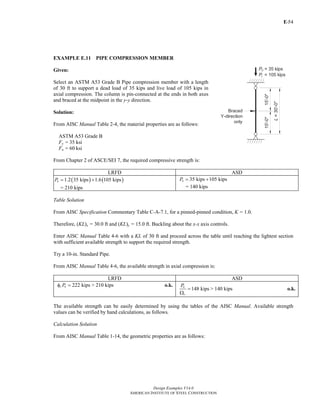
in./ft; consequently, 5 psf rain-on-snow surcharge is to be considered, but ponding instability design calculations
are not required. This roof can be designed as a fully exposed roof, but, per ASCE/SEI 7 Section 7.3, cannot be
designed for less than pf = (I)pg = 20 psf uniform snow load. Snow drift will be applied at the edges of the roof
and at the screen wall around the mechanical area. The roof live load for this building is 20 psf, but may be
reduced per ASCE/SEI 7 Section 4.8 where applicable.
Floor Loads:
The basic live load for the floor is 50 psf. An additional partition live load of 20 psf is specified. Because the
locations of partitions and, consequently, corridors are not known, and will be subject to change, the entire floor
will be designed for a live load of 80 psf. This live load will be reduced, based on type of member and area per
the ASCE provisions for live-load reduction.
Wall Loads:
A wall load of 55 psf will be used for the brick spandrels, supporting steel, and metal stud back-up. A wall load
of 15 psf will be used for the ribbon window glazing system.
ROOF MEMBER DESIGN AND SELECTION
Calculate dead load and snow load.
Dead Load
Roofing = 5 psf
Insulation = 2 psf
Deck = 2 psf
Beams = 3 psf
Joists = 3 psf
Misc. = 5 psf
Total = 20 psf
Return to Table of Contents
III-6
Design Examples V14.0
AMERICAN INSTITUTE OF STEEL CONSTRUCTION
Snow Load from ASCE/SEI 7 Section 7.3 and 7.10
Snow = 20 psf
Rain on Snow = 5 psf
Total = 25 psf
Note: In this design, the rain and snow load is greater than the roof live load
The deck is 1½ in., wide rib, 22 gage, painted roof deck, placed in a pattern of three continuous spans minimum.
The typical joist spacing is 6 ft on center. At 6 ft on center, this deck has an allowable total load capacity of 89
psf. The roof diaphragm and roof loads extend 6 in. past the centerline of grid as shown on Sheet S4.1.
From Section 7.7 of ASCE/SEI 7, the following drift loads are calculated:
Flat roof snow load = 20 psf, Density γ = 16.6 lbs/ft3
, hb = 1.20 ft
Summary of Drifts
Upwind Roof Proj. Max. Drift Max Drift
Length (lu) Height Load Width (W)
Side Parapet 121 ft 2 ft 13.2 psf 6.36 ft
End Parapet 211 ft 2 ft 13.2 psf 6.36 ft
Screen Wall 60.5 ft 6 ft 30.5 psf 7.35 ft
The snow drift at the penthouse was calculated for the maximum effect, using the East-West wind and an upwind
fetch from the parapet to the centerline of the columns at the penthouse. This same drift is conservatively used for
wind in the North-South direction. The precise location of the drift will depend upon the details of the penthouse
construction, but will not affect the final design in this case.
SELECT ROOF JOISTS
Layout loads and size joists.
User Note: Joists may be specified using ASD or LRFD but are most commonly specified by ASD as shown
here.
The 45-ft side joist with the heaviest loads is shown below along with its end reactions and maximum moment:
Because the load is not uniform, select a 24KCS4 joist from the Steel Joist Institute load tables (SJI, 2005). This
joist has an allowable moment of 92.3 kip-ft, an allowable shear of 8.40 kips, a gross moment of inertia of 453 in.4
and weighs 16.6 plf.
The first joist away from the end of the building is loaded with snow drift along the length of the member. Based
on analysis, a 24KCS4 joist is also acceptable for this uniform load case.
Return to Table of Contents
III-7
Design Examples V14.0
AMERICAN INSTITUTE OF STEEL CONSTRUCTION
As an alternative to directly specifying the joist sizes on the design document, as done in this example, loading
diagrams can be included on the design documents to allow the joist manufacturer to economically design the
joists.
The typical 30-ft joist in the middle bay will have a uniform load of
w = (20 psf + 25 psf)(6 ft) = 270 plf
wSL = (25 psf)(6 ft) = 150 plf
From the Steel Joist Institute load tables, select an 18K5 joist which weighs approximately 7.7 plf and satisfies
both strength and deflection requirements.
Note: the first joist away from the screen wall and the first joist away from the end of the building carry snow
drift. Based on analysis, an 18K7 joist will be used in these locations.
Return to Table of Contents
III-8
Design Examples V14.0
AMERICAN INSTITUTE OF STEEL CONSTRUCTION
SELECT ROOF BEAMS
Calculate loads and select beams in the mechanical area.
For the beams in the mechanical area, the mechanical units could weigh as much as 60 psf. Use 40 psf additional
dead load, which will account for the mechanical units and the screen wall around the mechanical area. Use 15
psf additional snow load, which will account for any snow drift which could occur in the mechanical area. The
beams in the mechanical area are spaced at 6 ft on center.
Per AISC Design Guide 3 (West et al., 2003), calculate the minimum Ix to limit deflection to l/360 = 1.00 in.
because a plaster ceiling will be used in the lobby area. Use 40 psf as an estimate of the snow load, including
some drifting that could occur in this area, for deflection calculations.
Note: The beams and supporting girders in this area should be rechecked when the final weights and locations for
the mechanical units have been determined.
Ireq (Live Load) =
( )
( )
4
0.240 kip/ft 30.0 ft
1,290 1.00 in.
= 151 in.4
Calculate the required strengths from Chapter 2 of ASCE/SEI 7 and select the beams in the mechanical area.
LRFD ASD
wu = 6.00 ft[1.2 (0.020 kip/ft2
+ 0.040 kip/ft2
)
+1.6(0.025 kip/ft2
+ 0.015 kip/ft2
)]
= 0.816 kip/ft
Ru = ( )
30.0 ft
0.816 kip/ft
2
= 12.2 kips
Mu =
( )
2
0.816 kip/ft 30.0 ft
8
= 91.8 kip-ft
Assuming the beam has full lateral support, use
Manual Table 3-2, select an ASTM A992 W14×22,
which has a design flexural strength of 125 kip-ft, a
design shear strength of 94.5 kips, and an Ix of 199
in.4
wa = 6.00 ft[0.020 kip/ft2
+ 0.040 kip/ft2
+ 0.025 kip/ft2
+ 0.015 kip/ft2
]
= 0.600 kip/ft
Ra = ( )
30.0 ft
0.600 kip/ft
2
= 9.00 kips
Ma =
( )
2
0.600 kip/ft 30.0 ft
8
= 67.5 kip-ft
Assuming the beam has full lateral support, use
Manual Table 3-2, select an ASTM A992 W14×22,
which has an allowable flexural strength of 82.8 kip-
ft, an allowable shear strength of 63.0 kips and
an Ix of 199 in.4
Return to Table of Contents
III-9
Design Examples V14.0
AMERICAN INSTITUTE OF STEEL CONSTRUCTION
SELECT ROOF BEAMS AT THE END (EAST & WEST) OF THE BUILDING
The beams at the ends of the building carry the brick spandrel panel and a small portion of roof load. For these
beams, the cladding weight exceeds 25% of the total dead load on the beam. Therefore, per AISC Design Guide 3,
limit the vertical deflection due to cladding and initial dead load to L/600 or a in. maximum. In addition, because
these beams are supporting brick above and there is continuous glass below, limit the superimposed dead and live
load deflection to L/600 or 0.3 in. max to accommodate the brick and L/360 or 4 in. max to accommodate the
glass. Therefore, combining the two limitations, limit the superimposed dead and live load deflection to L/600 or
4 in. The superimposed dead load includes all of the dead load that is applied after the cladding has been
installed. In calculating the wall loads, the spandrel panel weight is taken as 55 psf. The spandrel panel weight is
approximately:
wD = 7.50 ft(0.055 kip/ft2
)
= 0.413 kip/ft
The dead load from the roof is equal to:
wD = 3.50 ft(0.020 kip/ft2
)
= 0.070 kip/ft
Use 8 psf for the initial dead load.
wD(initial) = 3.50 ft(0.008 kip/ft2
)
= 0.0280 kip/ft
Use 12 psf for the superimposed dead load.
wD(super) = 3.50 ft(0.012 kip/ft2
)
= 0.0420 kip/ft
The snow load from the roof can be conservatively taken as:
wS = 3.50 ft(0.025 kip/ft2
+ 0.0132 kip/ft2
)
= 0.134 kip/ft
to account for the maximum snow drift as a uniform load.
Assume the beams are simple spans of 22.5 ft.
Calculate minimum Ix to limit the superimposed dead and live load deflection to ¼ in.
Ireq =
( )
( )
4
0.176 kip/ft 22.5 ft
1,290 in.4
=140 in.4
Calculate minimum Ix to limit the cladding and initial dead load deflection to a in.
Ireq =
( )
( )
4
0.441 kip/ft 22.5 ft
1,290 in.a
= 234 in.4
The beams are full supported by the deck as shown in Detail 4 on Sheet S4.1. The loading diagram is as follows:
Return to Table of Contents
III-10
Design Examples V14.0
AMERICAN INSTITUTE OF STEEL CONSTRUCTION
Calculate the required strengths from Chapter 2 of ASCE/SEI 7 and select the beams for the roof ends.
LRFD ASD
wu =1.2(0.070 kip/ft + 0.413 kip/ft) + 1.6(0.134 kip/ft)
= 0.794 kip/ft
Ru = ( )
22.5 ft
0.794 kip/ft
2
= 8.93 kips
Mu =
( )
2
0.794 kip/ft 22.5 ft
8
= 50.2 kip-ft
Assuming the beam has full lateral support, use
Manual Table 3-2, select an ASTM A992 W16×26,
which has a design flexural strength of 166 kip-ft, a
design shear strength of 106 kips, and an Ix of 301 in.4
wa = (0.070 kip/ft + 0.413 kip/ft) + 0.134 kip/ft
= 0.617 kip/ft
Ra = ( )
22.5 ft
0.617 kip/ft
2
= 6.94 kips
Ma =
( )
2
0.617 kip/ft 22.5 ft
8
= 39.0 kip-ft
Assuming the beam has full lateral support, use
Manual Table 3-2, select an ASTM A992 W16×26,
which has an allowable flexural strength of 110 kip-
ft, an allowable shear strength of 70.5 kips, and an
Ix of 301 in.4
Return to Table of Contents
III-11
Design Examples V14.0
AMERICAN INSTITUTE OF STEEL CONSTRUCTION
SELECT ROOF BEAMS ALONG THE SIDE (NORTH & SOUTH) OF THE BUILDING
The beams along the side of the building carry the spandrel panel and a substantial roof dead load and live load.
For these beams, the cladding weight exceeds 25% of the total dead load on the beam. Therefore, per AISC
Design Guide 3, limit the vertical deflection due to cladding and initial dead load to L/600 or a in. maximum. In
addition, because these beams are supporting brick above and there is continuous glass below, limit the
superimposed dead and live load deflection to L/600 or 0.3 in. max to accommodate the brick and L/360 or 4 in.
max to accommodate the glass. Therefore, combining the two limitations, limit the superimposed dead and live
load deflection to L/600 or 4 in. The superimposed dead load includes all of the dead load that is applied after the
cladding has been installed. These beams will be part of the moment frames on the side of the building and
therefore will be designed as fixed at both ends. The roof dead load and snow load on this edge beam is equal to
the joist end dead load and snow load reaction. Treating this as a uniform load, divide this by the joist spacing.
wD = 2.76 kips/6.00 ft
= 0.460 kip/ft
wS = 3.73 kips/6.00 ft
= 0.622 kip/ft
wD(initial) = 23.0 ft (0.008 kip/ft2
)
= 0.184 kip/ft
wD(super) = 23.0 ft (0.012 kip/ft2
)
= 0.276 kip/ft
Calculate the minimum Ix to limit the superimposed dead and live load deflection to 4 in.
Ireq =
( )( )
( )
4
0.898 kip/ft 30.0 ft
6,440 in.4
= 452 in.4
Calculate the minimum Ix to limit the cladding and initial dead load deflection to a in.
Ireq =
( )( )
( )
4
0.597 kip/ft 30.0 ft
6,440 in.a
= 200 in.4
Return to Table of Contents
III-12
Design Examples V14.0
AMERICAN INSTITUTE OF STEEL CONSTRUCTION
Calculate the required strengths from Chapter 2 of ASCE/SEI 7 and select the beams for the roof sides.
LRFD ASD
wu = 1.2(0.460 kip/ft + 0.413 kip/ft)
+1.6(0.622 kip/ft)
= 2.04 kip/ft
Ru = ( )
30.0 ft
2.04 kip/ft
2
= 30.6 kips
Calculate Cb for compression in the bottom flange
braced at the midpoint and supports using AISC
Specification Equation F1-1.
MuMax =
( )
2
2.04kip/ft 30.0 ft
12
= 153 kip-ft at supports
Mu =
( )
2
2.04 kip/ft 30.0 ft
24
= 76.5 kip-ft at midpoint
From AISC Manual Table 3-23,
( )( )
( ) ( )
2 2
6 30.0 ft 3.75 ft2.04 kip/ft
12 30.0 ft 6 3.75 ft
52.6 kip-ft
uAM
⎛ ⎞
⎜ ⎟=
⎜ ⎟− −⎝ ⎠
=
at quarter point of unbraced segment
( )( )
( ) ( )
2 2
6 30.0 ft 7.50 ft2.04 kip/ft
12 30.0 ft 6 7.50 ft
uBM
⎛ ⎞
⎜ ⎟=
⎜ ⎟− −⎝ ⎠
= 19.1 kip-ft at midpoint of unbraced segment
( )( )
( ) ( )
2 2
6 30.0 ft 11.3 ft2.04kip/ft
12 30.0 ft 6 11.3 ft
uCM
⎛ ⎞
⎜ ⎟=
⎜ ⎟− −⎝ ⎠
= 62.5 kip-ft at three quarter point of unbraced
segment
wa = (0.460 kip/ft + 0.413 kip/ft)
+ 0.622 kip/ft
= 1.50 kip/ft
Ra = ( )
30.0 ft
1.50 kip/ft
2
= 22.5 kips
Calculate Cb for compression in the bottom flange
braced at the midpoint and supports using AISC
Specification Equation F1-1.
MaMax =
( )
2
1.50kip/ft 30.0 ft
12
= 113 kip-ft at supports
Ma
( )
2
1.50 kip/ft 30.0 ft
24
=
= 56.3 kip-ft at midpoint
From AISC Manual Table 3-23,
( )( )
( ) ( )
2 2
6 30.0 ft 3.75 ft1.50 kip/ft
12 30.0 ft 6 3.75 ft
38.7 kip-ft
aAM
⎛ ⎞
⎜ ⎟=
⎜ ⎟− −⎝ ⎠
=
at quarter point of unbraced segment
( )( )
( ) ( )
2 2
6 30.0 ft 7.50 ft1.50 kip/ft
12 30.0 ft 6 7.50 ft
aBM
⎛ ⎞
⎜ ⎟=
⎜ ⎟− −⎝ ⎠
= 14.1 kip-ft at midpoint of unbraced segment
( )( )
( ) ( )
2 2
6 30.0 ft 11.3 ft1.50kip/ft
12 30.0 ft 6 11.3 ft
aCM
⎛ ⎞
⎜ ⎟=
⎜ ⎟− −⎝ ⎠
= 46.0 kip-ft at three quarter point of unbraced
segment
Return to Table of Contents
III-13
Design Examples V14.0
AMERICAN INSTITUTE OF STEEL CONSTRUCTION
LRFD ASD
Using AISC Specification Equation F1-1,
12.5
2.5 3 4 3
max
b
max A B C
M
C
M M M M
=
+ + +
( )
( ) ( )
( ) ( )
12.5 153 kip-ft
2.5 153 kip-ft 3 52.6 kip-ft
4 19.1 kip-ft 3 62.5 kip-ft
=
+⎡ ⎤
⎢ ⎥
+ +⎢ ⎥⎣ ⎦
= 2.38
From AISC Manual Table 3-10, select W18×35.
For Lb = 6 ft and Cb = 1.0
φbMn = 229 kip-ft > 76.5 kip-ft o.k.
For Lb = 15 ft and Cb = 2.38,
φbMn = (109 kip-ft)2.38
= 259 kip-ft ≤ φbMp
φbMp = 249 kip-ft > 153 kip-ft o.k.
From AISC Manual Table 3-2, a W18×35 has a
design shear strength of 159 kips and an Ix of 510 in.4
o.k.
Using AISC Specification Equation F1-1,
12.5
2.5 3 4 3
max
b
max A B C
M
C
M M M M
=
+ + +
( )
( ) ( )
( ) ( )
12.5 113 kip-ft
2.5 113 kip-ft 3 38.7 kip-ft
4 14.1 kip-ft 3 46.0 kip-ft
=
+⎡ ⎤
⎢ ⎥
+ +⎢ ⎥⎣ ⎦
= 2.38
From AISC Manual Table 3-10, select W18×35.
For Lb = 6 ft and Cb = 1.0
Mn / Ω b = 152 kip-ft > 56.3 kip-ft o.k.
For Lb = 15 ft and Cb = 2.38,
Mn / Ω b = (72.7 kip-ft)2.38
= 173 kip-ft ≤ Mp / Ωb
Ωb / Mp = 166 kip-ft > 113 kip-ft o.k.
From AISC Manual Table 3-2, a W18×35 has an
allowable shear strength of 106 kips and an Ix of 510
in.4
o.k.
Note: This roof beam may need to be upsized during the lateral load analysis to increase the
stiffness and strength of the member and improve lateral frame drift performance.
Return to Table of Contents
III-14
Design Examples V14.0
AMERICAN INSTITUTE OF STEEL CONSTRUCTION
SELECT THE ROOF BEAMS ALONG THE INTERIOR LINES OF THE BUILDING
There are three individual beam loadings that occur along grids C and D. The beams from 1 to 2 and 7 to 8 have a
uniform snow load except for the snow drift at the end at the parapet. The snow drift from the far ends of the 45-ft
joists is negligible. The beams from 2 to 3 and 6 to 7 are the same as the first group, except they have snow drift
at the screen wall. The loading diagrams are shown below. A summary of the moments, left and right reactions,
and required Ix to keep the live load deflection to equal or less than the span divided by 240 (or 1.50 in.) is given
below.
Calculate required strengths from Chapter 2 of ASCE/SEI 7 and required moment of inertia.
LRFD ASD
Grids 1 to 2 and 7 to 8 (opposite hand)
Ru (left) = 1.2(11.6 kips) + 1.6(16.0 kips)
= 39.5 kips
Ru (right) = 1.2(11.2 kips) + 1.6(14.2 kips)
= 36.2 kips
Mu = 1.2(84.3 kip-ft) + 1.6(107 kip-ft)
= 272 kip-ft
Grids 1 to 2 and 7 to 8 (opposite hand)
Ra (left) = 11.6 kips + 16.0 kips
= 27.6 kips
Ra (right) = 11.2 kips + 14.2 kips
= 25.4 kips
Ma = 84.3 kip-ft + 107 kip-ft
= 191 kip-ft
Return to Table of Contents
III-15
Design Examples V14.0
AMERICAN INSTITUTE OF STEEL CONSTRUCTION
LRFD ASD
Ix req’d =
( )( )
( )
4
0.938 kip/ft 30.0 ft
1,290 1.50 in.
= 393 in.4
From AISC Manual Table 3-10, for Lb = 6 ft and Cb
= 1.0, select W21×44 which has a design flexural
strength of 332 kip-ft, a design shear strength of 217
kips, and Ix = 843 in.4
Grids 2 to 3 and 6 to 7(opposite hand)
Ru (left) = 1.2(11.3 kips) + 1.6(14.4 kips)
= 36.6 kips
Ru (right) = 1.2(11.3 kips) + 1.6(17.9) kips)
= 42.2 kips
Mu = 1.2(84.4 kip-ft) + 1.6(111 kip-ft)
= 279 kip-ft
Ix req’d =
( )( )
( )
4
0.938 kip/ft 30.0 ft
1,290 1.50 in.
= 393 in.4
From AISC Manual Table 3-10, for Lb = 6 ft and Cb
= 1.0, select W21×44 which has a design flexural
strength of 332 kip-ft, a design shear strength of 217
kips and Ix = 843 in.4
Ix req’d =
( )( )
( )
4
0.938 kip/ft 30.0 ft
1,290 1.50 in.
= 393 in.4
From AISC Manual Table 3-10, for Lb = 6 ft and Cb
= 1.0, select W21×44 which has an allowable
flexural strength of 221 kip-ft, an allowable shear
strength of 145 kips, and Ix = 843 in.4
Grids 2 to 3 and 6 to 7(opposite hand)
Ra (left) = 11.3 kips + 14.4 kips
= 25.7 kips
Ra (right) = 11.3 kips + 17.9 kips
= 29.2 kips
Ma = 84.4 kip-ft + 111 kip-ft
= 195 kip-ft
Ix req’d =
( )( )
( )
4
0.938 kip/ft 30.0 ft
1,290 1.50 in.
= 393 in.4
From AISC Manual Table 3-10, for Lb = 6 ft and Cb =
1.0, select W21×44 which has an allowable flexural
strength of 221 kip-ft, an allowable shear strength of
145 kips, and Ix = 843 in.4
The third individual beam loading occurs at the beams from 3 to 4, 4 to 5, and 5 to 6. This is the
heaviest load.
Return to Table of Contents
III-16
Design Examples V14.0
AMERICAN INSTITUTE OF STEEL CONSTRUCTION
SELECT THE ROOF BEAMS ALONG THE SIDES OF THE MECHANICAL AREA
The beams from 3 to 4, 4 to 5, and 5 to 6 have a uniform snow load outside the screen walled area, except for the
snow drift at the parapet ends and the screen wall ends of the 45-ft joists. Inside the screen walled area the beams
support the mechanical equipment. A summary of the moments, left and right reactions, and required Ix to keep
the live load deflection to equal or less than the span divided by 240 (or 1.50 in.) is given below.
LRFD ASD
wu =1.2 (1.35 kip/ft) +1.6(1.27 kip/ft)
= 3.65 kip/ft
Mu =
( )
2
3.65 kip/ft 30.0 ft
8
= 411 kip-ft
Ru = ( )
30.0 ft
3.65 kip/ft
2
= 54.8 kips
Ix req’d =
( )
( )
4
1.27 kip/ft 30.0 ft
1,290 1.50 in.
= 532 in.4
From AISC Manual Table 3-2, for Lb = 6 ft and Cb =
1.0, select W21×55, which has a design flexural
strength of 473 kip-ft, a design shear strength of 234
kips, and an Ix of 1,140 in.4
wa = 1.35 kip/ft + 1.27 kip/ft2
= 2.62 kip/ft
Ma =
( )
2
2.62 kip/ft 30.0 ft
8
= 295 kip-ft
Ra = ( )
30.0 ft
2.62 kip/ft
2
= 39.3 kips
Ix req’d =
( )
( )
4
1.27 kip/ft 30.0 ft
1,290 1.50 in.
= 532 in.4
From AISC Manual Table 3-2, for Lb = 6 ft and Cb
= 1.0, select W21×55, which has an allowable
flexural strength of 314 kip-ft, an allowable shear
strength of 156 kips, and an Ix of 1,140 in.4
Return to Table of Contents
III-17
Design Examples V14.0
AMERICAN INSTITUTE OF STEEL CONSTRUCTION
FLOOR MEMBER DESIGN AND SELECTION
Calculate dead load and live load.
Dead Load
Slab and Deck = 57 psf
Beams (est.) = 8 psf
Misc. ( ceiling, mechanical, etc.) = 10 psf
Total = 75 psf
Note: The weight of the floor slab and deck was obtained from the manufacturer’s literature.
Live Load
Total (can be reduced for area per ASCE/SEI 7) = 80 psf
The floor and deck will be 3 in. of normal weight concrete, cf ′ = 4 ksi, on 3-in. 20 gage, galvanized, composite
deck, laid in a pattern of three or more continuous spans. The total depth of the slab is 6 in. The Steel Deck
Institute maximum unshored span for construction with this deck and a three-span condition is 10 ft 11 in. The
general layout for the floor beams is 10 ft on center; therefore, the deck does not need to be shored during
construction. At 10 ft on center, this deck has an allowable superimposed live load capacity of 143 psf. In
addition, it can be shown that this deck can carry a 2,000 pound load over an area of 2.5 ft by 2.5 ft as required by
Section 4.4 of ASCE/SEI 7. The floor diaphragm and the floor loads extend 6 in. past the centerline of grid as
shown on Sheet S4.1.
Return to Table of Contents
III-18
Design Examples V14.0
AMERICAN INSTITUTE OF STEEL CONSTRUCTION
SELECT FLOOR BEAMS (composite and noncomposite)
Note: There are two early and important checks in the design of composite beams. First, select a beam that either
does not require camber, or establish a target camber and moment of inertia at the start of the design process. A
reasonable approximation of the camber is between L/300 minimum and L/180 maximum (or a maximum of 12
to 2 in.).
Second, check that the beam is strong enough to safely carry the wet concrete and a 20 psf construction live load
(per ASCE 37-05), when designed by the ASCE/SEI 7 load combinations and the provisions of Chapter F of the
AISC Specification.
SELECT TYPICAL 45-FT INTERIOR COMPOSITE BEAM (10 FT ON CENTER)
Find a target moment of inertia for an unshored beam.
Hold deflection to around 2 in. maximum to facilitate concrete placement.
wD = (0.057 kip/ft2
+ 0.008 kip/ft2
)(10.0 ft)
= 0.650 kip/ft
I req ≈
( )
( )
4
0.650 kip/ft 45.0 ft
1,290 2.00 in.
= 1,030 in.4
Determine the required strength to carry wet concrete and construction live load.
wDL = 0.065 kip/ft2
(10.0 ft)
= 0.650 kip/ft
wLL = 0.020 kip/ft2
(10.0 ft)
= 0.200 kip/ft
Determine the required flexural strength due to wet concrete only.
LRFD ASD
wu = 1.4(0.650 kip/ft)
= 0.910 kip/ft
Mu =
( )
2
0.910 kip/ft 45.0 ft
8
= 230 kip-ft
wa = 0.650 kip/ft
Ma =
( )
2
0.650 kip/ft 45.0 ft
8
= 165 kip-ft
Determine the required flexural strength due to wet concrete and construction live load.
LRFD ASD
wu = 1.2(0.650 kip/ft) + 1.6(0.200 kip/ft)
= 1.10 kip/ft
Mu =
( )
2
1.10 kip/ft 45.0 ft
8
= 278 kip-ft controls
wa = 0.650 kip/ft + 0.200 kip/ft
= 0.850 kip/ft
Ma =
( )
2
0.850 kip/ft 45.0 ft
8
= 215 kip-ft controls
Use AISC Manual Table 3-2 to select a beam with Ix ≥ 1,030 in.4
. Select W21×50, which has Ix = 984 in.4
, close
to our target value, and has available flexural strengths of 413 kip-ft (LRFD) and 274 kip-ft (ASD).
Return to Table of Contents
III-19
Design Examples V14.0
AMERICAN INSTITUTE OF STEEL CONSTRUCTION
Check for possible live load reduction due to area in accordance with Section 4.7.2 of ASCE/SEI 7.
For interior beams, KLL = 2
The beams are at 10.0 ft on center, therefore the area ( )( )45.0 ft 10.0 ft 450TA = = ft2
.
Since ( )2
2 450 ft 900LL TK A = = ft2
> 400 ft2
, a reduced live load can be used.
From ASCE/SEI 7, Equation 4.7-1:
2
15
0.25
15
80.0 psf 0.25
900 ft
60.0 psf 0.50 40.0 psf
o
LL T
o
L L
K A
L
⎛ ⎞
= +⎜ ⎟⎜ ⎟
⎝ ⎠
⎛ ⎞
= +⎜ ⎟⎜ ⎟
⎝ ⎠
= ≥ =
Therefore, use 60.0 psf.
The beam is continuously braced by the deck.
The beams are at 10 ft on center, therefore the loading diagram is as shown below.
Calculate the required flexural strength from Chapter 2 of ASCE/SEI 7.
LRFD ASD
wu = 1.2(0.750 kip/ft) + 1.6(0.600 kip/ft)
= 1.86 kip/ft
Mu =
( )
2
1.86 kip/ft 45.0 ft
8
= 471 kip-ft
wa = 0.750 kip/ft + 0.600 kip/ft
= 1.35 kip/ft
Ma =
( )
2
1.35 kip/ft 45.0 ft
8
= 342 kip-ft
Assume initially a = 1.00 in.
Y2 = Ycon – a / 2
= 6.00 in. – 1.00 in. / 2
= 5.50 in.
Use AISC Manual Table 3-19 to check W21×50 selected above. Using required strengths of
471 kip-ft (LRFD) or 342 kip-ft (ASD) and a Y2 value of 5.50 in.
Return to Table of Contents
III-20
Design Examples V14.0
AMERICAN INSTITUTE OF STEEL CONSTRUCTION
LRFD ASD
Select W21×50 beam, where
PNA = Location 7 and Σ nQ = 184 kips
φbMn = 598 kip-ft > 471 kip-ft o.k.
Select W21×50 beam, where
PNA = Location 7 and Σ nQ = 184 kips
Mp / Ωn = 398 kip-ft > 342 kip-ft o.k.
Determine the effective width, beff.
Per Specification AISC Section I3.1a, the effective width of the concrete slab is the sum of the effective widths for
each side of the beam centerline, which shall not exceed:
(1) one-eighth of the span of the beam, center-to-center of supports
( )
45.0 ft
2 sides
8
= 11.3 ft
(2) one-half the distance to the centerline of the adjacent beam
( )
10.0 ft
2 sides
2
= 10.0 ft controls
(3) the distance to the edge of the slab
Not applicable
Determine the height of the compression block, a.
0.85
∑
=
′
n
c
Q
a
f b
(Manual Eq. 3-7)
=
( )( )( )
184 kips
0.85 4 ksi 10.0 ft 12 in./ft
= 0.451 in. < 1.00 in. o.k.
Check the W21×50 end shear strength.
LRFD ASD
Ru = ( )
45.0 ft
1.86 kip/ft
2
= 41.9 kips
From AISC Manual Table 3-2,
φvVn = 237 kips > 41.9 kips o.k.
Ra = ( )
45.0 ft
1.35 kip/ft
2
= 30.4 kips
From AISC Manual Table 3-2,
Vn / Ωv = 158 kips > 30.4 kips o.k.
Check live load deflection.
360LL lΔ = = (45.0 ft)(12 in./ft)/360 = 1.50 in.
For a W21×50, from AISC Manual Table 3-20,
Y2 = 5.50 in.
Return to Table of Contents
III-21
Design Examples V14.0
AMERICAN INSTITUTE OF STEEL CONSTRUCTION
PNA Location 7
ILB = 1,730 in.4
4
1,290
LL
LL
LB
w l
I
Δ =
=
( )
( )
4
4
0.600 kip/ft 45.0 ft
1,290 1,730 in.
= 1.10 in. < 1.50 in. o.k.
Based on AISC Design Guide 3 (West, Fisher and Griffis, 2003) limit the live load deflection, using 50% of the
(unreduced) design live load, to L / 360 with a maximum absolute value of 1.0 in. across the bay.
ΔLL =
( )
( )
4
4
0.400 kip/ft 45.0 ft
1,290 1,730 in.
= 0.735 in. < 1.00 in. o.k.
1.00 in. – 0.735 in. = 0.265 in.
Note: Limit the supporting girders to 0.265 in. deflection under the same load case at the connection point of the
beam.
Determine the required number of shear stud connectors.
From AISC Manual Table 3-21, using perpendicular deck with one w-in.-diameter stud per rib in normal weight,
4 ksi concrete, in weak position; Qn = 17.2 kips/stud.
n
n
Q
Q
∑
=
184 kips
17.2 kips/stud
= 10.7 studs / side
Therefore use 22 studs.
Based on AISC Design Guide 3, limit the wet concrete deflection in a bay to L / 360, not to exceed 1.00 in.
Camber the beam for 80% of the calculated wet deflection.
( )
( )
4
( ) 4
0.650 kip/ft 45.0 ft
1,290 984 in.
2.10 in.
DL wet concΔ =
=
Camber = 0.80(2.10 in.)
= 1.68 in.
Round the calculated value down to the nearest 4 in; therefore, specify 1.50 in. of camber.
2.10 in. – 1.50 in. = 0.600 in.
1.00 in. – 0.600 in. = 0.400 in.
Note: Limit the supporting girders to 0.400 in. deflection under the same load combination at the connection point
of the beam.
Return to Table of Contents
III-22
Design Examples V14.0
AMERICAN INSTITUTE OF STEEL CONSTRUCTION
SELECT TYPICAL 30-FT INTERIOR COMPOSITE (OR NONCOMPOSITE) BEAM
(10 FT ON CENTER)
Find a target moment of inertia for an unshored beam.
Hold deflection to around 1.50 in. maximum to facilitate concrete placement.
I req ≈
( )
( )
4
0.650 kip/ft 30.0 ft
1,290 1.50 in.
= 272 in.4
Determine the required strength to carry wet concrete and construction live load.
wDL = 0.065 kip/ft2
(10.0 ft)
= 0.650 kip/ft
wLL = 0.020 kip/ft2
(10.0 ft)
= 0.200 kip/ft
Determine the required flexural strength due to wet concrete only.
LRFD ASD
wu = 1.4(0.650 kip/ft)
= 0.910 kip/ft
Mu =
( )
2
0.910 kip/ft 30.0 ft
8
= 102 kip-ft
wa = 0.650 kip/ft
Ma =
( )
2
0.650 kip/ft 30.0 ft
8
= 73.1 kip-ft
Determine the required flexural strength due to wet concrete and construction live load.
LRFD ASD
wu = 1.2(0.650 kip/ft) + 1.6(0.200 kip/ft)
= 1.10 kip/ft
Mu =
( )
2
1.10 kip/ft 30.0 ft
8
= 124 kip-ft controls
wa = 0.650 kip/ft + 0.200 kip/ft
= 0.850 kip/ft
Ma =
( )
2
0.850 kip/ft 30.0 ft
8
= 95.6 kip-ft controls
Use AISC Manual Table 3-2 to find a beam with an Ix ≥ 272 in.4
Select W16×26, which has an Ix = 301 in.4
which exceeds our target value, and has available flexural strengths of 166 kip-ft (LRFD) and 110 kip-ft (ASD).
Check for possible live load reduction due to area in accordance with Section 4.7.2 of ASCE/SEI 7.
For interior beams, KLL = 2.
The beams are at 10 ft on center, therefore the area AT = 30.0 ft × 10.0 ft = 300 ft2
.
Since KLLAT = 2(300 ft2
) = 600 ft2
> 400 ft2
, a reduced live load can be used.
From ASCE/SEI 7, Equation 4.7-1:
Return to Table of Contents
III-23
Design Examples V14.0
AMERICAN INSTITUTE OF STEEL CONSTRUCTION
L =
15
0.25o
LL T
L
K A
⎛ ⎞
+⎜ ⎟⎜ ⎟
⎝ ⎠
=
2
15
80.0 psf 0.25
600 ft
⎛ ⎞
+⎜ ⎟⎜ ⎟
⎝ ⎠
= 69.0 psf ≥ 0.50 Lo = 40.0 psf
Therefore, use 69.0 psf.
The beams are at 10 ft on center, therefore the loading diagram is as shown below.
From Chapter 2 of ASCE/SEI 7, calculate the required strength.
LRFD ASD
wu = 1.2(0.750 kip/ft) + 1.6 (0.690 kip/ft)
= 2.00 kip/ft
Mu =
( )
2
2.00 kip/ft 30.0 ft
8
= 225 kip-ft
wa = 0.750 kip/ft + 0.690 kip/ft
= 1.44 kip/ft
Ma =
( )
2
1.44 kip/ft 30.0 ft
8
= 162 kip-ft
Assume initially a = 1.00
1.00 in.
2 6.00 in.
2
5.50 in.
Y = −
=
Use AISC Manual Table 3-19 to check the W16×26 selected above. Using required strengths of 225 kip-ft
(LRFD) or 162 kip-ft (ASD) and a Y2 value of 5.50 in.
LRFD ASD
Select W16×26 beam, where
PNA Location 7 and nQ∑ = 96.0 kips
φbMn = 248 kip-ft > 225 kip-ft o.k.
Select W16×26 beam, where
PNA Location 7 and nQ∑ = 96.0 kips
Mn / Ωn = 165 kip-ft > 162 kip-ft o.k.
Determine the effective width, beff.
From AISC Specification Section I3.1a, the effective width of the concrete slab is the sum of the effective widths
for each side of the beam centerline, which shall not exceed:
(1) one-eighth of the span of the beam, center-to-center of supports
Return to Table of Contents
III-24
Design Examples V14.0
AMERICAN INSTITUTE OF STEEL CONSTRUCTION
( )
30.0 ft
2 sides
8
= 7.50 ft controls
(2) one-half the distance to the centerline of the adjacent beam
( )
10.0 ft
2 sides
2
= 10.0 ft
(3) the distance to the edge of the slab
Not applicable
Determine the height of the compression block, a.
0.85
n
c
Q
a
f b
∑
=
′
(Manual Eq. 3-7)
=
( )( )( )
96.0 kips
0.85 4 ksi 7.50 ft 12 in./ft
= 0.314 in. < 1.00 in. o.k.
Check the W16×26 end shear strength.
LRFD ASD
Ru = ( )
30.0 ft
2.00 kip/ft
2
= 30.0 kips
From AISC Manual Table 3-2,
φvVn = 106 kips > 30.0 kips o.k.
Ra = ( )
30.0 ft
1.44 kip/ft
2
= 21.6 kips
From AISC Manual Table 3-2,
Vn / Ωv = 70.5 kips > 21.6 kips o.k.
Check live load deflection.
360LL lΔ =
= (30.0 ft)(12 in./ft)/360
= 1.00 in.
For a W16×26, from AISC Manual Table 3-20,
Y2 = 5.50 in.
PNA Location 7
ILB = 575 in.4
4
1,290
LL
LL
LB
w l
I
Δ =
=
( )
( )
4
4
0.690 kip/ft 30.0 ft
1,290 575 in.
= 0.753 in. < 1.00 in. o.k.
Return to Table of Contents
III-25
Design Examples V14.0
AMERICAN INSTITUTE OF STEEL CONSTRUCTION
Based on AISC Design Guide 3, limit the live load deflection, using 50% of the (unreduced) design live load, to
L/360 with a maximum absolute value of 1.0 in. across the bay.
ΔLL =
( )
( )
4
4
0.400 kip/ft 30.0 ft
1,290 575 in.
= 0.437 in. < 1.00 in. o.k.
1.00 in. – 0.437 in. = 0.563 in.
Note: Limit the supporting girders to 0.563 in. deflection under the same load combination at the connection point
of the beam.
Determine the required number of shear stud connectors.
From AISC Manual Table 3-21, using perpendicular deck with one w-in.-diameter stud per rib in normal weight, 4
ksi concrete, in the weak position; Qn = 17.2 kips/stud
n
n
Q
Q
∑
=
96.0 kips
17.2 kips/stud
= 5.58 studs/side
Use 12 studs
Note: Per AISC Specification Section I8.2d, there is a maximum spacing limit of 8(6 in.) = 4 ft not to exceed 36
in. between studs.
Therefore use 12 studs, uniformly spaced at no more than 36 in. on center.
Note: Although the studs may be placed up to 36 in. o.c. the steel deck must still be anchored to the supporting
member at a spacing not to exceed 18 in. per AISC Specification Section I3.2c.
Based on AISC Design Guide 3, limit the wet concrete deflection in a bay to L/360, not to exceed 1.00 in.
Camber the beam for 80% of the calculated wet dead load deflection.
( )
( )
4
( ) 4
0.650 kip/ft 30.0 ft
1,290 301 in.
1.36 in.
DL wet concΔ =
=
Camber = 0.800(1.36 in.)
= 1.09 in.
Round the calculated value down to the nearest 4 in. Therefore, specify 1.00 in. of camber.
1.36 in. – 1.00 in. = 0.360 in.
1.00 in. – 0.360 in. = 0.640 in.
Note: Limit the supporting girders to 0.640 in. deflection under the same load combination at the connection
point of the beam.
This beam could also be designed as a noncomposite beam. Use AISC Manual Table 3-2 with previous moments
and shears:
Return to Table of Contents
III-26
Design Examples V14.0
AMERICAN INSTITUTE OF STEEL CONSTRUCTION
LRFD ASD
Select W18×35
From AISC Manual Table 3-2,
φbMn = φbMp
= 249 kip-ft > 225 kip-ft o.k.
φvVn = 159 > 30.0 kips o.k.
Select W18×35
From AISC Manual Table 3-2,
Mn/Ωb = Mp/Ωb
= 166 kip-ft > 162 kip-ft o.k.
Vn / Ωv = 106 kips > 21.6 kips o.k.
Check beam deflections.
Check live load deflection of the W18×35 with an Ix = 510 in.4
, from AISC Manual Table 3-2.
( )
( )
4
4
0.690 kip/ft 30.0 ft
1,290 510 in.
0.850 in. < 1.00 in.
LLΔ =
= o.k.
Based on AISC Design Guide 3, limit the live load deflection, using 50% of the (unreduced) design live load,
to L/360 with a maximum absolute value of 1.0 in. across the bay.
( )
( )
4
4
0.400 kip/ft 30.0 ft
1,290 510 in.
LLΔ =
= 0.492 in. < 1.00 in. o.k.
1.00 in. – 0.492 in. = 0.508 in.
Note: Limit the supporting girders to 0.508 in. deflection under the same load combination at the connection
point of the beam.
Note: Because this beam is stronger than the W16×26 composite beam, no wet concrete strength
checks are required in this example.
Based on AISC Design Guide 3, limit the wet concrete deflection in a bay to L/360, not to exceed 1.00 in.
Camber the beam for 80% of the calculated wet deflection.
( )
( )
4
( ) 4
0.650 kip/ft 30.0 ft
1,290 510 in.
0.800 in. 1.50 in.
DL wet concΔ =
= < o.k.
Camber = 0.800(0.800 in.) = 0.640 in. < 0.750 in.
A good break point to eliminate camber is w in.; therefore, do not specify a camber for this beam.
1.00 in. – 0.800 in. = 0.200 in.
Note: Limit the supporting girders to 0.200 in. deflection under the same load case at the connection point of the
beam.
Return to Table of Contents
III-27
Design Examples V14.0
AMERICAN INSTITUTE OF STEEL CONSTRUCTION
Therefore, selecting a W18×35 will eliminate both shear studs and cambering. The cost of the extra steel weight
may be offset by the elimination of studs and cambering. Local labor and material costs should be checked to
make this determination.
Return to Table of Contents
III-28
Design Examples V14.0
AMERICAN INSTITUTE OF STEEL CONSTRUCTION
SELECT TYPICAL NORTH-SOUTH EDGE BEAM
The influence area (KLLAT) for these beams is less than 400 ft2
, therefore no live load reduction can be taken.
These beams carry 5.50 ft of dead load and live load as well as a wall load.
The floor dead load is:
w = 5.50 ft(0.075 kips/ft2
)
= 0.413 kip/ft
Use 65 psf for the initial dead load.
wD(initial) = 5.50 ft(0.065 kips/ft2
)
= 0.358 kips/ft
Use 10 psf for the superimposed dead load.
wD(super) = 5.50 ft(0.010 kips/ft2
)
= 0.055 kips/ft
The dead load of the wall system at the floor is:
w = ( ) ( )2 2
7.50ft 0.055 kip / ft 6.00 ft 0.015 kip / ft+
= 0.413 kip/ft + 0.090 kip/ft
= 0.503 kip/ft
The total dead load is wDL = 0.413 kip/ft + 0.503 kip/ft
= 0.916 kip/ft
The live load is wLL = 5.5 ft(0.080 kip/ft2
)
= 0.440 kip/ft
The loading diagram is as follows.
Calculate the required strengths from Chapter 2 of ASCE/SEI 7.
LRFD ASD
wu = 1.2(0.916 kip/ft) + 1.6 (0.440 kip/ft)
= 1.80 kip/ft
Mu =
( )
2
1.80 kip/ft 22.5 ft
8
wa = 0.916 kip/ft + 0.440 kip/ft
= 1.36 kip/ft
Ma =
( )
2
1.36 kip/ft 22.5 ft
8
Return to Table of Contents
III-29
Design Examples V14.0
AMERICAN INSTITUTE OF STEEL CONSTRUCTION
= 114 kip-ft
Ru = ( )
22.5 ft
1.80 kip/ft
2
= 20.3 kips
= 86.1 kip-ft
Ra = ( )
22.5 ft
1.36 kip/ft
2
= 15.3 kips
Because these beams are less than 25 ft long, they will be most efficient as noncomposite beams. The beams at the
edges of the building carry a brick spandrel panel. For these beams, the cladding weight exceeds 25% of the total
dead load on the beam. Therefore, per AISC Design Guide 3, limit the vertical deflection due to cladding and
initial dead load to L/600 or a in. maximum. In addition, because these beams are supporting brick above and
there is continuous glass below, limit the superimposed dead and live load deflection to L/600 or 0.3 in. max to
accommodate the brick and L/360 or 0.25 in. max to accommodate the glass. Therefore, combining the two
limitations, limit the superimposed dead and live load deflection to L/600 or 0.25 in. The superimposed dead load
includes all of the dead load that is applied after the cladding has been installed. Note that it is typically not
recommended to camber beams supporting spandrel panels.
Calculate minimum Ix to limit the superimposed dead and live load deflection to 4 in.
Ireq =
( )
( )
4
0.495 kip/ft 22.5 ft
1,290 in.4
= 393 in.4
controls
Calculate minimum Ix to limit the cladding and initial dead load deflection to a in.
Ireq =
( )
( )
4
0.861 kip/ft 22.5 ft
1,290 in.a
= 456 in.4
Select beam from AISC Manual Table 3-2.
LRFD ASD
Select W18×35 with Ix = 510 in.4
φbMn = φbMp
= 249 kip-ft > 114 kip-ft o.k.
φvVn = 159 > 20.3 kips o.k.
Select W18×35 with Ix = 510 in.4
Mn / Ωb = Mp / Ωb
= 166 kip-ft > 86.1 kip-ft o.k.
Vn / Ωv = 106 kips > 15.3 kips o.k.
Return to Table of Contents
III-30
Design Examples V14.0
AMERICAN INSTITUTE OF STEEL CONSTRUCTION
SELECT TYPICAL EAST-WEST SIDE GIRDER
The beams along the sides of the building carry the spandrel panel and glass, and dead load and live load from the
intermediate floor beams. For these beams, the cladding weight exceeds 25% of the total dead load on the beam.
Therefore, per AISC Design Guide 3, limit the vertical deflection due to cladding and initial dead load to L/600 or
a in. maximum. In addition, because these beams are supporting brick above and there is continuous glass below,
limit the superimposed dead and live load deflection to L/600 or 0.3 in. max to accommodate the brick and L/360
or 0.25 in. max to accommodate the glass. Therefore, combining the two limitations, limit the superimposed dead
and live load deflection to L/600 or 0.25 in. The superimposed dead load includes all of the dead load that is
applied after the cladding has been installed. These beams will be part of the moment frames on the North and
South sides of the building and therefore will be designed as fixed at both ends.
Establish the loading.
The dead load reaction from the floor beams is:
PD = 0.750 kip/ft(45.0 ft / 2)
= 16.9 kips
PD(initial) = 0.650 kip/ft(45.0 ft / 2)
= 14.6 kips
PD(super) = 0.100 kip/ft(45.0 ft / 2)
= 2.25 kips
The uniform dead load along the beam is:
wD = 0.500 ft(0.075 kip/ft2
) + 0.503 kip/ft
= 0.541 kip/ft
wD(initial) = 0.500 ft(0.065 kip/ft2
)
= 0.033 kip/ft
wD(super) = 0.500 ft(0.010 kip/ft2
)
= 0.005 kip/ft
Select typical 30-ft composite (or noncomposite) girders.
Check for possible live load reduction in accordance with Section 4.7.2 of ASCE/SEI 7.
For edge beams with cantilevered slabs, KLL = 1, per ASCE/SEI 7, Table 4-2. However, it is also permissible to
calculate the value of KLL based upon influence area. Because the cantilever dimension is small, KLL will be closer
to 2 than 1. The calculated value of KLL based upon the influence area is
KLL
( )( )
( )
45.5 ft 30.0 ft
45.0 ft
0.500 ft 30.0 ft
2
=
⎛ ⎞
+⎜ ⎟
⎝ ⎠
= 1.98
The area AT = (30.0 ft)(22.5 ft + 0.500 ft) = 690 ft2
Using Equation 4.7-1 of ASCE/SEI 7
Return to Table of Contents
III-31
Design Examples V14.0
AMERICAN INSTITUTE OF STEEL CONSTRUCTION
( )( )2
15
0.25
15
80.0 psf 0.25
1.98 690 ft
52.5 psf 0.50 40.0 psf
o
LL T
o
L L
K A
L
⎛ ⎞
= +⎜ ⎟⎜ ⎟
⎝ ⎠
⎛ ⎞
⎜ ⎟= +
⎜ ⎟⎜ ⎟
⎝ ⎠
= ≥ =
Therefore, use 52.5 psf.
The live load from the floor beams is PLL = 0.525 kip/ft(45.0 ft / 2)
= 11.8 kips
The uniform live load along the beam is wLL = 0.500 ft(0.0525 kip/ft2
)
= 0.026 kip/ft
The loading diagram is shown below.
A summary of the moments, reactions and required moments of inertia, determined from a structural analysis of
a fixed-end beam, is as follows:
Calculate the required strengths and select the beams for the floor side beams.
LRFD ASD
Typical side beam
Ru = 49.5 kips
Mu at ends =313 kip-ft
Mu at ctr. =156 kip-ft
Typical side beam
Ra = 37.2 kips
Ma at ends = 234 kip-ft
Ma at ctr. = 117 kip-ft
The maximum moment occurs at the support with compression in the bottom flange. The bottom laterally braced
at 10 ft o.c. by the intermediate beams.
Note: During concrete placement, because the deck is parallel to the beam, the beam will not have continuous
lateral support. It will be braced at 10 ft o.c. by the intermediate beams. By inspection, this condition will not
control because the maximum moment under full loading causes compression in the bottom flange, which is
braced at 10 ft o.c.
LRFD ASD
Calculate Cb = for compression in the bottom flange
braced at 10 ft o.c.
Calculate Cb = for compression in the bottom flange
braced at 10 ft o.c.
Return to Table of Contents
III-32
Design Examples V14.0
AMERICAN INSTITUTE OF STEEL CONSTRUCTION
LRFD ASD
Cb = 2.21 (from computer output)
Select W21×44
With continuous bracing, from AISC Manual Table
3-2,
φbMn = φbMp
= 358 kip-ft > 156 kip-ft o.k.
For Lb = 10 ft and Cb = 2.21, from AISC Manual
Table 3-10,
( )( )265 kip-ft 2.21
586 kip-ft
nMφ =
=
According to AISC Specification Section F2.2, the
nominal flexural strength is limited Mp, therefore
φbMn = φbMp = 358 kip-ft.
358 kip-ft > 313 kip-ft o.k.
From AISC Manual Table 3-2, a W21×44 has a
design shear strength of 217 kips. From Table 1-1, Ix
= 843 in.4
Check deflection due to cladding and initial dead
load.
0.295 in. in.Δ = < a o.k.
Check deflection due to superimposed dead and live
loads.
0.212 in. 0.250 in.Δ = < o.k.
Cb = 2.22 (from computer output)
Select W21×44
With continuous bracing, from AISC Manual Table
3-2,
Mn / Ω b = Mp / Ω b
= 238 kip-ft 117 kip-ft> o.k.
For Lb = 10 ft and Cb = 2.22, from AISC Manual
Table 3-10,
( )( )176 kip-ft 2.22
391 kip-ft
nM Ω =
=
According to AISC Specification Section F2.2, the
nominal flexural strength is limited Mp, therefore
Mn/Ωb = Mp/Ωb = 238 kip-ft.
238 kip-ft > 234 kip-ft o.k.
From AISC Manual Table 3-2, a W21×44 has an
allowable shear strength of 145 kips. From Table 1-
1, Ix = 843 in.4
Check deflection due to cladding and initial dead
load.
0.295 in. in.Δ = < a o.k.
Check deflection due to superimposed dead and live
loads.
0.212 in. 0.250 in.Δ = < o.k.
Note that both of the deflection criteria stated previously for the girder and for the locations on the girder where
the floor beams are supported have also been met.
Also noted previously, it is not typically recommended to camber beams supporting spandrel panels. The
W21×44 is adequate for strength and deflection, but may be increased in size to help with moment frame strength
or drift control.
Return to Table of Contents
III-33
Design Examples V14.0
AMERICAN INSTITUTE OF STEEL CONSTRUCTION
SELECT TYPICAL EAST-WEST INTERIOR GIRDER
Establish loads
The dead load reaction from the floor beams is
PDL = 0.750 kip/ft(45.0 ft + 30.0 ft)/2
= 28.1 kips
Check for live load reduction due to area in accordance with Section 4.7.2 of ASCE/SEI 7.
For interior beams, KLL = 2
The area ( )( )30.0 ft 37.5 ft 1,130TA = = ft2
Using ASCE/SEI 7, Equation 4.7-1:
L =
15
0.25o
LL T
L
K A
⎛ ⎞
+⎜ ⎟⎜ ⎟
⎝ ⎠
=
( )( )2
15
80.0 psf 0.25
2 1,130 ft
⎛ ⎞
⎜ ⎟+
⎜ ⎟⎜ ⎟
⎝ ⎠
= 45.2 psf ≥ 0.50 Lo = 40.0 psf
Therefore, use 45.2 psf.
The live load from the floor beams is PLL = 0.0452 kip/ft2
(10.0 ft)(37.5 ft)
= 17.0 kips
Note: The dead load for this beam is included in the assumed overall dead load.
A summary of the simple moments and reactions is shown below:
Calculate the required strengths and select the size for the interior beams.
LRFD ASD
Typical interior beam
Ru = 60.9 kips
Mu = 609 kip-ft
Typical interior beam
Ra = 45.1 kips
Ma = 451 kip-ft
Check for beam requirements when carrying wet concrete.
Return to Table of Contents
III-34
Design Examples V14.0
AMERICAN INSTITUTE OF STEEL CONSTRUCTION
Note: During concrete placement, because the deck is parallel to the beam, the beam will not have continuous
lateral support. It will be braced at 10 ft on center by the intermediate beams. Also, during concrete placement,
a construction live load of 20 psf will be present. This load pattern and a summary of the moments, reactions,
and deflection requirements is shown below. Limit wet concrete deflection to 1.5 in.
LRFD ASD
Typical interior beam with wet concrete only
Ru = 34.2 kips
Mu = 342 kip-ft
Typical interior beam with wet concrete only
Ra = 24.4 kips
Ma = 244 kip-ft
Assume Ix ≥ 935 in.4
, where 935 in.4
is determined based on a wet concrete deflection of 1.5 in.
LRFD ASD
Typical interior beam with wet concrete and
construction load
Ru = 41.3 kips
Mu (midspan) = 413 kip-ft
Select a beam with an unbraced length of 10.0 ft and
a conservative Cb = 1.0.
From AISC Manual Tables 3-2 and 3-10, select a
W21×68, which has a design flexural strength of 532
kip-ft, a design shear strength of 272 kips, and from
Table 1-1, an Ix of 1,480 in.4
φbMp = 532 kip-ft > 413 kip-ft o.k.
Typical interior beam with wet concrete and
construction load
Ra = 31.9 kips
Ma (midspan) = 319 kip-ft
Select a beam with an unbraced length of 10.0 ft and
a conservative Cb = 1.0.
From AISC Manual Tables 3-2 and 3-10, select a
W21×68, which has an allowable flexural strength of
354 kip-ft, an allowable shear strength of 181 kips,
and from Table 1-1 an Ix of 1,480 in.4
Mp / Ωb = 354 kip-ft > 319 kip-ft o.k.
Check W21×68 as a composite beam.
From previous calculations:
LRFD ASD
Typical interior Beam
Ru = 60.9 kips
Mu (midspan) = 609 kip-ft
Typical interior beam
Ra = 45.1 kips
Ma (midspan) = 451 kip-ft
Y2 (from previous calculations, assuming an initial a = 1.00 in.) = 5.50 in.
Using AISC Manual Table 3-19, check a W21×68, using required flexural strengths of 609 kip-ft (LRFD) and
451 kip-ft (ASD) and Y2 value of 5.5 in.
Return to Table of Contents
III-35
Design Examples V14.0
AMERICAN INSTITUTE OF STEEL CONSTRUCTION
LRFD ASD
Select a W21×68
At PNA Location 7, nQ∑ = 250 kips
φbMn = 844 kip-ft > 609 kip-ft o.k.
Select a W21×68
At PNA Location 7, nQ∑ = 250 kips
Mn / Ωb = 561 kip-ft > 461 kip-ft o.k.
Based on AISC Design Guide 3, limit the wet concrete deflection in a bay to L/360, not to exceed 1.00 in.
Camber the beam for 80% of the calculated wet deflection.
( ) ( )
( )( )
3 3
( ) 4
24.4 kips 30.0 ft 12 in./ft
28 29,000 ksi 1,480 in.
0.947 in.
DL wet concΔ =
=
Camber = 0.80(0.947 in.)
= 0.758 in.
Round the calculated value down to the nearest 4 in. Therefore, specify w in. of camber.
0.947 in. – w in. = 0.197 in. < 0.200 in.
Therefore, the total deflection limit of 1.00 in. for the bay has been met.
Determine the effective width, beff.
Per AISC Specification Section I3.1a, the effective width of the concrete slab is the sum of the effective widths
for each side of the beam centerline, which shall not exceed:
(1) one-eighth of the span of the beam, center-to-center of supports
( )
30.0 ft
2 sides
8
= 7.50 ft controls
(2) one-half the distance to the centerline of the adjacent beam
45.0 ft 30.0 ft
2 2
⎛ ⎞
+⎜ ⎟
⎝ ⎠
= 37.5 ft
(3) the distance to the edge of the slab
Not applicable.
Determine the height of the compression block.
0.85
n
c
Q
a
f b
∑
=
′
=
( )( )( )
250 kips
0.85 4 ksi 7.50 ft 12 in./ft
= 0.817 in. < 1.00 in. o.k.
Return to Table of Contents
III-36
Design Examples V14.0
AMERICAN INSTITUTE OF STEEL CONSTRUCTION
Check end shear strength.
LRFD ASD
Ru = 60.9 kips
From AISC Manual Table 3-2,
φvVn = 272 kips > 60.9 kips o.k.
Ra = 45.1 kips
From AISC Manual Table 3-2,
Vn / Ωv = 181 kips > 45.1 kips o.k.
Check live load deflection.
360LL lΔ = = (30.0 ft)(12 in./ft)/360 = 1.00 in.
From AISC Manual Table 3-20,
W21×68: Y2 = 5.50 in., PNA Location 7
ILB = 2,510 in.4
3
28
LL
LB
Pl
EI
Δ =
=
( ) ( )
( )( )
3 3
4
17.0 kips 30.0 ft 12 in./ft
28 29,000 ksi 2,510 in.
= 0.389 in. < 1.00 in. o.k.
Based on AISC Design Guide 3, limit the live load deflection, using 50% of the (unreduced) design live load,
to L/360 with a maximum absolute value of 1.00 in. across the bay.
The maximum deflection is,
( ) ( )
( )( )
3 3
4
15.0 kips 30.0 ft 12 in./ft
28 29,000 ksi 2,510 in.
LLΔ =
= 0.343 in. < 1.00 in. o.k.
Check the deflection at the location where the floor beams are supported.
( )
( )( )
( )( ) ( )
2
4
15.0 kips 120 in.
3 360 in. 120 in. 4 120 in.
6 29,000 ksi 2,510 in.
LL
⎡ ⎤Δ = −
⎣ ⎦
= 0.297 in. > 0.265 in. o.k.
Therefore, the total deflection in the bay is 0.297 in. + 0.735 in. = 1.03 in., which is acceptably close to the
limit of 1.00 in, where ΔLL = 0.735 in. is from the 45 ft interior composite beam running north-south.
Determine the required shear stud connectors.
Using Manual Table 3-21, for parallel deck with, wr / hr > 1.5, one w-in.-diameter stud in normal weight, 4-ksi
concrete and Qn = 21.5 kips/stud.
n
n
Q
Q
∑
=
250 kips
21.5 kips/stud
= 11.6 studs/side
Return to Table of Contents
III-37
Design Examples V14.0
AMERICAN INSTITUTE OF STEEL CONSTRUCTION
Therefore, use a minimum 24 studs for horizontal shear.
Per AISC Specification Section I8.2d, the maximum stud spacing is 36 in.
Since the load is concentrated at 3 points, the studs are to be arranged as follows:
Use 12 studs between supports and supported beams at 3 points. Between supported beams (middle 3 of span),
use 4 studs to satisfy minimum spacing requirements.
Thus, 28 studs are required in a 12:4:12 arrangement.
Notes: Although the studs may be placed up to 3'-0" o.c. the steel deck must still be anchored to be the supporting
member at a spacing not to exceed 18 in. in accordance with AISC Specification Section I3.2c.
This W21×68 beam, with full lateral support, is very close to having sufficient available strength to support the
imposed loads without composite action. A larger noncomposite beam might be a better solution.
Return to Table of Contents
III-38
Design Examples V14.0
AMERICAN INSTITUTE OF STEEL CONSTRUCTION
COLUMN DESIGN AND SELECTION FOR GRAVITY COLUMNS
Estimate column loads
Roof (from previous calculations)
Dead Load 20 psf
Live (Snow) 25 psf
Total 45 psf
Snow drift loads at the perimeter of the roof and at the mechanical screen wall from previous calculations
Reaction to column (side parapet):
w = (3.73 kips / 6.00 ft) − (0.025 ksf)(23.0 ft) = 0.0467 kip/ft
Reaction to column (end parapet):
w = (16.0 kips / 37.5 ft) − (0.025 ksf)(15.5 ft) = 0.0392 kip/ft
Reaction to column (screen wall along lines C & D):
w = (4.02 kips / 6.00 ft) − (0.025 ksf)(22.5 ft) = 0.108 kip/ft
Mechanical equipment and screen wall (average):
w = 40 psf
Return to Table of Contents
III-39
Design Examples V14.0
AMERICAN INSTITUTE OF STEEL CONSTRUCTION
Column Loading Area DL PD SL PS
Width Length
ft ft ft2
kip/ft2
kips kip/ft2
kips
2A, 2F, 3A, 3F, 4A, 4F 23.0 30.0 690 0.020 13.8 0.025 17.3
5A, 5F, 6A, 6F, 7A, 7F
snow drifting side 30.0 0.0467 klf 1.40
exterior wall 30.0 0.413 klf 12.4
26.2 18.7
1B, 1E, 8B, 8E 3.50 22.5 78.8 0.020 1.58 0.025 1.97
snow drifting end 22.5 0.0418 klf 0.941
exterior wall 22.5 0.413 klf 9.29
10.9 2.91
1A, 1F, 8A, 8F 23.0 15.5 357 0.020 6.36 0.025 7.95
2
(78.8 ft )
2
−
= 318
snow drifting end 11.8 0.0418 klf 0.493
snow drifting side 15.5 0.0467 klf 0.724
exterior wall 27.3 0.413 klf 11.3
17.7 9.17
1C, 1D, 8C, 8D 37.5 15.5 581 0.020 10.8 0.025 13.6
2
(78.8 ft )
2
−
= 542
snow-drifting end 26.3 0.0418 klf 1.10
exterior wall 26.3 0.413 klf 10.9
21.7 14.7
2C, 2D, 7C, 7D 37.5 30.0 1,125 0.020 22.5 0.025 28.1
3C, 3D, 4C, 4D 22.5 30.0 675 0.020 13.5 0.025 16.9
5C, 5D, 6C, 6D
snow-drifting 30.0 0.108 klf 3.24
mechanical area 15.0 30.0 450 0.060 27.0 0.040 klf 18.0
40.5 38.1
Return to Table of Contents
III-40
Design Examples V14.0
AMERICAN INSTITUTE OF STEEL CONSTRUCTION
Floor Loads (from previous calculations)
Dead load 75 psf
Live load 80 psf
Total load 155 psf
Calculate reduction in live loads, analyzed at the base of three floors using Section 4.7.2 of ASCE/SEI 7.
Note: The 6-in. cantilever of the floor slab has been ignored for the calculation of KLL for columns in this building
because it has a negligible effect.
Columns: 2A, 2F, 3A, 3F, 4A, 4F, 5A, 5F, 6A, 6F, 7A, 7F
Exterior column without cantilever slabs
KLL = 4
Lo = 80.0 psf
n = 3
( )( )
2
23.0 ft 30.0 ft
690 ft
TA =
=
Using ASCE/SEI 7 Equation 4.7-1
( )( )( )2
15
0.25
15
80.0 psf 0.25+
4 3 690 ft
33.2 psf 0.4 32.0 psf
o
LL T
o
L L
K nA
L
⎛ ⎞
= +⎜ ⎟⎜ ⎟
⎝ ⎠
⎛ ⎞
⎜ ⎟=
⎜ ⎟⎜ ⎟
⎝ ⎠
= ≥ =
Use L = 33.2 psf.
Columns: 1B, 1E, 8B, 8E
Exterior column without cantilever slabs
KLL = 4
Lo = 80.0 psf
n = 3
( )( )
2
5.50 ft 22.5 ft
124 ft
TA =
=
( )( )( )2
15
0.25
15
80.0 psf 0.25+
4 3 124 ft
51.1 psf 0.4 32.0 psf
o
LL T
o
L L
K nA
L
⎛ ⎞
= +⎜ ⎟⎜ ⎟
⎝ ⎠
⎛ ⎞
⎜ ⎟=
⎜ ⎟⎜ ⎟
⎝ ⎠
= ≥ =
Use 51.1 psfL =
Columns: 1A, 1F, 8A, 8F
Corner column without cantilever slabs
KLL = 4 Lo = 80.0 psf n = 3
Return to Table of Contents
III-41
Design Examples V14.0
AMERICAN INSTITUTE OF STEEL CONSTRUCTION
( )( ) ( )2
2
15.5 ft 23.0 ft 124 ft / 2
295 ft
TA = −
=
( )( )( )
( )2
15
0.25 0.4
15
80.0 psf 0.25+ 0.4 80.0 psf
4 3 295 ft
40.2 psf 32.0 psf
o o
LL T
L L L
K nA
⎛ ⎞
= + ≥⎜ ⎟⎜ ⎟
⎝ ⎠
⎛ ⎞
⎜ ⎟= ≥
⎜ ⎟⎜ ⎟
⎝ ⎠
= ≥
Use L = 40.2 psf.
Columns: 1C, 1D, 8C, 8D
Exterior column without cantilever slabs
KLL = 4
Lo = 80.0 psf
n = 3
( )( ) ( )2
2
15.5 ft 37.5 ft – 124 ft / 2
519 ft
TA =
=
( )( )( )
( )2
15
0.25 0.4
15
80.0 psf 0.25+ 0.4 80.0 psf
4 3 519 ft
35.2 psf 32.0 psf
o o
LL T
L L L
K nA
⎛ ⎞
= + ≥⎜ ⎟⎜ ⎟
⎝ ⎠
⎛ ⎞
⎜ ⎟= ≥
⎜ ⎟⎜ ⎟
⎝ ⎠
= ≥
Use L = 35.2 psf.
Columns: 2C, 2D, 3C, 3D, 4C, 4D, 5C, 5D, 6C, 6D, 7C, 7D
Interior column
KLL = 4
Lo = 80.0 psf
n = 3
( )( )
2
37.5 ft 30.0 ft
1,125 ft
TA =
=
( )( )( )
( )2
15
0.25 0.4
15
80.0 psf 0.25+ 0.4 80.0 psf
4 3 1,125 ft
30.3 psf 32.0 psf
o o
LL T
L L L
K nA
⎛ ⎞
= + ≥⎜ ⎟⎜ ⎟
⎝ ⎠
⎛ ⎞
⎜ ⎟= ≥
⎜ ⎟⎜ ⎟
⎝ ⎠
= ≤
Use L= 32.0 psf.
Return to Table of Contents
III-42
Design Examples V14.0
AMERICAN INSTITUTE OF STEEL CONSTRUCTION
Column Loading Tributary DL PD LL PL
Width Length Area
ft ft ft2
kip/ft2
kips kip/ft2
kips
2A, 2F, 3A, 3F, 4A, 4F 23.0 30.0 690 0.075 51.8 0.0332 22.9
5A, 5F, 6A, 6F, 7A, 7F
exterior wall 30.0 0.503 klf 15.1
66.9 22.9
1B, 1E, 8B, 8E 5.50 22.5 124 0.075 9.30 0.0511 6.34
exterior wall 22.5 0.503 klf 11.3
20.6 6.34
1A, 1F, 8A, 8F 23.0 15.5 357 0.075 22.1 0.0402 11.9
( )2
124 in.
2
−
= 295
exterior wall 27.3 0.503 klf 13.7
35.8 11.9
1C, 1D, 8C, 8D 37.5 15.5 581 0.075 38.9 0.0352 18.3
( )2
124 in.
2
−
= 519
exterior wall 26.3 0.503 klf 13.2
52.1 18.3
2C, 2D, 3C, 3D, 4C, 4D 37.5 30.0 1,125 0.075 84.4 0.0320 36.0
5C, 5D, 6C, 6D, 7C, 7D
Return to Table of Contents
III-43
Design Examples V14.0
AMERICAN INSTITUTE OF STEEL CONSTRUCTION
Column load summary
Column Floor PD PL
kips kips
2A, 2F, 3A, 3F, 4A, 4F Roof 26.2 18.7
5A, 5F, 6A, 6F, 7A, 7F 4th
66.9 22.9
3rd
66.9 22.9
2nd
66.9 22.9
Total 227 87.4
1B, 1E, 8B, 8E Roof 10.9 2.91
4th
20.6 6.34
3rd
20.6 6.34
2nd
20.6 6.34
Total 72.7 21.9
1A, 1F, 8A, 8F Roof 17.7 9.14
4th
35.8 11.9
3rd
35.8 11.9
2nd
35.8 11.9
Total 125 44.8
1C, 1D, 8C, 8D Roof 21.7 14.6
4th
52.1 18.3
3rd
52.1 18.3
2nd
52.1 18.3
Total 178 69.5
2C, 2D, 7C, 7D Roof 22.5 28.1
4th
84.4 36.0
3rd
84.4 36.0
2nd
84.4 36.0
Total 276 136
3C, 3D, 4C, 4D Roof 40.5 38.1
5C, 5D, 6C, 6D 4th
84.4 36.0
3rd
84.4 36.0
2nd
84.4 36.0
Total 294 146
Return to Table of Contents
III-44
Design Examples V14.0
AMERICAN INSTITUTE OF STEEL CONSTRUCTION
SELECT TYPICAL INTERIOR LEANING COLUMNS
Columns: 3C, 3D, 4C, 4D, 5C, 5D, 6C, 6D
Elevation of second floor slab: 113.5 ft
Elevation of first floor slab: 100 ft
Column unbraced length: KxLx = KyLy = 13.5 ft
From ASCE/SEI 7, determine the required strength,
LRFD ASD
Pu = 1.2(294 kips) + 1.6(3)(36.0 kips)
+ 0.5(38.1 kips)
= 545 kips
Pa = 294 kips + 0.75(3)(36.0 kips) + 0.75(38.1 kips)
= 404 kips
Using AISC Manual Table 4-1, enter with the effective length of 13.5 ft, and proceed across the table until
reaching the lightest size that has sufficient available strength at the required unbraced length.
LRFD ASD
W12×65
φcPn = 696 kips > 545 kips o.k.
W14×68
φcPn = 656 kips > 545 kips o.k.
W12×65
Pn / Ωc = 463 kips > 404 kips o.k.
W14×68
Pn / Ωc = 436 kips > 404 kips o.k.
Columns: 2C, 2D, 7C, 7D
Elevation of second floor slab: 113.5 ft
Elevation of first floor slab: 100.0 ft
Column unbraced length: KxLx = KyLy = 13.5 ft
LRFD ASD
Pu = 1.2(276 kips) + 1.6(3)(36.0 kips)
+ 0.5(28.1 kips)
= 518 kips
Pa = 276 kips + 0.75(3)(36.0 kips) + 0.75(28.1 kips)
= 378 kips
Using AISC Manual Table 4-1, enter with the effective length of 13.5 ft, and proceed across the table until
reaching the lightest size that has sufficient available strength at the required unbraced length.
LRFD ASD
W12×65
φcPn = 696 kips > 518 kips o.k.
W14×61
φcPn = 585 kips > 518 kips o.k.
W12×65
Pn / Ωc = 463 kips > 378 kips o.k.
W14×61
Pn / Ωc = 389 kips > 378 kips o.k.
Return to Table of Contents
III-45
Design Examples V14.0
AMERICAN INSTITUTE OF STEEL CONSTRUCTION
SELECT TYPICAL EXTERIOR LEANING COLUMNS
Columns: 1B, 1E, 8B, 8E
Elevation of second floor slab: 113.5 ft
Elevation of first floor slab: 100.0 ft
Column unbraced length: KxLx = KyLy = 13.5 ft
LRFD ASD
Pu = 1.2(72.7 kips) + 1.6(3)(6.34 kips)
+ 0.5(2.91 kips)
= 119 kips
Pa = 72.7 kips + 0.75(3)(6.34 kips) + 0.75(2.91 kips)
= 89.1 kips
Using AISC Manual Table 4-1, enter with the effective length of 13.5 ft, and proceed across the table until
reaching the lightest size that has sufficient available strength at the required unbraced length.
LRFD ASD
W12×40
φcPn = 316 kips > 119 kips o.k.
W12×40
Pn / Ωc = 210 kips > 89.1 kips o.k.
Note: A 12 in. column was selected above for ease of erection of framing beams.
(Bolted double-angle connections can be used without bolt staggering.)
Return to Table of Contents
III-46
Design Examples V14.0
AMERICAN INSTITUTE OF STEEL CONSTRUCTION
WIND LOAD DETERMINATION
Use the Envelope Procedure for simple diaphragm buildings from ASCE/SEI 7, Chapter 28, Part 2.
To qualify for the simplified wind load method for low-rise buildings, per ASCE/SEI 7, Section 26.2, the
following must be true.
1. Simple diaphragm building o.k.
2. Low-rise building <= 60 ft o.k.
3. Enclosed o.k.
4. Regular-shaped o.k.
5. Not a flexible building o.k.
6. Does not have response characteristics requiring special considerations o.k.
7. Symmetrical shape o.k.
8. Torsional load cases from ASCE/SEI 7, Figure 28.4-1 do not control design of MWFRS o.k.
Define input parameters
1. Risk category: II from ASCE/SEI 7, Table 1.5-1
2. Basic wind speed V: 115 mph (3-s) from ASCE/SEI 7, Figure 26.5-1A
3. Exposure category: C from ASCE/SEI 7, Section 26.7.3
4. Topographic factor, Kzt : 1.0 from ASCE/SEI 7, Section 26.8.2
5. Mean roof height: 55' - 0"
6. Height and exposure adjustment, λ: 1.59 from ASCE/SEI 7, Figure 28.6-1
7. Roof angle: 0°
ps = λ Kzt ps30 (ASCE 7 Eq. 28.6-7)
= (1.59)(1.0)(21.0 psf) = 33.4 psf Horizontal pressure zone A
= (1.59)(1.0)(13.9 psf) = 22.1 psf Horizontal pressure zone C
= (1.59)(1.0)(-25.2 psf) = -40.1 psf Vertical pressure zone E
= (1.59)(1.0)(-14.3 psf) = -22.7 psf Vertical pressure zone F
= (1.59)(1.0)(-17.5 psf) = -27.8 psf Vertical pressure zone G
= (1.59)(1.0)(-11.1 psf) = -17.6 psf Vertical pressure zone H
a = 10% of least horizontal dimension or 0.4h, whichever is smaller, but not less than either 4% of least
horizontal dimension or 3 ft
a = the lesser of: 10% of least horizontal dimension 12.3 ft
40% of eave height 22.0 ft
but not less than 4% of least horizontal dimension or 3 ft 4.92 ft
a = 12.3 ft
2a = 24.6 ft
Zone A – End zone of wall (width = 2a)
Zone C – Interior zone of wall
Zone E – End zone of windward roof (width = 2a)
Zone F – End zone of leeward roof (width = 2a)
Return to Table of Contents
III-47
Design Examples V14.0
AMERICAN INSTITUTE OF STEEL CONSTRUCTION
Zone G – Interior zone of windward roof
Zone H – Interior zone of leeward roof
Calculate load to roof diaphragm
Mechanical screen wall height: 6 ft
Wall height: 2 ( )55.0 ft – 3 13.5 ft 7.25=⎡ ⎤⎣ ⎦ ft
Parapet wall height: 2 ft
Total wall height at roof at screen wall: 6 ft + 7.25 ft = 13.3 ft
Total wall height at roof at parapet: 2 ft + 7.25 ft = 9.25 ft
Calculate load to fourth floor diaphragm
Wall height: 2 (55.0 ft – 40.5 ft) = 7.25 ft
2 (40.5 ft – 27.0 ft) = 6.75 ft
Total wall height at floor: 6.75 ft + 7.25 ft = 14.0 ft
Calculate load to third floor diaphragm
Wall height: 2 (40.5 ft – 27.0 ft) = 6.75 ft
2 (27.0 ft – 13.5 ft) = 6.75 ft
Total wall height at floor: 6.75 ft + 6.75 ft = 13.5 ft
Calculate load to second floor diaphragm
Wall height: 2 (27.0 ft – 13.5 ft) = 6.75 ft
2 (13.5 ft – 0.0 ft) = 6.75 ft
Total wall height at floor: 6.75 ft + 6.75 ft = 13.5 ft
Total load to diaphragm:
Load to diaphragm at roof: ws(A) = (33.4 psf)(9.25 ft) = 309 plf
ws(C) = (22.1 psf)(9.25 ft) = 204 plf at parapet
ws(C) = (22.1 psf)(13.3 ft) = 294 plf at screenwall
Load to diaphragm at fourth floor: ws(A) = (33.4 psf)(14.0 ft) = 468 plf
ws(C) = (22.1 psf)(14.0 ft) = 309 plf
Load to diaphragm at second and third: ws(A) = (33.4 psf)(13.5 ft) = 451 plf
floors
ws(C) = (22.1 psf)(13.5 ft) = 298 plf
Return to Table of Contents
III-48
Design Examples V14.0
AMERICAN INSTITUTE OF STEEL CONSTRUCTION
l = length of structure, ft
b = width of structure, ft
h = height of wall at building element, ft
Determine the wind load to each frame at each level. Conservatively apply the end zone pressures on both ends
of the building simultaneously.
Wind from a north or south direction:
Total load to each frame: ( ) ( ) ( ) ( ) ( )2 2 2W n s s A s CP w a w l a− = + −
Shear in diaphragm: ( ) ( ) 120 ftn s W n sv P− −= for roof
( ) ( ) 90 ftn s W n sv P− −= for floors (deduction for stair openings)
Wind from an east or west direction:
Total load to each frame: ( ) ( ) ( ) ( ) ( )2 2 2W e w s A s CP w a w b a− = + −
Shear in diaphragm: ( ) ( ) 210 fte w W e wv P− −= for roof and floors
l b 2a h ps(A) ps(C) ws(A) ws(C) PW(n-s) PW(e-w) v(n-s) v(e-w)
ft ft ft ft psf psf plf plf kips kips plf plf
Screen 93.0 33.0 0 13.3 0 22.1 0 294 13.7 4.85 − −
Roof 120 90.0 24.6 9.25 33.4 22.1 309 204 14.8 11.8 238 79
4th 213 123 24.6 14.0 33.4 22.1 468 309 36.8 22.9 409 109
3rd 213 123 24.6 13.5 33.4 22.1 451 298 35.5 22.1 394 105
2nd 213 123 24.6 13.5 33.4 22.1 451 298 35.5 22.1 394 105
Base of Frame 136 83.8
Note: The table above indicates the total wind load in each direction acting on a steel frame at each level. The
wind load at the ground level has not been included in the chart because it does not affect the steel frame.
Return to Table of Contents
III-49
Design Examples V14.0
AMERICAN INSTITUTE OF STEEL CONSTRUCTION
SEISMIC LOAD DETERMINATION
The floor plan area: 120 ft, column center line to column center line, by 210 ft, column centerline to column
center line, with the edge of floor slab or roof deck 6 in. beyond the column center line.
Area = (121 ft)(211 ft)
= 25,500 ft2
The perimeter cladding system length:
Length = (2)(123 ft) + (2)(213 ft)
= 672 ft
The perimeter cladding weight at floors:
Brick spandrel panel with metal stud backup (7.50 ft)(0.055 ksf) = 0.413 klf
Window wall system (6.00 ft)(0.015 ksf) = 0.090 klf
Total 0.503 klf
Typical roof dead load (from previous calculations):
Although 40 psf was used to account for the mechanical units and screen wall for the beam and column design,
the entire mechanical area will not be uniformly loaded. Use 30% of the uniform 40 psf mechanical area load to
determine the total weight of all of the mechanical equipment and screen wall for the seismic load determination.
Roof Area = (25,500 ft2
)(0.020 ksf) = 510 kips
Wall perimeter = (672 ft)(0.413 klf) = 278 kips
Mechanical Area = (2,700 ft2
)(0.300)(0.040 ksf) = 32.4 kips
Total 820 kips
Typical third and fourth floor dead load:
Note: An additional 10 psf has been added to the floor dead load to account for partitions per Section 12.7.2.2 of
ASCE/SEI 7.
Floor Area = (25,500 ft2
)(0.085 ksf) = 2,170 kips
Wall perimeter = (672 ft)(0.503 klf) = 338 kips
Total 2,510 kips
Second floor dead load: the floor area is reduced because of the open atrium
Floor Area = (24,700 ft2
)(0.085 ksf) = 2,100 kips
Wall perimeter = (672 ft)(0.503 klf) = 338 kips
Total 2,440 kips
Total dead load of the building:
Roof 820 kips
Fourth floor 2,510 kips
Third floor 2,510 kips
Second floor 2,440 kips
Total 8,280 kips
Return to Table of Contents
III-50
Design Examples V14.0
AMERICAN INSTITUTE OF STEEL CONSTRUCTION
Calculate the seismic forces.
Determine the seismic risk category and importance factors.
Office Building: Risk Category II from ASCE/SEI 7 Table 1.5-1
Seismic Importance Factor: Ie = 1.00 from ASCE/SEI 7 Table 1.5-2
The site coefficients are given in this example. SS and S1 can also be determined from ASCE/SEI 7, Figures 22-1 and
22-2, respectively.
SS = 0.121g
S1 = 0.060g
Soil, site class D (given)
Fa @ SS M 0.25 = 1.6 from ASCE/SEI 7, Table 11.4-1
Fv @ S1 M 0.1 = 2.4 from ASCE/SEI 7, Table 11.4-2
Determine the maximum considered earthquake accelerations.
SMS = Fa SS = (1.6)(0.121g) = 0.194g from ASCE/SEI 7, Equation 11.4-1
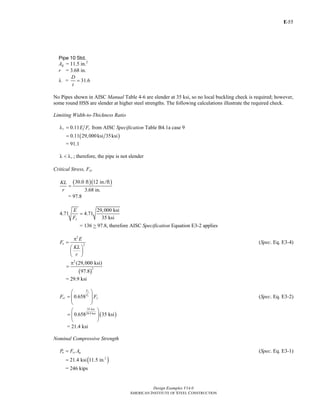
SM1 = Fv S1 = (2.4)(0.060g) = 0.144g from ASCE/SEI 7, Equation 11.4-2
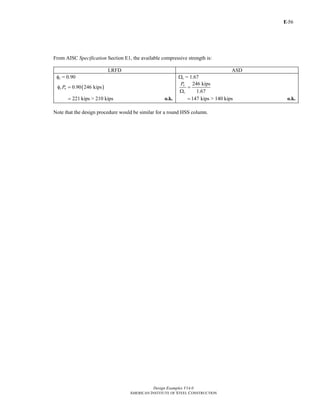
Determine the design earthquake accelerations.
SDS = q SMS = q (0.194g) = 0.129g from ASCE/SEI 7, Equation 11.4-3
SD1 = q SM1 = q (0.144g) = 0.096g from ASCE/SEI 7, Equation 11.4-4
Determine the seismic design category.
SDS < 0.167g, Seismic Risk Category II: Seismic Design Category: A from ASCE/SEI 7, Table 11.6-1
0.067g M SD1 < 0.133g, Seismic Risk Category II: Seismic Design Category: B from ASCE/SEI 7, Table 11.6-2
Select the seismic force resisting system.
Seismic Design Category B may be used and it is therefore permissible to select a structural steel system not
specifically detailed for seismic resistance, for which the seismic response modification coefficient, R = 3
Determine the approximate fundamental period.
Building Height, hn = 55.0 ft
Ct = 0.02: x = 0.75 from ASCE/SEI 7, Table 12.8-2
Ta = Ct (hn)x
= (0.02)(55.0 ft)0.75
= 0.404 sec from ASCE/SEI 7, Equation 12.8-7
Determine the redundancy factor from ASCE/SEI 7, Section 12.3.4.1.
ρ = 1.0 because the Seismic Design Category = B
Return to Table of Contents
III-51
Design Examples V14.0
AMERICAN INSTITUTE OF STEEL CONSTRUCTION
Determine the vertical seismic effect term.
Ev = 0.2SDSD (ASCE 7 Eq. 12.4-4)
= 0.2(0.129g)D
= 0.0258D
The following seismic load combinations are as specified in ASCE/SEI 7, Section 12.4.2.3.
LRFD ASD
( )
( )
( )
( )
1.2 0.2 0.2
1.2 0.2 0.129 1.0 0.2
1.23 1.0 0.2
0.9 0.2 1.6
0.9 0.2 0.129 1.0 0.0
0.874 1.0
DS E
E
E
DS E
E
E
S D Q L S
D Q L S
D Q L S
S D Q H
D Q
D Q
+ + ρ + +
= + + + +⎡ ⎤⎣ ⎦
= + + +
− + ρ +
= − + +⎡ ⎤⎣ ⎦
= +
( )
( ) ( )
( ) ( )
( ) ( )
1.0 0.14 0.7
1.0 0.14 0.129 0.0 0.0 0.7 1.0
1.02 0.7
1.0 0.10 0.525 0.75 0.75 or or
1.0 0.10 0.129 0.0 0.0 0.525 1.0 0.75 0.75
1.01 0.525 0.75 0.75
0.6 0.14
DS E
E
E
DS E r
E
E
S D H F Q
D Q
D Q
S D H F Q L L S R
D Q L S
D Q L S
S
+ + + + ρ
= + + + +⎡ ⎤⎣ ⎦
= +
+ + + + ρ + +
= + + + + + +⎡ ⎤⎣ ⎦
= + + +
−( )
( ) ( )
0.7
0.6 0.14 0.129 0.7 1.0 0
0.582 0.7
DS E
E
E
D Q H
D Q
D Q
+ ρ +
= − + +⎡ ⎤⎣ ⎦
= +
Note: ρQE = effect of horizontal seismic (earthquake induced) forces
Overstrength Factor: Ωo = 3 for steel systems not specifically detailed for seismic resistance, excluding cantilever
column systems, per ASCE/SEI 7, Table 12.2-1.
Calculate the seismic base shear using ASCE/SEI 7, Section 12.8.1.
Determine the seismic response coefficient from ASCE/SEI 7, Equation 12.8-2
0.129
3
1
0.0430
DS
s
e
S
C
R
I
=
⎛ ⎞
⎜ ⎟
⎝ ⎠
=
⎛ ⎞
⎜ ⎟
⎝ ⎠
= controls
Let Ta = T. From ASCE/SEI 7 Figure 22-12, TL = 12 > T (midwestern city); therefore use ASCE/SEI 7, Equation
12.8-3 to determine the upper limit of Cs.
1
0.096
3
0.404
1
0.0792
D
s
e
S
C
R
T
I
=
⎛ ⎞
⎜ ⎟
⎝ ⎠
=
⎛ ⎞
⎜ ⎟
⎝ ⎠
=
Return to Table of Contents
III-52
Design Examples V14.0
AMERICAN INSTITUTE OF STEEL CONSTRUCTION
From ASCE/SEI 7, Equation 12.8-5, Cs shall not be taken less than:
Cs = 0.044SDSIe ≥ 0.01
= 0.044(0.129)(1.0)
= 0.00568
Therefore, Cs = 0.0430.
Calculate the seismic base shear from ASCE/SEI 7 Equation 12.8-1
( )0.0430 8,280 kips
356 kips
sV C W=
=
=
Calculate vertical distribution of seismic forces from ASCE/SEI 7, Section 12.8.3.
x vxF C V= (ASCE Eq. 12.8-11)
( )356 kipsvxC=
1
k
x x
vx n
k
i i
i
w h
C
w h
=
=
∑
x vxF C V= (ASCE Eq. 12.8-12)
For structures having a period of 0.5 s or less, k = 1.
Calculate horizontal shear distribution at each level per ASCE/SEI 7, Section 12.8.4.
n
x i
i x
V F
=
= ∑ (ASCE Eq. 12.8-13)
Calculate the overturning moment at each level per ASCE/SEI 7, Section 12.8.5.
( )
n
x i i x
i x
M F h h
=
= −∑
wx hx
k
wxhx
k
Cvx Fx Vx Mx
kips ft kip-ft kips kips kips k-ft
Roof 820 55.0 45,100 0.182 64.8 64.8
Fourth 2,510 40.5 102,000 0.411 146 211 940
Third 2,510 27.0 67,800 0.273 97.2 308 3,790
Second 2,440 13.5 32,900 0.133 47.3 355 7,940
Base 8,280 248,000 355 12,700
Calculate strength and determine rigidity of diaphragms.
Determine the diaphragm design forces from Section 12.10.1.1 of ASCE/SEI 7.
Fpx is the largest of:
1. The force Fx at each level determined by the vertical distribution above
Return to Table of Contents
III-53
Design Examples V14.0
AMERICAN INSTITUTE OF STEEL CONSTRUCTION
2. 0.4
n
i
i x
px px DS e pxn
i
i x
F
F w S I w
w
=
=
= ≤
∑
∑
from ASCE/SEI 7, Equation 12.10-1 and 12.10-3
( )( )0.4 0.129 1.0
0.0516
px
px
w
w
≤
≤
3. 0.2px DS e pxF S I w= from ASCE/SEI 7, Equation 12.10-2
( )( )0.2 0.129 1.0
0.0258
px
px
w
w
=
=
wpx A B C Fpx v(n-s) v(e-w)
kips kips kips kips kips plf plf
Roof 820 64.8 42.3 21.2 64.8 297 170
Fourth 2,510 146 130 64.8 146 892 382
Third 2,510 97.2 130 64.8 130 791 339
Second 2,440 47.3 105 63.0 105 641 275
where
A = force at a level based on the vertical distribution of seismic forces
B = 0.4
n
i
i x
px px DS e pxn
i
i x
F
F w S I w
w
=
=
= ≤
∑
∑
C = 0.2 DS e pxS I w
Fpx = max(A, B, C)
Note: The diaphragm shear loads include the effects of openings in the diaphragm and a 10% increase to account
for accidental torsion.
Return to Table of Contents
III-54
Design Examples V14.0
AMERICAN INSTITUTE OF STEEL CONSTRUCTION
Roof
Roof deck: 12 in. deep, 22 gage, wide rib
Support fasteners: s in. puddle welds in 36 / 5 pattern
Sidelap fasteners: 3 #10 TEK screws
Joist spacing = s = 6.0 ft
Diaphragm length = 210 ft
Diaphragm width = lv =120 ft
By inspection, the critical condition for the diaphragm is loading from the north or south directions.
Calculate the required diaphragm strength, including a 10% increase for accidental torsion.
LRFD ASD
From the ASCE/SEI 7 load combinations for strength
design, the earthquake load is,
( )
( )
( )
( )
1.0
1.0 0.55
64.8 kips
1.0 0.55
120 ft
0.297 klf
E
r
v
px
v
Q
v
l
F
l
=
=
=
=
The wind load is,
( )
1.0
1.0 0.238klf
0.238klf
rv W=
=
=
From the ASCE/SEI 7 load combinations for
allowable stress design, the earthquake load is,
( )
( )
( )
( )
0.7
0.7 0.55
64.8 kips
0.7 0.55
120 ft
0.208 klf
E
r
v
px
v
Q
v
l
F
l
=
=
=
=
The wind load is,
( )
0.6
0.6 0.238klf
0.143klf
rv W=
=
=
Note: The 0.55 factor in the earthquake load accounts for half the shear to each braced frame plus the 10% increase
for accidental torsion.
From the SDI Diaphragm Design Manual (SDI, 2004), the nominal shear strengths are:
1. For panel buckling strength, vn = 1.425 klf
2. For connection strength, vn = 0.820 klf
Calculate the available strengths.
LRFD ASD
Panel Buckling Strength (SDI, 2004)
( )0.80 1.425 klf
a nv v= φ
=
1.14 klf 0.297 klf= > o.k.
Connection Strength (SDI, 2004)
Earthquake
Panel Buckling Strength (SDI, 2004)
1.425 klf
2.00
n
a
v
v =
Ω
=
0.713 klf 0.208 klf= > o.k.
Connection Strength (SDI, 2004)
Earthquake
Return to Table of Contents
III-55
Design Examples V14.0
AMERICAN INSTITUTE OF STEEL CONSTRUCTION
LRFD ASD
( )0.55 0.820 klf
a nv v= φ
=
0.451 klf 0.297 klf= > o.k.
Wind (SDI, 2004)
( )0.70 0.820 klf
a nv v= φ
=
0.574 klf 0.238 klf= > o.k.
0.820 klf
3.00
n
a
v
v =
Ω
=
0.273 klf 0.208 klf= > o.k.
Wind (SDI, 2004)
0.820 klf
2.35
n
a
v
v =
Ω
=
0.349 klf 0.143 klf= > o.k.
Check diaphragm flexibility.
From the Steel Deck Institute Diaphragm Design Manual,
Dxx = 758 ft K1 = 0.286 ft-1
K2 = 870 kip/in. K4 = 3.78
( )
( )
2
4 1
'
0.3
3
870 kips/in.
0.3 758 ft 0.286
3.78 3 6.00 ft
6.00 ft ft
18.6 kips/in.
xx
K
G
D
K K s
s
=
+ +
=
⎛ ⎞
+ + ⎜ ⎟
⎝ ⎠
=
Seismic loading to diaphragm.
( ) ( )64.8 kips 210 ft
0.309 klf
w =
=
Calculate the maximum diaphragm deflection.
( )( )
( )( )
2
2
8 '
0.309 klf 210 ft
8 120 ft 18.6 kips/in.
0.763 in.
v
wL
l G
Δ =
=
=
Story drift = 0.141 in. (from computer output)
The diaphragm deflection exceeds two times the story drift; therefore, the diaphragm may be considered to be
flexible in accordance with ASCE/SEI 7, Section 12.3.1.3
The roof diaphragm is flexible in the N-S direction, but using a rigid diaphragm distribution is more conservative
for the analysis of this building. By similar reasoning, the roof diaphragm will also be treated as a rigid diaphragm
in the E-W direction.
Third and Fourth floors
Return to Table of Contents
III-56
Design Examples V14.0
AMERICAN INSTITUTE OF STEEL CONSTRUCTION
Floor deck: 3 in. deep, 22 gage, composite deck with normal weight concrete,
Support fasteners; s in. puddle welds in a 36 / 4 pattern
Sidelap fasteners: 1 button punched fastener
Beam spacing = s = 10.0 ft
Diaphragm length = 210 ft
Diaphragm width = 120 ft
lv = 120 ft − 30 ft = 90 ft to account for the stairwell
By inspection, the critical condition for the diaphragm is loading from the north or south directions
Calculate the required diaphragm strength, including a 10% increase for accidental torsion.
LRFD ASD
From the ASCE/SEI 7 load combinations for strength
design, the earthquake load for the fourth floor is,
( )
( )
( )
( )
1.0
1.0 0.55
146 kips
1.0 0.55
90 ft
0.892klf
E
r
v
px
v
Q
v
l
F
l
=
=
=
=
For the fourth floor, the wind load is,
( )
1.0
1.0 0.409klf
0.409klf
rv W=
=
=
From the ASCI/SEI 7 load combinations for strength
design, the earthquake load for the third floor is,
( )
( )
( )
( )
1.0
1.0 0.55
130 kips
1.0 0.55
90 ft
0.794klf
E
r
v
px
v
Q
v
l
F
l
=
=
=
=
For the third floor, the wind load is,
( )
1.0
1.0 0.394klf
0.394klf
rv W=
=
=
From the ASCE/SEI 7 load combinations for strength
design, the earthquake load is,
( )
( )
( )
( )
0.7
0.7 0.55
146 kips
0.7 0.55
90 ft
0.625klf
E
r
v
px
v
Q
v
l
F
l
=
=
=
=
For the fourth floor, the wind load is,
( )
0.6
0.6 0.409klf
0.245klf
rv W=
=
=
From the ASCI/SEI 7 load combinations for strength
design, the earthquake load for the third floor is,
( )
( )
( )
( )
0.7
0.7 0.55
130 kips
0.7 0.55
90 ft
0.556klf
E
r
v
px
v
Q
v
l
F
l
=
=
=
=
For the third floor, the wind load is,
( )
0.6
0.6 0.394klf
0.236klf
rv W=
=
=
From the SDI Diaphragm Design Manual, the nominal shear strengths are:
For connection strength, vn = 5.16 klf
Calculate the available strengths.
Return to Table of Contents
III-57
Design Examples V14.0
AMERICAN INSTITUTE OF STEEL CONSTRUCTION
LRFD ASD
Connection Strength (same for earthquake or wind)
(SDI, 2004)
( )0.5 5.16 klf
a nv v= φ
=
2.58 klf 0.892 klf= > o.k.
Connection Strength (same for earthquake or wind)
(SDI, 2004)
5.16 klf
3.25
n
a
v
v =
Ω
=
1.59 klf 0.625 klf= > o.k.
Check diaphragm flexibility.
From the Steel Deck Institute Diaphragm Design Manual,
K1 = 0.729 ft-1
K2 = 870 kip/in. K3 = 2,380 kip/in. K4 = 3.78
( )
2
3
4 1
'
3
870 kip/in.
2,380 kip/in.
0.729
3.78 3 10.0 ft
ft
2,410 kips/in.
K
G K
K K s
⎛ ⎞
= +⎜ ⎟+⎝ ⎠
⎛ ⎞
= +⎜ ⎟⎛ ⎞⎜ ⎟+ ⎜ ⎟⎜ ⎟
⎝ ⎠⎝ ⎠
=
Fourth Floor
Calculate seismic loading to diaphragm based on the fourth floor seismic load.
( ) ( )146 kips 210 ft
0.695 klf
w =
=
Calculate the maximum diaphragm deflection on the fourth floor.
( )( )
( )( )
2
2
8 '
0.695 klf 210 ft
8 90 ft 2,410 kips/in.
0.0177 in.
v
wL
l G
Δ =
=
=
Third Floor
Calculate seismic loading to diaphragm based on the third floor seismic load.
( ) ( )130 kips 210 ft
0.619 klf
w =
=
Calculate the maximum diaphragm deflection on the third floor.
Return to Table of Contents
III-58
Design Examples V14.0
AMERICAN INSTITUTE OF STEEL CONSTRUCTION
( )( )
( )( )
2
2
8 '
0.619 klf 210 ft
8 90 ft 2,410 kips/in.
0.0157 in.
v
wL
l G
Δ =
=
=
The diaphragm deflection at the third and fourth floors is less than two times the story drift (story drift = 0.245 in.
from computer output); therefore, the diaphragm is considered rigid in accordance with ASCE/SEI 7, Section
12.3.1.3. By inspection, the floor diaphragm will also be rigid in the E-W direction.
Second floor
Floor deck: 3 in. deep, 22 gage, composite deck with normal weight concrete,
Support fasteners: s in. puddle welds in a 36 / 4 pattern
Sidelap fasteners: 1 button punched fasteners
Beam spacing = s = 10.0 ft
Diaphragm length = 210 ft
Diaphragm width = 120 ft
Because of the atrium opening in the floor diaphragm, an effective diaphragm depth of 75 ft will be used for the
deflection calculations.
By inspection, the critical condition for the diaphragm is loading from the north or south directions.
Calculate the required diaphragm strength, including a 10% increase for accidental torsion.
LRFD ASD
From the ASCE/SEI 7 load combinations for strength
design, the earthquake load is,
( )
( )
( )
( )
1.0
1.0 0.55
105 kips
1.0 0.55
90 ft
0.642klf
E
r
v
px
v
Q
v
l
F
l
=
=
=
=
The wind load is,
( )
1.0
1.0 0.395klf
0.395klf
rv W=
=
=
From the ASCE/SEI 7 load combinations for strength
design, the earthquake load is,
( )
( )
( )
( )
0.7
0.7 0.55
105 kips
0.7 0.55
90 ft
0.449klf
E
r
v
px
v
Q
v
l
F
l
=
=
=
=
The wind load is,
( )
0.6
0.6 0.395klf
0.237klf
rv W=
=
=
From the SDI Diaphragm Design Manual, the nominal shear strengths are:
For connection strength, vn = 5.16 klf
Calculate the available strengths.
Return to Table of Contents
III-59
Design Examples V14.0
AMERICAN INSTITUTE OF STEEL CONSTRUCTION
LRFD ASD
Connection Strength (same for earthquake or wind)
(SDI, 2004)
( )0.50 5.16 klf
a nv v= φ
=
2.58 klf 0.642 klf= > o.k.
Connection Strength (same for earthquake or wind)
(SDI, 2004)
5.16 klf
3.25
n
a
v
v =
Ω
=
1.59 klf 0.449 klf= > o.k.
Check diaphragm flexibility.
From the Steel Deck Institute Diaphragm Design Manual,
K1 = 0.729 ft-1
K2 = 870 kip/in. K3 = 2,380 kip/in. K4 = 3.78
( )
2
3
4 1
'
3
870 kip/in.
2,380 kip/in.
0.729
3.78 3 10.0 ft
ft
2,410 kip/in.
K
G K
K K s
⎛ ⎞
= +⎜ ⎟+⎝ ⎠
⎛ ⎞
= +⎜ ⎟⎛ ⎞⎜ ⎟+ ⎜ ⎟⎜ ⎟
⎝ ⎠⎝ ⎠
=
Calculate seismic loading to diaphragm.
( ) ( )105 kips 210 ft
0.500 klf
w =
=
Calculate the maximum diaphragm deflection.
( )( )
( )( )
2
2
8 '
0.500 klf 210 ft
8 75 ft 2,410 kip/in.
0.0152 in.
wL
bG
Δ =
=
=
Story drift = 0.228 in. (from computer output)
The diaphragm deflection is less than two times the story drift; therefore, the diaphragm is considered rigid in
accordance with ASCE/SEI 7, Section 12.3.1.3. By inspection, the floor diaphragm will also be rigid in the E-W
direction.
Horizontal shear distribution and torsion:
Calculate the seismic forces to be applied in the frame analysis in each direction, including the effect of accidental
torsion, in accordance with ASCE/SEI 7, Section 12.8.4.
Return to Table of Contents
III-60
Design Examples V14.0
AMERICAN INSTITUTE OF STEEL CONSTRUCTION
Load to Grids 1 and 8
Fy Load to Frame Accidental Torsion Total
kips % kips % kips kips
Roof 64.8 50 32.4 5 3.24 35.6
Fourth 146 50 73.0 5 7.30 80.3
Third 97.2 50 48.6 5 4.86 53.5
Second 47.3 50 23.7 5 2.37 26.1
Base 196
Load to Grids A and F
Fx Load to Frame Accidental Torsion Total
kips % kips % kips kips
Roof 64.8 50 32.4 5 3.24 35.6
Fourth 146 50 73.0 5 7.30 80.3
Third 97.2 50 48.6 5 4.86 53.5
Second 47.3 50.8(1)
24.0 5 2.37 26.4
Base 196
(1)
Note: In this example, Grids A and F have both been conservatively designed for the slightly higher load on
Grid A due to the atrium opening. The increase in load is calculated as follows
Area Mass y-dist My
ft2
kips ft k-ft
I 25,500 2,170 60.5 131,000
II 841 71.5 90.5 6,470
24,700 2,100 125,000
y = 125,000 kip-ft/2,100 kips = 59.5 ft
(100%)(121 ft – 59.5 ft)/121 ft = 50.8%
Return to Table of Contents
III-61
Design Examples V14.0
AMERICAN INSTITUTE OF STEEL CONSTRUCTION
MOMENT FRAME MODEL
Grids 1 and 8 were modeled in conventional structural analysis software as two-dimensional models. The second-
order option in the structural analysis program was not used. Rather, for illustration purposes, second-order effects
are calculated separately, using the “Approximate Second-Order Analysis” method described in AISC
Specification Appendix 8.
The column and beam layouts for the moment frames follow. Although the frames on Grids A and F are the
same, slightly heavier seismic loads accumulate on grid F after accounting for the atrium area and accidental
torsion. The models are half-building models. The frame was originally modeled with W14×82 interior columns
and W21×44 non-composite beams, but was revised because the beams and columns did not meet the strength
requirements. The W14×82 column size was increased to a W14×90 and the W21×44 beams were upsized to
W24×55 beams. Minimum composite studs are specified for the beams (corresponding to 0.25n y sQ F A=∑ ), but
the beams were modeled with a stiffness of Ieq = Is.
The frame was checked for both wind and seismic story drift limits. Based on the results on the computer
analysis, the frame meets the L/400 drift criterion for a 10 year wind (0.7W) indicated in Commentary Section
CC.1.2 of ASCE/SEI 7. In addition, the frame meets the 0.025hsx allowable story drift limit given in ASCE/SEI 7
Table 12.12-1 for Seismic Risk Category II.
All of the vertical loads on the frame were modeled as point loads on the frame. The dead load and live load are
shown in the load cases that follow. The wind, seismic, and notional loads from leaning columns are modeled and
distributed 1/14 to exterior columns and 1/7 to the interior columns. This approach minimizes the tendency to
accumulate too much load in the lateral system nearest an externally applied load.
Also shown in the models below are the remainder of the half-building model gravity loads from the interior
leaning columns accumulated in a single leaning column which was connected to the frame portion of the model
with pinned ended links. Because the second-order analyses that follow will use the “Approximate Second-Order
Analysis (amplified first-order) approach given in the AISC Specification Appendix 8, the inclusion of the leaning
column is unnecessary, but serves to summarize the leaning column loads and illustrate how these might be
handled in a full second-order analysis. See Geschwindner (1994), “A Practical Approach to the ‘Leaning’
Column.”
There are five lateral load cases. Two are the wind load and seismic load, per the previous discussion. In
addition, notional loads of Ni = 0.002Yi were established. The model layout, nominal dead, live, and snow loads
with associated notional loads, wind loads and seismic loads are shown in the figures below.
The same modeling procedures were used in the braced frame analysis. If column bases are not fixed in
construction, they should not be fixed in the analysis.
Return to Table of Contents
III-62
Design Examples V14.0
AMERICAN INSTITUTE OF STEEL CONSTRUCTION
Return to Table of Contents
III-63
Design Examples V14.0
AMERICAN INSTITUTE OF STEEL CONSTRUCTION
Return to Table of Contents
III-64
Design Examples V14.0
AMERICAN INSTITUTE OF STEEL CONSTRUCTION
Return to Table of Contents
III-65
Design Examples V14.0
AMERICAN INSTITUTE OF STEEL CONSTRUCTION
Return to Table of Contents
III-66
Design Examples V14.0
AMERICAN INSTITUTE OF STEEL CONSTRUCTION
Return to Table of Contents
III-67
Design Examples V14.0
AMERICAN INSTITUTE OF STEEL CONSTRUCTION
CALCULATION OF REQUIRED STRENGTH—THREE METHODS
Three methods for checking one of the typical interior column designs at the base of the building are presented
below. All three of presented methods require a second-order analysis (either direct via computer analysis
techniques or by amplifying a first-order analysis). A fourth method called the “First-Order Analysis Method” is
also an option. This method does not require a second-order analysis; however, this method is not presented
below. For additional guidance on applying any of these methods, see the discussion in AISC Manual Part 2
titled Required Strength, Stability, Effective Length, and Second-Order Effects.
GENERAL INFORMATION FOR ALL THREE METHODS
Seismic load combinations controlled over wind load combinations in the direction of the moment frames in the
example building. The frame analysis was run for all LRFD and ASD load combinations; however, only the
controlling combinations have been illustrated in the following examples. A lateral load of 0.2% of gravity load
was included for all gravity-only load combinations.
The second-order analysis for all the examples below was carried out by doing a first-order analysis and then
amplifying the results to achieve a set of second-order design forces using the approximate second-order analysis
procedure from AISC Specification Appendix 8.
METHOD 1. DIRECT ANALYSIS METHOD
Design for stability by the direct analysis method is found in Chapter C of the AISC Specification. This method
requires that both the flexural and axial stiffness are reduced and that 0.2% notional lateral loads are applied in the
analysis to account for geometric imperfections and inelasticity. Any general second-order analysis method that
considers both P − δ and P − Δ effects is permitted. The amplified first-order analysis method of AISC
Specification Appendix 8 is also permitted provided that the B1 and B2 factors are based on the reduced flexural
and axial stiffnesses. A summary of the axial loads, moments and 1st floor drifts from first-order analysis is
shown below. The floor diaphragm deflection in the east-west direction was previously determined to be very
small and will thus be neglected in these calculations. Second-order member forces are determined using the
amplified first-order procedure of AISC Specification Appendix 8.
It was assumed, subject to verification, that B2 is less than 1.7 for each load combination; therefore, per AISC
Specification Section C2.2b(4), the notional loads were applied to the gravity-only load combinations . The
required seismic load combinations are given in ASCE/SEI 7, Section 12.4.2.3.
LRFD ASD
1.23D ± 1.0QE + 0.5L + 0.2S
(Controls columns and beams)
From a first-order analysis with notional loads where
appropriate and reduced stiffnesses:
For Interior Column Design:
Pu = 317 kips
M1u = 148 kip-ft (from first-order analysis)
M2u = 233 kip-ft (from first-order analysis)
First story drift with reduced stiffnesses = 0.718 in.
1.01D + 0.75L + 0.75(0.7QE) + 0.75S
(Controls columns and beams)
From a first-order analysis with notional loads where
appropriate and reduced stiffnesses:
For Interior Column Design:
Pa = 295 kips
M1a = 77.9 kip-ft
M2a = 122 kip-ft
First story drift with reduced stiffnesses = 0.377 in.
Note: For ASD, ordinarily the second-order analysis must be carried out under 1.6 times the ASD load
combinations and the results must be divided by 1.6 to obtain the required strengths. For this example, second-
order analysis by the amplified first-order analysis method is used. The amplified first-order analysis method
incorporates the 1.6 multiplier directly in the B1 and B2 amplifiers, such that no other modification is needed.
The required second-order flexural strength, Mr, and axial strength, Pr, are determined as follows. For typical
Return to Table of Contents
III-68
Design Examples V14.0
AMERICAN INSTITUTE OF STEEL CONSTRUCTION
interior columns, the gravity-load moments are approximately balanced, therefore, Mnt = 0.0 kip-ft
Calculate the amplified forces and moments in accordance with AISC Specification Appendix 8.
LRFD ASD
Mr = B1Mnt + B2Mlt (Spec. Eq. A-8-1)
Determine B1
Pr = required second-order axial strength using LRFD
or ASD load combinations, kips.
Note that for members subject to axial compression,
B1 may be calculated based on the first-order estimate
Pr = Pnt + Plt.
Therefore, Pr = 317 kips
(from the first-order computer analysis)
Ix = 999 in.4
(W14×90)
τb = 1.0
( )
2
1 2
1
*
e
EI
P
K L
π
= (Spec. Eq. A-8-5)
( )( )( )
( )( )( )
2 4
2
0.8 29,000 ksi 999 in.
1.0 13.5 ft 12 in./ft
π
=
⎡ ⎤⎣ ⎦
= 8,720 kips
Cm = 0.6 – 0.4(M1 / M2) (Spec. Eq. A-8-4)
= 0.6 – 0.4 (148 kip-ft / 233 kip-ft)
= 0.346
α = 1.0
1
1
1
1
m
r
e
C
B
P
P
= ≥
α
−
(Spec. Eq. A-8-3)
( )
0.346
1
1.0 317 kips
1
8,720 kips
0.359 1; Use 1.0
= ≥
−
= ≥
Determine B2
2
1
1
1
story
e story
B
P
P
= ≥
α
−
(Spec. Eq. A-8-6)
where
α = 1.0
5,440 kips (from computer output)storyP =
Mr = B1Mnt + B2Mlt (Spec. Eq. A-8-1)
Determine B1
Pr = required second-order axial strength using
LRFD or ASD load combinations, kips.
Note that for members subject to axial compression,
B1 may be calculated based on the first-order
estimate Pr = Pnt + Plt.
Therefore, Pr = 295 kips
(from the first-order computer analysis)
Ix = 999 in.4
(W14×90)
τb = 1.0
( )
2
1 2
1
*
e
EI
P
K L
π
= (Spec. Eq. A-8-5)
( )( )( )
( )( )( )
2 4
2
0.8 29,000 ksi 999 in.
1.0 13.5 ft 12 in./ft
π
=
⎡ ⎤⎣ ⎦
= 8,720 kips
Cm = 0.6 – 0.4(M1 / M2) (Spec. Eq. A-8-4)
= 0.6 – 0.4 (77.9 kip-ft / 122 kip-ft)
= 0.345
α = 1.6
1
1
1
1
m
r
e
C
B
P
P
= ≥
α
−
(Spec. Eq. A-8-3)
( )
0.345
1
1.6 295 kips
1
8,720 kips
0.365 1; Use 1.0
= ≥
−
= ≥
Determine B2
2
1
1
1
story
e story
B
P
P
= ≥
α
−
(Spec. Eq. A-8-6)
where
α= 1.6
5,120 kips (from computer output)storyP =
Return to Table of Contents
III-69
Design Examples V14.0
AMERICAN INSTITUTE OF STEEL CONSTRUCTION
LRFD ASD
may be taken ase storyP :
e story M
H
HL
P R=
Δ
(Spec. Eq. A-8-7)
where
1 0.15
mf
M
story
P
R
P
= − (Spec. Eq. A-8-8)
where
2,250kipsmfP = (gravity load in moment frame)
2,250kips
1 0.15
5,440kips
0.938
MR = −
=
( )
1.0
1.0 196 kips (Lateral)
=196 kips
EH Q=
=
(previous seismic force distribution calculations)
= 0.718 in.HΔ (from computer output)
( )( )( )196 kips 13.5 ft 12 in./ft
0.938
0.718 in.
41,500 kips
e storyP =
=
2
1
1
1
story
e story
B
P
P
= ≥
α
−
(Spec. Eq. A-8-6)
( )
1
1
1.0 5,440 kips
1
41,500 kips
1.15 1
= ≥
−
= ≥
Because B2 < 1.7, it is verified that it was unnecessary
to add the notional loads to the lateral loads for this
load combination.
Calculate amplified moment
From AISC Specification Equation A-8-1,
( )( ) ( )( )1.0 0.0 kip-ft 1.15 233 kip-ftrM = +
= 268 kip-ft
Calculate amplified axial load
Pnt = 317 kips (from computer analysis)
may be taken ase storyP :
e story M
H
HL
P R=
Δ
(Spec. Eq. A-8-7)
where
1 0.15
mf
M
story
P
R
P
= − (Spec. Eq. A-8-8)
where
2,090kipsmfP = (gravity load in moment frame)
2,090kips
1 0.15
5,120kips
0.939
MR = −
=
( )
( )( ) ( )
0.75 0.7
0.75 0.7 196 kips Lateral
103 kips
EH Q=
=
=
(previous seismic force distribution calculations)
= 0.377 in. (from computer output)HΔ
( )( )( )103 kips 13.5 ft 12 in./ft
0.939
0.377 in.
41,600 kips
e storyP =
=
2
1
1
1
story
e story
B
P
P
= ≥
α
−
(Spec. Eq. A-8-6)
( )
1
1
1.6 5,120 kips
1
41,600 kips
1.25 1
= ≥
−
= ≥
Because B2 < 1.7, it is verified that it was
unnecessary to add the notional loads to the lateral
loads for this load combination.
Calculate amplified moment
From AISC Specification Equation A-8-1,
( )( ) ( )( )1.0 0.0 kip-ft 1.25 122 kip-ftrM = +
= 153 kip-ft
Calculate amplified axial load
Pnt = 295 kips (from computer analysis)
For a long frame, such as this one, the change in load
Return to Table of Contents
III-70
Design Examples V14.0
AMERICAN INSTITUTE OF STEEL CONSTRUCTION
LRFD ASD
For a long frame, such as this one, the change in load
to the interior columns associated with lateral load is
negligible.
Pr = Pnt + B2Plt (Spec. Eq. A-8-2)
= 317 kips + (1.15)(0.0 kips)
= 317 kips
The flexural and axial stiffness of all members in the
moment frame were reduced using 0.8E in the
computer analysis.
Check that the flexural stiffness was adequately
reduced for the analysis per AISC Specification
Section C2.3(2).
1.0
317 kipsrP
α =
=
( )2
26.5 in. 50.0 ksi 1,330 kipsy yP AF= = =
(W14×90 column)
( )1.0 317 kips
0.238 0.5
1,330 kips
r
y
P
P
α
= = ≤
Therefore, 1.0bτ = o.k.
Note: By inspection 1.0bτ = for all of the beams in the
moment frame.
For the direct analysis method, K = 1.0.
From AISC Manual Table 4-1,
Pc = 1,040 kips (W14×90 @ KL = 13.5 ft)
From AISC Manual Table 3-2,
Mcx = φbMpx = 574 kip-ft (W14×90 with Lb = 13.5 ft)
317 kips
0.305 0.2
1,040 kips
r
c
P
P
= = ≥
Because 0.2
r
c
P
P
≥ , use AISC Specification
interaction Equation H1-1a.
8
1.0
9
ryr rx
c cx cy
MP M
P M M
⎛ ⎞⎛ ⎞
+ + ≤⎜ ⎟⎜ ⎟
⎝ ⎠⎝ ⎠
(Spec. Eq. H1-1a)
to the interior columns associated with lateral load is
negligible.
Pr = Pnt + B2Plt (Spec. Eq. A-8-2)
= 295 kips + (1.25)(0.0 kips)
= 295 kips
The flexural and axial stiffness of all members in the
moment frame were reduced using 0.8E in the
computer analysis.
Check that the flexural stiffness was adequately
reduced for the analysis per AISC Specification
Section C2.3(2).
1.6
295 kipsrP
α =
=
( )2
26.5 in. 50.0 ksi 1,330 kipsy yP AF= = =
(W14×90 column)
( )1.6 295 kips
0.355 0.5
1,330 kips
r
y
P
P
α
= = ≤
Therefore, 1.0bτ = o.k.
Note: By inspection 1.0bτ = for all of the beams in
the moment frame.
For the direct analysis method, K = 1.0.
From AISC Manual Table 4-1,
Pc = 690 kips (W14×90 @ KL = 13.5 ft)
From AISC Manual Table 3-2,
Mcx =
px
b
M
Ω
= 382 kip-ft (W14×90 with Lb = 13.5 ft)
295 kips
0.428 0.2
690 kips
r
c
P
P
= = ≥
Because 0.2
r
c
P
P
≥ , use AISC Specification
interaction Equation H1-1a.
8
1.0
9
ryr rx
c cx cy
MP M
P M M
⎛ ⎞⎛ ⎞
+ + ≤⎜ ⎟⎜ ⎟
⎝ ⎠⎝ ⎠
(Spec. Eq. H1-1a)
Return to Table of Contents
III-71
Design Examples V14.0
AMERICAN INSTITUTE OF STEEL CONSTRUCTION
LRFD ASD
8 268 kip-ft
0.305 1.0
9 574 kip-ft
⎛ ⎞⎛ ⎞
+ ≤⎜ ⎟⎜ ⎟
⎝ ⎠⎝ ⎠
0.720 1.0≤ o.k.
8 153 kip-ft
0.428 1.0
9 382 kip-ft
⎛ ⎞⎛ ⎞
+ ≤⎜ ⎟⎜ ⎟
⎝ ⎠⎝ ⎠
0.784 1.0≤ o.k.
METHOD 2. EFFECTIVE LENGTH METHOD
Required strengths of frame members must be determined from a second-order analysis. In this example the
second-order analysis is performed by amplifying the axial forces and moments in members and connections from
a first-order analysis using the provisions of AISC Specification Appendix 8. The available strengths of
compression members are calculated using effective length factors computed from a sidesway stability analysis.
A first-order frame analysis is conducted using the load combinations for LRFD or ASD. A minimum lateral load
(notional load) equal to 0.2% of the gravity loads is included for any gravity-only load combination. The required
load combinations are given in ASCE/SEI 7 and are summarized in Part 2 of the AISC Manual.
A summary of the axial loads, moments and 1st floor drifts from the first-order computer analysis is shown below.
The floor diaphragm deflection in the east-west direction was previously determined to be very small and will
thus be neglected in these calculations.
LRFD ASD
1.23D ± 1.0QE + 0.5L + 0.2S
(Controls columns and beams)
For Interior Column Design:
Pu = 317 kips
M1u = 148 kip-ft (from first-order analysis)
M2u = 233 kip-ft (from first-order analysis)
First-order first story drift = 0.575 in.
1.01D + 0.75L + 0.75(0.7QE) + 0.75S
(Controls columns and beams)
For Interior Column Design:
Pa = 295 kips
M1a = 77.9 kip-ft (from first-order analysis)
M2a = 122 kip-ft (from first-order analysis)
First-order first story drift = 0.302 in.
The required second-order flexural strength, Mr, and axial strength, Pr, are calculated as follows:
For typical interior columns, the gravity load moments are approximately balanced; therefore, Mnt = 0.0 kips.
LRFD ASD
Mr = B1Mnt + B2Mlt (Spec. Eq. A-8-1)
Determine B1.
Pr = required second-order axial strength using
LRFD or ASD load combinations, kips
Note that for members subject to axial compression,
B1 may be calculated based on the first-order
estimate Pr = Pnt + Plt.
Therefore, Pr = 317 kips
(from first-order computer analysis)
I = 999 in.4
(W14×90)
( )
2
1 2
1
*
e
EI
P
K L
π
= (Spec. Eq. A-8-5)
Mr = B1Mnt + B2Mlt (Spec. Eq. A-8-1)
Determine B1.
Pr = required second-order axial strength using LRFD
or ASD load combinations, kips
Note that for members subject to axial compression,
B1 may be calculated based on the first-order estimate
Pr = Pnt + Plt.
Therefore, Pr = 295 kips
(from first-order computer analysis)
I = 999 in.4
(W14×90)
( )
2
1 2
1
*
e
EI
P
K L
π
= (Spec. Eq. A-8-5)
Return to Table of Contents
III-72
Design Examples V14.0
AMERICAN INSTITUTE OF STEEL CONSTRUCTION
LRFD ASD
( )( )
( )( )( )
2 4
2
29,000 ksi 999 in.
1.0 13.5 ft 12 in./ft
π
=
⎡ ⎤⎣ ⎦
= 10,900 kips
Cm = 0.6 – 0.4(M1 / M2) (Spec. Eq. A-8-4)
= 0.6 – 0.4 (148 kip-ft / 233 kip-ft)
= 0.346
α = 1.0
1
1
1
1
m
r
e
C
B
P
P
= ≥
α
−
(Spec. Eq. A-8-3)
( )
0.346
1
1.0 317 kips
1
10,900 kips
0.356 1; Use 1.00
= ≥
−
= ≥
Determine B2.
2
1
1
1
story
e story
B
P
P
= ≥
α
−
(Spec. Eq. A-8-6)
where
α = 1.0
5,440 kips (from computer output)storyP =
may be taken ase storyP
e story M
H
HL
P R=
Δ
(Spec. Eq. A-8-7)
where
1 0.15
mf
M
story
P
R
P
= − (Spec. Eq. A-8-8)
where
2,250kipsmfP = (gravity load in moment frame)
2,250kips
1 0.15
5,440kips
0.938
MR = −
=
H = 196 kips (Lateral)
(from previous seismic force distribution
calculations)
= 0.575 in. (from computer output)HΔ
( )( )
( )( )( )
2 4
2
29,000 ksi 999 in.
1.0 13.5 ft 12 in./ft
π
=
⎡ ⎤⎣ ⎦
= 10,900 kips
Cm = 0.6 – 0.4(M1 / M2) (Spec. Eq. A-8-4)
= 0.6 – 0.4 (77.9 kip-ft / 122 kip-ft)
= 0.345
α = 1.6
1
1
1
1
m
r
e
C
B
P
P
= ≥
α
−
(Spec. Eq. A-8-3)
( )
0.345
1
1.6 295 kips
1
10,900 kips
0.361 1; Use 1.00
= ≥
−
= ≥
Determine B2.
2
1
1
1
story
e story
B
P
P
= ≥
α
−
(Spec. Eq. A-8-6)
where
α= 1.6
5,120 kips (from computer output)storyP =
may be taken ase storyP
=e story M
H
HL
P R
Δ
(Spec. Eq. A-8-7)
where
1 0.15
mf
M
story
P
R
P
= − (Spec. Eq. A-8-8)
where
2,090kipsmfP = (gravity load in moment frame)
2,090kips
1 0.15
5,120kips
0.939
MR = −
=
H = 103 kips (Lateral)
(from previous seismic force distribution
calculations)
= 0.302 in. (from computer output)HΔ
Return to Table of Contents
III-73
Design Examples V14.0
AMERICAN INSTITUTE OF STEEL CONSTRUCTION
LRFD ASD
( )( )( )196 kips 13.5 ft 12 in./ft
0.938
0.575 in.
51,800 kips
e storyP =
=
2
1
1
1
story
e story
B
P
P
= ≥
α
−
(Spec. Eq. A-8-6)
( )
1
1
1.0 5,440 kips
1
51,800 kips
1.12 1
= ≥
−
= ≥
Note: B2 < 1.5, therefore use of the effective length
method is acceptable.
Calculate amplified moment
From AISC Specification Equation A-8-1,
( )( ) ( )( )1.00 0.0 kip-ft 1.12 233 kip-ftrM = +
= 261 kip-ft
Calculate amplified axial load.
Pnt = 317 kips (from computer analysis)
For a long frame, such as this one, the change in load
to the interior columns associated with lateral load is
negligible.
Therefore, Plt = 0
Pr = Pnt + B2Plt (Spec. Eq. A-8-2)
= 317 kips + (1.12)(0.0 kips)
= 317 kips
Determine the controlling effective length.
For out-of-plane buckling in the moment frame
Ky = 1.0
( )1.0 13.5 ft 13.5 fty yK L = =
For in-plane buckling in the moment frame, use the
story stiffness procedure from the AISC
Specification Commentary for Appendix 7 to
determine Kx with Specification Commentary
Equation C-A-7-5.
( )( )( )103 kips 13.5 ft 12 in./ft
0.939
0.302 in.
51,900 kips
e storyP =
=
2
1
1
1
story
e story
B
P
P
= ≥
α
−
(Spec. Eq. A-8-6)
( )
1
1
1.6 5,120 kips
1
51,900 kips
1.19 1
= ≥
−
= ≥
Note: B2 < 1.5, therefore use of the effective length
method is acceptable.
Calculate amplified moment
From AISC Specification Equation A-8-1,
( )( ) ( )( )1.00 0.0 kip-ft 1.19 122 kip-ftrM = +
= 145 kip-ft
Calculate amplified axial load.
Pnt = 295 kips (from computer analysis)
For a long frame, such as this one, the change in load
to the interior columns associated with lateral load is
negligible.
Therefore, Plt = 0
Pr = Pnt + B2Plt (Spec. Eq. A-8-2)
= 295 kips + (1.19)(0.0 kips)
= 295 kips
Determine the controlling effective length.
For out-of-plane buckling in the moment frame
Ky = 1.0
( )1.0 13.5 ft 13.5 fty yK L = =
For in-plane buckling in the moment frame, use the
story stiffness procedure from the AISC
Specification Commentary for Appendix 7 to
determine Kx with Specification Commentary
Equation C-A-7-5.
Return to Table of Contents
III-74
Design Examples V14.0
AMERICAN INSTITUTE OF STEEL CONSTRUCTION
LRFD ASD
( )
2
2 2
2
2
0.85 0.15
1.7
r H
L r
H
P EI
K
R P HLL
EI
HLL
⎛ ⎞Σ π Δ⎛ ⎞
= ≥⎜ ⎟⎜ ⎟
+ Σ⎝ ⎠⎝ ⎠
π Δ⎛ ⎞
⎜ ⎟
⎝ ⎠
Simplifying and substituting terms previously
calculated results in:
1.7
story e H
x e
e story r
P P
K P
P P HL
Δ⎛ ⎞ ⎛ ⎞
= ≥ ⎜ ⎟⎜ ⎟
⎝ ⎠⎝ ⎠
where
( )( )
( )
2
2
2 4
2
29,000ksi 999in.
12 in./ft 13.5 ft
10,900 kips
e
EI
P
L
π
=
π
=
⎡ ⎤⎣ ⎦
=
( ) ( )
5,440 kips 10,900 kips
51,800 kips 317 kips
0.575 in.
10,900 kips 12 in.
1.7 196 kips 13.5 ft
ft
1.90 0.341
xK
⎛ ⎞
= ≥⎜ ⎟
⎝ ⎠
⎛ ⎞
⎜ ⎟⎛ ⎞⎜ ⎟⎜ ⎟⎜ ⎟
⎝ ⎠⎝ ⎠
= ≥
Use Kx = 1.90
( )1.90 13.5 ft
15.5 ft
/ 1.66
x
x y
KL
r r
= =
Because x x
y y
x y
K L
K L
r r
> , use KL = 15.5 ft
From AISC Manual Table 4-1,
Pc = 990 kips (W14×90 @ KL = 15.5 ft)
From AISC Manual Table 3-2,
Mcx = 574 kip-ft (W14×90 with Lb =13.5 ft)
317 kips
990 kips
0.320 0.2
r
c
P
P
=
= ≥
( )
2
2 2
2
2
0.85 0.15
1.7
r H
L r
H
P EI
K
R P HLL
EI
HLL
⎛ ⎞Σ π Δ⎛ ⎞
= ≥⎜ ⎟⎜ ⎟
+ Σ⎝ ⎠⎝ ⎠
π Δ⎛ ⎞
⎜ ⎟
⎝ ⎠
Simplifying and substituting terms previously
calculated results in:
1.7
story e H
x e
e story r
P P
K P
P P HL
Δ⎛ ⎞ ⎛ ⎞
= ≥ ⎜ ⎟⎜ ⎟
⎝ ⎠⎝ ⎠
where
( )( )
( )
2
2
2 4
2
29,000ksi 999in.
12 in./ft 13.5 ft
10,900 kips
e
EI
P
L
π
=
π
=
⎡ ⎤⎣ ⎦
=
( ) ( )
5,120 kips 10,900kips
51,900 kips 295 kips
0.302 in.
10,900 kips 12 in.
1.7 103 kips 13.5 ft
ft
1.91 0.341
xK
⎛ ⎞
= ≥⎜ ⎟
⎝ ⎠
⎛ ⎞
⎜ ⎟⎛ ⎞⎜ ⎟⎜ ⎟⎜ ⎟
⎝ ⎠⎝ ⎠
= ≥
Use Kx = 1.91
( )1.91 13.5 ft
15.5 ft
/ 1.66
x
x y
KL
r r
= =
Because x x
y y
x y
K L
K L
r r
> , use KL = 15.5 ft
From AISC Manual Table 4-1,
Pc = 660 kips (W14×90 @ KL = 15.5 ft)
From AISC Manual Table 3-2,
Mcx = 382 kip-ft (W14×90 with Lb = 13.5 ft)
295 kips
660 kips
0.447 0.2
r
c
P
P
=
= ≥
Return to Table of Contents
III-75
Design Examples V14.0
AMERICAN INSTITUTE OF STEEL CONSTRUCTION
LRFD ASD
Because 0.2r
c
P
P
≥ , use interaction Equation H1-1a.
8
1.0
9
ryr rx
c cx cy
MP M
P M M
⎛ ⎞⎛ ⎞
+ + ≤⎜ ⎟⎜ ⎟
⎝ ⎠⎝ ⎠
(Spec. Eq. H1.1-a)
8 261 kip-ft
0.320 1.0
9 574 kip-ft
⎛ ⎞⎛ ⎞
+ ≤⎜ ⎟⎜ ⎟
⎝ ⎠⎝ ⎠
0.724 1.0≤ o.k.
Because 0.2
r
c
P
P
≥ , use interaction Equation H1-1a.
8
1.0
9
ryr rx
c cx cy
MP M
P M M
⎛ ⎞⎛ ⎞
+ + ≤⎜ ⎟⎜ ⎟
⎝ ⎠⎝ ⎠
(Spec. Eq. H1.1-a)
8 145 kip-ft
0.447 1.0
9 382 kip-ft
⎛ ⎞⎛ ⎞
+ ≤⎜ ⎟⎜ ⎟
⎝ ⎠⎝ ⎠
0.784 1.0≤ o.k.
METHOD 3. SIMPLIFIED EFFECTIVE LENGTH METHOD
A simplification of the effective length method using a method of second-order analysis based upon drift limits
and other assumptions is described in Chapter 2 of the AISC Manual. A first-order frame analysis is conducted
using the load combinations for LRFD or ASD. A minimum lateral load (notional load) equal to 0.2% of the
gravity loads is included for all gravity-only load combinations. The floor diaphragm deflection in the east-west
direction was previously determined to be very small and will thus be neglected in these calculations.
LRFD ASD
1.23D ± 1.0QE + 0.5L + 0.2S
(Controls columns and beams)
From a first-order analysis
For interior column design:
Pu = 317 kips
M1u = 148 kip-ft (from first-order analysis)
M2u = 233 kip-ft (from first-order analysis)
First story first-order drift = 0.575 in.
1.01D + 0.75L + 0.75(0.7QE) + 0.75S
(Controls columns and beams)
From a first-order analysis
For interior column design:
Pa = 295 kips
M1a = 77.9 kip-ft (from first-order analysis)
M2a = 122 kip-ft (from first-order analysis)
First story first-order drift = 0.302 in.
Then the following steps are executed.
LRFD ASD
Step 1:
Lateral load = 196 kips
Deflection due to first-order elastic analysis
Δ = 0.575 in. between first and second floor
Floor height = 13.5 ft
Drift ratio = (13.5 ft)(12 in./ft) / 0.575 in.
= 282
Step 2:
Design story drift limit = H/400
Adjusted Lateral load = (282/ 400)(196 kips)
= 138 kips
Step 1:
Lateral load = 103 kips
Deflection due to first-order elastic analysis
Δ = 0.302 in. between first and second floor
Floor height = 13.5 ft
Drift ratio = (13.5 ft)(12 in./ft) / 0.302 in.
= 536
Step 2:
Design story drift limit = H/400
Adjusted Lateral load = (536 / 400)(103 kips)
= 138 kips
Return to Table of Contents
III-76
Design Examples V14.0
AMERICAN INSTITUTE OF STEEL CONSTRUCTION
LRFD ASD
Step 3:
( )
( )
total story load
Load ratio = 1.0
lateral load
5,440 kips
= 1.0
138 kips
= 39.4
From AISC Manual Table 2-1:
B2 = 1.1
Which matches the value obtained in Method 2 to the
two significant figures of the table
Step 3: (for an ASD design the ratio must be
multiplied by 1.6)
( )
( )
total story load
Load ratio = 1.6
lateral load
5,120 kips
= 1.6
138 kips
= 59.4
From AISC Manual Table 2-1:
B2 = 1.2
Which matches the value obtained in Method 2 to the
two significant figures of the table
Note: Intermediate values are not interpolated from the table because the precision of the table is two significant
digits. Additionally, the design story drift limit used in Step 2 need not be the same as other strength or
serviceability drift limits used during the analysis and design of the structure.
Step 4. Multiply all the forces and moment from the first-order analysis by the value of B2 obtained from the
table. This presumes that B1 is less than or equal to B2, which is usually the case for members without transverse
loading between their ends.
LRFD ASD
Step 5. Since the selection is in the shaded area of the
chart, (B2 ≤ 1.1). For LRFD design, use K = 1.0.
Multiply both sway and non-sway moments by B2.
Mr = B2(Mnt + Mlt)
= 1.1(0 kip-ft + 233 kip-ft) = 256 kip-ft
Pr = B2(Pnt + Plt)
= 1.1(317 kips +0.0 kips) = 349 kips
From AISC Manual Table 4-1,
Pc = 1,040 kips (W14×90 @ KL = 13.5 ft)
From AISC Manual Table 3-2,
Mcx = φbMpx = 574 kip-ft (W14×90 with Lb = 13.5 ft)
349 kips
0.336 0.2
1,040 kips
r
c
P
P
= = ≥
Because 0.2,r
c
P
P
≥ use interaction Equation H1-1a.
Step 5. Since the selection is in the unshaded area of
the chart (B2 > 1.1), For ASD design, the effective
length factor, K, must be determined through
analysis. From previous analysis, use an effective
length of 15.5 ft.
Multiply both sway and non-sway moments by B2
Mr = B2(Mnt + Mlt)
= 1.2(0 kip-ft + 122 kip-ft) = 146 kip-ft
Pr = B2(Pnt + Plt)
= 1.2(295 kips +0.0 kips) = 354 kips
From AISC Manual Table 4-1,
Pc = 675 kips (W14×90 @ KL = 13.5 ft)
From AISC Manual Table 3-2,
Mcx =
px
b
M
Ω
= 382 kip-ft (W14×90 with Lb = 13.5 ft)
354 kips
0.524 0.2
675 kips
r
c
P
P
= = ≥
Because 0.2,r
c
P
P
≥ use interaction Equation H1-1a.
Return to Table of Contents
III-77
Design Examples V14.0
AMERICAN INSTITUTE OF STEEL CONSTRUCTION
8
1.0
9
8 256 kip-ft
0.336 1.0
9 574 kip-ft
ryr rx
c cx cy
MP M
P M M
⎛ ⎞⎛ ⎞
+ + ≤⎜ ⎟⎜ ⎟
⎝ ⎠⎝ ⎠
⎛ ⎞⎛ ⎞
+ ≤⎜ ⎟⎜ ⎟
⎝ ⎠⎝ ⎠
0.732 1.0≤ o.k.
8
1.0
9
8 146 kip-ft
0.524 1.0
9 382 kip-ft
ryr rx
c cx cy
MP M
P M M
⎛ ⎞⎛ ⎞
+ + ≤⎜ ⎟⎜ ⎟
⎝ ⎠⎝ ⎠
⎛ ⎞⎛ ⎞
+ ≤⎜ ⎟⎜ ⎟
⎝ ⎠⎝ ⎠
0.864 1.0≤ o.k.
BEAM ANALYSIS IN THE MOMENT FRAME
The controlling load combinations for the beams in the moment frames are shown below and
evaluated for the second floor beam. The dead load, live load and seismic moments were taken
from a computer analysis. The table summarizes the calculation of B2 for the stories above and
below the second floor.
1st – 2nd LRFD Combination ASD Combination 1 ASD Combination 2
1.23D + 1.0QE + 0.5L + 0.2S 1.02D + 0.7QE 1.01D + 0.75L + 0.75(0.7QE) + 0.75S
H 196 kips 137 kips 103 kips
L 13.5 ft 13.5 ft 13.5 ft
HΔ 0.575 in. 0.402 in. 0.302 in.
mfP 2,250 kips 1,640 kips 2,090 kips
MR 0.938 0.937 0.939
e storyP 51,800 kips 51,700 kips 51,900 kips
storyP 5,440 kips 3,920 kips 5,120 kips
B2 1.12 1.14 1.19
2nd – 3rd LRFD Combination ASD Combination 1 ASD Combination 2
1.23D + 1.0QE + 0.5L +0.2S 1.02D + 0.7QE 1.01D + 0.75L + 0.75(0.7QE) + 0.75S
H 170 kips 119 kips 89.3 kips
L 13.5 ft 13.5 ft 13.5 ft
HΔ 0.728 in. 0.509 in. 0.382 in.
mfP 1,590 1,160 1,490
MR 0.938 0.937 0.939
e storyP 35,500 kips 35,500 kips 35,600 kips
storyP 3,840 kips 2,770 kips 3,660 kips
B2 1.12 1.14 1.20
For beam members, the larger of the B2 values from the story above or below is used.
From computer output at the controlling beam:
Mdead = 153 kip-ft Mlive = 80.6 kip-ft Msnow = 0.0 kip-ft Mearthquake = 154 kip-ft
LRFD Combination ASD Combination 1 ASD Combination 2
( )2 1.12 154 kip-ft
172kip-ft
ltB M =
=
( )2 1.14 154 kip-ft
176 kip-ft
ltB M =
=
( )2 1.20 154 kip-ft
185kip-ft
ltB M =
=
Return to Table of Contents
III-78
Design Examples V14.0
AMERICAN INSTITUTE OF STEEL CONSTRUCTION
( )
( )
( )
1.23 153 kip-ft
= 1.0 172kip-ft
0.5 80.6kip-ft
400 kip-ft
uM
⎡ ⎤
⎢ ⎥
+⎢ ⎥
⎢ ⎥
+⎣ ⎦
=
( )
( )
1.02 153 kip-ft
=
0.7 176 kip-ft
279 kip-ft
aM
⎡ ⎤
⎢ ⎥
+⎢ ⎥⎣ ⎦
=
( )
( )
( )
1.01 153 kip-ft
= 0.525 185kip-ft
0.75 80.6 kip-ft
312 kip-ft
aM
⎡ ⎤
⎢ ⎥
+⎢ ⎥
⎢ ⎥
+⎣ ⎦
=
Calculate Cb for compression in the bottom flange braced at 10.0 ft o.c.
LRFD ASD
Cb = 1.86 (from computer output)
Check W24×55
From AISC Manual Table 3-2, with continuous
bracing
503 kip-ftnMφ =
From AISC Manual Table 3-10, for Lb = 10.0 ft and
Cb = 1.86
( )386 kip-ft 1.86 503 kip-ft
718 kip-ft 503 kip-ft
nMφ = ≤
= ≤
Use 503 kip-ft 400 kip-ftnMφ = > o.k.
From AISC Manual Table 3-2, a W24×55 has a
design shear strength of 252 kips and an Ix of 1350
in.4
1.02D + 0.7QE
Cb = 1.86 (from computer output)
1.01D + 0.75(0.7QE) + 0.75L
Cb = 2.01 (from computer output)
Check W24×55
1.02D + 0.7E
From AISC Manual Table 3-2, with continuous
bracing
334 kip-ftnM
=
Ω
From AISC Manual Table 3-10, for Lb = 10.0 ft and
Cb = 1.86
( )256 kip-ft 1.86 334 kip-ft
476 kip-ft 334 kip-ft
nM
= ≤
Ω
= ≤
Use 334 kip-ft 279 kip-ftnM
= >
Ω
o.k.
1.01D + 0.75(0.7QE) + 0.75L
With continuous bracing
334 kip-ftnM
=
Ω
From AISC Manual Table 3-10, for Lb = 10 ft and Cb
= 2.01
( )256 kip-ft 2.01
515 kip-ft 334 kip-ft
nM
=
Ω
= ≤
Use 334 kip-ft 312 kip-ftnM
= >
Ω
o.k.
Return to Table of Contents
III-79
Design Examples V14.0
AMERICAN INSTITUTE OF STEEL CONSTRUCTION
LRFD ASD
From AISC Manual Table 3-2, a W24×55 has an
allowable shear strength of 167 kips and an Ix of
1,350 in.4
The moments and shears on the roof beams due to the lateral loads were also checked but do not control the
design.
The connections of these beams can be designed by one of the techniques illustrated in the Chapter IIB of the
design examples.
Return to Table of Contents
III-80
Design Examples V14.0
AMERICAN INSTITUTE OF STEEL CONSTRUCTION
BRACED FRAME ANALYSIS
The braced frames at Grids 1 and 8 were analyzed for the required load combinations. The stability design
requirements from Chapter C were applied to this system.
The model layout, nominal dead, live, and snow loads with associated notional loads, wind loads and seismic
loads are shown in the figures below:
Return to Table of Contents
III-81
Design Examples V14.0
AMERICAN INSTITUTE OF STEEL CONSTRUCTION
Return to Table of Contents
III-82
Design Examples V14.0
AMERICAN INSTITUTE OF STEEL CONSTRUCTION
Second-order analysis by amplified first-order analysis
In the following, the approximate second-order analysis method from AISC Specification Appendix 8 is used to
account for second-order effects in the braced frames by amplifying the axial forces in members and connections
from a first-order analysis.
A first-order frame analysis is conducted using the load combinations for LRFD and ASD. From this analysis the
critical axial loads, moments and deflections are obtained.
A summary of the axial loads and 1st floor drifts from the first-order computer analysis is shown below. The
floor diaphragm deflection in the north-south direction was previously determined to be very small and will thus
be neglected in these calculations.
LRFD ASD
1.23D ± 1.0QE + 0.5L + 0.2S
(Controls columns and beams)
From a first-order analysis
For interior column design:
Pnt = 236 kips
Plt = 146 kips
The moments are negligible
First story first-order drift = 0.211 in.
1.01D + 0.75L + 0.75(0.7QE) + 0.75S
(Controls columns and beams)
From a first-order analysis
For interior column design:
Pnt = 219 kips
Plt = 76.6 kips
The moments are negligible
First story first-order drift = 0.111 in.
The required second-order axial strength, Pr, is computed as follows:
LRFD ASD
Pr = Pnt + B2Plt (Spec. Eq. A-8-2)
Determine B2.
2
1
1
1
story
e story
B
P
P
= ≥
α
−
(Spec. Eq. A-8-6)
Pstory = 5,440 kips (previously calculated)
Pe story may be calculated as:
e story M
H
HL
P R=
Δ
(Spec. Eq. A-8-7)
where
H = 196 kips (from previous calculations)
ΔH = 0.211 in. (from computer output)
RM = 1.0 for braced frames
( )( )( )196 kips 13.5 ft 12 in./ft
1.0
0.211 in.
150,000 kips
e storyP =
=
Pr = Pnt + B2Plt (Spec. Eq. A-8-2)
Determine B2.
2
1
1
1
story
e story
B
P
P
= ≥
α
−
(Spec. Eq. A-8-6)
Pstory = 5,120 kips (previously calculated)
Pe story may be calculated as:
e story M
H
HL
P R=
Δ
(Spec. Eq. A-8-7)
where
H = 103 kips (from previous calculations)
ΔH = 0.111 in. (from computer output)
RM = 1.0 for braced frames
( )( )( )103 kips 13.5 ft 12 in./ft
1.0
0.111 in.
150,000 kips
e storyP =
=
Return to Table of Contents
III-83
Design Examples V14.0
AMERICAN INSTITUTE OF STEEL CONSTRUCTION
( )
2
1
1
1
1
1
1.0 5,440 kips
1
150,000 kips
1.04 1
story
e story
B
P
P
= ≥
α
−
= ≥
−
= ≥
Pr = Pnt + B2Plt (Spec. Eq. A-8-2)
= 236 kips + (1.04)(146 kips)
= 388 kips
From AISC Manual Table 4-1,
Pc = 514 kips (W12×53 @ KL = 13.5 ft)
From AISC Specification Equation H1-1a,
388 kips
0.755 1.0
514 kips
r
c
P
P
= = ≤ o.k.
( )
2
1
1
1
1
1
1.6 5,120 kips
1
150,000 kips
1.06 1
story
estory
B
P
P
= ≥
α
−
= ≥
−
= ≥
Pr = Pnt + B2Plt (Spec. Eq. A-8-2)
= 219 kips + (1.06)(76.6 kips)
= 300 kips
From AISC Manual Table 4-1,
Pc = 342 kips (W12×53 @ KL = 13.5 ft)
From AISC Specification Equation H1-1a,
300 kips
0.877 1.0
342 kips
r
c
P
P
= = ≤ o.k.
Note: Notice that the lower sidesway displacements of the braced frame produce much lower values of B2 than
those of the moment frame. Similar results could be expected for the other two methods of analysis.
Although not presented here, second-order effects should be accounted for in the design of the beams and
diagonal braces in the braced frames at Grids 1 and 8.
Return to Table of Contents
III-84
Design Examples V14.0
AMERICAN INSTITUTE OF STEEL CONSTRUCTION
ANALYSIS OF DRAG STRUTS
The fourth floor delivers the highest diaphragm force to the braced frames at the ends of the building: E = 80.3
kips (from previous calculations). This force is transferred to the braced frame through axial loading of the
W18×35 beams at the end of the building.
The gravity dead loads for the edge beams are the floor loading of 75.0 psf (5.50 ft) plus the exterior wall loading
of 0.503 kip/ft, giving a total dead load of 0.916 kip/ft. The gravity live load for these beams is the floor loading
of 80.0 psf (5.50 ft) = 0.440 kip/ft. The resulting midspan moments are MDead = 58.0 kip-ft and MLive = 27.8 kip-ft.
The controlling load combination for LRFD is 1.23D + 1.0QE + 0.50L. The controlling load combinations for
ASD are 1.01D + 0.75L + 0.75(0.7QE) or 1.02D + 0.7QE
LRFD ASD
Mu = 1.23(58.0 kip-ft) + 0.50(27.8 kip-ft)
= 85.2 kip-ft
Load from the diaphragm shear due to earthquake
loading
Fp = 80.3 kips
Ma = 1.01(58.0 kip-ft) + 0.75(27.8 kip-ft)
= 79.4 kip-ft
or
Ma = 1.02(58.0 kip-ft) = 59.2 kip-ft
Load from the diaphragm shear due to earthquake
loading
Fp = 0.75(0.70)(80.3 kips) = 42.2 kips
or
Fp = 0.70(80.3 kips) = 56.2 kips
Only the two 45 ft long segments on either side of the brace can transfer load into the brace, because the stair
opening is in front of the brace.
Use AISC Specification Section H2 to check the combined bending and axial stresses.
LRFD ASD
( )
80.3 kips
0.892 kip/ft
2 45.0 ft
V = =
The top flange bending stress is
( )
3
85.2 kip-ft 12 in./ ft
57.6 in.
17.8 ksi
u
b
x
M
f
S
=
=
=
( )
42.2 kips
0.469 kip/ft
2 45.0 ft
V = =
or
( )
56.2 kips
0.624 kip/ft
2 45.0 ft
V = =
The top flange stress due to bending
( )
3
79.4 kip-ft 12 in./ ft
57.6 in.
16.5 ksi
a
b
x
M
f
S
=
=
=
or
Return to Table of Contents
III-85
Design Examples V14.0
AMERICAN INSTITUTE OF STEEL CONSTRUCTION
( )
3
59.2 kip-ft 12 in./ ft
57.6 in.
12.3 ksi
a
b
x
M
f
S
=
=
=
Note: It is often possible to resist the drag strut force using the slab directly. For illustration purposes, this solution
will instead use the beam to resist the force independently of the slab. The full cross section can be used to resist
the force if the member is designed as a column braced at one flange only (plus any other intermediate bracing
present, such as from filler beams). Alternatively, a reduced cross section consisting of the top flange plus a
portion of the web can be used. Arbitrarily use the top flange and 8 times an area of the web equal to its thickness
times a depth equal to its thickness, as an area to carry the drag strut component.
Area = 6.00 in.(0.425 in.) + 8(0.300 in.)2
= 2.55 in.2
+ 0.720 in.2
= 3.27 in.2
Ignoring the small segment of the beam between Grid C and D, the axial stress due to the drag strut force is:
LRFD ASD
fa =
( )2
80.3kips
2 3.27 in.
= 12.3 ksi
Using AISC Specification Section H2, assuming the
top flange is continuously braced:
( )
( )
0.90 50ksi
45.0ksi
0.90 50ksi
45.0ksi
a c y
bw b y
F F
F F
= φ
=
=
= φ
=
=
1.0a bw
a bw
f f
F F
+ ≤ (from Spec. Eq. H2-1)
12.3ksi 17.8ksi
0.669
45.0ksi 45.0ksi
+ = o.k.
fa =
( )2
42.2 kips
2 3.27 in.
= 6.45 ksi
or
( )
( )2
90.0 ft 0.624kip/ft
2 3.27 in.
8.59 ksi
af =
=
From AISC Specification Section H2, assuming the
top flange is continuously braced:
50ksi 1.67
29.9ksi
50ksi 1.67
29.9ksi
a y c
bw y b
F F
F F
= Ω
=
=
= Ω
=
=
1.0a bw
a bw
f f
F F
+ ≤ (from Spec. Eq. H2-1)
Load Combination 1:
6.45ksi 16.5ksi
0.768
29.9ksi 29.9ksi
+ = o.k.
Load Combination 2:
Return to Table of Contents
III-86
Design Examples V14.0
AMERICAN INSTITUTE OF STEEL CONSTRUCTION
8.59ksi 12.3ksi
0.699
29.9ksi 29.9ksi
+ = o.k.
Note: Because the drag strut load is a horizontal load, the method of transfer into the strut, and the extra
horizontal load which must be accommodated by the beam end connections should be indicated on the drawings.
Return to Table of Contents
III-87
Design Examples V14.0
AMERICAN INSTITUTE OF STEEL CONSTRUCTION
PART III EXAMPLE REFERENCES
ASCE (2010), Minimum Design Loads for Buildings and Other Structures, ASCE/SEI 7-10, Reston, VA.
Geschwindner, L.F. (1994), “A Practical Approach to the Leaning Column,” Engineering Journal, AISC, Vol. 31,
No. 4, 4th Quarter, pp. 141-149.
SDI (2004), Diaphragm Design Manual, 3rd Ed., Steel Deck Institute, Fox River Grove, IL.
SJI (2005), Load Tables and Weight Tables for Steel Joists and Joist Girders, 42nd Ed., Steel Joist Institute,
Forest, VA.
West, M., Fisher, J. and Griffis, L.A. (2003), Serviceability Design Considerations for Steel Buildings, Design
Guide 3, 2nd Ed., AISC, Chicago, IL.
Return to Table of Contents
III-88Return to Table of Contents
III-89
Return to Table of Contents
III-90
Return to Table of Contents
III-91
Return to Table of Contents
III-92
Return to Table of Contents
Design Examples V14.0
AMERICAN INSTITUTE OF STEEL CONSTRUCTION
IV-1
Chapter IV
Other Resources
This chapter contains additional design aids that are not available in the AISC Steel Construction Manual.
Return to Table of Contents
Design Examples V14.0
AMERICAN INSTITUTE OF STEEL CONSTRUCTION
IV-2
DESIGN TABLE DISCUSSION
Table 4-1. W-Shapes in Axial Compression, 65 ksi steel
Available strengths in axial compression are given for W-shapes with Fy = 65 ksi (ASTM A913 Grade 65).
The tabulated values are given for the effective length with respect to the y-axis (KL)y. However, the
effective length with respect to the x-axis (KL)x must also be investigated. To determine the available
strength in axial compression, the table should be entered at the larger of (KL)y and (KL)y eq, where
( )
( )x
y eq
x
y
KL
KL
r
r
=
(4-1)
The available strength is based on the limit states of flexural buckling, torsional buckling, and flexural-
torsional buckling. The limit between elastic and inelastic buckling is 99.5
KL
r
= with Fy = 65 ksi.
The slenderness limit between a nonslender web and a slender web is λrw = 31.5 with Fy = 65 ksi. All
current ASTM A6 W-shapes have nonslender flanges with Fy = 65 ksi.
Values of the ratio rx/ry and other properties useful in the design of W-shape compression members are
listed at the bottom of Table 4-1.
Variables Pwo, Pwi, Pwb and Pfb shown in Table 4-1 can be used to determine the strength of W-shapes
without stiffeners to resist concentrated forces applied normal to the face(s) of the flange(s). In these tables
it is assumed that the concentrated forces act far enough away from the member ends that end effects are
not considered (end effects are addressed in Chapter 9). When Pr ≤ φRn or Rn/Ω, column web stiffeners are
not required. Figures 4-1, 4-2 and 4-3 illustrate the limit states and the applicable variables for each.
Web Local Yielding: The variables Pwo and Pwi can be used in the calculation of the available web local
yielding strength for the column as follows:
LRFD ASD
n wo wi bR P P lφ = + (4-2a) n wo wi bR P P lΩ = + (4-2b)
where
Rn = (5 ) 5 , kips (AISC Equation J10-2)yw w b yw w yw w bF t k l F t k F t l Specification+ = +
Pwo = 5 for LRFD and 5 for ASD, kipsyw w yw wF t k F t kφ Ω
Pwi = for LRFD and for ASD, kips/in.yw w yw wF t F tφ Ω
k = distance from outer face of flange to the web toe of fillet, in.
lb = length of bearing, in.
tw = thickness of web, in.
φ = 1.00
Ω = 1.50
Web Compression Buckling: The variable Pwb is the available web compression buckling strength for the
column as follows:
LRFD ASD
n wbR Pφ = (4-3a) n wbR PΩ = (4-3b)
where
Rn =
3
24
(AISC Equation J10-8)
w ywt EF
Specification
h
Return to Table of Contents
Design Examples V14.0
AMERICAN INSTITUTE OF STEEL CONSTRUCTION
IV-3
Pwb =
3 3
24 24
for LRFD and for ASD, kips
w yw w ywt EF t EF
h h
φ
Ω
Fyw = specified minimum yield stress of the web, ksi
h = clear distance between flanges less the fillet or corner radius for rolled shapes, in.
φ = 0.90
Ω = 1.67
Fig. 4-1. Illustration of web local yielding limit state
(AISC Specification Section J10.2).
Flange Local Buckling: The variable Pfb is the available flange local bending strength for the column as
follows:
LRFD ASD
n fbR Pφ = (4-4a) n fbR PΩ = (4-4a)
where
Rn = 2
6.25 , kips (AISC Equation J10-1)yf fF t Specification
Pfb = 2 2
6.25 for LRFD and 6.25 for ASD, kipsyf f yf fF t F tφ Ω
φ = 0.90
Ω = 1.67
Fig. 4-2. Illustration of web compression buckling limit state
(AISC Specification Section J10.5).
Return to Table of Contents
Design Examples V14.0
AMERICAN INSTITUTE OF STEEL CONSTRUCTION
IV-4
Fig. 4-3. Illustration of flange local bending limit state
(AISC Specification Section J10.1).
Return to Table of Contents
P n /c c P n P n /c c P n P n /c c P n P n /c c P n P n /c c P n P n /c c P n
ASD LRFD ASD LRFD ASD LRFD ASD LRFD ASD LRFD ASD LRFD
0 8370 12600 7630 11500 6930 10400 6310 9480 5720 8600 5220 7840
6 8180 12300 7450 11200 6770 10200 6150 9250 5580 8390 5080 7640
7 8120 12200 7390 11100 6710 10100 6100 9170 5530 8310 5040 7570
8 8040 12100 7320 11000 6640 9980 6040 9070 5470 8220 4980 7490
9 7960 12000 7240 10900 6570 9870 5970 8970 5410 8130 4920 7400
10 7860 11800 7150 10800 6480 9750 5890 8850 5340 8020 4860 7300
11 7760 11700 7060 10600 6400 9610 5810 8730 5260 7900 4780 7190
12 7650 11500 6960 10500 6300 9470 5720 8590 5170 7780 4710 7070
13 7530 11300 6850 10300 6200 9310 5620 8450 5090 7640 4620 6950
14 7410 11100 6730 10100 6090 9150 5520 8300 4990 7500 4530 6820
15 7270 10900 6600 9930 5970 8970 5410 8130 4890 7350 4440 6680
16 7140 10700 6470 9730 5850 8790 5300 7970 4790 7190 4340 6530
17 6990 10500 6340 9530 5720 8600 5180 7790 4680 7030 4240 6380
18 6840 10300 6200 9310 5590 8410 5060 7610 4560 6860 4140 6220
19 6680 10000 6050 9100 5460 8200 4930 7420 4450 6690 4030 6060
20 6520 9810 5900 8870 5320 7990 4810 7220 4330 6510 3920 5890
22 6190 9310 5590 8410 5030 7560 4540 6820 4080 6140 3690 5550
24 5850 8790 5270 7920 4730 7120 4260 6410 3830 5750 3460 5200
26 5490 8260 4950 7430 4430 6660 3980 5990 3570 5370 3220 4840
28 5140 7720 4610 6940 4130 6200 3700 5570 3310 4980 2980 4480
30 4780 7180 4280 6440 3820 5740 3420 5140 3050 4590 2740 4120
32 4420 6650 3960 5950 3520 5290 3150 4730 2800 4210 2510 3780
34 4080 6130 3640 5460 3230 4850 2880 4320 2550 3840 2290 3440
36 3740 5620 3320 4990 2940 4420 2620 3930 2320 3480 2070 3110
38 3410 5120 3020 4540 2660 4000 2360 3550 2090 3130 1860 2790
40 3090 4640 2730 4100 2400 3610 2130 3200 1880 2830 1680 2520
3670 5500 3140 4710 2680 4020 2280 3420 1950 2920 1670 2500
133 200 123 184 113 169 103 155 94.9 142 87.5 131
50100 75300 39200 58900 30400 45700 23300 35100 18200 27300 14200 21400
5860 8810 4970 7470 4210 6330 3550 5340 2980 4480 2510 3770
Effectivelength,KL(ft),withrespecttoleastradiusofgyration,ry
605h
W14
W-Shapes
c = 0.90
119000 105000 73300
270000 235000 206000
Table 4-1
Available Strength in
Axial Compression, kips
c = 1.67
Specification Section A3.1c.
Properties
ASD LRFD
93000 82400P ey (KL )2
/104
, k-in.2
135000
P ex (KL )2
/104
, k-in.2
409000 355000 309000
r x /r y 1.74 1.73 1.71 1.70 1.69 1.67
4.49 4.43 4.38r y , in. 4.69 4.62 4.55
I y , in.4
4720 4170 3680 3250 2880 2560
9430 8210 7190I x , in.4
14300 12400 10800
178 162 147 134A g , in.2
215 196
P wo , kips
P wi , kips/in.
P wb , kips
P fb , kips
L r , ft
14.5
212
Design
455h
Shape
lb/ft 730h
665h
550h
500h
14.3
195
L p , ft 14.1 13.9 13.7 13.6
178 164 151 138
W14
h
Flange thickness is greater than 2 in. Special requirements may apply per AISC
= 65 ksiyF
IV-5
Design Examples V14.0
AMERICAN INSTITUTE OF STEEL CONSTRUCTION
Return to Table of Contents
P n /c c P n P n /c c P n P n /c c P n P n /c c P n P n /c c P n P n /c c P n
ASD LRFD ASD LRFD ASD LRFD ASD LRFD ASD LRFD ASD LRFD
0 4870 7310 4550 6840 4240 6380 3930 5910 3560 5350 3240 4870
11 4460 6700 4170 6260 3870 5820 3590 5390 3240 4870 2950 4430
12 4380 6590 4100 6160 3810 5720 3520 5290 3180 4780 2890 4350
13 4300 6470 4020 6040 3740 5620 3460 5200 3120 4690 2840 4270
14 4220 6340 3940 5920 3660 5500 3390 5090 3060 4590 2780 4180
15 4130 6210 3860 5800 3580 5390 3310 4980 2990 4490 2720 4080
16 4040 6070 3770 5670 3500 5260 3230 4860 2920 4380 2650 3980
17 3940 5930 3680 5530 3420 5130 3150 4740 2840 4270 2580 3880
18 3840 5780 3590 5390 3330 5000 3070 4620 2770 4160 2510 3780
19 3740 5630 3490 5250 3240 4860 2990 4490 2690 4040 2440 3670
20 3640 5470 3390 5100 3140 4720 2900 4360 2610 3920 2370 3560
22 3420 5140 3190 4790 2950 4430 2720 4090 2440 3670 2220 3330
24 3200 4810 2980 4480 2750 4140 2540 3810 2280 3420 2060 3100
26 2980 4470 2770 4160 2550 3840 2350 3530 2110 3160 1900 2860
28 2750 4140 2560 3840 2360 3540 2160 3250 1940 2910 1750 2630
30 2530 3800 2350 3530 2160 3240 1980 2980 1770 2660 1600 2400
32 2310 3470 2140 3220 1970 2960 1800 2710 1610 2420 1450 2180
34 2100 3160 1940 2920 1780 2680 1630 2450 1450 2180 1310 1960
36 1900 2850 1750 2630 1600 2410 1460 2200 1300 1950 1170 1750
38 1700 2560 1570 2360 1440 2160 1310 1970 1170 1750 1050 1570
40 1540 2310 1420 2130 1300 1950 1180 1780 1050 1580 945 1420
42 1390 2090 1290 1930 1180 1770 1070 1610 954 1430 857 1290
44 1270 1910 1170 1760 1070 1610 979 1470 869 1310 781 1170
46 1160 1750 1070 1610 980 1470 896 1350 795 1200 715 1070
48 1070 1600 985 1480 900 1350 823 1240 730 1100 656 986
50 983 1480 907 1360 830 1250 758 1140 673 1010 605 909
1480 2220 1320 1980 1170 1760 1020 1540 874 1310 746 1120
81.5 122 76.7 115 71.9 108 66.7 100 61.1 91.7 55.9 83.9
11500 17200 9600 14400 7890 11900 6320 9490 4850 7290 3710 5580
2250 3380 1980 2970 1720 2590 1480 2230 1240 1870 1040 1570
h
Flange thickness is greater than 2 in. Special requirements may apply per AISC
Specification Section A3.1c.
W14
= 65 ksi
W14
Properties
106 96.7 88.3130 122 114
13.2 13.1 13.0 12.9L p , ft 13.413.4
Shape
lb/ft 426h
398h
370h
342h
311h
Design
283h
A g , in.2
P wo , kips
P wi , kips/in.
P wb , kips
P fb , kips
L r , ft
125 117 109 101 91.4 83.3
I x , in.4
6600 6000 5440 4900 4330 3840
I y , in.4
2360 2170 1990 1810 1610 1440
r y , in. 4.34 4.31 4.27 4.24 4.20 4.17
r x /r y 1.67 1.66 1.66 1.65 1.64 1.63
P ex (KL )2
/104
, k-in.2
189000 110000
62100 57000 51800
172000 156000 140000 124000
4120067500
ASD LRFD
P ey (KL )2
/104
, k-in.2
46100
c = 1.67
Table 4-1 (continued)
Available Strength in
Axial Compression, kips
W-Shapes
c = 0.90
Effectivelength,KL(ft),withrespecttoleastradiusofgyration,ry
yF
IV-6
Design Examples V14.0
AMERICAN INSTITUTE OF STEEL CONSTRUCTION
Return to Table of Contents
P n /c c P n P n /c c P n P n /c c P n P n /c c P n P n /c c P n P n /c c P n
ASD LRFD ASD LRFD ASD LRFD ASD LRFD ASD LRFD ASD LRFD
0 2940 4420 2670 4010 2410 3630 2210 3320 2020 3030 1820 2730
6 2860 4300 2590 3890 2340 3520 2150 3220 1960 2940 1760 2650
7 2830 4250 2560 3850 2320 3480 2120 3190 1930 2910 1740 2620
8 2800 4200 2530 3800 2290 3440 2100 3150 1910 2870 1720 2590
9 2760 4140 2500 3750 2260 3390 2070 3110 1880 2830 1700 2550
10 2720 4080 2460 3690 2220 3340 2030 3060 1850 2780 1670 2510
11 2670 4010 2420 3630 2180 3280 2000 3000 1820 2740 1640 2460
12 2620 3940 2370 3560 2140 3220 1960 2950 1780 2680 1610 2420
13 2570 3860 2320 3490 2100 3150 1920 2890 1750 2630 1570 2360
14 2510 3780 2270 3420 2050 3080 1880 2820 1710 2570 1540 2310
15 2460 3690 2220 3340 2000 3010 1830 2750 1670 2500 1500 2250
16 2400 3600 2160 3250 1950 2940 1790 2680 1620 2440 1460 2190
17 2330 3510 2110 3170 1900 2860 1740 2610 1580 2370 1420 2130
18 2270 3410 2050 3080 1850 2780 1690 2540 1530 2300 1380 2070
19 2200 3310 1990 2990 1790 2690 1640 2460 1490 2230 1330 2010
20 2130 3210 1930 2890 1730 2610 1580 2380 1440 2160 1290 1940
22 2000 3000 1800 2700 1620 2430 1480 2220 1340 2010 1200 1810
24 1850 2790 1670 2510 1500 2250 1370 2050 1240 1860 1110 1670
26 1710 2570 1540 2310 1380 2070 1260 1890 1140 1710 1020 1530
28 1570 2360 1410 2120 1260 1900 1150 1730 1040 1560 929 1400
30 1430 2150 1280 1930 1150 1720 1040 1570 941 1410 842 1270
32 1290 1940 1160 1740 1040 1560 941 1410 847 1270 757 1140
34 1160 1750 1040 1560 927 1390 841 1260 756 1140 675 1010
36 1040 1560 927 1390 827 1240 750 1130 674 1010 602 905
38 932 1400 832 1250 742 1120 673 1010 605 909 540 812
40 841 1260 751 1130 670 1010 608 914 546 821 487 733
637 955 538 807 459 688 393 590 343 515 289 433
51.1 76.7 46.4 69.6 42.5 63.7 38.6 57.9 36.0 54.0 32.3 48.4
2830 4250 2110 3170 1630 2460 1220 1840 992 1490 716 1080
869 1310 720 1080 592 890 504 758 417 627 344 518
Effectivelength,KL(ft),withrespecttoleastradiusofgyration,ry
W14
W-Shapes
c = 0.90
21400
61300 54400
1.61 1.60 1.60
Table 4-1 (continued)
Available Strength in
Axial Compression, kips
c = 1.67
Properties
29500
ASD LRFD
26600P ey (KL )2
/104
, k-in.2
36900 32900 24000
6870097300 86200 76100P ex (KL )2
/104
, k-in.2
1.601.62 1.62r x /r y
4.05 4.02 4.004.13 4.10 4.07r y , in.
1030 931 838 7481290 1150I y , in.4
2400 2140 19003400 3010 2660I x , in.4
62.0 56.8 51.8 46.775.6 68.5A g , in.2
P wo , kips
P wi , kips/in.
P wb , kips
P fb , kips
L r , ft
Design
193 176 159257 233 211
Shape
lb/ft
L p , ft 12.8 12.7 12.6 12.5 12.5 12.4
80.7 73.5 67.2 61.8 57.1 52.4
W14
= 65 ksiyF
IV-7
Design Examples V14.0
AMERICAN INSTITUTE OF STEEL CONSTRUCTION
Return to Table of Contents
P n /c c P n P n /c c P n P n /c c P n P n /c c P n P n /c c P n P n /c c P n
ASD LRFD ASD LRFD ASD LRFD ASD LRFD ASD LRFD ASD LRFD
0 1660 2500 1510 2270 1370 2070 1250 1870 1130 1700 1030 1550
6 1610 2420 1460 2190 1330 1990 1200 1810 1090 1640 995 1500
7 1590 2390 1440 2160 1310 1970 1190 1780 1080 1620 982 1480
8 1570 2360 1420 2130 1290 1940 1170 1760 1060 1600 968 1450
9 1550 2330 1400 2100 1270 1910 1150 1730 1040 1570 951 1430
10 1520 2290 1370 2060 1250 1870 1130 1700 1030 1540 933 1400
11 1500 2250 1340 2020 1220 1830 1110 1660 1000 1510 914 1370
12 1470 2210 1310 1970 1190 1790 1080 1620 982 1480 893 1340
13 1440 2160 1280 1930 1160 1750 1050 1590 957 1440 871 1310
14 1400 2110 1250 1880 1130 1700 1030 1540 932 1400 848 1270
15 1370 2060 1210 1830 1100 1660 998 1500 906 1360 824 1240
16 1330 2000 1180 1770 1070 1610 968 1460 878 1320 799 1200
17 1290 1950 1140 1720 1040 1560 937 1410 850 1280 773 1160
18 1260 1890 1100 1660 1000 1500 906 1360 821 1230 746 1120
19 1220 1830 1060 1600 965 1450 873 1310 791 1190 719 1080
20 1180 1770 1030 1540 929 1400 840 1260 761 1140 691 1040
22 1090 1640 945 1420 856 1290 774 1160 700 1050 636 956
24 1010 1520 865 1300 782 1180 707 1060 639 960 580 872
26 927 1390 785 1180 709 1070 640 963 578 869 525 789
28 844 1270 707 1060 638 959 576 866 519 781 471 708
30 764 1150 632 950 569 856 514 772 463 696 419 630
32 686 1030 559 840 503 756 454 682 408 614 370 556
34 611 918 495 744 446 670 402 604 362 544 328 492
36 545 819 442 664 398 598 359 539 323 485 292 439
38 489 735 397 596 357 536 322 484 290 435 262 394
40 441 663 358 538 322 484 290 437 261 393 237 356
249 373 228 342 197 295 166 249 145 218 125 187
29.5 44.2 28.0 41.9 25.6 38.4 22.8 34.1 21.0 31.5 19.1 28.6
543 816 464 697 356 535 251 377 197 297 147 222
289 434 258 388 215 323 180 270 148 222 123 184
= 65 ksi
W14
W14
Properties
39.1 36.8 34.948.7 44.3 41.5
11.6 11.6 11.5 11.512.3 11.6L p , ft
Shape
lb/ft 132 120 109
Design
145
A g , in.2
P wo , kips
P wi , kips/in.
P wb , kips
P fb , kips
L r , ft
42.7 38.8 35.3 32.0
I x , in.4
1710 1530 1380 1240
I y , in.4
677 548 495 447
r y , in. 3.98 3.76 3.74 3.73
r x /r y 1.59 1.67 1.67 1.67
P ex (KL )2
/104
, k-in.2
48900
19400
43800 39500 35500
ASD LRFD
P ey (KL )2
/104
, k-in.2
402
3.71
1.66
31800
1150015700 14200 12800
29.1 26.5
999
362
c = 1.67
28600
Table 4-1 (continued)
Available Strength in
Axial Compression, kips
W-Shapes
c = 0.90
10400
3.70
1.66
99 90
1110
Effectivelength,KL(ft),withrespecttoleastradiusofgyration,ry
yF
IV-8
Design Examples V14.0
AMERICAN INSTITUTE OF STEEL CONSTRUCTION
Return to Table of Contents
P n /c c P n P n /c c P n P n /c c P n P n /c c P n P n /c c P n P n /c c P n P n /c c P n
ASD LRFD ASD LRFD ASD LRFD ASD LRFD ASD LRFD ASD LRFD ASD LRFD
0 934 1400 849 1280 778 1170 697 1050 607 913 541 813 474 712
6 862 1300 783 1180 718 1080 642 965 531 798 479 720 419 630
7 838 1260 761 1140 697 1050 623 936 506 761 457 686 401 603
8 810 1220 736 1110 674 1010 602 905 479 720 432 649 381 572
9 780 1170 709 1060 648 974 579 871 449 676 405 609 358 539
10 748 1120 679 1020 621 933 555 834 419 630 377 567 334 502
11 714 1070 648 974 592 890 529 795 387 582 349 524 308 464
12 678 1020 616 926 562 845 502 754 356 535 320 481 282 425
13 641 964 583 876 531 798 474 712 324 487 291 438 257 386
14 604 908 549 824 500 751 446 670 293 441 263 395 231 348
15 566 851 514 773 468 703 417 627 263 396 236 355 207 311
16 528 794 480 721 436 656 389 584 234 352 210 315 184 276
17 491 738 446 670 405 609 360 542 208 312 186 279 163 244
18 454 683 413 620 374 562 333 500 185 278 166 249 145 218
19 418 629 380 571 344 517 306 460 166 250 149 224 130 196
20 384 576 348 524 315 473 280 421 150 226 134 202 117 177
22 318 478 289 435 261 392 232 348 124 186 111 167 97.1 146
24 267 402 243 365 219 330 195 293 104 157 93.2 140 81.6 123
26 228 343 207 311 187 281 166 249 88.8 133 79.4 119 69.5 104
28 197 295 179 268 161 242 143 215 76.6 115 68.5 103 59.9 90.1
30 171 257 156 234 140 211 125 187 66.7 100 59.7 89.7 52.2 78.5
32 150 226 137 205 123 185 110 165 58.6 88.1
34 133 200 121 182 109 164 97.0 146
36 119 179 108 162 97.5 147 86.5 130
38 107 160 96.9 146 87.5 131 77.7 117
40 96.3 145 87.5 131 79.0 119 70.1 105
160 240 135 202 118 177 101 151 100 150 87.7 131 74.0 111
22.1 33.2 19.5 29.3 18.0 27.0 16.3 24.4 16.0 24.1 14.7 22.1 13.2 19.8
229 344 157 236 124 186 91.3 137 87.4 131 67.9 102 49.1 73.8
178 267 150 225 126 190 101 152 106 159 86.1 129 68.3 103
Axial Compression, kips
Available Strength in
Table 4-1 (continued)
W-Shapes W14
c
Shape is slender for compression with F y = 65 ksi.
Note: Heavy line indicates KL /r y equal to or greater than 200.
Properties
= 65 ksi
W14
18.4 17.6 16.826.7
5.95 5.92 5.86L p , ft
Shape
lb/ft
Design
A g , in.2
P wo , kips
P wi , kips/in.
P wb , kips
P fb , kips
L r , ft
I x , in.4
I y , in.4
r y , in.
r x /r y
P ex (KL )2
/104
, k-in.2
ASD
P ey (KL )2
/104
, k-in.2
LRFD
4240
7.62 7.59
25.2 24.0 22.7
7.68
17.9
881
148
640
48c
43c
14.1
82 74 68 61
7.68
24.0 15.6
2.48
22800
2.44
25200
3840
20.0
722
121
2.46
2.44
20700
3460
795
21.8
541
57.7
1.92
13900
3060
3.07
15500
1650 1470
12.6
428
45.2
1.89
3.08
53
12300
1290
484
51.4
1.91
3.06
c = 1.67
107
2.48
2.44 2.44
18300
2.45
134
c = 0.90
Effectivelength,KL(ft),withrespecttoleastradiusofgyration,ry
yF
IV-9
Design Examples V14.0
AMERICAN INSTITUTE OF STEEL CONSTRUCTION
Return to Table of Contents
P n /c c P n P n /c c P n P n /c c P n P n /c c P n P n /c c P n P n /c c P n
ASD LRFD ASD LRFD ASD LRFD ASD LRFD ASD LRFD ASD LRFD
0 3850 5790 3480 5240 3190 4790 2880 4330 2640 3960 2410 3620
6 3700 5550 3340 5020 3050 4590 2760 4150 2520 3790 2300 3450
7 3640 5470 3290 4940 3010 4520 2720 4080 2480 3730 2260 3400
8 3580 5380 3230 4860 2950 4440 2670 4010 2430 3660 2220 3330
9 3510 5280 3170 4760 2890 4350 2610 3920 2380 3580 2170 3260
10 3440 5160 3100 4660 2830 4250 2550 3830 2330 3500 2120 3180
11 3350 5040 3020 4540 2760 4140 2490 3740 2270 3400 2060 3100
12 3270 4910 2940 4420 2680 4030 2420 3630 2200 3310 2000 3010
13 3180 4770 2860 4300 2600 3910 2340 3520 2130 3210 1940 2920
14 3080 4630 2770 4160 2520 3790 2270 3410 2060 3100 1870 2820
15 2980 4480 2680 4020 2430 3660 2190 3290 1990 2990 1810 2720
16 2880 4320 2580 3880 2350 3530 2110 3170 1910 2880 1740 2610
17 2770 4170 2480 3730 2250 3390 2020 3040 1840 2760 1670 2500
18 2660 4000 2380 3580 2160 3250 1940 2910 1760 2640 1590 2390
19 2550 3840 2280 3430 2070 3110 1850 2780 1680 2520 1520 2280
20 2440 3670 2180 3280 1970 2970 1770 2650 1600 2400 1450 2170
22 2220 3340 1980 2970 1790 2680 1590 2390 1440 2160 1300 1950
24 2000 3010 1780 2670 1600 2400 1420 2140 1280 1930 1160 1740
26 1790 2680 1580 2370 1420 2130 1260 1890 1130 1700 1020 1530
28 1580 2370 1390 2090 1250 1870 1100 1650 988 1480 885 1330
30 1380 2080 1210 1820 1090 1630 959 1440 860 1290 771 1160
32 1210 1820 1070 1600 954 1430 843 1270 756 1140 678 1020
34 1080 1620 945 1420 845 1270 746 1120 670 1010 600 902
36 959 1440 843 1270 754 1130 666 1000 597 898 535 805
38 861 1290 757 1140 676 1020 598 898 536 806 481 722
40 777 1170 683 1030 610 917 539 811 484 727 434 652
1370 2050 1170 1750 1020 1530 865 1300 746 1120 639 959
77.1 116 70.6 106 66.3 99.5 60.7 91.0 55.9 83.9 51.1 76.7
11400 17200 8770 13200 7270 10900 5560 8350 4340 6530 3340 5020
2130 3200 1790 2690 1480 2230 1230 1850 1040 1570 878 1320
Specification Section A3.1c.
30100
h
Flange thickness is greater than 2 in. Special requirements may apply per AISC
Properties
c = 1.67 c = 0.90
Table 4-1 (continued)
Available Strength in
Axial Compression, kips
W-Shapes
ASD LRFD
23700 21200 19000P ey (KL )2
/104
, k-in.2
34100 26800
77900 69300 61300P ex (KL )2
/104
, k-in.2
116000 102000 89000
r x /r y 1.85 1.84 1.82 1.81 1.80 1.80
3.34 3.31 3.28r y , in. 3.47 3.42 3.38
I y , in.4
1190 1050 937 828 742 664
I x , in.4
4060 3550 3110 2720 2420 2140
Design
Effectivelength,KL(ft),withrespecttoleastradiusofgyration,ry
A g , in.2
98.9
P wo , kips
P wi , kips/in.
P wb , kips
P fb , kips
L p , ft
L r , ft
89.5 81.9 74.1 67.7 61.8
73.9
Shape
lb/ft 336h
305h
279h
252h
230h
210
10.2
W12
116
10.6 10.5 10.3
80.7
10.7 10.3
105 96.8 88.0
W12
= 65 ksiyF
IV-10
Design Examples V14.0
AMERICAN INSTITUTE OF STEEL CONSTRUCTION
Return to Table of Contents
P n /c c P n P n /c c P n P n /c c P n P n /c c P n P n /c c P n P n /c c P n
ASD LRFD ASD LRFD ASD LRFD ASD LRFD ASD LRFD ASD LRFD
0 2180 3280 1950 2920 1740 2610 1550 2330 1370 2060 1210 1830
6 2080 3130 1860 2790 1660 2490 1480 2220 1300 1960 1150 1730
7 2050 3070 1820 2740 1630 2450 1450 2180 1280 1920 1130 1700
8 2010 3020 1790 2690 1600 2400 1420 2140 1250 1880 1110 1670
9 1960 2950 1750 2630 1560 2350 1390 2090 1220 1840 1080 1630
10 1910 2880 1710 2560 1520 2290 1350 2040 1190 1790 1050 1580
11 1860 2800 1660 2490 1480 2220 1320 1980 1160 1740 1020 1540
12 1810 2720 1610 2420 1430 2150 1270 1920 1120 1680 990 1490
13 1750 2630 1560 2340 1390 2080 1230 1850 1080 1630 956 1440
14 1690 2540 1500 2260 1340 2010 1190 1780 1040 1570 920 1380
15 1630 2450 1450 2170 1290 1930 1140 1710 1000 1500 883 1330
16 1560 2350 1390 2090 1230 1850 1090 1640 958 1440 845 1270
17 1500 2250 1330 2000 1180 1770 1050 1570 915 1380 807 1210
18 1430 2150 1270 1910 1130 1690 996 1500 871 1310 768 1150
19 1370 2050 1210 1820 1070 1610 947 1420 827 1240 729 1100
20 1300 1950 1150 1730 1020 1530 898 1350 783 1180 689 1040
22 1160 1750 1030 1540 907 1360 800 1200 697 1050 612 920
24 1030 1550 910 1370 802 1210 705 1060 613 921 537 808
26 908 1360 797 1200 701 1050 615 924 532 800 466 700
28 788 1180 690 1040 606 910 530 797 459 690 402 604
30 686 1030 601 904 528 793 462 695 400 601 350 526
32 603 906 528 794 464 697 406 610 352 528 308 462
34 534 803 468 704 411 617 360 541 311 468 272 410
36 476 716 418 628 366 551 321 482 278 417 243 365
38 428 643 375 563 329 494 288 433 249 375 218 328
40 386 580 338 508 297 446 260 391 225 338 197 296
535 803 449 674 377 566 317 475 262 392 210 315
45.9 68.9 41.6 62.4 37.7 56.6 34.2 51.4 30.8 46.2 26.4 39.7
2420 3640 1800 2710 1330 2000 1000 1500 726 1090 462 694
737 1110 592 890 477 717 380 571 300 450 238 358
9870
40900 35500 3060054100
c = 1.67 c = 0.90
W12
W-Shapes
Table 4-1 (continued)
Available Strength in
Axial Compression, kips
Properties
8620
301
3.11
ASD LRFD
13000 11400P ey (KL )2
/104
, k-in.2
1.77 1.77 1.76
3.133.16
1430 1240 1070
454
1.76
26700
31.2
933
16900 14800
47200P ex (KL )2
/104
, k-in.2
r x /r y 1.79 1.78
345
3.25 3.22
589 398
3.19r y , in.
I y , in.4
517
35.2
I x , in.4
1890 1650
56.0 50.0 44.7 39.9
Design
Effectivelength,KL(ft),withrespecttoleastradiusofgyration,ry
A g , in.2
P wo , kips
P wi , kips/in.
P wb , kips
P fb , kips
L p , ft
L r , ft
170 152 136
9.88 9.79
67.4 60.7 54.8
120
Shape
lb/ft 190
10.1
W12
106
9.98 9.70 9.63
49.1 44.2 39.9
= 65 ksiyF
IV-11
Design Examples V14.0
AMERICAN INSTITUTE OF STEEL CONSTRUCTION
Return to Table of Contents
P n /c c P n P n /c c P n P n /c c P n P n /c c P n P n /c c P n P n /c c P n
ASD LRFD ASD LRFD ASD LRFD ASD LRFD ASD LRFD ASD LRFD
0 1100 1650 996 1500 903 1360 821 1230 743 1120 662 994
6 1040 1570 946 1420 856 1290 779 1170 704 1060 612 920
7 1020 1540 928 1390 840 1260 764 1150 691 1040 595 894
8 1000 1510 908 1360 822 1240 747 1120 675 1020 576 865
9 977 1470 886 1330 802 1200 728 1090 658 989 555 834
10 951 1430 862 1300 779 1170 708 1060 640 962 532 800
11 923 1390 836 1260 756 1140 687 1030 620 932 509 765
12 893 1340 808 1210 731 1100 664 997 599 900 484 727
13 861 1290 780 1170 704 1060 639 961 577 867 458 689
14 829 1250 750 1130 677 1020 614 923 554 833 432 650
15 795 1190 719 1080 648 975 589 885 530 797 406 610
16 760 1140 687 1030 620 931 562 845 506 761 379 570
17 725 1090 655 984 590 887 535 805 482 724 353 531
18 690 1040 622 936 561 843 508 764 457 687 327 492
19 654 983 590 887 531 798 481 723 432 650 302 454
20 619 930 557 838 501 753 454 683 408 613 277 417
22 548 824 493 742 443 666 401 603 360 540 231 347
24 481 722 432 649 387 582 350 526 313 471 194 292
26 416 625 373 560 333 501 301 453 269 404 165 249
28 358 539 321 483 287 432 260 390 232 349 143 214
30 312 469 280 421 250 376 226 340 202 304 124 187
32 274 413 246 370 220 331 199 299 178 267 109 164
34 243 365 218 327 195 293 176 265 157 236 96.7 145
36 217 326 194 292 174 261 157 236 140 211 86.3 130
38 195 293 174 262 156 234 141 212 126 189 77.4 116
40 176 264 157 237 141 212 127 191 114 171 69.9 105
179 268 157 236 135 203 118 177 101 152 96.7 145
23.8 35.8 22.3 33.5 20.4 30.6 18.6 28.0 16.9 25.4 15.6 23.4
337 507 277 416 211 316 161 243 121 181 94.7 142
197 296 160 240 131 198 109 164 89.0 134 99.6 150
Properties
c = 1.67 c = 0.90
W-Shapes
Table 4-1 (continued)
Available Strength in
Axial Compression, kips
3060
107
2.51
2.10
13600
1.75
15300
4980
195
3.04
19.1
533
174
3.02
23.2
662
216
3.05
21200
1.75
17100
6900
1.75
18900
6180 5580
28.2
833
270
3.09
1.76
23800
7730
740
21.1
597
79 72 65 58
ASD LRFD
P ey (KL )2
/104
, k-in.2
17.0
475
25.6
241
3.07
1.75
P ex (KL )2
/104
, k-in.2
r x /r y
r y , in.
I y , in.4
I x , in.4
Design
Effectivelength,KL(ft),withrespecttoleastradiusofgyration,ry
A g , in.2
P wo , kips
P wi , kips/in.
P wb , kips
P fb , kips
L p , ft
L r , ft
Shape
lb/ft 87
W12
96
9.45 9.42 9.36 7.789.57 9.51
24.434.4 32.1 30.4 28.837.0
W12
= 65 ksiyF
IV-12
Design Examples V14.0
AMERICAN INSTITUTE OF STEEL CONSTRUCTION
Return to Table of Contents
P n /c c P n P n /c c P n P n /c c P n P n /c c P n P n /c c P n
ASD LRFD ASD LRFD ASD LRFD ASD LRFD ASD LRFD
0 662 994 607 913 568 854 510 766 450 676
6 612 920 560 842 500 751 448 673 400 600
7 595 894 544 818 477 717 427 642 381 573
8 576 865 527 791 452 680 405 609 361 542
9 555 834 507 762 426 640 381 573 339 510
10 532 800 486 731 398 598 356 535 317 476
11 509 765 464 697 369 555 330 496 293 441
12 484 727 441 662 340 511 304 456 270 405
13 458 689 417 627 311 468 278 417 246 370
14 432 650 393 590 283 425 252 378 223 336
15 406 610 368 553 255 383 227 341 201 302
16 379 570 343 516 228 343 203 305 179 270
17 353 531 319 480 203 304 180 270 159 239
18 327 492 295 444 181 272 160 241 142 213
19 302 454 272 409 162 244 144 216 127 191
20 277 417 249 375 146 220 130 195 115 173
22 231 347 207 311 121 182 107 161 95.0 143
24 194 292 174 261 102 153 90.3 136 79.8 120
26 165 249 148 223 86.6 130 76.9 116 68.0 102
28 143 214 128 192 74.7 112 66.3 100 58.6 88.1
30 124 187 111 167 65.0 97.8 57.8 86.8 51.1 76.8
32 109 164 97.8 147 57.2 85.9 50.8 76.3 44.9 67.5
34 96.7 145 86.6 130
36 86.3 130 77.3 116
38 77.4 116 69.4 104
40 69.9 105 62.6 94.1
96.7 145 88.2 132 91.4 137 78.4 118 65.2 97.8
15.6 23.4 15.0 22.4 16.0 24.1 14.5 21.8 12.8 19.2
94.7 142 83.6 126 101 151 74.8 112 51.1 76.8
99.6 150 80.4 121 99.6 150 80.4 121 64.5 97.0
Note: Heavy line indicates KL /r y equal to or greater than 200.
= 65 ksi
17.618.524.4 23.2 19.5
6.017.78 7.68 6.07 6.04
W12Shape
lb/ft
Design
Effectivelength,KL(ft),withrespecttoleastradiusofgyration,ry
A g , in.2
P wo , kips
P wi , kips/in.
P wb , kips
P fb , kips
L p , ft
L r , ft
I x , in.4
I y , in.4
r y , in.
r x /r y
P ex (KL )2
/104
, k-in.2
53
475
17.0
ASD LRFD
P ey (KL )2
/104
, k-in.2
45 40c
58 50
107
2.51
2.10
13600
56.3
1.96
3060
15.6
425
95.8
2.48
2.11
12200
2740 1610
13.1
348
50.0
1.95
2.64
9960
1430
14.6
391
2.64
8790
1260
Properties
11.7
307
44.1
1.94
2.64
11200
c
Shape is slender for compression with F y = 65 ksi.
c = 1.67 c = 0.90
W12
Table 4-1 (continued)
Available Strength in
Axial Compression, kips
W-Shapes
yF
IV-13
Design Examples V14.0
AMERICAN INSTITUTE OF STEEL CONSTRUCTION
Return to Table of Contents
P n /c c P n P n /c c P n P n /c c P n P n /c c P n P n /c c P n P n /c c P n
ASD LRFD ASD LRFD ASD LRFD ASD LRFD ASD LRFD ASD LRFD
0 1280 1920 1140 1710 1010 1520 884 1330 775 1160 689 1040
6 1200 1800 1060 1600 942 1420 821 1230 720 1080 639 961
7 1170 1750 1040 1560 918 1380 800 1200 701 1050 622 935
8 1130 1700 1010 1510 892 1340 776 1170 680 1020 603 907
9 1100 1650 974 1460 862 1300 750 1130 657 987 582 875
10 1060 1590 938 1410 830 1250 722 1080 632 949 560 842
11 1020 1530 901 1350 796 1200 692 1040 605 909 536 806
12 973 1460 861 1290 761 1140 660 992 577 868 511 768
13 928 1390 820 1230 724 1090 627 943 549 825 485 730
14 881 1320 778 1170 687 1030 594 893 519 780 459 690
15 834 1250 736 1110 648 974 560 842 489 736 432 650
16 786 1180 692 1040 610 916 526 791 459 690 405 609
17 738 1110 649 976 571 859 492 740 429 646 379 569
18 691 1040 606 912 533 801 458 689 400 601 352 529
19 644 967 564 848 495 745 425 639 371 557 326 490
20 597 898 523 786 459 689 393 591 342 515 301 452
22 509 765 444 667 388 583 331 497 288 433 252 379
24 428 644 373 560 326 490 278 418 242 364 212 318
26 365 548 318 478 278 417 237 356 206 310 181 271
28 315 473 274 412 239 360 204 307 178 267 156 234
30 274 412 239 359 209 313 178 267 155 233 136 204
32 241 362 210 315 183 276 156 235 136 205 119 179
34 213 321 186 279 162 244 139 208 121 181 106 159
36 190 286 166 249 145 218 124 186 108 162 94.2 142
38 171 257 149 224 130 195 111 167 96.5 145 84.5 127
40 154 232 134 202 117 176 100 150 87.1 131 76.3 115
286 429 239 358 195 293 157 236 129 194 107 161
32.7 49.1 29.5 44.2 26.2 39.3 23.0 34.5 20.4 30.6 18.2 27.3
1080 1630 786 1180 556 835 374 563 261 392 186 280
380 571 305 459 238 358 184 277 144 217 112 169
W10
44.8 39.9 35.5 32.1 29.2
8.15 8.05 8.02 7.96
L r , ft
8.30
49.6
8.21
P wo , kips
P wi , kips/in.
P wb , kips
Shape W10
lb/ft 112 100 88 77 6068
Design
Effectivelength,KL(ft),withrespecttoleastradiusofgyration,ry
Properties
A g , in.2
29.3 22.7 17.7
P fb , kips
L p , ft
P ey (KL )2
/104
, k-in.2
32.9
716
236
2.68
1.74
20500
6750
I x , in.4
I y , in.4
2.65
1.74
P ex (KL )2
/104
, k-in.2
r y , in.
r x /r y
17800
5920
26.0
534
179
2.63
1.73
15300
5120
623
207
4410
19.9
394
134
2.59
1.71
11300
3840
455
154
2.57
1.71
13000
2.60
1.73
9760
3320
341
116
W-Shapes
c = 1.67 c = 0.90
ASD LRFD
Table 4-1 (continued)
Available Strength in
= 65 ksi
Axial Compression, kips
yF
IV-14
Design Examples V14.0
AMERICAN INSTITUTE OF STEEL CONSTRUCTION
Return to Table of Contents
P n /c c P n P n /c c P n P n /c c P n P n /c c P n P n /c c P n
ASD LRFD ASD LRFD ASD LRFD ASD LRFD ASD LRFD
0 615 924 560 842 518 778 448 673 378 568
6 570 857 519 780 458 689 395 593 332 498
7 555 834 505 759 438 659 377 567 316 475
8 538 809 489 735 417 626 358 538 299 450
9 519 780 472 709 393 591 337 507 282 423
10 499 750 453 681 369 554 316 474 263 395
11 478 718 434 652 344 516 293 441 243 366
12 455 684 413 621 318 478 271 407 224 336
13 432 649 392 589 292 439 248 373 204 307
14 408 614 370 556 266 401 226 339 185 278
15 384 578 348 523 242 363 204 307 167 251
16 360 542 326 489 217 327 183 275 149 224
17 336 505 304 456 194 292 163 245 132 198
18 313 470 282 424 173 260 145 218 118 177
19 289 435 261 392 155 234 130 196 106 159
20 267 401 240 361 140 211 118 177 95.4 143
22 223 336 200 301 116 174 97.2 146 78.8 118
24 188 282 168 253 97.4 146 81.7 123 66.2 100
26 160 240 143 216 83.0 125 69.6 105 56.4 84.8
28 138 207 124 186 71.5 108 60.0 90.2 48.7 73.1
30 120 180 108 162 62.3 93.7 52.3 78.6 42.4 63.7
32 106 159 94.7 142 54.8 82.3 46.0 69.1 37.3 56.0
34 93.5 141 83.9 126
36 83.4 125 74.8 112
38 74.8 112 67.2 101
40 67.6 102 60.6 91.1
89.8 135 78.1 117 84.9 127 70.3 105 58.7 88.1
16.0 24.1 14.7 22.1 15.2 22.8 13.7 20.5 12.6 18.9
127 192 98.7 148 107 161 78.3 118 61.2 92.0
92.0 138 76.3 115 93.5 141 68.3 103 46.0 69.2
= 65 ksi
19.7 18.027.0 25.6 21.6
7.87 6.23 6.13 6.01
P wo , kips
P wi , kips/in.
P wb , kips
Shape
49
Design
W10
lb/ft 33394554
7.93
P fb , kips
L p , ft
L r , ft
P ey (KL )2
/104
, k-in.2
I x , in.4
I y , in.4
P ex (KL )2
/104
, k-in.2
r y , in.
r x /r y
15.8
303
103
2.56
1.71
8670
2950 2670
13.3
248
53.4
2.01
2.15
7100
1530
272
93.4
1290
9.71
171
36.6
1.94
2.16
4890
1050
45.0
11.5
59807790
2.54
1.71
1.98
2.16
209
Effectivelength,KL(ft),withrespecttoleastradiusofgyration,ry
Properties
A g , in.2
14.4
c = 1.67 c = 0.90
ASD LRFD
W10
Table 4-1 (continued)
Available Strength in
Axial Compression, kips
W-Shapes
Note: Heavy line indicates KL /r y equal to or greater than 200.
yF
IV-15
Design Examples V14.0
AMERICAN INSTITUTE OF STEEL CONSTRUCTION
Return to Table of Contents
P n /c c P n P n /c c P n P n /c c P n P n /c c P n P n /c c P n P n /c c P n
ASD LRFD ASD LRFD ASD LRFD ASD LRFD ASD LRFD ASD LRFD
0 767 1150 666 1000 549 825 455 684 401 603 355 534
6 687 1030 595 895 490 736 405 608 356 535 315 473
7 660 993 572 859 470 706 388 583 341 512 301 453
8 631 948 546 820 448 674 369 555 324 487 287 431
9 599 901 518 778 425 638 349 524 306 460 271 407
10 565 850 488 733 400 601 328 493 288 432 254 382
11 530 797 457 687 374 562 306 460 268 403 237 356
12 495 743 426 640 348 523 284 426 248 373 219 329
13 458 689 394 592 322 483 261 393 229 344 202 303
14 422 634 362 544 295 444 239 359 209 314 184 277
15 386 581 331 498 269 405 217 327 190 285 167 251
16 352 528 301 452 244 367 196 295 171 257 151 226
17 318 478 271 408 220 331 176 264 153 230 135 202
18 285 429 243 365 197 295 157 236 137 206 120 180
19 256 385 218 328 176 265 141 212 123 184 108 162
20 231 347 197 296 159 239 127 191 111 166 97.2 146
22 191 287 163 244 132 198 105 158 91.5 138 80.3 121
24 160 241 137 205 111 166 88.2 133 76.9 116 67.5 101
26 137 205 116 175 94.2 142 75.2 113 65.5 98.5 57.5 86.5
28 118 177 100 151 81.2 122 64.8 97.4 56.5 84.9 49.6 74.5
30 103 154 87.5 131 70.7 106 56.5 84.9 49.2 74.0 43.2 64.9
32 90.3 136 76.9 116 62.2 93.5 49.6 74.6 43.3 65.0 38.0 57.1
34 79.9 120 68.1 102 55.1 82.8
164 246 133 199 93.6 140 74.4 112 59.7 89.6 51.2 76.8
24.7 37.1 22.1 33.2 17.3 26.0 15.6 23.4 13.4 20.2 12.4 18.5
578 868 414 622 199 298 145 218 92.5 139 71.9 108
213 320 160 240 114 172 76.3 115 59.6 89.6 46.0 69.2
Table 4-1 (continued)
Available Strength in
= 65 ksi
Axial Compression, kips
W-Shapes
3150
1060
4180
c = 1.67 c = 0.90
Note: Heavy line indicates KL/r y equal to or greater than 200.
1410
3630
1220
6530
2150
5270
1740
35 31
W8
Design
lb/ft
Shape
67 58 48 40
19.7
272
88.6
2.12
127
1.75
9.13
110
37.1
2.02
1.72
42.6
1.73
146
17.1 14.1 11.7 10.3
Properties
1.73
184
60.9
1.74
49.1
2.1 2.08 2.04 2.03
Effectivelength,KL(ft),withrespecttoleastradiusofgyration,ry
228
75.1
1.74
A g , in.2
I x , in.4
I y , in.4
r y , in.
r x /r y
LRFD
P ex (KL )2
/104
, k-in.2
P ey (KL )2
/104
, k-in.2
ASD
7790
2540
P wo , kips
P wi , kips/in.
P wb , kips
P fb , kips
L p , ft
L r , ft
6.57
36.9
6.26
32.4 27.6 23.8 21.7 20.1
6.51 6.44 6.32 6.29
W8
yF
IV-16
Design Examples V14.0
AMERICAN INSTITUTE OF STEEL CONSTRUCTION
Return to Table of Contents
Design Examples V14.0
AMERICAN INSTITUTE OF STEEL CONSTRUCTION
IV-17
DESIGN TABLE DISCUSSION
Table 6-1. W-Shapes in Combined Flexure and Axial Force, 65 ksi
Steel W-shapes with Fy = 65 ksi (ASTM A913 Grade 65) and subject to combined axial force (tension or
compression) and flexure may be checked for compliance with the provisions of Section H1.1 and H1.2 of
the AISC Specification using values listed in Table 6-1 and the appropriate interaction equations provided
in the following sections.
Values p, bx, by, ty and tr presented in Table 6-1 are defined as follows.
LRFD ASD
Axial Compression p = 11
, (kips)
c nP
−
φ
p = 1
, (kips)c
nP
−Ω
Strong Axis Bending bx = 18
, (kip-ft)
9 b nxM
−
φ
bx = 18
, (kip-ft)
9
b
nxM
−Ω
Weak Axis Bending by = 18
, (kip-ft)
9 b nyM
−
φ
by = 18
, (kip-ft)
9
b
nyM
−Ω
Tension Yielding ty = 11
, (kips)
t y gF A
−
φ
ty = 1
, (kips)t
y gF A
−Ω
Tension Rupture tr =
( )
11
, (kips)
0.75t u gF A
−
φ
tr =
( )
1
, (kips)
0.75
t
u gF A
−Ω
Combined Flexure and Compression
Equations H1-1a and H1-1b of the AISC Specification may be written as follows using the coefficients
listed in Table 6-1 and defined previously.
When pPr ≥ 0.2:
1.0r x rx y rypP b M b M+ + ≤ (6-1)
When pPr < 0.2:
( )91
2 8 1.0x rx y ryr b M b MpP ++ ≤ (6-2)
The designer may check acceptability of a given shape using the appropriate interaction equation from the
preceding list. See Aminmansour (2000) for more information on this method, including an alternative
approach for selection of a trial shape.
Combined Flexure and Tension
Equations H1-1a and H1-1b of the AISC Specification may be written as follows using the coefficients
listed in Table 6-1 and defined previously.
When pPr ≥ 0.2:
( )or 1.0y r r x rx y ryt t P b M b M+ + ≤ (6-3)
When pPr < 0.2:
( ) ( )91
2 8
or 1.0y r x rx y ryrt t b M b MP ++ ≤ (6-4)
The larger value of ty and tr should be used in the preceding equations.
Return to Table of Contents
Design Examples V14.0
AMERICAN INSTITUTE OF STEEL CONSTRUCTION
IV-18
The designer may check acceptability of a given shape using the appropriate interaction equation from
above along with variables tr, ty, bx and by. See Aminmansour (2006) for more information on this method.
It is noted that the values for tr listed in Table 6-1 are based on the assumption that Ae = 0.75Ag. See Part 5
for more information on this assumption. When Ae > 0.75Ag, the tabulated values for tr are conservative.
When Ae < 0.75Ag, tr must be calculated based upon the actual value of Ae.
General Considerations for Use of Values Listed in Table 6-1
The following remarks are offered for consideration in use of the values listed in Table 6-1.
1. Values of p, bx and by already account for section compactness and can be used directly.
2. Tabulated values of bx assumed Cb = 1.0. A procedure for determining bx when Cb > 1.0 follows.
3. Given that the limit state of lateral-torsional buckling does not apply to W-shapes bent about their
weak axis, values of by are independent of unbraced length and Cb.
4. Values of bx equally apply to combined flexure and compression as well as combined flexure and
tension.
5. Smaller values of variable p for a given KL and smaller values of bx for a given Lb indicate higher
strength for the type of load in question. For example, a section with a smaller p at a certain KL is
more effective in carrying axial compression than another section with a larger value of p at the same
KL. Similarly, a section with a smaller bx is more effective for flexure at a given Lb than another
section with a larger bx for the same Lb. This information may be used to select more efficient shapes
when relatively large amounts of axial load or bending are present.
Determination of bx when Cb > 1.0
The tabulated values of bx assume that Cb = 1.0. These values may be modified in accordance with AISC
Specification Sections F1 and H1.2. The following procedure may be used to account for Cb > 1.0.
( 1.0)
( 1.0)
b
b
x C
x C xmin
b
b
b b
C
=
> = ≥ (6-5)
Values of bxmin are listed in Table 6-1 at Lb = 0 ft. See Aminmansour (2009) for more information on this
method. Values for p, bx, by, ty and tr presented in Table 6-1 have been multiplied by 103
. Thus, when used
in the appropriate interaction equation they must be multiplied by 10-3
(0.001).
Return to Table of Contents
ASD LRFD ASD LRFD ASD LRFD ASD LRFD ASD LRFD ASD LRFD
0 0.276 0.184 0.169 0.113 0.333 0.221 0.194 0.129 0.378 0.251 0.216 0.144
11 0.309 0.205 0.170 0.113 0.370 0.246 0.195 0.130 0.420 0.279 0.217 0.144
12 0.315 0.210 0.173 0.115 0.378 0.251 0.199 0.132 0.428 0.285 0.221 0.147
13 0.323 0.215 0.176 0.117 0.387 0.257 0.203 0.135 0.438 0.291 0.226 0.150
14 0.331 0.221 0.179 0.119 0.396 0.264 0.207 0.138 0.449 0.299 0.231 0.154
15 0.341 0.227 0.183 0.122 0.407 0.271 0.211 0.140 0.461 0.307 0.236 0.157
16 0.352 0.234 0.187 0.124 0.419 0.279 0.215 0.143 0.474 0.316 0.241 0.160
17 0.363 0.242 0.190 0.127 0.433 0.288 0.220 0.146 0.489 0.325 0.246 0.164
18 0.376 0.250 0.194 0.129 0.447 0.298 0.225 0.150 0.506 0.336 0.252 0.168
19 0.391 0.260 0.198 0.132 0.464 0.309 0.230 0.153 0.524 0.349 0.258 0.172
20 0.409 0.272 0.203 0.135 0.482 0.321 0.235 0.156 0.544 0.362 0.264 0.176
22 0.449 0.299 0.212 0.141 0.525 0.349 0.246 0.164 0.591 0.393 0.278 0.185
24 0.498 0.332 0.222 0.147 0.577 0.384 0.258 0.172 0.649 0.432 0.292 0.195
26 0.558 0.371 0.233 0.155 0.643 0.428 0.272 0.181 0.721 0.480 0.309 0.206
28 0.629 0.419 0.245 0.163 0.726 0.483 0.287 0.191 0.812 0.540 0.327 0.218
30 0.719 0.478 0.258 0.172 0.829 0.552 0.304 0.202 0.928 0.617 0.348 0.232
32 0.818 0.544 0.273 0.182 0.943 0.628 0.328 0.218 1.06 0.702 0.384 0.256
34 0.923 0.614 0.296 0.197 1.06 0.708 0.361 0.240 1.19 0.793 0.424 0.282
36 1.03 0.689 0.323 0.215 1.19 0.794 0.395 0.263 1.34 0.889 0.465 0.310
38 1.15 0.767 0.350 0.233 1.33 0.885 0.429 0.286 1.49 0.990 0.507 0.337
40 1.28 0.850 0.377 0.251 1.47 0.980 0.464 0.309 1.65 1.10 0.549 0.365
42 1.41 0.937 0.404 0.269 1.62 1.08 0.499 0.332 1.82 1.21 0.592 0.394
44 1.55 1.03 0.431 0.287 1.78 1.19 0.534 0.355 2.00 1.33 0.635 0.423
46 1.69 1.12 0.459 0.305 1.95 1.30 0.570 0.379 2.18 1.45 0.679 0.452
48 1.84 1.22 0.486 0.323 2.12 1.41 0.605 0.403 2.37 1.58 0.722 0.481
50 2.00 1.33 0.514 0.342 2.30 1.53 0.641 0.426 2.58 1.71 0.766 0.510
Effectivelength,KL(ft),withrespecttoleastradiusofgyration,ry,
orUnbracedLength,Lb(ft),forX-Xaxisbending
c
Shape is slender for compression with F y = 65 ksi.
r x /r y 5.10 5.10 5.10
0.260
v
Shape does not meet the h /t w limit for shear in AISC Specification Section G2.1(a) with F y = 65 ksi; therefore,
v = 0.90 and v = 1.67.
0.432 0.288t r  103
(kips)-1
0.338 0.226 0.390
t y  103
(kips)-1
0.261 0.174 0.301 0.200 0.333 0.221
0.889 1.51b y  103
(kip-ft)-1
1.16 0.773 1.34
Combined Flexure
and Axial Force
W-Shapes
Table 6-1
(kips)-1
(kip-ft)-1
Other Constants and Properties
(kip-ft)-1
1.00
b x  103
p  103
b x  103
Design
p  103
b x  103
p  103
(kips)-1
(kips)-1
(kip-ft)-1
Shape
335c
290c
262c,v
W44
r y , in. 3.49 3.49 3.47
= 65 ksi
W44
yF
IV-19
Design Examples V14.0
AMERICAN INSTITUTE OF STEEL CONSTRUCTION
Return to Table of Contents
ASD LRFD ASD LRFD ASD LRFD ASD LRFD ASD LRFD ASD LRFD
0 0.443 0.295 0.249 0.166 0.148 0.0982 0.0993 0.0661 0.174 0.116 0.118 0.0786
11 0.492 0.327 0.251 0.167 0.166 0.110 0.0993 0.0661 0.196 0.130 0.118 0.0786
12 0.502 0.334 0.256 0.171 0.169 0.113 0.0995 0.0662 0.200 0.133 0.119 0.0791
13 0.513 0.342 0.262 0.174 0.173 0.115 0.101 0.0669 0.205 0.137 0.120 0.0801
14 0.526 0.350 0.268 0.178 0.178 0.118 0.102 0.0676 0.211 0.140 0.122 0.0811
15 0.540 0.359 0.273 0.182 0.183 0.122 0.103 0.0684 0.217 0.144 0.123 0.0821
16 0.555 0.369 0.280 0.186 0.188 0.125 0.104 0.0691 0.224 0.149 0.125 0.0832
17 0.573 0.381 0.286 0.190 0.194 0.129 0.105 0.0699 0.231 0.154 0.127 0.0843
18 0.592 0.394 0.293 0.195 0.201 0.134 0.106 0.0707 0.239 0.159 0.128 0.0854
19 0.613 0.408 0.300 0.200 0.208 0.138 0.107 0.0715 0.248 0.165 0.130 0.0866
20 0.636 0.423 0.308 0.205 0.216 0.144 0.109 0.0723 0.258 0.172 0.132 0.0878
22 0.690 0.459 0.324 0.215 0.234 0.155 0.111 0.0740 0.280 0.186 0.136 0.0903
24 0.758 0.504 0.342 0.227 0.255 0.170 0.114 0.0758 0.307 0.204 0.140 0.0929
26 0.841 0.560 0.362 0.241 0.280 0.186 0.117 0.0777 0.339 0.225 0.144 0.0957
28 0.946 0.630 0.384 0.256 0.310 0.207 0.120 0.0797 0.377 0.251 0.148 0.0986
30 1.08 0.719 0.417 0.277 0.347 0.231 0.123 0.0817 0.423 0.281 0.153 0.102
32 1.23 0.818 0.466 0.310 0.390 0.260 0.126 0.0839 0.479 0.319 0.158 0.105
34 1.39 0.924 0.516 0.343 0.441 0.293 0.130 0.0862 0.541 0.360 0.163 0.109
36 1.56 1.04 0.568 0.378 0.494 0.329 0.133 0.0887 0.606 0.403 0.169 0.113
38 1.73 1.15 0.621 0.413 0.551 0.366 0.137 0.0912 0.675 0.449 0.175 0.117
40 1.92 1.28 0.674 0.449 0.610 0.406 0.141 0.0940 0.748 0.498 0.182 0.121
42 2.12 1.41 0.729 0.485 0.673 0.448 0.146 0.0969 0.825 0.549 0.189 0.126
44 2.33 1.55 0.784 0.522 0.738 0.491 0.150 0.100 0.906 0.603 0.197 0.131
46 2.54 1.69 0.840 0.559 0.807 0.537 0.155 0.103 0.990 0.659 0.208 0.138
48 2.77 1.84 0.897 0.597 0.879 0.585 0.160 0.107 1.08 0.717 0.219 0.145
50 3.00 2.00 0.954 0.634 0.953 0.634 0.166 0.111 1.17 0.778 0.229 0.153
h
Flange thickness greater than 2 in. Special requirements may apply per AISC Specification Section A3.1c.
v
Shape does not meet the h /t w limit for shear in AISC Specification Section G2.1(a) with F y = 65 ksi; therefore,
v = 0.90 and v = 1.67.
4.47 4.52
Other Constants and Properties
W44 W40
b x  103
(kips)-1
(kips)-1
(kip-ft)-1
0.225
= 65 ksi
W44-W40
p  103
b x  103
p  103
Effectivelength,KL(ft),withrespecttoleastradiusofgyration,ry,
orUnbracedLength,Lb(ft),forX-Xaxisbending
r x /r y 5.10
0.328
0.379 0.252
1.16
c
Shape is slender for compression with F y = 65 ksi.
0.492t r  103
(kips)-1
0.192 0.128
t y  103
(kips)-1
0.148 0.0982 0.174
0.379 0.696b y  103
(kip-ft)-1
0.570
Combined Flexure
and Axial Force
W-Shapes
Table 6-1 (continued)
Design (kips)-1
(kip-ft)-1
(kip-ft)-1
p  103
Shape
593h
503h
230c,v
r y , in. 3.80 3.723.43
0.4631.75
b x  103
0.116
0.150
yF
IV-20
Design Examples V14.0
AMERICAN INSTITUTE OF STEEL CONSTRUCTION
Return to Table of Contents
ASD LRFD ASD LRFD ASD LRFD ASD LRFD ASD LRFD ASD LRFD
0 0.202 0.135 0.140 0.0930 0.220 0.146 0.152 0.101 0.221 0.147 0.160 0.107
11 0.229 0.152 0.140 0.0930 0.249 0.166 0.152 0.101 0.281 0.187 0.169 0.112
12 0.235 0.156 0.141 0.0939 0.255 0.170 0.154 0.102 0.294 0.196 0.172 0.115
13 0.241 0.160 0.143 0.0953 0.261 0.174 0.156 0.104 0.309 0.205 0.176 0.117
14 0.247 0.165 0.145 0.0967 0.269 0.179 0.159 0.105 0.325 0.217 0.179 0.119
15 0.255 0.170 0.147 0.0981 0.277 0.184 0.161 0.107 0.345 0.229 0.183 0.122
16 0.263 0.175 0.150 0.0995 0.286 0.190 0.164 0.109 0.366 0.244 0.187 0.124
17 0.272 0.181 0.152 0.101 0.296 0.197 0.166 0.111 0.391 0.260 0.191 0.127
18 0.282 0.188 0.154 0.103 0.307 0.204 0.169 0.112 0.418 0.278 0.195 0.130
19 0.293 0.195 0.157 0.104 0.319 0.212 0.172 0.114 0.450 0.299 0.199 0.133
20 0.305 0.203 0.159 0.106 0.332 0.221 0.175 0.116 0.486 0.323 0.204 0.136
22 0.333 0.221 0.164 0.109 0.362 0.241 0.181 0.120 0.574 0.382 0.214 0.142
24 0.366 0.243 0.170 0.113 0.398 0.265 0.187 0.125 0.683 0.454 0.224 0.149
26 0.405 0.270 0.176 0.117 0.441 0.294 0.194 0.129 0.801 0.533 0.236 0.157
28 0.453 0.301 0.182 0.121 0.494 0.328 0.202 0.134 0.929 0.618 0.250 0.166
30 0.510 0.339 0.189 0.126 0.556 0.370 0.210 0.140 1.07 0.710 0.265 0.176
32 0.580 0.386 0.196 0.131 0.633 0.421 0.219 0.146 1.21 0.807 0.285 0.189
34 0.655 0.436 0.204 0.136 0.714 0.475 0.228 0.152 1.37 0.911 0.307 0.204
36 0.734 0.488 0.213 0.142 0.801 0.533 0.239 0.159 1.54 1.02 0.329 0.219
38 0.818 0.544 0.222 0.148 0.892 0.594 0.250 0.167 1.71 1.14 0.350 0.233
40 0.906 0.603 0.234 0.155 0.989 0.658 0.268 0.178 1.90 1.26 0.372 0.248
42 0.999 0.665 0.249 0.165 1.09 0.725 0.286 0.190 2.09 1.39 0.394 0.262
44 1.10 0.729 0.264 0.175 1.20 0.796 0.303 0.202 2.29 1.53 0.415 0.276
46 1.20 0.797 0.279 0.185 1.31 0.870 0.321 0.213
48 1.30 0.868 0.293 0.195 1.42 0.947 0.338 0.225
50 1.42 0.942 0.308 0.205 1.55 1.03 0.356 0.237
Combined Flexure
and Axial Force
W-Shapes
Table 6-1 (continued)
h
Flange thickness greater than 2 in. Special requirements may apply per AISC Specification Section A3.1c.
Note: Heavy line indicates KL /r y equal to or greater than 200.
r x /r y 4.55 4.56 6.10
W40
Other Constants and Properties
t r  103
(kips)-1
0.262 0.175 0.285 0.190 0.287 0.192
0.146 0.221 0.1470.202 0.135 0.220t y  103
(kips)-1
1.32 0.8770.836 0.556 0.914b y  103
(kip-ft)-1
0.608
Effectivelength,KL(ft),withrespecttoleastradiusofgyration,ry,
orUnbracedLength,Lb(ft),forX-Xaxisbending
(kips)-1
(kip-ft)-1
(kips)-1
(kip-ft)-1
(kips)-1
(kip-ft)-1
Design
p  103
b x  103
p  103
b x  103
p  103
b x  103
Shape
431h
397h
392h
r y , in. 3.65 3.64 2.64
= 65 ksi
W40
yF
IV-21
Design Examples V14.0
AMERICAN INSTITUTE OF STEEL CONSTRUCTION
Return to Table of Contents
ASD LRFD ASD LRFD ASD LRFD ASD LRFD ASD LRFD ASD LRFD
0 0.234 0.155 0.163 0.109 0.242 0.161 0.167 0.111 0.263 0.175 0.192 0.128
11 0.265 0.177 0.163 0.109 0.275 0.183 0.167 0.111 0.338 0.225 0.205 0.136
12 0.272 0.181 0.165 0.110 0.282 0.188 0.169 0.113 0.354 0.236 0.209 0.139
13 0.279 0.186 0.168 0.112 0.290 0.193 0.172 0.114 0.373 0.248 0.214 0.142
14 0.287 0.191 0.171 0.113 0.298 0.198 0.175 0.116 0.395 0.263 0.219 0.146
15 0.296 0.197 0.173 0.115 0.307 0.205 0.178 0.118 0.419 0.279 0.224 0.149
16 0.306 0.204 0.176 0.117 0.318 0.211 0.181 0.120 0.447 0.297 0.230 0.153
17 0.317 0.211 0.179 0.119 0.329 0.219 0.184 0.122 0.479 0.318 0.236 0.157
18 0.329 0.219 0.182 0.121 0.341 0.227 0.187 0.125 0.515 0.342 0.242 0.161
19 0.342 0.228 0.186 0.123 0.355 0.236 0.191 0.127 0.556 0.370 0.249 0.165
20 0.356 0.237 0.189 0.126 0.370 0.246 0.194 0.129 0.602 0.401 0.256 0.170
22 0.389 0.259 0.196 0.130 0.404 0.269 0.201 0.134 0.719 0.478 0.270 0.180
24 0.429 0.286 0.203 0.135 0.445 0.296 0.209 0.139 0.855 0.569 0.287 0.191
26 0.477 0.317 0.212 0.141 0.495 0.329 0.218 0.145 1.00 0.668 0.306 0.204
28 0.535 0.356 0.220 0.147 0.555 0.369 0.227 0.151 1.16 0.774 0.330 0.220
30 0.605 0.402 0.230 0.153 0.628 0.418 0.237 0.158 1.34 0.889 0.362 0.241
32 0.688 0.458 0.241 0.160 0.714 0.475 0.249 0.165 1.52 1.01 0.393 0.262
34 0.777 0.517 0.252 0.168 0.806 0.536 0.261 0.174 1.72 1.14 0.425 0.283
36 0.871 0.579 0.265 0.176 0.904 0.601 0.274 0.182 1.92 1.28 0.456 0.304
38 0.970 0.646 0.284 0.189 1.01 0.670 0.295 0.196 2.14 1.43 0.488 0.324
40 1.08 0.715 0.304 0.202 1.12 0.742 0.316 0.210 2.38 1.58 0.519 0.345
42 1.19 0.789 0.324 0.216 1.23 0.818 0.337 0.224 2.62 1.74 0.550 0.366
44 1.30 0.866 0.344 0.229 1.35 0.898 0.358 0.238
46 1.42 0.946 0.365 0.243 1.48 0.982 0.380 0.253
48 1.55 1.03 0.385 0.256 1.61 1.07 0.401 0.267
50 1.68 1.12 0.405 0.270 1.74 1.16 0.422 0.281
W40
= 65 ksi
4.58 4.58 6.19
Combined Flexure
and Axial Force
W-Shapes
Table 6-1 (continued)
h
Flange thickness greater than 2 in. Special requirements may apply per AISC Specification Section A3.1c.
Note: Heavy line indicates KL /r y equal to or greater than 200.
r x /r y
W40
Other Constants and Properties
0.341 0.2270.303 0.202 0.314 0.210t r  103
(kips)-1
0.1750.155 0.242 0.161 0.2630.234t y  103
(kips)-1
1.02 0.675 1.62 1.080.989 0.658b y  103
(kip-ft)-1
Effectivelength,KL(ft),withrespecttoleastradiusofgyration,ry,
orUnbracedLength,Lb(ft),forX-Xaxisbending
(kip-ft)-1
(kip-ft)-1
(kips)-1
(kip-ft)-1
(kips)-1
(kips)-1
b x  103
b x  103
p  103
b x  103
p  103
p  103
Design
372h
362h
331h
Shape
r y , in. 3.60 3.60 2.57
yF
IV-22
Design Examples V14.0
AMERICAN INSTITUTE OF STEEL CONSTRUCTION
Return to Table of Contents
ASD LRFD ASD LRFD ASD LRFD ASD LRFD ASD LRFD ASD LRFD
0 0.268 0.178 0.194 0.129 0.276 0.184 0.188 0.125 0.307 0.204 0.206 0.137
11 0.344 0.229 0.207 0.138 0.309 0.205 0.188 0.125 0.343 0.228 0.206 0.137
12 0.360 0.240 0.212 0.141 0.315 0.210 0.191 0.127 0.351 0.233 0.210 0.140
13 0.379 0.252 0.217 0.144 0.323 0.215 0.194 0.129 0.359 0.239 0.214 0.142
14 0.401 0.267 0.222 0.148 0.332 0.221 0.197 0.131 0.369 0.245 0.218 0.145
15 0.426 0.283 0.227 0.151 0.343 0.228 0.201 0.134 0.379 0.252 0.222 0.147
16 0.454 0.302 0.233 0.155 0.354 0.236 0.204 0.136 0.391 0.260 0.226 0.150
17 0.485 0.323 0.239 0.159 0.367 0.244 0.208 0.138 0.404 0.268 0.230 0.153
18 0.522 0.347 0.245 0.163 0.381 0.254 0.212 0.141 0.419 0.279 0.235 0.156
19 0.563 0.374 0.252 0.168 0.396 0.264 0.216 0.144 0.437 0.290 0.240 0.159
20 0.610 0.406 0.259 0.172 0.413 0.275 0.220 0.147 0.456 0.303 0.245 0.163
22 0.726 0.483 0.274 0.182 0.452 0.301 0.229 0.153 0.499 0.332 0.255 0.170
24 0.864 0.575 0.291 0.194 0.499 0.332 0.239 0.159 0.552 0.367 0.267 0.178
26 1.01 0.675 0.310 0.206 0.555 0.369 0.250 0.166 0.616 0.410 0.280 0.186
28 1.18 0.783 0.334 0.222 0.623 0.414 0.261 0.174 0.693 0.461 0.294 0.195
30 1.35 0.899 0.366 0.244 0.706 0.470 0.274 0.182 0.788 0.524 0.309 0.206
32 1.54 1.02 0.398 0.265 0.803 0.534 0.288 0.192 0.897 0.597 0.326 0.217
34 1.73 1.15 0.430 0.286 0.907 0.603 0.303 0.202 1.01 0.674 0.352 0.234
36 1.95 1.29 0.462 0.307 1.02 0.676 0.329 0.219 1.13 0.755 0.383 0.255
38 2.17 1.44 0.494 0.329 1.13 0.754 0.355 0.236 1.26 0.841 0.414 0.276
40 2.40 1.60 0.526 0.350 1.25 0.835 0.382 0.254 1.40 0.932 0.446 0.297
42 2.65 1.76 0.557 0.371 1.38 0.921 0.408 0.272 1.54 1.03 0.478 0.318
44 1.52 1.01 0.435 0.289 1.70 1.13 0.509 0.339
46 1.66 1.10 0.461 0.307 1.85 1.23 0.541 0.360
48 1.81 1.20 0.488 0.324 2.02 1.34 0.573 0.381
50 1.96 1.30 0.514 0.342 2.19 1.46 0.605 0.403
= 65 ksi
W40
h
Flange thickness greater than 2 in. Special requirements may apply per AISC Specification Section A3.1c.
3.58 3.542.58r y , in.
Shape
327h
324c
297c
Design
p  103
b x  103
p  103
b x  103
p  103
b x  103
(kips)-1
(kip-ft)-1
(kips)-1
(kip-ft)-1
(kips)-1
(kip-ft)-1
Effectivelength,KL(ft),withrespecttoleastradiusofgyration,ry,
orUnbracedLength,Lb(ft),forX-Xaxisbending
b y  103
(kip-ft)-1
1.63 1.09 1.15 0.763 1.27 0.848
t y  103
(kips)-1
0.268 0.178 0.270 0.179 0.294 0.196
t r  103
(kips)-1
0.348 0.232 0.350 0.233 0.382 0.255
4.60
W40
Other Constants and Properties
6.20 4.58
c
Shape is slender for compression with F y = 65 ksi.
Note: Heavy line indicates KL /r y equal to or greater than 200.
r x /r y
Table 6-1 (continued)
Combined Flexure
and Axial Force
W-Shapes
yF
IV-23
Design Examples V14.0
AMERICAN INSTITUTE OF STEEL CONSTRUCTION
Return to Table of Contents
ASD LRFD ASD LRFD ASD LRFD ASD LRFD ASD LRFD ASD LRFD
0 0.301 0.200 0.216 0.144 0.318 0.212 0.230 0.153 0.337 0.224 0.219 0.146
11 0.385 0.256 0.232 0.154 0.405 0.270 0.249 0.165 0.375 0.250 0.219 0.146
12 0.404 0.269 0.238 0.158 0.426 0.283 0.255 0.170 0.383 0.255 0.223 0.148
13 0.425 0.283 0.244 0.162 0.449 0.299 0.262 0.174 0.392 0.261 0.227 0.151
14 0.450 0.300 0.250 0.166 0.476 0.317 0.269 0.179 0.402 0.267 0.231 0.154
15 0.479 0.318 0.257 0.171 0.507 0.337 0.276 0.184 0.413 0.275 0.236 0.157
16 0.511 0.340 0.264 0.175 0.542 0.361 0.284 0.189 0.425 0.283 0.240 0.160
17 0.548 0.364 0.271 0.180 0.582 0.387 0.292 0.194 0.438 0.292 0.245 0.163
18 0.590 0.392 0.279 0.185 0.628 0.418 0.301 0.200 0.453 0.301 0.250 0.166
19 0.637 0.424 0.287 0.191 0.680 0.452 0.310 0.206 0.469 0.312 0.255 0.170
20 0.692 0.460 0.296 0.197 0.739 0.492 0.320 0.213 0.488 0.324 0.261 0.173
22 0.827 0.550 0.315 0.210 0.887 0.590 0.342 0.227 0.530 0.352 0.272 0.181
24 0.985 0.655 0.337 0.224 1.06 0.702 0.367 0.244 0.583 0.388 0.285 0.190
26 1.16 0.769 0.363 0.241 1.24 0.824 0.401 0.267 0.649 0.432 0.299 0.199
28 1.34 0.892 0.402 0.268 1.44 0.956 0.445 0.296 0.728 0.485 0.314 0.209
30 1.54 1.02 0.442 0.294 1.65 1.10 0.490 0.326 0.825 0.549 0.331 0.220
32 1.75 1.16 0.482 0.320 1.88 1.25 0.535 0.356 0.939 0.625 0.350 0.233
34 1.98 1.31 0.521 0.347 2.12 1.41 0.580 0.386 1.06 0.705 0.380 0.253
36 2.22 1.47 0.561 0.373 2.38 1.58 0.624 0.415 1.19 0.791 0.414 0.276
38 2.47 1.64 0.601 0.400 2.65 1.76 0.669 0.445 1.32 0.881 0.449 0.299
40 2.73 1.82 0.640 0.426 2.93 1.95 0.714 0.475 1.47 0.976 0.484 0.322
42 3.02 2.01 0.679 0.452 3.23 2.15 0.758 0.504 1.62 1.08 0.519 0.345
44 1.78 1.18 0.555 0.369
46 1.94 1.29 0.590 0.393
48 2.11 1.41 0.625 0.416
50 2.29 1.53 0.661 0.440
W40
= 65 ksi
c
Shape is slender for compression with F y = 65 ksi.
Note: Heavy line indicates KL /r y equal to or greater than 200.
6.24
0.258 0.405 0.270
6.27
Combined Flexure
and Axial Force
W-Shapes
Table 6-1 (continued)
r x /r y
0.387
W40
Other Constants and Properties
4.58
0.409 0.273t r  103
(kips)-1
0.2100.198 0.312 0.208 0.3150.298t y  103
(kips)-1
1.97 1.31 1.34 0.8941.83 1.22b y  103
(kip-ft)-1
(kip-ft)-1
(kips)-1
(kip-ft)-1
Effectivelength,KL(ft),withrespecttoleastradiusofgyration,ry,
orUnbracedLength,Lb(ft),forX-Xaxisbending
(kip-ft)-1
(kips)-1
(kips)-1
b x  103
b x  103
p  103
b x  103
p  103
p  103
Design
277c
294c
278c
Shape
r y , in. 2.55 2.52 3.58
yF
IV-24
Design Examples V14.0
AMERICAN INSTITUTE OF STEEL CONSTRUCTION
Return to Table of Contents
ASD LRFD ASD LRFD ASD LRFD ASD LRFD ASD LRFD ASD LRFD
0 0.345 0.230 0.243 0.161 0.383 0.255 0.245 0.163 0.403 0.268 0.271 0.181
11 0.431 0.287 0.262 0.174 0.426 0.283 0.245 0.163 0.496 0.330 0.294 0.196
12 0.453 0.301 0.269 0.179 0.435 0.289 0.249 0.166 0.518 0.344 0.302 0.201
13 0.478 0.318 0.276 0.184 0.445 0.296 0.254 0.169 0.542 0.361 0.310 0.207
14 0.506 0.337 0.284 0.189 0.456 0.303 0.259 0.172 0.570 0.379 0.319 0.213
15 0.539 0.359 0.292 0.194 0.468 0.311 0.264 0.176 0.603 0.401 0.329 0.219
16 0.576 0.383 0.301 0.200 0.482 0.321 0.270 0.179 0.640 0.426 0.339 0.226
17 0.619 0.412 0.310 0.206 0.497 0.331 0.275 0.183 0.686 0.457 0.350 0.233
18 0.667 0.444 0.319 0.212 0.513 0.342 0.281 0.187 0.739 0.492 0.361 0.240
19 0.723 0.481 0.330 0.219 0.532 0.354 0.287 0.191 0.800 0.532 0.373 0.248
20 0.786 0.523 0.340 0.227 0.552 0.367 0.294 0.195 0.869 0.578 0.386 0.257
22 0.943 0.628 0.365 0.243 0.599 0.399 0.307 0.204 1.04 0.692 0.415 0.276
24 1.12 0.747 0.392 0.261 0.657 0.437 0.322 0.214 1.24 0.824 0.451 0.300
26 1.32 0.877 0.434 0.289 0.729 0.485 0.339 0.225 1.45 0.967 0.510 0.339
28 1.53 1.02 0.483 0.322 0.819 0.545 0.357 0.238 1.68 1.12 0.569 0.379
30 1.75 1.17 0.533 0.354 0.931 0.619 0.377 0.251 1.93 1.29 0.629 0.419
32 2.00 1.33 0.582 0.387 1.06 0.705 0.405 0.270 2.20 1.46 0.690 0.459
34 2.25 1.50 0.632 0.420 1.20 0.795 0.446 0.297 2.48 1.65 0.750 0.499
36 2.53 1.68 0.681 0.453 1.34 0.892 0.488 0.325 2.79 1.85 0.811 0.540
38 2.81 1.87 0.730 0.486 1.49 0.994 0.530 0.353 3.10 2.06 0.872 0.580
40 3.12 2.07 0.780 0.519 1.65 1.10 0.573 0.381 3.44 2.29 0.932 0.620
42 3.44 2.29 0.829 0.552 1.82 1.21 0.616 0.410 3.79 2.52 0.993 0.661
44 2.00 1.33 0.659 0.438
46 2.19 1.46 0.702 0.467
48 2.38 1.59 0.746 0.496
50 2.59 1.72 0.790 0.525
= 65 ksi
W40
2.52 3.55 2.54r y , in.
264c
Design
249c
235c
Shape
p  103
b x  103
p  103
b x  103
p  103
b x  103
(kip-ft)-1
(kips)-1
(kip-ft)-1
1.00b y  103
(kip-ft)-1
Effectivelength,KL(ft),withrespecttoleastradiusofgyration,ry,
orUnbracedLength,Lb(ft),forX-Xaxisbending
(kips)-1
(kip-ft)-1
(kips)-1
t y  103
(kips)-1
2.32 1.552.08 1.38 1.51
0.2470.332 0.221 0.350
t r  103
(kips)-1
0.233 0.372
6.27
0.302 0.482 0.3220.431 0.287 0.454
W40
Other Constants and Properties
r x /r y 4.59 6.26
Table 6-1 (continued)
Combined Flexure
and Axial Force
W-Shapes
c
Shape is slender for compression with F y = 65 ksi.
Note: Heavy line indicates KL /r y equal to or greater than 200.
yF
IV-25
Design Examples V14.0
AMERICAN INSTITUTE OF STEEL CONSTRUCTION
Return to Table of Contents
ASD LRFD ASD LRFD ASD LRFD ASD LRFD ASD LRFD ASD LRFD
0 0.458 0.305 0.2
Steel Construction: Manual Design-examples

Steel Construction: Manual Design-examples

  • 1.
    DESIGN EXAMPLES Version 14.0 AMERICANINSTITUTE OF STEEL CONSTRUCTION
  • 2.
    Design Examples V14.0 AMERICANINSTITUTE OF STEEL CONSTRUCTION ii Copyright © 2011 by American Institute of Steel Construction All rights reserved. This publication or any part thereof must not be reproduced in any form without the written permission of the publisher. The AISC logo is a registered trademark of AISC. The information presented in this publication has been prepared in accordance with recognized engineering principles and is for general information only. While it is believed to be accurate, this information should not be used or relied upon for any specific application without competent professional examination and verification of its accuracy, suitability, and applicability by a licensed professional engineer, designer, or architect. The publication of the material contained herein is not intended as a representation or warranty on the part of the American Institute of Steel Construction or of any other person named herein, that this information is suitable for any general or particular use or of freedom from infringement of any patent or patents. Anyone making use of this information assumes all liability arising from such use. Caution must be exercised when relying upon other specifications and codes developed by other bodies and incorporated by reference herein since such material may be modified or amended from time to time subsequent to the printing of this edition. The Institute bears no responsibility for such material other than to refer to it and incorporate it by reference at the time of the initial publication of this edition. Printed in the United States of America First Printing, October 2011
  • 3.
    Design Examples V14.0 AMERICANINSTITUTE OF STEEL CONSTRUCTION iii PREFACE The primary objective of these design examples is to provide illustrations of the use of the 2010 AISC Specification for Structural Steel Buildings (ANSI/AISC 360-10) and the 14th Edition of the AISC Steel Construction Manual. The design examples provide coverage of all applicable limit states whether or not a particular limit state controls the design of the member or connection. In addition to the examples which demonstrate the use of the Manual tables, design examples are provided for connection designs beyond the scope of the tables in the Manual. These design examples are intended to demonstrate an approach to the design, and are not intended to suggest that the approach presented is the only approach. The committee responsible for the development of these design examples recognizes that designers have alternate approaches that work best for them and their projects. Design approaches that differ from those presented in these examples are considered viable as long as the Specification, sound engineering, and project specific requirements are satisfied. Part I of these examples is organized to correspond with the organization of the Specification. The Chapter titles match the corresponding chapters in the Specification. Part II is devoted primarily to connection examples that draw on the tables from the Manual, recommended design procedures, and the breadth of the Specification. The chapters of Part II are labeled II-A, II-B, II-C, etc. Part III addresses aspects of design that are linked to the performance of a building as a whole. This includes coverage of lateral stability and second order analysis, illustrated through a four-story braced-frame and moment- frame building. The Design Examples are arranged with LRFD and ASD designs presented side by side, for consistency with the AISC Manual. Design with ASD and LRFD are based on the same nominal strength for each element so that the only differences between the approaches are which set of load combinations from ASCE/SEI 7-10 are used for design and whether the resistance factor for LRFD or the safety factor for ASD is used. CONVENTIONS The following conventions are used throughout these examples: 1. The 2010 AISC Specification for Structural Steel Buildings is referred to as the AISC Specification and the 14th Edition AISC Steel Construction Manual, is referred to as the AISC Manual. 2. The source of equations or tabulated values taken from the AISC Specification or AISC Manual is noted along the right-hand edge of the page. 3. When the design process differs between LRFD and ASD, the designs equations are presented side-by-side. This rarely occurs, except when the resistance factor, φ, and the safety factor, Ω, are applied. 4. The results of design equations are presented to three significant figures throughout these calculations. ACKNOWLEDGMENTS The AISC Committee on Manuals reviewed and approved V14.0 of the AISC Design Examples: William A. Thornton, Chairman Mark V. Holland, Vice Chairman Abbas Aminmansour Charles J. Carter Harry A. Cole Douglas B. Davis Robert O. Disque Bo Dowswell Edward M. Egan Marshall T. Ferrell
  • 4.
    Design Examples V14.0 AMERICANINSTITUTE OF STEEL CONSTRUCTION iv Lanny J. Flynn Patrick J. Fortney Louis F. Geschwindner W. Scott Goodrich Christopher M. Hewitt W. Steven Hofmeister Bill R. Lindley, II Ronald L. Meng Larry S. Muir Thomas M. Murray Charles R. Page Davis G. Parsons, II Rafael Sabelli Clifford W. Schwinger William N. Scott William T. Segui Victor Shneur Marc L. Sorenson Gary C. Violette Michael A. West Ronald G. Yeager Cynthia J. Duncan, Secretary The AISC Committee on Manuals gratefully acknowledges the contributions of the following individuals who assisted in the development of this document: Leigh Arber, Eric Bolin, Janet Cummins, Thomas Dehlin, William Jacobs, Richard C. Kaehler, Margaret Matthew, Heath Mitchell, Thomas J. Schlafly, and Sriramulu Vinnakota.
  • 5.
    Design Examples V14.0 AMERICANINSTITUTE OF STEEL CONSTRUCTION v TABLE OF CONTENTS PART I. EXAMPLES BASED ON THE AISC SPECIFICATION CHAPTER A GENERAL PROVISIONS.........................................................................................................A-1 Chapter A References ......................................................................................................................................................A-2 CHAPTER B DESIGN REQUIREMENTS .....................................................................................................B-1 Chapter B References ......................................................................................................................................................B-2 CHAPTER C DESIGN FOR STABILITY.......................................................................................................C-1 Example C.1A Design of a Moment Frame by the Direct Analysis Method ........................................................C-2 Example C.1B Design of a Moment Frame by the Effective Length Method ......................................................C-6 Example C.1C Design of a Moment Frame by the First-Order Method .............................................................C-11 CHAPTER D DESIGN OF MEMBERS FOR TENSION...............................................................................D-1 Example D.1 W-Shape Tension Member ..........................................................................................................D-2 Example D.2 Single Angle Tension Member ....................................................................................................D-5 Example D.3 WT-Shape Tension Member ........................................................................................................D-8 Example D.4 Rectangular HSS Tension Member ............................................................................................D-11 Example D.5 Round HSS Tension Member ....................................................................................................D-14 Example D.6 Double Angle Tension Member .................................................................................................D-17 Example D.7 Pin-Connected Tension Member ...............................................................................................D-20 Example D.8 Eyebar Tension Member ............................................................................................................D-23 Example D.9 Plate with Staggered Bolts .........................................................................................................D-25 CHAPTER E DESIGN OF MEMBERS FOR COMPRESSION...................................................................E-1 Example E.1A W-Shape Column Design with Pinned Ends ............................................................................... E-4 Example E.1B W-Shape Column Design with Intermediate Bracing.................................................................. E-6 Example E.1C W-Shape Available Strength Calculation .................................................................................... E-8 Example E.1D W-Shape Available Strength Calculation .................................................................................... E-9 Example E.2 Built-up Column with a Slender Web........................................................................................ E-11 Example E.3 Built-up Column with Slender Flanges ...................................................................................... E-16 Example E.4A W-Shape Compression Member (Moment Frame) .................................................................... E-21 Example E.4B W-Shape Compression Member (Moment Frame) .................................................................... E-25 Example E.5 Double Angle Compression Member without Slender Elements ............................................... E-26 Example E.6 Double Angle Compression Member with Slender Elements .................................................... E-31 Example E.7 WT Compression Member without Slender Elements ............................................................... E-37 Example E.8 WT Compression Member with Slender Elements .................................................................... E-42 Example E.9 Rectangular HSS Compression Member without Slender Elements ......................................... E-47 Example E.10 Rectangular HSS Compression Member with Slender Elements ............................................... E-50 Example E.11 Pipe Compression Member ........................................................................................................ E-54 Example E.12 Built-up I-Shaped Member with Different Flange Sizes ............................................................ E-57 Example E.13 Double WT Compression Member............................................................................................. E-63 CHAPTER F DESIGN OF MEMBERS FOR FLEXURE.............................................................................. F-1 Example F.1-1A W-Shape Flexural Member Design in Strong-Axis Bending, Continuously Braced ................... F-6 Example F.1-1B W-Shape Flexural Member Design in Strong-Axis Bending, Continuously Braced................... F-8 Example F.1-2A W-Shape Flexural Member Design in Strong-Axis Bending, Braced at Third Points ................. F-9 Example F.1-2B W-Shape Flexural Member Design in Strong-Axis Bending, Braced at Third Points............... F-10
  • 6.
    Design Examples V14.0 AMERICANINSTITUTE OF STEEL CONSTRUCTION vi Example F.1-3A W-Shape Flexural Member Design in Strong-Axis Bending, Braced at Midspan..................... F-12 Example F.1-3B W-Shape Flexural Member Design in Strong-Axis Bending, Braced at Midspan..................... F-14 Example F.2-1A Compact Channel Flexural Member, Continuously Braced ...................................................... F-16 Example F.2-1B Compact Channel Flexural Member, Continuously Braced ...................................................... F-18 Example F.2-2A Compact Channel Flexural Member with Bracing at Ends and Fifth Points ............................. F-19 Example F.2-2B Compact Channel Flexural Member with Bracing at End and Fifth Points ............................... F-20 Example F.3A W-Shape Flexural Member with Noncompact Flanges in Strong-Axis Bending ...................... F-22 Example F.3B W-Shape Flexural Member with Noncompact Flanges in Strong-Axis Bending ...................... F-24 Example F.4 W-Shape Flexural Member, Selection by Moment of Inertia for Strong-Axis Bending ............ F-26 Example F.5 I-Shaped Flexural Member in Minor-Axis Bending .................................................................. F-28 Example F.6 HSS Flexural Member with Compact Flanges ........................................................................... F-30 Example F.7A HSS Flexural Member with Noncompact Flanges ..................................................................... F-32 Example F.7B HSS Flexural Member with Noncompact Flanges ..................................................................... F-34 Example F.8A HSS Flexural Member with Slender Flanges ............................................................................. F-36 Example F.8B HSS Flexural Member with Slender Flanges ............................................................................. F-38 Example F.9A Pipe Flexural Member ................................................................................................................ F-41 Example F.9B Pipe Flexural Member ................................................................................................................ F-42 Example F.10 WT-Shape Flexural Member ..................................................................................................... F-44 Example F.11A Single Angle Flexural Member .................................................................................................. F-47 Example F.11B Single Angle Flexural Member .................................................................................................. F-50 Example F.11C Single Angle Flexural Member .................................................................................................. F-53 Example F.12 Rectangular Bar in Strong-Axis Bending .................................................................................. F-59 Example F.13 Round Bar in Bending ............................................................................................................... F-61 Example F.14 Point-Symmetrical Z-shape in Strong-Axis Bending................................................................. F-63 Chapter F Design Example References .................................................................................................................................................... F-69 CHAPTER G DESIGN OF MEMBERS FOR SHEAR...................................................................................G-1 Example G.1A W-Shape in Strong-Axis Shear ....................................................................................................G-3 Example G.1B W-Shape in Strong-Axis Shear ....................................................................................................G-4 Example G.2A C-Shape in Strong-Axis Shear .....................................................................................................G-5 Example G.2B C-Shape in Strong-Axis Shear .....................................................................................................G-6 Example G.3 Angle in Shear .............................................................................................................................G-7 Example G.4 Rectangular HSS in Shear ............................................................................................................G-9 Example G.5 Round HSS in Shear ..................................................................................................................G-11 Example G.6 Doubly Symmetric Shape in Weak-Axis Shear .........................................................................G-13 Example G.7 Singly Symmetric Shape in Weak-Axis Shear ...........................................................................G-15 Example G.8A Built-up Girder with Transverse Stiffeners ................................................................................G-17 Example G.8B Built-up Girder with Transverse Stiffeners ................................................................................G-21 Chapter G Design Example References ....................................................................................................................................................G-24 CHAPTER H DESIGN OF MEMBERS FOR COMBINED FORCES AND TORSION ............................H-1 Example H.1A W-shape Subject to Combined Compression and Bending About Both Axes (Braced Frame) ...............................................................................................H-2 Example H.1B W-shape Subject to Combined Compression and Bending Moment About Both Axes (Braced Frame) ................................................................................................H-4 Example H.2 W-Shape Subject to Combined Compression and Bending Moment About Both Axes (By AISC Specification Section H2) ..............................................................H-5 Example H.3 W-Shape Subject to Combined Axial Tension and Flexure......................................................... H-8 Example H.4 W-Shape Subject to Combined Axial Compression and Flexure ..............................................H-12 Example H.5A Rectangular HSS Torsional Strength .........................................................................................H-16
  • 7.
    Design Examples V14.0 AMERICANINSTITUTE OF STEEL CONSTRUCTION vii Example H.5B Round HSS Torsional Strength ..................................................................................................H-17 Example H.5C HSS Combined Torsional and Flexural Strength .......................................................................H-19 Example H.6 W-Shape Torsional Strength ......................................................................................................H-23 Chapter H Design Example References ....................................................................................................................................................H-30 CHAPTER I DESIGN OF COMPOSITE MEMBERS...................................................................................I-1 Example I.1 Composite Beam Design ............................................................................................................... I-8 Example I.2 Composite Girder Design ........................................................................................................... I-18 Example I.3 Concrete Filled Tube (CFT) Force Allocation and Load Transfer .............................................. I-35 Example I.4 Concrete Filled Tube (CFT) in Axial Compression .................................................................... I-45 Example I.5 Concrete Filled Tube (CFT) in Axial Tension ............................................................................ I-50 Example I.6 Concrete Filled Tube (CFT) in Combined Axial Compression, Flexure and Shear ................... I-52 Example I.7 Concrete Filled Box Column with Noncompact/Slender Elements ............................................ I-66 Example I.8 Encased Composite Member Force Allocation and Load Transfer ............................................ I-80 Example I.9 Encased Composite Member in Axial Compression ................................................................... I-93 Example I.10 Encased Composite Member in Axial Tension ......................................................................... I-100 Example I.11 Encased Composite Member in Combined Axial Compression, Flexure and Shear ................ I-103 Example I.12 Steel Anchors in Composite Components ................................................................................. I-119 Chapter I Design Example References ................................................................................................................................................... I-123 CHAPTER J DESIGN OF CONNECTIONS...................................................................................................J-1 Example J.1 Fillet Weld in Longitudinal Shear .................................................................................................J-2 Example J.2 Fillet Weld Loaded at an Angle ....................................................................................................J-4 Example J.3 Combined Tension and Shear in Bearing Type Connections........................................................ J-6 Example J.4A Slip-Critical Connection with Short-Slotted Holes .......................................................................J-8 Example J.4B Slip-Critical Connection with Long-Slotted Holes .................................................J-10 Example J.5 Combined Tension and Shear in a Slip-Critical Connection .................................................J-12 Example J.6 Bearing Strength of a Pin in a Drilled Hole ................................................................................ J-15 Example J.7 Base Plate Bearing on Concrete...................................................................................................J-16 CHAPTER K DESIGN OF HSS AND BOX MEMBER CONNECTIONS...................................................K-1 Example K.1 Welded/Bolted Wide Tee Connection to an HSS Column ...........................................................K-2 Example K.2 Welded/Bolted Narrow Tee Connection to an HSS Column .....................................................K-10 Example K.3 Double Angle Connection to an HSS Column ...........................................................................K-13 Example K.4 Unstiffened Seated Connection to an HSS Column ...................................................................K-16 Example K.5 Stiffened Seated Connection to an HSS Column .......................................................................K-19 Example K.6 Single-Plate Connection to Rectangular HSS Column ..............................................................K-24 Example K.7 Through-Plate Connection .........................................................................................................K-27 Example K.8 Transverse Plate Loaded Perpendicular to the HSS Axis on a Rectangular HSS .......................K-31 Example K.9 Longitudinal Plate Loaded Perpendicular to the HSS Axis on a Round HSS ............................K-34 Example K.10 HSS Brace Connection to a W-Shape Column...........................................................................K-36 Example K.11 Rectangular HSS Column with a Cap Plate, Supporting a Continuous Beam ...........................K-39 Example K.12 Rectangular HSS Column Base Plate ........................................................................................K-42 Example K.13 Rectangular HSS Strut End Plate ...............................................................................................K-45 Chapter K Design Example References ....................................................................................................................................................K-49
  • 8.
    Design Examples V14.0 AMERICANINSTITUTE OF STEEL CONSTRUCTION viii PART II. EXAMPLES BASED ON THE AISC STEEL CONSTRUCTION MANUAL CHAPTER IIA SIMPLE SHEAR CONNECTIONS.......................................................................................IIA-1 Example II.A-1 All-Bolted Double-Angle Connection ...................................................................................... IIA-2 Example II.A-2 Bolted/Welded Double-Angle Connection ............................................................................... IIA-4 Example II.A-3 All-Welded Double-Angle Connection .................................................................................... IIA-6 Example II.A-4 All-Bolted Double-Angle Connection in a Coped Beam .......................................................... IIA-9 Example II.A-5 Welded/ Bolted Double-Angle Connection (Beam-to-Girder Web). ...................................... IIA-13 Example II.A-6 Beam End Coped at the Top Flange Only .............................................................................. IIA-16 Example II.A-7 Beam End Coped at the Top and Bottom Flanges.................................................................. IIA-23 Example II.A-8 All-Bolted Double-Angle Connections (Beams-to-Girder Web) ........................................... IIA-26 Example II.A-9 Offset All-Bolted Double-Angle Connections (Beams-to-Girder Web) ................................ IIA-34 Example II.A-10 Skewed Double Bent-Plate Connection (Beam-to-Girder Web)............................................. IIA-37 Example II.A-11 Shear End-Plate Connection (Beam to Girder Web). ............................................................. IIA-43 Example II.A-12 All-Bolted Unstiffened Seated Connection (Beam-to-Column Web) ..................................... IIA-45 Example II.A-13 Bolted/Welded Unstiffened Seated Connection (Beam-to-Column Flange) .......................... IIA-48 Example II.A-14 Stiffened Seated Connection (Beam-to-Column Flange) ........................................................ IIA-51 Example II.A-15 Stiffened Seated Connection (Beam-to-Column Web) ........................................................... IIA-54 Example II.A-16 Offset Unstiffened Seated Connection (Beam-to-Column Flange)......................................... IIA-57 Example II.A-17 Single-Plate Connection (Conventional – Beam-to-Column Flange) ..................................... IIA-60 Example II.A-18 Single-Plate Connection (Beam-to-Girder Web) .................................................................... IIA-62 Example II.A-19 Extended Single-Plate Connection (Beam-to-Column Web) .................................................. IIA-64 Example II.A-20 All-Bolted Single-Plate Shear Splice ...................................................................................... IIA-70 Example II.A-21 Bolted/Welded Single-Plate Shear Splice ............................................................................... IIA-75 Example II.A-22 Bolted Bracket Plate Design ................................................................................................... IIA-80 Example II.A-23 Welded Bracket Plate Design. ................................................................................................ IIA-86 Example II.A-24 Eccentrically Loaded Bolt Group (IC Method) ....................................................................... IIA-91 Example II.A-25 Eccentrically Loaded Bolt Group (Elastic Method)................................................................ IIA-93 Example II.A-26 Eccentrically Loaded Weld Group (IC Method)..................................................................... IIA-95 Example II.A-27 Eccentrically Loaded Weld Group (Elastic Method) .............................................................. IIA-98 Example II.A-28 All-Bolted Single-Angle Connection (Beam-to-Girder Web) .............................................. IIA-100 Example II.A-29 Bolted/Welded Single-Angle Connection (Beam-to-Column Flange).................................. IIA-105 Example II.A-30 All-Bolted Tee Connection (Beam-to-Column Flange) ........................................................ IIA-108 Example II.A-31 Bolted/Welded Tee Connection (Beam-to-Column Flange) ................................................. IIA-115 CHAPTER IIB FULLY RESTRAINED (FR) MOMENT CONNECTIONS............................................... IIB-1 Example II.B-1 Bolted Flange-Plate FR Moment Connection (Beam-to-Column Flange) ............................... IIB-2 Example II.B-2 Welded Flange-Plated FR Moment Connection (Beam-to-Column Flange) ......................... IIB-14 Example II.B-3 Directly Welded Flange FR Moment Connection (Beam-to-Column Flange). ..................... IIB-20 Example II.B-4 Four-Bolt Unstiffened Extended End-Plate FR Moment Connection (Beam-to-Column Flange) ............................................................. IIB-22 Chapter IIB Design Example References ................................................................................................................................................. IIB-33 CHAPTER IIC BRACING AND TRUSS CONNECTIONS.......................................................................... IIC-1 Example II.C-1 Truss Support Connection........................................................................................................ IIC-2 Example II.C-2 Bracing Connection ............................................................................................................... IIC-13 Example II.C-3 Bracing Connection ............................................................................................................... IIC-41 Example II.C-4 Truss Support Connection...................................................................................................... IIC-50 Example II.C-5 HSS Chevron Brace Connection ............................................................................................ IIC-57 Example II.C-6 Heavy Wide Flange Compression Connection (Flanges on the Outside) .............................. IIC-69 CHAPTER IID MISCELLANEOUS CONNECTIONS.................................................................................. ID-1
  • 9.
    Design Examples V14.0 AMERICANINSTITUTE OF STEEL CONSTRUCTION ix Example II.D-1 Prying Action in Tees and in Single Angles ............................................................................ IID-2 Example II.D-2 Beam Bearing Plate ................................................................................................................. IID-9 Example II.D-3 Slip-Critical Connection with Oversized Holes...................................................................... IID-15 PART III. SYSTEM DESIGN EXAMPLES ................................................................. III-1 Example III-1 Design of Selected Members and Lateral Analysis of a Four-Story Building .............................III-2 Introduction..................................................................................................................................III-2 Conventions .................................................................................................................................III-2 Design Sequence..........................................................................................................................III-3 General Description of the Building ............................................................................................III-4 Roof Member Design and Selection ...........................................................................................III-5 Floor Member Design and Selection ........................................................................................III-17 Column Design and Selection for Gravity Loads ..................................................................... III-38 Wind Load Determination ........................................................................................................III-46 Seismic Load Determination .....................................................................................................III-49 Moment Frame Model ...............................................................................................................III-61 Calculation of Required Strength—Three Methods ..................................................................III-67 Beam Analysis in the Moment Frame........................................................................................III-77 Braced Frame Analysis..............................................................................................................III-80 Analysis of Drag Struts..............................................................................................................III-84 Part III Example References ...................................................................................................................................................III-87 PART IV. ADDITIONAL RESOURCES.....................................................................IV-1 Table 4-1 Discussion................................................................................................................................... IV-2 Table 4-1 W-Shapes in Axial Compressions, Fy = 65 ksi ........................................................................... IV-5 Table 6-1 Discussion................................................................................................................................. IV-17 Table 6-1 Combined Flexure and Axial Force, W-Shapes, Fy = 65 ksi .................................................... IV-19
  • 10.
    A-1 Design Examples V14.0 AMERICANINSTITUTE OF STEEL CONSTRUCTION Chapter A General Provisions A1. SCOPE These design examples are intended to illustrate the application of the 2010 AISC Specification for Structural Steel Buildings (ANSI/AISC 360-10) (AISC, 2010) and the AISC Steel Construction Manual, 14th Edition (AISC, 2011) in low-seismic applications. For information on design applications requiring seismic detailing, see the AISC Seismic Design Manual. A2. REFERENCED SPECIFICATIONS, CODES AND STANDARDS Section A2 includes a detailed list of the specifications, codes and standards referenced throughout the AISC Specification. A3. MATERIAL Section A3 includes a list of the steel materials that are approved for use with the AISC Specification. The complete ASTM standards for the most commonly used steel materials can be found in Selected ASTM Standards for Structural Steel Fabrication (ASTM, 2011). A4. STRUCTURAL DESIGN DRAWINGS AND SPECIFICATIONS Section A4 requires that structural design drawings and specifications meet the requirements in the AISC Code of Standard Practice for Steel Buildings and Bridges (AISC, 2010b). Return to Table of Contents
  • 11.
    A-2 Design Examples V14.0 AMERICANINSTITUTE OF STEEL CONSTRUCTION CHAPTER A REFERENCES AISC (2010a), Specification for Structural Steel Buildings, ANSI/AISC 360-10, American Institute for Steel Construction, Chicago, IL. AISC (2010b), Code of Standard Practice for Steel Buildings and Bridges, American Institute for Steel Construction, Chicago, IL. AISC (2011), Steel Construction Manual, 14th Ed., American Institute for Steel Construction, Chicago, IL. ASTM (2011), Selected ASTM Standards for Structural Steel Fabrication, ASTM International, West Conshohocken, PA. Return to Table of Contents
  • 12.
    B-1 Design Examples V14.0 AMERICANINSTITUTE OF STEEL CONSTRUCTION Chapter B Design Requirements B1. GENERAL PROVISIONS B2. LOADS AND LOAD COMBINATIONS In the absence of an applicable building code, the default load combinations to be used with this Specification are those from Minimum Design Loads for Buildings and Other Structures (ASCE/SEI 7-10) (ASCE, 2010). B3. DESIGN BASIS Chapter B of the AISC Specification and Part 2 of the AISC Manual describe the basis of design, for both LRFD and ASD. This Section describes three basic types of connections: simple connections, fully restrained (FR) moment connections, and partially restrained (PR) moment connections. Several examples of the design of each of these types of connection are given in Part II of these design examples. Information on the application of serviceability and ponding provisions may be found in AISC Specification Chapter L and AISC Specification Appendix 2, respectively, and their associated commentaries. Design examples and other useful information on this topic are given in AISC Design Guide 3, Serviceability Design Considerations for Steel Buildings, Second Edition (West et al., 2003). Information on the application of fire design provisions may be found in AISC Specification Appendix 4 and its associated commentary. Design examples and other useful information on this topic are presented in AISC Design Guide 19, Fire Resistance of Structural Steel Framing (Ruddy et al., 2003). Corrosion protection and fastener compatibility are discussed in Part 2 of the AISC Manual. B4. MEMBER PROPERTIES AISC Specification Tables B4.1a and B4.1b give the complete list of limiting width-to-thickness ratios for all compression and flexural members defined by the AISC Specification. Except for one section, the W-shapes presented in the compression member selection tables as column sections meet the criteria as nonslender element sections. The W-shapes presented in the flexural member selection tables as beam sections meet the criteria for compact sections, except for 10 specific shapes. When noncompact or slender-element sections are tabulated in the design aids, local buckling criteria are accounted for in the tabulated design values. The shapes listing and other member design tables in the AISC Manual also include footnoting to highlight sections that exceed local buckling limits in their most commonly available material grades. These footnotes include the following notations: c Shape is slender for compression. f Shape exceeds compact limit for flexure. g The actual size, combination and orientation of fastener components should be compared with the geometry of the cross section to ensure compatibility. h Flange thickness greater than 2 in. Special requirements may apply per AISC Specification Section A3.1c. v Shape does not meet the h/tw limit for shear in AISC Specification Section G2.1a. Return to Table of Contents
  • 13.
    B-2 Design Examples V14.0 AMERICANINSTITUTE OF STEEL CONSTRUCTION CHAPTER B REFERENCES ASCE (2010), Minimum Design Loads for Buildings and Other Structures, ASCE/SEI 7-10, American Society of Civil Engineers, Reston, VA. West, M., Fisher, J. and Griffis, L.G. (2003), Serviceability Design Considerations for Steel Buildings, Design Guide 3, 2nd Ed., AISC, Chicago, IL. Ruddy, J.L., Marlo, J.P., Ioannides, S.A. and Alfawakhiri, F. (2003), Fire Resistance of Structural Steel Framing, Design Guide 19, AISC, Chicago, IL. Return to Table of Contents
  • 14.
    C-1 Design Examples V14.0 AMERICANINSTITUTE OF STEEL CONSTRUCTION Chapter C Design for Stability C1. GENERAL STABILITY REQUIREMENTS The AISC Specification requires that the designer account for both the stability of the structural system as a whole, and the stability of individual elements. Thus, the lateral analysis used to assess stability must include consideration of the combined effect of gravity and lateral loads, as well as member inelasticity, out-of- plumbness, out-of-straightness and the resulting second-order effects, P-Δ and P-δ. The effects of “leaning columns” must also be considered, as illustrated in the examples in this chapter and in the four-story building design example in Part III of AISC Design Examples. P-Δ and P-δ effects are illustrated in AISC Specification Commentary Figure C-C2.1. Methods for addressing stability, including P-Δ and P-δ effects, are provided in AISC Specification Section C2 and Appendix 7. C2. CALCULATION OF REQUIRED STRENGTHS The calculation of required strengths is illustrated in the examples in this chapter and in the four-story building design example in Part III of AISC Design Examples. C3. CALCULATION OF AVAILABLE STRENGTHS The calculation of available strengths is illustrated in the four-story building design example in Part III of AISC Design Examples. Return to Table of Contents
  • 15.
    C-2 Design Examples V14.0 AMERICANINSTITUTE OF STEEL CONSTRUCTION EXAMPLE C.1A DESIGN OF A MOMENT FRAME BY THE DIRECT ANALYSIS METHOD Given: Determine the required strengths and effective length factors for the columns in the rigid frame shown below for the maximum gravity load combination, using LRFD and ASD. Use the direct analysis method. All members are ASTM A992 material. Columns are unbraced between the footings and roof in the x- and y-axes and are assumed to have pinned bases. Solution: From Manual Table 1-1, the W12×65 has A = 19.1 in.2 The beams from grid lines A to B, and C to E and the columns at A, D and E are pinned at both ends and do not contribute to the lateral stability of the frame. There are no P-Δ effects to consider in these members and they may be designed using K=1.0. The moment frame between grid lines B and C is the source of lateral stability and therefore must be designed using the provisions of Chapter C of the AISC Specification. Although the columns at grid lines A, D and E do not contribute to lateral stability, the forces required to stabilize them must be considered in the analysis. For the analysis, the entire frame could be modeled or the model can be simplified as shown in the figure below, in which the stability loads from the three “leaning” columns are combined into a single column. From Chapter 2 of ASCE/SEI 7, the maximum gravity load combinations are: LRFD ASD wu = 1.2D + 1.6L = 1.2(0.400 kip/ft) + 1.6(1.20 kip/ft) = 2.40 kip/ft wa = D + L = 0.400 kip/ft + 1.20 kip/ft = 1.60 kip/ft Per AISC Specification Section C2.1, for LRFD perform a second-order analysis and member strength checks using the LRFD load combinations. For ASD, perform a second-order analysis using 1.6 times the ASD load combinations and divide the analysis results by 1.6 for the ASD member strength checks. Frame Analysis Gravity Loads The uniform gravity loads to be considered in a second-order analysis on the beam from B to C are: Return to Table of Contents
  • 16.
    C-3 Design Examples V14.0 AMERICANINSTITUTE OF STEEL CONSTRUCTION LRFD ASD wu' = 2.40 kip/ft wa' = 1.6(1.60 kip/ft) = 2.56 kip/ft Concentrated gravity loads to be considered in a second-order analysis on the columns at B and C contributed by adjacent beams are: LRFD ASD Pu'= (15.0 ft)(2.40 kip/ft) = 36.0 kips Pa' = 1.6(15.0 ft)(1.60 kip/ft) = 38.4 kips Concentrated Gravity Loads on the Pseudo “Leaning” Column The load in this column accounts for all gravity loading that is stabilized by the moment frame, but is not directly applied to it. LRFD ASD PuL' = (60.0 ft)(2.40 kip/ft) = 144 kips PaL' = 1.6(60.0 ft)(1.60 kip/ft) = 154 kips Frame Analysis Notional Loads Per AISC Specification Section C2.2, frame out-of-plumbness must be accounted for either by explicit modeling of the assumed out-of-plumbness or by the application of notional loads. Use notional loads. From AISC Specification Equation C2-1, the notional loads are: LRFD ASD α = 1.0 Yi = (120 ft)(2.40 kip/ft) = 288 kips Ni = 0.002αYi (Spec. Eq. C2-1) = 0.002(1.0)(288 kips) = 0.576 kips α = 1.6 Yi = (120 ft)(1.60 kip/ft) = 192 kips Ni = 0.002αYi (Spec. Eq. C2-1) = 0.002(1.6)(192 kips) = 0.614 kips Summary of Applied Frame Loads LRFD ASD Return to Table of Contents
  • 17.
    C-4 Design Examples V14.0 AMERICANINSTITUTE OF STEEL CONSTRUCTION Per AISC Specification Section C2.3, conduct the analysis using 80% of the nominal stiffnesses to account for the effects of inelasticity. Assume, subject to verification, that αPr /Py is no greater than 0.5; therefore, no additional stiffness reduction is required. 50% of the gravity load is carried by the columns of the moment resisting frame. Because the gravity load supported by the moment resisting frame columns exceeds one third of the total gravity load tributary to the frame, per AISC Specification Section C2.1, the effects of P-δ upon P-Δ must be included in the frame analysis. If the software used does not account for P-δ effects in the frame analysis, this may be accomplished by adding joints to the columns between the footing and beam. Using analysis software that accounts for both P-Δ and P-δ effects, the following results are obtained: First-order results LRFD ASD Δ1st = 0.149 in. Δ1st = 0.159 in. (prior to dividing by 1.6) Second-order results LRFD ASD Δ2nd = 0.217 in. 2 1 0.217 in. 0.149 in. nd st Δ = Δ = 1.46 Δ2nd = 0.239 in. (prior to dividing by 1.6) 2 1 0.239 in. 0.159 in. nd st Δ = Δ = 1.50 Check the assumption that 0.5r yP Pα ≤ and therefore, τb = 1.0: Return to Table of Contents
  • 18.
    C-5 Design Examples V14.0 AMERICANINSTITUTE OF STEEL CONSTRUCTION Py = FyAg = 50 ksi(19.1 in.2 ) = 955 kips LRFD ASD ( )1.0 72.6kips 955kips r y P P α = 0.0760 0.5= ≤ o.k. ( )1.6 48.4kips 955kips r y P P α = 0.0811 0.5= ≤ o.k. The stiffness assumption used in the analysis, τb = 1.0, is verified. Although the second-order sway multiplier is approximately 1.5, the change in bending moment is small because the only sway moments are those produced by the small notional loads. For load combinations with significant gravity and lateral loadings, the increase in bending moments is larger. Verify the column strengths using the second-order forces shown above, using the following effective lengths (calculations not shown): Columns: Use KLx = 20.0 ft Use KLy = 20.0 ft Return to Table of Contents
  • 19.
    C-6 Design Examples V14.0 AMERICANINSTITUTE OF STEEL CONSTRUCTION EXAMPLE C.1B DESIGN OF A MOMENT FRAME BY THE EFFECTIVE LENGTH METHOD Repeat Example C.1A using the effective length method. Given: Determine the required strengths and effective length factors for the columns in the rigid frame shown below for the maximum gravity load combination, using LRFD and ASD. Use the effective length method. Columns are unbraced between the footings and roof in the x- and y-axes and are assumed to have pinned bases. Solution: From Manual Table 1-1, the W12×65 has Ix = 533 in.4 The beams from grid lines A to B, and C to E and the columns at A, D and E are pinned at both ends and do not contribute to the lateral stability of the frame. There are no P-Δ effects to consider in these members and they may be designed using K=1.0. The moment frame between grid lines B and C is the source of lateral stability and therefore must be designed using the provisions of Appendix 7 of the AISC Specification. Although the columns at grid lines A, D and E do not contribute to lateral stability, the forces required to stabilize them must be considered in the analysis. For the analysis, the entire frame could be modeled or the model can be simplified as shown in the figure below, in which the stability loads from the three “leaning” columns are combined into a single column. Check the limitations for the use of the effective length method given in Appendix 7, Section 7.2.1: (1) The structure supports gravity loads through nominally vertical columns. (2) The ratio of maximum second-order drift to the maximum first-order drift will be assumed to be no greater than 1.5, subject to verification following. From Chapter 2 of ASCE/SEI 7, the maximum gravity load combinations are: LRFD ASD wu = 1.2D + 1.6L = 1.2(0.400 kip/ft) + 1.6(1.20 kip/ft) = 2.40 kip/ft wa = D + L = 0.400 kip/ft + 1.20 kip/ft = 1.60 kip/ft Per AISC Specification Appendix 7, Section 7.2.1, the analysis must conform to the requirements of AISC Specification Section C2.1, with the exception of the stiffness reduction required by the provisions of Section C2.3. Return to Table of Contents
  • 20.
    C-7 Design Examples V14.0 AMERICANINSTITUTE OF STEEL CONSTRUCTION Per AISC Specification Section C2.1, for LRFD perform a second-order analysis and member strength checks using the LRFD load combinations. For ASD, perform a second-order analysis at 1.6 times the ASD load combinations and divide the analysis results by 1.6 for the ASD member strength checks. Frame Analysis Gravity Loads The uniform gravity loads to be considered in a second-order analysis on the beam from B to C are: LRFD ASD wu' = 2.40 kip/ft wa' = 1.6(1.60 kip/ft) = 2.56 kip/ft Concentrated gravity loads to be considered in a second-order analysis on the columns at B and C contributed by adjacent beams are: LRFD ASD Pu'= (15.0 ft)(2.40 kip/ft) = 36.0 kips Pa' = 1.6(15.0 ft)(1.60 kip/ft) = 38.4 kips Concentrated Gravity Loads on the Pseudo “Leaning” Column The load in this column accounts for all gravity loading that is stabilized by the moment frame, but is not directly applied to it. LRFD ASD PuL' = (60.0 ft)(2.40 kip/ft) = 144 kips PaL'= 1.6(60.0 ft)(1.60 kip/ft) = 154 kips Frame Analysis Notional Loads Per AISC Specification Appendix 7, Section 7.2.2, frame out-of-plumbness must be accounted for by the application of notional loads in accordance with AISC Specification Section C2.2b. From AISC Specification Equation C2-1, the notional loads are: LRFD ASD α = 1.0 Yi = (120 ft)(2.40 kip/ft) = 288 kips Ni = 0.002αYi (Spec. Eq. C2-1) = 0.002(1.0)(288 kips) = 0.576 kips α = 1.6 Yi = (120 ft)(1.60 kip/ft) = 192 kips Ni = 0.002αYi (Spec. Eq. C2-1) = 0.002(1.6)(192 kips) = 0.614 kips Return to Table of Contents
  • 21.
    C-8 Design Examples V14.0 AMERICANINSTITUTE OF STEEL CONSTRUCTION Summary of Applied Frame Loads LRFD ASD Per AISC Specification Appendix 7, Section 7.2.2, conduct the analysis using the full nominal stiffnesses. 50% of the gravity load is carried by the columns of the moment resisting frame. Because the gravity load supported by the moment resisting frame columns exceeds one third of the total gravity load tributary to the frame, per AISC Specification Section C2.1, the effects of P-δ must be included in the frame analysis. If the software used does not account for P-δ effects in the frame analysis, this may be accomplished by adding joints to the columns between the footing and beam. Using analysis software that accounts for both P-Δ and P-δ effects, the following results are obtained: First-order results LRFD ASD Δ1st = 0.119 in. Δ1st = 0.127 in. (prior to dividing by 1.6) Return to Table of Contents
  • 22.
    C-9 Design Examples V14.0 AMERICANINSTITUTE OF STEEL CONSTRUCTION Second-order results LRFD ASD Δ2nd = 0.159 in. 2 1 0.159 in. 0.119 in. nd st Δ = Δ = 1.34 Δ2nd = 0.174 in. (prior to dividing by 1.6) 2 1 0.174 in. 0.127 in. nd st Δ = Δ = 1.37 The assumption that the ratio of the maximum second-order drift to the maximum first-order drift is no greater than 1.5 is verified; therefore, the effective length method is permitted. Although the second-order sway multiplier is approximately 1.35, the change in bending moment is small because the only sway moments for this load combination are those produced by the small notional loads. For load combinations with significant gravity and lateral loadings, the increase in bending moments is larger. Calculate the in-plane effective length factor, Kx, using the “story stiffness method” and Equation C-A-7-5 presented in Commentary Appendix 7, Section 7.2. Take Kx = K2 ( ) 2 2 2 2 2 0.85 0.15 1.7 r H H x L r P EI EI K K R P HL HLL L ⎛ ⎞Σ π Δ π Δ⎛ ⎞ ⎛ ⎞ = = ≥⎜ ⎟⎜ ⎟ ⎜ ⎟⎜ ⎟+ Σ⎝ ⎠ ⎝ ⎠⎝ ⎠ (Spec. Eq. C-A-7-5) Calculate the total load in all columns, rPΣ LRFD ASD ( )2.40 kip/ft 120 ft 288 kips rPΣ = = ( )1.60 kip/ft 120 ft 192 kips rPΣ = = Calculate the ratio of the leaning column loads to the total load, RL LRFD ASD ( )288 kips 71.5 kips 72.5 kips 288 kips 0.500 r r moment frame L r P P R P Σ − Σ = Σ − + = = ( )192 kips 47.7 kips 48.3 kips 192 kips 0.500 r r moment frame L r P P R P Σ − Σ = Σ − + = = Calculate the Euler buckling strength of an individual column. Return to Table of Contents
  • 23.
    C-10 Design Examples V14.0 AMERICANINSTITUTE OF STEEL CONSTRUCTION ( )( ) ( ) 2 42 2 2 29,000 ksi 533 in. 240 in. 2,650 kips EI L ππ = = Calculate the drift ratio using the first-order notional loading results. LRFD ASD 0.119in. 240in. 0.000496in./in. H L Δ = = 0.127in. 240in. 0.000529in./in. H L Δ = = For the column at line C: LRFD ASD ( ) ( ) ( ) ( ) 288 kips 0.85 0.15 0.500 72.4 kips 0.000496 in./in. 2,650 kips 0.576 kips 0.000496 in./in. 2,650 kips 1.7 7.35 kips 3.13 0.324 xK +⎡ ⎤⎣ ⎦ = ⎛ ⎞ × ⎜ ⎟ ⎝ ⎠ ⎛ ⎞ ≥ ⎜ ⎟⎜ ⎟ ⎝ ⎠ = ≥ Use Kx = 3.13 ( ) ( ) ( )( ) ( ) ( )( ) 1.6 192 kips 0.85 0.15 0.500 1.6 48.3 kips 0.000529 in./in. 2,650 kips 0.614 kips 0.000529 in./in. 2,650 kips 1.7 1.6 4.90 kips 3.13 0.324 xK +⎡ ⎤⎣ ⎦ = ⎛ ⎞ × ⎜ ⎟ ⎝ ⎠ ⎛ ⎞ ≥ ⎜ ⎟⎜ ⎟ ⎝ ⎠ = ≥ Use Kx = 3.13 Note that it is necessary to multiply the column loads by 1.6 for ASD in the expression above. Verify the column strengths using the second-order forces shown above, using the following effective lengths (calculations not shown): Columns: Use KxLx = ( )3.13 20.0ft 62.6ft= Use KyLy = 20.0 ft Return to Table of Contents
  • 24.
    C-11 Design Examples V14.0 AMERICANINSTITUTE OF STEEL CONSTRUCTION EXAMPLE C.1C DESIGN OF A MOMENT FRAME BY THE FIRST-ORDER METHOD Repeat Example C.1A using the first-order analysis method. Given: Determine the required strengths and effective length factors for the columns in the rigid frame shown below for the maximum gravity load combination, using LRFD and ASD. Use the first-order analysis method. Columns are unbraced between the footings and roof in the x- and y-axes and are assumed to have pinned bases. Solution: From Manual Table 1-1, the W12×65 has A = 19.1 in.2 The beams from grid lines A to B, and C to E and the columns at A, D and E are pinned at both ends and do not contribute to the lateral stability of the frame. There are no P-Δ effects to consider in these members and they may be designed using K=1.0. The moment frame between grid lines B and C is the source of lateral stability and therefore must be designed using the provisions of Appendix 7 of the AISC Specification. Although the columns at grid lines A, D and E do not contribute to lateral stability, the forces required to stabilize them must be considered in the analysis. These members need not be included in the analysis model, except that the forces in the “leaning” columns must be included in the calculation of notional loads. Check the limitations for the use of the first-order analysis method given in Appendix 7, Section 7.3.1: (1) The structure supports gravity loads through nominally vertical columns. (2) The ratio of maximum second-order drift to the maximum first-order drift will be assumed to be no greater than 1.5, subject to verification. (3) The required axial strength of the members in the moment frame will be assumed to be no more than 50% of the axial yield strength, subject to verification. From Chapter 2 of ASCE/SEI 7, the maximum gravity load combinations are: LRFD ASD wu = 1.2D + 1.6L = 1.2(0.400 kip/ft) + 1.6(1.20 kip/ft) = 2.40 kip/ft wa = D + L = 0.400 kip/ft + 1.20 kip/ft = 1.60 kip/ft Return to Table of Contents
  • 25.
    C-12 Design Examples V14.0 AMERICANINSTITUTE OF STEEL CONSTRUCTION Per AISC Specification Appendix 7, Section 7.3.2, the required strengths are determined from a first-order analysis using notional loads determined below along with a B1 multiplier as determined from Appendix 8. For ASD, do not multiply loads or divide results by 1.6. Frame Analysis Gravity Loads The uniform gravity loads to be considered in the first-order analysis on the beam from B to C are: LRFD ASD wu' = 2.40 kip/ft wa' = 1.60 kip/ft Concentrated gravity loads to be considered in a second-order analysis on the columns at B and C contributed by adjacent beams are: LRFD ASD Pu'= (15.0 ft)(2.40 kip/ft) = 36.0 kips Pa' = (15.0 ft)(1.60 kip/ft) = 24.0 kips Frame Analysis Notional Loads Per AISC Specification Appendix 7, Section 7.3.2, frame out-of-plumbness must be accounted for by the application of notional loads. From AISC Specification Appendix Equation A-7-2, the required notional loads are: LRFD ASD α = 1.0 Yi = (120 ft)(2.40 kip/ft) = 288 kips Δ = 0.0 in. (no drift in this load combination) L = 240 in. Ni = 2.1α(Δ/L)Yi ≥ 0.0042Yi = 2.1(1.0)(0.0 in./240 in.)(288 kips) ≥ 0.0042(288 kips) = 0.0 kips ≥ 1.21 kips Use Ni = 1.21 kips α = 1.6 Yi = (120 ft)(1.60 kip/ft) = 192 kips Δ = 0.0 in. (no drift in this load combination) L = 240 in. Ni = 2.1α(Δ/L)Yi ≥ 0.0042Yi = 2.1(1.6)(0.0 in./240 in.)(192 kips) ≥ 0.0042(192 kips) = 0.0 kips ≥ 0.806 kips Use Ni = 0.806 kips Return to Table of Contents
  • 26.
    C-13 Design Examples V14.0 AMERICANINSTITUTE OF STEEL CONSTRUCTION Summary of Applied Frame Loads LRFD ASD Per AISC Specification Appendix 7, Section 7.2.2, conduct the analysis using the full nominal stiffnesses. Using analysis software, the following first-order results are obtained: LRFD ASD Δ1st = 0.250 in. Δ1st = 0.167 in. Check the assumption that the ratio of the second-order drift to the first-order drift does not exceed 1.5. B2 can be used to check this limit. Calculate B2 per the provisions of Section 8.2.2 of Appendix 8 using the results of the first-order analysis. LRFD ASD Pmf = 71.2 kips + 72.8 kips = 144 kips Pstory = 144 kips + 4(36 kips) = 288 kips ( )1 0.15M mf storyR P P= − (Spec. Eq. A-8-8) ( )1 0.15 144kips 288kips 0.925 = − = ΔH = 0.250 in. H = 1.21 kips L = 240 in. Pmf = 47.5 kips + 48.5 kips = 96 kips Pstory = 96 kips + 4(24 kips) = 192 kips ( )1 0.15M mf storyR P P= − (Spec. Eq. A-8-8) ( )1 0.15 96kips 192kips 0.925 = − = ΔH = 0.167 in. H = 0.806 kips L = 240 in. Return to Table of Contents
  • 27.
    C-14 Design Examples V14.0 AMERICANINSTITUTE OF STEEL CONSTRUCTION LRFD ASD estory M H HL P R= Δ (Spec. Eq. A-8-7) ( )1.21 kips 240 in. 0.925 0.250 in. 1,070 kips = = α = 1.00 2 1 1 1 story e story B P P = ≥ α − (Spec. Eq. A-8-6) ( ) 1 1 1.00 288 kips 1 1,070 kips 1.37 = ≥ − = estory M H HL P R= Δ (Spec. Eq. A-8-7) ( )0.806 kips 240 in. 0.925 0.167 in. 1,070 kips = = α = 1.60 2 1 1 1 story e story B P P = ≥ α − (Spec. Eq. A-8-6) ( ) 1 1 1.60 192 kips 1 1,070 kips 1.40 = ≥ − = The assumption that the ratio of the maximum second-order drift to the maximum first-order drift is no greater than 1.5 is correct; therefore, the first-order analysis method is permitted. Check the assumption that 0.5r yP Pα ≤ and therefore, the first-order analysis method is permitted. 0.5Py = 0.5FyAg = 0.5(50 ksi)(19.1 in.2 ) = 478 kips LRFD ASD ( )1.0 72.8 kipsrPα = 72.8 kips 478 kips= < o.k. ( )1.6 48.5 kipsrPα = 77.6 kips 478 kips= < o.k. The assumption that the first-order analysis method can be used is verified. Although the second-order sway multiplier is approximately 1.4, the change in bending moment is small because the only sway moments are those produced by the small notional loads. For load combinations with significant gravity and lateral loadings, the increase in bending moments is larger. Verify the column strengths using the second-order forces, using the following effective lengths (calculations not shown): Columns: Use KLx = 20.0 ft Use KLy = 20.0 ft Return to Table of Contents
  • 28.
    D-1 Design Examples V14.0 AMERICANINSTITUTE OF STEEL CONSTRUCTION Chapter D Design of Members for Tension D1. SLENDERNESS LIMITATIONS Section D1 does not establish a slenderness limit for tension members, but recommends limiting L/r to a maximum of 300. This is not an absolute requirement. Rods and hangers are specifically excluded from this recommendation. D2. TENSILE STRENGTH Both tensile yielding strength and tensile rupture strength must be considered for the design of tension members. It is not unusual for tensile rupture strength to govern the design of a tension member, particularly for small members with holes or heavier sections with multiple rows of holes. For preliminary design, tables are provided in Part 5 of the AISC Manual for W-shapes, L-shapes, WT-shapes, rectangular HSS, square HSS, round HSS, Pipe and 2L-shapes. The calculations in these tables for available tensile rupture strength assume an effective area, Ae, of 0.75Ag. If the actual effective area is greater than 0.75Ag, the tabulated values will be conservative and calculations can be performed to obtain higher available strengths. If the actual effective area is less than 0.75Ag, the tabulated values will be unconservative and calculations are necessary to determine the available strength. D3. EFFECTIVE NET AREA The gross area, Ag, is the total cross-sectional area of the member. In computing net area, An, AISC Specification Section B4.3 requires that an extra z in. be added to the bolt hole diameter. A computation of the effective area for a chain of holes is presented in Example D.9. Unless all elements of the cross section are connected, Ae = AnU, where U is a reduction factor to account for shear lag. The appropriate values of U can be obtained from Table D3.1 of the AISC Specification. D4. BUILT-UP MEMBERS The limitations for connections of built-up members are discussed in Section D4 of the AISC Specification. D5. PIN-CONNECTED MEMBERS An example of a pin-connected member is given in Example D.7. D6. EYEBARS An example of an eyebar is given in Example D.8. The strength of an eyebar meeting the dimensional requirements of AISC Specification Section D6 is governed by tensile yielding of the body. Return to Table of Contents
  • 29.
    D-2 Design Examples V14.0 AMERICANINSTITUTE OF STEEL CONSTRUCTION EXAMPLE D.1 W-SHAPE TENSION MEMBER Given: Select an 8-in. W-shape, ASTM A992, to carry a dead load of 30 kips and a live load of 90 kips in tension. The member is 25 ft long. Verify the member strength by both LRFD and ASD with the bolted end connection shown. Verify that the member satisfies the recommended slenderness limit. Assume that connection limit states do not govern. Solution: From Chapter 2 of ASCE/SEI 7, the required tensile strength is: LRFD ASD Pu = 1.2(30 kips) + 1.6(90 kips) = 180 kips Pa = 30 kips + 90 kips = 120 kips From AISC Manual Table 5-1, try a W8×21. From AISC Manual Table 2-4, the material properties are as follows: W8×21 ASTM A992 Fy = 50 ksi Fu = 65 ksi From AISC Manual Tables 1-1 and 1-8, the geometric properties are as follows: W8×21 Ag = 6.16 in.2 bf = 5.27 in. tf = 0.400 in. d = 8.28 in. ry = 1.26 in. WT4×10.5 y = 0.831 in. Tensile Yielding From AISC Manual Table 5-1, the tensile yielding strength is: LRFD ASD 277 kips > 180 kips o.k. 184 kips > 120 kips o.k. Return to Table of Contents
  • 30.
    D-3 Design Examples V14.0 AMERICANINSTITUTE OF STEEL CONSTRUCTION Tensile Rupture Verify the table assumption that Ae/Ag ≥ 0.75 for this connection. Calculate the shear lag factor, U, as the larger of the values from AISC Specification Section D3, Table D3.1 case 2 and case 7. From AISC Specification Section D3, for open cross sections, U need not be less than the ratio of the gross area of the connected element(s) to the member gross area. U = 2 f f g b t A = 2 2(5.27 in.)(0.400 in.) 6.16 in. = 0.684 Case 2: Check as two WT-shapes per AISC Specification Commentary Figure C-D3.1, with 0.831 in.x y= = U =1 x l − = 0.831 in. 1 9.00 in. − = 0.908 Case 7: bf = 5.27 in. d = 8.28 in. bf < qd U = 0.85 Use U = 0.908. Calculate An using AISC Specification Section B4.3. An = Ag – 4(dh + z in.)tf = 6.16 in.2 – 4(m in. + z in.)(0.400 in.) = 4.76 in.2 Calculate Ae using AISC Specification Section D3. Ae = AnU (Spec. Eq. D3-1) = 4.76 in.2 (0.908) = 4.32 in.2 2 2 4.32 in. 6.16 in. e g A A = = 0.701 < 0.75; therefore, table values for rupture are not valid. The available tensile rupture strength is, Return to Table of Contents
  • 31.
    D-4 Design Examples V14.0 AMERICANINSTITUTE OF STEEL CONSTRUCTION Pn = FuAe (Spec. Eq. D2-2) = 65 ksi(4.32 in.2 ) = 281 kips From AISC Specification Section D2, the available tensile rupture strength is: LRFD ASD φt = 0.75 φtPn = 0.75(281 kips) = 211 kips 211 kips > 180 kips o.k. Ωt = 2.00 281 kips 2.00 n t P = Ω = 141 kips 141 kips > 120 kips o.k. Check Recommended Slenderness Limit 25.0 ft 12.0 in. 1.26 in. ft L r ⎛ ⎞⎛ ⎞ = ⎜ ⎟⎜ ⎟ ⎝ ⎠⎝ ⎠ = 238 < 300 from AISC Specification Section D1 o.k. The W8×21 available tensile strength is governed by the tensile rupture limit state at the end connection. See Chapter J for illustrations of connection limit state checks. Return to Table of Contents
  • 32.
    D-5 Design Examples V14.0 AMERICANINSTITUTE OF STEEL CONSTRUCTION EXAMPLE D.2 SINGLE ANGLE TENSION MEMBER Given: Verify, by both ASD and LRFD, the tensile strength of an L4×4×2, ASTM A36, with one line of (4) w-in.- diameter bolts in standard holes. The member carries a dead load of 20 kips and a live load of 60 kips in tension. Calculate at what length this tension member would cease to satisfy the recommended slenderness limit. Assume that connection limit states do not govern. Solution: From AISC Manual Table 2-4, the material properties are as follows: L4×4×2 ASTM A36 Fy = 36 ksi Fu = 58 ksi From AISC Manual Table 1-7, the geometric properties are as follows: L4×4×2 Ag = 3.75 in.2 rz = 0.776 in. y = 1.18 in. = x From Chapter 2 of ASCE/SEI 7, the required tensile strength is: LRFD ASD Pu = 1.2(20 kips) + 1.6(60 kips) = 120 kips Pa = 20 kips + 60 kips = 80.0 kips Tensile Yielding Pn = FyAg (Spec. Eq. D2-1) = 36 ksi(3.75 in.2 ) = 135 kips From AISC Specification Section D2, the available tensile yielding strength is: LRFD ASD φt = 0.90 φtPn = 0.90(135 kips) = 122 kips Ωt = 1.67 135 kips 1.67 n t P = Ω = 80.8 kips Return to Table of Contents
  • 33.
    D-6 Design Examples V14.0 AMERICANINSTITUTE OF STEEL CONSTRUCTION Tensile Rupture Calculate U as the larger of the values from AISC Specification Section D3, Table D3.1 Case 2 and Case 8. From AISC Specification Section D3, for open cross sections, U need not be less than the ratio of the gross area of the connected element(s) to the member gross area, therefore, U = 0.500 Case 2: U =1 x l − = 1.18in. 1 9.00in. − = 0.869 Case 8, with 4 or more fasteners per line in the direction of loading: U = 0.80 Use U = 0.869. Calculate An using AISC Specification Section B4.3. An = Ag – (dh + z)t = 3.75 in.2 – (m in. + z in.)(2 in.) = 3.31 in.2 Calculate Ae using AISC Specification Section D3. Ae = AnU (Spec. Eq. D3-1) = 3.31 in.2 (0.869) = 2.88 in.2 Pn = FuAe (Spec. Eq. D2-2) = 58 ksi(2.88 in.2 ) = 167 kips From AISC Specification Section D2, the available tensile rupture strength is: LRFD ASD φt = 0.75 φtPn = 0.75(167 kips) = 125 kips Ωt = 2.00 167 kips 2.00 n t P = Ω = 83.5 kips The L4×4×2 available tensile strength is governed by the tensile yielding limit state. LRFD ASD φtPn = 122 kips 122 kips > 120 kips o.k. 80.8 kipsn t P = Ω 80.8 kips > 80.0 kips o.k. Return to Table of Contents
  • 34.
    D-7 Design Examples V14.0 AMERICANINSTITUTE OF STEEL CONSTRUCTION Recommended Lmax Using AISC Specification Section D1: Lmax = 300rz = ft (300)(0.776in.) 12.0 in. ⎛ ⎞ ⎜ ⎟ ⎝ ⎠ = 19.4 ft Note: The L/r limit is a recommendation, not a requirement. See Chapter J for illustrations of connection limit state checks. Return to Table of Contents
  • 35.
    D-8 Design Examples V14.0 AMERICANINSTITUTE OF STEEL CONSTRUCTION EXAMPLE D.3 WT-SHAPE TENSION MEMBER Given: A WT6×20, ASTM A992 member has a length of 30 ft and carries a dead load of 40 kips and a live load of 120 kips in tension. The end connection is fillet welded on each side for 16 in. Verify the member tensile strength by both LRFD and ASD. Assume that the gusset plate and the weld are satisfactory. Solution: From AISC Manual Table 2-4, the material properties are as follows: WT6×20 ASTM A992 Fy = 50 ksi Fu = 65 ksi From AISC Manual Table 1-8, the geometric properties are as follows: WT6×20 Ag = 5.84 in.2 bf = 8.01 in. tf = 0.515 in. rx = 1.57 in. y = 1.09 in. = x (in equation for U) From Chapter 2 of ASCE/SEI 7, the required tensile strength is: LRFD ASD Pu = 1.2(40 kips) + 1.6(120 kips) = 240 kips Pa = 40 kips + 120 kips = 160 kips Tensile Yielding Check tensile yielding limit state using AISC Manual Table 5-3. LRFD ASD φtPn = 263 kips > 240 kips o.k. n t P Ω = 175 kips > 160 kips o.k. Return to Table of Contents
  • 36.
    D-9 Design Examples V14.0 AMERICANINSTITUTE OF STEEL CONSTRUCTION Tensile Rupture Check tensile rupture limit state using AISC Manual Table 5-3. LRFD ASD φtPn = 214 kips < 240 kips n.g. n t P Ω = 142 kips < 160 kips n.g. The tabulated available rupture strengths may be conservative for this case; therefore, calculate the exact solution. Calculate U as the larger of the values from AISC Specification Section D3 and Table D3.1 case 2. From AISC Specification Section D3, for open cross-sections, U need not be less than the ratio of the gross area of the connected element(s) to the member gross area. U = f f g b t A = 2 8.01 in.(0.515 in.) 5.84 in. = 0.706 Case 2: U =1 x l − = 1.09in. 1 16.0in. − = 0.932 Use U = 0.932. Calculate An using AISC Specification Section B4.3. An = Ag (because there are no reductions due to holes or notches) = 5.84 in.2 Calculate Ae using AISC Specification Section D3. Ae = AnU (Spec. Eq. D3-1) = 5.84 in.2 (0.932) = 5.44 in.2 Calculate Pn. Pn = FuAe (Spec. Eq. D2-2) = 65 ksi(5.44 in.2 ) = 354 kips Return to Table of Contents
  • 37.
    D-10 Design Examples V14.0 AMERICANINSTITUTE OF STEEL CONSTRUCTION From AISC Specification Section D2, the available tensile rupture strength is: LRFD ASD φt = 0.75 φtPn = 0.75(354 kips) = 266 kips 266 kips > 240 kips o.k. Ωt = 2.00 354 kips 2.00 n t P = Ω = 177 kips 177 kips > 160 kips o.k. Alternately, the available tensile rupture strengths can be determined by modifying the tabulated values. The available tensile rupture strengths published in the tension member selection tables are based on the assumption that Ae = 0.75Ag. The actual available strengths can be determined by adjusting the values from AISC Manual Table 5-3 as follows: LRFD ASD φtPn = 214 kips 0.75 e g A A ⎛ ⎞ ⎜ ⎟ ⎝ ⎠ = 214 kips ( ) 2 2 5.44 in. 0.75 5.84 in. ⎛ ⎞ ⎜ ⎟ ⎜ ⎟ ⎝ ⎠ = 266 kips n t P Ω = 142 kips 0.75 e g A A ⎛ ⎞ ⎜ ⎟ ⎝ ⎠ = 142 kips ( ) 2 2 5.44 in. 0.75 5.84 in. ⎛ ⎞ ⎜ ⎟ ⎜ ⎟ ⎝ ⎠ = 176 kips The WT6×20 available tensile strength is governed by the tensile yielding limit state. LRFD ASD φtPn = 263 kips 263 kips > 240 kips o.k. n t P Ω = 175 kips 175 kips > 160 kips o.k. Recommended Slenderness Limit 30.0 ft 12.0 in. 1.57 in. ft L r ⎛ ⎞⎛ ⎞ = ⎜ ⎟⎜ ⎟ ⎝ ⎠⎝ ⎠ = 229 < 300 from AISC Specification Section D1 o.k. See Chapter J for illustrations of connection limit state checks. Return to Table of Contents
  • 38.
    D-11 Design Examples V14.0 AMERICANINSTITUTE OF STEEL CONSTRUCTION EXAMPLE D.4 RECTANGULAR HSS TENSION MEMBER Given: Verify the tensile strength of an HSS6×4×a, ASTM A500 Grade B, with a length of 30 ft. The member is carrying a dead load of 35 kips and a live load of 105 kips in tension. The end connection is a fillet welded 2-in.- thick single concentric gusset plate with a weld length of 16 in. Assume that the gusset plate and weld are satisfactory. Solution: From AISC Manual Table 2-4, the material properties are as follows: ASTM A500 Grade B Fy = 46 ksi Fu = 58 ksi From AISC Manual Table 1-11, the geometric properties are as follows: HSS6×4×a Ag = 6.18 in.2 ry = 1.55 in. t = 0.349 in. From Chapter 2 of ASCE/SEI 7, the required tensile strength is: LRFD ASD Pu = 1.2(35 kips) + 1.6(105 kips) = 210 kips Pa = 35 kips + 105 kips = 140 kips Tensile Yielding Check tensile yielding limit state using AISC Manual Table 5-4. LRFD ASD φtPn = 256 kips > 210 kips o.k. n t P Ω = 170 kips > 140 kips o.k. Tensile Rupture Check tensile rupture limit state using AISC Manual Table 5-4. Return to Table of Contents
  • 39.
    D-12 Design Examples V14.0 AMERICANINSTITUTE OF STEEL CONSTRUCTION LRFD ASD φtPn = 201 kips < 210 kips n.g. n t P Ω = 134 kips < 140 kips n.g. The tabulated available rupture strengths may be conservative in this case; therefore, calculate the exact solution. Calculate U from AISC Specification Table D3.1 case 6. x = 2 2 4( ) B BH B H + + = ( ) ( )( ) ( ) 2 4.00 in. 2 4.00 in. 6.00 in. 4 4.00 in. 6.00 in. + + = 1.60 in. U =1 x l − = 1.60in. 1 16.0in. − = 0.900 Allowing for a z-in. gap in fit-up between the HSS and the gusset plate: An = Ag – 2(tp + z in.)t = 6.18 in.2 – 2(2 in. + z in.)(0.349 in.) = 5.79 in.2 Calculate Ae using AISC Specification Section D3. Ae =AnU (Spec. Eq. D3-1) = 5.79 in.2 (0.900) = 5.21 in.2 Calculate Pn. Pn = FuAe (Spec. Eq. D2-2) = 58 ksi(5.21 in2 ) = 302 kips From AISC Specification Section D2, the available tensile rupture strength is: LRFD ASD φt = 0.75 φtPn = 0.75(302 kips) = 227 kips 227 kips > 210 kips o.k. Ωt = 2.00 302 kips 2.00 n t P = Ω = 151 kips 151 kips > 140 kips o.k. The HSS available tensile strength is governed by the tensile rupture limit state. Return to Table of Contents
  • 40.
    D-13 Design Examples V14.0 AMERICANINSTITUTE OF STEEL CONSTRUCTION Recommended Slenderness Limit 30.0 ft 12.0 in. 1.55 in. ft L r ⎛ ⎞⎛ ⎞ = ⎜ ⎟⎜ ⎟ ⎝ ⎠⎝ ⎠ = 232 < 300 from AISC Specification Section D1 o.k. See Chapter J for illustrations of connection limit state checks. Return to Table of Contents
  • 41.
    D-14 Design Examples V14.0 AMERICANINSTITUTE OF STEEL CONSTRUCTION EXAMPLE D.5 ROUND HSS TENSION MEMBER Given: Verify the tensile strength of an HSS6×0.500, ASTM A500 Grade B, with a length of 30 ft. The member carries a dead load of 40 kips and a live load of 120 kips in tension. Assume the end connection is a fillet welded 2-in.- thick single concentric gusset plate with a weld length of 16 in. Assume that the gusset plate and weld are satisfactory. Solution: From AISC Manual Table 2-4, the material properties are as follows: ASTM A500 Grade B Fy = 42 ksi Fu = 58 ksi From AISC Manual Table 1-13, the geometric properties are as follows: HSS6×0.500 Ag = 8.09 in.2 r = 1.96 in. t = 0.465 in. From Chapter 2 of ASCE/SEI 7, the required tensile strength is: LRFD ASD Pu = 1.2(40 kips) + 1.6(120 kips) = 240 kips Pa = 40 kips + 120 kips = 160 kips Tensile Yielding Check tensile yielding limit state using AISC Manual Table 5-6. LRFD ASD φtPn = 306 kips > 240 kips o.k. n t P Ω = 203 kips > 160 kips o.k. Tensile Rupture Check tensile rupture limit state using AISC Manual Table 5-6. Return to Table of Contents
  • 42.
    D-15 Design Examples V14.0 AMERICANINSTITUTE OF STEEL CONSTRUCTION LRFD ASD φtPn = 264 kips > 240 kips o.k. n t P Ω = 176 kips > 160 kips o.k. Check that Ae/Ag ≥ 0.75 as assumed in table. Determine U from AISC Specification Table D3.1 Case 5. L = 16.0 in. D = 6.00 in. 16.0 in. 6.00 in. L D = = 2.67 > 1.3, therefore U = 1.0 Allowing for a z-in. gap in fit-up between the HSS and the gusset plate, An = Ag – 2(tp + z in.)t = 8.09 in.2 – 2(0.500 in. + z in.)(0.465 in.) = 7.57 in.2 Calculate Ae using AISC Specification Section D3. Ae = AnU (Spec. Eq. D3-1) = 7.57 in.2 (1.0) = 7.57 in.2 2 2 7.57 in. 8.09 in. e g A A = = 0.936 > 0.75 o.k., but conservative Calculate Pn. Pn = FuAe (Spec. Eq. D2-2) = (58 ksi)(7.57 in.2 ) = 439 kips From AISC Specification Section D2, the available tensile rupture strength is: LRFD ASD φt = 0.75 φtPn = 0.75(439 kips) = 329 kips 329 kips > 240 kips o.k. Ωt = 2.00 439 kips 2.00 n t P = Ω = 220 kips 220 kips > 160 kips o.k. Recommended Slenderness Limit 30.0 ft 12.0 in. 1.96 in. ft L r ⎛ ⎞⎛ ⎞ = ⎜ ⎟⎜ ⎟ ⎝ ⎠⎝ ⎠ = 184 < 300 from AISC Specification Section D1 o.k. Return to Table of Contents
  • 43.
    D-16 Design Examples V14.0 AMERICANINSTITUTE OF STEEL CONSTRUCTION See Chapter J for illustrations of connection limit state checks. Return to Table of Contents
  • 44.
    D-17 Design Examples V14.0 AMERICANINSTITUTE OF STEEL CONSTRUCTION EXAMPLE D.6 DOUBLE ANGLE TENSION MEMBER Given: A 2L4×4×2 (a-in. separation), ASTM A36, has one line of (8) ¾-in.-diameter bolts in standard holes and is 25 ft in length. The double angle is carrying a dead load of 40 kips and a live load of 120 kips in tension. Verify the member tensile strength. Assume that the gusset plate and bolts are satisfactory. Solution: From AISC Manual Table 2-4, the material properties are as follows: ASTM A36 Fy = 36 ksi Fu = 58 ksi From AISC Manual Tables 1-7 and 1-15, the geometric properties are as follows: L4×4×2 Ag = 3.75 in.2 x = 1.18 in. 2L4×4×2 (s = a in.) ry = 1.83 in. rx = 1.21 in. From Chapter 2 of ASCE/SEI 7, the required tensile strength is: LRFD ASD Pn = 1.2(40 kips) + 1.6(120 kips) = 240 kips Pn = 40 kips + 120 kips = 160 kips Tensile Yielding Pn = FyAg (Spec. Eq. D2-1) = 36 ksi(2)(3.75 in.2 ) = 270 kips Return to Table of Contents
  • 45.
    D-18 Design Examples V14.0 AMERICANINSTITUTE OF STEEL CONSTRUCTION From AISC Specification Section D2, the available tensile yielding strength is: LRFD ASD φt = 0.90 φtPn = 0.90(270 kips) = 243 kips Ωt = 1.67 270 kips 1.67 n t P = Ω = 162 kips Tensile Rupture Calculate U as the larger of the values from AISC Specification Section D3, Table D3.1 case 2 and case 8. From AISC Specification Section D3, for open cross-sections, U need not be less than the ratio of the gross area of the connected element(s) to the member gross area. U = 0.500 Case 2: U = 1 x l − = 1.18in. 1 21.0in. − = 0.944 Case 8, with 4 or more fasteners per line in the direction of loading: U = 0.80 Use U = 0.944. Calculate An using AISC Specification Section B4.3. An = Ag – 2(dh + z in.)t = 2(3.75 in.2 ) – 2(m in. + z in.)(2 in.) = 6.63 in.2 Calculate Ae using AISC Specification Section D3. Ae = AnU (Spec. Eq. D3-1) = 6.63 in.2 (0.944) = 6.26 in.2 Calculate Pn. Pn = FuAe (Spec. Eq. D2-2) = 58 ksi(6.26 in.2 ) = 363 kips From AISC Specification Section D2, the available tensile rupture strength is: Return to Table of Contents
  • 46.
    D-19 Design Examples V14.0 AMERICANINSTITUTE OF STEEL CONSTRUCTION LRFD ASD φt = 0.75 φtPn = 0.75(363 kips) = 272 kips Ωt = 2.00 363 kips 2.00 n t P = Ω = 182 kips The double angle available tensile strength is governed by the tensile yielding limit state. LRFD ASD 243 kips > 240 kips o.k. 162 kips > 160 kips o.k. Recommended Slenderness Limit 25.0 ft 12.0 in. 1.21 in. ftx L r ⎛ ⎞⎛ ⎞ = ⎜ ⎟⎜ ⎟ ⎝ ⎠⎝ ⎠ = 248 < 300 from AISC Specification Section D1 o.k. Note: From AISC Specification Section D4, the longitudinal spacing of connectors between components of built- up members should preferably limit the slenderness ratio in any component between the connectors to a maximum of 300. See Chapter J for illustrations of connection limit state checks. Return to Table of Contents
  • 47.
    D-20 Design Examples V14.0 AMERICANINSTITUTE OF STEEL CONSTRUCTION EXAMPLE D.7 PIN-CONNECTED TENSION MEMBER Given: An ASTM A36 pin-connected tension member with the dimensions shown as follows carries a dead load of 4 kips and a live load of 12 kips in tension. The diameter of the pin is 1 inch, in a Q-in. oversized hole. Assume that the pin itself is adequate. Verify the member tensile strength. Solution: From AISC Manual Table 2-5, the material properties are as follows: Plate ASTM A36 Fy = 36 ksi Fu = 58 ksi The geometric properties are as follows: w = 4.25 in. t = 0.500 in. d = 1.00 in. a = 2.25 in. c = 2.50 in. dh = 1.03 in. Check dimensional requirements using AISC Specification Section D5.2. 1. be = 2t + 0.63 in. = 2(0.500 in.) + 0.63 in. = 1.63 in. ≤ 1.61 in. be = 1.61 in. controls 2. a > 1.33be 2.25 in. > 1.33(1.61 in.) = 2.14 in. o.k. Return to Table of Contents
  • 48.
    D-21 Design Examples V14.0 AMERICANINSTITUTE OF STEEL CONSTRUCTION 3. w > 2be + d 4.25 in. > 2(1.61 in.) + 1.00 in. = 4.22 in. o.k. 4. c > a 2.50 in. > 2.25 in. o.k. From Chapter 2 of ASCE/SEI 7, the required tensile strength is: LRFD ASD Pu = 1.2(4 kips) + 1.6(12 kips) = 24.0 kips Pa = 4 kips + 12 kips = 16.0 kips Tensile Rupture Calculate the available tensile rupture strength on the effective net area. Pn = Fu(2tbe) (Spec. Eq. D5-1) = 58 ksi (2)(0.500 in.)(1.61 in.) = 93.4 kips From AISC Specification Section D5.1, the available tensile rupture strength is: LRFD ASD φt = 0.75 φtPn = 0.75(93.4 kips) = 70.1 kips Ωt = 2.00 93.4 kips 2.00 n t P = Ω = 46.7 kips Shear Rupture Asf = 2t(a + d/2) = 2(0.500 in.)[2.25 in. + (1.00 in./2)] = 2.75 in.2 Pn = 0.6FuAsf (Spec. Eq. D5-2) = 0.6(58 ksi)(2.75 in.2 ) = 95.7 kips From AISC Specification Section D5.1, the available shear rupture strength is: LRFD ASD φsf = 0.75 φsfPn = 0.75(95.7 kips) = 71.8 kips Ωsf = 2.00 95.7 kips 2.00 n sf P = Ω = 47.9 kips Bearing Apb = 0.500 in.(1.00 in.) = 0.500 in.2 Return to Table of Contents
  • 49.
    D-22 Design Examples V14.0 AMERICANINSTITUTE OF STEEL CONSTRUCTION Rn = 1.8FyApb (Spec. Eq. J7-1) = 1.8(36 ksi)(0.500 in.2 ) = 32.4 kips From AISC Specification Section J7, the available bearing strength is: LRFD ASD φ = 0.75 φPn = 0.75(32.4 kips) = 24.3 kips Ω = 2.00 32.4 kips 2.00 nP = Ω = 16.2 kips Tensile Yielding Ag = wt = 4.25 in. (0.500 in.) = 2.13 in.2 Pn = FyAg (Spec. Eq. D2-1) = 36 ksi (2.13 in.2 ) = 76.7 kips From AISC Specification Section D2, the available tensile yielding strength is: LRFD ASD φt = 0.90 φtPn = 0.90(76.7 kips) = 69.0 kips Ωt = 1.67 76.7 kips 1.67 n t P = Ω = 45.9 kips The available tensile strength is governed by the bearing strength limit state. LRFD ASD φPn = 24.3 kips 24.3 kips > 24.0 kips o.k. nP Ω = 16.2 kips 16.2 kips > 16.0 kips o.k. See Example J.6 for an illustration of the limit state calculations for a pin in a drilled hole. Return to Table of Contents
  • 50.
    D-23 Design Examples V14.0 AMERICANINSTITUTE OF STEEL CONSTRUCTION EXAMPLE D.8 EYEBAR TENSION MEMBER Given: A s-in.-thick, ASTM A36 eyebar member as shown, carries a dead load of 25 kips and a live load of 15 kips in tension. The pin diameter, d, is 3 in. Verify the member tensile strength. Solution: From AISC Manual Table 2-5, the material properties are as follows: Plate ASTM A36 Fy = 36 ksi Fu = 58 ksi The geometric properties are as follows: w = 3.00 in. b = 2.23 in. t = s in. dhead = 7.50 in. d = 3.00 in. dh = 3.03 in. R = 8.00 in. Check dimensional requirements using AISC Specification Section D6.1 and D6.2. 1. t > 2 in. s in. > 2 in. o.k. 2. w < 8t 3.00 in. < 8(s in.) = 5.00 in. o.k. Return to Table of Contents
  • 51.
    D-24 Design Examples V14.0 AMERICANINSTITUTE OF STEEL CONSTRUCTION 3. d > d w 3.00 in. > d(3.00 in.) = 2.63 in. o.k. 4. dh < d + Q in. 3.03 in. < 3.00 in. + (Q in.) = 3.03 in. o.k. 5. R > dhead 8.00 in. > 7.50 in. o.k. 6. q w < b < w w q(3.00 in.) < 2.23 in. < w(3.00 in.) 2.00 in. < 2.23 in. < 2.25 in. o.k. From Chapter 2 of ASCE/SEI 7, the required tensile strength is: LRFD ASD Pu = 1.2(25.0 kips) + 1.6(15.0 kips) = 54.0 kips Pa = 25.0 kips + 15.0 kips = 40.0 kips Tensile Yielding Calculate the available tensile yielding strength at the eyebar body (at w). Ag = wt = 3.00 in.(s in.) = 1.88 in.2 Pn = FyAg (Spec. Eq. D2-1) = 36 ksi(1.88 in.2 ) = 67.7 kips From AISC Specification Section D2, the available tensile yielding strength is: LRFD ASD φt = 0.90 φtPn = 0.90(67.7 kips) = 60.9 kips 60.9 kips > 54.0 kips o.k. Ωt = 1.67 67.7 kips 1.67 n t P = Ω = 40.5 kips 40.5 kips > 40.0 kips o.k. The eyebar tension member available strength is governed by the tensile yielding limit state. Note: The eyebar detailing limitations ensure that the tensile yielding limit state at the eyebar body will control the strength of the eyebar itself. The pin should also be checked for shear yielding, and, if the material strength is less than that of the eyebar, bearing. See Example J.6 for an illustration of the limit state calculations for a pin in a drilled hole. Return to Table of Contents
  • 52.
    D-25 Design Examples V14.0 AMERICANINSTITUTE OF STEEL CONSTRUCTION EXAMPLE D.9 PLATE WITH STAGGERED BOLTS Given: Compute An and Ae for a 14-in.-wide and 2-in.-thick plate subject to tensile loading with staggered holes as shown. Solution: Calculate net hole diameter using AISC Specification Section B4.3. dnet = dh + z in. = m in. + z in. = 0.875 in. Compute the net width for all possible paths across the plate. Because of symmetry, many of the net widths are identical and need not be calculated. 2 14.0 4 net s w d g = − Σ + Σ from AISC Specification Section B4.3. Line A-B-E-F: w = 14.0 in. − 2(0.875 in.) = 12.3 in. Line A-B-C-D-E-F: ( ) ( ) ( ) ( ) ( ) 2 2 2.50in. 2.50in. 14.0in. 4 0.875in. 4 3.00in. 4 3.00in. w = − + + = 11.5 in. controls Line A-B-C-D-G: ( ) ( ) ( ) 2 2.50in. 14.0in. 3 0.875in. 4 3.00in. w = − + = 11.9 in. Line A-B-D-E-F: ( ) ( ) ( ) ( ) ( ) 2 2 2.50in. 2.50in. 14.0in. 3 0.875in. 4 7.00in. 4 3.00in. w = − + + = 12.1 in. Therefore, 11.5 in.(0.500 in.)nA = Return to Table of Contents
  • 53.
    D-26 Design Examples V14.0 AMERICANINSTITUTE OF STEEL CONSTRUCTION = 5.75 in.2 Calculate U. From AISC Specification Table D3.1 case 1, because tension load is transmitted to all elements by the fasteners, U = 1.0 Ae = AnU (Spec. Eq. D3-1) = 5.75 in.2 (1.0) = 5.75 in.2 Return to Table of Contents
  • 54.
    E- Design Examples V14.0 AMERICANINSTITUTE OF STEEL CONSTRUCTION 1 Chapter E Design of Members for Compression This chapter covers the design of compression members, the most common of which are columns. The AISC Manual includes design tables for the following compression member types in their most commonly available grades. • wide-flange column shapes • HSS • double angles • single angles LRFD and ASD information is presented side-by-side for quick selection, design or verification. All of the tables account for the reduced strength of sections with slender elements. The design and selection method for both LRFD and ASD designs is similar to that of previous AISC Specifications, and will provide similar designs. In this AISC Specification, ASD and LRFD will provide identical designs when the live load is approximately three times the dead load. The design of built-up shapes with slender elements can be tedious and time consuming, and it is recommended that standard rolled shapes be used, when possible. E1. GENERAL PROVISIONS The design compressive strength, φcPn, and the allowable compressive strength, Pn/Ωc, are determined as follows: Pn = nominal compressive strength based on the controlling buckling mode φc = 0.90 (LRFD) Ωc = 1.67 (ASD) Because Fcr is used extensively in calculations for compression members, it has been tabulated in AISC Manual Table 4-22 for all of the common steel yield strengths. E2. EFFECTIVE LENGTH In the AISC Specification, there is no limit on slenderness, KL/r. Per the AISC Specification Commentary, it is recommended that KL/r not exceed 200, as a practical limit based on professional judgment and construction economics. Although there is no restriction on the unbraced length of columns, the tables of the AISC Manual are stopped at common or practical lengths for ordinary usage. For example, a double L3×3×¼, with a a-in. separation has an ry of 1.38 in. At a KL/r of 200, this strut would be 23’-0” long. This is thought to be a reasonable limit based on fabrication and handling requirements. Throughout the AISC Manual, shapes that contain slender elements when supplied in their most common material grade are footnoted with the letter “c”. For example, see a W14×22c . E3. FLEXURAL BUCKLING OF MEMBERS WITHOUT SLENDER ELEMENTS Return to Table of Contents
  • 55.
    E- Design Examples V14.0 AMERICANINSTITUTE OF STEEL CONSTRUCTION 2 Nonslender sections, including nonslender built-up I-shaped columns and nonslender HSS columns, are governed by these provisions. The general design curve for critical stress versus KL/r is shown in Figure E-1. The term L is used throughout this chapter to describe the length between points that are braced against lateral and/or rotational displacement. TRANSITION POINT LIMITING VALUES OF KL/r yF , ksi Limiting KL/r 0.44 yF , ksi 36 134 15.8 50 113 22.0 60 104 26.4 70 96 30.8 E4. TORSIONAL AND FLEXURAL-TORSIONAL BUCKLING OF MEMBERS WITHOUT SLENDER ELEMENTS This section is most commonly applicable to double angles and WT sections, which are singly-symmetric shapes subject to torsional and flexural-torsional buckling. The available strengths in axial compression of these shapes are tabulated in Part 4 of the AISC Manual and examples on the use of these tables have been included in this chapter for the shapes with KLz = KLy. E5. SINGLE ANGLE COMPRESSION MEMBERS The available strength of single angle compression members is tabulated in Part 4 of the AISC Manual. E6. BUILT-UP MEMBERS There are no tables for built-up shapes in the AISC Manual, due to the number of possible geometries. This section suggests the selection of built-up members without slender elements, thereby making the analysis relatively straightforward. Fig. E-1. Standard column curve. E3-3 Elastic buckling E3-2 Inelastic buckling Transition between equations (location varies by Fy) Critical stress, ksi KL/r Return to Table of Contents
  • 56.
    E- Design Examples V14.0 AMERICANINSTITUTE OF STEEL CONSTRUCTION 3 E7. MEMBERS WITH SLENDER ELEMENTS The design of these members is similar to members without slender elements except that the formulas are modified by a reduction factor for slender elements, Q. Note the similarity of Equation E7-2 with Equation E3-2, and the similarity of Equation E7-3 with Equation E3-3. The tables of Part 4 of the AISC Manual incorporate the appropriate reductions in available strength to account for slender elements. Design examples have been included in this Chapter for built-up I-shaped members with slender webs and slender flanges. Examples have also been included for a double angle, WT and an HSS shape with slender elements. Return to Table of Contents
  • 57.
    E- Design Examples V14.0 AMERICANINSTITUTE OF STEEL CONSTRUCTION 4 EXAMPLE E.1A W-SHAPE COLUMN DESIGN WITH PINNED ENDS Given: Select an ASTM A992 (Fy = 50 ksi) W-shape column to carry an axial dead load of 140 kips and live load of 420 kips. The column is 30 ft long and is pinned top and bottom in both axes. Limit the column size to a nominal 14-in. shape. Solution: From Chapter 2 of ASCE/SEI 7, the required compressive strength is: LRFD ASD Pu = 1.2(140 kips) + 1.6(420 kips) = 840 kips Pa = 140 kips + 420 kips = 560 kips Column Selection From AISC Specification Commentary Table C-A-7.1, for a pinned-pinned condition, K = 1.0. Because the unbraced length is the same in both the x-x and y-y directions and rx exceeds ry for all W-shapes, y-y axis bucking will govern. Enter the table with an effective length, KLy, of 30 ft, and proceed across the table until reaching the least weight shape with an available strength that equals or exceeds the required strength. Select a W14×132. Return to Table of Contents
  • 58.
    E- Design Examples V14.0 AMERICANINSTITUTE OF STEEL CONSTRUCTION 5 From AISC Manual Table 4-1, the available strength for a y-y axis effective length of 30 ft is: LRFD ASD φcPn = 893 kips > 840 kips o.k. n c P Ω = 594 kips > 560 kips o.k. Return to Table of Contents
  • 59.
    E- Design Examples V14.0 AMERICANINSTITUTE OF STEEL CONSTRUCTION 6 EXAMPLE E.1B W-SHAPE COLUMN DESIGN WITH INTERMEDIATE BRACING Given: Redesign the column from Example E.1A assuming the column is laterally braced about the y-y axis and torsionally braced at the midpoint. Solution: From Chapter 2 of ASCE/SEI 7, the required compressive strength is: LRFD ASD Pu = 1.2(140 kips) + 1.6(420 kips) = 840 kips Pa = 140 kips + 420 kips = 560 kips Column Selection From AISC Specification Commentary Table C-A-7.1, for a pinned-pinned condition, K = 1.0. Because the unbraced lengths differ in the two axes, select the member using the y-y axis then verify the strength in the x-x axis. Enter AISC Manual Table 4-1 with a y-y axis effective length, KLy, of 15 ft and proceed across the table until reaching a shape with an available strength that equals or exceeds the required strength. Try a W14×90. A 15 ft long W14×90 provides an available strength in the y-y direction of: LRFD ASD φcPn = 1,000 kips n c P Ω = 667 kips The rx /ry ratio for this column, shown at the bottom of AISC Manual Table 4-1, is 1.66. The equivalent y-y axis effective length for strong axis buckling is computed as: 30.0ft 1.66 KL = = 18.1 ft Return to Table of Contents
  • 60.
    E- Design Examples V14.0 AMERICANINSTITUTE OF STEEL CONSTRUCTION 7 From AISC Manual Table 4-1, the available strength of a W14×90 with an effective length of 18 ft is: LRFD ASD φcPn = 929 kips > 840 kips o.k. n c P Ω = 618 kips > 560 kips o.k. The available compressive strength is governed by the x-x axis flexural buckling limit state. The available strengths of the columns described in Examples E.1A and E.1B are easily selected directly from the AISC Manual Tables. The available strengths can also be verified by hand calculations, as shown in the following Examples E.1C and E.1D. Return to Table of Contents
  • 61.
    E- Design Examples V14.0 AMERICANINSTITUTE OF STEEL CONSTRUCTION 8 EXAMPLE E.1C W-SHAPE AVAILABLE STRENGTH CALCULATION Given: Calculate the available strength of a W14×132 column with unbraced lengths of 30 ft in both axes. The material properties and loads are as given in Example E.1A. Solution: From AISC Manual Table 2-4, the material properties are as follows: ASTM A992 Fy = 50 ksi Fu = 65 ksi From AISC Manual Table 1-1, the geometric properties are as follows: W14×132 Ag = 38.8 in.2 rx = 6.28 in. ry = 3.76 in. Slenderness Check From AISC Specification Commentary Table C-A-7.1, for a pinned-pinned condition, K = 1.0. Because the unbraced length is the same for both axes, the y-y axis will govern. ( )1.0 30.0 ft 12.0in 3.76 in. ft y y y K L r ⎛ ⎞⎛ ⎞ = ⎜ ⎟⎜ ⎟ ⎝ ⎠⎝ ⎠ = 95.7 For Fy = 50 ksi, the available critical stresses, φcFcr and Fcr/Ωc for KL/r = 95.7 are interpolated from AISC Manual Table 4-22 as follows: LRFD ASD φcFcr = 23.0 ksi ( )2 38.8 in. 23.0 ksic nPφ = = 892 kips > 840 kips o.k. cr c F Ω = 15.4 ksi ( )2 38.8 in. 15.4 ksin c P = Ω = 598 kips > 560 kips o.k. Note that the calculated values are approximately equal to the tabulated values. Return to Table of Contents
  • 62.
    E- Design Examples V14.0 AMERICANINSTITUTE OF STEEL CONSTRUCTION 9 EXAMPLE E.1D W-SHAPE AVAILABLE STRENGTH CALCULATION Given: Calculate the available strength of a W14×90 with a strong axis unbraced length of 30.0 ft and weak axis and torsional unbraced lengths of 15.0 ft. The material properties and loads are as given in Example E.1A. Solution: From AISC Manual Table 2-4, the material properties are as follows: ASTM A992 Fy = 50 ksi Fu = 65 ksi From AISC Manual Table 1-1, the geometric properties are as follows: W14×90 Ag = 26.5 in.2 rx = 6.14 in. ry = 3.70 in. Slenderness Check From AISC Specification Commentary Table C-A-7.1, for a pinned-pinned condition, K = 1.0. ( )1.0 30.0 ft 12in. 6.14 in. ft x x KL r ⎛ ⎞ = ⎜ ⎟ ⎝ ⎠ = 58.6 governs ( )1.0 15.0 ft 12 in. 3.70 in. ft y y KL r ⎛ ⎞ = ⎜ ⎟ ⎝ ⎠ = 48.6 Critical Stresses The available critical stresses may be interpolated from AISC Manual Table 4-22 or calculated directly as follows: Calculate the elastic critical buckling stress, Fe. 2 2e E F KL r π = ⎛ ⎞ ⎜ ⎟ ⎝ ⎠ (Spec. Eq. E3-4) ( ) ( ) 2 2 29,000ksi 58.6 π = = 83.3 ksi Calculate the flexural buckling stress, Fcr. Return to Table of Contents
  • 63.
    E- Design Examples V14.0 AMERICANINSTITUTE OF STEEL CONSTRUCTION 10 29,000ksi 4.71 4.71 50ksiy E F = = 113 Because 58.6 113, KL r = ≤ 0.658 y e F F cr yF F ⎡ ⎤ = ⎢ ⎥ ⎢ ⎥⎣ ⎦ (Spec. Eq. E3-2) 50.0 ksi 83.3 ksi 0.658 50.0ksi ⎡ ⎤ = ⎢ ⎥ ⎣ ⎦ = 38.9 ksi Nominal Compressive Strength Pn = FcrAg (Spec. Eq. E3-1) = ( )2 38.9ksi 26.5in. = 1,030 kips From AISC Specification Section E1, the available compressive strength is: LRFD ASD φc = 0.90 φcPn = 0.90(1,030 kips) = 927 kips > 840 kips o.k. Ωc = 1.67 1,030 kips 1.67 n c P = Ω = 617 kips > 560 kips o.k. Return to Table of Contents
  • 64.
    E- Design Examples V14.0 AMERICANINSTITUTE OF STEEL CONSTRUCTION 11 EXAMPLE E.2 BUILT-UP COLUMN WITH A SLENDER WEB Given: Verify that a built-up, ASTM A572 Grade 50 column with PL1 in. × 8 in. flanges and a PL4 in. × 15 in. web is sufficient to carry a dead load of 70 kips and live load of 210 kips in axial compression. The column length is 15 ft and the ends are pinned in both axes. Solution: From AISC Manual Table 2-5, the material properties are as follows: Built-Up Column ASTM A572 Grade 50 Fy = 50 ksi Fu = 65 ksi The geometric properties are as follows: Built-Up Column d = 17.0 in. bf = 8.00 in. tf = 1.00 in. h = 15.0 in. tw = 4 in. From Chapter 2 of ASCE/SEI 7, the required compressive strength is: LRFD ASD Pu = 1.2(70 kips) + 1.6(210 kips) = 420 kips Pa = 70 kips + 210 kips = 280 kips Built-Up Section Properties (ignoring fillet welds) A = 2(8.00 in.)(1.00 in.) + 15.0 in.(4 in.) = 19.8 in.2 Return to Table of Contents
  • 65.
    E- Design Examples V14.0 AMERICANINSTITUTE OF STEEL CONSTRUCTION 12 ( )( ) ( ) 3 3 2 1.00 in. 8.00 in. 15.0 in. in. 12 12 yI = + 4 = 85.4 in.4 y y I r A = 4 2 85.4 in. 19.8 in. = = 2.08 in. ( )( ) ( )( ) ( )( ) 3 2 3 3 22 4 12 in. 15.00 in. 2 8.00 in. 1.00 in. 2 8.00 in. 8.00 in. + + 12 12 1,100 in. x bh I Ad= + = = ∑ ∑ 4 Elastic Flexural Buckling Stress From AISC Specification Commentary Table C-A-7.1, for a pinned-pinned condition, K = 1.0. Because the unbraced length is the same for both axes, the y-y axis will govern by inspection. ( )1.0 15.0 ft 12.0in. 2.08 in. ft y y KL r ⎛ ⎞ = ⎜ ⎟ ⎝ ⎠ = 86.5 Fe = 2 2 E KL r π ⎛ ⎞ ⎜ ⎟ ⎝ ⎠ (Spec. Eq. E3-4) = ( ) 2 2 (29,000 ksi) 86.5 π = 38.3 ksi Elastic Critical Torsional Buckling Stress Note: Torsional buckling generally will not govern if KLy ≥ KLz; however, the check is included here to illustrate the calculation. From the User Note in AISC Specification Section E4, Cw = 2 4 y oI h = 4 2 85.4 in. (16.0 in.) 4 = 5,470 in.6 Return to Table of Contents
  • 66.
    E- Design Examples V14.0 AMERICANINSTITUTE OF STEEL CONSTRUCTION 13 From AISC Design Guide 9, Equation 3.4, J = 3 3 bt ∑ = ( )( ) ( )( ) 3 3 2 8.00 in. 1.00 in. + 15.0 in. in. 3 4 = 5.41 in4 Fe = ( ) 2 2 1 + + w x yz EC GJ I IK L ⎡ ⎤π ⎢ ⎥ ⎢ ⎥⎣ ⎦ (Spec. Eq. E4-4) = ( )( ) ( )( )( ) ( )( ) 2 6 4 2 4 4 29,000ksi 5,470in. 1 + 11,200ksi 5.41in. 1,100in. 85.4in.1.0 15ft 12 ⎡ ⎤π ⎛ ⎞⎢ ⎥⎜ ⎟ +⎢ ⎥⎝ ⎠⎡ ⎤⎣ ⎦⎣ ⎦ = 91.9 ksi > 38.3 ksi Therefore, the flexural buckling limit state controls. Use Fe = 38.3 ksi. Slenderness Check for slender flanges using AISC Specification Table B4.1a, then determine Qs, the unstiffened element (flange) reduction factor using AISC Specification Section E7.1. Calculate kc using AISC Specification Table B4.1b note [a]. kc = 4 wh t = 4 15.0 in. in.4 = 0.516, which is between 0.35 and 0.76 For the flanges, b t λ = = 4.00in. 1.00in. = 4.00 Determine the flange limiting slenderness ratio, λr, from AISC Specification Table B4.1a case 2 0.64 c r y k E F λ = = ( )0.516 29,000 ksi 0.64 50 ksi = 11.1 rλ < λ ; therefore, the flange is not slender and Qs = 1.0. Return to Table of Contents
  • 67.
    E- Design Examples V14.0 AMERICANINSTITUTE OF STEEL CONSTRUCTION 14 Check for a slender web, then determine Qa, the stiffened element (web) reduction factor using AISC Specification Section E7.2. h t λ = 15.0 in. in. = 4 = 60.0 Determine the slender web limit from AISC Specification Table B4.1a case 5 1.49r y E F λ = 29,000 ksi 1.49 50 ksi 35.9 = = rλ > λ ; therefore, the web is slender Qa = e g A A (Spec. Eq. E7-16) where Ae = effective area based on the reduced effective width, be For AISC Specification Equation E7-17, take f as Fcr with Fcr calculated based on Q = 1.0. Select between AISC Specification Equations E7-2 and E7-3 based on KL/ry. KL/r = 86.5 as previously calculated 4.71 y E QF = ( ) 29,000ksi 4.71 1.0 50ksi = 113 > 86.5 Because KL r M 4.71 , y E QF Fcr 0.658 y e QF F yQ F ⎡ ⎤ = ⎢ ⎥ ⎢ ⎥⎣ ⎦ (Spec. Eq. E7-2) ( ) ( ) 1.0 50 ksi 38.3 ksi 1.0 0.658 50 ksi ⎡ ⎤ = ⎢ ⎥ ⎢ ⎥⎣ ⎦ = 29.0 ksi ( ) 0.34 1.92 1 , wheree E E b t b b h f b t f ⎡ ⎤ = − ≤ =⎢ ⎥ ⎢ ⎥⎣ ⎦ (Spec. Eq. E7-17) ( ) ( ) 29,000 ksi 0.34 29,000 ksi 1.92 in. 1 15.0 in. 29.0 ksi 15.0 in. in. 29.0 ksi ⎡ ⎤ = − ≤⎢ ⎥ ⎢ ⎥⎣ ⎦ 4 4 Return to Table of Contents
  • 68.
    E- Design Examples V14.0 AMERICANINSTITUTE OF STEEL CONSTRUCTION 15 = 12.5 in. < 15.0 in.; therefore, compute Ae with reduced effective web width 2e e w f fA b t b t= + ( ) ( )( )12.5 in. in. 2 8.00 in. 1.00 in.= +4 = 19.1 in.2 e a A Q A = (Spec. Eq. E7-16) 2 2 19.1 in. 19.8 in. = = 0.965 Q = QsQa from AISC Specification Section E7 = 1.00(0.965) = 0.965 Flexural Buckling Stress Determine whether AISC Specification Equation E7-2 or E7-3 applies. KL/r = 86.5 as previously calculated 4.71 y E QF = 29,000ksi 4.71 0.965(50ksi) = 115 > 86.5 Therefore, AISC Specification Equation E7-2 applies. 0.658 y e QF F cr yF Q F ⎡ ⎤ = ⎢ ⎥ ⎢ ⎥⎣ ⎦ (Spec. Eq. E7-2) ( ) ( ) 0.965 50 ksi 38.3 ksi 0.965 0.658 50 ksi ⎡ ⎤ = ⎢ ⎥ ⎢ ⎥⎣ ⎦ = 28.5 ksi Nominal Compressive Strength Pn = FcrAg (Spec. Eq. E7-1) = 28.5 ksi(19.8 in.2 ) = 564 kips From AISC Specification Section E1, the available compressive strength is: LRFD ASD φc = 0.90 ( )0.90 564 kipsc nPφ = = 508 kips > 420 kips o.k. Ωc = 1.67 564 kips 1.67 n c P = Ω = 338 kips > 280 kips o.k. Return to Table of Contents
  • 69.
    E- Design Examples V14.0 AMERICANINSTITUTE OF STEEL CONSTRUCTION 16 EXAMPLE E.3 BUILT-UP COLUMN WITH SLENDER FLANGES Given: Determine if a built-up, ASTM A572 Grade 50 column with PLa in. × 102 in. flanges and a PL4 in. × 74 in. web has sufficient available strength to carry a dead load of 40 kips and a live load of 120 kips in axial compression. The column’s unbraced length is 15.0 ft in both axes and the ends are pinned. Solution: From AISC Manual Table 2-5, the material properties are as follows: Built-Up Column ASTM A572 Grade 50 Fy = 50 ksi Fu = 65 ksi The geometric properties are as follows: Built-Up Column d = 8.00 in. bf = 102 in. tf = a in. h = 74 in. tw = 4 in. From Chapter 2 of ASCE/SEI 7, the required compressive strength is: LRFD ASD Pu = 1.2(40 kips) + 1.6(120 kips) = 240 kips Pa = 40 kips + 120 kips = 160 kips Built-Up Section Properties (ignoring fillet welds) Ag = 2(102 in.)(a in.) + 74 in.(4 in.) = 9.69 in.2 Because the unbraced length is the same for both axes, the weak axis will govern. Return to Table of Contents
  • 70.
    E- Design Examples V14.0 AMERICANINSTITUTE OF STEEL CONSTRUCTION 17 ( )( ) ( )( ) 3 3 in. 10 in. 7 in. in. 2 12 12 yI ⎡ ⎤ = +⎢ ⎥ ⎢ ⎥⎣ ⎦ a 2 4 4 = 72.4 in.4 y y I r A = 4 2 72.4 in. 9.69 in. = = 2.73 in. Ix = ( )( )( ) ( )( ) ( )( ) 3 3 2 in. 7 in. 2 10 in. in. 2 10 in. in. 3.81 in. + + 12 12 4 4 2 a 2 a = 122 in.4 Web Slenderness Determine the limiting slenderness ratio, λr, from AISC Specification Table B4.1a case 5: 1.49r y E F λ = 29,000 ksi 1.49 50 ksi = = 35.9 w h t λ = 7 in. in. = 4 4 = 29.0 rλ < λ ; therefore, the web is not slender. Note that the fillet welds are ignored in the calculation of h for built up sections. Flange Slenderness Calculate kc. 4 c w k h t = from AISC Specification Table B4.1b note [a] 4 7 in. in. = 4 4 = 0.743, where 0.35 M kc M 0.76 o.k. Use kc = 0.743 Return to Table of Contents
  • 71.
    E- Design Examples V14.0 AMERICANINSTITUTE OF STEEL CONSTRUCTION 18 Determine the limiting slenderness ratio, λr, from AISC Specification Table B4.1a case 2. 0.64 c r y k E F λ = 29,000 ksi(0.743) 0.64 50 ksi = = 13.3 b t λ = 5.25 in. in. = a = 14.0 rλ > λ ; therefore, the flanges are slender For compression members with slender elements, Section E7 of the AISC Specification applies. The nominal compressive strength, Pn, shall be determined based on the limit states of flexural, torsional and flexural-torsional buckling. Depending on the slenderness of the column, AISC Specification Equation E7-2 or E7-3 applies. Fe is used in both equations and is calculated as the lesser of AISC Specification Equations E3-4 and E4-4. From AISC Specification Commentary Table C-A-7.1, for a pinned-pinned condition, K = 1.0. Because the unbraced length is the same for both axes, the weak axis will govern. ( )1.0 15.0 ft 12 in. 2.73 in. ft y y y K L r ⎛ ⎞ = ⎜ ⎟ ⎝ ⎠ = 65.9 Elastic Critical Stress, Fe, for Flexural Buckling Fe = 2 2 E KL r π ⎛ ⎞ ⎜ ⎟ ⎝ ⎠ (Spec. Eq. E3-4) = ( ) ( ) 2 2 29,000 ksi 65.9 π = 65.9 ksi Elastic Critical Stress, Fe, for Torsional Buckling Note: This limit state is not likely to govern, but the check is included here for completeness. From the User Note in AISC Specification Section E4, Cw = 2 4 y oI h = 4 2 72.4 in. (7.63 in.) 4 Return to Table of Contents
  • 72.
    E- Design Examples V14.0 AMERICANINSTITUTE OF STEEL CONSTRUCTION 19 = 1,050 in.6 From AISC Design Guide 9, Equation 3.4, J = 3 3 bt ∑ = ( )( ) ( ) 3 3 2 10 in. in. + 7 in. in. 3 2 a 4 4 = 0.407 in.4 Fe = ( ) 2 2 1 + + w x yz EC GJ I IK L ⎡ ⎤π ⎢ ⎥ ⎢ ⎥⎣ ⎦ (Spec. Eq. E4-4) = ( )( ) ( ) ( )( ) 2 6 4 2 4 4 29,000ksi 1,050in. 1 + 11,200ksi 0.407in. 122in. 72.4in.180in. ⎡ ⎤π ⎛ ⎞ ⎢ ⎥⎜ ⎟ +⎢ ⎥⎝ ⎠⎣ ⎦ = 71.2 ksi > 65.9 ksi Therefore, use Fe = 65.9 ksi. Slenderness Reduction Factor, Q Q = QsQa from AISC Specification Section E7, where Qa = 1.0 because the web is not slender. Calculate Qs, the unstiffened element (flange) reduction factor from AISC Specification Section E7.1(b). Determine the proper equation for Qs by checking limits for AISC Specification Equations E7-7 to E7-9. 14.0 b t = as previously calculated 29,000 ksi(0.743) 0.64 0.64 50 ksi c y Ek F = = 13.3 29,000 ksi(0.743) 1.17 1.17 50 ksi c y Ek F = = 24.3 0.64 c y Ek F < b t M 1.17 c y Ek F therefore, AISC Specification Equation E7-8 applies 1.415 0.65 y s c Fb Q t Ek ⎛ ⎞ = − ⎜ ⎟ ⎝ ⎠ (Spec. Eq. E7-8) ( ) ( )( ) 50 ksi 1.415 0.65 14.0 29,000 ksi 0.743 = − = 0.977 Q =QsQa Return to Table of Contents
  • 73.
    E- Design Examples V14.0 AMERICANINSTITUTE OF STEEL CONSTRUCTION 20 = 0.977(1.0) = 0.977 Nominal Compressive Strength ( ) 29,000 ksi 4.71 4.71 0.977 50 ksiy E QF = = 115 > 65.9, therefore, AISC Specification Equation E7-2 applies 0.658 y e QF F cr yF Q F ⎡ ⎤ = ⎢ ⎥ ⎢ ⎥⎣ ⎦ (Spec. Eq. E7-2) ( ) ( ) 0.977 50 ksi 65.9 ksi 0.977 0.658 50 ksi ⎡ ⎤ = ⎢ ⎥ ⎢ ⎥⎣ ⎦ = 35.8 ksi Pn = FcrAg (Spec. Eq. E7-1) = 35.8 ksi(9.69 in.2 ) = 347 kips From AISC Specification Section E1, the available compressive strength is: LRFD ASD φc = 0.90 ( )0.90 347 kipsc nPφ = = 312 kips > 240 kips o.k. Ωc = 1.67 347 kips 1.67 n c P = Ω = 208 kips > 160 kips o.k. Note: Built-up sections are generally more expensive than standard rolled shapes; therefore, a standard compact shape, such as a W8×35 might be a better choice even if the weight is somewhat higher. This selection could be taken directly from AISC Manual Table 4-1. Return to Table of Contents
  • 74.
    E- Design Examples V14.0 AMERICANINSTITUTE OF STEEL CONSTRUCTION 21 EXAMPLE E.4A W-SHAPE COMPRESSION MEMBER (MOMENT FRAME) This example is primarily intended to illustrate the use of the alignment chart for sidesway uninhibited columns in conjunction with the effective length method. Given: The member sizes shown for the moment frame illustrated here (sidesway uninhibited in the plane of the frame) have been determined to be adequate for lateral loads. The material for both the column and the girders is ASTM A992. The loads shown at each level are the accumulated dead loads and live loads at that story. The column is fixed at the base about the x-x axis of the column. Determine if the column is adequate to support the gravity loads shown. Assume the column is continuously supported in the transverse direction (the y-y axis of the column). Solution: From AISC Manual Table 2-4, the material properties are as follows: ASTM A992 Fy = 50 ksi Fu = 65 ksi From AISC Manual Table 1-1, the geometric properties are as follows: W18×50 Ix = 800 in.4 W24×55 Ix = 1,350 in.4 W14×82 Ag = 24.0 in.2 Ix = 881 in.4 Column B-C From Chapter 2 of ASCE/SEI 7, the required compressive strength for the column between the roof and floor is: LRFD ASD ( ) ( )1.2 41.5 kips 1.6 125 kipsuP = + = 250 kips 41.5 125aP = + = 167 kips Return to Table of Contents
  • 75.
    E- Design Examples V14.0 AMERICANINSTITUTE OF STEEL CONSTRUCTION 22 Effective Length Factor Calculate the stiffness reduction parameter, τb, using AISC Manual Table 4-21. LRFD ASD 2 250 kips 24.0 in. u g P A = = 10.4 ksi 1.00bτ = 2 167 kips = 24.0 in. a g P A = 6.96 ksi 1.00bτ = Therefore, no reduction in stiffness for inelastic buckling will be required. Determine Gtop and Gbottom. Gtop = ( / ) ( / ) c c c g g g E I L E I L τ ∑ ∑ (from Spec. Comm. Eq. C-A-7-3) = 4 4 881 in. 29,000 ksi 14.0 ft (1.00) 800 in. 2(29,000 ksi) 35.0 ft ⎛ ⎞ ⎜ ⎟ ⎝ ⎠ ⎛ ⎞ ⎜ ⎟ ⎝ ⎠ = 1.38 Gbottom = ( / ) ( / ) c c c g g g E I L E I L τ ∑ ∑ (from Spec. Comm. Eq. C-A-7-3) = 4 4 881 in. 2(29,000 ksi) 14.0 ft (1.00) 1,350 in. 2(29,000 ksi) 35.0 ft ⎛ ⎞ ⎜ ⎟ ⎝ ⎠ ⎛ ⎞ ⎜ ⎟ ⎝ ⎠ = 1.63 From the alignment chart, AISC Specification Commentary Figure C-A-7.2, K is slightly less than 1.5; therefore use K = 1.5. Because the column available strength tables are based on the KL about the y-y axis, the equivalent effective column length of the upper segment for use in the table is: ( )x x y KL KL r r = ⎛ ⎞ ⎜ ⎟ ⎝ ⎠ ( )1.5 14.0 ft 2.44 = = 8.61 ft Take the available strength of the W14×82 from AISC Manual Table 4-1. At KL = 9 ft, the available strength in axial compression is: Return to Table of Contents
  • 76.
    E- Design Examples V14.0 AMERICANINSTITUTE OF STEEL CONSTRUCTION 23 LRFD ASD 940 kips > 250 kipsc nPφ = o.k. 626 kips > 167 kips n c P = Ω o.k. Column A-B From Chapter 2 of ASCE/SEI 7, the required compressive strength for the column between the floor and the foundation is: LRFD ASD Pu = 1.2(100 kips) + 1.6(300 kips) = 600 kips Pa = 100 kips + 300 kips = 400 kips Effective Length Factor Calculate the stiffness reduction parameter, τb, using AISC Manual Table 4-21. LRFD ASD 2 600 kips 24.0 in. u g P A = = 25.0 ksi 1.00bτ = 2 400 kips = 24.0 in. a g P A = 16.7 ksi 0.994bτ = Determine Gtop and Gbottom accounting for column inelasticity by replacing EcIc with τb(EcIc). Use τb = 0.994. ( ) ( ) / / c c c top g g g E I L G E I L Σ = τ Σ (from Spec. Comm. Eq. C-A-7-3) ( ) ( ) ( ) 4 4 29,000 ksi 881 in. 2 14.0 ft 0.994 29,000 ksi 1,350 in. 2 35.0 ft ⎛ ⎞ ⎜ ⎟ ⎜ ⎟ ⎝ ⎠= ⎛ ⎞ ⎜ ⎟ ⎜ ⎟ ⎝ ⎠ = 1.62 ( )1.0 fixedbottomG = from AISC Specification Commentary Appendix 7, Section 7.2 From the alignment chart, AISC Specification Commentary Figure C-A-7.2, K is approximately 1.40. Because the column available strength tables are based on the KL about the y-y axis, the effective column length of the lower segment for use in the table is: ( )x x y KL KL r r = ⎛ ⎞ ⎜ ⎟ ⎝ ⎠ ( )1.40 14.0 ft 2.44 = = 8.03 ft Return to Table of Contents
  • 77.
    E- Design Examples V14.0 AMERICANINSTITUTE OF STEEL CONSTRUCTION 24 Take the available strength of the W14×82 from AISC Manual Table 4-1. At KL = 9 ft, (conservative) the available strength in axial compression is: LRFD ASD 940 kips > 600 kipsc nPφ = o.k. 626 kips > 400 kips n c P = Ω o.k. A more accurate strength could be determined by interpolation from AISC Manual Table 4-1. Return to Table of Contents
  • 78.
    E- Design Examples V14.0 AMERICANINSTITUTE OF STEEL CONSTRUCTION 25 EXAMPLE E.4B W-SHAPE COMPRESSION MEMBER (MOMENT FRAME) Given: Using the effective length method, determine the available strength of the column shown subject to the same gravity loads shown in Example E.4A with the column pinned at the base about the x-x axis. All other assumptions remain the same. Solution: As determined in Example E.4A, for the column segment B-C between the roof and the floor, the column strength is adequate. As determined in Example E.4A, for the column segment A-B between the floor and the foundation, Gtop = 1.62 At the base, Gbottom = 10 (pinned) from AISC Specification Commentary Appendix 7, Section 7.2 Note: this is the only change in the analysis. From the alignment chart, AISC Specification Commentary Figure C-A-7.2, K is approximately equal to 2.00. Because the column available strength tables are based on the effective length, KL, about the y-y axis, the effective column length of the segment A-B for use in the table is: ( )x x y KL KL r r = ⎛ ⎞ ⎜ ⎟ ⎝ ⎠ ( )2.00 14.0 ft 2.44 = = 11.5 ft Interpolate the available strength of the W14×82 from AISC Manual Table 4-1. LRFD ASD 861 kips > 600 kipsc nPφ = o.k. 573 kips > 400 kips n c P = Ω o.k. Return to Table of Contents
  • 79.
    E- Design Examples V14.0 AMERICANINSTITUTE OF STEEL CONSTRUCTION 26 EXAMPLE E.5 DOUBLE ANGLE COMPRESSION MEMBER WITHOUT SLENDER ELEMENTS Given: Verify the strength of a 2L4×32×a LLBB (w-in. separation) strut, ASTM A36, with a length of 8 ft and pinned ends carrying an axial dead load of 20 kips and live load of 60 kips. Also, calculate the required number of pretensioned bolted or welded intermediate connectors required. Solution: From AISC Manual Table 2-4, the material properties are as follows: ASTM A36 Fy = 36 ksi Fu = 58 ksi From AISC Manual Tables 1-7 and 1-15, the geometric properties are as follows: L4×32×a LLBB rz = 0.719 in. 2L4×32×a LLBB rx = 1.25 in. ry = 1.55 in. for a-in. separation ry = 1.69 in. for w-in. separation From Chapter 2 of ASCE/SEI 7, the required compressive strength is: LRFD ASD Pu = 1.2(20 kips) + 1.6(60 kips) = 120 kips Pa = 20 kips + 60 kips = 80.0 kips Table Solution From AISC Specification Commentary Table C-A-7.1, for a pinned-pinned condition, K = 1.0. For (KL)x = 8 ft, the available strength in axial compression is taken from the upper (X-X) portion of AISC Manual Table 4-9 as: LRFD ASD 127 kips > 120 kipsc nPφ = o.k. 84.7 kips > 80.0 kipsn c P = Ω o.k. For buckling about the y-y axis, the values are tabulated for a separation of a in. To adjust to a spacing of w in., (KL)y is multiplied by the ratio of the ry for a a-in. separation to the ry for a w-in. separation. Thus, ( ) ( ) 1.55 in. 1.0 8.00 ft 1.69 in.y KL ⎛ ⎞ = ⎜ ⎟ ⎝ ⎠ Return to Table of Contents
  • 80.
    E- Design Examples V14.0 AMERICANINSTITUTE OF STEEL CONSTRUCTION 27 = 7.34 ft The calculation of the equivalent (KL)y in the preceding text is a simplified approximation of AISC Specification Section E6.1. To ensure a conservative adjustment for a ¾-in. separation, take (KL)y = 8 ft. The available strength in axial compression is taken from the lower (Y-Y) portion of AISC Manual Table 4-9 as: LRFD ASD 130 kips > 120 kipsc nPφ = o.k. 86.3 kips > 80.0 kips n c P = Ω o.k. Therefore, x-x axis flexural buckling governs. Intermediate Connectors From AISC Manual Table 4-9, at least two welded or pretensioned bolted intermediate connectors are required. This can be verified as follows: a = distance between connectors = ( )8.00 ft 12 in./ft 3 spaces = 32.0 in. From AISC Specification Section E6.2, the effective slenderness ratio of the individual components of the built-up member based upon the distance between intermediate connectors, a, must not exceed three-fourths of the governing slenderness ratio of the built-up member. Therefore, 3 4i max Ka Kl r r ⎛ ⎞ ≤ ⎜ ⎟ ⎝ ⎠ Solving for a gives, 3 4 i max KL r r a K ⎛ ⎞ ⎜ ⎟ ⎝ ⎠ ≤ ( )( )1.0 8.00 ft 12 in./ft 1.25 in.x KL r = = 76.8 controls ( )( )1.0 8.00 ft 12 in./ft 1.69 in.y KL r = = 56.8 Return to Table of Contents
  • 81.
    E- Design Examples V14.0 AMERICANINSTITUTE OF STEEL CONSTRUCTION 28 Thus, 3 4 z max KL r r a K ⎛ ⎞ ⎜ ⎟ ⎝ ⎠ ≤ ( )( ) ( ) 3 0.719in. 76.8 4 1.0 = = 41.4 in. > 32.0 in. o.k. Note that one connector would not be adequate as 48.0 in. > 41.4 in. The available strength can be easily determined by using the tables of the AISC Manual. Available strength values can be verified by hand calculations, as follows: Calculation Solution From AISC Manual Tables 1-7 and 1-15, the geometric properties are as follows: L4×32×a J = 0.132 in.4 ry = 1.05 in. 0.947 in.x = 2L4×32×a LLBB (w in. separation) Ag= 5.36 in.2 ry = 1.69 in. 2.33 in.or = H = 0.813 Slenderness Check b t λ = 4.00 in. in. = a = 10.7 Determine the limiting slenderness ratio, λr, from AISC Specification Table B4.1a Case 3 λr = 0.45 yE F 0.45 29,000 ksi 36 ksi= = 12.8 rλ < λ ; therefore, there are no slender elements. For compression members without slender elements, AISC Specification Sections E3 and E4 apply. The nominal compressive strength, Pn, shall be determined based on the limit states of flexural, torsional and flexural-torsional buckling. Flexural Buckling about the x-x Axis Return to Table of Contents
  • 82.
    E- Design Examples V14.0 AMERICANINSTITUTE OF STEEL CONSTRUCTION 29 1.0(8.00ft)(12 in./ft) 1.25 in.x KL r = = 76.8 e E F KL r π ⎛ ⎞ ⎜ ⎟ ⎝ ⎠ 2 2 = (Spec. Eq. E3-4) ( )29,000 76.8 π2 2 ksi = ( ) = 48.5 ksi 29,000 ksi 4.71 4.71 36 ksiy E F = = 134 > 76.8, therefore 0.658 y e F F cr yF F ⎡ ⎤ = ⎢ ⎥ ⎢ ⎥⎣ ⎦ (Spec. Eq. E3-2) ( ) 36 ksi 48.5 ksi 0.658 36 ksi ⎡ ⎤ = ⎢ ⎥ ⎣ ⎦ = 26.4 ksi controls Torsional and Flexural-Torsional Buckling For nonslender double angle compression members, AISC Specification Equation E4-2 applies. Fcry is taken as Fcr, for flexural buckling about the y-y axis from AISC Specification Equation E3-2 or E3-3 as applicable. Using AISC Specification Section E6, compute the modified KL/ry for built up members with pretensioned bolted or welded connectors. Assume two connectors are required. a = 96.0 in./3 = 32.0 in. ri = rz (single angle) = 0.719 in. 32in. 0.719 in.i a r = = 44.5 > 40, therefore 22 i im o KL KL K a r r r ⎛ ⎞⎛ ⎞ ⎛ ⎞ = +⎜ ⎟ ⎜ ⎟ ⎜ ⎟ ⎝ ⎠ ⎝ ⎠ ⎝ ⎠ where Ki = 0.50 for angles back-to-back (Spec. Eq. E6-2b) ( ) ( ) 2 2 0.50 32.0in. 56.8 0.719in. ⎛ ⎞ = + ⎜ ⎟ ⎝ ⎠ Return to Table of Contents
  • 83.
    E- Design Examples V14.0 AMERICANINSTITUTE OF STEEL CONSTRUCTION 30 = 61.0 < 134 2 2e E F KL r π = ⎛ ⎞ ⎜ ⎟ ⎝ ⎠ (Spec. Eq. E3-4) ( ) ( ) 2 2 29,000 ksi 61.0 π = = 76.9 ksi 0.658 y e F F cry yF F ⎡ ⎤ = ⎢ ⎥ ⎢ ⎥⎣ ⎦ (Spec. Eq. E3-2) ( ) 36 ksi 76.9 ksi 0.658 36 ksi ⎡ ⎤ = ⎢ ⎥ ⎣ ⎦ = 29.6 ksi 2crz g o GJ F A r = (Spec. Eq. E4-3) ( ) ( ) ( )( ) 4 22 11,200 ksi (2 angles) 0.132 in. 5.36 in. 2.33 in. = = 102 ksi ( ) 2 4 1 1 2 cry crz cry crz cr cry crz F F F F H F H F F ⎡ ⎤+⎛ ⎞ ⎢ ⎥= − −⎜ ⎟ ⎢ ⎥⎝ ⎠ +⎣ ⎦ (Spec. Eq. E4-2) ( ) ( )( )( ) ( ) 2 4 29.6ksi 102ksi 0.81329.6ksi 102ksi 1 1 2 0.813 29.6ksi 102ksi ⎡ ⎤⎛ ⎞+ ⎢ ⎥= − −⎜ ⎟⎜ ⎟⎢ ⎥+⎝ ⎠⎣ ⎦ = 27.7 ksi does not control Nominal Compressive Strength n cr gP F A= (Spec. Eq. E4-1) ( )2 26.4 ksi 5.36 in.= = 142 kips From AISC Specification Section E1, the available compressive strength is: LRFD ASD φc = 0.90 ( )0.90 142 kipsc nPφ = = 128 kips > 120 kips o.k. Ωc = 1.67 142 kips 1.67 n c P = Ω = 85.0 kips > 80.0 kips o.k. Return to Table of Contents
  • 84.
    E- Design Examples V14.0 AMERICANINSTITUTE OF STEEL CONSTRUCTION 31 EXAMPLE E.6 DOUBLE ANGLE COMPRESSION MEMBER WITH SLENDER ELEMENTS Given: Determine if a 2L5×3×4 LLBB (w-in. separation) strut, ASTM A36, with a length of 8 ft and pinned ends has sufficient available strength to support a dead load of 10 kips and live load of 30 kips in axial compression. Also, calculate the required number of pretensioned bolted or welded intermediate connectors. Solution: From AISC Manual Table 2-4, the material properties are as follows: ASTM A36 Fy = 36 ksi Fu = 58 ksi From AISC Manual Tables 1-7 and 1-15, the geometric properties are as follows: L5×3×4 rz = 0.652 in. 2L5×3×4 LLBB rx = 1.62 in. ry = 1.19 in. for a-in. separation ry = 1.33 in. for w-in. separation From Chapter 2 of ASCE/SEI 7, the required compressive strength is: LRFD ASD ( ) ( )1.2 10 kips 1.6 30 kipsuP = + = 60.0 kips 10 kips 30 kipsaP = + = 40.0 kips Table Solution From AISC Specification Commentary Table C-A-7.1, for a pinned-pinned condition, K = 1.0. From the upper portion of AISC Manual Table 4-9, the available strength for buckling about the x-x axis, with (KL)x = 8 ft is: LRFD ASD 87.1 kips > 60.0 kipsc nxPφ = o.k. 58.0 kips > 40.0 kips nx c P = Ω o.k. Return to Table of Contents
  • 85.
    E- Design Examples V14.0 AMERICANINSTITUTE OF STEEL CONSTRUCTION 32 For buckling about the y-y axis, the tabulated values are based on a separation of a in. To adjust for a spacing of w in., (KL)y is multiplied by the ratio of ry for a a-in. separation to ry for a w-in. separation. ( ) ( ) 1.19 in. 1.0 8.0 ft 1.33 in.y KL ⎛ ⎞ = ⎜ ⎟ ⎝ ⎠ = 7.16 ft This calculation of the equivalent (KL)y does not completely take into account the effect of AISC Specification Section E6.1 and is slightly unconservative. From the lower portion of AISC Manual Table 4-9, interpolate for a value at (KL)y = 7.16 ft. The available strength in compression is: LRFD ASD 65.2 kips > 60.0 kipsc nyPφ = o.k. 43.3 kips > 40.0 kips ny c P = Ω o.k. These strengths are approximate due to the linear interpolation from the table and the approximate value of the equivalent (KL)y noted in the preceding text. These can be compared to the more accurate values calculated in detail as follows: Intermediate Connectors From AISC Manual Table 4-9, it is determined that at least two welded or pretensioned bolted intermediate connectors are required. This can be confirmed by calculation, as follows: a = distance between connectors = ( )(8.00 ft) 12in. ft 3 spaces = 32.0 in. From AISC Specification Section E6.2, the effective slenderness ratio of the individual components of the built-up member based upon the distance between intermediate connectors, a, must not exceed three-fourths of the governing slenderness ratio of the built-up member. Therefore, 3 4i max Ka Kl r r ⎛ ⎞ ≤ ⎜ ⎟ ⎝ ⎠ Solving for a gives, 3 4 i max KL r r a K ⎛ ⎞ ⎜ ⎟ ⎝ ⎠ ≤ i zr r= = 0.652 in. ( )( )1.0 8.0 ft 12.0 in./ft 1.62 in. x x KL r = = 59.3 Return to Table of Contents
  • 86.
    E- Design Examples V14.0 AMERICANINSTITUTE OF STEEL CONSTRUCTION 33 ( )( )1.0 8.0 ft 12.0 in./ft 1.33 in. y y KL r = = 72.2 controls Thus, 3 4 z max KL r r a K ⎛ ⎞ ⎜ ⎟ ⎝ ⎠ ≤ ( )( ) ( ) 3 0.652 in. 72.2 4 1.0 = = 35.3 in. > 32.0 in. o.k. The governing slenderness ratio used in the calculations of the AISC Manual tables includes the effects of the provisions of Section E6.1 and is slightly higher as a result. See the following for these calculations. As a result, the maximum connector spacing calculated here is slightly conservative. Available strength values can be verified by hand calculations, as follows. Calculation Solution From AISC Manual Tables 1-7 and 1-15, the geometric properties are as follows. L5×3×4 J = 0.0438 in.4 ry = 0.853 in. x = 0.648 in. 2L5×3×4 LLBB Ag = 3.88 in.2 ry = 1.33 in. 2.59 in.or = H = 0.657 Slenderness Check b t λ = 5.00 in. in. = 4 = 20.0 Calculate the limiting slenderness ratio, λr, from AISC Specification Table B4.1a Case 3. 0.45r y E F λ = 29,000 ksi 0.45 36 ksi = = 12.8 rλ > λ ; therefore, the angle has a slender element Return to Table of Contents
  • 87.
    E- Design Examples V14.0 AMERICANINSTITUTE OF STEEL CONSTRUCTION 34 For a double angle compression member with slender elements, AISC Specification Section E7 applies. The nominal compressive strength, Pn, shall be determined based on the limit states of flexural, torsional and flexural- torsional buckling. Fcr will be determined by AISC Specification Equation E7-2 or E7-3. Calculate the slenderness reduction factor, Q. Q = QsQa from AISC Specification Section E7. Calculate Qs for the angles individually using AISC Specification Section E7.1c. 0.45 12.8 20.0 y E F = < 29,000 ksi 0.91 0.91 36 ksiy E F = = 25.8 ≥ 20.0 Therefore, AISC Specification Equation E7-11 applies. 1.34 0.76 y s Fb Q t E ⎛ ⎞ = − ⎜ ⎟ ⎝ ⎠ (Spec. Eq. E7-11) ( ) 36 ksi 1.34 0.76 20.0 29,000 ksi = − = 0.804 1.0aQ = (no stiffened elements) Therefore, s aQ Q Q= ( )0.804 1.0= = 0.804 Critical Stress, Fcr From the preceding text, K = 1.0. AISC Specification Equations E7-2 and E7-3 require the computation of Fe. For singly symmetric members, AISC Specification Equations E3-4 and E4-5 apply. Flexural Buckling about the x-x Axis ( )( )1.0 8.0 ft 12.0 in./ft 1.62 in. x x K L r = = 59.3 2 2e x x E F K L r π = ⎛ ⎞ ⎜ ⎟ ⎝ ⎠ (Spec. Eq. E3-4) Return to Table of Contents
  • 88.
    E- Design Examples V14.0 AMERICANINSTITUTE OF STEEL CONSTRUCTION 35 ( ) ( ) 2 2 29,000 ksi 59.3 π = = 81.4 ksi does not govern Torsional and Flexural-Torsional Buckling ( )( )1.0 8.0 ft 12.0 in./ft 1.33 in. y y K L r = = 72.2 Using AISC Specification Section E6, compute the modified KL/ry for built-up members with pretensioned bolted or welded connectors. a = 96.0 in./3 = 32.0 in. ri = rz (single angle) = 0.652 in. 32in. 0.652 in.i a r = = 49.1 > 40, therefore, 22 i im o KL KL K a r r r ⎛ ⎞⎛ ⎞ ⎛ ⎞ = +⎜ ⎟ ⎜ ⎟ ⎜ ⎟ ⎝ ⎠ ⎝ ⎠ ⎝ ⎠ where Ki = 0.50 for angles back-to-back (Spec. Eq. E6-2b) ( ) ( ) 2 2 0.50 32.0in. 72.2 0.652in. ⎛ ⎞ = + ⎜ ⎟ ⎝ ⎠ = 76.3 2 2ey y y m E F K L r π = ⎛ ⎞ ⎜ ⎟ ⎝ ⎠ (from Spec. Eq. E4-8) ( ) ( ) 2 2 29,000 ksi 76.3 π = 49.2 ksi= ( ) 2 2 2 1w ez g oz EC F GJ A rK L ⎛ ⎞π ⎜ ⎟= + ⎜ ⎟ ⎝ ⎠ (Spec. Eq. E4-9) For double angles, omit term with Cw per the User Note at the end of AISC Specification Section E4. 2ez g o GJ F A r = Return to Table of Contents
  • 89.
    E- Design Examples V14.0 AMERICANINSTITUTE OF STEEL CONSTRUCTION 36 ( )( )( ) ( )( ) 4 22 11,200ksi 2angles 0.0438in. 3.88in. 2.59in. = = 37.7 ksi ( ) 2 4 1 1 2 ey ez ey ez e ey ez F F F F H F H F F ⎡ ⎤+⎛ ⎞ ⎢ ⎥= − −⎜ ⎟ ⎢ ⎥⎝ ⎠ +⎣ ⎦ (Spec. Eq. E4-5) ( ) ( )( )( ) ( ) 2 4 49.2ksi 37.7ksi 0.65749.2ksi 37.7ksi 1 1 2 0.657 49.2ksi 37.7ksi ⎡ ⎤⎛ ⎞+ ⎢ ⎥= − −⎜ ⎟⎜ ⎟ ⎢ ⎥+⎝ ⎠ ⎣ ⎦ = 26.8 ksi governs Use the limits based on Fe to determine whether to apply Specification Equation E7-2 or E7-3. ( )0.804 36 ksi 2.25 2.25 yQF = = 12.9 ksi < 26.8 ksi, therefore AISC Specification Equation E7-2 applies 0.658 y e QF F cr yF Q F ⎡ ⎤ = ⎢ ⎥ ⎢ ⎥⎣ ⎦ (Spec. Eq. E7-2) ( )( ) ( ) 0.804 36 ksi 26.8 ksi 0.804 0.658 36 ksi ⎡ ⎤ = ⎢ ⎥ ⎢ ⎥⎣ ⎦ 18.4 ksi= Nominal Compressive Strength n cr gP F A= (Spec. Eq. E7-1) ( )2 18.4 ksi 3.88 in.= = 71.4 kips From AISC Specification Section E1, the available compressive strength is: LRFD ASD φc = 0.90 Ωc = 1.67 ( )0.90 71.4 kipsc nPφ = 71.4 kips 1.67 n c P = Ω = 64.3 kips > 60.0 kips o.k. = 42.8 kips > 40.0 kips o.k. Return to Table of Contents
  • 90.
    E- Design Examples V14.0 AMERICANINSTITUTE OF STEEL CONSTRUCTION 37 EXAMPLE E.7 WT COMPRESSION MEMBER WITHOUT SLENDER ELEMENTS Given: Select an ASTM A992 nonslender WT-shape compression member with a length of 20 ft to support a dead load of 20 kips and live load of 60 kips in axial compression. The ends are pinned. Solution: From AISC Manual Table 2-4, the material properties are as follows: ASTM A992 Fy = 50 ksi Fu = 65 ksi From Chapter 2 of ASCE/SEI 7, the required compressive strength is: LRFD ASD ( ) ( )1.2 20 kips 1.6 60 kipsuP = + = 120 kips 20 kips 60 kipsaP = + = 80.0 kips Table Solution From AISC Specification Commentary Table C-A-7.1, for a pinned-pinned condition, K = 1.0. Therefore, (KL)x = (KL)y = 20.0 ft. Select the lightest nonslender member from AISC Manual Table 4-7 with sufficient available strength about both the x-x axis (upper portion of the table) and the y-y axis (lower portion of the table) to support the required strength. Try a WT7×34. The available strength in compression is: LRFD ASD 128 kipsc nxPφ = > 120 kips controls o.k. 221 kipsc nyPφ = > 120 kips o.k. 85.5 kips nx c P = Ω > 80.0 kips controls o.k. 147 kips ny c P = Ω > 80.0 kips o.k. The available strength can be easily determined by using the tables of the AISC Manual. Available strength values can be verified by hand calculations, as follows. Calculation Solution From AISC Manual Table 1-8, the geometric properties are as follows. WT7×34 Return to Table of Contents
  • 91.
    E- Design Examples V14.0 AMERICANINSTITUTE OF STEEL CONSTRUCTION 38 Ag = 10.0 in.2 rx = 1.81 in. ry = 2.46 in. J = 1.50 in.4 1.29 in.y = Ix = 32.6 in.4 Iy = 60.7 in.4 d = 7.02 in. tw = 0.415 in. bf = 10.0 in. tf = 0.720 in. Stem Slenderness Check w d t λ = 7.02in. 0.415in. = = 16.9 Determine the stem limiting slenderness ratio, λr, from AISC Specification Table B4.1a Case 4 0.75r y E F λ = 29,000ksi 0.75 50ksi = = 18.1 rλ < λ ; therefore, the stem is not slender Flange Slenderness Check 2 f f b t λ = 10 in. = 2(0.720 in.) = 6.94 Determine the flange limiting slenderness ratio, λr, from AISC Specification Table B4.1a Case 1 0.56r y E F λ = 29,000 ksi 0.56 50 ksi = = 13.5 rλ < λ ; therefore, the flange is not slender There are no slender elements. Return to Table of Contents
  • 92.
    E- Design Examples V14.0 AMERICANINSTITUTE OF STEEL CONSTRUCTION 39 For compression members without slender elements, AISC Specification Sections E3 and E4 apply. The nominal compressive strength, Pn, shall be determined based on the limit states of flexural, torsional and flexural-torsional buckling. Flexural Buckling About the x-x Axis 1.0(20.0 ft)(12 in./ft) 1.81 in.x KL r = = 133 29,000 ksi 4.71 4.71 50 ksiy E F = = 113 < 133, therefore, AISC Specification Equation E3-3 applies 2 2e E F KL r π = ⎛ ⎞ ⎜ ⎟ ⎝ ⎠ (Spec. Eq. E3-4) ( ) ( ) 2 2 29,000 ksi 133 π = = 16.2 ksi 0.877cr eF F= (Spec. Eq. E3-3) 0.877(16.2 ksi)= = 14.2 ksi controls Torsional and Flexural-Torsional Buckling Because the WT7×34 section does not have any slender elements, AISC Specification Section E4 will be applicable for torsional and flexural-torsional buckling. Fcr will be calculated using AISC Specification Equation E4-2. Calculate Fcry. Fcry is taken as Fcr from AISC Specification Section E3, where KL/r = KL/ry. ( )( )1.0 20.0 ft 12 in./ft 2.46 in.y KL r = = 97.6 < 113, therefore, AISC Specification Equation E3-2 applies 2 2e E F KL r π = ⎛ ⎞ ⎜ ⎟ ⎝ ⎠ (Spec. Eq. E3-4) ( ) ( ) 2 2 29,000 ksi 97.6 π = = 30.0 ksi Return to Table of Contents
  • 93.
    E- Design Examples V14.0 AMERICANINSTITUTE OF STEEL CONSTRUCTION 40 0.658 y e F F cry cr yF F F ⎡ ⎤ = = ⎢ ⎥ ⎢ ⎥⎣ ⎦ (Spec. Eq. E3-2) 50.0ksi 30.0ksi 0.658 50.0ksi ⎡ ⎤ = ⎢ ⎥ ⎢ ⎥⎣ ⎦ = 24.9 ksi The shear center for a T-shaped section is located on the axis of symmetry at the mid-depth of the flange. 0.0ox = in. 2 f o t y y= − 0.720 in. 1.29 in. 2 = − = 0.930 in. 2 2 2 x y o o o g I I r x y A + = + + (Spec. Eq. E4-11) ( ) ( ) 4 4 2 2 2 32.6 in. 60.7 in. 0.0 in. 0.930 in. 10.0 in. + = + + = 10.2 in.2 2 o or r= 2 10.2 in. 3.19 in. = = 2 2 2 1 o o o x y H r + = − (Spec. Eq. E4-10) ( ) ( ) 2 2 2 0.0 in. 0.930 in. 1 10.2 in. + = − = 0.915 2crz g o GJ F A r = (Spec. Eq. E4-3) ( )( ) ( )( ) 4 2 2 11,200 ksi 1.50 in. 10.0 in. 10.2 in. = = 165 ksi ( ) 2 4 1 1 2 cry crz cry crz cr cry crz F F F F H F H F F ⎡ ⎤+⎛ ⎞ ⎢ ⎥= − −⎜ ⎟ ⎢ ⎥⎝ ⎠ +⎣ ⎦ (Spec. Eq. E4-2) Return to Table of Contents
  • 94.
    E- Design Examples V14.0 AMERICANINSTITUTE OF STEEL CONSTRUCTION 41 ( ) ( )( )( ) ( ) 2 4 24.9 ksi 165 ksi 0.91524.9 ksi 165 ksi 1 1 2 0.915 24.9 ksi 165 ksi ⎡ ⎤⎛ ⎞+ ⎢ ⎥= − −⎜ ⎟⎜ ⎟ ⎢ ⎥+⎝ ⎠ ⎣ ⎦ = 24.5 ksi does not control x-x axis flexural buckling governs, therefore, n cr gP F A= (Spec. Eq. E3-1) ( )2 14.2 ksi 10.0 in.= = 142 kips From AISC Specification Section E1, the available compressive strength is: LRFD ASD ( )0.90 142kipsc nPφ = 142kips 1.67 n c P = Ω 128 kips= > 120 kips o.k. 85.0 kips= > 80.0 kips o.k. Return to Table of Contents
  • 95.
    E- Design Examples V14.0 AMERICANINSTITUTE OF STEEL CONSTRUCTION 42 EXAMPLE E.8 WT COMPRESSION MEMBER WITH SLENDER ELEMENTS Given: Select an ASTM A992 WT-shape compression member with a length of 20 ft to support a dead load of 6 kips and live load of 18 kips in axial compression. The ends are pinned. Solution: From AISC Manual Table 2-4, the material properties are as follows: ASTM A992 Fy = 50 ksi Fu = 65 ksi From Chapter 2 of ASCE/SEI 7, the required compressive strength is: LRFD ASD ( ) ( )1.2 6 kips 1.6 18 kipsuP = + = 36.0 kips 6 kips 18 kipsaP = + = 24.0 kips Table Solution From AISC Specification Commentary Table C-A-7.1, for a pinned-pinned condition, K = 1.0. Therefore, (KL)x = (KL)y = 20.0 ft. Select the lightest member from AISC Manual Table 4-7 with sufficient available strength about the both the x-x axis (upper portion of the table) and the y-y axis (lower portion of the table) to support the required strength. Try a WT7×15. The available strength in axial compression from AISC Manual Table 4-7 is: LRFD ASD 66.7 kipsc nxPφ = > 36.0 kips o.k. 36.6 kipsc nyPφ = > 36.0 kips controls o.k. 44.4 kipsnx c P = Ω > 24.0 kips o.k. 24.4 kips ny c P = Ω > 24.0 kips controls o.k. The available strength can be easily determined by using the tables of the AISC Manual. Available strength values can be verified by hand calculations, as follows. Calculation Solution From AISC Manual Table 1-8, the geometric properties are as follows: WT7×15 Ag = 4.42 in.2 rx = 2.07 in. Return to Table of Contents
  • 96.
    E- Design Examples V14.0 AMERICANINSTITUTE OF STEEL CONSTRUCTION 43 ry = 1.49 in. J = 0.190 in.4 Qs = 0.611 1.58 in.y = Ix = 19.0 in.4 Iy = 9.79 in.4 d = 6.92 in. tw = 0.270 in. bf = 6.73 in. tf = 0.385 in. Stem Slenderness Check w d t λ = 6.92 in. = 0.270 in. = 25.6 Determine stem limiting slenderness ratio, λr, from AISC Specification Table B4.1a case 4 0.75r y E F λ = 29,000 ksi 0.75 50 ksi = = 18.1 rλ > λ ; therefore, the web is slender Flange Slenderness Check f f b 2t λ = ( ) 6.73 in. 2 0.385 in. 8.74 = = Determine flange limiting slenderness ratio, λr, from AISC Specification Table B4.1a Case 1 0.56r y E F λ = 29,000 ksi 0.56 50 ksi 13.5 = = rλ < λ ; therefore, the flange is not slender Because this WT7×15 has a slender web, AISC Specification Section E7 is applicable. The nominal compressive strength, Pn, shall be determined based on the limit states of flexural, torsional and flexural-torsional buckling. x-x Axis Critical Elastic Flexural Buckling Stress Return to Table of Contents
  • 97.
    E- Design Examples V14.0 AMERICANINSTITUTE OF STEEL CONSTRUCTION 44 ( )( )1.0 20.0 ft 12 in./ft 2.07 in. x x K L r = = 116 2 2e E F KL r π = ⎛ ⎞ ⎜ ⎟ ⎝ ⎠ (Spec. Eq. E3-4) ( ) 2 2 (29,000 ksi) 116 π = = 21.3 ksi Critical Elastic Torsional and Flexural-Torsional Buckling Stress ( )( )1.0 20.0 ft 12 in./ft 1.49 in. 161 y y K L r = = Fey = 2 2 y y E K L r π ⎛ ⎞ ⎜ ⎟ ⎝ ⎠ (Spec. Eq. E4-8) = ( ) ( ) 2 2 29,000 ksi 161 π = 11.0 ksi Torsional Parameters The shear center for a T-shaped section is located on the axis of symmetry at the mid-depth of the flange. 0.0ox = in. 2 f o t y y= − 0.385 in. 1.58 in. 2 = − = 1.39 in. 2 2 2 x y o o o g I I r x y A + = + + (Spec. Eq. E4-11) ( ) ( ) 4 4 2 2 2 19.0 in. 9.79 in. 0.0 in. 1.39 in. 4.42 in. + = + + = 8.45 in.2 2 o or r= 2 8.45 in.= Return to Table of Contents
  • 98.
    E- Design Examples V14.0 AMERICANINSTITUTE OF STEEL CONSTRUCTION 45 = 2.91 in. 2 2 0 0 2 0 1 x y H r + = − (Spec. Eq. E4-10) ( ) ( ) 2 2 2 0.0 in. 1.39 in. 1 8.45 in. + = − = 0.771 ( ) 2 2 2 1w ez g oz EC F GJ A rK L ⎛ ⎞π ⎜ ⎟= + ⎜ ⎟ ⎝ ⎠ (Spec. Eq. E4-9) Omit term with Cw per User Note at end of AISC Specification Section E4. 2ez g o GJ F A r = 4 2 2 11,200 ksi(0.190 in. ) 4.42 in. (8.45 in. ) = = 57.0 ksi 2 4 1 1 2 ( ) ey ez ey ez e ey ez F F F F H F H F F ⎡ ⎤+⎛ ⎞ = − −⎢ ⎥⎜ ⎟ +⎝ ⎠ ⎢ ⎥⎣ ⎦ (Spec. Eq. E4-5) 2 11.0 ksi 57.0 ksi 4(11.0 ksi)(57.0 ksi)(0.771) 1 1 2(0.771) (11.0 ksi 57.0 ksi) ⎡ ⎤⎛ ⎞+ = − −⎢ ⎥⎜ ⎟ +⎝ ⎠⎣ ⎦ = 10.5 ksi controls Check limit for the applicable equation. ( )( )0.611 50 ksi 2.25 2.25 yQF = = 13.6 ksi > 10.5 ksi, therefore, AISC Specification Equation E7-3 applies 0.877cr eF F= (Spec. Eq. E7-3) ( )0.877 10.5 ksi= = 9.21 ksi n cr gP F A= (Spec. Eq. E7-1) ( )2 9.21 ksi 4.42 in.= = 40.7 kips Return to Table of Contents
  • 99.
    E- Design Examples V14.0 AMERICANINSTITUTE OF STEEL CONSTRUCTION 46 From AISC Specification Section E1, the available compressive strength is: LRFD ASD φc = 0.90 Ωc = 1.67 ( )0.90 40.7kipsc nPφ = 36.6 kips= > 36.0 kips o.k. 40.7kips 1.67 n c P = Ω = 24.4 kips > 24.0 kips o.k. Return to Table of Contents
  • 100.
    E- Design Examples V14.0 AMERICANINSTITUTE OF STEEL CONSTRUCTION 47 EXAMPLE E.9 RECTANGULAR HSS COMPRESSION MEMBER WITHOUT SLENDER ELEMENTS Given: Select an ASTM A500 Grade B rectangular HSS compression member, with a length of 20 ft, to support a dead load of 85 kips and live load of 255 kips in axial compression. The base is fixed and the top is pinned. Solution: From AISC Manual Table 2-4, the material properties are as follows: ASTM A500 Grade B Fy = 46 ksi Fu = 58 ksi From Chapter 2 of ASCE/SEI 7, the required compressive strength is: LRFD ASD ( ) ( )1.2 85 kips 1.6 255 kipsuP = + = 510 kips 85 kips 255 kipsaP = + = 340 kips Table Solution From AISC Specification Commentary Table C-A-7.1, for a fixed-pinned condition, K = 0.8. (KL)x = (KL)y = 0.8(20.0 ft) = 16.0 ft Enter AISC Manual Table 4-3 for rectangular sections or AISC Manual Table 4-4 for square sections. Try an HSS12×10×a. From AISC Manual Table 4-3, the available strength in axial compression is: LRFD ASD 518 kipsc nPφ = > 510 kips o.k. 345 kips n c P = Ω > 340 kips o.k. The available strength can be easily determined by using the tables of the AISC Manual. Available strength values can be verified by hand calculations, as follows. Calculation Solution From AISC Manual Table 1-11, the geometric properties are as follows: HSS12×10×a Ag = 14.6 in.2 rx = 4.61 in. ry = 4.01 in. tdes = 0.349 in. Slenderness Check Return to Table of Contents
  • 101.
    E- Design Examples V14.0 AMERICANINSTITUTE OF STEEL CONSTRUCTION 48 Note: According to AISC Specification Section B4.1b, if the corner radius is not known, b and h shall be taken as the outside dimension minus three times the design wall thickness. This is generally a conservative assumption. Calculate b/t of the most slender wall. h t λ = 12.0in.-3(0.349in.) 0.349in. = = 31.4 Determine the wall limiting slenderness ratio, λr, from AISC Specification Table B4.1a Case 6 1.40r y E F λ = = 29,000 ksi 1.40 46 ksi = 35.2 rλ < λ ; therefore, the section does not contain slender elements. Because ry < rx and (KL)x = (KL)y, ry will govern the available strength. Determine the applicable equation. ( )( )0.8 20.0 ft 12 in./ft 4.01 in. y y K L r = = 47.9 29,000 ksi 4.71 4.71 46 ksiy E F = = 118 > 47.9, therefore, use AISC Specification Equation E3-2 2 2e E F KL r π = ⎛ ⎞ ⎜ ⎟ ⎝ ⎠ (Spec. Eq. E3-4) ( ) 2 2 (29,000 ksi) 47.9 π = = 125 ksi 0.658 y e F F cr yF F ⎛ ⎞ = ⎜ ⎟ ⎜ ⎟ ⎝ ⎠ (Spec. Eq. E3-2) ( ) 46 ksi 125 ksi 0.658 46 ksi ⎛ ⎞ = ⎜ ⎟ ⎝ ⎠ = 39.4 ksi Return to Table of Contents
  • 102.
    E- Design Examples V14.0 AMERICANINSTITUTE OF STEEL CONSTRUCTION 49 n cr gP F A= (Spec. Eq. E3-1) ( )2 39.4 ksi 14.6 in.= = 575 kips From AISC Specification Section E1, the available compressive strength is: LRFD ASD φc = 0.90 Ωc = 1.67 ( )0.90 575 kipsc nPφ = 575 kips 1.67 n c P = Ω = 518 kips > 510 kips o.k. = 344 kips > 340 kips o.k. Return to Table of Contents
  • 103.
    E- Design Examples V14.0 AMERICANINSTITUTE OF STEEL CONSTRUCTION 50 EXAMPLE E.10 RECTANGULAR HSS COMPRESSION MEMBER WITH SLENDER ELEMENTS Given: Select an ASTM A500 Grade B rectangular HSS12×8 compression member with a length of 30 ft, to support an axial dead load of 26 kips and live load of 77 kips. The base is fixed and the top is pinned. A column with slender elements has been selected to demonstrate the design of such a member. Solution: From AISC Manual Table 2-4, the material properties are as follows: ASTM A500 Grade B Fy = 46 ksi Fu = 58 ksi From Chapter 2 of ASCE/SEI 7, the required compressive strength is: LRFD ASD ( ) ( )1.2 26 kips 1.6 77 kipsuP = + = 154 kips 26 kips 77 kipsaP = + = 103 kips Table Solution From AISC Specification Commentary Table C-A-7.1, for a fixed-pinned condition, K = 0.8. (KL)x = (KL)y = 0.8(30.0 ft) = 24.0 ft Enter AISC Manual Table 4-3, for the HSS12×8 section and proceed to the lightest section with an available strength that is equal to or greater than the required strength, in this case an HSS 12×8×x. From AISC Manual Table 4-3, the available strength in axial compression is: LRFD ASD 156 kipsc nPφ = > 154 kips o.k. 103 kips n c P = Ω ? 103 kips o.k. The available strength can be easily determined by using the tables of the AISC Manual. Available strength values can be verified by hand calculations, as follows, including adjustments for slender elements. Calculation Solution From AISC Manual Table 1-11, the geometric properties are as follows: Return to Table of Contents
  • 104.
    E- Design Examples V14.0 AMERICANINSTITUTE OF STEEL CONSTRUCTION 51 HSS12×8×x Ag = 6.76 in.2 rx = 4.56 in. ry = 3.35 in. 43.0 b t = 66.0 h t = tdes = 0.174 in. Slenderness Check Calculate the limiting slenderness ratio, λr, from AISC Specification Table B4.1a case 6 for walls of HSS. 1.40r y E F λ = 29,000 ksi 1.40 46 ksi = = 35.2 < 43.0 and 35.2 < 66.0, therefore both the 8-in. and 12-in. walls are slender elements Note that for determining the width-to-thickness ratio, b is taken as the outside dimension minus three times the design wall thickness per AISC Specification Section B4.1b(d). For the selected shape, b = 8.0 in. – 3(0.174 in.) = 7.48 in. h = 12.0 in. – 3(0.174 in.) = 11.5 in. AISC Specification Section E7 is used for an HSS member with slender elements. The nominal compressive strength, Pn, is determined based upon the limit states of flexural buckling. Torsional buckling will not govern for HSS unless the torsional unbraced length greatly exceeds the controlling flexural unbraced length. Effective Area, Ae Qa = e g A A (Spec. Eq. E7-16) where Ae = summation of the effective areas of the cross section based on the reduced effective widths, be For flanges of square and rectangular slender-element sections of uniform thickness, be = ( ) 0.38 1.92 1 E E t f b t f ⎡ ⎤ −⎢ ⎥ ⎢ ⎥⎣ ⎦ M b (Spec. Eq. E7-18) where f = Pn /Ae, but can conservatively be taken as Fy according to the User Note in Specification Section E7.2. Return to Table of Contents
  • 105.
    E- Design Examples V14.0 AMERICANINSTITUTE OF STEEL CONSTRUCTION 52 For the 8-in. walls, be = ( ) 0.38 1.92 1 y y E E t F b t F ⎡ ⎤ −⎢ ⎥ ⎢ ⎥⎣ ⎦ (Spec. Eq. E7-18) = ( ) 29,000 ksi 0.38 29,000 ksi 1.92(0.174 in.) 1 46 ksi 43.0 46 ksi ⎡ ⎤ −⎢ ⎥ ⎢ ⎥⎣ ⎦ = 6.53 in. M 7.48 in. Length that is ineffective = b – be = 7.48 in. – 6.53 in. = 0.950 in. For the 12-in. walls, be = ( ) 0.38 1.92 1 y y E E t F b t F ⎡ ⎤ −⎢ ⎥ ⎢ ⎥⎣ ⎦ (Spec. Eq. E7-18) = ( ) 29,000 ksi 0.38 29,000 ksi 1.92(0.174 in.) 1 46 ksi 66.0 46 ksi ⎡ ⎤ −⎢ ⎥ ⎢ ⎥⎣ ⎦ = 7.18 in. M 11.5 in. Length that is ineffective = b – be = 11.5 in. – 7.18 in. = 4.32 in. Ae = 6.76 in.2 – 2(0.174 in.)(0.950 in.) – 2(0.174 in.)(4.32 in.) = 4.93 in.2 For cross sections composed of only stiffened slender elements, Q = Qa (Qs = 1.0). Q = e g A A (Spec. Eq. E7-16) = 2 2 4.93 in. 6.76 in. = 0.729 Critical Stress, Fcr y y K L r = 0.8(30.0 ft)(12 in./ ft) 3.35in. = 86.0 4.71 y E QF = 29,000 ksi 4.71 0.729(46 ksi) = 139 > 86.0, therefore AISC Specification Equation E7-2 applies For the limit state of flexural buckling. Return to Table of Contents
  • 106.
    E- Design Examples V14.0 AMERICANINSTITUTE OF STEEL CONSTRUCTION 53 2 2e E F KL r π = ⎛ ⎞ ⎜ ⎟ ⎝ ⎠ (Spec. Eq. E3-4) 2 2 (29,000 ksi) (86.0) π = = 38.7 ksi Fcr = 0.658 y e QF F yQ F ⎡ ⎤ ⎢ ⎥ ⎢ ⎥⎣ ⎦ (Spec. Eq. E7-2) = 0.729(46 ksi) 38.7 ksi 0.729 0.658 46 ksi ⎡ ⎤ ⎢ ⎥ ⎣ ⎦ = 23.3 ksi Nominal Compressive Strength Pn = FcrAg (Spec. Eq. E7-1) = 23.3 ksi(6.76 in.2 ) = 158 kips From AISC Specification Section E1, the available compressive strength is: LRFD ASD φc = 0.90 Ωc = 1.67 ( )0.90 158 kipsc nPφ = = 142 kips < 154 kips 158 kips 1.67 n c P = Ω = 94.6 kips < 103 kips See following note. See following note. Note: A smaller available strength is calculated here because a conservative initial assumption (f = Fy) was made in applying AISC Specification Equation E7-18. A more exact solution is obtained by iterating from the effective area, Ae, step using n ef P A= until the value of f converges. The HSS column strength tables in the AISC Manual were calculated using this iterative procedure. Return to Table of Contents
  • 107.
    E- Design Examples V14.0 AMERICANINSTITUTE OF STEEL CONSTRUCTION 54 EXAMPLE E.11 PIPE COMPRESSION MEMBER Given: Select an ASTM A53 Grade B Pipe compression member with a length of 30 ft to support a dead load of 35 kips and live load of 105 kips in axial compression. The column is pin-connected at the ends in both axes and braced at the midpoint in the y-y direction. Solution: From AISC Manual Table 2-4, the material properties are as follows: ASTM A53 Grade B Fy = 35 ksi Fu = 60 ksi From Chapter 2 of ASCE/SEI 7, the required compressive strength is: LRFD ASD ( ) ( )1.2 35 kips 1.6 105 kipsuP = + = 210 kips 35 kips 105 kipsaP = + = 140 kips Table Solution From AISC Specification Commentary Table C-A-7.1, for a pinned-pinned condition, K = 1.0. Therefore, (KL)x = 30.0 ft and (KL)y = 15.0 ft. Buckling about the x-x axis controls. Enter AISC Manual Table 4-6 with a KL of 30 ft and proceed across the table until reaching the lightest section with sufficient available strength to support the required strength. Try a 10-in. Standard Pipe. From AISC Manual Table 4-6, the available strength in axial compression is: LRFD ASD 222 kipsc nPφ = > 210 kips o.k. 148 kips n c P = Ω > 140 kips o.k. The available strength can be easily determined by using the tables of the AISC Manual. Available strength values can be verified by hand calculations, as follows. Calculation Solution From AISC Manual Table 1-14, the geometric properties are as follows: Return to Table of Contents
  • 108.
    E- Design Examples V14.0 AMERICANINSTITUTE OF STEEL CONSTRUCTION 55 Pipe 10 Std. Ag = 11.5 in.2 r = 3.68 in. λ = 31.6 D t = No Pipes shown in AISC Manual Table 4-6 are slender at 35 ksi, so no local buckling check is required; however, some round HSS are slender at higher steel strengths. The following calculations illustrate the required check. Limiting Width-to-Thickness Ratio 0.11r yE Fλ = from AISC Specification Table B4.1a case 9 ( )0.11 29,000ksi 35ksi= = 91.1 rλ < λ ; therefore, the pipe is not slender Critical Stress, Fcr ( )( )30.0 ft 12 in./ft 3.68 in. KL r = = 97.8 29,000 ksi 4.71 4.71 35 ksiy E F = = 136 > 97.8, therefore AISC Specification Equation E3-2 applies 2 2e E F KL r π = ⎛ ⎞ ⎜ ⎟ ⎝ ⎠ (Spec. Eq. E3-4) ( ) 2 2 (29,000 ksi) 97.8 π = = 29.9 ksi 0.658 y e F F cr yF F ⎛ ⎞ = ⎜ ⎟ ⎜ ⎟ ⎝ ⎠ (Spec. Eq. E3-2) ( ) 35 ksi 29.9 ksi 0.658 35 ksi ⎛ ⎞ = ⎜ ⎟ ⎝ ⎠ = 21.4 ksi Nominal Compressive Strength n cr gP F A= (Spec. Eq. E3-1) ( )2 21.4 ksi 11.5 in.= = 246 kips Return to Table of Contents
  • 109.
    E- Design Examples V14.0 AMERICANINSTITUTE OF STEEL CONSTRUCTION 56 From AISC Specification Section E1, the available compressive strength is: LRFD ASD φc = 0.90 Ωc = 1.67 ( )0.90 246 kipsc nPφ = 246 kips 1.67 n c P = Ω 221 kips= > 210 kips o.k. 147 kips= > 140 kips o.k. Note that the design procedure would be similar for a round HSS column. Return to Table of Contents
  • 110.
    E- Design Examples V14.0 AMERICANINSTITUTE OF STEEL CONSTRUCTION 57 EXAMPLE E.12 BUILT-UP I-SHAPED MEMBER WITH DIFFERENT FLANGE SIZES Given: Compute the available strength of a built-up compression member with a length of 14 ft. The ends are pinned. The outside flange is PLw-in.×5-in., the inside flange is PLw-in.×8-in., and the web is PLa-in.×102-in. Material is ASTM A572 Grade 50. Solution: From AISC Manual Table 2-5, the material properties are as follows: ASTM A572 Grade 50 Fy = 50 ksi Fu = 65 ksi There are no tables for special built-up shapes; therefore the available strength is calculated as follows. Slenderness Check Check outside flange slenderness. Calculate kc. 4 c w k h t = from AISC Specification Table B4.1b note [a] 4 = 10 in. in.2 a = 0.756, 0.35 0.76ck≤ ≤ o.k. For the outside flange, the slenderness ratio is, b t λ = 2.50 in. in. = w Return to Table of Contents
  • 111.
    E- Design Examples V14.0 AMERICANINSTITUTE OF STEEL CONSTRUCTION 58 = 3.33 Determine the limiting slenderness ratio, λr, from AISC Specification Table B4.1a case 2 0.64 c r y k E F λ = ( )0.756 29,000 ksi 0.64 50 ksi = = 13.4 rλ ≤ λ ; therefore, the outside flange is not slender Check inside flange slenderness. b t λ = 4.0 in. in. = w = 5.33 rλ ≤ λ ; therefore, the inside flange is not slender Check web slenderness. h t λ = 10 in. in. = 2 a = 28.0 Determine the limiting slenderness ratio, λr, for the web from AISC Specification Table B4.1a Case 8 1.49r y E F λ = 29,000 ksi 1.49 50 ksi = = 35.9 rλ ≤ λ ; therefore, the web is not slender Section Properties (ignoring welds) 1 1 2 2g f f w f fA b t ht b t= + + ( )( ) ( )( ) ( )( ) 2 8.00 in. in. 10 in. in. 5.00 in. in. 13.7 in. = + + = w 2 a w i i i A y y A Σ = Σ Return to Table of Contents
  • 112.
    E- Design Examples V14.0 AMERICANINSTITUTE OF STEEL CONSTRUCTION 59 ( )( ) ( )( ) ( )( ) ( ) ( ) ( ) 2 2 2 2 2 2 6.00 in. 11.6 in. 3.94 in. 6.00 in. 3.75 in. 0.375 in. 6.00 in. 3.94 in. 3.75 in. 6.91 in. + + = + + = Note that the center of gravity about the x-axis is measured from the bottom of the outside flange. ( )( ) ( )( )( ) ( )( ) ( )( )( ) ( )( ) ( )( )( ) 3 2 3 2 3 2 8.00 in. in. 8.00 in. in. 4.72 in. 12 in. 10 in. in. 10 in. 0.910 in. 12 5.00 in. in. 5.00 in. in. 6.54 in. 12 xI ⎡ ⎤ = + +⎢ ⎥ ⎢ ⎥⎣ ⎦ ⎡ ⎤ + +⎢ ⎥ ⎢ ⎥⎣ ⎦ ⎡ ⎤ +⎢ ⎥ ⎢ ⎥⎣ ⎦ w w a 2 a 2 w w = 334 in.4 x x I r A = 4 2 334 in. 13.7 in. 4.94 in. = = ( )( ) ( )( ) ( )( ) 3 3 3 4 in. 8.00 in. 10 in. in. in. 5.00 in. 12 12 12 39.9 in. yI ⎡ ⎤ ⎡ ⎤ ⎡ ⎤ = + +⎢ ⎥ ⎢ ⎥ ⎢ ⎥ ⎢ ⎥ ⎢ ⎥ ⎢ ⎥⎣ ⎦ ⎣ ⎦ ⎣ ⎦ = w 2 a w y y I r A = 4 2 39.9 in. 13.7 in. 1.71 in. = = x-x Axis Flexural Elastic Critical Buckling Stress, Fe ( )( )1.0 14.0 ft 12 in./ft 4.94 in. 34.0 x x K L r = = 2 2e E F KL r π = ⎛ ⎞ ⎜ ⎟ ⎝ ⎠ (Spec. Eq. E3-4) Return to Table of Contents
  • 113.
    E- Design Examples V14.0 AMERICANINSTITUTE OF STEEL CONSTRUCTION 60 ( ) 2 2 (29,000 ksi) 34.0 248 ksi π = = does not control Flexural-Torsional Critical Elastic Buckling Stress Calculate torsional constant, J. 3 3 bt J ⎛ ⎞ = Σ⎜ ⎟ ⎝ ⎠ from AISC Design Guide 9 ( )( ) ( )( ) ( )( ) 3 3 3 8.00 in. in. 10 in. in. 5.00 in. in. 3 3 3 = + + w 2 a w = 2.01 in.4 Distance between flange centroids: 1 2 2 2 f f o t t h d= − − in. in. 12.0 in. 2 2 = − − w w = 11.3 in. Warping constant: 2 3 3 1 2 3 3 1 212 f o w t h b b C b b ⎛ ⎞ = ⎜ ⎟ +⎝ ⎠ ( )( ) ( ) ( ) ( ) ( ) 2 3 3 3 3 in. 11.3 in. 8.00 in. 5.00 in. 12 8.00 in. 5.00 in. ⎛ ⎞ ⎜ ⎟= ⎜ ⎟+⎝ ⎠ w = 802 in.6 Due to symmetry, both the centroid and the shear center lie on the y-axis. Therefore 0.ox = The distance from the center of the outside flange to the shear center is: 3 1 3 3 1 2 o b e h b b ⎛ ⎞ = ⎜ ⎟ +⎝ ⎠ ( ) ( ) 3 3 3 (8.00 in.) 11.3 in. 8.00 in. 5.00 in. ⎛ ⎞ ⎜ ⎟= ⎜ ⎟+⎝ ⎠ = 9.08 in. Add one-half the flange thickness to determine the shear center location measured from the bottom of the outside flange. in. 9.08 in. 2 2 ft e + = + w = 9.46 in. Return to Table of Contents
  • 114.
    E- Design Examples V14.0 AMERICANINSTITUTE OF STEEL CONSTRUCTION 61 2 f o t y e y ⎛ ⎞ = + −⎜ ⎟ ⎝ ⎠ 9.46 in. 6.91 in.= − = 2.55 in. 2 2 2 0 0 0 x y g I I r x y A + = + + (Spec. Eq. E4-11) 4 4 2 2 334 in. 39.9 in. 0.0 (2.55 in.) 13.7 in. + = + + = 33.8 in.2 2 2 0 0 2 0 1 x y H r + = − (Spec. Eq. E4-10) ( ) 2 2 0.0 2.55 in. 1 33.8 in. + = − = 0.808 From AISC Specification Commentary Table C-A-7.1, for a pinned-pinned condition, K = 1.0. ( )( )1.0 14.0 ft 12.0 in./ft 1.71 in.y KL r = = 98.2 2 2ey y y E F K L r π = ⎛ ⎞ ⎜ ⎟ ⎝ ⎠ (Spec. Eq. E4-8) ( ) ( ) 2 2 29,000 ksi 98.2 π = = 29.7 ksi ( ) 2 2 2 1w ez g oz EC F GJ A rK L ⎡ ⎤⎛ ⎞π = +⎢ ⎥⎜ ⎟ ⎢ ⎥⎝ ⎠⎣ ⎦ (Spec. Eq. E4-9) ( )( ) ( )( )( ) ( )( ) ( )( ) 2 6 4 2 2 2 29,000 ksi 802 in. 1 11,200 ksi 2.01 in. 13.7 in. 33.8 in.1.0 14.0 ft 12 in./ft ⎡ ⎤⎛ ⎞π ⎢ ⎥⎜ ⎟= + ⎜ ⎟⎢ ⎥⎡ ⎤ ⎝ ⎠⎣ ⎦⎣ ⎦ = 66.2 ksi ( ) 2 4 1 1 2 ey ez ey ez e ey ez F F F F H F H F F ⎡ ⎤+⎛ ⎞ ⎢ ⎥= − −⎜ ⎟ ⎢ ⎥⎝ ⎠ +⎣ ⎦ (Spec. Eq. E4-5) ( ) ( )( )( ) ( ) 2 4 29.7 ksi 66.2 ksi 0.80829.7 ksi 66.2 ksi 1 1 2 0.808 29.7 ksi 66.2 ksi ⎡ ⎤⎛ ⎞+ ⎢ ⎥= − −⎜ ⎟⎜ ⎟ ⎢ ⎥+⎝ ⎠ ⎣ ⎦ Return to Table of Contents
  • 115.
    E- Design Examples V14.0 AMERICANINSTITUTE OF STEEL CONSTRUCTION 62 26.4 ksi= controls Torsional and flexural-torsional buckling governs. 50 ksi 2.25 2.25 yF = = 22.2 ksi < 26.4 ksi, therefore, AISC Specification Equation E3-2 applies 0.658 y e F F cr yF F ⎡ ⎤ = ⎢ ⎥ ⎢ ⎥⎣ ⎦ (Spec. Eq. E3-2) ( ) 50 ksi 26.4ksi 0.658 50 ksi ⎡ ⎤ = ⎢ ⎥ ⎢ ⎥⎣ ⎦ = 22.6 ksi n cr gP F A= (Spec. Eq. E3-1) ( )2 22.6 ksi 13.7 in.= = 310 kips From AISC Specification Section E1, the available compressive strength is: LRFD ASD φc = 0.90 Ωc = 1.67 ( )0.90 310 kipsc nPφ = = 279 kips 310 kips 1.67 n c P = Ω = 186 kips Return to Table of Contents
  • 116.
    E- Design Examples V14.0 AMERICANINSTITUTE OF STEEL CONSTRUCTION 63 EXAMPLE E.13 DOUBLE-WT COMPRESSION MEMBER Given: Determine the available compressive strength for the double-WT9×20 compression member shown below. Assume that 2-in.-thick connectors are welded in position at the ends and at equal intervals "a" along the length. Use the minimum number of intermediate connectors needed to force the two WT-shapes to act as a single built- up compressive section. Solution: From AISC Manual Table 2-4, the material properties are as follows: Tee ASTM A992 Fy = 50 ksi Fu = 65 ksi From AISC Manual Table 1-8 the geometric properties for a single WT9×20 are as follows: 2 4 4 4 6 5.88 in. 44.8 in. 9.55 in. 2.76 in. 1.27 in. 2.29 in. 0.404 in. 0.788 in. 0.496 = = = = = = = = = x y x y w s A I I r r y J C Q Return to Table of Contents
  • 117.
    E- Design Examples V14.0 AMERICANINSTITUTE OF STEEL CONSTRUCTION 64 From mechanics of materials, the combined section properties for two WT9×20’s, flange-to-flange, spaced 0.50 in. apart, are as follows: 2 2 2 4 2 2 4 4 2 4 4 2(5.88 in. ) 11.8 in. ( ) 2 44.8 in. (5.88 in. )(2.29 in. in.) 165 in. 165 in. 11.8 in. 3.74 in. 2(9.55 in. ) 19.1 in. single tee x x x x y y single tee A A I I Ay I r A I I = Σ = = = Σ + ⎡ ⎤= + + ⎣ ⎦ = = = = = Σ = = 4 4 2 4 4 19.1 in. 11.8 in. 1.27 in. 2(0.404 in. ) 0.808 in. y y single tee I r A J J = = = = Σ = = For the double-WT (cruciform) shape it is reasonable to take Cw = 0 and ignore any warping contribution to column strength. The y-axis of the combined section is the same as the y-axis of the single section. When buckling occurs about the y-axis, there is no relative slip between the two WTs. For buckling about the x-axis of the combined section, the WT’s will slip relative to each other unless restrained by welded or slip-critical end connections. Intermediate Connectors Determine the minimum adequate number of intermediate connectors. From AISC Specification Section E6.2, the maximum slenderness ratio of each tee may not exceed three-quarters of the maximum slenderness ratio of the double-tee built-up section. For a WT9×20, the minimum radius of gyration, ri = ry = 1.27 in. Return to Table of Contents
  • 118.
    E- Design Examples V14.0 AMERICANINSTITUTE OF STEEL CONSTRUCTION 65 Use K = 1.0 for both the single tee and the double tee: 0.75 i minsingle tee double tee Ka KL r r ⎛ ⎞ ⎛ ⎞ ≤⎜ ⎟ ⎜ ⎟ ⎝ ⎠ ⎝ ⎠ ( ) ( ) ( )( )( ) 0.75 1.0 9.00 ft 12 in./ft1.27 in. 0.75 1.27 in. 1.0 81.0 in. y single tee double tee y single teedouble tee r K L a r K ⎛ ⎞ ≤ ⎜ ⎟ ⎝ ⎠ ⎛ ⎞ = ⎜ ⎟ ⎝ ⎠ = Thus, one intermediate connector at mid-length (a = 4.5 ft = 54 in.) satisfies AISC Specification Section E6.2. Flexural Buckling and Torsional Buckling Strength The nominal compressive strength, Pn, is computed using n cr gP F A= (Spec. Eq. E3-1 or Eq. E7-1) where the critical stress is determined using AISC Specification equations in Sections E3, E4 or E7, as appropriate. For the WT9×20, the stem is slender because d /tw = 28.4 > 0.75 29,000 ksi 50ksi =18.1. Therefore, the member is a slender element member and the provisions of Section E7 must be followed. Determine the elastic buckling stress for flexural buckling about the y- and x-axes, and torsional buckling. Then, using Qs, determine the critical buckling stress and the nominal strength. Flexural buckling about the y-axis: ry = 1.27 in. Return to Table of Contents
  • 119.
    E- Design Examples V14.0 AMERICANINSTITUTE OF STEEL CONSTRUCTION 66 1.0(9.0 ft)(12 in./ft) 1.27 in. 85.0 y KL r = = 2 2 π = ⎛ ⎞ ⎜ ⎟ ⎝ ⎠ e E F KL r (Spec. Eq. E3-4) 2 2 (29,000 ksi) (85.0) 39.6 ksi π = = Flexural buckling about the x-axis: Flexural buckling about the x-axis is determined using the modified slenderness ratio to account for shear deformation of the intermediate connectors. Note that the provisions of AISC Specification Section E6.1, which require that KL/r be replaced with (KL/r)m, apply if “the buckling mode involves relative deformations that produce shear forces in the connectors between individual shapes…”. Relative slip between the two sections occurs for buckling about the x-axis so the provisions of the section apply only to buckling about the x-axis. The connectors are welded at the ends and the intermediate point. The modified slenderness is calculated using the spacing between intermediate connectors: a = 4.5 ft(12.0 in./ft) = 54.0 in. 1.27 in. ib yr r= = 54.0 in. 1.27 in. 42.5 = = ib a r Because a/rib >40, use AISC Specification Equation E6-2b. 22 ⎛ ⎞⎛ ⎞ ⎛ ⎞ = + ⎜ ⎟⎜ ⎟ ⎜ ⎟ ⎝ ⎠ ⎝ ⎠ ⎝ ⎠ i im o K aKL KL r r r (Spec. Eq. E6-2b) where ( )( ) ( )( ) 1.0 9.00 ft. 12.0 in./ft 28.9 3.74 in. 0.86 4.50 ft. 12.0 in./ft 36.6 1.27 in. ⎛ ⎞⎛ ⎞ = =⎜ ⎟⎜ ⎟ ⎝ ⎠ ⎝ ⎠ ⎛ ⎞⎛ ⎞ = =⎜ ⎟⎜ ⎟ ⎝ ⎠ ⎝ ⎠ o i i KL r K a r Return to Table of Contents
  • 120.
    E- Design Examples V14.0 AMERICANINSTITUTE OF STEEL CONSTRUCTION 67 Thus, ( ) ( )2 2 28.9 36.6 46.6 ⎛ ⎞ = + =⎜ ⎟ ⎝ ⎠m KL r and 2 2e x m E F KL r π = ⎛ ⎞ ⎜ ⎟ ⎝ ⎠ (from Spec. Eq. E3-4) 2 2 (29,000 ksi) (46.6) 132 ksi π = = Torsional buckling: 2 2 1 ( ) w e x yz EC F GJ I IK L ⎡ ⎤π = +⎢ ⎥ +⎢ ⎥⎣ ⎦ (Spec. Eq. E4-4) The cruciform section made up of two back-to-back WT's has virtually no warping resistance, thus the warping contribution is ignored and Equation E4-4 becomes 4 4 4 (11,200 ksi)(0.808 in. ) (165 in. 19.1 in. ) 49.2 ksi e x y GJ F I I = + = + = Use the smallest elastic buckling stress, Fe, from the limit states considered above to determine Fcr by AISC Specification Equation E7-2 or Equation E7-3, as follows: Qs = 0.496 Fe = Fe(smallest) = 39.6 ksi (y-axis flexural buckling) ( )0.496 50 ksi 0.626 2.25 39.6 ksi = = < y e QF F Therefore use Equation E7-2, [ ]0.626 0.658 0.496 0.658 (50 ksi) 19.1 ksi y e QF F cr yF Q F ⎡ ⎤ ⎢ ⎥= ⎣ ⎦ = = Determine the nominal compressive strength, Pn: Return to Table of Contents
  • 121.
    E- Design Examples V14.0 AMERICANINSTITUTE OF STEEL CONSTRUCTION 68 2 ( . Eq. E7-1) (19.1 ksi)(11.8 in. ) 225 kips = = = n cr gP F A Spec Determine the available compressive strength: LRFD ASD φc = 0.90 0.90(225 kips) 203 kips c nPφ = = Ωc = 1.67 225 kips 1.67 135 kips n c P = Ω = Return to Table of Contents
  • 122.
    F-1 Design Examples V14.0 AMERICANINSTITUTE OF STEEL CONSTRUCTION Chapter F Design of Members for Flexure INTRODUCTION This Specification chapter contains provisions for calculating the flexural strength of members subject to simple bending about one principal axis. Included are specific provisions for I-shaped members, channels, HSS, tees, double angles, single angles, rectangular bars, rounds and unsymmetrical shapes. Also included is a section with proportioning requirements for beams and girders. There are selection tables in the AISC Manual for standard beams in the commonly available yield strengths. The section property tables for most cross sections provide information that can be used to conveniently identify noncompact and slender element sections. LRFD and ASD information is presented side-by-side. Most of the formulas from this chapter are illustrated by the following examples. The design and selection techniques illustrated in the examples for both LRFD and ASD will result in similar designs. F1. GENERAL PROVISIONS Selection and evaluation of all members is based on deflection requirements and strength, which is determined as the design flexural strength, φbMn, or the allowable flexural strength, Mn/Ωb, where Mn = the lowest nominal flexural strength based on the limit states of yielding, lateral torsional-buckling, and local buckling, where applicable φb = 0.90 (LRFD) Ωb = 1.67 (ASD) This design approach is followed in all examples. The term Lb is used throughout this chapter to describe the length between points which are either braced against lateral displacement of the compression flange or braced against twist of the cross section. Requirements for bracing systems and the required strength and stiffness at brace points are given in AISC Specification Appendix 6. The use of Cb is illustrated in several of the following examples. AISC Manual Table 3-1 provides tabulated Cb values for some common situations. F2. DOUBLY SYMMETRIC COMPACT I-SHAPED MEMBERS AND CHANNELS BENT ABOUT THEIR MAJOR AXIS AISC Specification Section F2 applies to the design of compact beams and channels. As indicated in the User Note in Section F2 of the AISC Specification, the vast majority of rolled I-shaped beams and channels fall into this category. The curve presented as a solid line in Figure F-1 is a generic plot of the nominal flexural strength, Mn, as a function of the unbraced length, Lb. The horizontal segment of the curve at the far left, between Lb = 0 ft and Lp, is the range where the strength is limited by flexural yielding. In this region, the nominal strength is taken as the full plastic moment strength of the section as given by AISC Specification Equation F2-1. In the range of the curve at the far right, starting at Lr, the strength is limited by elastic buckling. The strength in this region is given by AISC Specification Equation F2-3. Between these regions, within the linear region of the curve between Mn = Mp at Lp on the left, and Mn = 0.7My = 0.7FySx at Lr on the right, the strength is limited by inelastic buckling. The strength in this region is provided in AISC Specification Equation F2-2. Return to Table of Contents
  • 123.
    F-2 Design Examples V14.0 AMERICANINSTITUTE OF STEEL CONSTRUCTION The curve plotted as a heavy solid line represents the case where Cb = 1.0, while the heavy dashed line represents the case where Cb exceeds 1.0. The nominal strengths calculated in both AISC Specification Equations F2-2 and F2-3 are linearly proportional to Cb, but are limited to Mp as shown in the figure. Fig. F-1. Beam strength versus unbraced length. Mn = Mp = FyZx (Spec. Eq. F2-1) Mn = ( )0.7 b p b p p y x p r p L L C M M F S M L L ⎡ ⎤⎛ ⎞− − − ≤⎢ ⎥⎜ ⎟ −⎢ ⎥⎝ ⎠⎣ ⎦ (Spec. Eq. F2-2) Mn = FcrSx ≤ Mp (Spec. Eq. F2-3) where Fcr = 2 2 2 1 0.078b b x o tsb ts C E LJc S h rL r ⎛ ⎞π + ⎜ ⎟ ⎛ ⎞ ⎝ ⎠ ⎜ ⎟ ⎝ ⎠ (Spec. Eq. F2-4) The provisions of this section are illustrated in Example F.1(W-shape beam) and Example F.2 (channel). Plastic design provisions are given in AISC Specification Appendix 1. Lpd, the maximum unbraced length for prismatic member segments containing plastic hinges is less than Lp. Return to Table of Contents
  • 124.
    F-3 Design Examples V14.0 AMERICANINSTITUTE OF STEEL CONSTRUCTION F3. DOUBLY SYMMETRIC I-SHAPED MEMBERS WITH COMPACT WEBS AND NONCOMPACT OR SLENDER FLANGES BENT ABOUT THEIR MAJOR AXIS The strength of shapes designed according to this section is limited by local buckling of the compression flange. Only a few standard wide flange shapes have noncompact flanges. For these sections, the strength reduction for Fy = 50 ksi steel varies. The approximate percentages of Mp about the strong axis that can be developed by noncompact members when braced such that Lb ≤ Lp are shown as follows: W21×48 = 99% W14×99 = 99% W14×90 = 97% W12×65 = 98% W10×12 = 99% W8×31 = 99% W8×10 = 99% W6×15 = 94% W6×8.5 = 97% The strength curve for the flange local buckling limit state, shown in Figure F-2, is similar in nature to that of the lateral-torsional buckling curve. The horizontal axis parameter is λ=bf /2tf. The flat portion of the curve to the left of λpf is the plastic yielding strength, Mp. The curved portion to the right of λrf is the strength limited by elastic buckling of the flange. The linear transition between these two regions is the strength limited by inelastic flange buckling. Fig, F-2. Flange local buckling strength. Mn = Mp = FyZx (Spec. Eq. F2-1) Mn = ( )0.7 pf p p y x rf pf M M F S ⎡ ⎤⎛ ⎞λ − λ − −⎢ ⎥⎜ ⎟ λ − λ⎢ ⎥⎝ ⎠⎣ ⎦ (Spec. Eq. F3-1) Mn = 2 0.9 c xEk S λ (Spec. Eq. F3-2) where kc = 4 wh t from AISC Specification Table B4.1b footnote [a], where 0.35 ≤ kc ≤ 0.76 The strength reductions due to flange local buckling of the few standard rolled shapes with noncompact flanges are incorporated into the design tables in Chapter 3 of the AISC Manual. Return to Table of Contents
  • 125.
    F-4 Design Examples V14.0 AMERICANINSTITUTE OF STEEL CONSTRUCTION There are no standard I-shaped members with slender flanges. The noncompact flange provisions of this section are illustrated in Example F.3. F4. OTHER I-SHAPED MEMBERS WITH COMPACT OR NONCOMPACT WEBS BENT ABOUT THEIR MAJOR AXIS This section of the AISC Specification applies to doubly symmetric I-shaped members with noncompact webs and singly symmetric I-shaped members (those having different flanges) with compact or noncompact webs. F5. DOUBLY SYMMETRIC AND SINGLY SYMMETRIC I-SHAPED MEMBERS WITH SLENDER WEBS BENT ABOUT THEIR MAJOR AXIS This section applies to I-shaped members with slender webs, formerly designated as “plate girders”. F6. I-SHAPED MEMBERS AND CHANNELS BENT ABOUT THEIR MINOR AXIS I-shaped members and channels bent about their minor axis are not subject to lateral-torsional buckling. Rolled or built-up shapes with noncompact or slender flanges, as determined by AISC Specification Tables B4.1a and B4.1b, must be checked for strength based on the limit state of flange local buckling using Equations F6-2 or F6-3 as applicable. The vast majority of W, M, C and MC shapes have compact flanges, and can therefore develop the full plastic moment, Mp, about the minor axis. The provisions of this section are illustrated in Example F.5. F7. SQUARE AND RECTANGULAR HSS AND BOX-SHAPED MEMBERS Square and rectangular HSS need only be checked for the limit states of yielding and local buckling. Although lateral-torsional buckling is theoretically possible for very long rectangular HSS bent about the strong axis, deflection will control the design as a practical matter. The design and section property tables in the AISC Manual were calculated using a design wall thickness of 93% of the nominal wall thickness. Strength reductions due to local buckling have been accounted for in the AISC Manual design tables. The selection of rectangular or square HSS with compact flanges is illustrated in Example F.6. The provisions for rectangular or square HSS with noncompact flanges are illustrated in Example F.7. The provisions for HSS with slender flanges are illustrated in Example F.8. Available flexural strengths of rectangular and square HSS are listed in Tables 3-12 and 3-13, respectively. F8. ROUND HSS The definition of HSS encompasses both tube and pipe products. The lateral-torsional buckling limit state does not apply, but round HSS are subject to strength reductions from local buckling. Available strengths of round HSS and Pipes are listed in AISC Manual Tables 3-14 and 3-15, respectively. The tabulated properties and available flexural strengths of these shapes in the AISC Manual are calculated using a design wall thickness of 93% of the nominal wall thickness. The design of a Pipe is illustrated in Example F.9. F9. TEES AND DOUBLE ANGLES LOADED IN THE PLANE OF SYMMETRY The AISC Specification provides a check for flange local buckling, which applies only when the flange is in compression due to flexure. This limit state will seldom govern. A check for local buckling of the web was added in the 2010 edition of the Specification. Attention should be given to end conditions of tees to avoid inadvertent fixed end moments which induce compression in the web unless this limit state is checked. The design of a WT- shape in bending is illustrated in Example F.10. Return to Table of Contents
  • 126.
    F-5 Design Examples V14.0 AMERICANINSTITUTE OF STEEL CONSTRUCTION F10. SINGLE ANGLES Section F10 permits the flexural design of single angles using either the principal axes or geometric axes (x-x and y-y axes). When designing single angles without continuous bracing using the geometric axis design provisions, My must be multiplied by 0.80 for use in Equations F10-1, F10-2 and F10-3. The design of a single angle in bending is illustrated in Example F.11. F11. RECTANGULAR BARS AND ROUNDS There are no design tables in the AISC Manual for these shapes. The local buckling limit state does not apply to any bars. With the exception of rectangular bars bent about the strong axis, solid square, rectangular and round bars are not subject to lateral-torsional buckling and are governed by the yielding limit state only. Rectangular bars bent about the strong axis are subject to lateral-torsional buckling and are checked for this limit state with Equations F11-2 and F11-3, as applicable. These provisions can be used to check plates and webs of tees in connections. A design example of a rectangular bar in bending is illustrated in Example F.12. A design example of a round bar in bending is illustrated in Example F.13. F12. UNSYMMETRICAL SHAPES Due to the wide range of possible unsymmetrical cross sections, specific lateral-torsional and local buckling provisions are not provided in this Specification section. A general template is provided, but appropriate literature investigation and engineering judgment are required for the application of this section. A Z-shaped section is designed in Example F.14. F13. PROPORTIONS OF BEAMS AND GIRDERS This section of the Specification includes a limit state check for tensile rupture due to holes in the tension flange of beams, proportioning limits for I-shaped members, detail requirements for cover plates and connection requirements for built-up beams connected side-to-side. Also included are unbraced length requirements for beams designed using the moment redistribution provisions of AISC Specification Section B3.7. Return to Table of Contents
  • 127.
    F-6 Design Examples V14.0 AMERICANINSTITUTE OF STEEL CONSTRUCTION EXAMPLE F.1-1A W-SHAPE FLEXURAL MEMBER DESIGN IN STRONG-AXIS BENDING, CONTINUOUSLY BRACED Given: Select an ASTM A992 W-shape beam with a simple span of 35 ft. Limit the member to a maximum nominal depth of 18 in. Limit the live load deflection to L/360. The nominal loads are a uniform dead load of 0.45 kip/ft and a uniform live load of 0.75 kip/ft. Assume the beam is continuously braced. Solution: From AISC Manual Table 2-4, the material properties are as follows: ASTM A992 Fy = 50 ksi Fu = 65 ksi From Chapter 2 of ASCE/SEI 7, the required flexural strength is: LRFD ASD wu = 1.2(0.45 kip/ft) +1.6 (0.75 kip/ft) = 1.74 kip/ft Mu = ( ) 2 1.74kip/ft 35.0 ft 8 = 266 kip-ft wa = 0.45 kip/ft + 0.75 kip/ft = 1.20 kip/ft Ma = ( ) 2 1.20kip/ft 35.0 ft 8 = 184 kip-ft Required Moment of Inertia for Live-Load Deflection Criterion of L/360 360 max L Δ = 35.0ft(12 in./ft) 360 = = 1.17 in. Ix(reqd) = 4 5 384 L max w l EΔ from AISC Manual Table 3-23 Case 1 4 3 5(0.750 kip/ft)(35.0 ft) (12 in./ft) 384 (29,000 ksi)(1.17 in.) = = 746 in.4 Return to Table of Contents
  • 128.
    F-7 Design Examples V14.0 AMERICANINSTITUTE OF STEEL CONSTRUCTION Beam Selection Select a W18×50 from AISC Manual Table 3-2. Per the User Note in AISC Specification Section F2, the section is compact. Because the beam is continuously braced and compact, only the yielding limit state applies. From AISC Manual Table 3-2, the available flexural strength is: LRFD ASD b n b pxM Mφ = φ 379kip-ft > 266 kip-ft= o.k. pxn b b MM = Ω Ω 252kip-ft > 184 kip-ft= o.k. From AISC Manual Table 3-2, Ix = 800 in.4 > 746 in.4 o.k. Return to Table of Contents
  • 129.
    F-8 Design Examples V14.0 AMERICANINSTITUTE OF STEEL CONSTRUCTION EXAMPLE F.1-1B W-SHAPE FLEXURAL MEMBER DESIGN IN STRONG-AXIS BENDING, CONTINUOUSLY BRACED Given: Verify the available flexural strength of the W18×50, ASTM A992 beam selected in Example F.1-1A by applying the requirements of the AISC Specification directly. Solution: From AISC Manual Table 2-4, the material properties are as follows: W18×50 ASTM A992 Fy = 50 ksi Fu = 65 ksi From AISC Manual Table 1-1, the geometric properties are as follows: W18×50 Zx = 101 in.3 The required flexural strength from Example F.1-1A is: LRFD ASD Mu = 266 kip-ft Ma = 184 kip-ft Nominal Flexural Strength, Mn Per the User Note in AISC Specification Section F2, the section is compact. Because the beam is continuously braced and compact, only the yielding limit state applies. Mn = Mp = Fy Zx (Spec. Eq. F2-1) = 50 ksi(101 in.3 ) = 5,050 kip-in. or 421 kip-ft From AISC Specification Section F1, the available flexural strength is: LRFD ASD φb = 0.90 φbMn = 0.90(421 kip-ft) Ωb = 1.67 n b M Ω = 421 kip-ft 1.67 = 379 kip-ft > 266 kip-ft o.k. = 252 kip-ft > 184 kip-ft o.k. Return to Table of Contents
  • 130.
    F-9 Design Examples V14.0 AMERICANINSTITUTE OF STEEL CONSTRUCTION EXAMPLE F.1-2A W-SHAPE FLEXURAL MEMBER DESIGN IN STRONG-AXIS BENDING, BRACED AT THIRD POINTS Given: Verify the available flexural strength of the W18×50, ASTM A992 beam selected in Example F.1-1A with the beam braced at the ends and third points. Use the AISC Manual tables. Solution: The required flexural strength at midspan from Example F.1-1A is: LRFD ASD Mu = 266 kip-ft Ma = 184 kip-ft Unbraced Length 35.0 ft 3 bL = = 11.7 ft By inspection, the middle segment will govern. From AISC Manual Table 3-1, for a uniformly loaded beam braced at the ends and third points, Cb = 1.01 in the middle segment. Conservatively neglect this small adjustment in this case. Available Strength Enter AISC Manual Table 3-10 and find the intersection of the curve for the W18×50 with an unbraced length of 11.7 ft. Obtain the available strength from the appropriate vertical scale to the left. From AISC Manual Table 3-10, the available flexural strength is: LRFD ASD φbMn ≈ 302 kip-ft > 266 kip-ft o.k. 201kip-ftn b M ≈ Ω > 184 kip-ft o.k. Return to Table of Contents
  • 131.
    F-10 Design Examples V14.0 AMERICANINSTITUTE OF STEEL CONSTRUCTION EXAMPLE F.1-2B W-SHAPE FLEXURAL MEMBER DESIGN IN STRONG-AXIS BENDING, BRACED AT THIRD POINTS Given: Verify the available flexural strength of the W18×50, ASTM A992 beam selected in Example F.1-1A with the beam braced at the ends and third points. Apply the requirements of the AISC Specification directly. Solution: From AISC Manual Table 2-4, the material properties are as follows: ASTM A992 Fy = 50 ksi Fu = 65 ksi From AISC Manual Table 1-1, the geometric properties are as follows: W18×50 Sx = 88.9 in.3 The required flexural strength from Example F.1-1A is: LRFD ASD Mu = 266 kip-ft Ma = 184 kip-ft Nominal Flexural Strength, Mn Calculate Cb. For the lateral-torsional buckling limit state, the nonuniform moment modification factor can be calculated using AISC Specification Equation F1-1. 12.5 2.5 3 4 3 max b max A B C M C M M M M = + + + (Spec. Eq. F1-1) For the center segment of the beam, the required moments for AISC Specification Equation F1-1 can be calculated as a percentage of the maximum midspan moment as: Mmax = 1.00, MA = 0.972, MB = 1.00, and MC = 0.972. ( ) ( ) ( ) ( ) ( ) 12.5 1.00 2.5 1.00 3 0.972 4 1.00 3 0.972 bC = + + + = 1.01 For the end-span beam segments, the required moments for AISC Specification Equation F1-1 can be calculated as a percentage of the maximum midspan moment as: Mmax = 0.889, MA = 0.306, MB = 0.556, and MC = 0.750. ( ) ( ) ( ) ( ) ( ) 12.5 0.889 2.5 0.889 3 0.306 4 0.556 3 0.750 bC = + + + = 1.46 Thus, the center span, with the higher required strength and lower Cb, will govern. From AISC Manual Table 3-2: Return to Table of Contents
  • 132.
    F-11 Design Examples V14.0 AMERICANINSTITUTE OF STEEL CONSTRUCTION Lp = 5.83 ft Lr = 16.9 ft For a compact beam with an unbraced length of Lp < Lb ≤ Lr, the lesser of either the flexural yielding limit state or the inelastic lateral-torsional buckling limit state controls the nominal strength. Mp = 5,050 kip-in. (from Example F.1-1B) Mn = ( 0.7 ) b p b p p y x p r p L L C M M F S M L L ⎡ ⎤⎛ ⎞− − − ≤⎢ ⎥⎜ ⎟ −⎢ ⎥⎝ ⎠⎣ ⎦ (Spec. Eq. F2-2) = ( )( )3 11.7 ft 5.83 ft 1.01 5,050 kip-in. 5,050 kip-in. 0.7 50 ksi 88.9 in. 16.9 ft 5.83 ft ⎧ − ⎫⎛ ⎞⎡ ⎤− −⎨ ⎬⎜ ⎟⎣ ⎦ −⎝ ⎠⎩ ⎭ 5,050kip-in.≤ = 4,060 kip-in. or 339 kip-ft From AISC Specification Section F1, the available flexural strength is: LRFD ASD φb = 0.90 φbMn = 0.90(339 kip-ft) Ωb = 1.67 n b M Ω = 339 kip-ft 1.67 = 305 kip-ft > 266 kip-ft o.k. = 203 kip-ft > 184 kip-ft o.k. Return to Table of Contents
  • 133.
    F-12 Design Examples V14.0 AMERICANINSTITUTE OF STEEL CONSTRUCTION EXAMPLE F.1-3A W-SHAPE FLEXURAL MEMBER DESIGN IN STRONG-AXIS BENDING, BRACED AT MIDSPAN Given: Verify the available flexural strength of the W18×50, ASTM A992 beam selected in Example F.1-1A with the beam braced at the ends and center point. Use the AISC Manual tables. Solution: The required flexural strength at midspan from Example F.1-1A is: LRFD ASD Mu = 266 kip-ft Ma = 184 kip-ft Unbraced Length 35.0ft 2 bL = = 17.5 ft From AISC Manual Table 3-1, for a uniformly loaded beam braced at the ends and at the center point, Cb = 1.30. There are several ways to make adjustments to AISC Manual Table 3-10 to account for Cb greater than 1.0. Procedure A Available moments from the sloped and curved portions of the plots from AISC Manual Table 3-10 may be multiplied by Cb, but may not exceed the value of the horizontal portion (φMp for LRFD, Mp/Ω for ASD). Obtain the available strength of a W18×50 with an unbraced length of 17.5 ft from AISC Manual Table 3-10. Enter AISC Manual Table 3-10 and find the intersection of the curve for the W18×50 with an unbraced length of 17.5 ft. Obtain the available strength from the appropriate vertical scale to the left. LRFD ASD φbMn ≈ 222 kip-ft From Manual Table 3-2, φbMp = 379 kip-ft (upper limit on CbMn) n b M Ω ≈ 148 kip-ft From Manual Table 3-2, p b M Ω = 252 kip-ft (upper limit on CbMn) Return to Table of Contents
  • 134.
    F-13 Design Examples V14.0 AMERICANINSTITUTE OF STEEL CONSTRUCTION LRFD ASD Adjust for Cb. 1.30(222 kip-ft) = 289 kip-ft Check Limit. 289 kip-ft ≤ φbMp = 379 kip-ft o.k. Check available versus required strength. 289 kip-ft > 266 kip-ft o.k. Adjust for Cb. 1.30(147 kip-ft) = 191 kip-ft Check Limit. 191 kip-ft ≤ p b M Ω = 252 kip-ft o.k. Check available versus required strength. 191 kip-ft > 184 kip-ft o.k. Procedure B For preliminary selection, the required strength can be divided by Cb and directly compared to the strengths in AISC Manual Table 3-10. Members selected in this way must be checked to ensure that the required strength does not exceed the available plastic moment strength of the section. Calculate the adjusted required strength. LRFD ASD Mu′ = 266 kip-ft/1.30 = 205 kip-ft Ma′ = 184 kip-ft/1.30 = 142 kip-ft Obtain the available strength for a W18×50 with an unbraced length of 17.5 ft from AISC Manual Table 3-10. LRFD ASD φbMn ≈ 222 kip-ft > 205 kip-ft o.k. φbMp = 379 kip-ft > 266 kip-ft o.k. n b M Ω ≈ 148 kip-ft > 142 kip-ft o.k. p b M Ω = 252 kip-ft > 184 kip-ft o.k. Return to Table of Contents
  • 135.
    F-14 Design Examples V14.0 AMERICANINSTITUTE OF STEEL CONSTRUCTION EXAMPLE F.1-3B W-SHAPE FLEXURAL MEMBER DESIGN IN STRONG-AXIS BENDING, BRACED AT MIDSPAN Given: Verify the available flexural strength of the W18×50, ASTM A992 beam selected in Example F.1-1A with the beam braced at the ends and center point. Apply the requirements of the AISC Specification directly. Solution: From AISC Manual Table 2-4, the material properties are as follows: ASTM A992 Fy = 50 ksi Fu = 65 ksi From AISC Manual Table 1-1, the geometric properties are as follows: W18×50 rts = 1.98 in. Sx = 88.9 in.3 J = 1.24 in.4 ho = 17.4 in. The required flexural strength from Example F.1-1A is: LRFD ASD Mu = 266 kip-ft Ma = 184 kip-ft Nominal Flexural Strength, Mn Calculate Cb. 12.5 2.5 3 4 3 max b max A B C M C M M M M = + + + (Spec. Eq. F1-1) The required moments for AISC Specification Equation F1-1 can be calculated as a percentage of the maximum midspan moment as: Mmax= 1.00, MA = 0.438, MB = 0.751, and MC = 0.938. ( ) ( ) ( ) ( ) ( ) 12.5 1.00 2.5 1.00 3 0.438 4 0.751 3 0.938 bC = + + + = 1.30 From AISC Manual Table 3-2: Lp = 5.83 ft Lr = 16.9 ft For a compact beam with an unbraced length Lb > Lr, the limit state of elastic lateral-torsional buckling applies. Return to Table of Contents
  • 136.
    F-15 Design Examples V14.0 AMERICANINSTITUTE OF STEEL CONSTRUCTION Calculate Fcr with Lb = 17.5 ft. Fcr = 22 2 1 0.0078b b x o tsb ts C E Jc L S h rL r π ⎛ ⎞ + ⎜ ⎟ ⎝ ⎠⎛ ⎞ ⎜ ⎟ ⎝ ⎠ where c = 1.0 for doubly symmetric I-shapes (Spec. Eq. F2-4) = ( ) ( )( ) 242 2 3 1.24in. 1.01.30 (29,000 ksi) 17.5ft(12 in./ft) 1 0.078 1.98in.88.9in. 17.4in.17.5ft(12 in./ft) 1.98 in. ⎛ ⎞π + ⎜ ⎟ ⎛ ⎞ ⎝ ⎠ ⎜ ⎟ ⎝ ⎠ = 43.2 ksi Mn = FcrSx ≤ Mp (Spec. Eq. F2-3) = 43.2 ksi(88.9 in.3 ) = 3,840 kip-in. < 5,050 kip-in. (from Example F.1-1B) Mn = 3,840 kip-in or 320 kip-ft From AISC Specification Section F1, the available flexural strength is: LRFD ASD φb = 0.90 Ωb = 1.67 φbMn = 0.90(320 kip-ft) = 288 kip-ft n b M Ω = 320 kip-ft 1.67 = 192 kip-ft 288 kip-ft > 266 kip-ft o.k. 192 kip-ft > 184 kip-ft o.k. Return to Table of Contents
  • 137.
    F-16 Design Examples V14.0 AMERICANINSTITUTE OF STEEL CONSTRUCTION EXAMPLE F.2-1A COMPACT CHANNEL FLEXURAL MEMBER, CONTINUOUSLY BRACED Given: Select an ASTM A36 channel to serve as a roof edge beam with a simple span of 25 ft. Limit the live load deflection to L/360. The nominal loads are a uniform dead load of 0.23 kip/ft and a uniform live load of 0.69 kip/ft. The beam is continuously braced. Solution: From AISC Manual Table 2-4, the material properties are as follows: ASTM A36 Fy = 36 ksi Fu = 58 ksi From Chapter 2 of ASCE/SEI 7, the required flexural strength is: LRFD ASD wu = 1.2(0.23 kip/ft) + 1.6(0.69 kip/ft) = 1.38 kip/ft wa = 0.23 kip/ft + 0.69 kip/ft = 0.920 kip/ft Mu = ( ) 2 1.38 kip/ft 25.0 ft 8 = 108 kip-ft Ma = ( ) 2 0.920 kip/ft 25.0 ft 8 = 71.9 kip-ft Beam Selection Per the User Note in AISC Specification Section F2, all ASTM A36 channels are compact. Because the beam is compact and continuously braced, the yielding limit state governs and Mn = Mp. Try C15×33.9 from AISC Manual Table 3-8. LRFD ASD φbMn = φbMp = 137 kip-ft > 108 kip-ft o.k. n b M Ω = p b M Ω = 91.3 kip-ft > 71.9 kip-ft o.k. Return to Table of Contents
  • 138.
    F-17 Design Examples V14.0 AMERICANINSTITUTE OF STEEL CONSTRUCTION Live Load Deflection Assume the live load deflection at the center of the beam is limited to L/360. 360 max L Δ = ( )25.0 ft 12 in./ft 360 = = 0.833 in. For C15×33.9, Ix = 315 in.4 from AISC Manual Table 1-5. The maximum calculated deflection is: Δmax = 4 5 384 Lw l EI from AISC Manual Table 3-23 Case 1 = ( )( ) ( ) ( )( ) 4 3 4 5 0.69 kip/ft 25.0 ft 12 in./ft 384 29,000 ksi 315 in. = 0.664 in. < 0.833 in. o.k. Return to Table of Contents
  • 139.
    F-18 Design Examples V14.0 AMERICANINSTITUTE OF STEEL CONSTRUCTION EXAMPLE F.2-1B COMPACT CHANNEL FLEXURAL MEMBER, CONTINUOUSLY BRACED Given: Example F.2-1A can be easily solved by utilizing the tables of the AISC Manual. Verify the results by applying the requirements of the AISC Specification directly. Solution: From AISC Manual Table 2-4, the material properties are as follows: ASTM A36 Fy = 36 ksi Fu = 58 ksi From AISC Manual Table 1-5, the geometric properties are as follows: C15×33.9 Zx = 50.8 in.3 The required flexural strength from Example F.2-1A is: LRFD ASD Mu = 108 kip-ft Ma = 71.9 kip-ft Nominal Flexural Strength, Mn Per the User Note in AISC Specification Section F2, all ASTM A36 C- and MC-shapes are compact. A channel that is continuously braced and compact is governed by the yielding limit state. Mn= Mp = FyZx (Spec. Eq. F2-1) = 36 ksi(50.8 in.3 ) = 1,830 kip-in. or 152 kip-ft From AISC Specification Section F1, the available flexural strength is: LRFD ASD φb = 0.90 Ωb = 1.67 φbMn = 0.90(152 kip-ft) n b M Ω = 152 kip-ft 1.67 = 137 kip-ft > 108 kip-ft o.k. = 91.0 kip-ft > 71.9 kip-ft o.k. Return to Table of Contents
  • 140.
    F-19 Design Examples V14.0 AMERICANINSTITUTE OF STEEL CONSTRUCTION EXAMPLE F.2-2A COMPACT CHANNEL FLEXURAL MEMBER WITH BRACING AT ENDS AND FIFTH POINTS Given: Check the C15×33.9 beam selected in Example F.2-1A, assuming it is braced at the ends and the fifth points rather than continuously braced. Solution: From AISC Manual Table 2-4, the material properties are as follows: ASTM A36 Fy = 36 ksi Fu = 58 ksi The center segment will govern by inspection. The required flexural strength at midspan from Example F.2-1A is: LRFD ASD Mu = 108 kip-ft Ma = 71.9 kip-ft From AISC Manual Table 3-1, with an almost uniform moment across the center segment, Cb = 1.00; therefore, no adjustment is required. Unbraced Length 25.0ft 5 bL = = 5.00 ft Obtain the strength of the C15×33.9 with an unbraced length of 5.00 ft from AISC Manual Table 3-11. Enter AISC Manual Table 3-11 and find the intersection of the curve for the C15×33.9 with an unbraced length of 5.00 ft. Obtain the available strength from the appropriate vertical scale to the left. LRFD ASD φbMn ≈ 130 kip-ft > 108 kip-ft o.k. n b M Ω ≈ 87.0 kip-ft > 71.9 kip-ft o.k. Return to Table of Contents
  • 141.
    F-20 Design Examples V14.0 AMERICANINSTITUTE OF STEEL CONSTRUCTION EXAMPLE F.2-2B COMPACT CHANNEL FLEXURAL MEMBER WITH BRACING AT ENDS AND FIFTH POINTS Given: Verify the results from Example F.2-2A by calculation using the provisions of the AISC Specification. Solution: From AISC Manual Table 2-4, the material properties are as follows: ASTM A36 Fy = 36 ksi Fu = 58 ksi From AISC Manual Table 1-5, the geometric properties are as follows: C15×33.9 Sx = 42.0 in.3 The required flexural strength from Example F.2-1A is: LRFD ASD Mu = 108 kip-ft Ma = 71.9 kip-ft Nominal Flexural Strength, Mn Per the User Note in AISC Specification Section F2, all ASTM A36 C- and MC-shapes are compact. From AISC Manual Table 3-1, for the center segment of a uniformly loaded beam braced at the ends and the fifth points: Cb = 1.00 From AISC Manual Table 3-8, for a C15×33.9: Lp = 3.75 ft Lr = 14.5 ft For a compact channel with Lp < Lb ≤ Lr, the lesser of the flexural yielding limit state or the inelastic lateral- torsional buckling limit-state controls the available flexural strength. The nominal flexural strength based on the flexural yielding limit state, from Example F.2-1B, is: Mn = Mp = 1,830 kip-in. The nominal flexural strength based on the lateral-torsional buckling limit state is: Return to Table of Contents
  • 142.
    F-21 Design Examples V14.0 AMERICANINSTITUTE OF STEEL CONSTRUCTION Mn = ( )0.7 b p b p p y x p r p L L C M M F S M L L ⎡ ⎤⎛ ⎞− − − ≤⎢ ⎥⎜ ⎟ −⎢ ⎥⎝ ⎠⎣ ⎦ (Spec. Eq. F2-2) = ( )( )3 5.00 ft 3.75 ft 1.0 1,830 kip-in. 1,830 kip-in. 0.7 36 ksi 42.0 in. 1,830 kip-in. 14.5 ft 3.75 ft ⎧ − ⎫⎛ ⎞⎡ ⎤− − ≤⎨ ⎬⎜ ⎟⎣ ⎦ −⎝ ⎠⎩ ⎭ = 1,740 kip-in. < 1,830 kip-in. o.k. Mn = 1,740 kip-in. or 145 kip-ft From AISC Specification Section F1, the available flexural strength is: LRFD ASD φb = 0.90 Ωb = 1.67 φbMn = 0.90(145 kip-ft) = 131 kip-ft n b M Ω = 145 kip-ft 1.67 = 86.8 kip-ft 131 kip-ft > 108 kip-ft o.k. 86.8 kip-ft > 71.9 kip-ft o.k. Return to Table of Contents
  • 143.
    F-22 Design Examples V14.0 AMERICANINSTITUTE OF STEEL CONSTRUCTION EXAMPLE F.3A W-SHAPE FLEXURAL MEMBER WITH NONCOMPACT FLANGES IN STRONG- AXIS BENDING Given: Select an ASTM A992 W-shape beam with a simple span of 40 ft. The nominal loads are a uniform dead load of 0.05 kip/ft and two equal 18 kip concentrated live loads acting at the third points of the beam. The beam is continuously braced. Also calculate the deflection. Note: A beam with noncompact flanges will be selected to demonstrate that the tabulated values of the AISC Manual account for flange compactness. Solution: From AISC Manual Table 2-4, the material properties are as follows: ASTM A992 Fy = 50 ksi Fu = 65 ksi From Chapter 2 of ASCE/SEI 7, the required flexural strength at midspan is: LRFD ASD wu = 1.2(0.05 kip/ft) = 0.0600 kip/ft Pu = 1.6(18 kips) = 28.8 kips Mu = ( )( ) 2 0.0600 kip/ft 40.0 ft 8 + ( ) 40.0 ft 28.8kips 3 = 396 kip-ft wa = 0.05 kip/ft Pa = 18 kips Ma = ( )( ) 2 0.0500 kip/ft 40.0 ft 8 + ( ) 40.0 ft 18.0kips 3 = 250 kip-ft Beam Selection For a continuously braced W-shape, the available flexural strength equals the available plastic flexural strength. Select the lightest section providing the required strength from the bold entries in AISC Manual Table 3-2. Try a W21×48. This beam has a noncompact compression flange at Fy = 50 ksi as indicated by footnote “f” in AISC Manual Table 3-2. This shape is also footnoted in AISC Manual Table 1-1. Return to Table of Contents
  • 144.
    F-23 Design Examples V14.0 AMERICANINSTITUTE OF STEEL CONSTRUCTION From AISC Manual Table 3-2, the available flexural strength is: LRFD ASD φbMn = φbMpx = 398 kip-ft > 396 kip-ft o.k. n b M Ω = px b M Ω = 265 kip-ft > 250 kip-ft o.k. Note: The value Mpx in AISC Manual Table 3-2 includes the strength reductions due to the noncompact nature of the shape. Deflection Ix = 959 in.4 from AISC Manual Table 1-1 The maximum deflection occurs at the center of the beam. Δmax = 4 5 384 Dw l EI + 3 28 LP l EI from AISC Manual Table 3-23 cases 1 and 9 = ( )( ) ( ) ( )( ) 4 3 4 5 0.0500 kip/ft 40.0 ft 12 in./ft 384 29,000 ksi 959 in. + ( ) ( ) ( )( ) 3 3 4 18.0 kips 40.0 ft 12 in./ft 28 29,000ksi 959in = 2.66 in. This deflection can be compared with the appropriate deflection limit for the application. Deflection will often be more critical than strength in beam design. Return to Table of Contents
  • 145.
    F-24 Design Examples V14.0 AMERICANINSTITUTE OF STEEL CONSTRUCTION EXAMPLE F.3B W-SHAPE FLEXURAL MEMBER WITH NONCOMPACT FLANGES IN STRONG- AXIS BENDING Given: Verify the results from Example F.3A by calculation using the provisions of the AISC Specification. Solution: From AISC Manual Table 2-4, the material properties are as follows: ASTM A992 Fy = 50 ksi Fu = 65 ksi From AISC Manual Table 1-1, the geometric properties are as follows: W21×48 Sx = 93.0 in.3 Zx = 107 in.3 2 f f b t = 9.47 The required flexural strength from Example F.3A is: LRFD ASD Mu = 396 kip-ft Ma = 250 kip-ft Flange Slenderness λ = 2 f f b t = 9.47 The limiting width-to-thickness ratios for the compression flange are: λpf = 0.38 y E F from AISC Specification Table B4.1b Case 10 = 29,000 ksi 0.38 50 ksi = 9.15 λrf =1.0 y E F from AISC Specification Table B4.1b Case 10 = 29,000 ksi 1.0 50 ksi = 24.1 λrf > λ > λpf, therefore, the compression flange is noncompact. This could also be determined from the footnote “f” in AISC Manual Table 1-1. Return to Table of Contents
  • 146.
    F-25 Design Examples V14.0 AMERICANINSTITUTE OF STEEL CONSTRUCTION Nominal Flexural Strength, Mn Because the beam is continuously braced, and therefore not subject to lateral-torsional buckling, the available strength is governed by AISC Specification Section F3.2, Compression Flange Local Buckling. Mp = FyZx = 50 ksi(107 in.3 ) = 5,350 kip-in. or 446 kip-ft Mn = ( )0.7 pf p p y x rf pf M M F S ⎡ ⎤⎛ ⎞λ − λ − −⎢ ⎥⎜ ⎟ λ − λ⎢ ⎥⎝ ⎠⎣ ⎦ (Spec. Eq. F3-1) = ( )( )3 9.47 9.15 5,350 kip-in. 5,350 kip-in 0.7 50 ksi 93.0 in. 24.1 9.15 ⎧ − ⎫⎛ ⎞⎡ ⎤− −⎨ ⎬⎜ ⎟⎣ ⎦ −⎝ ⎠⎩ ⎭ = 5,310 kip-in. or 442 kip-ft From AISC Specification Section F1, the available flexural strength is: LRFD ASD 0.90bφ = ( )0.90 442 kip-ftb nMφ = 398kip-ft 396kip-ft= > o.k. 1.67bΩ = 442kip-ft 1.67 n b M = Ω 265kip-ft 250kip-ft= > o.k. Note that these available strengths are identical to the tabulated values in AISC Manual Table 3-2, which account for the noncompact flange. Return to Table of Contents
  • 147.
    F-26 Design Examples V14.0 AMERICANINSTITUTE OF STEEL CONSTRUCTION EXAMPLE F.4 W-SHAPE FLEXURAL MEMBER, SELECTION BY MOMENT OF INERTIA FOR STRONG-AXIS BENDING Given: Select an ASTM A992 W-shape flexural member by the moment of inertia, to limit the live load deflection to 1 in. The span length is 30 ft. The loads are a uniform dead load of 0.80 kip/ft and a uniform live load of 2 kip/ft. The beam is continuously braced. Solution: From AISC Manual Table 2-4, the material properties are as follows: ASTM A992 Fy = 50 ksi Fu = 65 ksi From Chapter 2 of ASCE/SEI 7, the required flexural strength is: LRFD ASD wu = 1.2(0.800 kip/ft) + 1.6(2 kip/ft) = 4.16 kip/ft Mu = ( ) 2 4.16 kip/ft 30.0 ft 8 = 468 kip-ft wa = 0.80 kip/ft + 2 kip/ft = 2.80 kip/ft Ma = ( ) 2 2.80 kip/ft 30.0 ft 8 = 315 kip-ft Minimum Required Moment of Inertia The maximum live load deflection, Δmax, occurs at midspan and is calculated as: Δmax = 4 5 384 Lw l EI from AISC Manual Table 3-23 case 1 Rearranging and substituting Δmax = 1.00 in., Imin = ( )( ) ( ) ( )( ) 4 3 5 2 kips/ft 30.0 ft 12 in./ft 384 29,000 ksi 1.00 in. = 1,260 in.4 Beam Selection Select the lightest section with the required moment of inertia from the bold entries in AISC Manual Table 3-3. Return to Table of Contents
  • 148.
    F-27 Design Examples V14.0 AMERICANINSTITUTE OF STEEL CONSTRUCTION Try a W24×55. Ix = 1,350 in.4 > 1,260 in.4 o.k. Because the W24×55 is continuously braced and compact, its strength is governed by the yielding limit state and AISC Specification Section F2.1 From AISC Manual Table 3-2, the available flexural strength is: LRFD ASD φbMn = φbMpx = 503 kip-ft 503 kip-ft > 468 kip-ft o.k. n b M Ω = px b M Ω = 334 kip-ft 334 kip-ft > 315 kip-ft o.k. Return to Table of Contents
  • 149.
    F-28 Design Examples V14.0 AMERICANINSTITUTE OF STEEL CONSTRUCTION EXAMPLE F.5 I-SHAPED FLEXURAL MEMBER IN MINOR-AXIS BENDING Given: Select an ASTM A992 W-shape beam loaded in its minor axis with a simple span of 15 ft. The loads are a total uniform dead load of 0.667 kip/ft and a uniform live load of 2 kip/ft. Limit the live load deflection to L/240. The beam is braced at the ends only. Note: Although not a common design case, this example is being used to illustrate AISC Specification Section F6 (I-shaped members and channels bent about their minor axis). Solution: From AISC Manual Table 2-4, the material properties are as follows: ASTM A992 Fy = 50 ksi Fu = 65 ksi From Chapter 2 of ASCE/SEI 7, the required flexural strength is: LRFD ASD wu = 1.2(0.667 kip/ft) + 1.6(2 kip/ft) = 4.00 kip/ft Mu = ( ) 2 4.00kip/ft 15.0 ft 8 = 113 kip-ft wa = 0.667 kip/ft + 2 kip/ft = 2.67 kip/ft Ma = ( ) 2 2.67kip/ft 15.0 ft 8 = 75.1 kip-ft Minimum Required Moment of Inertia The maximum live load deflection permitted is: Δmax = 240 L = 15.0 ft(12 in./ft) 240 = 0.750 in. Ιreq = 4 5 384 L max w l EΔ from AISC Manual Table 3-23 case 1 = ( )( ) ( ) ( )( ) 4 3 5 2.00 kip/ft 15.0 ft 12 in./ft 384 29,000 ksi 0.750 in. Return to Table of Contents
  • 150.
    F-29 Design Examples V14.0 AMERICANINSTITUTE OF STEEL CONSTRUCTION = 105 in.4 Beam Selection Select the lightest section from the bold entries in AISC Manual Table 3-5, due to the likelihood that deflection will govern this design. Try a W12×58. From AISC Manual Table 1-1, the geometric properties are as follows: W12×58 Sy = 21.4 in.3 Zy = 32.5 in.3 Iy = 107 in.4 > 105 in.4 o.k. AISC Specification Section F6 applies. Because the W12×58 has compact flanges per the User Note in this Section, the yielding limit state governs the design. Mn = Mp = FyZy ≤ 1.6FySy (Spec. Eq. F6-1) = 50 ksi(32.5 in.3 ) ≤ 1.6(50 ksi)(21.4 in.3 ) = 1,630 kip-in. ≤ 1,710 kip-in. o.k. Mn = 1,630 kip-in. or 136 kip-ft From AISC Specification Section F1, the available flexural strength is: LRFD ASD φb = 0.90 Ωb = 1.67 φbMn = 0.90(136 kip-ft) = 122 kip-ft n b M Ω = 136 kip-ft 1.67 = 81.4 kip-ft 122 kip-ft > 113 kip-ft o.k. 81.4 kip-ft > 75.1 kip-ft o.k. Return to Table of Contents
  • 151.
    F-30 Design Examples V14.0 AMERICANINSTITUTE OF STEEL CONSTRUCTION EXAMPLE F.6 HSS FLEXURAL MEMBER WITH COMPACT FLANGES Given: Select a square ASTM A500 Grade B HSS beam to span 7.5 ft. The loads are a uniform dead load of 0.145 kip/ft and a uniform live load of 0.435 kip/ft. Limit the live load deflection to L/240. The beam is continuously braced. Solution: From AISC Manual Table 2-4, the material properties are as follows: ASTM A500 Grade B Fy = 46 ksi Fu = 58 ksi From Chapter 2 of ASCE/SEI 7, the required flexural strength is: LRFD ASD wu = 1.2(0.145 kip/ft) + 1.6(0.435 kip/ft) = 0.870 kip/ft Mu = ( )( ) 2 0.870 kip/ft 7.50 ft 8 = 6.12 kip-ft wa = 0.145 kip/ft + 0.435 kip/ft = 0.580 kip/ft Ma = ( )( ) 2 0.580 kip/ft 7.50 ft 8 = 4.08 kip-ft Minimum Required Moment of Inertia The maximum live load deflection permitted is: Δmax = 240 L = 7.50 ft(12 in./ft) 240 = 0.375 in. Determine the minimum required I as follows. Ιreq = 4 5 384 L max w l EΔ from AISC Manual Table 3-23 Case 1 = ( )( ) ( ) ( )( ) 4 3 5 0.435 kip/ft 7.50 ft 12 in./ft 384 29,000 ksi 0.375 in. = 2.85 in.4 Return to Table of Contents
  • 152.
    F-31 Design Examples V14.0 AMERICANINSTITUTE OF STEEL CONSTRUCTION Beam Selection Select an HSS with a minimum Ix of 2.85 in.4 , using AISC Manual Table 1-12, and having adequate available strength, using AISC Manual Table 3-13. Try an HSS32×32×8. From AISC Manual Table 1-12, Ix = 2.90 in.4 > 2.85 in.4 o.k. From AISC Manual Table 3-13, the available flexural strength is: LRFD ASD 6.67 kip-ftb nMφ = > 6.12 kip-ft o.k. 4.44 kip-ftn b M = Ω > 4.08 kip-ft o.k. Return to Table of Contents
  • 153.
    F-32 Design Examples V14.0 AMERICANINSTITUTE OF STEEL CONSTRUCTION EXAMPLE F.7A HSS FLEXURAL MEMBER WITH NONCOMPACT FLANGES Given: Select a rectangular ASTM A500 Grade B HSS beam with a span of 21 ft. The loads include a uniform dead load of 0.15 kip/ft and a uniform live load of 0.4 kip/ft. Limit the live load deflection to L/240. The beam is braced at the end points only. A noncompact member was selected here to illustrate the relative ease of selecting noncompact shapes from the AISC Manual, as compared to designing a similar shape by applying the AISC Specification requirements directly, as shown in Example F.7B. Solution: From AISC Manual Table 2-4, the material properties are as follows: ASTM A500 Grade B Fy = 46 ksi Fu = 58 ksi From Chapter 2 of ASCE/SEI 7, the required flexural strength is: LRFD ASD wu = 1.2(0.15 kip/ft) + 1.6(0.4 kip/ft) = 0.820 kip/ft Mu = ( ) 2 0.820 kip/ft 21.0 ft 8 = 45.2 kip-ft wa = 0.15 kip/ft + 0.4 kip/ft = 0.550 kip/ft Ma = ( ) 2 0.550 kip/ft 21.0 ft 8 = 30.3 kip-ft Minimum Required Moment of Inertia The maximum live load deflection permitted is: Δmax = 240 L = ( )21.0 ft 12 in./ft 240 = 1.05 in. The maximum calculated deflection is: Δmax = 4 5 384 Lw l EI from AISC Manual Table 3-23 case 1 Rearranging and substituting Δmax = 1.05 in., Return to Table of Contents
  • 154.
    F-33 Design Examples V14.0 AMERICANINSTITUTE OF STEEL CONSTRUCTION Imin = ( )( ) ( ) ( )( ) 4 3 5 0.4 kip/ft 21.0 ft 12 in./ft 384 29,000 ksi 1.05 in. = 57.5 in.4 Beam Selection Select a rectangular HSS with a minimum Ix of 57.5 in.4 , using AISC Manual Table 1-11, and having adequate available strength, using AISC Manual Table 3-12. Try an HSS10×6×x oriented in the strong direction. This rectangular HSS section was purposely selected for illustration purposes because it has a noncompact flange. See AISC Manual Table 1-12A for compactness criteria. Ix = 74.6 in.4 > 57.5 in.4 o.k. From AISC Manual Table 3-12, the available flexural strength is: LRFD ASD 57.0 kip-ftb nMφ = > 45.2 kip-ft o.k. 37.9 kip-ft n b M = Ω > 30.3 kip-ft o.k. Return to Table of Contents
  • 155.
    F-34 Design Examples V14.0 AMERICANINSTITUTE OF STEEL CONSTRUCTION EXAMPLE F.7B HSS FLEXURAL MEMBER WITH NONCOMPACT FLANGES Given: Notice that in Example F.7A the required information was easily determined by consulting the tables of the AISC Manual. The purpose of the following calculation is to demonstrate the use of the AISC Specification equations to calculate the flexural strength of an HSS member with a noncompact compression flange. Solution: From AISC Manual Table 2-4, the material properties are as follows: ASTM A500 Grade B Fy = 46 ksi Fu = 58 ksi From AISC Manual Table 1-11, the geometric properties are as follows: HSS10×6×x Zx = 18.0 in.3 Sx = 14.9 in.3 Flange Compactness λ = b t 31.5= from AISC Manual Table 1-11 Determine the limiting ratio for a compact HSS flange in flexure from AISC Specification Table B4.1b Case 17. λp =1.12 y E F = 29,000 ksi 1.12 46 ksi = 28.1 Flange Slenderness Determine the limiting ratio for a slender HSS flange in flexure from AISC Specification Table B4.1b Case 17. λr =1.40 y E F = 29,000 ksi 1.40 46 ksi = 35.2 λp < λ < λr; therefore, the flange is noncompact. For this situation, AISC Specification Equation F7-2 applies. Return to Table of Contents
  • 156.
    F-35 Design Examples V14.0 AMERICANINSTITUTE OF STEEL CONSTRUCTION Web Slenderness λ = h t = 54.5 from AISC Manual Table 1-11 Determine the limiting ratio for a compact HSS web in flexure from AISC Specification Table B4.1b Case 19. λp = 2.42 y E F = 29,000 ksi 2.42 46 ksi = 60.8 pλ < λ ; therefore, the web is compact For HSS with noncompact flanges and compact webs, AISC Specification Section F7.2(b) applies. Mp = FyZx = 46 ksi(18.0 in.3 ) = 828 kip-in. Mn = ( ) 3.57 4.0 y p p y p f Fb M M F S M t E ⎛ ⎞ − − − ≤⎜ ⎟⎜ ⎟ ⎝ ⎠ (Spec. Eq. F7-2) = ( ) ( )3 46 ksi 828 kip-in. 828 kip-in. 46 ksi 14.9 in. 3.57 31.5 4.0 29,000 ksi ⎛ ⎞ ⎡ ⎤− − −⎜ ⎟⎣ ⎦⎜ ⎟ ⎝ ⎠ = 760 kip-in. or 63.3 kip-ft From AISC Specification Section F1, the available flexural strength is: LRFD ASD φb = 0.90 Ωb = 1.67 ( )0.90 63.3 kip-ftb nMφ = = 57.0 kip-ft 63.3 kip-ft 1.67 n b M = Ω = 37.9 kip-ft Return to Table of Contents
  • 157.
    F-36 Design Examples V14.0 AMERICANINSTITUTE OF STEEL CONSTRUCTION EXAMPLE F.8A HSS FLEXURAL MEMBER WITH SLENDER FLANGES Given: Verify the strength of an ASTM A500 Grade B HSS8×8×x with a span of 21 ft. The loads are a dead load of 0.125 kip/ft and a live load of 0.375 kip/ft. Limit the live load deflection to L/240. The beam is continuously braced. Solution: From AISC Manual Table 2-4, the material properties are as follows: ASTM A500 Grade B (rectangular HSS) Fy = 46 ksi Fu = 58 ksi From Chapter 2 of ASCE/SEI 7, the required flexural strength is: LRFD ASD wu = 1.2(0.125 kip/ft) + 1.6(0.375 kip/ft) = 0.750 kip/ft Mu = ( ) 2 0.750 kip/ft 21.0 ft 8 = 41.3 kip-ft wa = 0.125 kip/ft + 0.375 kip/ft = 0.500 kip/ft Ma = ( ) 2 0.500 kip/ft 21.0 ft 8 = 27.6 kip-ft Obtain the available flexural strength of the HSS8×8×x from AISC Manual Table 3-13. LRFD ASD 43.3 kip-ftb nMφ = > 41.3 kip-ft o.k. 28.8 kip-ft n b M = Ω > 27.6 kip-ft o.k. Note that the strengths given in AISC Manual Table 3-13 incorporate the effects of noncompact and slender elements. Return to Table of Contents
  • 158.
    F-37 Design Examples V14.0 AMERICANINSTITUTE OF STEEL CONSTRUCTION Deflection The maximum live load deflection permitted is: 240 max L Δ = ( )21.0 ft 12 in./ft 240 = = 1.05 in. Ix = 54.4 in.4 from AISC Manual Table 1-12 The maximum calculated deflection is: 4 5 384 L max w l EI Δ = from AISC Manual Table 3-23 Case 1 ( )( ) ( ) ( )( ) 4 3 4 5 0.375 kip/ft 21.0ft 12in./ft 384 29,000 ksi 54.4 in. = = 1.04 in. < 1.05 in. o.k. Return to Table of Contents
  • 159.
    F-38 Design Examples V14.0 AMERICANINSTITUTE OF STEEL CONSTRUCTION EXAMPLE F.8B HSS FLEXURAL MEMBER WITH SLENDER FLANGES Given: In Example F.8A the available strengths were easily determined from the tables of the AISC Manual. The purpose of the following calculation is to demonstrate the use of the AISC Specification equations to calculate the flexural strength of an HSS member with slender flanges. Solution: From AISC Manual Table 2-4, the material properties are as follows: ASTM A500 Grade B (rectangular HSS) Fy = 46 ksi Fu = 58 ksi From AISC Manual Table 1-12, the geometric properties are as follows: HSS8×8×x Ix = 54.4 in.4 Zx = 15.7 in.3 Sx = 13.6 in.3 B = 8.00 in. H = 8.00 in. t = 0.174 in. b/t = 43.0 h/t = 43.0 The required flexural strength from Example F.8A is: LRFD ASD Mu = 41.3 kip-ft Ma = 27.6 kip-ft Flange Slenderness The assumed outside radius of the corners of HSS shapes is 1.5t. The design thickness is used to check compactness. Determine the limiting ratio for a slender HSS flange in flexure from AISC Specification Table B4.1b Case 17. 1.40r y E F λ = 29,000 ksi 1.40 46 ksi = = 35.2 λ = b t = 43.0 > λr; therefore, the flange is slender Return to Table of Contents
  • 160.
    F-39 Design Examples V14.0 AMERICANINSTITUTE OF STEEL CONSTRUCTION Web Slenderness Determine the limiting ratio for a compact web in flexure from AISC Specification Table B4.1b Case 19. 2.42p y E F λ = 29,000 ksi 2.42 46 ksi = = 60.8 λ = h t = 43.0 < λp, therefore the web is compact Nominal Flexural Strength, Mn For HSS sections with slender flanges and compact webs, AISC Specification Section F7.2(c) applies. Mn = FySe (Spec. Eq. F7-3) Where Se is the effective section modulus determined with the effective width of the compression flange taken as: be = 0.38 1.92 1 / f y f y E E t b F b t F ⎡ ⎤ − ≤⎢ ⎥ ⎢ ⎥⎣ ⎦ (Spec. Eq. F7-4) = ( ) 29,000 ksi 0.38 29,000 ksi 1.92 0.174 in. 1 46 ksi 43.0 46 ksi ⎡ ⎤ −⎢ ⎥ ⎣ ⎦ = 6.53 in. ( )8.00 in. 3 0.174 in.b = − from AISC Specification Section B4.1b(d) = 7.48 in. > 6.53 in. o.k. The ineffective width of the compression flange is: b − be = 7.48 in. – 6.53 in. = 0.950 in. An exact calculation of the effective moment of inertia and section modulus could be performed taking into account the ineffective width of the compression flange and the resulting neutral axis shift. Alternatively, a simpler but slightly conservative calculation can be performed by removing the ineffective width symmetrically from both the top and bottom flanges. Ieff ≈ ( ) ( )( )( ) 3 24 0.950 in. (0.174 in.) 54.4 in. 2 0.950 in. 0.174 in. 3.91 12 ⎡ ⎤ − +⎢ ⎥ ⎢ ⎥⎣ ⎦ = 49.3 in.4 Return to Table of Contents
  • 161.
    F-40 Design Examples V14.0 AMERICANINSTITUTE OF STEEL CONSTRUCTION The effective section modulus can now be calculated as follows: / 2 eff e I S d = 4 49.3 in. 8.00 in./ 2 = = 12.3 in.3 Mn = Fy Se (Spec. Eq. F7-3) = 46 ksi(12.3 in.3 ) = 566 kip-in. or 47.2 kip-ft From AISC Specification Section F1, the available flexural strength is: LRFD ASD 0.90bφ = 1.67bΩ = ( )0.90 47.2 kip-ftb nMφ = 47.2 kip-ft 1.67 n b M = Ω = 42.5 kip-ft > 41.3 kip-ft o.k. = 28.3 kip-ft > 27.6 kip-ft o.k. Note that the calculated available strengths are somewhat lower than those in AISC Manual Table 3-13 due to the use of the conservative calculation of the effective section modulus. Return to Table of Contents
  • 162.
    F-41 Design Examples V14.0 AMERICANINSTITUTE OF STEEL CONSTRUCTION EXAMPLE F.9A PIPE FLEXURAL MEMBER Given: Select an ASTM A53 Grade B Pipe shape with an 8-in. nominal depth and a simple span of 16 ft. The loads are a total uniform dead load of 0.32 kip/ft and a uniform live load of 0.96 kip/ft. There is no deflection limit for this beam. The beam is braced only at the ends. Solution: From AISC Manual Table 2-4, the material properties are as follows: ASTM A53 Grade B Fy = 35 ksi Fu = 60 ksi From Chapter 2 of ASCE/SEI 7, the required flexural strength is: LRFD ASD wu = 1.2(0.32 kip/ft) + 1.6(0.96 kip/ft) = 1.92 kip/ft Mu = ( ) 2 1.92 kip/ft 16.0 ft 8 = 61.4 kip-ft wa = 0.32 kip/ft + 0.96 kip/ft = 1.28 kip/ft Ma = ( ) 2 1.28 kip/ft 16.0 ft 8 = 41.0 kip-ft Pipe Selection Select a member from AISC Manual Table 3-15 having the required strength. Select Pipe 8 x-Strong. From AISC Manual Table 3-15, the available flexural strength is: LRFD ASD 81.4 kip-ftb nMφ = > 61.4 kip-ft o.k. 54.1 kip-ftn b M = Ω > 41.0 kip-ft o.k. Return to Table of Contents
  • 163.
    F-42 Design Examples V14.0 AMERICANINSTITUTE OF STEEL CONSTRUCTION EXAMPLE F.9B PIPE FLEXURAL MEMBER Given: The available strength in Example F.9A was easily determined using AISC Manual Table 3-15. The following example demonstrates the calculation of the available strength by directly applying the requirements of the AISC Specification. Solution: From AISC Manual Table 2-4, the material properties are as follows: ASTM A53 Grade B Fy = 35 ksi Fu = 60 ksi From AISC Manual Table 1-14, the geometric properties are as follows: Pipe 8 x-Strong Z = 31.0 in.3 D = 8.63 in. t = 0.465 in. D/t = 18.5 The required flexural strength from Example F.9A is: LRFD ASD Mu = 61.4 kip-ft Ma = 41.0 kip-ft Slenderness Check Determine the limiting diameter-to-thickness ratio for a compact section from AISC Specification Table B4.1b Case 20. 0.07 p y E F λ = ( )0.07 29,000 ksi 35 ksi = = 58.0 D t λ = 18.5 p= < λ ; therefore, the section is compact and the limit state of flange local buckling does not apply 0.45 y D E t F < 373,= therefore AISC Specification Section F8 applies Return to Table of Contents
  • 164.
    F-43 Design Examples V14.0 AMERICANINSTITUTE OF STEEL CONSTRUCTION Nominal Flexural Strength Based on Flexural Yielding n pM M= (Spec. Eq. F8-1) y xF Z= ( )3 35 ksi 31.0 in.= 1,090 kip-in. or 90.4 kip-ft= From AISC Specification Section F1, the available flexural strength is: LRFD ASD 0.90bφ = 1.67bΩ = ( )0.90 90.4 kip-ftb nMφ = 90.4 kip-ft 1.67 n b M = Ω 81.4 kip-ft 61.4 kip-ft= > o.k. 54.1 kip-ft 41.0 kip-ft= > o.k. Return to Table of Contents
  • 165.
    F-44 Design Examples V14.0 AMERICANINSTITUTE OF STEEL CONSTRUCTION EXAMPLE F.10 WT-SHAPE FLEXURAL MEMBER Given: Select an ASTM A992 WT beam with a 5-in. nominal depth and a simple span of 6 ft. The toe of the stem of the WT is in tension. The loads are a uniform dead load of 0.08 kip/ft and a uniform live load of 0.24 kip/ft. There is no deflection limit for this member. The beam is continuously braced. Solution: From AISC Manual Table 2-4, the material properties are as follows: ASTM A992 Fy = 50 ksi Fu = 65 ksi From Chapter 2 of ASCE/SEI 7, the required flexural strength is: LRFD ASD wu = 1.2(0.08 kip/ft) + 1.6(0.24 kip/ft) = 0.480 kip/ft Mu = ( ) 2 0.480 kip/ft 6.00 ft 8 = 2.16 kip-ft wa = 0.08 kip/ft + 0.24 kip/ft = 0.320 kip/ft Ma = ( ) 2 0.320 kip/ft 6.00 ft 8 = 1.44 kip-ft Try a WT5×6. From AISC Manual Table 1-8, the geometric properties are as follows: WT5×6 d = 4.94 in. Ix = 4.35 in.4 Zx = 2.20 in.3 Sx = 1.22 in.3 bf = 3.96 in. tf = 0.210 in. y = 1.36 in. bf/2tf = 9.43 Return to Table of Contents
  • 166.
    F-45 Design Examples V14.0 AMERICANINSTITUTE OF STEEL CONSTRUCTION x xc I S y = 4 4.35 in. 1.36 in. = = 3.20 in.3 Flexural Yielding Mn = Mp (Spec. Eq. F9-1) 1.6 for stems in tensionp y x yM F Z M= ≤ (Spec. Eq. F9-2) 1.6 1.6y y xM F S= ( )( )3 1.6 50 ksi 1.22 in.= = 97.6 kip-in. p y xM F Z= ( )3 50 ksi 2.20 in.= 110 kip-in. 97.6 kip-in.,= > therefore, use Mp = 97.6 kip-in. or 8.13 kip-ft Lateral-Torsional Buckling (AISC Specification Section F9.2) Because the WT is continuously braced, no check of the lateral-torsional buckling limit state is required. Flange Local Buckling (AISC Specification Section F9.3) Check flange compactness. Determine the limiting slenderness ratio for a compact flange from AISC Specification Table B4.1b Case 10. y 0.38pf E F λ = 29,000 ksi 0.38 50 ksi = = 9.15 2 f f b t λ = 9.43 pf= > λ ; therefore, the flange is not compact Return to Table of Contents
  • 167.
    F-46 Design Examples V14.0 AMERICANINSTITUTE OF STEEL CONSTRUCTION Check flange slenderness. y 1.0rf E F λ = from AISC Specification Table B4.1b Case 10 29,000 ksi 1.0 50 ksi = = 24.1 2 f f b t λ = 9.43 rf= < λ ; therefore, the flange is not slender For a WT with a noncompact flange, the nominal flexural strength due to flange local buckling is: Mn = ( )0.7 pf p p y xc rf pf M M F S ⎡ ⎤⎛ ⎞λ − λ − −⎢ ⎥⎜ ⎟ λ − λ⎢ ⎥⎝ ⎠⎣ ⎦ < 1.6My (Spec. Eq. F9-6) = ( )( )3 9.43 9.15 110 kip-in. 110 kip-in. 0.7 50 ksi 3.20 in. 24.1 9.15 ⎧ − ⎫⎛ ⎞⎡ ⎤− −⎨ ⎬⎜ ⎟⎣ ⎦ −⎝ ⎠⎩ ⎭ < 97.6 kip-in. = 110 kip-in. > 97.6 kip-in. Therefore use: Mn = 97.6 kip-in. or 8.13 kip-ft Mn = Mp = 8.13 kip-ft yielding limit state controls (Spec. Eq. F9-1) From AISC Specification Section F1, the available flexural strength is: LRFD ASD 0.90bφ = 1.67bΩ = ( )0.90 8.13 kip-ftb nMφ = 8.13 kip-ft 1.67 n b M = Ω 7.32 kip-ft 2.16 kip-ft= > o.k. 4.87 kip-ft 1.44 kip-ft= > o.k. Return to Table of Contents
  • 168.
    F-47 Design Examples V14.0 AMERICANINSTITUTE OF STEEL CONSTRUCTION EXAMPLE F.11A SINGLE ANGLE FLEXURAL MEMBER Given: Select an ASTM A36 single angle with a simple span of 6 ft. The vertical leg of the single angle is up and the toe is in compression. The vertical loads are a uniform dead load of 0.05 kip/ft and a uniform live load of 0.15 kip/ft. There are no horizontal loads. There is no deflection limit for this angle. The angle is braced at the end points only. Assume bending about the geometric x-x axis and that there is no lateral-torsional restraint. Solution: From AISC Manual Table 2-4, the material properties are as follows: ASTM A36 Fy = 36 ksi Fu = 58 ksi From Chapter 2 of ASCE/SEI 7, the required flexural strength is: LRFD ASD wux = 1.2(0.05 kip/ft) + 1.6(0.15 kip/ft) = 0.300 kip/ft Mux = ( ) 2 0.300 kip/ft 6 ft 8 = 1.35 kip-ft wax = 0.05 kip/ft + 0.15 kip/ft = 0.200 kip/ft Max = ( ) 2 0.200 kip/ft 6 ft 8 = 0.900 kip-ft Try a L4×4×4. From AISC Manual Table 1-7, the geometric properties are as follows: L4×4×4 Sx = 1.03 in.3 Nominal Flexural Strength, Mn Flexural Yielding From AISC Specification Section F10.1, the nominal flexural strength due to the limit state of flexural yielding is: 1.5n yM M= (Spec. Eq. F10-1) 1.5 y xF S= ( )( )3 1.5 36 ksi 1.03in.= 55.6 kip-in.= Return to Table of Contents
  • 169.
    F-48 Design Examples V14.0 AMERICANINSTITUTE OF STEEL CONSTRUCTION Lateral-Torsional Buckling From AISC Specification Section F10.2, for single angles bending about a geometric axis with no lateral-torsional restraint, My is taken as 0.80 times the yield moment calculated using the geometric section modulus. 0.80y y xM F S= ( )( )3 0.80 36ksi 1.03in.= = 29.7 kip-in. Determine Me. For bending moment about one of the geometric axes of an equal-leg angle with no axial compression, with no lateral-torsional restraint, and with maximum compression at the toe, use AISC Specification Section F10.2(b)(iii)(a)(i), Equation F10-6a. Cb = 1.14 from AISC Manual Table 3-1 24 2 2 0.66 1 0.78 1 b b e b Eb tC L t M L b ⎛ ⎞⎛ ⎞⎜ ⎟= + −⎜ ⎟⎜ ⎟⎝ ⎠⎝ ⎠ (Spec. Eq. F10-6a) ( )( ) ( )( ) ( ) ( )( ) ( ) 24 2 2 0.66 29,000 ksi 4.00 in. in. 1.14 72.0 in. in. 1 0.78 1 72.0 in. 4.00 in. ⎛ ⎞⎛ ⎞⎜ ⎟⎜ ⎟= + −⎜ ⎟⎜ ⎟⎜ ⎟⎝ ⎠⎝ ⎠ 4 4 = 110 kip-in. > 29.7 kip-in.; therefore, AISC Specification Equation F10-3 is applicable 1.92 1.17 1.5 y n y y e M M M M M ⎛ ⎞ = − ≤⎜ ⎟⎜ ⎟ ⎝ ⎠ (Spec. Eq. F10-3) ( ) 29.7 kip-in. 1.92 1.17 29.7 kip-in. 1.5 29.7kip-in. 110 kip-in. ⎛ ⎞ = − ≤⎜ ⎟⎜ ⎟ ⎝ ⎠ =39.0 kip-in. ≤ 44.6 kip-in.; therefore, Mn = 39.0 kip-in. Leg Local Buckling AISC Specification Section F10.3 applies when the toe of the leg is in compression. Check slenderness of the leg in compression. = b t λ 4.00 in. = in.4 = 16.0 Determine the limiting compact slenderness ratios from AISC Specification Table B4.1b Case 12. = 0.54p y E F λ Return to Table of Contents
  • 170.
    F-49 Design Examples V14.0 AMERICANINSTITUTE OF STEEL CONSTRUCTION 29,000ksi = 0.54 36ksi = 15.3 Determine the limiting noncompact slenderness ratios from AISC Specification Table B4.1b Case 12. = 0.91r y E F λ 29,000 ksi = 0.91 36 ksi = 25.8 < < , therefore, the leg is noncompact in flexurep rλ λ λ = 2.43 1.72 y n y c Fb M F S t E ⎛ ⎞⎛ ⎞ −⎜ ⎟⎜ ⎟⎜ ⎟⎝ ⎠⎝ ⎠ (Spec. Eq. F10-7) = 0.80c xS S = ( )3 0.80 1.03in. = 0.824 in.3 ( )3 36 ksi = 36ksi 0.824 in. 2.43 1.72(16.0) 29,000 ksi nM ⎛ ⎞ −⎜ ⎟⎜ ⎟ ⎝ ⎠ = 43.3 kip-in. The lateral-torsional buckling limit state controls. Mn = 39.0 kip-in. or 3.25 kip-ft From AISC Specification Section F1, the available flexural strength is: LRFD ASD 0.90bφ = 1.67bΩ = ( )0.90 3.25 kip-ftb nMφ = = 2.93 kip-ft > 1.35 kip-ft o.k. 3.25kip-ft 1.67 n b M = Ω = 1.95 kip-ft > 0.900 kip-ft o.k. Return to Table of Contents
  • 171.
    F-50 Design Examples V14.0 AMERICANINSTITUTE OF STEEL CONSTRUCTION EXAMPLE F.11B SINGLE ANGLE FLEXURAL MEMBER Given: Select an ASTM A36 single angle with a simple span of 6 ft. The vertical leg of the single angle is up and the toe is in compression. The vertical loads are a uniform dead load of 0.05 kip/ft and a uniform live load of 0.15 kip/ft. There are no horizontal loads. There is no deflection limit for this angle. The angle is braced at the end points and at the midspan. Assume bending about the geometric x-x axis and that there is lateral-torsional restraint at the midspan and ends only. Solution: From AISC Manual Table 2-4, the material properties are as follows: ASTM A36 Fy = 36 ksi Fu = 58 ksi From Chapter 2 of ASCE/SEI 7, the required flexural strength is: LRFD ASD wux = 1.2(0.05 kip/ft) + 1.6(0.15 kip/ft) = 0.300 kip/ft Mux = ( ) 2 0.300 kip/ft 6 ft 8 = 1.35 kip-ft wax = 0.05 kip/ft + 0.15 kip/ft = 0.200 kip/ft Max = ( ) 2 0.200 kip/ft 6 ft 8 = 0.900 kip-ft Try a L4×4×4. From AISC Manual Table 1-7, the geometric properties are as follows: L4×4×4 Sx = 1.03 in.3 Nominal Flexural Strength, Mn Flexural Yielding From AISC Specification Section F10.1, the nominal flexural strength due to the limit state of flexural yielding is: 1.5n yM M= (Spec. Eq. F10-1) 1.5 y xF S= Return to Table of Contents
  • 172.
    F-51 Design Examples V14.0 AMERICANINSTITUTE OF STEEL CONSTRUCTION ( )( )3 1.5 36 ksi 1.03in.= 55.6 kip-in.= Lateral-Torsional Buckling From AISC Specification Section F10.2(b)(iii)(b), for single angles with lateral-torsional restraint at the point of maximum moment, My is taken as the yield moment calculated using the geometric section modulus. y y xM F S= ( )3 36ksi 1.03in.= = 37.1 kip-in. Determine Me. For bending moment about one of the geometric axes of an equal-leg angle with no axial compression, with lateral-torsional restraint at the point of maximum moment only (at midspan in this case), and with maximum compression at the toe, Me shall be taken as 1.25 times Me computed using AISC Specification Equation F10-6a. Cb = 1.30 from AISC Manual Table 3-1 24 2 2 0.66 1.25 1 0.78 1 b b e b Eb tC L t M L b ⎛ ⎞⎛ ⎞ ⎛ ⎞⎜ ⎟= + −⎜ ⎟ ⎜ ⎟⎜ ⎟⎝ ⎠⎝ ⎠⎝ ⎠ (Spec. Eq. F10-6a) ( )( ) ( )( ) ( ) ( )( ) ( ) 24 2 2 0.66 29,000 ksi 4.00 in. in. 1.30 36.0 in. in. 1.25 1 0.78 1 36.0 in. 4.00 in. ⎛ ⎞⎡ ⎤ ⎛ ⎞⎜ ⎟⎜ ⎟= + −⎢ ⎥⎜ ⎟⎜ ⎟⎢ ⎥⎜ ⎟⎣ ⎦ ⎝ ⎠⎝ ⎠ 4 4 = 179 kip-in. > 37.1 kip-in., therefore, AISC Specification Equation F10-3 is applicable 1.92 1.17 1.5 y n y y e M M M M M ⎛ ⎞ = − ≤⎜ ⎟⎜ ⎟ ⎝ ⎠ (Spec. Eq. F10-3) ( ) 37.1 kip-in. 1.92 1.17 37.1 kip-in. 1.5 37.1kip-in. 179 kip-in. ⎛ ⎞ = − ≤⎜ ⎟⎜ ⎟ ⎝ ⎠ =51.5 kip-in. ≤ 55.7 kip-in., therefore, Mn = 51.5 kip-in. Leg Local Buckling Mn = 43.3 kip-in. from Example F.11A. The leg local buckling limit state controls. Mn = 43.3 kip-in. or 3.61 kip-ft From AISC Specification Section F1, the available flexural strength is: Return to Table of Contents
  • 173.
    F-52 Design Examples V14.0 AMERICANINSTITUTE OF STEEL CONSTRUCTION LRFD ASD 0.90bφ = 1.67bΩ = ( )0.90 3.61 kip-ftb nMφ = = 3.25 kip-ft > 1.35 kip-ft o.k. 3.61kip-ft 1.67 n b M = Ω = 2.16 kip-ft > 0.900 kip-ft o.k. Return to Table of Contents
  • 174.
    F-53 Design Examples V14.0 AMERICANINSTITUTE OF STEEL CONSTRUCTION EXAMPLE F.11C SINGLE ANGLE FLEXURAL MEMBER Given: Select an ASTM A36 single angle with a simple span of 6 ft. The vertical loads are a uniform dead load of 0.05 kip/ft and a uniform live load of 0.15 kip/ft. The horizontal load is a uniform wind load of 0.12 kip/ft. There is no deflection limit for this angle. The angle is braced at the end points only and there is no lateral-torsional restraint. Use load combination 4 from Section 2.3.2 of ASCE/SEI 7 for LRFD and load combination 6a from Section 2.4.1 of ASCE/SEI 7 for ASD. Solution: From AISC Manual Table 2-4, the material properties are as follows: ASTM A36 Fy = 36 ksi Fu = 58 ksi From Chapter 2 of ASCE/SEI 7, the required flexural strength is: LRFD ASD wux = 1.2(0.05 kip/ft) + 0.15 kip/ft = 0.210 kip/ft wuy = 1.0(0.12 kip/ft) = 0.12 kip/ft Mux = ( ) 2 0.210 kip/ft 6 ft 8 = 0.945 kip-ft Muy = ( ) 2 0.12 kip/ft 6 ft 8 = 0.540 kip-ft wax = 0.05 kip/ft + 0.75(0.15 kip/ft) = 0.163 kip/ft way = 0.75[(0.6)(0.12 kip/ft)] = 0.054 kip/ft Max = ( ) 2 0.163 kip/ft 6 ft 8 = 0.734 kip-ft May = ( ) 2 0.054 kip/ft 6 ft 8 = 0.243 kip-ft Try a L4×4×4. Return to Table of Contents
  • 175.
    F-54 Design Examples V14.0 AMERICANINSTITUTE OF STEEL CONSTRUCTION Fig. F.11C-1. Example F.11C single angle geometric and principal axes moments. Sign convention for geometric axes moments are: LRFD ASD Mux = −0.945 kip-ft Muy = 0.540 kip-ft Max = −0.734 kip-ft May = 0.243 kip-ft Principal axes moments are: LRFD ASD Muw = Mux cos α + Muy sin α = −0.945 kip-ft (cos 45°) + 0.540 kip-ft (sin 45°) = −0.286 kip-ft Muz = −Mux sin α + Muy cos α = −(−0.945 kip-ft)(sin 45°) + 0.540kip-ft (cos 45°) = 1.05 kip-ft Maw = Max cos α + May sin α = −0.734 kip-ft (cos 45°) + 0.243 kip-ft (sin 45°) = −0.347 kip-ft Maz = −Max sin α + May cos α = −(−0.734 kip-ft)(sin 45°) + 0.243 kip-ft (cos 45°) = 0.691 kip-ft From AISC Manual Table 1-7, the geometric properties are as follows: L4×4×4 Sx = Sy = 1.03 in.3 Ix = Iy = 3.00 in.4 Iz = 1.18 in.4 Additional properties from the angle geometry are as follows: wB= 1.53 in. wC= 1.39 in. zC = 2.74 in. Return to Table of Contents
  • 176.
    F-55 Design Examples V14.0 AMERICANINSTITUTE OF STEEL CONSTRUCTION Additional principal axes properties from the AISC Shapes Database are as follows: Iw = 4.82 in.4 SzB = 0.779 in.3 SzC = 0.857 in.3 SwC = 1.76 in.3 Z-Axis Nominal Flexural Strength, Mnz Note that Muz and Maz are positive; therefore, the toes of the angle are in compression. Flexural Yielding From AISC Specification Section F10.1, the nominal flexural strength due to the limit state of flexural yielding is: 1.5nz yM M= (Spec. Eq. F10-1) 1.5 y zBF S= ( )( )3 1.5 36 ksi 0.779 in.= 42.1 kip-in.= Lateral-Torsional Buckling From the User Note in AISC Specification Section F10, the limit state of lateral-torsional buckling does not apply for bending about the minor axis. Leg Local Buckling Check slenderness of outstanding leg in compression. = b t λ 4.00 in. = in.4 = 16.0 The limiting width-to-thickness ratios are: = 0.54p y E F λ from AISC Specification Table B4.1b Case 12 29,000ksi = 0.54 36ksi = 15.3 = 0.91r y E F λ from AISC Specification Table B4.1b Case 12 29,000 ksi = 0.91 36 ksi = 25.8 Return to Table of Contents
  • 177.
    F-56 Design Examples V14.0 AMERICANINSTITUTE OF STEEL CONSTRUCTION < < , therefore, the leg is noncompact in flexurep rλ λ λ = 2.43 1.72 y nz y c Fb M F S t E ⎛ ⎞⎛ ⎞ −⎜ ⎟⎜ ⎟⎜ ⎟⎝ ⎠⎝ ⎠ (Spec. Eq. F10-7) =c zCS S (to toe in compression) = 0.857 in.3 ( )3 36 ksi = 36 ksi 0.857 in. 2.43 1.72(16.0) 29,000 ksi nzM ⎡ ⎤ −⎢ ⎥ ⎣ ⎦ = 45.1 kip-in. The flexural yielding limit state controls. Mnz = 42.1 kip-in. From AISC Specification Section F1, the available flexural strength is: LRFD ASD 0.90bφ = 1.67bΩ = ( )0.90 42.1 kip-in.b nzMφ = = 37.9 kip-in. 42.1 kip-in. 1.67 nz b M = Ω = 25.2 kip-in.. W-Axis Nominal Flexural Strength, Mnw Flexural Yielding 1.5nw yM M= (Spec. Eq. F10-1) 1.5 y wCF S= ( )( )3 1.5 36 ksi 1.76 in.= 95.0 kip-in.= Lateral-Torsional Buckling Determine Me. For bending about the major principal axis of an equal-leg angle without continuous lateral-torsional restraint, use AISC Specification Equation F10-4. Cb = 1.14 from AISC Manual Table 3-1 2 2 0.46 b e b Eb t C M L = (Spec. Eq. F10-4) ( )( ) ( ) ( ) 2 2 0.46 29,000 ksi 4.00 in. in. 1.14 72.0 in. = 4 = 211 kip-in. Return to Table of Contents
  • 178.
    F-57 Design Examples V14.0 AMERICANINSTITUTE OF STEEL CONSTRUCTION My = FySwC = 36 ksi(1.76 in.3 ) = 63.4 kip-in. Me > My, therefore, AISC Specification Equation F10-3 is applicable 1.92 1.17 1.5 y nw y y e M M M M M ⎛ ⎞ = − ≤⎜ ⎟⎜ ⎟ ⎝ ⎠ (Spec. Eq. F10-3) ( ) 63.4 kip-in. 1.92 1.17 63.4 kip-in. 1.5 63.4kip-in. 211 kip-in. ⎛ ⎞ = − ≤⎜ ⎟⎜ ⎟ ⎝ ⎠ = 81.1 kip-in. ≤ 95.1 kip-in., therefore, Mnw = 81.1 kip-in. Leg Local Buckling From the preceding calculations, the leg is noncompact in flexure. = 2.43 1.72 y nw y c Fb M F S t E ⎛ ⎞⎛ ⎞ −⎜ ⎟⎜ ⎟⎜ ⎟⎝ ⎠⎝ ⎠ (Spec. Eq. F10-7) =c wCS S (to toe in compression) = 1.76 in.3 ( )3 36 ksi = 36 ksi 1.76 in. 2.43 1.72(16.0) 29,000 ksi nwM ⎡ ⎤ −⎢ ⎥ ⎣ ⎦ = 92.5 kip-in. The lateral-torsional buckling limit state controls. Mnw = 81.1 kip-in. From AISC Specification Section F1, the available flexural strength is: LRFD ASD 0.90bφ = 1.67bΩ = ( )0.90 81.1 kip-in.b nwMφ = = 73.0 kip-in. 81.1 kip-in. 1.67 nw b M = Ω = 48.6 kip-in. The moment resultant has components about both principal axes; therefore, the combined stress ratio must be checked using the provisions of AISC Specification Section H2. 1.0 ra rbw rbz ca cbw cbz f f f F F F + + ≤ (Spec. Eq. H2-1) Note: Rather than convert moments into stresses, it is acceptable to simply use the moments in the interaction equation because the section properties that would be used to convert the moments to stresses are the same in the numerator and denominator of each term. It is also important for the designer to keep track of the signs of the stresses at each point so that the proper sign is applied when the terms are combined. The sign of the moments Return to Table of Contents
  • 179.
    F-58 Design Examples V14.0 AMERICANINSTITUTE OF STEEL CONSTRUCTION used to convert geometric axis moments to principal axis moments will indicate which points are in tension and which are in compression but those signs will not be used in the interaction equations directly. Based on Figure F.11C-1, the required flexural strength and available flexural strength for this beam can be summarized as: LRFD ASD 0.286 kip-ft 73.0 kip-in. 12 in./ft 6.08 kip-ft uw b nw M M = φ = = 1.05 kip-ft 37.9 kip-in. 12 in./ft 3.16 kip-ft uz b nz M M = φ = = 0.347 kip-ft 48.6 kip-in. 12 in./ft 4.05 kip-ft aw nw b M M = = Ω = 0.691 kip-ft 25.2 kip-in. 12 in./ft 2.10 kip-ft az nz b M M = = Ω = At point B: Mw causes no stress at point B; therefore, the stress ratio is set to zero. Mz causes tension at point B; therefore it will be taken as negative. LRFD ASD 0 1.05 kip-ft 0.332 1.0 3.16 kip-ft − = ≤ o.k. 0 0.691 kip-ft 0.329 1.0 2.10 kip-ft − = ≤ o.k. At point C: Mw causes tension at point C; therefore, it will be taken as negative. Mz causes compression at point C; therefore, it will be taken as positive. LRFD ASD 0.286 kip-ft 1.05 kip-ft 0.285 1.0 6.08 kip-ft 3.16 kip-ft − + = ≤ o.k. 0.347 kip-ft 0.691 kip-ft 0.243 1.0 4.05 kip-ft 2.10 kip-ft − + = ≤ o.k. At point A: Mw and Mz cause compression at point A; therefore, both will be taken as positive. LRFD ASD 0.286 kip-ft 1.05 kip-ft 0.379 1.0 6.08 kip-ft 3.16 kip-ft + = ≤ o.k. 0.347 kip-ft 0.691 kip-ft 0.415 1.0 4.05 kip-ft 2.10 kip-ft + = ≤ o.k. Thus, the interaction of stresses at each point is seen to be less than 1.0 and this member is adequate to carry the required load. Although all three points were checked, it was expected that point A would be the controlling point because compressive stresses add at this point. Return to Table of Contents
  • 180.
    F-59 Design Examples V14.0 AMERICANINSTITUTE OF STEEL CONSTRUCTION EXAMPLE F.12 RECTANGULAR BAR IN STRONG-AXIS BENDING Given: Select an ASTM A36 rectangular bar with a span of 12 ft. The bar is braced at the ends and at the midpoint. Conservatively use Cb = 1.0. Limit the depth of the member to 5 in. The loads are a total uniform dead load of 0.44 kip/ft and a uniform live load of 1.32 kip/ft. Solution: From AISC Manual Table 2-5, the material properties are as follows: ASTM A36 Fy = 36 ksi Fu = 58 ksi From Chapter 2 of ASCE/SEI 7, the required flexural strength is: LRFD ASD wu = 1.2(0.44 kip/ft) + 1.6(1.32 kip/ft) = 2.64 kip/ft Mu = ( ) 2 2.64 kip/ft 12.0 ft 8 = 47.5 kip-ft wa = 0.44 kip/ft + 1.32 kip/ft = 1.76 kip/ft Ma = ( ) 2 1.76 kip/ft 12.0 ft 8 = 31.7 kip-ft Try a BAR 5 in.×3 in. From AISC Manual Table 17-27, the geometric properties are as follows: 2 6 x bd S = ( )( ) 2 3.00 in. 5.00 in. 6 = = 12.5 in.3 Return to Table of Contents
  • 181.
    F-60 Design Examples V14.0 AMERICANINSTITUTE OF STEEL CONSTRUCTION 2 4 x bd Z = ( )( ) 2 3.00 in. 5.00 in. 4 = = 18.8 in.3 Nominal Flexural Strength, Mn Flexural Yielding Check limit from AISC Specification Section F11.1. 2 0.08b y L d E Ft ≤ ( ) ( ) ( ) 2 72.0 in. 5.00 in. 0.08 29,000 ksi 36 ksi3.00 in. ≤ 40.0 < 64.4, therefore, the yielding limit state applies n pM M= (Spec. Eq. F11-1) 1.6y yF Z M= ≤ 1.6 1.6y y xM F S= ( )( )3 1.6 36 ksi 12.5 in.= = 720 kip-in. p y xM F Z= ( )3 36 ksi 18.8 in.= 677 kip-in. 720 kip-in.= ≤ Use 677 kip-in. or 56.4 kip-ft n pM M= = Lateral-Torsional Buckling (AISC Specification Section F11.2) As previously calculated, Lbd/t2 ≤ 0.08E/Fy, therefore, the lateral-torsional buckling limit state does not apply. From AISC Specification Section F1, the available flexural strength is: LRFD ASD φb = 0.90 Ωb = 1.67 ( )0.90 56.4 kip-ftb nMφ = 56.4 kip-ft 1.67 n b M = Ω 50.8 kip-ft 47.5 kip-ft= > o.k. 33.8 kip-ft 31.7 kip-ft= > o.k. Return to Table of Contents
  • 182.
    F-61 Design Examples V14.0 AMERICANINSTITUTE OF STEEL CONSTRUCTION EXAMPLE F.13 ROUND BAR IN BENDING Given: Select an ASTM A36 round bar with a span of 2.50 ft. The bar is braced at end points only. Assume Cb = 1.0. Limit the diameter to 2 in. The loads are a concentrated dead load of 0.10 kip and a concentrated live load of 0.25 kip at the center. The weight of the bar is negligible. Solution: From AISC Manual Table 2-5, the material properties are as follows: ASTM A36 Fy = 36 ksi Fu = 58 ksi From Chapter 2 of ASCE/SEI 7 and AISC Manual Table 3-23 diagram 7, the required flexural strength is: LRFD ASD Pu = 1.2(0.10 kip) + 1.6(0.25 kip) = 0.520 kip Mu = ( )( )0.520 kip 2.50 ft 4 = 0.325 kip-ft Pa = 0.10 kip + 0.25 kip = 0.350 kip Ma = ( )( )0.350 kip 2.50 ft 4 = 0.219 kip-ft Try a BAR 1 in. diameter. From AISC Manual Table 17-27, the geometric properties are as follows: Round bar 3 32 x d S π = ( ) 3 1.00 in. 32 π = = 0.0982 in.3 Return to Table of Contents
  • 183.
    F-62 Design Examples V14.0 AMERICANINSTITUTE OF STEEL CONSTRUCTION 3 6 x d Z = ( ) 3 1.00 in. 6 = = 0.167 in.3 Nominal Flexural Strength, Mn Flexural Yielding From AISC Specification Section F11.1, the nominal flexural strength based on the limit state of flexural yielding is, Mn = Mp (Spec. Eq. F11-1) = FyZ M 1.6My 1.6My = 1.6 y xF S = 1.6(36 ksi)(0.0982 in.3 ) = 5.66 kip-in. FyZx = 36 ksi(0.167 in.3 ) = 6.01 kip-in. > 5.66 kip-in. Therefore, Mn = 5.66 kip-in. The limit state lateral-torsional buckling (AISC Specification Section F11.2) need not be considered for rounds. The flexural yielding limit state controls. Mn = 5.66 kip-in. or 0.472 kip-ft From AISC Specification Section F1, the available flexural strength is: LRFD ASD φb = 0.90 Ωb = 1.67 φbMn = 0.90(0.472 kip-ft) 0.472 kip-ft 1.67 n b M = Ω = 0.425 kip-ft > 0.325 kip-ft o.k. 0.283 kip-ft 0.219 kip-ft= > o.k. Return to Table of Contents
  • 184.
    F-63 Design Examples V14.0 AMERICANINSTITUTE OF STEEL CONSTRUCTION EXAMPLE F.14 POINT-SYMMETRICAL Z-SHAPE IN STRONG-AXIS BENDING Given: Determine the available flexural strength of the ASTM A36 Z-shape shown for a simple span of 18 ft. The Z- shape is braced at 6 ft on center. Assume Cb = 1.0. The loads are a uniform dead load of 0.025 kip/ft and a uniform live load of 0.10 kip/ft. Assume the beam is loaded through the shear center. The profile of the purlin is shown below. Return to Table of Contents
  • 185.
    F-64 Design Examples V14.0 AMERICANINSTITUTE OF STEEL CONSTRUCTION Solution: From AISC Manual Table 2-5, the material properties are as follows: ASTM A36 Fy = 36 ksi Fu = 58 ksi The geometric properties are as follows: tw = tf = 4 in. ( )( )( ) ( )( )( ) ( )( )2.50 in. in. 2 in. in. 2 11.5 in. in.A = + +4 4 4 4 = 4.25 in.2 ( )( ) ( ) ( ) ( ) ( )( ) ( )( )( ) ( ) ( )( ) 3 2 2 3 2 3 4 in. in. 0.25 in. 5.63 in. 2 12 2.50 in. in. + 2.50 in. in. 5.88 in. 2 12 in. 11.5 in. + 12 78.9 in. xI ⎡ ⎤ = +⎢ ⎥ ⎢ ⎥⎣ ⎦ ⎡ ⎤ +⎢ ⎥ ⎢ ⎥⎣ ⎦ = 4 4 4 4 4 6.00 in.y = x x I S y = 4 78.9 in. 6.00 in. = = 13.2 in.3 ( )( ) ( ) ( ) ( ) ( )( ) ( )( )( ) ( ) ( )( ) 3 2 2 3 2 3 4 in. in. in. 2.25 in. 2 12 in. 2.50 in. + 2.50 in. in. 1.13 in. 2 12 11.5 in. in. + 12 2.90 in. yI ⎡ ⎤ = +⎢ ⎥ ⎢ ⎥⎣ ⎦ ⎡ ⎤ +⎢ ⎥ ⎢ ⎥⎣ ⎦ = 4 4 4 4 4 4 y y I r A = 4 2 2.90 in. 4.25 in. = = 0.826 in. Return to Table of Contents
  • 186.
    F-65 Design Examples V14.0 AMERICANINSTITUTE OF STEEL CONSTRUCTION 1 12 1 6 f ts w f f b r ht b t ≈ ⎛ ⎞ +⎜ ⎟ ⎝ ⎠ from AISC Specification Section F2.2 User Note ( )( ) ( )( ) 2.50 in. 11.5 in. in.1 12 1 6 2.50 in. in. = ⎧ ⎫⎡ ⎤⎪ ⎪ +⎨ ⎬⎢ ⎥ ⎪ ⎪⎣ ⎦⎩ ⎭ 4 4 = 0.543 in. From Chapter 2 of ASCE/SEI 7, the required flexural strength is: LRFD ASD wu = 1.2(0.025 kip/ft) + 1.6(0.10 kip/ft) = 0.190 kip/ft Mu = ( )( ) 2 0.190 kip/ft 18.0 ft 8 = 7.70 kip-ft wa = 0.025 kip/ft + 0.10 kip/ft = 0.125 kip/ft Ma = ( )( ) 2 0.125 kip/ft 18.0 ft 8 = 5.06 kip-ft Nominal Flexural Strength, Mn Flexural Yielding From AISC Specification Section F12.1, the nominal flexural strength based on the limit state of flexural yielding is, Fn = Fy (Spec. Eq. F12-2) = 36 ksi Mn = FnSmin (Spec. Eq. F12-1) = 36 ksi(13.2 in.3 ) = 475 kip-in. Local Buckling There are no specific local buckling provisions for Z-shapes in the AISC Specification. Use provisions for rolled channels from AISC Specification Table B4.1b, Cases 10 and 15. Flange Slenderness Conservatively neglecting the end return, f b t λ = 2.50 in. in. = 4 = 10.0 0.38p y E F λ = from AISC Specification Table B4.1b case 10 Return to Table of Contents
  • 187.
    F-66 Design Examples V14.0 AMERICANINSTITUTE OF STEEL CONSTRUCTION 29,000ksi 0.38 36ksi = = 10.8 pλ < λ ; therefore, the flange is compact Web Slenderness w h t λ = 11.5 in. in. = 4 = 46.0 3.76p y E F λ = from AISC Specification Table B4.1b case 15 29,000 ksi 3.76 36 ksi = = 107 pλ < λ ; therefore, the web is compact Therefore, the local buckling limit state does not apply. Lateral-Torsional Buckling Per the User Note in AISC Specification Section F12, take the critical lateral-torsional buckling stress as half that of the equivalent channel. This is a conservative approximation of the lateral-torsional buckling strength which accounts for the rotation between the geometric and principal axes of a Z-shaped cross-section, and is adopted from the North American Specification for the Design of Cold-Formed Steel Structural Members (AISC, 2007). Calculate limiting unbraced lengths. For bracing at 6 ft on center, ( )6.00 ft 12 in./ftbL = = 72.0 in. 1.76p y y E L r F = (Spec. Eq. F2-5) ( ) 29,000 ksi 1.76 0.826 in. 36 ksi = = 41.3 in. < 72.0 in. 2 2 0 0 0.7 1.95 6.76 0.7 y r ts y x x FE Jc Jc L r F S h S h E ⎛ ⎞ ⎛ ⎞ ⎛ ⎞ = + +⎜ ⎟ ⎜ ⎟⎜ ⎟ ⎝ ⎠⎝ ⎠⎝ ⎠ (Spec. Eq. F2-6) Return to Table of Contents
  • 188.
    F-67 Design Examples V14.0 AMERICANINSTITUTE OF STEEL CONSTRUCTION Per the User Note in AISC Specification Section F2, the square root term in AISC Specification Equation F2-4 can conservatively be taken equal to one. Therefore, Equation F2-6 can also be simplified. Substituting 0.7Fy for Fcr in Equation F2-4 and solving for Lb = Lr, AISC Specification Equation F2-6 becomes: 0.7 r ts y E L r F = π ( ) ( ) 29,000 ksi 0.543 in. 0.7 36 ksi = π = 57.9 in. < 72.0 in. Calculate one half of the critical lateral-torsional buckling stress of the equivalent channel. Lb > Lr, therefore, ( ) 22 2 0 0.5 1 0.078b b cr x tsb ts C E Jc L F S h rL r π ⎛ ⎞⎛ ⎞ = + ⎜ ⎟⎜ ⎟ ⎝ ⎠⎝ ⎠⎛ ⎞ ⎜ ⎟ ⎝ ⎠ (Spec. Eq. F2-4) Conservatively taking the square root term as 1.0, ( ) 2 2 0.5 b cr b ts C E F L r π = ⎛ ⎞ ⎜ ⎟ ⎝ ⎠ ( ) ( ) ( ) 2 2 1.0 29,000 ksi 0.5 72.0 in. 0.543 in. π = ⎛ ⎞ ⎜ ⎟ ⎝ ⎠ = 8.14 ksi Fn = Fcr M Fy (Spec. Eq. F12-3) = 8.14 ksi < 36 ksi o.k. n n minM F S= (Spec. Eq. F12-1) ( )3 8.14 ksi 13.2 in.= = 107 kip-in. The lateral-torsional buckling limit state controls. Mn = 107 kip-in. or 8.95 kip-ft From AISC Specification Section F1, the available flexural strength is: LRFD ASD φb = 0.90 Ωb = 1.67 ( )0.90 8.95 kip-ftb nMφ = 8.95 kip-ft 1.67 n b M = Ω 8.06 kip-ft > 7.70 kip-ft= o.k. 5.36 kip-ft > 5.06 kip-ft= o.k. Return to Table of Contents
  • 189.
    F-68 Design Examples V14.0 AMERICANINSTITUTE OF STEEL CONSTRUCTION Because the beam is loaded through the shear center, consideration of a torsional moment is unnecessary. If the loading produced torsion, the torsional effects should be evaluated using AISC Design Guide 9, Torsional Analysis of Structural Steel Members (Seaburg and Carter, 1997). Return to Table of Contents
  • 190.
    F-69 Design Examples V14.0 AMERICANINSTITUTE OF STEEL CONSTRUCTION CHAPTER F DESIGN EXAMPLE REFERENCES AISI (2007), North American Specification for the Design of Cold-Formed Steel Structural Members, ANSI/AISI Standard S100, Washington D.C. Seaburg, P.A. and Carter, C.J. (1997), Torsional Analysis of Structural Steel Members, Design Guide 9, AISC, Chicago, IL. Return to Table of Contents
  • 191.
    G- Design Examples V14.0 AMERICANINSTITUTE OF STEEL CONSTRUCTION 1 Chapter G Design of Members for Shear INTRODUCTION This chapter covers webs of singly or doubly symmetric members subject to shear in the plane of the web, single angles, HSS sections, and shear in the weak direction of singly or doubly symmetric shapes. Most of the equations from this chapter are illustrated by example. Tables for all standard ASTM A992 W-shapes and ASTM A36 channels are included in the AISC Manual. In the tables, where applicable, LRFD and ASD shear information is presented side-by-side for quick selection, design and verification. LRFD and ASD will produce identical designs for the case where the live load effect is approximately three times the dead load effect. G1. GENERAL PROVISIONS The design shear strength, φvVn, and the allowable shear strength, Vn /Ωv, are determined as follows: Vn = nominal shear strength based on shear yielding or shear buckling 0.6n y w vV F A C= (Spec. Eq. G2-1) φv = 0.90 (LRFD) Ωv = 1.67 (ASD) Exception: For all current ASTM A6, W, S and HP shapes except W44×230, W40×149, W36×135, W33×118, W30×90, W24×55, W16×26 and W12×14 for Fy = 50 ksi: φv = 1.00 (LRFD) Ωv = 1.50 (ASD) AISC Specification Section G2 does not utilize tension field action. AISC Specification Section G3 specifically addresses the use of tension field action. Strong axis shear values are tabulated for W-shapes in AISC Manual Tables 3-2 and 3-6, for S-shapes in AISC Manual Table 3-7, for C-shapes in AISC Manual Table 3-8, and for MC-shapes in AISC Manual Table 3-9. Weak axis shear values for W-shapes, S-shapes, C-shapes and MC-shapes, and shear values for angles, rectangular HSS and box members, and round HSS are not tabulated. G2. MEMBERS WITH UNSTIFFENED OR STIFFENED WEBS As indicated in the User Note of this section, virtually all W, S and HP shapes are not subject to shear buckling and are also eligible for the more liberal safety and resistance factors, φv = 1.00 (LRFD) and Ωv = 1.50 (ASD). This is presented in Example G.1 for a W-shape. A channel shear strength design is presented in Example G.2. G3. TENSION FIELD ACTION A built-up girder with a thin web and transverse stiffeners is presented in Example G.8. G4. SINGLE ANGLES Rolled angles are typically made from ASTM A36 steel. A single angle example is illustrated in Example G.3. G5. RECTANGULAR HSS AND BOX-SHAPED MEMBERS Return to Table of Contents
  • 192.
    G- Design Examples V14.0 AMERICANINSTITUTE OF STEEL CONSTRUCTION 2 The shear height, h, is taken as the clear distance between the flanges less the inside corner radius on each side. If the corner radii are unknown, h shall be taken as the corresponding outside dimension minus 3 times the thickness. A rectangular HSS example is provided in Example G.4. G6. ROUND HSS For all round HSS and pipes of ordinary length listed in the AISC Manual, Fcr can be taken as 0.6Fy in AISC Specification Equation G6-1. A round HSS example is illustrated in Example G.5. G7. WEAK AXIS SHEAR IN DOUBLY SYMMETRIC AND SINGLY SYMMETRIC SHAPES For examples of weak axis shear, see Example G.6 and Example G.7. G8. BEAMS AND GIRDERS WITH WEB OPENINGS For a beam and girder with web openings example, see AISC Design Guide 2, Steel and Composite Beams with Web Openings (Darwin, 1990). Return to Table of Contents
  • 193.
    G- Design Examples V14.0 AMERICANINSTITUTE OF STEEL CONSTRUCTION 3 EXAMPLE G.1A W-SHAPE IN STRONG AXIS SHEAR Given: Determine the available shear strength and adequacy of a W24×62 ASTM A992 beam using the AISC Manual with end shears of 48 kips from dead load and 145 kips from live load. Solution: From AISC Manual Table 2-4, the material properties are as follows: ASTM A992 Fy = 50 ksi Fu = 65 ksi From Chapter 2 of ASCE/SEI 7, the required shear strength is: LRFD ASD Vu = 1.2(48.0 kips) + 1.6(145 kips) = 290 kips Va = 48.0 kips + 145 kips = 193 kips From AISC Manual Table 3-2, the available shear strength is: LRFD ASD φvVn = 306 kips 306 kips > 290 kips o.k. n v V Ω = 204 kips 204 kips > 193 kips o.k. Return to Table of Contents
  • 194.
    G- Design Examples V14.0 AMERICANINSTITUTE OF STEEL CONSTRUCTION 4 EXAMPLE G.1B W-SHAPE IN STRONG AXIS SHEAR Given: The available shear strength, which can be easily determined by the tabulated values of the AISC Manual, can be verified by directly applying the provisions of the AISC Specification. Determine the available shear strength for the W-shape in Example G.1A by applying the provisions of the AISC Specification. Solution: From AISC Manual Table 1-1, the geometric properties are as follows: W24×62 d = 23.7 in. tw = 0.430 in. Except for very few sections, which are listed in the User Note, AISC Specification Section G2.1(a) is applicable to the I-shaped beams published in the AISC Manual for Fy = 50 ksi. Cv = 1.0 (Spec. Eq. G2-2) Calculate Aw. Aw = dtw from AISC Specification Section G2.1b = 23.7 in.(0.430 in.) = 10.2 in.2 Calculate Vn. Vn = 0.6FyAwCv (Spec. Eq. G2-1) = 0.6(50 ksi)(10.2 in.2 )(1.0) = 306 kips From AISC Specification Section G2.1a, the available shear strength is: LRFD ASD φv = 1.00 φvVn = 1.00(306 kips) = 306 kips Ωv = 1.50 306 kips 1.50 n v V = Ω = 204 kips Return to Table of Contents
  • 195.
    G- Design Examples V14.0 AMERICANINSTITUTE OF STEEL CONSTRUCTION 5 EXAMPLE G.2A C-SHAPE IN STRONG AXIS SHEAR Given: Verify the available shear strength and adequacy of a C15×33.9 ASTM A36 channel with end shears of 17.5 kips from dead load and 52.5 kips from live load. Solution: From AISC Manual Table 2-4, the material properties are as follows: ASTM A36 Fy = 36 ksi Fu = 58 ksi From Chapter 2 of ASCE/SEI 7, the required shear strength is: LRFD ASD Vu = 1.2(17.5 kips) + 1.6(52.5 kips) = 105 kips Va = 17.5 kips + 52.5 kips = 70.0 kips From AISC Manual Table 3-8, the available shear strength is: LRFD ASD φvVn = 117 kips 117 kips > 105 kips o.k. n v V Ω = 77.6 kips 77.6 kips > 70.0 kips o.k. Return to Table of Contents
  • 196.
    G- Design Examples V14.0 AMERICANINSTITUTE OF STEEL CONSTRUCTION 6 EXAMPLE G.2B C-SHAPE IN STRONG AXIS SHEAR Given: The available shear strength, which can be easily determined by the tabulated values of the AISC Manual, can be verified by directly applying the provisions of the AISC Specification. Determine the available shear strength for the channel in Example G.2A. Solution: From AISC Manual Table 1-5, the geometric properties are as follows: C15×33.9 d = 15.0 in. tw = 0.400 in. AISC Specification Equation G2-1 is applicable. All ASTM A36 channels listed in the AISC Manual have h/tw ≤ 1.10 /v yk E F ; therefore, Cv = 1.0 (Spec. Eq. G2-3) Calculate Aw. Aw = dtw from AISC Specification Section G2.1b = 15.0 in.(0.400 in.) = 6.00 in.2 Calculate Vn. Vn = 0.6FyAwCv (Spec. Eq. G2-1) = 0.6(36 ksi)(6.00 in.2 )(1.0) = 130 kips Available Shear Strength The values of φv = 1.00 (LRFD) and Ωv = 1.50 (ASD) do not apply to channels. The general values φv = 0.90 (LRFD) and Ωv = 1.67 (ASD) must be used. LRFD ASD φvVn = 0.90(130 kips) = 117 kips 130 kips 1.67 n v V = Ω = 77.8 kips Return to Table of Contents
  • 197.
    G- Design Examples V14.0 AMERICANINSTITUTE OF STEEL CONSTRUCTION 7 EXAMPLE G.3 ANGLE IN SHEAR Given: Determine the available shear strength and adequacy of a L5×3×4 (LLV) ASTM A36 with end shears of 3.50 kips from dead load and 10.5 kips from live load. Solution: From AISC Manual Table 2-4, the material properties are as follows: ASTM A36 Fy = 36 ksi Fu = 58 ksi From AISC Manual Table 1-7, the geometric properties are as follows: L5×3×4 b = 5.00 in. t = 4 in. From Chapter 2 of ASCE/SEI 7, the required shear strength is: LRFD ASD Vu = 1.2(3.50 kips) + 1.6(10.5 kips) = 21.0 kips Va = 3.50 kips + 10.5 kips = 14.0 kips Note: There are no tables for angles in shear, but the available shear strength can be calculated according to AISC Specification Section G4, as follows. AISC Specification Section G4 stipulates kv = 1.2. Calculate Aw. Aw = bt = 5.00 in.(4 in.) = 1.25 in.2 Determine Cv from AISC Specification Section G2.1(b). h/tw = b/t = 5.0 in./4 in. = 20 1.10 /v yk E F = 1.10 1.2(29,000 ksi/36ksi) = 34.2 20 < 34.2; therefore, Cv = 1.0 (Spec. Eq. G2-3) Calculate Vn. Vn = 0.6FyAwCv (Spec. Eq. G2-1) = 0.6(36 ksi)(1.25 in.2 )(1.0) = 27.0 kips From AISC Specification Section G1, the available shear strength is: Return to Table of Contents
  • 198.
    G- Design Examples V14.0 AMERICANINSTITUTE OF STEEL CONSTRUCTION 8 LRFD ASD φ v = 0.90 φvVn = 0.90(27.0 kips) = 24.3 kips 24.3 kips > 21.0 kips o.k. Ωv = 1.67 27.0 kips 1.67 n v V = Ω = 16.2 kips 16.2 kips > 14.0 kips o.k. Return to Table of Contents
  • 199.
    G- Design Examples V14.0 AMERICANINSTITUTE OF STEEL CONSTRUCTION 9 EXAMPLE G.4 RECTANGULAR HSS IN SHEAR Given: Determine the available shear strength and adequacy of an HSS6×4×a ASTM A500 Grade B member with end shears of 11.0 kips from dead load and 33.0 kips from live load. The beam is oriented with the shear parallel to the 6 in. dimension. Solution: From AISC Manual Table 2-4, the material properties are as follows: ASTM A500 Grade B Fy = 46 ksi Fu = 58 ksi From AISC Manual Table 1-11, the geometric properties are as follows: HSS6×4×a H = 6.00 in. B = 4.00 in. t = 0.349 in. From Chapter 2 of ASCE/SEI 7, the required shear strength is: LRFD ASD Vu = 1.2(11.0 kips) + 1.6(33.0 kips) = 66.0 kips Va = 11.0 kips + 33.0 kips = 44.0 kips Note: There are no AISC Manual Tables for shear in HSS shapes, but the available shear strength can be determined from AISC Specification Section G5, as follows. Nominal Shear Strength For rectangular HSS in shear, use AISC Specification Section G2.1 with Aw = 2ht (per AISC Specification Section G5) and kv = 5. From AISC Specification Section G5, if the exact radius is unknown, h shall be taken as the corresponding outside dimension minus three times the design thickness. h = H – 3t = 6.00 in. – 3(0.349 in.) = 4.95 in. 4.95 in. 0.349 in.w h t = = 14.2 1.10 v yk E F = ( )1.10 5 29,000 ksi 46 ksi = 61.8 14.2 < 61.8, therefore, Cv = 1.0 (Spec. Eq. G2-3) Note: Most standard HSS sections listed in the AISC Manual have Cv = 1.0 at Fy ≤ 46 ksi. Return to Table of Contents
  • 200.
    G- Design Examples V14.0 AMERICANINSTITUTE OF STEEL CONSTRUCTION 10 Calculate Aw. Aw = 2ht = 2(4.95 in.)(0.349 in.) = 3.46 in.2 Calculate Vn. 0.6n y w vV F A C= (Spec. Eq. G2-1) ( )( )( )2 0.6 46 ksi 3.46 in. 1.0 95.5 kips = = From AISC Specification Section G1, the available shear strength is: LRFD ASD φv = 0.90 φvVn= 0.90(95.5 kips) = 86.0 kips 86.0 kips > 66.0 kips o.k. Ωv = 1.67 95.5 kips 1.67 n v V = Ω = 57.2 kips 57.2 kips > 44.0 kips o.k. Return to Table of Contents
  • 201.
    G- Design Examples V14.0 AMERICANINSTITUTE OF STEEL CONSTRUCTION 11 EXAMPLE G.5 ROUND HSS IN SHEAR Given: Verify the available shear strength and adequacy of a round HSS16.000×0.375 ASTM A500 Grade B member spanning 32 ft with end shears of 30.0 kips from dead load and 90.0 kips from live load. Solution: From AISC Manual Table 2-4, the material properties are as follows: ASTM A500 Grade B Fy = 42 ksi Fu = 58 ksi From AISC Manual Table 1-13, the geometric properties are as follows: HSS16.000×0.375 D = 16.0 in. t = 0.349 in. Ag =17.2 in.2 From Chapter 2 of ASCE/SEI 7, the required shear strength is: LRFD ASD Vu = 1.2(30.0 kips) + 1.6(90.0 kips) = 180 kips Va = 30.0 kips + 90.0 kips = 120 kips There are no AISC Manual tables for round HSS in shear, but the available strength can be determined from AISC Specification Section G6, as follows: Using AISC Specification Section G6, calculate Fcr as the larger of: Fcr= 5 4 1.60 v E L D D t ⎛ ⎞ ⎜ ⎟ ⎝ ⎠ where Lv = half the span = 192 in. (Spec. Eq. G6-2a) = 5 4 1.60(29,000 ksi) 192 in. 16.0 in. 16.0 in. 0.349 in. ⎛ ⎞ ⎜ ⎟ ⎝ ⎠ = 112 ksi or Fcr= ( ) 3 2 0.78 / E D t (Spec. Eq. G6-2b) = 3 2 0.78(29,000 ksi) 16.0 in. 0.349 in. ⎛ ⎞ ⎜ ⎟ ⎝ ⎠ = 72.9 ksi Return to Table of Contents
  • 202.
    G- Design Examples V14.0 AMERICANINSTITUTE OF STEEL CONSTRUCTION 12 The maximum value of Fcr permitted is, Fcr= 0.6Fy = 0.6(42 ksi) = 25.2 ksi controls Note: AISC Specification Equations G6-2a and G6-2b will not normally control for the sections published in the AISC Manual except when high strength steel is used or the span is unusually long. Calculate Vn using AISC Specification Section G6. = 2 cr g n F A V (Spec. Eq. G6-1) = ( )( )2 25.2ksi 17.2in. 2 = 217 kips From AISC Specification Section G1, the available shear strength is: LRFD ASD φv = 0.90 φvVn= 0.90(217 kips) = 195 kips 195 kips > 180 kips o.k. Ωv = 1.67 217 kips 1.67 n v V = Ω = 130 kips 130 kips > 120 kips o.k. Return to Table of Contents
  • 203.
    G- Design Examples V14.0 AMERICANINSTITUTE OF STEEL CONSTRUCTION 13 EXAMPLE G.6 DOUBLY SYMMETRIC SHAPE IN WEAK AXIS SHEAR Given: Verify the available shear strength and adequacy of a W21×48 ASTM A992 beam with end shears of 20.0 kips from dead load and 60.0 kips from live load in the weak direction. Solution: From AISC Manual Table 2-4, the material properties are as follows: ASTM A992 Fy = 50 ksi Fu = 65 ksi From AISC Manual Table 1-1, the geometric properties are as follows: W21×48 bf = 8.14 in. tf = 0.430 in. From Chapter 2 of ASCE/SEI 7, the required shear strength is: LRFD ASD Vu = 1.2(20.0 kips) + 1.6(60.0 kips) = 120 kips Va = 20.0 kips + 60.0 kips = 80.0 kips From AISC Specification Section G7, for weak axis shear, use AISC Specification Equation G2-1 and AISC Specification Section G2.1(b) with Aw = bftf for each flange, h/tw = b/tf , b = bf /2 and kv = 1.2. Calculate Aw. (Multiply by 2 for both shear resisting elements.) Aw = 2bf tf = 2(8.14 in.)(0.430 in.) = 7.00 in.2 Calculate Cv. h/tw = b/tf = ( )8.14 in. / 2 0.430 in. = 9.47 1.10 v yk E F =1.10 1.2(29,000 ksi 50 ksi) = 29.0 > 9.47, therefore, Cv = 1.0 (Spec. Eq. G2-3) Note: For all ASTM A6 W-, S-, M- and HP-shapes when Fy < 50 ksi, Cv = 1.0, except some M-shapes noted in the User Note at the end of AISC Specification Section G2.1. Calculate Vn. Vn = 0.6FyAwCv (Spec. Eq. G2-1) = 0.6(50 ksi)(7.00 in.2 )(1.0) = 210 kips Return to Table of Contents
  • 204.
    G- Design Examples V14.0 AMERICANINSTITUTE OF STEEL CONSTRUCTION 14 From AISC Specification Section G1, the available shear strength is: LRFD ASD φ v = 0.90 φvVn= 0.90(210 kips) = 189 kips 189 kips > 120 kips o.k. Ωv = 1.67 210 kips 1.67 n v V = Ω = 126 kips 126 kips > 80.0 kips o.k. Return to Table of Contents
  • 205.
    G- Design Examples V14.0 AMERICANINSTITUTE OF STEEL CONSTRUCTION 15 EXAMPLE G.7 SINGLY SYMMETRIC SHAPE IN WEAK AXIS SHEAR Given: Verify the available shear strength and adequacy of a C9×20 ASTM A36 channel with end shears of 5.00 kips from dead load and 15.0 kips from live load in the weak direction. Solution: From AISC Manual Table 2-4, the material properties are as follows: ASTM A36 Fy = 36 ksi Fu = 58 ksi From AISC Manual Table 1-5, the geometric properties are as follows: C9×20 bf = 2.65 in. tf = 0.413 in. From Chapter 2 of ASCE/SEI 7, the required shear strength is: LRFD ASD Vu = 1.2(5.00 kips) + 1.6(15.0 kips) = 30.0 kips Va = 5.00 kips + 15.0 kips = 20.0 kips Note: There are no AISC Manual tables for weak-axis shear in channel sections, but the available strength can be determined from AISC Specification Section G7. From AISC Specification Section G7, for weak axis shear, use AISC Specification Equation G2-1 and AISC Specification Section G2.1(b) with Aw = bftf for each flange, h/tw = b/tf , b = bf and kv = 1.2. Calculate Aw. (Multiply by 2 for both shear resisting elements.) Aw = 2bf tf = 2(2.65 in.)(0.413 in.) = 2.19 in.2 Calculate Cv. 2.65 in. 0.413 in. f f b t = = 6.42 1.10 v yk E F =1.10 1.2(29,000 ksi 36 ksi) = 34.2 > 6.42, therefore, Cv = 1.0 (Spec. Eq. G2-3) Calculate Vn. Vn = 0.6FyAwCv (Spec. Eq. G2-1) = 0.6(36 ksi)(2.19 in.2 )(1.0) = 47.3 kips Return to Table of Contents
  • 206.
    G- Design Examples V14.0 AMERICANINSTITUTE OF STEEL CONSTRUCTION 16 From AISC Specification Section G1, the available shear strength is: LRFD ASD φv = 0.90 φvVn = 0.90(47.3 kips) = 42.6 kips 42.6 kips > 30.0 kips o.k. Ωv = 1.67 47.3 kips 1.67 n v V = Ω = 28.3 kips 28.3 kips > 20.0 kips o.k. Return to Table of Contents
  • 207.
    G- Design Examples V14.0 AMERICANINSTITUTE OF STEEL CONSTRUCTION 17 EXAMPLE G.8A BUILT-UP GIRDER WITH TRANSVERSE STIFFENERS Given: A built-up ASTM A36 I-shaped girder spanning 56 ft has a uniformly distributed dead load of 0.920 klf and a live load of 2.74 klf in the strong direction. The girder is 36 in. deep with 12-in. × 1½-in. flanges and a c-in. web. Determine if the member has sufficient available shear strength to support the end shear, without and with tension field action. Use transverse stiffeners, as required. Note: This built-up girder was purposely selected with a thin web in order to illustrate the design of transverse stiffeners. A more conventionally proportioned plate girder would have at least a ½-in. web and slightly smaller flanges. Solution: From AISC Manual Table 2-5, the material properties are as follows: ASTM A36 Fy = 36 ksi Fu = 58 ksi The geometric properties are as follows: Built-up girder tw = c in. d = 36.0 in. bft = bfc = 12.0 in. tf = 12 in. h = 33.0 in. From Chapter 2 of ASCE/SEI 7, the required shear strength at the support is: LRFD ASD Ru = wl/2 = [1.2(0.920 klf) + 1.6(2.74 klf)](56.0 ft/2) = 154 kips Ra = wl/2 = (0.920 klf + 2.74 klf)(56.0 ft/2) = 102 kips Stiffener Requirement Check Aw = dtw from AISC Specification Section G2.1(b) = 36.0 in.(c in.) = 11.3 in.2 Return to Table of Contents
  • 208.
    G- Design Examples V14.0 AMERICANINSTITUTE OF STEEL CONSTRUCTION 18 33.0 in. in.w h t = c = 106 106 < 260; therefore kv = 5 for webs without transverse stiffeners from AISC Specification Section G2.1(b) 1.37 /vk E Fy = 1.37 ( )5 29,000 ksi / 36 ksi = 86.9 106 > 86.9; therefore, use AISC Specification Equation G2-5 to calculate Cv Cv = 2 1.51 ( / ) v w y k E h t F (Spec. Eq. G2-5) = 2 1.51(5)(29,000 ksi) (106) (36 ksi) = 0.541 Calculate Vn. Vn = 0.6FyAwCv (Spec. Eq. G2-1) = 0.6(36 ksi)(11.3 in.2 )(0.541) = 132 kips From AISC Specification Section G1, the available shear strength without stiffeners is: LRFD ASD φv = 0.90 φvVn = 0.90(132 kips) = 119 kips 119 kips < 154 kips n.g. Therefore, stiffeners are required. Ωv = 1.67 132 kips 1.67 n v V = Ω = 79.0 kips 79.0 kips < 102 kips n.g. Therefore, stiffeners are required. Limits on the Use of Tension Field AISC Manual Tables 3-16a and 3-16b can be used to select stiffener spacings needed to develop the required stress in the web. From AISC Specification Section G3.1, consideration of tension field action is not permitted for any of the following conditions: (a) end panels in all members with transverse stiffeners (b) members when a/h exceeds 3.0 or [260/(h/tw)]2 (c) 2Aw /(Afc + Aft) > 2.5; 2(11.3)/[2(12 in.)(12 in.)] = 0.628 < 2.5 (d) h/bfc or h/bft > 6.0; 33 in./12 in. = 2.75 < 6.0 Items (c) and (d) are satisfied by the configuration provided. Item (b) is accounted for in AISC Manual Tables 3- 16a and 3-16b. Stiffener Spacing for End Panel Tension field action is not permitted for end panels, therefore use AISC Manual Table 3-16a. Return to Table of Contents
  • 209.
    G- Design Examples V14.0 AMERICANINSTITUTE OF STEEL CONSTRUCTION 19 LRFD ASD Use Vu = φvVn to determine the required stress in the web by dividing by the web area. v n w V A φ = u w V A = 2 154 kips 11.3in. = 13.6 ksi Use Va = Vn /Ωv to determine the required stress in the web by dividing by the web area. n v w V AΩ = a w V A = 2 102 kips 11.3 in. = 9.03 ksi Use Table 3-16a from the AISC Manual to select the required stiffener ratio a/h based on the h/tw ratio of the girder and the required stress. Interpolate and follow an available stress curve, φvVn/Aw= 13.6 ksi for LRFD, Vn/ΩvAw = 9.03 ksi for ASD, until it intersects the horizontal line for a h/tw value of 106. Project down from this intersection and take the maximum a/h value of 2.00 from the axis across the bottom. Because h = 33.0 in., stiffeners are required at (2.00)(33.0 in.) = 66.0 in. maximum. Conservatively, use 60.0 in. spacing. Stiffener Spacing for the Second Panel From AISC Specification Section G3.1, tension field action is allowed because the second panel is not an end panel. The required shear strength at the start of the second panel, 60 in. from the end is: LRFD ASD [ ] 60.0in. 154 kips 1.2(0.920 klf) 1.6(2.74 klf) 12in./ft uV ⎛ ⎞ = − + ⎜ ⎟ ⎝ ⎠ = 127 kips 60.0 in 102 kips (0.920 klf + 2.74 klf) 12 in./ft a . V ⎛ ⎞ = − ⎜ ⎟ ⎝ ⎠ = 83.7 kips From AISC Specification Section G1, the available shear strength without stiffeners is: LRFD ASD φv = 0.90 From previous calculations, φvVn= 119 kips 119 kips < 127 kips n.g. Therefore additional stiffeners are required. Use Vu = φvVn to determine the required stress in the web by dividing by the web area. v n w V A φ = u w V A = 2 127 kips 11.3in. = 11.2 ksi Ωv = 1.67 From previous calculations, n v V = Ω 79.0 kips 79.0 kips < 83.7 kips n.g. Therefore additional stiffeners are required. Use Va = Vn /Ωv to determine the required stress in the web by dividing by the web area. n v w V AΩ = a w V A = 2 83.7 kips 11.3 in. = 7.41 ksi Return to Table of Contents
  • 210.
    G- Design Examples V14.0 AMERICANINSTITUTE OF STEEL CONSTRUCTION 20 Use Table 3-16b from the AISC Manual, including tension field action, to select the required stiffener ratio a/h based on the h/tw ratio of the girder and the required stress. Interpolate and follow an available stress curve, φvVn/Aw = 11.2 ksi for LRFD, Vn/ΩvAw = 7.41 ksi for ASD, until it intersects the horizontal line for a h/tw value of 106. Because the available stress does not intersect the h/tw value of 106, the maximum value of 3.0 for a/h may be used. Because h = 33.0 in., an additional stiffener is required at (3.0)(33.0 in.) = 99.0 in. maximum from the previous one. Stiffener Spacing for the Third Panel From AISC Specification Section G3.1, tension field action is allowed because the next panel is not an end panel. The required shear strength at the start of the third panel, 159 in. from the end is: LRFD ASD Vu = 154 kips − [1.2(0.920 klf) + 1.6(2.74 klf)] × 159 in. 12 in./ft ⎛ ⎞ ⎜ ⎟ ⎝ ⎠ = 81.3 kips Va = 102 kips − (0.920 klf + 2.74 klf) 159 in. 12 in./ft ⎛ ⎞ ⎜ ⎟ ⎝ ⎠ = 53.5 kips From AISC Specification Section G1, the available shear strength without stiffeners is: LRFD ASD φv = 0.90 From previous calculations, φvVn = 119 kips 119 kips > 81.3 kips o.k. Therefore additional stiffeners are not required. Ωv = 1.67 From previous calculations, n v V = Ω 79.0 kips 79.0 kips > 53.5 kips o.k. Therefore additional stiffeners are not required. The four Available Shear Stress tables, AISC Manual Tables 3-16a, 3-16b, 3-17a and 3-17b, are useful because they permit a direct solution for the required stiffener spacing. Alternatively, you can select a stiffener spacing and check the resulting strength, although this process is likely to be iterative. In Example G.8B, the stiffener spacings used are taken from this example. Return to Table of Contents
  • 211.
    G- Design Examples V14.0 AMERICANINSTITUTE OF STEEL CONSTRUCTION 21 EXAMPLE G.8B BUILT-UP GIRDER WITH TRANSVERSE STIFFENERS Given: Verify the stiffener spacings from Example G.8A, which were easily determined from the tabulated values of the AISC Manual, by directly applying the provisions of the AISC Specification. Solution: Shear Strength of End Panel Determine kv based on AISC Specification Section G2.1(b) and check a/h limits. a/h = 60.0 in. 33.0 in. = 1.82 kv = ( ) 2 5 5 /a h + (Spec. Eq. G2-6) = ( ) 2 5 5 1.82 + = 6.51 Based on AISC Specification Section G2.1, kv = 5 when a/h > 3.0 or a/h > 2 260 ( / )wh t ⎡ ⎤ ⎢ ⎥ ⎣ ⎦ 33.0 in. in.w h t = c = 106 a/h = 1.82 ≤ 3.0 a/h = 1.82 ≤ 2 260 ( / )wh t ⎡ ⎤ ⎢ ⎥ ⎣ ⎦ 2 260 ( / )wh t ⎡ ⎤ ⎢ ⎥ ⎣ ⎦ = 2 260 106 ⎡ ⎤ ⎢ ⎥ ⎣ ⎦ = 6.02 1.82 ≤ 6.02 Therefore, use kv = 6.51. Tension field action is not allowed because the panel is an end panel. Because / wh t > 1.37 /v yk E F ( )1.37 6.51 29,000 ksi / 36 ksi= = 99.2 Cv = 2 1.51 ( / ) v w y k E h t F (Spec. Eq. G2-5) = ( )( ) 2 1.51 6.51 29,000 ksi (106) (36 ksi) = 0.705 Return to Table of Contents
  • 212.
    G- Design Examples V14.0 AMERICANINSTITUTE OF STEEL CONSTRUCTION 22 Vn = 0.6FyAwCv (Spec. Eq. G2-1) = 0.6(36 ksi)(11.3 in.2 )(0.705) = 172 kips From AISC Specification Section G1, the available shear strength is: LRFD ASD φv = 0.90 φvVn = 0.90(172 kips) = 155 kips 155 kips > 154 kips o.k. Ωv = 1.67 172 kips 1.67 n v V = Ω = 103 kips 103 kips > 102 kips o.k. Shear Strength of the Second Panel (AISC Specification Section G2.1b) Determine kv and check a/h limits based on AISC Specification Section G2.1(b). a/h for the second panel is 3.0 kv = ( ) 2 5 5 /a h + (Spec. Eq. G2-6) = ( ) 2 5 5 3.0 + = 5.56 Check a/h limits. a/h = 3.00 ≤ 3.0 a/h = 3.00 ≤ 2 260 ( / )wh t ⎡ ⎤ ⎢ ⎥ ⎣ ⎦ ≤ 6.02 as previously calculated Therefore, use kv = 5.56. Because / wh t > 1.37 /v yk E F ( )1.37 5.56 29,000 ksi / 36 ksi= = 91.7 Cv = 2 1.51 ( / ) v w y k E h t F (Spec. Eq. G2-5) = 2 1.51(5.56)(29,000 ksi) (106) (36 ksi) = 0.602 Return to Table of Contents
  • 213.
    G- Design Examples V14.0 AMERICANINSTITUTE OF STEEL CONSTRUCTION 23 Check the additional limits from AISC Specification Section G3.1 for the use of tension field action: Note the limits of a/h ≤ 3.0 and a/h ≤ [260/(h/tw)]2 have already been calculated. ( ) ( ) ( )( ) 2 2 11.3 in.2 2 12.0 in. 1 in. w fc ft A A A = + 2 = 0.628 ≤ 2.5 33.0 in. 12.0 in. fc ft h h b b = = = 2.75 ≤ 6.0 Tension field action is permitted because the panel under consideration is not an end panel and the other limits indicated in AISC Specification Section G3.1 have been met. From AISC Specification Section G3.2, 1.10 /v yk E F =1.10 5.56(29,000 ksi / 36 ksi) = 73.6 because / wh t > 73.6, use AISC Specification Equation G3-2 2 1 0.6 1.15 1 ( / ) v n y w v C V F A C a h ⎡ ⎤− = +⎢ ⎥ +⎣ ⎦ (Spec. Eq. G3-2) = ( )( ) ( ) 2 2 1 0.602 0.6 36 ksi 11.3 in. 0.602 1.15 1 3.00 ⎡ ⎤− ⎢ ⎥+ ⎢ ⎥+⎣ ⎦ = 174 kips From AISC Specification Section G1, the available shear strength is: LRFD ASD φv= 0.90 φvVn = 0.90(174 kips) = 157 kips 157 kips > 127 kips o.k. Ωv = 1.67 174 kips 1.67 n v V = Ω = 104 kips 104 kips > 83.7 kips o.k. Return to Table of Contents
  • 214.
    G- Design Examples V14.0 AMERICANINSTITUTE OF STEEL CONSTRUCTION 24 CHAPTER G DESIGN EXAMPLE REFERENCES Darwin, D. (1990), Steel and Composite Beams with Web Openings, Design Guide 2, AISC, Chicago, IL. Return to Table of Contents
  • 215.
    H-1 Design Examples V14.0 AMERICANINSTITUTE OF STEEL CONSTRUCTION Chapter H Design of Members for Combined Forces and Torsion For all interaction equations in AISC Specification Chapter H, the required forces and moments must include second-order effects, as required by Chapter C of the AISC Specification. ASD users of the 1989 AISC Specification are accustomed to using an interaction equation that includes a partial second-order amplification. Second order effects are now calculated in the analysis and are not included in these interaction equations. Return to Table of Contents
  • 216.
    H-2 Design Examples V14.0 AMERICANINSTITUTE OF STEEL CONSTRUCTION EXAMPLE H.1A W-SHAPE SUBJECT TO COMBINED COMPRESSION AND BENDING ABOUT BOTH AXES (BRACED FRAME) Given: Using AISC Manual Table 6-1, determine if an ASTM A992 W14×99 has sufficient available strength to support the axial forces and moments listed as follows, obtained from a second-order analysis that includes P-δ effects. The unbraced length is 14 ft and the member has pinned ends. KLx = KLy = Lb = 14.0 ft. LRFD ASD Pu = 400 kips Mux = 250 kip-ft Muy = 80.0 kip-ft Pa = 267 kips Max = 167 kip-ft May = 53.3 kip-ft Solution: From AISC Manual Table 2-4, the material properties are as follows: ASTM A992 Fy = 50 ksi Fu = 65 ksi The combined strength parameters from AISC Manual Table 6-1 are: LRFD ASD p = 3 0.887 10 kips at 14.0 ft bx = 3 1.38 10 kip-ft at 14.0 ft by = 3 2.85 10 kip-ft p = 3 1.33 10 kips at 14.0 ft bx = 3 2.08 10 kip-ft at 14.0 ft by = 3 4.29 10 kip-ft Check limit for AISC Specification Equation H1-1a. Check limit for AISC Specification Equation H1-1a. From AISC Manual Part 6, = u u c n P pP Pφ ( )3 0.887 = 400 kips 10 kips ⎛ ⎞ ⎜ ⎟ ⎝ ⎠ = 0.355 Because pPu > 0.2, pPu + bxMux + byMuy M 1.0 (Manual Eq. 6-1) From AISC Manual Part 6, = / a a n c P pP P Ω ( )3 1.33 = 267 kips 10 kips ⎛ ⎞ ⎜ ⎟ ⎝ ⎠ = 0.355 Because pPa > 0.2, pPa + bxMax + byMay M 1.0 (Manual Eq. 6-1) Return to Table of Contents
  • 217.
    H-3 Design Examples V14.0 AMERICANINSTITUTE OF STEEL CONSTRUCTION LRFD ASD ( ) ( ) 3 3 1.38 0.355 250kip-ft 10 kip-ft 2.85 80.0kip-ft 1.0 10 kip-ft ⎛ ⎞ + ⎜ ⎟ ⎝ ⎠ ⎛ ⎞ + ≤⎜ ⎟ ⎝ ⎠ = 0.355 + 0.345 + 0.228 = 0.928 M 1.0 o.k. ( ) ( ) 3 3 2.08 0.355 167kip-ft 10 kip-ft 4.29 53.3kip-ft 1.0 10 kip-ft ⎛ ⎞ + ⎜ ⎟ ⎝ ⎠ ⎛ ⎞ + ≤⎜ ⎟ ⎝ ⎠ = 0.355 + 0.347 + 0.229 = 0.931 M 1.0 o.k. AISC Manual Table 6-1 simplifies the calculation of AISC Specification Equations H1-1a and H1-1b. A direct application of these equations is shown in Example H.1B. Return to Table of Contents
  • 218.
    H-4 Design Examples V14.0 AMERICANINSTITUTE OF STEEL CONSTRUCTION EXAMPLE H.1B W-SHAPE SUBJECT TO COMBINED COMPRESSION AND BENDING MOMENT ABOUT BOTH AXES (BRACED FRAME) Given: Using AISC Manual tables to determine the available compressive and flexural strengths, determine if an ASTM A992 W14×99 has sufficient available strength to support the axial forces and moments listed as follows, obtained from a second-order analysis that includes P- δ effects. The unbraced length is 14 ft and the member has pinned ends. KLx = KLy = Lb = 14.0 ft. LRFD ASD Pu = 400 kips Mux = 250 kip-ft Muy = 80.0 kip-ft Pa = 267 kips Max = 167 kip-ft May = 53.3 kip-ft Solution: From AISC Manual Table 2-4, the material properties are as follows: ASTM A992 Fy = 50 ksi Fu = 65 ksi The available axial and flexural strengths from AISC Manual Tables 4-1, 3-10 and 3-4 are: LRFD ASD at KLy = 14.0 ft, Pc = φcPn = 1,130 kips at Lb = 14.0 ft, Mcx = φMnx = 642 kip-ft Mcy = φMny = 311 kip-ft u c n P Pφ = 400 kips 1,130 kips = 0.354 Because u c n P Pφ > 0.2, use AISC Specification Equation H1-1a. 8 + + 9 ryr rx c cx cy MP M P M M ⎛ ⎞ ⎜ ⎟ ⎝ ⎠ M 1.0 400 kips 8 250 kip-ft 80.0 kip-ft + + 1,130 kips 9 642 kip-ft 311 kip-ft ⎛ ⎞ ⎜ ⎟ ⎝ ⎠ = ( ) 8 0.354 + 0.389 + 0.257 9 = 0.928 < 1.0 o.k. at KLy = 14.0 ft, Pc = n c P Ω = 750 kips at Lb = 14.0 ft, Mcx = Mnx /Ω = 428 kip-ft Mcy = nyM Ω = 207 kip-ft / a n c P P Ω = 267 kips 750 kips = 0.356 Because / a n c P P Ω >0.2, use AISC Specification Equation H1-1a. 8 + + 9 ryr rx c cx cy MP M P M M ⎛ ⎞ ⎜ ⎟ ⎝ ⎠ M 1.0 267 kips 8 167 kip-ft 53.3 kip-ft + + 750 kips 9 428 kip-ft 207 kip-ft ⎛ ⎞ ⎜ ⎟ ⎝ ⎠ = ( ) 8 0.356 + 0.390 + 0.257 9 = 0.931 < 1.0 o.k. Return to Table of Contents
  • 219.
    H-5 Design Examples V14.0 AMERICANINSTITUTE OF STEEL CONSTRUCTION EXAMPLE H.2 W-SHAPE SUBJECT TO COMBINED COMPRESSION AND BENDING MOMENT ABOUT BOTH AXES (BY AISC SPECIFICATION SECTION H2) Given: Using AISC Specification Section H2, determine if an ASTM A992 W14×99 has sufficient available strength to support the axial forces and moments listed as follows, obtained from a second-order analysis that includes P- δ effects. The unbraced length is 14 ft and the member has pinned ends. KLx = KLy = Lb = 14.0 ft. This example is included primarily to illustrate the use of AISC Specification Section H2. LRFD ASD Pu = 360 kips Mux = 250 kip-ft Muy = 80.0 kip-ft Pa = 240 kips Max = 167 kip-ft May = 53.3 kip-ft Solution: From AISC Manual Table 2-4, the material properties are as follows: ASTM A992 Fy = 50 ksi Fu = 65 ksi From AISC Manual Table 1-1, the geometric properties are as follows: W14×99 A = 29.1 in.2 Sx = 157 in.3 Sy = 55.2 in.3 The required flexural and axial stresses are: LRFD ASD u ra P f A = 2 360kips 29.1 in. = 12.4ksi= ux rbx x M f S = 3 250kip-ft 12in. ft157in. ⎛ ⎞ = ⎜ ⎟ ⎝ ⎠ 19.1ksi= a ra P f A = 2 240kips 29.1in. = 8.25ksi= ax rbx x M f S = 3 167kip-ft 12in. ft157in. ⎛ ⎞ = ⎜ ⎟ ⎝ ⎠ 12.8ksi= Return to Table of Contents
  • 220.
    H-6 Design Examples V14.0 AMERICANINSTITUTE OF STEEL CONSTRUCTION LRFD ASD uy rby y M f S = 3 80.0kip-ft 12in. ft55.2in. ⎛ ⎞ = ⎜ ⎟ ⎝ ⎠ 17.4ksi= ay rby y M f S = 3 53.3kip-ft 12in. ft55.2in. ⎛ ⎞ = ⎜ ⎟ ⎝ ⎠ 11.6ksi= Calculate the available flexural and axial stresses from the available strengths in Example H.1B. LRFD ASD ca c crF F= φ c nP A φ = 2 1,130kips 29.1in. = 38.8ksi= b nx cbx x M F S φ = 3 642kip-ft 12in. ft157in. ⎛ ⎞ = ⎜ ⎟ ⎝ ⎠ 49.1ksi= b ny cby y M F S φ = 3 311kip-ft 12in. ft55.2in. ⎛ ⎞ = ⎜ ⎟ ⎝ ⎠ 67.6ksi= cr ca c F F = Ω n c P A = Ω 2 750kips 29.1in. = 25.8ksi= nx cbx b x M F S = Ω 3 428kip-ft 12in. ft157in. ⎛ ⎞ = ⎜ ⎟ ⎝ ⎠ 32.7ksi= ny cby b y M F S = Ω 3 207kip-ft 12in. ft55.2in. ⎛ ⎞ = ⎜ ⎟ ⎝ ⎠ 45.0ksi= As shown in the LRFD calculation of Fcby in the preceding text, the available flexural stresses can exceed the yield stress in cases where the available strength is governed by yielding and the yielding strength is calculated using the plastic section modulus. Combined Stress Ratio From AISC Specification Section H2, check the combined stress ratios as follows: LRFD ASD + + rbyra rbx ca cbx cby ff f F F F M 1.0 (from Spec. Eq. H2-1) 12.4 ksi 19.1 ksi 17.4 ksi + + 38.8 ksi 49.1 ksi 67.6 ksi = 0.966 < 1.0 o.k. + + rbyra rbx ca cbx cby ff f F F F M 1.0 (from Spec. Eq. H2-1) 8.25 ksi 12.8 ksi 11.6 ksi + + 25.8 ksi 32.7 ksi 45.0 ksi = 0.969 < 1.0 o.k. Return to Table of Contents
  • 221.
    H-7 Design Examples V14.0 AMERICANINSTITUTE OF STEEL CONSTRUCTION A comparison of these results with those from Example H.1B shows that AISC Specification Equation H1-1a will produce less conservative results than AISC Specification Equation H2-1 when its use is permitted. Note: This check is made at a point on the cross-section (extreme fiber, in this example). The designer must therefore determine which point on the cross-section is critical, or check multiple points if the critical point cannot be readily determined. Return to Table of Contents
  • 222.
    H-8 Design Examples V14.0 AMERICANINSTITUTE OF STEEL CONSTRUCTION EXAMPLE H.3 W-SHAPE SUBJECT TO COMBINED AXIAL TENSION AND FLEXURE Given: Select an ASTM A992 W-shape with a 14-in. nominal depth to carry forces of 29.0 kips from dead load and 87.0 kips from live load in axial tension, as well as the following moments due to uniformly distributed loads: MxD = 32.0 kip-ft MxL = 96.0 kip-ft MyD = 11.3 kip-ft MyL = 33.8 kip-ft The unbraced length is 30.0 ft and the ends are pinned. Assume the connections are made with no holes. Solution: From AISC Manual Table 2-4, the material properties are as follows: ASTM A992 Fy = 50 ksi Fu = 65 ksi From Chapter 2 of ASCE/SEI 7, the required strength is: LRFD ASD Pu = 1.2(29.0 kips) + 1.6(87.0 kips) = 174 kips Mux = 1.2(32.0 kip-ft) + 1.6(96.0 kip-ft) = 192 kip-ft Muy = 1.2(11.3 kip-ft) + 1.6(33.8 kip-ft) = 67.6 kip-ft Pa = 29.0 kips + 87.0 kips = 116 kips Max = 32.0 kip-ft + 96 kip-ft = 128 kip-ft May = 11.3 kip-ft + 33.8 kip-ft = 45.1 kip-ft Try a W14×82. From AISC Manual Tables 1-1 and 3-2, the geometric properties are as follows: W14×82 A = 24.0 in.2 Sx = 123 in.3 Zx = 139 in.3 Sy = 29.3 in.3 Zy = 44.8 in.3 Iy = 148 in.4 Lp = 8.76 ft Lr = 33.2 ft Nominal Tensile Strength From AISC Specification Section D2(a), the nominal tensile strength due to tensile yielding on the gross section is: Pn = FyAg (Spec. Eq. D2-1) = 50 ksi(24.0 in.2 ) = 1,200 kips Return to Table of Contents
  • 223.
    H-9 Design Examples V14.0 AMERICANINSTITUTE OF STEEL CONSTRUCTION Note that for a member with holes, the rupture strength of the member would also have to be computed using AISC Specification Equation D2-2. Nominal Flexural Strength for Bending About the X-X Axis Yielding From AISC Specification Section F2.1, the nominal flexural strength due to yielding (plastic moment) is: Mnx = Mp = FyZx (Spec. Eq. F2-1) = 50 ksi(139 in.3 ) = 6,950 kip-in. Lateral-Torsional Buckling From AISC Specification Section F2.2, the nominal flexural strength due to lateral-torsional buckling is determined as follows: Because Lp < Lb M Lr, i.e., 8.76 ft < 30.0 ft < 33.2 ft, AISC Specification Equation F2-2 applies. Lateral-Torsional Buckling Modification Factor, Cb From AISC Manual Table 3-1, Cb = 1.14, without considering the beneficial effects of the tension force. However, per AISC Specification Section H1.2, Cb may be increased because the column is in axial tension. 2 2 y ey b EI P L π = ( )( ) ( ) 2 4 2 29,000 ksi 148 in. 30.0 ft 12.0 in./ft π = ⎡ ⎤⎣ ⎦ = 327 kips LRFD ASD ( )1.0 174kips 1 1 327kips u ey P P α + = + 1.24= ( )1.6 116kips 1 1 327kips a ey P P α + = + 1.25= ( )1.24 1.14bC = = 1.41 Mn = ( )0.7 b p b p p y x r p L L C M M F S L L ⎡ ⎤⎛ ⎞− − −⎢ ⎥⎜ ⎟ −⎢ ⎥⎝ ⎠⎣ ⎦ M Mp (Spec. Eq. F2-2) = ( )( )3 30.0ft 8.76ft 1.41 6,950 kip-in. 6,950 kip-in. 0.7 50 ksi 123 in. 33.2ft 8.76ft ⎧ ⎫⎛ ⎞−⎪ ⎪⎡ ⎤− −⎨ ⎬⎜ ⎟⎣ ⎦ −⎪ ⎪⎝ ⎠⎩ ⎭ = 6,560 kip-in. < Mp Therefore, use Mn = 6,560 kip-in. or 547 kip-ft controls Local Buckling Return to Table of Contents
  • 224.
    H-10 Design Examples V14.0 AMERICANINSTITUTE OF STEEL CONSTRUCTION Per AISC Manual Table 1-1, the cross section is compact at Fy = 50 ksi; therefore, the local buckling limit state does not apply. Nominal Flexural Strength for Bending About the Y-Y Axis and the Interaction of Flexure and Tension Because a W14×82 has compact flanges, only the limit state of yielding applies for bending about the y-y axis. Mny = Mp = FyZy M 1.6FySy (Spec. Eq. F6-1) = 50 ksi(44.8 in.3 ) M 1.6(50 ksi)(29.3 in.3 ) = 2,240 kip-in. < 2,340 kip-in. Therefore, use Mny = 2,240 kip-in. or 187 kip-ft Available Strength From AISC Specification Sections D2 and F1, the available strength is: LRFD ASD φb = φt = 0.90 Pc = φtPn = 0.90(1,200 kips) = 1,080 kips Mcx = φbMnx = 0.90(547 kip-ft) = 492 kip-ft Mcy = φbMny = 0.90(187 kip-ft) = 168 kip-ft Ωb = Ωt = 1.67 1,200 kips 1.67 719 kips n c P P = Ω = = t 547 kip-ft 1.67 328 kip-ft nx cx b M M = = Ω = 187 kip-ft 1.67 112 kip-ft ny cy b M M = Ω = = Interaction of Tension and Flexure Check limit for AISC Specification Equation H1-1a. LRFD ASD 174 kips 1,080 kips 0.161 0.2 r u t n t n P P P P = φ φ = = < / / 116 kips 719 kips 0.161 0.2 r a n t n t P P P P = Ω Ω = = < Return to Table of Contents
  • 225.
    H-11 Design Examples V14.0 AMERICANINSTITUTE OF STEEL CONSTRUCTION Therefore, AISC Specification Equation H1-1b applies. 1.0 2 ryr rx c cx cy MP M P M M ⎛ ⎞ + + ≤⎜ ⎟ ⎝ ⎠ (Spec. Eq. H1-1b) LRFD ASD ( ) 174 kips 192 kip-ft 67.6 kip-ft 1.0 2 1,080 kips 492 kip-ft 168 kip-ft + + ≤ 0.873 ≤ 1.0 o.k. ( ) 116 kips 128 kip-ft 45.1 kip-ft 1.0 2 719 kips 328 kip-ft 112 kip-ft + + ≤ 0.874 ≤ 1.0 o.k. Return to Table of Contents
  • 226.
    H-12 Design Examples V14.0 AMERICANINSTITUTE OF STEEL CONSTRUCTION EXAMPLE H.4 W-SHAPE SUBJECT TO COMBINED AXIAL COMPRESSION AND FLEXURE Given: Select an ASTM A992 W-shape with a 10-in. nominal depth to carry axial compression forces of 5.00 kips from dead load and 15.0 kips from live load. The unbraced length is 14.0 ft and the ends are pinned. The member also has the following required moment strengths due to uniformly distributed loads, not including second-order effects: MxD = 15 kip-ft MxL = 45 kip-ft MyD = 2 kip-ft MyL = 6 kip-ft The member is not subject to sidesway (no lateral translation). Solution: From AISC Manual Table 2-4, the material properties are as follows: ASTM A992 Fy = 50 ksi Fu = 65 ksi From Chapter 2 of ASCE/SEI 7, the required strength (not considering second-order effects) is: LRFD ASD Pu = 1.2(5.00 kips) + 1.6(15.0 kips) = 30.0 kips Mux = 1.2(15.0 kip-ft) + 1.6(45.0 kip-ft) = 90.0 kip-ft Muy = 1.2(2.00 kip-ft) + 1.6(6.00 kip-ft) = 12.0 kip-ft Pa = 5.00 kips + 15.0 kips = 20.0 kips Max = 15.0 kip-ft + 45.0 kip-ft = 60.0 kip-ft May = 2.00 kip-ft + 6.00 kip-ft = 8.00 kip-ft Try a W10×33. From AISC Manual Tables 1-1 and 3-2, the geometric properties are as follows: W10×33 A = 9.71 in.2 Sx = 35.0 in.3 Zx = 38.8 in.3 Ix = 171 in.4 rx = 4.19 in. Sy = 9.20 in.3 Zy = 14.0 in.3 Iy = 36.6 in.4 ry = 1.94 in. Lp = 6.85 ft Lr = 21.8 ft Return to Table of Contents
  • 227.
    H-13 Design Examples V14.0 AMERICANINSTITUTE OF STEEL CONSTRUCTION Available Axial Strength From AISC Specification Commentary Table C-A-7.1, for a pinned-pinned condition, K = 1.0. Because KLx = KLy = 14.0 ft and rx > ry, the y-y axis will govern. From AISC Manual Table 4-1, the available axial strength is: LRFD ASD Pc = φcPn = 253 kips Pc = n c P Ω = 168 kips Required Flexural Strength (including second-order amplification) Use the approximate method of second-order analysis procedure from AISC Specification Appendix 8. Because the member is not subject to sidesway, only P-δ amplifiers need to be added. 1 1 1 1 / m r e C B P P = ≥ − α (Spec. Eq. A-8-3) Cm = 1.0 The x-x axis flexural magnifier is, ( ) 2 1 2 1 x e x EI P K L π = (from Spec. Eq. A-8-5) ( )( ) ( )( )( ) 2 4 2 29,000ksi 171in. 1.0 14.0ft 12in./ft π = ⎡ ⎤⎣ ⎦ = 1,730 kips LRFD ASD α = 1.0 ( ) 1 1.0 1 1.0 30.0kips /1,730kips B = − = 1.02 Mux = 1.02(90.0 kip-ft) = 91.8 kip-ft α = 1.6 ( ) 1 1.0 1 1.6 20.0kips /1,730kips B = − = 1.02 Max = 1.02(60.0 kip-ft) = 61.2 kip-ft The y-y axis flexural magnifier is, ( ) 2 1 2 1 y e y EI P K L π = (from Spec. Eq. A-8-5) ( )( ) ( )( )( ) 2 4 2 29,000ksi 36.6in. 1.0 14.0ft 12in./ft π = ⎡ ⎤⎣ ⎦ = 371 kips Return to Table of Contents
  • 228.
    H-14 Design Examples V14.0 AMERICANINSTITUTE OF STEEL CONSTRUCTION LRFD ASD α = 1.0 ( ) 1 1.0 1 1.0 30.0kips / 371kips B = − = 1.09 Muy = 1.09(12.0 kip-ft) = 13.1 kip-ft α = 1.6 ( ) 1 1.0 1 1.6 20.0kips / 371kips B = − = 1.09 May = 1.09(8.00 kip-ft) = 8.72 kip-ft Nominal Flexural Strength about the X-X Axis Yielding Mnx = Mp = FyZx (Spec. Eq. F2-1) = 50 ksi(38.8 in.3 ) = 1,940 kip-in Lateral-Torsional Buckling Because Lp < Lb < Lr, i.e., 6.85 ft < 14.0 ft < 21.8 ft, AISC Specification Equation F2-2 applies. From AISC Manual Table 3-1, Cb = 1.14 Mnx = ( )0.7 b p b p p y x r p L L C M M F S L L ⎡ ⎤⎛ ⎞− − −⎢ ⎥⎜ ⎟ −⎢ ⎥⎝ ⎠⎣ ⎦ M Mp (Spec. Eq. F2-2) = ( )( )3 14.0ft 6.85ft 1.14 1,940kip-in. 1,940 kip-in. 0.7 50ksi 35.0 in. 21.8 ft 6.85ft ⎧ ⎫⎛ ⎞−⎪ ⎪⎡ ⎤− −⎨ ⎬⎜ ⎟⎣ ⎦ −⎪ ⎪⎝ ⎠⎩ ⎭ = 1,820 kip-in. M 1,940 kip-in. Therefore, use Mnx = 1,820 kip-in. or 152 kip-ft controls Local Buckling Per AISC Manual Table 1-1, the member is compact for Fy = 50 ksi, so the local buckling limit state does not apply. Nominal Flexural Strength about the Y-Y Axis Determine the nominal flexural strength for bending about the y-y axis from AISC Specification Section F6. Because a W10×33 has compact flanges, only the yielding limit state applies. From AISC Specification Section F6.2, Mny = Mp = FyZy M 1.6FySy (Spec. Eq. F6-1) = 50 ksi(14.0 in.3 ) M 1.6(50 ksi)(9.20 in.3 ) = 700 kip-in M 736 kip-in. Therefore, use Mny = 700 kip-in. or 58.3 kip-ft From AISC Specification Section F1, the available flexural strength is: Return to Table of Contents
  • 229.
    H-15 Design Examples V14.0 AMERICANINSTITUTE OF STEEL CONSTRUCTION LRFD ASD φb = 0.90 Mcx = φbMnx = 0.90(152 kip-ft) = 137 kip-ft Mcy = φbMny = 0.90(58.3 kip-ft) = 52.5 kip-ft Ωb = 1.67 Mcx = nx b M Ω 152 kip-ft 1.67 = = 91.0 kip-ft Mcy = ny b M Ω 58.3 kip-ft 1.67 = = 34.9 kip-ft Check limit for AISC Specification Equations H1-1a and H1-1b. LRFD ASD r u c c n P P P P = φ = 30.0 kips 253 kips = 0.119 < 0.2, therefore, use AISC Specification Equation H1-1b + + 2 ryr rx c cx cy MP M P M M ⎛ ⎞ ⎜ ⎟ ⎝ ⎠ M 1.0 (Spec. Eq. H1-1b) 30.0 kips 91.8 kip-ft 13.1 kip-ft + + 2(253 kips) 137 kip-ft 52.5 kip-ft ⎛ ⎞ ⎜ ⎟ ⎝ ⎠ 0.0593 + 0.920 = 0.979 M 1.0 o.k. / r a c n c P P P P = Ω = 20.0 kips 168 kips = 0.119 < 0.2, therefore, use AISC Specification Equation H1-1b + + 2 ryr rx c cx cy MP M P M M ⎛ ⎞ ⎜ ⎟ ⎝ ⎠ M 1.0 (Spec. Eq. H1-1b) 20.0 kips 61.2 kip-ft 8.72 kip-ft + + 2(168 kips) 91.0 kip-ft 34.9 kip-ft ⎛ ⎞ ⎜ ⎟ ⎝ ⎠ 0.0595 + 0.922 = 0.982 M 1.0 o.k. Return to Table of Contents
  • 230.
    H-16 Design Examples V14.0 AMERICANINSTITUTE OF STEEL CONSTRUCTION EXAMPLE H.5A RECTANGULAR HSS TORSIONAL STRENGTH Given: Determine the available torsional strength of an ASTM A500 Grade B HSS6×4×4. Solution: From AISC Manual Table 2-4, the material properties are as follows: ASTM A500 Grade B Fy = 46 ksi Fu = 58 ksi From AISC Manual Table 1-11, the geometric properties are as follows: HSS6×4×4 h/t = 22.8 b/t = 14.2 t = 0.233 in. C = 10.1 in.3 The available torsional strength for rectangular HSS is stipulated in AISC Specification Section H3.1(b). h/t > b/t, therefore, h/t governs h/t ≤ 2.45 y E F 29,000 ksi 22.8 2.45 46 ksi ≤ = 61.5, therefore, use AISC Specification Equation H3-3 Fcr = 0.6Fy (Spec. Eq. H3-3) = 0.6(46 ksi) = 27.6 ksi The nominal torsional strength is, Tn = FcrC (Spec. Eq. H3-1) = 27.6 ksi (10.1 in.3 ) = 279 kip-in. From AISC Specification Section H3.1, the available torsional strength is: LRFD ASD φT = 0.90 φTTn = 0.90(279 kip-in.) = 251 kip-in. ΩT = 1.67 279 kip-in. 1.67 n T T = Ω = 167 kip-in. Note: For more complete guidance on designing for torsion, see AISC Design Guide 9, Torsional Analysis of Structural Steel Members (Seaburg and Carter, 1997). Return to Table of Contents
  • 231.
    H-17 Design Examples V14.0 AMERICANINSTITUTE OF STEEL CONSTRUCTION EXAMPLE H.5B ROUND HSS TORSIONAL STRENGTH Given: Determine the available torsional strength of an ASTM A500 Grade B HSS5.000×0.250 that is 14 ft long. Solution: From AISC Manual Table 2-4, the material properties are as follows: ASTM A500 Grade B Fy = 42 ksi Fu = 58 ksi From AISC Manual Table 1-13, the geometric properties are as follows: HSS5.000×0.250 D/t = 21.5 t = 0.233 in. D = 5.00 in. C = 7.95 in.3 The available torsional strength for round HSS is stipulated in AISC Specification Section H3.1(a). Calculate the critical stress as the larger of: 5 4 1.23 =cr E F L D D t ⎛ ⎞ ⎜ ⎟ ⎝ ⎠ (Spec. Eq. H3-2a) ( ) ( ) 5 4 1.23 29,000 ksi = 14.0 ft (12 in./ft) 21.5 5.00 in. = 133 ksi and 3 2 0.60 =cr E F D t ⎛ ⎞ ⎜ ⎟ ⎝ ⎠ (Spec. Eq. H3-2b) ( ) ( ) 3 2 0.60 29,000 ksi = 21.5 = 175 ksi However, Fcr shall not exceed the following: 0.6Fy = 0.6(42 ksi) = 25.2 ksi Therefore, Fcr = 25.2 ksi. Return to Table of Contents
  • 232.
    H-18 Design Examples V14.0 AMERICANINSTITUTE OF STEEL CONSTRUCTION The nominal torsional strength is, Tn = FcrC (Spec. Eq. H3-1) = 25.2 ksi (7.95 in.3 ) = 200 kip-in. From AISC Specification Section H3.1, the available torsional strength is: LRFD ASD φT = 0.90 φTTn = 0.90(200 kip-in.) = 180 kip-in. ΩT = 1.67 200 kip-in. 1.67 n T T = Ω = 120 kip-in. Note: For more complete guidance on designing for torsion, see AISC Design Guide 9, Torsional Analysis of Structural Steel Members (Seaburg and Carter, 1997). Return to Table of Contents
  • 233.
    H-19 Design Examples V14.0 AMERICANINSTITUTE OF STEEL CONSTRUCTION EXAMPLE H.5C RECTANGULAR HSS COMBINED TORSIONAL AND FLEXURAL STRENGTH Given: Verify the strength of an ASTM A500 Grade B HSS6×4×4 loaded as shown. The beam is simply supported and is torsionally fixed at the ends. Bending is about the strong axis. Solution: From AISC Manual Table 2-4, the material properties are as follows: ASTM A500 Grade B Fy = 46 ksi Fu = 58 ksi From AISC Manual Table 1-11, the geometric properties are as follows: HSS6×4×4 h/t = 22.8 b/t = 14.2 t = 0.233 in. Zx = 8.53 in.3 From Chapter 2 of ASCE/SEI 7, the required strength is: LRFD ASD wu = 1.2(0.460 kip/ft) + 1.6(1.38 kip/ft) = 2.76 kip/ft wa = 0.460 kip/ft + 1.38 kip/ft = 1.84 kip/ft Calculate the maximum shear (at the supports) using AISC Manual Table 3-23, Case 1. LRFD ASD Vr = Vu = 2 uw l = ( )2.76 kip/ft 8.00 ft 2 = 11.0 kips Vr = Va = 2 aw l = ( )1.84 kip/ft 8.00 ft 2 = 7.36 kips Calculate the maximum torsion (at the supports). LRFD ASD Tr = Tu = 2 uw le Tr = Ta = 2 aw le Return to Table of Contents
  • 234.
    H-20 Design Examples V14.0 AMERICANINSTITUTE OF STEEL CONSTRUCTION ( )( )2.76 kip/ft 8.00 ft 6.00in. 2 = 66.2 kip-in.= ( )1.84 kip/ft 8.00 ft (6.00 in.) 2 = 44.2 kip-in.= Available Shear Strength Determine the available shear strength from AISC Specification Section G5. h = 6.00 in. − 3(0.233 in.) = 5.30 in. Aw = 2ht from AISC Specification Section G5 = 2(5.30 in.)(0.233 in.) = 2.47 in.2 kv = 5 The web shear coefficient is determined from AISC Specification Section G2.1(b). v = 22.8 1.10 w y h k E t F ≤ 5(29,000ksi) = 1.10 46 ksi = 61.8, therefore, = 1.0vC (Spec. Eq. G2-3) The nominal shear strength from AISC Specification Section G2.1 is, Vn = 0.6FyAwCv (Spec. Eq. G2-1) = 0.6(46 ksi)(2.47 in.2 )(1.0) = 68.2 kips From AISC Specification Section G1, the available shear strength is: LRFD ASD φv = 0.90 Vc = φvVn = 0.90(68.2 kips) = 61.4 kips Ω v = 1.67 Vc = n v V Ω 68.2 kips 1.67 = = 40.8 kips Available Flexural Strength The available flexural strength is determined from AISC Specification Section F7 for rectangular HSS. For the limit state of flexural yielding, the nominal flexural strength is, Mn = Mp = FyZx (Spec. Eq. F7-1) = 46 ksi(8.53 in.3 ) = 392 kip-in. Return to Table of Contents
  • 235.
    H-21 Design Examples V14.0 AMERICANINSTITUTE OF STEEL CONSTRUCTION Determine if the limit state of flange local buckling applies as follows: b t λ = = 14.2 Determine the flange compact slenderness limit from AISC Specification Table B4.1b Case 17. 1.12p y E F λ = 29,000 ksi = 1.12 46 ksi = 28.1 pλ < λ ; therefore, the flange is compact and the flange local buckling limit state does not apply. Determine if the limit state of web local buckling applies as follows: h t λ = = 22.8 Determine the web compact slenderness limit from AISC Specification Table B4.1b Case 19. 29,000 ksi 2.42 46 ksi pλ = = 60.8 pλ < λ ; therefore, the web is compact and the web local buckling limit state does not apply. Therefore, Mn = 392 kip-in., controlled by the flexural yielding limit state. From AISC Specification Section F1, the available flexural strength is: LRFD ASD φb = 0.90 Mc = φbMn = 0.90(392 kip-in.) = 353 kip-in. Ω b = 1.67 392 kip-in. 1.67 235 kip-in. n c b M M = Ω = = From Example H.5A, the available torsional strength is: LRFD ASD Tc = φTTn = 0.90(279 kip-in.) = 251 kip-in. 279 kip-in. 1.67 n c T T T = Ω = Return to Table of Contents
  • 236.
    H-22 Design Examples V14.0 AMERICANINSTITUTE OF STEEL CONSTRUCTION = 167 kip-in. Using AISC Specification Section H3.2, check combined strength at several locations where Tr > 0.2Tc. Check at the supports, the point of maximum shear and torsion. LRFD ASD 66.2 kip-in. = 251 kip-in. r c T T = 0.264 > 0.20 Therefore, use AISC Specification Equation H3-6 2 + + + 1.0r r r r c c c c P M V T P M V T ⎛ ⎞ ⎛ ⎞ ≤⎜ ⎟ ⎜ ⎟ ⎝ ⎠ ⎝ ⎠ ( ) 2 11.0 kips 66.2 kip-in. 0 0 + 61.4 kips 251 kip-in. ⎛ ⎞ + + ⎜ ⎟ ⎝ ⎠ = 0.196 ≤ 1.0 o.k. 44.2 kip-in. = 167 kip-in. r c T T = 0.265 > 0.20 Therefore, use AISC Specification Equation H3-6 2 + + + 1.0r r r r c c c c P M V T P M V T ⎛ ⎞ ⎛ ⎞ ≤⎜ ⎟ ⎜ ⎟ ⎝ ⎠ ⎝ ⎠ ( ) 2 7.36 kips 44.2 kip-in. 0 0 + 40.8 kips 167 kip-in. ⎛ ⎞ + + ⎜ ⎟ ⎝ ⎠ = 0.198 ≤ 1.0 o.k. Check near the location where Tr = 0.2Tc. This is the location with the largest bending moment required to be considered in the interaction. Calculate the shear and moment at this location, x. LRFD ASD ( )( ) ( ) 66.2kip-in. 0.20 251kip-in. 2.76kip/ft 6.00 in. x − = = 0.966 ft 0.20r c T T = ( )11.0kips 0.966ft 2.76kips/ft 8.33kips rV = − = ( ) ( ) 2 2.76kip/ft 0.966ft 8.33kips 0.966 ft 2 9.33kip-ft = 112 kip-in. rM = + = 2 112 kip-in. 8.33 kips 0 + 0.20 353 kip-in. 61.4 kips ⎛ ⎞ ⎛ ⎞ + +⎜ ⎟ ⎜ ⎟ ⎝ ⎠ ⎝ ⎠ 0.430 1.0= ≤ o.k. ( )( ) ( ) 44.2kip-in. 0.20 167kip-in. 1.84kip/ft 6.00 in. x − = = 0.978 ft 0.20r c T T = ( )7.36kips 0.978ft 1.84kips/ft 5.56kips rV = − = ( ) ( ) 2 1.84kip/ft 0.978ft 5.56kips 0.978 ft 2 6.32kip-ft = 75.8 kip-in. rM = + = 2 75.8 kip-in. 5.56 kips 0 + + + 0.20 235 kip-in. 40.8 kips ⎛ ⎞ ⎛ ⎞ ⎜ ⎟ ⎜ ⎟ ⎝ ⎠ ⎝ ⎠ = 0.436 M 1.0 o.k. Note: The remainder of the beam, where Tr M Tc, must also be checked to determine if the strength without torsion controls over the interaction with torsion. Return to Table of Contents
  • 237.
    H-23 Design Examples V14.0 AMERICANINSTITUTE OF STEEL CONSTRUCTION EXAMPLE H.6 W-SHAPE TORSIONAL STRENGTH Given: This design example is taken from AISC Design Guide 9, Torsional Analysis of Structural Steel Members. As shown in the following diagram, an ASTM A992 W10×49 spans 15 ft and supports concentrated loads at midspan that act at a 6-in. eccentricity with respect to the shear center. Determine the stresses on the cross section, the adequacy of the section to support the loads, and the maximum rotation. The end conditions are assumed to be flexurally pinned and unrestrained for warping torsion. The eccentric load can be resolved into a torsional moment and a load applied through the shear center. Solution: From AISC Manual Table 2-4, the material properties are as follows: ASTM A992 Fy = 50 ksi Fu = 65 ksi From AISC Manual Table 1-1, the geometric properties are as follows: W10×49 Ix = 272 in.4 Sx = 54.6 in.3 tf = 0.560 in. tw = 0.340 in. J = 1.39 in.4 Cw = 2,070 in.6 Zx = 60.4 in.3 From the AISC Shapes Database, the additional torsional properties are as follows: W10×49 Sw1 = 33.0 in.4 Wno = 23.6 in.2 Qf = 12.8 in.3 Qw = 29.8 in.3 From AISC Design Guide 9 (Seaburg and Carter, 1997), the torsional property, a, is calculated as follows: Return to Table of Contents
  • 238.
    H-24 Design Examples V14.0 AMERICANINSTITUTE OF STEEL CONSTRUCTION 6 4 (29,000ksi)(2,070in. ) (11,200ksi)(1.39 in. ) wEC a GJ = = = 62.1 in. From Chapter 2 of ASCE/SEI 7, the required strength is: LRFD ASD Pu = 1.2(2.50 kips) + 1.6(7.50 kips) = 15.0 kips Vu = 2 uP 15.0 kips 2 = = 7.50 kips Mu = 4 uP l 15.0 kips(15.0 ft)(12 in./ft) 4 = 675 kip-in.= Tu = Pue = 15.0 kips(6.00 in.) = 90.0 kip-in. Pa = 2.50 kips + 7.50 kips = 10.0 kips Va = 2 aP 10.0 kips 2 = = 5.00 kips Ma = 4 aP l 10.0 kips(15.0 ft)(12 in./ft) 4 = 450 kip-in.= Ta = Pae = 10.0 kips(6.00 in.) = 60.0 kip-in. Normal and Shear Stresses from Flexure The normal and shear stresses from flexure are determined from AISC Design Guide 9, as follows: LRFD ASD = u ub x M S σ (from Design Guide 9 Eq. 4.5) 3 675 kip-in. = 54.6 in. = 12.4 ksi (compression at top, tension at bottom) = u w ub web x w V Q I t τ (from Design Guide 9 Eq. 4.6) ( ) ( ) 3 4 7.50 kips 29.8 in. = 272 in. 0.340 in. = 2.42 ksi = u f ub flange x f V Q I t τ (from Design Guide 9 Eq. 4.6) = a ab x M S σ (from Design Guide 9 Eq. 4.5) 3 450 kip-in. = 54.6 in. = 8.24 ksi (compression at top, tension at bottom) = a w ab web x w V Q I t τ (from Design Guide 9 Eq. 4.6) ( ) ( ) 3 4 5.00 kips 29.8 in. = 272 in. 0.340 in. = 1.61 ksi = a f ab flange x f V Q I t τ (from Design Guide 9 Eq. 4.6) Return to Table of Contents
  • 239.
    H-25 Design Examples V14.0 AMERICANINSTITUTE OF STEEL CONSTRUCTION ( ) ( ) 3 4 7.50 kips 12.8 in. = 272 in. 0.560 in. = 0.630 ksi ( ) ( ) 3 4 5.00 kips 12.8 in. = 272 in. 0.560 in. = 0.420 ksi Torsional Stresses The following functions are taken from AISC Design Guide 9, Torsional Analysis of Structural Steel Members, Appendix B, Case 3, with α = 0.5. 180 in. = 62.1 in. l a = 2.90 At midspan (z/l = 0.5): Using the graphs for , , and , select values 1 For : +0.09 Solve for = +0.09 For : 0.44 Solve for = 0.44 For r r r r GJ T l T l GJ GJ T a T GJa θ θ″ θ′ θ″′ ⎛ ⎞⎛ ⎞ θ θ× = θ⎜ ⎟⎜ ⎟ ⎝ ⎠⎝ ⎠ ⎛ ⎞ θ″ θ″× = − θ″ −⎜ ⎟ ⎝ ⎠ θ′ 2 2 : 0 Therefore = 0 For : = 0.50 Solve for = 0.50 r r r GJ T GJ T a T GJa ⎛ ⎞ θ′× = θ′⎜ ⎟ ⎝ ⎠ ⎛ ⎞ θ″′ θ″′× − θ″′ −⎜ ⎟ ⎝ ⎠ At the support (z/l = 0): 1 For : 0 Therefore = 0 For : = 0 Therefore = 0 For : +0.28 Solve for = +0.28 For r r r r GJ T l GJ a T GJ T T GJ ⎛ ⎞⎛ ⎞ θ θ× = θ⎜ ⎟⎜ ⎟ ⎝ ⎠⎝ ⎠ ⎛ ⎞ θ″ θ″× θ″⎜ ⎟ ⎝ ⎠ ⎛ ⎞ θ′ θ′× = θ′⎜ ⎟ ⎝ ⎠ 2 2 : 0.22 Solve for = 0.22 r r GJ T a T GJa ⎛ ⎞ θ″′ θ″′× = − θ″′ −⎜ ⎟ ⎝ ⎠ In the preceding calculations, note that the applied torque is negative with the sign convention used. Calculate Tr/GJ for use as follows: LRFD ASD ( )4 -3 90.0 kip-in. = 11,200 ksi 1.39 in. = 5.78 x 10 rad/in. uT GJ − − ( )4 -3 60.0 kip-in. = 11,200 ksi 1.39 in. = 3.85 x 10 rad/in. aT GJ − − Shear Stresses Due to Pure Torsion The shear stresses due to pure torsion are determined from AISC Design Guide 9 as follows: Return to Table of Contents
  • 240.
    H-26 Design Examples V14.0 AMERICANINSTITUTE OF STEEL CONSTRUCTION t Gtτ = θ′ (Design Guide 9 Eq. 4.1) LRFD ASD At midspan: 0; 0utθ′ = τ = At midspan: 0; 0atθ′ = τ = At the support, for the web: ( )( ) 3 5.78 rad 11,200 ksi 0.340 in. 0.28 10 in. = 6.16 ksi ut −⎛ ⎞ τ = ⎜ ⎟ ⎝ ⎠ − At the support, for the flange: 3 5.78 rad 11,200 ksi(0.560 in.)(0.28) 10 in. = 10.2 ksi ut −⎛ ⎞ τ = ⎜ ⎟ ⎝ ⎠ − At the support, for the web: 3 3.85 rad 11,200 ksi(0.340 in.)(0.28) 10 in. = 4.11 ksi at −⎛ ⎞ τ = ⎜ ⎟ ⎝ ⎠ − At the support, for the flange: 3 3.85rad 11,200 ksi(0.560 in.)(0.28) 10 in. = 6.76 ksi at −⎛ ⎞ τ = ⎜ ⎟ ⎝ ⎠ − Shear Stresses Due to Warping The shear stresses due to warping are determined from AISC Design Guide 9 as follows: 1w w f ES t − θ″′ τ = (from Design Guide 9 Eq. 4.2a) LRFD ASD At midspan: ( ) ( ) ( ) ( ) 4 2 3 29,000 ksi 33.0 in. 0.50 5.78 rad 0.560 in. 62.1 in. 10 in. = 1.28 ksi uw ⎡ ⎤− − − ⎢ ⎥τ = ⎢ ⎥ ⎣ ⎦ − At the support: ( ) ( ) ( ) ( ) 4 2 3 29,000 ksi 33.0 in. 0.22 5.78 rad 0.560 in. 62.1 in. 10 in. = 0.563 ksi uw ⎡ ⎤− − − ⎢ ⎥τ = ⎢ ⎥ ⎣ ⎦ − At midspan: ( ) ( ) ( ) ( ) 4 2 3 29,000 ksi 33.0 in. 0.50 3.85 rad 0.560 in. 62.1 in. 10 in. = 0.853 ksi aw ⎡ ⎤− − − ⎢ ⎥τ = ⎢ ⎥ ⎣ ⎦ − At the support: ( ) ( ) ( ) ( ) 4 2 3 29,000 ksi 33.0 in. 0.22 3.85 rad 0.560 in. 62.1 in. 10 in. = 0.375 ksi aw ⎡ ⎤− − − ⎢ ⎥τ = ⎢ ⎥ ⎣ ⎦ − Normal Stresses Due to Warping The normal stresses due to warping are determined from AISC Design Guide 9 as follows: w noEWσ = θ″ (from Design Guide 9 Eq. 4.3a) LRFD ASD At midspan: ( ) ( ) ( ) 2 3 0.44 5.78 rad 29,000 ksi 23.6 in. 62.1 in. 10 in. = 28.0 ksi uw ⎡ ⎤− − ⎢ ⎥σ = ⎢ ⎥⎣ ⎦ At the support: Because 0, 0uwθ″ = σ = At midspan: ( ) ( ) ( ) 2 3 0.44 3.85 rad 29,000 ksi 23.6in. 62.1 in. 10 in. = 18.7 ksi aw ⎡ ⎤− − ⎢ ⎥σ = ⎢ ⎥⎣ ⎦ At the support: Because 0, 0awθ″ = σ = Return to Table of Contents
  • 241.
    H-27 Design Examples V14.0 AMERICANINSTITUTE OF STEEL CONSTRUCTION Combined Stresses The stresses are summarized in the following table and shown in Figure H.6-1. Summary of Stresses Due to Flexure and Torsion, ksi LFRD ASD Location Normal Stresses Shear Stresses Normal Stresses Shear Stresses uwσ ubσ unf utτ uwτ ubτ uvf awσ abσ anf atτ awτ abτ avf Midspan Flange |28.0 |12.4 |40.4 0 -1.28 |0.630 -1.91 |18.7 |8.24 |26.9 0 -0.853 |0.420 -1.27 Web ---- ---- ---- 0 ---- |2.42 ±2.42 ---- ---- ---- 0 ---- |1.61 |1.61 Support Flange 0 0 0 -10.2 -0.563 |0.630 -11.4 0 0 0 -6.76 -0.375 |0.420 -7.56 Web ---- ---- ---- -6.16 ---- |2.42 -8.58 ---- ---- ---- -4.11 ---- |1.61 -5.72 Maximum |40.4 -11.4 |26.9 -7.56 Fig. H.6-1. Stresses due to flexure and torsion. Return to Table of Contents
  • 242.
    H-28 Design Examples V14.0 AMERICANINSTITUTE OF STEEL CONSTRUCTION LRFD ASD The maximum normal stress due to flexure and torsion occurs at the edge of the flange at midspan and is equal to 40.4 ksi. The maximum shear stress due to flexure and torsion occurs in the middle of the flange at the support and is equal to 11.4 ksi. The maximum normal stress due to flexure and torsion occurs at the edge of the flange at midspan and is equal to 26.9 ksi. The maximum shear stress due to flexure and torsion occurs in the middle of the flange at the support and is equal to 7.56 ksi. Available Torsional Strength The available torsional strength is the lowest value determined for the limit states of yielding under normal stress, shear yielding under shear stress, or buckling in accordance with AISC Specification Section H3.3. The nominal torsional strength due to the limit states of yielding under normal stress and shear yielding under shear stress are compared to the applicable buckling limit states. Buckling For the buckling limit state, lateral-torsional buckling and local buckling must be evaluated. The nominal torsional strength due to the limit state of lateral-torsional buckling is determined as follows: LRFD ASD Cb = 1.32 from AISC Manual Table 3-1. Compute Fn for a W10×49 using values from AISC Manual Table 3-10 with Lb = 15.0 ft and Cb = 1.0. φbMn = 204 kip-ft Fn = Fcr (Spec. Eq. H3-9) = b n b b x M C S φ φ ( )3 204kip-ft 12in. 1.32 ft0.90 54.6in. ⎛ ⎞ = ⎜ ⎟ ⎝ ⎠ 65.8 ksi= Cb = 1.32 from AISC Manual Table 3-1. Compute Fn for a W10×49 using values from AISC Manual Table 3-10 with Lb = 15.0 ft and Cb = 1.0. 136 kip-ftn b M = Ω Fn = Fcr (Spec. Eq. H3-9) = /n b b b x M C S Ω Ω ( ) 3 136kip-ft 12in. 1.32 1.67 ft54.6in. ⎛ ⎞ = ⎜ ⎟ ⎝ ⎠ 65.9 ksi= The limit state of local buckling does not apply because a W10×49 is compact in flexure per the user note in AISC Specification Section F2. Yielding Under Normal Stress The nominal torsional strength due to the limit state of yielding under normal stress is determined as follows: Fn = Fy (Spec. Eq. H3-7) = 50 ksi Therefore, the limit state of yielding under normal stress controls over buckling. The available torsional strength for yielding under normal stress is determined as follows, from AISC Specification Section H3: Return to Table of Contents
  • 243.
    H-29 Design Examples V14.0 AMERICANINSTITUTE OF STEEL CONSTRUCTION LRFD ASD φT = 0.90 φTFn = 0.90(50 ksi) = 45.0 ksi > 40.4 ksi o.k. ΩT = 1.67 50 ksi 1.67 n T F = Ω = 29.9 ksi > 26.9 ksi o.k. Shear Yielding Under Shear Stress The nominal torsional strength due to the limit state of shear yielding under shear stress is: Fn = 0.6Fy (Spec. Eq. H3-8) = 0.6(50 ksi) = 30 ksi The limit state of shear yielding under shear stress controls over buckling. The available torsional strength for shear yielding under shear stress determined as follows, from AISC Specification Section H3: LRFD ASD φT = 0.90 φTFn = 0.90(0.6)(50 ksi) = 27.0 ksi > 11.4 ksi o.k. ΩT = 1.67 ( )0.6 50 ksi 1.67 n T F = Ω = 18.0 ksi > 7.56 ksi o.k. Maximum Rotation at Service Load The maximum rotation occurs at midspan. The service load torque is: T Pe= ( )( )2.50 kips 7.50 kips 6.00 in.= − + = −60.0 kip-in. From AISC Design Guide 9, Appendix B, Case 3 with α = 0.5, the maximum rotation is: 0.09 Tl GJ θ = + ( )( ) ( )4 0.09 60.0 kip-in. 180 in. 11,200 ksi 1.39 in. − = 0.0624 rads or 3.58= − − ° See AISC Design Guide 9, Torsional Analysis of Structural Steel Members for additional guidance. Return to Table of Contents
  • 244.
    H-30 Design Examples V14.0 AMERICANINSTITUTE OF STEEL CONSTRUCTION CHAPTER H DESIGN EXAMPLE REFERENCES Seaburg, P.A. and Carter, C.J. (1997), Torsional Analysis of Structural Steel Members, Design Guide 9, AISC, Chicago, IL. Return to Table of Contents
  • 245.
    Design Examples V14.0 AMERICANINSTITUTE OF STEEL CONSTRUCTION I-1 Chapter I Design of Composite Members I1. GENERAL PROVISIONS Design, detailing, and material properties related to the concrete and steel reinforcing portions of composite members are governed by ACI 318 as modified with composite-specific provisions by the AISC Specification. The available strength of composite sections may be calculated by one of two methods; the plastic stress distribution method, or the strain-compatibility method. The composite design tables in the Steel Construction Manual and the Examples are based on the plastic stress distribution method. Filled composite sections are classified for local buckling according to the slenderness of the compression steel elements as illustrated in AISC Specification Table I1.1 and Examples I.4, I.6 and I.7. Local buckling effects do not need to be considered for encased composite members. Terminology used within the Examples for filled composite section geometry is illustrated in Figure I-2. I2. AXIAL FORCE The available compressive strength of a composite member is based on a summation of the strengths of all of the components of the column with reductions applied for member slenderness and local buckling effects where applicable. For tension members, the concrete tensile strength is ignored and only the strength of the steel member and properly connected reinforcing is permitted to be used in the calculation of available tensile strength. The available compressive strengths given in AISC Manual Tables 4-13 through 4-20 reflect the requirements given in AISC Specification Sections I1.4 and I2.2. The design of filled composite compression and tension members is presented in Examples I.4 and I.5. The design of encased composite compression and tension members is presented in Examples I.9 and I.10. There are no tables in the Manual for the design of these members. Note that the AISC Specification stipulates that the available compressive strength need not be less than that specified for the bare steel member. I3. FLEXURE The design of typical composite beams with steel anchors is illustrated in Examples I.1 and I.2. AISC Manual Table 3-19 provides available flexural strengths for composite beams, Table 3-20 provides lower-bound moments of inertia for plastic composite sections, and Table 3-21 provides shear strengths of steel stud anchors utilized for composite action in composite beams. The design of filled composite members for flexure is illustrated within Examples I.6 and I.7, and the design of encased composite members for flexure is illustrated within Example I.11. I4. SHEAR For composite beams with formed steel deck, the available shear strength is based upon the properties of the steel section alone in accordance with AISC Specification Chapter G as illustrated in Examples I.1 and I.2. For filled and encased composite members, either the shear strength of the steel section alone, the steel section plus the reinforcing steel, or the reinforced concrete alone are permitted to be used in the calculation of Return to Table of Contents
  • 246.
    Design Examples V14.0 AMERICANINSTITUTE OF STEEL CONSTRUCTION I-2 available shear strength. The calculation of shear strength for filled composite members is illustrated within Examples I.6 and I.7 and for encased composite members within Example I.11. I5. COMBINED FLEXURE AND AXIAL FORCE Design for combined axial force and flexure may be accomplished using either the strain compatibility method or the plastic-distribution method. Several different procedures for employing the plastic-distribution method are outlined in the Commentary, and each of these procedures is demonstrated for concrete filled members in Example I.6 and for concrete encased members in Example I.11. Interaction calculations for non-compact and slender concrete filled members are illustrated in Example I.7. To assist in developing the interaction curves illustrated within the design examples, a series of equations is provided in Figure I-1. These equations define selected points on the interaction curve, without consideration of slenderness effects. Figures I-1a through I-1d outline specific cases, and the applicability of the equations to a cross-section that differs should be carefully considered. As an example, the equations in Figure I-1a are appropriate for the case of side bars located at the centerline, but not for other side bar locations. In contrast, these equations are appropriate for any amount of reinforcing at the extreme reinforcing bar location. In Figure I-1b, the equations are appropriate only for the case of 4 reinforcing bars at the corners of the encased section. When design cases deviate from those presented the appropriate interaction equations can be derived from first principles. I6. LOAD TRANSFER The AISC Specification provides several requirements to ensure that the concrete and steel portions of the section act together. These requirements address both force allocation - how much of the applied loads are resisted by the steel versus the reinforced concrete, and force transfer mechanisms - how the force is transferred between the two materials. These requirements are illustrated in Example I.3 for concrete filled members and Example I.8 for encased composite members. I7. COMPOSITE DIAPHRAGMS AND COLLECTOR BEAMS The Commentary provides guidance on design methodologies for both composite diaphragms and composite collector beams. I8. STEEL ANCHORS AISC Specification Section I8 addresses the strength of steel anchors in composite beams and in composite components. Examples I.1 and I.2 illustrates the design of composite beams with steel headed stud anchors. The application of steel anchors in composite component provisions have strict limitations as summarized in the User Note provided at the beginning of AISC Specification Section I8.3. These provisions do not apply to typical composite beam designs nor do they apply to hybrid construction where the steel and concrete do not resist loads together via composite action such as in embed plates. The most common application for these provisions is for the transfer of longitudinal shear within the load introduction length of composite columns as demonstrated in Example I.8. The application of these provisions to an isolated anchor within an applicable composite system is illustrated in Example I.12. Return to Table of Contents
  • 247.
    Design Examples V14.0 AMERICANINSTITUTE OF STEEL CONSTRUCTION I-3 Fig. I-1a. W-shapes, strong-axis anchor points. Return to Table of Contents
  • 248.
    Design Examples V14.0 AMERICANINSTITUTE OF STEEL CONSTRUCTION I-4 Fig. I-1b. W-shapes, weak-axis anchor points. Return to Table of Contents
  • 249.
    Design Examples V14.0 AMERICANINSTITUTE OF STEEL CONSTRUCTION I-5 Fig. I-1c. Filled rectangular or square HSS, strong-axis anchor points. Return to Table of Contents
  • 250.
    Design Examples V14.0 AMERICANINSTITUTE OF STEEL CONSTRUCTION I-6 Fig. I-1d. Filled round HSS anchor points. Return to Table of Contents
  • 251.
    Design Examples V14.0 AMERICANINSTITUTE OF STEEL CONSTRUCTION I-7 Fig. I-2. Terminology used for filled members. Return to Table of Contents
  • 252.
    Design Examples V14.0 AMERICANINSTITUTE OF STEEL CONSTRUCTION I-8 EXAMPLE I.1 COMPOSITE BEAM DESIGN Given: A typical bay of a composite floor system is illustrated in Figure I.1-1. Select an appropriate ASTM A992 W-shaped beam and determine the required number of w-in.-diameter steel headed stud anchors. The beam will not be shored during construction. Fig. I.1-1. Composite bay and beam section. To achieve a two-hour fire rating without the application of spray applied fire protection material to the composite deck, 42 in. of normal weight 3 (145 lb/ft ) concrete will be placed above the top of the deck. The concrete has a specified compressive strength, cf ′ = 4 ksi. Applied loads are as follows: Dead Loads: Pre-composite: Slab = 2 75 lb/ft (in accordance with metal deck manufacturer’s data) Self weight = 2 5 lb/ft (assumed uniform load to account for beam weight) Composite (applied after composite action has been achieved): Miscellaneous = 2 10 lb/ft (HVAC, ceiling, floor covering, etc.) Live Loads: Pre-composite: Construction = 2 25 lb/ft (temporary loads during concrete placement) Composite (applied after composite action has been achieved): Non-reducible = 2 100 lb/ft (assembly occupancy) Return to Table of Contents
  • 253.
    Design Examples V14.0 AMERICANINSTITUTE OF STEEL CONSTRUCTION I-9 Solution: From AISC Manual Table 2-4, the material properties are as follows: ASTM A992 Fy = 50 ksi Fu = 65 ksi Applied Loads For slabs that are to be placed at a constant elevation, AISC Design Guide 3 (West and Fisher, 2003) recommends an additional 10% of the nominal slab weight be applied to account for concrete ponding due to deflections resulting from the wet weight of the concrete during placement. For the slab under consideration, this would result in an additional load of 2 8 lb/ft ; however, for this design the slab will be placed at a constant thickness thus no additional weight for concrete ponding is required. For pre-composite construction live loading, 2 25 lb/ft will be applied in accordance with recommendations from ASCE/SEI 37-02 Design Loads on Structures During Construction (ASCE, 2002) for a light duty operational class which includes concrete transport and placement by hose. Composite Deck and Anchor Requirements Check composite deck and anchor requirements stipulated in AISC Specification Sections I1.3, I3.2c and I8. (1) Concrete Strength: 3 ksi 10 ksicf ′≤ ≤ 4 ksicf ′ = o.k. (2) Rib height: 3 in.rh ≤ 3 in.rh = o.k. (3) Average rib width: 2 in.rw ≥ 6 in.rw = (from deck manufacturer’s literature) o.k. (4) Use steel headed stud anchors w in. or less in diameter. Use w-in.-diameter steel anchors per problem statement o.k. (5) Steel headed stud anchor diameter: ( )2.5sa fd t≤ In accordance with AISC Specification Section I8.1, this limit only applies if steel headed stud anchors are not welded to the flange directly over the web. The w-in.-diameter anchors will be placed in pairs transverse to the web in some locations, thus this limit must be satisfied. Select a beam size with a minimum flange thickness of 0.30 in., as determined below: 2.5 in. = 2.5 2.5 0.30 in. sa f sa d t d ≥ = w (6) Steel headed stud anchors, after installation, shall extend not less than 12 in. above the top of the steel deck. Return to Table of Contents
  • 254.
    Design Examples V14.0 AMERICANINSTITUTE OF STEEL CONSTRUCTION I-10 A minimum anchor length of 42 in. is required to meet this requirement for 3 in. deep deck. From steel headed stud anchor manufacturer’s data, a standard stock length of 4d in. is selected. Using a a-in. length reduction to account for burn off during anchor installation through the deck yields a final installed length of 42 in. 42 in. = 42 in. o.k. (7) Minimum length of stud anchors 4 sad= 42 in. > 4(w in.) = 3.00 in. o.k. (8) There shall be at least 2 in. of specified concrete cover above the top of the headed stud anchors. As discussed in AISC Specification Commentary to Section I3.2c, it is advisable to provide greater than 2 in. minimum cover to assure anchors are not exposed in the final condition, particularly for intentionally cambered beams. 7 in. 4 in. 3.00 in. in.− = > o.k.2 2 2 (9) Slab thickness above steel deck ≥ 2 in. 4 in. 2 in.> o.k.2 Design for Pre-Composite Condition Construction (Pre-Composite) Loads The beam is uniformly loaded by its tributary width as follows: ( )( ) ( )2 2 10 ft 75 lb/ft 5 lb/ft 0.001 kip/lb 0.800 kip/ft Dw ⎡ ⎤= +⎣ ⎦ = ( )( ) ( )2 10 ft 25 lb/ft 0.001 kip/lb 0.250 kip/ft Lw ⎡ ⎤= ⎣ ⎦ = Construction (Pre-Composite) Flexural Strength From Chapter 2 of ASCE/SEI 7, the required flexural strength is: LRFD ASD ( ) ( ) ( )( ) 2 2 1.2 0.800 kip/ft 1.6 0.250 kip/ft 1.36 kip/ft 8 1.36 kip/ft 45 ft 8 344 kip-ft u u u w w L M = + = = = = ( )( ) 2 2 0.800 kip/ft 0.250 kip/ft 1.05 kip/ft 8 1.05 kip/ft 45 ft 8 266 kip-ft a a a w w L M = + = = = = Return to Table of Contents
  • 255.
    Design Examples V14.0 AMERICANINSTITUTE OF STEEL CONSTRUCTION I-11 Beam Selection Assume that attachment of the deck perpendicular to the beam provides adequate bracing to the compression flange during construction, thus the beam can develop its full plastic moment capacity. The required plastic section modulus, Zx, is determined as follows, from AISC Specification Equation F2-1: LRFD ASD ( )( ) ( ) , 3 0.90 344 kip-ft 12 in./ft 0.90 50 ksi 91.7 in. b u x min b y M Z F φ = = φ = = ( )( ) , 3 1.67 1.67 266 kip-ft 12 in./ft 50 ksi 107 in. b b a x min y M Z F Ω = Ω = = = From AISC Manual Table 3-2 select a W21×50 with a Zx value of 3 110 in. Note that for the member size chosen, the self weight on a pounds per square foot basis is 50 plf 10 ft 5.00 psf ;= thus the initial self weight assumption is adequate. From AISC Manual Table 1-1, the geometric properties are as follows: W21×50 A = 14.7 in.2 Ix = 984 in.4 Pre-Composite Deflections AISC Design Guide 3 recommends deflections due to concrete plus self weight not exceed the minimum of L/360 or 1.0 in. From AISC Manual Table 3-23, Case 1: 4 5 384 D nc w L EI Δ = Substituting for the moment of inertia of the non-composite section, 4 984 in. ,I = yields a dead load deflection of: ( ) ( )( ) ( )( ) 4 4 0.800 kip/ft 5 45.0 ft 12 in./ft 12 in./ft 384 29,000 ksi 984 in. 2.59 in. / 208 / 360 nc L L ⎡ ⎤ ⎡ ⎤⎢ ⎥ ⎣ ⎦ ⎣ ⎦Δ = = = > n.g. Pre-composite deflections exceed the recommended limit. One possible solution is to increase the member size. A second solution is to induce camber into the member. For this example, the second solution is selected, and the beam will be cambered to reduce the net pre-composite deflections. Return to Table of Contents
  • 256.
    Design Examples V14.0 AMERICANINSTITUTE OF STEEL CONSTRUCTION I-12 Reducing the estimated simple span deflections to 80% of the calculated value to reflect the partial restraint of the end connections as recommended in AISC Design Guide 3 yields a camber of: ( )Camber = 0.8 2.59 in. 2.07 in.= Rounding down to the nearest 4-in. increment yields a specified camber of 2 in. Select a W21×50 with 2 in. of camber. Design for Composite Condition Required Flexural Strength Using tributary area calculations, the total uniform loads (including pre-composite dead loads in addition to dead and live loads applied after composite action has been achieved) are determined as: ( )( ) ( )2 2 2 10.0 ft 75 lb/ft 5 lb/ft 10 lb/ft 0.001 kip/lb 0.900 kip/ft Dw ⎡ ⎤= + +⎣ ⎦ = ( )( ) ( )2 10.0 ft 100 lb/ft 0.001 kip/lb 1.00 kip/ft Lw ⎡ ⎤= ⎣ ⎦ = From ASCE/SEI 7 Chapter 2, the required flexural strength is: LRFD ASD ( ) ( ) ( )( ) 2 2 1.2 0.900 kip/ft 1.6 1.00 kip/ft 2.68 kip/ft 8 2.68 kip/ft 45.0 ft 8 678 kip-ft u u u w w L M = + = = = = ( )( ) 2 2 0.900 kip/ft 1.00 kip/ft 1.90 kip/ft 8 1.90 kip/ft 45.0 ft 8 481 kip-ft a a a w w L M = + = = = = Determine b The effective width of the concrete slab is the sum of the effective widths to each side of the beam centerline as determined by the minimum value of the three widths set forth in AISC Specification Section I3.1a: (1) one-eighth of the beam span center-to-center of supports ( ) 45.0 ft 2 sides 11.3 ft 8 = (2) one-half the distance to the centerline of the adjacent beam ( ) 10.0 ft 2 sides 10.0 ft 2 = controls (3) distance to the edge of the slab not applicable for an interior member Return to Table of Contents
  • 257.
    Design Examples V14.0 AMERICANINSTITUTE OF STEEL CONSTRUCTION I-13 Available Flexural Strength According to AISC Specification Section I3.2a, the nominal flexural strength shall be determined from the plastic stress distribution on the composite section when / 3.76 /w yh t E F≤ . From AISC Manual Table 1-1, h/tw for a W21×50 = 49.4. 49.4 3.76 29,000 ksi / 50 ksi 90.6 ≤ ≤ Therefore, use the plastic stress distribution to determine the nominal flexural strength. According to the User Note in AISC Specification Section I3.2a, this check is generally unnecessary as all current W-shapes satisfy this limit for 50 ksi.yF ≤ Flexural strength can be determined using AISC Manual Table 3-19 or calculated directly using the provisions of AISC Specification Chapter I. This design example illustrates the use of the Manual table only. For an illustration of the direct calculation procedure, refer to Design Example I.2. To utilize AISC Manual Table 3-19, the distance from the compressive concrete flange force to beam top flange, Y2, must first be determined as illustrated by Manual Figure 3-3. Fifty percent composite action [ΣQn ≈ 0.50(AsFy)] is used to calculate a trial value of the compression block depth, atrial, for determining Y2 as follows: 0.85 n trial c Q a f b ∑ = ′ (from Manual. Eq. 3-7) ( ) ( )( ) ( )( )( ) 2 0.50 0.85 0.50 14.7 in. 50 ksi 0.85 4 ksi 10.0 ft 12 in./ft 0.90 in. say 1.0 in. s y c A F f b = ′ = = → Note that a trial value of 1.0 in.a = is a common starting point in many design problems. 2 2 trial con a Y Y= − (from Manual. Eq. 3-6) where distance from top of steel beam to top of slab, in. 7.50 in. conY = = 1.0 in. 2 7.50 in. 2 7.00 in. Y = − = Enter AISC Manual Table 3-19 with the required strength and Y2 = 7.00 in. to select a plastic neutral axis location for the W21×50 that provides sufficient available strength. Selecting PNA location 5 (BFL) with 386 kipsnQ∑ = provides a flexural strength of: Return to Table of Contents
  • 258.
    Design Examples V14.0 AMERICANINSTITUTE OF STEEL CONSTRUCTION I-14 LRFD ASD 769kip-ft 678 kip-ft b n u b n M M M φ ≥ φ = ≥ o.k. / / 512 kip-ft 481 kip-ft n b a n b M M M Ω ≥ Ω = ≥ o.k. Based on the available flexural strength provided in Table 3-19, the required PNA location for ASD and LRFD design methodologies differ. This discrepancy is due to the live to dead load ratio in this example, which is not equal to the ratio of 3 at which ASD and LRFD design methodologies produce equivalent results as discussed in AISC Specification Commentary Section B3.4. The selected PNA location 5 is acceptable for ASD design, and more conservative for LRFD design. The actual value for the compression block depth, a, is determined as follows: 0.85 n c Q a f b ∑ = ′ (Manual. Eq. 3-7) ( )( )( ) 386 kips 0.85 4 ksi 10 ft 12 in./ft 0.946 in. 0.946 in. 1.0 in.triala a = = = < = o.k. Live Load Deflection Deflections due to live load applied after composite action has been achieved will be limited to / 360L under the design live load as required by Table 1604.3 of the 2009 International Building Code (IBC) (ICC, 2009), or 1 in. using a 50% reduction in design live load as recommended by AISC Design Guide 3. Deflections for composite members may be determined using the lower bound moment of inertia provided by Specification Commentary Equation C-I3-1 and tabulated in AISC Manual Table 3-20. The Specification Commentary also provides an alternate method for determining deflections of a composite member through the calculation of an effective moment of inertia. This design example illustrates the use of the Manual table. For an illustration of the direct calculation procedure for each method, refer to Design Example I.2. Entering Table 3-20, for a W21×50 with PNA location 5 and Y2 = 7.00 in., provides a lower bound moment of inertia of 4 2,520 in.LBI = Inserting ILB into AISC Manual Table 3-23, Case 1, to determine the live load deflection under the full design live load for comparison to the IBC limit yields: ( ) ( )( ) ( )( ) 4 4 4 5 384 1.00 kip/ft 5 45.0 ft 12 in./ft 12 in./ft 384 29,000 ksi 2,520 in. 1.26 in. / 429 / 360 L c LB w L EI L L Δ = ⎡ ⎤ ⎡ ⎤⎢ ⎥ ⎣ ⎦ ⎣ ⎦= = = < o.k. Performing the same check with 50% of the design live load for comparison to the AISC Design Guide 3 limit yields: Return to Table of Contents
  • 259.
    Design Examples V14.0 AMERICANINSTITUTE OF STEEL CONSTRUCTION I-15 ( )0.50 1.26 in. 0.630 in. 1.0 in. cΔ = = < o.k. Steel Anchor Strength Steel headed stud anchor strengths are tabulated in AISC Manual Table 3-21 for typical conditions. Conservatively assuming that all anchors are placed in the weak position, the strength for w-in.-diameter anchors in normal weight concrete with 4 ksicf ′ = and deck oriented perpendicular to the beam is: 1 anchor per rib: 17.2 kips/anchornQ = 2 anchors per rib: 14.6 kips/anchornQ = Number and Spacing of Anchors Deck flutes are spaced at 12 in. on center according to the deck manufacturer’s literature. The minimum number of deck flutes along each half of the 45-ft-long beam, assuming the first flute begins a maximum of 12 in. from the support line at each end, is: ( )( ) ( ) 1 45.0 ft 2 12 in. 1 ft/12 in. 1 2 1 ft per space 22.5 say 22 flutes flutes spacesn n= + − = + = → According to AISC Specification Section I8.2c, the number of steel headed stud anchors required between the section of maximum bending moment and the nearest point of zero moment is determined by dividing the required horizontal shear, nQ∑ , by the nominal shear strength per anchor, nQ . Assuming one anchor per flute: 386 kips 17.2 kips/anchor 22.4 place 23 anchors on each side of the beam centerline n anchors n Q n Q ∑ = = = → As the number of anchors exceeds the number of available flutes by one, place two anchors in the first flute. The revised horizontal shear capacity of the anchors taking into account the reduced strength for two anchors in one flute is: ( ) ( )2 14.6 kips 21 17.2 kips 390 kips 386 kips nQ∑ = + = ≥ o.k. The final anchor pattern chosen is illustrated in Figure I.1-2. Return to Table of Contents
  • 260.
    Design Examples V14.0 AMERICANINSTITUTE OF STEEL CONSTRUCTION I-16 Fig. I.1-2. Steel headed stud anchor layout. Review steel headed stud anchor spacing requirements of AISC Specification Sections I8.2d and I3.2c. (1) Maximum anchor spacing along beam: ( )8 8 7.5 in. 60.0 in. or 36 in.slabt = = 12 in. 36 in.< o.k. (2) Minimum anchor spacing along beam: ( )6 6 in. 4.50 in.sad = =w 12 in. 4.50 in.> o.k. (3) Minimum transverse spacing between anchor pairs: ( )4 4 in. 3.00 in.sad = =w 3.00 in. 3.00 in.= o.k. (4) Minimum distance to free edge in the direction of the horizontal shear force: AISC Specification Section I8.2d requires that the distance from the center of an anchor to a free edge in the direction of the shear force be a minimum of 8 in. for normal weight concrete slabs. (5) Maximum spacing of deck attachment: AISC Specification Section I3.2c(4) requires that steel deck be anchored to all supporting members at a maximum spacing of 18 in. The stud anchors are welded through the metal deck at a maximum spacing of 12 inches in this example, thus this limit is met without the need for additional puddle welds or mechanical fasteners. Available Shear Strength According to AISC Specification Section I4.2, the beam should be assessed for available shear strength as a bare steel beam using the provisions of Chapter G. Applying the loads previously determined for the governing ASCE/SEI 7-10 load combinations and using available shear strengths from AISC Manual Table 3-2 for a W21×50 yields the following: Return to Table of Contents
  • 261.
    Design Examples V14.0 AMERICANINSTITUTE OF STEEL CONSTRUCTION I-17 LRFD ASD ( )( ) 2 2.68 kips/ft 45.0 ft 2 60.3 kips 237 kips 60.3 kips u u v n u v n w L V V V V = = = φ > φ = ≥ o.k. ( )( ) 2 1.90 kips/ft 45.0 ft 2 42.8 kips / / 158 kips 42.8 kips a a n v a n v w L V V V V = = = Ω ≥ Ω = > o.k. Serviceability Depending on the intended use of this bay, vibrations might need to be considered. See AISC Design Guide 11 (Murray et al., 1997) for additional information. Summary From Figure I.1-2, the total number of stud anchors used is equal to( )( )2 2 21 46+ = . A plan layout illustrating the final beam design is provided in Figure I.1-3: Fig. I.1-3. Revised plan. A W21×50 with 2 in. of camber and 46, w-in.-diameter by 4d-in.-long steel headed stud anchors is adequate to resist the imposed loads. Return to Table of Contents
  • 262.
    Design Examples V14.0 AMERICANINSTITUTE OF STEEL CONSTRUCTION I-18 EXAMPLE I.2 COMPOSITE GIRDER DESIGN Given: Two typical bays of a composite floor system are illustrated in Figure I.2-1. Select an appropriate ASTM A992 W- shaped girder and determine the required number of steel headed stud anchors. The girder will not be shored during construction. Fig. I.2-1. Composite bay and girder section. To achieve a two-hour fire rating without the application of spray applied fire protection material to the composite deck, 42 in. of normal weight 3 (145 lb/ft ) concrete will be placed above the top of the deck. The concrete has a specified compressive strength, cf ′ = 4 ksi. Applied loads are as follows: Dead Loads: Pre-composite: Slab = 2 75 lb/ft (in accordance with metal deck manufacturer’s data) Self weight = 80 lb/ft (trial girder weight) = 50 lb/ft (beam weight from Design Example I.1) Composite (applied after composite action has been achieved): Miscellaneous = 2 10 lb/ft (HVAC, ceiling, floor covering, etc.) Live Loads: Pre-composite: Construction = 2 25 lb/ft (temporary loads during concrete placement) Return to Table of Contents
  • 263.
    Design Examples V14.0 AMERICANINSTITUTE OF STEEL CONSTRUCTION I-19 Composite (applied after composite action has been achieved): Non-reducible = 2 100 lb/ft (assembly occupancy) Solution: From AISC Manual Table 2-4, the material properties are as follows: ASTM A992 Fy = 50 ksi Fu = 65 ksi Applied Loads For slabs that are to be placed at a constant elevation, AISC Design Guide 3 (West and Fisher, 2003) recommends an additional 10% of the nominal slab weight be applied to account for concrete ponding due to deflections resulting from the wet weight of the concrete during placement. For the slab under consideration, this would result in an additional load of 2 8 lb/ft ; however, for this design the slab will be placed at a constant thickness thus no additional weight for concrete ponding is required. For pre-composite construction live loading, 2 25 lb/ft will be applied in accordance with recommendations from ASCE/SEI 37-02 Design Loads on Structures During Construction (ASCE, 2002) for a light duty operational class which includes concrete transport and placement by hose. Composite Deck and Anchor Requirements Check composite deck and anchor requirements stipulated in AISC Specification Sections I1.3, I3.2c and I8. (1) Concrete Strength: 3 ksi 10 ksicf ′≤ ≤ 4 ksicf ′ = o.k. (2) Rib height: 3 in.rh ≤ 3 in.rh = o.k. (3) Average rib width: 2 in.rw ≥ 6 in.rw = (See Figure I.2-1) o.k. (4) Use steel headed stud anchors w in. or less in diameter. Select w-in.-diameter steel anchors o.k. (5) Steel headed stud anchor diameter: ( )2.5sa fd t≤ In accordance with AISC Specification Section I8.1, this limit only applies if steel headed stud anchors are not welded to the flange directly over the web. The w-in.-diameter anchors will be attached in a staggered pattern, thus this limit must be satisfied. Select a girder size with a minimum flange thickness of 0.30 in., as determined below: 2.5 in. 2.5 2.5 0.30 in. sa f sa d t d ≥ = = w Return to Table of Contents
  • 264.
    Design Examples V14.0 AMERICANINSTITUTE OF STEEL CONSTRUCTION I-20 (6) Steel headed stud anchors, after installation, shall extend not less than 12 in. above the top of the steel deck. A minimum anchor length of 42 in. is required to meet this requirement for 3 in. deep deck. From steel headed stud anchor manufacturer’s data, a standard stock length of 4d in. is selected. Using a x-in. length reduction to account for burn off during anchor installation directly to the girder flange yields a final installed length of 4n in. 4n in. > 42 in. o.k. (7) Minimum length of stud anchors = 4dsa 4n in. > 4(w in.) = 3.00 in. o.k. (8) There shall be at least 2 in. of specified concrete cover above the top of the headed stud anchors. As discussed in the Specification Commentary to Section I3.2c, it is advisable to provide greater than 2 in. minimum cover to assure anchors are not exposed in the final condition. 7 in. 4 in. 2 in. in.− = > o.k.2 n m 2 (9) Slab thickness above steel deck ≥ 2 in. 4 in. 2 in.> o.k.2 Design for Pre-Composite Condition Construction (Pre-Composite) Loads The girder will be loaded at third points by the supported beams. Determine point loads using tributary areas. ( )( )( ) ( )( ) ( )2 45.0 ft 10.0 ft 75 lb/ft 45.0 ft 50 lb/ft 0.001 kip/lb 36.0 kips DP ⎡ ⎤= +⎣ ⎦ = ( )( )( ) ( )2 45.0 ft 10.0 ft 25 lb/ft 0.001 kip/lb 11.3 kips LP ⎡ ⎤= ⎣ ⎦ = Construction (Pre-Composite) Flexural Strength From Chapter 2 of ASCE/SEI 7, the required flexural strength is: LRFD ASD ( ) ( ) ( )( ) ( )( ) ( )( ) 2 2 1.2 36.0 kips 1.6 11.3 kips 61.3 kips 1.2 80 lb/ft 0.001 kip/lb 0.0960 kip/ft 8 0.0960 kip/ft 30.0 ft 61.3 kips 10.0 ft 8 624 kip-ft u u u u u P w w L M P a = + = = = = + = + = ( )( ) ( )( ) ( )( ) 2 2 36.0 kips 11.3 kips 47.3 kips 80 lb/ft 0.001 kip/lb 0.0800 kip/ft 8 0.0800 kip/ft 30.0 ft 47.3 kips 10.0 ft 8 482 kip-ft a a a a a P w w L M P a = + = = = = + = + = Return to Table of Contents
  • 265.
    Design Examples V14.0 AMERICANINSTITUTE OF STEEL CONSTRUCTION I-21 Girder Selection Based on the required flexural strength under construction loading, a trial member can be selected utilizing AISC Manual Table 3-2. For the purposes of this example, the unbraced length of the girder prior to hardening of the concrete is taken as the distance between supported beams (one third of the girder length). Try a W24×76 10.0 ft 6.78 ft 19.5 ft b p r L L L = = = LRFD ASD 22.6 kips 750 kip-ft 462 kip-ft b b px b rx BF M M φ = φ = φ = / 15.1 kips / 499 kip-ft / 307 kip-ft b px b rx b BF M M Ω = Ω = Ω = Because Lp<Lb<Lr, use AISC Manual Equations 3-4a and 3-4b with 1.0bC = within the center girder segment in accordance with Manual Table 3-1: LRFD ASD [ ]( ) 1.0[750 kip-ft 22.6 kips(10.0 ft 6.78 ft) 677 kip-ft 750 kip-ft 677 kip-ft 624 kip-ft ] b n b b px b b p b px b n u M C M BF L L M M M φ = φ − φ − ≤ φ = − − = ≤ φ ≥ > o.k. ( ) ( ) 1.0[499 kip-ft 15.1 kips 10.0 ft 6.78 ft 450 kip-ft 499 kip-ft 450 kip-ft 482 kip-ft ] px pxn b b p b b b b n a b M MM BF C L L M M ⎡ ⎤ = − − ≤⎢ ⎥Ω Ω Ω Ω⎣ ⎦ = − − = ≤ ≥ Ω < n.g. For this example, the relatively low live load to dead load ratio results in a lighter member when LRFD methodology is employed. When ASD methodology is employed, a heavier member is required, and it can be shown that a W24×84 is adequate for pre-composite flexural strength. This example uses a W24×76 member to illustrate the determination of flexural strength of the composite section using both LRFD and ASD methodologies; however, this is done for comparison purposes only, and calculations for a W24×84 would be required to provide a satisfactory ASD design. Calculations for the heavier section are not shown as they would essentially be a duplication of the calculations provided for the W24×76 member. Note that for the member size chosen, 76 lb/ft 80 lb/ft,≤ thus the initial weight assumption is adequate. From AISC Manual Table 1-1, the geometric properties are as follows: W24×76 A = 22.4 in.2 Ix = 2,100 in.4 bf = 8.99 in. tf = 0.680 in. d = 23.9 in. Return to Table of Contents
  • 266.
    Design Examples V14.0 AMERICANINSTITUTE OF STEEL CONSTRUCTION I-22 Pre-Composite Deflections AISC Design Guide 3 recommends deflections due to concrete plus self weight not exceed the minimum of L/360 or 1.0 in. From the superposition of AISC Manual Table 3-23, Cases 1 and 9: 3 4 5 28 384 D D nc P L w L EI EI Δ = + Substituting for the moment of inertia of the non-composite section, 4 2,100 in. ,I = yields a dead load deflection of: ( )( ) ( )( ) ( ) ( )( ) ( )( ) 4 3 4 4 0.0760 kip/ft 5 30.0 ft 12 in./ft 36.0 kips 30.0 ft 12 in./ft 12 in./ft 28 29,000 ksi 2,100 in. 384 29,000 ksi 2,100 in. nc ⎡ ⎤ ⎡ ⎤⎢ ⎥ ⎣ ⎦⎡ ⎤⎣ ⎦ ⎣ ⎦Δ = + 1.01 in. / 356 / 360L L = = > n.g. Pre-composite deflections slightly exceed the recommended value. One possible solution is to increase the member size. A second solution is to induce camber into the member. For this example, the second solution is selected, and the girder will be cambered to reduce pre-composite deflections. Reducing the estimated simple span deflections to 80% of the calculated value to reflect the partial restraint of the end connections as recommended in AISC Design Guide 3 yields a camber of: ( )Camber = 0.8 1.01 in. 0.808 in.= Rounding down to the nearest 4-in. increment yields a specified camber of w in. Select a W24×76 with w in. of camber. Design for Composite Flexural Strength Required Flexural Strength Using tributary area calculations, the total applied point loads (including pre-composite dead loads in addition to dead and live loads applied after composite action has been achieved) are determined as: ( )( )( ) ( )( ) ( ) ( )( )( ) ( ) 2 2 2 45.0 ft 10.0 ft 75 lb/ft 10 lb/ft 45.0 ft 50 lb/ft 0.001 kip/lb 40.5 kips 45.0 ft 10.0 ft 100 lb/ft 0.001 kip/lb 45.0 kips D L P P ⎡ ⎤= + +⎣ ⎦ = ⎡ ⎤= ⎣ ⎦ = The required flexural strength diagram is illustrated by Figure I.2-2: Return to Table of Contents
  • 267.
    Design Examples V14.0 AMERICANINSTITUTE OF STEEL CONSTRUCTION I-23 Fig. I.2-2. Required flexural strength. From ASCE/SEI 7-10 Chapter 2, the required flexural strength is: LRFD ASD ( ) ( ) ( ) 1.2 40.5 kips 1.6 45.0 kips 121 kips 1.2 0.0760 kip/ft 0.0912 kip/ft from self weight of × r u u P P w = = + = = = W24 76 From AISC Manual Table 3-23, Case 1 and 9. ( ) ( )( ) ( )( ) ( ) ( )( ) ( )( ) 1 3 2 2 2 2 121 kips 10.0 ft 0.0912 kip/ft 10.0 ft 30.0 ft 10.0 ft 2 1,220 kip -ft 8 121 kips 10.0 ft 0.0912 kip/ft 30.0 ft 8 1,220 kip -ft u u u u u u u M M w a P a L a w L M P a = = + − = + − = = + = + = 40.5 kips 45.0 kips 85.5 kips 0.0760 kip/ft from self weight of × r a a P P w = = + = = W24 76 From AISC Manual Table 3-23, Case 1 and 9. ( ) ( )( ) ( )( ) ( ) ( )( ) ( )( ) 1 3 2 2 2 2 85.5 kips 10.0 ft 0.0760 kip/ft 10.0 ft 30.0 ft 10.0 ft 2 863 kip-ft 8 85.5 kips 10.0 ft 0.0760 kip/ft 30.0 ft 8 864 kip-ft a a a a a a a M M w a P a L a w L M P a = = + − = + − = = + = + = Determine b The effective width of the concrete slab is the sum of the effective widths to each side of the beam centerline as determined by the minimum value of the three conditions set forth in AISC Specification Section I3.1a: (1) one-eighth of the girder span center-to-center of supports ( ) 30.0 ft 2 sides 7.50 ft 8 = controls Return to Table of Contents
  • 268.
    Design Examples V14.0 AMERICANINSTITUTE OF STEEL CONSTRUCTION I-24 (2) one-half the distance to the centerline of the adjacent girder ( ) 45 ft 2 sides 45.0 ft 2 = (3) distance to the edge of the slab not applicable for an interior member Available Flexural Strength According to AISC Specification Section I3.2a, the nominal flexural strength shall be determined from the plastic stress distribution on the composite section when / 3.76 /w yh t E F≤ . From AISC Manual Table 1-1, h/tw for a W24×76 = 49.0. 49.0 3.76 29,000 ksi / 50 ksi 90.6 ≤ ≤ Therefore, use the plastic stress distribution to determine the nominal flexural strength. According to the User Note in AISC Specification Section I3.2a, this check is generally unnecessary as all current W-shapes satisfy this limit for 50 ksi.yF ≤ AISC Manual Table 3-19 can be used to facilitate the calculation of flexural strength for composite beams. Alternately, the available flexural strength can be determined directly using the provisions of AISC Specification Chapter I. Both methods will be illustrated for comparison in the following calculations. Method 1: AISC Manual To utilize AISC Manual Table 3-19, the distance from the compressive concrete flange force to beam top flange, Y2, must first be determined as illustrated by Manual Figure 3-3. Fifty percent composite action [ΣQn ≈ 0.50(AsFy)] is used to calculate a trial value of the compression block depth, atrial, for determining Y2 as follows: 0.85 n trial c Q a f b ∑ = ′ (from Manual. Eq. 3-7) ( ) ( )( ) ( )( )( ) 2 0.50 0.85 0.50 22.4 in. 50 ksi 0.85 4 ksi 7.50 ft 12 in./ft 1.83 in. s y c A F f b = ′ = = 2 2 trial con a Y Y= − (from Manual. Eq. 3-6) where distance from top of steel beam to top of slab 7.50 in. conY = = Return to Table of Contents
  • 269.
    Design Examples V14.0 AMERICANINSTITUTE OF STEEL CONSTRUCTION I-25 1.83 in. 2 7.50 in. 2 6.59 in. Y = − ≈ Enter AISC Manual Table 3-19 with the required strength and 2 6.50 in.Y = to select a plastic neutral axis location for the W24×76 that provides sufficient available strength. Based on the available flexural strength provided in Table 3-19, the required PNA location for ASD and LRFD design methodologies differ. This discrepancy is due to the live to dead load ratio in this example, which is not equal to the ratio of 3 at which ASD and LRFD design methodologies produce equivalent results as discussed in AISC Specification Commentary Section B3.4. Selecting PNA location 5 (BFL) with 509 kipsnQ∑ = provides a flexural strength of: LRFD ASD 1,240 kip-ft 1,220 kip-ft b n u b n M M M φ ≥ φ = > o.k. / / 823 kip-ft 864 kip-ft n b a n b M M M Ω ≥ Ω = < n.g. The selected PNA location 5 is acceptable for LRFD design, but inadequate for ASD design. For ASD design, it can be shown that a W24×76 is adequate if a higher composite percentage of approximately 60% is employed. However, as discussed previously, this beam size is not adequate for construction loading and a larger section is necessary when designing utilizing ASD. The actual value for the compression block depth, a, for the chosen PNA location is determined as follows: 0.85 n c Q a f b ∑ = ′ (Manual. Eq. 3-7) ( )( )( ) 509 kips 0.85 4 ksi 7.50 ft 12 in./ft 1.66 in. 1.66 in. 1.83 in.triala a = = = < = o.k.for LRFDdesign Method 2: Direct Calculation According to AISC Specification Commentary Section I3.2a, the number and strength of steel headed stud anchors will govern the compressive force, C, for a partially composite beam. The composite percentage is based on the minimum of the limit states of concrete crushing and steel yielding as follows: (1) Concrete crushing ( ) ( )( ) ( )( )( ) ( )( ) ( ) 2 Area of concrete slab within effective width. Assume that the deck profile is 50% void and 50% concrete fill. 4 in. / 2 3.00 in. 7.50 ft 12 in./ft 7.50 ft 12 in./ft 4 in. 3.00 in. 2 540 in. c eff eff A b b = = + ⎡ ⎤ = + ⎢ ⎥ ⎣ ⎦ = 2 2 0.85 c cC f A′= (Comm. Eq. C-I3-7) ( )( )2 0.85 4 ksi 540 in. 1,840 kips = = (2) Steel yielding Return to Table of Contents
  • 270.
    Design Examples V14.0 AMERICANINSTITUTE OF STEEL CONSTRUCTION I-26 s yC A F= (from Comm. Eq. C-I3-6) ( )( )2 22.4 in. 50 ksi 1,120 kips = = (3) Shear transfer Fifty percent is used as a trial percentage of composite action as follows: nC Q= Σ (Comm. Eq. C-I3-8) 1,840 kips 50% Min 1,120 kips 560 kips to achieve 50% composite action ⎛ ⎞⎧ ⎫ = ⎜ ⎟⎨ ⎬ ⎩ ⎭⎝ ⎠ = Location of the Plastic Neutral Axis The plastic neutral axis (PNA) is located by determining the axis above and below which the sum of horizontal forces is equal. This concept is illustrated in Figure I.2-3, assuming the trial PNA location is within the top flange of the girder. ( ) above PNA below PNA f y s f y F F C xb F A b x F Σ = Σ + = − Solving for x: ( )( ) ( )( ) 2 2 22.4 in. 50 ksi 560 kips 2 8.99 in. 50 ksi 0.623 in. s y f y A F C x b F − = − = = 0.623 in. 0.680 in. PNA in flangefx t= ≤ = Fig. I.2-3. Plastic neutral axis location. Return to Table of Contents
  • 271.
    Design Examples V14.0 AMERICANINSTITUTE OF STEEL CONSTRUCTION I-27 Determine the nominal moment resistance of the composite section following the procedure in Specification Commentary Section I3.2a as illustrated in Figure C-I3.3. ( ) ( ) ( )( )( ) 1 2 3 2 1 2 0.85 560 kips 0.85 4 ksi 7.50 ft 12 in./ft 1.83 in.<4.5 in. / 2 7.50 in. 1.83 in./2 6.59 in. / 2 0.623 in./2 0.312 in. n y c slab M C d d P d d C a f b d t a d x = + + − = ′ = = = − = − = = = = Above top of deck ( ) ( )( ) ( )( ) 3 2 / 2 23.9 in./2 12.0 in. 22.4 in. 50 ksi 1,120 kips 560 kips 6.59 in. 0.312 in. 1,120 kips 12.0 in. 0.312 in. 12 in./ft 17,000 kip-in. 12 in./ft 1,420 kip-ft y s y n d d P A F M = = = = = = = + + −⎡ ⎤⎣ ⎦ = = (Comm. Eq. C-I3-10) (Comm. Eq. C-I3-9) Note that Equation C-I3-10 is based on summation of moments about the centroid of the compression force in the steel; however, the same answer may be obtained by summing moments about any arbitrary point. LRFD ASD ( ) 0.90 0.90 1,420 kip-ft 1,280 kip-ft 1,220 kip-ft b b n u b n M M M φ = φ ≥ φ = = > o.k. 1.67 / 1,420 kip-ft / 1.67 850 kip-ft 864 kip-ft b n b a n b M M M Ω = Ω ≥ Ω = = < n.g. As was determined previously using the Manual Tables, a W24×76 with 50% composite action is acceptable when LRFD methodology is employed, while for ASD design the beam is inadequate at this level of composite action. Continue with the design using a W24×76 with 50% composite action. Steel Anchor Strength Steel headed stud anchor strengths are tabulated in AISC Manual Table 3-21 for typical conditions and may be calculated according to AISC Specification Section I8.2a as follows: Return to Table of Contents
  • 272.
    Design Examples V14.0 AMERICANINSTITUTE OF STEEL CONSTRUCTION I-28 0.5n sa c c g p sa uQ A f E R R A F′= ≤ (Spec. Eq. I8-1) ( ) ( ) 2 2 2 1.5 1.53 / 4 in. / 4 0.442 in. 4 ksi 145 lb/ft 4 ksi 3,490 ksi 1.0 Stud anchors welded directly to the steel shape within the slab haunch 0.75 Stud anchors welded di sa sa c c c c g p A d f E w f R R = π = π = ′ = ′= = = = = w ( )( ) ( )( ) ( )( )( )( )2 2 rectly to the steel shape 65 ksi From AISC Table 2-6 for ASTM A108 steel anchors 0.5 0.442 in. 4 ksi 3,490ksi 1.0 0.75 0.442 in. 65 ksi 26.1 kips 21.5 kips u n F Manual Q = = ≤ = > use 21.5 kipsnQ = Number and Spacing of Anchors According to AISC Specification Section I8.2c, the number of steel headed stud anchors required between any concentrated load and the nearest point of zero moment shall be sufficient to develop the maximum moment required at the concentrated load point. From Figure I.2-2 the moment at the concentrated load points, Mr1 and Mr3, is approximately equal to the maximum beam moment, Mr2 . The number of anchors between the beam ends and the point loads should therefore be adequate to develop the required compressive force associated with the maximum moment, C, previously determined to be 560 kips. 560 kips 21.5 kips/anchor 26 anchors from each end to concentrated load points n anchors n n Q N Q C Q ∑ = = = = In accordance with AISC Specification Section I8.2d, anchors between point loads should be spaced at a maximum of: 8 60.0 in. or 36 in. slabt = controls For beams with deck running parallel to the span such as the one under consideration, spacing of the stud anchors is independent of the flute spacing of the deck. Single anchors can therefore be spaced as needed along the beam length provided a minimum longitudinal spacing of six anchor diameters in accordance with AISC Specification Section I8.2d is maintained. Anchors can also be placed in aligned or staggered pairs provided a minimum transverse spacing of four stud diameters = 3 in. is maintained. For this design, it was chosen to use pairs of anchors along each end of the girder to meet strength requirements and single anchors along the center section of the girder to meet maximum spacing requirements as illustrated in Figure I.2-4. Return to Table of Contents
  • 273.
    Design Examples V14.0 AMERICANINSTITUTE OF STEEL CONSTRUCTION I-29 Fig. I.2-4. Steel headed stud anchor layout. AISC Specification Section I8.2d requires that the distance from the center of an anchor to a free edge in the direction of the shear force be a minimum of 8 in. for normal weight concrete slabs. For simply-supported composite beams this provision could apply to the distance between the slab edge and the first anchor at each end of the beam. Assuming the slab edge is coincident to the centerline of support, Figure I.2-4 illustrates an acceptable edge distance of 9 in., though in this case the column flange would prevent breakout and negate the need for this check. The slab edge is often uniformly supported by a column flange or pour stop in typical composite construction thus preventing the possibility of a concrete breakout failure and nullifying the edge distance requirement as discussed in AISC Specification Commentary Section I8.3. For this example, the minimum number of headed stud anchors required to meet the maximum spacing limit previously calculated is used within the middle third of the girder span. Note also that AISC Specification Section I3.2c(1)(4) requires that steel deck be anchored to all supporting members at a maximum spacing of 18 in. Additionally, ANSI/SDI C1.0-2006, Standard for Composite Steel Floor Deck (SDI, 2006), requires deck attachment at an average of 12 in. but no more than 18 in. From the previous discussion and Figure I.2-4, the total number of stud anchors used is equal to ( )( ) ( )( )13 2 3 13 2 55+ + = . A plan layout illustrating the final girder design is provided in Figure I.2-5. Fig. I.2-5. Revised plan. Return to Table of Contents
  • 274.
    Design Examples V14.0 AMERICANINSTITUTE OF STEEL CONSTRUCTION I-30 Live Load Deflection Criteria Deflections due to live load applied after composite action has been achieved will be limited to / 360L under the design live load as required by Table 1604.3 of the 2009 International Building Code (IBC) (ICC, 2009), or 1 in. using a 50% reduction in design live load as recommended by AISC Design Guide 3. Deflections for composite members may be determined using the lower bound moment of inertia provided in AISC Specification Commentary Equation C-I3-1 and tabulated in AISC Manual Table 3-20. The Specification Commentary also provides an alternate method for determining deflections through the calculation of an effective moment of inertia. Both methods are acceptable and are illustrated in the following calculations for comparison purposes: Method 1: Calculation of the lower bound moment of inertia, ILB ( ) ( ) 2 2 3 3 12 n LB s s ENA ENA y Q I I A Y d d d Y F ⎛ ⎞∑ = + − + + −⎜ ⎟ ⎝ ⎠ (Comm. Eq. C-I3-1) Variables d1, d2 and d3 in AISC Specification Commentary Equation C-I3-1 are determined using the same procedure previously illustrated for calculating nominal moment resistance. However, for the determination of LBI the nominal strength of steel anchors is calculated between the point of maximum positive moment and the point of zero moment as opposed to between the concentrated load and point of zero moment used previously. The maximum moment is located at the center of the span and it can be seen from Figure I.2-4 that 27 anchors are located between the midpoint of the beam and each end. ( )( )27 anchors 21.5 kips/anchor 581 kips nQΣ = = 0.85 c C a f b = ′ (Comm. Eq. C-I3-9) ( )( )( ) 0.85 581 kips 0.85 4 ksi 7.50 ft 12 in./ft 1.90 in. n c Q f b ∑ = ′ = = ( )( ) ( )( ) 1 2 2 3 / 2 7.50 in. 1.90 in./2 6.55 in. = 2 22.4 in. 50 ksi 581 kips 2 8.99 in. 50 ksi 0.600 in. t 0.680 in. (PNA within flange) / 2 0.600 in./ 2 0.300 in. / 2 23.9 in./2 12.0 in. f slab s y n f y d t a A F Q x b F d x d d = − = − = − ∑ − = = < = = = = = = = Return to Table of Contents
  • 275.
    Design Examples V14.0 AMERICANINSTITUTE OF STEEL CONSTRUCTION I-31 The distance from the top of the steel section to the elastic neutral axis, YENA, for use in Equation C-I3-1 is calculated using the procedure provided in AISC Specification Commentary Section I3.2 as follows: ( ) ( )( ) ( ) 3 3 1 2 2 2 581 kips 22.4 in. 12.0 in. 2 12.0 in. 6.55 in. 50 ksi 581 kips 22.4 in. 50 ksi 18.3 in. n s y ENA n s y Q A d d d F Y Q A F ⎛ ⎞∑ + +⎜ ⎟ ⎝ ⎠= ⎛ ⎞∑ + ⎜ ⎟ ⎝ ⎠ ⎛ ⎞ + +⎡ ⎤⎜ ⎟⎣ ⎦ ⎝ ⎠= ⎛ ⎞ + ⎜ ⎟ ⎝ ⎠ = (Comm. Eq. C-I3-2) Substituting these values into AISC Specification Commentary Equation C-I3-1 yields the following lower bound moment of inertia: ( )( ) ( ) 224 4 581 kips 2,100 in. 22.4 in. 18.3 in. 12.0 in. 2 12.0 in. 6.55 in. 18.3 in. 50 ksi 4,730 in. LBI ⎛ ⎞ = + − + + −⎡ ⎤⎜ ⎟⎣ ⎦ ⎝ ⎠ = Alternately, this value can be determined directly from AISC Manual Table 3-20 as illustrated in Design Example I.1. Method 2: Calculation of the effective moment of inertia, Ieff An alternate procedure for determining a moment of inertia for deflections of the composite section is presented in AISC Specification Commentary Section I3.2 as follows: Transformed Moment of Inertia, Itr The effective width of the concrete below the top of the deck may be approximated with the deck profile resulting in a 50% effective width as depicted in Figure I.2-6. The effective width, beff = 7.50 ft(12 in./ft) = 90.0 in. Transformed slab widths are calculated as follows: ( ) 1 2 / 29,000 ksi /3,490 ksi 8.31 / 90.0 in./8.31 =10.8 in. 0.5 / 0.5 90.0 in. /8.31 5.42 in. s c tr eff tr eff n E E b b n b b n = = = = = = = = The transformed model is illustrated in Figure I.2-7. Return to Table of Contents
  • 276.
    Design Examples V14.0 AMERICANINSTITUTE OF STEEL CONSTRUCTION I-32 Determine the elastic neutral axis of the transformed section (assuming fully composite action) and calculate the transformed moment of inertia using the information provided in Table I.2-1 and Figure I.2-7. For this problem, a trial location for the elastic neutral axis (ENA) is assumed to be within the depth of the composite deck. Table I.2-1. Properties for Elastic Neutral Axis Determination of Transformed Section Part A (in.2 ) y (in.) I (in.4 ) A1 48.6 2.25+x 82.0 A2 5.42x x/2 0.452x3 W24×76 22.4 x − 15.0 2,100 Fig. I.2-6. Effective concrete width. Fig. I.2-7. Transformed area model. Return to Table of Contents
  • 277.
    Design Examples V14.0 AMERICANINSTITUTE OF STEEL CONSTRUCTION I-33 ( )( ) ( ) ( )( ) 2 2 2 about Elastic Neutral Axis 0 48.6 in. 2.25 in. 5.42 in. 22.4 in. 15 in. 0 2 solve for 2.88 in. Ay x x x x x ∑ = ⎛ ⎞ + + + − =⎜ ⎟ ⎝ ⎠ → = Verify trial location: 2.88 in. 3 in.rh< = Elastic Neutral Axis within composite deck Utilizing the parallel axis theorem and substituting for x yields: ( )( ) ( )( ) ( )( ) ( )( ) 2 3 24 4 2 3 22 4 82.0 in. 0.452 in. 2.88 in. 2,100 in. 48.6 in. 2.25 in. 2.88 in. 5.42 in. 2.88 in. 22.4 in. 2.88 in. 15.0 in. 4 6,800 in. trI I Ay= Σ + Σ = + + + + + + − = Determine the equivalent moment of inertia, Iequiv ( )( ) 4 / 581 kips (previously determined in Method 1) C Compression force for fully composite beam previously determined to be controlled by 1,120 kips 2,100 in. 581 k equiv s n f tr s n f s y equiv I I Q C I I Q A F I = + Σ − Σ = = = = + ( )( )4 4 4 ips /1,120 kips 6,800 in. 2,100 in. 5,490 in. − = (Comm. Eq. C-I3-4) According to Specification Commentary Section I3.2: ( )4 4 0.75 0.75 5,490 in. 4,120 in. eff equivI I= = = Comparison of Methods and Final Deflection Calculation ILB was determined to be 4,730 in.4 and Ieff was determined to be 4,120 in.4 ILB will be used for the remainder of this example. From AISC Manual Table 3-23, Case 9: ( ) ( )( ) ( )( ) 3 3 4 28 45.0 kips 30.0 ft 12 in./ft 28 29,000 ksi 4,730 in. L LL LB P L EI Δ = ⎡ ⎤⎣ ⎦= Return to Table of Contents
  • 278.
    Design Examples V14.0 AMERICANINSTITUTE OF STEEL CONSTRUCTION I-34 0.547 in. 1.00 in. (50% reduction in design live load as allowed by Design Guide 3 was not necessary to meet this limit) / 658 / 360L L = < = < o.k. for AISC Design Guide 3 limit o.k. for IBC 2009 Table1604.3 limit Available Shear Strength According to AISC Specification Section I4.2, the girder should be assessed for available shear strength as a bare steel beam using the provisions of Chapter G. Applying the loads previously determined for the governing load combination of ASCE/SEI 7-10 and obtaining available shear strengths from AISC Manual Table 3-2 for a W24×76 yields the following: LRFD ASD ( )( )121 kips+ 0.0912 kip/ft 30.0 ft/2 122 kips 315 kips 122 kips u v n u v n V V V V = = φ ≥ φ = > o.k. ( )( )85.5 kips+ 0.0760 kip/ft 30.0 ft/2 86.6 kips / / 210 kips 86.6 kips a n v a n v V V V V = = Ω ≥ Ω = > o.k. Serviceability Depending on the intended use of this bay, vibrations might need to be considered. See AISC Design Guide 11 (Murray et al., 1997) for additional information. It has been observed that cracking of composite slabs can occur over girder lines. The addition of top reinforcing steel transverse to the girder span will aid in mitigating this effect. Summary Using LRFD design methodology, it has been determined that a W24×76 with w in. of camber and 55, w-in.- diameter by 4d-in.-long steel headed stud anchors as depicted in Figure I.2-4, is adequate for the imposed loads and deflection criteria. Using ASD design methodology, a W24×84 with a steel headed stud anchor layout determined using a procedure analogous to the one demonstrated in this example would be required. Return to Table of Contents
  • 279.
    Design Examples V14.0 AMERICANINSTITUTE OF STEEL CONSTRUCTION I-35 EXAMPLE I.3 FILLED COMPOSITE MEMBER FORCE ALLOCATION AND LOAD TRANSFER Given: Refer to Figure I.3-1. Part I: For each loading condition (a) through (c) determine the required longitudinal shear force, rV ′ , to be transferred between the steel section and concrete fill. Part II: For loading condition (a), investigate the force transfer mechanisms of direct bearing, shear connection, and direct bond interaction. The composite member consists of an ASTM A500 Grade B HSS with normal weight ( 3 145 lb/ft ) concrete fill having a specified concrete compressive strength, cf ′ = 5 ksi. Use ASTM A36 material for the bearing plate. Applied loading, Pr, for each condition illustrated in Figure I.3-1 is composed of the following nominal loads: PD = 32.0 kips PL = 84.0 kips Fig. I.3-1. Concrete filled member in compression. Return to Table of Contents
  • 280.
    Design Examples V14.0 AMERICANINSTITUTE OF STEEL CONSTRUCTION I-36 Solution: Part I—Force Allocation From AISC Manual Table 2-4, the material properties are as follows: ASTM A500 Grade B Fy = 46 ksi Fu = 58 ksi From AISC Manual Table 1-11 and Figure I.3-1, the geometric properties are as follows: HSS10×6×a As = 10.4 in.2 H = 10.0 in. B = 6.00 in. tnom = a in. (nominal wall thickness) t = 0.349 in. (design wall thickness in accordance with AISC Specification Section B4.2) h/t = 25.7 b/t = 14.2 Calculate the concrete area using geometry compatible with that used in the calculation of the steel area in AISC Manual Table 1-11 (taking into account the design wall thickness and a corner radii of two times the design wall thickness in accordance with AISC Manual Part 1), as follows: ( ) ( ) ( ) ( )( ) ( ) ( ) 2 2 2 2 10.0 in. 2 0.349 in. 9.30 in. 2 6.00 in. 2 0.349 in. 5.30 in. 4 5.30 in. 9.30 in. 0.349 4 49.2 in. i i c i i h H t b B t A b h t = − = − = = − = − = = − − π = − − π = From Chapter 2 of ASCE/SEI 7, the required compressive strength is: LRFD ASD ( ) ( )1.2 32.0 kips 1.6 84.0 kips 173 kips r uP P= = + = 32.0 kips 84.0 kips 116 kips r aP P= = + = Composite Section Strength for Force Allocation In order to determine the composite section strength, the member is first classified as compact, noncompact or slender in accordance with AISC Specification Table I1.1a. However, the results of this check do not affect force allocation calculations as Specification Section I6.2 requires the use of Equation I2-9a regardless of the local buckling classification, thus this calculation is omitted for this example. The nominal axial compressive strength without consideration of length effects, Pno, used for force allocation calculations is therefore determined as: Return to Table of Contents
  • 281.
    Design Examples V14.0 AMERICANINSTITUTE OF STEEL CONSTRUCTION I-37 2 no p s y s c c sr c P P E F A C f A A E = ⎛ ⎞ ′= + +⎜ ⎟ ⎝ ⎠ where C2 = 0.85 for rectangular sections Asr = 0 when no reinforcing steel is present within the HSS ( )( ) ( )( )2 2 2 46 ksi 10.4 in. 0.85 5 ksi 49.2 in. 0.0 in. 688 kips noP = + + = (Spec. Eq. I2-9a) (Spec. Eq. I2-9b) Transfer Force for Condition (a) Refer to Figure I.3-1(a). For this condition, the entire external force is applied to the steel section only, and the provisions of AISC Specification Section I6.2a apply. ( )( )2 1 46 ksi 10.4 in. 1 688 kips 0.305 y s r r no r r F A V P P P P ⎛ ⎞ ′ = −⎜ ⎟ ⎝ ⎠ ⎡ ⎤ ⎢ ⎥= − ⎢ ⎥⎣ ⎦ = (Spec. Eq. I6-1) LRFD ASD ( )0.305 173 kips 52.8 kips rV ′ = = ( )0.305 116 kips 35.4 kips rV ′ = = Transfer Force for Condition (b) Refer to Figure I.3-1(b). For this condition, the entire external force is applied to the concrete fill only, and the provisions of AISC Specification Section I6.2b apply. ( )( )2 46 ksi 10.4 in. 688 kips 0.695 y s r r no r r F A V P P P P ⎛ ⎞ ′ = ⎜ ⎟ ⎝ ⎠ ⎡ ⎤ ⎢ ⎥= ⎢ ⎥⎣ ⎦ = (Spec. Eq. I6-2) LRFD ASD ( )0.695 173 kips 120 kips rV ′ = = ( )0.695 116 kips 80.6 kips rV ′ = = Transfer Force for Condition (c) Refer to Figure I.3-1(c). For this condition, external force is applied to the steel section and concrete fill concurrently, and the provisions of AISC Specification Section I6.2c apply. AISC Specification Commentary Section I6.2 states that when loads are applied to both the steel section and concrete fill concurrently, rV ′ can be taken as the difference in magnitudes between the portion of the external force Return to Table of Contents
  • 282.
    Design Examples V14.0 AMERICANINSTITUTE OF STEEL CONSTRUCTION I-38 applied directly to the steel section and that required by Equation I6-2. Using the plastic distribution approach employed in Specification Equations I6-1 and I6-2, this concept can be written in equation form as follows: s y r rs r no A F V P P P ⎛ ⎞ ′ = − ⎜ ⎟ ⎝ ⎠ where Prs = portion of external force applied directly to the steel section, kips (Eq. 1) Currently the Specification provides no specific requirements for determining the distribution of the applied force for the determination of Prs, so it is left to engineering judgment. For a bearing plate condition such as the one represented in Figure I.3-1(c), one possible method for determining the distribution of applied forces is to use an elastic distribution based on the material axial stiffness ratios as follows: ( ) 1.5 1.53 145 lb/ft 5 ksi 3,900 ksi c c cE w f ′= = = ( ) ( )( ) ( )( ) ( )( ) ( ) 2 2 2 29,000 ksi 10.4 in. 29,000 ksi 10.4 in. 3,900 ksi 49.2 in. 0.611 s s rs r s s c c r r E A P P E A E A P P ⎛ ⎞ = ⎜ ⎟+⎝ ⎠ ⎡ ⎤ ⎢ ⎥= +⎢ ⎥⎣ ⎦ = Substituting the results into Equation 1 yields: ( )( )2 0.611 10.4 in. 46 ksi 0.611 688 kips 0.0843 s y r r r no r r r A F V P P P P P P ⎛ ⎞ ′ = − ⎜ ⎟ ⎝ ⎠ ⎡ ⎤ ⎢ ⎥= − ⎢ ⎥⎣ ⎦ = LRFD ASD ( )0.0843 173 kips 14.6 kips rV ′ = = ( )0.0843 116 kips 9.78 kips rV ′ = = An alternate approach would be the use of a plastic distribution method whereby the load is partitioned to each material in accordance with their contribution to the composite section strength given in Equation I2-9b. This method eliminates the need for longitudinal shear transfer provided the local bearing strength of the concrete and steel are adequate to resist the forces resulting from this distribution. Additional Discussion • The design and detailing of the connections required to deliver external forces to the composite member should be performed according to the applicable sections of AISC Specification Chapters J and K. Note that for checking bearing strength on concrete confined by a steel HSS or box member, the 2 1/A A term in Equation J8-2 may be taken as 2.0 according to the User Note in Specification Section I6.2. Return to Table of Contents
  • 283.
    Design Examples V14.0 AMERICANINSTITUTE OF STEEL CONSTRUCTION I-39 • The connection cases illustrated by Figure I.3-1 are idealized conditions representative of the mechanics of actual connections. For instance, a standard shear connection welded to the face of an HSS column is an example of a condition where all external force is applied directly to the steel section only. Note that the connection configuration can also impact the strength of the force transfer mechanism as illustrated in Part II of this example. Solution: Part II—Load Transfer The required longitudinal force to be transferred, rV ′ , determined in Part I condition (a) will be used to investigate the three applicable force transfer mechanisms of AISC Specification Section I6.3: direct bearing, shear connection, and direct bond interaction. As indicated in the Specification, these force transfer mechanisms may not be superimposed; however, the mechanism providing the greatest nominal strength may be used. Direct Bearing Trial Layout of Bearing Plate For investigating the direct bearing load transfer mechanism, the external force is delivered directly to the HSS section by standard shear connections on each side of the member as illustrated in Figure I.3-2. One method for utilizing direct bearing in this instance is through the use of an internal bearing plate. Given the small clearance within the HSS section under consideration, internal access for welding is limited to the open ends of the HSS; therefore, the HSS section will be spliced at the bearing plate location. Additionally, it is a practical consideration that no more than 50% of the internal width of the HSS section be obstructed by the bearing plate in order to facilitate concrete placement. It is essential that concrete mix proportions and installation of concrete fill produce full bearing above and below the projecting plate. Based on these considerations, the trial bearing plate layout depicted in Figure I.3-2 was selected using an internal plate protrusion, Lp, of 1.0 in. Fig. I.3-2. Internal bearing plate configuration. Location of Bearing Plate The bearing plate is placed within the load introduction length discussed in AISC Specification Section I6.4b. The load introduction length is defined as two times the minimum transverse dimension of the HSS both above and below the load transfer region. The load transfer region is defined in Specification Commentary Section I6.4 as the depth of the connection. For the configuration under consideration, the bearing plate should be located within 2(B = 6 in.) = 12 in. of the bottom of the shear connection. From Figure I.3-2, the location of the bearing plate is 6 in. from the bottom of the shear connection and is therefore adequate. Return to Table of Contents
  • 284.
    Design Examples V14.0 AMERICANINSTITUTE OF STEEL CONSTRUCTION I-40 Available Strength for the Limit State of Direct Bearing The contact area between the bearing plate and concrete, A1, may be determined as follows: 1 ( 2 )( 2 )c i p i pA A b L h L= − − − where (Eq. 2) typical protrusion of bearing plate inside HSS 1.0 in. pL = = Substituting for the appropriate geometric properties previously determined in Part I into Equation 2 yields: ( ) ( )2 1 2 49.2 in. 5.30 in. 2 1.0 in. 9.30 in. 2 1.0 in. 25.1 in. A = − − −⎡ ⎤ ⎡ ⎤⎣ ⎦ ⎣ ⎦ = The available strength for the direct bearing force transfer mechanism is: 11.7n cR f A′= (Spec. Eq. I6-3) LRFD ASD ( )( )( )2 0.65 0.65 1.7 5 ksi 25.1 in. 139 kips 52.8 kips B B n r B n R V R φ = ′φ ≥ φ = = > o.k. ( )( )2 2.31 / 1.7 5 ksi 25.1 in. / 2.31 92.4 kips 35.4 kips B n B r n B R V R Ω = ′Ω ≥ Ω = = > o.k. Required Thickness of Internal Bearing Plate There are several methods available for determining the bearing plate thickness. For round HSS sections with circular bearing plate openings, a closed-form elastic solution such as those found in Roark’s Formulas for Stress and Strain (Young and Budynas, 2002) may be used. Alternately, the use of computational methods such as finite element analysis may be employed. For this example, yield line theory can be employed to determine a plastic collapse mechanism of the plate. In this case, the walls of the HSS lack sufficient stiffness and strength to develop plastic hinges at the perimeter of the bearing plate. Utilizing only the plate material located within the HSS walls, and ignoring the HSS corner radii, the yield line pattern is as depicted in Figure I.3-3. Fig. I.3-3. Yield line pattern. Return to Table of Contents
  • 285.
    Design Examples V14.0 AMERICANINSTITUTE OF STEEL CONSTRUCTION I-41 Utilizing the results of the yield line analysis with 36 ksiyF = plate material, the plate thickness may be determined as follows: LRFD ASD ( ) 2 1 2 0.90 8 3 where bearing pressure on plate determined using LRFD load combinations 52.8 kips 25.1 in. 2.10 ksi pu p p i i y u r Lw t L b h F w V A φ = ⎡ ⎤ = + −⎢ ⎥ 2φ ⎣ ⎦ = ′ = = = ( ) ( )( ) ( )( ) ( )2 2.10 ksi 8 1.0in. 1.0in. 5.30in. 9.30in. 36 ksi 3 0.622 in. pt + − 2 0.9 ⎡ ⎤ = ⎢ ⎥ ⎣ ⎦ = ( ) 2 1 2 1.67 8 3 where bearing pressure on plate determined using ASD load combinations 35.4 kips 25.1 in. 1.41 ksi pa p p i i y a r Lw t L b h F w V A Ω = ⎡ ⎤Ω = + −⎢ ⎥ 2 ⎣ ⎦ = ′ = = = ( )( ) ( ) ( )( ) ( )2 1.41ksi 8 1.0in. 1.0in. 5.30in. 9.30in. 36 ksi 3 0.625 in. pt 1.67 + − 2 ⎡ ⎤ = ⎢ ⎥ ⎣ ⎦ = Thus, select a w-in.-thick bearing plate. Splice Weld The HSS is in compression due to the imposed loads, therefore the splice weld indicated in Figure I.3-2 is sized according to the minimum weld size requirements of Chapter J. Should uplift or flexure be applied in other loading conditions, the splice should be designed to resist these forces using the applicable provisions of AISC Specification Chapters J and K. Shear Connection Shear connection involves the use of steel headed stud or channel anchors placed within the HSS section to transfer the required longitudinal shear force. The use of the shear connection mechanism for force transfer in filled HSS is usually limited to large HSS sections and built-up box shapes, and is not practical for the composite member in question. Consultation with the fabricator regarding their specific capabilities is recommended to determine the feasibility of shear connection for HSS and box members. Should shear connection be a feasible load transfer mechanism, AISC Specification Section I6.3b in conjunction with the steel anchors in composite component provisions of Section I8.3 apply. Direct Bond Interaction The use of direct bond interaction for load transfer is limited to filled HSS and depends upon the location of the load transfer point within the length of the member being considered (end or interior) as well as the number of faces to which load is being transferred. From AISC Specification Section I6.3c, the nominal bond strength for a rectangular section is: 2 n in inR B C F= (Spec. Eq. I6-5) Return to Table of Contents
  • 286.
    Design Examples V14.0 AMERICANINSTITUTE OF STEEL CONSTRUCTION I-42 where = overall width of rectangular steel section along face transferring load, in. 2 if the filled composite member extends to one side of the point of force transfer 4 if the filled composite memb in B C = = er extends to both sides of the point of force transfer 0.06 ksiinF = For the design of this load transfer mechanism, two possible cases will be considered: Case 1: End Condition – Load Transferred to Member from Four Sides Simultaneously For this case the member is loaded at an end condition (the composite member only extends to one side of the point of force transfer). Force is applied to all four sides of the section simultaneously thus allowing the full perimeter of the section to be mobilized for bond strength. From AISC Specification Equation I6-5: LRFD ASD ( ) ( ) ( )( ) 2 2 0.45 0.45 2 6.00 in. 2 10.0 in. 2 0.06 ksi 14.7 kips 52.8 kips n r n R V R φ = ′φ ≥ ⎡ ⎤φ = + ⎣ ⎦ = < n.g. ( ) ( ) ( )( ) 2 2 3.33 / 2 6.00 in. 2 10.0 in. 2 0.06 ksi / 3.33 9.80 kips 35.4 kips n r n R V R Ω = ′Ω ≥ ⎡ ⎤+ ⎣ ⎦Ω = = < n.g. Bond strength is inadequate and another force transfer mechanism such as direct bearing must be used to meet the load transfer provisions of AISC Specification Section I6. Alternately, the detail could be revised so that the external force is applied to both the steel section and concrete fill concurrently as schematically illustrated in Figure I.3-1(c). Comparing bond strength to the load transfer requirements for concurrent loading determined in Part I of this example yields: LRFD ASD 0.45 14.7 kips 14.6 kips n r n R V R φ = ′φ ≥ φ = > o.k. 3.33 / / 9.80 kips 9.78 kips n r n R V R Ω = ′Ω ≥ Ω = > o.k. Case 2: Interior Condition – Load Transferred to Three Faces For this case the composite member is loaded from three sides away from the end of the member (the composite member extends to both sides of the point of load transfer) as indicated in Figure I.3-4. Return to Table of Contents
  • 287.
    Design Examples V14.0 AMERICANINSTITUTE OF STEEL CONSTRUCTION I-43 Fig. I.3-4. Case 2 load transfer. Longitudinal shear forces to be transferred at each face of the HSS are calculated using the relationship to external forces determined in Part I of the example for condition (a) shown in Figure I.3-1, and the applicable ASCE/SEI 7- 10 load combinations as follows: LRFD ASD ( ) ( ) ( ) ( ) ( ) ( ) 1 1 1 2 3 2 3 2 3 Face 1: 1.2 2.00 kips 1.6 6.00 kips 12.0 kips 0.305 0.305 12.0 kips 3.66 kips Faces 2 and 3: 1.2 15.0 kips 1.6 39.0 kips 80.4 kips 0.305 0.305 80.4 kips 24.5 kips r u r r r u r r P P V P P P V P − − − = = + = ′ = = = = = + = ′ = = = ( ) ( ) 1 1 1 2 3 2 3 2 3 Face 1: 2.00 kips 6.00 kips 8.00 kips 0.305 0.305 8.00 kips 2.44 kips Faces 2 and 3: 15.0 kips 39.0 kips 54.0 kips 0.305 0.305 54.0 kips 16.5 kips r a r r r u r r P P V P P P V P − − − = = + = ′ = = = = = + = ′ = = = Load transfer at each face of the section is checked separately for the longitudinal shear at that face using Equation I6-5 as follows: LRFD ASD ( ) ( )( ) 1 1 2 1 0.45 Face 1: 0.45 6.00 in. 4 0.06 ksi 3.89 kips 3.66 kips n r n R V R φ = ′φ ≥ φ = = > o.k. ( ) ( )( ) 1 1 2 1 3.33 Face 1: / 6.00 in. 4 0.06 ksi / 3.33 2.59 kips 2.44 kips n r n R V R Ω = ′Ω ≥ Ω = = > o.k. Return to Table of Contents
  • 288.
    Design Examples V14.0 AMERICANINSTITUTE OF STEEL CONSTRUCTION I-44 LRFD ASD ( ) ( )( ) 2 3 2 3 2 2 3 Faces 2 and 3: 0.45 10.0 in. 4 0.06 ksi 10.8 kips 24.5 kips n r n R V R − − − ′φ ≥ φ = = < n.g. ( ) ( )( ) 2 3 2 3 2 2 3 Faces 2 and 3: / 10.0 in. 4 0.06 ksi / 3.33 7.21 kips 16.5 kips n r n R V R − − − ′Ω ≥ Ω = = < n.g. The calculations indicate that the bond strength is inadequate for two of the three loaded faces, thus an alternate means of load transfer such as the use of internal bearing plates as demonstrated previously in this example is necessary. As demonstrated by this example, direct bond interaction provides limited available strength for transfer of longitudinal shears and is generally only acceptable for lightly loaded columns or columns with low shear transfer requirements such as those with loads applied to both concrete fill and steel encasement simultaneously. Return to Table of Contents
  • 289.
    Design Examples V14.0 AMERICANINSTITUTE OF STEEL CONSTRUCTION I-45 EXAMPLE I.4 FILLED COMPOSITE MEMBER IN AXIAL COMPRESSION Given: Determine if the 14 ft long, filled composite member illustrated in Figure I.4-1 is adequate for the indicated dead and live loads. The composite member consists of an ASTM A500 Grade B HSS with normal weight ( 3 145 lb/ft ) concrete fill having a specified concrete compressive strength, cf ′ = 5 ksi. Fig. I.4-1. Concrete filled member section and applied loading. Solution: From AISC Manual Table 2-4, the material properties are: ASTM A500 Grade B Fy = 46 ksi Fu = 58 ksi From Chapter 2 of ASCE/SEI 7, the required compressive strength is: LRFD ASD ( ) ( )1.2 32.0 kips 1.6 84.0 kips 173 kips r uP P= = + = 32.0 kips 84.0 kips 116 kips r aP P= = + = Method 1: AISC Manual Tables The most direct method of calculating the available compressive strength is through the use of AISC Manual Table 4-14. A K factor of 1.0 is used for a pin-ended member. Because the unbraced length is the same in both the x-x and y-y directions, and Ix exceeds Iy, y-y axis buckling will govern. Return to Table of Contents
  • 290.
    Design Examples V14.0 AMERICANINSTITUTE OF STEEL CONSTRUCTION I-46 Entering Table 4-14 with KLy = 14 ft yields: LRFD ASD 354 kips 354kips 173 kips c n c n u P P P φ = φ ≥ > o.k. / 236 kips / 236 kips 116 kips n c n c a P P P Ω = Ω ≥ > o.k. Method 2: AISC Specification Calculations As an alternate to the AISC Manual tables, the available compressive strength can be calculated directly using the provisions of AISC Specification Chapter I. From AISC Manual Table 1-11 and Figure I.4-1, the geometric properties of an HSS10×6×a are as follows: As = 10.4 in.2 H = 10.0 in. B = 6.00 in. tnom = a in. (nominal wall thickness) t = 0.349 in. (design wall thickness in accordance with AISC Specification Section B4.2) h/t = 25.7 b/t = 14.2 Isx = 137 in.4 Isy = 61.8 in.4 Internal clear distances are determined as: ( ) ( ) 2 10.0 in. 2 0.349 in. 9.30 in. 2 6.0 in. 2 0.349 in. 5.30 in. i i h H t b B t = − = − = = − = − = From Design Example I.3, the area of concrete, 2 , equals 49.2 in.cA The steel and concrete areas can be used to calculate the gross cross-sectional area as follows: 2 2 2 10.4 in. 49.2 in. 59.6 in. g s cA A A= + = + = Calculate the concrete moment of inertia using geometry compatible with that used in the calculation of the steel area in AISC Manual Table 1-11 (taking into account the design wall thickness and corner radii of two times the design wall thickness in accordance with AISC Manual Part 1), the following equations may be used, based on the terminology given in Figure I-2 of the introduction to these examples: For bending about the x-x axis: ( ) ( ) ( )3 2 4 23 2 9 644 4 4 4 12 6 36 2 3 i cx tB t h t H t H t t I t π −− − −⎛ ⎞ = + + + π +⎜ ⎟ π π⎝ ⎠ Return to Table of Contents
  • 291.
    Design Examples V14.0 AMERICANINSTITUTE OF STEEL CONSTRUCTION I-47 ( ) ( ) ( ) ( ) ( )( ) ( ) ( ) ( ) 3 43 2 2 2 4 9 64 0.349 in.6.00 in. 4 0.349 in. 9.30 in. 0.349 in. 10.0 in. 4 0.349 in. 12 6 36 10.0 in. 4 0.349 in. 4 0.349 in. 0.349 in. 2 3 353 in. cxI π −− −⎡ ⎤ ⎡ ⎤⎣ ⎦ ⎣ ⎦= + + π −⎛ ⎞ + π +⎜ ⎟ π⎝ ⎠ = For bending about the y-y axis: ( ) ( ) ( )3 2 4 23 2 9 644 4 4 4 12 6 36 2 3 i cy tH t b t B t B t t I t π −− − −⎛ ⎞ = + + + π +⎜ ⎟ π π⎝ ⎠ ( ) ( ) ( ) ( ) ( )( ) ( ) ( ) ( ) 3 43 2 2 2 4 9 64 0.349 in.10.0 in. 4 0.349 in. 5.30 in. 0.349 in. 6.00 in. 4 0.349 in. 12 6 36 6.00 in. 4 0.349 in. 4 0.349 in. 0.349 in. 2 3 115 in. cyI π −− −⎡ ⎤ ⎡ ⎤⎣ ⎦ ⎣ ⎦= + + π −⎛ ⎞ + π +⎜ ⎟ π⎝ ⎠ = Limitations of AISC Specification Sections I1.3 and I2.2a (1) Concrete Strength: 3 ksi 10 ksicf ′≤ ≤ 5 ksicf ′ = o.k. (2) Specified minimum yield stress of structural steel: 75 ksiyF ≤ 46 ksiyF = o.k. (3) Cross-sectional area of steel section: 0.01s gA A≥ ( )( )2 2 2 10.4 in. 0.01 59.6 in. 0.596 in. ≥ > o.k. There are no minimum longitudinal reinforcement requirements in the AISC Specification within filled composite members; therefore, the area of reinforcing bars, Asr, for this example is zero. Classify Section for Local Buckling In order to determine the strength of the composite section subject to axial compression, the member is first classified as compact, noncompact or slender in accordance with AISC Specification Table I1.1A. 2.26 29,000 ksi 2.26 46 ksi 56.7 / 25.7 max / 14.2 25.7 p y controlling controlling p E F h t b t λ = = = =⎛ ⎞ λ = ⎜ ⎟ =⎝ ⎠ = λ ≤ λ section is compact Return to Table of Contents
  • 292.
    Design Examples V14.0 AMERICANINSTITUTE OF STEEL CONSTRUCTION I-48 Available Compressive Strength The nominal axial compressive strength for compact sections without consideration of length effects, Pno, is determined from AISC Specification Section I2.2b as: 2 no p s y s c c sr c P P E F A C f A A E = ⎛ ⎞ ′= + +⎜ ⎟ ⎝ ⎠ where C2 = 0.85 for rectangular sections ( )( ) ( )( )2 2 2 46 ksi 10.4 in. 0.85 5 ksi 49.2 in. 0.0 in. 688 kips noP = + + = (Spec. Eq. I2-9a) (Spec. Eq. I2-9b) Because the unbraced length is the same in both the x-x and y-y directions, the column will buckle about the weaker y-y axis (the axis having the lower moment of inertia). Icy and Isy will therefore be used for calculation of length effects in accordance with AISC Specification Sections I2.2b and I2.1b as follows: ( ) ( )( ) ( )( ) 3 2 2 2 1.5 1.53 3 4 4 0.6 2 0.9 10.4 in. 0.6 2 0.9 49.2 in. 10.4 in. 0.949 0.9 145 lb/ft 5 ksi 3,900 ksi 29,000 ksi 61.8 in. 0 0.9 3,900 ksi 115 in. s c s c c c eff s sy s sr c cy A C A A E w f EI E I E I C E I ⎛ ⎞ = + ≤⎜ ⎟+⎝ ⎠ ⎛ ⎞ = + ≤⎜ ⎟ +⎝ ⎠ = > ′= = = = + + = + + = 0.9 controls ( ) ( ) 2 22 2,200,000 kip-in. /e effP EI KL= π where K=1.0 for a pin-ended member ( ) ( )( )( ) 2 2 2 2,200,000 kip-in. 1.0 14.0 ft 12 in./ft 769 kips 688 kips 769 kips 0.895 2.25 e no e P P P π = ⎡ ⎤⎣ ⎦ = = = < Therefore, use AISC Specification Equation I2-2. ( )( ) 0.895 0.658 688 kips 0.658 473 kips ⎡ ⎤ = ⎢ ⎥ ⎢ ⎥⎣ ⎦ = = no e P P n noP P (Spec. Eq. I2-13) (Spec. Eq. I2-12) (from Spec. Eq. I2-5) ( ). Eq. I2 2−Spec Return to Table of Contents
  • 293.
    Design Examples V14.0 AMERICANINSTITUTE OF STEEL CONSTRUCTION I-49 Check adequacy of the composite column for the required axial compressive strength: LRFD ASD ( ) 0.75 0.75 473 kips 355 kips 173 kips c c n u c n P P P φ = φ ≥ φ = = > o.k. 2.00 / 473 kips / 2.00 237 kips 116 kips c n c a n c P P P Ω = Ω ≥ Ω = = > o.k. The slight differences between these values and those tabulated in the AISC Manual are due to the number of significant digits carried through the calculations. Available Compressive Strength of Bare Steel Section Due to the differences in resistance and safety factors between composite and noncomposite column provisions, it is possible to calculate a lower available compressive strength for a composite column than one would calculate for the corresponding bare steel section. However, in accordance with AISC Specification Section I2.1b, the available compressive strength need not be less than that calculated for the bare steel member in accordance with Chapter E. From AISC Manual Table 4-3, for an HSS10×6×a, KLy = 14.0 ft: LRFD ASD 313kips 313 kips 355 kips c nPφ = < / 208 kips 208 kips 237 kips n cP Ω = < Thus, the composite section strength controls and is adequate for the required axial compressive strength as previously demonstrated. Force Allocation and Load Transfer Load transfer calculations for external axial forces should be performed in accordance with AISC Specification Section I6. The specific application of the load transfer provisions is dependent upon the configuration and detailing of the connecting elements. Expanded treatment of the application of load transfer provisions is provided in Design Example I.3. Return to Table of Contents
  • 294.
    Design Examples V14.0 AMERICANINSTITUTE OF STEEL CONSTRUCTION I-50 EXAMPLE I.5 FILLED COMPOSITE MEMBER IN AXIAL TENSION Given: Determine if the 14 ft long, filled composite member illustrated in Figure I.5-1 is adequate for the indicated dead load compression and wind load tension. The entire load is applied to the steel section. Fig. I.5-1. Concrete filled member section and applied loading. The composite member consists of an ASTM A500 Grade B HSS with normal weight ( 3 145 lb/ft ) concrete fill having a specified concrete compressive strength, cf ′ = 5 ksi. Solution: From AISC Manual Table 2-4, the material properties are: ASTM A500 Grade B Fy = 46 ksi Fu = 58 ksi From AISC Manual Table 1-11, the geometric properties are as follows: HSS10×6×a As = 10.4 in.2 There are no minimum requirements for longitudinal reinforcement in the AISC Specification; therefore it is common industry practice to use filled shapes without longitudinal reinforcement, thus Asr =0. From Chapter 2 of ASCE/SEI 7, the required compressive strength is (taking compression as negative and tension as positive): Return to Table of Contents
  • 295.
    Design Examples V14.0 AMERICANINSTITUTE OF STEEL CONSTRUCTION I-51 LRFD ASD Governing Uplift Load Combination 0.9 1.0D W= + ( ) ( )0.9 32.0 kips 1.0 100 kips 71.2 kips r uP P= = − + = Governing Uplift Load Combination 0.6 0.6D W= + ( ) ( )0.6 32.0 kips 0.6 100 kips 40.8 kips r aP P= = − + = Available Tensile Strength Available tensile strength for a filled composite member is determined in accordance with AISC Specification Section I2.2c. ( )( ) ( )( )2 2 10.4 in. 46 ksi 0.0 in. 60 ksi 478 kips n s y sr ysrP A F A F= + = + = (Spec. Eq. I2-14) LRFD ASD ( ) 0.90 0.90 478 kips 430 kips 71.2 kips t t n u t n P P P φ = φ ≥ φ = = > o.k. 1.67 / 478 kips / 1.67 286 kips 40.8 kips t n t a n t P P P Ω = Ω ≥ Ω = = > o.k. For concrete filled HSS members with no internal longitudinal reinforcing, the values for available tensile strength may also be taken directly from AISC Manual Table 5-4. Force Allocation and Load Transfer Load transfer calculations are not required for concrete filled members in axial tension that do not contain longitudinal reinforcement, such as the one under investigation, as only the steel section resists tension. Return to Table of Contents
  • 296.
    Design Examples V14.0 AMERICANINSTITUTE OF STEEL CONSTRUCTION I-52 EXAMPLE I.6 FILLED COMPOSITE MEMBER IN COMBINED AXIAL COMPRESSION, FLEXURE AND SHEAR Given: Determine if the 14 ft long, filled composite member illustrated in Figure I.6-1 is adequate for the indicated axial forces, shears and moments that have been determined in accordance with the direct analysis method of AISC Specification Chapter C for the controlling ASCE/SEI 7-10 load combinations. LRFD ASD Pr (kips) 129 98.2 Mr (kip-ft) 120 54.0 Vr (kips) 17.1 10.3 Fig. I.6-1. Concrete filled member section and member forces. The composite member consists of an ASTM A500 Grade B HSS with normal weight ( 3 145 lb/ft ) concrete fill having a specified concrete compressive strength, cf ′ = 5 ksi. Solution: From AISC Manual Table 2-4, the material properties are: ASTM A500 Grade B Fy = 46 ksi Fu = 58 ksi From AISC Manual Table 1-11 and Figure I.6-1, the geometric properties are as follows: HSS10×6×a H = 10.0 in. B = 6.00 in. Return to Table of Contents
  • 297.
    Design Examples V14.0 AMERICANINSTITUTE OF STEEL CONSTRUCTION I-53 tnom = a in. (nominal wall thickness) t = 0.349 in. (design wall thickness) h/t = 25.7 b/t = 14.2 As = 10.4 in.2 Isx = 137 in.4 Isy = 61.8 in.4 Zsx = 33.8 in.3 Additional geometric properties used for composite design are determined in Design Examples I.3 and I.4 as follows: hi = 9.30 in. clear distance between HSS walls (longer side) bi = 5.30 in. clear distance between HSS walls (shorter side) Ac = 49.2 in.2 cross-sectional area of concrete fill Ag = 59.6 in.2 gross cross-sectional area of composite member Asr = 0 in.2 area of longitudinal reinforcement Ec = 3,900 ksi modulus of elasticity of concrete Icx = 353 in.4 moment of inertia of concrete fill about the x-x axis Icy = 115 in.4 moment of inertia of concrete fill about the y-y axis Limitations of AISC Specification Sections I1.3 and I2.2a (1) Concrete Strength: 3 ksi 10 ksicf ′≤ ≤ 5 ksicf ′ = o.k. (2) Specified minimum yield stress of structural steel: 75 ksiyF ≤ 46 ksiyF = o.k. (3) Cross-sectional area of steel section: 0.01s gA A≥ ( )( )2 2 2 10.4 in. 0.01 59.6 in. 0.596 in. ≥ > o.k. Classify Section for Local Buckling The composite member in question was shown to be compact for pure compression in Design Example I.4 in accordance with AISC Specification Table I1.1a. The section must also be classified for local buckling due to flexure in accordance with Specification Table I1.1b; however, since the limits for members subject to flexure are equal to or less stringent than those for members subject to compression, the member is compact for flexure. Interaction of Axial Force and Flexure The interaction between axial forces and flexure in composite members is governed by AISC Specification Section I5 which, for compact members, permits the use of a strain compatibility method or plastic stress distribution method, with the option to use the interaction equations of Section H1.1. The strain compatibility method is a generalized approach that allows for the construction of an interaction diagram based upon the same concepts used for reinforced concrete design. Application of the strain compatibility method is required for irregular/nonsymmetrical sections, and its general application may be found in reinforced concrete design texts and will not be discussed further here. Plastic stress distribution methods are discussed in AISC Specification Commentary Section I5 which provides three acceptable procedures for filled members. The first procedure, Method 1, invokes the interaction equations of Return to Table of Contents
  • 298.
    Design Examples V14.0 AMERICANINSTITUTE OF STEEL CONSTRUCTION I-54 Section H1. This is the only method applicable to sections with noncompact or slender elements. The second procedure, Method 2, involves the construction of a piecewise-linear interaction curve using the plastic strength equations provided in Figure I.1c located within the front matter of the Chapter I Design Examples. The third procedure, Method 2 – Simplified, is a reduction of the piecewise-linear interaction curve that allows for the use of less conservative interaction equations than those presented in Chapter H. For this design example, each of the three applicable plastic stress distribution procedures are reviewed and compared. Method 1: Interaction Equations of Section H1 The most direct and conservative method of assessing interaction effects is through the use of the interaction equations of AISC Specification Section H1. For HSS shapes, both the available compressive and flexural strengths can be determined from Manual Table 4-14. In accordance with the direct analysis method, a K factor of 1 is used. Because the unbraced length is the same in both the x-x and y-y directions, and Ix exceeds Iy, y-y axis buckling will govern for the compressive strength. Flexural strength is determined for the x-x axis to resist the applied moment about this axis indicated in Figure I.6-1. Entering Table 4-14 with KLy = 14 ft yields: LRFD ASD 354 kips 130 kip-ft 129 kips 354 kips 0.364 0.2 c n b nx r u c c n P M P P P P φ = φ = = φ = = ≥ Therefore, use AISC Specification Equation H1-1a. 8 1.0 9 129 kips 8 120 kip-ft 1.0 354 kips 9 130 kip-ft 1.18 1.0 u u c n b n P M P M ⎛ ⎞ + ≤⎜ ⎟ φ φ⎝ ⎠ ⎛ ⎞ + ≤⎜ ⎟ ⎝ ⎠ > n.g. / 236 kips / 86.6 kip-ft / 98.2 kips 236 kips 0.416 0.2 n c nx c r a c n c P M P P P P Ω = Ω = = Ω = = ≥ Therefore, use AISC Specification Equation H1-1a. 8 1.0 / 9 / 98.2 kips 8 54.0 kip-ft 1.0 236 kips 9 86.6 kip-ft 0.97 1.0 a a n c n b P M P M ⎛ ⎞ + ≤⎜ ⎟Ω Ω⎝ ⎠ ⎛ ⎞ + ≤⎜ ⎟ ⎝ ⎠ < o.k. Using LRFD methodology, Method 1 indicates that the section is inadequate for the applied loads. The designer can elect to choose a new section that passes the interaction check or re-analyze the current section using a less conservative design method such as Method 2. The use of Method 2 is illustrated in the following section. Method 2: Interaction Curves from the Plastic Stress Distribution Model The procedure for creating an interaction curve using the plastic stress distribution model is illustrated graphically in Figure I.6-2. Return to Table of Contents
  • 299.
    Design Examples V14.0 AMERICANINSTITUTE OF STEEL CONSTRUCTION I-55 Fig. I.6-2. Interaction diagram for composite beam-column —Method 2. Referencing Figure I.6-2, the nominal strength interaction surface A,B,C,D,E is first determined using the equations of Figure I-1c found in the introduction of the Chapter I Design Examples. This curve is representative of the short column member strength without consideration of length effects. A slenderness reduction factor, λ, is then calculated and applied to each point to create surface A , B , C , D , E .′ ′ ′ ′ ′ The appropriate resistance or safety factors are then applied to create the design surface A , B , C , D , E .′′ ′′ ′′ ′′ ′′ Finally, the required axial and flexural strengths from the applicable load combinations of ASCE/SEI 7-10 are plotted on the design surface, and the member is acceptable for the applied loading if all points fall within the design surface. These steps are illustrated in detail by the following calculations. Step 1: Construct nominal strength interaction surface A, B, C, D, E without length effects Using the equations provided in Figure I-1c for bending about the x-x axis yields: Point A (pure axial compression): ( )( ) ( )( )2 2 0.85 46 ksi 10.4 in. 0.85 5 ksi 49.2 in. 688 kips 0 kip-ft A y s c c A P F A f A M ′= + = + = = Point D (maximum nominal moment strength): ( )( )2 3 0.85 2 0.85 5 ksi 49.2 in. 2 105 kips 33.8 in. c c D sx f A P Z ′ = = = = Return to Table of Contents
  • 300.
    Design Examples V14.0 AMERICANINSTITUTE OF STEEL CONSTRUCTION I-56 ( )( ) ( ) ( )( ) ( )( ) 2 3 2 3 3 3 3 0.192 where 4 5.30 in. 9.30 in. 0.192 0.349 in. 4 115 in. 0.85 2 0.85 5 ksi 115 in. 46 ksi 33.8 in. 2 1,800 kip-in. 12 in./ft 150 kip-ft i i c i i c c D y sx b h Z r r t f Z M F Z = − = = − = ′ = + = + = = Point B (pure flexure): ( ) ( )( ) ( )( ) ( )( ) ( )( ) ( )( ) 2 2 2 3 2 2 3 0 kips 0.85 2 0.85 4 2 0.85 5 ksi 49.2 in. 9.30 in. 22 0.85 5 ksi 5.30 in. 4 0.349 in. 46 ksi 1.21 in. 4.65 in. 1.21 in. 2 2 0.349 in. 1.21 in. 1.02 in. 5.30 in. 1.21 in. 7.76 in. B c c i n c i y sn n cn i n B P f A h h f b tF Z th Z b h M M = ′ = ≤ ′ + = ≤ +⎡ ⎤⎣ ⎦ = ≤ = = = = = = = = ( )( ) ( )( )3 3 0.85 2 0.85 5 ksi 7.76 in. 1,800 kip-in. 46 ksi 1.02 in. 2 1,740 kip-in. 12 in./ft 145 kip-ft c cn D y sn f Z F Z ′ − − = − − = = Point C (intermediate point): ( )( )2 0.85 0.85 5 ksi 49.2 in. 209 kips C c cP f A′= = = 145 kip-ft C BM M= = Return to Table of Contents
  • 301.
    Design Examples V14.0 AMERICANINSTITUTE OF STEEL CONSTRUCTION I-57 Point E (optional): Point E is an optional point that helps better define the interaction curve. ( )( ) ( )( )( ) ( )( )( ) ( )( ) 2 2 2 where 1.21 in. from Point B 2 4 1.21 in. 10.0 in. 2 4 3.11 in. 0.85 0.85 4 2 0.85 5 ksi 49.2 in. 0.85 5 ksi 5.30 in. 3.11 in. 4 46 ksi 0.349 in. 3.11 in. 2 374 kips 5.30 in. 3.11 in. 51. n E n c c E c i E y E cE i E h H h h f A P f b h F th Z b h = + = = + = ′ ′= + + = + + = = = = ( )( ) ( )( ) ( )( ) 3 2 2 3 3 3 3 in. 2 2 0.349 in. 3.11 in. 6.75 in. 0.85 2 0.85 5 ksi 51.3 in. 1,800 kip-in. 46 ksi 6.75 in. 2 1,380 kip-in. 12 in./ft 115 kip-ft sE E c cE E D y sE Z th f Z M M F Z = = = ′ = − − = − − = = The calculated points are plotted to construct the nominal strength interaction surface without length effects as depicted in Figure I.6-3. Return to Table of Contents
  • 302.
    Design Examples V14.0 AMERICANINSTITUTE OF STEEL CONSTRUCTION I-58 Fig. I.6-3. Nominal strength interaction surface without length effects. Step 2: Construct nominal strength interaction surface A , B , C , D , E′ ′ ′ ′ ′ with length effects The slenderness reduction factor, λ, is calculated for Point A using AISC Specification Section I2.2 in accordance with Specification Commentary Section I5. ( )( ) ( )( ) ( ) 3 2 2 2 3 4 4 2 688 kips 0.6 2 0.9 10.4 in. 0.6 2 0.9 49.2 in. 10.4 in. 0.949 0.9 29,000 ksi 61.8 in. 0 0.9 3,900 ksi 115 in. 2,200,000 ksi no A s c s eff s sy s sr c cy e eff P P A C A A EI E I E I C E I P EI = = ⎛ ⎞ = + ≤⎜ ⎟+⎝ ⎠ ⎛ ⎞ = + ≤⎜ ⎟ +⎝ ⎠ = > = + + = + + = = π 0.9 controls ( ) ( ) ( )( ) 2 2 2 / where 1.0 in accordance with the direct analysis method 2,200,000 ksi 14.0 ft 12 in./ft 769 kips 688 kips 769 kips 0.895 2.25 no e KL K P P = π = ⎡ ⎤⎣ ⎦ = = = < Use AISC Specification Equation I2-2. (Spec. Eq. I2-13) (from Spec. Eq. I2-12) (Spec. Eq. I2-5) Return to Table of Contents
  • 303.
    Design Examples V14.0 AMERICANINSTITUTE OF STEEL CONSTRUCTION I-59 ( ) 0.895 0.658 688 kips 0.658 473 kips 473 kips 688 kips 0.688 no e P P n no n no P P P P ⎡ ⎤ = ⎢ ⎥ ⎢ ⎥⎣ ⎦ = = λ = = = (Spec. Eq. I2-2) In accordance with AISC Specification Commentary Section I5, the same slenderness reduction is applied to each of the remaining points on the interaction surface as follows: ( ) ( ) ( ) 0.688 688 kips 473 kips 0.688 0 kips 0 kips 0.688 209 kips 144 kips A A B B C C P P P P P P ′ ′ ′ = λ = = = λ = = = λ = = ( ) ( ) 0.688 105 kips 72.2 kips 0.688 374 kips 257 kips D D E E P P P P ′ ′ = λ = = = λ = = The modified axial strength values are plotted with the flexural strength values previously calculated to construct the nominal strength interaction surface including length effects. These values are superimposed on the nominal strength surface not including length effects for comparison purposes in Figure I.6-4. Return to Table of Contents
  • 304.
    Design Examples V14.0 AMERICANINSTITUTE OF STEEL CONSTRUCTION I-60 Fig. I.6-4. Nominal strength interaction surfaces (with and without length effects). Step 3: Construct design interaction surface A , B , C , D , E′′ ′′ ′′ ′′ ′′ and verify member adequacy The final step in the Method 2 procedure is to reduce the interaction surface for design using the appropriate resistance or safety factors. LRFD ASD Design compressive strength: ( ) ( ) ( ) ( ) ( ) 0.75 where X = A, B, C, D or E 0.75 473 kips 355 kips 0.75 0 kips 0 kips 0.75 144 kips 108 kips 0.75 72.2 kips 54.2 kips 0.75 257 kips 193 kips c X c X A B C D E P P P P P P P ′′ ′ ′′ ′′ ′′ ′′ ′′ φ = = φ = = = = = = = = = = Design flexural strength: 0.90 where X = A, B, C, D or E b X b XM M ′′′ φ = = φ Allowable compressive strength: 2.00 / where X = A, B, C, D or E 473 kips / 2.00 237 kips 0 kips / 2.00 0 kips 144 kips / 2.00 72 kips 72.2 kips / 2.00 36.1 kips 257 kips / 2.00 129 kips c X X c A B C D E P P P P P P P ′′′ ′′ ′′ ′′ ′′ ′′ Ω = = Ω = = = = = = = = = = Allowable flexural strength: 1.67 / where X = A, B, C, D or E b X X bM M ′′′ Ω = = Ω Return to Table of Contents
  • 305.
    Design Examples V14.0 AMERICANINSTITUTE OF STEEL CONSTRUCTION I-61 LRFD ASD ( ) ( ) ( ) ( ) ( ) 0.90 0 kip-ft 0 kip-ft 0.90 145 kip-ft 131 kip-ft 0.90 145 kip-ft 131 kip-ft 0.90 150 kip-ft 135 kip-ft 0.90 115 kip-ft 104 kip-ft A B C D E M M M M M ′′ ′′ ′′ ′′ ′′ = = = = = = = = = = 0 kip-ft /1.67 0 kip-ft 145 kip-ft /1.67 86.8 kip-ft 145 kip-ft /1.67 86.8 kip-ft 150 kip-ft /1.67 89.8 kip-ft 115 kip-ft /1.67 68.9 kip-ft A B C D E M M M M M ′′ ′′ ′′ ′′ ′′ = = = = = = = = = = The available strength values for each design method can now be plotted. These values are superimposed on the nominal strength surfaces (with and without length effects) previously calculated for comparison purposes in Figure I.6-5. Fig. I.6-5. Available and nominal interaction surfaces. By plotting the required axial and flexural strength values determined for the governing load combinations on the available strength surfaces indicated in Figure I.6-5, it can be seen that both ASD (Ma, Pa) and LRFD (Mu, Pu) points lie within their respective design surfaces. The member in question is therefore adequate for the applied loads. Designers should carefully review the proximity of the available strength values in relation to point D′′ on Figure I.6-5 as it is possible for point D′′ to fall outside of the nominal strength curve, thus resulting in an unsafe design. This possibility is discussed further in AISC Commentary Section I5 and is avoided through the use of Method 2 – Simplified as illustrated in the following section. Method 2: Simplified The simplified version of Method 2 involves the removal of points D and E′′ ′′ from the Method 2 interaction surface leaving only points A ,B and C′′ ′′ ′′ as illustrated in the comparison of the two methods in Figure I.6-6. Return to Table of Contents
  • 306.
    Design Examples V14.0 AMERICANINSTITUTE OF STEEL CONSTRUCTION I-62 Fig. I.6-6. Comparison of Method 2 and Method 2 – Simplified. Reducing the number of interaction points allows for a bilinear interaction check defined by AISC Specification Commentary Equations C-I5-1a and C-I5-1b to be performed. Using the available strength values previously calculated in conjunction with the Commentary equations, interaction ratios are determined as follows: LRFD ASD 129 kips 108 kips r u r C P P P P ′′ = = ≥ ≥ Use AISC Specification Commentary Equation C-I5-1b. 1.0 which for LRFD equals: 1.0 129 kips 108 kips 120 kip-ft 1.0 355 kips 108 kips 131 kip-ft 1.00 1.0 r C r A C C u C u A C C P P M P P M P P M P P M ′′ ′′ ′′ ′′ − + ≤ − − + ≤ − − + ≤ − = o.k. 98.2 kips 72 kips r a r C P P P P ′′ = = ≥ ≥ Use AISC Specification Commentary Equation C-I5-1b. 1.0 which for ASD equals: 1.0 98.2 kips 72.0 kips 54.0 kip-ft 1.0 237 kips 72.0 kips 86.8 kip-ft 0.781 1.0 r C r A C C a C a A C C P P M P P M P P M P P M ′′ ′′ ′′ ′′ − + ≤ − − + ≤ − − + ≤ − < o.k. Thus, the member is adequate for the applied loads. Comparison of Methods The composite member was found to be inadequate using Method 1—Chapter H interaction equations, but was found to be adequate using both Method 2 and Method 2—Simplified procedures. A comparison between the methods is most easily made by overlaying the design curves from each method as illustrated in Figure I.6-7 for LRFD design. Return to Table of Contents
  • 307.
    Design Examples V14.0 AMERICANINSTITUTE OF STEEL CONSTRUCTION I-63 Fig. I.6-7. Comparison of interaction methods (LRFD). From Figure I.6-7, the conservative nature of the Chapter H interaction equations can be seen. Method 2 provides the highest available strength; however, the Method 2—Simplified procedure also provides a good representation of the complete design curve. By using Part 4 of the AISC Manual to determine the available strength of the composite member in compression and flexure (Points A and B′′ ′′ respectively), the modest additional effort required to calculate the available compressive strength at Point C′′ can result in appreciable gains in member strength when using Method 2—Simplified as opposed to Method 1. Available Shear Strength AISC Specification Section I4.1 provides three methods for determining the available shear strength of a filled member: available shear strength of the steel section alone in accordance with Chapter G, available shear strength of the reinforced concrete portion alone per ACI 318, or available shear strength of the steel section plus the reinforcing steel ignoring the contribution of the concrete. Available Shear Strength of Steel Section From AISC Specification Section G5, the nominal shear strength, Vn, of HSS members is determined using the provisions of Section G2.1(b) with 5.vk = The provisions define the width of web resisting the shear force, h, as the outside dimension minus three times the design wall thickness. ( ) ( )( ) 2 3 10.0 in. 3 0.349 in. 8.95 in. 2 2 8.95 in. 0.349 in. 6.25 in. w h H t A ht = − = − = = = = The slenderness value, h/tw, used to determine the web shear coefficient, Cv, is provided in AISC Manual Table 1-11 as 25.7. Return to Table of Contents
  • 308.
    Design Examples V14.0 AMERICANINSTITUTE OF STEEL CONSTRUCTION I-64 1.10 29,000 ksi 1.10 5 46 ksi 25.7 61.8 v y w h k E F t ≤ ⎛ ⎞ ≤ ⎜ ⎟ ⎝ ⎠ < Use AISC Specification Equation G2-3. 1.0vC = (Spec. Eq. G2-3) The nominal shear strength is calculated as: ( )( )( )2 0.6 0.6 46 ksi 6.25 in. 1.0 173 kips n y w vV F A C= = = (Spec. Eq. G2-1) The available shear strength of the steel section is: LRFD ASD ( ) 17.1 kips 0.90 0.90 173 kips 156 kips 17.1 kips u v v n u v n V V V V = φ = φ ≥ φ = = > o.k. 10.3 kips 1.67 / 173 kips / 1.67 104 kips 10.3 kips a v n v a n v V V V V = Ω = Ω ≥ Ω = = > o.k. Available Shear Strength of the Reinforced Concrete The available shear strength of the steel section alone has been shown to be sufficient, but the available shear strength of the concrete will be calculated for demonstration purposes. Considering that the member does not have longitudinal reinforcing, the method of shear strength calculation involving reinforced concrete is not valid; however, the design shear strength of the plain concrete using Chapter 22 of ACI 318 can be determined as follows: φ = 0.60 for plain concrete design from ACI 318 Section 9.3.5 λ = 1.0 for normal weight concrete from ACI 318 Section 8.6.1 4 3 n c w w i i V f b h b b h h ⎛ ⎞ ′= λ⎜ ⎟ ⎝ ⎠ = = ( ) ( )( ) ( ) 4 1 kip 1.0 5,000 psi 5.30 in. 9.30 in. 3 1,000 lb 4.65 kips 0.60 4.65 kips 2.79 kips n n V V ⎛ ⎞⎛ ⎞ = ⎜ ⎟ ⎜ ⎟ ⎝ ⎠ ⎝ ⎠ = φ = = 2.79 kips 17.1 kips n uV Vφ ≥ < n.g. (ACI 318 Eq. 22-9) (ACI 318 Eq. 22-8) Return to Table of Contents
  • 309.
    Design Examples V14.0 AMERICANINSTITUTE OF STEEL CONSTRUCTION I-65 As can be seen from this calculation, the shear resistance provided by plain concrete is small and the strength of the steel section alone is generally sufficient. Force Allocation and Load Transfer Load transfer calculations for applied axial forces should be performed in accordance with AISC Specification Section I6. The specific application of the load transfer provisions is dependent upon the configuration and detailing of the connecting elements. Expanded treatment of the application of load transfer provisions is provided in Design Example I.3. Return to Table of Contents
  • 310.
    Design Examples V14.0 AMERICANINSTITUTE OF STEEL CONSTRUCTION I-66 EXAMPLE I.7 CONCRETE FILLED BOX COLUMN WITH NONCOMPACT/SLENDER ELEMENTS Given: Determine the required ASTM A36 plate thickness of the 30 ft long, composite box column illustrated in Figure I.7- 1 to resist the indicated axial forces, shears and moments that have been determined in accordance with the direct analysis method of AISC Specification Chapter C for the controlling ASCE/SEI 7-10 load combinations. The core is composed of normal weight (145 lb/ft3 ) concrete fill having a specified concrete compressive strength, cf ′ = 7 ksi. LRFD ASD Pr (kips) 1,310 1,370 Mr (kip-ft) 552 248 Vr (kips) 36.8 22.1 Fig. I.7-1. Composite box column section and member forces. Solution: From AISC Manual Table 2-4, the material properties are: ASTM A36 Fy = 36 ksi Fu = 58 ksi Trial Size 1 (Noncompact) For ease of calculation the contribution of the plate extensions to the member strength will be ignored as illustrated by the analytical model in Figure I.7-1. Return to Table of Contents
  • 311.
    Design Examples V14.0 AMERICANINSTITUTE OF STEEL CONSTRUCTION I-67 Trial Plate Thickness and Geometric Section Properties of the Composite Member Select a trial plate thickness, t, of a in. Note that the design wall thickness reduction of AISC Specification Section B4.2 applies only to electric-resistance-welded HSS members and does not apply to built-up sections such as the one under consideration. The calculated geometric properties of the 30 in. by 30 in. steel box column are: 30.0 in. 30.0 in. 2 29.25 in. 2 29.25 in. i i B H b B t h H t = = = − = = − = 2 900 in.gA = 2 856 in.cA = 2 44.4 in.sA = ( ) 1.5 1.53 145 lb/ft 7 ksi 4,620 ksi c c cE w f ′= = = 3 4 /12 67,500 in. gxI BH= = 3 4 /12 61,000 in. cx i iI b h= = 4 6,500 in. sx gx cxI I I= − = Limitations of AISC Specification Sections I1.3 and I2.2a (1) Concrete Strength: 3 ksi 10 ksicf ′≤ ≤ 7 ksicf ′ = o.k. (2) Specified minimum yield stress of structural steel: 75 ksiyF ≤ 36 ksiyF = o.k. (3) Cross-sectional area of steel section: 0.01s gA A≥ ( )( )2 2 2 44.4 in. 0.01 900 in. 9.00 in. ≥ > o.k. Classify Section for Local Buckling Classification of the section for local buckling is performed in accordance with AISC Specification Table I1.1A for compression and Table I1.1B for flexure. As noted in Specification Section I1.4, the definitions of width, depth and thickness used in the evaluation of slenderness are provided in Tables B4.1a and B4.1b. For box columns, the widths of the stiffened compression elements used for slenderness checks, b and h, are equal to the clear distances between the column walls, bi and hi. The slenderness ratios are determined as follows: 29.25 in. in. 78.0 i i b t h t λ = = = = a Classify section for local buckling in steel elements subject to axial compression from AISC Specification Table I1.1A: Return to Table of Contents
  • 312.
    Design Examples V14.0 AMERICANINSTITUTE OF STEEL CONSTRUCTION I-68 2.26 29,000 ksi 2.26 36 ksi 64.1 3.00 29,000 ksi 3.00 36 ksi 85.1 p y r y E F E F λ = = = λ = = = 64.1 78.0 85.1; therefore, the section is noncompact for compression. p rλ ≤ λ ≤ λ ≤ ≤ According to AISC Specification Section I1.4, if any side of the section in question is noncompact or slender, then the entire section is treated as noncompact or slender. For the square section under investigation; however, this distinction is unnecessary as all sides are equal in length. Classification of the section for local buckling in elements subject to flexure is performed in accordance with AISC Specification Table I1.1B. Note that flanges and webs are treated separately; however, for the case of a square section only the most stringent limitations, those of the flange, need be applied. Noting that the flange limitations for bending are the same as those for compression, 64.1 78.0 85.1; therefore, the section is noncompact for flexure p rλ ≤ λ ≤ λ ≤ ≤ Available Compressive Strength Compressive strength for noncompact filled members is determined in accordance with AISC Specification Section I2.2b(b). ( )( ) ( )( ) ( )( ) ( )( ) ( ) 2 2 2 2 2 2 where 0.85 for rectangular sections 36 ksi 44.4 in. 0.85 7 ksi 856 in. 0 6,690 kips 0.7 36 ksi 44.4 in. 0.7 7 ksi 856 in. 0 5,790 kips s p y s c c sr c s y y s c c sr c p y no p r p E P F A C f A A C E E P F A f A A E P P P P ⎛ ⎞ ′= + + =⎜ ⎟ ⎝ ⎠ = + + = ⎛ ⎞ ′= + +⎜ ⎟ ⎝ ⎠ = + + = − = − λ − λ ( ) ( ) ( ) 2 2 2 2 6,690 kips 5,790 kips 6,690 kips 78.0 64.1 85.1 64.1 6,300 kips pλ − λ − = − − − = (Spec. Eq. I2-9b) (Spec. Eq. I2-9d) (Spec. Eq. I2-9c) Return to Table of Contents
  • 313.
    Design Examples V14.0 AMERICANINSTITUTE OF STEEL CONSTRUCTION I-69 ( )( ) ( )( ) ( ) ( ) 3 2 2 2 3 4 4 22 0.6 2 0.9 44.4 in. 0.6 2 0.9 856 in. 44.4 in. 0.699 0.9 29,000 ksi 6,500 in. 0.0 0.699 4,620 ksi 61,000 in. 385,000,000 ksi / where =1.0 in acco s c s eff s s s sr c c e eff A C A A EI E I E I C E I P EI KL K ⎛ ⎞ = + ≤⎜ ⎟+⎝ ⎠ ⎛ ⎞ = + ≤⎜ ⎟ +⎝ ⎠ = ≤ = + + = + + = = π rdance with the direct analysis method ( ) ( )( ) 2 2 385,000,000 ksi 30.0 ft 12 in./ft 29,300 kips 6,300 kips 29,300 kips 0.215 2.25 no e P P π = ⎡ ⎤⎣ ⎦ = = = < Therefore, use AISC Specification Equation I2-2. ( ) 0.215 0.658 6,300 kips 0.658 5,760 kips no e P P n noP P ⎡ ⎤ = ⎢ ⎥ ⎢ ⎥⎣ ⎦ = = (Spec. Eq. I2-13) (Spec. Eq. I2-12) (Spec. Eq. I2-5) (Spec. Eq. I2-2) According to AISC Specification Section I2.2b, the compression strength need not be less than that specified for the bare steel member as determined by Specification Chapter E. It can be shown that the compression strength of the bare steel for this section is equal to 955 kips, thus the strength of the composite section controls. The available compressive strength is: LRFD ASD ( ) 0.75 0.75 5,760 kips 4,320 kips c c nP φ = φ = = 2.00 / 5,760 kips/2.00 2,880 kips c n cP Ω = Ω = = Available Flexural Strength Flexural strength of noncompact filled composite members is determined in accordance with AISC Specification Section I3.4b(b): ( ) ( ) ( ) p n p p y r p M M M M λ − λ = − − λ − λ (Spec. Eq. I3-3b) In order to utilize Equation I3-3b, both the plastic moment strength of the section, Mp, and the yield moment strength of the section, My, must be calculated. Return to Table of Contents
  • 314.
    Design Examples V14.0 AMERICANINSTITUTE OF STEEL CONSTRUCTION I-70 Plastic Moment Strength The first step in determining the available flexural strength of a noncompact section is to calculate the moment corresponding to the plastic stress distribution over the composite cross section. This concept is illustrated graphically in AISC Specification Commentary Figure C-I3.7(a) and follows the force distribution depicted in Figure I.7-2 and detailed in Table I.7-1. Figure I.7-2. Plastic moment stress blocks and force distribution. Table I.7-1. Plastic Moment Equations Component Force Moment Arm Compression in steel flange 1 i f yC b t F= 1 2 f C p t y a= − Compression in concrete ( )2 0.85 c p f iC f a t b′= − 2 2 p f C a t y − = Compression in steel web 3 2p w yC a t F= 3 2 p C a y = Tension in steel web ( )1 2p w yT H a t F= − 1 2 p T H a y − = Tension in steel flange 2 i f yT b t F= 2 2 f T p t y H a= − − where: ( )( ) 2 0.85 4 0.85 force moment arm y w c i f p w y c i p F Ht f bt a t F f b M ′+ = ′+ = ∑ Using the equations provided in Table I.7-1 for the section in question results in the following: ( )( )( ) ( )( )( ) ( )( ) ( )( ) 2 36 ksi 30.0 in. in. 0.85 7 ksi 29.25 in. in. 4 in. 36 ksi 0.85 7 ksi 29.25 in. 3.84 in. pa + = + = a a a Return to Table of Contents
  • 315.
    Design Examples V14.0 AMERICANINSTITUTE OF STEEL CONSTRUCTION I-71 Force Moment Arm Force ~ Moment Arm ( )( )( )1 29.25 in. in. 36 ksi 395 kips C = = a 1 in. 3.84 in. 2 3.65 in. Cy = − = a 1 1 1,440 kip-in.CC y = ( )( )( )2 0.85 7 ksi 3.84 in. in. 29.25 in. 603 kips C = − = a 2 3.84 in. in. 2 1.73 in. Cy − = = a 2 2 1,040 kip-in.CC y = ( )( )( )( )3 3.84 in. 2 in. 36 ksi 104 kips C = = a 3 3.84 in. 2 1.92 in. Cy = = 3 3 200 kip-in.CC y = ( )( )( )( )1 30.0 in. 3.84 in. 2 in. 36 ksi 706 kips T = − = a 1 30.0 in. 3.84 in. 2 13.1 in. Ty − = = 1 1 9,250 kip-in.TT y = ( )( )( )2 29.25 in. in. 36 ksi 395 kips T = = a 2 in. 30.0 in. 3.84 in. 2 26.0 in. Ty = − − = a 2 2 10,300 kip-in.TT y = ( )( )force moment arm 1,440 kip-in. 1,040 kip-in. 200 kip-in. 9,250 kip-in. 10,300 kip-in. 12 in./ft 1,850 kip-ft pM = + + + + = = ∑ Yield Moment Strength The next step in determining the available flexural strength of a noncompact filled member is to determine the yield moment strength. The yield moment is defined in AISC Specification Section I3.4b(b) as the moment corresponding to first yield of the compression flange calculated using a linear elastic stress distribution with a maximum concrete compressive stress of 0.7 cf ′ . This concept is illustrated diagrammatically in Specification Commentary Figure C-I3.7(b) and follows the force distribution depicted in Figure I.7-3 and detailed in Table I.7-2. Figure I.7-3. Yield moment stress blocks and force distribution. Return to Table of Contents
  • 316.
    Design Examples V14.0 AMERICANINSTITUTE OF STEEL CONSTRUCTION I-72 Table I.7-2. Yield Moment Equations Component Force Moment Arm Compression in steel flange 1 i f yC b t F= 1 2 f C y t y a= − Compression in concrete ( )2 0.35 c y f iC f a t b′= − ( ) 2 2 3 y f C a t y − = Compression in steel web 3 2 0.5y w yC a t F= 3 2 3 y C a y = Tension in steel web ( ) 1 2 2 0.5 2 2 y w y y w y T a t F T H a t F = = − 1 2 3 y T a y = 2 2 T H y = Tension in steel flange 3 i f yT b t F= 3 2 f T y t y H a= − − where: ( )( ) 2 0.35 4 0.35 force moment arm y w c i f y w y c i y F Ht f b t a t F f b M ′+ = ′+ = ∑ Using the equations provided in Table I.7-2 for the section in question results in the following: ( )( )( ) ( )( )( ) ( )( ) ( )( ) 2 36 ksi 30.0 in. in. 0.35 7 ksi 29.25 in. in. 4 in. 36 ksi 0.35 7 ksi 29.25 in. 6.66 in. ya + = + = a a a Force Moment Arm Force ~ Moment Arm ( )( )( )1 29.25 in. in. 36 ksi 395 kips C = = a 1 in. 6.66 in. 2 6.47 in. Cy = − = a 1 1 2,560 kip-in.CC y = ( )( )( )2 0.35 7 ksi 6.66 in. in. 29.25 in. 450 kips C = − = a ( ) 2 2 6.66 in. in. 3 4.19 in. Cy − = = a 2 2 1,890 kip-in.CC y = ( )( )( )( )( )3 6.66 in. 2 in. 0.5 36 ksi 89.9 kips C = = a ( ) 3 2 6.66 in. 3 4.44 in. Cy = = 3 3 399 kip-in.CC y = ( )( )( )( )( )1 6.66 in. 2 in. 0.5 36 ksi 89.9 kips T = = a ( ) 1 2 6.66 in. 3 4.44 in. Ty = = 1 1 399 kip-in.TT y = ( ) ( )( )( )2 30.0 2 6.66 in. 2 in. 36 ksi 450 kips T = −⎡ ⎤⎣ ⎦ = a 2 30.0 in. 2 15.0 in. Ty = = 2 2 6,750 kip-in.TT y = ( )( )( )3 29.25 in. in. 36 ksi 395 kips T = = a 3 in. 30.0 in. 6.66 in. 2 23.2 in. Ty = − − = a 3 3 9,160 kip-in.TT y = Return to Table of Contents
  • 317.
    Design Examples V14.0 AMERICANINSTITUTE OF STEEL CONSTRUCTION I-73 ( )( )force moment arm 2,560 kip-in. 1,890 kip-in. 399 kip-in. 399 kip-in. 6,750 kip-in. 9,160 kip-in. 12 in./ft 1,760 kip-ft yM = + + + + + = = ∑ Now that both Mp and My have been determined, Equation I3-3b may be used in conjunction with the flexural slenderness values previously calculated to determine the nominal flexural strength of the composite section as follows: ( ) ( ) ( ) p n p p y r p M M M M λ − λ = − − λ − λ ( ) ( ) ( ) 78.0 64.1 1,850 kip-ft 1,850 kip-ft 1,760 kip-ft 85.1 64.1 1,790 kip-ft nM − = − − − = (Spec. Eq. I3-3b) The available flexural strength is: LRFD ASD φb = 0.90 ( )0.90 1,790 kip-ft 1,610 kip-ft b nMφ = = Ωb = 1.67 1,790 kip-ft 1.67 1,070 kip-ft n bM Ω = = Interaction of Flexure and Compression Design of members for combined forces is performed in accordance with AISC Specification Section I5. For filled composite members with noncompact or slender sections, interaction is determined in accordance with Section H1.1 as follows: LRFD ASD 1,310 kips 552 kip-ft 1,310 kips 4,320 kips 0.303 0.2 u u r u c c n P M P P P P = = = φ = = ≥ Use Specification Equation H1-1a. 8 1.0 9 1,310 kips 8 552 kip-ft 1.0 4,320 kips 9 1,610 kip-ft 0.608 1.0 u u c n b n P M P M ⎛ ⎞ + ≤⎜ ⎟ φ φ⎝ ⎠ ⎛ ⎞ + ≤⎜ ⎟ ⎝ ⎠ < o.k. 1,370 kips 248 kip-ft / 1,370 kips 2,880 kips 0.476 0.2 a a r a c n c P M P P P P = = = Ω = = ≥ Use Specification Equation H1-1a. 8 1.0 / 9 / 1,370 kips 8 248 kip-ft 1.0 2,880 kips 9 1,070 kip-ft 0.682 1.0 a a n c n b P M P M ⎛ ⎞ + ≤⎜ ⎟Ω Ω⎝ ⎠ ⎛ ⎞ + ≤⎜ ⎟ ⎝ ⎠ < o.k. Return to Table of Contents
  • 318.
    Design Examples V14.0 AMERICANINSTITUTE OF STEEL CONSTRUCTION I-74 The composite section is adequate; however, as there is available strength remaining for the trial plate thickness chosen, re-analyze the section to determine the adequacy of a reduced plate thickness. Trial Size 2 (Slender) The calculated geometric section properties using a reduced plate thickness of t = 4 in. are: 30.0 in. 30.0 in. 2 29.50 in. 2 29.50 in. i i B H b B t h H t = = = − = = − = 2 900 in.gA = 2 870 in.cA = 2 29.8 in.sA = ( ) 1.5 1.53 145 lb/ft 7 ksi 4,620 ksi c c cE w f ′= = = 3 4 /12 67,500 in. gxI BH= = 3 4 /12 63,100 in. cx i iI b h= = 4 4,400 in. sx gx cxI I I= − = Limitations of AISC Specification Sections I1.3 and I2.2a (1) Concrete Strength: 3 ksi 10 ksicf ′≤ ≤ 7 ksicf ′ = o.k. (2) Specified minimum yield stress of structural steel: 75 ksiyF ≤ 36 ksiyF = o.k. (3) Cross sectional area of steel section: 0.01s gA A≥ ( )( )2 2 2 29.8 in. 0.01 900 in. 9.00 in. ≥ > o.k. Classify Section for Local Buckling As noted previously, the definitions of width, depth and thickness used in the evaluation of slenderness are provided in AISC Specification Tables B4.1a and B4.1b. For a box column, the slenderness ratio is determined as the ratio of clear distance to wall thickness: 29.5 in. in. 118 i i b t h t λ = = = = 4 Classify section for local buckling in steel elements subject to axial compression from AISC Specification Table I1.1A. As determined previously, λr = 85.1. Return to Table of Contents
  • 319.
    Design Examples V14.0 AMERICANINSTITUTE OF STEEL CONSTRUCTION I-75 5.00 29,000 ksi 5.00 36 ksi 142 85.1 118 142; therefore, the section is slender for compression max y r max E F λ = = = λ ≤ λ ≤ λ ≤ ≤ Classification of the section for local buckling in elements subject to flexure occurs separately per AISC Specification Table I1.1B. Because the flange limitations for bending are the same as those for compression, 85.1 118 142; therefore, the section is slender for flexure r maxλ ≤ λ ≤ λ ≤ ≤ Available Compressive Strength Compressive strength for a slender filled member is determined in accordance with AISC Specification Section I2.2b(c). ( ) ( ) ( )( ) ( )( ) 2 2 2 2 3 2 2 2 9 9 29,000 ksi 118 18.7 ksi 0.7 18.7 ksi 29.8 in. 0.7 7 ksi 870 in. 0 4,820 kips 0.6 2 0.9 29.8 in. 0.6 2 0.9 870 in. 29.8 in. 0.666 0.9 s cr s no cr s c c sr c s c s ef E F b t E P F A f A A E A C A A EI = ⎛ ⎞ ⎜ ⎟ ⎝ ⎠ = = ⎛ ⎞ ′= + +⎜ ⎟ ⎝ ⎠ = + + = ⎛ ⎞ = + ≤⎜ ⎟+⎝ ⎠ ⎛ ⎞ = + ≤⎜ ⎟ +⎝ ⎠ = < ( )( ) ( )( ) ( ) ( ) ( ) ( )( ) 3 4 4 22 2 2 29,000 ksi 4,400 in. 0 0.666 4,620 ksi 63,100 in. 322,000,000 ksi / where 1.0 in accordance with the direct analysis method 322,000,000 ksi 30.0 ft 12 in./ft 24,500 kips f s s s sr c c e eff E I E I C E I P EI KL K = + + = + + = = π = π = ⎡ ⎤⎣ ⎦ = (Spec. Eq. I2-10) (Spec. Eq. I2-9e) (Spec. Eq. I2-13) (Spec. Eq. I2-12) (Spec. Eq. I2-5) Return to Table of Contents
  • 320.
    Design Examples V14.0 AMERICANINSTITUTE OF STEEL CONSTRUCTION I-76 4,820 kips 24,500 kips 0.197 2.25 no e P P = = < Therefore, use AISC Specification Equation I2-2. ( ) 0.197 0.658 4,820 kips 0.658 4,440 kips no e P P n noP P ⎡ ⎤ = ⎢ ⎥ ⎢ ⎥⎣ ⎦ = = (Spec. Eq. I2-2) According to AISC Specification Section I2.2b the compression strength need not be less than that determined for the bare steel member using Specification Chapter E. It can be shown that the compression strength of the bare steel for this section is equal to 450 kips, thus the strength of the composite section controls. The available compressive strength is: LRFD ASD ( ) 0.75 0.75 4,440 kips 3,330 kips c c nP φ = φ = = 2.00 4,440 kips 2.00 2,220 kips c n cP Ω = Ω = = Available Flexural Strength Flexural strength of slender filled composite members is determined in accordance with AISC Specification Section I3.4b(c). The nominal flexural strength is determined as the first yield moment, Mcr, corresponding to a flange compression stress of Fcr using a linear elastic stress distribution with a maximum concrete compressive stress of 0.7 cf ′ . This concept is illustrated diagrammatically in Specification Commentary Figure C-I3.7(c) and follows the force distribution depicted in Figure I.7-4 and detailed in Table I.7-3. Figure I.7-4. First yield moment stress blocks and force distribution. Return to Table of Contents
  • 321.
    Design Examples V14.0 AMERICANINSTITUTE OF STEEL CONSTRUCTION I-77 Table I.7-3. First Yield Moment Equations Component Force Moment arm Compression in steel flange 1 i f crC b t F= 1 2 f C cr t y a= − Compression in concrete ( )2 0.35 c cr f iC f a t b′= − ( ) 2 2 3 cr f C a t y − = Compression in steel web 3 2 0.5cr w crC a t F= 3 2 3 cr C a y = Tension in steel web ( )1 2 0.5cr w yT H a t F= − ( ) 1 2 3 cr T H a y − = Tension in steel flange 2 i f yT b t F= 2 2 f T cr t y H a= − − where: ( ) ( ) ( )( ) 0.35 0.35 force moment arm y w c y cr i f cr w cr y c i cr F Ht f F F b t a t F F f b M ′+ + − = ′+ + = ∑ Using the equations provided in Table I.7-3 for the section in question results in the following: ( )( )( ) ( ) ( )( ) ( )( ) ( )( ) 36 ksi 30.0 in. in. 0.35 7 ksi 36 ksi 18.7 ksi 29.5 in. in. in. 18.7 ksi 36 ksi 0.35 7 ksi 29.5 in. 4.84 in. cra + + −⎡ ⎤⎣ ⎦= + + = 4 4 4 Force Moment Arm Force ~ Moment Arm ( )( )( )1 29.5 in. in. 18.7 ksi 138 kips C = = 4 1 in. 4.84 in. 2 4.72 in. Cy = − = 4 1 1 651 kip-in.CC y = ( )( )( )2 0.35 7 ksi 4.84 in. in. 29.5 in. 332 kips C = − = 4 ( ) 2 2 4.84 in. in. 3 3.06 in. Cy − = = 4 2 2 1,020 kip-in.CC y = ( )( )( )( )( )3 4.84 in. 2 in. 0.5 18.7 ksi 22.6 kips C = = 4 ( ) 3 2 4.84 in. 3 3.23 in. Cy = = 3 3 73.0 kip-in.CC y = ( )( )( )( )( )1 30.0 in. 4.84 in. 2 in. 0.5 36 ksi 226 kips T = − = 4 ( ) 1 2 30.0 in. 4.84 in. 3 16.8 in. Ty − = = 1 1 3,800 kip-in.TT y = ( )( )( )2 29.5 in. in. 36 ksi 266 kips T = = 4 2 in 30.0 in. 4.84 in. 2 25.0 in. Ty = − − = 4 2 2 6,650 kip-in.TT y = ( )( )force component moment arm 651 kip-in. 1,020 kip-in. 73.0 kip-in. 3,800 kip-in. 6,650 kip-in. 12 in./ft 1,020 kip-ft crM = + + + + = = ∑ Return to Table of Contents
  • 322.
    Design Examples V14.0 AMERICANINSTITUTE OF STEEL CONSTRUCTION I-78 The available flexural strength is: LRFD ASD ( ) 0.90 0.90 1,020 kip-ft 918 kip-ft b nM φ = = = 1.67 1,020 kip-ft 1.67 611 kip-ft b n bM Ω = Ω = = Interaction of Flexure and Compression The interaction of flexure and compression is determined in accordance with AISC Specification Section H1.1 as follows: LRFD ASD 1,310 kips 552 kip-ft 1,310 kips 3,330 kips 0.393 0.2 u u r u c c n P M P P P P = = = φ = = ≥ Use AISC Specification Equation H1-1a. 8 1.0 9 1,310 kips 8 552 kip-ft 1.0 3,330 kips 9 918 kip-ft 0.928 1.0 u u c n b n P M P M ⎛ ⎞ + ≤⎜ ⎟ φ φ⎝ ⎠ ⎛ ⎞ + ≤⎜ ⎟ ⎝ ⎠ < o.k. 1,370 kips 248 kip-ft / 1,370 kips 2,220 kips 0.617 0.2 a a r a c n c P M P P P P = = = Ω = = ≥ Use AISC Specification Equation H1-1a. 8 1.0 / 9 / 1,370 kips 8 248 kip-ft 1.0 2,220 kips 9 611 kip-ft 0.978 1.0 a a n c n c P M P M ⎛ ⎞ + ≤⎜ ⎟Ω Ω⎝ ⎠ ⎛ ⎞ + ≤⎜ ⎟ ⎝ ⎠ < o.k. Thus, a plate thickness of 4 in. is adequate. Note that in addition to the design checks performed for the composite condition, design checks for other load stages should be performed as required by AISC Specification Section I1. These checks should take into account the effect of hydrostatic loads from concrete placement as well as the strength of the steel section alone prior to composite action. Available Shear Strength According to AISC Specification Section I4.1 there are three acceptable methods for determining the available shear strength of the member: available shear strength of the steel section alone in accordance with Chapter G, available shear strength of the reinforced concrete portion alone per ACI 318, or available shear strength of the steel section in addition to the reinforcing steel ignoring the contribution of the concrete. Considering that the member in question does not have longitudinal reinforcing, it is determined by inspection that the shear strength will be controlled by the steel section alone using the provisions of Chapter G. From AISC Specification Section G5 the nominal shear strength, Vn, of box members is determined using the provisions of Section G2.1 with 5.vk = As opposed to HSS sections which require the use of a reduced web area to take into account the corner radii, the full web area of a box section may be used as follows: Return to Table of Contents
  • 323.
    Design Examples V14.0 AMERICANINSTITUTE OF STEEL CONSTRUCTION I-79 2w wA dt= where d = full depth of section parallel to the required shear force ( )( ) 2 2 30.0 in. in. 15.0 in. = = 4 The slenderness value, h/tw, for the web used in Specification Section G2.1(b) is the same as that calculated previously for use in local buckling classification, λ = 118. 1.37 29,000 ksi 1.37 5 36 ksi 118 86.9 v y w w h k E F t h t > ⎛ ⎞ > ⎜ ⎟ ⎝ ⎠ > Therefore, use AISC Specification Equation G2-5. The web shear coefficient and nominal shear strength are calculated as: ( ) 2 1.51 / v v w y k E C h t F = ( )( ) ( ) ( ) ( )( )( ) 2 2 1.51 5 29,000 ksi 118 36 ksi 0.437 0.6 0.6 36 ksi 15.0 in. 0.437 142 kips n y w vV F A C = = = = = (Spec. Eq. G2-5) (Spec. Eq. G2-1) The available shear strength is checked as follows: LRFD ASD ( ) 36.8 kips 0.9 0.9 142 kips 128 kips>36.8 kips u v v n u v n V V V V = φ = φ ≥ φ = = o.k. 22.1 kips 1.67 / 142 kips / 1.67 85.0 kips 22.1 kips a v n v a n v V V V V = Ω = Ω ≥ Ω = = > o.k. Force allocation and load transfer Load transfer calculations for applied axial forces should be performed in accordance with AISC Specification Section I6. The specific application of the load transfer provisions is dependent upon the configuration and detailing of the connecting elements. Expanded treatment of the application of load transfer provisions is provided in Design Example I.3. Summary It has been determined that a 30 in. ~ 30 in. composite box column composed of 4-in.-thick plate is adequate for the imposed loads. Return to Table of Contents
  • 324.
    Design Examples V14.0 AMERICANINSTITUTE OF STEEL CONSTRUCTION I-80 EXAMPLE I.8 ENCASED COMPOSITE MEMBER FORCE ALLOCATION AND LOAD TRANSFER Given: Refer to Figure I.8-1. Part I: For each loading condition (a) through (c) determine the required longitudinal shear force, rV ′ , to be transferred between the embedded steel section and concrete encasement. Part II: For loading condition (b), investigate the force transfer mechanisms of direct bearing and shear connection. The composite member consists of an ASTM A992 W-shape encased by normal weight (145 lb/ft3 ) reinforced concrete having a specified concrete compressive strength, cf ′ = 5 ksi. Deformed reinforcing bars conform to ASTM A615 with a minimum yield stress, Fyr, of 60 ksi. Applied loading, Pr, for each condition illustrated in Figure I.8-1 is composed of the following loads: PD = 260 kips PL = 780 kips Fig. I.8-1. Encased composite member in compression. Solution: Part I—Force Allocation Return to Table of Contents
  • 325.
    Design Examples V14.0 AMERICANINSTITUTE OF STEEL CONSTRUCTION I-81 From AISC Manual Table 2-4, the steel material properties are: ASTM A992 Fy = 50 ksi Fu = 65 ksi From AISC Manual Table 1-1 and Figure I.8-1, the geometric properties of the encased W10×45 are as follows: 2 13.3 in. 8.02 in. 0.620 in. s f f A b t = = = 0.350 in. 10.1 in. wt d = = 1 2 24.0 in. 24.0 in. h h = = Additional geometric properties of the composite section used for force allocation and load transfer are calculated as follows: ( )( ) 1 2 2 2 24.0 in. 24.0 in. 576 in. 0.79 in. for a No. 8 bar g sri A h h A = = = = ( ) 1 2 2 8 0.79 in. 6.32 in. n sr sri i A A = = = = ∑ 2 2 2 2 576 in. 13.3 in. 6.32 in. 556 in. c g s srA A A A= − − = − − = where Ac = cross-sectional area of concrete encasement, in.2 Ag = gross cross-sectional area of composite section, in.2 Asri = cross-sectional area of reinforcing bar i, in.2 Asr = cross-sectional area of continuous reinforcing bars, in.2 n = number of continuous reinforcing bars in composite section From Chapter 2 of ASCE/SEI 7, the required strength is: LRFD ASD ( ) ( )1.2 260 kips 1.6 780 kips 1,560 kips r uP P= = + = 260 kips 780 kips 1,040 kips r aP P= = + = Composite Section Strength for Force Allocation In accordance with AISC Specification Section I6, force allocation calculations are based on the nominal axial compressive strength of the encased composite member without length effects, Pno. This section strength is defined in Section I2.1b as: ( )( ) ( )( ) ( )( )2 2 2 0.85 50 ksi 13.3 in. 60 ksi 6.32 in. 0.85 5 ksi 556 in. 3,410 kips no y s ysr sr c cP F A F A f A′= + + = + + = (Spec. Eq. I2-4) Transfer Force for Condition (a) Refer to Figure I.8-1(a). For this condition, the entire external force is applied to the steel section only, and the provisions of AISC Specification Section I6.2a apply. Return to Table of Contents
  • 326.
    Design Examples V14.0 AMERICANINSTITUTE OF STEEL CONSTRUCTION I-82 ( )( )2 1 50 ksi 13.3 in. 1 3,410 kips 0.805 y s r r no r r F A V P P P P ⎛ ⎞ ′ = −⎜ ⎟ ⎝ ⎠ ⎡ ⎤ ⎢ ⎥= − ⎢ ⎥⎣ ⎦ = (Spec. Eq. I6-1) LRFD ASD ( )0.805 1,560 kips 1,260 kips rV ′ = = ( )0.805 1,040 kips 837 kips rV ′ = = Transfer Force for Condition (b) Refer to Figure I.8-1(b). For this condition, the entire external force is applied to the concrete encasement only, and the provisions of AISC Specification Section I6.2b apply. ( )( )2 50 ksi 13.3 in. 3,410 kips 0.195 y s r r no r r F A V P P P P ⎛ ⎞ ′ = ⎜ ⎟ ⎝ ⎠ ⎡ ⎤ ⎢ ⎥= ⎢ ⎥⎣ ⎦ = (Spec. Eq. I6-2) LRFD ASD ( )0.195 1,560 kips 304 kips rV ′ = = ( )0.195 1,040 kips 203 kips rV ′ = = Transfer Force for Condition (c) Refer to Figure I.8-1(c). For this condition, external force is applied to the steel section and concrete encasement concurrently, and the provisions of AISC Specification Section I6.2c apply. AISC Specification Commentary Section I6.2 states that when loads are applied to both the steel section and concrete encasement concurrently, rV ′ can be taken as the difference in magnitudes between the portion of the external force applied directly to the steel section and that required by Equation I6-2. This concept can be written in equation form as follows: y s r rs r no F A V P P P ⎛ ⎞ ′ = − ⎜ ⎟ ⎝ ⎠ where Prs = portion of external force applied directly to the steel section (kips) (Eq. 1) Currently the Specification provides no specific requirements for determining the distribution of the applied force for the determination of Prs, so it is left to engineering judgment. For a bearing plate condition such as the one represented in Figure I.8-1(c), one possible method for determining the distribution of applied forces is to use an elastic distribution based on the material axial stiffness ratios as follows: Return to Table of Contents
  • 327.
    Design Examples V14.0 AMERICANINSTITUTE OF STEEL CONSTRUCTION I-83 ( ) 1.5 1.53 145 lb/ft 5 ksi 3,900 ksi c c cE w f ′= = = ( )( ) ( )( ) ( )( ) ( )( ) 2 2 2 2 29,000 ksi 13.3 in. 29,000 ksi 13.3 in. 3,900 ksi 556 in. 29,000 ksi 6.32 in. 0.141 s s rs r s s c c sr sr r r E A P P E A E A E A P P ⎛ ⎞ = ⎜ ⎟+ +⎝ ⎠ ⎡ ⎤ ⎢ ⎥= + +⎢ ⎥⎣ ⎦ = Substituting the results into Equation 1 yields: ( )( )2 0.141 50 ksi 13.3 in. 0.141 3,410 kips 0.0540 y s r r r no r r r F A V P P P P P P ⎛ ⎞ ′ = − ⎜ ⎟ ⎝ ⎠ ⎡ ⎤ ⎢ ⎥= − ⎢ ⎥⎣ ⎦ = LRFD ASD ( )0.0540 1,560 kips 84.2 kips rV ′ = = ( )0.0540 1,040 kips 56.2 kips rV ′ = = An alternate approach would be use of a plastic distribution method whereby the load is partitioned to each material in accordance with their contribution to the composite section strength given in Equation I2-4. This method eliminates the need for longitudinal shear transfer provided the local bearing strength of the concrete and steel are adequate to resist the forces resulting from this distribution. Additional Discussion • The design and detailing of the connections required to deliver external forces to the composite member should be performed according to the applicable sections of AISC Specification Chapters J and K. • The connection cases illustrated by Figure I.8-1 are idealized conditions representative of the mechanics of actual connections. For instance, an extended single plate connection welded to the flange of the W10 and extending out beyond the face of concrete to attach to a steel beam is an example of a condition where it may be assumed that all external force is applied directly to the steel section only. Solution: Part II—Load Transfer The required longitudinal force to be transferred, rV ′ , determined in Part I condition (b) is used to investigate the applicable force transfer mechanisms of AISC Specification Section I6.3: direct bearing and shear connection. As indicated in the Specification, these force transfer mechanisms may not be superimposed; however, the mechanism providing the greatest nominal strength may be used. Note that direct bond interaction is not applicable to encased composite members as the variability of column sections and connection configurations makes confinement and bond strength more difficult to quantify than in filled HSS. Return to Table of Contents
  • 328.
    Design Examples V14.0 AMERICANINSTITUTE OF STEEL CONSTRUCTION I-84 Direct Bearing Determine Layout of Bearing Plates One method of utilizing direct bearing as a load transfer mechanism is through the use of internal bearing plates welded between the flanges of the encased W-shape as indicated in Figure I.8-2. Fig. I.8-2. Composite member with internal bearing plates. When using bearing plates in this manner, it is essential that concrete mix proportions and installation techniques produce full bearing at the plates. Where multiple sets of bearing plates are used as illustrated in Figure I.8-2, it is recommended that the minimum spacing between plates be equal to the depth of the encased steel member to enhance constructability and concrete consolidation. For the configuration under consideration, this guideline is met with a plate spacing of 24 in. 10.1 in.d≥ = Bearing plates should be located within the load introduction length given in AISC Specification Section I6.4a. The load introduction length is defined as two times the minimum transverse dimension of the composite member both above and below the load transfer region. The load transfer region is defined in Specification Commentary Section I6.4 as the depth of the connection. For the connection configuration under consideration, where the majority of the required force is being applied from the concrete column above, the depth of connection is conservatively taken as zero. Because the composite member only extends to one side of the point of force transfer, the bearing plates should be located within 2h2 = 48 in. of the top of the composite member as indicated in Figure I.8-2. Available Strength for the Limit State of Direct Bearing Assuming two sets of bearing plates are to be used as indicated in Figure I.8-2, the total contact area between the bearing plates and the concrete, A1, may be determined as follows: Return to Table of Contents
  • 329.
    Design Examples V14.0 AMERICANINSTITUTE OF STEEL CONSTRUCTION I-85 ( )( ) ( )( ) ( ) ( ) 2 1 2 2 2 8.02 in. 0.350 in. 2 3.84 in. 2 10.1 in. 2(0.620 in.) 8.86 in. width of clipped corners in. 2 2 number of bearing plate sets 2 3.84 in. 8.86 in. 2 in. 2 134 in. f w f b t a b d t c A ab c − = − = = = − = − = = = = − ⎡ ⎤= − ⎣ ⎦ = w w The available strength for the direct bearing force transfer mechanism is: ( )( ) 1 2 1.7 1.7 5 ksi 134 in. 1,140 kips n cR f A′= = = (Spec. Eq. I6-3) LRFD ASD ( ) 0.65 0.65 1,140 kips 741 kips 304 kips B B n r B n R V R φ = ′φ ≥ φ = = > o.k. 2.31 / 1,140 kips / 2.31 494 kips 203 kips B n B r n B R V R Ω = ′Ω ≥ Ω = = > o.k. Thus two sets of bearing plates are adequate. From these calculations it can be seen that one set of bearing plates are adequate for force transfer purposes; however, the use of two sets of bearing plates serves to reduce the bearing plate thickness calculated in the following section. Required Bearing Plate Thickness There are several methods available for determining the bearing plate thickness. For rectangular plates supported on three sides, elastic solutions for plate stresses such as those found in Roark’s Formulas for Stress and Strain (Young and Budynas, 2002) may be used in conjunction with AISC Specification Section F12 for thickness calculations. Alternately, yield line theory or computational methods such as finite element analysis may be employed. For this example, yield line theory is employed. Results of the yield line analysis depend on an assumption of column flange strength versus bearing plate strength in order to estimate the fixity of the bearing plate to column flange connection. In general, if the thickness of the bearing plate is less than the column flange thickness, fixity and plastic hinging can occur at this interface; otherwise, the use of a pinned condition is conservative. Ignoring the fillets of the W-shape and clipped corners of the bearing plate, the yield line pattern chosen for the fixed condition is depicted in Figure I.8-3. Note that the simplifying assumption of 45° yield lines illustrated in Figure I.8-3 has been shown to provide reasonably accurate results (Park and Gamble, 2000), and that this yield line pattern is only valid where 2 .b a≥ Return to Table of Contents
  • 330.
    Design Examples V14.0 AMERICANINSTITUTE OF STEEL CONSTRUCTION I-86 Fig. I.8-3. Internal bearing plate yield line pattern (fixed condition). The plate thickness using 36 ksiyF = material may be determined as: LRFD ASD ( ) ( ) ( ) ( ) 2 2 0.90 If : 2 3 2 4 If : 2 3 2 6 p f u p y p f u p y t t a w b a t F a b t t a w b a t F a b φ = ≥ − = 3φ + < − = 3φ + where 1 2 bearing pressure on plate determined using LRFD load combinations 304 kips 134 in. 2.27 ksi u r w V A = ′ = = = Assuming tp ≥ tf ( ) ( ) ( ) ( )[ ] ( )( ) ( )[ ] 2 2 3.84 in. 2.27 ksi 3 8.86 in. 2 3.84 in. 36ksi 4 3.84 in. 8.86 in. 0.733 in. pt − = 3 0.90 + = Select w-in. plate. in. 0.620 in.p ft t= > = assumption o.k.w ( ) ( ) ( ) ( ) 2 2 1.67 If : 3 2 3 4 If : 3 2 3 6 p f u p y p f u p y t t a w b a t F a b t t a w b a t F a b Ω = ≥ ⎡ ⎤−⎛ ⎞2Ω = ⎢ ⎥⎜ ⎟ +⎢ ⎥⎝ ⎠ ⎣ ⎦ < ⎡ ⎤−⎛ ⎞2Ω = ⎢ ⎥⎜ ⎟ +⎢ ⎥⎝ ⎠ ⎣ ⎦ where 1 2 bearing pressure on plate determined using ASD load combinations 203 kips 134 in. 1.51 ksi u r w V A = ′ = = = Assuming tp ≥ tf ( )( ) ( ) ( ) ( )[ ] ( ) ( )[ ] 2 2 1.67 3.84 in. 1.51ksi 3 8.86 in. 2 3.84 in. 3 36 ksi 4 3.84 in. 8.86 in. 0.733 in. pt − = + = Select w-in. plate in. 0.620 in.p ft t= > = assumption o.k.w Thus, select w-in.-thick bearing plates. Bearing Plate to Encased Steel Member Weld Return to Table of Contents
  • 331.
    Design Examples V14.0 AMERICANINSTITUTE OF STEEL CONSTRUCTION I-87 The bearing plates should be connected to the encased steel member using welds designed in accordance with AISC Specification Chapter J to develop the full strength of the plate. For fillet welds, a weld size of stp will serve to develop the strength of either a 36- or 50-ksi plate as discussed in AISC Manual Part 10. Shear Connection Shear connection involves the use of steel headed stud or channel anchors placed on at least two faces of the steel shape in a generally symmetric configuration to transfer the required longitudinal shear force. For this example, w-in.-diameter ~ 4x-in.-long steel headed stud anchors composed of ASTM A108 material are selected. From AISC Manual Table 2-6, the specified minimum tensile strength, Fu, of ASTM A108 material is 65 ksi. Available Shear Strength of Steel Headed Stud Anchors The available shear strength of an individual steel headed stud anchor is determined in accordance with the composite component provisions of AISC Specification Section I8.3 as directed by Section I6.3b. ( ) 2 2 in. 4 0.442 in. nv u sa sa Q F A A = π = = w (Spec. Eq. I8-3) LRFD ASD ( )( )2 0.65 0.65 65 ksi 0.442 in. 18.7 kips per steel headed stud anchor v v nvQ φ = φ = = ( )( )2 2.31 65 ksi 0.442 in. / 2.31 12.4 kips per steel headed stud anchor v nv vQ Ω = Ω = = Required Number of Steel Headed Stud Anchors The number of steel headed stud anchors required to transfer the longitudinal shear is calculated as follows: LRFD ASD 304 kips 18.7 kips 16.3 steel headed stud anchors r anchors v nv V n Q ′ = φ = = 203 kips 12.4 kips 16.4 steel headed stud anchors r anchors nv v V n Q ′ = Ω = = With anchors placed in pairs on each flange, select 20 anchors to satisfy the symmetry provisions of AISC Specification Section I6.4a. Placement of Steel Headed Stud Anchors Steel headed stud anchors are placed within the load introduction length in accordance with AISC Specification Section I6.4a. Since the composite member only extends to one side of the point of force transfer, the steel anchors are located within 2h2 = 48 in. of the top of the composite member. Placing two anchors on each flange provides four anchors per group, and maximum stud spacing within the load introduction length is determined as: Return to Table of Contents
  • 332.
    Design Examples V14.0 AMERICANINSTITUTE OF STEEL CONSTRUCTION I-88 ( ) ( ) ( ) ( ) load introduction length distance to first anchor group from upper end of encased shape total number of anchors 1 number of anchors per group 48 in. 6 in. 20 anchors 1 4 anchors per group 1 maxs − = ⎡ ⎤ −⎢ ⎥ ⎣ ⎦ − = ⎡ ⎤ −⎢ ⎥ ⎣ ⎦ = 0.5 in. Use 10.0 in. spacing beginning 6 in. from top of encased member. In addition to anchors placed within the load introduction length, anchors must also be placed along the remainder of the composite member at a maximum spacing of 32 times the anchor shank diameter = 24 in. in accordance with AISC Specification Sections I6.4a and I8.3e. The chosen anchor layout and spacing is illustrated in Figure I.8-4. Fig. I.8-4. Composite member with steel anchors. Return to Table of Contents
  • 333.
    Design Examples V14.0 AMERICANINSTITUTE OF STEEL CONSTRUCTION I-89 Steel Headed Stud Anchor Detailing Limitations of AISC Specification Sections I6.4a, I8.1 and I8.3 Steel headed stud anchor detailing limitations are reviewed in this section with reference to the anchor configuration provided in Figure I.8-4 for anchors having a shank diameter, dsa, of w in. Note that these provisions are specific to the detailing of the anchors themselves and that additional limitations for the structural steel, concrete and reinforcing components of composite members should be reviewed as demonstrated in Design Example I.9. (1) Anchors must be placed on at least two faces of the steel shape in a generally symmetric configuration: Anchors are located in pairs on both faces. o.k. (2) Maximum anchor diameter: ( )2.5sa fd t≤ ( )in. 2.5 0.620 in. 1.55 in.< = o.k.w (3) Minimum steel headed stud anchor height-to-diameter ratio: / 5sah d ≥ The minimum ratio of installed anchor height (base to top of head), h, to shank diameter, dsa, must meet the provisions of AISC Specification Section I8.3 as summarized in the User Note table at the end of the section. For shear in normal weight concrete the limiting ratio is five. As previously discussed, a 4x-in.-long anchor was selected from anchor manufacturer’s data. As the h/dsa ratio is based on the installed length, a length reduction for burn off during installation of x in. is taken to yield the final installed length of 4 in. 4 in. 5.33 5 in.sa h d = = > o.k. w (4) Minimum lateral clear concrete cover = 1 in. From AWS D1.1 Figure 7.1, the head diameter of a w-in.-diameter stud anchor is equal to 1.25 in. 1 lateral spacing between anchor centerlines anchor head diameter lateral clear cover 2 2 2 24 in. 4 in. 1.25 in. 2 2 2 9.38 in. 1.0 in. h⎛ ⎞ ⎛ ⎞ ⎛ ⎞ = − −⎜ ⎟ ⎜ ⎟⎜ ⎟ ⎝ ⎠ ⎝ ⎠⎝ ⎠ ⎛ ⎞ ⎛ ⎞ ⎛ ⎞ = − −⎜ ⎟ ⎜ ⎟ ⎜ ⎟ ⎝ ⎠ ⎝ ⎠ ⎝ ⎠ = > o.k. (5) Minimum anchor spacing: ( ) 4 4 in. 3.00 in. min sas d= = = w In accordance with AISC Specification Section I8.3e, this spacing limit applies in any direction. 4 in. s 10 in. s transverse min longitudinal min s s = ≥ = ≥ o.k. o.k. (6) Maximum anchor spacing: ( ) 32 32 in. 24.0 in. max sas d= = = w Return to Table of Contents
  • 334.
    Design Examples V14.0 AMERICANINSTITUTE OF STEEL CONSTRUCTION I-90 In accordance with AISC Specification Section I6.4a, the spacing limits of Section I8.1 apply to steel anchor spacing both within and outside of the load introduction region. 24.0 in. maxs s= ≤ o.k. (7) Clear cover above the top of the steel headed stud anchors: Minimum clear cover over the top of the steel headed stud anchors is not explicitly specified for steel anchors in composite components; however, in keeping with the intent of AISC Specification Section I1.1, it is recommended that the clear cover over the top of the anchor head follow the cover requirements of ACI 318 Section 7.7. For concrete columns, ACI 318 specifies a clear cover of 12 in. 2 clear cover above anchor installed anchor length 2 2 24 in. 10.1 in. 4 in. 2 2 2.95 in. 1 in. h d = − − = − − = > o.k.2 Concrete Breakout AISC Specification Section I8.3a states that in order to use Equation I8-3 for shear strength calculations as previously demonstrated, concrete breakout strength in shear must not be an applicable limit state. If concrete breakout is deemed to be an applicable limit state, the Specification provides two alternatives: either the concrete breakout strength can be determine explicitly using ACI 318 Appendix D in accordance with Specification Section I8.3a(2), or anchor reinforcement can be provided to resist the breakout force as discussed in Specification Section I8.3a(1). Determining whether concrete breakout is a viable failure mode is left to the engineer. According to AISC Specification Commentary Section I8.3, “it is important that it be deemed by the engineer that a concrete breakout failure mode in shear is directly avoided through having the edges perpendicular to the line of force supported, and the edges parallel to the line of force sufficiently distant that concrete breakout through a side edge is not deemed viable.” For the composite member being designed, no free edge exists in the direction of shear transfer along the length of the column, and concrete breakout in this direction is not an applicable limit state. However, it is still incumbent upon the engineer to review the possibility of concrete breakout through a side edge parallel to the line of force. One method for explicitly performing this check is through the use of the provisions of ACI 318 Appendix D as follows: ACI 318 Section D.6.2.1(c) specifies that concrete breakout shall be checked for shear force parallel to the edge of a group of anchors using twice the value for the nominal breakout strength provided by ACI 318 Equation D-22 when the shear force in question acts perpendicular to the edge. For the composite member being designed, symmetrical concrete breakout planes form to each side of the encased shape, one of which is illustrated in Figure I.8-5. Return to Table of Contents
  • 335.
    Design Examples V14.0 AMERICANINSTITUTE OF STEEL CONSTRUCTION I-91 Fig. I.8-5. Concrete breakout check for shear force parallel to an edge. 0.75φ = for anchors governed by concrete breakout with supplemental reinforcement (provided by tie reinforcement) in accordance with ACI 318 Section D.4.4(c). , , , ,2 Vc cbg ec V ed V c V h V b Vco A V V A ⎡ ⎤ = Ψ Ψ Ψ Ψ⎢ ⎥ ⎣ ⎦ for shear force parallel to an edge ( ) ( ) ( )( ) 2 1 2 2 2 , , , 4.5 4.5 10 in. 450 in. 15 in. 40 in. 15 in. 24 in. from Figure I.8-5 1,680 in. 1.0 no eccentricity 1.0 in accordance with ACI 318 Section D.6.2.1(c) 1.4 compression-only me Vco a Vc ec V ed V c V A c A = = = = + + = Ψ = Ψ = Ψ = ( ) , 0.2 1.5 1 mber assumed uncracked 1.0 8 h V e b sa c a sa l V d f c d Ψ = ⎡ ⎤⎛ ⎞ ′= λ⎢ ⎥⎜ ⎟ ⎝ ⎠⎢ ⎥⎣ ⎦ (ACI 318 Eq. D-22) (ACI 318 Eq. D-23) (ACI 318 Eq. D-25) Return to Table of Contents
  • 336.
    Design Examples V14.0 AMERICANINSTITUTE OF STEEL CONSTRUCTION I-92 where 4 in. -in. anchor head thickness from AWS D1.1, Figure 7.1 3.63 in. -in. anchor diameter 1.0 from ACI 318 Section 8.6.1 for normal weight concrete 3.63 in. = 8 in e sa b l d V = − = = λ = a w w ( ) ( ) ( )( )( )( )( ) ( ) ( )( ) 0.2 1.5 2 2 5,000 psi in. 1.0 10 in. . 1,000 lb/kip 21.2 kips 1,680 in. 2 1.0 1.0 1.4 1.0 21.2 kips 450 in. 222 kips 0.75 222 kips 167 kips per breakout plane 2 breakout planes 167 kips/plane 3 cbg cbg cbg V V V ⎡ ⎤⎛ ⎞ ⎢ ⎥⎜ ⎟ ⎢ ⎥⎝ ⎠⎣ ⎦ = ⎡ ⎤ = ⎢ ⎥ ⎣ ⎦ = φ = = φ = = w 34 kips 304 kipscbg rV V ′φ ≥ = o.k. Thus, concrete breakout along an edge parallel to the direction of the longitudinal shear transfer is not a controlling limit state, and Equation I8-3 is appropriate for determining available anchor strength. Encased beam-column members with reinforcing detailed in accordance with the AISC Specification have demonstrated adequate confinement in tests to prevent concrete breakout along a parallel edge from occurring; however, it is still incumbent upon the engineer to review the project-specific detailing used for susceptibility to this limit state. If concrete breakout was determined to be a controlling limit state, transverse reinforcing ties could be analyzed as anchor reinforcement in accordance with AISC Specification Section I8.3a(1), and tie spacing through the load introduction length adjusted as required to prevent breakout. Alternately, the steel headed stud anchors could be relocated to the web of the encased member where breakout is prevented by confinement between the column flanges. Return to Table of Contents
  • 337.
    Design Examples V14.0 AMERICANINSTITUTE OF STEEL CONSTRUCTION I-93 EXAMPLE I.9 ENCASED COMPOSITE MEMBER IN AXIAL COMPRESSION Given: Determine if the 14 ft long, encased composite member illustrated in Figure I.9-1 is adequate for the indicated dead and live loads. Fig. I.9-1. Encased composite member section and applied loading. The composite member consists of an ASTM A992 W-shape encased by normal weight ( 3 145 lb/ft ) reinforced concrete having a specified concrete compressive strength, cf ′ = 5 ksi. Deformed reinforcing bars conform to ASTM A615 with a minimum yield stress, Fyr, of 60 ksi. Solution: From AISC Manual Table 2-4, the steel material properties are: ASTM A992 Fy = 50 ksi Fu = 65 ksi From AISC Manual Table 1-1, Figure I.9-1, and Design Example I.8, geometric and material properties of the composite section are: 2 13.3 in. 8.02 in. 0.620 in. 0.350 in. 3,900 ksi s f f w c A b t t E = = = = = 4 4 1 2 248 in. 53.4 in. 24.0 in. 24.0 in. sx sy I I h h = = = = 2 2 2 2 576 in. 0.79 in. 6.32 in. 556 in. g sri sr c A A A A = = = = Return to Table of Contents
  • 338.
    Design Examples V14.0 AMERICANINSTITUTE OF STEEL CONSTRUCTION I-94 The moment of inertia of the reinforcing bars about the elastic neutral axis of the composite section, Isr, is required for composite member design and is calculated as follows: ( ) ( ) ( )( ) ( )( ) 4 4 4 2 1 1 2 24 2 2 4 1 in. for the diameter of a No. 8 bar 64 1 in. 64 0.0491 in. =8 0.0491 in. 6 0.79 in. 9.50 in. 2 0.79 in. 0 in. 428 in. b b sri n n sr sri sri i i i d d I I I A e = = = π = π = = = + + + = ∑ ∑ where Asri = cross-sectional area of reinforcing bar i, in.2 Isri = moment of inertia of reinforcing bar i about its elastic neutral axis, in.4 Isr = moment of inertia of the reinforcing bars about the elastic neutral axis of the composite section, in.4 db = nominal diameter of reinforcing bar, in. ei = eccentricity of reinforcing bar i with respect to the elastic neutral axis of the composite section, in. n = number of reinforcing bars in composite section Note that the elastic neutral axis for each direction of the section in question is located at the x-x and y-y axes illustrated in Figure I.9-1, and that the moment of inertia calculated for the longitudinal reinforcement is valid about either axis due to symmetry. The moment of inertia values for the concrete about each axis are determined as: ( ) ( ) 4 4 4 4 4 4 4 4 24.0 in. 248 in. 428 in. 12 27,000 in. 24.0 in. 53.4 in. 428 in. 12 27,200 in. cx gx sx srx cy gy sy sry I I I I I I I I = − − = − − = = − − = − − = Classify Section for Local Buckling In accordance with AISC Specification Section I1.2, local buckling effects need not be considered for encased composite members, thus all encased sections are treated as compact sections for strength calculations. Material and Detailing Limitations According to the User Note at the end of AISC Specification Section I1.1, the intent of the Specification is to implement the noncomposite detailing provisions of ACI 318 in conjunction with the composite-specific provisions of Specification Chapter I. Detailing provisions may be grouped into material related limits, transverse reinforcement provisions, and longitudinal and structural steel reinforcement provisions as illustrated in the following discussion. Return to Table of Contents
  • 339.
    Design Examples V14.0 AMERICANINSTITUTE OF STEEL CONSTRUCTION I-95 Material limits are provided in AISC Specification Sections I1.1(2) and I1.3 as follows: (1) Concrete strength: 3 ksi 10 ksicf ′≤ ≤ 5 ksicf ′ = o.k. (2) Specified minimum yield stress of structural steel: 75 ksiyF ≤ 50 ksiyF = o.k. (3) Specified minimum yield stress of reinforcing bars: 75 ksiyrF ≤ 60 ksiyrF = o.k. Transverse reinforcement limitations are provided in AISC Specification Section I1.1(3), I2.1a(2) and ACI 318 as follows: (1) Tie size and spacing limitations: The AISC Specification requires that either lateral ties or spirals be used for transverse reinforcement. Where lateral ties are used, a minimum of either No. 3 bars spaced at a maximum of 12 in. on center or No. 4 bars or larger spaced at a maximum of 16 in. on center are required. No. 3 lateral ties at 12 in. o.c. are provided. o.k. Note that AISC Specification Section I1.1(1) specifically excludes the composite column provisions of ACI 318 Section 10.13, so it is unnecessary to meet the tie reinforcement provisions of ACI 318 Section 10.13.8 when designing composite columns using the provisions of AISC Specification Chapter I. If spirals are used, the requirements of ACI 318 Sections 7.10 and 10.9.3 should be met according to the User Note at the end of AISC Specification Section I2.1a. (2) Additional tie size limitation: No. 4 ties or larger are required where No. 11 or larger bars are used as longitudinal reinforcement in accordance with ACI 318 Section 7.10.5.1. No. 3 lateral ties are provided for No. 8 longitudinal bars. o.k. (3) Maximum tie spacing should not exceed 0.5 times the least column dimension: 1 2 24.0 in. 0.5min 24.0 in. 12.0 in. 12.0 in. max max h s h s s =⎧ ⎫ = ⎨ ⎬ =⎩ ⎭ = = ≤ o.k. (4) Concrete cover: ACI 318 Section 7.7 contains concrete cover requirements. For concrete not exposed to weather or in contact with ground, the required cover for column ties is 12 in. cover 2.5 in. diameter of No. 3 tie 2 2.5 in. in. in. 1.63 in. 1 in. bd = − − = − − = > o.k. 2 a 2 Return to Table of Contents
  • 340.
    Design Examples V14.0 AMERICANINSTITUTE OF STEEL CONSTRUCTION I-96 (5) Provide ties as required for lateral support of longitudinal bars: AISC Specification Commentary Section I2.1a references Chapter 7 of ACI 318 for additional transverse tie requirements. In accordance with ACI 318 Section 7.10.5.3 and Figure R7.10.5, ties are required to support longitudinal bars located farther than 6 in. clear on each side from a laterally supported bar. For corner bars, support is typically provided by the main perimeter ties. For intermediate bars, Figure I.9-1 illustrates one method for providing support through the use of a diamond-shaped tie. Longitudinal and structural steel reinforcement limits are provided in AISC Specification Sections I1.1(4), I2.1 and ACI 318 as follows: (1) Structural steel minimum reinforcement ratio: 0.01s gA A ≥ 2 2 13.3 in. 0.0231 576 in. = o.k. An explicit maximum reinforcement ratio for the encased steel shape is not provided in the AISC Specification; however, a range of 8 to 12% has been noted in the literature to result in economic composite members for the resistance of gravity loads (Leon and Hajjar, 2008). (2) Minimum longitudinal reinforcement ratio: 0.004sr gA A ≥ 2 2 6.32 in. 0.0110 576 in. = o.k. As discussed in AISC Specification Commentary Section I2.1a(3), only continuously developed longitudinal reinforcement is included in the minimum reinforcement ratio, so longitudinal restraining bars and other discontinuous longitudinal reinforcement is excluded. Note that this limitation is used in lieu of the minimum ratio provided in ACI 318 as discussed in Specification Commentary Section I1.1(4). (3) Maximum longitudinal reinforcement ratio: 0.08sr gA A ≤ 2 2 6.32 in. 0.0110 576 in. = o.k. This longitudinal reinforcement limitation is provided in ACI 318 Section 10.9.1. It is recommended that all longitudinal reinforcement, including discontinuous reinforcement not used in strength calculations, be included in this ratio as it is considered a practical limitation to mitigate congestion of reinforcement. If longitudinal reinforcement is lap spliced as opposed to mechanically coupled, this limit is effectively reduced to 4% in areas away from the splice location. (4) Minimum number of longitudinal bars: ACI 318 Section 10.9.2 requires a minimum of four longitudinal bars within rectangular or circular members with ties and six bars for columns utilizing spiral ties. The intent for rectangular sections is to provide a minimum of one bar in each corner, so irregular geometries with multiple corners require additional longitudinal bars. 8 bars provided. o.k. (5) Clear spacing between longitudinal bars: ACI 318 Section 7.6.3 requires a clear distance between bars of 1.5db or 12 in. Return to Table of Contents
  • 341.
    Design Examples V14.0 AMERICANINSTITUTE OF STEEL CONSTRUCTION I-97 1.5 1 in. max 1 in. 1 in. clear 9.5 in. 1.0 in. 8.5 in. 1 in. b min d s s =⎧ ⎫ = ⎨ ⎬ ⎩ ⎭ = = − = > o.k. 2 2 2 2 (6) Clear spacing between longitudinal bars and the steel core: AISC Specification Section I2.1e requires a minimum clear spacing between the steel core and longitudinal reinforcement of 1.5 reinforcing bar diameters, but not less than 12 in. 1.5 1 in. max 1 in. 1 in. clear b min d s =⎧ ⎫ = ⎨ ⎬ ⎩ ⎭ = 2 2 2 Closest reinforcing bars to the encased section are the center bars adjacent to each flange: 2 2.5 in. 2 2 2 24 in. 10.1 in. 1 in. 2.5 in. 2 2 2 3.95 in. 3.95 in. =1 in. b min h d d s s s = − − − = − − − = = ≥ o.k.2 (7) Concrete cover for longitudinal reinforcement: ACI 318 Section 7.7 provides concrete cover requirements for reinforcement. The cover requirements for column ties and primary reinforcement are the same, and the tie cover was previously determined to be acceptable, thus the longitudinal reinforcement cover is acceptable by inspection. From Chapter 2 of ASCE/SEI, the required compressive strength is: LRFD ASD ( ) ( )1.2 260 kips 1.6 780 kips 1,560 kips r uP P= = + = 260 kips 780 kips 1,040 kips r aP P= = + = Available Compressive Strength The nominal axial compressive strength without consideration of length effects, Pno, is determined from AISC Specification Section I2.1b as: ( )( ) ( )( ) ( )( )2 2 2 0.85 50 ksi 13.3 in. 60 ksi 6.32 in. 0.85 5 ksi 556 in. 3,410 kips no y s ysr sr c cP F A F A f A′= + + = + + = (Spec. Eq. I2-4) Because the unbraced length is the same in both the x-x and y-y directions, the column will buckle about the axis having the smaller effective composite section stiffness, EIeff. Noting the moment of inertia values determined previously for the concrete and reinforcing steel are similar about each axis, the column will buckle about the weak Return to Table of Contents
  • 342.
    Design Examples V14.0 AMERICANINSTITUTE OF STEEL CONSTRUCTION I-98 axis of the steel shape by inspection. Icy, Isy and Isry are therefore used for calculation of length effects in accordance with AISC Specification Section I2.1b as follows: ( )( ) ( )( ) ( )( ) 1 2 2 2 1 4 4 4 0.1 2 0.3 13.3 in. 0.1 2 0.3 556 in. 13.3 in. 0.147 0.3 0.5 29,000 ksi 53.4 in. 0.5 29,000 ksi 428 in. 0.147 3,900 ksi 27,200 in. 23,300,000 k s c s eff s sy s sry c cy A C A A EI E I E I C E I ⎛ ⎞ = + ≤⎜ ⎟+⎝ ⎠ ⎛ ⎞ = + ≤⎜ ⎟ +⎝ ⎠ = < = + + = + + = 0.147 controls ( ) ( ) ( ) ( )( )( ) 22 2 2 si / where 1.0 for a pin-ended member 23,300,000 ksi 1.0 14 ft 12 in./ft 8,150 kips 3,410 kips 8,150 kips 0.418 2.25 Therefore, use AISC Equation I2-2. 0.6 e eff no e n no P EI KL K P P Specification P P = π = π = ⎡ ⎤⎣ ⎦ = = = < = ( )( ) 0.418 58 3,410 kips 0.658 2,860 kips no e P P ⎡ ⎤ ⎢ ⎥ ⎢ ⎥⎣ ⎦ = = (Spec. Eq. I2-7) (from Spec. Eq. I2-6) (Spec. Eq. I2-5) (Spec. Eq. I2-2) Check adequacy of the composite column for the required axial compressive strength: LRFD ASD ( ) 0.75 0.75 2,860 kips 2,150 kips 1,560 kips c c n u c n P P P φ = φ ≥ φ = = > o.k. 2.00 / 2,860 kips / 2.00 1,430 kips 1,040 kips c n c a n c P P P Ω = Ω ≥ Ω = = > o.k. Available Compressive Strength of Composite Section Versus Bare Steel Section Due to the differences in resistance and safety factors between composite and noncomposite column provisions, it is possible in rare instances to calculate a lower available compressive strength for an encased composite column than one would calculate for the corresponding bare steel section. However, in accordance with AISC Specification Section I2.1b, the available compressive strength need not be less than that calculated for the bare steel member in accordance with Chapter E. Return to Table of Contents
  • 343.
    Design Examples V14.0 AMERICANINSTITUTE OF STEEL CONSTRUCTION I-99 From AISC Manual Table 4-1: LRFD ASD 359kips 359 kips 2,150 kips c nPφ = < / 239 kips 239 kips 1,430 kips n cP Ω = < Thus, the composite section strength controls and is adequate for the required axial compressive strength as previously demonstrated. Force Allocation and Load Transfer Load transfer calculations for external axial forces should be performed in accordance with AISC Specification Section I6. The specific application of the load transfer provisions is dependent upon the configuration and detailing of the connecting elements. Expanded treatment of the application of load transfer provisions for encased composite members is provided in Design Example I.8. Typical Detailing Convention Designers are directed to AISC Design Guide 6 (Griffis, 1992) for additional discussion and typical details of encased composite columns not explicitly covered in this example. Return to Table of Contents
  • 344.
    Design Examples V14.0 AMERICANINSTITUTE OF STEEL CONSTRUCTION I-100 EXAMPLE I.10 ENCASED COMPOSITE MEMBER IN AXIAL TENSION Given: Determine if the 14 ft long, encased composite member illustrated in Figure I.10-1 is adequate for the indicated dead load compression and wind load tension. The entire load is applied to the encased steel section. Fig. I.10-1. Encased composite member section and applied loading. The composite member consists of an ASTM A992 W-shape encased by normal weight ( 3 145 lb/ft ) reinforced concrete having a specified concrete compressive strength, cf ′ = 5 ksi. Deformed reinforcing bars conform to ASTM A615 with a minimum yield stress, Fyr, of 60 ksi. Solution: From AISC Manual Table 2-4, the steel material properties are: ASTM A992 Fy = 50 ksi Fu = 65 ksi From AISC Manual Table 1-1 and Figure I.10-1, the relevant properties of the composite section are: 2 2 13.3 in. 6.32 in. (area of eight No. 8 bars) s sr A A = = Material and Detailing Limitations Refer to Design Example I.9 for a check of material and detailing limitations specified in AISC Specification Chapter I for encased composite members. Taking compression as negative and tension as positive, from Chapter 2 of ASCE/SEI 7, the required strength is: Return to Table of Contents
  • 345.
    Design Examples V14.0 AMERICANINSTITUTE OF STEEL CONSTRUCTION I-101 LRFD ASD Governing Uplift Load Combination 0.9D 1.0W= + ( ) ( )0.9 260 kips 1.0 980 kips 746 kips r uP P= = − + = Governing Uplift Load Combination 0.6D 0.6W= + ( ) ( )0.6 260 kips 0.6 980 kips 432 kips r aP P= = − + = Available Tensile Strength Available tensile strength for an encased composite member is determined in accordance with AISC Specification Section I2.1c. ( )( ) ( )( )2 2 50 ksi 13.3 in. 60 ksi 6.32 in. 1,040 kips n y s ysr srP F A F A= + = + = (Spec. Eq. I2-8) LRFD ASD ( ) 0.90 0.90 1,040 kips 936 kips 746 kips t t n u t n P P P φ = φ ≥ φ = = > o.k. 1.67 / 1,040 kips / 1.67 623 kips 432 kips t n t a n t P P P Ω = Ω ≥ Ω = = > o.k. Force Allocation and Load Transfer In cases where all of the tension is applied to either the reinforcing steel or the encased steel shape, and the available strength of the reinforcing steel or encased steel shape by itself is adequate, no additional load transfer calculations are required. In cases such as the one under consideration, where the available strength of both the reinforcing steel and the encased steel shape are needed to provide adequate tension resistance, AISC Specification Section I6 can be modified for tensile load transfer requirements by replacing the Pno term in Equations I6-1 and I6-2 with the nominal tensile strength, Pn, determined from Equation I2-8. For external tensile force applied to the encased steel section: 1 y s r r n F A V P P ⎛ ⎞ ′ = −⎜ ⎟ ⎝ ⎠ (Eq. 1) For external tensile force applied to the longitudinal reinforcement of the concrete encasement: y s r r n F A V P P ⎛ ⎞ ′ = ⎜ ⎟ ⎝ ⎠ (Eq. 2) where required external tensile force applied to the composite member, kips nominal tensile strength of encased composite member from Equation I2-8, kips r n P P = = Return to Table of Contents
  • 346.
    Design Examples V14.0 AMERICANINSTITUTE OF STEEL CONSTRUCTION I-102 Per the problem statement, the entire external force is applied to the encased steel section, thus Equation 1 is used as follows: ( )( )2 50 ksi 13.3 in. 1 1,040 kips 0.361 r r r V P P ⎡ ⎤ ′ ⎢ ⎥= − ⎢ ⎥⎣ ⎦ = LRFD ASD ( )0.361 746 kips 269 kips rV ′ = = ( )0.361 432 kips 156 kips rV ′ = = The longitudinal shear force must be transferred between the encased steel shape and longitudinal reinforcing using the force transfer mechanisms of direct bearing or shear connection in accordance with AISC Specification Section I6.3 as illustrated in Design Example I.8. Return to Table of Contents
  • 347.
    Design Examples V14.0 AMERICANINSTITUTE OF STEEL CONSTRUCTION I-103 EXAMPLE I.11 ENCASED COMPOSITE MEMBER IN COMBINED AXIAL COMPRESSION, FLEXURE AND SHEAR Given: Determine if the 14 ft long, encased composite member illustrated in Figure I.11-1 is adequate for the indicated axial forces, shears and moments that have been determined in accordance with the direct analysis method of AISC Specification Chapter C for the controlling ASCE/SEI 7-10 load combinations. LRFD ASD Pr (kips) 1,170 879 Mr (kip-ft) 670 302 Vr (kips) 95.7 57.4 Fig. I.11-1. Encased composite member section and member forces. The composite member consists of an ASTM A992 W-shape encased by normal weight ( 3 145 lb/ft ) reinforced concrete having a specified concrete compressive strength, cf ′ = 5 ksi. Deformed reinforcing bars conform to ASTM A615 with a minimum yield stress, Fyr, of 60 ksi. Solution: From AISC Manual Table 2-4, the steel material properties are: ASTM A992 Fy = 50 ksi Fu = 65 ksi From AISC Manual Table 1-1, Figure I.11-1, and Design Examples I.8 and I.9, the geometric and material properties of the composite section are: Return to Table of Contents
  • 348.
    Design Examples V14.0 AMERICANINSTITUTE OF STEEL CONSTRUCTION I-104 2 13.3 in. 10.1 in. 8.02 in. 0.620 in. 0.350 in. s f f w A d b t t = = = = = 4 3 3 53.4 in. 54.9 in. 49.1 in. 3,900 ksi sy sx sx c I Z S E = = = = 2 2 2 4 576 in. 6.32 in. 556 in. 428 in. g sr c sr A A A I = = = = 1 2 4 4 24.0 in. 24.0 in. 2 in. 27,000 in. 27,200 in. cx cy h h c I I = = = = = 2 The area of continuous reinforcing located at the centerline of the composite section, Asrs, is determined from Figure I.11-1 as follows: ( ) ( )2 2 2 2 0.79 in. 1.58 in. srs srsiA A= = = where 2 area of reinforcing bar at centerline of composite section 0.79 in. for a No. 8 bar srsiA i= = For the section under consideration, Asrs is equal about both the x-x and y-y axis. Classify Section for Local Buckling In accordance with AISC Specification Section I1.2, local buckling effects need not be considered for encased composite members, thus all encased sections are treated as compact sections for strength calculations. Material and Detailing Limitations Refer to Design Example I.9 for a check of material and detailing limitations. Interaction of Axial Force and Flexure Interaction between axial forces and flexure in composite members is governed by AISC Specification Section I5 which permits the use of a strain compatibility method or plastic stress distribution method. The strain compatibility method is a generalized approach that allows for the construction of an interaction diagram based upon the same concepts used for reinforced concrete design. Application of the strain compatibility method is required for irregular/nonsymmetrical sections, and its general implementation may be found in reinforced concrete design texts and will not be discussed further here. Plastic stress distribution methods are discussed in AISC Specification Commentary Section I5 which provides four procedures. The first procedure, Method 1, invokes the interaction equations of Section H1. The second procedure, Method 2, involves the construction of a piecewise-linear interaction curve using the plastic strength equations provided in Figure I-1 located within the front matter of the Chapter I Design Examples. The third procedure, Method 2—Simplified, is a reduction of the piecewise-linear interaction curve that allows for the use of less conservative interaction equations than those presented in Chapter H. The fourth and final procedure, Method 3, utilizes AISC Design Guide 6 (Griffis, 1992). For this design example, three of the available plastic stress distribution procedures are reviewed and compared. Method 3 is not demonstrated as it is not applicable to the section under consideration due to the area of the encased steel section being smaller than the minimum limit of 4% of the gross area of the composite section provided in the earlier Specification upon which Design Guide 6 is based. Return to Table of Contents
  • 349.
    Design Examples V14.0 AMERICANINSTITUTE OF STEEL CONSTRUCTION I-105 Method 1—Interaction Equations of Section H1 The most direct and conservative method of assessing interaction effects is through the use of the interaction equations of AISC Specification Section H1. Unlike concrete filled HSS shapes, the available compressive and flexural strengths of encased members are not tabulated in the AISC Manual due to the large variety of possible combinations. Calculations must therefore be performed explicitly using the provisions of Chapter I. Available Compressive Strength The available compressive strength is calculated as illustrated in Design Example I.9. LRFD ASD 2,150 kipsc nPφ = / 1,430 kipsn cP Ω = Nominal Flexural Strength The applied moment illustrated in Figure I.11-1 is resisted by the flexural strength of the composite section about its strong (x-x) axis. The strength of the section in pure flexure is calculated using the equations of Figure I-1a found in the front matter of the Chapter I Design Examples for Point B. Note that the calculation of the flexural strength at Point B first requires calculation of the flexural strength at Point D as follows: ( ) ( ) ( )( ) ( ) ( )( ) ( )( ) 2 2 2 3 2 1 2 2 3 3 3 3 3 3 2 24.0 in. 6.32 in. 1.58 in. 2.5 in. 2 45.0 in. 4 24.0 in. 24.0 in. 54.9 in. 45.0 in. 4 3,360 in. 0.85 2 3,360 in. 54.9 in. 50 ksi 45.0 in. 60 ksi 0.8 2 r sr srs c s r c D s y r yr c h Z A A c h h Z Z Z Z M Z F Z F f ⎛ ⎞ = − −⎜ ⎟ ⎝ ⎠ ⎛ ⎞ = − −⎜ ⎟ ⎝ ⎠ = = − − = − − = ′= + + = + + ( )( )5 5 ksi 12,600 kip-in. 12 in./ft 1,050 kip-ft = = Assuming is within the flange : 2 2 n f n d d h t h ⎛ ⎞ − < ≤⎜ ⎟ ⎝ ⎠ ( ) ( ) ( ) ( ) ( )( ) ( ) ( )( ){ ( )( )} ( )( ) 1 2 2 2 2 2 0.85 2 2 2 0.85 2 0.85 5 ksi 556 in. 13.3 in. 10.1 in. 8.02 in. 1.58 in. 2 50 ksi 13.3 in. 10.1 in. 8.02 in. 2 60 ksi 1.58 in. 2 0.85 5 ksi 24.0 in. 8.02 in. 2 50 ks c c s f srs y s f yr srs n c f y f f A A db A F A db F A h f h b F b ′ + − + − − − = ′ − +⎡ ⎤⎣ ⎦ ⎡ ⎤ ⎡ ⎤= + − + − −⎣ ⎦ ⎣ ⎦ − − + ( )( )i 8.02 in. 4.98 in. ⎡ ⎤⎣ ⎦ = Return to Table of Contents
  • 350.
    Design Examples V14.0 AMERICANINSTITUTE OF STEEL CONSTRUCTION I-106 Check assumption: 10.1 in. 10.1 in. 0.620 in. 2 2 4.43 in. 4.98 in. 5.05 in. assumption n n h h ⎛ ⎞ − ≤ ≤⎜ ⎟ ⎝ ⎠ < = < o.k. ( ) ( )( ) ( ) ( )( ) 3 3 2 1 2 3 3 3 2 2 10.1 in. 10.1 in. 54.9 in. 8.02 in. 4.98 in. 4.98 in. 2 2 49.3 in. 24.0 in. 4.98 in. 49.3 in. 546 in. 0.85 2 5 12,600 kip-in. 49.3 in. 50 ksi sn s f n n cn n sn cn c B D sn y d d Z Z b h h Z h h Z Z f M M Z F ⎛ ⎞⎛ ⎞ = − − +⎜ ⎟⎜ ⎟ ⎝ ⎠⎝ ⎠ ⎛ ⎞⎛ ⎞ = − − +⎜ ⎟⎜ ⎟ ⎝ ⎠⎝ ⎠ = = − = − = ′ = − − = − − ( )( )( )3 46 in. 0.85 5 ksi 2 8,970 kip-in. 12 in./ft 748 kip-ft = = Available Flexural Strength LRFD ASD ( ) 0.90 0.90 748 kip-ft 673 kip-ft b b nM φ = φ = = 1.67 748 kip-ft 1.67 448 kip-ft b n b M Ω = = Ω = Interaction of Axial Compression and Flexure LRFD ASD 2,150 kips 673 kip-ft 1,170 kips 2,150 kips 0.544 0.2 c n b n r u c c n P M P P P P φ = φ = = φ = = > Use AISC Specification Equation H1-1a. 8 1.0 9 u u c n b n P M P M ⎛ ⎞ + ≤⎜ ⎟ φ φ⎝ ⎠ / 1,430 kips / 448 kip-ft / 879 kips 1,430 kips 0.615 0.2 n c n c r a c n c P M P P P P Ω = Ω = = Ω = = > Use AISC Specification Equation H1-1a. 8 1.0 / 9 / a a n c n b P M P M ⎛ ⎞ + ≤⎜ ⎟Ω Ω⎝ ⎠ Return to Table of Contents
  • 351.
    Design Examples V14.0 AMERICANINSTITUTE OF STEEL CONSTRUCTION I-107 LRFD ASD 1,170 kips 8 670 kip-ft 1.0 2,150 kips 9 673 kip-ft 1.43 1.0 ⎛ ⎞ + ≤⎜ ⎟ ⎝ ⎠ > n.g. 879 kips 8 302 kip-ft 1.0 1,430 kips 9 448 kip-ft 1.21 1.0 ⎛ ⎞ + ≤⎜ ⎟ ⎝ ⎠ > n.g. Method 1 indicates that the section is inadequate for the applied loads. The designer can elect to choose a new section that passes the interaction check or re-analyze the current section using a less conservative design method such as Method 2. The use of Method 2 is illustrated in the following section. Method 2—Interaction Curves from the Plastic Stress Distribution Model The procedure for creating an interaction curve using the plastic stress distribution model is illustrated graphically in AISC Specification Commentary Figure C-I5.2, and repeated here. Fig. C-I5.2. Interaction diagram for composite beam-columns – Method 2. Referencing Figure C.I5.2, the nominal strength interaction surface A, B, C, D is first determined using the equations of Figure I-1a found in the front matter of the Chapter I Design Examples. This curve is representative of the short column member strength without consideration of length effects. A slenderness reduction factor, λ, is then calculated and applied to each point to create surface A , B , C , D′ ′ ′ ′ . The appropriate resistance or safety factors are then applied to create the design surface A ,B ,C ,D′′ ′′ ′′ ′′ . Finally, the required axial and flexural strengths from the applicable load combinations of ASCE/SEI 7-10 are plotted on the design surface. The member is then deemed acceptable for the applied loading if all points fall within the design surface. These steps are illustrated in detail by the following calculations. Step 1: Construct nominal strength interaction surface A, B, C, D without length effects Using the equations provided in Figure I-1a for bending about the x-x axis yields: Point A (pure axial compression): ( )( ) ( )( ) ( )( )2 2 2 0.85 13.3 in. 50 ksi 6.32 in. 60 ksi 0.85 5 ksi 556 in. 3,410 kips 0 kip-ft A s y sr yr c c A P A F A F f A M ′= + + = + + = = Return to Table of Contents
  • 352.
    Design Examples V14.0 AMERICANINSTITUTE OF STEEL CONSTRUCTION I-108 Point D (maximum nominal moment strength): ( )( )2 0.85 2 0.85 5 ksi 556 in. 2 1,180 kips c c D f A P ′ = = = Calculation of MD was demonstrated previously in Method 1. 1,050 kip-ftDM = Point B (pure flexure): 0 kipsBP = Calculation of MB was demonstrated previously in Method 1. 748 kip-ftBM = Point C (intermediate point): ( )( )2 0.85 0.85 5 ksi 556 in. 2,360 kips C c cP f A′= = = 748 kip-ft C BM M= = The calculated points are plotted to construct the nominal strength interaction surface without length effects as depicted in Figure I.11-2. Fig. I.11-2. Nominal strength interaction surface without length effects. Return to Table of Contents
  • 353.
    Design Examples V14.0 AMERICANINSTITUTE OF STEEL CONSTRUCTION I-109 Step 2: Construct nominal strength interaction surface A , B , C , D′ ′ ′ ′ with length effects The slenderness reduction factor, λ, is calculated for Point A using AISC Specification Section I2.1 in accordance with Specification Commentary Section I5. Because the unbraced length is the same in both the x-x and y-y directions, the column will buckle about the axis having the smaller effective composite section stiffness, EIeff. Noting the moment of inertia values for the concrete and reinforcing steel are similar about each axis, the column will buckle about the weak axis of the steel shape by inspection. Icy, Isy and Isry are therefore used for calculation of length effects in accordance with AISC Specification Section I2.1b. ( )( ) ( )( ) ( ) 1 2 2 2 1 1 4 4 3,410 kips 0.1 2 0.3 13.3 in. 0.1 2 0.3 556 in. 13.3 in. 0.147 0.3; therefore 0.147. 0.5 29,000 ksi 53.4 in. 0.5 29,000 ksi 428 in. 0.147 3,900 ksi 2 no A s c s eff s sy s sry c cy P P A C A A C EI E I E I C E I = = ⎛ ⎞ = + ≤⎜ ⎟ +⎝ ⎠ ⎛ ⎞ = + ≤⎜ ⎟ +⎝ ⎠ = < = = + + = + + ( ) ( ) ( ) ( ) ( )( )( ) 4 22 2 2 7,200 in. 23,300,000 ksi / where 1.0 in accordance with the direct analysis method 23,300,000 ksi 1.0 14 ft 12 in./ft 8,150 kips 3,410 kips 8,150 kips 0.418 2.25 e eff no e P EI KL K P P = = π = π = ⎡ ⎤⎣ ⎦ = = = < Therefore, use AISC Specification Equation I2-2. ( ) 0.418 0.658 3,410 kips 0.658 2,860 kips 2,860 kips 3,410 kips 0.839 no e P P n no n no P P P P ⎡ ⎤ = ⎢ ⎥ ⎢ ⎥⎣ ⎦ = = λ = = = (Spec. Eq. I2-7) (Spec. Eq. I2-6) (Spec. Eq. I2-5) (Spec. Eq. I2-2) In accordance with AISC Specification Commentary Section I5, the same slenderness reduction is applied to each of the remaining points on the interaction surface as follows: Return to Table of Contents
  • 354.
    Design Examples V14.0 AMERICANINSTITUTE OF STEEL CONSTRUCTION I-110 ( ) ( ) ( ) ( ) 0.839 3,410 kips 2,860 kips 0.839 0 kips 0 kips 0.839 2,360 kips 1,980 kips 0.839 1,180 kips 990 kips A A B B C C D D P P P P P P P P ′ ′ ′ ′ = λ = = = λ = = = λ = = = λ = = The modified axial strength values are plotted with the flexural strength values previously calculated to construct the nominal strength interaction surface including length effects. These values are superimposed on the nominal strength surface not including length effects for comparison purposes in Figure I.11-3. The consideration of length effects results in a vertical reduction of the nominal strength curve as illustrated by Figure I.11-3. This vertical movement creates an unsafe zone within the shaded area of the figure where flexural capacities of the nominal strength (with length effects) curve exceed the section capacity. Application of resistance or safety factors reduces this unsafe zone as illustrated in the following step; however, designers should be cognizant of the potential for unsafe designs with loads approaching the predicted flexural capacity of the section. Alternately, the use of Method 2—Simplified eliminates this possibility altogether. Step 3: Construct design interaction surface A , B , C , D′′ ′′ ′′ ′′ and verify member adequacy The final step in the Method 2 procedure is to reduce the interaction surface for design using the appropriate resistance or safety factors. Fig. I.11-3. Nominal strength interaction surfaces (with and without length effects). Return to Table of Contents
  • 355.
    Design Examples V14.0 AMERICANINSTITUTE OF STEEL CONSTRUCTION I-111 The available compressive and flexural strengths are determined as follows: LRFD ASD Design compressive strength: ( ) ( ) ( ) ( ) 0.75 where = , , or 0.75 2,860 kips 2,150 kips 0.75 0 kips 0 kips 0.75 1,980 kips 1,490 kips 0.75 990 kips 743 kips c X c X A B C D P P X A B C D P P P P ′′′ ′′ ′′ ′′ ′′ φ = = φ = = = = = = = = Design flexural strength: ( ) ( ) ( ) ( ) 0.90 where , , or 0.90 0 kip-ft 0 kip-ft 0.90 748 kip-ft 673 kip-ft 0.90 748 kip-ft 673 kip-ft 0.90 1,050 kip-ft 945 kip-ft b X b X A B C D M M X A B C D M M M M ′′′ ′′ ′′ ′′ ′′ φ = = φ = = = = = = = = = Allowable compressive strength: 2.00 / where = , , or 2,860 kips / 2.00 1,430 kips 0 kips / 2.00 0 kips 1,980 kips / 2.00 990 kips 990 kips / 2.00 495 kips c X X c A B C D P P X A B C D P P P P ′′′ ′′ ′′ ′′ ′′ Ω = = Ω = = = = = = = = Allowable flexural strength: 1.67 / where , , or 0 kip-ft /1.67 0 kip-ft 748 kip-ft /1.67 448 kip-ft 748 kip-ft /1.67 448 kip-ft 1,050 kip-ft /1.67 629 kip-ft b X X b A B C D M M X A B C D M M M M ′′′ ′′ ′′ ′′ ′′ Ω = = Ω = = = = = = = = = The available strength values for each design method can now be plotted. These values are superimposed on the nominal strength surfaces (with and without length effects) previously calculated for comparison purposes in Figure I.11-4. Return to Table of Contents
  • 356.
    Design Examples V14.0 AMERICANINSTITUTE OF STEEL CONSTRUCTION I-112 Fig. I.11-4. Available and nominal interaction surfaces. By plotting the required axial and flexural strength values on the available strength surfaces indicated in Figure I.11-4, it can be seen that both ASD (Ma,Pa) and LRFD (Mu,Pu) points lie within their respective design surfaces. The member in question is therefore adequate for the applied loads. As discussed previously in Step 2 as well as in AISC Specification Commentary Section I5, when reducing the flexural strength of Point D for length effects and resistance or safety factors, an unsafe situation could result whereby additional flexural strength is permitted at a lower axial compressive strength than predicted by the cross section strength of the member. This effect is highlighted by the magnified portion of Figure I.11-4, where LRFD design point D′′ falls slightly below the nominal strength curve. Designs falling within this zone are unsafe and not permitted. Method 2—Simplified The unsafe zone discussed in the previous section for Method 2 is avoided in the Method 2—Simplified procedure by the removal of Point D′′ from the Method 2 interaction surface leaving only points A′′, B′′ and C′′ as illustrated in Figure I.11-5. Reducing the number of interaction points also allows for a bilinear interaction check defined by AISC Specification Commentary Equations C-I5-1a and C-I5-1b to be performed. Return to Table of Contents
  • 357.
    Design Examples V14.0 AMERICANINSTITUTE OF STEEL CONSTRUCTION I-113 Fig. I.11-5. Comparison of Method 2 and Method 2 —Simplified. Using the available strength values previously calculated in conjunction with the Commentary equations, interaction ratios are determined as follows: LRFD ASD 1,170 kips 1,490 kips r u r C P P P P ′′ = = < < Therefore, use Commentary Equation C-I5-1a. 1.0 670 kip-ft 1.0 673 kip-ft 1.0 1.0 r u C C M M M M ′′ = ≤ ≤ = o.k. 879 kips 990 kips r a r C P P P P ′′ = = < < Therefore, use Commentary Equation C-I5-1a. 1.0 302 kip-ft 1.0 448 kip-ft 0.67 1.0 r a C C M M M M ′′ = ≤ ≤ < o.k. Thus, the member is adequate for the applied loads. Comparison of Methods The composite member was found to be inadequate using Method 1—Chapter H interaction equations, but was found to be adequate using both Method 2 and Method 2—Simplified procedures. A comparison between the methods is most easily made by overlaying the design curves from each method as illustrated in Figure I.11-6 for LRFD design. Return to Table of Contents
  • 358.
    Design Examples V14.0 AMERICANINSTITUTE OF STEEL CONSTRUCTION I-114 Fig. I.11-6. Comparison of interaction methods (LRFD). From Figure I.11-6, the conservative nature of the Chapter H interaction equations can be seen. Method 2 provides the highest available strength; however, the Method 2—Simplified procedure also provides a good representation of the design curve. The procedure in Figure I-1 for calculating the flexural strength of Point C′′ first requires the calculation of the flexural strength for Point D′′. The design effort required for the Method 2—Simplified procedure, which utilizes Point C′′, is therefore not greatly reduced from Method 2. Available Shear Strength According to AISC Specification Section I4.1, there are three acceptable options for determining the available shear strength of an encased composite member: • Option 1—Available shear strength of the steel section alone in accordance with AISC Specification Chapter G. • Option 2—Available shear strength of the reinforced concrete portion alone per ACI 318. • Option 3—Available shear strength of the steel section in addition to the reinforcing steel ignoring the contribution of the concrete. Option 1—Available Shear Strength of Steel Section A W10×45 member meets the criteria of AISC Specification Section G2.1(a) according to the User Note at the end of the section. As demonstrated in Design Example I.9, No. 3 ties at 12 in. on center as illustrated in Figure I.11-1 satisfy the minimum detailing requirements of the Specification. The nominal shear strength may therefore be determined as: Return to Table of Contents
  • 359.
    Design Examples V14.0 AMERICANINSTITUTE OF STEEL CONSTRUCTION I-115 ( )( ) 2 1.0 10.1 in. 0.350 in. 3.54 in. v w w C A dt = = = = ( )( )( )2 0.6 0.6 50 ksi 3.54 in. 1.0 106 kips n y w vV F A C= = = (Spec. Eq. G2-2) (Spec. Eq. G2-1) The available shear strength of the steel section is: LRFD ASD ( ) 95.7 kips 1.0 1.0 106 kips 106 kips 95.7 kips u v v n u v n V V V V = φ = φ ≥ φ = = > o.k. 57.4 kips 1.50 / 106 kips / 1.50 70.7 kips 57.4 kips a v n v a n v V V V V = Ω = Ω ≥ Ω = = > o.k. Option 2—Available Shear Strength of the Reinforced Concrete (Concrete and Transverse Steel Reinforcement) The available shear strength of the steel section alone has been shown to be sufficient; however, the amount of transverse reinforcement required for shear resistance in accordance with AISC Specification Section I4.1(b) will be determined for demonstration purposes. Tie Requirements for Shear Resistance The nominal concrete shear strength is: 2c c wV f b d′= λ (ACI 318 Eq. 11-3) where ( ) ( ) 1 1.0 for normal weight concrete from ACI 318 Section 8.6.1 distance from extreme compression fiber to centroid of longitudinal tension reinforcement 24 in. 2 in. 21.5 in. 2 1.0 5,000 psi 24 in. 21. w c b h d V λ = = = = − = = 2 ( ) 1 kip 5 in. 1,000 lb 73.0 kips ⎛ ⎞ ⎜ ⎟ ⎝ ⎠ = The tie requirements for shear resistance are determined from ACI 318 Chapter 11 and AISC Specification Section I4.1(b), as follows: Return to Table of Contents
  • 360.
    Design Examples V14.0 AMERICANINSTITUTE OF STEEL CONSTRUCTION I-116 LRFD ASD 95.7 kips 0.75 u v V = φ = ( ) ( )( ) 95.7 kips 0.75 73.0 kips 0.75 60 ksi 21.5 in. 0.0423 in. v u v c v yr A V V s f d − φ = φ − = = Using two legs of No. 3 ties with Av = 0.11 in.2 from ACI 318 Appendix E: ( )2 2 0.11 in. 0.0423 in. 5.20 in. s s = = Using two legs of the No. 4 ties with Av = 0.20 in.2 : ( )2 2 0.20 in. 0.0423 in. 9.46 in. s s = = From ACI 318 Section 11.4.5.1, the maximum spacing is: 2 21.5 in. 2 10.8 in. max d s = = = Use No. 3 ties at 5 in. o.c. or No. 4 ties at 9 in. o.c. 57.4 kips 2.00 a v V = Ω = ( ) ( )( ) 73.0 kips 57.4 kips 2.00 60 ksi 21.5 in. 2.00 0.0324 in. a c vv yr v V VA s f d − Ω = Ω ⎛ ⎞ −⎜ ⎟ ⎝ ⎠= = Using two legs of No. 3 ties with Av = 0.11 in.2 from ACI 318 Appendix E: ( )2 2 0.11 in. 0.0324 in. 6.79 in. s s = = Using two legs of the No. 4 ties with Av = 0.20 in.2 : ( )2 2 0.20 in. 0.0324 in. 12.3 in. s s = = From ACI 318 Section 11.4.5.1, the maximum spacing is: 2 21.5 in. 2 10.8 in. max d s = = = Use No. 3 ties at 6 in. o.c. or No. 4 ties at 10 in. o.c. Minimum Reinforcing Limits Check that the minimum shear reinforcement is provided as required by ACI 318, Section 11.4.6.3. ( ) ( ) , , 50 0.75 0.75 5,000 psi 24 in. 50 24 in. 60,000 psi 60,000 psi 0.0212 0.0200 w w v min c yr yr v min b s b s A f f f A s ⎛ ⎞ ′= ≥⎜ ⎟ ⎝ ⎠ = ≥ = ≥ (from ACI 318 Eq. 11-13) LRFD ASD 0.0423 in. 0.0212vA s = > o.k. 0.0324 in. 0.0212vA s = > o.k. Return to Table of Contents
  • 361.
    Design Examples V14.0 AMERICANINSTITUTE OF STEEL CONSTRUCTION I-117 Maximum Reinforcing Limits From ACI 318 Section 11.4.5.3, maximum stirrup spacing is reduced to d/4 if 4 .s c wV f b d′≥ If No. 4 ties at 9 in. on center are selected: ( )( )( ) ( )( ) 2 , 2 0.20 in. 60 ksi 21.5 in. 9 in. 57.3 kips 4 1 kip 4 5,000 psi 24 in. 21.5 in. 1,000 lb 146 kips 57.3 kips v yr s s max c w A f d V s V f b d = = = ′= ⎛ ⎞ = ⎜ ⎟ ⎝ ⎠ = > (ACI 318 Eq. 11-15) Therefore, the stirrup spacing is acceptable. Option 3—Determine Available Shear Strength of the Steel Section Plus Reinforcing Steel The third procedure combines the shear strength of the reinforcing steel with that of the encased steel section, ignoring the contribution of the concrete. AISC Specification Section I4.1(c) provides a combined resistance and safety factor for this procedure. Note that the combined resistance and safety factor takes precedence over the factors in Chapter G used for the encased steel section alone in Option 1. The amount of transverse reinforcement required for shear resistance is determined as follows: Tie Requirements for Shear Resistance The nominal shear strength of the encased steel section was previously determined to be: , 106 kipsn steelV = The tie requirements for shear resistance are determined from ACI 318 Chapter 11 and AISC Specification Section I4.1(c), as follows: LRFD ASD ( ) ( )( ) , 95.7 kips as 0.75 95.7 kips 0.75 106 kips 0.75 60 ksi 21.5 in. 0.0167 in. u v v u v n steel v yr V A V V s f d = φ = − φ = φ − = = ( ) ( ) ( )( ) , 57.4 kips 2.00 57.4 kips 106 kips 2.00 60 ksi 21.5 in. 2.00 0.00682 in. a v a n steel vv yr v V V VA s f d = Ω = − Ω = Ω − = ⎡ ⎤ ⎢ ⎥ ⎣ ⎦ = Return to Table of Contents
  • 362.
    Design Examples V14.0 AMERICANINSTITUTE OF STEEL CONSTRUCTION I-118 As determined in Option 2, the minimum value of 0.0212vA s = , and the maximum tie spacing for shear resistance is 10.8 in. Using two legs of No. 3 ties for Av: ( )2 2 0.11 in. 0.0212 in. 10.4 in. 10.8 in.max s s s = = < = Use No. 3 ties at 10 in. o.c. Summary and Comparison of Available Shear Strength Calculations The use of the steel section alone is the most expedient method for calculating available shear strength and allows the use of a tie spacing which may be greater than that required for shear resistance by ACI 318. Where the strength of the steel section alone is not adequate, Option 3 will generally result in reduced tie reinforcement requirements as compared to Option 2. Force Allocation and Load Transfer Load transfer calculations should be performed in accordance with AISC Specification Section I6. The specific application of the load transfer provisions is dependent upon the configuration and detailing of the connecting elements. Expanded treatment of the application of load transfer provisions for encased composite members is provided in Design Example I.8 and AISC Design Guide 6. Return to Table of Contents
  • 363.
    Design Examples V14.0 AMERICANINSTITUTE OF STEEL CONSTRUCTION I-119 EXAMPLE I.12 STEEL ANCHORS IN COMPOSITE COMPONENTS Given: Select an appropriate w-in.-diameter, Type B steel headed stud anchor to resist the dead and live loads indicated in Figure I.12-1. The anchor is part of a composite system that may be designed using the steel anchor in composite components provisions of AISC Specification Section I8.3. Fig. I.12-1. Steel headed stud anchor and applied loading. The steel headed stud anchor is encased by normal weight ( 3 145 lb/ft ) reinforced concrete having a specified concrete compressive strength, cf ′ = 5 ksi. In accordance with AWS D1.1, steel headed stud anchors shall be made from material conforming to the requirements of ASTM A108. From AISC Manual Table 2-6, the specified minimum tensile stress, Fu, for ASTM A108 material is 65 ksi. The anchor is located away from edges such that concrete breakout in shear is not a viable limit state, and the nearest anchor is located 24 in. away. The concrete is considered to be uncracked. Solution: Minimum Anchor Length AISC Specification Section I8.3 provides minimum length to shank diameter ratios for anchors subjected to shear, tension, and interaction of shear and tension in both normal weight and lightweight concrete. These ratios are also summarized in the User Note provided within Section I8.3. For normal weight concrete subject to shear and tension, / 8h d ≥ , thus: ( ) 8 8 in. 6.00 in. h d≥ ≥ ≥ w This length is measured from the base of the steel headed stud anchor to the top of the head after installation. From anchor manufacturer’s data, a standard stock length of 6x in. is selected. Using a x-in. length reduction to account for burn off during installation yields a final installed length of 6.00 in. 6.00 in. 6.00 in.= o.k. Select a w-in.-diameter × 6x-in.-long headed stud anchor. Return to Table of Contents
  • 364.
    Design Examples V14.0 AMERICANINSTITUTE OF STEEL CONSTRUCTION I-120 Required Shear and Tensile Strength From Chapter 2 of ASCE/SEI 7, the required shear and tensile strengths are: LRFD ASD Governing Load Combination for interaction: ( ) ( ) ( ) ( ) 1.2 1.6 1.2 2.00 kips 1.6 5.00 kips 10.4 kips (shear) 1.2 3.00 kips 1.6 7.50 kips 15.6 kips (tension) uv ut D L Q Q = + = + = = + = Governing Load Combination for interaction: D L= + 2.00 kips 5.00 kips 7.00 kips (shear) 3.00 kips 7.50 kips 10.5 kips (tension) av at Q Q = + = = + = Available Shear Strength Per the problem statement, concrete breakout is not considered to be an applicable limit state. AISC Equation I8-3 may therefore be used to determine the available shear strength of the steel headed stud anchor as follows: nv u saQ F A= where ( ) ( )( ) 2 2 2 cross-sectional area of steel headed stud anchor in. 4 0.442 in. 65 ksi 0.442 in. 28.7 kips sa nv A Q = π = = = = w (Spec. Eq. I8-3) LRFD ASD ( ) 0.65 0.65 28.7 kips 18.7 kips v v nvQ φ = φ = = 2.31 28.7 kips / 2.31 12.4 kips v nv vQ Ω = Ω = = Alternately, available shear strengths can be selected directly from Table I.12-1 located at the end of this example. Available Tensile Strength The nominal tensile strength of a steel headed stud anchor is determined using AISC Specification Equation I8-4 provided the edge and spacing limitations of AISC Specification Section I8.3b are met as follows: (1) Minimum distance from centerline of anchor to free edge: ( )1.5 1.5 6.00 in. 9.00 in.h = = There are no free edges, therefore this limitation does not apply. (2) Minimum distance between centerlines of adjacent anchors: ( )3 3 6.00 in. 18.0 in.h = = 18.0 in. 24 in.< o.k. Return to Table of Contents
  • 365.
    Design Examples V14.0 AMERICANINSTITUTE OF STEEL CONSTRUCTION I-121 Equation I8-4 may therefore be used as follows: ( )( )2 65 ksi 0.442 in. 28.7 kips nt u sa nt Q F A Q = = = (Spec. Eq. I8-4) LRFD ASD ( ) 0.75 0.75 28.7 kips 21.5 kips t t ntQ φ = φ = = 2.00 28.7 kips 2.00 14.4 kips t nt t Q Ω = = Ω = Alternately, available tension strengths can be selected directly from Table I.12-1 located at the end of this example. Interaction of Shear and Tension The detailing limits on edge distances and spacing imposed by AISC Specification Section I8.3c for shear and tension interaction are the same as those previously reviewed separately for tension and shear alone. Tension and shear interaction is checked using Specification Equation I8-5 which can be written in terms of LRFD and ASD design as follows: LRFD ASD 5/3 5/3 5/3 5/3 1.0 15.6 kips 10.4 kips 0.96 21.5 kips 18.7 kips 0.96 1.0 ut uv t nt v nv Q Q Q Q ⎡ ⎤⎛ ⎞ ⎛ ⎞ ⎢ ⎥+ ≤⎜ ⎟ ⎜ ⎟ φ φ⎢ ⎥⎝ ⎠ ⎝ ⎠⎣ ⎦ ⎡ ⎤⎛ ⎞ ⎛ ⎞ ⎢ ⎥+ =⎜ ⎟ ⎜ ⎟ ⎢ ⎥⎝ ⎠ ⎝ ⎠⎣ ⎦ < o.k. 5/3 5/3 5/3 5/3 1.0 10.5 kips 7.00 kips 0.98 14.4 kips 12.4 kips 0.98 1.0 at av nt t nv v Q Q Q Q ⎡ ⎤⎛ ⎞ ⎛ ⎞ ⎢ ⎥+ ≤⎜ ⎟ ⎜ ⎟ Ω Ω⎢ ⎥⎝ ⎠ ⎝ ⎠⎣ ⎦ ⎡ ⎤⎛ ⎞ ⎛ ⎞ ⎢ ⎥+ =⎜ ⎟ ⎜ ⎟ ⎢ ⎥⎝ ⎠ ⎝ ⎠⎣ ⎦ < o.k. Thus, a w-in.-diameter × 6x-in.-long headed stud anchor is adequate for the applied loads. Limits of Application The application of the steel anchors in composite component provisions have strict limitations as summarized in the User Note provided at the beginning of AISC Specification Section I8.3. These provisions do not apply to typical composite beam designs nor do they apply to hybrid construction where the steel and concrete do not resist loads together via composite action such as in embed plates. This design example is intended solely to illustrate the calculations associated with an isolated anchor that is part of an applicable composite system. Available Strength Table Table I.12-1 provides available shear and tension strengths for standard Type B steel headed stud anchors conforming to the requirements of AWS D1.1 for use in composite components. Return to Table of Contents
  • 366.
    Design Examples V14.0 AMERICANINSTITUTE OF STEEL CONSTRUCTION I-122 Return to Table of Contents
  • 367.
    Design Examples V14.0 AMERICANINSTITUTE OF STEEL CONSTRUCTION I-123 CHAPTER I DESIGN EXAMPLE REFERENCES ASCE (2002), Design Loads on Structures During Construction, SEI/ASCE 37-02, American Society of Civil Engineers, Reston, VA. Griffis, L.G. (1992), Load and Resistance Factor Design of W-Shapes, Design Guide 6, AISC, Chicago, IL. ICC (2009), International Building Code, International Code Council, Falls Church, VA. Leon, R.T. and Hajjar, J.F. (2008), “Limit State Response of Composite Columns and Beam-Columns Part 2: Application of Design Provisions for the 2005 AISC Specification,” Engineering Journal, AISC, Vol. 45, No. 1, 1st Quarter, pp. 21–46. Murray, T.M., Allen, D.E. and Ungar, E.E. (1997), Floor Vibrations Due to Human Activity, Design Guide 11, AISC, Chicago, IL. Park, R. and Gamble, W.L. (2000), Reinforced Concrete Slabs, 2nd Ed., John Wiley & Sons, New York, NY. SDI (2006), Standard for Composite Steel Floor Deck, ANSI/SDI C1.0-2006, Fox River Grove, IL. West, M.A. and Fisher, J.M. (2003), Serviceability Design Consideration for Steel Buildings, Design Guide 3, 2nd Ed., AISC, Chicago, IL. Young, W.C. and Budynas, R.C. (2002), Roark’s Formulas for Stress and Strain, 7th Ed., McGraw-Hill, New York, NY. Return to Table of Contents
  • 368.
    J-1 Design Examples V14.0 AMERICANINSTITUTE OF STEEL CONSTRUCTION Chapter J Design of Connections Chapter J of the AISC Specification addresses the design and review of connections. The chapter’s primary focus is the design of welded and bolted connections. Design requirements for fillers, splices, column bases, concentrated forces, anchors rods and other threaded parts are also covered. Special requirements for connections subject to fatigue are not covered in this chapter. Return to Table of Contents
  • 369.
    J-2 Design Examples V14.0 AMERICANINSTITUTE OF STEEL CONSTRUCTION EXAMPLE J.1 FILLET WELD IN LONGITUDINAL SHEAR Given: A ¼-in. × 18-in. wide plate is fillet welded to a a-in. plate. The plates are ASTM A572 Grade 50 and have been properly sized. Use 70-ksi electrodes. Note that the plates would normally be specified as ASTM A36, but Fy = 50 ksi plate has been used here to demonstrate the requirements for long welds. Verify the welds for the loads shown. Solution: From Chapter 2 of ASCE/SEI 7, the required strength is: LRFD ASD Pu = 1.2(33.0 kips) + 1.6(100 kips) = 200 kips Pa = 33.0 kips + 100 kips = 133 kips Maximum and Minimum Weld Size Because the thickness of the overlapping plate is ¼ in., the maximum fillet weld size that can be used without special notation per AISC Specification Section J2.2b, is a x-in. fillet weld. A x-in. fillet weld can be deposited in the flat or horizontal position in a single pass (true up to c-in.). From AISC Specification Table J2.4, the minimum size of fillet weld, based on a material thickness of 4 in. is 8 in. Length of Weld Required The nominal weld strength per inch of x-in. weld, determined from AISC Specification Section J2.4(a) is: Rn = FnwAwe (Spec. Eq. J2-4) = (0.60 FEXX)(Awe) = 0.60(70 ksi) ( )in. 2x = 5.57 kips/in. Return to Table of Contents
  • 370.
    J-3 Design Examples V14.0 AMERICANINSTITUTE OF STEEL CONSTRUCTION LRFD ASD ( ) 200 kips = 0.75 5.57 kips/in. u n P Rφ = 47.9 in. or 24 in. of weld on each side ( )133 kips 2.00 = 5.57 kips/in. a n P R Ω = 47.8 in. or 24 in. of weld on each side From AISC Specification Section J2.2b, for longitudinal fillet welds used alone in end connections of flat-bar tension members, the length of each fillet weld shall be not less than the perpendicular distance between them. 24 in. 18 in.≥ o.k. From AISC Specification Section J2.2b, check the weld length to weld size ratio, because this is an end loaded fillet weld. 24 in. = in. L w x = 128 > 100. therefore, AISC Specification Equation J2-1 must be applied, and the length of weld increased, because the resulting β will reduce the available strength below the required strength. Try a weld length of 27 in. The new length to weld size ratio is: 27.0 in. 144 in. = x For this ratio: β = 1.2 – 0.002(l/w) M 1.0 (Spec. Eq. J2-1) = 1.2 – 0.002(144) = 0.912 Recheck the weld at its reduced strength. LRFD ASD ( )( )( )( )= 0.912 0.75 5.57 kips/in. 54.0 in.nRφ = 206 kips > = 200 kipsuP o.k. Therefore, use 27 in. of weld on each side. ( )( )(0.912) 5.57 kips/in. 54.0 in. = 2.00 nR Ω = 137 kips > = 133 kipsaP o.k. Therefore, use 27 in. of weld on each side. Return to Table of Contents
  • 371.
    J-4 Design Examples V14.0 AMERICANINSTITUTE OF STEEL CONSTRUCTION EXAMPLE J.2 FILLET WELD LOADED AT AN ANGLE Given: Design a fillet weld at the edge of a gusset plate to carry a force of 50.0 kips due to dead load and 150 kips due to live load, at an angle of 60° relative to the weld. Assume the beam and the gusset plate thickness and length have been properly sized. Use a 70-ksi electrode. Solution: From Chapter 2 of ASCE/SEI 7, the required tensile strength is: LRFD ASD Pu = 1.2(50.0 kips) + 1.6(150 kips) = 300 kips Pa = 50.0 kips + 150 kips = 200 kips Assume a c-in. fillet weld is used on each side of the plate. Note that from AISC Specification Table J2.4, the minimum size of fillet weld, based on a material thickness of w in. is 4 in. Available Shear Strength of the Fillet Weld Per Inch of Length From AISC Specification Section J2.4(a), the nominal strength of the fillet weld is determined as follows: in. = 2 weA c = 0.221 in. ( )1.5 = 0.60 1.0 + 0.5sinnw EXXF F θ (Spec. Eq. J2-5) ( )1.5 = 0.60(70 ksi) 1.0 + 0.5sin 60 = 58.9 ksi =n nw weR F A (Spec. Eq. J2-4) = 58.9 ksi(0.221 in.) = 13.0 kip/in. Return to Table of Contents
  • 372.
    J-5 Design Examples V14.0 AMERICANINSTITUTE OF STEEL CONSTRUCTION From AISC Specification Section J2.4(a), the available shear strength per inch of weld length is: LRFD ASD φ = 0.75 = 0.75(13.0 kip/in.)nRφ = 9.75 kip/in. For 2 sides: ( )= 2 0.75 (13.0 kip/in.)nRφ = 19.5 kip/in. Ω = 2.00 13.0 kip/in. 2.00 nR = Ω = 6.50 kip/in. For 2 sides: ( )2 13.0 kip/in. 2.00 nR = Ω = 13.0 kip/in. Required Length of Weld LRFD ASD 300 kips 19.5 kip/in. l = = 15.4 in. Use 16 in. on each side of the plate. 200 kips 13.0 kip/in. l = = 15.4 in. Use 16 in. on each side of the plate. Return to Table of Contents
  • 373.
    J-6 Design Examples V14.0 AMERICANINSTITUTE OF STEEL CONSTRUCTION EXAMPLE J.3 COMBINED TENSION AND SHEAR IN BEARING TYPE CONNECTIONS Given: A ¾-in.-diameter ASTM A325-N bolt is subjected to a tension force of 3.5 kips due to dead load and 12 kips due to live load, and a shear force of 1.33 kips due to dead load and 4 kips due to live load. Check the combined stresses according to AISC Specification Equations J3-3a and J3-3b. Solution: From Chapter 2 of ASCE/SEI 7, the required tensile and shear strengths are: LRFD ASD Tension: Tu = 1.2(3.50 kips) +1.6(12.0 kips) = 23.4 kips Shear: Vu = 1.2(1.33 kips) + 1.6(4.00 kips) = 8.00 kips Tension: Ta = 3.50 kips + 12.0 kips = 15.5 kips Shear: Va = 1.33 kips + 4.00 kips = 5.33 kips Available Tensile Strength When a bolt is subject to combined tension and shear, the available tensile strength is determined according to the limit states of tension and shear rupture, from AISC Specification Section J3.7 as follows. From AISC Specification Table J3.2, Fnt = 90 ksi, Fnv = 54 ksi From AISC Manual Table 7-1, for a w-in.-diameter bolt, Ab = 0.442 in.2 The available shear stress is determined as follows and must equal or exceed the required shear stress. LRFD ASD φ = 0.75 φFnv = 0.75(54 ksi) = 40.5 ksi 2 8.00 kips 0.442 in. 18.1 ksi 40.5ksi u rv b V f A = = = ≤ Ω = 2.00 54ksi 2.00 nvF = Ω = 27.0 2 5.33 kips 0.442 in. 12.1 ksi 27.0ksi a rv b V f A = = = ≤ o.k. The available tensile strength of a bolt subject to combined tension and shear is as follows: Return to Table of Contents
  • 374.
    J-7 Design Examples V14.0 AMERICANINSTITUTE OF STEEL CONSTRUCTION LRFD ASD ( ) ( ) 1.3 ( . Eq. J3.3a) 90 ksi 1.3 90 ksi 18.1 ksi 0.75(54 ksi) nt nt nt rv nt nv F F F f F Spec F ′ = − ≤ φ = − = 76.8 ksi < 90 ksi n nt bR F A′= (Spec. Eq. J3-2) ( )2 76.8 ksi 0.442 in.= = 33.9 kips For combined tension and shear, φ = 0.75 from AISC Specification Section J3.7 Design tensile strength: ( )0.75 33.9 kipsnRφ = = 25.4 kips > 23.4 kips o.k. ( ) ( ) ( ) 1.3 ( . Eq. J3.3b) 2.00 90 ksi 1.3 90 ksi 12.1 ksi 54 ksi nt nt nt rv nt nv F F F f F Spec F Ω ′ = − ≤ = − = 76.7 ksi < 90 ksi n nt bR F A′= (Spec. Eq. J3-2) ( )2 76.7 ksi 0.442 in.= = 33.9 kips For combined tension and shear, Ω = 2.00 from AISC Specification Section J3.7 Allowable tensile strength: 33.9 kips 2.00 nR = Ω = 17.0 kips > 15.5 kips o.k. Return to Table of Contents
  • 375.
    J-8 Design Examples V14.0 AMERICANINSTITUTE OF STEEL CONSTRUCTION EXAMPLE J.4A SLIP-CRITICAL CONNECTION WITH SHORT-SLOTTED HOLES Slip-critical connections shall be designed to prevent slip and for the limit states of bearing-type connections. Given: Select the number of ¾-in.-diameter ASTM A325 slip-critical bolts with a Class A faying surface that are required to support the loads shown when the connection plates have short slots transverse to the load and no fillers are provided. Select the number of bolts required for slip resistance only. Solution: From Chapter 2 of ASCE/SEI 7, the required strength is: LRFD ASD Pu = 1.2(17.0 kips) + 1.6(51.0 kips) = 102 kips Pa = 17.0 kips + 51.0 kips = 68.0 kips From AISC Specification Section J3.8(a), the available slip resistance for the limit state of slip for standard size and short-slotted holes perpendicular to the direction of the load is determined as follows: φ = 1.00 Ω = 1.50 μ = 0.30 for Class A surface Du = 1.13 hf = 1.0, factor for fillers, assuming no more than one filler Tb = 28 kips, from AISC Specification Table J3.1 ns = 2, number of slip planes Rn = μDuhfTbns (Spec. Eq. J3-4) = 0.30(1.13)(1.0)(28 kips)(2) = 19.0 kips/bolt The available slip resistance is: LRFD ASD φRn = 1.00(19.0 kips/bolt) = 19.0 kips/bolt 19.0kips/bolt 1.50 nR = Ω = 12.7 kips/bolt Return to Table of Contents
  • 376.
    J-9 Design Examples V14.0 AMERICANINSTITUTE OF STEEL CONSTRUCTION Required Number of Bolts LRFD ASD u b n P n R = φ 102 kips 19.0 kips/bolt = = 5.37 bolts a b n P n R = ⎛ ⎞ ⎜ ⎟ Ω⎝ ⎠ ( ) 68.0 kips 12.7kips/bolt = = 5.37 bolts Use 6 bolts Use 6 bolts Note: To complete the design of this connection, the limit states of bolt shear, bolt bearing, tensile yielding, tensile rupture, and block shear rupture must be determined. Return to Table of Contents
  • 377.
    J-10 Design Examples V14.0 AMERICANINSTITUTE OF STEEL CONSTRUCTION EXAMPLE J.4B SLIP-CRITICAL CONNECTION WITH LONG-SLOTTED HOLES Given: Repeat Example J.4A with the same loads, but assuming that the connected pieces have long-slotted holes in the direction of the load. Solution: The required strength from Example J.4A is: LRFD ASD Pu = 102 kips Pa = 68.0 kips From AISC Specification Section J3.8(c), the available slip resistance for the limit state of slip for long-slotted holes is determined as follows: φ = 0.70 Ω = 2.14 μ = 0.30 for Class A surface Du = 1.13 hf = 1.0, factor for fillers, assuming no more than one filler Tb = 28 kips, from AISC Specification Table J3.1 ns = 2, number of slip planes Rn = μDuhfTbns (Spec. Eq. J3-4) ( )( )( )( )0.30 1.13 1.0 28 kips 2= = 19.0 kips/bolt The available slip resistance is: LRFD ASD φRn = 0.70(19.0 kips/bolt) = 13.3 kips/bolt 19.0kips/bolt 2.14 nR = Ω = 8.88 kips/bolt Return to Table of Contents
  • 378.
    J-11 Design Examples V14.0 AMERICANINSTITUTE OF STEEL CONSTRUCTION Required Number of Bolts LRFD ASD u b n P n R = φ 102 kips 13.3 kips/bolt = = 7.67 bolts Use 8 bolts a b n P n R = ⎛ ⎞ ⎜ ⎟ Ω⎝ ⎠ 68.0 kips 8.88kips/bolt = = 7.66 bolts Use 8 bolts Note: To complete the design of this connection, the limit states of bolt shear, bolt bearing, tensile yielding, tensile rupture, and block shear rupture must be determined. Return to Table of Contents
  • 379.
    J-12 Design Examples V14.0 AMERICANINSTITUTE OF STEEL CONSTRUCTION EXAMPLE J.5 COMBINED TENSION AND SHEAR IN A SLIP-CRITICAL CONNECTION Because the pretension of a bolt in a slip-critical connection is used to create the clamping force that produces the shear strength of the connection, the available shear strength must be reduced for any load that produces tension in the connection. Given: The slip-critical bolt group shown as follows is subjected to tension and shear. Use ¾-in.-diameter ASTM A325 slip-critical Class A bolts in standard holes. This example shows the design for bolt slip resistance only, and assumes that the beams and plates are adequate to transmit the loads. Determine if the bolts are adequate. Solution: μ = 0.30 for Class A surface Du = 1.13 nb = 8, number of bolts carrying the applied tension hf = 1.0, factor for fillers, assuming no more than one filler Tb = 28 kips, from AISC Specification Table J3.1 ns = 1, number of slip planes From Chapter 2 of ASCE/SEI 7, the required strength is: LRFD ASD Pu = 1.2(15.0 kips)+1.6(45.0 kips) = 90.0 kips By geometry, Tu = 4 5 (90.0 kips) = 72.0 kips Vu = 3 5 (90.0 kips) = 54.0 kips Pa = 15.0 kips + 45.0 kips = 60.0 kips By geometry, Ta = 4 5 (60.0 kips) = 48.0 kips Va = 3 5 (60.0 kips) = 36.0 kips Available Bolt Tensile Strength The available tensile strength is determined from AISC Specification Section J3.6. Return to Table of Contents
  • 380.
    J-13 Design Examples V14.0 AMERICANINSTITUTE OF STEEL CONSTRUCTION From AISC Specification Table J3.2 for Group A bolts, the nominal tensile strength in ksi is, = 90 ksintF . From AISC Manual Table 7-1, Ab = 0.442 in.2 ( ) 2 in. = 4 bA π w = 0.442 in.2 The nominal tensile strength in kips is, =n nt bR F A (from Spec. Eq. J3-1) ( )2 = 90 ksi 0.442 in. = 39.8 kips The available tensile strength is, LRFD ASD 39.8 kips 72.0 kips 0.75 bolt 8 bolts nR ⎛ ⎞ φ = >⎜ ⎟ ⎝ ⎠ 29.9 kips/bolt 9.00 kips/bolt= > o.k. 39.8 kips bolt 48.0 kips 2.00 8 bolts nR ⎛ ⎞ = >⎜ ⎟ Ω ⎝ ⎠ 19.9 kips/bolt 6.00 kips/bolt= > o.k. Available Slip Resistance Per Bolt The available slip resistance of one bolt is determined using AISC Specification Equation J3-4 and Section J3.8. LRFD ASD Determine the available slip resistance (Tu = 0) of a bolt. φ = 1.00 n u f b sR D h T nφ = φμ = 1.00(0.30)(1.13)(1.0)(28 kips)(1) = 9.49 kips/bolt Determine the available slip resistance (Ta = 0) of a bolt. Ω = 1.50 = u f b sn D h T nR μ Ω Ω ( )( )( )( )0.30 1.13 1.0 28 kips 1 = 1.50 = 6.33 kips/bolt Available Slip Resistance of the Connection Because the clip-critical connection is subject to combined tension and shear, the available slip resistance is multiplied by a reduction factor provided in AISC Specification Section J3.9. LRFD ASD Slip-critical combined tension and shear coefficient: ksc =1 u u b b T D T n − (Spec. Eq. J3-5a) = ( )( ) 72.0 kips 1 1.13 28 kips 8 − = 0.716 φ = 1.00 Slip-critical combined tension and shear coefficient: ksc = 1.5 1 a u b b T D T n − (Spec. Eq. J3-5b) = ( ) ( )( ) 1.5 48.0 kips 1 1.13 28 kips 8 − = 0.716 Ω = 1.50 Return to Table of Contents
  • 381.
    J-14 Design Examples V14.0 AMERICANINSTITUTE OF STEEL CONSTRUCTION =n n s bR R k nφ φ = 9.49 kips/bolt(0.716)(8 bolts) = 54.4 kips > 54.0 kips o.k. n n s b R R k n= Ω Ω = 6.33 kips/bolt(0.716)(8 bolts) = 36.3 kips > 36.0 kips o.k. Note: The bolt group must still be checked for all applicable strength limit states for a bearing-type connection. Return to Table of Contents
  • 382.
    J-15 Design Examples V14.0 AMERICANINSTITUTE OF STEEL CONSTRUCTION EXAMPLE J.6 BEARING STRENGTH OF A PIN IN A DRILLED HOLE Given: A 1-in.-diameter pin is placed in a drilled hole in a 12-in. ASTM A36 plate. Determine the available bearing strength of the pinned connection, assuming the pin is stronger than the plate. Solution: From AISC Manual Table 2-5, the material properties are as follows: ASTM A36 Fy = 36 ksi Fu = 58 ksi The available bearing strength is determined from AISC Specification Section J7, as follows: The projected bearing area is, pb pA dt= = 1.00 in.(1.50 in.) = 1.50 in.2 The nominal bearing strength is, 1.8n y pbR F A= (Spec. Eq. J7-1) ( )( )2 1.8 36 ksi 1.50 in.= = 97.2 kips The available bearing strength of the plate is: LRFD ASD φ = 0.75 Ω = 2.00 ( )0.75 97.2 kipsnRφ = = 72.9 kips 97.2 kips 2.00 nR = Ω = 48.6 kips Return to Table of Contents
  • 383.
    J-16 Design Examples V14.0 AMERICANINSTITUTE OF STEEL CONSTRUCTION EXAMPLE J.7 BASE PLATE BEARING ON CONCRETE Given: An ASTM A992 W12×96 column bears on a 24-in. × 24-in. concrete pedestal with f′c = 3 ksi. The space between the base plate and the concrete pedestal has grout with f′c = 4 ksi. Design the ASTM A36 base plate to support the following loads in axial compression: PD = 115 kips PL = 345 kips Solution: From AISC Manual Tables 2-4 and 2-5, the material properties are as follows: Column ASTM A992 Fy = 50 ksi Fu = 65 ksi Base Plate ASTM A36 Fy = 36 ksi Fu = 58 ksi From AISC Manual Table 1-1, the geometric properties are as follows: Column W12×96 d = 12.7 in. bf = 12.2 in. tf = 0.900 in. tw = 0.550 in. From Chapter 2 of ASCE/SEI 7, the required tensile strength is: Return to Table of Contents
  • 384.
    J-17 Design Examples V14.0 AMERICANINSTITUTE OF STEEL CONSTRUCTION LRFD ASD ( ) ( )1.2 115 kips 1.6 345 kipsuP = + = 690 kips 115 kips 345 kipsaP = + = 460 kips Base Plate Dimensions Determine the required base plate area from AISC Specification Section J8 assuming bearing on the full area of the concrete support. LRFD ASD φc = 0.65 ( )1 0.85 u req c c P A f = ′φ ( )( ) 690 kips 0.65 0.85 3 ksi = = 416 in.2 Ωc = 2.31 ( )1 0.85 c a req c P A f Ω = ′ ( ) ( ) 2.31 460 kips 0.85 3 ksi = = 417 in.2 Note: The strength of the grout has conservatively been neglected, as its strength is greater than that of the concrete pedestal. Try a 22.0 in. × 22.0 in. base plate. Verify ( )2 3.00 in.N d≥ + and ( )2 3.00 in.fB b≥ + for anchor rod pattern shown in diagram: ( ) ( )2 3.00 in. 12.7 in. 2 3.00 in.d + = + = 18.7 in. < 22 in. o.k. ( ) ( )2 3.00 in. 12.2 in. 2 3.00 in.fb + = + = 18.2 in. < 22 in. o.k. Base plate area: 1A NB= = 22.0 in.(22.0 in.) = 484 in.2 > 417 in.2 o.k. Note: A square base plate with a square anchor rod pattern will be used to minimize the chance for field and shop problems. Concrete Bearing Strength Use AISC Specification Equation J8-2 because the base plate covers less than the full area of the concrete support. Because the pedestal is square and the base plate is a concentrically located square, the full pedestal area is also the geometrically similar area. Therefore, ( )2 24.0 in. 24.0 in.A = = 576 in.2 The available bearing strength is, Return to Table of Contents
  • 385.
    J-18 Design Examples V14.0 AMERICANINSTITUTE OF STEEL CONSTRUCTION LRFD ASD φc = 0.65 2 1 1 1 0.85 1.7c p c c c c A P f A f A A φ = φ ′ ≤ φ ′ ( )( )( ) 2 2 2 576 in. 0.65 0.85 3 ksi 484 in. 484 in. = 2 0.65(1.7)(3 ksi)(484 in. )≤ = 875 kips 1,600 kips,≤ use 875 kips 875 kips > 690 kips o.k. Ωc = 2.31 1 2 1 1 0.85 1.7c cp c c c f A A f AP A ′ ′ = ≤ Ω Ω Ω ( )( )2 2 2 0.85 3 ksi 484 in. 576 in. 2.31 484 in. = ( )( )2 1.7 3 ksi 484 in. 2.31 ≤ 583kips 1,070kips,= ≤ use 583 kips 583 kips > 460 kips o.k. Notes: 1. A2/A1 ≤ 4; therefore, the upper limit in AISC Specification Equation J8-2 does not control. 2. As the area of the base plate approaches the area of concrete, the modifying ratio, 2 1 ,A A approaches unity and AISC Specification Equation J8-2 converges to AISC Specification Equation J8-1. Required Base Plate Thickness The base plate thickness is determined in accordance with AISC Manual Part 14. 0.95 2 N d m − = (Manual Eq. 14-2) ( )22.0 in. 0.95 12.7 in. 2 − = = 4.97 in. 0.8 2 fB b n − = (Manual Eq. 14-3) ( )22.0 in. 0.8 12.2 in. 2 − = = 6.12 in. 4 fdb n′ = (Manual Eq. 14-4) ( )12.7 in. 12.2 in. 4 = = 3.11 in. Return to Table of Contents
  • 386.
    J-19 Design Examples V14.0 AMERICANINSTITUTE OF STEEL CONSTRUCTION LRFD ASD ( ) 2 4 f u c pf db P X Pd b ⎡ ⎤ = ⎢ ⎥ φ+⎢ ⎥⎣ ⎦ (Manual Eq. 14-6a) ( )( ) ( ) 2 4 12.7 in. 12.2 in. 690 kips 875 kips12.7 in. 12.2 in. ⎡ ⎤ = ⎢ ⎥ +⎢ ⎥⎣ ⎦ 0.788= ( ) 2 4 f c a pf db P X Pd b ⎡ ⎤ Ω = ⎢ ⎥ +⎢ ⎥⎣ ⎦ (Manual Eq. 14-6b) ( )( ) ( ) 2 4 12.7 in. 12.2 in. 460 kips 583 kips12.7 in. 12.2 in. ⎡ ⎤ = ⎢ ⎥ +⎢ ⎥⎣ ⎦ 0.789= 2 1 1 1 X X λ = ≤ + − (Manual Eq. 14-5) 2 0.788 1 1 0.788 = + − 1.22 1, use 1= > λ = Note: λ can always be conservatively taken equal to 1. ( )( )1 3.11 in.nλ ′ = = 3.11 in. ( )max , ,l m n n= λ ′ ( )max 4.97 in., 6.12 in., 3.11 in.= = 6.12 in. LRFD ASD u pu P f BN = ( ) 690 kips 22.0 in. 22.0 in. = = 1.43 ksi From AISC Manual Equation 14-7a: 2 0.9 pu min y f t l F = = ( ) ( ) 2 1.43 ksi 6.12 in. 0.9 36 ksi = 1.82 in. a pa P f BN = ( ) 460 kips 22.0 in. 22.0 in. = = 0.950 ksi From AISC Manual Equation 14-7b: 3.33 pa min y f t l F = = ( )3.33 0.950 ksi 6.12 in. 36 ksi = 1.81 in. Use a 2.00-in.-thick base plate. Return to Table of Contents
  • 387.
    Design Examples V14.0 AMERICANINSTITUTE OF STEEL CONSTRUCTION K-1 Chapter K Design of HSS and Box Member Connections Examples K.1 through K.6 illustrate common beam to column shear connections that have been adapted for use with HSS columns. Example K.7 illustrates a through-plate shear connection, which is unique to HSS columns. Calculations for transverse and longitudinal forces applied to HSS are illustrated in Examples K.8 and K.9. An example of an HSS truss connection is given in Example K.10. Examples of HSS cap plate, base plate and end plate connections are given in Examples K.11 through K.13. Return to Table of Contents
  • 388.
    Design Examples V14.0 AMERICANINSTITUTE OF STEEL CONSTRUCTION K-2 EXAMPLE K.1 WELDED/BOLTED WIDE TEE CONNECTION TO AN HSS COLUMN Given: Design a connection between an ASTM A992 W16×50 beam and an ASTM A500 Grade B HSS8×8×4 column using an ASTM A992 WT5×24.5. Use w-in.-diameter ASTM A325-N bolts in standard holes with a bolt spacing, s, of 3 in., vertical edge distance Lev of 14 in. and 3 in. from the weld line to the bolt line. Design as a flexible connection for the following vertical shear loads: PD = 6.20 kips PL = 18.5 kips Note: A tee with a flange width wider than 8 in. was selected to provide sufficient surface for flare bevel groove welds on both sides of the column, because the tee will be slightly offset from the column centerline. Solution: From AISC Manual Table 2-4, the material properties are as follows: Beam ASTM A992 Fy = 50 ksi Fu = 65 ksi Tee ASTM A992 Fy = 50 ksi Fu = 65 ksi Column ASTM A500 Grade B Fy = 46 ksi Fu = 58 ksi Return to Table of Contents
  • 389.
    Design Examples V14.0 AMERICANINSTITUTE OF STEEL CONSTRUCTION K-3 From AISC Manual Tables 1-1, 1-8 and 1-12, the geometric properties are as follows: W16×50 tw = 0.380 in. d = 16.3 in. tf = 0.630 in. T = 13s in. WT5×24.5 ts = tw = 0.340 in. d = 4.99 in. tf = 0.560 in. bf = 10.0 in. k1 = m in. HSS8×8×4 t = 0.233 in. B = 8.00 in. From Chapter 2 of ASCE/SEI 7, the required strength is: LRFD ASD Pu = 1.2(6.20 kips) + 1.6(18.5 kips) = 37.0 kips Pa = 6.20 kips + 18.5 kips = 24.7 kips Calculate the available strength assuming the connection is flexible. Required Number of Bolts The required number of bolts will ultimately be determined using the coefficient, C, from AISC Manual Table 7- 6. First, the available strength per bolt must be determined. Determine the available shear strength of a single bolt. LRFD ASD φrn = 17.9 kips from AISC Manual Table 7-1 nr Ω = 11.9 kips from AISC Manual Table 7-1 Determine single bolt bearing strength based on edge distance. LRFD ASD Lev = 14 in. ≥ 1 in. from AISC Specification Table J3.4 From AISC Manual Table 7-5, φrn = 49.4 kips/in.(0.340 in.) = 16.8 kips Lev = 14 in. ≥ 1 in. from AISC Specification Table J3.4 From AISC Manual Table 7-5, nr Ω = 32.9 kips/in.(0.340 in.) = 11.2 kips Determine single bolt bearing capacity based on spacing and AISC Specification Section J3.3. Return to Table of Contents
  • 390.
    Design Examples V14.0 AMERICANINSTITUTE OF STEEL CONSTRUCTION K-4 LRFD ASD s = 3.00 in. > 2q(w in.) = 2.00 in. From AISC Manual Table 7-4, φrn = 87.8 kips/in.(0.340 in.) = 29.9 kips s = 3.00 in. > 2q(w in.) = 2.00 in. From AISC Manual Table 7-4, nr Ω = 58.5 kips/in.(0.340 in.) = 19.9 kips Bolt bearing strength based on edge distance controls over available shear strength of the bolt. Determine the coefficient for the eccentrically loaded bolt group. LRFD ASD 37.0 kips 16.8 kips 2.20 u min n P C r = φ = = Using e = 3.00 in. and s = 3.00 in., determine C from AISC Manual Table 7-6. Try four rows of bolts, C = 2.81 > 2.20 o.k. / 24.7 kips 11.2 kips 2.21 a min n P C r = Ω = = Using e = 3.00 in. and s = 3.00 in., determine C from AISC Manual Table 7-6. Try four rows of bolts, C = 2.81 > 2.21 o.k. WT Stem Thickness and Length AISC Manual Part 9 stipulates a maximum tee stem thickness that should be provided for rotational ductility as follows: in. 2 b s max d t = +z (Manual Eq. 9-38) ( )in. in. 2 = + w z = 0.438 in. > 0.340 in. o.k. Note: The beam web thickness is greater than the WT stem thickness. If the beam web were thinner than the WT stem, this check could be satisfied by checking the thickness of the beam web. Determine the length of the WT required as follows: A W16×50 has a T-dimension of 13s in. Lmin = T/2 from AISC Manual Part 10 = (13s in.)/2 = 6.81 in. Determine WT length required for bolt spacing and edge distances. Return to Table of Contents
  • 391.
    Design Examples V14.0 AMERICANINSTITUTE OF STEEL CONSTRUCTION K-5 L= 3(3.00 in.) + 2(14 in.) = 11.5 in. < T = 13 s in. o.k. Try L = 11.5 in. Stem Shear Yielding Strength Determine the available shear strength of the tee stem based on the limit state of shear yielding from AISC Specification Section J4.2. 0.6n y gvR F A= (Spec. Eq. J4-3) 0.6(50 ksi)(11.5 in.)(0.340 in.) 117 kips = = LRFD ASD φRn = 1.00(117 kips) = 117 kips 117 kips 1.50 nR = Ω = 78.0 kips 117 kips > 37.0 kips o.k. 78.0 kips > 24.7 kips o.k. Because of the geometry of the WT and because the WT flange is thicker than the stem and carries only half of the beam reaction, flexural yielding and shear yielding of the flange are not critical limit states. Stem Shear Rupture Strength Determine the available shear strength of the tee stem based on the limit state of shear rupture from AISC Specification Section J4.2. 0.6n u nvR F A= (Spec. Eq. J4-4) [ ]( )0.6 ( in.)u h sF L n d t= − +z = 0.6(65 ksi)[11.5 in. – 4(m in. + z in.)](0.340 in.) = 106 kips LRFD ASD φRn = 0.75(106 kips) = 79.5 kips 106 kips 2.00 nR = Ω = 53.0 kips 79.5 kips > 37.0 kips o.k. 53.0 kips > 24.7 kips o.k. Stem Block Shear Rupture Strength Determine the available strength for the limit state of block shear rupture from AISC Specification Section J4.3. For this case Ubs = 1.0. Use AISC Manual Tables 9-3a, 9-3b and 9-3c. Assume Leh = 1.99 in. ≈ 2.00 in. Return to Table of Contents
  • 392.
    Design Examples V14.0 AMERICANINSTITUTE OF STEEL CONSTRUCTION K-6 LRFD ASD 76.2 kips/in. 0.60 231 kips/in. 0.60 210 kips/in. u nt y gv u nv F A t F A t F A t φ = φ = φ = φRn = φ0.60FuAnv + φUbsFuAnt ≤ φ0.60FyAgv + φUbsFuAnt (from Spec. Eq. J4-5) 50.8 kips/in. 0.60 154 kips/in. 0.60 140 kips/in. u nt y gv u nv F A t F A t F A t = Ω = Ω = Ω 0.60 = +n u nv bs u ntR F A U F A Ω Ω Ω 0.60 + y gv bs u nt F A U F A ≤ Ω Ω (from Spec. Eq. J4-5) φRn = 0.340 in.(210 kips/in.+76.2 kips/in.) ≤ 0.340 in.(231kips/in.+76.2 kips/in.) = 97.3 kips ≤ 104 kips 97.3 kips > 37.0 kips o.k. nR = Ω 0.340 in.(140 kips/in. + 50.8 kips/in.) ≤ 0.340 in.(154 kips/in. + 50.8 kips/in.) = 64.9 kips ≤ 69.6 kips 64.9 kips > 24.7 kips o.k. Stem Flexural Strength The required flexural strength for the tee stem is, LRFD ASD Mu = Pue = 37.0 kips(3.00 in.) = 111 kip-in. Ma = Pae = 24.7 kips(3.00 in.) = 74.1 kip-in. The tee stem available flexural strength due to yielding is determined as follows, from AISC Specification Section F11.1. The stem, in this case, is treated as a rectangular bar. 2 4 st d Z = ( ) 2 3 0.340 in. 11.5 in. 4 11.2 in. = = 2 6 st d S = ( ) 2 3 0.340 in. 11.5 in. 6 7.49 in. = = 1.6n p y yM M F Z M= = ≤ (Spec. Eq. F11-1) ( ) ( )( )3 3 50 ksi 11.2 in. 1.6 50 ksi 7.49 in. 560 kip-in. 599 kip-in. = ≤ = ≤ Return to Table of Contents
  • 393.
    Design Examples V14.0 AMERICANINSTITUTE OF STEEL CONSTRUCTION K-7 Therefore, use Mn = 560 kip-in. Note: The 1.6 limit will never control for a plate, because the shape factor for a plate is 1.5. The tee stem available flexural yielding strength is: LRFD ASD φMn = 0.90(560 kip-in.) 560 kip-in. 1.67 nM = Ω = 504 kip-in. > 111 kip-in. o.k. = 335 kip-in. > 74.1 kip-in. o.k. The tee stem available flexural strength due to lateral-torsional buckling is determined from Section F11.2. 2 2 (3.00in.)(11.5in.) (0.340in.) 298 b s L d t = = 0.08 0.08(29,000ksi) 50ksi 46.4 y E F = = ( )1.9 29,000ksi1.9 50ksi 1,102 y E F = = Because 46.4 < 298 < 1,102, Equation F11-2 is applicable. 2 3 1.52 0.274 ( . Eq. F11-2) 50ksi = 1.00 1.52 0.274(298) (50ksi)(7.49ksi) (50ksi)(11.2in. ) 29,000ksi 517kip-in. 560kip-in. yb n b y p FL d M C M M Spec Et ⎡ ⎤⎛ ⎞ = − ≤⎜ ⎟⎢ ⎥ ⎝ ⎠⎣ ⎦ ⎡ ⎤ − ≤⎢ ⎥ ⎣ ⎦ = ≤ LRFD ASD φ = 0.90 φMn = 0.90(517 kip-in.) = 465 kip-in. > 111 kip-in. o.k. Ω = 1.67 517kip-in. 1.67 310kip-in.> 74.1kip-in. n b M = Ω = o.k. The tee stem available flexural rupture strength is determined from Part 9 of the AISC Manual as follows: ( )( ) 2 2 in. 1.5in. 4.5in. 4 net h td Z t d= − + +z ( ) ( )( )( ) 2 3 0.340in. 11.5in. 2 0.340in. in. in. 1.5in. 4.5in. 4 7.67 in. = − + + = m z Return to Table of Contents
  • 394.
    Design Examples V14.0 AMERICANINSTITUTE OF STEEL CONSTRUCTION K-8 n u netM F Z= (Manual Eq. 9-4) ( )3 65 ksi 7.67 in. 499 kip-in. = = LRFD ASD φMn = 0.75(499 kip-in.) 499 kip-in. 2.00 nM = Ω = 374 kip-in. > 111 kip-in. o.k. = 250 kip-in. > 74.1 kip-in. o.k. Beam Web Bearing w st t> 0.380 in. 0.340 in.> Beam web is satisfactory for bearing by comparison with the WT. Weld Size Because the flange width of the WT is larger than the width of the HSS, a flare bevel groove weld is required. Taking the outside radius as 2(0.233 in.) = 0.466 in. and using AISC Specification Table J2.2, the effective throat thickness of the flare bevel weld is E = c(0.466 in.) = 0.146 in. Using AISC Specification Table J2.3, the minimum effective throat thickness of the flare bevel weld, based on the 0.233 in. thickness of the HSS column, is 8 in. E = 0.146 in. > 8 in. The equivalent fillet weld that provides the same throat dimension is: 1 0.146 16 2 D ⎛ ⎞⎛ ⎞ =⎜ ⎟⎜ ⎟ ⎝ ⎠⎝ ⎠ ( )16 2 0.146 3.30 sixteenths of an inch D = = The equivalent fillet weld size is used in the following calculations. Weld Ductility Let bf = B = 8.00 in. Return to Table of Contents
  • 395.
    Design Examples V14.0 AMERICANINSTITUTE OF STEEL CONSTRUCTION K-9 12 2 fb k b − = ( )8.00 in. 2 in. 2 3.19 in. − = = m ( ) 2 2 2 0.0155 2 y f min s F t b w t b L ⎛ ⎞ = + ≤⎜ ⎟ ⎝ ⎠ s (Manual Eq. 9-36) ( ) ( ) ( ) ( )( ) 2 2 2 50 ksi 0.560 in. 3.19 in. 0.0155 2 0.340 in. 3.19 in. 11.5 in. ⎡ ⎤ = + ≤⎢ ⎥ ⎢ ⎥⎣ ⎦ s 0.158 in. 0.213= ≤ in. 0.158 in. = 2.53 sixteenths of an inch 2.53 3.30minD = < sixteenths of an inch o.k. Nominal Weld Shear Strength The load is assumed to act concentrically with the weld group (flexible connection). a = 0, therefore, C = 3.71 from AISC Manual Table 8-4 Rn = CC1Dl = 3.71(1.00)(3.30 sixteenths of an inch)(11.5 in.) = 141 kips Shear Rupture of the HSS at the Weld 3.09 min u D t F = (Manual Eq. 9-2) ( )3.09 3.30 sixteenths 58 ksi 0.176 in. 0.233 in. = = < By inspection, shear rupture of the WT flange at the welds will not control. Therefore, the weld controls. From AISC Specification Section J2.4, the available weld strength is: LRFD ASD φ = 0.75 2.00Ω = φRn = 0.75(141 kips) 141kips 2.00 nR = Ω = 106 kips > 37.0 kips o.k. = 70.5 kips > 24.7 kips o.k. Return to Table of Contents
  • 396.
    Design Examples V14.0 AMERICANINSTITUTE OF STEEL CONSTRUCTION K-10 EXAMPLE K.2 WELDED/BOLTED NARROW TEE CONNECTION TO AN HSS COLUMN Given: Design a connection for an ASTM A992 W16×50 beam to an ASTM A500 Grade B HSS8×8×4 column using a tee with fillet welds against the flat width of the HSS. Use w-in.-diameter A325-N bolts in standard holes with a bolt spacing, s, of 3.00 in., vertical edge distance Lev of 14 in. and 3.00 in. from the weld line to the center of the bolt line. Use 70-ksi electrodes. Assume that, for architectural purposes, the flanges of the WT from the previous example have been stripped down to a width of 5 in. Design as a flexible connection for the following vertical shear loads: PD = 6.20 kips PL = 18.5 kips Note: This is the same problem as Example K.1 with the exception that a narrow tee will be selected which will permit fillet welds on the flat of the column. The beam will still be centered on the column centerline; therefore, the tee will be slightly offset. Solution: From AISC Manual Table 2-4, the material properties are as follows: Beam ASTM A992 Fy = 50 ksi Fu = 65 ksi Tee ASTM A992 Fy = 50 ksi Fu = 65 ksi Column ASTM A500 Grade B Fy = 46 ksi Fu = 58 ksi Return to Table of Contents
  • 397.
    Design Examples V14.0 AMERICANINSTITUTE OF STEEL CONSTRUCTION K-11 From AISC Manual Tables 1-1, 1-8 and 1-12, the geometric properties are as follows: W16×50 tw = 0.380 in. d = 16.3 in. tf = 0.630 in. HSS8×8×4 t = 0.233 in. B = 8.00 in. WT5×24.5 ts = tw = 0.340 in. d = 4.99 in. tf = 0.560 in. k1 = m in. From Chapter 2 of ASCE/SEI 7, the required strength is: LRFD ASD Pu = 1.2(6.20 kips) + 1.6(18.5 kips) = 37.0 kips Pa = 6.20 kips + 18.5 kips = 24.7 kips The WT stem thickness, WT length, WT stem strength and beam web bearing strength are verified in Example K.1. The required number of bolts is also determined in Example K.1. Maximum WT Flange Width Assume 4-in. welds and HSS corner radius equal to 2.25 times the nominal thickness 2.25(4 in.) = b in. The recommended minimum shelf dimension for 4-in. fillet welds from AISC Manual Figure 8-11 is 2 in. Connection offset: 0.380 in. 0.340 in. + = 0.360 in. 2 2 ( ) ( ) ( )8.00in. 2 in. 2 in. 2 0.360 in.fb ≤ − − −b 2 5.00 in. ≤ 5.16 in. o.k. Minimum Fillet Weld Size From AISC Specification Table J2.4, the minimum fillet weld size = 8 in. (D = 2) for welding to 0.233-in. material. Weld Ductility As defined in Figure 9-5 of the AISC Manual Part 9, 12 2 fb k b − = Return to Table of Contents
  • 398.
    Design Examples V14.0 AMERICANINSTITUTE OF STEEL CONSTRUCTION K-12 ( )5.00 in. 2 in. 2 1.69 in. − = = m ( ) 2 2 2 0.0155 2 y f min s F t b w t b L ⎛ ⎞ = + ≤⎜ ⎟ ⎝ ⎠ s (Manual Eq. 9-36) ( ) ( ) ( ) ( )( ) 2 2 2 50 ksi 0.560 in. 1.69 in. 0.0155 2 0.340 in. 1.69 in. 11.5 in. ⎡ ⎤ = + ≤⎢ ⎥ ⎢ ⎥⎣ ⎦ s 0.291 in. 0.213 in.= ≤ , use 0.213 in. Dmin = 0.213 in.(16) = 3.41 sixteenths of an inch. Try a 4-in. fillet weld as a practical minimum, which is less than the maximum permitted weld size of tf – z in. = 0.560 in. – z in. = 0.498 in. Provide 2-in. return welds at the top of the WT to meet the criteria listed in AISC Specification Section J2.2b. Minimum HSS Wall Thickness to Match Weld Strength 3.09 min u D t F = (Manual Eq. 9-2) ( )3.09 4 58 ksi = = 0.213 in. < 0.233 in. By inspection, shear rupture of the flange of the WT at the welds will not control. Therefore, the weld controls. Available Weld Shear Strength The load is assumed to act concentrically with the weld group (flexible connection). a = 0, therefore, C = 3.71 from AISC Manual Table 8-4 Rn = CC1Dl = 3.71(1.00)(4 sixteenths of an inch)(11.5 in.) = 171 kips From AISC Specification Section J2.4, the available fillet weld shear strength is: LRFD ASD φ = 0.75 2.00Ω = φRn = 0.75(171 kips) = 128 kips 171 kips 2.00 nR = Ω = 85.5 kips 128 kips > 37.0 kips o.k. 85.5 kips > 24.7 kips o.k. Return to Table of Contents
  • 399.
    Design Examples V14.0 AMERICANINSTITUTE OF STEEL CONSTRUCTION K-13 EXAMPLE K.3 DOUBLE ANGLE CONNECTION TO AN HSS COLUMN Given: Use AISC Manual Tables 10-1 and 10-2 to design a double-angle connection for an ASTM A992 W36×231 beam to an ASTM A500 Grade B HSS14×14×2 column. Use w-in.-diameter ASTM A325-N bolts in standard holes. The angles are ASTM A36 material. Use 70-ksi electrodes. The bottom flange cope is required for erection. Use the following vertical shear loads: PD = 37.5 kips PL = 113 kips Solution: From AISC Manual Table 2-4, the material properties are as follows: Beam ASTM A992 Fy = 50 ksi Fu = 65 ksi Column ASTM A500 Grade B Fy = 46 ksi Fu = 58 ksi Angles ASTM A36 Fy = 36 ksi Fu = 58 ksi Return to Table of Contents
  • 400.
    Design Examples V14.0 AMERICANINSTITUTE OF STEEL CONSTRUCTION K-14 From AISC Manual Tables 1-1 and 1-12, the geometric properties are as follows: W36×231 tw = 0.760 in. T = 31a in. HSS14×14×2 t = 0.465 in. B = 14.0 in. From Chapter 2 of ASCE/SEI 7, the required strength is: LRFD ASD Ru = 1.2(37.5 kips) + 1.6(113 kips) = 226 kips Ra = 37.5 kips + 113 kips = 151 kips Bolt and Weld Design Try 8 rows of bolts and c-in. welds. Obtain the bolt group and angle available strength from AISC Manual Table 10-1. LRFD ASD φRn = 286 kips > 226 kips o.k. nR Ω = 191 kips > 151 kips o.k. Obtain the available weld strength from AISC Manual Table 10-2 (welds B). LRFD ASD φRn = 279 kips > 226 kips o.k. nR Ω = 186 kips > 151 kips o.k. Minimum Support Thickness The minimum required support thickness using Table 10-2 is determined as follow for Fu = 58 ksi material. 65 ksi 0.238 in. = 0.267 in. 58 ksi ⎛ ⎞ ⎜ ⎟ ⎝ ⎠ < 0.465 in. o.k. Minimum Angle Thickness tmin = w + z in., from AISC Specification Section J2.2b = c in. + z in. = a in. Use a-in. angle thickness to accommodate the welded legs of the double angle connection. Use 2L4×32×a×1′-112″. Minimum Angle Length L = 23.5 in. > T/2 Return to Table of Contents
  • 401.
    Design Examples V14.0 AMERICANINSTITUTE OF STEEL CONSTRUCTION K-15 > 31a in./2 > 15.7 in. o.k. Minimum Column Width The workable flat for the HSS column is 14.0 in. – 2(2.25)(2 in.) = 11.8 in. The recommended minimum shelf dimension for c-in. fillet welds from AISC Manual Figure 8-11 is b in. The minimum acceptable width to accommodate the connection is: 2(4.00 in.) + 0.760 in. + 2(b in.) = 9.89 in. < 11.8 in. o.k. Available Beam Web Strength The available beam web strength, from AISC Manual Table 10-1 for an uncoped beam with Leh= 1w in., is: LRFD ASD φRn = 702 kips/in.(0.760 in.) = 534 kips 534 kips > 226 kips o.k. nR Ω = 468 kips/in.(0.760 in.) = 356 kips 356 kips > 151 kips o.k. Return to Table of Contents
  • 402.
    Design Examples V14.0 AMERICANINSTITUTE OF STEEL CONSTRUCTION K-16 EXAMPLE K.4 UNSTIFFENED SEATED CONNECTION TO AN HSS COLUMN Given: Use AISC Manual Table 10-6 to design an unstiffened seated connection for an ASTM A992 W21×62 beam to an ASTM A500 Grade B HSS12×12×2 column. The angles are ASTM A36 material. Use 70-ksi electrodes. Use the following vertical shear loads: PD = 9.00 kips PL = 27.0 kips Solution: From AISC Manual Table 2-4, the material properties are as follows: Beam ASTM A992 Fy = 50 ksi Fu = 65 ksi Column ASTM A500 Grade B Fy = 46 ksi Fu = 58 ksi Angles ASTM A36 Fy = 36 ksi Fu = 58 ksi Return to Table of Contents
  • 403.
    Design Examples V14.0 AMERICANINSTITUTE OF STEEL CONSTRUCTION K-17 From AISC Manual Tables 1-1 and 1-12, the geometric properties are as follows: W21×62 tw = 0.400 in. d = 21.0 in. kdes = 1.12 in. HSS12×12×2 t = 0.465 in. B = 12.0 in. From Chapter 2 of ASCE/SEI 7, the required strength is: LRFD ASD Ru = 1.2(9.00 kips) + 1.6(27.0 kips) = 54.0 kips Ra = 9.00 kips + 27.0 kips = 36.0 kips Seat Angle and Weld Design Check local web yielding of the W21×62 using AISC Manual Table 9-4 and Part 10. LRFD ASD From AISC Manual Equation 9-45a and Table 9-4, 1 2 u b min des R R l k R − φ = ≥ φ 54.0 kips 56.0 kips 1.12 in. 20.0 kips/in. − = ≥ Use lb min = 1.12 in. Check web crippling when lb/d M 0.2. From AISC Manual Equation 9-47a, 3 4 u b min R R l R − φ = φ 54.0 kips 71.7 kips 5.37 kips/in. − = which results in a negative quantity. Check web crippling when lb/d > 0.2. From AISC Manual Equation 9-48a, 5 6 u b min R R l R − φ = φ 54.0 kips 64.2 kips 7.16 kips/in. − = which results in a negative quantity. From AISC Manual Equation 9-45b and Table 9-4, 1 2 / / a b min des R R l k R − Ω = ≥ Ω 36.0 kips 37.3 kips 1.12 in. 13.3 kips/in. − = ≥ Use lb min = 1.12 in. Check web crippling when lb/d M 0.2. From AISC Manual Equation 9-47b, 3 4 / / a b min R R l R − Ω = Ω 36.0 kips 47.8 kips 3.58 kips/in. − = which results in a negative quantity. Check web crippling when lb/d > 0.2. From AISC Manual Equation 9-48b, 5 6 / / a b min R R l R − Ω = Ω 36.0 kips 42.8 kips 4.77 kips/in. − = which results in a negative quantity. Return to Table of Contents
  • 404.
    Design Examples V14.0 AMERICANINSTITUTE OF STEEL CONSTRUCTION K-18 Note: Generally, the value of lb/d is not initially known and the larger value determined from the web crippling equations in the preceding text can be used conservatively to determine the bearing length required for web crippling. For this beam and end reaction, the beam web strength exceeds the required strength (hence the negative bearing lengths) and the lower-bound bearing length controls (lb req = kdes = 1.12 in.). Thus, lb min = 1.12 in. Try an L8×4×s seat with c-in. fillet welds. Outstanding Angle Leg Available Strength From AISC Manual Table 10-6 for an 8-in. angle length and lb,req = 1.12 in.≈18 in., the outstanding angle leg available strength is: LRFD ASD 81.0 kipsnRφ = > 54.0 kips o.k. 53.9 kipsnR = Ω > 36.0 kips o.k. Available Weld Strength From AISC Manual Table 10-6, for an 8 in. x 4 in. angle and c-in. weld size, the available weld strength is: LRFD ASD 66.7 kipsnRφ = > 54.0 kips o.k. 44.5 kipsnR = Ω > 36.0 kips o.k. Minimum HSS Wall Thickness to Match Weld Strength 3.09 min u D t F = (Manual Eq. 9-2) ( )3.09 5 58 ksi = = 0.266 in. < 0.465 in. Because t of the HSS is greater than tmin for the c-in. weld, no reduction in the weld strength is required to account for the shear in the HSS. Connection to Beam and Top Angle (AISC Manual Part 10) Use a L4×4×4 top angle. Use a x-in. fillet weld across the toe of the angle for attachment to the HSS. Attach both the seat and top angles to the beam flanges with two w-in.-diameter ASTM A325-N bolts. Return to Table of Contents
  • 405.
    Design Examples V14.0 AMERICANINSTITUTE OF STEEL CONSTRUCTION K-19 EXAMPLE K.5 STIFFENED SEATED CONNECTION TO AN HSS COLUMN Given: Use AISC Manual Tables 10-8 and 10-15 to design a stiffened seated connection for an ASTM A992 W21×68 beam to an ASTM A500 Grade B HSS14×14×2 column. Use the following vertical shear loads: PD = 20.0 kips PL = 60.0 kips Use w-in.-diameter ASTM A325-N bolts in standard holes to connect the beam to the seat plate. Use 70-ksi electrode welds to connect the stiffener, seat plate and top angle to the HSS. The angle and plate material is ASTM A36. Return to Table of Contents
  • 406.
    Design Examples V14.0 AMERICANINSTITUTE OF STEEL CONSTRUCTION K-20 Solution: From AISC Manual Tables 2-4 and 2-5, the material properties are as follows: Beam ASTM A992 Fy = 50 ksi Fu = 65 ksi Column ASTM A500 Grade B Fy = 46 ksi Fu = 58 ksi Angles and Plates ASTM A36 Fy = 36 ksi Fu = 58 ksi From AISC Manual Tables 1-1 and 1-12, the geometric properties are as follows: W21×68 tw = 0.430 in. d = 21.1 in. kdes = 1.19 in. HSS14×14×2 t = 0.465 in. B = 14.0 in. From Chapter 2 of ASCE/SEI 7, the required strength is: LRFD ASD ( ) ( )1.2 20.0 kips 1.6 60.0 kipsuP = + = 120 kips 20.0 kips 60.0 kipsaP = + = 80.0 kips Limits of Applicability for AISC Specification Section K1.3 AISC Specification Table K1.2A gives the limits of applicability for plate-to-rectangular HSS connections. The limits that are applicable here are: Strength: 46 ksi 52 ksiyF = ≤ o.k. Ductility: 46 ksi 58 ksi y u F F = = 0.793 ≤ 0.8 o.k. Stiffener Width, W, Required for Web Local Crippling and Web Local Yielding The stiffener width is determined based on web local crippling and web local yielding of the beam. For web local crippling, assume lb/d > 0.2 and use constants R5 and R6 from AISC Manual Table 9-4. Assume a w-in. setback for the beam end. Return to Table of Contents
  • 407.
    Design Examples V14.0 AMERICANINSTITUTE OF STEEL CONSTRUCTION K-21 LRFD ASD 5 6 75.9 kips 7.95 kips R R φ = φ = 5 6 setback setback u min des R R W k R − φ = + ≥ + φ 120 kips 75.9 kips in. 1.19 in. in. 7.95 kips/in. − = + ≥ +w w 6.30 in. 1.94 in.= ≥ 5 6 50.6 kips 5.30 kips R R Ω = Ω = 5 6 / setback setback / a min des R R W k R − Ω = + ≥ + Ω 80.0 kips 50.6 kips in. 1.19 in. in. 5.30 kips/in. − = + ≥ +w w 6.30 in. 1.94 in.= ≥ For web local yielding, use constants R1 and R2 from AISC Manual Table 9-4. Assume a w-in. setback for the beam end. LRFD ASD 1 2 64.0 kips 21.5 kips R R φ = φ = 1 2 setbacku min R R W R − φ = + φ 120 kips 64.0 kips in. 21.5 kips/in. − = + w 3.35 in.= 1 2 42.6 kips 14.3 kips R R Ω = Ω = 1 2 / setback / a min R R W R − Ω = + Ω 80.0 kips 42.6 kips in. 14.3 kips/in. − = + w 3.37 in.= The minimum stiffener width, Wmin, for web local crippling controls. Use W = 7.00 in. Check the assumption that lb/d > 0.2. 7.00 in. in.bl = − w = 6.25 in. 6.25 in. 21.1 in. bl d = = 0.296 > 0.2, as assumed Weld Strength Requirements for the Seat Plate Try a stiffener of length, L = 24 in. with c-in. fillet welds. Enter AISC Manual Table 10-8 using W = 7 in. as determined in the preceding text. LRFD ASD 293 kips 120 kipsnRφ = > o.k. 195 kips 80.0 kipsnR = > Ω o.k. From AISC Manual Part 10, Figure 10-10(b), the minimum length of the seat-plate-to-HSS weld on each side of the stiffener is 0.2L = 4.8 in. This establishes the minimum weld between the seat plate and stiffener; use 5 in. of c-in. weld on each side of the stiffener. Minimum HSS Wall Thickness to Match Weld Strength The minimum HSS wall thickness required to match the shear rupture strength of the base metal to that of the weld is: Return to Table of Contents
  • 408.
    Design Examples V14.0 AMERICANINSTITUTE OF STEEL CONSTRUCTION K-22 3.09 min u D t F = (Manual Eq. 9-2) ( )3.09 5 58 ksi = = 0.266 in. < 0.465 in. Because t of the HSS is greater than tmin for the c-in. fillet weld, no reduction in the weld strength to account for shear in the HSS is required. Stiffener Plate Thickness From AISC Manual Part 10, Design Table 10-8 discussion, to develop the stiffener-to-seat-plate welds, the minimum stiffener thickness is: ( ) 2 2 in. in. p mint w= = = c s For a stiffener with Fy = 36 ksi and a beam with Fy = 50 ksi, the minimum stiffener thickness is: ( ) 50ksi 0.430 in. 36ksi 0.597 in. ybeam p min w y stiffener F t t F ⎛ ⎞ = ⎜ ⎟⎜ ⎟ ⎝ ⎠ ⎛ ⎞ = ⎜ ⎟ ⎝ ⎠ = For a stiffener with Fy = 36 ksi and a column with Fu = 58 ksi, the maximum stiffener thickness is determined from AISC Specification Table K1.2 as follows: u p max yp F t t F = (from Spec. Eq. K1-3) ( )58 ksi 0.465 in. 36 ksi 0.749 in. = = Use stiffener thickness of s in. Determine the stiffener length using AISC Manual Table 10-15. LRFD ASD ( ) ( ) 2 2 120 kips 7.00in. 0.465in. 3,880 kips/in. u req R W t ⎛ ⎞ =⎜ ⎟ ⎝ ⎠ = ( ) ( ) 2 2 80.0 kips 7.00in. 0.465in. 2,590 kips/in. a req R W t ⎛ ⎞ =⎜ ⎟ ⎝ ⎠ = Return to Table of Contents
  • 409.
    Design Examples V14.0 AMERICANINSTITUTE OF STEEL CONSTRUCTION K-23 To satisfy the minimum, select a stiffener L = 24 in. from AISC Manual Table 10-15. LRFD ASD 2 uR W t = 3,910 kips/in. > 3,880 kips/in. o.k. 2 aR W t = 2,600 kips/in. > 2,590 kips/in. o.k. Use PLs in.×7 in.×2 ft-0 in. for the stiffener. HSS Width Check The minimum width is 0.4L + tp + 2(2.25t) ( ) ( )( )14.0 in. 0.4 24.0 in. in. 2 2.25 0.465 in.B = > + +s = 12.3 in. Seat Plate Dimensions To accommodate two w-in.-diameter ASTM A325-N bolts on a 52-in. gage connecting the beam flange to the seat plate, a width of 8 in. is required. To accommodate the seat-plate-to-HSS weld, the required width is: ( )2 5.00 in. in. 10.6 in.+ =s Note: To allow room to start and stop welds, an 11.5 in. width is used. Use PLa in.×7 in.×0 ft-112 in. for the seat plate. Top Angle, Bolts and Welds (AISC Manual Part 10) The minimum weld size for the HSS thickness according to AISC Specification Table J2.4 is x in. The angle thickness should be z in. larger. Use L4×4×4 with x-in. fillet welds along the toes of the angle to the beam flange and HSS. Alternatively, two w-in.-diameter ASTM A325-N bolts may be used to connect the leg of the angle to the beam flange. Return to Table of Contents
  • 410.
    Design Examples V14.0 AMERICANINSTITUTE OF STEEL CONSTRUCTION K-24 EXAMPLE K.6 SINGLE-PLATE CONNECTION TO A RECTANGULAR HSS COLUMN Given: Use AISC Manual Table 10-10a to design a single-plate connection for an ASTM A992 W18×35 beam framing into an ASTM A500 Grade B HSS6×6×a column. Use w-in.-diameter ASTM A325-N bolts in standard holes and 70-ksi weld electrodes. The plate material is ASTM A36. Use the following vertical shear loads: PD = 6.50 kips PL = 19.5 kips Solution: From AISC Manual Tables 2-4 and 2-5, the material properties are as follows: Beam ASTM A992 Fy = 50 ksi Fu = 65 ksi Column ASTM A500 Grade B Fy = 46 ksi Fu = 58 ksi Plate ASTM A36 Fy = 36 ksi Fu = 58 ksi From AISC Manual Tables 1-1 and 1-12, the geometric properties are as follows: W18×35 d = 17.7 in. tw = 0.300 in. T = 152 in. Return to Table of Contents
  • 411.
    Design Examples V14.0 AMERICANINSTITUTE OF STEEL CONSTRUCTION K-25 HSS6×6×a B = H = 6.00 in. t = 0.349 in. b/t = 14.2 From Chapter 2 of ASCE/SEI 7, the required strength is: LRFD ASD ( ) ( )1.2 6.50 kips 1.6 19.5 kipsuR = + = 39.0 kips 6.50 kips 19.5 kipsaR = + 26.0 kips= Limits of Applicability of AISC Specification Section K1.3 AISC Specification Table K1.2A gives the following limits of applicability for plate-to-rectangular HSS connections. The limits applicable here are: HSS wall slenderness: ( 3 ) 1.40 [6.00 in. 3(0.349in.)] 29,000 ksi 1.40 0.349in. 46 ksi y B t E t F − ≤ − ≤ 14.2 < 35.2 o.k. Material Strength: 46 ksi 52 ksiyF = ≤ o.k. Ductility: 46 ksi 58 ksi y u F F = = 0.793 ≤ 0.8 o.k. Using AISC Manual Part 10, determine if a single-plate connection is suitable (the HSS wall is not slender). Maximum Single-Plate Thickness From AISC Specification Table K1.2, the maximum single-plate thickness is: u p yp F t t F ≤ (Spec. Eq. K1-3) 58 ksi (0.349 in.) 36 ksi = = 0.562 in. Note: Limiting the single-plate thickness precludes a shear yielding failure of the HSS wall. Single-Plate Connection Try 3 bolts and a c-in. plate thickness with 4-in. fillet welds. in. 0.562 in.pt = <c o.k. Return to Table of Contents
  • 412.
    Design Examples V14.0 AMERICANINSTITUTE OF STEEL CONSTRUCTION K-26 Note: From AISC Manual Table 10-9, either the plate or the beam web must satisfy: in. 2 in.t d= ≤ +c z in. 2+ in.≤ w z ≤ 0.438 in. o.k. Obtain the available single-plate connection strength from AISC Manual Table 10-10a. LRFD ASD 43.4 kips 39.0 kipsnRφ = > o.k. 28.8 kips 26.0 kipsnR = > Ω o.k. Use a PLc×42×0′-82″. HSS Shear Rupture at Welds The minimum HSS wall thickness required to match the shear rupture strength of the HSS wall to that of the weld is: 3.09 u D t F =min (Manual Eq. 9-2) ( )3.09 4 58 ksi = = 0.213 in. < t = 0.349 in. o.k. Available Beam Web Bearing Strength (AISC Manual Table 10-1) For three w-in.-diameter bolts and Leh = 12 in., the bottom of AISC Manual Table 10-1 gives the uncoped beam web available bearing strength per inch of thickness. The available beam web bearing strength can then be calculated as follows: LRFD ASD ( )263 kips/in. 0.300 in.nRφ = = 78.9 kips > 39.0 kips o.k. ( )176 kips/in. 0.300 in.nR = Ω = 52.8 kips > 26.0 kips o.k. Return to Table of Contents
  • 413.
    Design Examples V14.0 AMERICANINSTITUTE OF STEEL CONSTRUCTION K-27 EXAMPLE K.7 THROUGH-PLATE CONNECTION Given: Use AISC Manual Table 10-10a to check a through-plate connection between an ASTM A992 W18×35 beam and an ASTM A500 Grade B HSS6×4×8 with the connection to one of the 6 in. faces, as shown in the figure. A thin- walled column is used to illustrate the design of a through-plate connection. Use w-in.-diameter ASTM A325-N bolts in standard holes and 70-ksi weld electrodes. The plate is ASTM A36 material. Use the following vertical shear loads: PD = 3.30 kips PL = 9.90 kips Solution: From AISC Manual Tables 2-4 and 2-5, the material properties are as follows: Beam ASTM A992 Fy = 50 ksi Fu = 65 ksi Column ASTM A500 Grade B Fy = 46 ksi Fu = 58 ksi Plate ASTM A36 Fy = 36 ksi Fu = 58 ksi From AISC Manual Tables 1-1 and 1-11, the geometric properties are as follows: W18×35 d = 17.7 in. tw = 0.300 in. T = 152 in. Return to Table of Contents
  • 414.
    Design Examples V14.0 AMERICANINSTITUTE OF STEEL CONSTRUCTION K-28 HSS6×4×8 B = 4.00 in. H = 6.00 in. t = 0.116 in. h/t = 48.7 Limits of Applicability of AISC Specification Section K1.3 AISC Specification Table K1.2A gives the following limits of applicability for plate-to-rectangular HSS connections. The limits applicable here follow. HSS wall slenderness: Check if a single-plate connection is allowed. ( ) ( 3 ) 1.40 6.00 3 0.116in. 29,000 ksi 1.40 0.116in. 46 ksi y H t E t F − ≤ −⎡ ⎤⎣ ⎦ ≤ 48.7 > 35.2 n.g. Because the HSS6×4×8 is slender, a through-plate connection should be used instead of a single-plate connection. Through-plate connections are typically very expensive. When a single-plate connection is not adequate, another type of connection, such as a double-angle connection may be preferable to a through-plate connection. AISC Specification Chapter K does not contain provisions for the design of through-plate shear connections. The following procedure treats the connection of the through-plate to the beam as a single-plate connection. From Chapter 2 of ASCE/SEI 7, the required strength is: LRFD ASD ( ) ( )1.2 3.30 kips 1.6 9.90 kipsuR = + 19.8 kips= 3.30 kips 9.90 kipsaR = + 13.2 kips= Portion of the Through-Plate Connection that Resembles a Single-Plate Try three rows of bolts (L = 82 in.) and a 4-in. plate thickness with x-in. fillet welds. L = 82 in.≥ T/2 ≥ (152 in.)/2 ≥ 7.75 in. o.k. Note: From AISC Manual Table 10-9, either the plate or the beam web must satisfy: in. 2 in.bt d= ≤ +4 z in. 2 in.≤ +w z ≤ 0.438 in. o.k. Return to Table of Contents
  • 415.
    Design Examples V14.0 AMERICANINSTITUTE OF STEEL CONSTRUCTION K-29 Obtain the available single-plate connection strength from AISC Manual Table 10-10a. LRFD ASD 38.3 kips 19.8 kipsnRφ = > o.k. 25.6 kips 13.2 kipsnR = > Ω o.k. Required Weld Strength The available strength for the welds in this connection is checked at the location of the maximum reaction, which is along the weld line closest to the bolt line. The reaction at this weld line is determined by taking a moment about the weld line farthest from the bolt line. a = 3.00 in. (distance from bolt line to nearest weld line) LRFD ASD ( )u fu R B a V B + = ( )19.8 kips 4.00 in. 3.00 in. 4.00 in. + = 34.7 kips= ( )a fa R B a V B + = ( )13.2 kips 4.00 in. 3.00 in. 4.00 in. + = 23.1 kips= Available Weld Strength The minimum required weld size is determined using AISC Manual Part 8. LRFD ASD 1.392 n req R D l φ = (from Manual Eq. 8-2a) ( )( ) 34.7 kips 1.392 8.50 in. 2 1.47 sixteenths 3 sixteenths = = < o.k. 0.928 n req R D l Ω = (from Manual Eq. 8-2b) ( )( ) 23.1 kips 0.928 8.50 in. 2 1.46 sixteenths 3 sixteenths = = < o.k. HSS Shear Yielding and Rupture Strength The available shear strength of the HSS due to shear yielding and shear rupture is determined from AISC Specification Section J4.2. LRFD ASD For shear yielding of HSS at the connection, 1.00φ = 0.60n y gvR F Aφ = φ (from Spec. Eq. J4-3) ( )( )( )( )( )1.00 0.60 46 ksi 0.116 in. 8.50 in. 2 54.4 kips = = 54.4 kips > 34.7 kips o.k. For shear rupture of HSS at the connection, 0.75φ = For shear yielding of HSS at the connection, 1.50Ω = 0.60 y gvn F AR = Ω Ω (from Spec. Eq. J4-3) ( )( )( )( )( )0.60 46 ksi 0.116 in. 8.50 in. 2 1.50 36.3 kips = = 36.3 kips > 23.1 kips o.k. For shear rupture of HSS at the connection, 2.00Ω = Return to Table of Contents
  • 416.
    Design Examples V14.0 AMERICANINSTITUTE OF STEEL CONSTRUCTION K-30 0.60n u nvR F Aφ = φ (from Spec. Eq. J4-4) ( )( )( )( )( )0.75 0.60 58 ksi 0.116 in. 8.50 in. 2 51.5 kips = = 51.5 kips > 34.7 kips o.k. 0.60n u nvR F A = Ω Ω (from Spec. Eq. J4-4) ( )( )( )( )( )0.60 58 ksi 0.116 in. 8.50 in. 2 2.00 34.3 kips = = 34.3 kips > 23.1 kips o.k. Available Beam Web Bearing Strength The available beam web bearing strength is determined from the bottom portion of Table 10-1, for three w-in.- diameter bolts and an uncoped beam. The table provides the available strength in kips/in. and the available beam web bearing strength is: LRFD ASD ( )263 kips/in. 0.300 in.nRφ = = 78.9 kips > 19.8 kips o.k. ( )176 kips/in. 0.300 in.nR = Ω = 52.8 kips > 13.2 kips o.k. Return to Table of Contents
  • 417.
    Design Examples V14.0 AMERICANINSTITUTE OF STEEL CONSTRUCTION K-31 EXAMPLE K.8 TRANSVERSE PLATE LOADED PERPENDICULAR TO THE HSS AXIS ON A RECTANGULAR HSS Given: Verify the local strength of the ASTM A500 Grade B HSS column subject to the transverse loads given as follows, applied through a 52-in.-wide ASTM A36 plate. The HSS8×8×2 is in compression with nominal axial loads of PD column = 54.0 kips and PL column = 162 kips. The HSS has negligible required flexural strength. Solution: From AISC Manual Tables 2-4 and 2-5, the material properties are as follows: Column ASTM A500 Grade B Fy = 46 ksi Fu = 58 ksi Plate ASTM A36 Fyp = 36 ksi Fu = 58 ksi From AISC Manual Table 1-12, the geometric properties are as follows: HSS8×8×2 B = 8.00 in. t = 0.465 in. Plate Bp = 52 in. tp = 2 in. Limits of Applicability of AISC Specification Section K1.3 AISC Specification Table K1.2A provides the limits of applicability for plate-to-rectangular HSS connections. The following limits are applicable in this example. HSS wall slenderness: B/t = 14.2 ≤ 35 o.k. Return to Table of Contents
  • 418.
    Design Examples V14.0 AMERICANINSTITUTE OF STEEL CONSTRUCTION K-32 Width ratio: Bp/B = 52 in./8.00 in. = 0.688 0.25 ≤ Bp/B ≤ 1.0 o.k. Material strength: Fy = 46 ksi ≤ 52 ksi for HSS o.k. Ductility: Fy/Fu = 46 ksi/58 ksi = 0.793 ≤ 0.8 for HSS o.k. From Chapter 2 of ASCE/SEI 7, the required strength is: LRFD ASD Transverse force from the plate: Pu = 1.2(10.0 kips) + 1.6(30.0 kips) = 60.0 kips Column axial force: Pr = Pu column = 1.2(54.0 kips) + 1.6(162 kips) = 324 kips Transverse force from the plate: Pa = 10.0 kips + 30.0 kips = 40.0 kips Column axial force: Pr = Pa column = 54.0 kips + 162 kips = 216 kips Available Local Yielding Strength of Plate from AISC Specification Table K1.2 The available local yielding strength of the plate is determined from AISC Specification Table K1.2. 10 n y p yp p pR F tB F t B B t = ≤ (Spec. Eq. K1-7) 10 (46 ksi)(0.465 in.)(5 in.) 36 ksi( in.)(5 in.) 8.00 in. 0.465 in. = ≤2 2 2 = 68.4 kips ≤ 99.0 kips o.k. LRFD ASD φ = 0.95 Ω = 1.58 φRn = 0.95(68.4 kips) 68.4 kips 1.58 nR = Ω = 65.0 kips > 60.0 kips o.k. = 43.3 kips > 40.0 kips o.k. HSS Shear Yielding (Punching) The available shear yielding (punching) strength of the HSS is determined from AISC Specification Table K1.2. This limit state need not be checked when Bp > B − 2t, nor when Bp < 0.85B. B – 2t = 8.00 in. – 2(0.465 in.) = 7.07 in. 0.85B = 0.85(8.00 in.) = 6.80 in. Return to Table of Contents
  • 419.
    Design Examples V14.0 AMERICANINSTITUTE OF STEEL CONSTRUCTION K-33 Therefore, because Bp < 6.80 in., this limit state does not control. Other Limit States The other limit states listed in AISC Specification Table K1.2 apply only when β = 1.0. Because 1.0,pB B < these limit states do not apply. Return to Table of Contents
  • 420.
    Design Examples V14.0 AMERICANINSTITUTE OF STEEL CONSTRUCTION K-34 EXAMPLE K.9 LONGITUDINAL PLATE LOADED PERPENDICULAR TO THE HSS AXIS ON A ROUND HSS Given: Verify the local strength of the ASTM A500 Grade B HSS6.000×0.375 tension chord subject to transverse loads, PD = 4.00 kips and PL = 12.0 kips, applied through a 4 in. wide ASTM A36 plate. Solution: From AISC Manual Tables 2-4 and 2-5, the material properties are as follows: Chord ASTM A500 Grade B Fy = 42 ksi Fu = 58 ksi Plate ASTM A36 Fyp = 36 ksi Fu = 58 ksi From AISC Manual Table 1-13, the geometric properties are as follows: HSS6.000×0.375 D = 6.00 in. t = 0.349 in. Limits of Applicability of AISC Specification Section K1.2, Table K1.1A AISC Specification Table K1.1A provides the limits of applicability for plate-to-round connections. The applicable limits for this example are: HSS wall slenderness: D/t = 6.00 in./0.349 in. = 17.2 ≤ 50 for T-connections o.k. Material strength: Fy = 42 ksi ≤ 52 ksi for HSS o.k. Ductility: Return to Table of Contents
  • 421.
    Design Examples V14.0 AMERICANINSTITUTE OF STEEL CONSTRUCTION K-35 Fy/Fu = 42 ksi/58 ksi = 0.724 ≤ 0.8 for HSS o.k. From Chapter 2 of ASCE/SEI 7, the required strength is: LRFD ASD Pu = 1.2(4.00 kips) + 1.6(12.0 kips) = 24.0 kips Pa = 4.00 kips + 12.0 kips = 16.0 kips HSS Plastification Limit State The limit state of HSS plastification applies and is determined from AISC Specification Table K1.1. 2 5.5 1 0.25 b n y f l R F t Q D ⎛ ⎞ = +⎜ ⎟ ⎝ ⎠ (Spec. Eq. K1-2) From the AISC Specification Table K1.1 Functions listed at the bottom of the table, for an HSS connecting surface in tension, Qf = 1.0. ( )( ) ( ) 2 4.00 in. 5.5 42 ksi 0.349 in. 1 0.25 1.0 6.00 in. nR ⎛ ⎞ = +⎜ ⎟ ⎝ ⎠ = 32.8 kips The available strength is: LRFD ASD φRn = 0.90(32.8 kips) 32.8 kips 1.67 nR = Ω = 29.5 kips > 24.0 kips o.k. = 19.6 kips > 16.0 kips o.k. Return to Table of Contents
  • 422.
    Design Examples V14.0 AMERICANINSTITUTE OF STEEL CONSTRUCTION K-36 EXAMPLE K.10 HSS BRACE CONNECTION TO A W-SHAPE COLUMN Given: Verify the strength of an ASTM A500 Grade B HSS32×32×4 brace for required axial forces of 80.0 kips (LRFD) and 52.0 kips (ASD). The axial force may be either tension or compression. The length of the brace is 6 ft. Design the connection of the HSS brace to the gusset plate. Allow z in. for fit of the slot over the gusset plate. Solution: From AISC Manual Tables 2-4 and 2-5, the material properties are as follows: Brace ASTM A500 Grade B Fy = 46 ksi Fu = 58 ksi Plate ASTM A36 Fyp = 36 ksi Fu = 58 ksi From AISC Manual Table 1-12, the geometric properties are as follows: HSS32×32×4 A = 2.91 in.2 r = 1.32 in. t = 0.233 in. Available Compressive Strength of Brace Obtain the available axial compressive strength of the brace from AISC Manual Table 4-4. K = 1.0 Lb = 6.00 ft Return to Table of Contents
  • 423.
    Design Examples V14.0 AMERICANINSTITUTE OF STEEL CONSTRUCTION K-37 LRFD ASD φcPn = 98.6 kips > 80.0 kips o.k. n c P Ω = 65.6 kips > 52.0 kips o.k. Available Tensile Yielding Strength of Brace Obtain the available tensile yielding strength of the brace from AISC Manual Table 5-5. LRFD ASD φtPn = 120 kips > 80.0 kips o.k. n t P Ω = 80.2 kips > 52.0 kips o.k. Available Tensile Rupture Strength of the Brace Due to plate geometry, 8w in. of overlap occurs. Try four x-in. fillet welds, each 7-in. long. Based on AISC Specification Table J2.4 and the HSS thickness of 4 in., the minimum weld size is an 8-in. fillet weld. Determine the available tensile strength of the brace from AISC Specification Section D2. Ae = AnU (Spec. Eq. D3-1) where An = Ag – ( )( )2 gusset plate thickness + in.t z = 2.91 in.2 − ( )( )2 0.233 in. in. in.+a z = 2.71 in.2 Because l = 7 in. > H = 32 in., from AISC Specification Table D3.1, Case 6, U =1 x l − x = 2 2 4( ) B BH B H + + from AISC Specification Table D3.1 = ( ) ( )( ) ( ) 2 3 in. 2 3 in. 3 in. 4 3 in. 3 in. + + 2 2 2 2 2 = 1.31 in. Therefore, U =1 x l − = 1.31 in. 1 7.00 in. − = 0.813 And, Ae = AnU (Spec. Eq. D3-1) = 2.71 in.2 (0.813) = 2.20 in.2 Pn = FuAe (Spec. Eq. D2-2) = 58 ksi(2.20 in.2 ) Return to Table of Contents
  • 424.
    Design Examples V14.0 AMERICANINSTITUTE OF STEEL CONSTRUCTION K-38 = 128 kips Using AISC Specification Section D2, the available tensile rupture strength is: LRFD ASD φt = 0.75 φtPn = 0.75(128 kips) = 96.0 kips > 80.0 kips o.k. Ωt = 2.00 128 kips 2.00 n c P = Ω = 64.0 kips > 52.0 kips o.k. Available Strength of x-in. Weld of Plate to HSS From AISC Manual Part 8, the available strength of a x-in. fillet weld is: LRFD ASD = 4(1.392 )nR Dlφ (from Manual Eq. 8-2a) 4(1.392)(3 sixteenths)(7.00 in.)= = 117 kips > 80.0 kips o.k. = 4(0.928 )nR Dl Ω (from Manual Eq. 8-2b) 4(0.928)(3 sixteenths)(7.00 in.)= = 78.0 kips > 52.0 kips o.k. HSS Shear Rupture Strength at Welds (weld on one side) 3.09 min u D t F = (Manual Eq. 9-2) ( )3.09 3 58 = = 0.160 in. < 0.233 in. o.k. Gusset Plate Shear Rupture Strength at Welds (weld on two sides) 6.19 min u D t F = (Manual Eq. 9-3) 6.19(3) 58 = = 0.320 in. < a in. o.k. A complete check of the connection would also require consideration of the limit states of the other connection elements, such as: • Whitmore buckling • Local capacity of column web yielding and crippling • Yielding of gusset plate at gusset-to-column intersection Return to Table of Contents
  • 425.
    Design Examples V14.0 AMERICANINSTITUTE OF STEEL CONSTRUCTION K-39 EXAMPLE K.11 RECTANGULAR HSS COLUMN WITH A CAP PLATE, SUPPORTING A CONTINUOUS BEAM Given: Verify the local strength of the ASTM A500 Grade B HSS8×8×4 column subject to the given ASTM A992 W18×35 beam reactions through the ASTM A36 cap plate. Out of plane stability of the column top is provided by the beam web stiffeners; however, the stiffeners will be neglected in the column strength calculations. The column axial forces are RD = 24 kips and RL = 30 kips. Solution: From AISC Manual Tables 2-4 and 2-5, the material properties are as follows: Beam ASTM A992 Fy = 50 ksi Fu = 65 ksi Column ASTM A500 Grade B Fy = 46 ksi Fu = 58 ksi Cap Plate ASTM A36 Fyp = 36 ksi Fu = 58 ksi From AISC Manual Tables 1-1 and 1-12, the geometric properties are as follows: W18×35 d = 17.7 in. bf = 6.00 in. tw = 0.300 in. tf = 0.425 in. k1 = w in. HSS8×8×4 t = 0.233 in. Return to Table of Contents
  • 426.
    Design Examples V14.0 AMERICANINSTITUTE OF STEEL CONSTRUCTION K-40 From Chapter 2 of ASCE/SEI 7, the required strength is: LRFD ASD Ru = 1.2(24.0 kips) + 1.6(30.0 kips) = 76.8 kips Ra = 24.0 kips + 30.0 kips = 54.0 kips Assume the vertical beam reaction is transmitted to the HSS through bearing of the cap plate at the two column faces perpendicular to the beam. Bearing Length, lb, at Bottom of W18×35 Assume the dispersed load width, lb = 5tp + 2k1. With tp = tf. lb = 5tf + 2k1 = 5(0.425 in.) + 2(w in.) = 3.63 in. Available Strength: Local Yielding of HSS Sidewalls Determine the applicable equation from AISC Specification Table K1.2. ( )5 5 in. 3.63 in.p bt l+ = +2 = 6.13 in. < 8.00 in. Therefore, only two walls contribute and AISC Specification Equation K1-14a applies. ( )2 5n y p bR F t t l= + (Spec. Eq. K1-14a) ( )( )( )2 46ksi 0.233in. 6.13in.= 131 kips= The available wall local yielding strength of the HSS is: LRFD ASD φ= 1.00 φRn = 1.00(131 kips) = 131 kips > 76.8 kips o.k. Ω = 1.50 131 kips 1.50 nR = Ω = 87.3 kips > 54.0 kips o.k. Available Strength: Local Crippling of HSS Sidewalls From AISC Specification Table K1.2, the available wall local crippling strength of the HSS is determined as follows: 1.5 2 6 1.6 1 pb n y p tl t R t EF B t t ⎡ ⎤⎛ ⎞ ⎢ ⎥= + ⎜ ⎟⎜ ⎟⎢ ⎥⎝ ⎠⎣ ⎦ (Spec. Eq. K1-15) ( ) ( ) ( ) 1.5 2 6 6.13 in. 0.233 in. in. 1.6 0.233 in. 1 29,000 ksi 46 ksi 8.00 in. in. 0.233 in. ⎡ ⎤⎛ ⎞⎛ ⎞ = +⎢ ⎥⎜ ⎟⎜ ⎟ ⎝ ⎠⎢ ⎥⎝ ⎠⎣ ⎦ 2 2 = 362 kips Return to Table of Contents
  • 427.
    Design Examples V14.0 AMERICANINSTITUTE OF STEEL CONSTRUCTION K-41 LRFD ASD φ = 0.75 φRn = 0.75(362 kips) = 272 kips > 76.8 kips o.k. Ω = 2.00 362 kips 2.00 nR = Ω = 181 kips > 54.0 kips o.k. Note: This example illustrates the application of the relevant provisions of Chapter K of the AISC Specification. Other limit states should also be checked to complete the design. Return to Table of Contents
  • 428.
    Design Examples V14.0 AMERICANINSTITUTE OF STEEL CONSTRUCTION K-42 EXAMPLE K.12 RECTANGULAR HSS COLUMN BASE PLATE Given: An ASTM A500 Grade B HSS6×6×2 column is supporting loads of 40.0 kips of dead load and 120 kips of live load. The column is supported by a 7 ft-6 in. × 7 ft-6 in. concrete spread footing with cf ′ = 3,000 psi. Size an ASTM A36 base plate for this column. Solution: From AISC Manual Tables 2-4 and 2-5, the material properties are as follows: Column ASTM A500 Grade B Fy = 46 ksi Fu = 58 ksi Base Plate ASTM A36 Fy = 36 ksi Fu = 58 ksi From AISC Manual Table 1-12, the geometric properties are as follows: HSS6×6×2 B = H = 6.00 in. From Chapter 2 of ASCE/SEI 7, the required strength is: LRFD ASD Pu = 1.2(40.0 kips) + 1.6(120 kips) = 240 kips Pa = 40.0 kips + 120 kips = 160 kips Note: The procedure illustrated here is similar to that presented in AISC Design Guide 1, Base Plate and Anchor Rod Design (Fisher and Kloiber, 2006), and Part 14 of the AISC Manual. Try a base plate which extends 32 in. from each face of the HSS column, or 13 in. × 13 in. Return to Table of Contents
  • 429.
    Design Examples V14.0 AMERICANINSTITUTE OF STEEL CONSTRUCTION K-43 Available Strength for the Limit State of Concrete Crushing On less than the full area of a concrete support, Pp = 1 2 1 10.85 1.7 Ac cf A A A f′ ′≤ (Spec. Eq. J8-2) A1 = BN = 13.0 in.(13.0 in.) = 169 in.2 A2 = 90.0 in.(90.0 in.) = 8,100 in.2 Pp = ( )( ) ( )( ) 2 2 2 2 8,100in. 0.85 3 ksi 169 in. 1.7 3ksi 169in. 169in. ≤ = 2,980 kips 862kips≤ Use Pp = 862 kips. Note: The limit on the right side of AISC Specification Equation J8-2 will control when A2/A1 exceeds 4.0. LRFD ASD φc = 0.65 from AISC Specification Section J8 φcPp = 0.65(862 kips) = 560 kips > 240 kips o.k. Ωc = 2.31 from AISC Specification Section J8 862 kips 2.31 p c P = Ω = 373 kips > 160 kips o.k. Pressure Under Bearing Plate and Required Thickness For a rectangular HSS, the distance m or n is determined using 0.95 times the depth and width of the HSS. m = n = 0.95(outside dimension) 2 N − (Manual Eq. 14-2) 13.0 in. 0.95(6.00 in.) 2 − = = 3.65 in. The critical bending moment is the cantilever moment outside the HSS perimeter. Therefore, m = n = l. LRFD ASD 1 u pu P f A = 2 240kips 169in. = = 1.42 ksi 2 2 pu u f l M = Z = 2 4 pt 1 a pa P f A = 2 160kips 169in. = = 0.947 ksi 2 2 pa a f l M = Z = 2 4 pt Return to Table of Contents
  • 430.
    Design Examples V14.0 AMERICANINSTITUTE OF STEEL CONSTRUCTION K-44 LRFD ASD φb = 0.90 Mn = Mp = FyZ (Spec. Eq. F11-1) Equating: Mu = φbMn and solving for tp gives: 2 ( ) 2 pu p req b y f l t F = φ ( )( ) ( ) 2 2 1.42ksi 3.65in. 0.90 36ksi = = 1.08 in. Or use AISC Manual Equation 14-7a: ,( ) 2 0.9 2(240kips) 3.65 0.9(36ksi)(13.0in.)(13.0in.) 1.08in. u p req y P t l F BN = = = Ωb = 1.67 Mn = Mp = FyZ (Spec. Eq. F11-1) Equating: Ma = Mn/Ωb and solving for tp gives: 2 ( ) 2 / pa p req y b f l t F = Ω ( )( ) ( ) 2 2 0.947ksi 3.65in. 36ksi /1.67 = = 1.08 in. Or use AISC Manual Equation 14-7b: ,( ) 3.33 3.33(160kips) 3.65 (36ksi)(13.0in.)(13.0in.) 1.08in. a p req y P t l F BN = = = Therefore, use a 14 in.-thick base plate. Return to Table of Contents
  • 431.
    Design Examples V14.0 AMERICANINSTITUTE OF STEEL CONSTRUCTION K-45 EXAMPLE K.13 RECTANGULAR HSS STRUT END PLATE Given: Determine the weld leg size, end plate thickness, and the size of ASTM A325 bolts required to resist forces of 16 kips from dead load and 50 kips from live load on an ASTM A500 Grade B HSS4×4×4 section. The end plate is ASTM A36. Use 70-ksi weld electrodes. Solution: From AISC Manual Tables 2-4 and 2-5, the material properties are as follows: Strut ASTM A500 Grade B Fy = 46 ksi Fu = 58 ksi End Plate ASTM A36 Fy = 36 ksi Fu = 58 ksi From AISC Manual Table 1-12, the geometric properties are as follows: HSS4×4×4 t = 0.233 in. A = 3.37 in.2 From Chapter 2 of ASCE/SEI 7, the required tensile strength is: LRFD ASD Pu = 1.2(16.0 kips) + 1.6(50.0 kips) = 99.2 kips Pa = 16.0 kips + 50.0 kips = 66.0 kips Return to Table of Contents
  • 432.
    Design Examples V14.0 AMERICANINSTITUTE OF STEEL CONSTRUCTION K-46 Preliminary Size of the (4) ASTM A325 Bolts LRFD ASD u ut P r n = 99.2kips 4 = = 24.8 kips Using AISC Manual Table 7-2, try w-in.-diameter ASTM A325 bolts. nrφ = 29.8 kips a at P r n = 66.0kips 4 = = 16.5 kips Using AISC Manual Table 7-2, try w-in.-diameter ASTM A325 bolts. nr Ω = 19.9 kips End-Plate Thickness with Consideration of Prying Action (AISC Manual Part 9) 1.25 2 2 b bd d a a b ⎛ ⎞ ⎛ ⎞ ′ = + ≤ +⎜ ⎟ ⎜ ⎟ ⎝ ⎠ ⎝ ⎠ (Manual Eq. 9-27) ( ) in. in. 1.50 in. 1.25 1.50 in. 2 2 1.88 in. 2.25 in. = + ≤ + = ≤ o.k. w w 2 bd b b′ = − (Manual Eq. 9-21) in. 1.50 in. 2 1.13 in. = − = w b a ′ ρ = ′ (Manual Eq. 9-26) 1.13 1.88 0.601 = = d′ = m in. The tributary length per bolt, p = (full plate width)/(number of bolts per side) = 10.0 in./1 = 10.0 in. 1 d p ′ δ = − (Manual Eq. 9-24) in. 1 10.0 in. 0.919 = − = m Return to Table of Contents
  • 433.
    Design Examples V14.0 AMERICANINSTITUTE OF STEEL CONSTRUCTION K-47 LRFD ASD 1 1n ut r r ⎛ ⎞φ β = −⎜ ⎟ ρ ⎝ ⎠ (Manual Eq. 9-25) = 1 29.8 kips 1 0.601 24.8 kips ⎛ ⎞ −⎜ ⎟ ⎝ ⎠ = 0.335 1 ' 1 ⎛ ⎞β α = ⎜ ⎟ δ −β⎝ ⎠ = 1 0.335 0.919 1 0.335 ⎛ ⎞ ⎜ ⎟ −⎝ ⎠ = 0.548 ≤ 1.0 /1 1n at r r ⎛ ⎞Ω β = −⎜ ⎟ ρ ⎝ ⎠ (Manual Eq. 9-25) = 1 19.9 kips 1 0.601 16.5 kips ⎛ ⎞ −⎜ ⎟ ⎝ ⎠ = 0.343 1 ' 1 ⎛ ⎞β α = ⎜ ⎟ δ −β⎝ ⎠ 1 0.343 0.919 1 0.343 ⎛ ⎞ = ⎜ ⎟ −⎝ ⎠ = 0.568 ≤ 1.0 Use Equation 9-23 for treq in Chapter 9 of the AISC Manual, except that Fu is replaced by Fy per recommendation of Willibald, Packer and Puthli (2003) and Packer et al. (2010). LRFD ASD 4 (1 ) ut req y r b t pF ′ = φ + δα′ ( )( ) ( )( ) ( )( ) 4 24.8 kips 1.13 in. 0.9 10.0 in. 36 ksi 1 0.919 0.548 = + = 0.480 in. Use a 2-in. end plate, 1t > 0.480 in., further bolt check for prying not required. Use (4) w-in.-diameter A325 bolts. 4 (1 ) at req y r b t pF Ω ′ = + δα′ ( )( )( ) ( ) ( )( ) 1.67 4 16.5 kips 1.13 in. 10.0 in. 36 ksi 1 0.919 0.568 = + = 0.477 in. Use a 2-in. end plate, 1t > 0.477 in., further bolt check for prying not required. Use (4) w-in.-diameter A325 bolts. Required Weld Size Rn = FnwAwe (Spec. Eq. J2-4) ( )1.5 0.60 1.0 0.50sinnw EXXF F= + θ (Spec. Eq. J2-5) ( )( )1.5 0.60 70 ksi 1.0 0.50sin 0.90= + ° = 63.0 ksi ( )4 4.00 in. 16.0 in. l = = Note: This weld length is approximate. A more accurate length could be determined by taking into account the curved corners of the HSS. From AISC Specification Table J2.5: Return to Table of Contents
  • 434.
    Design Examples V14.0 AMERICANINSTITUTE OF STEEL CONSTRUCTION K-48 LRFD ASD For shear load on fillet welds φ = 0.75 w ≥ (0.707) u nw P F lφ from AISC Manual Part 8 ≥ ( )( )( ) 99.2 kips 0.75 63.0 ksi 0.707 16.0 in. ≥ 0.186 in. For shear load on fillet welds Ω = 2.00 w ≥ (0.707) a nw P F l Ω from AISC Manual Part 8 ≥ ( ) ( )( )( ) 2.00 66.0 kips 63.0 ksi 0.707 16.0 in. ≥ 0.185 in. Try w = x in. > 0.186 in. Minimum Weld Size Requirements For t = 4 in., the minimum weld size = 8 in. from AISC Specification Table J2.4. Results: Use x-in. weld with 2-in. end plate and (4) ¾-in.-diameter ASTM A325 bolts, as required for strength in the previous calculation. Return to Table of Contents
  • 435.
    Design Examples V14.0 AMERICANINSTITUTE OF STEEL CONSTRUCTION K-49 CHAPTER K DESIGN EXAMPLE REFERENCES Fisher, J.M. and Kloiber, L.A. (2006), Base Plate and Anchor Rod Design, Design Guide 1, 2nd Ed., AISC, Chicago, IL Packer, J.A., Sherman, D. and Lecce, M. (2010), Hollow Structural Section Connections, Design Guide 24, AISC, Chicago, IL. Willibald, S., Packer, J.A. and Puthli, R.S. (2003), “Design Recommendations for Bolted Rectangular HSS Flange Plate Connections in Axial Tension,” Engineering Journal, AISC, Vol. 40, No. 1, 1st Quarter, pp. 15- 24. Return to Table of Contents
  • 436.
    Design Examples V14.0 AMERICANINSTITUTE OF STEEL CONSTRUCTION IIA-1 Chapter IIA Simple Shear Connections The design of simple shear connections is covered in Part 10 of the AISC Steel Construction Manual. Return to Table of Contents
  • 437.
    Design Examples V14.0 AMERICANINSTITUTE OF STEEL CONSTRUCTION IIA-2 EXAMPLE II.A-1 ALL-BOLTED DOUBLE-ANGLE CONNECTION Given: Select an all-bolted double-angle connection between an ASTM A992 W36×231 beam and an ASTM A992 W14×90 column flange to support the following beam end reactions: RD = 37.5 kips RL = 113 kips Use w-in.-diameter ASTM A325-N or F1852-N bolts in standard holes and ASTM A36 angles. Solution: From AISC Manual Table 2-4, the material properties are as follows: Beam ASTM A992 Fy = 50 ksi Fu = 65 ksi Column ASTM A992 Fy = 50 ksi Fu = 65 ksi Angles Return to Table of Contents
  • 438.
    Design Examples V14.0 AMERICANINSTITUTE OF STEEL CONSTRUCTION IIA-3 ASTM A36 Fy = 36 ksi Fu = 58 ksi From AISC Manual Table 1-1, the geometric properties are as follows: Beam W36×231 tw = 0.760 in. Column W14×90 tf = 0.710 in. From Chapter 2 of ASCE/SEI 7, the required strength is: LRFD ASD Ru = 1.2(37.5 kips) + 1.6(113 kips) = 226 kips Ra = 37.5 kips + 113 kips = 151 kips Connection Design AISC Manual Table 10-1 includes checks for the limit states of bearing, shear yielding, shear rupture, and block shear rupture on the angles, and shear on the bolts. Try 8 rows of bolts and 2L5×32×c (SLBB). LRFD ASD φRn = 247 kips > 226 kips o.k. 165 kips 151 kipsnR = > Ω o.k. Beam web strength from AISC Manual Table 10-1: Uncoped, Leh = 1w in. φRn = 702 kips/in.(0.760 in.) = 534 kips > 226 kips o.k. Beam web strength from AISC Manual Table 10-1: Uncoped, Leh = 1w in. 468 kips/in.(0.760 in.)nR = Ω = 356 kips > 151 kips o.k. Bolt bearing on column flange from AISC Manual Table 10-1: φRn = 1,400 kips/in.(0.710 in.) = 994 kips > 226 kips o.k. Bolt bearing on column flange from AISC Manual Table 10-1: 936 kips/in.(0.710 in.)nR = Ω = 665 kips > 151 kips o.k. Return to Table of Contents
  • 439.
    Design Examples V14.0 AMERICANINSTITUTE OF STEEL CONSTRUCTION IIA-4 EXAMPLE II.A-2 BOLTED/WELDED DOUBLE-ANGLE CONNECTION Given: Repeat Example II.A-1 using AISC Manual Table 10-2 to substitute welds for bolts in the support legs of the double-angle connection (welds B). Use 70-ksi electrodes. Note: Bottom flange coped for erection. Solution: From AISC Manual Table 2-4, the material properties are as follows: Beam ASTM A992 Fy = 50 ksi Fu = 65 ksi Column ASTM A992 Fy = 50 ksi Fu = 65 ksi Angles ASTM A36 Fy = 36 ksi Fu = 58 ksi From AISC Manual Table 1-1, the geometric properties are as follows: Beam W36×231 tw = 0.760 in. Return to Table of Contents
  • 440.
    Design Examples V14.0 AMERICANINSTITUTE OF STEEL CONSTRUCTION IIA-5 Column W14×90 tf = 0.710 in. From Chapter 2 of ASCE/SEI 7, the required strength is: LRFD ASD Ru = 1.2(37.5 kips) + 1.6(113 kips) = 226 kips Ra = 37.5 kips + 113 kips = 151 kips Weld Design using AISC Manual Table 10-2 (welds B) Try c-in. weld size, L = 23 2 in. tf min = 0.238 in. < 0.710 in. o.k. LRFD ASD φRn = 279 kips > 226 kips o.k. 186 kips > 151 kipsnR = Ω o.k. Angle Thickness The minimum angle thickness for a fillet weld from AISC Specification Section J2.2b is: tmin = w + z in. = c in. + z in. = a in. Try 2L4×32×a (SLBB). Angle and Bolt Design AISC Manual Table 10-1 includes checks for the limit states of bearing, shear yielding, shear rupture, and block shear rupture on the angles, and shear on the bolts. Check 8 rows of bolts and a-in. angle thickness. LRFD ASD φRn = 286 kips > 226 kips o.k. 191kips > 151 kipsnR = Ω o.k. Beam web strength: Uncoped, Leh = 1w in. φRn = 702 kips/in.(0.760 in.) = 534 kips > 226 kips o.k. Beam web strength: Uncoped, Leh = 1w in. 468 kips/in.(0.760 in.)nR = Ω = 356 kips > 151 kips o.k. Note: In this example, because of the relative size of the cope to the overall beam size, the coped section does not control. When this cannot be determined by inspection, see AISC Manual Part 9 for the design of the coped section. Return to Table of Contents
  • 441.
    Design Examples V14.0 AMERICANINSTITUTE OF STEEL CONSTRUCTION IIA-6 EXAMPLE II.A-3 ALL-WELDED DOUBLE-ANGLE CONNECTION Given: Repeat Example II.A-1 using AISC Manual Table 10-3 to design an all-welded double-angle connection between an ASTM A992 W36×231 beam and an ASTM A992 W14×90 column flange. Use 70-ksi electrodes and ASTM A36 angles. Solution: From AISC Manual Table 2-4, the material properties are as follows: Beam ASTM A992 Fy = 50 ksi Fu = 65 ksi Column ASTM A992 Fy = 50 ksi Fu = 65 ksi Angles ASTM A36 Fy = 36 ksi Fu = 58 ksi From AISC Manual Table 1-1, the geometric properties are as follows: Beam W36×231 tw = 0.760 in. Return to Table of Contents
  • 442.
    Design Examples V14.0 AMERICANINSTITUTE OF STEEL CONSTRUCTION IIA-7 Column W14×90 tf = 0.710 in. From Chapter 2 of ASCE/SEI 7, the required strength is: LRFD ASD Ru = 1.2(37.5 kips) + 1.6(113 kips) = 226 kips Ra = 37.5 kips + 113 kips = 151 kips Design of Weld Between Beam Web and Angle (welds A) Try x-in. weld size, L = 24 in. tw min = 0.286 in. < 0.760 in. o.k. From AISC Manual Table 10-3: LRFD ASD φRn = 257 kips > 226 kips o.k. nR = Ω 171 kips > 151 kips o.k. Design of Weld Between Column Flange and Angle (welds B) Try 4-in. weld size, L = 24 in. tf min = 0.190 in. < 0.710 in. o.k. From AISC Manual Table 10-3: LRFD ASD φRn = 229 kips > 226 kips o.k. nR = Ω 153 kips > 151 kips o.k. Angle Thickness Minimum angle thickness for weld from AISC Specification Section J2.2b: tmin = w + z in. = 4 in. + z in. = c in. Try 2L4×3×c (SLBB). Shear Yielding of Angles (AISC Specification Section J4.2) ( )( )2 24.0 in. in.gvA = c = 15.0 in.2 0.60n y gvR F A= (Spec. Eq. J4-3) = ( )( )2 0.60 36 ksi 15.0 in. = 324 kips Return to Table of Contents
  • 443.
    Design Examples V14.0 AMERICANINSTITUTE OF STEEL CONSTRUCTION IIA-8 LRFD ASD φ = 1.00 φRn = 1.00(324 kips) = 324 kips > 226 kips o.k. = 1.50Ω 324 kips 1.50 nR = Ω 216 kips 151 kips= > o.k. Return to Table of Contents
  • 444.
    Design Examples V14.0 AMERICANINSTITUTE OF STEEL CONSTRUCTION IIA-9 EXAMPLE II.A-4 ALL-BOLTED DOUBLE-ANGLE CONNECTION IN A COPED BEAM Given: Use AISC Manual Table 10-1 to select an all-bolted double-angle connection between an ASTM A992 W18×50 beam and an ASTM A992 W21×62 girder web to support the following beam end reactions: RD = 10 kips RL = 30 kips The beam top flange is coped 2 in. deep by 4 in. long, Lev = 14 in., Leh = 1w in. Use w-in.-diameter ASTM A325- N or F1852-N bolts in standard holes and ASTM A36 angles. Solution: From AISC Manual Table 2-4, the material properties are as follows: Beam W18×50 ASTM A992 Fy = 50 ksi Fu = 65 ksi Girder W21×62 ASTM A992 Fy = 50 ksi Fu = 65 ksi Angles ASTM A36 Fy = 36 ksi Fu = 58 ksi Return to Table of Contents
  • 445.
    Design Examples V14.0 AMERICANINSTITUTE OF STEEL CONSTRUCTION IIA-10 From AISC Manual Tables 1-1 and 9-2 and AISC Manual Figure 9-2, the geometric properties are as follows: Beam W18×50 d = 18.0 in. tw = 0.355 in. Snet = 23.4 in.3 c = 4.00 in. dc = 2.00 in. e = 4.00 in. + 0.500 in. = 4.50 in. ho = 16.0 in. Girder W21×62 tw = 0.400 in. From Chapter 2 of ASCE/SEI 7, the required strength is: LRFD ASD Ru = 1.2(10 kips) + 1.6(30 kips) = 60.0 kips Ra = 10 kips + 30 kips = 40.0 kips Connection Design AISC Manual Table 10-1 includes checks for the limit states of bearing, shear yielding, shear rupture, and block shear rupture on the angles, and shear on the bolts. Try 3 rows of bolts and 2L4×32×4 (SLBB). LRFD ASD φRn = 76.4 kips > 60.0 kips o.k. 50.9 kips > 40.0 kipsnR = Ω o.k. Beam web strength from AISC Manual Table 10-1: Top flange coped, Lev = 14 in., Leh = 1w in. φRn = 200 kips/in.(0.355 in.) = 71.0 kips > 60.0 kips o.k. Beam web strength from AISC Manual Table 10-1: Top flange coped, Lev = 14 in., Leh = 1w in. 133 kips/in.(0.355 in.)nR = Ω = 47.2 kips > 40.0 kips o.k. Bolt bearing on girder web from AISC Manual Table 10-1: 526 kips/in.(0.400 in.)nRφ = = 210 kips > 60.0 kips o.k. Bolt bearing on girder web from AISC Manual Table 10-1: 351 kips/in.(0.400 in.)nR = Ω = 140 kips > 40.0 kips o.k. Note: The middle portion of AISC Manual Table 10-1 includes checks of the limit-state of bolt bearing on the beam web and the limit-state of block shear rupture on coped beams. AISC Manual Tables 9-3a, 9-3b and 9-3c may be used to determine the available block shear strength for values of Lev and Leh beyond the limits of AISC Manual Table 10-1. For coped members, the limit states of flexural yielding and local buckling must be checked independently per AISC Manual Part 9. Return to Table of Contents
  • 446.
    Design Examples V14.0 AMERICANINSTITUTE OF STEEL CONSTRUCTION IIA-11 Coped Beam Strength (AISC Manual Part 9) Flexural Local Web Buckling Verify 2 and . 2 c d c d d≤ ≤ ( )4.00 in. 2 18.0 in. 36.0 in.c = ≤ = o.k. 18.0 in. 2.00 in. 9.00 in. 2 cd = ≤ = o.k. 4.00 in. 18.0 in. c d = = 0.222 4.00 in. 16.0 in.o c h = = 0.250 Since 1.0, c d ≤ 2c f d = (Manual Eq. 9-8) = 2(0.222) = 0.444 Since 1.0, o c h ≤ 1.65 2.2 oh k c ⎛ ⎞ = ⎜ ⎟ ⎝ ⎠ (Manual Eq. 9-10) = 1.65 16.0 in. 2.2 4.00 in. ⎛ ⎞ ⎜ ⎟ ⎝ ⎠ = 21.7 2 26,210 w cr o t F fk h ⎛ ⎞ = ⎜ ⎟ ⎝ ⎠ (Manual Eq. 9-7) = ( )( ) 2 0.355 in. 26,210 0.444 21.7 16.0 in. ⎛ ⎞ ⎜ ⎟ ⎝ ⎠ = 124 ksi ≤ 50 ksi Use Fcr = 50 ksi. cr net n F S R e = from AISC Manual Equation 9-6 = ( )3 50 ksi 23.4 in. 4.50 in. = 260 kips Return to Table of Contents
  • 447.
    Design Examples V14.0 AMERICANINSTITUTE OF STEEL CONSTRUCTION IIA-12 LRFD ASD φ = 0.90 0.90(260 kips)nRφ = 234 kips= > 60.0 kips o.k. Ω=1.67 260 kips 1.67 nR = Ω 156 kips= > 40.0 kips o.k. Shear Yielding of Beam Web (AISC Specification Section J4.2) Rn = 0.60FyAgv (Spec. Eq. J4-3) = 0.60(50 ksi)(0.355 in.)(16.0 in) = 170 kips LRFD ASD φ = 1.00 1.00(170 kips)nRφ = 170 kips= > 60.0 kips o.k. Ω=1.50 170 kips 1.50 nR = Ω 113 kips= > 40.0 kips o.k. Shear Rupture of Beam Web (AISC Specification Section J4.2) ( )3 in. + in.nv w oA t h= −⎡ ⎤⎣ ⎦m z = ( )0.355 in. 16.0 in. 2.63 in.− = 4.75 in.2 0.60n u nvR F A= (Spec. Eq. J4-4) = ( )( )2 0.60 65.0 ksi 4.75 in. = 185 kips LRFD ASD φ = 0.75 Ω=2.00 0.75(185 kips)nRφ = 185 kips 2.00 nR = Ω = 139 kips > 60.0 kips o.k. = 92.5 kips > 40.0 kips o.k. Because the cope is not greater than the length of the connection angle, it is assumed that other flexural limit states of rupture and lateral-torsional buckling do not control. Return to Table of Contents
  • 448.
    Design Examples V14.0 AMERICANINSTITUTE OF STEEL CONSTRUCTION IIA-13 EXAMPLE II.A-5 WELDED/BOLTED DOUBLE-ANGLE CONNECTION IN A COPED BEAM Given: Repeat Example II.A-4 using AISC Manual Table 10-2 to substitute welds for bolts in the supported-beam-web legs of the double-angle connection (welds A). Use 70-ksi electrodes and w-in.-diameter ASTM A325-N or F1852-N bolts in standard holes and ASTM A36 angles.. Solution: From AISC Manual Table 2-4, the material properties are as follows: Beam W18×50 ASTM A992 Fy = 50 ksi Fu = 65 ksi Girder W21×62 ASTM A992 Fy = 50 ksi Fu = 65 ksi Angles ASTM A36 Fy = 36 ksi Fu = 58 ksi From AISC Manual Tables 1-1 and 9-2 and AISC Manual Figure 9-2, the geometric properties are as follows: Beam W18×50 d = 18.0 in. tw = 0.355 in. Snet = 23.4 in.3 c = 4.00 in. dc = 2.00 in. e = 4.00 in. + 0.500 in. Return to Table of Contents
  • 449.
    Design Examples V14.0 AMERICANINSTITUTE OF STEEL CONSTRUCTION IIA-14 = 4.50 in. ho = 16.0 in. Girder W21×62 tw = 0.400 in. From Chapter 2 of ASCE/SEI 7, the required strength is: LRFD ASD Ru = 1.2(10 kips) + 1.6(30 kips) = 60.0 kips Ra = 10 kips + 30 kips =40.0 kips Weld Design (welds A) Try x-in. weld size, L = 82 in from AISC Manual Table 10-2. tw min = 0.286 in. < 0.355 in. o.k. From AISC Manual Table 10-2: LRFD ASD φRn = 110 kips > 60.0 kips o.k. nR = Ω 73.5 kips > 40.0 kips o.k. Minimum Angle Thickness for Weld w = weld size tmin = w + z in. from AISC Specification Section J2.2b = x in. + z in. = 4 in. Bolt Bearing on Supporting Member Web From AISC Manual Table 10-1: LRFD ASD 526 kips/in.(0.400in.)nRφ = = 210 kips > 60.0 kips o.k. ( )351 kips/in. 0.400 in.nR = Ω = 140 kips > 40.0 kips o.k. Bearing, Shear and Block Shear for Bolts and Angles From AISC Manual Table 10-1: LRFD ASD 76.4 kips 60.0 kipsnRφ = > o.k. 50.9 kips 40.0 kipsnRφ = > o.k. Note: The middle portion of AISC Manual Table 10-1 includes checks of the limit state of bolt bearing on the beam web and the limit state of block shear rupture on the beam web. AISC Manual Tables 9-3a, 9-3b and 9-3c may be used to determine the available block shear strength for values of Lev and Leh beyond the limits of AISC Manual Table 10-1. For coped members, the limit states of flexural yielding and local buckling must be checked independently per AISC Manual Part 9. Return to Table of Contents
  • 450.
    Design Examples V14.0 AMERICANINSTITUTE OF STEEL CONSTRUCTION IIA-15 Coped Beam Strength (AISC Manual Part 9) The coped beam strength is verified in Example II.A-4. Shear Yielding of Beam Web 0.60n y gvR F A= (Spec. Eq. J4-3) = ( )( )( )0.60 50.0 ksi 0.355 in. 16.0 in. = 170 kips From AISC Specification Section J4.2: LRFD ASD φ = 1.00 1.00(170 kips)nRφ = 170 kips= > 60.0 kips o.k. Ω = 1.50 170 kips 1.50 nR = Ω 113 kips= > 40.0 kips o.k. Shear Rupture of Beam Web 0.60n u nvR F A= (Spec. Eq. J4-4) = ( )( )( )0.60 65.0 ksi 0.355 in. 16.0in. = 222 kips From AISC Specification Section J4.2: LRFD ASD φ = 0.75 Ω = 2.00 ( )0.75 222 kipsnRφ = 222 kips 2.00 nR = Ω = 167 kips > 60.0 kips o.k. = 111 kips > 40.0 kips o.k. Return to Table of Contents
  • 451.
    Design Examples V14.0 AMERICANINSTITUTE OF STEEL CONSTRUCTION IIA-16 EXAMPLE II.A-6 BEAM END COPED AT THE TOP FLANGE ONLY Given: For an ASTM A992 W21×62 coped 8 in. deep by 9 in. long at the top flange only, assuming e = 9½ in. and using an ASTM A36 plate: A. Calculate the available strength of the beam end, considering the limit states of flexural yielding, local buckling, shear yielding and shear rupture. B. Choose an alternate ASTM A992 W21 shape to eliminate the need for stiffening for an end reaction of RD = 16.5 kips and RL = 47 kips. C. Determine the size of doubler plate needed to stiffen the W21×62 for the given end reaction in Solution B. D. Determine the size of longitudinal stiffeners needed to stiffen the W2 for the given end reaction in Solution B. From AISC Manual Tables 2-4 and 2-5, the material properties are as follows: Beam W21×62 ASTM A992 Fy = 50 ksi Fu = 65 ksi Plate ASTM A36 Fy = 36 ksi Fu = 58 ksi Return to Table of Contents
  • 452.
    Design Examples V14.0 AMERICANINSTITUTE OF STEEL CONSTRUCTION IIA-17 From AISC Manual Tables 1-1 and 9-2 and AISC Manual Figure 9-2, the geometric properties are as follows: Beam W21×62 d = 21.0 in. tw = 0.400 in. bf = 8.24 in. tw = 0.615 in. Snet = 17.8 in.3 c = 9.00 in. dc = 8.00 in. e = 9.50 in. ho = 13.0 in. Solution A: Flexural Yielding and Local Web Buckling (AISC Manual Part 9) Verify parameters. c ≤ 2d ( )9.00 in. 2 21.0 in. 42.0 in. ≤ ≤ o.k. dc ≤ 2 d 21.0 in. 8.00 in. 2 10.5 in. ≤ ≤ o.k. 9.00 in. 21.0 in. c d = = 0.429 9.00 in. 13.0 in.o c h = = 0.692 Because 1.0, c d ≤ 2 c f d ⎛ ⎞ = ⎜ ⎟ ⎝ ⎠ (Manual Eq. 9-8) = 2(0.429) = 0.858 Because 1.0, o c h ≤ 1.65 2.2 oh k c ⎛ ⎞ = ⎜ ⎟ ⎝ ⎠ (Manual Eq. 9-10) = 1.65 13.0 in. 2.2 9.00 in. ⎛ ⎞ ⎜ ⎟ ⎝ ⎠ = 4.04 Return to Table of Contents
  • 453.
    Design Examples V14.0 AMERICANINSTITUTE OF STEEL CONSTRUCTION IIA-18 For a top cope only, the critical buckling stress is: 2 26,210 w cr y o t F fk F h ⎛ ⎞ = ≤⎜ ⎟ ⎝ ⎠ (Manual Eq. 9-7) = 2 0.400 in. 26,210 (0.858)(4.04) 13.0 in. yF ⎛ ⎞ ≤⎜ ⎟ ⎝ ⎠ =86.0 ksi yF≤ Use Fcr = Fy = 50 ksi cr net n F S R e = from AISC Manual Equation 9-6 = ( )3 50 ksi 17.8 in. 9.50 in. = 93.7 kips LRFD ASD φ = 0.90 0.90(93.7 kips)nRφ = = 84.3 kips Ω = 1.67 93.7 kips 1.67 nR = Ω = 56.1 kips Shear Yielding of Beam Web Rn = 0.60FyAgv (Spec. Eq. J4-3) = 0.60(50 ksi)(0.400 in.)(13.0 in.) = 156 kips From AISC Specification Section J4.2: LRFD ASD φ = 1.00 1.00(156 kips)nRφ = = 156 kips Ω = 1.50 156 kips 1.50 nR = Ω = 104 kips Shear Rupture of Beam Web Rn = 0.60FuAnv (Spec. Eq. J4-4) = 0.60(65 ksi)(0.400 in.)(13.0 in.) = 203 kips Return to Table of Contents
  • 454.
    Design Examples V14.0 AMERICANINSTITUTE OF STEEL CONSTRUCTION IIA-19 From AISC Specification Section J4.2: LRFD ASD φ = 0.75 0.75(203 kips)nRφ = = 152 kips Ω = 2.00 203 kips 2.00 nR = Ω = 102 kips Thus, the available strength is controlled by local bucking. LRFD ASD φRn = 84.3 kips nR Ω = 56.1 kips Solution B: From Chapter 2 of ASCE/SEI 7, the required strength is: LRFD ASD ( )1.2(16.5 kips) 1.6 47 kipsuR = + = 95.0 kips 16.5 kips 47 kipsaR = + = 63.5 kips As determined in Solution A, the available critical stress due to local buckling for a W21×62 with an 8-in.-deep cope is limited to the yield stress. Required Section Modulus Based on Local Buckling From AISC Manual Equations 9-5 and 9-6: LRFD ASD u req y R e S F = φ = 95.0 kips(9.50 in.) 0.90(50.0 ksi) = 20.1 in.3 a req y R e S F Ω = = 63.5 kips(9.50 in.)(1.67) 50.0 ksi = 20.1 in.3 Try a W21×73. From AISC Manual Table 9-2: 3 3 21.0 in. 20.1 in.netS = > o.k. Note: By comparison to a W21×62, a W21×73 has sufficient shear strength. Return to Table of Contents
  • 455.
    Design Examples V14.0 AMERICANINSTITUTE OF STEEL CONSTRUCTION IIA-20 Solution C: Doubler Plate Design (AISC Manual Part 9) LRFD ASD Doubler plate must provide a required strength of: 95.0 kips – 84.3 kips = 10.7 kips Doubler plate must provide a required strength of: 63.5 kips – 56.1 kips = 7.40 kips ( )u n beam req y R R e S F − φ = φ = ( )( ) ( ) 95.0 kips 84.3 kips 9.50 in. 0.90 50 ksi − = 2.26 in.3 For an 8-in.-deep plate, 2 6 req req S t d = = ( ) ( ) 3 2 6 2.26 in. 8.00 in. = 0.212 in. ( )/a n beam req y R R e S F − Ω Ω = = ( )( )( )63.5 kips 56.1 kips 9.50 in. 1.67 50 ksi − = 2.35 in.3 For an 8-in.-deep plate, 2 6 req req S t d = = ( ) ( ) 3 2 6 2.35 in. 8.00 in. = 0.220 in. Note: ASTM A572 Grade 50 plate is recommended in order to match the beam yield strength. Thus, since the doubler plate must extend at least dc beyond the cope, use a PL4 in×8 in.×1ft 5 in. with x-in. welds top and bottom. Solution D: Longitudinal Stiffener Design Try PL4 in.×4 in. slotted to fit over the beam web with Fy = 50 ksi. From section property calculations for the neutral axis and moment of inertia, conservatively ignoring the beam fillets, the neutral axis is located 4.39 in. from the bottom flange (8.86 in. from the top of the stiffener). Io (in.4 ) Ad 2 (in.4 ) Io + Ad 2 (in.4 ) Stiffener 0.00521 76.3 76.3 W21×62 web 63.3 28.9 92.2 W21×62 bottom flange 0.160 84.5 84.7 Σ = Ix = 253 in.4 Slenderness of the Longitudinal Stiffener 0.95r c Lk E Fλ = from AISC Specification Table B4.1b Case 11 Return to Table of Contents
  • 456.
    Design Examples V14.0 AMERICANINSTITUTE OF STEEL CONSTRUCTION IIA-21 4 where 0.35 0.76c c w k k h t = ≤ ≤ = 4 11.9 in. 0.400 in. = 0.733 use 0.733ck = x xc I S c = = 4 253 in. 8.86 in. = 28.6 in.3 4 253 in. 4.39 in. xtS = = 57.6 in.3 3 3 57.6 in. 28.6 in. xt xc S S = = 2.01 0.7,≥ therefore, 0.7L yF F= = 0.7(50 ksi) = 35.0 ksi ( )= 0.95 0.733 29,000 ksi 35.0 ksirλ = 23.4 4.00 in. 2( in.) b t = 4 =8.00 23.4,< therefore, the stiffener is not slender net xcS S= The nominal strength of the reinforced section using AISC Manual Equation 9-6 is: y net n F S R e = = ( )3 50 ksi 28.6 in. 9.50 in. = 151 kips LRFD ASD φ = 0.90 0.90(151 kips)nRφ = Ω = 1.67 Return to Table of Contents
  • 457.
    Design Examples V14.0 AMERICANINSTITUTE OF STEEL CONSTRUCTION IIA-22 136 kips 95.0 kips= > o.k. 151 kips 1.67 nR = Ω 90.4 kips 63.5 kips= > o.k. Note: ASTM A572 Grade 50 plate is recommended in order to match the beam yield strength. Plate Dimensions Since the longitudinal stiffening must extend at least dc beyond the cope, use PL4 in.×4 in.×1 ft 5 in. with ¼-in. welds. Return to Table of Contents
  • 458.
    Design Examples V14.0 AMERICANINSTITUTE OF STEEL CONSTRUCTION IIA-23 EXAMPLE II.A-7 BEAM END COPED AT THE TOP AND BOTTOM FLANGES Given: For an ASTM A992 W16×40 coped 32 in. deep by 92 in. wide at the top flange and 2 in. deep by 112 in. wide at the bottom flange calculate the available strength of the beam end, considering the limit states of flexural yielding and local buckling. Assume a 2-in. setback from the face of the support to the end of the beam. Solution: From AISC Manual Table 2-4, the material properties are as follows: Beam ASTM A992 Fy = 50 ksi Fu = 65 ksi From AISC Manual Table 1-1 and AISC Manual Figure 9-3, the geometric properties are as follows: d = 16.0 in. tw = 0.305 in. tf = 0.505 in. bf = 7.00 in. ct = 9.50 in. dct = 3.50 in. cb = 11.5 in. dcb = 2.00 in. eb = 11.5 in. + 0.50 in. = 12.0 in. et = 9.50 in. + 0.50 in. = 10.0 in. ho = 16.0 in. - 2.00 in. - 3.50 in. = 10.5 in. Local Buckling at the Compression (Top) Flange Cope Because the bottom cope (tension) is longer than the top cope (compression) and dc > 0.2d, the available buckling stress is calculated using AISC Manual Equation 9-14. Return to Table of Contents
  • 459.
    Design Examples V14.0 AMERICANINSTITUTE OF STEEL CONSTRUCTION IIA-24 2 10 475 280 o y o w t h F h t c λ = ⎛ ⎞ + ⎜ ⎟ ⎝ ⎠ (Manual Eq. 9-18) ( ) 2 10.5 in. 50 ksi 10.5 in. 10 0.305 in. 475 280 9.50 in. 0.852 = ⎛ ⎞ + ⎜ ⎟ ⎝ ⎠ = Because, 0.7 < λ ≤ 1.41: Q = 1.34 − 0.486λ (Manual Eq. 9-16) = 1.34 − 0.486(0.852) = 0.926 Available Buckling Stress Fcr = FyQ (Manual Eq. 9-14) = 50 ksi(0.926) = 46.3 ksi < 50 ksi (buckling controls) Determine the net elastic section modulus: ( ) 2 22 3 6 (0.305 in.) 10.5 in. 6 5.60 in. w o net t h S = = = The strength based on flexural local buckling is determined as follows: Mn =FcrSnet (Manual Eq. 9-6) = 46.3 ksi(5.60 in.3 ) = 259 kip-in. 259 kip-in. 10.0 in. 25.9 kips n n t M R e = = = LRFD ASD φb = 0.90 φbRn = 0.90(25.9 kips) = 23.3 kips Ωb = 1.67 25.9 kips 1.67 15.5 kips n b R = Ω = Check flexural yielding of the tension (bottom) flange cope. Return to Table of Contents
  • 460.
    Design Examples V14.0 AMERICANINSTITUTE OF STEEL CONSTRUCTION IIA-25 From AISC Manual Table 9-2 the elastic section modulus of the remaining section is Snet = 15.6 in.3 The strength based on flexural yielding is determined as follows: Mn = FySnet = 50 ksi(15.6 in.3 ) = 780 kip-in. 780 kip-in. 12.0 in. 65.0 kips n n b M R e = = = LRFD ASD φb = 0.90 φbRn = 0.90(65.0 kips) = 58.5 kips Ωb = 1.67 65.0 kips 1.67 38.9 kips n b R = Ω = Thus, the available strength is controlled by local buckling in the top (compression) cope of the beam. LRFD ASD φb = 0.90 φbRn = 23.3 kips Ωb = 1.67 n b R = Ω 15.5 kips Return to Table of Contents
  • 461.
    Design Examples V14.0 AMERICANINSTITUTE OF STEEL CONSTRUCTION IIA-26 EXAMPLE II.A-8 ALL-BOLTED DOUBLE-ANGLE CONNECTIONS (BEAMS-TO-GIRDER WEB) Given: Design the all-bolted double-angle connections between the ASTM A992 W12×40 beam (A) and ASTM A992 W21×50 beam (B) and the ASTM A992 W30×99 girder-web to support the following beam end reactions: Beam A Beam B RDA = 4.17 kips RDB = 18.3 kips RLA = 12.5 kips RLB = 55.0 kips Use w-in.-diameter ASTM A325-N or F1852-N bolts in standard holes and assume e = 5.50 in. Use ASTM A36 angles. Solution: From AISC Manual Table 2-4, the material properties are as follows: Beam A W12×40 ASTM A992 Fy = 50 ksi Fu = 65 ksi Beam B W21×50 ASTM A992 Fy = 50 ksi Fu = 65 ksi Return to Table of Contents
  • 462.
    Design Examples V14.0 AMERICANINSTITUTE OF STEEL CONSTRUCTION IIA-27 Girder W30×99 ASTM A992 Fy = 50 ksi Fu = 65 ksi Angle ASTM A36 Fy = 36 ksi Fu = 58 ksi From AISC Manual Tables 1-1 and 9-2, the geometric properties are as follows: Beam A W12×40 tw = 0.295 in. d = 11.9 in. ho = 9.90 in. Snet = 8.03 in.3 dc = 2.00 in. c = 5.00 in. e = 5.50 in. Beam B W21×50 tw = 0.380 in. d = 20.8 in. ho = 18.8 in. Snet = 32.5 in.3 dc = 2.00 in. c = 5.00 in. e = 5.50 in. Girder W30×99 tw = 0.520 in. d = 29.7 in. Beam A: From Chapter 2 of ASCE/SEI 7, the required strength is: LRFD ASD RAu = 1.2(4.17 kips) + 1.6(12.5 kips) = 25.0 kips RAa = 4.17 kips + 12.5 kips = 16.7 kips Return to Table of Contents
  • 463.
    Design Examples V14.0 AMERICANINSTITUTE OF STEEL CONSTRUCTION IIA-28 Bolt Shear and Bolt Bearing, Shear Yielding, Shear Rupture and Block Shear Rupture of Angles From AISC Manual Table 10-1, for two rows of bolts and 4-in. angle thickness: LRFD ASD φRn = 48.9 kips > 25.0 kips o.k. nR Ω = 32.6 kips > 16.7 kips o.k. Bolt Bearing and Block Shear Rupture of Beam Web From AISC Manual Table 10-1, for two rows of bolts and Lev = 14 in. and Leh = 12 in.: LRFD ASD φRn = 126 kips/in.(0.295 in.) = 37.2 kips > 25.0 kips o.k. nR Ω = 83.7 kips/in.(0.295 in.) = 24.7 kips > 16.7 kips o.k. Coped Beam Strength (AISC Manual Part 9) Flexural Yielding and Local Web Buckling Verify parameters. c M 2d 5.00 in. M 2(11.9 in.) ≤ 23.8 in. o.k. dc M 2 d 2.00 in. M 11.9 in. 2 ≤ 5.95 in. o.k. 5.00 in. 11.9 in. c d = = 0.420 ≤ 1.0 5.00 in. 9.90 in.o c h = = 0.505 ≤ 1.0 Because 1.0 c d ≤ , the plate buckling model adjustment factor: 2 c f d ⎛ ⎞ = ⎜ ⎟ ⎝ ⎠ (Manual Eq. 9-8) = 2(0.420) = 0.840 Because 1.0, o c h ≤ the plate buckling coefficient is: Return to Table of Contents
  • 464.
    Design Examples V14.0 AMERICANINSTITUTE OF STEEL CONSTRUCTION IIA-29 1.65 2.2 oh k c ⎛ ⎞ = ⎜ ⎟ ⎝ ⎠ (Manual Eq. 9-10) = 1.65 9.90 in. 2.2 5.00 in. ⎛ ⎞ ⎜ ⎟ ⎝ ⎠ = 6.79 For top cope only, the critical buckling stress is: 2 26,210 w cr o t F f k h ⎛ ⎞ = ⎜ ⎟ ⎝ ⎠ yF≤ (Manual Eq. 9-7) ( )( ) 2 0.295 in. 26,210 0.840 6.79 9.90 in. ⎛ ⎞ = ⎜ ⎟ ⎝ ⎠ 133 ksi yF= ≤ Use Fcr = Fy = 50 ksi. From AISC Manual Equation 9-6: LRFD ASD φ = 0.90 cr net n F S R e φ φ = = ( )( )3 0.90 50 ksi 8.03 in. 5.50 in. = 65.7 kips > 25.0 kips o.k. Ω = 1.67 n cr netR F S e = Ω Ω = ( ) ( ) 3 50 ksi 8.03 in. 1.67 5.50 in. = 43.7 kips > 16.7 kips o.k. Shear Yielding of Beam Web Rn = 0.60FyAgv (Spec. Eq. J4-3) = 0.60(50 ksi)(0.295 in.)(9.90 in.) = 87.6 kips From AISC Specification Section J4.2: LRFD ASD φ = 1.00 1.00(87.6 kips)nRφ = 87.6 kips > 25.0 kips= o.k. Ω = 1.50 87.6 kips 1.50 nR = Ω 58.4kips > 16.7 kips= o.k. Shear Rupture of Beam Web Anv = tw[ho – 2(m in.+ z in.)] = 0.295 in.(9.90 in. – 1.75 in.) = 2.40 in.2 Rn = 0.60FuAnv (Spec. Eq. J4-4) = 0.60(65 ksi)(2.40 in.2 ) Return to Table of Contents
  • 465.
    Design Examples V14.0 AMERICANINSTITUTE OF STEEL CONSTRUCTION IIA-30 = 93.6 kips From AISC Specification Section J4.2: LRFD ASD φ = 0.75 0.75(93.6 kips)nRφ = = 70.2 kips > 25.0 kips o.k. Ω = 2.00 93.6 kips 2.00 nR = Ω = 46.8 kips > 16.7 kips o.k. Beam B: From Chapter 2 of ASCE/SEI 7, the required strength is: LRFD ASD RBu = 1.2(18.3 kips) + 1.6(55.0 kips) = 110 kips RBa = 18.3 kips + 55.0 kips = 73.3 kips Bolt Shear and Bolt Bearing, Shear Yielding, Shear Rupture and Block Shear Rupture of Angles From AISC Manual Table 10-1, for five rows of bolts and 4-in. angle thickness: LRFD ASD φRn = 125 kips > 110 kips o.k. nR Ω = 83.3 kips > 73.3 kips o.k. Bolt Bearing and Block Shear Rupture of Beam Web From AISC Manual Table 10-1, for five rows of bolts and Lev = 14 in. and Leh = 12 in.: LRFD ASD φRn = 312 kips/in.(0.380 in.) = 119 kips > 110 kips o.k. nR Ω = 208 kips/in.(0.380 in.) = 79.0 kips > 73.3 kips o.k. Coped Beam Strength (AISC Manual Part 9) Flexural Yielding and Local Web Buckling Verify parameters. c M 2d 5.00 in. M 2(20.8 in.) ≤ 41.6 in. o.k. dc M 2 d 2.00 in. M 20.8 in. 2 ≤ 10.4 in. o.k. Return to Table of Contents
  • 466.
    Design Examples V14.0 AMERICANINSTITUTE OF STEEL CONSTRUCTION IIA-31 5.00 in. 20.8 in. c d = = 0.240 ≤ 1.0 5.00 in. 18.8 in.o c h = = 0.266 ≤ 1.0 Because 1.0, c d ≤ the plate buckling model adjustment factor is: 2c f d = (Manual Eq. 9-8) = 2(0.240) = 0.480 Because 1.0, o c h ≤ the plate buckling coefficient is: 1.65 2.2 oh k c ⎛ ⎞ = ⎜ ⎟ ⎝ ⎠ (Manual Eq. 9-10) = 1.65 18.8 in. 2.2 5.00 in. ⎛ ⎞ ⎜ ⎟ ⎝ ⎠ = 19.6 2 26,210 w cr o t F f k h ⎛ ⎞ = ⎜ ⎟ ⎝ ⎠ yF≤ (Manual Eq. 9-7) ( )( ) 2 0.380 in. 26,210 0.480 19.6 18.8 in. ⎛ ⎞ = ⎜ ⎟ ⎝ ⎠ 101 ksi yF= ≤ Use Fcr = Fy = 50 ksi. From AISC Manual Equation 9-6: LRFD ASD φ = 0.90 cr net n F S R e φ φ = = ( )( )3 0.90 50 ksi 32.5 in. 5.50 in. = 266 kips > 110 kips o.k. Ω = 1.67 n cr netR F S e = Ω Ω = ( ) ( ) 3 50 ksi 32.5 in. 1.67 5.50 in. = 177 kips > 73.3 kips o.k. Shear Yielding of Beam Web Return to Table of Contents
  • 467.
    Design Examples V14.0 AMERICANINSTITUTE OF STEEL CONSTRUCTION IIA-32 Rn = 0.60FyAgv (Spec. Eq. J4-3) = 0.60(50 ksi)(0.380 in.)(18.8 in.) = 214 kips From AISC Specification Section J4.2: LRFD ASD φ = 1.00 ( )1.00 214 kips 214 kips > 110 kips nRφ = = o.k. Ω = 1.50 214 kips 1.50 143 kips > 73.3 kips nR = Ω = o.k. Shear Rupture of Beam Web Anv = tw[ho – (5)(m in. + z in.)] = 0.380 in.(18.8 in. – 4.38 in.) = 5.48 in.2 Rn = 0.60FuAnv (Spec. Eq. J4-4) = 0.60(65 ksi)(5.48 in.2 ) = 214 kips From AISC Specification Section J4.2: LRFD ASD φ = 0.75 ( )0.75 214 kips 161 kips > 110 kips nRφ = = o.k. Ω = 2.00 214 kips 2.00 107 kips > 73.3 kips nR = Ω = o.k. Supporting Girder Supporting Girder Web The required bearing strength per bolt is greatest for the bolts that are loaded by both connections. Thus, for the design of these four critical bolts, the required strength is determined as follows: LRFD ASD From Beam A, each bolt must support one-fourth of 25.0 kips or 6.25 kips/bolt. From Beam B, each bolt must support one-tenth of 110 kips or 11.0 kips/bolt. Thus, Ru = 6.25 kips/bolt + 11.0 kips/bolt = 17.3 kips/bolt From AISC Manual Table 7-4, the allowable bearing strength per bolt is: From Beam A, each bolt must support one-fourth of 16.7 kips or 4.18 kips/bolt. From Beam B, each bolt must support one-tenth of 73.3 kips or 7.33 kips/bolt. Thus, Ra = 4.18 kips/bolt + 7.33 kips/bolt = 11.5 kips/bolt From AISC Manual Table 7-4, the allowable bearing strength per bolt is: Return to Table of Contents
  • 468.
    Design Examples V14.0 AMERICANINSTITUTE OF STEEL CONSTRUCTION IIA-33 φrn = 87.8 kips/in.(0.520 in.) = 45.7 kips/bolt > 17.3 kips/bolt o.k. nr Ω = 58.5 kips/in.(0.520 in.) = 30.4 kips/bolt > 11.5 kips/bolt o.k. The tabulated values may be verified by hand calculations, as follows: From AISC Specification Equation J3-6a: LRFD ASD φ = 0.75 φrn = φ1.2lctFu M φ2.4dtFu 3.00in. 0.875in.cl = − = 2.13 in. Ω = 2.00 nr Ω = 1.2 c ul tF Ω M 2.4 udtF Ω 3.00in. 0.875in.cl = − = 2.13 in. φ1.2lctFu = ( )( )( )( )0.75 1.2 2.13 in. 0.520 in. 65 ksi = 64.8 kips ( )2.4 udtFφ = ( )( )0.75(2.4)(0.750 in.) 0.520 in. 65 ksi = 45.6 kips < 64.8 kips φrn = 45.6 kips/bolt > 17.3 kips/bolt o.k. 1.2 c ul tF = Ω ( )( )( )1.2 2.13 in. 0.520 in. 65 ksi 2.00 = 43.2 kips 2.4 udtF = Ω ( )( )( )2.4 0.750 in. 0.520 in. 65.0 ksi 2.00 = 30.4 kips < 43.2 kips nr Ω = 30.4 kips/bolt > 11.5 kips/bolt o.k. Return to Table of Contents
  • 469.
    Design Examples V14.0 AMERICANINSTITUTE OF STEEL CONSTRUCTION IIA-34 EXAMPLE II.A-9 OFFSET ALL-BOLTED DOUBLE-ANGLE CONNECTIONS (BEAMS-TO- GIRDER WEB) Given: Two all-bolted double-angle connections are made back-to-back with offset beams. Design the connections to accommodate an offset of 6 in. Use an ASTM A992 beam, and ASTM A992 beam and ASTM A36 angles. Solution: From AISC Manual Table 2-4, the material properties are as follows: Girder W18×50 ASTM A992 Fy = 50 ksi Fu = 65 ksi Return to Table of Contents
  • 470.
    Design Examples V14.0 AMERICANINSTITUTE OF STEEL CONSTRUCTION IIA-35 Beam W16×45 ASTM A992 Fy = 50 ksi Fu = 65 ksi Angles ASTM A36 Fy = 36 ksi Fu = 58 ksi From AISC Manual Table 1-1, the geometric properties are as follows: Girder W18×50 tw = 0.355 in. d = 18.0 in. Beam W16×45 tw = 0.345 in. d = 16.1 in. Modify the 2L4×32×4 SLBB connection designed in Example II.A-4 to work in the configuration shown in the preceding figure. The offset dimension (6 in.) is approximately equal to the gage on the support from the previous example (6¼ in.) and, therefore, is not recalculated. Thus, the bearing strength of the middle vertical row of bolts (through both connections), which carries a portion of the reaction for both connections, must be verified for this new configuration. For each beam, RD = 10 kips RL = 30 kips From Chapter 2 of ASCE 7, the required strength is: LRFD ASD Ru = 1.2(10 kips) + 1.6(30 kips) = 60.0 kips Ra = 10 kips + 30 kips = 40.0 kips Bolt Shear LRFD ASD 60.0 kips 6 bolts ur = = 10.0 kips/bolt From AISC Manual Table 7-1, the available shear strength of a single bolt in double shear is: 17.9 kips/bolt > 10.0 kips/bolt o.k. 40.0 kips 6 bolts ar = = 6.67 kips/bolt From AISC Manual Table 7-1, the available shear strength of a single bolt in single shear is: 11.9 kips/bolt > 6.67 kips/bolt o.k. Return to Table of Contents
  • 471.
    Design Examples V14.0 AMERICANINSTITUTE OF STEEL CONSTRUCTION IIA-36 Supporting Girder Web At the middle vertical row of bolts, the required bearing strength for one bolt is the sum of the required shear strength per bolt for each connection. The available bearing strength per bolt is determined from AISC Manual Table 7-4. LRFD ASD ru = 2(10.0 kips/bolt) = 20.0 kips/bolt φrn = 87.8 kips/in(0.355 in.) = 31.2 kips/bolt > 20.0 kips/bolt o.k. ra = 2(6.67 kips/bolt) = 13.3 kips/bolt nr Ω = 58.5 kips/in.(0.355 in.) = 20.8 kips/bolt > 13.3 kips/bolt o.k. Note: If the bolts are not spaced equally from the supported beam web, the force in each column of bolts should be determined by using a simple beam analogy between the bolts, and applying the laws of statics. Return to Table of Contents
  • 472.
    Design Examples V14.0 AMERICANINSTITUTE OF STEEL CONSTRUCTION IIA-37 EXAMPLE II.A-10 SKEWED DOUBLE BENT-PLATE CONNECTION (BEAM-TO-GIRDER WEB) Given: Design the skewed double bent-plate connection between an ASTM A992 W16×77 beam and ASTM A992 W27×94 girder-web to support the following beam end reactions: RD = 13.3 kips RL = 40.0 kips Use d-in.-diameter ASTM A325-N or F1852-N bolts in standard holes through the support and ASTM A36 plates. Use 70-ksi electrode welds to the supported beam. Fig. II.A-10. Skewed Double Bent-Plate Connection (Beam-to-Girder Web) Solution: Return to Table of Contents
  • 473.
    Design Examples V14.0 AMERICANINSTITUTE OF STEEL CONSTRUCTION IIA-38 From AISC Manual Tables 2-4 and 2-5, the material properties are as follows: Beam W16×77 ASTM A992 Fy = 50 ksi Fu = 65 ksi Girder W27×94 ASTM A992 Fy = 50 ksi Fu = 65 ksi Plate ASTM A36 Fy = 36 ksi Fu = 58 ksi From AISC Manual Table 1-1, the geometric properties are as follows: Beam W16×77 tw = 0.455 in. d = 16.5 in. Girder W27×94 tw = 0.490 in. From Chapter 2 of ASCE/SEI 7, the required strength is: LRFD ASD Ru = 1.2 (13.3 kips) + 1.6 (40.0 kips) = 80.0 kips Ra = 13.3 kips + 40.0 kips = 53.3 kips Using figure (c) of the connection, assign load to each vertical row of bolts by assuming a simple beam analogy between bolts and applying the laws of statics. LRFD ASD Required strength for bent plate A: 80.0 kips (2 in.) = 6.00 in. uR 4 = 30.0 kips Required strength for bent plate B: 80.0 kips 30.0 kipsuR = − = 50.0 kips Required strength for bent plate A: 53.3 kips (2 in.) = 6.00 in. aR 4 = 20.0 kips Required strength for bent plate B: 53.3 kips 20.0 kipsaR = − = 33.3 kips Assume that the welds across the top and bottom of the plates will be 22 in. long, and that the load acts at the intersection of the beam centerline and the support face. Return to Table of Contents
  • 474.
    Design Examples V14.0 AMERICANINSTITUTE OF STEEL CONSTRUCTION IIA-39 While the welds do not coincide on opposite faces of the beam web and the weld groups are offset, the locations of the weld groups will be averaged and considered identical. See figure (d). Weld Design Assume a plate length of 82 in. kl k l = = 2 in. 8 in. 2 2 = 0.294 2 in.(1 in.)(2) 2 in.(2) 8 in. xl = + 2 4 2 2 = 0.463 in. ( )al xl xl a l + − = = 3 in 0.463 in. 8.50 in. −s = 0.373 Interpolating from AISC Manual Table 8-8, with θ = 0°, a = 0.373, and k = 0.294, C = 2.52 The required weld size for two such welds using AISC Manual Equation 8-13 is: LRFD ASD ( )( )( ) 1 0.75 50.0 kips 0.75 2.52 1.0 8 in. 3.11 4 sixteenths u req R D CC l φ = = φ = = → 2 ( ) ( )( ) 1 2.00 2.00 33.3 kips 2.52 1.0 8 in. 3.11 4 sixteenths a req R D CC l Ω = Ω = = = → 2 Use 4-in. fillet welds and at least c-in.-thick bent plates to allow for the welds. Beam Web Thickness According to Part 9 of the AISC Manual, with FEXX = 70 ksi on both sides of the connection, the minimum thickness required to match the available shear rupture strength of the connection element to the available shear rupture strength of the base metal is: 6.19 min u D t F = (Manual Eq. 9-3) = ( )6.19 3.11 sixteenths 65 ksi = 0.296 in. < 0.455 in. o.k. Return to Table of Contents
  • 475.
    Design Examples V14.0 AMERICANINSTITUTE OF STEEL CONSTRUCTION IIA-40 Bolt Shear LRFD ASD Maximum shear to one bent plate = 50.0 kips Try 3 rows of d-in.-diameter ASTM A325-N bolts. From AISC Manual Table 7-1: ( )n nR n rφ = φ = 3 bolts(24.3 kips/bolt) = 72.9 kips > 50.0 kips o.k. Maximum shear to one bent plate = 33.3 kips Try 3 rows of d-in.-diameter ASTM A325-N bolts. From AISC Manual Table 7-1: n nR r n ⎛ ⎞ = ⎜ ⎟ Ω Ω⎝ ⎠ = 3 bolts(16.2 kips/bolt) = 48.6 kips > 33.3 kips o.k. Bearing on Support From AISC Manual Table 7-4 with 3-in. spacing in standard holes: LRFD ASD φrn = 102 kips/in.(0.490 in.)(3 bolts) = 150 kips > 50.0 kips o.k. nR Ω = 68.3 kips/in.(0.490 in.)(3 bolts) = 100 kips > 33.3 kips o.k. Bent Plate Design Try a c in plate. LRFD ASD Bearing on plate from AISC Manual Tables 7-4 and 7-5: φrni = 91.4 kips/in. φrno = 40.8 kips/in. ( )( ) ( )( ) 91.4 kips/in. 2 bolts ( in.) 40.8 kips / in. 1 bolt nR ⎡ ⎤ φ = ⎢ ⎥ +⎢ ⎥⎣ ⎦ c = 69.9 kips > 50.0 kips o.k. Shear yielding of plate using AISC Specification Equation J4-3: φ = 1.00 φRn = φ0.60FyAgv = 1.00(0.60)(36 ksi)(82 in.)(c in.) = 57.4 kips > 50.0 kips o.k. Bearing on plate from AISC Manual Tables 7-4 and 7-5: nir Ω = 60.9 kips/in. nor Ω = 27.2 kips/in. ( )( ) ( )( ) ( ) 60.9 kips/in. 2 bolts in. 27.2 kips/in. 1 bolt nR ⎡ ⎤ = ⎢ ⎥ Ω +⎢ ⎥⎣ ⎦ c = 46.6 kips > 33.3 kips o.k. Shear yielding of plate using AISC Specification Equation J4-3: Ω = 1.50 0.60 y gvn F AR = Ω Ω = ( )( )( )0.60 36 ksi 8 in. in. 1.50 2 c = 38.3 kips > 33.3 kips o.k. Return to Table of Contents
  • 476.
    Design Examples V14.0 AMERICANINSTITUTE OF STEEL CONSTRUCTION IIA-41 LRFD ASD Shear rupture of plate using AISC Specification Equation J4-4: ( ) ( )8 in. 3 1.00 in. in.nvA = −⎡ ⎤⎣ ⎦2 c = 1.72 in.2 φ = 0.75 φRn = φ0.60FuAnv = 0.75(0.60)(58 ksi)(1.72 in.2 ) = 44.9 kips < 50.0 kips n.g. Shear rupture of plate using AISC Specification Equation J4-4: ( ) ( )8 in. 3 1.00 in. in.nvA = −⎡ ⎤⎣ ⎦2 c = 1.72 in.2 Ω = 2.00 0.60n u nvR F A = Ω Ω = ( )( )2 0.60 58 ksi 1.72 in. 2.00 = 29.9 kips < 33.3 kips n.g. Increase the plate thickness to a in. ( ) ( )8 in. 3 1.00 in. in.nvA = −⎡ ⎤⎣ ⎦2 a = 2.06 in.2 φ = 0.75 φRn = 0.75(0.60)(58 ksi)(2.06 in.2 ) = 53.8 kips > 50.0 kips o.k. Increase the plate thickness to a in. ( ) ( )8 in. 3 1.00 in. in.nvA = −⎡ ⎤⎣ ⎦2 a = 2.06 in.2 Ω = 2.00 nR Ω = ( )( )2 0.60 58 ksi 2.06 in. 2.00 = 35.8 kips > 33.3 kips o.k. Block shear rupture of plate using AISC Specification Equation J4-5 with n = 3, Lev = Leh = 14 in., Ubs = 1: ( )min 0.60 , 0.60n bs u nt y gv u nvR U F A F A F Aφ = φ + φ φ Tension rupture component from AISC Manual Table 9-3a: bs u ntU F Aφ = (1.0)(32.6 kips/in.)(a in.) Shear yielding component from AISC Manual Table 9-3b: 0.60 y gvF Aφ = 117 kips/in.( a in.) Shear rupture component from AISC Manual Table 9-3c: 0.60 u nvF Aφ = 124 kips/in.(a in.) Block shear rupture of plate using AISC Specification Equation J4-5 with n = 3, Lev = Leh = 14 in., Ubs = 1: 0.60 0.60 min , y gvn bs u nt u nvF AR U F A F A⎛ ⎞ = + ⎜ ⎟Ω Ω Ω Ω⎝ ⎠ Tension rupture component from AISC Manual Table 9-3a: bs u ntU F A Ω = (1.0)(21.8 kips/in.)( a in.) Shear yielding component from AISC Manual Table 9-3b: 0.60 y gvF A Ω = 78.3 kips/in.(a in.) Shear rupture component from AISC Manual Table 9-3c: 0.60 u nvF A Ω = 82.6 kips/in.(a in.) Return to Table of Contents
  • 477.
    Design Examples V14.0 AMERICANINSTITUTE OF STEEL CONSTRUCTION IIA-42 LRFD ASD φRn = (32.6 kips/in. + 117 kips/in.)(a in.) = 56.1 kips > 50.0 kips o.k. nR Ω = (21.8 kips/in.+ 78.3 kips/in.)(a in.) = 37.5 kips > 33.3 kips o.k. Thus, the configuration shown in Figure II.A-10 can be supported using a-in. bent plates, and 4-in. fillet welds. Return to Table of Contents
  • 478.
    Design Examples V14.0 AMERICANINSTITUTE OF STEEL CONSTRUCTION IIA-43 EXAMPLE II.A-11 SHEAR END-PLATE CONNECTION (BEAM TO GIRDER WEB) Given: Design a shear end-plate connection to connect an ASTM A992 W18×50 beam to an ASTM A992 W21×62 girder web, to support the following beam end reactions: RD = 10 kips RL = 30 kips Use w-in.-diameter ASTM A325-N or F1852-N bolts in standard holes, 70-ksi electrodes and ASTM A36 plates. Solution: From AISC Manual Tables 2-4 and 2-5, the material properties are as follows: Beam W18×50 ASTM A992 Fy = 50 ksi Fu = 65 ksi Girder W21×62 ASTM A992 Fy = 50 ksi Fu = 65 ksi Plate ASTM A36 Fy = 36 ksi Fu = 58 ksi From AISC Manual Tables 1-1 and 9-2 and AISC Manual Figure 9-2, the geometric properties are as follows: Beam W18×50 d = 18.0 in. tw = 0.355 in. Snet = 23.4 in.3 c = 44 in. dc = 2 in. e = 42 in. Return to Table of Contents
  • 479.
    Design Examples V14.0 AMERICANINSTITUTE OF STEEL CONSTRUCTION IIA-44 ho = 16.0 in. Girder W21×62 tw = 0.400 in. From Chapter 2 of ASCE/SEI 7, the required strength is: LRFD ASD Ru = 1.2 (10 kips) + 1.6 (30 kips) = 60.0 kips Ra = 10 kips + 30 kips = 40.0 kips Bolt Shear and Bolt Bearing, Shear Yielding, Shear Rupture, and Block Shear Rupture of End-Plate From AISC Manual Table 10-4, for 3 rows of bolts and 4-in. plate thickness: LRFD ASD φRn = 76.4 kips > 60.0 kips o.k. 50.9 kips 40.0 kipsnR = > Ω o.k. Weld Shear and Beam Web Shear Rupture Try x-in. weld. From AISC Manual Table 10-4, the minimum beam web thickness is, tw min = 0.286 in. < 0.355 in. o.k. From AISC Manual Table 10-4: LRFD ASD φRn = 67.9 kips > 60.0 kips o.k. 45.2 kips 40.0 kipsnR = > Ω o.k. Bolt Bearing on Girder Web From AISC Manual Table 10-4: LRFD ASD φRn = 526 kip/in.(0.400 in.) = 210 kips > 60.0 kips o.k. 351 kip/in.(0.400 in.)nR = Ω = 140 kips > 40.0 kips o.k. Coped Beam Strength As was shown in Example II.A-4, the coped section does not control the design. o.k. Beam Web Shear As was shown in Example II.A-4, beam web shear does not control the design. o.k. Return to Table of Contents
  • 480.
    Design Examples V14.0 AMERICANINSTITUTE OF STEEL CONSTRUCTION IIA-45 EXAMPLE II.A-12 ALL-BOLTED UNSTIFFENED SEATED CONNECTION (BEAM-TO-COLUMN WEB) Given: Design an all-bolted unstiffened seated connection between an ASTM A992 W16×50 beam and an ASTM A992 W14×90 column web to support the following end reactions: RD = 9.0 kips RL = 27.5 kips Use w-in.-diameter ASTM A325-N or F1852-N bolts in standard holes and ASTM A36 angles. Note: For calculation purposes, assume setback is equal to w in. to account for possible beam underrun. Solution: From AISC Manual Table 2-4, the material properties are as follows: Beam W16×50 ASTM A992 Fy = 50 ksi Fu = 65 ksi Column W14×90 ASTM A992 Fy = 50 ksi Fu = 65 ksi Angles ASTM A36 Fy = 36 ksi Fu = 58 ksi From AISC Manual Table 1-1, the geometric properties are as follows: Beam W16×50 tw = 0.380 in. Return to Table of Contents
  • 481.
    Design Examples V14.0 AMERICANINSTITUTE OF STEEL CONSTRUCTION IIA-46 d = 16.3 in. bf = 7.07 in. tf = 0.630 in. kdes = 1.03 in. Column W14×90 tw = 0.440 in. From Chapter 2 of ASCE/SEI 7, the required strength is: LRFD ASD Ru = 1.2 (9.0 kips) + 1.6 (27.5 kips) = 54.8 kips Ra = 9.0 kips + 27.5 kips = 36.5 kips Web Local Yielding Bearing Length (AISC Specification Section J10.2): lb min is the length of bearing required for the limit states of web local yielding and web local crippling on the beam, but not less than kdes. From AISC Manual Table 9-4: LRFD ASD 1 2 u b min des R R l k R − φ = ≥ φ (from Manual Eq. 9-45a) 54.8 kips 48.9 kips 1.03 in. 19.0 kips/in. − = ≥ 0.311 in. 1.03 in.= < Use lbmin 1.03 in.= 1 2 / / a b min des R R l k R − Ω = ≥ Ω (from Manual Eq. 9-45b) 36.5 kips 32.6 kips 1.03 in. 12.7 kips/in. − = ≥ 0.307 in. 1.03 in.= < Use lbmin 1.03 in.= Web Local Crippling Bearing Length (AISC Specification Section J10.3): max 3.25 in. 16.3 in. 0.199 0.2 bl d ⎛ ⎞ =⎜ ⎟ ⎝ ⎠ = < From AISC Manual Table 9-4, when 0.2, bl d ≤ LRFD ASD 3 4 u b min R R l R − φ = φ (from Manual Eq. 9-47a) 54.8 kips 67.2 kips 5.79 kips/in. − = which results in a negative quantity. Therefore, 1.03 in.b min desl k= = 3 4 / / a b min R R l R − Ω = Ω (from Manual Eq. 9-47b) 36.5 kips 44.8 kips 3.86 kips/in. − = which results in a negative quantity. Therefore, 1.03 in.b min desl k= = Shear Yielding and Flexural Yielding of Angle and Local Yielding and Crippling of Beam Web Try an 8-in. angle length with a s in. thickness, a 32-in. minimum outstanding leg and lb req = 1.03 in. Return to Table of Contents
  • 482.
    Design Examples V14.0 AMERICANINSTITUTE OF STEEL CONSTRUCTION IIA-47 Conservatively, use lb =1z in. From AISC Manual Table 10-5: LRFD ASD φRn = 90.0 kips > 54.8 kips o.k. nR Ω = 59.9 kips > 36.5 kips o.k. Try L6×4×s (4-in. OSL), 8-in. long with 52-in. bolt gage, connection type B (four bolts). From AISC Manual Table 10-5, for w-in. diameter ASTM A325-N bolts: LRFD ASD nRφ = 71.6 kips > 54.8 kips o.k. nR Ω = 47.7 kips > 36.5 kips o.k. Bolt Bearing on the Angle LRFD ASD Required bearing strength: 54.8 kips 4 bolts ur = = 13.7 kips/bolt By inspection, tear-out does not control; therefore, only the limit on AISC Specification Equation J3-6a need be checked. From AISC Specification Equation J3-6a: 2.4n uR dtFφ = φ = 0.75(2.4)(w in.)(s in.)(58 ksi) = 48.9 kips > 13.7 kips o.k. Required bearing strength: 36.5 kips 4 bolts ar = = 9.13 kips/bolt By inspection, tear-out does not control; therefore, only the limit on AISC Specification Equation J3-6a need be checked. From AISC Specification Equation J3-6a: 2.4n uR dtF = Ω Ω = ( )( )( )2.4 in. in. 58 ksi 2.00 w s = 32.6 kips > 9.13 kips o.k. Bolt Bearing on the Column LRFD ASD 2.4n uR dtFφ = φ = 0.75(2.4)(w in.)(0.440 in.)(65 ksi) = 38.6 kips > 13.7 kips o.k. 2.4n uR dtF = Ω Ω = ( )( )( )2.4 in. 0.440 in. 65 ksi 2.00 w = 25.7 kips > 9.13 kips o.k. Top Angle and Bolts Use an L4×4×4 with two w-in.-diameter ASTM A325-N or F1852-N bolts through each leg. Return to Table of Contents
  • 483.
    Design Examples V14.0 AMERICANINSTITUTE OF STEEL CONSTRUCTION IIA-48 EXAMPLE II.A-13 BOLTED/WELDED UNSTIFFENED SEATED CONNECTION (BEAM-TO- COLUMN FLANGE) Given: Design an unstiffened seated connection between an ASTM A992 W21×62 beam and an ASTM A992 W14×61 column flange to support the following beam end reactions: RD = 9.0 kips RL = 27.5 kips Use w-in.-diameter ASTM A325-N or F1852-N bolts in standard holes to connect the supported beam to the seat and top angles. Use 70-ksi electrode welds to connect the seat and top angles to the column flange and ASTM A36 angles. Note: For calculation purposes, assume setback is equal to ¾ in. to account for possible beam underrun. Solution: From AISC Manual Table 2-4, the material properties are as follows: Beam W21×62 ASTM A992 Fy = 50 ksi Fu = 65 ksi Column W14×61 ASTM A992 Fy = 50 ksi Fu = 65 ksi Return to Table of Contents
  • 484.
    Design Examples V14.0 AMERICANINSTITUTE OF STEEL CONSTRUCTION IIA-49 Angles ASTM A36 Fy = 36 ksi Fu = 58 ksi From AISC Manual Table 1-1, the geometric properties are as follows: Beam W21×62 tw = 0.400 in. d = 21.0 in. bf = 8.24 in. tf = 0.615 in. kdes = 1.12 in. Column W14×61 tf = 0.645 in. From Chapter 2 of ASCE/SEI 7, the required strength is: LRFD ASD Ru = 1.2 (9.0 kips) + 1.6 (27.5 kips) = 54.8 kips Ra = 9.0 kips + 27.5 kips = 36.5 kips Web Local Yielding Bearing Length (AISC Specification Section J10.2): lb min is the length of bearing required for the limit states of web local yielding and web local crippling of the beam, but not less than kdes. From AISC Manual Table 9-4: LRFD ASD 1 2 u b min des R R l k R − φ = ≥ φ (from Manual Eq. 9-45a) 54.8 kips 56.0 kips 1.12 in. 20.0 kips/in. − = ≥ which results in a negative quantity. Therefore, 1.12 in.b min desl k= = 1 2 / / a b min des R R l k R − Ω = ≥ Ω (from Manual Eq. 9-45b) 36.5 kips 37.3 kips 1.12 in. 13.3 kips/in. − = ≥ which results in a negative quantity. Therefore, 1.12 in.b min desl k= = Web Local Crippling Bearing Length (AISC Specification Section J10.3): max 3 in. 21.0 in. 0.155 0.2 bl d ⎛ ⎞ =⎜ ⎟ ⎝ ⎠ = < 4 Return to Table of Contents
  • 485.
    Design Examples V14.0 AMERICANINSTITUTE OF STEEL CONSTRUCTION IIA-50 From AISC Manual Table 9-4, when 0.2, bl d ≤ LRFD ASD 3 4 u b min R R l R − φ = φ (from Manual Eq. 9-47a) 54.8 kips 71.7 kips 5.37 kips/in. − = which results in a negative quantity. Therefore, 1.12 in.b min desl k= = 3 4 / / a b min R R l R − Ω = Ω (from Manual Eq. 9-47b) 36.5 kips 47.8 kips 3.58 kips/in. − = which results in a negative quantity. Therefore, 1.12 in.b min desl k= = Shear Yielding and Flexural Yielding of Angle and Local Yielding and Crippling of Beam Web Try an 8-in. angle length with a s-in. thickness and a 32-in. minimum outstanding leg. Conservatively, use lb = 18 in. From AISC Manual Table 10-6: LRFD ASD φRn =81.0 kips > 54.8 kips o.k. nR Ω = 53.9 kips > 36.5 kips o.k. Try an L8×4×s (4 in. OSL), 8 in. long with c-in. fillet welds. From AISC Manual Table 10-6: LRFD ASD φRn = 66.7 kips > 54.8 kips o.k. nR Ω = 44.5 kips > 36.5 kips o.k. Use two w-in.-diameter ASTM A325-N bolts to connect the beam to the seat angle. The strength of the bolts, welds and angles must be verified if horizontal forces are added to the connection. Top Angle, Bolts and Welds Use an L4×4×4 with two w-in.-diameter ASTM A325-N or F1852-N bolts through the supported beam leg of the angle. Use a x-in. fillet weld along the toe of the angle to the column flange. See the discussion in AISC Manual Part 10. Return to Table of Contents
  • 486.
    Design Examples V14.0 AMERICANINSTITUTE OF STEEL CONSTRUCTION IIA-51 EXAMPLE II.A-14 STIFFENED SEATED CONNECTION (BEAM-TO-COLUMN FLANGE) Given: Design a stiffened seated connection between an ASTM A992 W21×68 beam and an ASTM A992 W14×90 column flange, to support the following end reactions: RD = 21 kips RL = 62.5 kips Use w-in.-diameter ASTM A325-N or F1852-N bolts in standard holes to connect the supported beam to the seat plate and top angle. Use 70-ksi electrode welds to connect the stiffener and top angle to the column flange and ASTM A36 plates and angles. Note: For calculation purposes, assume setback is equal to ¾ in. to account for possible beam underrun. Solution: From AISC Manual Tables 2-4 and 2-5, the material properties are as follows: Beam W21×68 ASTM A992 Fy = 50 ksi Fu = 65 ksi Column W14×90 ASTM A992 Fy = 50 ksi Fu = 65 ksi Return to Table of Contents
  • 487.
    Design Examples V14.0 AMERICANINSTITUTE OF STEEL CONSTRUCTION IIA-52 Angles and plates ASTM A36 Fy = 36 ksi Fu = 58 ksi From AISC Manual Table 1-1, the geometric properties are as follows: Beam W21×68 tw = 0.430 in. d = 21.1 in. bf = 8.27 in. tf = 0.685 in. kdes = 1.19 in. Column W14×90 tf = 0.710 in. From Chapter 2 of ASCE/SEI 7, the required strength is: LRFD ASD Ru = 1.2 (21 kips) + 1.6 (62.5 kips) = 125 kips Ra = 21 kips + 62.5 kips = 83.5 kips Required Stiffener Width, W For web local crippling, assume lb/d > 0.2. From AISC Manual Table 9-4, Wmin for local crippling is: LRFD ASD 5 6 setback u min R R W R − φ = + φ = 125 kips 75.9 kips in. 7.95 kips / in. − + w = 6.93 in. 5 6 / setback / a min R R W R − Ω = + Ω = 83.5 kips 50.6 kips in. 5.30 kips / in. − + w = 6.96 in. From AISC Manual Table 9-4, Wmin for web local yielding is: LRFD ASD 1 2 setbacku min R R W R − φ = + φ = 125 kips 64.0 kips in. 21.5 kips / in. − + w = 3.59 in. < 6.93 in. 1 2 / setback / a min R R W R − Ω = + Ω = 83.5 kips 42.6 kips in. 14.3 kips / in. − + w = 3.61 in. < 6.96 in. Use W = 7 in. Check assumption: 7.00 in. in. 21.1in. bl d − = w Return to Table of Contents
  • 488.
    Design Examples V14.0 AMERICANINSTITUTE OF STEEL CONSTRUCTION IIA-53 = 0.296 > 0.2 o.k. Stiffener Length, L, and Stiffener to Column Flange Weld Size Try a stiffener with L = 15 in. and c-in. fillet welds. From AISC Manual Table 10-8: LRFD ASD φRn = 139 kips > 125 kips o.k. nR Ω = 93.0 kips > 83.5 kips o.k. Seat Plate Welds (AISC Manual Part 10) Use c-in. fillet welds on each side of the stiffener. Minimum length of seat plate to column flange weld is 0.2(L) = 3 in. The weld between the seat plate and stiffener plate is required to have a strength equal to or greater than the weld between the seat plate and the column flange, use c-in. fillet welds on each side of the stiffener to the seat plate; length of weld = 6 in. Seat Plate Dimensions (AISC Manual Part 10) A width of 9 in. is adequate to accommodate two w-in.-diameter ASTM A325-N bolts on a 52 in. gage connecting the beam flange to the seat plate. Use a PLa in.×7 in.×9 in. for the seat. Stiffener Plate Thickness (AISC Manual Part 10) Determine the minimum plate thickness to develop the stiffener to the seat plate weld. 2mint w= = 2(c in.) = s in. Determine the minimum plate thickness for a stiffener with Fy = 36 ksi and a beam with Fy = 50 ksi. 50 ksi 36 ksi min wt t= = ( ) 50 ksi 0.430 in. 36 ksi = 0.597 in. < s in. Use a PL s in.×7 in.×1 ft 3 in. Top Angle, Bolts and Welds Use an L4×4×4 with two w-in.-diameter A325-N or F1852-N bolts through the supported beam leg of the angle. Use a x-in. fillet weld along the toe of the angle to the column flange. Return to Table of Contents
  • 489.
    Design Examples V14.0 AMERICANINSTITUTE OF STEEL CONSTRUCTION IIA-54 EXAMPLE II.A-15 STIFFENED SEATED CONNECTION (BEAM-TO-COLUMN WEB) Given: Design a stiffened seated connection between an ASTM A992 W21×68 beam and an ASTM A992 W14×90 column web to support the following beam end reactions: RD = 21 kips RL = 62.5 kips Use w-in.-diameter ASTM A325-N or F1852-N bolts in standard holes to connect the supported beam to the seat plate and top angle. Use 70-ksi electrode welds to connect the stiffener and top angle to the column web. Use ASTM A36 angles and plates. Solution: From AISC Manual Tables 2-4 and 2-5, the material properties are as follows: Beam W21×68 ASTM A992 Fy = 50 ksi Fu = 65 ksi Column W14×90 ASTM A992 Fy = 50 ksi Fu = 65 ksi Return to Table of Contents
  • 490.
    Design Examples V14.0 AMERICANINSTITUTE OF STEEL CONSTRUCTION IIA-55 Angles and Plates ASTM A36 Fy = 36 ksi Fu = 58 ksi From AISC Manual Table 1-1, the geometric properties are as follows: Beam W21×68 tw = 0.430 in. d = 21.1 in. bf = 8.27 in. tf = 0.685 in. kdes = 1.19 in. Column W14×90 tw = 0.440 in. T = 10 in. From Chapter 2 of ASCE/SEI 7, the required strength is: LRFD ASD Ru = 1.2 (21 kips) + 1.6 (62.5 kips) = 125 kips Ra = 21 kips + 62.5 kips = 83.5 kips Required Stiffener Width, W As calculated in Example II.A-14, use W = 7 in. Stiffener Length, L, and Stiffener to Column Web Weld Size As calculated in Example II.A-14, use L = 15 in. and c-in. fillet welds. Seat Plate Welds (AISC Manual Part 10) As calculated in Example II.A-14, use 3 in. of c-in. weld on both sides of the seat plate for the seat plate to column web welds and for the seat plate to stiffener welds. Seat Plate Dimensions (AISC Manual Part 10) For a column web support, the maximum distance from the face of the support to the line of the bolts between the beam flange and seat plate is 32 in. The PLa in.×7 in.×9 in. selected in Example II.A-14 will accommodate these bolts. Stiffener Plate Thickness (AISC Manual Part 10) As calculated in Example II.A-14, use a PLs in.×7 in.×1 ft 3 in. Top Angle, Bolts and Welds Use an L4×4×4 with two w-in.-diameter ASTM A325-N bolts through the supported beam leg of the angle. Use a x-in. fillet weld along the toe of the angle to the column web. Column Web Return to Table of Contents
  • 491.
    Design Examples V14.0 AMERICANINSTITUTE OF STEEL CONSTRUCTION IIA-56 If only one side of the column web has a stiffened seated connection, then, 3.09 w min u D t F = (Manual Eq. 9-2) = ( )3.09 5sixteenths 65ksi = 0.238 in. If both sides of the column web have a stiffened seated connection, then, 6.19 w min u D t F = (Manual Eq. 9-3) = ( )6.19 5sixteenths 65ksi = 0.476 in. Column tw = 0.440 in., which is sufficient for the one-sided stiffened seated connection shown. Note: Additional detailing considerations for stiffened seated connections are given in Part 10 of the AISC Manual. Return to Table of Contents
  • 492.
    Design Examples V14.0 AMERICANINSTITUTE OF STEEL CONSTRUCTION IIA-57 EXAMPLE II.A-16 OFFSET UNSTIFFENED SEATED CONNECTION (BEAM-TO-COLUMN FLANGE) Given: Determine the seat angle and weld size required for the unstiffened seated connection between an ASTM A992 W14×48 beam and an ASTM A992 W12×65 column flange connection with an offset of 5½ in., to support the following beam end reactions: RD = 5.0 kips RL = 15 kips Use 70-ksi electrode welds to connect the seat angle to the column flange and an ASTM A36 angle. Solution: From AISC Manual Tables 2-4 and 2-5, the material properties are as follows: Beam W14×48 ASTM A992 Fy = 50 ksi Fu = 65 ksi Column W12×65 ASTM A992 Fy = 50 ksi Fu = 65 ksi Angle Return to Table of Contents
  • 493.
    Design Examples V14.0 AMERICANINSTITUTE OF STEEL CONSTRUCTION IIA-58 ASTM A36 Fy = 36 ksi Fu = 58 ksi From AISC Manual Table 1-1, the geometric properties are as follows: Beam W14×48 tw = 0.340 in. d = 13.8 in. bf = 8.03 in. tf = 0.595 in. kdes = 1.19 in. Column W12×65 bf = 12.0 in. tf = 0.605 in. From Chapter 2 of ASCE/SEI 7, the required strength is: LRFD ASD Ru = 1.2 (5.0 kips) + 1.6 (15 kips) = 30.0 kips Ra = 5.0 kips + 15 kips = 20.0 kips Web Local Yielding Bearing Length (AISC Specification Section J10.2): lb min is the length of bearing required for the limit states of web local yielding and web local crippling, but not less than kdes. From AISC Manual Table 9-4: LRFD ASD 1 2 u b min des R R l k R − φ = ≥ φ (from Manual Eq. 9-45a) = 30.0 kips 50.6 kips 17.0 kips / in. − > 1.19 in. which results in a negative quantity. Therefore, lb min = kdes = 1.19 in. ( ) ( ) 1 2 / / a b min des R R l k R − Ω = ≥ Ω (from Manual Eq. 9-45b) = 20.0 kips 33.7 kips 11.3 kips / in. − > 1.19 in. which results in a negative quantity. Therefore, lb min = kdes = 1.19 in. Web Local Crippling Bearing Length (AISC Specification Section J10.3): From AISC Manual Table 9-4, when 0.2,bl d ≤ LRFD ASD 3 4 u b min R R l R − φ = φ (from Manual Eq. 9-47a) 30.0 kips 55.2 kips 5.19 kips/in. − = ( ) ( ) 3 4 / / a b min R R l R − Ω = Ω (from Manual Eq. 9-47b) 20.0 kips 36.8 kips 3.46 kips/in. − = which results in a negative quantity. Return to Table of Contents
  • 494.
    Design Examples V14.0 AMERICANINSTITUTE OF STEEL CONSTRUCTION IIA-59 which results in a negative quantity. Therefore, lb,req = kdes = 1.19 in. Therefore, lb,req = kdes = 1.19 in. Seat Angle and Welds The required strength for the righthand weld can be determined by summing moments about the lefthand weld. LRFD ASD ( )30.0 kips 3.00 in. 3.50 in. uRR = = 25.7 kips ( )20.0 kips 3.00 in. 3.50 in. aRR = = 17.1 kips Conservatively design the seat for twice the force in the more highly loaded weld. Therefore design the seat for the following: LRFD ASD Ru = 2(25.7 kips) = 51.4 kips Ra = 2(17.1 kips) = 34.2 kips Try a 6-in. angle length with a s-in. thickness. From AISC Manual Table 10-6, with lb,req = 1x in.: LRFD ASD φRn = 55.2 kips > 51.4 kips o.k. nR Ω = 36.7 kips > 34.2 kips o.k. For an L7×4 (OSL) angle with c-in. fillet welds, the weld strength from AISC Manual Table 10-6 is: LRFD ASD φRn = 53.4 kips > 51.4 kips o.k. nR Ω = 35.6 kips > 34.2 kips o.k. Use L7×4×s×6 in. for the seat angle. Use two w-in.-diameter ASTM A325-N or F1852-N bolts to connect the beam to the seat angle. Weld the angle to the column with c-in. fillet welds. Top Angle, Bolts and Welds Use an L4×4×4 with two w-in.-diameter ASTM A325-N or F1852-N bolts through the outstanding leg of the angle. Use a x-in. fillet weld along the toe of the angle to the column flange (maximum size permitted by AISC Specification Section J2.2b). Return to Table of Contents
  • 495.
    Design Examples V14.0 AMERICANINSTITUTE OF STEEL CONSTRUCTION IIA-60 EXAMPLE II.A-17 SINGLE-PLATE CONNECTION (CONVENTIONAL – BEAM-TO-COLUMN FLANGE) Given: Design a single-plate connection between an ASTM A992 W16×50 beam and an ASTM A992 W14×90 column flange to support the following beam end reactions: RD = 8.0 kips RL = 25 kips Use w-in.-diameter ASTM A325-N or F1852-N bolts in standard holes, 70-ksi electrode welds and an ASTM A36 plate. Solution: From AISC Manual Tables 2-4 and 2-5, the material properties are as follows: Beam W16×50 ASTM A992 Fy = 50 ksi Fu = 65 ksi Column W14×90 ASTM A992 Fy = 50 ksi Fu = 65 ksi Plate ASTM A36 Fy = 36 ksi Fu = 58 ksi Return to Table of Contents
  • 496.
    Design Examples V14.0 AMERICANINSTITUTE OF STEEL CONSTRUCTION IIA-61 From AISC Manual Table 1-1, the geometric properties are as follows: Beam W16×50 tw = 0.380 in. d = 16.3 in. tf = 0.630 in. Column W14×90 tf = 0.710 in. From Chapter 2 of ASCE/SEI 7, the required strength is: LRFD ASD Ru = 1.2(8.0 kips) + 1.6(25 kips) = 49.6 kips Ra = 8.0 kips + 25 kips = 33.0 kips Bolt Shear, Weld Shear, and Bolt Bearing, Shear Yielding, Shear Rupture, and Block Shear Rupture of the Plate Try four rows of bolts, 4-in. plate thickness, and x-in. fillet weld size. From AISC Manual Table 10-10a: LRFD ASD φRn = 52.2 kips > 49.6 kips o.k. 34.8 kips 33.0 kipsnR = > Ω o.k. Bolt Bearing for Beam Web Block shear rupture, shear yielding and shear rupture will not control for an uncoped section. From AISC Manual Table 10-1, for an uncoped section, the beam web available strength is: LRFD ASD φRn = 351 kips/in.(0.380 in.) = 133 kips > 49.6 kips o.k. ( )234 kips/in. 0.380 in.nR = Ω = 88.9 kips > 33.0 kips o.k. Note: To provide for stability during erection, it is recommended that the minimum plate length be one-half the T- dimension of the beam to be supported. AISC Manual Table 10-1 may be used as a reference to determine the recommended maximum and minimum connection lengths for a supported beam. Return to Table of Contents
  • 497.
    Design Examples V14.0 AMERICANINSTITUTE OF STEEL CONSTRUCTION IIA-62 EXAMPLE II.A-18 SINGLE-PLATE CONNECTION (BEAM-TO-GIRDER WEB) Given: Design a single-plate connection between an ASTM A992 W18×35 beam and an ASTM A992 W21×62 girder web to support the following beam end reactions: RD = 6.5 kips RL = 20 kips The top flange is coped 2 in. deep by 4 in. long, Lev = 1½ in. Use w-in.-diameter ASTM A325-N or F1852-N bolts in standard holes, 70-ksi electrode welds and an ASTM A36 plate. Solution: From AISC Manual Tables 2-4 and 2-5, the material properties are as follows: Beam W18×35 ASTM A992 Fy = 50 ksi Fu = 65 ksi Girder W21×62 ASTM A992 Fy = 50 ksi Fu = 65 ksi Plate ASTM A36 Fy = 36 ksi Fu = 58 ksi Return to Table of Contents
  • 498.
    Design Examples V14.0 AMERICANINSTITUTE OF STEEL CONSTRUCTION IIA-63 From AISC Manual Table 1-1 and Figure 9-2, the geometric properties are as follows: Beam W18×35 tw = 0.300 in. d = 17.7 in. tf = 0.425 in. c = 4.00 in. dc = 2.00 in. e = 4.50 in. ho = 15.7 in. Girder W21×62 tw = 0.400 in. From Chapter 2 of ASCE/SEI 7, the required strength is: LRFD ASD Ru = 1.2(6.5 kips) + 1.6(20 kips) = 39.8 kips Ra = 6.5 kips + 20 kips = 26.5 kips Bolt Shear, Weld Shear, and Bolt Bearing, Shear Yielding, Shear Rupture, and Block Shear Rupture of the Plate Try four rows of bolts, 4-in. plate thickness, and x-in. fillet weld size. From AISC Manual Table 10-10a: LRFD ASD φRn = 52.2 kips > 39.8 kips o.k. 34.8 kips 26.5 kipsnR = > Ω o.k. Bolt Bearing and Block Shear Rupture for Beam Web From AISC Manual Table 10-1, for a coped section with n = 4, Lev = 12 in., and Leh > 1w in.: LRFD ASD φRn = 269 kips/in.(0.300 in.) = 80.7 kips > 39.8 kips o.k. ( )180 kips/in. 0.300 in.nR = Ω = 54.0 kips > 26.5 kips o.k. Shear Rupture of the Girder Web at the Weld 3.09 min u D t F = (Manual Eq. 9-2) = ( )3.09 3sixteenths 65 ksi = 0.143 in. < 0.400 in. o.k. Note: For coped beam sections, the limit states of flexural yielding and local buckling should be checked independently per AISC Manual Part 9. The supported beam web should also be checked for shear yielding and shear rupture per AISC Specification Section J4.2. However, for the shallow cope in this example, these limit states do not govern. For an illustration of these checks, see Example II.A-4. Return to Table of Contents
  • 499.
    Design Examples V14.0 AMERICANINSTITUTE OF STEEL CONSTRUCTION IIA-64 EXAMPLE II.A-19 EXTENDED SINGLE-PLATE CONNECTION (BEAM-TO-COLUMN WEB) Given: Design the connection between an ASTM A992 W16×36 beam and the web of an ASTM A992 W14×90 column, to support the following beam end reactions: RD = 6.0 kips RL = 18 kips Use w-in.-diameter ASTM A325-N or F1852-N bolts in standard holes and an ASTM A36 plate. The beam is braced by the floor diaphragm. The plate is assumed to be thermally cut. Note: All dimensional limitations are satisfied. Solution: From AISC Manual Tables 2-4 and 2-5, the material properties are as follows: Beam W16×36 ASTM A992 Fy = 50 ksi Fu = 65 ksi Column W14×90 ASTM A992 Fy = 50 ksi Fu = 65 ksi Plate ASTM A36 Fy = 36 ksi Fu = 58 ksi From AISC Manual Table 1-1, the geometric properties are as follows: Beam Return to Table of Contents
  • 500.
    Design Examples V14.0 AMERICANINSTITUTE OF STEEL CONSTRUCTION IIA-65 W16×36 tw = 0.295 in. d = 15.9 in. Column W14×90 tw = 0.440 in. bf = 14.5 in. From Chapter 2 of ASCE/SEI 7, the required strength is: LRFD ASD Ru = 1.2(6.0 kips) + 1.6(18 kips) = 36.0 kips Ra = 6.0 kips + 18 kips = 24.0 kips Determine the distance from the support to the first line of bolts and the distance to the center of gravity of the bolt group. = 9.00 in.a e = 9.00 in. +1.50 in. = 10.5 in. Bearing Strength of One Bolt on the Beam Web Tear out does not control by inspection. From AISC Manual Table 7-4, determine the bearing strength (right side of AISC Specification Equation J3-6a): LRFD ASD nrφ = ( )87.8 kips in. 0.295 in. = 25.9 kips ( )= 58.5 kips in. 0.295 in.nr Ω = 17.3 kips Shear Strength of One Bolt From AISC Manual Table 7-1: LRFD ASD 17.9 kipsnrφ = 11.9 kipsnr = Ω Therefore, shear controls over bearing. Strength of the Bolt Group By interpolating AISC Manual Table 7-7, with e = 10.5 in.: C = 2.33 Return to Table of Contents
  • 501.
    Design Examples V14.0 AMERICANINSTITUTE OF STEEL CONSTRUCTION IIA-66 LRFD ASD 2.33(17.9 kips) =41.7 kips > 36.0 kips n nR C rφ = φ = o.k. 2.33(11.9 kips) = 27.7 kips > 24.0 kips n nR Cr = Ω Ω = o.k. Maximum Plate Thickness Determine the maximum plate thickness, tmax, that will result in the plate yielding before the bolts shear. Fnv = 54 ksi from AISC Specification Table J3.2 C′ = 26.0 in. from AISC Manual Table 7-7 for the moment-only case ( ) 0.90 nv max b F M A C'= (Manual Eq. 10-3) = ( )( )254ksi 0.442 in. 26.0 in. 0.90 = 690 kip-in. 2 6 = max max y M t F d (Manual Eq. 10-2) = ( ) ( )2 6 690 kip-in. 36 ksi 12.0 in. = 0.799 in. Try a plate thickness of ½ in. Bolt Bearing on Plate in. 1.50in. 2 cl = − m = 1.09 in. 1.2 2.4n c u uR l tF dtF= ≤ (Spec. Eq. J3-6a) 1.2(1.09 in.)( in.)(58 ksi) 2.4( in.)( in.)(58 ksi) 37.9 kips/bolt 52.2 kips/bolt ≤ ≤ 2 w 2 LRFD ASD φ = 0.75 φRn = 0.75(37.9 kips/bolt) = 28.4 kips/bolt > 17.9 kip/bolt Ω = 2.00 37.9 kips/bolt = 2.00 nR Ω =19.0 kips/bolt > 11.9 kip/bolt Therefore, bolt shear controls. Shear Yielding of Plate Using AISC Specification Equation J4-3: Return to Table of Contents
  • 502.
    Design Examples V14.0 AMERICANINSTITUTE OF STEEL CONSTRUCTION IIA-67 LRFD ASD φ = 1.00 φRn = φ0.60FyAgv = 1.00(0.60)(36 ksi)(12.0 in.)(2 in.) = 130 kips > 36.0 kips o.k. Ω = 1.50 0.60 = y gvn F AR Ω Ω = ( )( )( )0.60 36 ksi 12.0 in. in. 1.50 2 = 86.4 kips > 24.0 kips o.k. Shear Rupture of Plate ( ) ( ) 2 in. in. 12.0 in. 4 in. in. 4.25 in. nv p bt d n dA = − +⎡ ⎤⎣ ⎦ = − +⎡ ⎤⎣ ⎦ = 8 2 m z Using AISC Specification Equation J4-4: LRFD ASD φ = 0.75 0.60n u nvR F Aφ = φ = ( )( )2 0.75(0.60) 58 ksi 4.25 in. = 111 kips > 36.0 kips o.k. Ω = 2.00 0.60n u nvR F A = Ω Ω = ( )( )2 0.60 58 ksi 4.25 in. 2.00 = 74.0 kips > 24.0 kips o.k. Block Shear Rupture of Plate n = 4, Lev = 12 in., Leh = 44 in. Using AISC Specification Equation J4-5: LRFD ASD φRn = φUbsFuAnt + min(φ0.60FyAgv, φ0.60FuAnv) 0.60 0.60 min , y gvn bs u nt u nvF AR U F A F A⎛ ⎞ = + ⎜ ⎟ Ω Ω Ω Ω⎝ ⎠ Tension rupture component: = 0.5bsU from AISC Specification Section J4.3 ( ) 2 in. 4 in. 1.5 in. in. 1.47 in. ntA = − +⎡ ⎤⎣ ⎦ = 2 4 m z 2 0.75(0.5)(58 ksi)(1.47 in. ) 32.0 kips bs u ntU F Aφ = = Tension rupture component: = 0.5bsU from AISC Specification Section J4.3 ( ) 2 in. 4 in. 1.5 in. in. 1.47 in. ntA = − +⎡ ⎤⎣ ⎦ = 2 4 m z ( )( )2 0.5 58 ksi 1.47 in. 2.00 21.3 kips bs u ntU F A = Ω = Return to Table of Contents
  • 503.
    Design Examples V14.0 AMERICANINSTITUTE OF STEEL CONSTRUCTION IIA-68 LRFD ASD Shear yielding component from AISC Manual Table 9-3b: ( )0.60 170 kips/in. in. 85.0 kips y gvF Aφ = = 2 Shear yielding component from AISC Manual Table 9-3b: ( ) 0.60 113 kips/in. in. 56.5 kips y gvF A = Ω = 2 Shear rupture component from AISC Manual Table 9-3c: ( )0.60 194 kips/in. in. 97.0 kips u nvF Aφ = = 2 Shear rupture component from AISC Manual Table 9-3c: ( ) 0.60 129 kips/in. in. 64.5 kips u nvF A = Ω = 2 32.0 kips 85.0 kipsnRφ = + = 117 kips > 36.0 kips o.k. 21.3 kips + 56.5 kipsnR = Ω = 77.8 kips > 24.0 kips o.k. Shear Yielding, Shear Buckling and Flexural Yielding of Plate From AISC Manual Equation 10-4: LRFD ASD 2 2 1.0u u v n b n V M V M ⎛ ⎞ ⎛ ⎞ + ≤⎜ ⎟ ⎜ ⎟ φ φ⎝ ⎠ ⎝ ⎠ From preceding calculations: Vu = 36.0 kips φvVn = 130 kips 2 2 1.0 / / a a n v n b V M V M ⎛ ⎞ ⎛ ⎞ + ≤⎜ ⎟ ⎜ ⎟Ω Ω⎝ ⎠ ⎝ ⎠ From preceding calculations: Va = 24.0 kips n v V Ω = 86.4 kips Mu = Vue = 36.0 kips(9.00 in.) = 324 kip-in. φb = 0.90 φbMn = φbFyZpl = ( ) ( )2 in. 12.0 in. 0.90 36 ksi 4 2 = 583 kip-in. Ma = Vae = 24.0 kips(9.00 in.) = 216 kip-in. Ω = 1.67 y pln b b F ZM = Ω Ω = ( )2 in. 12.0 in. 4 36 ksi 1.67 2 = 388 kip-in. 2 2 36.0 kips 324 kip-in. 0.386 1.0 130 kips 583 kip-in. ⎛ ⎞ ⎛ ⎞ + = ≤⎜ ⎟ ⎜ ⎟ ⎝ ⎠ ⎝ ⎠ o.k. 2 2 24.0 kips 216 kip-in. 0.387 1.0 86.4 kips 388 kip-in. ⎛ ⎞ ⎛ ⎞ + = ≤⎜ ⎟ ⎜ ⎟ ⎝ ⎠ ⎝ ⎠ o.k. Return to Table of Contents
  • 504.
    Design Examples V14.0 AMERICANINSTITUTE OF STEEL CONSTRUCTION IIA-69 Local Buckling of Plate This check is analogous to the local buckling check for doubly coped beams as illustrated in AISC Manual Part 9, where c = 9 in. and ho = 12 in. 2 10 475 280 o y o w h F h t c λ = ⎛ ⎞ + ⎜ ⎟ ⎝ ⎠ (Manual Eq. 9-18) = ( ) ( ) 2 12.0 in. 36 ksi 12.0 in. 10 in. 475 280 9.00 in. ⎛ ⎞ + ⎜ ⎟ ⎝ ⎠ 2 = 0.462 λ ≤ 0.7, therefore, Q = 1.0 QFy = Fy Therefore, plate buckling is not a controlling limit state. Flexural Rupture of Plate 3 12.8 in.netZ = from AISC Manual Table 15-3 From AISC Manual Equation 9-4: LRFD ASD φ = 0.75 3 0.75(58 ksi)(12.8 in. ) 557 kip-in. > 324 kip-in. n u netM F Zφ = φ = = o.k. Ω = 2.00 3 58 ksi(12.8 in. ) 2.00 371 kip-in. > 216 kip-in. n u netM F Z = Ω Ω = = o.k. Weld Between Plate and Column Web (AISC Manual Part 10) pw t= s = ( )in.s 2 = 0.313 in., therefore, use a c-in. fillet weld on both sides of the plate. Strength of Column Web at Weld 3.09 =min u D t F (Manual Eq. 9-2) = ( )3.09 5sixteenths 65 ksi = 0.238 in. < 0.440 in. o.k. Return to Table of Contents
  • 505.
    Design Examples V14.0 AMERICANINSTITUTE OF STEEL CONSTRUCTION IIA-70 EXAMPLE II.A-20 ALL-BOLTED SINGLE-PLATE SHEAR SPLICE Given: Design an all-bolted single-plate shear splice between an ASTM A992 W24×55 beam and an ASTM A992 W24×68 beam. RD = 10 kips RL = 30 kips Use d-in.-diameter ASTM A325-N or F1852-N bolts in standard holes with 5 in. between vertical bolt rows and an ASTM A36 plate. Solution: From AISC Manual Tables 2-4 and 2-5, the material properties are as follows: Beam W24×55 ASTM A992 Fy = 50 ksi Fu = 65 ksi Beam W24×68 ASTM A992 Fy = 50 ksi Fu = 65 ksi Plate ASTM A36 Fy = 36 ksi Fu = 58 ksi From AISC Manual Table 1-1, the geometric properties are as follows: Beam W24×55 Return to Table of Contents
  • 506.
    Design Examples V14.0 AMERICANINSTITUTE OF STEEL CONSTRUCTION IIA-71 tw = 0.395 in. Beam W24×68 tw = 0.415 in. Bolt Group Design Note: When the splice is symmetrical, the eccentricity of the shear to the center of gravity of either bolt group is equal to half the distance between the centroids of the bolt groups. Therefore, each bolt group can be designed for the shear, Ru or Ra, and one-half the eccentric moment, Rue or Rae. Using a symmetrical splice, each bolt group will carry one-half the eccentric moment. Thus, the eccentricity on each bolt group, e/2 = 22 in. From Chapter 2 of ASCE/SEI 7, the required strength is: LRFD ASD Ru = 1.2(10 kips) + 1.6(30 kips) = 60.0 kips Ra = 10 kips + 30 kips = 40.0 kips Bolt Shear From AISC Manual Table 7-1: LRFD ASD φrn = 24.3 kips/bolt nr Ω = 16.2 kips/bolt Bolt Bearing on a-in. Plate Note: The available bearing strength based on edge distance will conservatively be used for all of the bolts. in. 1.50in. 2 1.03 in. cl = − = , rn = 1.2lctFu ≤ 2.4dtFu (Spec. Eq. J3-6a) = 1.2(1.03 in.)(a in.)(58 ksi) ≤ 2.4(d in.)(a in.)(58 ksi) = 26.9 kips/bolt ≤ 45.7 kips/bolt LRFD ASD ( ) = 0.75 = 0.75 26.9 kipsnr φ φ = 20.2 kips/bolt = 2.00 26.9 kips 2.00 nr Ω = Ω = 13.5 kips/bolt Note: By inspection, bearing on the webs of the W24 beams will not govern. Return to Table of Contents
  • 507.
    Design Examples V14.0 AMERICANINSTITUTE OF STEEL CONSTRUCTION IIA-72 Since bearing is more critical, LRFD ASD u min n R C r = φ = 60.0 kips 20.2 kips/bolt = 2.97 By interpolating AISC Manual Table 7-6, with n = 4, θ = 00 and ex = 22 in.: C = 3.07 > 2.97 o.k. / a min n R C r = Ω = 40.0 kips 13.5 kips/bolt = 2.96 By interpolating AISC Manual Table 7-6, with n = 4, θ = 00 and ex = 22 in.: C = 3.07 > 2.96 o.k. Flexural Yielding of Plate Try PLa in. × 8 in. × 1’-0”. The required flexural strength is: LRFD ASD 2 u u R e M = = ( )60.0 kips 5.00 in. 2 = 150 kip-in. φ = 0.90 φMn = φFyZx = ( ) ( )2 in. 12.0 in. 0.90 36ksi 4 ⎡ ⎤ ⎢ ⎥ ⎢ ⎥⎣ ⎦ a = 437 kip-in. > 150 kip-in. o.k. 2 a a R e M = = ( )40.0 kips 5.00 in. 2 = 100 kip-in. Ω = 1.67 y xn F ZM = Ω Ω = ( )2 in. 12.0 in.36 ksi 1.67 4 ⎡ ⎤ ⎢ ⎥ ⎢ ⎥⎣ ⎦ a = 291 kip-in. > 100 kip-in. o.k. Flexural Rupture of Plate 3 = 9.00 in.netZ from AISC Manual Table 15-3 From AISC Manual Equation 9-4: LRFD ASD φ = 0.75 φMn = φFuZnet = 0.75(58 ksi)(9.00 in3 ) = 392 kip-in. > 150 kip-in. o.k. Ω = 2.00 n u netM F Z = Ω Ω = ( )3 58 ksi 9.00 in. 2.00 = 261 kip-in. > 100 kip-in. o.k. Return to Table of Contents
  • 508.
    Design Examples V14.0 AMERICANINSTITUTE OF STEEL CONSTRUCTION IIA-73 Shear Yielding of Plate From AISC Specification Equation J4-3: LRFD ASD φ = 1.00 0.60 1.00(0.60)(36 ksi)(12.0 in.)( in.) 97.2 kips > 60.0 kips n y gvR F Aφ = φ = = o.k. a Ω = 1.50 0.60 0.60(36 ksi)(12.0 in.)( in.) 1.50 64.8 kips > 40.0 kips y gvn F AR = Ω Ω = = o.k. a Shear Rupture of Plate Anv = a in.[12.0 in. – 4(, in. + z in.)] = 3.00 in.2 From AISC Specification Equation J4-4: LRFD ASD φ = 0.75 0.60n u nvR F Aφ = φ = ( )( )( )2 0.75 0.60 58 ksi 3.00in. = 78.3 kips > 60.0 kips o.k. Ω = 2.00 0.60n u nvR F A = Ω Ω = ( )( )2 0.60 58 ksi 3.00 in. 2.00 = 52.2 kips > 40.0 kips o.k. Block Shear Rupture of Plate Leh = Lev = 12 in. From AISC Specification Equation J4-5: LRFD ASD min( 0.60 , 0.60 )n bs u nt y gv u nvR U F A F A F Aφ = φ + φ φ Ubs = 1.0 0.60 0.60 min , y gvn bs u nt u nvF AR U F A F A⎛ ⎞ = + ⎜ ⎟Ω Ω Ω Ω⎝ ⎠ Ubs = 1.0 Tension rupture component from AISC Manual Table 9-3a: bs u ntU F Aφ = 1.0(43.5 kips/in.)(a in.) Tension rupture component from AISC Manual Table 9-3a: bs u ntU F A Ω = 1.0(29.0 kips/in.)(a in.) Return to Table of Contents
  • 509.
    Design Examples V14.0 AMERICANINSTITUTE OF STEEL CONSTRUCTION IIA-74 LRFD ASD Shear yielding component from AISC Manual Table 9-3b: 0.60 y gvF Aφ = 170 kips/in.(a in.) Shear rupture component from AISC Manual Table 9-3c: 0.60 u nvF Aφ = 183 kips/in.(a in.) φRn = (43.5 kips/in. + 170 kips/in.)(a in.) = 80.1 kips > 60.0 kips o.k. Shear yielding component from AISC Manual Table 9-3b: 0.60 y gvF A Ω = 113 kips/in.(a in.) Shear rupture component from AISC Manual Table 9-3c: 0.60 u nvF A Ω = 122 kips/in.(a in.) nR Ω = (29.0 kips/in. 113 kips/in.)( in.)+ a = 53.3 kips > 40.0 kips o.k. Use PLa in. × 8 in. × 1 ft 0 in. Return to Table of Contents
  • 510.
    Design Examples V14.0 AMERICANINSTITUTE OF STEEL CONSTRUCTION IIA-75 EXAMPLE II.A-21 BOLTED/WELDED SINGLE-PLATE SHEAR SPLICE Given: Design a single-plate shear splice between an ASTM A992 W16×31 beam and an ASTM A992 W16×50 beam to support the following beam end reactions: RD = 8.0 kips RL = 24.0 kips Use ¾-in.-diameter ASTM A325-N or F1852-N bolts through the web of the W16×50 and 70-ksi electrode welds to the web of the W16×31. Use an ASTM A36 plate. Solution: From AISC Manual Tables 2-4 and 2-5, the material properties are as follows: Beam W16×31 ASTM A992 Fy = 50 ksi Fu = 65 ksi Beam W16×50 ASTM A992 Fy = 50 ksi Fu = 65 ksi Plate ASTM A36 Fy = 36 ksi Fu = 58 ksi From AISC Manual Table 1-1, the geometric properties are as follows: Beam W16×31 tw = 0.275 in. Return to Table of Contents
  • 511.
    Design Examples V14.0 AMERICANINSTITUTE OF STEEL CONSTRUCTION IIA-76 Beam W16×50 tw = 0.380 in. From Chapter 2 of ASCE/SEI 7, the required strength is: LRFD ASD Ru = 1.2(8.0 kips) + 1.6(24 kips) = 48.0 kips Ra = 8.0 kips + 24 kips = 32.0 kips Weld Design Since the splice is unsymmetrical and the weld group is more rigid, it will be designed for the full moment from the eccentric shear. Assume PLa in. × 8 in. × 1 ft 0 in. This plate size meets the dimensional and other limitations of a single-plate connection with a conventional configuration from AISC Manual Part 10. Use AISC Manual Table 8-8 to determine the weld size. kl k l = = 3 in. 12.0 in. 2 = 0.292 ( )2 2( ) kl xl kl l = + = 2 (3 in) 2(3 in.) 12.0in.+ 2 2 = 0.645 in. al = 6.50 in. – 0.645 in. = 5.86 in. al a l = = 5.86 in. 12.0 in. = 0.488 By interpolating AISC Manual Table 8-8, with °,θ = 0 C = 2.15 The required weld size is: LRFD ASD 1 u req P D CC l = φ 1 a req P D CC l Ω = Return to Table of Contents
  • 512.
    Design Examples V14.0 AMERICANINSTITUTE OF STEEL CONSTRUCTION IIA-77 = ( )( )( ) 48.0 kips 0.75 2.15 1.0 12.0 in. = 2.48 3 sixteenths→ = ( ) ( )( ) 32.0 kips 2.00 2.15 1.0 12.0 in. = 2.48 3 sixteenths→ The minimum weld size from AISC Specification Table J2.4 is x in. Use a x-in. fillet weld. Shear Rupture of W16×31 Beam Web at Weld For fillet welds with FEXX = 70 ksi on one side of the connection, the minimum thickness required to match the available shear rupture strength of the connection element to the available shear rupture strength of the base metal is: min 3.09 u D t F = (Manual Eq. 9-2) = ( )3.09 2.48 sixteenths 65 ksi = 0.118 < 0.275 in. o.k. Bolt Group Design Since the weld group was designed for the full eccentric moment, the bolt group will be designed for shear only. LRFD ASD Bolt shear strength from AISC Manual Table 7-1: φrn = 17.9 kips/bolt Bolt shear strength from AISC Manual Table 7-1: nr Ω = 11.9 kips/bolt For bearing on the a-in.-thick single plate, conservatively use the design values provided for Le = 14 in. Note: By inspection, bearing on the web of the W16×50 beam will not govern. From AISC Manual Table 7-5: ( )44.0 kips/in./bolt in.nrφ = a = 16.5 kips/bolt Since bolt bearing is more critical than bolt shear, min u n R n r = φ = 48.0 kips 16.5 kips/bolt = 2.91 bolts < 4 bolts o.k. For bearing on the a-in.-thick single plate, conservatively use the design values provided for Le = 14 in. Note: By inspection, bearing on the web of the W16×50 beam will not govern. From AISC Manual Table 7-5: ( )29.4 kips/in./bolt in.nr = Ω a = 11.0 kips/bolt Since bolt bearing is more critical than bolt shear, min / u n R n r = Ω = 32.0 kips 11.0 kips/bolt = 2.91 bolts < 4 bolts o.k. Return to Table of Contents
  • 513.
    Design Examples V14.0 AMERICANINSTITUTE OF STEEL CONSTRUCTION IIA-78 Flexural Yielding of Plate As before, try a PLa in. × 8 in. × 1 ft 0 in. The required flexural strength is: LRFD ASD Mu = Rue = 48.0 kips(5.86 in.) = 281 kip-in. φ = 0.90 φMn = φFyZx = ( ) ( )2 in. 12.0 in. 0.9 36 ksi 4 ⎡ ⎤ ⎢ ⎥ ⎢ ⎥⎣ ⎦ a = 437 kip-in. > 281 kip-in. o.k. Ma = Rae = 32.0 kips(5.86 in.) = 188 kip-in. Ω = 1.67 y xn F ZM = Ω Ω = ( )2 in. 12.0 in.36 ksi 1.67 4 ⎡ ⎤ ⎢ ⎥ ⎢ ⎥⎣ ⎦ a = 291 kip-in. > 188 kip-in. o.k. Shear Yielding of Plate From AISC Specification Equation J4-3: LRFD ASD φ = 1.00 0.60 1.00(0.60)(36 ksi)(12.0 in.)( in.) 97.2 kips > 48.0 kips n y gvR F Aφ = φ = = o.k. a Ω = 1.50 0.60 y gvn F AR = Ω Ω = ( )( )( )0.60 36 ksi 12.0 in. in. 1.50 a = 64.8 kips > 32.0 kips o.k. Shear Rupture of Plate ( )in. 12.0 in. 4 in. in.nvA = − +⎡ ⎤⎣ ⎦a m z = 3.19 in.2 From AISC Specification Equation J4-4: LRFD ASD φ = 0.75 0.60n u nvR F Aφ = φ = ( )( )( )2 0.75 0.60 58 ksi 3.19in. = 83.3 kips > 48.0 kip o.k. Ω = 2.00 0.60n u nvR F A = Ω Ω = ( )( )2 0.60 58 ksi 3.19 in. 2.00 = 55.5 kips > 32.0 kips o.k. Return to Table of Contents
  • 514.
    Design Examples V14.0 AMERICANINSTITUTE OF STEEL CONSTRUCTION IIA-79 Block Shear Rupture of Plate Leh = Lev = 12 in. From AISC Specification Equation J4-5: LRFD ASD min( 0.60 , 0.60 )n bs u nt y gv u nvR U F A F A F Aφ = φ + φ φ Ubs = 1.0 0.60 0.60 min , y gvn bs u nt u nvF AR U F A F A⎛ ⎞ = + ⎜ ⎟Ω Ω Ω Ω⎝ ⎠ Ubs = 1.0 Tension rupture component from AISC Manual Table 9-3a: bs u ntU F Aφ = 1.0(46.2 kips/in.)(a in.) Shear yielding component from AISC Manual Table 9-3b: 0.60 y gvF Aφ = 170 kips/in.(a in.) Shear rupture component from AISC Manual Table 9-3c: 0.60 u nvF Aφ = 194 kips/in.(a in.) φRn = (46.2 kips/in. + 170 kips/in.)(a in.) = 81.1 kips > 48.0 kips o.k. Tension rupture component from AISC Manual Table 9-3a: bs u ntU F A Ω = 1.0(30.8 kips/in.)(a in.) Shear yielding component from AISC Manual Table 9-3b: 0.60 y gvF A Ω = 113 kips/in.(a in.) Shear rupture component from AISC Manual Table 9-3c: 0.60 u nvF A Ω = 129 kips/in.(a in.) nR Ω = (30.8 kips/in. + 113 kips/in.)(a in.) = 53.9 kips > 32.0 kips o.k. Use PLa in. × 8 in. × 1 ft 0 in. Return to Table of Contents
  • 515.
    Design Examples V14.0 AMERICANINSTITUTE OF STEEL CONSTRUCTION IIA-80 EXAMPLE II.A-22 BOLTED BRACKET PLATE DESIGN Given: Design a bracket plate to support the following loads: PD = 6 kips PL = 18 kips Use w-in.-diameter ASTM A325-N or F1852-N bolts in standard holes and an ASTM A36 plate. Assume the column has sufficient available strength for the connection. Return to Table of Contents
  • 516.
    Design Examples V14.0 AMERICANINSTITUTE OF STEEL CONSTRUCTION IIA-81 Solution: For discussion of the design of a bracket plate, see AISC Manual Part 15. From AISC Manual Table 2-5, the material properties are as follows: Plate ASTM A36 Fy = 36 ksi Fu = 58 ksi From Chapter 2 of ASCE/SEI 7, the required strength is: LRFD ASD Ru = 1.2(6 kips) + 1.6(18 kips) = 36.0 kips Ra = 6 kips + 18 kips = 24.0 kips Bolt Design LRFD ASD Bolt shear from AISC Manual Table 7-1: 17.9 kipsnrφ = Bolt shear from AISC Manual Table 7-1: = 11.9 kipsnr Ω For bearing on the bracket plate: Try PLa in. × 20 in., Le ≥ 2 in. From AISC Manual Table 7-5: φrn = 78.3 kips/bolt/in.(a in.) = 29.4 kips/bolt Bolt shear controls. By interpolating AISC Manual Table 7-8 with θ = 00, a 52 in. gage with s = 3 in., ex = 12.0 in., n = 6 and C = 4.53: u min n R C r = φ = 36.0 kips 17.9 kips/bolt = 2.01 C = 4.53 > 2.01 o.k. For bearing on the bracket plate: Try PLa in. × 20 in., Le ≥ 2 in. From AISC Manual Table 7-5: rn /Ω = 52.2 kips/bolt/in.(a in.) = 19.6 kips/bolt Bolt shear controls. By interpolating AISC Manual Table 7-8 with θ = 00, a 52 in. gage with s = 3 in., ex = 12.0 in., n = 6, and C = 4.53: a min n R C r Ω = = 24.0 kips 11.9 kips/bolt = 2.02 C = 4.53 > 2.02 o.k. Flexural Yielding of Bracket Plate on Line K The required strength is: Return to Table of Contents
  • 517.
    Design Examples V14.0 AMERICANINSTITUTE OF STEEL CONSTRUCTION IIA-82 LRFD ASD u uM P e= (Manual Eq. 15-1a) = (36.0 kips)(12.0 in. – 2w in.) = 333 kip-in. a aM P e= (Manual Eq. 15-1b) = (24.0 kips)(12.0 in. – 2w in.) = 222 kip-in. From AISC Manual Equation 15-2: LRFD ASD φ = 0.90 n yM F Zφ = φ = ( ) ( )2 in. 20.0 in. 0.90 36 ksi 4 ⎛ ⎞ ⎜ ⎟ ⎜ ⎟ ⎝ ⎠ a = 1,220 kip-in. > 333 kip-in. o.k. 1.67Ω = yn F ZM = Ω Ω = ( )2 in. 20.0 in. 36 ksi 4 1.67 ⎛ ⎞ ⎜ ⎟ ⎜ ⎟ ⎝ ⎠ a = 808 kip-in. > 222 kip-in. o.k. Flexural Rupture of Bracket Plate on Line K From Table 15-3, for a a-in.-thick bracket plate, with w-in. bolts and six bolts in a row, Znet = 21.5 in.3 . From AISC Manual Equation 15-3: LRFD ASD φ = 0.75 n u netM F Zφ = φ = 3 0.75(58 ksi)(21.5 in. ) = 935 kip-in. > 333 kip-in. o.k. 2.00Ω = n u netM F Z = Ω Ω = ( )3 58 ksi 21.5 in. 2.00 = 624 kip-in. > 222 kip-in. o.k. Shear Yielding of Bracket Plate on Line J tan θ = b a = 15 in. 20.0 in. 4 θ = 37.3° b′ = a sin θ = 20.0 in. (sin 37.3°) = 12.1 in. LRFD ASD Vr = Vu = Pu sin θ (Manual Eq. 15-6a) = 36.0 kips(sin 37.3°) = 21.8 kips Vn = 0.6Fytb′ (Manual Eq. 15-7) = 0.6(36 ksi)(a in.)(12.1 in.) = 98.0 kips Vr = Va = Pa sin θ (Manual Eq. 15-6b) = 24.0 kips(sin 37.3°) = 14.5 kips Vn = 0.6Fytb′ (Manual Eq. 15-7) = 0.6(36 ksi)(a in.)(12.1 in.) = 98.0 kips Return to Table of Contents
  • 518.
    Design Examples V14.0 AMERICANINSTITUTE OF STEEL CONSTRUCTION IIA-83 LRFD ASD φ = 1.00 φVn = 1.00(98.0 kips) = 98.0 kips > 21.8 kips o.k. Ω = 1.50 98.0 kips 1.50 nV = Ω = 65.3 kips > 14.5 kips o.k. Local Yielding and Local Buckling of Bracket Plate on Line J For local yielding: Fcr = Fy (Manual Eq. 15-13) = 36 ksi For local buckling: Fcr = QFy (Manual Eq. 15-14) where a' = cos a θ (Manual Eq. 15-18) = 20.0 in. cos 37.3 = 25.1 in. 2 ' ' 5 475 1,120 ' y b F t b a ⎛ ⎞ ⎜ ⎟ ⎝ ⎠λ = ⎛ ⎞ + ⎜ ⎟ ⎝ ⎠ (Manual Eq. 15-17) = 2 12.1 in. 36 ksi in. 12.1 in. 5 475 1,120 25.1 in. ⎛ ⎞ ⎜ ⎟ ⎝ ⎠ ⎛ ⎞ + ⎜ ⎟ ⎝ ⎠ a = 1.43 Because 1.41< λ 2 1.30 Q = λ (Manual Eq. 15-16) 2 1.30 (1.43) 0.636 = = Fcr = QFy (Manual Eq. 15-14) = 0.636(36 ksi) = 22.9 ksi Local buckling controls over local yielding. Interaction of Normal and Flexural Strengths Check that Manual Equation 15-10 is satisfied: Return to Table of Contents
  • 519.
    Design Examples V14.0 AMERICANINSTITUTE OF STEEL CONSTRUCTION IIA-84 LRFD ASD Nr = Nu = Pu cos θ (Manual Eq. 15-9a) = 36.0 kips(cos 37.3°) = 28.6 kips Nn = Fcrtb′ (Manual Eq. 15-11) = 22.9 ksi(a in.)(12.1 in.) = 104 kips φ = 0.90 Nc = φNn = 0.90(104 kips) = 93.6 kips Nr = Na = Pa cos θ (Manual Eq. 15-9b) = 24.0 kips(cos 37.3°) = 19.1 kips Nn = Fcrtb′ (Manual Eq. 15-11) = 22.9 ksi(a in.)(12.1 in.) = 104 kips Ω = 1.67 Nc = 104 kips 1.67 nN = Ω = 62.3 kips Mr = Mu = Pue – Nu(b′/2) (Manual Eq. 15-8a) = 36.0 kips(94 in.) – 28.6 kips(12.1 in./2) = 160 kip-in. Mn = ( )2 ' 4 crF t b (Manual Eq. 15-12) = ( )( )2 22.9 ksi in. 12.1 in. 4 a = 314 kip-in. Mc = φMn = 0.90(314 kip-in.) = 283 kip-in. Mr = Ma = Pae – Na(b′/2) (Manual Eq. 15-8b) = 24.0 kips(94 in.) – 19.1 kips(12.1 in./2) = 106 kip-in. Mn = ( )2 ' 4 crF t b (Manual Eq. 15-12) = ( )( )2 22.9 ksi in. 12.1 in. 4 a = 314 kip-in. Mc = 314 kip-in. 1.67 nM = Ω = 188 kip-in. 1.0r r c c N M N M + ≤ (Manual Eq. 15-10) = 28.6 kips 160 kip-in. 1.0 93.6 kips 283 kip-in. + ≤ = 0.871 ≤ 1.0 o.k. 1.0r r c c N M N M + ≤ (Manual Eq. 15-10) = 19.1 kips 106 kip-in. 1.0 62.3 kips 188 kip-in. + ≤ = 0.870 ≤ 1.0 o.k. Shear Yielding of Bracket Plate on Line K (using AISC Specification Equation J4-3) Rn = 0.60FyAgv (Spec. Eq. J4-3) = 0.6(36 ksi)(20.0 in.)(a in.) = 162 kips LRFD ASD φ = 1.00 φRn = 1.00(162 kips) = 162 kips > 36.0 kips o.k. Ω = 1.50 162 kips 1.50 nR = Ω = 108 kips > 24.0 kips o.k. Shear Rupture of Bracket Plate on Line K (using AISC Specification Equation J4-4) ( ) ( )20.0 in. 6 in. in. in.nvA = − +⎡ ⎤⎣ ⎦m z a = 5.53 in.2 Return to Table of Contents
  • 520.
    Design Examples V14.0 AMERICANINSTITUTE OF STEEL CONSTRUCTION IIA-85 LRFD ASD φ = 0.75 0.60n u nvR F Aφ = φ = ( )( )( )2 0.75 0.60 58 ksi 5.53in. = 144 kips > 36.0 kips o.k. Ω = 2.00 0.60n u nvR F A = Ω Ω = ( )( )2 0.60 58 ksi 5.53 in. 2.00 = 96.2 kips > 24.0 kips o.k. Return to Table of Contents
  • 521.
    Design Examples V14.0 AMERICANINSTITUTE OF STEEL CONSTRUCTION IIA-86 EXAMPLE II.A-23 WELDED BRACKET PLATE DESIGN Given: Design a welded bracket plate, using 70-ksi electrodes, to support the following loads: PD = 9 kips PL = 27 kips Assume the column has sufficient available strength for the connection. Use an ASTM A36 plate. Solution: From AISC Manual Table 2-5, the material properties are as follows: Plate ASTM A36 Fy = 36 ksi Fu = 58 ksi From Chapter 2 of ASCE/SEI 7, the required strength is: Return to Table of Contents
  • 522.
    Design Examples V14.0 AMERICANINSTITUTE OF STEEL CONSTRUCTION IIA-87 LRFD ASD Ru = 1.2(9 kips) + 1.6(27 kips) = 54.0 kips Ra = 9 kips + 27 kips = 36.0 kips Try PL2 in. × 18 in. Try a C-shaped weld with kl = 3 in. and l = 18 in. kl k l = = 3.00 in. 18.0 in. = 0.167 ( ) ( ) 2 2 ( ) 2( ) 3.00 in. 2 3.00 in. 18.00 in. 0.375 in. kl xl kl l = + = + = al = 11.0 in. − 0.375 in. = 10.6 in. 10.6 in. 18.0 in. 0.589 al al l = = = Interpolate AISC Manual Table 8-8 using θ = 00, k = 0.167, and a = 0.589. C = 1.49 From AISC Manual Table 8-3: C1 = 1.0 for E70 electrode From AISC Manual Equation 8-13: LRFD ASD φ = 0.75 1 u min P D CC l = φ 54.0 kips 0.75(1.49)(1.0)(18.0 in.) = 2.68 3 sixteenths= → Ω = 2.00 1 a min P D CC l Ω = 2.00(36.0 kips) 1.49(1.0)(18.0 in.) = 2.68 3 sixteenths= → From AISC Specification Section J2.2(b): Return to Table of Contents
  • 523.
    Design Examples V14.0 AMERICANINSTITUTE OF STEEL CONSTRUCTION IIA-88 wmax = ½ in. – z in. = v in. ≥ x in. o.k. From AISC Specification Table J2.4: wmin = x in. Use a x-in. fillet weld. Flexural Yielding of Bracket Plate Conservatively taking the required moment strength of the plate as equal to the moment strength of the weld group, LRFD ASD Mu = Pu(al) = 54.0 kips(10.6 in.) = 572 kip-in. Ma = Pa(al) = 36.0 kips(10.6 in.) = 382 kip-in. Mn = FyZ (Manual Eq. 15-2) = ( ) ( )2 in. 18.0 in. 36 ksi 4 2 = 1,460 kip-in. LRFD ASD φ = 0.90 0.90(1,460 kip-in.)nMφ = = 1,310 kip-in. 1,310 kip-in. > 572 kip-in. o.k. 1.67Ω = 1,460 kip-in. 1.67 nM = Ω = 874 kip-in. 874 kip-in. > 382 kip-in. o.k. Shear Yielding of Bracket Plate on Line J tan θ = b a = 11 in. 18.0 in. w θ = 33.1° b′ = a sin θ = 18.0 in. (sin 33.1°) = 9.83 in. LRFD ASD Vr = Vu = Pu sin θ (Manual Eq. 15-6a) = 54.0 kips(sin 33.1°) = 29.5 kips Vn = 0.6Fytb′ (Manual Eq. 15-7) = 0.6(36 ksi)(2 in.)(9.83 in.) = 106 kips Vr = Va = Pa sin θ (Manual Eq. 15-6b) = 36.0 kips(sin 33.1°) = 19.7 kips Vn = 0.6Fytb′ (Manual Eq. 15-7) = 0.6(36 ksi)(2 in.)(9.83 in.) = 106 kips Return to Table of Contents
  • 524.
    Design Examples V14.0 AMERICANINSTITUTE OF STEEL CONSTRUCTION IIA-89 LRFD ASD φ = 1.00 φVn = 1.00(106 kips) = 106 kips > 29.5 kips o.k. Ω = 1.50 106 kips 1.50 nV = Ω = 70.7 kips > 19.7 kips o.k. Local Yielding and Local Buckling of Bracket Plate on Line J For local yielding: Fcr = Fy (Manual Eq. 15-13) = 36 ksi For local buckling: Fcr = QFy (Manual Eq. 15-14) where a' = cos a θ (Manual Eq. 15-18) = 18.0 in. cos 33.1 = 21.5 in. 2 ' ' 5 475 1,120 ' y b F t b a ⎛ ⎞ ⎜ ⎟ ⎝ ⎠λ = ⎛ ⎞ + ⎜ ⎟ ⎝ ⎠ (Manual Eq. 15-17) = 2 9.83 in. 36 ksi in. 9.83 in. 5 475 1,120 21.5 in. ⎛ ⎞ ⎜ ⎟ ⎝ ⎠ ⎛ ⎞ + ⎜ ⎟ ⎝ ⎠ 2 = 0.886 Because 0.70 1.41,< λ ≤ Q =1.34 0.486− λ (Manual Eq. 15-15) = 1.34 – 0.486(0.886) = 0.909 Fcr = QFy (Manual Eq. 15-14) = 0.909(36 ksi) = 32.7 ksi Local buckling controls over local yielding. Therefore, the required and available normal and flexural strengths are determined as follows: Return to Table of Contents
  • 525.
    Design Examples V14.0 AMERICANINSTITUTE OF STEEL CONSTRUCTION IIA-90 LRFD ASD Nr = Nu = Pu cos θ (Manual Eq. 15-9a) = 54.0 kips(cos 33.1°) = 45.2 kips Nn = Fcrtb′ (Manual Eq. 15-11) = 32.7 ksi(2 in.)(9.83 in.) = 161 kips φ = 0.90 Nc = φNn = 0.90(161 kips) = 145 kips Nr = Na = Pa cos θ (Manual Eq. 15-9b) = 36.0 kips(cos 33.1°) = 30.2 kips Nn = Fcrtb′ (Manual Eq. 15-11) = 32.7 ksi(2 in.)(9.83 in.) = 161 kips Ω = 1.67 Nc = 161 kips 1.67 nN = Ω = 96.4 kips Mr = Mu = Pue – Nu(b′/2) (Manual Eq. 15-8a) = 54.0 kips(8.00 in.) – 45.2 kips(9.83 in./2) = 210 kip-in. Mn = ( )2 ' 4 crF t b (Manual Eq. 15-12) = ( )( )2 32.7 ksi in. 9.83 in. 4 2 = 395 kip-in. Mc = φMn = 0.90(395 kip-in.) = 356 kip-in. Mr = Ma = Pae – Na(b′/2) (Manual Eq. 15-8b) = 36.0 kips(8.00 in.) – 30.1 kips(9.83 in./2) = 140 kip-in. Mn = ( )2 ' 4 crF t b (Manual Eq. 15-12) = ( )( )2 32.7 ksi in. 9.83 in. 4 2 = 395 kip-in. Mc = 395 kip-in. 1.67 nM = Ω = 237 kip-in. 1.0 r r c c N M N M + ≤ (Manual Eq. 15-10) = 45.2 kips 210 kip-in. 1.0 145 kips 356 kip-in. + ≤ = 0.902 ≤ 1.0 o.k. 1.0 r r c c N M N M + ≤ (Manual Eq. 15-10) = 30.2 kips 140 kip-in. 1.0 96.4 kips 237 kip-in. + ≤ = 0.902 ≤ 1.0 o.k. Shear Yielding of Bracket Plate on Line K 0.60n y gvR F A= (Spec. Eq. J4-3) = 0.60(36 ksi)(18.0 in.)( in.)2 = 194 kips LRFD ASD φ = 1.00 1.00(194 kips)nRφ = = 194 kips > 54.0 kips o.k. 1.50Ω = 194 kips 1.50 nR = Ω = 129 kips > 36.0 kips o.k. Return to Table of Contents
  • 526.
    Design Examples V14.0 AMERICANINSTITUTE OF STEEL CONSTRUCTION IIA-91 EXAMPLE II.A-24 ECCENTRICALLY LOADED BOLT GROUP (IC METHOD) Given: Determine the largest eccentric force, acting vertically and at a 15° angle, which can be supported by the available shear strength of the bolts using the instantaneous center of rotation method. Use d-in.-diameter ASTM A325-N or F1852-N bolts in standard holes. Assume that bolt shear controls over bearing. Use AISC Manual Table 7-8. Solution A (θ = 0°): Assume the load is vertical (θ = 00) as shown: From AISC Manual Table 7-8, with θ = 00, s = 3.00 in., ex = 16.0 in. and n = 6: 3.55C = From AISC Manual Table 7-1: LRFD ASD φrn = 24.3 kips φRn = Cφrn = 3.55(24.3 kips) = 86.3 kips nr Ω = 16.2 kips n nR r C= Ω Ω = 3.55(16.2 kips) = 57.5 kips Thus, Pu must be less than or equal to 86.3 kips. Thus, Pa must be less than or equal to 57.5 kips. Note: The eccentricity of the load significantly reduces the shear strength of the bolt group. Return to Table of Contents
  • 527.
    Design Examples V14.0 AMERICANINSTITUTE OF STEEL CONSTRUCTION IIA-92 Solution B (θ = 15°): Assume the load acts at an angle of 150 with respect to vertical (θ = 150) as shown: ex = 16.0 in. + 9.00 in.(tan 15°) = 18.4 in. By interpolating AISC Manual Table 7-8, with θ = 150, s = 3.00 in., ex = 18.4 in., and n = 6: 3.21C = LRFD ASD φRn = Cφrn = 3.21(24.3 kips) = 78.0 kips n nR r C= Ω Ω = 3.21(16.2 kips) = 52.0 kips Thus, Pu must be less than or equal to 78.0 kips. Thus, Pa must be less than or equal to 52.0 kips. Return to Table of Contents
  • 528.
    Design Examples V14.0 AMERICANINSTITUTE OF STEEL CONSTRUCTION IIA-93 EXAMPLE II.A-25 ECCENTRICALLY LOADED BOLT GROUP (ELASTIC METHOD) Given: Determine the largest eccentric force that can be supported by the available shear strength of the bolts using the elastic method for θ = 0°. Compare the result with that of the previous example. Use d-in.-diameter ASTM A325- N or F1852-N bolts in standard holes. Assume that bolt shear controls over bearing. Solution: LRFD ASD Direct shear force per bolt: 0pxur = u pyu P r n = (Manual Eq. 7-2a) = 12 uP Additional shear force due to eccentricity: Polar moment of inertia: 2 xI y≈ Σ = 2 2 2 4(7.50 in.) + 4(4.50 in.) + 4(1.50 in.) = 4 2 in. 315 in. 2 yI x≈ Σ = 2 12(2.75 in.) = 4 2 in. 90.8 in. Direct shear force per bolt: 0pxar = a pya P r n = (Manual Eq. 7-2b) = 12 aP Additional shear force due to eccentricity: Polar moment of inertia: 2 xI y≈ Σ = 2 2 2 4(7.50 in.) + 4(4.50 in.) + 4(1.50 in.) = 4 2 in. 315 in. 2 yI x≈ Σ = 2 12(2.75 in.) = 4 2 in. 90.8 in. Return to Table of Contents
  • 529.
    Design Examples V14.0 AMERICANINSTITUTE OF STEEL CONSTRUCTION IIA-94 LRFD ASD p x yI Ι I≈ + = 4 4 2 2 in. in. 315 90.8 in. in. + = 4 2 in. 406 in. u y mxu p P ec r I = (Manual Eq. 7-6a) = 4 2 (16.0 in.)(7.50 in.) 406 in. /in. uP = 0.296Pu u x myu p P ec r I = (Manual Eq. 7-7a) = 4 2 (16.0 in.)(2.75 in.) 406 in. /in. uP = 0.108Pu Resultant shear force: ( ) ( )2 2 u pxu mxu pyu myur r r r r= + + + (Manual Eq. 7-8a) ( ) 2 2 0 0.296 0.108 12 0.353 u u u u P P P P ⎛ ⎞ = + + +⎜ ⎟ ⎝ ⎠ = Since ru must be less than or equal to the available strength, 0.353 n u r P φ ≤ = 24.3 kips 0.353 = 68.8 kips p x yI Ι I≈ + = 4 4 2 2 in. in. 315 90.8 in. in. + = 4 2 in. 406 in. a y mxa p P ec r I = (Manual Eq. 7-6b) = 4 2 (16.0 in.)(7.50 in.) 406 in. /in. aP = 0.296Pa a x mya p P ec r I = (Manual Eq. 7-7b) = 4 2 (16.0 in.)(2.75 in.) 406 in. /in. aP = 0.108Pa Resultant shear force: ( ) ( )2 2 a pxa mxa pya myar r r r r= + + + (Manual Eq. 7-8b) ( ) 2 2 0 0.296 0.108 12 0.353 a a a a P P P P ⎛ ⎞ = + + +⎜ ⎟ ⎝ ⎠ = Since ra must be less than or equal to the available strength, / 0.353 n a r P Ω ≤ = 16.2 kips 0.353 = 45.9 kips Note: The elastic method, shown here, is more conservative than the instantaneous center of rotation method, shown in Example II.A-24. Return to Table of Contents
  • 530.
    Design Examples V14.0 AMERICANINSTITUTE OF STEEL CONSTRUCTION IIA-95 EXAMPLE II.A-26 ECCENTRICALLY LOADED WELD GROUP (IC METHOD) Given: Determine the largest eccentric force, acting vertically and at a 75° angle, that can be supported by the available shear strength of the weld group, using the instantaneous center of rotation method. Use a a-in. fillet weld and 70-ksi electrodes. Use AISC Manual Table 8-8. Solution A (θ = 0°): Assume that the load is vertical (θ = 0°) as shown: l = 10.0 in. kl = 5.00 in. kl k l = = 5.00 in. 10.0 in. = 0.500 2 2 ( ) 2( ) (5.00 in.) 2(5.00 in.) 10.0 in. kl xl kl l = + = + = 1.25 in. 10.0 in. 1.25 in. (10.0 in.) 10.0 in. 0.875 xl al a a + = + = = By interpolating AISC Manual Table 8-8, with θ = 0°, a = 0.875 and k = 0.500: 1.88C = Return to Table of Contents
  • 531.
    Design Examples V14.0 AMERICANINSTITUTE OF STEEL CONSTRUCTION IIA-96 From AISC Manual Equation 8-13: LRFD ASD φ = 0.75 1 0.75(1.88)(1.0)(6 sixteenths)(10.0 in.) 84.6 kips nR CC Dlφ = φ = = Ω = 2.00 1 1.88(1.0)(6 sixteenths)(10.0 in.) 2.00 56.4 kips nR CC Dl = Ω Ω = = Thus, Pu must be less than or equal to 84.6 kips. Thus, Pa must be less than or equal to 56.4 kips. Note: The eccentricity of the load significantly reduces the shear strength of this weld group as compared to the concentrically loaded case. Solution B (θ = 75°): Assume that the load acts at an angle of 75° with respect to vertical (θ = 75°) as shown: As determined in Solution A, k = 0.500 and xl = 1.25 in. ex = al = 7.00 in. sin15° = 27.0 in. xe a l = = 27.0 in. 10.0 in. = 2.70 Return to Table of Contents
  • 532.
    Design Examples V14.0 AMERICANINSTITUTE OF STEEL CONSTRUCTION IIA-97 By interpolating AISC Manual Table 8-8, with θ = 75o , a = 2.70 and k = 0.500: 1.99C = From AISC Manual Equation 8-13: LRFD ASD 1nR CC Dlφ = φ = 0.75(1.99)(1.0)(6 sixteenths)(10.0 in.) = 89.6 kips 1nR CC Dl = Ω Ω = 1.99(1.0)(6 sixteenths)(10.0 in.) 2.00 = 59.7 kips Thus, Pu must be less than or equal to 89.6 kips. Thus, Pa must be less than or equal to 59.7 kips. Return to Table of Contents
  • 533.
    Design Examples V14.0 AMERICANINSTITUTE OF STEEL CONSTRUCTION IIA-98 EXAMPLE II.A-27 ECCENTRICALLY LOADED WELD GROUP (ELASTIC METHOD) Given: Determine the largest eccentric force that can be supported by the available shear strength of the welds in the connection, using the elastic method. Compare the result with that of the previous example. Use a-in. fillet welds and 70-ksi electrodes. Solution: Direct Shear Force per Inch of Weld LRFD ASD 0puxr = u puy P r l = (Manual Eq. 8-5a) 20.0 in. uP = = 0.0500 in. uP 0paxr = a pay P r l = (Manual Eq. 8-5b) 20.0 in. aP = 0.0500 in. aP = Additional Shear Force due to Eccentricity Determine the polar moment of inertia referring to the AISC Manual Figure 8-6: 3 2 2( )( ) 12 x l I kl y= + = 3 2(10.0in.) 2(5.00 in.)(5.00in.) 12 + = 333 in.4 /in. ( ) ( ) ( ) 3 2 22 2 12 2 y kl kl I kl xl l xl ⎛ ⎞ = + − +⎜ ⎟ ⎝ ⎠ = ( ) ( )( ) ( )( ) 3 2 22 5.00in. 2 5.00in. 2.50in. 1 in. 10.0in. 1 in. 12 + − +4 4 = 52.1 in.4 /in. Return to Table of Contents
  • 534.
    Design Examples V14.0 AMERICANINSTITUTE OF STEEL CONSTRUCTION IIA-99 p x yI I I= + = 333 in.4 /in. + 52.1 in.4 /in. = 385 in.4 /in. LRFD ASD u y mux p P ec r I = (Manual Eq. 8-9a) 4 (8.75 in.)(5.00 in.) 385 in. /in. uP = 0.114 in. uP = u x muy p P ec r I = (Manual Eq. 8-10a) ( ) 4 (8.75 in.) 3.75 in. 385 in. /in. uP = 0.0852 in. uP = Resultant shear force: ( ) ( )2 2 u pux mux puy muyr r r r r= + + + (Manual Eq. 8-11a) 2 2 0.114 0.0500 0.0852 0 in. in. in. u u uP P P⎛ ⎞ ⎛ ⎞ = + + +⎜ ⎟ ⎜ ⎟ ⎝ ⎠ ⎝ ⎠ 0.177 in. uP = Since ru must be less than or equal to the available strength, from AISC Manual Equation 8-2a, ( ) 0.177 0.177 1.392kips/in. in. 6 sixteenths sixteenth 0.177 47.2 kips u u n n u r P r r P = ≤ φ φ ≤ ⎛ ⎞ ≤ ⎜ ⎟ ⎝ ⎠ ≤ a y max p P ec r I = (Manual Eq. 8-9b) 4 (8.75 in.)(5.00 in.) 385 in. /in. aP = 0.114 in. aP = a x may p P ec r I = (Manual Eq. 8-10b) ( ) 4 (8.75 in.) 3.75 in. 385 in. /in. aP = 0.0852 in. aP = Resultant shear force: ( ) ( )2 2 a pax max pay mayr r r r r= + + + (Manual Eq. 8-11b) 2 2 0.114 0.0500 0.0852 0 in. in. in. a a aP P P⎛ ⎞ ⎛ ⎞ = + + +⎜ ⎟ ⎜ ⎟ ⎝ ⎠ ⎝ ⎠ 0.177 in. aP = Since ra must be less than or equal to the available strength, from AISC Manual Equation 8-2b, ( ) 0.177 0.177 0.928kip/in. in. 6 sixteenths sixteeth 0.177 31.5 kips a a n n a r P r r P = ≤ Ω Ω ≤ ⎛ ⎞ ≤ ⎜ ⎟ ⎝ ⎠ ≤ Note: The strength of the weld group predicted by the elastic method, as shown here, is significantly less than that predicted by the instantaneous center of rotation method in Example II.A-26. Return to Table of Contents
  • 535.
    Design Examples V14.0 AMERICANINSTITUTE OF STEEL CONSTRUCTION IIA-100 EXAMPLE II.A-28 ALL-BOLTED SINGLE-ANGLE CONNECTION (BEAM-TO-GIRDER WEB) Given: Design an all-bolted single-angle connection (Case I in Table 10-11) between an ASTM A992 W18×35 beam and an ASTM A992 W21×62 girder web, to support the following beam end reactions: RD = 6.5 kips RL = 20 kips The top flange is coped 2 in. deep by 4 in. long, Lev = 1½ in. and Leh = 1½ in. (assumed to be 1¼ in. for calculation purposes to account for possible underrun in beam length). Use ¾-in.-diameter A325-N or F1852-N bolts in standard holes and an ASTM A36 angle. Solution: From AISC Manual Table 2-4, the material properties are as follows: Beam W18×35 ASTM A992 Fy = 50 ksi Fu = 65 ksi Girder W21×62 ASTM A992 Fy = 50 ksi Fu = 65 ksi Angle ASTM A36 Fy = 36 ksi Fu = 58 ksi Return to Table of Contents
  • 536.
    Design Examples V14.0 AMERICANINSTITUTE OF STEEL CONSTRUCTION IIA-101 From AISC Manual Table 1-1 and Figure 9-2, the geometric properties are as follows: Beam W18×35 tw = 0.300 in. d = 17.7 in. tf = 0.425 in. c = 4.00 in. dc = 2.00 in. e = 5.25 in. h0 = 15.7 in. Girder W21×62 tw = 0.400 in. From Chapter 2 of ASCE/SEI 7, the required strength is: LRFD ASD Ru = 1.2(6.5 kips) + 1.6(20 kips) = 39.8 kips Ra = 6.5 kips + 20 kips = 26.5 kips Bolt Design Check eccentricity of connection. For the 4-in. angle leg attached to the supported beam (W18x35): e = 2.75 ≤ 3.00 in., therefore, eccentricity does not need to be considered for this leg. For the 3-in. angle leg attached to the supporting girder (W21x62): 0.300in. 1.75 in. 2 e = + = 1.90 in. ≤ 2.50 in., therefore, AISC Manual Table 10-11 may conservatively be used for bolt shear. From AISC Manual Table 7-1, the single bolt shear strength is: LRFD ASD 17.9 kipsnrφ = 11.9 kipsnr = Ω From AISC Manual Table 7-5, the single bolt bearing strength on a a-in.-thick angle is: LRFD ASD 44.0kips/in.( in.)nrφ = a = 16.5 kips 29.4kips/in.( in.)nr = Ω a = 11.0 kips Bolt bearing is more critical than bolt shear in this example; thus, φrn = 16.5 kips. u min n R C r = φ Bolt bearing is more critical than bolt shear in this example; thus, rn /Ω = 11.0 kips. / a min n R C r = Ω Return to Table of Contents
  • 537.
    Design Examples V14.0 AMERICANINSTITUTE OF STEEL CONSTRUCTION IIA-102 LRFD ASD = 39.8 kips 16.5 kips/bolt = 2.41 Try a four-bolt connection. From AISC Manual Table 10-11: C = 3.07 > 2.41 o.k. = 26.5 kips 11.0 kips/bolt = 2.41 Try a four-bolt connection. From AISC Manual Table 10-11: C = 3.07 > 2.41 o.k. The 3-in. leg will be shop bolted to the girder web and the 4-in. leg will be field bolted to the beam web. Shear Yielding of Angle Rn = 0.60FyAgv (Spec. Eq. J4-3) = 0.60(36 ksi)(112 in.)(a in.) = 93.2 kips From AISC Specification Section J4.2: LRFD ASD φ = 1.00 φRn = 1.00(93.2 kips) = 93.2 kips > 39.8 kips o.k. Ω = 1.50 93.2 kips 1.50 62.1 kips > 26.5 nR = Ω = o.k. Shear Rupture of Angle Anv = a in.[112 in. − 4(m in. + z in.)] = 3.00 in.2 Rn = 0.60FuAnv (Spec. Eq. J4-4) = 0.60(58 ksi)(3.00 in.2 ) = 104 kips From AISC Specification Section J4.2: LRFD ASD φ = 0.75 φRn = 0.75(104 kisp) = 78.0 kips > 39.8 kips o.k. Ω = 2.00 104 kips 2.00 nR = Ω = 52.0 kips > 26.5 kips o.k. Block Shear Rupture of Angle n = 4 Lev = Leh = 14 in. From AISC Specification Equation J4-5: Return to Table of Contents
  • 538.
    Design Examples V14.0 AMERICANINSTITUTE OF STEEL CONSTRUCTION IIA-103 LRFD ASD min( 0.60 , 0.60 )n bs u nt y gv u nvR U F A F A F Aφ = φ + φ φ Ubs = 1.0 0.60 0.60 min , y gvn bs u nt u nvF AR U F A F A⎛ ⎞ = + ⎜ ⎟ Ω Ω Ω Ω⎝ ⎠ Ubs = 1.0 Tension rupture component from AISC Manual Table 9-3a: bs u ntU F Aφ = 1.0(35.3 kips/in.)(a in.) Shear yielding component from AISC Manual Table 9-3b: 0.60 y gvF Aφ = 166 kips/in.(a in.) Shear rupture component from AISC Manual Table 9-3c: 0.60 u nvF Aφ = 188 kips/in.(a in.) φRn = (35.3 kips/in. + 166 kips/in.)(a in.) = 75.5 kips > 39.8 kips o.k. Tension rupture component from AISC Manual Table 9-3a: bs u ntU F A Ω = 1.0(23.6 kips/in.)(a in.) Shear yielding component from AISC Manual Table 9-3b: 0.60 y gvF A Ω = 111 kips/in.(a in.) Shear rupture component from AISC Manual Table 9-3c: 0.60 u nvF A Ω = 125 kips/in.(a in.) nR Ω = (23.6 kips/in. + 111 kips/in.)(a in.) = 50.5 kips > 26.5 kips o.k. Flexural Yielding of Support-Leg of Angle The required strength is: LRFD ASD Mu = Rue = 0.300 in. 39.8kips 1 in. 2 ⎛ ⎞ +⎜ ⎟ ⎝ ⎠ w = 75.6 kip-in. φ = 0.90 n y xM F Zφ = φ = ( ) ( )2 in. 11 in. 0.90 36 ksi 4 ⎡ ⎤ ⎢ ⎥ ⎢ ⎥⎣ ⎦ a 2 = 402 kip-in. > 75.6 kip-in. o.k. Ma = Rae = 0.300 in. 26.5kips 1 in. 2 ⎛ ⎞ +⎜ ⎟ ⎝ ⎠ w = 50.4 kip-in. 1.67Ω = y xn F ZM = Ω Ω = ( )2 in. 11 in.36 ksi 1.67 4 ⎡ ⎤ ⎢ ⎥ ⎢ ⎥⎣ ⎦ a 2 = 267 kip-in. > 50.4 kip-in. o.k. Return to Table of Contents
  • 539.
    Design Examples V14.0 AMERICANINSTITUTE OF STEEL CONSTRUCTION IIA-104 Flexural Rupture of Support-Leg of Angle ( ) ( )( ) ( )( ) 2 11 in. in. 2 0.875 in. 4.50 in. 2 0.875 in. 1.50 in. 4 netZ ⎡ ⎤ ⎢ ⎥= − − ⎢ ⎥⎣ ⎦ 2 a = 8.46 in.3 From AISC Manual Equation 9-4: LRFD ASD φb = 0.75 φbM n= φbFuZnet = 0.75(58 ksi)(8.46 in.3 ) = 368 kip-in. > 75.6 kip-in. o.k. Ωb = 2.00 n u net b b M F Z = Ω Ω = ( )3 58 ksi 8.46 in. 2.00 = 245 kip-in. > 50.4 kip-in. o.k. Bolt Bearing and Block Shear Rupture of Beam Web n = 4 Lev = Leh = 12 in. (Leh assumed to be 14 in. for calculation purposes to provide for possible underrun in beam length.) From AISC Manual Table 10-1: LRFD ASD φRn = 257 kips/in.(0.300 in.) = 77.1 kips > 39.8 kips o.k. nR Ω = 171 kips/in.(0.300 in.) = 51.3 kips > 26.5 kips o.k. Note: For coped beam sections, the limit states of flexural yielding and local buckling should be checked independently per AISC Manual Part 9. The supported beam web should also be checked for shear yielding and shear rupture per AISC Specification Section J4.2. However, for the shallow cope in this example, these limit states do not govern. For an illustration of these checks, see Example II.A-4. Return to Table of Contents
  • 540.
    Design Examples V14.0 AMERICANINSTITUTE OF STEEL CONSTRUCTION IIA-105 EXAMPLE II.A-29 BOLTED/WELDED SINGLE-ANGLE CONNECTION (BEAM-TO-COLUMN FLANGE) Given: Design a single-angle connection between an ASTM A992 W16×50 beam and an ASTM A992 W14×90 column flange to support the following beam end reactions: RD = 9.0 kips RL = 27 kips Use ¾-in.-diameter ASTM A325-N or F1852-N bolts to connect the supported beam to an ASTM A36 single angle. Use 70-ksi electrode welds to connect the single angle to the column flange. Solution: From AISC Manual Table 2-4, the material properties are as follows: Beam W16×50 ASTM A992 Fy = 50 ksi Fu = 65 ksi Column W14×90 ASTM A992 Fy = 50 ksi Fu = 65 ksi Angle ASTM A36 Fy = 36 ksi Fu = 58 ksi Return to Table of Contents
  • 541.
    Design Examples V14.0 AMERICANINSTITUTE OF STEEL CONSTRUCTION IIA-106 From AISC Manual Table 1-1, the geometric properties are as follows: Beam W16×50 tw = 0.380 in. d = 16.3in. tf = 0.630 in. Column W14×90 tf = 0.710 From Chapter 2 of ASCE/SEI 7, the required strength is: LRFD ASD Ru = 1.2(9.0 kips) + 1.6(27 kips) = 54.0 kips Ra = 9.0 kips + 27 kips = 36.0 kips Single Angle, Bolts and Welds Check eccentricity of the connection. For the 4-in. angle leg attached to the supported beam: e = 2.75 in. ≤ 3.00 in., therefore, eccentricity does not need to be considered for this leg. For the 3-in. angle leg attached to the supporting column flange: Since the half-web dimension of the W16x50 supported beam is less than 4 in., AISC Manual Table 10-12 may conservatively be used. Try a four-bolt single-angle (L4×3×a). From AISC Manual Table 10-12: LRFD ASD Bolt and angle available strength: φRn = 71.4 kips > 54.0 kips o.k. Weld available strength: With a x-in fillet weld size: φRn = 56.6 kips > 54.0 kips o.k. Bolt and angle available strength: nR Ω = 47.6 kips > 36.0 kips o.k. Weld available strength: With a x-in. fillet weld size: nR Ω = 37.8 kips > 36.0 kips o.k. Support Thickness The minimum support thickness for the x-in. fillet welds is: 3.09 min u D t F = (Manual Eq. 9-2) Return to Table of Contents
  • 542.
    Design Examples V14.0 AMERICANINSTITUTE OF STEEL CONSTRUCTION IIA-107 = 3.09(3 sixteenths) 65 ksi = 0.143 in. < 0.710 in. o.k. Note: The minimum thickness values listed in Table 10-12 are for conditions with angles on both sides of the web. Use a four-bolt single-angle L4×3×a. The 3-in. leg will be shop welded to the column flange and the 4-in. leg will be field bolted to the beam web. Supported Beam Web From AISC Manual Table 7-4, with s = 3.00 in., w-in.-diameter bolts and standard holes, the bearing strength of the beam web is: LRFD ASD n n wR r t nφ = φ = 87.8 kips/in.(0.380 in.)(4 bolts) = 133 kips > 54.0 kips o.k. n n wR r t n = Ω Ω = 58.5 kips/in.(0.380 in.)(4 bolts) = 88.9 kips > 36.0 kips o.k. Return to Table of Contents
  • 543.
    Design Examples V14.0 AMERICANINSTITUTE OF STEEL CONSTRUCTION IIA-108 EXAMPLE II.A-30 ALL-BOLTED TEE CONNECTION (BEAM-TO-COLUMN FLANGE) Given: Design an all-bolted tee connection between an ASTM A992 W16×50 beam and an ASTM A992 W14×90 column flange to support the following beam end reactions: RD = 9.0 kips RL = 27 kips Use ¾-in.-diameter ASTM A325 bolts in standard holes. Try an ASTM A992 WT5×22.5 with a four-bolt connection. Solution: From AISC Manual Table 2-4, the material properties are as follows: Beam W16×50 ASTM A992 Fy = 50 ksi Fu = 65 ksi Column W14×90 ASTM A992 Fy = 50 ksi Fu = 65 ksi Tee WT5×22.5 ASTM A992 Fy = 50 ksi Fu = 65 ksi From AISC Manual Tables 1-1 and 1-8, the geometric properties are as follows: Return to Table of Contents
  • 544.
    Design Examples V14.0 AMERICANINSTITUTE OF STEEL CONSTRUCTION IIA-109 Beam W16×50 tw = 0.380 in. d = 16.3 in. tf = 0.630 in. Column W14×90 tf = 0.710 in. Tee WT5×22.5 d = 5.05 in. bf = 8.02 in. tf = 0.620 in. ts = 0.350 in. k1 = m in. (see W10×45 AISC Manual Table 1-1) kdes = 1.12 in. From Chapter 2 of ASCE/SEI 7, the required strength is: LRFD ASD Ru = 1.2(9.0 kips) + 1.6(27 kips) = 54.0 kips Ra = 9.0 kips + 27 kips = 36.0 kips Limitation on Tee Stem Thickness See rotational ductility discussion at the beginning of the AISC Manual Part 9. ts max = in. 2 d +z (Manual Eq. 9-38) = in. in. 2 + w z = 0.438 in. > 0.350 in. o.k. Limitation on Bolt Diameter for Bolts through Tee Flange Note: The bolts are not located symmetrically with respect to the centerline of the tee. b = flexible width in connection element = 2.75 in. – 1 2 2 s wt t k− − = 2.75 in. – 0.350 in. 0.380 in. in. 2 2 − −m = 1.57 in. 2 2 0.163 2 0.69 y min f s F b d t t b L ⎛ ⎞ = + ≤⎜ ⎟⎜ ⎟ ⎝ ⎠ (Manual Eq. 9-37) = ( ) ( ) 2 2 1.57 in.50 ksi 0.163(0.620 in.) 2 1.57 in. 11 in. ⎛ ⎞ ⎜ ⎟+ ⎜ ⎟ ⎝ ⎠2 0.69 0.350 in.≤ = 0.810 in. 0.408 in.≤ Return to Table of Contents
  • 545.
    Design Examples V14.0 AMERICANINSTITUTE OF STEEL CONSTRUCTION IIA-110 Use dmin = 0.408 in. d = w in. > dmin = 0.408 in. o.k. Since the connection is rigid at the support, the bolts through the tee stem must be designed for shear, but do not need to be designed for an eccentric moment. Shear and Bearing for Bolts through Beam Web LRFD ASD Since bolt shear is more critical than bolt bearing in this example, φrn = 17.9 kips from AISC Manual Table 7-1. Thus, φRn = nφrn = 4 bolts(17.9 kips) = 71.6 kips > 54.0 kips o.k. Since bolt shear is more critical than bolt bearing in this example, rn /Ω = 11.9 kips from AISC Manual Table 7-1. Thus, n nR nr = Ω Ω = 4 bolts(11.9 kips) = 47.6 kips > 36.0 kips o.k. Flexural Yielding of Stem The flexural yielding strength is checked at the junction of the stem and the fillet. LRFD ASD Mu = Pue = (54.0 kips)(3.80 in. – 1.12 in.) = 145 kip-in. φ = 0.90 φΜn = φFyZx ( ) ( )2 0.350 in. 11 in. 0.90 50 ksi 4 521 kip-in. > 145 kip-in. ⎛ ⎞ ⎜ ⎟= ⎜ ⎟ ⎝ ⎠ = o.k. 2 Ma = Pae = 36.0 kips(3.80 in. – 1.12 in.) = 96.5 kip-in. Ω = 1.67 y xu F ZM = Ω Ω ( )2 0.350 in. 11 in. 50 ksi 4 1.67 346 kip-in. > 96.5 kip-in. ⎛ ⎞ ⎜ ⎟ ⎜ ⎟ ⎝ ⎠= = o.k. 2 Shear Yielding of Stem From AISC Specification Equation J4-3: LRFD ASD φ = 1.00 φRn = 0.60 y gvF Aφ = ( )( )1.00 0.60 50 ksi 11 in.)(0.350 in.⎡ ⎤⎣ ⎦2 = 121 kips > 54.0 kips o.k. Ω = 1.50 0.60 y gvn F AR = Ω Ω = 0.60(50 ksi)(11 in.)(0.350 in.) 1.50 2 = 80.5 kips > 36.0 kips o.k. Return to Table of Contents
  • 546.
    Design Examples V14.0 AMERICANINSTITUTE OF STEEL CONSTRUCTION IIA-111 Shear Rupture of Stem ( )11 in. 4 in. in. 0.350in.nvA = − +⎡ ⎤⎣ ⎦2 m z = 2.80 in.2 From AISC Specification Equation J4-4: LRFD ASD φ = 0.75 φRn = 0.60 u nvF Aφ = 2 0.75(0.60)(65 ksi)(2.80 in. ) = 81.9 kips > 54.0 kips o.k. Ω = 2.00 0.60n u nvR F A = Ω Ω = 2 0.60(65 ksi)(2.80 in. ) 2.00 = 54.6 kips > 36.0 kips o.k. Block Shear Rupture of Stem Leh = Lev = 14 in. From AISC Specification Equation J4-5: LRFD ASD min( 0.60 , 0.60 )n bs u nt y gv u nvR U F A F A F Aφ = φ + φ φ Ubs = 1.0 0.60 0.60 min , y gvn bs u nt u nvF AR U F A F A⎛ ⎞ = + ⎜ ⎟ Ω Ω Ω Ω⎝ ⎠ Ubs = 1.0 Tension rupture component from AISC Manual Table 9-3a: bs u ntU F Aφ = 39.6 kips/in. (0.350 in.) Shear yielding component from AISC Manual Table 9-3b: 0.60 y gvF Aφ = 231 kips/in. (0.350 in.) Shear rupture component from AISC Manual Table 9-3c: 0.60 u nvF Aφ = 210 kips/in. (0.350 in.) φRn = (39.6 kips/in. + 210 kips/in.)(0.350in.) = 87.4 kips > 54.0 kips o.k. Tension rupture component from AISC Manual Table 9-3a: bs u ntU F A Ω = 26.4 kips/in. (0.350 in.) Shear yielding component from AISC Manual Table 9-3b: 0.60 y gvF A Ω = 154 kips/in. (0.350 in.) Shear rupture component from AISC Manual Table 9-3c: 0.60 u nvF A Ω = 140 kips/in. (0.350 in.) nR = Ω (26.4 kips/in. + 140 kips/in.)(0.350 in.) = 58.2 kips > 36.0 kips o.k. Return to Table of Contents
  • 547.
    Design Examples V14.0 AMERICANINSTITUTE OF STEEL CONSTRUCTION IIA-112 Since the connection is rigid at the support, the bolts attaching the tee flange to the support must be designed for the shear and the eccentric moment. Bolt Group at Column Check bolts for shear and bearing combined with tension due to eccentricity. The following calculation follows the Case II approach in the Section “Eccentricity Normal to the Plane of the Faying Surface” in Part 7 of the AISC Manual. LRFD ASD Tensile force per bolt, rut: ' u ut m P e r n d = (Manual Eq. 7-14a) = ( ) ( ) 54.0 kips 3.80 in. 4 bolts 6.00 in. = 8.55 kips/bolt Design strength of bolts for tension-shear interaction: When threads are not excluded from the shear planes of ASTM A325 bolts, from AISC Manual Table 7-1, φrn = 17.9 kips/bolt. u uv P r n = (Spec. Eq. 7- 13a) = 54.0 kips 8 bolts = 6.75 kips/bolt < 17.9 kips/bolt o.k. 2 6.75 kips/bolt 0.442 in. rvf = = 15.3 ksi From AISC Specification Table J3.2: Fnt = 90 ksi Fnv = 54 ksi φ = 0.75 1.3 nt nt nt rv nt nv F F F f F F ′ = − ≤ φ (Spec. Eq. J3-3a) = 90 ksi 1.3(90 ksi) (15.3 ksi) 0.75(54 ksi) ⎛ ⎞ −⎜ ⎟ ⎝ ⎠ = 83.0 ksi ≤ 90 ksi From AISC Specification Equation J3-2: n nt bR F A′φ = φ Tensile force per bolt, rat: ' a at m P e r n d = (Manual Eq. 7-14b) = ( ) ( ) 36.0 kips 3.80 in. 4 bolts 6.00 in. = 5.70 kips/bolt Allowable strength of bolts for tension-shear interaction: When threads are not excluded from the shear planes of ASTM A325 bolts, from AISC Manual Table 7-1, rn/Ω = 11.9 kips/bolt. a av P r n = (Spec. Eq. 7- 13b) = 36.0 kips 8 bolts = 4.50 kips/bolt < 11.9 kips/bolt o.k. 2 4.50 kips/bolt 0.442 in. rvf = = 10.2 ksi From AISC Specification Table J3.2: Fnt = 90 ksi Fnv = 54 ksi Ω = 2.00 1.3 nt nt nt rv nt nv F F F f F F Ω ′ = − ≤ (Spec. Eq. J3-3b) = 2.00(90 ksi) 1.3(90 ksi) (10.2 ksi) 54 ksi ⎛ ⎞ −⎜ ⎟ ⎝ ⎠ = 83.0 ksi < 90 ksi From AISC Specification Equation J3-2: Return to Table of Contents
  • 548.
    Design Examples V14.0 AMERICANINSTITUTE OF STEEL CONSTRUCTION IIA-113 = 0.75(83.0 ksi)(0.442 in.2 ) = 27.5 kips/bolt > 8.55 kips/bolt o.k. n nt bR F A′ = Ω Ω = 83.0 ksi(0.442 in.2 )/2.00 = 18.3 kips/bolt > 5.70 kips/bolt o.k. With Le = 14 in. and s = 3 in., the bearing strength of the tee flange exceeds the single shear strength of the bolts. Therefore, bearing strength is o.k. Prying Action (AISC Manual Part 9) By inspection, prying action in the tee will control over prying action in the column. Note: The bolts are not located symmetrically with respect to the centerline of the tee. 0.380 in. 2 in.+ 2 b = w = 2.94 in. 8.02 in. 0.380 in. 0.350 in. 2 in. 2 2 2 a = − − −w = 0.895 in. ' 2 bd b b= − (Manual Eq. 9-21) = in. 2.94 in. 2 − w = 2.57 in. Since a = 0.895 in. is less than 1.25b = 3.68 in., use a = 0.895 in. for calculation purposes. ' 2 bd a a= + (Manual Eq. 9-27) = in. 0.895 in. 2 + w = 1.27 in. ρ ' ' b a = (Manual Eq. 9-26) = 2.57 in. 1.27 in. = 2.02 LRFD ASD 8.55 kips/boltu utT r= = 27.5 kips/boltu nB r= φ = 1 1u u B T ⎛ ⎞ β = −⎜ ⎟ρ ⎝ ⎠ (Manual Eq. 9-25) 5.70 kips/bolta atT r= = / 18.3 kips/bolta nB r= Ω = 1 1a a B T ⎛ ⎞ β = −⎜ ⎟ρ ⎝ ⎠ (Manual Eq. 9-25) Return to Table of Contents
  • 549.
    Design Examples V14.0 AMERICANINSTITUTE OF STEEL CONSTRUCTION IIA-114 = 1 27.5 kips/bolt 1 2.02 8.55 kips/bolt ⎛ ⎞ −⎜ ⎟ ⎝ ⎠ = 1.10 = 1 18.3 kips/bolt 1 2.02 5.70 kips/bolt ⎛ ⎞ −⎜ ⎟ ⎝ ⎠ = 1.09 Since 1β ≥ , set α′ = 1.0 p = 14 in. + 3.00 in. 2 = 2.75 in. ≤ s = 3.00 in. ' 1 d p δ = − (Manual Eq. 9-24) = in. 1 2.75 in. − m = 0.705 LRFD ASD φ = 0.90 ( ) 4 ' 1 ' u min u T b t pF = φ + δα (Manual Eq. 9-23a) = [ ] 4(8.55 kips)(2.57 in.) 0.90(2.75 in.)(65 ksi) 1 (0.705)(1.0)+ = 0.566 in. < 0.620 in. o.k. Ω = 1.67 ( ) 4 ' 1 ' a min u T b t pF Ω = + δα (Manual Eq. 9-23b) = [ ] 1.67(4)(5.70 kips)(2.57 in.) 2.75 in.(65 ksi) 1 (0.705)(1.0)+ = 0.567 in. < 0.620 in. o.k. Similarly, checks of the tee flange for shear yielding, shear rupture, and block shear rupture will show that the tee flange is o.k. Bolt Bearing on Beam Web From AISC Manual Table 10-1, for four rows of w-in.-diameter bolts and an uncoped beam: LRFD ASD φRn = 351 kips/in.(0.380 in.) = 133 kips > 54.0 kips o.k. nR Ω = 234 kips/in.(0.380 in.) = 88.9 kips > 36.0 kips o.k. Bolt Bearing on Column Flange From AISC Manual Table 10-1, for four rows of w-in.-diameter bolts: LRFD ASD φRn = 702 kips/in.(0.710 in.) = 498 kips > 54.0 kips o.k. nR Ω = 468 kips/in.(0.710 in.) = 332 kips > 36.0 kips o.k. Note: Although the edge distance (a = 0.895 in.) for one row of bolts in the tee flange does not meet the minimum value indicated in AISC Specification Table J3.4, based on footnote [a], the edge distance provided is acceptable because the provisions of AISC Specification Section J3.10 and J4.4 have been met in this case. Return to Table of Contents
  • 550.
    Design Examples V14.0 AMERICANINSTITUTE OF STEEL CONSTRUCTION IIA-115 EXAMPLE II.A-31 BOLTED/WELDED TEE CONNECTION (BEAM-TO-COLUMN FLANGE) Given: Design a tee connection bolted to an ASTM A992 W16×50 supported beam and welded to an ASTM A992 W14×90 supporting column flange, to support the following beam end reactions: RD = 6 kips RL = 18 kips Use w-in.-diameter Group A bolts in standard holes and 70-ksi electrodes. Try an ASTM A992 WT5×22.5 with four bolts. Solution: From AISC Manual Table 2-4, the material properties are as follows: Beam W16×50 ASTM A992 Fy = 50 ksi Fu = 65 ksi Column W14×90 ASTM A992 Fy = 50 ksi Fu = 65 ksi Tee WT5×22.5 ASTM A992 Fy = 50 ksi Fu = 65 ksi From AISC Manual Tables 1-1 and 1-8, the geometric properties are as follows: Return to Table of Contents
  • 551.
    Design Examples V14.0 AMERICANINSTITUTE OF STEEL CONSTRUCTION IIA-116 Beam W16×50 tw = 0.380 in. d = 16.3 in. tf = 0.630 in. Column W14×90 tf = 0.710 in. Tee WT5×22.5 d = 5.05 in. bf = 8.02 in. tf = 0.620 in. ts = 0.350 in. k1 = m in. (see W10×45 AISC Manual Table 1-1) kdes = 1.12 in. From Chapter 2 of ASCE/SEI 7, the required strength is: LRFD ASD Ru = 1.2(6.0 kips) + 1.6(18 kips) = 36.0 kips Ra = 6.0 kips + 18 kips = 24.0 kips Limitation on Tee Stem Thickness See rotational ductility discussion at the beginning of the AISC Manual Part 9 ts max = in. 2 d +z (Manual Eq. 9-38) = in. in. 2 + w z = 0.438 in. > 0.350 in. o.k. Weld Design b = flexible width in connection element = 12 2 fb k− = 8.02 in. 2( in.) 2 − m = 3.20 in. 2 2 2 0.0155 2 y f min s F t b w t b L ⎛ ⎞ = + ≤⎜ ⎟⎜ ⎟ ⎝ ⎠ s (Manual Eq. 9-36) = ( ) ( ) ( ) ( ) 2 2 2 50 ksi 0.620 in. 3.20 in. 0.0155 2 0.350 in. 3.20 in. 11 in. ⎡ ⎤⎡ ⎤ ⎛ ⎞ ⎢ ⎥⎜ ⎟⎢ ⎥ + ≤ ⎜ ⎟⎢ ⎥⎢ ⎥⎣ ⎦ ⎝ ⎠⎣ ⎦ s 2 . = 0.193 in. 0.219 in.≤ The minimum weld size is 4 in. per AISC Specification Table J2.4. Return to Table of Contents
  • 552.
    Design Examples V14.0 AMERICANINSTITUTE OF STEEL CONSTRUCTION IIA-117 Try 4-in. fillet welds. From AISC Manual Table 10-2, with n = 4, L = 112, and weld B = 4 in.: LRFD ASD φRn = 79.9 kips > 36.0 kips o.k. nR Ω = 53.3 kips > 24.0 kips o.k. Use 4-in. fillet welds. Supporting Column Flange From AISC Manual Table 10-2, with n = 4, L = 112, and weld B = 4 in., the minimum support thickness is 0.190 in. tf = 0.710 in. > 0.190 in. o.k. Stem Side of Connection Since the connection is flexible at the support, the tee stem and bolts must be designed for eccentric shear, where the eccentricity, eb, is determined as follows: a = d – Leh = 5.05 in. – 1.25 in. = 3.80 in. eb = a = 3.80 in. LRFD ASD The tee stem and bolts must be designed for Ru = 36.0 kips and Rueb = 36.0 kips(3.80 in.) = 137 kip-in. Bolt Shear and Bolt Bearing on Tee Stem From AISC Manual Table 7-1, the single bolt shear strength is: φRn = 17.9 kips From AISC Manual Table 7-5, the single bolt bearing strength with a 14-in. edge distance is: φRn = 49.4 kips/in.(0.350 in.) = 17.3 kips < 17.9 kips Bolt bearing controls. Note: By inspection, bolt bearing on the beam web does not control. From AISC Manual Table 7-6 for θ = 00, with s = 3 in., ex = eb = 3.80 in., and n = 4, The tee stem and bolts must be designed for Ra = 24.0 kips and Raeb = 24.0 kips(3.80 in.) = 91.2 kip-in. Bolt Shear and Bolt Bearing on Tee Stem From AISC Manual Table 7-1, the single bolt shear strength is: nR Ω = 11.9 kips From AISC Manual Table 7-5, the single bolt bearing strength with a 14-in. edge distance is: nR Ω = 32.9 kips/in.(0.350 in.) = 11.5 kips < 11.9 kips Bolt bearing controls. Note: By inspection, bolt bearing on the beam web does not control. From AISC Manual Table 7-6 for θ = 00, with s = 3 in., Return to Table of Contents
  • 553.
    Design Examples V14.0 AMERICANINSTITUTE OF STEEL CONSTRUCTION IIA-118 LRFD ASD C = 2.45 ex = eb = 3.80 in., and n = 4, C = 2.45 Since bolt bearing is more critical than bolt shear in this example, from AISC Manual Equation 7-19, φRn = Cφrn = 2.45 (17.3 kips/bolt) = 42.4 kips > 36.0 kips o.k. Since bolt bearing is more critical than bolt shear in this example, from AISC Manual Equation 7-19, n nR r C= Ω Ω = 2.45 (11.5 kips/bolt) = 28.2 kips > 24.0 kips o.k. Flexural Yielding of Tee Stem LRFD ASD φ = 0.90 φMn = φFyZx = 2 0.350 in.(11 in.) 0.90(50 ksi) 4 ⎡ ⎤ ⎢ ⎥ ⎣ ⎦ 2 = 521 kip-in. > 137 kip-in. o.k. Ω = 1.67 y xn F ZM = Ω Ω = 2 50 ksi 0.350 in.(11 in.) 1.67 4 ⎡ ⎤ ⎢ ⎥ ⎣ ⎦ 2 = 346 kip-in. > 91.2 kip-in. o.k. Flexural Rupture of Tee Stem 2 (11 in.) 0.350 in. 2( in. in.)(4.50 in.) 2( in. in.)(1.50 in.) 4 netZ ⎡ ⎤ = − + − +⎢ ⎥ ⎣ ⎦ 2 m z m z = 7.90 in.3 From AISC Manual Equation 9-4: LRFD ASD φ = 0.75 φMn = φFuZnet = 0.75(65 ksi)(7.90 in.3 ) = 385 kip-in. > 137 kip-in. o.k. Ω = 2.00 n u netM F Z = Ω Ω = 3 65 ksi(7.90 in. ) 2.00 = 257 kip-in. > 91.2 kip-in. o.k. Shear Yielding of Tee Stem From AISC Specification Equation J4-3: LRFD ASD φ = 1.00 φRn = 0.60 y gvF Aφ =1.00(0.60)(50 ksi)(11 in.)(0.350 in.)2 = 121 kips > 36.0 kips o.k. Ω = 1.50 0.60 y gvn F AR = Ω Ω = 0.60(50 ksi)(11 in.)(0.350 in.) /1.502 = 80.5 kips > 24.0 kips o.k. Return to Table of Contents
  • 554.
    Design Examples V14.0 AMERICANINSTITUTE OF STEEL CONSTRUCTION IIA-119 Shear Rupture of Tee Stem [ ]11 in. 4( in. in.) (0.350 in.)nvA = − +2 m z = 2.80 in.2 From AISC Specification Equation J4-4: LRFD ASD φ = 0.75 φRn = 0.60 u nvF Aφ = 2 0.75(0.60)(65 ksi)(2.80in. ) = 81.9 kips > 36.0 kips o.k. Ω = 2.00 0.60n u nvR F A = Ω Ω = 2 0.60(65 ksi)(2.80in. ) 2.00 = 54.6 kips > 24.0 kips o.k. Block Shear Rupture of Tee Stem Leh = Lev = 14 in. From AISC Specification Equation J4-5: LRFD ASD min( 0.60 , 0.60 )n bs u nt y gv u nvR U F A F A F Aφ = φ + φ φ Ubs = 1.0 0.60 0.60 min , y gvn bs u nt u nvF AR U F A F A⎛ ⎞ = + ⎜ ⎟ Ω Ω Ω Ω⎝ ⎠ Ubs = 1.0 Tension rupture component from AISC Manual Table 9-3a: bs u ntU F Aφ = 1.0(39.6 kips/in.)(0.350 in.) Shear yielding component from AISC Manual Table 9-3b: 0.60 y gvF Aφ = 231 kips/in.(0.350 in.) Shear rupture component from AISC Manual Table 9-3c: 0.60 u nvF Aφ = 210 kips/in.(0.350 in.) φRn = (39.6 kips/in + 210 kips/in.)(0.350in.) = 87.4 kips > 36.0 kips o.k. Tension rupture component from AISC Manual Table 9-3a: bs u ntU F A Ω = 1.0(26.4 kips/in.)(0.350 in.) Shear yielding component from AISC Manual Table 9-3b: 0.60 y gvF A Ω = 154 kips/in.(0.350 in.) Shear rupture component from AISC Manual Table 9-3c: 0.60 u nvF A Ω = 140 kips/in.(0.350 in.) nR = Ω (26.4 kips/in. + 140 kips/in.)(0.350 in.) = 58.2 kips > 24.0 kips o.k. Return to Table of Contents
  • 555.
    IIB-1 Design Examples V14.0 AMERICANINSTITUTE OF STEEL CONSTRUCTION Chapter IIB Fully Restrained (FR) Moment Connections The design of fully restrained (FR) moment connections is covered in Part 12 of the AISC Steel Construction Manual. Return to Table of Contents
  • 556.
    IIB-2 Design Examples V14.0 AMERICANINSTITUTE OF STEEL CONSTRUCTION EXAMPLE II.B-1 BOLTED FLANGE-PLATED FR MOMENT CONNECTION (BEAM-TO-COLUMN FLANGE) Given: Design a bolted flange-plated FR moment connection between an ASTM A992 W18×50 beam and an ASTM A992 W14×99 column flange to transfer the following vertical shear forces and strong-axis moments: VD = 7.0 kips MD = 42 kip-ft VL = 21 kips ML = 126 kip-ft Use d-in.-diameter ASTM A325-N or F1852-N bolts in standard holes and 70-ksi electrodes. The flange plates are ASTM A36 material. Check the column for stiffening requirements. Solution: From AISC Manual Tables 2-4 and 2-5, the material properties are as follows: Beam ASTM A992 Fy = 50 ksi Fu = 65 ksi Return to Table of Contents
  • 557.
    IIB-3 Design Examples V14.0 AMERICANINSTITUTE OF STEEL CONSTRUCTION Column ASTM A992 Fy = 50 ksi Fu = 65 ksi Plates ASTM A36 Fy = 36 ksi Fu = 58 ksi From AISC Manual Table 1-1, the geometric properties are as follows: Beam W18×50 d = 18.0 in. bf = 7.50 in. tf = 0.570 in. tw = 0.355 in. Sx = 88.9 in.3 Column W14×99 d = 14.2 in. bf = 14.6 in. tf = 0.780 in. tw = 0.485 in. kdes = 1.38 in. From Chapter 2 of ASCE/SEI 7, the required strength is: LRFD ASD ( ) ( )1.2 7.0 kips 1.6 21 kipsuR = + = 42.0 kips ( ) ( )1.2 42 kip-ft 1.6 126 kip-ftuM = + = 252 kip-ft 7.0 kips 21 kipsaR = + = 28.0 kips 42 kip-ft 126 kip-ftaM = + = 168 kip-ft Flexural Strength of Beam (using AISC Specification Section F13.1) Use two rows of bolts in standard holes. fg f fA b t= = ( )7.50 in. 0.570 in. = 4.28 in.2 ( ) ( )( )2 2 2 in. 4.28 in. 2 in. in. 0.570 in. 3.14 in. fn fg h fA A d t= − + = − + = z , z Return to Table of Contents
  • 558.
    IIB-4 Design Examples V14.0 AMERICANINSTITUTE OF STEEL CONSTRUCTION 50 ksi 65 ksi y u F F = = 0.769 ≤ 0.8, therefore Yt = 1.0. ( )2 65 ksi 3.14 in. 204 kips u fnF A = = ( )( )2 1.0 50 ksi 4.28 in. 214 kips 204 kips t y fgY F A = = > Therefore the nominal flexural strength, Mn, at the location of the holes in the tension flange is not greater than: u fn n x fg F A M S A = (Spec. Eq. F13-1) ( ) ( ) 2 3 2 65 ksi 3.14 in. 88.9 in. 4.28 in. 4,240 kip-in. or 353 kip-ft = = LRFD ASD φb = 0.90 ( )0.90 353 kip-ftb nMφ = = 318 kip-ft > 252 kip-ft o.k. Ωb = 1.67 353 kip-ft 1.67 n b M = Ω = 211 kip-ft > 168 kip-ft o.k. Note: The available flexural strength of the beam may be less than that determined based on AISC Specification Equation F13-1. Other applicable provisions in AISC Specification Section F should be checked to possibly determine a lower value for the available flexural strength of the beam. Single-Plate Web Connection Try a PLa×5×0'-9", with three d-in.-diameter ASTM A325-N bolts and 4-in. fillet welds. LRFD ASD Shear strength of bolts from AISC Manual Table 7-1: φrn = 24.3 kips/bolt Bearing strength of bolts: Bearing on the plate controls over bearing on the beam web. Vertical edge distance = 1.50 in. in. 1.50 in. 2 cl = − , = 1.03 in. Shear strength of bolts from AISC Manual Table 7-1: rn /Ω = 16.2 kips/bolt Bearing strength of bolts: Bearing on the plate controls over bearing on the beam web. Vertical edge distance = 1.50 in. in. 1.50 in. 2 cl = − , = 1.03 in. Return to Table of Contents
  • 559.
    IIB-5 Design Examples V14.0 AMERICANINSTITUTE OF STEEL CONSTRUCTION From AISC Specification Equation J-36a: LRFD ASD 0.75φ = 1.2 2.4n c u ur l tF dtFφ = φ ≤ φ ( )( )( )( )0.75 1.2 1.03 in. in. 58 ksia ( )( )( )( )0.75 2.4 in. in. 58 ksi≤ d a 20.2 kips 34.3 kips≤ 20.2kips/boltnrφ = From AISC Manual Table 7-4 with s = 3 in., φrn = 91.4 kips/in./bolt(a in.) = 34.3 kips/bolt Bolt bearing strength at the top bolt controls. Determine the coefficient for the eccentrically loaded bolt group from AISC Manual Table 7-6. 42.0 kips 20.2 kips 2.08 u min n R C r = φ = = Using e = 3.00 in./2 = 1.50 in. and s = 3.00 in., C = 2.23 > 2.08 o.k. Plate shear yielding, from AISC Specification Equation J4-3: φ = 1.00 φRn = φ0.60FyAgv = 1.00(0.60)(36 ksi)(9.00 in.)(a in.) = 72.9 kips > 42.0 kips o.k. Plate shear rupture, from AISC Specification Equation J4-4: Total length of bolt holes: 2.00Ω = 1.2 2.4n c u ur l tF dtF = ≤ Ω Ω Ω ( )( )( )1.2 1.03 in. in. 58 ksi 2.00 a ( )( )( )2.4 in. in. 58 ksi 2.00 ≤ d a 13.4kips 22.8 kips≤ rn /Ω = 13.4 kips/bolt From AISC Manual Table 7-4 with s = 3 in., rn /Ω = 60.9 kips/in./bolt(a in.) = 22.8 kips/bolt Bolt bearing strength at the top bolt controls. Determine the coefficient for the eccentrically loaded bolt group from AISC Manual Table 7-6. / 28.0 kips 13.4 kips 2.09 a min n R C r = Ω = = Using e = 3.00 in./2 = 1.50 in. and s = 3.00 in., C = 2.23 > 2.09 o.k. Plate shear yielding, from AISC Specification Equation J4-3: Ω = 1.50 0.60 y gvn F AR = Ω Ω = ( )( )( )0.60 36 ksi 9.00 in. in. 1.50 a = 48.6 kips > 28.0 kips o.k. Plate shear rupture, from AISC Specification Equation J4-4: Total length of bolt holes: Return to Table of Contents
  • 560.
    IIB-6 Design Examples V14.0 AMERICANINSTITUTE OF STEEL CONSTRUCTION LRFD ASD 3 bolts(, in. + z in.) = 3.00 in. Anv = a in.(9.00 in. − 3.00 in.) = 2.25 in.2 φ = 0.75 φRn = φ0.60FuAnv = 0.75(0.60)(58 ksi)(2.25 in.2 ) = 58.7 kips > 42.0 kips o.k. 3 bolts(, in. + z in.) = 3.00 in. Anv = a in.(9.00 in. − 3.00 in.) = 2.25 in.2 Ω = 2.00 0.60n u nvR F A = Ω Ω = ( )( )2 0.60 58 ksi 2.25 in. 2.00 = 39.2 kips > 28.0 kips o.k. Block Shear Rupture Strength of the Web Plate (using AISC Specification Equation J4-5) Leh = 2 in.; Lev = 12 in.; Ubs = 1.0; n = 3 LRFD ASD ( )min 0.60 , 0.60n bs u nt y gv u nvR U F A F A F Aφ = φ + φ φ Ubs = 1.0 Tension rupture component from AISC Manual Table 9-3a: φUbsFuAnt = 1.0(65.3 kips/in.)(a in.) Shear yielding component from AISC Manual Table 9-3b: φ0.60FyAgv = 121 kips/in.(a in.) Shear rupture component from AISC Manual Table 9-3c: φ0.60FuAnv = 131 kips/in.(a in.) φRn = (65.3 kips/in. + 121 kips/in.)(a in.) = 69.9 kips > 42.0 kips o.k. 0.60 0.60 min , y gvn bs u nt u nvF AR U F A F A⎛ ⎞ = + ⎜ ⎟ Ω Ω Ω Ω⎝ ⎠ Ubs = 1.0 Tension rupture component from AISC Manual Table 9-3a: UbsFuAnt/Ω = 1.0(43.5 kips/in.)(a in.) Shear yielding component from AISC Manual Table 9-3b: 0.60FyAgv/Ω = 81.0 kips/in.(a in.) Shear rupture component from AISC Manual Table 9-3c: 0.60FuAnv/Ω = 87.0 kips/in.(a in.) nR Ω = (43.5 kips/in . + 81.0 kips/in.)(a in.) = 46.7 kips > 28.0 kips o.k. Web Plate to Column Flange Weld Shear Strength (using AISC Manual Part 8) From AISC Manual Equation 8-2: LRFD ASD φRn = 1.392Dl(2) = 1.392(4 sixteenths)(9.00 in.)(2) = 100 kips > 42.0 kips o.k. nR Ω = 0.928Dl(2) = 0.928(4 sixteenths)(9.00 in.)(2) = 66.8 kips > 28.0 kips o.k. Return to Table of Contents
  • 561.
    IIB-7 Design Examples V14.0 AMERICANINSTITUTE OF STEEL CONSTRUCTION Note: By inspection, the available shear yielding, shear rupture and block shear rupture strengths of the beam web are o.k. Web Plate Rupture Strength at Welds (using AISC Manual Part 9) 2 0.6 2 16 0.6 EXX min u D F t F ⎛ ⎞⎛ ⎞ ⎜ ⎟⎜ ⎟⎜ ⎟⎝ ⎠⎝ ⎠= 3.09 u D F = for Fexx = 70.0 ksi (Manual Eq. 9-2) ( )( )3.09 4 sixteenths 0.190 in. 0.780 in. 65 ksi = = < column flange o.k. Tension Flange Plate and Connection LRFD ASD ( )252 kip-ft 12 in./ft 18.0 in. u uf M P d = = = 168 kips Try a PL w×7. Determine critical bolt strength. Bolt shear using AISC Manual Table 7-1, 24.3 kips/boltnrφ = Bearing on flange using AISC Manual Table 7-5, Edge distance = 12 in. (Use 14 in. to account for possible underrun in beam length.) ( )45.7 kips/bolt/in.n fr tφ = ( )45.7 kips/bolt/in. 0.570 in.= = 26.0 kips/bolt Bearing on plate using AISC Manual Table 7-5, Edge distance = 12 in. (Conservatively, use 14 in. value from table.) ( )40.8 kips/bolt/in.n pr tφ = ( )40.8 kips/bolt/in. in.= w = 30.6 kips/bolt Bolt shear controls, therefore the number of bolts required is as follows: ( )168 kip-ft 12 in./ft 18.0 in. a af M P d = = = 112 kips Try a PL w×7. Determine critical bolt strength. Bolt shear using AISC Manual Table 7-1, / 16.2 kips/boltnr Ω = Bearing on flange using AISC Manual Table 7-5, Edge distance = 12 in. (Use 14 in. to account for possible underrun in beam length.) ( )/ 30.5 kips/bolt/in.n fr tΩ = ( )30.5 kips/bolt/in. 0.570 in.= = 17.4 kips/bolt Bearing on plate using AISC Manual Table 7-5, Edge distance = 12 in. (Conservatively, use 14 in. value from table.) ( )/ 27.2 kips/bolt/in.n pr tΩ = ( )27.2 kips/bolt/in. in.= w = 20.4 kips/bolt Bolt shear controls, therefore the number of bolts required is as follows: Return to Table of Contents
  • 562.
    IIB-8 Design Examples V14.0 AMERICANINSTITUTE OF STEEL CONSTRUCTION 168 kips 24.3 kips/bolt uf min n P n r = = φ = 6.91 bolts Use 8 bolts. 112 kips / 16.2 kips/bolt af min n P n r = = Ω = 6.91 bolts Use 8 bolts. Flange Plate Tensile Yielding n y gR F A= (Spec. Eq. J4-1) = ( )( )36 ksi 7.00 in. in.w = 189 kips LRFD ASD ( ) ( ) 252 kip-ft 12 in./ft 18.0 in. + in. 161 kips u uf p M P d t = = + = w φ = 0.90 ( )0.90 189 kipsnRφ = = 170 kips > 161 kips o.k. ( ) ( ) 168 kip-ft 12 in./ft 18.0 in. + in. 108 kips a af p M P d t = = + = w Ω = 1.67 189 kips 1.67 nR = Ω = 113 kips > 108 kips o.k. Flange Plate Tensile Rupture e nA A= from AISC Specification Section J4.1(b) ( )2 in.n h pA B d t⎡ ⎤= − +⎣ ⎦z = ( ) ( ) ( )7.00 in. 2 in. in. in.⎡ ⎤− +⎣ ⎦, z w = 3.75 in.2 Ae = 3.75 in.2 n u eR F A= (Spec. Eq. J4-2) = ( )2 58 ksi 3.75 in. = 218 kips LRFD ASD φ = 0.75 ( )0.75 218 kipsnRφ = = 164 kips > 161 kips o.k. Ω = 2.00 218 kips 2.00 nR = Ω = 109 kips > 108 kips o.k. Flange Plate Block Shear Rupture There are three cases for which block shear rupture must be checked (see Figure IIB-1). The first case involves the tearout of the two blocks outside the two rows of bolt holes in the flange plate; for this case Leh = 12 in. and Lev = 12 in. The second case involves the tearout of the block between the two rows of the holes in the flange plate. AISC Manual Tables 9-3a, 9-3b, and 9-3c may be adapted for this calculation by considering the 4 in. width to be comprised of two, 2 in. wide blocks where Leh = 2 in. and Lev = 12 in. The first case is more critical than the second case because Leh is smaller. The third case involves a shear failure through one row of bolts and a tensile failure through the two bolts closest to the column. Return to Table of Contents
  • 563.
    IIB-9 Design Examples V14.0 AMERICANINSTITUTE OF STEEL CONSTRUCTION Fig. IIB-1. Three cases for block shear rupture. LRFD ASD Case 1: From AISC Specification Equation J4-5: ( )min 0.60 , 0.60n bs u nt y gv u nvR U F A F A F Aφ = φ + φ φ Ubs = 1.0, Lev = 12 in. Tension component from AISC Manual Table 9-3a: bs u ntU F Aφ = 1.0(43.5 kips/in.)(w in.)(2) Shear yielding component from AISC Manual Table 9-3b: 0.60 y gvF Aφ = 170 kips/in.(w in.)(2) Shear rupture component from AISC Manual Table 9-3c: 0.60 u nvF Aφ = 183 kips/in.(w in.)(2) Shear yielding controls, thus, ( )( ) 43.5 kips 170 kips in. 2 in. in. nR ⎛ ⎞ φ = +⎜ ⎟ ⎝ ⎠ w = 320 kips > 161 kips o.k. Case 1: From AISC Specification Equation J4-5: 0.60 0.60 min , y gvn bs u nt u nvF AR U F A F A⎛ ⎞ = + ⎜ ⎟ Ω Ω Ω Ω⎝ ⎠ Ubs = 1.0, Lev = 12 in. Tension component from AISC Manual Table 9-3a: /bs u ntU F A Ω = 1.0(29.0 kips/in.)(w in.)(2) Shear yielding component from AISC Manual Table 9-3b: 0.60 /y gvF A Ω = 113 kips/in.(w in.)(2) Shear rupture component from AISC Manual Table 9-3c: 0.60 /u nvF A Ω = 122 kips/in.(w in.)(2) Shear yielding controls, thus, ( )( ) 29.0 kips 113 kips in. 2 in. in. nR ⎛ ⎞ = +⎜ ⎟Ω ⎝ ⎠ w = 213 kips > 108 kips o.k. Return to Table of Contents
  • 564.
    IIB-10 Design Examples V14.0 AMERICANINSTITUTE OF STEEL CONSTRUCTION LRFD ASD Case 3: From AISC Specification Equation J4-5: ( )min 0.60 , 0.60n bs u nt y gv u nvR U F A F A F Aφ = φ + φ φ Ubs = 1.0 Tension component: Ant = [5.50 in. – 1.5(, in. + z in.)](w in.) = 3.00 in.2 ( )( )( )2 0.75 1.0 58 ksi 3.00 in.bs u ntU F Aφ = = 131 kips Shear yielding component from AISC Manual Table 9-3b with Lev = 12 in.: 0.60 y gvF Aφ = 170 kips/in.(w in.) Shear rupture component from AISC Manual Table 9-3c with Lev = 12 in.: 0.60 u nvF Aφ = 183 kips/in.(w in.) Shear yielding controls, thus, 131 kips 170 kips/in.( in.)nRφ = + w = 259 kips > 161 kips o.k. Case 3: From AISC Specification Equation J4-5: 0.60 0.60 min , y gvn bs u nt u nvF AR U F A F A⎛ ⎞ = + ⎜ ⎟ Ω Ω Ω Ω⎝ ⎠ Ubs = 1.0 Tension component: Ant = [5.50 in. – 1.5(, in. + z in.)](w in.) = 3.00 in.2 ( )( )2 1.0 58 ksi 3.00 in. 2.00 bs u ntU F A = Ω = 87.0 kips Shear yielding component from AISC Manual Table 9-3b with Lev = 12 in.: 0.60 /y gvF A Ω = 113 kips/in.(w in.) Shear rupture component from AISC Manual Table 9-3c with Lev = 12 in.: 0.60 /u nvF A Ω = 122 kips/in.(w in.) Shear yielding controls, thus, ( )87.0 kips 113 kips/in. in.nR = + Ω w = 172 kips > 108 kips o.k. Block Shear Rupture of the Beam Flange This case involves the tearout of the two blocks outside the two rows of bolt holes in the flanges; for this case Leh = 1w in. and Lev = 12 in. (Use 14 in. to account for possible underrun in beam length.) LRFD ASD From AISC Specification Equation J4-5: ( )min 0.60 , 0.60n bs u nt y gv u nvR U F A F A F Aφ = φ + φ φ Ubs = 1.0 Tension component from AISC Manual Table 9-3a: bs u ntU F Aφ = 1.0(60.9 kips/in.)(0.570 in.)(2) From AISC Specification Equation J4-5: 0.60 0.60 min , y gvn bs u nt u nvF AR U F A F A⎛ ⎞ = + ⎜ ⎟ Ω Ω Ω Ω⎝ ⎠ Ubs = 1.0 Tension component from AISC Manual Table 9-3a: /bs u ntU F A Ω = 1.0(40.6 kips/in.)(0.570 in.)(2) Return to Table of Contents
  • 565.
    IIB-11 Design Examples V14.0 AMERICANINSTITUTE OF STEEL CONSTRUCTION Shear yielding component from AISC Manual Table 9-3b: 0.6 y gvF Aφ = (231 kips/in.)(0.570 in.)(2) Shear rupture component from AISC Manual Table 9-3c: 0.6 u nvF Aφ = (197 kips/in.)(0.570 in.)(2) Shear rupture controls, thus, ( )( ) 60.9 kips 197 kips 0.570 in. 2 in. in. nR ⎛ ⎞ φ = +⎜ ⎟ ⎝ ⎠ 294 kips 168 kips= > o.k. Shear yielding component from AISC Manual Table 9-3b: 0.6 /y gvF A Ω = (154 kips/in.)(0.570 in.)(2) Shear rupture component from AISC Manual Table 9-3c: 0.6 /u nvF A Ω = (132 kips/in.)(0.570 in.)(2) Shear rupture controls, thus, ( )( ) 40.6 kips 132 kips 0.570 in. 2 in. in. nR ⎛ ⎞ = +⎜ ⎟Ω ⎝ ⎠ 197 kips 112 kips= > o.k. Fillet Weld to Supporting Column Flange The applied load is perpendicular to the weld length; therefore 1.5 90 and 1.0 0.50sin 1.5.θ = ° + θ = From AISC Manual Equation 8-2: LRFD ASD ( )( ) ( )( )( ) 2 1.5 1.392 161 kips 2 1.5 1.392 7.00 in. 5.51 sixteenths uf min P D l = = = Use a-in. fillet welds, 6 > 5.51 o.k. ( )( ) ( )( )( ) 2 1.5 0.928 108 kips 2 1.5 0.928 7.00 in. 5.54 sixteenths af min P D l = = = Use a-in. fillet welds, 6 > 5.54 o.k. Connecting Elements Rupture Strength at Welds (using AISC Manual Part 9) 3.09 for 70 ksimin EXX u D t F F = = (Manual Eq. 9-2) ( )3.09 5.54 sixteenths 65 ksi = 0.263 in. 0.780 in.= < column flange o.k. Compression Flange Plate and Connection Try PL w×7. K = 0.65 from AISC Specification Commentary Table C-A-7.1 L = 2.00 in. (12 in. edge distance and 2 in. setback) Return to Table of Contents
  • 566.
    IIB-12 Design Examples V14.0 AMERICANINSTITUTE OF STEEL CONSTRUCTION ( )0.65 2.00 in. in. 12 KL r = ⎛ ⎞ ⎜ ⎟ ⎝ ⎠ w = 6.00 ≤ 25 Therefore, Fcr = Fy from AISC Specification Section J4.4. ( ) 2 7.00 in. in. 5.25 in. gA = = w From AISC Specification Equation J4-6: LRFD ASD φ = 0.90 ( )( )2 0.90 36 ksi 5.25 in.n y gP F Aφ = φ = = 0.90 (36 ksi)(5.25 in.2 ) = 170 kips > 161 kips o.k. Ω = 1.67 y gn F AP = Ω Ω = ( )2 36 ksi 5.25 in. 1.67 113 kips 108 kips= > o.k. The compression flange plate will be identical to the tension flange plate; a w-in.×7-in. plate with eight bolts in two rows of four bolts on a 4 in. gage and a-in. fillet welds to the supporting column flange. Note: The bolt bearing and shear checks are the same as for the tension flange plate and are o.k. by inspection. Tension due to load reversal must also be considered in the design of the fillet weld to the supporting column flange. Flange Local Bending of Column (AISC Specification Section J10.1) Assume the concentrated force to be resisted is applied at a distance from the member end that is greater than 10tf. 10tf = 10(0.780 in.) = 7.80 in. LRFD ASD 2 6.25n yf fR F t= (Spec. Eq. J10-1) = 2 6.25(50 ksi)(0.780 in.) = 190 kips 0.90φ = 0.90(190 kips)nRφ = = 171 kips > 161 kips o.k. 2 6.25n yf fR F t= (Spec. Eq. J10-1) = 2 6.25(50 ksi)(0.780 in.) = 190 kips 1.67Ω = 190 kips 1.67 nR = Ω = 114 kips > 108 kips o.k. Web Local Yielding of Column (AISC Specification Section J10.2) Assume the concentrated force to be resisted is applied at a distance from the member that is greater than the depth of the member, d. From AISC Manual Table 9-4: Return to Table of Contents
  • 567.
    IIB-13 Design Examples V14.0 AMERICANINSTITUTE OF STEEL CONSTRUCTION LRFD ASD 1 22( ) ( )n bR R l Rφ = φ + φ (Manual Eq. 9-46a) 2(83.7 kips) + 0.750 in.(24.3 kips/in.)= 186 kips > 161 kips= o.k. 1 2 2 n b R R R l ⎛ ⎞ ⎛ ⎞ = +⎜ ⎟ ⎜ ⎟Ω Ω Ω⎝ ⎠ ⎝ ⎠ (Manual Eq. 9-46b) 2(55.8 kips) 0.750 in.(16.2 kips/in.)= + 124 kips 108 kips= > o.k. Web Crippling (AISC Specification Section J10.3) Assume the concentrated force to be resisted is applied at a distance from the member end that is greater than or equal to d/2. From AISC Manual Table 9-4: LRFD ASD [ ]3 42 ( ) ( )n bR R l Rφ = φ + φ (Manual Eq. 9-49a) [ ]2 (108 kips) 0.750 in.(11.2 kips/in.)= + 233 kips > 161 kips= o.k. 3 4 2 n b R R R l ⎡ ⎤⎛ ⎞ ⎛ ⎞ = +⎢ ⎥⎜ ⎟ ⎜ ⎟Ω Ω Ω⎝ ⎠ ⎝ ⎠⎣ ⎦ (Manual Eq. 9-49b) [ ]2 (71.8 kips) 0.750 in.(7.44 kips/in.)= + 155 kips 108 kips= > o.k. Note: Web compression buckling (AISC Specification Section J10.5) must be checked if another beam is framed into the opposite side of the column at this location. Web panel zone shear (AISC Specification Section J10.6) should also be checked for this column. For further information, see AISC Design Guide 13 Stiffening of Wide-Flange Columns at Moment Connections: Wind and Seismic Applications (Carter, 1999). Return to Table of Contents
  • 568.
    IIB-14 Design Examples V14.0 AMERICANINSTITUTE OF STEEL CONSTRUCTION EXAMPLE II.B-2 WELDED FLANGE-PLATED FR MOMENT CONNECTION (BEAM-TO-COLUMN FLANGE) Given: Design a welded flange-plated FR moment connection between an ASTM A992 W18×50 beam and an ASTM A992 W14×99 column flange to transfer the following vertical shear forces and strong-axis moments: VD = 7.0 kips MD = 42 kip-ft VL = 21 kips ML = 126 kip-ft Use d-in.-diameter ASTM A325-N or F1852-N bolts in standard holes and 70-ksi electrodes. The flange plates are A36 material. Check the column for stiffening requirements. Solution: From AISC Manual Tables 2-4 and 2-5, the material properties are as follows: Beam W18×50 ASTM A992 Fy = 50 ksi Fu = 65 ksi Return to Table of Contents
  • 569.
    IIB-15 Design Examples V14.0 AMERICANINSTITUTE OF STEEL CONSTRUCTION Column W14×99 ASTM A992 Fy = 50 ksi Fu = 65 ksi Plates ASTM A36 Fy = 36 ksi Fu = 58 ksi From AISC Manual Table 1-1, the geometric properties are as follows: Beam W18×50 d = 18.0 in. bf = 7.50 in. tf = 0.570 in. tw = 0.355 in. Zx = 101 in.3 Column W14×99 d = 14.2 in. bf = 14.6 in. tf = 0.780 in. tw = 0.485 in. kdes = 1.38 in. From Chapter 2 of ASCE/SEI 7, the required strength is: LRFD ASD Ru = 1.2(7.0 kips) + 1.6(21 kips) = 42.0 kips Mu = 1.2(42 kip-ft) + 1.6(126 kip-ft) = 252 kip-ft Ra = 7.0 kips + 21 kips = 28.0 kips Ma = 42 kip-ft + 126 kip-ft = 168 kip-ft The single-plate web connection is verified in Example II.B-1. Note: By inspection, the available shear yielding, shear rupture and block shear rupture strengths of the beam web are o.k. Tension Flange Plate and Connection Determine the flange force using AISC Manual Part 12. The top flange width, bf = 7.50 in. Assume a shelf dimension of s in. on both sides of the plate. The plate width, then, is 7.50 in. – 2(s in.) = 6.25 in. Try a 1 in. × 6 4 in. flange plate. Assume a w-in. bottom flange plate. From AISC Manual Equation 12-1: Return to Table of Contents
  • 570.
    IIB-16 Design Examples V14.0 AMERICANINSTITUTE OF STEEL CONSTRUCTION LRFD ASD u uf p M P d t = + = ( )252 kip-ft 12 in./ft 18.0 in. 0.875 in.+ = 160 kips a af p M P d t = + = ( )168 kip-ft 12 in./ft 18.0 in. 0.875 in.+ = 107 kips Flange Plate Tensile Yielding n y gR F A= (Spec. Eq. J4-1) = ( )( )36 ksi 6.25 in. 1.00 in. = 225 kips LRFD ASD φ = 0.90 ( )0.90 225 kipsnRφ = = 203 kips 203 kips > 160 kips o.k. Ω = 1.67 225 kips 1.67 nR = Ω = 135 kips 135 kips > 107 kips o.k. Determine the force in the welds. LRFD ASD u uf M P d = = ( )252 kip-ft 12 in./ft 18.0 in. = 168 kips a af M P d = = ( )168 kip-ft 12 in./ft 18.0 in. = 112 kips Required Weld Size and Length for Fillet Welds to Beam Flange (using AISC Manual Part 8) Try a c-in. fillet weld. The minimum length of weld, lmin, is determined as follows. For weld compatibility, disregard the increased capacity due to perpendicular loading of the end weld (see Part 8 discussion under “Effect of Load Angle”). From AISC Manual Equation 8-2: LRFD ASD 1.392 uf min P l D = = ( ) 168 kips 1.392 5 = 24.1 in. Use 9 in. of weld along each side and 6 4 in. of weld along the end of the flange plate. 0.928 af min P l D = = ( ) 112 kips 0.928 5 = 24.1 in. Use 9 in. of weld along each side and 64 in. of weld along the end of the flange plate. Return to Table of Contents
  • 571.
    IIB-17 Design Examples V14.0 AMERICANINSTITUTE OF STEEL CONSTRUCTION ( )2 9.00 in. 6.25 in.l = + 24.3 in. 24.1 in.= > o.k. ( )2 9.00 in. 6.25 in.l = + 24.3 in. 24.1 in.= > o.k. Connecting Elements Rupture Strength at Welds (Top Flange) 3.09 for 70 ksimin EXX u D t F F = = (Manual Eq. 9-2) ( )3.09 5 sixteenths 65 ksi 0.238 in. < 0.570 in. beam flange = = o.k. 3.09 min u D t F = (Manual Eq. 9-2) ( )3.09 5 sixteenths 58 ksi = = 0.266 in. < 1.00 in. top flange plate o.k. Required Fillet Weld Size at Top Flange Plate to Column Flange (using AISC Manual Part 8) The applied tensile load is perpendicular to the weld, therefore, 1.5 90 and 1.0 0.50sin 1.5.θ = ° + θ = From AISC Manual Equation 8-2: LRFD ASD ( )( ) ( )( )( ) 2 1.5 1.392 160 kips 2 1.5 1.392 6.25 in. 6.13 sixteenths uf min P D l = = = Use v-in. fillet welds, 7 > 6.13 o.k. ( )( ) ( )( )( ) 2 1.5 0.928 107 kips 2 1.5 0.928 6.25 in. 6.15 sixteenths af min P D l = = = Use v-in. fillet welds, 7 > 6.15 o.k. Connecting Elements Rupture Strength at Welds 3.09 for 70 ksimin EXX u D t F F = = (Manual Eq. 9-2) ( )3.09 6.15 sixteenths 65 ksi 0.292 in. < 0.780 in. column flange = = o.k. Compression Flange Plate and Connection Assume a shelf dimension of s in. The plate width, then, is 7.50 in. + 2(s in.) = 8.75 in. Try a w in. × 8w in. compression flange plate. Return to Table of Contents
  • 572.
    IIB-18 Design Examples V14.0 AMERICANINSTITUTE OF STEEL CONSTRUCTION Assume K = 0.65 from AISC Specification Commentary Table C-A-7.1, and L = 1.00 in (1-in. setback). ( )0.65 1.00 in. in. 12 3.00 < 25 KL r = = w Therefore, Fcr = Fy from AISC Specification Section J4.4. ( ) 2 8 in. in. 6.56 in. gA = = w w From AISC Specification Equation J4-6: LRFD ASD φ = 0.90 n y gR F Aφ = φ ( )( )2 0.90 36 ksi 6.56 in.= 213 kips 160 kips= > o.k. Ω = 1.67 y gn F AR = Ω Ω ( )2 36 ksi 6.56 in. 1.67 = 141 kips 107 kips= > o.k. Required Weld Size and Length for Fillet Welds to Beam Flange (using AISC Manual Part 8) Based upon the weld length required for the tension flange plate, use c in. fillet weld and 122 in. of weld along each side of the beam flange. Connecting Elements Rupture Strength at Welds (Bottom Flange) 3.09 for 70 ksimin EXX u D t F F = = (Manual Eq. 9-2) ( )3.09 5 sixteenths 65 ksi 0.238 in. < 0.570 in. beam flange = = o.k. 3.09 min u D t F = (Manual Eq. 9-2) ( )3.09 5 sixteenths 58 ksi = = 0.266 in. < w in. bottom flange plate o.k. Note: Tension due to load reversal must also be considered in the design of the fillet weld to the supporting column flange. Required Fillet Weld Size at Bottom Flange Plate to Column Flange (using AISC Manual Part 8) The applied tensile load is perpendicular to the weld; therefore Return to Table of Contents
  • 573.
    IIB-19 Design Examples V14.0 AMERICANINSTITUTE OF STEEL CONSTRUCTION 1.5 90 and 1.0 0.50sin 1.5.θ = ° + θ = From AISC Manual Equation 8-2: LRFD ASD ( )( ) ( )( )( ) min 2 1.5 1.392 160 kips 2 1.5 1.392 8 in. 4.38 sixteenths ufP D l = = = w Use c-in. fillet welds, 5 > 4.38 o.k. ( )( ) ( )( )( ) min 2 1.5 0.928 107 kips 2 1.5 0.928 8 in. 4.39 sixteenths afP D l = = = w Use c-in. fillet welds, 5 > 4.39 o.k. Connecting Elements Rupture Strength at Welds 3.09 for 70 ksimax EXX u D t F F = = (Manual Eq. 9-2) ( )3.09 4.39 sixteenths 65 ksi 0.209 in. < 0.780 in. column flange = = o.k. See Example II.B-1 for checks of the column under concentrated forces. For further information, see AISC Design Guide 13 Stiffening of Wide-Flange Columns at Moment Connections: Wind and Seismic Applications. (Carter, 1999). Return to Table of Contents
  • 574.
    IIB-20 Design Examples V14.0 AMERICANINSTITUTE OF STEEL CONSTRUCTION EXAMPLE II.B-3 DIRECTLY WELDED FLANGE FR MOMENT CONNECTION (BEAM-TO-COLUMN FLANGE) Given: Design a directly welded flange FR moment connection between an ASTM A992 W18×50 beam and an ASTM A992 W14×99 column flange to transfer the following vertical shear forces and strong-axis moments: VD = 7.0 kips MD = 42 kip-ft VL = 21 kips ML = 126 kip-ft Use d-in.-diameter ASTM A325-N or F1852-N bolts in standard holes and 70-ksi electrodes. Check the column for stiffening requirements. Solution: From AISC Manual Tables 2-4 and 2-5, the material properties are as follows: Beam W18×50 ASTM A992 Fy = 50 ksi Fu = 65 ksi Column W14×99 ASTM A992 Fy = 50 ksi Fu = 65 ksi Plate ASTM A36 Fy = 36 ksi Fu = 58 ksi Return to Table of Contents
  • 575.
    IIB-21 Design Examples V14.0 AMERICANINSTITUTE OF STEEL CONSTRUCTION From AISC Manual Table 1-1, the geometric properties are as follows: Beam W18×50 d = 18.0 in. bf = 7.50 in. tf = 0.570 in. tw = 0.355 in. Zx = 101 in.3 Column W14×99 d = 14.2 in. bf = 14.6 in. tf = 0.780 in. tw = 0.485 in. kdes = 1.38 in. From Chapter 2 of ASCE/SEI 7, the required strength is: LRFD ASD Ru = 1.2(7.0 kips) + 1.6(21 kips) = 42.0 kips Mu = 1.2(42 kip-ft) + 1.6(126 kip-ft) = 252 kip-ft Ra = 7.0 kips + 21 kips = 28.0 kips Ma = 42 kip-ft + 126 kip-ft = 168 kip-ft The single-plate web connection is verified in Example II.B-1. Note: By inspection, the available shear yielding, shear rupture, and block shear rupture strengths of the beam web are o.k. Weld of Beam Flange to Column A complete-joint-penetration groove weld will transfer the entire flange force in tension and compression. It is assumed that the beam is adequate for the applied moment and will carry the tension and compression forces through the flanges. See Example II.B-1 for checks of the column under concentrated forces. For further information, see AISC Design Guide 13 Stiffening of Wide-Flange Columns at Moment Connections: Wind and Seismic Applications. (Carter, 1999). Return to Table of Contents
  • 576.
    IIB-22 Design Examples V14.0 AMERICANINSTITUTE OF STEEL CONSTRUCTION EXAMPLE II.B-4 FOUR-BOLT UNSTIFFENED EXTENDED END-PLATE FR MOMENT CONNECTION (BEAM-TO-COLUMN FLANGE) Given: Design a four-bolt unstiffened extended end-plate FR moment connection between an ASTM A992 W18×50 beam and an ASTM A992 W14×99 column flange to transfer the following vertical shear forces and strong-axis moments: VD = 7 kips MD = 42 kip-ft VL = 21 kips ML = 126 kip-ft Use ASTM A325-N snug-tight bolts in standard holes and 70-ksi electrodes. The plate is ASTM A36 material. a. Use the design procedure from AISC Steel Design Guide 4 Extended End-Plate Moment Connections Seismic and Wind Applications (Murray and Sumner, 2003). b. Use design procedure 2 (thin end-plate and larger diameter bolts) from AISC Design Guide 16, Flush and Extended Multiple-Row Moment End-Plate Connections (Murray and Shoemaker, 2002). From AISC Manual Tables 2-4 and 2-5, the material properties are as follows: Beam W18×50 ASTM A992 Fy = 50 ksi Fu = 65 ksi Return to Table of Contents
  • 577.
    IIB-23 Design Examples V14.0 AMERICANINSTITUTE OF STEEL CONSTRUCTION Column W14×99 ASTM A992 Fy = 50 ksi Fu = 65 ksi Plate ASTM A36 Fy = 36 ksi Fu = 58 ksi From AISC Manual Table 1-1, the geometric properties are as follows: Beam W18×50 d = 18.0 in. bf = 7.50 in. tf = 0.570 in. tw = 0.355 in. Sx = 88.9 in.3 Column W14×99 d = 14.2 in. bf = 14.6 in. tf = 0.780 in. tw = 0.485 in. kdes = 1.38 in. Solution a: From Chapter 2 of ASCE/SEI 7, the required strength is: LRFD ASD Ru = 1.2(7.0 kips) + 1.6(21 kips) = 42.0 kips Mu = 1.2(42 kip-ft) + 1.6(126 kip-ft) = 252 kip-ft Ra = 7.0 kips + 21 kips = 28.0 kips Ma = 42 kip-ft + 126 kip-ft = 168 kip-ft Extended end-plate geometric properties are as follows: bp = 72 in. g = 4 in. pfi = 12 in. pfo = 12 in. Additional dimensions are as follows: 0 2 f fo t h d p= + − = 0.570 in. 18.0 in. 1 in. 2 + −2 = 19.2 in. Return to Table of Contents
  • 578.
    IIB-24 Design Examples V14.0 AMERICANINSTITUTE OF STEEL CONSTRUCTION 1 2 f fi f t h d p t= − − − = 0.570 in. 18.0 in. 1 in. 0.570 in. 2 − − −2 = 15.6 in. Required Bolt Diameter Assuming No Prying Action From AISC Specification Table J3.2, Fnt = 90 ksi, for ASTM A325-N bolts. From Design Guide 4 Equation 3.5, determine the required bolt diameter: LRFD ASD φ = 0.75 ( ) Req'd 0 1 2 u b nt M d F h h = πφ + ( )( ) ( )( )( ) 2 252 kip-ft 12 in./ft 0.75 90 ksi 19.2 in. 15.6 in. = π + 0.905 in.= Use 1-in.-diameter ASTM A325-N snug-tightened bolts. Ω = 2.00 ( ) Req'd 0 1 2 a b nt M d F h h Ω = π + ( )( )( ) ( )( ) 2 168 kip-ft 12 in./ft 2.00 90 ksi 19.2 in. 15.6 in. = π + 0.905 in.= Use 1-in.-diameter ASTM A325-N snug-tightened bolts. Required End-Plate Thickness The end-plate yield line mechanism parameter is: 2 pb g s = = ( )7 in. 4.00 in. 2 2 = 2.74 in. 1.50 in. 2.74 in., therefore, use 1.50 in.fi fip s p= ≤ = = From Design Guide 4 Table 3.1: ( )1 0 1 1 1 1 2 2 p p fi fi fo b Y h h h p s p s p g ⎡ ⎤⎛ ⎞ ⎛ ⎞ ⎡ ⎤= + + − + +⎢ ⎥⎜ ⎟ ⎜ ⎟ ⎣ ⎦⎜ ⎟ ⎜ ⎟ ⎢ ⎥⎝ ⎠ ⎝ ⎠⎣ ⎦ 2 = ( ) 7 in. 1 1 1 2 15.6 in. 19.2 in. 15.6 in. 1 in. 2.74 in. 2 1 in. 2.74 in. 1 in. 4.00 in. ⎡ ⎤⎛ ⎞ ⎛ ⎞ ⎡ ⎤+ + − + +⎢ ⎥⎜ ⎟ ⎜ ⎟ ⎣ ⎦ ⎝ ⎠ ⎝ ⎠⎣ ⎦ 2 2 2 2 2 = 140 in. 2 4 b t nt d P F ⎛ ⎞π = ⎜ ⎟⎜ ⎟ ⎝ ⎠ (Design Guide 4 Eq. 3.9) Return to Table of Contents
  • 579.
    IIB-25 Design Examples V14.0 AMERICANINSTITUTE OF STEEL CONSTRUCTION = ( )2 1.00 in. 90 ksi 4 ⎛ ⎞π ⎜ ⎟ ⎜ ⎟ ⎝ ⎠ = 70.7 kips ( )0 12np tM P h h= + (Design Guide 4 Eq. 3.7) = ( )( )2 70.7 kips 19.2 in. 15.6 in.+ = 4,920 kip-in. The no prying bolt available flexural strength is: LRFD ASD φ = 0.75 ( )0.75 4,920 kip-in. 3,690 kip-in. npMφ = = φb = 0.90 Req'd 1.11 np p b yp p M t F Y φ = φ (Design Guide 4 Eq. 3.10) = ( ) ( )( ) 1.11 3,690 kip-in. 0.90 36 ksi 140 in. = 0.950 in. Use a 1-in.-thick end-plate. With a 1-in.-thick end-plate, the design strength is: φb = 0.90 2 1.11 b yp p p b pl F t Y M φ φ = = ( )( ) ( )2 0.90 36 ksi 1.00 in. 140 in. 1.11 = 4,090 kip-in. Ω = 2.00 4,920 kip-in. 2.00 2,460 kip-in. npM = Ω = . Ωb = 1.67 Req'd 1.11 np p yp p b M t F Y ⎛ ⎞ = ⎜ ⎟ Ω⎛ ⎞ ⎝ ⎠ ⎜ ⎟Ω⎝ ⎠ (from Design Guide 4 Eq. 3.10) = ( ) ( ) 1.11 2,460 kip-in. 36 ksi 140 in. 1.67 ⎛ ⎞ ⎜ ⎟ ⎝ ⎠ = 0.951 in. Use a 1-in.-thick end-plate. With a 1-in.-thick end-plate, the allowable strength is: Ωb = 1.67 2 1.11 pl yp p p b b M F t Y = Ω Ω = ( ) ( ) ( ) 2 36 ksi 1.00 in. 140 in. 1.11 1.67 = 2,720 kip-in. Return to Table of Contents
  • 580.
    IIB-26 Design Examples V14.0 AMERICANINSTITUTE OF STEEL CONSTRUCTION Beam Flange Force The required force applied to the end plate through the beam flange is: LRFD ASD u fu f M F d t = − = ( )252 kip-ft 12 in./ft 18.0 in. 0.570 in.− = 173 kips a fa f M F d t = − = ( )168 kip-ft 12 in./ft 18.0 in. 0.570 in.− = 116 kips Shear Yielding of the Extended End-Plate The available strength due to shear yielding on the extended portion of the end-plate is determined as follows. LRFD ASD φ = 0.90 φRn = φ0.6Fypbptp > 2 fuF (Design Guide 4 Eq. 3.12) = 0.90(0.6)(36 ksi)(72 in.)(1.00 in.) > 173 kips 2 = 146 kips > 86.5 kips o.k. Ω = 1.67 0.6 2 yp p p fan F b t FR = > Ω Ω (from Design Guide 4 Eq. 3.12) = ( )( )( )0.6 36 ksi 7 in. 1.00 in. 116 kips 1.67 2 > 2 = 97.0 kips > 58.0 kips o.k. Shear Rupture of the Extended End-Plate The available strength due to shear rupture on the extended portion of the end-plate is determined as follows. An = [72 in. – 2(1z in. + z in.)](1.00 in.) = 5.25 in.2 LRFD ASD φ = 0.75 φRn = φ0.6FupAn > 2 fuF (from Design Guide 4 Eq. 3.13) = 0.75(0.6)(58 ksi)(5.25 in.2 ) > 173 kips 2 = 137 kips > 86.5 kips o.k. Ω = 2.00 0.6 2 up n fan F A FR = > Ω Ω (from Design Guide 4 Eq. 3.13) = ( )( )2 0.6 58 ksi 5.25 in. 116 kips 2.00 2 > = 91.4 kips > 58.0 kips o.k. Note: For the vertical shear forces, the shear yielding strength, shear rupture strength, and flexural yielding strength of the end-plate are all adequate by inspection. Bolt Shear and Bearing Try the minimum of four bolts at the tension flange and two bolts at the compression flange. Note: Based on common practice, the compression bolts are assumed to resist all of the shear force. Return to Table of Contents
  • 581.
    IIB-27 Design Examples V14.0 AMERICANINSTITUTE OF STEEL CONSTRUCTION LRFD ASD Bolt shear strength using AISC Manual Table 7-1: ( )2 bolts 31.8 kips/boltn nR n rφ = φ = 63.6 kips 42.0 kips= > o.k. Bolt bearing on the end-plate (Le ≥ Le full) using AISC Manual Table 7-5: (104 kip/in./bolt)(1.00 in.)n nR n rφ = φ = 104 kips/bolt > 31.8 kips/bolt= Bolt bearing on column flange (Le ≥ Le full) using AISC Manual Table 7-5: (117 kip/in./bolt)(0.780 in.)n nR n rφ = φ = 91.3 kips/bolt > 31.8 kips/bolt= Bolt shear governs. Bolt shear strength using AISC Manual Table 7-1: ( )/ / 2 bolts 21.2 kips/boltn nR nrΩ = Ω = 42.4 kips 28.0 kips= > o.k. Bolt bearing on the end-plate (Le ≥ Le full) using AISC Manual Table 7-5: / / (69.6 kips/in./bolt)(1.00 in.)n nR nrΩ = Ω = 69.6 kips/bolt > 21.2 kips/bolt= Bolt bearing on column flange (Le ≥ Le full) using AISC Manual Table 7-5: / / (78.0 kips/in./bolt)(0.780 in.)n nR nrΩ = Ω = 60.8 kips/bolt > 21.2 kips/bolt= Bolt shear governs. Determine the required size of the beam web to end-plate fillet weld in the tension-bolt region to develop the yield strength of the beam web. The minimum weld size required to match the shear rupture strength of the weld to the tension yield strength of the beam web, per unit length, is: LRFD ASD (1in.) 2(1.5)(1.392)(1in.) y w min F t D φ = 0.90(50 ksi)(0.355 in.)(1in.) 2(1.5)(1.392)(1in.) = = 3.83 Use 4-in. fillet welds on both sides (1.0in.) (2)(1.5)(0.928)(1.0in.) y w min F t D Ω = ( )50ksi (0.355in.)(1.0 in.) 1.67(2)(1.5)(0.928)(1.0 in.) = = 3.82 Use 4-in. fillet welds on both sides Use 4-in. fillet welds on both sides of the beam web from the inside face of the beam tension flange to the centerline of the inside bolt holes plus two bolt diameters. Note that the 1.5 factor is from AISC Specification Section J2.4 and accounts for the increased strength of a transversely loaded fillet weld. Weld Size Required for the End Reaction The end reaction, Ru or Ra, is resisted by the lesser of the beam web-to-end-plate weld 1) between the mid-depth of the beam and the inside face of the compression flange, or 2) between the inner row of tension bolts plus two bolt diameters and the inside face of the beam compression flange. By inspection, the former governs for this example. 2 f d l t= − = 18.0 in. 0.570 in. 2 − = 8.43 in. From AISC Manual Equations 8-2: Return to Table of Contents
  • 582.
    IIB-28 Design Examples V14.0 AMERICANINSTITUTE OF STEEL CONSTRUCTION LRFD ASD ( ) ( )( ) 2 1.392 42.0 kips 2 1.392 8.43 in. 1.79 u min R D l = = = The minimum fillet weld size from AISC Specification Table J2.4 is x in. Use a x-in. fillet weld on both sides of the beam web below the tension-bolt region. ( ) ( )( ) 2 0.928 28.0 kips 2 0.928 8.43 in. 1.79 a min R D l = = = The minimum fillet weld size from AISC Specification Table J2.4 is x in. Use a x-in. fillet weld on both sides of the beam web below the tension-bolt region. Connecting Elements Rupture Strength at Welds 6.19 min u D t F = (Manual Eq. 9-3) = ( )6.19 1.79 sixteenths 65 ksi = 0.170 in. < 0.355 in. beam web o.k. 3.09 min u D t F = (Manual Eq. 9-2) = ( )3.09 1.79 sixteenths 58 ksi = 0.0954 in. < 1.00 in. end-plate o.k. Required Fillet Weld Size for the Beam Flange to End-Plate Connection ( )2 f wl b t= − = ( )2 7.50 in. 0.355 in.− = 14.6 in. From AISC Manual Part 8: LRFD ASD Ffu = 173 kips ( )1.5 1.392 fu min F D l = ( )( ) 173 kips 1.5 1.392 14.6 in. = 5.67 6 sixteenths= → Ffa = 116 kips ( )1.5 0.928 fa min F D l = ( )( ) 116 kips 1.5 0.928 14.6 in. = 5.71 6 sixteenths= → Note that the 1.5 factor is from AISC Specification J2.4 and accounts for the increased strength of a transversely loaded fillet weld. Use a-in. fillet welds at the beam tension flange. Welds at the compression flange may be 4-in. fillet welds (minimum size per AISC Specification Table J2.4). Return to Table of Contents
  • 583.
    IIB-29 Design Examples V14.0 AMERICANINSTITUTE OF STEEL CONSTRUCTION Connecting Elements Rupture Strength at Welds Shear rupture strength of base metal 3.09 min u D t F = (Manual Eq. 9-2) = ( )3.09 5.71 sixteenths 58 ksi = 0.304 in. < 1.00 in. end-plate o.k. Solution b: Only those portions of the design that vary from the Solution “a” calculations are presented here. Required End-Plate Thickness LRFD ASD φb = 0.90 , r u p req b py M t F Y γ = φ (Design Guide 16 Eq. 2-9) = ( )( ) ( )( ) 1.0 252 kip-ft 12 in./ft 0.90 36 ksi 140 in. = 0.816 in. Use tp = d in. Ωb = 1.67 , r a b p req py M t F Y γ Ω = (from Design Guide 16 Eq. 2-9) = ( )( )( ) ( )( ) 1.0 168 kip-ft 12 in./ft 1.67 36 ksi 140 in. = 0.817 in. Use tp = d in. Return to Table of Contents
  • 584.
    IIB-30 Design Examples V14.0 AMERICANINSTITUTE OF STEEL CONSTRUCTION Trial Bolt Diameter and Maximum Prying Forces Try 1-in.-diameter bolts. ( )' in. 2 p b b w d= − +z (Design Guide 16 Eq. 2-12) = ( ) 7.50 in. 1.00 in. + in. 2 − z = 2.69 in. 3 3.62 0.085 p i b t a d ⎛ ⎞ = −⎜ ⎟ ⎝ ⎠ (Design Guide 16 Eq. 2-13) = 3 in. 3.62 0.085 1.00 in. ⎛ ⎞ −⎜ ⎟ ⎝ ⎠ d = 2.34 in. 3 2 , 0.85 0.80 ' 2 8 ' 4 p b nt p py i f i b d F t F w F p ⎡ ⎤ π⎛ ⎞ + +⎢ ⎥⎜ ⎟ ⎝ ⎠⎣ ⎦= (Design Guide 16 Eq. 2-14) = ( ) ( ) ( ) ( ) ( ) ( ) 3 2 1.00 in. 90 ksi7.50 in. in. 36ksi 0.85 0.80 2.69 in. 2 8 4 1 in. π⎡ ⎤⎛ ⎞ + +⎜ ⎟⎢ ⎥ ⎝ ⎠⎣ ⎦ d 2 = 30.4 kips 22 2' ' 3 4 ' p i max,i py i p w t F Q F a w t ⎛ ⎞ = − ⎜ ⎟⎜ ⎟ ⎝ ⎠ (Design Guide 16 Eq. 2-11) = ( ) ( ) ( ) ( ) 22 22.69in. in. 30.4 kips 36 ksi 3 4 2.38 in. 2.69 in. in. ⎛ ⎞ − ⎜ ⎟⎜ ⎟ ⎝ ⎠ d d = 6.10 kips ,min ,o i ext f oa a p p= −⎡ ⎤⎣ ⎦ (Design Guide 16 Eq. 2-16) = [ ]min 2.34 in., (3.00 in. 1 in.)− 2 = 1.50 in. From AISC Design Guide 16 Equation 2-17: , , ' ' f i o i f o p F F p ⎛ ⎞ = ⎜ ⎟⎜ ⎟ ⎝ ⎠ = 1 in. 30.4 kips 1 in. ⎛ ⎞ ⎜ ⎟ ⎝ ⎠ 2 2 = 30.4 kips Return to Table of Contents
  • 585.
    IIB-31 Design Examples V14.0 AMERICANINSTITUTE OF STEEL CONSTRUCTION 22 2' ' 3 4 ' p o max,o py o p w t F Q F a w t ⎛ ⎞ = − ⎜ ⎟⎜ ⎟ ⎝ ⎠ (Design Guide 16 Eq. 2-15) = ( ) ( ) ( ) ( ) 22 22.69 in. in. 30.4 kips 36 ksi 3 4 1.50 in. 2.69 in. in. ⎛ ⎞ − ⎜ ⎟⎜ ⎟ ⎝ ⎠ d d = 9.68 kips Bolt Rupture with Prying Action 2 4 b nt t d F P π = = ( ) ( )2 1.00 in. 90 ksi 4 π = 70.7 kips From AISC Specification Table J3.1, the unmodified bolt pretension, Tb0, = 51 kips. Modify bolt pretension for the snug-tight condition. ( )00.25b bT T= from AISC Design Guide 16 Table 4-1. = ( )0.25 51 kips = 12.8 kips From AISC Design Guide Equation 2-19: LRFD ASD φ = 0.75 ( ) ( ) ( ) ( ) ( ) ( ) ( )( ) 0 1 0 1 1 0 0 1 2 2 2 2 max 2 2 2 t max,o t max,i t max,o b q t max,i b b P Q d P Q d P Q d T d M P Q d T d T d d ⎧ ⎫⎡ ⎤φ − + −⎣ ⎦⎪ ⎪ ⎪ ⎪⎡ ⎤φ − +⎪ ⎣ ⎦ ⎪ φ = ⎨ ⎬ ⎡ ⎤φ − +⎪ ⎪⎣ ⎦ ⎪ ⎪ ⎡ ⎤φ +⎪ ⎪⎣ ⎦⎩ ⎭ ( )( ) ( )( ) ( )( ) ( )( ) ( )( ) ( )( ) 2 70.7 kips 9.68 kips 19.2 in. 0.75 +2 70.7 kips 6.10 kips 15.6 in. 2 70.7 kips 9.68 kips 19.2 in. 0.75 +2 12.8 kips 15.6 in.ma x 2 70.7 kips 6.10 kips 15.6 in. 0.75 +2 12.8 kips 19.2 in. 0.75 2 12.8 ⎡ ⎤− ⎢ ⎥ −⎢ ⎥⎣ ⎦ ⎡ ⎤− ⎢ ⎥ = ⎢ ⎥⎣ ⎦ ⎡ ⎤− ⎢ ⎥ ⎢ ⎥⎣ ⎦ ( )( )kips 19.2 in. + 15.6 in. ⎧ ⎫ ⎪ ⎪ ⎪ ⎪ ⎪ ⎪ ⎪ ⎪ ⎪ ⎪⎪ ⎪ ⎨ ⎬ ⎪ ⎪ ⎪ ⎪ ⎪ ⎪ ⎪ ⎪ ⎪ ⎪ ⎡ ⎤⎪ ⎪⎣ ⎦⎩ ⎭ Ω = 2.00 ( ) ( ) ( ) ( ) ( ) ( ) ( )( ) 0 1 0 1 1 0 0 1 1 2 2 1 2 2 max 1 2 2 1 2 t max,o t max,i t max,o b q t max,i b b P Q d P Q d P Q d T d M P Q d T d T d d ⎧ ⎫ ⎡ ⎤− + −⎪ ⎪⎣ ⎦Ω ⎪ ⎪ ⎪ ⎪⎡ ⎤− +⎣ ⎦⎪ ⎪Ω= ⎨ ⎬ Ω ⎪ ⎪⎡ ⎤− +⎣ ⎦⎪ ⎪Ω ⎪ ⎪ ⎪ ⎪⎡ ⎤+⎣ ⎦Ω⎩ ⎭ ( )( ) ( )( ) ( )( ) ( )( ) ( )( ) ( )( ) 2 70.7 kips 9.68 kips 19.2 in.1 2.00 +2 70.7 kips 6.10 kips 15.6 in. 2 70.7 kips 9.68 kips 19.2 in.1 2.00 +2 12.8 kips 15.6 in.max 2 70.7 kips 6.10 kips 15.6 in.1 2.00 +2 12.8 kips 19.2 in. 1 2 2.00 ⎡ ⎤− ⎢ ⎥ −⎢ ⎥⎣ ⎦ ⎡ ⎤− ⎢ ⎥ ⎢ ⎥⎣ ⎦= ⎡ ⎤− ⎢ ⎥ ⎢ ⎥⎣ ⎦ ( )( )12.8 kips 19.2 in. + 15.6 in. ⎧ ⎫ ⎪ ⎪ ⎪ ⎪ ⎪ ⎪ ⎪ ⎪ ⎪ ⎪ ⎪ ⎪ ⎨ ⎬ ⎪ ⎪ ⎪ ⎪ ⎪ ⎪ ⎪ ⎪ ⎪ ⎪ ⎡ ⎤⎪ ⎪⎣ ⎦⎩ ⎭ Return to Table of Contents
  • 586.
    IIB-32 Design Examples V14.0 AMERICANINSTITUTE OF STEEL CONSTRUCTION LRFD ASD 3,270 kip-in. 2,060 kip-in. max 3,270 kip-in. 1,880 kip-in. 668 kip-in. ⎧ ⎫ ⎪ ⎪ ⎪ ⎪ = =⎨ ⎬ ⎪ ⎪ ⎪ ⎪⎩ ⎭ qMφ = 3,270 kip-in. = 273 kip-ft > 252 kip-ft o.k. 2,180 kip-in. 1,370 kip-in. max 2,180 kip-in. 1,250 kip-in. 445 kip-in. ⎧ ⎫ ⎪ ⎪ ⎪ ⎪ = =⎨ ⎬ ⎪ ⎪ ⎪ ⎪⎩ ⎭ 2,180 kip-in. qM = Ω = 182 kip-ft > 168 kip-ft o.k. For Example II.B-4, the design procedure from Design Guide 4 produced a design with a 1-in.-thick end-plate and 1-in. diameter bolts. Design procedure 2 from Design Guide 16 produced a design with a d-in.-thick end-plate and 1-in.-diameter bolts. Either design is acceptable. The first design procedure did not produce a smaller bolt diameter for this example, although in general it should result in a thicker plate and smaller diameter bolt than the second design procedure. Note that the bolt stress is lower in the first design procedure than in the second design procedure. Return to Table of Contents
  • 587.
    IIB-33 Design Examples V14.0 AMERICANINSTITUTE OF STEEL CONSTRUCTION CHAPTER IIB DESIGN EXAMPLE REFERENCES Carter, C.J. (1999), Stiffening of Wide-Flange Columns at Moment Connections: Wind and Seismic Applications, Design Guide 13, AISC, Chicago, IL. Murray, T.M. and Sumner, E.A. (2003), Extended End-Plate Moment Connections—Seismic and Wind Applications, Design Guide 4, 2nd Ed., AISC, Chicago, IL. Murray, T.M. and Shoemaker, W.L. (2002), Flush and Extended Multiple-Row Moment End-Plate Connections, Design Guide 16, AISC, Chicago, IL. Return to Table of Contents
  • 588.
    IIC-1 Design Examples V14.0 AMERICANINSTITUTE OF STEEL CONSTRUCTION Chapter IIC Bracing and Truss Connections The design of bracing and truss connections is covered in Part 13 of the AISC Steel Construction Manual. Return to Table of Contents
  • 589.
    IIC-2 Design Examples V14.0 AMERICANINSTITUTE OF STEEL CONSTRUCTION EXAMPLE II.C-1 TRUSS SUPPORT CONNECTION Given: Based on the configuration shown in Figure II.C-1-1, determine: a. The connection requirements between the gusset and the column b. The required gusset size and the weld requirements connecting the diagonal to the gusset The reactions on the truss end connection are: RD = 16.6 kips RL = 53.8 kips Use d-in.-diameter ASTM A325-N or F1852-N bolts in standard holes and 70-ksi electrodes. The top chord and column are ASTM A992 material. The diagonal member, gusset plate and clip angles are ASTM A36 material. Fig. II.C-1-1. Truss support connection. Return to Table of Contents
  • 590.
    IIC-3 Design Examples V14.0 AMERICANINSTITUTE OF STEEL CONSTRUCTION Solution: From AISC Manual Tables 2-4 and 2-5, the material properties are as follows: Top Chord WT8×38.5 ASTM A992 Fy = 50 ksi Fu = 65 ksi Column W12×50 ASTM A992 Fy = 50 ksi Fu = 65 ksi Diagonal 2L4×32×a ASTM A36 Fy = 36 ksi Fu = 58 ksi Gusset Plate ASTM A36 Fy = 36 ksi Fu = 58 ksi Clip Angles 2L4×4×s ASTM A36 Fy = 36 ksi Fu = 58 ksi From AISC Manual Tables 1-1, 1-8 and 1-15, the geometric properties are as follows: Top Chord WT8×38.5 d = 8.26 in. tw = 0.455 in. Column W12×50 d = 12.2 in. tf = 0.640 in. bf = 8.08 in. tw = 0.370 in. Diagonal 2L4×32×a t = 0.375 in. A = 5.36 in.2 x = 0.947 in. for single angle From Chapter 2 of ASCE/SEI 7, the required strength is: Return to Table of Contents
  • 591.
    IIC-4 Design Examples V14.0 AMERICANINSTITUTE OF STEEL CONSTRUCTION LRFD ASD Brace axial load: 168 kipsuR = Truss end reaction: ( ) ( )1.2 16.6 kips 1.6 53.8 kipsuR = + = 106 kips Top chord axial load: 131 kipsuR = Brace axial load: 112 kipsaR = Truss end reaction: 16.6 kips 53.8 kipsaR = + = 70.4 kips Top chord axial load: 87.2 kipsaR = Weld Connecting the Diagonal to the Gusset Plate Note: AISC Specification Section J1.7 requiring that the center of gravity of the weld group coincide with the center of gravity of the member does not apply to end connections of statically loaded single angle, double angle and similar members. For a-in. angles, 3minD = from AISC Specification Table J2.4. Try 4-in. fillet welds, 4.D = From AISC Manual Equation 8-2, the required length is: LRFD ASD ( )4 1.392 u req R L D = = ( )( ) 168 kips 4 4 1.392 = 7.54 in. ( )4 0.928 a req R L D = = ( )( ) 112 kips 4 4 0.928 = 7.54 in. Use 8 in. at the heel and 8 in. at the toe of each angle. Tensile Yielding of Diagonal n y gR F A= (Spec. Eq. J4-1) = ( )2 36 ksi 5.36 in. = 193 kips LRFD ASD φ = 0.90 ( )0.90 193 kipsnRφ = = 174 kips > 168 kips o.k. Ω = 1.67 193kips 1.67 nR = Ω = 116 kips > 112 kips o.k. Tensile Rupture of Diagonal An = Ag = 5.36 in.2 Return to Table of Contents
  • 592.
    IIC-5 Design Examples V14.0 AMERICANINSTITUTE OF STEEL CONSTRUCTION 1 x U l = − from AISC Specification Table D3.1 Case 2 = 0.947 in. 1 8.00 in. − = 0.882 Ae = AnU (Spec. Eq. D3-1) = 5.36 in.2 (0.882) = 4.73 in.2 Rn = FuAe (Spec. Eq. J4-2) = 58 ksi(4.73 in.2 ) = 274 kips LRFD ASD φ = 0.75 0.75(274 kips)nRφ = = 206 kips > 168 kips o.k. Ω = 2.00 274 kips 2.00 nR = Ω = 137 kips > 112 kips o.k. Use a 2-in. gusset plate. With the diagonal to gusset welds determined, a gusset plate layout as shown in Figure II.C-1-1(a) can be made. Bolts Connecting Clip Angles to Column (Shear and Tension) From AISC Manual Table 7-1, the number of d-in.-diameter ASTM A325-N bolts required for shear only is: LRFD ASD u min n R n r = φ = 106 kips 24.3 kips/bolt = 4.36 bolts / u min n R n r = Ω = 70.4 kips 16.2 kips/bolt = 4.35 bolts Try a clip angle thickness of s in. For a trial calculation, the number of bolts was increased to 10 in pairs at 3-in. spacing. This is done to “square off” the gusset plate. With 10 bolts: LRFD ASD u rv b R f nA = = ( )2 106 kips 10 bolts 0.601 in. = 17.6 ksi a rv b R f nA = = ( )2 70.4 kips 10 bolts 0.601 in. = 11.7 ksi The eccentric moment about the workpoint (WP) in Figure II.C-1-1 at the faying surface (face of column flange) is determined as follows. The eccentricity, e, is half of the column depth, d, equal to 12.1 in. Return to Table of Contents
  • 593.
    IIC-6 Design Examples V14.0 AMERICANINSTITUTE OF STEEL CONSTRUCTION LRFD ASD u uM R e= = ( )106 kips 6.10 in. = 647 kip-in. a aM R e= = ( )70.4 kips 6.10 in. = 429 kip-in. For the bolt group, the Case II approach in AISC Manual Part 7 can be used. Thus, the maximum tensile force per bolt, T, is given by the following: n' = number of bolts on tension side of the neutral axis (the bottom in this case) = 4 bolts dm = moment arm between resultant tensile force and resultant compressive force = 9.00 in. From AISC Manual Equations 7-14a and 7-14b: LRFD ASD ' u u m M T n d = = ( ) 647 kip-in. 4 bolts 9.00 in. = 18.0 kips/bolt ' a a m M T n d = = ( ) 429 kip-in. 4 bolts 9.00 in. = 11.9 kips/bolt Tensile strength of bolts: From AISC Specification Table J3.2: Fnt = 90 ksi Fnv = 54 ksi LRFD ASD φ = 0.75 1.3 nt nt nt rv nt nv F F F f F F ′ = − ≤ φ (Spec. Eq. J3-3a) = ( ) ( ) ( ) 90 ksi 1.3 90 ksi 17.6 ksi 0.75 54 ksi − = 77.9 ksi 90 ksi< o.k. nt bB F A′= φ = ( )( )2 0.75 77.9 ksi 0.601 in. = 35.1 kips 18.0 kips> o.k. Ω = 2.00 1.3 nt nt nt rv nt nv F F F f F F Ω ′ = − ≤ (Spec. Eq. J3-3b) = ( ) ( ) ( ) 2.00 90 ksi 1.3 90 ksi 11.7 ksi 54 ksi − = 78.0 ksi 90 ksi< o.k. nt b F B A ′ = Ω = ( )278.0 ksi 0.601 in. 2.00 = 23.4 kips 11.9 kips> o.k. Prying Action on Clip Angles (AISC Manual Part 9) 3.00 in.p = in. 2.00 in. 2 b = − s = 1.69 in. Return to Table of Contents
  • 594.
    IIC-7 Design Examples V14.0 AMERICANINSTITUTE OF STEEL CONSTRUCTION Note: 1a in. entering and tightening clearance from AISC Manual Table 7-15 is accommodated and the column fillet toe is cleared. 8.08 in. 4 in. 2 a − = 2 = 1.79 in. Note: a was calculated based on the column flange width in this case because it is less than the double angle width. ' 2 bd b b= − (Manual Eq. 9-21) = in. 1.69 in. 2 − d = 1.25 in. ' 1.25 2 2 b bd d a a b= + ≤ + (Manual Eq. 9-27) = ( ) in. in. 1.79 in.+ 1.25 1.69 in. 2 2 ≤ + d d = 2.23 in. 2.55 in.≤ ' ' b a ρ = (Manual Eq. 9-26) = 1.25 in. 2.23 in. = 0.561 ' 1 d p δ = − (Manual Eq. 9-24) = in. 1 3.00 in. − , = 0.688 LRFD ASD φ = 0.90 4 ' c u Bb t pF = φ (Manual Eq. 9-30a) = ( )( ) ( )( ) 4 35.1 kips 1.25 in. 0.90 3.00 in. 58 ksi = 1.06 in. Ω = 1.67 4 ' c u Bb t pF Ω = (Manual Eq. 9-30b) = ( )( )( ) ( ) 1.67 4 23.4 kips 1.25 in. 3.00 in. 58 ksi = 1.06 in. ( ) 2 1 ' 1 1 ct t ⎡ ⎤⎛ ⎞ α = −⎢ ⎥⎜ ⎟δ + ρ ⎝ ⎠⎢ ⎥⎣ ⎦ (Manual Eq. 9-35) = ( ) 2 1 1.06 in. 1 0.688 1 0.561 in. ⎡ ⎤⎛ ⎞ −⎢ ⎥⎜ ⎟+ ⎝ ⎠⎢ ⎥⎣ ⎦s Return to Table of Contents
  • 595.
    IIC-8 Design Examples V14.0 AMERICANINSTITUTE OF STEEL CONSTRUCTION = 1.75 Because ' 1,α > ( ) 2 1 c t Q t ⎛ ⎞ = + δ⎜ ⎟ ⎝ ⎠ (Manual Eq. 9-34) = ( ) 2 in. 1 0.688 1.06 in. ⎛ ⎞ +⎜ ⎟ ⎝ ⎠ s = 0.587 LRFD ASD availT BQ= (Manual Eq. 9-31) = ( )35.1 kips 0.587 = 20.6 kips 18.0 kips> o.k. availT BQ= (Manual Eq. 9-31) = ( )23.4 kips 0.587 =13.7 kips 11.9 kips> o.k. Shear Yielding of Clip Angles From AISC Specification Equation J4-3: LRFD ASD φ = 1.00 0.60n y gvR F Aφ = φ = ( )( ) ( )( )1.00 0.60 36 ksi 2 15.0 in. in.⎡ ⎤⎣ ⎦s = 405 kips 106 kips> o.k. Ω = 1.50 0.60 y gvn F AR = Ω Ω = ( ) ( )( )0.60 36 ksi 2 15.0 in. in. 1.50 ⎡ ⎤⎣ ⎦s = 270 kips 70.4 kips> o.k. Shear Rupture of Clip Angles ( ) ( )2 15.0 in. 5 in. in. in.nvA ⎡ ⎤= − +⎣ ⎦, z s = 12.5 in.2 From AISC Specification Equation J4-4: LRFD ASD φ = 0.75 0.60n u nvR F Aφ = φ = ( )( )( )2 0.75 0.60 58 ksi 12.5 in. =326 kips 106 kips> o.k. Ω = 2.00 0.60n u nvR F A = Ω Ω = ( )( )2 0.60 58 ksi 12.5 in. 2.00 = 218 kips 70.4 kips> o.k. Block Shear Rupture of Clip Angles Assume uniform tension stress, so use Ubs = 1.0. Return to Table of Contents
  • 596.
    IIC-9 Design Examples V14.0 AMERICANINSTITUTE OF STEEL CONSTRUCTION ( )( )2 15.0 in. 1 in. in.gvA = − 2 s = 16.9 in.2 ( )( )2 16.9 in. 2 4.5 in. in. in.nvA ⎡ ⎤= − +⎣ ⎦, z s = 11.3 in.2 ( )( ) ( )( )2 2.00 in. in. 0.5 in. in. in.ntA ⎡ ⎤= − +⎣ ⎦s , z s = 1.88 in.2 From AISC Specification Equation J4-5: LRFD ASD φ = 0.75 { }min 0.60 ,0.60n bs u nt y gv u nvR U F A F A F A⎡ ⎤φ = φ +⎣ ⎦ ( )( ) ( )( ) ( )( ) 2 2 2 1.0 58 ksi 1.88 in. 0.75 0.60 36 ksi 16.9 in. min 0.60 58 ksi 11.3 in. ⎡ ⎤+ ⎢ ⎥ ⎢ ⎥⎧ ⎫= ⎢ ⎥⎪ ⎪ ⎢ ⎥⎨ ⎬ ⎢ ⎥⎪ ⎪ ⎩ ⎭⎣ ⎦ 356 kips 106 kips= > o.k. Ω = 2.00 { }min 0.60 ,0.60bs u nt y gv u nvn U F A F A F AR ⎡ ⎤+⎣ ⎦= Ω Ω ( )( ) ( )( ) ( )( ) 2 2 2 1.0 58 ksi 1.88 in. 0.60 36 ksi 16.9 in. min 0.60 58 ksi 11.3 in. 2.00 ⎡ ⎤+ ⎢ ⎥ ⎢ ⎥⎧ ⎫ ⎢ ⎥⎪ ⎪ ⎢ ⎥⎨ ⎬ ⎢ ⎥⎪ ⎪ ⎩ ⎭⎣ ⎦= 237 kips 70.4 kips= > o.k. Bearing and Tearout on Clip Angles The clear edge distance, lc, for the top bolts is ' 2,c el L d= − where Le is the distance to the center of the hole. in. 1 in. 2 cl = − , 2 = 1.03 in. The available strength due to bearing/tearout of the top bolt is as follows: From AISC Specification Equation J3-6a: LRFD ASD φ = 0.75 1.2 2.4n c u ur l tF dtFφ = φ ≤ φ ( )( )( ) ( )( )( )( ) 0.75(1.2) 1.03 in. in. 58 ksi 0.75 2.4 in. in. 58 ksi = ≤ s d s 33.6 kips 57.1 kips= ≤ 33.6 kips/bolt > 24.3 kips/bolt Ω = 2.00 1.2 2.4n c ur l tF dtF = ≤ Ω Ω Ω ( )( )( ) ( )( )( ) 1.2 1.03 in. in. 58 ksi 2.00 2.4 in. in. 58 ksi 2.00 = ≤ s d s 22.4 kips 38.1 kips= ≤ 22.4 kips/bolt >16.2 kips/bolt Bolt shear controls. Return to Table of Contents
  • 597.
    IIC-10 Design Examples V14.0 AMERICANINSTITUTE OF STEEL CONSTRUCTION By inspection, the bearing capacity of the remaining bolts does not control. Use 2L4x4xs clip angles. Prying Action on Column Flange (AISC Manual Part 9) Using the same procedure as that for the clip angles, the tensile strength is: LRFD ASD 18.7 kips 18.0 kipsavailT = > o.k. 12.4 kips 11.9 kipsavailT = > o.k. Bearing and Tearout on Column Flange By inspection, these limit states will not control. Clip Angle-to-Gusset Plate Connection From AISC Specification Table J2.4, the minimum weld size is x in. with the top chord slope being 2 on 12, the horizontal welds are as shown in Figure II.C-1-1(c) due to the square cut end. Use the average length. 15.0 in.l = 3 in. 2 in. 2 kl + = a w = 3.06 in. kl k l = = 3.06 in. 15.0 in. = 0.204 ( ) ( ) ( ) ( ) 2 2 2 3.06 in. 15.0 in. 2 3.06 in. kl xl l kl = + = + = 0.443 in. 6.10 in. 4.00 in.al xl+ = + = 10.1 in. 10.1 in.al xl= − = 10.1 in. – 0.443 in. = 9.66 in. al a l = = 9.66 in. 15.0 in. = 0.644 Return to Table of Contents
  • 598.
    IIC-11 Design Examples V14.0 AMERICANINSTITUTE OF STEEL CONSTRUCTION By interpolating AISC Manual Table 8-8 with θ = 0°: C = 1.50 From AISC Manual Table 8-8: LRFD ASD φ = 0.75 ( ) ( )( )( )( ) 12 106 kips 2 0.75 1.50 1.0 15.0 in. u req R D CC l = φ = 3.14 4 sixteenths= → Ω = 2.00 ( ) ( ) ( )( )( ) 12 2.00 70.4 kips 2 1.50 1.0 15.0 in. a req R D CC l Ω = = 3.13 4 sixteenths= → Use 4-in. fillet welds. Note: Using the average of the horizontal weld lengths provides a reasonable solution when the horizontal welds are close in length. A conservative solution can be determined by using the smaller of the horizontal weld lengths as effective for both horizontal welds. For this example, using kl = 2.75 in., C = 1.43 and Dreq = 3.29 sixteenths. Tensile Yielding of Gusset Plate on the Whitmore Section (AISC Manual Part 9) The gusset plate thickness should match or slightly exceed that of the tee stem. This requirement is satisfied by the 2-in. plate previously selected. The width of the Whitmore section is: ( )4.00 in. 2 8.00 in. tan30wl = + ° = 13.2 in. From AISC Specification Equation J4-1, the available strength due to tensile yielding is: LRFD ASD φ = 0.90 n y gR F Aφ = φ = ( )( )( )0.90 36 ksi 13.2 in. in.2 = 214 kips 168 kips> o.k. Ω = 1.67 y gn F AR = Ω Ω = ( )( )36 ksi 13.2 in. in. 1.67 2 =142 kips 112 kips> o.k. Return to Table of Contents
  • 599.
    IIC-12 Design Examples V14.0 AMERICANINSTITUTE OF STEEL CONSTRUCTION Gusset Plate-to-Tee Stem Weld The interface forces are: LRFD ASD Horizontal shear between gusset and WT: Hub = 131 kips – 4 bolts(18.0 kips/bolt) = 59.0 kips Vertical tension between gusset and WT: Vub = 106 kips(4 bolts/10 bolts) = 42.4 kips Compression between WT and column: Cub = 4 bolts(18.0 kips/bolt) =72.0 kips Summing moments about the face of the column at the workline of the top chord: Mub = Cub(22 in. + 1.50 in.) + Hub(d – y ) – Vub (gusset plate width/2 + setback) = 72.0 kips(4.00 in.) + 59.0 kips(8.26 in. – 1s in.) – 42.4 kips(15.0 in./2 + 2 in.) = 340 kip-in. Horizontal shear between gusset and WT: Hab = 87.2 kips – 4 bolts(11.9 kips/bolt) = 39.6 kips Vertical tension between gusset and WT: Vab = 70.4 kips(4 bolts/10 bolts) = 28.2 kips Compression between WT and column: Cab = 4 bolts(11.9 kips/bolt) =47.6 kips Summing moments about the face of the column at the workline of the top chord: Mub = Cab(22 in. + 1.50 in.) + Hab(d – y ) – Vab (gusset plate width/2 + setback) = 47.6 kips(4.00 in.) + 39.6 kips(8.26 in. – 1s in.) – 28.2 kips(15.0 in./2 + 2 in.) = 228 kip-in. A CJP weld should be used along the interface between the gusset plate and the tee stem. The weld should be ground smooth under the clip angles. The gusset plate width depends upon the diagonal connection. From a scaled layout, the gusset plate must be 1 ft 3 in. wide. The gusset plate depth depends upon the connection angles. From a scaled layout, the gusset plate must extend 12 in. below the tee stem. Use a PL2×12 in.×1 ft 3 in. Return to Table of Contents
  • 600.
    IIC-13 Design Examples V14.0 AMERICANINSTITUTE OF STEEL CONSTRUCTION EXAMPLE II.C-2 BRACING CONNECTION Given: Design the diagonal bracing connection between the ASTM A992 W12×87 brace and the ASTM A992 W18×106 beam and the ASTM A992 W14×605 column. Brace Axial Load Tu = 675 kips Ta = 450 kips Beam End Reaction Ru = 15 kips Ra = 10 kips Column Axial Load Pu = 421 kips Pa = 280 kips Beam Axial Load Pu = 528 kips Pa = 352 kips Use d-in.-diameter ASTM A325-N or F1852-N bolts in standard holes and 70-ksi electrodes. The gusset plate and angles are ASTM A36 material. Fig. II.C-2-1. Diagonal bracing connection. Return to Table of Contents
  • 601.
    IIC-14 Design Examples V14.0 AMERICANINSTITUTE OF STEEL CONSTRUCTION Solution: From AISC Manual Tables 2-4 and 2-5, the material properties are as follows: Brace W12×87 ASTM A992 Fy = 50 ksi Fu = 65 ksi Beam W18×106 ASTM A992 Fy = 50 ksi Fu = 65 ksi Column W14×605 ASTM A992 Fy = 50 ksi Fu = 65 ksi Gusset Plate ASTM A36 Fy = 36 ksi Fu = 58 ksi Angles ASTM A36 Fy = 36 ksi Fu = 58 ksi From AISC Manual Table 1-1, the geometric properties are as follows: Brace W12×87 A =25.6 in.2 d =12.5 in. tw =0.515 in. bf =12.1 in. tf =0.810 in. Beam W18×106 d =18.7 in. tw =0.590 in. bf =11.2 in. tf =0.940 in. kdes =1.34 Column W14×605 d =20.9 in. tw =2.60 in. bf =17.4 in. Return to Table of Contents
  • 602.
    IIC-15 Design Examples V14.0 AMERICANINSTITUTE OF STEEL CONSTRUCTION tf =4.16 in. Brace-to-Gusset Connection Distribute brace force in proportion to web and flange areas. LRFD ASD Force in one flange: u f f uf P b t P A = = ( )( ) 2 675 kips 12.1 in. 0.810 in. 25.6 in. = 258 kips Force in web: 2uw u ufP P P= − = ( )675 kips 2 258 kips− = 159 kips Force in one flange: a f f af P b t P A = = ( )( ) 2 450 kips 12.1 in. 0.810 in. 25.6 in. = 172 kips Force in web: 2aw a afP P P= − = ( )450 kips 2 172 kips− = 106 kips Brace-Flange-to-Gusset Connection For short claw angle connections, eccentricity may be an issue. See AISC Engineering Journal, Vol. 33, No. 4, pp. 123-128, 1996. Determine number of d-in.-diameter ASTM A325-N bolts required on the brace side of the brace-flange-to-gusset connection for single shear. From AISC Manual Table 7-1: LRFD ASD uf min n P n r = φ = 258 kips 24.3 kips/bolt =10.6 bolts use 12 bolts→ / af min n P n r = Ω = 172 kips 16.2 kips/bolt =10.6 bolts use 12 bolts→ On the gusset side, since the bolts are in double shear, half as many bolts will be required. Try six rows of two bolts through each flange, six bolts per flange through the gusset, and 2L4x4xw angles per flange. From AISC Manual Tables 1-7 and 1-15, the geometric properties are as follows: A = 10.9 in.2 1.27 in.x = Return to Table of Contents
  • 603.
    IIC-16 Design Examples V14.0 AMERICANINSTITUTE OF STEEL CONSTRUCTION Tensile Yielding of Angles From AISC Specification Equation J4-1: LRFD ASD φ = 0.90 n y gR F Aφ = φ = ( )( )2 0.90 36 ksi 10.9 in. = 353 kips > 258 kips o.k. Ω = 1.67 1.67 y gn F AR = Ω = ( )2 36 ksi 10.9 in. 1.67 = 235 kips > 172 kips o.k. Tensile Rupture of Angles 1 x U l = − from AISC Specification Table D3.1 Case 2 = 1.27 in. 1 15.0 in. − = 0.915 e nA A U= (Spec. Eq. D3-1) = ( )( ) ( )2 10.9 in. 2 in. in. in. 0.915⎡ ⎤− + ⎣ ⎦ w , z = 8.60 in.2 From AISC Specification Equation J4-2: LRFD ASD φ = 0.75 ( )( )2 0.75 58 ksi 8.60 in. n u eR F Aφ = φ = = 374 kips > 258 kips o.k. Ω = 2.00 ( )( )2 / 58 ksi 8.60 in. 2.00 u e n F A R Ω = Ω = = 249 kips > 172 kips o.k. Block Shear Rupture of Angles Use n = 6, Lev = 12 in., Leh = 12 in. and Ubs = 1.0. From AISC Specification Equation J4-5: Return to Table of Contents
  • 604.
    IIC-17 Design Examples V14.0 AMERICANINSTITUTE OF STEEL CONSTRUCTION LRFD ASD ( )min 0.60 , 0.60n bs u nt y gv u nvR U F A F A F Aφ = φ + φ φ Tension rupture component from AISC Manual Table 9-3a: ( )( )( )1.0 43.5 kips/in. in. 2bs u ntU F Aφ = w Shear yielding component from AISC Manual Table 9-3b: ( )( )0.60 267 kips/in. in. 2y gvF Aφ = w Shear rupture component from AISC Manual Table 9-3c: ( )( )0.60 287 kips/in. in. 2u nvF Aφ = w ( )( )( )43.5 kips 267 kips in. 2nRφ = + w = 466 kips > 258 kips o.k. 0.60 0.60 min , y gvn bs u nt u nvF AR U F A F A⎛ ⎞ = + ⎜ ⎟ Ω Ω Ω Ω⎝ ⎠ Tension rupture component from AISC Manual Table 9-3a: ( )( )( )1.0 29.0 kips/in. in. 2bs u ntU F A = Ω w Shear yielding component from AISC Manual Table 9-3b: ( )( ) 0.60 178 kips/in. in. 2 y gvF A = Ω w Shear rupture component from AISC Manual Table 9-3c: ( )( ) 0.60 191 kips/in. in. 2u nvF A = Ω w ( )( )( )29.0 kips 178 kips in. 2nR = + Ω w = 311 kips > 172 kips o.k. The flange thickness is greater than the angle thickness, the yield and tensile strengths of the flange are greater than that of the angles, Lev = 1w in. for the brace is greater than 12 in. for the angles and Leh = 3x in. for the brace is greater than 12 in. for the angles. Therefore, by inspection, the block shear rupture strength of the brace flange is o.k. Brace-Web-to-Gusset Connection Determine number of d-in.-diameter ASTM A325-N bolts required on the brace side (double shear) for shear. From AISC Manual Table 7-1: LRFD ASD uw min n P n r = φ = 159 kips 48.7 kips/bolt =3.26 bolts 4 bolts→ / aw min n P n r = Ω = 106 kips 32.5 kips/bolt =3.26 bolts 4 bolts→ On the gusset side, the same number of bolts are required. Try two rows of two bolts and two PLa × 9. Return to Table of Contents
  • 605.
    IIC-18 Design Examples V14.0 AMERICANINSTITUTE OF STEEL CONSTRUCTION Tensile Yielding of Plates From AISC Specification Equation J4-1: LRFD ASD φ = 0.90 n y gR F Aφ = φ = ( )( )( )( )0.90 36 ksi 2 in. 9.00 in.a = 219 kips > 159 kips o.k. Ω = 1.67 y gn F AR = Ω Ω = ( )( )( )36 ksi 2 in. 9.00 in. 1.67 a = 146 kips > 106 kips o.k. Tensile Rupture of Plates From AISC Specification Section J4.1, take Ae as the lesser of An and 0.85Ag. ( )min ,0.85e n gA A A= = ( ) ( ) ( ) ( )( )( ){ }min in. 2 9.00 in. 4 1.00 in. , 0.85 2 in. 9.00 in.⎡ ⎤−⎣ ⎦a a = 5.25 in.2 From AISC Specification Equation J4-2: LRFD ASD φ = 0.75 n u eR F Aφ = φ = ( )( )2 0.75 58 ksi 5.25 in. = 228 kips > 159 kips o.k. Ω = 2.00 n u eR F A = Ω Ω = ( )2 58 ksi 5.25 in. 2.00 =152 kips > 106 kips o.k. Block Shear Rupture of Plates (Outer Blocks) Use n = 2, Lev = 12 in., Leh = 12 in. and Ubs = 1.0. From AISC Specification Equation J4-5: Return to Table of Contents
  • 606.
    IIC-19 Design Examples V14.0 AMERICANINSTITUTE OF STEEL CONSTRUCTION LRFD ASD ( )min 0.60 , 0.60n bs u nt y gv u nvR U F A F A F Aφ = φ + φ φ Tension rupture component from AISC Manual Table 9-3a: ( )( )( )1.0 43.5 kips/in. in. 4bs u ntU F Aφ = a Shear yielding component from AISC Manual Table 9-3b: ( )( )0.60 72.9 kips/in. in. 4y gvF Aφ = a Shear rupture component from AISC Manual Table 9-3c: ( )( )0.60 78.3 kips/in. in. 4u nvF Aφ = a ( )( )( )43.5 kips 72.9 kips in. 4 175 kips > 159 kips nRφ = + = o.k. a 0.60 0.60 min , y gvn bs u nt u nvF AR U F A F A⎛ ⎞ = + ⎜ ⎟ Ω Ω Ω Ω⎝ ⎠ Tension rupture component from AISC Manual Table 9-3a: ( )( )( )1.0 29.0 kips/in. in. 4bs u ntU F A = Ω a Shear yielding component from AISC Manual Table 9-3b: ( )( ) 0.60 48.6 kips/in. in. 4 y gvF A = Ω a Shear rupture component from AISC Manual Table 9-3c: ( )( ) 0.60 52.2 kips/in. in. 4u nvF A = Ω a ( )( )( )29.0 kips 48.6 kips in. 4 116 kips > 106 kips nR = + Ω = o.k. a Similarly, by inspection, because the tension area is larger for the interior blocks, the block shear rupture strength of the interior blocks of the brace-web plates is o.k. Block Shear Rupture of Brace Web Use n = 2, Lev = 1w in., but use 12 in. for calculations to account for possible underrun in brace length, and Leh = 3 in. From AISC Specification Equation J4-5: LRFD ASD ( )min 0.60 , 0.60n bs u nt y gv u nvR U F A F A F Aφ = φ + φ φ Tension rupture component from AISC Manual Table 9-3a: ( )( )( )1.0 122 kips/in. 0.515 in. 2bs u ntU F Aφ = Shear yielding component from AISC Manual Table 9-3b: 0.60 0.60 min , y gvn bs u nt u nvF AR U F A F A⎛ ⎞ = + ⎜ ⎟ Ω Ω Ω Ω⎝ ⎠ Tension rupture component from AISC Manual Table 9-3a: ( )( )( )1.0 81.3 kips/in. 0.515 in. 2bs u ntU F A = Ω Shear yielding component from AISC Manual Table 9-3b: Return to Table of Contents
  • 607.
    IIC-20 Design Examples V14.0 AMERICANINSTITUTE OF STEEL CONSTRUCTION ( )( )0.60 101 kips/in. 0.515 in. 2y gvF Aφ = Shear rupture component from AISC Manual Table 9-3c: ( )( )0.60 87.8 kips/in. 0.515 in. 2u nvF Aφ = ( )( )( )122 kips 87.8 kips 0.515 in. 2nRφ = + = 216 kips > 159 kips o.k. ( )( ) 0.6 67.5 kips/in. 0.515 in. 2 y gvF A = Ω Shear rupture component from AISC Manual Table 9-3c: ( )( ) 0.6 58.5 kips/in. 0.515 in. 2u nvF A = Ω ( )( )( )81.3 kips 58.5 kips 0.515 in. 2nR = + Ω = 144 kips > 106 kips o.k. Tensile Yielding of Brace From AISC Specification Equation J4-1: LRFD ASD φ = 0.90 n y gR F Aφ = φ = ( )( )2 0.90 50 ksi 25.6 in. = 1150 kips > 675 kips o.k. Ω = 1.67 y gn F AR = Ω Ω = ( )2 50 ksi 25.6 in. 1.67 = 766 kips > 450 kips o.k. Tensile Rupture of Brace Because the load is transmitted to all of the cross-sectional elements, U = 1.0 and Ae = An. ( ) ( ) ( )2 25.6 in. 4 0.810 in. 2 0.515 in. in. in.e nA A ⎡ ⎤= = − + +⎣ ⎦ , z = 21.3 in.2 From AISC Specification Equation J4-2: LRFD ASD φ = 0.75 n u eR F Aφ = φ = ( )( )2 0.75 65 ksi 21.3 in. = 1040 kips > 675 kips o.k. Ω = 2.00 n u eR F A = Ω Ω = ( )2 65 ksi 21.3 in. 2.00 = 692 kips > 450 kips o.k. Gusset Plate From edge distance, spacing and thickness requirements of the angles and web plates, try PL w. For the bolt layout in this example, because the gusset plate thickness is equal to the sum of the web plate thicknesses, block shear rupture of the gusset plate for the web force is o.k., by inspection. Return to Table of Contents
  • 608.
    IIC-21 Design Examples V14.0 AMERICANINSTITUTE OF STEEL CONSTRUCTION Block Shear Rupture of Gusset Plate for Total Brace Force Ubs = 1.0 From gusset plate geometry: Agv = 25.1 in.2 Anv = 16.9 in.2 Ant = 12.4 in.2 Fig. II.C-2-2. Block shear rupture area for gusset. Return to Table of Contents
  • 609.
    IIC-22 Design Examples V14.0 AMERICANINSTITUTE OF STEEL CONSTRUCTION From AISC Specification Equation J4-5: LRFD ASD φ = 0.75 ( )min 0.60 , 0.60n bs u nt y gv u nvR U F A F A F Aφ = φ + φ φ Ω = 2.00 0.60 0.60 min , y gvn bs u nt u nvF AR U F A F A⎛ ⎞ = + ⎜ ⎟ Ω Ω Ω Ω⎝ ⎠ Tension rupture component: ( )( )( )2 0.75 1.0 58 ksi 12.4 in.bs u ntU F Aφ = = 539 kips Shear yielding component: ( )( )( )2 0.60 0.75 0.60 36 ksi 25.1 in.y gvF Aφ = = 407 kips Shear rupture component: ( )( )( )2 0.60 0.75 0.60 58 ksi 16.9 in.u nvF Aφ = = 441 kips ( )539 kips min 407 kips, 441 kipsnRφ = + = 946 kips > 675 kips o.k. Tension rupture component: ( )( )2 1.0 58 ksi 12.4 in. 2.00 bs u ntU F A = Ω = 360 kips Shear yielding component: ( )( )2 0.60 36 ksi 25.1 in.0.60 2.00 y gvF A = Ω = 271 kips Shear rupture component: ( )( )2 0.60 58 ksi 16.9 in.0.60 2.00 u nvF A = Ω = 294 kips ( )360 kips min 271 kips, 294 kipsnR = + Ω = 631 kips > 450 kips o.k. Tensile Yielding on Whitmore Section of Gusset Plate The Whitmore section, as illustrated with dashed lines in Figure II.C-2-1(b), is 34.8 in. long; 30.9 in. occurs in the gusset and 3.90 in. occurs in the beam web. From AISC Specification Equation J4-1: LRFD ASD φ = 0.90 n y gR F Aφ = φ = ( )( )( ) ( )( )( ) 36 ksi 30.9 in. 0.750 in. 0.90 50 ksi 3.90 in. 0.590 in. ⎡ ⎤+ ⎢ ⎥ ⎢ ⎥⎣ ⎦ = 854 kips > 675 kips o.k. Ω = 1.67 y gn F AR = Ω Ω = ( )( )( ) ( )( )( ) 36 ksi 30.9 in. 0.750 in. 50 ksi 3.90 in. 0.590 in. 1.67 ⎡ ⎤+ ⎢ ⎥ ⎢ ⎥⎣ ⎦ = 568 kips > 450 kips o.k. Note: The beam web thickness is used, conservatively ignoring the larger thickness in the beam flange and the flange-to-web fillet area. Return to Table of Contents
  • 610.
    IIC-23 Design Examples V14.0 AMERICANINSTITUTE OF STEEL CONSTRUCTION Bolt Bearing Strength of Angles, Brace Flange and Gusset Plate By inspection, bolt bearing on the gusset plate controls. For an edge bolt, ( )( )1 in. 0.5 in.cl = −w , = 1.28 in. From AISC Specification Equation J3-6a: LRFD ASD φ = 0.75 1.2 2.4n c u ur l tF dtFφ = φ ≤ φ ( )( )( ) ( )( )( ) 0.75(1.2) 1.28 in. in. 58 ksi (0.75)2.4 in. in. 58 ksi = ≤ w d w 50.1 kips 68.5 kips= ≤ = 50.1 kips/bolt Ω = 2.00 1.2 2.4n c u ur l tF dtF = ≤ Ω Ω Ω ( )( )( ) ( )( )( ) 1.2 1.28 in. in. 58 ksi 2.00 2.4 in. in. 58 ksi 2.00 = ≤ w d w 33.4 kips 45.7 kips= ≤ = 33.4 kips/bolt For an interior bolt, ( )( )3.00 in. 1 in.cl = − , = 2.06 in. From AISC Specification Equation J3-6a: LRFD ASD φ = 0.75 1.2 2.4n c u ur l tF dtFφ = φ ≤ φ ( )( )( ) ( )( )( ) 0.75(1.2) 2.06 in. in. 58 ksi 0.75(2.4) in. in. 58 ksi = ≤ w d w 80.6 kips 68.5 kips= ≤ = 68.5 kips/bolt Ω = 2.00 1.2 2.4n c u ur l tF dtF = ≤ Ω Ω Ω ( )( )( ) ( )( )( ) 1.2 2.06 in. in. 58 ksi 2.00 2.4 in. in. 58 ksi 2.00 = ≤ w d w 53.8 kips 45.7 kips= ≤ = 45.7 kips/bolt The total bolt bearing strength is: LRFD ASD ( ) ( )1 bolt 50.1 kips/bolt 5 bolts 68.5 kips/boltnRφ = + = 393 kips > 258 kips o.k. ( ) ( )1 bolt 33.4 kips/bolt 5 bolts 45.7 kips/boltnR = + Ω = 262 kips > 172 kips o.k. Return to Table of Contents
  • 611.
    IIC-24 Design Examples V14.0 AMERICANINSTITUTE OF STEEL CONSTRUCTION Note: If any of these bearing strengths were less than the bolt double shear strength; the bolt shear strength would need to be rechecked. Bolt Bearing Strength of Brace Web, Web Plates and Gusset Plate The total web plate thickness is the same as the gusset plate thickness, but since the web plates and brace web have a smaller edge distance due to possible underrun in brace length they control over the gusset plate for bolt bearing strength. Accounting for a possible 4 in. underrun in brace length, the brace web and web plates have the same edge distance. Therefore, the controlling element can be determined by finding the minimum tFu. For the brace web, 0.515 in.(65 ksi) = 33.5 kip/in. For the web plates, a in.(2)(58 ksi) = 43.5 kip/in. The brace web controls for bolt bearing strength. For an edge bolt, lc = 1w in. – 4 in. – 0.5(, in.) = 1.03 in. From AISC Specification Equation J3-6a: LRFD ASD φ = 0.75 1.2 2.4 0.75(1.2)(1.03 in.)(0.515 in.)(65 ksi) 0.75(2.4)( in.)(0.515 in.)(65 ksi) 31.0 kips 52.7 kips 31.0 kips n c u ur l tF dtFφ = φ ≤ φ = ≤ = ≤ = d Ω = 2.00 1.2 2.4 1.2(1.03 in.)(0.515 in.)(65 ksi) 2.00 2.4( in.)(0.515 in.)(65 ksi) 2.00 20.7 kips 35.1 kips 20.7 kips n c u ur l tF dtF = ≤ Ω Ω Ω = ≤ = ≤ = d For an interior bolt, lc = 3.00 in. – 1.0(, in.) = 2.06 in. From AISC Specification Equation J3-6a: LRFD ASD φ = 0.75 1.2 2.4 0.75(1.2)(2.06 in.)(0.515 in.)(65 ksi) 0.75(2.4)( in.)(0.515 in.)(65 ksi) 62.1 kips 52.7 kips 52.7 kips n c u ur l tF dtFφ = φ ≤ φ = ≤ = ≤ = d Ω = 2.00 1.2 2.4 1.2(2.06 in.)(0.515 in.)(65 ksi) 2.00 2.4( in.)(0.515 in.)(65 ksi) 2.00 41.4 kips 35.1 kips 35.1 kips n c u ur l tF dtF = ≤ Ω Ω Ω = ≤ = ≤ = d Return to Table of Contents
  • 612.
    IIC-25 Design Examples V14.0 AMERICANINSTITUTE OF STEEL CONSTRUCTION The total bolt bearing strength is: LRFD ASD ( ) ( )2 bolts 31.0 kips/bolt 2 bolts 52.7 kips/boltnRφ = + = 167 kips > 159 kips o.k. ( ) ( )2 bolts 20.7 kips/bolt 2 bolts 35.1 kips/boltnR = + Ω = 112 kips > 106 kips o.k. Note: The bearing strength for the edge bolts is less than the double shear strength of the bolts; therefore, the bolt group strength must be rechecked. Using the minimum of the bearing strength and the bolt shear strength for each bolt the revised bolt group strength is: LRFD ASD 2 bolts(31.0 kips/bolt) 2 bolts(48.7 kips/bolt)nRφ = + 159 kips 159 kips= ≥ o.k. 2 bolts(20.7 kips/bolt) 2 bolts(32.5 kips/bolt)nR = + Ω 106 kips 106 kips= ≥ o.k. Note: When a brace force is compressive, gusset plate buckling would have to be checked. Refer to the comments at the end of this example. Distribution of Brace Force to Beam and Column (AISC Manual Part 13) From the member geometry: 2 beam b d e = = 18.7 in. 2 = 9.35 in. 2 column c d e = = 20.9 in. 2 = 10.5 in. 12 tan 9 θ = b = 1.25 ( )tan 9.35 in. 1.25 10.5 in.b ce eθ − = − = 1.19 in. Try gusset PLw × 42 in. horizontally × 33 in. vertically (several intermediate gusset dimensions were inadequate). Place connection centroids at the midpoint of the gusset plate edges. 42.0 in. 0.500 in. 2 α = + = 21.5 in. 2 in. is allowed for the setback between the gusset plate and the column. Return to Table of Contents
  • 613.
    IIC-26 Design Examples V14.0 AMERICANINSTITUTE OF STEEL CONSTRUCTION 33.0 in. 2 β = = 16.5 in. Choosing ,β = β the α required for the uniform forces from AISC Manual Equation 13-1 is: tan tanb ce eα = θ − +β θ = ( )1.19 in. 16.5 in. 1.25+ = 21.8 in. The resulting eccentricity is .α − α 21.8 in. 21.5 in.α − α = − = 0.300 in. Since this slight eccentricity is negligible, use α = 21.8 in. and β = 16.5 in. Gusset Plate Interface Forces ( ) ( )2 2 c br e e= α + + β + (Manual Eq. 13-6) = ( ) ( )2 2 21.8 in. 10.5 in. 16.5 in. 9.35 in.+ + + = 41.4 in. On the gusset-to-column connection, LRFD ASD c u uc e P H r = (from Manual Eq. 13-3) = ( )10.5 in. 675 kips 41.4 in. = 171 kips u uc P V r β = (from Manual Eq. 13-2) = ( )16.5 in. 675 kips 41.4 in. = 269 kips c a ac e P H r = (from Manual Eq. 13-3) = ( )10.5 in. 450 kips 41.4 in. = 114 kips a ac P V r β = (from Manual Eq. 13-2) = ( )16.5 in. 450 kips 41.4 in. = 179 kips On the gusset-to-beam connection, LRFD ASD u ub P H r α = (from Manual Eq. 13-5) = ( )21.8 in. 675 kips 41.4 in. = 355 kips a ab P H r α = (from Manual Eq. 13-5) = ( )21.8 in. 450 kips 41.4 in. = 237 kips Return to Table of Contents
  • 614.
    IIC-27 Design Examples V14.0 AMERICANINSTITUTE OF STEEL CONSTRUCTION LRFD ASD b u ub e P V r = (from Manual Eq. 13-4) = ( )9.35 in. 675 kips 41.4 in. = 152 kips b a ab e P V r = (from Manual Eq. 13-4) = ( )9.35 in. 450 kips 41.4 in. = 102 kips Gusset Plate-to-Column Connection The forces involved are: Vuc = 269 kips and Vac = 179 kips shear Huc = 171 kips and Hac = 114 kips tension Try 2L5×32×s×2 ft 6 in. welded to the gusset plate and bolted with 10 rows of d-in.-diameter A325-N bolts in standard holes to the column flange. The required tensile strength per bolt is: LRFD ASD uc u H T n = = 171 kips 20 bolts = 8.55 kips/bolt Design strength of bolts for tension-shear interaction is determined from AISC Specification Section J3.7 as follows: uc uv V r n = = 269 kips 20 bolts = 13.5 kips/bolt From AISC Manual Table 7-1, the bolt available shear strength is: 24.3 kips/bolt > 13.5 kips/bolt o.k. uv uv b r f A = = 2 13.5 kips 0.601 in. = 22.5 ksi φ = 0.75 From AISC Specification Table J3.2: ac a H T n = = 114 kips 20 bolts = 5.70 kips/bolt Allowable strength of bolts for tension-shear interaction is determined from AISC Specification Section J3.7 as follows: ac av V r n = = 179 kips 20 bolts = 8.95 kips/bolt From AISC Manual Table 7-1, the bolt available shear strength is: 16.2 kips/bolt > 8.95 kips/bolt o.k. av av b r f A = = 2 8.95 kips 0.601 in. = 14.9 ksi Ω = 2.00 From AISC Specification Table J3.2: Return to Table of Contents
  • 615.
    IIC-28 Design Examples V14.0 AMERICANINSTITUTE OF STEEL CONSTRUCTION LRFD ASD Fnv = 54 ksi and Fnt = 90 ksi 1.3 nt nt nt uv nt nv F F F f F F ′ = − ≤ φ (Spec. Eq. J3-3a) = ( ) ( ) ( ) 90 ksi 1.3 90 ksi 22.5 ksi 0.75 54 ksi − = 67.0 ksi 90 ksi≤ u nt bB F A′= φ (Spec. Eq. J3-2) = ( )( )2 0.75 67.0 ksi 0.601 in. = 30.2 kips/bolt 8.55 kips/bolt> o.k. Fnv = 54 ksi and Fnt = 90 ksi 1.3 nt nt nt av nt nv F F F f F F Ω ′ = − ≤ (Spec. Eq. J3-3b) = ( ) ( ) ( ) 90 ksi 2.00 1.3 90 ksi 14.9 ksi 54 ksi − = 67.3 ksi 90 ksi≤ nt b a F A B ′ = Ω (Spec. Eq. J3-2) = ( )2 67.3 ksi 0.601 in. 2.00 = 20.2 kips/bolt 5.70 kips/bolt> o.k. Bolt Bearing Strength on Double Angles at Column Flange From AISC Specification Equation J3-6a using Lc = 12 in. − 0.5(, in.) = 1.03 in. for an edge bolt. LRFD ASD φ = 0.75 1.2 2.4n c u ur l tF dtFφ = φ ≤ φ ( )( )( ) ( )( )( ) 0.75(1.2) 1.03 in. in. 58 ksi 0.75(2.4) in. in. 58 ksi = ≤ s d s 33.6 kips 57.1 kips= ≤ = 33.6 kips/bolt Ω = 2.00 1.2 2.4n c u ur l tF dtF = ≤ Ω Ω Ω ( )( )( ) ( )( )( ) 1.2 1.03 in. in. 58 ksi 2.00 2.4 in. in. 58 ksi 2.00 = ≤ s d s 22.4 kips 38.1 kips= ≤ = 22.4 kips/bolt Since this edge bolt value exceeds the single bolt shear strength of 24.3 kips, and the actual shear per bolt of 13.5 kips, bolt shear and bolt bearing strengths are o.k. Since this edge bolt value exceeds the single bolt shear strength of 16.2 kips, and the actual shear per bolt of 8.95 kips, bolt shear and bolt bearing strengths are o.k. The bearing strength of the interior bolts on the double angle will not control. Prying Action on Double Angles (AISC Manual Part 9) 2 t b g= − = in. 3.00 in. 2 − s = 2.69 in. 5.00 in.a g= − = 5.00 in. – 3.00 in. = 2.00 in. Return to Table of Contents
  • 616.
    IIC-29 Design Examples V14.0 AMERICANINSTITUTE OF STEEL CONSTRUCTION 2 bd b b′ = − (Manual Eq. 9-21) = in. 2.69 in. 2 − d = 2.25 in. ' 1.25 in. 2 2 b bd d a a b ⎛ ⎞ = + ≤ +⎜ ⎟ ⎝ ⎠ (Manual Eq. 9-27) = in. in. 2.00 in. + 1.25(2.69 in.)+ 2 2 ≤ d d = 2.44 in. 3.80 in.≤ b a ′ ρ = ′ (Manual Eq. 9-26) = 2.25 in. 2.44 in. = 0.922 LRFD ASD 1 1u u B T ⎛ ⎞ β = −⎜ ⎟ρ ⎝ ⎠ (Manual Eq. 9-25) = 1 30.2 kips/bolt 1 0.922 8.55 kips/bolt ⎛ ⎞ −⎜ ⎟ ⎝ ⎠ = 2.75 1 1a a B T ⎛ ⎞ β = −⎜ ⎟ρ ⎝ ⎠ (Manual Eq. 9-25) = 1 20.2 kips/bolt 1 0.922 5.70 kips/bolt ⎛ ⎞ −⎜ ⎟ ⎝ ⎠ = 2.76 Because 1, set ' = 1.0.β > α ' 1 d p δ = − (Manual Eq. 9-24) = in. 1 3.00 in. − , = 0.688 LRFD ASD φ = 0.90 4 (1 ) u req u T b t pF ′ = ′φ + δα (Manual Eq. 9-23a) = [ ] 4(8.55 kips/bolt)(2.25 in.) 0.90(3.00 in.)(58 ksi) 1 0.688(1.0)+ = 0.540 in. < 0.625 in. o.k. Ω = 1.67 4 (1 ') a req u T b t pF ′Ω = + δα (Manual Eq. 9-23b) = [ ] 1.67(4)(5.70 kips/bolt)(2.25 in.) 3.00 in.(58 ksi) 1 0.688(1.0)+ = 0.540 in. < 0.625 in. o.k. Use the 2L5x32xs for the gusset plate-to-column connection. Weld Design Try fillet welds around the perimeter (three sides) of both angles. Return to Table of Contents
  • 617.
    IIC-30 Design Examples V14.0 AMERICANINSTITUTE OF STEEL CONSTRUCTION The resultant required force on the welds is: LRFD ASD 2 2 uc uc ucP H V= + = ( ) ( )2 2 171 kips 269 kips+ = 319 kips -1 tan uc uc H V ⎛ ⎞ θ = ⎜ ⎟ ⎝ ⎠ = -1 171 kips tan 269 kips ⎛ ⎞ ⎜ ⎟ ⎝ ⎠ = 32.4° 2 2 ac ac acP H V= + = ( ) ( )2 2 114 kips 179 kips+ = 212 kips -1 tan ac ac H V ⎛ ⎞ θ = ⎜ ⎟ ⎝ ⎠ = -1 114 kips tan 179 kips ⎛ ⎞ ⎜ ⎟ ⎝ ⎠ = 32.5° l = 30.0 in. kl = 3.00 in., therefore, k = 0.100 2 ( ) ( 2 ) kl xl l kl = + = 2 (3.00in.) 30.0 in.+2(3.00 in.) = 0.250 in. 3.50 in.al xl= − = 3.50 in. 0.250 in.− = 3.25 in. a = 0.108 By interpolating AISC Manual Table 8-8 with θ = 300, C = 2.55 LRFD ASD φ = 0.75 1 uc req P D CC l = φ = ( )( )( )( ) 319 kips 0.75 2.55 1.0 2 welds 30.0 in. = 2.78 3 sixteenths→ Ω = 2.00 1 ac req P D CC l Ω = = ( ) ( )( )( ) 2.00 212 kips 2.55 1.0 2 welds 30.0 in. = 2.77 3 sixteenths→ From AISC Specification Table J2.4, minimum fillet weld size is 4 in. Use 4-in. fillet welds. Return to Table of Contents
  • 618.
    IIC-31 Design Examples V14.0 AMERICANINSTITUTE OF STEEL CONSTRUCTION Gusset Plate Thickness 6.19 min u D t F = (Manual Eq. 9-3) = ( )6.19 2.78 sixteenths 58 ksi = 0.297 in. < w in. o.k. Shear Yielding of Angles (due to Vuc or Vac) ( )( )2 30.0 in. in.gvA = s = 37.5 in.2 From AISC Specification Equation J4-3: LRFD ASD φ = 1.00 0.60n y gvR F Aφ = φ = ( )( )( )2 1.00 0.60 36 ksi 37.5in. = 810 kips > 269 kips o.k. Ω = 1.50 0.60 y gvn F AR = Ω Ω = ( )( )2 0.60 36 ksi 37.5in. 1.50 = 540 kips > 179 kips o.k. Similarly, shear yielding of the angles due to Huc and Hac is not critical. Shear Rupture of Angles ( ) ( )in. 2 30.0 in. 20 in. in.nvA ⎡ ⎤= − +⎣ ⎦s , z = 25.0 in.2 From AISC Specification Equation J4-4: LRFD ASD φ = 0.75 0.60n u nvR F Aφ = φ = ( )( )2 0.75(0.60) 58 ksi 25.0 in. = 653 kips > 269 kips o.k. Ω = 2.00 0.60n u nvR F A = Ω Ω = ( )( )2 0.60 58 ksi 25.0 in. 2.00 = 435 kips > 179 kips o.k. Block Shear Rupture of Angles Use n = 10, Lev = 12 in. and Leh = 2 in. Return to Table of Contents
  • 619.
    IIC-32 Design Examples V14.0 AMERICANINSTITUTE OF STEEL CONSTRUCTION From AISC Specification Equation J4-5: LRFD ASD ( )min 0.60 , 0.60n bs u nt y gv u nvR U F A F A F Aφ = φ + φ φ Ubs = 1.0 Tension rupture component from AISC Manual Table 9-3a: ( )( )( )1.0 65.3 kips/in. in. 2bs u ntU F Aφ = s Shear yielding component from AISC Manual Table 9-3b: ( )( )0.60 462 kips/in. in. 2y gvF Aφ = s Shear rupture component from AISC Manual Table 9-3c: ( )( )0.60 496 kips/in. in. 2u nvF Aφ = s ( )( )( )65.3 kips 462 kips in. 2nRφ = + s = 659 kips > 269 kips o.k. 0.60 0.60 min , y gvn bs u nt u nvF AR U F A F A⎛ ⎞ = + ⎜ ⎟ Ω Ω Ω Ω⎝ ⎠ Ubs = 1.0 Tension rupture component from AISC Manual Table 9-3a: ( )( )( )1.0 43.5 kips/in. in. 2bs u ntU F A = Ω s Shear yielding component from AISC Manual Table 9-3b: ( )( ) 0.60 308 kips/in. in. 2 y gvF A = Ω s Shear rupture component from AISC Manual Table 9-3c: ( )( ) 0.60 331 kips/in. in. 2u nvF A = Ω s ( )( )( )43.5 kips 308 kips in. 2nR = + Ω s = 439 kips > 179 kips o.k. Column Flange By inspection, the 4.16-in.-thick column flange has adequate flexural strength, stiffness and bearing strength. Gusset Plate-to-Beam Connection The forces involved are: Vub = 152 kips and Vab = 102 kips Hub = 355 kips and Hab = 237 kips This edge of the gusset plate is welded to the beam. The distribution of force on the welded edge is known to be nonuniform. The Uniform Force Method, as shown in AISC Manual Part 13, used here assumes a uniform distribution of force on this edge. Fillet welds are known to have limited ductility, especially if transversely loaded. To account for this, the required strength of the gusset edge weld is amplified by a factor of 1.25 to allow for the redistribution of forces on the weld as discussed in Part 13 of the AISC Manual. Return to Table of Contents
  • 620.
    IIC-33 Design Examples V14.0 AMERICANINSTITUTE OF STEEL CONSTRUCTION The stresses on the gusset plate at the welded edge are as follows: From AISC Specification Sections J4.1(a) and J4.2: LRFD ASD ub ua y V f F tl = ≤ φ = ( ) ( ) 152 kips 0.90 36 ksi in. 42.0 in. ≤ w = 4.83 ksi < 32.4 ksi o.k. 0.60ub uv y H f F tl = ≤ φ = ( ) ( )( ) 355 kips 1.00 0.60 36 ksi in. 42.0 in. ≤ w = 11.3 ksi < 21.6 ksi o.k. yab aa FV f tl = ≤ Ω = ( ) 102 kips 36 ksi in. 42.0 in. 1.67 ≤ w = 3.24 ksi < 21.6 ksi o.k. 0.60 yab av FH f tl = ≤ Ω = ( ) ( )0.60 36 ksi237 kips in. 42.0 in. 1.50 ≤ w = 7.52 ksi < 14.4 ksi o.k. LRFD ASD -1 tan ub ub V H ⎛ ⎞ θ = ⎜ ⎟ ⎝ ⎠ = -1 152 kips tan 355 kips ⎛ ⎞ ⎜ ⎟ ⎝ ⎠ = 23.2° -1 tan ab ab V H ⎛ ⎞ θ = ⎜ ⎟ ⎝ ⎠ = -1 102 kips tan 237 kips ⎛ ⎞ ⎜ ⎟ ⎝ ⎠ = 23.3° From AISC Specification Equation J2-5 and AISC Manual Part 8: 1.5 1.0 0.50sinμ = + θ = ( )1.5 1.0 0.50sin 23.2+ ° = 1.12 LRFD ASD The weld strength per z in. is as follows from AISC Manual Equation 8-2a: ( )1.392 kips/in. 1.12wrφ = = 1.56 kips/in. The peak weld stress is: ( )2 2 2 u peak ua ub uv t f f f f ⎛ ⎞ = + +⎜ ⎟ ⎝ ⎠ = ( ) ( )2 2in. 4.83 ksi 0 ksi 11.3 ksi 2 ⎛ ⎞ + +⎜ ⎟ ⎝ ⎠ w = 4.61 kips/in. The weld strength per z in. is as follows from AISC Manual Equation 8-2b: ( )0.928 kips/in. 1.12wr = Ω = 1.04 kips/in. The peak weld stress is: ( )2 2 2 a peak aa ab av t f f f f ⎛ ⎞ = + +⎜ ⎟ ⎝ ⎠ = ( ) ( )2 2in. 3.24 ksi 0 ksi 7.52 ksi 2 ⎛ ⎞ + +⎜ ⎟ ⎝ ⎠ w = 3.07 kips/in. Return to Table of Contents
  • 621.
    IIC-34 Design Examples V14.0 AMERICANINSTITUTE OF STEEL CONSTRUCTION LRFD ASD The average stress is: ( ) ( ) 2 2 2 22 2 ua ub uv ua ub uv u ave f f ft f f f f ⎡ ⎤ − +⎢ ⎥ ⎢ ⎥ + + +⎢ ⎥⎣ ⎦= Because fub = 0 ksi (there is no moment on the edge), fu ave = fu peak = 4.61 kips/in. The design weld stress is: { }max , 1.25u weld u peak u avef f f= = ( ) 4.61 kips/in., max 1.25 4.61 kips/in. ⎧ ⎫⎪ ⎪ ⎨ ⎬ ⎪ ⎪⎩ ⎭ = 5.76 kips/in. The required weld size is: u weld req w f D r = φ = 5.76 kips/in. 1.56 kips/in. = 3.69 4 sixteenths→ The average stress is: ( ) ( ) 2 2 2 22 2 aa ab av aa ab av a ave f f ft f f f f ⎡ ⎤ − +⎢ ⎥ ⎢ ⎥ + + +⎢ ⎥⎣ ⎦= Because fab = 0 ksi (there is no moment on the edge), fa ave = fa peak = 3.07 kips/in. The design weld stress is: { }max , 1.25a weld a peak a avef f f= = ( ) 3.07 kips/in., max 1.25 3.07 kips/in. ⎧ ⎫⎪ ⎪ ⎨ ⎬ ⎪ ⎪⎩ ⎭ = 3.84 kips/in. The required weld size is: / a weld req w f D r = Ω = 3.84 kips/in. 1.04 kips/in. = 3.69 4 sixteenths→ From AISC Specification Table J2.4, the minimum fillet weld size is 4 in. Use a 4-in. fillet weld. Web Local Yielding of Beam From AISC Manual Table 9-4: LRFD ASD 1 2( )n bR R l Rφ = φ + φ =98.8kips + 42.0 in.(29.5 kips/in.) = 1,340 kips > 152 kips o.k. 1 2n b R R R l ⎛ ⎞ = + ⎜ ⎟Ω Ω Ω⎝ ⎠ = 65.9 kips + 42.0 in.(19.7 kips/in.) = 893 kips > 102 kips o.k. Web Crippling of Beam 42.0 in. 18.7 in. bl d = = 2.25 > 0.2 Return to Table of Contents
  • 622.
    IIC-35 Design Examples V14.0 AMERICANINSTITUTE OF STEEL CONSTRUCTION From AISC Manual Table 9-4: LRFD ASD 5 6( )n bR R l Rφ = φ + φ =143kips + 42.0 in.(16.9 kips/in.) =853 kips 152 kips> o.k. 5 6n b R R R l ⎛ ⎞ = + ⎜ ⎟Ω Ω Ω⎝ ⎠ = 95.3 kips + 42.0 in.(11.3 kips/in.) =570 kips 102 kips> o.k. Beam-to-Column Connection Since the brace is in tension, the required strength of the beam-to-column connection is as follows. LRFD ASD The required shear strength is: 15 kips 152 kipsub ubR V+ = + = 167 kips 171 kips u ub ucH H H− = = The required axial strength is determined as follows: ( ) 0 kips 171 kips =171 kips compression ub u ubA H H+ − = + The required shear strength is: 10 kips 102 kipsab abR V+ = + = 112 kips 114 kips a ab acH H H− = = The required axial strength is determined as follows: ( ) 0 kips 114 kips =114 kips compression ab a abA H H+ − = + Try 2L8×6×d×1 ft 22 in. LLBB (leg gage = 3z in.) welded to the beam web, bolted with five rows of d-in.- diameter A325-N bolts in standard holes to the column flange. Since the connection is in compression in this example, the bolts resist shear only, no tension. If the bolts were in tension, the angles would also have to be checked for prying action. Bolt Shear LRFD ASD 167 kips 10 bolts ur = = 16.7 kips/bolt From AISC Manual Table 7-1: φrn = 24.3 kips/bolt > 16.7 kips/bolt o.k. 112 kips 10 bolts ar = = 11.2 kips/bolt From AISC Manual Table 7-1: nr Ω = 16.2 kips/bolt > 11.2 kips/bolt o.k. Bolt Bearing Bearing on the angles controls over bearing on the column flange. in. 1 in. 2 cl = − , 4 Return to Table of Contents
  • 623.
    IIC-36 Design Examples V14.0 AMERICANINSTITUTE OF STEEL CONSTRUCTION = 0.781 in. From AISC Specification Equation J3-6a: LRFD ASD φ = 0.75 1.2 2.4n c u ur l tF dtFφ = φ < φ ( )( )( ) ( )( )( ) 0.75(1.2) 0.781 in. in. 58 ksi 0.75(2.4) in. in. 58 ksi = ≤ d d d =35.7 kips 79.9 kips< = 35.7 kips/bolt Ω = 2.00 1.2 2.4n c u ur l tF dtF = ≤ Ω Ω Ω ( )( )( ) ( )( )( ) 1.2 0.781 in. in. 58 ksi 2.00 2.4 in. in. 58 ksi 2.00 = ≤ d d d = 23.8 kips < 53.3 kips = 23.8 kips/bolt Since this edge bolt value exceeds the single bolt shear strength of 24.3 kips, bearing does not control. Since this edge bolt value exceeds the single bolt shear strength of 16.2 kips, bearing does not control. Weld Design Try fillet welds around perimeter (three sides) of both angles. LRFD ASD ( ) ( )2 2 171 kips 167 kipsucP = + = 239 kips -1 171kips tan 167 kips ⎛ ⎞ θ = ⎜ ⎟ ⎝ ⎠ = 45.7° ( ) ( )2 2 114 kips 112 kipsacP = + = 160 kips -1 114 kips tan 112 kips ⎛ ⎞ θ = ⎜ ⎟ ⎝ ⎠ = 45.5° l = 14.5 in., kl = 7.50 in. and k = 0.517 2 ( ) 2 kl xl l kl = + = 2 (7.50 in.) 14.5 in. + 2(7.50 in.) = 1.91 in. 8.00 in.al xl= − =8.00 in. 1.91 in.− = 6.09 in. a = 0.420 By interpolating AISC Manual Table 8-8 for θ = 450: C = 3.55 Return to Table of Contents
  • 624.
    IIC-37 Design Examples V14.0 AMERICANINSTITUTE OF STEEL CONSTRUCTION LRFD ASD φ = 0.75 1 uc req P D CC l = φ = ( )( )( )( ) 239 kips 0.75 3.55 1.0 2 welds 14.5 in. = 3.10 4 sixteenths→ Ω = 2.00 1 ac req P D CC l Ω = = ( ) ( )( )( ) 2.00 160 kips 3.55 1.0 2 welds 14.5 in. = 3.11 4 sixteenths→ From AISC Specification Table J2.4, the minimum fillet weld size is 4 in. Use 4-in. fillet welds. Beam Web Thickness 6.19 min u D t F = (Manual Eq. 9-3) = ( )6.19 3.11 sixteenths 65 ksi = 0.296 in. < 0.590 in. o.k. Shear Yielding of Angles ( )( )2 14.5 in. in.gvA = d = 25.4 in.2 From AISC Specification Equation J4-3: LRFD ASD φ = 1.00 0.60n y gvR F Aφ = φ = ( )( )( )2 1.00 0.60 36 ksi 25.4in. = 549 kips > 167 kips o.k. Ω = 1.50 0.60 y gvn F AR = Ω Ω = ( )( )2 0.60 36 ksi 25.4in. 1.50 = 366 kips > 112 kips o.k. Similarly, shear yielding of the angles due to Huc and Hac is not critical. Shear Rupture of Angles ( ) ( )in. 2 14.5 in. 10 in. in.nvA ⎡ ⎤= − +⎣ ⎦d , z = 16.6 in.2 Return to Table of Contents
  • 625.
    IIC-38 Design Examples V14.0 AMERICANINSTITUTE OF STEEL CONSTRUCTION From AISC Specification Equation J4-4: LRFD ASD φ = 0.75 Ω = 2.00 0.60n u nvR F Aφ = φ = ( )( )( )2 0.75 0.60 58 ksi 16.6 in. = 433 kips > 167 kips o.k. 0.60n u nvR F A = Ω Ω = ( )( )2 0.60 58.0 ksi 16.6 in. 2.00 = 289 kips > 112 kips o.k. Block Shear Rupture of Angles Use n = 5, Lev = 14 in. and Leh = 2.94 in. ( ) ( )( ) ( )( )2.94 in. 0.5 in. in. in. 2ntA ⎡ ⎤= − +⎣ ⎦, z d = 4.27 in.2 ( )( )13.3 in. in. 2gvA = d = 23.3 in.2 ( ) ( )( ) ( )( )13.3 in. 4.50 in. in. in. 2nvA ⎡ ⎤= − +⎣ ⎦, z d = 15.4 in.2 ( )( )2 1.0 58 ksi 4.27 in.bs u ntU F A = = 248 kips ( )( )2 0.60 0.60 36 ksi 23.3 in.y gvF A = = 503 kips controls ( )( )2 0.60 0.60 58 ksi 15.4 in.u nvF A = = 536 kips From AISC Specification Equation J4-5: LRFD ASD φ = 0.75 ( )min 0.60 , 0.60n bs u nt y gv u nvR U F A F A F Aφ = φ + φ φ = ( )0.75 248 kips 503 kips+ = 563 kips > 167 kips o.k. Ω = 2.00 0.60 0.60 min , y gvn bs u nt u nvF AR U F A F A⎛ ⎞ = + ⎜ ⎟ Ω Ω Ω Ω⎝ ⎠ = 248 kips 503 kips 2.00 + = 376 kips > 112 kips o.k. Column Flange By inspection, the 4.16-in.-thick column flange has adequate flexural strength, stiffness and bearing strength. Return to Table of Contents
  • 626.
    IIC-39 Design Examples V14.0 AMERICANINSTITUTE OF STEEL CONSTRUCTION Note: When the brace is in compression, the buckling strength of the gusset would have to be checked as follows: LRFD ASD n c cr wR F Aφ = φ n cr w c R F A = Ω Ω In the preceding equation, φcFcr or Fcr/Ωc may be determined with Kl1/r from AISC Specification Section J4.4, where l1 is the perpendicular distance from the Whitmore section to the interior edge of the gusset plate. Alternatively, the average value of l = (l1 + l2 + l3)/3 may be substituted, where these quantities are illustrated in the figure. Note that for this example, l2 is negative since part of the Whitmore section is in the beam web. The effective length factor K has been established as 0.5 by full scale tests on bracing connections (Gross, 1990). It assumes that the gusset plate is supported on both edges. In cases where the gusset plate is supported on one edge only, such as illustrated in Example II.C-3, Figure (d), the brace can more readily move out-of-plane and a sidesway mode of buckling can occur in the gusset. For that case, K should be taken as 1.2. Gusset Plate Buckling The area of the Whitmore section is: ( ) ( ) 50 ksi 30.9 in. in. 3.90 in. 0.590 in. 36 ksi wA ⎛ ⎞ = + ⎜ ⎟ ⎝ ⎠ w = 26.4 in.2 In the preceding equation, the area in the beam web is multiplied by the ratio 50/36 to convert the area to an equivalent area of ASTM A36 plate. Assume l1 = 17.0 in. ( )( )1 0.5 17.0 in. 12 in. Kl r = w = 39.3 Because Kl1/r > 25, use AISC Specification Section E3: 2 2e E F Kl r π = ⎛ ⎞ ⎜ ⎟ ⎝ ⎠ (Spec. Eq. E3-4) = ( )2 2 29,000 ksi 39.3 π = 185 ksi 29,000 ksi 4.71 4.71 36 ksiy E F = = 134 Return to Table of Contents
  • 627.
    IIC-40 Design Examples V14.0 AMERICANINSTITUTE OF STEEL CONSTRUCTION 0.658 y e F F cr yF F ⎡ ⎤ ⎢ ⎥= ⎢ ⎥ ⎣ ⎦ (Spec. Eq. E3-2) = ( ) 36 ksi 185 ksi0.658 36 ksi ⎡ ⎤ ⎢ ⎥ ⎢ ⎥⎣ ⎦ = 33.2 ksi n cr gR F A= (Spec. Eq. E3-1) = ( )2 33.2 ksi 26.4 in. = 876 kips From AISC Specification Section E1: LRFD ASD 0.90cφ = ( )0.90 876 kipsc nRφ = = 788 kips > 675 kips o.k. 1.67cΩ = 876 kips 1.67 n c R = Ω = 525 kips > 450 kips o.k. Reference: Gross, J.L. (1990), “Experimental Study of Gusseted Connections,” Engineering Journal, AISC, Vol. 27, No. 3, 3rd quarter, pp.89-97. Return to Table of Contents
  • 628.
    IIC-41 Design Examples V14.0 AMERICANINSTITUTE OF STEEL CONSTRUCTION EXAMPLE II.C-3 BRACING CONNECTION Given: Each of the four designs shown for the diagonal bracing connection between the W14×68 brace, W24×55 beam and W14×211 column web have been developed using the Uniform Force Method (the General Case and Special Cases 1, 2, and 3). For the given values of α and β, determine the interface forces on the gusset-to-column and gusset-to-beam connections for the following: a. General Case of Figure (a) b. Special Case 1 of Figure (b) c. Special Case 2 of Figure (c) d. Special Case 3 of Figure (d) Brace Axial Load Pu = |195 kips Pa = |130 kips Beam End Reaction Ru = 44 kips Ra = 29 kips Beam Axial Load Au = 26 kips Aa = 17 kips Return to Table of Contents
  • 629.
    IIC-42 Design Examples V14.0 AMERICANINSTITUTE OF STEEL CONSTRUCTION Fig. II.C-3-1. Bracing connection configurations for Example II.C-3. Return to Table of Contents
  • 630.
    IIC-43 Design Examples V14.0 AMERICANINSTITUTE OF STEEL CONSTRUCTION From AISC Manual Tables 2-4 and 2-5, the material properties are as follows: Brace W14×68 ASTM A992 Fy = 50 ksi Fu = 65 ksi Beam W24×55 ASTM A992 Fy = 50 ksi Fu = 65 ksi Column W14×211 ASTM A992 Fy = 50 ksi Fu = 65 ksi Gusset Plate ASTM A36 Fy = 36 ksi Fu = 58 ksi From AISC Manual Table 1-1, the geometric properties are as follows: Brace W14×68 A = 20.0 in.2 d = 14.0 in. tw = 0.415 in. bf = 10.0 in. tf = 0.720 in. Beam W24×55 d = 23.6 in. tw = 0.395 in. bf = 7.01 in. tf = 0.505 in. kdes = 1.01 in. Column W14×211 d = 15.7 in. tw = 0.980 in. bf = 15.8 in. tf = 1.56 in. Solution A (General Case): Assume 3.00 in.β = β = Return to Table of Contents
  • 631.
    IIC-44 Design Examples V14.0 AMERICANINSTITUTE OF STEEL CONSTRUCTION From AISC Manual Equation 13-1: tan tanb ce eα = θ − +β θ = 12 12 11.8 in. 0 3.00 in. 11 11 ⎛ ⎞ ⎛ ⎞ − +⎜ ⎟ ⎜ ⎟ ⎝ ⎠ ⎝ ⎠z z = 16.1 in. Since ,α ≠ α an eccentricity exists on the gusset-to-beam connection. Interface Forces ( ) ( )2 2 c br e e= α + + β + (Manual Eq. 13-6) = ( ) ( )2 2 16.1 in. 0 in. 3.00 in. 11.8 in.+ + + = 21.9 in. On the gusset-to-column connection: LRFD ASD uc uV P r β = (Manual Eq. 13-2) = ( ) 3.00 in. 195 kips 21.9 in. = 26.7 kips c uc u e H P r = (Manual Eq. 13-3) = 0 kips ac aV P r β = (Manual Eq. 13-2) = ( ) 3.00 in. 130 kips 21.9 in. = 17.8 kips c ac a e H P r = (Manual Eq. 13-3) = 0 kips On the gusset-to-beam connection: LRFD ASD b ub u e V P r = (Manual Eq. 13-4) = ( ) 11.8 in. 195 kips 21.9 in. = 105 kips ub uH P r α = (Manual Eq. 13-5) = ( ) 16.1 in. 195 kips 21.9 in. = 143 kips ( )ub ubM V= α − α = ( )3 4105 kips 16.1 in. 15 in. 12 in./ft − = 3.06 kip-ft b ab a e V P r = (Manual Eq. 13-4) = ( ) 11.8 in. 130 kips 21.9 in. = 70.0 kips ab aH P r α = (Manual Eq. 13-5) = ( ) 16.1 in. 130 kips 21.9 in. = 95.6 kips ( )ab abM V= α − α = ( )3 470.0 kips 16.1 in. 15 in. 12 in./ft − = 2.04 kip-ft Return to Table of Contents
  • 632.
    IIC-45 Design Examples V14.0 AMERICANINSTITUTE OF STEEL CONSTRUCTION In this case, this small moment is negligible. On the beam-to-column connection, the required shear strength is: LRFD ASD Rub + Vub = 44.0 kips + 105 kips = 149 kips Rab + Vab = 29.0 kips + 70.0 kips = 99.0 kips The required axial strength is LRFD ASD Aub + Huc = 26.0 kips + 0 kips = 26.0 kips Aab + Hac = 17.0 kips + 0 kips = 17.0 kips For a discussion of the sign use between Aub and Huc (Aab and Hac for ASD), refer to Part 13 of the AISC Manual. Solution B (Special Case 1): In this case, the centroidal positions of the gusset edge connections are irrelevant; α and β are given to define the geometry of the connection, but are not needed to determine the gusset edge forces. The angle of the brace from the vertical is -1 12 tan 10 ⎛ ⎞ θ = ⎜ ⎟ ⎝ ⎠8 = 49.8° The horizontal and vertical components of the brace force are: LRFD ASD sinu uH P= θ (Manual Eq. 13-9) = ( )195 kips sin 49.8° = 149 kips cosu uV P= θ (Manual Eq. 13-7) =( )195 kips cos49.8° = 126 kips sina aH P= θ (Manual Eq. 13-9) = ( )130 kips sin 49.8° = 99.3 kips cosa aV P= θ (Manual Eq. 13-7) =( )130 kips cos49.8° = 83.9 kips On the gusset-to-column connection: LRFD ASD 126 kipsuc uV V= = 0 kipsucH = (Manual Eq. 13-10) 83.9 kipsac aV V= = 0 kipsacH = (Manual Eq. 13-10) On the gusset-to-beam connection: LRFD ASD 0 kipsubV = (Manual Eq. 13-8) 149 kipsub uH H= = 0 kipsabV = (Manual Eq. 13-8) 99.3 kipsab aH H= = Return to Table of Contents
  • 633.
    IIC-46 Design Examples V14.0 AMERICANINSTITUTE OF STEEL CONSTRUCTION On the beam-to-column connection: LRFD ASD Rub = 44.0 kips (shear) Aub = 26.0 kips (axial transfer force) Rab = 29.0 kips (shear) Aab = 17.0 kips (axial transfer force) In addition to the forces on the connection interfaces, the beam is subjected to a moment Mub or Mab. LRFD ASD ub ub bM H e= (Manual Eq. 13-11) = ( )149 kips 11.8 in. 12 in./ft = 147 kip-ft ab ab bM H e= (Manual Eq. 13-11) = ( )99.3 kips 11.8 in. 12 in./ft = 97.6 kip-ft This moment, as well as the beam axial load Hub = 149 kips or Hab = 99.3 kips and the moment and shear in the beam associated with the end reaction Rub or Rab, must be considered in the design of the beam. Solution C (Special Case 2): Assume 10 in.β = β = 2 From AISC Manual Equation 13-1: tan tanb ce eα = θ − +β θ = 12 12 11.8 in. 0 10 in. 11 11 ⎛ ⎞ ⎛ ⎞ − +⎜ ⎟ ⎜ ⎟ ⎝ ⎠ ⎝ ⎠ 2 z z = 24.2 in. Calculate the interface forces for the general case before applying Special Case 2. ( ) ( )2 2 c br e e= α + + β + (Manual Eq. 13-6) = ( ) ( )2 2 24.2 in. 0 in. 10 in. 11.8 in.+ + +2 = 32.9 in. On the gusset-to-column connection: LRFD ASD uc uV P r β = (Manual Eq. 13-2) = ( ) 10 in. 195 kips 32.9 in. 2 = 62.2 kips c uc u e H P r = (Manual Eq. 13-3) = 0 kips ac aV P r β = (Manual Eq. 13-2) = ( ) 10 in. 130 kips 32.9 in. 2 = 41.5 kips c ac a e H P r = (Manual Eq. 13-3) = 0 kips On the gusset-to-beam connection: Return to Table of Contents
  • 634.
    IIC-47 Design Examples V14.0 AMERICANINSTITUTE OF STEEL CONSTRUCTION LRFD ASD b ub u e V P r = (Manual Eq. 13-4) = ( ) 11.8 in. 195 kips 32.9 in. = 69.9 kips ub uH P r α = (Manual Eq. 13-5) = ( ) 24.2 in. 195 kips 32.9 in. = 143 kips b ab a e V P r = (Manual Eq. 13-4) = ( ) 11.8 in. 130 kips 32.9 in. = 46.6 kips ab aH P r α = (Manual Eq. 13-5) = ( ) 24.2 in. 130 kips 32.9 in. = 95.6 kips On the beam-to-column connection, the shear is: LRFD ASD Rub + Vub = 44.0 kips + 69.9 kips = 114 kips Rab + Vab = 29.0 kips + 46.6 kips = 75.6 kips The axial force is: LRFD ASD Aub + Huc = 26.0 kips + 0 kips = 26.0 kips Aab + Hac = 17.0 kips + 0 kips = 17.0 kips Next, applying Special Case 2 with ΔVub = Vub = 69.9 kips (ΔVab = Vab = 46.6 kips for ASD), calculate the interface forces. On the gusset-to-column connection (where Vuc is replaced by Vuc + ΔVub) or (where Vac is replaced by Vac + ΔVab for ASD): LRFD ASD 62.2 kips 69.9 kipsucV = + = 132 kips 0 kipsucH = (unchanged) 41.5 kips 46.6 kipsacV = + = 88.1 kips 0 kipsacH = (unchanged) On the gusset-to-beam connection (where Vub is replaced by Vub − ΔVub) or (where Vab is replaced by Vab − ΔVab): LRFD ASD 143 kipsubH = (unchanged) 69.9 kips 69.9 kipsubV = − = 0 kips ( )ub ubM V= Δ α (Manual Eq. 13-13) = ( )69.9 kips 24.2 in. 12 in./ft = 141 kip-ft 95.6 kipsabH = (unchanged) 46.6 kips 46.6 kipsabV = − = 0 kips ( )ab abM V= Δ α (Manual Eq. 13-13) = ( )46.6 kips 24.2 in. 12 in./ft = 94.0 kip-ft Return to Table of Contents
  • 635.
    IIC-48 Design Examples V14.0 AMERICANINSTITUTE OF STEEL CONSTRUCTION On the beam-to-column connection, the shear is: LRFD ASD Rub + Vub − ΔVub = 44.0 kips + 69.9 kips - 69.9 kips = 44.0 kips Rab + Vab − ΔVab = 29.0 kips + 46.6 kips – 46.6 kips = 29.0 kips The axial force is: LRFD ASD Aub + Huc = 26.0 kips | 0 kips = 26.0 kips Aab + Hac = 17.0 kips | 0 kips = 17.0 kips Solution D (Special Case 3): Set 0 in.β = β = tanbeα = θ = 12 11.8 in. 11 ⎛ ⎞ ⎜ ⎟ ⎝ ⎠z = 12.8 in. Since, ,α ≠ α an eccentricity exists on the gusset-to-beam connection. Interface Forces From AISC Manual Equation 13-6: 2 2 br e= α + = ( ) ( )2 2 12.8 in. 11.8 in.+ = 17.4 in. On the gusset-to-beam connection: LRFD ASD ub uH P r α = (Manual Eq. 13-5) = ( ) 12.8 in. 195 kips 17.4 in. = 143 kips b ub u e V P r = (Manual Eq. 13-4) = ( ) 11.8 in. 195 kips 17.4 in. = 132 kips ( )ub ubM V= α − α (Manual Eq. 13-14) = ( )132 kips 12.8 in. 13 in. 12 in./ft − 2 ab aH P r α = (Manual Eq. 13-5) = ( ) 12.8 in. 130 kips 17.4 in. = 95.6 kips b ab a e V P r = (Manual Eq. 13-4) = ( ) 11.8 in. 130 kips 17.4 in. = 88.2 kips ( )ab abM V= α − α (Manual Eq. 13-14) = ( )88.2 kips 12.8 in. 13 in. 12 in./ft − 2 Return to Table of Contents
  • 636.
    IIC-49 Design Examples V14.0 AMERICANINSTITUTE OF STEEL CONSTRUCTION LRFD ASD = -7.70 kip-ft = -5.15 kip-ft In this case, this small moment is negligible. On the beam-to-column connection, the shear is: LRFD ASD Rub + Vub = 44.0 kips + 132 kips = 176 kips Rab + Vab = 29.0 kips + 88.2 kips = 117 kips The axial force is: LRFD ASD Aub + Huc = 26 kips + 0 kips = 26.0 kips Aab + Hac = 17 kips + 0 kips = 17.0 kips Note: From the foregoing results, designs by Special Case 3 and the General Case of the Uniform Force Method provide the more economical designs. Additionally, note that designs by Special Case 1 and Special Case 2 result in moments on the beam and/or column that must be considered. Return to Table of Contents
  • 637.
    IIC-50 Design Examples V14.0 AMERICANINSTITUTE OF STEEL CONSTRUCTION EXAMPLE II.C-4 TRUSS SUPPORT CONNECTION Given: Design the truss support connections at the following joints: a. Joint L1 b. Joint U1 Use 70-ksi electrodes, ASTM A36 plate, ASTM A992 bottom and top chords, and ASTM A36 double angles. Solution: From AISC Manual Tables 2-4 and 2-5, the material properties are as follows: Top Chord WT8×38.5 ASTM A992 Fy = 50 ksi Fu = 65 ksi Return to Table of Contents
  • 638.
    IIC-51 Design Examples V14.0 AMERICANINSTITUTE OF STEEL CONSTRUCTION Bottom Chord WT8×28.5 ASTM A992 Fy = 50 ksi Fu = 65 ksi Diagonal U0L1 2L4×32×a ASTM A36 Fy = 36 ksi Fu = 58 ksi Web U1L1 2L32×3×c ASTM A36 Fy = 36 ksi Fu = 58 ksi Diagonal U1L2 2L32×22×c ASTM A36 Fy = 36 ksi Fu = 58 ksi Plate PLv×4×1'−10" ASTM A36 Fy = 36 ksi Fu = 58 ksi From AISC Manual Tables 1-7, 1-8 and 1-15, the geometric properties are as follows: Top Chord WT8×38.5 tw = 0.455 in. d = 8.26 in. Bottom Chord WT8×28.5 tw = 0.430 in. d = 8.22 in. Diagonal U0L1 2L4×32×a A = 5.36 in.2 0.947 in.x = Web U1L1 2L32×3×c A = 3.90 in.2 Return to Table of Contents
  • 639.
    IIC-52 Design Examples V14.0 AMERICANINSTITUTE OF STEEL CONSTRUCTION Diagonal U1L2 2L32×22×c A = 3.58 in.2 0.632 in.x = LRFD ASD Web U1L1 load: -104 kipsuR = Diagonal U0L1 load: +165 kipsuR = Diagonal U1L2 load: +114 kipsuR = Web U1L1 load: -69.2 kipsaR = Diagonal U0L1 load: +110 kipsaR = Diagonal U1L2 load: +76.0 kipsaR = Solution a: Shear Yielding of Bottom Chord Tee Stem (on Section A-A) 0.60n y gvR F A= (Spec. Eq. J4-3) = ( )( )( )0.60 50 ksi 8.22 in. 0.430 in. = 106 kips LRFD ASD φ = 1.00 ( )1.00 106 kipsnRφ = = 106 kips > 104 kips o.k. Ω = 1.50 106 kips 1.50 nR = Ω = 70.7 kips > 69.2 kips o.k. Welds for Member U1L1 Note: AISC Specification Section J1.7 requiring that the center of gravity of the weld group coincide with the center of gravity of the member does not apply to end connections of statically loaded single angle, double angle and similar members. From AISC Specification Table J2.4, the minimum weld size is in.minw = x The maximum weld size is thickness in. = in.maxw = −z 4 Using AISC Manual Part 8, Equations 8-2, the minimum length of x-in. fillet weld is: LRFD ASD 1.392 u min R L D = = ( ) 104 kips 1.392 3 sixteenths = 24.9 in. 0.928 a min R L D = = ( ) 69.2 kips 0.928 3 sixteenths = 24.9 in. Return to Table of Contents
  • 640.
    IIC-53 Design Examples V14.0 AMERICANINSTITUTE OF STEEL CONSTRUCTION Use 62 in. of x-in. weld at the heel and toe of both angles for a total of 26 in. Minimum Angle Thickness to Match the Required Shear Rupture Strength of Welds 3.09 min u D t F = (Manual Eq. 9-2) = 3.09(3 sixteenths) 58 ksi = 0.160 in. < c in. o.k. Minimum Stem Thickness to Match the Required Shear Rupture Strength of Welds 6.19 min u D t F = (Manual Eq. 9-3) = 6.19(3 sixteenths) 65 ksi = 0.286 in. < 0.430 in. o.k. Top and bottom chords are o.k. Welds for Member U0L1 From AISC Specification Table J2.4, the minimum weld size is in.minw = x The maximum weld size is thickness in. in.maxw = − =z c Using AISC Manual Part 8, Equations 8-2, the minimum length of x-in. fillet weld is: LRFD ASD 1.392 u min R L D = = ( ) 165 kips 1.392 3 sixteenths = 39.5 in. 0.928 a min R L D = = ( ) 110 kips 0.928 3 sixteenths = 39.5 in. Use 10 in. of x-in. weld at the heel and toe of both angles for a total of 40 in. Note: A plate will be welded to the stem of the WT to provide room for the connection. Based on the preceding calculations for the minimum angle and stem thicknesses, by inspection the angles, stems, and stem plate extension have adequate strength. Tensile Yielding of Diagonal U0L1 n y gR F A= (Spec. Eq. J4-1) = ( )2 36 ksi 5.36 in. = 193 kips Return to Table of Contents
  • 641.
    IIC-54 Design Examples V14.0 AMERICANINSTITUTE OF STEEL CONSTRUCTION LRFD ASD φ = 0.90 ( )0.90 193 kipsnRφ = = 174 kips > 165 kips o.k. Ω = 1.67 193 kips 1.67 nR = Ω = 116 kips > 110 kips o.k. Tensile Rupture of Diagonal U0L1 1 x U l = − from AISC Specification Table D3.1 Case 2 = − 0.947 in. 1 10.0 in. = 0.905 n u eR F A= (Spec. Eq. J4-2) = ( )( )2 58 ksi 0.905 5.36 in. = 281 kips LRFD ASD φ = 0.75 ( )0.75 281 kipsnRφ = = 211 kips > 165 kips o.k. Ω = 2.00 281 kips 2.00 nR = Ω =141 kips > 110 kips o.k. Block Shear Rupture of Bottom Chord ( )4.0 in. 0.430 in.ntA = = 1.72 in.2 ( )( )10.0 in. 0.430 in. 2gvA = = 8.60 in.2 From AISC Specification Equation J4-5: 0.60n bs u nt y gvR U F A F A= + = ( )( ) ( )( )+2 2 1.0 65 ksi 1.72 in. 0.60 36 ksi 8.60 in. = 298 kips Because an ASTM A36 plate is used for the stem extension plate, use 36 ksi.yF = LRFD ASD φ = 0.75 ( )φ = 0.75 298 kipsnR = 224 kips > 165 kips o.k. Ω = 2.00 = Ω 298 kips 2.00 nR = 149 kips > 110 kips o.k. Return to Table of Contents
  • 642.
    IIC-55 Design Examples V14.0 AMERICANINSTITUTE OF STEEL CONSTRUCTION Solution b: Shear Yielding of Top Chord Tee Stem (on Section B-B) 0.60n y gvR F A= (Spec. Eq. J4-3) = ( )( )( )0.60 50 ksi 8.26 in. 0.455 in. = 113 kips LRFD ASD φ = 1.00 ( )1.00 113 kipsnRφ = = 113 kips > 74.0 kips o.k. Ω = 1.50 113 kips 1.50 nR = Ω = 75.3 kips > 49.2 kips o.k. Welds for Member U1L1 As calculated previously in Solution a, use 62 in. of x-in. weld at the heel and toe of both angles for a total of 26 in. Welds for Member U1L2 From AISC Specification Table J2.4, the minimum weld size is in.minw = x The maximum weld size is in.maxw = 4 Using AISC Manual Part 8, Equations 8-2, the minimum length of 4-in. fillet weld is: LRFD ASD 1.392 u min R L D = = ( ) 114 kips 1.392 4 sixteenths = 20.5 in. 0.928 a min R L D = = ( ) 76.0 kips 0.928 4 sixteenths = 20.5 in. Use 72 in. of 4-in. fillet weld at the heel and 4 in. of 4-in. fillet weld at the toe of each angle for a total of 23 in. Minimum Angle Thickness to Match the Required Shear Rupture Strength of Welds 3.09 min u D t F = (Manual Eq. 9-2) = 3.09(4 sixteenths) 58 ksi = 0.213 in. < c in. o.k. Minimum Stem Thickness to Match the Required Shear Rupture Strength of Welds 6.19 min u D t F = (Manual Eq. 9-3) = 6.19(4 sixteenths) 65 ksi Return to Table of Contents
  • 643.
    IIC-56 Design Examples V14.0 AMERICANINSTITUTE OF STEEL CONSTRUCTION = 0.381 in. < 0.455 in. o.k. Tensile Yielding of Diagonal U1L2 n y gR F A= (Spec. Eq. J4-1) = ( )2 36 ksi 3.58 in. = 129 kips LRFD ASD φ = 0.90 ( )0.90 129 kipsnRφ = = 116 kips > 114 kips o.k. Ω = 1.67 129 kips 1.67 nR = Ω = 77.2 kips > 76.0 kips o.k. Tensile Rupture of Diagonal U1L2 = −1 x U l from AISC Specification Table D3.1 Case 2 = − +⎛ ⎞ ⎜ ⎟ ⎝ ⎠ 0.632 in. 1 7.50 in. 4.00 in. 2 = 0.890 n u eR F A= (Spec. Eq. J4-2) = ( )( )2 58 ksi 0.890 3.58 in. = 185 kips LRFD ASD φ = 0.75 ( )0.75 185 kipsnRφ = = 139 kips > 114 kips o.k. Ω = 2.00 185 kips 2.00 nR = Ω = 92.5 kips > 76.0 kips o.k. Return to Table of Contents
  • 644.
    IIC-57 Design Examples V14.0 AMERICANINSTITUTE OF STEEL CONSTRUCTION Example II.C-5 HSS Chevron Brace Connection Given: Verify that the chevron brace connection shown in Figure II.C-5-1 is adequate for the loading shown. The ASTM A36, w-in.-thick gusset plate is welded with 70-ksi electrode welds to an ASTM A992 W18×35 beam. The braces are ASTM A500 Grade B HSS6×6×2. Fig. II.C-5-1. Layout for chevron brace connection. Solution: From AISC Manual Tables 2-4 and 2-5, the material properties are as follows: Beam W18×35 ASTM A992 Fy = 50 ksi Fu = 65 ksi Brace HSS 6×6×2 ASTM A500 Grade B Fy = 46 ksi Fu = 58 ksi Gusset Plate ASTM A36 Fy = 36 ksi Fu = 58 ksi Return to Table of Contents
  • 645.
    IIC-58 Design Examples V14.0 AMERICANINSTITUTE OF STEEL CONSTRUCTION tp = w in. From the AISC Manual Tables 1-1 and 1-12, the geometric properties are as follows: Beam W18×35 d = 17.7 in. tw = 0.300 in. tf = 0.425 in. kdes= 0.827 in. Brace HSS 6×6×2 H = B = 6.00 in. A = 9.74 in.2 t = 0.465 in. Solution: Calculate the interface forces (at the beam-gusset plate interface). Δ = 2(L2 − L1) = 0 (Note: Δ is negative if L2 < L1) The work point is at the concentric location at the beam gravity axis, eb = 8.85 in. The brace bevels and loads are equal, thus the gusset will be symmetrical and Δ = 0. Brace forces may both act in tension or compression, but the most common is for one to be in tension and the other to be in compression, as shown for this example. From Figure II.C-5-1: 2 17.7 in. 2 8.85 in. b d e = = = 1 12 tan 10 48.0 θ − ⎛ ⎞⎟⎜= ⎟⎜ ⎟⎟⎜⎝ ⎠ = m L = 44.0 in. L1 = L2 = 22.0 in. h = 11.0 in. Determine the moments indicated in Figure II.C-5-2. Return to Table of Contents
  • 646.
    IIC-59 Design Examples V14.0 AMERICANINSTITUTE OF STEEL CONSTRUCTION LRFD ASD At Point A: ( ) ( ) 1 1 1 2 2 2 158 kips 158sin 48.0 117 kips 158cos 48.0 106 kips 158 kips 117 kips 106 kips u u u u u u P H V P H V = = = = = = − = − = − ( )( ) ( )( ) 1 1 1 2 2 2 117 kips 8.85 in. 106 kips 0 1,040 kip-in. 1,040 kip-in. u u b u u u b u M H e V M H e V Δ Δ = + = + = = − =− At Point B: ( )( ) ( )( ) ( ) ( )( ) ( )( ) ( ) 1 1 1 1 2 2 2 2 1 1 1 ' 8 4 2 1 106 kips 44.0 in. 8 1 117 kips 11.0 in. 4 1 1,040 kip-in. 2 259 kip-in. 1 1 1 ' 8 4 2 1 106 kips 44.0 in. 8 1 117 kips 11.0 in. 4 1 1,040 kip-in. 2 259 kip-in. u u u u u u u u M V L H h M M V L H h M = − − = − − =− = − − = − − − − − = At Point A: ( ) ( ) 1 1 1 2 2 2 105 kips 105sin 48.0 78.0 kips 105cos 48.0 70.3 kips 105 kips 78.0 kips 70.3 kips a a a a a a P H V P H V = = = = = = − = − = − ( )( ) ( )( ) 1 1 1 2 2 2 78.0 kips 8.85 in. 70.3 kips 0 690 kip-in. 690 kip-in. a a b a a a b a M H e V M H e V Δ Δ = − = + = = − =− At Point B: ( )( ) ( )( ) ( ) ( )( ) ( )( ) ( ) 1 1 1 1 2 2 2 2 1 1 1 ' 8 4 2 1 70.3 kips 44.0 in. 8 1 78.0 kips 11.0 in. 4 1 690 kip-in. 2 173 kip-in. 1 1 1 ' 8 4 2 1 70.3 kips 44.0 in. 8 1 78.0 kips 11.0 in. 4 1 690 kip-in. 2 173 kip-in. a a a a a a a a M V L H h M M V L H h M = − − = − − =− = − − = − − − − − = Note: The signs on the variables are important. Return to Table of Contents
  • 647.
    IIC-60 Design Examples V14.0 AMERICANINSTITUTE OF STEEL CONSTRUCTION Fig. II.C-5-2. Free body diagrams Forces for Section a-a (Gusset Internal Forces) LRFD ASD ( ) ( ) ( ) 1 2 1 2 1 2 106 kips 106 kips 0 kips 117 kips 117 kips 234 kips 1,040 kip- in. 1,040 kip- in. 2,080 kip- in. u u u u u u u u u Axial N V V Shear V H H Moment M M M = + = + − = = − = − − = = − = − − = ( ) ( ) ( ) 1 2 1 2 1 2 70.3 kips 70.3 kips 0 kips 78.0 kips 78.0 kips 156 kips 690 kip- in. 690 kip- in. 1,380 kip- in. a a a a a a a a a Axial N V V Shear V H H Moment M M M = + = + − = = − = − − = = − = − − = Return to Table of Contents
  • 648.
    IIC-61 Design Examples V14.0 AMERICANINSTITUTE OF STEEL CONSTRUCTION Forces for Section b-b (Gusset Internal Forces) LRFD ASD Axial ( ) ( ) 1 2 1 ' 2 1 117 kips 117 kips 2 0 kips u u uN H H= + ⎡ ⎤= + −⎣ ⎦ = Shear ( ) ( ) ( ) 1 2 1 2 ' 2 1 106 kips 106 kips 2 2 2,080 kip-in. 44.0 in. 11.5 kips u u u u M V V V L = − − ⎡ ⎤= − −⎣ ⎦ − = Moment 1 2' ' ' 259 kip-in. 259 kip-in. 0 kip-in. = + = − + = u u uM M M Axial ( ) ( ) 1 2 1 ' 2 1 78.0 kips 78.0 kips 2 0 kips a a aN H H= + ⎡ ⎤= + −⎣ ⎦ = Shear ( ) ( ) ( ) 1 2 1 2 ' 2 1 70.3 kips 70.3 kips 2 2 1,380 kip-in. 44.0 in. 7.57 kips a a a a M V V V L = − − ⎡ ⎤= − −⎣ ⎦ − = Moment 1 2' ' ' 173 kip-in. 173 kip-in. 0 kip-in. = + = − + = a a aM M M Design Brace-to-Gusset Connection This part of the connection should be designed first because it will give a minimum required size of the gusset plate. Brace Gross Tension Yielding From AISC Specification Equation D2-1, determine the available strength due to tensile yielding in the gross section as follows: LRFD ASD ( )( )2 0.90 46 ksi 9.74 in. 403 kips 158 kips φ φ= = = > o.k. n y gP F A ( )( )2 46 ksi 9.74 in. 1.67 268 kips 105 kips Ω Ω = = = > o.k. y gn F AP Brace Shear Rupture Because net tension rupture involves shear lag, first determine the weld length, l, required for shear rupture of the brace. From the AISC Specification Equation J4-4, Return to Table of Contents
  • 649.
    IIC-62 Design Examples V14.0 AMERICANINSTITUTE OF STEEL CONSTRUCTION LRFD ASD φRn = φ0.6FuAnv 158 kips = 0.75(0.6)(58 ksi)(0.465l)(4) Therefore, l = 3.25 in. ( )( )( )( ) 0.6 0.6 58 ksi 0.465 4 105 kips 2.00 Therefore, 3.24 in. n u nvR F A l l Ω Ω = = = Assume a c-in. fillet weld. The weld length, lw, required is determined from AISC Manual Equation 8-2: LRFD ASD ( )( ) ( )( ) φ 1.392 4 158 kips 1.392 5 4 5.68 in. n w P l D = = = ( )( ) ( )( ) Ω/ 0.928 4 105 kips 0.928 5 4 5.66 in. n w P l D = = = Use a 6-in.-long c-in. fillet weld. Add a note to weld symbol tail to adjust for gap of z in. on each side of the plate for implementation by the shop. Brace Tension Rupture (Assume ¾-in. gusset) Determine the shear lag factor, U, from AISC Specification Table D3.1, Case 6, ( ) ( ) ( )( ) ( ) 2 2 2 4 6.00 in. 2 6.00 in. 6.00 in. 4 6.00 in. 6.00 in. 2.25 in. B BH x B H + = + + = + = ( )( )2 2 1 2.25 in. 1 6.00 in. 0.625 2 slot width 9.74 in. 2 0.465 in. in. in. 8.93 in. n g slot slot n x U l A A td d A w 8 = − = − = = − = = − + = ( )2 2 0.625 8.93 in. 5.58 in. e nA UA= = = The nominal tensile rupture of the brace is: ( )2 ( . Eq. J4-2) 58 ksi 5.58 in. 324 kips = = = n u eR F A Spec Return to Table of Contents
  • 650.
    IIC-63 Design Examples V14.0 AMERICANINSTITUTE OF STEEL CONSTRUCTION LRFD ASD ( )φ o k 0.75 324 kips 243 kips 158 kips . . nR = = > Ω o k 324 kips 2.00 162 kips 105 kips . . nR = = > Check Block Shear on Gusset 0.6 0.6n u nv bs u nt y gv bs u ntR F A U F A F A U F A= + ≤ + (Spec. Eq. J4-5) ( )( ) 2 2 2 in. 6.00 in. 9.00 in. gv nv p w A A t L w = = = = ( ) 2 in. 6.00 in. 4.50 in. gt nt p A A t B w = = = = ( ) ( ) ( ) 2 2 2 58 ksi 4.50 in. 261 kips 36 ksi 9.00 in. 324 kips 58 ksi 9.00 in. 522 kips u nt y gv u nv F A F A F A = = = = = = Shear Yielding: ( ) 0.6 0.6 324 kips 194 kips (controls) n y gvR F A= = = Shear Rupture: ( ) 0.6 0.6 522 kips 313 kips n u nvR F A= = = LRFD ASD ( ) ( ) φ o k 0.75 0.6 0.75 1.0 261 kips 194 kips 341 kips 158 kips . . bs bs u nt y gvR U F A F A= + ⎡ ⎤= +⎣ ⎦ = > ( ) ( ) Ω o k 1 0.6 2.00 1 1.0 261 kips 194 kips 2.00 228 kips 105 kips . . bs bs u nt y gv R U F A F A= + ⎡ ⎤= +⎣ ⎦ = > Return to Table of Contents
  • 651.
    IIC-64 Design Examples V14.0 AMERICANINSTITUTE OF STEEL CONSTRUCTION Whitmore Tension Yield and Compression Buckling of Gusset Plate (AISC Manual Part 9) Determine whether AISC Specification Section J4.4 is applicable (KL/r ≤ 25). 12 in. 12 0.217 in. pt r = = = w Assume K = 0.65, from AISC Specification Commentary Table C-A-7.1. The unbraced gusset plate length is L = 6.50 in. ( )0.65 6.50 in. 0.217 in. 19.5 KL r = = Based on AISC Specification Section J4.4, Equation J4-6 is applicable because KL/r ≤ 25. Determine the length of the Whitmore Section ( ) ( ) ( ) ( ) ( ) 2 2 connection length tan 30 6.00 in. 2 6.00 in. tan 30 12.9 in. 12.9 in. in. 9.68 in. (Whitmore section is assumed to be entirely in gusset) w w w p l B A l t = + = + = = = = w ( )2 36 ksi 9.68 in. 348 kips n y wP F A= = = LRFD ASD ( )φ o k 0.90 348 kips 313 kips 158 kips . . nP = = > Ω o k 348 kips 1.67 208 kips 105 kips . . nP = = > Gusset-to-Beam Connection (Section a-a) LRFD ASD Shear : 234 kips Axial: 0 kips Moment : 2,080 kip-in. u u u V N M = = = Shear : 156 kips Axial: 0 kips Moment : 1,380 kip-in. a a a V N M = = = Gusset Stresses From AISC Specification Equation J4-3: Return to Table of Contents
  • 652.
    IIC-65 Design Examples V14.0 AMERICANINSTITUTE OF STEEL CONSTRUCTION LRFD ASD ( ) ( )( ) Shear : 234 kips in. 44.0 in. 7.09 ksi 1.0 0.60 36 ksi 21.6 ksi 7.09 ksi o.k u v p n V f t L Rφ w = = = = = > ( ) Axial: 0 kips in. 44.0 in. 0 kips u a p N f t L = = = w ( ) 2 2 Moment : / 4 4(2,080 kip-in.) in. 44.0 in. 5.73 ksi u b x u p M f Z M t L = = = = w Total Axial Stress : 0 ksi 5.73 ksi 5.73 ksi n a bf f f= + = + = Compare the total axial stress to the available stress from AISC Specification Section J4.1(a) for the limit state of tensile yielding. 5.73 ksi ≤ 0.90 (36 ksi) = 32.4 ksi o.k. ( ) ( )( ) Shear : 156 kips in. 44.0 in. 4.73 ksi 0.60 36 ksi 1.50 14.4 ksi 4.73 ksi o.k. a v p n V f t L R Ω = = = = = > w ( ) Axial: 0 kips in. 44.0 in. 0 kips a a p N f t L = = = w ( ) 2 2 Moment : / 4 4(1,380 kip-in.) in. 44.0 in. 3.80 ksi a b x a p M f Z M t L = = = = w Total Axial Stress : 0 ksi 3.80 ksi 3.80 ksi n a bf f f= + = + = Compare the total axial stress to the available stress from AISC Specification Section J4.1(a) for the limit state of tensile yielding. 36 ksi 3.80ksi 21.6 ksi . . 1.67 ≤ = o k Return to Table of Contents
  • 653.
    IIC-66 Design Examples V14.0 AMERICANINSTITUTE OF STEEL CONSTRUCTION Weld of Gusset to Beam LRFD ASD ( ) ( ) 2 2 2 2 234 kips 0 kips 234 kips u uR V N= + = + = ( ) ( ) 2 2 2 2 156 kips 0 kips 156 kips a aR V N= + = + = The 234 kips shear force is actually at the center of the beam, this is a function of the moment (2,080 kip-in.). The effective eccentricity of V is: LRFD ASD 2,080 kip- in. 234 kips 8.89 in. u u M e V = = = 1,380 kip- in. 156 kips 8.85 in. a a M e V = = = The LRFD and ASD values for e differ due to rounding. Continue the problem with e = 8.89 in. θ 8.89 in. 0 0 8.89 in. 44.0 in. 0.202 e k e a L = = ° = = = = From AISC Manual Table 8-4: 13.50, 1.00C C= = Applying a ductility factor of 1.25 as discussed in Part 13 of the AISC Manual to AISC Manual Equation 8-13, the weld required is determined as follows: LRFD ASD ( ) ( ) ( )( )( ) φ ' 1 1.25 234 kips 1.25 0.75 3.50 1.00 44 in. 2.53 u req d V D CC L = = = ( ) ( )( ) ( )( ) Ω ' 1 1.25 2.00 156 kips 1.25 3.50 1.00 44 in. 2.53 a req d V D CC L = = = A x-in. fillet weld is required. Verifying this with the AISC Specification Table J2.4, the material thickness of the thinner part joined is tf = 0.425 in. which falls into the category with a minimum size fillet weld of x in. Therefore, use a x-in. fillet weld. Return to Table of Contents
  • 654.
    IIC-67 Design Examples V14.0 AMERICANINSTITUTE OF STEEL CONSTRUCTION Gusset Internal Stresses (section b-b) LRFD ASD Shear : ' 11.5 kips Axial : ' 0 kips Moment : ' 0 kip- in. u u u V N M = = = Shear : ' 7.57 kips Axial : ' 0 kips Moment : ' 0 kip- in. a a a V N M = = = Gusset Stresses The limit of shear yielding of the gusset is checked using AISC Specification Equation J4-3 as follows: LRFD ASD ( ) ( )( ) Shear : ' 11.5 kips in. 11.0 in. 1.39 ksi 1.00 0.60 36 ksi 21.6 ksi . . ' ' 0 No check is required u v p u u V f t h N M = = = ≤ = = = o k w ( ) ( )( ) o k Shear : ' 7.57 kips in. 11.0 in. 0.60 36 ksi 0.918 ksi 14.4 ksi . . 1.50 ' ' 0 No check is required a v p u u V f t h N M = = = ≤ = = = w If Nu′ and Mu′ are greater than zero, it is possible for a compressive stress to exist on the gusset free edge at section b-b. In this case, the gusset should be checked for buckling under this stress. The procedure in AISC Manual Part 9 for buckling of a coped beam can be used. If the gusset buckling controls, an edge stiffener could be added or a thicker plate used. Check Web Local Yielding of Beam Under Normal Force The limit state of web local yielding is checked using AISC Specification Equation J10-2, with lb = L = 44 in. and k = kdes, as follows: LRFD ASD ( ) ( ) ( )( ) ( ) φ φ o k 4 4 2,080 kip- in. 0 kips 44.0 in. 189 kips 5 1.00 50 ksi 0.300 in. 5 0.827 in. 44.0 in. 722 kips 189 kips . . u max u n yw w b M N N L R F t k l = + = + = = + ⎡ ⎤= +⎣ ⎦ = ≥ ( ) ( ) ( )( ) ( ) Ω Ω o k 4 4 1,380 kip- in. 0 kips 44.0 in. 125 kips 5 50 ksi 0.300 in. 5 0.827 in. 44.0 in. 1.50 481 kips 125 kips . . a max a yw wn b M N N L F tR k l = + = + = = + ⎡ ⎤= +⎣ ⎦ = ≥ Web Yielding Under Shear From AISC Specification Equation J4-3, Return to Table of Contents
  • 655.
    IIC-68 Design Examples V14.0 AMERICANINSTITUTE OF STEEL CONSTRUCTION LRFD ASD ( )( )( )( ) φ φ o k 0.60 1.00 0.60 50 ksi 0.300 in. 44.0 in. 396 kips 234 kips . . n y w u R F t L V = = = ≥ = ( )( )( ) Ω Ω o k 0.60 0.60 50 ksi 0.300 in. 44.0 in. 1.50 264 kips 156 kips . . y wn u F t LR V = = = ≥ = Note: A length L of up to one half the length of the beam is appropriate. The length of the gusset is used above, which is conservative. Web Crippling Under Normal Load From AISC Specification Equation J10-4, LRFD ASD ( )( ) ( )( ) φ φ o k 1.5 2 1.5 2 0.80 1 3 44.0 in. 0.300 in. 0.75 0.80 0.300 in. 1 3 17.7 in. 0.425 in. 29,000 50 ksi 0.425 in. 0.300 in. 420 kips 189 kips . y fb w n w f w EF tl t R t d t t ⎡ ⎤⎛ ⎞⎛ ⎞⎢ ⎥⎟⎜⎟⎜ ⎟= + ⎜⎟⎜⎢ ⎥⎟⎟⎜⎟⎜ ⎟⎜⎝ ⎠⎝ ⎠⎢ ⎥⎣ ⎦ ⎡ ⎤⎛ ⎞⎛ ⎞⎢ ⎥⎟ ⎟⎜ ⎜⎟ ⎟= + ⎜ ⎜⎢ ⎥⎟ ⎟⎜ ⎜⎟ ⎟⎜ ⎜⎝ ⎠⎝ ⎠⎢ ⎥⎣ ⎦ × = ≥ . ( )( ) ( )( ) Ω Ω o k 1.5 2 2 1.5 0.80 1 3 0.80 0.300 in. 44.0 in. 0.300 in. 1 3 2.00 17.7 in. 0.425 in. 29,000 50 ksi 0.425 in. 0.300 in. 280 kips 125 kips . y fn w b w f w EF tR t l t d t t ⎡ ⎤⎛ ⎞⎛ ⎞⎢ ⎥⎟⎜⎟⎜ ⎟= + ⎜⎟⎜⎢ ⎥⎟⎟⎜⎟⎜ ⎟⎜⎝ ⎠⎝ ⎠⎢ ⎥⎣ ⎦ ⎡ ⎤⎛ ⎞⎛ ⎞⎢ ⎥⎟ ⎟⎜ ⎜⎟ ⎟= + ⎜ ⎜⎢ ⎥⎟ ⎟⎜ ⎜⎟ ⎟⎜ ⎜⎝ ⎠⎝ ⎠⎢ ⎥⎣ ⎦ × = ≥ . Transverse Section Web Yielding The transverse shear induced in the beam at the centerline of the gusset (section b-b) is calculated and compared to the available shear yielding limit state determined from AISC Specification Equation G2-1, with Cv = 1.0. LRFD ASD ( )( )( )( ) 117 kips 11.5 kips 106 kips 0.60 1.00 0.60 50 ksi 0.300 in. 17.7 in. (1.0) 159 kips 106 kips . . u n y w v V R F t dCφ φ = − = = = = ≥ o k ( )( )( ) 78.0 kips 7.57 kips 70.4 kips 0.60 0.60 50 ksi 0.300 in. 17.7 in. (1.0) 1.50 106 kips 70.4 kips . . a y w vn V F t dCR Ω Ω = − = = = = ≥ o k Return to Table of Contents
  • 656.
    IIC-69 Design Examples V14.0 AMERICANINSTITUTE OF STEEL CONSTRUCTION EXAMPLE II.C-6 HEAVY WIDE FLANGE COMPRESSION CONNECTION (FLANGES ON THE OUTSIDE) Given: This truss has been designed with nominal 14-in. ASTM A992 W-shapes, with the flanges to the outside of the truss. Beams framing into the top chord and lateral bracing are not shown but can be assumed to be adequate. Based on multiple load cases, the critical dead and live load forces for this connection were determined. A typical top chord connection and the dead load and live load forces are shown as follows in detail A. Design this typical connection using 1-in.-diameter ASTM A325 slip-critical bolts in standard holes with a Class A faying surface and ASTM A36 gusset plates. Return to Table of Contents
  • 657.
    IIC-70 Design Examples V14.0 AMERICANINSTITUTE OF STEEL CONSTRUCTION Solution: From AISC Manual Tables 2-4 and 2-5, the material properties are as follows: W-shapes ASTM A992 Fy = 50 ksi Fu = 65 ksi Gusset Plates ASTM A36 Fy = 36 ksi Fu = 58 ksi From AISC Manual Table 1-1, the geometric properties are as follows: W14×109 d = 14.3 in. bf = 14.6 in. tf = 0.860 in. W14×61 d = 13.9 in. bf = 10.0 in. tf = 0.645 in. From Chapter 2 of ASCE/SEI 7, the required strength is: LRFD ASD Left top chord: Pu = 1.2(262 kips) + 1.6(262 kips) = 734 kips Right top chord: Pu = 1.2(345 kips) + 1.6(345 kips) = 966 kips Vertical Web: Pu = 1.2(102 kips) + 1.6(102 kips) = 286 kips Diagonal Web: Tu = 1.2(113 kips) + 1.6(113 kips) = 316 kips Left top chord: Pa = 262 kips + 262 kips = 524 kips Right top chord: Pa = 345 kips + 345 kips = 690 kips Vertical Web: Pa = 102 kips + 102 kips = 204 kips Diagonal Web: Ta = 113 kips + 113 kips = 226 kips Single Bolt Shear Strength (AISC Specification Section J3.8) d = 1.00 in. ASTM A325-SC bolts Class A faying surface Return to Table of Contents
  • 658.
    IIC-71 Design Examples V14.0 AMERICANINSTITUTE OF STEEL CONSTRUCTION μ = 0.30 dh = 1z in. (diameter of holes at gusset plates) hf = 1.0 (factor for fillers) Tb = 51 kips from AISC Specification Table J3.1 Du = 1.13 Rn = μDuhfTbns (Spec. Eq. J3-4) = 0.30(1.13)(1.0)(51 kips)(1) = 17.3 kips For standard holes, determine the available slip resistance and available bolt shear rupture strength: LRFD ASD φ = 1.00 φRn = 1.00(17.3 kips) = 17.3 kips/bolt Ω = 1.50 17.3 kips 1.50 = Ω nR = 11.5 kips/bolt From AISC Manual Table 7-1, the shear strength of an ASTM A325-N bolt is: φrn = 31..8 kips > 17.3 kips o.k. From AISC Manual Table 7-1, the shear strength of an ASTM A325-N bolt is: 21.2 kips 11.5 kipsnr = > Ω o.k. Note: Standard holes are used in both plies for this example. Other hole sizes may be used and should be considered based on the preferences of the fabricator or erector on a case-by-case basis. Diagonal Connection LRFD ASD Pu = 316 kips 316 kips / 17.3 kips/bolt = 18.3 bolts 2 lines both sides = 18.3 bolts / 4 = 4.58 Therefore, use 5 rows at min. 3-in. spacing. Pa = 226 kips 226 kips / 11.5 kips/bolt = 19.7 bolts 2 lines both sides = 19.7 bolts / 4 = 4.93 Therefore, use 5 rows at min. 3-in. spacing. Whitmore Section in Gusset Plate (AISC Manual Part 9) Whitmore section = gage of the bolts + tan 30°(length of the bolt group)(2) = 52 in. + tan 30°[(4 spaces)(3.00 in.)](2) = 19.4 in. Try a-in.-thick plate Ag = a in.(19.4 in.) = 7.28 in.2 Tensile Yielding of Gusset Plate Return to Table of Contents
  • 659.
    IIC-72 Design Examples V14.0 AMERICANINSTITUTE OF STEEL CONSTRUCTION From AISC Specification Equation J4-1: LRFD ASD φ = 0.90 φRn = φFyAg = 0.90(36 ksi)(7.28 in.2 )(2) = 472 kips > 316 kips o.k. Ω = 1.67 = Ω Ω y gn F AR = ( )( )2 36 ksi 7.28 in. 2 1.67 = 314 kips > 226 kips o.k. Block Shear Rupture of Gusset Plate Tension stress is uniform, therefore, Ubs = 1.0. Assume a 2-in. edge distance on the diagonal gusset plate connection. tp = a in. Agv = a in.{2 lines[(4 spaces)(3 in.) + 2 in.]} = 10.5 in.2 Anv = 10.5 in.2 − (a in.)(2 lines)(4.5 bolts)(1z in. + z in.) = 6.70 in.2 Ant = a in.[5.50 in. - (1z in. + z in)] = 1.64 in.2 From AISC Specification Equation J4-5: LRFD ASD φ = 0.75 φRn = φUbsFuAnt + min(φ0.60FyAgv, φ0.6FuAnv) Tension rupture component: φUbsFuAnt = 0.75(1.0)(58 ksi)(1.64 in.2 ) = 71.3 kips Shear yielding component: φ0.60FyAgv = 0.75(0.6)(36 ksi)(10.5 in.2 ) = 170 kips Shear rupture component: φ0.6FuAnv = 0.75(0.6)(58 ksi)(6.70 in.2 ) = 175 kips Ω = 2.00 0.60 0.60 min , Ω Ω Ω Ω ⎛ ⎞⎟⎜= + ⎟⎜ ⎟⎟⎜⎝ ⎠ y gvn bs u nt u nvF AR U F A F A Tension rupture component: ( )( )2 1.0 58 ksi 1.64 in. 2.00 47.6 kips Ω = = bs u ntU F A Shear yielding component: ( )( )2 0.6 36 ksi 10.5 in.0.6 2.00 113 kips Ω = = y gvF A Shear rupture component: ( )( )2 0.6 58 ksi 6.70 in.0.6 2.00 117 kips u nvF A Ω = = Return to Table of Contents
  • 660.
    IIC-73 Design Examples V14.0 AMERICANINSTITUTE OF STEEL CONSTRUCTION LRFD ASD φRn = 71.3 kips + 170 kips/in. = 241 kips > 316 kips/2 = 158 kips o.k. 47.6 kips 113 kips 161 kips > 226 kips/2 = 113 kips nR Ω o.k. = + = Block Shear Rupture of Diagonal Flange By inspection, block shear rupture on the diagonal flange will not control. Bolt Bearing on Gusset Plate LRFD ASD From AISC Manual Table 7-4 with s = 3 in. and standard holes, φrn = 101 kips/in.(a in.) = 37.9 kips > 17.3 kips o.k. From AISC Manual Table 7-5 with Le = 2 in. and standard holes, φrn = 76.7 kips/in.(a in.) = 28.8 kips > 17.3 kips o.k. From AISC Manual Table 7-4 with s = 3 in. and standard holes, ( )67.4 kips/in. in.= Ω nr a = 25.3 kips > 11.5 kips o.k. From AISC Manual Table 7-5 with Le = 2 in. and standard holes, ( )51.1 kips/in. in.= Ω nr a = 19.2 kips > 11.5 kips o.k. Bolt Bearing on Diagonal Flange LRFD ASD From AISC Manual Table 7-4 with s = 3 in. and standard holes, φrn = 113 kips/in.(0.645 in.) = 72.9 kips > 17.3 kips o.k. From AISC Manual Table 7-5 with Le = 2 in. and standard holes, φrn = 85.9 kips/in.(0.645 in.) = 55.4 kips > 17.3 kips o.k. From AISC Manual Table 7-4 with s = 3 in. and standard holes, ( )75.6 kips/in. 0.645 in.= Ω nr = 48.8 kips > 11.5 kips o.k. From AISC Manual Table 7-5 with Le = 2 in. and standard holes, ( )57.3 kips/in. 0.645 in.= Ω nr = 37.0 kips > 11.5 kips o.k. Horizontal Connection LRFD ASD Required strength: Pu = 966 kips – 734 kips = 232 kips As determined previously, the design bolt shear strength is 17.3 kips/bolt. Required strength: Pa = 690 kips – 524 kips = 166 kips As determined previously, the allowable bolt shear strength is 11.5 kips/bolt. Return to Table of Contents
  • 661.
    IIC-74 Design Examples V14.0 AMERICANINSTITUTE OF STEEL CONSTRUCTION 232 kips / 17.3 kips/bolt = 13.4 bolts 2 lines both sides = 13.4 bolts / 4 = 3.35 Use 4 rows on each side. 166 kips / 11.5 kips/bolt = 14.4 bolts 2 lines both sides = 14.4 bolts / 4 = 3.60 Use 4 rows on each side. For members not subject to corrosion the maximum bolt spacing is calculated using AISC Specification Section J3.5(a): Maximum bolt spacing = 24(a in.) = 9.00 in. Due to the geometry of the gusset plate, the use of 4 rows of bolts in the horizontal connection will exceed the maximum bolt spacing; instead use 5 rows of bolts in two lines. Shear Yielding of Plate Try plate with, tp = a in. Agv = a in.(32 in.) = 12.0 in.2 From AISC Specification Equation J4-3: LRFD ASD φ = 1.00 φRn = φ0.60FyAgv = 1.00(0.60)(36 ksi)(12.0 in.2 ) = 259 kips > 232 kips/2 = 116 kips o.k. Ω = 1.50 0.60 = Ω Ω y gvn F AR = ( )( )2 0.60 36 ksi 12.0 in. 1.50 = 173 kips > 166 kips/2 = 83.0 kips o.k. Shear Rupture of Plate Anv = 12.0 in.² – a in.(5 bolts)(1z in. + z in.) = 9.89 in.2 From AISC Specification Equation J4-4: LRFD ASD φ = 0.75 φRn = φ0.60FuAnv = 0.75(0.60)(58 ksi)(9.89 in.2 ) = 258 kips > 232 kips/2 = 116 kips o.k. Ω = 2.00 0.60 = Ω Ω n u nvR F A = ( )( )2 0.60 58 ksi 9.89 in. 2.00 = 172 kips > 166 kips/2 = 83.0 kips o.k. Bolt Bearing on Gusset Plate and Horizontal Flange Return to Table of Contents
  • 662.
    IIC-75 Design Examples V14.0 AMERICANINSTITUTE OF STEEL CONSTRUCTION By comparison to the preceding calculations for the diagonal connection, bolt bearing does not control. Vertical Connection LRFD ASD Required axial strength: Pu = 286 kips As determined previously, the design bolt shear strength is 17.3 kips/bolt. 286 kips / 17.3 kips/bolt = 16.5 bolts 2 lines both sides = 16.5 bolts / 4 = 4.13 Use 5 bolts per line. Required axial strength: Pa = 204 kips As determined previously, the allowable bolt shear strength is 11.5 kips/bolt. 204 kips / 11.5 kips/bolt = 17.7 bolts 2 lines both sides = 17.7 bolts / 4 = 4.43 Use 5 bolts per line. Shear Yielding of Plate Try plate with, tp = a in. Agv = a in.(31.75 in.) = 11.9 in.2 From AISC Specification Equation J4-3: LRFD ASD φ = 1.00 φRn = φ0.60FyAgv = 1.00(0.60)(36 ksi)(11.9 in.2 ) = 257 kips > 286 kips/2 = 143 kips o.k. Ω = 1.50 = Ω Ω 0.60 y gvn F AR = ( )( )2 0.60 36 ksi 11.9 in. 1.50 = 171 kips > 204 kips/2 = 102 kips o.k. Shear Rupture of Plate Anv = 11.9 in.2 - a in.(7 bolts)(1z in. + z in. ) = 8.95 in.2 From AISC Specification Equation J4-4: LRFD ASD φ = 0.75 φRn = φ0.60FyAnv = 0.75(0.60)(58 ksi)(8.95 in.2 ) = 234 kips > 286 kips/2 = 143 kips o.k. Ω = 2.00 0.60 = Ω Ω n u nvR F A = ( )( )2 0.60 58 ksi 8.95 in. 2.00 = 156 kips > 204 kips/2 = 102 kips o.k. Return to Table of Contents
  • 663.
    IIC-76 Design Examples V14.0 AMERICANINSTITUTE OF STEEL CONSTRUCTION Bolt Bearing on Gusset Plate and Vertical Flange By comparison to the preceding calculations for the diagonal connection, bolt bearing does not control. The final layout for the connection is as follows: Note that because of the difference in depths between the top chord and the vertical and diagonal members, x-in. loose shims are required on each side of the shallower members. Return to Table of Contents
  • 664.
    IID-1 Design Examples V14.0 AMERICANINSTITUTE OF STEEL CONSTRUCTION Chapter IID Miscellaneous Connections This section contains design examples on connections in the AISC Steel Construction Manual that are not covered in other sections of the AISC Design Examples. Return to Table of Contents
  • 665.
    IID-2 Design Examples V14.0 AMERICANINSTITUTE OF STEEL CONSTRUCTION EXAMPLE II.D-1 PRYING ACTION IN TEES AND IN SINGLE ANGLES Given: Design an ASTM A992 WT hanger connection between an ASTM A36 2L3×3×c tension member and an ASTM A992 W24×94 beam to support the following loads: PD = 13.5 kips PL = 40 kips Use w-in.-diameter ASTM A325-N or F1852-N bolts and 70-ksi electrodes. Solution: From AISC Manual Table 2-4, the material properties are as follows: Hanger WT ASTM A992 Fy = 50 ksi Fu = 65 ksi Beam W24×94 ASTM A992 Fy = 50 ksi Fu = 65 ksi Angles 2L3×3×c ASTM A36 Fy = 36 ksi Fu = 58 ksi Return to Table of Contents
  • 666.
    IID-3 Design Examples V14.0 AMERICANINSTITUTE OF STEEL CONSTRUCTION From AISC Manual Tables 1-1, 1-7 and 1-15, the geometric properties are as follows: Beam W24×94 d = 24.3 in. tw = 0.515 in. bf = 9.07 in. tf = 0.875 in. Angles 2L3×3×c A = 3.56 in.2 x = 0.860 in. for single angle From Chapter 2 of ASCE/SEI 7, the required strength is: LRFD ASD 1.2(13.5 kips) 1.6(40 kips)uP = + = 80.2 kips 13.5 kips 40 kipsaP = + = 53.5 kips Tensile Yielding of Angles n y gP F A= (Spec. Eq. D2-1) ( )2 36 ksi 3.56 in.= = 128 kips LRFD ASD 0.90φ = 0.90(128 kips)nPφ = 115 kips 80.2 kips= > o.k. 1.67Ω = 128 kips 1.67 nP = Ω 76.6 kips 53.5 kips= > o.k. From AISC Specification Table J2.4, the minimum size of fillet weld based on a material thickness of c in. is x in. From AISC Specification Section J2.2b, the maximum size of fillet weld is: thickness in. in. in. in. maxw = − = − = z c z 4 Try 4-in. fillet welds. Return to Table of Contents
  • 667.
    IID-4 Design Examples V14.0 AMERICANINSTITUTE OF STEEL CONSTRUCTION From AISC Manual Part 8, Equations 8-2: LRFD ASD 1.392 u min P l D = = 80.2 kips 1.392(4 sixteenths) = 14.4 in. 0.928 a min P l D = = 53.5 kips 0.928(4 sixteenths) = 14.4 in. Use four 4-in. welds (16 in. total), one at the toe and heel of each angle. Tensile Rupture Strength of Angles 1 x U L = − from AISC Specification Table D3.1 case 2 0.860 in. 1 4.00 in. = − = 0.785 e nA A U= (Spec. Eq. D3-1) = ( )2 3.56 in. 0.785 = 2.79 in.2 n u eP F A= (Spec. Eq. D2-2) = ( )2 58 ksi 2.79 in. = 162 kips LRFD ASD 0.75tφ = ( )0.75 162kipst nPφ = 122 kips 80.2 kips= > o.k. 2.00tΩ = 162kips 2.00 n t P = Ω 81.0 kips 53.5 kips= > o.k. Preliminary WT Selection Using Beam Gage g = 4 in. Try four w-in.-diameter ASTM A325-N bolts. From AISC Manual Table 7-2: LRFD ASD u ut P T r n = = 80.2 kips 4 = 20.1 kips/bolt= 29.8 kips 20.1 kipsnB r= φ = > o.k. a at P T r n = = 53.5 kips 4 = 13.4 kips/bolt= / 19.9 kips 13.4 kipsnB r= Ω = > o.k. Return to Table of Contents
  • 668.
    IID-5 Design Examples V14.0 AMERICANINSTITUTE OF STEEL CONSTRUCTION Determine tributary length per pair of bolts, p, using AISC Manual Figure 9-4 and assuming a 2-in. web thickness. p = 4.00 in. in. 8.00 in. 4 in. 2 2 − − + 2 2 = 3.50 in. ≤ 42 in. LRFD ASD 2 bolts(20.1 kips/bolt) 11.5 kips/in. 3.50 in. = 2 bolts(13.4 kips/bolt) 7.66 kips/in. 3.50 in. = From AISC Manual Table 15-2b, with an assumed b = (4.00 in. – 2 in.)/2 = 1.75 in., the flange thickness, t = tf, of the WT hanger should be approximately s in. The minimum depth WT that can be used is equal to the sum of the weld length plus the weld size plus the k- dimension for the selected section. From AISC Manual Table 1-8 with an assumed b = 1.75 in., in.,ft ≈ s and 4 in. in. 6 in.,mind k= + + ≈4 appropriate selections include: WT6×25 WT7×26.5 WT8×25 WT9×27.5 Try a WT6×25. From AISC Manual Table 1-8, the geometric properties are as follows: bf = 8.08 in. tf = 0.640 in. tw = 0.370 in. Prying Action Using AISC Manual Part 9 The beam flange is thicker than the WT flange; therefore, prying in the tee flange will control over prying in the beam flange. 2 wg t b − = 4.00 in. 0.370 in. 2 − = 1.82 in. 1 -in. entering and tightening clearance,= > 4 and the fillet toe is cleared 2 fb g a − = = 8.08 in. 4.00 in. 2 − = 2.04 in. 2 bd b b′ = − (Manual Eq. 9-21) Return to Table of Contents
  • 669.
    IID-6 Design Examples V14.0 AMERICANINSTITUTE OF STEEL CONSTRUCTION = in. 1.82 in. 2 ⎛ ⎞ −⎜ ⎟ ⎝ ⎠ w = 1.45 in. 1.25 2 2 b bd d a a b ⎛ ⎞ ⎛ ⎞′ = + ≤ +⎜ ⎟ ⎜ ⎟ ⎝ ⎠ ⎝ ⎠ (Manual Eq. 9-27) in. in. 2.04 in. 1.25(1.82 in.)+ 2 2 ⎛ ⎞ = + ≤⎜ ⎟ ⎝ ⎠ w w 2.42 in. 2.65 in.= ≤ b a ′ ρ = ′ (Manual Eq. 9-26) = 1.45 in. 2.42 in. = 0.599 LRFD ASD 1 1 B T ⎛ ⎞ β = −⎜ ⎟ ρ ⎝ ⎠ (Manual Eq. 9-25) = 1 29.8 kips/bolt 1 0.599 20.1 kips/bolt ⎛ ⎞ −⎜ ⎟ ⎝ ⎠ = 0.806 1 1 B T ⎛ ⎞ β = −⎜ ⎟ ρ ⎝ ⎠ (Manual Eq. 9-25) = 1 19.9 kips/bolt 1 0.599 13.4 kips/bolt ⎛ ⎞ −⎜ ⎟ ⎝ ⎠ = 0.810 1 d p ′ δ = − (Manual Eq. 9-24) = in. in. 1 3.50 in. + − w z = 0.768 Since 1.0,β < LRFD ASD 1 1.0 1 1 0.806 0.768 1 0.806 5.41, therefore, 1.0 ⎛ ⎞β ′α = ≤⎜ ⎟ δ −β⎝ ⎠ ⎛ ⎞ = ⎜ ⎟ −⎝ ⎠ ′= α = 0.90φ = min 4 (1 )u Tb t pF ′ = ′φ + δα (Manual Eq. 9-23a) ( )( ) ( )( ) ( )( ) 4 20.1 kips/bolt 1.45 in. 0.90 3.50 in. 65 ksi 1 0.768 1.0 = +⎡ ⎤⎣ ⎦ 0.567 in. 0.640 in.ft= < = o.k. 1 1.0 1 1 0.810 0.768 1 0.810 5.55, therefore, 1.0 ⎛ ⎞β ′α = ≤⎜ ⎟ δ −β⎝ ⎠ ⎛ ⎞ = ⎜ ⎟ −⎝ ⎠ ′= α = 1.67Ω = min 4 (1 )u Tb t pF ′Ω = ′+ δα (Manual Eq. 9-23b) ( )( )( ) ( ) ( )( ) 1.67 4 13.4 kips/bolt 1.45 in. 3.50 in. 65 ksi 1 0.768 1.0 = +⎡ ⎤⎣ ⎦ 0.568 in. 0.640 in.ft= < = o.k. Return to Table of Contents
  • 670.
    IID-7 Design Examples V14.0 AMERICANINSTITUTE OF STEEL CONSTRUCTION Tensile Yielding of the WT Stem on the Whitmore Section Using AISC Manual Part 9 The effective width of the WT stem (which cannot exceed the actual width of 8 in.) is: 3.00 in. 2(4.00 in.)(tan 30 ) 8.00 in. =7.62 in. wl = + ≤ The nominal strength is determined as: n y gR F A= (Spec. Eq. J4-1) = 50 ksi(7.62 in.)(0.370 in.) = 141 kips LRFD ASD 0.90φ = 1.67Ω = 0.90(141 kips)nRφ = 127 kips 80.2 kips= > o.k. 141kips 1.67 nR = Ω 84.4 kips 53.5 kips= > o.k. Shear Rupture of the WT Stem Base Metal 6.19 =min u D t F (Manual Eq. 9-3) 4 sixteenths 6.19 65 ksi ⎛ ⎞ = ⎜ ⎟ ⎝ ⎠ 0.381 in. > 0.370 in.= shear rupture strength of WT stem controls over weld rupture strength Block Shear Rupture of the WT Stem ( )( )( )2 shear planes 4.00 in. 0.370 in.gvA = = 2.96 in.2 Tension stress is uniform, therefore Ubs = 1.0. ( )3.00 in. 0.370 in.nt gtA A= = = 1.11 in.2 Rn = 0.60FuAnv+UbsFuAnt ≤ 0.60FyAgv+UbsFuAnt (Spec. Eq. J4-5) Because the angles are welded to the WT-hanger, shear yielding on the gross area will control (that is, the portion of the block shear rupture equation that addresses shear rupture on the net area does not control). 0.60n y gv bs u ntR F A U F A= + = ( )( ) ( )( )2 2 0.60 50 ksi 2.96 in. 1.0 65 ksi 1.11 in.+ = 161 kips Return to Table of Contents
  • 671.
    IID-8 Design Examples V14.0 AMERICANINSTITUTE OF STEEL CONSTRUCTION LRFD ASD 0.75φ = 2.00Ω = φRn = 0.75(161 kips) = 121 kips > 80.2 kips o.k. 161 kips 2.00 nR = Ω 80.5 kips 53.5 kips= > o.k. Note: As an alternative to the preceding calculations, the designer can use a simplified procedure to select a WT hanger with a flange thick enough to reduce the effect of prying action to an insignificant amount, i.e., 0.q ≈ Assuming ' 1.45 in.b = From AISC Manual Part 9: LRFD ASD 0.90φ = min 4 u Tb t pF ′ = φ (Manual Eq. 9-20a) = 4(20.1 kips/bolt)(1.45 in.) 0.90(3.50 in./bolt)(65 ksi) = 0.755 in. 1.67Ω = min 4 u Tb t pF ′Ω = (Manual Eq. 9-20b) = ( )1.67 4 (13.4 kips/bolt)(1.45 in.) (3.50 in./bolt)(65 ksi) = 0.755 in. A WT6×25, with tf = 0.640 in. < 0.755 in., does not have a sufficient flange thickness to reduce the effect of prying action to an insignificant amount. In this case, the simplified approach requires a WT section with a thicker flange. Return to Table of Contents
  • 672.
    IID-9 Design Examples V14.0 AMERICANINSTITUTE OF STEEL CONSTRUCTION EXAMPLE II.D-2 BEAM BEARING PLATE Given: An ASTM A992 W18×50 beam with a dead load end reaction of 15 kips and a live load end reaction of 45 kips is supported by a 10-in.-thick concrete wall. Assuming the concrete has cf ′ = 3 ksi, and the bearing plate is ASTM A36 material determine the following: a. If a bearing plate is required if the beam is supported by the full wall thickness b. The bearing plate required if lb = 10 in. (the full wall thickness) c. The bearing plate required if lb = 62 in. and the bearing plate is centered on the thickness of the wall Solution: From AISC Manual Tables 2-4 and 2-5, the material properties are as follows: Beam W18×50 ASTM A992 Fy = 50 ksi Fu = 65 ksi Bearing Plate (if required) ASTM A36 Fy = 36 ksi Fu = 58 ksi Concrete Wall cf ′ = 3 ksi From AISC Manual Table 1-1, the geometric properties are as follows: Beam W18×50 d = 18.0 in. tw = 0.355 in. bf = 7.50 in. tf = 0.570 in. kdes = 0.972 in. k1 = m in. Return to Table of Contents
  • 673.
    IID-10 Design Examples V14.0 AMERICANINSTITUTE OF STEEL CONSTRUCTION Concrete Wall h = 10.0 in. Solution a: LRFD ASD Calculate required strength. Ru = 1.2(15 kips) + 1.6(45 kips) = 90.0 kips Check web local yielding using AISC Manual Table 9-4 and Manual Equation 9-45a. lb req = 1 2 uR R R − φ φ ≥ kdes = 90.0 kips 43.1 kips 17.8 kips/in. − ≥ 0.972 in. = 2.63 in. < 10.0 in. o.k. Check web local crippling using AISC Manual Table 9-4. bl d = 10.0 in. 18.0 in. = 0.556 Since bl d > 0.2, use Manual Equation 9-48a. lb req = 5 6 uR R R − φ φ = 90.0 kips 52.0 kips 6.30 kips/in. − = 6.03 in. < 10.0 in. o.k. Verify bl d > 0.2, 6.03 in. 18.0 in. bl d = = 0.335 > 0.2 o.k. Check the bearing strength of concrete. Note that AISC Specification Equation J8-1 is used because A2 is not larger than A1 in this case. Pp = 0.85fc′ A1 (Spec. Eq. J8-1) Calculate required strength. Ra = 15 kips + 45 kips = 60.0 kips Check web local yielding using AISC Manual Table 9-4 and Manual Equation 9-45b. lb req = 1 2 / / aR R R − Ω Ω ≥ kdes = 60.0 kips 28.8 kips 11.8 kips/in. − ≥ 0.972 in. = 2.64 in. < 10.0 in. o.k. Check web local crippling using AISC Manual Table 9-4. bl d = 10.0 in. 18.0 in. = 0.556 Since bl d > 0.2, use Manual Equation 9-48b. lb req = 5 6 / / aR R R − Ω Ω = 60.0 kips 34.7 kips 4.20 kips/in. − = 6.02 in. < 10.0 in. o.k. Verify bl d > 0.2, 6.02 in. 18.0 in. bl d = = 0.334 > 0.2 o.k. Check the bearing strength of concrete. Note that AISC Specification Equation J8-1 is used because A2 is not larger than A1 in this case. Pp = 0.85fc′ A1 (Spec. Eq. J8-1) Return to Table of Contents
  • 674.
    IID-11 Design Examples V14.0 AMERICANINSTITUTE OF STEEL CONSTRUCTION LRFD ASD 0.65cφ = φcPp = φc0.85fc′A1 = 0.65(0.85)(3 ksi)(7.50 in.)(10.0 in.) = 124 kips > 90.0 kips o.k. 2.31cΩ = p c P Ω = 10.85 c c f 'A Ω = ( )( )( )0.85 3 ksi 7.50 in. 10.0 in. 2.31 = 82.8 kips > 60.0 kips o.k. Beam Flange Thickness Check Using AISC Manual Part 14 LRFD ASD Determine the cantilever length from Manual Equation 14-1. n = 2 f des b k− 7.50 in. 0.972 in. 2 2.78 in. = − = Determine bearing pressure. fp = 1 uR A Determine the minimum beam flange thickness required if no bearing plate is provided. The beam flanges along the length, n, are assumed to be fixed end cantilevers with a minimum thickness determined using the limit state of flexural yielding. 2 2 12 2 p u u f n R n M A = = 2 Z t= 4 2 4 u y y t M F Z F ⎛ ⎞ ≤ φ = φ ⎜ ⎟⎜ ⎟ ⎝ ⎠ tmin = 2 1 4 2u u y y M R n F A F = φ φ φ = 0.90 tmin = 2 1 2 u y R n A Fφ Determine the cantilever length from Manual Equation 14-1. n = 2 f des b k− 7.50 in. 0.972 in. 2 2.78 in. = − = Determine bearing pressure. fp = 1 aR A Determine the minimum beam flange thickness required if no bearing plate is provided. The beam flanges along the length, n, are assumed to be fixed end cantilevers with a minimum thickness determined using the limit state of flexural yielding. 2 2 12 2 p a a f n R n M A = = 2 Z t= 4 2 4 y y a F Z F t M ⎛ ⎞ ≤ = ⎜ ⎟⎜ ⎟Ω Ω ⎝ ⎠ tmin = 2 1 4 2a a y y M R n F A F Ω Ω = Ω = 1.67 tmin = 2 1 2 a y R n A F Ω Return to Table of Contents
  • 675.
    IID-12 Design Examples V14.0 AMERICANINSTITUTE OF STEEL CONSTRUCTION LRFD ASD = 2 2(90.0 kips)(2.78 in.) 0.90(7.50 in.)(10.0 in.)(50 ksi) = 0.642 in. > 0.570 in. n.g. A bearing plate is required. See note following. = ( ) 2 1.67 2 (60.0 kips)(2.78 in.) (7.50 in.)(10.0 in.)(50 ksi) = 0.643 in. > 0.570 in. n.g. A bearing plate is required. See note following. Note: The designer may assume a bearing width narrower than the beam flange in order to justify a thinner flange. In this case, if 5.44 in. ≤ bearing width ≤ 6.56 in., a 0.570 in. flange thickness is ok and the concrete has adequate bearing strength. Solution b: lb = 10 in. From Solution a, web local yielding and web local crippling are o.k. LRFD ASD Calculate the required bearing-plate width using AISC Specification Equation J8-1. 0.65cφ = A1 req = 0.85 u c c R fφ ′ = 90.0 kips 0.65(0.85)(3 ksi) = 54.3 in.2 B req = 1 reqA N = 2 54.3 in. 10.0 in. = 5.43 in. Use B = 8 in. (selected as the least whole-inch dimension that exceeds bf). Calculate the required bearing-plate thickness using AISC Manual Part 14. n = 2 des B k− (Manual Eq. 14-1) = 8.00 in. 0.972 in. 2 − = 3.03 in. tmin = 2 1 2 u y R n A Fφ Calculate the required bearing-plate width using AISC Specification Equation J8-1. 2.31cΩ = A1 req = 0.85 a c c R f Ω ′ = 60.0 kips(2.31) (0.85)(3 ksi) = 54.4 in.2 B req = 1 reqA N = 2 54.4 in. 10.0 in. = 5.44 in. Use B = 8 in. (selected as the least whole-inch dimension that exceeds bf). Calculate the required bearing-plate thickness using AISC Manual Part 14. n = 2 des B k− (Manual Eq. 14-1) = 8.00 in. 0.972 in. 2 − = 3.03 in. tmin = 2 1 2 a y R n A F Ω Return to Table of Contents
  • 676.
    IID-13 Design Examples V14.0 AMERICANINSTITUTE OF STEEL CONSTRUCTION = 2 2(90.0 kips)(3.03 in.) 0.90(10.0 in.)(8.00 in.)(36 ksi) = 0.798 in. Use PL d in.×10 in.×0 ft 8 in. = ( ) 2 1.67 2 (60.0 kips)(3.03 in.) (10.0 in.)(8.00 in.)(36 ksi) = 0.799 in. Use PL d in.×10 in.×0 ft 8 in. Note: The calculations for tmin are conservative. Taking the strength of the beam flange into consideration results in a thinner required bearing plate or no bearing plate at all. Solution c: lb = N = 6.50 in. From Solution a, web local yielding and web local crippling are o.k. Try B = 8 in. A1 = BN = 8.00 in.(6.50 in.) = 52.0 in.2 To determine the dimensions of the area A2, the load is spread into the concrete until an edge or the maximum condition 2 1/ 2A A = is met. There is also a requirement that the area, A2, be geometrically similar to A1 or, in other words, have the same aspect ratio as A1. N1 = 6.50 in. + 2(1.75 in.) = 10.0 in. 8.00in. 6.50 in. B N = = 1.23 B1 = 1.23(10.0 in.) = 12.3 in. A2 = B1N1 = 12.3 in. (10.0 in.) = 123 in.2 Check 2 2 2 1 123 in. 52.0 in. A A = = 1.54 ≤ 2 o.k. 1 2 1 10.85 1.7p c cP f A A A f A= ′ ≤ ′ (Spec. Eq. J8-2) ( )( )( ) ( )( )2 2 0.85 3 ksi 52.0 in. 1.54 1.7 3 ksi 52.0 in.= ≤ = 204 kips ≤ 265 kips Return to Table of Contents
  • 677.
    IID-14 Design Examples V14.0 AMERICANINSTITUTE OF STEEL CONSTRUCTION LRFD ASD 0.65cφ = 0.65(204 kips)c pPφ = = 133 kips 133 kips > 90.0 kips o.k. Calculate the required bearing-plate thickness using AISC Manual Part 14. n = 2 B k− (Manual Eq. 14-1) = 8.00 in. 0.972 in. 2 − = 3.03 in. tmin = 2 1 2 u y R n A Fφ = ( )( ) 2 2(90.0 kips)(3.03 in.) 0.90 6.50 in. 8.00 in. (36 ksi) = 0.990 in. Use PL 1 in.× 62 in.× 0 ft 8 in. 2.31 204kips 2.31 c pP Ω = = Ω = 88.3 kips 88.3 kips > 60.0 kips o.k. Calculate the required bearing-plate thickness using AISC Manual Part 14. n = 2 B k− 2 B k− (Manual Eq. 14-1) = 8.00 in. 0.972 in. 2 − = 3.03 in. tmin = 2 1 2 a y R n A F Ω = ( ) ( )( ) 2 1.67 2 (60.0 kips)(3.03 in.) 6.50 in. 8.00 in. (36 ksi) = 0.991 in. Use PL 1 in.× 62 in.× 0 ft 8 in. Note: The calculations for tmin are conservative. Taking the strength of the beam flange into consideration results in a thinner required bearing plate or no bearing plate at all. Return to Table of Contents
  • 678.
    IID-15 Design Examples V14.0 AMERICANINSTITUTE OF STEEL CONSTRUCTION EXAMPLE II.D-3 SLIP-CRITICAL CONNECTION WITH OVERSIZED HOLES Given: Design the connection of an ASTM A36 2L3×3×c tension member to an ASTM A36 plate welded to an ASTM A992 beam as shown in Figure II.D-3-1 for a dead load of 15 kips and a live load of 45 kips. The angles have standard holes and the plate has oversized holes per AISC Specification Table J3.3. Use w-in.-diameter ASTM A325-SC bolts with Class A surfaces. PD = 15 kips PL = 45 kips Fig. II.D-3-1. Connection Configuration for Example II.D-3. Solution: From AISC Manual Tables 2-4 and 2-5, the material properties are as follows: Beam W16×26 ASTM A992 Fy = 50 ksi Fu = 65 ksi Hanger 2L3×3×c ASTM A36 Fy = 36 ksi Fu = 58 ksi Return to Table of Contents
  • 679.
    IID-16 Design Examples V14.0 AMERICANINSTITUTE OF STEEL CONSTRUCTION Plate ASTM A36 Fy = 36 ksi Fu = 58 ksi From AISC Manual Tables 1-1, 1-7 and 1-15, the geometric properties are as follows: Beam W16×26 tf = 0.345 in. tw = 0.250 in. kdes = 0.747 in. Hanger 2L3×3×c A = 3.56 in.2 0.860 in.x = for single angle Plate tp = 0.500 in. LRFD ASD Calculate required strength. Ru = (1.2)(15 kips) + (1.6)(45 kips) = 90.0 kips Check the available slip resistance of the bolts using AISC Manual Table 7-3. For w-in.-diameter ASTM A325-SC bolts with Class A faying surfaces in oversized holes and double shear: φrn = 16.1 kips/bolt u n R n r = φ 90.0 kips 16.1 kips/bolt = 5.59 6 bolts= → Slip-critical connections must also be designed for the limit states of bearing-type connections. Check bolt shear strength using AISC Manual Table 7-1. n v br F Aφ = φ = 35.8 kips/bolt n nR r nφ = φ = (35.8 kips/bolt)(6 bolts) = 215 kips > 90.0 kips o.k. Calculate required strength. Ra = 15 kips + 45 kips = 60.0 kips Check the available slip resistance of the bolts using AISC Manual Table 7-3. For w-in.-diameter ASTM A325-SC bolts with Class A faying surfaces in oversized holes and double shear: nr Ω = 10.8 kips/bolt ( )/ a n R n r = Ω 60.0 kips 10.8 kips/bolt = 5.56 6 bolts= → Slip-critical connections must also be designed for the limit states of bearing-type connections. Check bolt shear strength using AISC Manual Table 7-1. n v br F A = Ω Ω = 23.9 kips/bolt n nR r n= Ω Ω = (23.9 kips/bolt)(6 bolts) = 143 kips > 60.0 kips o.k. Return to Table of Contents
  • 680.
    IID-17 Design Examples V14.0 AMERICANINSTITUTE OF STEEL CONSTRUCTION Tensile Yielding Strength of the Angles n y gP F A= (Spec. Eq. D2-1) = ( )2 36ksi 3.56 in. = 128 kips LRFD ASD ( ) 0.90 0.90 128 kips t t nP φ = φ = 115kips > 90.0 kips= o.k. 1.67 128 kips 1.67 t nP Ω = = Ω 76.6 kips > 60.0 kips= o.k. Tensile Rupture Strength of the Angles 1 x U l = − from AISC Specification Table D3.1 Case 2 0.860 in. 1 15.0 in. = − = 0.943 e nA A U= (Spec. Eq. D3-1) = ( )2 3.56 in. 2( in.)( in. in.) 0.943⎡ ⎤− +⎣ ⎦c m z = 2.84 in.2 n u eP F A= (Spec. Eq. D2-2) = 2 58 ksi(2.84 in. ) = 165 kips LRFD ASD 0.75tφ = 0.75(165 kips)t nPφ = = 124 kips > 90.0 kips o.k. 2.00tΩ = 165 kips 2.00 n t P = Ω = 82.5 kips > 60.0 kips o.k. Block Shear Rupture Strength of the Angles Use a single vertical row of bolts. 1, 6, 1 in., and 1 in.bs ev ehU n L L= = = =2 4 0.60 0.60n u nv bs u nt y gv bs u ntR F A U F A F A U F A= + ≤ + (Spec. Eq. J4-5) Shear Yielding Component ( ) ( )5 3.00 in. +1.50 in. in.gvA = ⎡ ⎤⎣ ⎦ c = 5.16 in.2 per angle Return to Table of Contents
  • 681.
    IID-18 Design Examples V14.0 AMERICANINSTITUTE OF STEEL CONSTRUCTION ( )( )2 0.60 0.60 36 ksi 5.16 in.y gvF A = = 111 kips per angle Shear Rupture Component ( )( )2 5.16 in. 5.5 in. in. in.nvA = − +m z c = 3.66 in.2 per angle ( )( )2 0.60 0.60 58 ksi 3.66 in.u nvF A = = 127 kips per angle Shear yielding controls over shear rupture. Tension Rupture Component ( ) ( )1.25 in. 0.5 in. in. in.ntA = − +⎡ ⎤⎣ ⎦m z c = 0.254 in.2 per angle ( )( )2 1.0 58 ksi 0.254 in.bs u ntU F A = = 14.7 kips per angle LRFD ASD ( )( ) 0.75 0.75 2 111 kips + 14.7 kipsnR φ = φ = 189 kips > 90.0 kips= o.k. ( ) 2.00 2 111kips + 14.7 kips 2.00 nR Ω = = Ω 126 kips > 60.0 kips= o.k. Bearing / Tear Out Strength of the Angles Holes are standard m-in. diameter. Check strength for edge bolt. in. in. 1.50 in. 2 cl + = − w z = 1.09 in. 1.2 2.4n c u ur l tF dtF= ≤ (Spec. Eq. J3-6a) 1.2(1.09 in.)( in.)(2)(58 ksi) 2.4( in.)( in.)(2)(58 ksi)= ≤c w c = 47.4 kips 65.3 kips≤ Check strength for interior bolts. ( )3.00 in. in. in.cl = − +w z = 2.19 in. 1.2 2.4n c u ur l tF dtF= ≤ (Spec. Eq. J3-6a) 1.2(2.19 in.)( in.)(2)(58 ksi) 2.4( in.)( in.)(2)(58 ksi)= ≤c w c Return to Table of Contents
  • 682.
    IID-19 Design Examples V14.0 AMERICANINSTITUTE OF STEEL CONSTRUCTION = 95.3 kips 65.3 kips≤ Total strength for all bolts. rn = 1(47.4 kips) + 5(65.3 kips) = 374 kips LRFD ASD 0.75φ = 0.75(374 kips)nrφ = = 281 kips > 90.0 kips o.k. 2.00Ω = 374 kips 2.00 nr = Ω = 187 kips > 60.0 kips o.k. Tensile Yielding Strength of the 2-in. Plate By inspection, the Whitmore section includes the entire width of the 2-in. plate. n y gR F A= (Spec. Eq. J4-1) = 36 ksi( in.)(6.00 in.)2 = 108 kips LRFD ASD 0.90 0.90(108 kips) t nR φ = φ = 97.2 kips 90.0 kips= > o.k. 1.67 108 kips 1.67 t n t R Ω = = Ω 64.7 kips > 60.0 kips= o.k. Tensile Rupture Strength of the 2-in. Plate Holes are oversized ,-in. diameter. Calculate the effective net area. 0.85e n gA A A= ≤ from AISC Specification Section J4.1 ( )2 0.85 3.00 in.≤ ≤ 2.55 in.2 2 3.00 in. ( in.)( in. + in.)nA = − 2 , z 2 2 2.50in. 2.55in.= ≤ e nA A U= (Spec. Eq. D3-1) = ( )2 2.50in. 1.0 = 2.50 in.2 n u eR F A= (Spec. Eq. J4-2) = 2 58 ksi(2.50 in. ) = 145 kips Return to Table of Contents
  • 683.
    IID-20 Design Examples V14.0 AMERICANINSTITUTE OF STEEL CONSTRUCTION LRFD ASD 0.75 0.75(145 kips)nR φ = φ = 109 kips > 90.0 kips= o.k. 2.00 145 kips 2.00 nR Ω = = Ω 72.5 kips > 60.0 kips= o.k. Block Shear Rupture Strength of the 2-in. Plate Use a single vertical row of bolts. 1.0, 6, 1 in., and 3 in.bs ev ehU n L L= = = =2 0.60 0.60n u nv bs u nt y gv bs u ntR F A U F A F A U F A= + ≤ + (Spec. Eq. J4-5) Shear Yielding Component ( ) ( )5 3.00 in. 1.50 in. in.gvA = +⎡ ⎤⎣ ⎦ 2 = 8.25 in.2 ( )( )2 0.60 0.60 36 ksi 8.25 in.y gvF A = = 178 kips Shear Rupture Component ( )( )2 8.25 in. 5.5 in. in. in.nvA = − +, z 2 = 5.50 in.2 ( )( )2 0.60 0.60 58 ksi 5.50 in.u nvF A = = 191 kips Shear yielding controls over shear rupture. Tension Rupture Component ( ) ( )3.00 in. 0.5 in. in. in.ntA = − +⎡ ⎤⎣ ⎦, z 2 = 1.25 in.2 ( )( )2 1.0 58 ksi 1.25 in.bs u ntU F A = = 72.5 kips LRFD ASD ( ) 0.75 0.75 178 kips + 72.5 kipsnR φ = φ = 188 kips > 90.0 kips= o.k. ( ) 2.00 178kips + 72.5 kips 2.00 nR Ω = = Ω 125 kips > 60.0 kips= o.k. Return to Table of Contents
  • 684.
    IID-21 Design Examples V14.0 AMERICANINSTITUTE OF STEEL CONSTRUCTION Bearing/Tear Out Strength of the 2-in. Plate Holes are oversized ,-in. diameter. Check strength for edge bolt. in. 1.50 in. 2 cl = − , = 1.03 in. 1.2 2.4n c u ur l tF dtF= ≤ (Spec. Eq. J3-6a) 1.2(1.03 in.)( in.)(58 ksi) 2.4( )( in.)(58 ksi)= ≤2 w 2 35.8kips 52.2 kips= ≤ Check strength for interior bolts. 3.00 in. in.cl = − , = 2.06 in. 1.2 2.4n c u ur l tF dtF= ≤ (Spec. Eq. J3-6a) 1.2(2.06 in.)( in.)(58 ksi) 2.4( in.)( in.)(58 ksi)= ≤2 w 2 71.7kips 52.2 kips= ≤ Total strength for all bolts. rn = 1(35.8 kips) + 5(52.2 kips) = 297 kips LRFD ASD 0.75φ = 0.75(297kips)nrφ = = 223 kips > 90.0 kips o.k. 2.00Ω = 297 kips 2.00 nr = Ω = 149 kips > 60.0 kips o.k. Fillet Weld Required for the 2-in. Plate to the W-Shape Beam Because the angle of the force relative to the axis of the weld is 90°, the strength of the weld can be increased by the following factor from AISC Specification Section J2.4. 1.5 1.5 (1.0 0.50sin ) (1.0 0.50sin 90 )+ θ = + ° = 1.50 From AISC Manual Equations 8-2, LRFD ASD 1.50(1.392 ) 90.0 kips 1.50(1.392)(2)(6.00 in.) 3.59 sixteenths u req R D l = = = 1.50(0.928 ) 60.0 kips 1.50(0.928)(2)(6.00 in.) 3.59 sixteenths a req P D l = = = Return to Table of Contents
  • 685.
    IID-22 Design Examples V14.0 AMERICANINSTITUTE OF STEEL CONSTRUCTION From AISC Manual Table J2.4, the minimum fillet weld size is x in. Use a 4-in. fillet weld on both sides of the plate. Beam Flange Base Metal Check 3.09 min u D t F = (Manual Eq. 9-2) 3.09(3.59 sixteenths) 65 ksi = 0.171in. 0.345 in.= < o.k. Concentrated Forces Check for W16x26 Beam Check web local yielding. (Assume the connection is at a distance from the member end greater than the depth of the member, d.) (5 )n yw w des bR F t k l= + (Spec. Eq. J10-2) = ( ) ( )50 ksi in. 5 0.747 in. + 6.00 in.⎡ ⎤⎣ ⎦4 = 122 kips LRFD ASD 1.00φ = 1.00(122kips)nRφ = = 122 kips > 90.0 kips o.k. 1.50Ω = 122 kips 1.50 nR = Ω = 81.3 kips > 60.0 kips o.k. Return to Table of Contents
  • 686.
    III-1 Design Examples V14.0 AMERICANINSTITUTE OF STEEL CONSTRUCTION Chapter III System Design Examples Return to Table of Contents
  • 687.
    III-2 Design Examples V14.0 AMERICANINSTITUTE OF STEEL CONSTRUCTION EXAMPLE III-1 Design of Selected Members and Lateral Analysis of a Four-Story Building INTRODUCTION This section illustrates the load determination and selection of representative members that are part of the gravity and lateral frame of a typical four-story building. The design is completed in accordance with the 2010 AISC Specification for Structural Steel Buildings and the 14th Edition AISC Steel Construction Manual. Loading criteria are based on ASCE/SEI 7-10 (ASCE, 2010). This section includes: • Analysis and design of a typical steel frame for gravity loads • Analysis and design of a typical steel frame for lateral loads • Examples illustrating three methods for satisfying the stability provisions of AISC Specification Chapter C The building being analyzed in this design example is located in a Midwestern city with moderate wind and seismic loads. The loads are given in the description of the design example. All members are ASTM A992 steel. CONVENTIONS The following conventions are used throughout this example: 1. Beams or columns that have similar, but not necessarily identical, loads are grouped together. This is done because such grouping is generally a more economical practice for design, fabrication and erection. 2. Certain calculations, such as design loads for snow drift, which might typically be determined using a spreadsheet or structural analysis program, are summarized and then incorporated into the analysis. This simplifying feature allows the design example to illustrate concepts relevant to the member selection process. 3. Two commonly used deflection calculations, for uniform loads, have been rearranged so that the conventional units in the problem can be directly inserted into the equation for steel design. They are as follows: Simple Beam: Δ = ( ) ( )( ) 4 4 5 kip/in. in. 384 29,000 ksi in. w L I = ( ) ( ) 4 4 kip/ft ft 1,290 in. w L I Beam Fixed at both Ends: Δ = ( ) ( )( ) 4 4 kip/in. in. 384 29,000 ksi in. w L I = ( ) ( ) 4 4 kip/ft ft 6,440 in. w L I Return to Table of Contents
  • 688.
    III-3 Design Examples V14.0 AMERICANINSTITUTE OF STEEL CONSTRUCTION DESIGN SEQUENCE The design sequence is presented as follows: 1. General description of the building including geometry, gravity loads and lateral loads 2. Roof member design and selection 3. Floor member design and selection 4. Column design and selection for gravity loads 5. Wind load determination 6. Seismic load determination 7. Horizontal force distribution to the lateral frames 8. Preliminary column selection for the moment frames and braced frames 9. Seismic load application to lateral systems 10. Stability (P-Δ) analysis Return to Table of Contents
  • 689.
    III-4 Design Examples V14.0 AMERICANINSTITUTE OF STEEL CONSTRUCTION GENERAL DESCRIPTION OF THE BUILDING Geometry The design example is a four-story building, comprised of seven bays at 30 ft in the East-West (numbered grids) direction and bays of 45 ft, 30 ft and 45 ft in the North-South (lettered grids) direction. The floor-to-floor height for the four floors is 13 ft 6 in. and the height from the fourth floor to the roof (at the edge of the building) is 14 ft 6 in. Based on discussions with fabricators, the same column size will be used for the whole height of the building. Basic Building Layout The plans of these floors and the roof are shown on Sheets S2.1 thru S2.3, found at the end of this Chapter. The exterior of the building is a ribbon window system with brick spandrels supported and back-braced with steel and infilled with metal studs. The spandrel wall extends 2 ft above the elevation of the edge of the roof. The window and spandrel system is shown on design drawing Sheet S4.1. The roof system is 12-in. metal deck on bar joists. These bar joists are supported on steel beams as shown on Sheet S2.3. The roof slopes to interior drains. The middle 3 bays have a 6 ft tall screen wall around them and house the mechanical equipment and the elevator over run. This area has steel beams, in place of steel bar joists, to support the mechanical equipment. The three elevated floors have 3 in. of normal weight concrete over 3-in. composite deck for a total slab thickness of 6 in. The supporting beams are spaced at 10 ft on center. These beams are carried by composite girders in the East-West direction to the columns. There is a 30 ft by 29 ft opening in the second floor, to create a two-story atrium at the entrance. These floor layouts are shown on Sheets S2.1 and S2.2. The first floor is a slab on grade and the foundation consists of conventional spread footings. The building includes both moment frames and braced frames for lateral resistance. The lateral system in the North-South direction consists of chevron braces at the end of the building, located adjacent to the stairways. In Return to Table of Contents
  • 690.
    III-5 Design Examples V14.0 AMERICANINSTITUTE OF STEEL CONSTRUCTION the East-West direction there are no locations in which chevron braces can be concealed; consequently, the lateral system in the East-West direction is composed of moment frames at the North and South faces of the building. This building is sprinklered and has large open spaces around it, and consequently does not require fireproofing for the floors. Wind Forces The Basic Wind Speed is 90 miles per hour (3 second gust). Because it is sited in an open, rural area, it will be analyzed as Wind Exposure Category C. Because it is an ordinary (Risk Category II) office occupancy, the wind importance factor is 1.0. Seismic Forces The sub-soil has been evaluated and the site class has been determined to be Category D. The area has a short period Ss = 0.121g and a one-second period S1 = 0.060g. The seismic importance factor is 1.0, that of an ordinary office occupancy (Risk Category II). Roof and Floor Loads Roof loads: The ground snow load (pg) is 20 psf. The slope of the roof is 4 in./ft or more at all locations, but not exceeding 2 in./ft; consequently, 5 psf rain-on-snow surcharge is to be considered, but ponding instability design calculations are not required. This roof can be designed as a fully exposed roof, but, per ASCE/SEI 7 Section 7.3, cannot be designed for less than pf = (I)pg = 20 psf uniform snow load. Snow drift will be applied at the edges of the roof and at the screen wall around the mechanical area. The roof live load for this building is 20 psf, but may be reduced per ASCE/SEI 7 Section 4.8 where applicable. Floor Loads: The basic live load for the floor is 50 psf. An additional partition live load of 20 psf is specified. Because the locations of partitions and, consequently, corridors are not known, and will be subject to change, the entire floor will be designed for a live load of 80 psf. This live load will be reduced, based on type of member and area per the ASCE provisions for live-load reduction. Wall Loads: A wall load of 55 psf will be used for the brick spandrels, supporting steel, and metal stud back-up. A wall load of 15 psf will be used for the ribbon window glazing system. ROOF MEMBER DESIGN AND SELECTION Calculate dead load and snow load. Dead Load Roofing = 5 psf Insulation = 2 psf Deck = 2 psf Beams = 3 psf Joists = 3 psf Misc. = 5 psf Total = 20 psf Return to Table of Contents
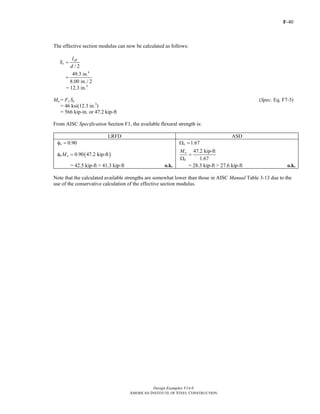
  • 691.
    III-6 Design Examples V14.0 AMERICANINSTITUTE OF STEEL CONSTRUCTION Snow Load from ASCE/SEI 7 Section 7.3 and 7.10 Snow = 20 psf Rain on Snow = 5 psf Total = 25 psf Note: In this design, the rain and snow load is greater than the roof live load The deck is 1½ in., wide rib, 22 gage, painted roof deck, placed in a pattern of three continuous spans minimum. The typical joist spacing is 6 ft on center. At 6 ft on center, this deck has an allowable total load capacity of 89 psf. The roof diaphragm and roof loads extend 6 in. past the centerline of grid as shown on Sheet S4.1. From Section 7.7 of ASCE/SEI 7, the following drift loads are calculated: Flat roof snow load = 20 psf, Density γ = 16.6 lbs/ft3 , hb = 1.20 ft Summary of Drifts Upwind Roof Proj. Max. Drift Max Drift Length (lu) Height Load Width (W) Side Parapet 121 ft 2 ft 13.2 psf 6.36 ft End Parapet 211 ft 2 ft 13.2 psf 6.36 ft Screen Wall 60.5 ft 6 ft 30.5 psf 7.35 ft The snow drift at the penthouse was calculated for the maximum effect, using the East-West wind and an upwind fetch from the parapet to the centerline of the columns at the penthouse. This same drift is conservatively used for wind in the North-South direction. The precise location of the drift will depend upon the details of the penthouse construction, but will not affect the final design in this case. SELECT ROOF JOISTS Layout loads and size joists. User Note: Joists may be specified using ASD or LRFD but are most commonly specified by ASD as shown here. The 45-ft side joist with the heaviest loads is shown below along with its end reactions and maximum moment: Because the load is not uniform, select a 24KCS4 joist from the Steel Joist Institute load tables (SJI, 2005). This joist has an allowable moment of 92.3 kip-ft, an allowable shear of 8.40 kips, a gross moment of inertia of 453 in.4 and weighs 16.6 plf. The first joist away from the end of the building is loaded with snow drift along the length of the member. Based on analysis, a 24KCS4 joist is also acceptable for this uniform load case. Return to Table of Contents
  • 692.
    III-7 Design Examples V14.0 AMERICANINSTITUTE OF STEEL CONSTRUCTION As an alternative to directly specifying the joist sizes on the design document, as done in this example, loading diagrams can be included on the design documents to allow the joist manufacturer to economically design the joists. The typical 30-ft joist in the middle bay will have a uniform load of w = (20 psf + 25 psf)(6 ft) = 270 plf wSL = (25 psf)(6 ft) = 150 plf From the Steel Joist Institute load tables, select an 18K5 joist which weighs approximately 7.7 plf and satisfies both strength and deflection requirements. Note: the first joist away from the screen wall and the first joist away from the end of the building carry snow drift. Based on analysis, an 18K7 joist will be used in these locations. Return to Table of Contents
  • 693.
    III-8 Design Examples V14.0 AMERICANINSTITUTE OF STEEL CONSTRUCTION SELECT ROOF BEAMS Calculate loads and select beams in the mechanical area. For the beams in the mechanical area, the mechanical units could weigh as much as 60 psf. Use 40 psf additional dead load, which will account for the mechanical units and the screen wall around the mechanical area. Use 15 psf additional snow load, which will account for any snow drift which could occur in the mechanical area. The beams in the mechanical area are spaced at 6 ft on center. Per AISC Design Guide 3 (West et al., 2003), calculate the minimum Ix to limit deflection to l/360 = 1.00 in. because a plaster ceiling will be used in the lobby area. Use 40 psf as an estimate of the snow load, including some drifting that could occur in this area, for deflection calculations. Note: The beams and supporting girders in this area should be rechecked when the final weights and locations for the mechanical units have been determined. Ireq (Live Load) = ( ) ( ) 4 0.240 kip/ft 30.0 ft 1,290 1.00 in. = 151 in.4 Calculate the required strengths from Chapter 2 of ASCE/SEI 7 and select the beams in the mechanical area. LRFD ASD wu = 6.00 ft[1.2 (0.020 kip/ft2 + 0.040 kip/ft2 ) +1.6(0.025 kip/ft2 + 0.015 kip/ft2 )] = 0.816 kip/ft Ru = ( ) 30.0 ft 0.816 kip/ft 2 = 12.2 kips Mu = ( ) 2 0.816 kip/ft 30.0 ft 8 = 91.8 kip-ft Assuming the beam has full lateral support, use Manual Table 3-2, select an ASTM A992 W14×22, which has a design flexural strength of 125 kip-ft, a design shear strength of 94.5 kips, and an Ix of 199 in.4 wa = 6.00 ft[0.020 kip/ft2 + 0.040 kip/ft2 + 0.025 kip/ft2 + 0.015 kip/ft2 ] = 0.600 kip/ft Ra = ( ) 30.0 ft 0.600 kip/ft 2 = 9.00 kips Ma = ( ) 2 0.600 kip/ft 30.0 ft 8 = 67.5 kip-ft Assuming the beam has full lateral support, use Manual Table 3-2, select an ASTM A992 W14×22, which has an allowable flexural strength of 82.8 kip- ft, an allowable shear strength of 63.0 kips and an Ix of 199 in.4 Return to Table of Contents
  • 694.
    III-9 Design Examples V14.0 AMERICANINSTITUTE OF STEEL CONSTRUCTION SELECT ROOF BEAMS AT THE END (EAST & WEST) OF THE BUILDING The beams at the ends of the building carry the brick spandrel panel and a small portion of roof load. For these beams, the cladding weight exceeds 25% of the total dead load on the beam. Therefore, per AISC Design Guide 3, limit the vertical deflection due to cladding and initial dead load to L/600 or a in. maximum. In addition, because these beams are supporting brick above and there is continuous glass below, limit the superimposed dead and live load deflection to L/600 or 0.3 in. max to accommodate the brick and L/360 or 4 in. max to accommodate the glass. Therefore, combining the two limitations, limit the superimposed dead and live load deflection to L/600 or 4 in. The superimposed dead load includes all of the dead load that is applied after the cladding has been installed. In calculating the wall loads, the spandrel panel weight is taken as 55 psf. The spandrel panel weight is approximately: wD = 7.50 ft(0.055 kip/ft2 ) = 0.413 kip/ft The dead load from the roof is equal to: wD = 3.50 ft(0.020 kip/ft2 ) = 0.070 kip/ft Use 8 psf for the initial dead load. wD(initial) = 3.50 ft(0.008 kip/ft2 ) = 0.0280 kip/ft Use 12 psf for the superimposed dead load. wD(super) = 3.50 ft(0.012 kip/ft2 ) = 0.0420 kip/ft The snow load from the roof can be conservatively taken as: wS = 3.50 ft(0.025 kip/ft2 + 0.0132 kip/ft2 ) = 0.134 kip/ft to account for the maximum snow drift as a uniform load. Assume the beams are simple spans of 22.5 ft. Calculate minimum Ix to limit the superimposed dead and live load deflection to ¼ in. Ireq = ( ) ( ) 4 0.176 kip/ft 22.5 ft 1,290 in.4 =140 in.4 Calculate minimum Ix to limit the cladding and initial dead load deflection to a in. Ireq = ( ) ( ) 4 0.441 kip/ft 22.5 ft 1,290 in.a = 234 in.4 The beams are full supported by the deck as shown in Detail 4 on Sheet S4.1. The loading diagram is as follows: Return to Table of Contents
  • 695.
    III-10 Design Examples V14.0 AMERICANINSTITUTE OF STEEL CONSTRUCTION Calculate the required strengths from Chapter 2 of ASCE/SEI 7 and select the beams for the roof ends. LRFD ASD wu =1.2(0.070 kip/ft + 0.413 kip/ft) + 1.6(0.134 kip/ft) = 0.794 kip/ft Ru = ( ) 22.5 ft 0.794 kip/ft 2 = 8.93 kips Mu = ( ) 2 0.794 kip/ft 22.5 ft 8 = 50.2 kip-ft Assuming the beam has full lateral support, use Manual Table 3-2, select an ASTM A992 W16×26, which has a design flexural strength of 166 kip-ft, a design shear strength of 106 kips, and an Ix of 301 in.4 wa = (0.070 kip/ft + 0.413 kip/ft) + 0.134 kip/ft = 0.617 kip/ft Ra = ( ) 22.5 ft 0.617 kip/ft 2 = 6.94 kips Ma = ( ) 2 0.617 kip/ft 22.5 ft 8 = 39.0 kip-ft Assuming the beam has full lateral support, use Manual Table 3-2, select an ASTM A992 W16×26, which has an allowable flexural strength of 110 kip- ft, an allowable shear strength of 70.5 kips, and an Ix of 301 in.4 Return to Table of Contents
  • 696.
    III-11 Design Examples V14.0 AMERICANINSTITUTE OF STEEL CONSTRUCTION SELECT ROOF BEAMS ALONG THE SIDE (NORTH & SOUTH) OF THE BUILDING The beams along the side of the building carry the spandrel panel and a substantial roof dead load and live load. For these beams, the cladding weight exceeds 25% of the total dead load on the beam. Therefore, per AISC Design Guide 3, limit the vertical deflection due to cladding and initial dead load to L/600 or a in. maximum. In addition, because these beams are supporting brick above and there is continuous glass below, limit the superimposed dead and live load deflection to L/600 or 0.3 in. max to accommodate the brick and L/360 or 4 in. max to accommodate the glass. Therefore, combining the two limitations, limit the superimposed dead and live load deflection to L/600 or 4 in. The superimposed dead load includes all of the dead load that is applied after the cladding has been installed. These beams will be part of the moment frames on the side of the building and therefore will be designed as fixed at both ends. The roof dead load and snow load on this edge beam is equal to the joist end dead load and snow load reaction. Treating this as a uniform load, divide this by the joist spacing. wD = 2.76 kips/6.00 ft = 0.460 kip/ft wS = 3.73 kips/6.00 ft = 0.622 kip/ft wD(initial) = 23.0 ft (0.008 kip/ft2 ) = 0.184 kip/ft wD(super) = 23.0 ft (0.012 kip/ft2 ) = 0.276 kip/ft Calculate the minimum Ix to limit the superimposed dead and live load deflection to 4 in. Ireq = ( )( ) ( ) 4 0.898 kip/ft 30.0 ft 6,440 in.4 = 452 in.4 Calculate the minimum Ix to limit the cladding and initial dead load deflection to a in. Ireq = ( )( ) ( ) 4 0.597 kip/ft 30.0 ft 6,440 in.a = 200 in.4 Return to Table of Contents
  • 697.
    III-12 Design Examples V14.0 AMERICANINSTITUTE OF STEEL CONSTRUCTION Calculate the required strengths from Chapter 2 of ASCE/SEI 7 and select the beams for the roof sides. LRFD ASD wu = 1.2(0.460 kip/ft + 0.413 kip/ft) +1.6(0.622 kip/ft) = 2.04 kip/ft Ru = ( ) 30.0 ft 2.04 kip/ft 2 = 30.6 kips Calculate Cb for compression in the bottom flange braced at the midpoint and supports using AISC Specification Equation F1-1. MuMax = ( ) 2 2.04kip/ft 30.0 ft 12 = 153 kip-ft at supports Mu = ( ) 2 2.04 kip/ft 30.0 ft 24 = 76.5 kip-ft at midpoint From AISC Manual Table 3-23, ( )( ) ( ) ( ) 2 2 6 30.0 ft 3.75 ft2.04 kip/ft 12 30.0 ft 6 3.75 ft 52.6 kip-ft uAM ⎛ ⎞ ⎜ ⎟= ⎜ ⎟− −⎝ ⎠ = at quarter point of unbraced segment ( )( ) ( ) ( ) 2 2 6 30.0 ft 7.50 ft2.04 kip/ft 12 30.0 ft 6 7.50 ft uBM ⎛ ⎞ ⎜ ⎟= ⎜ ⎟− −⎝ ⎠ = 19.1 kip-ft at midpoint of unbraced segment ( )( ) ( ) ( ) 2 2 6 30.0 ft 11.3 ft2.04kip/ft 12 30.0 ft 6 11.3 ft uCM ⎛ ⎞ ⎜ ⎟= ⎜ ⎟− −⎝ ⎠ = 62.5 kip-ft at three quarter point of unbraced segment wa = (0.460 kip/ft + 0.413 kip/ft) + 0.622 kip/ft = 1.50 kip/ft Ra = ( ) 30.0 ft 1.50 kip/ft 2 = 22.5 kips Calculate Cb for compression in the bottom flange braced at the midpoint and supports using AISC Specification Equation F1-1. MaMax = ( ) 2 1.50kip/ft 30.0 ft 12 = 113 kip-ft at supports Ma ( ) 2 1.50 kip/ft 30.0 ft 24 = = 56.3 kip-ft at midpoint From AISC Manual Table 3-23, ( )( ) ( ) ( ) 2 2 6 30.0 ft 3.75 ft1.50 kip/ft 12 30.0 ft 6 3.75 ft 38.7 kip-ft aAM ⎛ ⎞ ⎜ ⎟= ⎜ ⎟− −⎝ ⎠ = at quarter point of unbraced segment ( )( ) ( ) ( ) 2 2 6 30.0 ft 7.50 ft1.50 kip/ft 12 30.0 ft 6 7.50 ft aBM ⎛ ⎞ ⎜ ⎟= ⎜ ⎟− −⎝ ⎠ = 14.1 kip-ft at midpoint of unbraced segment ( )( ) ( ) ( ) 2 2 6 30.0 ft 11.3 ft1.50kip/ft 12 30.0 ft 6 11.3 ft aCM ⎛ ⎞ ⎜ ⎟= ⎜ ⎟− −⎝ ⎠ = 46.0 kip-ft at three quarter point of unbraced segment Return to Table of Contents
  • 698.
    III-13 Design Examples V14.0 AMERICANINSTITUTE OF STEEL CONSTRUCTION LRFD ASD Using AISC Specification Equation F1-1, 12.5 2.5 3 4 3 max b max A B C M C M M M M = + + + ( ) ( ) ( ) ( ) ( ) 12.5 153 kip-ft 2.5 153 kip-ft 3 52.6 kip-ft 4 19.1 kip-ft 3 62.5 kip-ft = +⎡ ⎤ ⎢ ⎥ + +⎢ ⎥⎣ ⎦ = 2.38 From AISC Manual Table 3-10, select W18×35. For Lb = 6 ft and Cb = 1.0 φbMn = 229 kip-ft > 76.5 kip-ft o.k. For Lb = 15 ft and Cb = 2.38, φbMn = (109 kip-ft)2.38 = 259 kip-ft ≤ φbMp φbMp = 249 kip-ft > 153 kip-ft o.k. From AISC Manual Table 3-2, a W18×35 has a design shear strength of 159 kips and an Ix of 510 in.4 o.k. Using AISC Specification Equation F1-1, 12.5 2.5 3 4 3 max b max A B C M C M M M M = + + + ( ) ( ) ( ) ( ) ( ) 12.5 113 kip-ft 2.5 113 kip-ft 3 38.7 kip-ft 4 14.1 kip-ft 3 46.0 kip-ft = +⎡ ⎤ ⎢ ⎥ + +⎢ ⎥⎣ ⎦ = 2.38 From AISC Manual Table 3-10, select W18×35. For Lb = 6 ft and Cb = 1.0 Mn / Ω b = 152 kip-ft > 56.3 kip-ft o.k. For Lb = 15 ft and Cb = 2.38, Mn / Ω b = (72.7 kip-ft)2.38 = 173 kip-ft ≤ Mp / Ωb Ωb / Mp = 166 kip-ft > 113 kip-ft o.k. From AISC Manual Table 3-2, a W18×35 has an allowable shear strength of 106 kips and an Ix of 510 in.4 o.k. Note: This roof beam may need to be upsized during the lateral load analysis to increase the stiffness and strength of the member and improve lateral frame drift performance. Return to Table of Contents
  • 699.
    III-14 Design Examples V14.0 AMERICANINSTITUTE OF STEEL CONSTRUCTION SELECT THE ROOF BEAMS ALONG THE INTERIOR LINES OF THE BUILDING There are three individual beam loadings that occur along grids C and D. The beams from 1 to 2 and 7 to 8 have a uniform snow load except for the snow drift at the end at the parapet. The snow drift from the far ends of the 45-ft joists is negligible. The beams from 2 to 3 and 6 to 7 are the same as the first group, except they have snow drift at the screen wall. The loading diagrams are shown below. A summary of the moments, left and right reactions, and required Ix to keep the live load deflection to equal or less than the span divided by 240 (or 1.50 in.) is given below. Calculate required strengths from Chapter 2 of ASCE/SEI 7 and required moment of inertia. LRFD ASD Grids 1 to 2 and 7 to 8 (opposite hand) Ru (left) = 1.2(11.6 kips) + 1.6(16.0 kips) = 39.5 kips Ru (right) = 1.2(11.2 kips) + 1.6(14.2 kips) = 36.2 kips Mu = 1.2(84.3 kip-ft) + 1.6(107 kip-ft) = 272 kip-ft Grids 1 to 2 and 7 to 8 (opposite hand) Ra (left) = 11.6 kips + 16.0 kips = 27.6 kips Ra (right) = 11.2 kips + 14.2 kips = 25.4 kips Ma = 84.3 kip-ft + 107 kip-ft = 191 kip-ft Return to Table of Contents
  • 700.
    III-15 Design Examples V14.0 AMERICANINSTITUTE OF STEEL CONSTRUCTION LRFD ASD Ix req’d = ( )( ) ( ) 4 0.938 kip/ft 30.0 ft 1,290 1.50 in. = 393 in.4 From AISC Manual Table 3-10, for Lb = 6 ft and Cb = 1.0, select W21×44 which has a design flexural strength of 332 kip-ft, a design shear strength of 217 kips, and Ix = 843 in.4 Grids 2 to 3 and 6 to 7(opposite hand) Ru (left) = 1.2(11.3 kips) + 1.6(14.4 kips) = 36.6 kips Ru (right) = 1.2(11.3 kips) + 1.6(17.9) kips) = 42.2 kips Mu = 1.2(84.4 kip-ft) + 1.6(111 kip-ft) = 279 kip-ft Ix req’d = ( )( ) ( ) 4 0.938 kip/ft 30.0 ft 1,290 1.50 in. = 393 in.4 From AISC Manual Table 3-10, for Lb = 6 ft and Cb = 1.0, select W21×44 which has a design flexural strength of 332 kip-ft, a design shear strength of 217 kips and Ix = 843 in.4 Ix req’d = ( )( ) ( ) 4 0.938 kip/ft 30.0 ft 1,290 1.50 in. = 393 in.4 From AISC Manual Table 3-10, for Lb = 6 ft and Cb = 1.0, select W21×44 which has an allowable flexural strength of 221 kip-ft, an allowable shear strength of 145 kips, and Ix = 843 in.4 Grids 2 to 3 and 6 to 7(opposite hand) Ra (left) = 11.3 kips + 14.4 kips = 25.7 kips Ra (right) = 11.3 kips + 17.9 kips = 29.2 kips Ma = 84.4 kip-ft + 111 kip-ft = 195 kip-ft Ix req’d = ( )( ) ( ) 4 0.938 kip/ft 30.0 ft 1,290 1.50 in. = 393 in.4 From AISC Manual Table 3-10, for Lb = 6 ft and Cb = 1.0, select W21×44 which has an allowable flexural strength of 221 kip-ft, an allowable shear strength of 145 kips, and Ix = 843 in.4 The third individual beam loading occurs at the beams from 3 to 4, 4 to 5, and 5 to 6. This is the heaviest load. Return to Table of Contents
  • 701.
    III-16 Design Examples V14.0 AMERICANINSTITUTE OF STEEL CONSTRUCTION SELECT THE ROOF BEAMS ALONG THE SIDES OF THE MECHANICAL AREA The beams from 3 to 4, 4 to 5, and 5 to 6 have a uniform snow load outside the screen walled area, except for the snow drift at the parapet ends and the screen wall ends of the 45-ft joists. Inside the screen walled area the beams support the mechanical equipment. A summary of the moments, left and right reactions, and required Ix to keep the live load deflection to equal or less than the span divided by 240 (or 1.50 in.) is given below. LRFD ASD wu =1.2 (1.35 kip/ft) +1.6(1.27 kip/ft) = 3.65 kip/ft Mu = ( ) 2 3.65 kip/ft 30.0 ft 8 = 411 kip-ft Ru = ( ) 30.0 ft 3.65 kip/ft 2 = 54.8 kips Ix req’d = ( ) ( ) 4 1.27 kip/ft 30.0 ft 1,290 1.50 in. = 532 in.4 From AISC Manual Table 3-2, for Lb = 6 ft and Cb = 1.0, select W21×55, which has a design flexural strength of 473 kip-ft, a design shear strength of 234 kips, and an Ix of 1,140 in.4 wa = 1.35 kip/ft + 1.27 kip/ft2 = 2.62 kip/ft Ma = ( ) 2 2.62 kip/ft 30.0 ft 8 = 295 kip-ft Ra = ( ) 30.0 ft 2.62 kip/ft 2 = 39.3 kips Ix req’d = ( ) ( ) 4 1.27 kip/ft 30.0 ft 1,290 1.50 in. = 532 in.4 From AISC Manual Table 3-2, for Lb = 6 ft and Cb = 1.0, select W21×55, which has an allowable flexural strength of 314 kip-ft, an allowable shear strength of 156 kips, and an Ix of 1,140 in.4 Return to Table of Contents
  • 702.
    III-17 Design Examples V14.0 AMERICANINSTITUTE OF STEEL CONSTRUCTION FLOOR MEMBER DESIGN AND SELECTION Calculate dead load and live load. Dead Load Slab and Deck = 57 psf Beams (est.) = 8 psf Misc. ( ceiling, mechanical, etc.) = 10 psf Total = 75 psf Note: The weight of the floor slab and deck was obtained from the manufacturer’s literature. Live Load Total (can be reduced for area per ASCE/SEI 7) = 80 psf The floor and deck will be 3 in. of normal weight concrete, cf ′ = 4 ksi, on 3-in. 20 gage, galvanized, composite deck, laid in a pattern of three or more continuous spans. The total depth of the slab is 6 in. The Steel Deck Institute maximum unshored span for construction with this deck and a three-span condition is 10 ft 11 in. The general layout for the floor beams is 10 ft on center; therefore, the deck does not need to be shored during construction. At 10 ft on center, this deck has an allowable superimposed live load capacity of 143 psf. In addition, it can be shown that this deck can carry a 2,000 pound load over an area of 2.5 ft by 2.5 ft as required by Section 4.4 of ASCE/SEI 7. The floor diaphragm and the floor loads extend 6 in. past the centerline of grid as shown on Sheet S4.1. Return to Table of Contents
  • 703.
    III-18 Design Examples V14.0 AMERICANINSTITUTE OF STEEL CONSTRUCTION SELECT FLOOR BEAMS (composite and noncomposite) Note: There are two early and important checks in the design of composite beams. First, select a beam that either does not require camber, or establish a target camber and moment of inertia at the start of the design process. A reasonable approximation of the camber is between L/300 minimum and L/180 maximum (or a maximum of 12 to 2 in.). Second, check that the beam is strong enough to safely carry the wet concrete and a 20 psf construction live load (per ASCE 37-05), when designed by the ASCE/SEI 7 load combinations and the provisions of Chapter F of the AISC Specification. SELECT TYPICAL 45-FT INTERIOR COMPOSITE BEAM (10 FT ON CENTER) Find a target moment of inertia for an unshored beam. Hold deflection to around 2 in. maximum to facilitate concrete placement. wD = (0.057 kip/ft2 + 0.008 kip/ft2 )(10.0 ft) = 0.650 kip/ft I req ≈ ( ) ( ) 4 0.650 kip/ft 45.0 ft 1,290 2.00 in. = 1,030 in.4 Determine the required strength to carry wet concrete and construction live load. wDL = 0.065 kip/ft2 (10.0 ft) = 0.650 kip/ft wLL = 0.020 kip/ft2 (10.0 ft) = 0.200 kip/ft Determine the required flexural strength due to wet concrete only. LRFD ASD wu = 1.4(0.650 kip/ft) = 0.910 kip/ft Mu = ( ) 2 0.910 kip/ft 45.0 ft 8 = 230 kip-ft wa = 0.650 kip/ft Ma = ( ) 2 0.650 kip/ft 45.0 ft 8 = 165 kip-ft Determine the required flexural strength due to wet concrete and construction live load. LRFD ASD wu = 1.2(0.650 kip/ft) + 1.6(0.200 kip/ft) = 1.10 kip/ft Mu = ( ) 2 1.10 kip/ft 45.0 ft 8 = 278 kip-ft controls wa = 0.650 kip/ft + 0.200 kip/ft = 0.850 kip/ft Ma = ( ) 2 0.850 kip/ft 45.0 ft 8 = 215 kip-ft controls Use AISC Manual Table 3-2 to select a beam with Ix ≥ 1,030 in.4 . Select W21×50, which has Ix = 984 in.4 , close to our target value, and has available flexural strengths of 413 kip-ft (LRFD) and 274 kip-ft (ASD). Return to Table of Contents
  • 704.
    III-19 Design Examples V14.0 AMERICANINSTITUTE OF STEEL CONSTRUCTION Check for possible live load reduction due to area in accordance with Section 4.7.2 of ASCE/SEI 7. For interior beams, KLL = 2 The beams are at 10.0 ft on center, therefore the area ( )( )45.0 ft 10.0 ft 450TA = = ft2 . Since ( )2 2 450 ft 900LL TK A = = ft2 > 400 ft2 , a reduced live load can be used. From ASCE/SEI 7, Equation 4.7-1: 2 15 0.25 15 80.0 psf 0.25 900 ft 60.0 psf 0.50 40.0 psf o LL T o L L K A L ⎛ ⎞ = +⎜ ⎟⎜ ⎟ ⎝ ⎠ ⎛ ⎞ = +⎜ ⎟⎜ ⎟ ⎝ ⎠ = ≥ = Therefore, use 60.0 psf. The beam is continuously braced by the deck. The beams are at 10 ft on center, therefore the loading diagram is as shown below. Calculate the required flexural strength from Chapter 2 of ASCE/SEI 7. LRFD ASD wu = 1.2(0.750 kip/ft) + 1.6(0.600 kip/ft) = 1.86 kip/ft Mu = ( ) 2 1.86 kip/ft 45.0 ft 8 = 471 kip-ft wa = 0.750 kip/ft + 0.600 kip/ft = 1.35 kip/ft Ma = ( ) 2 1.35 kip/ft 45.0 ft 8 = 342 kip-ft Assume initially a = 1.00 in. Y2 = Ycon – a / 2 = 6.00 in. – 1.00 in. / 2 = 5.50 in. Use AISC Manual Table 3-19 to check W21×50 selected above. Using required strengths of 471 kip-ft (LRFD) or 342 kip-ft (ASD) and a Y2 value of 5.50 in. Return to Table of Contents
  • 705.
    III-20 Design Examples V14.0 AMERICANINSTITUTE OF STEEL CONSTRUCTION LRFD ASD Select W21×50 beam, where PNA = Location 7 and Σ nQ = 184 kips φbMn = 598 kip-ft > 471 kip-ft o.k. Select W21×50 beam, where PNA = Location 7 and Σ nQ = 184 kips Mp / Ωn = 398 kip-ft > 342 kip-ft o.k. Determine the effective width, beff. Per Specification AISC Section I3.1a, the effective width of the concrete slab is the sum of the effective widths for each side of the beam centerline, which shall not exceed: (1) one-eighth of the span of the beam, center-to-center of supports ( ) 45.0 ft 2 sides 8 = 11.3 ft (2) one-half the distance to the centerline of the adjacent beam ( ) 10.0 ft 2 sides 2 = 10.0 ft controls (3) the distance to the edge of the slab Not applicable Determine the height of the compression block, a. 0.85 ∑ = ′ n c Q a f b (Manual Eq. 3-7) = ( )( )( ) 184 kips 0.85 4 ksi 10.0 ft 12 in./ft = 0.451 in. < 1.00 in. o.k. Check the W21×50 end shear strength. LRFD ASD Ru = ( ) 45.0 ft 1.86 kip/ft 2 = 41.9 kips From AISC Manual Table 3-2, φvVn = 237 kips > 41.9 kips o.k. Ra = ( ) 45.0 ft 1.35 kip/ft 2 = 30.4 kips From AISC Manual Table 3-2, Vn / Ωv = 158 kips > 30.4 kips o.k. Check live load deflection. 360LL lΔ = = (45.0 ft)(12 in./ft)/360 = 1.50 in. For a W21×50, from AISC Manual Table 3-20, Y2 = 5.50 in. Return to Table of Contents
  • 706.
    III-21 Design Examples V14.0 AMERICANINSTITUTE OF STEEL CONSTRUCTION PNA Location 7 ILB = 1,730 in.4 4 1,290 LL LL LB w l I Δ = = ( ) ( ) 4 4 0.600 kip/ft 45.0 ft 1,290 1,730 in. = 1.10 in. < 1.50 in. o.k. Based on AISC Design Guide 3 (West, Fisher and Griffis, 2003) limit the live load deflection, using 50% of the (unreduced) design live load, to L / 360 with a maximum absolute value of 1.0 in. across the bay. ΔLL = ( ) ( ) 4 4 0.400 kip/ft 45.0 ft 1,290 1,730 in. = 0.735 in. < 1.00 in. o.k. 1.00 in. – 0.735 in. = 0.265 in. Note: Limit the supporting girders to 0.265 in. deflection under the same load case at the connection point of the beam. Determine the required number of shear stud connectors. From AISC Manual Table 3-21, using perpendicular deck with one w-in.-diameter stud per rib in normal weight, 4 ksi concrete, in weak position; Qn = 17.2 kips/stud. n n Q Q ∑ = 184 kips 17.2 kips/stud = 10.7 studs / side Therefore use 22 studs. Based on AISC Design Guide 3, limit the wet concrete deflection in a bay to L / 360, not to exceed 1.00 in. Camber the beam for 80% of the calculated wet deflection. ( ) ( ) 4 ( ) 4 0.650 kip/ft 45.0 ft 1,290 984 in. 2.10 in. DL wet concΔ = = Camber = 0.80(2.10 in.) = 1.68 in. Round the calculated value down to the nearest 4 in; therefore, specify 1.50 in. of camber. 2.10 in. – 1.50 in. = 0.600 in. 1.00 in. – 0.600 in. = 0.400 in. Note: Limit the supporting girders to 0.400 in. deflection under the same load combination at the connection point of the beam. Return to Table of Contents
  • 707.
    III-22 Design Examples V14.0 AMERICANINSTITUTE OF STEEL CONSTRUCTION SELECT TYPICAL 30-FT INTERIOR COMPOSITE (OR NONCOMPOSITE) BEAM (10 FT ON CENTER) Find a target moment of inertia for an unshored beam. Hold deflection to around 1.50 in. maximum to facilitate concrete placement. I req ≈ ( ) ( ) 4 0.650 kip/ft 30.0 ft 1,290 1.50 in. = 272 in.4 Determine the required strength to carry wet concrete and construction live load. wDL = 0.065 kip/ft2 (10.0 ft) = 0.650 kip/ft wLL = 0.020 kip/ft2 (10.0 ft) = 0.200 kip/ft Determine the required flexural strength due to wet concrete only. LRFD ASD wu = 1.4(0.650 kip/ft) = 0.910 kip/ft Mu = ( ) 2 0.910 kip/ft 30.0 ft 8 = 102 kip-ft wa = 0.650 kip/ft Ma = ( ) 2 0.650 kip/ft 30.0 ft 8 = 73.1 kip-ft Determine the required flexural strength due to wet concrete and construction live load. LRFD ASD wu = 1.2(0.650 kip/ft) + 1.6(0.200 kip/ft) = 1.10 kip/ft Mu = ( ) 2 1.10 kip/ft 30.0 ft 8 = 124 kip-ft controls wa = 0.650 kip/ft + 0.200 kip/ft = 0.850 kip/ft Ma = ( ) 2 0.850 kip/ft 30.0 ft 8 = 95.6 kip-ft controls Use AISC Manual Table 3-2 to find a beam with an Ix ≥ 272 in.4 Select W16×26, which has an Ix = 301 in.4 which exceeds our target value, and has available flexural strengths of 166 kip-ft (LRFD) and 110 kip-ft (ASD). Check for possible live load reduction due to area in accordance with Section 4.7.2 of ASCE/SEI 7. For interior beams, KLL = 2. The beams are at 10 ft on center, therefore the area AT = 30.0 ft × 10.0 ft = 300 ft2 . Since KLLAT = 2(300 ft2 ) = 600 ft2 > 400 ft2 , a reduced live load can be used. From ASCE/SEI 7, Equation 4.7-1: Return to Table of Contents
  • 708.
    III-23 Design Examples V14.0 AMERICANINSTITUTE OF STEEL CONSTRUCTION L = 15 0.25o LL T L K A ⎛ ⎞ +⎜ ⎟⎜ ⎟ ⎝ ⎠ = 2 15 80.0 psf 0.25 600 ft ⎛ ⎞ +⎜ ⎟⎜ ⎟ ⎝ ⎠ = 69.0 psf ≥ 0.50 Lo = 40.0 psf Therefore, use 69.0 psf. The beams are at 10 ft on center, therefore the loading diagram is as shown below. From Chapter 2 of ASCE/SEI 7, calculate the required strength. LRFD ASD wu = 1.2(0.750 kip/ft) + 1.6 (0.690 kip/ft) = 2.00 kip/ft Mu = ( ) 2 2.00 kip/ft 30.0 ft 8 = 225 kip-ft wa = 0.750 kip/ft + 0.690 kip/ft = 1.44 kip/ft Ma = ( ) 2 1.44 kip/ft 30.0 ft 8 = 162 kip-ft Assume initially a = 1.00 1.00 in. 2 6.00 in. 2 5.50 in. Y = − = Use AISC Manual Table 3-19 to check the W16×26 selected above. Using required strengths of 225 kip-ft (LRFD) or 162 kip-ft (ASD) and a Y2 value of 5.50 in. LRFD ASD Select W16×26 beam, where PNA Location 7 and nQ∑ = 96.0 kips φbMn = 248 kip-ft > 225 kip-ft o.k. Select W16×26 beam, where PNA Location 7 and nQ∑ = 96.0 kips Mn / Ωn = 165 kip-ft > 162 kip-ft o.k. Determine the effective width, beff. From AISC Specification Section I3.1a, the effective width of the concrete slab is the sum of the effective widths for each side of the beam centerline, which shall not exceed: (1) one-eighth of the span of the beam, center-to-center of supports Return to Table of Contents
  • 709.
    III-24 Design Examples V14.0 AMERICANINSTITUTE OF STEEL CONSTRUCTION ( ) 30.0 ft 2 sides 8 = 7.50 ft controls (2) one-half the distance to the centerline of the adjacent beam ( ) 10.0 ft 2 sides 2 = 10.0 ft (3) the distance to the edge of the slab Not applicable Determine the height of the compression block, a. 0.85 n c Q a f b ∑ = ′ (Manual Eq. 3-7) = ( )( )( ) 96.0 kips 0.85 4 ksi 7.50 ft 12 in./ft = 0.314 in. < 1.00 in. o.k. Check the W16×26 end shear strength. LRFD ASD Ru = ( ) 30.0 ft 2.00 kip/ft 2 = 30.0 kips From AISC Manual Table 3-2, φvVn = 106 kips > 30.0 kips o.k. Ra = ( ) 30.0 ft 1.44 kip/ft 2 = 21.6 kips From AISC Manual Table 3-2, Vn / Ωv = 70.5 kips > 21.6 kips o.k. Check live load deflection. 360LL lΔ = = (30.0 ft)(12 in./ft)/360 = 1.00 in. For a W16×26, from AISC Manual Table 3-20, Y2 = 5.50 in. PNA Location 7 ILB = 575 in.4 4 1,290 LL LL LB w l I Δ = = ( ) ( ) 4 4 0.690 kip/ft 30.0 ft 1,290 575 in. = 0.753 in. < 1.00 in. o.k. Return to Table of Contents
  • 710.
    III-25 Design Examples V14.0 AMERICANINSTITUTE OF STEEL CONSTRUCTION Based on AISC Design Guide 3, limit the live load deflection, using 50% of the (unreduced) design live load, to L/360 with a maximum absolute value of 1.0 in. across the bay. ΔLL = ( ) ( ) 4 4 0.400 kip/ft 30.0 ft 1,290 575 in. = 0.437 in. < 1.00 in. o.k. 1.00 in. – 0.437 in. = 0.563 in. Note: Limit the supporting girders to 0.563 in. deflection under the same load combination at the connection point of the beam. Determine the required number of shear stud connectors. From AISC Manual Table 3-21, using perpendicular deck with one w-in.-diameter stud per rib in normal weight, 4 ksi concrete, in the weak position; Qn = 17.2 kips/stud n n Q Q ∑ = 96.0 kips 17.2 kips/stud = 5.58 studs/side Use 12 studs Note: Per AISC Specification Section I8.2d, there is a maximum spacing limit of 8(6 in.) = 4 ft not to exceed 36 in. between studs. Therefore use 12 studs, uniformly spaced at no more than 36 in. on center. Note: Although the studs may be placed up to 36 in. o.c. the steel deck must still be anchored to the supporting member at a spacing not to exceed 18 in. per AISC Specification Section I3.2c. Based on AISC Design Guide 3, limit the wet concrete deflection in a bay to L/360, not to exceed 1.00 in. Camber the beam for 80% of the calculated wet dead load deflection. ( ) ( ) 4 ( ) 4 0.650 kip/ft 30.0 ft 1,290 301 in. 1.36 in. DL wet concΔ = = Camber = 0.800(1.36 in.) = 1.09 in. Round the calculated value down to the nearest 4 in. Therefore, specify 1.00 in. of camber. 1.36 in. – 1.00 in. = 0.360 in. 1.00 in. – 0.360 in. = 0.640 in. Note: Limit the supporting girders to 0.640 in. deflection under the same load combination at the connection point of the beam. This beam could also be designed as a noncomposite beam. Use AISC Manual Table 3-2 with previous moments and shears: Return to Table of Contents
  • 711.
    III-26 Design Examples V14.0 AMERICANINSTITUTE OF STEEL CONSTRUCTION LRFD ASD Select W18×35 From AISC Manual Table 3-2, φbMn = φbMp = 249 kip-ft > 225 kip-ft o.k. φvVn = 159 > 30.0 kips o.k. Select W18×35 From AISC Manual Table 3-2, Mn/Ωb = Mp/Ωb = 166 kip-ft > 162 kip-ft o.k. Vn / Ωv = 106 kips > 21.6 kips o.k. Check beam deflections. Check live load deflection of the W18×35 with an Ix = 510 in.4 , from AISC Manual Table 3-2. ( ) ( ) 4 4 0.690 kip/ft 30.0 ft 1,290 510 in. 0.850 in. < 1.00 in. LLΔ = = o.k. Based on AISC Design Guide 3, limit the live load deflection, using 50% of the (unreduced) design live load, to L/360 with a maximum absolute value of 1.0 in. across the bay. ( ) ( ) 4 4 0.400 kip/ft 30.0 ft 1,290 510 in. LLΔ = = 0.492 in. < 1.00 in. o.k. 1.00 in. – 0.492 in. = 0.508 in. Note: Limit the supporting girders to 0.508 in. deflection under the same load combination at the connection point of the beam. Note: Because this beam is stronger than the W16×26 composite beam, no wet concrete strength checks are required in this example. Based on AISC Design Guide 3, limit the wet concrete deflection in a bay to L/360, not to exceed 1.00 in. Camber the beam for 80% of the calculated wet deflection. ( ) ( ) 4 ( ) 4 0.650 kip/ft 30.0 ft 1,290 510 in. 0.800 in. 1.50 in. DL wet concΔ = = < o.k. Camber = 0.800(0.800 in.) = 0.640 in. < 0.750 in. A good break point to eliminate camber is w in.; therefore, do not specify a camber for this beam. 1.00 in. – 0.800 in. = 0.200 in. Note: Limit the supporting girders to 0.200 in. deflection under the same load case at the connection point of the beam. Return to Table of Contents
  • 712.
    III-27 Design Examples V14.0 AMERICANINSTITUTE OF STEEL CONSTRUCTION Therefore, selecting a W18×35 will eliminate both shear studs and cambering. The cost of the extra steel weight may be offset by the elimination of studs and cambering. Local labor and material costs should be checked to make this determination. Return to Table of Contents
  • 713.
    III-28 Design Examples V14.0 AMERICANINSTITUTE OF STEEL CONSTRUCTION SELECT TYPICAL NORTH-SOUTH EDGE BEAM The influence area (KLLAT) for these beams is less than 400 ft2 , therefore no live load reduction can be taken. These beams carry 5.50 ft of dead load and live load as well as a wall load. The floor dead load is: w = 5.50 ft(0.075 kips/ft2 ) = 0.413 kip/ft Use 65 psf for the initial dead load. wD(initial) = 5.50 ft(0.065 kips/ft2 ) = 0.358 kips/ft Use 10 psf for the superimposed dead load. wD(super) = 5.50 ft(0.010 kips/ft2 ) = 0.055 kips/ft The dead load of the wall system at the floor is: w = ( ) ( )2 2 7.50ft 0.055 kip / ft 6.00 ft 0.015 kip / ft+ = 0.413 kip/ft + 0.090 kip/ft = 0.503 kip/ft The total dead load is wDL = 0.413 kip/ft + 0.503 kip/ft = 0.916 kip/ft The live load is wLL = 5.5 ft(0.080 kip/ft2 ) = 0.440 kip/ft The loading diagram is as follows. Calculate the required strengths from Chapter 2 of ASCE/SEI 7. LRFD ASD wu = 1.2(0.916 kip/ft) + 1.6 (0.440 kip/ft) = 1.80 kip/ft Mu = ( ) 2 1.80 kip/ft 22.5 ft 8 wa = 0.916 kip/ft + 0.440 kip/ft = 1.36 kip/ft Ma = ( ) 2 1.36 kip/ft 22.5 ft 8 Return to Table of Contents
  • 714.
    III-29 Design Examples V14.0 AMERICANINSTITUTE OF STEEL CONSTRUCTION = 114 kip-ft Ru = ( ) 22.5 ft 1.80 kip/ft 2 = 20.3 kips = 86.1 kip-ft Ra = ( ) 22.5 ft 1.36 kip/ft 2 = 15.3 kips Because these beams are less than 25 ft long, they will be most efficient as noncomposite beams. The beams at the edges of the building carry a brick spandrel panel. For these beams, the cladding weight exceeds 25% of the total dead load on the beam. Therefore, per AISC Design Guide 3, limit the vertical deflection due to cladding and initial dead load to L/600 or a in. maximum. In addition, because these beams are supporting brick above and there is continuous glass below, limit the superimposed dead and live load deflection to L/600 or 0.3 in. max to accommodate the brick and L/360 or 0.25 in. max to accommodate the glass. Therefore, combining the two limitations, limit the superimposed dead and live load deflection to L/600 or 0.25 in. The superimposed dead load includes all of the dead load that is applied after the cladding has been installed. Note that it is typically not recommended to camber beams supporting spandrel panels. Calculate minimum Ix to limit the superimposed dead and live load deflection to 4 in. Ireq = ( ) ( ) 4 0.495 kip/ft 22.5 ft 1,290 in.4 = 393 in.4 controls Calculate minimum Ix to limit the cladding and initial dead load deflection to a in. Ireq = ( ) ( ) 4 0.861 kip/ft 22.5 ft 1,290 in.a = 456 in.4 Select beam from AISC Manual Table 3-2. LRFD ASD Select W18×35 with Ix = 510 in.4 φbMn = φbMp = 249 kip-ft > 114 kip-ft o.k. φvVn = 159 > 20.3 kips o.k. Select W18×35 with Ix = 510 in.4 Mn / Ωb = Mp / Ωb = 166 kip-ft > 86.1 kip-ft o.k. Vn / Ωv = 106 kips > 15.3 kips o.k. Return to Table of Contents
  • 715.
    III-30 Design Examples V14.0 AMERICANINSTITUTE OF STEEL CONSTRUCTION SELECT TYPICAL EAST-WEST SIDE GIRDER The beams along the sides of the building carry the spandrel panel and glass, and dead load and live load from the intermediate floor beams. For these beams, the cladding weight exceeds 25% of the total dead load on the beam. Therefore, per AISC Design Guide 3, limit the vertical deflection due to cladding and initial dead load to L/600 or a in. maximum. In addition, because these beams are supporting brick above and there is continuous glass below, limit the superimposed dead and live load deflection to L/600 or 0.3 in. max to accommodate the brick and L/360 or 0.25 in. max to accommodate the glass. Therefore, combining the two limitations, limit the superimposed dead and live load deflection to L/600 or 0.25 in. The superimposed dead load includes all of the dead load that is applied after the cladding has been installed. These beams will be part of the moment frames on the North and South sides of the building and therefore will be designed as fixed at both ends. Establish the loading. The dead load reaction from the floor beams is: PD = 0.750 kip/ft(45.0 ft / 2) = 16.9 kips PD(initial) = 0.650 kip/ft(45.0 ft / 2) = 14.6 kips PD(super) = 0.100 kip/ft(45.0 ft / 2) = 2.25 kips The uniform dead load along the beam is: wD = 0.500 ft(0.075 kip/ft2 ) + 0.503 kip/ft = 0.541 kip/ft wD(initial) = 0.500 ft(0.065 kip/ft2 ) = 0.033 kip/ft wD(super) = 0.500 ft(0.010 kip/ft2 ) = 0.005 kip/ft Select typical 30-ft composite (or noncomposite) girders. Check for possible live load reduction in accordance with Section 4.7.2 of ASCE/SEI 7. For edge beams with cantilevered slabs, KLL = 1, per ASCE/SEI 7, Table 4-2. However, it is also permissible to calculate the value of KLL based upon influence area. Because the cantilever dimension is small, KLL will be closer to 2 than 1. The calculated value of KLL based upon the influence area is KLL ( )( ) ( ) 45.5 ft 30.0 ft 45.0 ft 0.500 ft 30.0 ft 2 = ⎛ ⎞ +⎜ ⎟ ⎝ ⎠ = 1.98 The area AT = (30.0 ft)(22.5 ft + 0.500 ft) = 690 ft2 Using Equation 4.7-1 of ASCE/SEI 7 Return to Table of Contents
  • 716.
    III-31 Design Examples V14.0 AMERICANINSTITUTE OF STEEL CONSTRUCTION ( )( )2 15 0.25 15 80.0 psf 0.25 1.98 690 ft 52.5 psf 0.50 40.0 psf o LL T o L L K A L ⎛ ⎞ = +⎜ ⎟⎜ ⎟ ⎝ ⎠ ⎛ ⎞ ⎜ ⎟= + ⎜ ⎟⎜ ⎟ ⎝ ⎠ = ≥ = Therefore, use 52.5 psf. The live load from the floor beams is PLL = 0.525 kip/ft(45.0 ft / 2) = 11.8 kips The uniform live load along the beam is wLL = 0.500 ft(0.0525 kip/ft2 ) = 0.026 kip/ft The loading diagram is shown below. A summary of the moments, reactions and required moments of inertia, determined from a structural analysis of a fixed-end beam, is as follows: Calculate the required strengths and select the beams for the floor side beams. LRFD ASD Typical side beam Ru = 49.5 kips Mu at ends =313 kip-ft Mu at ctr. =156 kip-ft Typical side beam Ra = 37.2 kips Ma at ends = 234 kip-ft Ma at ctr. = 117 kip-ft The maximum moment occurs at the support with compression in the bottom flange. The bottom laterally braced at 10 ft o.c. by the intermediate beams. Note: During concrete placement, because the deck is parallel to the beam, the beam will not have continuous lateral support. It will be braced at 10 ft o.c. by the intermediate beams. By inspection, this condition will not control because the maximum moment under full loading causes compression in the bottom flange, which is braced at 10 ft o.c. LRFD ASD Calculate Cb = for compression in the bottom flange braced at 10 ft o.c. Calculate Cb = for compression in the bottom flange braced at 10 ft o.c. Return to Table of Contents
  • 717.
    III-32 Design Examples V14.0 AMERICANINSTITUTE OF STEEL CONSTRUCTION LRFD ASD Cb = 2.21 (from computer output) Select W21×44 With continuous bracing, from AISC Manual Table 3-2, φbMn = φbMp = 358 kip-ft > 156 kip-ft o.k. For Lb = 10 ft and Cb = 2.21, from AISC Manual Table 3-10, ( )( )265 kip-ft 2.21 586 kip-ft nMφ = = According to AISC Specification Section F2.2, the nominal flexural strength is limited Mp, therefore φbMn = φbMp = 358 kip-ft. 358 kip-ft > 313 kip-ft o.k. From AISC Manual Table 3-2, a W21×44 has a design shear strength of 217 kips. From Table 1-1, Ix = 843 in.4 Check deflection due to cladding and initial dead load. 0.295 in. in.Δ = < a o.k. Check deflection due to superimposed dead and live loads. 0.212 in. 0.250 in.Δ = < o.k. Cb = 2.22 (from computer output) Select W21×44 With continuous bracing, from AISC Manual Table 3-2, Mn / Ω b = Mp / Ω b = 238 kip-ft 117 kip-ft> o.k. For Lb = 10 ft and Cb = 2.22, from AISC Manual Table 3-10, ( )( )176 kip-ft 2.22 391 kip-ft nM Ω = = According to AISC Specification Section F2.2, the nominal flexural strength is limited Mp, therefore Mn/Ωb = Mp/Ωb = 238 kip-ft. 238 kip-ft > 234 kip-ft o.k. From AISC Manual Table 3-2, a W21×44 has an allowable shear strength of 145 kips. From Table 1- 1, Ix = 843 in.4 Check deflection due to cladding and initial dead load. 0.295 in. in.Δ = < a o.k. Check deflection due to superimposed dead and live loads. 0.212 in. 0.250 in.Δ = < o.k. Note that both of the deflection criteria stated previously for the girder and for the locations on the girder where the floor beams are supported have also been met. Also noted previously, it is not typically recommended to camber beams supporting spandrel panels. The W21×44 is adequate for strength and deflection, but may be increased in size to help with moment frame strength or drift control. Return to Table of Contents
  • 718.
    III-33 Design Examples V14.0 AMERICANINSTITUTE OF STEEL CONSTRUCTION SELECT TYPICAL EAST-WEST INTERIOR GIRDER Establish loads The dead load reaction from the floor beams is PDL = 0.750 kip/ft(45.0 ft + 30.0 ft)/2 = 28.1 kips Check for live load reduction due to area in accordance with Section 4.7.2 of ASCE/SEI 7. For interior beams, KLL = 2 The area ( )( )30.0 ft 37.5 ft 1,130TA = = ft2 Using ASCE/SEI 7, Equation 4.7-1: L = 15 0.25o LL T L K A ⎛ ⎞ +⎜ ⎟⎜ ⎟ ⎝ ⎠ = ( )( )2 15 80.0 psf 0.25 2 1,130 ft ⎛ ⎞ ⎜ ⎟+ ⎜ ⎟⎜ ⎟ ⎝ ⎠ = 45.2 psf ≥ 0.50 Lo = 40.0 psf Therefore, use 45.2 psf. The live load from the floor beams is PLL = 0.0452 kip/ft2 (10.0 ft)(37.5 ft) = 17.0 kips Note: The dead load for this beam is included in the assumed overall dead load. A summary of the simple moments and reactions is shown below: Calculate the required strengths and select the size for the interior beams. LRFD ASD Typical interior beam Ru = 60.9 kips Mu = 609 kip-ft Typical interior beam Ra = 45.1 kips Ma = 451 kip-ft Check for beam requirements when carrying wet concrete. Return to Table of Contents
  • 719.
    III-34 Design Examples V14.0 AMERICANINSTITUTE OF STEEL CONSTRUCTION Note: During concrete placement, because the deck is parallel to the beam, the beam will not have continuous lateral support. It will be braced at 10 ft on center by the intermediate beams. Also, during concrete placement, a construction live load of 20 psf will be present. This load pattern and a summary of the moments, reactions, and deflection requirements is shown below. Limit wet concrete deflection to 1.5 in. LRFD ASD Typical interior beam with wet concrete only Ru = 34.2 kips Mu = 342 kip-ft Typical interior beam with wet concrete only Ra = 24.4 kips Ma = 244 kip-ft Assume Ix ≥ 935 in.4 , where 935 in.4 is determined based on a wet concrete deflection of 1.5 in. LRFD ASD Typical interior beam with wet concrete and construction load Ru = 41.3 kips Mu (midspan) = 413 kip-ft Select a beam with an unbraced length of 10.0 ft and a conservative Cb = 1.0. From AISC Manual Tables 3-2 and 3-10, select a W21×68, which has a design flexural strength of 532 kip-ft, a design shear strength of 272 kips, and from Table 1-1, an Ix of 1,480 in.4 φbMp = 532 kip-ft > 413 kip-ft o.k. Typical interior beam with wet concrete and construction load Ra = 31.9 kips Ma (midspan) = 319 kip-ft Select a beam with an unbraced length of 10.0 ft and a conservative Cb = 1.0. From AISC Manual Tables 3-2 and 3-10, select a W21×68, which has an allowable flexural strength of 354 kip-ft, an allowable shear strength of 181 kips, and from Table 1-1 an Ix of 1,480 in.4 Mp / Ωb = 354 kip-ft > 319 kip-ft o.k. Check W21×68 as a composite beam. From previous calculations: LRFD ASD Typical interior Beam Ru = 60.9 kips Mu (midspan) = 609 kip-ft Typical interior beam Ra = 45.1 kips Ma (midspan) = 451 kip-ft Y2 (from previous calculations, assuming an initial a = 1.00 in.) = 5.50 in. Using AISC Manual Table 3-19, check a W21×68, using required flexural strengths of 609 kip-ft (LRFD) and 451 kip-ft (ASD) and Y2 value of 5.5 in. Return to Table of Contents
  • 720.
    III-35 Design Examples V14.0 AMERICANINSTITUTE OF STEEL CONSTRUCTION LRFD ASD Select a W21×68 At PNA Location 7, nQ∑ = 250 kips φbMn = 844 kip-ft > 609 kip-ft o.k. Select a W21×68 At PNA Location 7, nQ∑ = 250 kips Mn / Ωb = 561 kip-ft > 461 kip-ft o.k. Based on AISC Design Guide 3, limit the wet concrete deflection in a bay to L/360, not to exceed 1.00 in. Camber the beam for 80% of the calculated wet deflection. ( ) ( ) ( )( ) 3 3 ( ) 4 24.4 kips 30.0 ft 12 in./ft 28 29,000 ksi 1,480 in. 0.947 in. DL wet concΔ = = Camber = 0.80(0.947 in.) = 0.758 in. Round the calculated value down to the nearest 4 in. Therefore, specify w in. of camber. 0.947 in. – w in. = 0.197 in. < 0.200 in. Therefore, the total deflection limit of 1.00 in. for the bay has been met. Determine the effective width, beff. Per AISC Specification Section I3.1a, the effective width of the concrete slab is the sum of the effective widths for each side of the beam centerline, which shall not exceed: (1) one-eighth of the span of the beam, center-to-center of supports ( ) 30.0 ft 2 sides 8 = 7.50 ft controls (2) one-half the distance to the centerline of the adjacent beam 45.0 ft 30.0 ft 2 2 ⎛ ⎞ +⎜ ⎟ ⎝ ⎠ = 37.5 ft (3) the distance to the edge of the slab Not applicable. Determine the height of the compression block. 0.85 n c Q a f b ∑ = ′ = ( )( )( ) 250 kips 0.85 4 ksi 7.50 ft 12 in./ft = 0.817 in. < 1.00 in. o.k. Return to Table of Contents
  • 721.
    III-36 Design Examples V14.0 AMERICANINSTITUTE OF STEEL CONSTRUCTION Check end shear strength. LRFD ASD Ru = 60.9 kips From AISC Manual Table 3-2, φvVn = 272 kips > 60.9 kips o.k. Ra = 45.1 kips From AISC Manual Table 3-2, Vn / Ωv = 181 kips > 45.1 kips o.k. Check live load deflection. 360LL lΔ = = (30.0 ft)(12 in./ft)/360 = 1.00 in. From AISC Manual Table 3-20, W21×68: Y2 = 5.50 in., PNA Location 7 ILB = 2,510 in.4 3 28 LL LB Pl EI Δ = = ( ) ( ) ( )( ) 3 3 4 17.0 kips 30.0 ft 12 in./ft 28 29,000 ksi 2,510 in. = 0.389 in. < 1.00 in. o.k. Based on AISC Design Guide 3, limit the live load deflection, using 50% of the (unreduced) design live load, to L/360 with a maximum absolute value of 1.00 in. across the bay. The maximum deflection is, ( ) ( ) ( )( ) 3 3 4 15.0 kips 30.0 ft 12 in./ft 28 29,000 ksi 2,510 in. LLΔ = = 0.343 in. < 1.00 in. o.k. Check the deflection at the location where the floor beams are supported. ( ) ( )( ) ( )( ) ( ) 2 4 15.0 kips 120 in. 3 360 in. 120 in. 4 120 in. 6 29,000 ksi 2,510 in. LL ⎡ ⎤Δ = − ⎣ ⎦ = 0.297 in. > 0.265 in. o.k. Therefore, the total deflection in the bay is 0.297 in. + 0.735 in. = 1.03 in., which is acceptably close to the limit of 1.00 in, where ΔLL = 0.735 in. is from the 45 ft interior composite beam running north-south. Determine the required shear stud connectors. Using Manual Table 3-21, for parallel deck with, wr / hr > 1.5, one w-in.-diameter stud in normal weight, 4-ksi concrete and Qn = 21.5 kips/stud. n n Q Q ∑ = 250 kips 21.5 kips/stud = 11.6 studs/side Return to Table of Contents
  • 722.
    III-37 Design Examples V14.0 AMERICANINSTITUTE OF STEEL CONSTRUCTION Therefore, use a minimum 24 studs for horizontal shear. Per AISC Specification Section I8.2d, the maximum stud spacing is 36 in. Since the load is concentrated at 3 points, the studs are to be arranged as follows: Use 12 studs between supports and supported beams at 3 points. Between supported beams (middle 3 of span), use 4 studs to satisfy minimum spacing requirements. Thus, 28 studs are required in a 12:4:12 arrangement. Notes: Although the studs may be placed up to 3'-0" o.c. the steel deck must still be anchored to be the supporting member at a spacing not to exceed 18 in. in accordance with AISC Specification Section I3.2c. This W21×68 beam, with full lateral support, is very close to having sufficient available strength to support the imposed loads without composite action. A larger noncomposite beam might be a better solution. Return to Table of Contents
  • 723.
    III-38 Design Examples V14.0 AMERICANINSTITUTE OF STEEL CONSTRUCTION COLUMN DESIGN AND SELECTION FOR GRAVITY COLUMNS Estimate column loads Roof (from previous calculations) Dead Load 20 psf Live (Snow) 25 psf Total 45 psf Snow drift loads at the perimeter of the roof and at the mechanical screen wall from previous calculations Reaction to column (side parapet): w = (3.73 kips / 6.00 ft) − (0.025 ksf)(23.0 ft) = 0.0467 kip/ft Reaction to column (end parapet): w = (16.0 kips / 37.5 ft) − (0.025 ksf)(15.5 ft) = 0.0392 kip/ft Reaction to column (screen wall along lines C & D): w = (4.02 kips / 6.00 ft) − (0.025 ksf)(22.5 ft) = 0.108 kip/ft Mechanical equipment and screen wall (average): w = 40 psf Return to Table of Contents
  • 724.
    III-39 Design Examples V14.0 AMERICANINSTITUTE OF STEEL CONSTRUCTION Column Loading Area DL PD SL PS Width Length ft ft ft2 kip/ft2 kips kip/ft2 kips 2A, 2F, 3A, 3F, 4A, 4F 23.0 30.0 690 0.020 13.8 0.025 17.3 5A, 5F, 6A, 6F, 7A, 7F snow drifting side 30.0 0.0467 klf 1.40 exterior wall 30.0 0.413 klf 12.4 26.2 18.7 1B, 1E, 8B, 8E 3.50 22.5 78.8 0.020 1.58 0.025 1.97 snow drifting end 22.5 0.0418 klf 0.941 exterior wall 22.5 0.413 klf 9.29 10.9 2.91 1A, 1F, 8A, 8F 23.0 15.5 357 0.020 6.36 0.025 7.95 2 (78.8 ft ) 2 − = 318 snow drifting end 11.8 0.0418 klf 0.493 snow drifting side 15.5 0.0467 klf 0.724 exterior wall 27.3 0.413 klf 11.3 17.7 9.17 1C, 1D, 8C, 8D 37.5 15.5 581 0.020 10.8 0.025 13.6 2 (78.8 ft ) 2 − = 542 snow-drifting end 26.3 0.0418 klf 1.10 exterior wall 26.3 0.413 klf 10.9 21.7 14.7 2C, 2D, 7C, 7D 37.5 30.0 1,125 0.020 22.5 0.025 28.1 3C, 3D, 4C, 4D 22.5 30.0 675 0.020 13.5 0.025 16.9 5C, 5D, 6C, 6D snow-drifting 30.0 0.108 klf 3.24 mechanical area 15.0 30.0 450 0.060 27.0 0.040 klf 18.0 40.5 38.1 Return to Table of Contents
  • 725.
    III-40 Design Examples V14.0 AMERICANINSTITUTE OF STEEL CONSTRUCTION Floor Loads (from previous calculations) Dead load 75 psf Live load 80 psf Total load 155 psf Calculate reduction in live loads, analyzed at the base of three floors using Section 4.7.2 of ASCE/SEI 7. Note: The 6-in. cantilever of the floor slab has been ignored for the calculation of KLL for columns in this building because it has a negligible effect. Columns: 2A, 2F, 3A, 3F, 4A, 4F, 5A, 5F, 6A, 6F, 7A, 7F Exterior column without cantilever slabs KLL = 4 Lo = 80.0 psf n = 3 ( )( ) 2 23.0 ft 30.0 ft 690 ft TA = = Using ASCE/SEI 7 Equation 4.7-1 ( )( )( )2 15 0.25 15 80.0 psf 0.25+ 4 3 690 ft 33.2 psf 0.4 32.0 psf o LL T o L L K nA L ⎛ ⎞ = +⎜ ⎟⎜ ⎟ ⎝ ⎠ ⎛ ⎞ ⎜ ⎟= ⎜ ⎟⎜ ⎟ ⎝ ⎠ = ≥ = Use L = 33.2 psf. Columns: 1B, 1E, 8B, 8E Exterior column without cantilever slabs KLL = 4 Lo = 80.0 psf n = 3 ( )( ) 2 5.50 ft 22.5 ft 124 ft TA = = ( )( )( )2 15 0.25 15 80.0 psf 0.25+ 4 3 124 ft 51.1 psf 0.4 32.0 psf o LL T o L L K nA L ⎛ ⎞ = +⎜ ⎟⎜ ⎟ ⎝ ⎠ ⎛ ⎞ ⎜ ⎟= ⎜ ⎟⎜ ⎟ ⎝ ⎠ = ≥ = Use 51.1 psfL = Columns: 1A, 1F, 8A, 8F Corner column without cantilever slabs KLL = 4 Lo = 80.0 psf n = 3 Return to Table of Contents
  • 726.
    III-41 Design Examples V14.0 AMERICANINSTITUTE OF STEEL CONSTRUCTION ( )( ) ( )2 2 15.5 ft 23.0 ft 124 ft / 2 295 ft TA = − = ( )( )( ) ( )2 15 0.25 0.4 15 80.0 psf 0.25+ 0.4 80.0 psf 4 3 295 ft 40.2 psf 32.0 psf o o LL T L L L K nA ⎛ ⎞ = + ≥⎜ ⎟⎜ ⎟ ⎝ ⎠ ⎛ ⎞ ⎜ ⎟= ≥ ⎜ ⎟⎜ ⎟ ⎝ ⎠ = ≥ Use L = 40.2 psf. Columns: 1C, 1D, 8C, 8D Exterior column without cantilever slabs KLL = 4 Lo = 80.0 psf n = 3 ( )( ) ( )2 2 15.5 ft 37.5 ft – 124 ft / 2 519 ft TA = = ( )( )( ) ( )2 15 0.25 0.4 15 80.0 psf 0.25+ 0.4 80.0 psf 4 3 519 ft 35.2 psf 32.0 psf o o LL T L L L K nA ⎛ ⎞ = + ≥⎜ ⎟⎜ ⎟ ⎝ ⎠ ⎛ ⎞ ⎜ ⎟= ≥ ⎜ ⎟⎜ ⎟ ⎝ ⎠ = ≥ Use L = 35.2 psf. Columns: 2C, 2D, 3C, 3D, 4C, 4D, 5C, 5D, 6C, 6D, 7C, 7D Interior column KLL = 4 Lo = 80.0 psf n = 3 ( )( ) 2 37.5 ft 30.0 ft 1,125 ft TA = = ( )( )( ) ( )2 15 0.25 0.4 15 80.0 psf 0.25+ 0.4 80.0 psf 4 3 1,125 ft 30.3 psf 32.0 psf o o LL T L L L K nA ⎛ ⎞ = + ≥⎜ ⎟⎜ ⎟ ⎝ ⎠ ⎛ ⎞ ⎜ ⎟= ≥ ⎜ ⎟⎜ ⎟ ⎝ ⎠ = ≤ Use L= 32.0 psf. Return to Table of Contents
  • 727.
    III-42 Design Examples V14.0 AMERICANINSTITUTE OF STEEL CONSTRUCTION Column Loading Tributary DL PD LL PL Width Length Area ft ft ft2 kip/ft2 kips kip/ft2 kips 2A, 2F, 3A, 3F, 4A, 4F 23.0 30.0 690 0.075 51.8 0.0332 22.9 5A, 5F, 6A, 6F, 7A, 7F exterior wall 30.0 0.503 klf 15.1 66.9 22.9 1B, 1E, 8B, 8E 5.50 22.5 124 0.075 9.30 0.0511 6.34 exterior wall 22.5 0.503 klf 11.3 20.6 6.34 1A, 1F, 8A, 8F 23.0 15.5 357 0.075 22.1 0.0402 11.9 ( )2 124 in. 2 − = 295 exterior wall 27.3 0.503 klf 13.7 35.8 11.9 1C, 1D, 8C, 8D 37.5 15.5 581 0.075 38.9 0.0352 18.3 ( )2 124 in. 2 − = 519 exterior wall 26.3 0.503 klf 13.2 52.1 18.3 2C, 2D, 3C, 3D, 4C, 4D 37.5 30.0 1,125 0.075 84.4 0.0320 36.0 5C, 5D, 6C, 6D, 7C, 7D Return to Table of Contents
  • 728.
    III-43 Design Examples V14.0 AMERICANINSTITUTE OF STEEL CONSTRUCTION Column load summary Column Floor PD PL kips kips 2A, 2F, 3A, 3F, 4A, 4F Roof 26.2 18.7 5A, 5F, 6A, 6F, 7A, 7F 4th 66.9 22.9 3rd 66.9 22.9 2nd 66.9 22.9 Total 227 87.4 1B, 1E, 8B, 8E Roof 10.9 2.91 4th 20.6 6.34 3rd 20.6 6.34 2nd 20.6 6.34 Total 72.7 21.9 1A, 1F, 8A, 8F Roof 17.7 9.14 4th 35.8 11.9 3rd 35.8 11.9 2nd 35.8 11.9 Total 125 44.8 1C, 1D, 8C, 8D Roof 21.7 14.6 4th 52.1 18.3 3rd 52.1 18.3 2nd 52.1 18.3 Total 178 69.5 2C, 2D, 7C, 7D Roof 22.5 28.1 4th 84.4 36.0 3rd 84.4 36.0 2nd 84.4 36.0 Total 276 136 3C, 3D, 4C, 4D Roof 40.5 38.1 5C, 5D, 6C, 6D 4th 84.4 36.0 3rd 84.4 36.0 2nd 84.4 36.0 Total 294 146 Return to Table of Contents
  • 729.
    III-44 Design Examples V14.0 AMERICANINSTITUTE OF STEEL CONSTRUCTION SELECT TYPICAL INTERIOR LEANING COLUMNS Columns: 3C, 3D, 4C, 4D, 5C, 5D, 6C, 6D Elevation of second floor slab: 113.5 ft Elevation of first floor slab: 100 ft Column unbraced length: KxLx = KyLy = 13.5 ft From ASCE/SEI 7, determine the required strength, LRFD ASD Pu = 1.2(294 kips) + 1.6(3)(36.0 kips) + 0.5(38.1 kips) = 545 kips Pa = 294 kips + 0.75(3)(36.0 kips) + 0.75(38.1 kips) = 404 kips Using AISC Manual Table 4-1, enter with the effective length of 13.5 ft, and proceed across the table until reaching the lightest size that has sufficient available strength at the required unbraced length. LRFD ASD W12×65 φcPn = 696 kips > 545 kips o.k. W14×68 φcPn = 656 kips > 545 kips o.k. W12×65 Pn / Ωc = 463 kips > 404 kips o.k. W14×68 Pn / Ωc = 436 kips > 404 kips o.k. Columns: 2C, 2D, 7C, 7D Elevation of second floor slab: 113.5 ft Elevation of first floor slab: 100.0 ft Column unbraced length: KxLx = KyLy = 13.5 ft LRFD ASD Pu = 1.2(276 kips) + 1.6(3)(36.0 kips) + 0.5(28.1 kips) = 518 kips Pa = 276 kips + 0.75(3)(36.0 kips) + 0.75(28.1 kips) = 378 kips Using AISC Manual Table 4-1, enter with the effective length of 13.5 ft, and proceed across the table until reaching the lightest size that has sufficient available strength at the required unbraced length. LRFD ASD W12×65 φcPn = 696 kips > 518 kips o.k. W14×61 φcPn = 585 kips > 518 kips o.k. W12×65 Pn / Ωc = 463 kips > 378 kips o.k. W14×61 Pn / Ωc = 389 kips > 378 kips o.k. Return to Table of Contents
  • 730.
    III-45 Design Examples V14.0 AMERICANINSTITUTE OF STEEL CONSTRUCTION SELECT TYPICAL EXTERIOR LEANING COLUMNS Columns: 1B, 1E, 8B, 8E Elevation of second floor slab: 113.5 ft Elevation of first floor slab: 100.0 ft Column unbraced length: KxLx = KyLy = 13.5 ft LRFD ASD Pu = 1.2(72.7 kips) + 1.6(3)(6.34 kips) + 0.5(2.91 kips) = 119 kips Pa = 72.7 kips + 0.75(3)(6.34 kips) + 0.75(2.91 kips) = 89.1 kips Using AISC Manual Table 4-1, enter with the effective length of 13.5 ft, and proceed across the table until reaching the lightest size that has sufficient available strength at the required unbraced length. LRFD ASD W12×40 φcPn = 316 kips > 119 kips o.k. W12×40 Pn / Ωc = 210 kips > 89.1 kips o.k. Note: A 12 in. column was selected above for ease of erection of framing beams. (Bolted double-angle connections can be used without bolt staggering.) Return to Table of Contents
  • 731.
    III-46 Design Examples V14.0 AMERICANINSTITUTE OF STEEL CONSTRUCTION WIND LOAD DETERMINATION Use the Envelope Procedure for simple diaphragm buildings from ASCE/SEI 7, Chapter 28, Part 2. To qualify for the simplified wind load method for low-rise buildings, per ASCE/SEI 7, Section 26.2, the following must be true. 1. Simple diaphragm building o.k. 2. Low-rise building <= 60 ft o.k. 3. Enclosed o.k. 4. Regular-shaped o.k. 5. Not a flexible building o.k. 6. Does not have response characteristics requiring special considerations o.k. 7. Symmetrical shape o.k. 8. Torsional load cases from ASCE/SEI 7, Figure 28.4-1 do not control design of MWFRS o.k. Define input parameters 1. Risk category: II from ASCE/SEI 7, Table 1.5-1 2. Basic wind speed V: 115 mph (3-s) from ASCE/SEI 7, Figure 26.5-1A 3. Exposure category: C from ASCE/SEI 7, Section 26.7.3 4. Topographic factor, Kzt : 1.0 from ASCE/SEI 7, Section 26.8.2 5. Mean roof height: 55' - 0" 6. Height and exposure adjustment, λ: 1.59 from ASCE/SEI 7, Figure 28.6-1 7. Roof angle: 0° ps = λ Kzt ps30 (ASCE 7 Eq. 28.6-7) = (1.59)(1.0)(21.0 psf) = 33.4 psf Horizontal pressure zone A = (1.59)(1.0)(13.9 psf) = 22.1 psf Horizontal pressure zone C = (1.59)(1.0)(-25.2 psf) = -40.1 psf Vertical pressure zone E = (1.59)(1.0)(-14.3 psf) = -22.7 psf Vertical pressure zone F = (1.59)(1.0)(-17.5 psf) = -27.8 psf Vertical pressure zone G = (1.59)(1.0)(-11.1 psf) = -17.6 psf Vertical pressure zone H a = 10% of least horizontal dimension or 0.4h, whichever is smaller, but not less than either 4% of least horizontal dimension or 3 ft a = the lesser of: 10% of least horizontal dimension 12.3 ft 40% of eave height 22.0 ft but not less than 4% of least horizontal dimension or 3 ft 4.92 ft a = 12.3 ft 2a = 24.6 ft Zone A – End zone of wall (width = 2a) Zone C – Interior zone of wall Zone E – End zone of windward roof (width = 2a) Zone F – End zone of leeward roof (width = 2a) Return to Table of Contents
  • 732.
    III-47 Design Examples V14.0 AMERICANINSTITUTE OF STEEL CONSTRUCTION Zone G – Interior zone of windward roof Zone H – Interior zone of leeward roof Calculate load to roof diaphragm Mechanical screen wall height: 6 ft Wall height: 2 ( )55.0 ft – 3 13.5 ft 7.25=⎡ ⎤⎣ ⎦ ft Parapet wall height: 2 ft Total wall height at roof at screen wall: 6 ft + 7.25 ft = 13.3 ft Total wall height at roof at parapet: 2 ft + 7.25 ft = 9.25 ft Calculate load to fourth floor diaphragm Wall height: 2 (55.0 ft – 40.5 ft) = 7.25 ft 2 (40.5 ft – 27.0 ft) = 6.75 ft Total wall height at floor: 6.75 ft + 7.25 ft = 14.0 ft Calculate load to third floor diaphragm Wall height: 2 (40.5 ft – 27.0 ft) = 6.75 ft 2 (27.0 ft – 13.5 ft) = 6.75 ft Total wall height at floor: 6.75 ft + 6.75 ft = 13.5 ft Calculate load to second floor diaphragm Wall height: 2 (27.0 ft – 13.5 ft) = 6.75 ft 2 (13.5 ft – 0.0 ft) = 6.75 ft Total wall height at floor: 6.75 ft + 6.75 ft = 13.5 ft Total load to diaphragm: Load to diaphragm at roof: ws(A) = (33.4 psf)(9.25 ft) = 309 plf ws(C) = (22.1 psf)(9.25 ft) = 204 plf at parapet ws(C) = (22.1 psf)(13.3 ft) = 294 plf at screenwall Load to diaphragm at fourth floor: ws(A) = (33.4 psf)(14.0 ft) = 468 plf ws(C) = (22.1 psf)(14.0 ft) = 309 plf Load to diaphragm at second and third: ws(A) = (33.4 psf)(13.5 ft) = 451 plf floors ws(C) = (22.1 psf)(13.5 ft) = 298 plf Return to Table of Contents
  • 733.
    III-48 Design Examples V14.0 AMERICANINSTITUTE OF STEEL CONSTRUCTION l = length of structure, ft b = width of structure, ft h = height of wall at building element, ft Determine the wind load to each frame at each level. Conservatively apply the end zone pressures on both ends of the building simultaneously. Wind from a north or south direction: Total load to each frame: ( ) ( ) ( ) ( ) ( )2 2 2W n s s A s CP w a w l a− = + − Shear in diaphragm: ( ) ( ) 120 ftn s W n sv P− −= for roof ( ) ( ) 90 ftn s W n sv P− −= for floors (deduction for stair openings) Wind from an east or west direction: Total load to each frame: ( ) ( ) ( ) ( ) ( )2 2 2W e w s A s CP w a w b a− = + − Shear in diaphragm: ( ) ( ) 210 fte w W e wv P− −= for roof and floors l b 2a h ps(A) ps(C) ws(A) ws(C) PW(n-s) PW(e-w) v(n-s) v(e-w) ft ft ft ft psf psf plf plf kips kips plf plf Screen 93.0 33.0 0 13.3 0 22.1 0 294 13.7 4.85 − − Roof 120 90.0 24.6 9.25 33.4 22.1 309 204 14.8 11.8 238 79 4th 213 123 24.6 14.0 33.4 22.1 468 309 36.8 22.9 409 109 3rd 213 123 24.6 13.5 33.4 22.1 451 298 35.5 22.1 394 105 2nd 213 123 24.6 13.5 33.4 22.1 451 298 35.5 22.1 394 105 Base of Frame 136 83.8 Note: The table above indicates the total wind load in each direction acting on a steel frame at each level. The wind load at the ground level has not been included in the chart because it does not affect the steel frame. Return to Table of Contents
  • 734.
    III-49 Design Examples V14.0 AMERICANINSTITUTE OF STEEL CONSTRUCTION SEISMIC LOAD DETERMINATION The floor plan area: 120 ft, column center line to column center line, by 210 ft, column centerline to column center line, with the edge of floor slab or roof deck 6 in. beyond the column center line. Area = (121 ft)(211 ft) = 25,500 ft2 The perimeter cladding system length: Length = (2)(123 ft) + (2)(213 ft) = 672 ft The perimeter cladding weight at floors: Brick spandrel panel with metal stud backup (7.50 ft)(0.055 ksf) = 0.413 klf Window wall system (6.00 ft)(0.015 ksf) = 0.090 klf Total 0.503 klf Typical roof dead load (from previous calculations): Although 40 psf was used to account for the mechanical units and screen wall for the beam and column design, the entire mechanical area will not be uniformly loaded. Use 30% of the uniform 40 psf mechanical area load to determine the total weight of all of the mechanical equipment and screen wall for the seismic load determination. Roof Area = (25,500 ft2 )(0.020 ksf) = 510 kips Wall perimeter = (672 ft)(0.413 klf) = 278 kips Mechanical Area = (2,700 ft2 )(0.300)(0.040 ksf) = 32.4 kips Total 820 kips Typical third and fourth floor dead load: Note: An additional 10 psf has been added to the floor dead load to account for partitions per Section 12.7.2.2 of ASCE/SEI 7. Floor Area = (25,500 ft2 )(0.085 ksf) = 2,170 kips Wall perimeter = (672 ft)(0.503 klf) = 338 kips Total 2,510 kips Second floor dead load: the floor area is reduced because of the open atrium Floor Area = (24,700 ft2 )(0.085 ksf) = 2,100 kips Wall perimeter = (672 ft)(0.503 klf) = 338 kips Total 2,440 kips Total dead load of the building: Roof 820 kips Fourth floor 2,510 kips Third floor 2,510 kips Second floor 2,440 kips Total 8,280 kips Return to Table of Contents
  • 735.
    III-50 Design Examples V14.0 AMERICANINSTITUTE OF STEEL CONSTRUCTION Calculate the seismic forces. Determine the seismic risk category and importance factors. Office Building: Risk Category II from ASCE/SEI 7 Table 1.5-1 Seismic Importance Factor: Ie = 1.00 from ASCE/SEI 7 Table 1.5-2 The site coefficients are given in this example. SS and S1 can also be determined from ASCE/SEI 7, Figures 22-1 and 22-2, respectively. SS = 0.121g S1 = 0.060g Soil, site class D (given) Fa @ SS M 0.25 = 1.6 from ASCE/SEI 7, Table 11.4-1 Fv @ S1 M 0.1 = 2.4 from ASCE/SEI 7, Table 11.4-2 Determine the maximum considered earthquake accelerations. SMS = Fa SS = (1.6)(0.121g) = 0.194g from ASCE/SEI 7, Equation 11.4-1 SM1 = Fv S1 = (2.4)(0.060g) = 0.144g from ASCE/SEI 7, Equation 11.4-2 Determine the design earthquake accelerations. SDS = q SMS = q (0.194g) = 0.129g from ASCE/SEI 7, Equation 11.4-3 SD1 = q SM1 = q (0.144g) = 0.096g from ASCE/SEI 7, Equation 11.4-4 Determine the seismic design category. SDS < 0.167g, Seismic Risk Category II: Seismic Design Category: A from ASCE/SEI 7, Table 11.6-1 0.067g M SD1 < 0.133g, Seismic Risk Category II: Seismic Design Category: B from ASCE/SEI 7, Table 11.6-2 Select the seismic force resisting system. Seismic Design Category B may be used and it is therefore permissible to select a structural steel system not specifically detailed for seismic resistance, for which the seismic response modification coefficient, R = 3 Determine the approximate fundamental period. Building Height, hn = 55.0 ft Ct = 0.02: x = 0.75 from ASCE/SEI 7, Table 12.8-2 Ta = Ct (hn)x = (0.02)(55.0 ft)0.75 = 0.404 sec from ASCE/SEI 7, Equation 12.8-7 Determine the redundancy factor from ASCE/SEI 7, Section 12.3.4.1. ρ = 1.0 because the Seismic Design Category = B Return to Table of Contents
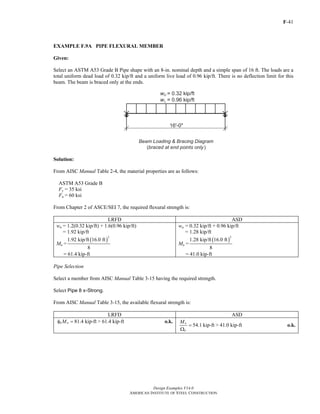
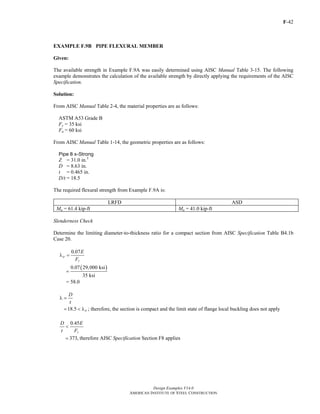
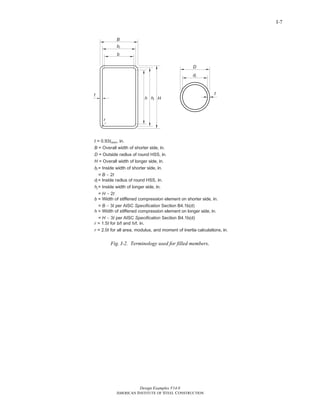
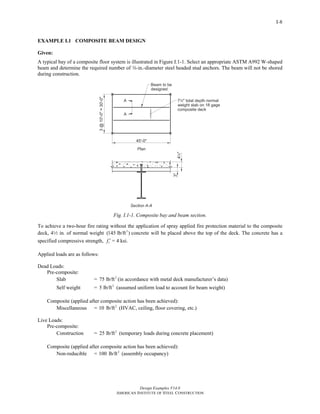
  • 736.
    III-51 Design Examples V14.0 AMERICANINSTITUTE OF STEEL CONSTRUCTION Determine the vertical seismic effect term. Ev = 0.2SDSD (ASCE 7 Eq. 12.4-4) = 0.2(0.129g)D = 0.0258D The following seismic load combinations are as specified in ASCE/SEI 7, Section 12.4.2.3. LRFD ASD ( ) ( ) ( ) ( ) 1.2 0.2 0.2 1.2 0.2 0.129 1.0 0.2 1.23 1.0 0.2 0.9 0.2 1.6 0.9 0.2 0.129 1.0 0.0 0.874 1.0 DS E E E DS E E E S D Q L S D Q L S D Q L S S D Q H D Q D Q + + ρ + + = + + + +⎡ ⎤⎣ ⎦ = + + + − + ρ + = − + +⎡ ⎤⎣ ⎦ = + ( ) ( ) ( ) ( ) ( ) ( ) ( ) 1.0 0.14 0.7 1.0 0.14 0.129 0.0 0.0 0.7 1.0 1.02 0.7 1.0 0.10 0.525 0.75 0.75 or or 1.0 0.10 0.129 0.0 0.0 0.525 1.0 0.75 0.75 1.01 0.525 0.75 0.75 0.6 0.14 DS E E E DS E r E E S D H F Q D Q D Q S D H F Q L L S R D Q L S D Q L S S + + + + ρ = + + + +⎡ ⎤⎣ ⎦ = + + + + + ρ + + = + + + + + +⎡ ⎤⎣ ⎦ = + + + −( ) ( ) ( ) 0.7 0.6 0.14 0.129 0.7 1.0 0 0.582 0.7 DS E E E D Q H D Q D Q + ρ + = − + +⎡ ⎤⎣ ⎦ = + Note: ρQE = effect of horizontal seismic (earthquake induced) forces Overstrength Factor: Ωo = 3 for steel systems not specifically detailed for seismic resistance, excluding cantilever column systems, per ASCE/SEI 7, Table 12.2-1. Calculate the seismic base shear using ASCE/SEI 7, Section 12.8.1. Determine the seismic response coefficient from ASCE/SEI 7, Equation 12.8-2 0.129 3 1 0.0430 DS s e S C R I = ⎛ ⎞ ⎜ ⎟ ⎝ ⎠ = ⎛ ⎞ ⎜ ⎟ ⎝ ⎠ = controls Let Ta = T. From ASCE/SEI 7 Figure 22-12, TL = 12 > T (midwestern city); therefore use ASCE/SEI 7, Equation 12.8-3 to determine the upper limit of Cs. 1 0.096 3 0.404 1 0.0792 D s e S C R T I = ⎛ ⎞ ⎜ ⎟ ⎝ ⎠ = ⎛ ⎞ ⎜ ⎟ ⎝ ⎠ = Return to Table of Contents
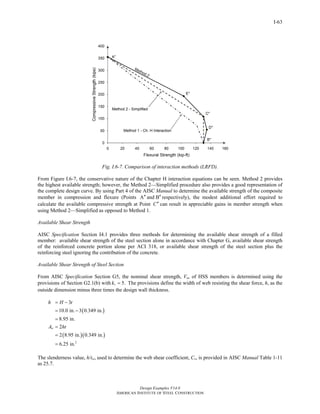
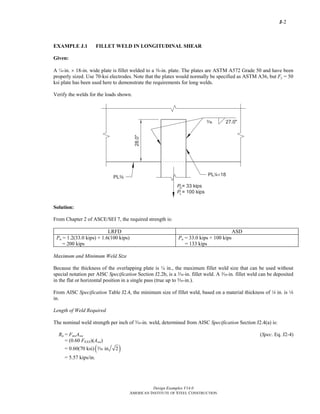
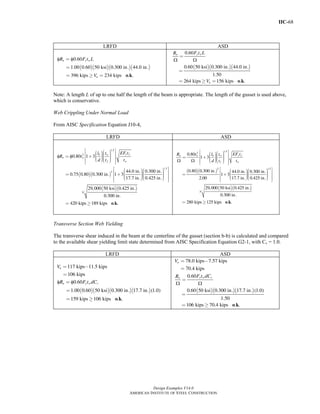
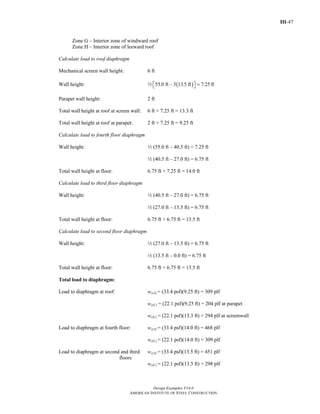
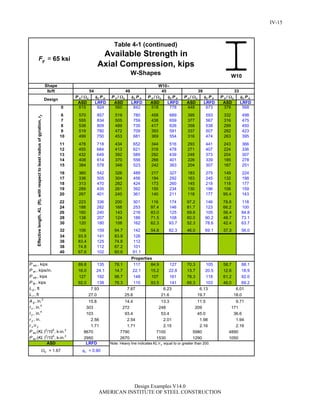
  • 737.
    III-52 Design Examples V14.0 AMERICANINSTITUTE OF STEEL CONSTRUCTION From ASCE/SEI 7, Equation 12.8-5, Cs shall not be taken less than: Cs = 0.044SDSIe ≥ 0.01 = 0.044(0.129)(1.0) = 0.00568 Therefore, Cs = 0.0430. Calculate the seismic base shear from ASCE/SEI 7 Equation 12.8-1 ( )0.0430 8,280 kips 356 kips sV C W= = = Calculate vertical distribution of seismic forces from ASCE/SEI 7, Section 12.8.3. x vxF C V= (ASCE Eq. 12.8-11) ( )356 kipsvxC= 1 k x x vx n k i i i w h C w h = = ∑ x vxF C V= (ASCE Eq. 12.8-12) For structures having a period of 0.5 s or less, k = 1. Calculate horizontal shear distribution at each level per ASCE/SEI 7, Section 12.8.4. n x i i x V F = = ∑ (ASCE Eq. 12.8-13) Calculate the overturning moment at each level per ASCE/SEI 7, Section 12.8.5. ( ) n x i i x i x M F h h = = −∑ wx hx k wxhx k Cvx Fx Vx Mx kips ft kip-ft kips kips kips k-ft Roof 820 55.0 45,100 0.182 64.8 64.8 Fourth 2,510 40.5 102,000 0.411 146 211 940 Third 2,510 27.0 67,800 0.273 97.2 308 3,790 Second 2,440 13.5 32,900 0.133 47.3 355 7,940 Base 8,280 248,000 355 12,700 Calculate strength and determine rigidity of diaphragms. Determine the diaphragm design forces from Section 12.10.1.1 of ASCE/SEI 7. Fpx is the largest of: 1. The force Fx at each level determined by the vertical distribution above Return to Table of Contents
  • 738.
    III-53 Design Examples V14.0 AMERICANINSTITUTE OF STEEL CONSTRUCTION 2. 0.4 n i i x px px DS e pxn i i x F F w S I w w = = = ≤ ∑ ∑ from ASCE/SEI 7, Equation 12.10-1 and 12.10-3 ( )( )0.4 0.129 1.0 0.0516 px px w w ≤ ≤ 3. 0.2px DS e pxF S I w= from ASCE/SEI 7, Equation 12.10-2 ( )( )0.2 0.129 1.0 0.0258 px px w w = = wpx A B C Fpx v(n-s) v(e-w) kips kips kips kips kips plf plf Roof 820 64.8 42.3 21.2 64.8 297 170 Fourth 2,510 146 130 64.8 146 892 382 Third 2,510 97.2 130 64.8 130 791 339 Second 2,440 47.3 105 63.0 105 641 275 where A = force at a level based on the vertical distribution of seismic forces B = 0.4 n i i x px px DS e pxn i i x F F w S I w w = = = ≤ ∑ ∑ C = 0.2 DS e pxS I w Fpx = max(A, B, C) Note: The diaphragm shear loads include the effects of openings in the diaphragm and a 10% increase to account for accidental torsion. Return to Table of Contents
  • 739.
    III-54 Design Examples V14.0 AMERICANINSTITUTE OF STEEL CONSTRUCTION Roof Roof deck: 12 in. deep, 22 gage, wide rib Support fasteners: s in. puddle welds in 36 / 5 pattern Sidelap fasteners: 3 #10 TEK screws Joist spacing = s = 6.0 ft Diaphragm length = 210 ft Diaphragm width = lv =120 ft By inspection, the critical condition for the diaphragm is loading from the north or south directions. Calculate the required diaphragm strength, including a 10% increase for accidental torsion. LRFD ASD From the ASCE/SEI 7 load combinations for strength design, the earthquake load is, ( ) ( ) ( ) ( ) 1.0 1.0 0.55 64.8 kips 1.0 0.55 120 ft 0.297 klf E r v px v Q v l F l = = = = The wind load is, ( ) 1.0 1.0 0.238klf 0.238klf rv W= = = From the ASCE/SEI 7 load combinations for allowable stress design, the earthquake load is, ( ) ( ) ( ) ( ) 0.7 0.7 0.55 64.8 kips 0.7 0.55 120 ft 0.208 klf E r v px v Q v l F l = = = = The wind load is, ( ) 0.6 0.6 0.238klf 0.143klf rv W= = = Note: The 0.55 factor in the earthquake load accounts for half the shear to each braced frame plus the 10% increase for accidental torsion. From the SDI Diaphragm Design Manual (SDI, 2004), the nominal shear strengths are: 1. For panel buckling strength, vn = 1.425 klf 2. For connection strength, vn = 0.820 klf Calculate the available strengths. LRFD ASD Panel Buckling Strength (SDI, 2004) ( )0.80 1.425 klf a nv v= φ = 1.14 klf 0.297 klf= > o.k. Connection Strength (SDI, 2004) Earthquake Panel Buckling Strength (SDI, 2004) 1.425 klf 2.00 n a v v = Ω = 0.713 klf 0.208 klf= > o.k. Connection Strength (SDI, 2004) Earthquake Return to Table of Contents
  • 740.
    III-55 Design Examples V14.0 AMERICANINSTITUTE OF STEEL CONSTRUCTION LRFD ASD ( )0.55 0.820 klf a nv v= φ = 0.451 klf 0.297 klf= > o.k. Wind (SDI, 2004) ( )0.70 0.820 klf a nv v= φ = 0.574 klf 0.238 klf= > o.k. 0.820 klf 3.00 n a v v = Ω = 0.273 klf 0.208 klf= > o.k. Wind (SDI, 2004) 0.820 klf 2.35 n a v v = Ω = 0.349 klf 0.143 klf= > o.k. Check diaphragm flexibility. From the Steel Deck Institute Diaphragm Design Manual, Dxx = 758 ft K1 = 0.286 ft-1 K2 = 870 kip/in. K4 = 3.78 ( ) ( ) 2 4 1 ' 0.3 3 870 kips/in. 0.3 758 ft 0.286 3.78 3 6.00 ft 6.00 ft ft 18.6 kips/in. xx K G D K K s s = + + = ⎛ ⎞ + + ⎜ ⎟ ⎝ ⎠ = Seismic loading to diaphragm. ( ) ( )64.8 kips 210 ft 0.309 klf w = = Calculate the maximum diaphragm deflection. ( )( ) ( )( ) 2 2 8 ' 0.309 klf 210 ft 8 120 ft 18.6 kips/in. 0.763 in. v wL l G Δ = = = Story drift = 0.141 in. (from computer output) The diaphragm deflection exceeds two times the story drift; therefore, the diaphragm may be considered to be flexible in accordance with ASCE/SEI 7, Section 12.3.1.3 The roof diaphragm is flexible in the N-S direction, but using a rigid diaphragm distribution is more conservative for the analysis of this building. By similar reasoning, the roof diaphragm will also be treated as a rigid diaphragm in the E-W direction. Third and Fourth floors Return to Table of Contents
  • 741.
    III-56 Design Examples V14.0 AMERICANINSTITUTE OF STEEL CONSTRUCTION Floor deck: 3 in. deep, 22 gage, composite deck with normal weight concrete, Support fasteners; s in. puddle welds in a 36 / 4 pattern Sidelap fasteners: 1 button punched fastener Beam spacing = s = 10.0 ft Diaphragm length = 210 ft Diaphragm width = 120 ft lv = 120 ft − 30 ft = 90 ft to account for the stairwell By inspection, the critical condition for the diaphragm is loading from the north or south directions Calculate the required diaphragm strength, including a 10% increase for accidental torsion. LRFD ASD From the ASCE/SEI 7 load combinations for strength design, the earthquake load for the fourth floor is, ( ) ( ) ( ) ( ) 1.0 1.0 0.55 146 kips 1.0 0.55 90 ft 0.892klf E r v px v Q v l F l = = = = For the fourth floor, the wind load is, ( ) 1.0 1.0 0.409klf 0.409klf rv W= = = From the ASCI/SEI 7 load combinations for strength design, the earthquake load for the third floor is, ( ) ( ) ( ) ( ) 1.0 1.0 0.55 130 kips 1.0 0.55 90 ft 0.794klf E r v px v Q v l F l = = = = For the third floor, the wind load is, ( ) 1.0 1.0 0.394klf 0.394klf rv W= = = From the ASCE/SEI 7 load combinations for strength design, the earthquake load is, ( ) ( ) ( ) ( ) 0.7 0.7 0.55 146 kips 0.7 0.55 90 ft 0.625klf E r v px v Q v l F l = = = = For the fourth floor, the wind load is, ( ) 0.6 0.6 0.409klf 0.245klf rv W= = = From the ASCI/SEI 7 load combinations for strength design, the earthquake load for the third floor is, ( ) ( ) ( ) ( ) 0.7 0.7 0.55 130 kips 0.7 0.55 90 ft 0.556klf E r v px v Q v l F l = = = = For the third floor, the wind load is, ( ) 0.6 0.6 0.394klf 0.236klf rv W= = = From the SDI Diaphragm Design Manual, the nominal shear strengths are: For connection strength, vn = 5.16 klf Calculate the available strengths. Return to Table of Contents
  • 742.
    III-57 Design Examples V14.0 AMERICANINSTITUTE OF STEEL CONSTRUCTION LRFD ASD Connection Strength (same for earthquake or wind) (SDI, 2004) ( )0.5 5.16 klf a nv v= φ = 2.58 klf 0.892 klf= > o.k. Connection Strength (same for earthquake or wind) (SDI, 2004) 5.16 klf 3.25 n a v v = Ω = 1.59 klf 0.625 klf= > o.k. Check diaphragm flexibility. From the Steel Deck Institute Diaphragm Design Manual, K1 = 0.729 ft-1 K2 = 870 kip/in. K3 = 2,380 kip/in. K4 = 3.78 ( ) 2 3 4 1 ' 3 870 kip/in. 2,380 kip/in. 0.729 3.78 3 10.0 ft ft 2,410 kips/in. K G K K K s ⎛ ⎞ = +⎜ ⎟+⎝ ⎠ ⎛ ⎞ = +⎜ ⎟⎛ ⎞⎜ ⎟+ ⎜ ⎟⎜ ⎟ ⎝ ⎠⎝ ⎠ = Fourth Floor Calculate seismic loading to diaphragm based on the fourth floor seismic load. ( ) ( )146 kips 210 ft 0.695 klf w = = Calculate the maximum diaphragm deflection on the fourth floor. ( )( ) ( )( ) 2 2 8 ' 0.695 klf 210 ft 8 90 ft 2,410 kips/in. 0.0177 in. v wL l G Δ = = = Third Floor Calculate seismic loading to diaphragm based on the third floor seismic load. ( ) ( )130 kips 210 ft 0.619 klf w = = Calculate the maximum diaphragm deflection on the third floor. Return to Table of Contents
  • 743.
    III-58 Design Examples V14.0 AMERICANINSTITUTE OF STEEL CONSTRUCTION ( )( ) ( )( ) 2 2 8 ' 0.619 klf 210 ft 8 90 ft 2,410 kips/in. 0.0157 in. v wL l G Δ = = = The diaphragm deflection at the third and fourth floors is less than two times the story drift (story drift = 0.245 in. from computer output); therefore, the diaphragm is considered rigid in accordance with ASCE/SEI 7, Section 12.3.1.3. By inspection, the floor diaphragm will also be rigid in the E-W direction. Second floor Floor deck: 3 in. deep, 22 gage, composite deck with normal weight concrete, Support fasteners: s in. puddle welds in a 36 / 4 pattern Sidelap fasteners: 1 button punched fasteners Beam spacing = s = 10.0 ft Diaphragm length = 210 ft Diaphragm width = 120 ft Because of the atrium opening in the floor diaphragm, an effective diaphragm depth of 75 ft will be used for the deflection calculations. By inspection, the critical condition for the diaphragm is loading from the north or south directions. Calculate the required diaphragm strength, including a 10% increase for accidental torsion. LRFD ASD From the ASCE/SEI 7 load combinations for strength design, the earthquake load is, ( ) ( ) ( ) ( ) 1.0 1.0 0.55 105 kips 1.0 0.55 90 ft 0.642klf E r v px v Q v l F l = = = = The wind load is, ( ) 1.0 1.0 0.395klf 0.395klf rv W= = = From the ASCE/SEI 7 load combinations for strength design, the earthquake load is, ( ) ( ) ( ) ( ) 0.7 0.7 0.55 105 kips 0.7 0.55 90 ft 0.449klf E r v px v Q v l F l = = = = The wind load is, ( ) 0.6 0.6 0.395klf 0.237klf rv W= = = From the SDI Diaphragm Design Manual, the nominal shear strengths are: For connection strength, vn = 5.16 klf Calculate the available strengths. Return to Table of Contents
  • 744.
    III-59 Design Examples V14.0 AMERICANINSTITUTE OF STEEL CONSTRUCTION LRFD ASD Connection Strength (same for earthquake or wind) (SDI, 2004) ( )0.50 5.16 klf a nv v= φ = 2.58 klf 0.642 klf= > o.k. Connection Strength (same for earthquake or wind) (SDI, 2004) 5.16 klf 3.25 n a v v = Ω = 1.59 klf 0.449 klf= > o.k. Check diaphragm flexibility. From the Steel Deck Institute Diaphragm Design Manual, K1 = 0.729 ft-1 K2 = 870 kip/in. K3 = 2,380 kip/in. K4 = 3.78 ( ) 2 3 4 1 ' 3 870 kip/in. 2,380 kip/in. 0.729 3.78 3 10.0 ft ft 2,410 kip/in. K G K K K s ⎛ ⎞ = +⎜ ⎟+⎝ ⎠ ⎛ ⎞ = +⎜ ⎟⎛ ⎞⎜ ⎟+ ⎜ ⎟⎜ ⎟ ⎝ ⎠⎝ ⎠ = Calculate seismic loading to diaphragm. ( ) ( )105 kips 210 ft 0.500 klf w = = Calculate the maximum diaphragm deflection. ( )( ) ( )( ) 2 2 8 ' 0.500 klf 210 ft 8 75 ft 2,410 kip/in. 0.0152 in. wL bG Δ = = = Story drift = 0.228 in. (from computer output) The diaphragm deflection is less than two times the story drift; therefore, the diaphragm is considered rigid in accordance with ASCE/SEI 7, Section 12.3.1.3. By inspection, the floor diaphragm will also be rigid in the E-W direction. Horizontal shear distribution and torsion: Calculate the seismic forces to be applied in the frame analysis in each direction, including the effect of accidental torsion, in accordance with ASCE/SEI 7, Section 12.8.4. Return to Table of Contents
  • 745.
    III-60 Design Examples V14.0 AMERICANINSTITUTE OF STEEL CONSTRUCTION Load to Grids 1 and 8 Fy Load to Frame Accidental Torsion Total kips % kips % kips kips Roof 64.8 50 32.4 5 3.24 35.6 Fourth 146 50 73.0 5 7.30 80.3 Third 97.2 50 48.6 5 4.86 53.5 Second 47.3 50 23.7 5 2.37 26.1 Base 196 Load to Grids A and F Fx Load to Frame Accidental Torsion Total kips % kips % kips kips Roof 64.8 50 32.4 5 3.24 35.6 Fourth 146 50 73.0 5 7.30 80.3 Third 97.2 50 48.6 5 4.86 53.5 Second 47.3 50.8(1) 24.0 5 2.37 26.4 Base 196 (1) Note: In this example, Grids A and F have both been conservatively designed for the slightly higher load on Grid A due to the atrium opening. The increase in load is calculated as follows Area Mass y-dist My ft2 kips ft k-ft I 25,500 2,170 60.5 131,000 II 841 71.5 90.5 6,470 24,700 2,100 125,000 y = 125,000 kip-ft/2,100 kips = 59.5 ft (100%)(121 ft – 59.5 ft)/121 ft = 50.8% Return to Table of Contents
  • 746.
    III-61 Design Examples V14.0 AMERICANINSTITUTE OF STEEL CONSTRUCTION MOMENT FRAME MODEL Grids 1 and 8 were modeled in conventional structural analysis software as two-dimensional models. The second- order option in the structural analysis program was not used. Rather, for illustration purposes, second-order effects are calculated separately, using the “Approximate Second-Order Analysis” method described in AISC Specification Appendix 8. The column and beam layouts for the moment frames follow. Although the frames on Grids A and F are the same, slightly heavier seismic loads accumulate on grid F after accounting for the atrium area and accidental torsion. The models are half-building models. The frame was originally modeled with W14×82 interior columns and W21×44 non-composite beams, but was revised because the beams and columns did not meet the strength requirements. The W14×82 column size was increased to a W14×90 and the W21×44 beams were upsized to W24×55 beams. Minimum composite studs are specified for the beams (corresponding to 0.25n y sQ F A=∑ ), but the beams were modeled with a stiffness of Ieq = Is. The frame was checked for both wind and seismic story drift limits. Based on the results on the computer analysis, the frame meets the L/400 drift criterion for a 10 year wind (0.7W) indicated in Commentary Section CC.1.2 of ASCE/SEI 7. In addition, the frame meets the 0.025hsx allowable story drift limit given in ASCE/SEI 7 Table 12.12-1 for Seismic Risk Category II. All of the vertical loads on the frame were modeled as point loads on the frame. The dead load and live load are shown in the load cases that follow. The wind, seismic, and notional loads from leaning columns are modeled and distributed 1/14 to exterior columns and 1/7 to the interior columns. This approach minimizes the tendency to accumulate too much load in the lateral system nearest an externally applied load. Also shown in the models below are the remainder of the half-building model gravity loads from the interior leaning columns accumulated in a single leaning column which was connected to the frame portion of the model with pinned ended links. Because the second-order analyses that follow will use the “Approximate Second-Order Analysis (amplified first-order) approach given in the AISC Specification Appendix 8, the inclusion of the leaning column is unnecessary, but serves to summarize the leaning column loads and illustrate how these might be handled in a full second-order analysis. See Geschwindner (1994), “A Practical Approach to the ‘Leaning’ Column.” There are five lateral load cases. Two are the wind load and seismic load, per the previous discussion. In addition, notional loads of Ni = 0.002Yi were established. The model layout, nominal dead, live, and snow loads with associated notional loads, wind loads and seismic loads are shown in the figures below. The same modeling procedures were used in the braced frame analysis. If column bases are not fixed in construction, they should not be fixed in the analysis. Return to Table of Contents
  • 747.
    III-62 Design Examples V14.0 AMERICANINSTITUTE OF STEEL CONSTRUCTION Return to Table of Contents
  • 748.
    III-63 Design Examples V14.0 AMERICANINSTITUTE OF STEEL CONSTRUCTION Return to Table of Contents
  • 749.
    III-64 Design Examples V14.0 AMERICANINSTITUTE OF STEEL CONSTRUCTION Return to Table of Contents
  • 750.
    III-65 Design Examples V14.0 AMERICANINSTITUTE OF STEEL CONSTRUCTION Return to Table of Contents
  • 751.
    III-66 Design Examples V14.0 AMERICANINSTITUTE OF STEEL CONSTRUCTION Return to Table of Contents
  • 752.
    III-67 Design Examples V14.0 AMERICANINSTITUTE OF STEEL CONSTRUCTION CALCULATION OF REQUIRED STRENGTH—THREE METHODS Three methods for checking one of the typical interior column designs at the base of the building are presented below. All three of presented methods require a second-order analysis (either direct via computer analysis techniques or by amplifying a first-order analysis). A fourth method called the “First-Order Analysis Method” is also an option. This method does not require a second-order analysis; however, this method is not presented below. For additional guidance on applying any of these methods, see the discussion in AISC Manual Part 2 titled Required Strength, Stability, Effective Length, and Second-Order Effects. GENERAL INFORMATION FOR ALL THREE METHODS Seismic load combinations controlled over wind load combinations in the direction of the moment frames in the example building. The frame analysis was run for all LRFD and ASD load combinations; however, only the controlling combinations have been illustrated in the following examples. A lateral load of 0.2% of gravity load was included for all gravity-only load combinations. The second-order analysis for all the examples below was carried out by doing a first-order analysis and then amplifying the results to achieve a set of second-order design forces using the approximate second-order analysis procedure from AISC Specification Appendix 8. METHOD 1. DIRECT ANALYSIS METHOD Design for stability by the direct analysis method is found in Chapter C of the AISC Specification. This method requires that both the flexural and axial stiffness are reduced and that 0.2% notional lateral loads are applied in the analysis to account for geometric imperfections and inelasticity. Any general second-order analysis method that considers both P − δ and P − Δ effects is permitted. The amplified first-order analysis method of AISC Specification Appendix 8 is also permitted provided that the B1 and B2 factors are based on the reduced flexural and axial stiffnesses. A summary of the axial loads, moments and 1st floor drifts from first-order analysis is shown below. The floor diaphragm deflection in the east-west direction was previously determined to be very small and will thus be neglected in these calculations. Second-order member forces are determined using the amplified first-order procedure of AISC Specification Appendix 8. It was assumed, subject to verification, that B2 is less than 1.7 for each load combination; therefore, per AISC Specification Section C2.2b(4), the notional loads were applied to the gravity-only load combinations . The required seismic load combinations are given in ASCE/SEI 7, Section 12.4.2.3. LRFD ASD 1.23D ± 1.0QE + 0.5L + 0.2S (Controls columns and beams) From a first-order analysis with notional loads where appropriate and reduced stiffnesses: For Interior Column Design: Pu = 317 kips M1u = 148 kip-ft (from first-order analysis) M2u = 233 kip-ft (from first-order analysis) First story drift with reduced stiffnesses = 0.718 in. 1.01D + 0.75L + 0.75(0.7QE) + 0.75S (Controls columns and beams) From a first-order analysis with notional loads where appropriate and reduced stiffnesses: For Interior Column Design: Pa = 295 kips M1a = 77.9 kip-ft M2a = 122 kip-ft First story drift with reduced stiffnesses = 0.377 in. Note: For ASD, ordinarily the second-order analysis must be carried out under 1.6 times the ASD load combinations and the results must be divided by 1.6 to obtain the required strengths. For this example, second- order analysis by the amplified first-order analysis method is used. The amplified first-order analysis method incorporates the 1.6 multiplier directly in the B1 and B2 amplifiers, such that no other modification is needed. The required second-order flexural strength, Mr, and axial strength, Pr, are determined as follows. For typical Return to Table of Contents
  • 753.
    III-68 Design Examples V14.0 AMERICANINSTITUTE OF STEEL CONSTRUCTION interior columns, the gravity-load moments are approximately balanced, therefore, Mnt = 0.0 kip-ft Calculate the amplified forces and moments in accordance with AISC Specification Appendix 8. LRFD ASD Mr = B1Mnt + B2Mlt (Spec. Eq. A-8-1) Determine B1 Pr = required second-order axial strength using LRFD or ASD load combinations, kips. Note that for members subject to axial compression, B1 may be calculated based on the first-order estimate Pr = Pnt + Plt. Therefore, Pr = 317 kips (from the first-order computer analysis) Ix = 999 in.4 (W14×90) τb = 1.0 ( ) 2 1 2 1 * e EI P K L π = (Spec. Eq. A-8-5) ( )( )( ) ( )( )( ) 2 4 2 0.8 29,000 ksi 999 in. 1.0 13.5 ft 12 in./ft π = ⎡ ⎤⎣ ⎦ = 8,720 kips Cm = 0.6 – 0.4(M1 / M2) (Spec. Eq. A-8-4) = 0.6 – 0.4 (148 kip-ft / 233 kip-ft) = 0.346 α = 1.0 1 1 1 1 m r e C B P P = ≥ α − (Spec. Eq. A-8-3) ( ) 0.346 1 1.0 317 kips 1 8,720 kips 0.359 1; Use 1.0 = ≥ − = ≥ Determine B2 2 1 1 1 story e story B P P = ≥ α − (Spec. Eq. A-8-6) where α = 1.0 5,440 kips (from computer output)storyP = Mr = B1Mnt + B2Mlt (Spec. Eq. A-8-1) Determine B1 Pr = required second-order axial strength using LRFD or ASD load combinations, kips. Note that for members subject to axial compression, B1 may be calculated based on the first-order estimate Pr = Pnt + Plt. Therefore, Pr = 295 kips (from the first-order computer analysis) Ix = 999 in.4 (W14×90) τb = 1.0 ( ) 2 1 2 1 * e EI P K L π = (Spec. Eq. A-8-5) ( )( )( ) ( )( )( ) 2 4 2 0.8 29,000 ksi 999 in. 1.0 13.5 ft 12 in./ft π = ⎡ ⎤⎣ ⎦ = 8,720 kips Cm = 0.6 – 0.4(M1 / M2) (Spec. Eq. A-8-4) = 0.6 – 0.4 (77.9 kip-ft / 122 kip-ft) = 0.345 α = 1.6 1 1 1 1 m r e C B P P = ≥ α − (Spec. Eq. A-8-3) ( ) 0.345 1 1.6 295 kips 1 8,720 kips 0.365 1; Use 1.0 = ≥ − = ≥ Determine B2 2 1 1 1 story e story B P P = ≥ α − (Spec. Eq. A-8-6) where α= 1.6 5,120 kips (from computer output)storyP = Return to Table of Contents
  • 754.
    III-69 Design Examples V14.0 AMERICANINSTITUTE OF STEEL CONSTRUCTION LRFD ASD may be taken ase storyP : e story M H HL P R= Δ (Spec. Eq. A-8-7) where 1 0.15 mf M story P R P = − (Spec. Eq. A-8-8) where 2,250kipsmfP = (gravity load in moment frame) 2,250kips 1 0.15 5,440kips 0.938 MR = − = ( ) 1.0 1.0 196 kips (Lateral) =196 kips EH Q= = (previous seismic force distribution calculations) = 0.718 in.HΔ (from computer output) ( )( )( )196 kips 13.5 ft 12 in./ft 0.938 0.718 in. 41,500 kips e storyP = = 2 1 1 1 story e story B P P = ≥ α − (Spec. Eq. A-8-6) ( ) 1 1 1.0 5,440 kips 1 41,500 kips 1.15 1 = ≥ − = ≥ Because B2 < 1.7, it is verified that it was unnecessary to add the notional loads to the lateral loads for this load combination. Calculate amplified moment From AISC Specification Equation A-8-1, ( )( ) ( )( )1.0 0.0 kip-ft 1.15 233 kip-ftrM = + = 268 kip-ft Calculate amplified axial load Pnt = 317 kips (from computer analysis) may be taken ase storyP : e story M H HL P R= Δ (Spec. Eq. A-8-7) where 1 0.15 mf M story P R P = − (Spec. Eq. A-8-8) where 2,090kipsmfP = (gravity load in moment frame) 2,090kips 1 0.15 5,120kips 0.939 MR = − = ( ) ( )( ) ( ) 0.75 0.7 0.75 0.7 196 kips Lateral 103 kips EH Q= = = (previous seismic force distribution calculations) = 0.377 in. (from computer output)HΔ ( )( )( )103 kips 13.5 ft 12 in./ft 0.939 0.377 in. 41,600 kips e storyP = = 2 1 1 1 story e story B P P = ≥ α − (Spec. Eq. A-8-6) ( ) 1 1 1.6 5,120 kips 1 41,600 kips 1.25 1 = ≥ − = ≥ Because B2 < 1.7, it is verified that it was unnecessary to add the notional loads to the lateral loads for this load combination. Calculate amplified moment From AISC Specification Equation A-8-1, ( )( ) ( )( )1.0 0.0 kip-ft 1.25 122 kip-ftrM = + = 153 kip-ft Calculate amplified axial load Pnt = 295 kips (from computer analysis) For a long frame, such as this one, the change in load Return to Table of Contents
  • 755.
    III-70 Design Examples V14.0 AMERICANINSTITUTE OF STEEL CONSTRUCTION LRFD ASD For a long frame, such as this one, the change in load to the interior columns associated with lateral load is negligible. Pr = Pnt + B2Plt (Spec. Eq. A-8-2) = 317 kips + (1.15)(0.0 kips) = 317 kips The flexural and axial stiffness of all members in the moment frame were reduced using 0.8E in the computer analysis. Check that the flexural stiffness was adequately reduced for the analysis per AISC Specification Section C2.3(2). 1.0 317 kipsrP α = = ( )2 26.5 in. 50.0 ksi 1,330 kipsy yP AF= = = (W14×90 column) ( )1.0 317 kips 0.238 0.5 1,330 kips r y P P α = = ≤ Therefore, 1.0bτ = o.k. Note: By inspection 1.0bτ = for all of the beams in the moment frame. For the direct analysis method, K = 1.0. From AISC Manual Table 4-1, Pc = 1,040 kips (W14×90 @ KL = 13.5 ft) From AISC Manual Table 3-2, Mcx = φbMpx = 574 kip-ft (W14×90 with Lb = 13.5 ft) 317 kips 0.305 0.2 1,040 kips r c P P = = ≥ Because 0.2 r c P P ≥ , use AISC Specification interaction Equation H1-1a. 8 1.0 9 ryr rx c cx cy MP M P M M ⎛ ⎞⎛ ⎞ + + ≤⎜ ⎟⎜ ⎟ ⎝ ⎠⎝ ⎠ (Spec. Eq. H1-1a) to the interior columns associated with lateral load is negligible. Pr = Pnt + B2Plt (Spec. Eq. A-8-2) = 295 kips + (1.25)(0.0 kips) = 295 kips The flexural and axial stiffness of all members in the moment frame were reduced using 0.8E in the computer analysis. Check that the flexural stiffness was adequately reduced for the analysis per AISC Specification Section C2.3(2). 1.6 295 kipsrP α = = ( )2 26.5 in. 50.0 ksi 1,330 kipsy yP AF= = = (W14×90 column) ( )1.6 295 kips 0.355 0.5 1,330 kips r y P P α = = ≤ Therefore, 1.0bτ = o.k. Note: By inspection 1.0bτ = for all of the beams in the moment frame. For the direct analysis method, K = 1.0. From AISC Manual Table 4-1, Pc = 690 kips (W14×90 @ KL = 13.5 ft) From AISC Manual Table 3-2, Mcx = px b M Ω = 382 kip-ft (W14×90 with Lb = 13.5 ft) 295 kips 0.428 0.2 690 kips r c P P = = ≥ Because 0.2 r c P P ≥ , use AISC Specification interaction Equation H1-1a. 8 1.0 9 ryr rx c cx cy MP M P M M ⎛ ⎞⎛ ⎞ + + ≤⎜ ⎟⎜ ⎟ ⎝ ⎠⎝ ⎠ (Spec. Eq. H1-1a) Return to Table of Contents
  • 756.
    III-71 Design Examples V14.0 AMERICANINSTITUTE OF STEEL CONSTRUCTION LRFD ASD 8 268 kip-ft 0.305 1.0 9 574 kip-ft ⎛ ⎞⎛ ⎞ + ≤⎜ ⎟⎜ ⎟ ⎝ ⎠⎝ ⎠ 0.720 1.0≤ o.k. 8 153 kip-ft 0.428 1.0 9 382 kip-ft ⎛ ⎞⎛ ⎞ + ≤⎜ ⎟⎜ ⎟ ⎝ ⎠⎝ ⎠ 0.784 1.0≤ o.k. METHOD 2. EFFECTIVE LENGTH METHOD Required strengths of frame members must be determined from a second-order analysis. In this example the second-order analysis is performed by amplifying the axial forces and moments in members and connections from a first-order analysis using the provisions of AISC Specification Appendix 8. The available strengths of compression members are calculated using effective length factors computed from a sidesway stability analysis. A first-order frame analysis is conducted using the load combinations for LRFD or ASD. A minimum lateral load (notional load) equal to 0.2% of the gravity loads is included for any gravity-only load combination. The required load combinations are given in ASCE/SEI 7 and are summarized in Part 2 of the AISC Manual. A summary of the axial loads, moments and 1st floor drifts from the first-order computer analysis is shown below. The floor diaphragm deflection in the east-west direction was previously determined to be very small and will thus be neglected in these calculations. LRFD ASD 1.23D ± 1.0QE + 0.5L + 0.2S (Controls columns and beams) For Interior Column Design: Pu = 317 kips M1u = 148 kip-ft (from first-order analysis) M2u = 233 kip-ft (from first-order analysis) First-order first story drift = 0.575 in. 1.01D + 0.75L + 0.75(0.7QE) + 0.75S (Controls columns and beams) For Interior Column Design: Pa = 295 kips M1a = 77.9 kip-ft (from first-order analysis) M2a = 122 kip-ft (from first-order analysis) First-order first story drift = 0.302 in. The required second-order flexural strength, Mr, and axial strength, Pr, are calculated as follows: For typical interior columns, the gravity load moments are approximately balanced; therefore, Mnt = 0.0 kips. LRFD ASD Mr = B1Mnt + B2Mlt (Spec. Eq. A-8-1) Determine B1. Pr = required second-order axial strength using LRFD or ASD load combinations, kips Note that for members subject to axial compression, B1 may be calculated based on the first-order estimate Pr = Pnt + Plt. Therefore, Pr = 317 kips (from first-order computer analysis) I = 999 in.4 (W14×90) ( ) 2 1 2 1 * e EI P K L π = (Spec. Eq. A-8-5) Mr = B1Mnt + B2Mlt (Spec. Eq. A-8-1) Determine B1. Pr = required second-order axial strength using LRFD or ASD load combinations, kips Note that for members subject to axial compression, B1 may be calculated based on the first-order estimate Pr = Pnt + Plt. Therefore, Pr = 295 kips (from first-order computer analysis) I = 999 in.4 (W14×90) ( ) 2 1 2 1 * e EI P K L π = (Spec. Eq. A-8-5) Return to Table of Contents
  • 757.
    III-72 Design Examples V14.0 AMERICANINSTITUTE OF STEEL CONSTRUCTION LRFD ASD ( )( ) ( )( )( ) 2 4 2 29,000 ksi 999 in. 1.0 13.5 ft 12 in./ft π = ⎡ ⎤⎣ ⎦ = 10,900 kips Cm = 0.6 – 0.4(M1 / M2) (Spec. Eq. A-8-4) = 0.6 – 0.4 (148 kip-ft / 233 kip-ft) = 0.346 α = 1.0 1 1 1 1 m r e C B P P = ≥ α − (Spec. Eq. A-8-3) ( ) 0.346 1 1.0 317 kips 1 10,900 kips 0.356 1; Use 1.00 = ≥ − = ≥ Determine B2. 2 1 1 1 story e story B P P = ≥ α − (Spec. Eq. A-8-6) where α = 1.0 5,440 kips (from computer output)storyP = may be taken ase storyP e story M H HL P R= Δ (Spec. Eq. A-8-7) where 1 0.15 mf M story P R P = − (Spec. Eq. A-8-8) where 2,250kipsmfP = (gravity load in moment frame) 2,250kips 1 0.15 5,440kips 0.938 MR = − = H = 196 kips (Lateral) (from previous seismic force distribution calculations) = 0.575 in. (from computer output)HΔ ( )( ) ( )( )( ) 2 4 2 29,000 ksi 999 in. 1.0 13.5 ft 12 in./ft π = ⎡ ⎤⎣ ⎦ = 10,900 kips Cm = 0.6 – 0.4(M1 / M2) (Spec. Eq. A-8-4) = 0.6 – 0.4 (77.9 kip-ft / 122 kip-ft) = 0.345 α = 1.6 1 1 1 1 m r e C B P P = ≥ α − (Spec. Eq. A-8-3) ( ) 0.345 1 1.6 295 kips 1 10,900 kips 0.361 1; Use 1.00 = ≥ − = ≥ Determine B2. 2 1 1 1 story e story B P P = ≥ α − (Spec. Eq. A-8-6) where α= 1.6 5,120 kips (from computer output)storyP = may be taken ase storyP =e story M H HL P R Δ (Spec. Eq. A-8-7) where 1 0.15 mf M story P R P = − (Spec. Eq. A-8-8) where 2,090kipsmfP = (gravity load in moment frame) 2,090kips 1 0.15 5,120kips 0.939 MR = − = H = 103 kips (Lateral) (from previous seismic force distribution calculations) = 0.302 in. (from computer output)HΔ Return to Table of Contents
  • 758.
    III-73 Design Examples V14.0 AMERICANINSTITUTE OF STEEL CONSTRUCTION LRFD ASD ( )( )( )196 kips 13.5 ft 12 in./ft 0.938 0.575 in. 51,800 kips e storyP = = 2 1 1 1 story e story B P P = ≥ α − (Spec. Eq. A-8-6) ( ) 1 1 1.0 5,440 kips 1 51,800 kips 1.12 1 = ≥ − = ≥ Note: B2 < 1.5, therefore use of the effective length method is acceptable. Calculate amplified moment From AISC Specification Equation A-8-1, ( )( ) ( )( )1.00 0.0 kip-ft 1.12 233 kip-ftrM = + = 261 kip-ft Calculate amplified axial load. Pnt = 317 kips (from computer analysis) For a long frame, such as this one, the change in load to the interior columns associated with lateral load is negligible. Therefore, Plt = 0 Pr = Pnt + B2Plt (Spec. Eq. A-8-2) = 317 kips + (1.12)(0.0 kips) = 317 kips Determine the controlling effective length. For out-of-plane buckling in the moment frame Ky = 1.0 ( )1.0 13.5 ft 13.5 fty yK L = = For in-plane buckling in the moment frame, use the story stiffness procedure from the AISC Specification Commentary for Appendix 7 to determine Kx with Specification Commentary Equation C-A-7-5. ( )( )( )103 kips 13.5 ft 12 in./ft 0.939 0.302 in. 51,900 kips e storyP = = 2 1 1 1 story e story B P P = ≥ α − (Spec. Eq. A-8-6) ( ) 1 1 1.6 5,120 kips 1 51,900 kips 1.19 1 = ≥ − = ≥ Note: B2 < 1.5, therefore use of the effective length method is acceptable. Calculate amplified moment From AISC Specification Equation A-8-1, ( )( ) ( )( )1.00 0.0 kip-ft 1.19 122 kip-ftrM = + = 145 kip-ft Calculate amplified axial load. Pnt = 295 kips (from computer analysis) For a long frame, such as this one, the change in load to the interior columns associated with lateral load is negligible. Therefore, Plt = 0 Pr = Pnt + B2Plt (Spec. Eq. A-8-2) = 295 kips + (1.19)(0.0 kips) = 295 kips Determine the controlling effective length. For out-of-plane buckling in the moment frame Ky = 1.0 ( )1.0 13.5 ft 13.5 fty yK L = = For in-plane buckling in the moment frame, use the story stiffness procedure from the AISC Specification Commentary for Appendix 7 to determine Kx with Specification Commentary Equation C-A-7-5. Return to Table of Contents
  • 759.
    III-74 Design Examples V14.0 AMERICANINSTITUTE OF STEEL CONSTRUCTION LRFD ASD ( ) 2 2 2 2 2 0.85 0.15 1.7 r H L r H P EI K R P HLL EI HLL ⎛ ⎞Σ π Δ⎛ ⎞ = ≥⎜ ⎟⎜ ⎟ + Σ⎝ ⎠⎝ ⎠ π Δ⎛ ⎞ ⎜ ⎟ ⎝ ⎠ Simplifying and substituting terms previously calculated results in: 1.7 story e H x e e story r P P K P P P HL Δ⎛ ⎞ ⎛ ⎞ = ≥ ⎜ ⎟⎜ ⎟ ⎝ ⎠⎝ ⎠ where ( )( ) ( ) 2 2 2 4 2 29,000ksi 999in. 12 in./ft 13.5 ft 10,900 kips e EI P L π = π = ⎡ ⎤⎣ ⎦ = ( ) ( ) 5,440 kips 10,900 kips 51,800 kips 317 kips 0.575 in. 10,900 kips 12 in. 1.7 196 kips 13.5 ft ft 1.90 0.341 xK ⎛ ⎞ = ≥⎜ ⎟ ⎝ ⎠ ⎛ ⎞ ⎜ ⎟⎛ ⎞⎜ ⎟⎜ ⎟⎜ ⎟ ⎝ ⎠⎝ ⎠ = ≥ Use Kx = 1.90 ( )1.90 13.5 ft 15.5 ft / 1.66 x x y KL r r = = Because x x y y x y K L K L r r > , use KL = 15.5 ft From AISC Manual Table 4-1, Pc = 990 kips (W14×90 @ KL = 15.5 ft) From AISC Manual Table 3-2, Mcx = 574 kip-ft (W14×90 with Lb =13.5 ft) 317 kips 990 kips 0.320 0.2 r c P P = = ≥ ( ) 2 2 2 2 2 0.85 0.15 1.7 r H L r H P EI K R P HLL EI HLL ⎛ ⎞Σ π Δ⎛ ⎞ = ≥⎜ ⎟⎜ ⎟ + Σ⎝ ⎠⎝ ⎠ π Δ⎛ ⎞ ⎜ ⎟ ⎝ ⎠ Simplifying and substituting terms previously calculated results in: 1.7 story e H x e e story r P P K P P P HL Δ⎛ ⎞ ⎛ ⎞ = ≥ ⎜ ⎟⎜ ⎟ ⎝ ⎠⎝ ⎠ where ( )( ) ( ) 2 2 2 4 2 29,000ksi 999in. 12 in./ft 13.5 ft 10,900 kips e EI P L π = π = ⎡ ⎤⎣ ⎦ = ( ) ( ) 5,120 kips 10,900kips 51,900 kips 295 kips 0.302 in. 10,900 kips 12 in. 1.7 103 kips 13.5 ft ft 1.91 0.341 xK ⎛ ⎞ = ≥⎜ ⎟ ⎝ ⎠ ⎛ ⎞ ⎜ ⎟⎛ ⎞⎜ ⎟⎜ ⎟⎜ ⎟ ⎝ ⎠⎝ ⎠ = ≥ Use Kx = 1.91 ( )1.91 13.5 ft 15.5 ft / 1.66 x x y KL r r = = Because x x y y x y K L K L r r > , use KL = 15.5 ft From AISC Manual Table 4-1, Pc = 660 kips (W14×90 @ KL = 15.5 ft) From AISC Manual Table 3-2, Mcx = 382 kip-ft (W14×90 with Lb = 13.5 ft) 295 kips 660 kips 0.447 0.2 r c P P = = ≥ Return to Table of Contents
  • 760.
    III-75 Design Examples V14.0 AMERICANINSTITUTE OF STEEL CONSTRUCTION LRFD ASD Because 0.2r c P P ≥ , use interaction Equation H1-1a. 8 1.0 9 ryr rx c cx cy MP M P M M ⎛ ⎞⎛ ⎞ + + ≤⎜ ⎟⎜ ⎟ ⎝ ⎠⎝ ⎠ (Spec. Eq. H1.1-a) 8 261 kip-ft 0.320 1.0 9 574 kip-ft ⎛ ⎞⎛ ⎞ + ≤⎜ ⎟⎜ ⎟ ⎝ ⎠⎝ ⎠ 0.724 1.0≤ o.k. Because 0.2 r c P P ≥ , use interaction Equation H1-1a. 8 1.0 9 ryr rx c cx cy MP M P M M ⎛ ⎞⎛ ⎞ + + ≤⎜ ⎟⎜ ⎟ ⎝ ⎠⎝ ⎠ (Spec. Eq. H1.1-a) 8 145 kip-ft 0.447 1.0 9 382 kip-ft ⎛ ⎞⎛ ⎞ + ≤⎜ ⎟⎜ ⎟ ⎝ ⎠⎝ ⎠ 0.784 1.0≤ o.k. METHOD 3. SIMPLIFIED EFFECTIVE LENGTH METHOD A simplification of the effective length method using a method of second-order analysis based upon drift limits and other assumptions is described in Chapter 2 of the AISC Manual. A first-order frame analysis is conducted using the load combinations for LRFD or ASD. A minimum lateral load (notional load) equal to 0.2% of the gravity loads is included for all gravity-only load combinations. The floor diaphragm deflection in the east-west direction was previously determined to be very small and will thus be neglected in these calculations. LRFD ASD 1.23D ± 1.0QE + 0.5L + 0.2S (Controls columns and beams) From a first-order analysis For interior column design: Pu = 317 kips M1u = 148 kip-ft (from first-order analysis) M2u = 233 kip-ft (from first-order analysis) First story first-order drift = 0.575 in. 1.01D + 0.75L + 0.75(0.7QE) + 0.75S (Controls columns and beams) From a first-order analysis For interior column design: Pa = 295 kips M1a = 77.9 kip-ft (from first-order analysis) M2a = 122 kip-ft (from first-order analysis) First story first-order drift = 0.302 in. Then the following steps are executed. LRFD ASD Step 1: Lateral load = 196 kips Deflection due to first-order elastic analysis Δ = 0.575 in. between first and second floor Floor height = 13.5 ft Drift ratio = (13.5 ft)(12 in./ft) / 0.575 in. = 282 Step 2: Design story drift limit = H/400 Adjusted Lateral load = (282/ 400)(196 kips) = 138 kips Step 1: Lateral load = 103 kips Deflection due to first-order elastic analysis Δ = 0.302 in. between first and second floor Floor height = 13.5 ft Drift ratio = (13.5 ft)(12 in./ft) / 0.302 in. = 536 Step 2: Design story drift limit = H/400 Adjusted Lateral load = (536 / 400)(103 kips) = 138 kips Return to Table of Contents
  • 761.
    III-76 Design Examples V14.0 AMERICANINSTITUTE OF STEEL CONSTRUCTION LRFD ASD Step 3: ( ) ( ) total story load Load ratio = 1.0 lateral load 5,440 kips = 1.0 138 kips = 39.4 From AISC Manual Table 2-1: B2 = 1.1 Which matches the value obtained in Method 2 to the two significant figures of the table Step 3: (for an ASD design the ratio must be multiplied by 1.6) ( ) ( ) total story load Load ratio = 1.6 lateral load 5,120 kips = 1.6 138 kips = 59.4 From AISC Manual Table 2-1: B2 = 1.2 Which matches the value obtained in Method 2 to the two significant figures of the table Note: Intermediate values are not interpolated from the table because the precision of the table is two significant digits. Additionally, the design story drift limit used in Step 2 need not be the same as other strength or serviceability drift limits used during the analysis and design of the structure. Step 4. Multiply all the forces and moment from the first-order analysis by the value of B2 obtained from the table. This presumes that B1 is less than or equal to B2, which is usually the case for members without transverse loading between their ends. LRFD ASD Step 5. Since the selection is in the shaded area of the chart, (B2 ≤ 1.1). For LRFD design, use K = 1.0. Multiply both sway and non-sway moments by B2. Mr = B2(Mnt + Mlt) = 1.1(0 kip-ft + 233 kip-ft) = 256 kip-ft Pr = B2(Pnt + Plt) = 1.1(317 kips +0.0 kips) = 349 kips From AISC Manual Table 4-1, Pc = 1,040 kips (W14×90 @ KL = 13.5 ft) From AISC Manual Table 3-2, Mcx = φbMpx = 574 kip-ft (W14×90 with Lb = 13.5 ft) 349 kips 0.336 0.2 1,040 kips r c P P = = ≥ Because 0.2,r c P P ≥ use interaction Equation H1-1a. Step 5. Since the selection is in the unshaded area of the chart (B2 > 1.1), For ASD design, the effective length factor, K, must be determined through analysis. From previous analysis, use an effective length of 15.5 ft. Multiply both sway and non-sway moments by B2 Mr = B2(Mnt + Mlt) = 1.2(0 kip-ft + 122 kip-ft) = 146 kip-ft Pr = B2(Pnt + Plt) = 1.2(295 kips +0.0 kips) = 354 kips From AISC Manual Table 4-1, Pc = 675 kips (W14×90 @ KL = 13.5 ft) From AISC Manual Table 3-2, Mcx = px b M Ω = 382 kip-ft (W14×90 with Lb = 13.5 ft) 354 kips 0.524 0.2 675 kips r c P P = = ≥ Because 0.2,r c P P ≥ use interaction Equation H1-1a. Return to Table of Contents
  • 762.
    III-77 Design Examples V14.0 AMERICANINSTITUTE OF STEEL CONSTRUCTION 8 1.0 9 8 256 kip-ft 0.336 1.0 9 574 kip-ft ryr rx c cx cy MP M P M M ⎛ ⎞⎛ ⎞ + + ≤⎜ ⎟⎜ ⎟ ⎝ ⎠⎝ ⎠ ⎛ ⎞⎛ ⎞ + ≤⎜ ⎟⎜ ⎟ ⎝ ⎠⎝ ⎠ 0.732 1.0≤ o.k. 8 1.0 9 8 146 kip-ft 0.524 1.0 9 382 kip-ft ryr rx c cx cy MP M P M M ⎛ ⎞⎛ ⎞ + + ≤⎜ ⎟⎜ ⎟ ⎝ ⎠⎝ ⎠ ⎛ ⎞⎛ ⎞ + ≤⎜ ⎟⎜ ⎟ ⎝ ⎠⎝ ⎠ 0.864 1.0≤ o.k. BEAM ANALYSIS IN THE MOMENT FRAME The controlling load combinations for the beams in the moment frames are shown below and evaluated for the second floor beam. The dead load, live load and seismic moments were taken from a computer analysis. The table summarizes the calculation of B2 for the stories above and below the second floor. 1st – 2nd LRFD Combination ASD Combination 1 ASD Combination 2 1.23D + 1.0QE + 0.5L + 0.2S 1.02D + 0.7QE 1.01D + 0.75L + 0.75(0.7QE) + 0.75S H 196 kips 137 kips 103 kips L 13.5 ft 13.5 ft 13.5 ft HΔ 0.575 in. 0.402 in. 0.302 in. mfP 2,250 kips 1,640 kips 2,090 kips MR 0.938 0.937 0.939 e storyP 51,800 kips 51,700 kips 51,900 kips storyP 5,440 kips 3,920 kips 5,120 kips B2 1.12 1.14 1.19 2nd – 3rd LRFD Combination ASD Combination 1 ASD Combination 2 1.23D + 1.0QE + 0.5L +0.2S 1.02D + 0.7QE 1.01D + 0.75L + 0.75(0.7QE) + 0.75S H 170 kips 119 kips 89.3 kips L 13.5 ft 13.5 ft 13.5 ft HΔ 0.728 in. 0.509 in. 0.382 in. mfP 1,590 1,160 1,490 MR 0.938 0.937 0.939 e storyP 35,500 kips 35,500 kips 35,600 kips storyP 3,840 kips 2,770 kips 3,660 kips B2 1.12 1.14 1.20 For beam members, the larger of the B2 values from the story above or below is used. From computer output at the controlling beam: Mdead = 153 kip-ft Mlive = 80.6 kip-ft Msnow = 0.0 kip-ft Mearthquake = 154 kip-ft LRFD Combination ASD Combination 1 ASD Combination 2 ( )2 1.12 154 kip-ft 172kip-ft ltB M = = ( )2 1.14 154 kip-ft 176 kip-ft ltB M = = ( )2 1.20 154 kip-ft 185kip-ft ltB M = = Return to Table of Contents
  • 763.
    III-78 Design Examples V14.0 AMERICANINSTITUTE OF STEEL CONSTRUCTION ( ) ( ) ( ) 1.23 153 kip-ft = 1.0 172kip-ft 0.5 80.6kip-ft 400 kip-ft uM ⎡ ⎤ ⎢ ⎥ +⎢ ⎥ ⎢ ⎥ +⎣ ⎦ = ( ) ( ) 1.02 153 kip-ft = 0.7 176 kip-ft 279 kip-ft aM ⎡ ⎤ ⎢ ⎥ +⎢ ⎥⎣ ⎦ = ( ) ( ) ( ) 1.01 153 kip-ft = 0.525 185kip-ft 0.75 80.6 kip-ft 312 kip-ft aM ⎡ ⎤ ⎢ ⎥ +⎢ ⎥ ⎢ ⎥ +⎣ ⎦ = Calculate Cb for compression in the bottom flange braced at 10.0 ft o.c. LRFD ASD Cb = 1.86 (from computer output) Check W24×55 From AISC Manual Table 3-2, with continuous bracing 503 kip-ftnMφ = From AISC Manual Table 3-10, for Lb = 10.0 ft and Cb = 1.86 ( )386 kip-ft 1.86 503 kip-ft 718 kip-ft 503 kip-ft nMφ = ≤ = ≤ Use 503 kip-ft 400 kip-ftnMφ = > o.k. From AISC Manual Table 3-2, a W24×55 has a design shear strength of 252 kips and an Ix of 1350 in.4 1.02D + 0.7QE Cb = 1.86 (from computer output) 1.01D + 0.75(0.7QE) + 0.75L Cb = 2.01 (from computer output) Check W24×55 1.02D + 0.7E From AISC Manual Table 3-2, with continuous bracing 334 kip-ftnM = Ω From AISC Manual Table 3-10, for Lb = 10.0 ft and Cb = 1.86 ( )256 kip-ft 1.86 334 kip-ft 476 kip-ft 334 kip-ft nM = ≤ Ω = ≤ Use 334 kip-ft 279 kip-ftnM = > Ω o.k. 1.01D + 0.75(0.7QE) + 0.75L With continuous bracing 334 kip-ftnM = Ω From AISC Manual Table 3-10, for Lb = 10 ft and Cb = 2.01 ( )256 kip-ft 2.01 515 kip-ft 334 kip-ft nM = Ω = ≤ Use 334 kip-ft 312 kip-ftnM = > Ω o.k. Return to Table of Contents
  • 764.
    III-79 Design Examples V14.0 AMERICANINSTITUTE OF STEEL CONSTRUCTION LRFD ASD From AISC Manual Table 3-2, a W24×55 has an allowable shear strength of 167 kips and an Ix of 1,350 in.4 The moments and shears on the roof beams due to the lateral loads were also checked but do not control the design. The connections of these beams can be designed by one of the techniques illustrated in the Chapter IIB of the design examples. Return to Table of Contents
  • 765.
    III-80 Design Examples V14.0 AMERICANINSTITUTE OF STEEL CONSTRUCTION BRACED FRAME ANALYSIS The braced frames at Grids 1 and 8 were analyzed for the required load combinations. The stability design requirements from Chapter C were applied to this system. The model layout, nominal dead, live, and snow loads with associated notional loads, wind loads and seismic loads are shown in the figures below: Return to Table of Contents
  • 766.
    III-81 Design Examples V14.0 AMERICANINSTITUTE OF STEEL CONSTRUCTION Return to Table of Contents
  • 767.
    III-82 Design Examples V14.0 AMERICANINSTITUTE OF STEEL CONSTRUCTION Second-order analysis by amplified first-order analysis In the following, the approximate second-order analysis method from AISC Specification Appendix 8 is used to account for second-order effects in the braced frames by amplifying the axial forces in members and connections from a first-order analysis. A first-order frame analysis is conducted using the load combinations for LRFD and ASD. From this analysis the critical axial loads, moments and deflections are obtained. A summary of the axial loads and 1st floor drifts from the first-order computer analysis is shown below. The floor diaphragm deflection in the north-south direction was previously determined to be very small and will thus be neglected in these calculations. LRFD ASD 1.23D ± 1.0QE + 0.5L + 0.2S (Controls columns and beams) From a first-order analysis For interior column design: Pnt = 236 kips Plt = 146 kips The moments are negligible First story first-order drift = 0.211 in. 1.01D + 0.75L + 0.75(0.7QE) + 0.75S (Controls columns and beams) From a first-order analysis For interior column design: Pnt = 219 kips Plt = 76.6 kips The moments are negligible First story first-order drift = 0.111 in. The required second-order axial strength, Pr, is computed as follows: LRFD ASD Pr = Pnt + B2Plt (Spec. Eq. A-8-2) Determine B2. 2 1 1 1 story e story B P P = ≥ α − (Spec. Eq. A-8-6) Pstory = 5,440 kips (previously calculated) Pe story may be calculated as: e story M H HL P R= Δ (Spec. Eq. A-8-7) where H = 196 kips (from previous calculations) ΔH = 0.211 in. (from computer output) RM = 1.0 for braced frames ( )( )( )196 kips 13.5 ft 12 in./ft 1.0 0.211 in. 150,000 kips e storyP = = Pr = Pnt + B2Plt (Spec. Eq. A-8-2) Determine B2. 2 1 1 1 story e story B P P = ≥ α − (Spec. Eq. A-8-6) Pstory = 5,120 kips (previously calculated) Pe story may be calculated as: e story M H HL P R= Δ (Spec. Eq. A-8-7) where H = 103 kips (from previous calculations) ΔH = 0.111 in. (from computer output) RM = 1.0 for braced frames ( )( )( )103 kips 13.5 ft 12 in./ft 1.0 0.111 in. 150,000 kips e storyP = = Return to Table of Contents
  • 768.
    III-83 Design Examples V14.0 AMERICANINSTITUTE OF STEEL CONSTRUCTION ( ) 2 1 1 1 1 1 1.0 5,440 kips 1 150,000 kips 1.04 1 story e story B P P = ≥ α − = ≥ − = ≥ Pr = Pnt + B2Plt (Spec. Eq. A-8-2) = 236 kips + (1.04)(146 kips) = 388 kips From AISC Manual Table 4-1, Pc = 514 kips (W12×53 @ KL = 13.5 ft) From AISC Specification Equation H1-1a, 388 kips 0.755 1.0 514 kips r c P P = = ≤ o.k. ( ) 2 1 1 1 1 1 1.6 5,120 kips 1 150,000 kips 1.06 1 story estory B P P = ≥ α − = ≥ − = ≥ Pr = Pnt + B2Plt (Spec. Eq. A-8-2) = 219 kips + (1.06)(76.6 kips) = 300 kips From AISC Manual Table 4-1, Pc = 342 kips (W12×53 @ KL = 13.5 ft) From AISC Specification Equation H1-1a, 300 kips 0.877 1.0 342 kips r c P P = = ≤ o.k. Note: Notice that the lower sidesway displacements of the braced frame produce much lower values of B2 than those of the moment frame. Similar results could be expected for the other two methods of analysis. Although not presented here, second-order effects should be accounted for in the design of the beams and diagonal braces in the braced frames at Grids 1 and 8. Return to Table of Contents
  • 769.
    III-84 Design Examples V14.0 AMERICANINSTITUTE OF STEEL CONSTRUCTION ANALYSIS OF DRAG STRUTS The fourth floor delivers the highest diaphragm force to the braced frames at the ends of the building: E = 80.3 kips (from previous calculations). This force is transferred to the braced frame through axial loading of the W18×35 beams at the end of the building. The gravity dead loads for the edge beams are the floor loading of 75.0 psf (5.50 ft) plus the exterior wall loading of 0.503 kip/ft, giving a total dead load of 0.916 kip/ft. The gravity live load for these beams is the floor loading of 80.0 psf (5.50 ft) = 0.440 kip/ft. The resulting midspan moments are MDead = 58.0 kip-ft and MLive = 27.8 kip-ft. The controlling load combination for LRFD is 1.23D + 1.0QE + 0.50L. The controlling load combinations for ASD are 1.01D + 0.75L + 0.75(0.7QE) or 1.02D + 0.7QE LRFD ASD Mu = 1.23(58.0 kip-ft) + 0.50(27.8 kip-ft) = 85.2 kip-ft Load from the diaphragm shear due to earthquake loading Fp = 80.3 kips Ma = 1.01(58.0 kip-ft) + 0.75(27.8 kip-ft) = 79.4 kip-ft or Ma = 1.02(58.0 kip-ft) = 59.2 kip-ft Load from the diaphragm shear due to earthquake loading Fp = 0.75(0.70)(80.3 kips) = 42.2 kips or Fp = 0.70(80.3 kips) = 56.2 kips Only the two 45 ft long segments on either side of the brace can transfer load into the brace, because the stair opening is in front of the brace. Use AISC Specification Section H2 to check the combined bending and axial stresses. LRFD ASD ( ) 80.3 kips 0.892 kip/ft 2 45.0 ft V = = The top flange bending stress is ( ) 3 85.2 kip-ft 12 in./ ft 57.6 in. 17.8 ksi u b x M f S = = = ( ) 42.2 kips 0.469 kip/ft 2 45.0 ft V = = or ( ) 56.2 kips 0.624 kip/ft 2 45.0 ft V = = The top flange stress due to bending ( ) 3 79.4 kip-ft 12 in./ ft 57.6 in. 16.5 ksi a b x M f S = = = or Return to Table of Contents
  • 770.
    III-85 Design Examples V14.0 AMERICANINSTITUTE OF STEEL CONSTRUCTION ( ) 3 59.2 kip-ft 12 in./ ft 57.6 in. 12.3 ksi a b x M f S = = = Note: It is often possible to resist the drag strut force using the slab directly. For illustration purposes, this solution will instead use the beam to resist the force independently of the slab. The full cross section can be used to resist the force if the member is designed as a column braced at one flange only (plus any other intermediate bracing present, such as from filler beams). Alternatively, a reduced cross section consisting of the top flange plus a portion of the web can be used. Arbitrarily use the top flange and 8 times an area of the web equal to its thickness times a depth equal to its thickness, as an area to carry the drag strut component. Area = 6.00 in.(0.425 in.) + 8(0.300 in.)2 = 2.55 in.2 + 0.720 in.2 = 3.27 in.2 Ignoring the small segment of the beam between Grid C and D, the axial stress due to the drag strut force is: LRFD ASD fa = ( )2 80.3kips 2 3.27 in. = 12.3 ksi Using AISC Specification Section H2, assuming the top flange is continuously braced: ( ) ( ) 0.90 50ksi 45.0ksi 0.90 50ksi 45.0ksi a c y bw b y F F F F = φ = = = φ = = 1.0a bw a bw f f F F + ≤ (from Spec. Eq. H2-1) 12.3ksi 17.8ksi 0.669 45.0ksi 45.0ksi + = o.k. fa = ( )2 42.2 kips 2 3.27 in. = 6.45 ksi or ( ) ( )2 90.0 ft 0.624kip/ft 2 3.27 in. 8.59 ksi af = = From AISC Specification Section H2, assuming the top flange is continuously braced: 50ksi 1.67 29.9ksi 50ksi 1.67 29.9ksi a y c bw y b F F F F = Ω = = = Ω = = 1.0a bw a bw f f F F + ≤ (from Spec. Eq. H2-1) Load Combination 1: 6.45ksi 16.5ksi 0.768 29.9ksi 29.9ksi + = o.k. Load Combination 2: Return to Table of Contents
  • 771.
    III-86 Design Examples V14.0 AMERICANINSTITUTE OF STEEL CONSTRUCTION 8.59ksi 12.3ksi 0.699 29.9ksi 29.9ksi + = o.k. Note: Because the drag strut load is a horizontal load, the method of transfer into the strut, and the extra horizontal load which must be accommodated by the beam end connections should be indicated on the drawings. Return to Table of Contents
  • 772.
    III-87 Design Examples V14.0 AMERICANINSTITUTE OF STEEL CONSTRUCTION PART III EXAMPLE REFERENCES ASCE (2010), Minimum Design Loads for Buildings and Other Structures, ASCE/SEI 7-10, Reston, VA. Geschwindner, L.F. (1994), “A Practical Approach to the Leaning Column,” Engineering Journal, AISC, Vol. 31, No. 4, 4th Quarter, pp. 141-149. SDI (2004), Diaphragm Design Manual, 3rd Ed., Steel Deck Institute, Fox River Grove, IL. SJI (2005), Load Tables and Weight Tables for Steel Joists and Joist Girders, 42nd Ed., Steel Joist Institute, Forest, VA. West, M., Fisher, J. and Griffis, L.A. (2003), Serviceability Design Considerations for Steel Buildings, Design Guide 3, 2nd Ed., AISC, Chicago, IL. Return to Table of Contents
  • 773.
  • 774.
  • 775.
  • 776.
  • 777.
  • 778.
    Design Examples V14.0 AMERICANINSTITUTE OF STEEL CONSTRUCTION IV-1 Chapter IV Other Resources This chapter contains additional design aids that are not available in the AISC Steel Construction Manual. Return to Table of Contents
  • 779.
    Design Examples V14.0 AMERICANINSTITUTE OF STEEL CONSTRUCTION IV-2 DESIGN TABLE DISCUSSION Table 4-1. W-Shapes in Axial Compression, 65 ksi steel Available strengths in axial compression are given for W-shapes with Fy = 65 ksi (ASTM A913 Grade 65). The tabulated values are given for the effective length with respect to the y-axis (KL)y. However, the effective length with respect to the x-axis (KL)x must also be investigated. To determine the available strength in axial compression, the table should be entered at the larger of (KL)y and (KL)y eq, where ( ) ( )x y eq x y KL KL r r = (4-1) The available strength is based on the limit states of flexural buckling, torsional buckling, and flexural- torsional buckling. The limit between elastic and inelastic buckling is 99.5 KL r = with Fy = 65 ksi. The slenderness limit between a nonslender web and a slender web is λrw = 31.5 with Fy = 65 ksi. All current ASTM A6 W-shapes have nonslender flanges with Fy = 65 ksi. Values of the ratio rx/ry and other properties useful in the design of W-shape compression members are listed at the bottom of Table 4-1. Variables Pwo, Pwi, Pwb and Pfb shown in Table 4-1 can be used to determine the strength of W-shapes without stiffeners to resist concentrated forces applied normal to the face(s) of the flange(s). In these tables it is assumed that the concentrated forces act far enough away from the member ends that end effects are not considered (end effects are addressed in Chapter 9). When Pr ≤ φRn or Rn/Ω, column web stiffeners are not required. Figures 4-1, 4-2 and 4-3 illustrate the limit states and the applicable variables for each. Web Local Yielding: The variables Pwo and Pwi can be used in the calculation of the available web local yielding strength for the column as follows: LRFD ASD n wo wi bR P P lφ = + (4-2a) n wo wi bR P P lΩ = + (4-2b) where Rn = (5 ) 5 , kips (AISC Equation J10-2)yw w b yw w yw w bF t k l F t k F t l Specification+ = + Pwo = 5 for LRFD and 5 for ASD, kipsyw w yw wF t k F t kφ Ω Pwi = for LRFD and for ASD, kips/in.yw w yw wF t F tφ Ω k = distance from outer face of flange to the web toe of fillet, in. lb = length of bearing, in. tw = thickness of web, in. φ = 1.00 Ω = 1.50 Web Compression Buckling: The variable Pwb is the available web compression buckling strength for the column as follows: LRFD ASD n wbR Pφ = (4-3a) n wbR PΩ = (4-3b) where Rn = 3 24 (AISC Equation J10-8) w ywt EF Specification h Return to Table of Contents
  • 780.
    Design Examples V14.0 AMERICANINSTITUTE OF STEEL CONSTRUCTION IV-3 Pwb = 3 3 24 24 for LRFD and for ASD, kips w yw w ywt EF t EF h h φ Ω Fyw = specified minimum yield stress of the web, ksi h = clear distance between flanges less the fillet or corner radius for rolled shapes, in. φ = 0.90 Ω = 1.67 Fig. 4-1. Illustration of web local yielding limit state (AISC Specification Section J10.2). Flange Local Buckling: The variable Pfb is the available flange local bending strength for the column as follows: LRFD ASD n fbR Pφ = (4-4a) n fbR PΩ = (4-4a) where Rn = 2 6.25 , kips (AISC Equation J10-1)yf fF t Specification Pfb = 2 2 6.25 for LRFD and 6.25 for ASD, kipsyf f yf fF t F tφ Ω φ = 0.90 Ω = 1.67 Fig. 4-2. Illustration of web compression buckling limit state (AISC Specification Section J10.5). Return to Table of Contents
  • 781.
    Design Examples V14.0 AMERICANINSTITUTE OF STEEL CONSTRUCTION IV-4 Fig. 4-3. Illustration of flange local bending limit state (AISC Specification Section J10.1). Return to Table of Contents
  • 782.
    P n /cc P n P n /c c P n P n /c c P n P n /c c P n P n /c c P n P n /c c P n ASD LRFD ASD LRFD ASD LRFD ASD LRFD ASD LRFD ASD LRFD 0 8370 12600 7630 11500 6930 10400 6310 9480 5720 8600 5220 7840 6 8180 12300 7450 11200 6770 10200 6150 9250 5580 8390 5080 7640 7 8120 12200 7390 11100 6710 10100 6100 9170 5530 8310 5040 7570 8 8040 12100 7320 11000 6640 9980 6040 9070 5470 8220 4980 7490 9 7960 12000 7240 10900 6570 9870 5970 8970 5410 8130 4920 7400 10 7860 11800 7150 10800 6480 9750 5890 8850 5340 8020 4860 7300 11 7760 11700 7060 10600 6400 9610 5810 8730 5260 7900 4780 7190 12 7650 11500 6960 10500 6300 9470 5720 8590 5170 7780 4710 7070 13 7530 11300 6850 10300 6200 9310 5620 8450 5090 7640 4620 6950 14 7410 11100 6730 10100 6090 9150 5520 8300 4990 7500 4530 6820 15 7270 10900 6600 9930 5970 8970 5410 8130 4890 7350 4440 6680 16 7140 10700 6470 9730 5850 8790 5300 7970 4790 7190 4340 6530 17 6990 10500 6340 9530 5720 8600 5180 7790 4680 7030 4240 6380 18 6840 10300 6200 9310 5590 8410 5060 7610 4560 6860 4140 6220 19 6680 10000 6050 9100 5460 8200 4930 7420 4450 6690 4030 6060 20 6520 9810 5900 8870 5320 7990 4810 7220 4330 6510 3920 5890 22 6190 9310 5590 8410 5030 7560 4540 6820 4080 6140 3690 5550 24 5850 8790 5270 7920 4730 7120 4260 6410 3830 5750 3460 5200 26 5490 8260 4950 7430 4430 6660 3980 5990 3570 5370 3220 4840 28 5140 7720 4610 6940 4130 6200 3700 5570 3310 4980 2980 4480 30 4780 7180 4280 6440 3820 5740 3420 5140 3050 4590 2740 4120 32 4420 6650 3960 5950 3520 5290 3150 4730 2800 4210 2510 3780 34 4080 6130 3640 5460 3230 4850 2880 4320 2550 3840 2290 3440 36 3740 5620 3320 4990 2940 4420 2620 3930 2320 3480 2070 3110 38 3410 5120 3020 4540 2660 4000 2360 3550 2090 3130 1860 2790 40 3090 4640 2730 4100 2400 3610 2130 3200 1880 2830 1680 2520 3670 5500 3140 4710 2680 4020 2280 3420 1950 2920 1670 2500 133 200 123 184 113 169 103 155 94.9 142 87.5 131 50100 75300 39200 58900 30400 45700 23300 35100 18200 27300 14200 21400 5860 8810 4970 7470 4210 6330 3550 5340 2980 4480 2510 3770 Effectivelength,KL(ft),withrespecttoleastradiusofgyration,ry 605h W14 W-Shapes c = 0.90 119000 105000 73300 270000 235000 206000 Table 4-1 Available Strength in Axial Compression, kips c = 1.67 Specification Section A3.1c. Properties ASD LRFD 93000 82400P ey (KL )2 /104 , k-in.2 135000 P ex (KL )2 /104 , k-in.2 409000 355000 309000 r x /r y 1.74 1.73 1.71 1.70 1.69 1.67 4.49 4.43 4.38r y , in. 4.69 4.62 4.55 I y , in.4 4720 4170 3680 3250 2880 2560 9430 8210 7190I x , in.4 14300 12400 10800 178 162 147 134A g , in.2 215 196 P wo , kips P wi , kips/in. P wb , kips P fb , kips L r , ft 14.5 212 Design 455h Shape lb/ft 730h 665h 550h 500h 14.3 195 L p , ft 14.1 13.9 13.7 13.6 178 164 151 138 W14 h Flange thickness is greater than 2 in. Special requirements may apply per AISC = 65 ksiyF IV-5 Design Examples V14.0 AMERICAN INSTITUTE OF STEEL CONSTRUCTION Return to Table of Contents
  • 783.
    P n /cc P n P n /c c P n P n /c c P n P n /c c P n P n /c c P n P n /c c P n ASD LRFD ASD LRFD ASD LRFD ASD LRFD ASD LRFD ASD LRFD 0 4870 7310 4550 6840 4240 6380 3930 5910 3560 5350 3240 4870 11 4460 6700 4170 6260 3870 5820 3590 5390 3240 4870 2950 4430 12 4380 6590 4100 6160 3810 5720 3520 5290 3180 4780 2890 4350 13 4300 6470 4020 6040 3740 5620 3460 5200 3120 4690 2840 4270 14 4220 6340 3940 5920 3660 5500 3390 5090 3060 4590 2780 4180 15 4130 6210 3860 5800 3580 5390 3310 4980 2990 4490 2720 4080 16 4040 6070 3770 5670 3500 5260 3230 4860 2920 4380 2650 3980 17 3940 5930 3680 5530 3420 5130 3150 4740 2840 4270 2580 3880 18 3840 5780 3590 5390 3330 5000 3070 4620 2770 4160 2510 3780 19 3740 5630 3490 5250 3240 4860 2990 4490 2690 4040 2440 3670 20 3640 5470 3390 5100 3140 4720 2900 4360 2610 3920 2370 3560 22 3420 5140 3190 4790 2950 4430 2720 4090 2440 3670 2220 3330 24 3200 4810 2980 4480 2750 4140 2540 3810 2280 3420 2060 3100 26 2980 4470 2770 4160 2550 3840 2350 3530 2110 3160 1900 2860 28 2750 4140 2560 3840 2360 3540 2160 3250 1940 2910 1750 2630 30 2530 3800 2350 3530 2160 3240 1980 2980 1770 2660 1600 2400 32 2310 3470 2140 3220 1970 2960 1800 2710 1610 2420 1450 2180 34 2100 3160 1940 2920 1780 2680 1630 2450 1450 2180 1310 1960 36 1900 2850 1750 2630 1600 2410 1460 2200 1300 1950 1170 1750 38 1700 2560 1570 2360 1440 2160 1310 1970 1170 1750 1050 1570 40 1540 2310 1420 2130 1300 1950 1180 1780 1050 1580 945 1420 42 1390 2090 1290 1930 1180 1770 1070 1610 954 1430 857 1290 44 1270 1910 1170 1760 1070 1610 979 1470 869 1310 781 1170 46 1160 1750 1070 1610 980 1470 896 1350 795 1200 715 1070 48 1070 1600 985 1480 900 1350 823 1240 730 1100 656 986 50 983 1480 907 1360 830 1250 758 1140 673 1010 605 909 1480 2220 1320 1980 1170 1760 1020 1540 874 1310 746 1120 81.5 122 76.7 115 71.9 108 66.7 100 61.1 91.7 55.9 83.9 11500 17200 9600 14400 7890 11900 6320 9490 4850 7290 3710 5580 2250 3380 1980 2970 1720 2590 1480 2230 1240 1870 1040 1570 h Flange thickness is greater than 2 in. Special requirements may apply per AISC Specification Section A3.1c. W14 = 65 ksi W14 Properties 106 96.7 88.3130 122 114 13.2 13.1 13.0 12.9L p , ft 13.413.4 Shape lb/ft 426h 398h 370h 342h 311h Design 283h A g , in.2 P wo , kips P wi , kips/in. P wb , kips P fb , kips L r , ft 125 117 109 101 91.4 83.3 I x , in.4 6600 6000 5440 4900 4330 3840 I y , in.4 2360 2170 1990 1810 1610 1440 r y , in. 4.34 4.31 4.27 4.24 4.20 4.17 r x /r y 1.67 1.66 1.66 1.65 1.64 1.63 P ex (KL )2 /104 , k-in.2 189000 110000 62100 57000 51800 172000 156000 140000 124000 4120067500 ASD LRFD P ey (KL )2 /104 , k-in.2 46100 c = 1.67 Table 4-1 (continued) Available Strength in Axial Compression, kips W-Shapes c = 0.90 Effectivelength,KL(ft),withrespecttoleastradiusofgyration,ry yF IV-6 Design Examples V14.0 AMERICAN INSTITUTE OF STEEL CONSTRUCTION Return to Table of Contents
  • 784.
    P n /cc P n P n /c c P n P n /c c P n P n /c c P n P n /c c P n P n /c c P n ASD LRFD ASD LRFD ASD LRFD ASD LRFD ASD LRFD ASD LRFD 0 2940 4420 2670 4010 2410 3630 2210 3320 2020 3030 1820 2730 6 2860 4300 2590 3890 2340 3520 2150 3220 1960 2940 1760 2650 7 2830 4250 2560 3850 2320 3480 2120 3190 1930 2910 1740 2620 8 2800 4200 2530 3800 2290 3440 2100 3150 1910 2870 1720 2590 9 2760 4140 2500 3750 2260 3390 2070 3110 1880 2830 1700 2550 10 2720 4080 2460 3690 2220 3340 2030 3060 1850 2780 1670 2510 11 2670 4010 2420 3630 2180 3280 2000 3000 1820 2740 1640 2460 12 2620 3940 2370 3560 2140 3220 1960 2950 1780 2680 1610 2420 13 2570 3860 2320 3490 2100 3150 1920 2890 1750 2630 1570 2360 14 2510 3780 2270 3420 2050 3080 1880 2820 1710 2570 1540 2310 15 2460 3690 2220 3340 2000 3010 1830 2750 1670 2500 1500 2250 16 2400 3600 2160 3250 1950 2940 1790 2680 1620 2440 1460 2190 17 2330 3510 2110 3170 1900 2860 1740 2610 1580 2370 1420 2130 18 2270 3410 2050 3080 1850 2780 1690 2540 1530 2300 1380 2070 19 2200 3310 1990 2990 1790 2690 1640 2460 1490 2230 1330 2010 20 2130 3210 1930 2890 1730 2610 1580 2380 1440 2160 1290 1940 22 2000 3000 1800 2700 1620 2430 1480 2220 1340 2010 1200 1810 24 1850 2790 1670 2510 1500 2250 1370 2050 1240 1860 1110 1670 26 1710 2570 1540 2310 1380 2070 1260 1890 1140 1710 1020 1530 28 1570 2360 1410 2120 1260 1900 1150 1730 1040 1560 929 1400 30 1430 2150 1280 1930 1150 1720 1040 1570 941 1410 842 1270 32 1290 1940 1160 1740 1040 1560 941 1410 847 1270 757 1140 34 1160 1750 1040 1560 927 1390 841 1260 756 1140 675 1010 36 1040 1560 927 1390 827 1240 750 1130 674 1010 602 905 38 932 1400 832 1250 742 1120 673 1010 605 909 540 812 40 841 1260 751 1130 670 1010 608 914 546 821 487 733 637 955 538 807 459 688 393 590 343 515 289 433 51.1 76.7 46.4 69.6 42.5 63.7 38.6 57.9 36.0 54.0 32.3 48.4 2830 4250 2110 3170 1630 2460 1220 1840 992 1490 716 1080 869 1310 720 1080 592 890 504 758 417 627 344 518 Effectivelength,KL(ft),withrespecttoleastradiusofgyration,ry W14 W-Shapes c = 0.90 21400 61300 54400 1.61 1.60 1.60 Table 4-1 (continued) Available Strength in Axial Compression, kips c = 1.67 Properties 29500 ASD LRFD 26600P ey (KL )2 /104 , k-in.2 36900 32900 24000 6870097300 86200 76100P ex (KL )2 /104 , k-in.2 1.601.62 1.62r x /r y 4.05 4.02 4.004.13 4.10 4.07r y , in. 1030 931 838 7481290 1150I y , in.4 2400 2140 19003400 3010 2660I x , in.4 62.0 56.8 51.8 46.775.6 68.5A g , in.2 P wo , kips P wi , kips/in. P wb , kips P fb , kips L r , ft Design 193 176 159257 233 211 Shape lb/ft L p , ft 12.8 12.7 12.6 12.5 12.5 12.4 80.7 73.5 67.2 61.8 57.1 52.4 W14 = 65 ksiyF IV-7 Design Examples V14.0 AMERICAN INSTITUTE OF STEEL CONSTRUCTION Return to Table of Contents
  • 785.
    P n /cc P n P n /c c P n P n /c c P n P n /c c P n P n /c c P n P n /c c P n ASD LRFD ASD LRFD ASD LRFD ASD LRFD ASD LRFD ASD LRFD 0 1660 2500 1510 2270 1370 2070 1250 1870 1130 1700 1030 1550 6 1610 2420 1460 2190 1330 1990 1200 1810 1090 1640 995 1500 7 1590 2390 1440 2160 1310 1970 1190 1780 1080 1620 982 1480 8 1570 2360 1420 2130 1290 1940 1170 1760 1060 1600 968 1450 9 1550 2330 1400 2100 1270 1910 1150 1730 1040 1570 951 1430 10 1520 2290 1370 2060 1250 1870 1130 1700 1030 1540 933 1400 11 1500 2250 1340 2020 1220 1830 1110 1660 1000 1510 914 1370 12 1470 2210 1310 1970 1190 1790 1080 1620 982 1480 893 1340 13 1440 2160 1280 1930 1160 1750 1050 1590 957 1440 871 1310 14 1400 2110 1250 1880 1130 1700 1030 1540 932 1400 848 1270 15 1370 2060 1210 1830 1100 1660 998 1500 906 1360 824 1240 16 1330 2000 1180 1770 1070 1610 968 1460 878 1320 799 1200 17 1290 1950 1140 1720 1040 1560 937 1410 850 1280 773 1160 18 1260 1890 1100 1660 1000 1500 906 1360 821 1230 746 1120 19 1220 1830 1060 1600 965 1450 873 1310 791 1190 719 1080 20 1180 1770 1030 1540 929 1400 840 1260 761 1140 691 1040 22 1090 1640 945 1420 856 1290 774 1160 700 1050 636 956 24 1010 1520 865 1300 782 1180 707 1060 639 960 580 872 26 927 1390 785 1180 709 1070 640 963 578 869 525 789 28 844 1270 707 1060 638 959 576 866 519 781 471 708 30 764 1150 632 950 569 856 514 772 463 696 419 630 32 686 1030 559 840 503 756 454 682 408 614 370 556 34 611 918 495 744 446 670 402 604 362 544 328 492 36 545 819 442 664 398 598 359 539 323 485 292 439 38 489 735 397 596 357 536 322 484 290 435 262 394 40 441 663 358 538 322 484 290 437 261 393 237 356 249 373 228 342 197 295 166 249 145 218 125 187 29.5 44.2 28.0 41.9 25.6 38.4 22.8 34.1 21.0 31.5 19.1 28.6 543 816 464 697 356 535 251 377 197 297 147 222 289 434 258 388 215 323 180 270 148 222 123 184 = 65 ksi W14 W14 Properties 39.1 36.8 34.948.7 44.3 41.5 11.6 11.6 11.5 11.512.3 11.6L p , ft Shape lb/ft 132 120 109 Design 145 A g , in.2 P wo , kips P wi , kips/in. P wb , kips P fb , kips L r , ft 42.7 38.8 35.3 32.0 I x , in.4 1710 1530 1380 1240 I y , in.4 677 548 495 447 r y , in. 3.98 3.76 3.74 3.73 r x /r y 1.59 1.67 1.67 1.67 P ex (KL )2 /104 , k-in.2 48900 19400 43800 39500 35500 ASD LRFD P ey (KL )2 /104 , k-in.2 402 3.71 1.66 31800 1150015700 14200 12800 29.1 26.5 999 362 c = 1.67 28600 Table 4-1 (continued) Available Strength in Axial Compression, kips W-Shapes c = 0.90 10400 3.70 1.66 99 90 1110 Effectivelength,KL(ft),withrespecttoleastradiusofgyration,ry yF IV-8 Design Examples V14.0 AMERICAN INSTITUTE OF STEEL CONSTRUCTION Return to Table of Contents
  • 786.
    P n /cc P n P n /c c P n P n /c c P n P n /c c P n P n /c c P n P n /c c P n P n /c c P n ASD LRFD ASD LRFD ASD LRFD ASD LRFD ASD LRFD ASD LRFD ASD LRFD 0 934 1400 849 1280 778 1170 697 1050 607 913 541 813 474 712 6 862 1300 783 1180 718 1080 642 965 531 798 479 720 419 630 7 838 1260 761 1140 697 1050 623 936 506 761 457 686 401 603 8 810 1220 736 1110 674 1010 602 905 479 720 432 649 381 572 9 780 1170 709 1060 648 974 579 871 449 676 405 609 358 539 10 748 1120 679 1020 621 933 555 834 419 630 377 567 334 502 11 714 1070 648 974 592 890 529 795 387 582 349 524 308 464 12 678 1020 616 926 562 845 502 754 356 535 320 481 282 425 13 641 964 583 876 531 798 474 712 324 487 291 438 257 386 14 604 908 549 824 500 751 446 670 293 441 263 395 231 348 15 566 851 514 773 468 703 417 627 263 396 236 355 207 311 16 528 794 480 721 436 656 389 584 234 352 210 315 184 276 17 491 738 446 670 405 609 360 542 208 312 186 279 163 244 18 454 683 413 620 374 562 333 500 185 278 166 249 145 218 19 418 629 380 571 344 517 306 460 166 250 149 224 130 196 20 384 576 348 524 315 473 280 421 150 226 134 202 117 177 22 318 478 289 435 261 392 232 348 124 186 111 167 97.1 146 24 267 402 243 365 219 330 195 293 104 157 93.2 140 81.6 123 26 228 343 207 311 187 281 166 249 88.8 133 79.4 119 69.5 104 28 197 295 179 268 161 242 143 215 76.6 115 68.5 103 59.9 90.1 30 171 257 156 234 140 211 125 187 66.7 100 59.7 89.7 52.2 78.5 32 150 226 137 205 123 185 110 165 58.6 88.1 34 133 200 121 182 109 164 97.0 146 36 119 179 108 162 97.5 147 86.5 130 38 107 160 96.9 146 87.5 131 77.7 117 40 96.3 145 87.5 131 79.0 119 70.1 105 160 240 135 202 118 177 101 151 100 150 87.7 131 74.0 111 22.1 33.2 19.5 29.3 18.0 27.0 16.3 24.4 16.0 24.1 14.7 22.1 13.2 19.8 229 344 157 236 124 186 91.3 137 87.4 131 67.9 102 49.1 73.8 178 267 150 225 126 190 101 152 106 159 86.1 129 68.3 103 Axial Compression, kips Available Strength in Table 4-1 (continued) W-Shapes W14 c Shape is slender for compression with F y = 65 ksi. Note: Heavy line indicates KL /r y equal to or greater than 200. Properties = 65 ksi W14 18.4 17.6 16.826.7 5.95 5.92 5.86L p , ft Shape lb/ft Design A g , in.2 P wo , kips P wi , kips/in. P wb , kips P fb , kips L r , ft I x , in.4 I y , in.4 r y , in. r x /r y P ex (KL )2 /104 , k-in.2 ASD P ey (KL )2 /104 , k-in.2 LRFD 4240 7.62 7.59 25.2 24.0 22.7 7.68 17.9 881 148 640 48c 43c 14.1 82 74 68 61 7.68 24.0 15.6 2.48 22800 2.44 25200 3840 20.0 722 121 2.46 2.44 20700 3460 795 21.8 541 57.7 1.92 13900 3060 3.07 15500 1650 1470 12.6 428 45.2 1.89 3.08 53 12300 1290 484 51.4 1.91 3.06 c = 1.67 107 2.48 2.44 2.44 18300 2.45 134 c = 0.90 Effectivelength,KL(ft),withrespecttoleastradiusofgyration,ry yF IV-9 Design Examples V14.0 AMERICAN INSTITUTE OF STEEL CONSTRUCTION Return to Table of Contents
  • 787.
    P n /cc P n P n /c c P n P n /c c P n P n /c c P n P n /c c P n P n /c c P n ASD LRFD ASD LRFD ASD LRFD ASD LRFD ASD LRFD ASD LRFD 0 3850 5790 3480 5240 3190 4790 2880 4330 2640 3960 2410 3620 6 3700 5550 3340 5020 3050 4590 2760 4150 2520 3790 2300 3450 7 3640 5470 3290 4940 3010 4520 2720 4080 2480 3730 2260 3400 8 3580 5380 3230 4860 2950 4440 2670 4010 2430 3660 2220 3330 9 3510 5280 3170 4760 2890 4350 2610 3920 2380 3580 2170 3260 10 3440 5160 3100 4660 2830 4250 2550 3830 2330 3500 2120 3180 11 3350 5040 3020 4540 2760 4140 2490 3740 2270 3400 2060 3100 12 3270 4910 2940 4420 2680 4030 2420 3630 2200 3310 2000 3010 13 3180 4770 2860 4300 2600 3910 2340 3520 2130 3210 1940 2920 14 3080 4630 2770 4160 2520 3790 2270 3410 2060 3100 1870 2820 15 2980 4480 2680 4020 2430 3660 2190 3290 1990 2990 1810 2720 16 2880 4320 2580 3880 2350 3530 2110 3170 1910 2880 1740 2610 17 2770 4170 2480 3730 2250 3390 2020 3040 1840 2760 1670 2500 18 2660 4000 2380 3580 2160 3250 1940 2910 1760 2640 1590 2390 19 2550 3840 2280 3430 2070 3110 1850 2780 1680 2520 1520 2280 20 2440 3670 2180 3280 1970 2970 1770 2650 1600 2400 1450 2170 22 2220 3340 1980 2970 1790 2680 1590 2390 1440 2160 1300 1950 24 2000 3010 1780 2670 1600 2400 1420 2140 1280 1930 1160 1740 26 1790 2680 1580 2370 1420 2130 1260 1890 1130 1700 1020 1530 28 1580 2370 1390 2090 1250 1870 1100 1650 988 1480 885 1330 30 1380 2080 1210 1820 1090 1630 959 1440 860 1290 771 1160 32 1210 1820 1070 1600 954 1430 843 1270 756 1140 678 1020 34 1080 1620 945 1420 845 1270 746 1120 670 1010 600 902 36 959 1440 843 1270 754 1130 666 1000 597 898 535 805 38 861 1290 757 1140 676 1020 598 898 536 806 481 722 40 777 1170 683 1030 610 917 539 811 484 727 434 652 1370 2050 1170 1750 1020 1530 865 1300 746 1120 639 959 77.1 116 70.6 106 66.3 99.5 60.7 91.0 55.9 83.9 51.1 76.7 11400 17200 8770 13200 7270 10900 5560 8350 4340 6530 3340 5020 2130 3200 1790 2690 1480 2230 1230 1850 1040 1570 878 1320 Specification Section A3.1c. 30100 h Flange thickness is greater than 2 in. Special requirements may apply per AISC Properties c = 1.67 c = 0.90 Table 4-1 (continued) Available Strength in Axial Compression, kips W-Shapes ASD LRFD 23700 21200 19000P ey (KL )2 /104 , k-in.2 34100 26800 77900 69300 61300P ex (KL )2 /104 , k-in.2 116000 102000 89000 r x /r y 1.85 1.84 1.82 1.81 1.80 1.80 3.34 3.31 3.28r y , in. 3.47 3.42 3.38 I y , in.4 1190 1050 937 828 742 664 I x , in.4 4060 3550 3110 2720 2420 2140 Design Effectivelength,KL(ft),withrespecttoleastradiusofgyration,ry A g , in.2 98.9 P wo , kips P wi , kips/in. P wb , kips P fb , kips L p , ft L r , ft 89.5 81.9 74.1 67.7 61.8 73.9 Shape lb/ft 336h 305h 279h 252h 230h 210 10.2 W12 116 10.6 10.5 10.3 80.7 10.7 10.3 105 96.8 88.0 W12 = 65 ksiyF IV-10 Design Examples V14.0 AMERICAN INSTITUTE OF STEEL CONSTRUCTION Return to Table of Contents
  • 788.
    P n /cc P n P n /c c P n P n /c c P n P n /c c P n P n /c c P n P n /c c P n ASD LRFD ASD LRFD ASD LRFD ASD LRFD ASD LRFD ASD LRFD 0 2180 3280 1950 2920 1740 2610 1550 2330 1370 2060 1210 1830 6 2080 3130 1860 2790 1660 2490 1480 2220 1300 1960 1150 1730 7 2050 3070 1820 2740 1630 2450 1450 2180 1280 1920 1130 1700 8 2010 3020 1790 2690 1600 2400 1420 2140 1250 1880 1110 1670 9 1960 2950 1750 2630 1560 2350 1390 2090 1220 1840 1080 1630 10 1910 2880 1710 2560 1520 2290 1350 2040 1190 1790 1050 1580 11 1860 2800 1660 2490 1480 2220 1320 1980 1160 1740 1020 1540 12 1810 2720 1610 2420 1430 2150 1270 1920 1120 1680 990 1490 13 1750 2630 1560 2340 1390 2080 1230 1850 1080 1630 956 1440 14 1690 2540 1500 2260 1340 2010 1190 1780 1040 1570 920 1380 15 1630 2450 1450 2170 1290 1930 1140 1710 1000 1500 883 1330 16 1560 2350 1390 2090 1230 1850 1090 1640 958 1440 845 1270 17 1500 2250 1330 2000 1180 1770 1050 1570 915 1380 807 1210 18 1430 2150 1270 1910 1130 1690 996 1500 871 1310 768 1150 19 1370 2050 1210 1820 1070 1610 947 1420 827 1240 729 1100 20 1300 1950 1150 1730 1020 1530 898 1350 783 1180 689 1040 22 1160 1750 1030 1540 907 1360 800 1200 697 1050 612 920 24 1030 1550 910 1370 802 1210 705 1060 613 921 537 808 26 908 1360 797 1200 701 1050 615 924 532 800 466 700 28 788 1180 690 1040 606 910 530 797 459 690 402 604 30 686 1030 601 904 528 793 462 695 400 601 350 526 32 603 906 528 794 464 697 406 610 352 528 308 462 34 534 803 468 704 411 617 360 541 311 468 272 410 36 476 716 418 628 366 551 321 482 278 417 243 365 38 428 643 375 563 329 494 288 433 249 375 218 328 40 386 580 338 508 297 446 260 391 225 338 197 296 535 803 449 674 377 566 317 475 262 392 210 315 45.9 68.9 41.6 62.4 37.7 56.6 34.2 51.4 30.8 46.2 26.4 39.7 2420 3640 1800 2710 1330 2000 1000 1500 726 1090 462 694 737 1110 592 890 477 717 380 571 300 450 238 358 9870 40900 35500 3060054100 c = 1.67 c = 0.90 W12 W-Shapes Table 4-1 (continued) Available Strength in Axial Compression, kips Properties 8620 301 3.11 ASD LRFD 13000 11400P ey (KL )2 /104 , k-in.2 1.77 1.77 1.76 3.133.16 1430 1240 1070 454 1.76 26700 31.2 933 16900 14800 47200P ex (KL )2 /104 , k-in.2 r x /r y 1.79 1.78 345 3.25 3.22 589 398 3.19r y , in. I y , in.4 517 35.2 I x , in.4 1890 1650 56.0 50.0 44.7 39.9 Design Effectivelength,KL(ft),withrespecttoleastradiusofgyration,ry A g , in.2 P wo , kips P wi , kips/in. P wb , kips P fb , kips L p , ft L r , ft 170 152 136 9.88 9.79 67.4 60.7 54.8 120 Shape lb/ft 190 10.1 W12 106 9.98 9.70 9.63 49.1 44.2 39.9 = 65 ksiyF IV-11 Design Examples V14.0 AMERICAN INSTITUTE OF STEEL CONSTRUCTION Return to Table of Contents
  • 789.
    P n /cc P n P n /c c P n P n /c c P n P n /c c P n P n /c c P n P n /c c P n ASD LRFD ASD LRFD ASD LRFD ASD LRFD ASD LRFD ASD LRFD 0 1100 1650 996 1500 903 1360 821 1230 743 1120 662 994 6 1040 1570 946 1420 856 1290 779 1170 704 1060 612 920 7 1020 1540 928 1390 840 1260 764 1150 691 1040 595 894 8 1000 1510 908 1360 822 1240 747 1120 675 1020 576 865 9 977 1470 886 1330 802 1200 728 1090 658 989 555 834 10 951 1430 862 1300 779 1170 708 1060 640 962 532 800 11 923 1390 836 1260 756 1140 687 1030 620 932 509 765 12 893 1340 808 1210 731 1100 664 997 599 900 484 727 13 861 1290 780 1170 704 1060 639 961 577 867 458 689 14 829 1250 750 1130 677 1020 614 923 554 833 432 650 15 795 1190 719 1080 648 975 589 885 530 797 406 610 16 760 1140 687 1030 620 931 562 845 506 761 379 570 17 725 1090 655 984 590 887 535 805 482 724 353 531 18 690 1040 622 936 561 843 508 764 457 687 327 492 19 654 983 590 887 531 798 481 723 432 650 302 454 20 619 930 557 838 501 753 454 683 408 613 277 417 22 548 824 493 742 443 666 401 603 360 540 231 347 24 481 722 432 649 387 582 350 526 313 471 194 292 26 416 625 373 560 333 501 301 453 269 404 165 249 28 358 539 321 483 287 432 260 390 232 349 143 214 30 312 469 280 421 250 376 226 340 202 304 124 187 32 274 413 246 370 220 331 199 299 178 267 109 164 34 243 365 218 327 195 293 176 265 157 236 96.7 145 36 217 326 194 292 174 261 157 236 140 211 86.3 130 38 195 293 174 262 156 234 141 212 126 189 77.4 116 40 176 264 157 237 141 212 127 191 114 171 69.9 105 179 268 157 236 135 203 118 177 101 152 96.7 145 23.8 35.8 22.3 33.5 20.4 30.6 18.6 28.0 16.9 25.4 15.6 23.4 337 507 277 416 211 316 161 243 121 181 94.7 142 197 296 160 240 131 198 109 164 89.0 134 99.6 150 Properties c = 1.67 c = 0.90 W-Shapes Table 4-1 (continued) Available Strength in Axial Compression, kips 3060 107 2.51 2.10 13600 1.75 15300 4980 195 3.04 19.1 533 174 3.02 23.2 662 216 3.05 21200 1.75 17100 6900 1.75 18900 6180 5580 28.2 833 270 3.09 1.76 23800 7730 740 21.1 597 79 72 65 58 ASD LRFD P ey (KL )2 /104 , k-in.2 17.0 475 25.6 241 3.07 1.75 P ex (KL )2 /104 , k-in.2 r x /r y r y , in. I y , in.4 I x , in.4 Design Effectivelength,KL(ft),withrespecttoleastradiusofgyration,ry A g , in.2 P wo , kips P wi , kips/in. P wb , kips P fb , kips L p , ft L r , ft Shape lb/ft 87 W12 96 9.45 9.42 9.36 7.789.57 9.51 24.434.4 32.1 30.4 28.837.0 W12 = 65 ksiyF IV-12 Design Examples V14.0 AMERICAN INSTITUTE OF STEEL CONSTRUCTION Return to Table of Contents
  • 790.
    P n /cc P n P n /c c P n P n /c c P n P n /c c P n P n /c c P n ASD LRFD ASD LRFD ASD LRFD ASD LRFD ASD LRFD 0 662 994 607 913 568 854 510 766 450 676 6 612 920 560 842 500 751 448 673 400 600 7 595 894 544 818 477 717 427 642 381 573 8 576 865 527 791 452 680 405 609 361 542 9 555 834 507 762 426 640 381 573 339 510 10 532 800 486 731 398 598 356 535 317 476 11 509 765 464 697 369 555 330 496 293 441 12 484 727 441 662 340 511 304 456 270 405 13 458 689 417 627 311 468 278 417 246 370 14 432 650 393 590 283 425 252 378 223 336 15 406 610 368 553 255 383 227 341 201 302 16 379 570 343 516 228 343 203 305 179 270 17 353 531 319 480 203 304 180 270 159 239 18 327 492 295 444 181 272 160 241 142 213 19 302 454 272 409 162 244 144 216 127 191 20 277 417 249 375 146 220 130 195 115 173 22 231 347 207 311 121 182 107 161 95.0 143 24 194 292 174 261 102 153 90.3 136 79.8 120 26 165 249 148 223 86.6 130 76.9 116 68.0 102 28 143 214 128 192 74.7 112 66.3 100 58.6 88.1 30 124 187 111 167 65.0 97.8 57.8 86.8 51.1 76.8 32 109 164 97.8 147 57.2 85.9 50.8 76.3 44.9 67.5 34 96.7 145 86.6 130 36 86.3 130 77.3 116 38 77.4 116 69.4 104 40 69.9 105 62.6 94.1 96.7 145 88.2 132 91.4 137 78.4 118 65.2 97.8 15.6 23.4 15.0 22.4 16.0 24.1 14.5 21.8 12.8 19.2 94.7 142 83.6 126 101 151 74.8 112 51.1 76.8 99.6 150 80.4 121 99.6 150 80.4 121 64.5 97.0 Note: Heavy line indicates KL /r y equal to or greater than 200. = 65 ksi 17.618.524.4 23.2 19.5 6.017.78 7.68 6.07 6.04 W12Shape lb/ft Design Effectivelength,KL(ft),withrespecttoleastradiusofgyration,ry A g , in.2 P wo , kips P wi , kips/in. P wb , kips P fb , kips L p , ft L r , ft I x , in.4 I y , in.4 r y , in. r x /r y P ex (KL )2 /104 , k-in.2 53 475 17.0 ASD LRFD P ey (KL )2 /104 , k-in.2 45 40c 58 50 107 2.51 2.10 13600 56.3 1.96 3060 15.6 425 95.8 2.48 2.11 12200 2740 1610 13.1 348 50.0 1.95 2.64 9960 1430 14.6 391 2.64 8790 1260 Properties 11.7 307 44.1 1.94 2.64 11200 c Shape is slender for compression with F y = 65 ksi. c = 1.67 c = 0.90 W12 Table 4-1 (continued) Available Strength in Axial Compression, kips W-Shapes yF IV-13 Design Examples V14.0 AMERICAN INSTITUTE OF STEEL CONSTRUCTION Return to Table of Contents
  • 791.
    P n /cc P n P n /c c P n P n /c c P n P n /c c P n P n /c c P n P n /c c P n ASD LRFD ASD LRFD ASD LRFD ASD LRFD ASD LRFD ASD LRFD 0 1280 1920 1140 1710 1010 1520 884 1330 775 1160 689 1040 6 1200 1800 1060 1600 942 1420 821 1230 720 1080 639 961 7 1170 1750 1040 1560 918 1380 800 1200 701 1050 622 935 8 1130 1700 1010 1510 892 1340 776 1170 680 1020 603 907 9 1100 1650 974 1460 862 1300 750 1130 657 987 582 875 10 1060 1590 938 1410 830 1250 722 1080 632 949 560 842 11 1020 1530 901 1350 796 1200 692 1040 605 909 536 806 12 973 1460 861 1290 761 1140 660 992 577 868 511 768 13 928 1390 820 1230 724 1090 627 943 549 825 485 730 14 881 1320 778 1170 687 1030 594 893 519 780 459 690 15 834 1250 736 1110 648 974 560 842 489 736 432 650 16 786 1180 692 1040 610 916 526 791 459 690 405 609 17 738 1110 649 976 571 859 492 740 429 646 379 569 18 691 1040 606 912 533 801 458 689 400 601 352 529 19 644 967 564 848 495 745 425 639 371 557 326 490 20 597 898 523 786 459 689 393 591 342 515 301 452 22 509 765 444 667 388 583 331 497 288 433 252 379 24 428 644 373 560 326 490 278 418 242 364 212 318 26 365 548 318 478 278 417 237 356 206 310 181 271 28 315 473 274 412 239 360 204 307 178 267 156 234 30 274 412 239 359 209 313 178 267 155 233 136 204 32 241 362 210 315 183 276 156 235 136 205 119 179 34 213 321 186 279 162 244 139 208 121 181 106 159 36 190 286 166 249 145 218 124 186 108 162 94.2 142 38 171 257 149 224 130 195 111 167 96.5 145 84.5 127 40 154 232 134 202 117 176 100 150 87.1 131 76.3 115 286 429 239 358 195 293 157 236 129 194 107 161 32.7 49.1 29.5 44.2 26.2 39.3 23.0 34.5 20.4 30.6 18.2 27.3 1080 1630 786 1180 556 835 374 563 261 392 186 280 380 571 305 459 238 358 184 277 144 217 112 169 W10 44.8 39.9 35.5 32.1 29.2 8.15 8.05 8.02 7.96 L r , ft 8.30 49.6 8.21 P wo , kips P wi , kips/in. P wb , kips Shape W10 lb/ft 112 100 88 77 6068 Design Effectivelength,KL(ft),withrespecttoleastradiusofgyration,ry Properties A g , in.2 29.3 22.7 17.7 P fb , kips L p , ft P ey (KL )2 /104 , k-in.2 32.9 716 236 2.68 1.74 20500 6750 I x , in.4 I y , in.4 2.65 1.74 P ex (KL )2 /104 , k-in.2 r y , in. r x /r y 17800 5920 26.0 534 179 2.63 1.73 15300 5120 623 207 4410 19.9 394 134 2.59 1.71 11300 3840 455 154 2.57 1.71 13000 2.60 1.73 9760 3320 341 116 W-Shapes c = 1.67 c = 0.90 ASD LRFD Table 4-1 (continued) Available Strength in = 65 ksi Axial Compression, kips yF IV-14 Design Examples V14.0 AMERICAN INSTITUTE OF STEEL CONSTRUCTION Return to Table of Contents
  • 792.
    P n /cc P n P n /c c P n P n /c c P n P n /c c P n P n /c c P n ASD LRFD ASD LRFD ASD LRFD ASD LRFD ASD LRFD 0 615 924 560 842 518 778 448 673 378 568 6 570 857 519 780 458 689 395 593 332 498 7 555 834 505 759 438 659 377 567 316 475 8 538 809 489 735 417 626 358 538 299 450 9 519 780 472 709 393 591 337 507 282 423 10 499 750 453 681 369 554 316 474 263 395 11 478 718 434 652 344 516 293 441 243 366 12 455 684 413 621 318 478 271 407 224 336 13 432 649 392 589 292 439 248 373 204 307 14 408 614 370 556 266 401 226 339 185 278 15 384 578 348 523 242 363 204 307 167 251 16 360 542 326 489 217 327 183 275 149 224 17 336 505 304 456 194 292 163 245 132 198 18 313 470 282 424 173 260 145 218 118 177 19 289 435 261 392 155 234 130 196 106 159 20 267 401 240 361 140 211 118 177 95.4 143 22 223 336 200 301 116 174 97.2 146 78.8 118 24 188 282 168 253 97.4 146 81.7 123 66.2 100 26 160 240 143 216 83.0 125 69.6 105 56.4 84.8 28 138 207 124 186 71.5 108 60.0 90.2 48.7 73.1 30 120 180 108 162 62.3 93.7 52.3 78.6 42.4 63.7 32 106 159 94.7 142 54.8 82.3 46.0 69.1 37.3 56.0 34 93.5 141 83.9 126 36 83.4 125 74.8 112 38 74.8 112 67.2 101 40 67.6 102 60.6 91.1 89.8 135 78.1 117 84.9 127 70.3 105 58.7 88.1 16.0 24.1 14.7 22.1 15.2 22.8 13.7 20.5 12.6 18.9 127 192 98.7 148 107 161 78.3 118 61.2 92.0 92.0 138 76.3 115 93.5 141 68.3 103 46.0 69.2 = 65 ksi 19.7 18.027.0 25.6 21.6 7.87 6.23 6.13 6.01 P wo , kips P wi , kips/in. P wb , kips Shape 49 Design W10 lb/ft 33394554 7.93 P fb , kips L p , ft L r , ft P ey (KL )2 /104 , k-in.2 I x , in.4 I y , in.4 P ex (KL )2 /104 , k-in.2 r y , in. r x /r y 15.8 303 103 2.56 1.71 8670 2950 2670 13.3 248 53.4 2.01 2.15 7100 1530 272 93.4 1290 9.71 171 36.6 1.94 2.16 4890 1050 45.0 11.5 59807790 2.54 1.71 1.98 2.16 209 Effectivelength,KL(ft),withrespecttoleastradiusofgyration,ry Properties A g , in.2 14.4 c = 1.67 c = 0.90 ASD LRFD W10 Table 4-1 (continued) Available Strength in Axial Compression, kips W-Shapes Note: Heavy line indicates KL /r y equal to or greater than 200. yF IV-15 Design Examples V14.0 AMERICAN INSTITUTE OF STEEL CONSTRUCTION Return to Table of Contents
  • 793.
    P n /cc P n P n /c c P n P n /c c P n P n /c c P n P n /c c P n P n /c c P n ASD LRFD ASD LRFD ASD LRFD ASD LRFD ASD LRFD ASD LRFD 0 767 1150 666 1000 549 825 455 684 401 603 355 534 6 687 1030 595 895 490 736 405 608 356 535 315 473 7 660 993 572 859 470 706 388 583 341 512 301 453 8 631 948 546 820 448 674 369 555 324 487 287 431 9 599 901 518 778 425 638 349 524 306 460 271 407 10 565 850 488 733 400 601 328 493 288 432 254 382 11 530 797 457 687 374 562 306 460 268 403 237 356 12 495 743 426 640 348 523 284 426 248 373 219 329 13 458 689 394 592 322 483 261 393 229 344 202 303 14 422 634 362 544 295 444 239 359 209 314 184 277 15 386 581 331 498 269 405 217 327 190 285 167 251 16 352 528 301 452 244 367 196 295 171 257 151 226 17 318 478 271 408 220 331 176 264 153 230 135 202 18 285 429 243 365 197 295 157 236 137 206 120 180 19 256 385 218 328 176 265 141 212 123 184 108 162 20 231 347 197 296 159 239 127 191 111 166 97.2 146 22 191 287 163 244 132 198 105 158 91.5 138 80.3 121 24 160 241 137 205 111 166 88.2 133 76.9 116 67.5 101 26 137 205 116 175 94.2 142 75.2 113 65.5 98.5 57.5 86.5 28 118 177 100 151 81.2 122 64.8 97.4 56.5 84.9 49.6 74.5 30 103 154 87.5 131 70.7 106 56.5 84.9 49.2 74.0 43.2 64.9 32 90.3 136 76.9 116 62.2 93.5 49.6 74.6 43.3 65.0 38.0 57.1 34 79.9 120 68.1 102 55.1 82.8 164 246 133 199 93.6 140 74.4 112 59.7 89.6 51.2 76.8 24.7 37.1 22.1 33.2 17.3 26.0 15.6 23.4 13.4 20.2 12.4 18.5 578 868 414 622 199 298 145 218 92.5 139 71.9 108 213 320 160 240 114 172 76.3 115 59.6 89.6 46.0 69.2 Table 4-1 (continued) Available Strength in = 65 ksi Axial Compression, kips W-Shapes 3150 1060 4180 c = 1.67 c = 0.90 Note: Heavy line indicates KL/r y equal to or greater than 200. 1410 3630 1220 6530 2150 5270 1740 35 31 W8 Design lb/ft Shape 67 58 48 40 19.7 272 88.6 2.12 127 1.75 9.13 110 37.1 2.02 1.72 42.6 1.73 146 17.1 14.1 11.7 10.3 Properties 1.73 184 60.9 1.74 49.1 2.1 2.08 2.04 2.03 Effectivelength,KL(ft),withrespecttoleastradiusofgyration,ry 228 75.1 1.74 A g , in.2 I x , in.4 I y , in.4 r y , in. r x /r y LRFD P ex (KL )2 /104 , k-in.2 P ey (KL )2 /104 , k-in.2 ASD 7790 2540 P wo , kips P wi , kips/in. P wb , kips P fb , kips L p , ft L r , ft 6.57 36.9 6.26 32.4 27.6 23.8 21.7 20.1 6.51 6.44 6.32 6.29 W8 yF IV-16 Design Examples V14.0 AMERICAN INSTITUTE OF STEEL CONSTRUCTION Return to Table of Contents
  • 794.
    Design Examples V14.0 AMERICANINSTITUTE OF STEEL CONSTRUCTION IV-17 DESIGN TABLE DISCUSSION Table 6-1. W-Shapes in Combined Flexure and Axial Force, 65 ksi Steel W-shapes with Fy = 65 ksi (ASTM A913 Grade 65) and subject to combined axial force (tension or compression) and flexure may be checked for compliance with the provisions of Section H1.1 and H1.2 of the AISC Specification using values listed in Table 6-1 and the appropriate interaction equations provided in the following sections. Values p, bx, by, ty and tr presented in Table 6-1 are defined as follows. LRFD ASD Axial Compression p = 11 , (kips) c nP − φ p = 1 , (kips)c nP −Ω Strong Axis Bending bx = 18 , (kip-ft) 9 b nxM − φ bx = 18 , (kip-ft) 9 b nxM −Ω Weak Axis Bending by = 18 , (kip-ft) 9 b nyM − φ by = 18 , (kip-ft) 9 b nyM −Ω Tension Yielding ty = 11 , (kips) t y gF A − φ ty = 1 , (kips)t y gF A −Ω Tension Rupture tr = ( ) 11 , (kips) 0.75t u gF A − φ tr = ( ) 1 , (kips) 0.75 t u gF A −Ω Combined Flexure and Compression Equations H1-1a and H1-1b of the AISC Specification may be written as follows using the coefficients listed in Table 6-1 and defined previously. When pPr ≥ 0.2: 1.0r x rx y rypP b M b M+ + ≤ (6-1) When pPr < 0.2: ( )91 2 8 1.0x rx y ryr b M b MpP ++ ≤ (6-2) The designer may check acceptability of a given shape using the appropriate interaction equation from the preceding list. See Aminmansour (2000) for more information on this method, including an alternative approach for selection of a trial shape. Combined Flexure and Tension Equations H1-1a and H1-1b of the AISC Specification may be written as follows using the coefficients listed in Table 6-1 and defined previously. When pPr ≥ 0.2: ( )or 1.0y r r x rx y ryt t P b M b M+ + ≤ (6-3) When pPr < 0.2: ( ) ( )91 2 8 or 1.0y r x rx y ryrt t b M b MP ++ ≤ (6-4) The larger value of ty and tr should be used in the preceding equations. Return to Table of Contents
  • 795.
    Design Examples V14.0 AMERICANINSTITUTE OF STEEL CONSTRUCTION IV-18 The designer may check acceptability of a given shape using the appropriate interaction equation from above along with variables tr, ty, bx and by. See Aminmansour (2006) for more information on this method. It is noted that the values for tr listed in Table 6-1 are based on the assumption that Ae = 0.75Ag. See Part 5 for more information on this assumption. When Ae > 0.75Ag, the tabulated values for tr are conservative. When Ae < 0.75Ag, tr must be calculated based upon the actual value of Ae. General Considerations for Use of Values Listed in Table 6-1 The following remarks are offered for consideration in use of the values listed in Table 6-1. 1. Values of p, bx and by already account for section compactness and can be used directly. 2. Tabulated values of bx assumed Cb = 1.0. A procedure for determining bx when Cb > 1.0 follows. 3. Given that the limit state of lateral-torsional buckling does not apply to W-shapes bent about their weak axis, values of by are independent of unbraced length and Cb. 4. Values of bx equally apply to combined flexure and compression as well as combined flexure and tension. 5. Smaller values of variable p for a given KL and smaller values of bx for a given Lb indicate higher strength for the type of load in question. For example, a section with a smaller p at a certain KL is more effective in carrying axial compression than another section with a larger value of p at the same KL. Similarly, a section with a smaller bx is more effective for flexure at a given Lb than another section with a larger bx for the same Lb. This information may be used to select more efficient shapes when relatively large amounts of axial load or bending are present. Determination of bx when Cb > 1.0 The tabulated values of bx assume that Cb = 1.0. These values may be modified in accordance with AISC Specification Sections F1 and H1.2. The following procedure may be used to account for Cb > 1.0. ( 1.0) ( 1.0) b b x C x C xmin b b b b C = > = ≥ (6-5) Values of bxmin are listed in Table 6-1 at Lb = 0 ft. See Aminmansour (2009) for more information on this method. Values for p, bx, by, ty and tr presented in Table 6-1 have been multiplied by 103 . Thus, when used in the appropriate interaction equation they must be multiplied by 10-3 (0.001). Return to Table of Contents
  • 796.
    ASD LRFD ASDLRFD ASD LRFD ASD LRFD ASD LRFD ASD LRFD 0 0.276 0.184 0.169 0.113 0.333 0.221 0.194 0.129 0.378 0.251 0.216 0.144 11 0.309 0.205 0.170 0.113 0.370 0.246 0.195 0.130 0.420 0.279 0.217 0.144 12 0.315 0.210 0.173 0.115 0.378 0.251 0.199 0.132 0.428 0.285 0.221 0.147 13 0.323 0.215 0.176 0.117 0.387 0.257 0.203 0.135 0.438 0.291 0.226 0.150 14 0.331 0.221 0.179 0.119 0.396 0.264 0.207 0.138 0.449 0.299 0.231 0.154 15 0.341 0.227 0.183 0.122 0.407 0.271 0.211 0.140 0.461 0.307 0.236 0.157 16 0.352 0.234 0.187 0.124 0.419 0.279 0.215 0.143 0.474 0.316 0.241 0.160 17 0.363 0.242 0.190 0.127 0.433 0.288 0.220 0.146 0.489 0.325 0.246 0.164 18 0.376 0.250 0.194 0.129 0.447 0.298 0.225 0.150 0.506 0.336 0.252 0.168 19 0.391 0.260 0.198 0.132 0.464 0.309 0.230 0.153 0.524 0.349 0.258 0.172 20 0.409 0.272 0.203 0.135 0.482 0.321 0.235 0.156 0.544 0.362 0.264 0.176 22 0.449 0.299 0.212 0.141 0.525 0.349 0.246 0.164 0.591 0.393 0.278 0.185 24 0.498 0.332 0.222 0.147 0.577 0.384 0.258 0.172 0.649 0.432 0.292 0.195 26 0.558 0.371 0.233 0.155 0.643 0.428 0.272 0.181 0.721 0.480 0.309 0.206 28 0.629 0.419 0.245 0.163 0.726 0.483 0.287 0.191 0.812 0.540 0.327 0.218 30 0.719 0.478 0.258 0.172 0.829 0.552 0.304 0.202 0.928 0.617 0.348 0.232 32 0.818 0.544 0.273 0.182 0.943 0.628 0.328 0.218 1.06 0.702 0.384 0.256 34 0.923 0.614 0.296 0.197 1.06 0.708 0.361 0.240 1.19 0.793 0.424 0.282 36 1.03 0.689 0.323 0.215 1.19 0.794 0.395 0.263 1.34 0.889 0.465 0.310 38 1.15 0.767 0.350 0.233 1.33 0.885 0.429 0.286 1.49 0.990 0.507 0.337 40 1.28 0.850 0.377 0.251 1.47 0.980 0.464 0.309 1.65 1.10 0.549 0.365 42 1.41 0.937 0.404 0.269 1.62 1.08 0.499 0.332 1.82 1.21 0.592 0.394 44 1.55 1.03 0.431 0.287 1.78 1.19 0.534 0.355 2.00 1.33 0.635 0.423 46 1.69 1.12 0.459 0.305 1.95 1.30 0.570 0.379 2.18 1.45 0.679 0.452 48 1.84 1.22 0.486 0.323 2.12 1.41 0.605 0.403 2.37 1.58 0.722 0.481 50 2.00 1.33 0.514 0.342 2.30 1.53 0.641 0.426 2.58 1.71 0.766 0.510 Effectivelength,KL(ft),withrespecttoleastradiusofgyration,ry, orUnbracedLength,Lb(ft),forX-Xaxisbending c Shape is slender for compression with F y = 65 ksi. r x /r y 5.10 5.10 5.10 0.260 v Shape does not meet the h /t w limit for shear in AISC Specification Section G2.1(a) with F y = 65 ksi; therefore, v = 0.90 and v = 1.67. 0.432 0.288t r  103 (kips)-1 0.338 0.226 0.390 t y  103 (kips)-1 0.261 0.174 0.301 0.200 0.333 0.221 0.889 1.51b y  103 (kip-ft)-1 1.16 0.773 1.34 Combined Flexure and Axial Force W-Shapes Table 6-1 (kips)-1 (kip-ft)-1 Other Constants and Properties (kip-ft)-1 1.00 b x  103 p  103 b x  103 Design p  103 b x  103 p  103 (kips)-1 (kips)-1 (kip-ft)-1 Shape 335c 290c 262c,v W44 r y , in. 3.49 3.49 3.47 = 65 ksi W44 yF IV-19 Design Examples V14.0 AMERICAN INSTITUTE OF STEEL CONSTRUCTION Return to Table of Contents
  • 797.
    ASD LRFD ASDLRFD ASD LRFD ASD LRFD ASD LRFD ASD LRFD 0 0.443 0.295 0.249 0.166 0.148 0.0982 0.0993 0.0661 0.174 0.116 0.118 0.0786 11 0.492 0.327 0.251 0.167 0.166 0.110 0.0993 0.0661 0.196 0.130 0.118 0.0786 12 0.502 0.334 0.256 0.171 0.169 0.113 0.0995 0.0662 0.200 0.133 0.119 0.0791 13 0.513 0.342 0.262 0.174 0.173 0.115 0.101 0.0669 0.205 0.137 0.120 0.0801 14 0.526 0.350 0.268 0.178 0.178 0.118 0.102 0.0676 0.211 0.140 0.122 0.0811 15 0.540 0.359 0.273 0.182 0.183 0.122 0.103 0.0684 0.217 0.144 0.123 0.0821 16 0.555 0.369 0.280 0.186 0.188 0.125 0.104 0.0691 0.224 0.149 0.125 0.0832 17 0.573 0.381 0.286 0.190 0.194 0.129 0.105 0.0699 0.231 0.154 0.127 0.0843 18 0.592 0.394 0.293 0.195 0.201 0.134 0.106 0.0707 0.239 0.159 0.128 0.0854 19 0.613 0.408 0.300 0.200 0.208 0.138 0.107 0.0715 0.248 0.165 0.130 0.0866 20 0.636 0.423 0.308 0.205 0.216 0.144 0.109 0.0723 0.258 0.172 0.132 0.0878 22 0.690 0.459 0.324 0.215 0.234 0.155 0.111 0.0740 0.280 0.186 0.136 0.0903 24 0.758 0.504 0.342 0.227 0.255 0.170 0.114 0.0758 0.307 0.204 0.140 0.0929 26 0.841 0.560 0.362 0.241 0.280 0.186 0.117 0.0777 0.339 0.225 0.144 0.0957 28 0.946 0.630 0.384 0.256 0.310 0.207 0.120 0.0797 0.377 0.251 0.148 0.0986 30 1.08 0.719 0.417 0.277 0.347 0.231 0.123 0.0817 0.423 0.281 0.153 0.102 32 1.23 0.818 0.466 0.310 0.390 0.260 0.126 0.0839 0.479 0.319 0.158 0.105 34 1.39 0.924 0.516 0.343 0.441 0.293 0.130 0.0862 0.541 0.360 0.163 0.109 36 1.56 1.04 0.568 0.378 0.494 0.329 0.133 0.0887 0.606 0.403 0.169 0.113 38 1.73 1.15 0.621 0.413 0.551 0.366 0.137 0.0912 0.675 0.449 0.175 0.117 40 1.92 1.28 0.674 0.449 0.610 0.406 0.141 0.0940 0.748 0.498 0.182 0.121 42 2.12 1.41 0.729 0.485 0.673 0.448 0.146 0.0969 0.825 0.549 0.189 0.126 44 2.33 1.55 0.784 0.522 0.738 0.491 0.150 0.100 0.906 0.603 0.197 0.131 46 2.54 1.69 0.840 0.559 0.807 0.537 0.155 0.103 0.990 0.659 0.208 0.138 48 2.77 1.84 0.897 0.597 0.879 0.585 0.160 0.107 1.08 0.717 0.219 0.145 50 3.00 2.00 0.954 0.634 0.953 0.634 0.166 0.111 1.17 0.778 0.229 0.153 h Flange thickness greater than 2 in. Special requirements may apply per AISC Specification Section A3.1c. v Shape does not meet the h /t w limit for shear in AISC Specification Section G2.1(a) with F y = 65 ksi; therefore, v = 0.90 and v = 1.67. 4.47 4.52 Other Constants and Properties W44 W40 b x  103 (kips)-1 (kips)-1 (kip-ft)-1 0.225 = 65 ksi W44-W40 p  103 b x  103 p  103 Effectivelength,KL(ft),withrespecttoleastradiusofgyration,ry, orUnbracedLength,Lb(ft),forX-Xaxisbending r x /r y 5.10 0.328 0.379 0.252 1.16 c Shape is slender for compression with F y = 65 ksi. 0.492t r  103 (kips)-1 0.192 0.128 t y  103 (kips)-1 0.148 0.0982 0.174 0.379 0.696b y  103 (kip-ft)-1 0.570 Combined Flexure and Axial Force W-Shapes Table 6-1 (continued) Design (kips)-1 (kip-ft)-1 (kip-ft)-1 p  103 Shape 593h 503h 230c,v r y , in. 3.80 3.723.43 0.4631.75 b x  103 0.116 0.150 yF IV-20 Design Examples V14.0 AMERICAN INSTITUTE OF STEEL CONSTRUCTION Return to Table of Contents
  • 798.
    ASD LRFD ASDLRFD ASD LRFD ASD LRFD ASD LRFD ASD LRFD 0 0.202 0.135 0.140 0.0930 0.220 0.146 0.152 0.101 0.221 0.147 0.160 0.107 11 0.229 0.152 0.140 0.0930 0.249 0.166 0.152 0.101 0.281 0.187 0.169 0.112 12 0.235 0.156 0.141 0.0939 0.255 0.170 0.154 0.102 0.294 0.196 0.172 0.115 13 0.241 0.160 0.143 0.0953 0.261 0.174 0.156 0.104 0.309 0.205 0.176 0.117 14 0.247 0.165 0.145 0.0967 0.269 0.179 0.159 0.105 0.325 0.217 0.179 0.119 15 0.255 0.170 0.147 0.0981 0.277 0.184 0.161 0.107 0.345 0.229 0.183 0.122 16 0.263 0.175 0.150 0.0995 0.286 0.190 0.164 0.109 0.366 0.244 0.187 0.124 17 0.272 0.181 0.152 0.101 0.296 0.197 0.166 0.111 0.391 0.260 0.191 0.127 18 0.282 0.188 0.154 0.103 0.307 0.204 0.169 0.112 0.418 0.278 0.195 0.130 19 0.293 0.195 0.157 0.104 0.319 0.212 0.172 0.114 0.450 0.299 0.199 0.133 20 0.305 0.203 0.159 0.106 0.332 0.221 0.175 0.116 0.486 0.323 0.204 0.136 22 0.333 0.221 0.164 0.109 0.362 0.241 0.181 0.120 0.574 0.382 0.214 0.142 24 0.366 0.243 0.170 0.113 0.398 0.265 0.187 0.125 0.683 0.454 0.224 0.149 26 0.405 0.270 0.176 0.117 0.441 0.294 0.194 0.129 0.801 0.533 0.236 0.157 28 0.453 0.301 0.182 0.121 0.494 0.328 0.202 0.134 0.929 0.618 0.250 0.166 30 0.510 0.339 0.189 0.126 0.556 0.370 0.210 0.140 1.07 0.710 0.265 0.176 32 0.580 0.386 0.196 0.131 0.633 0.421 0.219 0.146 1.21 0.807 0.285 0.189 34 0.655 0.436 0.204 0.136 0.714 0.475 0.228 0.152 1.37 0.911 0.307 0.204 36 0.734 0.488 0.213 0.142 0.801 0.533 0.239 0.159 1.54 1.02 0.329 0.219 38 0.818 0.544 0.222 0.148 0.892 0.594 0.250 0.167 1.71 1.14 0.350 0.233 40 0.906 0.603 0.234 0.155 0.989 0.658 0.268 0.178 1.90 1.26 0.372 0.248 42 0.999 0.665 0.249 0.165 1.09 0.725 0.286 0.190 2.09 1.39 0.394 0.262 44 1.10 0.729 0.264 0.175 1.20 0.796 0.303 0.202 2.29 1.53 0.415 0.276 46 1.20 0.797 0.279 0.185 1.31 0.870 0.321 0.213 48 1.30 0.868 0.293 0.195 1.42 0.947 0.338 0.225 50 1.42 0.942 0.308 0.205 1.55 1.03 0.356 0.237 Combined Flexure and Axial Force W-Shapes Table 6-1 (continued) h Flange thickness greater than 2 in. Special requirements may apply per AISC Specification Section A3.1c. Note: Heavy line indicates KL /r y equal to or greater than 200. r x /r y 4.55 4.56 6.10 W40 Other Constants and Properties t r  103 (kips)-1 0.262 0.175 0.285 0.190 0.287 0.192 0.146 0.221 0.1470.202 0.135 0.220t y  103 (kips)-1 1.32 0.8770.836 0.556 0.914b y  103 (kip-ft)-1 0.608 Effectivelength,KL(ft),withrespecttoleastradiusofgyration,ry, orUnbracedLength,Lb(ft),forX-Xaxisbending (kips)-1 (kip-ft)-1 (kips)-1 (kip-ft)-1 (kips)-1 (kip-ft)-1 Design p  103 b x  103 p  103 b x  103 p  103 b x  103 Shape 431h 397h 392h r y , in. 3.65 3.64 2.64 = 65 ksi W40 yF IV-21 Design Examples V14.0 AMERICAN INSTITUTE OF STEEL CONSTRUCTION Return to Table of Contents
  • 799.
    ASD LRFD ASDLRFD ASD LRFD ASD LRFD ASD LRFD ASD LRFD 0 0.234 0.155 0.163 0.109 0.242 0.161 0.167 0.111 0.263 0.175 0.192 0.128 11 0.265 0.177 0.163 0.109 0.275 0.183 0.167 0.111 0.338 0.225 0.205 0.136 12 0.272 0.181 0.165 0.110 0.282 0.188 0.169 0.113 0.354 0.236 0.209 0.139 13 0.279 0.186 0.168 0.112 0.290 0.193 0.172 0.114 0.373 0.248 0.214 0.142 14 0.287 0.191 0.171 0.113 0.298 0.198 0.175 0.116 0.395 0.263 0.219 0.146 15 0.296 0.197 0.173 0.115 0.307 0.205 0.178 0.118 0.419 0.279 0.224 0.149 16 0.306 0.204 0.176 0.117 0.318 0.211 0.181 0.120 0.447 0.297 0.230 0.153 17 0.317 0.211 0.179 0.119 0.329 0.219 0.184 0.122 0.479 0.318 0.236 0.157 18 0.329 0.219 0.182 0.121 0.341 0.227 0.187 0.125 0.515 0.342 0.242 0.161 19 0.342 0.228 0.186 0.123 0.355 0.236 0.191 0.127 0.556 0.370 0.249 0.165 20 0.356 0.237 0.189 0.126 0.370 0.246 0.194 0.129 0.602 0.401 0.256 0.170 22 0.389 0.259 0.196 0.130 0.404 0.269 0.201 0.134 0.719 0.478 0.270 0.180 24 0.429 0.286 0.203 0.135 0.445 0.296 0.209 0.139 0.855 0.569 0.287 0.191 26 0.477 0.317 0.212 0.141 0.495 0.329 0.218 0.145 1.00 0.668 0.306 0.204 28 0.535 0.356 0.220 0.147 0.555 0.369 0.227 0.151 1.16 0.774 0.330 0.220 30 0.605 0.402 0.230 0.153 0.628 0.418 0.237 0.158 1.34 0.889 0.362 0.241 32 0.688 0.458 0.241 0.160 0.714 0.475 0.249 0.165 1.52 1.01 0.393 0.262 34 0.777 0.517 0.252 0.168 0.806 0.536 0.261 0.174 1.72 1.14 0.425 0.283 36 0.871 0.579 0.265 0.176 0.904 0.601 0.274 0.182 1.92 1.28 0.456 0.304 38 0.970 0.646 0.284 0.189 1.01 0.670 0.295 0.196 2.14 1.43 0.488 0.324 40 1.08 0.715 0.304 0.202 1.12 0.742 0.316 0.210 2.38 1.58 0.519 0.345 42 1.19 0.789 0.324 0.216 1.23 0.818 0.337 0.224 2.62 1.74 0.550 0.366 44 1.30 0.866 0.344 0.229 1.35 0.898 0.358 0.238 46 1.42 0.946 0.365 0.243 1.48 0.982 0.380 0.253 48 1.55 1.03 0.385 0.256 1.61 1.07 0.401 0.267 50 1.68 1.12 0.405 0.270 1.74 1.16 0.422 0.281 W40 = 65 ksi 4.58 4.58 6.19 Combined Flexure and Axial Force W-Shapes Table 6-1 (continued) h Flange thickness greater than 2 in. Special requirements may apply per AISC Specification Section A3.1c. Note: Heavy line indicates KL /r y equal to or greater than 200. r x /r y W40 Other Constants and Properties 0.341 0.2270.303 0.202 0.314 0.210t r  103 (kips)-1 0.1750.155 0.242 0.161 0.2630.234t y  103 (kips)-1 1.02 0.675 1.62 1.080.989 0.658b y  103 (kip-ft)-1 Effectivelength,KL(ft),withrespecttoleastradiusofgyration,ry, orUnbracedLength,Lb(ft),forX-Xaxisbending (kip-ft)-1 (kip-ft)-1 (kips)-1 (kip-ft)-1 (kips)-1 (kips)-1 b x  103 b x  103 p  103 b x  103 p  103 p  103 Design 372h 362h 331h Shape r y , in. 3.60 3.60 2.57 yF IV-22 Design Examples V14.0 AMERICAN INSTITUTE OF STEEL CONSTRUCTION Return to Table of Contents
  • 800.
    ASD LRFD ASDLRFD ASD LRFD ASD LRFD ASD LRFD ASD LRFD 0 0.268 0.178 0.194 0.129 0.276 0.184 0.188 0.125 0.307 0.204 0.206 0.137 11 0.344 0.229 0.207 0.138 0.309 0.205 0.188 0.125 0.343 0.228 0.206 0.137 12 0.360 0.240 0.212 0.141 0.315 0.210 0.191 0.127 0.351 0.233 0.210 0.140 13 0.379 0.252 0.217 0.144 0.323 0.215 0.194 0.129 0.359 0.239 0.214 0.142 14 0.401 0.267 0.222 0.148 0.332 0.221 0.197 0.131 0.369 0.245 0.218 0.145 15 0.426 0.283 0.227 0.151 0.343 0.228 0.201 0.134 0.379 0.252 0.222 0.147 16 0.454 0.302 0.233 0.155 0.354 0.236 0.204 0.136 0.391 0.260 0.226 0.150 17 0.485 0.323 0.239 0.159 0.367 0.244 0.208 0.138 0.404 0.268 0.230 0.153 18 0.522 0.347 0.245 0.163 0.381 0.254 0.212 0.141 0.419 0.279 0.235 0.156 19 0.563 0.374 0.252 0.168 0.396 0.264 0.216 0.144 0.437 0.290 0.240 0.159 20 0.610 0.406 0.259 0.172 0.413 0.275 0.220 0.147 0.456 0.303 0.245 0.163 22 0.726 0.483 0.274 0.182 0.452 0.301 0.229 0.153 0.499 0.332 0.255 0.170 24 0.864 0.575 0.291 0.194 0.499 0.332 0.239 0.159 0.552 0.367 0.267 0.178 26 1.01 0.675 0.310 0.206 0.555 0.369 0.250 0.166 0.616 0.410 0.280 0.186 28 1.18 0.783 0.334 0.222 0.623 0.414 0.261 0.174 0.693 0.461 0.294 0.195 30 1.35 0.899 0.366 0.244 0.706 0.470 0.274 0.182 0.788 0.524 0.309 0.206 32 1.54 1.02 0.398 0.265 0.803 0.534 0.288 0.192 0.897 0.597 0.326 0.217 34 1.73 1.15 0.430 0.286 0.907 0.603 0.303 0.202 1.01 0.674 0.352 0.234 36 1.95 1.29 0.462 0.307 1.02 0.676 0.329 0.219 1.13 0.755 0.383 0.255 38 2.17 1.44 0.494 0.329 1.13 0.754 0.355 0.236 1.26 0.841 0.414 0.276 40 2.40 1.60 0.526 0.350 1.25 0.835 0.382 0.254 1.40 0.932 0.446 0.297 42 2.65 1.76 0.557 0.371 1.38 0.921 0.408 0.272 1.54 1.03 0.478 0.318 44 1.52 1.01 0.435 0.289 1.70 1.13 0.509 0.339 46 1.66 1.10 0.461 0.307 1.85 1.23 0.541 0.360 48 1.81 1.20 0.488 0.324 2.02 1.34 0.573 0.381 50 1.96 1.30 0.514 0.342 2.19 1.46 0.605 0.403 = 65 ksi W40 h Flange thickness greater than 2 in. Special requirements may apply per AISC Specification Section A3.1c. 3.58 3.542.58r y , in. Shape 327h 324c 297c Design p  103 b x  103 p  103 b x  103 p  103 b x  103 (kips)-1 (kip-ft)-1 (kips)-1 (kip-ft)-1 (kips)-1 (kip-ft)-1 Effectivelength,KL(ft),withrespecttoleastradiusofgyration,ry, orUnbracedLength,Lb(ft),forX-Xaxisbending b y  103 (kip-ft)-1 1.63 1.09 1.15 0.763 1.27 0.848 t y  103 (kips)-1 0.268 0.178 0.270 0.179 0.294 0.196 t r  103 (kips)-1 0.348 0.232 0.350 0.233 0.382 0.255 4.60 W40 Other Constants and Properties 6.20 4.58 c Shape is slender for compression with F y = 65 ksi. Note: Heavy line indicates KL /r y equal to or greater than 200. r x /r y Table 6-1 (continued) Combined Flexure and Axial Force W-Shapes yF IV-23 Design Examples V14.0 AMERICAN INSTITUTE OF STEEL CONSTRUCTION Return to Table of Contents
  • 801.
    ASD LRFD ASDLRFD ASD LRFD ASD LRFD ASD LRFD ASD LRFD 0 0.301 0.200 0.216 0.144 0.318 0.212 0.230 0.153 0.337 0.224 0.219 0.146 11 0.385 0.256 0.232 0.154 0.405 0.270 0.249 0.165 0.375 0.250 0.219 0.146 12 0.404 0.269 0.238 0.158 0.426 0.283 0.255 0.170 0.383 0.255 0.223 0.148 13 0.425 0.283 0.244 0.162 0.449 0.299 0.262 0.174 0.392 0.261 0.227 0.151 14 0.450 0.300 0.250 0.166 0.476 0.317 0.269 0.179 0.402 0.267 0.231 0.154 15 0.479 0.318 0.257 0.171 0.507 0.337 0.276 0.184 0.413 0.275 0.236 0.157 16 0.511 0.340 0.264 0.175 0.542 0.361 0.284 0.189 0.425 0.283 0.240 0.160 17 0.548 0.364 0.271 0.180 0.582 0.387 0.292 0.194 0.438 0.292 0.245 0.163 18 0.590 0.392 0.279 0.185 0.628 0.418 0.301 0.200 0.453 0.301 0.250 0.166 19 0.637 0.424 0.287 0.191 0.680 0.452 0.310 0.206 0.469 0.312 0.255 0.170 20 0.692 0.460 0.296 0.197 0.739 0.492 0.320 0.213 0.488 0.324 0.261 0.173 22 0.827 0.550 0.315 0.210 0.887 0.590 0.342 0.227 0.530 0.352 0.272 0.181 24 0.985 0.655 0.337 0.224 1.06 0.702 0.367 0.244 0.583 0.388 0.285 0.190 26 1.16 0.769 0.363 0.241 1.24 0.824 0.401 0.267 0.649 0.432 0.299 0.199 28 1.34 0.892 0.402 0.268 1.44 0.956 0.445 0.296 0.728 0.485 0.314 0.209 30 1.54 1.02 0.442 0.294 1.65 1.10 0.490 0.326 0.825 0.549 0.331 0.220 32 1.75 1.16 0.482 0.320 1.88 1.25 0.535 0.356 0.939 0.625 0.350 0.233 34 1.98 1.31 0.521 0.347 2.12 1.41 0.580 0.386 1.06 0.705 0.380 0.253 36 2.22 1.47 0.561 0.373 2.38 1.58 0.624 0.415 1.19 0.791 0.414 0.276 38 2.47 1.64 0.601 0.400 2.65 1.76 0.669 0.445 1.32 0.881 0.449 0.299 40 2.73 1.82 0.640 0.426 2.93 1.95 0.714 0.475 1.47 0.976 0.484 0.322 42 3.02 2.01 0.679 0.452 3.23 2.15 0.758 0.504 1.62 1.08 0.519 0.345 44 1.78 1.18 0.555 0.369 46 1.94 1.29 0.590 0.393 48 2.11 1.41 0.625 0.416 50 2.29 1.53 0.661 0.440 W40 = 65 ksi c Shape is slender for compression with F y = 65 ksi. Note: Heavy line indicates KL /r y equal to or greater than 200. 6.24 0.258 0.405 0.270 6.27 Combined Flexure and Axial Force W-Shapes Table 6-1 (continued) r x /r y 0.387 W40 Other Constants and Properties 4.58 0.409 0.273t r  103 (kips)-1 0.2100.198 0.312 0.208 0.3150.298t y  103 (kips)-1 1.97 1.31 1.34 0.8941.83 1.22b y  103 (kip-ft)-1 (kip-ft)-1 (kips)-1 (kip-ft)-1 Effectivelength,KL(ft),withrespecttoleastradiusofgyration,ry, orUnbracedLength,Lb(ft),forX-Xaxisbending (kip-ft)-1 (kips)-1 (kips)-1 b x  103 b x  103 p  103 b x  103 p  103 p  103 Design 277c 294c 278c Shape r y , in. 2.55 2.52 3.58 yF IV-24 Design Examples V14.0 AMERICAN INSTITUTE OF STEEL CONSTRUCTION Return to Table of Contents
  • 802.
    ASD LRFD ASDLRFD ASD LRFD ASD LRFD ASD LRFD ASD LRFD 0 0.345 0.230 0.243 0.161 0.383 0.255 0.245 0.163 0.403 0.268 0.271 0.181 11 0.431 0.287 0.262 0.174 0.426 0.283 0.245 0.163 0.496 0.330 0.294 0.196 12 0.453 0.301 0.269 0.179 0.435 0.289 0.249 0.166 0.518 0.344 0.302 0.201 13 0.478 0.318 0.276 0.184 0.445 0.296 0.254 0.169 0.542 0.361 0.310 0.207 14 0.506 0.337 0.284 0.189 0.456 0.303 0.259 0.172 0.570 0.379 0.319 0.213 15 0.539 0.359 0.292 0.194 0.468 0.311 0.264 0.176 0.603 0.401 0.329 0.219 16 0.576 0.383 0.301 0.200 0.482 0.321 0.270 0.179 0.640 0.426 0.339 0.226 17 0.619 0.412 0.310 0.206 0.497 0.331 0.275 0.183 0.686 0.457 0.350 0.233 18 0.667 0.444 0.319 0.212 0.513 0.342 0.281 0.187 0.739 0.492 0.361 0.240 19 0.723 0.481 0.330 0.219 0.532 0.354 0.287 0.191 0.800 0.532 0.373 0.248 20 0.786 0.523 0.340 0.227 0.552 0.367 0.294 0.195 0.869 0.578 0.386 0.257 22 0.943 0.628 0.365 0.243 0.599 0.399 0.307 0.204 1.04 0.692 0.415 0.276 24 1.12 0.747 0.392 0.261 0.657 0.437 0.322 0.214 1.24 0.824 0.451 0.300 26 1.32 0.877 0.434 0.289 0.729 0.485 0.339 0.225 1.45 0.967 0.510 0.339 28 1.53 1.02 0.483 0.322 0.819 0.545 0.357 0.238 1.68 1.12 0.569 0.379 30 1.75 1.17 0.533 0.354 0.931 0.619 0.377 0.251 1.93 1.29 0.629 0.419 32 2.00 1.33 0.582 0.387 1.06 0.705 0.405 0.270 2.20 1.46 0.690 0.459 34 2.25 1.50 0.632 0.420 1.20 0.795 0.446 0.297 2.48 1.65 0.750 0.499 36 2.53 1.68 0.681 0.453 1.34 0.892 0.488 0.325 2.79 1.85 0.811 0.540 38 2.81 1.87 0.730 0.486 1.49 0.994 0.530 0.353 3.10 2.06 0.872 0.580 40 3.12 2.07 0.780 0.519 1.65 1.10 0.573 0.381 3.44 2.29 0.932 0.620 42 3.44 2.29 0.829 0.552 1.82 1.21 0.616 0.410 3.79 2.52 0.993 0.661 44 2.00 1.33 0.659 0.438 46 2.19 1.46 0.702 0.467 48 2.38 1.59 0.746 0.496 50 2.59 1.72 0.790 0.525 = 65 ksi W40 2.52 3.55 2.54r y , in. 264c Design 249c 235c Shape p  103 b x  103 p  103 b x  103 p  103 b x  103 (kip-ft)-1 (kips)-1 (kip-ft)-1 1.00b y  103 (kip-ft)-1 Effectivelength,KL(ft),withrespecttoleastradiusofgyration,ry, orUnbracedLength,Lb(ft),forX-Xaxisbending (kips)-1 (kip-ft)-1 (kips)-1 t y  103 (kips)-1 2.32 1.552.08 1.38 1.51 0.2470.332 0.221 0.350 t r  103 (kips)-1 0.233 0.372 6.27 0.302 0.482 0.3220.431 0.287 0.454 W40 Other Constants and Properties r x /r y 4.59 6.26 Table 6-1 (continued) Combined Flexure and Axial Force W-Shapes c Shape is slender for compression with F y = 65 ksi. Note: Heavy line indicates KL /r y equal to or greater than 200. yF IV-25 Design Examples V14.0 AMERICAN INSTITUTE OF STEEL CONSTRUCTION Return to Table of Contents
  • 803.
    ASD LRFD ASDLRFD ASD LRFD ASD LRFD ASD LRFD ASD LRFD 0 0.458 0.305 0.2