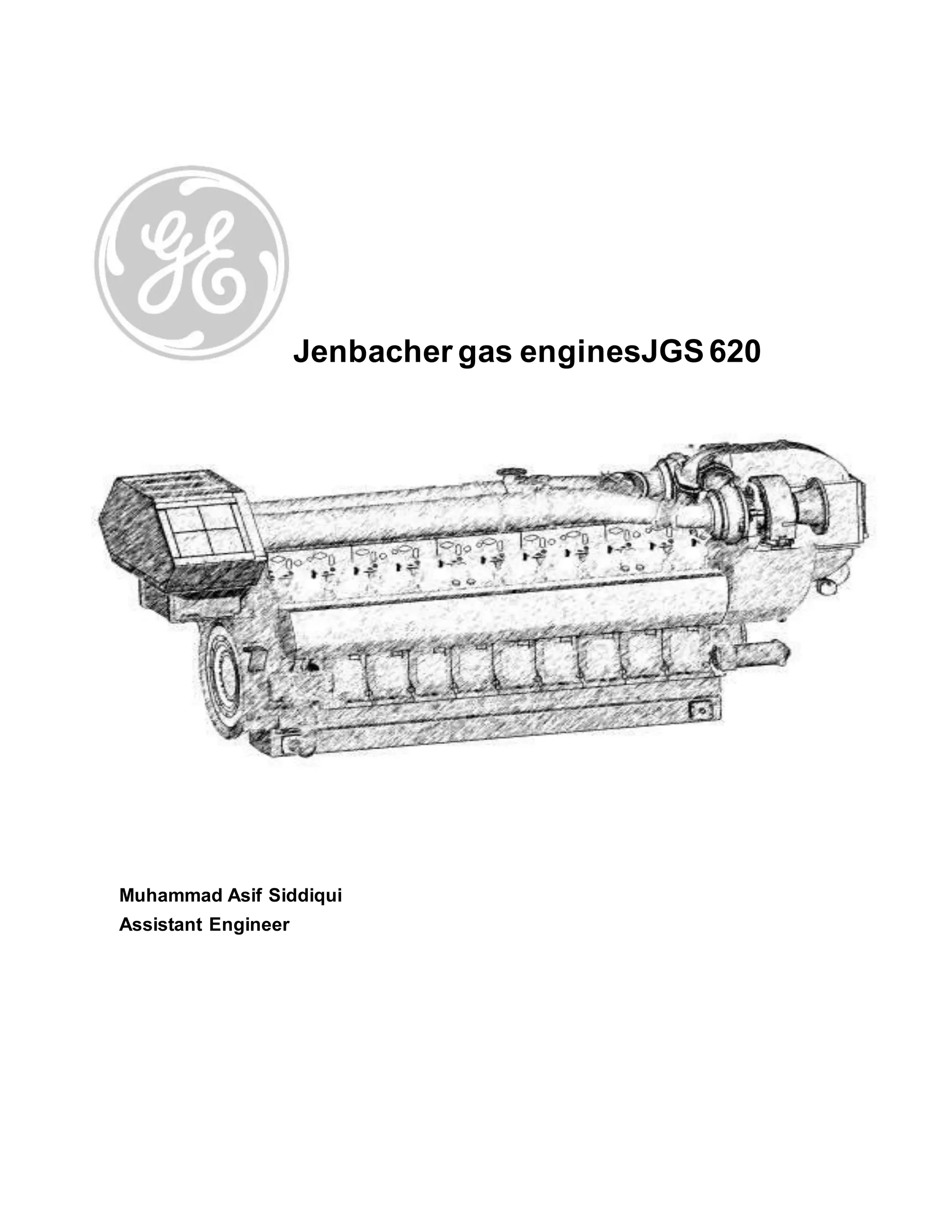
Jenbacher gas enginesJGS620
Muhammad Asif Siddiqui
Assistant Engineer
DESCRIPTION
 Gas engine
 General Principal
 4 stroke principal
 Engine parts
 Product range
 Salient features
 Parts of generators
 Generator working
 Main components of a generator
 Technical Data (at Genset)
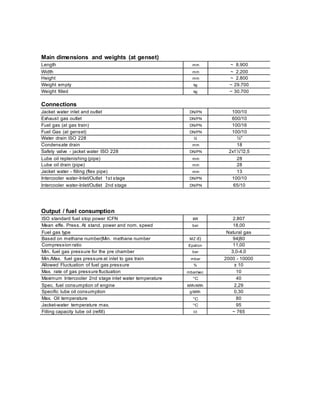
 Main dimensions and weights (at genset)
 Connections
 Output / fuel consumption
 Technical data of engine JGS 620
 Thermal energy balance
 Exhaust gas data
 Combustion air data
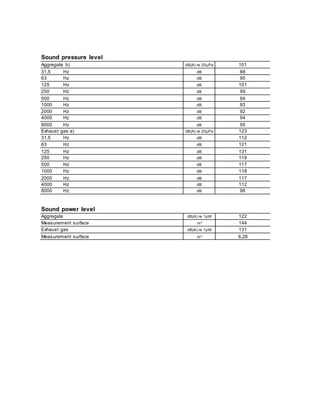
 Sound pressure level
 Sound power level
GE JENBACHER Gas Engine
GE JENBACHER is a leading Gas genset manufacturer in Austria ranked 1st in the world’s Gas
Genset industry. Its gas engine division is one of the world’s leading manufacturers of gas-fueled
Reciprocating engines, packaged generator sets and cogeneration units for power generation.
In Pakistan, the gen sets range in power from 0.33 to 4.4MW which can be run either on natural
gas or a variety of other gases such as biogas, coal mine gas, sewage gas and combustible
Industrial waste gases.
Patented combustion systems, engine controls and monitoring enable its power generation plants
to meet stringent emission standards whilst offering high levels of efficiency, durability and
Reliability.
With more than 50 years of experience in gas genset manufacturing, GE Jenbacher offers world
Leading technical support for each of its products.
Gas Engine
GE JENBACHER gas engine used the LEAN-OX method, which is the further development of
the lean-mix engine principal here the engine is supplied with the mixer of gas and a surplus of
air to minimize emission already at combustion stage in the engine.
General Principal:
The GE JENBACHER gas engine work on the four stroke principal and is water cooled 20
Cylinders V-engine (70%) with an exhaust gas turbo charger for pressure charging of the intake mixer.
Four stroke Principal:
1. Intake  Inlet stroke
2. Compression stroke
3. Power stroke
4. Exhaust stroke
Engine parts:
1. Throttle valve
2. Turbo charger
3. Air-intake line
4. Engine cooling water return line
5. Ignition coil (convert 24v to 18kv)
6. Exhaust valve
7. Piston
8. Cylinder
9. Connecting rod
10. Piston cooling nozzle
11. Crankshaft
12. Engine oil pump
13. Core
14. Vibration Damper
1. Throttle valve
When gas is complete 100% then other gas should go to the turbo charge by pass where
the gas reaches the turbo charger
2. Turbo charger
Turbo charger is use to raise the efficiency. There are 2 fans in this turbo charge.
One is move clock wise and 2nd is move anti-clock wise. Clock wise fan push the gas
Inside the engine and anti-clock wise fan exhaust the extra air.
3. Air-intake line
Where the fresh natural air intake inside the engine and mix with the gas.
4. Engine water return line:
The air which intake in air intake line, this air use the cool the engine all lines and return
To the cooling water.
5.Piston cooling nozzle:
It is a little nozzle which is pointed towards the beneath of a piston in an internal
Combustion.
It is linked to the pressurized side of the oil system, so cool oil coming directly from the
oil cooler will spray onto the piston and cooling it instead of just cooling around the
Cylinder.
6. Ignition coil:
Ignition coil use to converts 24v to 18kv which we take from batteries.
7. Exhaust valve:
Exhaust valve use to exhaust the gas which created during engine working.
8. Piston:
A piston is a component of reciprocating engines, reciprocating pumps, gas compressors
And pneumatic cylinders, among other similar mechanisms. It is the moving component
That is contained by a cylinder and is made gas-tight by piston rings.
9. cylinder
There are 20 cylinders in this gas engine. In this there is spark plugs use to sparkblast for
Ignition.
10. Connecting Rod.
A connecting rod is an engine component that transfers motion from the piston to the
Crankshaft and functions as a lever arm.
Technical Data (atGenset)
Data:
Fuel gas LHV kWh/Nm³ 9,5
100%
Energy input kW [2] 6.433
Gas volume Nm³/h *) 677
Mechanical output kW [1] 2.807
Electrical output kW el. [4] 2.739
Heat to be dissipated [5]
~ Intercooler 1st stage (Engine jacket water cooling circuit) kW 413
~ Intercooler 2nd stage (Low temperature circuit) kW 162
~ Lube oil (Engine jacket water cooling circuit) kW 315
~ Jacket water kW 515
~ Surface heat ca. kW [7] 239
~ Balance heat kW 64
Spec. fuel consumption of engine kWh/kWh [2] 2,29
Lube oil consumption ca. kg/h [3] 0,84
Electrical efficiency % 42,6%
Main dimensions and weights (at genset)
Length mm ~ 8.900
Width mm ~ 2.200
Height mm ~ 2.800
Weight empty kg ~ 29.700
Weight filled kg ~ 30.700
Connections
Jacket water inlet and outlet DN/PN 100/10
Exhaust gas outlet DN/PN 600/10
Fuel gas (at gas train) DN/PN 100/16
Fuel Gas (at genset) DN/PN 100/10
Water drain ISO 228 G ½''
Condensate drain mm 18
Safety valve - jacket water ISO 228 DN/PN 2x1½''/2,5
Lube oil replenishing (pipe) mm 28
Lube oil drain (pipe) mm 28
Jacket water - filling (flex pipe) mm 13
Intercooler water-Inlet/Outlet 1st stage DN/PN 100/10
Intercooler water-Inlet/Outlet 2nd stage DN/PN 65/10
Output / fuel consumption
ISO standard fuel stop power ICFN kW 2.807
Mean effe. Press. At stand. power and nom. speed bar 18,00
Fuel gas type Natural gas
Based on methane number|Min. methane number MZ d) 94|80
Compression ratio Epsilon 11,00
Min. fuel gas pressure for the pre chamber bar 3,0-4,0
Min./Max. fuel gas pressure at inlet to gas train mbar 2000 - 10000
Allowed Fluctuation of fuel gas pressure % ± 10
Max. rate of gas pressure fluctuation mbar/sec 10
Maximum Intercooler 2nd stage inlet water temperature °C 40
Spec. fuel consumption of engine kWh/kWh 2,29
Specific lube oil consumption g/kWh 0,30
Max. Oil temperature °C 80
Jacket-water temperature max. °C 95
Filling capacity lube oil (refill) lit ~ 765
Technical data ofengine JGS 620
Manufacturer GE Jenbacher
Engine type J 620 GS-E01
Working principle 4-Stroke
Configuration V 60°
No. of cylinders 20
Bore mm 190
Stroke mm 220
Piston displacement lit 124,75
Nominal speed rpm 1.500
Mean piston speed m/s 11,00
Length mm 5.542
Width mm 1.900
Height mm 2.540
Weight dry kg 12.000
Weight filled kg 13.000
Moment of inertia kgm² 69,21
Direction of rotation (from flywheel view) left
Flywheel connection SAE 24''
Radio interference level to VDE 0875 N
Starter motor output kW 20
Starter motor voltage V 24
Thermal energy balance
Energy input kW 6.433
Intercooler kW 575
Lube oil kW 315
Jacket water kW 515
Exhaust gas total kW 1.990
Exhaust gas cooled to 180 °C kW 1.268
Exhaust gas cooled to 100 °C kW 1.643
Surface heat kW 171
Balance heat kW 64
Exhaust gas data
Exhaust gas temperature at full load °C [8] 440
Exhaust gas mass flow rate, wet kg/h 15.635
Exhaust gas mass flow rate, dry kg/h 14.596
Exhaust gas volume, wet Nm³/h 12.335
Exhaust gas volume, dry Nm³/h 11.087
Max.admissible exhaust back pressure after engine mbar 60
Combustion air data
Combustion air mass flow rate kg/h 15.172
Combustion air volume Nm³/h 11.737
Max. admissible pressure drop in front of intake-air filter mbar 10
Sound pressure level
Aggregate b) dB(A) re 20µPa 101
31,5 Hz dB 88
63 Hz dB 95
125 Hz dB 101
250 Hz dB 99
500 Hz dB 94
1000 Hz dB 93
2000 Hz dB 92
4000 Hz dB 94
8000 Hz dB 95
Exhaust gas a) dB(A) re 20µPa 123
31,5 Hz dB 112
63 Hz dB 121
125 Hz dB 131
250 Hz dB 119
500 Hz dB 117
1000 Hz dB 118
2000 Hz dB 117
4000 Hz dB 112
8000 Hz dB 98
Sound power level
Aggregate dB(A) re 1pW 122
Measurement surface m² 144
Exhaust gas dB(A) re 1pW 131
Measurement surface m² 6,28
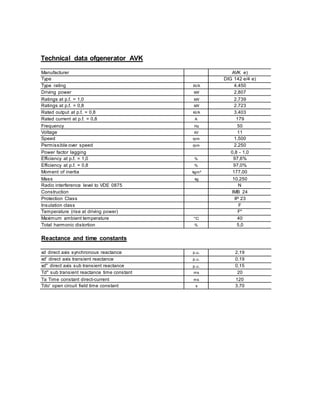
Technical data ofgenerator AVK
Manufacturer AVK e)
Type DIG 142 e/4 e)
Type rating kVA 4.450
Driving power kW 2.807
Ratings at p.f. = 1,0 kW 2.739
Ratings at p.f. = 0,8 kW 2.723
Rated output at p.f. = 0,8 kVA 3.403
Rated current at p.f. = 0,8 A 179
Frequency Hz 50
Voltage kV 11
Speed rpm 1.500
Permissible over speed rpm 2.250
Power factor lagging 0,8 - 1,0
Efficiency at p.f. = 1,0 % 97,6%
Efficiency at p.f. = 0,8 % 97,0%
Moment of inertia kgm² 177,00
Mass kg 10.250
Radio interference level to VDE 0875 N
Construction IMB 24
Protection Class IP 23
Insulation class F
Temperature (rise at driving power) F*
Maximum ambient temperature °C 40
Total harmonic distortion % 5,0
Reactance and time constants
xd direct axis synchronous reactance p.u. 2,19
xd' direct axis transient reactance p.u. 0,19
xd'' direct axis sub transient reactance p.u. 0,15
Td'' sub transient reactance time constant ms 20
Ta Time constant direct-current ms 120
Tdo' open circuit field time constant s 3,70
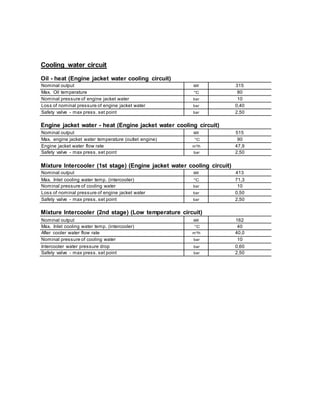
Cooling water circuit
Oil - heat (Engine jacket water cooling circuit)
Nominal output kW 315
Max. Oil temperature °C 80
Nominal pressure of engine jacket water bar 10
Loss of nominal pressure of engine jacket water bar 0,40
Safety valve - max press. set point bar 2,50
Engine jacket water - heat (Engine jacket water cooling circuit)
Nominal output kW 515
Max. engine jacket water temperature (outlet engine) °C 90
Engine jacket water flow rate m³/h 47,9
Safety valve - max press. set point bar 2,50
Mixture Intercooler (1st stage) (Engine jacket water cooling circuit)
Nominal output kW 413
Max. Inlet cooling water temp. (intercooler) °C 71,3
Nominal pressure of cooling water bar 10
Loss of nominal pressure of engine jacket water bar 0,50
Safety valve - max press. set point bar 2,50
Mixture Intercooler (2nd stage) (Low temperature circuit)
Nominal output kW 162
Max. Inlet cooling water temp. (intercooler) °C 40
After cooler water flow rate m³/h 40,0
Nominal pressure of cooling water bar 10
Intercooler water pressure drop bar 0,60
Safety valve - max press. set point bar 2,50
GE Jebachers Gas Engine JGS620 technical specifications

GE Jebachers Gas Engine JGS620 technical specifications

  • 1.
    Jenbacher gas enginesJGS620 MuhammadAsif Siddiqui Assistant Engineer
  • 2.
    DESCRIPTION  Gas engine General Principal  4 stroke principal  Engine parts  Product range  Salient features  Parts of generators  Generator working  Main components of a generator  Technical Data (at Genset)  Main dimensions and weights (at genset)  Connections  Output / fuel consumption  Technical data of engine JGS 620  Thermal energy balance  Exhaust gas data  Combustion air data  Sound pressure level  Sound power level
  • 3.
    GE JENBACHER GasEngine GE JENBACHER is a leading Gas genset manufacturer in Austria ranked 1st in the world’s Gas Genset industry. Its gas engine division is one of the world’s leading manufacturers of gas-fueled Reciprocating engines, packaged generator sets and cogeneration units for power generation. In Pakistan, the gen sets range in power from 0.33 to 4.4MW which can be run either on natural gas or a variety of other gases such as biogas, coal mine gas, sewage gas and combustible Industrial waste gases. Patented combustion systems, engine controls and monitoring enable its power generation plants to meet stringent emission standards whilst offering high levels of efficiency, durability and Reliability. With more than 50 years of experience in gas genset manufacturing, GE Jenbacher offers world Leading technical support for each of its products. Gas Engine GE JENBACHER gas engine used the LEAN-OX method, which is the further development of the lean-mix engine principal here the engine is supplied with the mixer of gas and a surplus of air to minimize emission already at combustion stage in the engine. General Principal: The GE JENBACHER gas engine work on the four stroke principal and is water cooled 20 Cylinders V-engine (70%) with an exhaust gas turbo charger for pressure charging of the intake mixer. Four stroke Principal: 1. Intake Inlet stroke 2. Compression stroke 3. Power stroke 4. Exhaust stroke
  • 4.
    Engine parts: 1. Throttlevalve 2. Turbo charger 3. Air-intake line 4. Engine cooling water return line 5. Ignition coil (convert 24v to 18kv) 6. Exhaust valve 7. Piston 8. Cylinder 9. Connecting rod 10. Piston cooling nozzle 11. Crankshaft 12. Engine oil pump 13. Core 14. Vibration Damper 1. Throttle valve When gas is complete 100% then other gas should go to the turbo charge by pass where the gas reaches the turbo charger 2. Turbo charger Turbo charger is use to raise the efficiency. There are 2 fans in this turbo charge. One is move clock wise and 2nd is move anti-clock wise. Clock wise fan push the gas Inside the engine and anti-clock wise fan exhaust the extra air. 3. Air-intake line Where the fresh natural air intake inside the engine and mix with the gas. 4. Engine water return line: The air which intake in air intake line, this air use the cool the engine all lines and return To the cooling water. 5.Piston cooling nozzle: It is a little nozzle which is pointed towards the beneath of a piston in an internal Combustion. It is linked to the pressurized side of the oil system, so cool oil coming directly from the oil cooler will spray onto the piston and cooling it instead of just cooling around the
  • 5.
    Cylinder. 6. Ignition coil: Ignitioncoil use to converts 24v to 18kv which we take from batteries. 7. Exhaust valve: Exhaust valve use to exhaust the gas which created during engine working. 8. Piston: A piston is a component of reciprocating engines, reciprocating pumps, gas compressors And pneumatic cylinders, among other similar mechanisms. It is the moving component That is contained by a cylinder and is made gas-tight by piston rings. 9. cylinder There are 20 cylinders in this gas engine. In this there is spark plugs use to sparkblast for Ignition. 10. Connecting Rod. A connecting rod is an engine component that transfers motion from the piston to the Crankshaft and functions as a lever arm. Technical Data (atGenset) Data: Fuel gas LHV kWh/Nm³ 9,5 100% Energy input kW [2] 6.433 Gas volume Nm³/h *) 677 Mechanical output kW [1] 2.807 Electrical output kW el. [4] 2.739 Heat to be dissipated [5] ~ Intercooler 1st stage (Engine jacket water cooling circuit) kW 413 ~ Intercooler 2nd stage (Low temperature circuit) kW 162 ~ Lube oil (Engine jacket water cooling circuit) kW 315 ~ Jacket water kW 515 ~ Surface heat ca. kW [7] 239 ~ Balance heat kW 64 Spec. fuel consumption of engine kWh/kWh [2] 2,29 Lube oil consumption ca. kg/h [3] 0,84 Electrical efficiency % 42,6%
  • 6.
    Main dimensions andweights (at genset) Length mm ~ 8.900 Width mm ~ 2.200 Height mm ~ 2.800 Weight empty kg ~ 29.700 Weight filled kg ~ 30.700 Connections Jacket water inlet and outlet DN/PN 100/10 Exhaust gas outlet DN/PN 600/10 Fuel gas (at gas train) DN/PN 100/16 Fuel Gas (at genset) DN/PN 100/10 Water drain ISO 228 G ½'' Condensate drain mm 18 Safety valve - jacket water ISO 228 DN/PN 2x1½''/2,5 Lube oil replenishing (pipe) mm 28 Lube oil drain (pipe) mm 28 Jacket water - filling (flex pipe) mm 13 Intercooler water-Inlet/Outlet 1st stage DN/PN 100/10 Intercooler water-Inlet/Outlet 2nd stage DN/PN 65/10 Output / fuel consumption ISO standard fuel stop power ICFN kW 2.807 Mean effe. Press. At stand. power and nom. speed bar 18,00 Fuel gas type Natural gas Based on methane number|Min. methane number MZ d) 94|80 Compression ratio Epsilon 11,00 Min. fuel gas pressure for the pre chamber bar 3,0-4,0 Min./Max. fuel gas pressure at inlet to gas train mbar 2000 - 10000 Allowed Fluctuation of fuel gas pressure % ± 10 Max. rate of gas pressure fluctuation mbar/sec 10 Maximum Intercooler 2nd stage inlet water temperature °C 40 Spec. fuel consumption of engine kWh/kWh 2,29 Specific lube oil consumption g/kWh 0,30 Max. Oil temperature °C 80 Jacket-water temperature max. °C 95 Filling capacity lube oil (refill) lit ~ 765
  • 7.
    Technical data ofengineJGS 620 Manufacturer GE Jenbacher Engine type J 620 GS-E01 Working principle 4-Stroke Configuration V 60° No. of cylinders 20 Bore mm 190 Stroke mm 220 Piston displacement lit 124,75 Nominal speed rpm 1.500 Mean piston speed m/s 11,00 Length mm 5.542 Width mm 1.900 Height mm 2.540 Weight dry kg 12.000 Weight filled kg 13.000 Moment of inertia kgm² 69,21 Direction of rotation (from flywheel view) left Flywheel connection SAE 24'' Radio interference level to VDE 0875 N Starter motor output kW 20 Starter motor voltage V 24 Thermal energy balance Energy input kW 6.433 Intercooler kW 575 Lube oil kW 315 Jacket water kW 515 Exhaust gas total kW 1.990 Exhaust gas cooled to 180 °C kW 1.268 Exhaust gas cooled to 100 °C kW 1.643 Surface heat kW 171 Balance heat kW 64 Exhaust gas data Exhaust gas temperature at full load °C [8] 440 Exhaust gas mass flow rate, wet kg/h 15.635 Exhaust gas mass flow rate, dry kg/h 14.596 Exhaust gas volume, wet Nm³/h 12.335 Exhaust gas volume, dry Nm³/h 11.087 Max.admissible exhaust back pressure after engine mbar 60 Combustion air data Combustion air mass flow rate kg/h 15.172 Combustion air volume Nm³/h 11.737 Max. admissible pressure drop in front of intake-air filter mbar 10
  • 8.
    Sound pressure level Aggregateb) dB(A) re 20µPa 101 31,5 Hz dB 88 63 Hz dB 95 125 Hz dB 101 250 Hz dB 99 500 Hz dB 94 1000 Hz dB 93 2000 Hz dB 92 4000 Hz dB 94 8000 Hz dB 95 Exhaust gas a) dB(A) re 20µPa 123 31,5 Hz dB 112 63 Hz dB 121 125 Hz dB 131 250 Hz dB 119 500 Hz dB 117 1000 Hz dB 118 2000 Hz dB 117 4000 Hz dB 112 8000 Hz dB 98 Sound power level Aggregate dB(A) re 1pW 122 Measurement surface m² 144 Exhaust gas dB(A) re 1pW 131 Measurement surface m² 6,28
  • 9.
    Technical data ofgeneratorAVK Manufacturer AVK e) Type DIG 142 e/4 e) Type rating kVA 4.450 Driving power kW 2.807 Ratings at p.f. = 1,0 kW 2.739 Ratings at p.f. = 0,8 kW 2.723 Rated output at p.f. = 0,8 kVA 3.403 Rated current at p.f. = 0,8 A 179 Frequency Hz 50 Voltage kV 11 Speed rpm 1.500 Permissible over speed rpm 2.250 Power factor lagging 0,8 - 1,0 Efficiency at p.f. = 1,0 % 97,6% Efficiency at p.f. = 0,8 % 97,0% Moment of inertia kgm² 177,00 Mass kg 10.250 Radio interference level to VDE 0875 N Construction IMB 24 Protection Class IP 23 Insulation class F Temperature (rise at driving power) F* Maximum ambient temperature °C 40 Total harmonic distortion % 5,0 Reactance and time constants xd direct axis synchronous reactance p.u. 2,19 xd' direct axis transient reactance p.u. 0,19 xd'' direct axis sub transient reactance p.u. 0,15 Td'' sub transient reactance time constant ms 20 Ta Time constant direct-current ms 120 Tdo' open circuit field time constant s 3,70
  • 10.
    Cooling water circuit Oil- heat (Engine jacket water cooling circuit) Nominal output kW 315 Max. Oil temperature °C 80 Nominal pressure of engine jacket water bar 10 Loss of nominal pressure of engine jacket water bar 0,40 Safety valve - max press. set point bar 2,50 Engine jacket water - heat (Engine jacket water cooling circuit) Nominal output kW 515 Max. engine jacket water temperature (outlet engine) °C 90 Engine jacket water flow rate m³/h 47,9 Safety valve - max press. set point bar 2,50 Mixture Intercooler (1st stage) (Engine jacket water cooling circuit) Nominal output kW 413 Max. Inlet cooling water temp. (intercooler) °C 71,3 Nominal pressure of cooling water bar 10 Loss of nominal pressure of engine jacket water bar 0,50 Safety valve - max press. set point bar 2,50 Mixture Intercooler (2nd stage) (Low temperature circuit) Nominal output kW 162 Max. Inlet cooling water temp. (intercooler) °C 40 After cooler water flow rate m³/h 40,0 Nominal pressure of cooling water bar 10 Intercooler water pressure drop bar 0,60 Safety valve - max press. set point bar 2,50