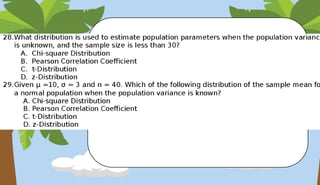
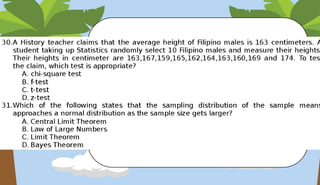
STATISTICS REVIEWER
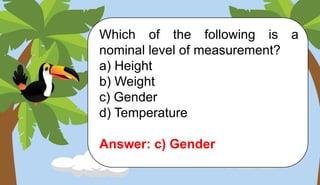
Which of the following is a
nominal level of measurement?
a) Height
b) Weight
c) Gender
d) Temperature
Answer: c) Gender
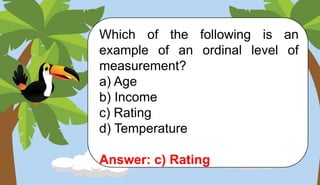
Which of the following is an
example of an ordinal level of
measurement?
a) Age
b) Income
c) Rating
d) Temperature
Answer: c) Rating
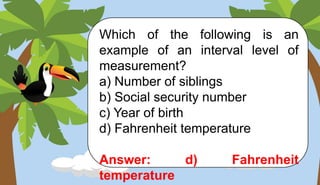
Which of the following is an
example of an interval level of
measurement?
a) Number of siblings
b) Social security number
c) Year of birth
d) Fahrenheit temperature
Answer: d) Fahrenheit
temperature
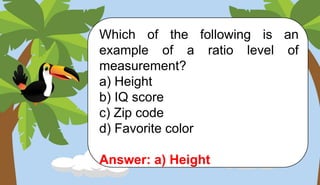
Which of the following is an
example of a ratio level of
measurement?
a) Height
b) IQ score
c) Zip code
d) Favorite color
Answer: a) Height
Which level of measurement is
most commonly used in surveys?
a) Nominal
b) Ordinal
c) Interval
d) Ratio
Answer: a) Nominal
Which level of measurement is
used to classify data into mutually
exclusive categories?
a) Nominal
b) Ordinal
c) Interval
d) Ratio
Answer: a) Nominal
Which level of measurement is
used to classify data into mutually
exclusive categories?
a) Nominal
b) Ordinal
c) Interval
d) Ratio
Answer: a) Nominal
Which measure of central
tendency is the most commonly
used?
a) Mean
b) Median
c) Mode
d) Range
Answer: a) Mean
Which measure of central
tendency is not influenced by
extreme values?
a) Mean
b) Median
c) Mode
d) Range
Answer: b) Median
What is the median?
a) The value that occurs most frequently
in a data set
b) The middle value in a data set
c) The value that is halfway between the
minimum and maximum values in a data
set
d) The value that is closest to the
arithmetic mean in a data set
Answer: b) The middle value in a
dataset
What is the mode?
a) The value that occurs most frequently
in a dataset
b) The middle value in a dataset
c) The value that is halfway between the
minimum and maximum values in a
dataset
d) The value that is closest to the
arithmetic mean in a dataset
Answer: a) The value that occurs most
frequently in a dataset
What is the range?
a) The difference between the highest and
lowest values in a dataset
b) The average of the highest and lowest
values in a dataset
c) The value that occurs most frequently
in a dataset
d) The middle value in a dataset
Answer: a) The difference between the
highest and lowest values in a dataset
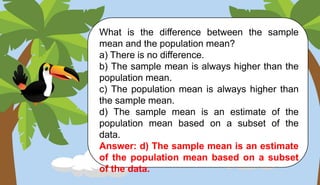
What is the difference between the sample
mean and the population mean?
a) There is no difference.
b) The sample mean is always higher than the
population mean.
c) The population mean is always higher than
the sample mean.
d) The sample mean is an estimate of the
population mean based on a subset of the
data.
Answer: d) The sample mean is an estimate
of the population mean based on a subset
of the data.
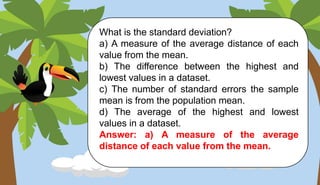
What is the standard deviation?
a) A measure of the average distance of each
value from the mean.
b) The difference between the highest and
lowest values in a dataset.
c) The number of standard errors the sample
mean is from the population mean.
d) The average of the highest and lowest
values in a dataset.
Answer: a) A measure of the average
distance of each value from the mean.
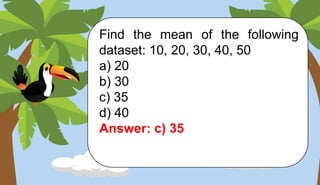
Find the mean of the following
dataset: 10, 20, 30, 40, 50
a) 20
b) 30
c) 35
d) 40
Answer: c) 35
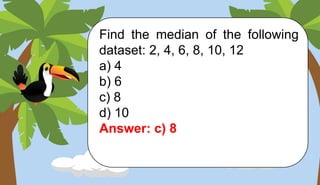
Find the median of the following
dataset: 2, 4, 6, 8, 10, 12
a) 4
b) 6
c) 8
d) 10
Answer: c) 8
What is a random variable?
a) A variable that is not determined by
chance
b) A variable that has a fixed value
c) A variable whose value depends on the
outcome of a random event
d) A variable that can only take on
discrete values
Answer: c) A variable whose value
depends on the outcome of a random
event.
What is the expected value of a random
variable?
a) The value that the random variable is most
likely to take on
b) The average value of the random variable
over many trials
c) The highest possible value the random
variable can take on
d) The lowest possible value the random
variable can take on
Answer: b) The average value of the random
variable over many trials.
What is the variance of a random variable?
a) A measure of how spread out the values of
the random variable are from the expected
value
b) The highest possible value the random
variable can take on
c) The lowest possible value the random
variable can take on
d) The value that the random variable is most
likely to take on
Answer: a) A measure of how spread out
the values of the random variable are from
the expected value.
Which of the following is an
example of a discrete variable?
a) The weight of a person
b) The height of a person
c) The number of cars in a parking
lot
d) The temperature outside
Answer: c) The number of cars
in a parking lot.
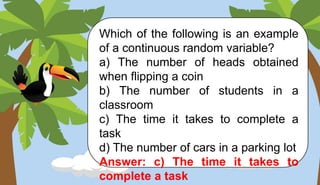
Which of the following is an example
of a continuous random variable?
a) The number of heads obtained
when flipping a coin
b) The number of students in a
classroom
c) The time it takes to complete a
task
d) The number of cars in a parking lot
Answer: c) The time it takes to
complete a task
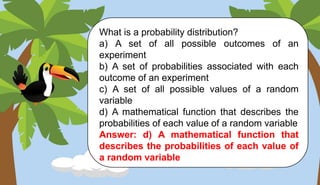
What is a probability distribution?
a) A set of all possible outcomes of an
experiment
b) A set of probabilities associated with each
outcome of an experiment
c) A set of all possible values of a random
variable
d) A mathematical function that describes the
probabilities of each value of a random variable
Answer: d) A mathematical function that
describes the probabilities of each value of
a random variable
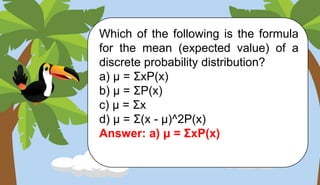
Which of the following is the formula
for the mean (expected value) of a
discrete probability distribution?
a) μ = ΣxP(x)
b) μ = ΣP(x)
c) μ = Σx
d) μ = Σ(x - μ)^2P(x)
Answer: a) μ = ΣxP(x)
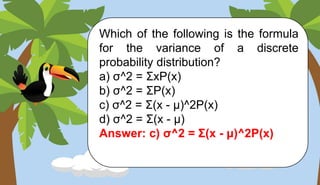
Which of the following is the formula
for the variance of a discrete
probability distribution?
a) σ^2 = ΣxP(x)
b) σ^2 = ΣP(x)
c) σ^2 = Σ(x - μ)^2P(x)
d) σ^2 = Σ(x - μ)
Answer: c) σ^2 = Σ(x - μ)^2P(x)
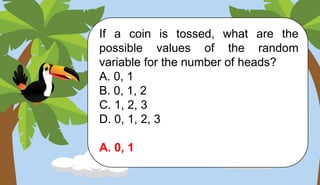
If a coin is tossed, what are the
possible values of the random
variable for the number of heads?
A. 0, 1
B. 0, 1, 2
C. 1, 2, 3
D. 0, 1, 2, 3
A. 0, 1
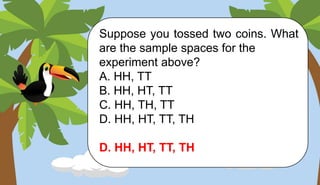
Suppose you tossed two coins. What
are the sample spaces for the
experiment above?
A. HH, TT
B. HH, HT, TT
C. HH, TH, TT
D. HH, HT, TT, TH
D. HH, HT, TT, TH
What is the mean of a standard
normal distribution?
a) 0
b) 1
c) -1
d) It depends on the standard
deviation.
Answer: a) 0
According to the empirical rule, what
percentage of data is expected to fall
within one standard deviation of the
mean in a normal distribution?
a) 34%
b) 68%
c) 95%
d) 99.7%
Answer: b) 68%
According to the empirical rule, what
percentage of data is expected to fall
within two standard deviations of the
mean in a normal distribution?
a) 34%
b) 68%
c) 95%
d) 99.7%
Answer: c) 95%
According to the empirical rule, what
percentage of data is expected to fall
within three standard deviations of
the mean in a normal distribution?
a) 34%
b) 68%
c) 95%
d) 99.7%
Answer: d) 99.7%
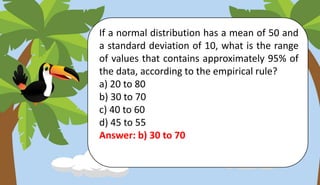
If a normal distribution has a mean of 50 and
a standard deviation of 10, what is the range
of values that contains approximately 95% of
the data, according to the empirical rule?
a) 20 to 80
b) 30 to 70
c) 40 to 60
d) 45 to 55
Answer: b) 30 to 70
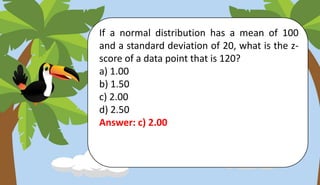
If a normal distribution has a mean of 100
and a standard deviation of 20, what is the z-
score of a data point that is 120?
a) 1.00
b) 1.50
c) 2.00
d) 2.50
Answer: c) 2.00
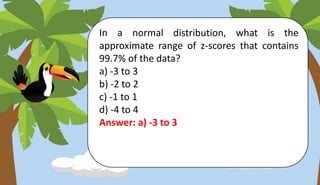
In a normal distribution, what is the
approximate range of z-scores that contains
99.7% of the data?
a) -3 to 3
b) -2 to 2
c) -1 to 1
d) -4 to 4
Answer: a) -3 to 3
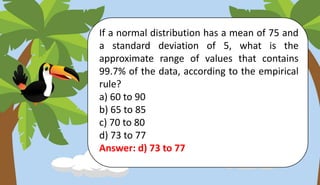
If a normal distribution has a mean of 75 and
a standard deviation of 5, what is the
approximate range of values that contains
99.7% of the data, according to the empirical
rule?
a) 60 to 90
b) 65 to 85
c) 70 to 80
d) 73 to 77
Answer: d) 73 to 77
A normal distribution has a mean of 100 and
a standard deviation of 10. What is the
approximate range of values that contains
95% of the data, according to the empirical
rule?
a) 80 to 120
b) 85 to 115
c) 90 to 110
d) 93 to 107
Answer: d) 93 to 107
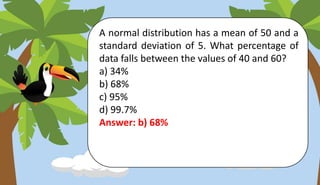
A normal distribution has a mean of 50 and a
standard deviation of 5. What percentage of
data falls between the values of 40 and 60?
a) 34%
b) 68%
c) 95%
d) 99.7%
Answer: b) 68%
In a normal distribution with a mean of 50
and a standard deviation of 10, what is the
approximate range of values that contains
68% of the data, according to the empirical
rule?
a) 30 to 70
b) 40 to 60
c) 45 to 55
d) 47 to 53
Answer: d) 47 to 53
Which of the following is an example
of a random sampling technique?
a) Convenience sampling
b) Stratified sampling
c) Snowball sampling
d) Purposive sampling
Answer: b) Stratified sampling
It is a variable being measured to
produce numerical observations
associated with the random outcomes of
a chance experiment.
A. fixed variable
B. dependent variable
C. independent variable
D. random variable
D. random variable
A fair coin is tossed three times and the
sequence of heads (H) and tails (T) is
observed. What is the probability that no
heads will appear?
A. 1/8
B. 3/8
C. 5/8
D. 2/3
A. 1/8
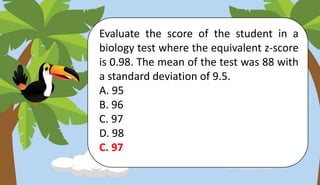
Evaluate the score of the student in a
biology test where the equivalent z-score
is 0.98. The mean of the test was 88 with
a standard deviation of 9.5.
A. 95
B. 96
C. 97
D. 98
C. 97
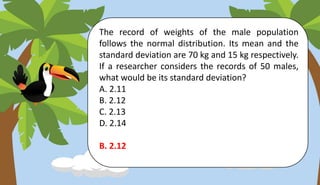
The record of weights of the male population
follows the normal distribution. Its mean and the
standard deviation are 70 kg and 15 kg respectively.
If a researcher considers the records of 50 males,
what would be its standard deviation?
A. 2.11
B. 2.12
C. 2.13
D. 2.14
B. 2.12
What is the estimate, if the sample size of
random sampling using the Central Limit
Theorem is almost normal in accordance with
Statisticians?
A. If n= 2
B. If n= 3
C. If n= 10
D. If n= 30
D. If n= 30
Which of the following is not a
probability sampling technique?
A. Simple Random Sampling
B. Systematic Sampling
C. Convenience Sampling
D. Stratified Sampling
Answer: C. Convenience Sampling
In stratified sampling, what is the purpose of
dividing the population into strata?
A. To ensure that every member of the population
has an equal chance of being selected
B. To reduce the variability of the sample
C. To increase the representativeness of the sample
D. To reduce the sample size required
Answer: C. To increase the representativeness of
the sample
Which of the following is an example of stratified
sampling?
A. Dividing a city into neighborhoods and randomly
selecting households within each neighborhood
B. Selecting every 10th person from a list of employees
C. Randomly selecting customers as they exit a store
D. Dividing a university into departments and randomly
selecting students from each department
Answer: D. Dividing a university into departments and
randomly selecting students from each department
What is a null hypothesis?
A. A hypothesis that is always true
B. A hypothesis that is never true
C. A hypothesis that is tested using statistical
methods
D. A hypothesis that is assumed to be true
unless proven otherwise
Answer: D. A hypothesis that is assumed to
be true unless proven otherwise
What is a Type I error?
A. Rejecting a true null hypothesis
B. Failing to reject a false null hypothesis
C. Rejecting a false alternative hypothesis
D. Failing to reject a true alternative
hypothesis
Answer: A. Rejecting a true null
hypothesis
What is a Type II error?
A. Failing to reject a false null hypothesis
B. Rejecting a true null hypothesis
C. Failing to reject a true alternative
hypothesis
D. Rejecting a false alternative hypothesis
Answer: A. Failing to reject a false null
hypothesis
What is the significance level in hypothesis testing?
A. The level of confidence in rejecting the null
hypothesis
B. The level of confidence in failing to reject the
null hypothesis
C. The probability of making a Type I error
D. The probability of making a Type II error
Answer: C. The probability of making a Type I
error
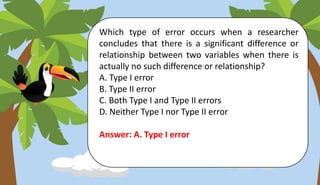
Which type of error occurs when a researcher
concludes that there is a significant difference or
relationship between two variables when there is
actually no such difference or relationship?
A. Type I error
B. Type II error
C. Both Type I and Type II errors
D. Neither Type I nor Type II error
Answer: A. Type I error
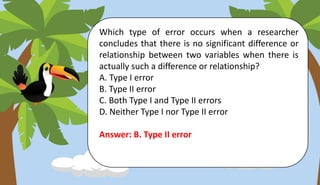
Which type of error occurs when a researcher
concludes that there is no significant difference or
relationship between two variables when there is
actually such a difference or relationship?
A. Type I error
B. Type II error
C. Both Type I and Type II errors
D. Neither Type I nor Type II error
Answer: B. Type II error
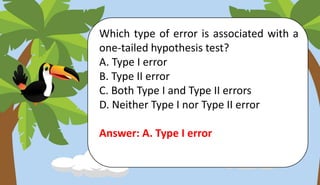
Which type of error is associated with a
one-tailed hypothesis test?
A. Type I error
B. Type II error
C. Both Type I and Type II errors
D. Neither Type I nor Type II error
Answer: A. Type I error
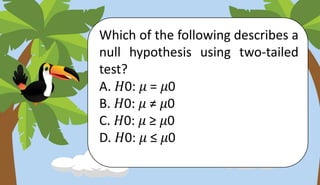
Which of the following describes a
null hypothesis using two-tailed
test?
A. 𝐻0: 𝜇 = 𝜇0
B. 𝐻0: 𝜇 ≠ 𝜇0
C. 𝐻0: 𝜇 ≥ 𝜇0
D. 𝐻0: 𝜇 ≤ 𝜇0
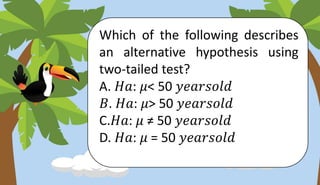
Which of the following describes
an alternative hypothesis using
two-tailed test?
A. 𝐻𝑎: 𝜇< 50 𝑦𝑒𝑎𝑟𝑠𝑜𝑙𝑑
𝐵. 𝐻𝑎: 𝜇> 50 𝑦𝑒𝑎𝑟𝑠𝑜𝑙𝑑
C.𝐻𝑎: 𝜇 ≠ 50 𝑦𝑒𝑎𝑟𝑠𝑜𝑙𝑑
D. 𝐻𝑎: 𝜇 = 50 𝑦𝑒𝑎𝑟𝑠𝑜𝑙𝑑
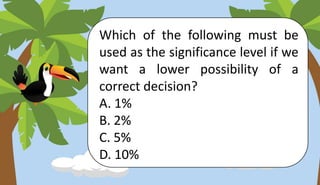
Which of the following must be
used as the significance level if we
want a lower possibility of a
correct decision?
A. 1%
B. 2%
C. 5%
D. 10%
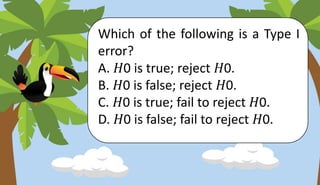
Which of the following is a Type I
error?
A. 𝐻0 is true; reject 𝐻0.
B. 𝐻0 is false; reject 𝐻0.
C. 𝐻0 is true; fail to reject 𝐻0.
D. 𝐻0 is false; fail to reject 𝐻0.
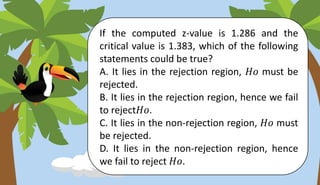
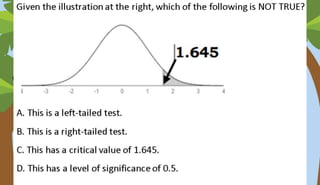
If the computed z-value is 1.286 and the
critical value is 1.383, which of the following
statements could be true?
A. It lies in the rejection region, 𝐻𝑜 must be
rejected.
B. It lies in the rejection region, hence we fail
to reject𝐻𝑜.
C. It lies in the non-rejection region, 𝐻𝑜 must
be rejected.
D. It lies in the non-rejection region, hence
we fail to reject 𝐻𝑜.
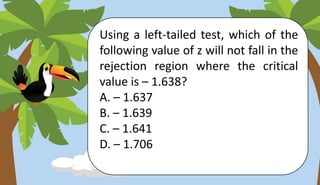
Using a left-tailed test, which of the
following value of z will not fall in the
rejection region where the critical
value is – 1.638?
A. – 1.637
B. – 1.639
C. – 1.641
D. – 1.706
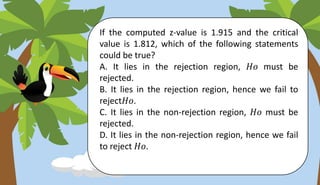
If the computed z-value is 1.915 and the critical
value is 1.812, which of the following statements
could be true?
A. It lies in the rejection region, 𝐻𝑜 must be
rejected.
B. It lies in the rejection region, hence we fail to
reject𝐻𝑜.
C. It lies in the non-rejection region, 𝐻𝑜 must be
rejected.
D. It lies in the non-rejection region, hence we fail
to reject 𝐻𝑜.
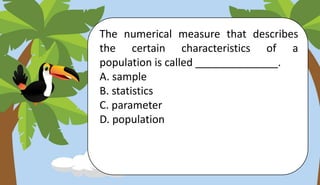
The numerical measure that describes
the certain characteristics of a
population is called ______________.
A. sample
B. statistics
C. parameter
D. population
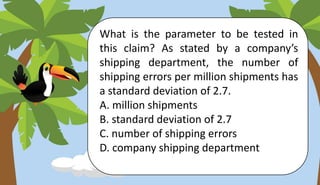
What is the parameter to be tested in
this claim? As stated by a company’s
shipping department, the number of
shipping errors per million shipments has
a standard deviation of 2.7.
A. million shipments
B. standard deviation of 2.7
C. number of shipping errors
D. company shipping department
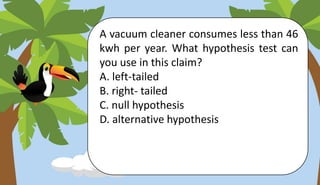
A vacuum cleaner consumes less than 46
kwh per year. What hypothesis test can
you use in this claim?
A. left-tailed
B. right- tailed
C. null hypothesis
D. alternative hypothesis
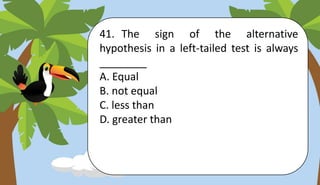
41. The sign of the alternative
hypothesis in a left-tailed test is always
________
A. Equal
B. not equal
C. less than
D. greater than
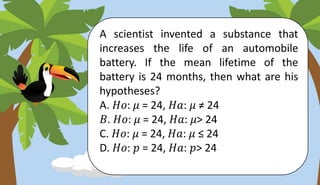
A scientist invented a substance that
increases the life of an automobile
battery. If the mean lifetime of the
battery is 24 months, then what are his
hypotheses?
A. 𝐻𝑜: 𝜇 = 24, 𝐻𝑎: 𝜇 ≠ 24
𝐵. 𝐻𝑜: 𝜇 = 24, 𝐻𝑎: 𝜇> 24
C. 𝐻𝑜: 𝜇 = 24, 𝐻𝑎: 𝜇 ≤ 24
D. 𝐻𝑜: 𝑝 = 24, 𝐻𝑎: 𝑝> 24
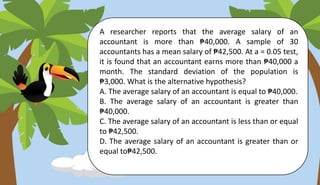
A researcher reports that the average salary of an
accountant is more than ₱40,000. A sample of 30
accountants has a mean salary of ₱42,500. At a = 0.05 test,
it is found that an accountant earns more than ₱40,000 a
month. The standard deviation of the population is
₱3,000. What is the alternative hypothesis?
A. The average salary of an accountant is equal to ₱40,000.
B. The average salary of an accountant is greater than
₱40,000.
C. The average salary of an accountant is less than or equal
to ₱42,500.
D. The average salary of an accountant is greater than or
equal to₱42,500.
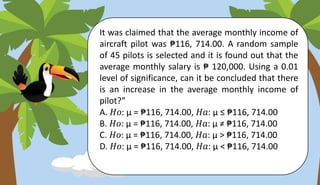
It was claimed that the average monthly income of
aircraft pilot was ₱116, 714.00. A random sample
of 45 pilots is selected and it is found out that the
average monthly salary is ₱ 120,000. Using a 0.01
level of significance, can it be concluded that there
is an increase in the average monthly income of
pilot?”
A. 𝐻𝑜: µ = ₱116, 714.00, 𝐻𝑎: µ ≤ ₱116, 714.00
B. 𝐻𝑜: µ = ₱116, 714.00, 𝐻𝑎: µ ≠ ₱116, 714.00
C. 𝐻𝑜: µ = ₱116, 714.00, 𝐻𝑎: µ > ₱116, 714.00
D. 𝐻𝑜: µ = ₱116, 714.00, 𝐻𝑎: µ < ₱116, 714.00
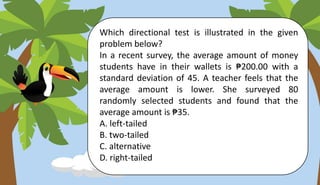
Which directional test is illustrated in the given
problem below?
In a recent survey, the average amount of money
students have in their wallets is ₱200.00 with a
standard deviation of 45. A teacher feels that the
average amount is lower. She surveyed 80
randomly selected students and found that the
average amount is ₱35.
A. left-tailed
B. two-tailed
C. alternative
D. right-tailed
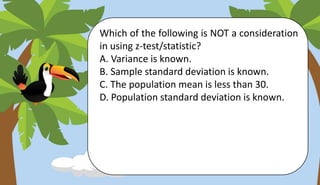
Which of the following is NOT a consideration
in using z-test/statistic?
A. Variance is known.
B. Sample standard deviation is known.
C. The population mean is less than 30.
D. Population standard deviation is known.
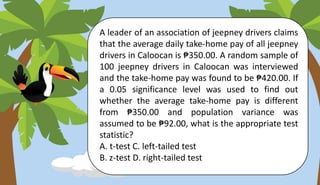
A leader of an association of jeepney drivers claims
that the average daily take-home pay of all jeepney
drivers in Caloocan is ₱350.00. A random sample of
100 jeepney drivers in Caloocan was interviewed
and the take-home pay was found to be ₱420.00. If
a 0.05 significance level was used to find out
whether the average take-home pay is different
from ₱350.00 and population variance was
assumed to be ₱92.00, what is the appropriate test
statistic?
A. t-test C. left-tailed test
B. z-test D. right-tailed test
The value that separates a rejection
region from an acceptance region is
called a ___________.
A. Parameter
B. Hypothesis
C. critical value
D. significance level
Statistics and Probability Reviewer.pptx

Statistics and Probability Reviewer.pptx

  • 1.
  • 2.
    Which of thefollowing is a nominal level of measurement? a) Height b) Weight c) Gender d) Temperature Answer: c) Gender
  • 3.
    Which of thefollowing is an example of an ordinal level of measurement? a) Age b) Income c) Rating d) Temperature Answer: c) Rating
  • 4.
    Which of thefollowing is an example of an interval level of measurement? a) Number of siblings b) Social security number c) Year of birth d) Fahrenheit temperature Answer: d) Fahrenheit temperature
  • 5.
    Which of thefollowing is an example of a ratio level of measurement? a) Height b) IQ score c) Zip code d) Favorite color Answer: a) Height
  • 6.
    Which level ofmeasurement is most commonly used in surveys? a) Nominal b) Ordinal c) Interval d) Ratio Answer: a) Nominal
  • 7.
    Which level ofmeasurement is used to classify data into mutually exclusive categories? a) Nominal b) Ordinal c) Interval d) Ratio Answer: a) Nominal
  • 8.
    Which level ofmeasurement is used to classify data into mutually exclusive categories? a) Nominal b) Ordinal c) Interval d) Ratio Answer: a) Nominal
  • 9.
    Which measure ofcentral tendency is the most commonly used? a) Mean b) Median c) Mode d) Range Answer: a) Mean
  • 10.
    Which measure ofcentral tendency is not influenced by extreme values? a) Mean b) Median c) Mode d) Range Answer: b) Median
  • 11.
    What is themedian? a) The value that occurs most frequently in a data set b) The middle value in a data set c) The value that is halfway between the minimum and maximum values in a data set d) The value that is closest to the arithmetic mean in a data set Answer: b) The middle value in a dataset
  • 12.
    What is themode? a) The value that occurs most frequently in a dataset b) The middle value in a dataset c) The value that is halfway between the minimum and maximum values in a dataset d) The value that is closest to the arithmetic mean in a dataset Answer: a) The value that occurs most frequently in a dataset
  • 13.
    What is therange? a) The difference between the highest and lowest values in a dataset b) The average of the highest and lowest values in a dataset c) The value that occurs most frequently in a dataset d) The middle value in a dataset Answer: a) The difference between the highest and lowest values in a dataset
  • 14.
    What is thedifference between the sample mean and the population mean? a) There is no difference. b) The sample mean is always higher than the population mean. c) The population mean is always higher than the sample mean. d) The sample mean is an estimate of the population mean based on a subset of the data. Answer: d) The sample mean is an estimate of the population mean based on a subset of the data.
  • 15.
    What is thestandard deviation? a) A measure of the average distance of each value from the mean. b) The difference between the highest and lowest values in a dataset. c) The number of standard errors the sample mean is from the population mean. d) The average of the highest and lowest values in a dataset. Answer: a) A measure of the average distance of each value from the mean.
  • 16.
    Find the meanof the following dataset: 10, 20, 30, 40, 50 a) 20 b) 30 c) 35 d) 40 Answer: c) 35
  • 17.
    Find the medianof the following dataset: 2, 4, 6, 8, 10, 12 a) 4 b) 6 c) 8 d) 10 Answer: c) 8
  • 18.
    What is arandom variable? a) A variable that is not determined by chance b) A variable that has a fixed value c) A variable whose value depends on the outcome of a random event d) A variable that can only take on discrete values Answer: c) A variable whose value depends on the outcome of a random event.
  • 19.
    What is theexpected value of a random variable? a) The value that the random variable is most likely to take on b) The average value of the random variable over many trials c) The highest possible value the random variable can take on d) The lowest possible value the random variable can take on Answer: b) The average value of the random variable over many trials.
  • 20.
    What is thevariance of a random variable? a) A measure of how spread out the values of the random variable are from the expected value b) The highest possible value the random variable can take on c) The lowest possible value the random variable can take on d) The value that the random variable is most likely to take on Answer: a) A measure of how spread out the values of the random variable are from the expected value.
  • 21.
    Which of thefollowing is an example of a discrete variable? a) The weight of a person b) The height of a person c) The number of cars in a parking lot d) The temperature outside Answer: c) The number of cars in a parking lot.
  • 22.
    Which of thefollowing is an example of a continuous random variable? a) The number of heads obtained when flipping a coin b) The number of students in a classroom c) The time it takes to complete a task d) The number of cars in a parking lot Answer: c) The time it takes to complete a task
  • 23.
    What is aprobability distribution? a) A set of all possible outcomes of an experiment b) A set of probabilities associated with each outcome of an experiment c) A set of all possible values of a random variable d) A mathematical function that describes the probabilities of each value of a random variable Answer: d) A mathematical function that describes the probabilities of each value of a random variable
  • 24.
    Which of thefollowing is the formula for the mean (expected value) of a discrete probability distribution? a) μ = ΣxP(x) b) μ = ΣP(x) c) μ = Σx d) μ = Σ(x - μ)^2P(x) Answer: a) μ = ΣxP(x)
  • 25.
    Which of thefollowing is the formula for the variance of a discrete probability distribution? a) σ^2 = ΣxP(x) b) σ^2 = ΣP(x) c) σ^2 = Σ(x - μ)^2P(x) d) σ^2 = Σ(x - μ) Answer: c) σ^2 = Σ(x - μ)^2P(x)
  • 26.
    If a coinis tossed, what are the possible values of the random variable for the number of heads? A. 0, 1 B. 0, 1, 2 C. 1, 2, 3 D. 0, 1, 2, 3 A. 0, 1
  • 27.
    Suppose you tossedtwo coins. What are the sample spaces for the experiment above? A. HH, TT B. HH, HT, TT C. HH, TH, TT D. HH, HT, TT, TH D. HH, HT, TT, TH
  • 30.
    What is themean of a standard normal distribution? a) 0 b) 1 c) -1 d) It depends on the standard deviation. Answer: a) 0
  • 31.
    According to theempirical rule, what percentage of data is expected to fall within one standard deviation of the mean in a normal distribution? a) 34% b) 68% c) 95% d) 99.7% Answer: b) 68%
  • 32.
    According to theempirical rule, what percentage of data is expected to fall within two standard deviations of the mean in a normal distribution? a) 34% b) 68% c) 95% d) 99.7% Answer: c) 95%
  • 33.
    According to theempirical rule, what percentage of data is expected to fall within three standard deviations of the mean in a normal distribution? a) 34% b) 68% c) 95% d) 99.7% Answer: d) 99.7%
  • 34.
    If a normaldistribution has a mean of 50 and a standard deviation of 10, what is the range of values that contains approximately 95% of the data, according to the empirical rule? a) 20 to 80 b) 30 to 70 c) 40 to 60 d) 45 to 55 Answer: b) 30 to 70
  • 35.
    If a normaldistribution has a mean of 100 and a standard deviation of 20, what is the z- score of a data point that is 120? a) 1.00 b) 1.50 c) 2.00 d) 2.50 Answer: c) 2.00
  • 36.
    In a normaldistribution, what is the approximate range of z-scores that contains 99.7% of the data? a) -3 to 3 b) -2 to 2 c) -1 to 1 d) -4 to 4 Answer: a) -3 to 3
  • 37.
    If a normaldistribution has a mean of 75 and a standard deviation of 5, what is the approximate range of values that contains 99.7% of the data, according to the empirical rule? a) 60 to 90 b) 65 to 85 c) 70 to 80 d) 73 to 77 Answer: d) 73 to 77
  • 38.
    A normal distributionhas a mean of 100 and a standard deviation of 10. What is the approximate range of values that contains 95% of the data, according to the empirical rule? a) 80 to 120 b) 85 to 115 c) 90 to 110 d) 93 to 107 Answer: d) 93 to 107
  • 39.
    A normal distributionhas a mean of 50 and a standard deviation of 5. What percentage of data falls between the values of 40 and 60? a) 34% b) 68% c) 95% d) 99.7% Answer: b) 68%
  • 40.
    In a normaldistribution with a mean of 50 and a standard deviation of 10, what is the approximate range of values that contains 68% of the data, according to the empirical rule? a) 30 to 70 b) 40 to 60 c) 45 to 55 d) 47 to 53 Answer: d) 47 to 53
  • 41.
    Which of thefollowing is an example of a random sampling technique? a) Convenience sampling b) Stratified sampling c) Snowball sampling d) Purposive sampling Answer: b) Stratified sampling
  • 42.
    It is avariable being measured to produce numerical observations associated with the random outcomes of a chance experiment. A. fixed variable B. dependent variable C. independent variable D. random variable D. random variable
  • 43.
    A fair coinis tossed three times and the sequence of heads (H) and tails (T) is observed. What is the probability that no heads will appear? A. 1/8 B. 3/8 C. 5/8 D. 2/3 A. 1/8
  • 44.
    Evaluate the scoreof the student in a biology test where the equivalent z-score is 0.98. The mean of the test was 88 with a standard deviation of 9.5. A. 95 B. 96 C. 97 D. 98 C. 97
  • 47.
    The record ofweights of the male population follows the normal distribution. Its mean and the standard deviation are 70 kg and 15 kg respectively. If a researcher considers the records of 50 males, what would be its standard deviation? A. 2.11 B. 2.12 C. 2.13 D. 2.14 B. 2.12
  • 48.
    What is theestimate, if the sample size of random sampling using the Central Limit Theorem is almost normal in accordance with Statisticians? A. If n= 2 B. If n= 3 C. If n= 10 D. If n= 30 D. If n= 30
  • 49.
    Which of thefollowing is not a probability sampling technique? A. Simple Random Sampling B. Systematic Sampling C. Convenience Sampling D. Stratified Sampling Answer: C. Convenience Sampling
  • 50.
    In stratified sampling,what is the purpose of dividing the population into strata? A. To ensure that every member of the population has an equal chance of being selected B. To reduce the variability of the sample C. To increase the representativeness of the sample D. To reduce the sample size required Answer: C. To increase the representativeness of the sample
  • 51.
    Which of thefollowing is an example of stratified sampling? A. Dividing a city into neighborhoods and randomly selecting households within each neighborhood B. Selecting every 10th person from a list of employees C. Randomly selecting customers as they exit a store D. Dividing a university into departments and randomly selecting students from each department Answer: D. Dividing a university into departments and randomly selecting students from each department
  • 52.
    What is anull hypothesis? A. A hypothesis that is always true B. A hypothesis that is never true C. A hypothesis that is tested using statistical methods D. A hypothesis that is assumed to be true unless proven otherwise Answer: D. A hypothesis that is assumed to be true unless proven otherwise
  • 53.
    What is aType I error? A. Rejecting a true null hypothesis B. Failing to reject a false null hypothesis C. Rejecting a false alternative hypothesis D. Failing to reject a true alternative hypothesis Answer: A. Rejecting a true null hypothesis
  • 54.
    What is aType II error? A. Failing to reject a false null hypothesis B. Rejecting a true null hypothesis C. Failing to reject a true alternative hypothesis D. Rejecting a false alternative hypothesis Answer: A. Failing to reject a false null hypothesis
  • 55.
    What is thesignificance level in hypothesis testing? A. The level of confidence in rejecting the null hypothesis B. The level of confidence in failing to reject the null hypothesis C. The probability of making a Type I error D. The probability of making a Type II error Answer: C. The probability of making a Type I error
  • 56.
    Which type oferror occurs when a researcher concludes that there is a significant difference or relationship between two variables when there is actually no such difference or relationship? A. Type I error B. Type II error C. Both Type I and Type II errors D. Neither Type I nor Type II error Answer: A. Type I error
  • 57.
    Which type oferror occurs when a researcher concludes that there is no significant difference or relationship between two variables when there is actually such a difference or relationship? A. Type I error B. Type II error C. Both Type I and Type II errors D. Neither Type I nor Type II error Answer: B. Type II error
  • 58.
    Which type oferror is associated with a one-tailed hypothesis test? A. Type I error B. Type II error C. Both Type I and Type II errors D. Neither Type I nor Type II error Answer: A. Type I error
  • 60.
    Which of thefollowing describes a null hypothesis using two-tailed test? A. 𝐻0: 𝜇 = 𝜇0 B. 𝐻0: 𝜇 ≠ 𝜇0 C. 𝐻0: 𝜇 ≥ 𝜇0 D. 𝐻0: 𝜇 ≤ 𝜇0
  • 61.
    Which of thefollowing describes an alternative hypothesis using two-tailed test? A. 𝐻𝑎: 𝜇< 50 𝑦𝑒𝑎𝑟𝑠𝑜𝑙𝑑 𝐵. 𝐻𝑎: 𝜇> 50 𝑦𝑒𝑎𝑟𝑠𝑜𝑙𝑑 C.𝐻𝑎: 𝜇 ≠ 50 𝑦𝑒𝑎𝑟𝑠𝑜𝑙𝑑 D. 𝐻𝑎: 𝜇 = 50 𝑦𝑒𝑎𝑟𝑠𝑜𝑙𝑑
  • 62.
    Which of thefollowing must be used as the significance level if we want a lower possibility of a correct decision? A. 1% B. 2% C. 5% D. 10%
  • 63.
    Which of thefollowing is a Type I error? A. 𝐻0 is true; reject 𝐻0. B. 𝐻0 is false; reject 𝐻0. C. 𝐻0 is true; fail to reject 𝐻0. D. 𝐻0 is false; fail to reject 𝐻0.
  • 64.
    If the computedz-value is 1.286 and the critical value is 1.383, which of the following statements could be true? A. It lies in the rejection region, 𝐻𝑜 must be rejected. B. It lies in the rejection region, hence we fail to reject𝐻𝑜. C. It lies in the non-rejection region, 𝐻𝑜 must be rejected. D. It lies in the non-rejection region, hence we fail to reject 𝐻𝑜.
  • 65.
    Using a left-tailedtest, which of the following value of z will not fall in the rejection region where the critical value is – 1.638? A. – 1.637 B. – 1.639 C. – 1.641 D. – 1.706
  • 66.
    If the computedz-value is 1.915 and the critical value is 1.812, which of the following statements could be true? A. It lies in the rejection region, 𝐻𝑜 must be rejected. B. It lies in the rejection region, hence we fail to reject𝐻𝑜. C. It lies in the non-rejection region, 𝐻𝑜 must be rejected. D. It lies in the non-rejection region, hence we fail to reject 𝐻𝑜.
  • 67.
    The numerical measurethat describes the certain characteristics of a population is called ______________. A. sample B. statistics C. parameter D. population
  • 68.
    What is theparameter to be tested in this claim? As stated by a company’s shipping department, the number of shipping errors per million shipments has a standard deviation of 2.7. A. million shipments B. standard deviation of 2.7 C. number of shipping errors D. company shipping department
  • 69.
    A vacuum cleanerconsumes less than 46 kwh per year. What hypothesis test can you use in this claim? A. left-tailed B. right- tailed C. null hypothesis D. alternative hypothesis
  • 70.
    41. The signof the alternative hypothesis in a left-tailed test is always ________ A. Equal B. not equal C. less than D. greater than
  • 71.
    A scientist inventeda substance that increases the life of an automobile battery. If the mean lifetime of the battery is 24 months, then what are his hypotheses? A. 𝐻𝑜: 𝜇 = 24, 𝐻𝑎: 𝜇 ≠ 24 𝐵. 𝐻𝑜: 𝜇 = 24, 𝐻𝑎: 𝜇> 24 C. 𝐻𝑜: 𝜇 = 24, 𝐻𝑎: 𝜇 ≤ 24 D. 𝐻𝑜: 𝑝 = 24, 𝐻𝑎: 𝑝> 24
  • 72.
    A researcher reportsthat the average salary of an accountant is more than ₱40,000. A sample of 30 accountants has a mean salary of ₱42,500. At a = 0.05 test, it is found that an accountant earns more than ₱40,000 a month. The standard deviation of the population is ₱3,000. What is the alternative hypothesis? A. The average salary of an accountant is equal to ₱40,000. B. The average salary of an accountant is greater than ₱40,000. C. The average salary of an accountant is less than or equal to ₱42,500. D. The average salary of an accountant is greater than or equal to₱42,500.
  • 73.
    It was claimedthat the average monthly income of aircraft pilot was ₱116, 714.00. A random sample of 45 pilots is selected and it is found out that the average monthly salary is ₱ 120,000. Using a 0.01 level of significance, can it be concluded that there is an increase in the average monthly income of pilot?” A. 𝐻𝑜: µ = ₱116, 714.00, 𝐻𝑎: µ ≤ ₱116, 714.00 B. 𝐻𝑜: µ = ₱116, 714.00, 𝐻𝑎: µ ≠ ₱116, 714.00 C. 𝐻𝑜: µ = ₱116, 714.00, 𝐻𝑎: µ > ₱116, 714.00 D. 𝐻𝑜: µ = ₱116, 714.00, 𝐻𝑎: µ < ₱116, 714.00
  • 74.
    Which directional testis illustrated in the given problem below? In a recent survey, the average amount of money students have in their wallets is ₱200.00 with a standard deviation of 45. A teacher feels that the average amount is lower. She surveyed 80 randomly selected students and found that the average amount is ₱35. A. left-tailed B. two-tailed C. alternative D. right-tailed
  • 75.
    Which of thefollowing is NOT a consideration in using z-test/statistic? A. Variance is known. B. Sample standard deviation is known. C. The population mean is less than 30. D. Population standard deviation is known.
  • 76.
    A leader ofan association of jeepney drivers claims that the average daily take-home pay of all jeepney drivers in Caloocan is ₱350.00. A random sample of 100 jeepney drivers in Caloocan was interviewed and the take-home pay was found to be ₱420.00. If a 0.05 significance level was used to find out whether the average take-home pay is different from ₱350.00 and population variance was assumed to be ₱92.00, what is the appropriate test statistic? A. t-test C. left-tailed test B. z-test D. right-tailed test
  • 77.
    The value thatseparates a rejection region from an acceptance region is called a ___________. A. Parameter B. Hypothesis C. critical value D. significance level