STATIC ELECTRICITY
• Static electricity are at rest. Static electricity is caused when non
conductive materials such as rubber, plastic or glass are rubbed
together. Then transfer of electron takes place which results in
disbalance of charge between two material. Due to which object
will produce attractive or repulsive forces.
• Unit of charge is COLUMB
• e = 1.6x 10⁻¹⁹ columb.
• In any object number number of electrons and number of
protons are equal .Equal number of positive charge and equal
number of negative charge makes atoms electrically neutral.
Tribo electriciry
Metal become electrically charged when they have come into
fricative contact.
Charge is conserved. It is always constant . It can neither be
created nor be destroyed.
TRIBO ELECTRIC CHARGE
Metal become electrically charged when they have come into fricative
contact.
Charge is conserved. It is always constant . It can neither be created
nor be destroyed.
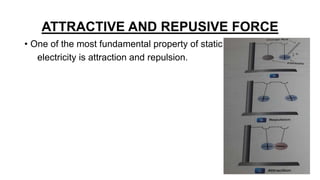
ATTRACTIVE AND REPUSIVE FORCE
• One of the most fundamental property of static
electricity is attraction and repulsion.
ENFULENCE OF CHARGE SUBSTANCE
• Although most object become charged
with static electricity by means of friction,
charged substance can influence
object near it by contact.
ELECTRO STATIC FIELD
COLUMB’s LAW
• Columb’s Law states that the electrical force between two
charged objects is directly proportional to the product of the
quantity of charge on the objects and inversely proportional to
the square of the distance.
• F =k Q1Q2/d2
• F = 1/4πЄo q1q2/d2
Where k is the proportionality constant. Known as columbs law
constant.
• The direction outward to indicate of force in the field with the same
polarity as Q either positive or negative.
• The lines are shorter further away from Q to indicate that the force
decreases inversely as the square of the distance, larger the charge
greater the force.
• Field strength is given by E = v/d where v is the applied potential
difference
• Amount of charge that can be stored by a capacitor. Q =CV
• where ε = absolute (or actual) permittivity of the material
• ε0 = absolute (actual) permittivity of air or vacuum (8·854 ×
10−12 F/m) εr
• = relative permittivity of the material.
• Obviously, εr for air would be ε0/ε0 = 1.
• Permittivity of a medium plays an important role in electrostatics.
For instance, the relative
• permittivity of insulating oil is 3. It means that for the same
charges (Q1 and Q2) and distance (d), the
• force between the two charges in insulating oil will be one-third of
that in air

STATIC ELECTRICITY .

  • 1.
    STATIC ELECTRICITY • Staticelectricity are at rest. Static electricity is caused when non conductive materials such as rubber, plastic or glass are rubbed together. Then transfer of electron takes place which results in disbalance of charge between two material. Due to which object will produce attractive or repulsive forces. • Unit of charge is COLUMB • e = 1.6x 10⁻¹⁹ columb.
  • 3.
    • In anyobject number number of electrons and number of protons are equal .Equal number of positive charge and equal number of negative charge makes atoms electrically neutral. Tribo electriciry Metal become electrically charged when they have come into fricative contact. Charge is conserved. It is always constant . It can neither be created nor be destroyed.
  • 4.
    TRIBO ELECTRIC CHARGE Metalbecome electrically charged when they have come into fricative contact. Charge is conserved. It is always constant . It can neither be created nor be destroyed.
  • 5.
    ATTRACTIVE AND REPUSIVEFORCE • One of the most fundamental property of static electricity is attraction and repulsion.
  • 6.
    ENFULENCE OF CHARGESUBSTANCE • Although most object become charged with static electricity by means of friction, charged substance can influence object near it by contact.
  • 7.
  • 8.
    COLUMB’s LAW • Columb’sLaw states that the electrical force between two charged objects is directly proportional to the product of the quantity of charge on the objects and inversely proportional to the square of the distance. • F =k Q1Q2/d2 • F = 1/4πЄo q1q2/d2 Where k is the proportionality constant. Known as columbs law constant.
  • 9.
    • The directionoutward to indicate of force in the field with the same polarity as Q either positive or negative. • The lines are shorter further away from Q to indicate that the force decreases inversely as the square of the distance, larger the charge greater the force.
  • 10.
    • Field strengthis given by E = v/d where v is the applied potential difference • Amount of charge that can be stored by a capacitor. Q =CV
  • 11.
    • where ε= absolute (or actual) permittivity of the material • ε0 = absolute (actual) permittivity of air or vacuum (8·854 × 10−12 F/m) εr • = relative permittivity of the material. • Obviously, εr for air would be ε0/ε0 = 1. • Permittivity of a medium plays an important role in electrostatics. For instance, the relative • permittivity of insulating oil is 3. It means that for the same charges (Q1 and Q2) and distance (d), the • force between the two charges in insulating oil will be one-third of that in air