State Responsibility and Liability for Nuclear
Damage
By Alexandre Kiss Presented by Abhay Singh
1
Introduction
Statesareresponsibleforviolationsoftherulesofinternationallawthatcanbe
attributedtothem
First, the question of whether and how far
such rules can be applied to the violation of
general, mostly customary rules of
international law
Second, breaches of treaties related to
nuclear activities and damage caused by
such activities
This paper will discuss the most relevant rules adopted in this field
by the UN International Law Commission and analyzes
2
ILC:Everyinternationallywrongfulactof a Stateentitlestheinternationalresponsibilityof thatState
3
 Initially Question arise whether nuclear activities can constitute a breach of international obligations
Answer Found in series of cases:
 Trail Smelter Case 1941 : Arbitral Award between USA and Canada: No state should use its own
territory and cause transboundary harm by fumes resulting serious consequences
 Corfu Channel Case 1949: ICJ affirmed that no State may utilize its territory contrary to the rights of
other states
 Lake Lanoux 1957 : Arbitral Award between France and Spain : alluded to the violation of the rights
of other states that may result from pollution of boundary waters
 ICJ advisory opinion 1996: Legality of the Threat or Use of Nuclear Weapons : the existence of the
general obligation of States to ensure that activities within their jurisdiction and control respect the
environment of other States or of areas beyond national control is now part of the Corpus of
international law relating to the environment
 Gabcikovo-Nagymaros Project 1997: ICJ Repeated itself
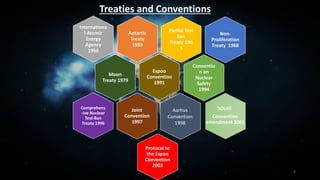
Treaties and Conventions
Antartic
Treaty
1959
Internationa
l Atomic
Energy
Agency
1956
Partial Test
Ban
Treaty 196
3
Non-
Proliferation
Treaty 1968
Conventio
n on
Nuclear
Safety
1994
Moon
Treaty 1979
Comprehens
-ive Nuclear
Test-Ban
Treaty 1996
Joint
Convention
1997
4
Espoo
Convention
1991
Protocol to
the Espoo
Convention
2003
SOLAS
Convention
amendment 2001
Aarhus
Convention
1998
5
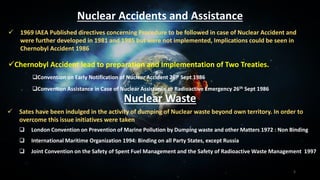
Nuclear Accidents and Assistance
 1969 IAEA Published directives concerning Procedure to be followed in case of Nuclear Accident and
were further developed in 1981 and 1985 but were not implemented, Implications could be seen in
Chernobyl Accident 1986
Chernobyl Accident lead to preparation and Implementation of Two Treaties.
Convention on Early Notification of Nuclear Accident 26th Sept 1986
Convention Assistance in Case of Nuclear Assistance or Radioactive Emergency 26th Sept 1986
Nuclear Waste
 Sates have been indulged in the activity of dumping of Nuclear waste beyond own territory. In order to
overcome this issue initiatives were taken
 London Convention on Prevention of Marine Pollution by Dumping waste and other Matters 1972 : Non Binding
 International Maritime Organization 1994: Binding on all Party States, except Russia
 Joint Convention on the Safety of Spent Fuel Management and the Safety of Radioactive Waste Management 1997
6
State Responsibility In Nuclear Activity
 Nuclear Activity Included in
 General Obligations result from Customary International Law and entails not to cause transboundary harm, e.g, that
the wrongful act should be attributable to the State is included in the customary law principle
 Specific Obligations results from treaties, e.g, treaty provisions related to nuclear activities include specific obligations
providing for State control on such activities: licensing, surveillance, or even prohibition if necessary
 International responsibility is founded on fault imputable to the acting State, it is not necessary that a state
intentionally or maliciously violates an international obligation to attribute responsibility.
Damage Caused by a Nuclear Activity
 Vienna Convention On Civil Liability For Nuclear Damage
 Vienna Convention 1963 Article I (1) of this Convention defines Nuclear Damage
 A Protocol of September 12, 1997 aforementioned was amended
 Article 46 of the articles of the International Law Commission, "where several States are injured by the same
internationally wrongful act, each injured State may separately invoke the responsibility of the State which
has committed the internationally wrongful act." This implies that customary international law, could have
been invoked by each State whose territory was affected by the consequences of the 1986 Chernobyl
accident
7
Conclusion
Statesareresponsibleunderinternational lawforanyfailuretoexercisedue
diligenceoverthesitingandoperationofnuclearfacilitiesandthetransport
anddisposalofnuclearwastes.
The law of state responsibility allows injured states to bring a claim,
however, the problem in defining what constitutes sufficient injury in
this field should be further studied
8

State Responsibility and Liability for Nuclear Damage1

  • 1.
    State Responsibility andLiability for Nuclear Damage By Alexandre Kiss Presented by Abhay Singh 1
  • 2.
    Introduction Statesareresponsibleforviolationsoftherulesofinternationallawthatcanbe attributedtothem First, the questionof whether and how far such rules can be applied to the violation of general, mostly customary rules of international law Second, breaches of treaties related to nuclear activities and damage caused by such activities This paper will discuss the most relevant rules adopted in this field by the UN International Law Commission and analyzes 2
  • 3.
    ILC:Everyinternationallywrongfulactof a StateentitlestheinternationalresponsibilityofthatState 3  Initially Question arise whether nuclear activities can constitute a breach of international obligations Answer Found in series of cases:  Trail Smelter Case 1941 : Arbitral Award between USA and Canada: No state should use its own territory and cause transboundary harm by fumes resulting serious consequences  Corfu Channel Case 1949: ICJ affirmed that no State may utilize its territory contrary to the rights of other states  Lake Lanoux 1957 : Arbitral Award between France and Spain : alluded to the violation of the rights of other states that may result from pollution of boundary waters  ICJ advisory opinion 1996: Legality of the Threat or Use of Nuclear Weapons : the existence of the general obligation of States to ensure that activities within their jurisdiction and control respect the environment of other States or of areas beyond national control is now part of the Corpus of international law relating to the environment  Gabcikovo-Nagymaros Project 1997: ICJ Repeated itself
  • 4.
    Treaties and Conventions Antartic Treaty 1959 Internationa lAtomic Energy Agency 1956 Partial Test Ban Treaty 196 3 Non- Proliferation Treaty 1968 Conventio n on Nuclear Safety 1994 Moon Treaty 1979 Comprehens -ive Nuclear Test-Ban Treaty 1996 Joint Convention 1997 4 Espoo Convention 1991 Protocol to the Espoo Convention 2003 SOLAS Convention amendment 2001 Aarhus Convention 1998
  • 5.
    5 Nuclear Accidents andAssistance  1969 IAEA Published directives concerning Procedure to be followed in case of Nuclear Accident and were further developed in 1981 and 1985 but were not implemented, Implications could be seen in Chernobyl Accident 1986 Chernobyl Accident lead to preparation and Implementation of Two Treaties. Convention on Early Notification of Nuclear Accident 26th Sept 1986 Convention Assistance in Case of Nuclear Assistance or Radioactive Emergency 26th Sept 1986 Nuclear Waste  Sates have been indulged in the activity of dumping of Nuclear waste beyond own territory. In order to overcome this issue initiatives were taken  London Convention on Prevention of Marine Pollution by Dumping waste and other Matters 1972 : Non Binding  International Maritime Organization 1994: Binding on all Party States, except Russia  Joint Convention on the Safety of Spent Fuel Management and the Safety of Radioactive Waste Management 1997
  • 6.
    6 State Responsibility InNuclear Activity  Nuclear Activity Included in  General Obligations result from Customary International Law and entails not to cause transboundary harm, e.g, that the wrongful act should be attributable to the State is included in the customary law principle  Specific Obligations results from treaties, e.g, treaty provisions related to nuclear activities include specific obligations providing for State control on such activities: licensing, surveillance, or even prohibition if necessary  International responsibility is founded on fault imputable to the acting State, it is not necessary that a state intentionally or maliciously violates an international obligation to attribute responsibility. Damage Caused by a Nuclear Activity  Vienna Convention On Civil Liability For Nuclear Damage  Vienna Convention 1963 Article I (1) of this Convention defines Nuclear Damage  A Protocol of September 12, 1997 aforementioned was amended  Article 46 of the articles of the International Law Commission, "where several States are injured by the same internationally wrongful act, each injured State may separately invoke the responsibility of the State which has committed the internationally wrongful act." This implies that customary international law, could have been invoked by each State whose territory was affected by the consequences of the 1986 Chernobyl accident
  • 7.
    7 Conclusion Statesareresponsibleunderinternational lawforanyfailuretoexercisedue diligenceoverthesitingandoperationofnuclearfacilitiesandthetransport anddisposalofnuclearwastes. The lawof state responsibility allows injured states to bring a claim, however, the problem in defining what constitutes sufficient injury in this field should be further studied
  • 8.