2019 CC Global Summit
Jane Park
Director of Product & Research
@janedaily
State of CC Usability
& User Research
AGENDA
• Current state of things
• Findings from user research
‣ Goals & Human-Centered Design Process
‣ The Interviews & Insights
• Design Phase: Workshop & Prototypes
• What’s next + Q&A and Discussion
CC USABILITY INITIATIVE IN 2018
• Conducted interviews with 80+ creators and users
• Identified common themes and produced 9 key insights across 117 total
interviews
• Generated 250+ ideas and chose 6 to take to the Design stage
• Prototyped 4 of them w/product design students at UC Berkeley
• Jane transitioned to lead CC Search product in Sept/Oct
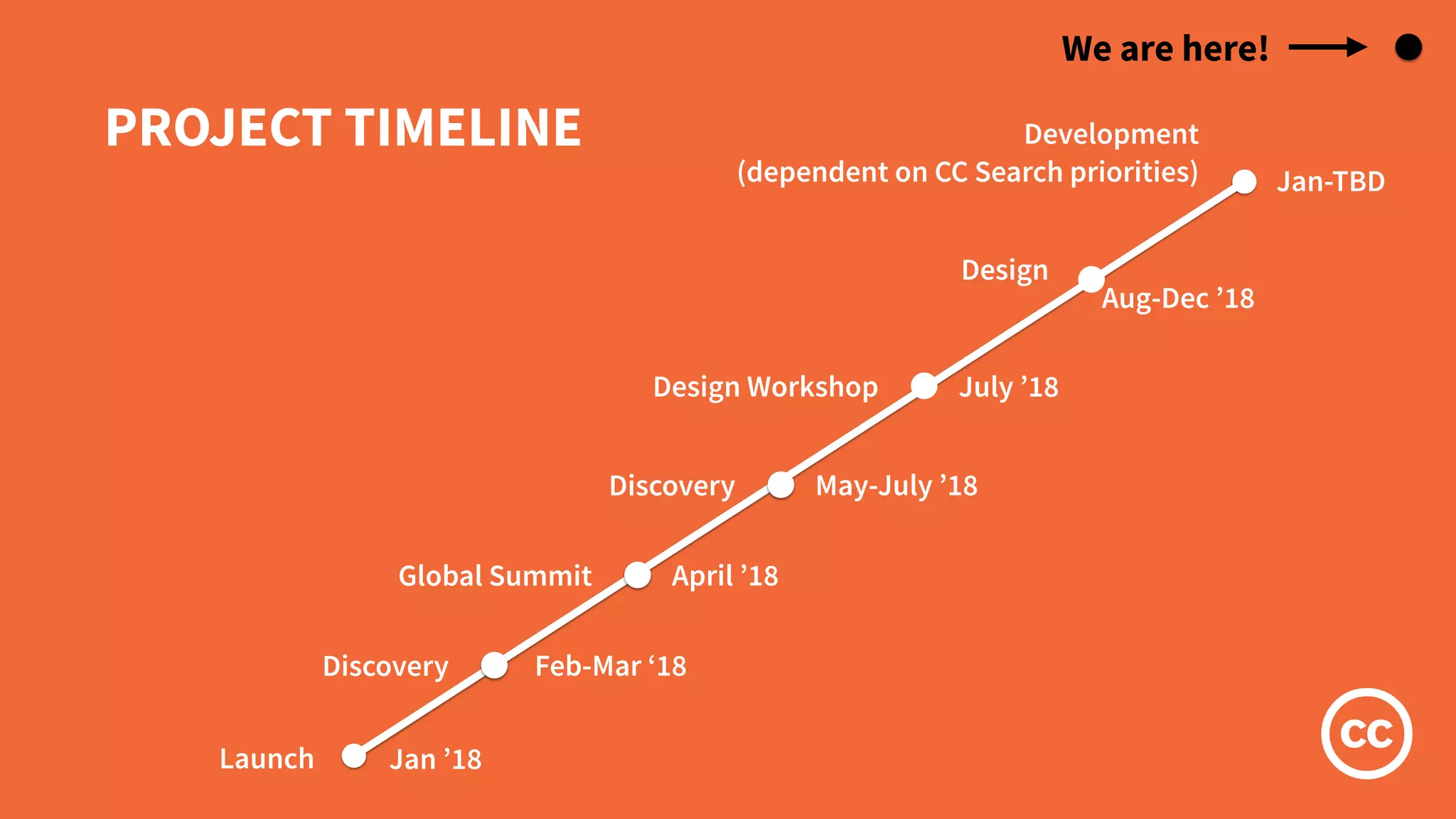
PROJECT TIMELINE
Jan ’18Launch
Feb-Mar ‘18Discovery
April ’18Global Summit
May-July ’18Discovery
July ’18Design Workshop
Aug-Dec ’18
Design
Jan-TBD
Development
(dependent on CC Search priorities)
We are here!
Goals & Process
–Erika Hall
Director of Strategy at Mule Design
Just Enough Research
“Relevance to the real world is what separates innovation from
invention. Understanding why and how people do what they do
today is essential to making new concepts fit into their lives
tomorrow.”
CC USABILITY:
1) Update the experience of CC licensing and discovery to reflect
the realities of how people are sharing in 2018
2) Anticipate and design for the future of digital content sharing
CC usability refers to the quality of a
user’s experience when creating, sharing
and using CC-licensed* content.
We are focused on the people who directly create or use content.
We are not focused on advocates and practitioners for movement growth or
policymaking, as this is covered by other CC programs.
*includes the CC marked public domain
Human-Centered Design:
Discovery, Design, Development
–IDEO
“Human-centered design is all about starting with people and
building deep empathy; generating lots of possible ideas; building
and testing prototypes with the people you’re designing for; and
eventually putting new solutions out into the world to improve
lives.”
CONSULTANTS
★ Tom De Blasis — Founder of (tbd) collective; Former Design Innovation
Director at Nike Foundation & Global Design Director at Nike; Engaging
with us at key moments throughout Discovery & Design; Facilitating
design workshop
★ Rachel Dzombak — Design consultant with Gobee Group; PhD in
Engineering from UC Berkeley; Postdoctoral Fellow at the Haas School of
Business and the Blum Center for Developing Economies; Engaging with
us regularly throughout Discovery
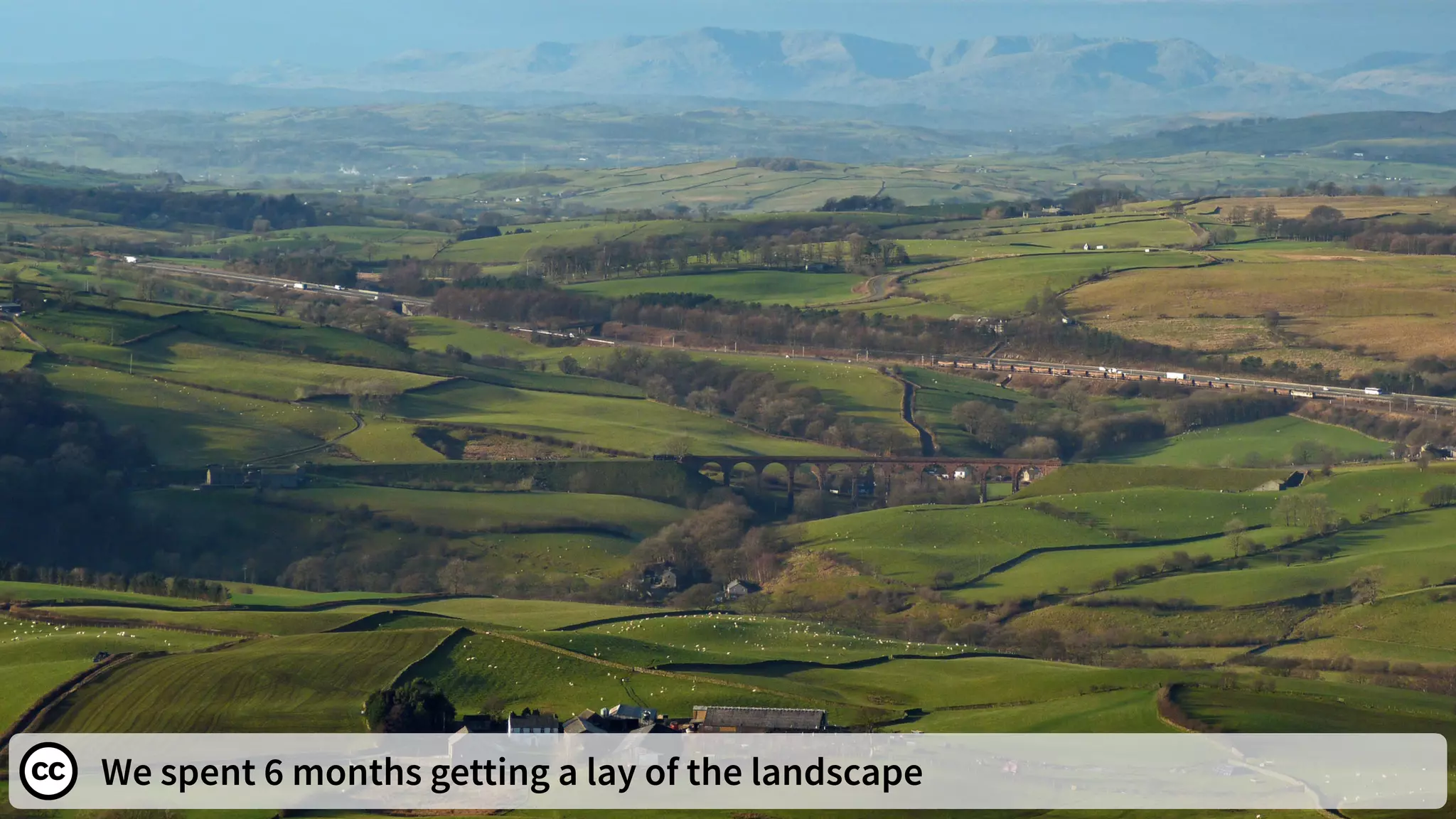
We spent 6 months getting a lay of the landscape
The Interviews
• 81 interviews, + 36 interviews from Made with CC, CC Talks With,
Humans of the Commons
• Interviewees were super, expert, or future users sharing all sorts of
media including: images, text, data, audio, 3D design, games, VR/AR
• We talked to them about their motivations, behaviors, problems, and
ideal outcomes for sharing content online — with and without CC
licensing
The Insights
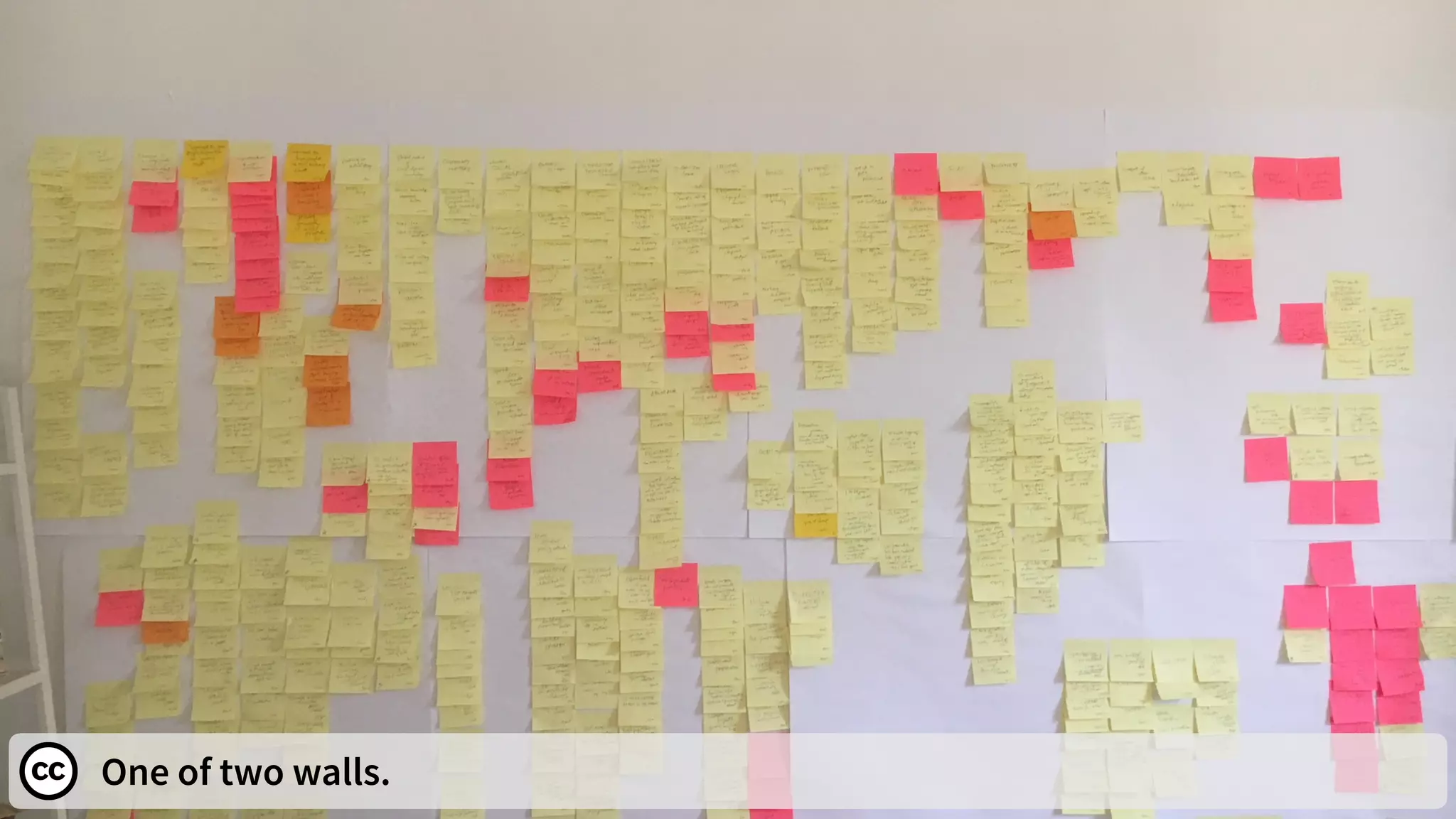
One of two walls.
HOW WE DID IT
• We went through every interview and noted relevant themes
(motivations, behaviors, problems, needs, ideal outcomes, zany ideas)
• We clustered the themes over two walls, and constellations (groups of
117 people saying the same things in different ways) emerged
• We analyzed the constellations, combined some of them, reorganized
others, and extracted the key insights
–Tom De Blasis, Design Strategy Consultant
Former Design Innovation Director at Nike Foundation & Global Design Director at Nike
“An Insight is both an opportunity and a problem statement — two
things with tension, two things where you can’t readily have both.
For example, share stuff for free but also make money.”
i. Insights about our current tools
ii. Insights about the core experience of sharing
content
iii. Insights about futures we might help build
People understand that CC stands for free content
sharing, but the nuances of the specific licenses are
lost on them — including experts and longtime CC
users.
INSIGHT 1:
Understanding the Licenses
• “CC licenses seem ridiculously simple to me but people still don’t get it; they
ignore anything after the dash.” (Journalist)
• “I’ve been using CC for years and I couldn’t explain the differences between the
license options to you.” (Multimedia Artist)
• “There are still misunderstandings for what you can or can’t do.” (Event Producer)
• “People still need reassurance, so I give them that… CC licenses could be branded
in a simpler way so the degrees are instantly recognizable.” (Creative Director)
• “People don’t know what the fuck they’re doing.” (Video Producer)
People are motivated to license their
work under CC, but have a hard time
figuring out how to do it.
INSIGHT 2:
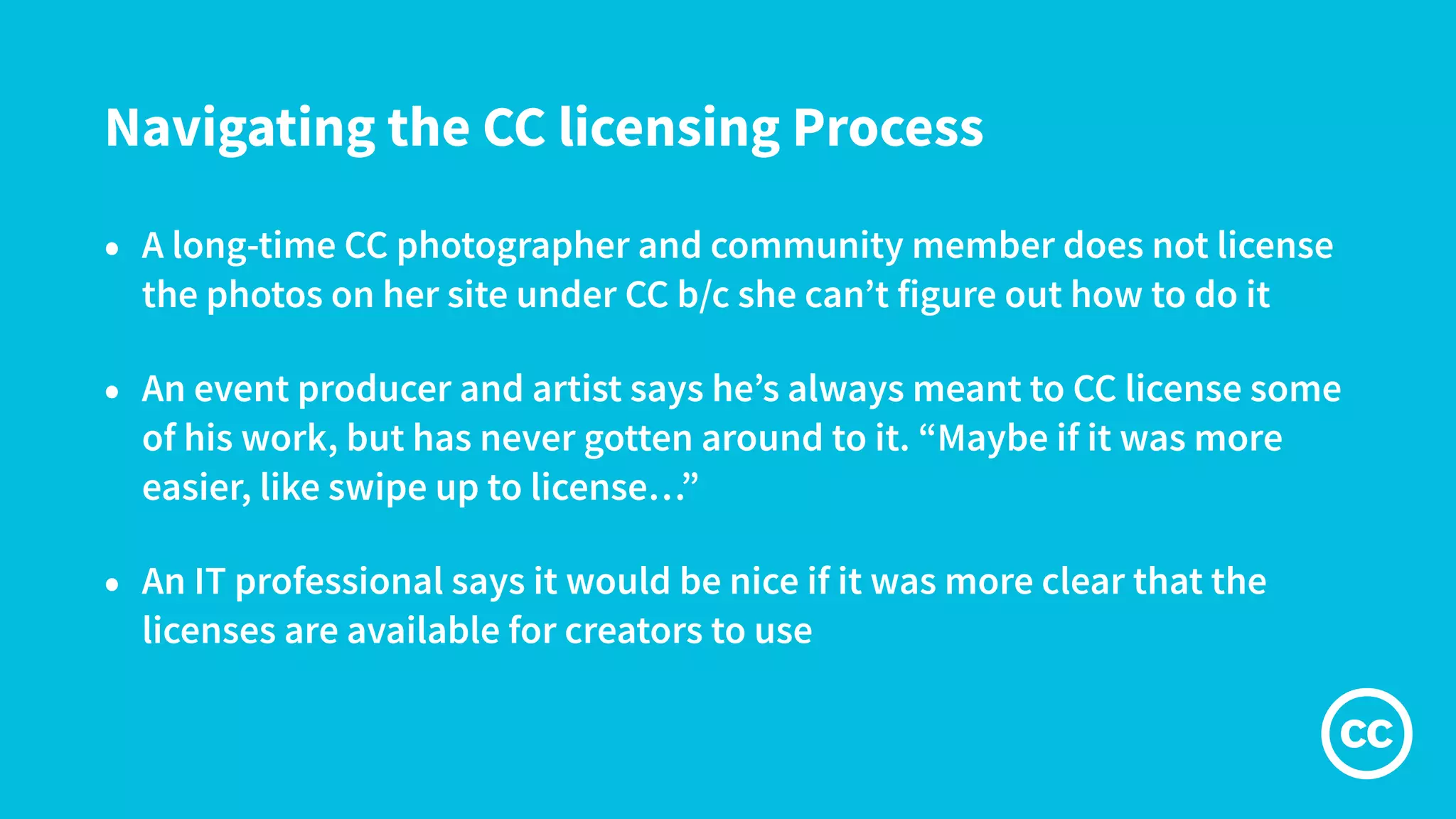
Navigating the CC licensing Process
• A long-time CC photographer and community member does not license
the photos on her site under CC b/c she can’t figure out how to do it
• An event producer and artist says he’s always meant to CC license some
of his work, but has never gotten around to it. “Maybe if it was more
easier, like swipe up to license…”
• An IT professional says it would be nice if it was more clear that the
licenses are available for creators to use
People are motivated to give credit to
other people, but they find attribution
complicated and a hassle.
INSIGHT 3:
Attribution and Credit
• “The footer notice is not enough. We still get questions.” (A Museum)
• “Citing is important, but complicated, which is why I moved to CC0 from CC
BY.” (Graphic Artist)
• A photographer takes time to fill in EXIF data on her images, but is frustrated when
it is read but not displayed on platforms like Facebook.
• “Metadata [as currently used, 1.0] is waste of time; nobody uses
metadata.” (Programmer)
• A designer adds a small watermark to a corner of all of his images so anyone who
cares can find and credit him.
People like seeing how their work is
used, where it goes, and who it touches,
but have no easy way to find this out.
INSIGHT 4:
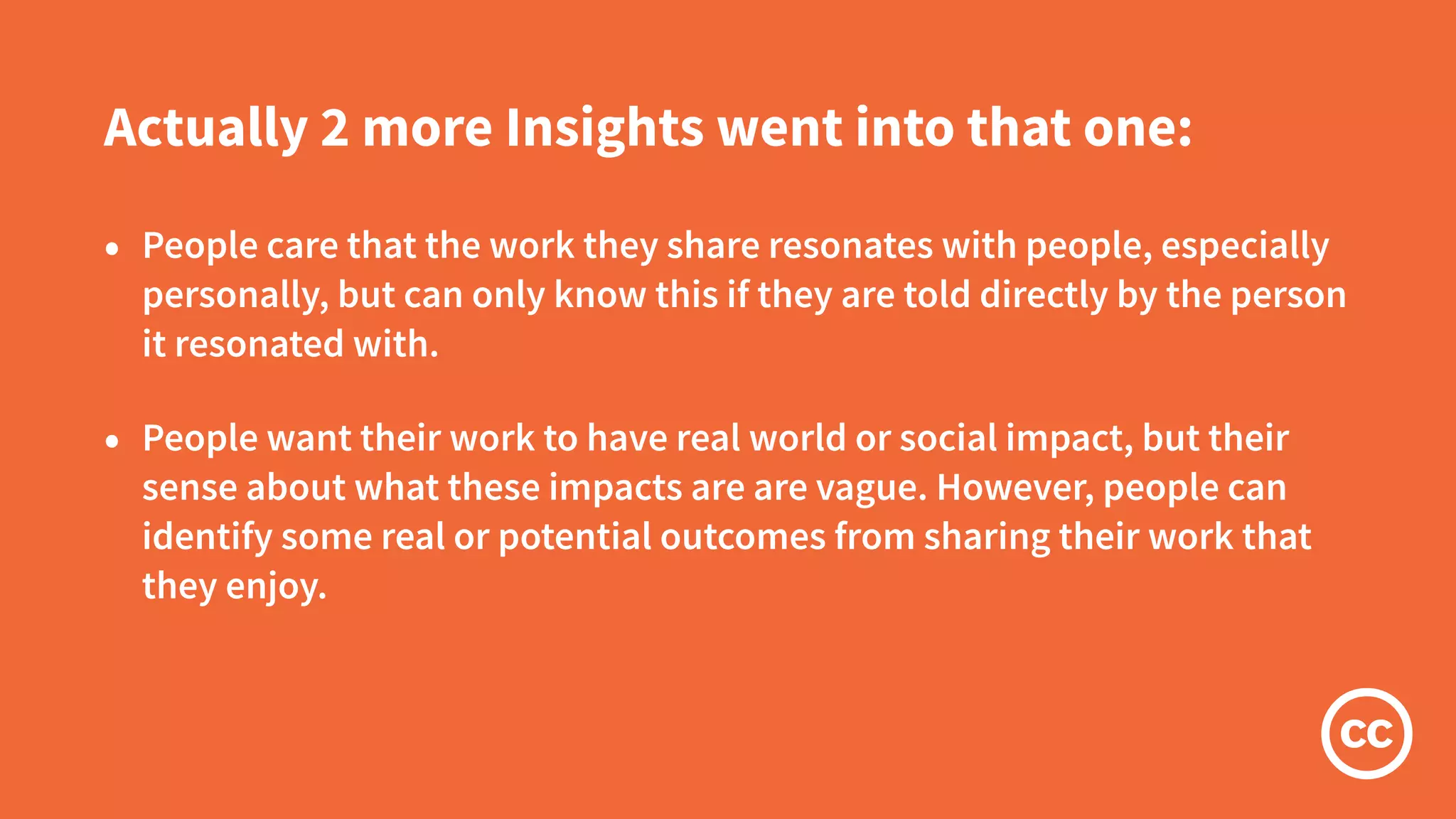
Actually 2 more Insights went into that one:
• People care that the work they share resonates with people, especially
personally, but can only know this if they are told directly by the person
it resonated with.
• People want their work to have real world or social impact, but their
sense about what these impacts are are vague. However, people can
identify some real or potential outcomes from sharing their work that
they enjoy.
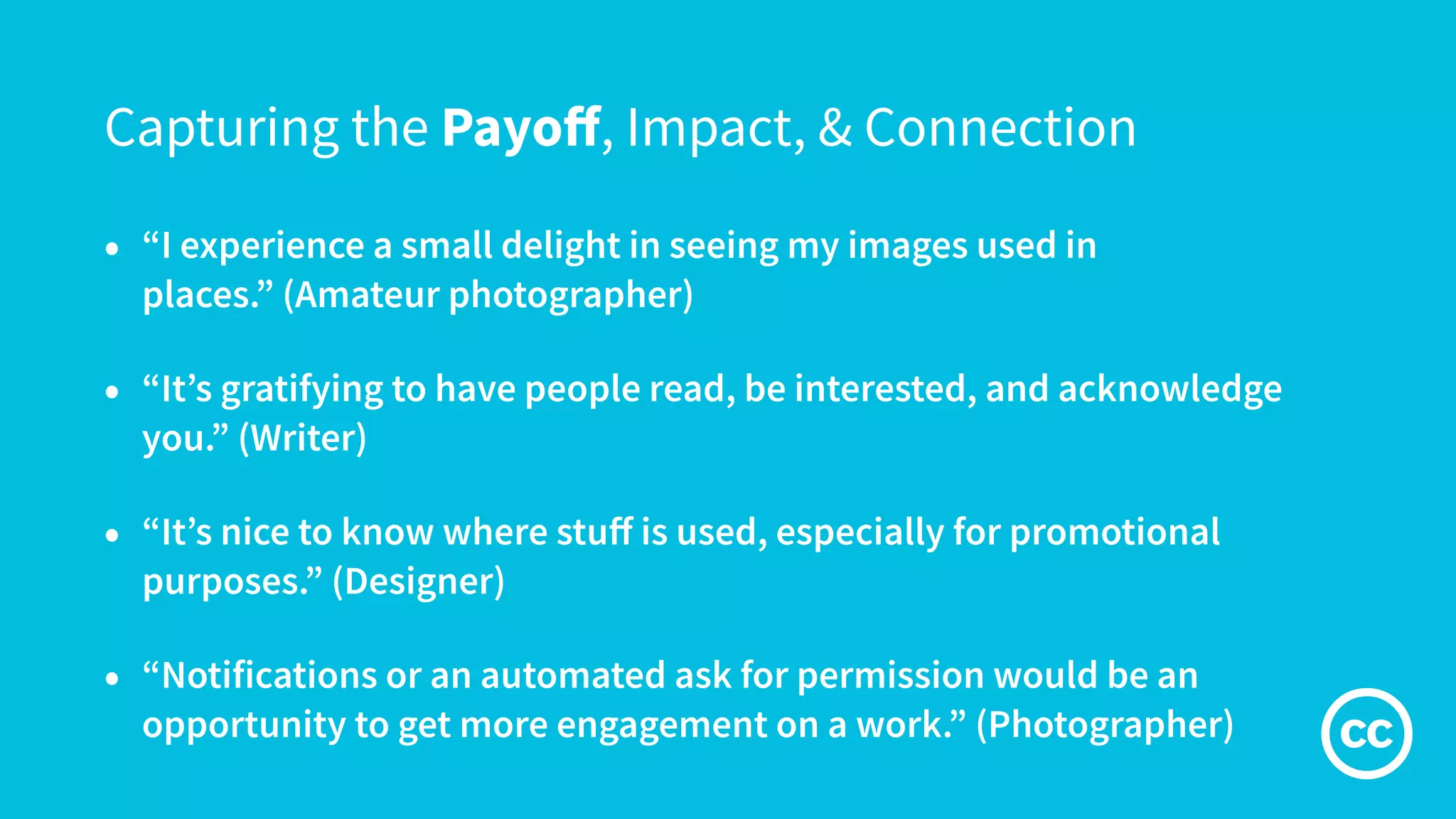
Capturing the Payoff, Impact, & Connection
• “I experience a small delight in seeing my images used in
places.” (Amateur photographer)
• “It’s gratifying to have people read, be interested, and acknowledge
you.” (Writer)
• “It’s nice to know where stuff is used, especially for promotional
purposes.” (Designer)
• “Notifications or an automated ask for permission would be an
opportunity to get more engagement on a work.” (Photographer)
Capturing the Payoff, Impact, & Connection
• An academic mentioned her writing being cited on the House floor, in
Supreme Court cases, and the realization of initiatives based on her ideas.
• “In an ideal world [a publishing platform’s] republishing guidelines would be
part of the license because they help us measure impact, has our branding,
links back to our site. There is an appetite among for profit publishers to be
able to distribute content under CC and track it without having to build it
themselves.” (Publisher)
• A writer wonders if licensing something could be attached to you in some way,
so you would be interested in how it’s helping others, e.g. look at how blood
drives are starting to do this.
Capturing the Payoff, Impact, & Connection
• A writer says “it’s nice to know people are reading and you’re
connecting with them.” For example, he gave a copy of his first novel to
his barber. He got a call in the morning from his agent that some film
company was interested in it. He got a call in afternoon from his barber
saying he just loved the book. The latter was more rewarding for him.
• A writer says he felt like he helped “to produce an idea that had an
effect on the landscape,” because years later people still refer back to [a
magazine’s] issue on [a subject] and say it meant something to them,
helped them understand a thing that was happening.
–A student
“The best outcome would be an ‘inspiration chain’ that results in
something truly changing the world for the better.”
People are often first introduced to CC when they
have completed a work, but at that point they are
more interested in getting the work out there than
thinking through a whole new system for sharing.
INSIGHT 5:
–Community Manager
“By the time a creator uploads, it’s mostly at the tail end of the
publication process, so they are not actively thinking about it. They
are thinking about what that platform offers them. Akin to
academic researchers and their data/research — by the time they
are moving to a platform for publishing their mindset has shifted to
other goals completely.”
Embedding CC Earlier in the Creation Process
• “They should be thinking about it within the creation process, before moment
of publish. Or even the moment they sit down to start creating. How do I want
the creation to live in the world? That would be interesting, have them think
about it from the start…” (Journalist)
• [photography project] was a project that [the creators] decided from the
outset they wanted to share and disseminate widely, deciding before they
even shot the photos that they would share them under a CC license.
• Staff at [a museum] wants to go open with its various programs and resources,
but find it difficult to retrofit open policies; they need ways to build in CC more
intentionally at the outset of project formation.
–Graphic Designer
“How do we put CC in front of people at critical moments in their
lives, where they can connect it to their lives, where it might be
integrated seamlessly and clearly?”
People want to share and find good work,
but find it difficult to navigate the abundance
of content and information online
INSIGHT 6:
Cutting through the Noise
• “Problems creators have today are things like, how can I be heard amid abundance
and content overload? The problem is now attention scarcity.” (Designer)
• A TV producer and journalist said the number one challenge in her field was a lack
of relevant resources.
• A VR producer and director thinks search filters need to exist for the right kinds of
things, like style, mood, and previous use -- as some people don’t want to use work
that is too much used in other projects.
• A user researcher thinks that Soundcloud has got the human experience of
discovery right, and that’s why it’s so popular among musicians (even if it’s
struggling in other areas).
People like the efficiency of sharing via centralized
platforms, but are frustrated by the lack of control
and ownership over their work, and increasing
devaluation of individual creativity.
INSIGHT 7:
Decentralization of Content & Control
• “There is this move towards devaluation of art and creativity, the
commoditization of content by big companies like
Google.” (Entrepreneur)
• “I’m frustrated with the lack of control using platforms like Instagram. I
wish there was more equitable treatment of its users, regardless of how
many followers they have.” (Photographer)
• “Companies are taking advantage of creators!” (Artist)
Decentralization of Content & Control
• “CC is arguably more relevant now that the Internet is losing its
fundamental, collaborative aspect, but most people aren’t aware or
don’t care.” (Journalist)
• “When someone else has total control over your work, it’s not
hypothetical. Average people feel like they are at the whim of a few
companies. How can CC empower and support creators in this
landscape?” (Writer)
• “The problem that CC solves for creators is not openness, but
control.” (Designer)
–A journalist
“The biggest trends for content are ownership of your content;
how do we make sure people maintain some level of control over
the works they create? Anything we can do with licensing and
contracts to give people the right to own your content.”
People aren’t driven to create for the money, but
money is always a good outcome. People like sharing
freely, but if someone is making a lot of money off
their work, they want to be fairly compensated.
INSIGHT 8:
Getting Paid
• “Most creators want to share while being fairly compensated, attributed,
and recognized.” (IT professional)
• “If no one’s making money, I’ll gladly give my work for free. If people are
getting paid, then the artist also needs to get paid.” (Nonprofit)
• “Unsplash weirds me out how open it is, and I almost feel bad sometimes. I
go there when I’m in a quick jam. But I would rather pay $10 a month to CC
for a massive archive where percentage goes back to creators and they are
being credited.” (Designer)
• “I would rather give money directly to a musician.” (Screenwriter)
People have a desire to create work that is lasting and
meaningful, that eventually has a life of its own, but
don’t know what to do with a work beyond
publishing it.
INSIGHT 9:
Posterity
• “I’ve been able to capture it… make sure it’s good, the way it should be,
and then it goes to the Library of Congress and they do a lot of work to
get it up and then it’s there for thousands of years. How can any of us
lose on this?” (Photographer)
• “We want to enable the public to rediscover and experience the work.
We want to activate the material through artist engagement with
it.” (Archivist)
• “Licensing reflects the living, changing medium and
content.” (Filmmaker)
Design Workshop & Prototypes
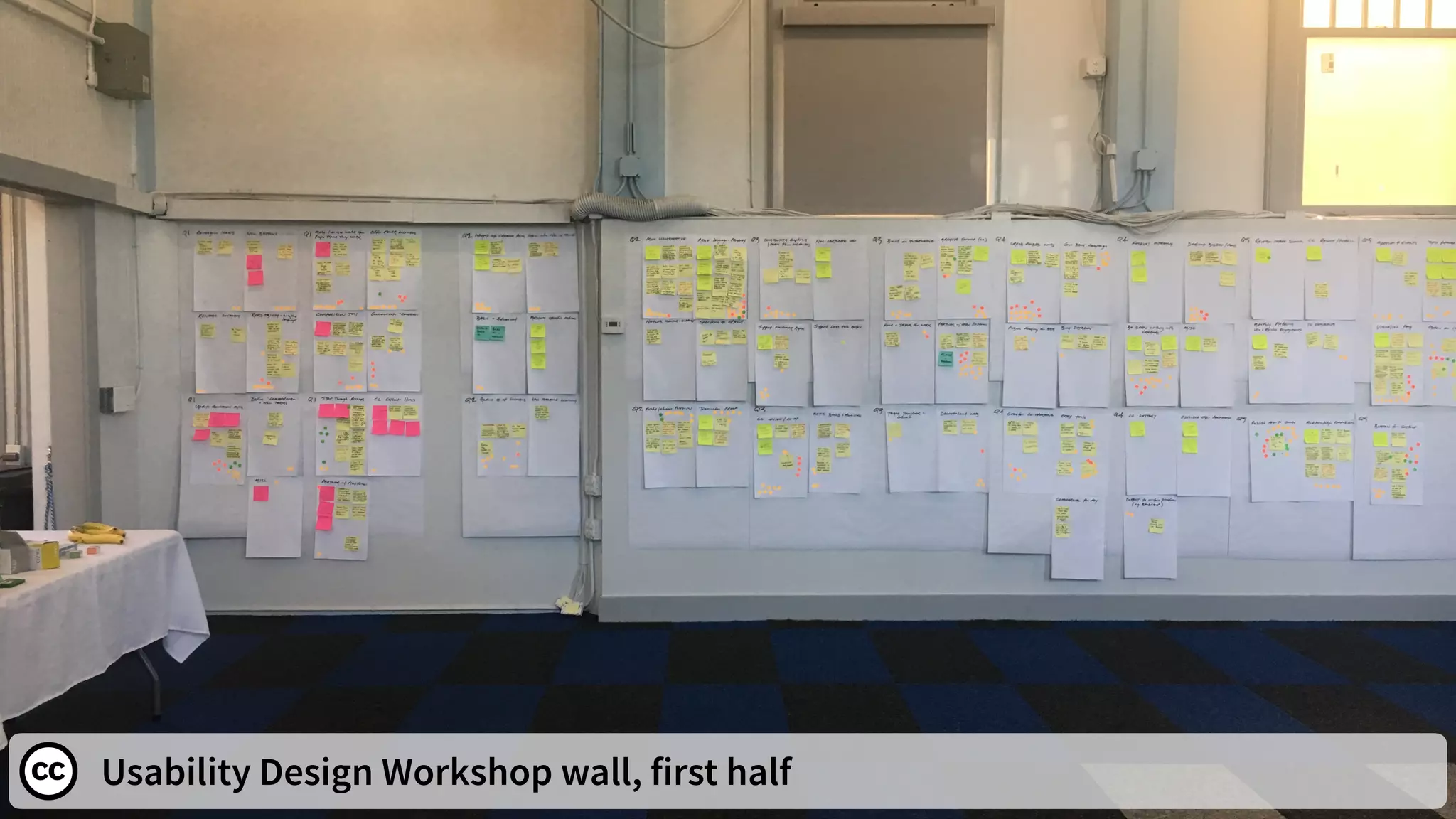
The Design Workshop — what we did
• Discussed 9 Insights and how we got to them
• Conducted a series of idea generation sessions tackling “How Might
We” questions directly related to each Insight
• Break-out exercise on license deprecation
• Heat mapped all ideas, fleshed out top ideas (achievable, on strategy/
mission, impactful), and decided which to bring forward into the
Design phase
Covered in Design Workshop:
• Images, text (long form), and anything that loosely intersects
Tabled:
• Data, Emerging media, Analogous media
• Needs surfaced around outreach/education/advocacy for institutions
and publishers
Usability Design Workshop wall, first half
Ideas green lit for prototyping
1. New step-through process / Redo language + pathway
2. Publish How To Guide for where to find your work
3. Button for contact
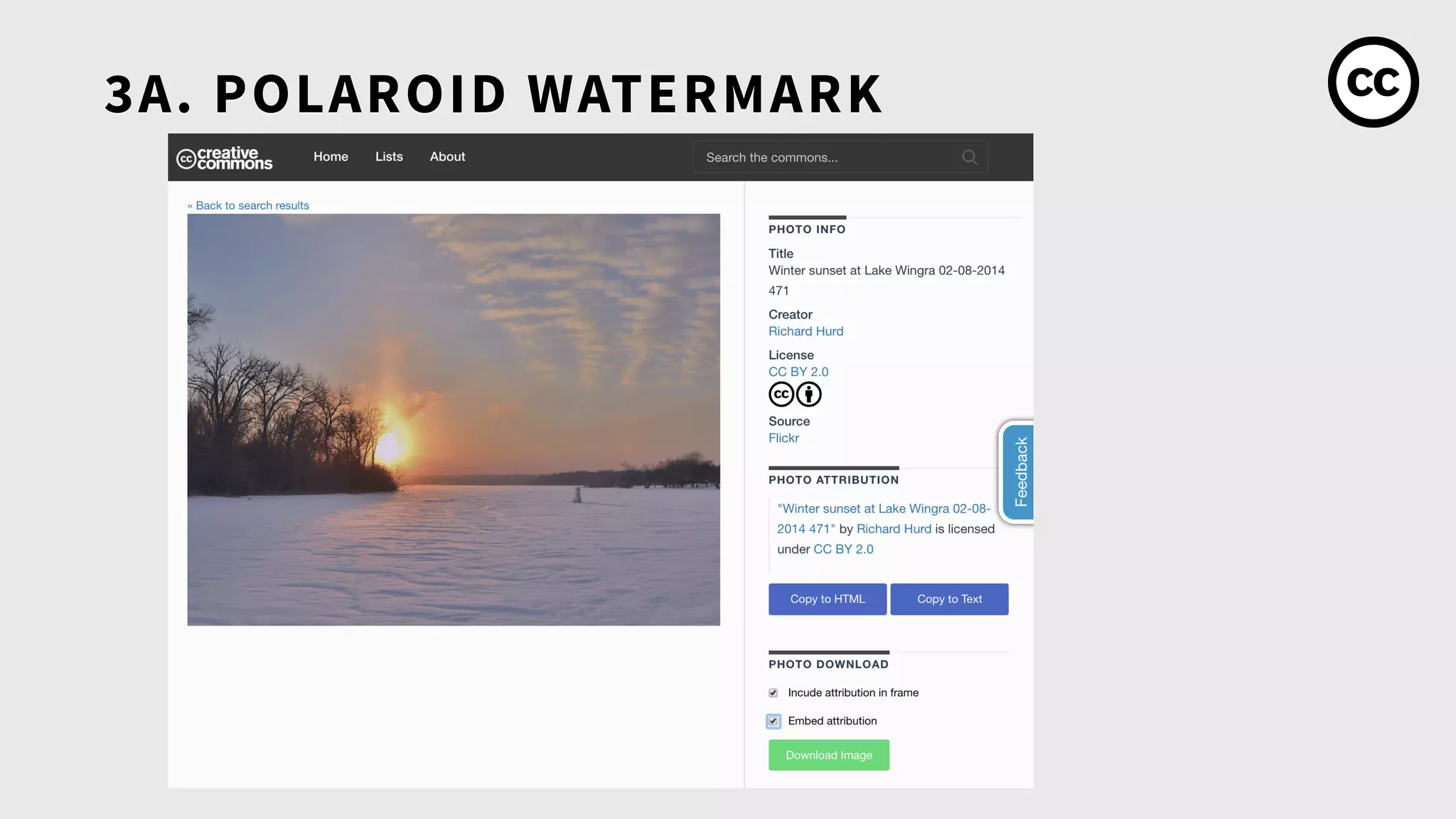
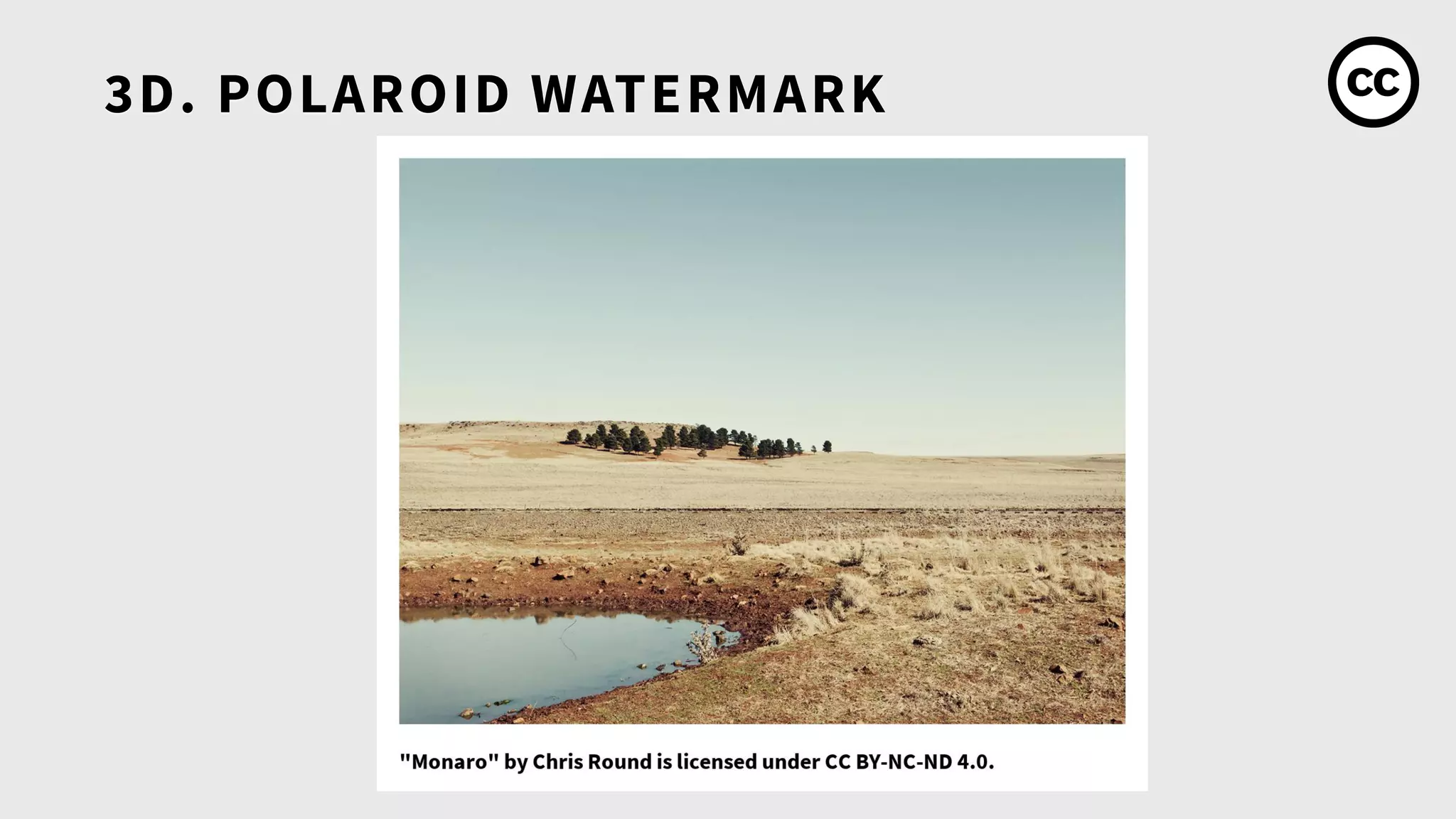
4. Polaroid watermark
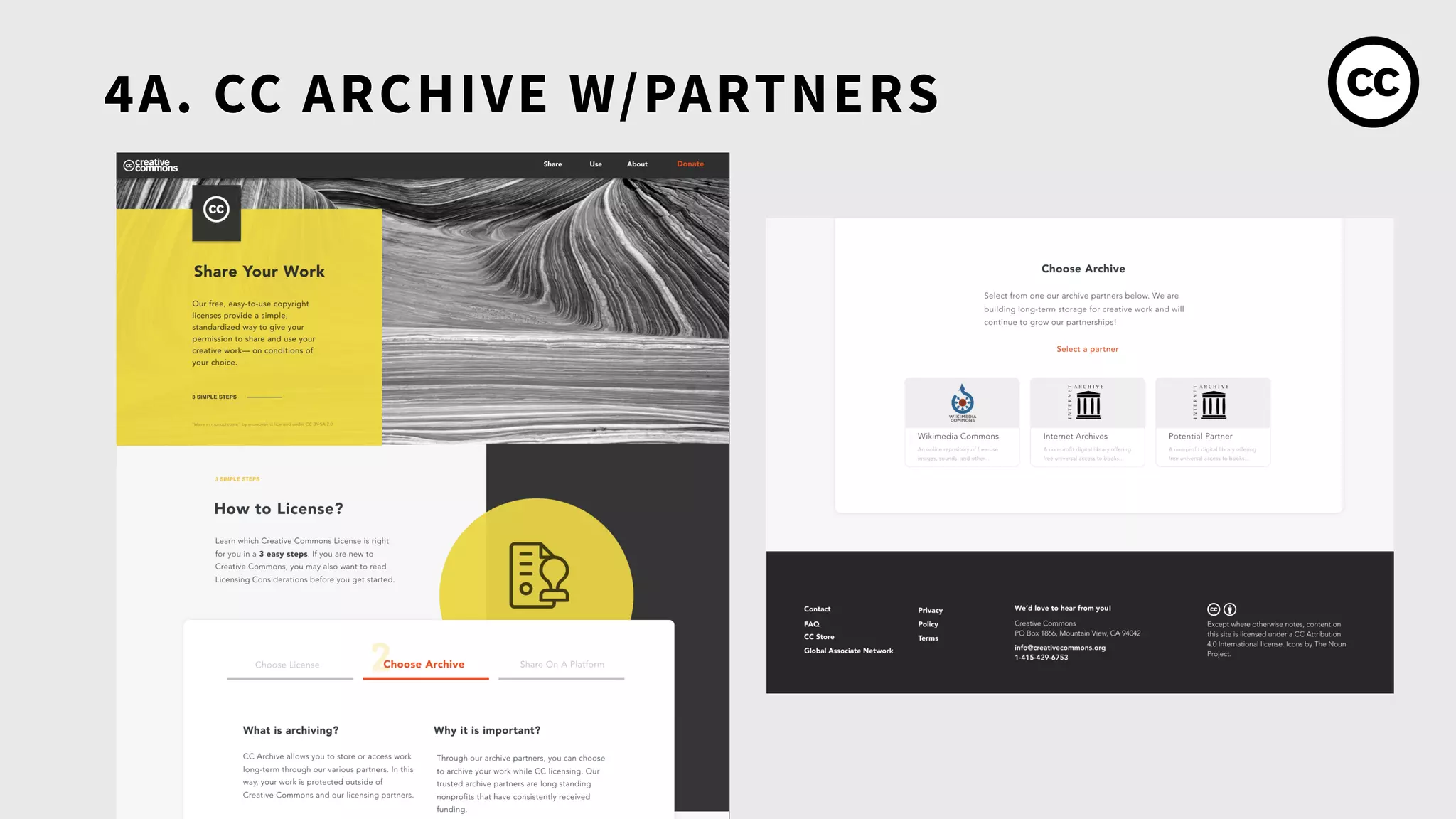
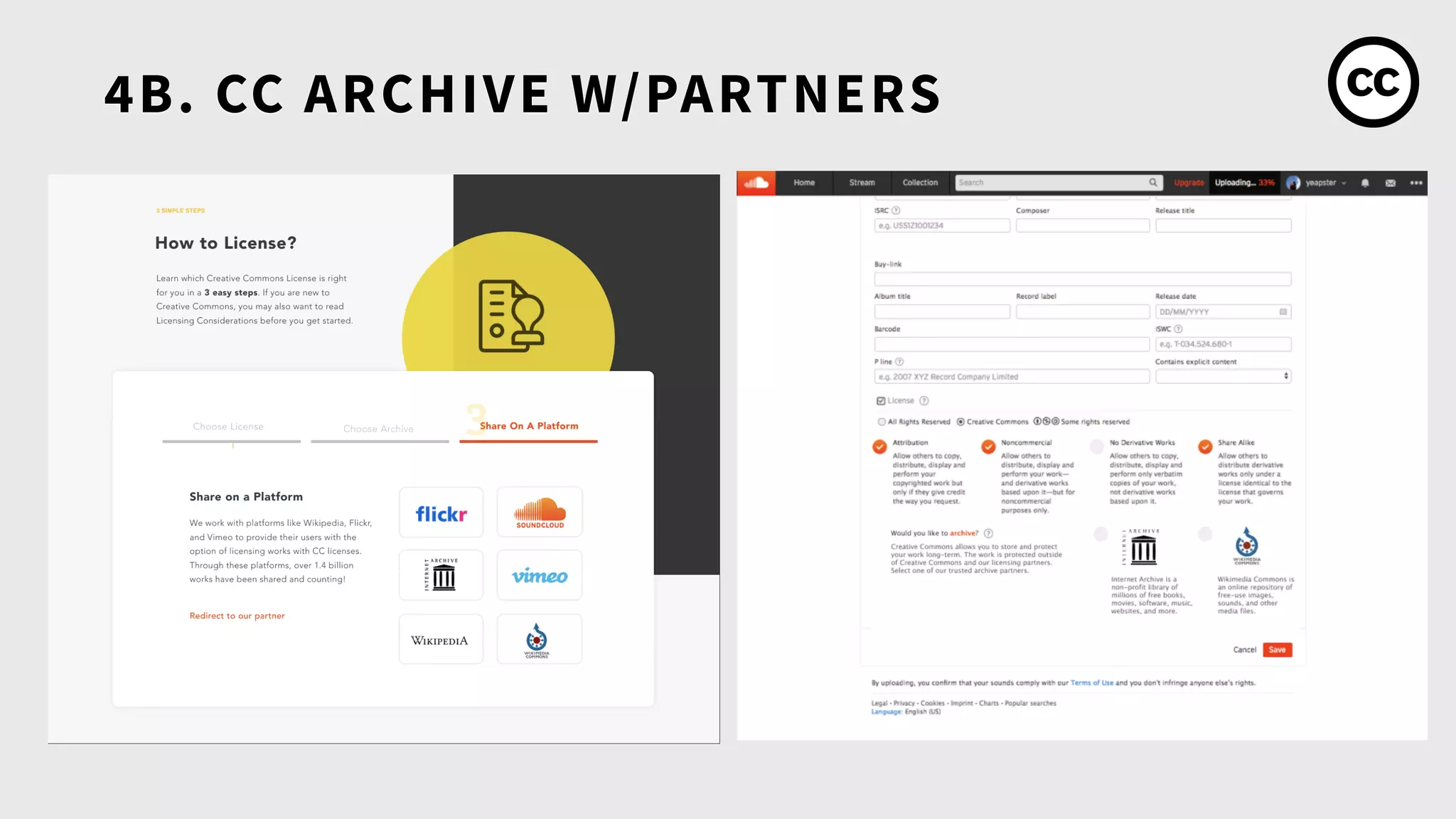
5. Archive
6. Reward & Delight
Ideas TBD with Comms & Product Teams
1. Update educational materials (T&P team formed to tackle some in Q3)
2. No click attribution
3. Narrow use case search (in pipeline of ideas for CC Search)
4. Obtain an ID (now technically possible in CC search)
Idea to revisit after Design phase
5. Plugins for Adobe, etc.
Non-usability ideas left on the cutting room floor
1. “Librarian” of the Commons, aka some way to curate the commons
2. Creator co-operative/union
3. CC concepts introduced earlier in creation process, before publication
(related to Adobe plugins)
4. One Creative Commons License (license deprecation)
State of prototypes in 2019
1. New step-through process / Redo
language + pathway
2. Publish How To Guide for where to
find your work
3. Button for contact
4. Polaroid watermark
5. Archive
6. Reward & Delight
✓ 2 student prototypes; GSoC Fellow
➡ TBD (CC comms)
➡ TBD
✓ 1 student prototype
✓ 2 student prototypes
✓ 1 prototype; in dev CC Search site
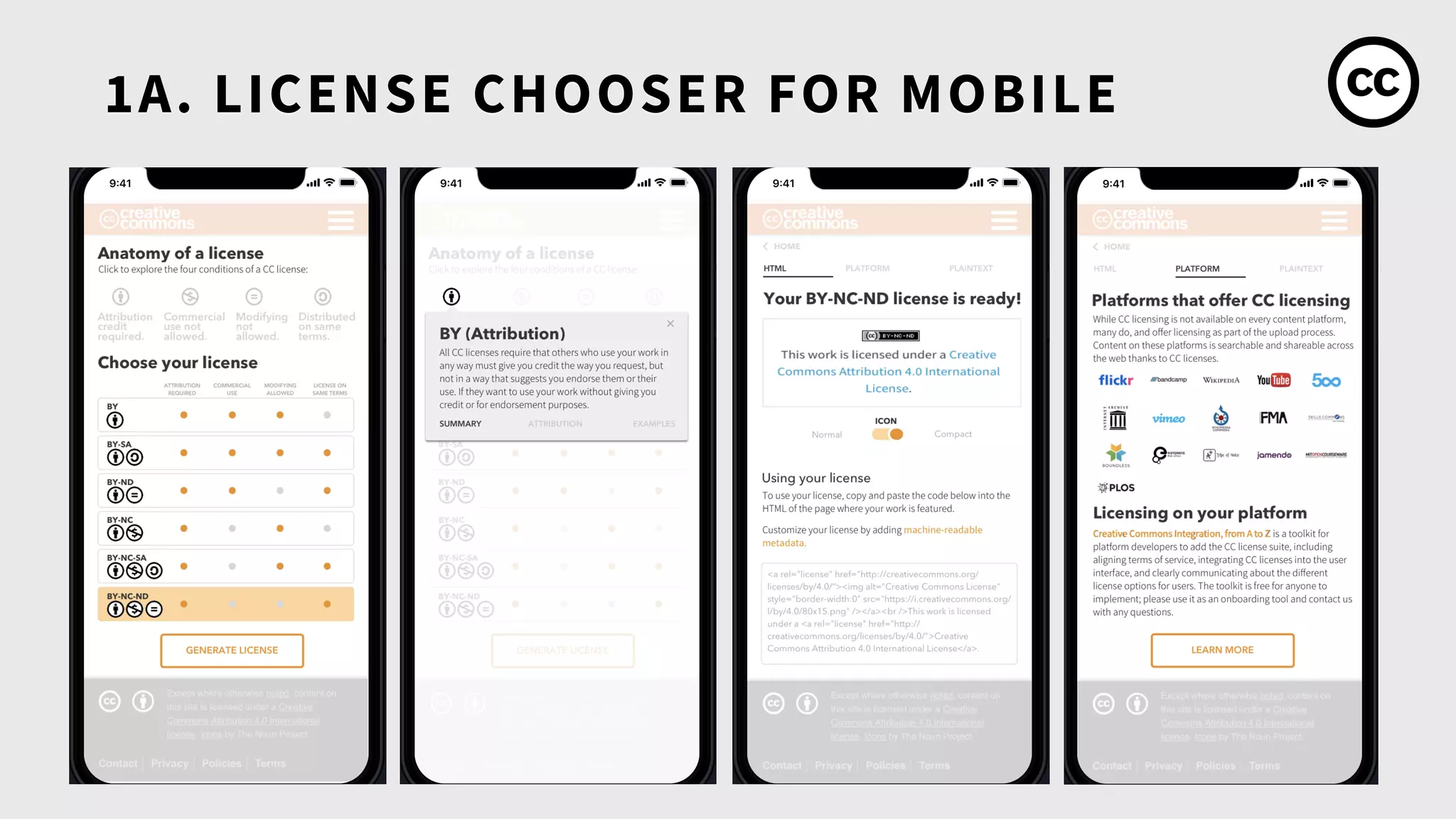
1A. LICENSE CHOOSER FOR MOBILE
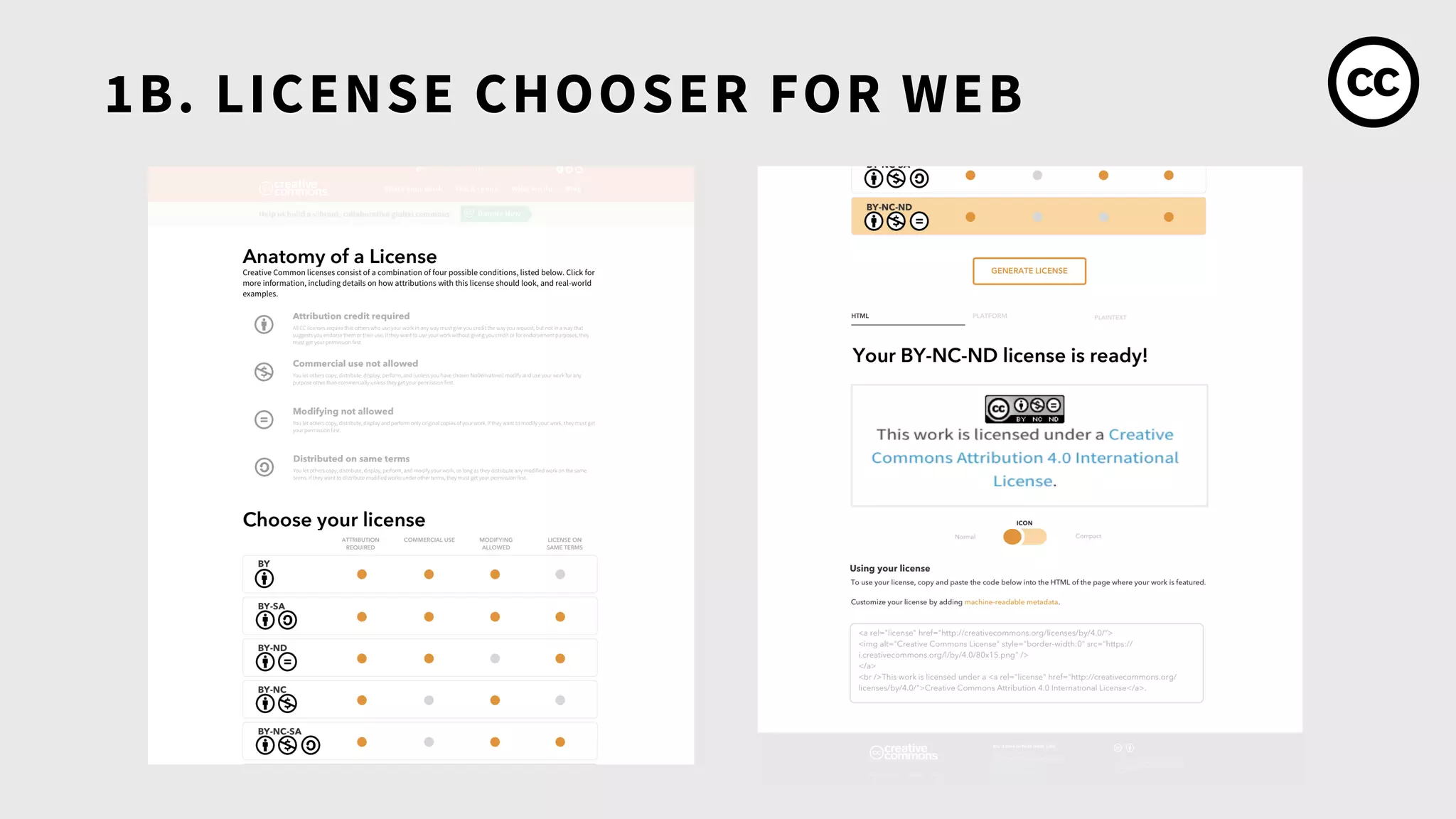
1B. LICENSE CHOOSER FOR WEB
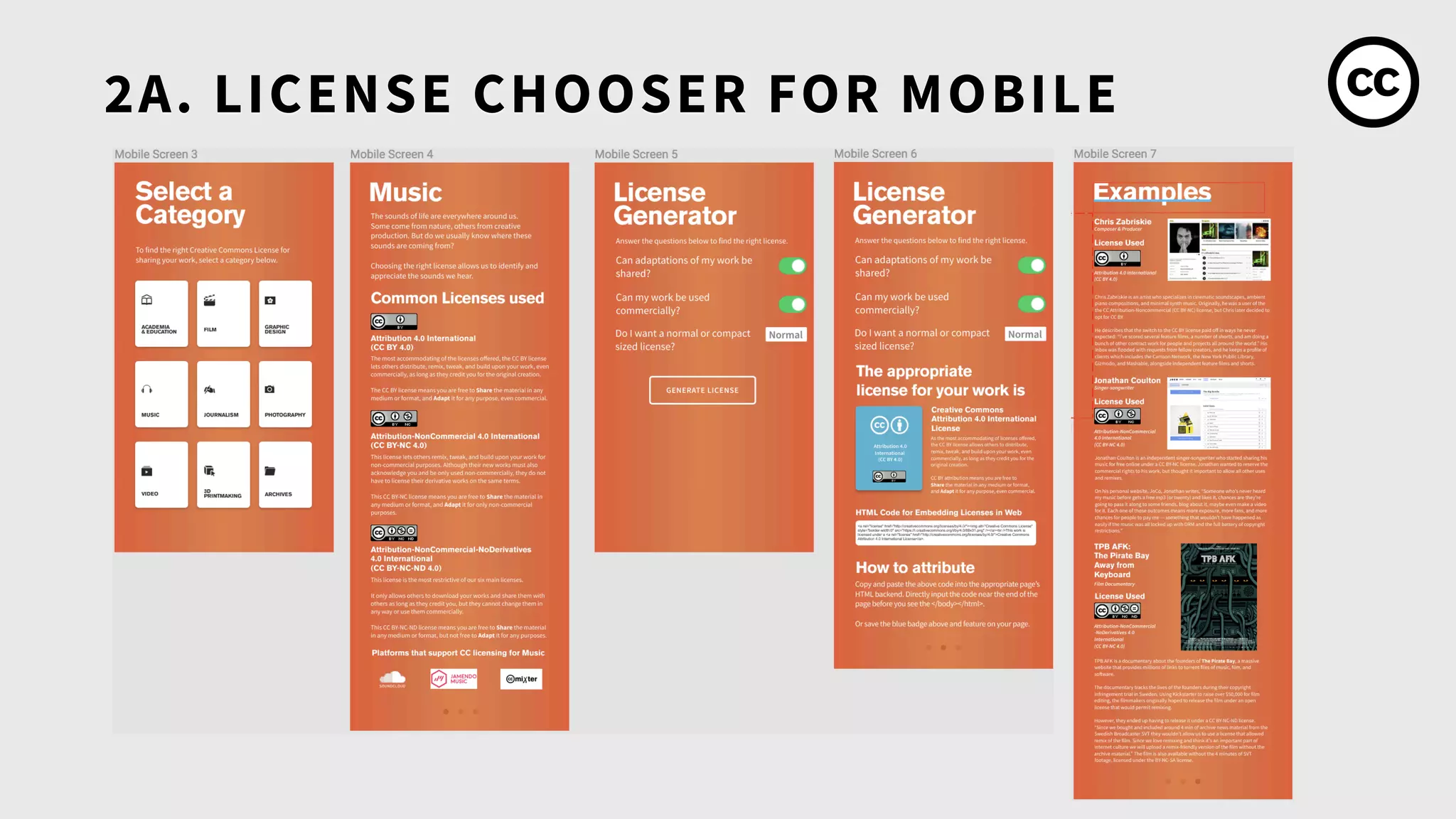
2A. LICENSE CHOOSER FOR MOBILE
2B. LICENSE CHOOSER FOR WEB
3A. POLAROID WATERMARK
3B. POLAROID WATERMARK
3C. POLAROID WATERMARK
3D. POLAROID WATERMARK
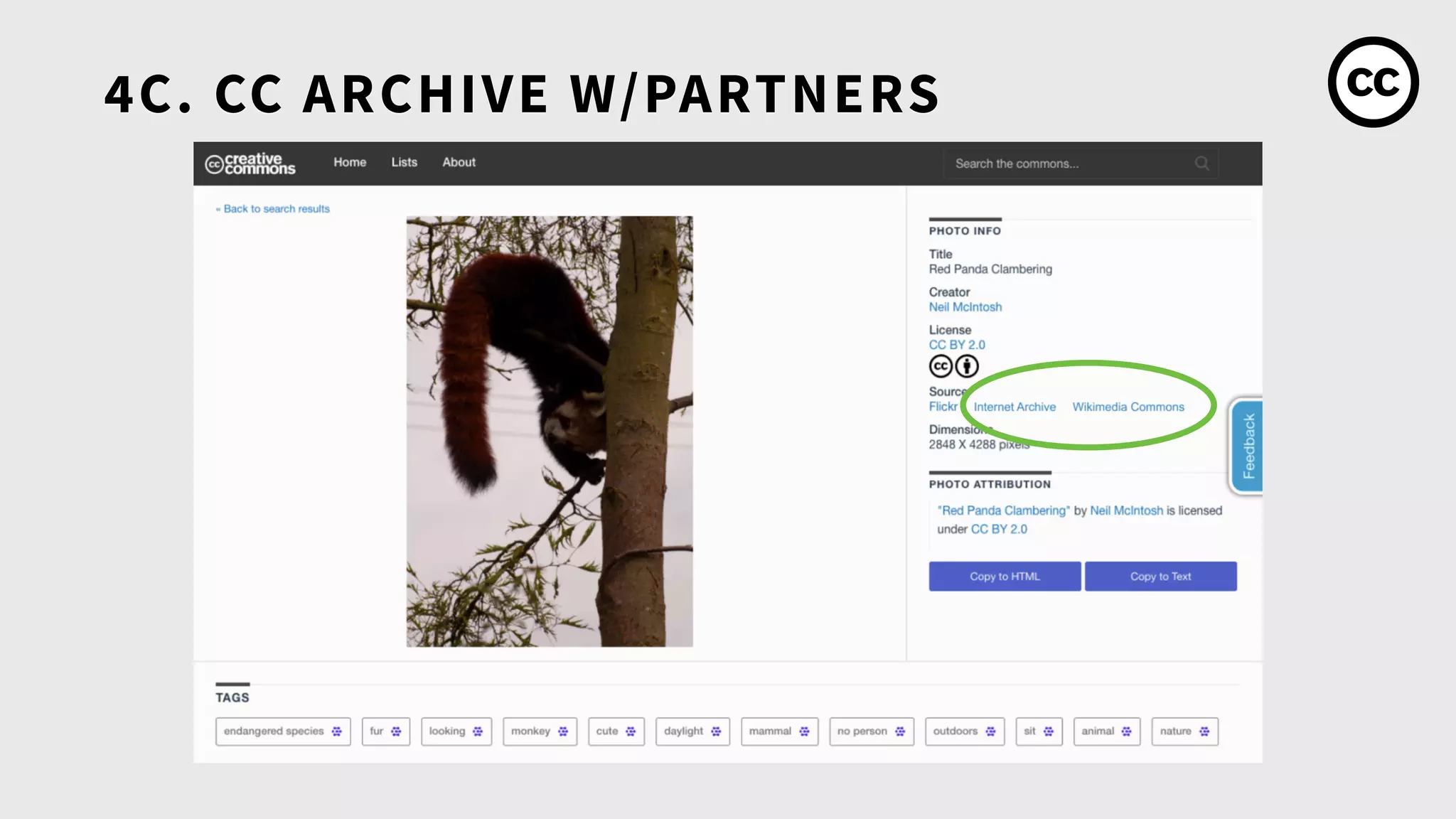
4A. CC ARCHIVE W/PARTNERS
4B. CC ARCHIVE W/PARTNERS
4C. CC ARCHIVE W/PARTNERS
5A. CC ARCHIVE ACCOUNT
5B. CC ARCHIVE ACCOUNT
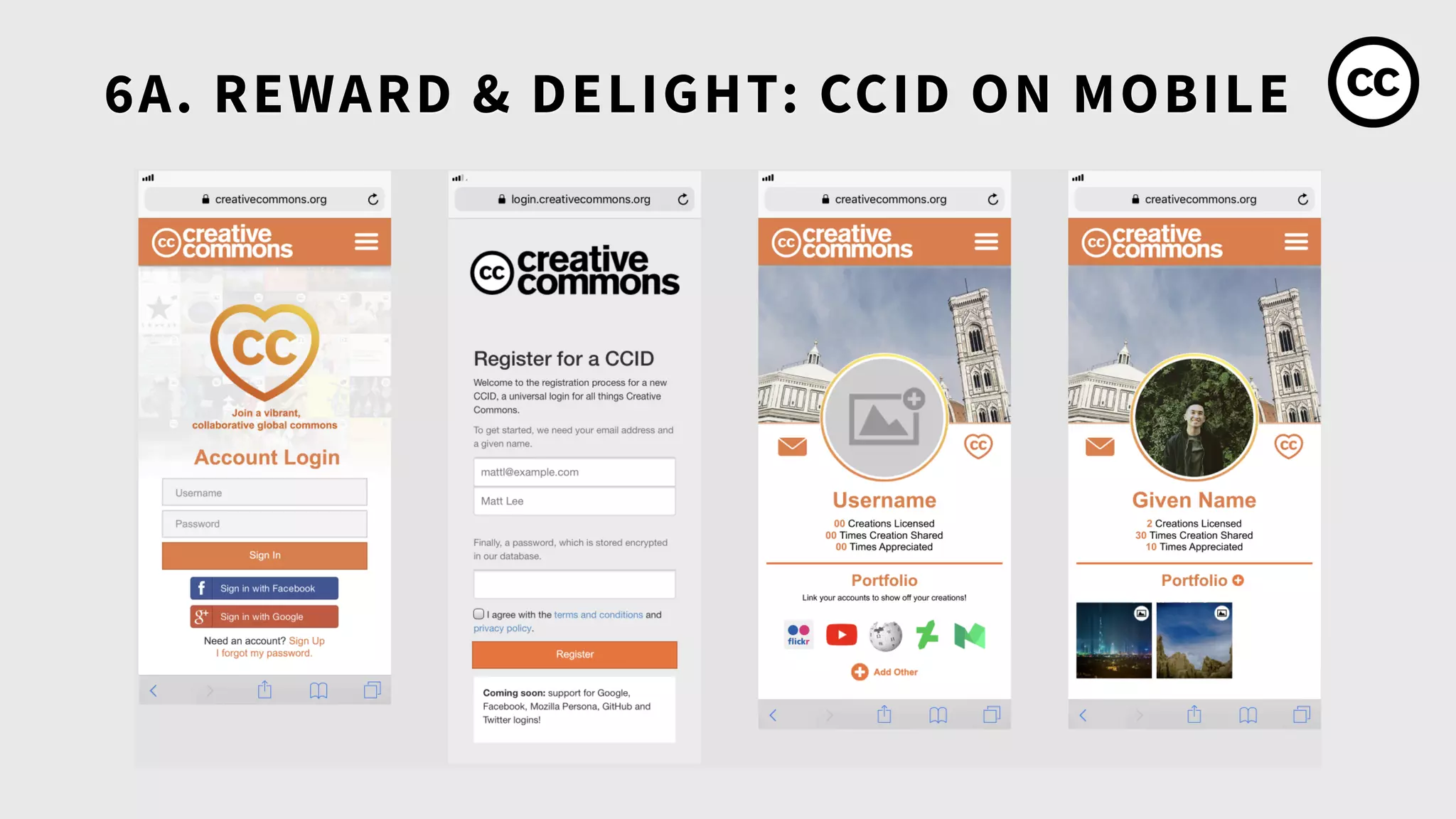
6A. REWARD & DELIGHT: CCID ON MOBILE
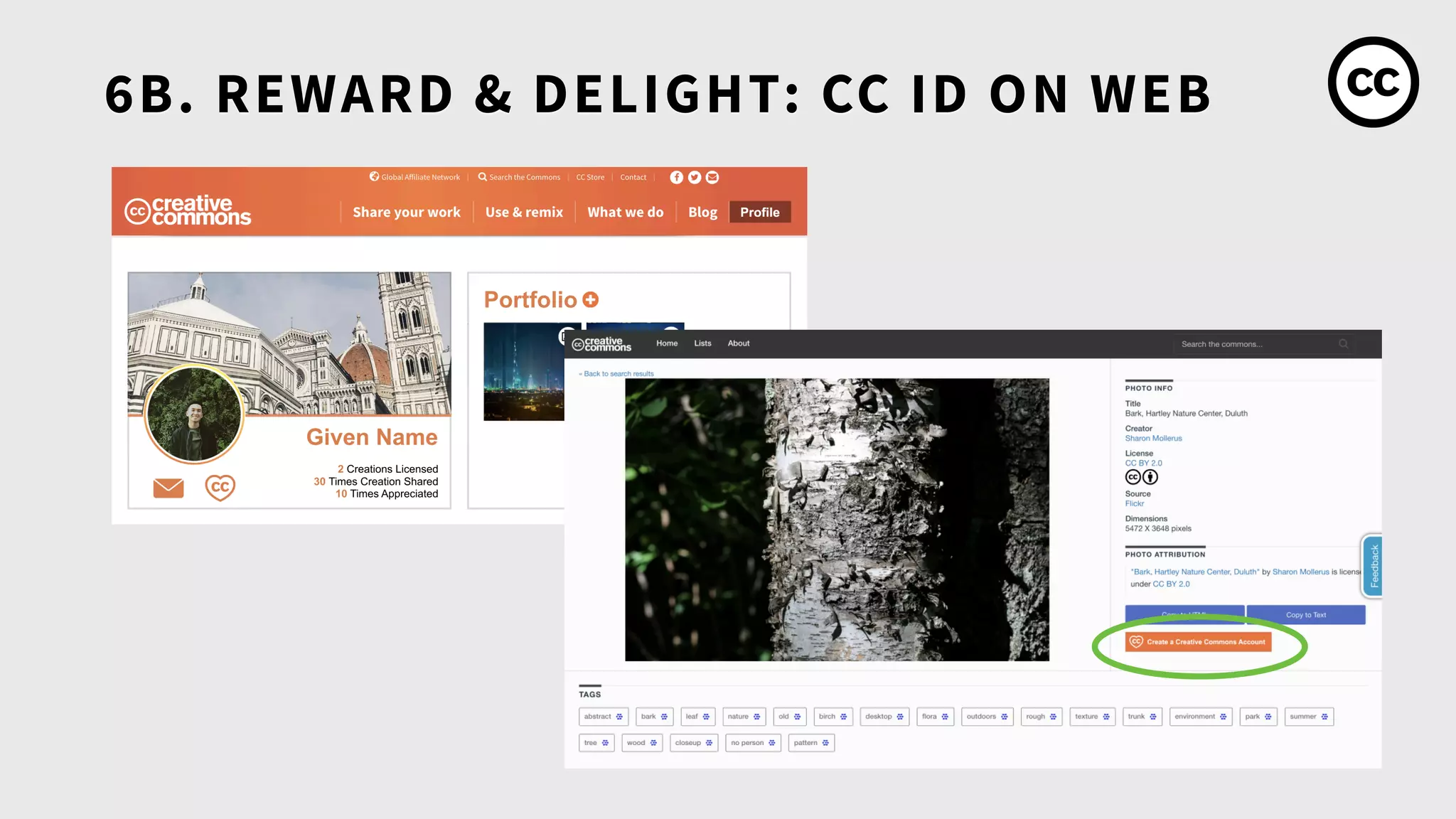
6B. REWARD & DELIGHT: CC ID ON WEB
State of user research in 2019
‣ 16 people agreed to be part of a super user group (recs for a better
name?), and participate in follow-on conversations
‣ 71 people joined the #cc-usability Slack channel
‣ Users give feedback on front end features in CC search every Friday
(#feedbackfriday) during a sprint
‣ Monthly usability testing for CC Search
‣ User feedback forms in CC Search
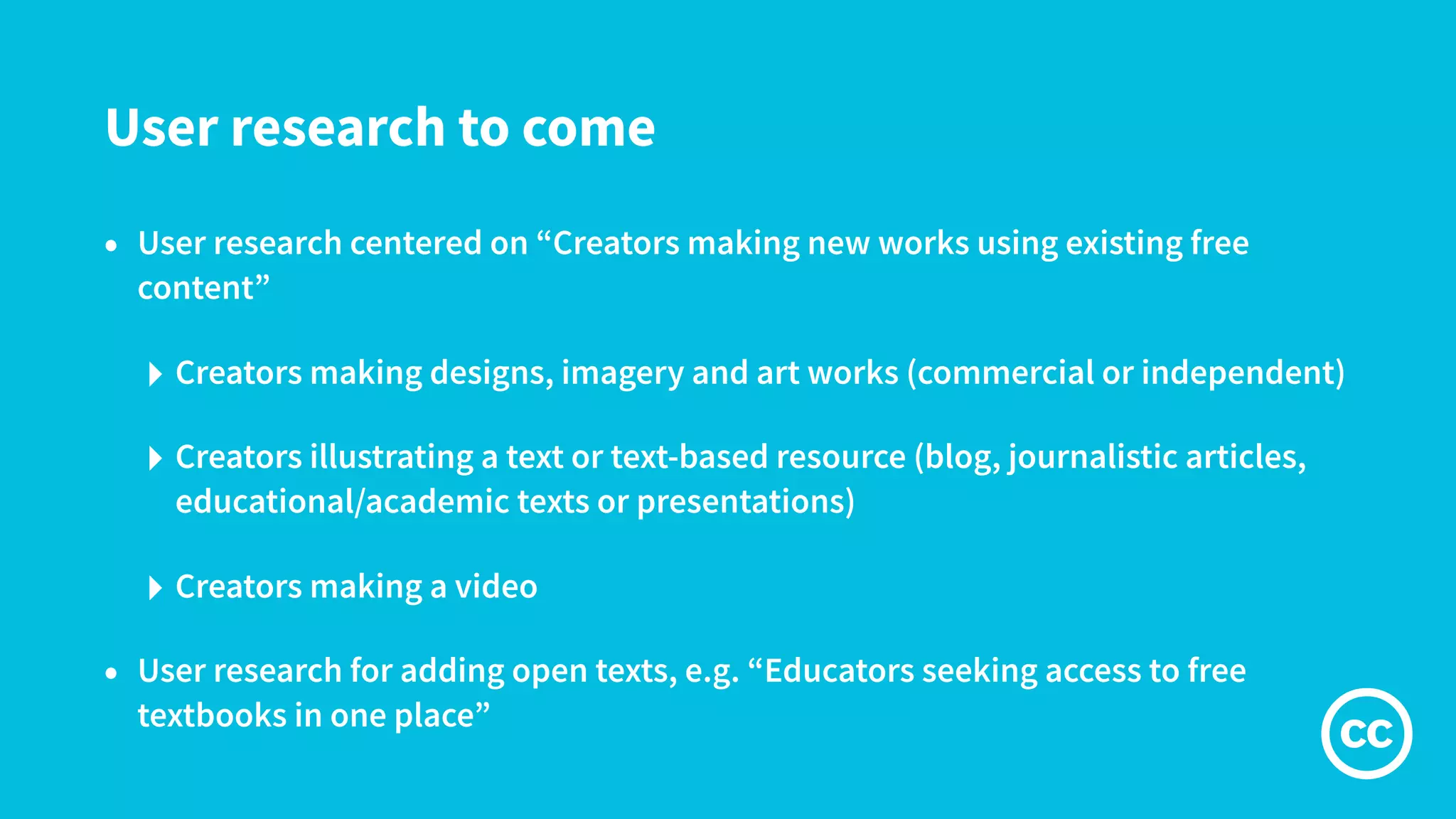
User research to come
• User research centered on “Creators making new works using existing free
content”
‣ Creators making designs, imagery and art works (commercial or independent)
‣ Creators illustrating a text or text-based resource (blog, journalistic articles,
educational/academic texts or presentations)
‣ Creators making a video
• User research for adding open texts, e.g. “Educators seeking access to free
textbooks in one place”
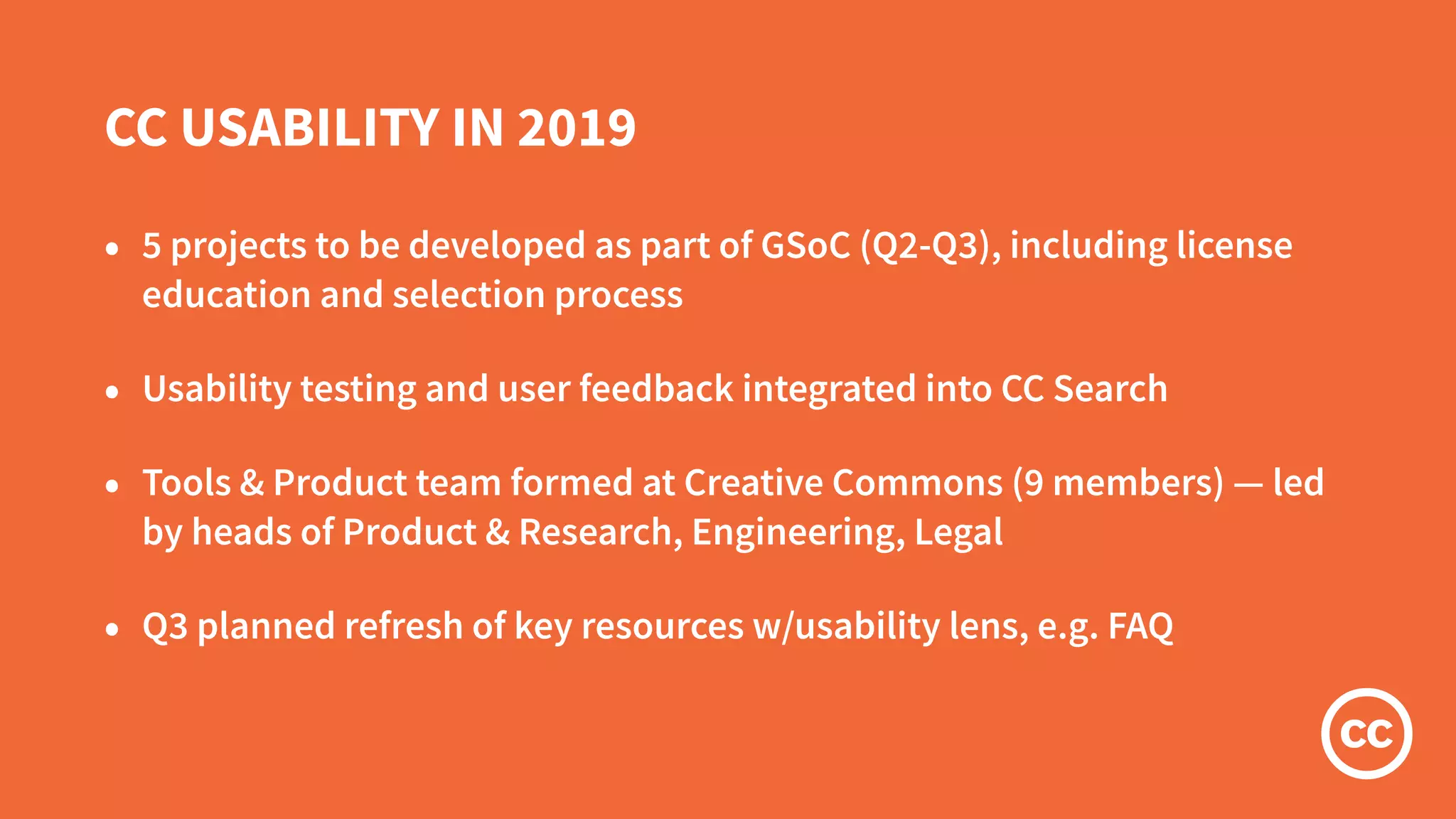
CC USABILITY IN 2019
• 5 projects to be developed as part of GSoC (Q2-Q3), including license
education and selection process
• Usability testing and user feedback integrated into CC Search
• Tools & Product team formed at Creative Commons (9 members) — led
by heads of Product & Research, Engineering, Legal
• Q3 planned refresh of key resources w/usability lens, e.g. FAQ
Q&A / Discussion

State of CC Usability and User Research (GS 2019)

  • 1.
    2019 CC GlobalSummit Jane Park Director of Product & Research @janedaily State of CC Usability & User Research
  • 2.
    AGENDA • Current stateof things • Findings from user research ‣ Goals & Human-Centered Design Process ‣ The Interviews & Insights • Design Phase: Workshop & Prototypes • What’s next + Q&A and Discussion
  • 3.
    CC USABILITY INITIATIVEIN 2018 • Conducted interviews with 80+ creators and users • Identified common themes and produced 9 key insights across 117 total interviews • Generated 250+ ideas and chose 6 to take to the Design stage • Prototyped 4 of them w/product design students at UC Berkeley • Jane transitioned to lead CC Search product in Sept/Oct
  • 4.
    PROJECT TIMELINE Jan ’18Launch Feb-Mar‘18Discovery April ’18Global Summit May-July ’18Discovery July ’18Design Workshop Aug-Dec ’18 Design Jan-TBD Development (dependent on CC Search priorities) We are here!
  • 5.
  • 6.
    –Erika Hall Director ofStrategy at Mule Design Just Enough Research “Relevance to the real world is what separates innovation from invention. Understanding why and how people do what they do today is essential to making new concepts fit into their lives tomorrow.”
  • 7.
    CC USABILITY: 1) Updatethe experience of CC licensing and discovery to reflect the realities of how people are sharing in 2018 2) Anticipate and design for the future of digital content sharing
  • 8.
    CC usability refersto the quality of a user’s experience when creating, sharing and using CC-licensed* content. We are focused on the people who directly create or use content. We are not focused on advocates and practitioners for movement growth or policymaking, as this is covered by other CC programs. *includes the CC marked public domain
  • 9.
  • 10.
    –IDEO “Human-centered design isall about starting with people and building deep empathy; generating lots of possible ideas; building and testing prototypes with the people you’re designing for; and eventually putting new solutions out into the world to improve lives.”
  • 11.
    CONSULTANTS ★ Tom DeBlasis — Founder of (tbd) collective; Former Design Innovation Director at Nike Foundation & Global Design Director at Nike; Engaging with us at key moments throughout Discovery & Design; Facilitating design workshop ★ Rachel Dzombak — Design consultant with Gobee Group; PhD in Engineering from UC Berkeley; Postdoctoral Fellow at the Haas School of Business and the Blum Center for Developing Economies; Engaging with us regularly throughout Discovery
  • 12.
    We spent 6months getting a lay of the landscape
  • 13.
    The Interviews • 81interviews, + 36 interviews from Made with CC, CC Talks With, Humans of the Commons • Interviewees were super, expert, or future users sharing all sorts of media including: images, text, data, audio, 3D design, games, VR/AR • We talked to them about their motivations, behaviors, problems, and ideal outcomes for sharing content online — with and without CC licensing
  • 14.
  • 15.
    One of twowalls.
  • 16.
    HOW WE DIDIT • We went through every interview and noted relevant themes (motivations, behaviors, problems, needs, ideal outcomes, zany ideas) • We clustered the themes over two walls, and constellations (groups of 117 people saying the same things in different ways) emerged • We analyzed the constellations, combined some of them, reorganized others, and extracted the key insights
  • 17.
    –Tom De Blasis,Design Strategy Consultant Former Design Innovation Director at Nike Foundation & Global Design Director at Nike “An Insight is both an opportunity and a problem statement — two things with tension, two things where you can’t readily have both. For example, share stuff for free but also make money.”
  • 18.
    i. Insights aboutour current tools ii. Insights about the core experience of sharing content iii. Insights about futures we might help build
  • 19.
    People understand thatCC stands for free content sharing, but the nuances of the specific licenses are lost on them — including experts and longtime CC users. INSIGHT 1:
  • 20.
    Understanding the Licenses •“CC licenses seem ridiculously simple to me but people still don’t get it; they ignore anything after the dash.” (Journalist) • “I’ve been using CC for years and I couldn’t explain the differences between the license options to you.” (Multimedia Artist) • “There are still misunderstandings for what you can or can’t do.” (Event Producer) • “People still need reassurance, so I give them that… CC licenses could be branded in a simpler way so the degrees are instantly recognizable.” (Creative Director) • “People don’t know what the fuck they’re doing.” (Video Producer)
  • 21.
    People are motivatedto license their work under CC, but have a hard time figuring out how to do it. INSIGHT 2:
  • 22.
    Navigating the CClicensing Process • A long-time CC photographer and community member does not license the photos on her site under CC b/c she can’t figure out how to do it • An event producer and artist says he’s always meant to CC license some of his work, but has never gotten around to it. “Maybe if it was more easier, like swipe up to license…” • An IT professional says it would be nice if it was more clear that the licenses are available for creators to use
  • 23.
    People are motivatedto give credit to other people, but they find attribution complicated and a hassle. INSIGHT 3:
  • 24.
    Attribution and Credit •“The footer notice is not enough. We still get questions.” (A Museum) • “Citing is important, but complicated, which is why I moved to CC0 from CC BY.” (Graphic Artist) • A photographer takes time to fill in EXIF data on her images, but is frustrated when it is read but not displayed on platforms like Facebook. • “Metadata [as currently used, 1.0] is waste of time; nobody uses metadata.” (Programmer) • A designer adds a small watermark to a corner of all of his images so anyone who cares can find and credit him.
  • 25.
    People like seeinghow their work is used, where it goes, and who it touches, but have no easy way to find this out. INSIGHT 4:
  • 26.
    Actually 2 moreInsights went into that one: • People care that the work they share resonates with people, especially personally, but can only know this if they are told directly by the person it resonated with. • People want their work to have real world or social impact, but their sense about what these impacts are are vague. However, people can identify some real or potential outcomes from sharing their work that they enjoy.
  • 27.
    Capturing the Payoff,Impact, & Connection • “I experience a small delight in seeing my images used in places.” (Amateur photographer) • “It’s gratifying to have people read, be interested, and acknowledge you.” (Writer) • “It’s nice to know where stuff is used, especially for promotional purposes.” (Designer) • “Notifications or an automated ask for permission would be an opportunity to get more engagement on a work.” (Photographer)
  • 28.
    Capturing the Payoff,Impact, & Connection • An academic mentioned her writing being cited on the House floor, in Supreme Court cases, and the realization of initiatives based on her ideas. • “In an ideal world [a publishing platform’s] republishing guidelines would be part of the license because they help us measure impact, has our branding, links back to our site. There is an appetite among for profit publishers to be able to distribute content under CC and track it without having to build it themselves.” (Publisher) • A writer wonders if licensing something could be attached to you in some way, so you would be interested in how it’s helping others, e.g. look at how blood drives are starting to do this.
  • 29.
    Capturing the Payoff,Impact, & Connection • A writer says “it’s nice to know people are reading and you’re connecting with them.” For example, he gave a copy of his first novel to his barber. He got a call in the morning from his agent that some film company was interested in it. He got a call in afternoon from his barber saying he just loved the book. The latter was more rewarding for him. • A writer says he felt like he helped “to produce an idea that had an effect on the landscape,” because years later people still refer back to [a magazine’s] issue on [a subject] and say it meant something to them, helped them understand a thing that was happening.
  • 30.
    –A student “The bestoutcome would be an ‘inspiration chain’ that results in something truly changing the world for the better.”
  • 31.
    People are oftenfirst introduced to CC when they have completed a work, but at that point they are more interested in getting the work out there than thinking through a whole new system for sharing. INSIGHT 5:
  • 32.
    –Community Manager “By thetime a creator uploads, it’s mostly at the tail end of the publication process, so they are not actively thinking about it. They are thinking about what that platform offers them. Akin to academic researchers and their data/research — by the time they are moving to a platform for publishing their mindset has shifted to other goals completely.”
  • 33.
    Embedding CC Earlierin the Creation Process • “They should be thinking about it within the creation process, before moment of publish. Or even the moment they sit down to start creating. How do I want the creation to live in the world? That would be interesting, have them think about it from the start…” (Journalist) • [photography project] was a project that [the creators] decided from the outset they wanted to share and disseminate widely, deciding before they even shot the photos that they would share them under a CC license. • Staff at [a museum] wants to go open with its various programs and resources, but find it difficult to retrofit open policies; they need ways to build in CC more intentionally at the outset of project formation.
  • 34.
    –Graphic Designer “How dowe put CC in front of people at critical moments in their lives, where they can connect it to their lives, where it might be integrated seamlessly and clearly?”
  • 35.
    People want toshare and find good work, but find it difficult to navigate the abundance of content and information online INSIGHT 6:
  • 36.
    Cutting through theNoise • “Problems creators have today are things like, how can I be heard amid abundance and content overload? The problem is now attention scarcity.” (Designer) • A TV producer and journalist said the number one challenge in her field was a lack of relevant resources. • A VR producer and director thinks search filters need to exist for the right kinds of things, like style, mood, and previous use -- as some people don’t want to use work that is too much used in other projects. • A user researcher thinks that Soundcloud has got the human experience of discovery right, and that’s why it’s so popular among musicians (even if it’s struggling in other areas).
  • 37.
    People like theefficiency of sharing via centralized platforms, but are frustrated by the lack of control and ownership over their work, and increasing devaluation of individual creativity. INSIGHT 7:
  • 38.
    Decentralization of Content& Control • “There is this move towards devaluation of art and creativity, the commoditization of content by big companies like Google.” (Entrepreneur) • “I’m frustrated with the lack of control using platforms like Instagram. I wish there was more equitable treatment of its users, regardless of how many followers they have.” (Photographer) • “Companies are taking advantage of creators!” (Artist)
  • 39.
    Decentralization of Content& Control • “CC is arguably more relevant now that the Internet is losing its fundamental, collaborative aspect, but most people aren’t aware or don’t care.” (Journalist) • “When someone else has total control over your work, it’s not hypothetical. Average people feel like they are at the whim of a few companies. How can CC empower and support creators in this landscape?” (Writer) • “The problem that CC solves for creators is not openness, but control.” (Designer)
  • 40.
    –A journalist “The biggesttrends for content are ownership of your content; how do we make sure people maintain some level of control over the works they create? Anything we can do with licensing and contracts to give people the right to own your content.”
  • 41.
    People aren’t drivento create for the money, but money is always a good outcome. People like sharing freely, but if someone is making a lot of money off their work, they want to be fairly compensated. INSIGHT 8:
  • 42.
    Getting Paid • “Mostcreators want to share while being fairly compensated, attributed, and recognized.” (IT professional) • “If no one’s making money, I’ll gladly give my work for free. If people are getting paid, then the artist also needs to get paid.” (Nonprofit) • “Unsplash weirds me out how open it is, and I almost feel bad sometimes. I go there when I’m in a quick jam. But I would rather pay $10 a month to CC for a massive archive where percentage goes back to creators and they are being credited.” (Designer) • “I would rather give money directly to a musician.” (Screenwriter)
  • 43.
    People have adesire to create work that is lasting and meaningful, that eventually has a life of its own, but don’t know what to do with a work beyond publishing it. INSIGHT 9:
  • 44.
    Posterity • “I’ve beenable to capture it… make sure it’s good, the way it should be, and then it goes to the Library of Congress and they do a lot of work to get it up and then it’s there for thousands of years. How can any of us lose on this?” (Photographer) • “We want to enable the public to rediscover and experience the work. We want to activate the material through artist engagement with it.” (Archivist) • “Licensing reflects the living, changing medium and content.” (Filmmaker)
  • 45.
  • 46.
    The Design Workshop— what we did • Discussed 9 Insights and how we got to them • Conducted a series of idea generation sessions tackling “How Might We” questions directly related to each Insight • Break-out exercise on license deprecation • Heat mapped all ideas, fleshed out top ideas (achievable, on strategy/ mission, impactful), and decided which to bring forward into the Design phase
  • 47.
    Covered in DesignWorkshop: • Images, text (long form), and anything that loosely intersects Tabled: • Data, Emerging media, Analogous media • Needs surfaced around outreach/education/advocacy for institutions and publishers
  • 48.
    Usability Design Workshopwall, first half
  • 49.
    Ideas green litfor prototyping 1. New step-through process / Redo language + pathway 2. Publish How To Guide for where to find your work 3. Button for contact 4. Polaroid watermark 5. Archive 6. Reward & Delight
  • 50.
    Ideas TBD withComms & Product Teams 1. Update educational materials (T&P team formed to tackle some in Q3) 2. No click attribution 3. Narrow use case search (in pipeline of ideas for CC Search) 4. Obtain an ID (now technically possible in CC search) Idea to revisit after Design phase 5. Plugins for Adobe, etc.
  • 51.
    Non-usability ideas lefton the cutting room floor 1. “Librarian” of the Commons, aka some way to curate the commons 2. Creator co-operative/union 3. CC concepts introduced earlier in creation process, before publication (related to Adobe plugins) 4. One Creative Commons License (license deprecation)
  • 52.
    State of prototypesin 2019 1. New step-through process / Redo language + pathway 2. Publish How To Guide for where to find your work 3. Button for contact 4. Polaroid watermark 5. Archive 6. Reward & Delight ✓ 2 student prototypes; GSoC Fellow ➡ TBD (CC comms) ➡ TBD ✓ 1 student prototype ✓ 2 student prototypes ✓ 1 prototype; in dev CC Search site
  • 53.
  • 54.
  • 55.
  • 56.
  • 57.
  • 58.
  • 59.
  • 60.
  • 61.
    4A. CC ARCHIVEW/PARTNERS
  • 62.
    4B. CC ARCHIVEW/PARTNERS
  • 63.
    4C. CC ARCHIVEW/PARTNERS
  • 64.
  • 65.
  • 66.
    6A. REWARD &DELIGHT: CCID ON MOBILE
  • 67.
    6B. REWARD &DELIGHT: CC ID ON WEB
  • 68.
    State of userresearch in 2019 ‣ 16 people agreed to be part of a super user group (recs for a better name?), and participate in follow-on conversations ‣ 71 people joined the #cc-usability Slack channel ‣ Users give feedback on front end features in CC search every Friday (#feedbackfriday) during a sprint ‣ Monthly usability testing for CC Search ‣ User feedback forms in CC Search
  • 69.
    User research tocome • User research centered on “Creators making new works using existing free content” ‣ Creators making designs, imagery and art works (commercial or independent) ‣ Creators illustrating a text or text-based resource (blog, journalistic articles, educational/academic texts or presentations) ‣ Creators making a video • User research for adding open texts, e.g. “Educators seeking access to free textbooks in one place”
  • 70.
    CC USABILITY IN2019 • 5 projects to be developed as part of GSoC (Q2-Q3), including license education and selection process • Usability testing and user feedback integrated into CC Search • Tools & Product team formed at Creative Commons (9 members) — led by heads of Product & Research, Engineering, Legal • Q3 planned refresh of key resources w/usability lens, e.g. FAQ
  • 71.