@JonKMD
THE
FUTURE OF
MEDICINE
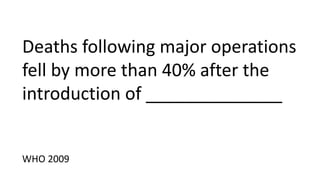
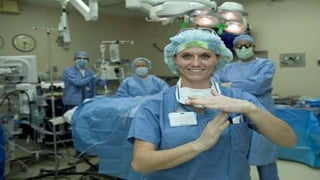
Deaths following major operations
fell by more than 40% after the
introduction of ______________
WHO 2009
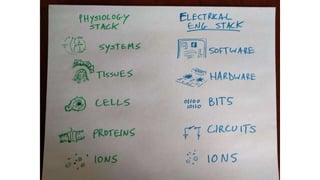
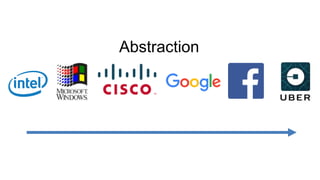
Abstraction
Alexdanco.com
Abstraction
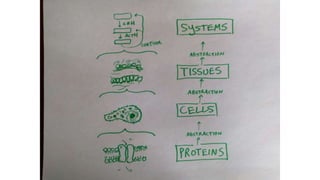
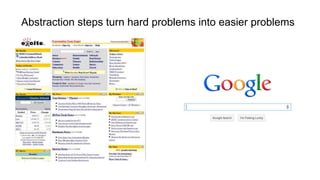
Abstraction steps turn hard problems into easier problems
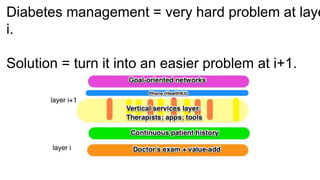
Diabetes management = very hard problem at laye
i.
Solution = turn it into an easier problem at i+1.
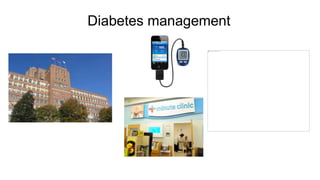
Diabetes management
Artificial Intelligence
against cancer
Biggest ML research hub in the world?
Yoshua Bengio, PhD
University of Montreal
Behavioral Changes
• Automated detection – Less scanning by
radiologists?
• Non-radiologist physicians begin reading
medical imaging?
• More medical imaging devices on the cloud?
• Do patients voluntarily share more data?
What is the role of the physician in the machine
learning revolution?
What are the inherent biases and ethical issues
with data collected?
Who gets access to this life saving technology?
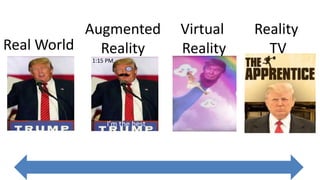
Real World
Augmented
Reality
Virtual
Reality
Reality
TV
I’m the best
1:15 PM
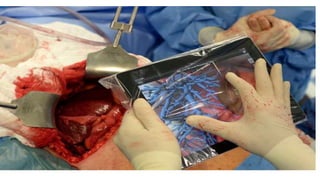
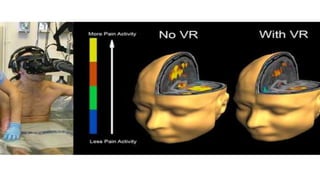
Uses of AR/VR in Healthcare
• Doctors
– Consultation
– Intra-operative
• Patients
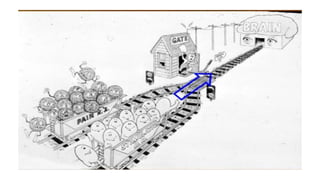
– Pain reduction
– Anxiety management
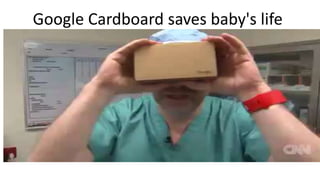
Google Cardboard saves baby's life
Behavioral Changes
• Decreased pain medication– reaction from big
pharma?
• Will hospitals start regularly integrating AR/VR?
• Will there be an increased need for VR content?
• How do you make AR/VR more accessible in
surgery?
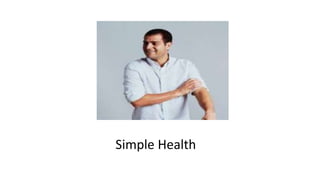
Simple Health
Behavioral Changes
• Less reliance on doctors for basic cares, apps
replace basic medical functions?
• How does insurance re-imburse for
personalized preventative care?
• What do highly trained specialists without
jobs go do?
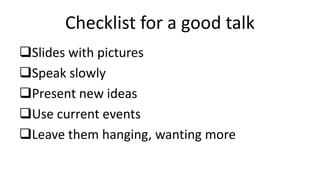
Checklist for a good talk
Slides with pictures
Speak slowly
Present new ideas
Use current events
Leave them hanging, wanting more

Startufpest 2016: Dr. Jonathan Kanevsky - Future of

Editor's Notes

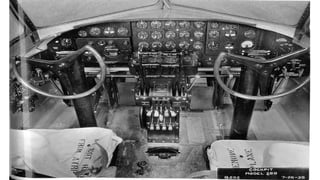
  • #4 This is a b-17, known as the flying fortress. There were far fewer B-17s than needed at the start of WWII
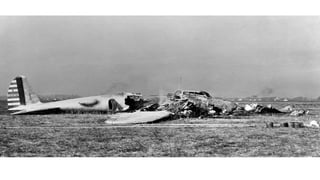
  • #5  This was due to this. Not that it was too complicated for one man to fly, but it was too complicatd for one man to remember everything to fly it. , in large part because of the tragic death of Major “Pete” Ployer Hill in 1935, when the B-17 was Model 299–an experimental aircraft being tested at Wright Field Ocotber 30, 1935 Boeing test pilots, B-17 boeing swept the competition and was on track to secure 200 orers from the US army. The plane made a normal taxi and take off, shrotly afterward it turned onto its wing and crashed in flames


  • #6 Eventually Boeing was given contracts for a significant number of B-17s, but this delay meant the United States was two years into WWII before the Air Force had a sufficient number of the bombers.
  • #7  so a group of Air Force pilots and Boeing mechanics and pilots were given the task of allaying fears about it. Their solution was to develop a list of the equipment that had to be in place and the actions that had to be done before take off, as well as lists for in-flight, prior to landing and after landing. The list would be in the cockpit and the co-pilot would read each step then wait for the pilot to check the status and verbally indicate it by saying “Check”.  If the co-pilot couldn’t make a check mark everything stopped until the situation was corrected. The flight checklist worked perfectly and made flight activities more organized. Soon, other pilots heard about the idea and developed checklists for their own planes. Within a short time it was required for all pilots in all aircraft.
  • #9 Current WHO standard is to have 2 time outs, one befor ehte procedure starts and one when it is over check the name of the patient procedure, site operated antibiotics given any concerns
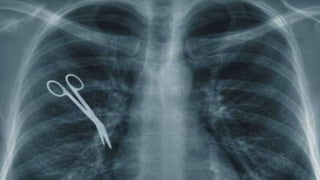
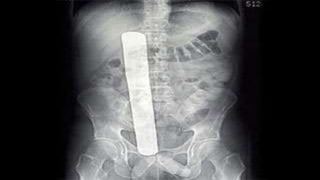
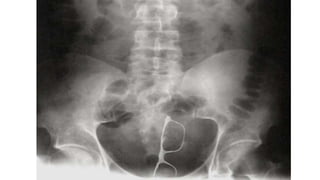
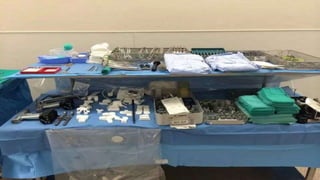
  • #13 Counting surgical instruments has also become a practice to ensure patient safety -decreases efficiency, but increases safety
  • #14 Despite what you might think, some of the greatest medical advances haven’t been medical devices They have been things that change behaviors
  • #15  The future of medicine is about changing behaviors And the ripple effect of changing behaviors of insurance providers, doctors, nurses, patients is what is interesting to startups and investors
  • #16 Id like to introduce the concept of abstraction A close friend Alex danco first told me about this when we were students…. It is applicable to many of the eco systems we see around us... And i think it is essential to the future of medicine
  • #23  I said before that changing behaviours is key to creating change among patients and doctors. The process of abstraction is changing the landscape of technology and how behaviors are changed. Now that we root our understanding abstraction can change behaviours, I’d like to talk about four branches of technology in medicine that are rapidly growing and behavioral changes will flourish 1) Machine learning - Imagia 2) Augmented/Virtual Reality –Applied VR, Hololens/ VIPAR 4) Personalized Medicine –simple contacts/ Sano/ Ella
  • #38 So what if u started to look at different data
  • #40 Everyone of these points should be of interest to innovators and investors in healthcare! -less scanning by radiologists – -
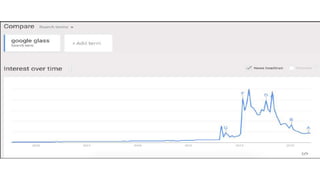
  • #48 Next time someone tells you AR isn’t going to pick up….
  • #55 Everyone of these points should be of interest to innovators and investors in healthcare! -less scanning by radiologists – -
  • #58 Personalized medicine is a medical procedure that separates patients into different groups—with medical decisions, practices, interventions and/or products being tailored to the individual patient based on their predicted response or risk of disease.
  • #61 -paradigm shift -optometrists out of work
  • #63 Everyone of these points should be of interest to innovators and investors in healthcare! -less scanning by radiologists – -
  • #64 Revisit the concept of abstraction -patients to navigate and circumvent the traditional access to healthcare, diagnosis, and treatment