Industrial Employment (Standing
Order) Act, 1946
Introduction
• To avoid friction amongst the employers and workmen
employed in an industry is the principal aim of Indian
Legislation in India.
• It was considered that the society had a vital interest in
the settlement of terms of employment of Industrial
Labor and also settlement of Labor problems.
• Therefore, the steps were taken by the Central
Government to enact Industrial Employment (Standing
Orders) Act, 1946 with a view to afford protection to
the workmen with regard to conditions of employment
What is Standing Order
“Standing Orders” mean rules relating to matters
set out in the Schedule to the Act [Sec.2(g)] to be
covered and in respect of which the employer has
to draft for submission to the Certifying Officer,
are matters specified in the Schedule.
“an instruction or prescribed procedure in force
permanently or until changed or cancelled”-
Merriam-Webster Dictionary
Schedule I
• Classification of workman (whether he is a temporary or
permanent, Badli workman)
• Working hours, holidays as well as wage rates
• Shift working
• Attendance and late coming
• Procedure in applying leave and holidays
• Requirement to enter premises by certain or specific gates and
liability to search
• Closing and opening up industrial establishment
• Termination of employment and procedure for serving the notice
• Suspension or dismissal for misconduct or any act or omission
• Remedies available for a workman in case of unfair labor practices
• Any other matter which may be prescribed.
Objective of the Act
1. To regulate industrial relations.
2. To regulate the conditions of employment,
grievances, misconduct etc. of the workers
employed in industrial undertakings.
3. Unsolved grievances can become industrial
disputes.
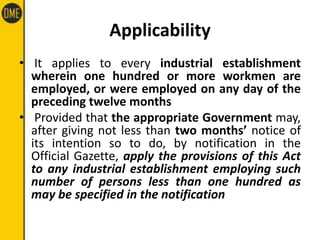
Applicability
• It applies to every industrial establishment
wherein one hundred or more workmen are
employed, or were employed on any day of the
preceding twelve months
• Provided that the appropriate Government may,
after giving not less than two months’ notice of
its intention so to do, by notification in the
Official Gazette, apply the provisions of this Act
to any industrial establishment employing such
number of persons less than one hundred as
may be specified in the notification
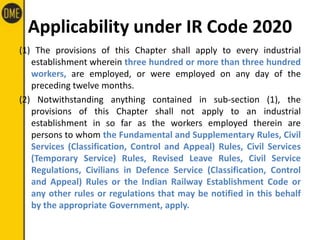
Applicability under IR Code 2020
(1) The provisions of this Chapter shall apply to every industrial
establishment wherein three hundred or more than three hundred
workers, are employed, or were employed on any day of the
preceding twelve months.
(2) Notwithstanding anything contained in sub-section (1), the
provisions of this Chapter shall not apply to an industrial
establishment in so far as the workers employed therein are
persons to whom the Fundamental and Supplementary Rules, Civil
Services (Classification, Control and Appeal) Rules, Civil Services
(Temporary Service) Rules, Revised Leave Rules, Civil Service
Regulations, Civilians in Defence Service (Classification, Control
and Appeal) Rules or the Indian Railway Establishment Code or
any other rules or regulations that may be notified in this behalf
by the appropriate Government, apply.
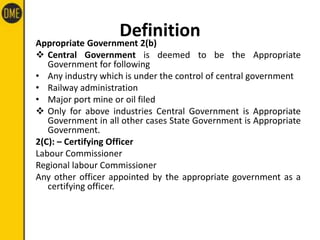
Definition
Appropriate Government 2(b)
 Central Government is deemed to be the Appropriate
Government for following
• Any industry which is under the control of central government
• Railway administration
• Major port mine or oil filed
 Only for above industries Central Government is Appropriate
Government in all other cases State Government is Appropriate
Government.
2(C): – Certifying Officer
Labour Commissioner
Regional labour Commissioner
Any other officer appointed by the appropriate government as a
certifying officer.
Procedure for the Approval of Standing Orders
• Procedure for the submission of Draft Standing Orders
[Section 3].
• Procedure for the Conditions for Certification of Standing
Orders [Section4].
• Procedure for Certification of Standing Orders (Procedure
for Adoption) [Section 5].
• Appeals [Section 6].
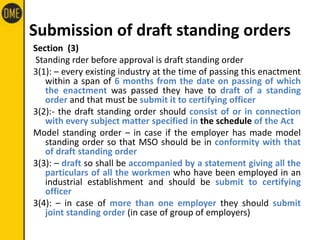
Submission of draft standing orders
Section (3)
Standing rder before approval is draft standing order
3(1): – every existing industry at the time of passing this enactment
within a span of 6 months from the date on passing of which
the enactment was passed they have to draft of a standing
order and that must be submit it to certifying officer
3(2):- the draft standing order should consist of or in connection
with every subject matter specified in the schedule of the Act
Model standing order – in case if the employer has made model
standing order so that MSO should be in conformity with that
of draft standing order
3(3): – draft so shall be accompanied by a statement giving all the
particulars of all the workmen who have been employed in an
industrial establishment and should be submit to certifying
officer
3(4): – in case of more than one employer they should submit
joint standing order (in case of group of employers)
Condition for certification of standing order
Section (4): –
• What are all the conditions to be fulfilled to get
certification
• Certifying officer will verify whether the provision has
made by employer for all the subject matter mentioned in
the schedule
• Standing order should also in conformity with the provision
of this Act
• Certifying officer have the authority to decide whether to
grant the certification and he may also suggest for
modification of the standing order in the form of addition
of rules in the draft standing order and after it is fulfilled,
he will certify.
Preparation of draft standing orders by employer under IR
Code 2020
(1) The employer shall prepare draft standing orders, within a period of six
months from the date of commencement of this Code, based on the
model standing orders referred to in section 29 in respect of the matters
specified in the First Schedule and on any other matter considered
necessary by him for incorporation of necessary provisions in such
standing orders for his industrial establishment or undertaking,
considering the nature of activity in his industrial establishment or
undertaking, provided such provision is not inconsistent with any of the
provision of this Code and covers every matters set out in the First
Schedule.
(2) The employer shall consult the Trade Unions or recognised negotiating
union or members of the negotiating council relating to the industrial
establishment or undertaking, as the case may be, in respect of the draft
of the standing order and thereafter forward the draft of the standing
order electronically or otherwise to the certifying officer for
certification.
Preparation of draft standing orders by employer under IR
Code 2020
(3) Where an employer adopts a model standing order of the Central
Government referred to in section 29 with respect to matters relevant to
his industrial establishment or undertaking, then, such model standing
order shall be deemed to have been certified under the provisions of this
section and employer shall forward the information in this regard to the
concerned certifying officer in such manner as may be prescribed:
Provided that if the certifying officer has any observation, he may direct
such employer to amend the standing order so adopted within such
period as may be prescribed.
(4) The employer shall prepare the draft of the modifications required in
the standing order, if any, in accordance with the provisions of this Code
and forward electronically or otherwise to the certifying officer for
certification of those modifications only within a period of six months
from the date, the provisions of this Chapter becomes applicable to his
industrial establishment
Procedure for certification
The draft standing orders or draft of the modifications
proposed in the standing orders shall be accompanied by
a statement giving such particulars, as may be prescribed,
of the workers employed in the industrial establishment,
the Trade Union to which they belong, and the negotiating
union or negotiating council, if any.
The standing orders relating to an industrial establishment
or undertaking existing on the date of commencement of
the relevant provisions of this Code, shall, in so far as is
not inconsistent with the provisions of this Code or rules
made there under, continue and be deemed to be the
standing orders certified
Procedure for certification under IR Code 2020
(5) On receipt of the drafts referred to in sub-section (1) and sub-section (4), the
certifying officer shall issue notice to—
(i) the Trade Union or negotiating union of the industrial establishment or
undertaking, or members of the negotiating council; or
(ii) where there is no Trade Union operating, to such representatives of the
workers of the industrial establishment or undertaking
for seeking their comments in the matter and after receipt of their comments
give an opportunity of being heard to the negotiating union or negotiating
council, or as the case may be, to the Trade Unions or the representatives of
the workers and decide as to whether or not any modification or addition to
such draft standing order is necessary to render the draft standing order
certifiable, and shall make an order in writing in this regard:
• Provided that the certifying officer shall complete such procedure for
certification referred to in sub-sections (4) and (5) in respect of—
(a) the draft standing order so received within a period of sixty days from the
date of the receipt of it; and
(b) the draft modifications in the standing order so received within a period of
sixty days from the date of the receipt of such modifications, failing which such
draft standing orders or, as the case may be, the modifications in the standing
order shall be deemed to have been certified on the expiry of the said period.
Condition for certification
• The standing orders shall be certifiable under this Code, if—
(a) provision is made therein for every matter set out in the First Schedule which
is applicable to the industrial establishment; and
(b) such orders are otherwise in conformity with the provisions of this Code.
• It shall be the function of the certifying officer or the appellate authority to
adjudicate upon the fairness or reasonableness of the provisions of any
standing orders keeping in view the provisions of the model standing order.
• The certifying officer shall certify the draft standing orders or the
modifications in the standing orders referred to in sub-section (5), and shall
within seven days send copies of the certified standing orders or the
modifications in the standing orders, authenticated in such manner as may be
prescribed, to the employer and to the negotiating union or negotiating council
or the Trade Union or other representatives of the workers
Certification of standing order
Section (5)
• When the draft standing order is submitted, he shall forward it a copy to trade
union or workman representative.
• If certifying order is satisfied by fulfilling all the conditions u/s -4 then it shall send
to trade union or workman representative after certifying it will sent to trade
union
• Inviting objections as for the standing order is the purpose to send to workman
representatives. They will have 15 days’ time to send objections from the date on
which it is served to workman representative.
• In case if the objectives are sent then certifying officer, he provides opportunities
for both the employer and employee
• After opportunity of being heard he will decide whether to grant or not and pass
an order.
• In case if he feels any modifications, he can suggest and certify it.
• That certification order shall be sent within a span of 7 days after approval is
given that order should be sent to trade union or workman representative
• Once standing order is certified then condition of the service of employment of
the workman,
• Standing order will be bind on employees as well as employer it includes
successors, legal heirs.
Appeals
• Section 6 Industrial Employment (Standing Order)Act 1946
• Any employer, trade union, representation of the workman who may
be aggrieved by the order of certifying officer may make an appeal to
the appellant authority within a span of 30 days from the date of
certifying order is received by trade union
• The decision of appellant authority shall be final binding on all the
parties
• Appellant authority has the power to modify or suggest for any
additional information
• The appellant authority shall send the final copy or order copy within
a span of 7 days to the certifying officer
• In case if the appellant authority suggests the modification, it shall
send back copy along with draft standing order with the parties
• Appellant authority has the power to modify on its own if it modifies
then that copy shall send back to the parties.
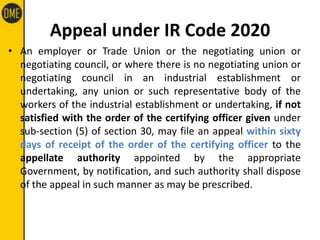
Appeal under IR Code 2020
• An employer or Trade Union or the negotiating union or
negotiating council, or where there is no negotiating union or
negotiating council in an industrial establishment or
undertaking, any union or such representative body of the
workers of the industrial establishment or undertaking, if not
satisfied with the order of the certifying officer given under
sub-section (5) of section 30, may file an appeal within sixty
days of receipt of the order of the certifying officer to the
appellate authority appointed by the appropriate
Government, by notification, and such authority shall dispose
of the appeal in such manner as may be prescribed.
Certifying Officers and Appellate Authorities to have
powers of civil court
• Every Certifying Officer and appellate authority shall have all the powers
of a Civil Court for the purposes of receiving evidence, administering
oaths, enforcing the attendance of witnesses, and compelling the
discovery and production of documents, and shall be deemed to be a
civil court within the meaning of 2 [sections 345 and 346 of the Code of
Criminal Procedure, 1973
• Clerical or arithmetical mistakes in any order passed by a Certifying
Officer or appellate authority, or errors arising therein from any accidental
slip or omission may, at any time, be corrected by that Officer or authority
or the successor in office of such Officer or authority, as the case may be.]
• Oral evidence in contradiction of standing orders not admissible.—No
oral evidence having the effect of adding to or otherwise varying or
contradicting standing orders as finally certified under this Act shall be
admitted in any Court.
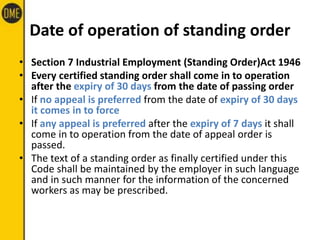
Date of operation of standing order
• Section 7 Industrial Employment (Standing Order)Act 1946
• Every certified standing order shall come in to operation
after the expiry of 30 days from the date of passing order
• If no appeal is preferred from the date of expiry of 30 days
it comes in to force
• If any appeal is preferred after the expiry of 7 days it shall
come in to operation from the date of appeal order is
passed.
• The text of a standing order as finally certified under this
Code shall be maintained by the employer in such language
and in such manner for the information of the concerned
workers as may be prescribed.
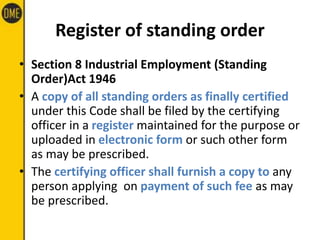
Register of standing order
• Section 8 Industrial Employment (Standing
Order)Act 1946
• A copy of all standing orders as finally certified
under this Code shall be filed by the certifying
officer in a register maintained for the purpose or
uploaded in electronic form or such other form
as may be prescribed.
• The certifying officer shall furnish a copy to any
person applying on payment of such fee as may
be prescribed.
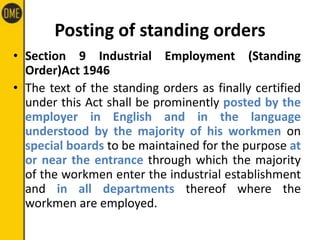
Posting of standing orders
• Section 9 Industrial Employment (Standing
Order)Act 1946
• The text of the standing orders as finally certified
under this Act shall be prominently posted by the
employer in English and in the language
understood by the majority of his workmen on
special boards to be maintained for the purpose at
or near the entrance through which the majority
of the workmen enter the industrial establishment
and in all departments thereof where the
workmen are employed.
Duration and modification of standing orders
• Modification within six months on an
agreement between Employer and workmen
• Modification after the expiry of Six Months
• Conditions for Modification of Certified SO
• Who can make the Application
• Penalty for contravening Section 10
Duration and modification of standing orders
• Section 10
• Standing orders finally certified under this Act shall not, except on
agreement between the employer and the workmen [or a trade
union or other representative body of the workmen], be liable to
modification until the expiry of six months from the date on which
the standing orders or the last modifications thereof came into
operation.
• An employer or workman [or a trade union or other representative
body of the workmen] may apply to the Certifying Officer to have
the standing orders modified, and such application shall be
accompanied by five copies of the modifications proposed to be
made, and where such modifications are proposed to be made by
agreement between the employer and the workmen [or a trade
union or other representative body of the workmen], a certified
copy of that agreement shall be filed along with the application.
Temporary application of model
standing order
• Section 12 A
• Notwithstanding anything contained in sections 3 to 12, for the period
commencing on the date on which this Act becomes applicable to an
industrial establishment and ending with the date on which the
standing orders as finally certified under this Act come into operation
under section 7 in that establishment, the prescribed model standing
orders shall be deemed to be adopted in that establishment, and the
provisions of section 9, sub-section (2) of section 13 and section 13A
shall apply to such model standing orders as they apply to the standing
orders so certified.
• The prescribed model standing order till they get the certification of
standing order they should apply model standing order prescribed by
the Act
Subsistence Allowance
Section 10 A Industrial Employment (Standing Order)Act 1946
(1) Where any workmen is suspended by the employer pending
investigation or inquiry into complaints or charges of misconduct
against him, the employer shall pay to such workman subsistence
allowance—
(a) at the rate of fifty per cent. of the wages which the workman was
entitled to immediately preceding the date of such suspension, for
the first ninety days of suspension; and
(b) at the rate of seventy-five per cent. of such wages for the
remaining period of suspension if the delay in the completion of
disciplinary proceedings against such workman is not directly
attributable to the conduct of such workman
Subsistence Allowance
• (2) If any dispute arises regarding the subsistence allowance payable to
a workman, the workman or the employer concerned may refer the
dispute to the Labour Court, constituted under the Industrial Disputes
Act, 1947 within the local limits of whose jurisdiction the industrial
establishment wherein such workman is employed is situate and the
Labour Court to which the dispute is so referred shall, after giving the
parties an opportunity of being heard, decide the dispute and such
decision shall be final and binding on the parties.
• (3) Notwithstanding anything contained in the foregoing provisions of
this section, where provisions relating to payment of subsistence
allowance under any other law for the time being in force in any State
are more beneficial than the provisions of this section, the provisions
of such other law shall be applicable to the payment of subsistence
allowance in that State.]
Liability of the Employer
• To prepare a standing order based on the provisions of the act
• Submit the standing orders for certification within six months of the act
becoming applicable, and follow the stipulations of the certifying officer to get
the standing orders certified. Penalty for non-compliance I a fine of Rs 5000/-
plus Rs 200/- for every day of continuing offence.
• Display the certified standing orders (or the model standing orders as the case
may be) in English and local language on special notice boards at or near
entrance of the establishment. [section 9].
• Rajasthan SRTC v. Krishna Kant (1995): Standing orders are statutorily imposed
conditions of service, and binding on employer and employee. However, the
‘Standing Orders’ even when approved, do not become ‘law’ in the sense in
which Rules and Notifications issued under delegated legislation become after
they are published as prescribed) -
• Rothak & Hissar Electric Supply Co V State of UP (1966): SC held if both parties
(management and union) agree the proposed standing orders are fair and
reasonable, the appropriate authority must take that into account. Consent6 of
the workmen, though a relevant factor, is not an essential condition for
certification.
Offences and Penalties
• Section 13 Industrial Employment (Standing Order)Act 1946
An employer fails to submit the draft Standing Orders as required by
Section 3 or who modified his standing orders otherwise with sec.10
shall be punishable with fine which may extend to Rs.5000 and in case
of continuing offence with a further fine of Rs.200 for every day after
the first during which the offence continues.
• An employer who does any act in contravention of the standing orders
finally certified under this act for industrial establishment shall be
punishable with fine which may extend to Rs.100 and in case of
continuous offence with further fine of Rs.25 every day after the first
during which the offence continues.
• No persecution for any offence punishable under this section 13 shall be
instituted except with the previous sanction of the appropriate
government. It can be tried only in the Court of a presidency magistrate
or the second class magistrate.
Interpretation of Standing Order
• Section 13 A
• Sabhapati Singh v. UP State Road Transport
Corporation 1994 LLJ
• Ram Asrey v. Labour Court Kanpur 1991 LLJ

Standing+Order++Unit+II.pptx

  • 1.
  • 2.
    Introduction • To avoidfriction amongst the employers and workmen employed in an industry is the principal aim of Indian Legislation in India. • It was considered that the society had a vital interest in the settlement of terms of employment of Industrial Labor and also settlement of Labor problems. • Therefore, the steps were taken by the Central Government to enact Industrial Employment (Standing Orders) Act, 1946 with a view to afford protection to the workmen with regard to conditions of employment
  • 3.
    What is StandingOrder “Standing Orders” mean rules relating to matters set out in the Schedule to the Act [Sec.2(g)] to be covered and in respect of which the employer has to draft for submission to the Certifying Officer, are matters specified in the Schedule. “an instruction or prescribed procedure in force permanently or until changed or cancelled”- Merriam-Webster Dictionary
  • 4.
    Schedule I • Classificationof workman (whether he is a temporary or permanent, Badli workman) • Working hours, holidays as well as wage rates • Shift working • Attendance and late coming • Procedure in applying leave and holidays • Requirement to enter premises by certain or specific gates and liability to search • Closing and opening up industrial establishment • Termination of employment and procedure for serving the notice • Suspension or dismissal for misconduct or any act or omission • Remedies available for a workman in case of unfair labor practices • Any other matter which may be prescribed.
  • 5.
    Objective of theAct 1. To regulate industrial relations. 2. To regulate the conditions of employment, grievances, misconduct etc. of the workers employed in industrial undertakings. 3. Unsolved grievances can become industrial disputes.
  • 6.
    Applicability • It appliesto every industrial establishment wherein one hundred or more workmen are employed, or were employed on any day of the preceding twelve months • Provided that the appropriate Government may, after giving not less than two months’ notice of its intention so to do, by notification in the Official Gazette, apply the provisions of this Act to any industrial establishment employing such number of persons less than one hundred as may be specified in the notification
  • 7.
    Applicability under IRCode 2020 (1) The provisions of this Chapter shall apply to every industrial establishment wherein three hundred or more than three hundred workers, are employed, or were employed on any day of the preceding twelve months. (2) Notwithstanding anything contained in sub-section (1), the provisions of this Chapter shall not apply to an industrial establishment in so far as the workers employed therein are persons to whom the Fundamental and Supplementary Rules, Civil Services (Classification, Control and Appeal) Rules, Civil Services (Temporary Service) Rules, Revised Leave Rules, Civil Service Regulations, Civilians in Defence Service (Classification, Control and Appeal) Rules or the Indian Railway Establishment Code or any other rules or regulations that may be notified in this behalf by the appropriate Government, apply.
  • 8.
    Definition Appropriate Government 2(b) Central Government is deemed to be the Appropriate Government for following • Any industry which is under the control of central government • Railway administration • Major port mine or oil filed  Only for above industries Central Government is Appropriate Government in all other cases State Government is Appropriate Government. 2(C): – Certifying Officer Labour Commissioner Regional labour Commissioner Any other officer appointed by the appropriate government as a certifying officer.
  • 9.
    Procedure for theApproval of Standing Orders • Procedure for the submission of Draft Standing Orders [Section 3]. • Procedure for the Conditions for Certification of Standing Orders [Section4]. • Procedure for Certification of Standing Orders (Procedure for Adoption) [Section 5]. • Appeals [Section 6].
  • 10.
    Submission of draftstanding orders Section (3) Standing rder before approval is draft standing order 3(1): – every existing industry at the time of passing this enactment within a span of 6 months from the date on passing of which the enactment was passed they have to draft of a standing order and that must be submit it to certifying officer 3(2):- the draft standing order should consist of or in connection with every subject matter specified in the schedule of the Act Model standing order – in case if the employer has made model standing order so that MSO should be in conformity with that of draft standing order 3(3): – draft so shall be accompanied by a statement giving all the particulars of all the workmen who have been employed in an industrial establishment and should be submit to certifying officer 3(4): – in case of more than one employer they should submit joint standing order (in case of group of employers)
  • 11.
    Condition for certificationof standing order Section (4): – • What are all the conditions to be fulfilled to get certification • Certifying officer will verify whether the provision has made by employer for all the subject matter mentioned in the schedule • Standing order should also in conformity with the provision of this Act • Certifying officer have the authority to decide whether to grant the certification and he may also suggest for modification of the standing order in the form of addition of rules in the draft standing order and after it is fulfilled, he will certify.
  • 12.
    Preparation of draftstanding orders by employer under IR Code 2020 (1) The employer shall prepare draft standing orders, within a period of six months from the date of commencement of this Code, based on the model standing orders referred to in section 29 in respect of the matters specified in the First Schedule and on any other matter considered necessary by him for incorporation of necessary provisions in such standing orders for his industrial establishment or undertaking, considering the nature of activity in his industrial establishment or undertaking, provided such provision is not inconsistent with any of the provision of this Code and covers every matters set out in the First Schedule. (2) The employer shall consult the Trade Unions or recognised negotiating union or members of the negotiating council relating to the industrial establishment or undertaking, as the case may be, in respect of the draft of the standing order and thereafter forward the draft of the standing order electronically or otherwise to the certifying officer for certification.
  • 13.
    Preparation of draftstanding orders by employer under IR Code 2020 (3) Where an employer adopts a model standing order of the Central Government referred to in section 29 with respect to matters relevant to his industrial establishment or undertaking, then, such model standing order shall be deemed to have been certified under the provisions of this section and employer shall forward the information in this regard to the concerned certifying officer in such manner as may be prescribed: Provided that if the certifying officer has any observation, he may direct such employer to amend the standing order so adopted within such period as may be prescribed. (4) The employer shall prepare the draft of the modifications required in the standing order, if any, in accordance with the provisions of this Code and forward electronically or otherwise to the certifying officer for certification of those modifications only within a period of six months from the date, the provisions of this Chapter becomes applicable to his industrial establishment
  • 14.
    Procedure for certification Thedraft standing orders or draft of the modifications proposed in the standing orders shall be accompanied by a statement giving such particulars, as may be prescribed, of the workers employed in the industrial establishment, the Trade Union to which they belong, and the negotiating union or negotiating council, if any. The standing orders relating to an industrial establishment or undertaking existing on the date of commencement of the relevant provisions of this Code, shall, in so far as is not inconsistent with the provisions of this Code or rules made there under, continue and be deemed to be the standing orders certified
  • 15.
    Procedure for certificationunder IR Code 2020 (5) On receipt of the drafts referred to in sub-section (1) and sub-section (4), the certifying officer shall issue notice to— (i) the Trade Union or negotiating union of the industrial establishment or undertaking, or members of the negotiating council; or (ii) where there is no Trade Union operating, to such representatives of the workers of the industrial establishment or undertaking for seeking their comments in the matter and after receipt of their comments give an opportunity of being heard to the negotiating union or negotiating council, or as the case may be, to the Trade Unions or the representatives of the workers and decide as to whether or not any modification or addition to such draft standing order is necessary to render the draft standing order certifiable, and shall make an order in writing in this regard: • Provided that the certifying officer shall complete such procedure for certification referred to in sub-sections (4) and (5) in respect of— (a) the draft standing order so received within a period of sixty days from the date of the receipt of it; and (b) the draft modifications in the standing order so received within a period of sixty days from the date of the receipt of such modifications, failing which such draft standing orders or, as the case may be, the modifications in the standing order shall be deemed to have been certified on the expiry of the said period.
  • 16.
    Condition for certification •The standing orders shall be certifiable under this Code, if— (a) provision is made therein for every matter set out in the First Schedule which is applicable to the industrial establishment; and (b) such orders are otherwise in conformity with the provisions of this Code. • It shall be the function of the certifying officer or the appellate authority to adjudicate upon the fairness or reasonableness of the provisions of any standing orders keeping in view the provisions of the model standing order. • The certifying officer shall certify the draft standing orders or the modifications in the standing orders referred to in sub-section (5), and shall within seven days send copies of the certified standing orders or the modifications in the standing orders, authenticated in such manner as may be prescribed, to the employer and to the negotiating union or negotiating council or the Trade Union or other representatives of the workers
  • 17.
    Certification of standingorder Section (5) • When the draft standing order is submitted, he shall forward it a copy to trade union or workman representative. • If certifying order is satisfied by fulfilling all the conditions u/s -4 then it shall send to trade union or workman representative after certifying it will sent to trade union • Inviting objections as for the standing order is the purpose to send to workman representatives. They will have 15 days’ time to send objections from the date on which it is served to workman representative. • In case if the objectives are sent then certifying officer, he provides opportunities for both the employer and employee • After opportunity of being heard he will decide whether to grant or not and pass an order. • In case if he feels any modifications, he can suggest and certify it. • That certification order shall be sent within a span of 7 days after approval is given that order should be sent to trade union or workman representative • Once standing order is certified then condition of the service of employment of the workman, • Standing order will be bind on employees as well as employer it includes successors, legal heirs.
  • 18.
    Appeals • Section 6Industrial Employment (Standing Order)Act 1946 • Any employer, trade union, representation of the workman who may be aggrieved by the order of certifying officer may make an appeal to the appellant authority within a span of 30 days from the date of certifying order is received by trade union • The decision of appellant authority shall be final binding on all the parties • Appellant authority has the power to modify or suggest for any additional information • The appellant authority shall send the final copy or order copy within a span of 7 days to the certifying officer • In case if the appellant authority suggests the modification, it shall send back copy along with draft standing order with the parties • Appellant authority has the power to modify on its own if it modifies then that copy shall send back to the parties.
  • 19.
    Appeal under IRCode 2020 • An employer or Trade Union or the negotiating union or negotiating council, or where there is no negotiating union or negotiating council in an industrial establishment or undertaking, any union or such representative body of the workers of the industrial establishment or undertaking, if not satisfied with the order of the certifying officer given under sub-section (5) of section 30, may file an appeal within sixty days of receipt of the order of the certifying officer to the appellate authority appointed by the appropriate Government, by notification, and such authority shall dispose of the appeal in such manner as may be prescribed.
  • 20.
    Certifying Officers andAppellate Authorities to have powers of civil court • Every Certifying Officer and appellate authority shall have all the powers of a Civil Court for the purposes of receiving evidence, administering oaths, enforcing the attendance of witnesses, and compelling the discovery and production of documents, and shall be deemed to be a civil court within the meaning of 2 [sections 345 and 346 of the Code of Criminal Procedure, 1973 • Clerical or arithmetical mistakes in any order passed by a Certifying Officer or appellate authority, or errors arising therein from any accidental slip or omission may, at any time, be corrected by that Officer or authority or the successor in office of such Officer or authority, as the case may be.] • Oral evidence in contradiction of standing orders not admissible.—No oral evidence having the effect of adding to or otherwise varying or contradicting standing orders as finally certified under this Act shall be admitted in any Court.
  • 21.
    Date of operationof standing order • Section 7 Industrial Employment (Standing Order)Act 1946 • Every certified standing order shall come in to operation after the expiry of 30 days from the date of passing order • If no appeal is preferred from the date of expiry of 30 days it comes in to force • If any appeal is preferred after the expiry of 7 days it shall come in to operation from the date of appeal order is passed. • The text of a standing order as finally certified under this Code shall be maintained by the employer in such language and in such manner for the information of the concerned workers as may be prescribed.
  • 22.
    Register of standingorder • Section 8 Industrial Employment (Standing Order)Act 1946 • A copy of all standing orders as finally certified under this Code shall be filed by the certifying officer in a register maintained for the purpose or uploaded in electronic form or such other form as may be prescribed. • The certifying officer shall furnish a copy to any person applying on payment of such fee as may be prescribed.
  • 23.
    Posting of standingorders • Section 9 Industrial Employment (Standing Order)Act 1946 • The text of the standing orders as finally certified under this Act shall be prominently posted by the employer in English and in the language understood by the majority of his workmen on special boards to be maintained for the purpose at or near the entrance through which the majority of the workmen enter the industrial establishment and in all departments thereof where the workmen are employed.
  • 24.
    Duration and modificationof standing orders • Modification within six months on an agreement between Employer and workmen • Modification after the expiry of Six Months • Conditions for Modification of Certified SO • Who can make the Application • Penalty for contravening Section 10
  • 25.
    Duration and modificationof standing orders • Section 10 • Standing orders finally certified under this Act shall not, except on agreement between the employer and the workmen [or a trade union or other representative body of the workmen], be liable to modification until the expiry of six months from the date on which the standing orders or the last modifications thereof came into operation. • An employer or workman [or a trade union or other representative body of the workmen] may apply to the Certifying Officer to have the standing orders modified, and such application shall be accompanied by five copies of the modifications proposed to be made, and where such modifications are proposed to be made by agreement between the employer and the workmen [or a trade union or other representative body of the workmen], a certified copy of that agreement shall be filed along with the application.
  • 26.
    Temporary application ofmodel standing order • Section 12 A • Notwithstanding anything contained in sections 3 to 12, for the period commencing on the date on which this Act becomes applicable to an industrial establishment and ending with the date on which the standing orders as finally certified under this Act come into operation under section 7 in that establishment, the prescribed model standing orders shall be deemed to be adopted in that establishment, and the provisions of section 9, sub-section (2) of section 13 and section 13A shall apply to such model standing orders as they apply to the standing orders so certified. • The prescribed model standing order till they get the certification of standing order they should apply model standing order prescribed by the Act
  • 27.
    Subsistence Allowance Section 10A Industrial Employment (Standing Order)Act 1946 (1) Where any workmen is suspended by the employer pending investigation or inquiry into complaints or charges of misconduct against him, the employer shall pay to such workman subsistence allowance— (a) at the rate of fifty per cent. of the wages which the workman was entitled to immediately preceding the date of such suspension, for the first ninety days of suspension; and (b) at the rate of seventy-five per cent. of such wages for the remaining period of suspension if the delay in the completion of disciplinary proceedings against such workman is not directly attributable to the conduct of such workman
  • 28.
    Subsistence Allowance • (2)If any dispute arises regarding the subsistence allowance payable to a workman, the workman or the employer concerned may refer the dispute to the Labour Court, constituted under the Industrial Disputes Act, 1947 within the local limits of whose jurisdiction the industrial establishment wherein such workman is employed is situate and the Labour Court to which the dispute is so referred shall, after giving the parties an opportunity of being heard, decide the dispute and such decision shall be final and binding on the parties. • (3) Notwithstanding anything contained in the foregoing provisions of this section, where provisions relating to payment of subsistence allowance under any other law for the time being in force in any State are more beneficial than the provisions of this section, the provisions of such other law shall be applicable to the payment of subsistence allowance in that State.]
  • 29.
    Liability of theEmployer • To prepare a standing order based on the provisions of the act • Submit the standing orders for certification within six months of the act becoming applicable, and follow the stipulations of the certifying officer to get the standing orders certified. Penalty for non-compliance I a fine of Rs 5000/- plus Rs 200/- for every day of continuing offence. • Display the certified standing orders (or the model standing orders as the case may be) in English and local language on special notice boards at or near entrance of the establishment. [section 9]. • Rajasthan SRTC v. Krishna Kant (1995): Standing orders are statutorily imposed conditions of service, and binding on employer and employee. However, the ‘Standing Orders’ even when approved, do not become ‘law’ in the sense in which Rules and Notifications issued under delegated legislation become after they are published as prescribed) - • Rothak & Hissar Electric Supply Co V State of UP (1966): SC held if both parties (management and union) agree the proposed standing orders are fair and reasonable, the appropriate authority must take that into account. Consent6 of the workmen, though a relevant factor, is not an essential condition for certification.
  • 30.
    Offences and Penalties •Section 13 Industrial Employment (Standing Order)Act 1946 An employer fails to submit the draft Standing Orders as required by Section 3 or who modified his standing orders otherwise with sec.10 shall be punishable with fine which may extend to Rs.5000 and in case of continuing offence with a further fine of Rs.200 for every day after the first during which the offence continues. • An employer who does any act in contravention of the standing orders finally certified under this act for industrial establishment shall be punishable with fine which may extend to Rs.100 and in case of continuous offence with further fine of Rs.25 every day after the first during which the offence continues. • No persecution for any offence punishable under this section 13 shall be instituted except with the previous sanction of the appropriate government. It can be tried only in the Court of a presidency magistrate or the second class magistrate.
  • 31.
    Interpretation of StandingOrder • Section 13 A • Sabhapati Singh v. UP State Road Transport Corporation 1994 LLJ • Ram Asrey v. Labour Court Kanpur 1991 LLJ