INDUSTRIAL DISPUTES ACT,
1947
Object of the Act
Provisions for investigation and
settlement of industrial disputes and
for certain other purposes.
 Industry – means any business, trade,
undertaking, manufacture or calling of
employers and includes any calling,
service, employment, handicraft, or
industrial occupation or avocation(hobby)
of workman. Sec.2(I)
 Works Committee–Joint Committee with
equal number of employers and
employees’ representatives for discussion
of certain common problems. Sec.3
 Conciliation–is an attempt by a third
party in helping to settle the disputes
Sec.4
 Adjudication – Labour Court, Industrial
Tribunal or National Tribunal to hear and
decide the dispute.
 Secs.7,7A & 7B
Lay off & Payment of Compensation –
Conditions for Laying off
 Failure, refusal or inability of an
employer to provide work due to
 Shortage of coal, power or raw
material.
 Accumulation of stocks.
 Breakdown of machinery.
 Natural calamity.
Sec.25-C
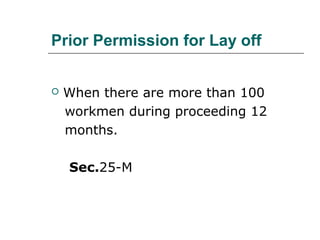
Prior Permission for Lay off
 When there are more than 100
workmen during proceeding 12
months.
Sec.25-M
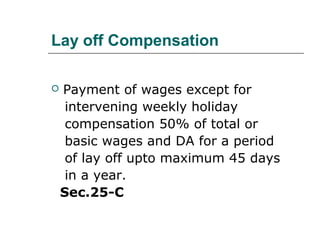
Lay off Compensation
 Payment of wages except for
intervening weekly holiday
compensation 50% of total or
basic wages and DA for a period
of lay off upto maximum 45 days
in a year.
Sec.25-C
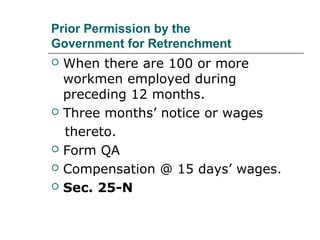
Prior Permission by the
Government for Retrenchment
 When there are 100 or more
workmen employed during
preceding 12 months.
 Three months’ notice or wages
thereto.
 Form QA
 Compensation @ 15 days’ wages.
 Sec. 25-N
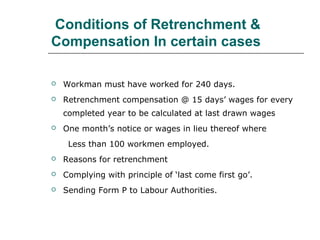
Conditions of Retrenchment &
Compensation In certain cases
 Workman must have worked for 240 days.
 Retrenchment compensation @ 15 days’ wages for every
completed year to be calculated at last drawn wages
 One month’s notice or wages in lieu thereof where
Less than 100 workmen employed.
 Reasons for retrenchment
 Complying with principle of ‘last come first go’.
 Sending Form P to Labour Authorities.
Right of a Workman during Pendency
of Proceedings in High Court
 Employer to pay last drawn wages
to workman to be reinstated, when
proceedings challenging the award
of his reinstatement are pending in
the higher Courts.
 Sec.17B
Power of Labour Court to give
Appropriate Relief
Labour Court/Industrial Tribunal can
Modify the punishment of dismissal
or discharge of workmen and give
appropriate relief including
reinstatement.
Sec.11A
Prohibition of unfair labour
practice either by employer or
workman or a trade union as
stipulated in fifth schedule
 Both the employer and the Union
can be punished. Sec.25-T
Closure of an Undertaking
 60 days’ notice to the labour authorities for
intended closure in Form QA. Sec.25FFA
 Prior permission atleast 90 days before in
Form O by the Government when there are
100 or more workmen during preceding 12
months.
 Sec.25-O
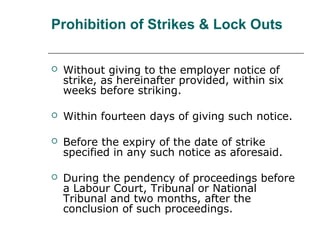
Prohibition of Strikes & Lock Outs
 Without giving to the employer notice of
strike, as hereinafter provided, within six
weeks before striking.
 Within fourteen days of giving such notice.
 Before the expiry of the date of strike
specified in any such notice as aforesaid.
 During the pendency of proceedings before
a Labour Court, Tribunal or National
Tribunal and two months, after the
conclusion of such proceedings.
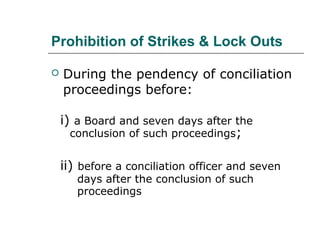
Prohibition of Strikes & Lock Outs
 During the pendency of conciliation
proceedings before:
i) a Board and seven days after the
conclusion of such proceedings;
ii) before a conciliation officer and seven
days after the conclusion of such
proceedings
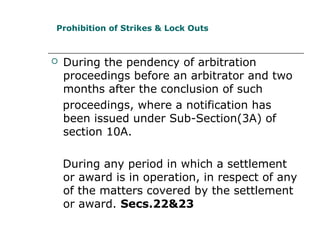
 During the pendency of arbitration
proceedings before an arbitrator and two
months after the conclusion of such
proceedings, where a notification has
been issued under Sub-Section(3A) of
section 10A.
During any period in which a settlement
or award is in operation, in respect of any
of the matters covered by the settlement
or award. Secs.22&23
Prohibition of Strikes & Lock Outs
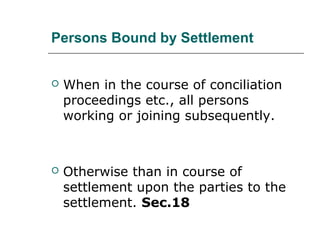
Persons Bound by Settlement
 When in the course of conciliation
proceedings etc., all persons
working or joining subsequently.
 Otherwise than in course of
settlement upon the parties to the
settlement. Sec.18
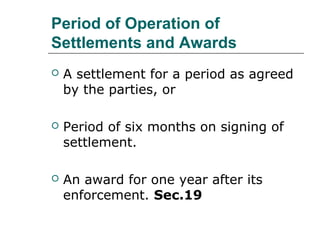
Period of Operation of
Settlements and Awards
 A settlement for a period as agreed
by the parties, or
 Period of six months on signing of
settlement.
 An award for one year after its
enforcement. Sec.19
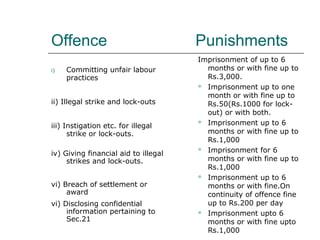
Offence Punishments
i) Committing unfair labour
practices
ii) Illegal strike and lock-outs
iii) Instigation etc. for illegal
strike or lock-outs.
iv) Giving financial aid to illegal
strikes and lock-outs.
vi) Breach of settlement or
award
vi) Disclosing confidential
information pertaining to
Sec.21
Imprisonment of up to 6
months or with fine up to
Rs.3,000.
 Imprisonment up to one
month or with fine up to
Rs.50(Rs.1000 for lock-
out) or with both.
 Imprisonment up to 6
months or with fine up to
Rs.1,000
 Imprisonment for 6
months or with fine up to
Rs.1,000
 Imprisonment up to 6
months or with fine.On
continuity of offence fine
up to Rs.200 per day
 Imprisonment upto 6
months or with fine upto
Rs.1,000
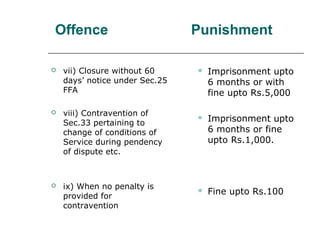
Offence Punishment
 vii) Closure without 60
days’ notice under Sec.25
FFA
 viii) Contravention of
Sec.33 pertaining to
change of conditions of
Service during pendency
of dispute etc.
 ix) When no penalty is
provided for
contravention
 Imprisonment upto
6 months or with
fine upto Rs.5,000
 Imprisonment upto
6 months or fine
upto Rs.1,000.
 Fine upto Rs.100
STANDING ORDERS ACT, 1946
& THE RULES
Applicability of
the Act
 Every industrial establishment
wherein 100 or more
Matters to be provided in
Standing orders
 Classification of workmen, e.g., whether
permanent, temporary, apprentices,
probationers, or badlis.
 Manner of intimating to workmen periods
and hours of work, holidays, pay-days
and wage rates.
 Shift working.
 Attendance and late coming.
 Conditions of, procedure in applying for,
and the authority which may grant, leave
and holidays.
 Requirement to enter premises by certain
gates, and liability to search.
 Closing and re-opening of sections of the
industrial establishments, and temporary
stoppages of work and the right and
liabilities of the employer and workmen
arising there from.
 Termination of employment, and
the notice thereof to be given by
employer and workmen.
 Suspension or dismissal for
misconduct, and acts or omissions
which constitute misconduct.
Means of redressal for workmen against unfair
treatment or wrongful exactions by the employer or
his agents or servants.
Additional Matters
 Service Record – Matters relating to
service card, token tickets, certification of
service, change of residential address of
workers and record of age Confirmation
Age of retirement Transfer Medical aid in
case of Accident ,Medical Examination,
Secrecy, Exclusive service.
 Secs.2(g), 3(2) and Rule 2A
Payment of Subsistence Allowance to
the
Suspended Workers
 At the rate of fifty per cent, of the wages
which the workman was entitled to
immediately proceeding the date of such
suspension, for the first ninety days of
suspension.
 At the rate of seventy-five percent of such
wages for the remaining period of suspension
if the delay in the completion of disciplinary
proceedings against such workman is not
directly attributable to the conduct such
workman. Sec.10-A
Thank You

Id,so. copy

  • 1.
  • 2.
    Object of theAct Provisions for investigation and settlement of industrial disputes and for certain other purposes.
  • 3.
     Industry –means any business, trade, undertaking, manufacture or calling of employers and includes any calling, service, employment, handicraft, or industrial occupation or avocation(hobby) of workman. Sec.2(I)  Works Committee–Joint Committee with equal number of employers and employees’ representatives for discussion of certain common problems. Sec.3  Conciliation–is an attempt by a third party in helping to settle the disputes Sec.4  Adjudication – Labour Court, Industrial Tribunal or National Tribunal to hear and decide the dispute.  Secs.7,7A & 7B
  • 4.
    Lay off &Payment of Compensation – Conditions for Laying off  Failure, refusal or inability of an employer to provide work due to  Shortage of coal, power or raw material.  Accumulation of stocks.  Breakdown of machinery.  Natural calamity. Sec.25-C
  • 5.
    Prior Permission forLay off  When there are more than 100 workmen during proceeding 12 months. Sec.25-M
  • 6.
    Lay off Compensation Payment of wages except for intervening weekly holiday compensation 50% of total or basic wages and DA for a period of lay off upto maximum 45 days in a year. Sec.25-C
  • 7.
    Prior Permission bythe Government for Retrenchment  When there are 100 or more workmen employed during preceding 12 months.  Three months’ notice or wages thereto.  Form QA  Compensation @ 15 days’ wages.  Sec. 25-N
  • 8.
    Conditions of Retrenchment& Compensation In certain cases  Workman must have worked for 240 days.  Retrenchment compensation @ 15 days’ wages for every completed year to be calculated at last drawn wages  One month’s notice or wages in lieu thereof where Less than 100 workmen employed.  Reasons for retrenchment  Complying with principle of ‘last come first go’.  Sending Form P to Labour Authorities.
  • 9.
    Right of aWorkman during Pendency of Proceedings in High Court  Employer to pay last drawn wages to workman to be reinstated, when proceedings challenging the award of his reinstatement are pending in the higher Courts.  Sec.17B
  • 10.
    Power of LabourCourt to give Appropriate Relief Labour Court/Industrial Tribunal can Modify the punishment of dismissal or discharge of workmen and give appropriate relief including reinstatement. Sec.11A
  • 11.
    Prohibition of unfairlabour practice either by employer or workman or a trade union as stipulated in fifth schedule  Both the employer and the Union can be punished. Sec.25-T
  • 12.
    Closure of anUndertaking  60 days’ notice to the labour authorities for intended closure in Form QA. Sec.25FFA  Prior permission atleast 90 days before in Form O by the Government when there are 100 or more workmen during preceding 12 months.  Sec.25-O
  • 13.
    Prohibition of Strikes& Lock Outs  Without giving to the employer notice of strike, as hereinafter provided, within six weeks before striking.  Within fourteen days of giving such notice.  Before the expiry of the date of strike specified in any such notice as aforesaid.  During the pendency of proceedings before a Labour Court, Tribunal or National Tribunal and two months, after the conclusion of such proceedings.
  • 14.
    Prohibition of Strikes& Lock Outs  During the pendency of conciliation proceedings before: i) a Board and seven days after the conclusion of such proceedings; ii) before a conciliation officer and seven days after the conclusion of such proceedings
  • 15.
     During thependency of arbitration proceedings before an arbitrator and two months after the conclusion of such proceedings, where a notification has been issued under Sub-Section(3A) of section 10A. During any period in which a settlement or award is in operation, in respect of any of the matters covered by the settlement or award. Secs.22&23 Prohibition of Strikes & Lock Outs
  • 16.
    Persons Bound bySettlement  When in the course of conciliation proceedings etc., all persons working or joining subsequently.  Otherwise than in course of settlement upon the parties to the settlement. Sec.18
  • 17.
    Period of Operationof Settlements and Awards  A settlement for a period as agreed by the parties, or  Period of six months on signing of settlement.  An award for one year after its enforcement. Sec.19
  • 18.
    Offence Punishments i) Committingunfair labour practices ii) Illegal strike and lock-outs iii) Instigation etc. for illegal strike or lock-outs. iv) Giving financial aid to illegal strikes and lock-outs. vi) Breach of settlement or award vi) Disclosing confidential information pertaining to Sec.21 Imprisonment of up to 6 months or with fine up to Rs.3,000.  Imprisonment up to one month or with fine up to Rs.50(Rs.1000 for lock- out) or with both.  Imprisonment up to 6 months or with fine up to Rs.1,000  Imprisonment for 6 months or with fine up to Rs.1,000  Imprisonment up to 6 months or with fine.On continuity of offence fine up to Rs.200 per day  Imprisonment upto 6 months or with fine upto Rs.1,000
  • 19.
    Offence Punishment  vii)Closure without 60 days’ notice under Sec.25 FFA  viii) Contravention of Sec.33 pertaining to change of conditions of Service during pendency of dispute etc.  ix) When no penalty is provided for contravention  Imprisonment upto 6 months or with fine upto Rs.5,000  Imprisonment upto 6 months or fine upto Rs.1,000.  Fine upto Rs.100
  • 20.
    STANDING ORDERS ACT,1946 & THE RULES
  • 21.
    Applicability of the Act Every industrial establishment wherein 100 or more
  • 22.
    Matters to beprovided in Standing orders  Classification of workmen, e.g., whether permanent, temporary, apprentices, probationers, or badlis.  Manner of intimating to workmen periods and hours of work, holidays, pay-days and wage rates.  Shift working.  Attendance and late coming.
  • 23.
     Conditions of,procedure in applying for, and the authority which may grant, leave and holidays.  Requirement to enter premises by certain gates, and liability to search.  Closing and re-opening of sections of the industrial establishments, and temporary stoppages of work and the right and liabilities of the employer and workmen arising there from.
  • 24.
     Termination ofemployment, and the notice thereof to be given by employer and workmen.  Suspension or dismissal for misconduct, and acts or omissions which constitute misconduct.
  • 25.
    Means of redressalfor workmen against unfair treatment or wrongful exactions by the employer or his agents or servants. Additional Matters  Service Record – Matters relating to service card, token tickets, certification of service, change of residential address of workers and record of age Confirmation Age of retirement Transfer Medical aid in case of Accident ,Medical Examination, Secrecy, Exclusive service.  Secs.2(g), 3(2) and Rule 2A
  • 26.
    Payment of SubsistenceAllowance to the Suspended Workers  At the rate of fifty per cent, of the wages which the workman was entitled to immediately proceeding the date of such suspension, for the first ninety days of suspension.  At the rate of seventy-five percent of such wages for the remaining period of suspension if the delay in the completion of disciplinary proceedings against such workman is not directly attributable to the conduct such workman. Sec.10-A
  • 27.