Methodology
Utilized:
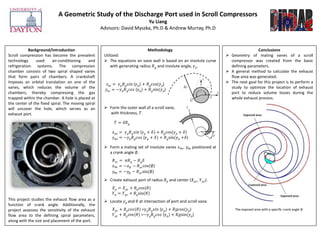
 The equations an vane wall is based on an involute curve
with generating radius 𝑅 𝑔 and involute angle, 𝛾 𝑝.
𝑥 𝑝𝑖 = 𝛾 𝑝 𝑅 𝑔 𝑠𝑖𝑛 (𝛾 𝑝) + 𝑅 𝑔cos(𝛾 𝑝)
𝑦 𝑝𝑖 = −𝛾 𝑝 𝑅 𝑔 𝑐𝑜𝑠 (𝛾 𝑝) + 𝑅 𝑔sin(𝛾 𝑝)
 Form the outer wall of a scroll vane,
with thickness, 𝑇.
𝑇 = 𝛿𝑅 𝑔
𝑥 𝑝𝑜 = 𝛾 𝑝 𝑅 𝑔 𝑠𝑖𝑛 (𝛾 𝑝 + 𝛿) + 𝑅 𝑔cos(𝛾 𝑝 + 𝛿)
𝑦 𝑝𝑜 = −𝛾 𝑝 𝑅 𝑔 𝑐𝑜𝑠 (𝛾 𝑝 + 𝛿) + 𝑅 𝑔sin(𝛾 𝑝 +𝛿)
 Form a mating set of involute vanes 𝑥 𝑚, 𝑦 𝑚 positioned at
a crank angle ∅ .
𝑅 𝑜𝑟 = 𝜋𝑅 𝑔 − 𝑅 𝑔 𝛿
𝑥 𝑚 = −𝑥 𝑝 − 𝑅 𝑜𝑟cos(∅)
𝑦 𝑚 = −𝑦𝑝 − 𝑅 𝑜𝑟sin(∅)
 Create exhaust port of radius 𝑅 𝑝 and center (𝑋 𝑝𝑐, 𝑌 𝑝𝑐).
𝑋 𝑝 = 𝑋 𝑝𝑐 + 𝑅 𝑝cos(𝜃)
𝑌 𝑝 = 𝑌 𝑝𝑐 + 𝑅 𝑝sin(𝜃)
 Locate 𝛾 𝑝 and 𝜃 at intersection of port and scroll vane.
𝑋 𝑝𝑐 + 𝑅 𝑝 𝑐𝑜𝑠(𝜃) =𝛾 𝑝 𝑅 𝑔 𝑠𝑖𝑛 (𝛾 𝑝) + 𝑅𝑔cos(𝛾 𝑝)
𝑌 𝑝𝑐 + 𝑅 𝑝 𝑠𝑖𝑛(𝜃) =−𝛾 𝑝 𝑅 𝑔 𝑐𝑜𝑠 (𝛾 𝑝) + 𝑅𝑔sin(𝛾 𝑝)
A Geometric Study of the Discharge Port used in Scroll Compressors
Yu Liang
Advisors: David Myszka, Ph.D & Andrew Murray, Ph.D
Background/Introduction
Scroll compression has become the prevalent
technology used air-conditioning and
refrigeration systems. The compression
chamber consists of two spiral shaped vanes
that form pairs of chambers. A crankshaft
Imposes an orbital translation on one of the
vanes, which reduces the volume of the
chambers, thereby compressing the gas
trapped within the chamber. A hole is placed at
the center of the fixed spiral. The moving spiral
will uncover the hole, which serves as an
exhaust port.
This project studies the exhaust flow area as a
function of crank angle. Additionally, the
project assesses the sensitivity of the exhaust
flow area to the defining spiral parameters,
along with the size and placement of the port.
Conclusions
 Geometry of mating vanes of a scroll
compressor was created from the basic
defining parameters.
 A general method to calculate the exhaust
flow area was generated.
 The next goal for this project is to perform a
study to optimize the location of exhaust
port to reduce volume losses during the
whole exhaust process.
The exposed area with a specific crank angle ∅.

Stander

  • 1.
    Methodology Utilized:  The equationsan vane wall is based on an involute curve with generating radius 𝑅 𝑔 and involute angle, 𝛾 𝑝. 𝑥 𝑝𝑖 = 𝛾 𝑝 𝑅 𝑔 𝑠𝑖𝑛 (𝛾 𝑝) + 𝑅 𝑔cos(𝛾 𝑝) 𝑦 𝑝𝑖 = −𝛾 𝑝 𝑅 𝑔 𝑐𝑜𝑠 (𝛾 𝑝) + 𝑅 𝑔sin(𝛾 𝑝)  Form the outer wall of a scroll vane, with thickness, 𝑇. 𝑇 = 𝛿𝑅 𝑔 𝑥 𝑝𝑜 = 𝛾 𝑝 𝑅 𝑔 𝑠𝑖𝑛 (𝛾 𝑝 + 𝛿) + 𝑅 𝑔cos(𝛾 𝑝 + 𝛿) 𝑦 𝑝𝑜 = −𝛾 𝑝 𝑅 𝑔 𝑐𝑜𝑠 (𝛾 𝑝 + 𝛿) + 𝑅 𝑔sin(𝛾 𝑝 +𝛿)  Form a mating set of involute vanes 𝑥 𝑚, 𝑦 𝑚 positioned at a crank angle ∅ . 𝑅 𝑜𝑟 = 𝜋𝑅 𝑔 − 𝑅 𝑔 𝛿 𝑥 𝑚 = −𝑥 𝑝 − 𝑅 𝑜𝑟cos(∅) 𝑦 𝑚 = −𝑦𝑝 − 𝑅 𝑜𝑟sin(∅)  Create exhaust port of radius 𝑅 𝑝 and center (𝑋 𝑝𝑐, 𝑌 𝑝𝑐). 𝑋 𝑝 = 𝑋 𝑝𝑐 + 𝑅 𝑝cos(𝜃) 𝑌 𝑝 = 𝑌 𝑝𝑐 + 𝑅 𝑝sin(𝜃)  Locate 𝛾 𝑝 and 𝜃 at intersection of port and scroll vane. 𝑋 𝑝𝑐 + 𝑅 𝑝 𝑐𝑜𝑠(𝜃) =𝛾 𝑝 𝑅 𝑔 𝑠𝑖𝑛 (𝛾 𝑝) + 𝑅𝑔cos(𝛾 𝑝) 𝑌 𝑝𝑐 + 𝑅 𝑝 𝑠𝑖𝑛(𝜃) =−𝛾 𝑝 𝑅 𝑔 𝑐𝑜𝑠 (𝛾 𝑝) + 𝑅𝑔sin(𝛾 𝑝) A Geometric Study of the Discharge Port used in Scroll Compressors Yu Liang Advisors: David Myszka, Ph.D & Andrew Murray, Ph.D Background/Introduction Scroll compression has become the prevalent technology used air-conditioning and refrigeration systems. The compression chamber consists of two spiral shaped vanes that form pairs of chambers. A crankshaft Imposes an orbital translation on one of the vanes, which reduces the volume of the chambers, thereby compressing the gas trapped within the chamber. A hole is placed at the center of the fixed spiral. The moving spiral will uncover the hole, which serves as an exhaust port. This project studies the exhaust flow area as a function of crank angle. Additionally, the project assesses the sensitivity of the exhaust flow area to the defining spiral parameters, along with the size and placement of the port. Conclusions  Geometry of mating vanes of a scroll compressor was created from the basic defining parameters.  A general method to calculate the exhaust flow area was generated.  The next goal for this project is to perform a study to optimize the location of exhaust port to reduce volume losses during the whole exhaust process. The exposed area with a specific crank angle ∅.