Standards-based and
Standardized Assessment
The man considered to be the Father of Standardized
Testing in the U.S. is Horace Mann, who was
secretary of the Massachusetts State Board of
Education from 1837-48. Before 1845,
oral examinations prevailed as the primary way to
measure educational attainment in American
schools.
Standardised tests are developed in a very structured
way to ensure that they have validity (they test what
they claim to test or the results predict future
behaviour) and reliability (the test gives the same or
similar results repeatedly over time). The rigorous
development process can take between two and four
years to complete and involves a number of stages
and experts.
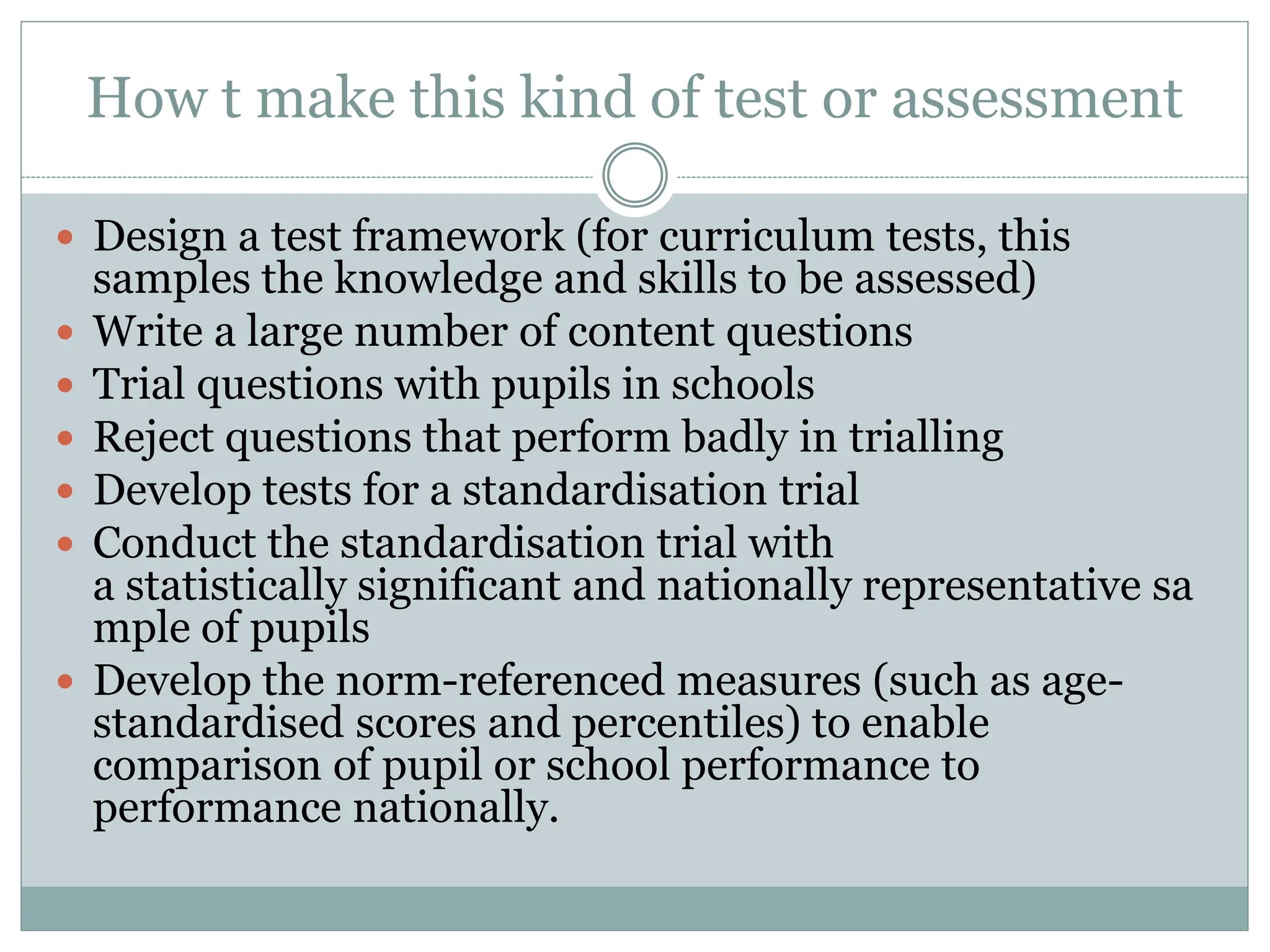
How t make this kind of test or assessment
 Design a test framework (for curriculum tests, this
samples the knowledge and skills to be assessed)
 Write a large number of content questions
 Trial questions with pupils in schools
 Reject questions that perform badly in trialling
 Develop tests for a standardisation trial
 Conduct the standardisation trial with
a statistically significant and nationally representative sa
mple of pupils
 Develop the norm-referenced measures (such as age-
standardised scores and percentiles) to enable
comparison of pupil or school performance to
performance nationally.
 Once, standardized tests brought convenience,
efficiency kind of test
 Lately, Educators become aware of weaknesses in
standardized testing: They were not accurate
measures of achievement and success and they
were not based on carefully framed
comprehensive and validated standards of
achievement.
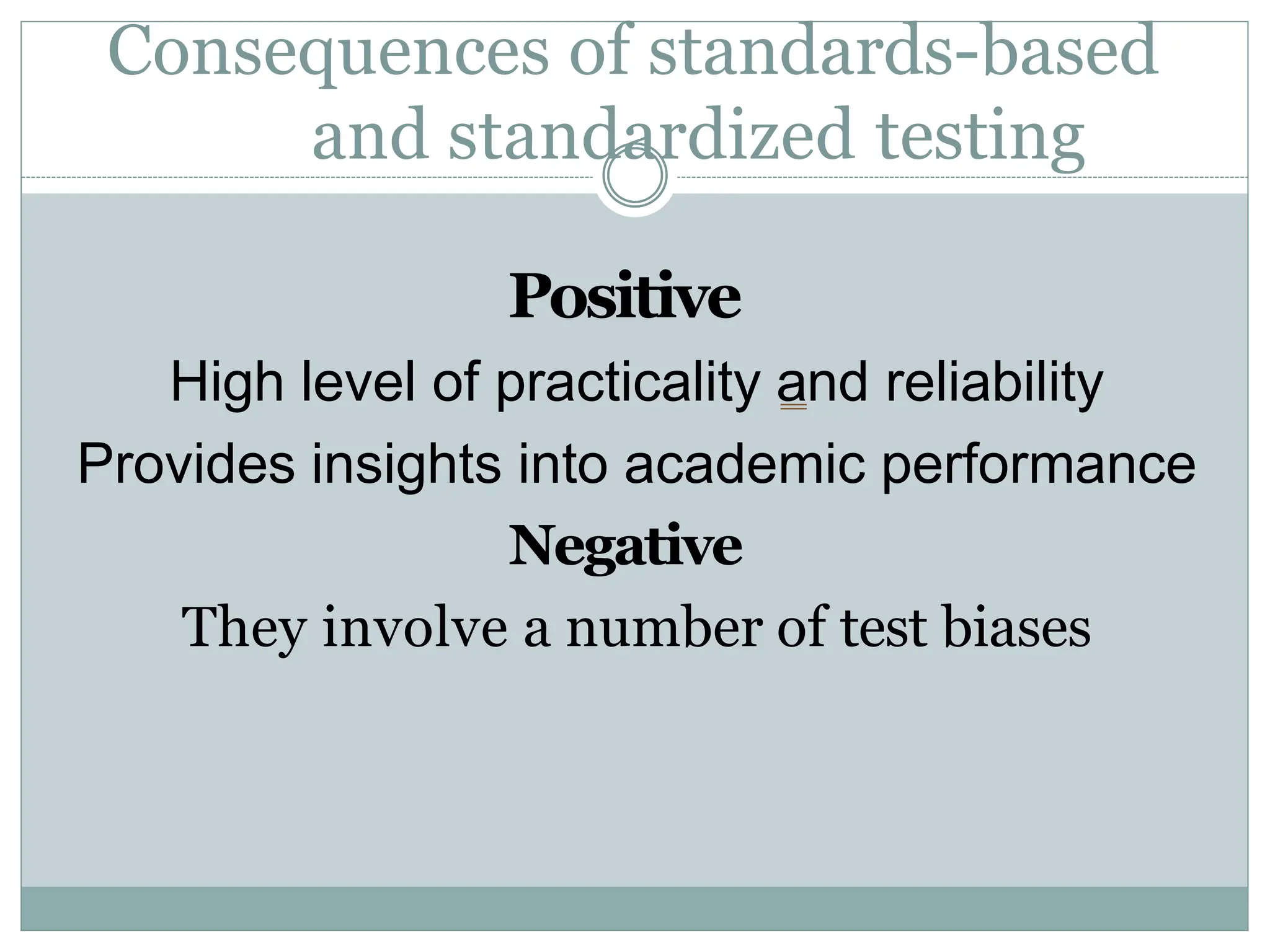
Consequences of standards-based
and standardized testing
Positive
High level of practicality and reliability
Provides insights into academic performance
Negative
They involve a number of test biases
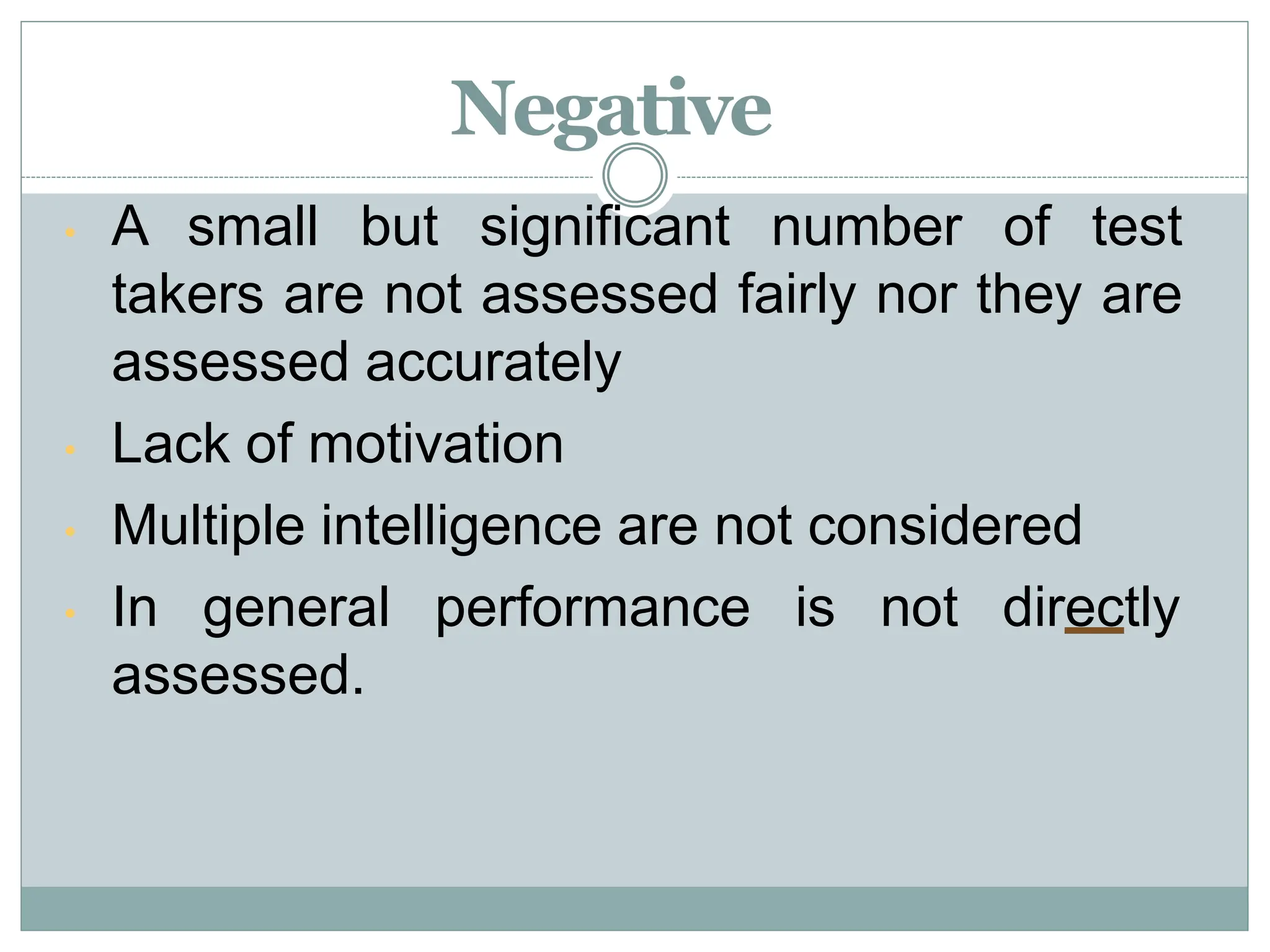
Negative
• A small but significant number of test
takers are not assessed fairly nor they are
assessed accurately
• Lack of motivation
• Multiple intelligence are not considered
• In general performance is not directly
assessed.
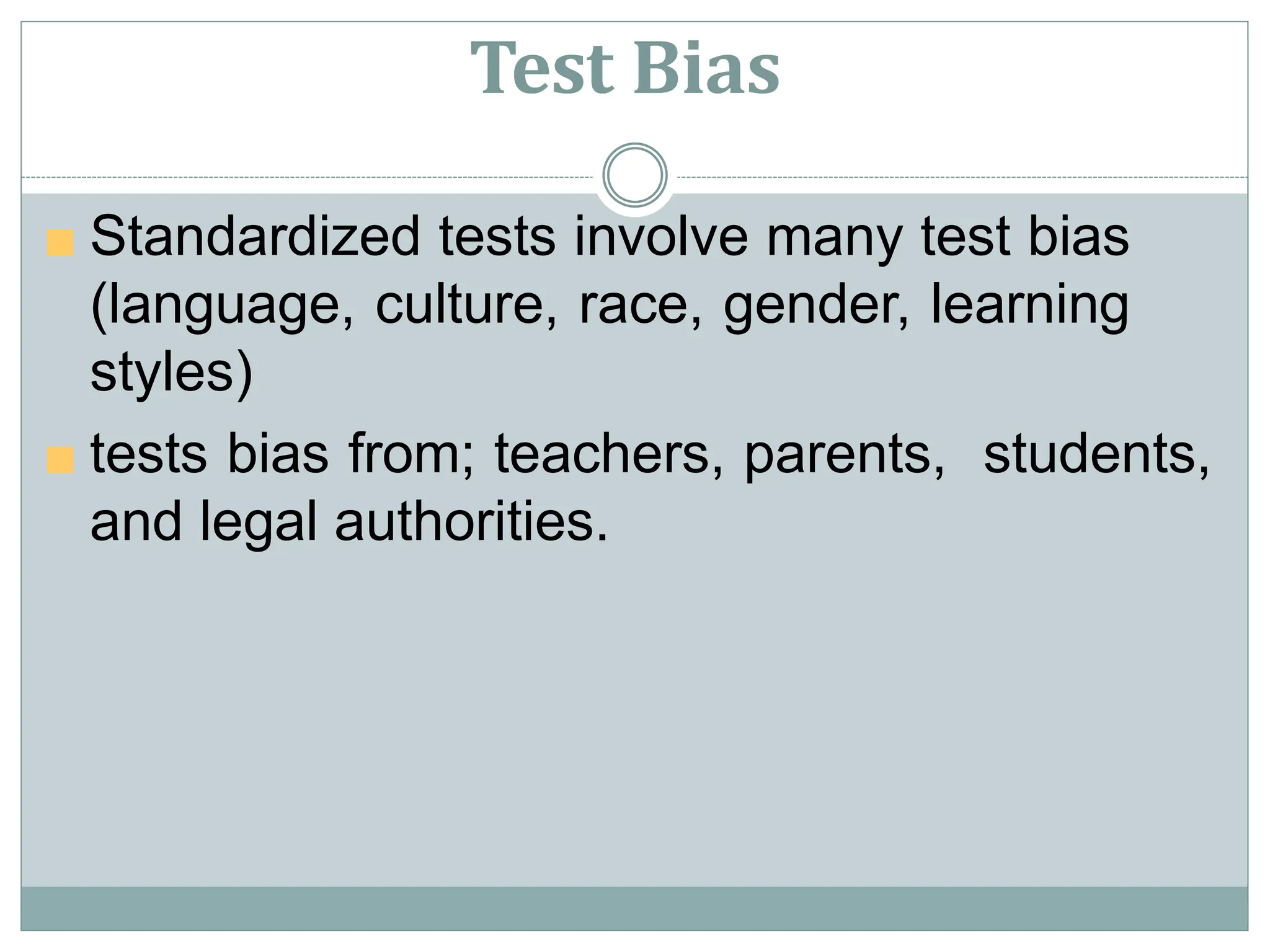
Test Bias
■ Standardized tests involve many test bias
(language, culture, race, gender, learning
styles)
■ tests bias from; teachers, parents, students,
and legal authorities.
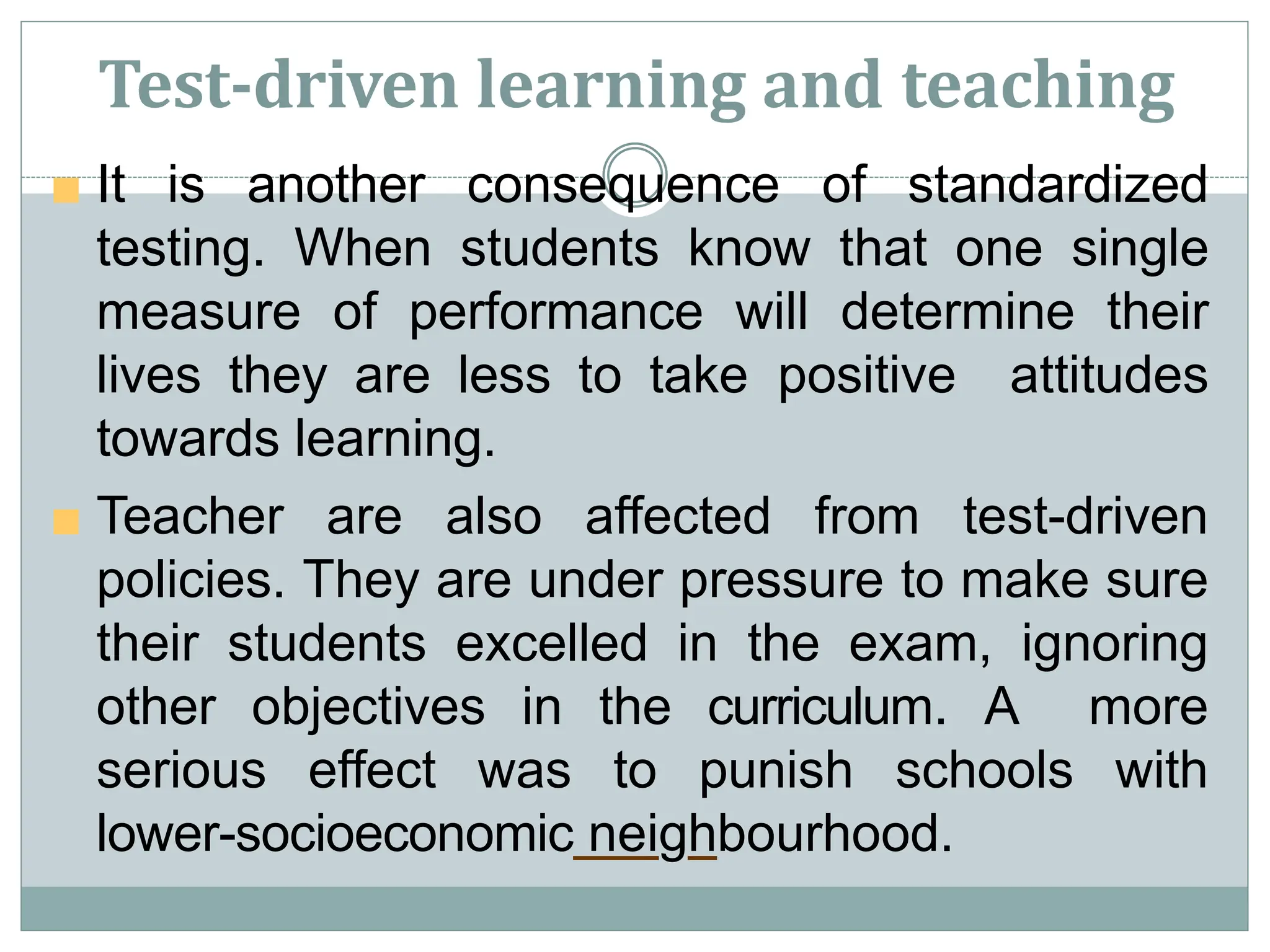
Test-driven learning and teaching
■ It is another consequence of standardized
testing. When students know that one single
measure of performance will determine their
lives they are less to take positive attitudes
towards learning.
■ Teacher are also affected from test-driven
policies. They are under pressure to make sure
their students excelled in the exam, ignoring
other objectives in the curriculum. A more
serious effect was to punish schools with
lower-socioeconomic neighbourhood.

Standards-based and Standardized Assessment.pptx

  • 1.
  • 2.
    The man consideredto be the Father of Standardized Testing in the U.S. is Horace Mann, who was secretary of the Massachusetts State Board of Education from 1837-48. Before 1845, oral examinations prevailed as the primary way to measure educational attainment in American schools.
  • 3.
    Standardised tests aredeveloped in a very structured way to ensure that they have validity (they test what they claim to test or the results predict future behaviour) and reliability (the test gives the same or similar results repeatedly over time). The rigorous development process can take between two and four years to complete and involves a number of stages and experts.
  • 4.
    How t makethis kind of test or assessment  Design a test framework (for curriculum tests, this samples the knowledge and skills to be assessed)  Write a large number of content questions  Trial questions with pupils in schools  Reject questions that perform badly in trialling  Develop tests for a standardisation trial  Conduct the standardisation trial with a statistically significant and nationally representative sa mple of pupils  Develop the norm-referenced measures (such as age- standardised scores and percentiles) to enable comparison of pupil or school performance to performance nationally.
  • 5.
     Once, standardizedtests brought convenience, efficiency kind of test  Lately, Educators become aware of weaknesses in standardized testing: They were not accurate measures of achievement and success and they were not based on carefully framed comprehensive and validated standards of achievement.
  • 6.
    Consequences of standards-based andstandardized testing Positive High level of practicality and reliability Provides insights into academic performance Negative They involve a number of test biases
  • 7.
    Negative • A smallbut significant number of test takers are not assessed fairly nor they are assessed accurately • Lack of motivation • Multiple intelligence are not considered • In general performance is not directly assessed.
  • 8.
    Test Bias ■ Standardizedtests involve many test bias (language, culture, race, gender, learning styles) ■ tests bias from; teachers, parents, students, and legal authorities.
  • 9.
    Test-driven learning andteaching ■ It is another consequence of standardized testing. When students know that one single measure of performance will determine their lives they are less to take positive attitudes towards learning. ■ Teacher are also affected from test-driven policies. They are under pressure to make sure their students excelled in the exam, ignoring other objectives in the curriculum. A more serious effect was to punish schools with lower-socioeconomic neighbourhood.