PRINCIPLES OF
LANGUAGE ASSESSMENT
• Explore the foundational principles of
language assessment.
STANDARDIZED TESTS
• Historical Context:
Standardized testing has its roots
in China from the 1880s. At first,
it was a way for the Chinese
government to evaluate job
candidates' knowledge of
Confucian poetry and
philosophy. Standardized exams,
like the Army Alpha and Army
Beta examinations, were created
to gauge recruits' mental
capacities during the American
enlistment effort for World War I.
• Definition:
Standardized exams are
evaluation tools created
to guarantee
consistency when
gauging people's
aptitudes, competencies,
or expertise. Because
these exams are
frequently given and
scored consistently, the
outcomes are
dependable and similar.
STANDARDIZED TESTS
• Current Utility:
Standardized tests have
changed throughout time to
fulfill a variety of functions,
such as evaluating applicants
for university admissions,
jobs, and driver's licenses.
They are now essential for
delivering objective
performance measurements
in a variety of settings.
ADVANTAGES OF STANDARDIZED TESTS
• Objective Scoring:
One of the primary advantages
of standardized tests is the
objectivity in scoring. The use of
predefined criteria ensures
consistency and reliability in
evaluating student performance
across different contexts.
• Data for Marginalized Groups:
Standardized tests can provide
valuable data to address
educational gaps among
marginalized groups. The data
collected from these tests can
help identify and rectify
disparities in educational
outcomes.
• Benchmark for Teacher
Evaluation: Standardized tests
serve as helpful benchmarks
for evaluating teacher
performance. The data
generated from these tests can
inform educators about their
effectiveness in facilitating
student learning and
achievement.
DISADVANTAGES OF STANDARDIZED TESTS
• Student-Related Reliability: Standardized tests
may be affected by factors such as anxiety, test-
taking skills, and fatigue. These internal factors
can influence the reliability of the test results.
• Washback Effect: The
washback effect refers to the
impact of standardized tests
on teaching practices and
student learning. It can lead
to a focus on test success at
the expense of broader
educational goals.
• Biased Design: Standardized
tests may exhibit biases in
their design, contributing to
discrimination. Questions that
reflect the background
knowledge of privileged
groups can lead to unfair
outcomes.
PURPOSE OF STANDARDIZED TESTS
• Comparative Assessment:
Standardized examinations are primarily used to make it
easier to compare abilities among various groups. The
purpose of these assessments is to provide a standard
scale that will enable comparisons independent of the
testing site.
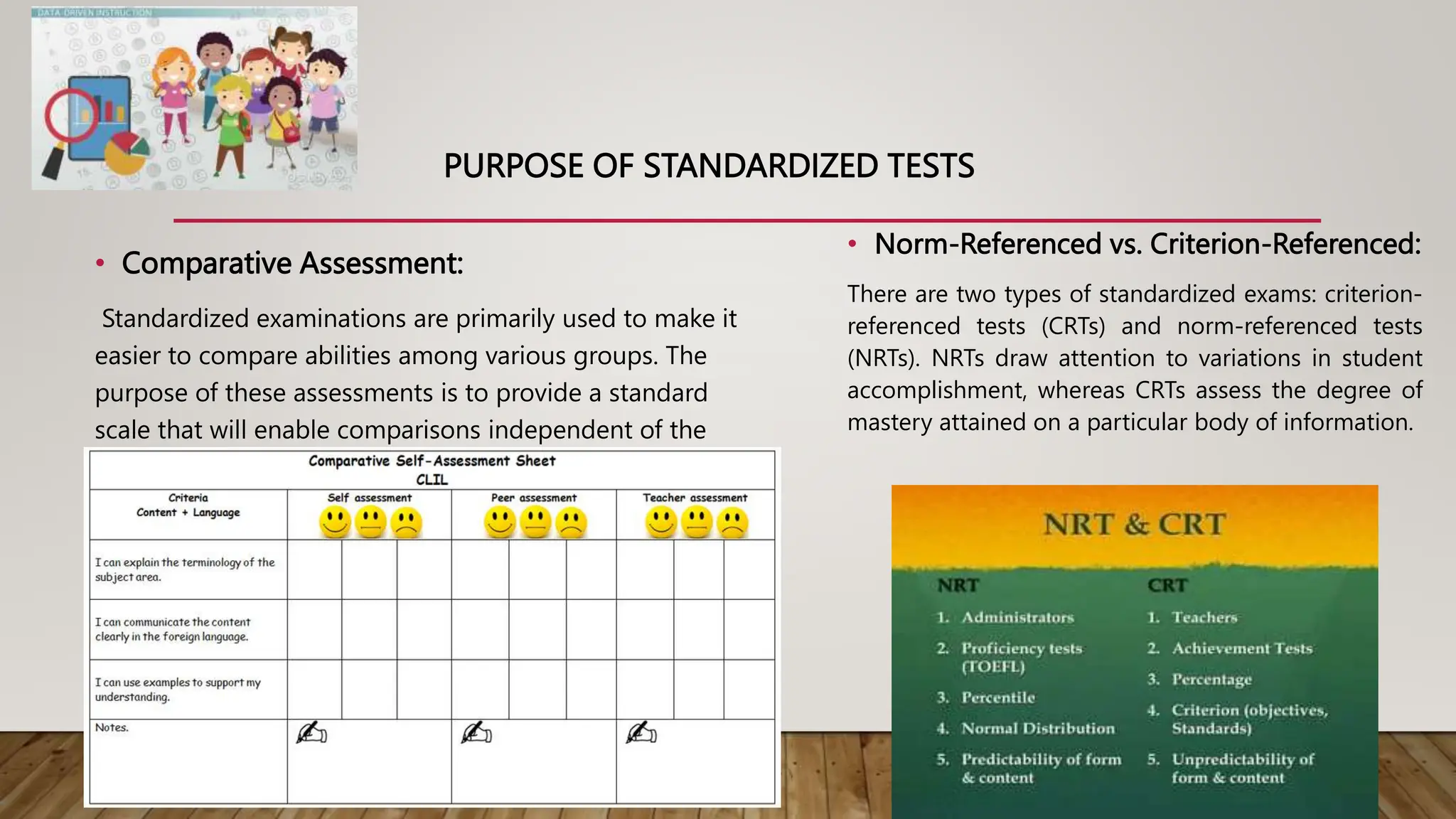
• Norm-Referenced vs. Criterion-Referenced:
There are two types of standardized exams: criterion-
referenced tests (CRTs) and norm-referenced tests
(NRTs). NRTs draw attention to variations in student
accomplishment, whereas CRTs assess the degree of
mastery attained on a particular body of information.
TEST SPECIFICATIONS
• Representativeness:
Test specifications emphasize
the importance of
representativeness across a
specific knowledge domain.
Tests should accurately reflect
the content they aim to assess.
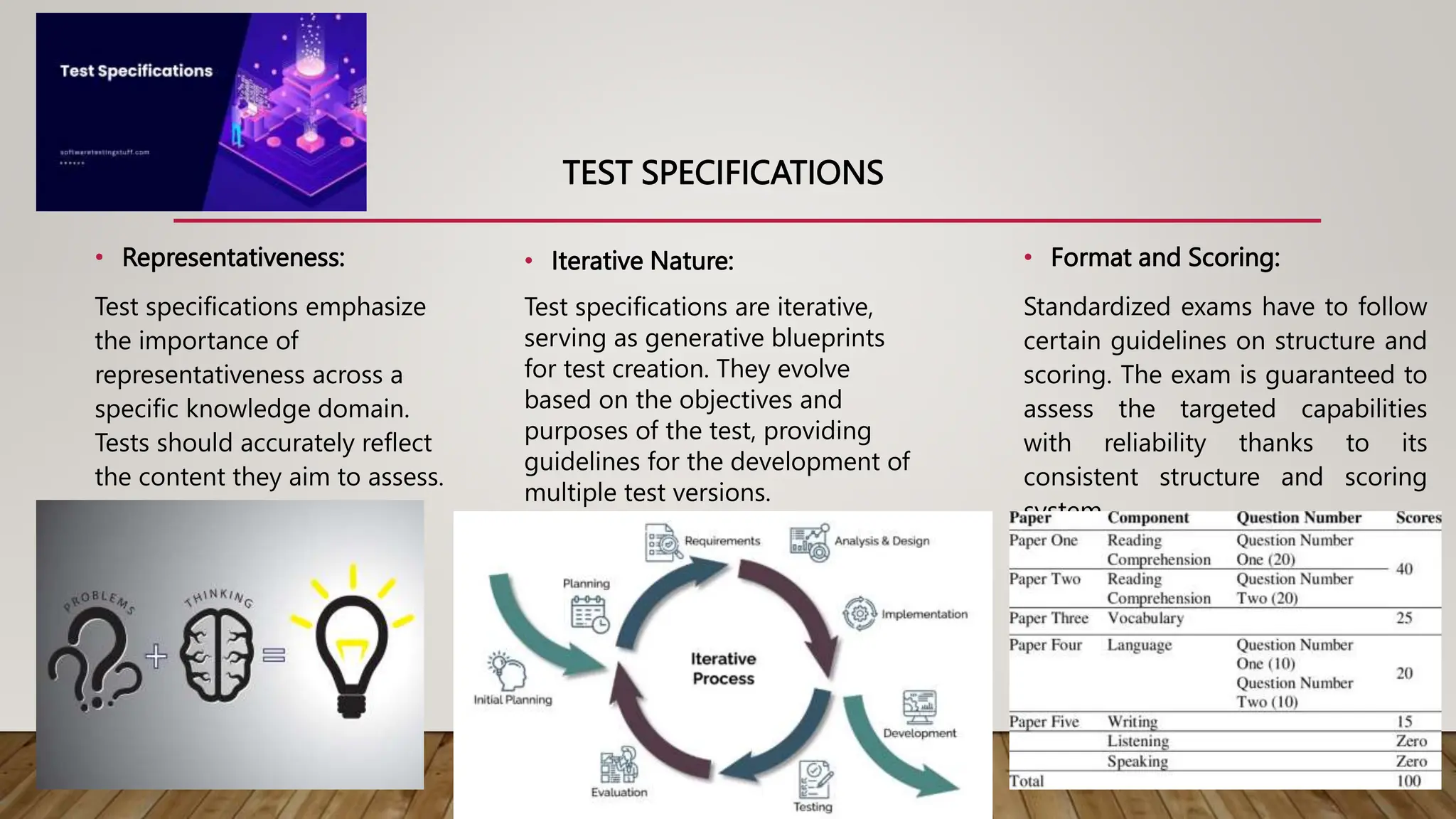
• Format and Scoring:
Standardized exams have to follow
certain guidelines on structure and
scoring. The exam is guaranteed to
assess the targeted capabilities
with reliability thanks to its
consistent structure and scoring
system.
• Iterative Nature:
Test specifications are iterative,
serving as generative blueprints
for test creation. They evolve
based on the objectives and
purposes of the test, providing
guidelines for the development of
multiple test versions.
DESIGN, SELECT, AND ARRANGE
TEST ITEMS
• Multiple-Choice Exams: Exams with
multiple choice questions are appropriate for
evaluating information retention. Although
they could be viewed as superficial, they are
useful for some kinds of exams since they are
simple to grade.
• Essay Questions: Essay questions
evaluate originality, organization, and
critical thinking. They offer a deeper
knowledge of a student's understanding
and analytical skills.

Principles of Language Assessment

  • 1.
  • 2.
    • Explore thefoundational principles of language assessment.
  • 3.
    STANDARDIZED TESTS • HistoricalContext: Standardized testing has its roots in China from the 1880s. At first, it was a way for the Chinese government to evaluate job candidates' knowledge of Confucian poetry and philosophy. Standardized exams, like the Army Alpha and Army Beta examinations, were created to gauge recruits' mental capacities during the American enlistment effort for World War I. • Definition: Standardized exams are evaluation tools created to guarantee consistency when gauging people's aptitudes, competencies, or expertise. Because these exams are frequently given and scored consistently, the outcomes are dependable and similar.
  • 4.
    STANDARDIZED TESTS • CurrentUtility: Standardized tests have changed throughout time to fulfill a variety of functions, such as evaluating applicants for university admissions, jobs, and driver's licenses. They are now essential for delivering objective performance measurements in a variety of settings.
  • 5.
    ADVANTAGES OF STANDARDIZEDTESTS • Objective Scoring: One of the primary advantages of standardized tests is the objectivity in scoring. The use of predefined criteria ensures consistency and reliability in evaluating student performance across different contexts. • Data for Marginalized Groups: Standardized tests can provide valuable data to address educational gaps among marginalized groups. The data collected from these tests can help identify and rectify disparities in educational outcomes. • Benchmark for Teacher Evaluation: Standardized tests serve as helpful benchmarks for evaluating teacher performance. The data generated from these tests can inform educators about their effectiveness in facilitating student learning and achievement.
  • 6.
    DISADVANTAGES OF STANDARDIZEDTESTS • Student-Related Reliability: Standardized tests may be affected by factors such as anxiety, test- taking skills, and fatigue. These internal factors can influence the reliability of the test results. • Washback Effect: The washback effect refers to the impact of standardized tests on teaching practices and student learning. It can lead to a focus on test success at the expense of broader educational goals. • Biased Design: Standardized tests may exhibit biases in their design, contributing to discrimination. Questions that reflect the background knowledge of privileged groups can lead to unfair outcomes.
  • 7.
    PURPOSE OF STANDARDIZEDTESTS • Comparative Assessment: Standardized examinations are primarily used to make it easier to compare abilities among various groups. The purpose of these assessments is to provide a standard scale that will enable comparisons independent of the testing site. • Norm-Referenced vs. Criterion-Referenced: There are two types of standardized exams: criterion- referenced tests (CRTs) and norm-referenced tests (NRTs). NRTs draw attention to variations in student accomplishment, whereas CRTs assess the degree of mastery attained on a particular body of information.
  • 8.
    TEST SPECIFICATIONS • Representativeness: Testspecifications emphasize the importance of representativeness across a specific knowledge domain. Tests should accurately reflect the content they aim to assess. • Format and Scoring: Standardized exams have to follow certain guidelines on structure and scoring. The exam is guaranteed to assess the targeted capabilities with reliability thanks to its consistent structure and scoring system. • Iterative Nature: Test specifications are iterative, serving as generative blueprints for test creation. They evolve based on the objectives and purposes of the test, providing guidelines for the development of multiple test versions.
  • 9.
    DESIGN, SELECT, ANDARRANGE TEST ITEMS • Multiple-Choice Exams: Exams with multiple choice questions are appropriate for evaluating information retention. Although they could be viewed as superficial, they are useful for some kinds of exams since they are simple to grade. • Essay Questions: Essay questions evaluate originality, organization, and critical thinking. They offer a deeper knowledge of a student's understanding and analytical skills.