
Ministry of Health Services Policy Directive
Title Standardized Hospital Colour Codes
Division Chief Operating Officer
Branch Emergency Management Unit
Effective Date February 1st
, 2011
Last Review Date N/A
Next Review Date April 1st
, 2012
Program Contact John Lavery, Executive Director, Emergency Management Unit
Rationale
Hospital Colour Codes are used in hospitals worldwide to denote to staff various kinds of
emergency situations. The use of codes is intended to convey essential information quickly and
with a minimum of misunderstanding to appropriate staff, while minimizing stress and
preventing panic among patients and visitors to the hospital. They enable a concise means of
ensuring staff receive a common message, signaling the need for an urgent response without
unnecessarily alerting or alarming patients, residents, or visitors.
A number of jurisdictions have moved towards standardization of codes. The need for codes to
be uniform is underscored by the mobility of the health care workforce. Staff who are reassigned
to a new facility or site or who must practice in more than one facility need to be immediately
familiar with a code identifying the nature of a given crisis and their expected response.
A subcommittee of the BC Health Emergency Management Council, with representatives from
Health Authorities and the Ministry of Health Services, was formed in 2009 to standardize the
use of hospital colour codes in British Columbia.
Policy Statement(s)
To ensure the standard use of hospital colour codes in British Columbia, Hospitals will use the
following codes, where applicable:
• Code Red: Fire
• Code Blue: Cardiac Arrest
• Code Orange: Disaster or Mass Casualties
• Code Green: Evacuation
• Code Yellow: Missing Patient
• Code Amber: Missing or Abducted Infant or Child
• Code Black: Bomb Threat
• Code White: Aggression
• Code Brown: Hazardous Spill
• Code Grey: System Failure
• Code Pink: Pediatric Emergency and/or Obstetrical Emergency
Scope
This policy applies to all inpatient facilities, clinics attached to acute care hospitals, and should
be considered for administrative and corporate support staff that work or spend significant time
in acute care settings, operated by the Health Authorities in British Columbia.
The following provisions also apply to the use of hospital colour codes in British Columbia:
1
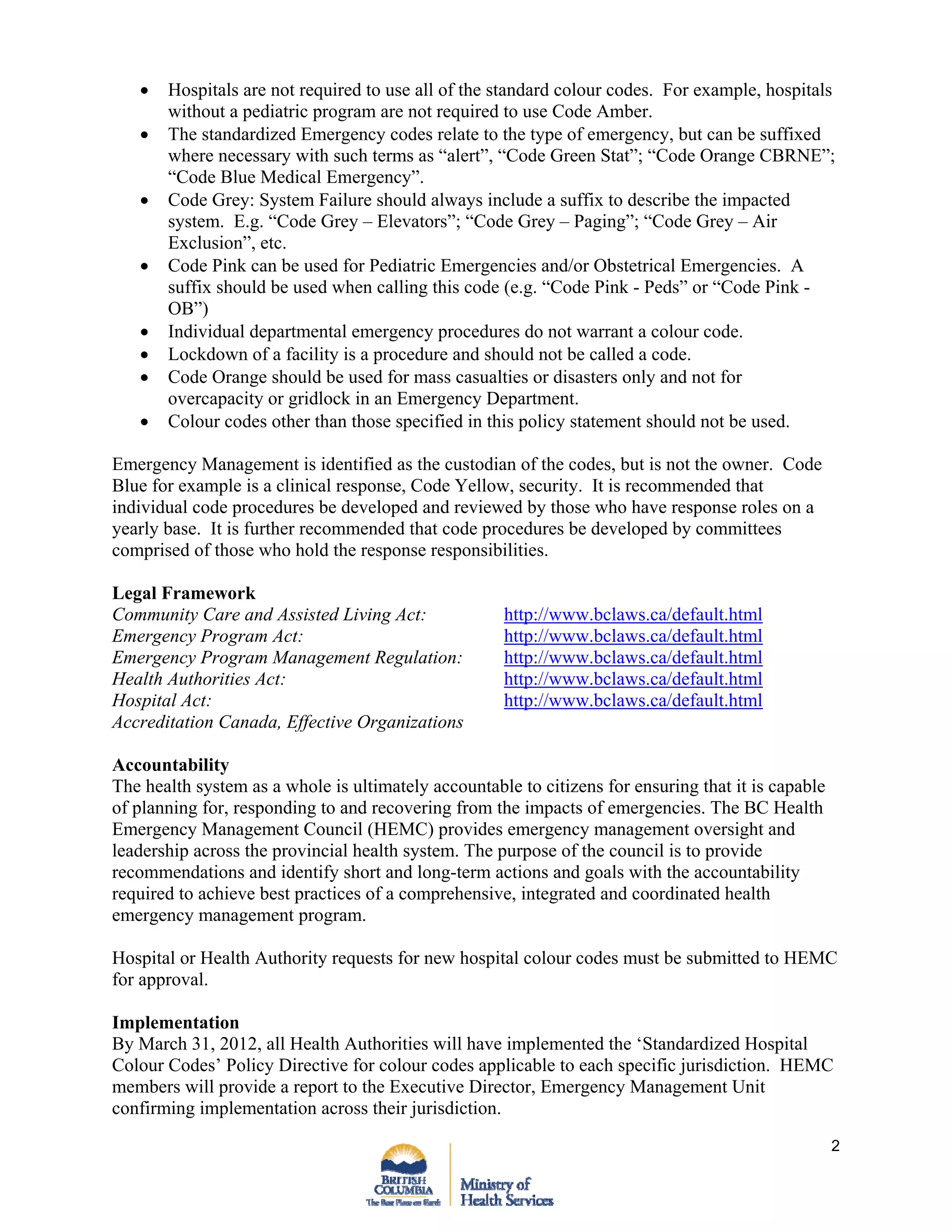
• Hospitals are not required to use all of the standard colour codes. For example, hospitals
without a pediatric program are not required to use Code Amber.
• The standardized Emergency codes relate to the type of emergency, but can be suffixed
where necessary with such terms as “alert”, “Code Green Stat”; “Code Orange CBRNE”;
“Code Blue Medical Emergency”.
• Code Grey: System Failure should always include a suffix to describe the impacted
system. E.g. “Code Grey – Elevators”; “Code Grey – Paging”; “Code Grey – Air
Exclusion”, etc.
• Code Pink can be used for Pediatric Emergencies and/or Obstetrical Emergencies. A
suffix should be used when calling this code (e.g. “Code Pink - Peds” or “Code Pink -
OB”)
• Individual departmental emergency procedures do not warrant a colour code.
• Lockdown of a facility is a procedure and should not be called a code.
• Code Orange should be used for mass casualties or disasters only and not for
overcapacity or gridlock in an Emergency Department.
• Colour codes other than those specified in this policy statement should not be used.
Emergency Management is identified as the custodian of the codes, but is not the owner. Code
Blue for example is a clinical response, Code Yellow, security. It is recommended that
individual code procedures be developed and reviewed by those who have response roles on a
yearly base. It is further recommended that code procedures be developed by committees
comprised of those who hold the response responsibilities.
Legal Framework
Community Care and Assisted Living Act: http://www.bclaws.ca/default.html
Emergency Program Act: http://www.bclaws.ca/default.html
Emergency Program Management Regulation: http://www.bclaws.ca/default.html
Health Authorities Act: http://www.bclaws.ca/default.html
Hospital Act: http://www.bclaws.ca/default.html
Accreditation Canada, Effective Organizations
Accountability
The health system as a whole is ultimately accountable to citizens for ensuring that it is capable
of planning for, responding to and recovering from the impacts of emergencies. The BC Health
Emergency Management Council (HEMC) provides emergency management oversight and
leadership across the provincial health system. The purpose of the council is to provide
recommendations and identify short and long-term actions and goals with the accountability
required to achieve best practices of a comprehensive, integrated and coordinated health
emergency management program.
Hospital or Health Authority requests for new hospital colour codes must be submitted to HEMC
for approval.
Implementation
By March 31, 2012, all Health Authorities will have implemented the ‘Standardized Hospital
Colour Codes’ Policy Directive for colour codes applicable to each specific jurisdiction. HEMC
members will provide a report to the Executive Director, Emergency Management Unit
confirming implementation across their jurisdiction.
2
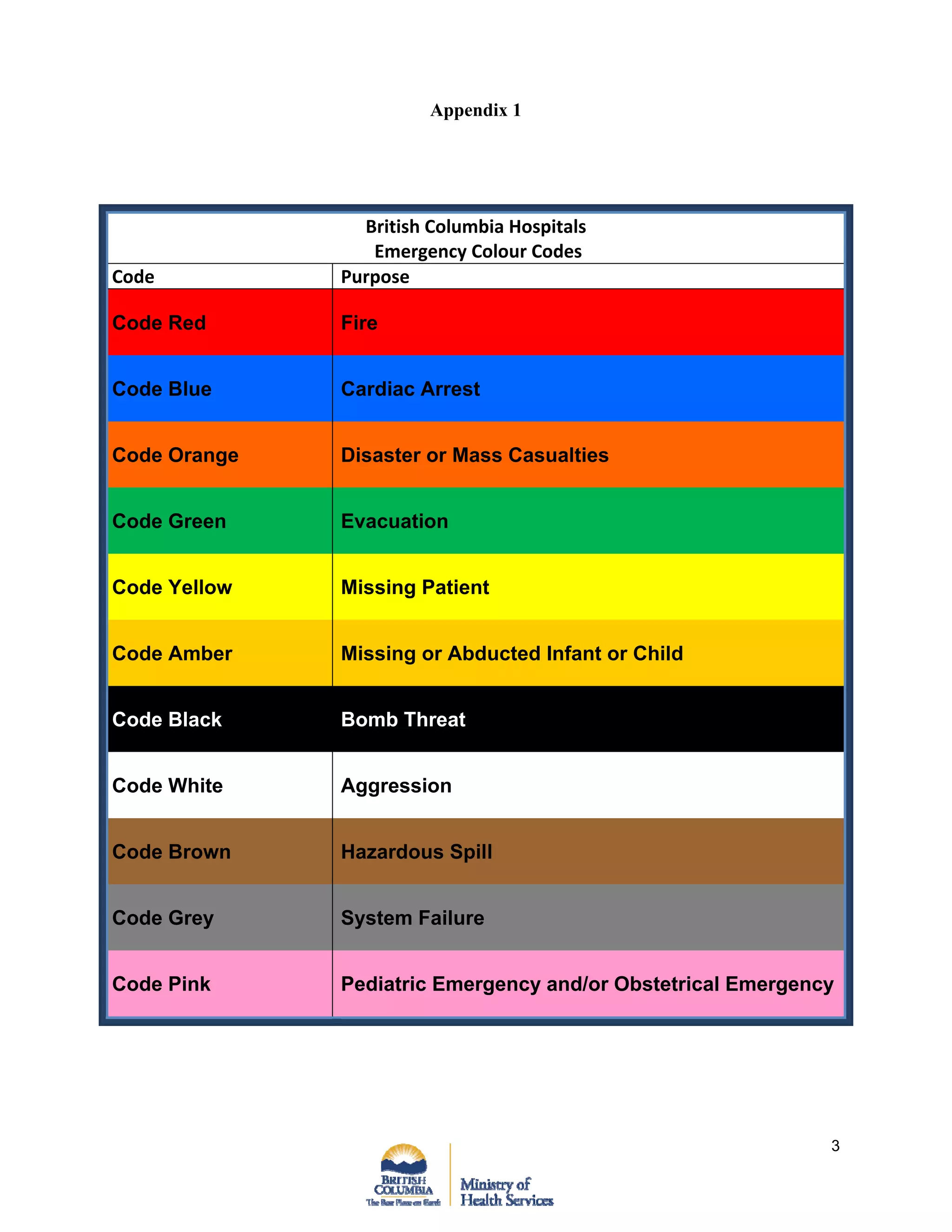
Appendix 1
British Columbia Hospitals
 Emergency Colour Codes 
Code  Purpose
Code Red Fire
Code Blue Cardiac Arrest
Code Orange Disaster or Mass Casualties
Code Green Evacuation
Code Yellow Missing Patient
Code Amber Missing or Abducted Infant or Child
Code Black Bomb Threat
Code White Aggression
Code Brown Hazardous Spill
Code Grey System Failure
Code Pink Pediatric Emergency and/or Obstetrical Emergency
3

Standardized hospital-colour-codes

  • 3.
    Ministry of HealthServices Policy Directive Title Standardized Hospital Colour Codes Division Chief Operating Officer Branch Emergency Management Unit Effective Date February 1st , 2011 Last Review Date N/A Next Review Date April 1st , 2012 Program Contact John Lavery, Executive Director, Emergency Management Unit Rationale Hospital Colour Codes are used in hospitals worldwide to denote to staff various kinds of emergency situations. The use of codes is intended to convey essential information quickly and with a minimum of misunderstanding to appropriate staff, while minimizing stress and preventing panic among patients and visitors to the hospital. They enable a concise means of ensuring staff receive a common message, signaling the need for an urgent response without unnecessarily alerting or alarming patients, residents, or visitors. A number of jurisdictions have moved towards standardization of codes. The need for codes to be uniform is underscored by the mobility of the health care workforce. Staff who are reassigned to a new facility or site or who must practice in more than one facility need to be immediately familiar with a code identifying the nature of a given crisis and their expected response. A subcommittee of the BC Health Emergency Management Council, with representatives from Health Authorities and the Ministry of Health Services, was formed in 2009 to standardize the use of hospital colour codes in British Columbia. Policy Statement(s) To ensure the standard use of hospital colour codes in British Columbia, Hospitals will use the following codes, where applicable: • Code Red: Fire • Code Blue: Cardiac Arrest • Code Orange: Disaster or Mass Casualties • Code Green: Evacuation • Code Yellow: Missing Patient • Code Amber: Missing or Abducted Infant or Child • Code Black: Bomb Threat • Code White: Aggression • Code Brown: Hazardous Spill • Code Grey: System Failure • Code Pink: Pediatric Emergency and/or Obstetrical Emergency Scope This policy applies to all inpatient facilities, clinics attached to acute care hospitals, and should be considered for administrative and corporate support staff that work or spend significant time in acute care settings, operated by the Health Authorities in British Columbia. The following provisions also apply to the use of hospital colour codes in British Columbia: 1
  • 4.
    • Hospitals arenot required to use all of the standard colour codes. For example, hospitals without a pediatric program are not required to use Code Amber. • The standardized Emergency codes relate to the type of emergency, but can be suffixed where necessary with such terms as “alert”, “Code Green Stat”; “Code Orange CBRNE”; “Code Blue Medical Emergency”. • Code Grey: System Failure should always include a suffix to describe the impacted system. E.g. “Code Grey – Elevators”; “Code Grey – Paging”; “Code Grey – Air Exclusion”, etc. • Code Pink can be used for Pediatric Emergencies and/or Obstetrical Emergencies. A suffix should be used when calling this code (e.g. “Code Pink - Peds” or “Code Pink - OB”) • Individual departmental emergency procedures do not warrant a colour code. • Lockdown of a facility is a procedure and should not be called a code. • Code Orange should be used for mass casualties or disasters only and not for overcapacity or gridlock in an Emergency Department. • Colour codes other than those specified in this policy statement should not be used. Emergency Management is identified as the custodian of the codes, but is not the owner. Code Blue for example is a clinical response, Code Yellow, security. It is recommended that individual code procedures be developed and reviewed by those who have response roles on a yearly base. It is further recommended that code procedures be developed by committees comprised of those who hold the response responsibilities. Legal Framework Community Care and Assisted Living Act: http://www.bclaws.ca/default.html Emergency Program Act: http://www.bclaws.ca/default.html Emergency Program Management Regulation: http://www.bclaws.ca/default.html Health Authorities Act: http://www.bclaws.ca/default.html Hospital Act: http://www.bclaws.ca/default.html Accreditation Canada, Effective Organizations Accountability The health system as a whole is ultimately accountable to citizens for ensuring that it is capable of planning for, responding to and recovering from the impacts of emergencies. The BC Health Emergency Management Council (HEMC) provides emergency management oversight and leadership across the provincial health system. The purpose of the council is to provide recommendations and identify short and long-term actions and goals with the accountability required to achieve best practices of a comprehensive, integrated and coordinated health emergency management program. Hospital or Health Authority requests for new hospital colour codes must be submitted to HEMC for approval. Implementation By March 31, 2012, all Health Authorities will have implemented the ‘Standardized Hospital Colour Codes’ Policy Directive for colour codes applicable to each specific jurisdiction. HEMC members will provide a report to the Executive Director, Emergency Management Unit confirming implementation across their jurisdiction. 2
  • 5.
    Appendix 1 British Columbia Hospitals  Emergency Colour Codes  Code  Purpose CodeRed Fire Code Blue Cardiac Arrest Code Orange Disaster or Mass Casualties Code Green Evacuation Code Yellow Missing Patient Code Amber Missing or Abducted Infant or Child Code Black Bomb Threat Code White Aggression Code Brown Hazardous Spill Code Grey System Failure Code Pink Pediatric Emergency and/or Obstetrical Emergency 3