Competitiveness-Sustainability
            Links
                          Lawrence Pratt
                  INCAE Business School
                Lawrence.Pratt@incae.edu
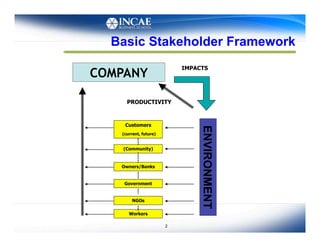
Basic Stakeholder Framework
                           IMPACTS
COMPANY


    Customers
   (current, future)


    (Community)


   Owners/Banks


    Government


       NGOs

      Workers

                       2
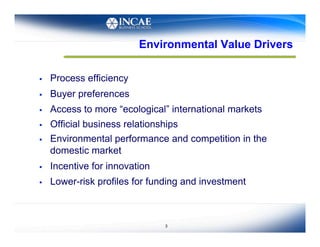
Environmental Value Drivers

    Process efficiency
    Buyer preferences
    Access to more “ecological” international markets
    Official business relationships
    Environmental performance and competition in the
     domestic market
    Incentive for innovation
    Lower-risk profiles for funding and investment


                                3
Driver # 1: Process Efficiency


    Ecoefficiency
         material used/in product material
         new concept:
           energy and material quantity per
            “service unit” ==> “dematerialization”

    Thousands of well-known examples


                                 4
Driver # 2:
                                      Buyer preferences


    Trend toward customers looking for better
     performance
         for customers and other stakeholders (both current
          and future)
         due to requirements from markets
         by philosophy and conviction
    Good and bad news
         Challenges for those not seeing them
         Exciting opportunities


                                 5
Driver # 3: Access to more “ecological”
                                   international markets

     Fairly new trend
    “Market rules” set the guidelines
    Non-official
         No GMOs, organic
         recycled content
         ISO 14001
         more sustainable tourism
    More official
         “product take-back” requirements


                                     6
Driver # 4: Official
                                     business relationships


    The most complex
    Particularly important in relation to product
     content
         traces of carcinogenic substances
    Also process issues
    WTO role? UNFCC?
    Obviously, governments can protect the
     population

                                 7
Driver # 5: Environmental competition in the
                                          domestic market


     Local companies are already worried
     Multinational companies in industrial countries
     have up to 30-year experience in creating and
     using environmental development as a market
     position.
     They are not afraid to use it against local
     rivals.


                             8
Driver # 6: Incentive for Innovation


    Less evidence than other areas
    Companies under environmental pressure
     innovate faster (“Porter Hypothesis”)
         cases: Bacardi, de-icing, paper and pulp
    Rate of change is accelerating
         few companies have experience in this area


                                 9
Driver # 7: Lower-risk profiles for funding


    International banks acknowledge risk
    Evidence for serious problems due to a lack of
     in-depth evaluation
    Up to 50 basis points premium with ISO 14001
     (10% of leading banks?)
    Relation with IFC and The World Bank,
     multinationals


                            10
Opportunities in “Products for the Future”


    Good and bad news
         Favored versus un-favored sectors
         However, performance is important in all
         Alternative energy
               willing to pay up to 15% extra for non-fossil energy
         Agriculture -- organic has 20% annual increase
         Tourism -- fastest growing segments?


                                         11
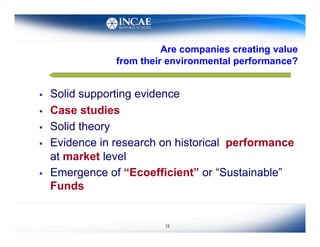
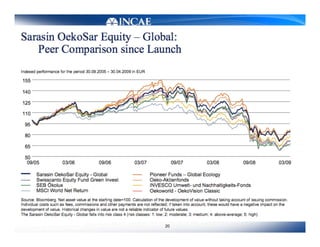
Are companies creating value
                 from their environmental performance?


    Solid supporting evidence
    Case studies
    Solid theory
    Evidence in research on historical performance
     at market level
    Emergence of “Ecoefficient” or “Sustainable”
     Funds


                           12
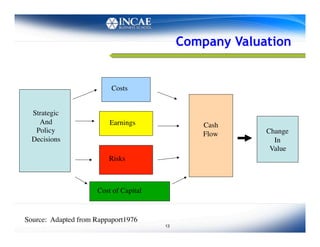
Company Valuation


                            Costs	


  Strategic	

    And 	

                Earnings	

               Cash	

   Policy 	

                                                  Change	

                                                     Flow	

  Decisions	

                                                   In	

                                                                Value	

                           Risks	


                       Cost of Capital	


Source: Adapted from Rappaport1976	

                                            13
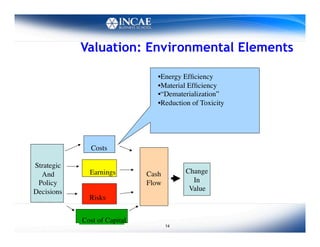
Valuation: Environmental Elements

                                        • Energy Efficiency	

                                        • Material Efficiency	

                                        • “Dematerialization”	

                                        • Reduction of Toxicity	


                  Costs	


Strategic	

  And	

          Earnings	

       Cash	

        Change 	

 Policy	

                          Flow	

          In 	

Decisions	

                                        Value	

                 Risks	


               Cost of Capital	

                                              14
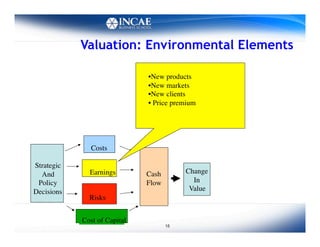
Valuation: Environmental Elements

                                    • New products	

                                    • New markets	

                                    • New clients	

                                    •  Price premium	


                  Costs	


Strategic	

  And 	

         Earnings	

       Cash	

        Change	

 Policy	

                          Flow	

          In 	

Decisions	

                                        Value	

                 Risks	


               Cost of Capital	

                                              15
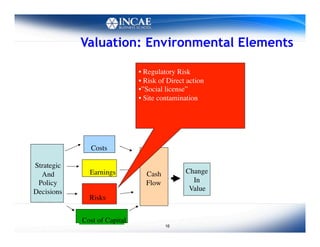
Valuation: Environmental Elements

                                    •  Regulatory Risk	

                                    •  Risk of Direct action	

                                    • ”Social license”	

                                    •  Site contamination	


                  Costs	


Strategic	

  And 	

         Earnings	

          Cash 	

        Change	

 Policy	

                             Flow	

           In 	

Decisions	

                                            Value	

                 Risks	


               Cost of Capital	

                                                  16
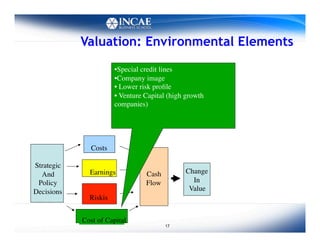
Valuation: Environmental Elements

                             • Special credit lines	

                             • Company image	

                             •  Lower risk profile	

                             •  Venture Capital (high growth
                             companies)	


                  Costs	


Strategic	

  And 	

         Earnings	

           Cash 	

        Change 	

 Policy	

                              Flow	

           In 	

Decisions	

                                             Value	

                 Riskis	


               Cost of Capital	

                                                   17
18
19
20

Stakeholder Analysis

  • 1.
    Competitiveness-Sustainability Links Lawrence Pratt INCAE Business School Lawrence.Pratt@incae.edu
  • 2.
    Basic Stakeholder Framework IMPACTS COMPANY Customers (current, future) (Community) Owners/Banks Government NGOs Workers 2
  • 3.
    Environmental Value Drivers   Process efficiency   Buyer preferences   Access to more “ecological” international markets   Official business relationships   Environmental performance and competition in the domestic market   Incentive for innovation   Lower-risk profiles for funding and investment 3
  • 4.
    Driver # 1:Process Efficiency   Ecoefficiency   material used/in product material   new concept: energy and material quantity per “service unit” ==> “dematerialization”   Thousands of well-known examples 4
  • 5.
    Driver # 2: Buyer preferences   Trend toward customers looking for better performance   for customers and other stakeholders (both current and future)   due to requirements from markets   by philosophy and conviction   Good and bad news   Challenges for those not seeing them   Exciting opportunities 5
  • 6.
    Driver # 3:Access to more “ecological” international markets   Fairly new trend   “Market rules” set the guidelines   Non-official   No GMOs, organic   recycled content   ISO 14001   more sustainable tourism   More official   “product take-back” requirements 6
  • 7.
    Driver # 4:Official business relationships   The most complex   Particularly important in relation to product content   traces of carcinogenic substances   Also process issues   WTO role? UNFCC?   Obviously, governments can protect the population 7
  • 8.
    Driver # 5:Environmental competition in the domestic market   Local companies are already worried   Multinational companies in industrial countries have up to 30-year experience in creating and using environmental development as a market position.   They are not afraid to use it against local rivals. 8
  • 9.
    Driver # 6:Incentive for Innovation   Less evidence than other areas   Companies under environmental pressure innovate faster (“Porter Hypothesis”)   cases: Bacardi, de-icing, paper and pulp   Rate of change is accelerating   few companies have experience in this area 9
  • 10.
    Driver # 7:Lower-risk profiles for funding   International banks acknowledge risk   Evidence for serious problems due to a lack of in-depth evaluation   Up to 50 basis points premium with ISO 14001 (10% of leading banks?)   Relation with IFC and The World Bank, multinationals 10
  • 11.
    Opportunities in “Productsfor the Future”   Good and bad news   Favored versus un-favored sectors   However, performance is important in all   Alternative energy   willing to pay up to 15% extra for non-fossil energy   Agriculture -- organic has 20% annual increase   Tourism -- fastest growing segments? 11
  • 12.
    Are companies creatingvalue from their environmental performance?   Solid supporting evidence   Case studies   Solid theory   Evidence in research on historical performance at market level   Emergence of “Ecoefficient” or “Sustainable” Funds 12
  • 13.
    Company Valuation Costs Strategic And Earnings Cash Policy Change Flow Decisions In Value Risks Cost of Capital Source: Adapted from Rappaport1976 13
  • 14.
    Valuation: Environmental Elements • Energy Efficiency • Material Efficiency • “Dematerialization” • Reduction of Toxicity Costs Strategic And Earnings Cash Change Policy Flow In Decisions Value Risks Cost of Capital 14
  • 15.
    Valuation: Environmental Elements • New products • New markets • New clients •  Price premium Costs Strategic And Earnings Cash Change Policy Flow In Decisions Value Risks Cost of Capital 15
  • 16.
    Valuation: Environmental Elements •  Regulatory Risk •  Risk of Direct action • ”Social license” •  Site contamination Costs Strategic And Earnings Cash Change Policy Flow In Decisions Value Risks Cost of Capital 16
  • 17.
    Valuation: Environmental Elements • Special credit lines • Company image •  Lower risk profile •  Venture Capital (high growth companies) Costs Strategic And Earnings Cash Change Policy Flow In Decisions Value Riskis Cost of Capital 17
  • 18.
  • 19.
  • 20.