Stages Involved in Research Project,
Hypothesis Testing, and
Problems Encountered by Researchers in Developing
World
Research Ethics and ICT (CHS 902) Presentation
By
Atika Musa
(22310707001)
Faculty of Basic Clinical Sciences,
Department of Chemical Pathology and Immunology,
Usmanu Danfodiyo University, Sokoto.
01/10/2023 CHS, UDUS 1
Outline
• Topic 3: Problems
Encountered by Researchers
in Developing World
01/10/2023 CHS, UDUS 2
• Topic 1:Stages Involved in
Research Project
• Introduction
• Stages
• Topic 2: Hypothesis Testing
• Introduction
• Hypothesis testing
• Steps
Topic 1: Stages Involved in Research Project
01/10/2023 CHS, UDUS 3
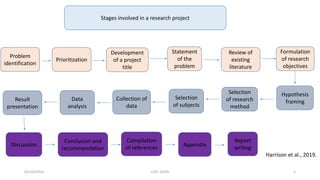
Stages involved in a research project
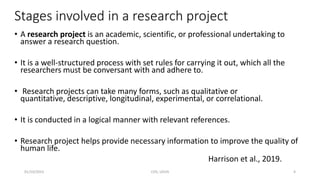
• A research project is an academic, scientific, or professional undertaking to
answer a research question.
• It is a well-structured process with set rules for carrying it out, which all the
researchers must be conversant with and adhere to.
• Research projects can take many forms, such as qualitative or
quantitative, descriptive, longitudinal, experimental, or correlational.
• It is conducted in a logical manner with relevant references.
• Research project helps provide necessary information to improve the quality of
human life.
Harrison et al., 2019.
01/10/2023 CHS, UDUS 4
01/10/2023 CHS, UDUS 5
Problem
identification
Prioritization
Compilation
of references
Hypothesis
framing
Selection
of research
method
Formulation
of research
objectives
Data
analysis
Report
writing
Review of
existing
literature
Discussion
Conclusion and
recommendation
Collection of
data
Development
of a project
title
Result
presentation
Appendix
Statement
of the
problem
Selection
of subjects
Stages involved in a research project
Harrison et al., 2019.
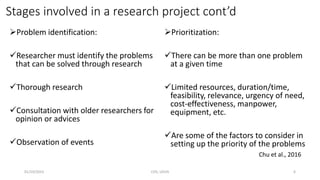
Stages involved in a research project cont’d
Problem identification:
Researcher must identify the problems
that can be solved through research
Thorough research
Consultation with older researchers for
opinion or advices
Observation of events
Prioritization:
There can be more than one problem
at a given time
Limited resources, duration/time,
feasibility, relevance, urgency of need,
cost-effectiveness, manpower,
equipment, etc.
Are some of the factors to consider in
setting up the priority of the problems
Chu et al., 2016
01/10/2023 CHS, UDUS 6
Stages involved in a research project cont’d
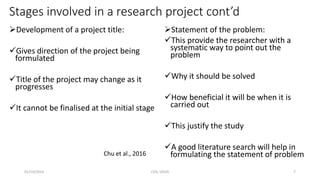
Development of a project title:
Gives direction of the project being
formulated
Title of the project may change as it
progresses
It cannot be finalised at the initial stage
Chu et al., 2016
Statement of the problem:
This provide the researcher with a
systematic way to point out the
problem
Why it should be solved
How beneficial it will be when it is
carried out
This justify the study
A good literature search will help in
formulating the statement of problem
01/10/2023 CHS, UDUS 7
Stages involved in a research project cont’d
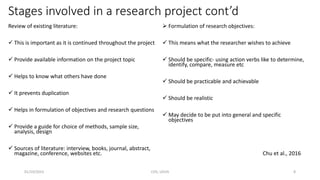
Review of existing literature:
 This is important as it is continued throughout the project
 Provide available information on the project topic
 Helps to know what others have done
 It prevents duplication
 Helps in formulation of objectives and research questions
 Provide a guide for choice of methods, sample size,
analysis, design
 Sources of literature: interview, books, journal, abstract,
magazine, conference, websites etc.
 Formulation of research objectives:
 This means what the researcher wishes to achieve
 Should be specific- using action verbs like to determine,
identify, compare, measure etc
 Should be practicable and achievable
 Should be realistic
 May decide to be put into general and specific
objectives
Chu et al., 2016
01/10/2023 CHS, UDUS 8
Stages involved in a research project cont’d
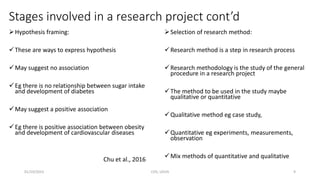
Hypothesis framing:
These are ways to express hypothesis
May suggest no association
Eg there is no relationship between sugar intake
and development of diabetes
May suggest a positive association
Eg there is positive association between obesity
and development of cardiovascular diseases
Chu et al., 2016
Selection of research method:
Research method is a step in research process
Research methodology is the study of the general
procedure in a research project
The method to be used in the study maybe
qualitative or quantitative
Qualitative method eg case study,
Quantitative eg experiments, measurements,
observation
Mix methods of quantitative and qualitative
01/10/2023 CHS, UDUS 9
Stages involved in a research project cont’d
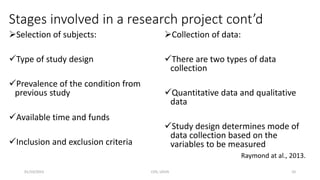
Selection of subjects:
Type of study design
Prevalence of the condition from
previous study
Available time and funds
Inclusion and exclusion criteria
Collection of data:
There are two types of data
collection
Quantitative data and qualitative
data
Study design determines mode of
data collection based on the
variables to be measured
Raymond at al., 2013.
01/10/2023 CHS, UDUS 10
Stages involved in a research project cont’d
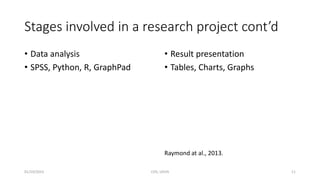
• Data analysis
• SPSS, Python, R, GraphPad
• Result presentation
• Tables, Charts, Graphs
Raymond at al., 2013.
01/10/2023 CHS, UDUS 11
Stages involved in a research project cont’d
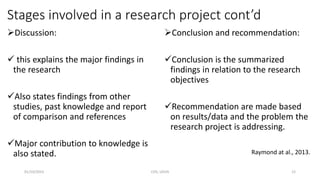
Discussion:
 this explains the major findings in
the research
Also states findings from other
studies, past knowledge and report
of comparison and references
Major contribution to knowledge is
also stated.
Conclusion and recommendation:
Conclusion is the summarized
findings in relation to the research
objectives
Recommendation are made based
on results/data and the problem the
research project is addressing.
Raymond at al., 2013.
01/10/2023 CHS, UDUS 12
Stages involved in a research project cont’d
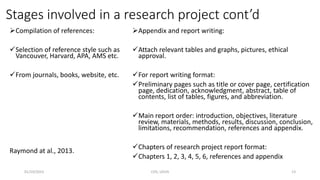
Compilation of references:
Selection of reference style such as
Vancouver, Harvard, APA, AMS etc.
From journals, books, website, etc.
Raymond at al., 2013.
Appendix and report writing:
Attach relevant tables and graphs, pictures, ethical
approval.
For report writing format:
Preliminary pages such as title or cover page, certification
page, dedication, acknowledgment, abstract, table of
contents, list of tables, figures, and abbreviation.
Main report order: introduction, objectives, literature
review, materials, methods, results, discussion, conclusion,
limitations, recommendation, references and appendix.
Chapters of research project report format:
Chapters 1, 2, 3, 4, 5, 6, references and appendix
01/10/2023 CHS, UDUS 13
Topic 2: Hypothesis Testing
01/10/2023 CHS, UDUS 14
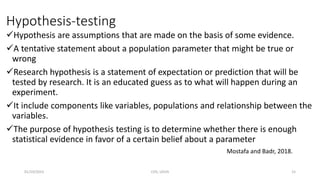
Hypothesis-testing
Hypothesis are assumptions that are made on the basis of some evidence.
A tentative statement about a population parameter that might be true or
wrong
Research hypothesis is a statement of expectation or prediction that will be
tested by research. It is an educated guess as to what will happen during an
experiment.
It include components like variables, populations and relationship between the
variables.
The purpose of hypothesis testing is to determine whether there is enough
statistical evidence in favor of a certain belief about a parameter
Mostafa and Badr, 2018.
01/10/2023 CHS, UDUS 15
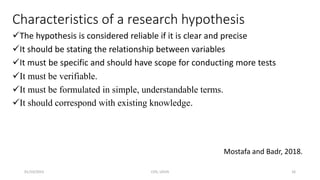
Characteristics of a research hypothesis
The hypothesis is considered reliable if it is clear and precise
It should be stating the relationship between variables
It must be specific and should have scope for conducting more tests
It must be verifiable.
It must be formulated in simple, understandable terms.
It should correspond with existing knowledge.
Mostafa and Badr, 2018.
01/10/2023 CHS, UDUS 16
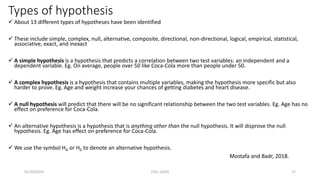
Types of hypothesis
 About 13 different types of hypotheses have been identified
 These include simple, complex, null, alternative, composite, directional, non-directional, logical, empirical, statistical,
associative, exact, and inexact
 A simple hypothesis is a hypothesis that predicts a correlation between two test variables: an independent and a
dependent variable. Eg. On average, people over 50 like Coca-Cola more than people under 50.
 A complex hypothesis is a hypothesis that contains multiple variables, making the hypothesis more specific but also
harder to prove. Eg. Age and weight increase your chances of getting diabetes and heart disease.
 A null hypothesis will predict that there will be no significant relationship between the two test variables. Eg. Age has no
effect on preference for Coca-Cola.
 An alternative hypothesis is a hypothesis that is anything other than the null hypothesis. It will disprove the null
hypothesis. Eg. Age has effect on preference for Coca-Cola.
 We use the symbol HA or H0 to denote an alternative hypothesis.
Mostafa and Badr, 2018.
01/10/2023 CHS, UDUS 17
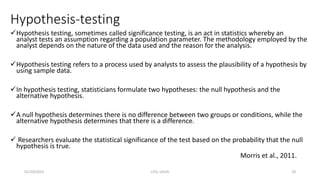
Hypothesis-testing
Hypothesis testing, sometimes called significance testing, is an act in statistics whereby an
analyst tests an assumption regarding a population parameter. The methodology employed by the
analyst depends on the nature of the data used and the reason for the analysis.
Hypothesis testing refers to a process used by analysts to assess the plausibility of a hypothesis by
using sample data.
In hypothesis testing, statisticians formulate two hypotheses: the null hypothesis and the
alternative hypothesis.
A null hypothesis determines there is no difference between two groups or conditions, while the
alternative hypothesis determines that there is a difference.
 Researchers evaluate the statistical significance of the test based on the probability that the null
hypothesis is true.
Morris et al., 2011.
01/10/2023 CHS, UDUS 18
01/10/2023 CHS, UDUS 19
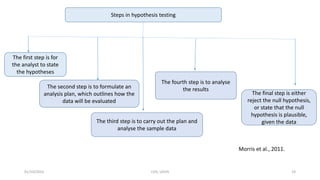
Steps in hypothesis testing
The second step is to formulate an
analysis plan, which outlines how the
data will be evaluated
The first step is for
the analyst to state
the hypotheses
The final step is either
reject the null hypothesis,
or state that the null
hypothesis is plausible,
given the data
The fourth step is to analyse
the results
The third step is to carry out the plan and
analyse the sample data
Morris et al., 2011.
01/10/2023 CHS, UDUS 20
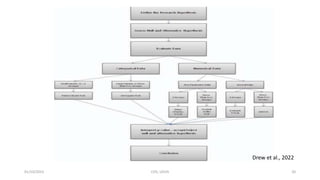
Drew et al., 2022
Topic 3: Problems Encountered by Researchers
in Developing World
01/10/2023 CHS, UDUS 21
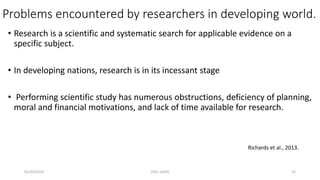
Problems encountered by researchers in developing world.
• Research is a scientific and systematic search for applicable evidence on a
specific subject.
• In developing nations, research is in its incessant stage
• Performing scientific study has numerous obstructions, deficiency of planning,
moral and financial motivations, and lack of time available for research.
01/10/2023 CHS, UDUS 22
Richards et al., 2013.
01/10/2023 CHS, UDUS 23
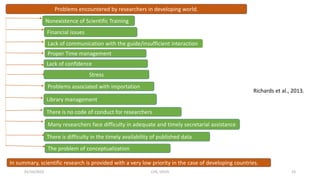
Problems encountered by researchers in developing world.
Nonexistence of Scientific Training
Financial issues
Lack of communication with the guide/insufficient interaction
Proper Time management
Lack of confidence
Stress
Problems associated with importation
Library management
There is no code of conduct for researchers
Many researchers face difficulty in adequate and timely secretarial assistance
There is difficulty in the timely availability of published data
The problem of conceptualization
In summary, scientific research is provided with a very low priority in the case of developing countries.
Richards et al., 2013.
Some selected references
• Richards T, et al. Let the patient revolution begin. BMJ. 2013;346:f2614. https://doi.org/10.1136/bmj.f2614.
• Article PubMed Google Scholar
• Harrison JD, et al. Patient stakeholder engagement in research: A narrative review to describe foundational principles and best practice activities.
Health Expect. 2019;22(3):307–16. https://doi.org/10.1111/hex.12873.
• http://www.invo.org.uk/find-out-more/what-is-public-involvement-in-research-2/.
• Morris C, et al. Why it is crucial to involve families in all stages of childhood disability research. Dev Med Child Neurol. 2011;53(8):769–
71. https://doi.org/10.1111/j.1469-8749.2011.03984.x.
• van der Scheer L, et al. The benefits of patient involvement for translational research. Health Care Anal. 2017;25(3):225–
41. https://doi.org/10.1007/s10728-
• Chu LF, et al. “Nothing about us without us”-patient partnership in medical conferences. BMJ. 2016;354:i3883. https://doi.org/10.1136/bmj.i3883.
• Raymond Hubbard, M. J. Bayarri, P Values are not Error Probabilities Archived September 4, 2013, at the Wayback Machine. A working paper that
explains the difference between Fisher's evidential p-value and the Neyman–Pearson Type I error ra
• Mostafa Z. Badr, “Challenges Facing Scientific Research in Developing Countries: 1. The Human Factor,” Egyptian Journal of Basic and Clinical
Pharmacology, vol. 8, Article ID 101378, 2018
01/10/2023 CHS, UDUS 24
Thank you for listening
01/10/2023 CHS, UDUS 25

Stages Involved in Research Project.pptx

  • 1.
    Stages Involved inResearch Project, Hypothesis Testing, and Problems Encountered by Researchers in Developing World Research Ethics and ICT (CHS 902) Presentation By Atika Musa (22310707001) Faculty of Basic Clinical Sciences, Department of Chemical Pathology and Immunology, Usmanu Danfodiyo University, Sokoto. 01/10/2023 CHS, UDUS 1
  • 2.
    Outline • Topic 3:Problems Encountered by Researchers in Developing World 01/10/2023 CHS, UDUS 2 • Topic 1:Stages Involved in Research Project • Introduction • Stages • Topic 2: Hypothesis Testing • Introduction • Hypothesis testing • Steps
  • 3.
    Topic 1: StagesInvolved in Research Project 01/10/2023 CHS, UDUS 3
  • 4.
    Stages involved ina research project • A research project is an academic, scientific, or professional undertaking to answer a research question. • It is a well-structured process with set rules for carrying it out, which all the researchers must be conversant with and adhere to. • Research projects can take many forms, such as qualitative or quantitative, descriptive, longitudinal, experimental, or correlational. • It is conducted in a logical manner with relevant references. • Research project helps provide necessary information to improve the quality of human life. Harrison et al., 2019. 01/10/2023 CHS, UDUS 4
  • 5.
    01/10/2023 CHS, UDUS5 Problem identification Prioritization Compilation of references Hypothesis framing Selection of research method Formulation of research objectives Data analysis Report writing Review of existing literature Discussion Conclusion and recommendation Collection of data Development of a project title Result presentation Appendix Statement of the problem Selection of subjects Stages involved in a research project Harrison et al., 2019.
  • 6.
    Stages involved ina research project cont’d Problem identification: Researcher must identify the problems that can be solved through research Thorough research Consultation with older researchers for opinion or advices Observation of events Prioritization: There can be more than one problem at a given time Limited resources, duration/time, feasibility, relevance, urgency of need, cost-effectiveness, manpower, equipment, etc. Are some of the factors to consider in setting up the priority of the problems Chu et al., 2016 01/10/2023 CHS, UDUS 6
  • 7.
    Stages involved ina research project cont’d Development of a project title: Gives direction of the project being formulated Title of the project may change as it progresses It cannot be finalised at the initial stage Chu et al., 2016 Statement of the problem: This provide the researcher with a systematic way to point out the problem Why it should be solved How beneficial it will be when it is carried out This justify the study A good literature search will help in formulating the statement of problem 01/10/2023 CHS, UDUS 7
  • 8.
    Stages involved ina research project cont’d Review of existing literature:  This is important as it is continued throughout the project  Provide available information on the project topic  Helps to know what others have done  It prevents duplication  Helps in formulation of objectives and research questions  Provide a guide for choice of methods, sample size, analysis, design  Sources of literature: interview, books, journal, abstract, magazine, conference, websites etc.  Formulation of research objectives:  This means what the researcher wishes to achieve  Should be specific- using action verbs like to determine, identify, compare, measure etc  Should be practicable and achievable  Should be realistic  May decide to be put into general and specific objectives Chu et al., 2016 01/10/2023 CHS, UDUS 8
  • 9.
    Stages involved ina research project cont’d Hypothesis framing: These are ways to express hypothesis May suggest no association Eg there is no relationship between sugar intake and development of diabetes May suggest a positive association Eg there is positive association between obesity and development of cardiovascular diseases Chu et al., 2016 Selection of research method: Research method is a step in research process Research methodology is the study of the general procedure in a research project The method to be used in the study maybe qualitative or quantitative Qualitative method eg case study, Quantitative eg experiments, measurements, observation Mix methods of quantitative and qualitative 01/10/2023 CHS, UDUS 9
  • 10.
    Stages involved ina research project cont’d Selection of subjects: Type of study design Prevalence of the condition from previous study Available time and funds Inclusion and exclusion criteria Collection of data: There are two types of data collection Quantitative data and qualitative data Study design determines mode of data collection based on the variables to be measured Raymond at al., 2013. 01/10/2023 CHS, UDUS 10
  • 11.
    Stages involved ina research project cont’d • Data analysis • SPSS, Python, R, GraphPad • Result presentation • Tables, Charts, Graphs Raymond at al., 2013. 01/10/2023 CHS, UDUS 11
  • 12.
    Stages involved ina research project cont’d Discussion:  this explains the major findings in the research Also states findings from other studies, past knowledge and report of comparison and references Major contribution to knowledge is also stated. Conclusion and recommendation: Conclusion is the summarized findings in relation to the research objectives Recommendation are made based on results/data and the problem the research project is addressing. Raymond at al., 2013. 01/10/2023 CHS, UDUS 12
  • 13.
    Stages involved ina research project cont’d Compilation of references: Selection of reference style such as Vancouver, Harvard, APA, AMS etc. From journals, books, website, etc. Raymond at al., 2013. Appendix and report writing: Attach relevant tables and graphs, pictures, ethical approval. For report writing format: Preliminary pages such as title or cover page, certification page, dedication, acknowledgment, abstract, table of contents, list of tables, figures, and abbreviation. Main report order: introduction, objectives, literature review, materials, methods, results, discussion, conclusion, limitations, recommendation, references and appendix. Chapters of research project report format: Chapters 1, 2, 3, 4, 5, 6, references and appendix 01/10/2023 CHS, UDUS 13
  • 14.
    Topic 2: HypothesisTesting 01/10/2023 CHS, UDUS 14
  • 15.
    Hypothesis-testing Hypothesis are assumptionsthat are made on the basis of some evidence. A tentative statement about a population parameter that might be true or wrong Research hypothesis is a statement of expectation or prediction that will be tested by research. It is an educated guess as to what will happen during an experiment. It include components like variables, populations and relationship between the variables. The purpose of hypothesis testing is to determine whether there is enough statistical evidence in favor of a certain belief about a parameter Mostafa and Badr, 2018. 01/10/2023 CHS, UDUS 15
  • 16.
    Characteristics of aresearch hypothesis The hypothesis is considered reliable if it is clear and precise It should be stating the relationship between variables It must be specific and should have scope for conducting more tests It must be verifiable. It must be formulated in simple, understandable terms. It should correspond with existing knowledge. Mostafa and Badr, 2018. 01/10/2023 CHS, UDUS 16
  • 17.
    Types of hypothesis About 13 different types of hypotheses have been identified  These include simple, complex, null, alternative, composite, directional, non-directional, logical, empirical, statistical, associative, exact, and inexact  A simple hypothesis is a hypothesis that predicts a correlation between two test variables: an independent and a dependent variable. Eg. On average, people over 50 like Coca-Cola more than people under 50.  A complex hypothesis is a hypothesis that contains multiple variables, making the hypothesis more specific but also harder to prove. Eg. Age and weight increase your chances of getting diabetes and heart disease.  A null hypothesis will predict that there will be no significant relationship between the two test variables. Eg. Age has no effect on preference for Coca-Cola.  An alternative hypothesis is a hypothesis that is anything other than the null hypothesis. It will disprove the null hypothesis. Eg. Age has effect on preference for Coca-Cola.  We use the symbol HA or H0 to denote an alternative hypothesis. Mostafa and Badr, 2018. 01/10/2023 CHS, UDUS 17
  • 18.
    Hypothesis-testing Hypothesis testing, sometimescalled significance testing, is an act in statistics whereby an analyst tests an assumption regarding a population parameter. The methodology employed by the analyst depends on the nature of the data used and the reason for the analysis. Hypothesis testing refers to a process used by analysts to assess the plausibility of a hypothesis by using sample data. In hypothesis testing, statisticians formulate two hypotheses: the null hypothesis and the alternative hypothesis. A null hypothesis determines there is no difference between two groups or conditions, while the alternative hypothesis determines that there is a difference.  Researchers evaluate the statistical significance of the test based on the probability that the null hypothesis is true. Morris et al., 2011. 01/10/2023 CHS, UDUS 18
  • 19.
    01/10/2023 CHS, UDUS19 Steps in hypothesis testing The second step is to formulate an analysis plan, which outlines how the data will be evaluated The first step is for the analyst to state the hypotheses The final step is either reject the null hypothesis, or state that the null hypothesis is plausible, given the data The fourth step is to analyse the results The third step is to carry out the plan and analyse the sample data Morris et al., 2011.
  • 20.
    01/10/2023 CHS, UDUS20 Drew et al., 2022
  • 21.
    Topic 3: ProblemsEncountered by Researchers in Developing World 01/10/2023 CHS, UDUS 21
  • 22.
    Problems encountered byresearchers in developing world. • Research is a scientific and systematic search for applicable evidence on a specific subject. • In developing nations, research is in its incessant stage • Performing scientific study has numerous obstructions, deficiency of planning, moral and financial motivations, and lack of time available for research. 01/10/2023 CHS, UDUS 22 Richards et al., 2013.
  • 23.
    01/10/2023 CHS, UDUS23 Problems encountered by researchers in developing world. Nonexistence of Scientific Training Financial issues Lack of communication with the guide/insufficient interaction Proper Time management Lack of confidence Stress Problems associated with importation Library management There is no code of conduct for researchers Many researchers face difficulty in adequate and timely secretarial assistance There is difficulty in the timely availability of published data The problem of conceptualization In summary, scientific research is provided with a very low priority in the case of developing countries. Richards et al., 2013.
  • 24.
    Some selected references •Richards T, et al. Let the patient revolution begin. BMJ. 2013;346:f2614. https://doi.org/10.1136/bmj.f2614. • Article PubMed Google Scholar • Harrison JD, et al. Patient stakeholder engagement in research: A narrative review to describe foundational principles and best practice activities. Health Expect. 2019;22(3):307–16. https://doi.org/10.1111/hex.12873. • http://www.invo.org.uk/find-out-more/what-is-public-involvement-in-research-2/. • Morris C, et al. Why it is crucial to involve families in all stages of childhood disability research. Dev Med Child Neurol. 2011;53(8):769– 71. https://doi.org/10.1111/j.1469-8749.2011.03984.x. • van der Scheer L, et al. The benefits of patient involvement for translational research. Health Care Anal. 2017;25(3):225– 41. https://doi.org/10.1007/s10728- • Chu LF, et al. “Nothing about us without us”-patient partnership in medical conferences. BMJ. 2016;354:i3883. https://doi.org/10.1136/bmj.i3883. • Raymond Hubbard, M. J. Bayarri, P Values are not Error Probabilities Archived September 4, 2013, at the Wayback Machine. A working paper that explains the difference between Fisher's evidential p-value and the Neyman–Pearson Type I error ra • Mostafa Z. Badr, “Challenges Facing Scientific Research in Developing Countries: 1. The Human Factor,” Egyptian Journal of Basic and Clinical Pharmacology, vol. 8, Article ID 101378, 2018 01/10/2023 CHS, UDUS 24
  • 25.
    Thank you forlistening 01/10/2023 CHS, UDUS 25