MAYOR’S TASK FORCE ONON HOUSING
MAYOR’S TASK FORCE HOUSING AFFORDABILITY
AFFORDABILITY
Final Report and Staff Recommendations
October 2, 2012 Staff Recommendations
Final Report and
October 2012
OVERVIEW


1. Task Force – Focus and Process
2. Task Force - Recommendations

3. City Action Plan for Implementation
  –   Priority Actions for Immediate Implementation

  –   Additional Implementation Actions

4. Next Steps
Task Force Focus and Process
Vancouver’s Affordable Housing Challenge


• Vancouver has the highest house prices in Canada
  – well beyond the ability of most households to
  afford even a modest condo
• Vancouver households paying more than 30% of
  their income on housing:
   – 40% of all households
   – 50% of households headed by people under 34
• The challenge continues to grow – August 2012
  RBC report indicates that:
   – affordability measures further deteriorated for all
     housing types in Vancouver
   – affordability levels are now very close to the worst on
     record.
Vancouver’s Affordable Housing Challenge


Housing Affordability challenges threaten the City’s:
  – Diversity
                                      “Vancouver’s economy depends
                                         on attracting and retaining
  – Livability                        talent. Affordable housing of all
                                      types, including market rentals,
  – Economic Competitiveness          is essential to the City’s current
                                        and future competitiveness.”


 John Tylee, Director of Policy and Research
Vancouver Economic Development Commission
Target Groups in Need of Affordable Housing

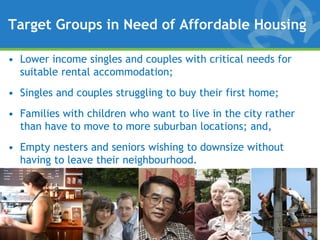
• Lower income singles and couples with critical needs for
  suitable rental accommodation;
• Singles and couples struggling to buy their first home;
• Families with children who want to live in the city rather
  than have to move to more suburban locations; and,
• Empty nesters and seniors wishing to downsize without
  having to leave their neighbourhood.
Who is the Task Force?

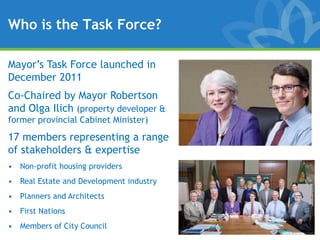
Mayor’s Task Force launched in
December 2011
Co-Chaired by Mayor Robertson
and Olga Ilich (property developer &
former provincial Cabinet Minister)
17 members representing a range
of stakeholders & expertise
• Non-profit housing providers
• Real Estate and Development industry
• Planners and Architects
• First Nations
• Members of City Council
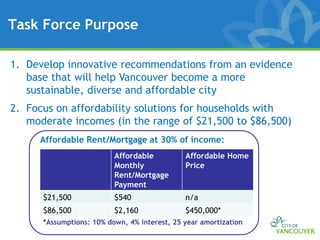
Task Force Purpose

1. Develop innovative recommendations from an evidence
   base that will help Vancouver become a more
   sustainable, diverse and affordable city
2. Focus on affordability solutions for households with
   moderate incomes (in the range of $21,500 to $86,500)
     Affordable Rent/Mortgage at 30% of income:
                          Affordable          Affordable Home
                          Monthly             Price
                          Rent/Mortgage
                          Payment
      $21,500             $540                n/a
      $86,500             $2,160              $450,000*
      *Assumptions: 10% down, 4% interest, 25 year amortization
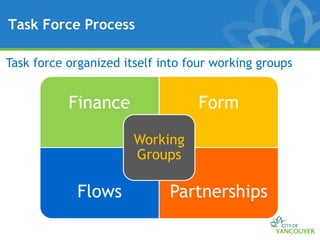
Task Force Process

Task force organized itself into four working groups


           Finance                Form

                       Working
                       Groups

            Flows            Partnerships
Task Force Process

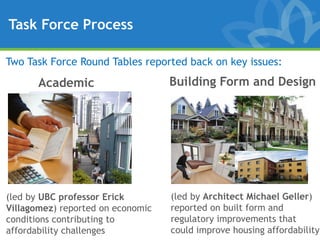
Two Task Force Round Tables reported back on key issues:

       Academic                    Building Form and Design


(led by UBC professor Erick        (led by Architect Michael Geller)
Villagomez) reported on economic   reported on built form and
conditions contributing to         regulatory improvements that
affordability challenges
    10                             could improve housing affordability
Task Force Process

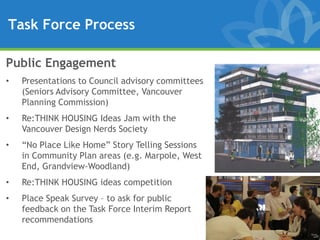
Public Engagement
•   Presentations to Council advisory committees
    (Seniors Advisory Committee, Vancouver
    Planning Commission)
•   Re:THINK HOUSING Ideas Jam with the
    Vancouver Design Nerds Society
•   “No Place Like Home” Story Telling Sessions
    in Community Plan areas (e.g. Marpole, West
    End, Grandview-Woodland)
•   Re:THINK HOUSING ideas competition
•   Place Speak Survey – to ask for public
    feedback on the Task Force Interim Report
    recommendations
Task Force Process

re:THINK HOUSING – an open ideas competition to
broaden the discussion on possible solutions to
Vancouver’s affordability challenges
Task Force Process

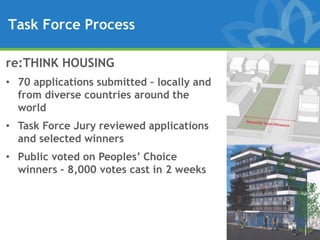
re:THINK HOUSING
• 70 applications submitted – locally and
  from diverse countries around the
  world
• Task Force Jury reviewed applications
  and selected winners
• Public voted on Peoples’ Choice
  winners – 8,000 votes cast in 2 weeks
Task Force Process

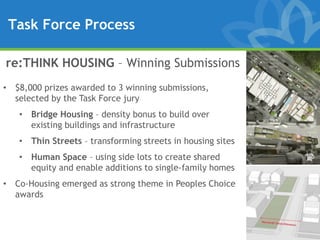
re:THINK HOUSING – Winning Submissions
• $8,000 prizes awarded to 3 winning submissions,
  selected by the Task Force jury
   • Bridge Housing – density bonus to build over
     existing buildings and infrastructure
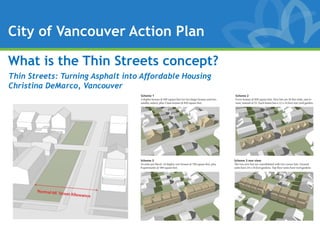
   • Thin Streets – transforming streets in housing sites
   • Human Space – using side lots to create shared
     equity and enable additions to single-family homes
• Co-Housing emerged as strong theme in Peoples Choice
  awards
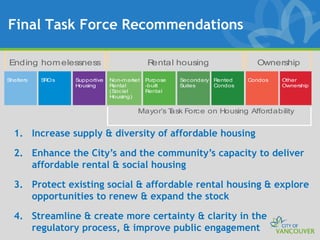
Final Task Force Recommendations

Ending hom elessness                         Rental housing                  Ownership

Shelters   S Os
            R     Supportive   Non-m arket   Purpose   Sec ondary Rented   Condos   Other
                  Housing      Rental        -built    Suites     Condos            Ownership
                               (Soc ial      Rental
                               Housing)


                                         Mayor’s T
                                                 ask Forc e on Housing Affordability


  1. Increase supply & diversity of affordable housing

  2. Enhance the City’s and the community’s capacity to deliver
     affordable rental & social housing

  3. Protect existing social & affordable rental housing & explore
     opportunities to renew & expand the stock

  4. Streamline & create more certainty & clarity in the
     regulatory process, & improve public engagement
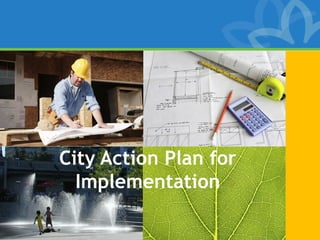
City Action Plan for
  Implementation
City Approach

• Public & Stakeholder engagement
• Talk Housing With Us – Spring/Summer 2011
• Input to Housing & Homelessness Strategy
• Council approved strategy – July 2011
• Staff support to Task Force – 2012
• Council report including Priority Actions for
  Implementation
• Building on previous engagement and
  approved strategy
Talk Housing With Us Engagement

• Public & stakeholder input into Housing & Homelessness
  Strategy through Talk Housing With Us:
  - Stakeholder Workshop – April 27, 2011
  - Renter’s Round Table – May 26, 2011
  - Housing Un-conference – June 4, 2011
   - Community dialogues
• Key Themes:
  - More affordable & social housing needed
  - Concern over decreasing affordability and lack of rental
  supply
  - Need for low-cost housing for seniors & working families
  - Clear leadership from the City needed
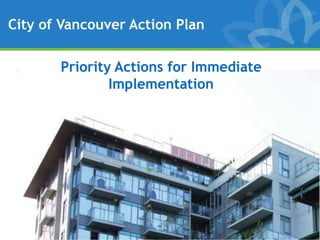
City of Vancouver Action Plan

       Priority Actions for Immediate
               Implementation
City of Vancouver Action Plan

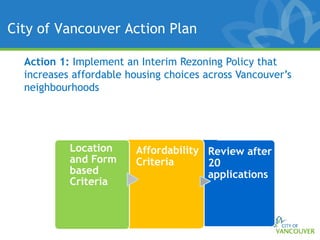
  Action 1: Implement an Interim Rezoning Policy that
  increases affordable housing choices across Vancouver’s
  neighbourhoods


           Location      Affordability Review after
           and Form      Criteria      20
           based                       applications
           Criteria
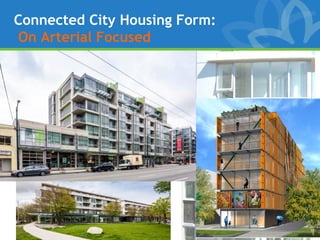
Connected City Housing Form:
On Arterial Focused
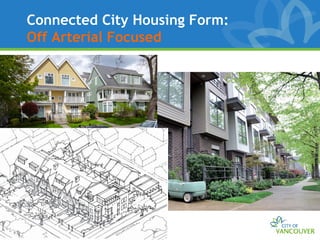
Connected City Housing Form:
Off Arterial Focused
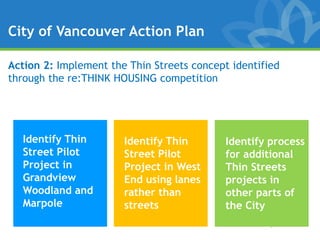
City of Vancouver Action Plan

Action 2: Implement the Thin Streets concept identified
through the re:THINK HOUSING competition


  Identify Thin        Identify Thin        Identify process
  Street Pilot         Street Pilot         for additional
  Project in           Project in West      Thin Streets
  Grandview            End using lanes      projects in
  Woodland and         rather than          other parts of
  Marpole              streets              the City
City of Vancouver Action Plan

What is the Thin Streets concept?
Thin Streets: Turning Asphalt into Affordable Housing
Christina DeMarco, Vancouver
City of Vancouver Action Plan

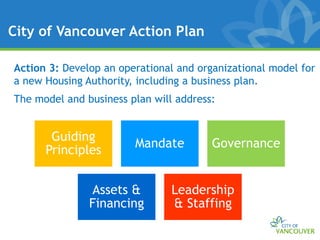
Action 3: Develop an operational and organizational model for
a new Housing Authority, including a business plan.
The model and business plan will address:


       Guiding
                        Mandate         Governance
      Principles


               Assets &         Leadership
               Financing        & Staffing
City of Vancouver Action Plan

Action 3: Develop an operational and organizational model for
a new Housing Authority, including a business plan.

Advantages of a Housing Authority model include ability to:

  • Respond nimbly to partnership opportunities with the non-profit and
    private sectors, as well as senior levels of government

  • Rely on the skills of an experienced Board of Directors to optimize
    the City’s investments in affordable housing

  • Consolidate City’s non-market portfolio for administrative efficiency
City of Vancouver Action Plan

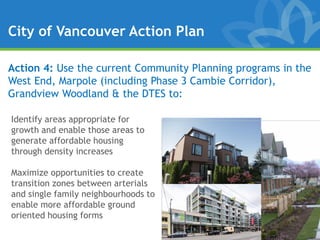
Action 4: Use the current Community Planning programs in the
West End, Marpole (including Phase 3 Cambie Corridor),
Grandview Woodland & the DTES to:

Identify areas appropriate for
growth and enable those areas to
generate affordable housing
through density increases

Maximize opportunities to create
transition zones between arterials
and single family neighbourhoods to
enable more affordable ground
oriented housing forms
City of Vancouver Action Plan

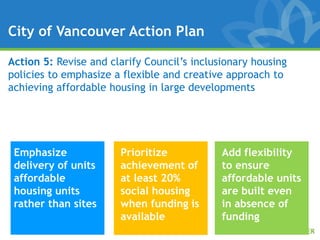
Action 5: Revise and clarify Council’s inclusionary housing
policies to emphasize a flexible and creative approach to
achieving affordable housing in large developments


 Emphasize             Prioritize            Add flexibility
 delivery of units     achievement of        to ensure
 affordable            at least 20%          affordable units
 housing units         social housing        are built even
 rather than sites     when funding is       in absence of
                       available             funding
City of Vancouver Action Plan

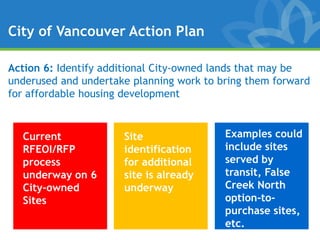
Action 6: Identify additional City-owned lands that may be
underused and undertake planning work to bring them forward
for affordable housing development


  Current             Site                Examples could
  RFEOI/RFP           identification      include sites
  process             for additional      served by
  underway on 6       site is already     transit, False
  City-owned          underway            Creek North
  Sites                                   option-to-
                                          purchase sites,
                                          etc.
City of Vancouver Action Plan

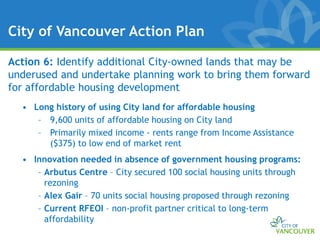
Action 6: Identify additional City-owned lands that may be
underused and undertake planning work to bring them forward
for affordable housing development
  • Long history of using City land for affordable housing
     – 9,600 units of affordable housing on City land
     – Primarily mixed income - rents range from Income Assistance
       ($375) to low end of market rent
  • Innovation needed in absence of government housing programs:
     – Arbutus Centre – City secured 100 social housing units through
       rezoning
     – Alex Gair – 70 units social housing proposed through rezoning
     – Current RFEOI – non-profit partner critical to long-term
       affordability
City of Vancouver Action Plan


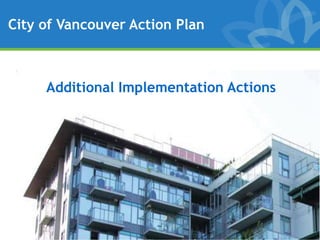
     Additional Implementation Actions
City of Vancouver Action Plan

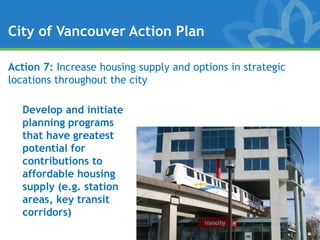
Action 7: Increase housing supply and options in strategic
locations throughout the city

   Develop and initiate
   planning programs
   that have greatest
   potential for
   contributions to
   affordable housing
   supply (e.g. station
   areas, key transit
   corridors)
City of Vancouver Action Plan

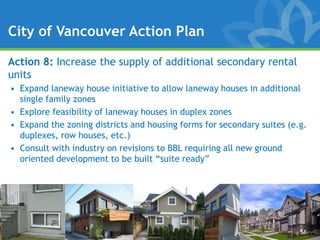
Action 8: Increase the supply of additional secondary rental
units
• Expand laneway house initiative to allow laneway houses in additional
  single family zones
• Explore feasibility of laneway houses in duplex zones
• Expand the zoning districts and housing forms for secondary suites (e.g.
  duplexes, row houses, etc.)
• Consult with industry on revisions to BBL requiring all new ground
  oriented development to be built “suite ready”
City of Vancouver Action Plan

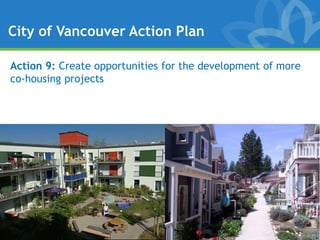
Action 9: Create opportunities for the development of more
co-housing projects
City of Vancouver Action Plan

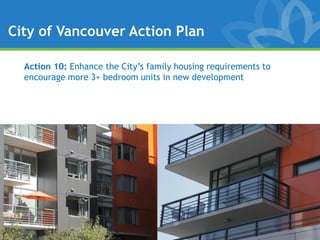
  Action 10: Enhance the City’s family housing requirements to
  encourage more 3+ bedroom units in new development
City of Vancouver Action Plan

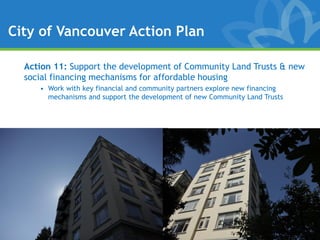
  Action 11: Support the development of Community Land Trusts & new
  social financing mechanisms for affordable housing
     • Work with key financial and community partners explore new financing
       mechanisms and support the development of new Community Land Trusts
City of Vancouver Action Plan

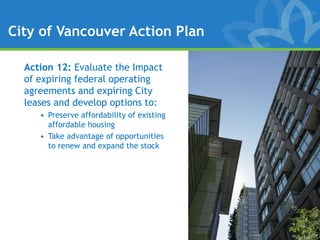
  Action 12: Evaluate the Impact
  of expiring federal operating
  agreements and expiring City
  leases and develop options to:
     • Preserve affordability of existing
       affordable housing
     • Take advantage of opportunities
       to renew and expand the stock
City of Vancouver Action Plan

  Action 13: Evaluate the City’s rental
  protection regulations with goal of
  preserving housing stability and
  affordability while identifying
  opportunities to renew and expand
  the private market rental stock
City of Vancouver Action Plan

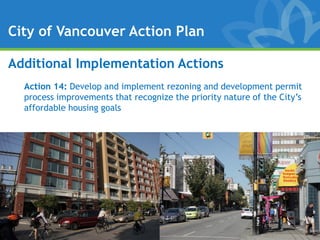
Additional Implementation Actions
  Action 14: Develop and implement rezoning and development permit
  process improvements that recognize the priority nature of the City’s
  affordable housing goals
City of Vancouver Action Plan

Additional
Implementation Actions
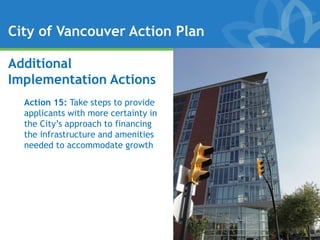
  Action 15: Take steps to provide
  applicants with more certainty in
  the City’s approach to financing
  the infrastructure and amenities
  needed to accommodate growth
Next Steps
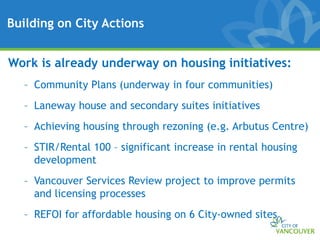
Building on City Actions


Work is already underway on housing initiatives:
  – Community Plans (underway in four communities)
  – Laneway house and secondary suites initiatives
  – Achieving housing through rezoning (e.g. Arbutus Centre)
  – STIR/Rental 100 – significant increase in rental housing
    development
  – Vancouver Services Review project to improve permits
    and licensing processes
  – REFOI for affordable housing on 6 City-owned sites
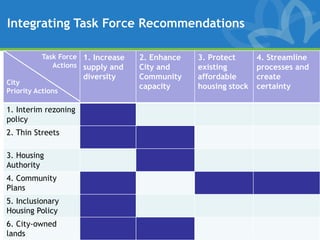
Integrating Task Force Recommendations

           Task Force 1. Increase   2. Enhance   3. Protect      4. Streamline
              Actions supply and    City and     existing        processes and
                      diversity     Community    affordable      create
City
                                    capacity     housing stock   certainty
Priority Actions

1. Interim rezoning
policy
2. Thin Streets

3. Housing
Authority
4. Community
Plans
5. Inclusionary
Housing Policy
6. City-owned
lands
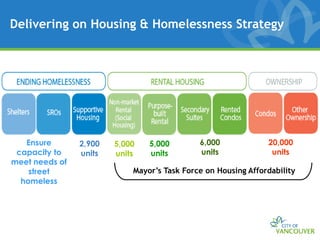
Delivering on Housing & Homelessness Strategy


   Ensure       2,900   5,000   5,000        6,000             20,000
 capacity to    units   units   units        units              units
meet needs of
    street                  Mayor’s Task Force on Housing Affordability
  homeless
A home for everyone

Staff presentation: Final report on Mayor's Housing Affordability Task Force

  • 1.
    MAYOR’S TASK FORCEONON HOUSING MAYOR’S TASK FORCE HOUSING AFFORDABILITY AFFORDABILITY Final Report and Staff Recommendations October 2, 2012 Staff Recommendations Final Report and October 2012
  • 2.
    OVERVIEW 1. Task Force– Focus and Process 2. Task Force - Recommendations 3. City Action Plan for Implementation – Priority Actions for Immediate Implementation – Additional Implementation Actions 4. Next Steps
  • 3.
    Task Force Focusand Process
  • 4.
    Vancouver’s Affordable HousingChallenge • Vancouver has the highest house prices in Canada – well beyond the ability of most households to afford even a modest condo • Vancouver households paying more than 30% of their income on housing: – 40% of all households – 50% of households headed by people under 34 • The challenge continues to grow – August 2012 RBC report indicates that: – affordability measures further deteriorated for all housing types in Vancouver – affordability levels are now very close to the worst on record.
  • 5.
    Vancouver’s Affordable HousingChallenge Housing Affordability challenges threaten the City’s: – Diversity “Vancouver’s economy depends on attracting and retaining – Livability talent. Affordable housing of all types, including market rentals, – Economic Competitiveness is essential to the City’s current and future competitiveness.” John Tylee, Director of Policy and Research Vancouver Economic Development Commission
  • 6.
    Target Groups inNeed of Affordable Housing • Lower income singles and couples with critical needs for suitable rental accommodation; • Singles and couples struggling to buy their first home; • Families with children who want to live in the city rather than have to move to more suburban locations; and, • Empty nesters and seniors wishing to downsize without having to leave their neighbourhood.
  • 7.
    Who is theTask Force? Mayor’s Task Force launched in December 2011 Co-Chaired by Mayor Robertson and Olga Ilich (property developer & former provincial Cabinet Minister) 17 members representing a range of stakeholders & expertise • Non-profit housing providers • Real Estate and Development industry • Planners and Architects • First Nations • Members of City Council
  • 8.
    Task Force Purpose 1.Develop innovative recommendations from an evidence base that will help Vancouver become a more sustainable, diverse and affordable city 2. Focus on affordability solutions for households with moderate incomes (in the range of $21,500 to $86,500) Affordable Rent/Mortgage at 30% of income: Affordable Affordable Home Monthly Price Rent/Mortgage Payment $21,500 $540 n/a $86,500 $2,160 $450,000* *Assumptions: 10% down, 4% interest, 25 year amortization
  • 9.
    Task Force Process Taskforce organized itself into four working groups Finance Form Working Groups Flows Partnerships
  • 10.
    Task Force Process TwoTask Force Round Tables reported back on key issues: Academic Building Form and Design (led by UBC professor Erick (led by Architect Michael Geller) Villagomez) reported on economic reported on built form and conditions contributing to regulatory improvements that affordability challenges 10 could improve housing affordability
  • 11.
    Task Force Process PublicEngagement • Presentations to Council advisory committees (Seniors Advisory Committee, Vancouver Planning Commission) • Re:THINK HOUSING Ideas Jam with the Vancouver Design Nerds Society • “No Place Like Home” Story Telling Sessions in Community Plan areas (e.g. Marpole, West End, Grandview-Woodland) • Re:THINK HOUSING ideas competition • Place Speak Survey – to ask for public feedback on the Task Force Interim Report recommendations
  • 12.
    Task Force Process re:THINKHOUSING – an open ideas competition to broaden the discussion on possible solutions to Vancouver’s affordability challenges
  • 13.
    Task Force Process re:THINKHOUSING • 70 applications submitted – locally and from diverse countries around the world • Task Force Jury reviewed applications and selected winners • Public voted on Peoples’ Choice winners – 8,000 votes cast in 2 weeks
  • 14.
    Task Force Process re:THINKHOUSING – Winning Submissions • $8,000 prizes awarded to 3 winning submissions, selected by the Task Force jury • Bridge Housing – density bonus to build over existing buildings and infrastructure • Thin Streets – transforming streets in housing sites • Human Space – using side lots to create shared equity and enable additions to single-family homes • Co-Housing emerged as strong theme in Peoples Choice awards
  • 15.
    Final Task ForceRecommendations Ending hom elessness Rental housing Ownership Shelters S Os R Supportive Non-m arket Purpose Sec ondary Rented Condos Other Housing Rental -built Suites Condos Ownership (Soc ial Rental Housing) Mayor’s T ask Forc e on Housing Affordability 1. Increase supply & diversity of affordable housing 2. Enhance the City’s and the community’s capacity to deliver affordable rental & social housing 3. Protect existing social & affordable rental housing & explore opportunities to renew & expand the stock 4. Streamline & create more certainty & clarity in the regulatory process, & improve public engagement
  • 16.
    City Action Planfor Implementation
  • 17.
    City Approach • Public& Stakeholder engagement • Talk Housing With Us – Spring/Summer 2011 • Input to Housing & Homelessness Strategy • Council approved strategy – July 2011 • Staff support to Task Force – 2012 • Council report including Priority Actions for Implementation • Building on previous engagement and approved strategy
  • 18.
    Talk Housing WithUs Engagement • Public & stakeholder input into Housing & Homelessness Strategy through Talk Housing With Us: - Stakeholder Workshop – April 27, 2011 - Renter’s Round Table – May 26, 2011 - Housing Un-conference – June 4, 2011 - Community dialogues • Key Themes: - More affordable & social housing needed - Concern over decreasing affordability and lack of rental supply - Need for low-cost housing for seniors & working families - Clear leadership from the City needed
  • 19.
    City of VancouverAction Plan Priority Actions for Immediate Implementation
  • 20.
    City of VancouverAction Plan Action 1: Implement an Interim Rezoning Policy that increases affordable housing choices across Vancouver’s neighbourhoods Location Affordability Review after and Form Criteria 20 based applications Criteria
  • 21.
    Connected City HousingForm: On Arterial Focused
  • 22.
    Connected City HousingForm: Off Arterial Focused
  • 23.
    City of VancouverAction Plan Action 2: Implement the Thin Streets concept identified through the re:THINK HOUSING competition Identify Thin Identify Thin Identify process Street Pilot Street Pilot for additional Project in Project in West Thin Streets Grandview End using lanes projects in Woodland and rather than other parts of Marpole streets the City
  • 24.
    City of VancouverAction Plan What is the Thin Streets concept? Thin Streets: Turning Asphalt into Affordable Housing Christina DeMarco, Vancouver
  • 25.
    City of VancouverAction Plan Action 3: Develop an operational and organizational model for a new Housing Authority, including a business plan. The model and business plan will address: Guiding Mandate Governance Principles Assets & Leadership Financing & Staffing
  • 26.
    City of VancouverAction Plan Action 3: Develop an operational and organizational model for a new Housing Authority, including a business plan. Advantages of a Housing Authority model include ability to: • Respond nimbly to partnership opportunities with the non-profit and private sectors, as well as senior levels of government • Rely on the skills of an experienced Board of Directors to optimize the City’s investments in affordable housing • Consolidate City’s non-market portfolio for administrative efficiency
  • 27.
    City of VancouverAction Plan Action 4: Use the current Community Planning programs in the West End, Marpole (including Phase 3 Cambie Corridor), Grandview Woodland & the DTES to: Identify areas appropriate for growth and enable those areas to generate affordable housing through density increases Maximize opportunities to create transition zones between arterials and single family neighbourhoods to enable more affordable ground oriented housing forms
  • 28.
    City of VancouverAction Plan Action 5: Revise and clarify Council’s inclusionary housing policies to emphasize a flexible and creative approach to achieving affordable housing in large developments Emphasize Prioritize Add flexibility delivery of units achievement of to ensure affordable at least 20% affordable units housing units social housing are built even rather than sites when funding is in absence of available funding
  • 29.
    City of VancouverAction Plan Action 6: Identify additional City-owned lands that may be underused and undertake planning work to bring them forward for affordable housing development Current Site Examples could RFEOI/RFP identification include sites process for additional served by underway on 6 site is already transit, False City-owned underway Creek North Sites option-to- purchase sites, etc.
  • 30.
    City of VancouverAction Plan Action 6: Identify additional City-owned lands that may be underused and undertake planning work to bring them forward for affordable housing development • Long history of using City land for affordable housing – 9,600 units of affordable housing on City land – Primarily mixed income - rents range from Income Assistance ($375) to low end of market rent • Innovation needed in absence of government housing programs: – Arbutus Centre – City secured 100 social housing units through rezoning – Alex Gair – 70 units social housing proposed through rezoning – Current RFEOI – non-profit partner critical to long-term affordability
  • 31.
    City of VancouverAction Plan Additional Implementation Actions
  • 32.
    City of VancouverAction Plan Action 7: Increase housing supply and options in strategic locations throughout the city Develop and initiate planning programs that have greatest potential for contributions to affordable housing supply (e.g. station areas, key transit corridors)
  • 33.
    City of VancouverAction Plan Action 8: Increase the supply of additional secondary rental units • Expand laneway house initiative to allow laneway houses in additional single family zones • Explore feasibility of laneway houses in duplex zones • Expand the zoning districts and housing forms for secondary suites (e.g. duplexes, row houses, etc.) • Consult with industry on revisions to BBL requiring all new ground oriented development to be built “suite ready”
  • 34.
    City of VancouverAction Plan Action 9: Create opportunities for the development of more co-housing projects
  • 35.
    City of VancouverAction Plan Action 10: Enhance the City’s family housing requirements to encourage more 3+ bedroom units in new development
  • 36.
    City of VancouverAction Plan Action 11: Support the development of Community Land Trusts & new social financing mechanisms for affordable housing • Work with key financial and community partners explore new financing mechanisms and support the development of new Community Land Trusts
  • 37.
    City of VancouverAction Plan Action 12: Evaluate the Impact of expiring federal operating agreements and expiring City leases and develop options to: • Preserve affordability of existing affordable housing • Take advantage of opportunities to renew and expand the stock
  • 38.
    City of VancouverAction Plan Action 13: Evaluate the City’s rental protection regulations with goal of preserving housing stability and affordability while identifying opportunities to renew and expand the private market rental stock
  • 39.
    City of VancouverAction Plan Additional Implementation Actions Action 14: Develop and implement rezoning and development permit process improvements that recognize the priority nature of the City’s affordable housing goals
  • 40.
    City of VancouverAction Plan Additional Implementation Actions Action 15: Take steps to provide applicants with more certainty in the City’s approach to financing the infrastructure and amenities needed to accommodate growth
  • 41.
  • 42.
    Building on CityActions Work is already underway on housing initiatives: – Community Plans (underway in four communities) – Laneway house and secondary suites initiatives – Achieving housing through rezoning (e.g. Arbutus Centre) – STIR/Rental 100 – significant increase in rental housing development – Vancouver Services Review project to improve permits and licensing processes – REFOI for affordable housing on 6 City-owned sites
  • 43.
    Integrating Task ForceRecommendations Task Force 1. Increase 2. Enhance 3. Protect 4. Streamline Actions supply and City and existing processes and diversity Community affordable create City capacity housing stock certainty Priority Actions 1. Interim rezoning policy 2. Thin Streets 3. Housing Authority 4. Community Plans 5. Inclusionary Housing Policy 6. City-owned lands
  • 44.
    Delivering on Housing& Homelessness Strategy Ensure 2,900 5,000 5,000 6,000 20,000 capacity to units units units units units meet needs of street Mayor’s Task Force on Housing Affordability homeless
  • 45.
    A home foreveryone