Stability and Control of Power Grids
Stability
Theory of
Power Grids
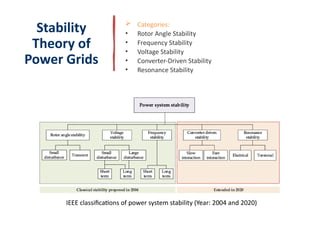
 Categories:
• Rotor Angle Stability
• Frequency Stability
• Voltage Stability
• Converter-Driven Stability
• Resonance Stability
IEEE classifications of power system stability (Year: 2004 and 2020)
Rotor Angle
Stability
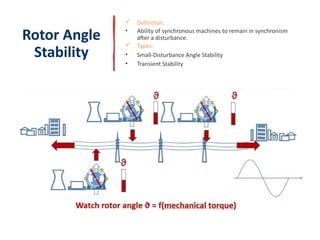
 Definition:
• Ability of synchronous machines to remain in synchronism
after a disturbance.
 Types:
• Small-Disturbance Angle Stability
• Transient Stability
Voltage
Stability
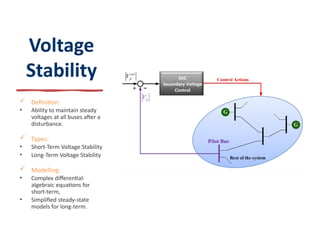
 Definition:
• Ability to maintain steady
voltages at all buses after a
disturbance.
 Types:
• Short-Term Voltage Stability
• Long-Term Voltage Stability
 Modelling:
• Complex differential-
algebraic equations for
short-term,
• Simplified steady-state
models for long-term.
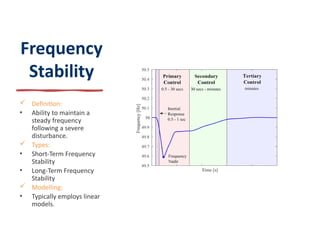
Frequency
Stability
 Definition:
• Ability to maintain a
steady frequency
following a severe
disturbance.
 Types:
• Short-Term Frequency
Stability
• Long-Term Frequency
Stability
 Modelling:
• Typically employs linear
models.
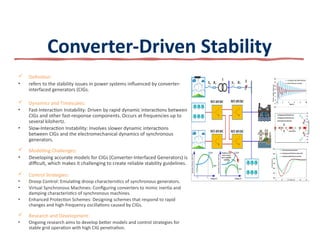
Converter-Driven Stability
 Definition:
• refers to the stability issues in power systems influenced by converter-
interfaced generators (CIGs.
 Dynamics and Timescales:
• Fast-Interaction Instability: Driven by rapid dynamic interactions between
CIGs and other fast-response components. Occurs at frequencies up to
several kilohertz.
• Slow-Interaction Instability: Involves slower dynamic interactions
between CIGs and the electromechanical dynamics of synchronous
generators.
 Modelling Challenges:
• Developing accurate models for CIGs (Converter-Interfaced Generators) is
difficult, which makes it challenging to create reliable stability guidelines.
 Control Strategies:
• Droop Control: Emulating droop characteristics of synchronous generators.
• Virtual Synchronous Machines: Configuring converters to mimic inertia and
damping characteristics of synchronous machines.
• Enhanced Protection Schemes: Designing schemes that respond to rapid
changes and high-frequency oscillations caused by CIGs.
 Research and Development:
• Ongoing research aims to develop better models and control strategies for
stable grid operation with high CIG penetration.
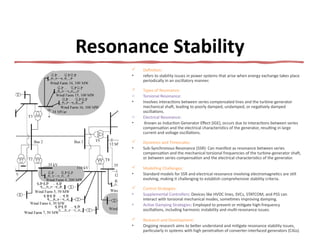
Resonance Stability
 Definition:
• refers to stability issues in power systems that arise when energy exchange takes place
periodically in an oscillatory manner.
 Types of Resonance:
o Torsional Resonance:
• Involves interactions between series compensated lines and the turbine-generator
mechanical shaft, leading to poorly damped, undamped, or negatively damped
oscillations.
o Electrical Resonance:
• Known as Induction Generator Effect (IGE), occurs due to interactions between series
compensation and the electrical characteristics of the generator, resulting in large
current and voltage oscillations.
 Dynamics and Timescales:
• Sub-Synchronous Resonance (SSR): Can manifest as resonance between series
compensation and the mechanical torsional frequencies of the turbine-generator shaft,
or between series compensation and the electrical characteristics of the generator.
 Modelling Challenges:
• Standard models for SSR and electrical resonance involving electromagnetics are still
evolving, making it challenging to establish comprehensive stability criteria.
 Control Strategies:
• Supplemental Controllers: Devices like HVDC lines, SVCs, STATCOM, and PSS can
interact with torsional mechanical modes, sometimes improving damping.
• Active Damping Strategies: Employed to prevent or mitigate high-frequency
oscillations, including harmonic instability and multi-resonance issues.
 Research and Development:
• Ongoing research aims to better understand and mitigate resonance stability issues,
particularly in systems with high penetration of converter-interfaced generators (CIGs).
Control of
Power Grids
 Frequency Control:
 Traditional:
o Primary,
o Secondary,
o Tertiary.
 New Challenges:
o Variability, Reduced
Inertia.
 New Methods:
o Advanced Control,
o Energy Storage,
o Demand-Side
Management.
Voltage
Control
 Traditional:
• Preventive and corrective
measures, hierarchical
structure.
 New Challenges:
• Voltage Fluctuations,
• Reverse Power Flow.
 New Methods:
• Coordination of DERs,
• Coordinated Control
Frameworks,
• Network Reconfiguration.
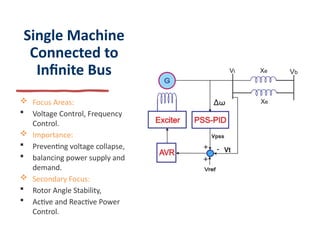
Single Machine
Connected to
Infinite Bus
 Focus Areas:
 Voltage Control, Frequency
Control.
 Importance:
 Preventing voltage collapse,
 balancing power supply and
demand.
 Secondary Focus:
 Rotor Angle Stability,
 Active and Reactive Power
Control.
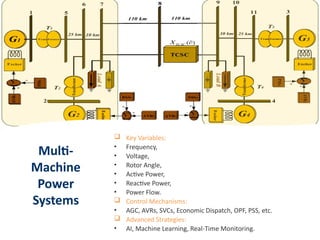
Multi-
Machine
Power
Systems
 Key Variables:
• Frequency,
• Voltage,
• Rotor Angle,
• Active Power,
• Reactive Power,
• Power Flow.
 Control Mechanisms:
• AGC, AVRs, SVCs, Economic Dispatch, OPF, PSS, etc.
 Advanced Strategies:
• AI, Machine Learning, Real-Time Monitoring.
Thank you for your
attention!

Stability_and_Control_of_Power_Grids_Designed.pptx

  • 1.
    Stability and Controlof Power Grids
  • 2.
    Stability Theory of Power Grids Categories: • Rotor Angle Stability • Frequency Stability • Voltage Stability • Converter-Driven Stability • Resonance Stability IEEE classifications of power system stability (Year: 2004 and 2020)
  • 3.
    Rotor Angle Stability  Definition: •Ability of synchronous machines to remain in synchronism after a disturbance.  Types: • Small-Disturbance Angle Stability • Transient Stability
  • 4.
    Voltage Stability  Definition: • Abilityto maintain steady voltages at all buses after a disturbance.  Types: • Short-Term Voltage Stability • Long-Term Voltage Stability  Modelling: • Complex differential- algebraic equations for short-term, • Simplified steady-state models for long-term.
  • 5.
    Frequency Stability  Definition: • Abilityto maintain a steady frequency following a severe disturbance.  Types: • Short-Term Frequency Stability • Long-Term Frequency Stability  Modelling: • Typically employs linear models.
  • 6.
    Converter-Driven Stability  Definition: •refers to the stability issues in power systems influenced by converter- interfaced generators (CIGs.  Dynamics and Timescales: • Fast-Interaction Instability: Driven by rapid dynamic interactions between CIGs and other fast-response components. Occurs at frequencies up to several kilohertz. • Slow-Interaction Instability: Involves slower dynamic interactions between CIGs and the electromechanical dynamics of synchronous generators.  Modelling Challenges: • Developing accurate models for CIGs (Converter-Interfaced Generators) is difficult, which makes it challenging to create reliable stability guidelines.  Control Strategies: • Droop Control: Emulating droop characteristics of synchronous generators. • Virtual Synchronous Machines: Configuring converters to mimic inertia and damping characteristics of synchronous machines. • Enhanced Protection Schemes: Designing schemes that respond to rapid changes and high-frequency oscillations caused by CIGs.  Research and Development: • Ongoing research aims to develop better models and control strategies for stable grid operation with high CIG penetration.
  • 7.
    Resonance Stability  Definition: •refers to stability issues in power systems that arise when energy exchange takes place periodically in an oscillatory manner.  Types of Resonance: o Torsional Resonance: • Involves interactions between series compensated lines and the turbine-generator mechanical shaft, leading to poorly damped, undamped, or negatively damped oscillations. o Electrical Resonance: • Known as Induction Generator Effect (IGE), occurs due to interactions between series compensation and the electrical characteristics of the generator, resulting in large current and voltage oscillations.  Dynamics and Timescales: • Sub-Synchronous Resonance (SSR): Can manifest as resonance between series compensation and the mechanical torsional frequencies of the turbine-generator shaft, or between series compensation and the electrical characteristics of the generator.  Modelling Challenges: • Standard models for SSR and electrical resonance involving electromagnetics are still evolving, making it challenging to establish comprehensive stability criteria.  Control Strategies: • Supplemental Controllers: Devices like HVDC lines, SVCs, STATCOM, and PSS can interact with torsional mechanical modes, sometimes improving damping. • Active Damping Strategies: Employed to prevent or mitigate high-frequency oscillations, including harmonic instability and multi-resonance issues.  Research and Development: • Ongoing research aims to better understand and mitigate resonance stability issues, particularly in systems with high penetration of converter-interfaced generators (CIGs).
  • 8.
    Control of Power Grids Frequency Control:  Traditional: o Primary, o Secondary, o Tertiary.  New Challenges: o Variability, Reduced Inertia.  New Methods: o Advanced Control, o Energy Storage, o Demand-Side Management.
  • 9.
    Voltage Control  Traditional: • Preventiveand corrective measures, hierarchical structure.  New Challenges: • Voltage Fluctuations, • Reverse Power Flow.  New Methods: • Coordination of DERs, • Coordinated Control Frameworks, • Network Reconfiguration.
  • 10.
    Single Machine Connected to InfiniteBus  Focus Areas:  Voltage Control, Frequency Control.  Importance:  Preventing voltage collapse,  balancing power supply and demand.  Secondary Focus:  Rotor Angle Stability,  Active and Reactive Power Control.
  • 11.
    Multi- Machine Power Systems  Key Variables: •Frequency, • Voltage, • Rotor Angle, • Active Power, • Reactive Power, • Power Flow.  Control Mechanisms: • AGC, AVRs, SVCs, Economic Dispatch, OPF, PSS, etc.  Advanced Strategies: • AI, Machine Learning, Real-Time Monitoring.
  • 12.
    Thank you foryour attention!