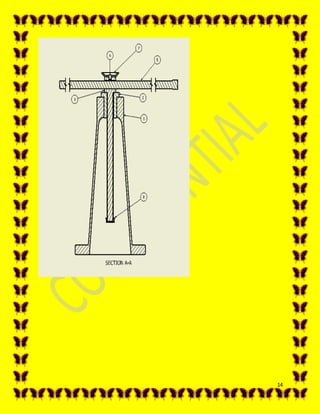
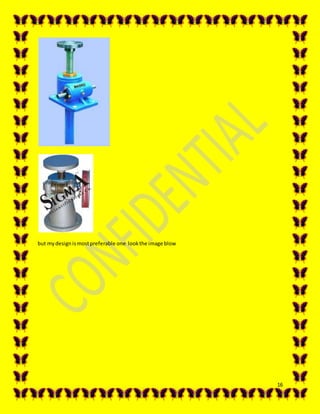
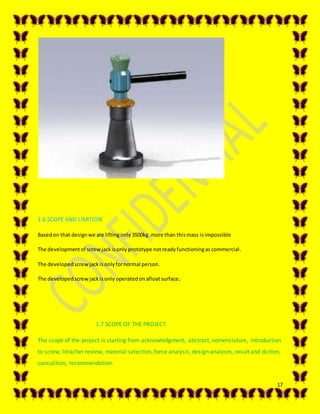
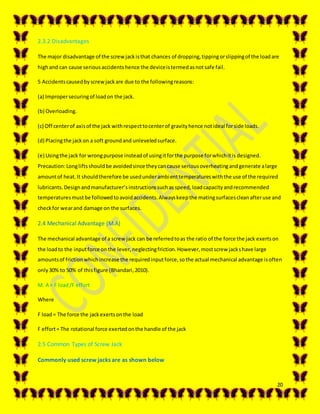
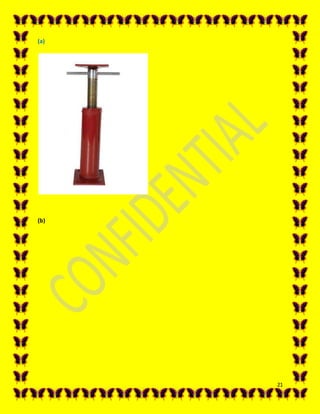
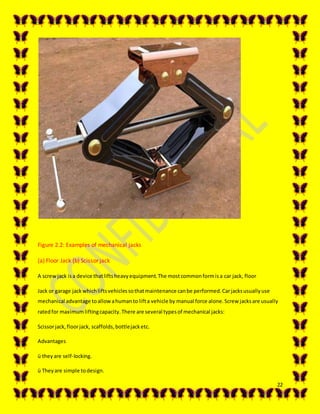
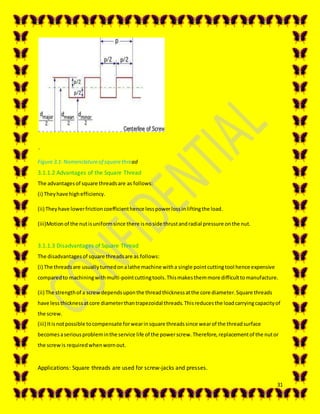
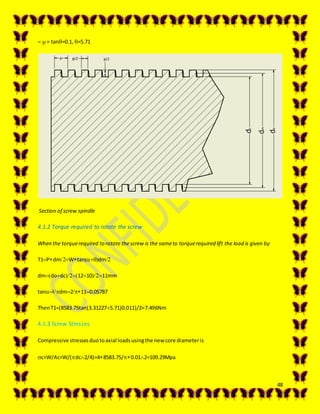
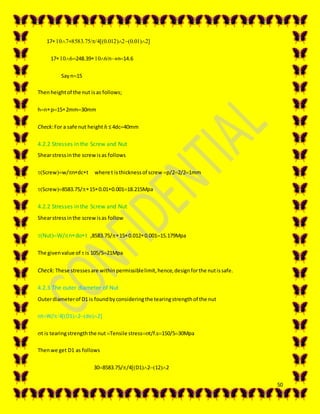
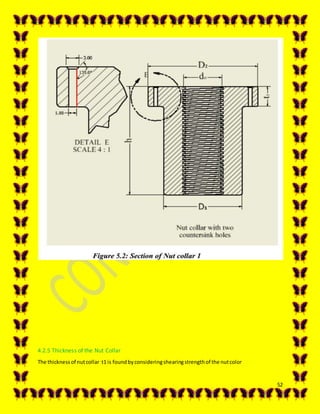
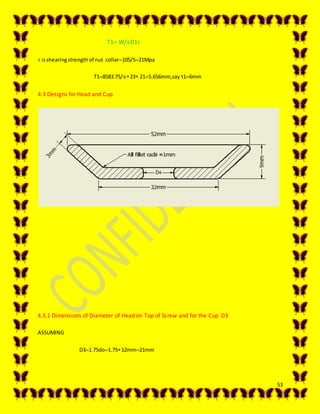
This document provides information about screw jacks. It discusses the working principle, construction, advantages, disadvantages and common types of screw jacks. Specifically, it notes that a screw jack consists of a screw and nut, where the nut remains stationary and the screw is rotated using a handle to lift a load. It provides mechanical advantage by converting rotational force to linear force. Advantages include self-locking ability to hold loads, while disadvantages include potential for accidents if not used properly. Common types of screw jacks include floor jacks and scissor jacks used to lift vehicles. Mechanical advantage is defined as the ratio of load force to input force, neglecting friction.























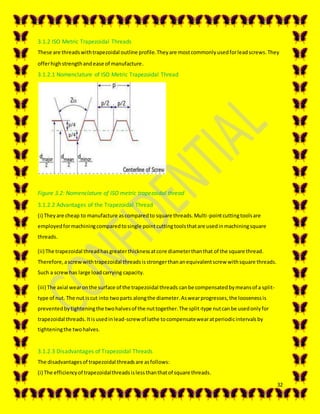
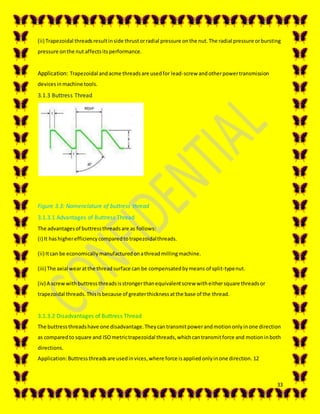

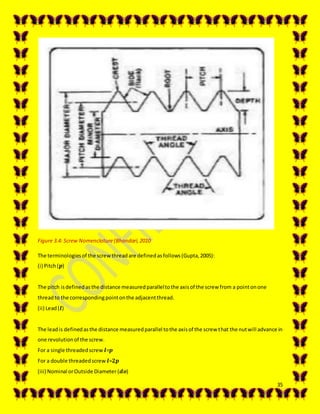
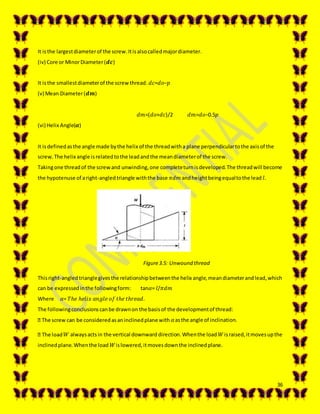
![38
Where
𝜃 = the frictionangle.
Substituting(3.4) intoequation (3.3),
𝑃=(tan𝜃+tan𝛼)/(1−tan𝜃tan𝛼) (3.5)
𝑃=𝑊tan(𝛼+𝜃) (3.6)
The torque 𝑇 requiredtoraise the loadis givenby: 𝑇=𝑃×𝑑𝑚/2
Whence
𝑇=[𝑊tan(𝛼+𝜃)]𝑑𝑚/2 (3.7)
3.5 Torque Requirement - LoweringLoad
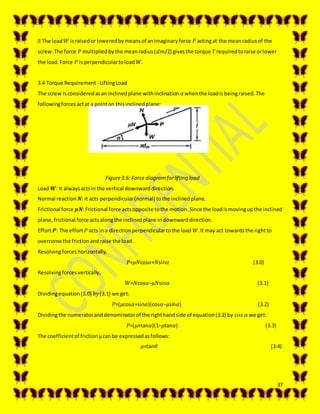
Whenthe loadis beinglowered,the following forcesactat a pointonthe inclinedplane:
Load 𝑾: It alwaysactsin the vertical downwarddirection.
Normal reaction 𝑵: It acts perpendicular(normal) tothe inclinedplane.
Frictional force 𝝁𝑵:Frictional force actsopposite tothe motion.Since the loadismovingdownthe
inclinedplane,frictional force actsalongthe inclinedplane inthe upwarddirection
Figure 3.7: Force diagramforlowering load
Effort 𝑷: The effort 𝑃 acts ina directionperpendiculartothe load 𝑊.It shouldact towardsleftto
overcome the frictionandlowerthe load.
Resolvinghorizontally,
𝑃 = 𝜇 𝑁 𝑐𝑜𝑠 𝛼 − 𝑁 𝑠𝑖𝑛 𝛼 (3.8)
Resolvingvertically,
𝑊 = 𝑁 𝑐𝑜𝑠 𝛼 + 𝜇 𝑁 𝑠𝑖𝑛 𝛼 (3.9)](https://image.slidesharecdn.com/ssss-170603145133/85/Ssss-38-320.jpg)
![39
Dividingexpression(3.8) by(3.9) we get as follows:
𝑃=(𝜇cos𝛼−sin𝛼)/(cos𝛼+𝜇sin𝛼)
(3.10)
Dividingthe numeratoranddenominatorof the righthandside of equation(3.10) by cos α:
𝑃=(𝜇−tan𝛼)/(1+𝜇tan𝛼)
(3.11)
Substitutingequation(3.4) intoEquation(3.11),
𝑃=(tan𝜃−tan𝛼)/(1+tan𝜃tan𝛼)
(3.12)
Whence
𝑃 = 𝑊 𝑡𝑎𝑛 (𝜃 − 𝛼) (3.13)
The torque 𝑇 requiredtolowerthe loadisgivenby, 𝑇=𝑃×𝑑𝑚/2
Whence
𝑇=[𝑊tan(𝜃−𝛼)]𝑑𝑚/2
(3.14)
3.6 OverHaulingandSelf-LockingScrews
From equation(3.14),we knowtorque requiredtolowerloadisgivenby: 𝑇=[𝑊tan(𝜃−𝛼)]𝑑𝑚/218](https://image.slidesharecdn.com/ssss-170603145133/85/Ssss-39-320.jpg)













![71
References
1. Ashby, M. F., 2005. Material Selection in Mechanical Design. 3rd ed. New York: Pergamon Press
.
2. Bhandari, V. B., 2010. Design of Machine Elements. Third Edition ed. New Delhi: Tata McGraw-
Hill Education.
3. Collection, J., 2015. hubpages.com› Autos › Automobile History. [Online] Available at:
https://www.history of screw jacks.com [Accessed 11 November 2015].
4. Fasteners, C. o., 2005. Technical Reference Guide. Ninth Edition ed. Winona, Minnesota: Fastenal
Industrial & Construction Supplies.
5. Gupta, R. K. &. J., 2005. Theory of Machines. Revised Edition ed. Punjab, India: S. Chand and
Company](https://image.slidesharecdn.com/ssss-170603145133/85/Ssss-71-320.jpg)










![Final report[1]](https://cdn.slidesharecdn.com/ss_thumbnails/finalreport1-170515065010-thumbnail.jpg?width=640&height=640&fit=bounds)


