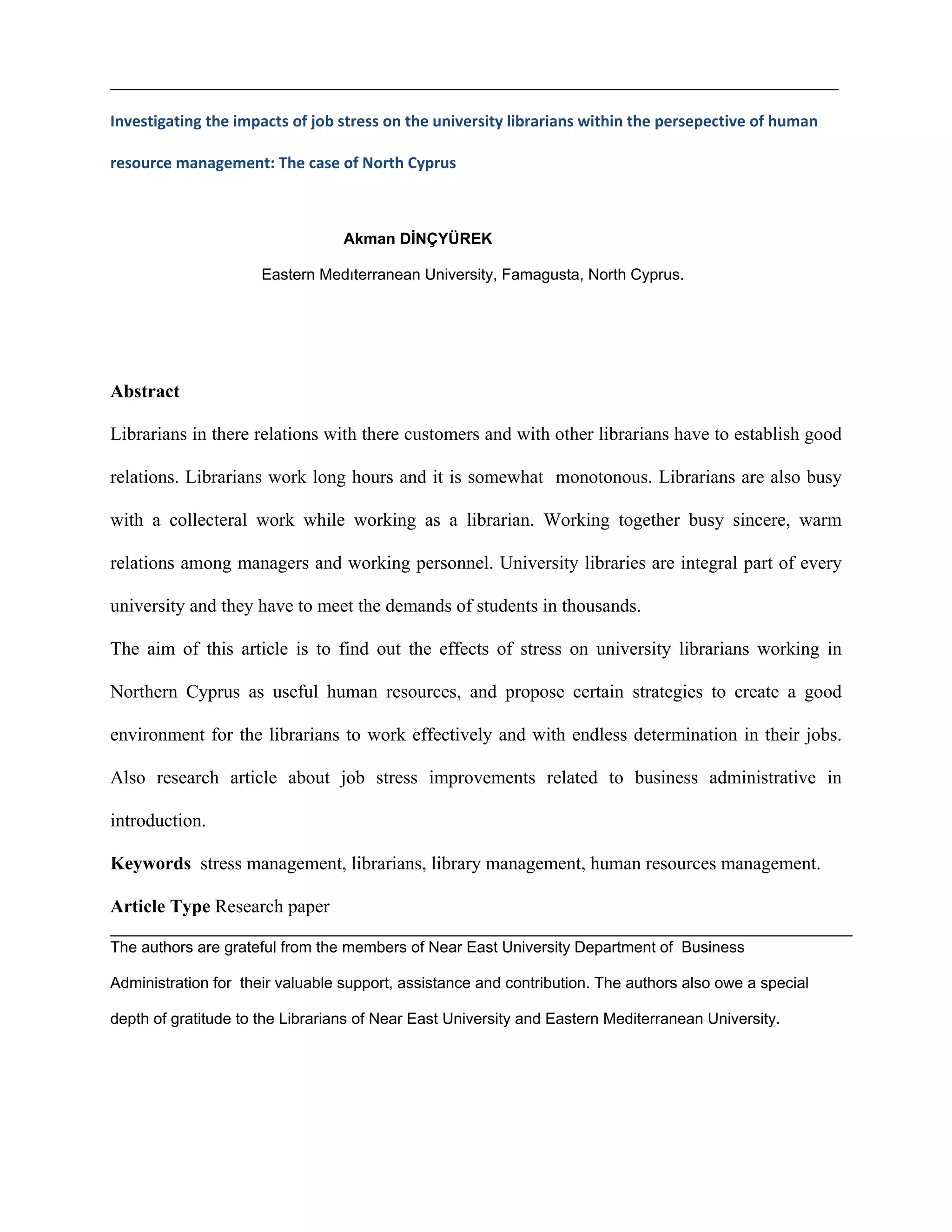
Investigating the impacts of job stress on the university librarians within the persepective of human 
resource management: The case of North Cyprus
Akman DİNÇYÜREK
Eastern Medıterranean University, Famagusta, North Cyprus.
Abstract
Librarians in there relations with there customers and with other librarians have to establish good
relations. Librarians work long hours and it is somewhat monotonous. Librarians are also busy
with a collecteral work while working as a librarian. Working together busy sincere, warm
relations among managers and working personnel. University libraries are integral part of every
university and they have to meet the demands of students in thousands.
The aim of this article is to find out the effects of stress on university librarians working in
Northern Cyprus as useful human resources, and propose certain strategies to create a good
environment for the librarians to work effectively and with endless determination in their jobs.
Also research article about job stress improvements related to business administrative in
introduction.
Keywords stress management, librarians, library management, human resources management.
Article Type Research paper
The authors are grateful from the members of Near East University Department of Business
Administration for their valuable support, assistance and contribution. The authors also owe a special
depth of gratitude to the Librarians of Near East University and Eastern Mediterranean University.
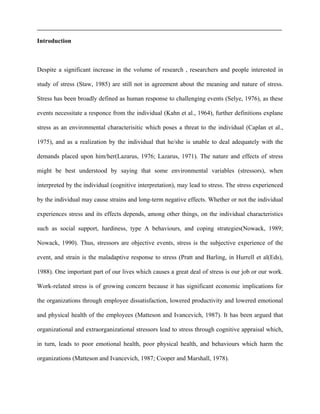
Introduction
Despite a significant increase in the volume of research , researchers and people interested in
study of stress (Staw, 1985) are still not in agreement about the meaning and nature of stress.
Stress has been broadly defined as human response to challenging events (Selye, 1976), as these
events necessitate a responce from the individual (Kahn et al., 1964), further definitions explane
stress as an environmental characterisitic which poses a threat to the individual (Caplan et al.,
1975), and as a realization by the individual that he/she is unable to deal adequately with the
demands placed upon him/her(Lazarus, 1976; Lazarus, 1971). The nature and effects of stress
might be best understood by saying that some environmental variables (stressors), when
interpreted by the individual (cognitive interpretation), may lead to stress. The stress experienced
by the individual may cause strains and long-term negative effects. Whether or not the individual
experiences stress and its effects depends, among other things, on the individual characteristics
such as social support, hardiness, type A behaviours, and coping strategies(Nowack, 1989;
Nowack, 1990). Thus, stressors are objective events, stress is the subjective experience of the
event, and strain is the maladaptive response to stress (Pratt and Barling, in Hurrell et al(Eds),
1988). One important part of our lives which causes a great deal of stress is our job or our work.
Work-related stress is of growing concern because it has significant economic implications for
the organizations through employee dissatisfaction, lowered productivity and lowered emotional
and physical health of the employees (Matteson and Ivancevich, 1987). It has been argued that
organizational and extraorganizational stressors lead to stress through cognitive appraisal which,
in turn, leads to poor emotional health, poor physical health, and behaviours which harm the
organizations (Matteson and Ivancevich, 1987; Cooper and Marshall, 1978).
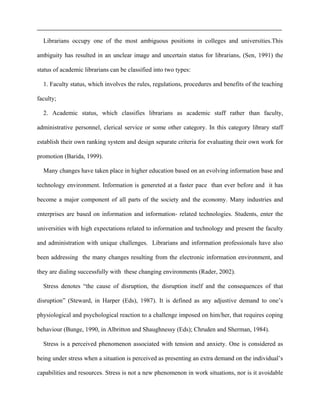
Librarians occupy one of the most ambiguous positions in colleges and universities.This
ambiguity has resulted in an unclear image and uncertain status for librarians, (Sen, 1991) the
status of academic librarians can be classified into two types:
1. Faculty status, which involves the rules, regulations, procedures and benefits of the teaching
faculty;
2. Academic status, which classifies librarians as academic staff rather than faculty,
administrative personnel, clerical service or some other category. In this category library staff
establish their own ranking system and design separate criteria for evaluating their own work for
promotion (Barida, 1999).
Many changes have taken place in higher education based on an evolving information base and
technology environment. Information is genereted at a faster pace than ever before and it has
become a major component of all parts of the society and the economy. Many industries and
enterprises are based on information and information- related technologies. Students, enter the
universities with high expectations related to information and technology and present the faculty
and administration with unique challenges. Librarians and information professionals have also
been addressing the many changes resulting from the electronic information environment, and
they are dialing successfully with these changing environments (Rader, 2002).
Stress denotes “the cause of disruption, the disruption itself and the consequences of that
disruption” (Steward, in Harper (Eds), 1987). It is defined as any adjustive demand to one’s
physiological and psychological reaction to a challenge imposed on him/her, that requires coping
behaviour (Bunge, 1990, in Albritton and Shaughnessy (Eds); Chruden and Sherman, 1984).
Stress is a perceived phenomenon associated with tension and anxiety. One is considered as
being under stress when a situation is perceived as presenting an extra demand on the individual’s
capabilities and resources. Stress is not a new phenomenon in work situations, nor is it avoidable
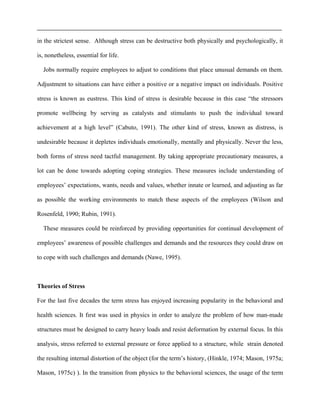
in the strictest sense. Although stress can be destructive both physically and psychologically, it
is, nonetheless, essential for life.
Jobs normally require employees to adjust to conditions that place unusual demands on them.
Adjustment to situations can have either a positive or a negative impact on individuals. Positive
stress is known as eustress. This kind of stress is desirable because in this case “the stressors
promote wellbeing by serving as catalysts and stimulants to push the individual toward
achievement at a high level” (Cabuto, 1991). The other kind of stress, known as distress, is
undesirable because it depletes individuals emotionally, mentally and physically. Never the less,
both forms of stress need tactful management. By taking appropriate precautionary measures, a
lot can be done towards adopting coping strategies. These measures include understanding of
employees’ expectations, wants, needs and values, whether innate or learned, and adjusting as far
as possible the working environments to match these aspects of the employees (Wilson and
Rosenfeld, 1990; Rubin, 1991).
These measures could be reinforced by providing opportunities for continual development of
employees’ awareness of possible challenges and demands and the resources they could draw on
to cope with such challenges and demands (Nawe, 1995).
Theories of Stress
For the last five decades the term stress has enjoyed increasing popularity in the behavioral and
health sciences. It fırst was used in physics in order to analyze the problem of how man-made
structures must be designed to carry heavy loads and resist deformation by external focus. In this
analysis, stress referred to external pressure or force applied to a structure, while strain denoted
the resulting internal distortion of the object (for the term’s history, (Hinkle, 1974; Mason, 1975a;
Mason, 1975c) ). In the transition from physics to the behavioral sciences, the usage of the term
stress changed. In most approaches it now designates bodily processes created by circumstances
that place physical or psychological demands on an individual (Selye, 1976). The external forces
that impinge on the body are called stressors (McGrath, 1982, in Krohne (Eds)).
Theories that focus on the specific relationship between external demands (stressors) and
bodily processes (stress) can be grouped in two diferent categories: approaches to ‘systemic
stress’ based in physiology and psychobiology (among others, (Selye, 1976)) and approaches to
‘psychological stress’ developed within the field of cognitive psychology (Lazarus, 1966;
Lazarus, 1991; Lazarus, 1984; McGrath, 1982).
Systemic Stress : Selye’s Theory
The popularity of the concept of stress in science and mass media stems largely from the work of
the endocrinologist Hans Selye. In a series of animal studies he observed that a variety of
stimulus events (e.g., heat, cold, toxic agents) applied intensely and long enough are capable of
producing common effects, meaning not specific to either stimulus event. (Besides these
nonspecific changes in the body, each stimulus produces, of course, its specific effect, heat, for
example, produces vasodilatation, and cold vasoconstriction.)
According to Selye, these “nonspecifically caused changes” constitute the stereotypical, i.e.,
specific, response pattern of systemic stress. Selye (Selye, 1976) defines this stress as “a state
manifested by a syndrome which consists of all the nonspecifically induced changes in a biologic
system.”This stereotypical response pattern, called the ‘General Adaptation Syndrome’ (GAS),
proceeds in three stages. (a) The’alarm reaction’ comprises an initial shock phase and a
subsequent countershock phase. The shock phase exhibits autonomic excitability, an increased
adrenaline discharge, and gastro-intestinal ulcerations. The countershock phase marks the initial
operation of defensive processes and is characterized by increased adrenocortical activity. (b) If
noxious stimulation continues, the organism enters the ‘stage of resistance’. In this stage, the
symptoms of the alarm reaction disappear, which seemingly indicates the organism’s adaptation
to the stressor. However, while resistance to the noxious stimulation increases, resistance to other
kinds of stressors decreases at the same time. (c) If the aversive stimulation persists, resistance
gives way to the ‘stage of exhaustion’. The organism’s capability of adapting to the stressor is
exhausted, the symptoms of stage (a) reappear, but resistance is no longer possible. Irreversible
tissue damages appear, and, if the stimulation persists, the organism dies.
Psychological Stress: The Lazarus Theory
Two concepts are central to any psychological stress theory: appraisal, i.e., individuals’
evaluation of the significance of what is happening to their well-being, and coping, i.e.,
individuals’ efforts in thought and action to manage specific demands (Lazarus, 1993)
Since its first presentation as a comprehensive theory (Lazarus, 1966), the Lazarus stress
theory has undergone several essential revisions (Lazarus, 1991; Lazarus, 1984; Lazarus and
Launier, 1978). In the latest version (Lazarus, 1991), stress is regarded as a relational concept,
i.e., stress is not defined as a specific kind of external stimulation or a specific pattern of
physiological, behavioral, or subjective reactions. Instead, stress is viewed as a relationship
(‘transaction’) between individuals and their environment. “Psychological stress refers to a
relationship with the environment that the person appraises as significant for his or her well being
and in which the demands tax or exceed available coping resources” (Lazarus and Folkman,
1986, in Appley and Trumbull (Eds)). This definition points to two processes as central mediators
within the person–environment transaction: cognitive appraisal and coping. The concept of
appraisal, introduced into emotion research by Arnold (Arnold, 1960) and elaborated with
respect to stress processes by Lazarus (Lazarus, 1966; Lazarus and Launier, 1978), is a key factor
for understanding stress relevant transactions. This concept is based on the idea that emotional
processes (including stress) are dependent on actual expectancies that persons manifest with
regard to the significance and outcome of a specific encounter. This concept is necessary to
explain individual differences in quality, intensity, and duration of an elicited emotion in
environments that are objectively equal for different individuals. It is generally assumed that the
resulting state is generated, maintained, and eventually altered by a specific pattern of appraisals.
These appraisals, in turn, are determined by a number of personal and situational factors. The
most important factors on the personal side are motivational dispositions, goals, values, and
generalized expectancies. Relevant situational parameters are predictability, controllability, and
imminence of a potentially stressful event. In his monograph on emotion and adaptation, Lazarus
(Lazarus, 1991) developed a comprehensive emotion theory that also includes a stress theory
Lazarus (Lazarus, 1993). This theory distinguishes two basic forms of appraisal; primary and
secondary appraisal (see also (Lazarus, 1966)). These forms rely on different sources of
information. Primary appraisal is concerned with whether something of relevance to the
individual’s well being occurs, whereas secondary appraisal deals with coping options.
Resource Theories of Stress: A Bridge between Systemic and Cognitive Viewpoints
Unlike approaches discussed so far, resource theories of stress are not primarily concerned with
factors that create stress, but with resources that preserve well being in the face of stressful
encounters. Several social and personal constructs have been proposed, such as social support
(Schwarzer and Leppin, 1991), sense of coherence (Antonovsky, 1979), hardiness (Kobasa,
1979), self-efficacy (Bandura, 1977), or optimism (Scheier, 1992). While self-efficacy and
optimism are single protective factors, hardiness and sense of coherence represent tripartite
approaches. Hardiness is an amalgamation of three components:
Internal control, commitment, and a sense of challenge as opposed to threat. Similarly, sense of
coherence consists of believing that the world is meaningful, predictable, and basically
benevolent. Within the social support field, several types have been investigated, such as
instrumental, informational, appraisal, and emotional support. The recently offered conservation
of resources (COR) theory (Hopfoll, 1989; Hopfoll et al., 1996) assumes that stress occurs in any
of three contexts: when people experience loss of resources, when resources are threatened, or
when people invest their resources without subsequent gain. Four categories of resources are
proposed: object resources (i.e., physical objects such as home, clothing, or access to
transportation), condition resources (e.g., employment, personal relationships), personal
resources (e.g., skills or self-efficacy), and energy resources (means that facilitate the attainment
of other resources, for example, money, credit, or knowledge).
Hobfoll and his colleagues outlined a number of testable hypotheses (called principles) derived
from basic assumptions of COR (Hopfoll et al., 1996 ).
Coping Theories
The Lazarus model outlined above represents specific types of coping theories. These theories
may be classified according to two independent parameters: (a) trait-oriented versus state-
oriented, and (b) microanalytic versus macroanalytic approaches (Krohne, 1996). Trait-oriented
and state-oriented research strategies have different objectives: The ‘trait-oriented’ (or
dispositional) strategy aims at early identification of individuals whose coping resources and
tendencies are inadequate for the demands of a specific stressful encounter. An early
identification of these persons will offer the opportunity for establishing a selection (or
placement) procedure or a successful primary prevention program. Research that is ‘state-
oriented,’ i.e., which centers around actual coping, has a more general objective (Smelser and
Baltes, 2004).
The Origins of Stress Research
Stress is a term that is often related to a psychological or physical state of health (Sapolsky, 1994)
and is used by many psychological, sociological, and medical scientists as well as laymen. The
first definition of the term was proposed by Cannon (Cannon, 1935). He postulated that passing
a critical stress level, triggered by physical and emotional stimuli, endangers the homeostatic
control of an organism. However, the name that is most closely associated with stress is Hans
Selye, who defined stress as a nonspecific response of the body to any demand characterized by
the secretion of glucocorticoids (Smelser and Baltes, 2004). Selye (Selye, 1964) was the first to
use the term “stress” to describe a set of physical and psychological responses to adverse
conditions or influences.
Originally the syndrome of just being sick (Selye, 1936) covered the stereotypical response of
an organism to a wide range of chemical, biological, or physical stimuli. In later seeking a term to
cover this typical response Selye used the word “stress”, an engineering term for a force which
causes deformation in bodies. Unfortunately, this term should have been more properly applied to
the various stimuli applied to the organisms. The term “strain”, which in engineering refers to the
manifestation of stress in an actual body, or the deformation of a material under a stress, should
have been used for the resulting responses. Since this early use of the term stress, there has been
continuing confusion and disagreement on the current nomenclature in the field(Levi, 1998).
Selye (Selye, 1956) used the term “stressor” to describe the external force or influence acting
on the individual and “stress” to denote the resulting reaction, terminology adopted by many
others (e.g. Code and Langan, 2001; Maslach, 1998, in Cooper (Eds); Quick et al., 2001). Some
authors have used stress to denote such external forces and strain to denote the resulting reaction
(e.g. Edwards, 1998, in Cooper(Eds.)), while others failed to clearly define how they were using
the terminology at all (e.g. Smit and Schabracq, 1998; Wiholm et al., 2000). Further, some have
simply used stress as a blanket term covering the whole process of external influence, appraisal,
reaction, and effect [e.g. Deary et al., 1996). Even at the most basic level of terminology a
problem has existed in distinguishing between independent, intervening, and dependent variables
as far as stress research is concerned (Cooper, 1998).
“Stress”, as used in the literature, may refer to external influences acting on individuals
(Selye’s stressors) (Selye, 1956), physiological reactions to such influences (Selye’s original
stress concept) (Mayer, 2000; Selye, 1956), psychological interpretation of both the external
influences and the physiological reactions (Code and Langan, 2001; Selye, 1983), and adverse
behavioural reactions exhibited in work, or social situations, or both (Richmond and Kehoe,
1999; Vasse et al., 1998). This inconsistency in the use of stress-related constructs may well have
contributed to the even greater confusion over the concept of eustress. Distress and eustress were
originally both subsumed within the larger definition of stress but were regarded as different and
distinct from each other(Le Fevre et al., 2003).
The concept of an optimal amount of stress arose from the Yerkes Dodson Law that indicates
that increasing stress is beneficial to performance until some optimum level is reached, after
which performance will decline, the familiar inverted U diagram (Benson and Allen, 1980; Certo,
2003). The inverted U is often drawn with stress or arousal on the horizontal axis and
performance on the vertical axis. It is interesting to note, that the words stress, arousal, and
performance do not appear at any time in the original paper (Yerkes and Dodson, 1908).
Job Stress
Job stressors may refer to any characteristic of the workplace that poses a threat to the individual.
Job stressors can relate to either job demands a person cannot meet or the lack of sufficient
resources to meet them (French and Caplan, 1972). For stress to exist, the demand from the
environment (the job) versus the capability of the individual (the employee) will typically be
considerably out of balance. Individuals experience job stress when they have little or no control
over their jobs or when work demands exceed their abilities (Donovan and Kleiner, 1994). Job
stress also occurs when conditions on a job inhibit, stifle, or thwart the attainment of expectations
and goals (Larson, 2004). Not all job stress is bad because a certain amount of job stress has been
shown to improve both effectiveness and performance (Brief et al., 1981).
A person’s response to stressors will be somewhat mediated by various individual personality
traits. Individual qualities affect how a person will respond to stress in three major ways (Schuler,
1980). First, because individual needs and values define the person’s desires, the individual
qualities determine the relative importance of events or occurrences to the person. Second,
individual abilities and past experiences affect the choice of strategies to deal with stressful
events. Third, the individual’s choice of strategies to deal with stress is influenced by personality
characteristics. Consequently, individuals will differ in the ways they respond to an identical
event depending on these individual qualities. Events that are very stressful for one individual
may not be stressful to another. Consequently, individuals vary in the amount of stress they can
tolerate without showing signs of job-related tension (Ivancevich and Matteson, 1980).
Stress is a naturally occurring experience that may have either beneficial or destructive
consequences. Stress is a physical response, but the stressors that trigger the response are
typically social, psychological, or symbolic, and consequently require no physical action. Stress
is very hard on the human body because the body is preparing for a physiological response to a
non-physical demand. The cumulative result is a major strain on a person’s body that can lead to
illness. The more frequently the person is in a stress-response mode, the more susceptible that
individual is to fatigue, disease, disability, aging, and death (Matteson and Ivacevich, 1987).
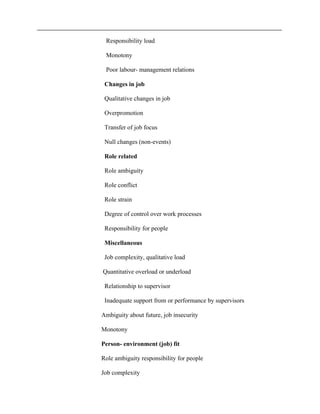
Source of stress percentages Adapted from Sutherland and Davidson (1989 ) article on high.
Inadequacy/inconsistency of communication flow , work-load - constant time pressure, conflict
of boundary situations , working long hours , The company strategy - competitive/dynamic/go-
getting image, changing staffing problems as high effects are established.
Physical properties of the working environment
Physical hazards, chronic dangers
Extremes of heat, cold, humidity, pressure, etc.
Bad man-machine design
Time variables
Non-standard working hours (shift work)
Deadlines
Time pressure
Social and organizational properties of work and its
setting
Work-load, overload
Responsibility load
Monotony
Poor labour- management relations
Changes in job
Qualitative changes in job
Overpromotion
Transfer of job focus
Null changes (non-events)
Role related
Role ambiguity
Role conflict
Role strain
Degree of control over work processes
Responsibility for people
Miscellaneous
Job complexity, qualitative load
Quantitative overload or underload
Relationship to supervisor
Inadequate support from or performance by supervisors
Ambiguity about future, job insecurity
Monotony
Person- environment (job) fit
Role ambiguity responsibility for people
Job complexity
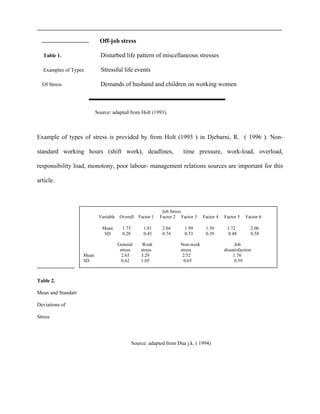
Off-job stress
Table 1. Disturbed life pattern of miscellaneous stresses
Examples of Types Stressful life events
Of Stress Demands of husband and children on working women
Source: adapted from Holt (1993).
Example of types of stress is provided by from Holt (1993 ) in Djebarni, R. ( 1996 ). Non-
standard working hours (shift work), deadlines, time pressure, work-load, overload,
responsibility load, monotony, poor labour- management relations sources are important for this
article.
Table 2.
Mean and Standart
Deviations of
Stress
Source: adapted from Dua j.k. ( 1994)
Job Stress
Variable Overall Factor 1 Factor 2 Factor 3 Factor 4 Factor 5 Factor 6
Mean 1.73 1.81 2.04 1.99 1.30 1.72 2.06
SD 0.28 0.45 0.74 0.53 0.39 0.48 0.58
General Work Non-work Job
stress stress stress dissatisfaction
Mean 2.65 3.29 2.52 1.76
SD 0.62 1.05 0.65 0.59
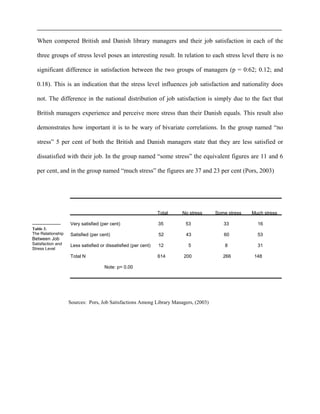
Table 3.
The Relationship
Between Job
Satisfaction and
Stress Level
When compered British and Danish library managers and their job satisfaction in each of the
three groups of stress level poses an interesting result. In relation to each stress level there is no
significant difference in satisfaction between the two groups of managers (p = 0:62; 0.12; and
0.18). This is an indication that the stress level influences job satisfaction and nationality does
not. The difference in the national distribution of job satisfaction is simply due to the fact that
British managers experience and perceive more stress than their Danish equals. This result also
demonstrates how important it is to be wary of bivariate correlations. In the group named “no
stress” 5 per cent of both the British and Danish managers state that they are less satisfied or
dissatisfied with their job. In the group named “some stress” the equivalent figures are 11 and 6
per cent, and in the group named “much stress” the figures are 37 and 23 per cent (Pors, 2003)
Total No stress Some stress Much stress
Very satisfied (per cent) 35 53 33 16
Satisfied (per cent) 52 43 60 53
Less satisfied or dissatisfied (per cent) 12 5 8 31
Total N 614 200 266 148
Note: p= 0.00
Sources: Pors, Job Satisfactions Among Library Managers, (2003)
Purpose of The Study
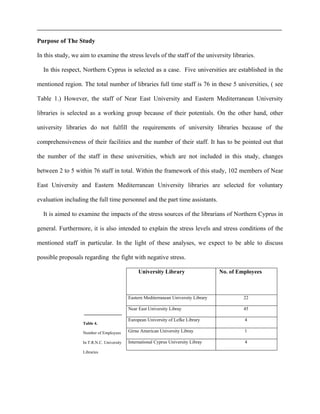
In this study, we aim to examine the stress levels of the staff of the university libraries.
In this respect, Northern Cyprus is selected as a case. Five universities are established in the
mentioned region. The total number of libraries full time staff is 76 in these 5 universities, ( see
Table 1.) However, the staff of Near East University and Eastern Mediterranean University
libraries is selected as a working group because of their potentials. On the other hand, other
university libraries do not fulfill the requirements of university libraries because of the
comprehensiveness of their facilities and the number of their staff. It has to be pointed out that
the number of the staff in these universities, which are not included in this study, changes
between 2 to 5 within 76 staff in total. Within the framework of this study, 102 members of Near
East University and Eastern Mediterranean University libraries are selected for voluntary
evaluation including the full time personnel and the part time assistants.
It is aimed to examine the impacts of the stress sources of the librarians of Northern Cyprus in
general. Furthermore, it is also intended to explain the stress levels and stress conditions of the
mentioned staff in particular. In the light of these analyses, we expect to be able to discuss
possible proposals regarding the fight with negative stress.
Table 4.
Number of Employees
In T.R.N.C. University
Libraries
University Library No. of Employees
Eastern Mediterranean University Library 22
Near East University Libray 45
European University of Lefke Library 4
Girne American University Libray 1
International Cyprus University Libray 4
Mainly, this study is developed in the field of human resources by particular reference to
business administration and human resource management.
Method
Library personnel of the two considerable universities in Cyprus, which are Eastern
Mediterranean University and Near East University, form the main sources of this research
study.
Inputs were achived by applying the inquiry forms to the preselected particular group from the
related group. In other words, sample group was thoroughly analyzed and related information
was gathered after the interpretation of the answer on the inquiry forms.
The already mentioned inquiry form includes four sections, including the explanatory
introduction to the selected research group. In the second part, it is aimed to provide general
information about the selected librarians. The negative impacts on the working conditions and the
moods of the librarians were questioned in the third part of the inquiry forms. The last part was
reserved for the comments of the librarians by asking open-ended questions.
For the analysis of the inquiry forms, SPSS 11 statistical program was used, which is specially
developed for social sciences.
In this study, two universities, which form the backbone of the higher education in Northern
Cyprus, were particularly selected for the realm of the main research group.
In parallel to the development of the universities in northern Cyprus, the University Libraries
which have great roles in higher education, have developed respectively. These selected
universities contain 13000 students and 750 academic staff including part-time academic
members, which point out its great importance in such a small country.
From the since the establishment university libraries in the country ,the working hours of the
librarians are gradually and consistently increased.
Nowadays, the Near East University Library remains open 24 hours a day, seven days a week.
The library personnel work in three shifts. Eastern Mediterranean University Library has also
increased its working hours especially during the exam weeks and weekends. Librarians work
until 01.00 am during the week and until 10.30 pm during the weekends and exam weeks.
Validity and Reliability
Validity
Construct Validity is applied to the inquiry forms and consequently, the data are collected.
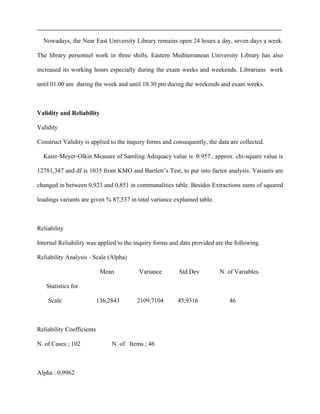
Kaier-Meyer-Olkin Measure of Samling Adequacy value is 0.957 , approx. chi-square value is
12781,347 and df is 1035 from KMO and Bartlett’s Test, to put into factor analysis. Variants are
changed in between 0,923 and 0,851 in communalities table. Besides Extractions sums of squared
loadings variants are given % 87,537 in total variance explained table.
Reliability
Internal Reliability was applied to the inquiry forms and data provided are the following.
Reliability Analysis - Scale (Alpha)
Mean Variance Std.Dev N. of Variables
Statistics for
Scale 136,2843 2109,7104 45,9316 46
Reliability Coefficients
N. of Cases ; 102 N. of Items ; 46
Alpha : 0,9962
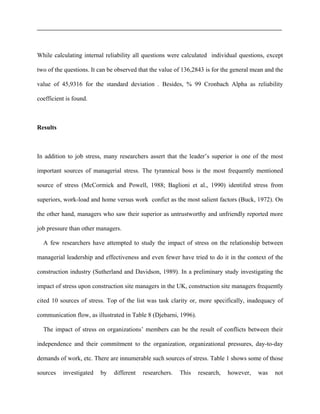
While calculating internal reliability all questions were calculated individual questions, except
two of the questions. It can be observed that the value of 136,2843 is for the general mean and the
value of 45,9316 for the standard deviation . Besides, % 99 Cronbach Alpha as reliability
coefficient is found.
Results
In addition to job stress, many researchers assert that the leader’s superior is one of the most
important sources of managerial stress. The tyrannical boss is the most frequently mentioned
source of stress (McCormick and Powell, 1988; Baglioni et al., 1990) identifed stress from
superiors, work-load and home versus work confict as the most salient factors (Buck, 1972). On
the other hand, managers who saw their superior as untrustworthy and unfriendly reported more
job pressure than other managers.
A few researchers have attempted to study the impact of stress on the relationship between
managerial leadership and effectiveness and even fewer have tried to do it in the context of the
construction industry (Sutherland and Davidson, 1989). In a preliminary study investigating the
impact of stress upon construction site managers in the UK, construction site managers frequently
cited 10 sources of stress. Top of the list was task clarity or, more specifically, inadequacy of
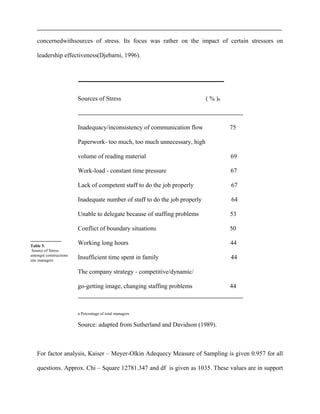
communication flow, as illustrated in Table 8 (Djebarni, 1996).
The impact of stress on organizations’ members can be the result of conflicts between their
independence and their commitment to the organization, organizational pressures, day-to-day
demands of work, etc. There are innumerable such sources of stress. Table 1 shows some of those
sources investigated by different researchers. This research, however, was not
Table 5.
Source of Stress
amongst constructions
site managers
concernedwithsources of stress. Its focus was rather on the impact of certain stressors on
leadership effectiveness(Djebarni, 1996).
Sources of Stress ( % )a
Inadequacy/inconsistency of communication flow 75
Paperwork- too much, too much unnecessary, high
volume of reading material 69
Work-load - constant time pressure 67
Lack of competent staff to do the job properly 67
Inadequate number of staff to do the job properly 64
Unable to delegate because of staffing problems 53
Conflict of boundary situations 50
Working long hours 44
Insufficient time spent in family 44
The company strategy - competitive/dynamic/
go-getting image, changing staffing problems 44
a Percentage of total managers
Source: adapted from Sutherland and Davidson (1989).
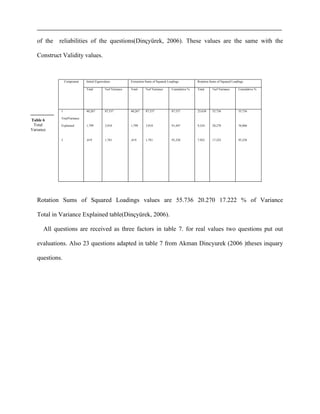
For factor analysis, Kaiser – Meyer-Olkin Adequecy Measure of Sampling is given 0.957 for all
questions. Approx. Chi – Square 12781.347 and df is given as 1035. These values are in support
Table 6
Total
Varıance
of the reliabilities of the questions(Dinçyürek, 2006). These values are the same with the
Construct Validity values.
Rotation Sums of Squared Loadings values are 55.736 20.270 17.222 % of Variance
Total in Variance Explained table(Dinçyürek, 2006).
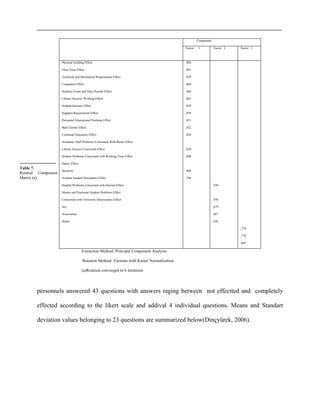
All questions are received as three factors in table 7. for real values two questions put out
evaluations. Also 23 questions adapted in table 7 from Akman Dincyurek (2006 )theses inquary
questions.
Component Initial Eigenvalues Extraction Sums of Squared Loadings Rotation Sums of Squared Loadings
Total %of Variance Total %of Variance Cumulative % Total %of Variance Cumulative %
1
TotalVariance
Explained
3
40,267
1,799
,819
87,537
3,910
1,781
40,267
1,799
,819
87,537
3,910
1,781
87,537
91,447
93,228
25,638
9,324
7,922
55,736
20,270
17,222
55,736
76,006
93,228
Table 7.
Rotated Component
Matrix (a)
Extraction Method: Principal Component Analysis.
Rotation Method: Varimax with Kaiser Normalization
(a)Rotation converged in 6 iterations
personnels answered 43 questions with answers raging between not effectted and completely
effected according to the likert scale and addival 4 individual questions. Means and Standart
deviation values belonging to 23 questions are summarized below(Dinçyürek, 2006).
Component
Factor 1 Factor 2 Factor 3
Physical building Effect
Over-Time Effect
Technical and Mechanical Requirement Effect
Computers Effect
Students Exam and Duty Periods Effect
Library Security Working Effect
Student Increase Effect
Supplies Requirement Effect
Personnel Educational Positions Effect
Bad Climate Effect
Continual Education Effect
Academic Staff Problems Concerned With Books Effect
Library Science Concerned Effect
Student Problems Concerned with Working Time Effect
Salary Effect
Seniority
Asistant Student Nationality Effect
Student Problems Concerned with Internet Effect
Master and Doctorate Student Problems Effect
Concerned with University Directoraties Effect
Sex
Association
Status
,884
,881
,870
,869
,866
,863
,859
,858
,851
,822
,820
,820
,806
,804
,796
,930
,930
,679
,667
,642
,778
,778
,692
Table 8.
Descriptive
Statistics
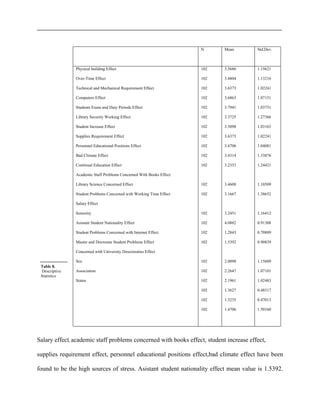
Salary effect, academic staff problems concerned with books effect, student increase effect,
supplies requirement effect, personnel educational positions effect,bad climate effect have been
found to be the high sources of stress. Asistant student nationality effect mean value is 1.5392.
N Mean Std.Dev.
Physical building Effect
Over-Time Effect
Technical and Mechanical Requirement Effect
Computers Effect
Students Exam and Duty Periods Effect
Library Security Working Effect
Student Increase Effect
Supplies Requirement Effect
Personnel Educational Positions Effect
Bad Climate Effect
Continual Education Effect
Academic Staff Problems Concerned With Books Effect
Library Science Concerned Effect
Student Problems Concerned with Working Time Effect
Salary Effect
Seniority
Asistant Student Nationality Effect
Student Problems Concerned with Internet Effect
Master and Doctorate Student Problems Effect
Concerned with University Directoraties Effect
Sex
Association
Status
102
102
102
102
102
102
102
102
102
102
102
102
102
102
102
102
102
102
102
102
102
102
102
3.5686
3.4804
3.6373
3.6863
3.7941
3.3725
3.5098
3.6373
3.4706
3.4314
3.2353
3.4608
3.1667
3.2451
4.0882
1.2843
1.5392
2.0098
2.2647
2.1961
1.3627
1.3235
1.4706
1.15621
1.13216
1.02241
1.07151
1.03731
1.27366
1.03163
1.02241
1.04081
1.33876
1.24421
1.10509
1.38652
1.16412
0.91308
0.70889
0.90839
1.15609
1.07101
1.02483
0.48317
0.47013
1.50160
Table 9.
Descriptive
Statistics 2
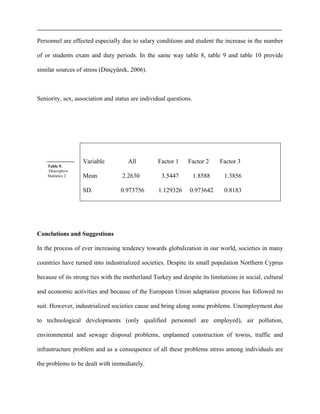
Personnel are effected especially due to salary conditions and student the increase in the number
of or students exam and duty periods. In the same way table 8, table 9 and table 10 provide
similar sources of stress (Dinçyürek, 2006).
Seniority, sex, association and status are individual questions.
Conclutions and Suggestions
In the process of ever increasing tendency towards globalization in our world, societies in many
countries have turned into industrialized societies. Despite its small population Northern Cyprus
because of its strong ties with the motherland Turkey and despite its limitations in social, cultural
and economic activities and because of the European Union adaptation process has followed no
suit. However, industrialized societies cause and bring along some problems. Unemployment due
to technological developments (only qualified personnel are employed), air pollution,
environmental and sewage disposal problems, unplanned construction of towns, traffic and
infrastructure problem and as a consequence of all these problems stress among individuals are
the problems to be dealt with immediately.
Variable All Factor 1 Factor 2 Factor 3
Mean 2.2630 3.5447 1.8588 1.3856
SD. 0.973756 1.129326 0.973642 0.8183
In order to keep pace with competitive markets in a globalized world, a country has to take
necessary precautions to increase performance in the work done.
The basic condition needed to be an educated society is to share authority, take decisions
collectively and a contemporary administration allowing participation in everything. In a society
well informed of everything vocational schools and education must be emphasized in order for
the employment of qualified workers to achieve “total quality Administration” in a country.
The understanding of quality living concept will have positive effects on the stress the society
is undergoing.
Stress among individuals in a society could be minimized if solutions are found to social
security systems , if we become civilized , well informed individuals in the process of adaptation
of new laws and regulations, be well aware of our responsibilities as citizens, if we respect
human rights and support democracy, undergo appropriate education in the way of becoming
well informed individuals, maintain stability in the economy and in politics, spread participative
understanding, put into effect reforms, improve work and working conditions to minimize
underemployment, put into production neglected resources to make reforms in public sector and
to create rein structure economically and legally to improve productivity.
The environment in which we live is constantly changing. Social, economic and technological
developments due affect institutions and workers and render changes in new sectors unavoidable.
No organization could change its policies in the face of every single change in the environment. It
has to reorganize and educate its workers accordingly. Our people could not keep pace with new
developments. This will unavoidably lead to stress within the society.
Individuals under stress in an organization not only harm themselves but affect the whole
organization adversely.
Reactions to stressors differ from do individual to individual. Positive stress increases
motivation while negative stress affects productivity and workers’ health adversely.
Activities to minimize stress are carried out within an organization. These activities could be
summarized under four main headings:
1. Rehabilitation Programs.
2. Aid Programs for Workers.
3. Employment of Stress Consultants.
4. Activities directed towards relations between stress and performance.
Our educational system has abandoned old classic teaching methods. It is becoming more and
more knowledge oriented, put importance on research and consulted to different sources for facts
which are a modern system of education (Dinçyürek, 2006).
Evaluation of answers to questions asked in the research:
1.Librarians live stress in their relations with other personnels of the same status. This type of
relationship affects themselves especially for their relations with top-level administrators.
However the same personnel are not affected by their relations with people working at various
departments of the university. Librarians have to be more careful in their relations.
Administrators have to work hard to specify each personnel’s’ job definition and obligations.
Librarians have to do more work which would help minimize stress and increase productivity.
2.It is observed clearly that stress because of problems between library personnel and students.
Stress directly affects students and librarians.
Important assignment needs frequent visit to libraries. Contrary to public libraries which put
emphasis on novels, story books and newspapers, students visiting libraries at the university
campus look for appropriate source in a short time for a project or exams. This kind of
atmosphere could be distressful, cause anxiety and stress among librarians.
For students, one could say they attend a university for proper education. They are not
interested in the work done in libraries nor listen to complaints of librarians. They are there to
serve the university students for all they care.
Time wasted to get information at libraries could be used for studying. Moreover, students
receiving services at libraries carry to the librarians their social and cultural problems.
It was observed that while students having problems related to internet or Turkish language were
helped and receive prompt service, that is not the case with problems related to English language
and computer works.
3.There is a direct reaction which leads to stress between teaching staff at the university and
librarians.
Librarians are greatly affected by demands of the teaching staff that books and magazines
must be at the disposal university students. Authority delegation between university teaching staff
is no main cause of this stress. Moreover, librarians undergo extreme stress in order to meet the
demands of no teaching staff.
4.Also there is a direct relation between stress and the personnel using the latest technology.
Librarians use various instruments in their work.
The instruments are directly related to the work they perform. If any of the instruments fail to
work, they could not perform their work. Computers are indispensable instruments or apparatus
used by librarians.
Computers are divided into two components software, hardware. Many programs and spouse
parts are involved.
Failures or multifunction in any of these components mean problems for librarians. This is an
important cause of stress among librarians.
5.There also exists relationship between the personnel using the infrastructure and stress.
Librarians exercise bodily effort in their work. Library building is composed of many systems.
For example, in libraries at EMU Campus release central vacuum cleaners, fire alarm systems,
security systems, generator room and central heading and air-conditioning systems. Failure of
any of these systems will be tedious for librarians.
6.There is also direct relationship between stress and overtime working hours. Libraries are
full of students during exams and projects. Sometimes more than 3000 students visit a library
during these periods. Social and cultural demands of students at these periods of times are no
main cause of stress among librarians. Librarians work overtime during periods when students
prepare their thesis. University administrators think of shift working at libraries during these
times. Overtime work sometimes lasts for 5-10 hours everyday. This is of course tiring and
boring.
Principles of human resources administration and total quality administration verify it.
Librarians prefer shift work to overtime work. Overtime is tedious and monotonous but extra pay
serves as an incentive.
As could be noted statistically, librarians are under great stress. Co-operation between
personnels must be achieved. Additionally, balanced relations between top-level and working
staff and also detection of causes of stress are essential for solving this stress problem. Stress is
said to be caused by environmental, organizational or individual factors and direct individuals
behavior and acts.
In order to put the economy at a required level, one has to eliminate factors leading to
underemployment. Productive working conditions must be created by eliminating factors leading
to stress at work(Dinçyürek, 2006).
Suggestions
Stress is an indispensable part of our modern life and if not dealt with it poses a great threat to
every individual in a society.
We recommend the following to the librarians to get rid of stress or at least minimize its effect.
To deal with individual stress:
1. Individuals have to find the sources of stress.
2. Avoid conditions which cause stress.
3. Try to have control over stress.
4. Improve good relations with people they work with.
5. Try to be calm in all cases.
6. Work in a place where they get job satisfaction.
7. Create a calm and organized working condition.
8. Individuals should not get disturbed at every event.
9. Try to have leisure to do something else.
10. Be thrifty.
11. Go on a holiday when they have time and money.
12. Ask for help from experts or from people they work with.
13. Go over their obligations and give up those they find tedious.
14. Know their limits and confine their expectations within these limits.
To deal with organizational stress:
1. Develop a system of priorities.
2. Say no to works which exceed their capacity.
3. Develop open and effective relations and dialogue with administrators.
4. Be open to debate on the date a work is to be finished.
5. Develop good relations with their colleagues at work.
6. Have good relations with people working under their control.
7. If necessary delegate authority to someone else.
8. Resist demands from top-level administrators which may evoke confrontation with their
colleagues.
9. Try to speak with their colleagues or administrators in the event of any misunderstanding
about the work they perform.
10. Organization has to determine the source of stress to individuals and try to eliminate it.
11. For good relations among personnel an organization must schedule public relations
courses.
12. Individual’s obligation and work within an organization must be clearly defined.
13. Emphasis must be put on equipment and infrastructure to increase productivity.
14. Librarians must be subjected to training about the work they perform and taught ways to
deal with stress.
15. Librarians must upgrade themselves constantly and if necessary work with assistants to
train them.
16. Librarians must be lenient towards each other in extreme working conditions.
17. Personnel must avoid unnecessary argument and confrontation with colleagues.
18. Put limitations to the demands of students and avoid tedious work.
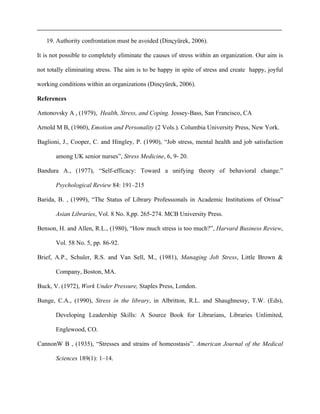
19. Authority confrontation must be avoided (Dinçyürek, 2006).
It is not possible to completely eliminate the causes of stress within an organization. Our aim is
not totally eliminating stress. The aim is to be happy in spite of stress and create happy, joyful
working conditions within an organizations (Dinçyürek, 2006).
References
Antonovsky A , (1979), Health, Stress, and Coping. Jossey-Bass, San Francisco, CA
Arnold M B, (1960), Emotion and Personality (2 Vols.). Columbia University Press, New York.
Baglioni, J., Cooper, C. and Hingley, P. (1990), “Job stress, mental health and job satisfaction
among UK senior nurses”, Stress Medicine, 6, 9- 20.
Bandura A., (1977), “Self-efficacy: Toward a unifying theory of behavioral change.”
Psychological Review 84: 191–215
Barida, B. , (1999), “The Status of Library Professıonals in Academic Institutions of Orissa”
Asian Libraries, Vol. 8 No. 8,pp. 265-274. MCB University Press.
Benson, H. and Allen, R.L., (1980), “How much stress is too much?”, Harvard Business Review,
Vol. 58 No. 5, pp. 86-92.
Brief, A.P., Schuler, R.S. and Van Sell, M., (1981), Managing Job Stress, Little Brown &
Company, Boston, MA.
Buck, V. (1972), Work Under Pressure, Staples Press, London.
Bunge, C.A., (1990), Stress in the library, in Albritton, R.L. and Shaughnessy, T.W. (Eds),
Developing Leadership Skills: A Source Book for Librarians, Libraries Unlimited,
Englewood, CO.
CannonW B , (1935), “Stresses and strains of homeostasis”. American Journal of the Medical
Sciences 189(1): 1–14.
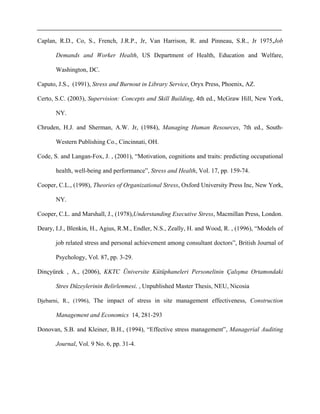
Caplan, R.D., Co, S., French, J.R.P., Jr, Van Harrison, R. and Pinneau, S.R., Jr 1975,Job
Demands and Worker Health, US Department of Health, Education and Welfare,
Washington, DC.
Caputo, J.S., (1991), Stress and Burnout in Library Service, Oryx Press, Phoenix, AZ.
Certo, S.C. (2003), Supervision: Concepts and Skill Building, 4th ed., McGraw Hill, New York,
NY.
Chruden, H.J. and Sherman, A.W. Jr, (1984), Managing Human Resources, 7th ed., South-
Western Publishing Co., Cincinnati, OH.
Code, S. and Langan-Fox, J. , (2001), “Motivation, cognitions and traits: predicting occupational
health, well-being and performance”, Stress and Health, Vol. 17, pp. 159-74.
Cooper, C.L., (1998), Theories of Organizational Stress, Oxford University Press Inc, New York,
NY.
Cooper, C.L. and Marshall, J., (1978),Understanding Executive Stress, Macmillan Press, London.
Deary, I.J., Blenkin, H., Agius, R.M., Endler, N.S., Zeally, H. and Wood, R. , (1996), “Models of
job related stress and personal achievement among consultant doctors”, British Journal of
Psychology, Vol. 87, pp. 3-29.
Dinçyürek , A., (2006), KKTC Üniversite Kütüphaneleri Personelinin Çalışma Ortamındaki
Stres Düzeylerinin Belirlenmesi. , Unpublished Master Thesis, NEU, Nicosia
Djebarni, R., (1996), The impact of stress in site management effectiveness, Construction
Management and Economics 14, 281-293
Donovan, S.B. and Kleiner, B.H., (1994), “Effective stress management”, Managerial Auditing
Journal, Vol. 9 No. 6, pp. 31-4.
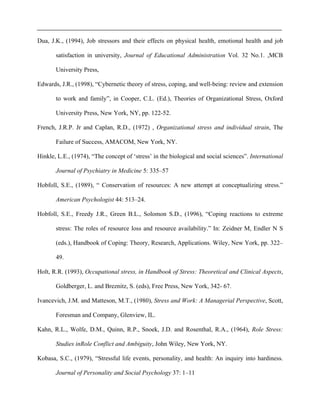
Dua, J.K., (1994), Job stressors and their effects on physical health, emotional health and job
satisfaction in university, Journal of Educational Administration Vol. 32 No.1. ,MCB
University Press,
Edwards, J.R., (1998), “Cybernetic theory of stress, coping, and well-being: review and extension
to work and family”, in Cooper, C.L. (Ed.), Theories of Organizational Stress, Oxford
University Press, New York, NY, pp. 122-52.
French, J.R.P. Jr and Caplan, R.D., (1972) , Organizational stress and individual strain, The
Failure of Success, AMACOM, New York, NY.
Hinkle, L.E., (1974), “The concept of ‘stress’ in the biological and social sciences”. International
Journal of Psychiatry in Medicine 5: 335–57
Hobfoll, S.E., (1989), “ Conservation of resources: A new attempt at conceptualizing stress.”
American Psychologist 44: 513–24.
Hobfoll, S.E., Freedy J.R., Green B.L., Solomon S.D., (1996), “Coping reactions to extreme
stress: The roles of resource loss and resource availability.” In: Zeidner M, Endler N S
(eds.), Handbook of Coping: Theory, Research, Applications. Wiley, New York, pp. 322–
49.
Holt, R.R. (1993), Occupational stress, in Handbook of Stress: Theoretical and Clinical Aspects,
Goldberger, L. and Breznitz, S. (eds), Free Press, New York, 342- 67.
Ivancevich, J.M. and Matteson, M.T., (1980), Stress and Work: A Managerial Perspective, Scott,
Foresman and Company, Glenview, IL.
Kahn, R.L., Wolfe, D.M., Quinn, R.P., Snoek, J.D. and Rosenthal, R.A., (1964), Role Stress:
Studies inRole Conflict and Ambiguity, John Wiley, New York, NY.
Kobasa, S.C., (1979), “Stressful life events, personality, and health: An inquiry into hardiness.
Journal of Personality and Social Psychology 37: 1–11
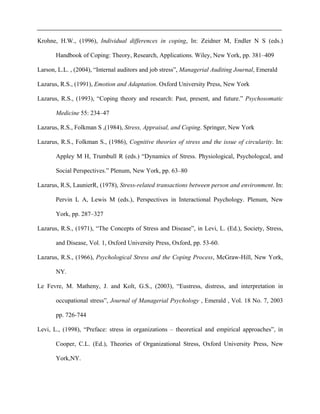
Krohne, H.W., (1996), Individual differences in coping, In: Zeidner M, Endler N S (eds.)
Handbook of Coping: Theory, Research, Applications. Wiley, New York, pp. 381–409
Larson, L.L. , (2004), “Internal auditors and job stress”, Managerial Auditing Journal, Emerald
Lazarus, R.S., (1991), Emotion and Adaptation. Oxford University Press, New York
Lazarus, R.S., (1993), “Coping theory and research: Past, present, and future.” Psychosomatic
Medicine 55: 234–47
Lazarus, R.S., Folkman S ,(1984), Stress, Appraisal, and Coping. Springer, New York
Lazarus, R.S., Folkman S., (1986), Cognitive theories of stress and the issue of circularity. In:
Appley M H, Trumbull R (eds.) “Dynamics of Stress. Physiological, Psychologcal, and
Social Perspectives.” Plenum, New York, pp. 63–80
Lazarus, R.S, LaunierR, (1978), Stress-related transactions between person and environment. In:
Pervin L A, Lewis M (eds.), Perspectives in Interactional Psychology. Plenum, New
York, pp. 287–327
Lazarus, R.S., (1971), “The Concepts of Stress and Disease”, in Levi, L. (Ed.), Society, Stress,
and Disease, Vol. 1, Oxford University Press, Oxford, pp. 53-60.
Lazarus, R.S., (1966), Psychological Stress and the Coping Process, McGraw-Hill, New York,
NY.
Le Fevre, M. Matheny, J. and Kolt, G.S., (2003), “Eustress, distress, and interpretation in
occupational stress”, Journal of Managerial Psychology , Emerald , Vol. 18 No. 7, 2003
pp. 726-744
Levi, L., (1998), “Preface: stress in organizations – theoretical and empirical approaches”, in
Cooper, C.L. (Ed.), Theories of Organizational Stress, Oxford University Press, New
York,NY.
Maslach, C., (1998), A multidimensional theory of burnout, in Cooper, C.L. (Ed.), Theories of
Organizational Stress, Oxford University Press, New York, NY, pp. 68-85.
Mason, J.W., (1975a), A historical view of the stress field. Part I.Journal of Human Stress1:6–12
Mason, J.W., (1975c), Emotion as reflected in patterns of endocrine integration. In: Levi L (ed.)
Emotions: Their Parameters and Measurement. Raven, New York, pp. 143–81
Matteson, M.T. and Ivancevich, J.M., (1987), Controlling Work Stress: Effective Human
Resource and Management Strategies, Jossey Bass, San Francisco, CA.
Mayer, E.A., (2000), “The neurobiology of stress and gastrointestinal disease”, Gut, Vol.47,p.
861.
McCormick, J. and Powell, B., (1988),” Management for the 1990’s”, Newsweek, 4, 47- 8.
McGrath, J.E., (1982), Methodological problems in research on stress. In: Krohne H W, Laux L
(eds.) Achievement, Stress, and Anxiety. Hemisphere, Washington, DC, pp. 19–48
Nawe, J., (1995), “Work-Related Stress Among the Library and İnformation Workforce”,
Library Review, Vol.44, No.6, pp 30-37, MCB University Press, UK.
Nowack, K.M., (1989), “Coping Style, Cognitive Hardiness, and Health Status”, Journal of
Behavioral Medicine, Vol. 12 No. 2, pp. 145-58.
Nowack, K.M., (1990), “Initial Development of an Inventory to Assess any Health Risk”,
American Journal of Health Promotion, Vol. 4 No. 3, pp. 173-80.
Pors, N.O., 2003, “Job satisfaction among library managers: a cross-cultural study of stress,
freedom and job conditions”, New Library World, Vol. 104 No. 1194/1195
Pratt, L.I. and Barling, J., (1988), Differentiating between Daily Events, Acute and Chronic
Stressors: A Framework and its Implications, in Hurrell, J.J., Jr, Murphy, L.R., and
Sauter, S.L. (Eds), Occupational Stress: Issues and Developments in Research, Taylor and
Francis,New York, NY, pp. 41-53.
Quick, J.C., Nelson, D.L., Quick, J.D. and Orman, D.K., (2001), “An isomorphic theory of stress:
the dynamics of person-environment fit”, Stress and Health, Vol. 17 No. 3, pp. 147-57.
Rader, H., (2002), “ Managing Academic and Research Libraries Partnership “, Library
Management, Vol.23, No. 4/5, pp 187 – 191, USA.
Richmond, R.L. and Kehoe, L., (1999), “Quantitative and qualitative evaluations of brief
interventions to change excessive drinking, smoking, and stress in the police force”,
Addiction, Vol. 94, p. 1509.
Rubin, R.E., (1991), Human Resource Management in Libraries, Neal-Schuman, New York, NY.
Sapolsky, R M ,(1994), Why Zebras Don’t Get Ulcers. WH Freeman, New York.
Scheier, M F, Carver C S, (1992) “ Effects of optimism on psychological and physical well-
being: Theoretical overview and empirical update”. Cognitive Therapy and Research 16:
201–28
Schuler, R.S., (1980), “Definition and conceptualization of stress in organizations”,
Organizational Behavior & Human Performance, Vol. 25 No. 2, pp. 184-215.
Schwarzer, R., Leppin A., (1991), “Social support and health: A theoretical and empirical
overview”, Journal of Social and Personal Relationships, 8: 99–127
Selye, H. (1956), The Stress of Life, McGraw-Hill, New York, NY.
Selye, H. (1983), The stress concept: past, present, and future, in Cooper, C.L. (Ed.), Stress
Research, John Wiley & Sons, New York, NY, pp. 1-20.
Selye, H., (1936), “A syndrome produced by diverse nocuous agents”, Nature, Vol. 138, p. 32.
Selye, H., (1964), From Dream to Discovery, McGraw-Hill, New York, NY.
Selye, H., (1976), The Stress of Life, McGraw-Hill, New York, NY.
Sen, B., (1991), “The Status of College Librarians Based on some colleges under Bombay
University within the Limits of Bombay City”, Library Science with a Slant towards
Documentation, Vol. 28 No. 1, pp. 5-16.
Smelser, NJ., Baltes PB. Editors in Chief, International Encyclopedia of the Social &
Behavioral Sciences, (2004), Elsevier.
Smit, I. and Schabracq, M., (1998), “Team cultures stress and health”, Stress Medicine, Vol. 14,
pp. 13-19.
Staw, B.M., (1985), “Organizational Behaviour: A Review and Reformulation of the Field’s
Outcome Variables”, Annual Review of Psychology, Vol. 35, pp. 627-66.
Stewart, A.M., (1987), Stress at work, in Harper, S. (Ed.), Personnel Management Handbook.
Sutherland, V.J. and Davidson, M.J., (1989) Stress among construction site managers: a
preliminary study, Stress Medicine, 5, 221- 35.
Vasse, R.M., Nijhuis, F.J. and Kok, G., (1998), “Associations between work stress alcohol
consumption and sickness absence”, Addiction, Vol. 93, p. 231.
Wiholm, C., Arentz, B. and Berg, M.,(2000), “The impact of stress management on computer
related skin problems”, Stress Medicine, Vol. 16, pp. 279-85.
Wilson, D.C. and Rosenfeld, R.H., (1990), Managing Organizations: Text, Readings and Cases,
McGraw-Hill, London.
Yerkes, R.M. and Dodson, J.D., (1908), “The relation of strength of stimulus to rapidity of habit-
formation”, Journal of Comparative Neurology and Psychology, Vol. 18, p. 459.
Corresponding author
Akman Dinçyürek can be contacted at: akman.dincyurek@emu.edu.tr
Postal address: Eastern Mediterranean University, Library, Famagusta, North Cyprus, (via Mersin 10 Turkey)
Office phone: +90 392 630 2102
Mobile phone: +90 542 859 5652
SSRN-id1995473

SSRN-id1995473

  • 1.
    Investigating the impacts of job stress on the university librarians within the persepective of human  resource management: The case of North Cyprus Akman DİNÇYÜREK Eastern MedıterraneanUniversity, Famagusta, North Cyprus. Abstract Librarians in there relations with there customers and with other librarians have to establish good relations. Librarians work long hours and it is somewhat monotonous. Librarians are also busy with a collecteral work while working as a librarian. Working together busy sincere, warm relations among managers and working personnel. University libraries are integral part of every university and they have to meet the demands of students in thousands. The aim of this article is to find out the effects of stress on university librarians working in Northern Cyprus as useful human resources, and propose certain strategies to create a good environment for the librarians to work effectively and with endless determination in their jobs. Also research article about job stress improvements related to business administrative in introduction. Keywords stress management, librarians, library management, human resources management. Article Type Research paper The authors are grateful from the members of Near East University Department of Business Administration for their valuable support, assistance and contribution. The authors also owe a special depth of gratitude to the Librarians of Near East University and Eastern Mediterranean University.
  • 2.
    Introduction Despite a significantincrease in the volume of research , researchers and people interested in study of stress (Staw, 1985) are still not in agreement about the meaning and nature of stress. Stress has been broadly defined as human response to challenging events (Selye, 1976), as these events necessitate a responce from the individual (Kahn et al., 1964), further definitions explane stress as an environmental characterisitic which poses a threat to the individual (Caplan et al., 1975), and as a realization by the individual that he/she is unable to deal adequately with the demands placed upon him/her(Lazarus, 1976; Lazarus, 1971). The nature and effects of stress might be best understood by saying that some environmental variables (stressors), when interpreted by the individual (cognitive interpretation), may lead to stress. The stress experienced by the individual may cause strains and long-term negative effects. Whether or not the individual experiences stress and its effects depends, among other things, on the individual characteristics such as social support, hardiness, type A behaviours, and coping strategies(Nowack, 1989; Nowack, 1990). Thus, stressors are objective events, stress is the subjective experience of the event, and strain is the maladaptive response to stress (Pratt and Barling, in Hurrell et al(Eds), 1988). One important part of our lives which causes a great deal of stress is our job or our work. Work-related stress is of growing concern because it has significant economic implications for the organizations through employee dissatisfaction, lowered productivity and lowered emotional and physical health of the employees (Matteson and Ivancevich, 1987). It has been argued that organizational and extraorganizational stressors lead to stress through cognitive appraisal which, in turn, leads to poor emotional health, poor physical health, and behaviours which harm the organizations (Matteson and Ivancevich, 1987; Cooper and Marshall, 1978).
  • 3.
    Librarians occupy oneof the most ambiguous positions in colleges and universities.This ambiguity has resulted in an unclear image and uncertain status for librarians, (Sen, 1991) the status of academic librarians can be classified into two types: 1. Faculty status, which involves the rules, regulations, procedures and benefits of the teaching faculty; 2. Academic status, which classifies librarians as academic staff rather than faculty, administrative personnel, clerical service or some other category. In this category library staff establish their own ranking system and design separate criteria for evaluating their own work for promotion (Barida, 1999). Many changes have taken place in higher education based on an evolving information base and technology environment. Information is genereted at a faster pace than ever before and it has become a major component of all parts of the society and the economy. Many industries and enterprises are based on information and information- related technologies. Students, enter the universities with high expectations related to information and technology and present the faculty and administration with unique challenges. Librarians and information professionals have also been addressing the many changes resulting from the electronic information environment, and they are dialing successfully with these changing environments (Rader, 2002). Stress denotes “the cause of disruption, the disruption itself and the consequences of that disruption” (Steward, in Harper (Eds), 1987). It is defined as any adjustive demand to one’s physiological and psychological reaction to a challenge imposed on him/her, that requires coping behaviour (Bunge, 1990, in Albritton and Shaughnessy (Eds); Chruden and Sherman, 1984). Stress is a perceived phenomenon associated with tension and anxiety. One is considered as being under stress when a situation is perceived as presenting an extra demand on the individual’s capabilities and resources. Stress is not a new phenomenon in work situations, nor is it avoidable
  • 4.
    in the strictestsense. Although stress can be destructive both physically and psychologically, it is, nonetheless, essential for life. Jobs normally require employees to adjust to conditions that place unusual demands on them. Adjustment to situations can have either a positive or a negative impact on individuals. Positive stress is known as eustress. This kind of stress is desirable because in this case “the stressors promote wellbeing by serving as catalysts and stimulants to push the individual toward achievement at a high level” (Cabuto, 1991). The other kind of stress, known as distress, is undesirable because it depletes individuals emotionally, mentally and physically. Never the less, both forms of stress need tactful management. By taking appropriate precautionary measures, a lot can be done towards adopting coping strategies. These measures include understanding of employees’ expectations, wants, needs and values, whether innate or learned, and adjusting as far as possible the working environments to match these aspects of the employees (Wilson and Rosenfeld, 1990; Rubin, 1991). These measures could be reinforced by providing opportunities for continual development of employees’ awareness of possible challenges and demands and the resources they could draw on to cope with such challenges and demands (Nawe, 1995). Theories of Stress For the last five decades the term stress has enjoyed increasing popularity in the behavioral and health sciences. It fırst was used in physics in order to analyze the problem of how man-made structures must be designed to carry heavy loads and resist deformation by external focus. In this analysis, stress referred to external pressure or force applied to a structure, while strain denoted the resulting internal distortion of the object (for the term’s history, (Hinkle, 1974; Mason, 1975a; Mason, 1975c) ). In the transition from physics to the behavioral sciences, the usage of the term
  • 5.
    stress changed. Inmost approaches it now designates bodily processes created by circumstances that place physical or psychological demands on an individual (Selye, 1976). The external forces that impinge on the body are called stressors (McGrath, 1982, in Krohne (Eds)). Theories that focus on the specific relationship between external demands (stressors) and bodily processes (stress) can be grouped in two diferent categories: approaches to ‘systemic stress’ based in physiology and psychobiology (among others, (Selye, 1976)) and approaches to ‘psychological stress’ developed within the field of cognitive psychology (Lazarus, 1966; Lazarus, 1991; Lazarus, 1984; McGrath, 1982). Systemic Stress : Selye’s Theory The popularity of the concept of stress in science and mass media stems largely from the work of the endocrinologist Hans Selye. In a series of animal studies he observed that a variety of stimulus events (e.g., heat, cold, toxic agents) applied intensely and long enough are capable of producing common effects, meaning not specific to either stimulus event. (Besides these nonspecific changes in the body, each stimulus produces, of course, its specific effect, heat, for example, produces vasodilatation, and cold vasoconstriction.) According to Selye, these “nonspecifically caused changes” constitute the stereotypical, i.e., specific, response pattern of systemic stress. Selye (Selye, 1976) defines this stress as “a state manifested by a syndrome which consists of all the nonspecifically induced changes in a biologic system.”This stereotypical response pattern, called the ‘General Adaptation Syndrome’ (GAS), proceeds in three stages. (a) The’alarm reaction’ comprises an initial shock phase and a subsequent countershock phase. The shock phase exhibits autonomic excitability, an increased adrenaline discharge, and gastro-intestinal ulcerations. The countershock phase marks the initial operation of defensive processes and is characterized by increased adrenocortical activity. (b) If

  • 6.
    noxious stimulation continues,the organism enters the ‘stage of resistance’. In this stage, the symptoms of the alarm reaction disappear, which seemingly indicates the organism’s adaptation to the stressor. However, while resistance to the noxious stimulation increases, resistance to other kinds of stressors decreases at the same time. (c) If the aversive stimulation persists, resistance gives way to the ‘stage of exhaustion’. The organism’s capability of adapting to the stressor is exhausted, the symptoms of stage (a) reappear, but resistance is no longer possible. Irreversible tissue damages appear, and, if the stimulation persists, the organism dies. Psychological Stress: The Lazarus Theory Two concepts are central to any psychological stress theory: appraisal, i.e., individuals’ evaluation of the significance of what is happening to their well-being, and coping, i.e., individuals’ efforts in thought and action to manage specific demands (Lazarus, 1993) Since its first presentation as a comprehensive theory (Lazarus, 1966), the Lazarus stress theory has undergone several essential revisions (Lazarus, 1991; Lazarus, 1984; Lazarus and Launier, 1978). In the latest version (Lazarus, 1991), stress is regarded as a relational concept, i.e., stress is not defined as a specific kind of external stimulation or a specific pattern of physiological, behavioral, or subjective reactions. Instead, stress is viewed as a relationship (‘transaction’) between individuals and their environment. “Psychological stress refers to a relationship with the environment that the person appraises as significant for his or her well being and in which the demands tax or exceed available coping resources” (Lazarus and Folkman, 1986, in Appley and Trumbull (Eds)). This definition points to two processes as central mediators within the person–environment transaction: cognitive appraisal and coping. The concept of appraisal, introduced into emotion research by Arnold (Arnold, 1960) and elaborated with
  • 7.
    respect to stressprocesses by Lazarus (Lazarus, 1966; Lazarus and Launier, 1978), is a key factor for understanding stress relevant transactions. This concept is based on the idea that emotional processes (including stress) are dependent on actual expectancies that persons manifest with regard to the significance and outcome of a specific encounter. This concept is necessary to explain individual differences in quality, intensity, and duration of an elicited emotion in environments that are objectively equal for different individuals. It is generally assumed that the resulting state is generated, maintained, and eventually altered by a specific pattern of appraisals. These appraisals, in turn, are determined by a number of personal and situational factors. The most important factors on the personal side are motivational dispositions, goals, values, and generalized expectancies. Relevant situational parameters are predictability, controllability, and imminence of a potentially stressful event. In his monograph on emotion and adaptation, Lazarus (Lazarus, 1991) developed a comprehensive emotion theory that also includes a stress theory Lazarus (Lazarus, 1993). This theory distinguishes two basic forms of appraisal; primary and secondary appraisal (see also (Lazarus, 1966)). These forms rely on different sources of information. Primary appraisal is concerned with whether something of relevance to the individual’s well being occurs, whereas secondary appraisal deals with coping options. Resource Theories of Stress: A Bridge between Systemic and Cognitive Viewpoints Unlike approaches discussed so far, resource theories of stress are not primarily concerned with factors that create stress, but with resources that preserve well being in the face of stressful encounters. Several social and personal constructs have been proposed, such as social support (Schwarzer and Leppin, 1991), sense of coherence (Antonovsky, 1979), hardiness (Kobasa, 1979), self-efficacy (Bandura, 1977), or optimism (Scheier, 1992). While self-efficacy and
  • 8.
    optimism are singleprotective factors, hardiness and sense of coherence represent tripartite approaches. Hardiness is an amalgamation of three components: Internal control, commitment, and a sense of challenge as opposed to threat. Similarly, sense of coherence consists of believing that the world is meaningful, predictable, and basically benevolent. Within the social support field, several types have been investigated, such as instrumental, informational, appraisal, and emotional support. The recently offered conservation of resources (COR) theory (Hopfoll, 1989; Hopfoll et al., 1996) assumes that stress occurs in any of three contexts: when people experience loss of resources, when resources are threatened, or when people invest their resources without subsequent gain. Four categories of resources are proposed: object resources (i.e., physical objects such as home, clothing, or access to transportation), condition resources (e.g., employment, personal relationships), personal resources (e.g., skills or self-efficacy), and energy resources (means that facilitate the attainment of other resources, for example, money, credit, or knowledge). Hobfoll and his colleagues outlined a number of testable hypotheses (called principles) derived from basic assumptions of COR (Hopfoll et al., 1996 ). Coping Theories The Lazarus model outlined above represents specific types of coping theories. These theories may be classified according to two independent parameters: (a) trait-oriented versus state- oriented, and (b) microanalytic versus macroanalytic approaches (Krohne, 1996). Trait-oriented and state-oriented research strategies have different objectives: The ‘trait-oriented’ (or dispositional) strategy aims at early identification of individuals whose coping resources and tendencies are inadequate for the demands of a specific stressful encounter. An early
  • 9.
    identification of thesepersons will offer the opportunity for establishing a selection (or placement) procedure or a successful primary prevention program. Research that is ‘state- oriented,’ i.e., which centers around actual coping, has a more general objective (Smelser and Baltes, 2004). The Origins of Stress Research Stress is a term that is often related to a psychological or physical state of health (Sapolsky, 1994) and is used by many psychological, sociological, and medical scientists as well as laymen. The first definition of the term was proposed by Cannon (Cannon, 1935). He postulated that passing a critical stress level, triggered by physical and emotional stimuli, endangers the homeostatic control of an organism. However, the name that is most closely associated with stress is Hans Selye, who defined stress as a nonspecific response of the body to any demand characterized by the secretion of glucocorticoids (Smelser and Baltes, 2004). Selye (Selye, 1964) was the first to use the term “stress” to describe a set of physical and psychological responses to adverse conditions or influences. Originally the syndrome of just being sick (Selye, 1936) covered the stereotypical response of an organism to a wide range of chemical, biological, or physical stimuli. In later seeking a term to cover this typical response Selye used the word “stress”, an engineering term for a force which causes deformation in bodies. Unfortunately, this term should have been more properly applied to the various stimuli applied to the organisms. The term “strain”, which in engineering refers to the manifestation of stress in an actual body, or the deformation of a material under a stress, should have been used for the resulting responses. Since this early use of the term stress, there has been continuing confusion and disagreement on the current nomenclature in the field(Levi, 1998).
  • 10.
    Selye (Selye, 1956)used the term “stressor” to describe the external force or influence acting on the individual and “stress” to denote the resulting reaction, terminology adopted by many others (e.g. Code and Langan, 2001; Maslach, 1998, in Cooper (Eds); Quick et al., 2001). Some authors have used stress to denote such external forces and strain to denote the resulting reaction (e.g. Edwards, 1998, in Cooper(Eds.)), while others failed to clearly define how they were using the terminology at all (e.g. Smit and Schabracq, 1998; Wiholm et al., 2000). Further, some have simply used stress as a blanket term covering the whole process of external influence, appraisal, reaction, and effect [e.g. Deary et al., 1996). Even at the most basic level of terminology a problem has existed in distinguishing between independent, intervening, and dependent variables as far as stress research is concerned (Cooper, 1998). “Stress”, as used in the literature, may refer to external influences acting on individuals (Selye’s stressors) (Selye, 1956), physiological reactions to such influences (Selye’s original stress concept) (Mayer, 2000; Selye, 1956), psychological interpretation of both the external influences and the physiological reactions (Code and Langan, 2001; Selye, 1983), and adverse behavioural reactions exhibited in work, or social situations, or both (Richmond and Kehoe, 1999; Vasse et al., 1998). This inconsistency in the use of stress-related constructs may well have contributed to the even greater confusion over the concept of eustress. Distress and eustress were originally both subsumed within the larger definition of stress but were regarded as different and distinct from each other(Le Fevre et al., 2003). The concept of an optimal amount of stress arose from the Yerkes Dodson Law that indicates that increasing stress is beneficial to performance until some optimum level is reached, after which performance will decline, the familiar inverted U diagram (Benson and Allen, 1980; Certo, 2003). The inverted U is often drawn with stress or arousal on the horizontal axis and
  • 11.
    performance on thevertical axis. It is interesting to note, that the words stress, arousal, and performance do not appear at any time in the original paper (Yerkes and Dodson, 1908). Job Stress Job stressors may refer to any characteristic of the workplace that poses a threat to the individual. Job stressors can relate to either job demands a person cannot meet or the lack of sufficient resources to meet them (French and Caplan, 1972). For stress to exist, the demand from the environment (the job) versus the capability of the individual (the employee) will typically be considerably out of balance. Individuals experience job stress when they have little or no control over their jobs or when work demands exceed their abilities (Donovan and Kleiner, 1994). Job stress also occurs when conditions on a job inhibit, stifle, or thwart the attainment of expectations and goals (Larson, 2004). Not all job stress is bad because a certain amount of job stress has been shown to improve both effectiveness and performance (Brief et al., 1981). A person’s response to stressors will be somewhat mediated by various individual personality traits. Individual qualities affect how a person will respond to stress in three major ways (Schuler, 1980). First, because individual needs and values define the person’s desires, the individual qualities determine the relative importance of events or occurrences to the person. Second, individual abilities and past experiences affect the choice of strategies to deal with stressful events. Third, the individual’s choice of strategies to deal with stress is influenced by personality characteristics. Consequently, individuals will differ in the ways they respond to an identical event depending on these individual qualities. Events that are very stressful for one individual may not be stressful to another. Consequently, individuals vary in the amount of stress they can tolerate without showing signs of job-related tension (Ivancevich and Matteson, 1980).
  • 12.
    Stress is anaturally occurring experience that may have either beneficial or destructive consequences. Stress is a physical response, but the stressors that trigger the response are typically social, psychological, or symbolic, and consequently require no physical action. Stress is very hard on the human body because the body is preparing for a physiological response to a non-physical demand. The cumulative result is a major strain on a person’s body that can lead to illness. The more frequently the person is in a stress-response mode, the more susceptible that individual is to fatigue, disease, disability, aging, and death (Matteson and Ivacevich, 1987). Source of stress percentages Adapted from Sutherland and Davidson (1989 ) article on high. Inadequacy/inconsistency of communication flow , work-load - constant time pressure, conflict of boundary situations , working long hours , The company strategy - competitive/dynamic/go- getting image, changing staffing problems as high effects are established. Physical properties of the working environment Physical hazards, chronic dangers Extremes of heat, cold, humidity, pressure, etc. Bad man-machine design Time variables Non-standard working hours (shift work) Deadlines Time pressure Social and organizational properties of work and its setting Work-load, overload
  • 13.
    Responsibility load Monotony Poor labour-management relations Changes in job Qualitative changes in job Overpromotion Transfer of job focus Null changes (non-events) Role related Role ambiguity Role conflict Role strain Degree of control over work processes Responsibility for people Miscellaneous Job complexity, qualitative load Quantitative overload or underload Relationship to supervisor Inadequate support from or performance by supervisors Ambiguity about future, job insecurity Monotony Person- environment (job) fit Role ambiguity responsibility for people Job complexity
  • 14.
    Off-job stress Table 1.Disturbed life pattern of miscellaneous stresses Examples of Types Stressful life events Of Stress Demands of husband and children on working women Source: adapted from Holt (1993). Example of types of stress is provided by from Holt (1993 ) in Djebarni, R. ( 1996 ). Non- standard working hours (shift work), deadlines, time pressure, work-load, overload, responsibility load, monotony, poor labour- management relations sources are important for this article. Table 2. Mean and Standart Deviations of Stress Source: adapted from Dua j.k. ( 1994) Job Stress Variable Overall Factor 1 Factor 2 Factor 3 Factor 4 Factor 5 Factor 6 Mean 1.73 1.81 2.04 1.99 1.30 1.72 2.06 SD 0.28 0.45 0.74 0.53 0.39 0.48 0.58 General Work Non-work Job stress stress stress dissatisfaction Mean 2.65 3.29 2.52 1.76 SD 0.62 1.05 0.65 0.59
  • 15.
    Table 3. The Relationship BetweenJob Satisfaction and Stress Level When compered British and Danish library managers and their job satisfaction in each of the three groups of stress level poses an interesting result. In relation to each stress level there is no significant difference in satisfaction between the two groups of managers (p = 0:62; 0.12; and 0.18). This is an indication that the stress level influences job satisfaction and nationality does not. The difference in the national distribution of job satisfaction is simply due to the fact that British managers experience and perceive more stress than their Danish equals. This result also demonstrates how important it is to be wary of bivariate correlations. In the group named “no stress” 5 per cent of both the British and Danish managers state that they are less satisfied or dissatisfied with their job. In the group named “some stress” the equivalent figures are 11 and 6 per cent, and in the group named “much stress” the figures are 37 and 23 per cent (Pors, 2003) Total No stress Some stress Much stress Very satisfied (per cent) 35 53 33 16 Satisfied (per cent) 52 43 60 53 Less satisfied or dissatisfied (per cent) 12 5 8 31 Total N 614 200 266 148 Note: p= 0.00 Sources: Pors, Job Satisfactions Among Library Managers, (2003)
  • 16.
    Purpose of TheStudy In this study, we aim to examine the stress levels of the staff of the university libraries. In this respect, Northern Cyprus is selected as a case. Five universities are established in the mentioned region. The total number of libraries full time staff is 76 in these 5 universities, ( see Table 1.) However, the staff of Near East University and Eastern Mediterranean University libraries is selected as a working group because of their potentials. On the other hand, other university libraries do not fulfill the requirements of university libraries because of the comprehensiveness of their facilities and the number of their staff. It has to be pointed out that the number of the staff in these universities, which are not included in this study, changes between 2 to 5 within 76 staff in total. Within the framework of this study, 102 members of Near East University and Eastern Mediterranean University libraries are selected for voluntary evaluation including the full time personnel and the part time assistants. It is aimed to examine the impacts of the stress sources of the librarians of Northern Cyprus in general. Furthermore, it is also intended to explain the stress levels and stress conditions of the mentioned staff in particular. In the light of these analyses, we expect to be able to discuss possible proposals regarding the fight with negative stress. Table 4. Number of Employees In T.R.N.C. University Libraries University Library No. of Employees Eastern Mediterranean University Library 22 Near East University Libray 45 European University of Lefke Library 4 Girne American University Libray 1 International Cyprus University Libray 4
  • 17.
    Mainly, this studyis developed in the field of human resources by particular reference to business administration and human resource management. Method Library personnel of the two considerable universities in Cyprus, which are Eastern Mediterranean University and Near East University, form the main sources of this research study. Inputs were achived by applying the inquiry forms to the preselected particular group from the related group. In other words, sample group was thoroughly analyzed and related information was gathered after the interpretation of the answer on the inquiry forms. The already mentioned inquiry form includes four sections, including the explanatory introduction to the selected research group. In the second part, it is aimed to provide general information about the selected librarians. The negative impacts on the working conditions and the moods of the librarians were questioned in the third part of the inquiry forms. The last part was reserved for the comments of the librarians by asking open-ended questions. For the analysis of the inquiry forms, SPSS 11 statistical program was used, which is specially developed for social sciences. In this study, two universities, which form the backbone of the higher education in Northern Cyprus, were particularly selected for the realm of the main research group. In parallel to the development of the universities in northern Cyprus, the University Libraries which have great roles in higher education, have developed respectively. These selected universities contain 13000 students and 750 academic staff including part-time academic members, which point out its great importance in such a small country. From the since the establishment university libraries in the country ,the working hours of the librarians are gradually and consistently increased.
  • 18.
    Nowadays, the NearEast University Library remains open 24 hours a day, seven days a week. The library personnel work in three shifts. Eastern Mediterranean University Library has also increased its working hours especially during the exam weeks and weekends. Librarians work until 01.00 am during the week and until 10.30 pm during the weekends and exam weeks. Validity and Reliability Validity Construct Validity is applied to the inquiry forms and consequently, the data are collected. Kaier-Meyer-Olkin Measure of Samling Adequacy value is 0.957 , approx. chi-square value is 12781,347 and df is 1035 from KMO and Bartlett’s Test, to put into factor analysis. Variants are changed in between 0,923 and 0,851 in communalities table. Besides Extractions sums of squared loadings variants are given % 87,537 in total variance explained table. Reliability Internal Reliability was applied to the inquiry forms and data provided are the following. Reliability Analysis - Scale (Alpha) Mean Variance Std.Dev N. of Variables Statistics for Scale 136,2843 2109,7104 45,9316 46 Reliability Coefficients N. of Cases ; 102 N. of Items ; 46 Alpha : 0,9962
  • 19.
    While calculating internalreliability all questions were calculated individual questions, except two of the questions. It can be observed that the value of 136,2843 is for the general mean and the value of 45,9316 for the standard deviation . Besides, % 99 Cronbach Alpha as reliability coefficient is found. Results In addition to job stress, many researchers assert that the leader’s superior is one of the most important sources of managerial stress. The tyrannical boss is the most frequently mentioned source of stress (McCormick and Powell, 1988; Baglioni et al., 1990) identifed stress from superiors, work-load and home versus work confict as the most salient factors (Buck, 1972). On the other hand, managers who saw their superior as untrustworthy and unfriendly reported more job pressure than other managers. A few researchers have attempted to study the impact of stress on the relationship between managerial leadership and effectiveness and even fewer have tried to do it in the context of the construction industry (Sutherland and Davidson, 1989). In a preliminary study investigating the impact of stress upon construction site managers in the UK, construction site managers frequently cited 10 sources of stress. Top of the list was task clarity or, more specifically, inadequacy of communication flow, as illustrated in Table 8 (Djebarni, 1996). The impact of stress on organizations’ members can be the result of conflicts between their independence and their commitment to the organization, organizational pressures, day-to-day demands of work, etc. There are innumerable such sources of stress. Table 1 shows some of those sources investigated by different researchers. This research, however, was not
  • 20.
    Table 5. Source ofStress amongst constructions site managers concernedwithsources of stress. Its focus was rather on the impact of certain stressors on leadership effectiveness(Djebarni, 1996). Sources of Stress ( % )a Inadequacy/inconsistency of communication flow 75 Paperwork- too much, too much unnecessary, high volume of reading material 69 Work-load - constant time pressure 67 Lack of competent staff to do the job properly 67 Inadequate number of staff to do the job properly 64 Unable to delegate because of staffing problems 53 Conflict of boundary situations 50 Working long hours 44 Insufficient time spent in family 44 The company strategy - competitive/dynamic/ go-getting image, changing staffing problems 44 a Percentage of total managers Source: adapted from Sutherland and Davidson (1989). For factor analysis, Kaiser – Meyer-Olkin Adequecy Measure of Sampling is given 0.957 for all questions. Approx. Chi – Square 12781.347 and df is given as 1035. These values are in support
  • 21.
    Table 6 Total Varıance of thereliabilities of the questions(Dinçyürek, 2006). These values are the same with the Construct Validity values. Rotation Sums of Squared Loadings values are 55.736 20.270 17.222 % of Variance Total in Variance Explained table(Dinçyürek, 2006). All questions are received as three factors in table 7. for real values two questions put out evaluations. Also 23 questions adapted in table 7 from Akman Dincyurek (2006 )theses inquary questions. Component Initial Eigenvalues Extraction Sums of Squared Loadings Rotation Sums of Squared Loadings Total %of Variance Total %of Variance Cumulative % Total %of Variance Cumulative % 1 TotalVariance Explained 3 40,267 1,799 ,819 87,537 3,910 1,781 40,267 1,799 ,819 87,537 3,910 1,781 87,537 91,447 93,228 25,638 9,324 7,922 55,736 20,270 17,222 55,736 76,006 93,228
  • 22.
    Table 7. Rotated Component Matrix(a) Extraction Method: Principal Component Analysis. Rotation Method: Varimax with Kaiser Normalization (a)Rotation converged in 6 iterations personnels answered 43 questions with answers raging between not effectted and completely effected according to the likert scale and addival 4 individual questions. Means and Standart deviation values belonging to 23 questions are summarized below(Dinçyürek, 2006). Component Factor 1 Factor 2 Factor 3 Physical building Effect Over-Time Effect Technical and Mechanical Requirement Effect Computers Effect Students Exam and Duty Periods Effect Library Security Working Effect Student Increase Effect Supplies Requirement Effect Personnel Educational Positions Effect Bad Climate Effect Continual Education Effect Academic Staff Problems Concerned With Books Effect Library Science Concerned Effect Student Problems Concerned with Working Time Effect Salary Effect Seniority Asistant Student Nationality Effect Student Problems Concerned with Internet Effect Master and Doctorate Student Problems Effect Concerned with University Directoraties Effect Sex Association Status ,884 ,881 ,870 ,869 ,866 ,863 ,859 ,858 ,851 ,822 ,820 ,820 ,806 ,804 ,796 ,930 ,930 ,679 ,667 ,642 ,778 ,778 ,692
  • 23.
    Table 8. Descriptive Statistics Salary effect,academic staff problems concerned with books effect, student increase effect, supplies requirement effect, personnel educational positions effect,bad climate effect have been found to be the high sources of stress. Asistant student nationality effect mean value is 1.5392. N Mean Std.Dev. Physical building Effect Over-Time Effect Technical and Mechanical Requirement Effect Computers Effect Students Exam and Duty Periods Effect Library Security Working Effect Student Increase Effect Supplies Requirement Effect Personnel Educational Positions Effect Bad Climate Effect Continual Education Effect Academic Staff Problems Concerned With Books Effect Library Science Concerned Effect Student Problems Concerned with Working Time Effect Salary Effect Seniority Asistant Student Nationality Effect Student Problems Concerned with Internet Effect Master and Doctorate Student Problems Effect Concerned with University Directoraties Effect Sex Association Status 102 102 102 102 102 102 102 102 102 102 102 102 102 102 102 102 102 102 102 102 102 102 102 3.5686 3.4804 3.6373 3.6863 3.7941 3.3725 3.5098 3.6373 3.4706 3.4314 3.2353 3.4608 3.1667 3.2451 4.0882 1.2843 1.5392 2.0098 2.2647 2.1961 1.3627 1.3235 1.4706 1.15621 1.13216 1.02241 1.07151 1.03731 1.27366 1.03163 1.02241 1.04081 1.33876 1.24421 1.10509 1.38652 1.16412 0.91308 0.70889 0.90839 1.15609 1.07101 1.02483 0.48317 0.47013 1.50160
  • 24.
    Table 9. Descriptive Statistics 2 Personnelare effected especially due to salary conditions and student the increase in the number of or students exam and duty periods. In the same way table 8, table 9 and table 10 provide similar sources of stress (Dinçyürek, 2006). Seniority, sex, association and status are individual questions. Conclutions and Suggestions In the process of ever increasing tendency towards globalization in our world, societies in many countries have turned into industrialized societies. Despite its small population Northern Cyprus because of its strong ties with the motherland Turkey and despite its limitations in social, cultural and economic activities and because of the European Union adaptation process has followed no suit. However, industrialized societies cause and bring along some problems. Unemployment due to technological developments (only qualified personnel are employed), air pollution, environmental and sewage disposal problems, unplanned construction of towns, traffic and infrastructure problem and as a consequence of all these problems stress among individuals are the problems to be dealt with immediately. Variable All Factor 1 Factor 2 Factor 3 Mean 2.2630 3.5447 1.8588 1.3856 SD. 0.973756 1.129326 0.973642 0.8183
  • 25.
    In order tokeep pace with competitive markets in a globalized world, a country has to take necessary precautions to increase performance in the work done. The basic condition needed to be an educated society is to share authority, take decisions collectively and a contemporary administration allowing participation in everything. In a society well informed of everything vocational schools and education must be emphasized in order for the employment of qualified workers to achieve “total quality Administration” in a country. The understanding of quality living concept will have positive effects on the stress the society is undergoing. Stress among individuals in a society could be minimized if solutions are found to social security systems , if we become civilized , well informed individuals in the process of adaptation of new laws and regulations, be well aware of our responsibilities as citizens, if we respect human rights and support democracy, undergo appropriate education in the way of becoming well informed individuals, maintain stability in the economy and in politics, spread participative understanding, put into effect reforms, improve work and working conditions to minimize underemployment, put into production neglected resources to make reforms in public sector and to create rein structure economically and legally to improve productivity. The environment in which we live is constantly changing. Social, economic and technological developments due affect institutions and workers and render changes in new sectors unavoidable. No organization could change its policies in the face of every single change in the environment. It has to reorganize and educate its workers accordingly. Our people could not keep pace with new developments. This will unavoidably lead to stress within the society. Individuals under stress in an organization not only harm themselves but affect the whole organization adversely.
  • 26.
    Reactions to stressorsdiffer from do individual to individual. Positive stress increases motivation while negative stress affects productivity and workers’ health adversely. Activities to minimize stress are carried out within an organization. These activities could be summarized under four main headings: 1. Rehabilitation Programs. 2. Aid Programs for Workers. 3. Employment of Stress Consultants. 4. Activities directed towards relations between stress and performance. Our educational system has abandoned old classic teaching methods. It is becoming more and more knowledge oriented, put importance on research and consulted to different sources for facts which are a modern system of education (Dinçyürek, 2006). Evaluation of answers to questions asked in the research: 1.Librarians live stress in their relations with other personnels of the same status. This type of relationship affects themselves especially for their relations with top-level administrators. However the same personnel are not affected by their relations with people working at various departments of the university. Librarians have to be more careful in their relations. Administrators have to work hard to specify each personnel’s’ job definition and obligations. Librarians have to do more work which would help minimize stress and increase productivity. 2.It is observed clearly that stress because of problems between library personnel and students. Stress directly affects students and librarians. Important assignment needs frequent visit to libraries. Contrary to public libraries which put emphasis on novels, story books and newspapers, students visiting libraries at the university
  • 27.
    campus look forappropriate source in a short time for a project or exams. This kind of atmosphere could be distressful, cause anxiety and stress among librarians. For students, one could say they attend a university for proper education. They are not interested in the work done in libraries nor listen to complaints of librarians. They are there to serve the university students for all they care. Time wasted to get information at libraries could be used for studying. Moreover, students receiving services at libraries carry to the librarians their social and cultural problems. It was observed that while students having problems related to internet or Turkish language were helped and receive prompt service, that is not the case with problems related to English language and computer works. 3.There is a direct reaction which leads to stress between teaching staff at the university and librarians. Librarians are greatly affected by demands of the teaching staff that books and magazines must be at the disposal university students. Authority delegation between university teaching staff is no main cause of this stress. Moreover, librarians undergo extreme stress in order to meet the demands of no teaching staff. 4.Also there is a direct relation between stress and the personnel using the latest technology. Librarians use various instruments in their work. The instruments are directly related to the work they perform. If any of the instruments fail to work, they could not perform their work. Computers are indispensable instruments or apparatus used by librarians. Computers are divided into two components software, hardware. Many programs and spouse parts are involved.
  • 28.
    Failures or multifunctionin any of these components mean problems for librarians. This is an important cause of stress among librarians. 5.There also exists relationship between the personnel using the infrastructure and stress. Librarians exercise bodily effort in their work. Library building is composed of many systems. For example, in libraries at EMU Campus release central vacuum cleaners, fire alarm systems, security systems, generator room and central heading and air-conditioning systems. Failure of any of these systems will be tedious for librarians. 6.There is also direct relationship between stress and overtime working hours. Libraries are full of students during exams and projects. Sometimes more than 3000 students visit a library during these periods. Social and cultural demands of students at these periods of times are no main cause of stress among librarians. Librarians work overtime during periods when students prepare their thesis. University administrators think of shift working at libraries during these times. Overtime work sometimes lasts for 5-10 hours everyday. This is of course tiring and boring. Principles of human resources administration and total quality administration verify it. Librarians prefer shift work to overtime work. Overtime is tedious and monotonous but extra pay serves as an incentive. As could be noted statistically, librarians are under great stress. Co-operation between personnels must be achieved. Additionally, balanced relations between top-level and working staff and also detection of causes of stress are essential for solving this stress problem. Stress is said to be caused by environmental, organizational or individual factors and direct individuals behavior and acts.
  • 29.
    In order toput the economy at a required level, one has to eliminate factors leading to underemployment. Productive working conditions must be created by eliminating factors leading to stress at work(Dinçyürek, 2006). Suggestions Stress is an indispensable part of our modern life and if not dealt with it poses a great threat to every individual in a society. We recommend the following to the librarians to get rid of stress or at least minimize its effect. To deal with individual stress: 1. Individuals have to find the sources of stress. 2. Avoid conditions which cause stress. 3. Try to have control over stress. 4. Improve good relations with people they work with. 5. Try to be calm in all cases. 6. Work in a place where they get job satisfaction. 7. Create a calm and organized working condition. 8. Individuals should not get disturbed at every event. 9. Try to have leisure to do something else. 10. Be thrifty. 11. Go on a holiday when they have time and money. 12. Ask for help from experts or from people they work with. 13. Go over their obligations and give up those they find tedious. 14. Know their limits and confine their expectations within these limits.
  • 30.
    To deal withorganizational stress: 1. Develop a system of priorities. 2. Say no to works which exceed their capacity. 3. Develop open and effective relations and dialogue with administrators. 4. Be open to debate on the date a work is to be finished. 5. Develop good relations with their colleagues at work. 6. Have good relations with people working under their control. 7. If necessary delegate authority to someone else. 8. Resist demands from top-level administrators which may evoke confrontation with their colleagues. 9. Try to speak with their colleagues or administrators in the event of any misunderstanding about the work they perform. 10. Organization has to determine the source of stress to individuals and try to eliminate it. 11. For good relations among personnel an organization must schedule public relations courses. 12. Individual’s obligation and work within an organization must be clearly defined. 13. Emphasis must be put on equipment and infrastructure to increase productivity. 14. Librarians must be subjected to training about the work they perform and taught ways to deal with stress. 15. Librarians must upgrade themselves constantly and if necessary work with assistants to train them. 16. Librarians must be lenient towards each other in extreme working conditions. 17. Personnel must avoid unnecessary argument and confrontation with colleagues. 18. Put limitations to the demands of students and avoid tedious work.
  • 31.
    19. Authority confrontationmust be avoided (Dinçyürek, 2006). It is not possible to completely eliminate the causes of stress within an organization. Our aim is not totally eliminating stress. The aim is to be happy in spite of stress and create happy, joyful working conditions within an organizations (Dinçyürek, 2006). References Antonovsky A , (1979), Health, Stress, and Coping. Jossey-Bass, San Francisco, CA Arnold M B, (1960), Emotion and Personality (2 Vols.). Columbia University Press, New York. Baglioni, J., Cooper, C. and Hingley, P. (1990), “Job stress, mental health and job satisfaction among UK senior nurses”, Stress Medicine, 6, 9- 20. Bandura A., (1977), “Self-efficacy: Toward a unifying theory of behavioral change.” Psychological Review 84: 191–215 Barida, B. , (1999), “The Status of Library Professıonals in Academic Institutions of Orissa” Asian Libraries, Vol. 8 No. 8,pp. 265-274. MCB University Press. Benson, H. and Allen, R.L., (1980), “How much stress is too much?”, Harvard Business Review, Vol. 58 No. 5, pp. 86-92. Brief, A.P., Schuler, R.S. and Van Sell, M., (1981), Managing Job Stress, Little Brown & Company, Boston, MA. Buck, V. (1972), Work Under Pressure, Staples Press, London. Bunge, C.A., (1990), Stress in the library, in Albritton, R.L. and Shaughnessy, T.W. (Eds), Developing Leadership Skills: A Source Book for Librarians, Libraries Unlimited, Englewood, CO. CannonW B , (1935), “Stresses and strains of homeostasis”. American Journal of the Medical Sciences 189(1): 1–14.
  • 32.
    Caplan, R.D., Co,S., French, J.R.P., Jr, Van Harrison, R. and Pinneau, S.R., Jr 1975,Job Demands and Worker Health, US Department of Health, Education and Welfare, Washington, DC. Caputo, J.S., (1991), Stress and Burnout in Library Service, Oryx Press, Phoenix, AZ. Certo, S.C. (2003), Supervision: Concepts and Skill Building, 4th ed., McGraw Hill, New York, NY. Chruden, H.J. and Sherman, A.W. Jr, (1984), Managing Human Resources, 7th ed., South- Western Publishing Co., Cincinnati, OH. Code, S. and Langan-Fox, J. , (2001), “Motivation, cognitions and traits: predicting occupational health, well-being and performance”, Stress and Health, Vol. 17, pp. 159-74. Cooper, C.L., (1998), Theories of Organizational Stress, Oxford University Press Inc, New York, NY. Cooper, C.L. and Marshall, J., (1978),Understanding Executive Stress, Macmillan Press, London. Deary, I.J., Blenkin, H., Agius, R.M., Endler, N.S., Zeally, H. and Wood, R. , (1996), “Models of job related stress and personal achievement among consultant doctors”, British Journal of Psychology, Vol. 87, pp. 3-29. Dinçyürek , A., (2006), KKTC Üniversite Kütüphaneleri Personelinin Çalışma Ortamındaki Stres Düzeylerinin Belirlenmesi. , Unpublished Master Thesis, NEU, Nicosia Djebarni, R., (1996), The impact of stress in site management effectiveness, Construction Management and Economics 14, 281-293 Donovan, S.B. and Kleiner, B.H., (1994), “Effective stress management”, Managerial Auditing Journal, Vol. 9 No. 6, pp. 31-4.
  • 33.
    Dua, J.K., (1994),Job stressors and their effects on physical health, emotional health and job satisfaction in university, Journal of Educational Administration Vol. 32 No.1. ,MCB University Press, Edwards, J.R., (1998), “Cybernetic theory of stress, coping, and well-being: review and extension to work and family”, in Cooper, C.L. (Ed.), Theories of Organizational Stress, Oxford University Press, New York, NY, pp. 122-52. French, J.R.P. Jr and Caplan, R.D., (1972) , Organizational stress and individual strain, The Failure of Success, AMACOM, New York, NY. Hinkle, L.E., (1974), “The concept of ‘stress’ in the biological and social sciences”. International Journal of Psychiatry in Medicine 5: 335–57 Hobfoll, S.E., (1989), “ Conservation of resources: A new attempt at conceptualizing stress.” American Psychologist 44: 513–24. Hobfoll, S.E., Freedy J.R., Green B.L., Solomon S.D., (1996), “Coping reactions to extreme stress: The roles of resource loss and resource availability.” In: Zeidner M, Endler N S (eds.), Handbook of Coping: Theory, Research, Applications. Wiley, New York, pp. 322– 49. Holt, R.R. (1993), Occupational stress, in Handbook of Stress: Theoretical and Clinical Aspects, Goldberger, L. and Breznitz, S. (eds), Free Press, New York, 342- 67. Ivancevich, J.M. and Matteson, M.T., (1980), Stress and Work: A Managerial Perspective, Scott, Foresman and Company, Glenview, IL. Kahn, R.L., Wolfe, D.M., Quinn, R.P., Snoek, J.D. and Rosenthal, R.A., (1964), Role Stress: Studies inRole Conflict and Ambiguity, John Wiley, New York, NY. Kobasa, S.C., (1979), “Stressful life events, personality, and health: An inquiry into hardiness. Journal of Personality and Social Psychology 37: 1–11
  • 34.
    Krohne, H.W., (1996),Individual differences in coping, In: Zeidner M, Endler N S (eds.) Handbook of Coping: Theory, Research, Applications. Wiley, New York, pp. 381–409 Larson, L.L. , (2004), “Internal auditors and job stress”, Managerial Auditing Journal, Emerald Lazarus, R.S., (1991), Emotion and Adaptation. Oxford University Press, New York Lazarus, R.S., (1993), “Coping theory and research: Past, present, and future.” Psychosomatic Medicine 55: 234–47 Lazarus, R.S., Folkman S ,(1984), Stress, Appraisal, and Coping. Springer, New York Lazarus, R.S., Folkman S., (1986), Cognitive theories of stress and the issue of circularity. In: Appley M H, Trumbull R (eds.) “Dynamics of Stress. Physiological, Psychologcal, and Social Perspectives.” Plenum, New York, pp. 63–80 Lazarus, R.S, LaunierR, (1978), Stress-related transactions between person and environment. In: Pervin L A, Lewis M (eds.), Perspectives in Interactional Psychology. Plenum, New York, pp. 287–327 Lazarus, R.S., (1971), “The Concepts of Stress and Disease”, in Levi, L. (Ed.), Society, Stress, and Disease, Vol. 1, Oxford University Press, Oxford, pp. 53-60. Lazarus, R.S., (1966), Psychological Stress and the Coping Process, McGraw-Hill, New York, NY. Le Fevre, M. Matheny, J. and Kolt, G.S., (2003), “Eustress, distress, and interpretation in occupational stress”, Journal of Managerial Psychology , Emerald , Vol. 18 No. 7, 2003 pp. 726-744 Levi, L., (1998), “Preface: stress in organizations – theoretical and empirical approaches”, in Cooper, C.L. (Ed.), Theories of Organizational Stress, Oxford University Press, New York,NY.
  • 35.
    Maslach, C., (1998),A multidimensional theory of burnout, in Cooper, C.L. (Ed.), Theories of Organizational Stress, Oxford University Press, New York, NY, pp. 68-85. Mason, J.W., (1975a), A historical view of the stress field. Part I.Journal of Human Stress1:6–12 Mason, J.W., (1975c), Emotion as reflected in patterns of endocrine integration. In: Levi L (ed.) Emotions: Their Parameters and Measurement. Raven, New York, pp. 143–81 Matteson, M.T. and Ivancevich, J.M., (1987), Controlling Work Stress: Effective Human Resource and Management Strategies, Jossey Bass, San Francisco, CA. Mayer, E.A., (2000), “The neurobiology of stress and gastrointestinal disease”, Gut, Vol.47,p. 861. McCormick, J. and Powell, B., (1988),” Management for the 1990’s”, Newsweek, 4, 47- 8. McGrath, J.E., (1982), Methodological problems in research on stress. In: Krohne H W, Laux L (eds.) Achievement, Stress, and Anxiety. Hemisphere, Washington, DC, pp. 19–48 Nawe, J., (1995), “Work-Related Stress Among the Library and İnformation Workforce”, Library Review, Vol.44, No.6, pp 30-37, MCB University Press, UK. Nowack, K.M., (1989), “Coping Style, Cognitive Hardiness, and Health Status”, Journal of Behavioral Medicine, Vol. 12 No. 2, pp. 145-58. Nowack, K.M., (1990), “Initial Development of an Inventory to Assess any Health Risk”, American Journal of Health Promotion, Vol. 4 No. 3, pp. 173-80. Pors, N.O., 2003, “Job satisfaction among library managers: a cross-cultural study of stress, freedom and job conditions”, New Library World, Vol. 104 No. 1194/1195 Pratt, L.I. and Barling, J., (1988), Differentiating between Daily Events, Acute and Chronic Stressors: A Framework and its Implications, in Hurrell, J.J., Jr, Murphy, L.R., and Sauter, S.L. (Eds), Occupational Stress: Issues and Developments in Research, Taylor and Francis,New York, NY, pp. 41-53.
  • 36.
    Quick, J.C., Nelson,D.L., Quick, J.D. and Orman, D.K., (2001), “An isomorphic theory of stress: the dynamics of person-environment fit”, Stress and Health, Vol. 17 No. 3, pp. 147-57. Rader, H., (2002), “ Managing Academic and Research Libraries Partnership “, Library Management, Vol.23, No. 4/5, pp 187 – 191, USA. Richmond, R.L. and Kehoe, L., (1999), “Quantitative and qualitative evaluations of brief interventions to change excessive drinking, smoking, and stress in the police force”, Addiction, Vol. 94, p. 1509. Rubin, R.E., (1991), Human Resource Management in Libraries, Neal-Schuman, New York, NY. Sapolsky, R M ,(1994), Why Zebras Don’t Get Ulcers. WH Freeman, New York. Scheier, M F, Carver C S, (1992) “ Effects of optimism on psychological and physical well- being: Theoretical overview and empirical update”. Cognitive Therapy and Research 16: 201–28 Schuler, R.S., (1980), “Definition and conceptualization of stress in organizations”, Organizational Behavior & Human Performance, Vol. 25 No. 2, pp. 184-215. Schwarzer, R., Leppin A., (1991), “Social support and health: A theoretical and empirical overview”, Journal of Social and Personal Relationships, 8: 99–127 Selye, H. (1956), The Stress of Life, McGraw-Hill, New York, NY. Selye, H. (1983), The stress concept: past, present, and future, in Cooper, C.L. (Ed.), Stress Research, John Wiley & Sons, New York, NY, pp. 1-20. Selye, H., (1936), “A syndrome produced by diverse nocuous agents”, Nature, Vol. 138, p. 32. Selye, H., (1964), From Dream to Discovery, McGraw-Hill, New York, NY. Selye, H., (1976), The Stress of Life, McGraw-Hill, New York, NY.
  • 37.
    Sen, B., (1991),“The Status of College Librarians Based on some colleges under Bombay University within the Limits of Bombay City”, Library Science with a Slant towards Documentation, Vol. 28 No. 1, pp. 5-16. Smelser, NJ., Baltes PB. Editors in Chief, International Encyclopedia of the Social & Behavioral Sciences, (2004), Elsevier. Smit, I. and Schabracq, M., (1998), “Team cultures stress and health”, Stress Medicine, Vol. 14, pp. 13-19. Staw, B.M., (1985), “Organizational Behaviour: A Review and Reformulation of the Field’s Outcome Variables”, Annual Review of Psychology, Vol. 35, pp. 627-66. Stewart, A.M., (1987), Stress at work, in Harper, S. (Ed.), Personnel Management Handbook. Sutherland, V.J. and Davidson, M.J., (1989) Stress among construction site managers: a preliminary study, Stress Medicine, 5, 221- 35. Vasse, R.M., Nijhuis, F.J. and Kok, G., (1998), “Associations between work stress alcohol consumption and sickness absence”, Addiction, Vol. 93, p. 231. Wiholm, C., Arentz, B. and Berg, M.,(2000), “The impact of stress management on computer related skin problems”, Stress Medicine, Vol. 16, pp. 279-85. Wilson, D.C. and Rosenfeld, R.H., (1990), Managing Organizations: Text, Readings and Cases, McGraw-Hill, London. Yerkes, R.M. and Dodson, J.D., (1908), “The relation of strength of stimulus to rapidity of habit- formation”, Journal of Comparative Neurology and Psychology, Vol. 18, p. 459. Corresponding author Akman Dinçyürek can be contacted at: akman.dincyurek@emu.edu.tr Postal address: Eastern Mediterranean University, Library, Famagusta, North Cyprus, (via Mersin 10 Turkey) Office phone: +90 392 630 2102 Mobile phone: +90 542 859 5652