My Journey from Ion Track
Technology to Nanotechnology
Hardev Singh Virk
Professor Emeritus
Eternal University, Baru Sahib,
HP, India
History of Nuclear Tracks
Rutherford’s discovery Alpha tracks:1906
(Wilson Cloud chamber used as a detector)
Ruchi Ram Sahni studied Alpha tracks in
Nuclear Emulsion in Rutherford Lab.1915
Discovery of Pi Mesons by C.F. Powel using
Nuclear Emulsions in Bristol 1940s
Beva Chowdhary used N. Emulsions for
study of Pi mesons in Calcutta University.
D.Lal, Y.Pal & B.Peters in TIFR used NE:1950s
Routes to Nanotechnology
• Physical, chemical, biological and nature’s self
assembly.
• Top-down and bottom-up approaches.
• Chemical route to nanotechnology is simpler,
cheaper and allows fabrication at bench top
conditions.
• Reverse micelles (microemulsions route) is a
versatile method to produce a variety of
nanoparticles.
My Route to Nanotechnology
• Ion Track Technology Route using Heavy Ion
Beams from GSI, Darmstadt & JINR, Dubna.
• Chemical Route of Reverse micelles, co-
precipitation, solvo-thermal, sol-gel and seed
growth techniques.
• Quantum dots, nanorods and nanoneedles of
Barium Carbonate, Barium Oxalate, Iron Oxalate,
Barium hexaferrite, Zinc Oxide, Cadmium
Sulphide, Cadmium Oxide and Silver prepared.
Ion Track Technology
 Ion Track Technology [1] was developed at GSI,
Darmstadt. Ion Track Filters (ITFs) or Track-etched
membranes became precursors to development of
nanotechnology during 1990s. ITFs were prepared
by bombardment of thin polymer foils using heavy
ions. One of the first applications of ITFs was
separation of cancer blood cells from normal blood
by making use of Nuclepore filters. Author’s group
used heavy ion beam facility available at GSI
UNILAC, Darmstadt during 1980s for Ion Beam
Modification of Materials and to prepare ITFs in our
laboratory.
 [1] R. Spohr: Ion Tracks and Microtechnology: Principles and Applications
(Vieweg Publications, Weisbaden Germany, 1990)
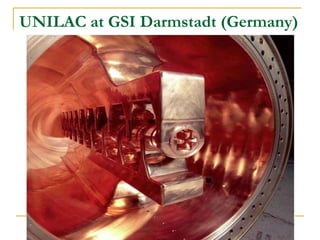
UNILAC at GSI Darmstadt (Germany)
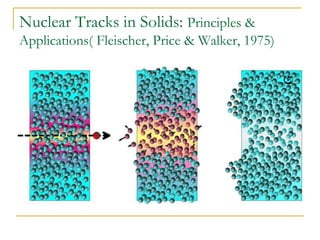
Nuclear Tracks in Solids: Principles &
Applications( Fleischer, Price & Walker, 1975)
Ion Tracks as Structuring Tools
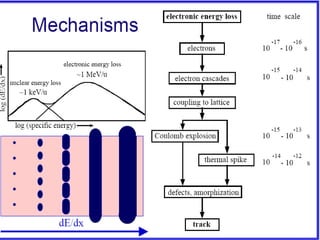
 Ion tracks are created when high-energetic heavy
ions with energy of about 1 MeV/nucleon (e.g. 140
MeV Xe ions) pass through matter. The extremely
high local energy deposition along the path leads to
a material transformation within a narrow cylinder of
about 10 nm width. Unlike in the more conventional
lithographic techniques based on ion or electron
beam irradiation, a single heavy ion suffices to
transform the material.
Revelation of Ion Tracks
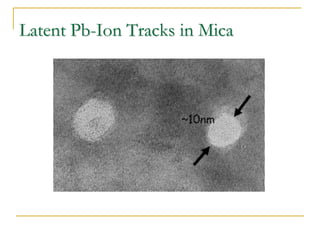
 Latent tracks were first observed in Mica by Electron
Microscope with diameter range of 50-100 Angstrom
(5-10nm).
 Chemical etching was first used by DA Young in
Harwell (1958) to reveal fission fragment tracks in
LiF and Mica. They can be observed using Optical
Microscope. Ion tracks can be recorded in almost all
Insulators( polymers, glasses, inorganic crystals)
and some Semi-conductors.
Latent Pb-Ion Tracks in Mica
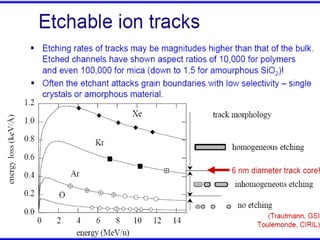
Size of Etched ION Tracks
Large Etched Ion Tracks
How to Use Ion Tracks
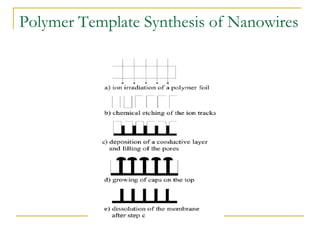
 There are essentially two ways to use ion tracks for
nanostructuring. The first is based on track etching
as used in the filter production, i.e. one irradiates a
polymer foil and etches the tracks to create thin
pores in the foil. These pores are subsequently filled
with an appropriate material to make
nanostructures. In this process, the polymer foil
serves as a template and can be removed
(dissolved) if required.
 The second method uses the ion tracks directly
without additional etching and refilling steps. This
method is simpler than the template technique since
no filling of the pores is required, but its scope is
limited.
Nanowire Fabrication
 Template synthesis using polymer and anodic
alumina membranes
 Electrochemical deposition
 Ensures fabrication of electrically continuous wires
since it only takes place on conductive surfaces
 Applicable to a wide range of materials
 High pressure injection
 Limited to elements and heterogeneously-melting
compounds with low melting points
 Does not ensure continuous wires
 Does not work well for diameters < 30-40 nm
 Chemical Vapor Deposition (CVD) or VLS technique
 Laser assisted techniques
Polymer Template Synthesis of Nanowires
(T. Sands/ HEMI group http://www.mse.berkeley.edu/groups/Sands/HEMI/nanoTE.html)
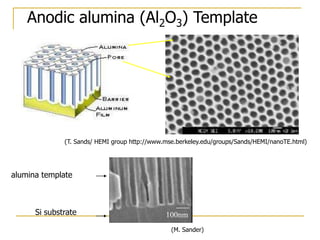
Anodic alumina (Al2O3) Template
100nmSi substrate
alumina template
(M. Sander)
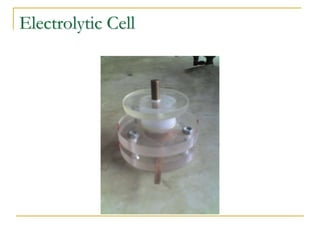
Electrolytic Cell
Template Synthesis of Copper Nanowires
 The concept of electro-deposition of metals through
electroplating is described as an electrochemical
process. The etched pores of ITFs used would act
as a template. The electrolyte used here was
CuSO4.5H2O acidic solution. The rate of deposition
of metallic film depends upon many factors, i.e.,
current density, inter-electrode distance, cell
voltage, electrolyte concentration and temperature
etc. In the present set up electrode distance was
kept 0.5 cm and a current of 0.0025A was applied
for 50 minutes. The developed microstructures
were scanned under SEM (Jeol, JSM-6100) for
morphological and structural studies.
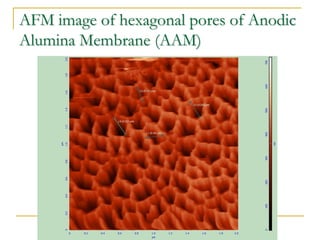
AFM image of hexagonal pores of Anodic
Alumina Membrane (AAM)
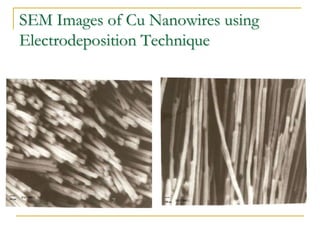
SEM Images of Cu Nanowires using
Electrodeposition Technique
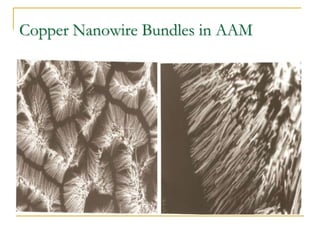
Copper Nanowire Bundles in AAM
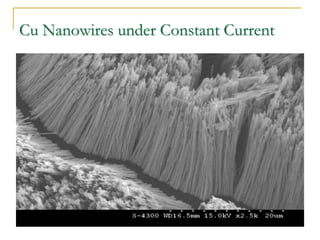
Cu Nanowires under Constant Current
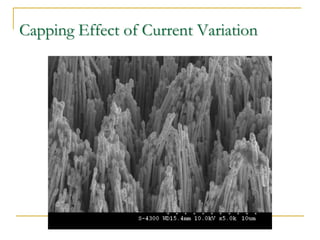
Capping Effect of Current Variation
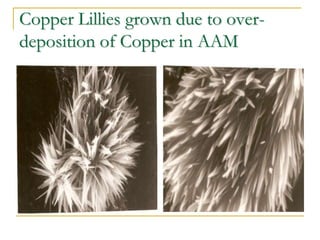
Copper Lillies grown due to over-
deposition of Copper in AAM
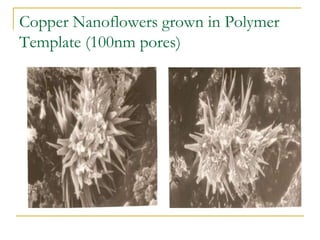
Copper Nanoflowers grown in Polymer
Template (100nm pores)
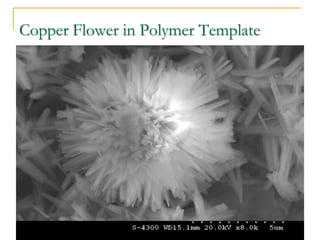
Copper Flower in Polymer Template
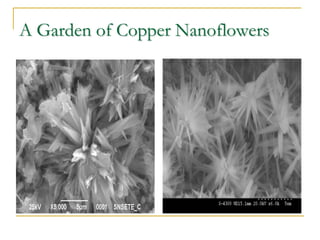
A Garden of Copper Nanoflowers
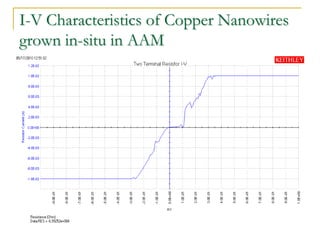
I-V Characteristics of Copper Nanowires
grown in-situ in AAM
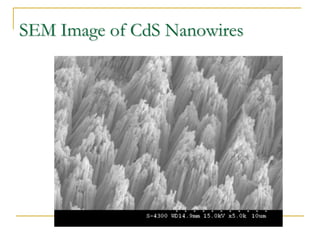
SEM Image of CdS Nanowires
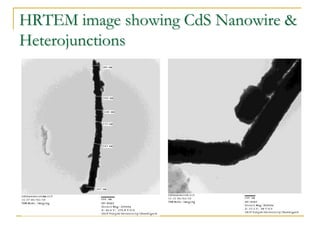
HRTEM image showing CdS Nanowire &
Heterojunctions
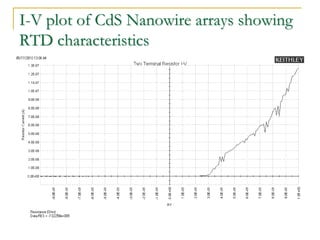
I-V plot of CdS Nanowire arrays showing
RTD characteristics
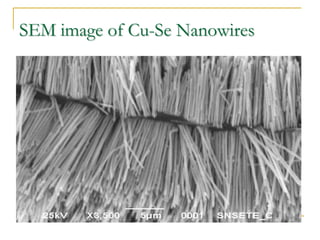
SEM image of Cu-Se Nanowires
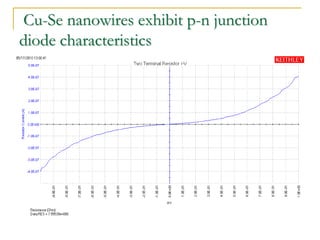
Cu-Se nanowires exhibit p-n junction
diode characteristics
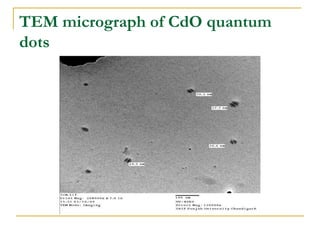
TEM micrograph of CdO quantum
dots
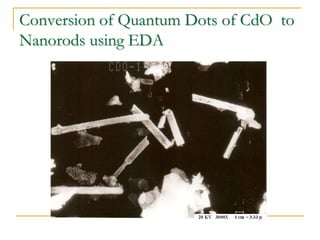
Conversion of Quantum Dots of CdO to
Nanorods using EDA
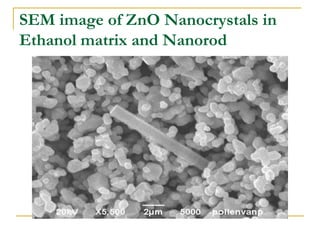
SEM image of ZnO Nanocrystals in
Ethanol matrix and Nanorod
Acknowledgements
 Reimer Spohr & Christina Trautman (GSI, Darmstadt)
 Sanjit Amrita Kaur (GND University, Amritsar)
 Vishal, Gurmit, Sehdev & KK (DAVIET, Jalandhar)
 Dr SK Mehta, Chemistry Deptt. (PU, Chandigarh)
 CSIO Chandigarh & IIT Roorkee for FESEM & TEM facility.
 SEM & TEM facility (SAIF, PU, Chandigarh)
 Rajeev Patnaik (Geology Deptt., PU, Chandigarh)
 DAV MC, New Delhi for Research Grants.
 Dr. MS Atwal, VC, Eternal University, Baru Sahib.
Thank You !!!

Ssntd ion track technology to nanotechnology

  • 1.
    My Journey fromIon Track Technology to Nanotechnology Hardev Singh Virk Professor Emeritus Eternal University, Baru Sahib, HP, India
  • 2.
    History of NuclearTracks Rutherford’s discovery Alpha tracks:1906 (Wilson Cloud chamber used as a detector) Ruchi Ram Sahni studied Alpha tracks in Nuclear Emulsion in Rutherford Lab.1915 Discovery of Pi Mesons by C.F. Powel using Nuclear Emulsions in Bristol 1940s Beva Chowdhary used N. Emulsions for study of Pi mesons in Calcutta University. D.Lal, Y.Pal & B.Peters in TIFR used NE:1950s
  • 3.
    Routes to Nanotechnology •Physical, chemical, biological and nature’s self assembly. • Top-down and bottom-up approaches. • Chemical route to nanotechnology is simpler, cheaper and allows fabrication at bench top conditions. • Reverse micelles (microemulsions route) is a versatile method to produce a variety of nanoparticles.
  • 4.
    My Route toNanotechnology • Ion Track Technology Route using Heavy Ion Beams from GSI, Darmstadt & JINR, Dubna. • Chemical Route of Reverse micelles, co- precipitation, solvo-thermal, sol-gel and seed growth techniques. • Quantum dots, nanorods and nanoneedles of Barium Carbonate, Barium Oxalate, Iron Oxalate, Barium hexaferrite, Zinc Oxide, Cadmium Sulphide, Cadmium Oxide and Silver prepared.
  • 5.
    Ion Track Technology Ion Track Technology [1] was developed at GSI, Darmstadt. Ion Track Filters (ITFs) or Track-etched membranes became precursors to development of nanotechnology during 1990s. ITFs were prepared by bombardment of thin polymer foils using heavy ions. One of the first applications of ITFs was separation of cancer blood cells from normal blood by making use of Nuclepore filters. Author’s group used heavy ion beam facility available at GSI UNILAC, Darmstadt during 1980s for Ion Beam Modification of Materials and to prepare ITFs in our laboratory.  [1] R. Spohr: Ion Tracks and Microtechnology: Principles and Applications (Vieweg Publications, Weisbaden Germany, 1990)
  • 6.
    UNILAC at GSIDarmstadt (Germany)
  • 7.
    Nuclear Tracks inSolids: Principles & Applications( Fleischer, Price & Walker, 1975)
  • 10.
    Ion Tracks asStructuring Tools  Ion tracks are created when high-energetic heavy ions with energy of about 1 MeV/nucleon (e.g. 140 MeV Xe ions) pass through matter. The extremely high local energy deposition along the path leads to a material transformation within a narrow cylinder of about 10 nm width. Unlike in the more conventional lithographic techniques based on ion or electron beam irradiation, a single heavy ion suffices to transform the material.
  • 11.
    Revelation of IonTracks  Latent tracks were first observed in Mica by Electron Microscope with diameter range of 50-100 Angstrom (5-10nm).  Chemical etching was first used by DA Young in Harwell (1958) to reveal fission fragment tracks in LiF and Mica. They can be observed using Optical Microscope. Ion tracks can be recorded in almost all Insulators( polymers, glasses, inorganic crystals) and some Semi-conductors.
  • 12.
  • 13.
    Size of EtchedION Tracks
  • 14.
  • 15.
    How to UseIon Tracks  There are essentially two ways to use ion tracks for nanostructuring. The first is based on track etching as used in the filter production, i.e. one irradiates a polymer foil and etches the tracks to create thin pores in the foil. These pores are subsequently filled with an appropriate material to make nanostructures. In this process, the polymer foil serves as a template and can be removed (dissolved) if required.  The second method uses the ion tracks directly without additional etching and refilling steps. This method is simpler than the template technique since no filling of the pores is required, but its scope is limited.
  • 16.
    Nanowire Fabrication  Templatesynthesis using polymer and anodic alumina membranes  Electrochemical deposition  Ensures fabrication of electrically continuous wires since it only takes place on conductive surfaces  Applicable to a wide range of materials  High pressure injection  Limited to elements and heterogeneously-melting compounds with low melting points  Does not ensure continuous wires  Does not work well for diameters < 30-40 nm  Chemical Vapor Deposition (CVD) or VLS technique  Laser assisted techniques
  • 17.
  • 18.
    (T. Sands/ HEMIgroup http://www.mse.berkeley.edu/groups/Sands/HEMI/nanoTE.html) Anodic alumina (Al2O3) Template 100nmSi substrate alumina template (M. Sander)
  • 19.
  • 20.
    Template Synthesis ofCopper Nanowires  The concept of electro-deposition of metals through electroplating is described as an electrochemical process. The etched pores of ITFs used would act as a template. The electrolyte used here was CuSO4.5H2O acidic solution. The rate of deposition of metallic film depends upon many factors, i.e., current density, inter-electrode distance, cell voltage, electrolyte concentration and temperature etc. In the present set up electrode distance was kept 0.5 cm and a current of 0.0025A was applied for 50 minutes. The developed microstructures were scanned under SEM (Jeol, JSM-6100) for morphological and structural studies.
  • 21.
    AFM image ofhexagonal pores of Anodic Alumina Membrane (AAM)
  • 22.
    SEM Images ofCu Nanowires using Electrodeposition Technique
  • 23.
  • 24.
    Cu Nanowires underConstant Current
  • 25.
    Capping Effect ofCurrent Variation
  • 26.
    Copper Lillies growndue to over- deposition of Copper in AAM
  • 27.
    Copper Nanoflowers grownin Polymer Template (100nm pores)
  • 28.
    Copper Flower inPolymer Template
  • 29.
    A Garden ofCopper Nanoflowers
  • 30.
    I-V Characteristics ofCopper Nanowires grown in-situ in AAM
  • 31.
    SEM Image ofCdS Nanowires
  • 32.
    HRTEM image showingCdS Nanowire & Heterojunctions
  • 33.
    I-V plot ofCdS Nanowire arrays showing RTD characteristics
  • 34.
    SEM image ofCu-Se Nanowires
  • 35.
    Cu-Se nanowires exhibitp-n junction diode characteristics
  • 36.
    TEM micrograph ofCdO quantum dots
  • 37.
    Conversion of QuantumDots of CdO to Nanorods using EDA
  • 38.
    SEM image ofZnO Nanocrystals in Ethanol matrix and Nanorod
  • 39.
    Acknowledgements  Reimer Spohr& Christina Trautman (GSI, Darmstadt)  Sanjit Amrita Kaur (GND University, Amritsar)  Vishal, Gurmit, Sehdev & KK (DAVIET, Jalandhar)  Dr SK Mehta, Chemistry Deptt. (PU, Chandigarh)  CSIO Chandigarh & IIT Roorkee for FESEM & TEM facility.  SEM & TEM facility (SAIF, PU, Chandigarh)  Rajeev Patnaik (Geology Deptt., PU, Chandigarh)  DAV MC, New Delhi for Research Grants.  Dr. MS Atwal, VC, Eternal University, Baru Sahib.
  • 40.