Andy Colley
ICT AST, BSC, SSC, NCQW
@MrAColley
www.mrcolley.com
@MrAColley www.mrcolley.com
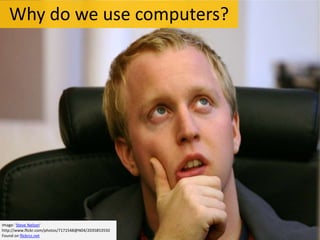
Why do we use computers?
Image: 'Steve Nelson'
http://www.flickr.com/photos/7171548@N04/2035853550
Found on flickrcc.net
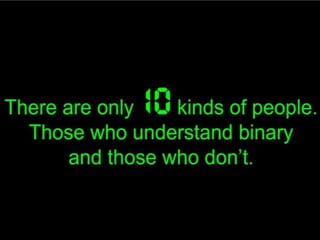
Do you get it?
@MrAColley www.mrcolley.com
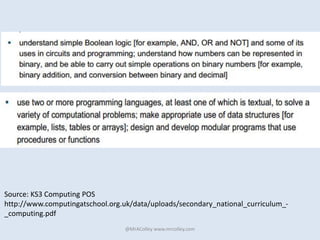
Source: KS3 Computing POS
http://www.computingatschool.org.uk/data/uploads/secondary_national_curriculum_-
_computing.pdf
@MrAColley www.mrcolley.com
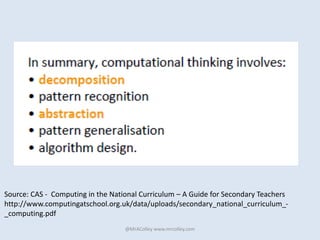
Source: CAS - Computing in the National Curriculum – A Guide for Secondary Teachers
http://www.computingatschool.org.uk/data/uploads/secondary_national_curriculum_-
_computing.pdf
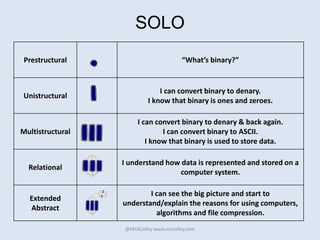
SOLO
@MrAColley www.mrcolley.com
Prestructural “What’s binary?”
Unistructural
I can convert binary to denary.
I know that binary is ones and zeroes.
Multistructural
I can convert binary to denary & back again.
I can convert binary to ASCII.
I know that binary is used to store data.
Relational
I understand how data is represented and stored on a
computer system.
Extended
Abstract
I can see the big picture and start to
understand/explain the reasons for using computers,
algorithms and file compression.
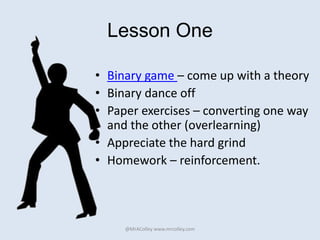
Lesson One
• Binary game – come up with a theory
• Binary dance off
• Paper exercises – converting one way
and the other (overlearning)
• Appreciate the hard grind
• Homework – reinforcement.
@MrAColley www.mrcolley.com
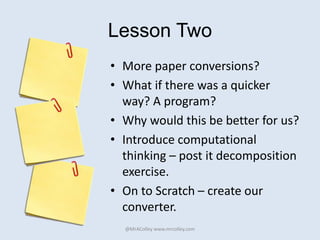
Lesson Two
• More paper conversions?
• What if there was a quicker
way? A program?
• Why would this be better for us?
• Introduce computational
thinking – post it decomposition
exercise.
• On to Scratch – create our
converter.
@MrAColley www.mrcolley.com
Lesson 3
@MrAColley www.mrcolley.com
MrAColley (no spaces)
@MrAColley www.mrcolley.com
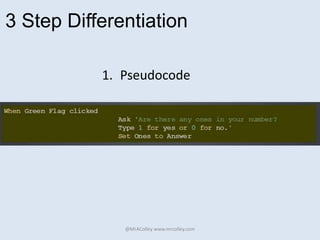
3 Step Differentiation
1. Pseudocode
@MrAColley www.mrcolley.com
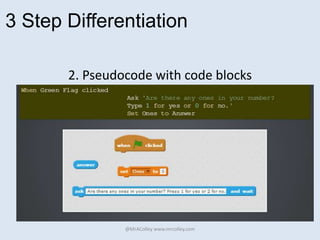
3 Step Differentiation
2. Pseudocode with code blocks
@MrAColley www.mrcolley.com
3 Step Differentiation
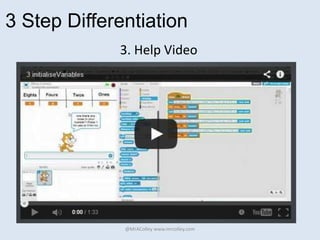
3. Help Video
@MrAColley www.mrcolley.com
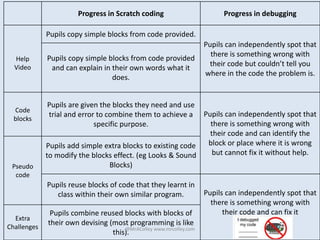
Progress in Scratch coding Progress in debugging
Help
Video
Pupils copy simple blocks from code provided.
Pupils can independently spot that
there is something wrong with
their code but couldn’t tell you
where in the code the problem is.
Pupils copy simple blocks from code provided
and can explain in their own words what it
does.
Code
blocks
Pupils are given the blocks they need and use
trial and error to combine them to achieve a
specific purpose.
Pupils can independently spot that
there is something wrong with
their code and can identify the
block or place where it is wrong
but cannot fix it without help.
Pseudo
code
Pupils add simple extra blocks to existing code
to modify the blocks effect. (eg Looks & Sound
Blocks)
Pupils reuse blocks of code that they learnt in
class within their own similar program. Pupils can independently spot that
there is something wrong with
their code and can fix it
Extra
Challenges
Pupils combine reused blocks with blocks of
their own devising (most programming is like
this).@MrAColley www.mrcolley.com
ASCII
• Secret messages
• Data representation
• Email
• Can build into networks
@MrAColley www.mrcolley.com
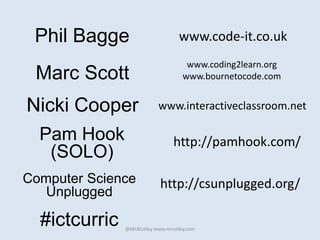
Phil Bagge
www.coding2learn.org
www.bournetocode.com
@MrAColley www.mrcolley.com
Marc Scott
www.code-it.co.uk
#ictcurric
Nicki Cooper www.interactiveclassroom.net
http://csunplugged.org/Computer Science
Unplugged
http://pamhook.com/Pam Hook
(SOLO)

SSAT Computing Conference 2014 Workshop - Scratch Binary Converter

  • 1.
    Andy Colley ICT AST,BSC, SSC, NCQW @MrAColley www.mrcolley.com
  • 2.
    @MrAColley www.mrcolley.com Why dowe use computers? Image: 'Steve Nelson' http://www.flickr.com/photos/7171548@N04/2035853550 Found on flickrcc.net
  • 3.
    Do you getit? @MrAColley www.mrcolley.com
  • 4.
    @MrAColley www.mrcolley.com Source: KS3Computing POS http://www.computingatschool.org.uk/data/uploads/secondary_national_curriculum_- _computing.pdf
  • 5.
    @MrAColley www.mrcolley.com Source: CAS- Computing in the National Curriculum – A Guide for Secondary Teachers http://www.computingatschool.org.uk/data/uploads/secondary_national_curriculum_- _computing.pdf
  • 6.
    SOLO @MrAColley www.mrcolley.com Prestructural “What’sbinary?” Unistructural I can convert binary to denary. I know that binary is ones and zeroes. Multistructural I can convert binary to denary & back again. I can convert binary to ASCII. I know that binary is used to store data. Relational I understand how data is represented and stored on a computer system. Extended Abstract I can see the big picture and start to understand/explain the reasons for using computers, algorithms and file compression.
  • 7.
    Lesson One • Binarygame – come up with a theory • Binary dance off • Paper exercises – converting one way and the other (overlearning) • Appreciate the hard grind • Homework – reinforcement. @MrAColley www.mrcolley.com
  • 8.
    Lesson Two • Morepaper conversions? • What if there was a quicker way? A program? • Why would this be better for us? • Introduce computational thinking – post it decomposition exercise. • On to Scratch – create our converter. @MrAColley www.mrcolley.com
  • 9.
  • 10.
  • 11.
    3 Step Differentiation 1.Pseudocode @MrAColley www.mrcolley.com
  • 12.
    3 Step Differentiation 2.Pseudocode with code blocks @MrAColley www.mrcolley.com
  • 13.
    3 Step Differentiation 3.Help Video @MrAColley www.mrcolley.com
  • 14.
    Progress in Scratchcoding Progress in debugging Help Video Pupils copy simple blocks from code provided. Pupils can independently spot that there is something wrong with their code but couldn’t tell you where in the code the problem is. Pupils copy simple blocks from code provided and can explain in their own words what it does. Code blocks Pupils are given the blocks they need and use trial and error to combine them to achieve a specific purpose. Pupils can independently spot that there is something wrong with their code and can identify the block or place where it is wrong but cannot fix it without help. Pseudo code Pupils add simple extra blocks to existing code to modify the blocks effect. (eg Looks & Sound Blocks) Pupils reuse blocks of code that they learnt in class within their own similar program. Pupils can independently spot that there is something wrong with their code and can fix it Extra Challenges Pupils combine reused blocks with blocks of their own devising (most programming is like this).@MrAColley www.mrcolley.com
  • 15.
    ASCII • Secret messages •Data representation • Email • Can build into networks @MrAColley www.mrcolley.com
  • 16.
    Phil Bagge www.coding2learn.org www.bournetocode.com @MrAColley www.mrcolley.com MarcScott www.code-it.co.uk #ictcurric Nicki Cooper www.interactiveclassroom.net http://csunplugged.org/Computer Science Unplugged http://pamhook.com/Pam Hook (SOLO)

Editor's Notes

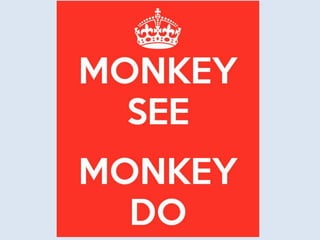
  • #4 Learning objective – get the joke.
  • #7 Reference Pam Hook
  • #8 Decomposition Pattern Recognition Reference Nicki Cooper (resources)
  • #9 Algorithms Abstraction Pattern generalisation.
  • #11 Screencasts – no challenge. High tech copying from a textbook.
  • #12 Or how to stop them just copying from a video. Support AND challenge. Reference Marc Scott
  • #13 Or how to stop them just copying from a video. Support AND challenge.
  • #14 Or how to stop them just copying from a video. Support AND challenge.
  • #15 Reference Phil Bagge