Service Organization Control Reports
             An Overview
Agenda
• Service Organization Control Reporting
   – Definitions
   – Background
   – Report Types and Guidance
• Transitioning to SSAE 16/SOC 1
   – Similarities to SAS 70
   – Key Differences from SAS 70
• SOC 2 and 3 Reporting
• Reporting Options
• Summary
• Questions
Service Organization Control
Reporting
What are Service Organizations?
• Service Organization – provider of services that may
  impact a user’s financial reporting or pose a
  business risk
    Services such as:
       Cloud computing
       Managed security
       Financial services customer accounting
       Customer support
       Sales force automation
       Health care claims management and processing
       Enterprise IT outsourcing
Definition: Service Auditor

• Service auditor – a CPA who examines and
  reports on controls at a service organization
Who are Users?
• Users – typically considered clients of
  service organization
   May need assurance regarding controls over
    security, availability, processing integrity,
    confidentiality or privacy
• User Auditor – a CPA who performs a audit
  on the users financial statements
   Needs assurance regarding the controls in place at
    the service organization that impact user financial
    statements
Background
• Why change?
     • SAS 70 has become increasingly misused
     • Never intended to offer assurance on compliance or
       operations
     • No such thing as a SAS 70 “certification”
     • Convergence with International Standards
     • AICPA is seeking to address needs of the marketplace
Background
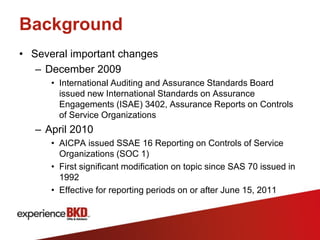
• Several important changes
   – December 2009
      • International Auditing and Assurance Standards Board
        issued new International Standards on Assurance
        Engagements (ISAE) 3402, Assurance Reports on Controls
        of Service Organizations
   – April 2010
      • AICPA issued SSAE 16 Reporting on Controls of Service
        Organizations (SOC 1)
      • First significant modification on topic since SAS 70 issued in
        1992
      • Effective for reporting periods on or after June 15, 2011
Background
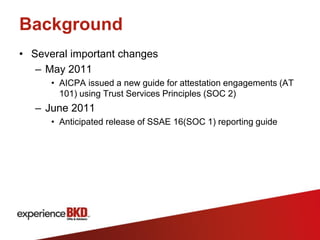
• Several important changes
   – May 2011
      • AICPA issued a new guide for attestation engagements (AT
        101) using Trust Services Principles (SOC 2)
   – June 2011
      • Anticipated release of SSAE 16(SOC 1) reporting guide
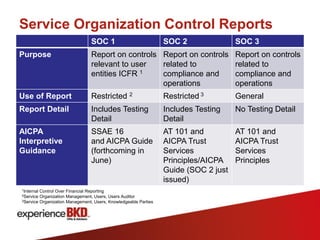
Service Organization Control Reports
                                SOC 1                            SOC 2               SOC 3
Purpose                         Report on controls Report on controls                Report on controls
                                relevant to user   related to                        related to
                                entities ICFR 1    compliance and                    compliance and
                                                   operations                        operations
Use of Report                   Restricted 2                     Restricted 3        General
Report Detail                   Includes Testing                 Includes Testing    No Testing Detail
                                Detail                           Detail
AICPA                           SSAE 16                          AT 101 and          AT 101 and
Interpretive                    and AICPA Guide                  AICPA Trust         AICPA Trust
Guidance                        (forthcoming in                  Services            Services
                                June)                            Principles/AICPA    Principles
                                                                 Guide (SOC 2 just
                                                                 issued)
1InternalControl Over Financial Reporting
2Service Organization Management, Users, Users Auditor
3Service Organization Management, Users, Knowledgeable Parties
Transitioning to SSAE 16
    SOC 1 Reporting
Similarities
• SSAE 16 continues the focus on
  controls likely to be relevant to their user entities’
  internal control over financial reporting (ICFR)
• SSAE 16 will have SOC 1 reports similar in
  scope to the current SAS 70 reports
   – Type 1
   – Type 2
• The format of the reports will not be significantly
  different
Similarities
• Narrative description of controls:
  Basis for new description of the system
• Treatment of subservice organizations
   Included (inclusive method)
   Excluded (carve-out method)

• Intended users of the report
   Service organization’s management
   Users
   User auditors
Key Differences:
SAS vs. SSAE
• Attest standard (Assertion), not an audit
  standard (GAAP)
• Consistency with international standards and
  existing attestation standards
• Increased focus on service organizations with
  services relevant to a user organizations internal
  control over financial reporting (ICFR)
• Some SAS 70 reports will move to SOC 2 or
  SOC 3 reports
Key Differences:
Management Assertion
A Management Assertion will be included in or
attached to the SSAE 16 report
• States*:
     System fairly represented
     System suitably designed and implemented
     The related controls activities were suitably designed
      to achieve the stated control objectives
     That the control activities are operating effectively
      (Type 2 only)
*The auditor opinion attests to these statements. Type 1 specified
 date/Type 2 throughout the period
Key Differences:
Management Assertion
• The report will reference that management is
  responsible for:
   Preparing the system description
   Providing the stated services
   Specifying the control objectives
   Identifying the risks
   Selecting and stating the criteria for their assertion
    (e.g. monitoring activities)
   Designing, implementing and documenting controls
    that are suitably designed and operating effectively
Key Differences:
Management Assertion

• Auditor’s Opinion – remains in the role of
  providing assurance regarding management’s
  assertions (same but more emphasis)
• Auditor is not the entity responsible for the
  communication (same but more emphasis)
• Subservice organizations must provide a similar
  assertion when the inclusive method is used
Key Differences:
System Description
• Currently a narrative description of controls
• SSAE 16 requires a description of the system
    Infrastructure
    Software
    People
    Procedures
    Data
Key Differences:
System Description
• Components common to existing Descriptions
  of Controls
   Services covered
   Period covered
   Control objectives and related control activities
   Complementary user controls

• For inclusive subservice organizations, add
   Related control objectives
   Related control activities
Key Differences:
System Description

• Additional elements for the Description of the
  System
   Classes of transactions and details on related
    procedures and accounting records
   The capturing and addressing of significant events
    other than transactions
Key Differences:
System Description

• Additional elements for the Description of the
  System
   Report preparation processes
   Other relevant aspects of the organization’s:
     Control environment
     Risk assessment process
     Information and communication systems
     Control activities and monitoring controls
Key Differences:
Risks Assessment
• Management should:
   Identify the risks that threaten the achievement of the
    stated services
   Identify the risks that threaten the achievement of the
    stated control objectives
   Evaluate whether the identified controls sufficiently
    address the risks to achieving the control objectives
• Risks to Services       Control Objectives
• Risks to Control Objectives        Control Activities
Design of Controls: Based on Risk

       Risk Assessment Supporting Control Design

            Services Provided
        Assessment of risks to services leads to:

            Control Objectives
     Assessment of risk to control objective leads to:

              Control Activities
Other Key Differences
• Service auditor use of internal audit
   – Reliance on / must disclose
   – Direct use / no disclosure
• Certain aspects of opinion apply to entire period rather
  than a point in time
    Narrative

    Control design

    Control implementation
Trust Services Principles
    SOC 2 and 3 Reporting
SOC 2 Reporting
• Governed by AT 101 – Attestation service
• Criteria for evaluation is Trust Services Principles (TSP)
• SSAE 16 guidance to be used
• Intended for users seeking assurance around one or
  more of control areas not relevant to ICFR of User
• TSP Criteria
      •   Security
      •   Availability
      •   Processing Integrity of the system
      •   Confidentiality of information processed
      •   Privacy of information processed
SOC 2 Reporting
• Limited Use report
   – Users generally user entity management not user auditors
   – Service Organization
   – Knowledgeable parties
• Helps user entity management
   – Obtain information about service organization controls
   – Assess and address risks
   – Carry out its responsibility for monitoring
SOC 2 Reporting
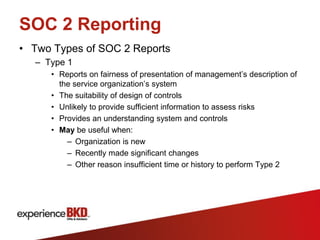
• Two Types of SOC 2 Reports
  – Type 1
     • Reports on fairness of presentation of management’s description of
       the service organization’s system
     • The suitability of design of controls
     • Unlikely to provide sufficient information to assess risks
     • Provides an understanding system and controls
     • May be useful when:
         – Organization is new
         – Recently made significant changes
         – Other reason insufficient time or history to perform Type 2
SOC 2 Reporting
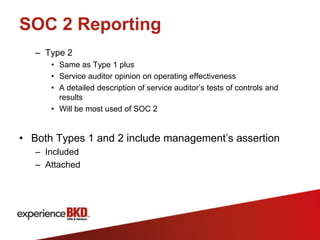
   – Type 2
      • Same as Type 1 plus
      • Service auditor opinion on operating effectiveness
      • A detailed description of service auditor’s tests of controls and
        results
      • Will be most used of SOC 2


• Both Types 1 and 2 include management’s assertion
   – Included
   – Attached
SOC 2 Reporting
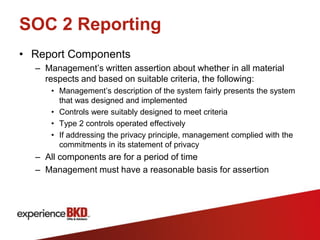
• Report Components
  – Management’s written assertion about whether in all material
    respects and based on suitable criteria, the following:
     • Management’s description of the system fairly presents the system
       that was designed and implemented
     • Controls were suitably designed to meet criteria
     • Type 2 controls operated effectively
     • If addressing the privacy principle, management complied with the
       commitments in its statement of privacy
  – All components are for a period of time
  – Management must have a reasonable basis for assertion
SOC 3 Reporting
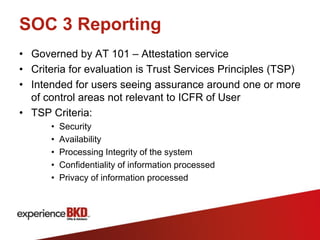
• Governed by AT 101 – Attestation service
• Criteria for evaluation is Trust Services Principles (TSP)
• Intended for users seeing assurance around one or more
  of control areas not relevant to ICFR of User
• TSP Criteria:
      •   Security
      •   Availability
      •   Processing Integrity of the system
      •   Confidentiality of information processed
      •   Privacy of information processed
SOC 3 Reporting
• General use report
   – Can be published
   – For current and prospective customers
   – One Type
• Report components like a SOC 2
   – Does include management’s written assertion
   – Does include a description of the system and its boundaries
   – Is for a period of time
• Differences from SOC 2 Report
   – Description of system less detailed and not covered by CPA’s report
   – No description of test of effectiveness or results
   – If privacy principle is addressed there is no description of compliance
     with or test results
SOC 3 Reporting
• Seal (SysTrust for Service Organizations)
   – Can be delivery vehicle for report
   – Seal displayed on service organizations website
   – SysTrust is registered by AICPA an Canadian Institute of
     Chartered Accountants (CICA)
   – Practitioners must be licensed with CICA to use seal
Reporting Options
• Multiple reports combinations
   – SOC 1 and SOC 2
      • Services impacting ICFR of user and other services with trust
        services principles concerns
   – SOC 2 and SOC 3
      • Services not impacting ICFR and need to use beyond current users
        such as marketing to prospects
   – SOC 1 and SOC 3
      • Services impacting ICFR of user and other services with trust
        services principles concerns or marketing needs
Transition Planning

     Action Items for Service Providers
Transition Planning

• Determine effective date for your organization
• Confirm Type of SOC Report
   ICFR – SOC 1 (SSAE 16)
   Limited Use / Trust Principles – SOC 2
   General Use / Trust Principles – SOC 3
Transition Planning

• Develop a Communication Plan
   Within your organization
   To your clients
      Client Internal Audit/Risk Management (i.e., other users of
       the report)
      Marketing material
      Web pages
      Contractual references
Transition Planning

• Review Scope
   Included/excluded services
   Services that impact your client’s financial reporting
   Key third parties (sub-service organizations)
      Identify all relevant 3rd party service organizations
      Existence and use of their SAS 70/SSAE 16/SOC 2 Report
      Commitments from 3rd party relative to carve out or inclusive
       method
      Contractual /SLA impacts
Transition Planning

• Review System Description
   Services
   Scope
   Classes of Transactions
   Third parties (inclusive or carve out)
   Risks
   Objectives
   Controls
Transition Planning

• Assess Control Design
   Risk based
   Will impact control objectives
   Will impact supporting control activities
   Consider current SOX or other compliance efforts/
    governance models and efforts
Transition Planning

• Consider Management Assertion
   Review basis for assertion
   Review sufficiency of current monitoring processes
   Need for direct testing of controls not sufficiently
    monitored
In Conclusion

• Develop a project plan
• Assign responsibilities
• Monitor the plan
• See Risk / Seek Help
Contact Information

Jeffrey Paulette
BKD – IT Risk Services
417.865.8701
jpaulette@bkd.com

SSAE 16 Transitions Overview

  • 1.
    Service Organization ControlReports An Overview
  • 2.
    Agenda • Service OrganizationControl Reporting – Definitions – Background – Report Types and Guidance • Transitioning to SSAE 16/SOC 1 – Similarities to SAS 70 – Key Differences from SAS 70 • SOC 2 and 3 Reporting • Reporting Options • Summary • Questions
  • 3.
  • 4.
    What are ServiceOrganizations? • Service Organization – provider of services that may impact a user’s financial reporting or pose a business risk  Services such as:  Cloud computing  Managed security  Financial services customer accounting  Customer support  Sales force automation  Health care claims management and processing  Enterprise IT outsourcing
  • 5.
    Definition: Service Auditor •Service auditor – a CPA who examines and reports on controls at a service organization
  • 6.
    Who are Users? •Users – typically considered clients of service organization  May need assurance regarding controls over security, availability, processing integrity, confidentiality or privacy • User Auditor – a CPA who performs a audit on the users financial statements  Needs assurance regarding the controls in place at the service organization that impact user financial statements
  • 7.
    Background • Why change? • SAS 70 has become increasingly misused • Never intended to offer assurance on compliance or operations • No such thing as a SAS 70 “certification” • Convergence with International Standards • AICPA is seeking to address needs of the marketplace
  • 8.
    Background • Several importantchanges – December 2009 • International Auditing and Assurance Standards Board issued new International Standards on Assurance Engagements (ISAE) 3402, Assurance Reports on Controls of Service Organizations – April 2010 • AICPA issued SSAE 16 Reporting on Controls of Service Organizations (SOC 1) • First significant modification on topic since SAS 70 issued in 1992 • Effective for reporting periods on or after June 15, 2011
  • 9.
    Background • Several importantchanges – May 2011 • AICPA issued a new guide for attestation engagements (AT 101) using Trust Services Principles (SOC 2) – June 2011 • Anticipated release of SSAE 16(SOC 1) reporting guide
  • 10.
    Service Organization ControlReports SOC 1 SOC 2 SOC 3 Purpose Report on controls Report on controls Report on controls relevant to user related to related to entities ICFR 1 compliance and compliance and operations operations Use of Report Restricted 2 Restricted 3 General Report Detail Includes Testing Includes Testing No Testing Detail Detail Detail AICPA SSAE 16 AT 101 and AT 101 and Interpretive and AICPA Guide AICPA Trust AICPA Trust Guidance (forthcoming in Services Services June) Principles/AICPA Principles Guide (SOC 2 just issued) 1InternalControl Over Financial Reporting 2Service Organization Management, Users, Users Auditor 3Service Organization Management, Users, Knowledgeable Parties
  • 11.
    Transitioning to SSAE16 SOC 1 Reporting
  • 12.
    Similarities • SSAE 16continues the focus on controls likely to be relevant to their user entities’ internal control over financial reporting (ICFR) • SSAE 16 will have SOC 1 reports similar in scope to the current SAS 70 reports – Type 1 – Type 2 • The format of the reports will not be significantly different
  • 13.
    Similarities • Narrative descriptionof controls: Basis for new description of the system • Treatment of subservice organizations  Included (inclusive method)  Excluded (carve-out method) • Intended users of the report  Service organization’s management  Users  User auditors
  • 14.
    Key Differences: SAS vs.SSAE • Attest standard (Assertion), not an audit standard (GAAP) • Consistency with international standards and existing attestation standards • Increased focus on service organizations with services relevant to a user organizations internal control over financial reporting (ICFR) • Some SAS 70 reports will move to SOC 2 or SOC 3 reports
  • 15.
    Key Differences: Management Assertion AManagement Assertion will be included in or attached to the SSAE 16 report • States*:  System fairly represented  System suitably designed and implemented  The related controls activities were suitably designed to achieve the stated control objectives  That the control activities are operating effectively (Type 2 only) *The auditor opinion attests to these statements. Type 1 specified date/Type 2 throughout the period
  • 16.
    Key Differences: Management Assertion •The report will reference that management is responsible for:  Preparing the system description  Providing the stated services  Specifying the control objectives  Identifying the risks  Selecting and stating the criteria for their assertion (e.g. monitoring activities)  Designing, implementing and documenting controls that are suitably designed and operating effectively
  • 17.
    Key Differences: Management Assertion •Auditor’s Opinion – remains in the role of providing assurance regarding management’s assertions (same but more emphasis) • Auditor is not the entity responsible for the communication (same but more emphasis) • Subservice organizations must provide a similar assertion when the inclusive method is used
  • 18.
    Key Differences: System Description •Currently a narrative description of controls • SSAE 16 requires a description of the system  Infrastructure  Software  People  Procedures  Data
  • 19.
    Key Differences: System Description •Components common to existing Descriptions of Controls  Services covered  Period covered  Control objectives and related control activities  Complementary user controls • For inclusive subservice organizations, add  Related control objectives  Related control activities
  • 20.
    Key Differences: System Description •Additional elements for the Description of the System  Classes of transactions and details on related procedures and accounting records  The capturing and addressing of significant events other than transactions
  • 21.
    Key Differences: System Description •Additional elements for the Description of the System  Report preparation processes  Other relevant aspects of the organization’s: Control environment Risk assessment process Information and communication systems Control activities and monitoring controls
  • 22.
    Key Differences: Risks Assessment •Management should:  Identify the risks that threaten the achievement of the stated services  Identify the risks that threaten the achievement of the stated control objectives  Evaluate whether the identified controls sufficiently address the risks to achieving the control objectives • Risks to Services Control Objectives • Risks to Control Objectives Control Activities
  • 23.
    Design of Controls:Based on Risk Risk Assessment Supporting Control Design Services Provided Assessment of risks to services leads to: Control Objectives Assessment of risk to control objective leads to: Control Activities
  • 24.
    Other Key Differences •Service auditor use of internal audit – Reliance on / must disclose – Direct use / no disclosure • Certain aspects of opinion apply to entire period rather than a point in time  Narrative  Control design  Control implementation
  • 25.
    Trust Services Principles SOC 2 and 3 Reporting
  • 26.
    SOC 2 Reporting •Governed by AT 101 – Attestation service • Criteria for evaluation is Trust Services Principles (TSP) • SSAE 16 guidance to be used • Intended for users seeking assurance around one or more of control areas not relevant to ICFR of User • TSP Criteria • Security • Availability • Processing Integrity of the system • Confidentiality of information processed • Privacy of information processed
  • 27.
    SOC 2 Reporting •Limited Use report – Users generally user entity management not user auditors – Service Organization – Knowledgeable parties • Helps user entity management – Obtain information about service organization controls – Assess and address risks – Carry out its responsibility for monitoring
  • 28.
    SOC 2 Reporting •Two Types of SOC 2 Reports – Type 1 • Reports on fairness of presentation of management’s description of the service organization’s system • The suitability of design of controls • Unlikely to provide sufficient information to assess risks • Provides an understanding system and controls • May be useful when: – Organization is new – Recently made significant changes – Other reason insufficient time or history to perform Type 2
  • 29.
    SOC 2 Reporting – Type 2 • Same as Type 1 plus • Service auditor opinion on operating effectiveness • A detailed description of service auditor’s tests of controls and results • Will be most used of SOC 2 • Both Types 1 and 2 include management’s assertion – Included – Attached
  • 30.
    SOC 2 Reporting •Report Components – Management’s written assertion about whether in all material respects and based on suitable criteria, the following: • Management’s description of the system fairly presents the system that was designed and implemented • Controls were suitably designed to meet criteria • Type 2 controls operated effectively • If addressing the privacy principle, management complied with the commitments in its statement of privacy – All components are for a period of time – Management must have a reasonable basis for assertion
  • 31.
    SOC 3 Reporting •Governed by AT 101 – Attestation service • Criteria for evaluation is Trust Services Principles (TSP) • Intended for users seeing assurance around one or more of control areas not relevant to ICFR of User • TSP Criteria: • Security • Availability • Processing Integrity of the system • Confidentiality of information processed • Privacy of information processed
  • 32.
    SOC 3 Reporting •General use report – Can be published – For current and prospective customers – One Type • Report components like a SOC 2 – Does include management’s written assertion – Does include a description of the system and its boundaries – Is for a period of time • Differences from SOC 2 Report – Description of system less detailed and not covered by CPA’s report – No description of test of effectiveness or results – If privacy principle is addressed there is no description of compliance with or test results
  • 33.
    SOC 3 Reporting •Seal (SysTrust for Service Organizations) – Can be delivery vehicle for report – Seal displayed on service organizations website – SysTrust is registered by AICPA an Canadian Institute of Chartered Accountants (CICA) – Practitioners must be licensed with CICA to use seal
  • 34.
    Reporting Options • Multiplereports combinations – SOC 1 and SOC 2 • Services impacting ICFR of user and other services with trust services principles concerns – SOC 2 and SOC 3 • Services not impacting ICFR and need to use beyond current users such as marketing to prospects – SOC 1 and SOC 3 • Services impacting ICFR of user and other services with trust services principles concerns or marketing needs
  • 35.
    Transition Planning Action Items for Service Providers
  • 36.
    Transition Planning • Determineeffective date for your organization • Confirm Type of SOC Report  ICFR – SOC 1 (SSAE 16)  Limited Use / Trust Principles – SOC 2  General Use / Trust Principles – SOC 3
  • 37.
    Transition Planning • Developa Communication Plan  Within your organization  To your clients  Client Internal Audit/Risk Management (i.e., other users of the report)  Marketing material  Web pages  Contractual references
  • 38.
    Transition Planning • ReviewScope  Included/excluded services  Services that impact your client’s financial reporting  Key third parties (sub-service organizations)  Identify all relevant 3rd party service organizations  Existence and use of their SAS 70/SSAE 16/SOC 2 Report  Commitments from 3rd party relative to carve out or inclusive method  Contractual /SLA impacts
  • 39.
    Transition Planning • ReviewSystem Description  Services  Scope  Classes of Transactions  Third parties (inclusive or carve out)  Risks  Objectives  Controls
  • 40.
    Transition Planning • AssessControl Design  Risk based  Will impact control objectives  Will impact supporting control activities  Consider current SOX or other compliance efforts/ governance models and efforts
  • 41.
    Transition Planning • ConsiderManagement Assertion  Review basis for assertion  Review sufficiency of current monitoring processes  Need for direct testing of controls not sufficiently monitored
  • 42.
    In Conclusion • Developa project plan • Assign responsibilities • Monitor the plan • See Risk / Seek Help
  • 43.
    Contact Information Jeffrey Paulette BKD– IT Risk Services 417.865.8701 jpaulette@bkd.com