PHRASEOLOGICAL POTENTIAL OF
GASTRONOMIC TERMS IN THE ENGLISH
LANGUAGE
Роботу виконала:
Науменко Ксенія Олександрівна,
учениця 10 класу
НВК «Загальноосвітня школа I-III ступенів -
дошкільний навчальний заклад»
Костянтинівської міської ради
Донецької області
Науковий керівник:
Кузнецова Вікторія Євгенівна,
вчитель англійської мови
НВК «Загальноосвітня школа I-III ступенів -
дошкільний навчальний заклад»
Костянтинівської міської ради
Донецької області
The urgency of the research
The urgency of the research is determined by the need for a
comprehensive analysis of PUGC as one of the most vivid verbal
means of expressing the national English culture.
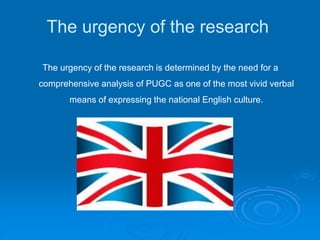
The purpose of the research:
is to determine the basic English food, the degree of phrasal activity of
the gastronomic names.
The object of the research:
is the phraseological system of the English language.
The subject of the study:
is English phraseological units with the names of
gastronomic units.
There are the following tasks for
achievement of the goal:
➢ to define the concept of phraseological units with a gastronomic
component;
➢ to describe the gastronomic culture of the British;
➢ to investigate what names of products became productive elements
in the formation of phraseologisms;
➢ to examine what spheres of English life the widespread use of
gastronomic terms in the phraseology of the English language is
connected with.
Methods we used:
➢ method of continuous sampling
➢ descriptive method
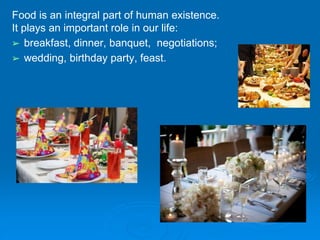
Food is an integral part of human existence.
It plays an important role in our life:
➢ breakfast, dinner, banquet, negotiations;
➢ wedding, birthday party, feast.
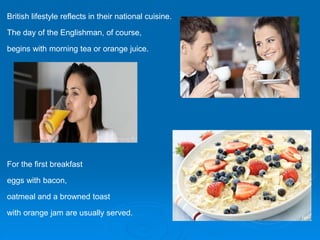
British lifestyle reflects in their national cuisine.
The day of the Englishman, of course,
begins with morning tea or orange juice.
For the first breakfast
eggs with bacon,
oatmeal and a browned toast
with orange jam are usually served.
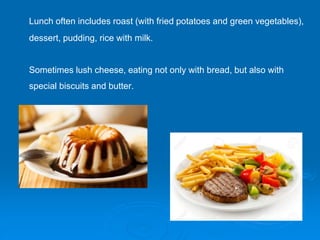
Lunch often includes roast (with fried potatoes and green vegetables),
dessert, pudding, rice with milk.
Sometimes lush cheese, eating not only with bread, but also with
special biscuits and butter.
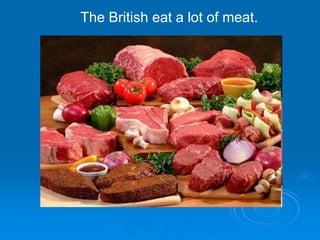
The British eat a lot of meat.
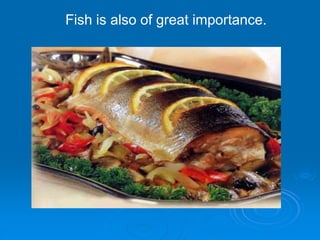
Fish is also of great importance.
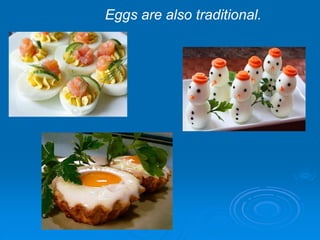
Eggs are also traditional.
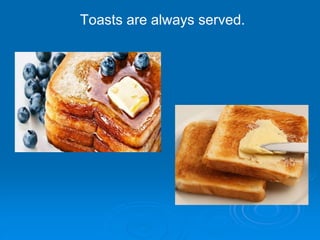
Toasts are always served.
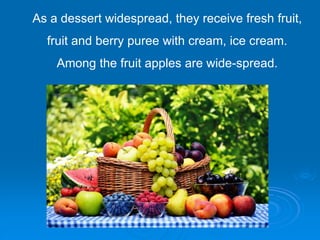
As a dessert widespread, they receive fresh fruit,
fruit and berry puree with cream, ice cream.
Among the fruit apples are wide-spread.
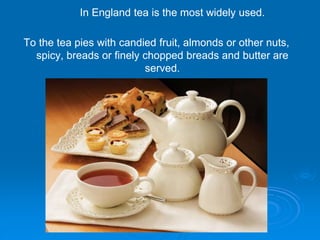
In England tea is the most widely used.
To the tea pies with candied fruit, almonds or other nuts,
spicy, breads or finely chopped breads and butter are
served.
The names of these products, drinks and
taste additives are parts of the
phraseological units with gastronomic
components.
The phraseological units with gastronomic
components are considered as phraseological
units which contain one or several gastronomic
lexical units.
They reflect cultural preferences, tastes, traditions
relating to traditional British food.
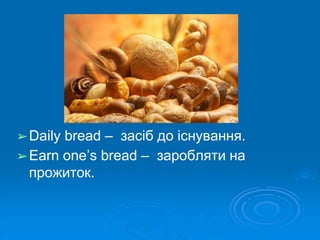
➢Daily bread – засіб до існування.
➢Earn one’s bread – заробляти на
прожиток.
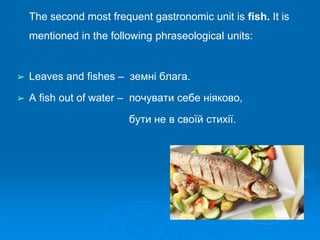
The second most frequent gastronomic unit is fish. It is
mentioned in the following phraseological units:
➢ Leaves and fishes – земні блага.
➢ A fish out of water – почувати себе ніяково,
бути не в своїй стихії.
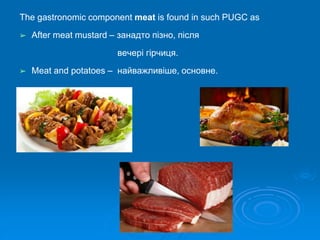
The gastronomic component meat is found in such PUGC as
➢ After meat mustard – занадто пізно, після
вечері гірчиця.
➢ Meat and potatoes – найважливіше, основне.
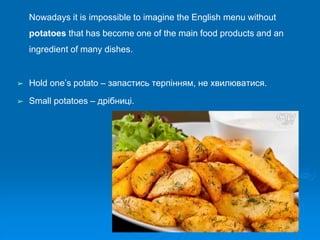
Nowadays it is impossible to imagine the English menu without
potatoes that has become one of the main food products and an
ingredient of many dishes.
➢ Hold one’s potato – запастись терпінням, не хвилюватися.
➢ Small potatoes – дрібниці.
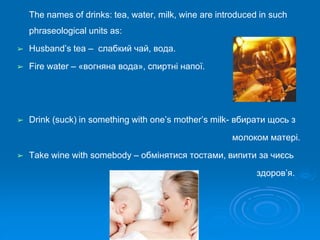
The names of drinks: tea, water, milk, wine are introduced in such
phraseological units as:
➢ Husband’s tea – слабкий чай, вода.
➢ Fire water – «вогняна вода», спиртні напої.
➢ Drink (suck) in something with one’s mother’s milk- вбирати щось з
молоком матері.
➢ Take wine with somebody – обмінятися тостами, випити за чиєсь
здоров’я.
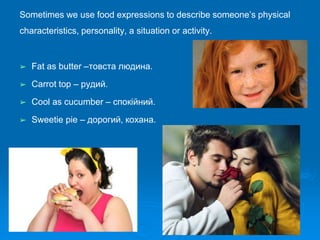
Sometimes we use food expressions to describe someone’s physical
characteristics, personality, a situation or activity.
➢ Fat as butter –товста людина.
➢ Carrot top – рудий.
➢ Cool as cucumber – спокійний.
➢ Sweetie pie – дорогий, кохана.
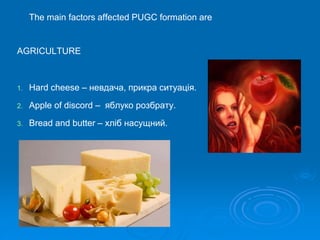
The main factors affected PUGC formation are
AGRICULTURE
1. Hard cheese – невдача, прикра ситуація.
2. Apple of discord – яблуко розбрату.
3. Bread and butter – хліб насущний.
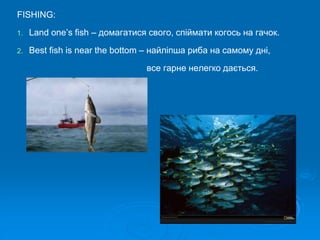
FISHING:
1. Land one’s fish – домагатися свого, спіймати когось на гачок.
2. Best fish is near the bottom – найліпша риба на самому дні,
все гарне нелегко дається.
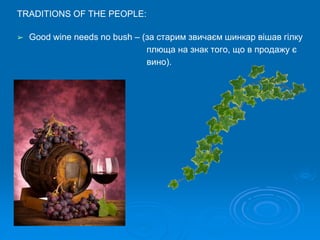
TRADITIONS OF THE PEOPLE:
➢ Good wine needs no bush – (за старим звичаєм шинкар вішав гілку
плюща на знак того, що в продажу є
вино).
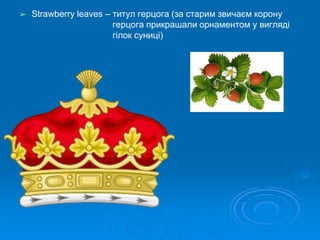
➢ Strawberry leaves – титул герцога (за старим звичаєм корону
герцога прикрашали орнаментом у вигляді
гілок суниці)
Proverbs and sayings with gastronomic components are the reflection of
folk wisdom and human experience.
They contain instructions, advice, warning against something.
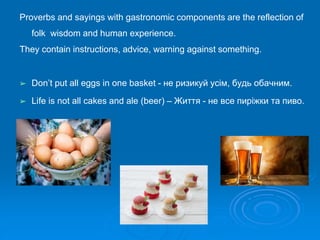
➢ Don’t put all eggs in one basket - не ризикуй усім, будь обачним.
➢ Life is not all cakes and ale (beer) – Життя - не все пиріжки та пиво.
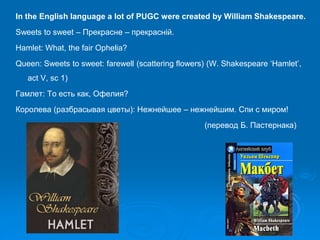
In the English language a lot of PUGC were created by William Shakespeare.
Sweets to sweet – Прекрасне – прекрасній.
Hamlet: What, the fair Ophelia?
Queen: Sweets to sweet: farewell (scattering flowers) (W. Shakespeare ‘Hamlet’,
act V, sc 1)
Гамлет: То есть как, Офелия?
Королева (разбрасывая цветы): Нежнейшее – нежнейшим. Спи с миром!
(перевод Б. Пастернака)
CONCLUSIONS
Nutrition, as an integral part of human life has conditioned a broad
availability of gastronomic code of culture in the phraseology of the
English language.
PUGC are one of the brightest verbal means of expressing the national
culture of Great Britain.
In our study three hundred and ten phraseological units from different
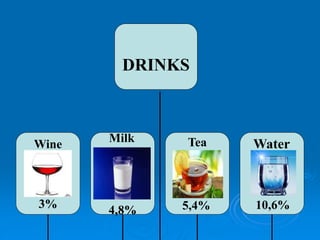
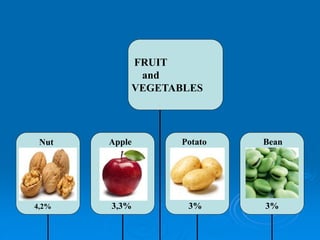
sources have been analyzed. The most popular gastronomic terms
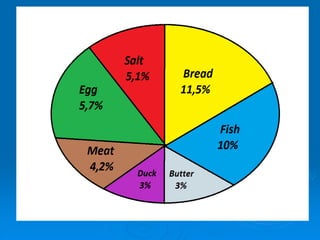
in English phraseological units are the following components:
DRINKS
Wine
3%
Milk
4,8%
Tea
5,4%
Water
10,6%
FRUIT
and
VEGETABLES
Nut
4,2%
Apple
3,3%
Potato
3%
Bean
3%
The rest (40%) are gastronomic terms used in
phraseological units less than 3%.
They are cheese, hen, pudding, onion, cabbage,
cucumber, carrot.
Summing it up, we can conclude that in modern English
gastronomic terms have a great phraseological potential.
THANK YOU
for attention !

Науменко Ксенія

  • 1.
    PHRASEOLOGICAL POTENTIAL OF GASTRONOMICTERMS IN THE ENGLISH LANGUAGE Роботу виконала: Науменко Ксенія Олександрівна, учениця 10 класу НВК «Загальноосвітня школа I-III ступенів - дошкільний навчальний заклад» Костянтинівської міської ради Донецької області Науковий керівник: Кузнецова Вікторія Євгенівна, вчитель англійської мови НВК «Загальноосвітня школа I-III ступенів - дошкільний навчальний заклад» Костянтинівської міської ради Донецької області
  • 2.
    The urgency ofthe research The urgency of the research is determined by the need for a comprehensive analysis of PUGC as one of the most vivid verbal means of expressing the national English culture.
  • 3.
    The purpose ofthe research: is to determine the basic English food, the degree of phrasal activity of the gastronomic names.
  • 4.
    The object ofthe research: is the phraseological system of the English language.
  • 5.
    The subject ofthe study: is English phraseological units with the names of gastronomic units.
  • 6.
    There are thefollowing tasks for achievement of the goal: ➢ to define the concept of phraseological units with a gastronomic component; ➢ to describe the gastronomic culture of the British; ➢ to investigate what names of products became productive elements in the formation of phraseologisms; ➢ to examine what spheres of English life the widespread use of gastronomic terms in the phraseology of the English language is connected with.
  • 7.
    Methods we used: ➢method of continuous sampling ➢ descriptive method
  • 8.
    Food is anintegral part of human existence. It plays an important role in our life: ➢ breakfast, dinner, banquet, negotiations; ➢ wedding, birthday party, feast.
  • 9.
    British lifestyle reflectsin their national cuisine. The day of the Englishman, of course, begins with morning tea or orange juice. For the first breakfast eggs with bacon, oatmeal and a browned toast with orange jam are usually served.
  • 10.
    Lunch often includesroast (with fried potatoes and green vegetables), dessert, pudding, rice with milk. Sometimes lush cheese, eating not only with bread, but also with special biscuits and butter.
  • 11.
    The British eata lot of meat.
  • 12.
    Fish is alsoof great importance.
  • 13.
    Eggs are alsotraditional.
  • 14.
  • 15.
    As a dessertwidespread, they receive fresh fruit, fruit and berry puree with cream, ice cream. Among the fruit apples are wide-spread.
  • 16.
    In England teais the most widely used. To the tea pies with candied fruit, almonds or other nuts, spicy, breads or finely chopped breads and butter are served.
  • 17.
    The names ofthese products, drinks and taste additives are parts of the phraseological units with gastronomic components.
  • 18.
    The phraseological unitswith gastronomic components are considered as phraseological units which contain one or several gastronomic lexical units. They reflect cultural preferences, tastes, traditions relating to traditional British food.
  • 19.
    ➢Daily bread –засіб до існування. ➢Earn one’s bread – заробляти на прожиток.
  • 20.
    The second mostfrequent gastronomic unit is fish. It is mentioned in the following phraseological units: ➢ Leaves and fishes – земні блага. ➢ A fish out of water – почувати себе ніяково, бути не в своїй стихії.
  • 21.
    The gastronomic componentmeat is found in such PUGC as ➢ After meat mustard – занадто пізно, після вечері гірчиця. ➢ Meat and potatoes – найважливіше, основне.
  • 22.
    Nowadays it isimpossible to imagine the English menu without potatoes that has become one of the main food products and an ingredient of many dishes. ➢ Hold one’s potato – запастись терпінням, не хвилюватися. ➢ Small potatoes – дрібниці.
  • 23.
    The names ofdrinks: tea, water, milk, wine are introduced in such phraseological units as: ➢ Husband’s tea – слабкий чай, вода. ➢ Fire water – «вогняна вода», спиртні напої. ➢ Drink (suck) in something with one’s mother’s milk- вбирати щось з молоком матері. ➢ Take wine with somebody – обмінятися тостами, випити за чиєсь здоров’я.
  • 24.
    Sometimes we usefood expressions to describe someone’s physical characteristics, personality, a situation or activity. ➢ Fat as butter –товста людина. ➢ Carrot top – рудий. ➢ Cool as cucumber – спокійний. ➢ Sweetie pie – дорогий, кохана.
  • 25.
    The main factorsaffected PUGC formation are AGRICULTURE 1. Hard cheese – невдача, прикра ситуація. 2. Apple of discord – яблуко розбрату. 3. Bread and butter – хліб насущний.
  • 26.
    FISHING: 1. Land one’sfish – домагатися свого, спіймати когось на гачок. 2. Best fish is near the bottom – найліпша риба на самому дні, все гарне нелегко дається.
  • 27.
    TRADITIONS OF THEPEOPLE: ➢ Good wine needs no bush – (за старим звичаєм шинкар вішав гілку плюща на знак того, що в продажу є вино).
  • 28.
    ➢ Strawberry leaves– титул герцога (за старим звичаєм корону герцога прикрашали орнаментом у вигляді гілок суниці)
  • 29.
    Proverbs and sayingswith gastronomic components are the reflection of folk wisdom and human experience. They contain instructions, advice, warning against something. ➢ Don’t put all eggs in one basket - не ризикуй усім, будь обачним. ➢ Life is not all cakes and ale (beer) – Життя - не все пиріжки та пиво.
  • 30.
    In the Englishlanguage a lot of PUGC were created by William Shakespeare. Sweets to sweet – Прекрасне – прекрасній. Hamlet: What, the fair Ophelia? Queen: Sweets to sweet: farewell (scattering flowers) (W. Shakespeare ‘Hamlet’, act V, sc 1) Гамлет: То есть как, Офелия? Королева (разбрасывая цветы): Нежнейшее – нежнейшим. Спи с миром! (перевод Б. Пастернака)
  • 31.
    CONCLUSIONS Nutrition, as anintegral part of human life has conditioned a broad availability of gastronomic code of culture in the phraseology of the English language. PUGC are one of the brightest verbal means of expressing the national culture of Great Britain. In our study three hundred and ten phraseological units from different sources have been analyzed. The most popular gastronomic terms in English phraseological units are the following components:
  • 33.
  • 34.
  • 35.
    The rest (40%)are gastronomic terms used in phraseological units less than 3%. They are cheese, hen, pudding, onion, cabbage, cucumber, carrot. Summing it up, we can conclude that in modern English gastronomic terms have a great phraseological potential.
  • 36.