The ConTenT
 Title of The Research.
 Key words.
 Abstract.
 Introduction.
 Study Type.
 Research Variables.
 Terms.
 Theoretical background
 Measurement.
 Research Model
 Research Design
 Hypothesis
 Study limitation
 Result
 analysisDemographics
 analysis characteristic
 Measurement tool
verification
 Research model
verification
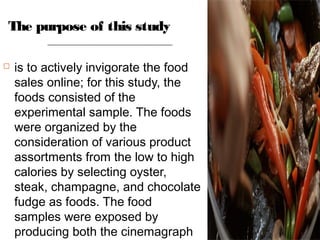
 Results
 Recommendation
 Critical Vision
Title of The Research
Cinemagraph Image Study forthe Online
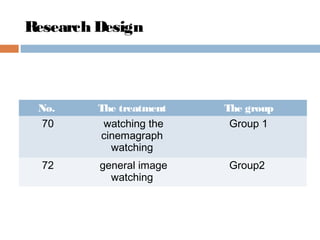
Food Marketing
By
J. Seob Park Cheul Rhee
UXLab Cognitive Engineering Square
Department of e-business School of Business Administration
Ajou University, South Korea
Agribusiness and Information Management Vol. 6, No. 1, 2014.
Key words
 Cinemagraph.
 Perceived Monetary Value.
 Brand Attitude.
 Perceived Taste.
 Purchase Intention.
Abstract
 The purpose of The study was to compare and analyze:

the product image produced by the cinemagraphimage and

the product image produced by the general image in the electronic
trade.
purchase
intention
electronic trade
Follow: Abstract
 The study explored how the monetary value, brand attitude,
and perceived taste would influence on the purchase intention
 it was analyzed that all of the three factors significantly
influenced on the purchase intention.
purchase
intention
Factor
one
Factor
two
Factor
three
Follow: Abstract
 It was investigated that the purchase intention of the
group watching the image by the cinemagraph was
significantly influenced by:
 the perceived monetary value
 the perceived taste
purchase
intention of the
group watching
the image
the cinemagraph
the general image
- the perceived monetary value
- the perceived taste,
-the brand attitude.
- the perceived taste.
Follow: Abstract
 and the purchase intention of the other group watching
the general image was significantly influenced by:
 the brand attitude
 the perceived taste.
purchase
intention of the
group watching
the image
the cinemagraph
the general image
- the perceived monetary value
- the perceived taste,
- the brand attitude
- the perceived taste.
Follow: Abstract
 therefore, it was verified that there
was a difference between the group
watching the cinemagraph and the
group watching the general image.
 In this result, it could be interpreted
that when the people watching the
cinemagraph purchase a product in
the shopping mall, the price becomes
the important requirement,
 and when the people watching the
general image purchase a product in
the shopping mall, the brand becomes
the important requirement.
Introduction
 Cinemagraph image is produced by the format of the GIF
type, it is possible to apply to the websites or most
shopping malls.
 It is possible to provide a detailed product instruction to
the consumers by producing the existing product image
into a cinemagraph and providing a more dynamic
advertisement than that of the existing general image.
Study Type
 Survey research.
 Empirical study.
 group watching the
general image.
 group watching the
cinemagraph image
Research Variables

Independent variable:
 watching the
cinemagraph purchase a
product
 Dependent variable:
 The important requirement of
price.
 The requirement of brand
Terms
 The Cinemagraph:
Refers to the new type of image
which can provide a motion cue
by playing the part of the image
endlessly as a video (Jiseob Park,
2014)
Terms Study:
 Purchase intention:
means the future action
planned by the consumers in
advance, and it can be the
probability in which the
belief and attitude are
connected to the actual
purchase (Till and Michael
2000).
Theoretical background
1. The Cinemagraph
Because the video and the
image were combined in
the cinemagraph, the
frame, a time concept of
the video, is inserted;
therefore, people watching
the cinemagraph could
interpret the complicated
meanings differently
because the still image
frame, the video frame, and
Theoretical background
2. Brand Attitude
The brand attitude has been used as a factor to
analyze a consumer’s behavior such as the brand
selection (Fishbein and Ajzen 1975).
Theoretical background
3. Perceived Monetary Value
Perceived monetary value refers to the
subjective recognition or the perceived expression of
the consumers when they see the price of a certain
product (Jacoby and Olson 1977).
Theoretical background
4. Perceived Taste
when the advertisement copy made about the
food, the one stimulating the five senses of a human
increases the human perception more than that of any
other cases which do not. (RS Elder ,2010)
Theoretical background
5. Purchase Intention
means the future action
planned by the consumers in
advance, and it can be the
probability in which the belief
and attitude are connected to
the actual purchase (Till and
Michael 2000).
The Study Goal
 The study tried to explore more concretely on
how the attitudes of the people watching the
cinemagraph image and the people watching
the general image would be different.
The purpose of this study
 is to actively invigorate the food
sales online; for this study, the
foods consisted of the
experimental sample. The foods
were organized by the
consideration of various product
assortments from the low to high
calories by selecting oyster,
steak, champagne, and chocolate
fudge as foods. The food
samples were exposed by
producing both the cinemagraph
Tools
 Survey (the survey questions consisted of a single question
based on seven points on the Likert scale, representing ‘it looks very
bad in taste’ with one point to ‘it looks very good in taste’ with seven
points. )
 eye-tracking.
 interview.
Measurement composition items of the research
Research Model
 Research model was analyzed that how the
perceived monetary value, brand attitude, and
perceived taste influence on the purchase
intention.
Research Design
No. The treatment The group
70 watching the
cinemagraph
watching
Group 1
72 general image
watching
Group2
Hypothesis
The four hypotheses were suggested as the
following:
H1: The perceived monetary value will
influence the purchase intention positively.
H2: The brand attitude will influence the
purchase intention positively.
H3: The perceived taste will influence the
purchase intention positively.
H4: There will be a significant difference
between the group watching the
cinemagraph and the group watching the
general images.`
Study limitation
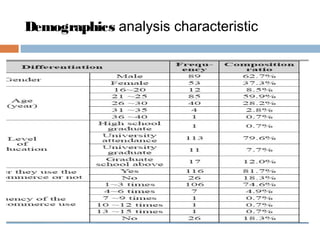
 The survey data was collected from 142 participants for about
three months from March to June, 2014 in Yonsei University
in Seoul and Ajou University in Suwon.
 the experiment samples consisting of foods such as oyster,
steak, champagne, cherry tomato, and chocolate fudge were
exposed by separating them into the cinemagraph group and
the general image group.
Result analysis
 The reliability analysis, validity
analysis, and descriptive
statistical analysis were
conducted using the SPSS 20.0
version.
 For the hypotheses testing, it was
analyzed by using the SmartPLS
2.0 version.
Demographics analysis characteristic
Measurement tool verification
 Reliability and validity verification
 In this study, for the reliability analysis
and validity verification, SPSS 20.0 was
used, and the result was shown in
<Table 4>. In the reliability analysis
result, because all of the Cronbach's
Alpha values were more than 0.8, it can
be judged that the internal consistency
was very high.
Spsss
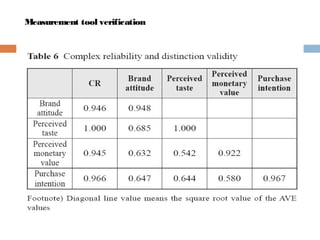
Measurement tool verification
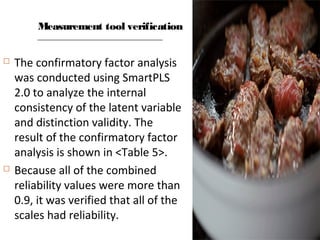
 The confirmatory factor analysis
was conducted using SmartPLS
2.0 to analyze the internal
consistency of the latent variable
and distinction validity. The
result of the confirmatory factor
analysis is shown in <Table 5>.
 Because all of the combined
reliability values were more than
0.9, it was verified that all of the
scales had reliability.
Measurement tool verification
Research model verification:
 The analysis was conducted to verify on how the perceived
monetary value, brand attitude, and perceived taste influence
the purchase intention in both the group watching the
cinemagraph product image and the group watching the
general product image, using SmartPLS 2.0.
 As the results suggested by the hypothesis established in this
study, <Fig.3> and <Fig. 4> represent the path coefficients
and R² values of the group watching the cinemagraph and the
group watching general image; <Table 7> represents the
averages and the standard deviations of the group watching
the cinemagraph and the group watching the general image.
Results
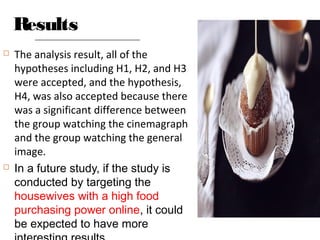
 The analysis result, all of the
hypotheses including H1, H2, and H3
were accepted, and the hypothesis,
H4, was also accepted because there
was a significant difference between
the group watching the cinemagraph
and the group watching the general
image.
 In a future study, if the study is
conducted by targeting the
housewives with a high food
purchasing power online, it could
be expected to have more
Critical Vision
First: Strength in the search
Some of Strength Point
 Title of the search was a good and highlighted
variables (the Independent)

 The researchers had some studies searching the
independent variable and some other variables
(Researcher interested by the cinemagraph).

Follow: Some of Strength Point
 Search results are applicable.

 Detailed view of the characteristics of the sample
(sample demographic research).

Follow:: Some of Strength Point



Follow: Some of Strength Point
SPSS 20.0 version; for the hypotheses testing, it was
analyzed by using the SmartPLS 2.0 version.


Second : Weakness in the search
Some of Weaknesses Point
 There were few extant studies related to the
cinemagraph.


 There was many old references such as:
 Makens, J. C. (1965). "Effect of Brand Preference Upon Consumers
Perceived Taste of Turkey Meat," Journal of Applied Psychology
(49:4), p. 261.
 Fishbein, Martin, and Icek Ajzen. (1975). "Belief, attitude, intention and
behavior: An introduction to theory and research."
 Jacoby, J., and Olson, J. C. (1977). "Consumer Response to Price: An
Attitudinal, Information Processing Perspective," Moving
Follow:: Some of Weaknesses Point
 The study forgeten some of important terms
such as:
 electronic trade. - dynamic advertisement- food marketing
online-
 etc.

Follow: Some of Weaknesses Point
 It did not link the results with studies that covered by the
research.

تحليل ونقد دراسة للسينماجراف

تحليل ونقد دراسة للسينماجراف

  • 2.
    The ConTenT  Titleof The Research.  Key words.  Abstract.  Introduction.  Study Type.  Research Variables.  Terms.  Theoretical background  Measurement.  Research Model  Research Design  Hypothesis  Study limitation  Result  analysisDemographics  analysis characteristic  Measurement tool verification  Research model verification  Results  Recommendation  Critical Vision
  • 3.
    Title of TheResearch Cinemagraph Image Study forthe Online Food Marketing By J. Seob Park Cheul Rhee UXLab Cognitive Engineering Square Department of e-business School of Business Administration Ajou University, South Korea Agribusiness and Information Management Vol. 6, No. 1, 2014.
  • 4.
    Key words  Cinemagraph. Perceived Monetary Value.  Brand Attitude.  Perceived Taste.  Purchase Intention.
  • 5.
    Abstract  The purposeof The study was to compare and analyze:  the product image produced by the cinemagraphimage and  the product image produced by the general image in the electronic trade. purchase intention electronic trade
  • 6.
    Follow: Abstract  Thestudy explored how the monetary value, brand attitude, and perceived taste would influence on the purchase intention  it was analyzed that all of the three factors significantly influenced on the purchase intention. purchase intention Factor one Factor two Factor three
  • 7.
    Follow: Abstract  Itwas investigated that the purchase intention of the group watching the image by the cinemagraph was significantly influenced by:  the perceived monetary value  the perceived taste purchase intention of the group watching the image the cinemagraph the general image - the perceived monetary value - the perceived taste, -the brand attitude. - the perceived taste.
  • 8.
    Follow: Abstract  andthe purchase intention of the other group watching the general image was significantly influenced by:  the brand attitude  the perceived taste. purchase intention of the group watching the image the cinemagraph the general image - the perceived monetary value - the perceived taste, - the brand attitude - the perceived taste.
  • 9.
    Follow: Abstract  therefore,it was verified that there was a difference between the group watching the cinemagraph and the group watching the general image.  In this result, it could be interpreted that when the people watching the cinemagraph purchase a product in the shopping mall, the price becomes the important requirement,  and when the people watching the general image purchase a product in the shopping mall, the brand becomes the important requirement.
  • 10.
    Introduction  Cinemagraph imageis produced by the format of the GIF type, it is possible to apply to the websites or most shopping malls.  It is possible to provide a detailed product instruction to the consumers by producing the existing product image into a cinemagraph and providing a more dynamic advertisement than that of the existing general image.
  • 11.
    Study Type  Surveyresearch.  Empirical study.  group watching the general image.  group watching the cinemagraph image
  • 12.
    Research Variables  Independent variable: watching the cinemagraph purchase a product  Dependent variable:  The important requirement of price.  The requirement of brand
  • 13.
    Terms  The Cinemagraph: Refersto the new type of image which can provide a motion cue by playing the part of the image endlessly as a video (Jiseob Park, 2014)
  • 14.
    Terms Study:  Purchaseintention: means the future action planned by the consumers in advance, and it can be the probability in which the belief and attitude are connected to the actual purchase (Till and Michael 2000).
  • 15.
    Theoretical background 1. TheCinemagraph Because the video and the image were combined in the cinemagraph, the frame, a time concept of the video, is inserted; therefore, people watching the cinemagraph could interpret the complicated meanings differently because the still image frame, the video frame, and
  • 16.
    Theoretical background 2. BrandAttitude The brand attitude has been used as a factor to analyze a consumer’s behavior such as the brand selection (Fishbein and Ajzen 1975).
  • 17.
    Theoretical background 3. PerceivedMonetary Value Perceived monetary value refers to the subjective recognition or the perceived expression of the consumers when they see the price of a certain product (Jacoby and Olson 1977).
  • 18.
    Theoretical background 4. PerceivedTaste when the advertisement copy made about the food, the one stimulating the five senses of a human increases the human perception more than that of any other cases which do not. (RS Elder ,2010)
  • 19.
    Theoretical background 5. PurchaseIntention means the future action planned by the consumers in advance, and it can be the probability in which the belief and attitude are connected to the actual purchase (Till and Michael 2000).
  • 20.
    The Study Goal The study tried to explore more concretely on how the attitudes of the people watching the cinemagraph image and the people watching the general image would be different.
  • 21.
    The purpose ofthis study  is to actively invigorate the food sales online; for this study, the foods consisted of the experimental sample. The foods were organized by the consideration of various product assortments from the low to high calories by selecting oyster, steak, champagne, and chocolate fudge as foods. The food samples were exposed by producing both the cinemagraph
  • 22.
    Tools  Survey (thesurvey questions consisted of a single question based on seven points on the Likert scale, representing ‘it looks very bad in taste’ with one point to ‘it looks very good in taste’ with seven points. )  eye-tracking.  interview.
  • 23.
  • 24.
  • 25.
     Research modelwas analyzed that how the perceived monetary value, brand attitude, and perceived taste influence on the purchase intention.
  • 26.
    Research Design No. Thetreatment The group 70 watching the cinemagraph watching Group 1 72 general image watching Group2
  • 27.
    Hypothesis The four hypotheseswere suggested as the following: H1: The perceived monetary value will influence the purchase intention positively. H2: The brand attitude will influence the purchase intention positively. H3: The perceived taste will influence the purchase intention positively. H4: There will be a significant difference between the group watching the cinemagraph and the group watching the general images.`
  • 28.
    Study limitation  Thesurvey data was collected from 142 participants for about three months from March to June, 2014 in Yonsei University in Seoul and Ajou University in Suwon.  the experiment samples consisting of foods such as oyster, steak, champagne, cherry tomato, and chocolate fudge were exposed by separating them into the cinemagraph group and the general image group.
  • 29.
    Result analysis  Thereliability analysis, validity analysis, and descriptive statistical analysis were conducted using the SPSS 20.0 version.  For the hypotheses testing, it was analyzed by using the SmartPLS 2.0 version.
  • 30.
  • 31.
    Measurement tool verification Reliability and validity verification  In this study, for the reliability analysis and validity verification, SPSS 20.0 was used, and the result was shown in <Table 4>. In the reliability analysis result, because all of the Cronbach's Alpha values were more than 0.8, it can be judged that the internal consistency was very high. Spsss
  • 32.
    Measurement tool verification The confirmatory factor analysis was conducted using SmartPLS 2.0 to analyze the internal consistency of the latent variable and distinction validity. The result of the confirmatory factor analysis is shown in <Table 5>.  Because all of the combined reliability values were more than 0.9, it was verified that all of the scales had reliability.
  • 34.
  • 36.
    Research model verification: The analysis was conducted to verify on how the perceived monetary value, brand attitude, and perceived taste influence the purchase intention in both the group watching the cinemagraph product image and the group watching the general product image, using SmartPLS 2.0.  As the results suggested by the hypothesis established in this study, <Fig.3> and <Fig. 4> represent the path coefficients and R² values of the group watching the cinemagraph and the group watching general image; <Table 7> represents the averages and the standard deviations of the group watching the cinemagraph and the group watching the general image.
  • 38.
    Results  The analysisresult, all of the hypotheses including H1, H2, and H3 were accepted, and the hypothesis, H4, was also accepted because there was a significant difference between the group watching the cinemagraph and the group watching the general image.  In a future study, if the study is conducted by targeting the housewives with a high food purchasing power online, it could be expected to have more
  • 39.
  • 40.
  • 41.
    Some of StrengthPoint  Title of the search was a good and highlighted variables (the Independent)   The researchers had some studies searching the independent variable and some other variables (Researcher interested by the cinemagraph). 
  • 42.
    Follow: Some ofStrength Point  Search results are applicable.   Detailed view of the characteristics of the sample (sample demographic research). 
  • 43.
    Follow:: Some ofStrength Point   
  • 44.
    Follow: Some ofStrength Point SPSS 20.0 version; for the hypotheses testing, it was analyzed by using the SmartPLS 2.0 version.  
  • 45.
    Second : Weaknessin the search
  • 46.
    Some of WeaknessesPoint  There were few extant studies related to the cinemagraph.    There was many old references such as:  Makens, J. C. (1965). "Effect of Brand Preference Upon Consumers Perceived Taste of Turkey Meat," Journal of Applied Psychology (49:4), p. 261.  Fishbein, Martin, and Icek Ajzen. (1975). "Belief, attitude, intention and behavior: An introduction to theory and research."  Jacoby, J., and Olson, J. C. (1977). "Consumer Response to Price: An Attitudinal, Information Processing Perspective," Moving
  • 47.
    Follow:: Some ofWeaknesses Point  The study forgeten some of important terms such as:  electronic trade. - dynamic advertisement- food marketing online-  etc. 
  • 48.
    Follow: Some ofWeaknesses Point  It did not link the results with studies that covered by the research. 