Survey on Analogical Reasoning 2009. 4. 21 Sang-Kyun Kim [email_address]
Table of Contents The Analogical Mind Case-Based Reasoning An analogy ontology for integrating analogical processing and first-principles reasoning
The Analogical Mind
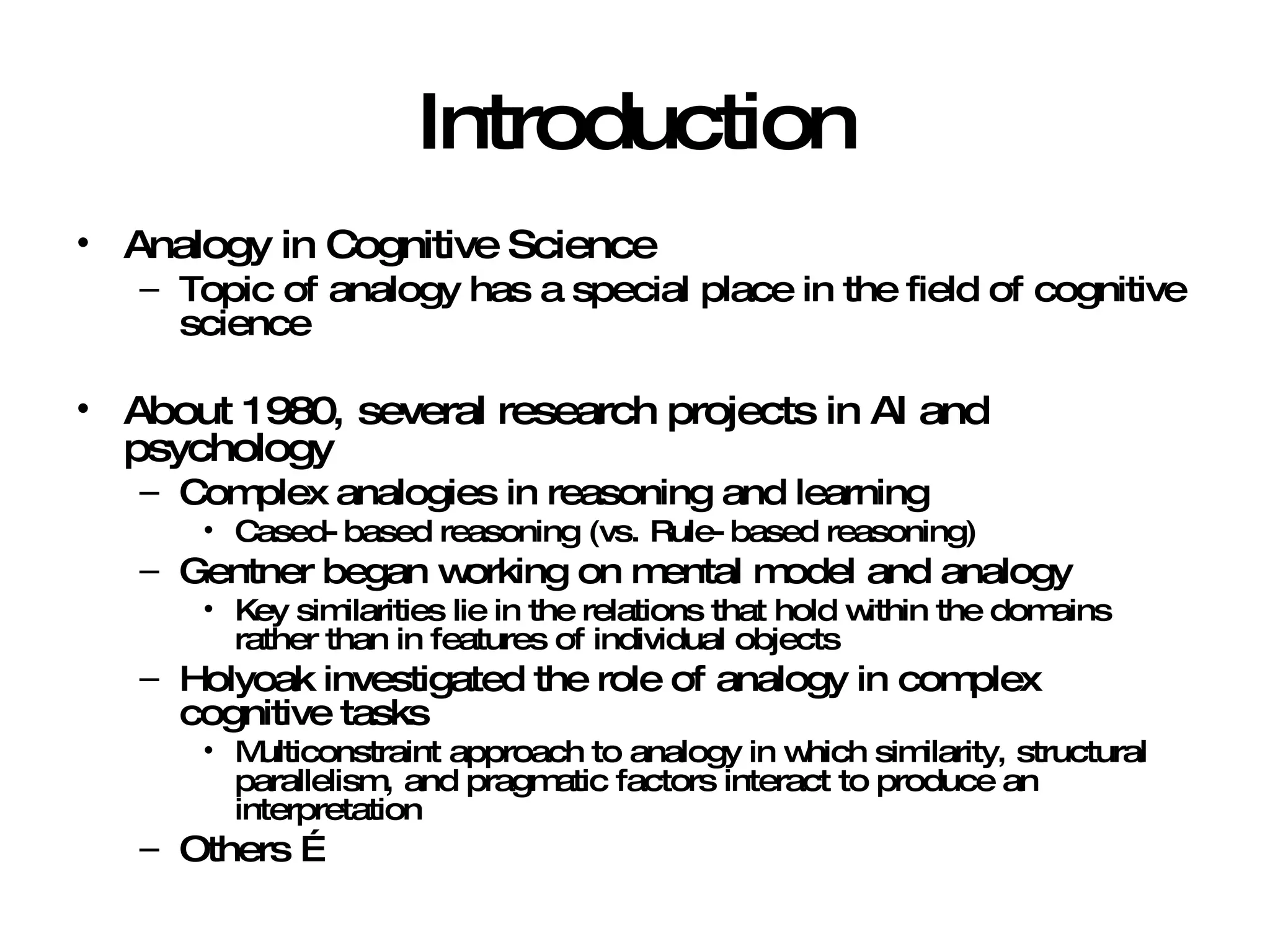
Introduction Analogy in Cognitive Science Topic of analogy has a special place in the field of cognitive science About 1980, several research projects in AI and psychology Complex analogies in reasoning and learning Cased-based reasoning (vs. Rule-based reasoning) Gentner began working on mental model and analogy Key similarities lie in the relations that hold within the domains rather than in features of individual objects Holyoak investigated the role of analogy in complex cognitive tasks Multiconstraint approach to analogy in which similarity, structural parallelism, and pragmatic factors interact to produce an interpretation Others …
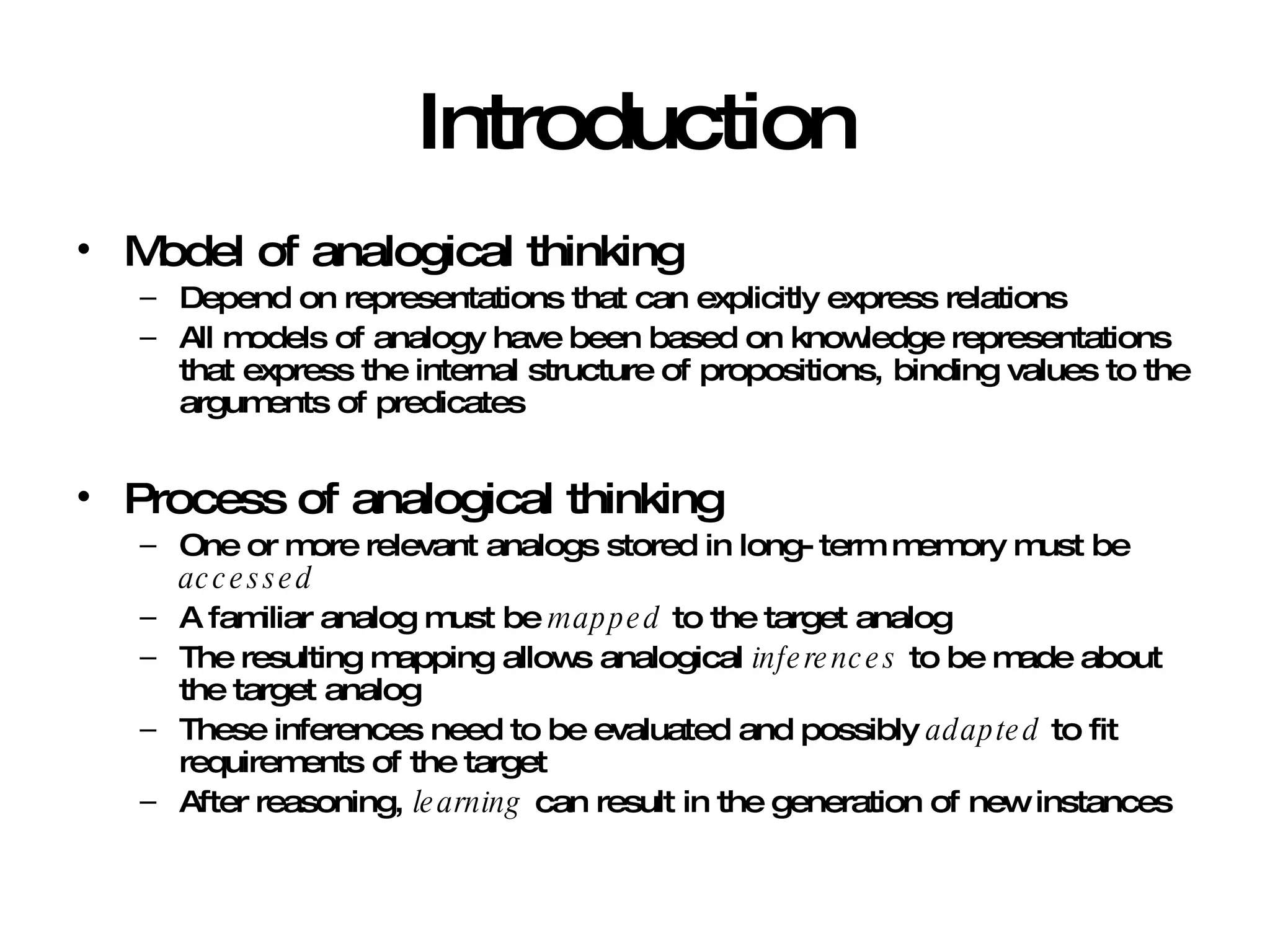
Introduction Model of analogical thinking  Depend on representations that can explicitly express relations All models of analogy have been based on knowledge representations that express the internal structure of propositions, binding values to the arguments of predicates Process of analogical thinking One or more relevant analogs stored in long-term memory must be  accessed A familiar analog must be  mapped  to the target analog The resulting mapping allows analogical  inferences  to be made about the target analog These inferences need to be evaluated and possibly  adapted  to fit requirements of the target After reasoning,  learning  can result in the generation of new instances
Exploring Analogy in the Large Structure-mapping theory  (Gentner 1983, 1989) Account of comparison processes that is consistent with a growing body of psychological evidence SME (Structure Mapping Engine) (Falkenhainer, Forbus, and Gentner 1989; Forbus, Ferguson, and Gentner 1994) Simulation of the comparison processes SME operated in polynomial time and can also incrementally extend its mappings
Exploring Analogy in the Large Input of two structured propositional representations,  base  and  target Attributes  : unary predicated indicating features Relations  : express connections between entities Higher-order relations  : express connections between relations Given a base and target, SME computes a mapping Each mapping contains a set of  correspondences  that align particular items in the base with items in the target Candidate inferences  : statements about the base that are hypothesized to hold in the target by these correspondences
Exploring Analogy in the Large MAC/FAC (Many Are Called/Few Are Chosen) (Forbus, Gentner, and Law 1995) Models similarity-based retrieval MAC first uses a simple, nonstructural matcher to filter out a few promising candidates FAC then evaluates these candidates more carefully using SME Correspondences and candidate inferences that indicate how the reminded information may be relevant to the current situation Scalability comes from the simplicity of MAC
Integrating Memory and Reasoning in Analogy-Making AMBR (Associative Memory-Based Reasoning) (Kokinov 1988; Kokinov 1998) A model of human reasoning in problem solving, unifying analogy, deduction, and induction AMBR1 Integrate memory, mapping, and transfer and simulated analogy-making in a commonsense domain Suppose you are in the forest and you want to heat some water, but you have only a knife, an ax, and a matchbox. You do not have a container of any kind. You can cut a vessel of wood, but it would burn in the fire. How can you heat the water in this wooden vessel? Used in studying some interactions between memory (priming), perception (context effects), and reasoning (problem solving)
Integrating Memory and Reasoning in Analogy-Making AMBR2 Relies on emergent context-sensitive computations and implements in an even more decentralized way Concepts and objects are represented in the same way as in AMBR1
The STAR-2 Model for Mapping Hierarchically Structured Analogs STAR (Structured Tensor Analogical Reasoning) Halford et al. 1994 Neural net model Designed to be consistent with human processing capacity limitations Approaches for representation of propositions that comprise the base and target in neural net model Synchronous oscillation model Product operations such as circular convolution or  tensor products
Toward an Understanding of Analogy within a Biological Symbol System LISA (Learning and Inference with Schemas and Analogies) Hummel and Holyoak 1997; Holyoak and Hummel 2000 Neural net model Integrated model of analogical access, mapping, inference, and learning Consider capacity limits of human working memory How complex analogies can be processed within a system with inherent constraints on the capacity of working memory Biological symbol systems – knowledge representations that capture the symbolic nature of human cognition
Case-Based Reasoning
CBR in Context : The Present and Future Knowledge source in CBR Not generalized rules but a memory of stored  cases  recording specific prior episodes Reasoning in CBR is based on remembering New solutions are generated not by chaining, but by retrieving the most relevant cases from memory Library of cases Most important component of a case-based reasoning system
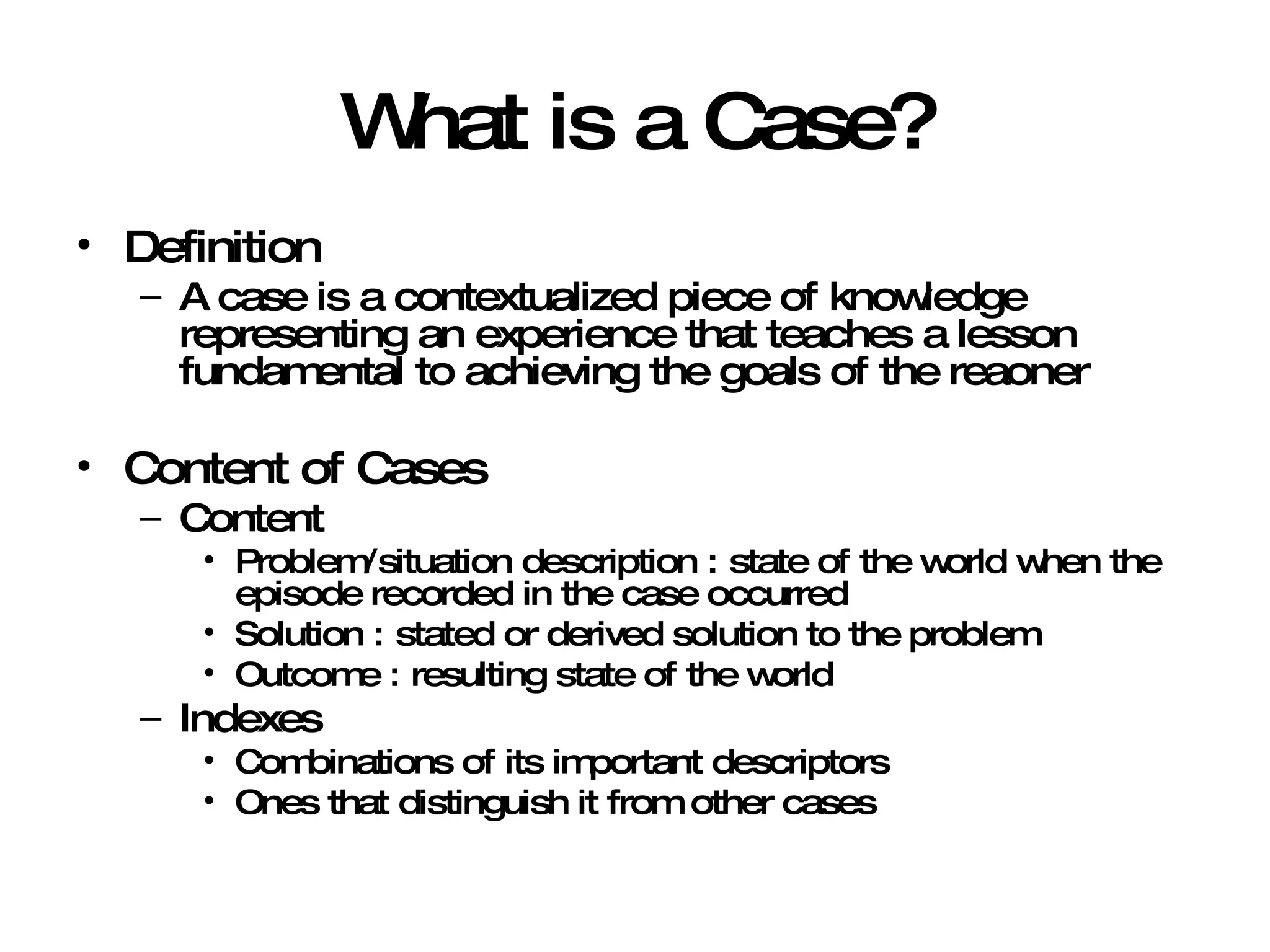
What is a Case? Definition A case is a contextualized piece of knowledge representing an experience that teaches a lesson fundamental to achieving the goals of the reaoner Content of Cases Content Problem/situation description : state of the world when the episode recorded in the case occurred Solution : stated or derived solution to the problem Outcome : resulting state of the world Indexes Combinations of its important descriptors Ones that distinguish it from other cases
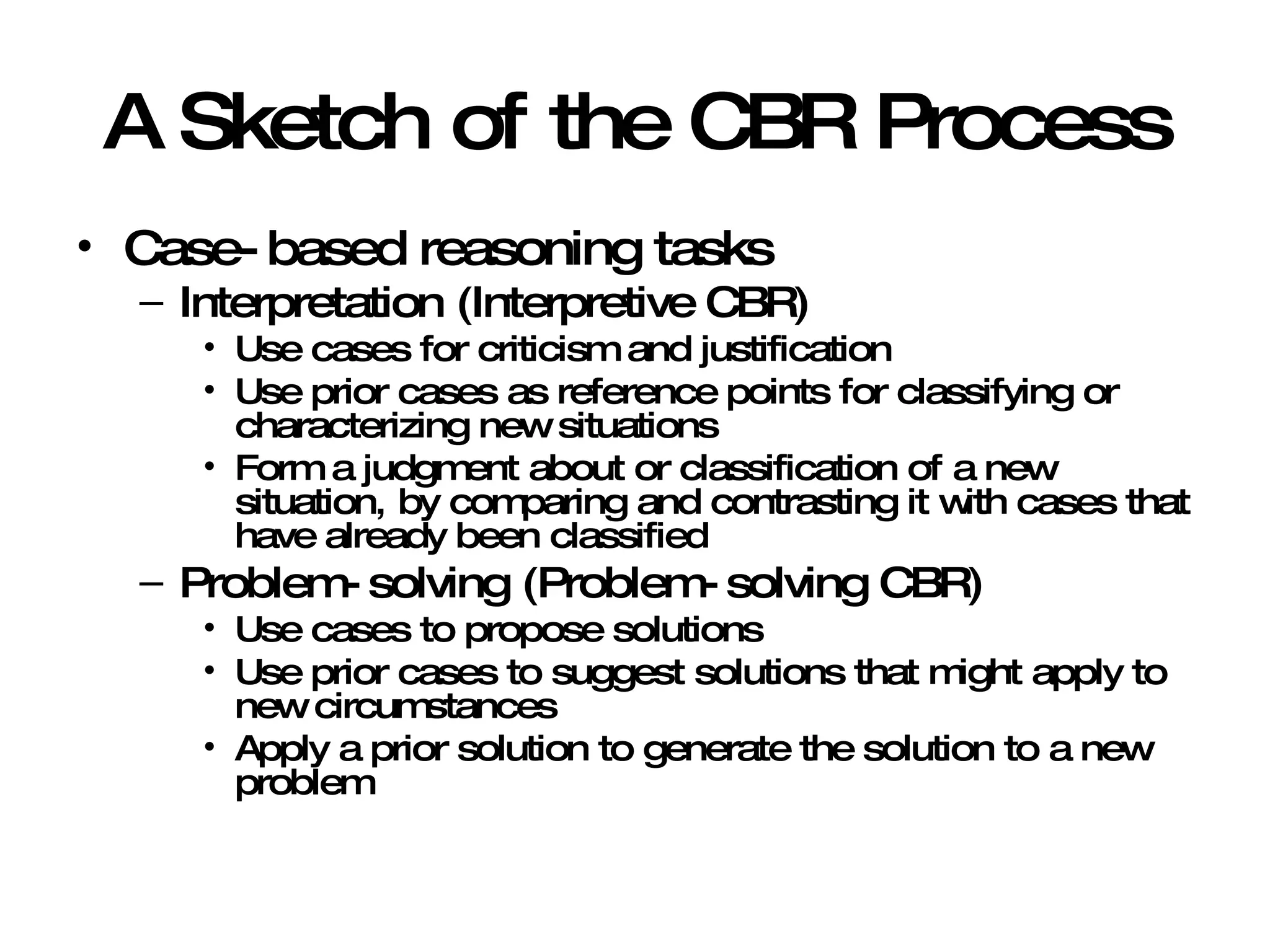
A Sketch of the CBR Process Case-based reasoning tasks Interpretation (Interpretive CBR) Use cases for criticism and justification Use prior cases as reference points for classifying or characterizing new situations Form a judgment about or classification of a new situation, by comparing and contrasting it with cases that have already been classified Problem-solving (Problem-solving CBR) Use cases to propose solutions Use prior cases to suggest solutions that might apply to new circumstances Apply a prior solution to generate the solution to a new problem
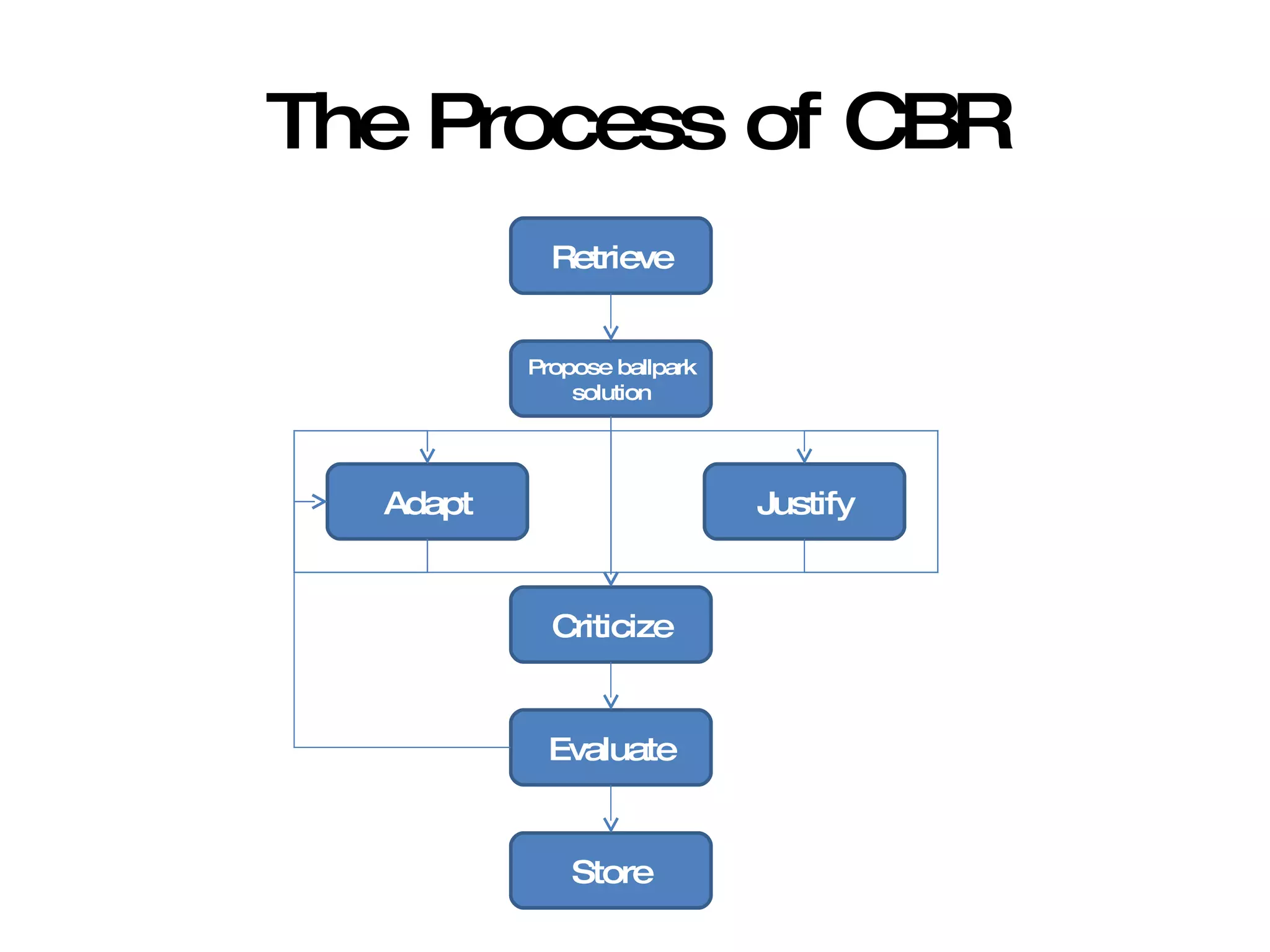
The Process of CBR Retrieve Propose ballpark solution Adapt Justify Criticize Evaluate Store
What is the Point of CBR True CBR Not abstract CBR or rule-based reasoning Process of true CBR Partial matching (selection) Don’t find matching case Find the cases that matches best Adaptation (reasoning) Don’t apply a case by filling in the details Have to decide which details to throw away, which to replace, and which to keep
Relationship to Analogical Reasoning Analogical reasoning vs. CBR CBR can be viewed as fundamentally analogical There is no clear line between research “on analogy” and “on CBR” Research on analogy More concerned with abstract knowledge and structural similarity Focus on analogical mapping Research on CBR More concerned with forming correspondences between specific episodes based on pragmatic considerations about the usefulness of the result Focus on analogical mapping + related processes that occur both before and after mapping
An analogy ontology for integrating analogical processing and first-principles reasoning
Introduction Understanding how to integrate analogical processing into AI systems seems crucial to creating more human-like reasoning system Similarity plays at best a minor role in many AI systems Most AI systems operate on a first-principles basis using rules or axioms plus logical inference Few reasoning systems that include analogy tend to treat it as a method of last resort, something to use only when other forms of inference have failed The exceptions are CBR systems, but CBR use only minimal first-principles reasoning Most CBR systems rely on feature-based descriptions that cannot match the expressive power of predicate calculus
Introduction Integrate analogical processing and first-principle reasoning Key idea is to use Analogy ontology Formal representation of the contents and results of analogical reasoning Provide the glue between 1 st  principles reasoning and analogical processing Semantics is defined by structure-mapping theory Simulation : SME and MAC/FAC
Analogy Ontology Cases Functions (task constraints in analogical reasoning) minimal-case-fn ?thing : all of the statements in the KB that directly mention ?thing, where ?thing can be any term case-fn ?thing : union of (minimal-case-fn ?thing) recursive-case-fn ?thing : union of case-fn applied to ?thing and to all of its subparts, recursively … Matches Pragmatic constraints Mappings Correspondences Candidate inferences Similarities and differences
Integrating 1 st  principles and analogical reasoning Analogy Ontology Language for the entities and relationships of structure-mapping Procedural attachment Enforce the semantics of the analogy ontology Two-way communication between the reasoning system and the attached software Reasoning system -> analogy software Recognize predicates with procedural attachments Carry out the appropriate procedure when queries involving them are made Analogy software -> reasoning system Handled by using the reasoner’s query software from within the analogy subsystem
Simple example Goal : (match-between ?base ?target ?match) When ?base and ?target are bound, this goal invokes SME to match the value of ?base against the value of ?target When ?base is unbound, this goal invokes MAC/FAC When ?target is unbound, the query is considered to be an error and the goal fails If ?base and ?target are a non-atomic term, further reasoning is invoked to derive the contents of the case Successful match-between query results in Creation of a new term in the reasoning system to represent the match ?match is bound to this new term as part of the bindings produced by the goal New term is linked the analogical processing data structure to support future queries Mappings associated with the match are reified as new terms in the reasoning system, with the appropriate mapping-of, best-mapping Structural evaluation score information asserted
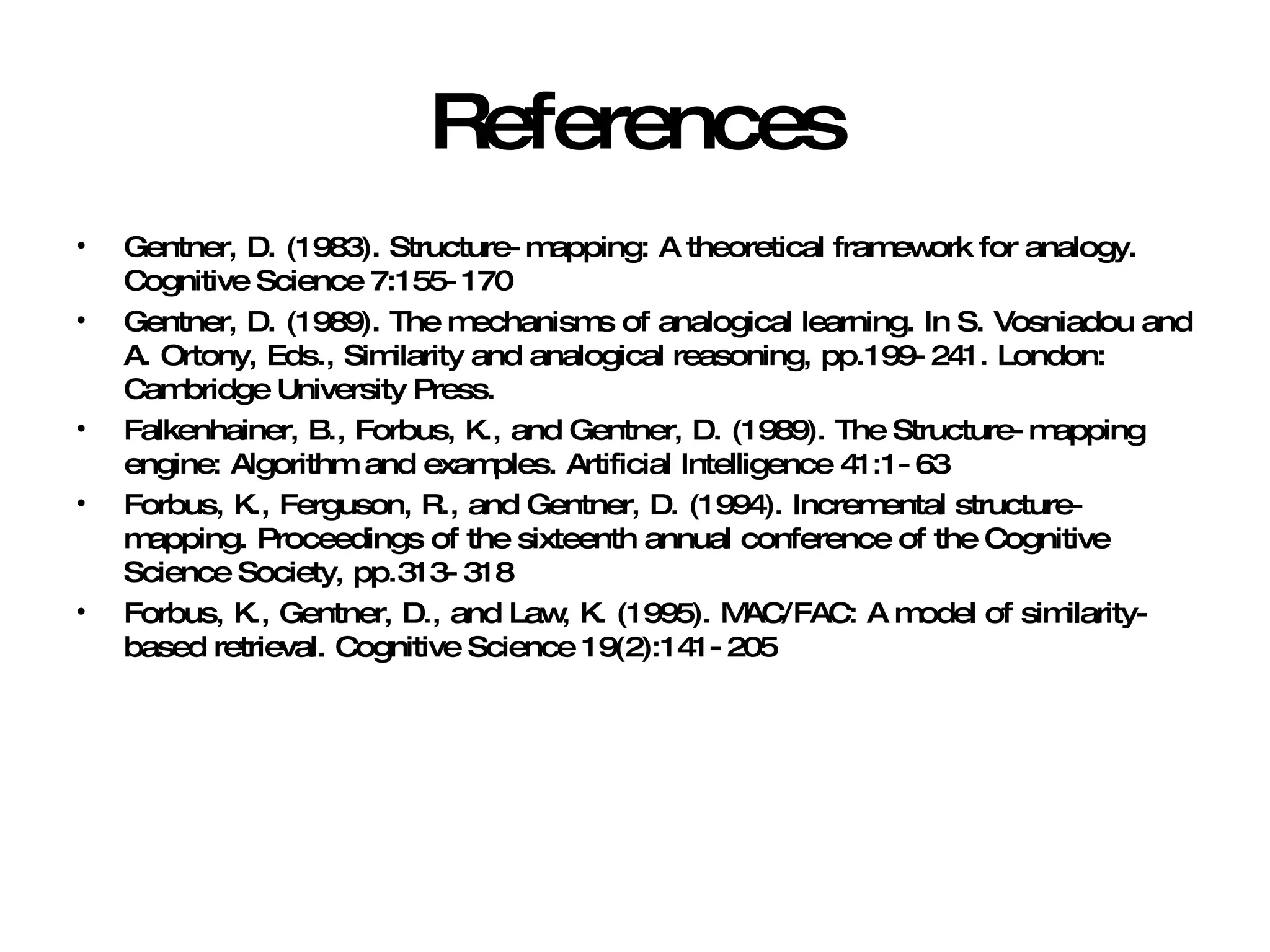
References Gentner, D. (1983). Structure-mapping: A theoretical framework for analogy. Cognitive Science 7:155-170 Gentner, D. (1989). The mechanisms of analogical learning. In S. Vosniadou and A. Ortony, Eds., Similarity and analogical reasoning, pp.199-241. London: Cambridge University Press. Falkenhainer, B., Forbus, K., and Gentner, D. (1989). The Structure-mapping engine: Algorithm and examples. Artificial Intelligence 41:1-63 Forbus, K., Ferguson, R., and Gentner, D. (1994). Incremental structure-mapping. Proceedings of the sixteenth annual conference of the Cognitive Science Society, pp.313-318 Forbus, K., Gentner, D., and Law, K. (1995). MAC/FAC: A model of similarity-based retrieval. Cognitive Science 19(2):141-205
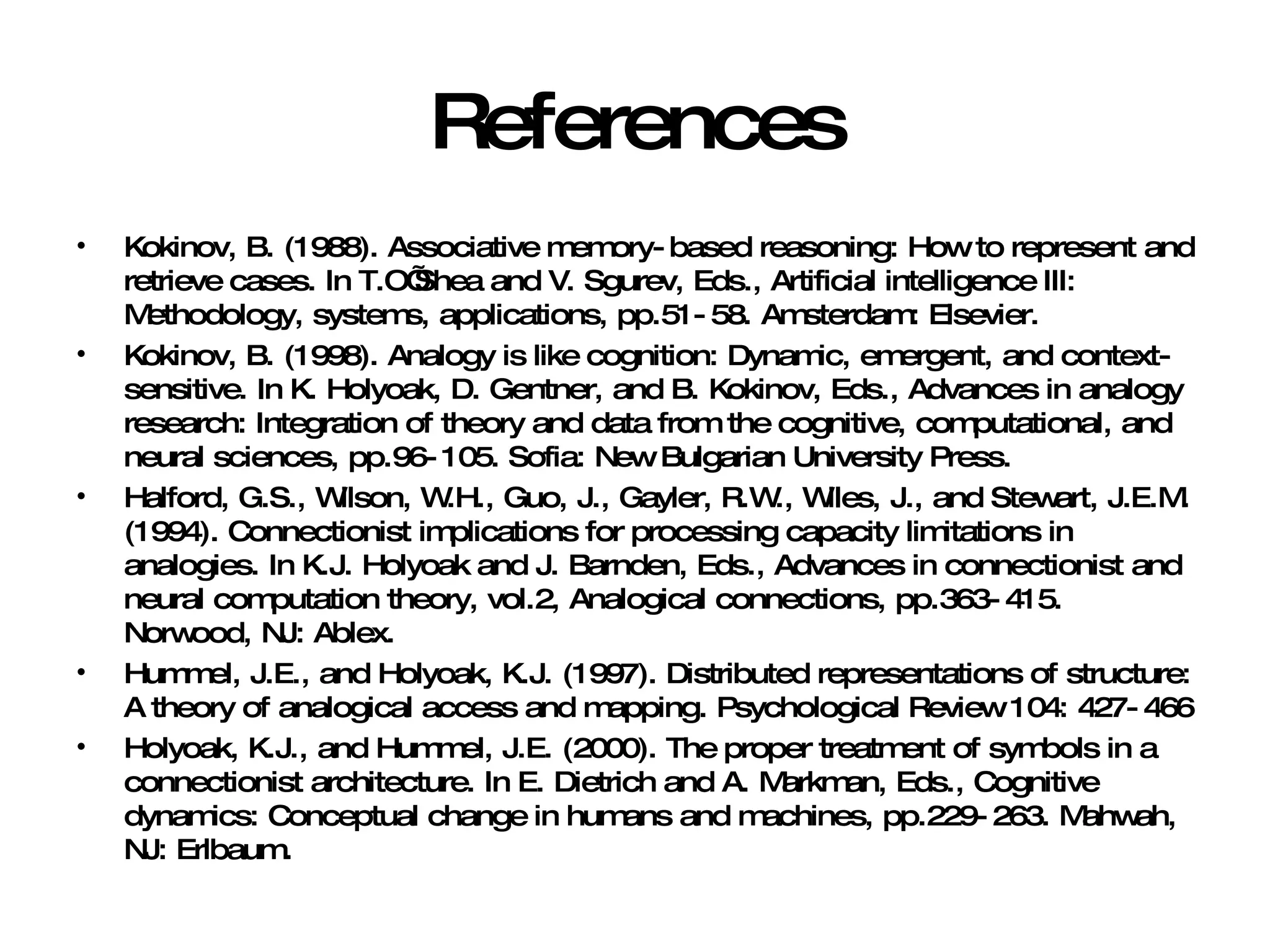
References Kokinov, B. (1988). Associative memory-based reasoning: How to represent and retrieve cases. In T.O’Shea and V. Sgurev, Eds., Artificial intelligence III: Methodology, systems, applications, pp.51-58. Amsterdam: Elsevier. Kokinov, B. (1998). Analogy is like cognition: Dynamic, emergent, and context-sensitive. In K. Holyoak, D. Gentner, and B. Kokinov, Eds., Advances in analogy research: Integration of theory and data from the cognitive, computational, and neural sciences, pp.96-105. Sofia: New Bulgarian University Press. Halford, G.S., Wilson, W.H., Guo, J., Gayler, R.W., Wiles, J., and Stewart, J.E.M. (1994). Connectionist implications for processing capacity limitations in analogies. In K.J. Holyoak and J. Barnden, Eds., Advances in connectionist and neural computation theory, vol.2, Analogical connections, pp.363-415. Norwood, NJ: Ablex. Hummel, J.E., and Holyoak, K.J. (1997). Distributed representations of structure: A theory of analogical access and mapping. Psychological Review 104: 427-466 Holyoak, K.J., and Hummel, J.E. (2000). The proper treatment of symbols in a connectionist architecture. In E. Dietrich and A. Markman, Eds., Cognitive dynamics: Conceptual change in humans and machines, pp.229-263. Mahwah, NJ: Erlbaum.
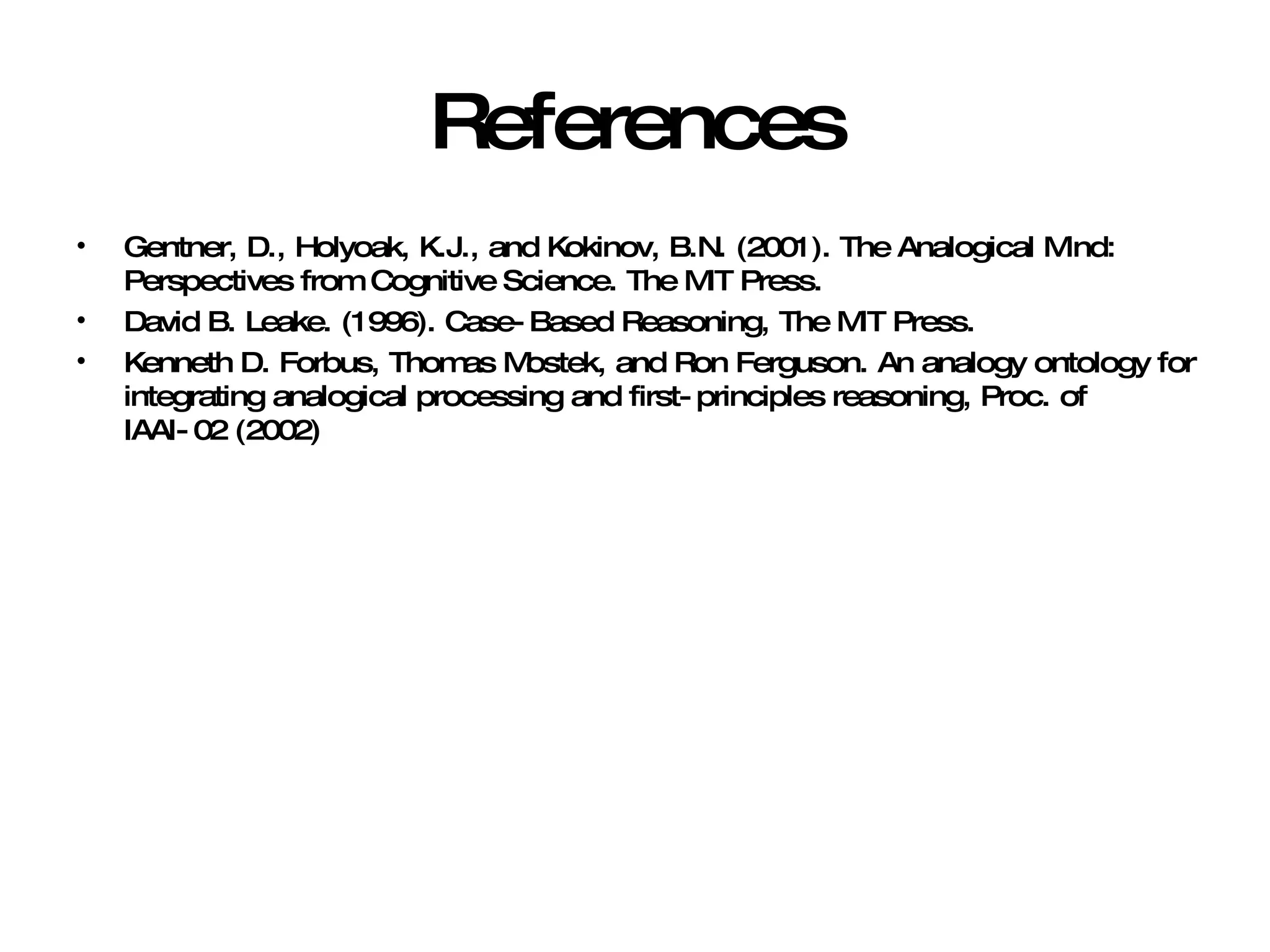
References Gentner, D., Holyoak, K.J., and Kokinov, B.N. (2001). The Analogical Mind: Perspectives from Cognitive Science. The MIT Press. David B. Leake. (1996). Case-Based Reasoning, The MIT Press. Kenneth D. Forbus, Thomas Mostek, and Ron Ferguson. An analogy ontology for integrating analogical processing and first-principles reasoning, Proc. of IAAI-02 (2002)

Survey of Analogy Reasoning

  • 1.
    Survey on AnalogicalReasoning 2009. 4. 21 Sang-Kyun Kim [email_address]
  • 2.
    Table of ContentsThe Analogical Mind Case-Based Reasoning An analogy ontology for integrating analogical processing and first-principles reasoning
  • 3.
  • 4.
    Introduction Analogy inCognitive Science Topic of analogy has a special place in the field of cognitive science About 1980, several research projects in AI and psychology Complex analogies in reasoning and learning Cased-based reasoning (vs. Rule-based reasoning) Gentner began working on mental model and analogy Key similarities lie in the relations that hold within the domains rather than in features of individual objects Holyoak investigated the role of analogy in complex cognitive tasks Multiconstraint approach to analogy in which similarity, structural parallelism, and pragmatic factors interact to produce an interpretation Others …
  • 5.
    Introduction Model ofanalogical thinking Depend on representations that can explicitly express relations All models of analogy have been based on knowledge representations that express the internal structure of propositions, binding values to the arguments of predicates Process of analogical thinking One or more relevant analogs stored in long-term memory must be accessed A familiar analog must be mapped to the target analog The resulting mapping allows analogical inferences to be made about the target analog These inferences need to be evaluated and possibly adapted to fit requirements of the target After reasoning, learning can result in the generation of new instances
  • 6.
    Exploring Analogy inthe Large Structure-mapping theory (Gentner 1983, 1989) Account of comparison processes that is consistent with a growing body of psychological evidence SME (Structure Mapping Engine) (Falkenhainer, Forbus, and Gentner 1989; Forbus, Ferguson, and Gentner 1994) Simulation of the comparison processes SME operated in polynomial time and can also incrementally extend its mappings
  • 7.
    Exploring Analogy inthe Large Input of two structured propositional representations, base and target Attributes : unary predicated indicating features Relations : express connections between entities Higher-order relations : express connections between relations Given a base and target, SME computes a mapping Each mapping contains a set of correspondences that align particular items in the base with items in the target Candidate inferences : statements about the base that are hypothesized to hold in the target by these correspondences
  • 8.
    Exploring Analogy inthe Large MAC/FAC (Many Are Called/Few Are Chosen) (Forbus, Gentner, and Law 1995) Models similarity-based retrieval MAC first uses a simple, nonstructural matcher to filter out a few promising candidates FAC then evaluates these candidates more carefully using SME Correspondences and candidate inferences that indicate how the reminded information may be relevant to the current situation Scalability comes from the simplicity of MAC
  • 9.
    Integrating Memory andReasoning in Analogy-Making AMBR (Associative Memory-Based Reasoning) (Kokinov 1988; Kokinov 1998) A model of human reasoning in problem solving, unifying analogy, deduction, and induction AMBR1 Integrate memory, mapping, and transfer and simulated analogy-making in a commonsense domain Suppose you are in the forest and you want to heat some water, but you have only a knife, an ax, and a matchbox. You do not have a container of any kind. You can cut a vessel of wood, but it would burn in the fire. How can you heat the water in this wooden vessel? Used in studying some interactions between memory (priming), perception (context effects), and reasoning (problem solving)
  • 10.
    Integrating Memory andReasoning in Analogy-Making AMBR2 Relies on emergent context-sensitive computations and implements in an even more decentralized way Concepts and objects are represented in the same way as in AMBR1
  • 11.
    The STAR-2 Modelfor Mapping Hierarchically Structured Analogs STAR (Structured Tensor Analogical Reasoning) Halford et al. 1994 Neural net model Designed to be consistent with human processing capacity limitations Approaches for representation of propositions that comprise the base and target in neural net model Synchronous oscillation model Product operations such as circular convolution or tensor products
  • 12.
    Toward an Understandingof Analogy within a Biological Symbol System LISA (Learning and Inference with Schemas and Analogies) Hummel and Holyoak 1997; Holyoak and Hummel 2000 Neural net model Integrated model of analogical access, mapping, inference, and learning Consider capacity limits of human working memory How complex analogies can be processed within a system with inherent constraints on the capacity of working memory Biological symbol systems – knowledge representations that capture the symbolic nature of human cognition
  • 13.
  • 14.
    CBR in Context: The Present and Future Knowledge source in CBR Not generalized rules but a memory of stored cases recording specific prior episodes Reasoning in CBR is based on remembering New solutions are generated not by chaining, but by retrieving the most relevant cases from memory Library of cases Most important component of a case-based reasoning system
  • 15.
    What is aCase? Definition A case is a contextualized piece of knowledge representing an experience that teaches a lesson fundamental to achieving the goals of the reaoner Content of Cases Content Problem/situation description : state of the world when the episode recorded in the case occurred Solution : stated or derived solution to the problem Outcome : resulting state of the world Indexes Combinations of its important descriptors Ones that distinguish it from other cases
  • 16.
    A Sketch ofthe CBR Process Case-based reasoning tasks Interpretation (Interpretive CBR) Use cases for criticism and justification Use prior cases as reference points for classifying or characterizing new situations Form a judgment about or classification of a new situation, by comparing and contrasting it with cases that have already been classified Problem-solving (Problem-solving CBR) Use cases to propose solutions Use prior cases to suggest solutions that might apply to new circumstances Apply a prior solution to generate the solution to a new problem
  • 17.
    The Process ofCBR Retrieve Propose ballpark solution Adapt Justify Criticize Evaluate Store
  • 18.
    What is thePoint of CBR True CBR Not abstract CBR or rule-based reasoning Process of true CBR Partial matching (selection) Don’t find matching case Find the cases that matches best Adaptation (reasoning) Don’t apply a case by filling in the details Have to decide which details to throw away, which to replace, and which to keep
  • 19.
    Relationship to AnalogicalReasoning Analogical reasoning vs. CBR CBR can be viewed as fundamentally analogical There is no clear line between research “on analogy” and “on CBR” Research on analogy More concerned with abstract knowledge and structural similarity Focus on analogical mapping Research on CBR More concerned with forming correspondences between specific episodes based on pragmatic considerations about the usefulness of the result Focus on analogical mapping + related processes that occur both before and after mapping
  • 20.
    An analogy ontologyfor integrating analogical processing and first-principles reasoning
  • 21.
    Introduction Understanding howto integrate analogical processing into AI systems seems crucial to creating more human-like reasoning system Similarity plays at best a minor role in many AI systems Most AI systems operate on a first-principles basis using rules or axioms plus logical inference Few reasoning systems that include analogy tend to treat it as a method of last resort, something to use only when other forms of inference have failed The exceptions are CBR systems, but CBR use only minimal first-principles reasoning Most CBR systems rely on feature-based descriptions that cannot match the expressive power of predicate calculus
  • 22.
    Introduction Integrate analogicalprocessing and first-principle reasoning Key idea is to use Analogy ontology Formal representation of the contents and results of analogical reasoning Provide the glue between 1 st principles reasoning and analogical processing Semantics is defined by structure-mapping theory Simulation : SME and MAC/FAC
  • 23.
    Analogy Ontology CasesFunctions (task constraints in analogical reasoning) minimal-case-fn ?thing : all of the statements in the KB that directly mention ?thing, where ?thing can be any term case-fn ?thing : union of (minimal-case-fn ?thing) recursive-case-fn ?thing : union of case-fn applied to ?thing and to all of its subparts, recursively … Matches Pragmatic constraints Mappings Correspondences Candidate inferences Similarities and differences
  • 24.
    Integrating 1 st principles and analogical reasoning Analogy Ontology Language for the entities and relationships of structure-mapping Procedural attachment Enforce the semantics of the analogy ontology Two-way communication between the reasoning system and the attached software Reasoning system -> analogy software Recognize predicates with procedural attachments Carry out the appropriate procedure when queries involving them are made Analogy software -> reasoning system Handled by using the reasoner’s query software from within the analogy subsystem
  • 25.
    Simple example Goal: (match-between ?base ?target ?match) When ?base and ?target are bound, this goal invokes SME to match the value of ?base against the value of ?target When ?base is unbound, this goal invokes MAC/FAC When ?target is unbound, the query is considered to be an error and the goal fails If ?base and ?target are a non-atomic term, further reasoning is invoked to derive the contents of the case Successful match-between query results in Creation of a new term in the reasoning system to represent the match ?match is bound to this new term as part of the bindings produced by the goal New term is linked the analogical processing data structure to support future queries Mappings associated with the match are reified as new terms in the reasoning system, with the appropriate mapping-of, best-mapping Structural evaluation score information asserted
  • 26.
    References Gentner, D.(1983). Structure-mapping: A theoretical framework for analogy. Cognitive Science 7:155-170 Gentner, D. (1989). The mechanisms of analogical learning. In S. Vosniadou and A. Ortony, Eds., Similarity and analogical reasoning, pp.199-241. London: Cambridge University Press. Falkenhainer, B., Forbus, K., and Gentner, D. (1989). The Structure-mapping engine: Algorithm and examples. Artificial Intelligence 41:1-63 Forbus, K., Ferguson, R., and Gentner, D. (1994). Incremental structure-mapping. Proceedings of the sixteenth annual conference of the Cognitive Science Society, pp.313-318 Forbus, K., Gentner, D., and Law, K. (1995). MAC/FAC: A model of similarity-based retrieval. Cognitive Science 19(2):141-205
  • 27.
    References Kokinov, B.(1988). Associative memory-based reasoning: How to represent and retrieve cases. In T.O’Shea and V. Sgurev, Eds., Artificial intelligence III: Methodology, systems, applications, pp.51-58. Amsterdam: Elsevier. Kokinov, B. (1998). Analogy is like cognition: Dynamic, emergent, and context-sensitive. In K. Holyoak, D. Gentner, and B. Kokinov, Eds., Advances in analogy research: Integration of theory and data from the cognitive, computational, and neural sciences, pp.96-105. Sofia: New Bulgarian University Press. Halford, G.S., Wilson, W.H., Guo, J., Gayler, R.W., Wiles, J., and Stewart, J.E.M. (1994). Connectionist implications for processing capacity limitations in analogies. In K.J. Holyoak and J. Barnden, Eds., Advances in connectionist and neural computation theory, vol.2, Analogical connections, pp.363-415. Norwood, NJ: Ablex. Hummel, J.E., and Holyoak, K.J. (1997). Distributed representations of structure: A theory of analogical access and mapping. Psychological Review 104: 427-466 Holyoak, K.J., and Hummel, J.E. (2000). The proper treatment of symbols in a connectionist architecture. In E. Dietrich and A. Markman, Eds., Cognitive dynamics: Conceptual change in humans and machines, pp.229-263. Mahwah, NJ: Erlbaum.
  • 28.
    References Gentner, D.,Holyoak, K.J., and Kokinov, B.N. (2001). The Analogical Mind: Perspectives from Cognitive Science. The MIT Press. David B. Leake. (1996). Case-Based Reasoning, The MIT Press. Kenneth D. Forbus, Thomas Mostek, and Ron Ferguson. An analogy ontology for integrating analogical processing and first-principles reasoning, Proc. of IAAI-02 (2002)