Faced this situationbefore?
• Oops the car stopped.
– What could have gone wrong?
• Aah.. Last time it happened, there was no petrol.
– Is there petrol?
• Yes.
– Oh but wait I remember the tyre was punctured
• This is the normal thought process of a human when
faced with a problem which is similar to a problem
he/she had faced before.
3.
How do wesolve problems?
• By knowing the steps to apply
– from symptoms to a plausible diagnosis
• But not always applying causal knowledge
• How does an expert solve problems?
– uses same “book learning” as a novice
– but quickly selects the right knowledge to apply
• Heuristic knowledge (“rules of thumb”)
– “I don’t know why this works but it does and so I’ll use it
again!”
– difficult to elicit
4.
So what?
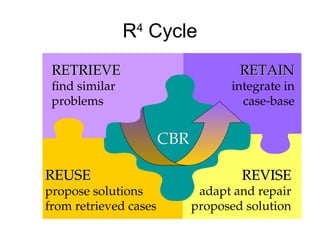
• Reusethe solution experience when faced with a similar
problem.
• This is Case Based Reasoning (CBR)!
– memory-based problem-solving
– re-using past experiences
• Experts often find it easier to relate stories about past cases
than to formulate rules
5.
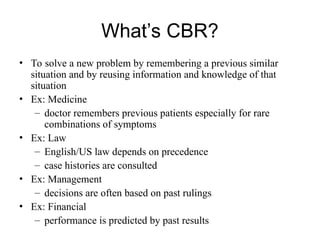
What’s CBR?
• Tosolve a new problem by remembering a previous similar
situation and by reusing information and knowledge of that
situation
• Ex: Medicine
– doctor remembers previous patients especially for rare
combinations of symptoms
• Ex: Law
– English/US law depends on precedence
– case histories are consulted
• Ex: Management
– decisions are often based on past rulings
• Ex: Financial
– performance is predicted by past results
6.
Definitions of CBR
•Case-based reasoning is […] reasoning by
remembering - Leake, 1996
• A case-based reasoner solves new
problems by adapting solutions that were
used to solve old problems - Riesbeck &
Schank, 1989
• Case-based reasoning is a recent approach
to problem solving and learning […] -
Aamodt & Plaza, 1994
7.
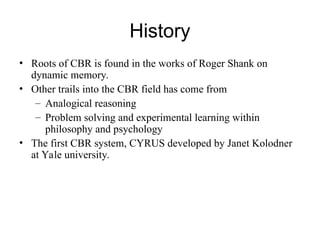
History
• Roots ofCBR is found in the works of Roger Shank on
dynamic memory.
• Other trails into the CBR field has come from
– Analogical reasoning
– Problem solving and experimental learning within
philosophy and psychology
• The first CBR system, CYRUS developed by Janet Kolodner
at Yale university.
8.
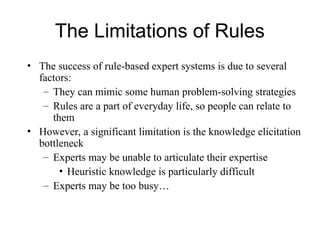
The Limitations ofRules
• The success of rule-based expert systems is due to several
factors:
– They can mimic some human problem-solving strategies
– Rules are a part of everyday life, so people can relate to
them
• However, a significant limitation is the knowledge elicitation
bottleneck
– Experts may be unable to articulate their expertise
• Heuristic knowledge is particularly difficult
– Experts may be too busy…
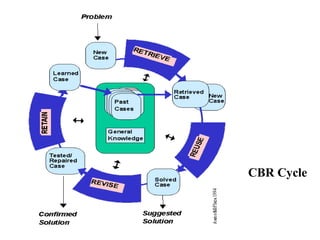
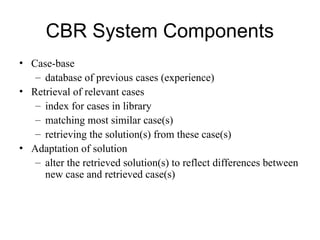
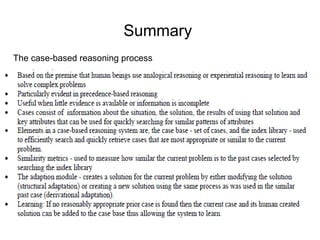
CBR System Components
•Case-base
– database of previous cases (experience)
• Retrieval of relevant cases
– index for cases in library
– matching most similar case(s)
– retrieving the solution(s) from these case(s)
• Adaptation of solution
– alter the retrieved solution(s) to reflect differences between
new case and retrieved case(s)
12.
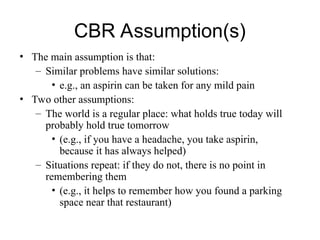
CBR Assumption(s)
• Themain assumption is that:
– Similar problems have similar solutions:
• e.g., an aspirin can be taken for any mild pain
• Two other assumptions:
– The world is a regular place: what holds true today will
probably hold true tomorrow
• (e.g., if you have a headache, you take aspirin,
because it has always helped)
– Situations repeat: if they do not, there is no point in
remembering them
• (e.g., it helps to remember how you found a parking
space near that restaurant)
13.
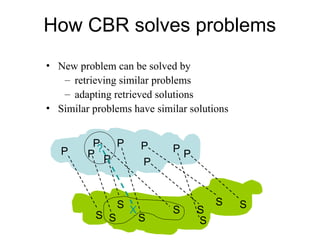
How CBR solvesproblems
• New problem can be solved by
– retrieving similar problems
– adapting retrieved solutions
• Similar problems have similar solutions
?
S
S
S
S
S S
S
S S
P
P
P
P
P
P
P
P
P
X
14.
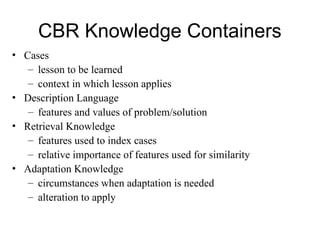
CBR Knowledge Containers
•Cases
– lesson to be learned
– context in which lesson applies
• Description Language
– features and values of problem/solution
• Retrieval Knowledge
– features used to index cases
– relative importance of features used for similarity
• Adaptation Knowledge
– circumstances when adaptation is needed
– alteration to apply
15.
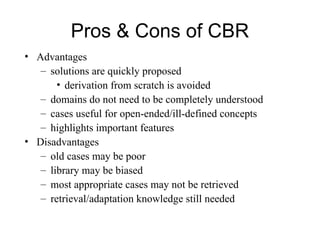
Pros & Consof CBR
• Advantages
– solutions are quickly proposed
• derivation from scratch is avoided
– domains do not need to be completely understood
– cases useful for open-ended/ill-defined concepts
– highlights important features
• Disadvantages
– old cases may be poor
– library may be biased
– most appropriate cases may not be retrieved
– retrieval/adaptation knowledge still needed
![Definitions of CBR
• Case-based reasoning is […] reasoning by
remembering - Leake, 1996
• A case-based reasoner solves new
problems by adapting solutions that were
used to solve old problems - Riesbeck &
Schank, 1989
• Case-based reasoning is a recent approach
to problem solving and learning […] -
Aamodt & Plaza, 1994](https://image.slidesharecdn.com/chap33casebasedreasoning-251125073442-1a377733/85/chap-3-3-Case-Based-Reasoning-ppt-for-lecture-6-320.jpg)


![[K Engine] Intorduction To Machine Planning, A Case Based Approach](https://cdn.slidesharecdn.com/ss_thumbnails/kengineintorductiontomachineplanningacasebasedapproach-13046756973176-phpapp02-110506051152-phpapp02-thumbnail.jpg?width=640&height=640&fit=bounds)


![[DSC Europe 25] Ivan Lukovic & Marija Djukic - From Data to Value: Why Maturi...](https://cdn.slidesharecdn.com/ss_thumbnails/ahrfps8xr6knowwhacxh-1-ivan-marija-dsc-2025-ld-v1-presentation-260115093812-be21adfc-thumbnail.jpg?width=640&height=640&fit=bounds)


![[DSC Europe 25] Elena Menshikova - AI-Powered Operational Excellence: Revolut...](https://cdn.slidesharecdn.com/ss_thumbnails/es6nholbqy3zaao2c2yd-2-elena-menshikova-data-ai-in-decision-making-260115093812-4fba8b38-thumbnail.jpg?width=640&height=640&fit=bounds)
![[DSC Europe 25] Andrzej Kowalczyk - AI - how to start small and grow in the f...](https://cdn.slidesharecdn.com/ss_thumbnails/oy1zmo94qv6vpcqjvno2-andrzej-kowalczyk-ai-how-to-start-small-and-grow-in-the-future-1-260119121559-cf093b23-thumbnail.jpg?width=640&height=640&fit=bounds)
![[DSC Europe 25] Bojan Djuricic - Predictive Design Process.pdf](https://cdn.slidesharecdn.com/ss_thumbnails/5awdrbedqdek3gqu2ezy-4-the-predictive-design-bojan-djuricic-260120105856-6c399e9b-thumbnail.jpg?width=640&height=640&fit=bounds)