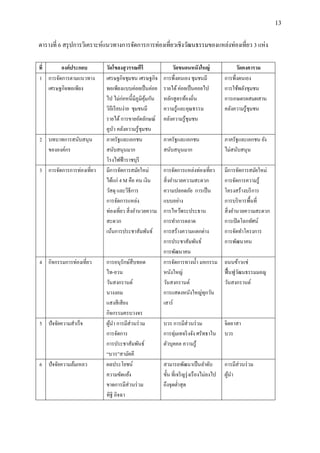
2
หน่ ว ยงานภาครัฐประกอบด้วย การสนับสนุ น จากภาครัฐ ทั้งความรู้ สิ่ งอานวยความสะดวก การพัฒนา
ศักยภาพแหล่งท่องเที่ยว บุคลากร การประชาสัมพันธ์และการจัดกิจกรรมอย่างต่อเนื่อง
Abstract
This research was aimed to study 1) the motive force level in Thai tourists regarding
art and cultural learning in cradles of civilization of Ratchaburi Province 2) the opinion of
tourist related groups toward this tourism and 3) the guideline of tourist promotion. The
research process was based on the integration of quantitative and qualitative methodologies
and divided into two steps as follows:
Starting from the first step of quantitative method, four hundred of Thai tourists and
eighty-six of other related persons were systematically chosen as our respondents and these
were interviewed with structural questionnaire set no.1 and no.2 respectively. After that in the
second step would be conducted with the qualitative method, the seventeen and twelve key
informants were purposively selected to in-depth interview and invited to joint in the one
setting of focus group discussion respectively. The quantitative data was statistically analyzed
with Statistical Computer Program Package and presented in percentage, mean, standard
deviation, outcomes of t-test and F-test method. For the qualitative data it would be then
analyzed with the technique of content analysis.
From the results, the motive force of Thai tourists and the opinion of other persons
were measured and shown its overall results at much level ( X =3.69, S.D. =.949 and X =3.59,
S.D. =.946 respectively). When tested with F-test method, the tourists had their age,
education and occupation associate with the motive force level significantly at P ≤.05. The
guideline of tourist promotion was comprised of two components as follows:
The tourist sites: There should have the analysis in its shortages and problems
including to any recommendations from stake holders. The sites should be gradually
developed and this was based on Philosophy of Self-Sufficient Economy. The leaders should
have to have their strong leadership, sacrifice and public mind. The community involvement
should be formulated from the co-working together of three main parts namely Home,
Temple and School (HTS).
The government sector: To build up the capacities of tourist sites, the government
offices should support and promote them until to have enough knowledge, human resources,
public relation and advertising, movement of continuous activities and other facilities.
บทนา
การท่องเที่ยวเป็ นอุตสาหกรรมที่เจริ ญเติบโตและมีความสาคัญยิ่งต่อการพัฒนาทางเศรษฐกิจและ
สังคมของประเทศไทย รั ฐบาลจึงมีนโยบายส่ งเสริ มการท่องเที่ ยว โดยการท่องเที่ย วเริ่ มเข้ามามีบทบาท
สาคัญ ในการพัฒ นาประเทศอย่า งจริ งจังเป็ นครั้ งแรก เมื่อ มีก ารบรรจุ แ ผนพัฒ นาการท่ องเที่ ย วไว้ใ น
แผนพัฒนาเศรษฐกิจและสังคมแห่งชาติ ฉบับที่ 4 เรื่ อยมา จนถึงปัจจุบน (นริ นทร์ สังข์รักษา, 2552 : 1)
ั
จัง หวัด ราชบุ รี อยู่ห่ า งจากกรุ งเทพฯ เพี ย ง 100 กิ โ ลเมตร เป็ นจัง หวัด ที่ อุ ด มสมบู ร ณ์ ด ้ว ย
ทรั พยากรธรรมชาติและภูมิปัญญาท้องถิ่น มีความได้เปรี ย บทางด้านทาเลที่ ต้ ัง ประกอบกับโครงสร้ าง
พื้นฐานของจังหวัดมีการพัฒนาการเกษตรในทุกด้าน อีกทั้งมีแม่น้ าแม่กลอง ทาให้สภาพดินและแหล่งน้ ามี
ความอุด มสมบูร ณ์ สามารถปลูกพืชและสัตว์เศรษฐกิจ ได้หลายชนิ ด (ศาลากลางจังหวัด ราชบุ รี .2555)
16
บุญเลิศ จิตตั้งวัฒนา. (2548).การพัฒนาการท่ องเที่ ยวแบบยั่งยืน . ศูนย์วิชาการท่องเที่ยวแห่ งประเทศไทย
พิมพ์ครั้งที่ 1 บริ ษท เพรส แอนด์ ดีไซน์ จากัด.
ั
.(2548).อุตสาหกรรมการท่ องเที่ยว ธุรกิจที่ไม่มีวันตาย. กรุ งเทพฯ: สานักพิมพ์
ซี.พี.บุ๊ค สแตนดาร์ด.
วรรณา วงษ์วานิช. (2539). ภูมิศาสตร์ การท่ องเที่ยว. กรุ งเทพฯ มหาวิทยาลัยธรรมศาสตร์ .
ศรัญยา วรากุลวิทย์. (2546). ปฐมนิเทศอุตสาหกรรมการท่ องเที่ยว. อยุธยา : สถาบันเทคโนโลยีราชมงคล
วิทยาเขตพระนครศรี อยุธยา.
ศาลากลางจังหวัดราชบุรี (2555).ข้ อมูลทั่วไปจังหวัดราชบุรี. ราชบุรี : อัดสาเนา.
สิทธิโชค วรานุสนติกล.(2546).จิตวิทยาสังคม. : ทฤษฎีและการประยุกต์ . กรุ งเทพฯ : ซีเอ็ดยูเคชัน.
ั ู ่
อุดม เชยกีวงศ์ ประชิด สกุณะพัฒน์ และวิมล จิโรจพันธ์. (2548). การท่ องเที่ยวเชิงนิเวศ. กรุ งเทพฯ :
สานักพิมพ์แสงดาว.
Best,J. & Kahn,J.V. (1998). Research in education 6 th New Jersey : Prentice-Hall.
Buckley Ralf. (1995). Where tourism and ecology meet in Hiranburana et al. D (ed.) Proceeding
Ecotourism. Concept design and strategy : 1-14 Srinakharinwirot University Press.
Gee, Chuck Y., Dexter J. L. Choy and James C. Makens. (1984). The travel industry. Westport
Connecticut : AVI Publishing.
Krejcie R. V. and Morgan D.W. (1970) “Determining sample size for research activities” Educational and
Psychological Measurement 30(3): 607-610)
Masion, P. (2009). Tourism impacts, planning and management. 2nd ed. Oxford: Elsevier.
McIntosh,R.W. and C.R. Goeldner.(1986). Tourism principle practices philosophies. 5th ed. New York :
John Wileysons.
Pender, L. and Sharpley, R. (2005). The management tourism. London: Sage Publication.
Vroom, V. H. (1995). Work and motivation. Harmondsworth, England: Penguin.
Weaver, D. and Lawton, L. (2000). Tourism management. Australia: John Wiley & Sons.ก