
SQL ? NoSQL ?
GiorgosChrysovalantis Grammatikos
Mail: grammatikos84@gmail.com
Website: cloudopszone.com
MCSA : Cloud Platform
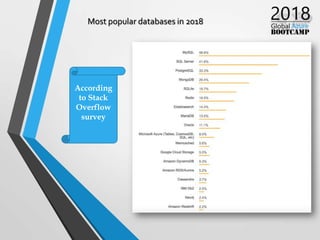
Most popular databases in 2018
According
to Stack
Overflow
survey
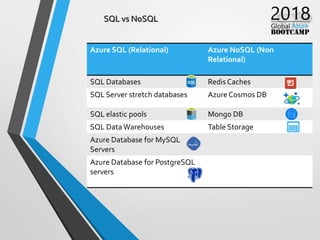
SQL vs NoSQL
Azure SQL (Relational) Azure NoSQL (Non
Relational)
SQL Databases RedisCaches
SQL Server stretch databases Azure Cosmos DB
SQL elastic pools Mongo DB
SQL Data Warehouses Table Storage
Azure Database for MySQL
Servers
Azure Database for PostgreSQL
servers
What is easier ?
Develop a Database Or a building ?
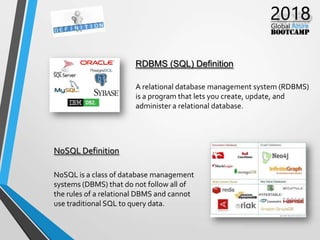
RDBMS (SQL) Definition
A relational database management system (RDBMS)
is a program that lets you create, update, and
administer a relational database.
NoSQL Definition
NoSQL is a class of database management
systems (DBMS) that do not follow all of
the rules of a relational DBMS and cannot
use traditional SQL to query data.
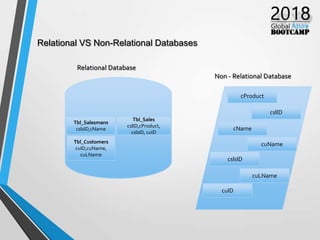
Relational VS Non-Relational Databases
Tbl_Salesmans
cslsID,cName
Tbl_Customers
cuID,cuName,
cuLName
Tbl_Sales
cslID,cProduct,
cslsID, cuID
cProduct
cslID
cslsID
cName
cuName
cuLName
cuID
Relational Database
Non - Relational Database
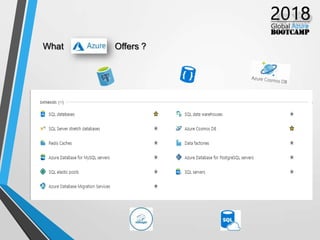
What Offers ?
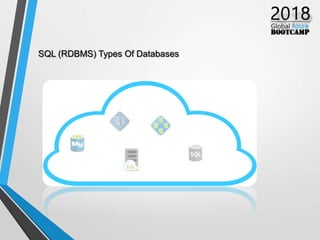
SQL (RDBMS) Types Of Databases
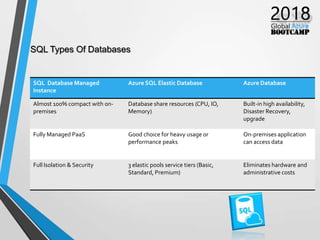
SQL Types Of Databases
SQL Database Managed
Instance
Azure SQL Elastic Database Azure Database
Almost 100% compact with on-
premises
Database share resources (CPU, IO,
Memory)
Built-in high availability,
Disaster Recovery,
upgrade
Fully Managed PaaS Good choice for heavy usage or
performance peaks
On-premises application
can access data
Full Isolation & Security 3 elastic pools service tiers (Basic,
Standard, Premium)
Eliminates hardware and
administrative costs
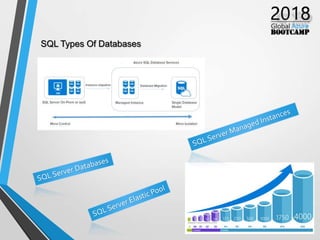
SQL Types Of Databases
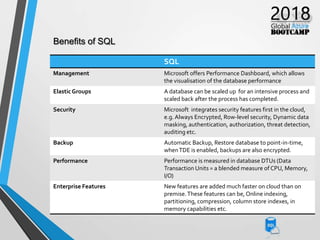
SQL
Management Microsoft offers Performance Dashboard, which allows
the visualisation of the database performance
ElasticGroups A database can be scaled up for an intensive process and
scaled back after the process has completed.
Security Microsoft integrates security features first in the cloud,
e.g.Always Encrypted, Row-level security, Dynamic data
masking, authentication, authorization, threat detection,
auditing etc.
Backup Automatic Backup, Restore database to point-in-time,
whenTDE is enabled, backups are also encrypted.
Performance Performance is measured in database DTUs (Data
Transaction Units = a blended measure of CPU, Memory,
I/O)
Enterprise Features New features are added much faster on cloud than on
premise.These features can be, Online indexing,
partitioning, compression, column store indexes, in
memory capabilities etc.
Benefits of SQL
Live Demo (Azure SQL Databases)
Deploy SQL Azure Database
Choose the correct PricingTier
Learn about Settings, Monitoring, Support &
Troubleshooting
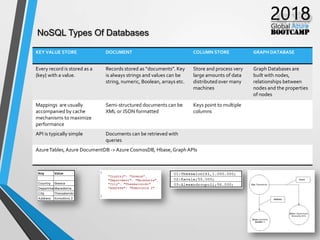
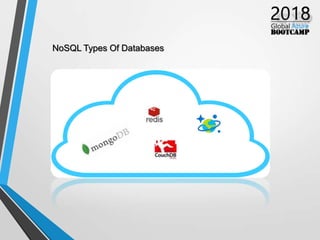
NoSQL Types Of Databases
KEY VALUE STORE DOCUMENT COLUMN STORE GRAPH DATABASE
Every record is stored as a
{key} with a value.
Records stored as “documents”. Key
is always strings and values can be
string, numeric, Boolean, arrays etc.
Store and process very
large amounts of data
distributed over many
machines
Graph Databases are
built with nodes,
relationships between
nodes and the properties
of nodes
Mappings are usually
accompanied by cache
mechanisms to maximize
performance
Semi-structured documents can be
XML or JSON formatted
Keys point to multiple
columns
API is typically simple Documents can be retrieved with
queries
AzureTables,Azure DocumentDB ->Azure CosmosDB, Hbase,Graph APIs
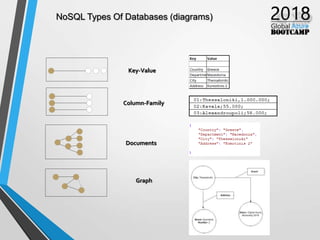
Key-Value
Column-Family
Documents
Graph
NoSQL Types Of Databases (diagrams)
Azure CosmosDB Useful Links
 Azure Cosmos DB: SQL API getting started tutorial
 Azure Cosmos Db : Designing your data structure
 Modelling document data for NoSQL databases
 ASP.NET MVCTutorial:Web application development with Azure Cosmos DB
NoSQL Types Of Databases
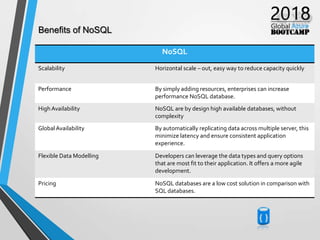
NoSQL
Scalability Horizontal scale – out, easy way to reduce capacity quickly
Performance By simply adding resources, enterprises can increase
performance NoSQL database.
HighAvailability NoSQL are by design high available databases, without
complexity
GlobalAvailability By automatically replicating data across multiple server, this
minimize latency and ensure consistent application
experience.
Flexible Data Modelling Developers can leverage the data types and query options
that are most fit to their application. It offers a more agile
development.
Pricing NoSQL databases are a low cost solution in comparison with
SQL databases.
Benefits of NoSQL
Live Demo (Azure Cosmos DB)
Deploy Azure Cosmos DB
Choose the correct PricingTier
Learn about Settings, Monitoring, Support &
Troubleshooting
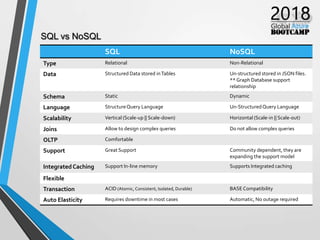
SQL NoSQL
Type Relational Non-Relational
Data Structured Data stored inTables Un-structured stored in JSON files.
** Graph Database support
relationship
Schema Static Dynamic
Language StructureQuery Language Un-StructuredQuery Language
Scalability Vertical (Scale-up || Scale-down) Horizontal (Scale-in || Scale-out)
Joins Allow to design complex queries Do not allow complex queries
OLTP Comfortable
Support Great Support Community dependent, they are
expanding the support model
IntegratedCaching Support In-line memory Supports Integrated caching
Flexible
Transaction ACID (Atomic, Consistent, Isolated, Durable) BASECompatibility
Auto Elasticity Requires downtime in most cases Automatic, No outage required
SQL vs NoSQL
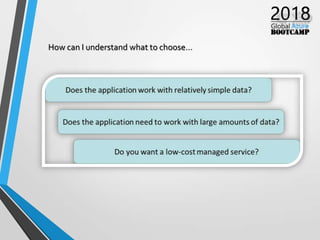
How can I understand what to choose…
Thank You

SQL or NoSQL, is this the question? - George Grammatikos

  • 2.
    SQL ? NoSQL? GiorgosChrysovalantis Grammatikos Mail: grammatikos84@gmail.com Website: cloudopszone.com MCSA : Cloud Platform
  • 3.
    Most popular databasesin 2018 According to Stack Overflow survey
  • 4.
    SQL vs NoSQL AzureSQL (Relational) Azure NoSQL (Non Relational) SQL Databases RedisCaches SQL Server stretch databases Azure Cosmos DB SQL elastic pools Mongo DB SQL Data Warehouses Table Storage Azure Database for MySQL Servers Azure Database for PostgreSQL servers
  • 5.
    What is easier? Develop a Database Or a building ?
  • 6.
    RDBMS (SQL) Definition Arelational database management system (RDBMS) is a program that lets you create, update, and administer a relational database. NoSQL Definition NoSQL is a class of database management systems (DBMS) that do not follow all of the rules of a relational DBMS and cannot use traditional SQL to query data.
  • 7.
    Relational VS Non-RelationalDatabases Tbl_Salesmans cslsID,cName Tbl_Customers cuID,cuName, cuLName Tbl_Sales cslID,cProduct, cslsID, cuID cProduct cslID cslsID cName cuName cuLName cuID Relational Database Non - Relational Database
  • 8.
  • 9.
    SQL (RDBMS) TypesOf Databases
  • 10.
    SQL Types OfDatabases SQL Database Managed Instance Azure SQL Elastic Database Azure Database Almost 100% compact with on- premises Database share resources (CPU, IO, Memory) Built-in high availability, Disaster Recovery, upgrade Fully Managed PaaS Good choice for heavy usage or performance peaks On-premises application can access data Full Isolation & Security 3 elastic pools service tiers (Basic, Standard, Premium) Eliminates hardware and administrative costs
  • 11.
    SQL Types OfDatabases
  • 12.
    SQL Management Microsoft offersPerformance Dashboard, which allows the visualisation of the database performance ElasticGroups A database can be scaled up for an intensive process and scaled back after the process has completed. Security Microsoft integrates security features first in the cloud, e.g.Always Encrypted, Row-level security, Dynamic data masking, authentication, authorization, threat detection, auditing etc. Backup Automatic Backup, Restore database to point-in-time, whenTDE is enabled, backups are also encrypted. Performance Performance is measured in database DTUs (Data Transaction Units = a blended measure of CPU, Memory, I/O) Enterprise Features New features are added much faster on cloud than on premise.These features can be, Online indexing, partitioning, compression, column store indexes, in memory capabilities etc. Benefits of SQL
  • 13.
    Live Demo (AzureSQL Databases) Deploy SQL Azure Database Choose the correct PricingTier Learn about Settings, Monitoring, Support & Troubleshooting
  • 14.
    NoSQL Types OfDatabases KEY VALUE STORE DOCUMENT COLUMN STORE GRAPH DATABASE Every record is stored as a {key} with a value. Records stored as “documents”. Key is always strings and values can be string, numeric, Boolean, arrays etc. Store and process very large amounts of data distributed over many machines Graph Databases are built with nodes, relationships between nodes and the properties of nodes Mappings are usually accompanied by cache mechanisms to maximize performance Semi-structured documents can be XML or JSON formatted Keys point to multiple columns API is typically simple Documents can be retrieved with queries AzureTables,Azure DocumentDB ->Azure CosmosDB, Hbase,Graph APIs
  • 15.
  • 16.
    Azure CosmosDB UsefulLinks  Azure Cosmos DB: SQL API getting started tutorial  Azure Cosmos Db : Designing your data structure  Modelling document data for NoSQL databases  ASP.NET MVCTutorial:Web application development with Azure Cosmos DB
  • 17.
    NoSQL Types OfDatabases
  • 18.
    NoSQL Scalability Horizontal scale– out, easy way to reduce capacity quickly Performance By simply adding resources, enterprises can increase performance NoSQL database. HighAvailability NoSQL are by design high available databases, without complexity GlobalAvailability By automatically replicating data across multiple server, this minimize latency and ensure consistent application experience. Flexible Data Modelling Developers can leverage the data types and query options that are most fit to their application. It offers a more agile development. Pricing NoSQL databases are a low cost solution in comparison with SQL databases. Benefits of NoSQL
  • 19.
    Live Demo (AzureCosmos DB) Deploy Azure Cosmos DB Choose the correct PricingTier Learn about Settings, Monitoring, Support & Troubleshooting
  • 20.
    SQL NoSQL Type RelationalNon-Relational Data Structured Data stored inTables Un-structured stored in JSON files. ** Graph Database support relationship Schema Static Dynamic Language StructureQuery Language Un-StructuredQuery Language Scalability Vertical (Scale-up || Scale-down) Horizontal (Scale-in || Scale-out) Joins Allow to design complex queries Do not allow complex queries OLTP Comfortable Support Great Support Community dependent, they are expanding the support model IntegratedCaching Support In-line memory Supports Integrated caching Flexible Transaction ACID (Atomic, Consistent, Isolated, Durable) BASECompatibility Auto Elasticity Requires downtime in most cases Automatic, No outage required SQL vs NoSQL
  • 21.
    How can Iunderstand what to choose…
  • 22.