State Government Perspective WLIA Spring Regional Meeting June 3, 2010
Important land information issues Technological, social or political advances How do these issues/advances affect state government land information professionals? How has WLIP helped state government? How can WLIP be enhanced to support state government?
Land Information Issues No Wisconsin strategy for sustainable statewide imagery acquisition State agencies contributed to 2010 efforts What’s next? Homeland Security Strategic Plan includes objective to address this… Need to create or update statewide data layers aggregated from local and other sources Parcels, PLSS
Land Information Issues Uncertainty about “best available” version of some statewide data layers MCD Lack of consistent data exchange standards and data sharing policies General confusion about roles/responsibilities of groups and individuals to address issues GIO, WIGICC, WLIA, SCO, SAGIC, LION, other
Land Information Issues Lack of business needs and return-on-investment (ROI) assessments to justify acquisition/creation/maintenance of centralized infrastructure, data repository and services  Funding issues Who should pay to support access to statewide public domain data via centralized data repository and/or services? Need very high level policy to guide a strategy/plan
Advances Technological Advances “ Google Maps Effect” Web Services (e.g., WMS, REST/SOAP) ETL processes Social Advances State government has always been and will continue to be a participant in geospatial groups and initiatives Political Advances Government transparency requires easier data access
Land Info Professionals Increase need for positions and training to develop web services and applications using web APIs Budget requires creative thinking about shared repository and services  Still a lot of silos…
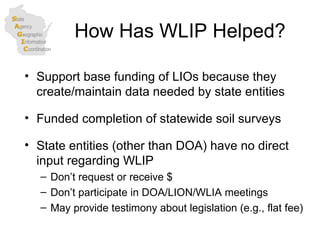
How Has WLIP Helped? Support base funding of LIOs because they create/maintain data needed by state entities Funded completion of statewide soil surveys State entities (other than DOA) have no direct input regarding WLIP Don’t request or receive $ Don’t participate in DOA/LION/WLIA meetings May provide testimony about legislation (e.g., flat fee)
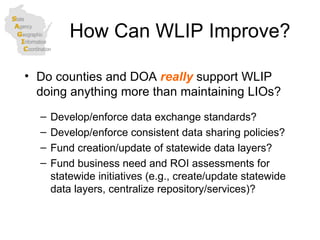
How Can WLIP Improve? Do counties and DOA  really  support WLIP doing anything more than maintaining LIOs? Develop/enforce data exchange standards? Develop/enforce consistent data sharing policies? Fund creation/update of statewide data layers? Fund business need and ROI assessments for statewide initiatives (e.g., create/update statewide data layers, centralize repository/services)?
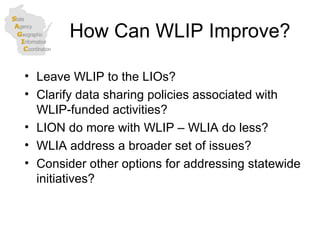
How Can WLIP Improve? Leave WLIP to the LIOs? Clarify data sharing policies associated with WLIP-funded activities? LION do more with WLIP – WLIA do less? WLIA address a broader set of issues? Consider other options for addressing statewide initiatives?

Spring 2010 SAGIC Perspective

  • 1.
    State Government PerspectiveWLIA Spring Regional Meeting June 3, 2010
  • 2.
    Important land informationissues Technological, social or political advances How do these issues/advances affect state government land information professionals? How has WLIP helped state government? How can WLIP be enhanced to support state government?
  • 3.
    Land Information IssuesNo Wisconsin strategy for sustainable statewide imagery acquisition State agencies contributed to 2010 efforts What’s next? Homeland Security Strategic Plan includes objective to address this… Need to create or update statewide data layers aggregated from local and other sources Parcels, PLSS
  • 4.
    Land Information IssuesUncertainty about “best available” version of some statewide data layers MCD Lack of consistent data exchange standards and data sharing policies General confusion about roles/responsibilities of groups and individuals to address issues GIO, WIGICC, WLIA, SCO, SAGIC, LION, other
  • 5.
    Land Information IssuesLack of business needs and return-on-investment (ROI) assessments to justify acquisition/creation/maintenance of centralized infrastructure, data repository and services Funding issues Who should pay to support access to statewide public domain data via centralized data repository and/or services? Need very high level policy to guide a strategy/plan
  • 6.
    Advances Technological Advances“ Google Maps Effect” Web Services (e.g., WMS, REST/SOAP) ETL processes Social Advances State government has always been and will continue to be a participant in geospatial groups and initiatives Political Advances Government transparency requires easier data access
  • 7.
    Land Info ProfessionalsIncrease need for positions and training to develop web services and applications using web APIs Budget requires creative thinking about shared repository and services Still a lot of silos…
  • 8.
    How Has WLIPHelped? Support base funding of LIOs because they create/maintain data needed by state entities Funded completion of statewide soil surveys State entities (other than DOA) have no direct input regarding WLIP Don’t request or receive $ Don’t participate in DOA/LION/WLIA meetings May provide testimony about legislation (e.g., flat fee)
  • 9.
    How Can WLIPImprove? Do counties and DOA really support WLIP doing anything more than maintaining LIOs? Develop/enforce data exchange standards? Develop/enforce consistent data sharing policies? Fund creation/update of statewide data layers? Fund business need and ROI assessments for statewide initiatives (e.g., create/update statewide data layers, centralize repository/services)?
  • 10.
    How Can WLIPImprove? Leave WLIP to the LIOs? Clarify data sharing policies associated with WLIP-funded activities? LION do more with WLIP – WLIA do less? WLIA address a broader set of issues? Consider other options for addressing statewide initiatives?