Project
Project
in
in Internet and Web
Internet and Web
page Development
page Development
Prepared By:
Banao, Leo D.
Caquilala, Leizel C.
BOA IV-1
Course Code
Course Code
EN 214
EN 214
Course Description:
Course Description:
BUSINESS
BUSINESS
COMMUNICATION AND
COMMUNICATION AND
REPORT WRITING
REPORT WRITING
.
.
Course Outline
Course Outline
Chapter 1:
Chapter 1:
Communication in Business
Chapter 2:
Chapter 2:
Appearance and Form of the
Business Letters
Business Letters
Chapter 3:
Chapter 3:
Qualities of Effective Business
Letters
Letters
Chapter 4:
Chapter 4:
Request, Reply, Order,
Acknowledgement, and Remittance
Chapter 5:
Chapter 5:
Sales Letters
Sales Letters
Chapter 6:
Chapter 6:
Employment Letters
Employment Letters
Chapter 7:
Chapter 7:
Claim and Adjustment Letters
Chapter 8:
Chapter 8:
Credit and Collection Letters
Chapter 9:
Chapter 9:
Invitation, Announcement,
Appreciation and Sympathy Letters
Chapter 10:
Chapter 10:
Introduction, Reference, and
Recommendation Letters
Chapter 11:
Chapter 11:
Business Reports
Business Reports
CHAPTER 1
CHAPTER 1
COMMUNICATION IN BUSINESS
There is one thing that distinguishes man from lower
animals, and that is man’s ability to use language or to
communicate his ideas (or thoughts, feelings, attitudes, etc.)
through some oral or written system.
Communication ideas, therefore, involves language
which may be oral, written (or graphic or printed), or even
gestural (hands, head, or eyes in meaningful motion). But
what ever form of language is used, three basic elements
always make up the communication process: the
communicator (or source or speaker or transmitter), the
message (or code or idea), and the receiver (or listener or
recipient). The language used in the communication process
may be called medium, the means to transmit the message or
idea. In simple terms communication may be defined as the
act or process of transmitting or sending a message.
In communication, the word channel may refer to a
person’s speech mechanism- mouth, tongue, teeth, diaphragm,
etc. - or to the kind of language used- oral, written, or gestural.
It may also refer to a medium used in mass
communication – broadcast (television, radio, movies) or
print (newspapers, magazines, books, etc.).
Two other words related to communication are
encoding and decoding. Simply defined, encoding is the act
of transmitting a message while decoding is receiving and
understanding a message. Aside from being known as
communicator, source, speaker, or transmitter, a person who
transmit a message is also called encoder.
Feedback
Since communication is a two way channel, the source
and the receiver alternately transmit and receive messages.
This means that although a source initiates or starts a
communication situation, the message he transmits is not only
received by the receiver but is also reacted to by the receiver.
The receiver’s response or answer to some information or
message from the source is known as feedback.
Feedback may be positive or negative. Positive
feedback reinforces or encourages the source, the implications
being that he is doing fine and should continue what he was
been doing. Negative feedback signifies a need for changing,
adjusting, or reassessing the communicator’s message or
behavior
Organizational Communication
Two structures actually make up the communication channels
of any organization: formal and informal. Formal
communication usually follows the same line and patterns of
an organizational chart while informal communication- often
referred to us grapevine- is an unstructured communication
channel, a form of communication whose lines and routes
change as fast as personal relationships among organization
members change. Chismis is the popular local word for
informal communication.
There are three formal communication channels: upward,
downward, and horizontal. Informal communication also runs
up, down, and across the organization. Clearly communication
in organizations has two basic functions: 1. to give and receive
directions and 2. to give and to receive information.
An organization needs a considerable number or
communication channels. Higher authority, of course, needs
channels connecting with lower management, supervisors,
staff, workers, and people outside the organization.
The theory is that the more channels people have
access to, the more they likely to communicate; and the more
communication there is, the better it is likely to be.
Upward communications
Upward communications give management feedback
or information needed for planning, decision making and
controlling. On the part of the employees, communicating to
management is an opportunity to offer valuable ideas and
management, a means in showing that directives or policies
are understood or accepted by them, or a form of release form
emotional tensions and pressures. The common formal
procedures associated with the upward channels or
organizational communication as follows:
1.
1. Informal discussion
Informal discussion.
.
This procedure involves talking with one or few
employees, the purpose being to make the employee or
employees speak out his or their minds or feelings as openly
as possible. Informal discussions are supposed to make the
participants more at ease, the exchange more spontaneous,
and the atmosphere more conducive to mutual trust and
respect.
2.
2. Reports
Reports.
.
Whether oral and written, reports are among the most
important tools of carrying information upward because they
provide invaluable data which help management arrive at
certain decisions. If made orally, a report may be simple as a
supervisor’s statement. If written, it may contain only raw
data like monthly financial statement, an employee’s time
record, minutes of an annual meeting, or simply a listing of
the ten newly hired employees in section.
3.
3. Attitude survey
Attitude survey.
.
This technique gives employees a chance to express
themselves anonymously, and hence, honestly. When
conducted by experts, surveys not only generate a lot of
information quickly but also provide statistically valid answers
to wide range of questions.
.
4.
4. Grievance procedure.
Grievance procedure.
This form of upward communication provides unions
and management with formal machinery to air grievances on
all points of view, often in areas overlooked or considered
insignificant by supervisors. It gives employees a sense of
involvement and importance.
5.
5. Counseling.
Counseling.
Counselors may serve as “listening post” to many
workers’ problems and therefore, provide a means for
releasing the workers’ pressure and tensions. The result is a
quicker resolution of a grievance or problem.
6.
6. Exit interview.
Exit interview.
Resigning or “terminated” employees can offer
valuable information because they usually do not hesitate to
make known their gripes or ideas. Through exit interviews,
employees are given a forum for candor without fear of
reprisals.
7.
7. Union.
Union.
Are supposed to represent workers’ interest and
welfare, therefore union representatives are in direct contact
with workers, know what is going on, and are not hesitant
about speaking their minds.
8.
8. Formal meeting.
Formal meeting.
This is probably the most common communication
technique used by business organizations. Formal meeting
usually provide a way for a person of stature to have an impact
on a group.
9.
9. Suggestion system.
Suggestion system.
This organizational communication procedure
promises to be an effective source of “intelligence” for
executives if manage properly. Suggestion work best when
employees know that each suggestion gets the attention of top
management
10.
10. Employee publication
Employee publication.
.
When featuring a gripe box and/or question and answer
column, an employee publication can be perfect for employees
who wish to remain anonymous or avoid a face to face
encounter with anyone in the company
11.
11. Open door policy.
Open door policy.
This procedure does away with the “through channels”
manner of communications; therefore, it allow employees to
have management contract freely and encourages more
personal than formal meetings.
12.
12. Grapevine
Grapevine.
.
If all channels of communication are open, the
grapevine will not be very active, but it should not ignored for
it can provide good first indicators of morale and trends.
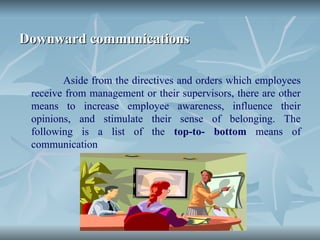
Downward communications
Aside from the directives and orders which employees
receive from management or their supervisors, there are other
means to increase employee awareness, influence their
opinions, and stimulate their sense of belonging. The
following is a list of the top-to- bottom means of
communication
1.
1. Small group meeting.
Small group meeting.
This has been found to be the most effective means
of two way communication. Once the information has been
conveyed, employee understanding and commitment can be
insured with a question and answer session and a period of
free discussion.
2.
2. Company publication
Company publication.
.
The newsletter being the most common form, a
company publication can carry a broad range of information
while conveying the official company position on important
issues.
3.
3. Supervisory meeting.
Supervisory meeting.
this is used to let the workers hear about company plans,
policies, and the like from the member of the management with
whom they work directly.
4.
4. Mass meeting
Mass meeting.
.
a gathering of employees is very effective when the top
company management wants to make very important
announcements.
5.
5. Letters to employees’ homes.
Letters to employees’ homes.
A letter mailed to an employee’s home can generate can
generate more feedback than any other technique.
6.
6. Bulletin boards.
Bulletin boards.
These provide a simple means for supplying firsthand
information quickly. To be effective they must be attractive
and constantly changing.
7.
7. Insert in pay envelopes.
Insert in pay envelopes.
Notes or notices inserted in pay envelopes are certain
to be seen and likely to be read.
8.
8. Public address announcement.
Public address announcement.
This procedure requires almost no preparation and can
reach all employees at once.
9.
9. Posters.
Posters.
Posters give information a graphic impact while
providing a continuing reminder to all those concerned.
10.
10. Open house and plant tours.
Open house and plant tours.
These are effective for mass exposure to create interest
and credibility.
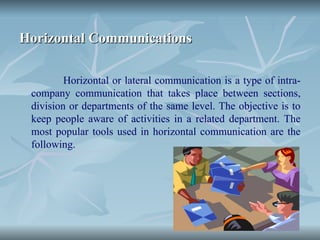
Horizontal Communications
Horizontal or lateral communication is a type of intra-
company communication that takes place between sections,
division or departments of the same level. The objective is to
keep people aware of activities in a related department. The
most popular tools used in horizontal communication are the
following.
1.
1. Meeting and conferences.
Meeting and conferences.
A meeting may be held to disseminate information, to
solve certain problems, to train the participants or let the
participants brainstorm. Meetings and conferences emphasizes
the philosophy of participative management.
2.
2. Seminars and workshop.
Seminars and workshop.
These are held to upgrade the knowledge and skills of
the personnel so that they will do their job better, increase
production, create greater savings or make optimum use of the
human resources in the company
3.
3. Telephones and Intercoms.
Telephones and Intercoms.
Telephones and intercoms reduce, to a large degree,
the physical distance between speakers and provide immediate
feedback without the need of face to face communication.
4.
4. Socials.
Socials.
These may take the form of testimonial, a luncheon
meeting, a party to welcome a new employee or head. In many
companies socials have proven to be more than fun occasions
for management and employees because they can turn out to
be excellent opportunity for solving interdepartmental or
individual human relations problem or a “status-leveler”
among the personnel.
Writing in business
Writing in business
Type of business letter
Business letters fall into the following different categories:
A. Letters to or from potential customer and
suppliers:
suppliers:
1
1. Sales letter- letters designed to persuade people either to buy
the product of a business or to utilize its service.
2. Request letter- letters addressed to a supplier of products or
services to request information about a particular product or
service.
B. Letters to or from established customers
and suppliers:
and suppliers:
1. Sales inquiry, order, and acknowledgement letters- letters
planned to communicate business information between
business institutions.
2. Goodwill letters- letters conveying such expressions as
congratulations, my sympathies, and thank you, their purpose
is to strengthen customer relations.
3. Claims and adjustment letters- letters written to correct any
misunderstanding that occurs between parties in business
transaction.
4. Credit and collection letters- letters that involve payments
for items brought or orders or loans made.
C. Letters from prospective employees and
employers:
employers:
A. Application letters- letter written by individual to obtain
employment inquires and follow up letters.
B. Application approval or rejections- letters written by the
firm to individuals confirming or rejecting employment.
CHAPTER 2
CHAPTER 2
APPEARANCE AND FORM OF THE
BUSINESS LETTER
BUSINESS LETTER
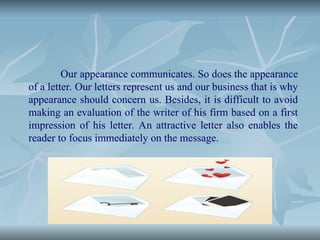
Our appearance communicates. So does the appearance
of a letter. Our letters represent us and our business that is why
appearance should concern us. Besides, it is difficult to avoid
making an evaluation of the writer of his firm based on a first
impression of his letter. An attractive letter also enables the
reader to focus immediately on the message.
The Attractive Letter Appearance
The elements which contribute to an attractive letter appearance
are:
1. The paper. The quality and the size of the paper upon which
business letters are written vary. Good taste call for white or
nearly white unruled paper with a surface not glossy but
smooth to prevent ink from running or blurring.
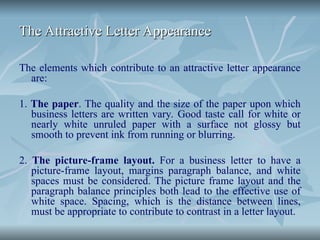
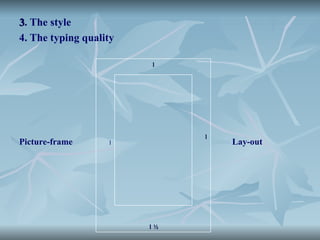
2. The picture-frame layout. For a business letter to have a
picture-frame layout, margins paragraph balance, and white
spaces must be considered. The picture frame layout and the
paragraph balance principles both lead to the effective use of
white space. Spacing, which is the distance between lines,
must be appropriate to contribute to contrast in a letter layout.
3
3. The style
4. The typing quality
Picture-frame 1 Lay-out
1
1
1
1
1 ½
1 ½
Business Letter Styles
A firm may reflect a progressive, conventional or
outdated corporate image through its choice of a letter style.
However, there is no standard by which
appropriateness or inappropriateness of a particular style can
be firmly established.
The following outline includes the six commonly used
styles of arrangement and the three punctuations patters:
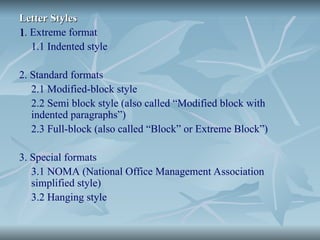
Letter Styles
Letter Styles
1
1. Extreme format
1.1 Indented style
2. Standard formats
2.1 Modified-block style
2.2 Semi block style (also called “Modified block with
indented paragraphs”)
2.3 Full-block (also called “Block” or Extreme Block”)
3. Special formats
3.1 NOMA (National Office Management Association
simplified style)
3.2 Hanging style
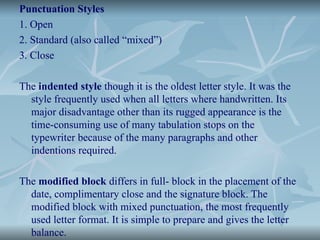
Punctuation Styles
1. Open
2. Standard (also called “mixed”)
3. Close
The indented style though it is the oldest letter style. It was the
style frequently used when all letters where handwritten. Its
major disadvantage other than its rugged appearance is the
time-consuming use of many tabulation stops on the
typewriter because of the many paragraphs and other
indentions required.
The modified block differs in full- block in the placement of the
date, complimentary close and the signature block. The
modified block with mixed punctuation, the most frequently
used letter format. It is simple to prepare and gives the letter
balance.
EXAMPLE OF AN INDENTED
LETTER STYLE
LETTER STYLE
 The ultraconservative and close punctuation
 With 5 space indentations
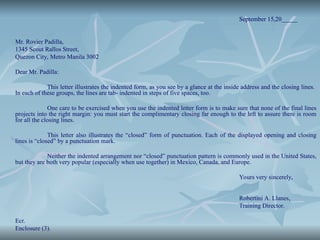
September 15,20_____
Mr. Rovier Padilla,
1345 Scout Rallos Street,
Quezon City, Metro Manila 3002
Dear Mr. Padilla:
This letter illustrates the indented form, as you see by a glance at the inside address and the closing lines.
In each of these groups, the lines are tab- indented in steps of five spaces, too.
One care to be exercised when you use the indented letter form is to make sure that none of the final lines
projects into the right margin: you must start the complimentary closing far enough to the left to assure there is room
for all the closing lines.
This letter also illustrates the “closed” form of punctuation. Each of the displayed opening and closing
lines is “closed” by a punctuation mark.
Neither the indented arrangement nor “closed” punctuation pattern is commonly used in the United States,
but they are both very popular (especially when use together) in Mexico, Canada, and Europe.
Yours very sincerely,
Robertini A. Llanes,
Training Director.
Ecr.
Enclosure (3).
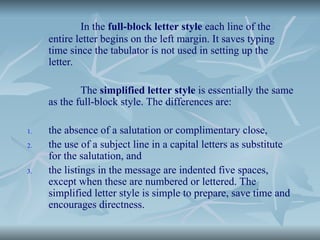
In the full-block letter style each line of the
entire letter begins on the left margin. It saves typing
time since the tabulator is not used in setting up the
letter.
The simplified letter style is essentially the same
as the full-block style. The differences are:
1. the absence of a salutation or complimentary close,
2. the use of a subject line in a capital letters as substitute
for the salutation, and
3. the listings in the message are indented five spaces,
except when these are numbered or lettered. The
simplified letter style is simple to prepare, save time and
encourages directness.
EXAMPLE OF SEMI-BLOCKED LETTER
STYLE
 Conservative
 Executive
 With attention line and cc notation
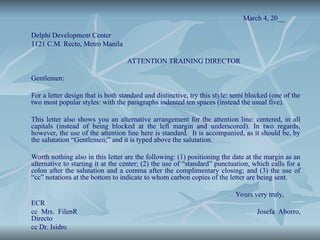
March 4, 20__
Delphi Development Center
1121 C.M. Recto, Metro Manila
ATTENTION TRAINING DIRECTOR
Gentlemen:
For a letter design that is both standard and distinctive, try this style: semi blocked (one of the
two most popular styles: with the paragraphs indented ten spaces (instead the usual five).
This letter also shows you an alternative arrangement for the attention line: centered, in all
capitals (instead of being blocked at the left margin and underscored). In two regards,
however, the use of the attention line here is standard. It is accompanied, as it should be, by
the salutation “Gentlemen;” and it is typed above the salutation.
Worth nothing also in this letter are the following: (1) positioning the date at the margin as an
alternative to starting it at the center; (2) the use of “standard” punctuation, which calls for a
colon after the salutation and a comma after the complimentary closing; and (3) the use of
“cc” notations at the bottom to indicate to whom carbon copies of the letter are being sent.
Yours very truly,
ECR
cc Mrs. FilenR Josefa Aborro,
Directo
cc Dr. Isidro
EXAMPLE OF FULL-BLOCKED
LETER STYLE
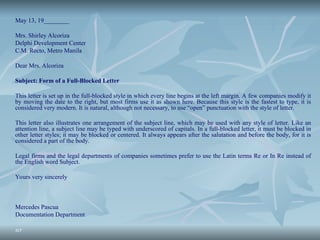
 vigorous
 aggressive
 with subject line and open punctuation
May 13, 19________
Mrs. Shirley Alcoriza
Delphi Development Center
C.M. Recto, Metro Manila
Dear Mrs. Alcoriza
Subject: Form of a Full-Blocked Letter
This letter is set up in the full-blocked style in which every line begins at the left margin. A few companies modify it
by moving the date to the right, but most firms use it as shown here. Because this style is the fastest to type, it is
considered very modern. It is natural, although not necessary, to use “open” punctuation with the style of letter.
This letter also illustrates one arrangement of the subject line, which may be used with any style of letter. Like an
attention line, a subject line may be typed with underscored of capitals. In a full-blocked letter, it must be blocked in
other letter styles; it may be blocked or centered. It always appears after the salutation and before the body, for it is
considered a part of the body.
Legal firms and the legal departments of companies sometimes prefer to use the Latin terms Re or In Re instead of
the English word Subject.
Yours very sincerely
Mercedes Pascua
Documentation Department
ecr
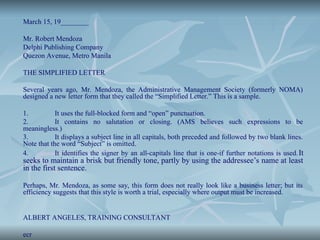
EXAMPLE OF SIMPLIFIE LETTER
STYLE
 the efficiency expert’s
 with open and full-block design
March 15, 19________
Mr. Robert Mendoza
Delphi Publishing Company
Quezon Avenue, Metro Manila
THE SIMPLIFIED LETTER
Several years ago, Mr. Mendoza, the Administrative Management Society (formerly NOMA)
designed a new letter form that they called the “Simplified Letter.” This is a sample.
1. It uses the full-blocked form and “open” punctuation.
2. It contains no salutation or closing. (AMS believes such expressions to be
meaningless.)
3. It displays a subject line in all capitals, both preceded and followed by two blank lines.
Note that the word “Subject” is omitted.
4. It identifies the signer by an all-capitals line that is one-if further notations is used.It
seeks to maintain a brisk but friendly tone, partly by using the addressee’s name at least
in the first sentence.
Perhaps, Mr. Mendoza, as some say, this form does not really look like a business letter; but its
efficiency suggests that this style is worth a trial, especially where output must be increased.
ALBERT ANGELES, TRAINING CONSULTANT
ecr
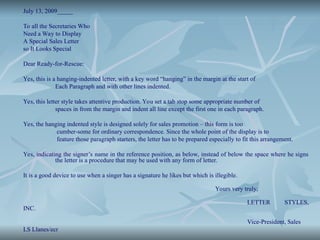
For advertising and sales letters, the hanging style
attracts the reader’s attention to the beginning of each
paragraph. The style is similar to the modified block except
that the first line of each paragraph is not indented, while the
second and all other paragraph lines are indented five of ten
spaces
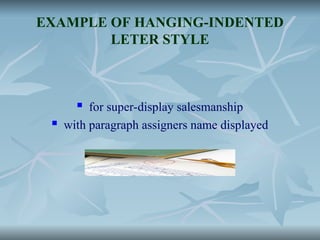
EXAMPLE OF HANGING-INDENTED
LETER STYLE
 for super-display salesmanship
 with paragraph assigners name displayed
July 13, 2009_____
To all the Secretaries Who
Need a Way to Display
A Special Sales Letter
so It Looks Special
Dear Ready-for-Rescue:
Yes, this is a hanging-indented letter, with a key word “hanging” in the margin at the start of
Each Paragraph and with other lines indented.
Yes, this letter style takes attentive production. You set a tab stop some appropriate number of
spaces in from the margin and indent all line except the first one in each paragraph.
Yes, the hanging indented style is designed solely for sales promotion – this form is too
cumber-some for ordinary correspondence. Since the whole point of the display is to
feature those paragraph starters, the letter has to be prepared especially to fit this arrangement.
Yes, indicating the signer’s name in the reference position, as below, instead of below the space where he signs
the letter is a procedure that may be used with any form of letter.
It is a good device to use when a singer has a signature he likes but which is illegible.
Yours very truly,
LETTER STYLES,
INC.
Vice-President, Sales
LS Llanes/ecr
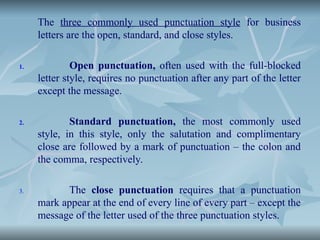
The three commonly used punctuation style for business
letters are the open, standard, and close styles.
1. Open punctuation, often used with the full-blocked
letter style, requires no punctuation after any part of the letter
except the message.
2. Standard punctuation, the most commonly used
style, in this style, only the salutation and complimentary
close are followed by a mark of punctuation – the colon and
the comma, respectively.
3. The close punctuation requires that a punctuation
mark appear at the end of every line of every part – except the
message of the letter used of the three punctuation styles.
Typewriting Quality
Typewriting quality depends upon three factors,
namely, the evenness of touch of the keys, the typewriter
ribbon and the neatness of erasures. An even touch produces
typescript of even density- not a sprinkling of light and dark
letters across the page. Type keys must be cleaned regularly to
prevent dust – and – ink clogged letters from marrying the
appearance of the typescript.
A good quality ribbon must be used – one that suits the
type of typewriter – standard or portable, manual or electronic.
Black is the color frequently used, but the typist may use a
tinted colored ribbon for tinted stationery. Of course, erasures
and strikeover must be avoided. If these are noticeable, the
letter must be retyped. Good erasing tools must be a part of
every typist’s kit.
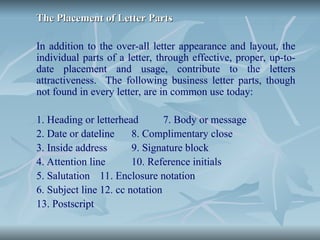
The Placement of Letter Parts
In addition to the over-all letter appearance and layout, the
individual parts of a letter, through effective, proper, up-to-
date placement and usage, contribute to the letters
attractiveness. The following business letter parts, though
not found in every letter, are in common use today:
1. Heading or letterhead 7. Body or message
2. Date or dateline 8. Complimentary close
3. Inside address 9. Signature block
4. Attention line 10. Reference initials
5. Salutation 11. Enclosure notation
6. Subject line 12. cc notation
13. Postscript
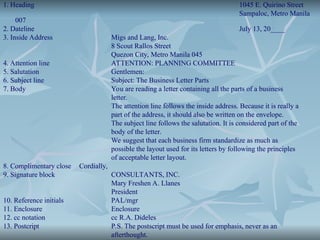
1. Heading 1045 E. Quirino Street
Sampaloc, Metro Manila
007
2. Dateline July 13, 20____
3. Inside Address Migs and Lang, Inc.
8 Scout Rallos Street
Quezon City, Metro Manila 045
4. Attention line ATTENTION: PLANNING COMMITTEE
5. Salutation Gentlemen:
6. Subject line Subject: The Business Letter Parts
7. Body You are reading a letter containing all the parts of a business
letter.
The attention line follows the inside address. Because it is really a
part of the address, it should also be written on the envelope.
The subject line follows the salutation. It is considered part of the
body of the letter.
We suggest that each business firm standardize as much as
possible the layout used for its letters by following the principles
of acceptable letter layout.
8. Complimentary close Cordially,
9. Signature block CONSULTANTS, INC.
Mary Freshen A. Llanes
President
10. Reference initials PAL/mgr
11. Enclosure Enclosure
12. cc notation cc R.A. Dideles
13. Postcript P.S. The postscript must be used for emphasis, never as an
afterthought.
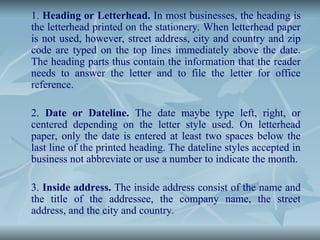
1. Heading or Letterhead. In most businesses, the heading is
the letterhead printed on the stationery. When letterhead paper
is not used, however, street address, city and country and zip
code are typed on the top lines immediately above the date.
The heading parts thus contain the information that the reader
needs to answer the letter and to file the letter for office
reference.
2. Date or Dateline. The date maybe type left, right, or
centered depending on the letter style used. On letterhead
paper, only the date is entered at least two spaces below the
last line of the printed heading. The dateline styles accepted in
business not abbreviate or use a number to indicate the month.
3. Inside address. The inside address consist of the name and
the title of the addressee, the company name, the street
address, and the city and country.
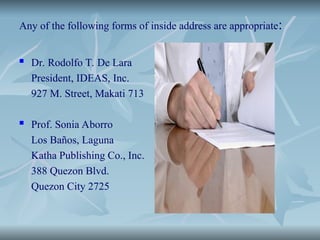
Any of the following forms of inside address are appropriate:
 Dr. Rodolfo T. De Lara
President, IDEAS, Inc.
927 M. Street, Makati 713
 Prof. Sonia Aborro
Los Baños, Laguna
Katha Publishing Co., Inc.
388 Quezon Blvd.
Quezon City 2725
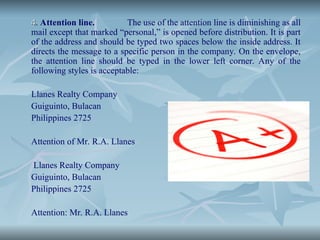
4
4. Attention line. The use of the attention line is diminishing as all
mail except that marked “personal,” is opened before distribution. It is part
of the address and should be typed two spaces below the inside address. It
directs the message to a specific person in the company. On the envelope,
the attention line should be typed in the lower left corner. Any of the
following styles is acceptable:
Llanes Realty Company
Guiguinto, Bulacan
Philippines 2725
Attention of Mr. R.A. Llanes
Llanes Realty Company
Guiguinto, Bulacan
Philippines 2725
Attention: Mr. R.A. Llanes
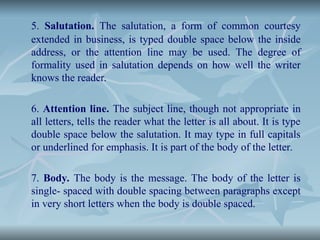
5. Salutation. The salutation, a form of common courtesy
extended in business, is typed double space below the inside
address, or the attention line may be used. The degree of
formality used in salutation depends on how well the writer
knows the reader.
6. Attention line. The subject line, though not appropriate in
all letters, tells the reader what the letter is all about. It is type
double space below the salutation. It may type in full capitals
or underlined for emphasis. It is part of the body of the letter.
7. Body. The body is the message. The body of the letter is
single- spaced with double spacing between paragraphs except
in very short letters when the body is double spaced.
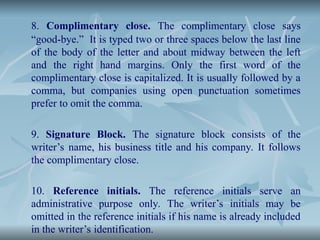
8. Complimentary close. The complimentary close says
“good-bye.” It is typed two or three spaces below the last line
of the body of the letter and about midway between the left
and the right hand margins. Only the first word of the
complimentary close is capitalized. It is usually followed by a
comma, but companies using open punctuation sometimes
prefer to omit the comma.
9. Signature Block. The signature block consists of the
writer’s name, his business title and his company. It follows
the complimentary close.
10. Reference initials. The reference initials serve an
administrative purpose only. The writer’s initials may be
omitted in the reference initials if his name is already included
in the writer’s identification.
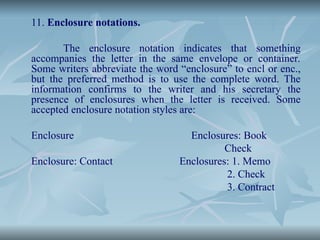
11. Enclosure notations.
The enclosure notation indicates that something
accompanies the letter in the same envelope or container.
Some writers abbreviate the word “enclosure” to encl or enc.,
but the preferred method is to use the complete word. The
information confirms to the writer and his secretary the
presence of enclosures when the letter is received. Some
accepted enclosure notation styles are:
Enclosure Enclosures: Book
Check
Enclosure: Contact Enclosures: 1. Memo
2. Check
3. Contract
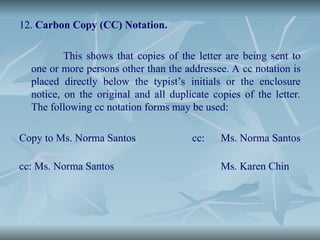
12. Carbon Copy (CC) Notation.
This shows that copies of the letter are being sent to
one or more persons other than the addressee. A cc notation is
placed directly below the typist’s initials or the enclosure
notice, on the original and all duplicate copies of the letter.
The following cc notation forms may be used:
Copy to Ms. Norma Santos cc: Ms. Norma Santos
cc: Ms. Norma Santos Ms. Karen Chin
13. Blind Carbon Copy (bcc) Notation.
A bcc notation appears only on the original copy of the
letter, not on carbon copies as the writer wishes to send a copy
to a person other than the addressee, but does not want the
addressee to know that he is doing so. The writer should retain
the copy with a cc or bcc notation for his files.
14. Confidential and Mailing Notation.
The fact that the letter is confidential or similar nature
must be indicated on all copies of the letter. Such notations
may be type below the date or below the reference initials. A
note indicating the special postal service such as registered or
certified mail should be indicated on all copies of the letter.
15. P.S. (Postscript).
PS notation in business communication must be used
to re-emphasize an important point, not to call attention to
something you forgot to say in the message. When PS is used
for afterthoughts, it indicates careless letter planning and can
do more harm than good to your reputation. Thus, PS should
function be treated like other paragraphs except it is preceded
by the letters PS.
Two-Page letters
Two-Page letters
Special attention must be given to the heading of the
second and succeeding pages, which must be typed about
one inch from the top of each page. It identifies the letter for
filing purposes of both the writer and the reader. A two-
page letter must include the firms name in capital letters in
the signature block, even though letter head paper is used to
the first page.
The heading of the second pages contains the
following information.
1. addressee’s name,
2. page number and
3. date.
The envelope.
The envelope.
The envelope address should be exactly the same as
the letters. The address should be well centered. It takes the
same form-blocked or indented as the inside address. The
inside address, though, is always single spaced but on the
envelope, a four line address is single spaced and a three line
address is double spaced.
CHAPTER 3
CHAPTER 3
QUALITIES OF EFFECTIVE BUSINESS
LETTERS
LETTERS
Qualities of Effective Business Letter
A business letter which effectively communicates is
not only physically attractive but also well written. A writer’s
style or the way he expresses his ideas depends upon his total
personality, consisting of his verbal intelligence, his
relationship with people, and his social, emotional, and
intellectual maturity.
Good writing is the product of:
1. sound mind which enables a person to think clearly and
logically:
2. knowledge of human behavior;
3. humility, sincerity, and an altruistic attitude.
.
Business writing style possesses the following
qualities:
qualities:
1. completeness,
2. clearness,
3. conciseness,
4. correctness,
5. coherence, and
6. courtesy.
Completeness
Completeness
Two requirements must be met before a letter,
particularly a business letter, may be consider complete: first, it
should give all the important facts or ideas, and second, it should
have only one objective or purpose. The important facts or ideas
of the letter are those which are intended to inform the reader
and those which are presented to influence or motivate the
reader to act favorably on the writer’s request, offer, or proposal.
Clearness
Clearness
Clear writing is no doubt the result of clear thinking. A
clear letter or report is, of course, one which the readers
understand quickly. What you read is clear if there is no doubt in
your mind about what the writer means. Three factors actually
contribute to the clearness of the writing: sentence structure,
punctuation and word choice. When words are erroneously
arranged or when pronouns are incorrectly used, the meaning
intended may be obscured, or the reader may be misled.
Conciseness
Conciseness
Concise writing involves the expression of an idea in
the fewest possible word without sacrificing completeness or
clearness of the meaning. It is being brief but understandable
and forceful. It knows when to stop writing when the job is
done. Many people use words extravagantly, not knowing that
their verbal extravagance often makes their expression less
forceful and meaningful. In fact, a number of professional
writers and speakers still need to convince that one carefully
chosen word is usually more effective than four or five words
taken at random. A conciseness achieved by omitting
unnecessary details, or by condensing unimportant ideas to
their essentials, or by eliminating unnecessary words.
Correctness
Correctness
This is a very important quality which means that
business letter should be perfect. To be perfect a business
letter should:
1. have a correct physical make-up;
2. be free from all errors in grammar, punctuation,
capitalization, correct usage, sentence and paragraph structure;
and
3. be free from errors in facts and figures. Remember that
errors in letters can be costly because the image of the
company will be greatly affected. The writer should therefore
write carefully and have sufficient knowledge of the rules of
grammar.
Coherence
Coherence
Coherence, which means the process of sticking together, is
one of three levels coherence within paragraphs, coherence
with sentence in a paragraph, and coherence within the word in
a sentence. Coherence within paragraphs in the letter is
achieved by means of planning and outlining. Planning
involves listing down the things you want say and making sure
they are in the right order.
Generally, the writer of a well planned business letter uses the
three paragraph approach which includes the following:
1. an introductory paragraph explaining the topic of the letter
and possibly referring to a previous correspondence;
2. a middle paragraph which contains the body of the letter;
3. a final paragraph which sums up and explains what course
of action to take.
To avoid this kind of error, you should consider the following
suggestions:
1. Avoid dangling modifiers. A dangling modifier refers to the
wrong word or to no word in a sentence.
2. Make a certain that a modifier refers clearly to the word or
words modified.
3. Place words like only and phrases like at least where they
convey exactly what you mean.
Courtesy
Courtesy
Courtesy is a mental attitude, a way of life among
people living in a polite society. It means recognizing and
having respect for the value and worth of other people. It
further means consideration, friendliness, and willingness to
serve others.
The ingredients of courtesy are the following:
1. a positive attitude;
2. an other centered attitude;
3. a sincere and personal relationship with people;
4. a willingness to serve.
1. Other-centered, “You” Attitude. Makes other people feel
important because he thinks highly of them.
2. Sincere and Personal Relationship with People. True
friendship is one which is based on understanding, caring for
others, and closeness to others. Using the correspondents
name in natural, conversational way helps to produce a
personal and pleasant atmosphere.
3. A Willingness to Serve Others. This attitude comes from
empathy which means placing oneself in somebody else’s
shoes. Empathy leads to a consideration for the reader’s
feelings and point of view resulting in a friendly and kind
attitude toward others.
Methods of Paragraph Development
A paragraph is a series of closely related sentences, all
of which help support the development of one central thought.
The topic sentence of a paragraph expresses the topic or
central idea of the paragraph. It may be placed at the
beginning, middle, or end of the paragraph.
Among the various methods of paragraph development are the
following:
following:
1
1. Series of question. The writer can arouse the reader’s
interest by asking a series of questions.
2. Statement. The writer gives a strong suggestion and gives
details to arouse the reader’s interest and desire.
3. Definitions. The subject of the paragraph is defined and
particulars are given.
4. Cause-effect. The paragraph begins by stating the problem,
and then explains the circumstances which brought it about.
5. Origin. One way of giving the reader a clearer
understanding of the subject is by showing the origin of the
subject of the letter and then by tracing its development.
6. Deductive. This paragraph begins with a general statement,
then proceeds to giving supportive details
7. Narration. The incident which led to the situation or
problems is narrated. The writer must see to it that the facts
are accurate. Objective, factual reporting is necessary.
8. Analogy. The likeness of two things is shown in terms of
their attitudes, circumstances or effects
CHAPTER 4
CHAPTER 4
REQUEST, REPLY,ORDER,
ACKNOWLEDGMENT, AND
ACKNOWLEDGMENT, AND
REMITTANCE LETTERS
REMITTANCE LETTERS
Request, Inquiry, Reply, Order,
Acknowledgement, and Remittance Letters
The letters in this unit occur so frequently in everyday
correspondence, both business and non business that they
deserve special attention. Inasmuch as they deal with
particular situations and specific purposes. They should be
written in fresh, vivid, personal language. Properly composed,
they will have individuality and warmth which would make
them effective instruments for building goodwill. Each of
these types of letters- request, inquiry, reply, order
acknowledgement and remittance make it possible for writers
to “keep in touch” with their friends and business associates.
Request letters
Request letters
Letters seeking help or assistance should be direct,
concise, and courteous. They should be reflecting the writer’s
confident and positive attitude. They should be brief and
straightforward; therefore, all relevant explanatory matters
should be avoided.
Inquiry letters
Inquiry letters
An inquiry letter seek information about people,
services rendered, products manufactured, prices or
quotations, catalogue, a firm’s policies such as those relating
sales, credit and collection, personnel and the like. A good
inquiry letter must state exactly and completely the required
information. It should brief and direct to the point.
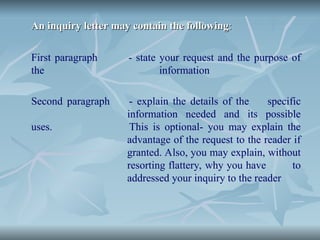
An inquiry letter may contain the following
An inquiry letter may contain the following:
:
First paragraph - state your request and the purpose of
the information
Second paragraph - explain the details of the specific
information needed and its possible
uses. This is optional- you may explain the
advantage of the request to the reader if
granted. Also, you may explain, without
resorting flattery, why you have to
addressed your inquiry to the reader
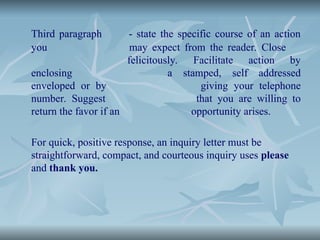
Third paragraph - state the specific course of an action
you may expect from the reader. Close
felicitously. Facilitate action by
enclosing a stamped, self addressed
enveloped or by giving your telephone
number. Suggest that you are willing to
return the favor if an opportunity arises.
For quick, positive response, an inquiry letter must be
straightforward, compact, and courteous inquiry uses please
and thank you.
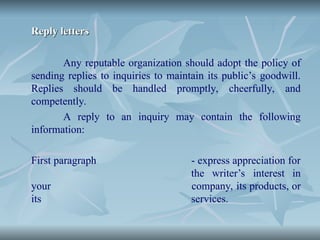
Reply letters
Reply letters
Any reputable organization should adopt the policy of
sending replies to inquiries to maintain its public’s goodwill.
Replies should be handled promptly, cheerfully, and
competently.
A reply to an inquiry may contain the following
information:
First paragraph - express appreciation for
the writer’s interest in
your company, its products, or
its services.
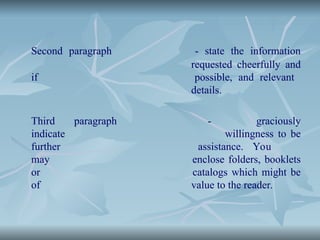
Second paragraph - state the information
requested cheerfully and
if possible, and relevant
details.
Third paragraph - graciously
indicate willingness to be
further assistance. You
may enclose folders, booklets
or catalogs which might be
of value to the reader.
Order letters
An order letter must be specifies and complete. You
must include necessary information about the merchandise,
among which are the following.
1. A complete description of the merchandise ordered:
a. trade name e. color
b. quantity f. catalogue number
c. size g. quality
d. style or style number h. price
2. Necessary information regarding the shipment of the
merchandise
a. complete name and address of buyer or consignee (if
any)
b. date of shipment
c. mode of shipment (parcel post, airmail, express,
freight, and so on)
3. Method of payment
a. check or draft
b. charge
c. money order
d. C.O.D.
e. on account
4. Credit reference, if open account is requested.
Acknowledging Orders
Letters acknowledging order may serve as
confirmation of the order and an expression of appreciation for
the writer’s interest in the company and its products, an
important gesture in developing a good corporate image.
An acknowledgement order may contain the following:
1. Expression of appreciation for the order received
2. Restatement of the order.
3. Giving such necessary details as to the time, method of
delivery and any special instructions
4. Brief sales talk designed to make the customer and in being
of further service
4. Brief sales talk designed to make the customer and in being
of further service
5. Expression of pleasure and interest in serving the customer
and in being of further service.
Remittance letters
Remittance letters
A remittance letter states the amount sent or received.
It should be straightforward, brief, and accurate. Purchases
send remittance letters
a) to make a partial or full payment for merchandise
purchased;
b) to deposit to their account money against which they will
later draw charge merchandise.
Sellers, on the other hand, send remittance letters
1) to acknowledge a partial of full payment;
2) to take note of errors in billing and in payment;
3) to take note of discounts which have been taken at an
incorrect rate or after the discount period has elapsed.
CHAPTER 5
CHAPTER 5
Sales Letters
Sales Letters
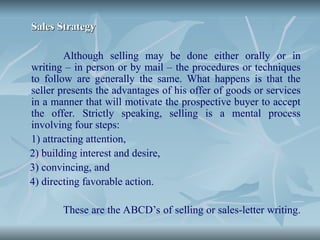
Almost all letters are actually sales letters- they sell
merchandise or commodities, services, ideas, policies, or
goodwill. When you write a letter of application, you are
attempting to sell your skills and services. When you invite
your neighbors to a birthday party in your place, you are
actually trying to sell goodwill.
Sales Strategy
Sales Strategy
Although selling may be done either orally or in
writing – in person or by mail – the procedures or techniques
to follow are generally the same. What happens is that the
seller presents the advantages of his offer of goods or services
in a manner that will motivate the prospective buyer to accept
the offer. Strictly speaking, selling is a mental process
involving four steps:
1) attracting attention,
2) building interest and desire,
3) convincing, and
4) directing favorable action.
These are the ABCD’s of selling or sales-letter writing.
Attracting attention. A very effective sales letter is one that
can attract the reader’s attention even before it is taken out of
the envelope. The factors that attract attention are, of course,
1) the mechanical details of the letter,
2) the headline and subheadings, and
3) the opening sentence or sentences.
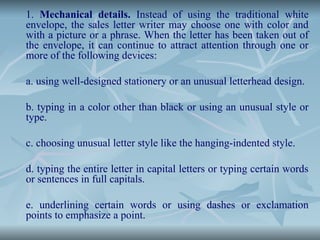
1. Mechanical details. Instead of using the traditional white
envelope, the sales letter writer may choose one with color and
with a picture or a phrase. When the letter has been taken out of
the envelope, it can continue to attract attention through one or
more of the following devices:
a. using well-designed stationery or an unusual letterhead design.
b. typing in a color other than black or using an unusual style or
type.
c. choosing unusual letter style like the hanging-indented style.
d. typing the entire letter in capital letters or typing certain words
or sentences in full capitals.
e. underlining certain words or using dashes or exclamation
points to emphasize a point.
2. Headlines and subheadings.
When letters are intended for mass circulation, they are
usually prepared without a personal inside address and
salutation. To attract attention, a provocative headline is
placed in the same position as the inside address or run across
the page. Note the following examples:
Who Says that You Can’t Be a Millionaire?
There Is Money
In Earthworms
Read On.
3. Opening sentences.
Striking headlines or subheadings are certainly not
enough to hold the reader’s attention. A good opening is
necessary to carry the reader’s attention into the main
substance of the letter.
CHAPTER 6
CHAPTER 6
EMPLOYMENT LETTERS
EMPLOYMENT LETTERS
Every year, thousands graduate from colleges and
universities, and every year too, thousands look for jobs they
hope they can hold for sometime. While graduation
ceremonies may take place in a school only once or twice a
year applications for jobs occur every day of year.
Whether it is your first time to seek employment or
not, you must be able to write an application letter. In fact, the
application letter may be the most important letter you will
have to write in your lifetime. On it may depend much of your
success in getting a highly-rewarding job or being
misemployed or unemployed.
The Application Letter as a Sales Letter
There is actually not much difference between an
application letter and a sales letter because both are selling
propositions: the application letter attempts to “sell’ you to a
prospective employer.
Purpose: To present as attractively as possible your
peculiar fitness for a particular job and the benefit of benefits
the prospective employer will get if he employs someone who
possess special qualities, a positive personality, and a capacity
to grow. If your letter is convincing, your qualifications being
attractively presented, you may be granted an interview after
which you may go through a series pf recruitment procedures
and eventually fill the hob you have applied for.
An application letter is not an autobiography. It is not
expected to include information that has no relevance to the
position you are applying for.
Selling Principles for an Effective Application
Letter
Letter
1. Convince the prospective employer by showing you meet
the requirements of the position – present your desirable
qualifications and d express your desire to contribute
something for the food of the company.
2. Catch the employer’s attention or interest by giving the
purpose of the letter – make known the job you want to fill,
indicated how you came to know about the job opening, and
give the requirements of the position.
3. Prompt the prospective employer to act by offering
references and by asking for an interview.
Kinds of Application Letters
1. Solicited – is written to answer an advertisement about a
job opening (a Want-ad). When writing a solicited letter, you
should keep in mind that there are probably many other letters
written to answer the same advertisement. You should,
therefore, make sure that the letter you write appears better than
the other letters if you wish it to read closely or considered
favorably.
The following want-ad may have attracted a number of replies
after it came out in the papers. The replies to this advertisement
are, of course, properly celled solicited application letters.
WANTED
ACCOUNTANT
SECRETARY
COLLECTOR
Business Management Major
2 yrs. Exp.
Marketing Major
Mechanical Engineer
Electrician
Building Administrator
with exp.
CONTACT
Tel.nos. 35-65-51 to 54
Or 673-6336 to 39
2. Unsolicited – is written to a prospective employer who
has not placed a want-ad in any publication. An applicant
sends an unsolicited because he believes some opening exists
or is expected to exist or because someone has told him am
opening does exist.
The unsolicited letter is sometimes called a prospecting or
cold application. Its chief advantage is the likelihood that
there are fewer applicants or no other applicant with whom
one competes. The advantages are, of course, that there is no
assurance of an opening and that the written must determine
for him the qualification is which the employer will be very
interested.
When the applicant hears of an opening indirectly, or when
some friend or agency tells him of a vacancy, it is advisable to
refer to this person or agency in the introductory paragraph.
Examples:
Examples:
Prof. Esperanza Ortiz of the Polytechnic University of
the Philippines has suggested that I apply to you for the
position of telephone operator-receptionist which you will
need starting July 16.
Miss Helen Cuason, Director of the Placement Office
at the Polytechnic University of the Philippines, tells me that
your company needs a clerk typist.
Blind Advertisement
Blind Advertisement
One kind of advertisement that does not reveal the identity of
the employer or the specific requirements of the job is called
blind advertisement. In replying to a blind advertisement, the
salutation “Gentlemen” is used unless the writer knows the
name of the person he is applying to.
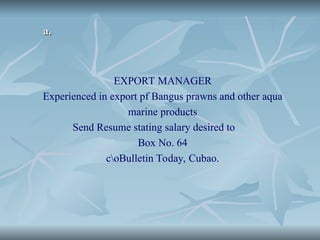
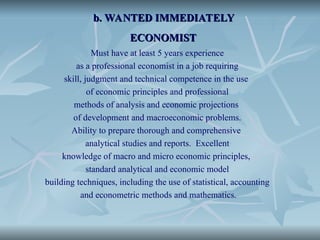
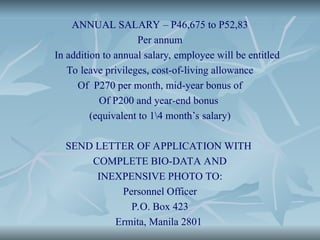
Want-ads like the following are called blind advertisements,
the first one giving very little information while the second
one giving more explicit information:
a.
a.
EXPORT MANAGER
Experienced in export pf Bangus prawns and other aqua
marine products
Send Resume stating salary desired to
Box No. 64
coBulletin Today, Cubao.
b. WANTED IMMEDIATELY
ECONOMIST
ECONOMIST
Must have at least 5 years experience
as a professional economist in a job requiring
skill, judgment and technical competence in the use
of economic principles and professional
methods of analysis and economic projections
of development and macroeconomic problems.
Ability to prepare thorough and comprehensive
analytical studies and reports. Excellent
knowledge of macro and micro economic principles,
standard analytical and economic model
building techniques, including the use of statistical, accounting
and econometric methods and mathematics.
ANNUAL SALARY – P46,675 to P52,83
Per annum
In addition to annual salary, employee will be entitled
To leave privileges, cost-of-living allowance
Of P270 per month, mid-year bonus of
Of P200 and year-end bonus
(equivalent to 14 month’s salary)
SEND LETTER OF APPLICATION WITH
COMPLETE BIO-DATA AND
INEXPENSIVE PHOTO TO:
Personnel Officer
P.O. Box 423
Ermita, Manila 2801
Writing the Application Letter
Most application letters consist of two parts
1. letter
2. data sheet
Outline of an Application Letter
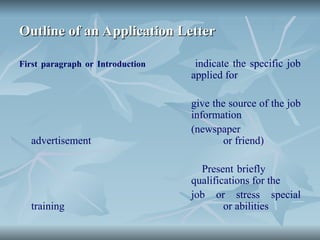
First paragraph or Introduction indicate the specific job
applied for
give the source of the job
information
(newspaper
advertisement or friend)
Present briefly
qualifications for the
job or stress special
training or abilities
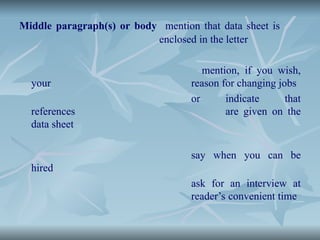
Middle paragraph(s) or body mention that data sheet is
enclosed in the letter
mention, if you wish,
your reason for changing jobs
or indicate that
references are given on the
data sheet
say when you can be
hired
ask for an interview at
reader’s convenient time
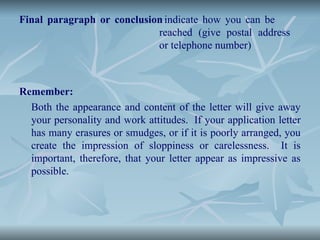
Final paragraph or conclusion indicate how you can be
reached (give postal address
or telephone number)
Remember:
Both the appearance and content of the letter will give away
your personality and work attitudes. If your application letter
has many erasures or smudges, or if it is poorly arranged, you
create the impression of sloppiness or carelessness. It is
important, therefore, that your letter appear as impressive as
possible.
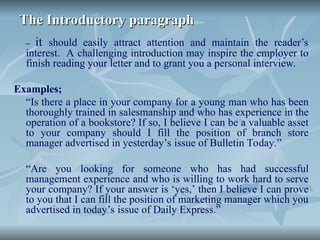
The Introductory paragraph
– it should easily attract attention and maintain the reader’s
interest. A challenging introduction may inspire the employer to
finish reading your letter and to grant you a personal interview.
Examples;
“Is there a place in your company for a young man who has been
thoroughly trained in salesmanship and who has experience in the
operation of a bookstore? If so, I believe I can be a valuable asset
to your company should I fill the position of branch store
manager advertised in yesterday’s issue of Bulletin Today.”
“Are you looking for someone who has had successful
management experience and who is willing to work hard to serve
your company? If your answer is ‘yes,’ then I believe I can prove
to you that I can fill the position of marketing manager which you
advertised in today’s issue of Daily Express.”
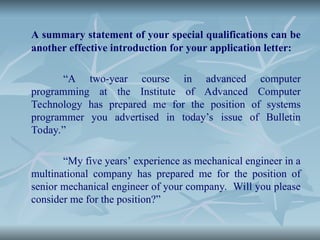
A summary statement of your special qualifications can be
another effective introduction for your application letter:
“A two-year course in advanced computer
programming at the Institute of Advanced Computer
Technology has prepared me for the position of systems
programmer you advertised in today’s issue of Bulletin
Today.”
“My five years’ experience as mechanical engineer in a
multinational company has prepared me for the position of
senior mechanical engineer of your company. Will you please
consider me for the position?”
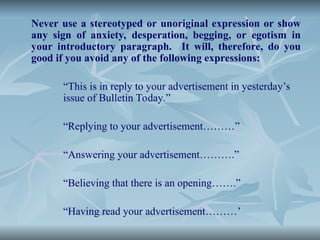
Never use a stereotyped or unoriginal expression or show
any sign of anxiety, desperation, begging, or egotism in
your introductory paragraph. It will, therefore, do you
good if you avoid any of the following expressions:
“This is in reply to your advertisement in yesterday’s
issue of Bulletin Today.”
“Replying to your advertisement………”
“Answering your advertisement……….”
“Believing that there is an opening…….”
“Having read your advertisement………’
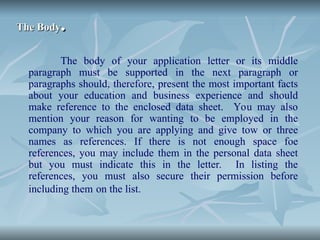
The Body
The Body.
.
The body of your application letter or its middle
paragraph must be supported in the next paragraph or
paragraphs should, therefore, present the most important facts
about your education and business experience and should
make reference to the enclosed data sheet. You may also
mention your reason for wanting to be employed in the
company to which you are applying and give tow or three
names as references. If there is not enough space foe
references, you may include them in the personal data sheet
but you must indicate this in the letter. In listing the
references, you must also secure their permission before
including them on the list.
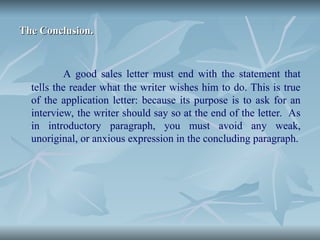
The Conclusion.
The Conclusion.
A good sales letter must end with the statement that
tells the reader what the writer wishes him to do. This is true
of the application letter: because its purpose is to ask for an
interview, the writer should say so at the end of the letter. As
in introductory paragraph, you must avoid any weak,
unoriginal, or anxious expression in the concluding paragraph.
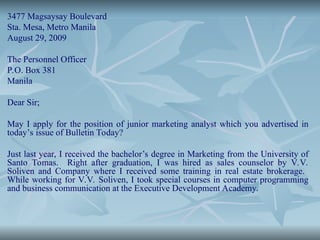
Observe how the following application letters,
the first one solicited and the other one
unsolicited, apply the principles of effective
letter writing:
3477 Magsaysay Boulevard
Sta. Mesa, Metro Manila
August 29, 2009
The Personnel Officer
P.O. Box 381
Manila
Dear Sir;
May I apply for the position of junior marketing analyst which you advertised in
today’s issue of Bulletin Today?
Just last year, I received the bachelor’s degree in Marketing from the University of
Santo Tomas. Right after graduation, I was hired as sales counselor by V.V.
Soliven and Company where I received some training in real estate brokerage.
While working for V.V. Soliven, I took special courses in computer programming
and business communication at the Executive Development Academy.
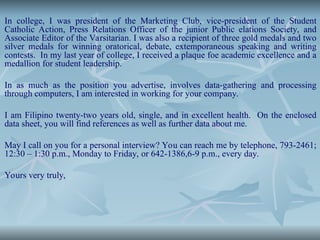
In college, I was president of the Marketing Club, vice-president of the Student
Catholic Action, Press Relations Officer of the junior Public elations Society, and
Associate Editor of the Varsitarian. I was also a recipient of three gold medals and two
silver medals for winning oratorical, debate, extemporaneous speaking and writing
contests. In my last year of college, I received a plaque foe academic excellence and a
medallion for student leadership.
In as much as the position you advertise, involves data-gathering and processing
through computers, I am interested in working for your company.
I am Filipino twenty-two years old, single, and in excellent health. On the enclosed
data sheet, you will find references as well as further data about me.
May I call on you for a personal interview? You can reach me by telephone, 793-2461;
12:30 – 1:30 p.m., Monday to Friday, or 642-1386,6-9 p.m., every day.
Yours very truly,
Prof. Amparo Santos
Director, School of Secretarial Education
University of the East
Sampaloc, Metro Manila
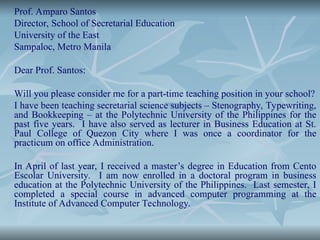
Dear Prof. Santos:
Will you please consider me for a part-time teaching position in your school?
I have been teaching secretarial science subjects – Stenography, Typewriting,
and Bookkeeping – at the Polytechnic University of the Philippines for the
past five years. I have also served as lecturer in Business Education at St.
Paul College of Quezon City where I was once a coordinator for the
practicum on office Administration.
In April of last year, I received a master’s degree in Education from Cento
Escolar University. I am now enrolled in a doctoral program in business
education at the Polytechnic University of the Philippines. Last semester, I
completed a special course in advanced computer programming at the
Institute of Advanced Computer Technology.
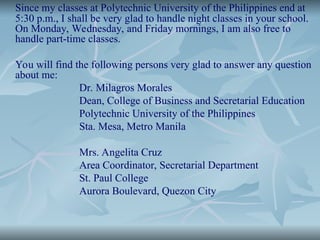
Since my classes at Polytechnic University of the Philippines end at
5:30 p.m., I shall be very glad to handle night classes in your school.
On Monday, Wednesday, and Friday mornings, I am also free to
handle part-time classes.
You will find the following persons very glad to answer any question
about me:
Dr. Milagros Morales
Dean, College of Business and Secretarial Education
Polytechnic University of the Philippines
Sta. Mesa, Metro Manila
Mrs. Angelita Cruz
Area Coordinator, Secretarial Department
St. Paul College
Aurora Boulevard, Quezon City
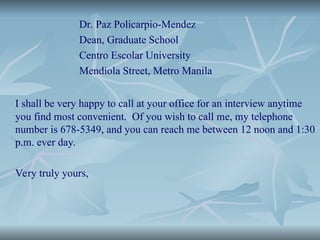
Dr. Paz Policarpio-Mendez
Dean, Graduate School
Centro Escolar University
Mendiola Street, Metro Manila
I shall be very happy to call at your office for an interview anytime
you find most convenient. Of you wish to call me, my telephone
number is 678-5349, and you can reach me between 12 noon and 1:30
p.m. ever day.
Very truly yours,
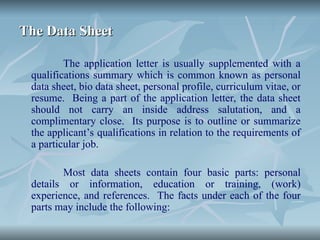
The Data Sheet
The Data Sheet
The application letter is usually supplemented with a
qualifications summary which is common known as personal
data sheet, bio data sheet, personal profile, curriculum vitae, or
resume. Being a part of the application letter, the data sheet
should not carry an inside address salutation, and a
complimentary close. Its purpose is to outline or summarize
the applicant’s qualifications in relation to the requirements of
a particular job.
Most data sheets contain four basic parts: personal
details or information, education or training, (work)
experience, and references. The facts under each of the four
parts may include the following:
Personal Details
Name your legal name, mot nickname)
Address
Age
Birthplace
Sex
Civil Status
Height
Weight
Health
Religion
Nationality
Hobbies
Education
Degree(s) earned and school attended
Special courses taken
Honors and academic awards received
Membership in school or professional organizations
Work Experience
List of jobs held beginning with the present job and moving
backward and name(s) of employer(s)
Salary or salaries received (optional)
References
Names of two or three persons who can vouch for your
competence and integrity
Filling out an Application Form
Besides writing an application letter and a data sheet,
you may still have to fill out an application form prepared by
the company to which you are applying. An application form
also provides information about you which your application
letter and data sheet may mot be able to give – your
penmanship, your accuracy, and carefulness in answering
questions, your neatness, and your ability to follow written
instructions.
When called for an interview, you must, therefore, take the
following items with you:
1. a pen that writes well or that does not make blots or
scratches;
2. a copy of your personal data sheet, in addition to that earlier
enclosed in the application letter;
3. at least four copies of your ID picture; and
4. a copy of your transcript of records and your college
diploma.
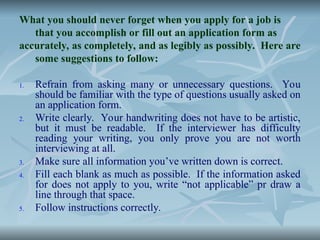
What you should never forget when you apply for a job is
that you accomplish or fill out an application form as
accurately, as completely, and as legibly as possibly. Here are
some suggestions to follow:
1. Refrain from asking many or unnecessary questions. You
should be familiar with the type of questions usually asked on
an application form.
2. Write clearly. Your handwriting does not have to be artistic,
but it must be readable. If the interviewer has difficulty
reading your writing, you only prove you are not worth
interviewing at all.
3. Make sure all information you’ve written down is correct.
4. Fill each blank as much as possible. If the information asked
for does not apply to you, write “not applicable” pr draw a
line through that space.
5. Follow instructions correctly.
The Interview Follow-up Letter
Like the sales letter, the application letter may need a
follow-up to make the reader take action. A letter you write to
the interviewer of employer thanking him for the time given
you and pointing out one or two interesting points about the
interview will surely put you in a favorable light.
The Letter of Acceptance
When notified by mail that you have been chosen to fill a certain
position or when a job offer is made to you by mail and you
accept it, you are expected top send a letter of acceptance.
Purpose:
1. to acknowledge the offer
2. to inform your prospective employer of your acceptance of
the offer;
3. to reassure your employer-to-be that he has chosen the right
person; and
4. to inform your employer-to-be when you can report for work.
for work.
Example:
Example:
Dear Atty. Riano:
Thank you very much for your April 24 letter informing of
your decision to choose me as your secretary. The letter was
most welcome.
I am accepting the position, and I can start reporting for work
on the day you indicated in the letter, Monday, May 8. I
assure you I will do my best to a worthy employee of Riano
and Tañada Law Offices.
Thank you again, and I look forward to working for you.
Sincerely,
The Letter of Refusal
If you have to turn down a job offer for one reason or
another, it is usually advisable to write a letter of refusal
tactfully stating your reason or reasons for declining the offer.
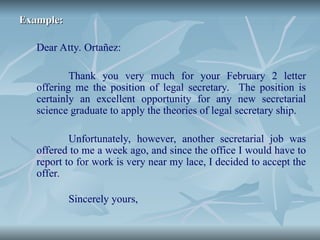
Example:
Example:
Dear Atty. Ortañez:
Thank you very much for your February 2 letter
offering me the position of legal secretary. The position is
certainly an excellent opportunity for any new secretarial
science graduate to apply the theories of legal secretary ship.
Unfortunately, however, another secretarial job was
offered to me a week ago, and since the office I would have to
report to for work is very near my lace, I decided to accept the
offer.
Sincerely yours,
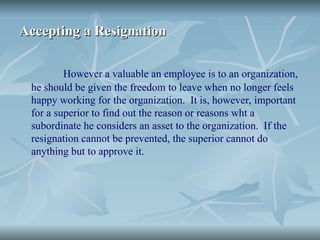
Accepting a Resignation
However a valuable an employee is to an organization,
he should be given the freedom to leave when no longer feels
happy working for the organization. It is, however, important
for a superior to find out the reason or reasons wht a
subordinate he considers an asset to the organization. If the
resignation cannot be prevented, the superior cannot do
anything but to approve it.
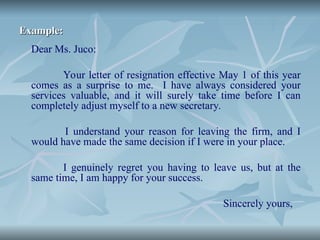
Example:
Example:
Dear Ms. Juco:
Your letter of resignation effective May 1 of this year
comes as a surprise to me. I have always considered your
services valuable, and it will surely take time before I can
completely adjust myself to a new secretary.
I understand your reason for leaving the firm, and I
would have made the same decision if I were in your place.
I genuinely regret you having to leave us, but at the
same time, I am happy for your success.
Sincerely yours,
CHAPTER 7
CHAPTER 7
CLAIM AND ADJUSTMENT LETTERS
Despite efforts to make its operation as efficient as
possible, a company may still expect to receive complaints
about its products(s) or service. Even with the installation of
the most advanced equipments or facilities, mistakes cannot be
completely avoided. The customer may receive a defective
item, an erroneous invoice or statement, a slow service, or
rude treatment from a sales clerk.
A customer who feels aggrieved may, therefore, decide
to write a letter expressing his grievance. A letter in which a
complaint is expressed, - that is, one in which the customer
makes known that has a claim against the company – is called
claim letter. The answer to a claim letter is called adjustment
letter.
Types of Claims
Types of Claims
1. Merchandise Claims – This type involves orders incorrectly
filled, merchandise whose quality is unsatisfactory, and
goods damaged or delayed in shipment.
2. Amounts of Money Claims – This type involves errors in
statements and invoices and misunderstandings with regard
to price or terms of payment.
3. Service Claims – This type concerns delays in filling orders
for service, discourteous treatment by employees, and failure
to make a follow-up of an earlier incomplete service.
Rules for Writing Claim Letters
1. Explain carefully and tactfully what is wrong. Never allow
yourself to be controlled by anger.
2. Indicate details necessary to identify your claim –dates,
catalog numbers, order numbers, color or make of item, etc.
3. Explain, in general terms, what you feel the company should
do about your claim, but don’t be unreasonable in your
request.
4. Avoid accusing or threatening expressions.
Example of Merchandise Claim
Dear Mrs. Roxas:
The Lacoste T-shirt I bought at your store last April 24
fits me very well, but I noticed a sewing defect at the tip of the
reverse side of the right front collar. I may have overlooked
this defect when I inspected the T-shirt before I made my
payment.
While this defect may be hidden from view, some wind
may turn the collar up and reveal the defect which is not at all
too pleasant to look at.
May I. therefore, as that the T-shirt be replaced with
another?
Cordially yours,
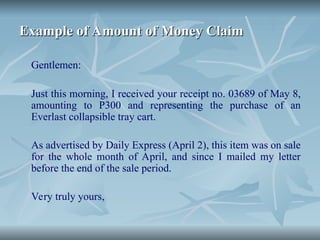
Example of Amount of Money Claim
Gentlemen:
Just this morning, I received your receipt no. 03689 of May 8,
amounting to P300 and representing the purchase of an
Everlast collapsible tray cart.
As advertised by Daily Express (April 2), this item was on sale
for the whole month of April, and since I mailed my letter
before the end of the sale period.
Very truly yours,
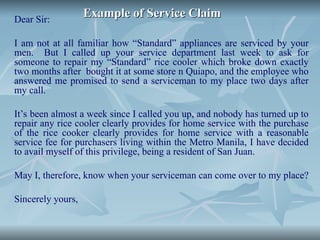
Example of Service Claim
Dear Sir:
I am not at all familiar how “Standard” appliances are serviced by your
men. But I called up your service department last week to ask for
someone to repair my “Standard” rice cooler which broke down exactly
two months after bought it at some store n Quiapo, and the employee who
answered me promised to send a serviceman to my place two days after
my call.
It’s been almost a week since I called you up, and nobody has turned up to
repair any rice cooler clearly provides for home service with the purchase
of the rice cooker clearly provides for home service with a reasonable
service fee for purchasers living within the Metro Manila, I have decided
to avail myself of this privilege, being a resident of San Juan.
May I, therefore, know when your serviceman can come over to my place?
Sincerely yours,
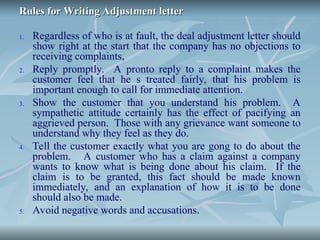
Rules for Writing Adjustment letter
1. Regardless of who is at fault, the deal adjustment letter should
show right at the start that the company has no objections to
receiving complaints,
2. Reply promptly. A pronto reply to a complaint makes the
customer feel that he s treated fairly, that his problem is
important enough to call for immediate attention.
3. Show the customer that you understand his problem. A
sympathetic attitude certainly has the effect of pacifying an
aggrieved person. Those with any grievance want someone to
understand why they feel as they do.
4. Tell the customer exactly what you are gong to do about the
problem. A customer who has a claim against a company
wants to know what is being done about his claim. If the
claim is to be granted, this fact should be made known
immediately, and an explanation of how it is to be done
should also be made.
5. Avoid negative words and accusations.
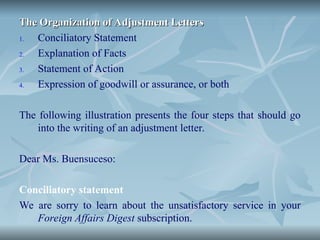
The Organization of Adjustment Letters
1. Conciliatory Statement
2. Explanation of Facts
3. Statement of Action
4. Expression of goodwill or assurance, or both
The following illustration presents the four steps that should go
into the writing of an adjustment letter.
Dear Ms. Buensuceso:
Conciliatory statement
We are sorry to learn about the unsatisfactory service in your
Foreign Affairs Digest subscription.
Explanation of facts
Although Foreign Affairs Digest comes out only once a
month, it is published on a carefully schedule which must be
followed strictly if copies are to reach you promptly. N recent
weeks, however, production and transportation problems,
which are not ordinarily experienced by the publication’s
Singapore-based publisher, have caused a few shipments to
reach Metro Manila late, thus affecting delivery by the Central
Post Office.
Statement of Action
Statement of Action
We have given this matter serious attention, and we are
exerting top make the dispatch schedule in the coming months
followed with greater regularity. We have also reviewed
transportation facilities to make sure that deliveries will
always be as prompt as possible.
Expression of goodwill and assurance
We appreciate your writing us, and we assure you that every
effort will be made to give you the kind of service you have
the right to expect.
Cordially yours,
CHAPTER 8
CHAPTER 8
CREDIT AND COLLECTION LETTERS
In today’s business, the role of the collection man s
related to the roles played by the sales and credit man. The
three must coordinate with one another of the result s a
problem n business operation. The salesman seeks sales,
mostly on credit, while the credit man who more often than
not is also the collection man aims to increase the volume of
business through credit.
Six types of Credit Letter
1. Letters Requesting Credit Information
The credit man may write either to the customer or to a third party or both to
secure the credit information he needs.
Example:
Dear Ms. Duque:
We are pleased to receive your initial order for our new cosmetic lines.
To help us fill your order on open account as promptly as possible, please fill and
return the enclosed Credit Application blank form together with a recent financial
statement and the names and addresses of three firms which now extend credit to
you.
Thank you for your cooperation in this matter. We look forward to the
opportunity of serving you.
Very truly yours,
2.
2. Letters Giving Information
The credit man may be asked to furnish information about
his own firm or about a company with which his firm does
business.
Gentlemen:
We are glad to submit the information you requested with the
regard to the establishing of an open account with your
company.
Attached is our most recent profit and loss statement and
balance sheet. Listed below are companies with which we
have done business on credit for at least five years:
Baliwag Touch, Inc.
Baliwag, Bulacan
Crownwood Furnitures, Inc.
Baliwag, Bulacan
Rovirey Industries, Inc.
Guiguinto, Bilacan
Very truly yours,
3.
3. Letters Granting Credit
Letters Granting Credit
Contents:
1. the credit grant
2. a statement of terms
3. a sales talk on products quality, type of service, etc.
4. an expression of appreciation
The letter granting credit offers good opportunities to create
favorable impressions about the company, pleasure in
opening an account, and anticipation of a pleasant,
profitable relationship.
Example of Letter Granting Credit
Example of Letter Granting Credit:
:
Dear Ms. Rodriguez:
We are pleased to tell you that your 713 Charge Account is
now open and ready for your use. We are sure you will find it
great convenience.
The 713 Charge Account enclosed, which bears your name,
address, and account number should be presented to our Credit
Line department whenever you charg3e purchase. A
statement will be sent to you regularly each month. Thank
you for this opportunity to be of service.
Sincerely yours,
4.
4. Letter Refusing Credit
Letter Refusing Credit
The Letter refusing credit must be properly handled
so that, while it refuses, credit is still able to retain the
customer’s goodwill.
The tome of the letter must be sympathetic and tactful, its
aim being to turn the customer into a cash customer by
presenting the advantages of cash buying or the desirability
of merchandise.
5.
5. Inviting new Credit Accounts
Inviting new Credit Accounts
Letters inviting new credit accounts are generally
practiced by retail stores. The letters may be written to
invite new accounts either from customers, or from potential
customers. It has been proven that individuals with credit
accounts tend to buy more often and to buy more at a time
than cash customers.
Example:
Example:
Dear Ms. Austero:
Have you visited our new Cubao branch at Farmers’
Market? All roads, as they say, have led to our branch since
opening.
If you have visited the sore, you will surely agree with me
that this should be your store for your apparel needs and that
a charge account cam be a real shopping convenience
Very truly yours,
6.
6. Reactivating Old Credit Accounts
Reactivating Old Credit Accounts
The credit man must take constructive action when a
reliable credit customer stops using his account.
The Collection Letters
When credit customers fail to pay their accounts promptly, collection
letters become necessary.
Characteristics:
Promptness. Attempts to collect after an account becomes de must not be
procrastinated.
Regularity. Debtors are impressed with collection practices that are efficient and
systematic.
Understanding. Understanding involves adaptability to the types of debtor
involved, flexibility to meet unforeseen circumstances and human relations
skills
Increasing forcefulness. The collection process involves a series of letters that
progress from reminders to ultimatums.
Good tone. Collection letters involve the debtor’s most cherished possession – his
own personality an d reputation,
CHAPTER 9
CHAPTER 9
INVITATION, ANNOUNCEMENT,
APPRECIATION, AND
APPRECIATION, AND
SYMPATHY LETTERS
SYMPATHY LETTERS
Pointers:
Pointers:
1. Call the person by his correct name. Use correct titles such
as Dr., Eng., Atty., and the like
2. Make the letter personal in the salutation by using the
expression Dear Mr. Inocencio instead of the impersonal
Dear Sir, Dear Madam, and the like.
3. In closing the letter, use terms that harmonize with a warm
personal such as Sincerely yours, Cordially yours, and the
like.
4. Make the letter radiate warmth, friendship, and sincerity.
Invitation
Invitation
Letters that invite request the reader’s presence. They
should contain all the information which the reader should
know. Hence, they should answer what, where, when, who,
and why.
An invitation letter should give the reader the
impression of or sincerity in inviting him, without necessarily
resorting to flattery.
Letter of Thanks/Appreciation
One letter that is certain to create a lot of goodwill is
the letter of thanks or appreciation.
Letter of Sympathy or Condolence
One of the most difficult letters to write is the letter of
sympathy or condolence. Just like the letter of appreciation, a
letter of sympathy should come “from the heart” – it should
completely sincere.
CHAPTER 10
INTRODUCTION, REFERENCE, AND
RECOMMENDATION LETTERS
Introduction
Introduction
In a letter of introduction, the writer gives information about the bearer’s (the
person being introduced) character, reputation and record. The letter is unsealed.
It normally accompanies the bearer and acts as an introduction to another person or
company. Very often the writer requests his correspondent to assist the bearer n
some way.
Recommendation
Recommendation
It is an endorsement of someone’s ability or personal qualities. It may be written to
recommend someone for another job, for a scholarship, or for membership n an
organization.
Contents:
1. Purpose of the Letter
2. Qualifications of the work of the person
3. recommendation to the reader
References
References
A letter of reference gives information about a person’s ability and/or personal
qualities. It is placed in a sealed envelope because it conrains confidential
information.
CHAPTER 11
CHAPTER 11
BUSINESS REPORTS
BUSINESS REPORTS
The Importance of Report
1. To provide efficient dissemination of current
information
2. To provide a permanent record of
information recently obtained.
The Definition of Report
A business report is a systematic and objective communication of
factual information to achieve a specific purpose or purposes. This
definition of report makes the report writer see the distinction
between report writing and their types of writing. The definition
discloses the qualities of report writing, systematic, objective,
factual, informative, and functional.
1. Systematic – A report involves careful planning and preparation
2. Objective – Objectivity can be achieved when the writer presents
and analyzes facts without regard to his personal beliefs and
attitudes.
3. Factual – The writer presents documented facts and ideas researched
from various sources.
4. Informative – The writer gives all the facts necessary to enable the
reader to understand the report.
5. Functional – Reports are intended to provide useful and information
to the reader, to get results and to get things done.
Classification of Reports
Subject-matter. This type of classification is based on subject
fields such as accounting, economics, engineering and the like.
Time-interval. They are routine weekly and monthly reports
made by salesman, periodic report of progress in big
corporation’s annual report of operations.
Function. These are informational and analytical reports.
Informational reports present facts bearing on the subject.
Formality. Formal reports are those that are dressed up and
are appropriately worded to fit the requirements of a very
formal occasion.
Authorship. Reports may be private or public. Private report which
is prepared or written by those engaged in private business is
considered private report, while those prepared by the staff of
public institutions are considered public reports.
Format. The physical format of the report varies with the expected
outcomes, the use to make of it, and the formality of the
situation.
Types of Reports
1. Filled-in-blanks, in which the consequences are predetermined
by the designer
2. The memorandum report, which usually has TO, FROM,
SUBJECT format.
3. The letter report, which is a letter more formal than the
memorandum. It has a business letter format.
5. Booklets, which are report of book lengths. They contain
covers, title pages, sometimes table of contents, and
sometime covering letters of transmittal, depending on their
purpose, readers, and length.
6. The Short Report, which consists of ten pages or less.
Such report is of temporary or current interest, and
presented with pages informally stapled together.
7. The long, formal report which is a report in gala dress, to
suit the requirements of a formal situation. It includes
prefatory parts, the text, and the supplemental parts.
Working Plan for Research
Steps
1. Deciding on a Subject of Problem
2. Identification of the Problem and objectives of the Study
3. Preliminary Investigation and Conducting a Situation
Analysis
3.1 Conceptual on Theoretical Framework
3.11 Review of Literature and Related Studies
3.12 Conceptual Framework
3.13 Working Hypothesis
3.14 Definition of Terms/Variables
3.2 Deciding what types of study should be conducted
4 Development of a Research Design
4.1 Determining Type of Information Needed
4.2 Primary Data
4.3 Secondary Data
4.4 Deciding on Information Sources
4.5 Internal Sources
4.6 External Sources
4.7 Deciding on Data
4.31 Survey Method
4.311 Questionnaire
4.32 Experimentation
4.33 Observation Method
5. Presentation and Execution of Research Findings
6. Follow-up the Study
The Research Report
The Research Report
A research report presents the findings of the
investigation of a problem which arose from a situation of
needed or pf unsolved difficulties. It employs any one or more
of the methods of research: survey, observation, interrogation,
and bibliographical research.
Five Main Parts:
Five Main Parts:
Introduction. This may be in Chapter 1, of it is short, it may
simply be headed as “Introduction.” In long, complicated
reports, the introduction consists of the following:
1. Background of the Study. This is a brief presentation of the
Scope and Delimitation of the Study. Limits of the study should
be properly defined the scope especially state the number of
subjects/respondents (research population), instruments or
research design. source of the problem and a description of the
events which suggested the research.
2. Statement of the Problem. The problem should be stated
precisely, accurately, and clearly.
3. Significance of the Study. This part explains why the
problem investigated is important and what significance the
result has.
4. Scope and Delimitation of the Study. Limits of the study
should be properly defined the scope especially state the
number of subjects/respondents (research population),
instruments or research design.
5. Hypothesis. These are conjectural statements of
relationships between two or more variables. These
statements are based on existing information (common
knowledge) and are tested experimentally or empirically.
Research Methods and Procedures
This section includes description of the sources of the data,
the data gathering procedure, instruments used, the data
processing techniques and statistical treatment(s) applied.
1. Research Population. The report should include information
on who the respondents are, how many they are and how
they were selected.
2. Procedure. Techniques, devices and procedures should
be described in complete data.
3. Data-gathering instruments. A description of the adoption,
construction and administration of instruments should be
included
4. Statistical Techniques. A statement of a statistical
techniques should be given. If the statistical technique used
is new, a formula should e given.
.
Results and Findings
This section presents a summary of the collected data and
the statistical treatment applied to them. Actually, the data
presented must be those which directly answer the research
questions and hypothesis. The results should be presented
in a straight forward and unbiased way.
Summary, Conclusions and Recommendations
This last section of the body of the report contains an
overview of the research.
-End-
Thank You!!
Thank You!
Thank You!

Business Commuication for different purposes.ppt

  • 1.
    Project Project in in Internet andWeb Internet and Web page Development page Development Prepared By: Banao, Leo D. Caquilala, Leizel C. BOA IV-1
  • 2.
  • 3.
    Course Description: Course Description: BUSINESS BUSINESS COMMUNICATIONAND COMMUNICATION AND REPORT WRITING REPORT WRITING . .
  • 4.
    Course Outline Course Outline Chapter1: Chapter 1: Communication in Business Communication in Business Chapter 2: Chapter 2: Appearance and Form of the Appearance and Form of the Business Letters Business Letters Chapter 3: Chapter 3: Qualities of Effective Business Qualities of Effective Business Letters Letters
  • 5.
    Chapter 4: Chapter 4: Request,Reply, Order, Request, Reply, Order, Acknowledgement, and Remittance Acknowledgement, and Remittance Chapter 5: Chapter 5: Sales Letters Sales Letters Chapter 6: Chapter 6: Employment Letters Employment Letters Chapter 7: Chapter 7: Claim and Adjustment Letters Claim and Adjustment Letters
  • 6.
    Chapter 8: Chapter 8: Creditand Collection Letters Credit and Collection Letters Chapter 9: Chapter 9: Invitation, Announcement, Invitation, Announcement, Appreciation and Sympathy Letters Appreciation and Sympathy Letters Chapter 10: Chapter 10: Introduction, Reference, and Introduction, Reference, and Recommendation Letters Recommendation Letters Chapter 11: Chapter 11: Business Reports Business Reports
  • 7.
    CHAPTER 1 CHAPTER 1 COMMUNICATIONIN BUSINESS COMMUNICATION IN BUSINESS
  • 8.
    There is onething that distinguishes man from lower animals, and that is man’s ability to use language or to communicate his ideas (or thoughts, feelings, attitudes, etc.) through some oral or written system.
  • 9.
    Communication ideas, therefore,involves language which may be oral, written (or graphic or printed), or even gestural (hands, head, or eyes in meaningful motion). But what ever form of language is used, three basic elements always make up the communication process: the communicator (or source or speaker or transmitter), the message (or code or idea), and the receiver (or listener or recipient). The language used in the communication process may be called medium, the means to transmit the message or idea. In simple terms communication may be defined as the act or process of transmitting or sending a message.
  • 10.
    In communication, theword channel may refer to a person’s speech mechanism- mouth, tongue, teeth, diaphragm, etc. - or to the kind of language used- oral, written, or gestural. It may also refer to a medium used in mass communication – broadcast (television, radio, movies) or print (newspapers, magazines, books, etc.). Two other words related to communication are encoding and decoding. Simply defined, encoding is the act of transmitting a message while decoding is receiving and understanding a message. Aside from being known as communicator, source, speaker, or transmitter, a person who transmit a message is also called encoder.
  • 11.
    Feedback Since communication isa two way channel, the source and the receiver alternately transmit and receive messages. This means that although a source initiates or starts a communication situation, the message he transmits is not only received by the receiver but is also reacted to by the receiver. The receiver’s response or answer to some information or message from the source is known as feedback.
  • 12.
    Feedback may bepositive or negative. Positive feedback reinforces or encourages the source, the implications being that he is doing fine and should continue what he was been doing. Negative feedback signifies a need for changing, adjusting, or reassessing the communicator’s message or behavior
  • 13.
    Organizational Communication Organizational Communication Twostructures actually make up the communication channels of any organization: formal and informal. Formal communication usually follows the same line and patterns of an organizational chart while informal communication- often referred to us grapevine- is an unstructured communication channel, a form of communication whose lines and routes change as fast as personal relationships among organization members change. Chismis is the popular local word for informal communication. There are three formal communication channels: upward, downward, and horizontal. Informal communication also runs up, down, and across the organization. Clearly communication in organizations has two basic functions: 1. to give and receive directions and 2. to give and to receive information.
  • 14.
    An organization needsa considerable number or communication channels. Higher authority, of course, needs channels connecting with lower management, supervisors, staff, workers, and people outside the organization. The theory is that the more channels people have access to, the more they likely to communicate; and the more communication there is, the better it is likely to be.
  • 15.
    Upward communications Upward communications Upwardcommunications give management feedback or information needed for planning, decision making and controlling. On the part of the employees, communicating to management is an opportunity to offer valuable ideas and management, a means in showing that directives or policies are understood or accepted by them, or a form of release form emotional tensions and pressures. The common formal procedures associated with the upward channels or organizational communication as follows:
  • 16.
    1. 1. Informal discussion Informaldiscussion. . This procedure involves talking with one or few employees, the purpose being to make the employee or employees speak out his or their minds or feelings as openly as possible. Informal discussions are supposed to make the participants more at ease, the exchange more spontaneous, and the atmosphere more conducive to mutual trust and respect.
  • 17.
    2. 2. Reports Reports. . Whether oraland written, reports are among the most important tools of carrying information upward because they provide invaluable data which help management arrive at certain decisions. If made orally, a report may be simple as a supervisor’s statement. If written, it may contain only raw data like monthly financial statement, an employee’s time record, minutes of an annual meeting, or simply a listing of the ten newly hired employees in section.
  • 18.
    3. 3. Attitude survey Attitudesurvey. . This technique gives employees a chance to express themselves anonymously, and hence, honestly. When conducted by experts, surveys not only generate a lot of information quickly but also provide statistically valid answers to wide range of questions. . 4. 4. Grievance procedure. Grievance procedure. This form of upward communication provides unions and management with formal machinery to air grievances on all points of view, often in areas overlooked or considered insignificant by supervisors. It gives employees a sense of involvement and importance.
  • 19.
    5. 5. Counseling. Counseling. Counselors mayserve as “listening post” to many workers’ problems and therefore, provide a means for releasing the workers’ pressure and tensions. The result is a quicker resolution of a grievance or problem. 6. 6. Exit interview. Exit interview. Resigning or “terminated” employees can offer valuable information because they usually do not hesitate to make known their gripes or ideas. Through exit interviews, employees are given a forum for candor without fear of reprisals.
  • 20.
    7. 7. Union. Union. Are supposedto represent workers’ interest and welfare, therefore union representatives are in direct contact with workers, know what is going on, and are not hesitant about speaking their minds. 8. 8. Formal meeting. Formal meeting. This is probably the most common communication technique used by business organizations. Formal meeting usually provide a way for a person of stature to have an impact on a group.
  • 21.
    9. 9. Suggestion system. Suggestionsystem. This organizational communication procedure promises to be an effective source of “intelligence” for executives if manage properly. Suggestion work best when employees know that each suggestion gets the attention of top management 10. 10. Employee publication Employee publication. . When featuring a gripe box and/or question and answer column, an employee publication can be perfect for employees who wish to remain anonymous or avoid a face to face encounter with anyone in the company
  • 22.
    11. 11. Open doorpolicy. Open door policy. This procedure does away with the “through channels” manner of communications; therefore, it allow employees to have management contract freely and encourages more personal than formal meetings. 12. 12. Grapevine Grapevine. . If all channels of communication are open, the grapevine will not be very active, but it should not ignored for it can provide good first indicators of morale and trends.
  • 23.
    Downward communications Downward communications Asidefrom the directives and orders which employees receive from management or their supervisors, there are other means to increase employee awareness, influence their opinions, and stimulate their sense of belonging. The following is a list of the top-to- bottom means of communication
  • 24.
    1. 1. Small groupmeeting. Small group meeting. This has been found to be the most effective means of two way communication. Once the information has been conveyed, employee understanding and commitment can be insured with a question and answer session and a period of free discussion. 2. 2. Company publication Company publication. . The newsletter being the most common form, a company publication can carry a broad range of information while conveying the official company position on important issues.
  • 25.
    3. 3. Supervisory meeting. Supervisorymeeting. this is used to let the workers hear about company plans, policies, and the like from the member of the management with whom they work directly. 4. 4. Mass meeting Mass meeting. . a gathering of employees is very effective when the top company management wants to make very important announcements. 5. 5. Letters to employees’ homes. Letters to employees’ homes. A letter mailed to an employee’s home can generate can generate more feedback than any other technique.
  • 26.
    6. 6. Bulletin boards. Bulletinboards. These provide a simple means for supplying firsthand information quickly. To be effective they must be attractive and constantly changing. 7. 7. Insert in pay envelopes. Insert in pay envelopes. Notes or notices inserted in pay envelopes are certain to be seen and likely to be read. 8. 8. Public address announcement. Public address announcement. This procedure requires almost no preparation and can reach all employees at once.
  • 27.
    9. 9. Posters. Posters. Posters giveinformation a graphic impact while providing a continuing reminder to all those concerned. 10. 10. Open house and plant tours. Open house and plant tours. These are effective for mass exposure to create interest and credibility.
  • 28.
    Horizontal Communications Horizontal Communications Horizontalor lateral communication is a type of intra- company communication that takes place between sections, division or departments of the same level. The objective is to keep people aware of activities in a related department. The most popular tools used in horizontal communication are the following.
  • 29.
    1. 1. Meeting andconferences. Meeting and conferences. A meeting may be held to disseminate information, to solve certain problems, to train the participants or let the participants brainstorm. Meetings and conferences emphasizes the philosophy of participative management. 2. 2. Seminars and workshop. Seminars and workshop. These are held to upgrade the knowledge and skills of the personnel so that they will do their job better, increase production, create greater savings or make optimum use of the human resources in the company
  • 30.
    3. 3. Telephones andIntercoms. Telephones and Intercoms. Telephones and intercoms reduce, to a large degree, the physical distance between speakers and provide immediate feedback without the need of face to face communication. 4. 4. Socials. Socials. These may take the form of testimonial, a luncheon meeting, a party to welcome a new employee or head. In many companies socials have proven to be more than fun occasions for management and employees because they can turn out to be excellent opportunity for solving interdepartmental or individual human relations problem or a “status-leveler” among the personnel.
  • 31.
    Writing in business Writingin business Type of business letter Business letters fall into the following different categories:
  • 32.
    A. Letters toor from potential customer and A. Letters to or from potential customer and suppliers: suppliers: 1 1. Sales letter- letters designed to persuade people either to buy the product of a business or to utilize its service. 2. Request letter- letters addressed to a supplier of products or services to request information about a particular product or service.
  • 33.
    B. Letters toor from established customers B. Letters to or from established customers and suppliers: and suppliers: 1. Sales inquiry, order, and acknowledgement letters- letters planned to communicate business information between business institutions. 2. Goodwill letters- letters conveying such expressions as congratulations, my sympathies, and thank you, their purpose is to strengthen customer relations. 3. Claims and adjustment letters- letters written to correct any misunderstanding that occurs between parties in business transaction. 4. Credit and collection letters- letters that involve payments for items brought or orders or loans made.
  • 34.
    C. Letters fromprospective employees and C. Letters from prospective employees and employers: employers: A. Application letters- letter written by individual to obtain employment inquires and follow up letters. B. Application approval or rejections- letters written by the firm to individuals confirming or rejecting employment.
  • 35.
    CHAPTER 2 CHAPTER 2 APPEARANCEAND FORM OF THE APPEARANCE AND FORM OF THE BUSINESS LETTER BUSINESS LETTER
  • 36.
    Our appearance communicates.So does the appearance of a letter. Our letters represent us and our business that is why appearance should concern us. Besides, it is difficult to avoid making an evaluation of the writer of his firm based on a first impression of his letter. An attractive letter also enables the reader to focus immediately on the message.
  • 37.
    The Attractive LetterAppearance The Attractive Letter Appearance The elements which contribute to an attractive letter appearance are: 1. The paper. The quality and the size of the paper upon which business letters are written vary. Good taste call for white or nearly white unruled paper with a surface not glossy but smooth to prevent ink from running or blurring. 2. The picture-frame layout. For a business letter to have a picture-frame layout, margins paragraph balance, and white spaces must be considered. The picture frame layout and the paragraph balance principles both lead to the effective use of white space. Spacing, which is the distance between lines, must be appropriate to contribute to contrast in a letter layout.
  • 38.
    3 3. The style 4.The typing quality Picture-frame 1 Lay-out 1 1 1 1 1 ½ 1 ½
  • 39.
    Business Letter Styles BusinessLetter Styles A firm may reflect a progressive, conventional or outdated corporate image through its choice of a letter style. However, there is no standard by which appropriateness or inappropriateness of a particular style can be firmly established. The following outline includes the six commonly used styles of arrangement and the three punctuations patters:
  • 40.
    Letter Styles Letter Styles 1 1.Extreme format 1.1 Indented style 2. Standard formats 2.1 Modified-block style 2.2 Semi block style (also called “Modified block with indented paragraphs”) 2.3 Full-block (also called “Block” or Extreme Block”) 3. Special formats 3.1 NOMA (National Office Management Association simplified style) 3.2 Hanging style
  • 41.
    Punctuation Styles 1. Open 2.Standard (also called “mixed”) 3. Close The indented style though it is the oldest letter style. It was the style frequently used when all letters where handwritten. Its major disadvantage other than its rugged appearance is the time-consuming use of many tabulation stops on the typewriter because of the many paragraphs and other indentions required. The modified block differs in full- block in the placement of the date, complimentary close and the signature block. The modified block with mixed punctuation, the most frequently used letter format. It is simple to prepare and gives the letter balance.
  • 42.
    EXAMPLE OF ANINDENTED EXAMPLE OF AN INDENTED LETTER STYLE LETTER STYLE  The ultraconservative and close punctuation  With 5 space indentations
  • 43.
    September 15,20_____ Mr. RovierPadilla, 1345 Scout Rallos Street, Quezon City, Metro Manila 3002 Dear Mr. Padilla: This letter illustrates the indented form, as you see by a glance at the inside address and the closing lines. In each of these groups, the lines are tab- indented in steps of five spaces, too. One care to be exercised when you use the indented letter form is to make sure that none of the final lines projects into the right margin: you must start the complimentary closing far enough to the left to assure there is room for all the closing lines. This letter also illustrates the “closed” form of punctuation. Each of the displayed opening and closing lines is “closed” by a punctuation mark. Neither the indented arrangement nor “closed” punctuation pattern is commonly used in the United States, but they are both very popular (especially when use together) in Mexico, Canada, and Europe. Yours very sincerely, Robertini A. Llanes, Training Director. Ecr. Enclosure (3).
  • 44.
    In the full-blockletter style each line of the entire letter begins on the left margin. It saves typing time since the tabulator is not used in setting up the letter. The simplified letter style is essentially the same as the full-block style. The differences are: 1. the absence of a salutation or complimentary close, 2. the use of a subject line in a capital letters as substitute for the salutation, and 3. the listings in the message are indented five spaces, except when these are numbered or lettered. The simplified letter style is simple to prepare, save time and encourages directness.
  • 45.
    EXAMPLE OF SEMI-BLOCKEDLETTER STYLE  Conservative  Executive  With attention line and cc notation
  • 46.
    March 4, 20__ DelphiDevelopment Center 1121 C.M. Recto, Metro Manila ATTENTION TRAINING DIRECTOR Gentlemen: For a letter design that is both standard and distinctive, try this style: semi blocked (one of the two most popular styles: with the paragraphs indented ten spaces (instead the usual five). This letter also shows you an alternative arrangement for the attention line: centered, in all capitals (instead of being blocked at the left margin and underscored). In two regards, however, the use of the attention line here is standard. It is accompanied, as it should be, by the salutation “Gentlemen;” and it is typed above the salutation. Worth nothing also in this letter are the following: (1) positioning the date at the margin as an alternative to starting it at the center; (2) the use of “standard” punctuation, which calls for a colon after the salutation and a comma after the complimentary closing; and (3) the use of “cc” notations at the bottom to indicate to whom carbon copies of the letter are being sent. Yours very truly, ECR cc Mrs. FilenR Josefa Aborro, Directo cc Dr. Isidro
  • 47.
    EXAMPLE OF FULL-BLOCKED LETERSTYLE  vigorous  aggressive  with subject line and open punctuation
  • 48.
    May 13, 19________ Mrs.Shirley Alcoriza Delphi Development Center C.M. Recto, Metro Manila Dear Mrs. Alcoriza Subject: Form of a Full-Blocked Letter This letter is set up in the full-blocked style in which every line begins at the left margin. A few companies modify it by moving the date to the right, but most firms use it as shown here. Because this style is the fastest to type, it is considered very modern. It is natural, although not necessary, to use “open” punctuation with the style of letter. This letter also illustrates one arrangement of the subject line, which may be used with any style of letter. Like an attention line, a subject line may be typed with underscored of capitals. In a full-blocked letter, it must be blocked in other letter styles; it may be blocked or centered. It always appears after the salutation and before the body, for it is considered a part of the body. Legal firms and the legal departments of companies sometimes prefer to use the Latin terms Re or In Re instead of the English word Subject. Yours very sincerely Mercedes Pascua Documentation Department ecr
  • 49.
    EXAMPLE OF SIMPLIFIELETTER STYLE  the efficiency expert’s  with open and full-block design
  • 50.
    March 15, 19________ Mr.Robert Mendoza Delphi Publishing Company Quezon Avenue, Metro Manila THE SIMPLIFIED LETTER Several years ago, Mr. Mendoza, the Administrative Management Society (formerly NOMA) designed a new letter form that they called the “Simplified Letter.” This is a sample. 1. It uses the full-blocked form and “open” punctuation. 2. It contains no salutation or closing. (AMS believes such expressions to be meaningless.) 3. It displays a subject line in all capitals, both preceded and followed by two blank lines. Note that the word “Subject” is omitted. 4. It identifies the signer by an all-capitals line that is one-if further notations is used.It seeks to maintain a brisk but friendly tone, partly by using the addressee’s name at least in the first sentence. Perhaps, Mr. Mendoza, as some say, this form does not really look like a business letter; but its efficiency suggests that this style is worth a trial, especially where output must be increased. ALBERT ANGELES, TRAINING CONSULTANT ecr
  • 51.
    For advertising andsales letters, the hanging style attracts the reader’s attention to the beginning of each paragraph. The style is similar to the modified block except that the first line of each paragraph is not indented, while the second and all other paragraph lines are indented five of ten spaces
  • 52.
    EXAMPLE OF HANGING-INDENTED LETERSTYLE  for super-display salesmanship  with paragraph assigners name displayed
  • 53.
    July 13, 2009_____ Toall the Secretaries Who Need a Way to Display A Special Sales Letter so It Looks Special Dear Ready-for-Rescue: Yes, this is a hanging-indented letter, with a key word “hanging” in the margin at the start of Each Paragraph and with other lines indented. Yes, this letter style takes attentive production. You set a tab stop some appropriate number of spaces in from the margin and indent all line except the first one in each paragraph. Yes, the hanging indented style is designed solely for sales promotion – this form is too cumber-some for ordinary correspondence. Since the whole point of the display is to feature those paragraph starters, the letter has to be prepared especially to fit this arrangement. Yes, indicating the signer’s name in the reference position, as below, instead of below the space where he signs the letter is a procedure that may be used with any form of letter. It is a good device to use when a singer has a signature he likes but which is illegible. Yours very truly, LETTER STYLES, INC. Vice-President, Sales LS Llanes/ecr
  • 54.
    The three commonlyused punctuation style for business letters are the open, standard, and close styles. 1. Open punctuation, often used with the full-blocked letter style, requires no punctuation after any part of the letter except the message. 2. Standard punctuation, the most commonly used style, in this style, only the salutation and complimentary close are followed by a mark of punctuation – the colon and the comma, respectively. 3. The close punctuation requires that a punctuation mark appear at the end of every line of every part – except the message of the letter used of the three punctuation styles.
  • 55.
    Typewriting Quality Typewriting qualitydepends upon three factors, namely, the evenness of touch of the keys, the typewriter ribbon and the neatness of erasures. An even touch produces typescript of even density- not a sprinkling of light and dark letters across the page. Type keys must be cleaned regularly to prevent dust – and – ink clogged letters from marrying the appearance of the typescript. A good quality ribbon must be used – one that suits the type of typewriter – standard or portable, manual or electronic. Black is the color frequently used, but the typist may use a tinted colored ribbon for tinted stationery. Of course, erasures and strikeover must be avoided. If these are noticeable, the letter must be retyped. Good erasing tools must be a part of every typist’s kit.
  • 56.
    The Placement ofLetter Parts The Placement of Letter Parts In addition to the over-all letter appearance and layout, the individual parts of a letter, through effective, proper, up-to- date placement and usage, contribute to the letters attractiveness. The following business letter parts, though not found in every letter, are in common use today: 1. Heading or letterhead 7. Body or message 2. Date or dateline 8. Complimentary close 3. Inside address 9. Signature block 4. Attention line 10. Reference initials 5. Salutation 11. Enclosure notation 6. Subject line 12. cc notation 13. Postscript
  • 57.
    1. Heading 1045E. Quirino Street Sampaloc, Metro Manila 007 2. Dateline July 13, 20____ 3. Inside Address Migs and Lang, Inc. 8 Scout Rallos Street Quezon City, Metro Manila 045 4. Attention line ATTENTION: PLANNING COMMITTEE 5. Salutation Gentlemen: 6. Subject line Subject: The Business Letter Parts 7. Body You are reading a letter containing all the parts of a business letter. The attention line follows the inside address. Because it is really a part of the address, it should also be written on the envelope. The subject line follows the salutation. It is considered part of the body of the letter. We suggest that each business firm standardize as much as possible the layout used for its letters by following the principles of acceptable letter layout. 8. Complimentary close Cordially, 9. Signature block CONSULTANTS, INC. Mary Freshen A. Llanes President 10. Reference initials PAL/mgr 11. Enclosure Enclosure 12. cc notation cc R.A. Dideles 13. Postcript P.S. The postscript must be used for emphasis, never as an afterthought.
  • 58.
    1. Heading orLetterhead. In most businesses, the heading is the letterhead printed on the stationery. When letterhead paper is not used, however, street address, city and country and zip code are typed on the top lines immediately above the date. The heading parts thus contain the information that the reader needs to answer the letter and to file the letter for office reference. 2. Date or Dateline. The date maybe type left, right, or centered depending on the letter style used. On letterhead paper, only the date is entered at least two spaces below the last line of the printed heading. The dateline styles accepted in business not abbreviate or use a number to indicate the month. 3. Inside address. The inside address consist of the name and the title of the addressee, the company name, the street address, and the city and country.
  • 59.
    Any of thefollowing forms of inside address are appropriate:  Dr. Rodolfo T. De Lara President, IDEAS, Inc. 927 M. Street, Makati 713  Prof. Sonia Aborro Los Baños, Laguna Katha Publishing Co., Inc. 388 Quezon Blvd. Quezon City 2725
  • 60.
    4 4. Attention line.The use of the attention line is diminishing as all mail except that marked “personal,” is opened before distribution. It is part of the address and should be typed two spaces below the inside address. It directs the message to a specific person in the company. On the envelope, the attention line should be typed in the lower left corner. Any of the following styles is acceptable: Llanes Realty Company Guiguinto, Bulacan Philippines 2725 Attention of Mr. R.A. Llanes Llanes Realty Company Guiguinto, Bulacan Philippines 2725 Attention: Mr. R.A. Llanes
  • 61.
    5. Salutation. Thesalutation, a form of common courtesy extended in business, is typed double space below the inside address, or the attention line may be used. The degree of formality used in salutation depends on how well the writer knows the reader. 6. Attention line. The subject line, though not appropriate in all letters, tells the reader what the letter is all about. It is type double space below the salutation. It may type in full capitals or underlined for emphasis. It is part of the body of the letter. 7. Body. The body is the message. The body of the letter is single- spaced with double spacing between paragraphs except in very short letters when the body is double spaced.
  • 62.
    8. Complimentary close.The complimentary close says “good-bye.” It is typed two or three spaces below the last line of the body of the letter and about midway between the left and the right hand margins. Only the first word of the complimentary close is capitalized. It is usually followed by a comma, but companies using open punctuation sometimes prefer to omit the comma. 9. Signature Block. The signature block consists of the writer’s name, his business title and his company. It follows the complimentary close. 10. Reference initials. The reference initials serve an administrative purpose only. The writer’s initials may be omitted in the reference initials if his name is already included in the writer’s identification.
  • 63.
    11. Enclosure notations. Theenclosure notation indicates that something accompanies the letter in the same envelope or container. Some writers abbreviate the word “enclosure” to encl or enc., but the preferred method is to use the complete word. The information confirms to the writer and his secretary the presence of enclosures when the letter is received. Some accepted enclosure notation styles are: Enclosure Enclosures: Book Check Enclosure: Contact Enclosures: 1. Memo 2. Check 3. Contract
  • 64.
    12. Carbon Copy(CC) Notation. This shows that copies of the letter are being sent to one or more persons other than the addressee. A cc notation is placed directly below the typist’s initials or the enclosure notice, on the original and all duplicate copies of the letter. The following cc notation forms may be used: Copy to Ms. Norma Santos cc: Ms. Norma Santos cc: Ms. Norma Santos Ms. Karen Chin
  • 65.
    13. Blind CarbonCopy (bcc) Notation. A bcc notation appears only on the original copy of the letter, not on carbon copies as the writer wishes to send a copy to a person other than the addressee, but does not want the addressee to know that he is doing so. The writer should retain the copy with a cc or bcc notation for his files. 14. Confidential and Mailing Notation. The fact that the letter is confidential or similar nature must be indicated on all copies of the letter. Such notations may be type below the date or below the reference initials. A note indicating the special postal service such as registered or certified mail should be indicated on all copies of the letter.
  • 66.
    15. P.S. (Postscript). PSnotation in business communication must be used to re-emphasize an important point, not to call attention to something you forgot to say in the message. When PS is used for afterthoughts, it indicates careless letter planning and can do more harm than good to your reputation. Thus, PS should function be treated like other paragraphs except it is preceded by the letters PS.
  • 67.
    Two-Page letters Two-Page letters Specialattention must be given to the heading of the second and succeeding pages, which must be typed about one inch from the top of each page. It identifies the letter for filing purposes of both the writer and the reader. A two- page letter must include the firms name in capital letters in the signature block, even though letter head paper is used to the first page. The heading of the second pages contains the following information. 1. addressee’s name, 2. page number and 3. date.
  • 68.
    The envelope. The envelope. Theenvelope address should be exactly the same as the letters. The address should be well centered. It takes the same form-blocked or indented as the inside address. The inside address, though, is always single spaced but on the envelope, a four line address is single spaced and a three line address is double spaced.
  • 69.
    CHAPTER 3 CHAPTER 3 QUALITIESOF EFFECTIVE BUSINESS QUALITIES OF EFFECTIVE BUSINESS LETTERS LETTERS
  • 70.
    Qualities of EffectiveBusiness Letter Qualities of Effective Business Letter A business letter which effectively communicates is not only physically attractive but also well written. A writer’s style or the way he expresses his ideas depends upon his total personality, consisting of his verbal intelligence, his relationship with people, and his social, emotional, and intellectual maturity. Good writing is the product of: 1. sound mind which enables a person to think clearly and logically: 2. knowledge of human behavior; 3. humility, sincerity, and an altruistic attitude. .
  • 71.
    Business writing stylepossesses the following Business writing style possesses the following qualities: qualities: 1. completeness, 2. clearness, 3. conciseness, 4. correctness, 5. coherence, and 6. courtesy.
  • 72.
    Completeness Completeness Two requirements mustbe met before a letter, particularly a business letter, may be consider complete: first, it should give all the important facts or ideas, and second, it should have only one objective or purpose. The important facts or ideas of the letter are those which are intended to inform the reader and those which are presented to influence or motivate the reader to act favorably on the writer’s request, offer, or proposal. Clearness Clearness Clear writing is no doubt the result of clear thinking. A clear letter or report is, of course, one which the readers understand quickly. What you read is clear if there is no doubt in your mind about what the writer means. Three factors actually contribute to the clearness of the writing: sentence structure, punctuation and word choice. When words are erroneously arranged or when pronouns are incorrectly used, the meaning intended may be obscured, or the reader may be misled.
  • 73.
    Conciseness Conciseness Concise writing involvesthe expression of an idea in the fewest possible word without sacrificing completeness or clearness of the meaning. It is being brief but understandable and forceful. It knows when to stop writing when the job is done. Many people use words extravagantly, not knowing that their verbal extravagance often makes their expression less forceful and meaningful. In fact, a number of professional writers and speakers still need to convince that one carefully chosen word is usually more effective than four or five words taken at random. A conciseness achieved by omitting unnecessary details, or by condensing unimportant ideas to their essentials, or by eliminating unnecessary words.
  • 74.
    Correctness Correctness This is avery important quality which means that business letter should be perfect. To be perfect a business letter should: 1. have a correct physical make-up; 2. be free from all errors in grammar, punctuation, capitalization, correct usage, sentence and paragraph structure; and 3. be free from errors in facts and figures. Remember that errors in letters can be costly because the image of the company will be greatly affected. The writer should therefore write carefully and have sufficient knowledge of the rules of grammar.
  • 75.
    Coherence Coherence Coherence, which meansthe process of sticking together, is one of three levels coherence within paragraphs, coherence with sentence in a paragraph, and coherence within the word in a sentence. Coherence within paragraphs in the letter is achieved by means of planning and outlining. Planning involves listing down the things you want say and making sure they are in the right order. Generally, the writer of a well planned business letter uses the three paragraph approach which includes the following: 1. an introductory paragraph explaining the topic of the letter and possibly referring to a previous correspondence; 2. a middle paragraph which contains the body of the letter; 3. a final paragraph which sums up and explains what course of action to take.
  • 76.
    To avoid thiskind of error, you should consider the following suggestions: 1. Avoid dangling modifiers. A dangling modifier refers to the wrong word or to no word in a sentence. 2. Make a certain that a modifier refers clearly to the word or words modified. 3. Place words like only and phrases like at least where they convey exactly what you mean.
  • 77.
    Courtesy Courtesy Courtesy is amental attitude, a way of life among people living in a polite society. It means recognizing and having respect for the value and worth of other people. It further means consideration, friendliness, and willingness to serve others. The ingredients of courtesy are the following: 1. a positive attitude; 2. an other centered attitude; 3. a sincere and personal relationship with people; 4. a willingness to serve.
  • 78.
    1. Other-centered, “You”Attitude. Makes other people feel important because he thinks highly of them. 2. Sincere and Personal Relationship with People. True friendship is one which is based on understanding, caring for others, and closeness to others. Using the correspondents name in natural, conversational way helps to produce a personal and pleasant atmosphere. 3. A Willingness to Serve Others. This attitude comes from empathy which means placing oneself in somebody else’s shoes. Empathy leads to a consideration for the reader’s feelings and point of view resulting in a friendly and kind attitude toward others.
  • 79.
    Methods of ParagraphDevelopment A paragraph is a series of closely related sentences, all of which help support the development of one central thought. The topic sentence of a paragraph expresses the topic or central idea of the paragraph. It may be placed at the beginning, middle, or end of the paragraph.
  • 80.
    Among the variousmethods of paragraph development are the Among the various methods of paragraph development are the following: following: 1 1. Series of question. The writer can arouse the reader’s interest by asking a series of questions. 2. Statement. The writer gives a strong suggestion and gives details to arouse the reader’s interest and desire. 3. Definitions. The subject of the paragraph is defined and particulars are given. 4. Cause-effect. The paragraph begins by stating the problem, and then explains the circumstances which brought it about. 5. Origin. One way of giving the reader a clearer understanding of the subject is by showing the origin of the subject of the letter and then by tracing its development.
  • 81.
    6. Deductive. Thisparagraph begins with a general statement, then proceeds to giving supportive details 7. Narration. The incident which led to the situation or problems is narrated. The writer must see to it that the facts are accurate. Objective, factual reporting is necessary. 8. Analogy. The likeness of two things is shown in terms of their attitudes, circumstances or effects
  • 82.
    CHAPTER 4 CHAPTER 4 REQUEST,REPLY,ORDER, REQUEST, REPLY,ORDER, ACKNOWLEDGMENT, AND ACKNOWLEDGMENT, AND REMITTANCE LETTERS REMITTANCE LETTERS
  • 83.
    Request, Inquiry, Reply,Order, Request, Inquiry, Reply, Order, Acknowledgement, and Remittance Letters Acknowledgement, and Remittance Letters The letters in this unit occur so frequently in everyday correspondence, both business and non business that they deserve special attention. Inasmuch as they deal with particular situations and specific purposes. They should be written in fresh, vivid, personal language. Properly composed, they will have individuality and warmth which would make them effective instruments for building goodwill. Each of these types of letters- request, inquiry, reply, order acknowledgement and remittance make it possible for writers to “keep in touch” with their friends and business associates.
  • 84.
    Request letters Request letters Lettersseeking help or assistance should be direct, concise, and courteous. They should be reflecting the writer’s confident and positive attitude. They should be brief and straightforward; therefore, all relevant explanatory matters should be avoided. Inquiry letters Inquiry letters An inquiry letter seek information about people, services rendered, products manufactured, prices or quotations, catalogue, a firm’s policies such as those relating sales, credit and collection, personnel and the like. A good inquiry letter must state exactly and completely the required information. It should brief and direct to the point.
  • 85.
    An inquiry lettermay contain the following An inquiry letter may contain the following: : First paragraph - state your request and the purpose of the information Second paragraph - explain the details of the specific information needed and its possible uses. This is optional- you may explain the advantage of the request to the reader if granted. Also, you may explain, without resorting flattery, why you have to addressed your inquiry to the reader
  • 86.
    Third paragraph -state the specific course of an action you may expect from the reader. Close felicitously. Facilitate action by enclosing a stamped, self addressed enveloped or by giving your telephone number. Suggest that you are willing to return the favor if an opportunity arises. For quick, positive response, an inquiry letter must be straightforward, compact, and courteous inquiry uses please and thank you.
  • 87.
    Reply letters Reply letters Anyreputable organization should adopt the policy of sending replies to inquiries to maintain its public’s goodwill. Replies should be handled promptly, cheerfully, and competently. A reply to an inquiry may contain the following information: First paragraph - express appreciation for the writer’s interest in your company, its products, or its services.
  • 88.
    Second paragraph -state the information requested cheerfully and if possible, and relevant details. Third paragraph - graciously indicate willingness to be further assistance. You may enclose folders, booklets or catalogs which might be of value to the reader.
  • 89.
    Order letters An orderletter must be specifies and complete. You must include necessary information about the merchandise, among which are the following. 1. A complete description of the merchandise ordered: a. trade name e. color b. quantity f. catalogue number c. size g. quality d. style or style number h. price
  • 90.
    2. Necessary informationregarding the shipment of the merchandise a. complete name and address of buyer or consignee (if any) b. date of shipment c. mode of shipment (parcel post, airmail, express, freight, and so on) 3. Method of payment a. check or draft b. charge c. money order d. C.O.D. e. on account 4. Credit reference, if open account is requested.
  • 91.
    Acknowledging Orders Acknowledging Orders Lettersacknowledging order may serve as confirmation of the order and an expression of appreciation for the writer’s interest in the company and its products, an important gesture in developing a good corporate image. An acknowledgement order may contain the following: 1. Expression of appreciation for the order received 2. Restatement of the order. 3. Giving such necessary details as to the time, method of delivery and any special instructions 4. Brief sales talk designed to make the customer and in being of further service
  • 92.
    4. Brief salestalk designed to make the customer and in being of further service 5. Expression of pleasure and interest in serving the customer and in being of further service.
  • 93.
    Remittance letters Remittance letters Aremittance letter states the amount sent or received. It should be straightforward, brief, and accurate. Purchases send remittance letters a) to make a partial or full payment for merchandise purchased; b) to deposit to their account money against which they will later draw charge merchandise. Sellers, on the other hand, send remittance letters 1) to acknowledge a partial of full payment; 2) to take note of errors in billing and in payment; 3) to take note of discounts which have been taken at an incorrect rate or after the discount period has elapsed.
  • 94.
    CHAPTER 5 CHAPTER 5 SalesLetters Sales Letters
  • 95.
    Almost all lettersare actually sales letters- they sell merchandise or commodities, services, ideas, policies, or goodwill. When you write a letter of application, you are attempting to sell your skills and services. When you invite your neighbors to a birthday party in your place, you are actually trying to sell goodwill.
  • 96.
    Sales Strategy Sales Strategy Althoughselling may be done either orally or in writing – in person or by mail – the procedures or techniques to follow are generally the same. What happens is that the seller presents the advantages of his offer of goods or services in a manner that will motivate the prospective buyer to accept the offer. Strictly speaking, selling is a mental process involving four steps: 1) attracting attention, 2) building interest and desire, 3) convincing, and 4) directing favorable action. These are the ABCD’s of selling or sales-letter writing.
  • 97.
    Attracting attention. Avery effective sales letter is one that can attract the reader’s attention even before it is taken out of the envelope. The factors that attract attention are, of course, 1) the mechanical details of the letter, 2) the headline and subheadings, and 3) the opening sentence or sentences.
  • 98.
    1. Mechanical details.Instead of using the traditional white envelope, the sales letter writer may choose one with color and with a picture or a phrase. When the letter has been taken out of the envelope, it can continue to attract attention through one or more of the following devices: a. using well-designed stationery or an unusual letterhead design. b. typing in a color other than black or using an unusual style or type. c. choosing unusual letter style like the hanging-indented style. d. typing the entire letter in capital letters or typing certain words or sentences in full capitals. e. underlining certain words or using dashes or exclamation points to emphasize a point.
  • 99.
    2. Headlines andsubheadings. When letters are intended for mass circulation, they are usually prepared without a personal inside address and salutation. To attract attention, a provocative headline is placed in the same position as the inside address or run across the page. Note the following examples: Who Says that You Can’t Be a Millionaire? There Is Money In Earthworms Read On.
  • 100.
    3. Opening sentences. Strikingheadlines or subheadings are certainly not enough to hold the reader’s attention. A good opening is necessary to carry the reader’s attention into the main substance of the letter.
  • 101.
    CHAPTER 6 CHAPTER 6 EMPLOYMENTLETTERS EMPLOYMENT LETTERS
  • 102.
    Every year, thousandsgraduate from colleges and universities, and every year too, thousands look for jobs they hope they can hold for sometime. While graduation ceremonies may take place in a school only once or twice a year applications for jobs occur every day of year. Whether it is your first time to seek employment or not, you must be able to write an application letter. In fact, the application letter may be the most important letter you will have to write in your lifetime. On it may depend much of your success in getting a highly-rewarding job or being misemployed or unemployed.
  • 103.
    The Application Letteras a Sales Letter The Application Letter as a Sales Letter There is actually not much difference between an application letter and a sales letter because both are selling propositions: the application letter attempts to “sell’ you to a prospective employer. Purpose: To present as attractively as possible your peculiar fitness for a particular job and the benefit of benefits the prospective employer will get if he employs someone who possess special qualities, a positive personality, and a capacity to grow. If your letter is convincing, your qualifications being attractively presented, you may be granted an interview after which you may go through a series pf recruitment procedures and eventually fill the hob you have applied for. An application letter is not an autobiography. It is not expected to include information that has no relevance to the position you are applying for.
  • 104.
    Selling Principles foran Effective Application Selling Principles for an Effective Application Letter Letter 1. Convince the prospective employer by showing you meet the requirements of the position – present your desirable qualifications and d express your desire to contribute something for the food of the company. 2. Catch the employer’s attention or interest by giving the purpose of the letter – make known the job you want to fill, indicated how you came to know about the job opening, and give the requirements of the position. 3. Prompt the prospective employer to act by offering references and by asking for an interview.
  • 105.
    Kinds of ApplicationLetters Kinds of Application Letters 1. Solicited – is written to answer an advertisement about a job opening (a Want-ad). When writing a solicited letter, you should keep in mind that there are probably many other letters written to answer the same advertisement. You should, therefore, make sure that the letter you write appears better than the other letters if you wish it to read closely or considered favorably. The following want-ad may have attracted a number of replies after it came out in the papers. The replies to this advertisement are, of course, properly celled solicited application letters.
  • 106.
    WANTED ACCOUNTANT SECRETARY COLLECTOR Business Management Major 2yrs. Exp. Marketing Major Mechanical Engineer Electrician Building Administrator with exp. CONTACT Tel.nos. 35-65-51 to 54 Or 673-6336 to 39
  • 107.
    2. Unsolicited –is written to a prospective employer who has not placed a want-ad in any publication. An applicant sends an unsolicited because he believes some opening exists or is expected to exist or because someone has told him am opening does exist. The unsolicited letter is sometimes called a prospecting or cold application. Its chief advantage is the likelihood that there are fewer applicants or no other applicant with whom one competes. The advantages are, of course, that there is no assurance of an opening and that the written must determine for him the qualification is which the employer will be very interested. When the applicant hears of an opening indirectly, or when some friend or agency tells him of a vacancy, it is advisable to refer to this person or agency in the introductory paragraph.
  • 108.
    Examples: Examples: Prof. Esperanza Ortizof the Polytechnic University of the Philippines has suggested that I apply to you for the position of telephone operator-receptionist which you will need starting July 16. Miss Helen Cuason, Director of the Placement Office at the Polytechnic University of the Philippines, tells me that your company needs a clerk typist.
  • 109.
    Blind Advertisement Blind Advertisement Onekind of advertisement that does not reveal the identity of the employer or the specific requirements of the job is called blind advertisement. In replying to a blind advertisement, the salutation “Gentlemen” is used unless the writer knows the name of the person he is applying to. Want-ads like the following are called blind advertisements, the first one giving very little information while the second one giving more explicit information:
  • 110.
    a. a. EXPORT MANAGER Experienced inexport pf Bangus prawns and other aqua marine products Send Resume stating salary desired to Box No. 64 coBulletin Today, Cubao.
  • 111.
    b. WANTED IMMEDIATELY b.WANTED IMMEDIATELY ECONOMIST ECONOMIST Must have at least 5 years experience as a professional economist in a job requiring skill, judgment and technical competence in the use of economic principles and professional methods of analysis and economic projections of development and macroeconomic problems. Ability to prepare thorough and comprehensive analytical studies and reports. Excellent knowledge of macro and micro economic principles, standard analytical and economic model building techniques, including the use of statistical, accounting and econometric methods and mathematics.
  • 112.
    ANNUAL SALARY –P46,675 to P52,83 Per annum In addition to annual salary, employee will be entitled To leave privileges, cost-of-living allowance Of P270 per month, mid-year bonus of Of P200 and year-end bonus (equivalent to 14 month’s salary) SEND LETTER OF APPLICATION WITH COMPLETE BIO-DATA AND INEXPENSIVE PHOTO TO: Personnel Officer P.O. Box 423 Ermita, Manila 2801
  • 113.
    Writing the ApplicationLetter Writing the Application Letter Most application letters consist of two parts 1. letter 2. data sheet
  • 114.
    Outline of anApplication Letter Outline of an Application Letter First paragraph or Introduction indicate the specific job applied for give the source of the job information (newspaper advertisement or friend) Present briefly qualifications for the job or stress special training or abilities
  • 115.
    Middle paragraph(s) orbody mention that data sheet is enclosed in the letter mention, if you wish, your reason for changing jobs or indicate that references are given on the data sheet say when you can be hired ask for an interview at reader’s convenient time
  • 116.
    Final paragraph orconclusion indicate how you can be reached (give postal address or telephone number) Remember: Both the appearance and content of the letter will give away your personality and work attitudes. If your application letter has many erasures or smudges, or if it is poorly arranged, you create the impression of sloppiness or carelessness. It is important, therefore, that your letter appear as impressive as possible.
  • 117.
    The Introductory paragraph TheIntroductory paragraph – it should easily attract attention and maintain the reader’s interest. A challenging introduction may inspire the employer to finish reading your letter and to grant you a personal interview. Examples; “Is there a place in your company for a young man who has been thoroughly trained in salesmanship and who has experience in the operation of a bookstore? If so, I believe I can be a valuable asset to your company should I fill the position of branch store manager advertised in yesterday’s issue of Bulletin Today.” “Are you looking for someone who has had successful management experience and who is willing to work hard to serve your company? If your answer is ‘yes,’ then I believe I can prove to you that I can fill the position of marketing manager which you advertised in today’s issue of Daily Express.”
  • 118.
    A summary statementof your special qualifications can be another effective introduction for your application letter: “A two-year course in advanced computer programming at the Institute of Advanced Computer Technology has prepared me for the position of systems programmer you advertised in today’s issue of Bulletin Today.” “My five years’ experience as mechanical engineer in a multinational company has prepared me for the position of senior mechanical engineer of your company. Will you please consider me for the position?”
  • 119.
    Never use astereotyped or unoriginal expression or show any sign of anxiety, desperation, begging, or egotism in your introductory paragraph. It will, therefore, do you good if you avoid any of the following expressions: “This is in reply to your advertisement in yesterday’s issue of Bulletin Today.” “Replying to your advertisement………” “Answering your advertisement……….” “Believing that there is an opening…….” “Having read your advertisement………’
  • 120.
    The Body The Body. . Thebody of your application letter or its middle paragraph must be supported in the next paragraph or paragraphs should, therefore, present the most important facts about your education and business experience and should make reference to the enclosed data sheet. You may also mention your reason for wanting to be employed in the company to which you are applying and give tow or three names as references. If there is not enough space foe references, you may include them in the personal data sheet but you must indicate this in the letter. In listing the references, you must also secure their permission before including them on the list.
  • 121.
    The Conclusion. The Conclusion. Agood sales letter must end with the statement that tells the reader what the writer wishes him to do. This is true of the application letter: because its purpose is to ask for an interview, the writer should say so at the end of the letter. As in introductory paragraph, you must avoid any weak, unoriginal, or anxious expression in the concluding paragraph.
  • 122.
    Observe how thefollowing application letters, the first one solicited and the other one unsolicited, apply the principles of effective letter writing:
  • 123.
    3477 Magsaysay Boulevard Sta.Mesa, Metro Manila August 29, 2009 The Personnel Officer P.O. Box 381 Manila Dear Sir; May I apply for the position of junior marketing analyst which you advertised in today’s issue of Bulletin Today? Just last year, I received the bachelor’s degree in Marketing from the University of Santo Tomas. Right after graduation, I was hired as sales counselor by V.V. Soliven and Company where I received some training in real estate brokerage. While working for V.V. Soliven, I took special courses in computer programming and business communication at the Executive Development Academy.
  • 124.
    In college, Iwas president of the Marketing Club, vice-president of the Student Catholic Action, Press Relations Officer of the junior Public elations Society, and Associate Editor of the Varsitarian. I was also a recipient of three gold medals and two silver medals for winning oratorical, debate, extemporaneous speaking and writing contests. In my last year of college, I received a plaque foe academic excellence and a medallion for student leadership. In as much as the position you advertise, involves data-gathering and processing through computers, I am interested in working for your company. I am Filipino twenty-two years old, single, and in excellent health. On the enclosed data sheet, you will find references as well as further data about me. May I call on you for a personal interview? You can reach me by telephone, 793-2461; 12:30 – 1:30 p.m., Monday to Friday, or 642-1386,6-9 p.m., every day. Yours very truly,
  • 125.
    Prof. Amparo Santos Director,School of Secretarial Education University of the East Sampaloc, Metro Manila Dear Prof. Santos: Will you please consider me for a part-time teaching position in your school? I have been teaching secretarial science subjects – Stenography, Typewriting, and Bookkeeping – at the Polytechnic University of the Philippines for the past five years. I have also served as lecturer in Business Education at St. Paul College of Quezon City where I was once a coordinator for the practicum on office Administration. In April of last year, I received a master’s degree in Education from Cento Escolar University. I am now enrolled in a doctoral program in business education at the Polytechnic University of the Philippines. Last semester, I completed a special course in advanced computer programming at the Institute of Advanced Computer Technology.
  • 126.
    Since my classesat Polytechnic University of the Philippines end at 5:30 p.m., I shall be very glad to handle night classes in your school. On Monday, Wednesday, and Friday mornings, I am also free to handle part-time classes. You will find the following persons very glad to answer any question about me: Dr. Milagros Morales Dean, College of Business and Secretarial Education Polytechnic University of the Philippines Sta. Mesa, Metro Manila Mrs. Angelita Cruz Area Coordinator, Secretarial Department St. Paul College Aurora Boulevard, Quezon City
  • 127.
    Dr. Paz Policarpio-Mendez Dean,Graduate School Centro Escolar University Mendiola Street, Metro Manila I shall be very happy to call at your office for an interview anytime you find most convenient. Of you wish to call me, my telephone number is 678-5349, and you can reach me between 12 noon and 1:30 p.m. ever day. Very truly yours,
  • 128.
    The Data Sheet TheData Sheet The application letter is usually supplemented with a qualifications summary which is common known as personal data sheet, bio data sheet, personal profile, curriculum vitae, or resume. Being a part of the application letter, the data sheet should not carry an inside address salutation, and a complimentary close. Its purpose is to outline or summarize the applicant’s qualifications in relation to the requirements of a particular job. Most data sheets contain four basic parts: personal details or information, education or training, (work) experience, and references. The facts under each of the four parts may include the following:
  • 129.
    Personal Details Name yourlegal name, mot nickname) Address Age Birthplace Sex Civil Status Height Weight Health Religion Nationality Hobbies
  • 130.
    Education Degree(s) earned andschool attended Special courses taken Honors and academic awards received Membership in school or professional organizations Work Experience List of jobs held beginning with the present job and moving backward and name(s) of employer(s) Salary or salaries received (optional) References Names of two or three persons who can vouch for your competence and integrity
  • 131.
    Filling out anApplication Form Filling out an Application Form Besides writing an application letter and a data sheet, you may still have to fill out an application form prepared by the company to which you are applying. An application form also provides information about you which your application letter and data sheet may mot be able to give – your penmanship, your accuracy, and carefulness in answering questions, your neatness, and your ability to follow written instructions.
  • 132.
    When called foran interview, you must, therefore, take the When called for an interview, you must, therefore, take the following items with you: following items with you: 1. a pen that writes well or that does not make blots or scratches; 2. a copy of your personal data sheet, in addition to that earlier enclosed in the application letter; 3. at least four copies of your ID picture; and 4. a copy of your transcript of records and your college diploma.
  • 133.
    What you shouldnever forget when you apply for a job is that you accomplish or fill out an application form as accurately, as completely, and as legibly as possibly. Here are some suggestions to follow: 1. Refrain from asking many or unnecessary questions. You should be familiar with the type of questions usually asked on an application form. 2. Write clearly. Your handwriting does not have to be artistic, but it must be readable. If the interviewer has difficulty reading your writing, you only prove you are not worth interviewing at all. 3. Make sure all information you’ve written down is correct. 4. Fill each blank as much as possible. If the information asked for does not apply to you, write “not applicable” pr draw a line through that space. 5. Follow instructions correctly.
  • 134.
    The Interview Follow-upLetter The Interview Follow-up Letter Like the sales letter, the application letter may need a follow-up to make the reader take action. A letter you write to the interviewer of employer thanking him for the time given you and pointing out one or two interesting points about the interview will surely put you in a favorable light.
  • 135.
    The Letter ofAcceptance The Letter of Acceptance When notified by mail that you have been chosen to fill a certain position or when a job offer is made to you by mail and you accept it, you are expected top send a letter of acceptance. Purpose: 1. to acknowledge the offer 2. to inform your prospective employer of your acceptance of the offer; 3. to reassure your employer-to-be that he has chosen the right person; and 4. to inform your employer-to-be when you can report for work. for work.
  • 136.
    Example: Example: Dear Atty. Riano: Thankyou very much for your April 24 letter informing of your decision to choose me as your secretary. The letter was most welcome. I am accepting the position, and I can start reporting for work on the day you indicated in the letter, Monday, May 8. I assure you I will do my best to a worthy employee of Riano and Tañada Law Offices. Thank you again, and I look forward to working for you. Sincerely,
  • 137.
    The Letter ofRefusal The Letter of Refusal If you have to turn down a job offer for one reason or another, it is usually advisable to write a letter of refusal tactfully stating your reason or reasons for declining the offer.
  • 138.
    Example: Example: Dear Atty. Ortañez: Thankyou very much for your February 2 letter offering me the position of legal secretary. The position is certainly an excellent opportunity for any new secretarial science graduate to apply the theories of legal secretary ship. Unfortunately, however, another secretarial job was offered to me a week ago, and since the office I would have to report to for work is very near my lace, I decided to accept the offer. Sincerely yours,
  • 139.
    Accepting a Resignation Acceptinga Resignation However a valuable an employee is to an organization, he should be given the freedom to leave when no longer feels happy working for the organization. It is, however, important for a superior to find out the reason or reasons wht a subordinate he considers an asset to the organization. If the resignation cannot be prevented, the superior cannot do anything but to approve it.
  • 140.
    Example: Example: Dear Ms. Juco: Yourletter of resignation effective May 1 of this year comes as a surprise to me. I have always considered your services valuable, and it will surely take time before I can completely adjust myself to a new secretary. I understand your reason for leaving the firm, and I would have made the same decision if I were in your place. I genuinely regret you having to leave us, but at the same time, I am happy for your success. Sincerely yours,
  • 141.
    CHAPTER 7 CHAPTER 7 CLAIMAND ADJUSTMENT LETTERS CLAIM AND ADJUSTMENT LETTERS
  • 142.
    Despite efforts tomake its operation as efficient as possible, a company may still expect to receive complaints about its products(s) or service. Even with the installation of the most advanced equipments or facilities, mistakes cannot be completely avoided. The customer may receive a defective item, an erroneous invoice or statement, a slow service, or rude treatment from a sales clerk. A customer who feels aggrieved may, therefore, decide to write a letter expressing his grievance. A letter in which a complaint is expressed, - that is, one in which the customer makes known that has a claim against the company – is called claim letter. The answer to a claim letter is called adjustment letter.
  • 143.
    Types of Claims Typesof Claims 1. Merchandise Claims – This type involves orders incorrectly filled, merchandise whose quality is unsatisfactory, and goods damaged or delayed in shipment. 2. Amounts of Money Claims – This type involves errors in statements and invoices and misunderstandings with regard to price or terms of payment. 3. Service Claims – This type concerns delays in filling orders for service, discourteous treatment by employees, and failure to make a follow-up of an earlier incomplete service.
  • 144.
    Rules for WritingClaim Letters Rules for Writing Claim Letters 1. Explain carefully and tactfully what is wrong. Never allow yourself to be controlled by anger. 2. Indicate details necessary to identify your claim –dates, catalog numbers, order numbers, color or make of item, etc. 3. Explain, in general terms, what you feel the company should do about your claim, but don’t be unreasonable in your request. 4. Avoid accusing or threatening expressions.
  • 145.
    Example of MerchandiseClaim Example of Merchandise Claim Dear Mrs. Roxas: The Lacoste T-shirt I bought at your store last April 24 fits me very well, but I noticed a sewing defect at the tip of the reverse side of the right front collar. I may have overlooked this defect when I inspected the T-shirt before I made my payment. While this defect may be hidden from view, some wind may turn the collar up and reveal the defect which is not at all too pleasant to look at. May I. therefore, as that the T-shirt be replaced with another? Cordially yours,
  • 146.
    Example of Amountof Money Claim Example of Amount of Money Claim Gentlemen: Just this morning, I received your receipt no. 03689 of May 8, amounting to P300 and representing the purchase of an Everlast collapsible tray cart. As advertised by Daily Express (April 2), this item was on sale for the whole month of April, and since I mailed my letter before the end of the sale period. Very truly yours,
  • 147.
    Example of ServiceClaim Example of Service Claim Dear Sir: I am not at all familiar how “Standard” appliances are serviced by your men. But I called up your service department last week to ask for someone to repair my “Standard” rice cooler which broke down exactly two months after bought it at some store n Quiapo, and the employee who answered me promised to send a serviceman to my place two days after my call. It’s been almost a week since I called you up, and nobody has turned up to repair any rice cooler clearly provides for home service with the purchase of the rice cooker clearly provides for home service with a reasonable service fee for purchasers living within the Metro Manila, I have decided to avail myself of this privilege, being a resident of San Juan. May I, therefore, know when your serviceman can come over to my place? Sincerely yours,
  • 148.
    Rules for WritingAdjustment letter Rules for Writing Adjustment letter 1. Regardless of who is at fault, the deal adjustment letter should show right at the start that the company has no objections to receiving complaints, 2. Reply promptly. A pronto reply to a complaint makes the customer feel that he s treated fairly, that his problem is important enough to call for immediate attention. 3. Show the customer that you understand his problem. A sympathetic attitude certainly has the effect of pacifying an aggrieved person. Those with any grievance want someone to understand why they feel as they do. 4. Tell the customer exactly what you are gong to do about the problem. A customer who has a claim against a company wants to know what is being done about his claim. If the claim is to be granted, this fact should be made known immediately, and an explanation of how it is to be done should also be made. 5. Avoid negative words and accusations.
  • 149.
    The Organization ofAdjustment Letters The Organization of Adjustment Letters 1. Conciliatory Statement 2. Explanation of Facts 3. Statement of Action 4. Expression of goodwill or assurance, or both The following illustration presents the four steps that should go into the writing of an adjustment letter. Dear Ms. Buensuceso: Conciliatory statement We are sorry to learn about the unsatisfactory service in your Foreign Affairs Digest subscription.
  • 150.
    Explanation of facts Explanationof facts Although Foreign Affairs Digest comes out only once a month, it is published on a carefully schedule which must be followed strictly if copies are to reach you promptly. N recent weeks, however, production and transportation problems, which are not ordinarily experienced by the publication’s Singapore-based publisher, have caused a few shipments to reach Metro Manila late, thus affecting delivery by the Central Post Office. Statement of Action Statement of Action We have given this matter serious attention, and we are exerting top make the dispatch schedule in the coming months followed with greater regularity. We have also reviewed transportation facilities to make sure that deliveries will always be as prompt as possible.
  • 151.
    Expression of goodwilland assurance Expression of goodwill and assurance We appreciate your writing us, and we assure you that every effort will be made to give you the kind of service you have the right to expect. Cordially yours,
  • 152.
    CHAPTER 8 CHAPTER 8 CREDITAND COLLECTION LETTERS CREDIT AND COLLECTION LETTERS
  • 153.
    In today’s business,the role of the collection man s related to the roles played by the sales and credit man. The three must coordinate with one another of the result s a problem n business operation. The salesman seeks sales, mostly on credit, while the credit man who more often than not is also the collection man aims to increase the volume of business through credit.
  • 154.
    Six types ofCredit Letter Six types of Credit Letter 1. Letters Requesting Credit Information The credit man may write either to the customer or to a third party or both to secure the credit information he needs. Example: Dear Ms. Duque: We are pleased to receive your initial order for our new cosmetic lines. To help us fill your order on open account as promptly as possible, please fill and return the enclosed Credit Application blank form together with a recent financial statement and the names and addresses of three firms which now extend credit to you. Thank you for your cooperation in this matter. We look forward to the opportunity of serving you. Very truly yours,
  • 155.
    2. 2. Letters GivingInformation The credit man may be asked to furnish information about his own firm or about a company with which his firm does business.
  • 156.
    Gentlemen: We are gladto submit the information you requested with the regard to the establishing of an open account with your company. Attached is our most recent profit and loss statement and balance sheet. Listed below are companies with which we have done business on credit for at least five years: Baliwag Touch, Inc. Baliwag, Bulacan Crownwood Furnitures, Inc. Baliwag, Bulacan Rovirey Industries, Inc. Guiguinto, Bilacan Very truly yours,
  • 157.
    3. 3. Letters GrantingCredit Letters Granting Credit Contents: 1. the credit grant 2. a statement of terms 3. a sales talk on products quality, type of service, etc. 4. an expression of appreciation The letter granting credit offers good opportunities to create favorable impressions about the company, pleasure in opening an account, and anticipation of a pleasant, profitable relationship.
  • 158.
    Example of LetterGranting Credit Example of Letter Granting Credit: : Dear Ms. Rodriguez: We are pleased to tell you that your 713 Charge Account is now open and ready for your use. We are sure you will find it great convenience. The 713 Charge Account enclosed, which bears your name, address, and account number should be presented to our Credit Line department whenever you charg3e purchase. A statement will be sent to you regularly each month. Thank you for this opportunity to be of service. Sincerely yours,
  • 159.
    4. 4. Letter RefusingCredit Letter Refusing Credit The Letter refusing credit must be properly handled so that, while it refuses, credit is still able to retain the customer’s goodwill. The tome of the letter must be sympathetic and tactful, its aim being to turn the customer into a cash customer by presenting the advantages of cash buying or the desirability of merchandise. 5. 5. Inviting new Credit Accounts Inviting new Credit Accounts Letters inviting new credit accounts are generally practiced by retail stores. The letters may be written to invite new accounts either from customers, or from potential customers. It has been proven that individuals with credit accounts tend to buy more often and to buy more at a time than cash customers.
  • 160.
    Example: Example: Dear Ms. Austero: Haveyou visited our new Cubao branch at Farmers’ Market? All roads, as they say, have led to our branch since opening. If you have visited the sore, you will surely agree with me that this should be your store for your apparel needs and that a charge account cam be a real shopping convenience Very truly yours, 6. 6. Reactivating Old Credit Accounts Reactivating Old Credit Accounts The credit man must take constructive action when a reliable credit customer stops using his account.
  • 161.
    The Collection Letters TheCollection Letters When credit customers fail to pay their accounts promptly, collection letters become necessary. Characteristics: Promptness. Attempts to collect after an account becomes de must not be procrastinated. Regularity. Debtors are impressed with collection practices that are efficient and systematic. Understanding. Understanding involves adaptability to the types of debtor involved, flexibility to meet unforeseen circumstances and human relations skills Increasing forcefulness. The collection process involves a series of letters that progress from reminders to ultimatums. Good tone. Collection letters involve the debtor’s most cherished possession – his own personality an d reputation,
  • 162.
    CHAPTER 9 CHAPTER 9 INVITATION,ANNOUNCEMENT, INVITATION, ANNOUNCEMENT, APPRECIATION, AND APPRECIATION, AND SYMPATHY LETTERS SYMPATHY LETTERS
  • 163.
    Pointers: Pointers: 1. Call theperson by his correct name. Use correct titles such as Dr., Eng., Atty., and the like 2. Make the letter personal in the salutation by using the expression Dear Mr. Inocencio instead of the impersonal Dear Sir, Dear Madam, and the like. 3. In closing the letter, use terms that harmonize with a warm personal such as Sincerely yours, Cordially yours, and the like. 4. Make the letter radiate warmth, friendship, and sincerity.
  • 164.
    Invitation Invitation Letters that inviterequest the reader’s presence. They should contain all the information which the reader should know. Hence, they should answer what, where, when, who, and why. An invitation letter should give the reader the impression of or sincerity in inviting him, without necessarily resorting to flattery. Letter of Thanks/Appreciation Letter of Thanks/Appreciation One letter that is certain to create a lot of goodwill is the letter of thanks or appreciation.
  • 165.
    Letter of Sympathyor Condolence Letter of Sympathy or Condolence One of the most difficult letters to write is the letter of sympathy or condolence. Just like the letter of appreciation, a letter of sympathy should come “from the heart” – it should completely sincere.
  • 166.
    CHAPTER 10 INTRODUCTION, REFERENCE,AND INTRODUCTION, REFERENCE, AND RECOMMENDATION LETTERS RECOMMENDATION LETTERS
  • 167.
    Introduction Introduction In a letterof introduction, the writer gives information about the bearer’s (the person being introduced) character, reputation and record. The letter is unsealed. It normally accompanies the bearer and acts as an introduction to another person or company. Very often the writer requests his correspondent to assist the bearer n some way. Recommendation Recommendation It is an endorsement of someone’s ability or personal qualities. It may be written to recommend someone for another job, for a scholarship, or for membership n an organization. Contents: 1. Purpose of the Letter 2. Qualifications of the work of the person 3. recommendation to the reader References References A letter of reference gives information about a person’s ability and/or personal qualities. It is placed in a sealed envelope because it conrains confidential information.
  • 168.
    CHAPTER 11 CHAPTER 11 BUSINESSREPORTS BUSINESS REPORTS
  • 169.
    The Importance ofReport The Importance of Report 1. To provide efficient dissemination of current information 2. To provide a permanent record of information recently obtained.
  • 170.
    The Definition ofReport The Definition of Report A business report is a systematic and objective communication of factual information to achieve a specific purpose or purposes. This definition of report makes the report writer see the distinction between report writing and their types of writing. The definition discloses the qualities of report writing, systematic, objective, factual, informative, and functional. 1. Systematic – A report involves careful planning and preparation 2. Objective – Objectivity can be achieved when the writer presents and analyzes facts without regard to his personal beliefs and attitudes. 3. Factual – The writer presents documented facts and ideas researched from various sources. 4. Informative – The writer gives all the facts necessary to enable the reader to understand the report. 5. Functional – Reports are intended to provide useful and information to the reader, to get results and to get things done.
  • 171.
    Classification of Reports Classificationof Reports Subject-matter. This type of classification is based on subject fields such as accounting, economics, engineering and the like. Time-interval. They are routine weekly and monthly reports made by salesman, periodic report of progress in big corporation’s annual report of operations. Function. These are informational and analytical reports. Informational reports present facts bearing on the subject. Formality. Formal reports are those that are dressed up and are appropriately worded to fit the requirements of a very formal occasion.
  • 172.
    Authorship. Reports maybe private or public. Private report which is prepared or written by those engaged in private business is considered private report, while those prepared by the staff of public institutions are considered public reports. Format. The physical format of the report varies with the expected outcomes, the use to make of it, and the formality of the situation. Types of Reports 1. Filled-in-blanks, in which the consequences are predetermined by the designer 2. The memorandum report, which usually has TO, FROM, SUBJECT format. 3. The letter report, which is a letter more formal than the memorandum. It has a business letter format.
  • 173.
    5. Booklets, whichare report of book lengths. They contain covers, title pages, sometimes table of contents, and sometime covering letters of transmittal, depending on their purpose, readers, and length. 6. The Short Report, which consists of ten pages or less. Such report is of temporary or current interest, and presented with pages informally stapled together. 7. The long, formal report which is a report in gala dress, to suit the requirements of a formal situation. It includes prefatory parts, the text, and the supplemental parts.
  • 174.
    Working Plan forResearch Working Plan for Research Steps 1. Deciding on a Subject of Problem 2. Identification of the Problem and objectives of the Study 3. Preliminary Investigation and Conducting a Situation Analysis 3.1 Conceptual on Theoretical Framework 3.11 Review of Literature and Related Studies 3.12 Conceptual Framework 3.13 Working Hypothesis 3.14 Definition of Terms/Variables
  • 175.
    3.2 Deciding whattypes of study should be conducted 4 Development of a Research Design 4.1 Determining Type of Information Needed 4.2 Primary Data 4.3 Secondary Data 4.4 Deciding on Information Sources 4.5 Internal Sources 4.6 External Sources 4.7 Deciding on Data
  • 176.
    4.31 Survey Method 4.311Questionnaire 4.32 Experimentation 4.33 Observation Method 5. Presentation and Execution of Research Findings 6. Follow-up the Study
  • 177.
    The Research Report TheResearch Report A research report presents the findings of the investigation of a problem which arose from a situation of needed or pf unsolved difficulties. It employs any one or more of the methods of research: survey, observation, interrogation, and bibliographical research.
  • 178.
    Five Main Parts: FiveMain Parts: Introduction. This may be in Chapter 1, of it is short, it may simply be headed as “Introduction.” In long, complicated reports, the introduction consists of the following: 1. Background of the Study. This is a brief presentation of the Scope and Delimitation of the Study. Limits of the study should be properly defined the scope especially state the number of subjects/respondents (research population), instruments or research design. source of the problem and a description of the events which suggested the research. 2. Statement of the Problem. The problem should be stated precisely, accurately, and clearly.
  • 179.
    3. Significance ofthe Study. This part explains why the problem investigated is important and what significance the result has. 4. Scope and Delimitation of the Study. Limits of the study should be properly defined the scope especially state the number of subjects/respondents (research population), instruments or research design. 5. Hypothesis. These are conjectural statements of relationships between two or more variables. These statements are based on existing information (common knowledge) and are tested experimentally or empirically.
  • 180.
    Research Methods andProcedures Research Methods and Procedures This section includes description of the sources of the data, the data gathering procedure, instruments used, the data processing techniques and statistical treatment(s) applied. 1. Research Population. The report should include information on who the respondents are, how many they are and how they were selected. 2. Procedure. Techniques, devices and procedures should be described in complete data. 3. Data-gathering instruments. A description of the adoption, construction and administration of instruments should be included
  • 181.
    4. Statistical Techniques.A statement of a statistical techniques should be given. If the statistical technique used is new, a formula should e given. . Results and Findings Results and Findings This section presents a summary of the collected data and the statistical treatment applied to them. Actually, the data presented must be those which directly answer the research questions and hypothesis. The results should be presented in a straight forward and unbiased way. Summary, Conclusions and Recommendations Summary, Conclusions and Recommendations This last section of the body of the report contains an overview of the research.
  • 182.