Data and Computer
Communications
Eighth Edition
by William Stallings
Chapter 9 – Spread Spectrum
Spread Spectrum
 important encoding method for wireless
communications
 analog & digital data with analog signal
 spreads data over wide bandwidth
 makes jamming and interception harder
 two approaches, both in use:
 Frequency Hopping
 Direct Sequence
General Model of Spread
Spectrum System
Spread Spectrum Advantages
 immunity from noise and multipath
distortion
 can hide / encrypt signals
 several users can share same higher
bandwidth with little interference
 CDM/CDMA Mobile telephones
Pseudorandom Numbers
 generated by a deterministic algorithm
 not actually random
 but if algorithm good, results pass reasonable
tests of randomness
 starting from an initial seed
 need to know algorithm and seed to
predict sequence
 hence only receiver can decode signal
Frequency Hopping Spread
Spectrum (FHSS)
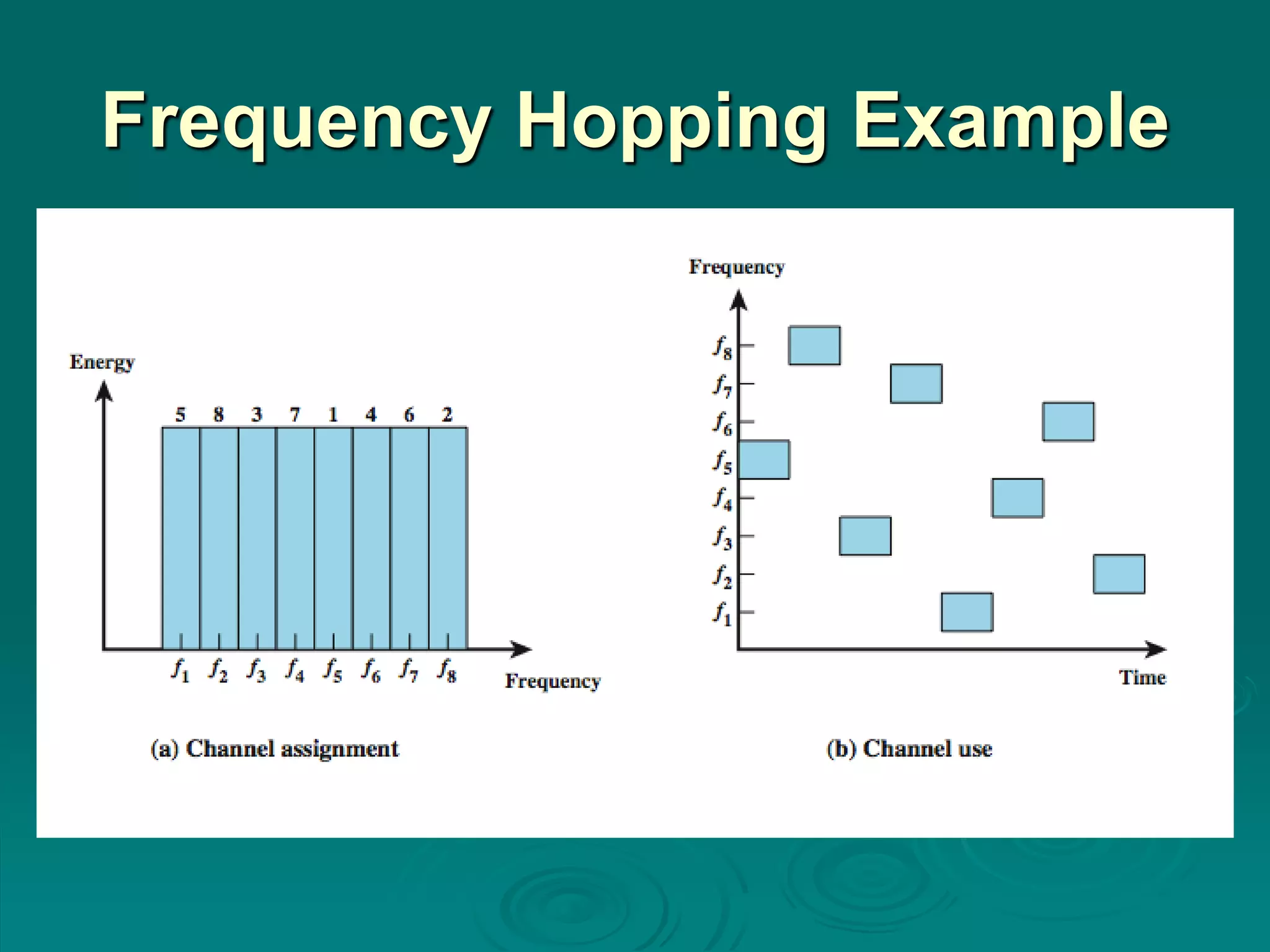
 signal is broadcast over seemingly random
series of frequencies
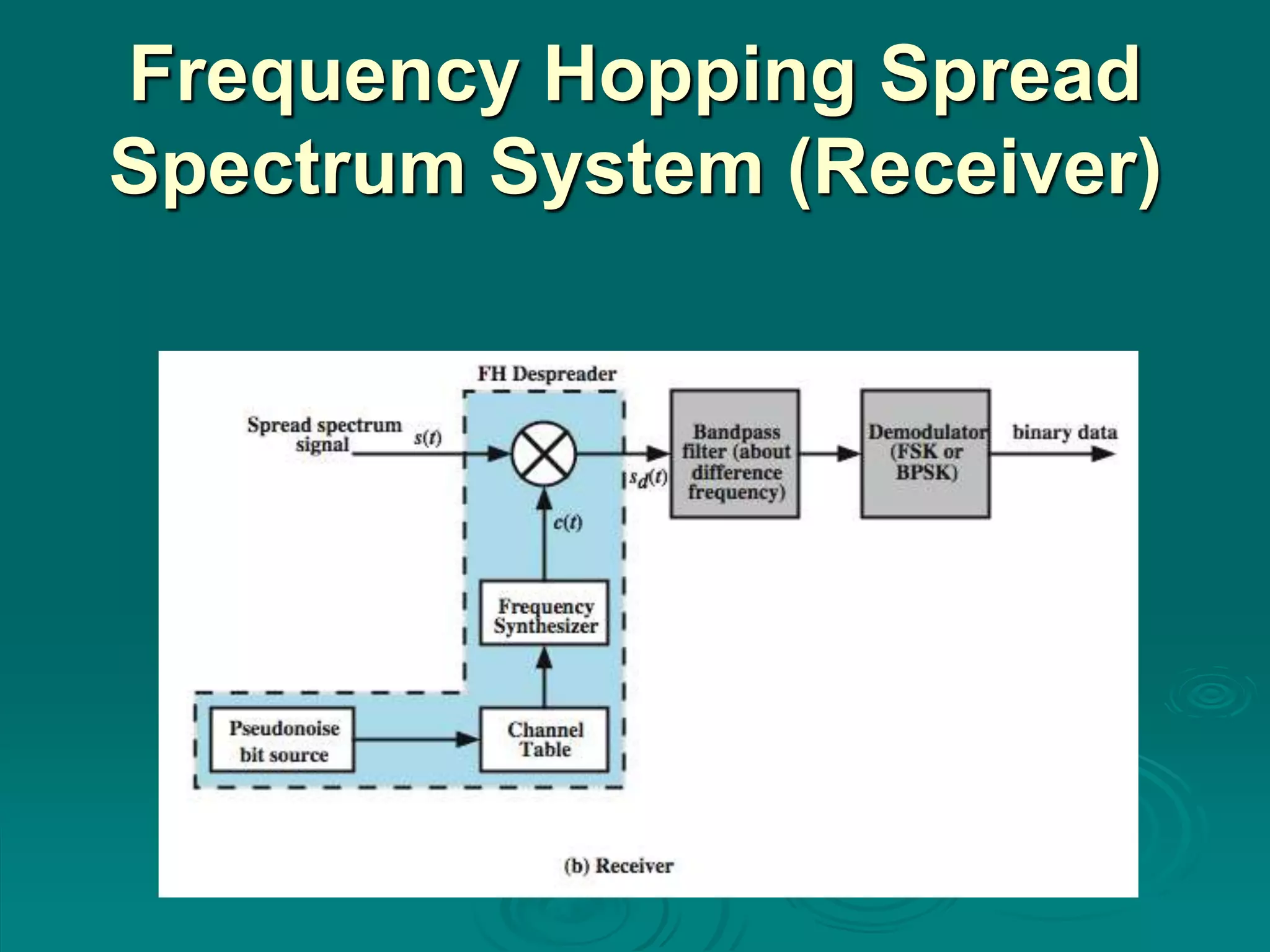
 receiver hops between frequencies in sync
with transmitter
 eavesdroppers hear unintelligible blips
 jamming on one frequency affects only a
few bits
Frequency Hopping Example
FHSS (Transmitter)
Frequency Hopping Spread
Spectrum System (Receiver)
Slow and Fast FHSS
 commonly use multiple FSK (MFSK)
 have frequency shifted every Tc seconds
 duration of signal element is Ts seconds
 Slow FHSS has Tc  Ts
 Fast FHSS has Tc < Ts
 FHSS quite resistant to noise or jamming
 with fast FHSS giving better performance
Slow MFSK FHSS
Fast MFSK FHSS
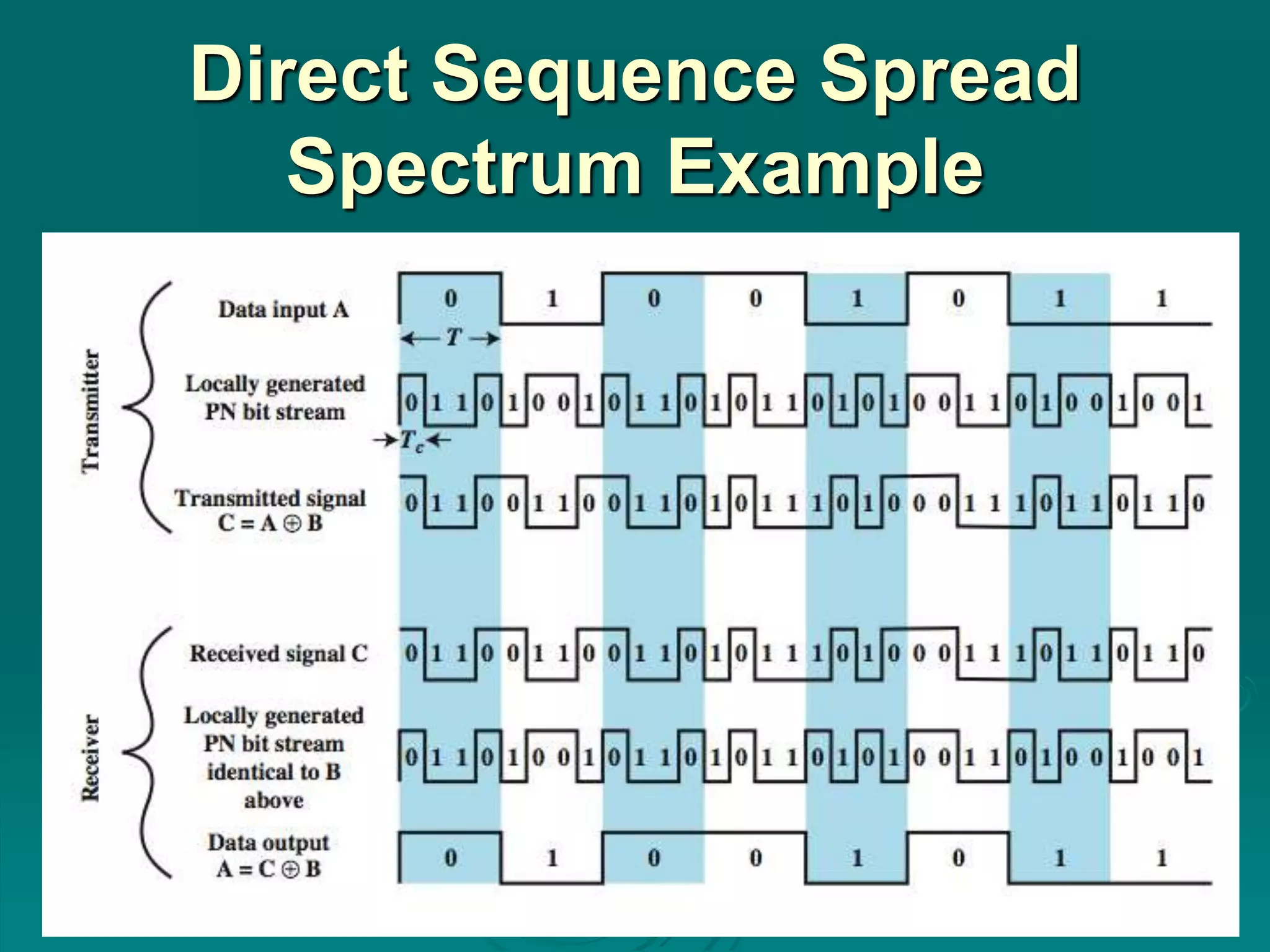
Direct Sequence Spread
Spectrum (DSSS)
 each bit is represented by multiple bits
using a spreading code
 this spreads signal across a wider
frequency band
 has performance similar to FHSS
Direct Sequence Spread
Spectrum Example
Direct Sequence Spread
Spectrum System
DSSS Example Using BPSK
Approximate
Spectrum of
DSSS Signal
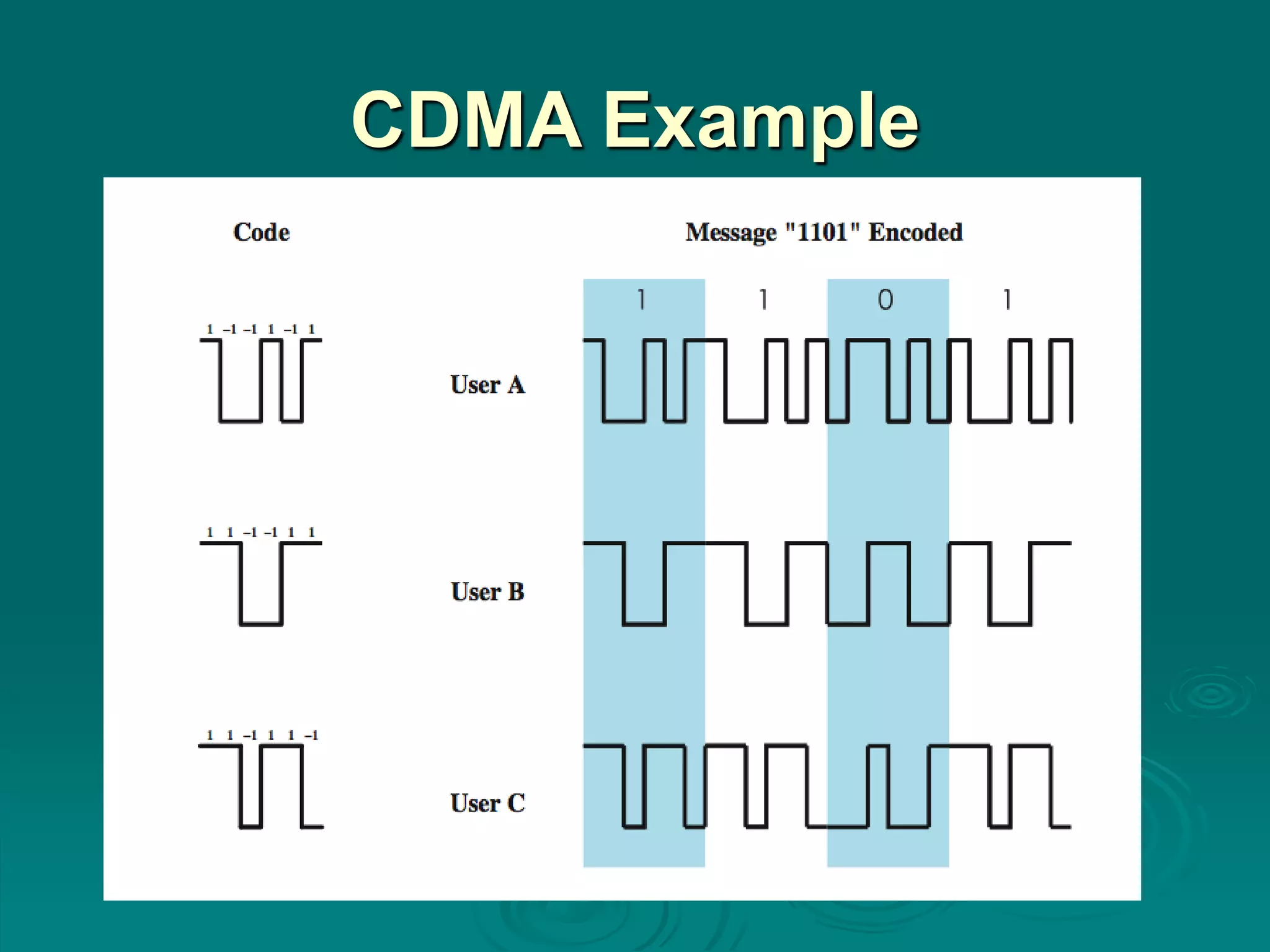
Code Division Multiple
Access (CDMA)
 a multiplexing technique used with spread
spectrum
 given a data signal rate D
 break each bit into k chips according to a
fixed chipping code specific to each user
 resulting new channel has chip data rate
kD chips per second
 can have multiple channels superimposed
CDMA Example
CDMA for DSSS
Summary
 looked at use of spread spectrum
techniques:
 FHSS
 DSSS
 CDMA

09-SpreadSpectrum.ppt