SPORTS   MOUTHGUARDS Prepared by:  GBC Dental Hygiene Students Nancy Fong, Anna-Marie Maliwat, Jennie Trinh, Thuy Vu
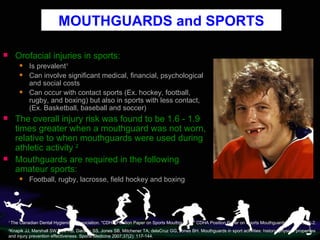
Orofacial injuries in sports: Is prevalent 1 Can involve significant medical, financial, psychological and social costs Can occur with contact sports (Ex. hockey, football, rugby, and boxing) but also in sports with less contact, (Ex. Basketball, baseball and soccer) The overall injury risk was found to be 1.6 - 1.9 times greater when a mouthguard was not worn, relative to when mouthguards were used during athletic activity  2 Mouthguards are required in the following amateur sports: Football, rugby, lacrosse, field hockey and boxing 1  The Canadian Dental Hygienists' Association. "CDHA Position Paper on Sports Mouthguards." CDHA Position Paper on Sports Mouthguards 39 (2005): 1-2.  2 Knapik JJ, Marshall SW, Lee RB, Darakjy SS, Jones SB, Mitchener TA; delaCruz GG, Jones BH. Mouthguards in sport activities: history, physical properties and injury prevention effectiveness. Sports Medicine 2007;37(2): 117-144. MOUTHGUARDS and SPORTS
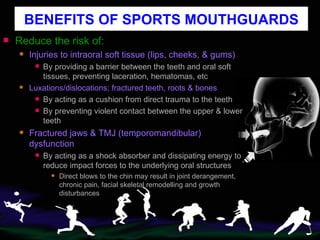
BENEFITS OF SPORTS MOUTHGUARDS Reduce the risk of: Injuries to intraoral soft tissue (lips, cheeks, & gums) By providing a barrier between the teeth and oral soft tissues, preventing laceration, hematomas, etc Luxations/dislocations; fractured teeth, roots & bones By acting as a cushion from direct trauma to the teeth By preventing violent contact between the upper & lower teeth Fractured jaws & TMJ (temporomandibular) dysfunction By acting as a shock absorber and dissipating energy to reduce impact forces to the underlying oral structures Direct blows to the chin may result in joint derangement, chronic pain, facial skeletal remodelling and growth disturbances
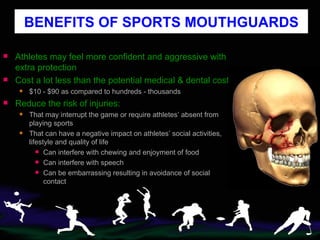
Athletes may feel more confident and aggressive with extra protection Cost a lot less than the potential medical & dental cost  $10 - $90 as compared to hundreds - thousands Reduce the risk of injuries: That may interrupt the game or require athletes’ absent from playing sports That can have a negative impact on athletes’ social activities, lifestyle and quality of life Can interfere with chewing and enjoyment of food Can interfere with speech Can be embarrassing resulting in avoidance of social contact BENEFITS OF SPORTS MOUTHGUARDS
WHAT TO LOOK FOR WHEN  CHOOSING SPORTS MOUTHGUARDS It should fit properly  Stays securely in place by adapting to oral structures Covers all teeth in the arch Comfortable Should not restrict your speech especially in sports where you need to communicate verbally with your coach, team members and referee  Should not restrict your breathing for good flow of oxygen for better performance and less muscle fatigue Increased chance of usage  Absorb high impact energy and dissipate the energy This reduces impact forces to the underlying oral structures Durable and tear resistant Bright colour Transparent mouthguards are harder to retrieve if they are dislodged from the mouth Easy to clean
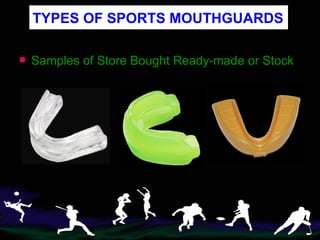
TYPES OF SPORTS MOUTHGUARDS Store Bought Ready-made or Stock Thermoplastic tray that is preformed and ready to wear Limited in sized which may lead to discomfort Fits loosely over the teeth and does not adapt well to or grip onto teeth Requires athlete to bite down in order to stay in place This requires the wearer’s mouth to be closed to provide any protective benefit Can interfere with breathing and speaking   Shifts and allows gaps between the teeth which may results in reduced protection Least expensive Can be purchased at any sporting goods store or through the Internet
TYPES OF SPORTS MOUTHGUARDS Samples of Store Bought Ready-made or Stock
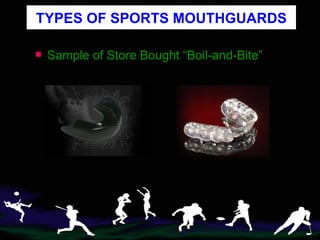
Store bought “Boil-and-Bite” Sold as a standard tray of thermoplastic material Formed by softening it in hot water, briefly cooling it in cold water, placing it in the mouth and shaping the material with fingers, tongue and some biting pressure to form a stable impression 1 In order to get the protection that it is intended to provide, care must be taken during formation to achieve a consistent thickness in the lips and biting/grinding surfaces When shaping the mouthguard, the height and width can be reduced which results in less protection Can be reshaped Can be worn over orthodontic appliances/braces Although it conforms to the mouth better than stock, it is still loose fitting which can interfere with breathing and speaking Less adequate cushioning, retention and absorption than custom-made mouthguards 1 Most do not properly cover all posterior/back teeth Inexpensive Can be purchased in sporting goods stores or on the Internet TYPES OF SPORTS MOUTHGUARDS 1 American Dental Association. "Using mouthguards to reduce the incidence and severity of sports-related oral injuries." The Journal of the American Dental Association (2006) 137: 1712-1720.
TYPES OF SPORTS MOUTHGUARDS Sample of Store Bought “Boil-and-Bite”
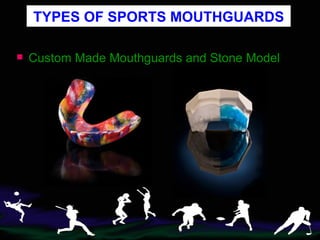
Custom Made Individually designed and form-fitted in a dental office An impression is taken of the upper set of teeth   by the dental professional A stone model is poured from the impression A thermoplastic material is formed over the stone model which is then trimmed to fit into the mouth over the upper teeth More adaptability to orthodontic appliances/braces Very important to have a custom made mouthguard when athlete is undergoing orthodontic treatment since brackets and wires can be damaged and cause further damage to hard and soft tissues of mouth A mandibular (lower jaw) mouthguard should be considered in an athlete with braces for extra protection Provide better retention and comfort than the previous 2 types Maintains its position in the mouth without the need for the wearer to bite down Therefore, less interference with speech and breathing Can choose different designs and colours (i.e. team colour) Most expensive option (stay tuned for a less expensive option) Most durable TYPES OF SPORTS MOUTHGUARDS
Custom Made Mouthguards and Stone Model TYPES OF SPORTS MOUTHGUARDS
Custom Made – Impression Taking Experience TYPES OF SPORTS MOUTHGUARDS http://www.youtube.com/watch?v=oVz07KqGQek
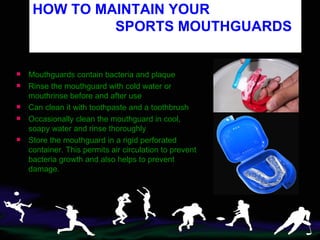
HOW TO MAINTAIN YOUR    SPORTS MOUTHGUARDS   Mouthguards contain bacteria and plaque Rinse the mouthguard   with cold water or mouthrinse before and after use Can clean it with toothpaste and a toothbrush Occasionally clean the mouthguard in cool, soapy water and rinse thoroughly Store the mouthguard in a rigid perforated container. This permits air circulation to prevent bacteria growth and also helps to prevent damage.
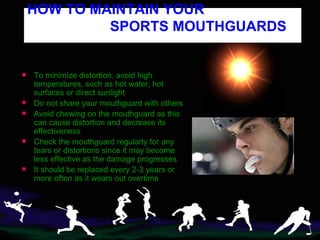
To minimize distortion, avoid high temperatures, such as hot water, hot surfaces or direct sunlight Do not share your mouthguard with others Avoid chewing on the mouthguard as this can cause distortion and decrease its effectiveness  Check the mouthguard regularly for any tears or distortions since it may become less effective as the damage progresses It should be replaced every 2-3 years or more often as it wears out overtime  HOW TO MAINTAIN YOUR    SPORTS MOUTHGUARDS
SPORTS MOUTHGUARD at GBC The George Brown College Interprofessional Learning Clinic at the Casa Loma Campus offers dental hygiene, denture and restorative services Dental Cleaning -$35 Sports Mouthguard (custom-made) - $40 If you are a student in a   Health Science program at GBC, dental cleaning and x-rays are free. For a complete fee schedule of all services provided, please visit  www.georgebrown.ca/clinic For more information, please call (416) 415-4604 Cash, credit, and debit are all acceptable methods of payment Insurance coverage is also accepted
THE END PLEASE go to the following link below or to the right info box to fill out a short post-survey regarding this presentation   http://www.esurveyspro.com/Survey.aspx?id=45095416-330e-4590-a818-fdbf21b55115 Your participation and input will be of great significance in the completion of our project and GREATLY APPRECIATED! Feel free to email us any questions/comments to gbcdhstudy@gmail.com Thank you for your participation in making the completion of our project possible We hope you have gained important new information that will help ease the decision making process on whether you should wear sports mouthguards for your future athletic endeavors and also on the type of mouthguards that would suit you best GO…  !!!
REFERENCE American Dental Association. &quot;Using mouthguards to reduce the incidence and severity of sports-related oral injuries.&quot; The Journal of the American Dental Association (2006) 137: 1712-1720. Bull, Charles and Roberts, William O., Dental Injuries. Bull’s Handbook of Sports Injuries. 2nd ed. 14: 163-177. Jones, Devin. &quot;Mouthguard Awareness.&quot; Comp. CDHO. Mouthguard Awareness.  &quot;Mouth guards: sports mouthguards / football protectors / athletic mouthpieces.&quot; Mouth guards: sports mouthguards / football protectors / athletic mouthpieces. 2006. Animated-Teeth. 2009 <http://www.animated-teeth.com/mouthguards/a1-mouth-guards.htm>.  Ontario Dental Association. &quot;Sports and Activities.&quot; Sports and Activities. Your Oral Health. <http://www.youroralhealth.ca/content/view/126/180/>.  Parmet et.al., “Concussion in Sports.” The Journal of the American Medical Association. Nov 2003; 290: 2628. The Canadian Dental Hygienists Association. &quot;CDHA Position Paper on Sports Mouthguards.&quot; CDHA Position Paper on Sports Mouthguards 39 (2005): 1-2.

Sports Mouthguard Presentation

  • 1.
    SPORTS MOUTHGUARDS Prepared by: GBC Dental Hygiene Students Nancy Fong, Anna-Marie Maliwat, Jennie Trinh, Thuy Vu
  • 2.
    Orofacial injuries insports: Is prevalent 1 Can involve significant medical, financial, psychological and social costs Can occur with contact sports (Ex. hockey, football, rugby, and boxing) but also in sports with less contact, (Ex. Basketball, baseball and soccer) The overall injury risk was found to be 1.6 - 1.9 times greater when a mouthguard was not worn, relative to when mouthguards were used during athletic activity 2 Mouthguards are required in the following amateur sports: Football, rugby, lacrosse, field hockey and boxing 1 The Canadian Dental Hygienists' Association. &quot;CDHA Position Paper on Sports Mouthguards.&quot; CDHA Position Paper on Sports Mouthguards 39 (2005): 1-2. 2 Knapik JJ, Marshall SW, Lee RB, Darakjy SS, Jones SB, Mitchener TA; delaCruz GG, Jones BH. Mouthguards in sport activities: history, physical properties and injury prevention effectiveness. Sports Medicine 2007;37(2): 117-144. MOUTHGUARDS and SPORTS
  • 3.
    BENEFITS OF SPORTSMOUTHGUARDS Reduce the risk of: Injuries to intraoral soft tissue (lips, cheeks, & gums) By providing a barrier between the teeth and oral soft tissues, preventing laceration, hematomas, etc Luxations/dislocations; fractured teeth, roots & bones By acting as a cushion from direct trauma to the teeth By preventing violent contact between the upper & lower teeth Fractured jaws & TMJ (temporomandibular) dysfunction By acting as a shock absorber and dissipating energy to reduce impact forces to the underlying oral structures Direct blows to the chin may result in joint derangement, chronic pain, facial skeletal remodelling and growth disturbances
  • 4.
    Athletes may feelmore confident and aggressive with extra protection Cost a lot less than the potential medical & dental cost $10 - $90 as compared to hundreds - thousands Reduce the risk of injuries: That may interrupt the game or require athletes’ absent from playing sports That can have a negative impact on athletes’ social activities, lifestyle and quality of life Can interfere with chewing and enjoyment of food Can interfere with speech Can be embarrassing resulting in avoidance of social contact BENEFITS OF SPORTS MOUTHGUARDS
  • 5.
    WHAT TO LOOKFOR WHEN CHOOSING SPORTS MOUTHGUARDS It should fit properly Stays securely in place by adapting to oral structures Covers all teeth in the arch Comfortable Should not restrict your speech especially in sports where you need to communicate verbally with your coach, team members and referee Should not restrict your breathing for good flow of oxygen for better performance and less muscle fatigue Increased chance of usage Absorb high impact energy and dissipate the energy This reduces impact forces to the underlying oral structures Durable and tear resistant Bright colour Transparent mouthguards are harder to retrieve if they are dislodged from the mouth Easy to clean
  • 6.
    TYPES OF SPORTSMOUTHGUARDS Store Bought Ready-made or Stock Thermoplastic tray that is preformed and ready to wear Limited in sized which may lead to discomfort Fits loosely over the teeth and does not adapt well to or grip onto teeth Requires athlete to bite down in order to stay in place This requires the wearer’s mouth to be closed to provide any protective benefit Can interfere with breathing and speaking Shifts and allows gaps between the teeth which may results in reduced protection Least expensive Can be purchased at any sporting goods store or through the Internet
  • 7.
    TYPES OF SPORTSMOUTHGUARDS Samples of Store Bought Ready-made or Stock
  • 8.
    Store bought “Boil-and-Bite”Sold as a standard tray of thermoplastic material Formed by softening it in hot water, briefly cooling it in cold water, placing it in the mouth and shaping the material with fingers, tongue and some biting pressure to form a stable impression 1 In order to get the protection that it is intended to provide, care must be taken during formation to achieve a consistent thickness in the lips and biting/grinding surfaces When shaping the mouthguard, the height and width can be reduced which results in less protection Can be reshaped Can be worn over orthodontic appliances/braces Although it conforms to the mouth better than stock, it is still loose fitting which can interfere with breathing and speaking Less adequate cushioning, retention and absorption than custom-made mouthguards 1 Most do not properly cover all posterior/back teeth Inexpensive Can be purchased in sporting goods stores or on the Internet TYPES OF SPORTS MOUTHGUARDS 1 American Dental Association. &quot;Using mouthguards to reduce the incidence and severity of sports-related oral injuries.&quot; The Journal of the American Dental Association (2006) 137: 1712-1720.
  • 9.
    TYPES OF SPORTSMOUTHGUARDS Sample of Store Bought “Boil-and-Bite”
  • 10.
    Custom Made Individuallydesigned and form-fitted in a dental office An impression is taken of the upper set of teeth by the dental professional A stone model is poured from the impression A thermoplastic material is formed over the stone model which is then trimmed to fit into the mouth over the upper teeth More adaptability to orthodontic appliances/braces Very important to have a custom made mouthguard when athlete is undergoing orthodontic treatment since brackets and wires can be damaged and cause further damage to hard and soft tissues of mouth A mandibular (lower jaw) mouthguard should be considered in an athlete with braces for extra protection Provide better retention and comfort than the previous 2 types Maintains its position in the mouth without the need for the wearer to bite down Therefore, less interference with speech and breathing Can choose different designs and colours (i.e. team colour) Most expensive option (stay tuned for a less expensive option) Most durable TYPES OF SPORTS MOUTHGUARDS
  • 11.
    Custom Made Mouthguardsand Stone Model TYPES OF SPORTS MOUTHGUARDS
  • 12.
    Custom Made –Impression Taking Experience TYPES OF SPORTS MOUTHGUARDS http://www.youtube.com/watch?v=oVz07KqGQek
  • 13.
    HOW TO MAINTAINYOUR SPORTS MOUTHGUARDS Mouthguards contain bacteria and plaque Rinse the mouthguard with cold water or mouthrinse before and after use Can clean it with toothpaste and a toothbrush Occasionally clean the mouthguard in cool, soapy water and rinse thoroughly Store the mouthguard in a rigid perforated container. This permits air circulation to prevent bacteria growth and also helps to prevent damage.
  • 14.
    To minimize distortion,avoid high temperatures, such as hot water, hot surfaces or direct sunlight Do not share your mouthguard with others Avoid chewing on the mouthguard as this can cause distortion and decrease its effectiveness Check the mouthguard regularly for any tears or distortions since it may become less effective as the damage progresses It should be replaced every 2-3 years or more often as it wears out overtime HOW TO MAINTAIN YOUR SPORTS MOUTHGUARDS
  • 15.
    SPORTS MOUTHGUARD atGBC The George Brown College Interprofessional Learning Clinic at the Casa Loma Campus offers dental hygiene, denture and restorative services Dental Cleaning -$35 Sports Mouthguard (custom-made) - $40 If you are a student in a Health Science program at GBC, dental cleaning and x-rays are free. For a complete fee schedule of all services provided, please visit www.georgebrown.ca/clinic For more information, please call (416) 415-4604 Cash, credit, and debit are all acceptable methods of payment Insurance coverage is also accepted
  • 16.
    THE END PLEASEgo to the following link below or to the right info box to fill out a short post-survey regarding this presentation  http://www.esurveyspro.com/Survey.aspx?id=45095416-330e-4590-a818-fdbf21b55115 Your participation and input will be of great significance in the completion of our project and GREATLY APPRECIATED! Feel free to email us any questions/comments to gbcdhstudy@gmail.com Thank you for your participation in making the completion of our project possible We hope you have gained important new information that will help ease the decision making process on whether you should wear sports mouthguards for your future athletic endeavors and also on the type of mouthguards that would suit you best GO… !!!
  • 17.
    REFERENCE American DentalAssociation. &quot;Using mouthguards to reduce the incidence and severity of sports-related oral injuries.&quot; The Journal of the American Dental Association (2006) 137: 1712-1720. Bull, Charles and Roberts, William O., Dental Injuries. Bull’s Handbook of Sports Injuries. 2nd ed. 14: 163-177. Jones, Devin. &quot;Mouthguard Awareness.&quot; Comp. CDHO. Mouthguard Awareness. &quot;Mouth guards: sports mouthguards / football protectors / athletic mouthpieces.&quot; Mouth guards: sports mouthguards / football protectors / athletic mouthpieces. 2006. Animated-Teeth. 2009 <http://www.animated-teeth.com/mouthguards/a1-mouth-guards.htm>. Ontario Dental Association. &quot;Sports and Activities.&quot; Sports and Activities. Your Oral Health. <http://www.youroralhealth.ca/content/view/126/180/>. Parmet et.al., “Concussion in Sports.” The Journal of the American Medical Association. Nov 2003; 290: 2628. The Canadian Dental Hygienists Association. &quot;CDHA Position Paper on Sports Mouthguards.&quot; CDHA Position Paper on Sports Mouthguards 39 (2005): 1-2.