SPONDYLITIS
N.Sowjanya,
Pharm D III yr.
Definition
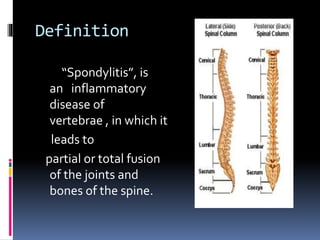
“Spondylitis”, is
an inflammatory disease
disease of vertebrae
vertebrae , in which it
leads to
partial or total fusion
of the joints and
bones of the spine.
Epidemology
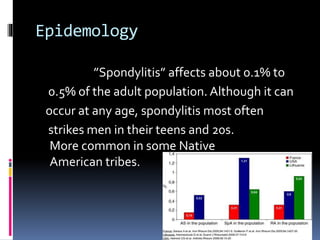
”Spondylitis” affects about 0.1% to
0.5% of the adult population. Although it can
occur at any age, spondylitis most often
strikes men in their teens and 20s.
More common in some Native
American tribes.
Etiology
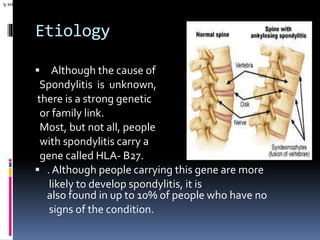
 Although the cause of
Spondylitis is unknown,
there is a strong genetic
or family link.
Most, but not all, people
with spondylitis carry a
gene called HLA- B27.
 . Although people carrying this gene are more
likely to develop spondylitis, it is
also found in up to 10% of people who have no
signs of the condition.
ly link. Most, but not all, people with spondylitis carry a gene called HLA-B27. Although people carrying this gene are more likely to develop spondylitis, it isalso fou
TYPES
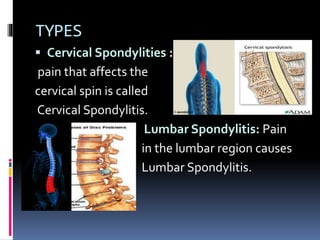
 Cervical Spondylities :
pain that affects the
cervical spin is called
Cervical Spondylitis.
Lumbar Spondylitis: Pain
in the lumbar region causes
Lumbar Spondylitis.
Ankylosing spondylitis
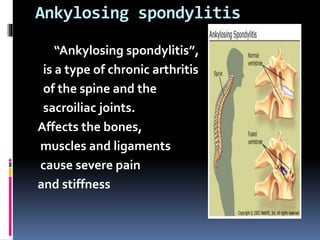
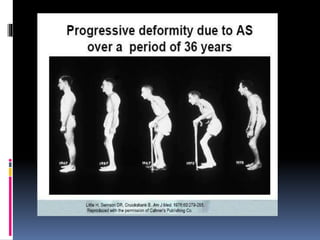
“Ankylosing spondylitis”,
is a type of chronic arthritis
of the spine and the
sacroiliac joints.
Affects the bones,
muscles and ligaments
cause severe pain
and stiffness
PATHOGENESIS
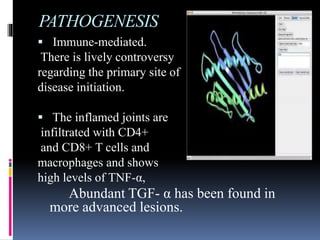
 Immune-mediated.
There is lively controversy
regarding the primary site of
disease initiation.
 The inflamed joints are
infiltrated with CD4+
and CD8+ T cells and
macrophages and shows
high levels of TNF-α,
Abundant TGF- α has been found in
more advanced lesions.
 It is characterized by neutrophils,
macrophages expressing CD68 and CD163,
CD4+ and CD8+ T cells, B cells , ICAM-
1, VCAM-1,
 No specific event or exogenous agent that
triggers the onset but reactive arthritis and
inflammatory bowel disease (IBD) suggest
that enteric bacteria may play a role.
 Elevated serum titers of antibodies to
certain enteric bacteria but no role for these
antibodies in the pathogenesis of AS
 B27 plays a direct role & develop
spondylitis.
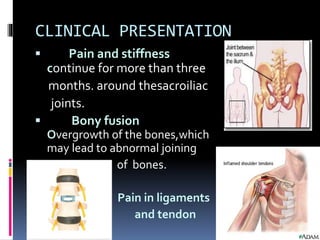
CLINICAL PRESENTATION
 Pain and stiffness
continue for more than three
months. around thesacroiliac
joints.
 Bony fusion
Overgrowth of the bones,which
may lead to abnormal joining
 of bones.
Pain in ligaments
and tendon
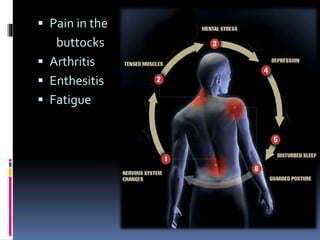
 Pain in the
buttocks
 Arthritis
 Enthesitis
 Fatigue
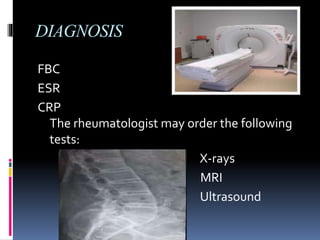
FBC
ESR
CRP
The rheumatologist may order the following
tests:
X-rays
MRI
Ultrasound
DIAGNOSIS
TREATMENT
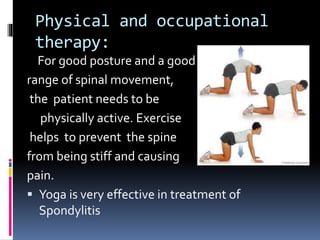
Physical and occupational
therapy:
For good posture and a good
range of spinal movement,
the patient needs to be
physically active. Exercise
helps to prevent the spine
from being stiff and causing
pain.
 Yoga is very effective in treatment of
Spondylitis
 Surgery: Depending on the patient’s
clinical situation two types.
Joint Replacement
surgery can allow people
to regain the use of joints.
Ostectomy
A surgical procedure that involves cutting
a section of bone in order to shorten or
lengthen the bone itself.
MEDICATIONS
 Painkillers
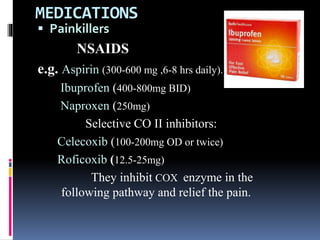
NSAIDS
e.g. Aspirin (300-600 mg ,6-8 hrs daily).
Ibuprofen (400-800mg BID)
Naproxen (250mg)
Selective CO II inhibitors:
Celecoxib (100-200mg OD or twice)
Roficoxib (12.5-25mg)
They inhibit COX enzyme in the
following pathway and relief the pain.
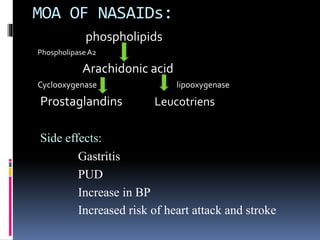
MOA OF NASAIDs:
phospholipids
PhospholipaseA2
Arachidonic acid
Cyclooxygenase lipooxygenase
Prostaglandins Leucotriens
Side effects:
Gastritis
PUD
Increase in BP
Increased risk of heart attack and stroke
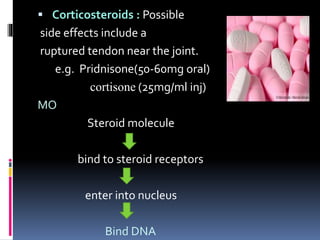
 Corticosteroids : Possible
side effects include a
ruptured tendon near the joint.
e.g. Pridnisone(50-60mg oral)
cortisone (25mg/ml inj)
MO
Steroid molecule
bind to steroid receptors
enter into nucleus
Bind DNA
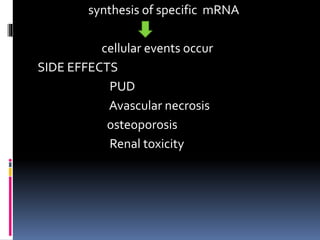
synthesis of specific mRNA
cellular events occur
SIDE EFFECTS
PUD
Avascular necrosis
osteoporosis
Renal toxicity
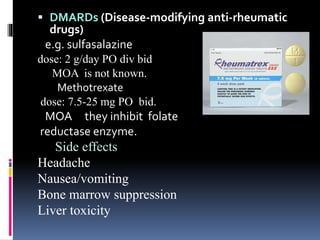
 DMARDs (Disease-modifying anti-rheumatic
drugs)
e.g. sulfasalazine
dose: 2 g/day PO div bid
MOA is not known.
Methotrexate
dose: 7.5-25 mg PO bid.
MOA they inhibit folate
reductase enzyme.
Side effects
Headache
Nausea/vomiting
Bone marrow suppression
Liver toxicity
 Biologics:
Tumor necrosis factor (TNF) blockers
e.g. Etanercept given as a weekly subcutaneous
injection
Remicade (Infliximab) given as a 2-hour IV
infusion every 6 weeks
Humira (Adalimumab) subcutaneous injection given
twice a month.
Simponi (Golimumab) subcutaneous injection
given once a month to treat active ankylosing
spondylitis.
MOA
These drugs aim to reduce the amount of
TNF (a protein in the body that triggers
inflammation leading to the symptoms of
ankylosing spondylitis)
 Side effects:
Redness,
Swelling,
Itching, rash.
occur at the injection site and typically last no more
than 3 to 5 days.
Side effects:
 Side effects:
Redness,
Swelling,
Itching, rash.
occur at the injection site and typically last no more
than 3 to 5 days.
Complications:
 Uveitis
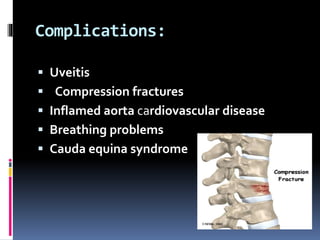
 Compression fractures
 Inflamed aorta cardiovascular disease
 Breathing problems
 Cauda equina syndrome
 http://www.spondylitis.org/about/overview.aspx

http://www.accesspharmacy.com/content.aspx?aID=28627
56
 http://www.spine-
health.com/conditions/arthritis/ankylosing-spondylitis-
symptoms
 http://basdai.com/
 https://online.epocrates.com/noFrame/showPage.do?meth
od=drugs&MonographId=284&ActiveSectionI
 http://www.spondylitis.org/about/as_treat.aspx
 https://online.epocrates.com/noFrame/showPage.do?meth
od=drugs&MonographId=1186
SPONDYLITIS.pptx

SPONDYLITIS.pptx

  • 1.
  • 2.
    Definition “Spondylitis”, is an inflammatorydisease disease of vertebrae vertebrae , in which it leads to partial or total fusion of the joints and bones of the spine.
  • 3.
    Epidemology ”Spondylitis” affects about0.1% to 0.5% of the adult population. Although it can occur at any age, spondylitis most often strikes men in their teens and 20s. More common in some Native American tribes.
  • 4.
    Etiology  Although thecause of Spondylitis is unknown, there is a strong genetic or family link. Most, but not all, people with spondylitis carry a gene called HLA- B27.  . Although people carrying this gene are more likely to develop spondylitis, it is also found in up to 10% of people who have no signs of the condition. ly link. Most, but not all, people with spondylitis carry a gene called HLA-B27. Although people carrying this gene are more likely to develop spondylitis, it isalso fou
  • 5.
    TYPES  Cervical Spondylities: pain that affects the cervical spin is called Cervical Spondylitis. Lumbar Spondylitis: Pain in the lumbar region causes Lumbar Spondylitis.
  • 6.
    Ankylosing spondylitis “Ankylosing spondylitis”, isa type of chronic arthritis of the spine and the sacroiliac joints. Affects the bones, muscles and ligaments cause severe pain and stiffness
  • 8.
    PATHOGENESIS  Immune-mediated. There islively controversy regarding the primary site of disease initiation.  The inflamed joints are infiltrated with CD4+ and CD8+ T cells and macrophages and shows high levels of TNF-α, Abundant TGF- α has been found in more advanced lesions.
  • 9.
     It ischaracterized by neutrophils, macrophages expressing CD68 and CD163, CD4+ and CD8+ T cells, B cells , ICAM- 1, VCAM-1,  No specific event or exogenous agent that triggers the onset but reactive arthritis and inflammatory bowel disease (IBD) suggest that enteric bacteria may play a role.  Elevated serum titers of antibodies to certain enteric bacteria but no role for these antibodies in the pathogenesis of AS  B27 plays a direct role & develop spondylitis.
  • 10.
    CLINICAL PRESENTATION  Painand stiffness continue for more than three months. around thesacroiliac joints.  Bony fusion Overgrowth of the bones,which may lead to abnormal joining  of bones. Pain in ligaments and tendon
  • 11.
     Pain inthe buttocks  Arthritis  Enthesitis  Fatigue
  • 12.
    FBC ESR CRP The rheumatologist mayorder the following tests: X-rays MRI Ultrasound DIAGNOSIS
  • 13.
  • 14.
    Physical and occupational therapy: Forgood posture and a good range of spinal movement, the patient needs to be physically active. Exercise helps to prevent the spine from being stiff and causing pain.  Yoga is very effective in treatment of Spondylitis
  • 15.
     Surgery: Dependingon the patient’s clinical situation two types. Joint Replacement surgery can allow people to regain the use of joints. Ostectomy A surgical procedure that involves cutting a section of bone in order to shorten or lengthen the bone itself.
  • 17.
    MEDICATIONS  Painkillers NSAIDS e.g. Aspirin(300-600 mg ,6-8 hrs daily). Ibuprofen (400-800mg BID) Naproxen (250mg) Selective CO II inhibitors: Celecoxib (100-200mg OD or twice) Roficoxib (12.5-25mg) They inhibit COX enzyme in the following pathway and relief the pain.
  • 18.
    MOA OF NASAIDs: phospholipids PhospholipaseA2 Arachidonicacid Cyclooxygenase lipooxygenase Prostaglandins Leucotriens Side effects: Gastritis PUD Increase in BP Increased risk of heart attack and stroke
  • 19.
     Corticosteroids :Possible side effects include a ruptured tendon near the joint. e.g. Pridnisone(50-60mg oral) cortisone (25mg/ml inj) MO Steroid molecule bind to steroid receptors enter into nucleus Bind DNA
  • 20.
    synthesis of specificmRNA cellular events occur SIDE EFFECTS PUD Avascular necrosis osteoporosis Renal toxicity
  • 21.
     DMARDs (Disease-modifyinganti-rheumatic drugs) e.g. sulfasalazine dose: 2 g/day PO div bid MOA is not known. Methotrexate dose: 7.5-25 mg PO bid. MOA they inhibit folate reductase enzyme. Side effects Headache Nausea/vomiting Bone marrow suppression Liver toxicity
  • 22.
     Biologics: Tumor necrosisfactor (TNF) blockers e.g. Etanercept given as a weekly subcutaneous injection Remicade (Infliximab) given as a 2-hour IV infusion every 6 weeks Humira (Adalimumab) subcutaneous injection given twice a month. Simponi (Golimumab) subcutaneous injection given once a month to treat active ankylosing spondylitis.
  • 23.
    MOA These drugs aimto reduce the amount of TNF (a protein in the body that triggers inflammation leading to the symptoms of ankylosing spondylitis)  Side effects: Redness, Swelling, Itching, rash. occur at the injection site and typically last no more than 3 to 5 days.
  • 24.
    Side effects:  Sideeffects: Redness, Swelling, Itching, rash. occur at the injection site and typically last no more than 3 to 5 days.
  • 25.
    Complications:  Uveitis  Compressionfractures  Inflamed aorta cardiovascular disease  Breathing problems  Cauda equina syndrome
  • 26.
     http://www.spondylitis.org/about/overview.aspx  http://www.accesspharmacy.com/content.aspx?aID=28627 56  http://www.spine- health.com/conditions/arthritis/ankylosing-spondylitis- symptoms http://basdai.com/  https://online.epocrates.com/noFrame/showPage.do?meth od=drugs&MonographId=284&ActiveSectionI  http://www.spondylitis.org/about/as_treat.aspx  https://online.epocrates.com/noFrame/showPage.do?meth od=drugs&MonographId=1186