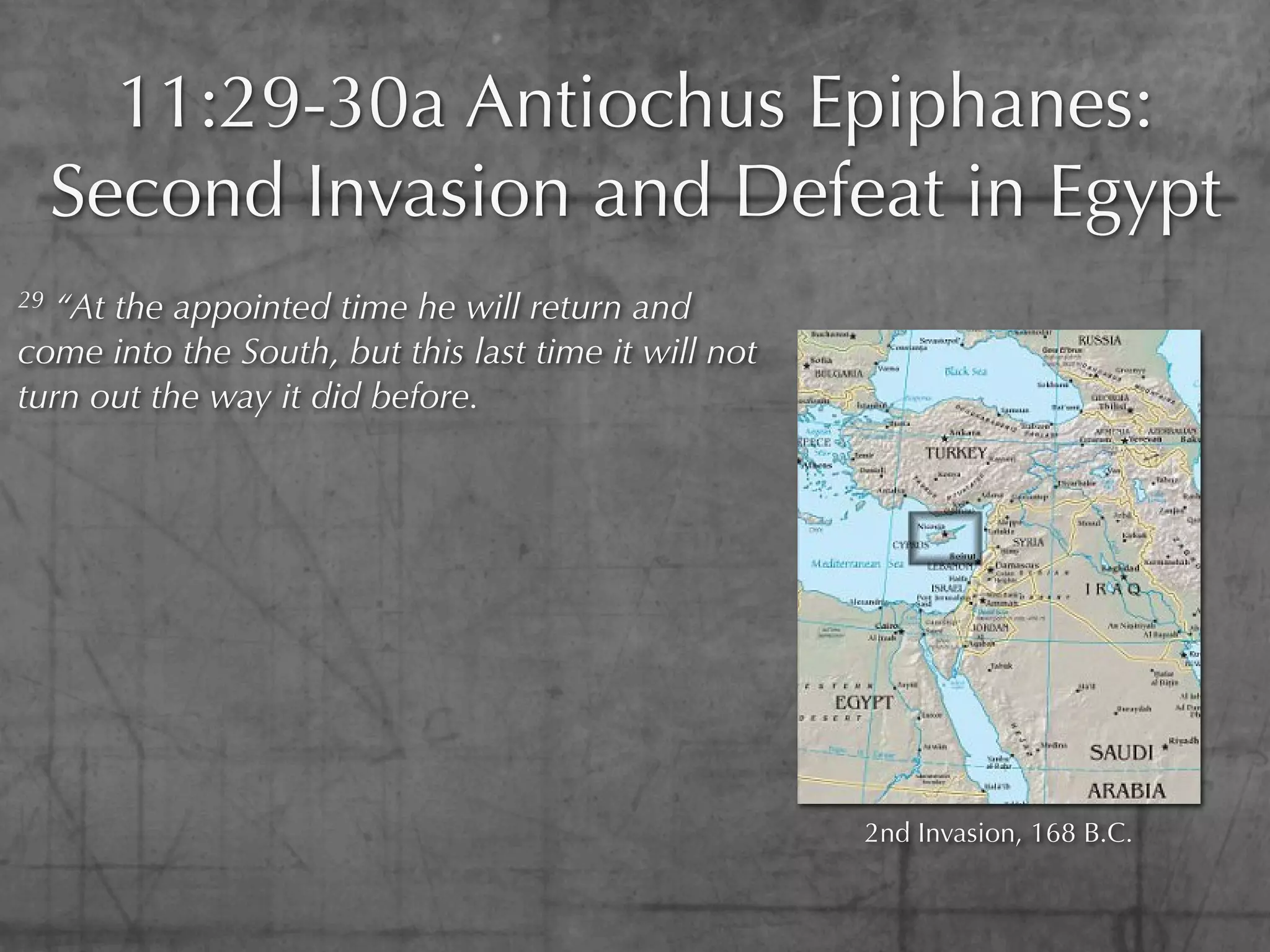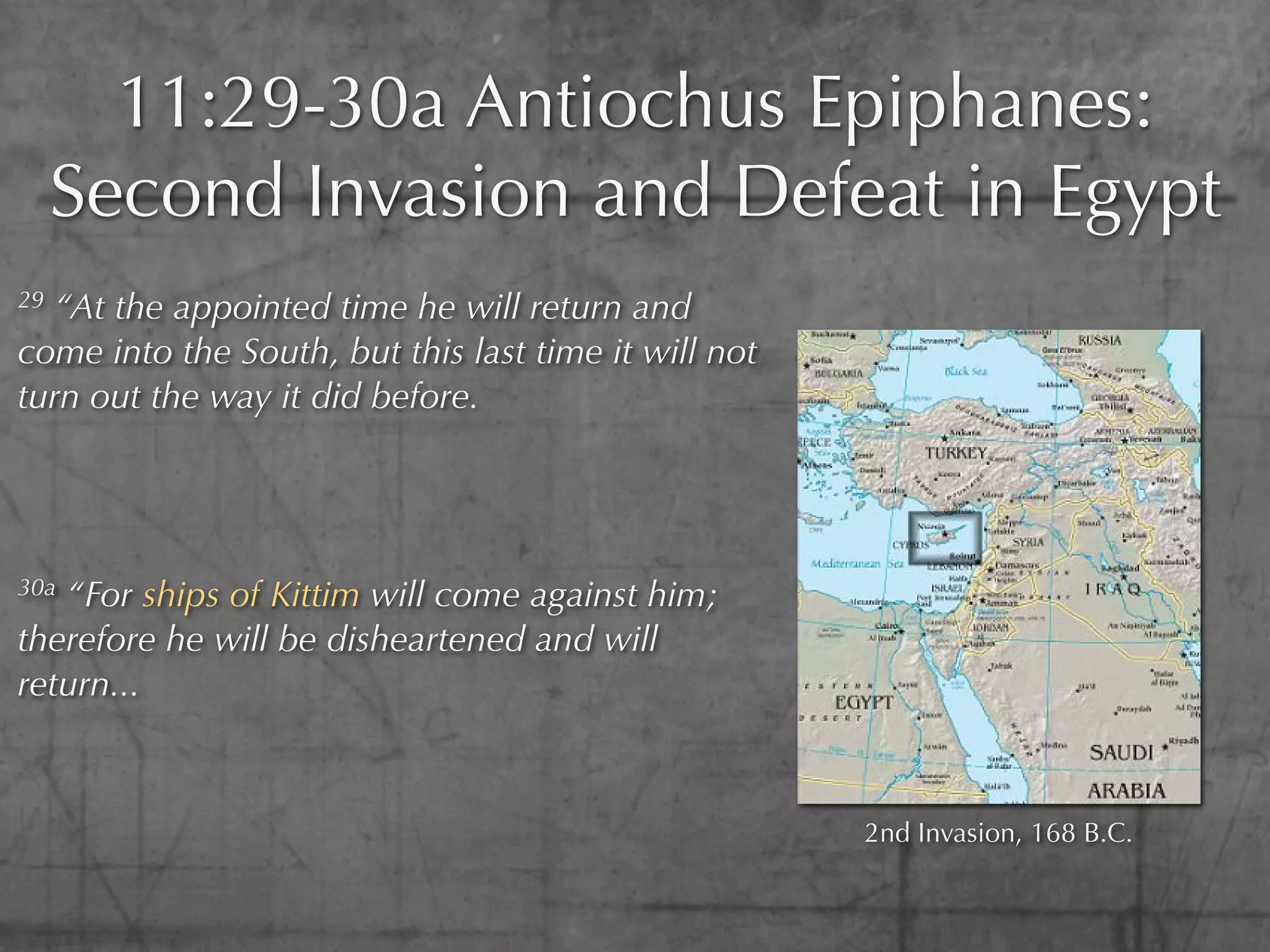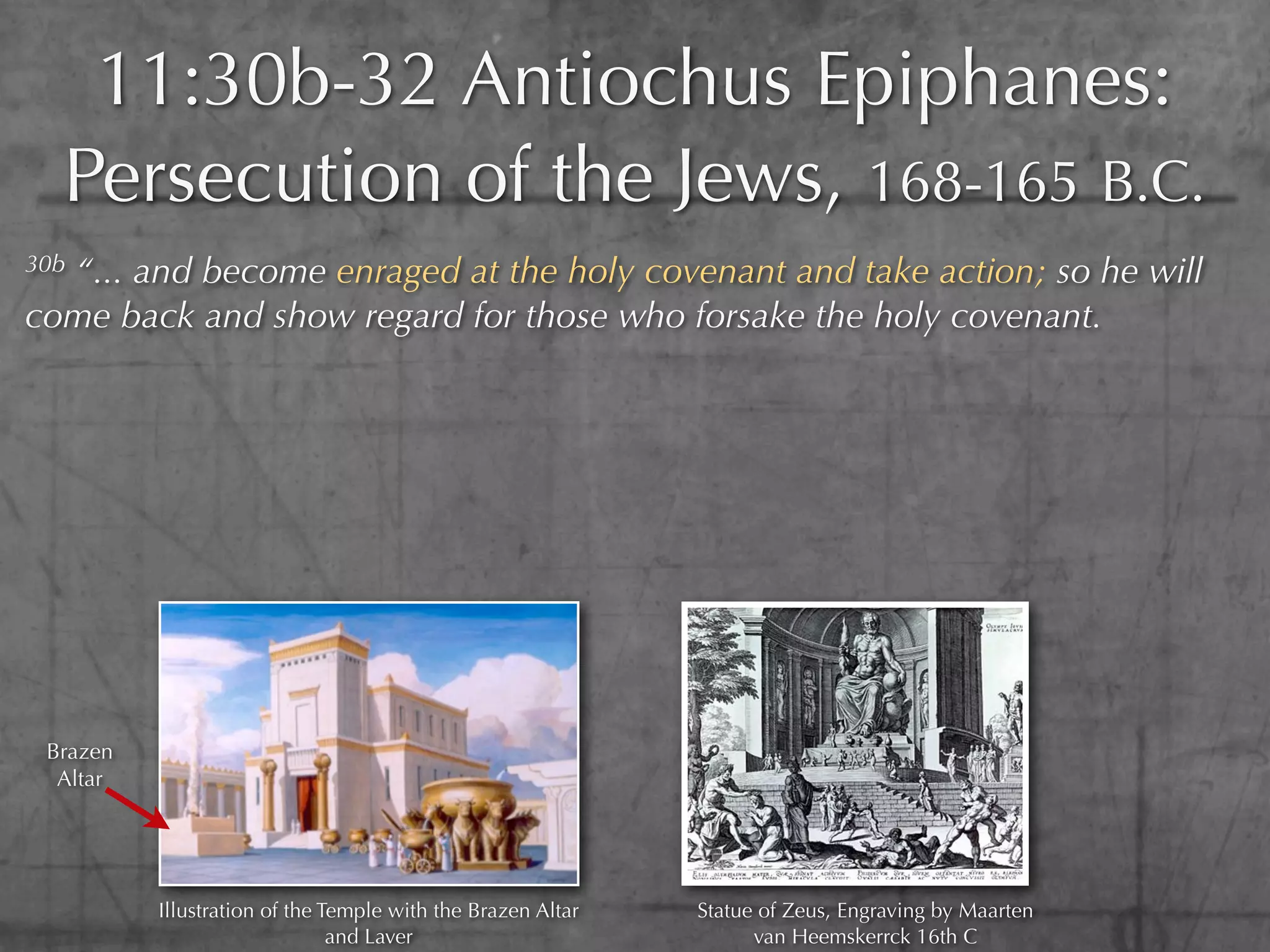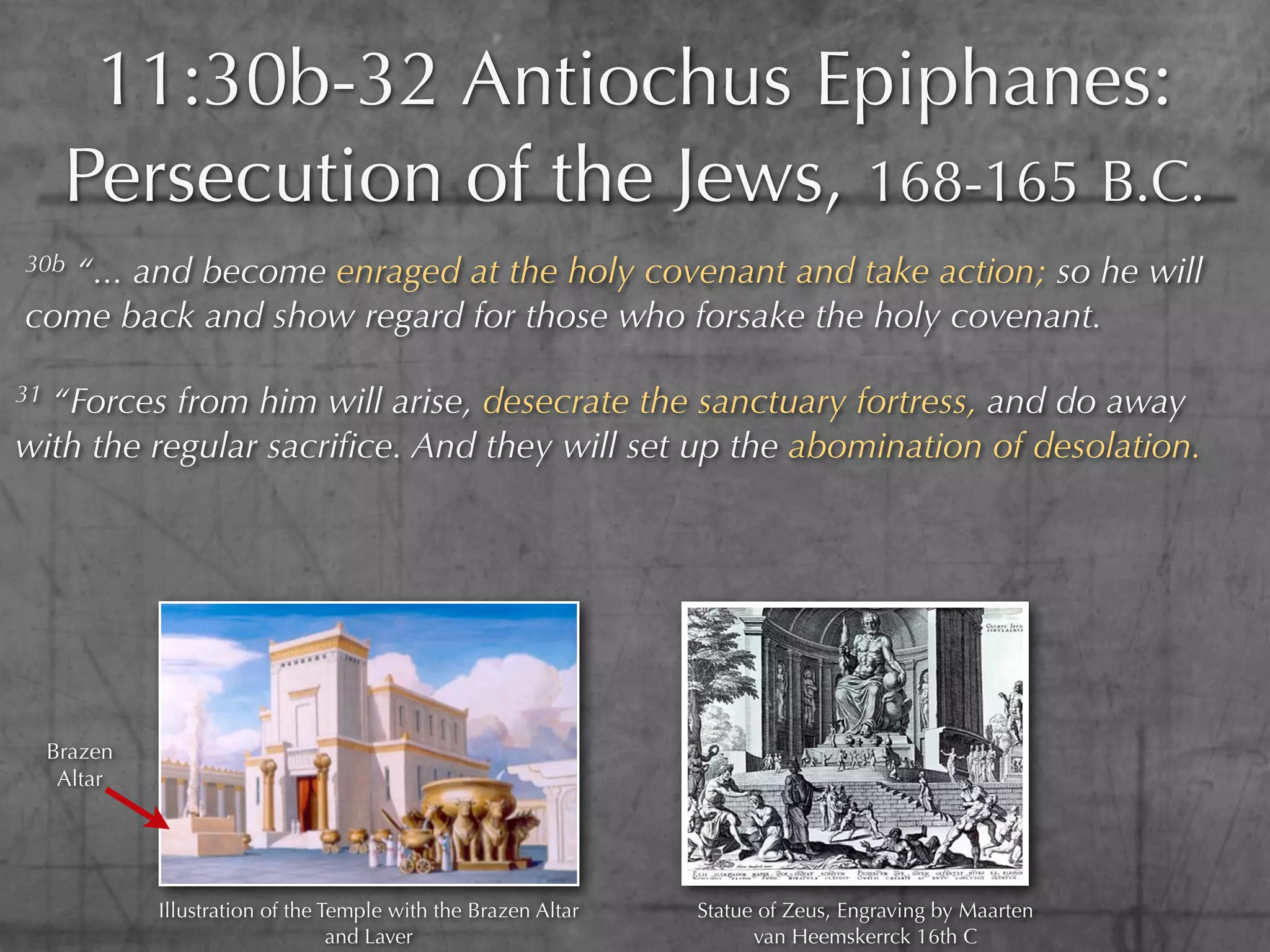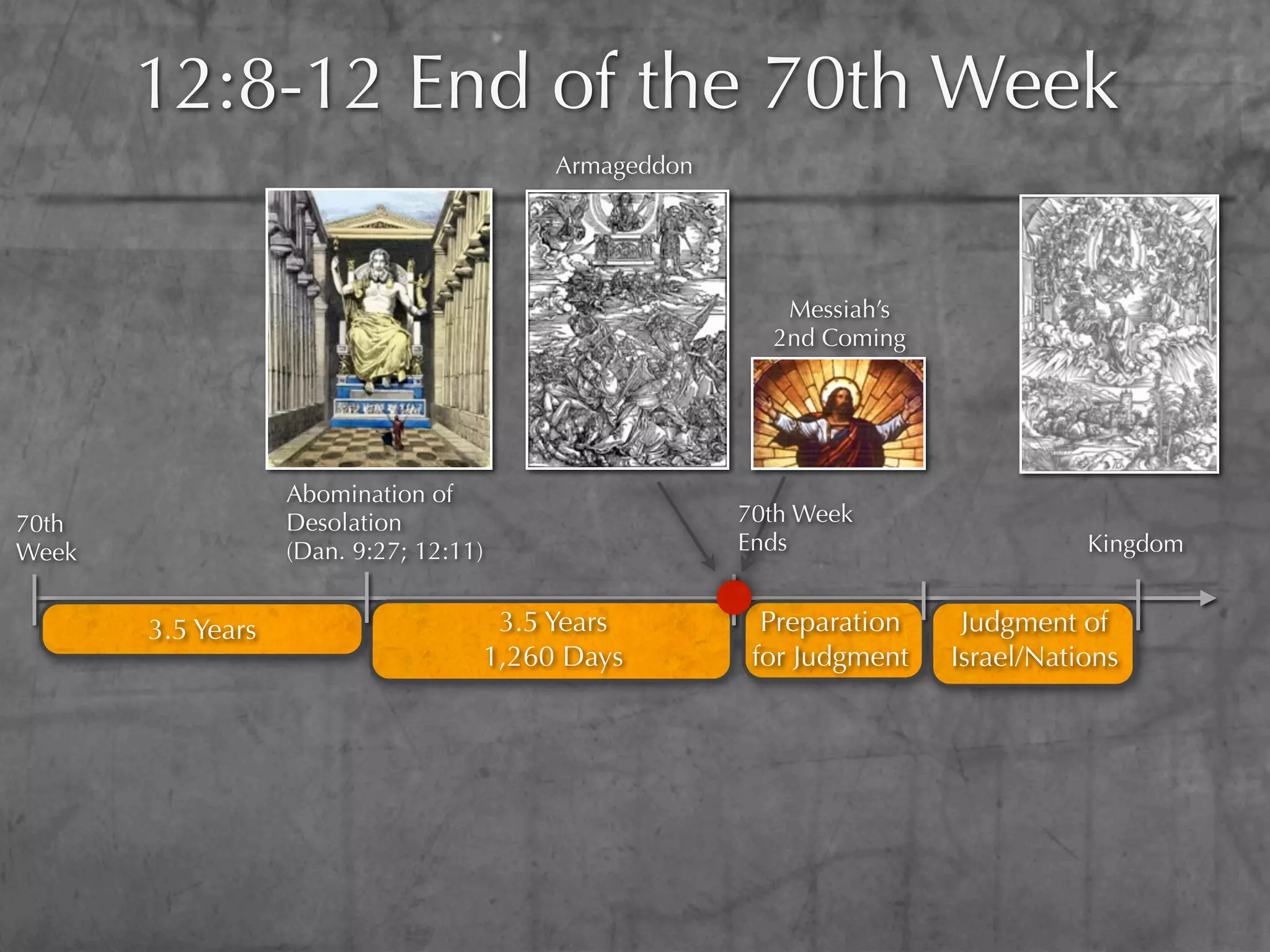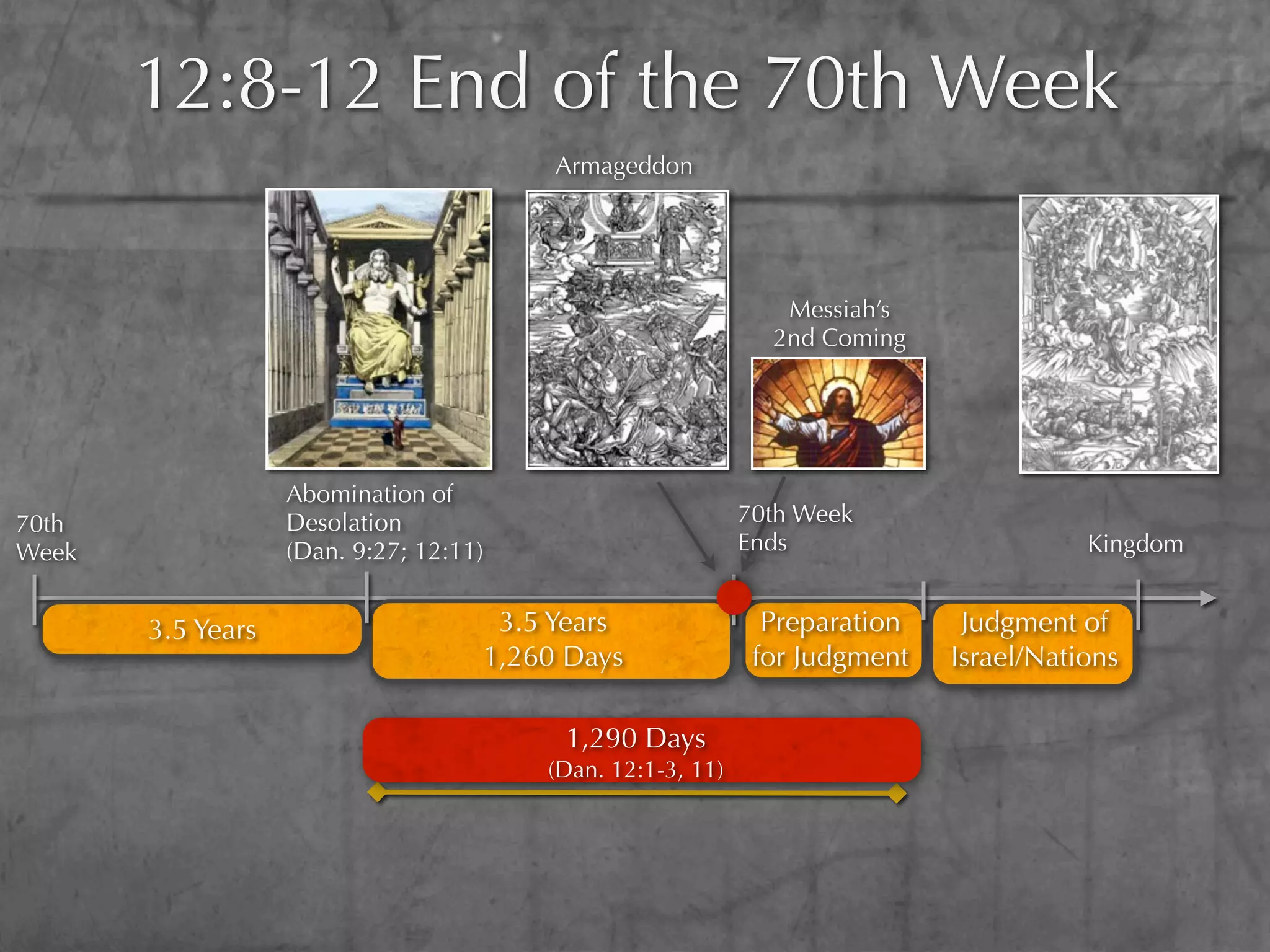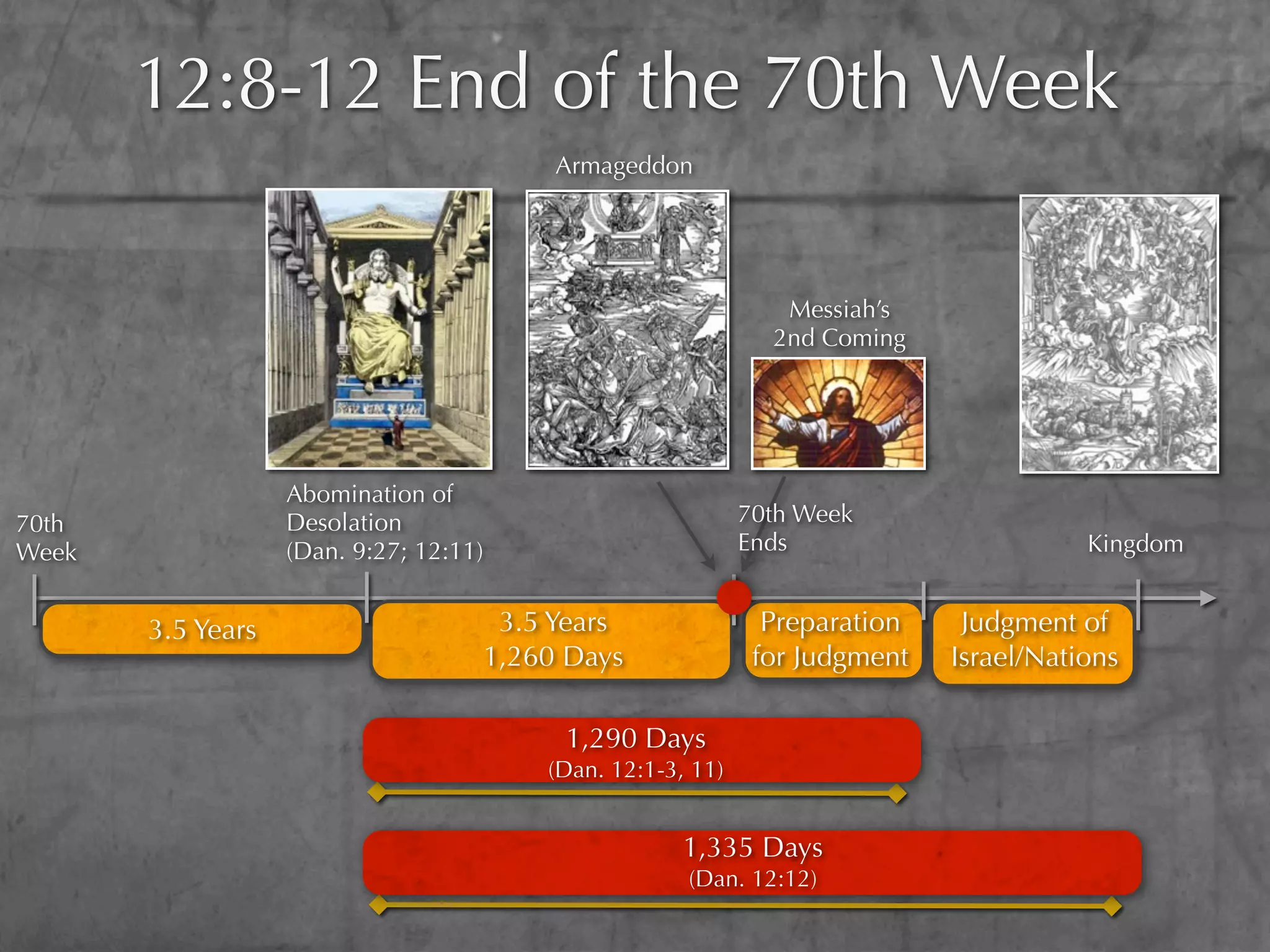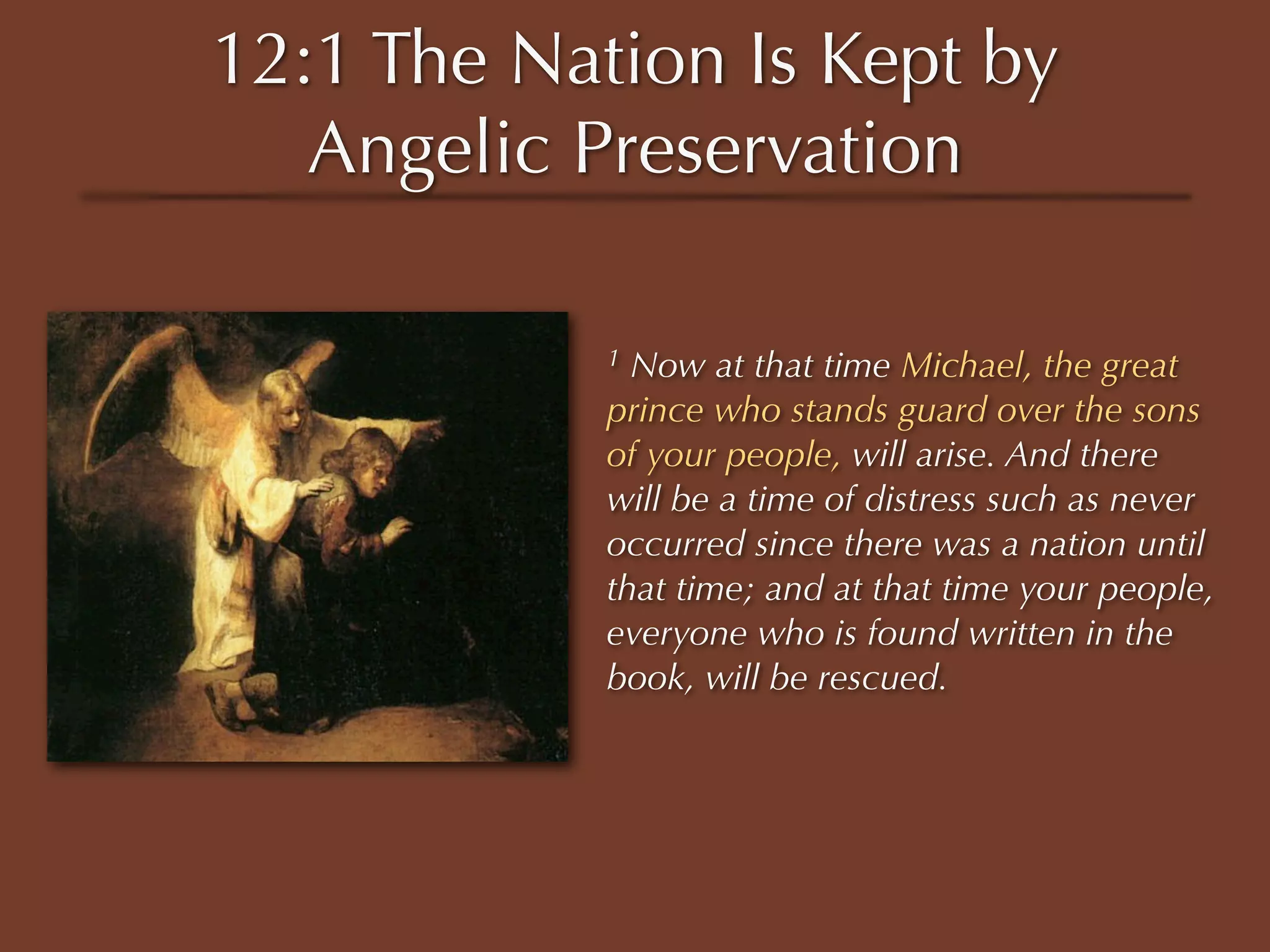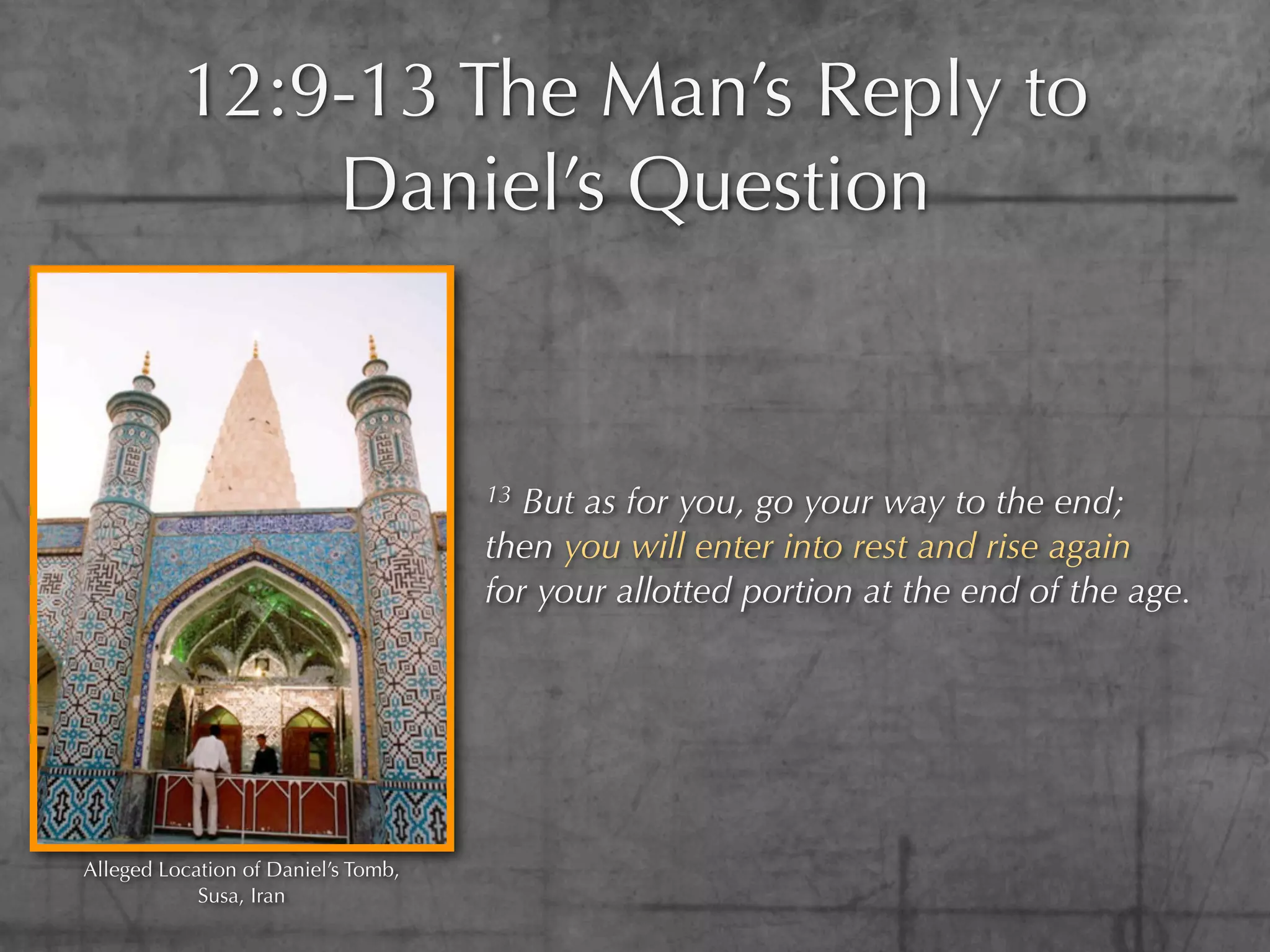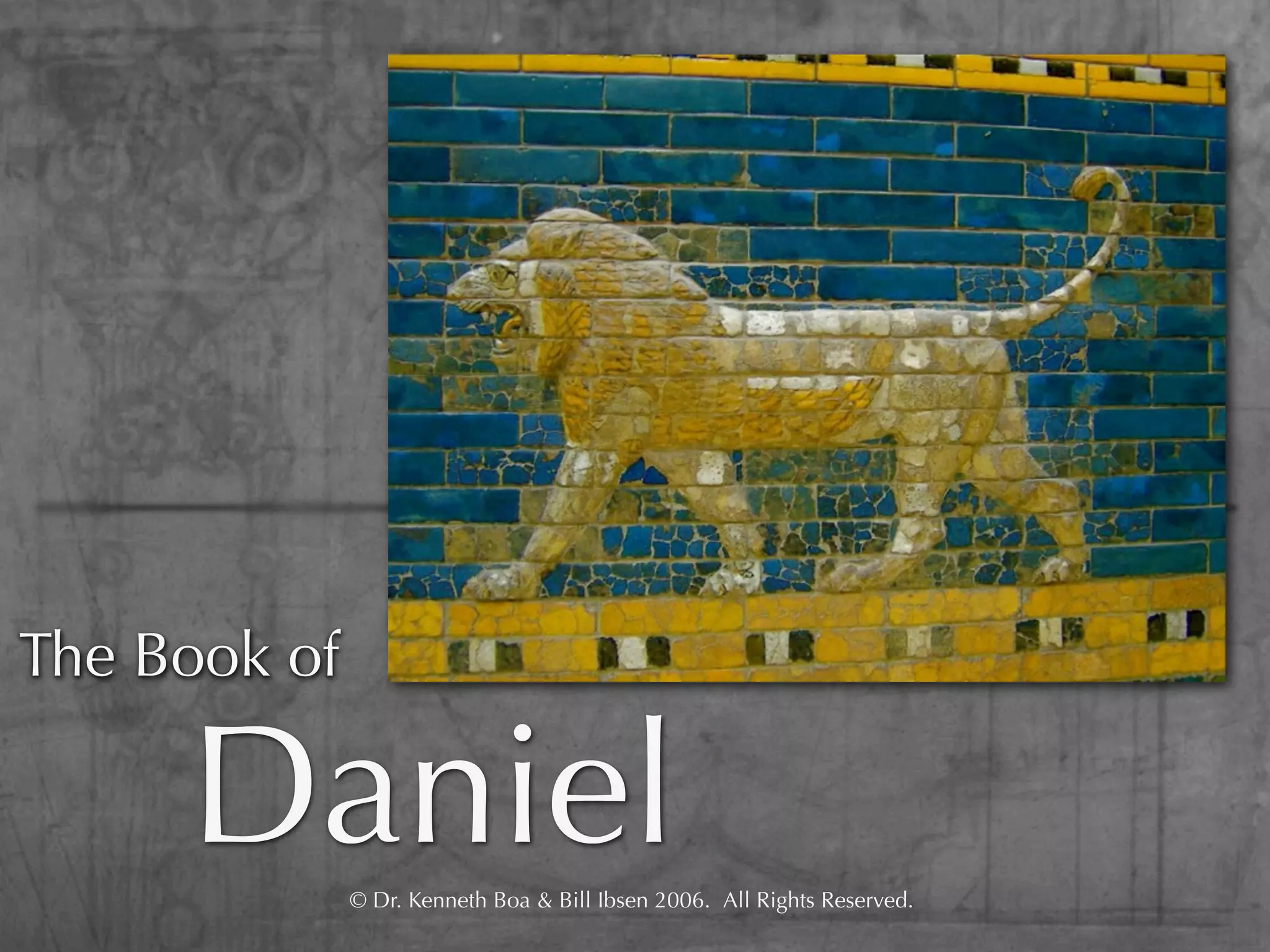






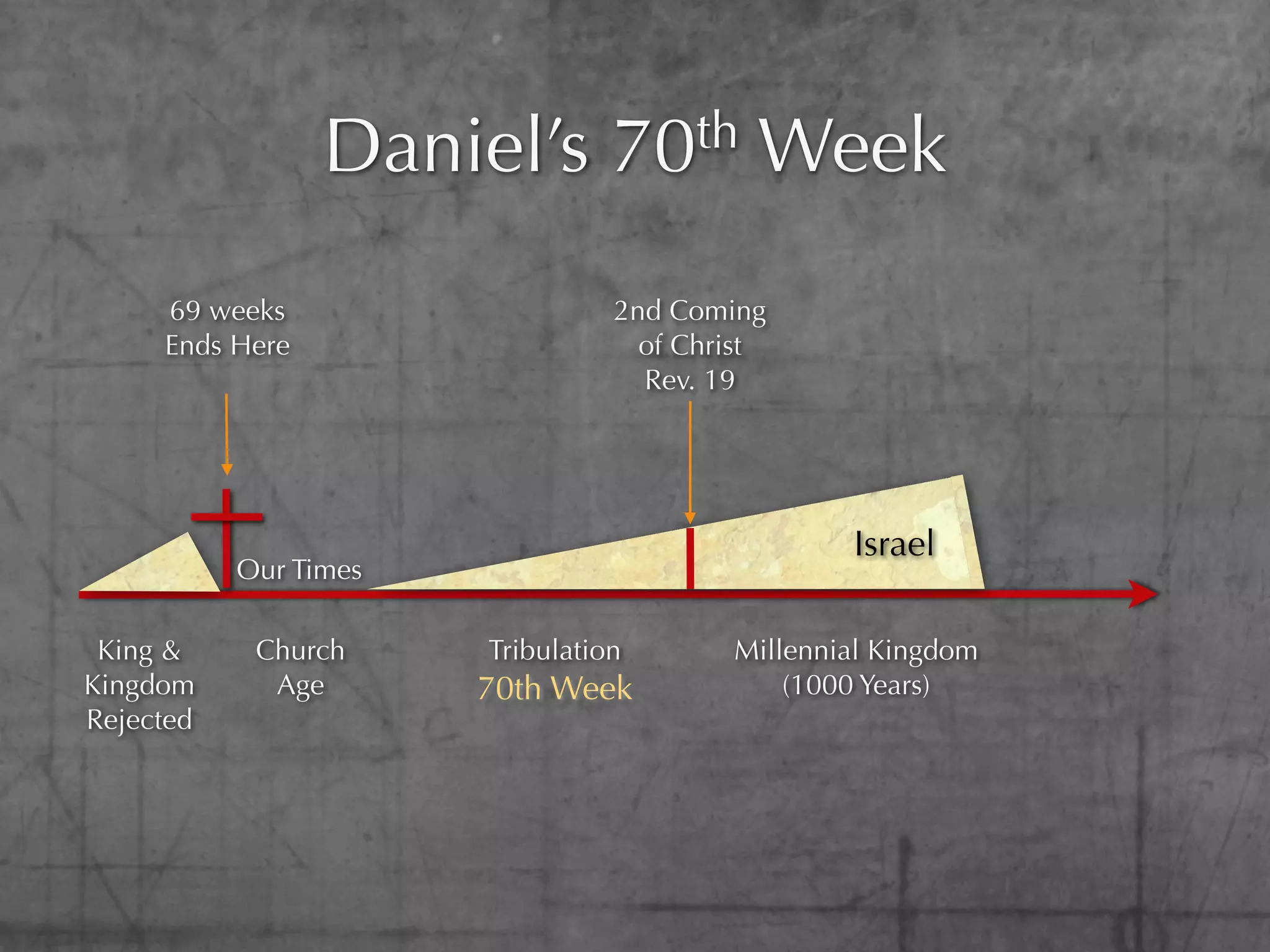
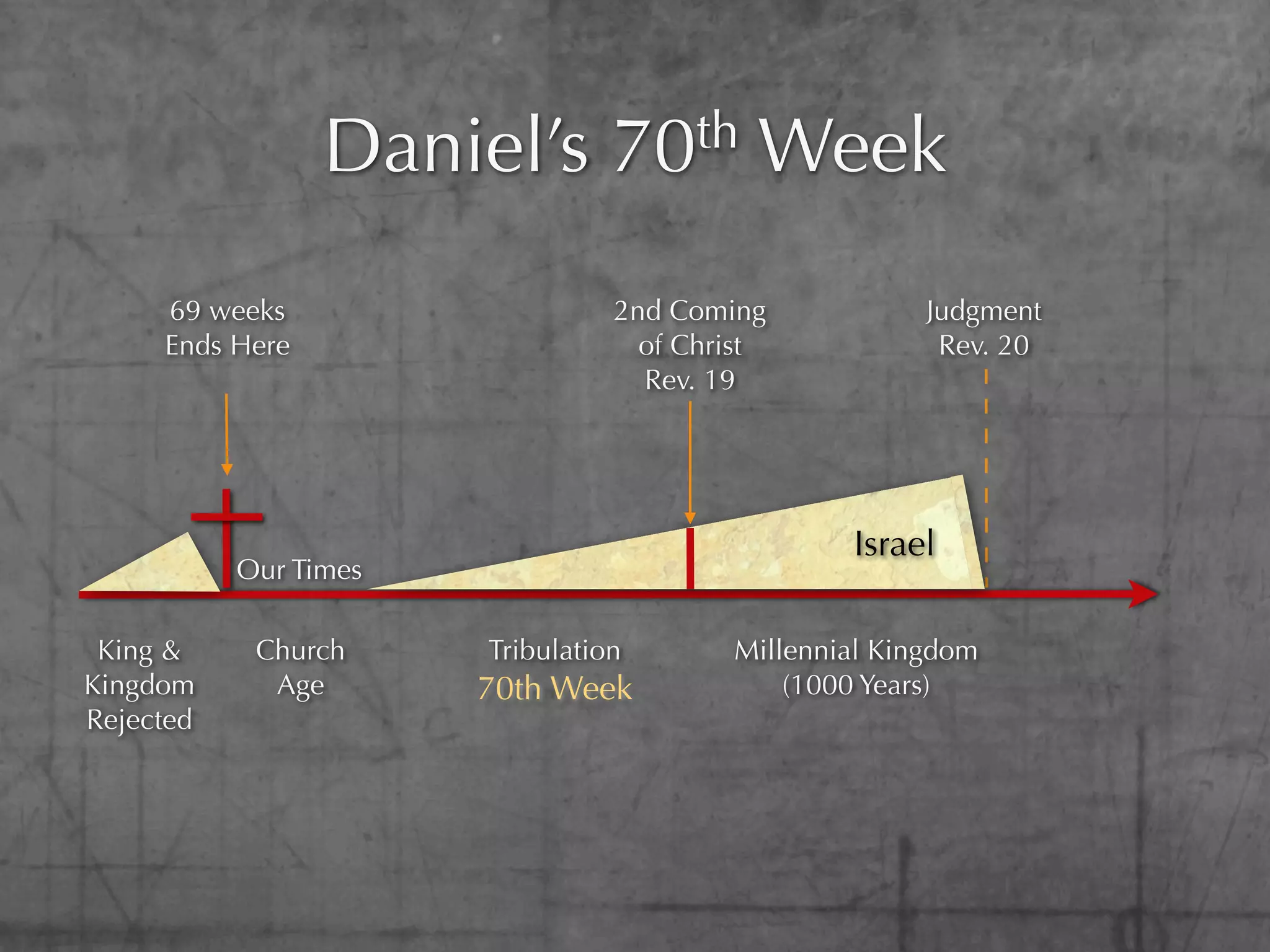
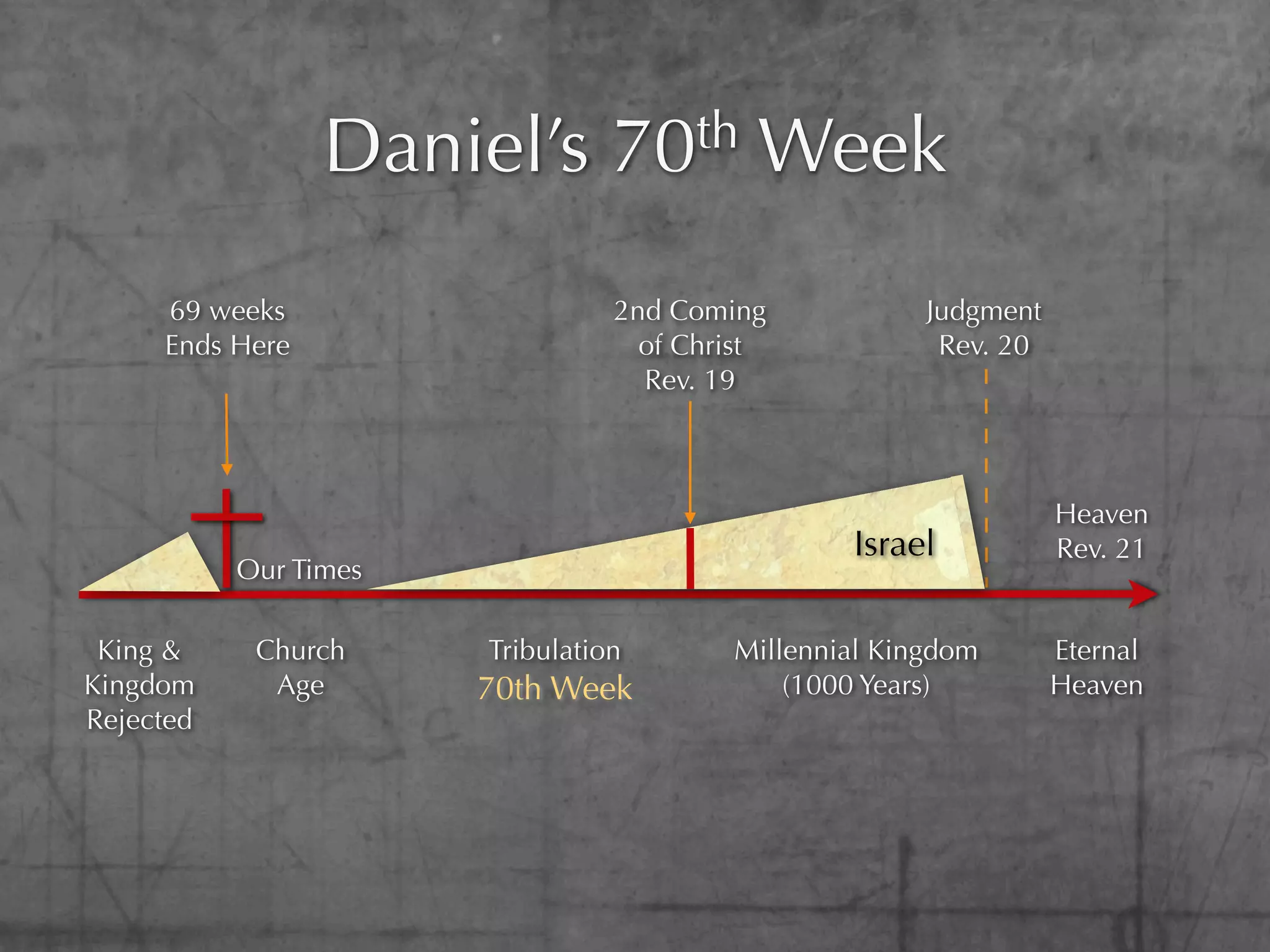



The Book of

     Daniel   © Dr. Kenneth Boa & Bill Ibsen 2006.  All Rights Reserved.
Book of Daniel Overview
Section I:
Personal History
of the Prophet, 1
Daniel’s life


                Book of Daniel Overview
Section I:             Section II:
Personal History       Prophetic History
of the Prophet, 1      of the Gentiles, 2-7
Daniel’s life          Dreams, images, feasts, and visions


                Book of Daniel Overview
Section I:             Section II:                           Section III:
Personal History       Prophetic History                     Prophetic History
of the Prophet, 1      of the Gentiles, 2-7                  of Israel, 8-12
Daniel’s life          Dreams, images, feasts, and visions   Daniel’s visions


                Book of Daniel Overview
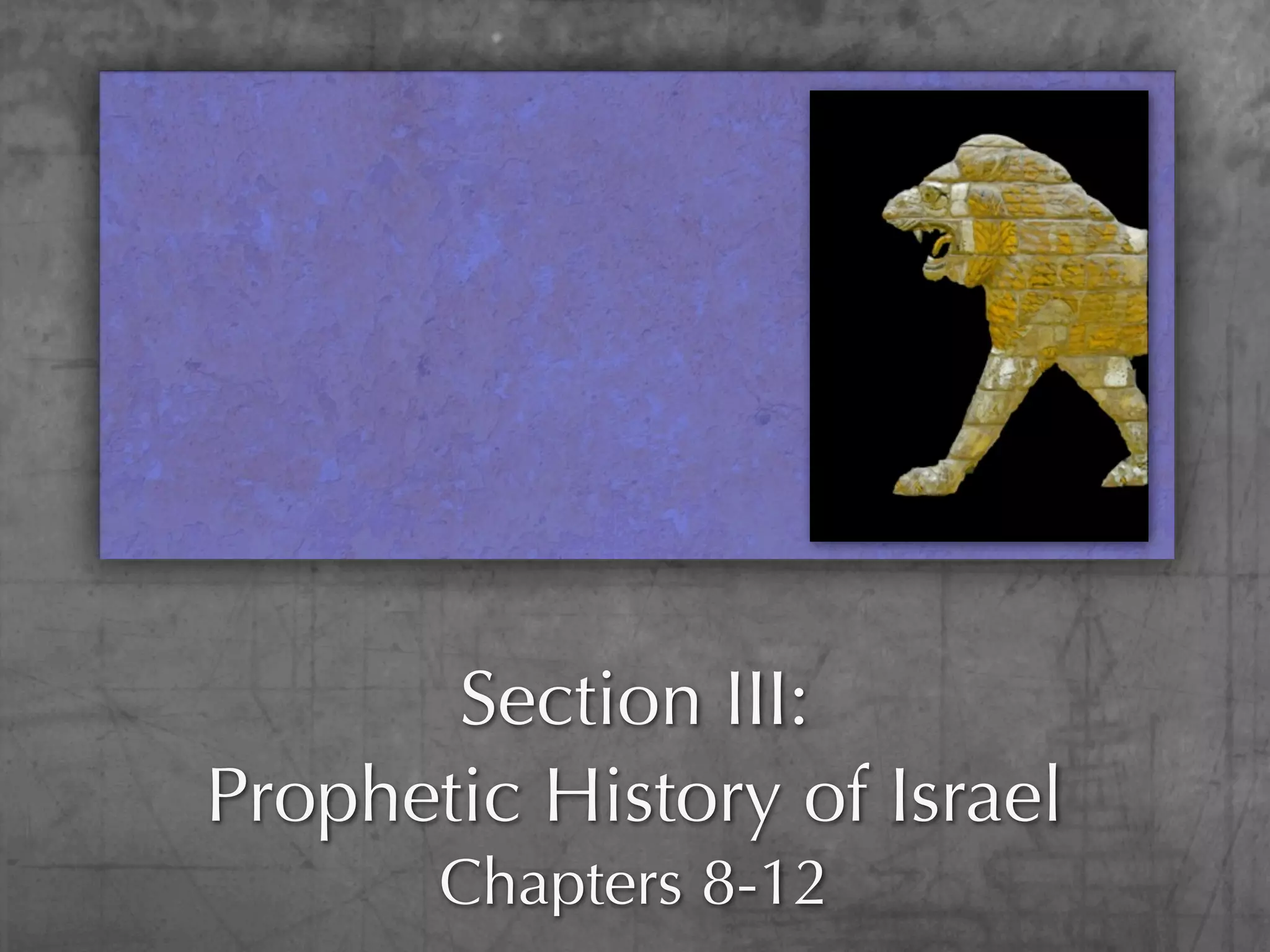
Section III:
Prophetic History of Israel
       Chapters 8-12
Chapter 8
The Vision of the Ram and He-Goat


     Israel under Medo-Persia and Greece
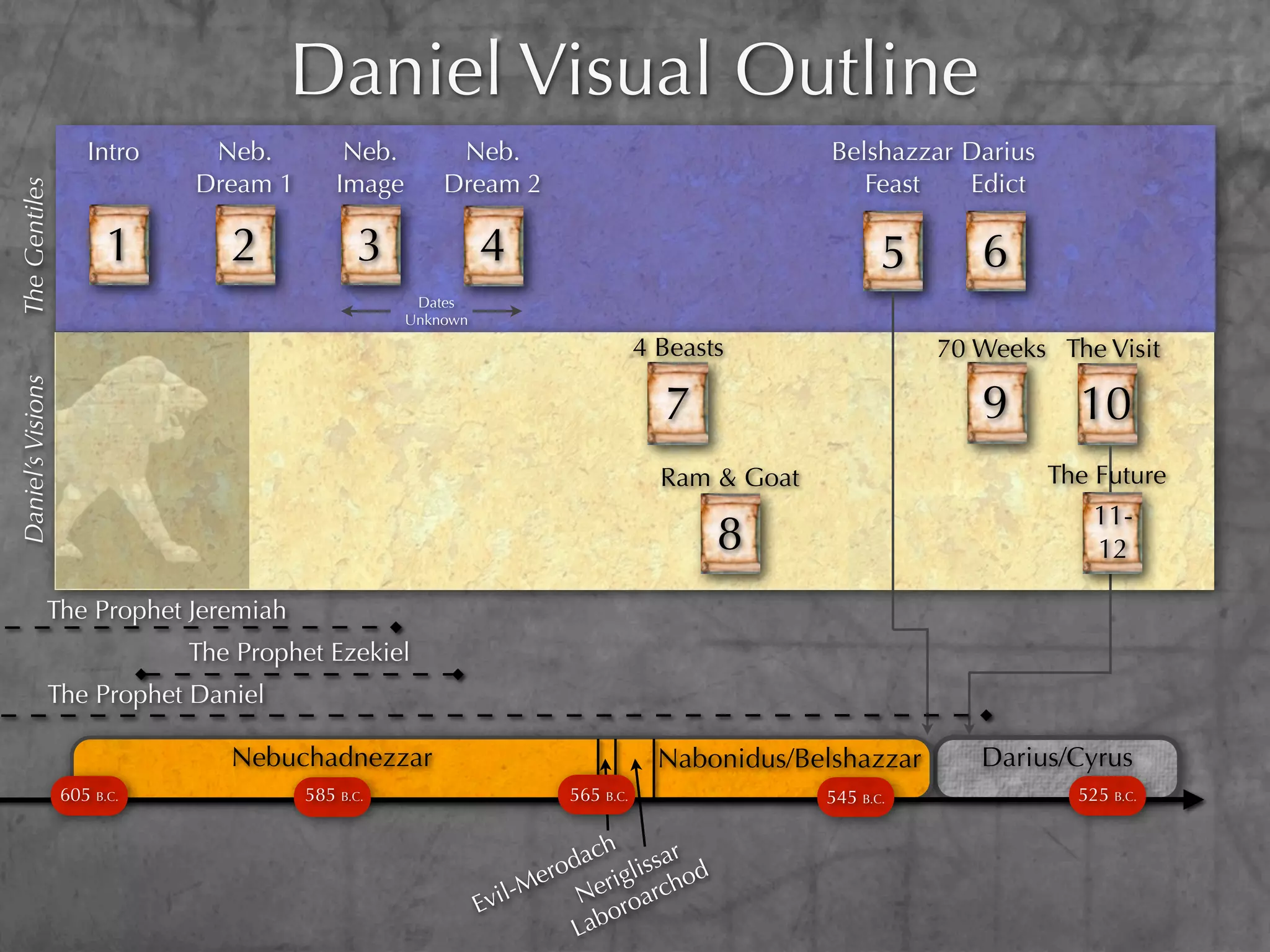
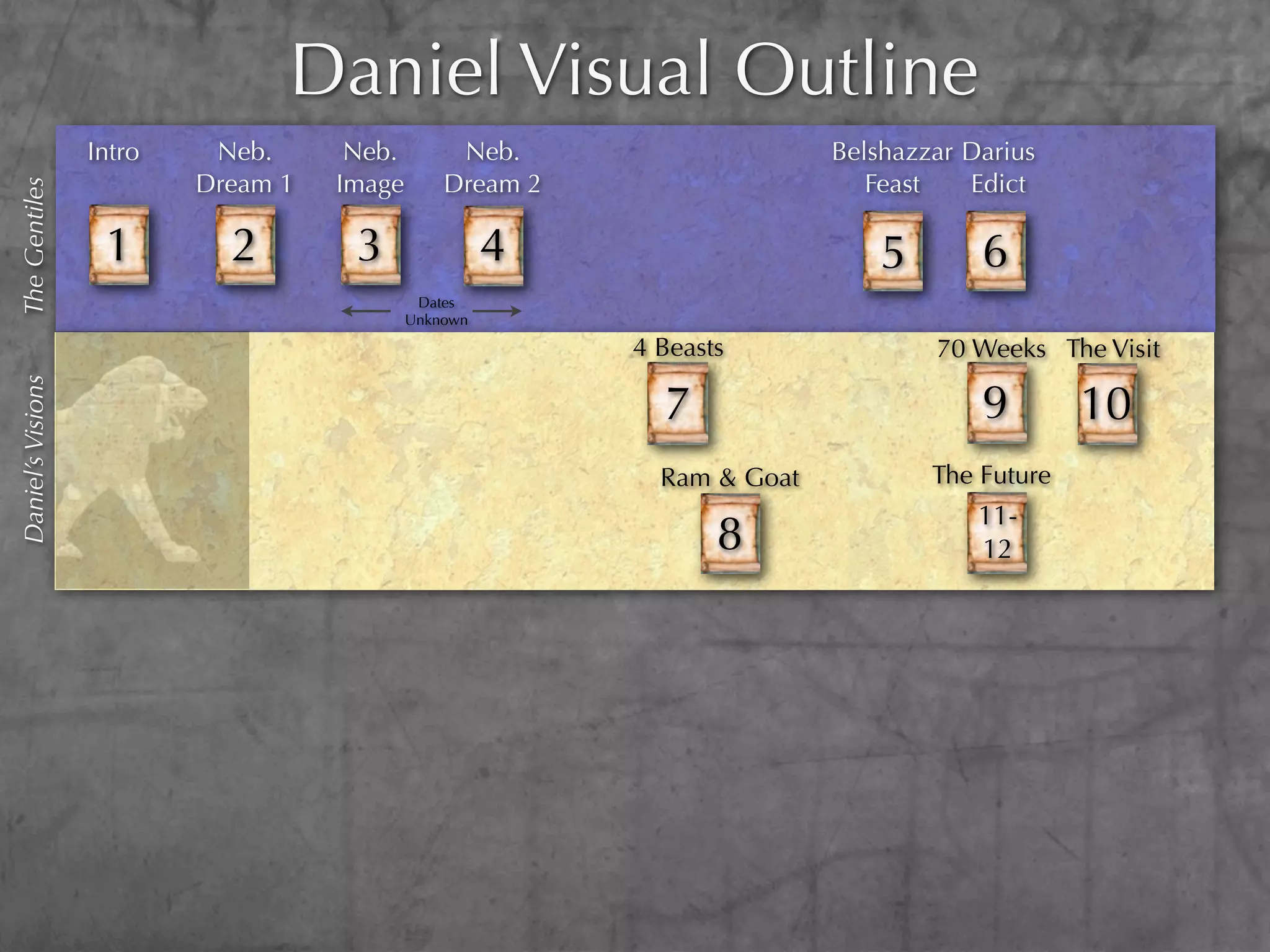
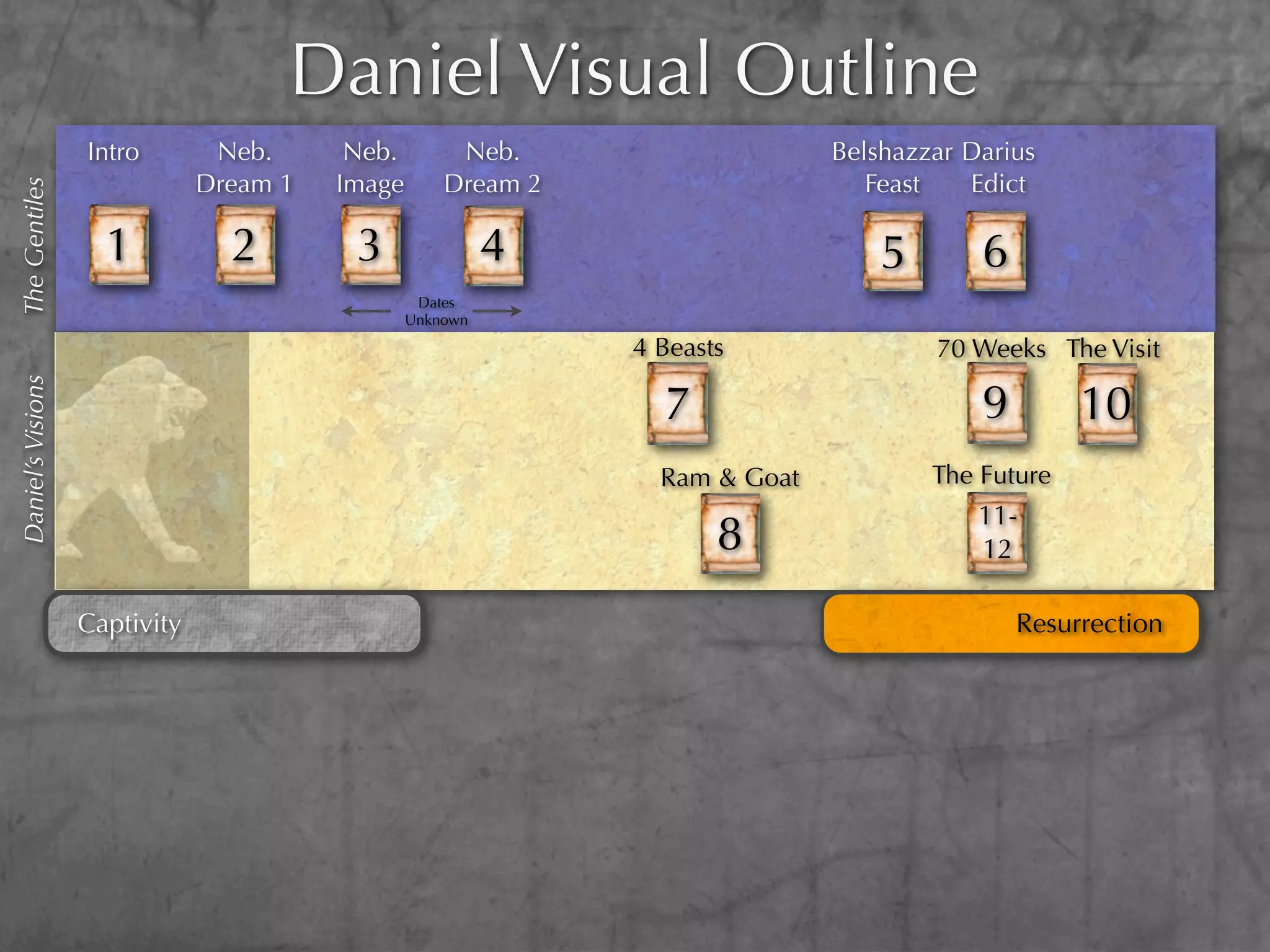
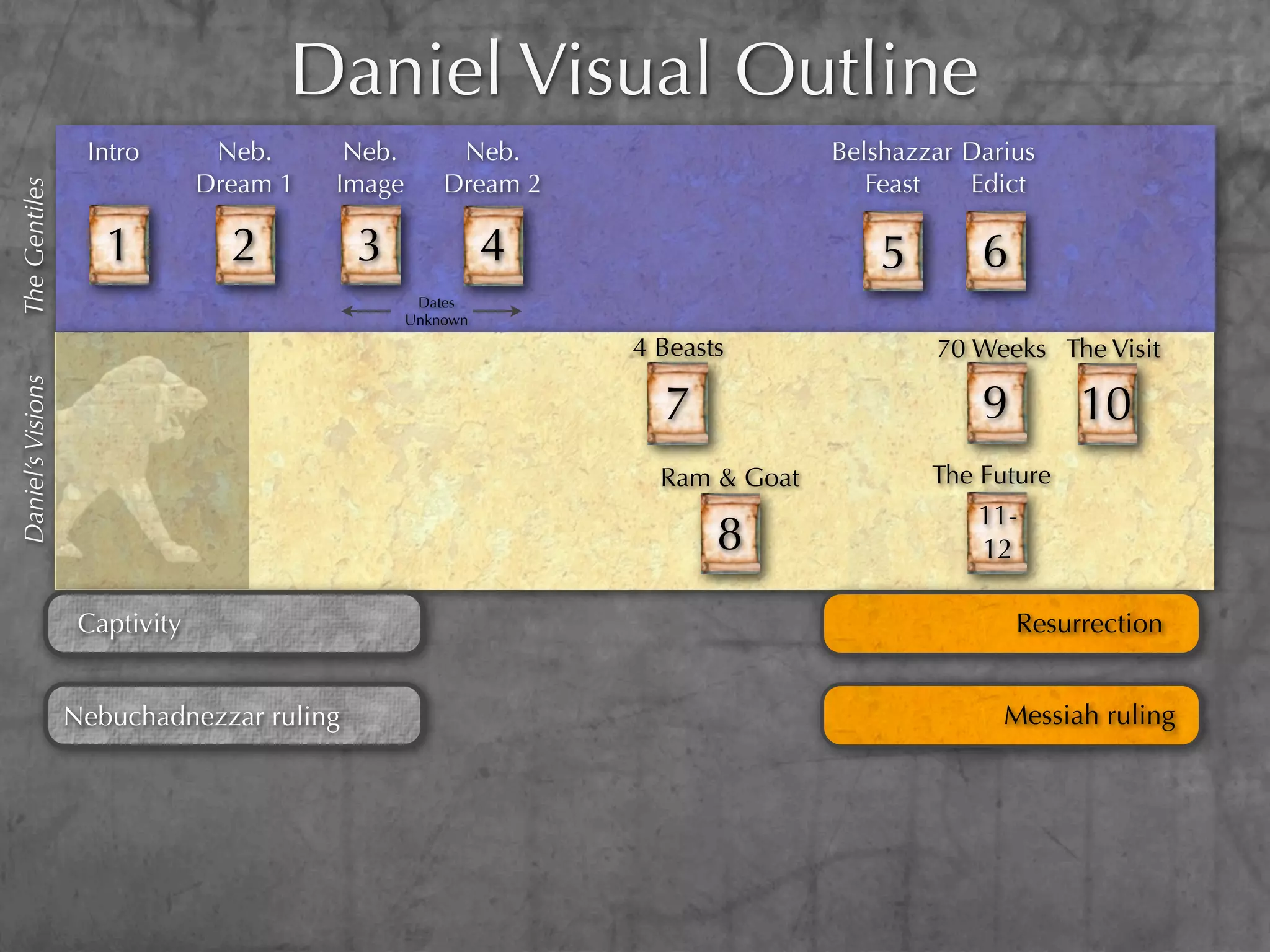
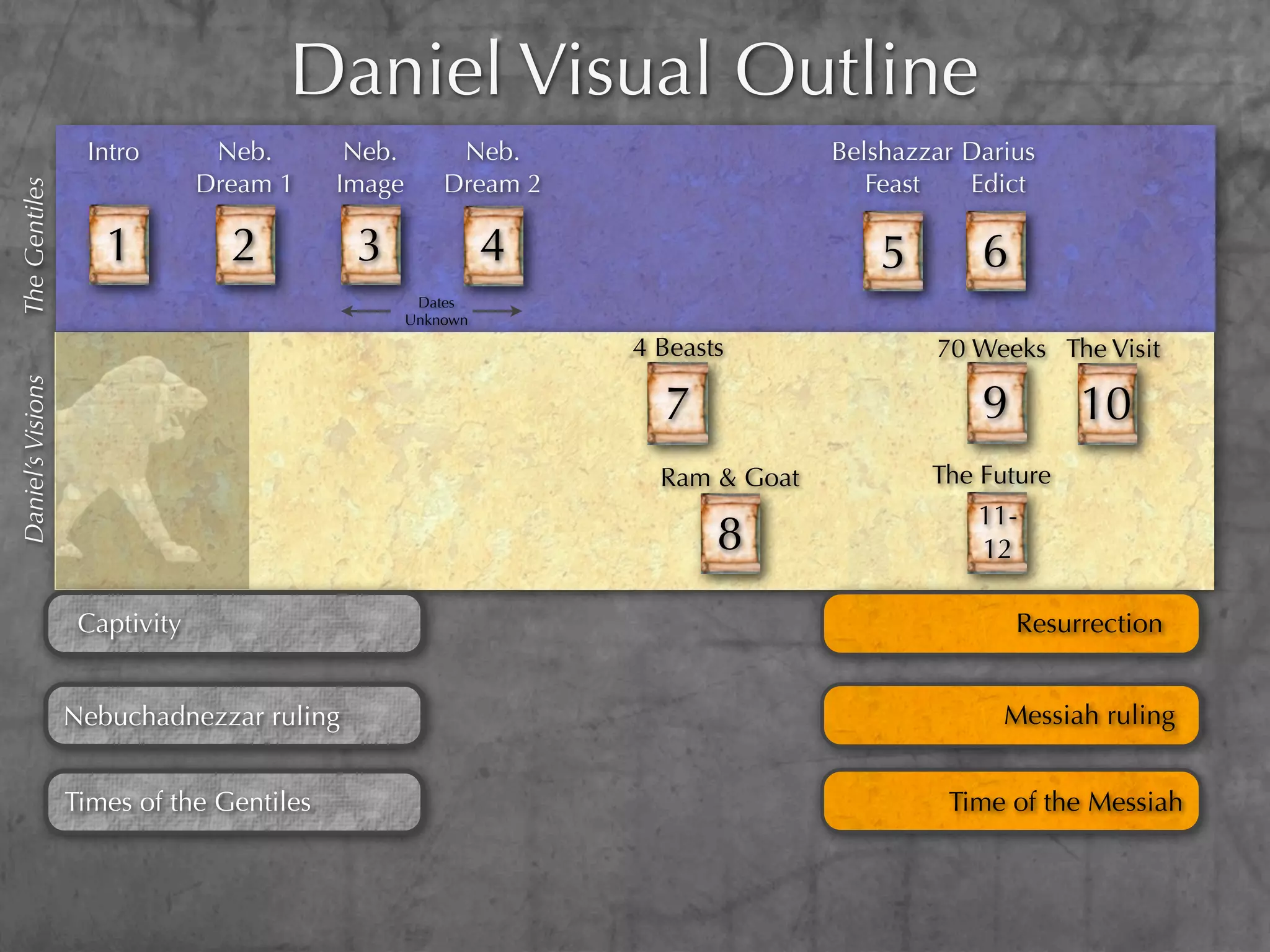
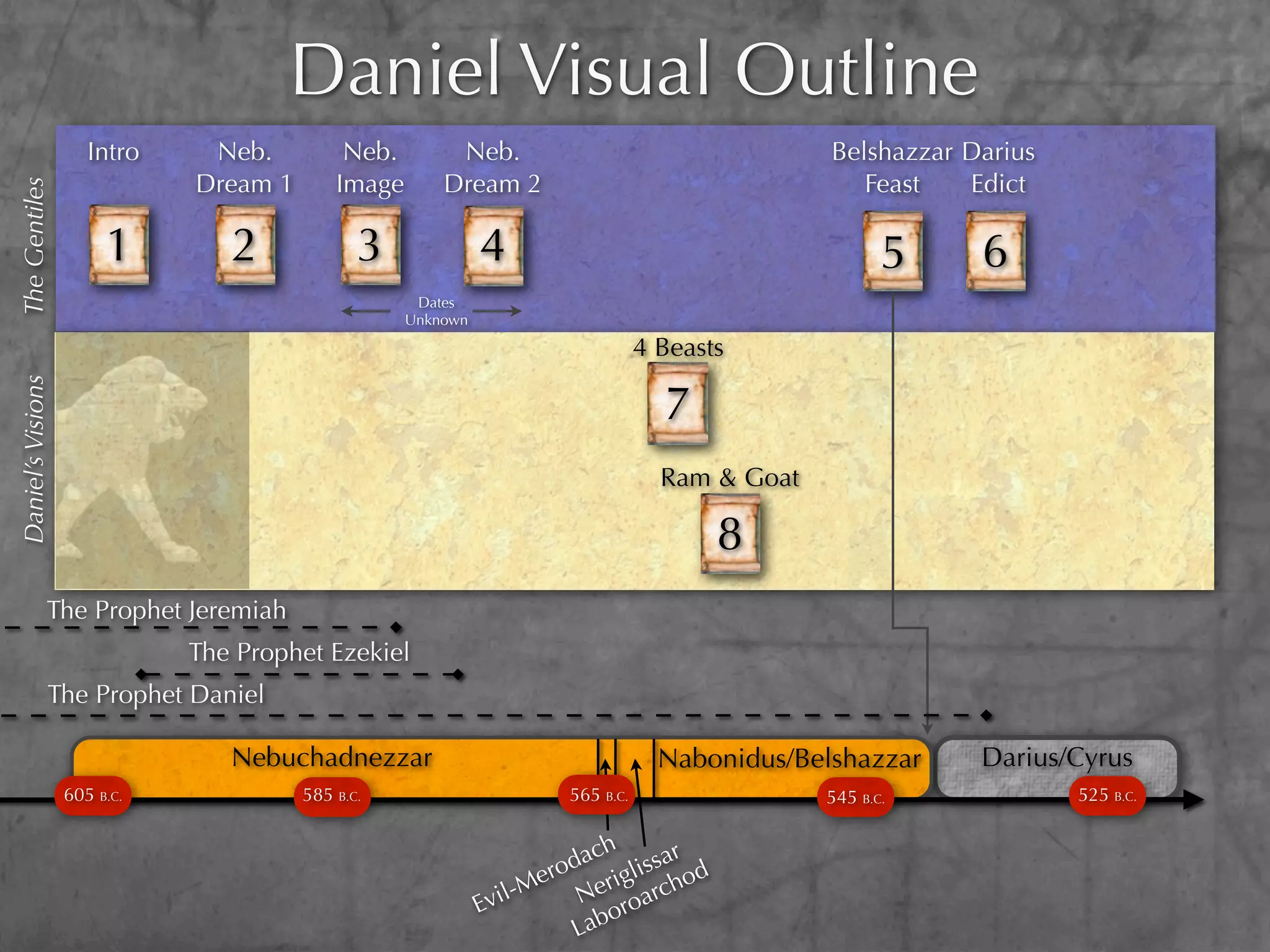
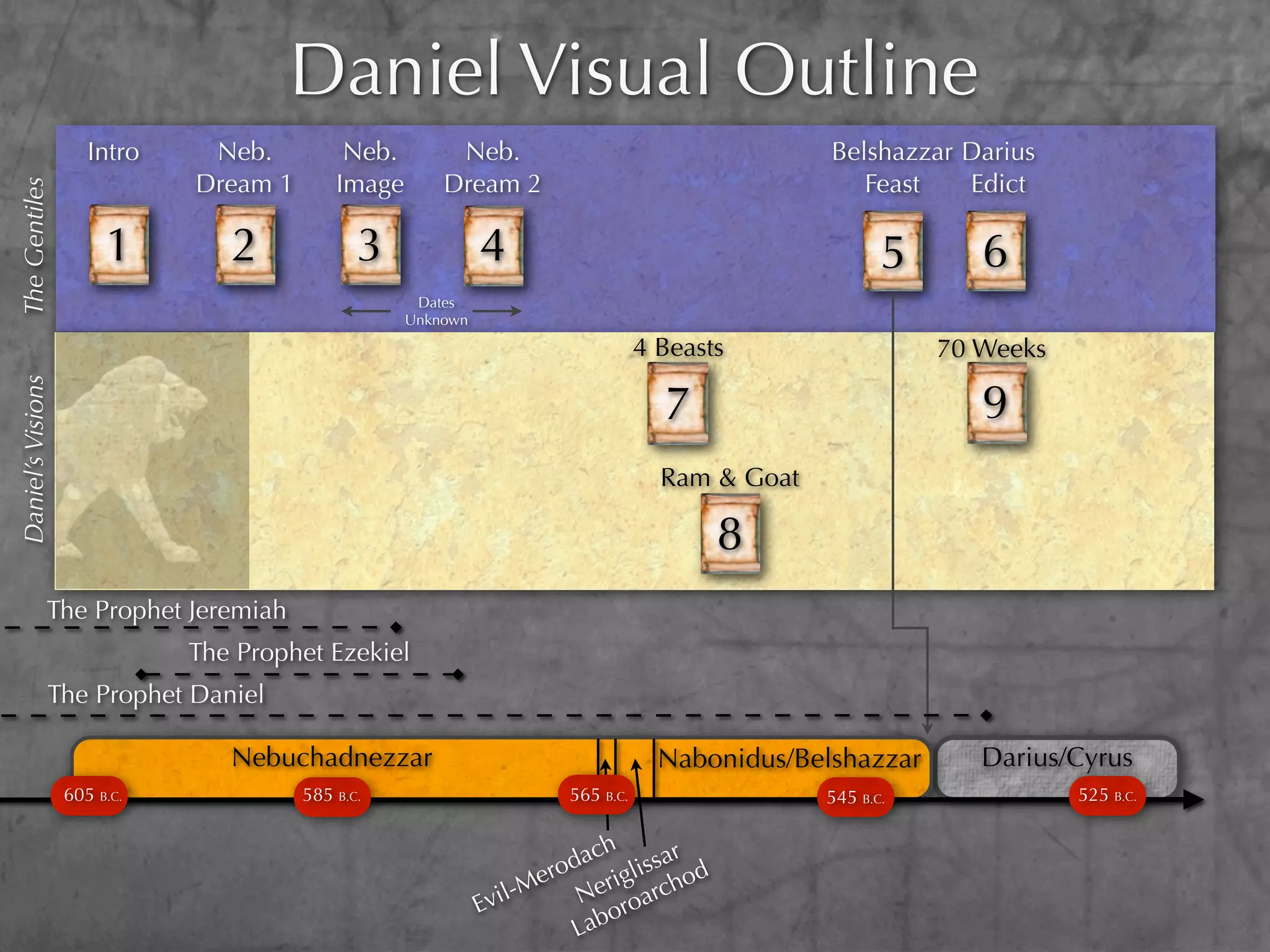
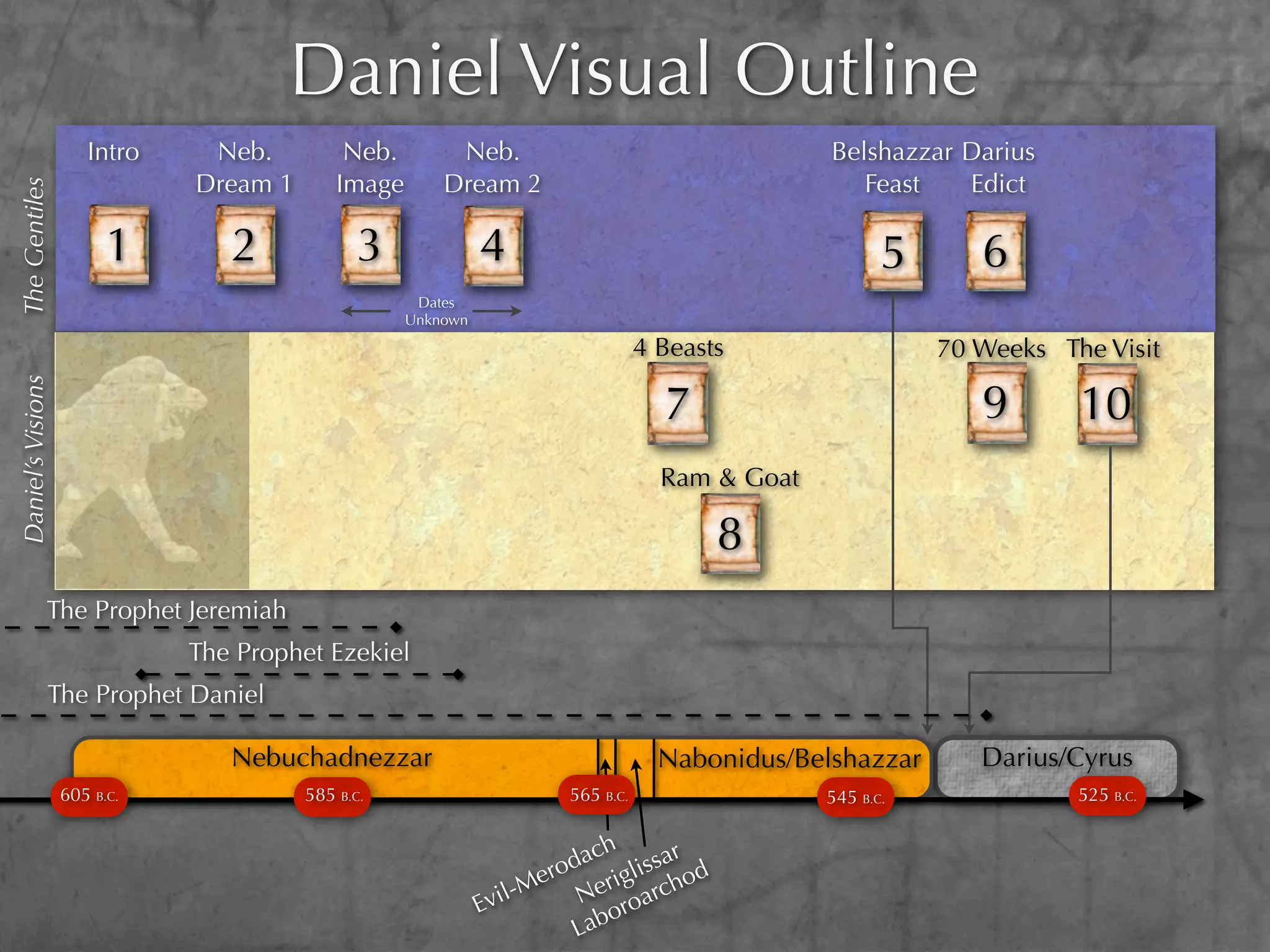
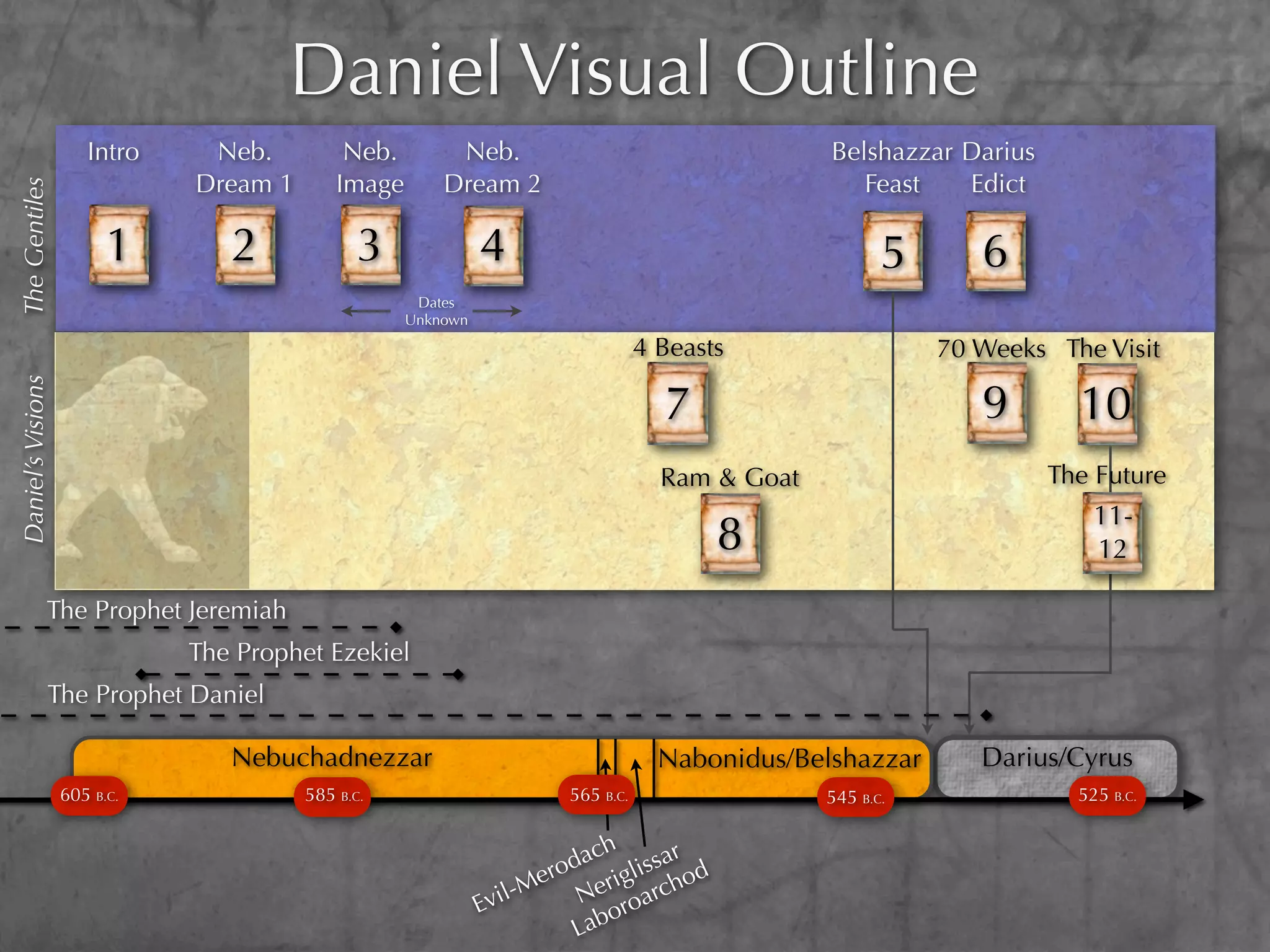
Daniel Visual Outline
                      Intro    Neb.          Neb.        Neb.                                    Belshazzar Darius
                              Dream 1       Image       Dream 2                                     Feast   Edict
The Gentiles


                        1        2             3              4                                         5    6
                                                     Dates
                                                    Unknown

                                                                                  4 Beasts
Daniel’s Visions


                                                                                    7
                                                                                    Ram & Goat

                                                                                         8
              The Prophet Jeremiah
                              The Prophet Ezekiel
              The Prophet Daniel

                                 Nebuchadnezzar                                     Nabonidus/Belshazzar     Darius/Cyrus
                   605 B.C.             585 B.C.                       565 B.C.                  545 B.C.            525 B.C.

                                                                            h
                                                                         dac lissar d
                                                                      ero erig      o
                                                                  l-M           rch
                                                              Evi         N roa
                                                                            o
                                                                         Lab
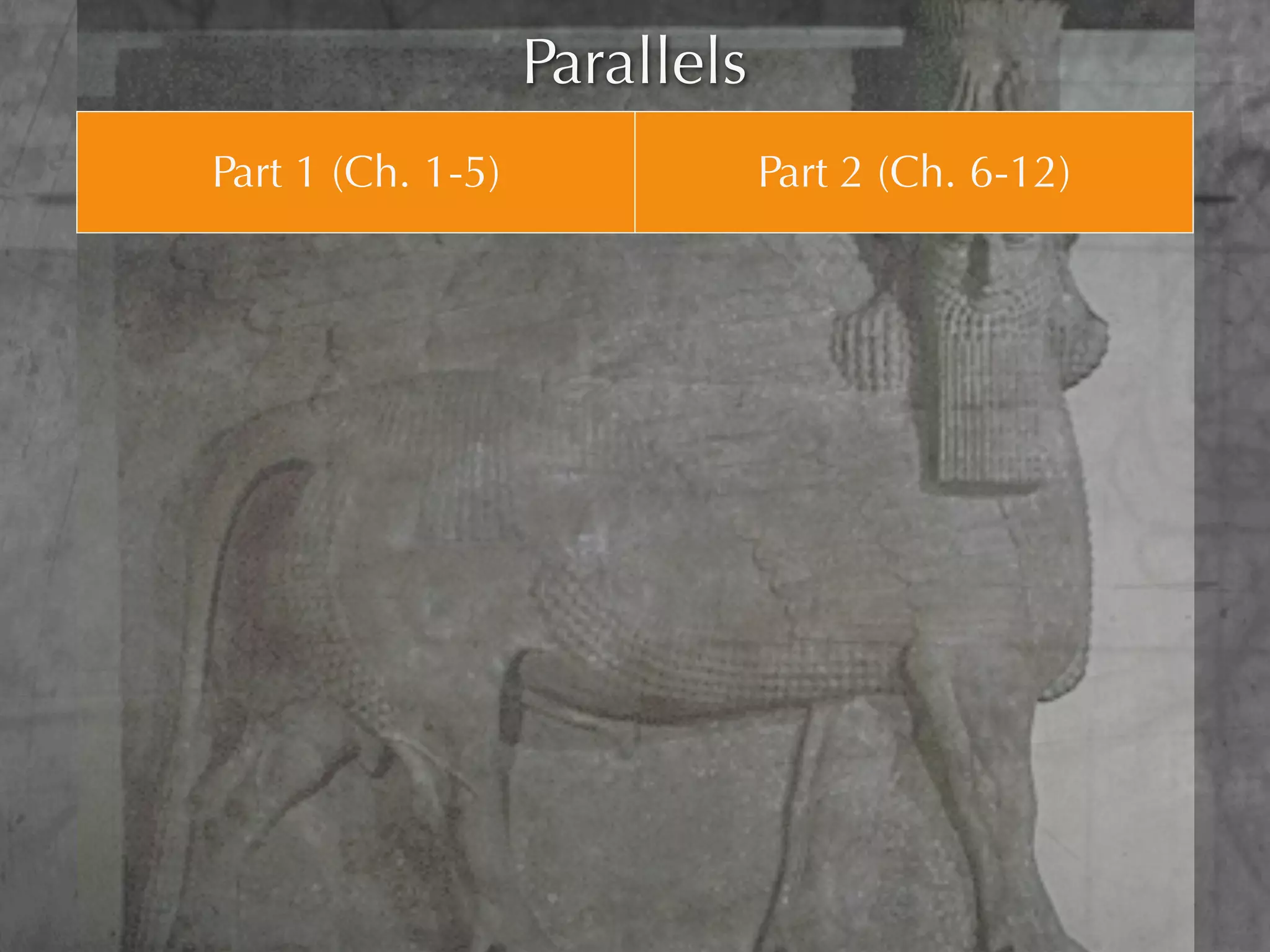
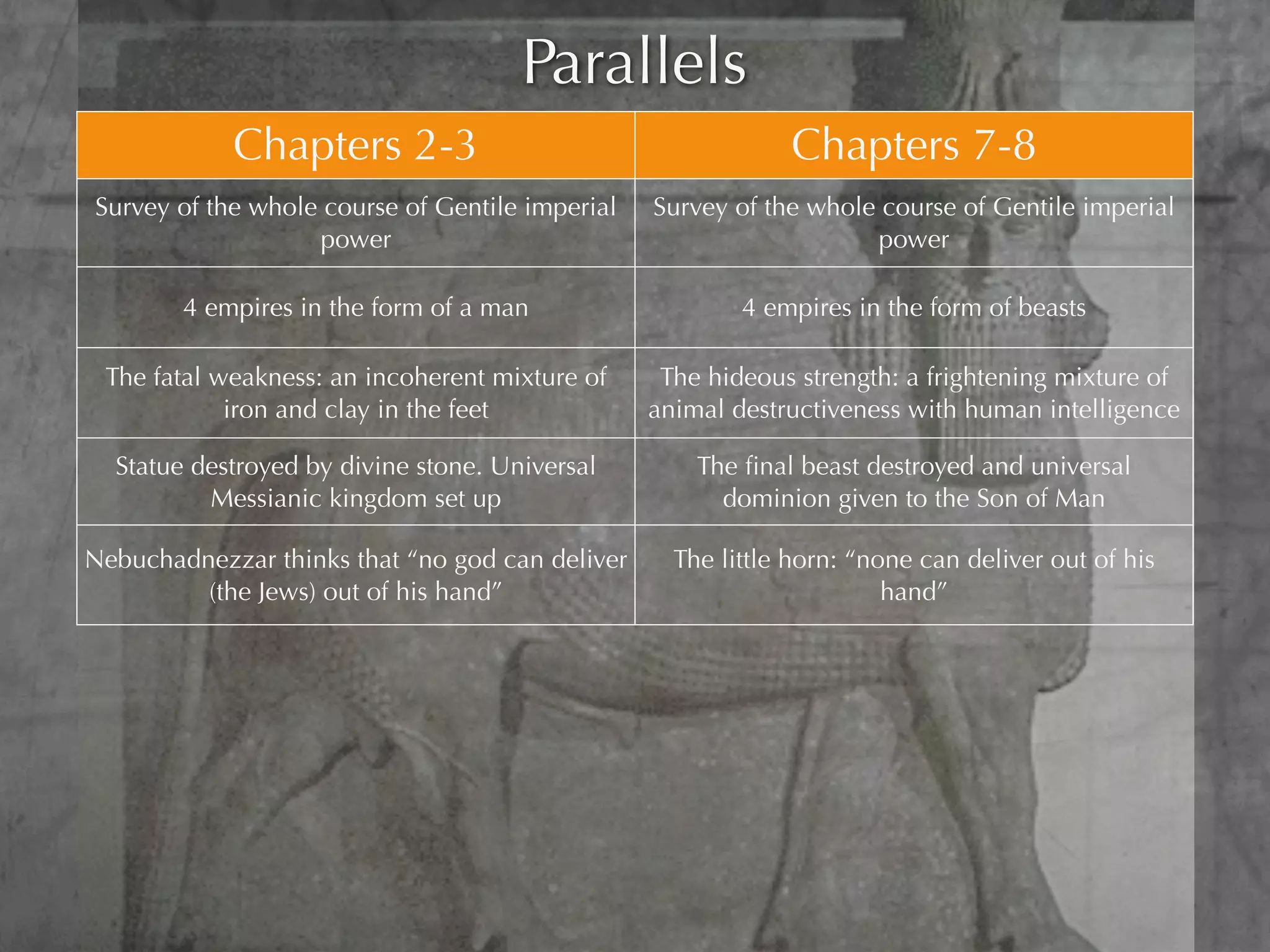
Parallels
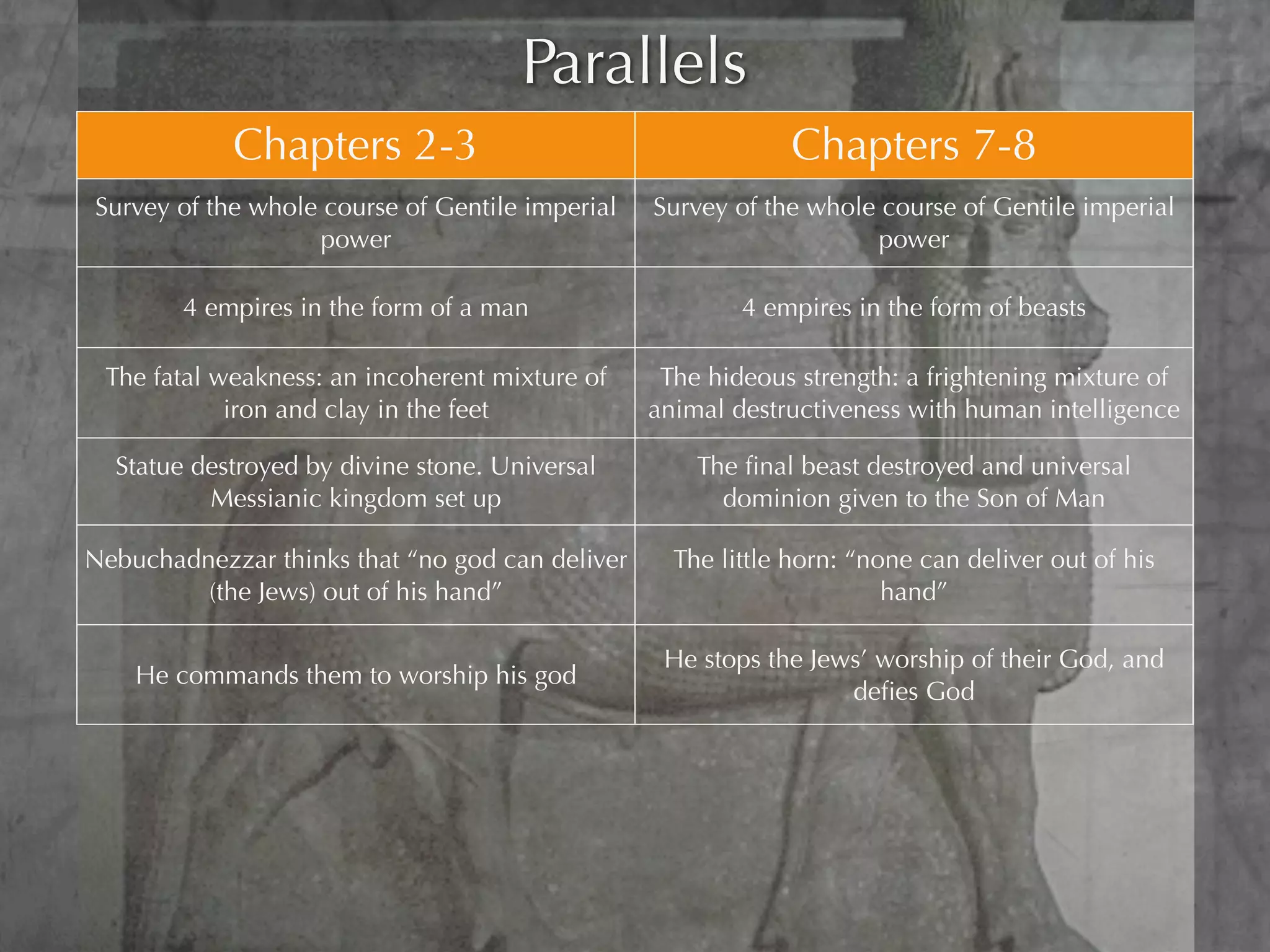
Parallels
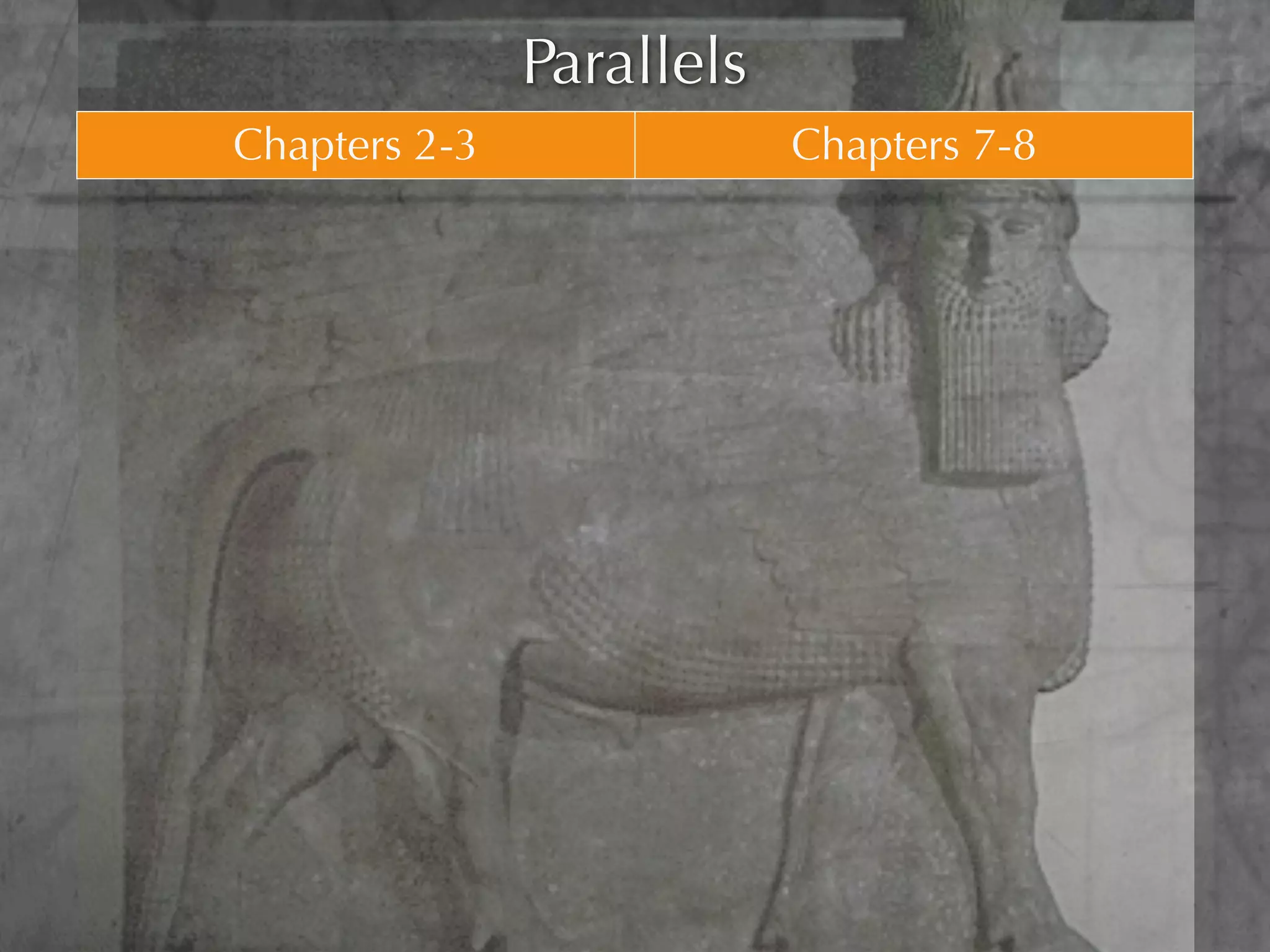
             Chapters 2-3                                       Chapters 7-8
Survey of the whole course of Gentile imperial     Survey of the whole course of Gentile imperial
                   power                                              power

        4 empires in the form of a man                     4 empires in the form of beasts

 The fatal weakness: an incoherent mixture of       The hideous strength: a frightening mixture of
            iron and clay in the feet              animal destructiveness with human intelligence

  Statue destroyed by divine stone. Universal          The final beast destroyed and universal
          Messianic kingdom set up                       dominion given to the Son of Man

Nebuchadnezzar thinks that “no god can deliver       The little horn: “none can deliver out of his
         (the Jews) out of his hand”                                     hand”

                                                    He stops the Jews’ worship of their God, and
    He commands them to worship his god
                                                                    defies God


  God’s ability to deliver is thereby vindicated   God’s sanctuary and truth are finally vindicated
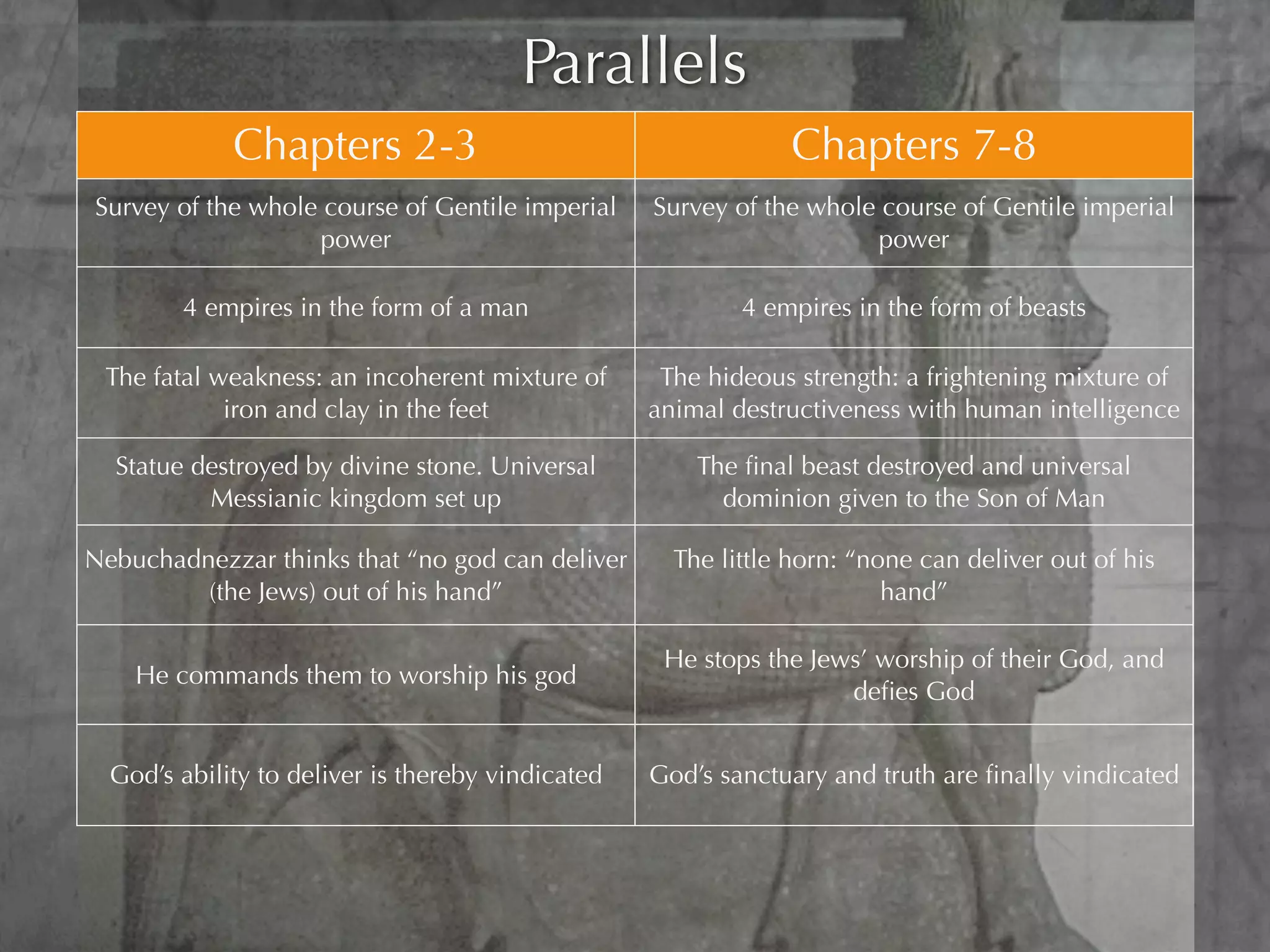
Parallels
             Chapters 2-3                                       Chapters 7-8
Survey of the whole course of Gentile imperial     Survey of the whole course of Gentile imperial
                   power                                              power

        4 empires in the form of a man                     4 empires in the form of beasts

 The fatal weakness: an incoherent mixture of       The hideous strength: a frightening mixture of
            iron and clay in the feet              animal destructiveness with human intelligence

  Statue destroyed by divine stone. Universal          The final beast destroyed and universal
          Messianic kingdom set up                       dominion given to the Son of Man

Nebuchadnezzar thinks that “no god can deliver       The little horn: “none can deliver out of his
         (the Jews) out of his hand”                                     hand”

                                                    He stops the Jews’ worship of their God, and
    He commands them to worship his god
                                                                    defies God


  God’s ability to deliver is thereby vindicated   God’s sanctuary and truth are finally vindicated
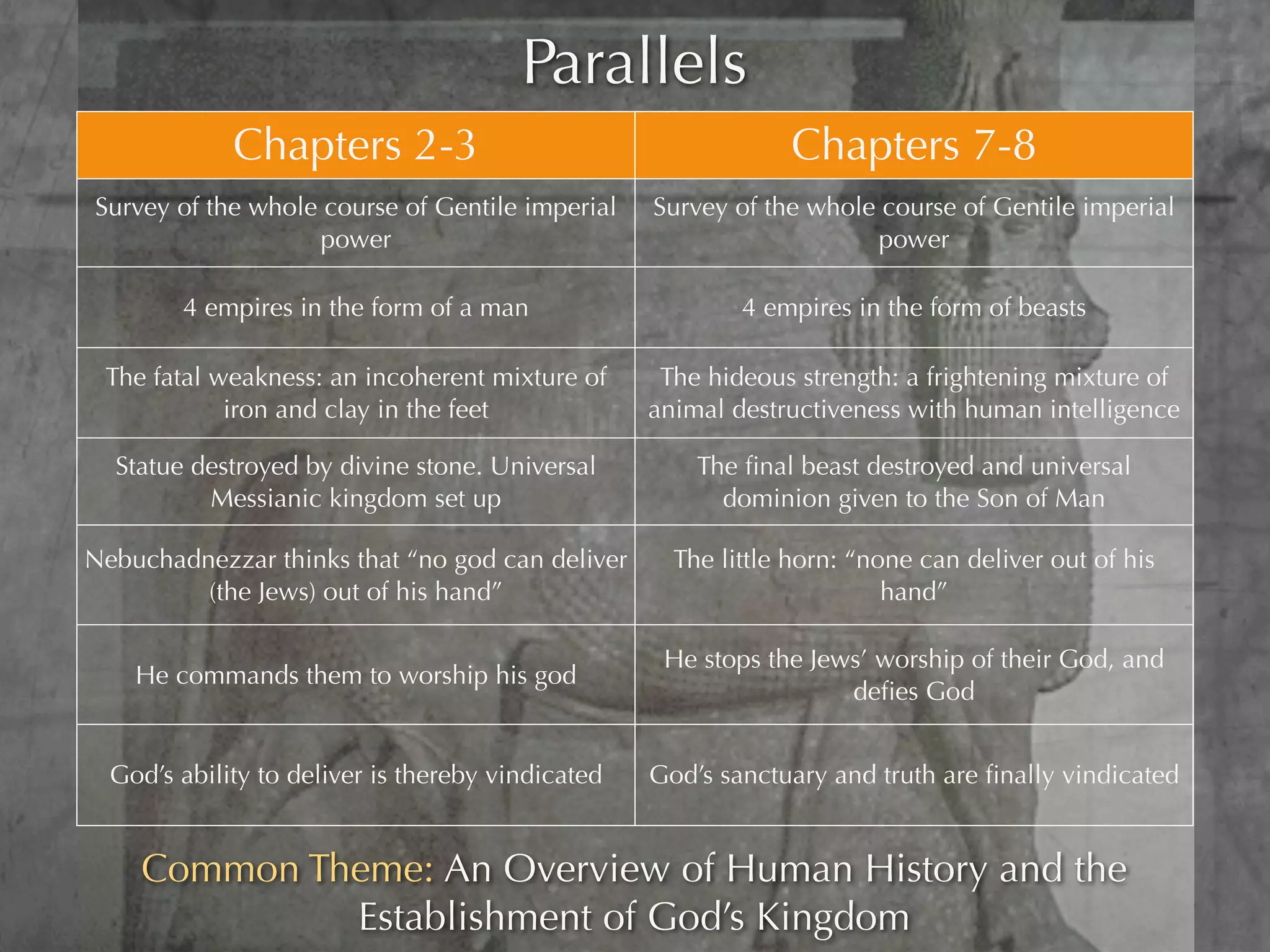
Parallels
             Chapters 2-3                                       Chapters 7-8
Survey of the whole course of Gentile imperial     Survey of the whole course of Gentile imperial
                   power                                              power

        4 empires in the form of a man                     4 empires in the form of beasts

 The fatal weakness: an incoherent mixture of       The hideous strength: a frightening mixture of
            iron and clay in the feet              animal destructiveness with human intelligence

  Statue destroyed by divine stone. Universal          The final beast destroyed and universal
          Messianic kingdom set up                       dominion given to the Son of Man

Nebuchadnezzar thinks that “no god can deliver       The little horn: “none can deliver out of his
         (the Jews) out of his hand”                                     hand”

                                                    He stops the Jews’ worship of their God, and
    He commands them to worship his god
                                                                    defies God


  God’s ability to deliver is thereby vindicated   God’s sanctuary and truth are finally vindicated
Parallels
             Chapters 2-3                                       Chapters 7-8
Survey of the whole course of Gentile imperial     Survey of the whole course of Gentile imperial
                   power                                              power

        4 empires in the form of a man                     4 empires in the form of beasts

 The fatal weakness: an incoherent mixture of       The hideous strength: a frightening mixture of
            iron and clay in the feet              animal destructiveness with human intelligence

  Statue destroyed by divine stone. Universal          The final beast destroyed and universal
          Messianic kingdom set up                       dominion given to the Son of Man

Nebuchadnezzar thinks that “no god can deliver       The little horn: “none can deliver out of his
         (the Jews) out of his hand”                                     hand”

                                                    He stops the Jews’ worship of their God, and
    He commands them to worship his god
                                                                    defies God


  God’s ability to deliver is thereby vindicated   God’s sanctuary and truth are finally vindicated
Parallels
             Chapters 2-3                                       Chapters 7-8
Survey of the whole course of Gentile imperial     Survey of the whole course of Gentile imperial
                   power                                              power

        4 empires in the form of a man                     4 empires in the form of beasts

 The fatal weakness: an incoherent mixture of       The hideous strength: a frightening mixture of
            iron and clay in the feet              animal destructiveness with human intelligence

  Statue destroyed by divine stone. Universal          The final beast destroyed and universal
          Messianic kingdom set up                       dominion given to the Son of Man

Nebuchadnezzar thinks that “no god can deliver       The little horn: “none can deliver out of his
         (the Jews) out of his hand”                                     hand”

                                                    He stops the Jews’ worship of their God, and
    He commands them to worship his god
                                                                    defies God


  God’s ability to deliver is thereby vindicated   God’s sanctuary and truth are finally vindicated
Parallels
             Chapters 2-3                                       Chapters 7-8
Survey of the whole course of Gentile imperial     Survey of the whole course of Gentile imperial
                   power                                              power

        4 empires in the form of a man                     4 empires in the form of beasts

 The fatal weakness: an incoherent mixture of       The hideous strength: a frightening mixture of
            iron and clay in the feet              animal destructiveness with human intelligence

  Statue destroyed by divine stone. Universal          The final beast destroyed and universal
          Messianic kingdom set up                       dominion given to the Son of Man

Nebuchadnezzar thinks that “no god can deliver       The little horn: “none can deliver out of his
         (the Jews) out of his hand”                                     hand”

                                                    He stops the Jews’ worship of their God, and
    He commands them to worship his god
                                                                    defies God


  God’s ability to deliver is thereby vindicated   God’s sanctuary and truth are finally vindicated
Parallels
             Chapters 2-3                                       Chapters 7-8
Survey of the whole course of Gentile imperial     Survey of the whole course of Gentile imperial
                   power                                              power

        4 empires in the form of a man                     4 empires in the form of beasts

 The fatal weakness: an incoherent mixture of       The hideous strength: a frightening mixture of
            iron and clay in the feet              animal destructiveness with human intelligence

  Statue destroyed by divine stone. Universal          The final beast destroyed and universal
          Messianic kingdom set up                       dominion given to the Son of Man

Nebuchadnezzar thinks that “no god can deliver       The little horn: “none can deliver out of his
         (the Jews) out of his hand”                                     hand”

                                                    He stops the Jews’ worship of their God, and
    He commands them to worship his god
                                                                    defies God


  God’s ability to deliver is thereby vindicated   God’s sanctuary and truth are finally vindicated
Parallels
             Chapters 2-3                                       Chapters 7-8
Survey of the whole course of Gentile imperial     Survey of the whole course of Gentile imperial
                   power                                              power

        4 empires in the form of a man                     4 empires in the form of beasts

 The fatal weakness: an incoherent mixture of       The hideous strength: a frightening mixture of
            iron and clay in the feet              animal destructiveness with human intelligence

  Statue destroyed by divine stone. Universal          The final beast destroyed and universal
          Messianic kingdom set up                       dominion given to the Son of Man

Nebuchadnezzar thinks that “no god can deliver       The little horn: “none can deliver out of his
         (the Jews) out of his hand”                                     hand”

                                                    He stops the Jews’ worship of their God, and
    He commands them to worship his god
                                                                    defies God


  God’s ability to deliver is thereby vindicated   God’s sanctuary and truth are finally vindicated
Parallels
             Chapters 2-3                                       Chapters 7-8
Survey of the whole course of Gentile imperial     Survey of the whole course of Gentile imperial
                   power                                              power

        4 empires in the form of a man                     4 empires in the form of beasts

 The fatal weakness: an incoherent mixture of       The hideous strength: a frightening mixture of
            iron and clay in the feet              animal destructiveness with human intelligence

  Statue destroyed by divine stone. Universal          The final beast destroyed and universal
          Messianic kingdom set up                       dominion given to the Son of Man

Nebuchadnezzar thinks that “no god can deliver       The little horn: “none can deliver out of his
         (the Jews) out of his hand”                                     hand”

                                                    He stops the Jews’ worship of their God, and
    He commands them to worship his god
                                                                    defies God


  God’s ability to deliver is thereby vindicated   God’s sanctuary and truth are finally vindicated


    Common Theme: An Overview of Human History and the
             Establishment of God’s Kingdom
Second Vision Under Belshazzar
             1 In the third year of the reign of
             Belshazzar the king a vision appeared to
             me, Daniel, subsequent to the one which
             appeared to me previously.
Vision in Susa, Persia

2I looked in the vision, and while I was looking I was in the citadel
of Susa, which is in the province of Elam; and I looked in the vision
and I myself was beside the Ulai Canal.
Identity of the Ram
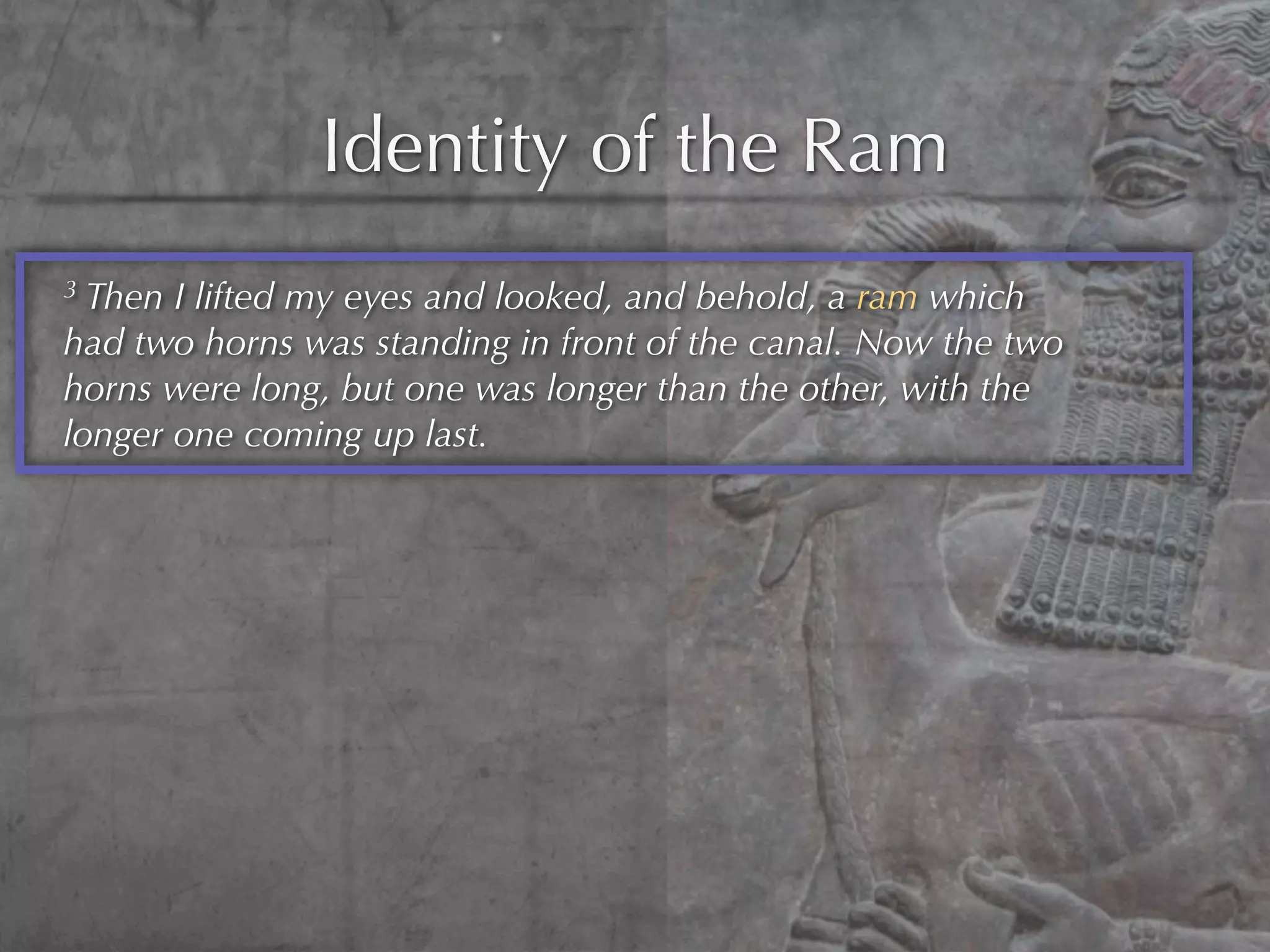
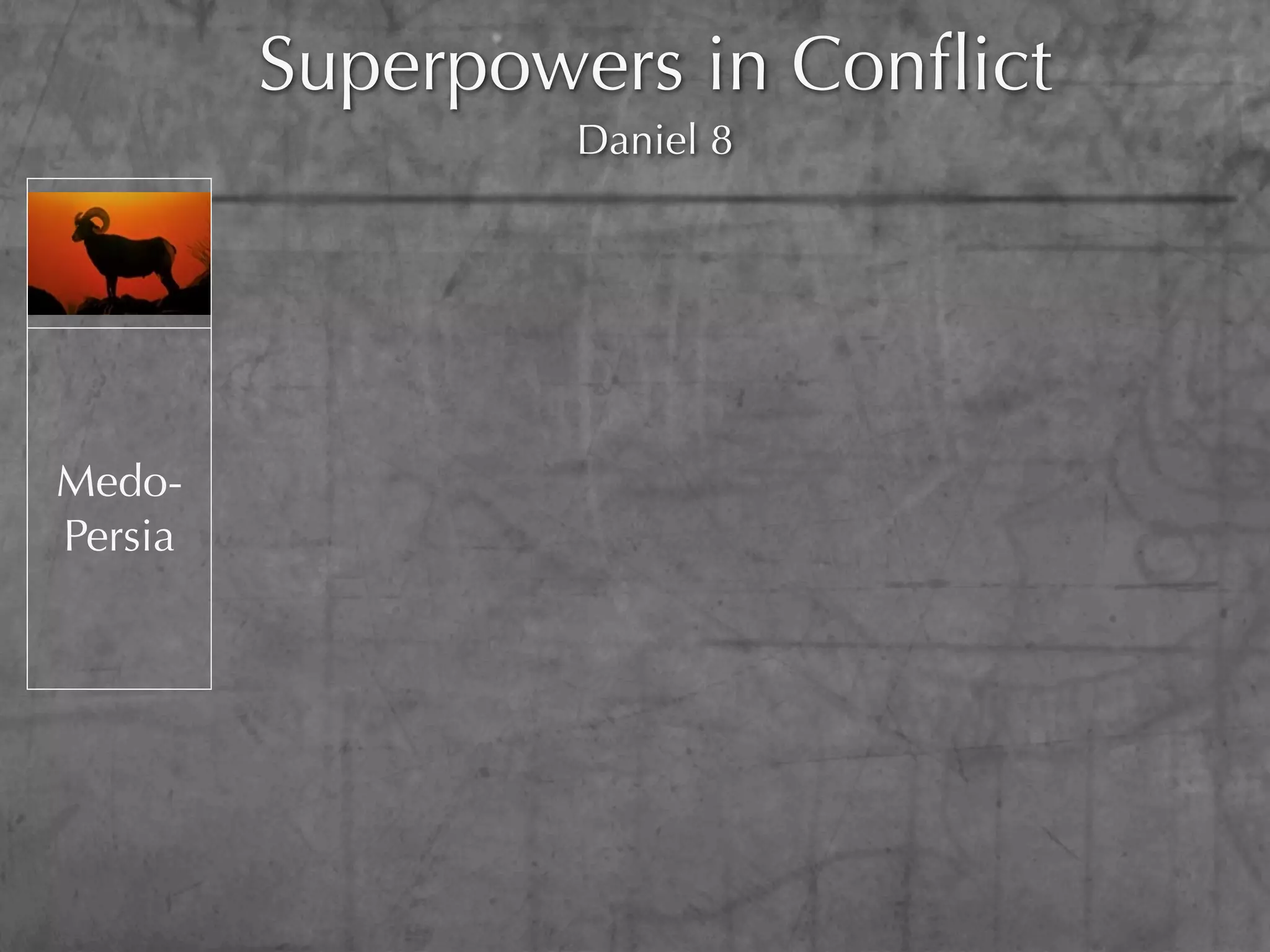
3 Then I lifted my eyes and looked, and behold, a ram which
had two horns was standing in front of the canal. Now the two
horns were long, but one was longer than the other, with the
longer one coming up last.
Identity of the Ram
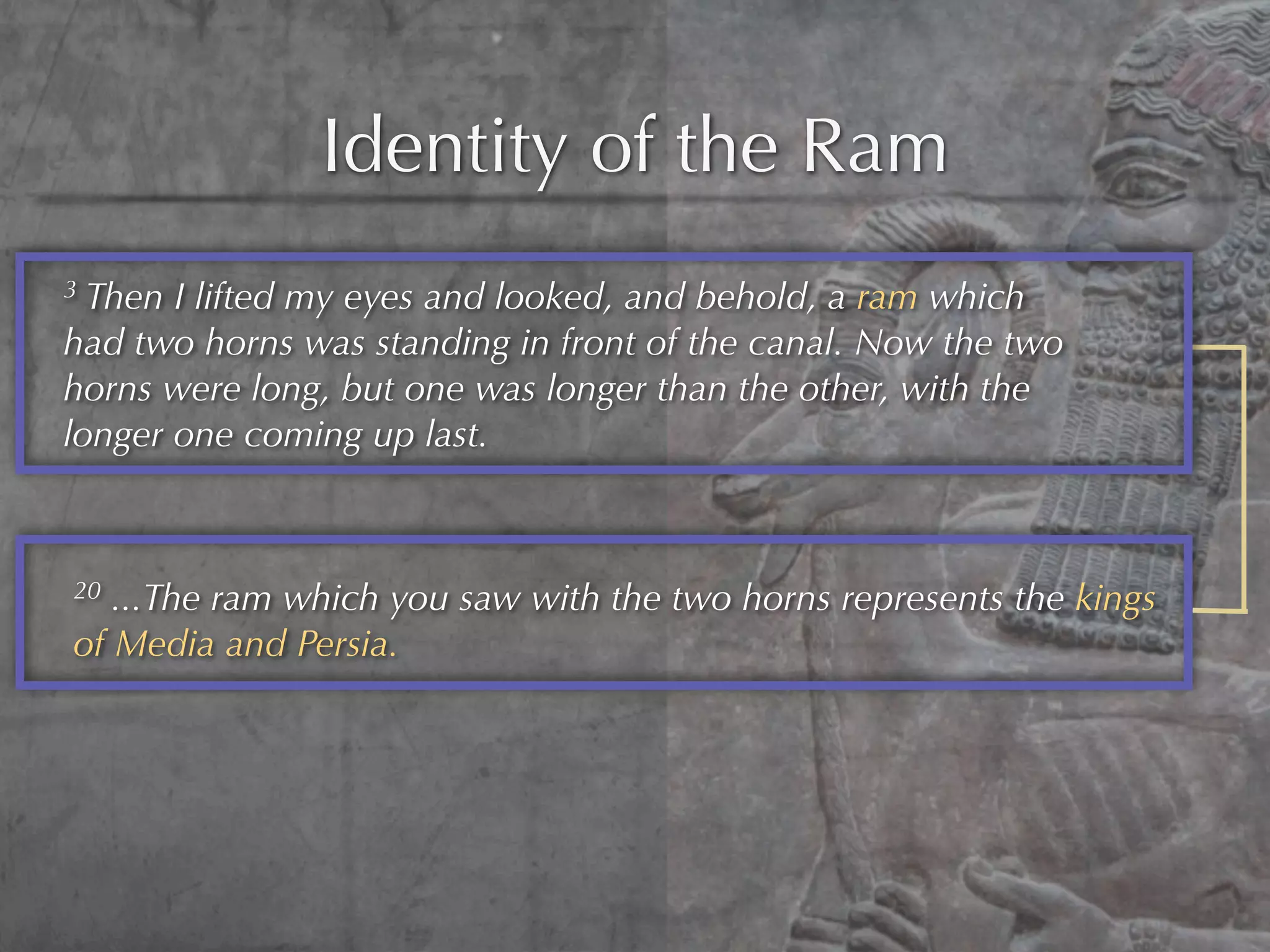
3 Then I lifted my eyes and looked, and behold, a ram which
had two horns was standing in front of the canal. Now the two
horns were long, but one was longer than the other, with the
longer one coming up last.


20 ...The ram which you saw with the two horns represents the kings
of Media and Persia.
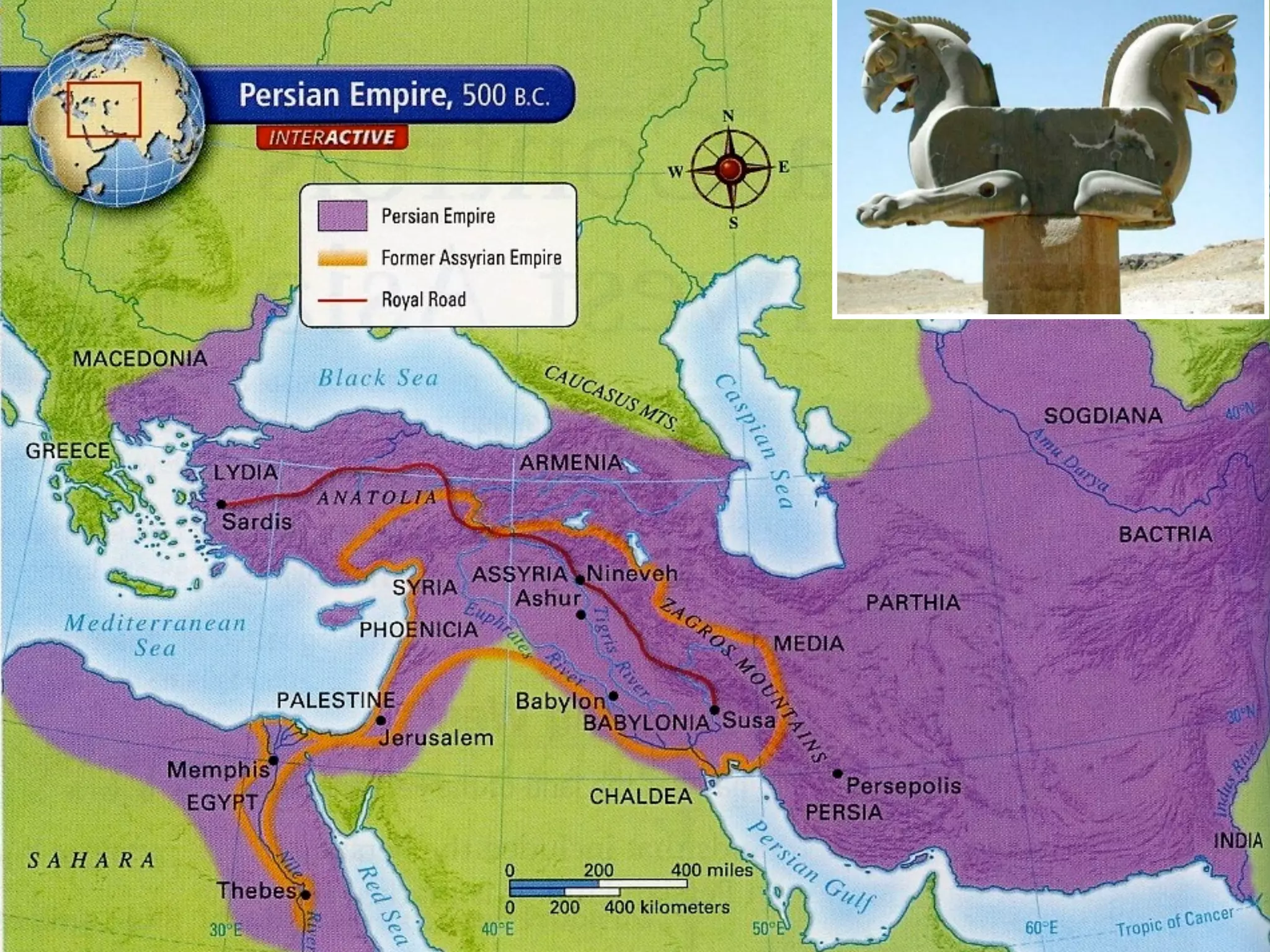
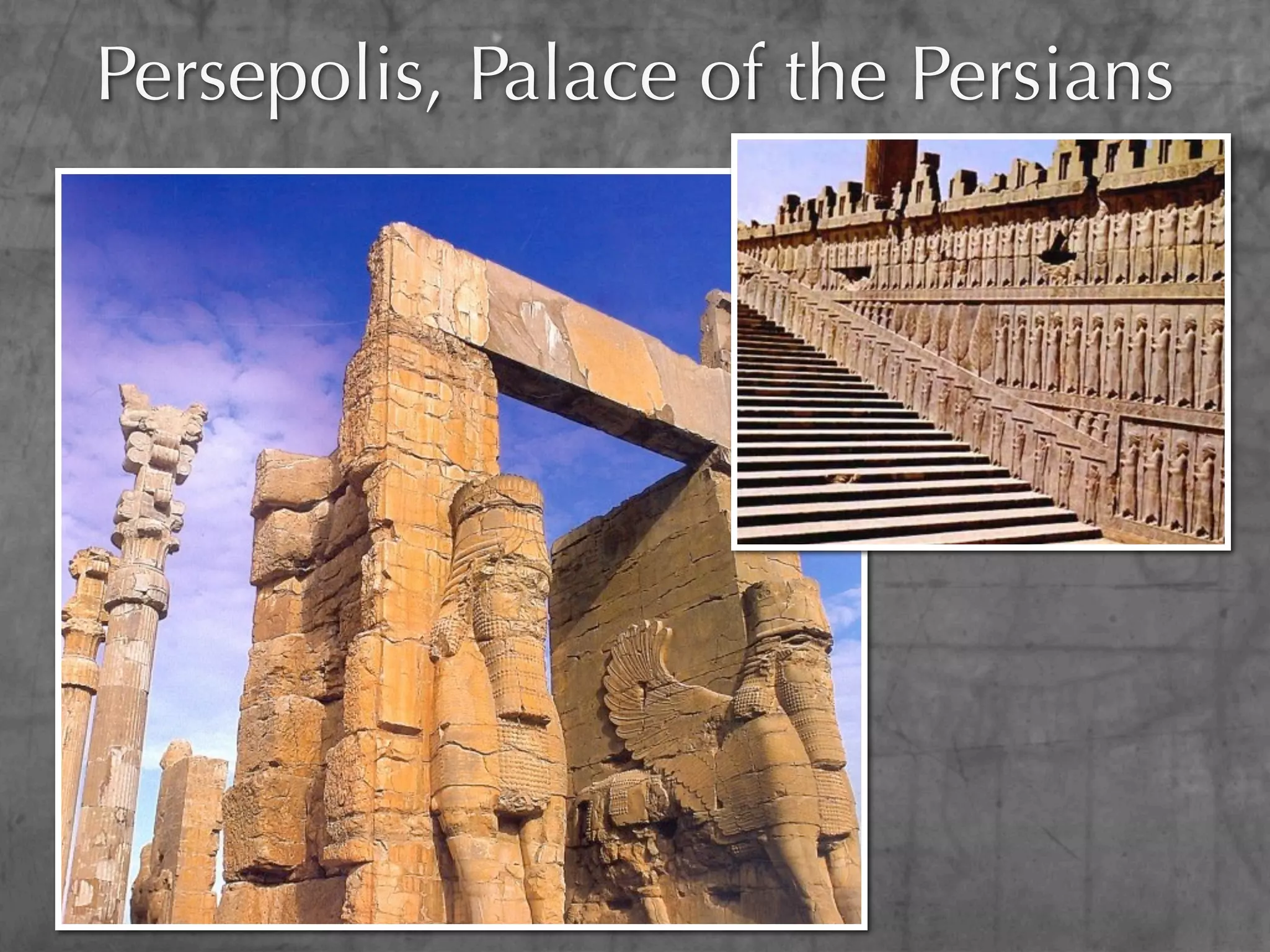
Persepolis, Palace of the Persians
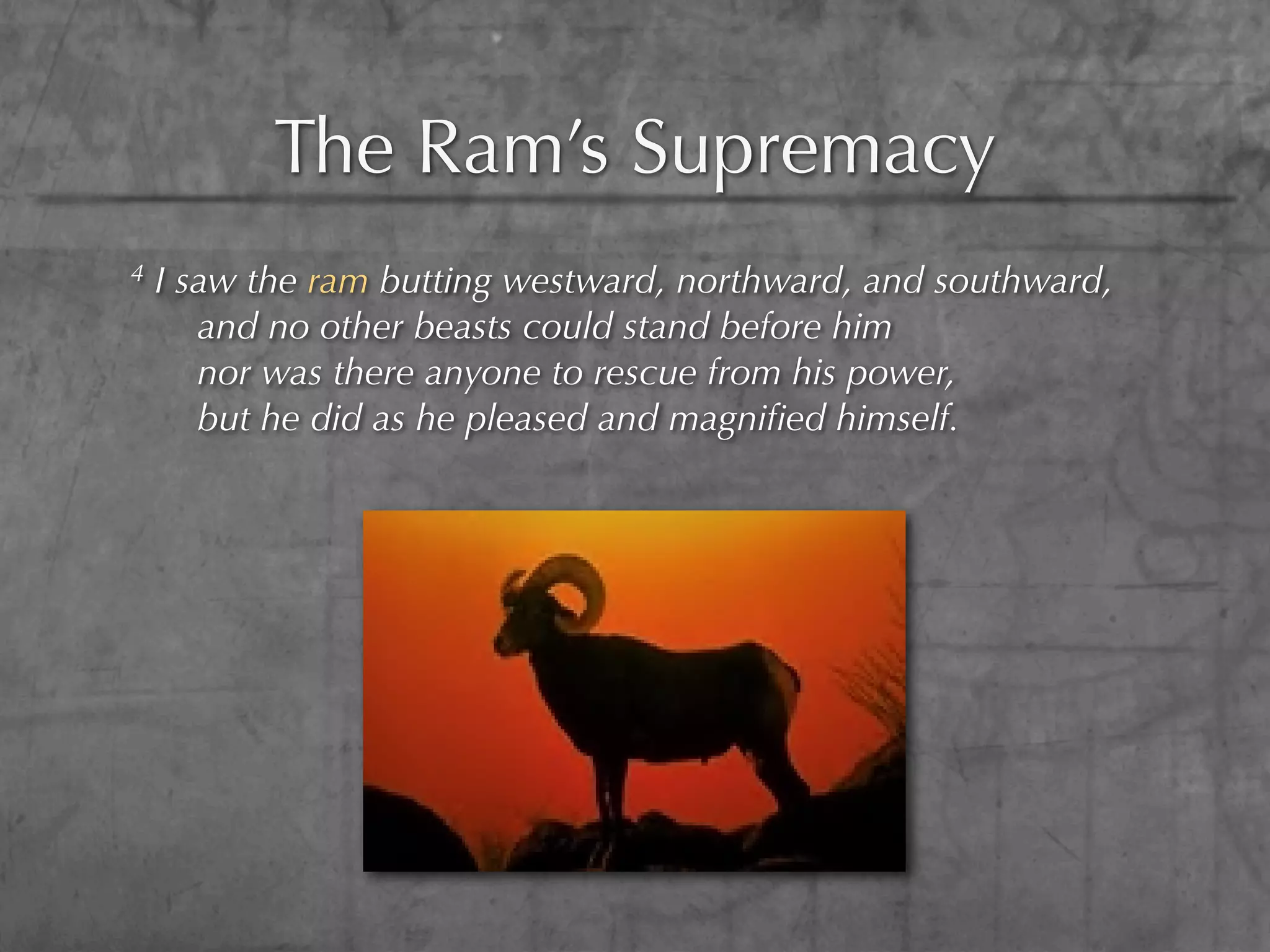
The Ram’s Supremacy
4   I saw the ram butting westward, northward, and southward,
       and no other beasts could stand before him
       nor was there anyone to rescue from his power,
       but he did as he pleased and magnified himself.
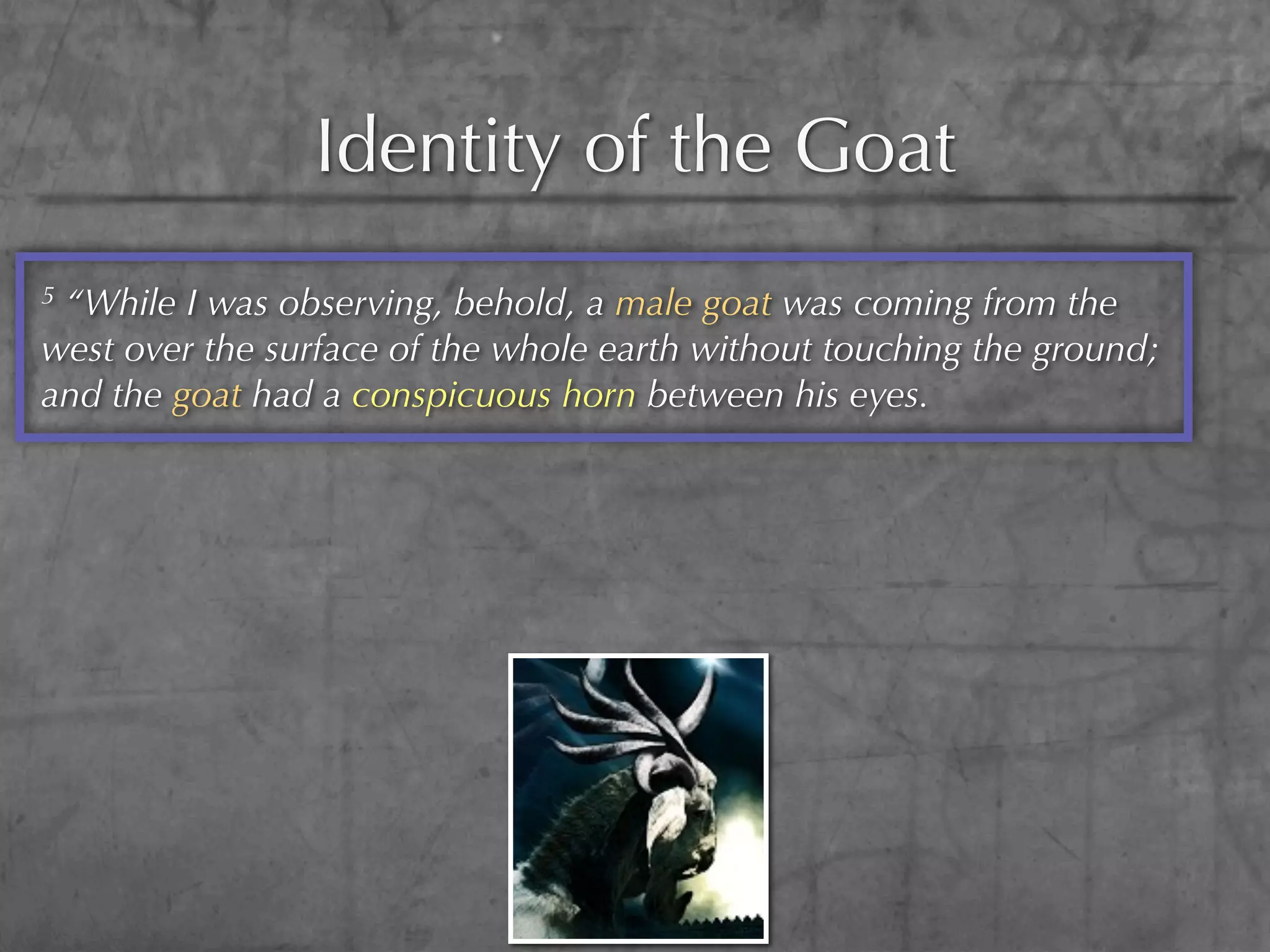
Identity of the Goat
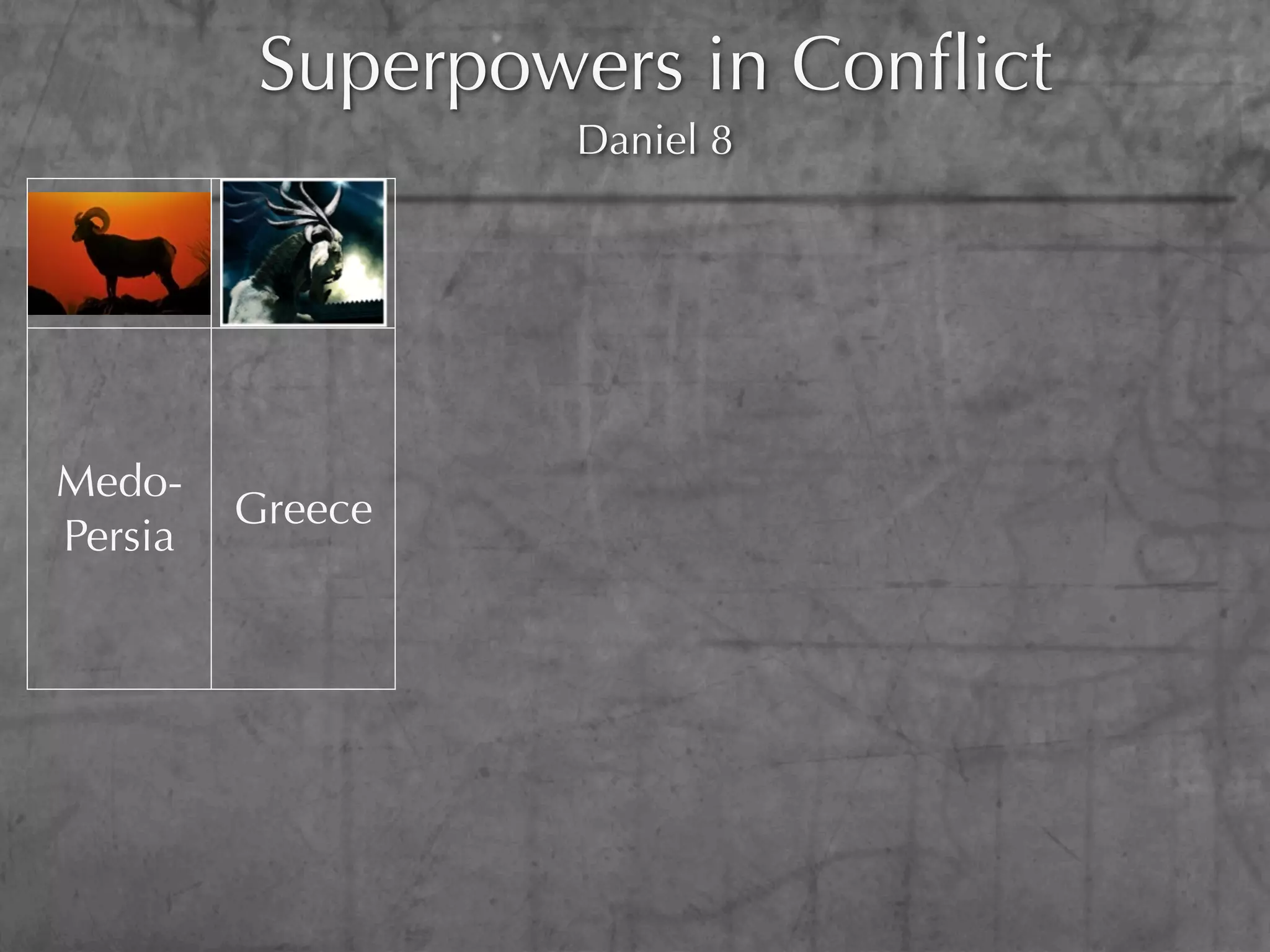
5“While I was observing, behold, a male goat was coming from the
west over the surface of the whole earth without touching the ground;
and the goat had a conspicuous horn between his eyes.
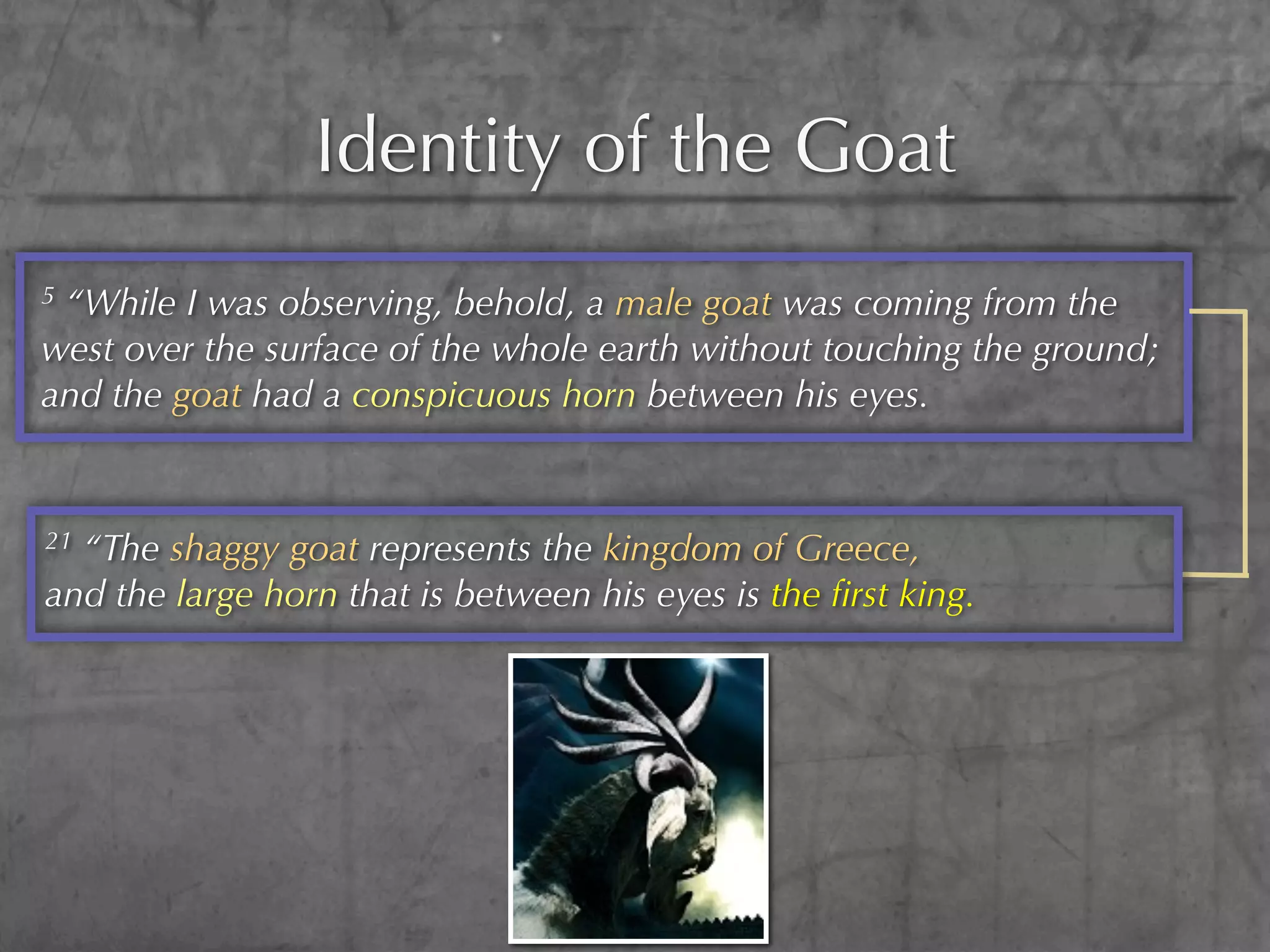
Identity of the Goat
5“While I was observing, behold, a male goat was coming from the
west over the surface of the whole earth without touching the ground;
and the goat had a conspicuous horn between his eyes.


21“The shaggy goat represents the kingdom of Greece,
and the large horn that is between his eyes is the first king.
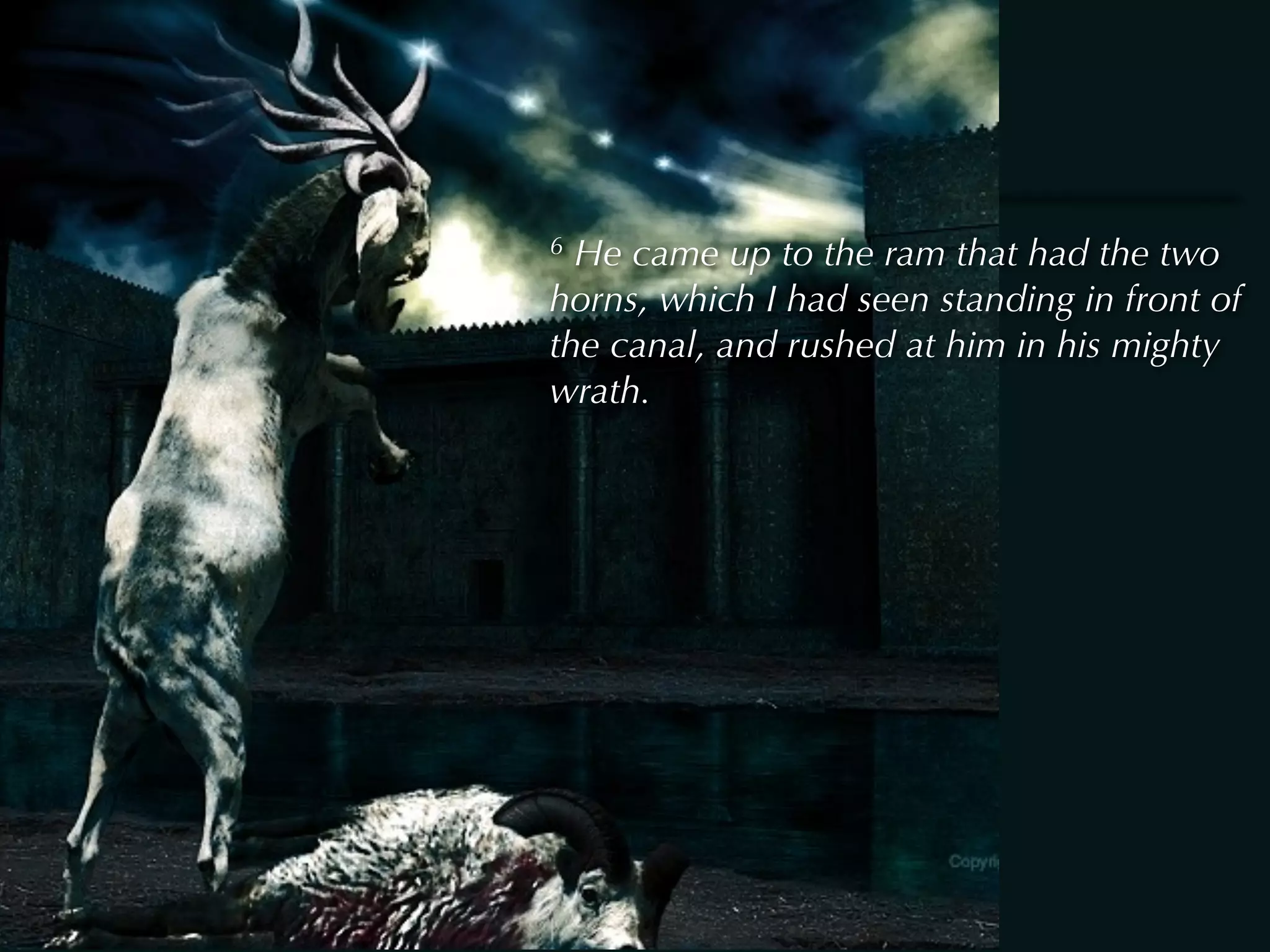
6 He came up to the ram that had the two
horns, which I had seen standing in front of
the canal, and rushed at him in his mighty
wrath.
6 He came up to the ram that had the two
horns, which I had seen standing in front of
the canal, and rushed at him in his mighty
wrath.

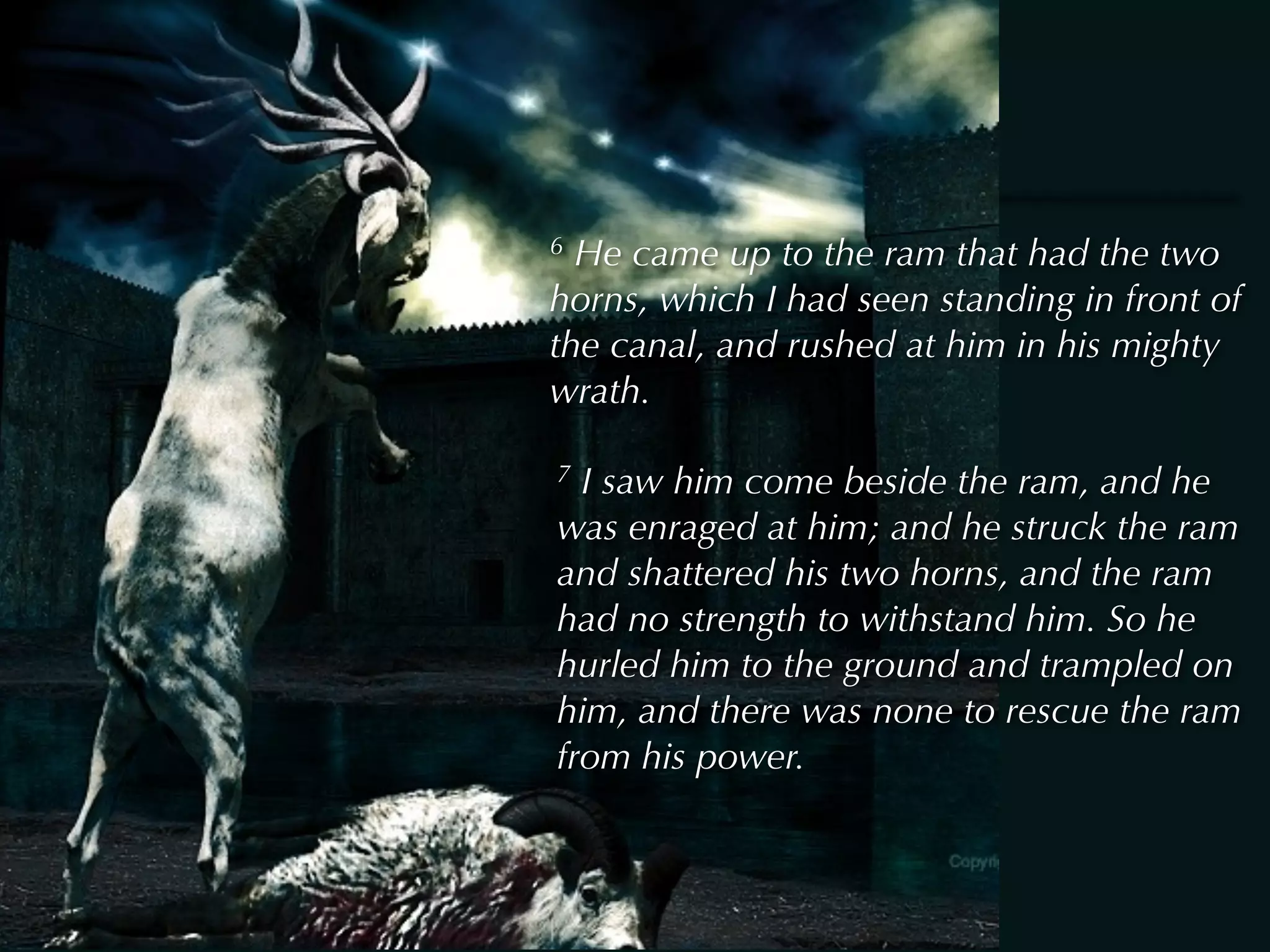
7 I saw him come beside the ram, and he
was enraged at him; and he struck the ram
and shattered his two horns, and the ram
had no strength to withstand him. So he
hurled him to the ground and trampled on
him, and there was none to rescue the ram
from his power.
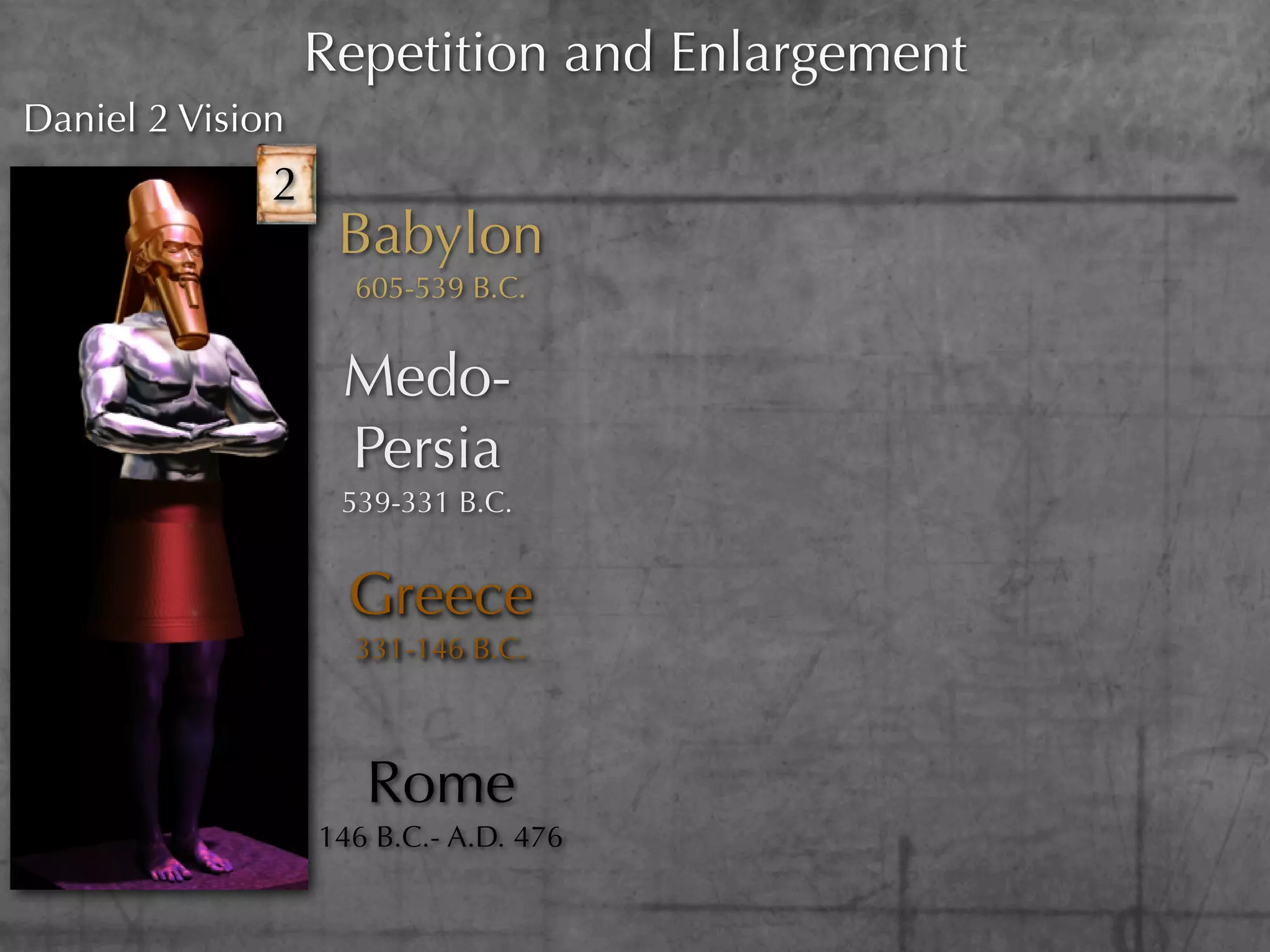
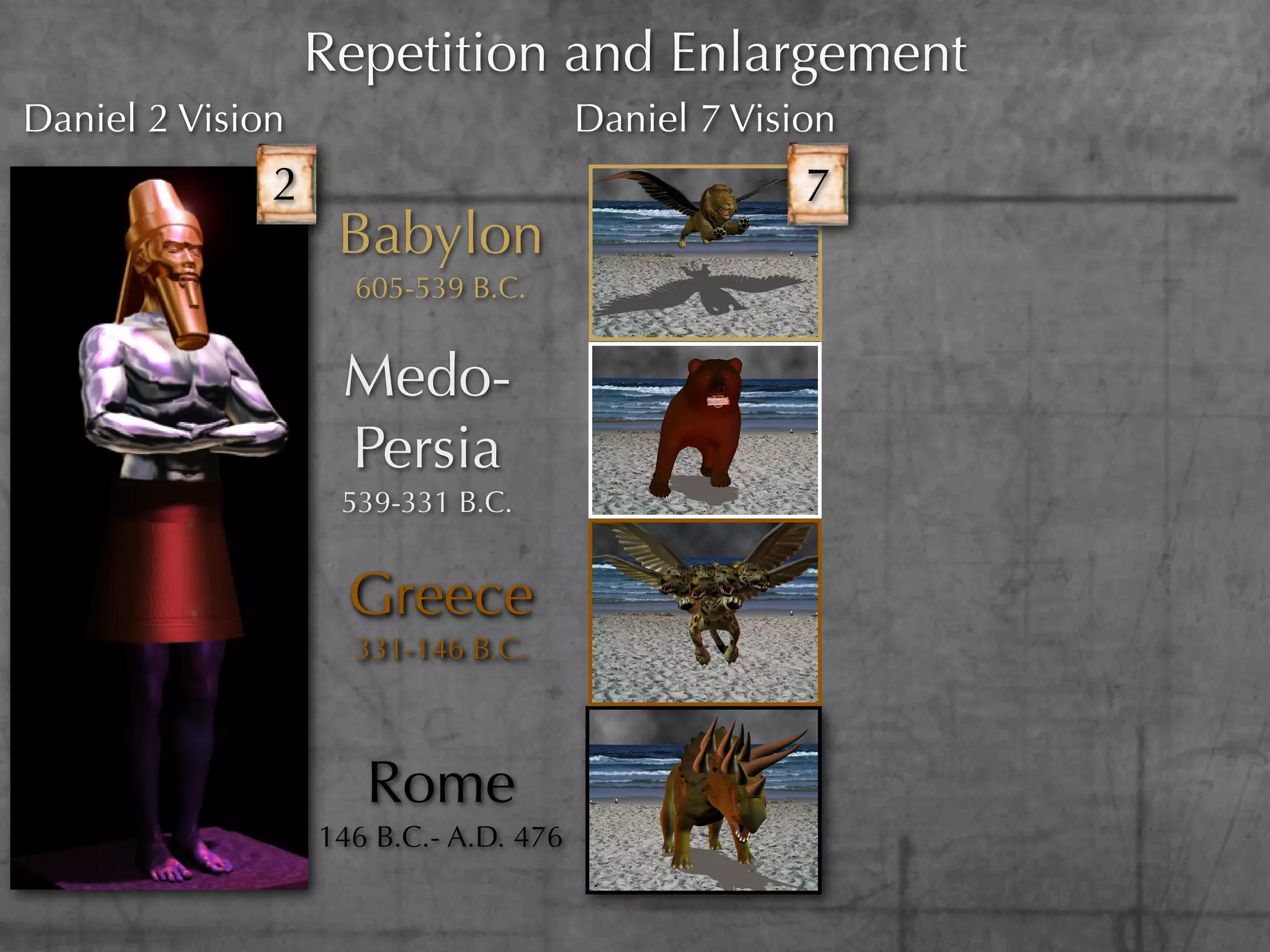
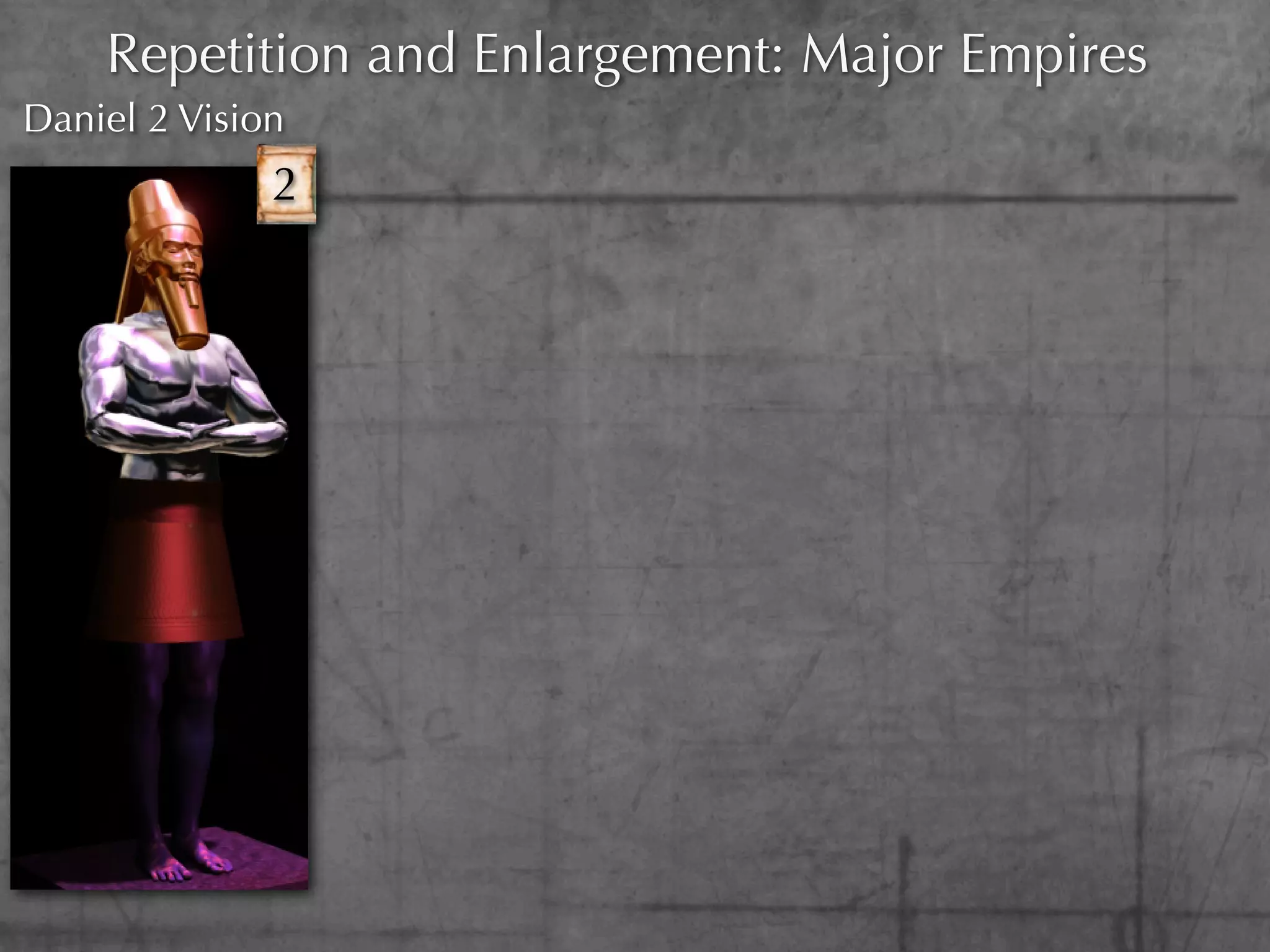
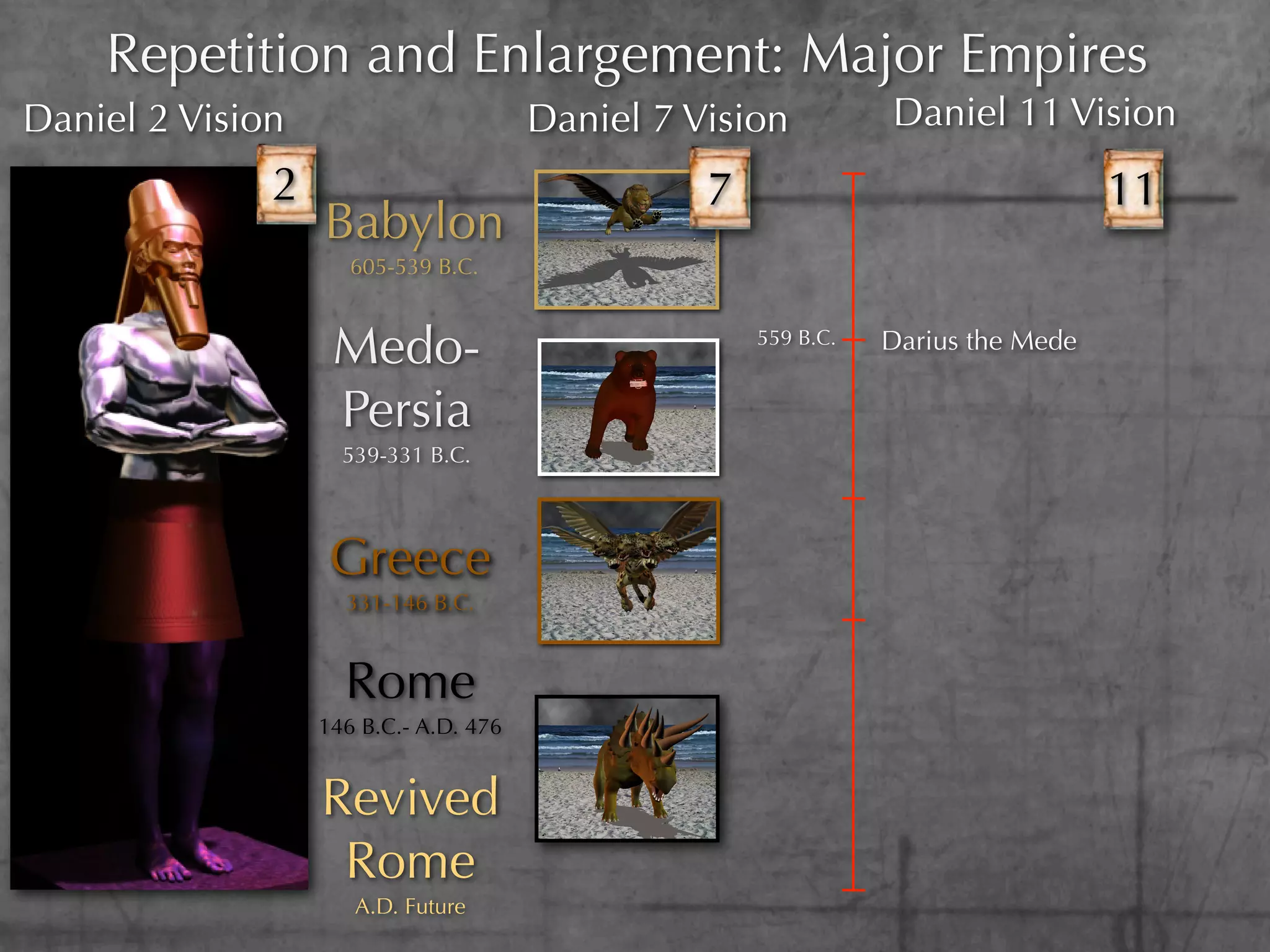
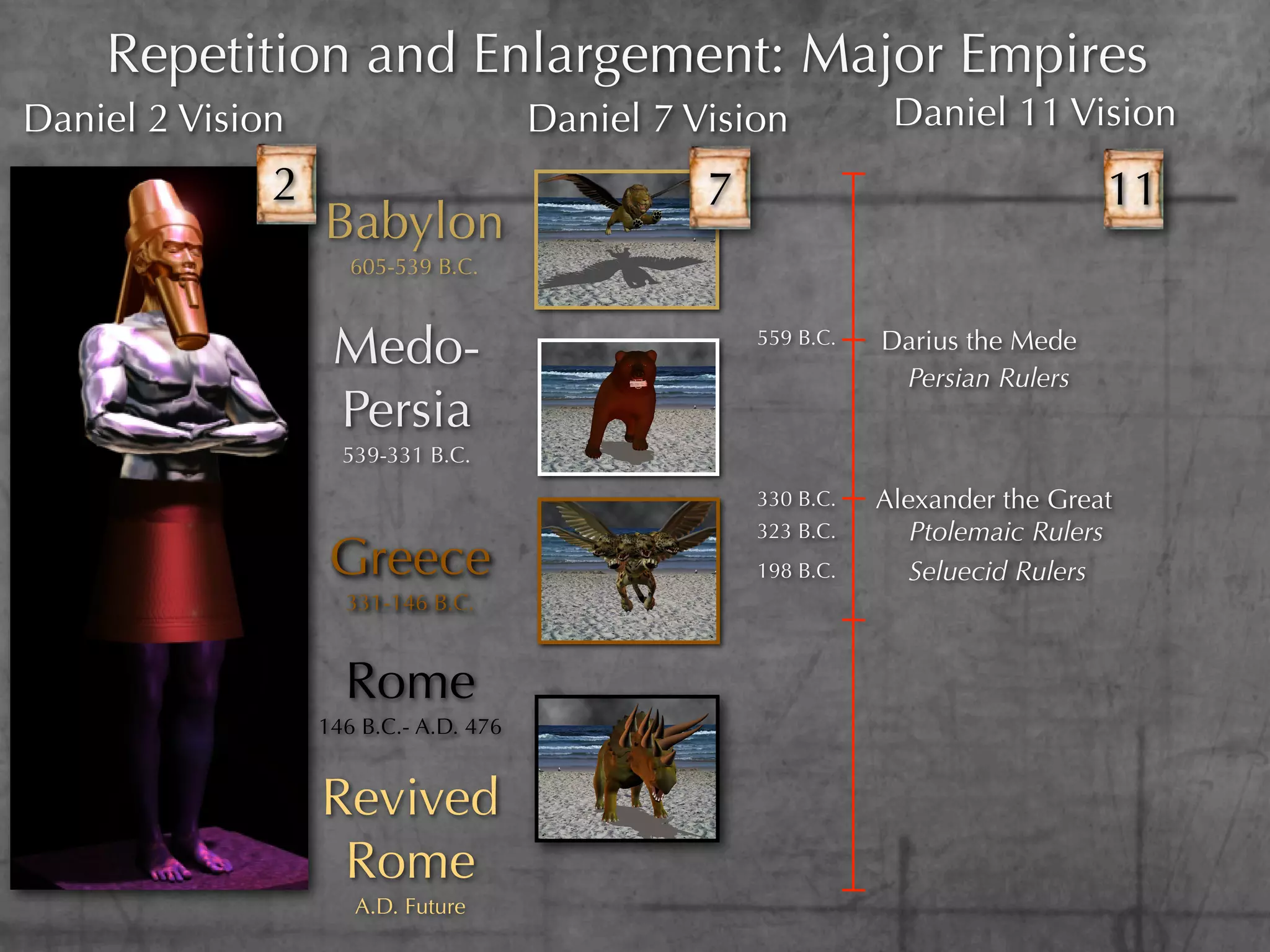
Repetition and Enlargement
Daniel 2 Vision
              2
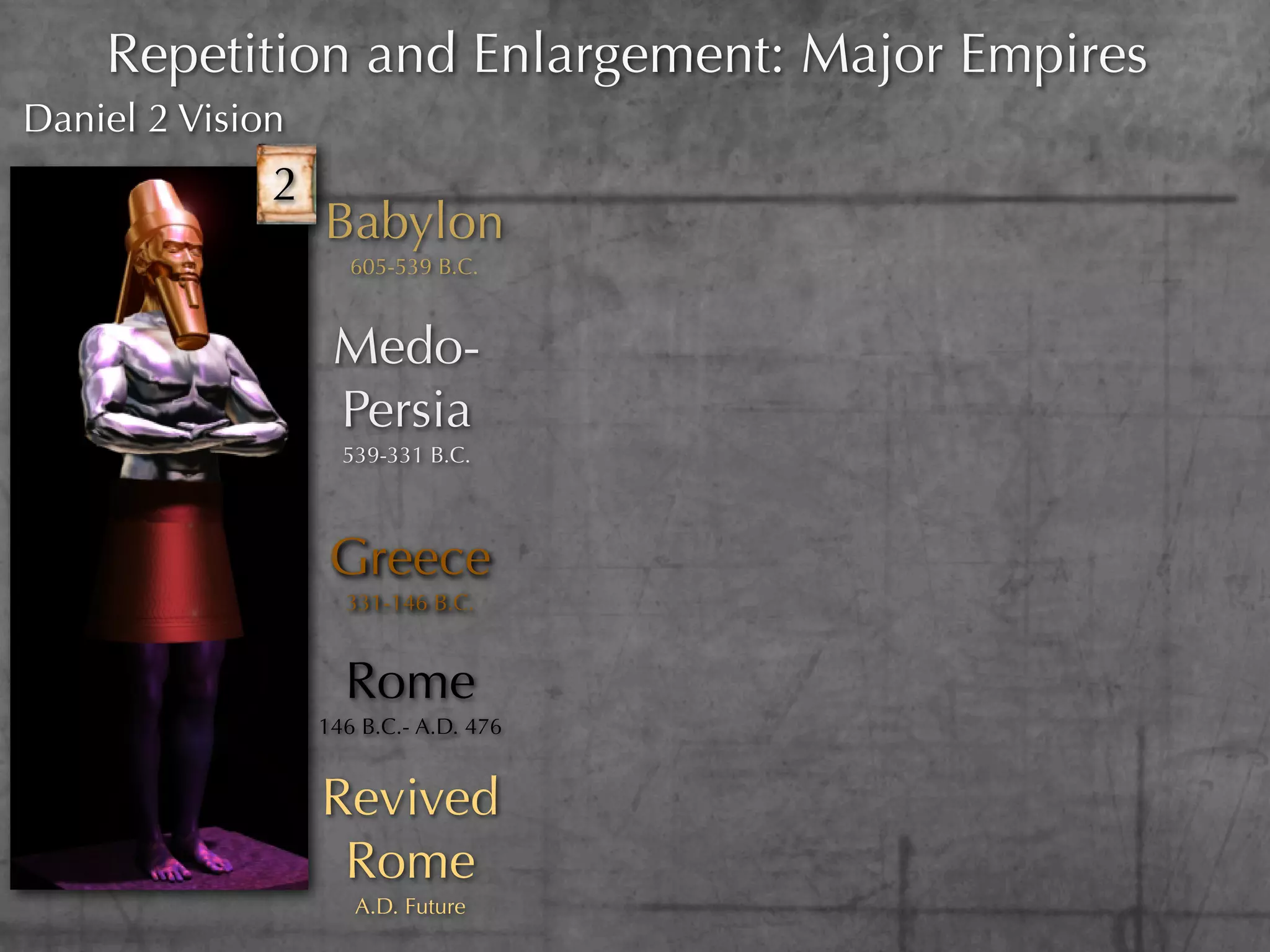
                   Babylon
                    605-539 B.C.


                   Medo-
                   Persia
                   539-331 B.C.


                    Greece
                    331-146 B.C.


                     Rome
                  146 B.C.- A.D. 476
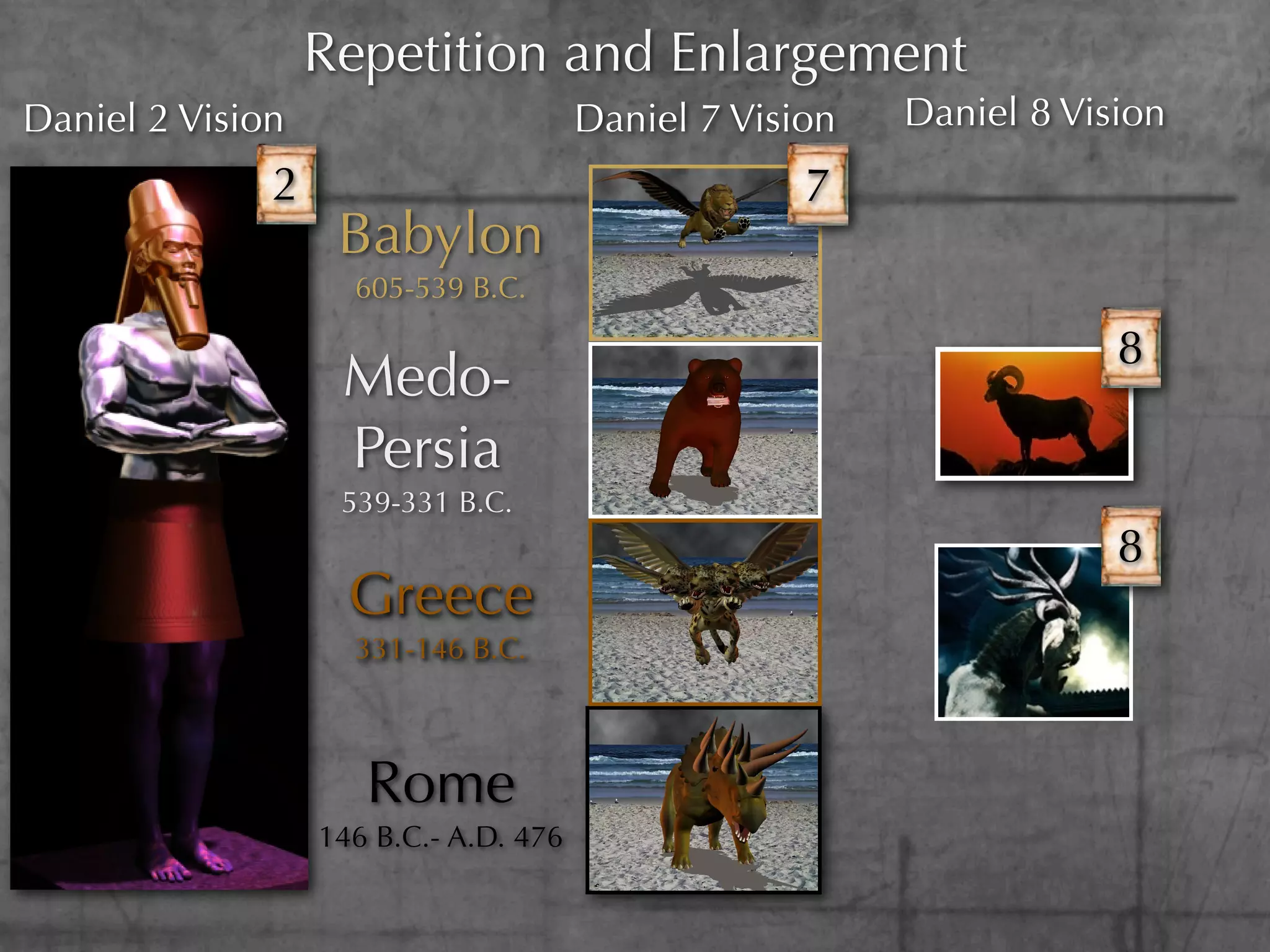
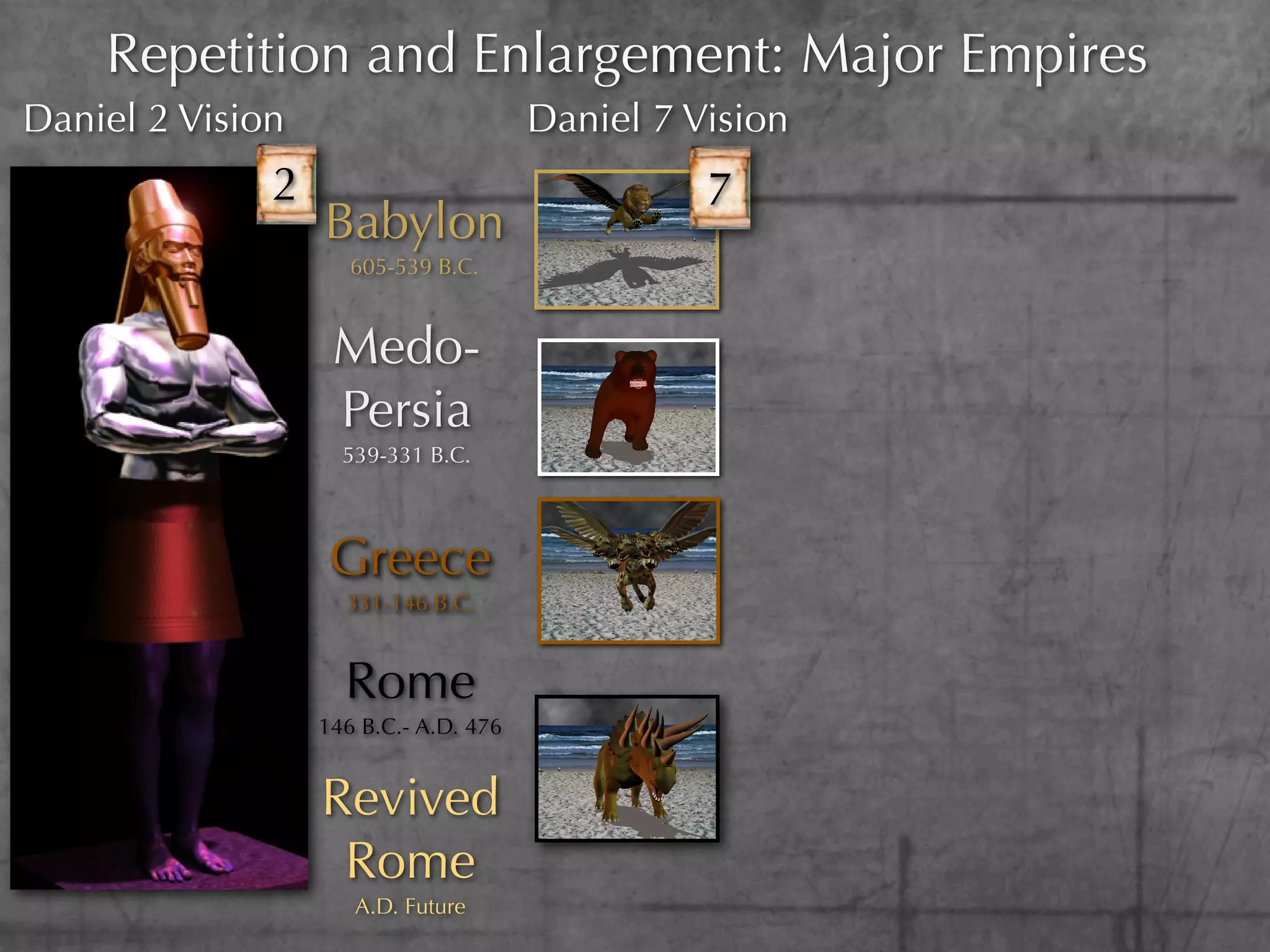
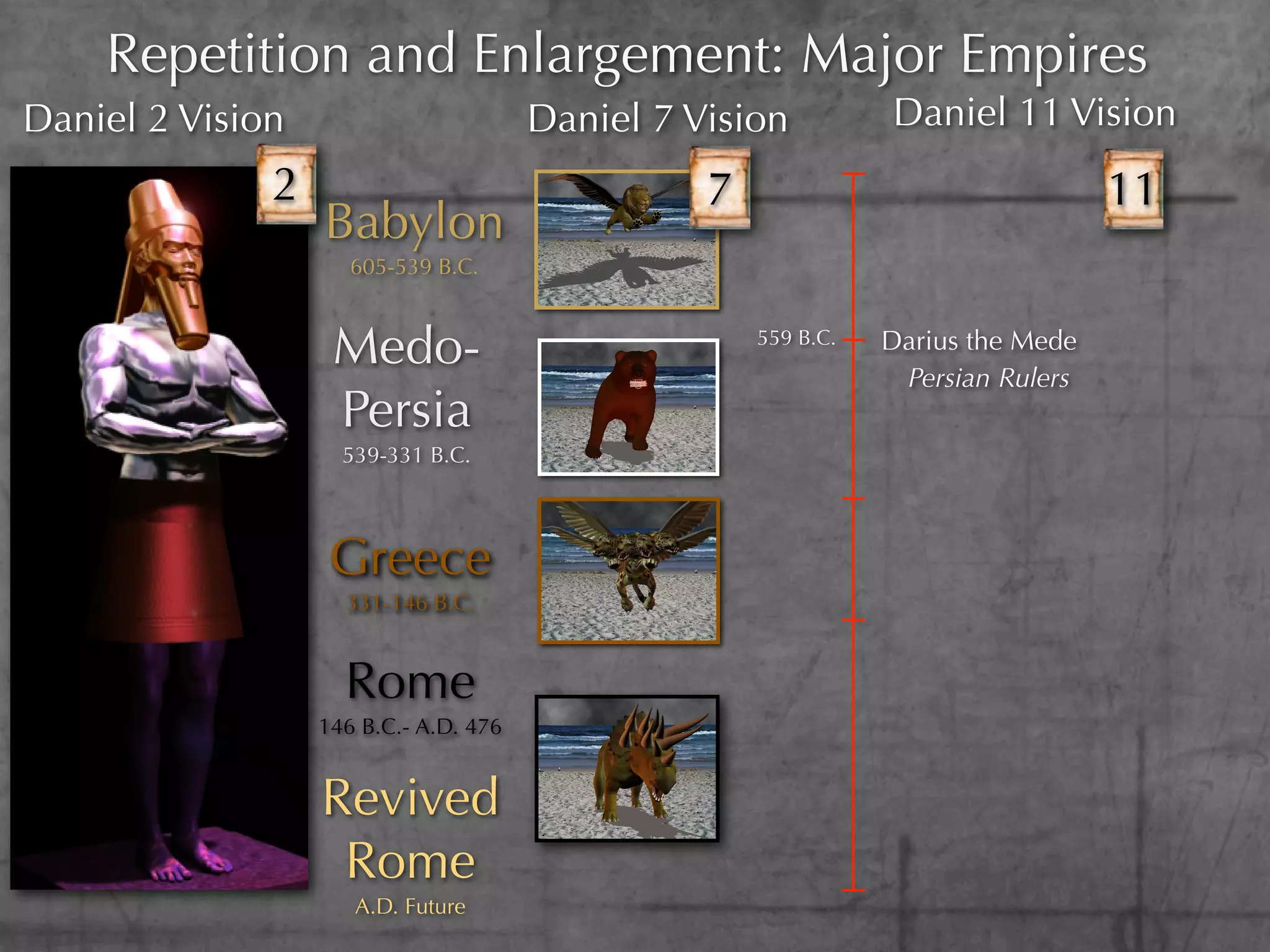
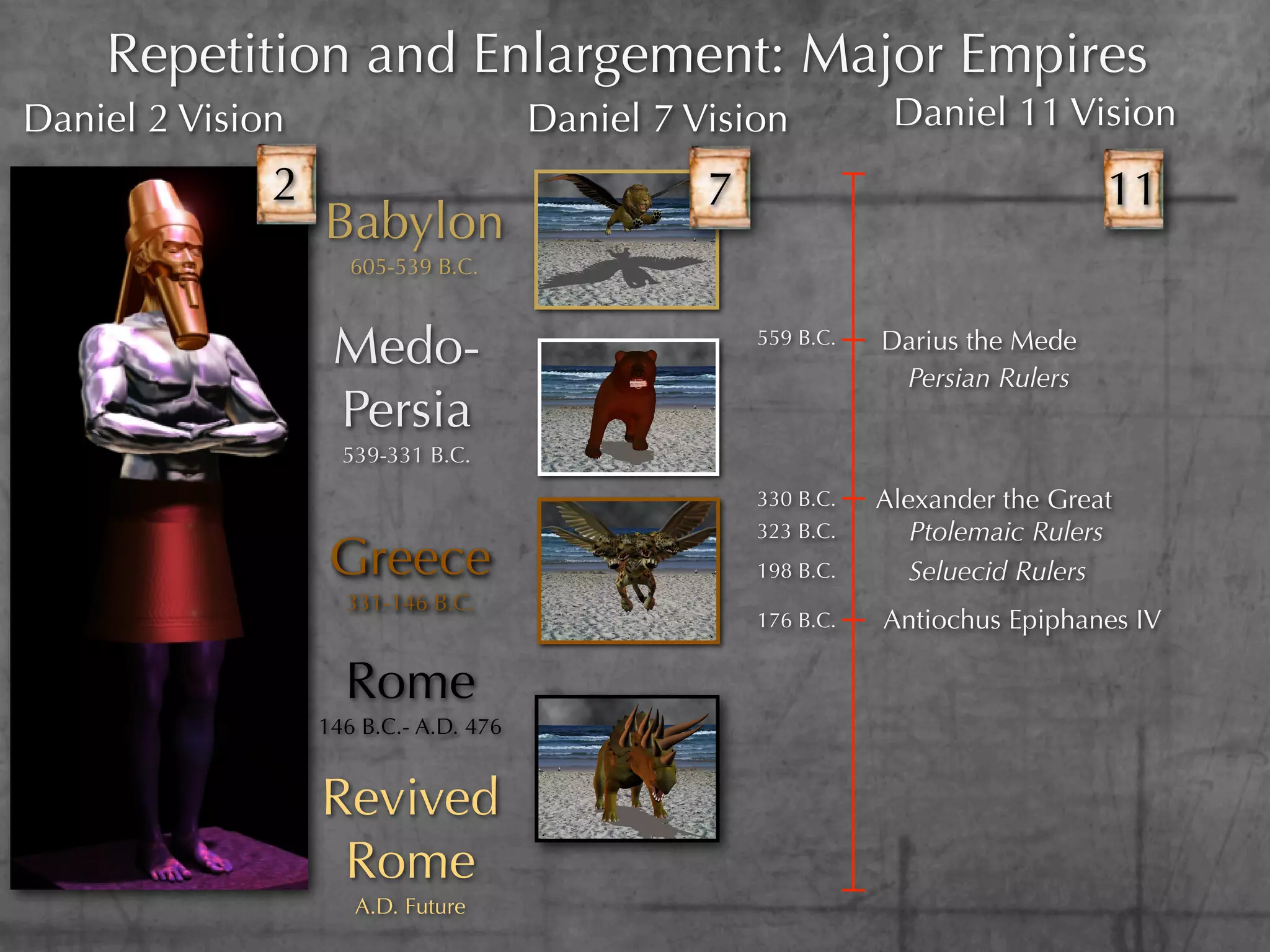
Repetition and Enlargement
Daniel 2 Vision                        Daniel 7 Vision
              2                                     7
                   Babylon
                    605-539 B.C.


                   Medo-
                   Persia
                   539-331 B.C.


                    Greece
                    331-146 B.C.


                     Rome
                  146 B.C.- A.D. 476
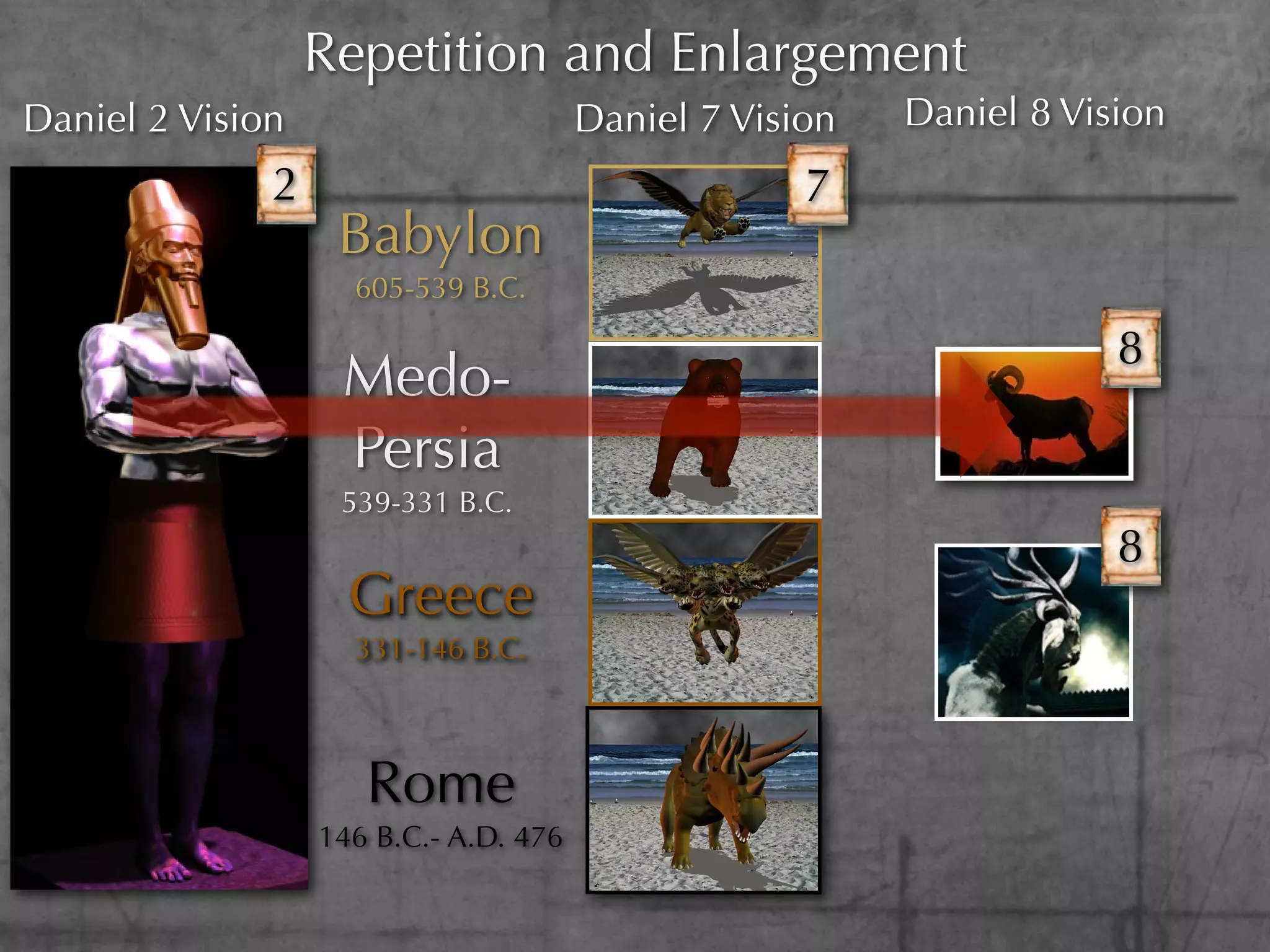
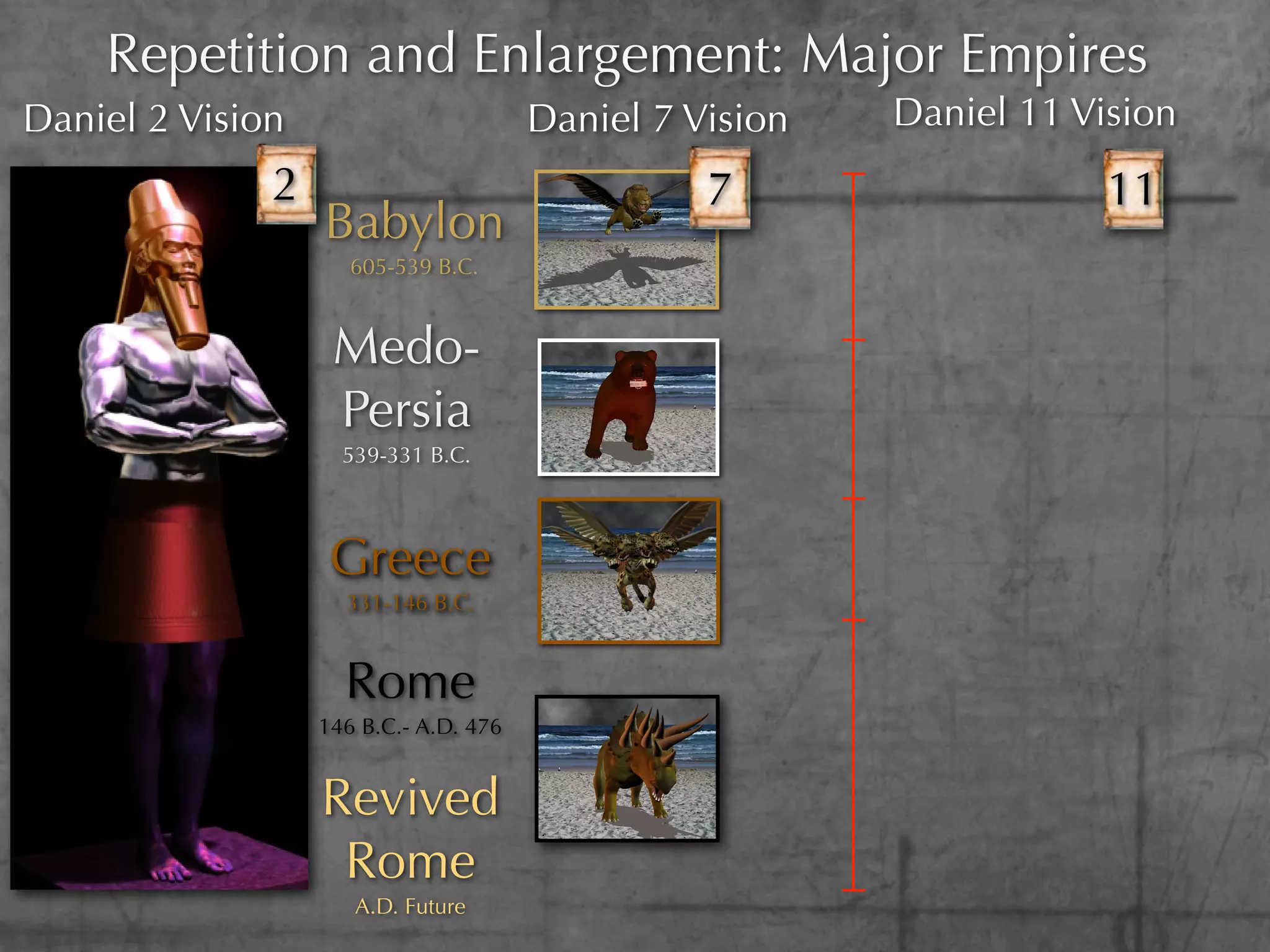
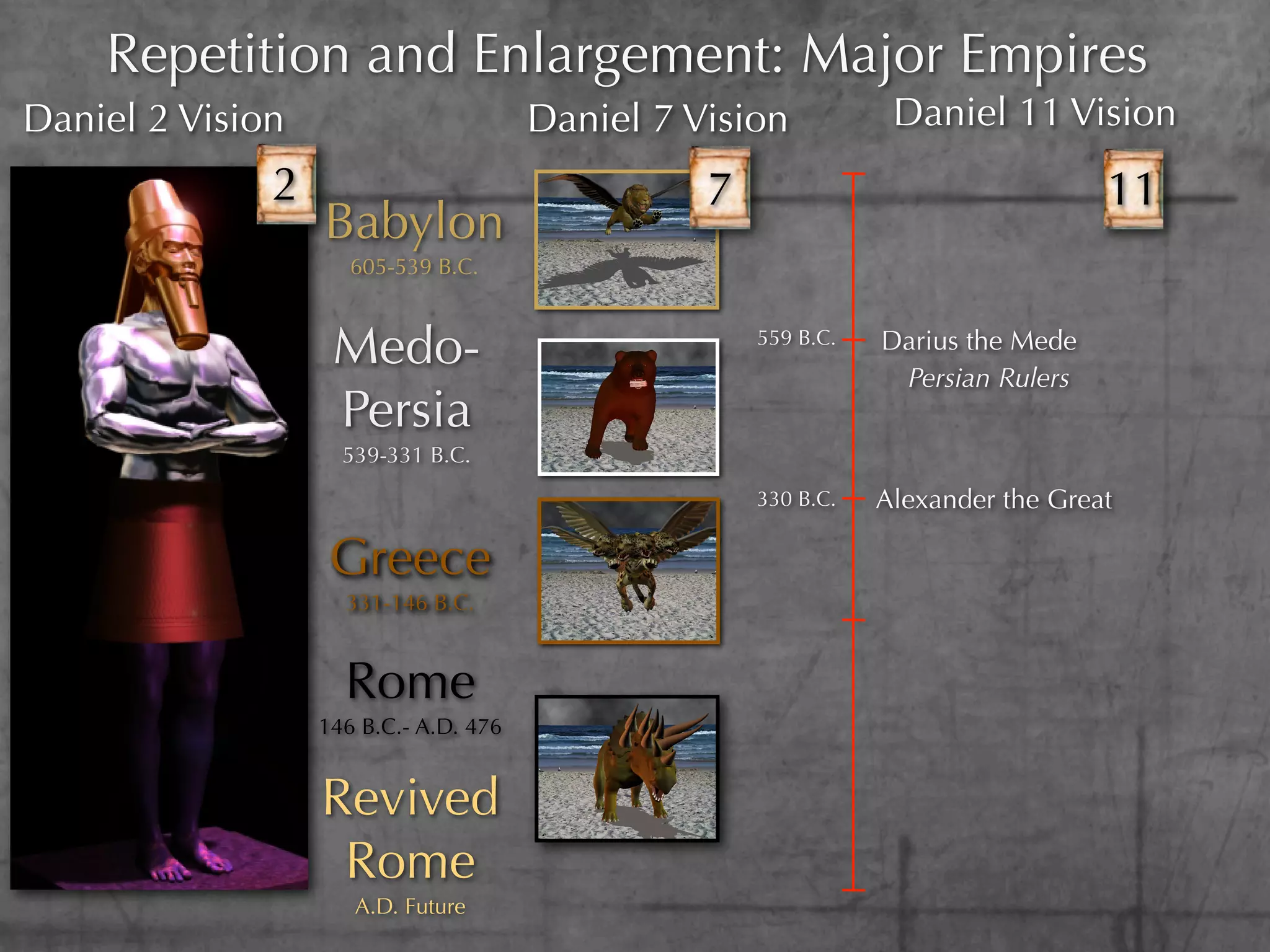
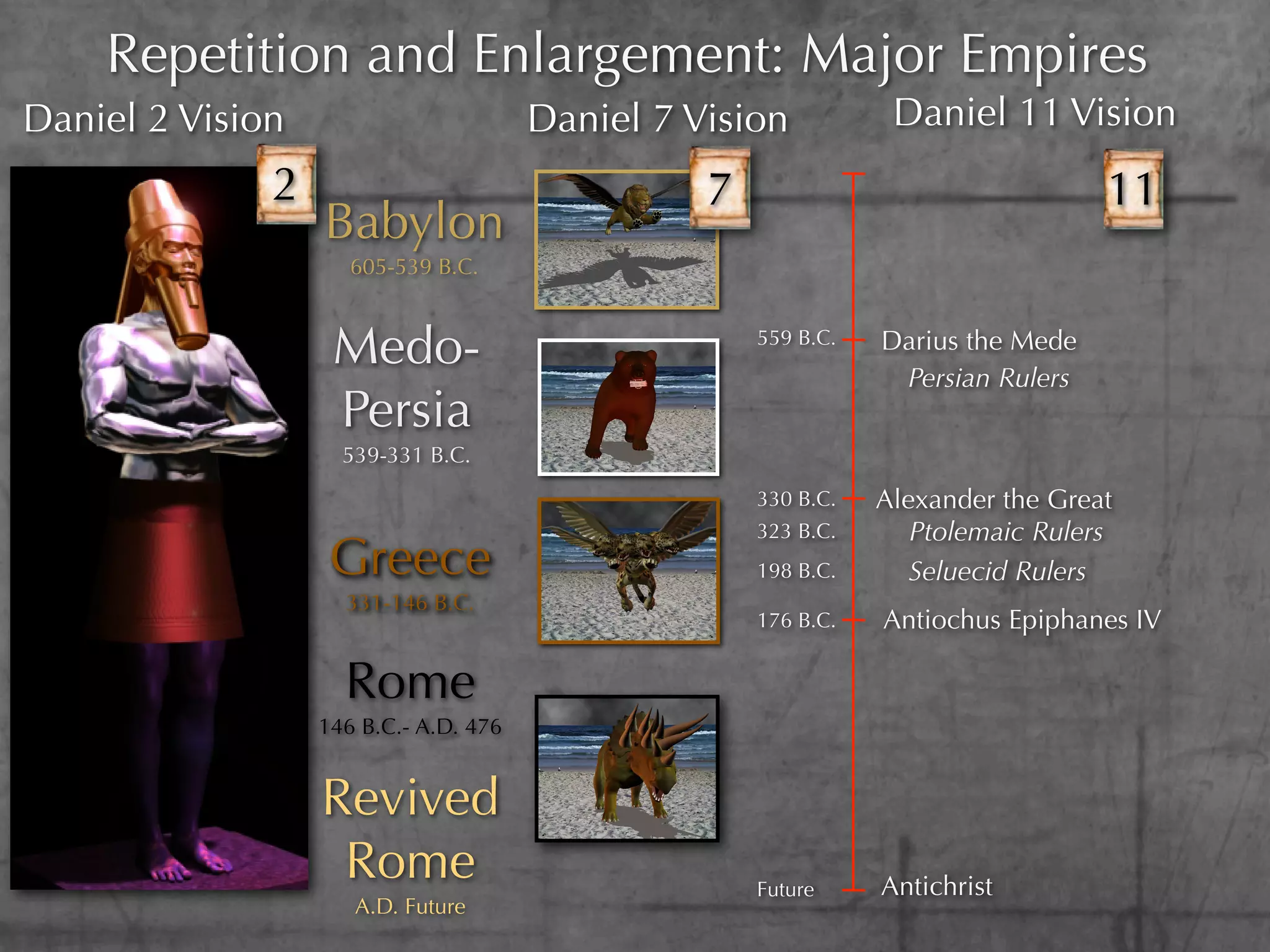
Repetition and Enlargement
Daniel 2 Vision                        Daniel 7 Vision   Daniel 8 Vision
              2                                     7
                   Babylon
                    605-539 B.C.

                                                                     8
                   Medo-
                   Persia
                   539-331 B.C.
                                                                     8
                    Greece
                    331-146 B.C.


                     Rome
                  146 B.C.- A.D. 476
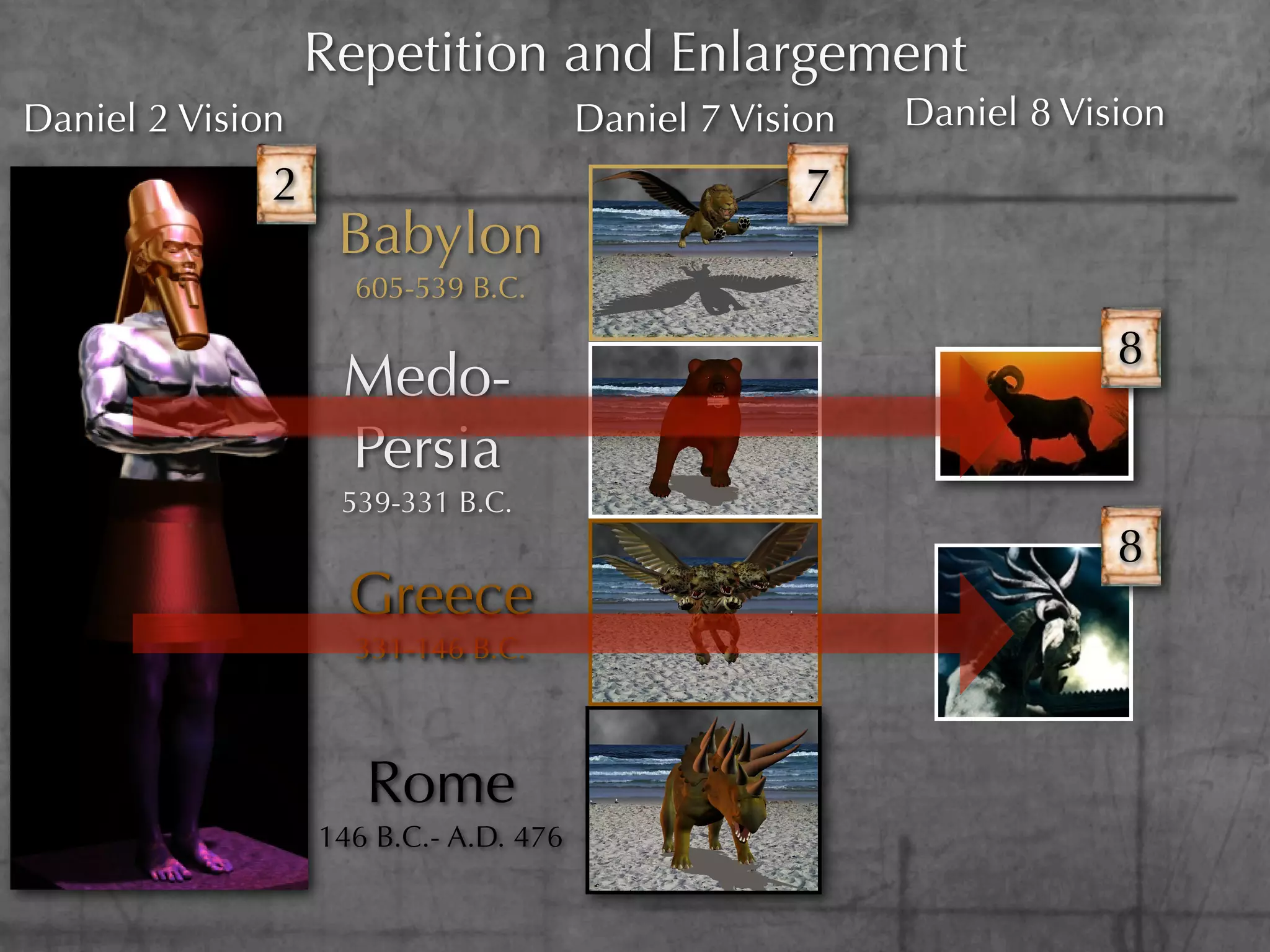
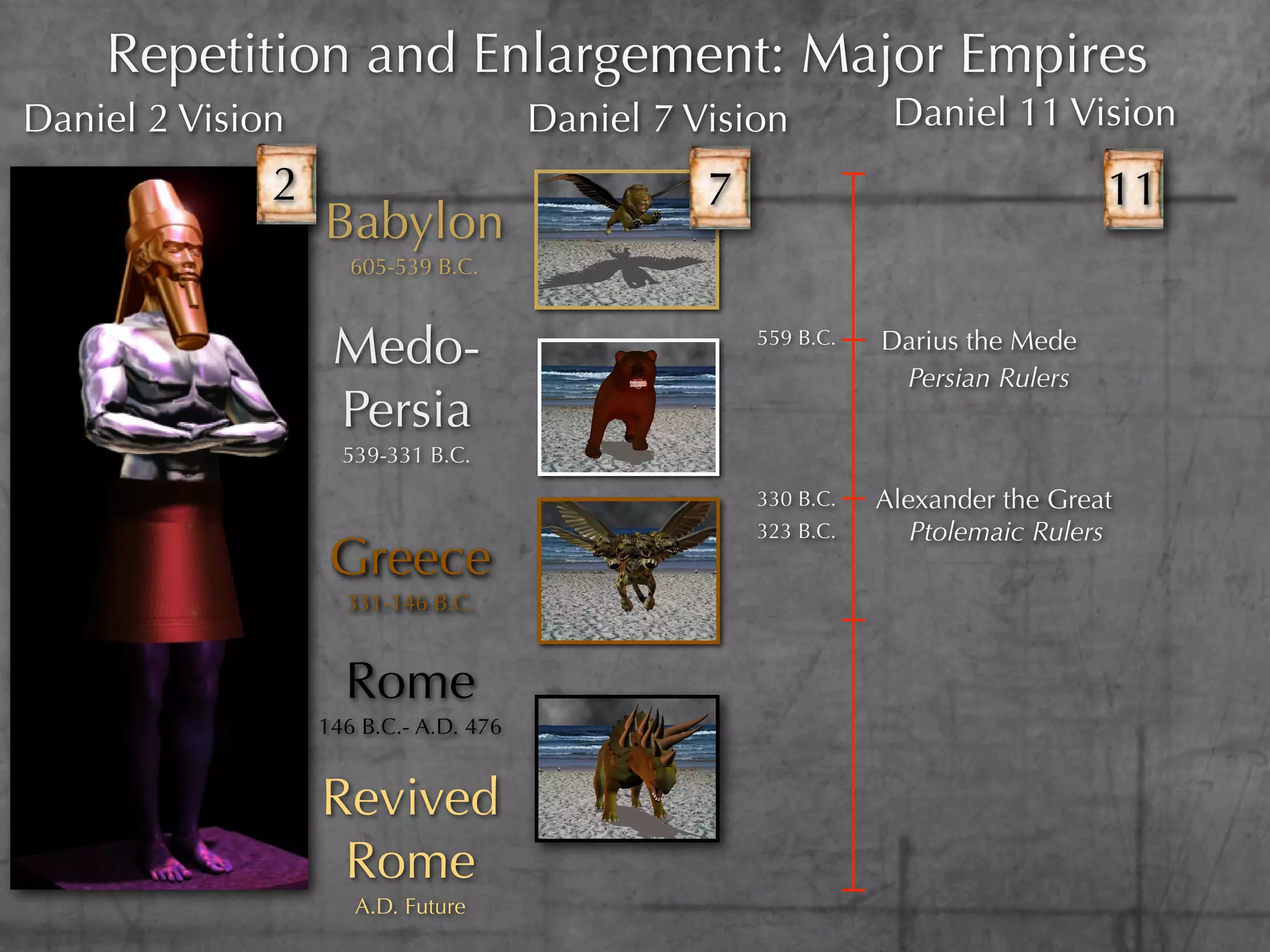
Repetition and Enlargement
Daniel 2 Vision                        Daniel 7 Vision   Daniel 8 Vision
              2                                     7
                   Babylon
                    605-539 B.C.

                                                                     8
                   Medo-
                   Persia
                   539-331 B.C.
                                                                     8
                    Greece
                    331-146 B.C.


                     Rome
                  146 B.C.- A.D. 476
Repetition and Enlargement
Daniel 2 Vision                        Daniel 7 Vision   Daniel 8 Vision
              2                                     7
                   Babylon
                    605-539 B.C.

                                                                     8
                   Medo-
                   Persia
                   539-331 B.C.
                                                                     8
                    Greece
                    331-146 B.C.


                     Rome
                  146 B.C.- A.D. 476
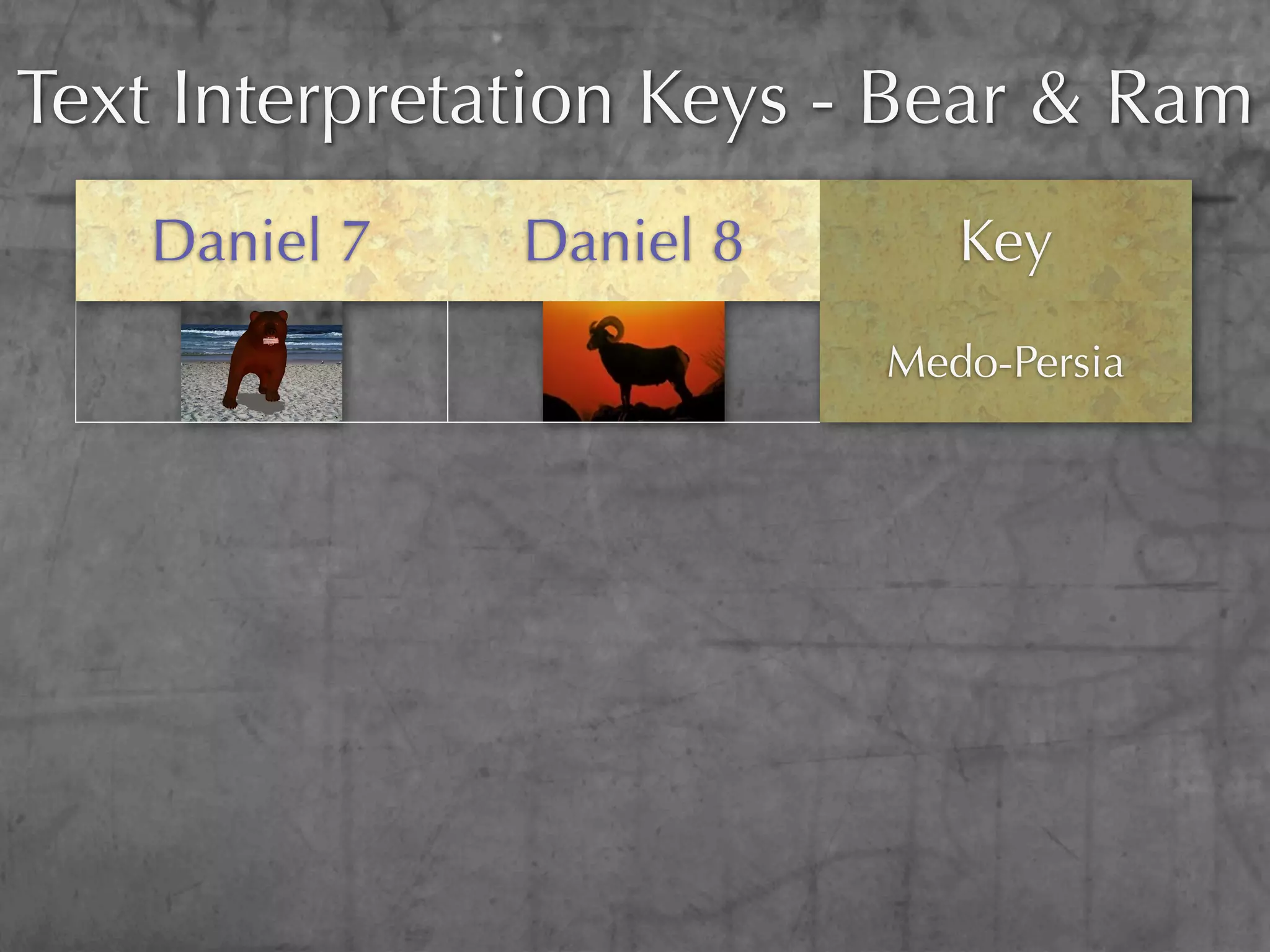
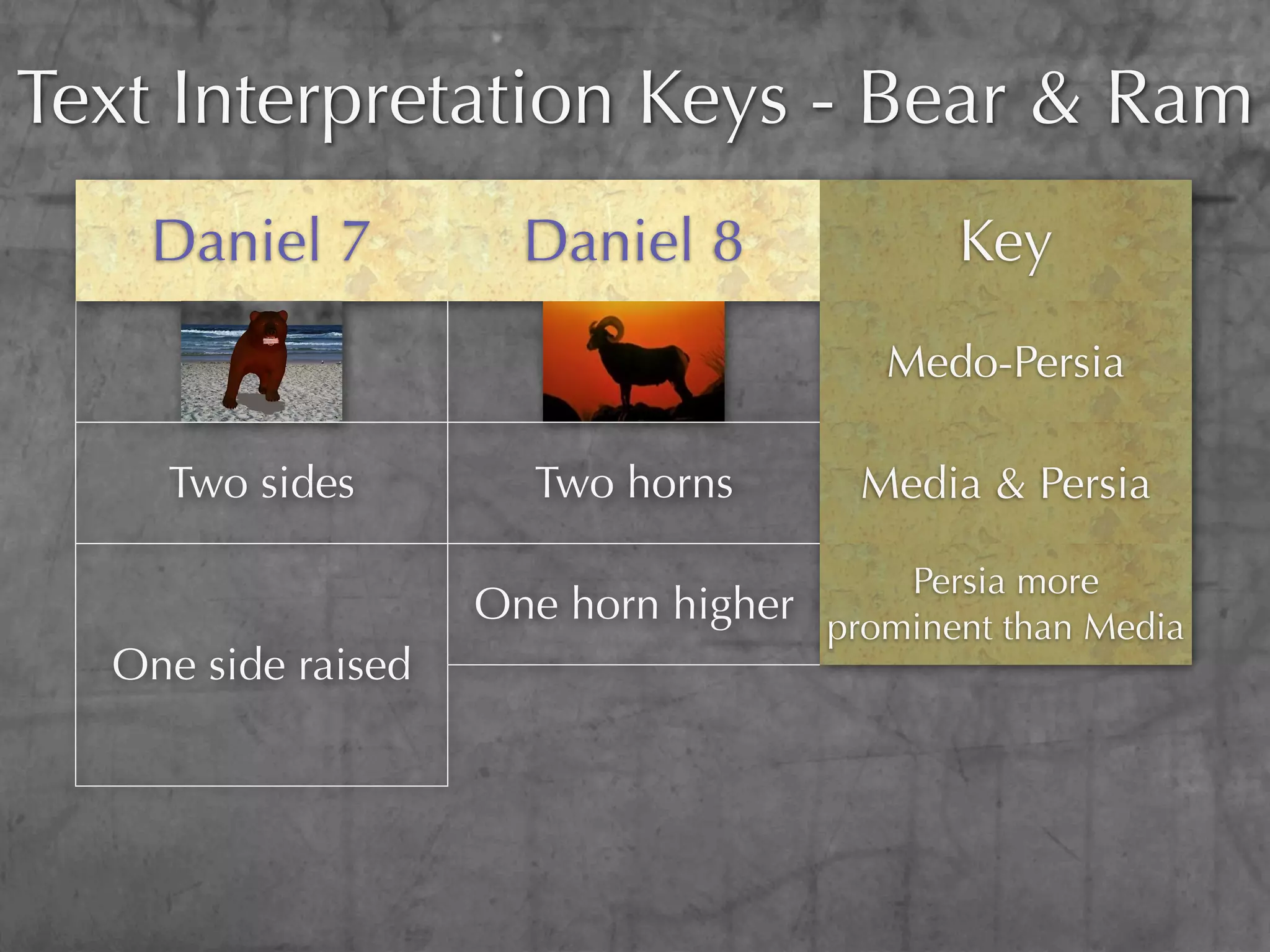
Text Interpretation Keys - Bear & Ram
    Daniel 7   Daniel 8     Key
Text Interpretation Keys - Bear & Ram
    Daniel 7   Daniel 8      Key
                          Medo-Persia
Text Interpretation Keys - Bear & Ram
    Daniel 7    Daniel 8        Key
                             Medo-Persia

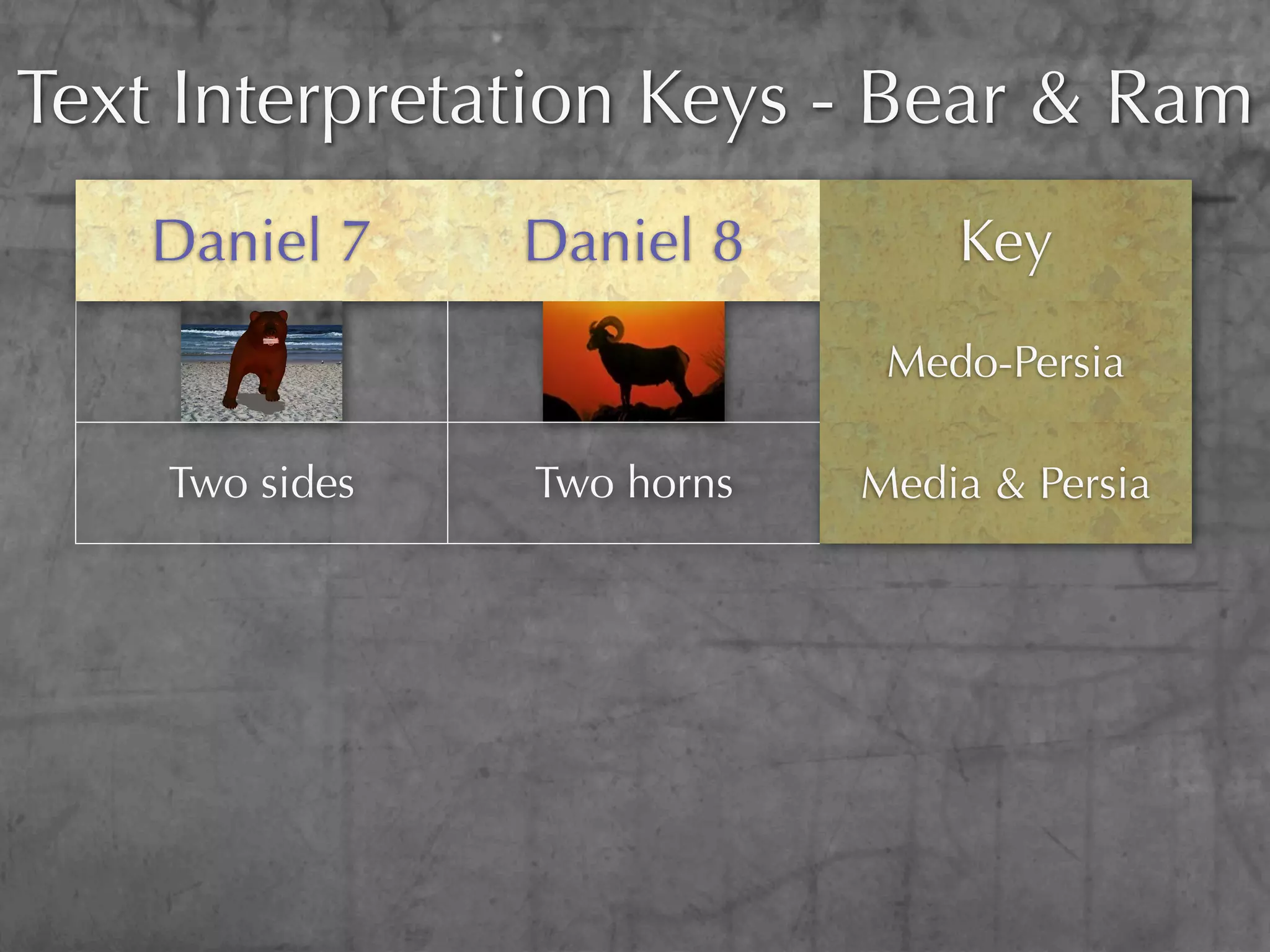
    Two sides   Two horns   Media & Persia
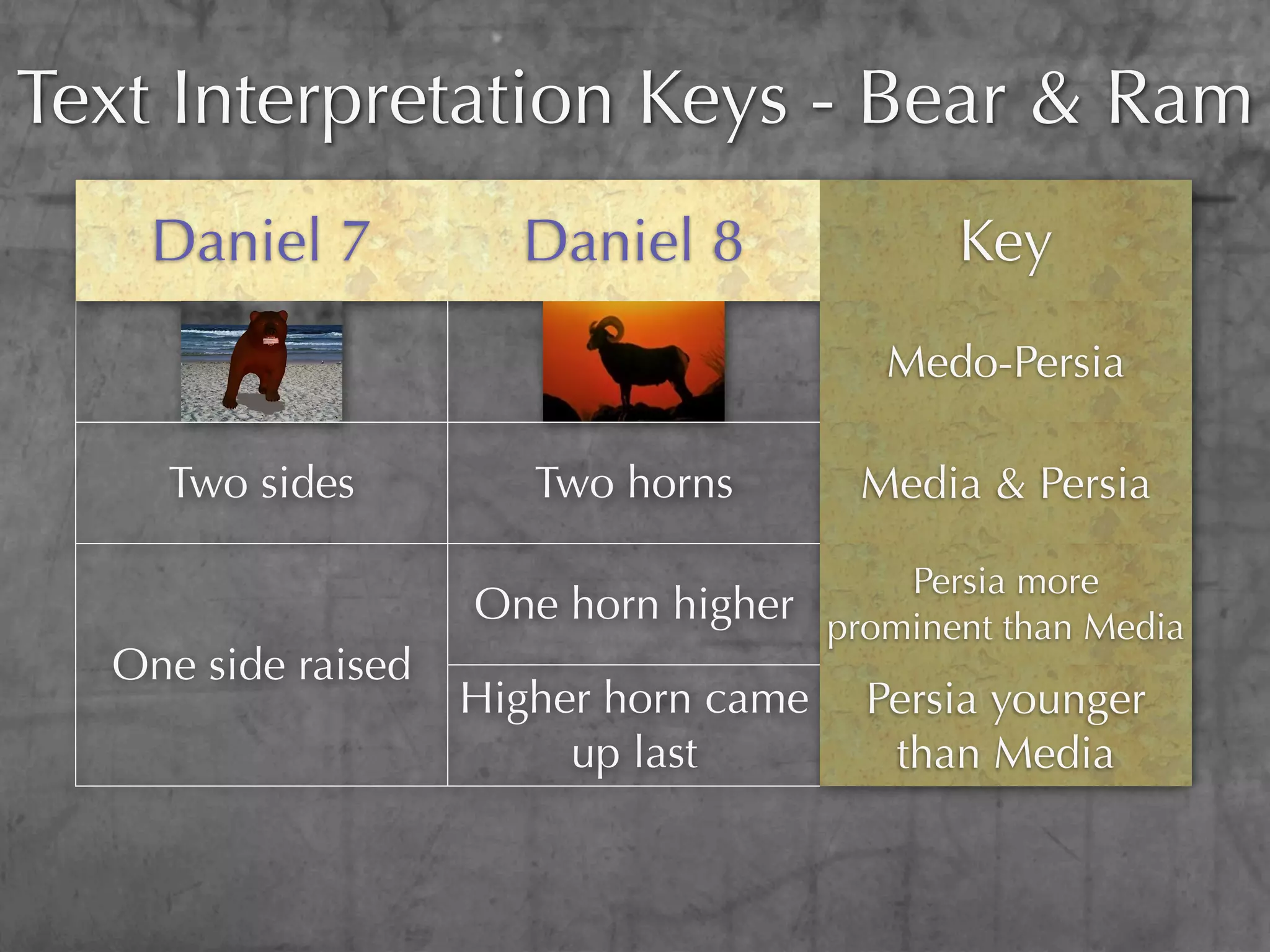
Text Interpretation Keys - Bear & Ram
    Daniel 7          Daniel 8              Key
                                        Medo-Persia

    Two sides          Two horns       Media & Persia

                                        Persia more
                    One horn higher prominent than Media
  One side raised
                    Higher horn came   Persia younger
                         up last        than Media
                                         Countries
Text Interpretation Keys - Bear & Ram
    Daniel 7          Daniel 8              Key
                                        Medo-Persia

    Two sides          Two horns       Media & Persia

                                        Persia more
                    One horn higher prominent than Media
  One side raised
                    Higher horn came   Persia younger
                         up last        than Media
                                         Countries
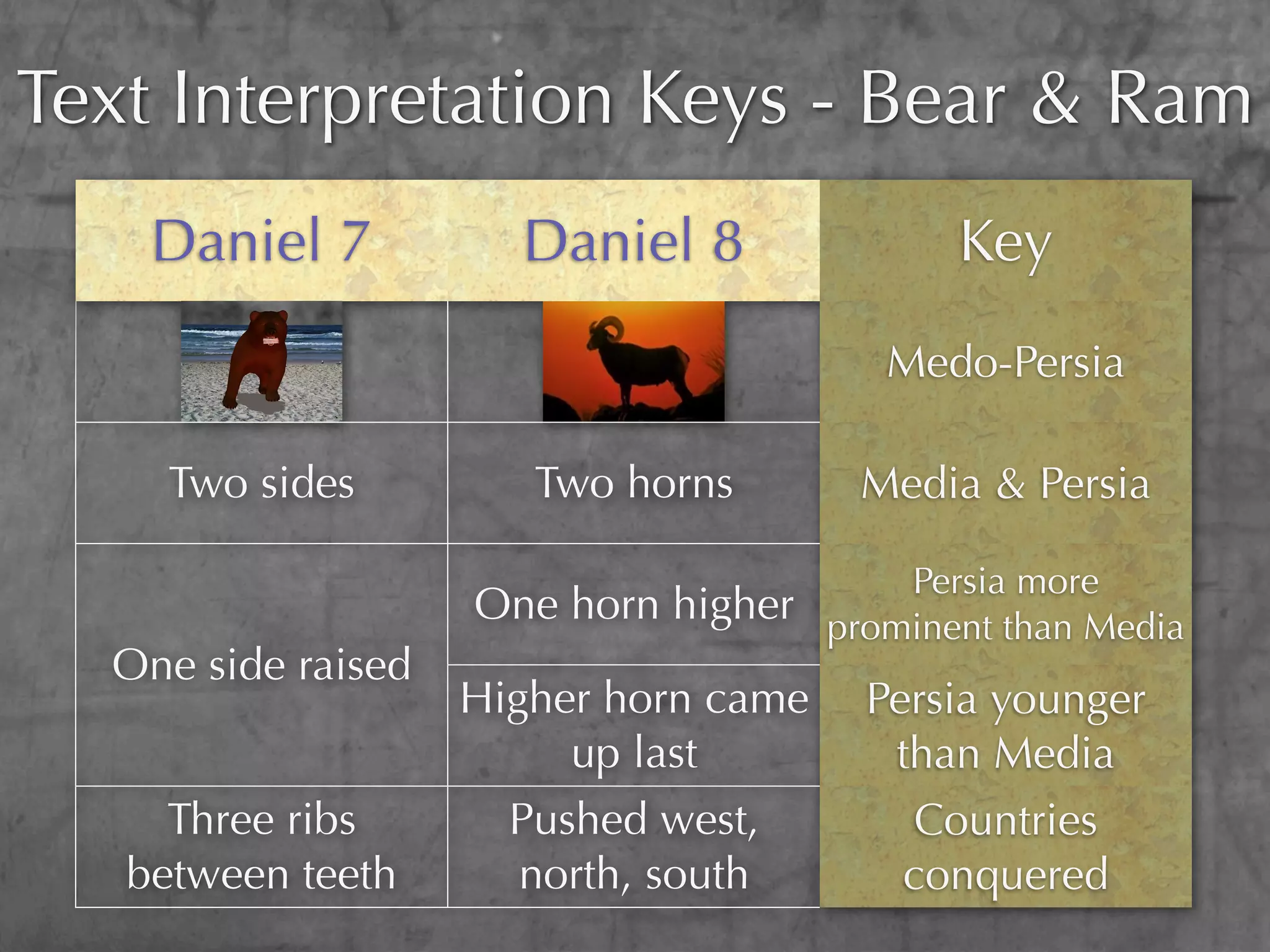
Text Interpretation Keys - Bear & Ram
    Daniel 7          Daniel 8              Key
                                        Medo-Persia

     Two sides         Two horns       Media & Persia

                                        Persia more
                    One horn higher prominent than Media
  One side raised
                    Higher horn came   Persia younger
                         up last        than Media
     Three ribs       Pushed west,        Countries
   between teeth       north, south      conquered
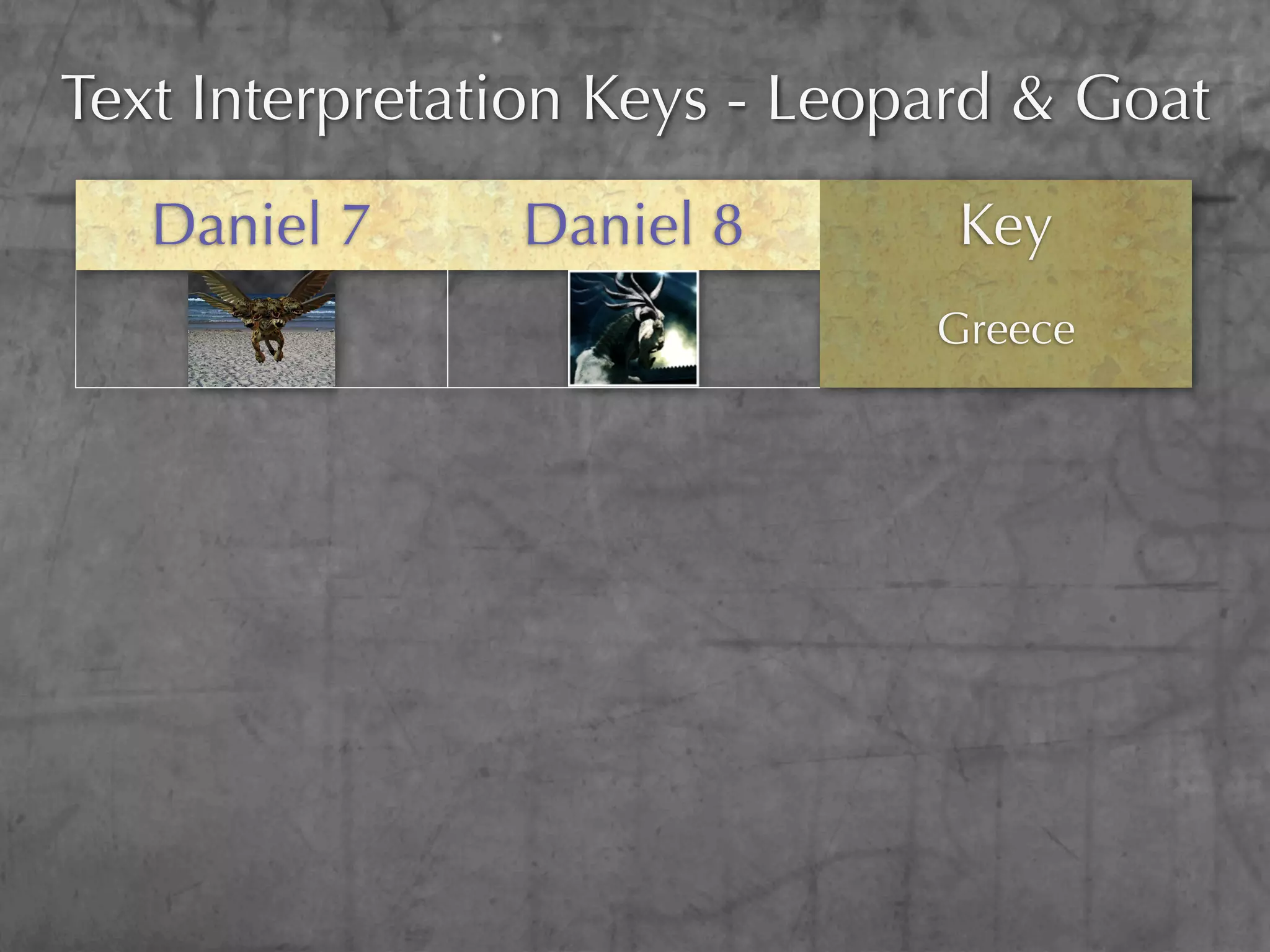
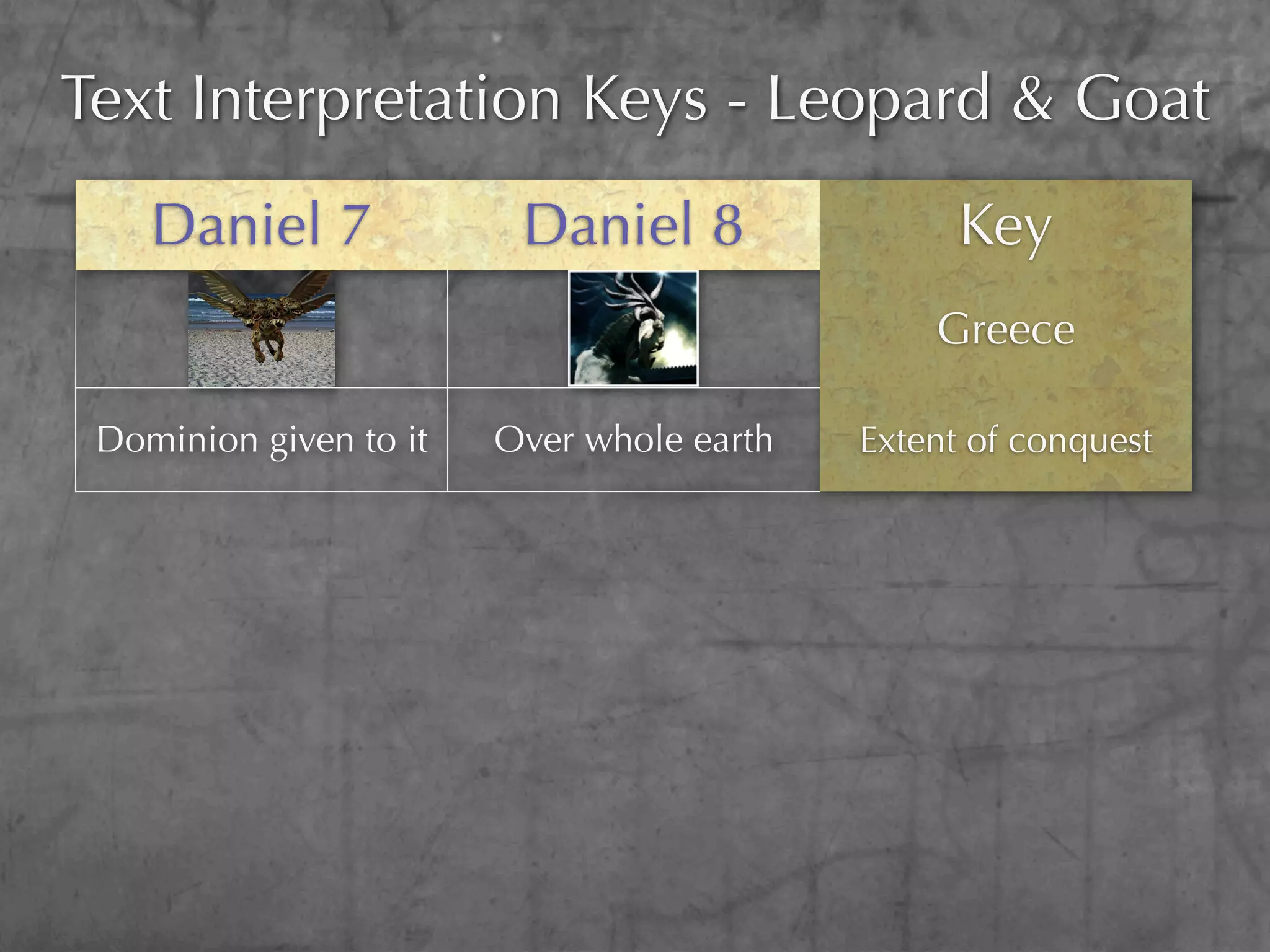
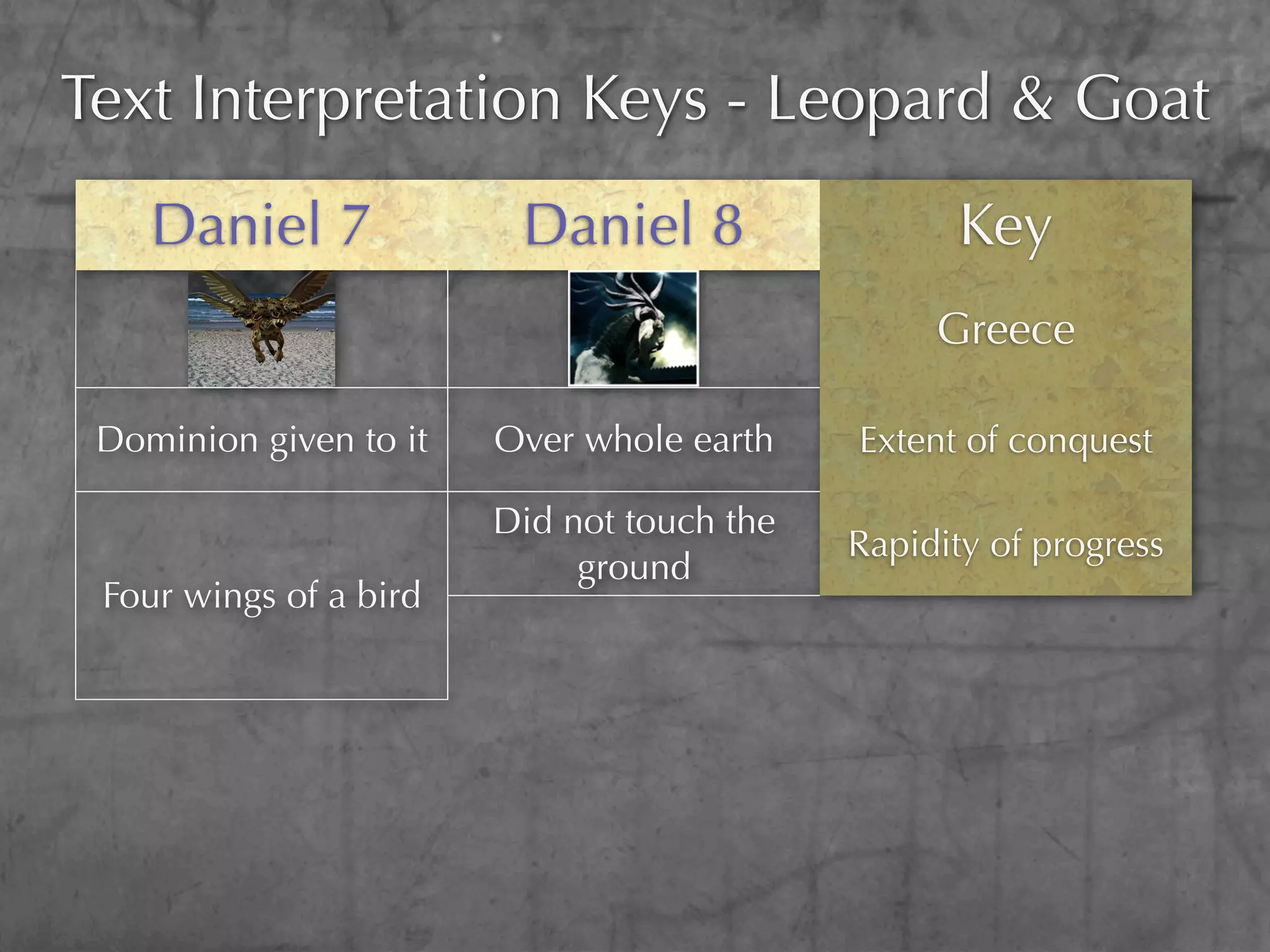
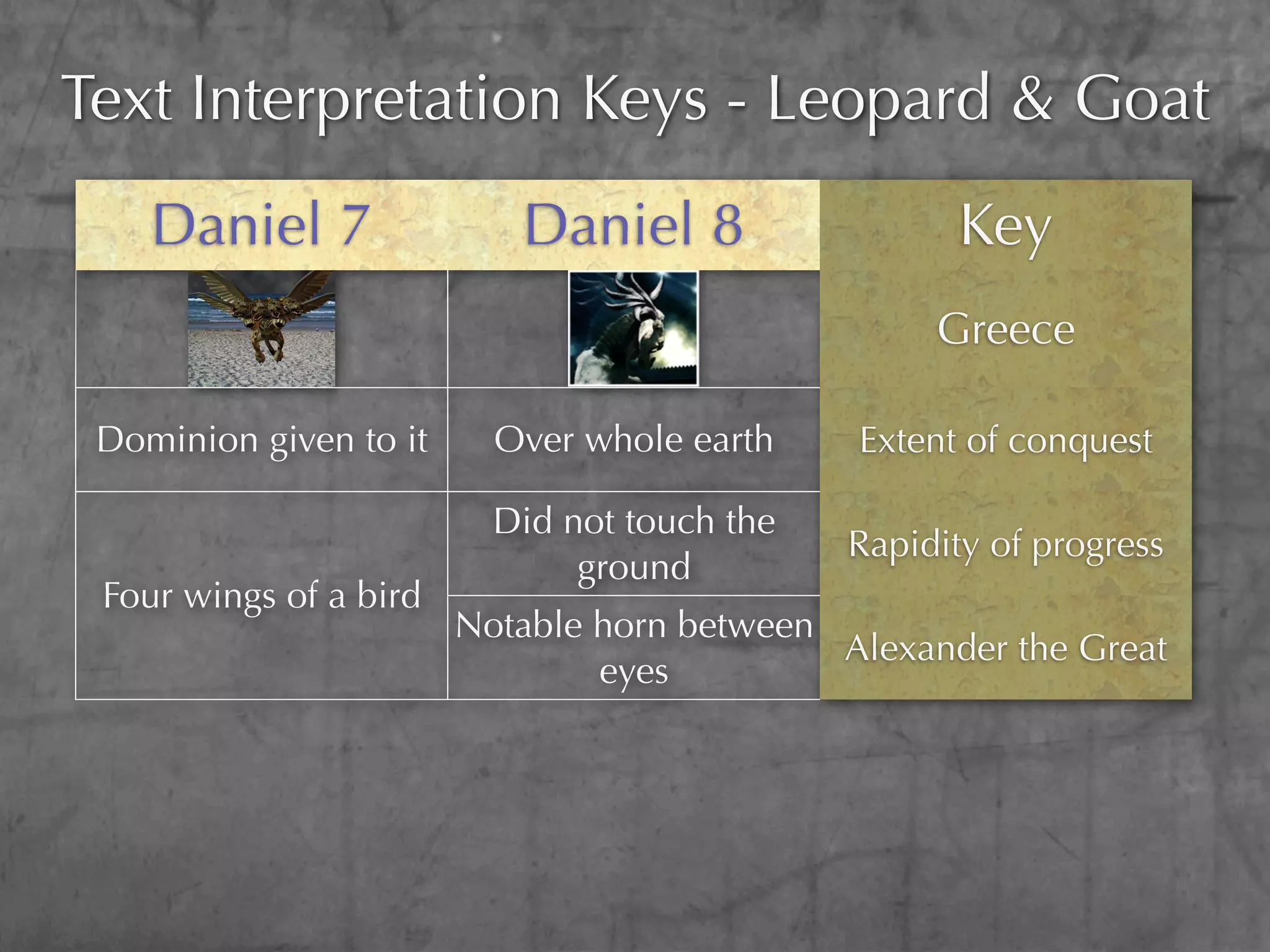
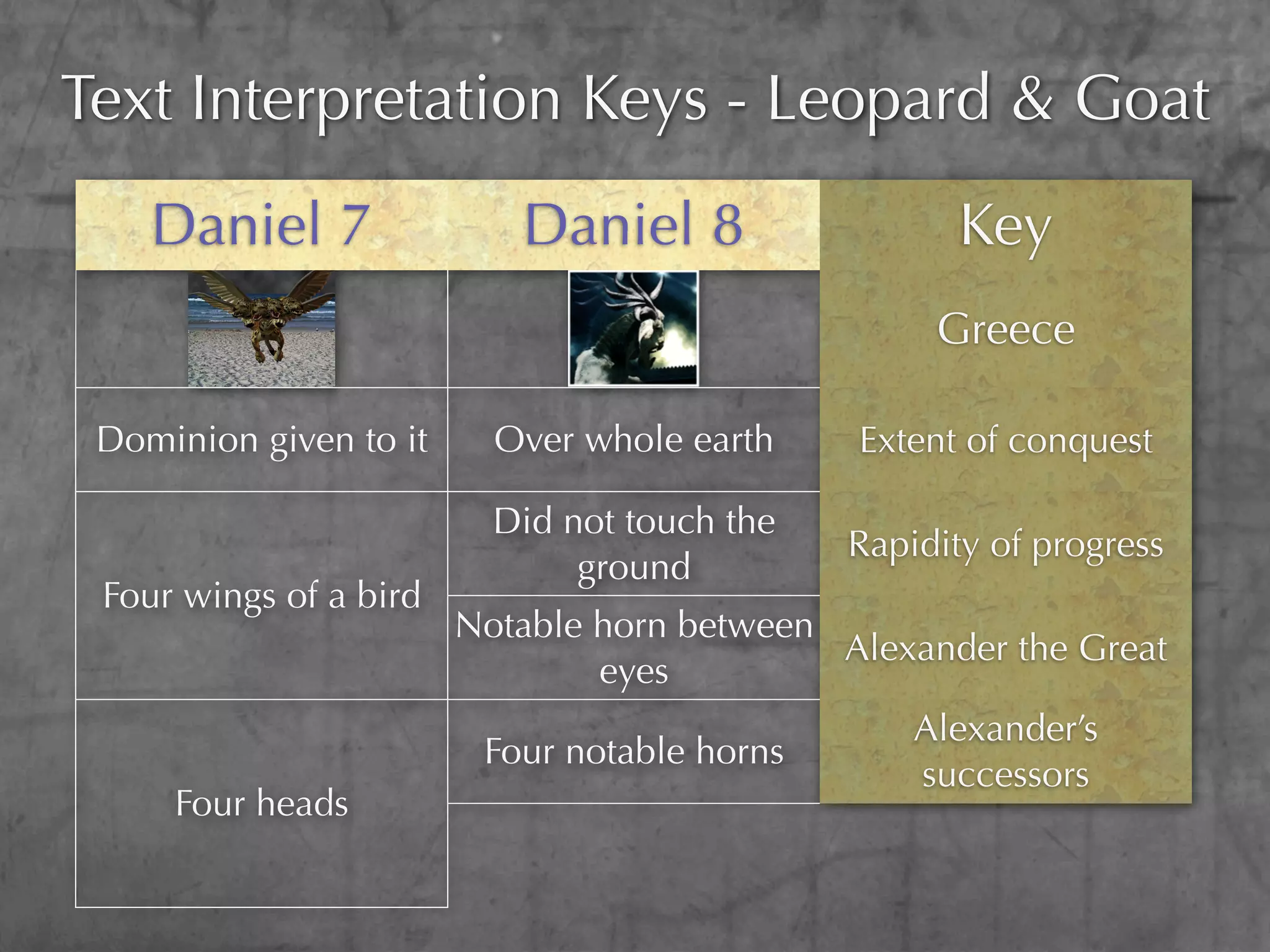
Text Interpretation Keys - Leopard & Goat
   Daniel 7     Daniel 8        Key
Text Interpretation Keys - Leopard & Goat
   Daniel 7     Daniel 8        Key
                               Greece
Text Interpretation Keys - Leopard & Goat
    Daniel 7             Daniel 8                Key
                                               Greece

 Dominion given to it   Over whole earth   Extent of conquest
Text Interpretation Keys - Leopard & Goat
    Daniel 7               Daniel 8                  Key
                                                   Greece

 Dominion given to it     Over whole earth    Extent of conquest

                          Did not touch the
                                              Rapidity of progress
                               ground
 Four wings of a bird
                        Notable horn between
                                             Alexander the Great
                                eyes
                                                  Alexander’s
Text Interpretation Keys - Leopard & Goat
    Daniel 7               Daniel 8                  Key
                                                   Greece

 Dominion given to it     Over whole earth    Extent of conquest

                          Did not touch the
                                              Rapidity of progress
                               ground
 Four wings of a bird
                        Notable horn between
                                             Alexander the Great
                                eyes
                                                  Alexander’s
Text Interpretation Keys - Leopard & Goat
    Daniel 7               Daniel 8                  Key
                                                   Greece

 Dominion given to it     Over whole earth     Extent of conquest

                          Did not touch the
                                              Rapidity of progress
                               ground
 Four wings of a bird
                        Notable horn between
                                             Alexander the Great
                                eyes
                                                  Alexander’s
                         Four notable horns
                                                  successors
     Four heads
                        Little horn out of one Antiochus Epiphanes
                                of them                IV
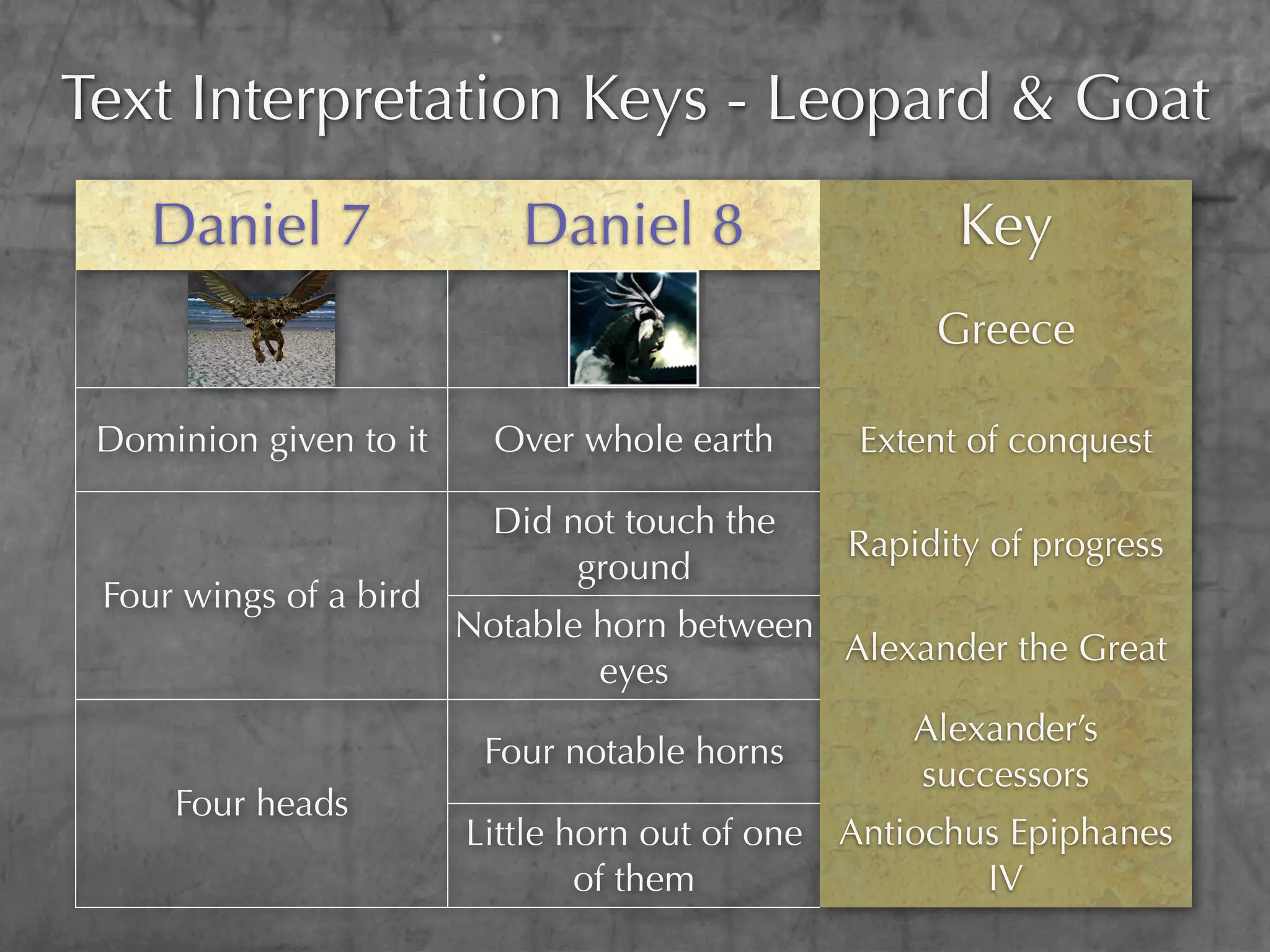
Text Interpretation Keys - Leopard & Goat
    Daniel 7               Daniel 8                  Key
                                                   Greece

 Dominion given to it     Over whole earth     Extent of conquest

                          Did not touch the
                                              Rapidity of progress
                               ground
 Four wings of a bird
                        Notable horn between
                                             Alexander the Great
                                eyes
                                                  Alexander’s
                         Four notable horns
                                                  successors
     Four heads
                        Little horn out of one Antiochus Epiphanes
                                of them                IV
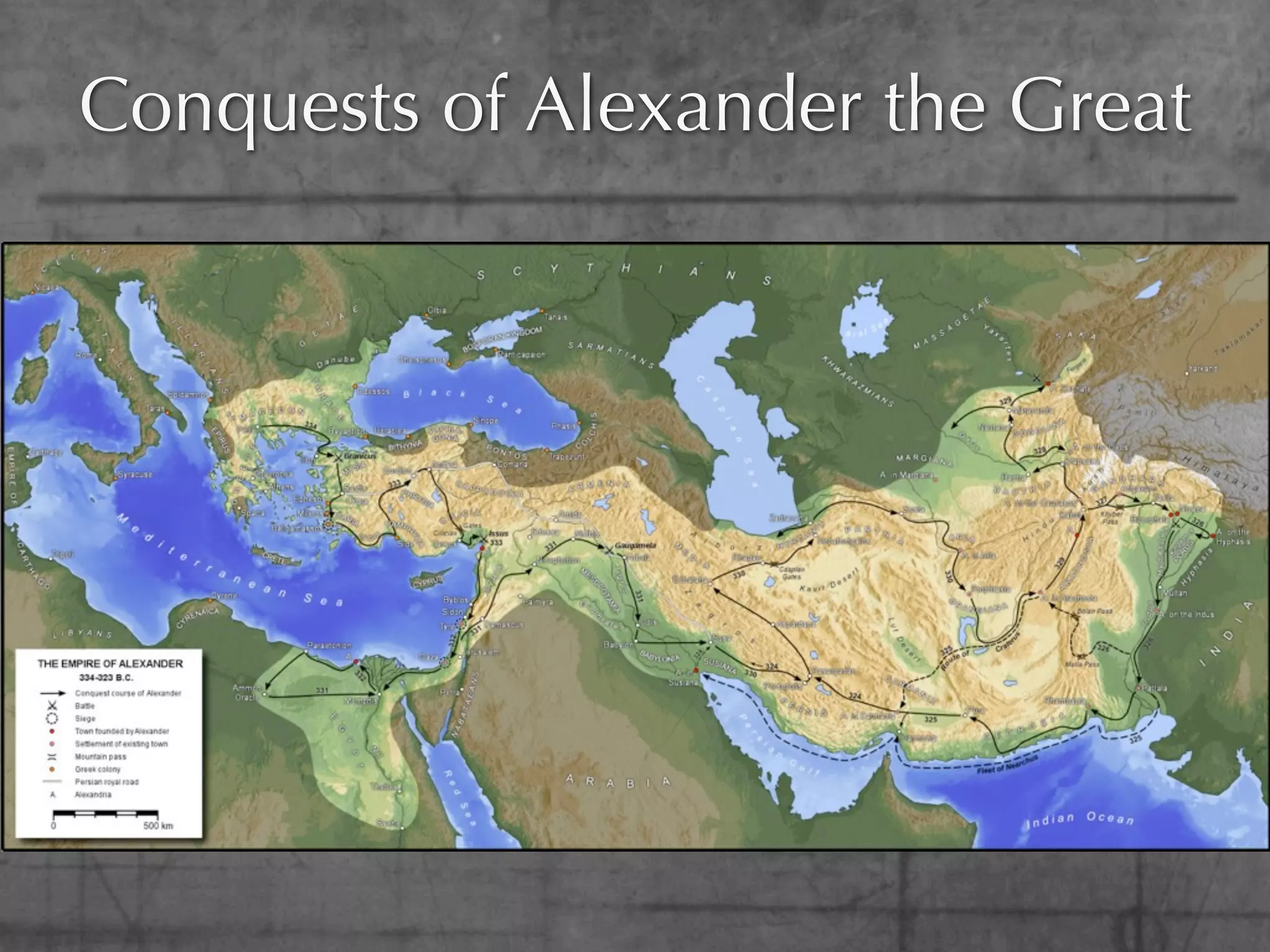
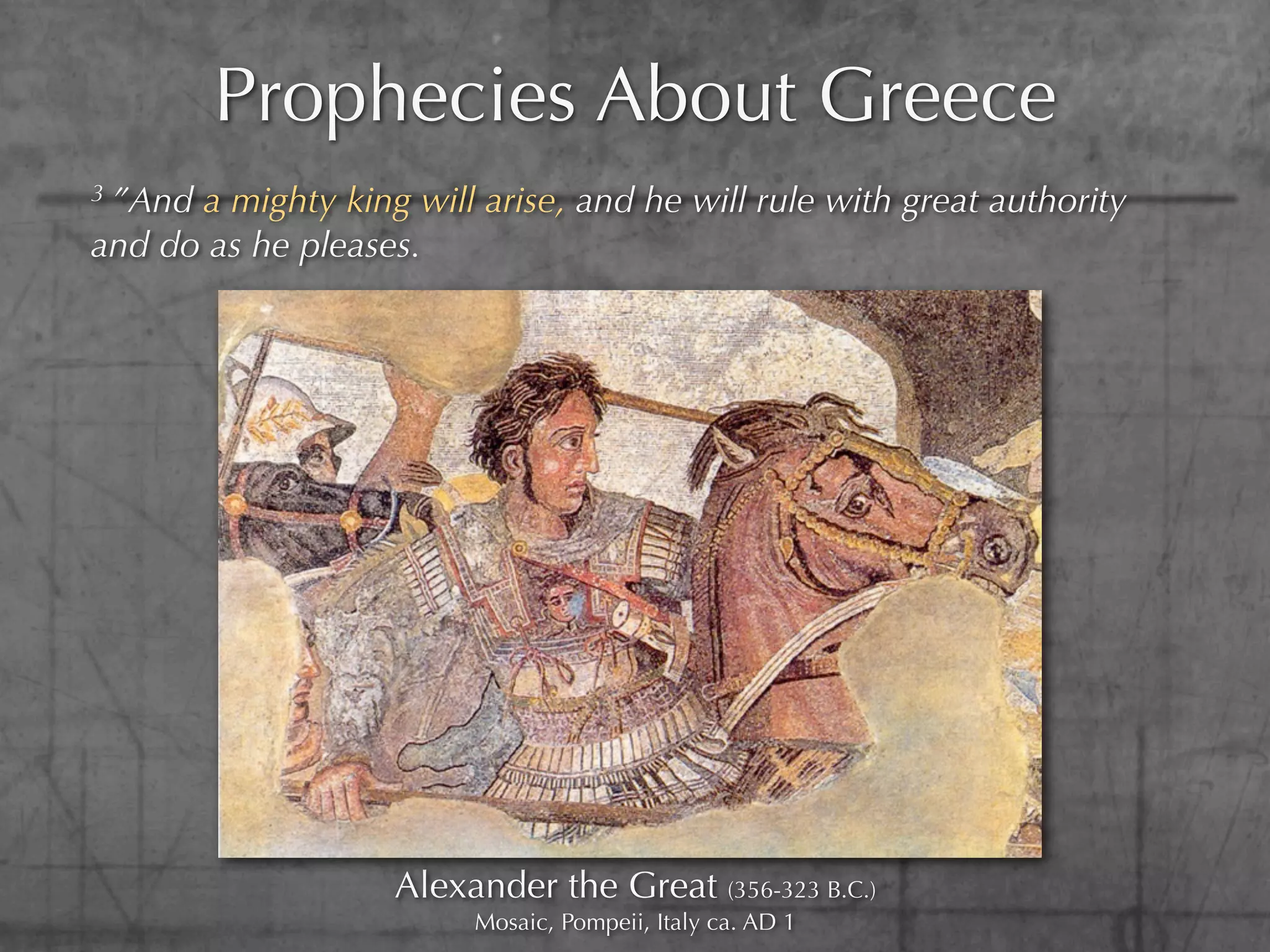
Conquests of Alexander the Great
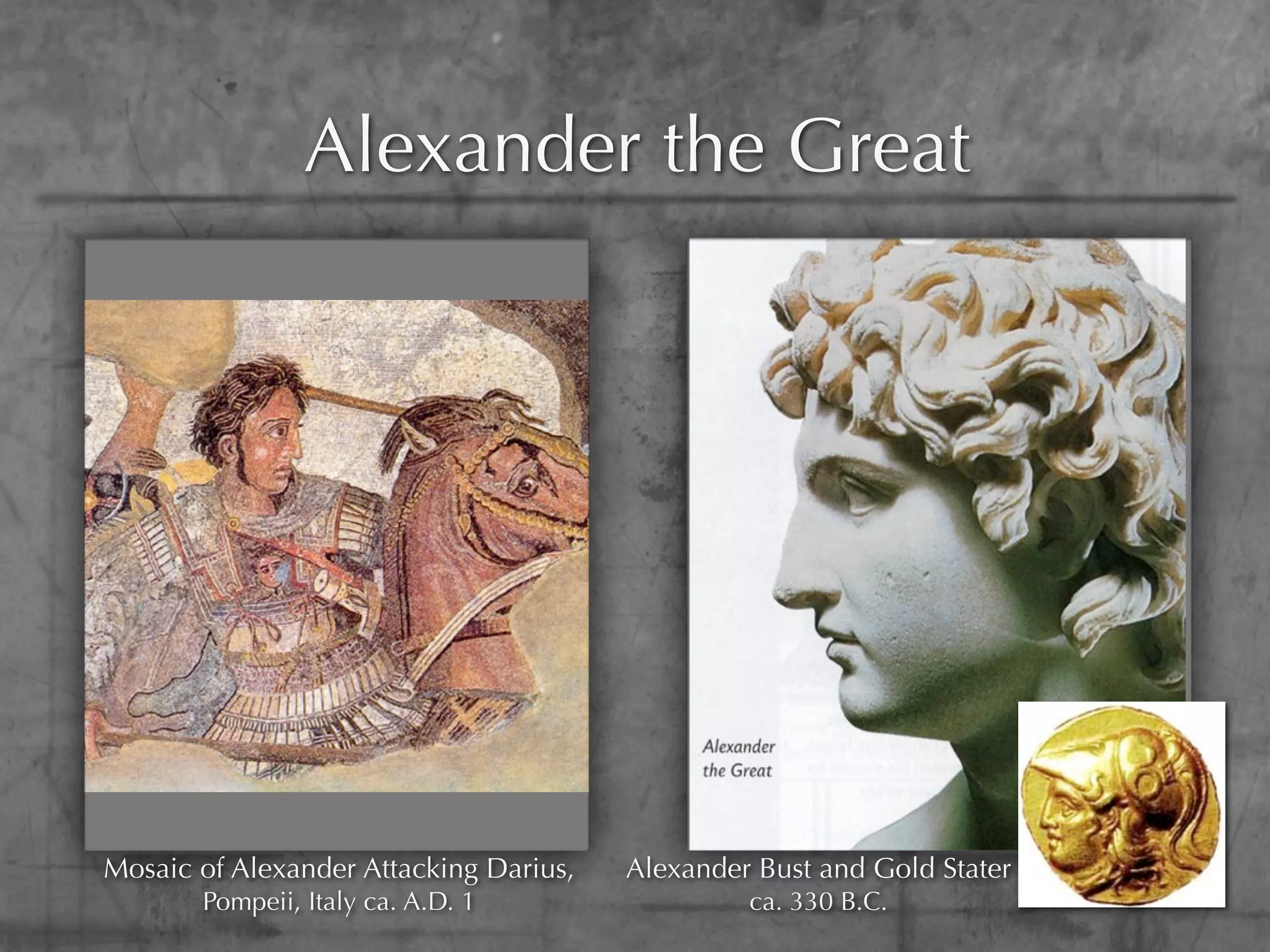
Alexander the Great


Mosaic of Alexander Attacking Darius,   Alexander Bust and Gold Stater
       Pompeii, Italy ca. A.D. 1                 ca. 330 B.C.
Alexander’s Greatness,
              Death, and Successors
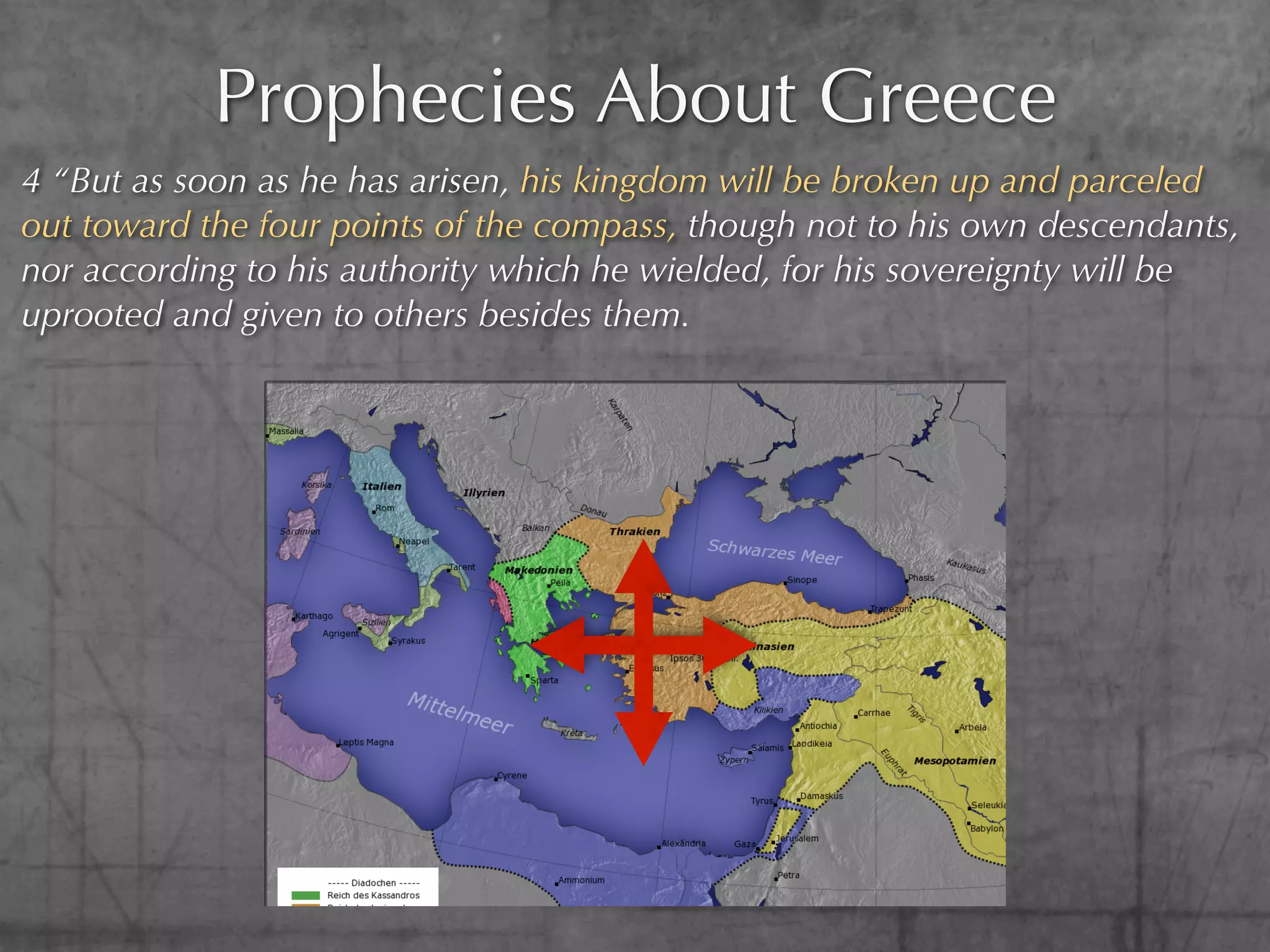
8Then the male goat magnified himself exceedingly.
But as soon as he was mighty,
  the large horn was broken;
    and in its place there came up four conspicuous horns
                         toward the four winds of heaven.
Alexander’s Greatness,
                 Death, and Successors
8Then the male goat magnified himself exceedingly.
But as soon as he was mighty,
  the large horn was broken;
    and in its place there came up four conspicuous horns
                         toward the four winds of heaven.


    22“The broken horn and the four horns that arose in its place
    represent four kingdoms which will arise from his nation, although not
    with his power.
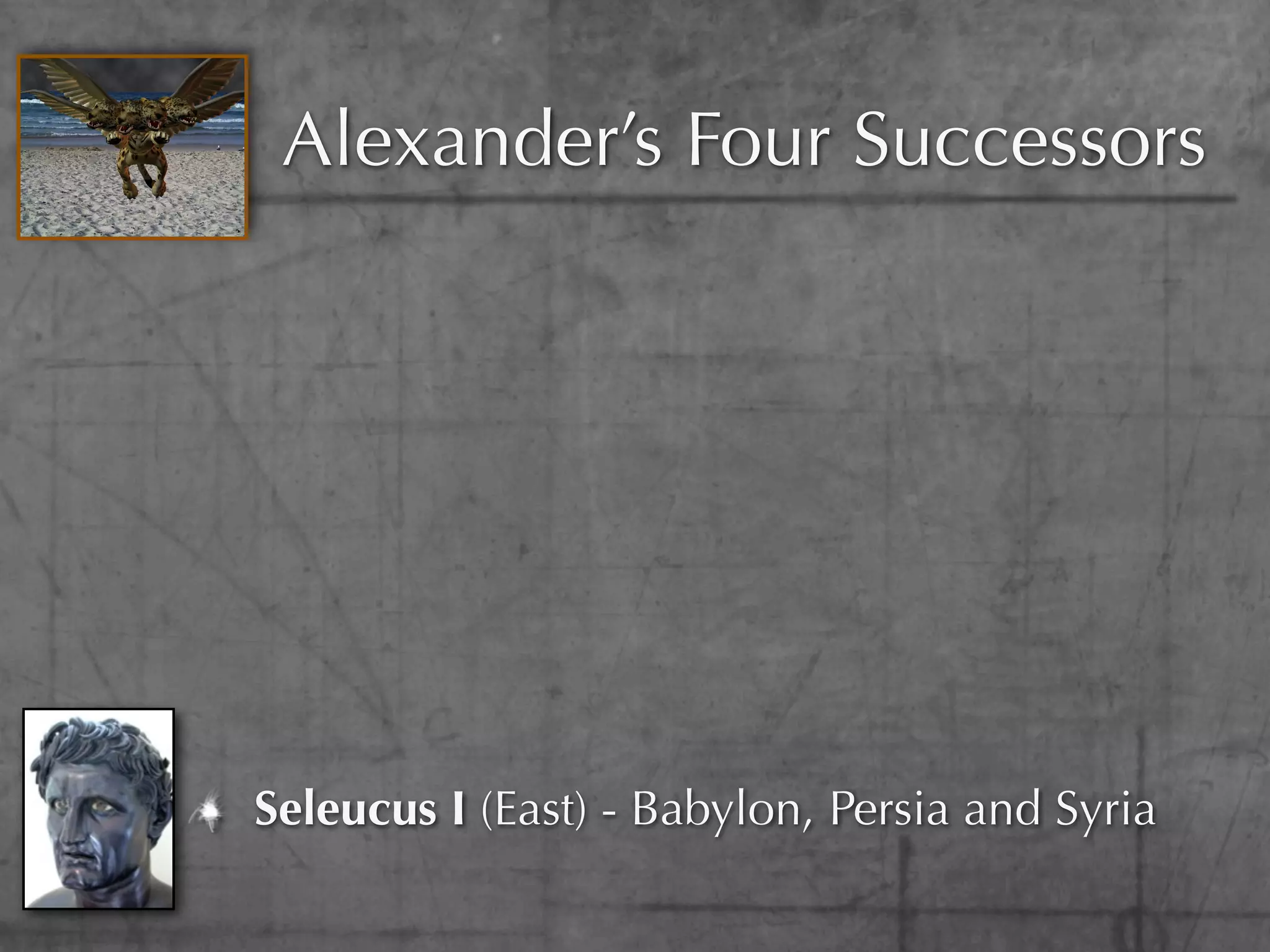
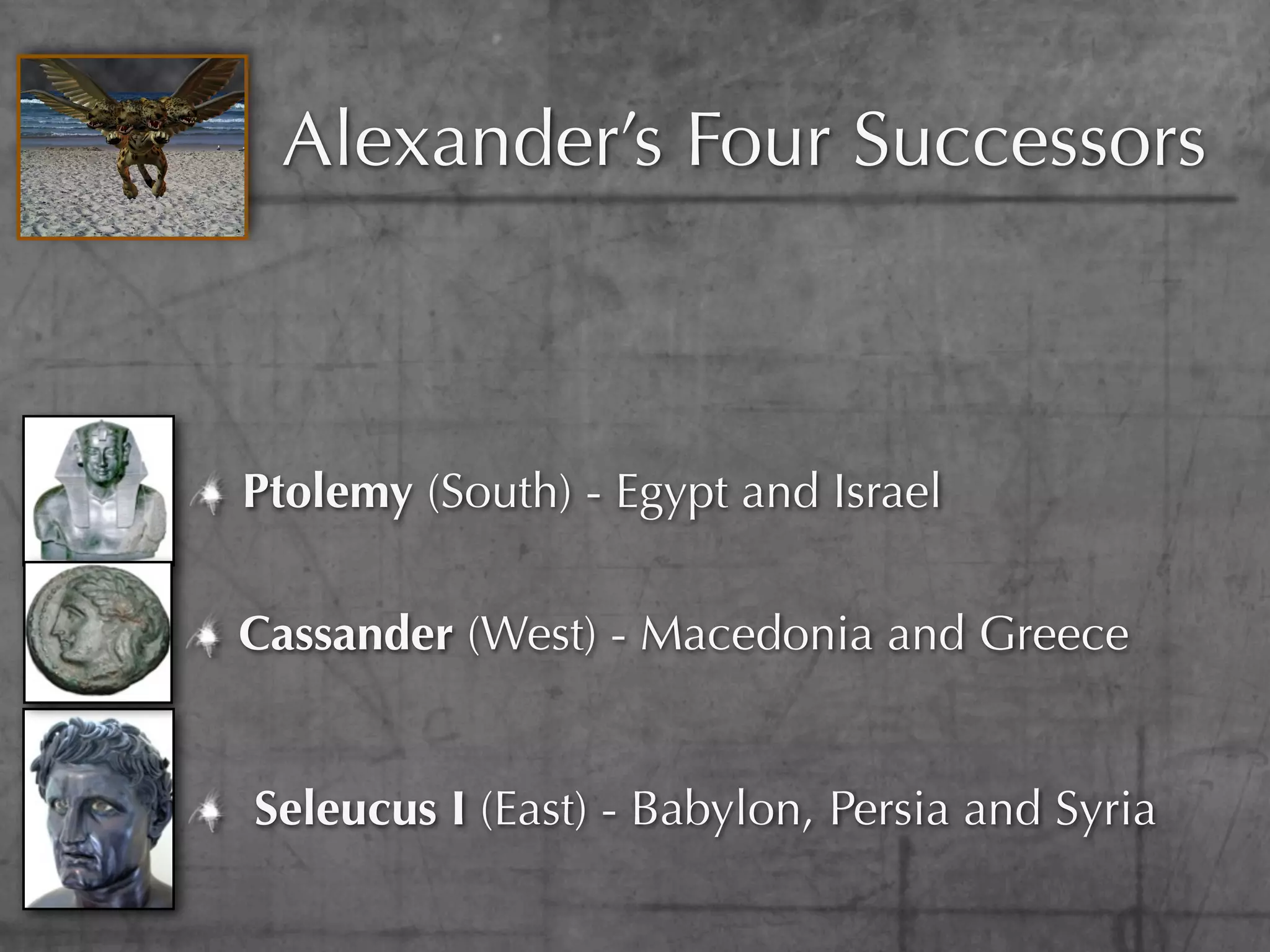
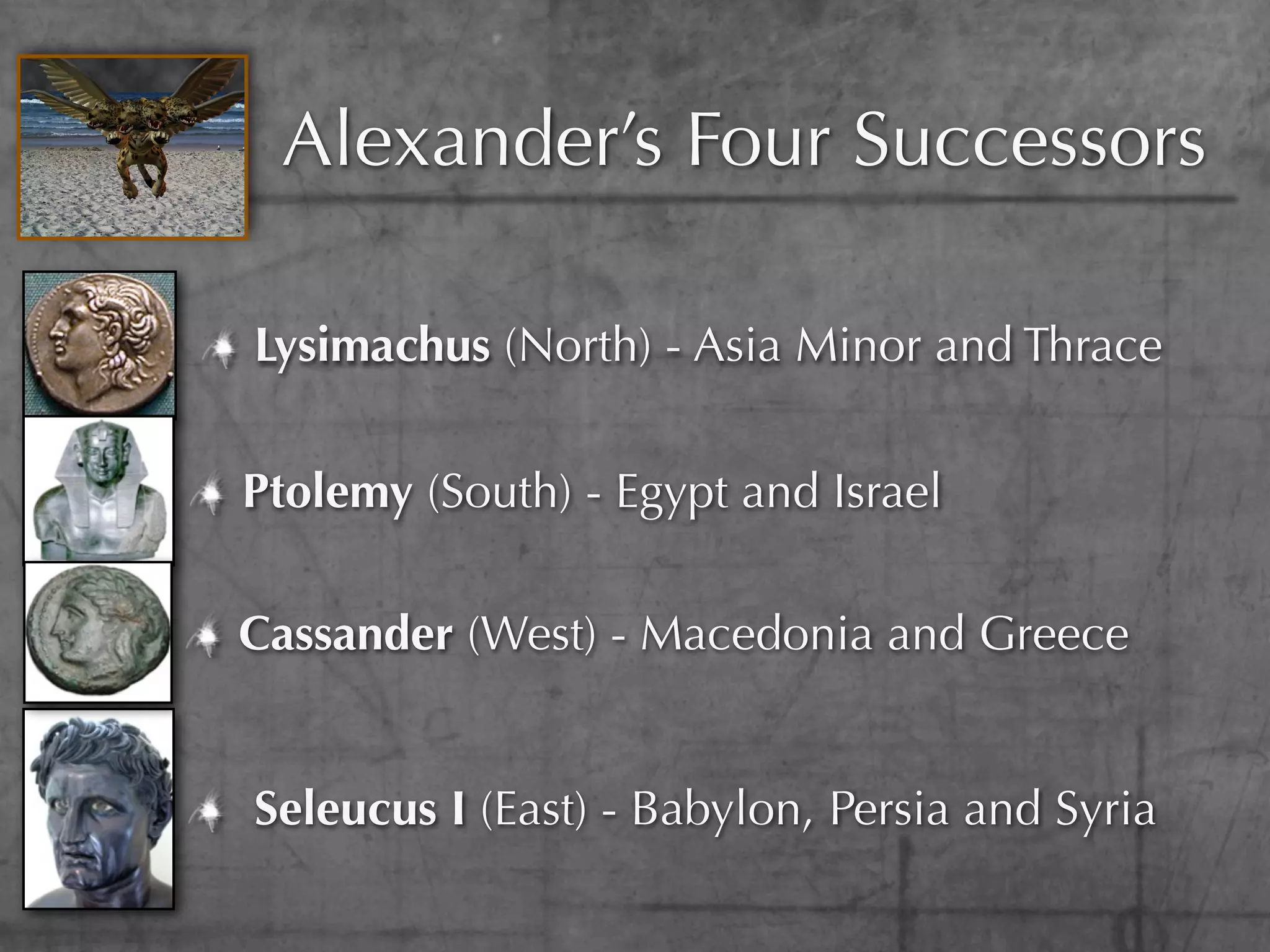
Alexander’s Four Successors


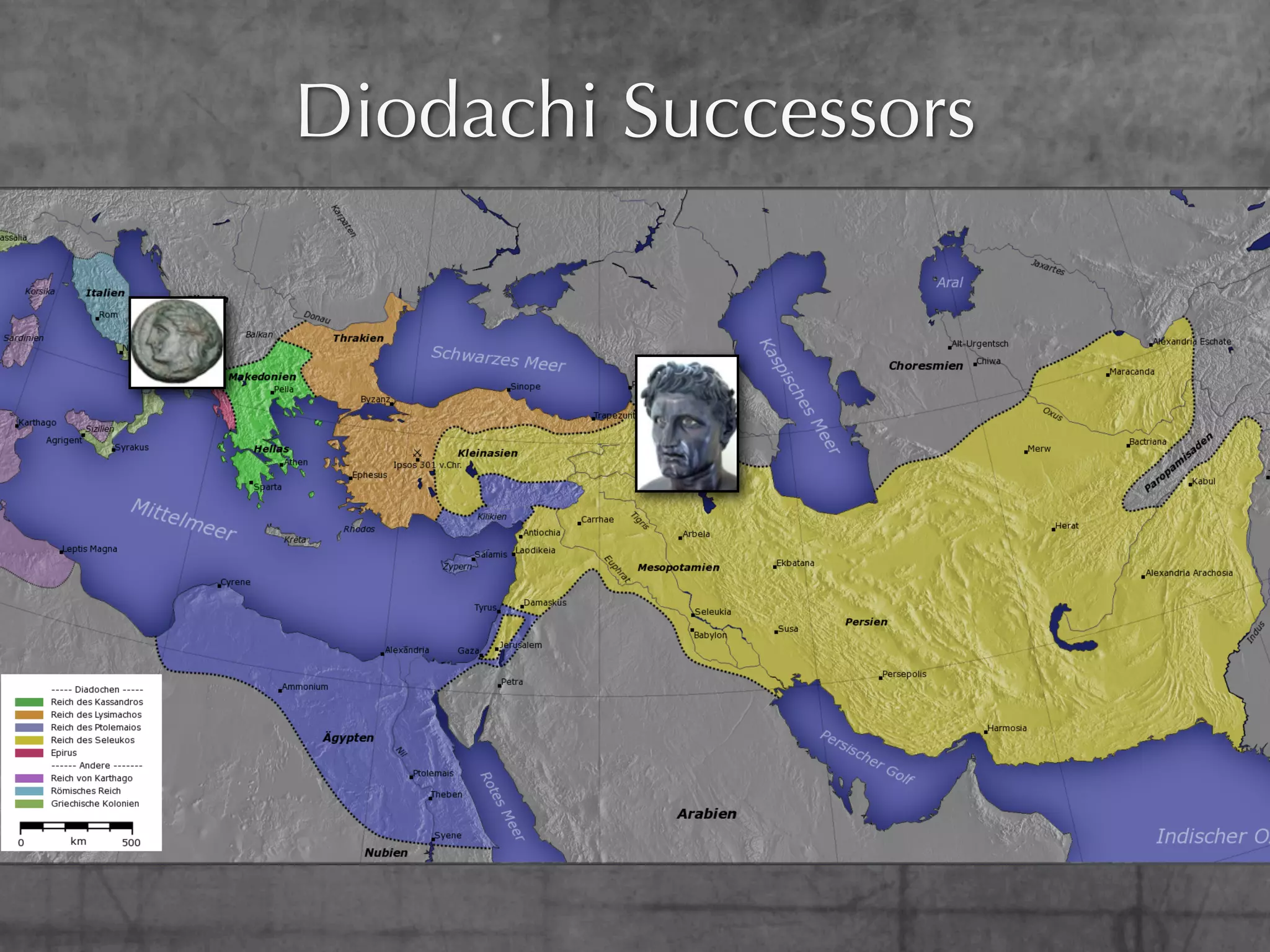
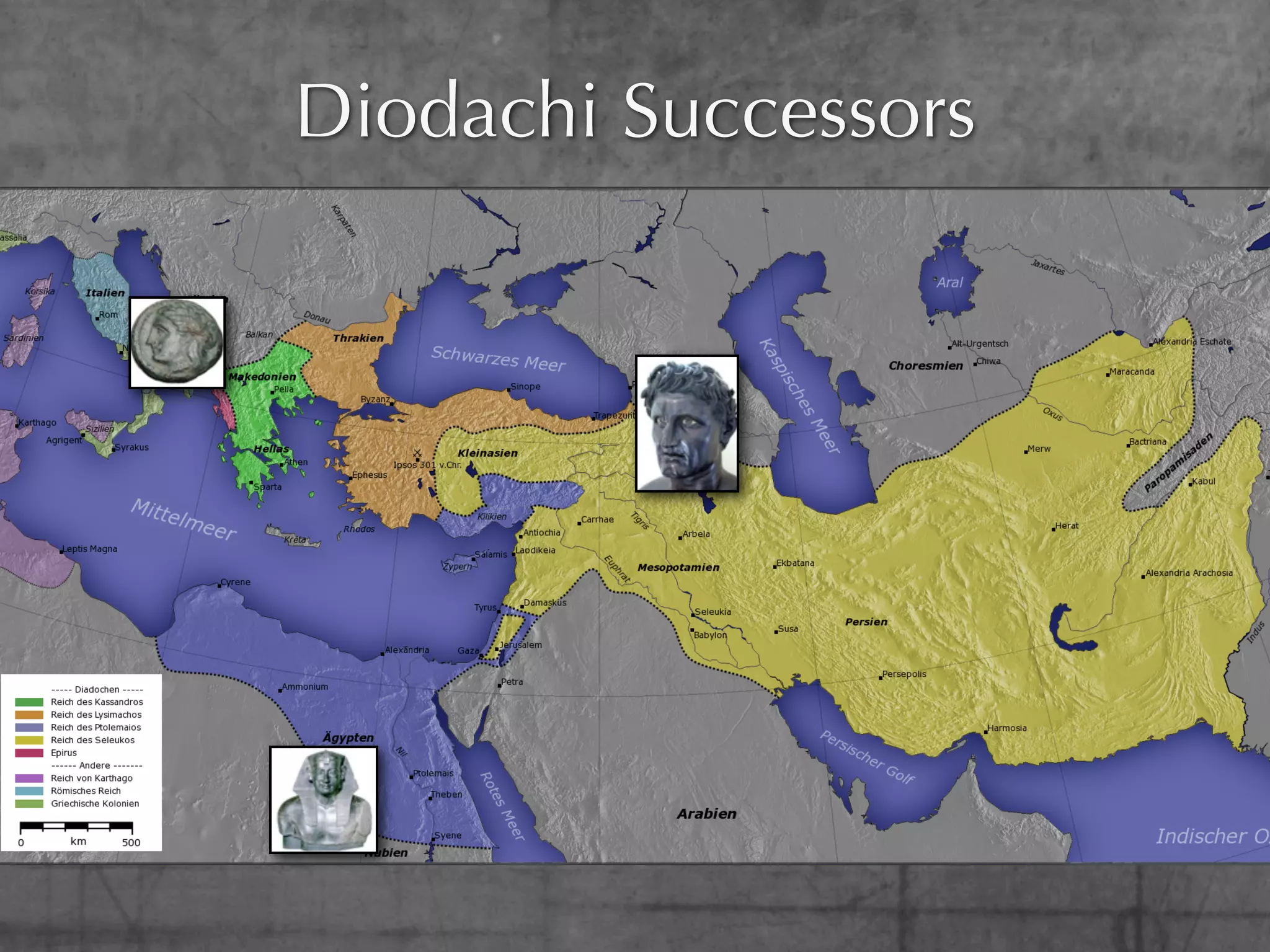
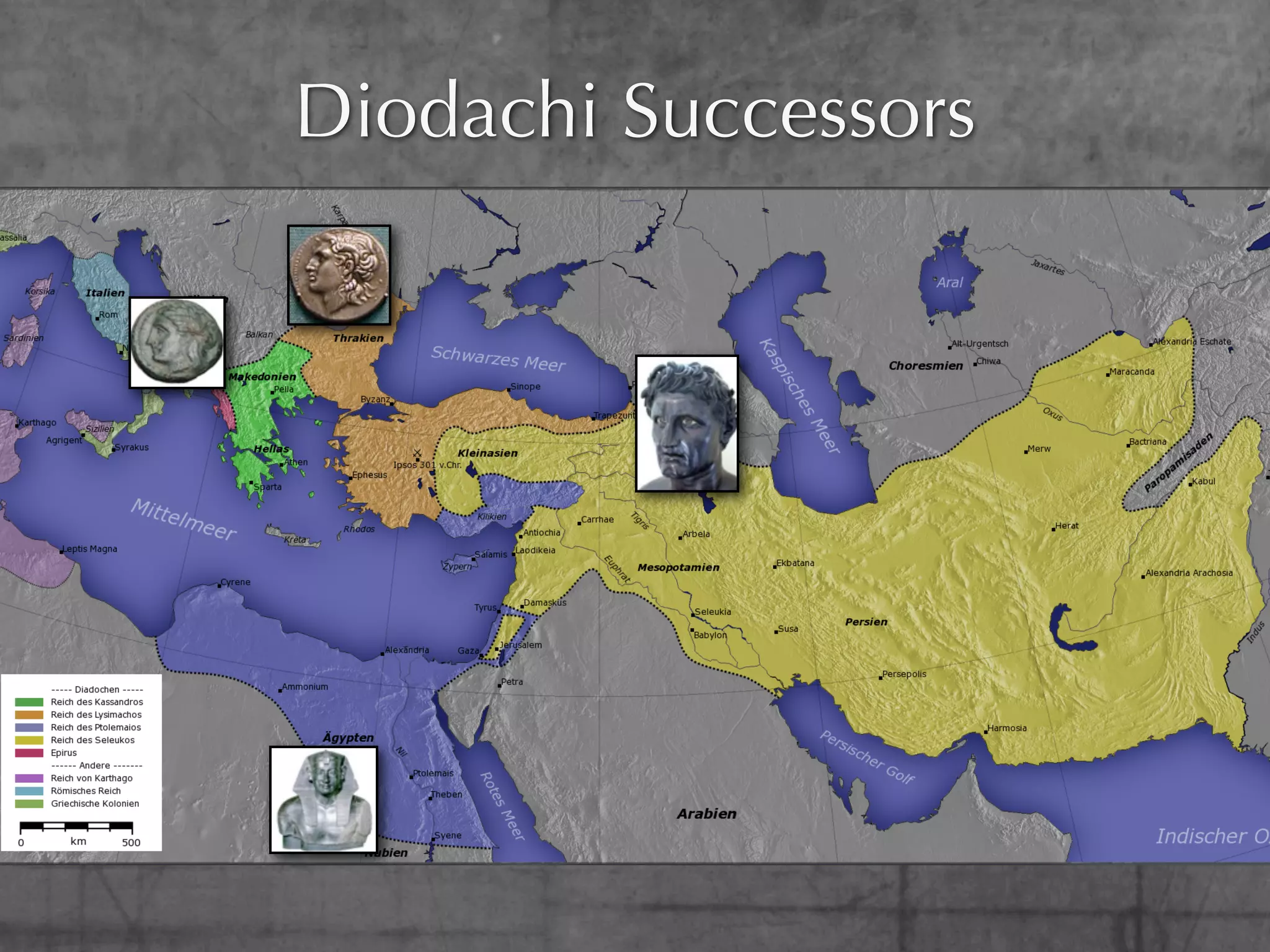
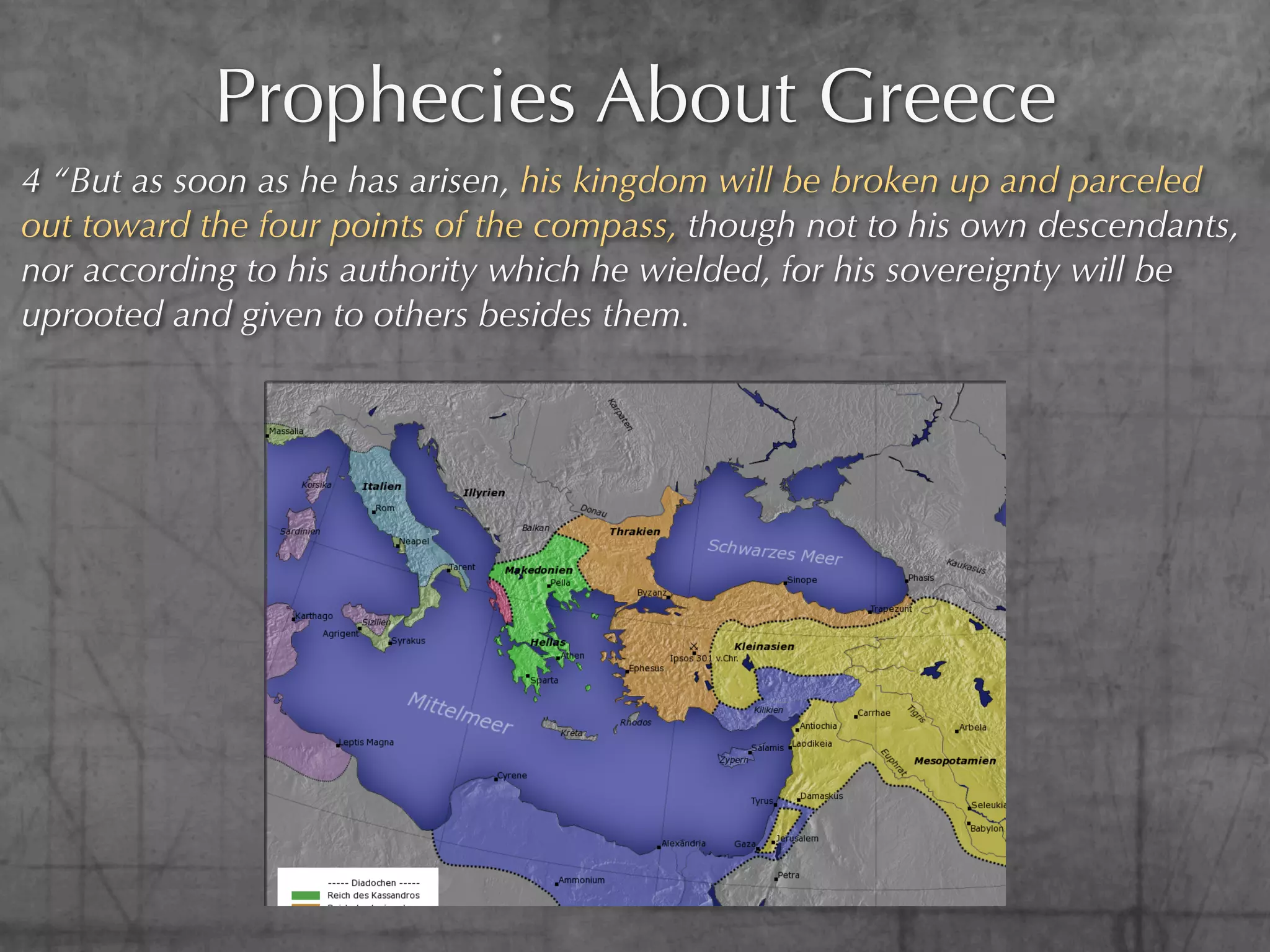
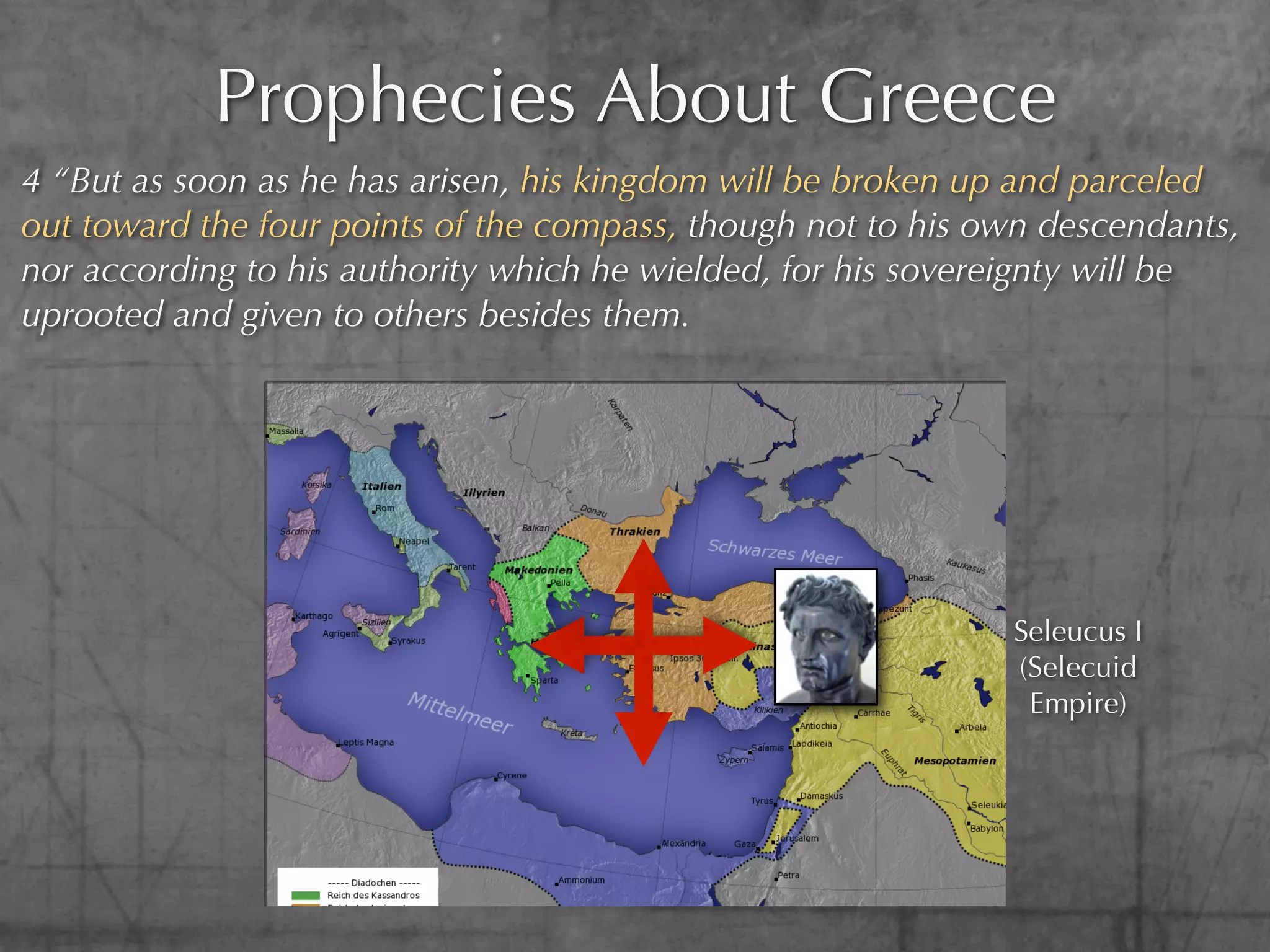
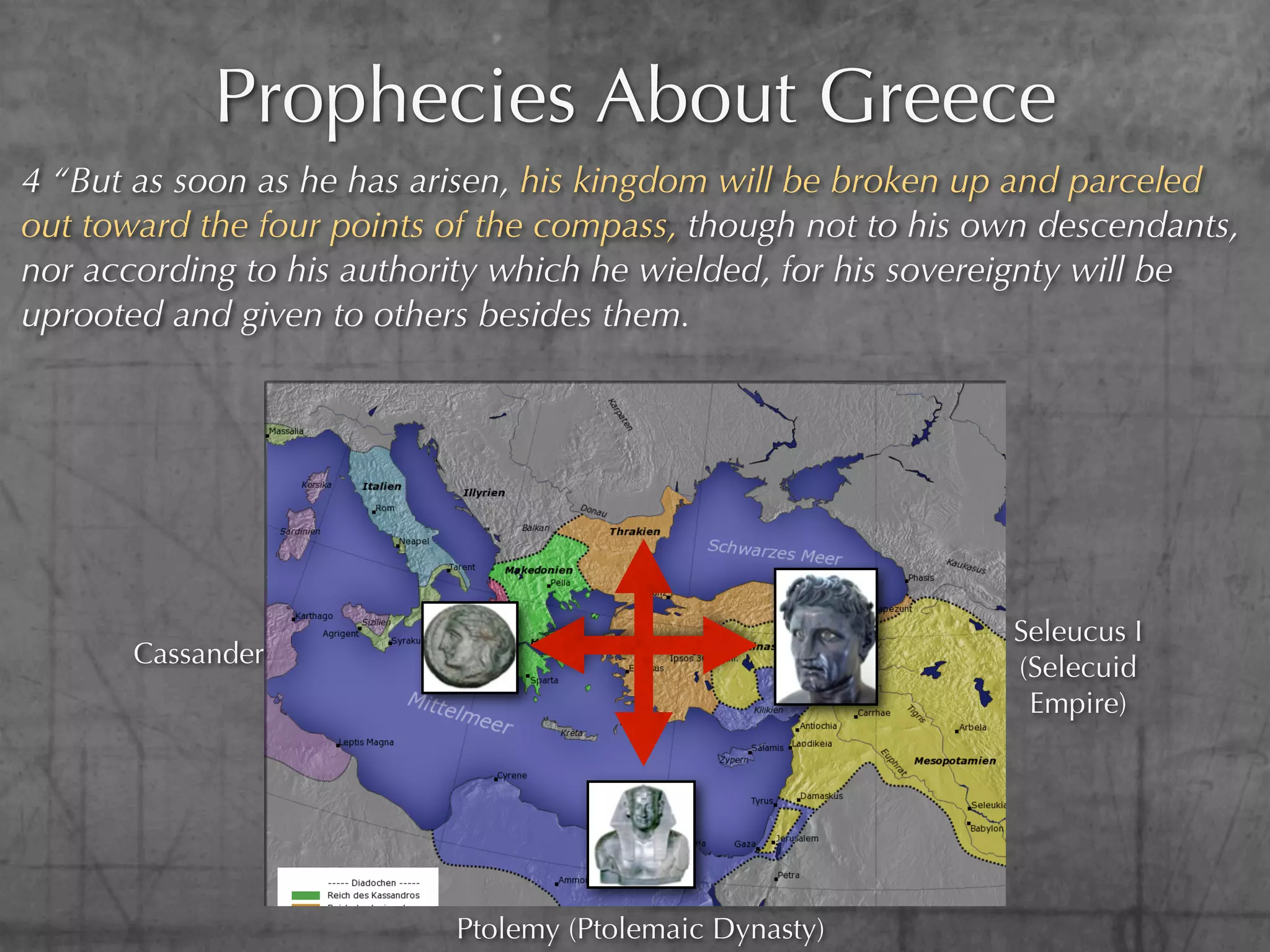
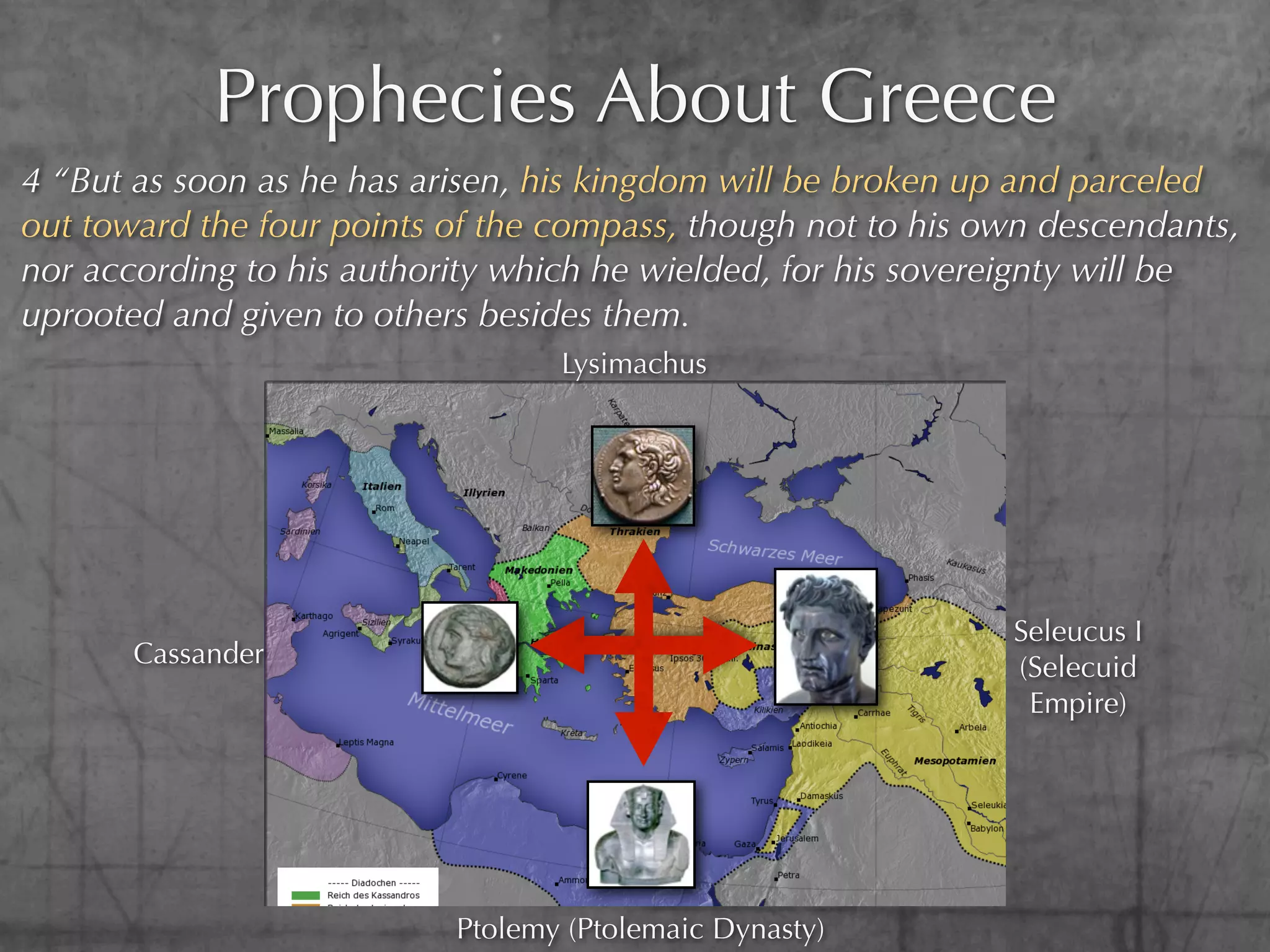
Seleucus I (East) - Babylon, Persia and Syria
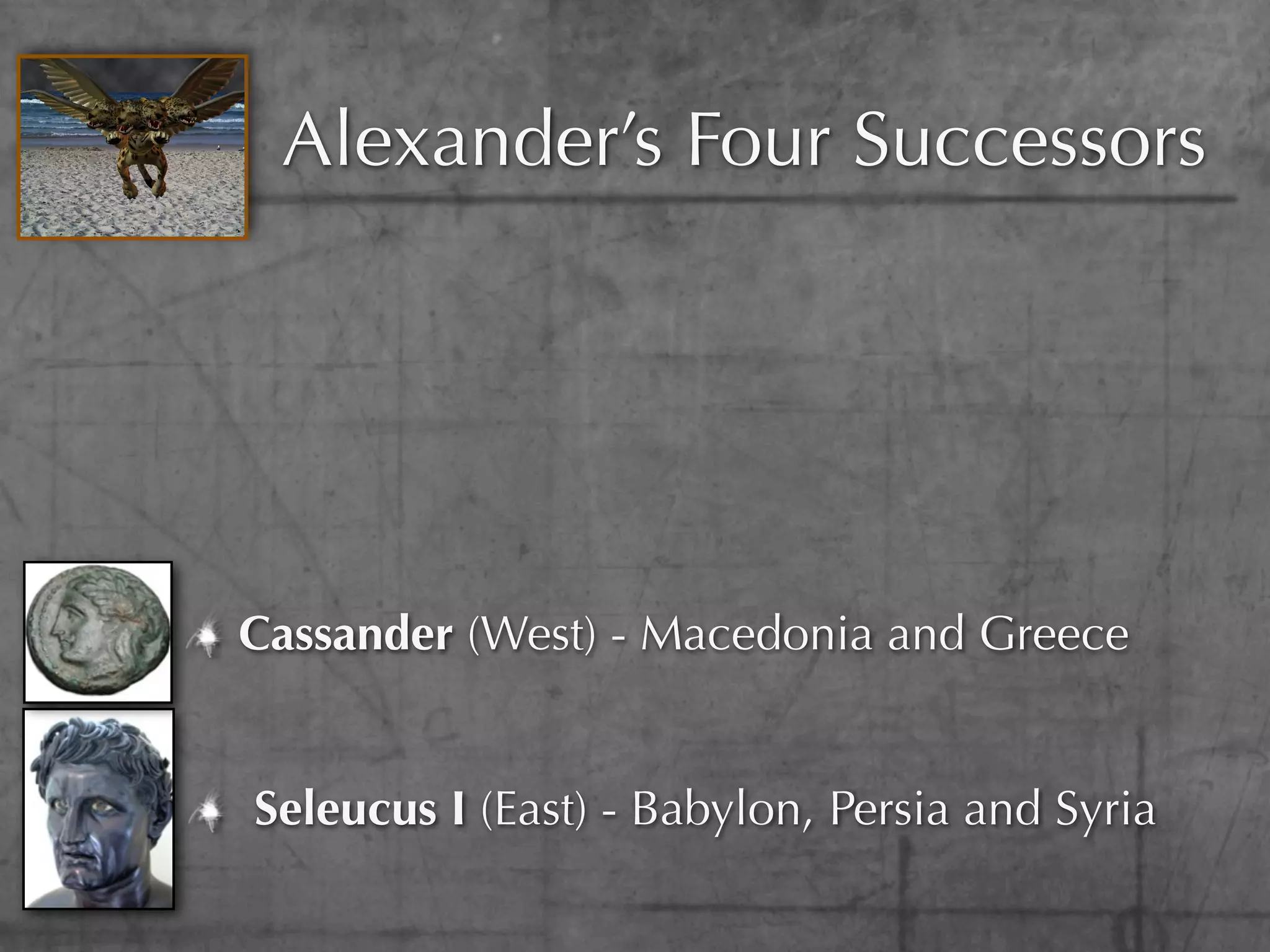
Alexander’s Four Successors


Cassander (West) - Macedonia and Greece


Seleucus I (East) - Babylon, Persia and Syria
Alexander’s Four Successors


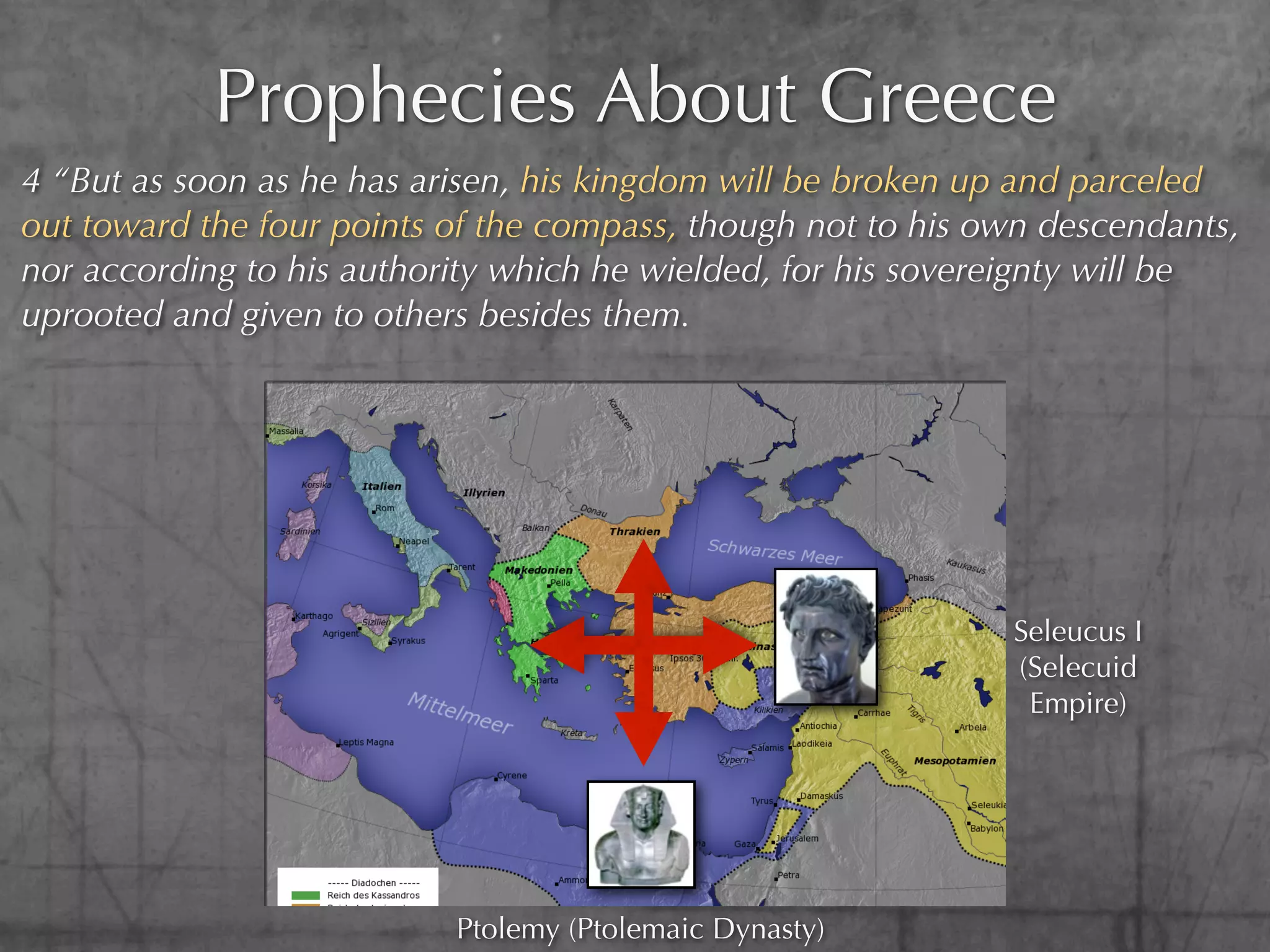
Ptolemy (South) - Egypt and Israel

Cassander (West) - Macedonia and Greece


Seleucus I (East) - Babylon, Persia and Syria
Alexander’s Four Successors

Lysimachus (North) - Asia Minor and Thrace


Ptolemy (South) - Egypt and Israel

Cassander (West) - Macedonia and Greece


Seleucus I (East) - Babylon, Persia and Syria
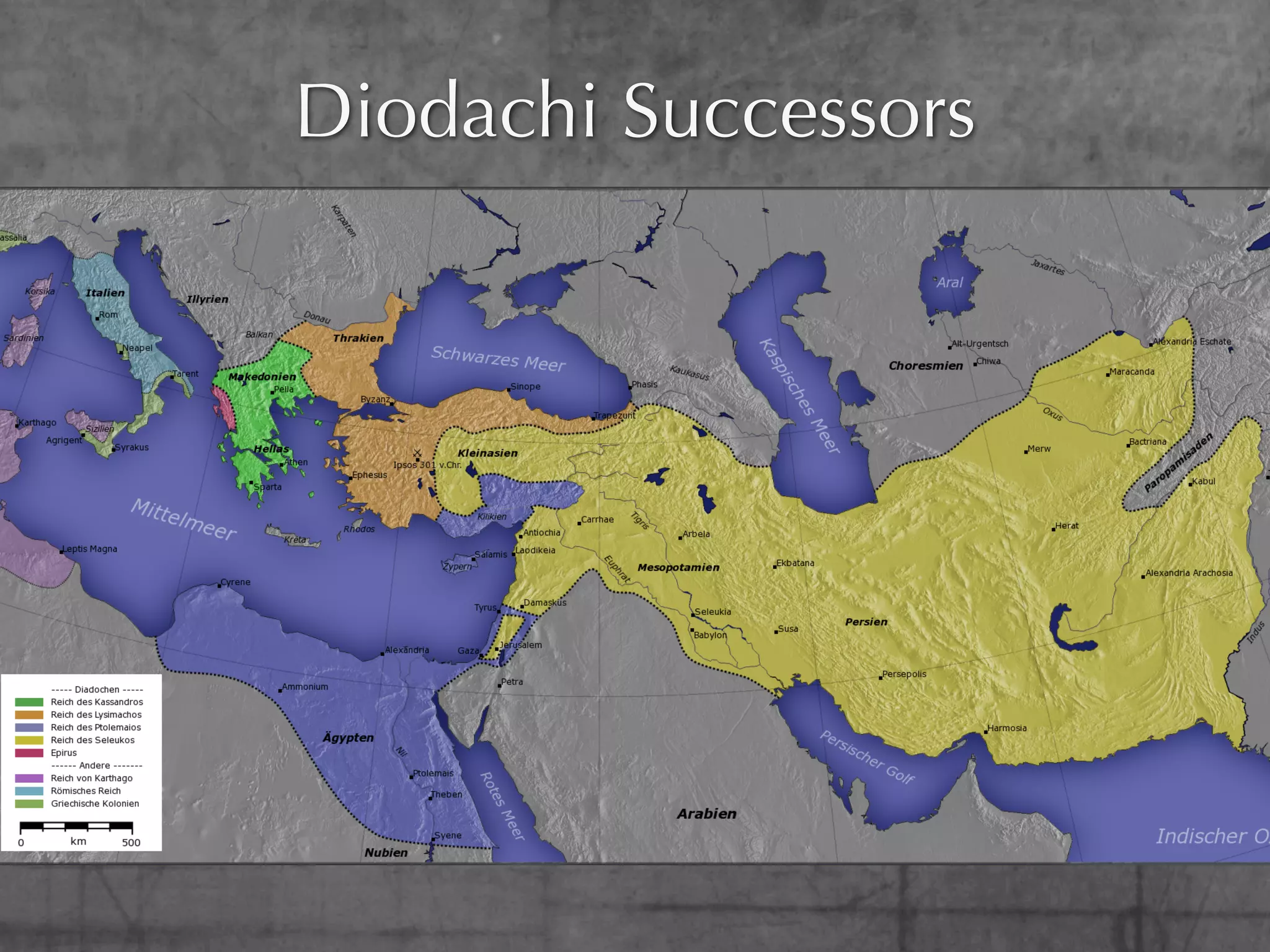
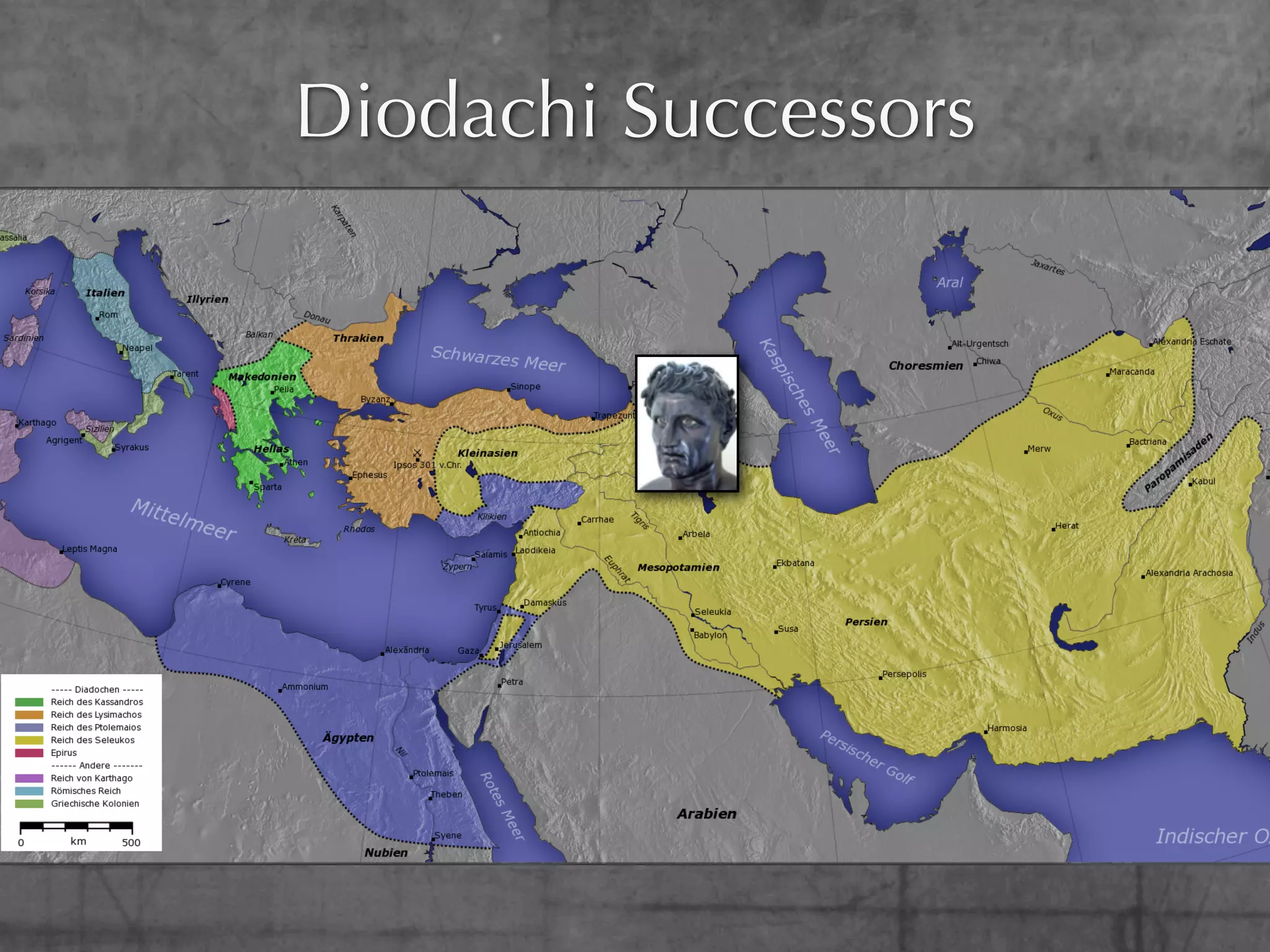
Diodachi Successors
Diodachi Successors
Diodachi Successors
Diodachi Successors
Diodachi Successors
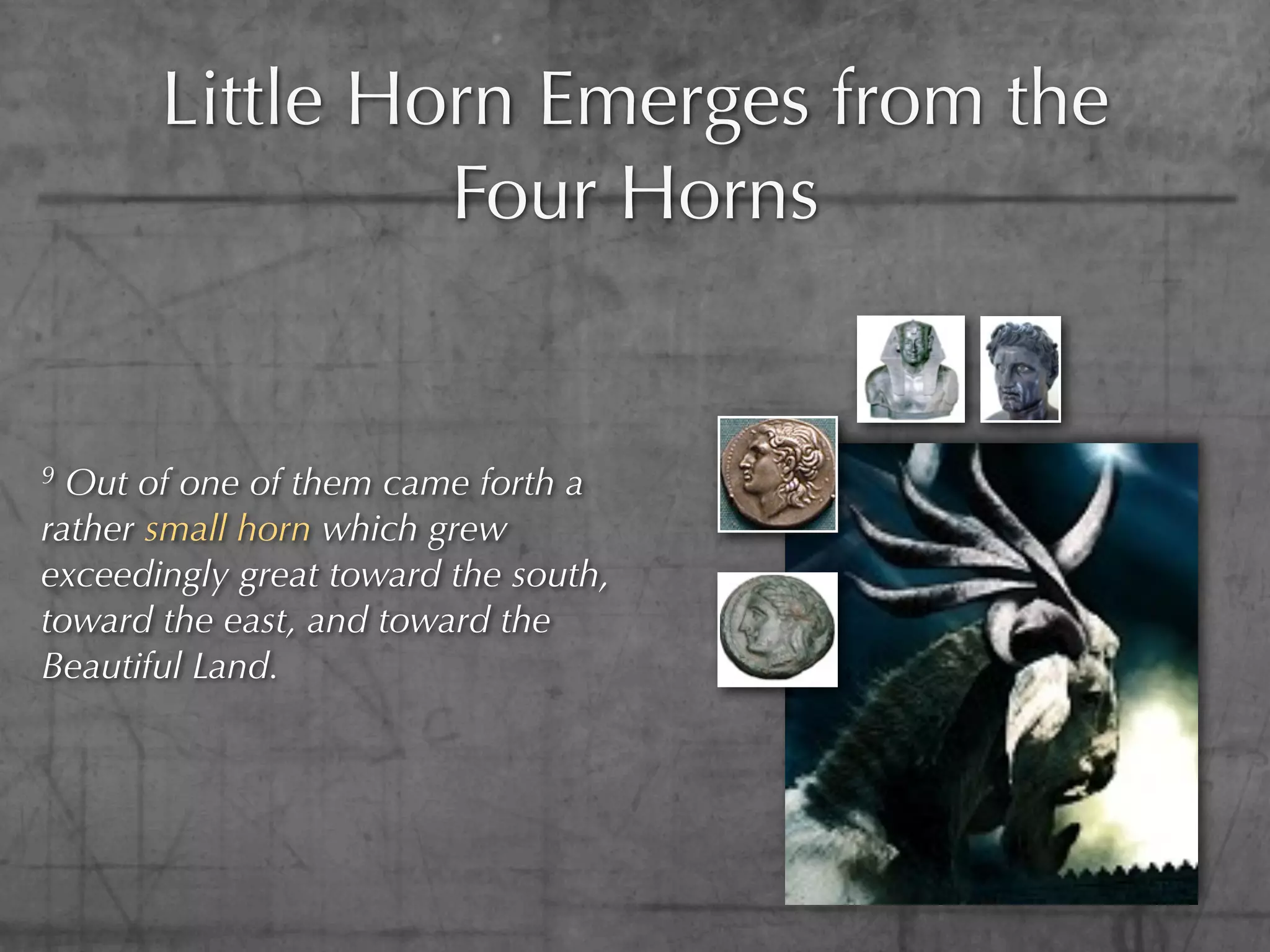
Little Horn Emerges from the
                Four Horns


9 Out of one of them came forth a
rather small horn which grew
exceedingly great toward the south,
toward the east, and toward the
Beautiful Land.
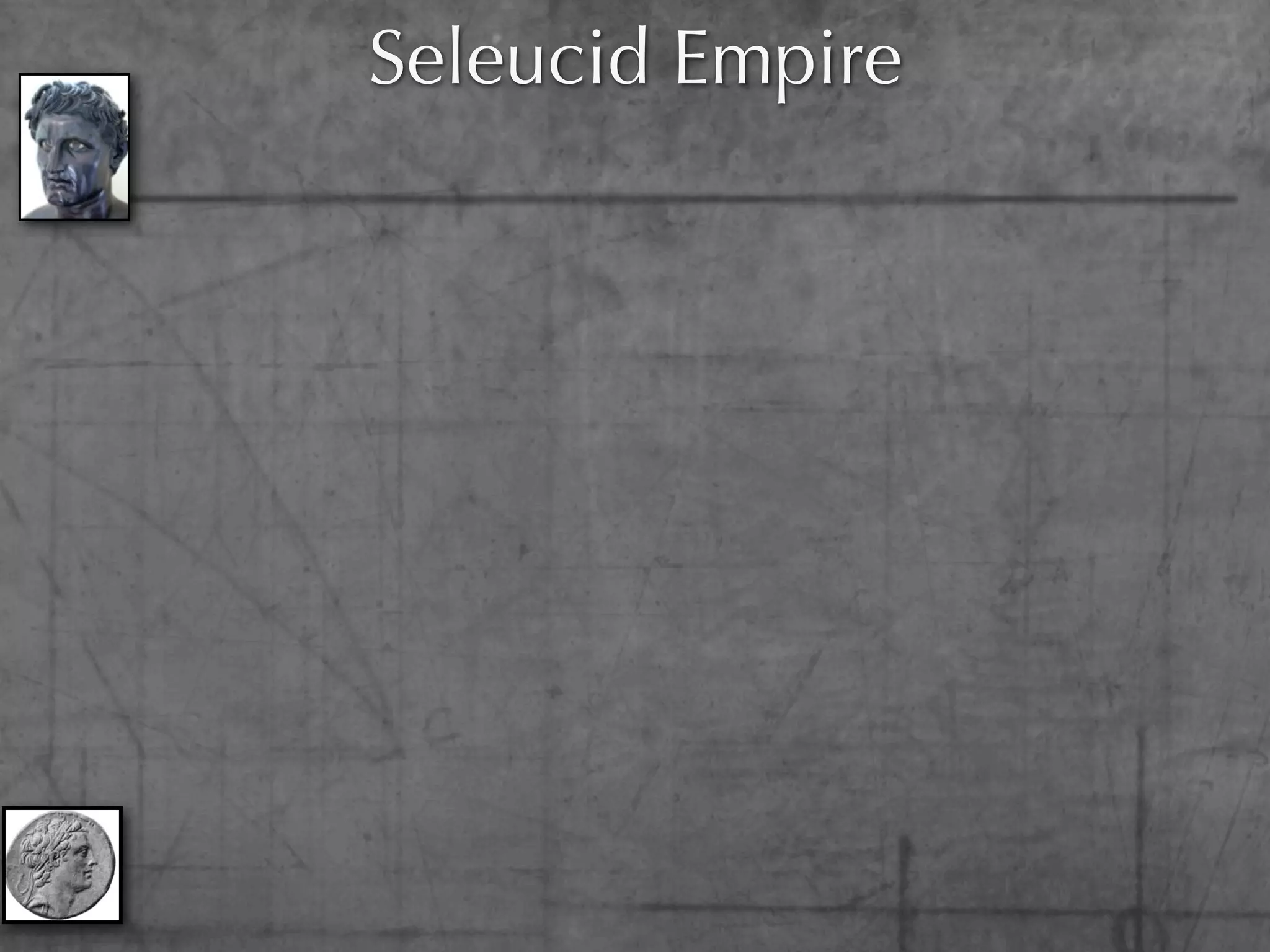
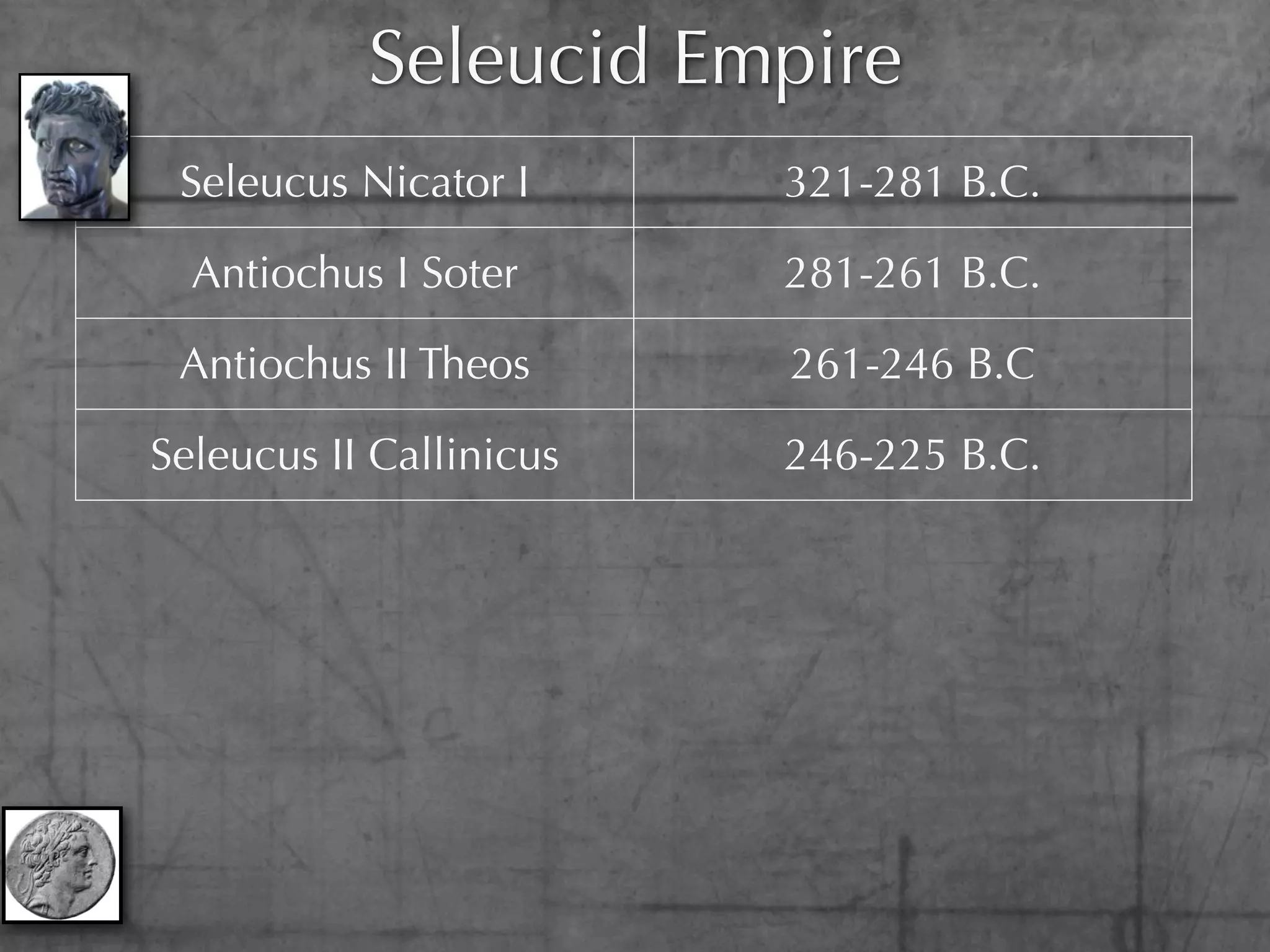
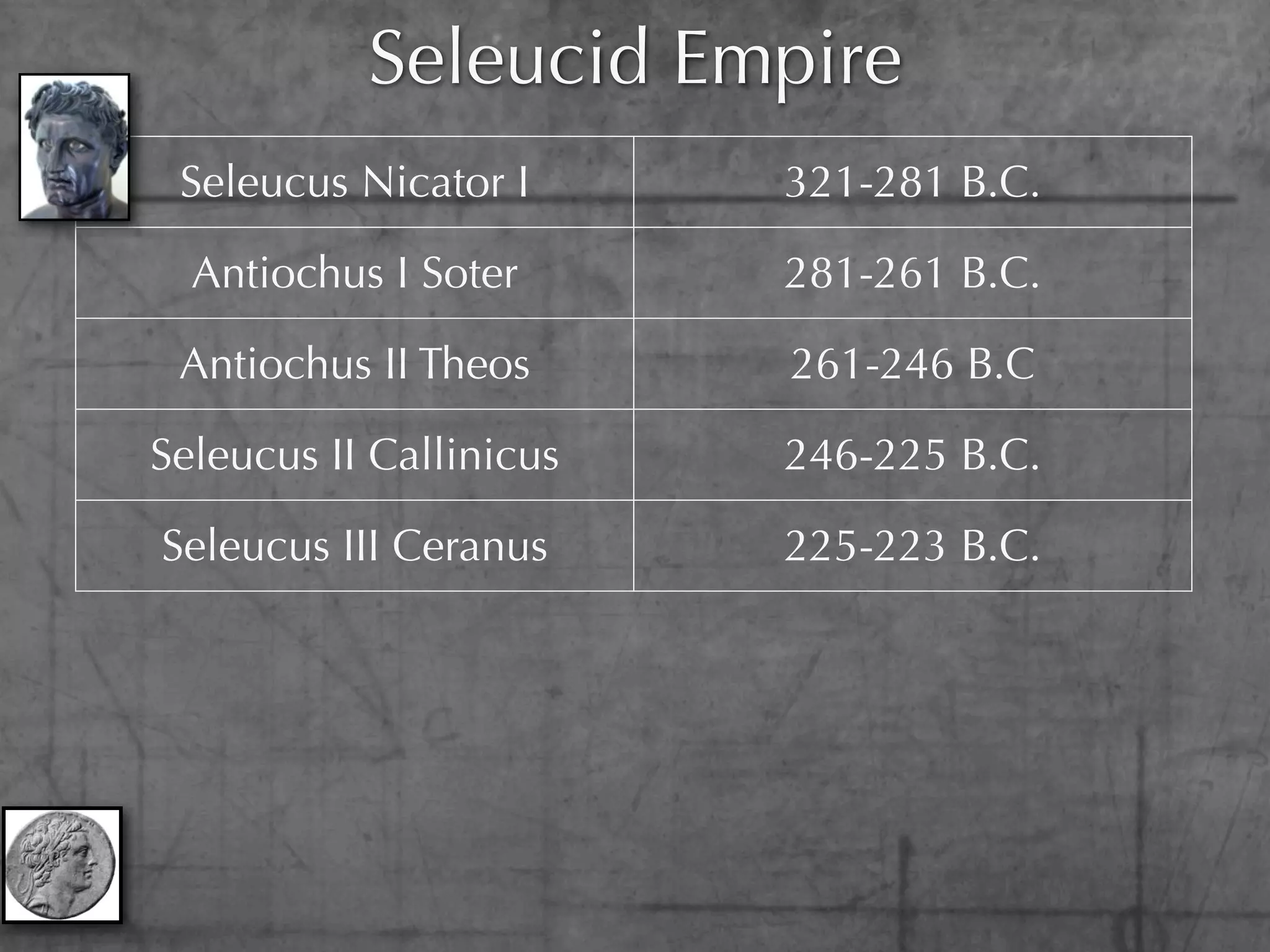
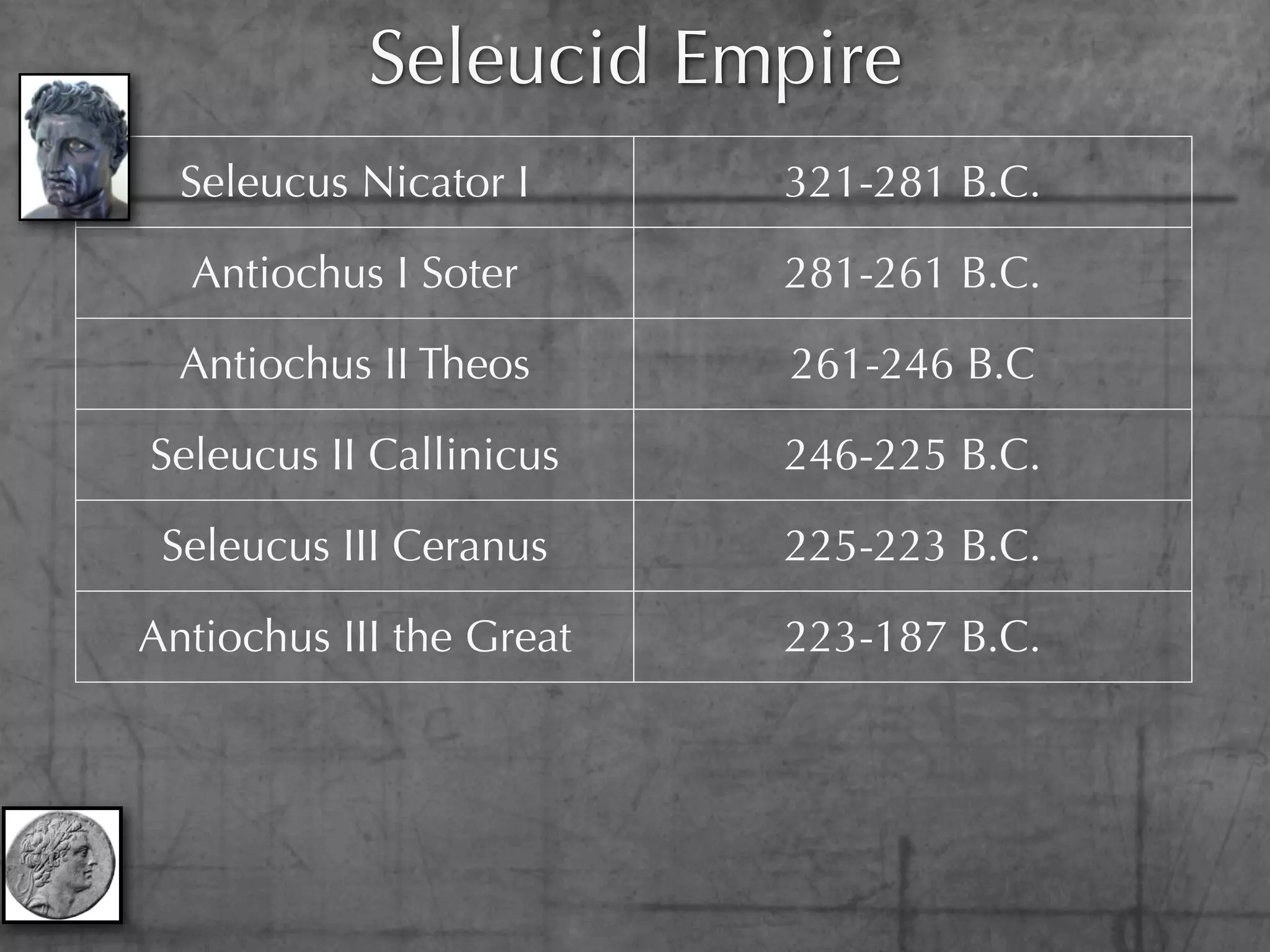
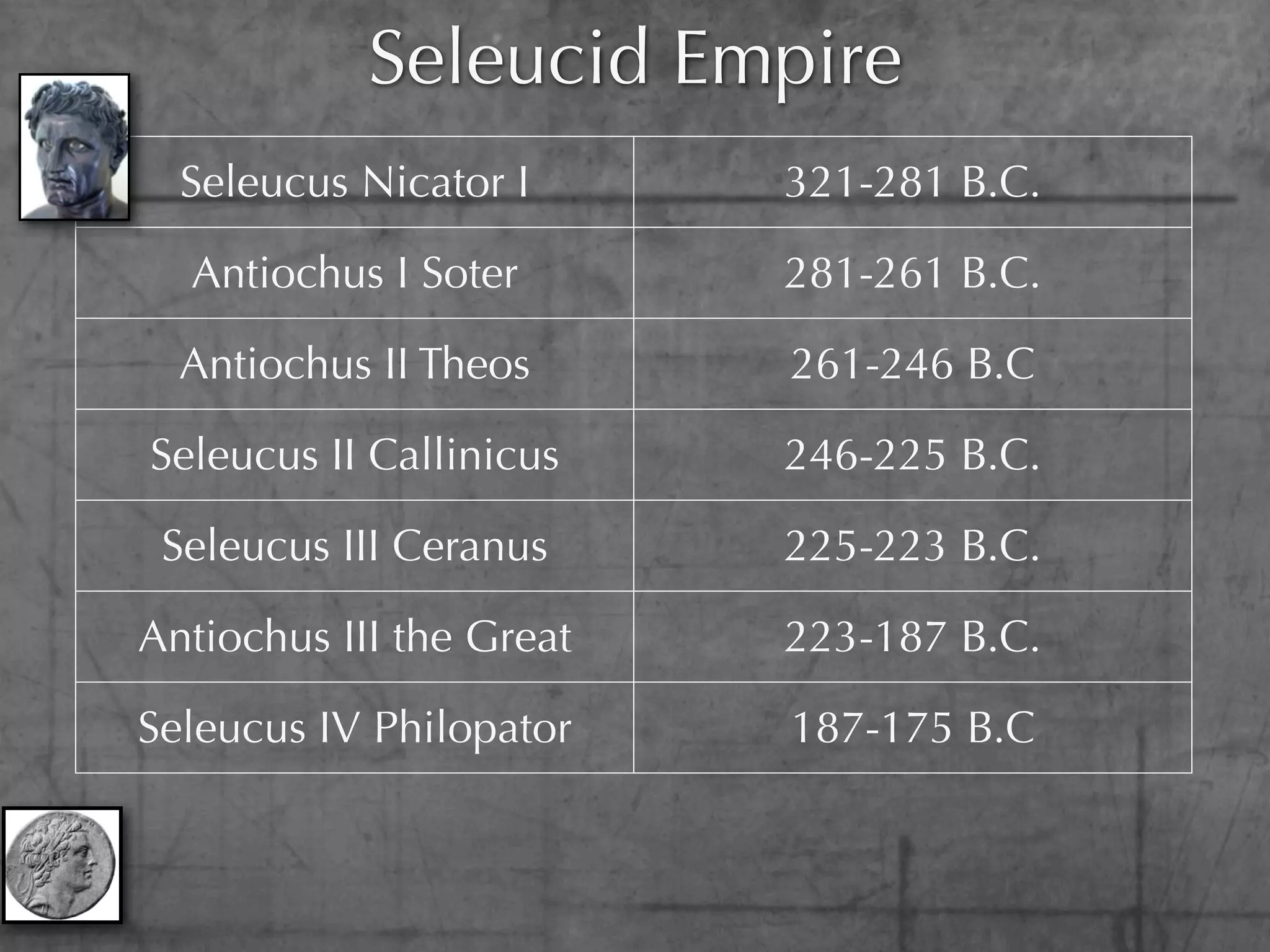
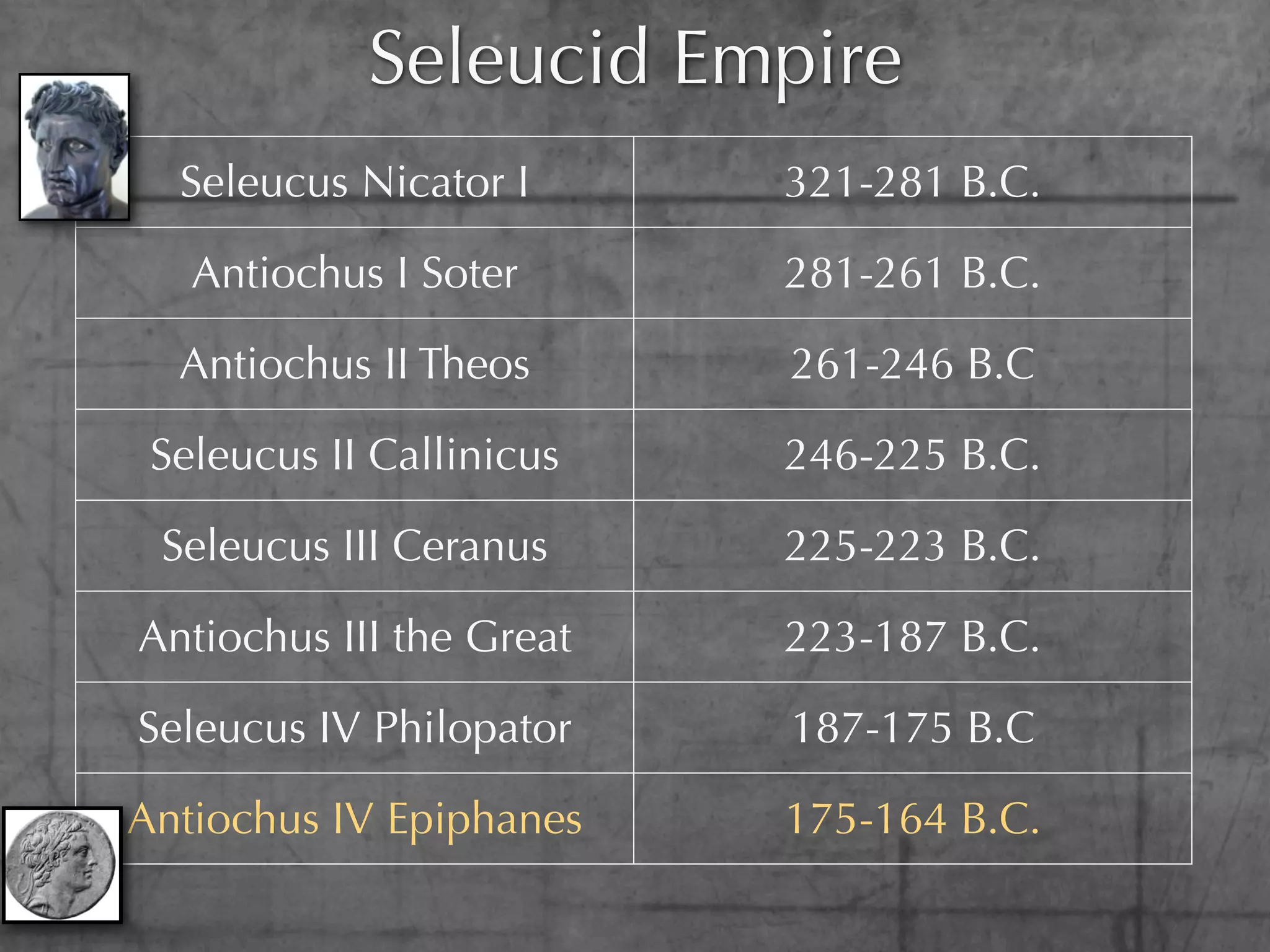
Seleucid Empire
Seleucid Empire
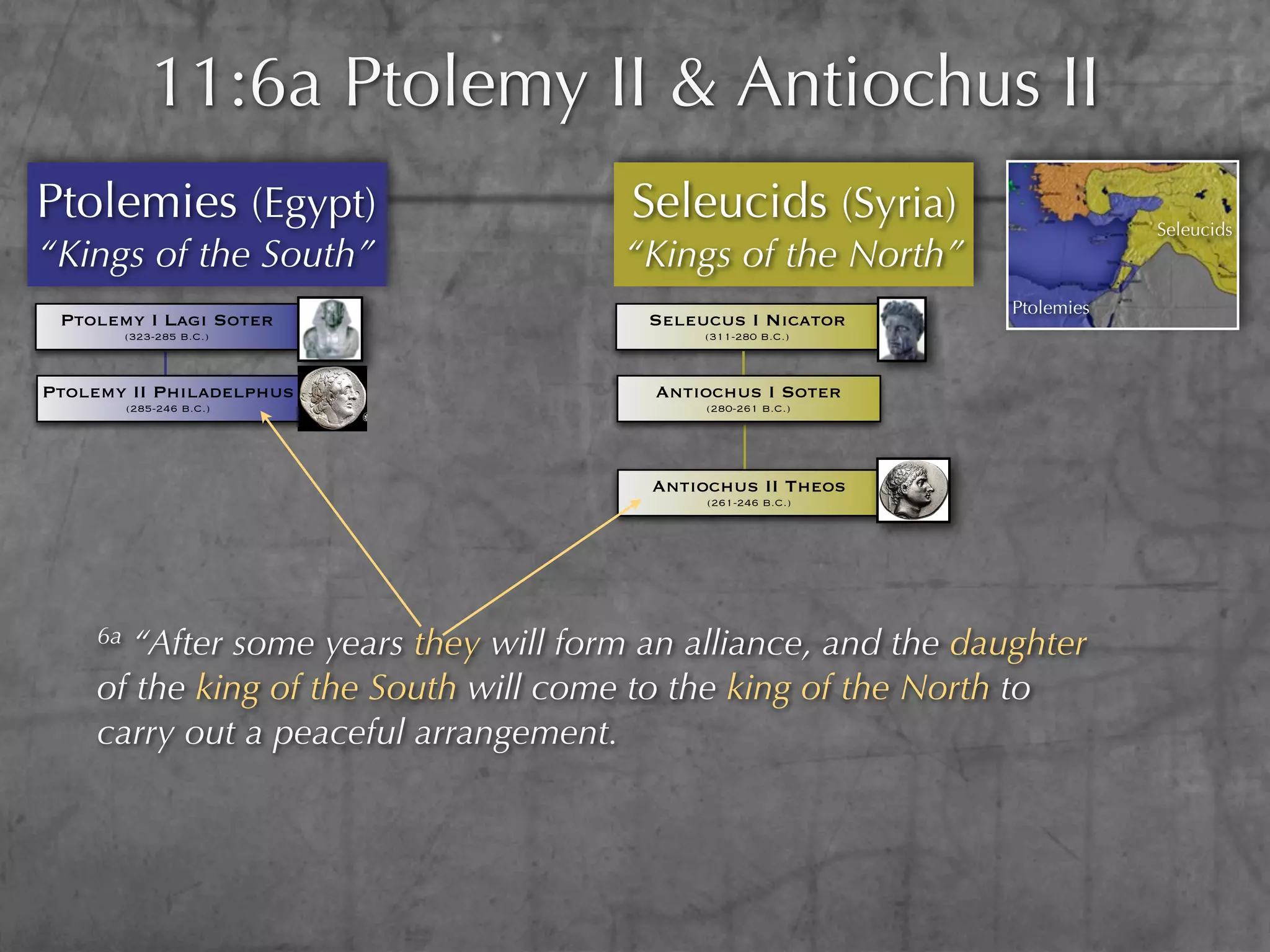
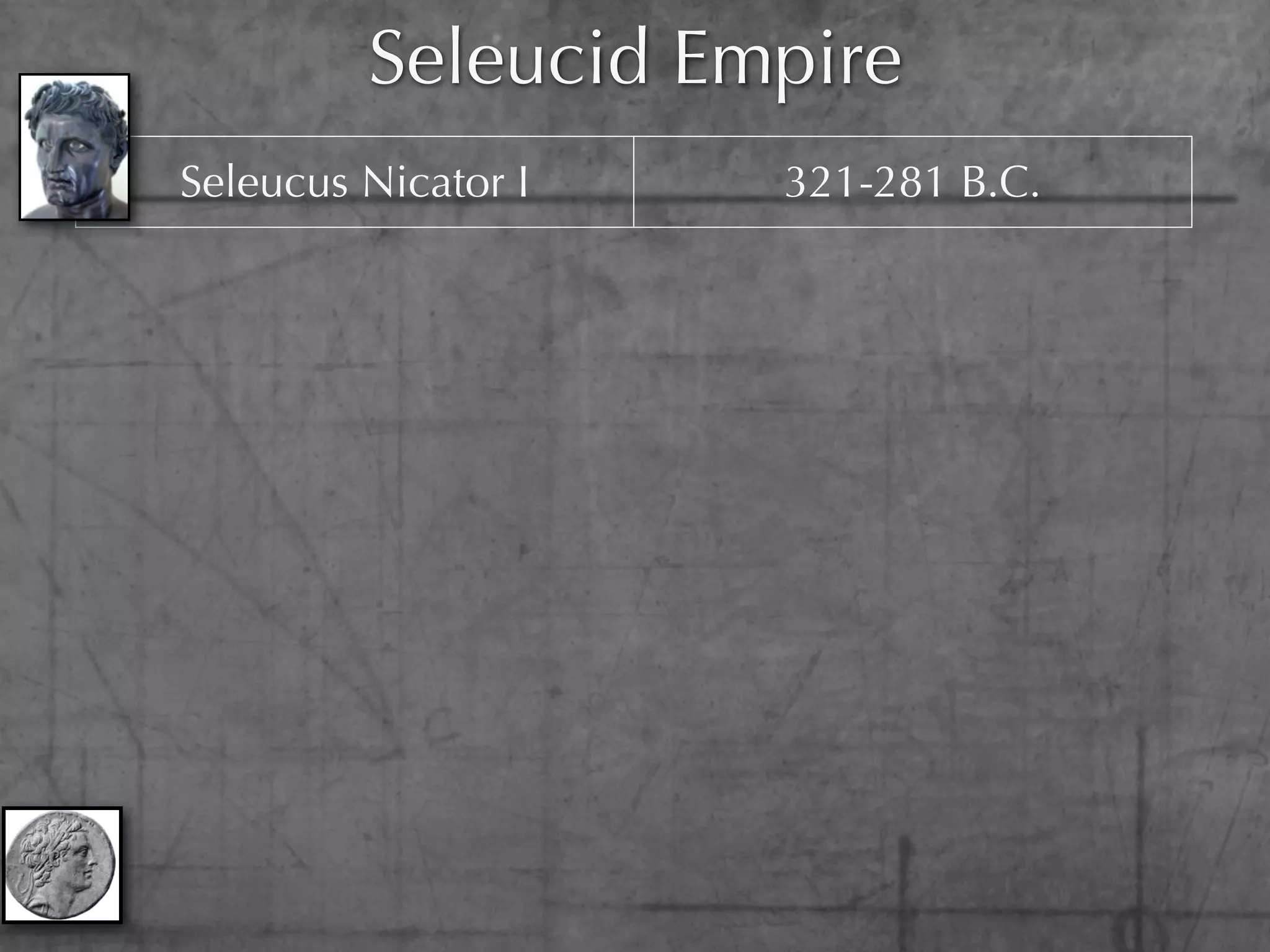
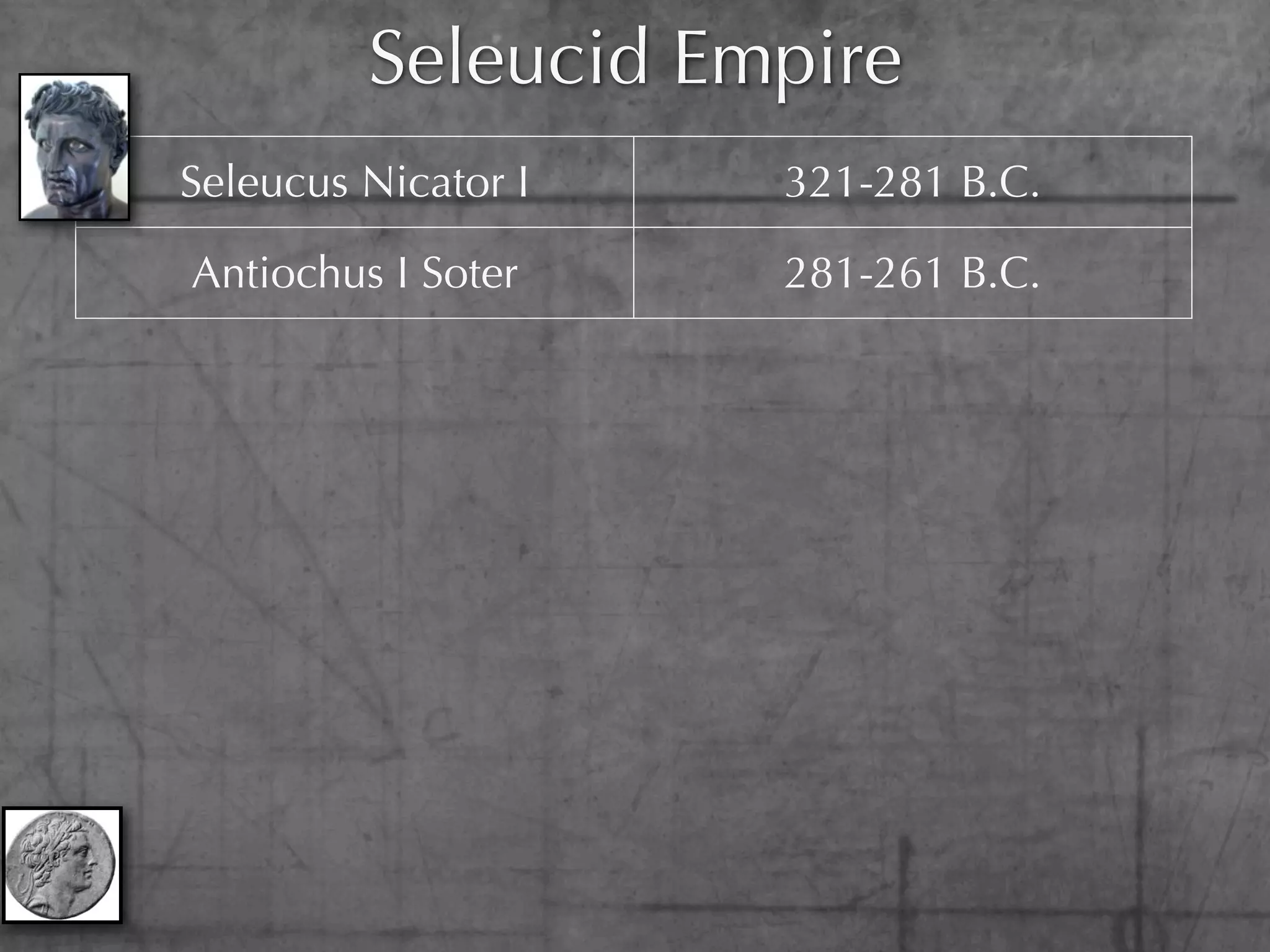
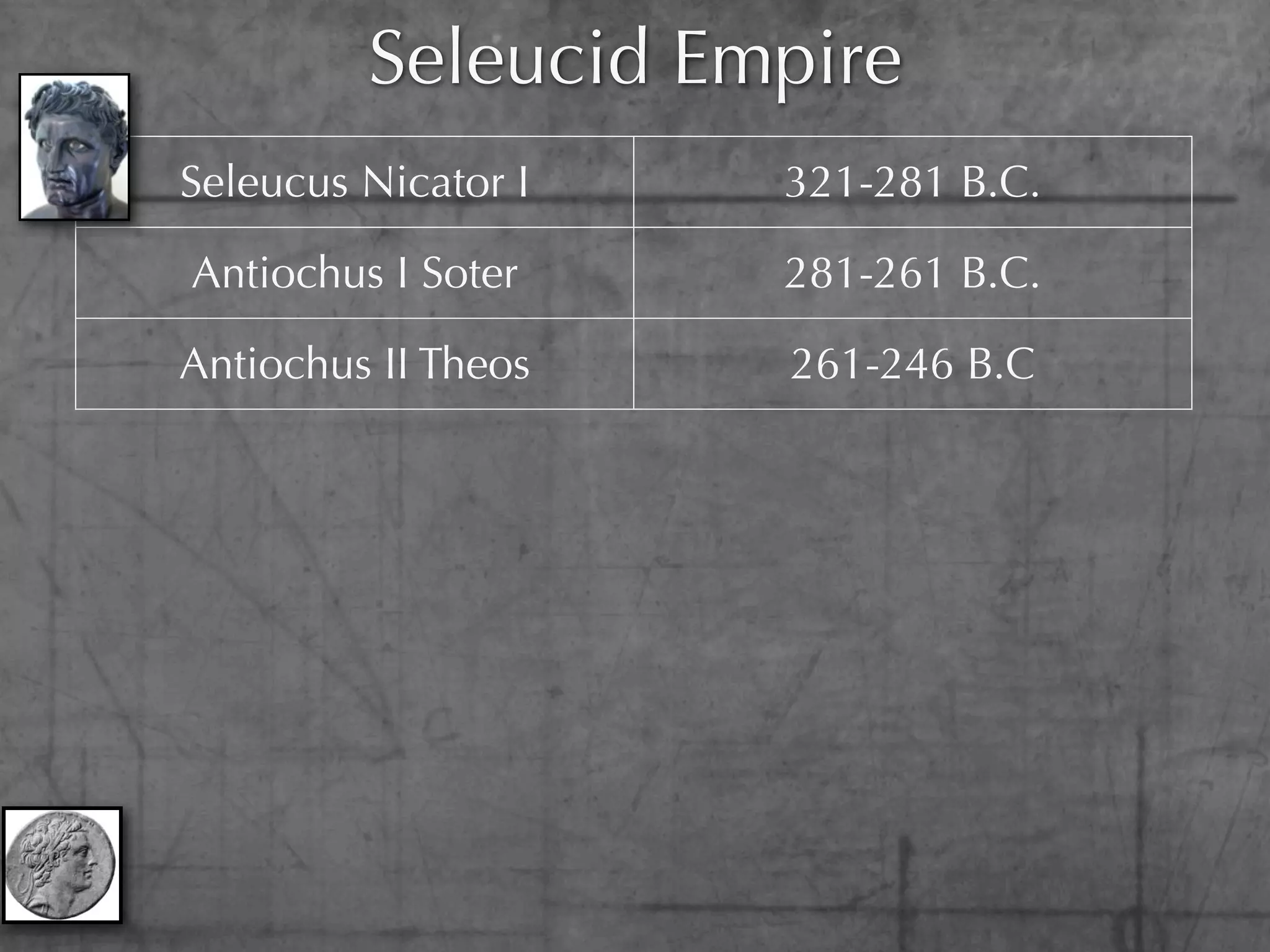
  Seleucus Nicator I      321-281 B.C.

   Antiochus I Soter      281-261 B.C.

  Antiochus II Theos      261-246 B.C

 Seleucus II Callinicus   246-225 B.C.

 Seleucus III Ceranus     225-223 B.C.

Antiochus III the Great   223-187 B.C.

Seleucus IV Philopator    187-175 B.C

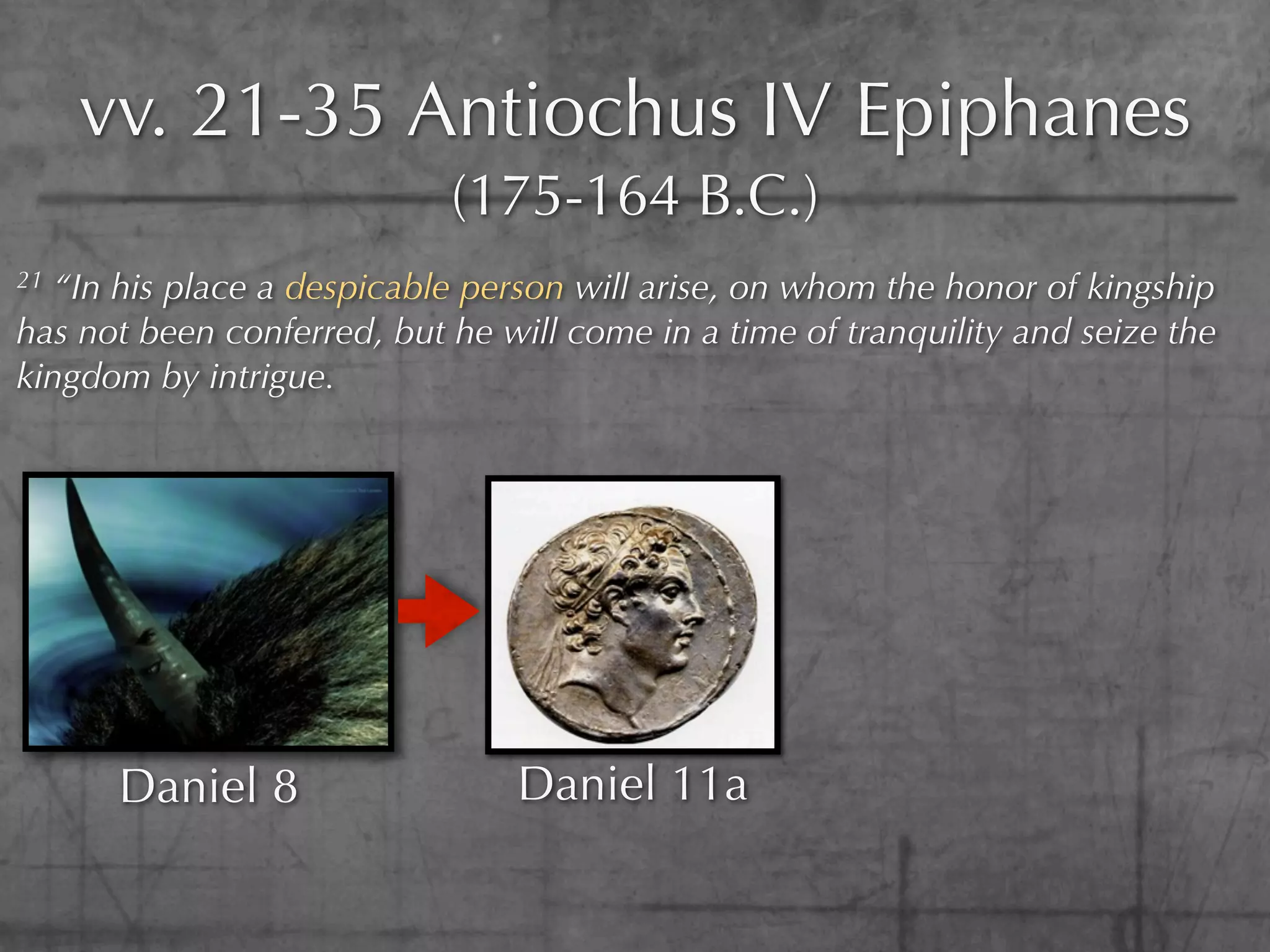
Antiochus IV Epiphanes    175-164 B.C.
Seleucid Empire
  Seleucus Nicator I      321-281 B.C.

   Antiochus I Soter      281-261 B.C.

  Antiochus II Theos      261-246 B.C

 Seleucus II Callinicus   246-225 B.C.

 Seleucus III Ceranus     225-223 B.C.

Antiochus III the Great   223-187 B.C.

Seleucus IV Philopator    187-175 B.C

Antiochus IV Epiphanes    175-164 B.C.
Seleucid Empire
  Seleucus Nicator I      321-281 B.C.

   Antiochus I Soter      281-261 B.C.

  Antiochus II Theos      261-246 B.C

 Seleucus II Callinicus   246-225 B.C.

 Seleucus III Ceranus     225-223 B.C.

Antiochus III the Great   223-187 B.C.

Seleucus IV Philopator    187-175 B.C

Antiochus IV Epiphanes    175-164 B.C.
Seleucid Empire
  Seleucus Nicator I      321-281 B.C.

   Antiochus I Soter      281-261 B.C.

  Antiochus II Theos      261-246 B.C

 Seleucus II Callinicus   246-225 B.C.

 Seleucus III Ceranus     225-223 B.C.

Antiochus III the Great   223-187 B.C.

Seleucus IV Philopator    187-175 B.C

Antiochus IV Epiphanes    175-164 B.C.
Seleucid Empire
  Seleucus Nicator I      321-281 B.C.

   Antiochus I Soter      281-261 B.C.

  Antiochus II Theos      261-246 B.C

 Seleucus II Callinicus   246-225 B.C.

 Seleucus III Ceranus     225-223 B.C.

Antiochus III the Great   223-187 B.C.

Seleucus IV Philopator    187-175 B.C

Antiochus IV Epiphanes    175-164 B.C.
Seleucid Empire
  Seleucus Nicator I      321-281 B.C.

   Antiochus I Soter      281-261 B.C.

  Antiochus II Theos      261-246 B.C

 Seleucus II Callinicus   246-225 B.C.

 Seleucus III Ceranus     225-223 B.C.

Antiochus III the Great   223-187 B.C.

Seleucus IV Philopator    187-175 B.C

Antiochus IV Epiphanes    175-164 B.C.
Seleucid Empire
  Seleucus Nicator I      321-281 B.C.

   Antiochus I Soter      281-261 B.C.

  Antiochus II Theos      261-246 B.C

 Seleucus II Callinicus   246-225 B.C.

 Seleucus III Ceranus     225-223 B.C.

Antiochus III the Great   223-187 B.C.

Seleucus IV Philopator    187-175 B.C

Antiochus IV Epiphanes    175-164 B.C.
Seleucid Empire
  Seleucus Nicator I      321-281 B.C.

   Antiochus I Soter      281-261 B.C.

  Antiochus II Theos      261-246 B.C

 Seleucus II Callinicus   246-225 B.C.

 Seleucus III Ceranus     225-223 B.C.

Antiochus III the Great   223-187 B.C.

Seleucus IV Philopator    187-175 B.C

Antiochus IV Epiphanes    175-164 B.C.
Little Horn, Ch. 7 vs. Ch.8
 Daniel 7          Daniel 8
Little Horn, Ch. 7 vs. Ch.8
      Daniel 7         Daniel 8


Revived Roman Empire
Little Horn, Ch. 7 vs. Ch.8
      Daniel 7                Daniel 8


Revived Roman Empire   Ancient Grecian Empire
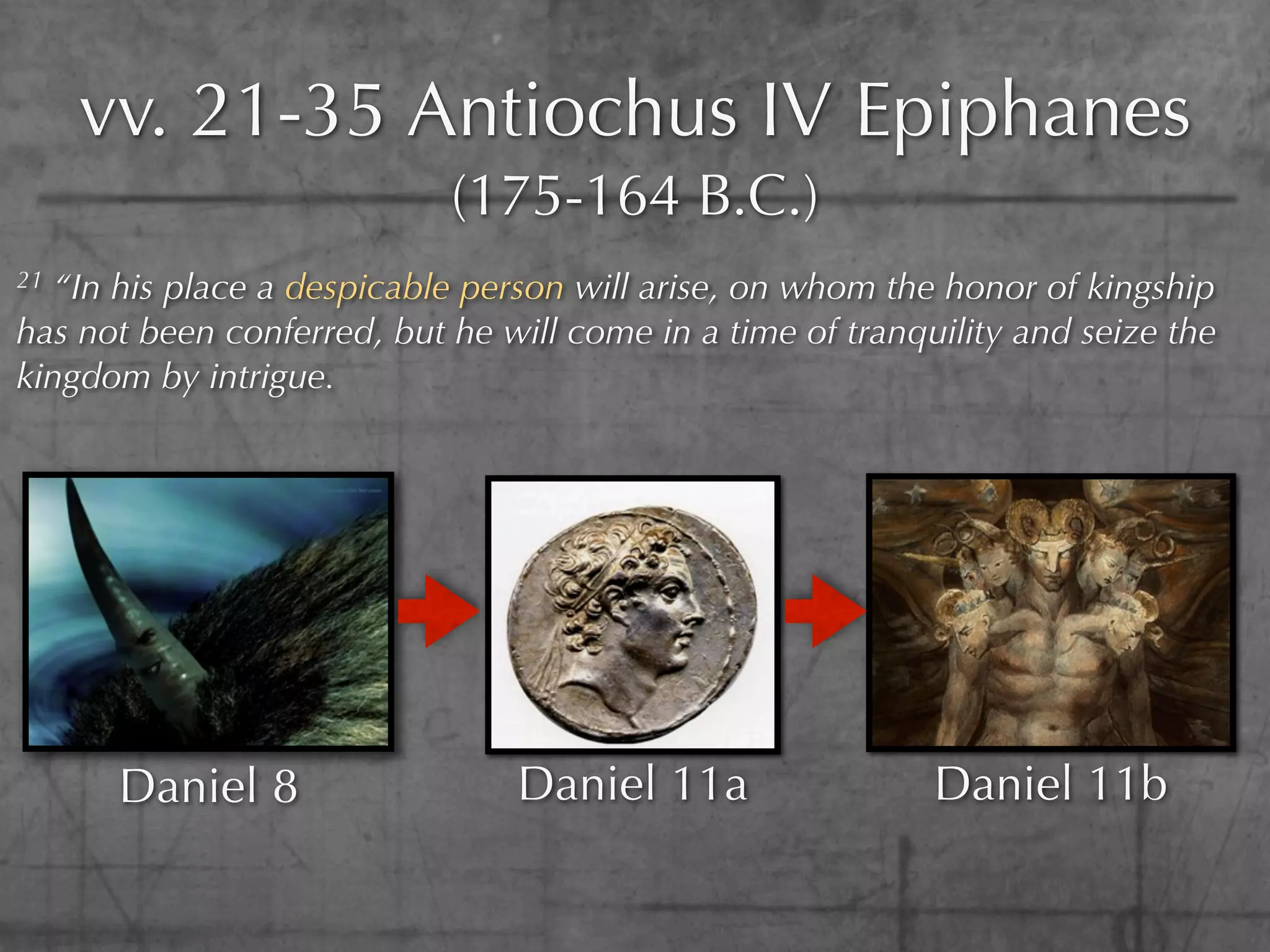
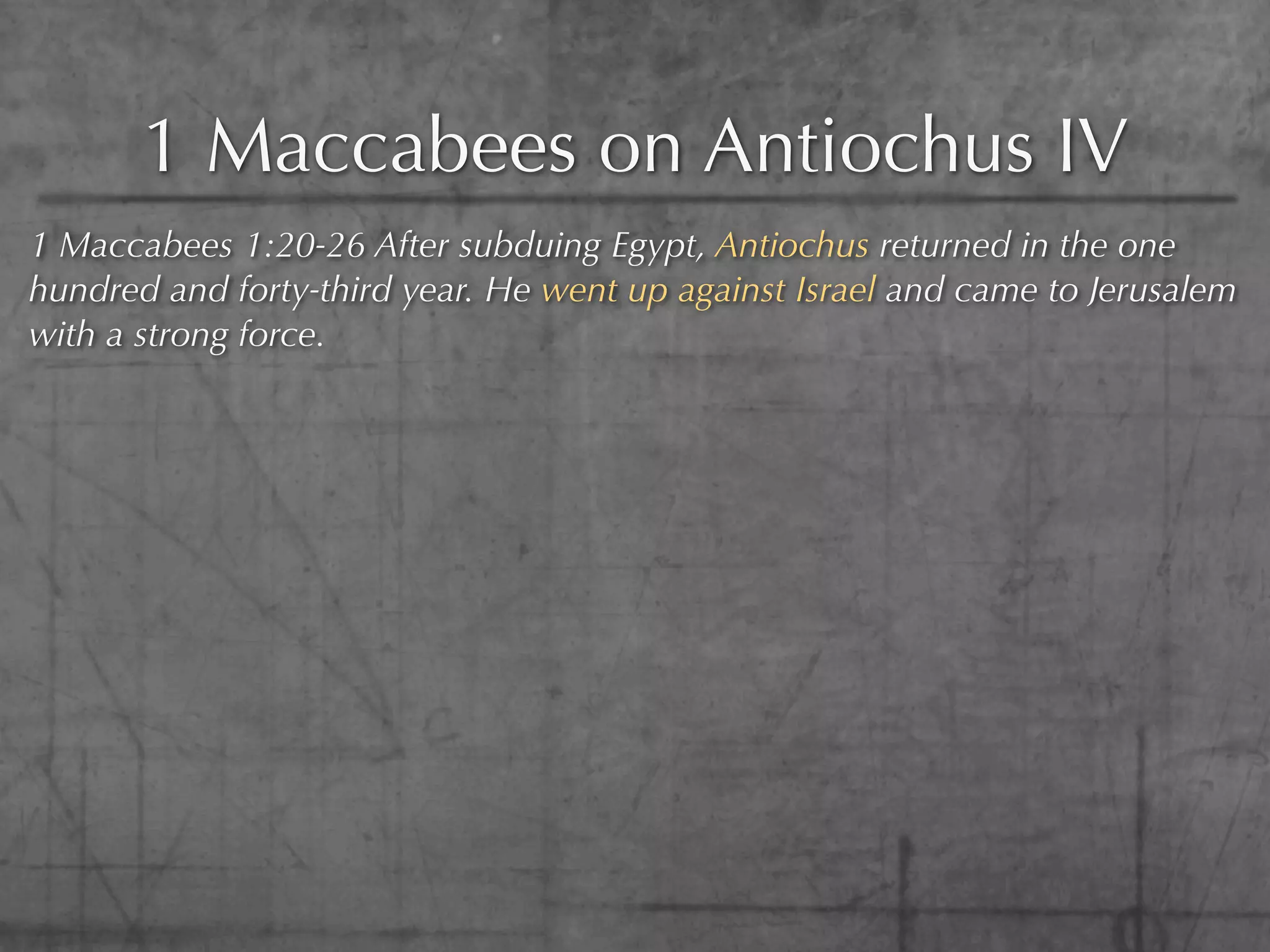
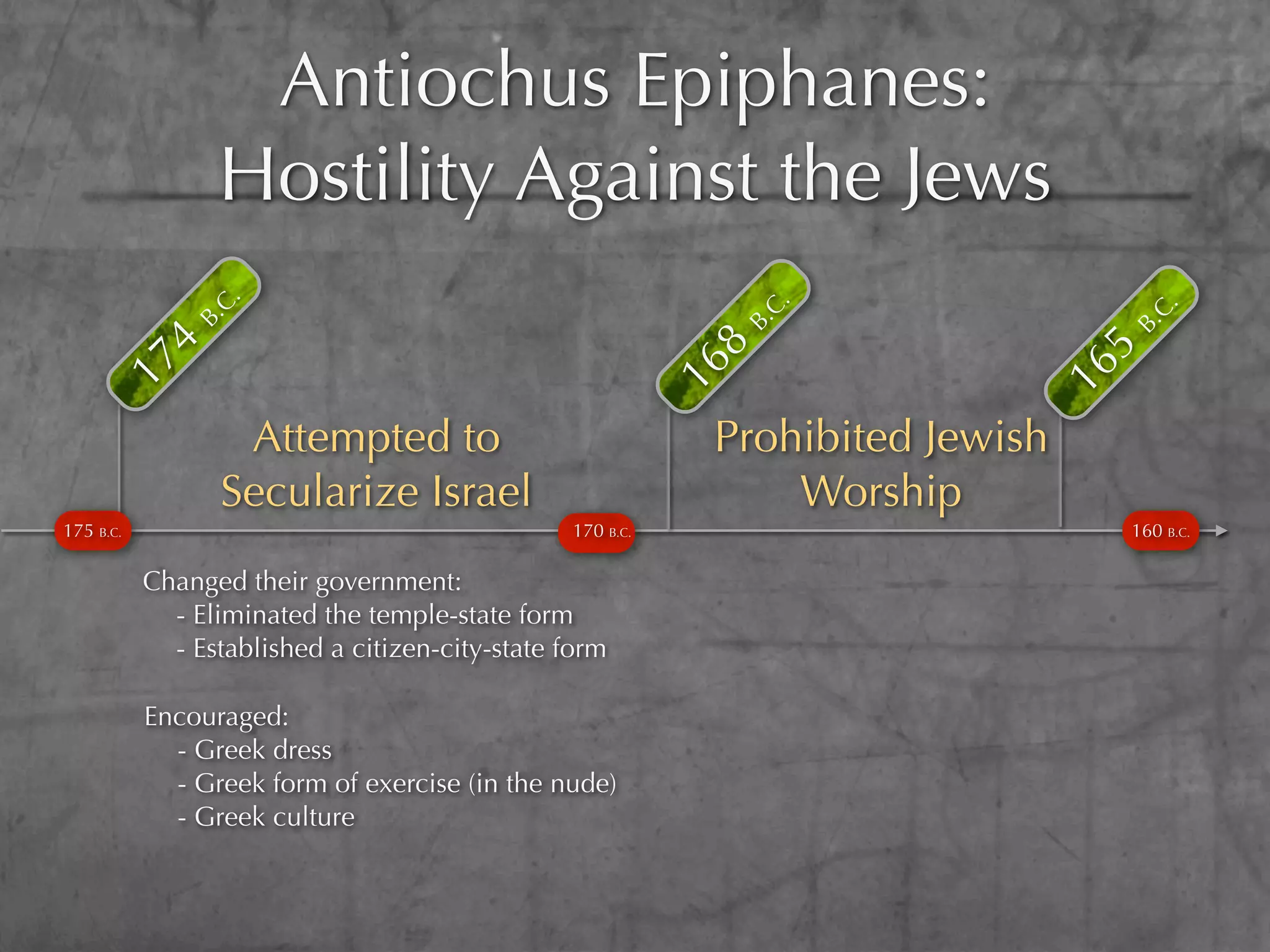
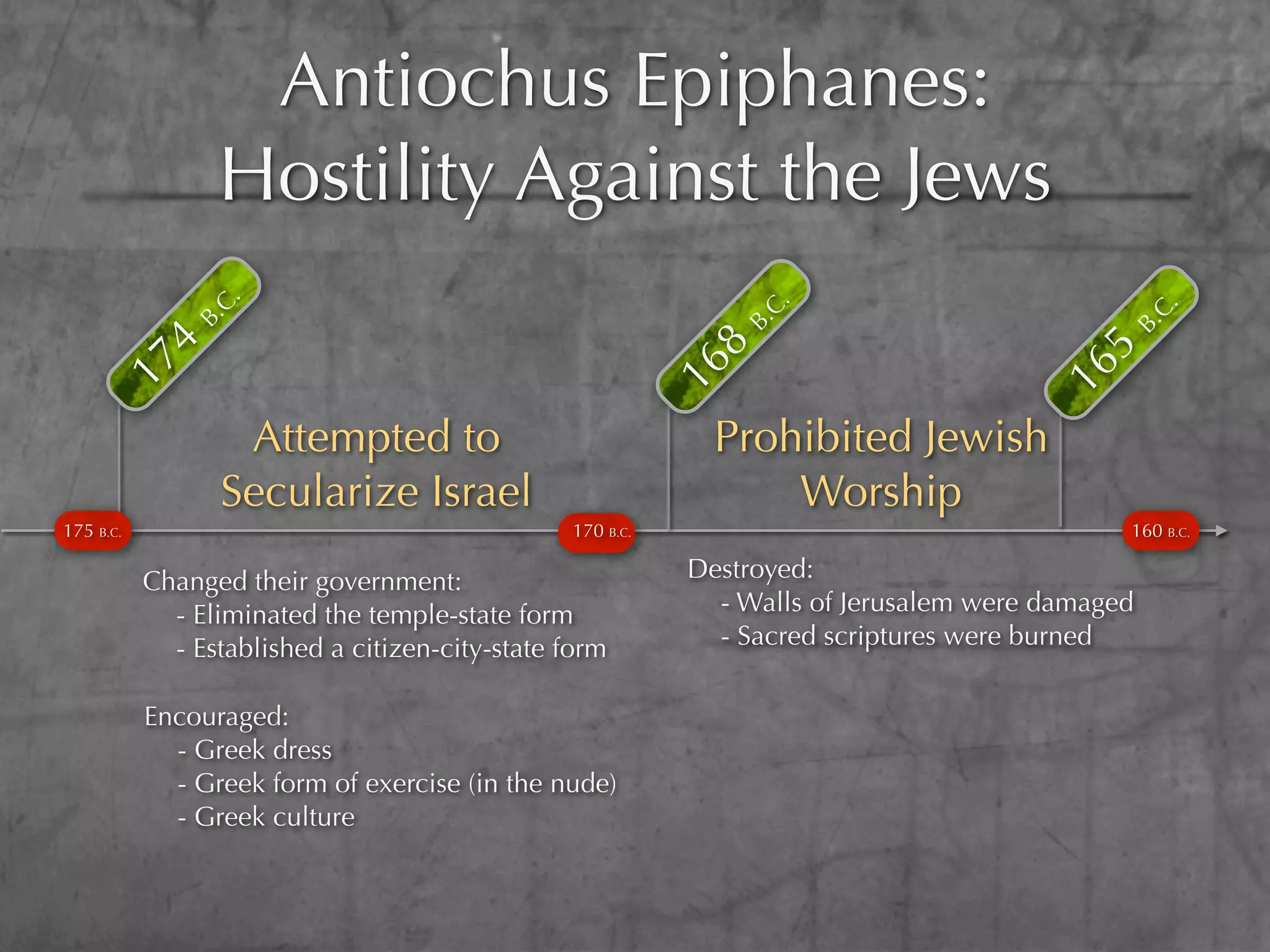
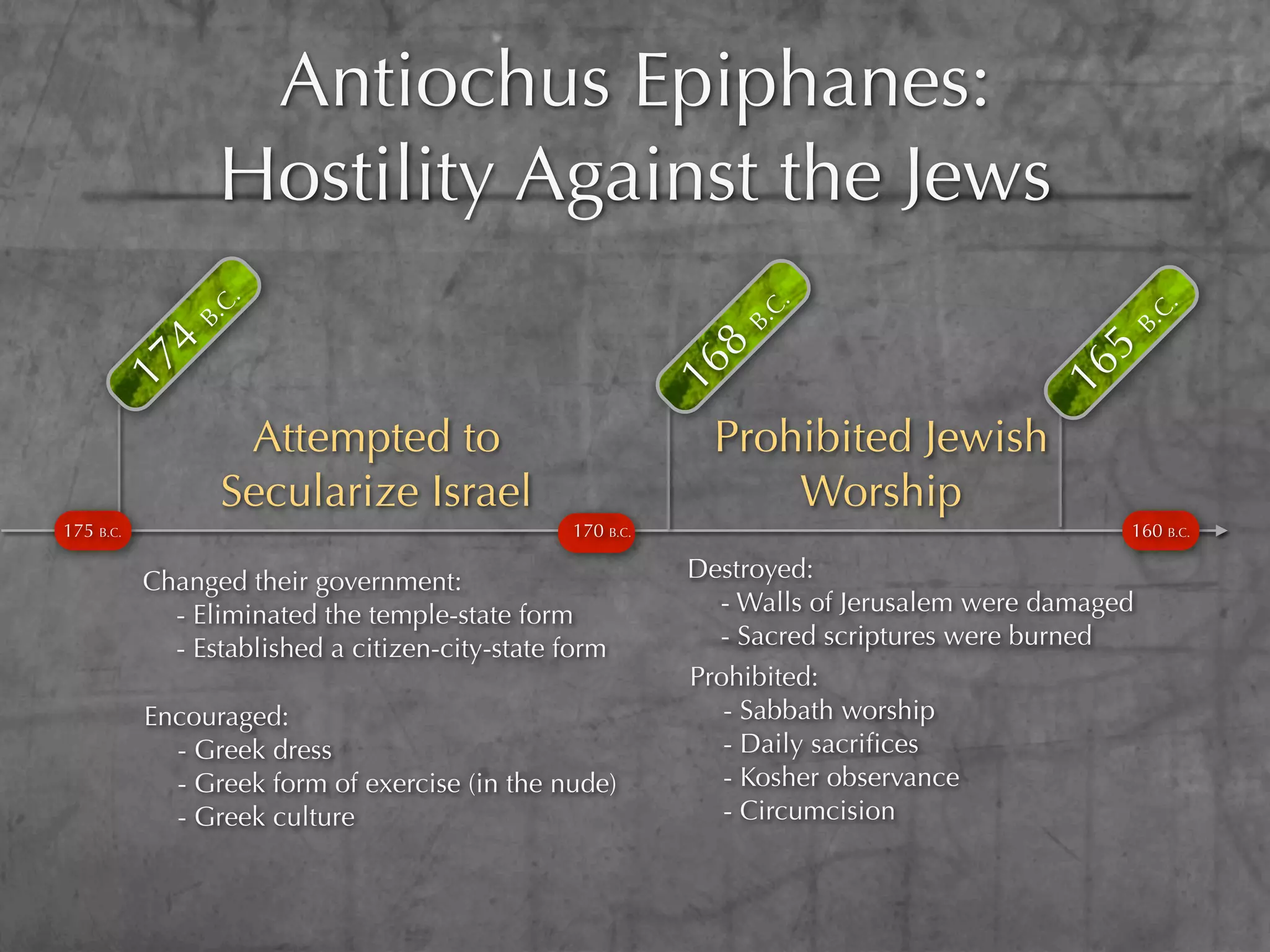
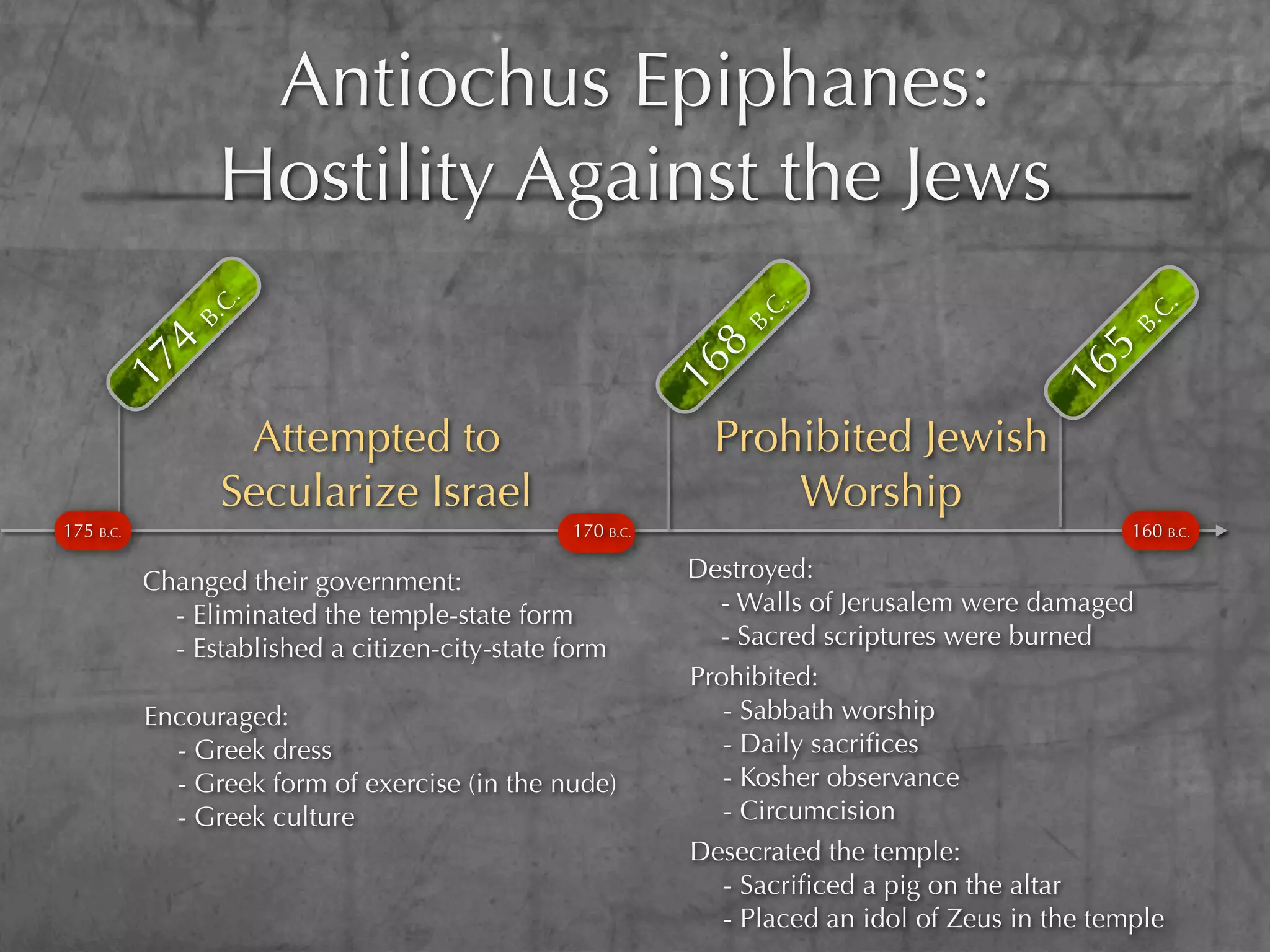
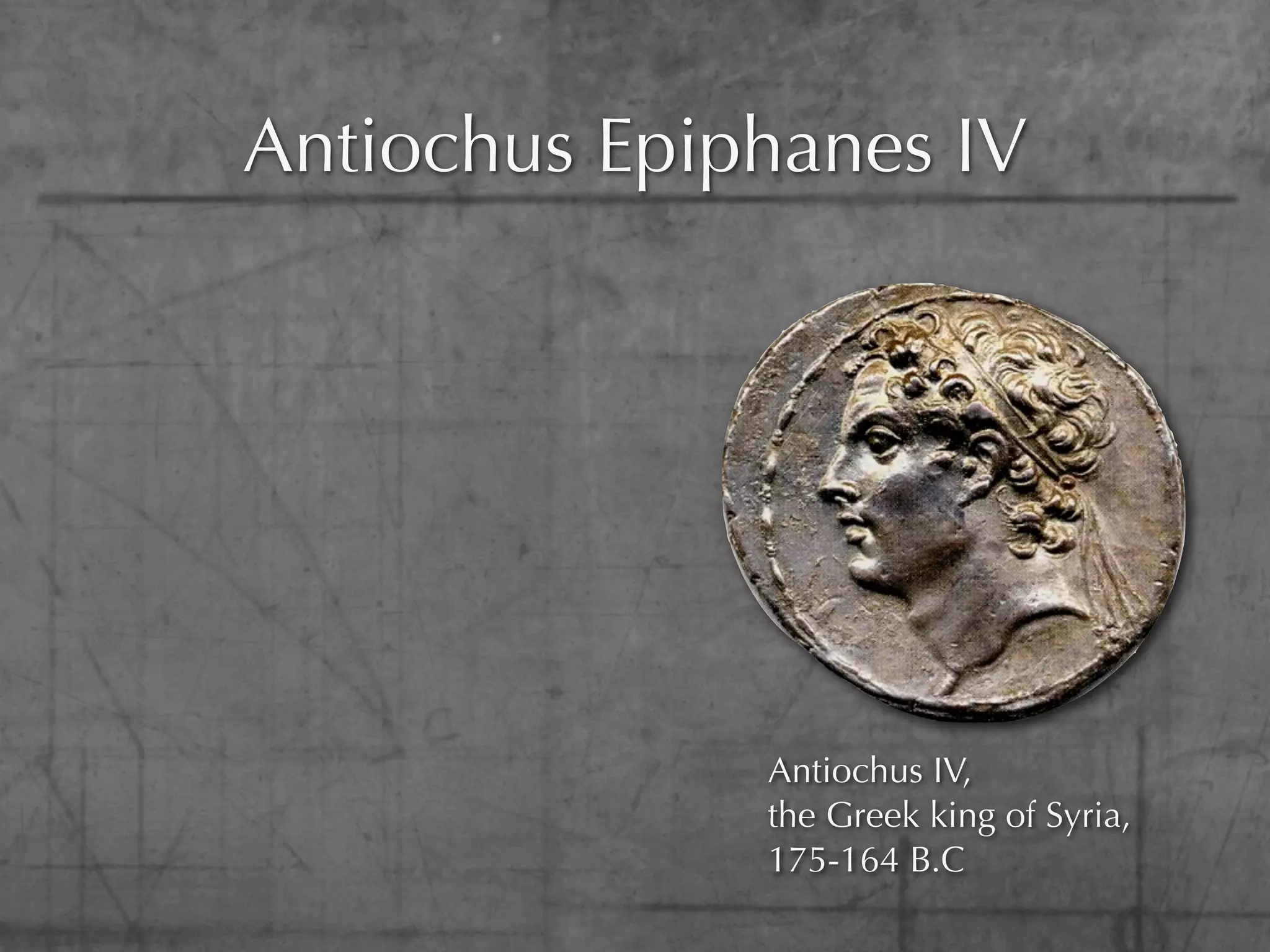
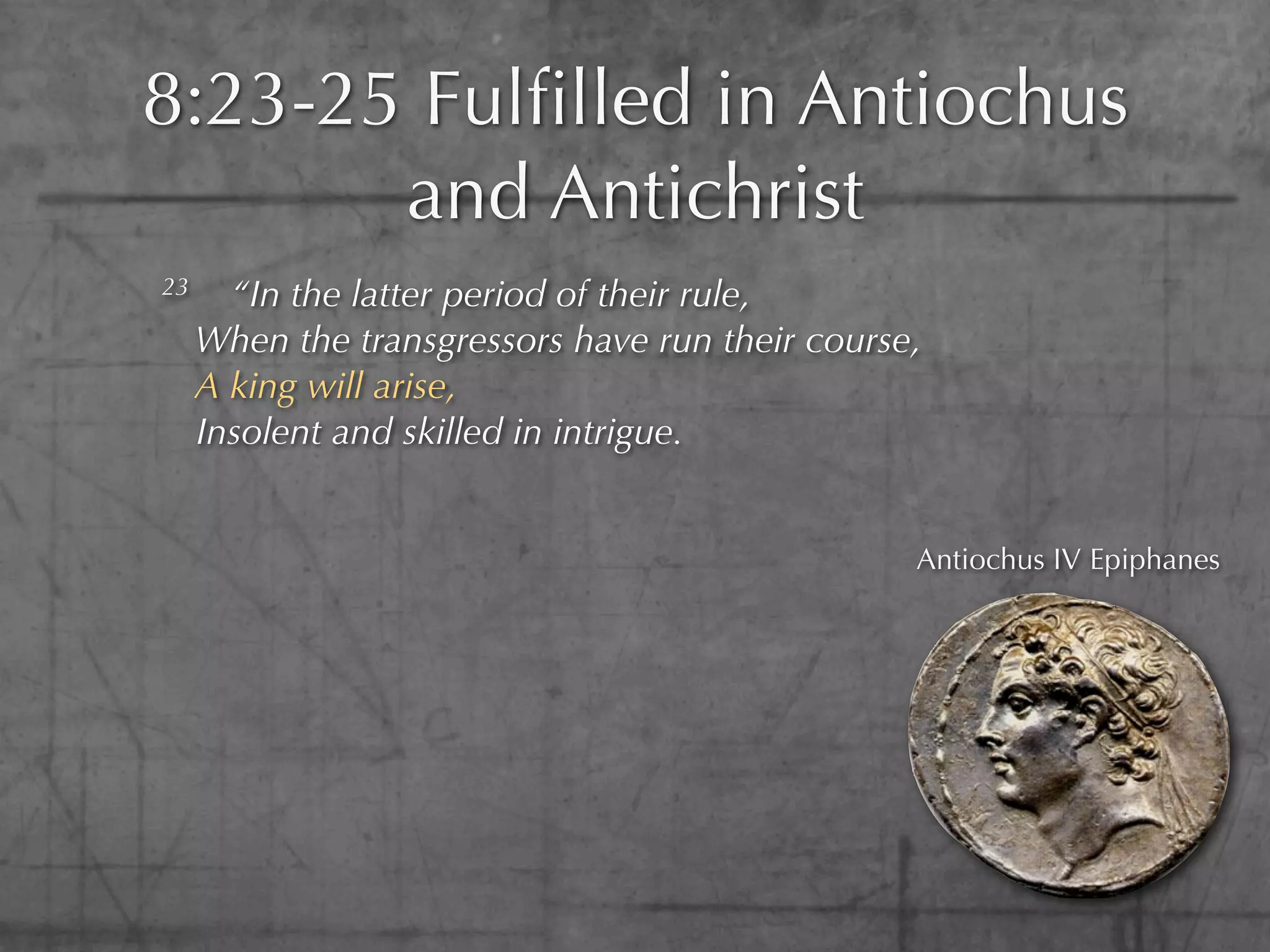
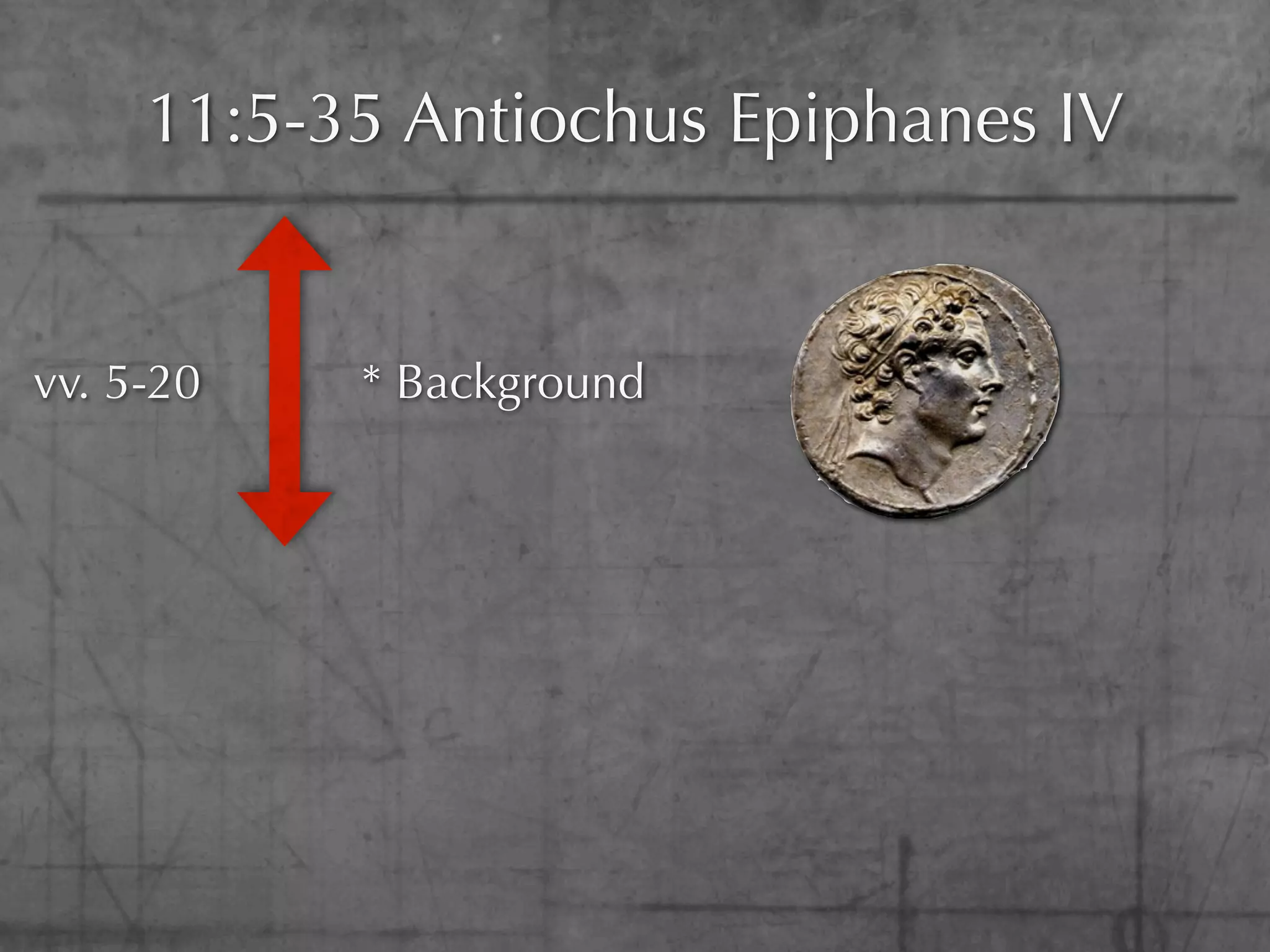
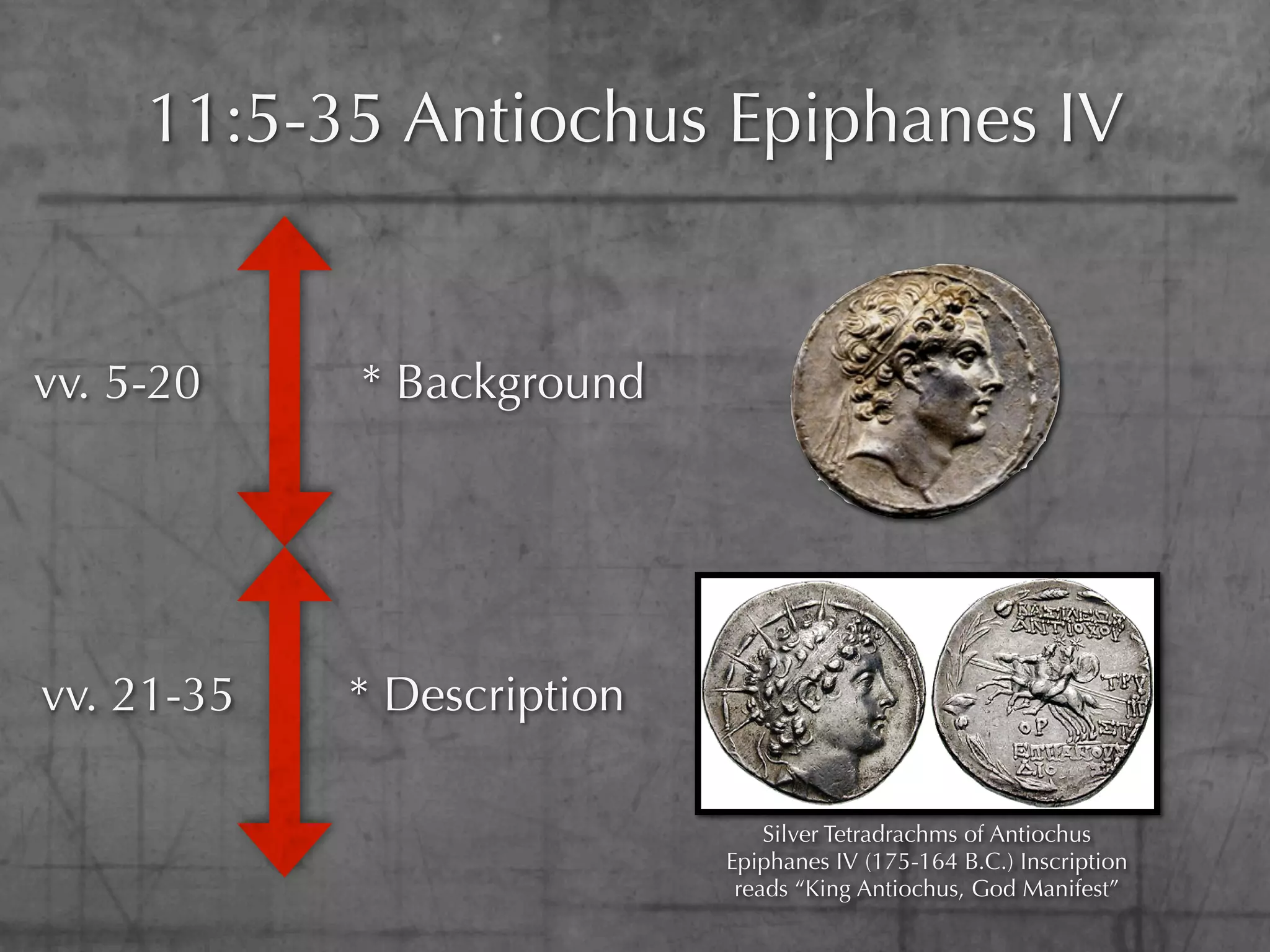
Antiochus Epiphanes IV


              Antiochus IV,
              the Greek king of Syria,
              175-164 B.C
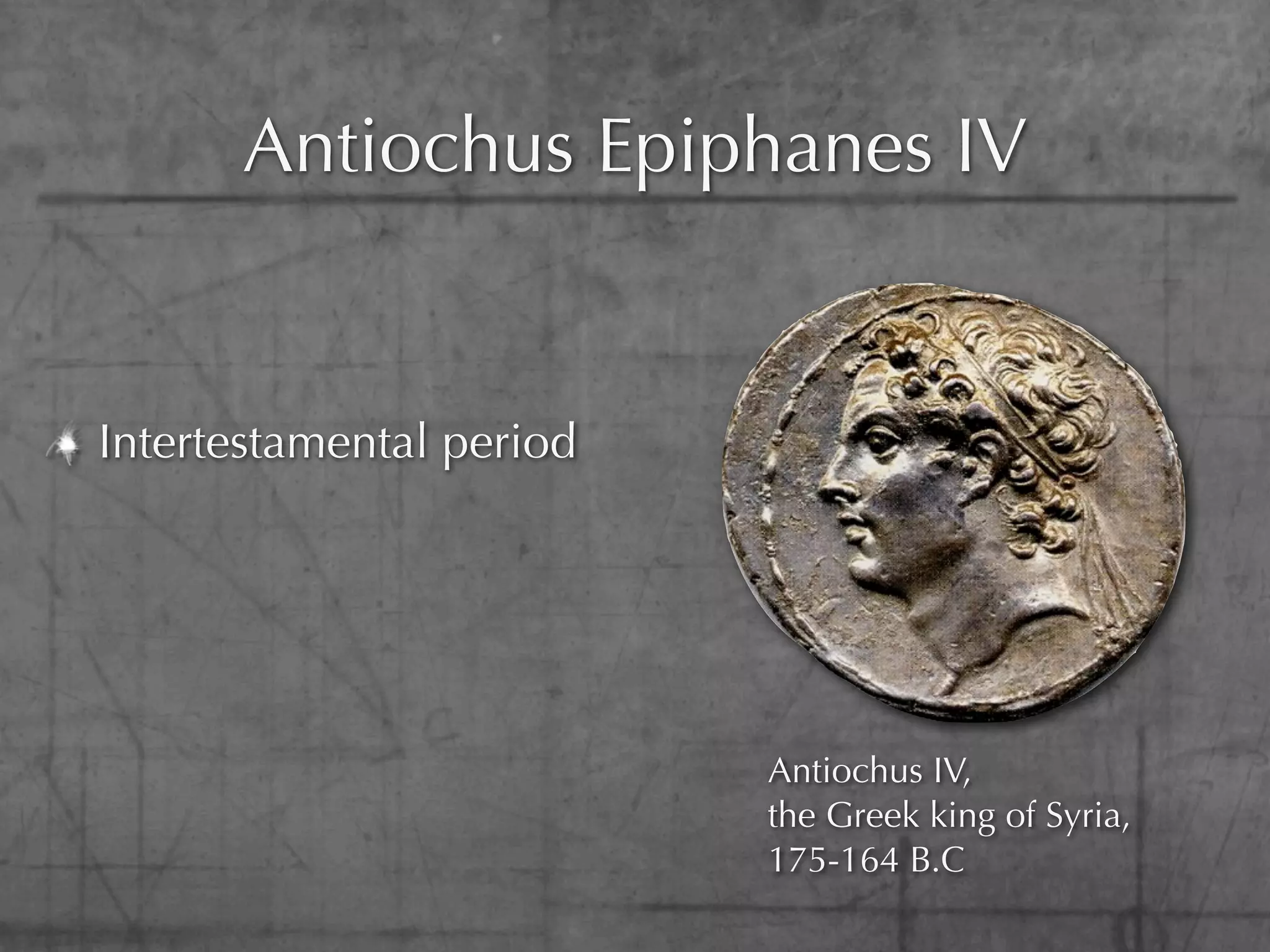
Antiochus Epiphanes IV


Intertestamental period


                          Antiochus IV,
                          the Greek king of Syria,
                          175-164 B.C
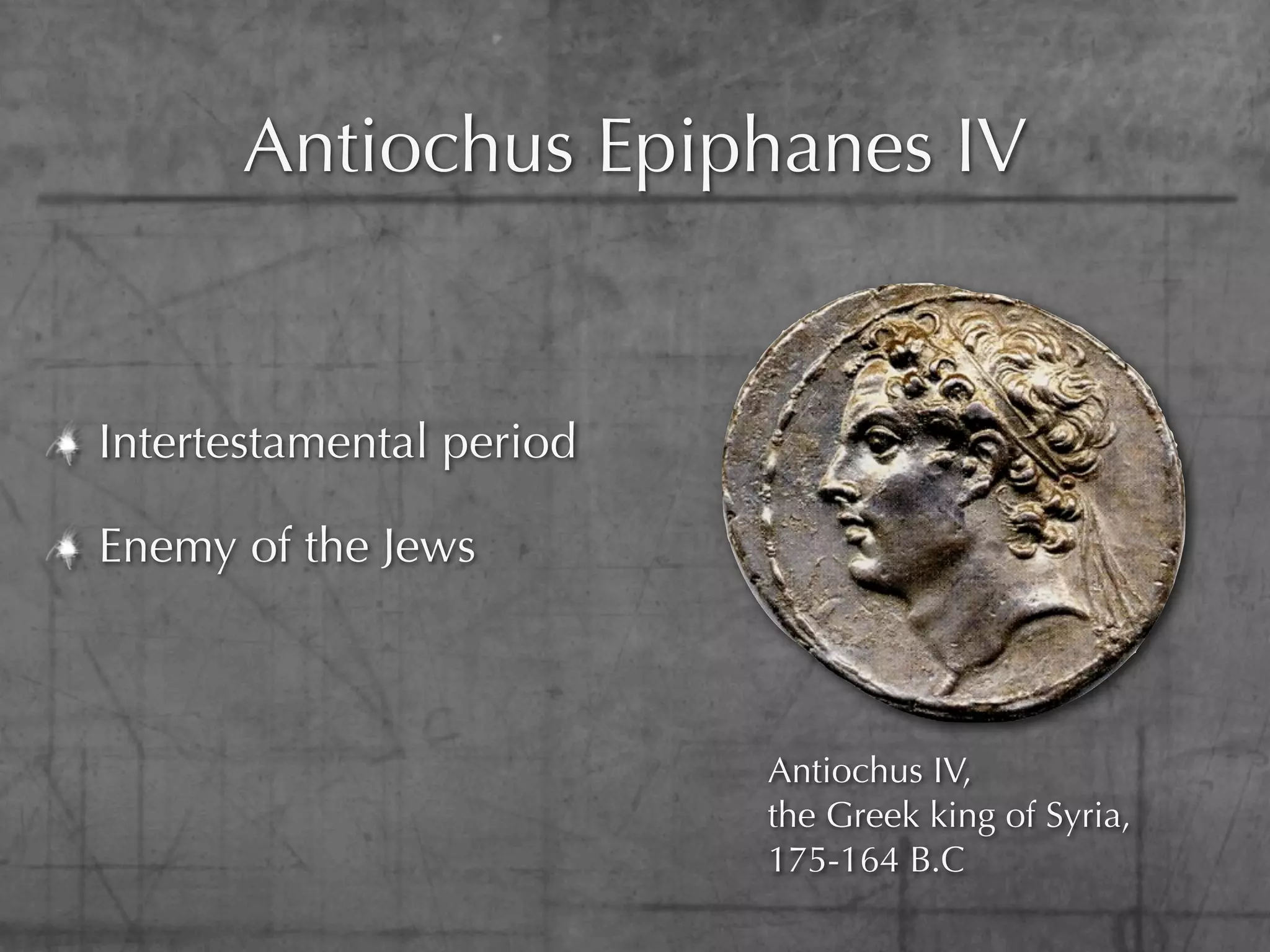
Antiochus Epiphanes IV


Intertestamental period

Enemy of the Jews


                          Antiochus IV,
                          the Greek king of Syria,
                          175-164 B.C
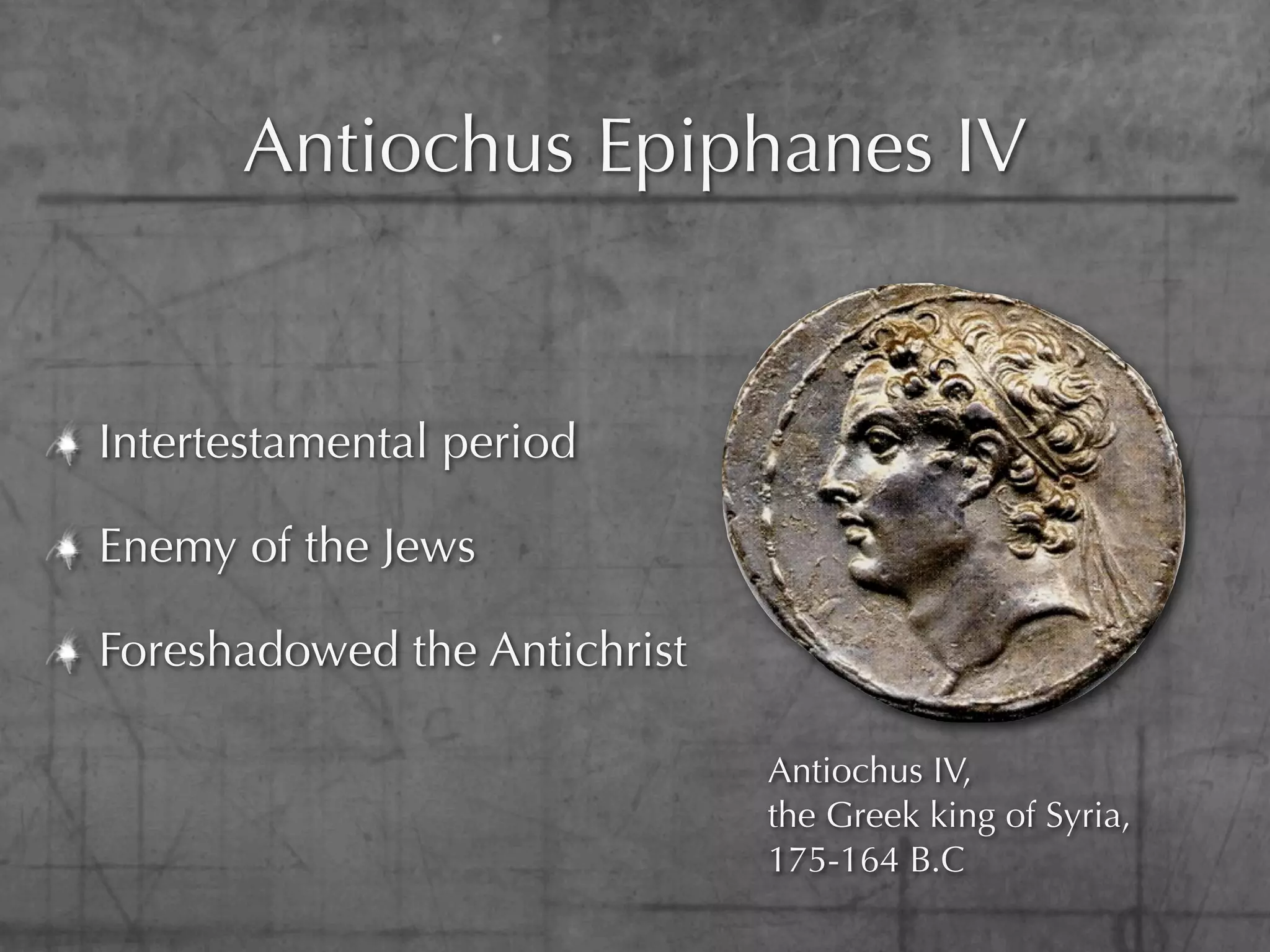
Antiochus Epiphanes IV


Intertestamental period

Enemy of the Jews

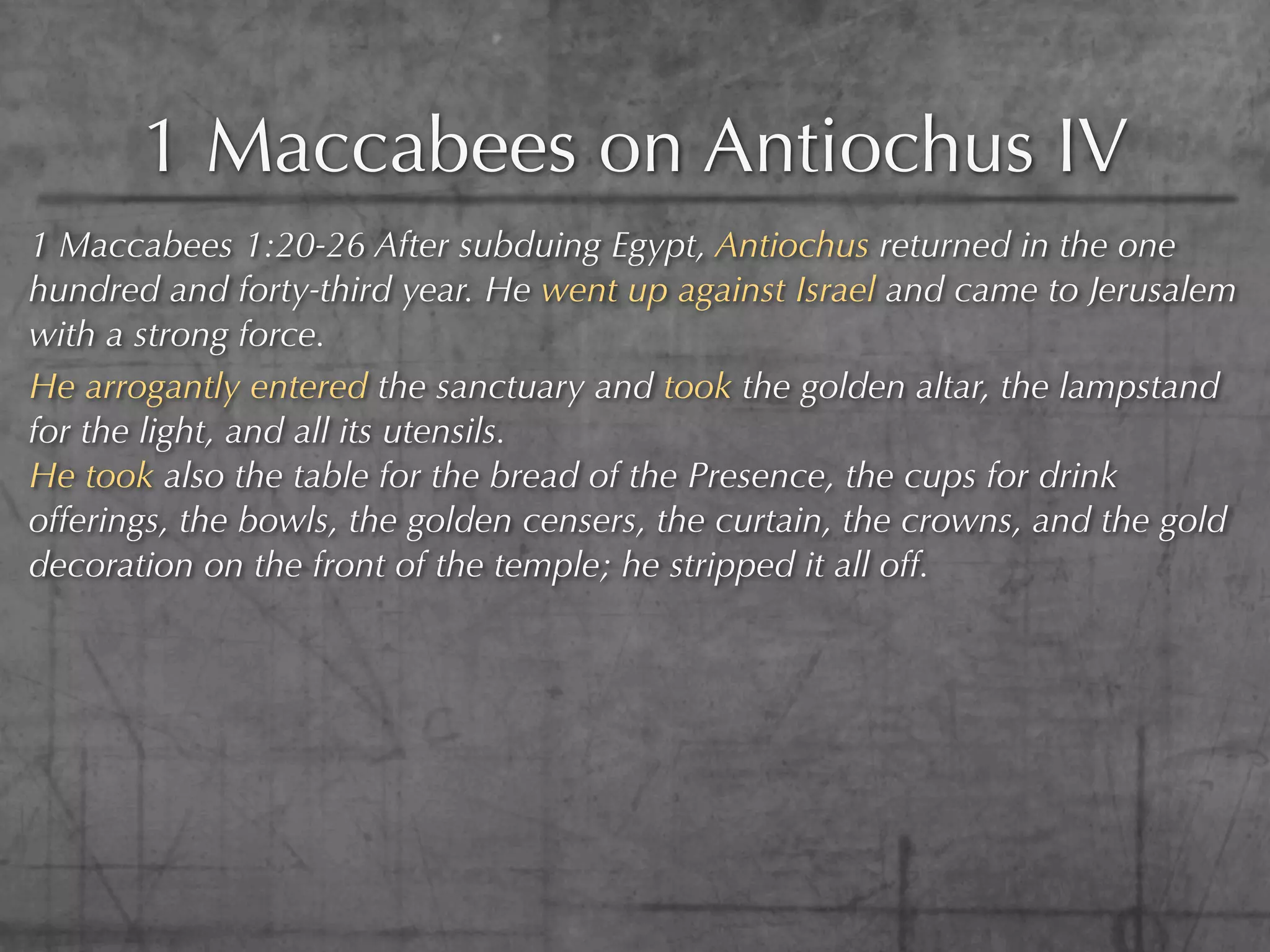
Foreshadowed the Antichrist

                              Antiochus IV,
                              the Greek king of Syria,
                              175-164 B.C
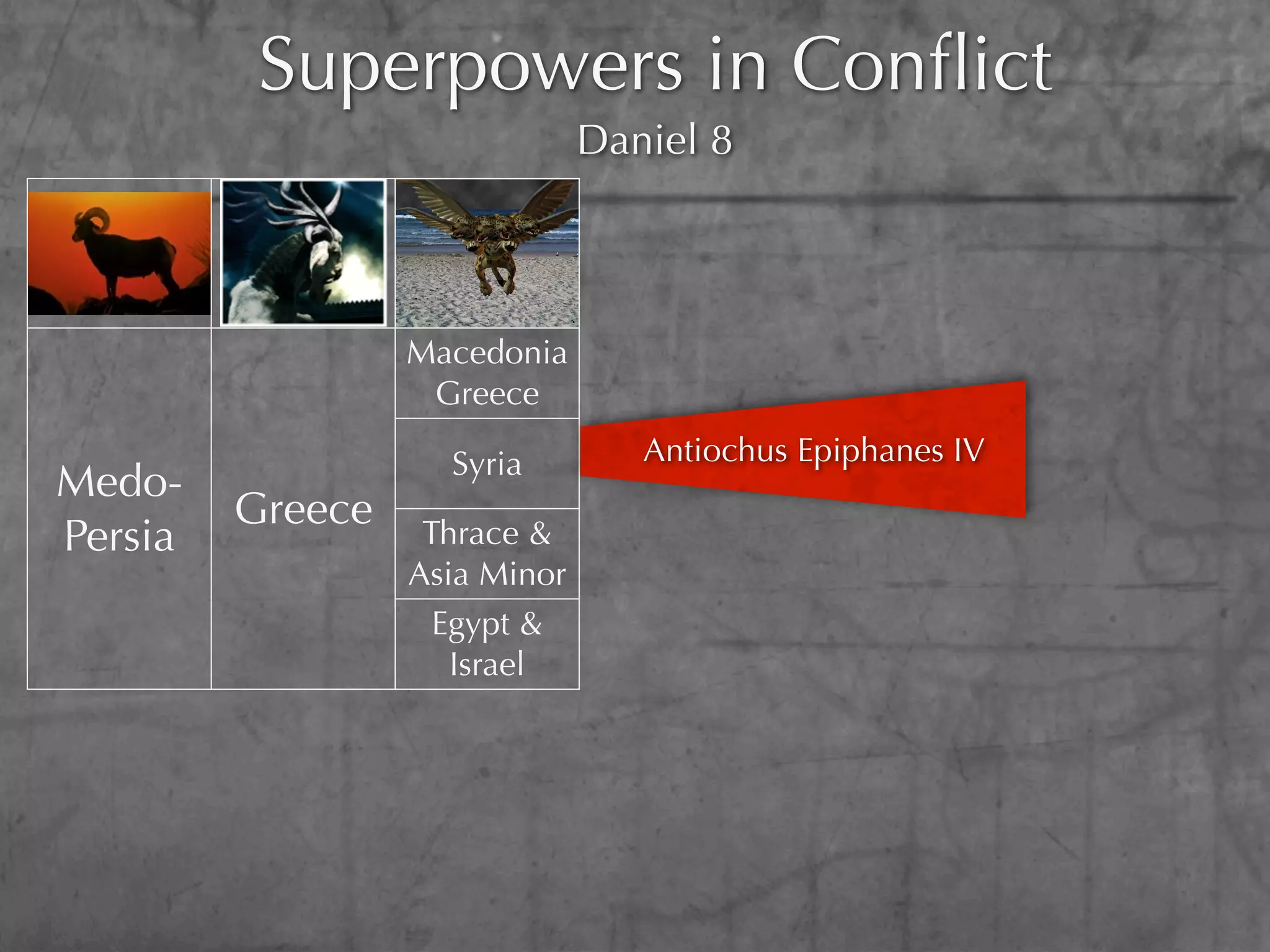
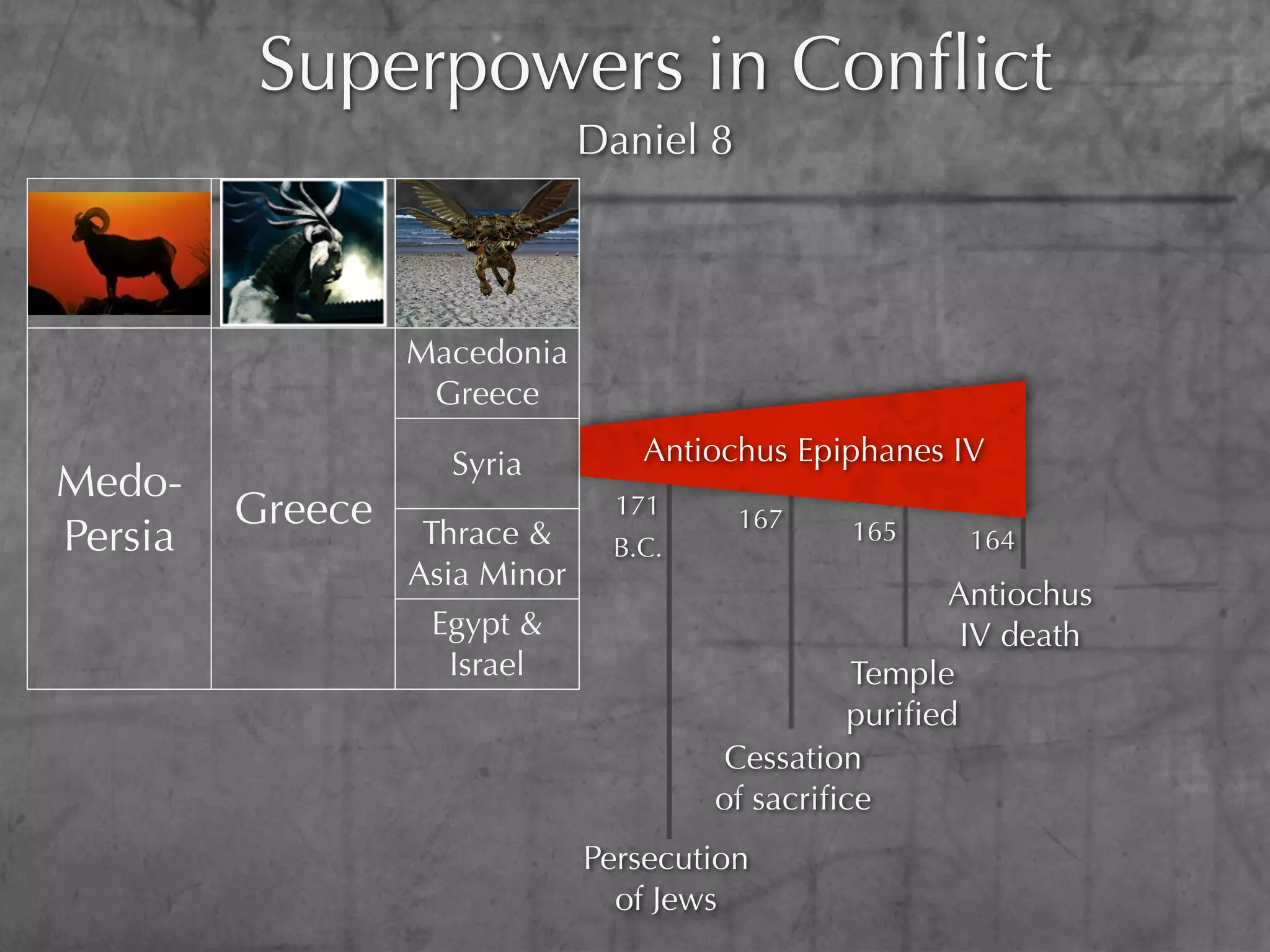
Superpowers in Conflict
        Daniel 8
Superpowers in Conflict
                               Daniel 8


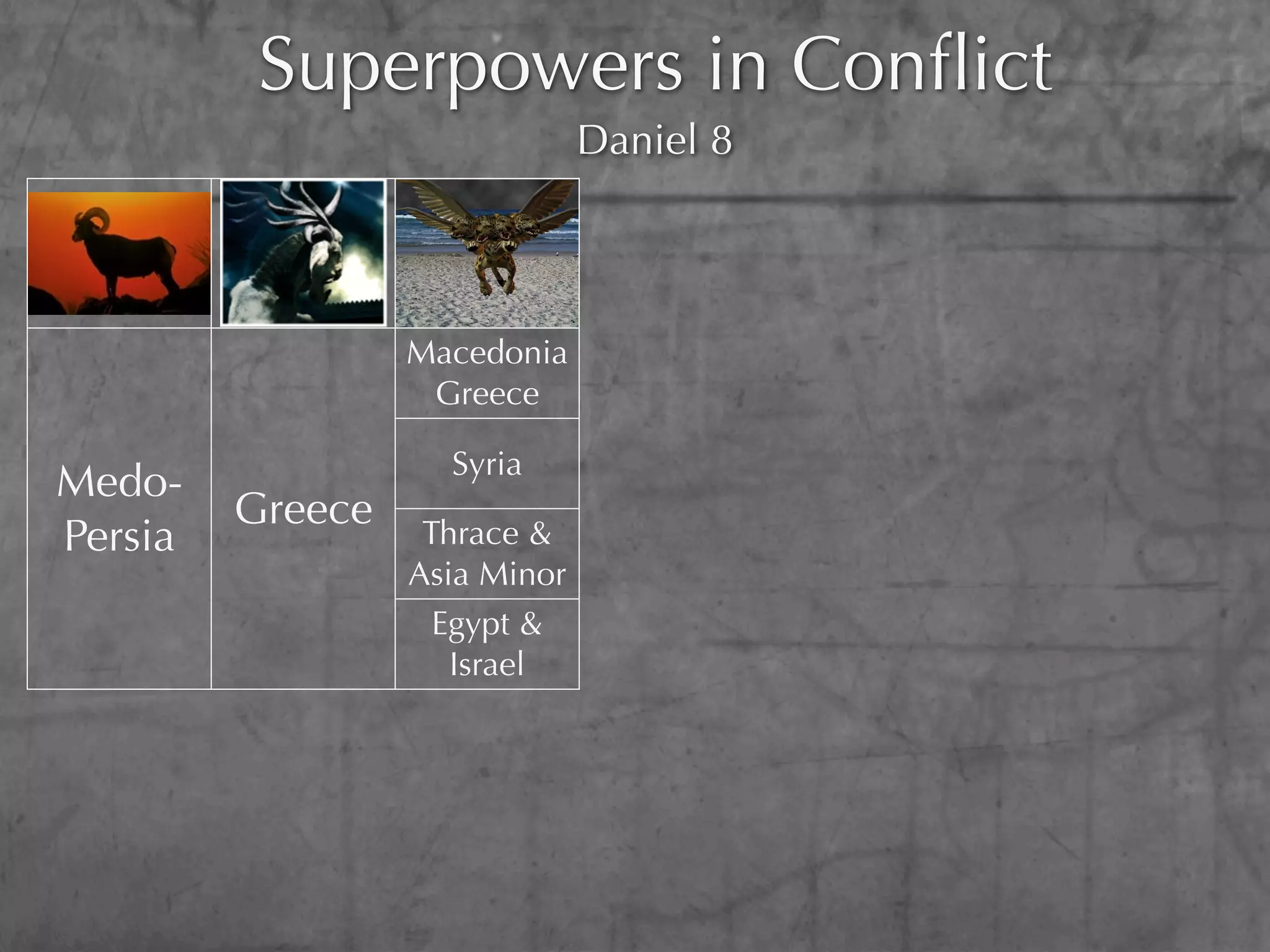
                  Macedonia
                   Greece

                    Syria
Medo-
         Greece
Persia             Thrace &
                  Asia Minor
                    Egypt &
                     Israel
Superpowers in Conflict
                               Daniel 8


                  Macedonia
                   Greece

                    Syria
Medo-
         Greece
Persia             Thrace &
                  Asia Minor
                    Egypt &
                     Israel
Superpowers in Conflict
                               Daniel 8


                  Macedonia
                   Greece

                    Syria
Medo-
         Greece
Persia             Thrace &
                  Asia Minor
                    Egypt &
                     Israel
Superpowers in Conflict
                               Daniel 8


                  Macedonia
                   Greece

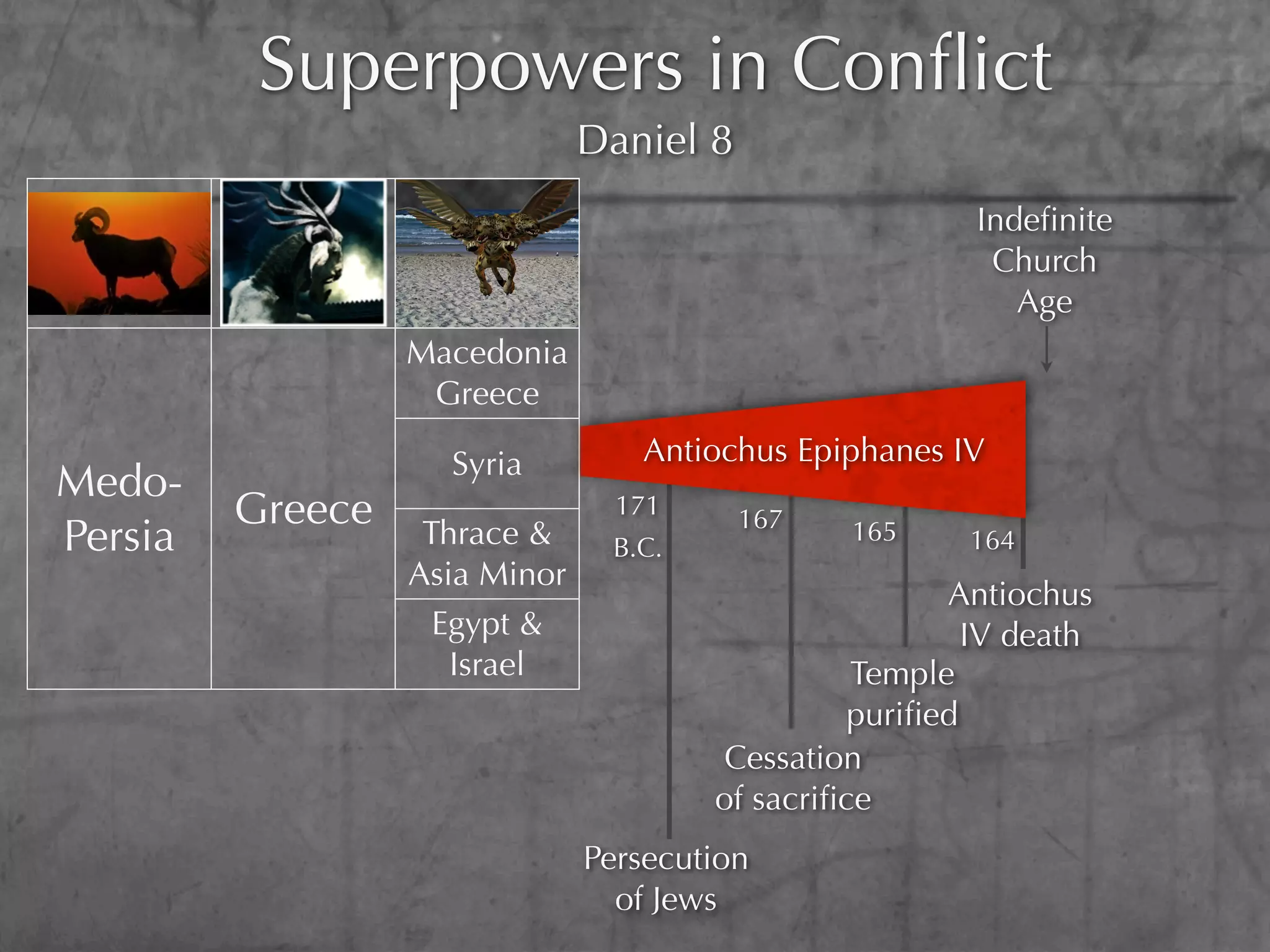
                    Syria         Antiochus Epiphanes IV
Medo-
         Greece
Persia             Thrace &
                  Asia Minor
                    Egypt &
                     Israel
Superpowers in Conflict
                               Daniel 8


                  Macedonia
                   Greece

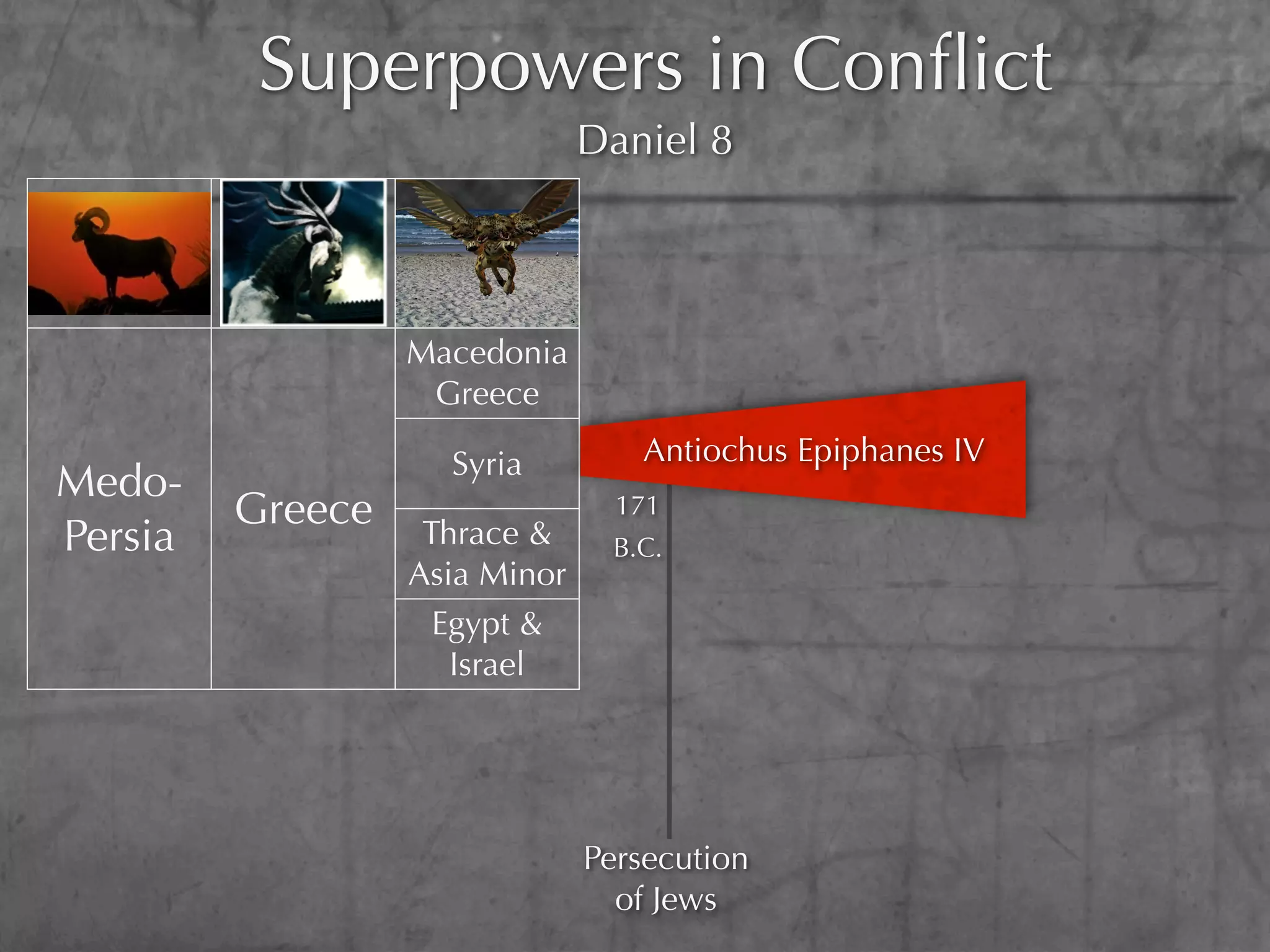
                    Syria         Antiochus Epiphanes IV
Medo-
         Greece                  171
Persia             Thrace &     B.C.
                  Asia Minor
                    Egypt &
                     Israel


                               Persecution
                                 of Jews
Superpowers in Conflict
                               Daniel 8


                  Macedonia
                   Greece

                    Syria         Antiochus Epiphanes IV
Medo-
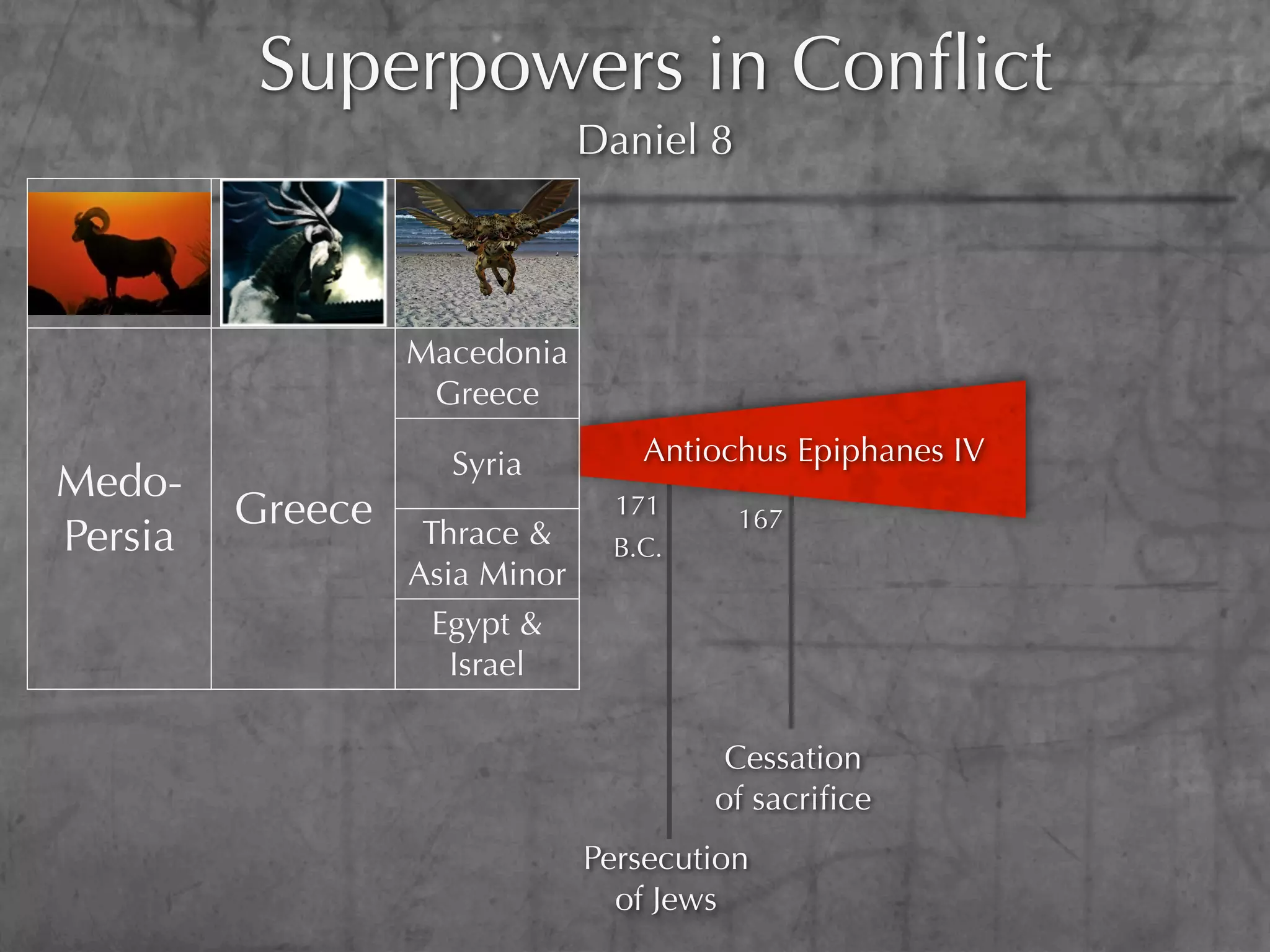
         Greece                  171      167
Persia             Thrace &     B.C.
                  Asia Minor
                    Egypt &
                     Israel

                                       Cessation
                                       of sacrifice
                               Persecution
                                 of Jews
Superpowers in Conflict
                               Daniel 8


                  Macedonia
                   Greece

                    Syria         Antiochus Epiphanes IV
Medo-
         Greece                  171      167
Persia             Thrace &     B.C.
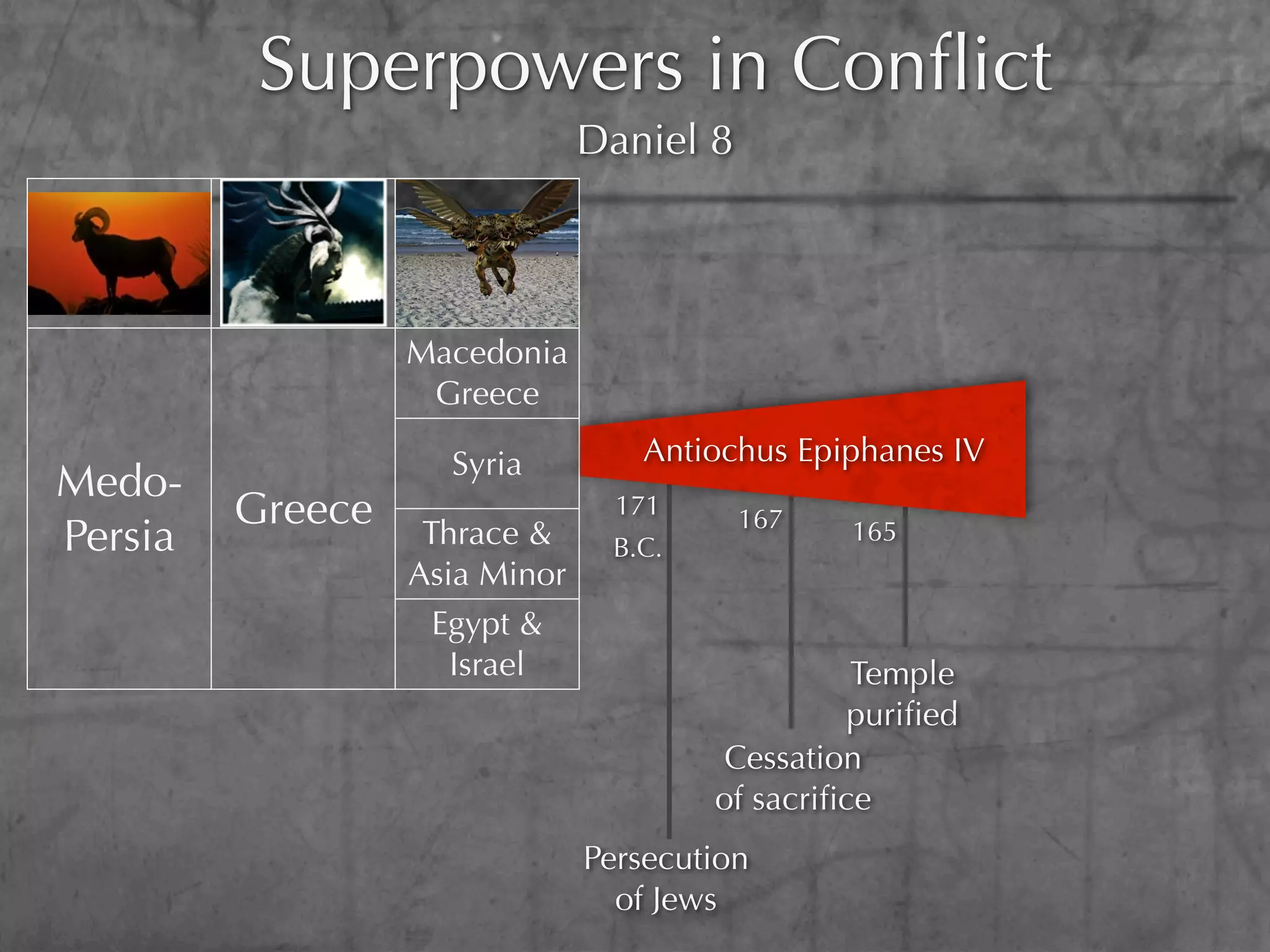
                                                165
                  Asia Minor
                    Egypt &
                     Israel                      Temple
                                                 purified
                                       Cessation
                                       of sacrifice
                               Persecution
                                 of Jews
Superpowers in Conflict
                               Daniel 8


                  Macedonia
                   Greece

                    Syria         Antiochus Epiphanes IV
Medo-
         Greece                  171      167
Persia             Thrace &     B.C.
                                                165     164
                  Asia Minor
                                                       Antiochus
                    Egypt &                              IV death
                     Israel                      Temple
                                                 purified
                                       Cessation
                                       of sacrifice
                               Persecution
                                 of Jews
Superpowers in Conflict
                               Daniel 8
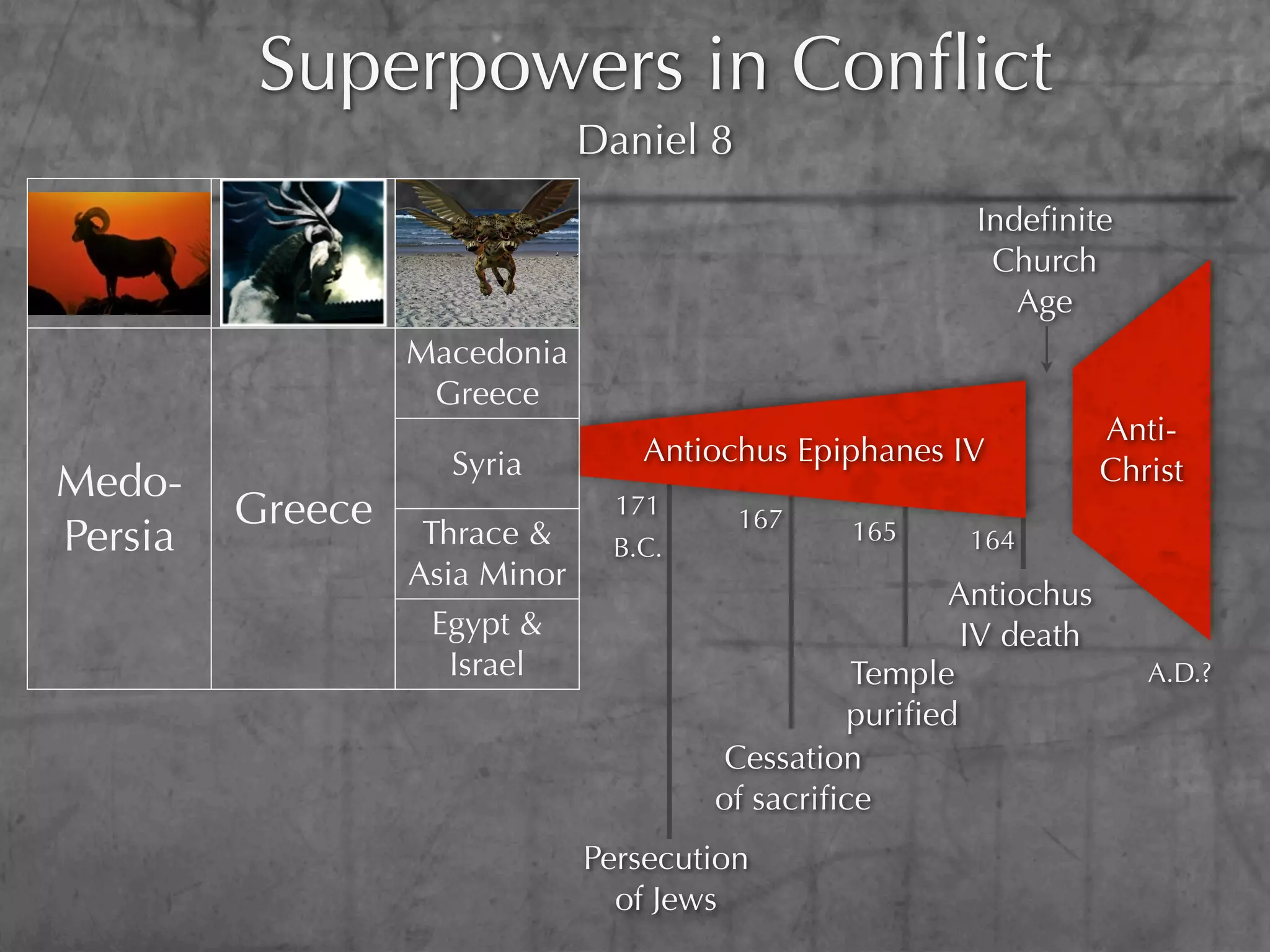
                                                         Indefinite
                                                          Church
                                                            Age
                  Macedonia
                   Greece

                    Syria         Antiochus Epiphanes IV
Medo-
         Greece                  171      167
Persia             Thrace &     B.C.
                                                165     164
                  Asia Minor
                                                       Antiochus
                    Egypt &                              IV death
                     Israel                      Temple
                                                 purified
                                       Cessation
                                       of sacrifice
                               Persecution
                                 of Jews
Superpowers in Conflict
                               Daniel 8
                                                         Indefinite
                                                          Church
                                                            Age
                  Macedonia
                   Greece
                                                                    Anti-
                    Syria         Antiochus Epiphanes IV
Medo-                                                               Christ
         Greece                  171      167
Persia             Thrace &     B.C.
                                                165     164
                  Asia Minor
                                                       Antiochus
                    Egypt &                              IV death
                     Israel                      Temple                A.D.?
                                                 purified
                                       Cessation
                                       of sacrifice
                               Persecution
                                 of Jews
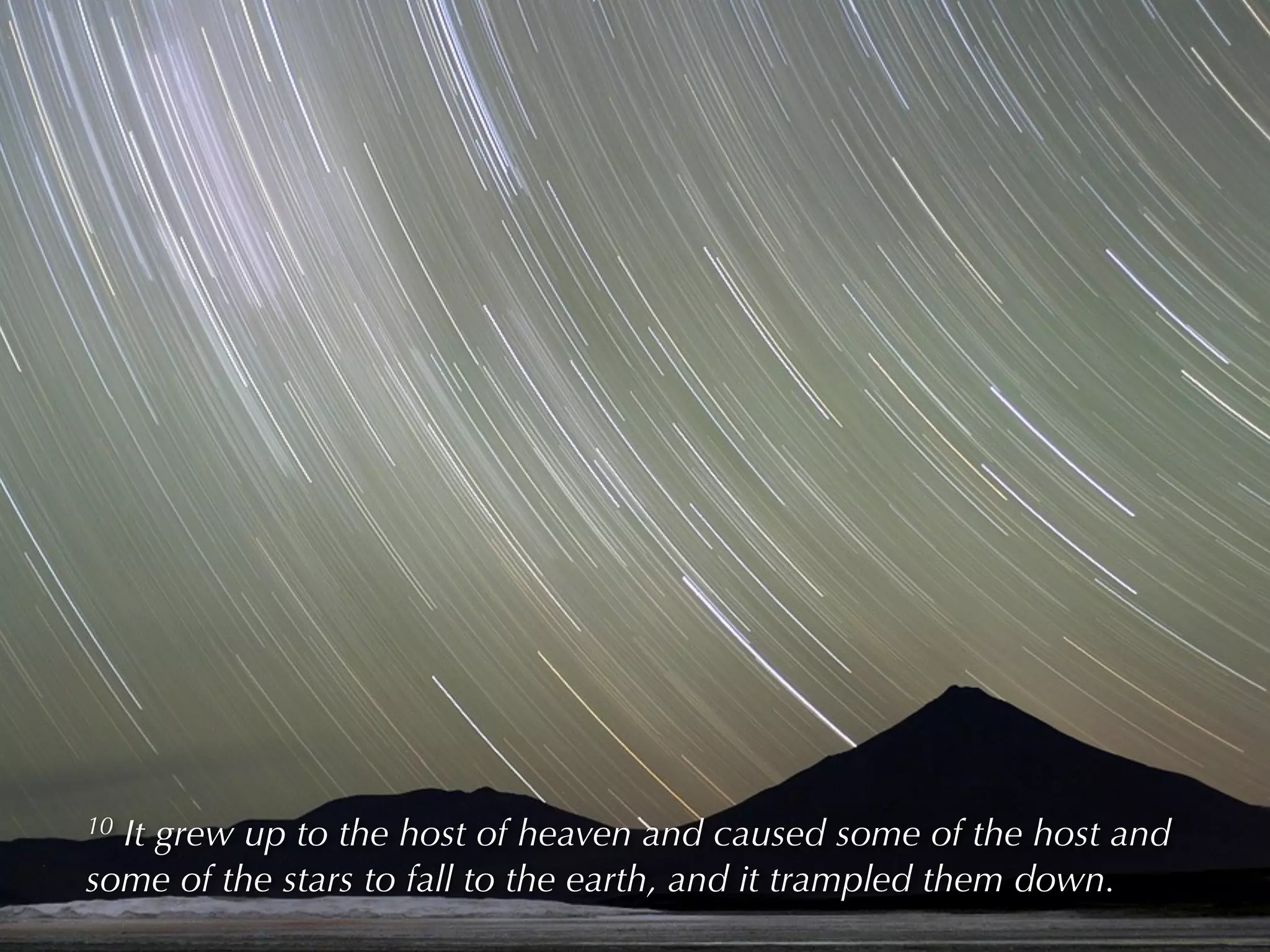
10It grew up to the host of heaven and caused some of the host and
some of the stars to fall to the earth, and it trampled them down.
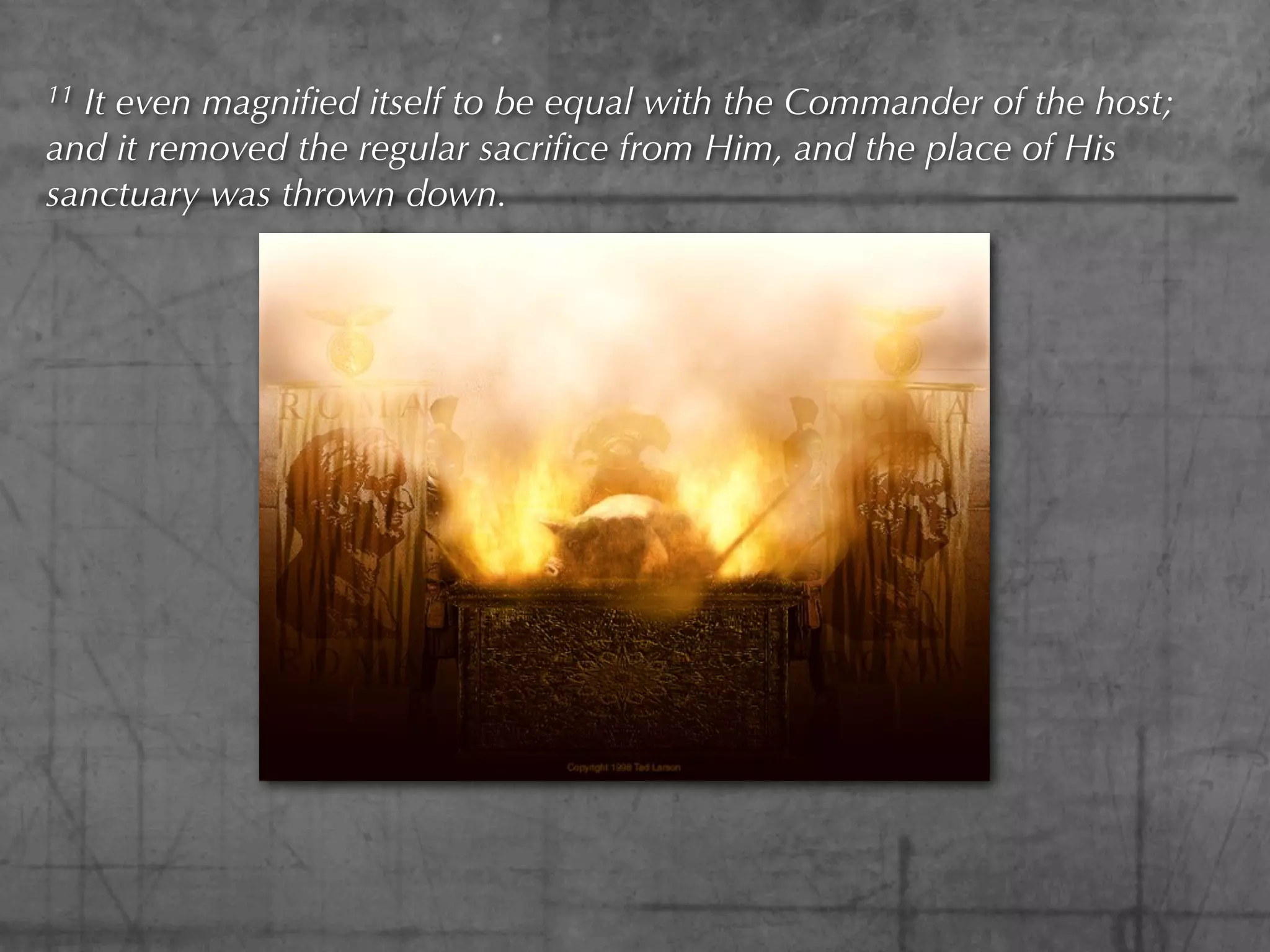
11It even magnified itself to be equal with the Commander of the host;
and it removed the regular sacrifice from Him, and the place of His
sanctuary was thrown down.
11It even magnified itself to be equal with the Commander of the host;
 and it removed the regular sacrifice from Him, and the place of His
 sanctuary was thrown down.


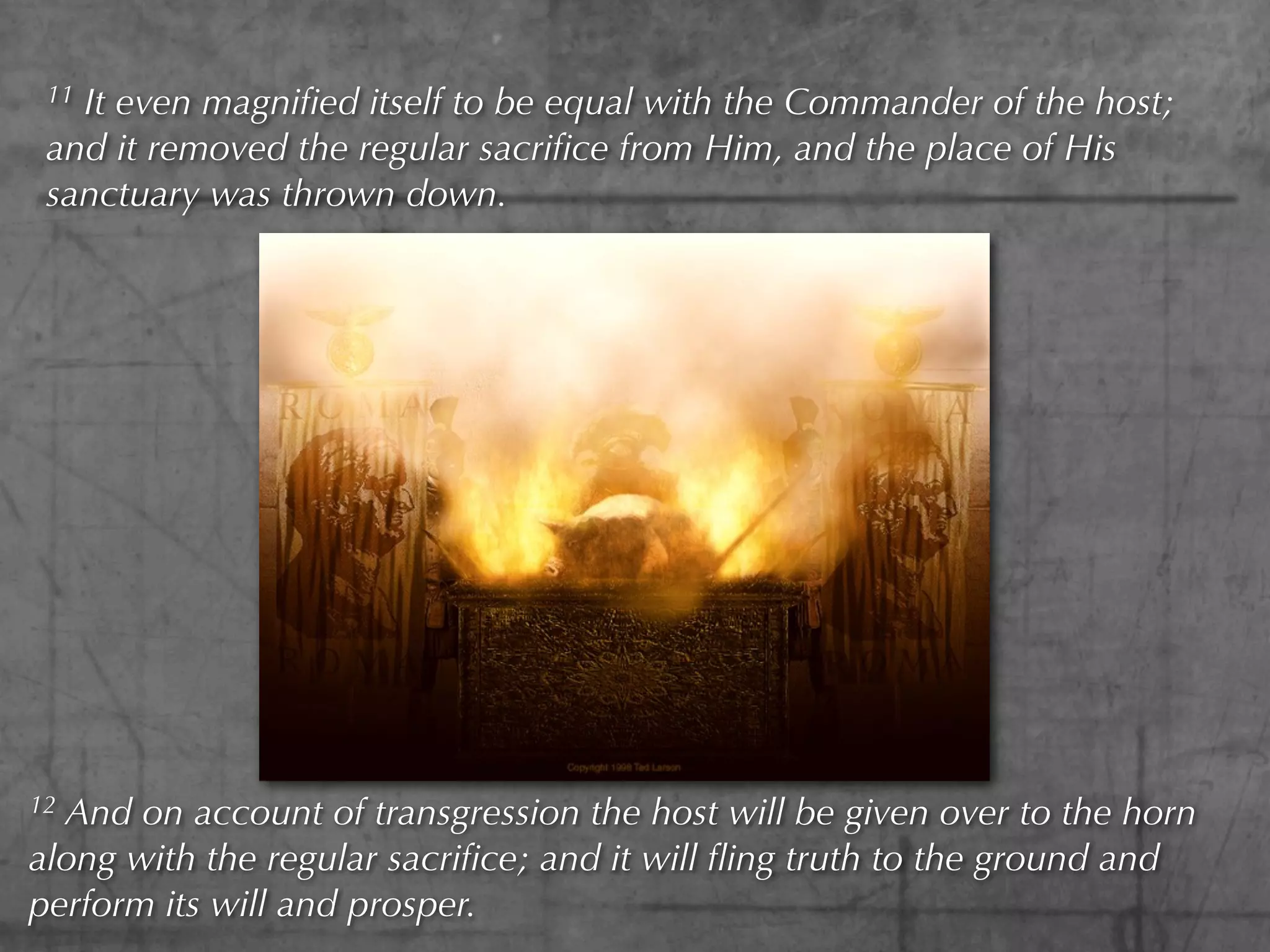
12And on account of transgression the host will be given over to the horn
along with the regular sacrifice; and it will fling truth to the ground and
perform its will and prosper.
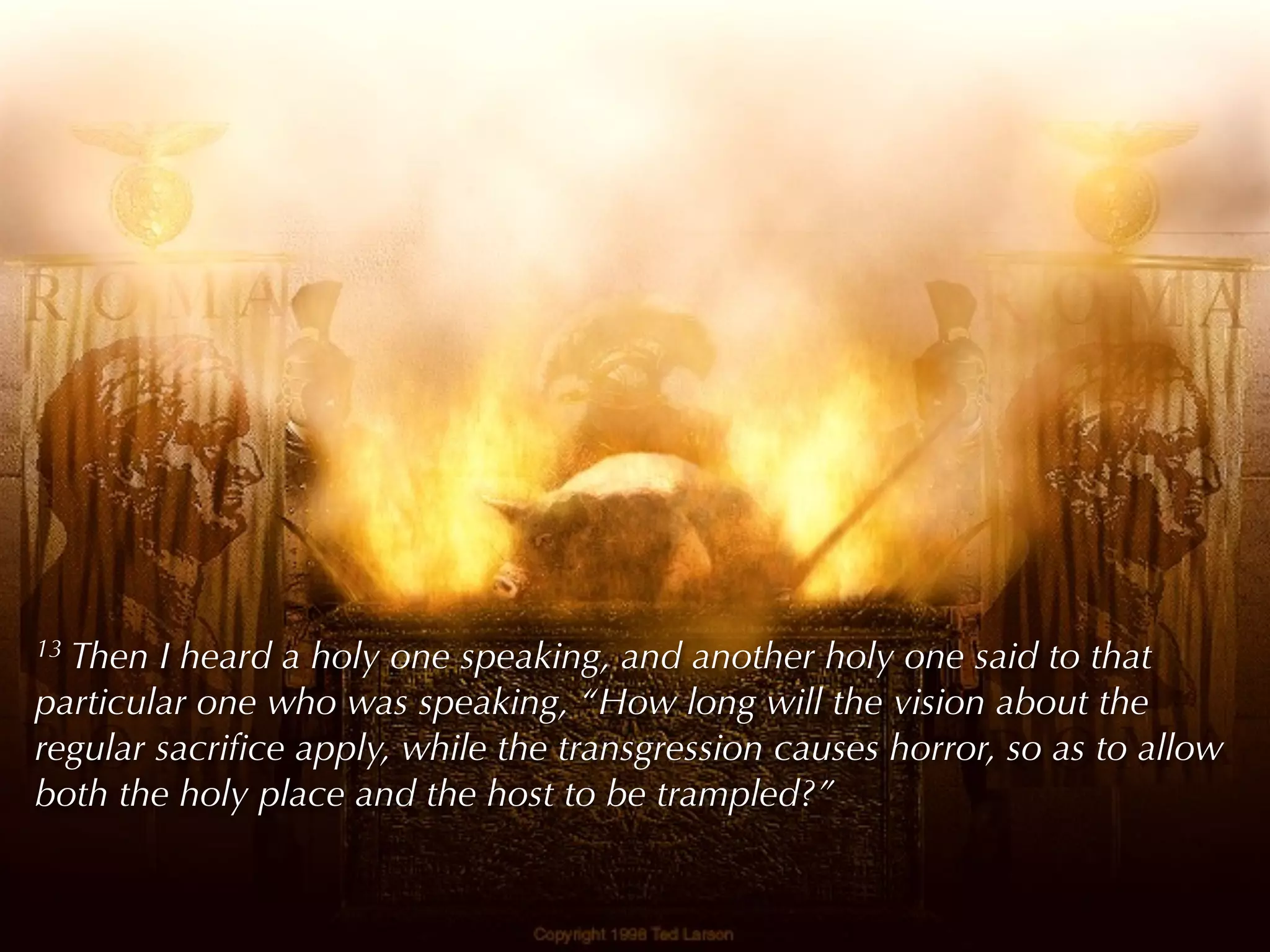
13Then I heard a holy one speaking, and another holy one said to that
particular one who was speaking, “How long will the vision about the
regular sacrifice apply, while the transgression causes horror, so as to allow
both the holy place and the host to be trampled?”
13Then I heard a holy one speaking, and another holy one said to that
particular one who was speaking, “How long will the vision about the
regular sacrifice apply, while the transgression causes horror, so as to allow
both the holy place and the host to be trampled?”
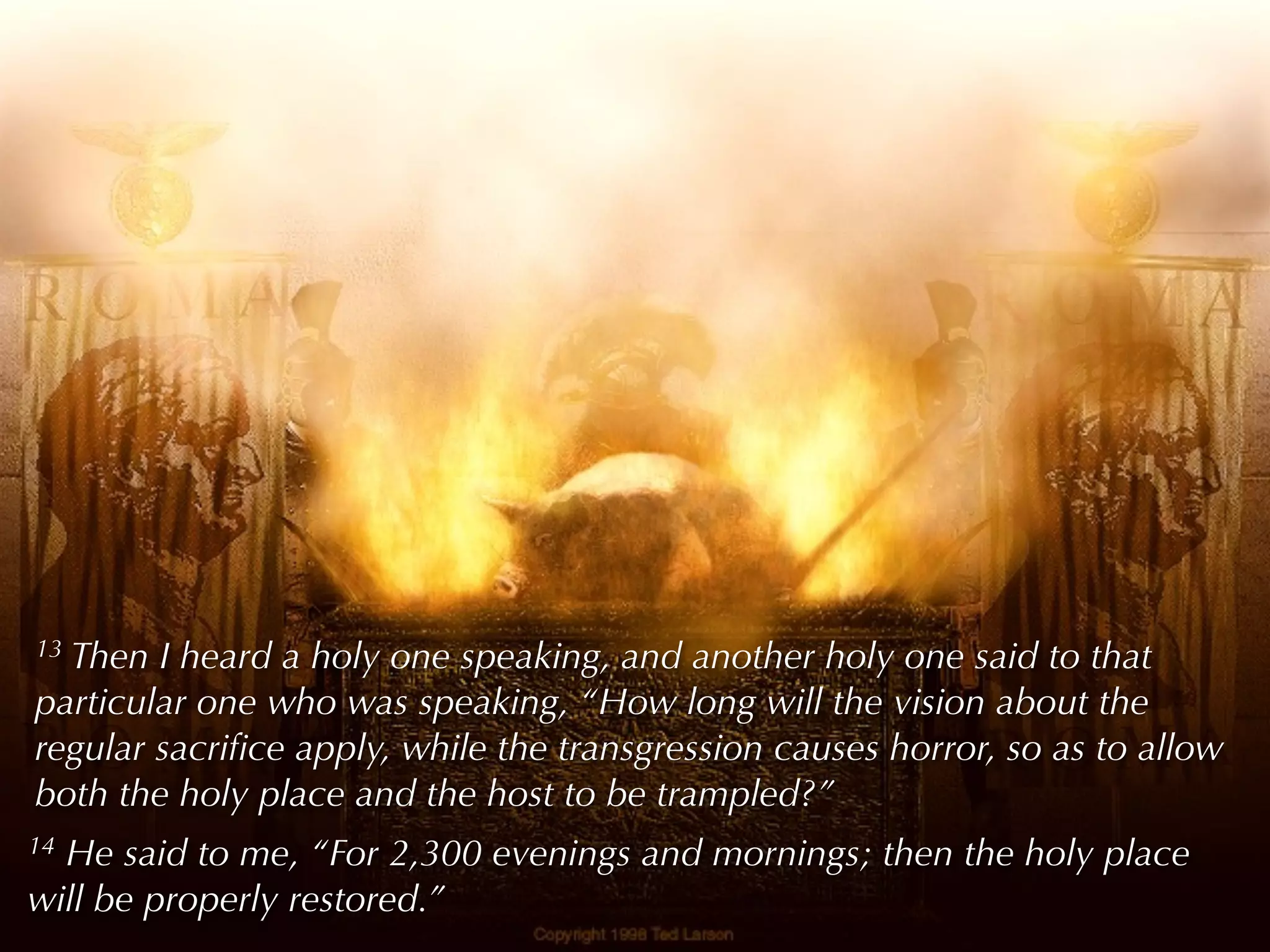
14He said to me, “For 2,300 evenings and mornings; then the holy place
will be properly restored.”
Calculating the 2300 Days


          3 0 0
Calculating the 2300 Days


                     0
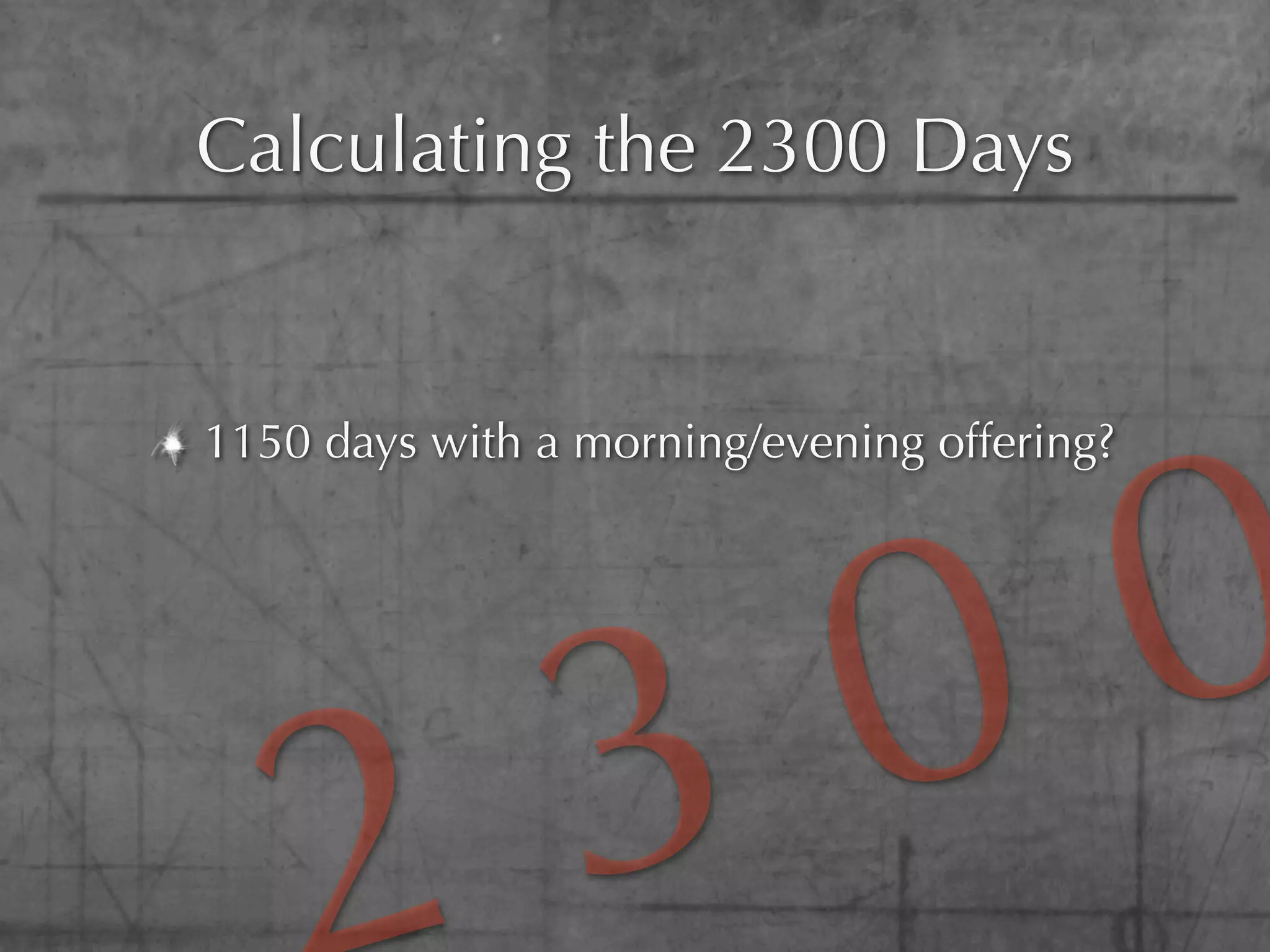
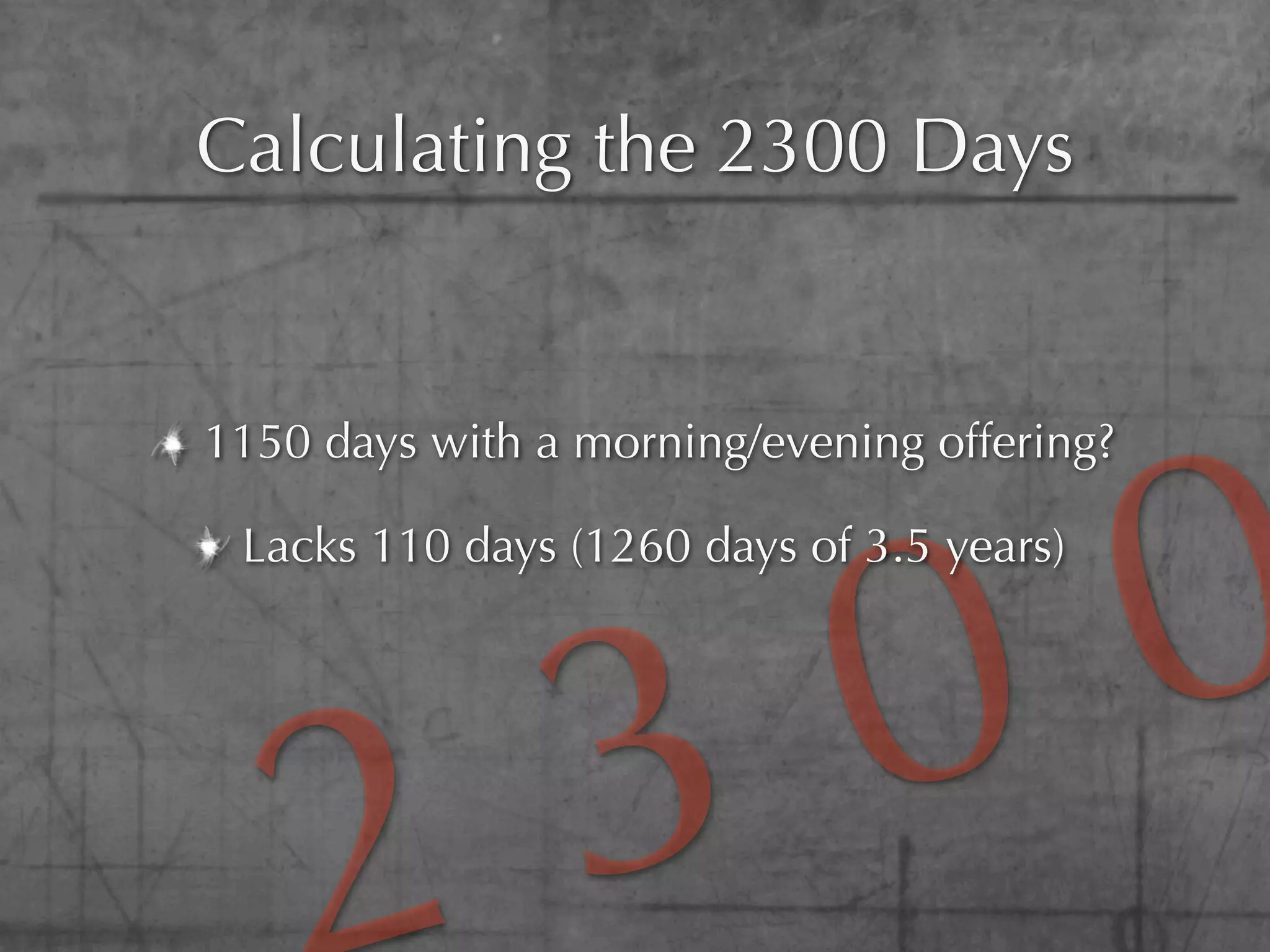
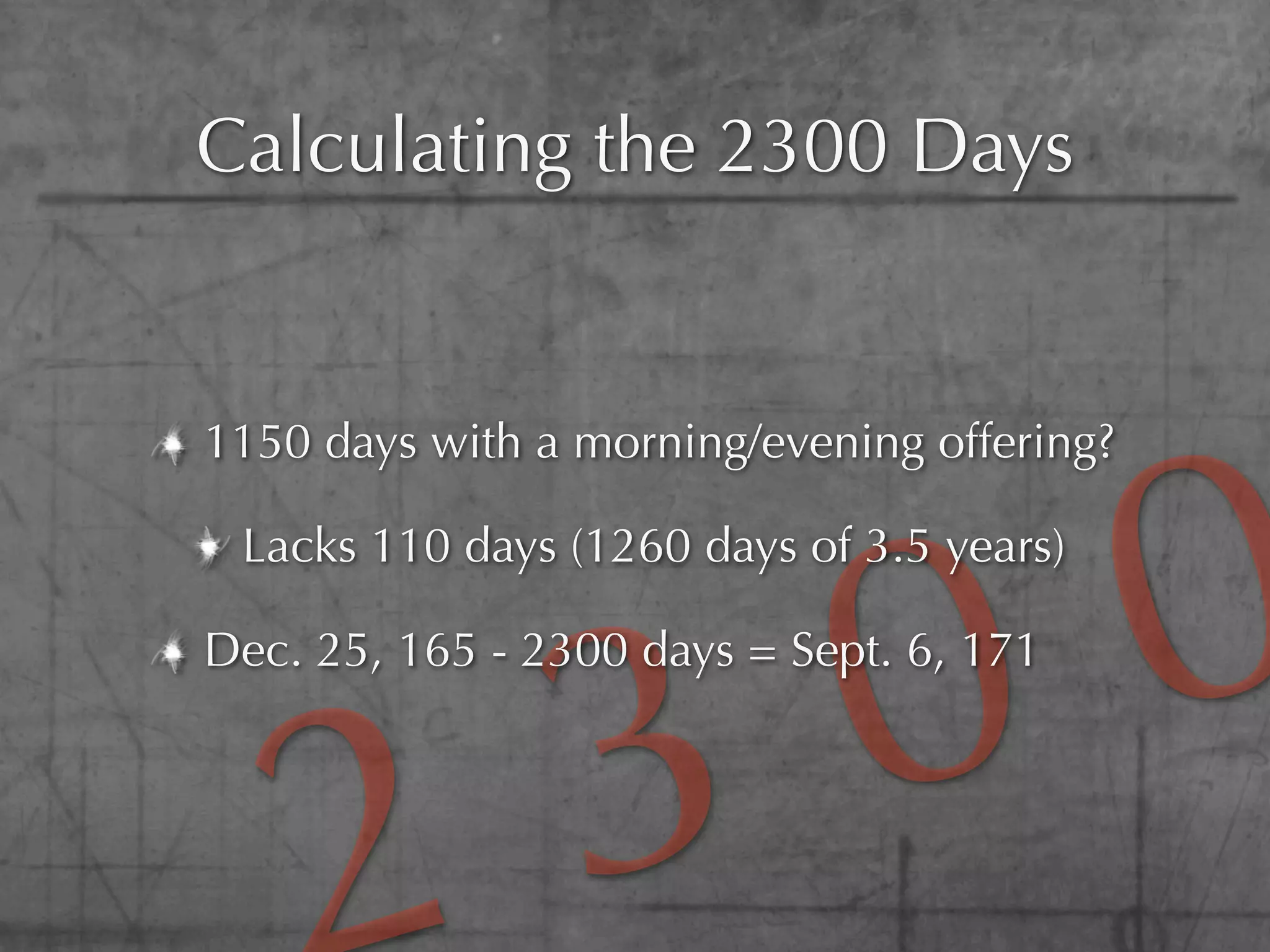
1150 days with a morning/evening offering?


                 3 0
Calculating the 2300 Days


                     0
1150 days with a morning/evening offering?


                   0
 Lacks 110 days (1260 days of 3.5 years)


                 3
Calculating the 2300 Days


                     0
1150 days with a morning/evening offering?


                   0
 Lacks 110 days (1260 days of 3.5 years)


                 3
Dec. 25, 165 - 2300 days = Sept. 6, 171
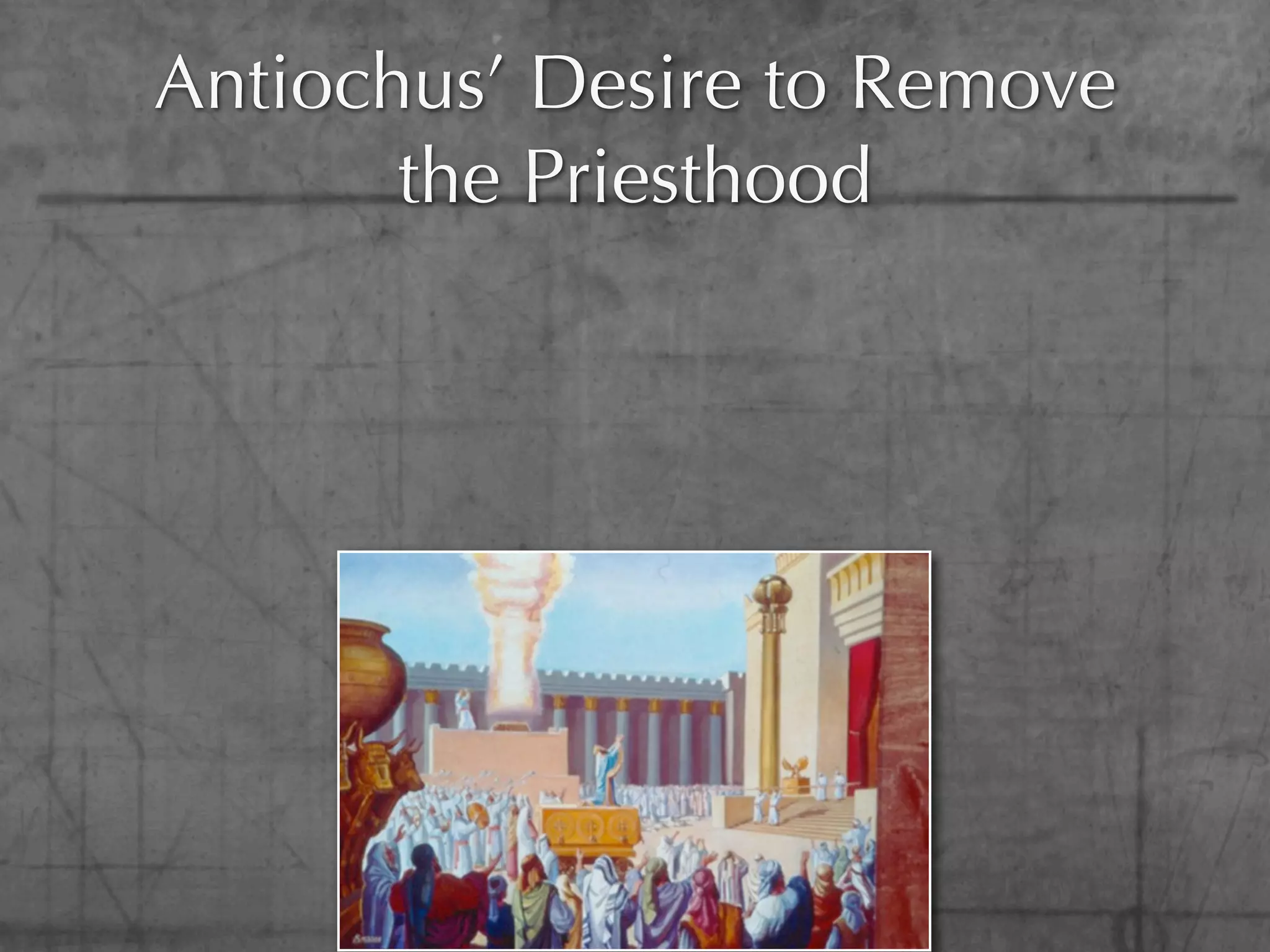
Antiochus’ Desire to Remove
       the Priesthood
Antiochus’ Desire to Remove
       the Priesthood
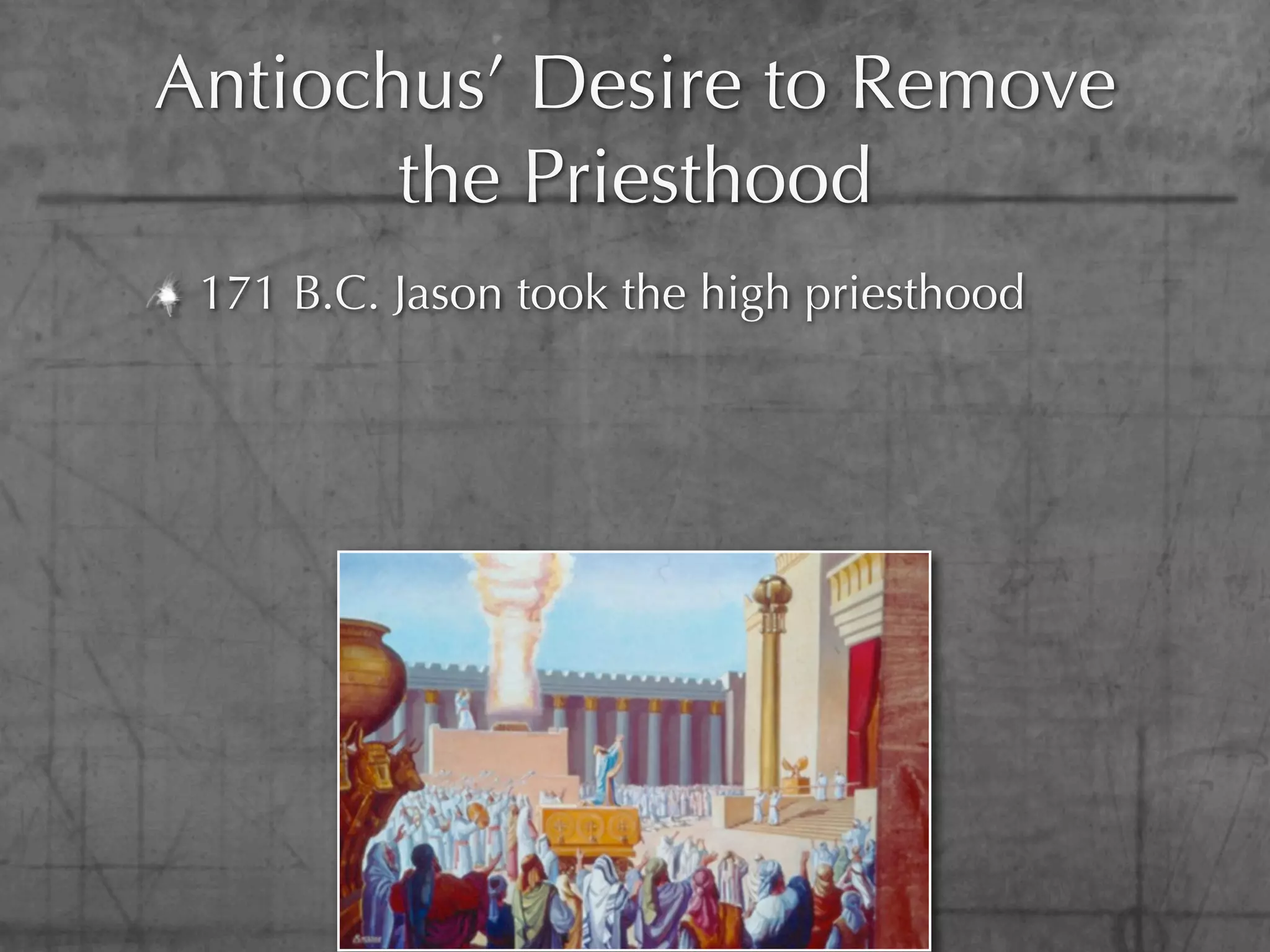
 171 B.C. Jason took the high priesthood
Antiochus’ Desire to Remove
       the Priesthood
 171 B.C. Jason took the high priesthood

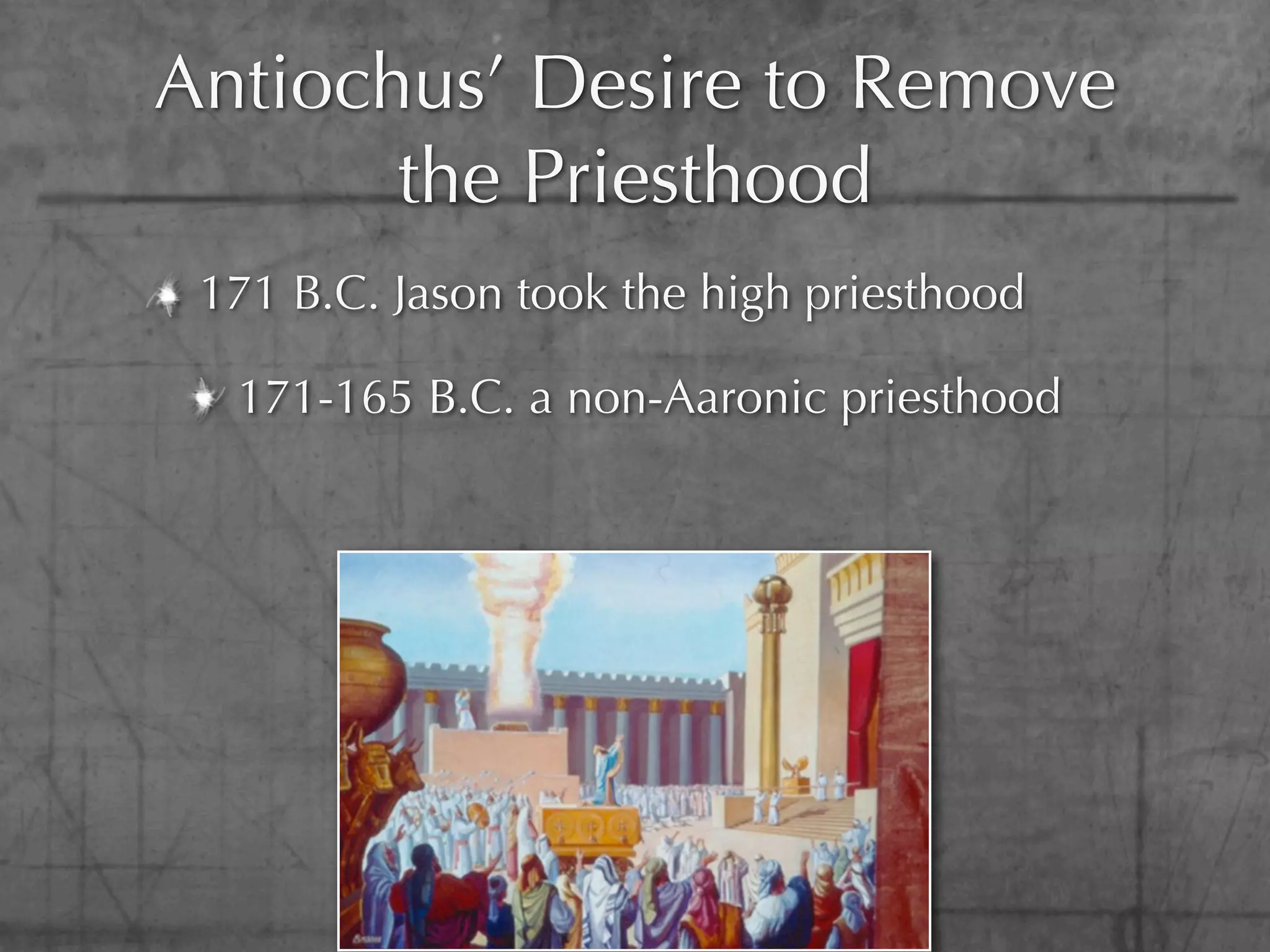
  171-165 B.C. a non-Aaronic priesthood
Antiochus’ Desire to Remove
       the Priesthood
 171 B.C. Jason took the high priesthood

  171-165 B.C. a non-Aaronic priesthood

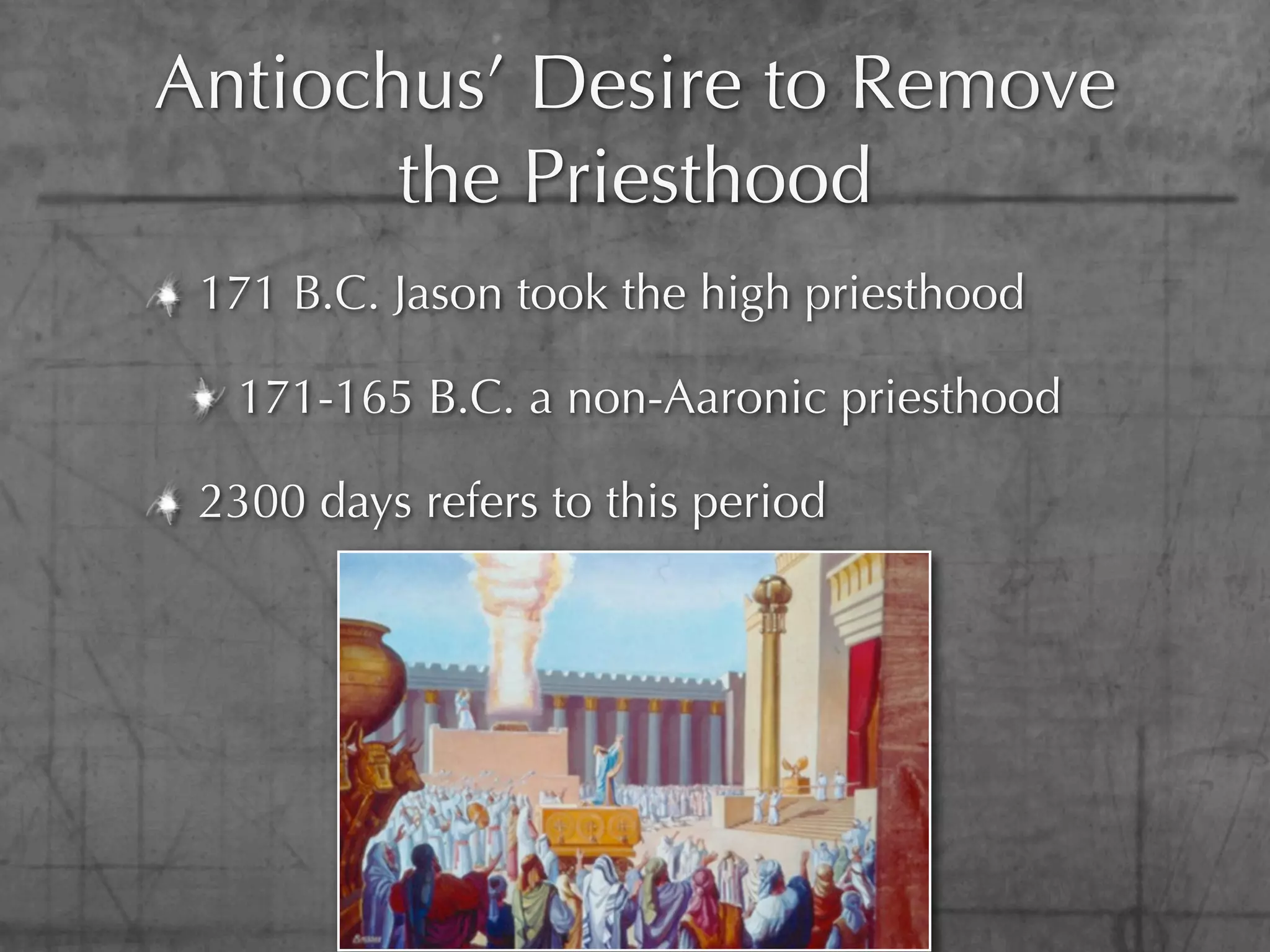
 2300 days refers to this period
Unifying Hellenistic Force
     against the Jews
Unifying Hellenistic Force
     against the Jews
Sacrifices to cease
Unifying Hellenistic Force
     against the Jews
Sacrifices to cease

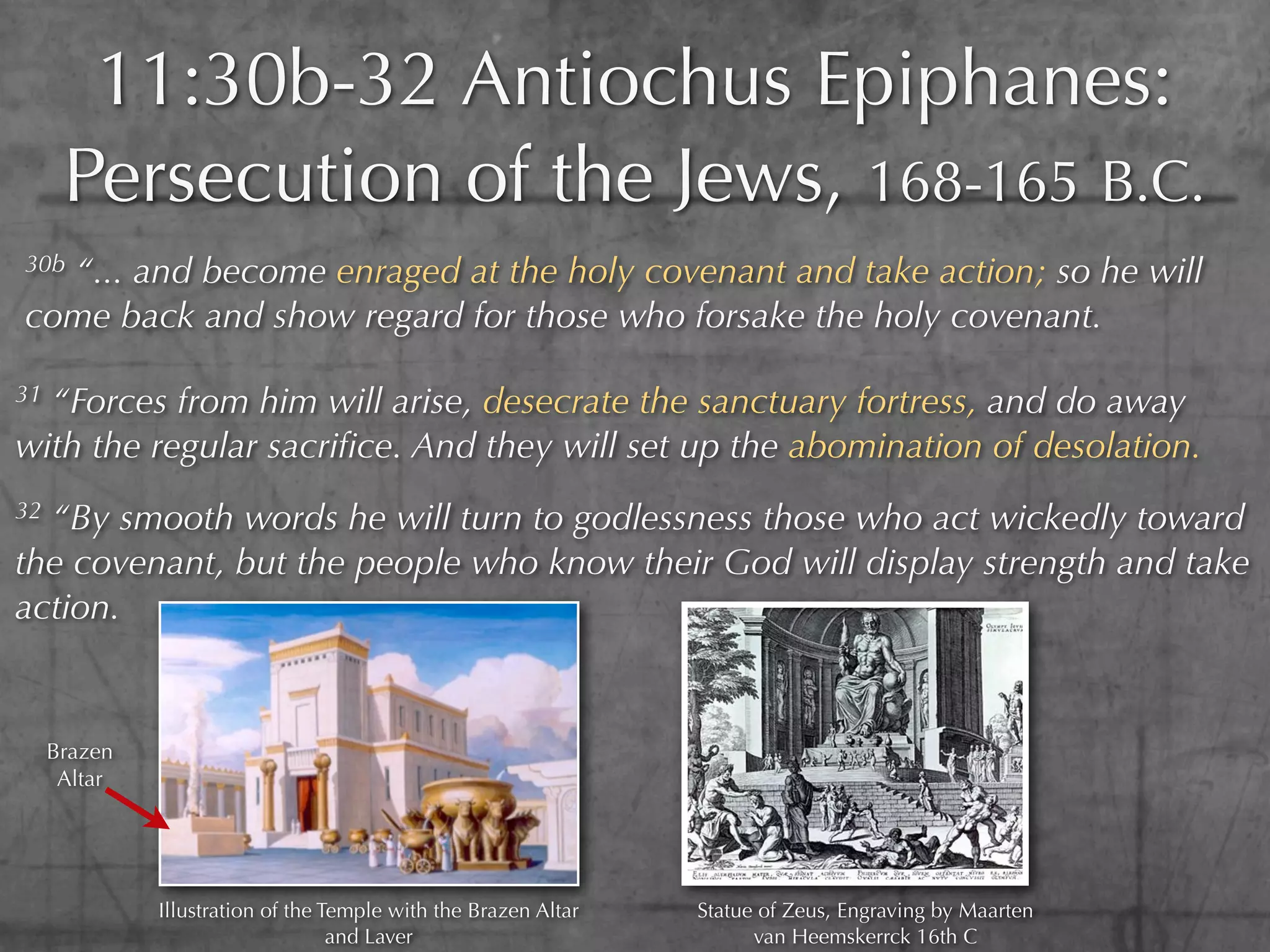
Temple to be dedicated to Zeus
Unifying Hellenistic Force
     against the Jews
Sacrifices to cease

Temple to be dedicated to Zeus

Observance of Sabbath forbidden
Unifying Hellenistic Force
     against the Jews
Sacrifices to cease

Temple to be dedicated to Zeus

Observance of Sabbath forbidden

Monthly searches for the Torah and
circumcised infants
Unifying Hellenistic Force
     against the Jews
Sacrifices to cease

Temple to be dedicated to Zeus

Observance of Sabbath forbidden

Monthly searches for the Torah and
circumcised infants

Greek soldiers and women performed
licentious rites in the temple courts
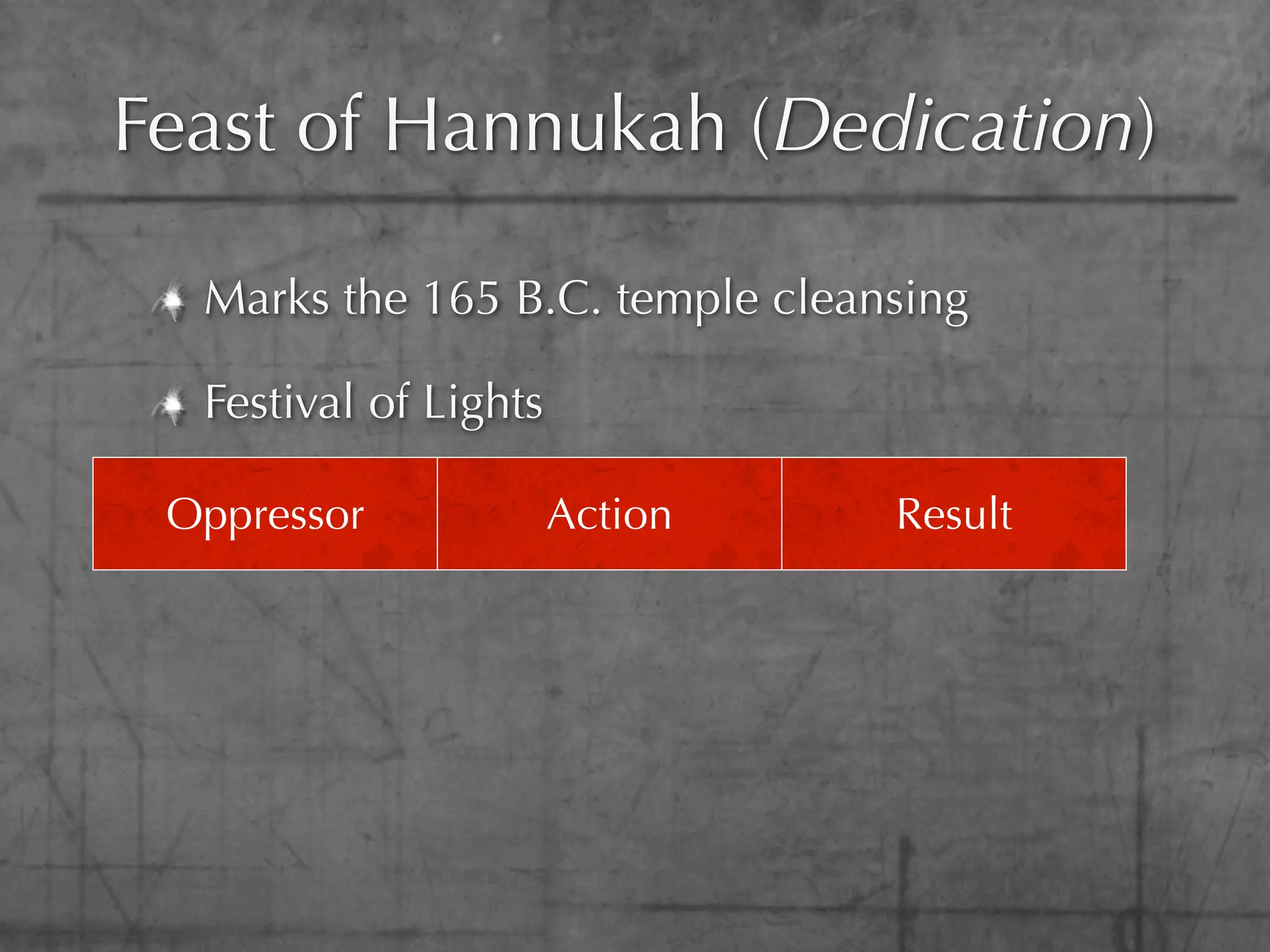
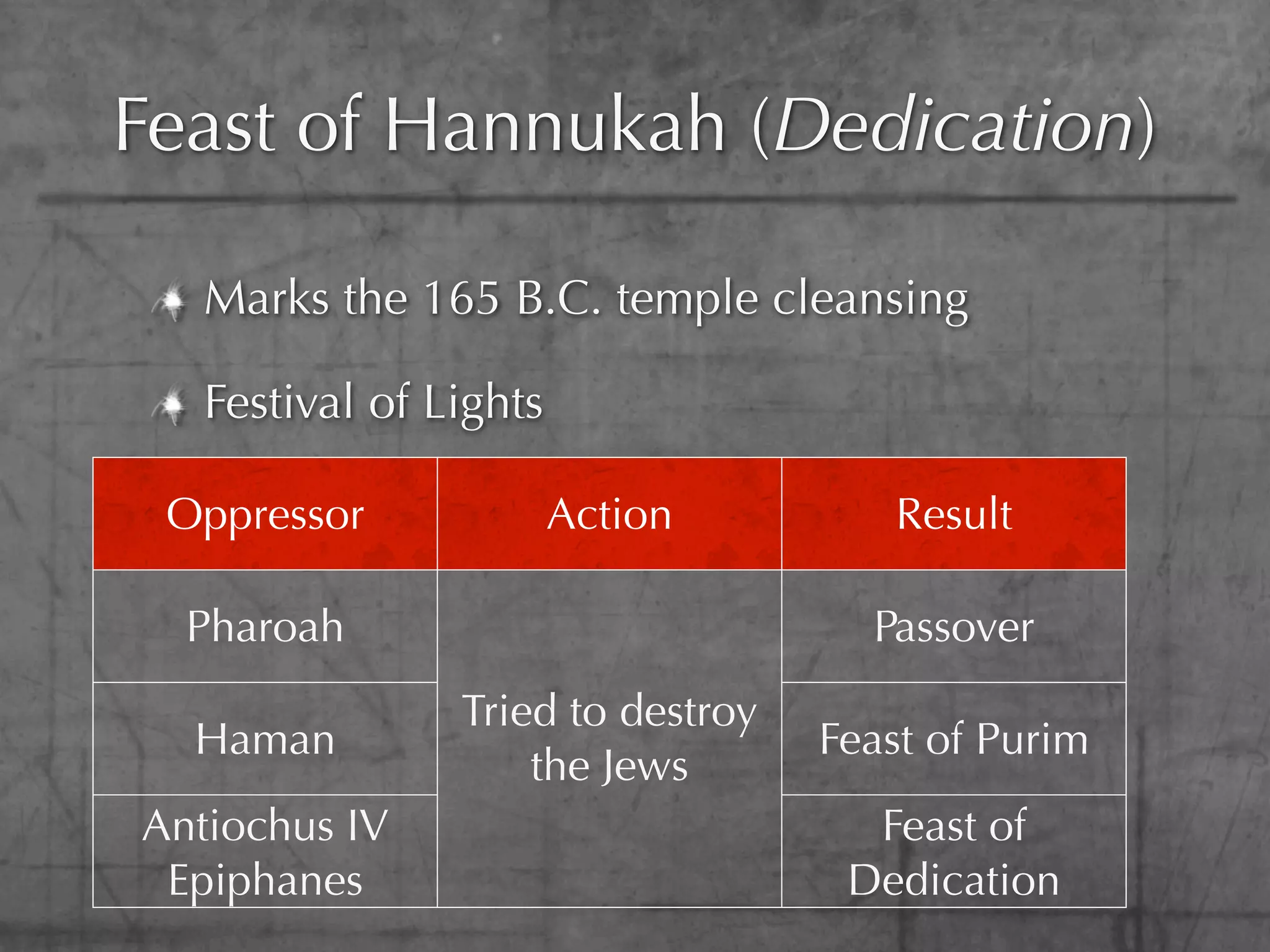
Feast of Hannukah (Dedication)

  Marks the 165 B.C. temple cleansing
Feast of Hannukah (Dedication)

  Marks the 165 B.C. temple cleansing

  Festival of Lights
Feast of Hannukah (Dedication)

   Marks the 165 B.C. temple cleansing

   Festival of Lights

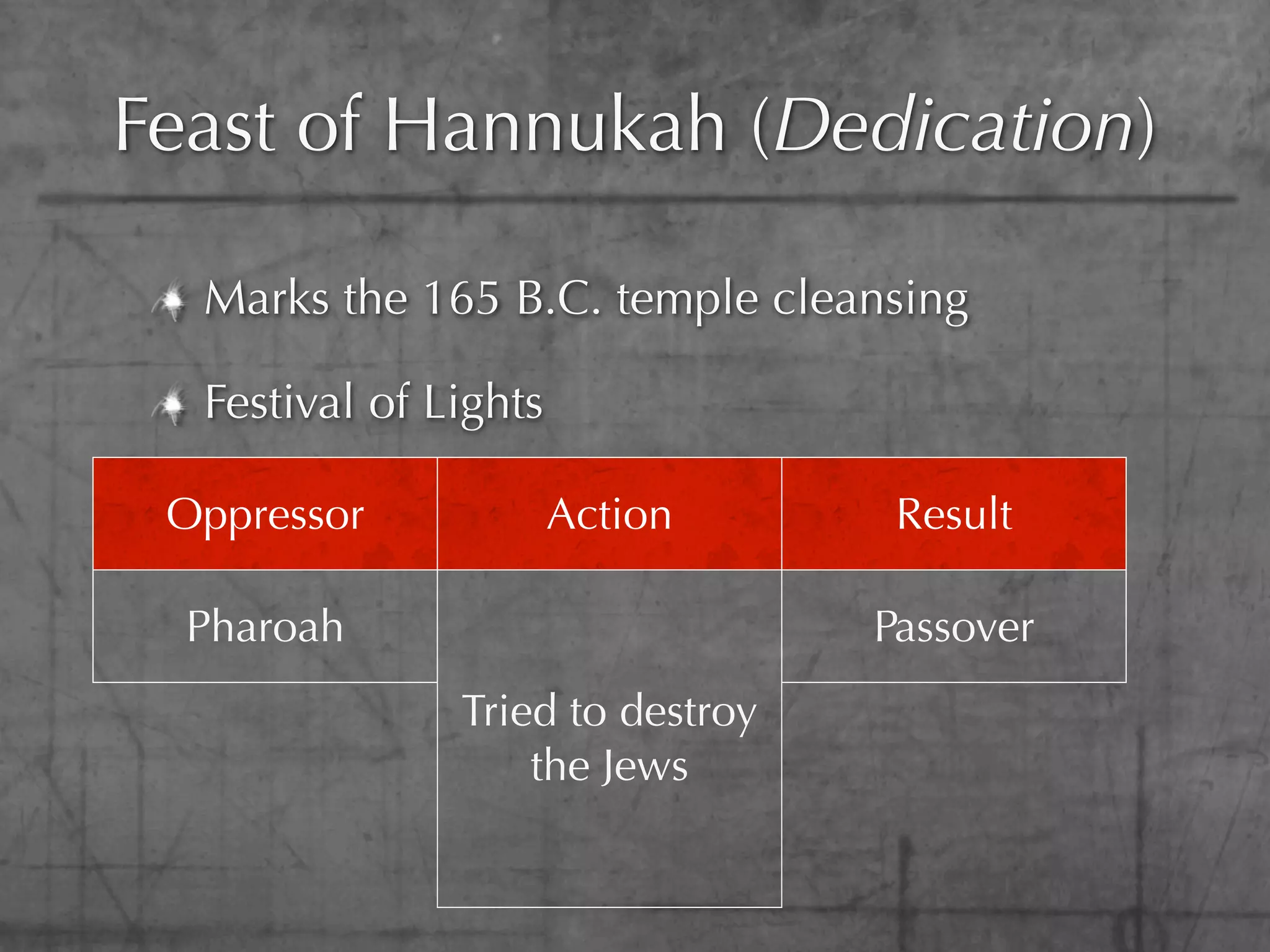
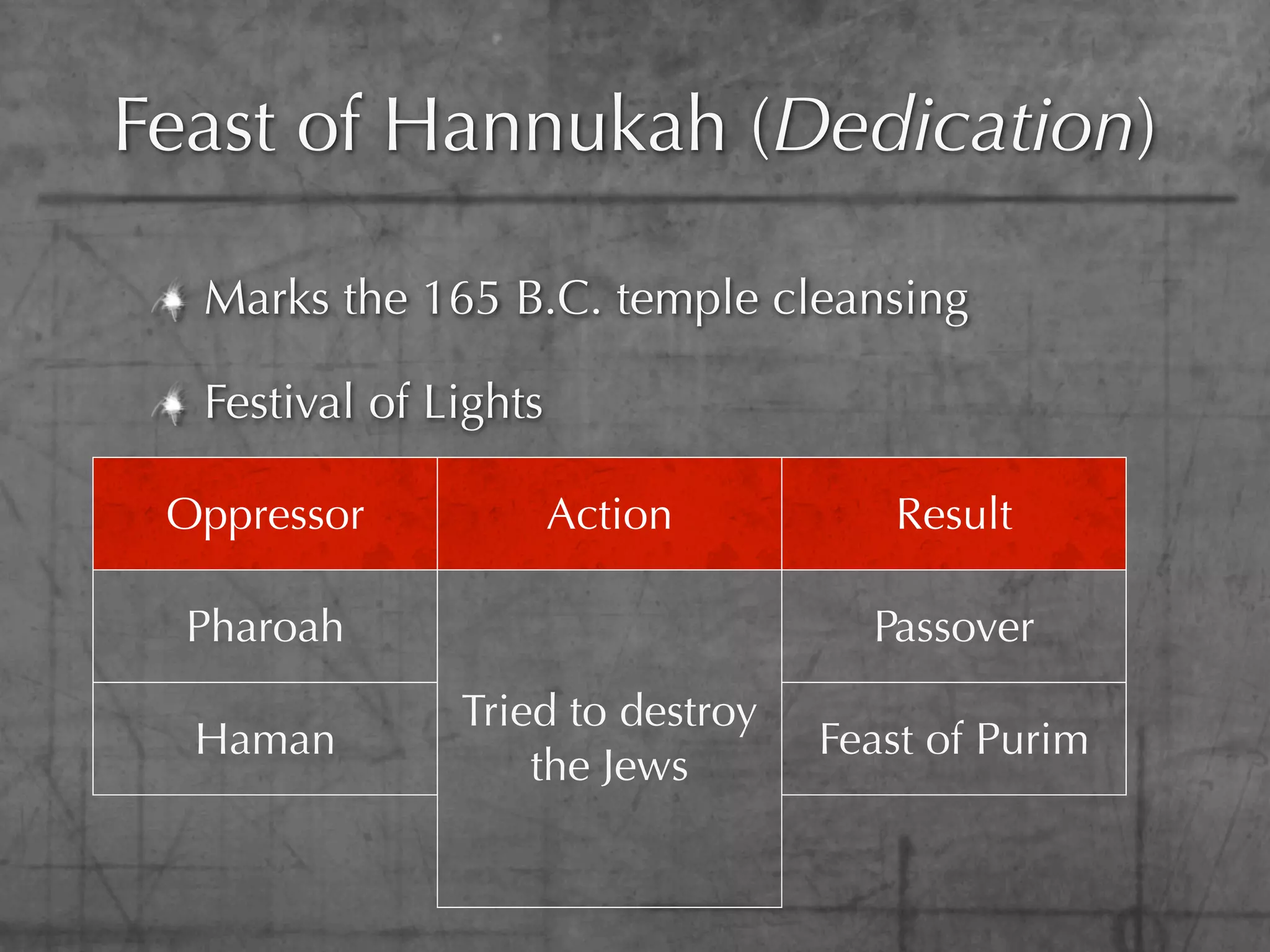
 Oppressor              Action        Result

  Pharoah                            Passover
                Tried to destroy
  Haman                            Feast of Purim
                    the Jews
Antiochus IV                         Feast of
 Epiphanes                          Dedication
Feast of Hannukah (Dedication)

   Marks the 165 B.C. temple cleansing

   Festival of Lights

 Oppressor              Action        Result

  Pharoah                            Passover
                Tried to destroy
  Haman                            Feast of Purim
                    the Jews
Antiochus IV                         Feast of
 Epiphanes                          Dedication
Feast of Hannukah (Dedication)

   Marks the 165 B.C. temple cleansing

   Festival of Lights

 Oppressor              Action        Result

  Pharoah                            Passover
                Tried to destroy
  Haman                            Feast of Purim
                    the Jews
Antiochus IV                         Feast of
 Epiphanes                          Dedication
Feast of Hannukah (Dedication)

   Marks the 165 B.C. temple cleansing

   Festival of Lights

 Oppressor              Action        Result

  Pharoah                            Passover
                Tried to destroy
  Haman                            Feast of Purim
                    the Jews
Antiochus IV                         Feast of
 Epiphanes                          Dedication
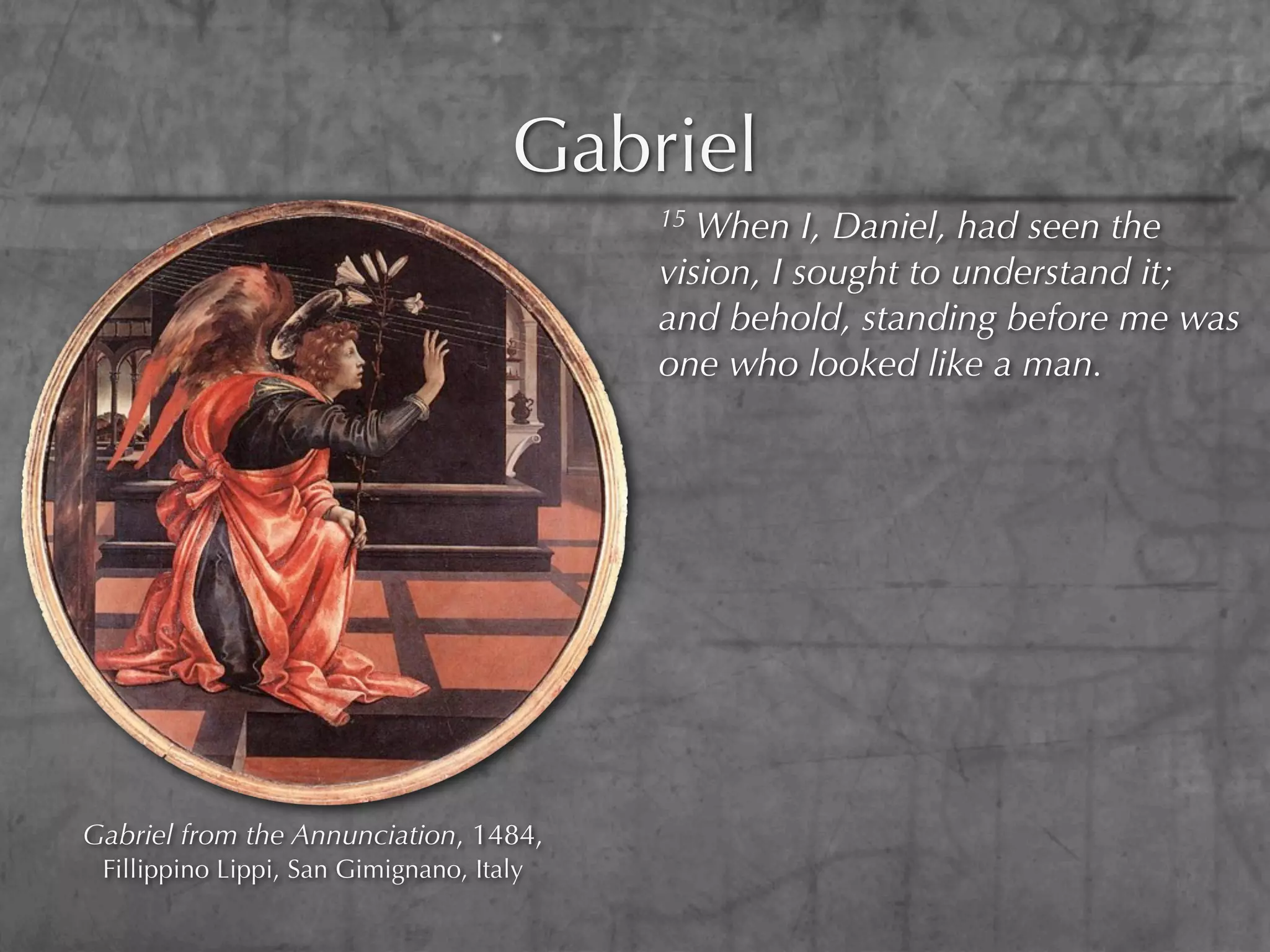
Gabriel
                                          15 When I, Daniel, had seen the
                                          vision, I sought to understand it;
                                          and behold, standing before me was
                                          one who looked like a man.


Gabriel from the Annunciation, 1484,
 Fillippino Lippi, San Gimignano, Italy
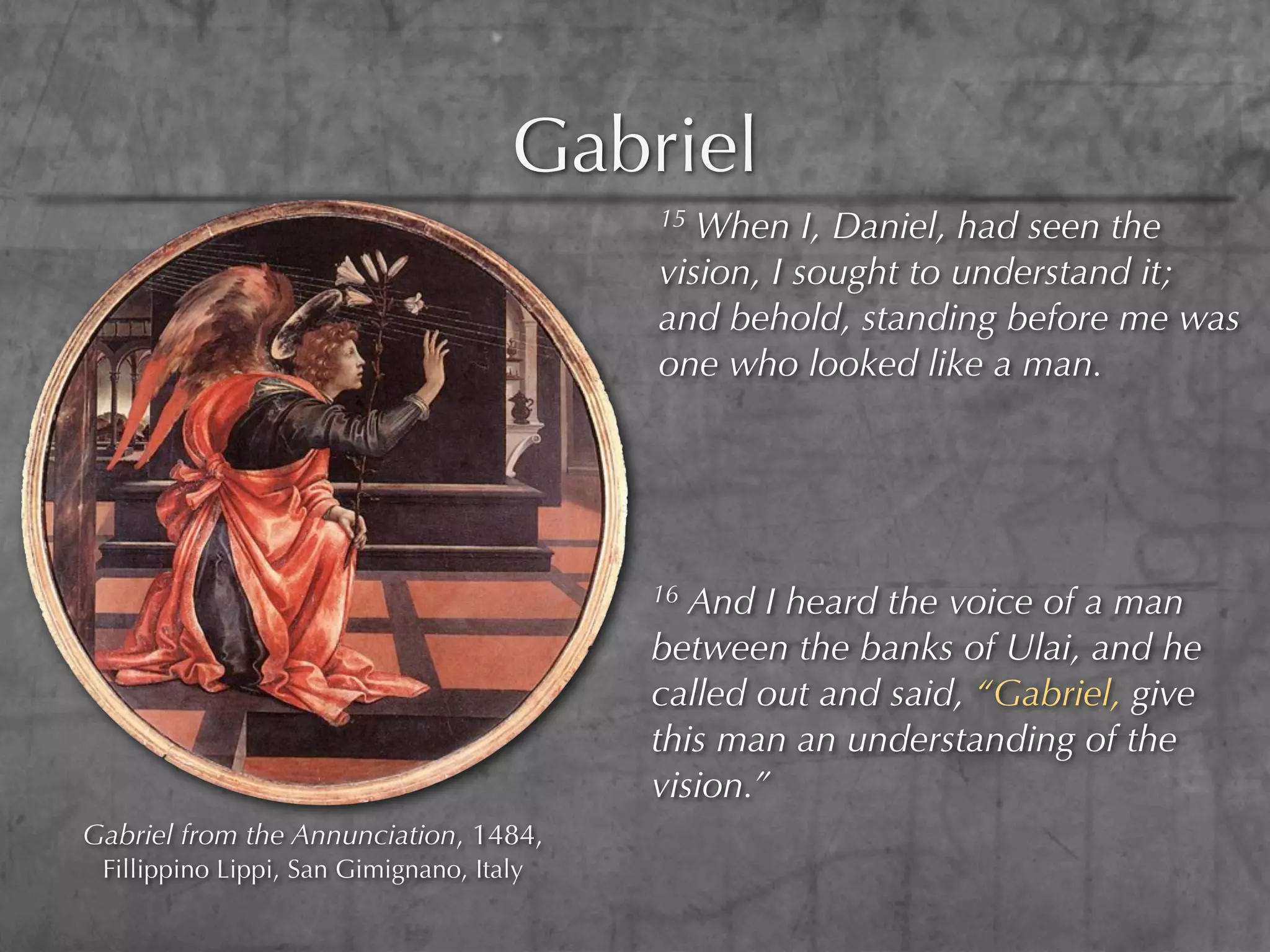
Gabriel
                                          15 When I, Daniel, had seen the
                                          vision, I sought to understand it;
                                          and behold, standing before me was
                                          one who looked like a man.


                                          16 And I heard the voice of a man
                                          between the banks of Ulai, and he
                                          called out and said, “Gabriel, give
                                          this man an understanding of the
                                          vision.”
Gabriel from the Annunciation, 1484,
 Fillippino Lippi, San Gimignano, Italy
Daniel’s Vision of
                the End of the World
17So he came near to where I was standing,
and when he came I was frightened and fell on my face;
but he said to me,
“Son of man, understand that the vision pertains to the time of the end.”
Daniel’s Vision of
                the End of the World
17So he came near to where I was standing,
and when he came I was frightened and fell on my face;
but he said to me,
“Son of man, understand that the vision pertains to the time of the end.”

18 Now while he was talking with me,
I sank into a deep sleep with my face to the ground;
but he touched me and made me stand upright.
19 He said,

   “Behold, I am going to let you know what will occur at the final period of
   the indignation,
   for it pertains to the appointed time of the end.
Four Views of Daniel 8:9-26
17 So he came near to where I was standing, and when he came I was
frightened and fell on my face; but he said to me, “Son of man, understand
that the vision pertains to the time of the end.”
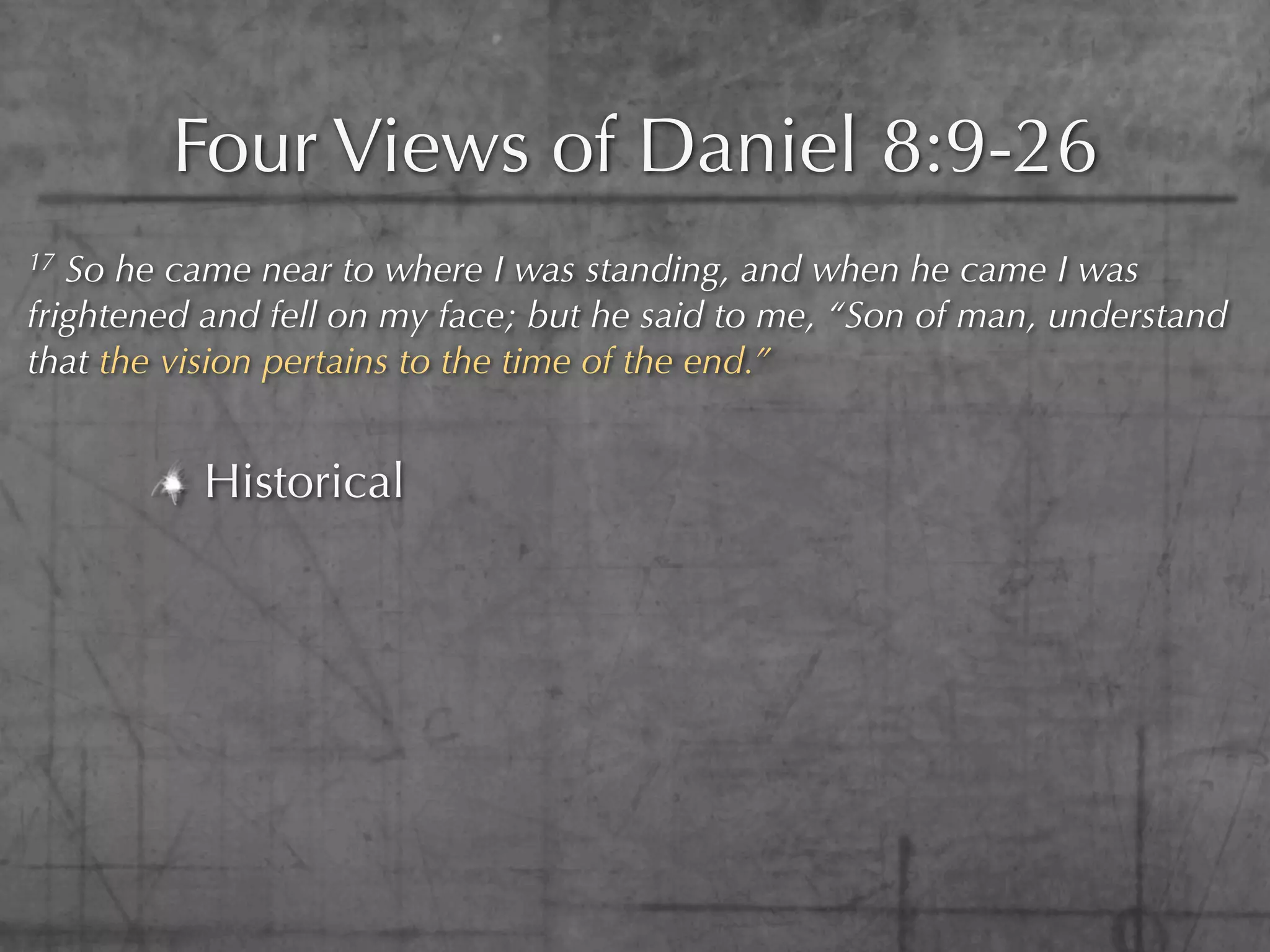
Four Views of Daniel 8:9-26
17 So he came near to where I was standing, and when he came I was
frightened and fell on my face; but he said to me, “Son of man, understand
that the vision pertains to the time of the end.”


          Historical
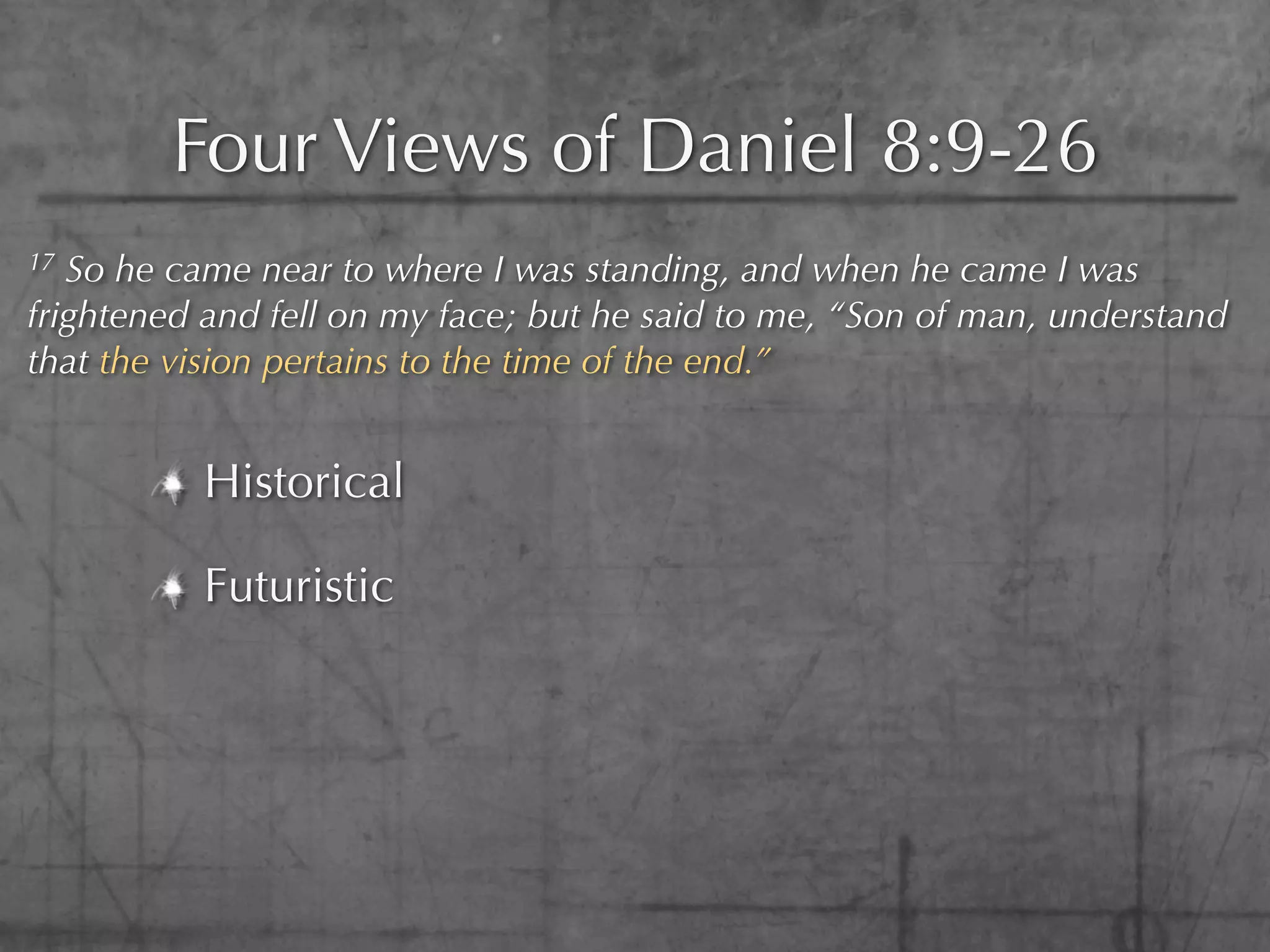
Four Views of Daniel 8:9-26
17 So he came near to where I was standing, and when he came I was
frightened and fell on my face; but he said to me, “Son of man, understand
that the vision pertains to the time of the end.”


          Historical

          Futuristic
Four Views of Daniel 8:9-26
17 So he came near to where I was standing, and when he came I was
frightened and fell on my face; but he said to me, “Son of man, understand
that the vision pertains to the time of the end.”


          Historical

          Futuristic

          Double fulfillment
Four Views of Daniel 8:9-26
17 So he came near to where I was standing, and when he came I was
frightened and fell on my face; but he said to me, “Son of man, understand
that the vision pertains to the time of the end.”


          Historical

          Futuristic

          Double fulfillment

          Historical but illustrates the future
8:23-25 Fulfilled in Antiochus
       and Antichrist
23     “In the latter period of their rule,
     When the transgressors have run their course,
     A king will arise,
     Insolent and skilled in intrigue.
8:23-25 Fulfilled in Antiochus
       and Antichrist
23     “In the latter period of their rule,
     When the transgressors have run their course,
     A king will arise,
     Insolent and skilled in intrigue.


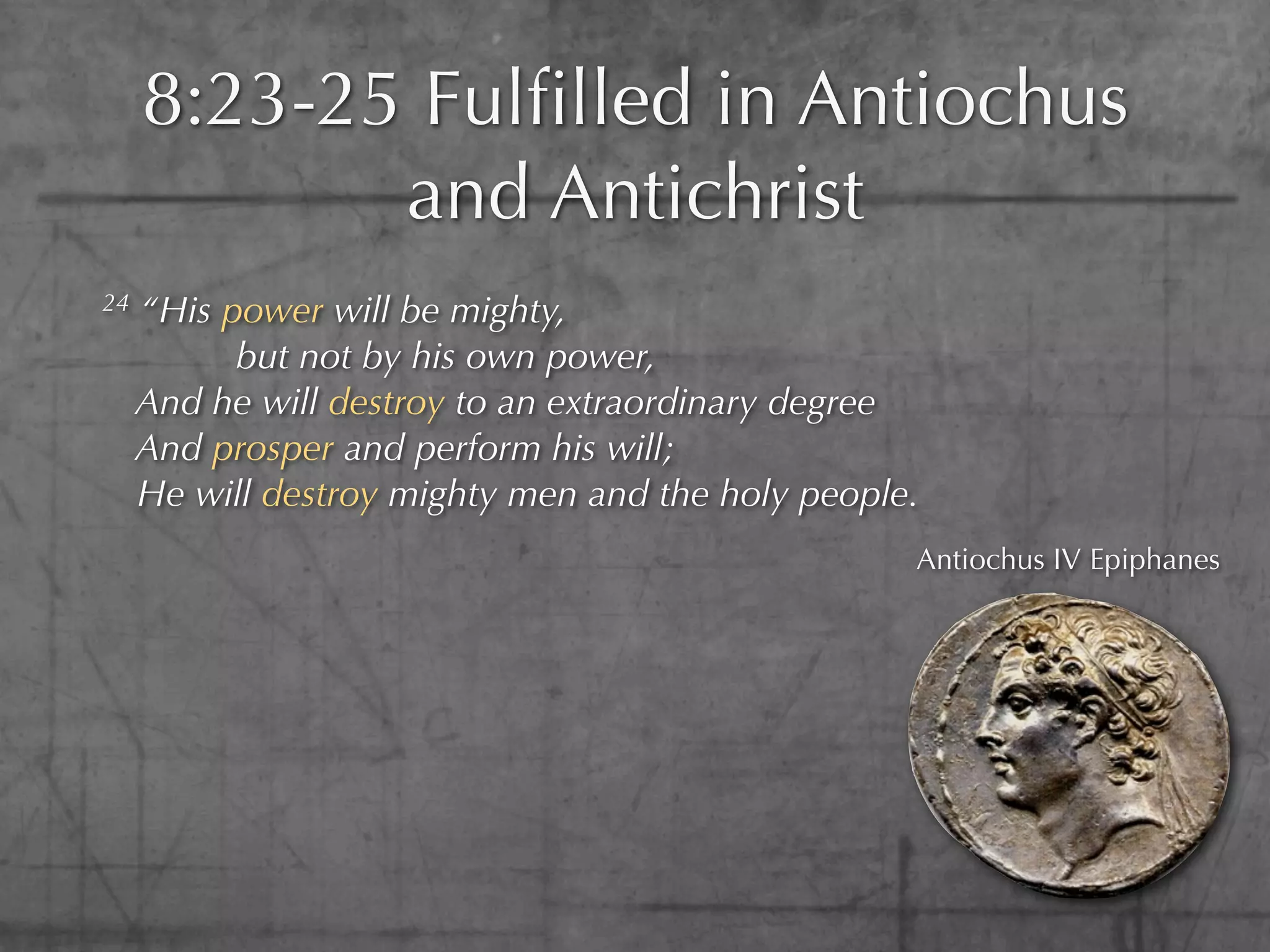
                                                 Antiochus IV Epiphanes
8:23-25 Fulfilled in Antiochus
            and Antichrist
24   “His power will be mighty,
           but not by his own power,
     And he will destroy to an extraordinary degree
     And prosper and perform his will;
     He will destroy mighty men and the holy people.
8:23-25 Fulfilled in Antiochus
            and Antichrist
24   “His power will be mighty,
           but not by his own power,
     And he will destroy to an extraordinary degree
     And prosper and perform his will;
     He will destroy mighty men and the holy people.
                                                   Antiochus IV Epiphanes
8:23-25 Fulfilled in
              Antiochus and Antichrist
25   “And through his shrewdness
     He will cause deceit to succeed by his influence;
     And he will magnify himself in his heart,
     And he will destroy many while they are at ease.
     He will even oppose the Prince of princes,

     But he will be broken without human agency.”
8:23-25 Fulfilled in
              Antiochus and Antichrist
25   “And through his shrewdness
     He will cause deceit to succeed by his influence;
     And he will magnify himself in his heart,
     And he will destroy many while they are at ease.
     He will even oppose the Prince of princes,

     But he will be broken without human agency.”
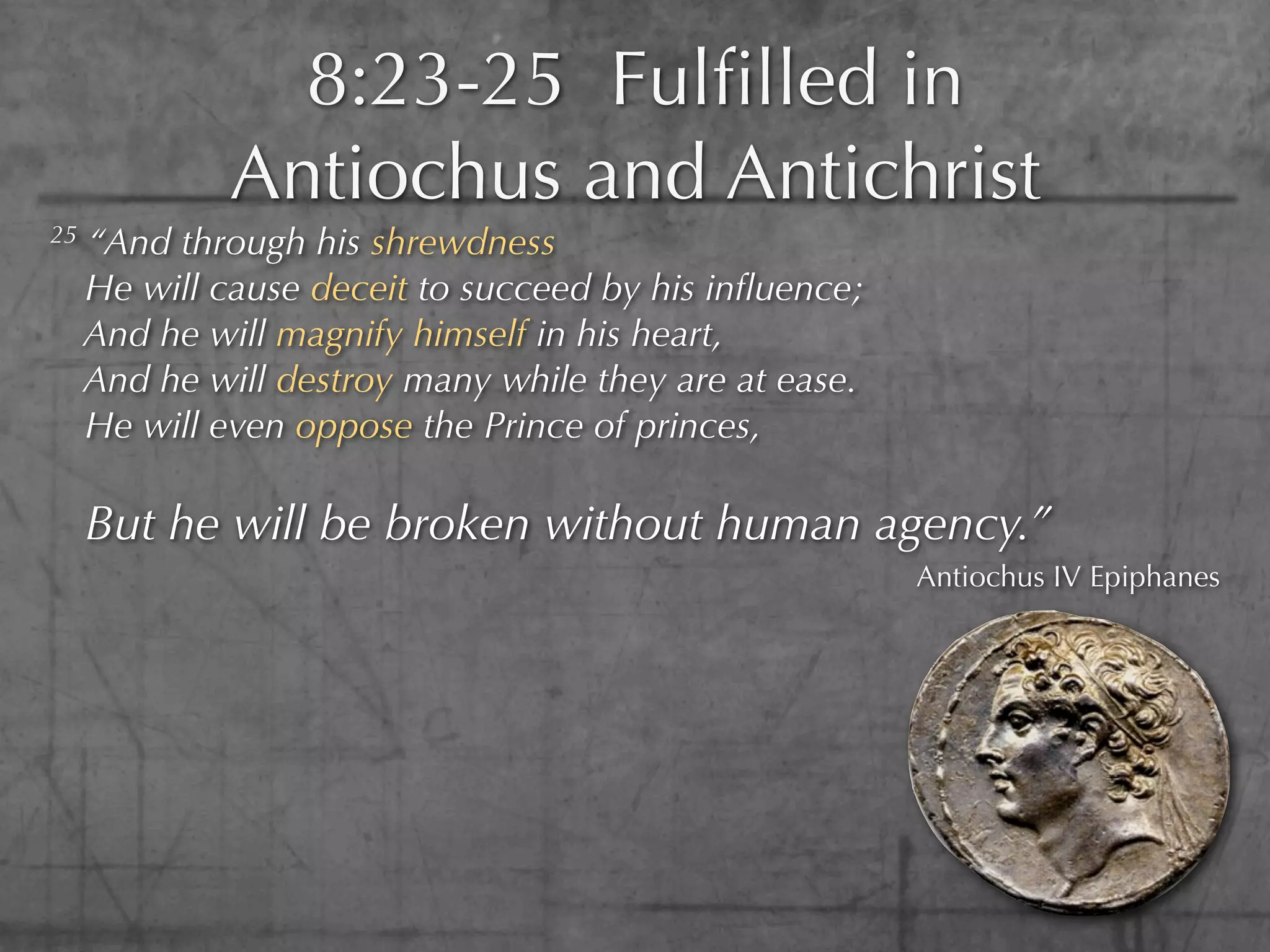
                                                        Antiochus IV Epiphanes
8:24 Parallels between
            Antiochus and Antichrist
Dan. 8:24 “His power will be
mighty, but not by his own
power...


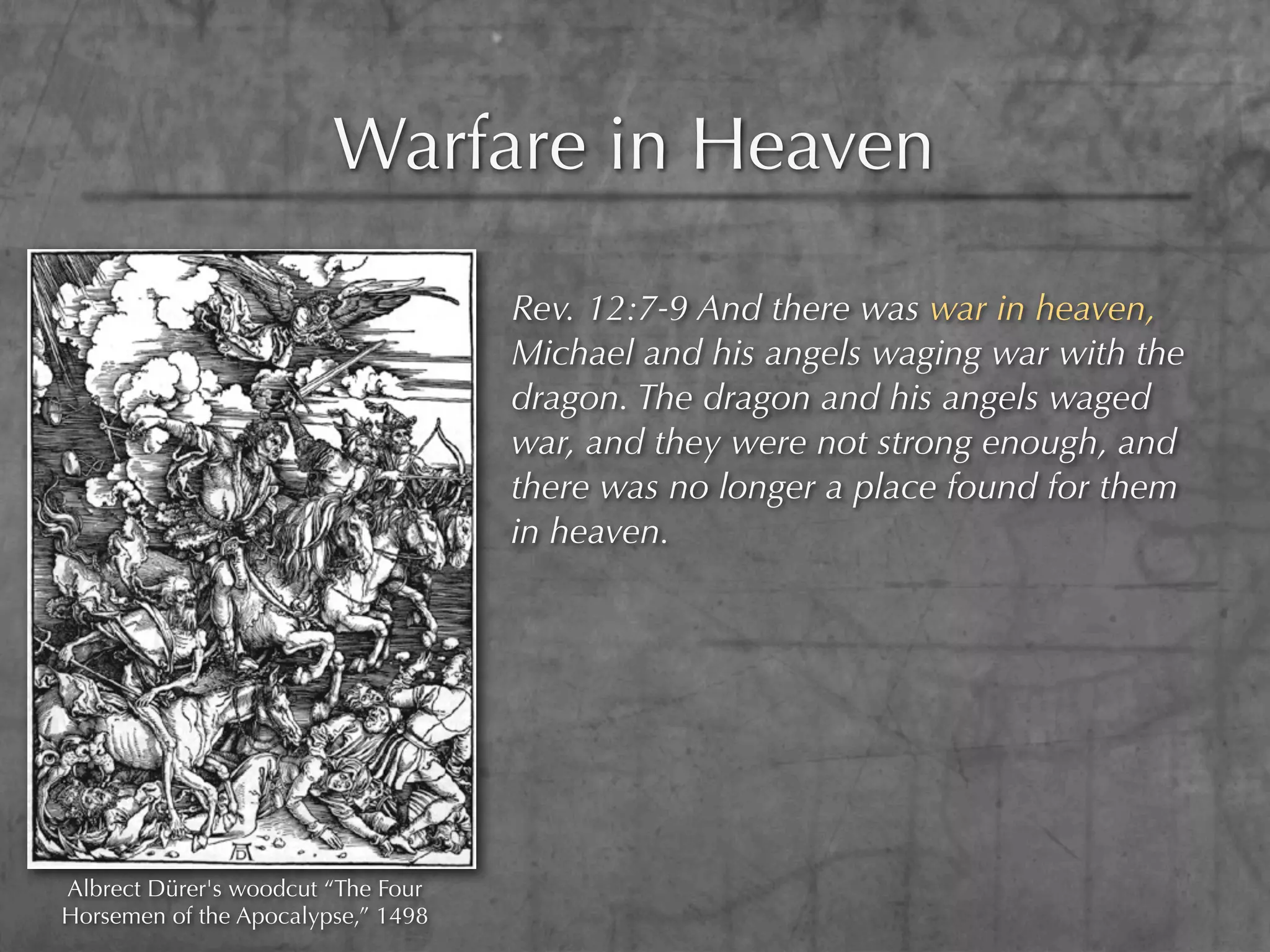
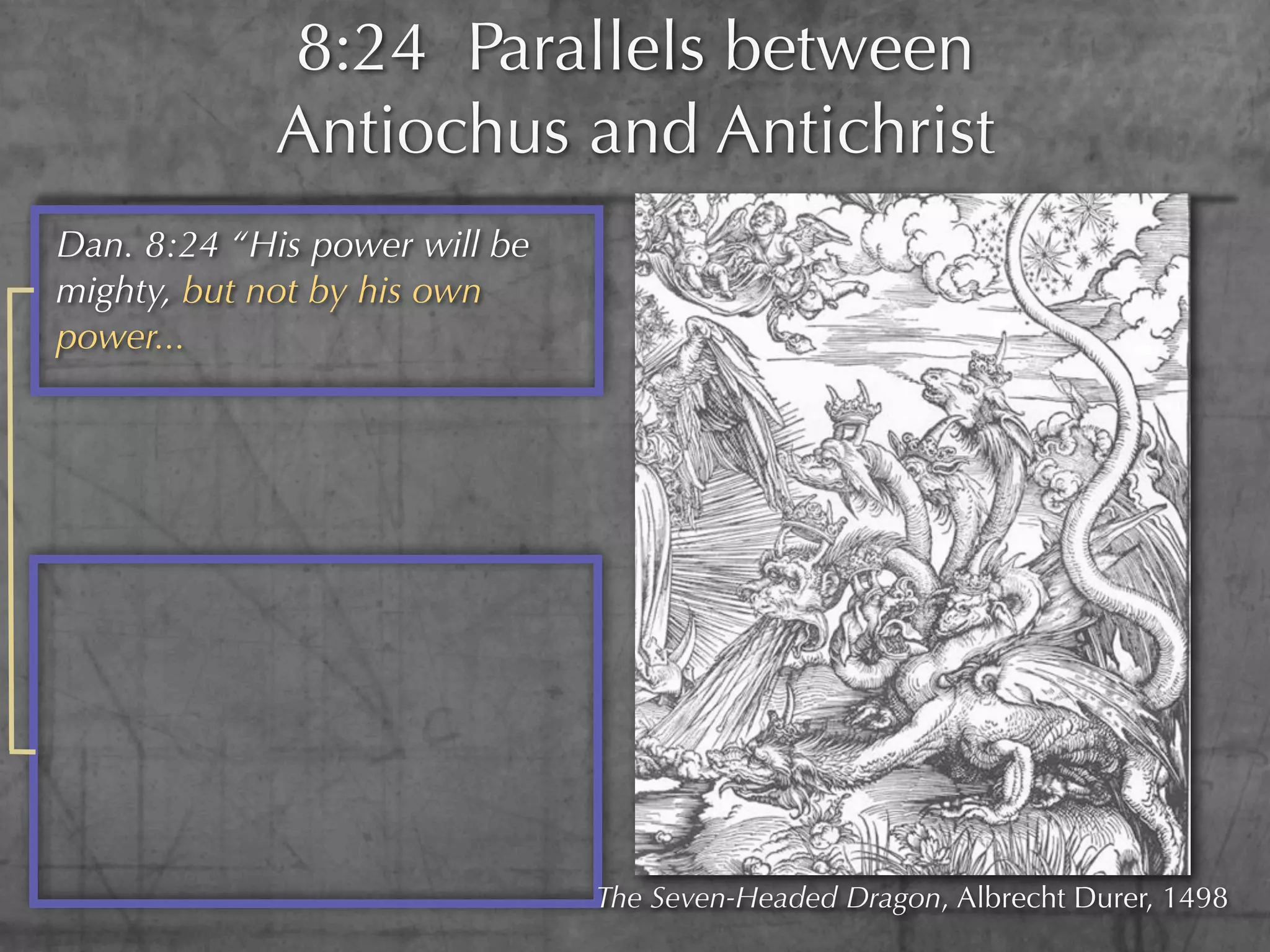
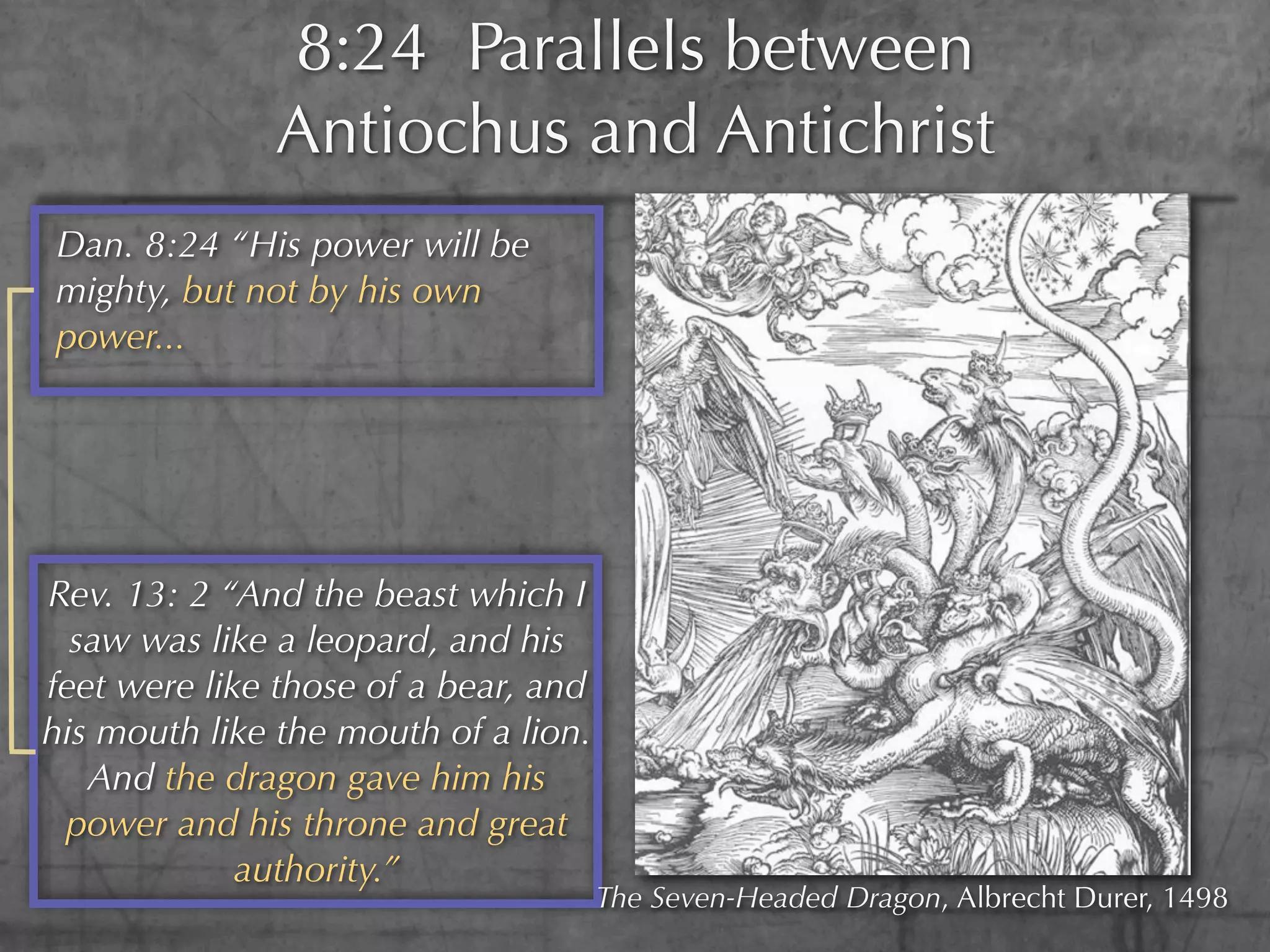
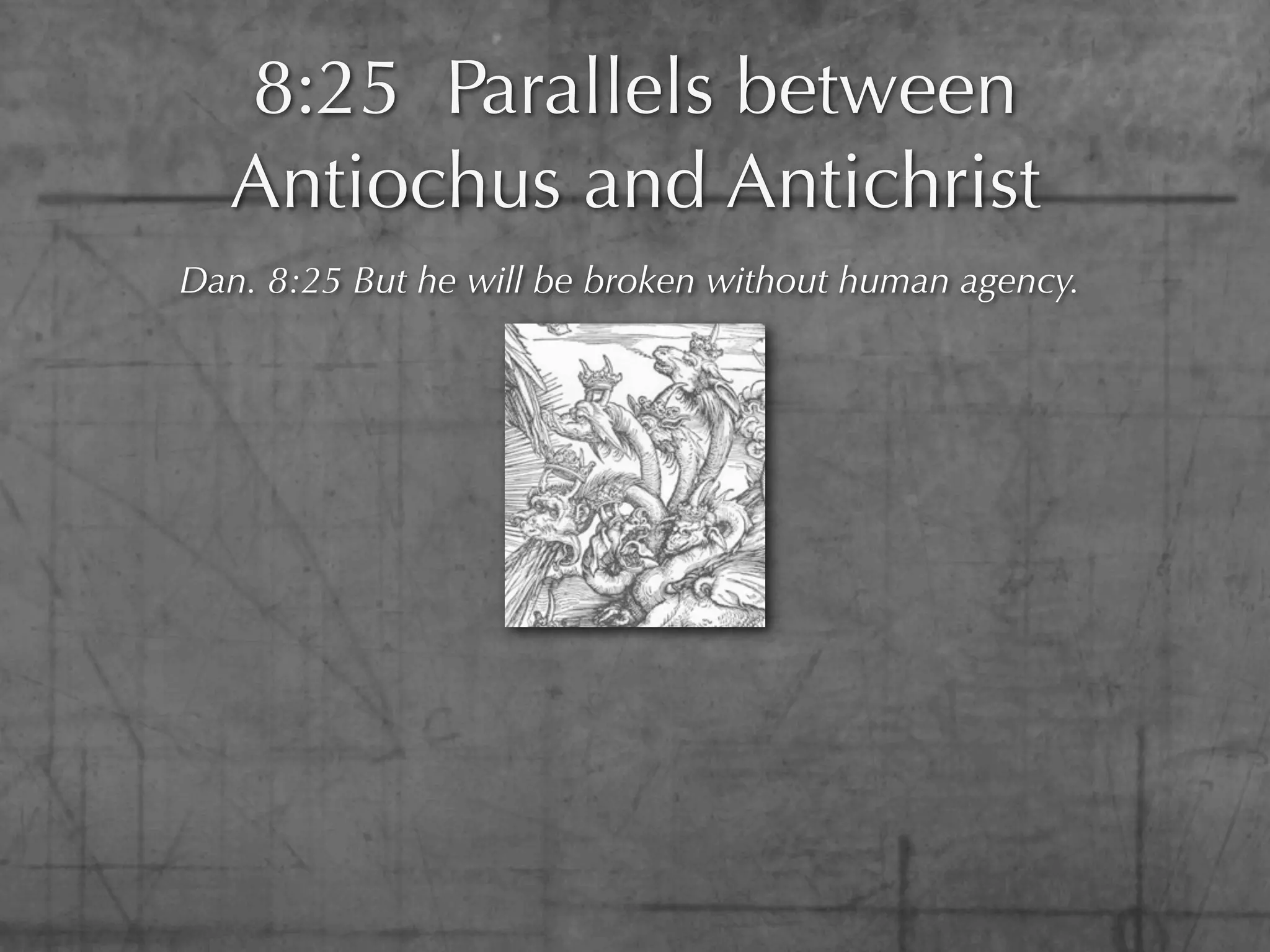
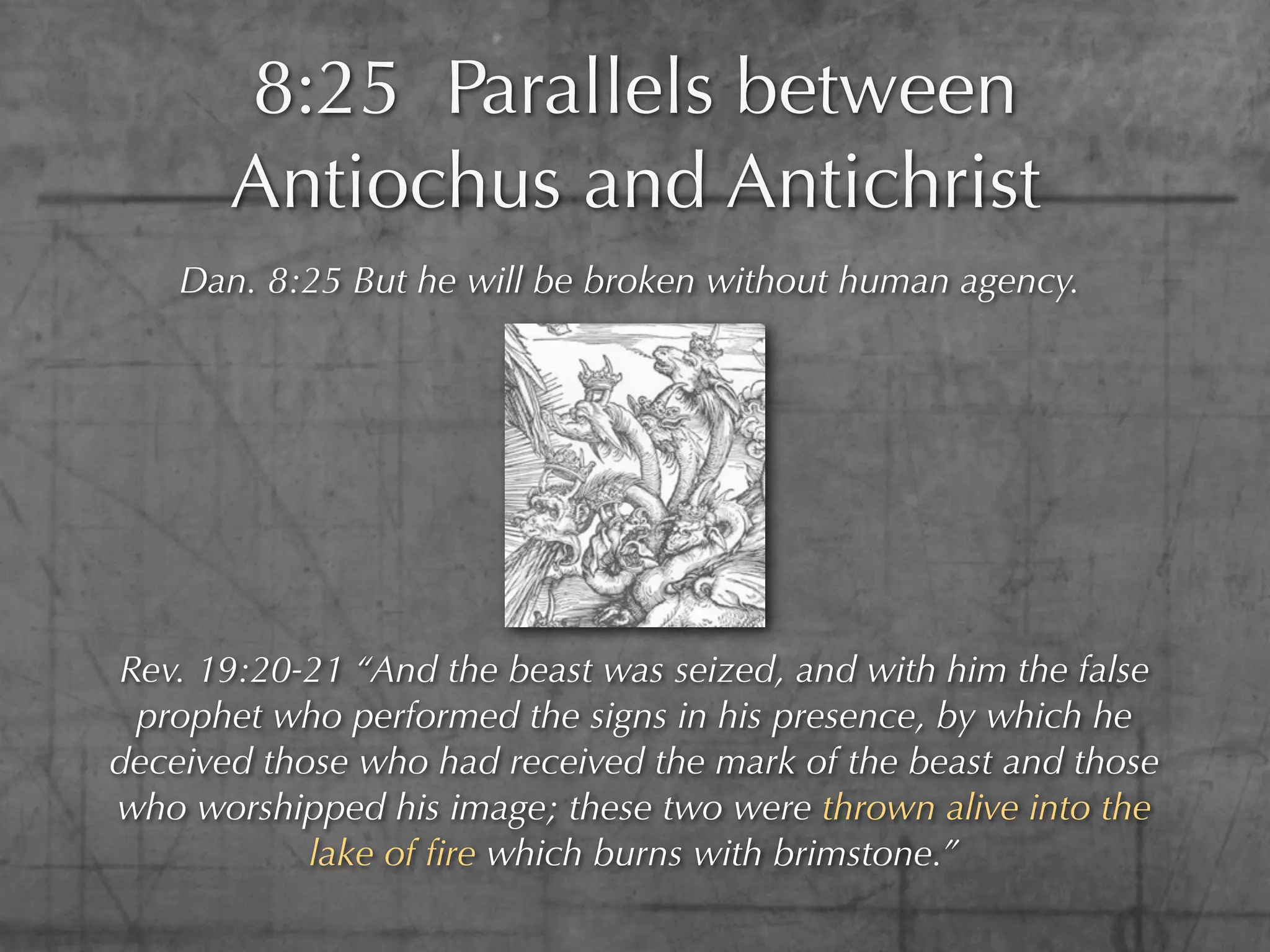
                               The Seven-Headed Dragon, Albrecht Durer, 1498
8:24 Parallels between
              Antiochus and Antichrist
Dan. 8:24 “His power will be
mighty, but not by his own
power...


Rev. 13: 2 “And the beast which I
  saw was like a leopard, and his
feet were like those of a bear, and
his mouth like the mouth of a lion.
   And the dragon gave him his
 power and his throne and great
             authority.”
                                      The Seven-Headed Dragon, Albrecht Durer, 1498
8:24 Parallels between
                  Antiochus and Antichrist
        Dan. 8:24 He will destroy mighty men and the holy people.


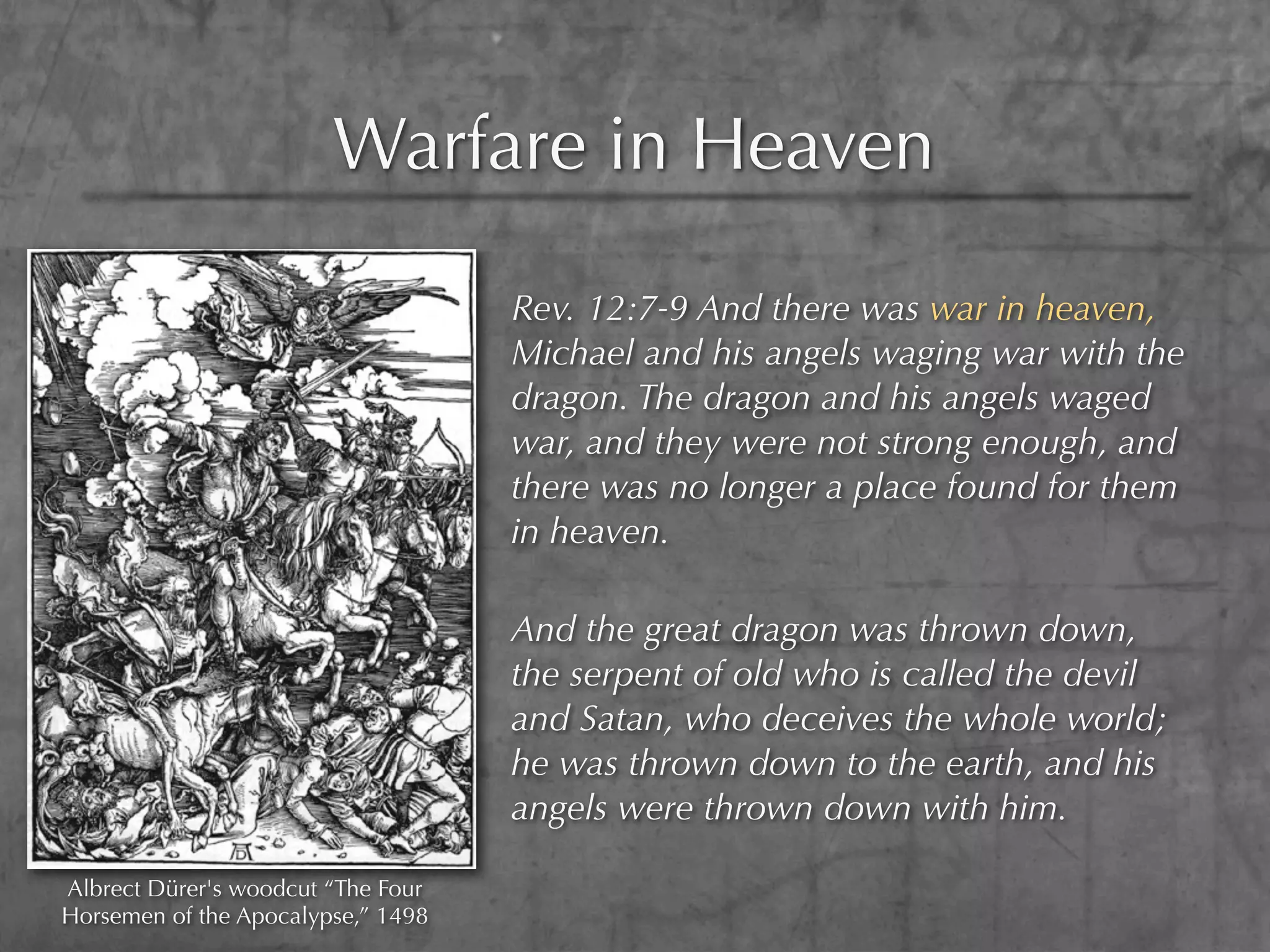
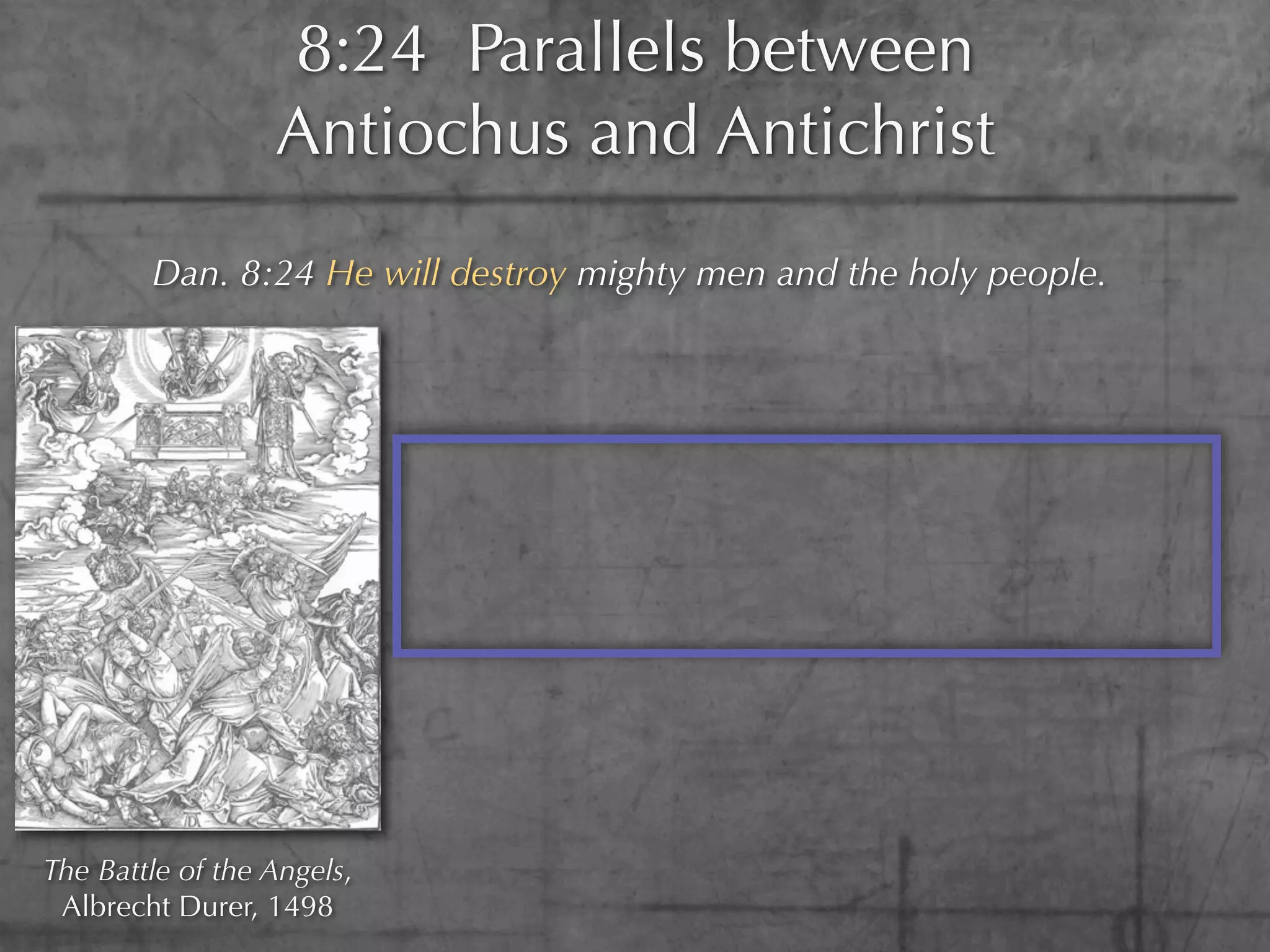
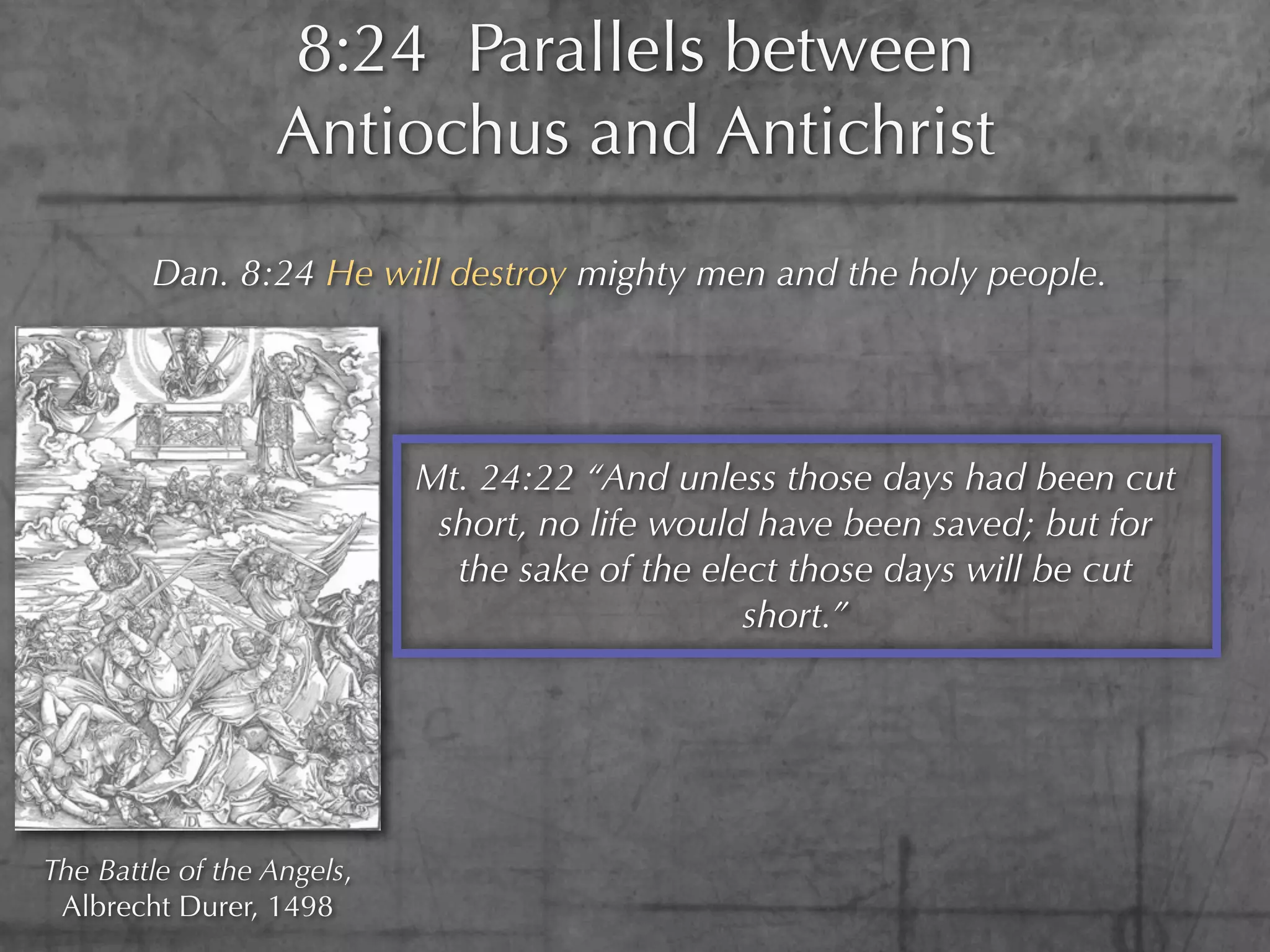
The Battle of the Angels,
 Albrecht Durer, 1498
8:24 Parallels between
                  Antiochus and Antichrist
        Dan. 8:24 He will destroy mighty men and the holy people.


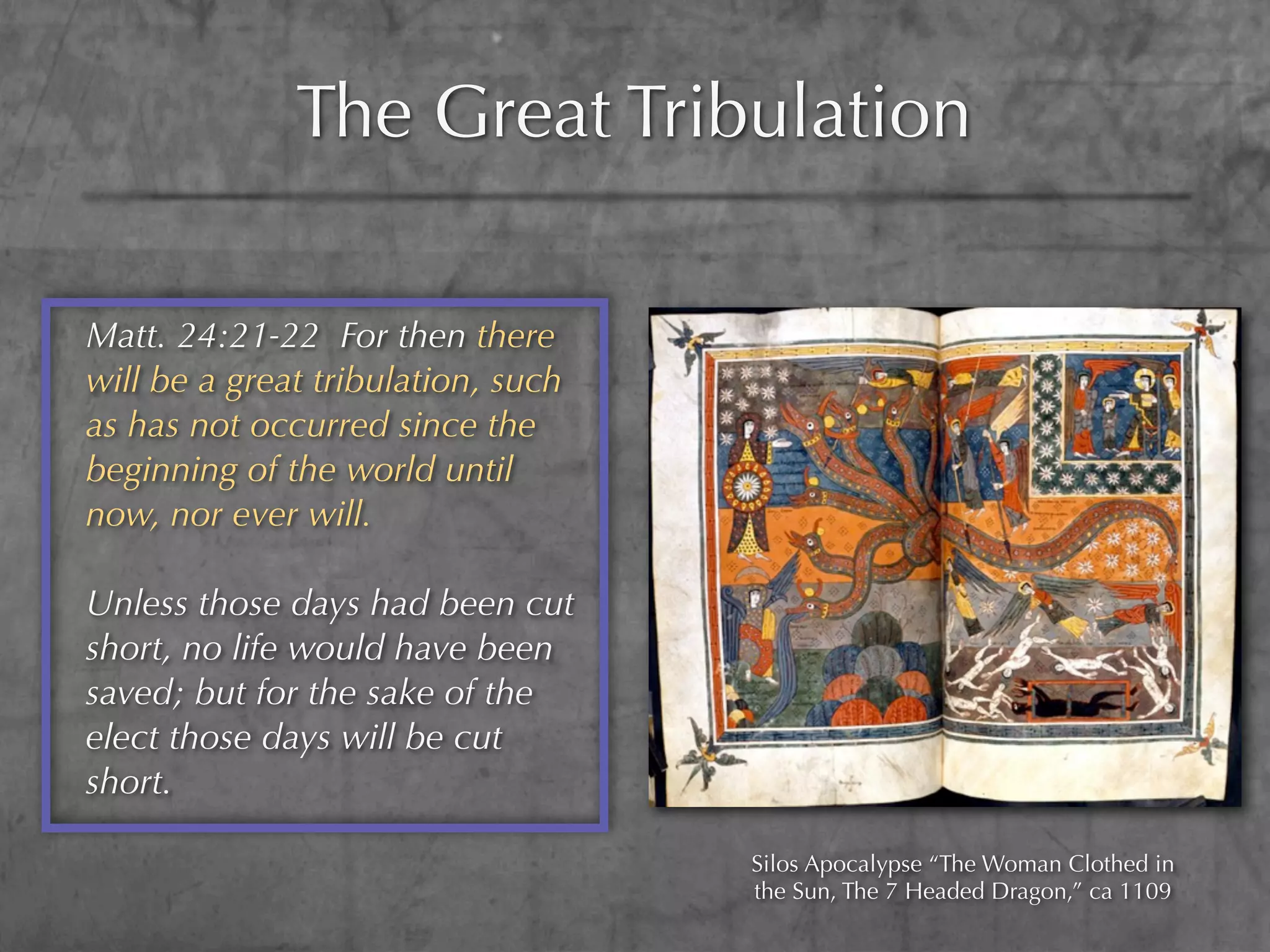
                            Mt. 24:22 “And unless those days had been cut
                             short, no life would have been saved; but for
                              the sake of the elect those days will be cut
                                                 short.”


The Battle of the Angels,
 Albrecht Durer, 1498
8:25 Parallels between
   Antiochus and Antichrist

Dan. 8:25 “And through his shrewdness
 He will cause deceit to succeed by his influence;
8:25 Parallels between
           Antiochus and Antichrist

        Dan. 8:25 “And through his shrewdness
         He will cause deceit to succeed by his influence;


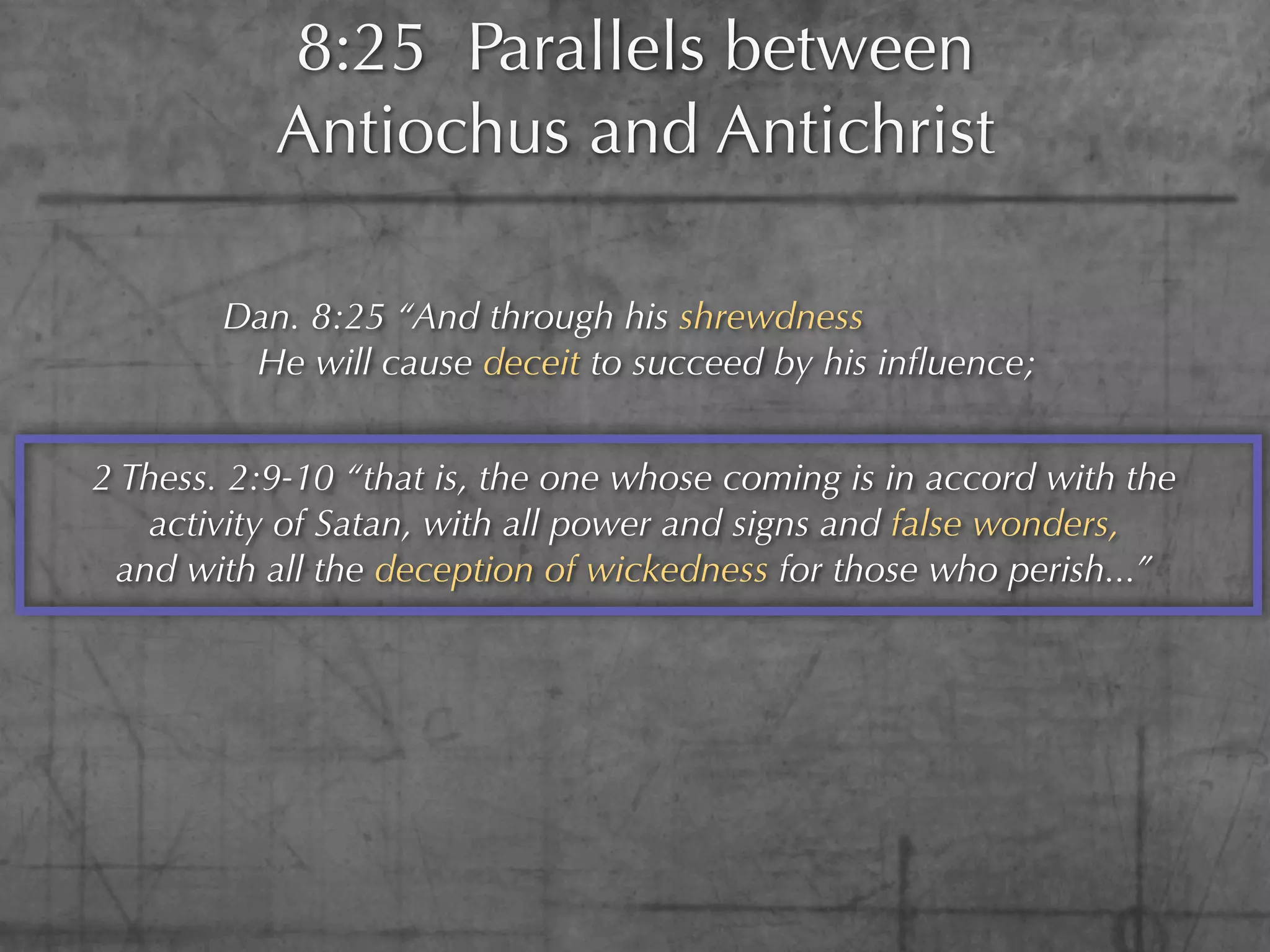
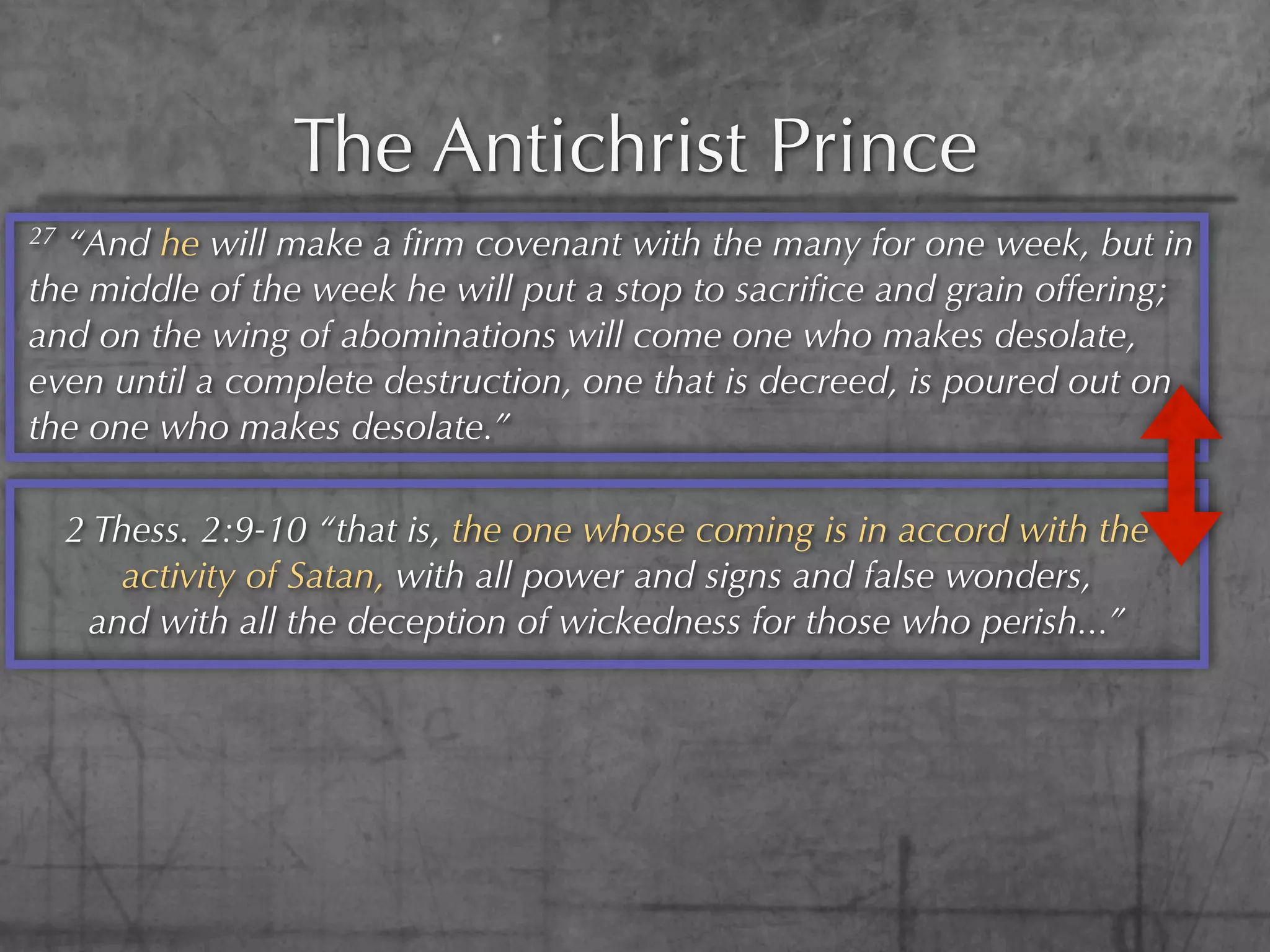
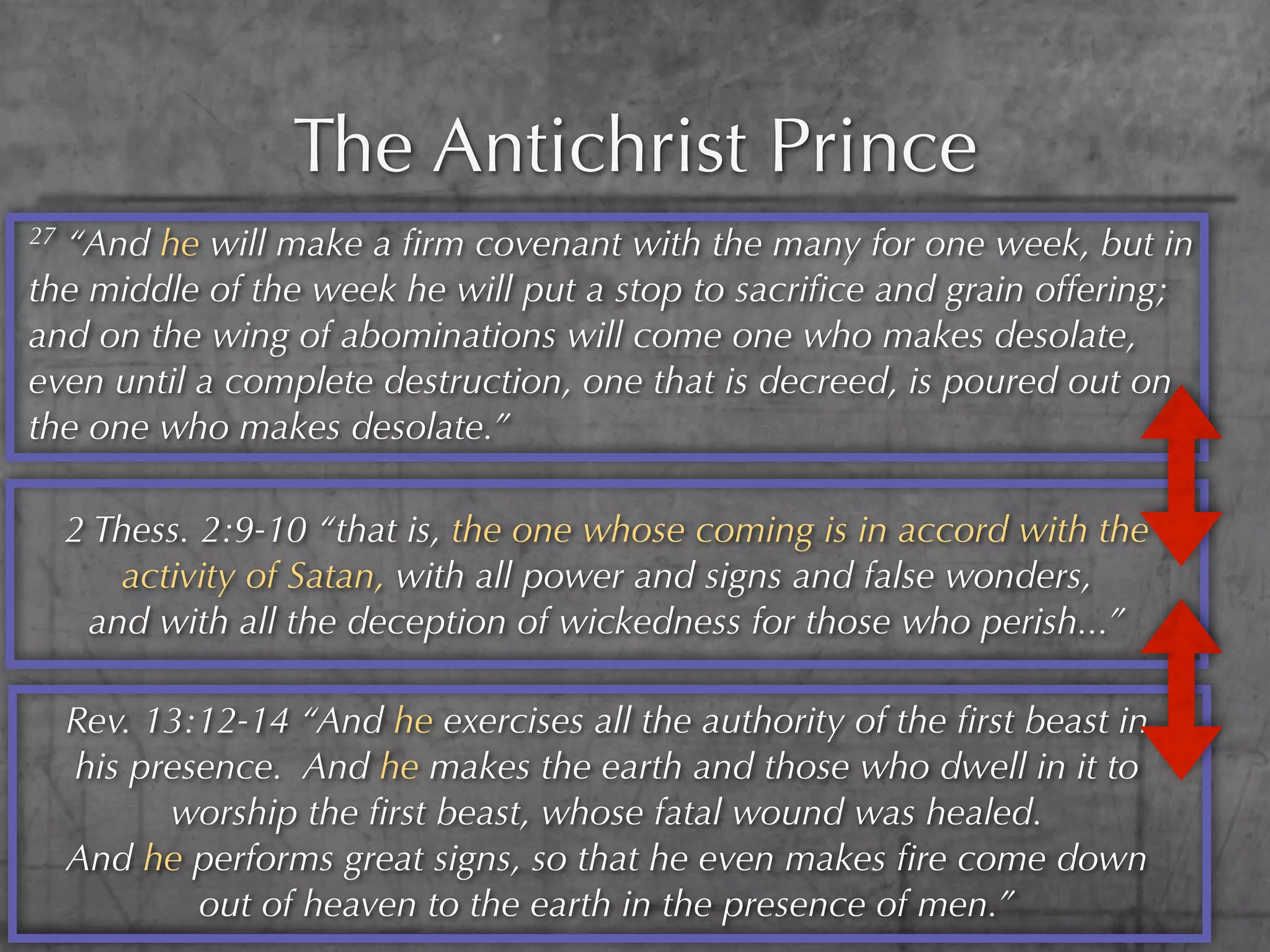
2 Thess. 2:9-10 “that is, the one whose coming is in accord with the
   activity of Satan, with all power and signs and false wonders,
 and with all the deception of wickedness for those who perish...”
8:25 Parallels between
           Antiochus and Antichrist

        Dan. 8:25 “And through his shrewdness
         He will cause deceit to succeed by his influence;


2 Thess. 2:9-10 “that is, the one whose coming is in accord with the
   activity of Satan, with all power and signs and false wonders,
 and with all the deception of wickedness for those who perish...”

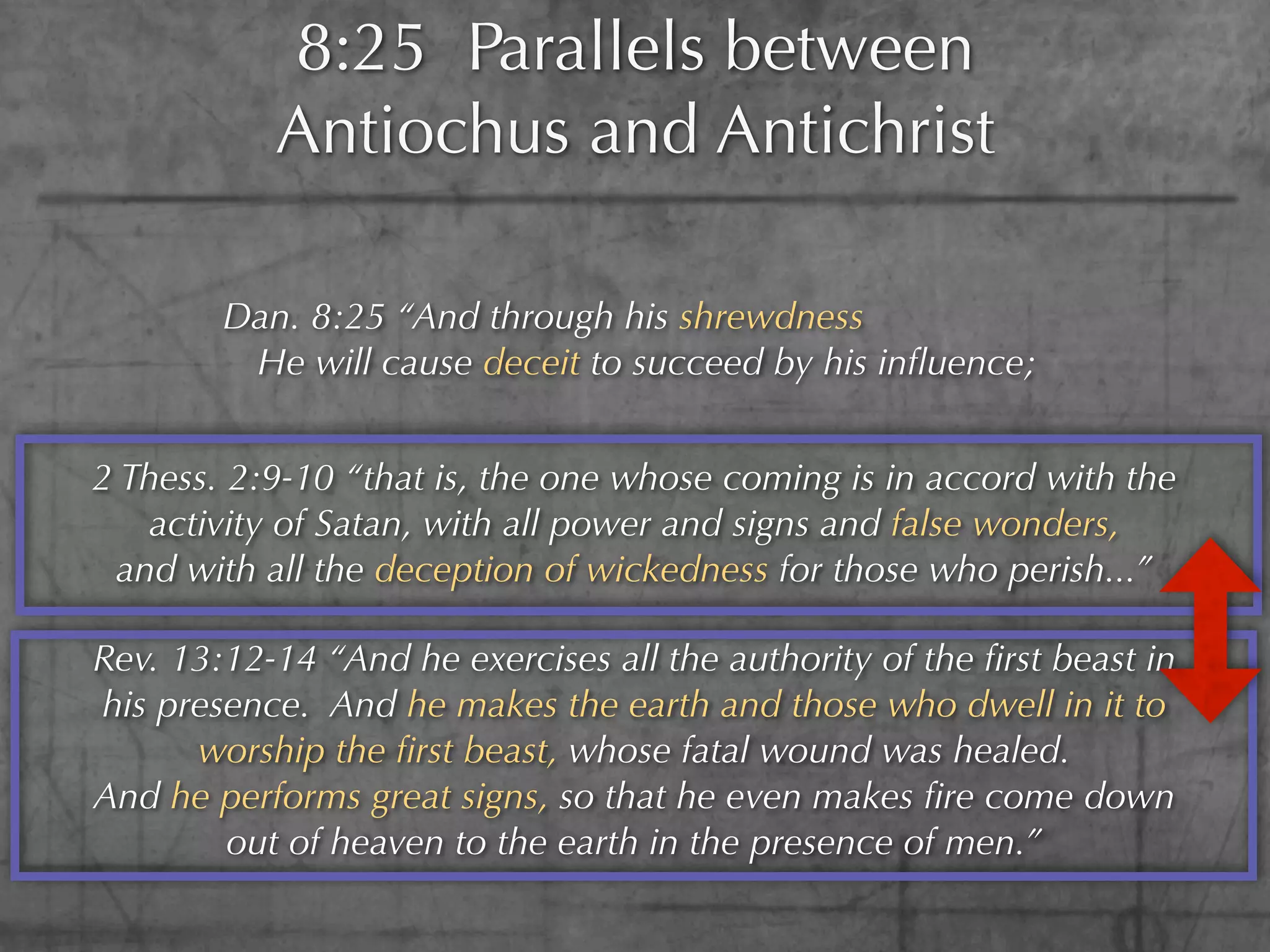
Rev. 13:12-14 “And he exercises all the authority of the first beast in
his presence. And he makes the earth and those who dwell in it to
      worship the first beast, whose fatal wound was healed.
And he performs great signs, so that he even makes fire come down
        out of heaven to the earth in the presence of men.”
8:25 Parallels between
        Antiochus and Antichrist
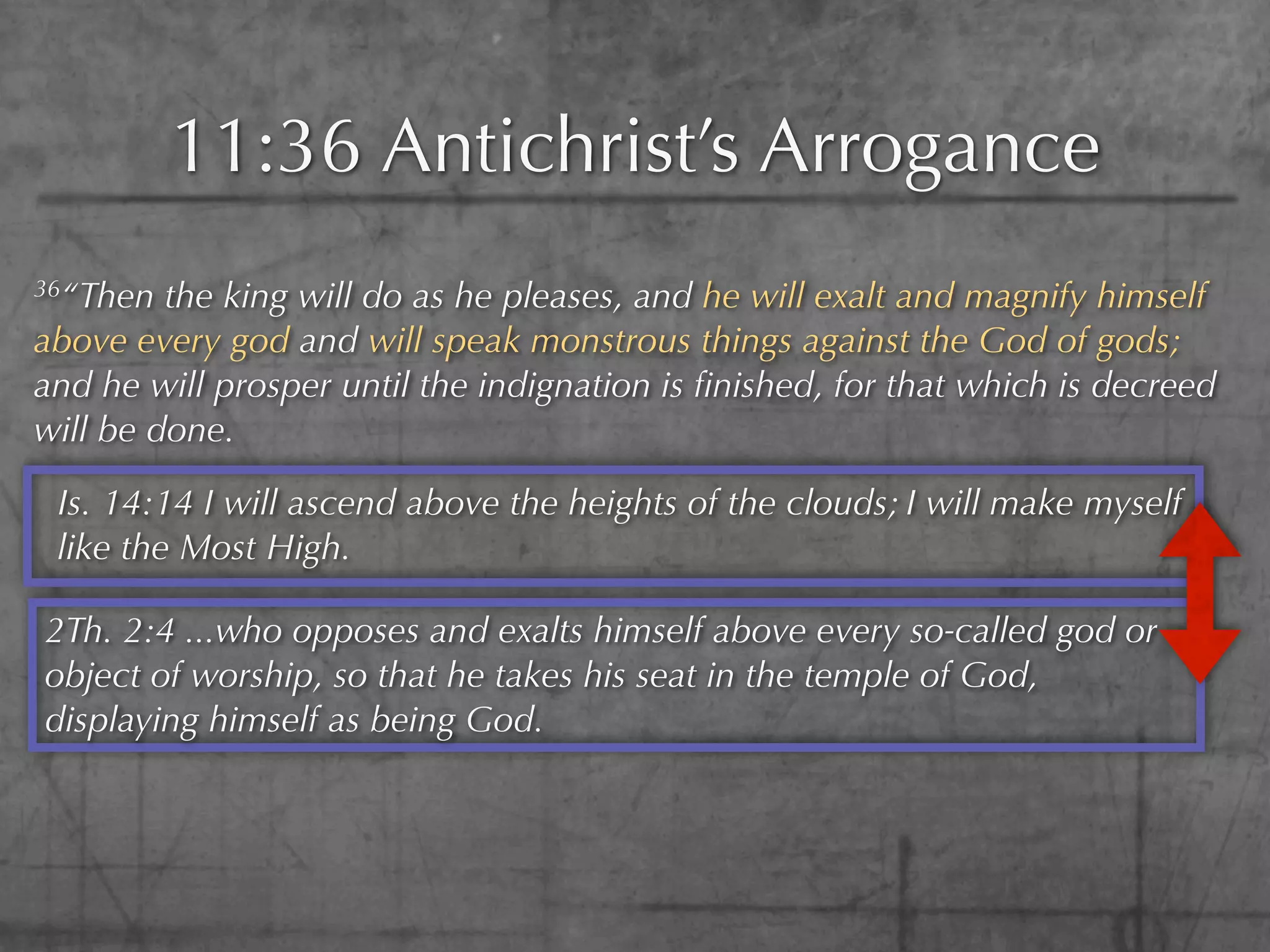
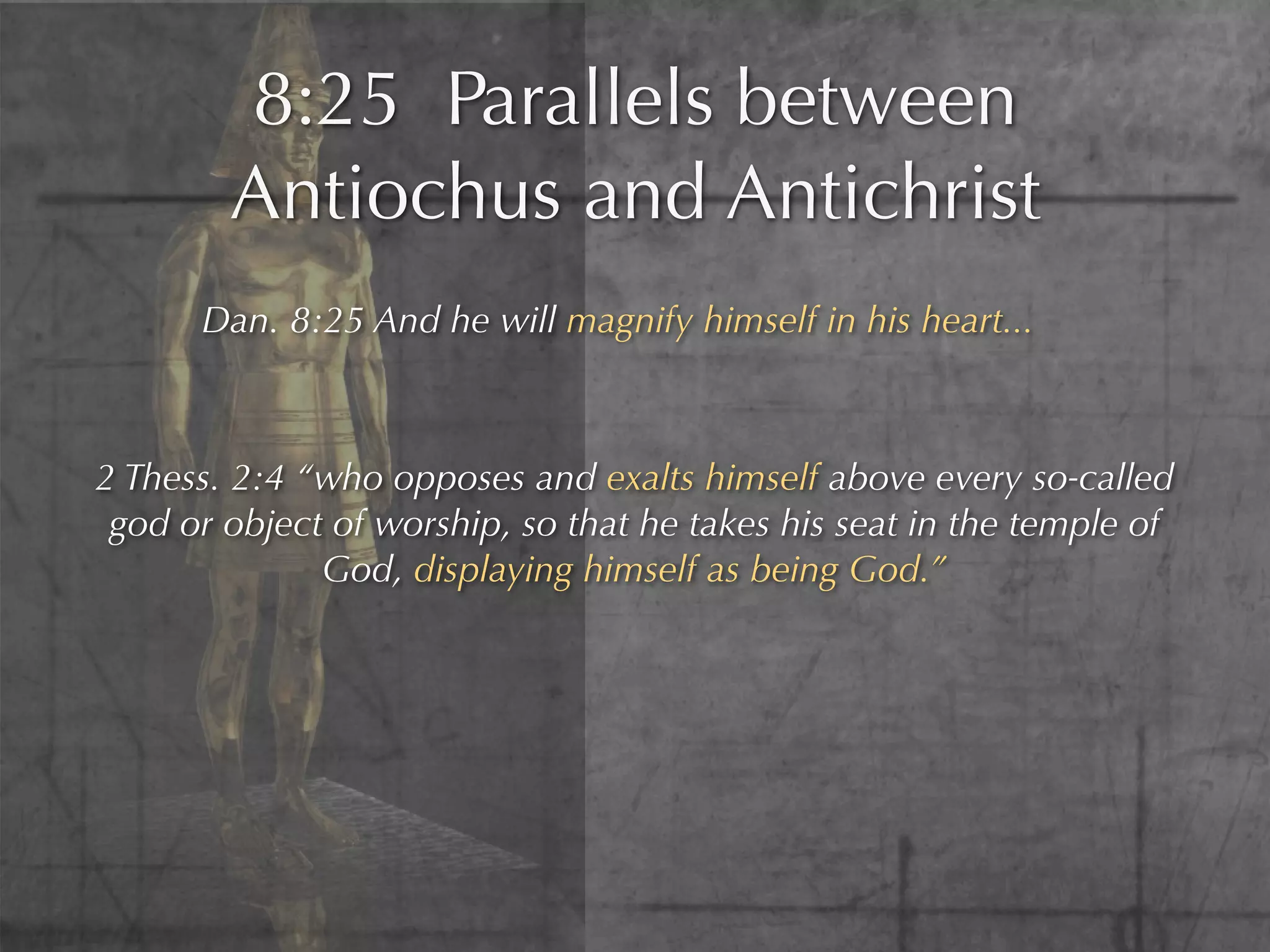
      Dan. 8:25 And he will magnify himself in his heart...


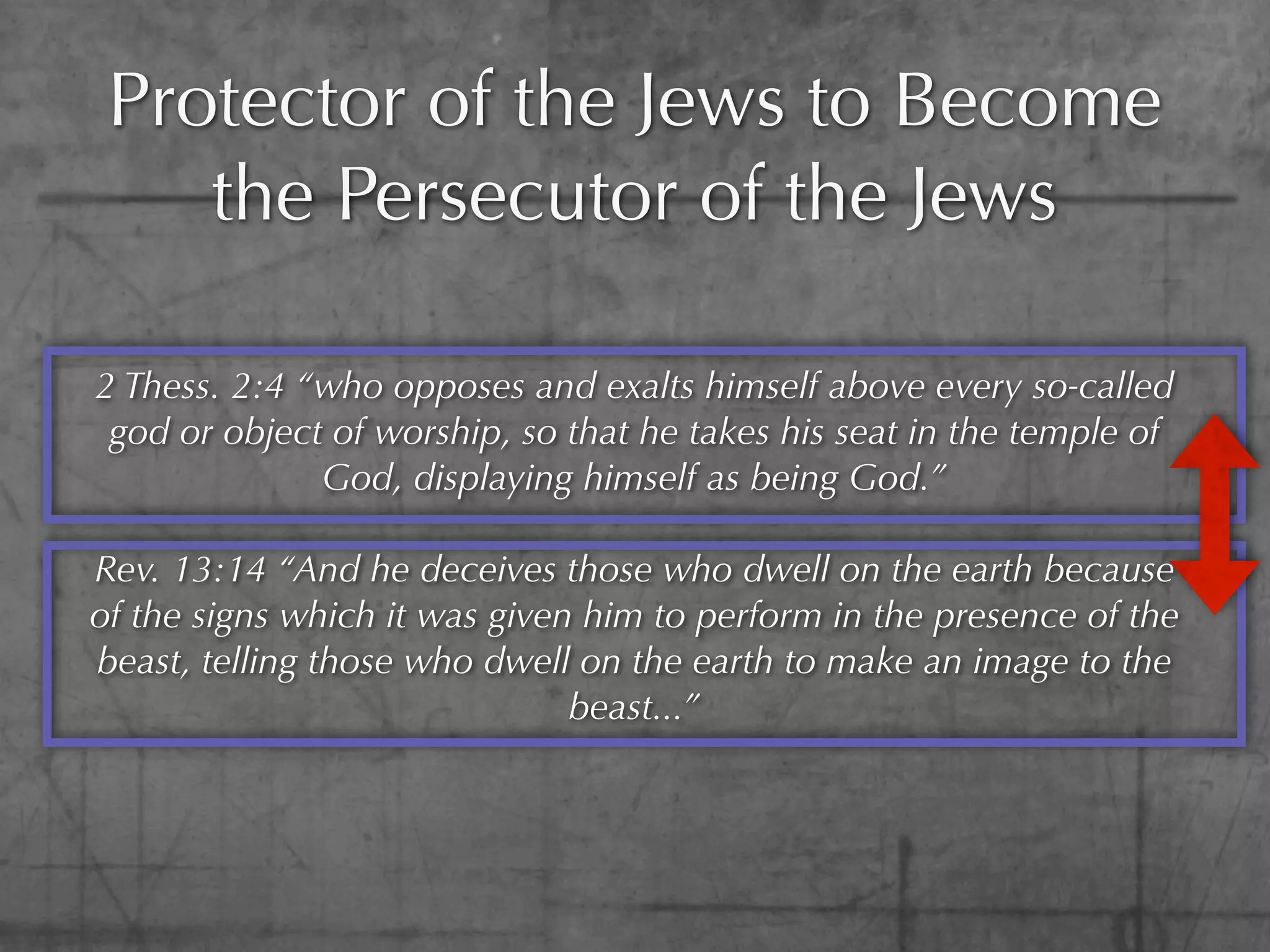
2 Thess. 2:4 “who opposes and exalts himself above every so-called
 god or object of worship, so that he takes his seat in the temple of
              God, displaying himself as being God.”
8:25 Parallels between
      Antiochus and Antichrist
Dan. 8:25 And he will destroy many while they are at ease....
8:25 Parallels between
        Antiochus and Antichrist
  Dan. 8:25 And he will destroy many while they are at ease....

1 Maccabees 1:29-30 “ Two years later the king sent to the cities of
Judah a chief collector of tribute, and he came to Jerusalem with a
large force.
Deceitfully he spoke peaceable words to them, and they believed
him; but he suddenly fell upon the city, dealt it a severe blow, and
destroyed many people of Israel..”
8:25 Parallels between
        Antiochus and Antichrist
  Dan. 8:25 And he will destroy many while they are at ease....

1 Maccabees 1:29-30 “ Two years later the king sent to the cities of
Judah a chief collector of tribute, and he came to Jerusalem with a
large force.
Deceitfully he spoke peaceable words to them, and they believed
him; but he suddenly fell upon the city, dealt it a severe blow, and
destroyed many people of Israel..”

     1 Thess. 5:3 “While they are saying, ‘Peace and safety!’ then
  destruction will come upon them suddenly like birth pangs upon a
            woman with child; and they shall not escape.”
8:25 Parallels between
          Antiochus and Antichrist


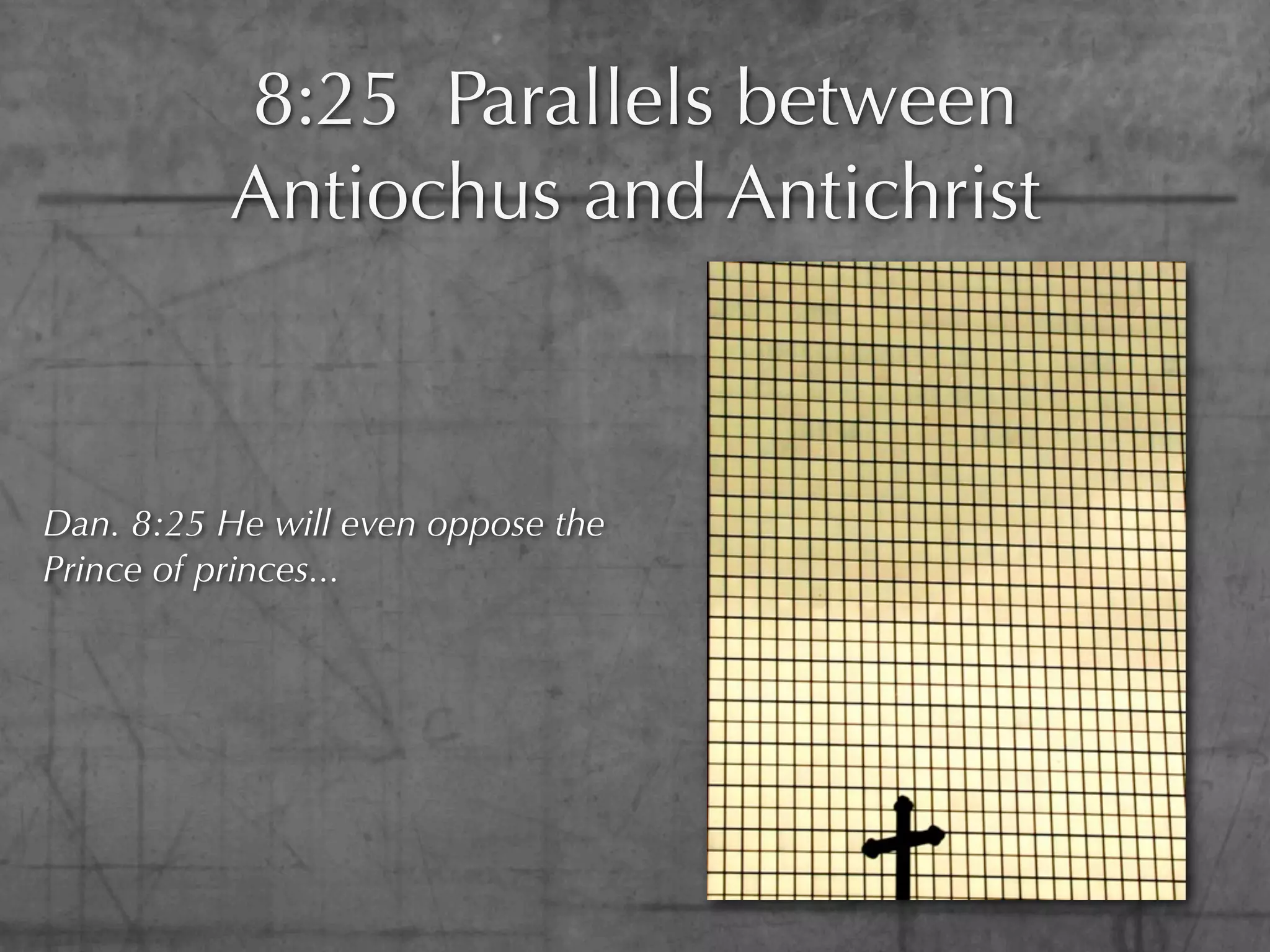
Dan. 8:25 He will even oppose the
Prince of princes...
8:25 Parallels between
  Antiochus and Antichrist
Dan. 8:25 But he will be broken without human agency.
8:25 Parallels between
       Antiochus and Antichrist
    Dan. 8:25 But he will be broken without human agency.


Rev. 19:20-21 “And the beast was seized, and with him the false
 prophet who performed the signs in his presence, by which he
deceived those who had received the mark of the beast and those
who worshipped his image; these two were thrown alive into the
            lake of fire which burns with brimstone.”
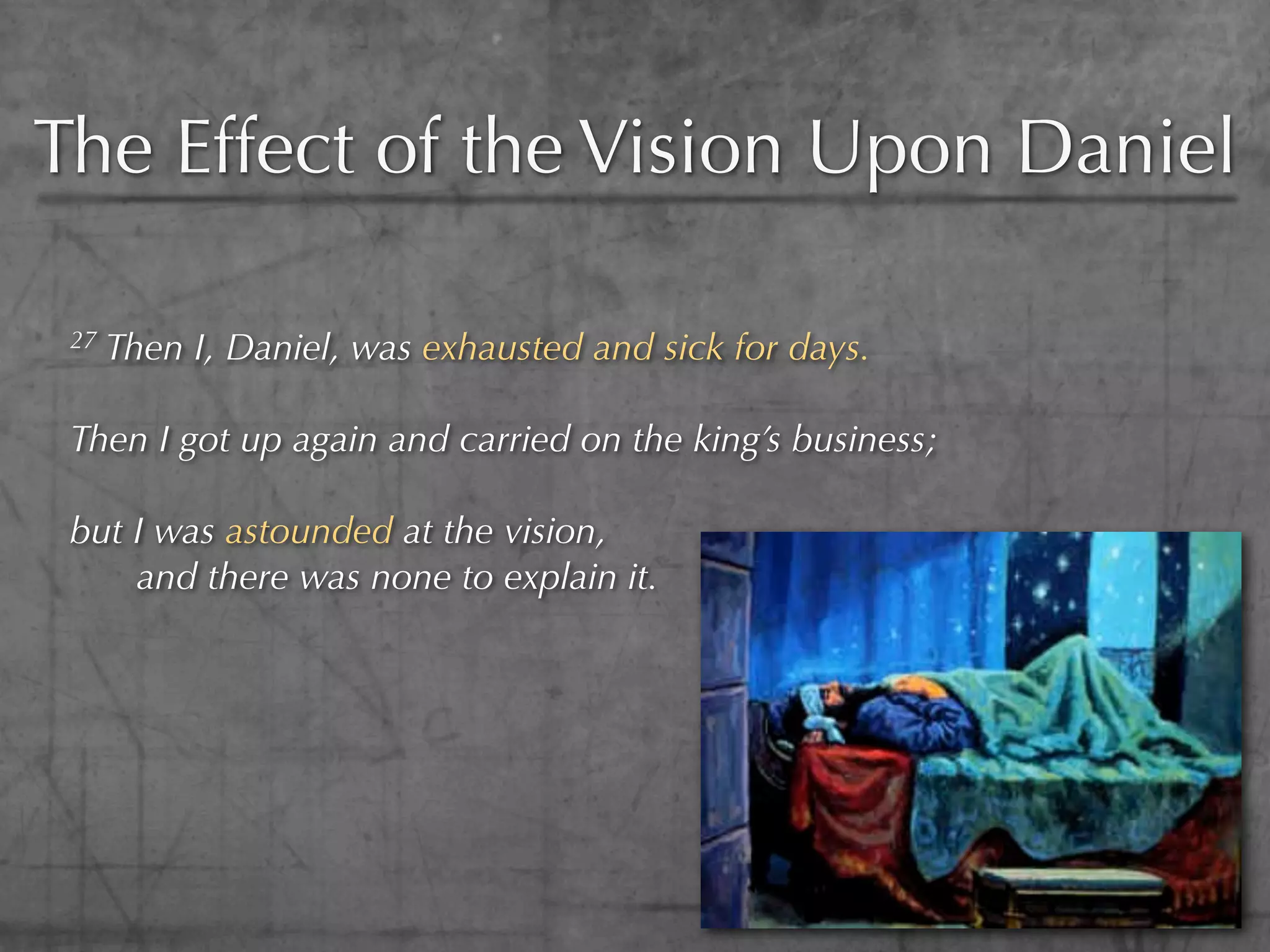
The Effect of the Vision Upon Daniel

 27   Then I, Daniel, was exhausted and sick for days.

 Then I got up again and carried on the king’s business;

 but I was astounded at the vision,
     and there was none to explain it.
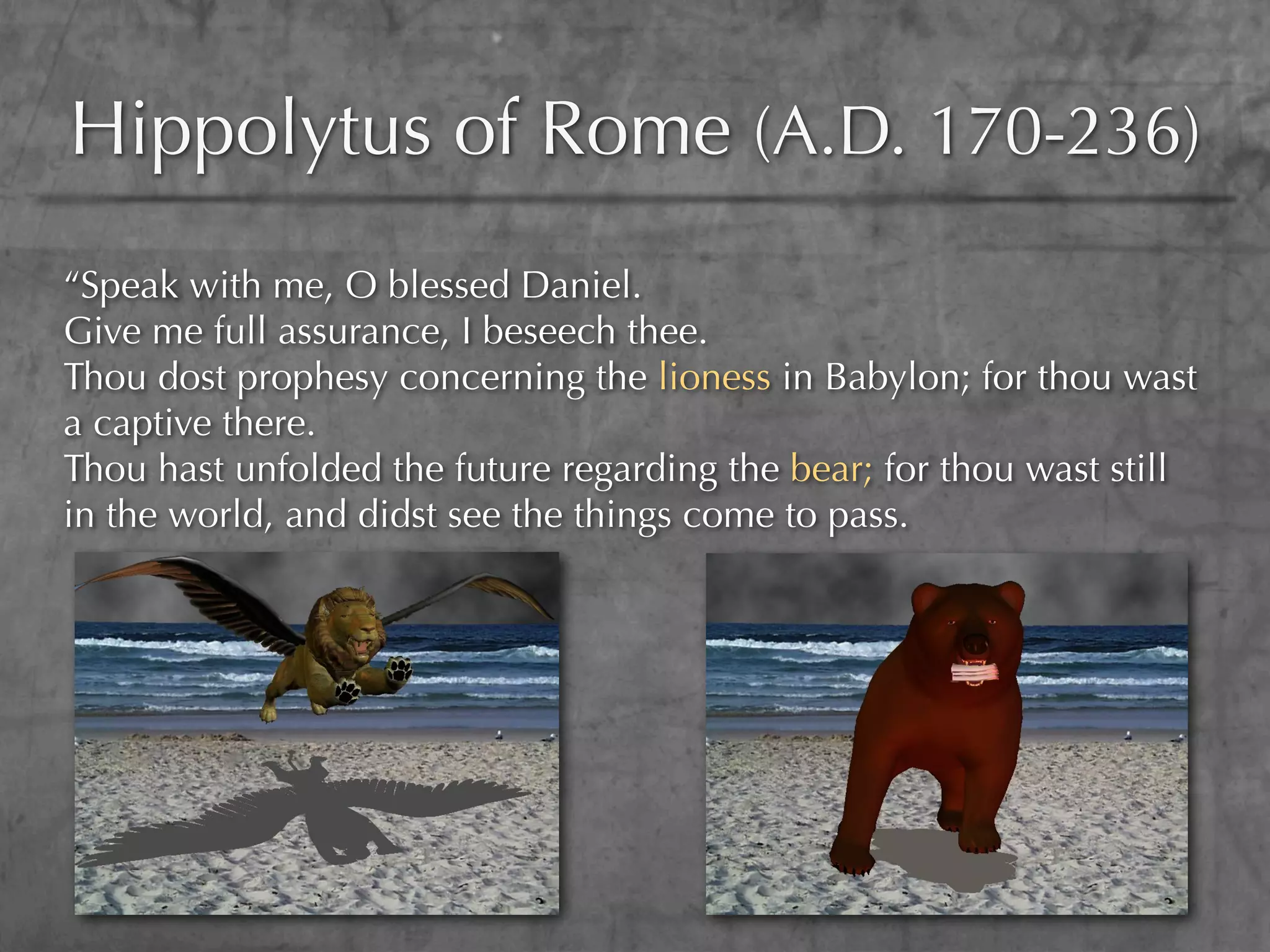
Hippolytus of Rome (A.D. 170-236)
“Speak with me, O blessed Daniel.
Give me full assurance, I beseech thee.
Thou dost prophesy concerning the lioness in Babylon; for thou wast
a captive there.
Thou hast unfolded the future regarding the bear; for thou wast still
in the world, and didst see the things come to pass.
Hippolytus of Rome (A.D. 170-236)
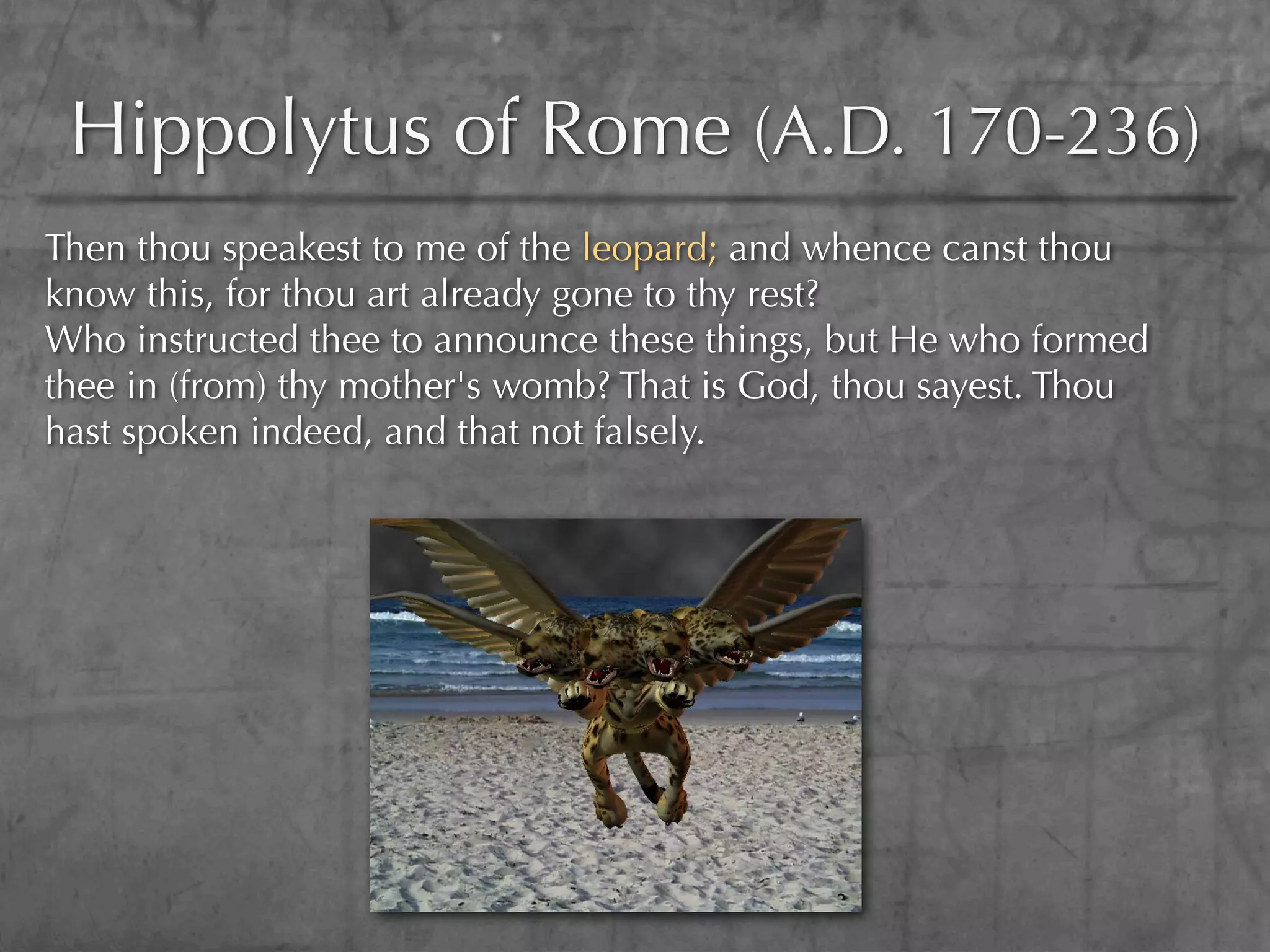
Then thou speakest to me of the leopard; and whence canst thou
know this, for thou art already gone to thy rest?
Who instructed thee to announce these things, but He who formed
thee in (from) thy mother's womb? That is God, thou sayest. Thou
hast spoken indeed, and that not falsely.
Hippolytus of Rome (A.D. 170-236)


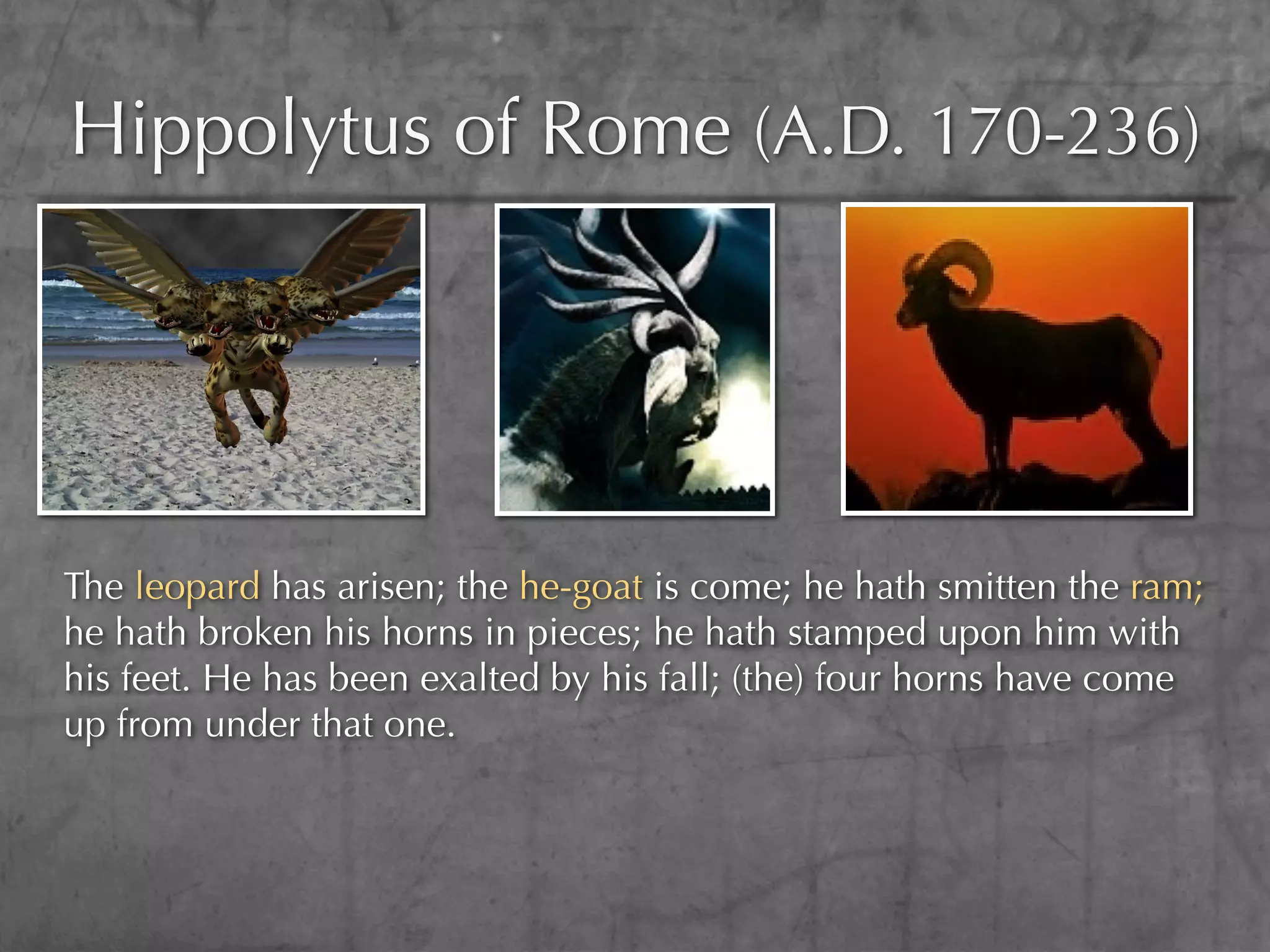
The leopard has arisen; the he-goat is come; he hath smitten the ram;
he hath broken his horns in pieces; he hath stamped upon him with
his feet. He has been exalted by his fall; (the) four horns have come
up from under that one.
Hippolytus of Rome (A.D. 170-236)


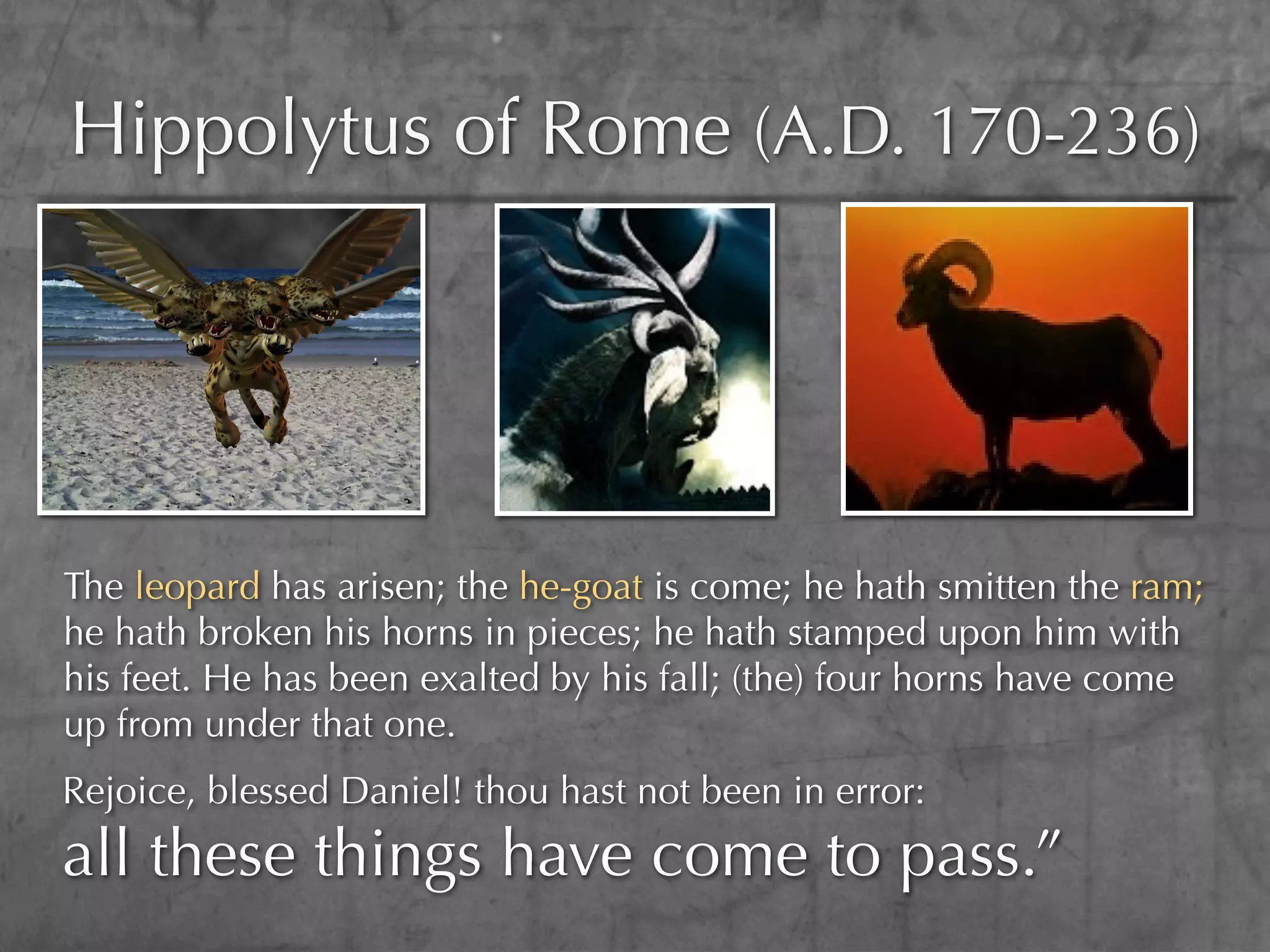
The leopard has arisen; the he-goat is come; he hath smitten the ram;
he hath broken his horns in pieces; he hath stamped upon him with
his feet. He has been exalted by his fall; (the) four horns have come
up from under that one.
Rejoice, blessed Daniel! thou hast not been in error:
all these things have come to pass.”
Ch. 8 Applications
Ch. 8 Applications
Depend upon God’s promises and sovereignty
Ch. 8 Applications
Depend upon God’s promises and sovereignty

Be aware of spiritual warfare
Ch. 8 Applications
Depend upon God’s promises and sovereignty

Be aware of spiritual warfare

Supernatural credentials are not proof of divine
backing
Ch. 8 Applications
Depend upon God’s promises and sovereignty

Be aware of spiritual warfare

Supernatural credentials are not proof of divine
backing

The “time of the end” may be very near
Ch. 8 Applications
Depend upon God’s promises and sovereignty

Be aware of spiritual warfare

Supernatural credentials are not proof of divine
backing

The “time of the end” may be very near

All biblical truth is intended to lead us into maturity
Chapter 9
The Vision of the Seventy Weeks


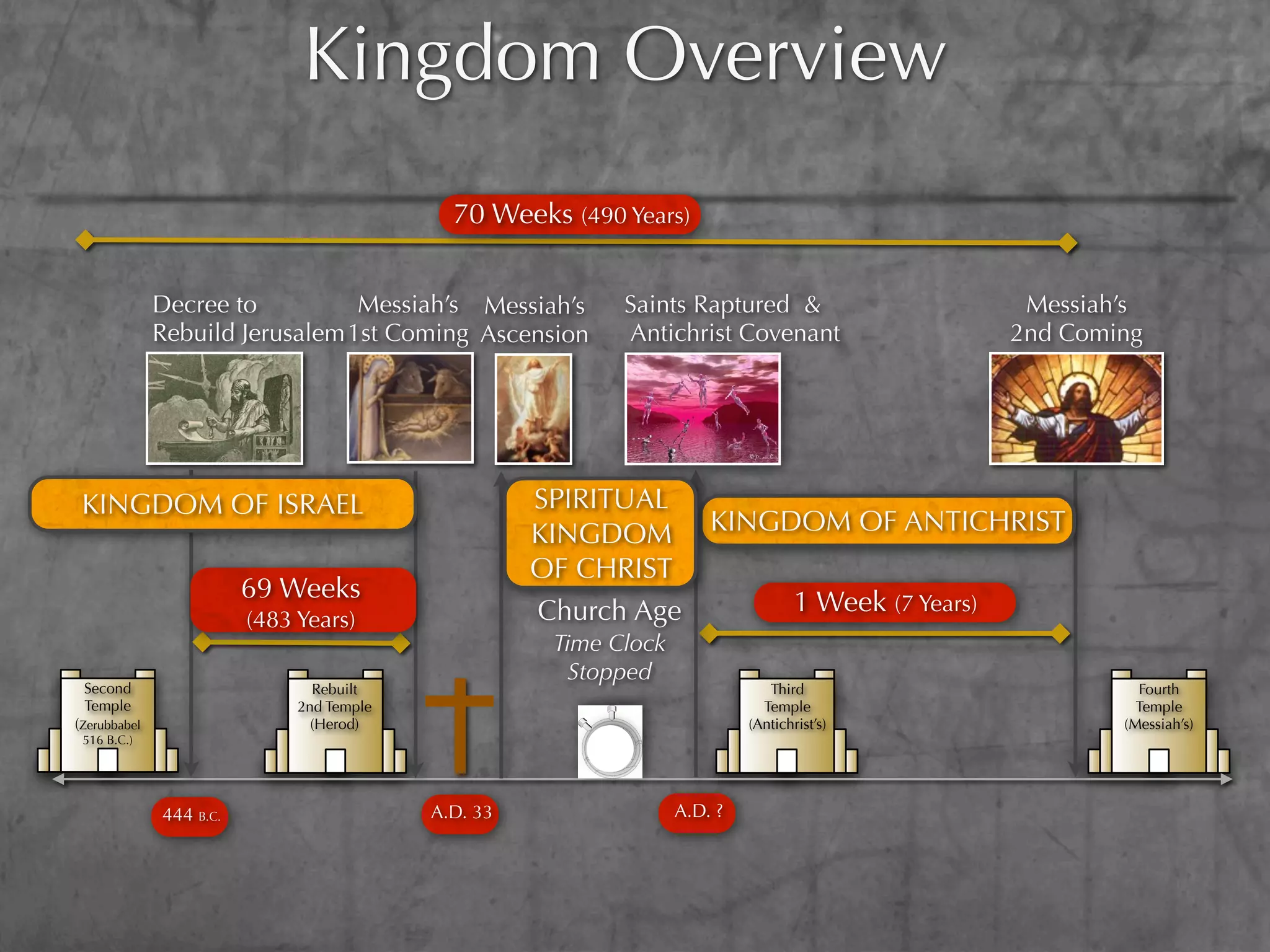
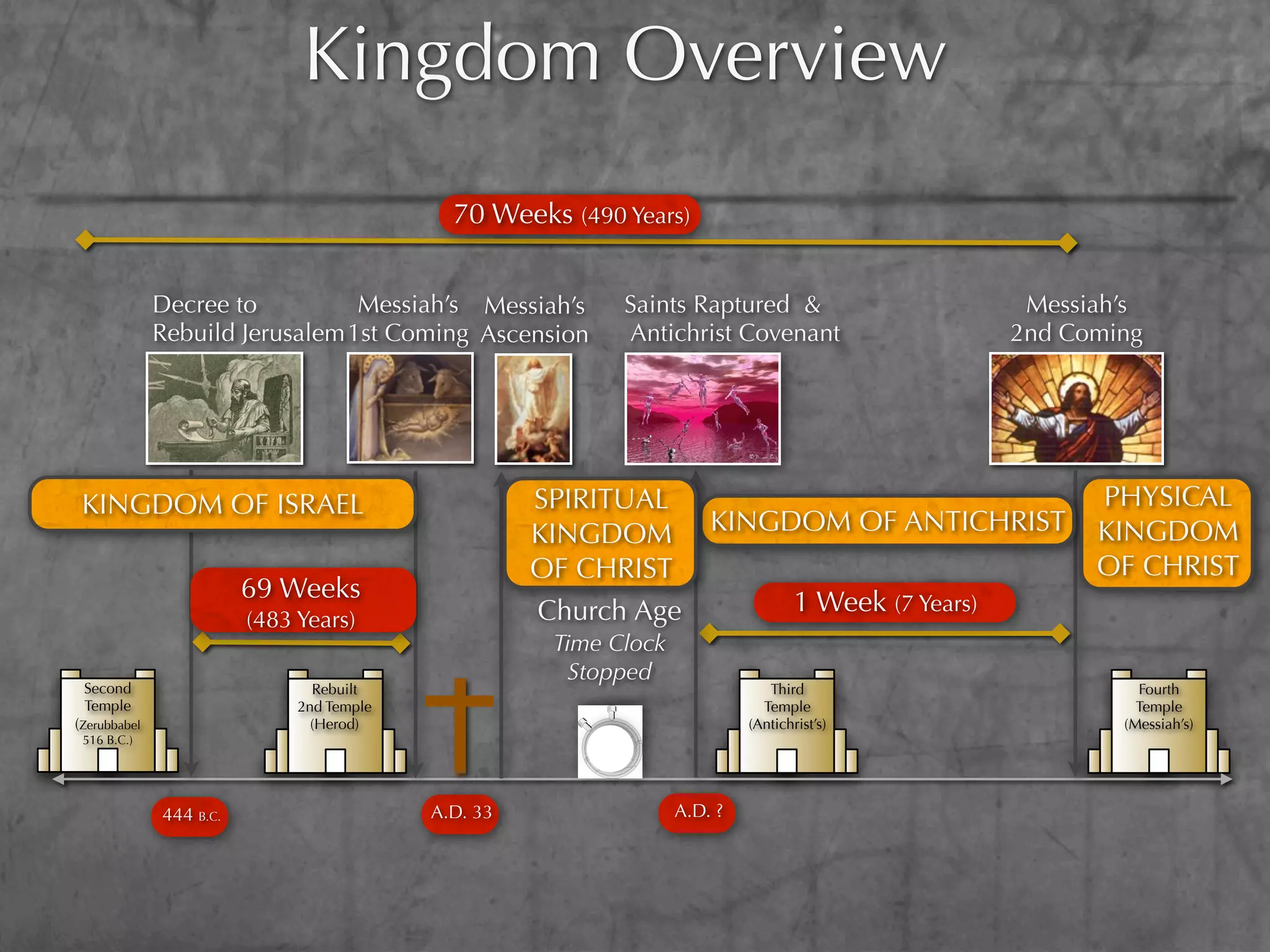
 The Chronology of Israel’s Prophetic Program
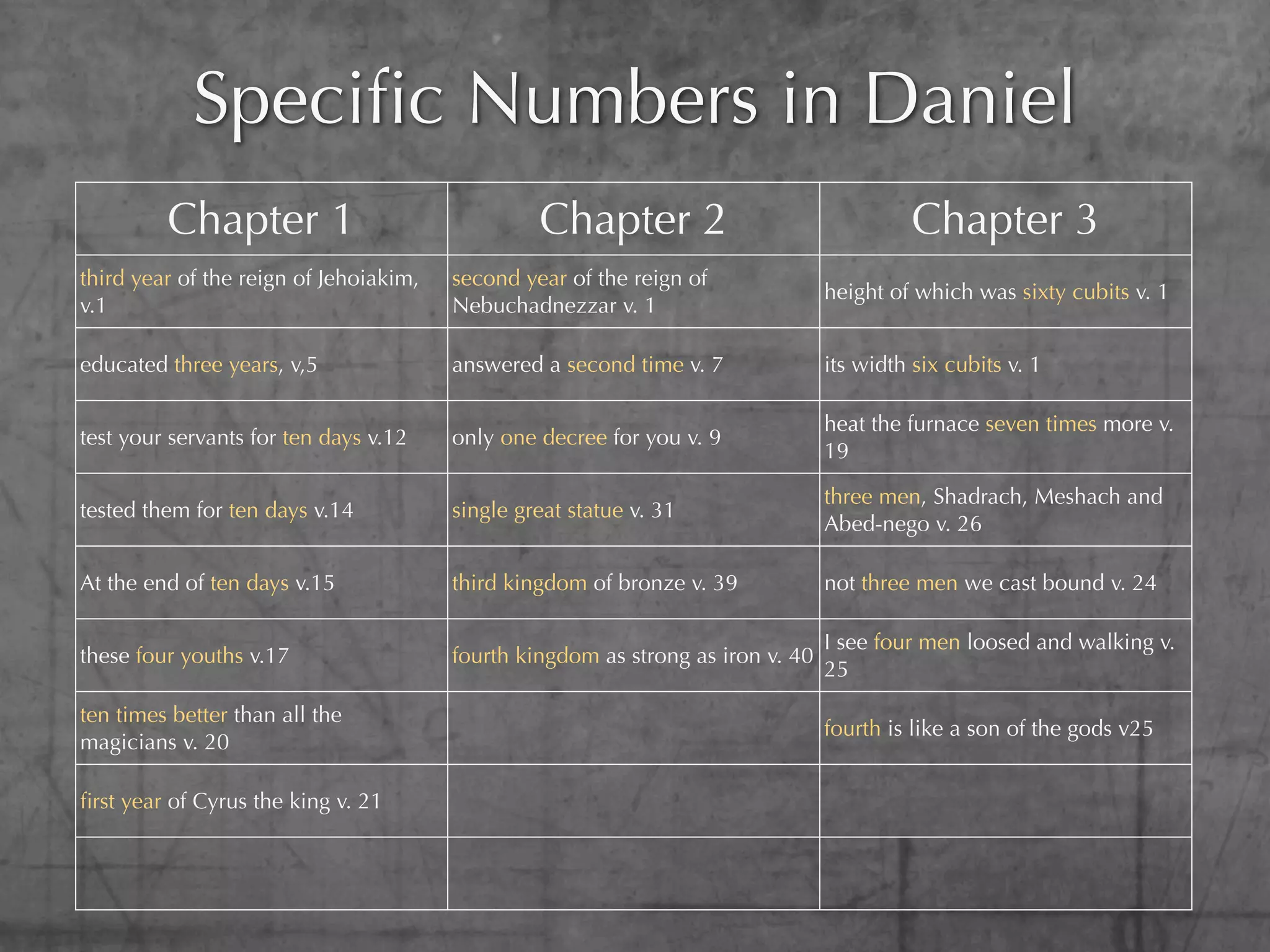
Specific Numbers in Daniel
         Chapter 1                               Chapter 2                                 Chapter 3
third year of the reign of Jehoiakim,   second year of the reign of
                                                                                 height of which was sixty cubits v. 1
v.1                                     Nebuchadnezzar v. 1

educated three years, v,5               answered a second time v. 7              its width six cubits v. 1

                                                                                 heat the furnace seven times more v.
test your servants for ten days v.12    only one decree for you v. 9
                                                                                 19

                                                                                 three men, Shadrach, Meshach and
tested them for ten days v.14           single great statue v. 31
                                                                                 Abed-nego v. 26

At the end of ten days v.15             third kingdom of bronze v. 39            not three men we cast bound v. 24

                                                                                 I see four men loosed and walking v.
these four youths v.17                  fourth kingdom as strong as iron v. 40
                                                                                 25

ten times better than all the
                                                                                 fourth is like a son of the gods v25
magicians v. 20

first year of Cyrus the king v. 21
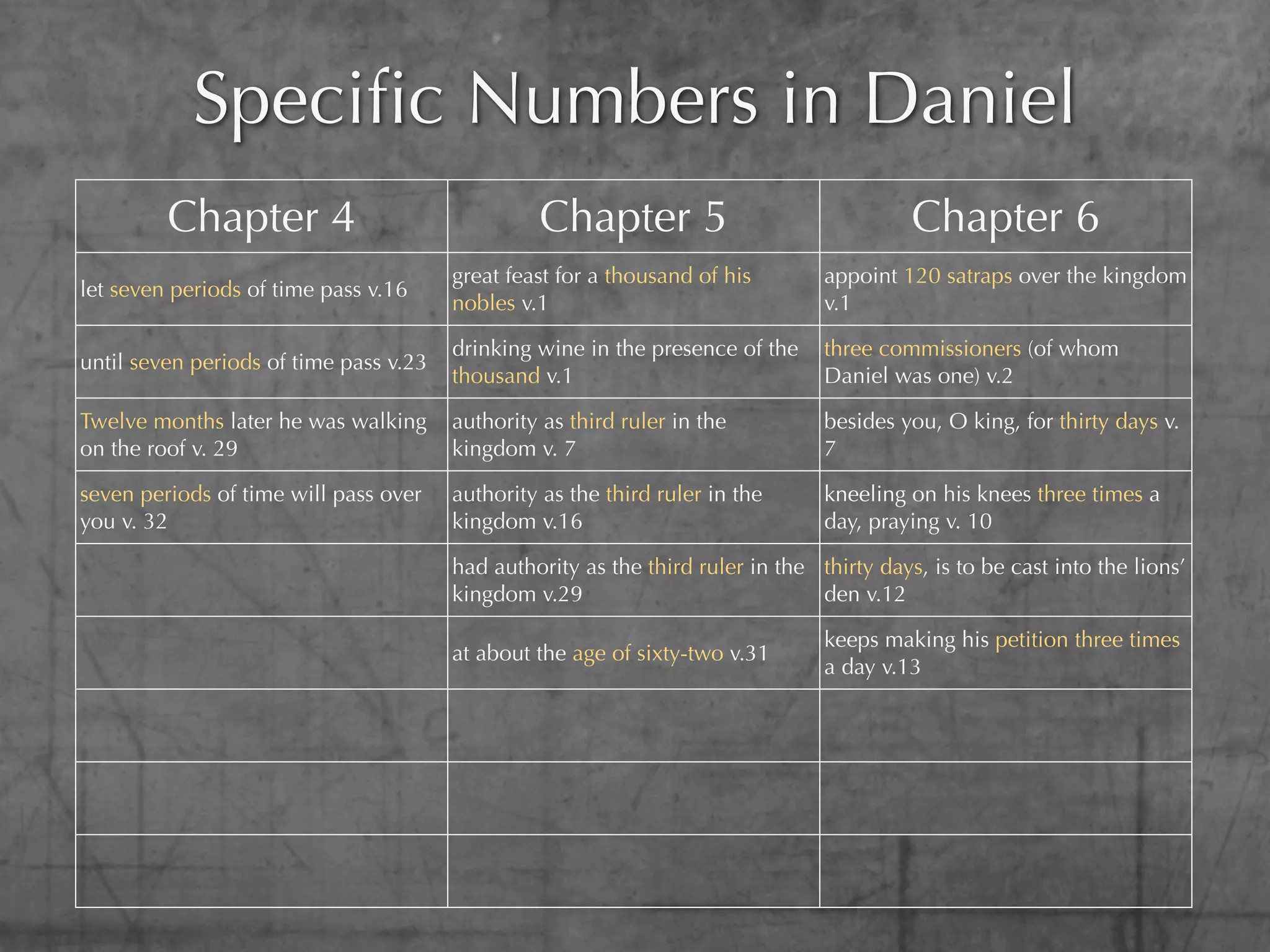
Specific Numbers in Daniel
         Chapter 4                               Chapter 5                                 Chapter 6
                                        great feast for a thousand of his        appoint 120 satraps over the kingdom
let seven periods of time pass v.16
                                        nobles v.1                               v.1

                                        drinking wine in the presence of the     three commissioners (of whom
until seven periods of time pass v.23
                                        thousand v.1                             Daniel was one) v.2

Twelve months later he was walking      authority as third ruler in the          besides you, O king, for thirty days v.
on the roof v. 29                       kingdom v. 7                             7

seven periods of time will pass over    authority as the third ruler in the      kneeling on his knees three times a
you v. 32                               kingdom v.16                             day, praying v. 10

                                        had authority as the third ruler in the thirty days, is to be cast into the lions’
                                        kingdom v.29                            den v.12

                                                                                 keeps making his petition three times
                                        at about the age of sixty-two v.31
                                                                                 a day v.13
Specific Numbers in Daniel
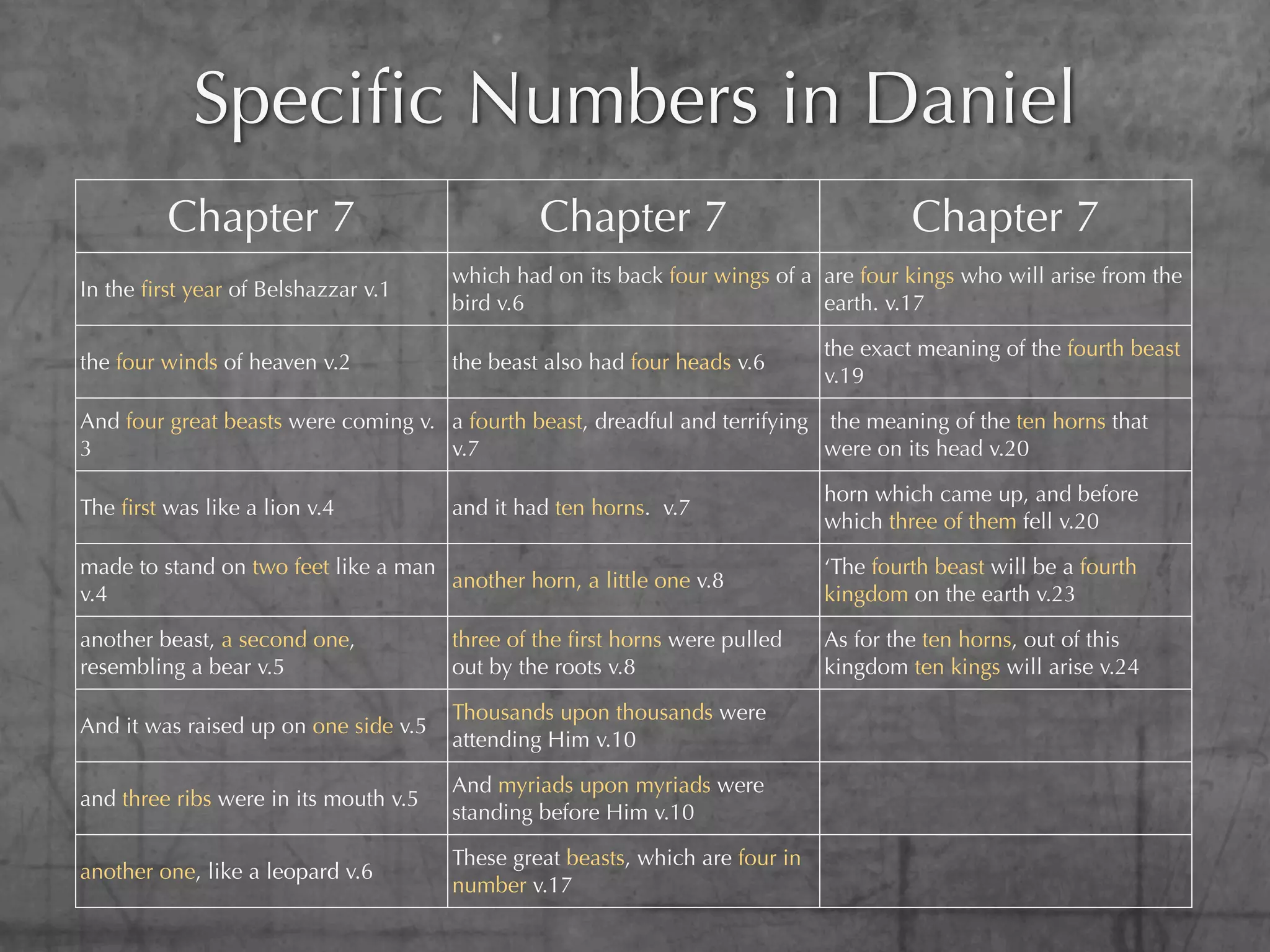
         Chapter 7                              Chapter 7                               Chapter 7
                                       which had on its back four wings of a are four kings who will arise from the
In the first year of Belshazzar v.1
                                       bird v.6                              earth. v.17

                                                                               the exact meaning of the fourth beast
the four winds of heaven v.2           the beast also had four heads v.6
                                                                               v.19

And four great beasts were coming v. a fourth beast, dreadful and terrifying the meaning of the ten horns that
3                                    v.7                                     were on its head v.20

                                                                               horn which came up, and before
The first was like a lion v.4           and it had ten horns. v.7
                                                                               which three of them fell v.20

made to stand on two feet like a man                                           ‘The fourth beast will be a fourth
                                     another horn, a little one v.8
v.4                                                                            kingdom on the earth v.23

another beast, a second one,           three of the first horns were pulled     As for the ten horns, out of this
resembling a bear v.5                  out by the roots v.8                    kingdom ten kings will arise v.24

                                       Thousands upon thousands were
And it was raised up on one side v.5
                                       attending Him v.10

                                       And myriads upon myriads were
and three ribs were in its mouth v.5
                                       standing before Him v.10

                                       These great beasts, which are four in
another one, like a leopard v.6
                                       number v.17
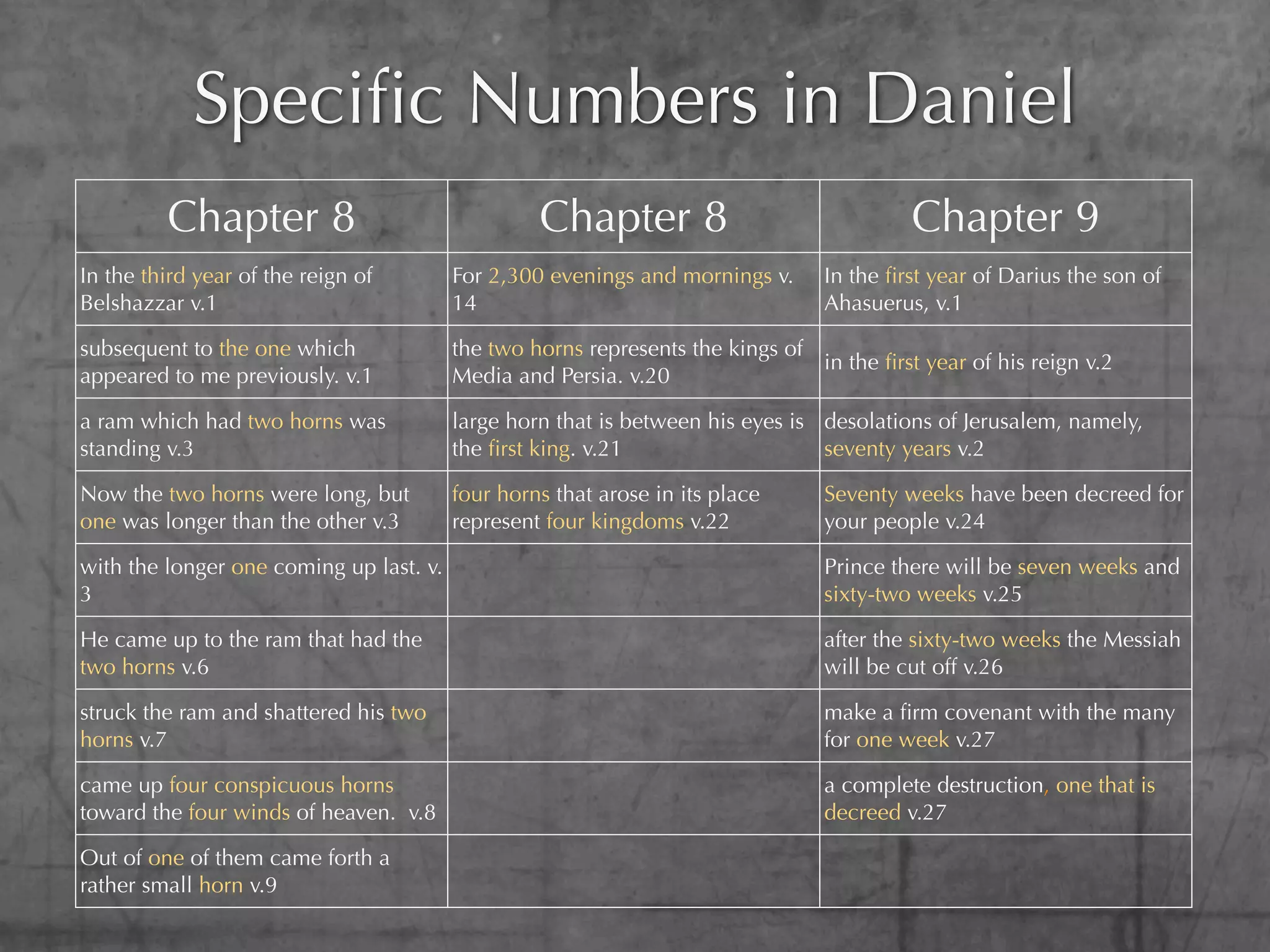
Specific Numbers in Daniel
         Chapter 8                                Chapter 8                               Chapter 9
In the third year of the reign of        For 2,300 evenings and mornings v.     In the first year of Darius the son of
Belshazzar v.1                           14                                     Ahasuerus, v.1

subsequent to the one which              the two horns represents the kings of
                                                                               in the first year of his reign v.2
appeared to me previously. v.1           Media and Persia. v.20

a ram which had two horns was            large horn that is between his eyes is desolations of Jerusalem, namely,
standing v.3                             the first king. v.21                    seventy years v.2

Now the two horns were long, but         four horns that arose in its place     Seventy weeks have been decreed for
one was longer than the other v.3        represent four kingdoms v.22           your people v.24

with the longer one coming up last. v.                                          Prince there will be seven weeks and
3                                                                               sixty-two weeks v.25

He came up to the ram that had the                                              after the sixty-two weeks the Messiah
two horns v.6                                                                   will be cut off v.26

struck the ram and shattered his two                                            make a firm covenant with the many
horns v.7                                                                       for one week v.27

came up four conspicuous horns                                                  a complete destruction, one that is
toward the four winds of heaven. v.8                                            decreed v.27

Out of one of them came forth a
rather small horn v.9
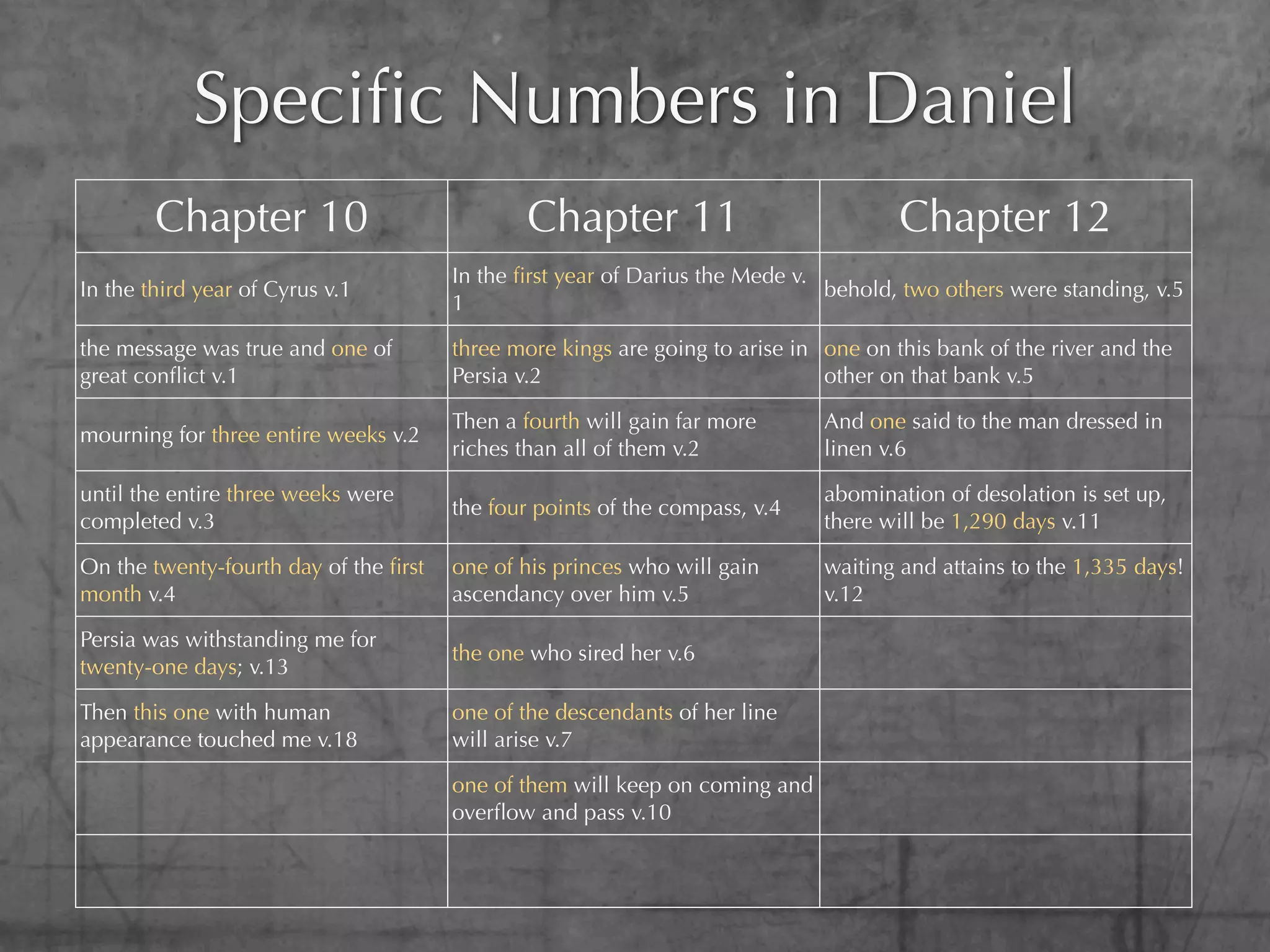
Specific Numbers in Daniel
        Chapter 10                            Chapter 11                              Chapter 12
                                       In the first year of Darius the Mede v.
In the third year of Cyrus v.1                                                behold, two others were standing, v.5
                                       1

the message was true and one of        three more kings are going to arise in one on this bank of the river and the
great conflict v.1                      Persia v.2                             other on that bank v.5

                                       Then a fourth will gain far more       And one said to the man dressed in
mourning for three entire weeks v.2
                                       riches than all of them v.2            linen v.6

until the entire three weeks were                                             abomination of desolation is set up,
                                       the four points of the compass, v.4
completed v.3                                                                 there will be 1,290 days v.11

On the twenty-fourth day of the first   one of his princes who will gain       waiting and attains to the 1,335 days!
month v.4                              ascendancy over him v.5                v.12

Persia was withstanding me for
                                       the one who sired her v.6
twenty-one days; v.13

Then this one with human               one of the descendants of her line
appearance touched me v.18             will arise v.7

                                       one of them will keep on coming and
                                       overflow and pass v.10
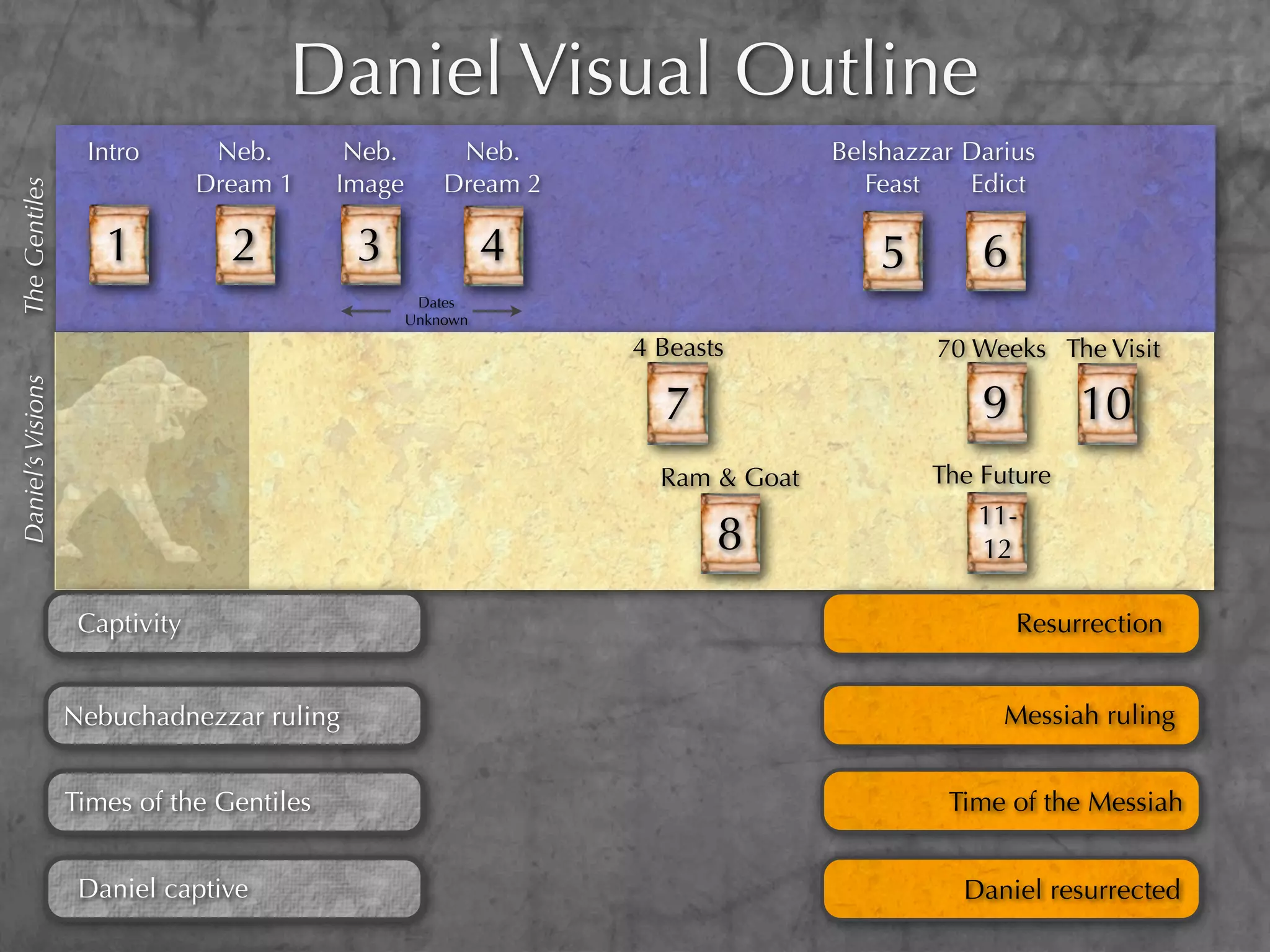
Daniel Visual Outline
                      Intro    Neb.          Neb.        Neb.                                    Belshazzar Darius
                              Dream 1       Image       Dream 2                                     Feast   Edict
The Gentiles


                        1        2             3              4                                         5      6
                                                     Dates
                                                    Unknown

                                                                                  4 Beasts                  70 Weeks
Daniel’s Visions


                                                                                    7                          9
                                                                                    Ram & Goat

                                                                                         8
              The Prophet Jeremiah
                              The Prophet Ezekiel
              The Prophet Daniel

                                 Nebuchadnezzar                                     Nabonidus/Belshazzar       Darius/Cyrus
                   605 B.C.             585 B.C.                       565 B.C.                  545 B.C.              525 B.C.

                                                                            h
                                                                         dac lissar d
                                                                      ero erig      o
                                                                  l-M           rch
                                                              Evi         N roa
                                                                            o
                                                                         Lab
How to Destroy the Jews


 Arnold Fruchtenbaum’s Message
Jeremiah 31:35-37
35   “Thus says the LORD,
       Who gives the sun for light by day;
       And the fixed order of the moon and the stars by night,
       Who stirs up the sea so that its waves roar;
       The LORD of hosts is His name;
Jeremiah 31:35-37
35   “Thus says the LORD,
       Who gives the sun for light by day;
       And the fixed order of the moon and the stars by night,
       Who stirs up the sea so that its waves roar;
       The LORD of hosts is His name;
      36“If this fixed order departs
      From before Me,” declares the LORD,
      Then the offspring of Israel also shall cease
      From being a nation before Me forever”
Jeremiah 31:35-37
35   “Thus says the LORD,
       Who gives the sun for light by day;
       And the fixed order of the moon and the stars by night,
       Who stirs up the sea so that its waves roar;
       The LORD of hosts is His name;
       36“If this fixed order departs
       From before Me,” declares the LORD,
       Then the offspring of Israel also shall cease
       From being a nation before Me forever”
 37   Thus says the LORD,
        “If the heavens above can be measured,
        and the foundations of the earth searched out below,
        Then I will also cast off all the offspring of Israel
        For all that they have done,”
        declares the LORD.”
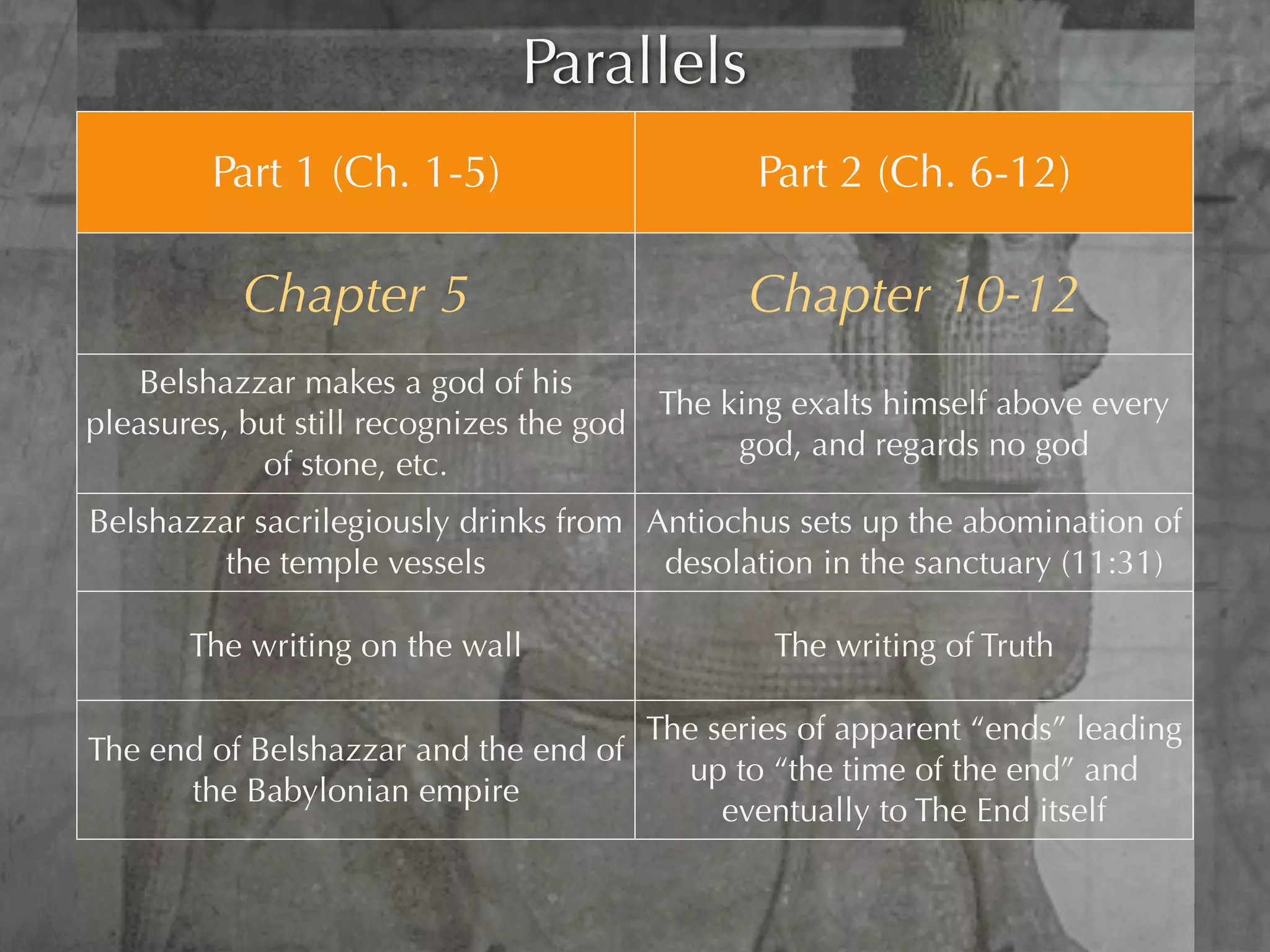
Parallels


Common Theme: God’s Discipline and Human Pride
Parallels
      Part 1 (Ch. 1-5)                       Part 2 (Ch. 6-12)

         Chapter 4                              Chapter 9
                                      The desolations of Jerusalem due to
      The glory of Babylon
                                                  Israel’s sins
Nebuchadnezar is warned that he
                                      They were warned by their prophets
      deserves discipline

                                        Their persistence in sin brings on
He persists in pride, is chastised,
                                      further desolations lasting to the end
    which lasts for 7 times
                                                 of 70 X 7 years


       He is then restored                 Jerusalem will be restored

  Common Theme: God’s Discipline and Human Pride
Parallels
      Part 1 (Ch. 1-5)                       Part 2 (Ch. 6-12)

         Chapter 4                              Chapter 9
                                      The desolations of Jerusalem due to
      The glory of Babylon
                                                  Israel’s sins
Nebuchadnezar is warned that he
                                      They were warned by their prophets
      deserves discipline

                                        Their persistence in sin brings on
He persists in pride, is chastised,
                                      further desolations lasting to the end
    which lasts for 7 times
                                                 of 70 X 7 years


       He is then restored                 Jerusalem will be restored

  Common Theme: God’s Discipline and Human Pride
Parallels
      Part 1 (Ch. 1-5)                       Part 2 (Ch. 6-12)

         Chapter 4                              Chapter 9
                                      The desolations of Jerusalem due to
      The glory of Babylon
                                                  Israel’s sins
Nebuchadnezar is warned that he
                                      They were warned by their prophets
      deserves discipline

                                        Their persistence in sin brings on
He persists in pride, is chastised,
                                      further desolations lasting to the end
    which lasts for 7 times
                                                 of 70 X 7 years


       He is then restored                 Jerusalem will be restored

  Common Theme: God’s Discipline and Human Pride
Parallels
      Part 1 (Ch. 1-5)                       Part 2 (Ch. 6-12)

         Chapter 4                              Chapter 9
                                      The desolations of Jerusalem due to
      The glory of Babylon
                                                  Israel’s sins
Nebuchadnezar is warned that he
                                      They were warned by their prophets
      deserves discipline

                                        Their persistence in sin brings on
He persists in pride, is chastised,
                                      further desolations lasting to the end
    which lasts for 7 times
                                                 of 70 X 7 years


       He is then restored                 Jerusalem will be restored

  Common Theme: God’s Discipline and Human Pride
Parallels
      Part 1 (Ch. 1-5)                       Part 2 (Ch. 6-12)

         Chapter 4                              Chapter 9
                                      The desolations of Jerusalem due to
      The glory of Babylon
                                                  Israel’s sins
Nebuchadnezar is warned that he
                                      They were warned by their prophets
      deserves discipline

                                        Their persistence in sin brings on
He persists in pride, is chastised,
                                      further desolations lasting to the end
    which lasts for 7 times
                                                 of 70 X 7 years


       He is then restored                 Jerusalem will be restored

  Common Theme: God’s Discipline and Human Pride
Parallels
      Part 1 (Ch. 1-5)                       Part 2 (Ch. 6-12)

         Chapter 4                              Chapter 9
                                      The desolations of Jerusalem due to
      The glory of Babylon
                                                  Israel’s sins
Nebuchadnezar is warned that he
                                      They were warned by their prophets
      deserves discipline

                                        Their persistence in sin brings on
He persists in pride, is chastised,
                                      further desolations lasting to the end
    which lasts for 7 times
                                                 of 70 X 7 years


       He is then restored                 Jerusalem will be restored

  Common Theme: God’s Discipline and Human Pride
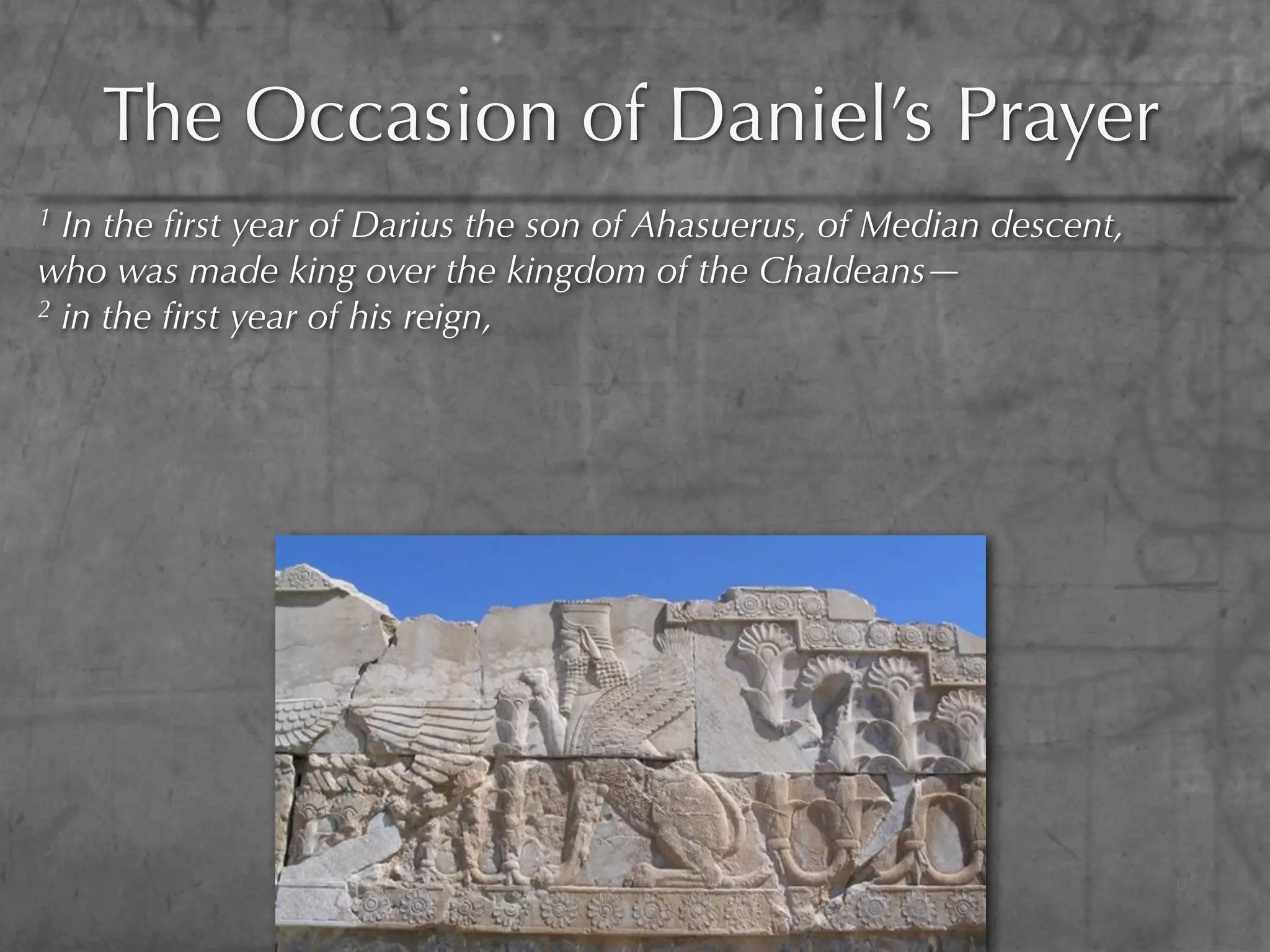
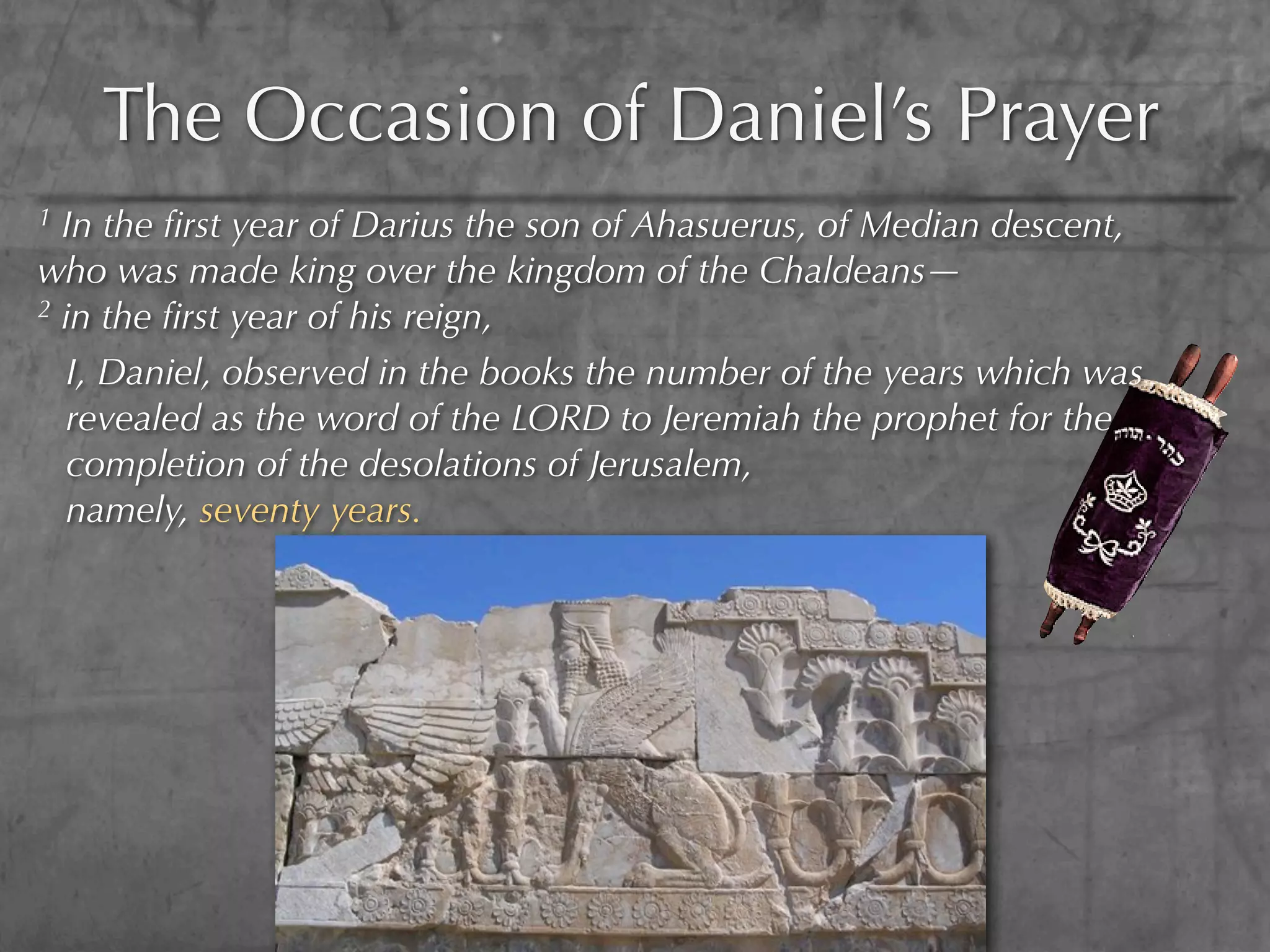
The Occasion of Daniel’s Prayer
1 In the first year of Darius the son of Ahasuerus, of Median descent,
who was made king over the kingdom of the Chaldeans—
2 in the first year of his reign,
The Occasion of Daniel’s Prayer
1 In the first year of Darius the son of Ahasuerus, of Median descent,
who was made king over the kingdom of the Chaldeans—
2 in the first year of his reign,

  I, Daniel, observed in the books the number of the years which was
  revealed as the word of the LORD to Jeremiah the prophet for the
  completion of the desolations of Jerusalem,
  namely, seventy years.
Daniel Studies Jeremiah
2in the first year of his reign, I, Daniel, observed in the books the number
of the years which was revealed as the word of the LORD to Jeremiah the
prophet for the completion of the desolations of Jerusalem, namely, seventy
years.
Daniel Studies Jeremiah
2in the first year of his reign, I, Daniel, observed in the books the number
of the years which was revealed as the word of the LORD to Jeremiah the
prophet for the completion of the desolations of Jerusalem, namely, seventy
years.
Jer. 25:11-12 “And the whole land shall be a desolation and a horror,
and these nations shall serve the king of Babylon seventy years. Then it will
be when seventy years are completed I will punish the king of Babylon and
that nation, declares the LORD...”
Daniel Studies Jeremiah
2in the first year of his reign, I, Daniel, observed in the books the number
of the years which was revealed as the word of the LORD to Jeremiah the
prophet for the completion of the desolations of Jerusalem, namely, seventy
years.
Jer. 25:11-12 “And the whole land shall be a desolation and a horror,
and these nations shall serve the king of Babylon seventy years. Then it will
be when seventy years are completed I will punish the king of Babylon and
that nation, declares the LORD...”
Jer. 29:10
“For thus says the LORD,
       ‘When seventy years have been completed for Babylon, I will visit
       you and fulfill My good word to you, to bring you back to this place”
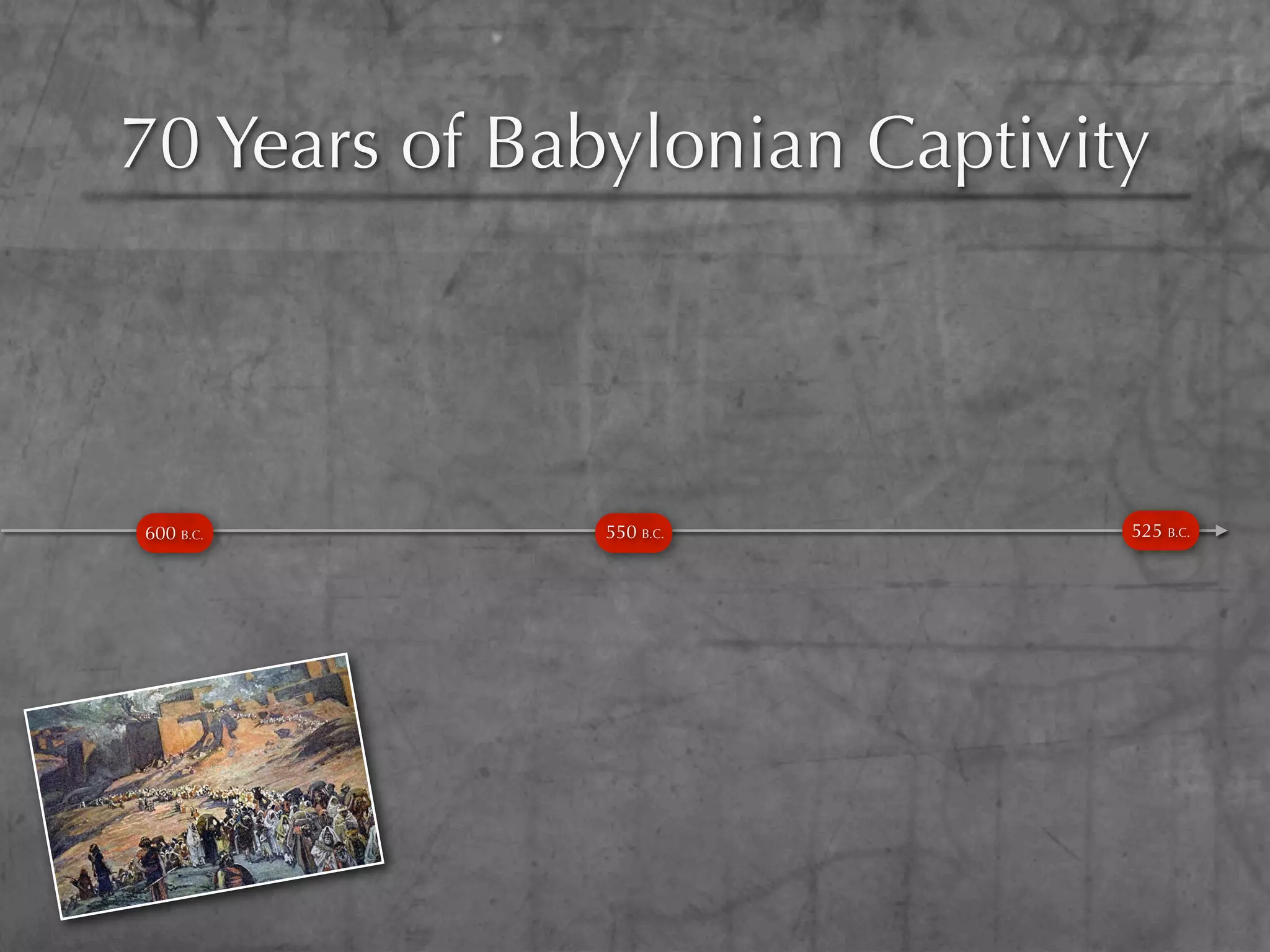
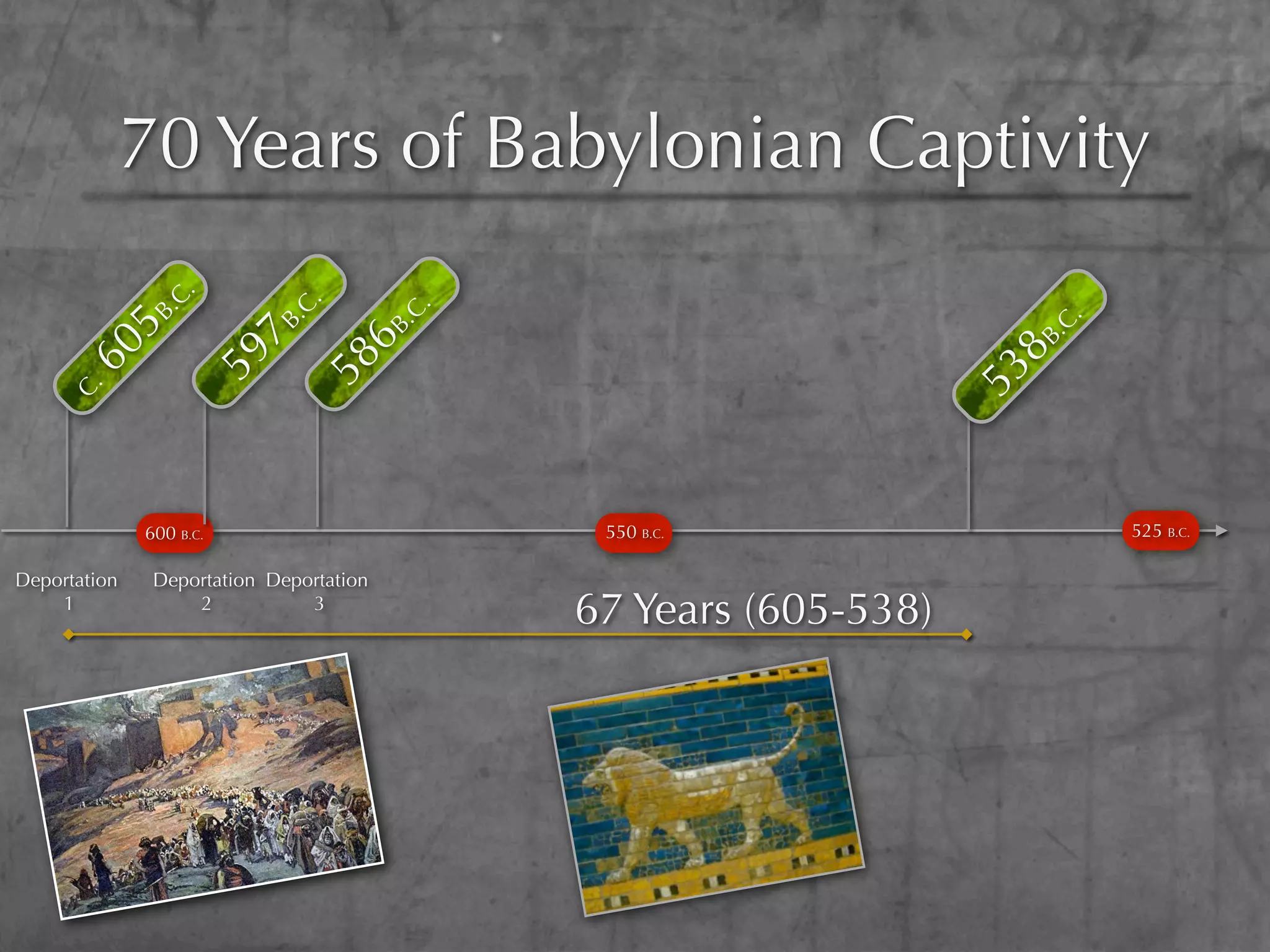
70 Years of Babylonian Captivity


600 B.C.       550 B.C.        525 B.C.
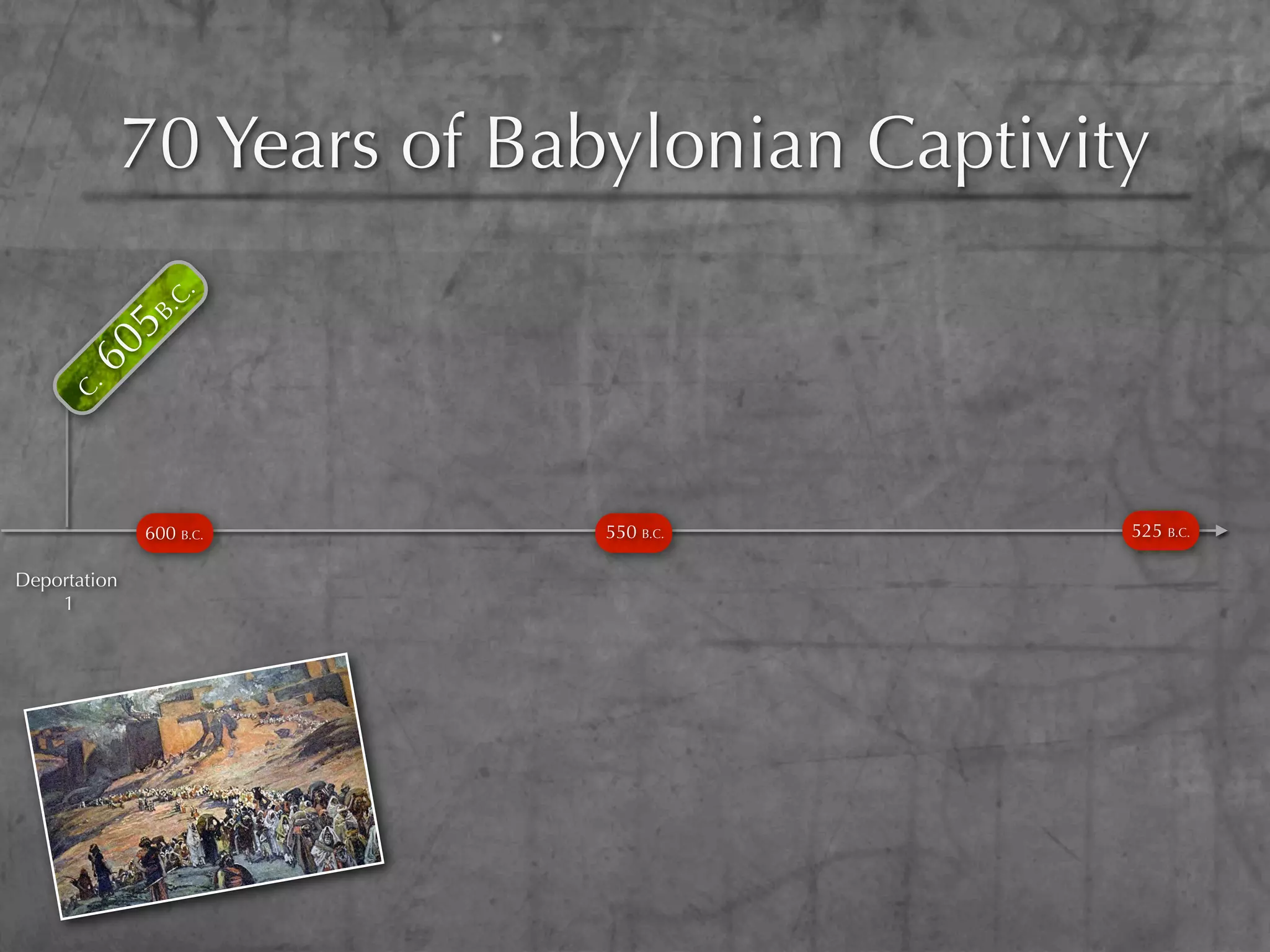
5B  70 Years of Babylonian Captivity
               .C
                 .
      60
     C.


              600 B.C.       550 B.C.        525 B.C.

Deportation
    1
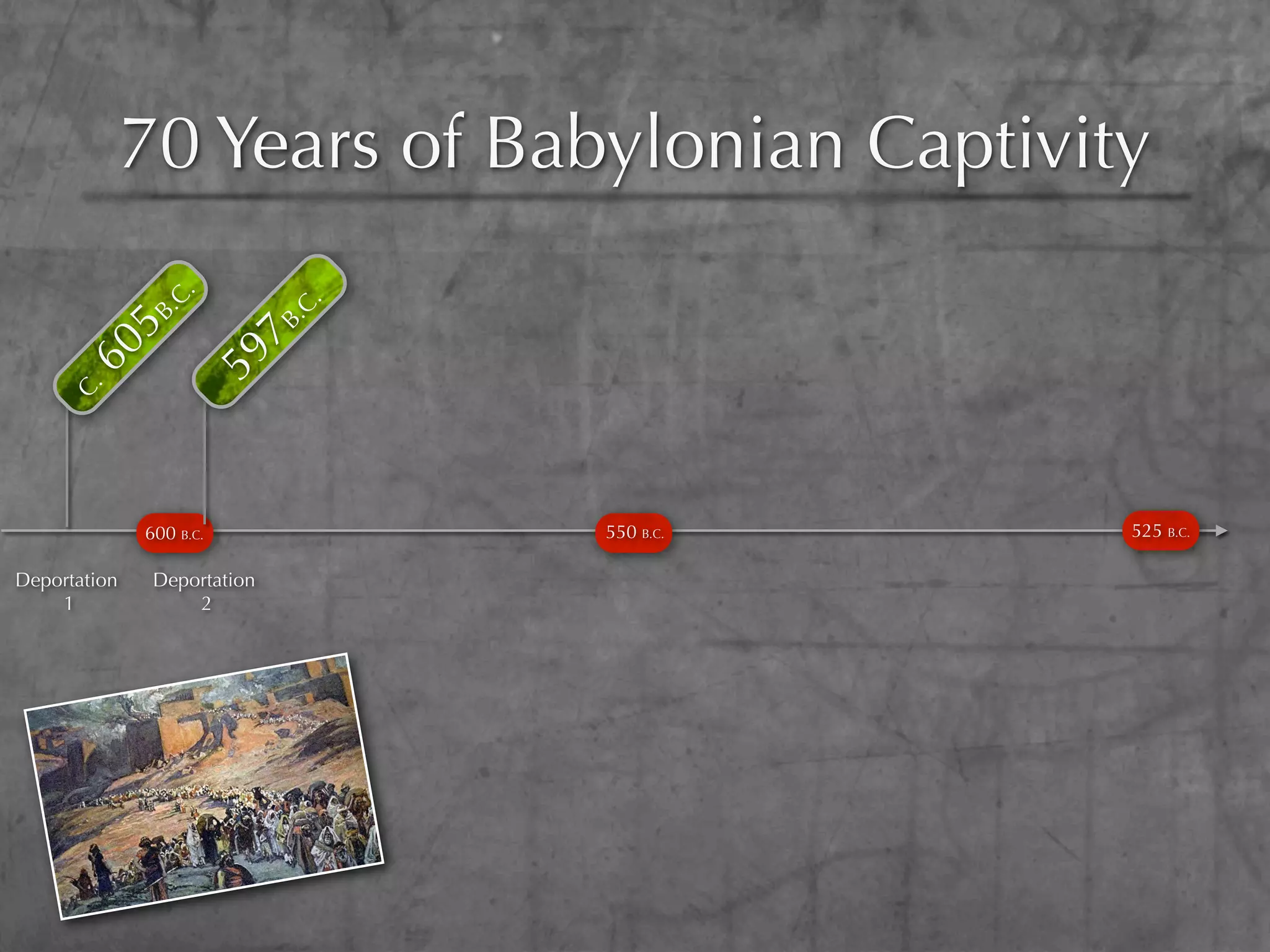
70 Years of Babylonian Captivity
               .C
                 .


                             .
                             .C
          5B

                         7B
      60

                     59
     C.


              600 B.C.            550 B.C.   525 B.C.

Deportation    Deportation
    1              2
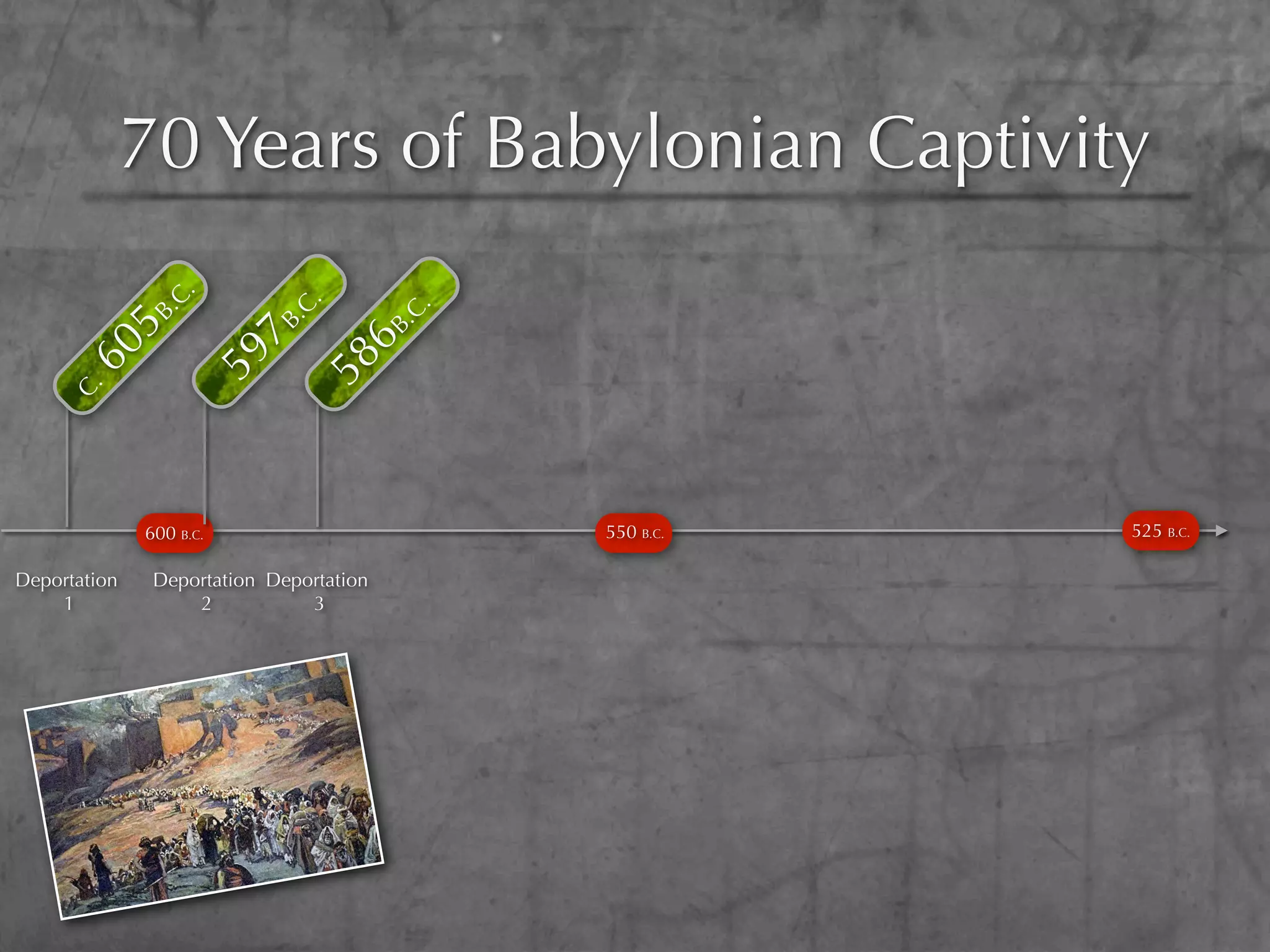
70 Years of Babylonian Captivity
               .C
                 .


                              .
                            .C


                                           .
                                         .C
          5B

                         7B

                                   6B
      60

                     59

                               58
     C.


              600 B.C.                         550 B.C.   525 B.C.

Deportation    Deportation Deportation
    1              2           3
70 Years of Babylonian Captivity
               .C
                 .


                              .
                            .C


                                           .
                                         .C
          5B


                                                                         .
                                                                         .C
                         7B

                                   6B


                                                                    8B
      60

                     59

                               58


                                                                    53
     C.


              600 B.C.                          550 B.C.                      525 B.C.

Deportation    Deportation Deportation
    1              2           3
                                               67 Years (605-538)
From “Yahweh” to “Adonai”
                     LORD = Yahweh; vv. 2-14
13“As it is written in the law of Moses, all this calamity has come on us;
yet we have not sought the favor of the LORD our God by turning from
our iniquity and giving attention to Your truth. 14 “Therefore the LORD
has kept the calamity in store and brought it on us; for the LORD our
God is righteous with respect to all His deeds which He has done, but
we have not obeyed His voice.
From “Yahweh” to “Adonai”
                     LORD = Yahweh; vv. 2-14
13“As it is written in the law of Moses, all this calamity has come on us;
yet we have not sought the favor of the LORD our God by turning from
our iniquity and giving attention to Your truth. 14 “Therefore the LORD
has kept the calamity in store and brought it on us; for the LORD our
God is righteous with respect to all His deeds which He has done, but
we have not obeyed His voice.

                      Lord = Adonai vv. 15-19
15¶ “And now, O Lord our God, who have brought Your people out of
the land of Egypt with a mighty hand and have made a name for
Yourself, as it is this day—we have sinned, we have been wicked. 16
“O Lord, in accordance with all Your righteous acts, let now Your
anger and Your wrath turn away from Your city Jerusalem,
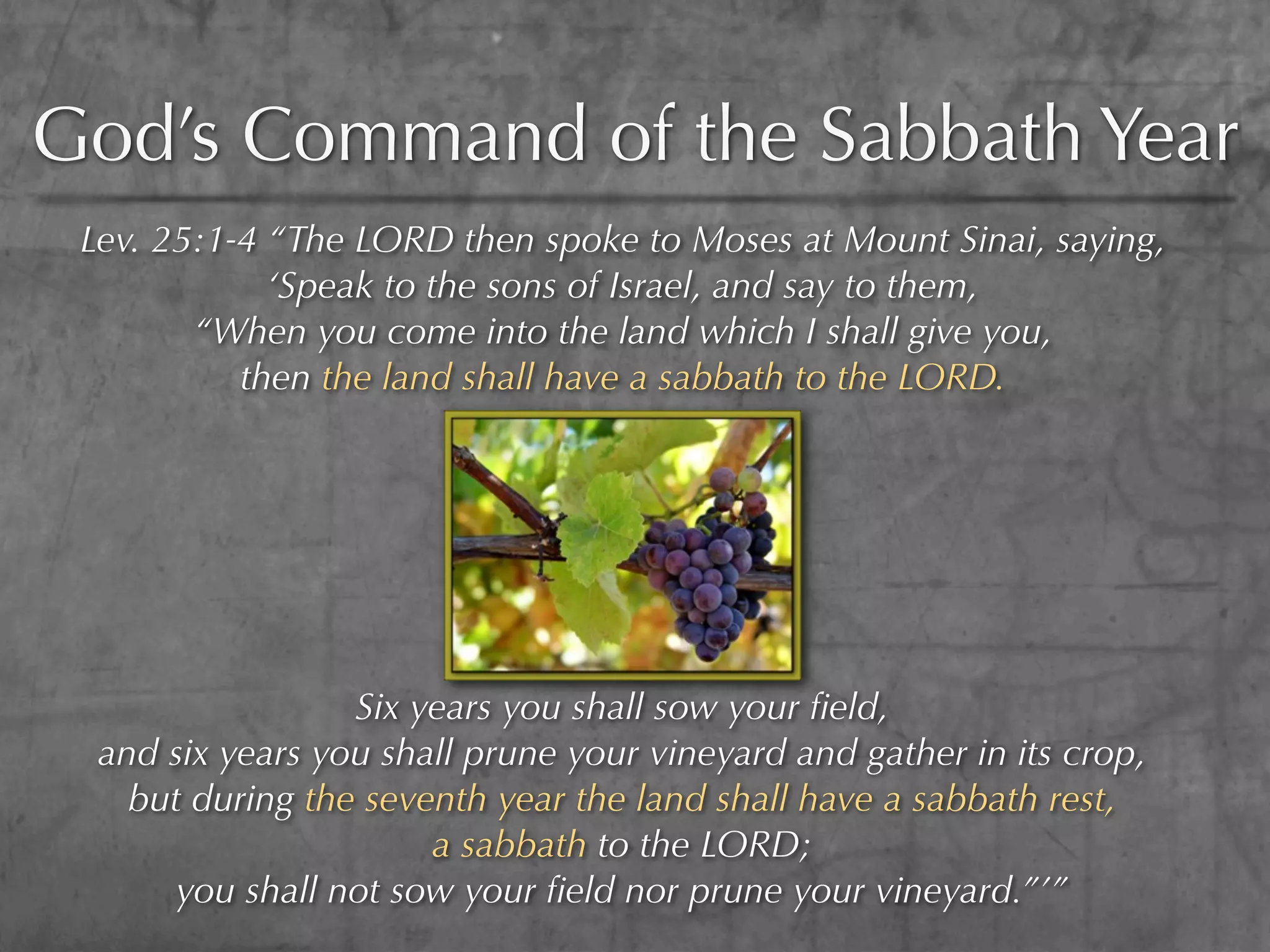
God’s Command of the Sabbath Year
 Lev. 25:1-4 “The LORD then spoke to Moses at Mount Sinai, saying,
             ‘Speak to the sons of Israel, and say to them,
        “When you come into the land which I shall give you,
           then the land shall have a sabbath to the LORD.
God’s Command of the Sabbath Year
 Lev. 25:1-4 “The LORD then spoke to Moses at Mount Sinai, saying,
             ‘Speak to the sons of Israel, and say to them,
        “When you come into the land which I shall give you,
           then the land shall have a sabbath to the LORD.


                  Six years you shall sow your field,
  and six years you shall prune your vineyard and gather in its crop,
    but during the seventh year the land shall have a sabbath rest,
                       a sabbath to the LORD;
       you shall not sow your field nor prune your vineyard.”’”
Prophecy of the Land Resting
         and Enjoying its Sabbaths
 Lev. 26:33-35 “You, however,
I will scatter among the nations and will draw out a sword after you,
as your land becomes desolate and your cities become waste
Then the land will enjoy its sabbaths all the days of the desolation,
while you are in your enemies land;
then the land will rest and enjoy its sabbaths.
Prophecy of the Land Resting
         and Enjoying its Sabbaths
 Lev. 26:33-35 “You, however,
I will scatter among the nations and will draw out a sword after you,
as your land becomes desolate and your cities become waste
Then the land will enjoy its sabbaths all the days of the desolation,
while you are in your enemies land;
then the land will rest and enjoy its sabbaths.


70 Years of Captivity = 70 Years of Violated Sabbatical Years
70 Weeks of Years
2 in the first year of his reign, I, Daniel, observed in the books the
number of the years which was revealed as the word of the LORD to
Jeremiah the prophet for the completion of the desolations of
Jerusalem, namely, seventy years.
70 Weeks of Years
2 in the first year of his reign, I, Daniel, observed in the books the
number of the years which was revealed as the word of the LORD to
Jeremiah the prophet for the completion of the desolations of
Jerusalem, namely, seventy years.


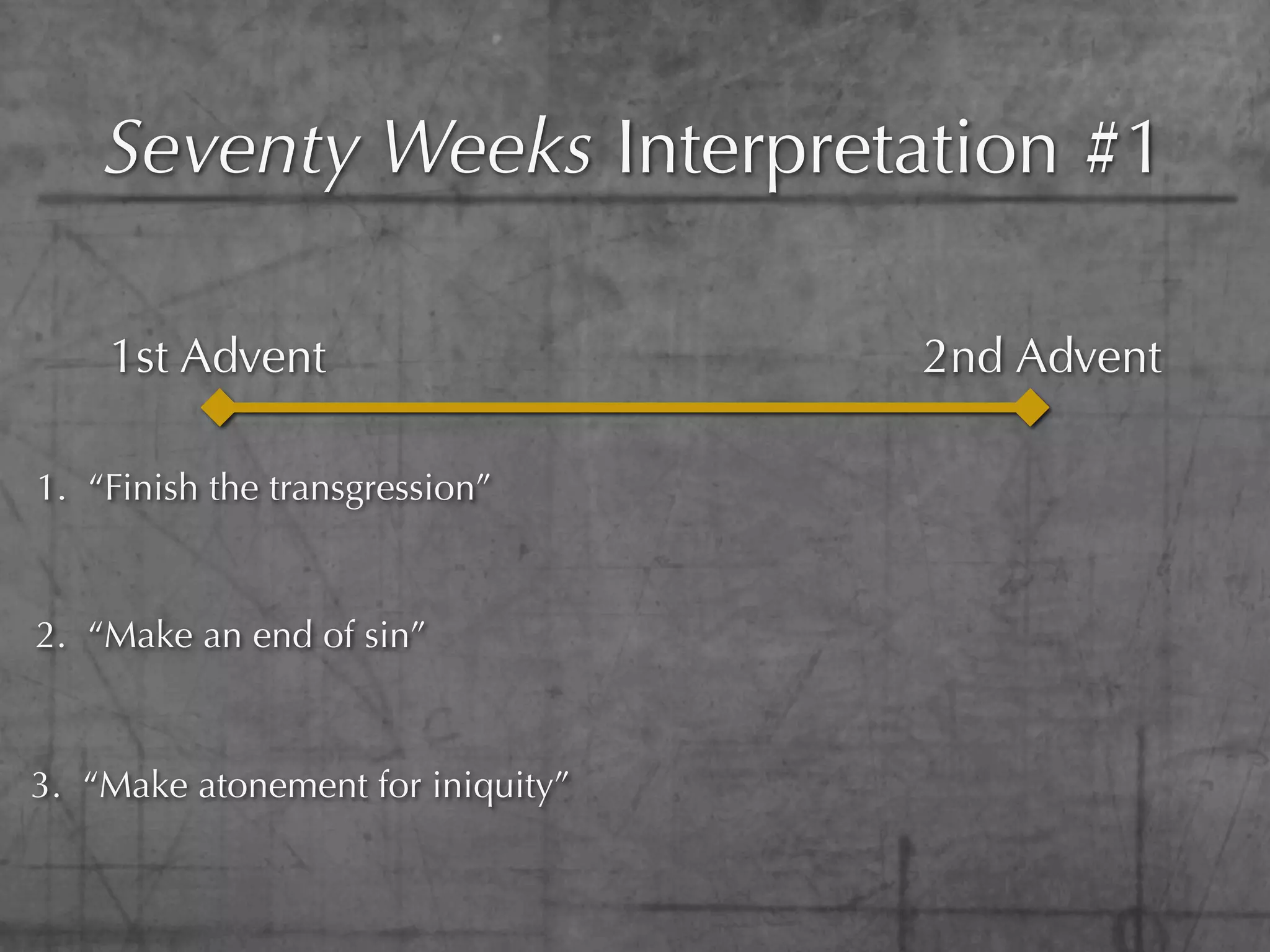
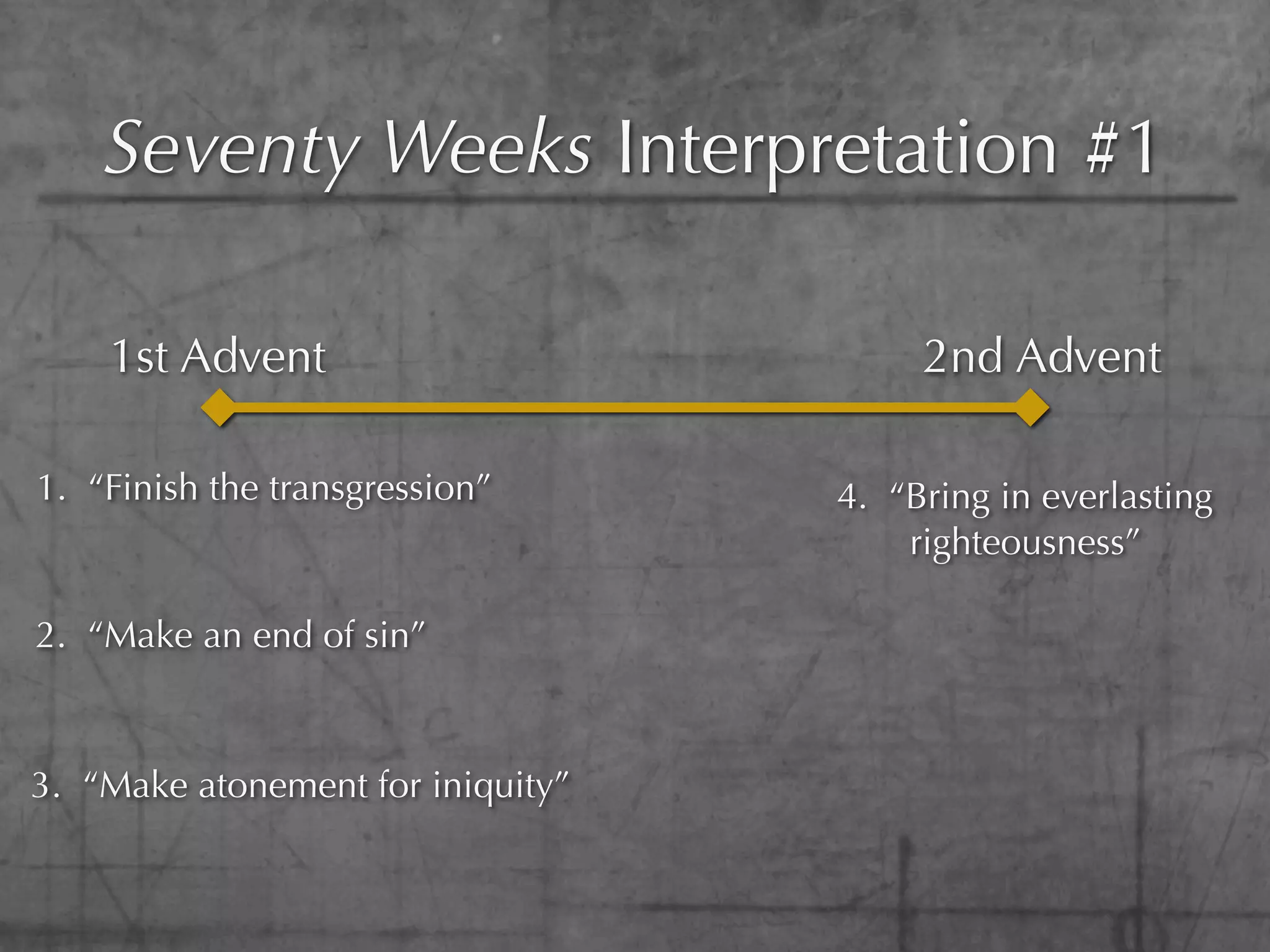
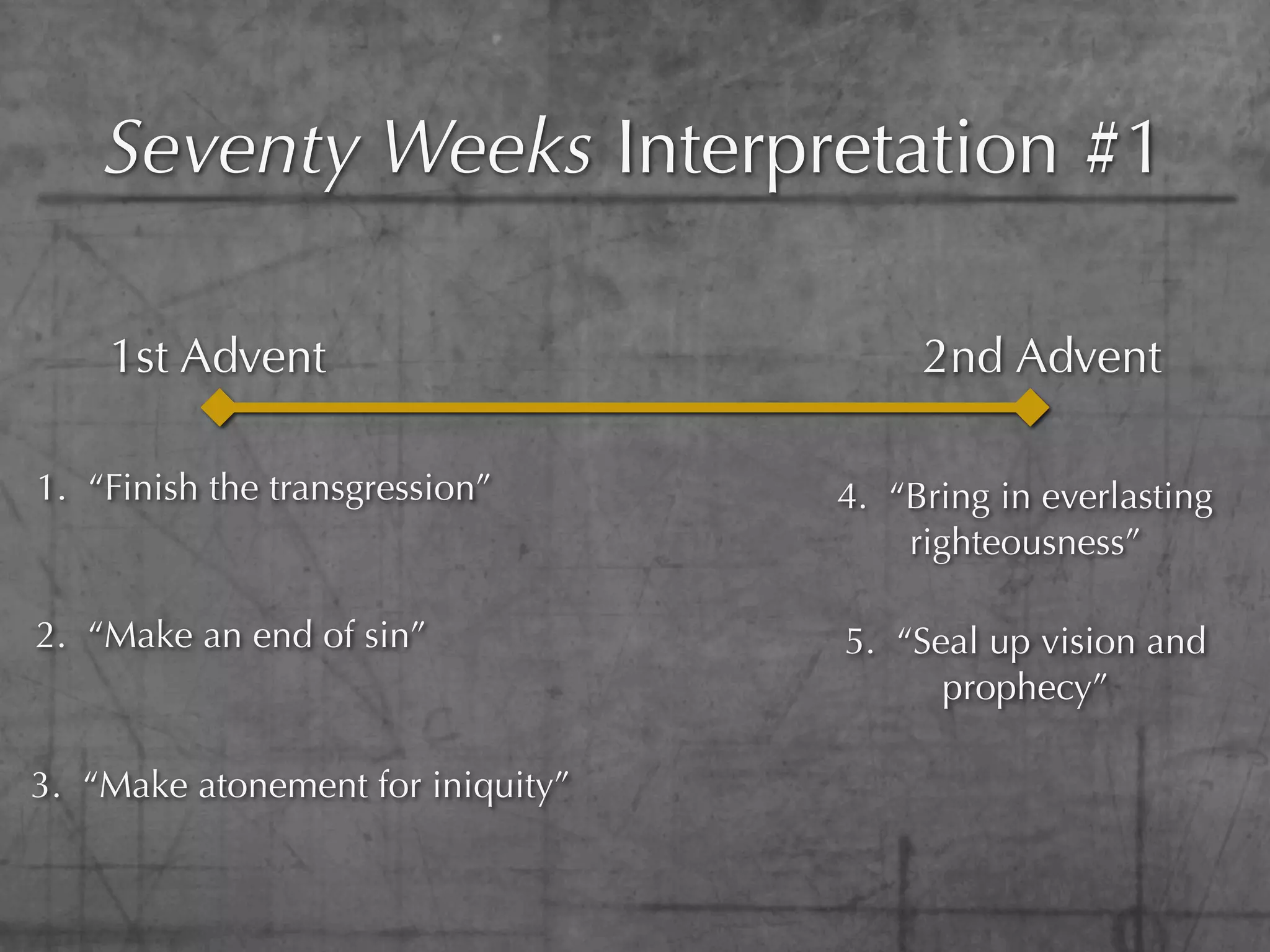
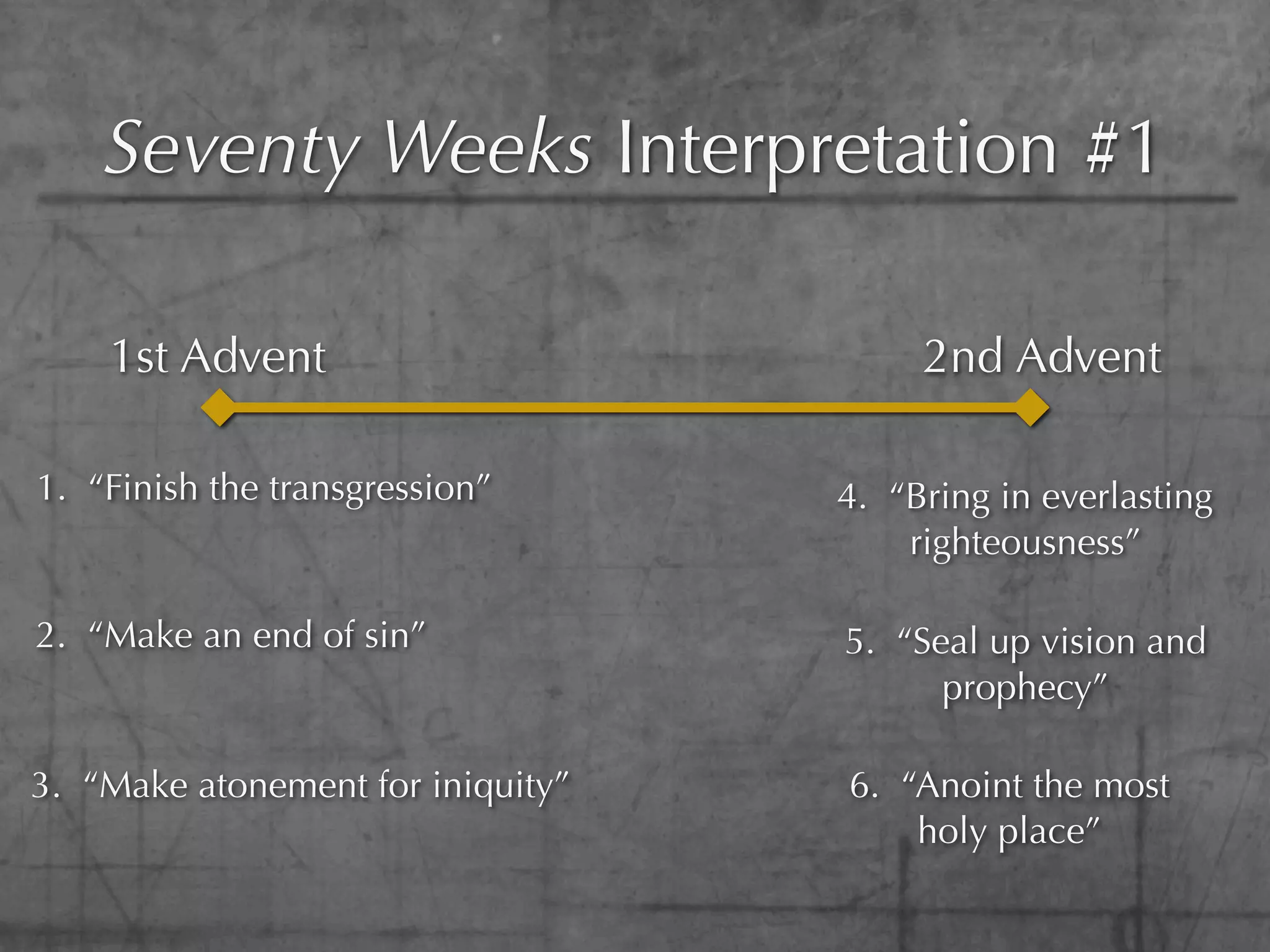
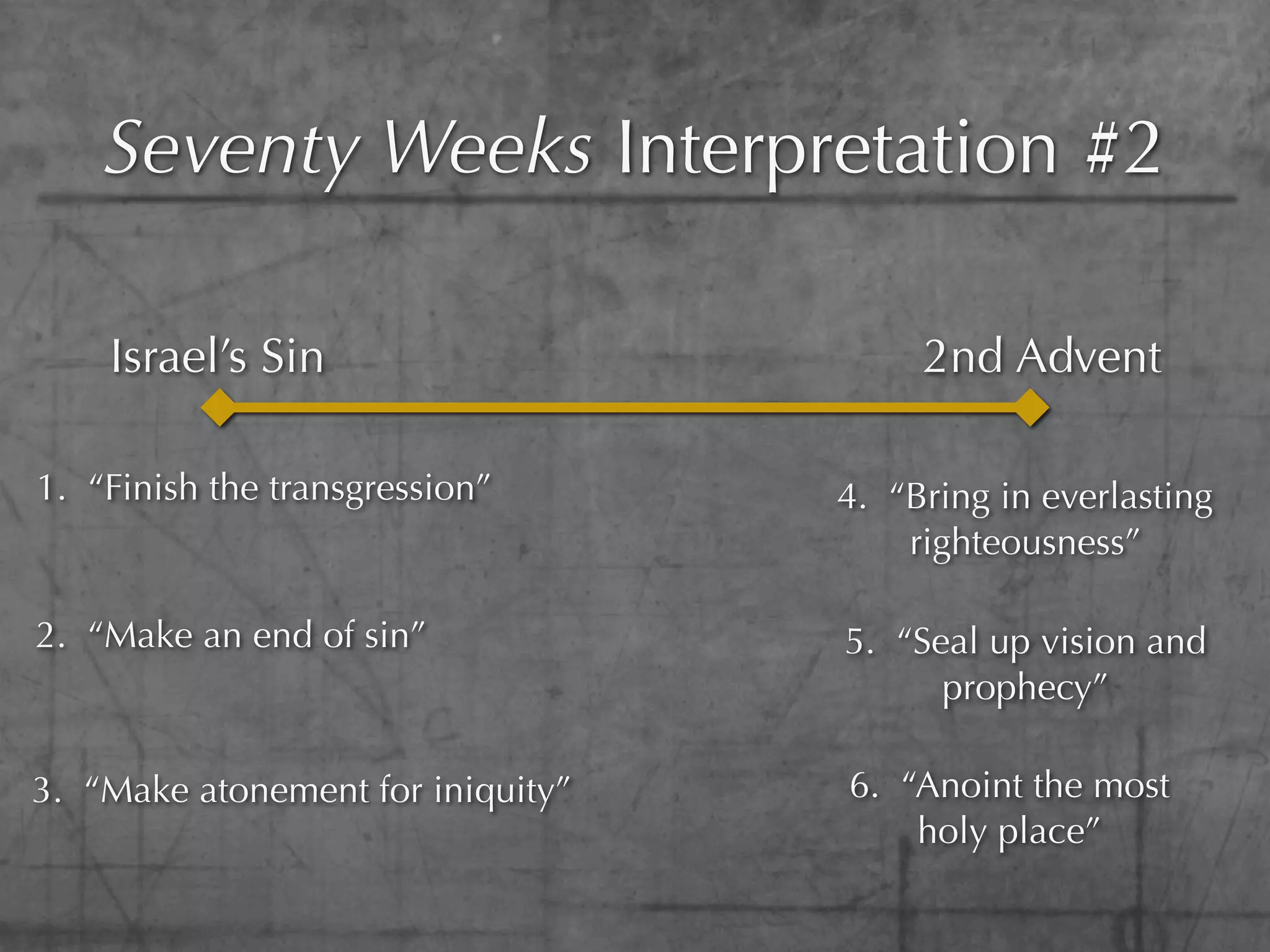
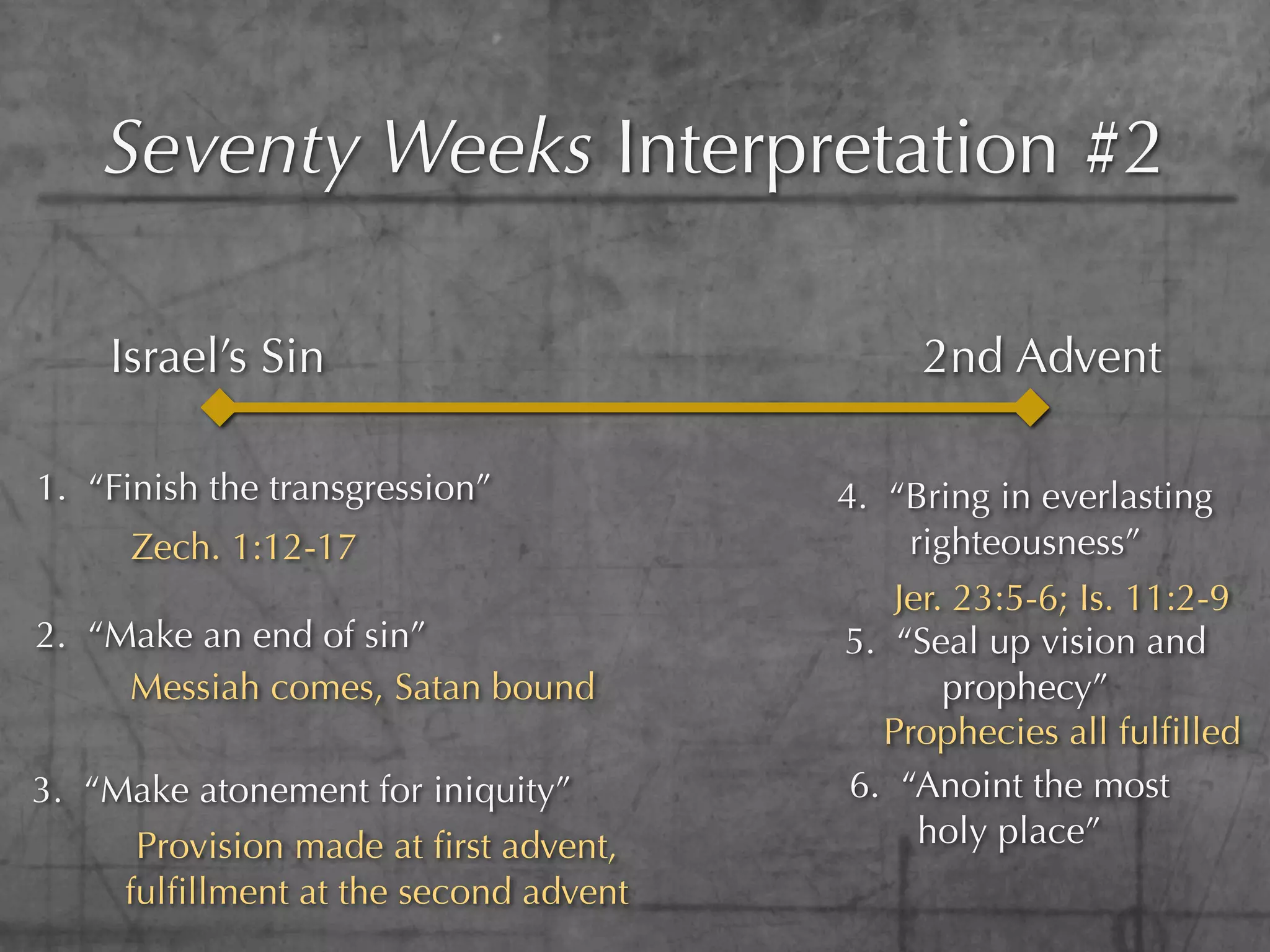
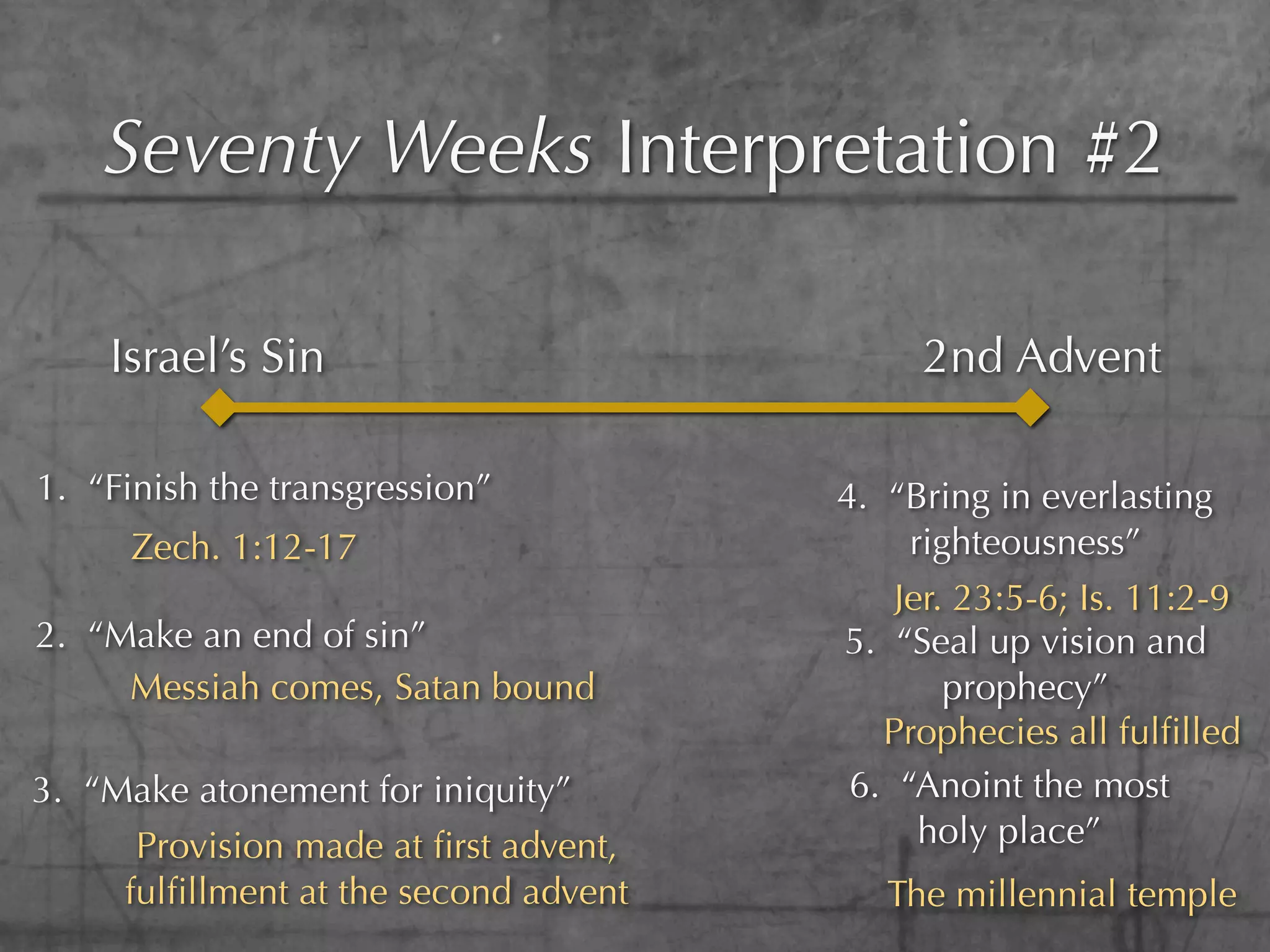
24 “Seventy weeks have been decreed for your people and your holy
city, to finish the transgression, to make an end of sin, to make
atonement for iniquity, to bring in everlasting righteousness, to seal up
vision and prophecy and to anoint the most holy place.
70 Weeks of Years
2 in the first year of his reign, I, Daniel, observed in the books the
number of the years which was revealed as the word of the LORD to
Jeremiah the prophet for the completion of the desolations of
Jerusalem, namely, seventy years.


24 “Seventy weeks have been decreed for your people and your holy
city, to finish the transgression, to make an end of sin, to make
atonement for iniquity, to bring in everlasting righteousness, to seal up
vision and prophecy and to anoint the most holy place.

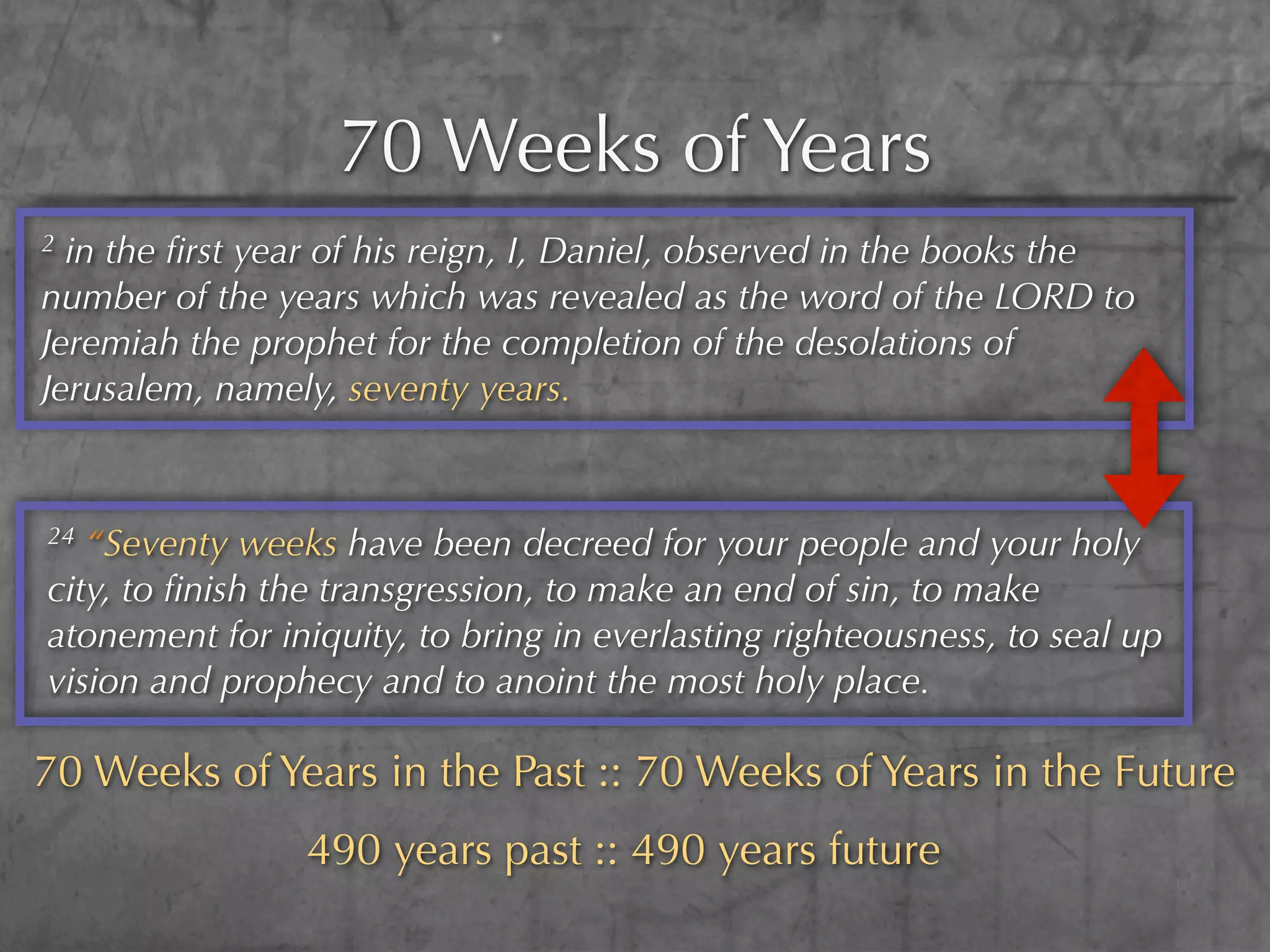
70 Weeks of Years in the Past :: 70 Weeks of Years in the Future
                490 years past :: 490 years future
Prophecy of Restoration
               Following Captivity
Jer. 29:10
“For thus says the LORD,
       ‘When seventy years have been completed for Babylon, I will visit
       you and fulfill My good word to you, to bring you back to this place”
Prophecy of Restoration
               Following Captivity
Jer. 29:10
“For thus says the LORD,
       ‘When seventy years have been completed for Babylon, I will visit
       you and fulfill My good word to you, to bring you back to this place”

Jer. 29:11-14
“For I know the plans I have for you,’ declares the LORD, ‘plans for welfare
and not for calamity to give you a future and a hope. Then you will call
upon Me and come and pray to Me, and I will listen to you. And you will
seek Me and find Me, when you search for Me with all your heart. And I
will be found by you,’ declares the LORD, ‘and I will restore your fortunes
and will gather you from all the nations and from all the places where I
have driven you,’ declares the LORD, ‘and I will bring you back to the
place from where I sent you into exile.’ ”
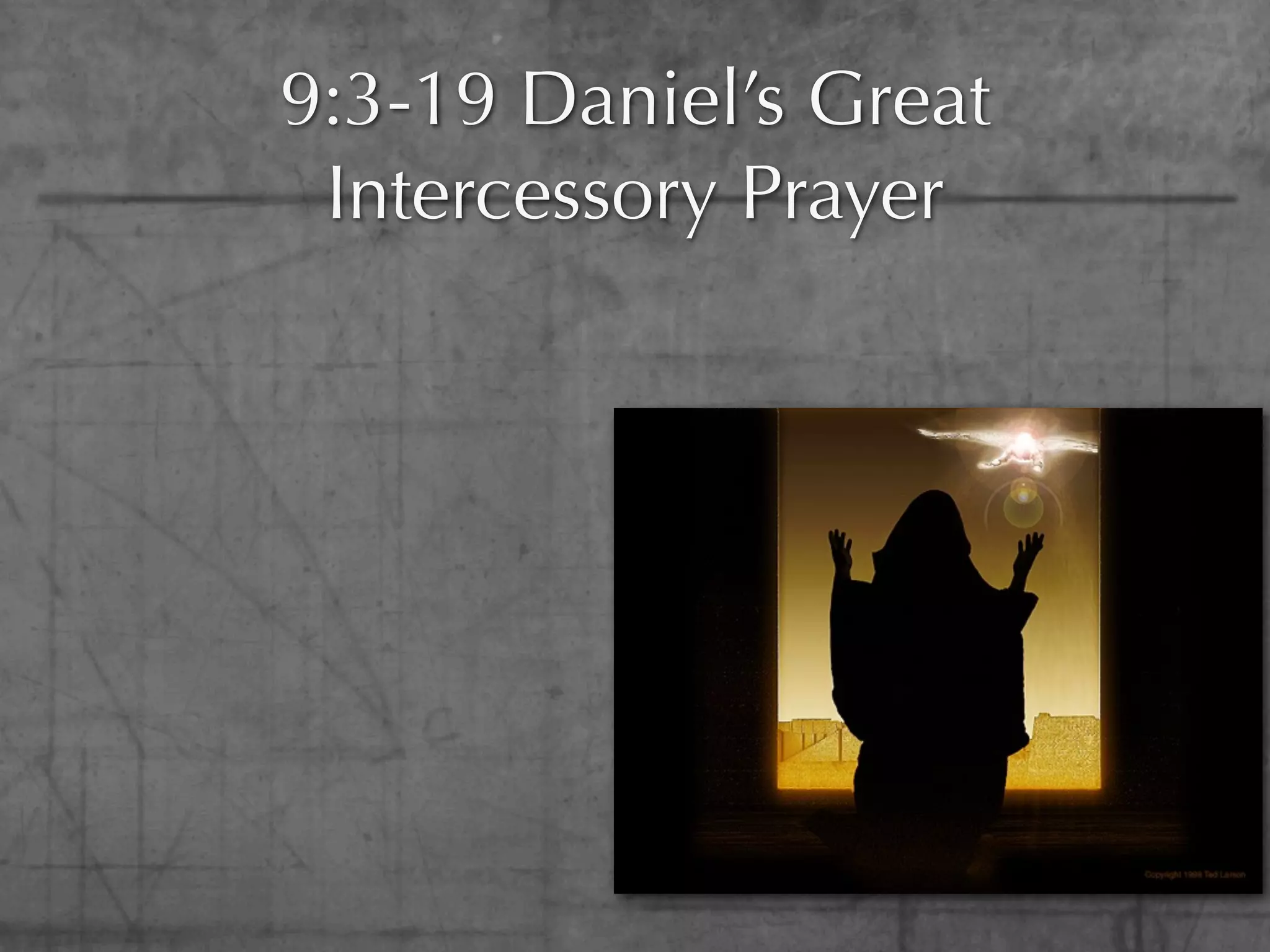
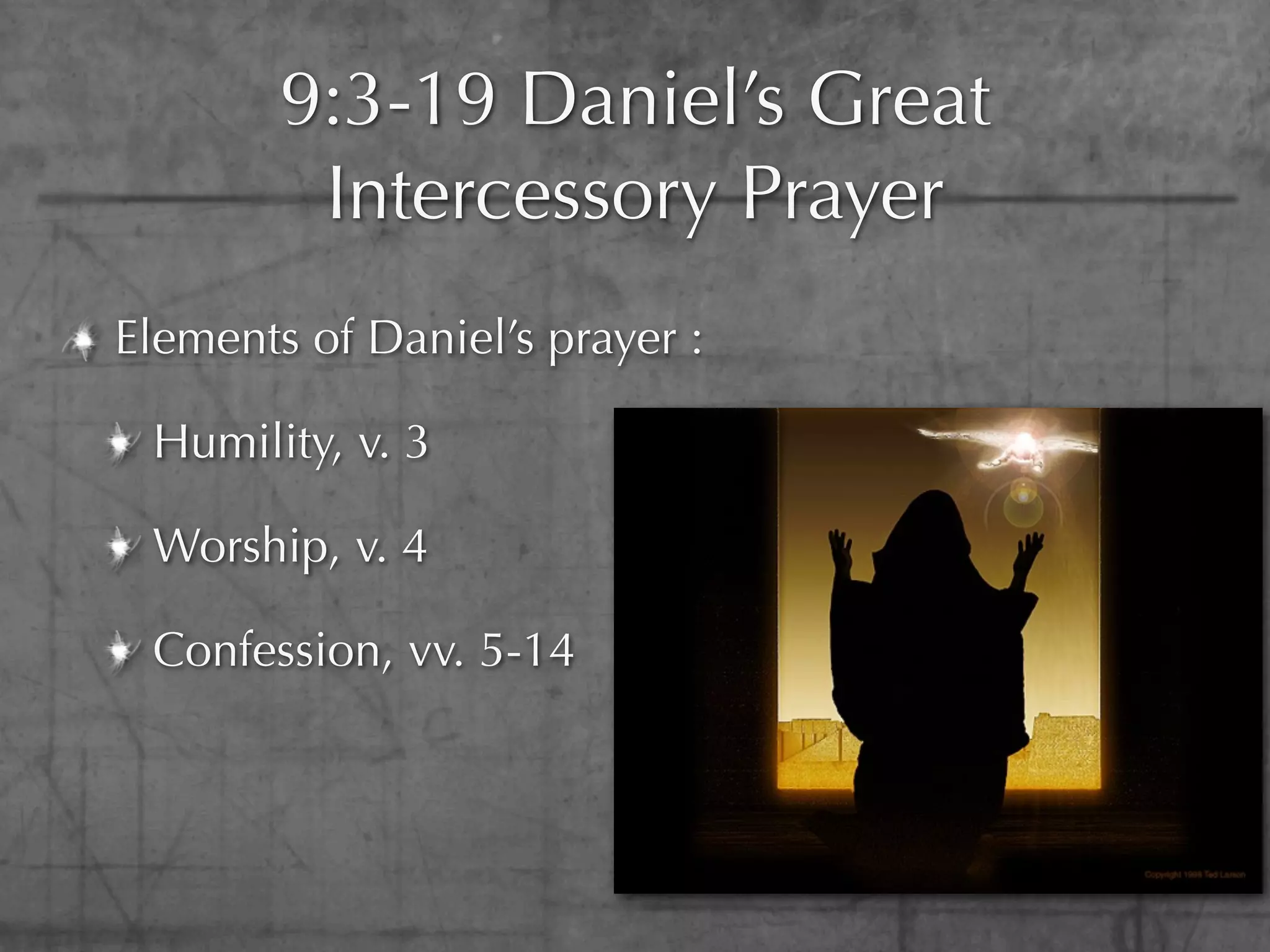
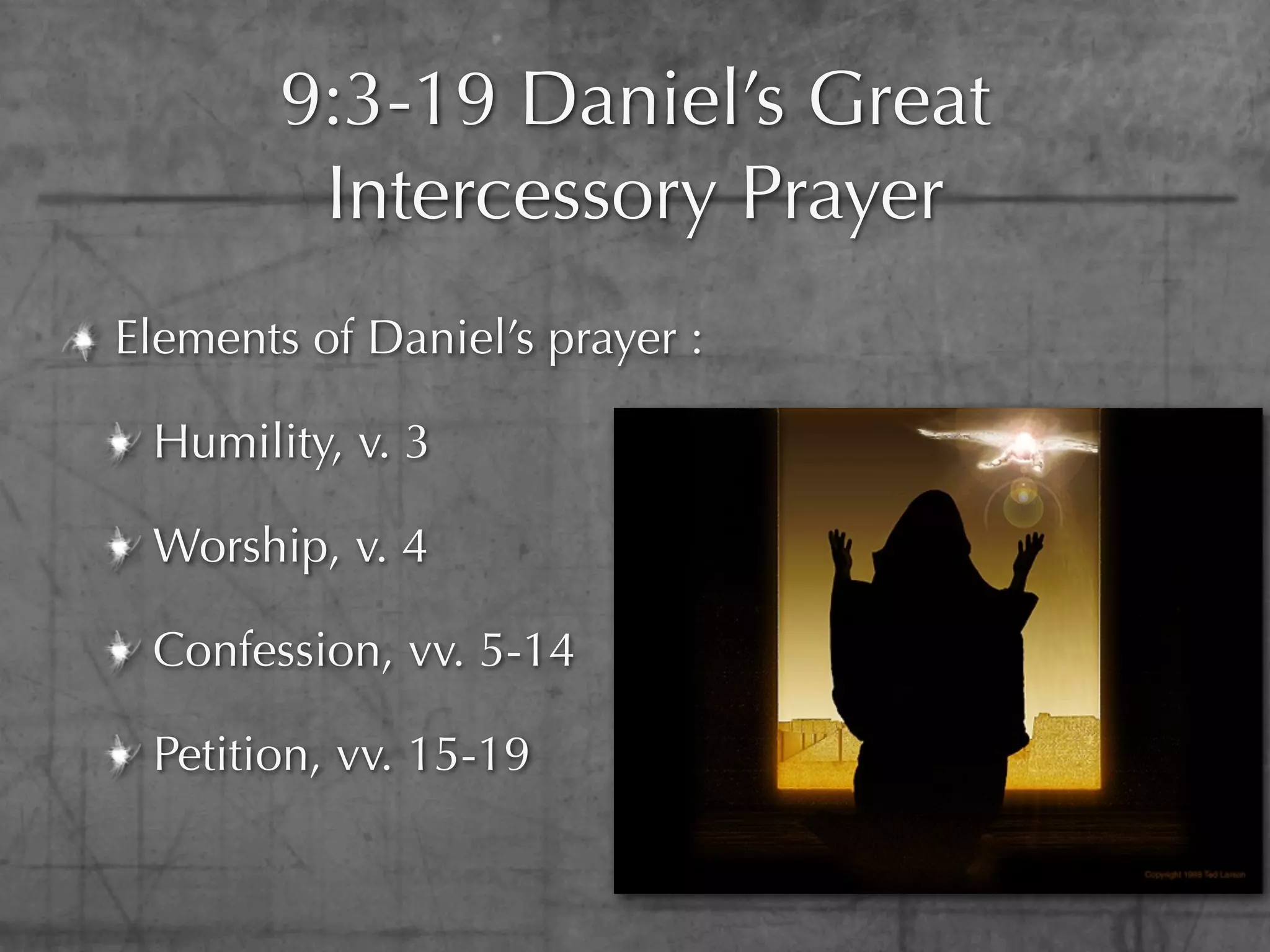
9:3-19 Daniel’s Great
 Intercessory Prayer
9:3-19 Daniel’s Great
         Intercessory Prayer
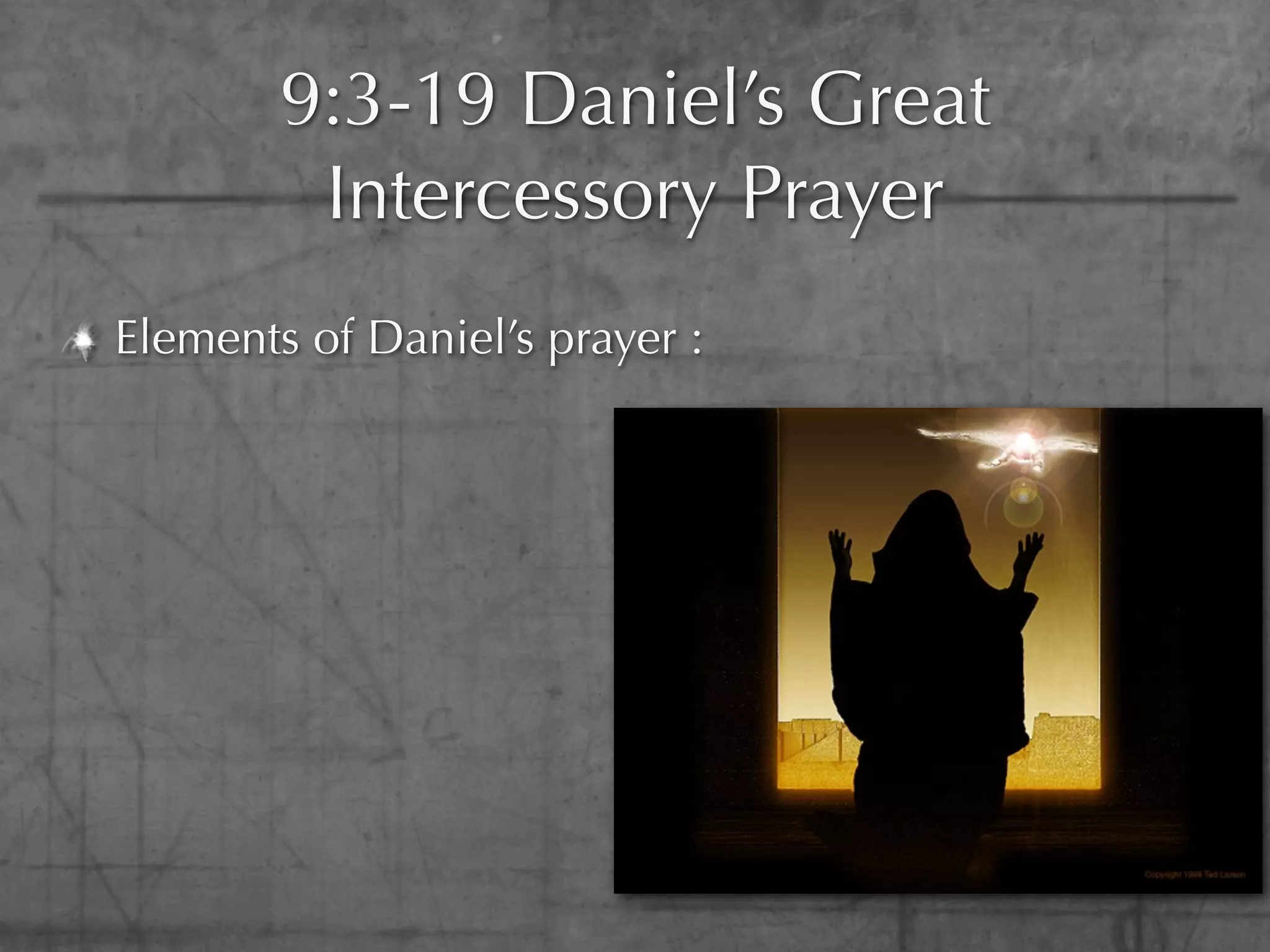
Elements of Daniel’s prayer :
9:3-19 Daniel’s Great
         Intercessory Prayer
Elements of Daniel’s prayer :

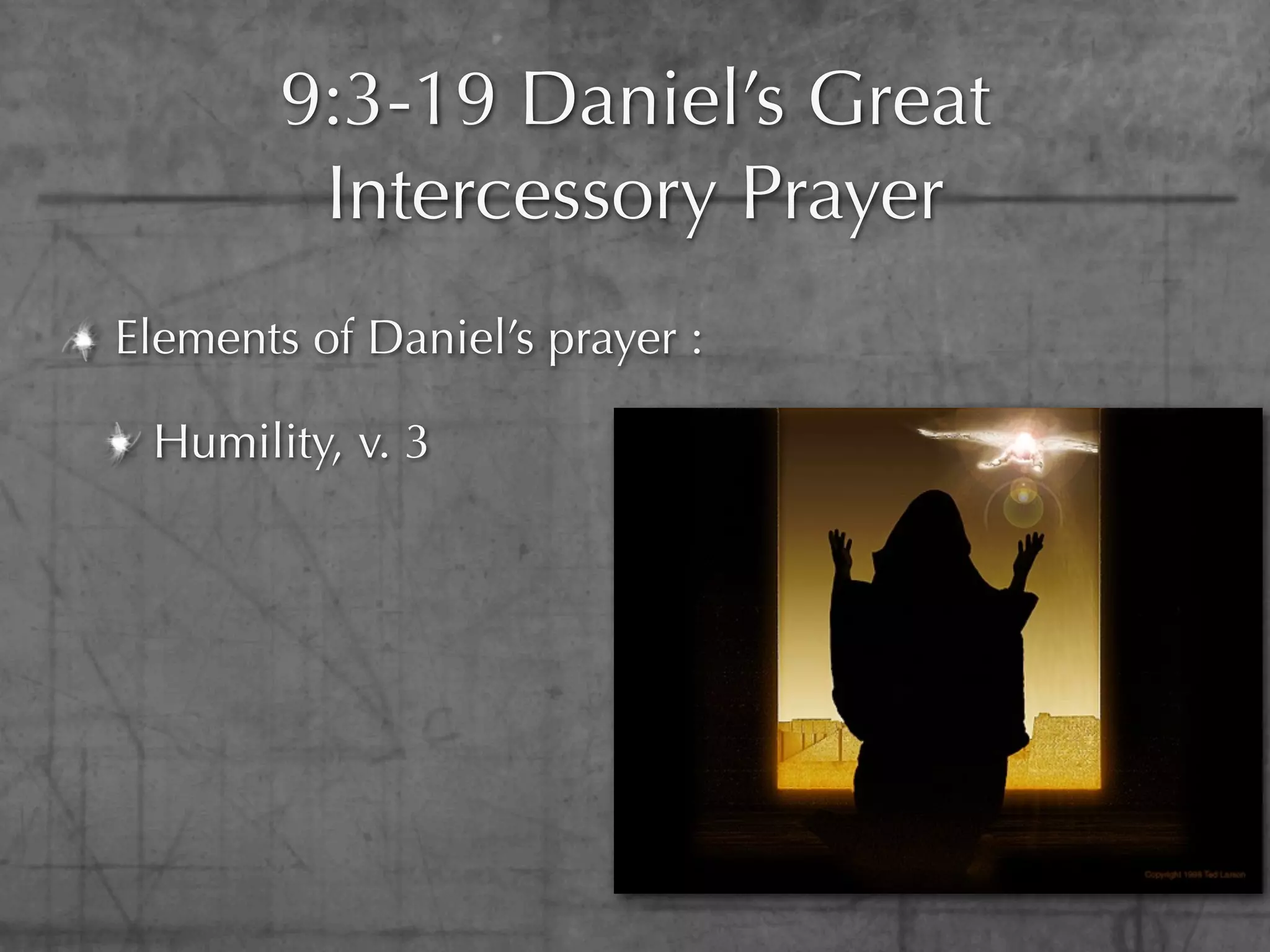
 Humility, v. 3
9:3-19 Daniel’s Great
         Intercessory Prayer
Elements of Daniel’s prayer :

 Humility, v. 3

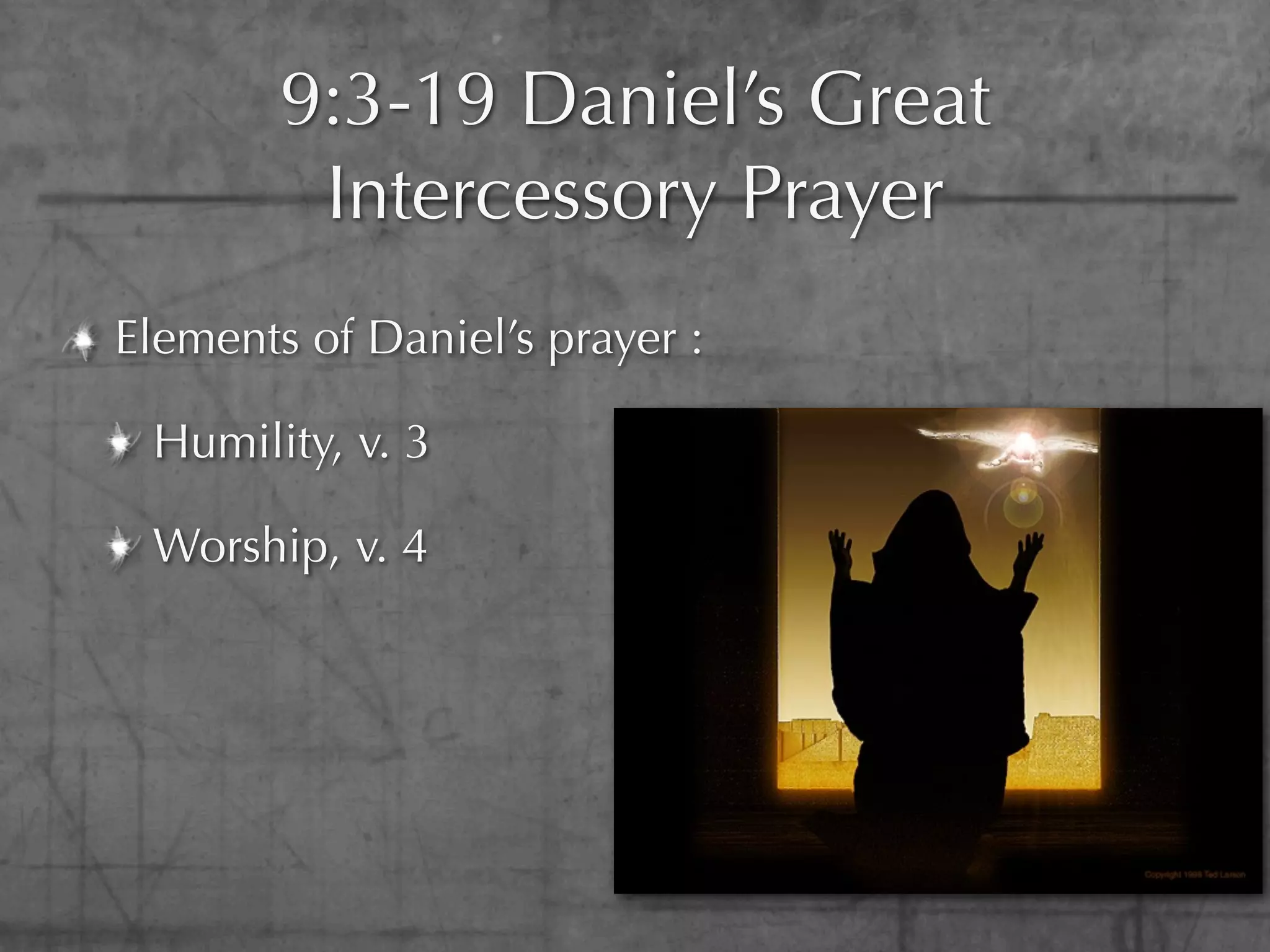
 Worship, v. 4
9:3-19 Daniel’s Great
         Intercessory Prayer
Elements of Daniel’s prayer :

 Humility, v. 3

 Worship, v. 4

 Confession, vv. 5-14
9:3-19 Daniel’s Great
         Intercessory Prayer
Elements of Daniel’s prayer :

 Humility, v. 3

 Worship, v. 4

 Confession, vv. 5-14

 Petition, vv. 15-19
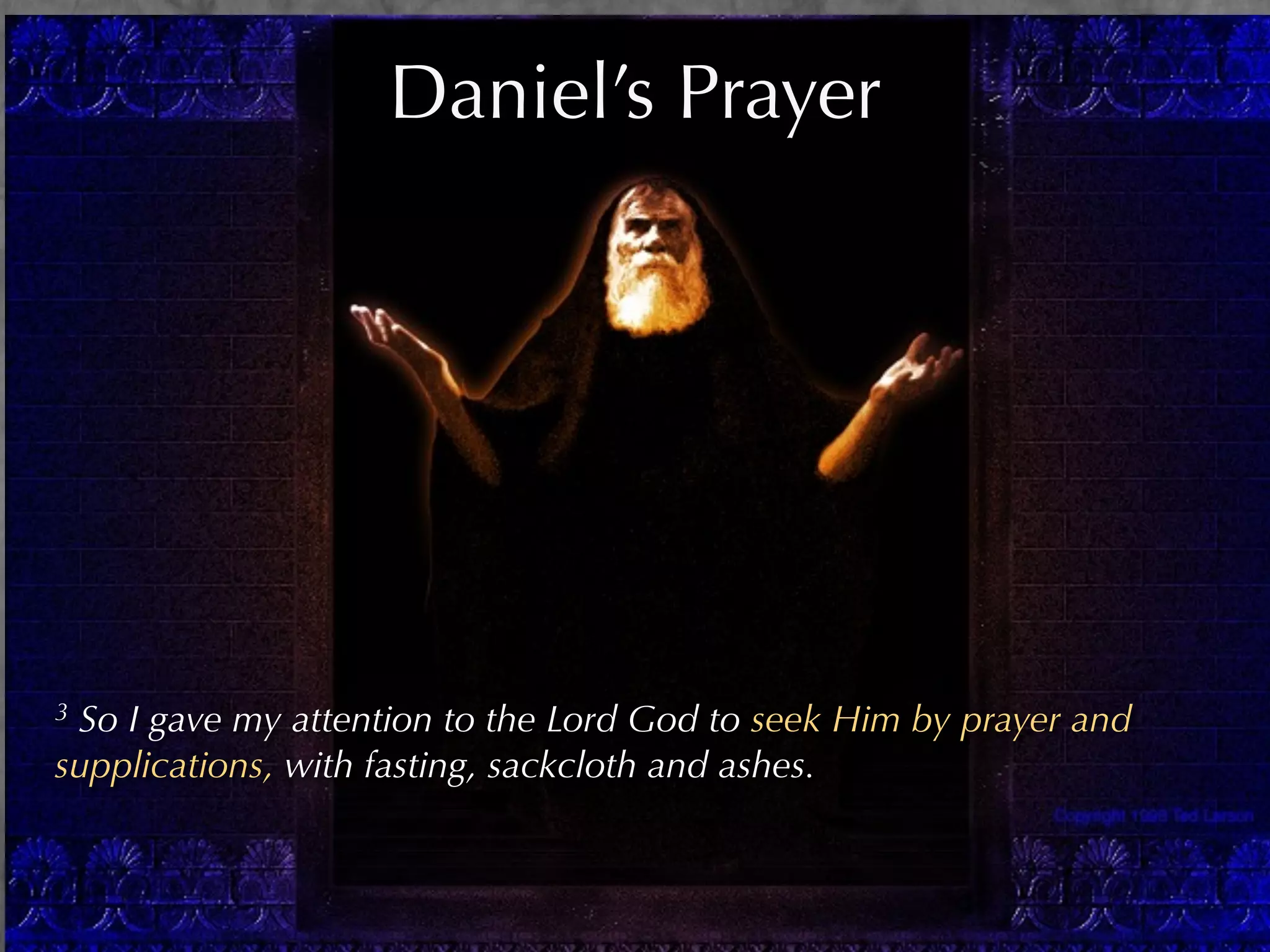
Daniel’s Prayer


3So I gave my attention to the Lord God to seek Him by prayer and
supplications, with fasting, sackcloth and ashes.
Daniel Expresses Key Aspects of
           God’s Character
4 I prayed to the LORD my God and confessed and said,
“Alas, O Lord,
the great and awesome God,
who keeps His covenant and lovingkindness for those who love Him and
keep His commandments,
Contrast #1 God’s Holiness
     and the Israelites’ Sinfulness

5we have sinned,
committed iniquity,
acted wickedly
and rebelled,
even turning aside
    from Your commandments and ordinances.
None are Exempt

6“Moreover,
we have not listened to Your servants the prophets,
who spoke in Your name to
                 our kings,
                 our princes,
                 our fathers and
                 all the people of the land.
Eight Reasons Why We Suffer

 Being disciplined by God (Heb. 12:4-13)
Eight Reasons Why We Suffer

 Being disciplined by God (Heb. 12:4-13)

  Refusal to listen to God (Dan. 9:6-8)
Eight Reasons Why We Suffer

 Being disciplined by God (Heb. 12:4-13)

  Refusal to listen to God (Dan. 9:6-8)

  Refusal to listen to God’s prophets (Dan. 9:6-8)
Eight Reasons Why We Suffer

 Being disciplined by God (Heb. 12:4-13)

   Refusal to listen to God (Dan. 9:6-8)

   Refusal to listen to God’s prophets (Dan. 9:6-8)

 The sins of our nation, previous generations,
 and parents (Dan. 9:6-8)
Eight Reasons Why We Suffer


 Living in a fallen world (Acts 28:1-6)
Eight Reasons Why We Suffer


 Living in a fallen world (Acts 28:1-6)

 For spiritual growth (2 Cor. 12:8-10; Ja. 1:2-3)
Eight Reasons Why We Suffer


 Living in a fallen world (Acts 28:1-6)

 For spiritual growth (2 Cor. 12:8-10; Ja. 1:2-3)

 To know that He is the LORD (Ezek. 30:8)
Eight Reasons Why We Suffer


 Living in a fallen world (Acts 28:1-6)

 For spiritual growth (2 Cor. 12:8-10; Ja. 1:2-3)

 To know that He is the LORD (Ezek. 30:8)

 To glorify God (Jn. 11:4)
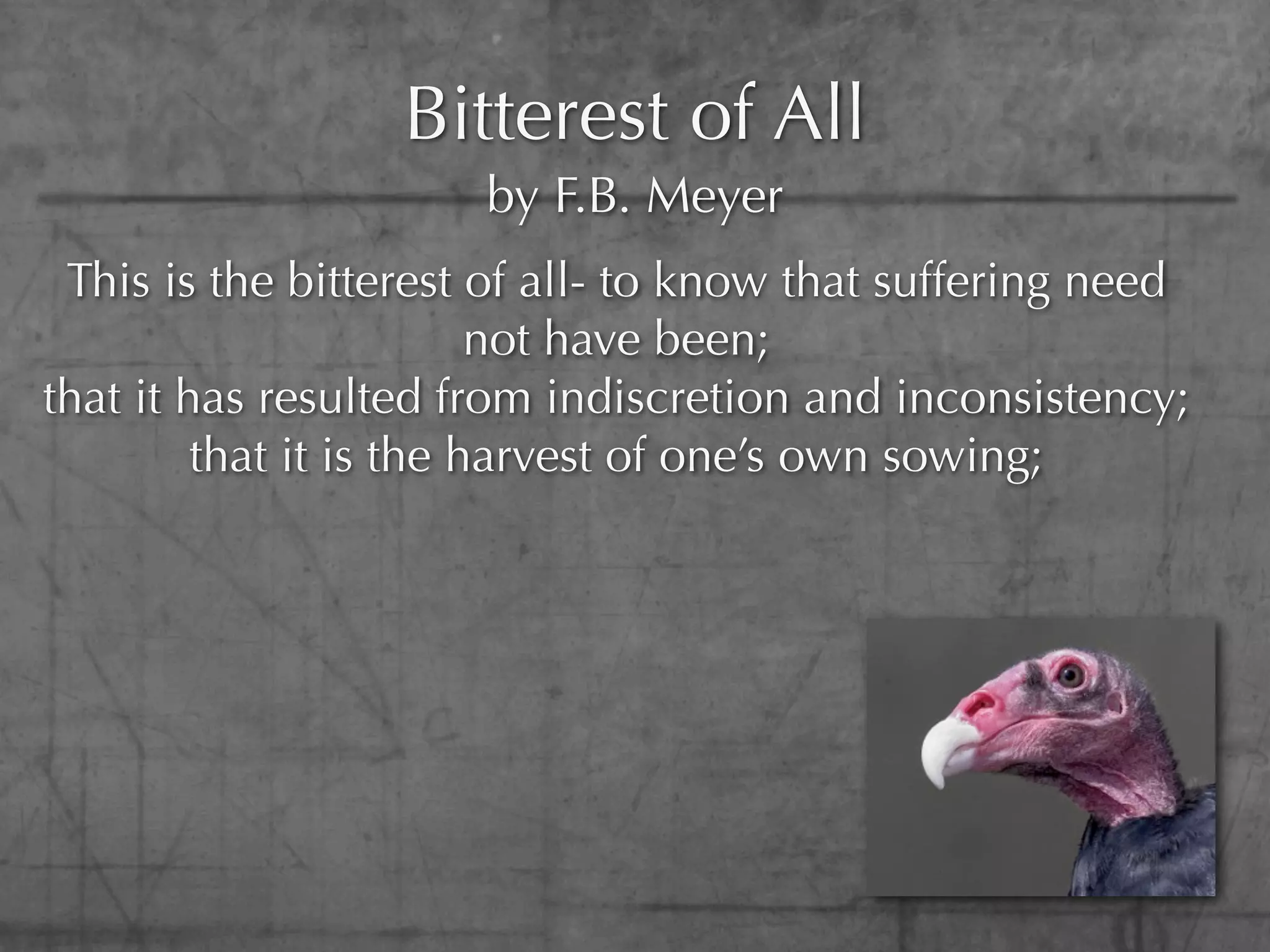
Bitterest of All
                      by F.B. Meyer
 This is the bitterest of all- to know that suffering need
                         not have been;
that it has resulted from indiscretion and inconsistency;
         that it is the harvest of one’s own sowing;
Bitterest of All
                      by F.B. Meyer
 This is the bitterest of all- to know that suffering need
                         not have been;
that it has resulted from indiscretion and inconsistency;
         that it is the harvest of one’s own sowing;
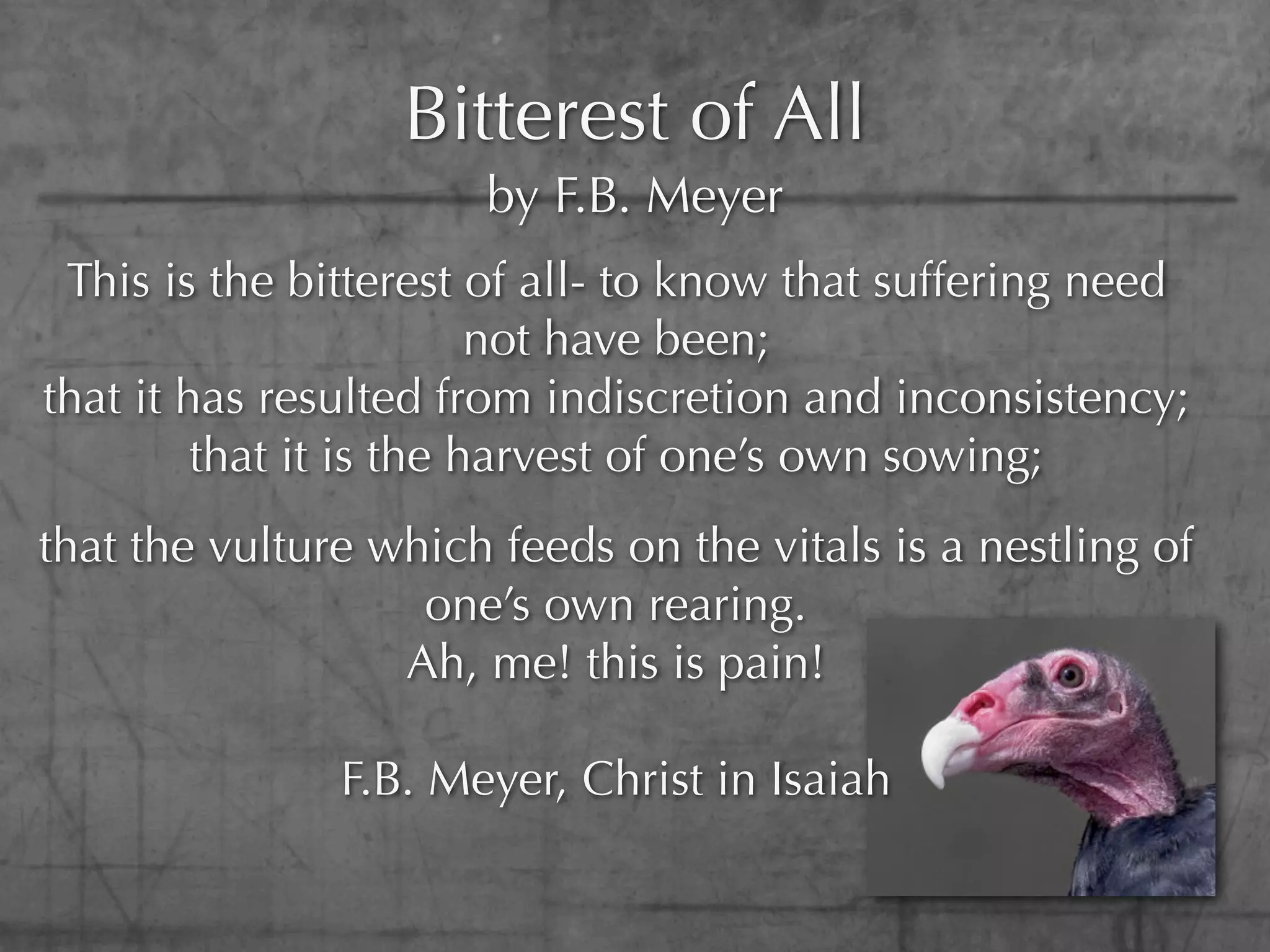
that the vulture which feeds on the vitals is a nestling of
                   one’s own rearing.
                  Ah, me! this is pain!

               F.B. Meyer, Christ in Isaiah
Contrast #2 God’s Character
         and His People’s Character
7   “Righteousness belongs to You, O Lord,
      but to us open shame, as it is this day
        —to the men of Judah,
        the inhabitants of Jerusalem and all Israel,
        those who are nearby and those who are far away
          in all the countries to which You have driven them,
          because of their unfaithful deeds which they have committed
          against You.
Contrast #2 God’s Character
           and His People’s Character
7   “Righteousness belongs to You, O Lord,
      but to us open shame, as it is this day
        —to the men of Judah,
        the inhabitants of Jerusalem and all Israel,
        those who are nearby and those who are far away
          in all the countries to which You have driven them,
          because of their unfaithful deeds which they have committed
          against You.
    8   “Open shame belongs to us, O Lord,
           to our kings,
           our princes and our fathers,
           because we have sinned against You.
Contrast #3: God’s Faithfulness
        and Israel’s Rebellion
9   “To the Lord our God belong compassion and forgiveness,
             for we have rebelled against Him;
             10 nor have we obeyed the voice of the LORD our God,

                 to walk in His teachings
                 which He set before us through His servants the
                 prophets.
9:11-14 Inciting God’s Curse

11 “Indeed all Israel has transgressed Your law and turned aside, not
obeying Your voice; so the curse has been poured out on us, along with
the oath which is written in the law of Moses the servant of God, for we
have sinned against Him.
12 “Thus He has confirmed His words which He had spoken against us

and against our rulers who ruled us, to bring on us great calamity; for
under the whole heaven there has not been done anything like what was
done to Jerusalem.
9:11-14 Inciting God’s Curse


13 “As it is written in the law of Moses,
all this calamity has come on us;
yet we have not sought the favor of the LORD our God by turning from
our iniquity and giving attention to Your truth.

14Therefore, the LORD has kept the calamity in store
and brought it on us;
for the LORD our God is righteous with respect to all His deeds
which He has done,
                 but we have not obeyed His voice.
9:15-19 Daniel’s Earnest Petition

  The basis for Daniel’s petition:
9:15-19 Daniel’s Earnest Petition

  The basis for Daniel’s petition:

   God’s past deliverance, v. 15
9:15-19 Daniel’s Earnest Petition

  The basis for Daniel’s petition:

   God’s past deliverance, v. 15

   God’s people, city, and sanctuary, vv. 16-17
9:15-19 Daniel’s Earnest Petition

  The basis for Daniel’s petition:

   God’s past deliverance, v. 15

   God’s people, city, and sanctuary, vv. 16-17

   God’s compassion, v. 18
9:15-19 Daniel’s Earnest Petition

  The basis for Daniel’s petition:

   God’s past deliverance, v. 15

   God’s people, city, and sanctuary, vv. 16-17

   God’s compassion, v. 18

   God’s reputation, v. 19
9:20-23 God Answers Daniel’s
               Prayer
20“Now while I was speaking and praying, and confessing my sin
and the sin of my people Israel, and presenting my supplication
before the LORD my God in behalf of the holy mountain of my
God, 21 while I was still speaking in prayer, then the man, Gabriel,
whom I had seen in the vision previously, came to me in my
extreme weariness, about the time of the evening offering.
9:20-23 God Answers Daniel’s
               Prayer
20“Now while I was speaking and praying, and confessing my sin
and the sin of my people Israel, and presenting my supplication
before the LORD my God in behalf of the holy mountain of my
God, 21 while I was still speaking in prayer, then the man, Gabriel,
whom I had seen in the vision previously, came to me in my
extreme weariness, about the time of the evening offering.

22 And he gave me instruction and talked with me and said, ‘O
Daniel, I have now come forth to give you insight with understanding.
23 At the beginning of your supplications the command was issued,

and I have come to tell you, for you are highly esteemed; so give
heed to the message and gain understanding of the vision.”
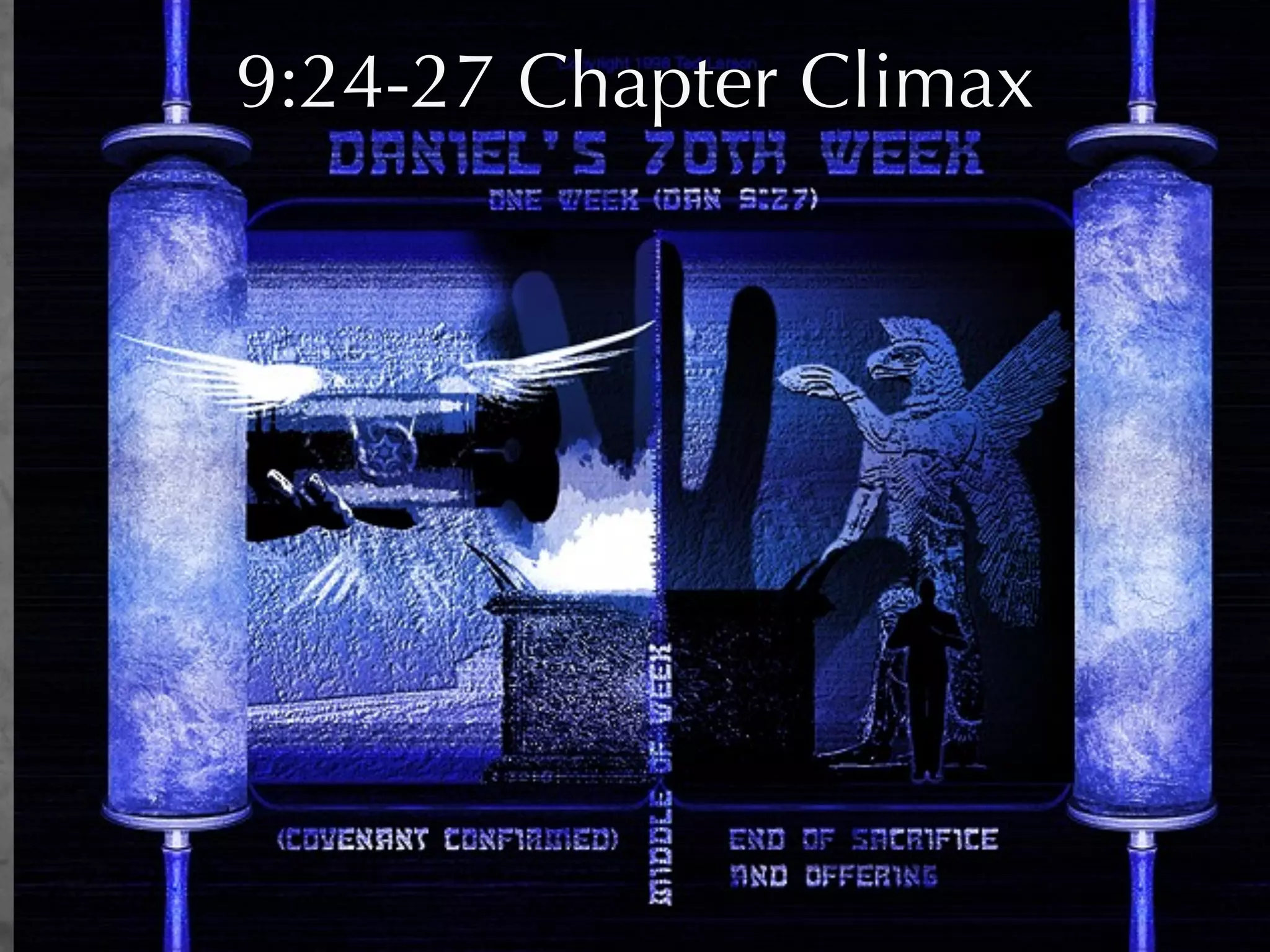
9:24-27 Chapter Climax
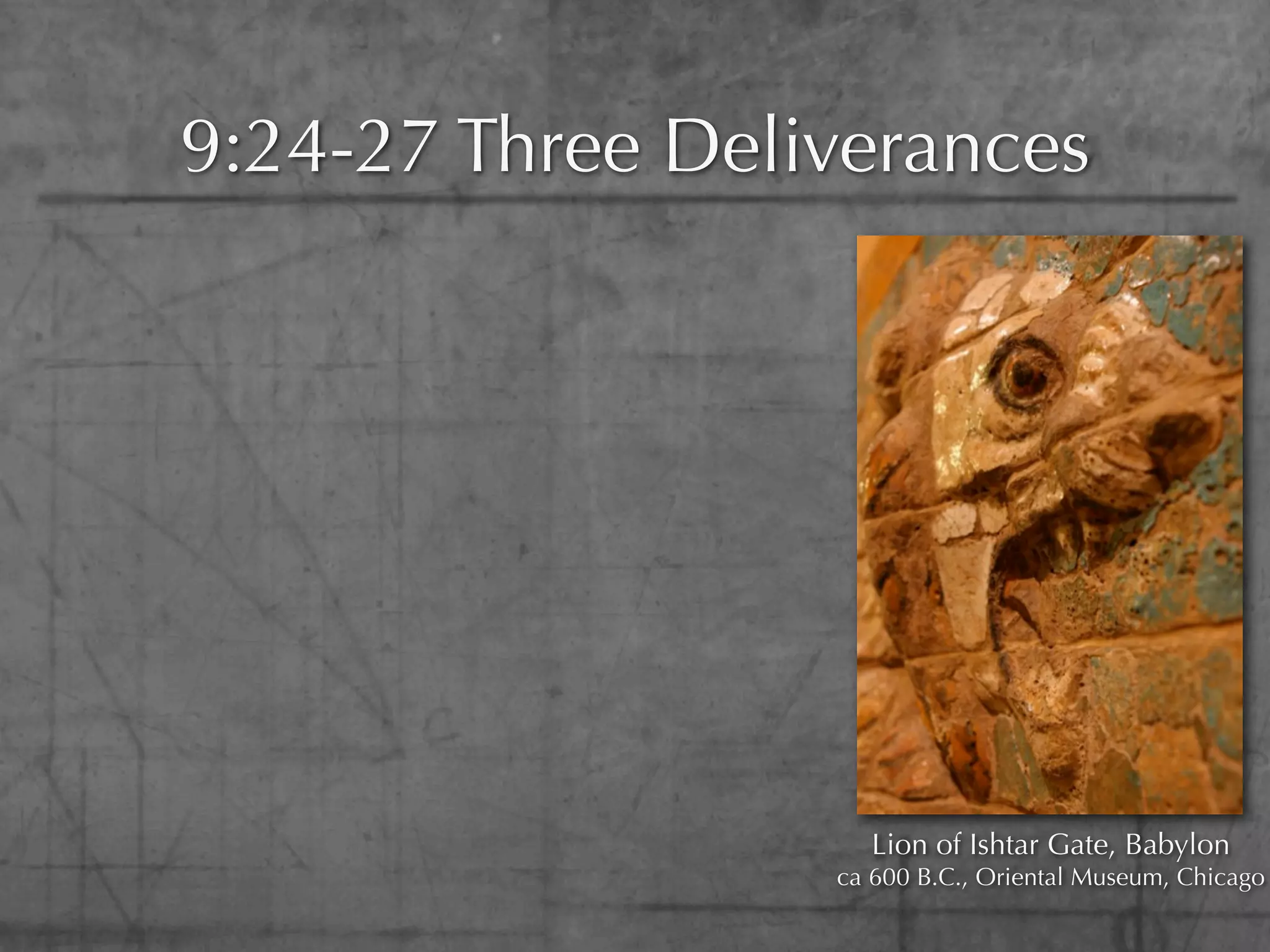
9:24-27 Three Deliverances


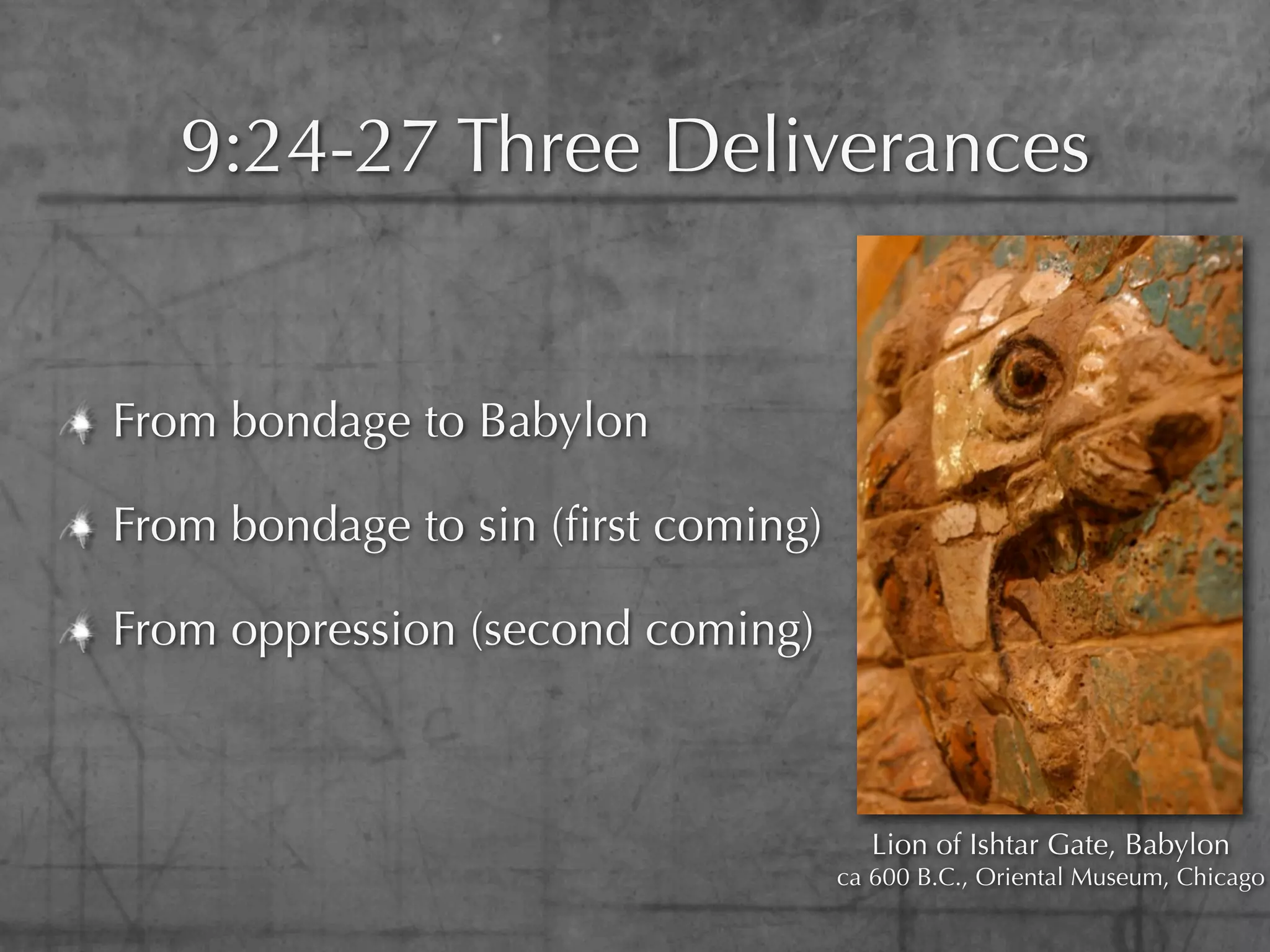
                     Lion of Ishtar Gate, Babylon
                  ca 600 B.C., Oriental Museum, Chicago
9:24-27 Three Deliverances


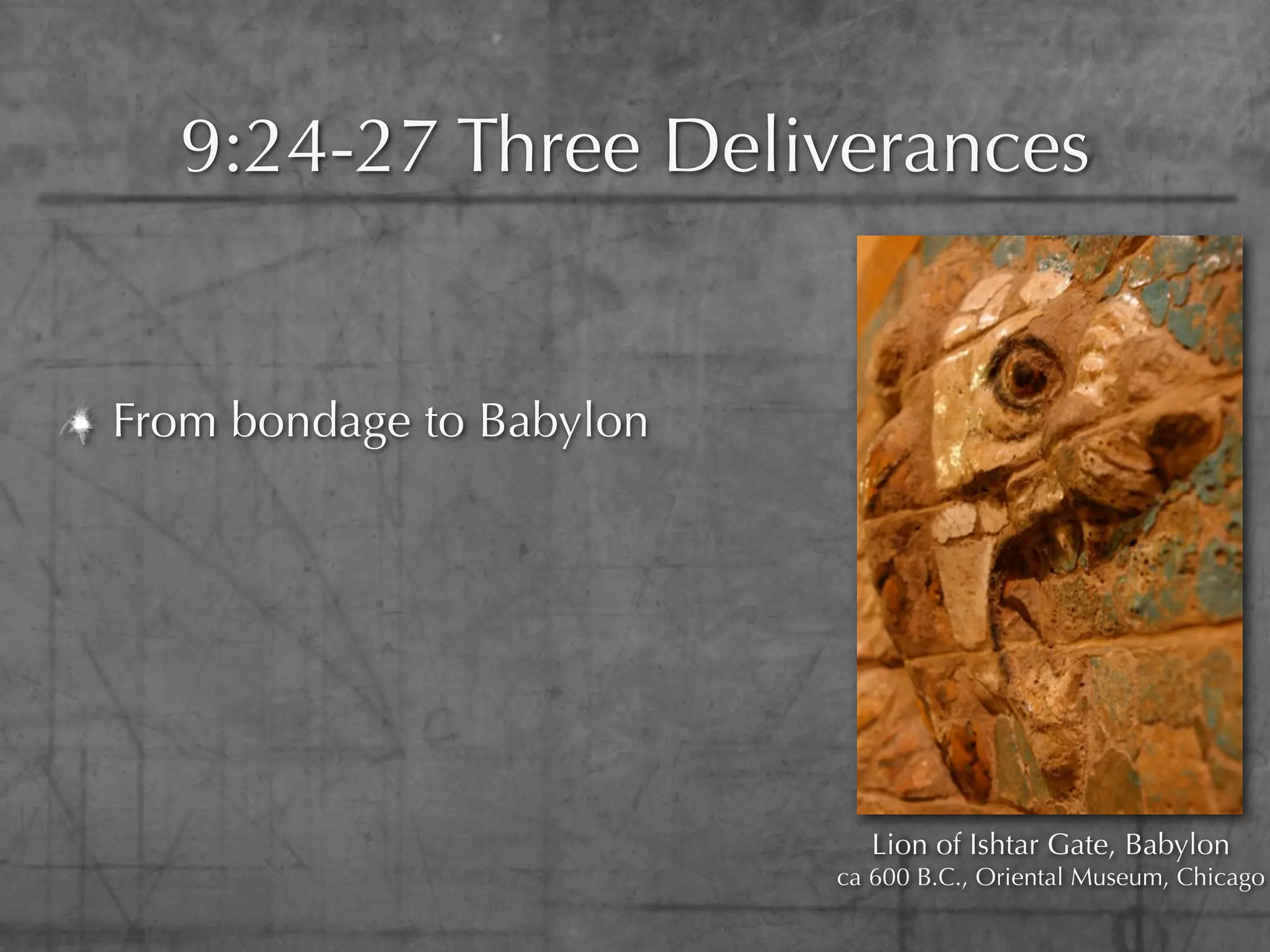
From bondage to Babylon


                             Lion of Ishtar Gate, Babylon
                          ca 600 B.C., Oriental Museum, Chicago
9:24-27 Three Deliverances


From bondage to Babylon

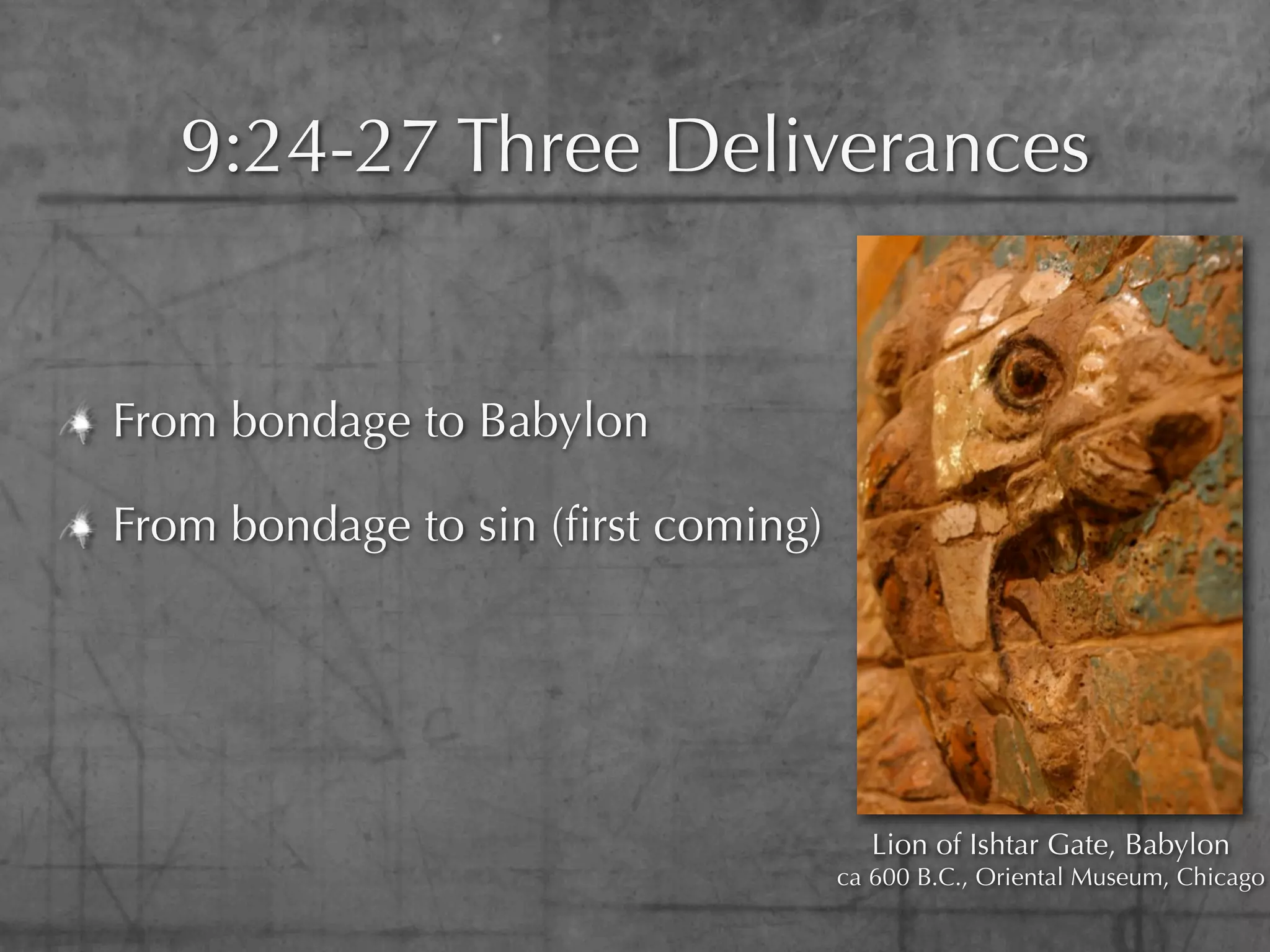
From bondage to sin (first coming)


                                       Lion of Ishtar Gate, Babylon
                                    ca 600 B.C., Oriental Museum, Chicago
9:24-27 Three Deliverances


From bondage to Babylon

From bondage to sin (first coming)
From oppression (second coming)


                                       Lion of Ishtar Gate, Babylon
                                    ca 600 B.C., Oriental Museum, Chicago
0
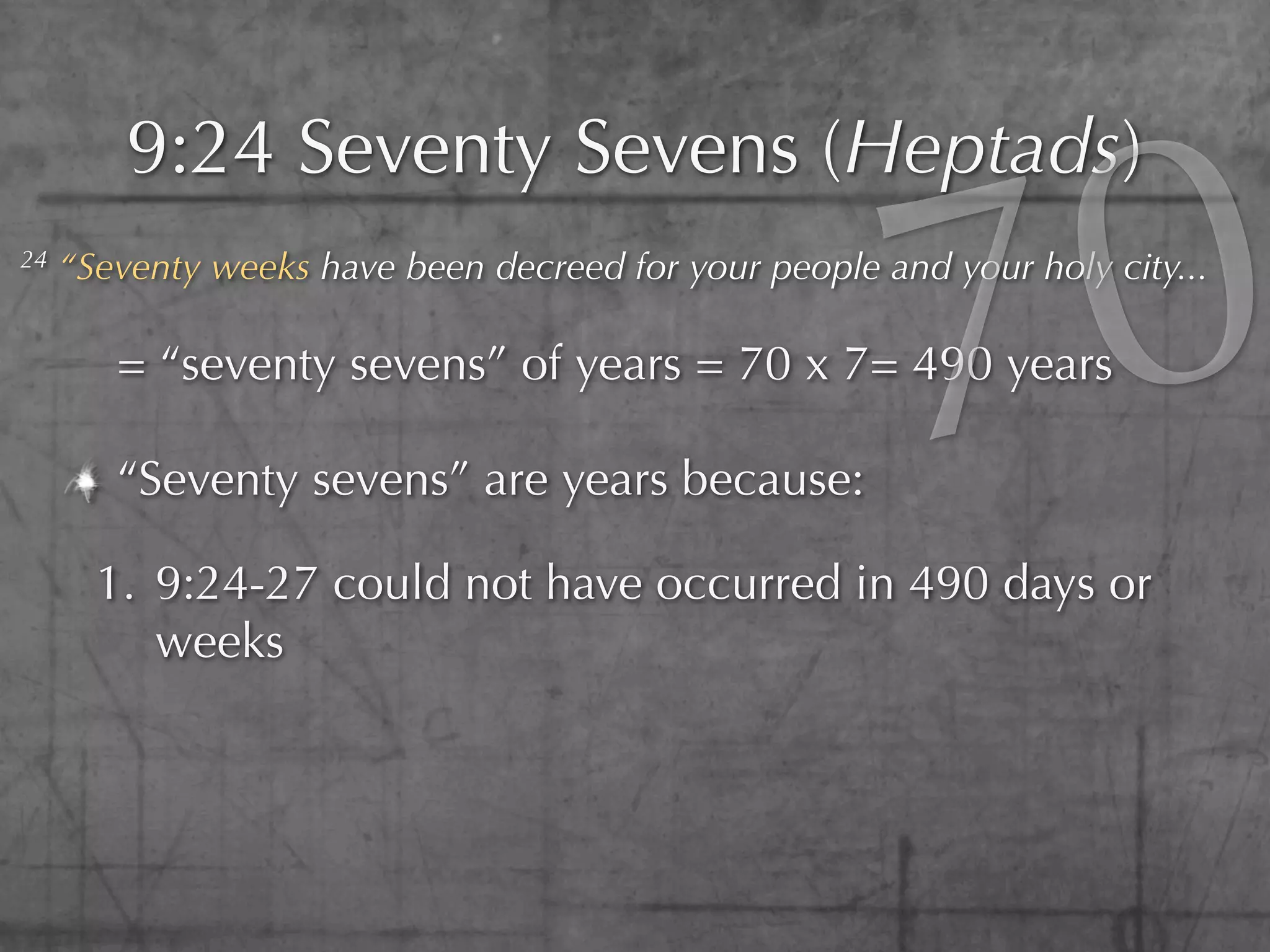
         9:24 Seventy Sevens (Heptads)
24


                                                        7
     “Seventy weeks have been decreed for your people and your holy city...
0
         9:24 Seventy Sevens (Heptads)
24


                                                        7
     “Seventy weeks have been decreed for your people and your holy city...

        = “seventy sevens” of years = 70 x 7= 490 years
0
         9:24 Seventy Sevens (Heptads)
24


                                                        7
     “Seventy weeks have been decreed for your people and your holy city...

        = “seventy sevens” of years = 70 x 7= 490 years

        “Seventy sevens” are years because:
0
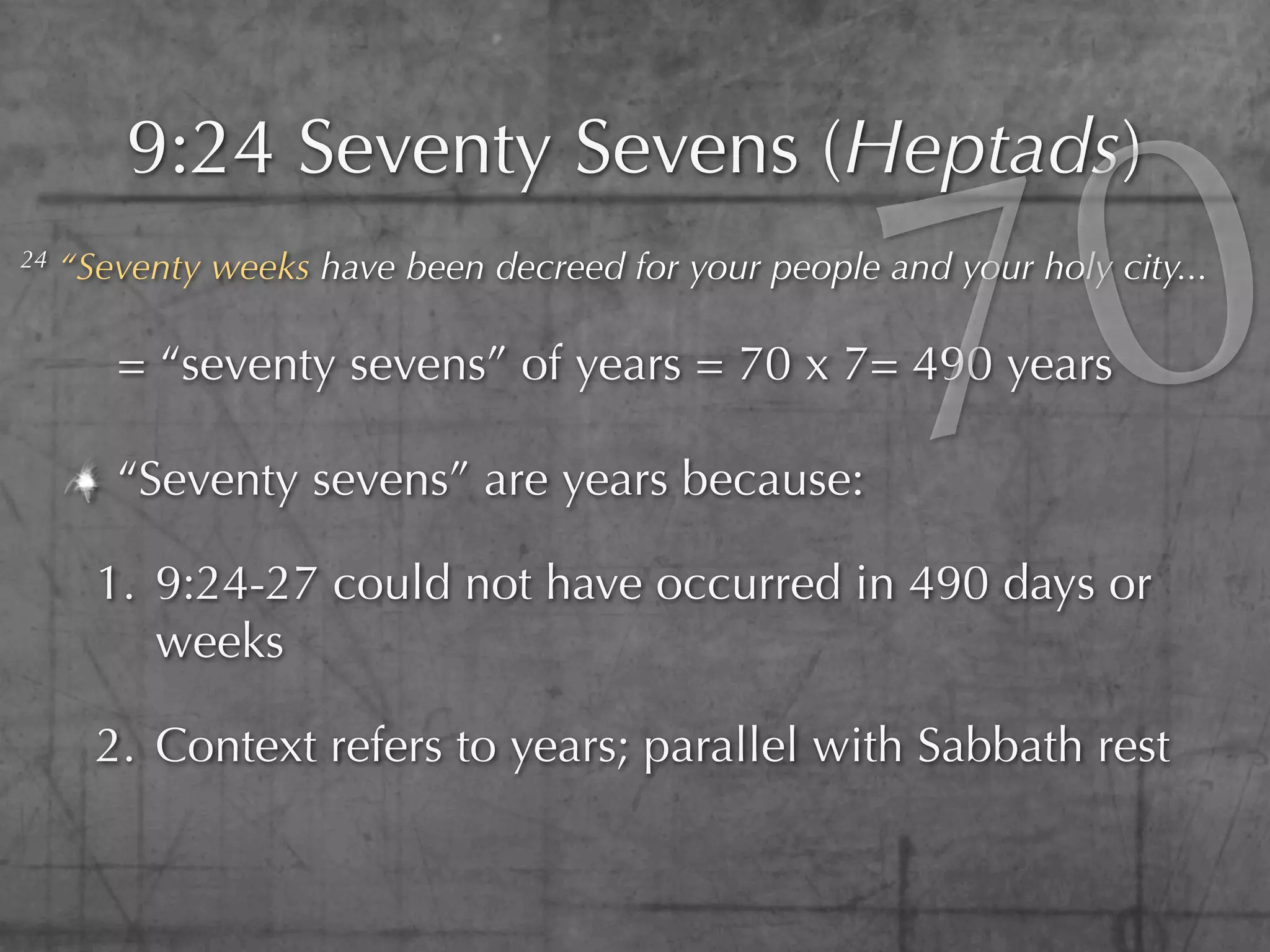
         9:24 Seventy Sevens (Heptads)
24


        = “seventy sevens” of years = 70 x 7= 490 years

        “Seventy sevens” are years because:

       1. 9:24-27 could not have occurred in 490 days or
                                                        7
     “Seventy weeks have been decreed for your people and your holy city...


          weeks
0
         9:24 Seventy Sevens (Heptads)
24


        = “seventy sevens” of years = 70 x 7= 490 years

        “Seventy sevens” are years because:

       1. 9:24-27 could not have occurred in 490 days or
                                                        7
     “Seventy weeks have been decreed for your people and your holy city...


          weeks

       2. Context refers to years; parallel with Sabbath rest
0
         9:24 Seventy Sevens (Heptads)
24


                                                        7
     “Seventy weeks have been decreed for your people and your holy city...

        = “seventy sevens” of years = 70 x 7= 490 years
0
         9:24 Seventy Sevens (Heptads)
24


                                                        7
     “Seventy weeks have been decreed for your people and your holy city...

        = “seventy sevens” of years = 70 x 7= 490 years

        “Seventy sevens” are years because:
0
         9:24 Seventy Sevens (Heptads)
24


        = “seventy sevens” of years = 70 x 7= 490 years

        “Seventy sevens” are years because:
                                                        7
     “Seventy weeks have been decreed for your people and your holy city...


       3. 10:2-3 Daniel says he fasted “three sevens of days”
0
         9:24 Seventy Sevens (Heptads)
24


        = “seventy sevens” of years = 70 x 7= 490 years

        “Seventy sevens” are years because:
                                                        7
     “Seventy weeks have been decreed for your people and your holy city...


       3. 10:2-3 Daniel says he fasted “three sevens of days”

       4. 9:27 speaks of a half-week (heptad) = 3½ years =
          1260 days = 42 months (based upon 360-day
          years)
Flood Dated Upon a 360-day Year
Gen. 7:11 “In the six hundredth year of Noah’s life, in the second
month, on he seventeenth day of the month, on the same day all
the fountains of the great deep burst open, and the flood gates of
the sky were opened.” (Flood started February 17)
Flood Dated Upon a 360-day Year
Gen. 7:11 “In the six hundredth year of Noah’s life, in the second
month, on he seventeenth day of the month, on the same day all
the fountains of the great deep burst open, and the flood gates of
the sky were opened.” (Flood started February 17)

Gen. 8:4 “And in the seventh month, on the seventeenth day of
the month, the ark rested upon the mountains of Ararat.”
(Flood ended July 17)
Flood Dated Upon a 360-day Year
Gen. 7:11 “In the six hundredth year of Noah’s life, in the second
month, on he seventeenth day of the month, on the same day all
the fountains of the great deep burst open, and the flood gates of
the sky were opened.” (Flood started February 17)

Gen. 8:4 “And in the seventh month, on the seventeenth day of
the month, the ark rested upon the mountains of Ararat.”
(Flood ended July 17)

Gen. 7:24 (cf. Gen. 8:3) “And the water prevailed upon the earth
one hundred and fifty days.” (Flood duration: 150 days)
Flood Dated Upon a 360-day Year
Gen. 7:11 “In the six hundredth year of Noah’s life, in the second
month, on he seventeenth day of the month, on the same day all
the fountains of the great deep burst open, and the flood gates of
the sky were opened.” (Flood started February 17)

Gen. 8:4 “And in the seventh month, on the seventeenth day of
the month, the ark rested upon the mountains of Ararat.”
(Flood ended July 17)

Gen. 7:24 (cf. Gen. 8:3) “And the water prevailed upon the earth
one hundred and fifty days.” (Flood duration: 150 days)

                    2/17-7/17= 5 months
Flood Dated Upon a 360-day Year
Gen. 7:11 “In the six hundredth year of Noah’s life, in the second
month, on he seventeenth day of the month, on the same day all
the fountains of the great deep burst open, and the flood gates of
the sky were opened.” (Flood started February 17)

Gen. 8:4 “And in the seventh month, on the seventeenth day of
the month, the ark rested upon the mountains of Ararat.”
(Flood ended July 17)

Gen. 7:24 (cf. Gen. 8:3) “And the water prevailed upon the earth
one hundred and fifty days.” (Flood duration: 150 days)

                    2/17-7/17= 5 months
             5 months x 30 days = 150 days
Six Events of 9:24
24   “Seventy weeks have been decreed for your people and your holy city,
          to finish the transgression,            1
          to make an end of sin,                 2
          to make atonement for iniquity,        3
          to bring in everlasting righteousness, 4
          to seal up vision and prophecy and     5
          to anoint the most holy place.         6
Seventy Weeks Interpretation #1

1st Advent             2nd Advent
Seventy Weeks Interpretation #1

    1st Advent                  2nd Advent

1. “Finish the transgression”
Seventy Weeks Interpretation #1

    1st Advent                  2nd Advent

1. “Finish the transgression”


2. “Make an end of sin”
Seventy Weeks Interpretation #1

    1st Advent                     2nd Advent

1. “Finish the transgression”


2. “Make an end of sin”


3. “Make atonement for iniquity”
Seventy Weeks Interpretation #1

    1st Advent                          2nd Advent

1. “Finish the transgression”      4. “Bring in everlasting
                                       righteousness”

2. “Make an end of sin”


3. “Make atonement for iniquity”
Seventy Weeks Interpretation #1

    1st Advent                          2nd Advent

1. “Finish the transgression”      4. “Bring in everlasting
                                       righteousness”

2. “Make an end of sin”            5. “Seal up vision and
                                         prophecy”

3. “Make atonement for iniquity”
Seventy Weeks Interpretation #1

    1st Advent                          2nd Advent

1. “Finish the transgression”      4. “Bring in everlasting
                                       righteousness”

2. “Make an end of sin”            5. “Seal up vision and
                                         prophecy”

3. “Make atonement for iniquity”   6. “Anoint the most
                                       holy place”
Seventy Weeks Interpretation #2

    Israel’s Sin                        2nd Advent

1. “Finish the transgression”      4. “Bring in everlasting
                                       righteousness”

2. “Make an end of sin”            5. “Seal up vision and
                                         prophecy”

3. “Make atonement for iniquity”   6. “Anoint the most
                                       holy place”
Seventy Weeks Interpretation #2

    Israel’s Sin                        2nd Advent

1. “Finish the transgression”      4. “Bring in everlasting
      Zech. 1:12-17                    righteousness”

2. “Make an end of sin”            5. “Seal up vision and
                                         prophecy”

3. “Make atonement for iniquity”   6. “Anoint the most
                                       holy place”
Seventy Weeks Interpretation #2

    Israel’s Sin                        2nd Advent

1. “Finish the transgression”      4. “Bring in everlasting
      Zech. 1:12-17                    righteousness”

2. “Make an end of sin”            5. “Seal up vision and
     Messiah comes, Satan bound          prophecy”

3. “Make atonement for iniquity”   6. “Anoint the most
                                       holy place”
Seventy Weeks Interpretation #2

    Israel’s Sin                            2nd Advent

1. “Finish the transgression”          4. “Bring in everlasting
      Zech. 1:12-17                        righteousness”

2. “Make an end of sin”                5. “Seal up vision and
     Messiah comes, Satan bound              prophecy”

3. “Make atonement for iniquity”       6. “Anoint the most
      Provision made at first advent,       holy place”
     fulfillment at the second advent
Seventy Weeks Interpretation #2

    Israel’s Sin                            2nd Advent

1. “Finish the transgression”          4. “Bring in everlasting
      Zech. 1:12-17                        righteousness”
                                          Jer. 23:5-6; Is. 11:2-9
2. “Make an end of sin”                5. “Seal up vision and
     Messiah comes, Satan bound               prophecy”

3. “Make atonement for iniquity”       6. “Anoint the most
      Provision made at first advent,       holy place”
     fulfillment at the second advent
Seventy Weeks Interpretation #2

    Israel’s Sin                            2nd Advent

1. “Finish the transgression”          4. “Bring in everlasting
      Zech. 1:12-17                         righteousness”
                                           Jer. 23:5-6; Is. 11:2-9
2. “Make an end of sin”                5. “Seal up vision and
     Messiah comes, Satan bound                prophecy”
                                          Prophecies all fulfilled
3. “Make atonement for iniquity”        6. “Anoint the most
      Provision made at first advent,         holy place”
     fulfillment at the second advent
Seventy Weeks Interpretation #2

    Israel’s Sin                            2nd Advent

1. “Finish the transgression”          4. “Bring in everlasting
      Zech. 1:12-17                         righteousness”
                                           Jer. 23:5-6; Is. 11:2-9
2. “Make an end of sin”                5. “Seal up vision and
     Messiah comes, Satan bound                prophecy”
                                          Prophecies all fulfilled
3. “Make atonement for iniquity”        6. “Anoint the most
      Provision made at first advent,         holy place”
     fulfillment at the second advent      The millennial temple
Start Date of the 70 Weeks
25   “So you are to know and discern that
        from the issuing of a decree to restore and rebuild Jerusalem
        until Messiah the Prince
        there will be seven weeks and sixty-two weeks;
               it will be built again,
                  with plaza and moat,
                    even in times of distress.


                          Model of Rebuilt Temple, Jerusalem
Daniel’s   70th   Week
     69 weeks
     Ends Here


 King &
Kingdom
Rejected
Daniel’s   70th   Week
     69 weeks
     Ends Here


           Our Times

 King &     Church
Kingdom      Age
Rejected
Daniel’s        70th   Week
     69 weeks
     Ends Here


                                          Israel
           Our Times

 King &     Church     Tribulation
Kingdom      Age       70th Week
Rejected
Daniel’s        70th      Week
     69 weeks                    2nd Coming
     Ends Here                     of Christ
                                   Rev. 19


                                               Israel
           Our Times

 King &     Church     Tribulation
Kingdom      Age       70th Week
Rejected
Daniel’s        70th      Week
     69 weeks                    2nd Coming
     Ends Here                     of Christ
                                   Rev. 19


                                                 Israel
           Our Times

 King &     Church     Tribulation       Millennial Kingdom
Kingdom      Age       70th Week             (1000 Years)
Rejected
Daniel’s        70th      Week
     69 weeks                    2nd Coming            Judgment
     Ends Here                     of Christ            Rev. 20
                                   Rev. 19


                                                 Israel
           Our Times

 King &     Church     Tribulation       Millennial Kingdom
Kingdom      Age       70th Week             (1000 Years)
Rejected
Daniel’s        70th      Week
     69 weeks                    2nd Coming            Judgment
     Ends Here                     of Christ            Rev. 20
                                   Rev. 19


                                                                  Heaven
                                                 Israel           Rev. 21
           Our Times

 King &     Church     Tribulation       Millennial Kingdom       Eternal
Kingdom      Age       70th Week             (1000 Years)         Heaven
Rejected
Start of the Seventy Weeks


550 B.C.               500 B.C.         450 B.C.
Start of the Seventy Weeks


                              .
                            .C
                       8B
                   53


550 B.C.                          500 B.C.   450 B.C.

                End of the
           Babylonian Captivity
Start of the Seventy Weeks


                                                                 .
                                                               .C
                              .
                            .C


                                                          4B
                       8B


                                                      44
                   53


550 B.C.                          500 B.C.                   450 B.C.

                End of the                   Decree of Artaxerxes,
           Babylonian Captivity                 King of Persia
Start of the Seventy Weeks


                                                                                    .
                                                                                  .C
                              .
                            .C


                                                                             4B
                       8B


                                                                         44
                   53


550 B.C.                                   500 B.C.                             450 B.C.

                End of the                                      Decree of Artaxerxes,
           Babylonian Captivity                                    King of Persia


                                  94-Year Delay (538-444 B.C)
Incorrect Start Dates of 70 Weeks
  Based Upon the Book of Ezra
Incorrect Start Dates of 70 Weeks
  Based Upon the Book of Ezra
     Decree of Cyrus, 536 B.C., (Ezra 1:1-3)
Incorrect Start Dates of 70 Weeks
  Based Upon the Book of Ezra
     Decree of Cyrus, 536 B.C., (Ezra 1:1-3)

     Decree of Darius, (Ezra 6:3-8)
Incorrect Start Dates of 70 Weeks
  Based Upon the Book of Ezra
     Decree of Cyrus, 536 B.C., (Ezra 1:1-3)

     Decree of Darius, (Ezra 6:3-8)

     Decree of Artaxeres, 458 B.C., (Ezra 7)
Correct Start Dates of 70 Weeks
Based Upon the Book of Nehemiah
Correct Start Dates of 70 Weeks
Based Upon the Book of Nehemiah
   Nehemiah 2:1-8
Correct Start Dates of 70 Weeks
Based Upon the Book of Nehemiah
   Nehemiah 2:1-8

   Nehemiah’s prayer, 1:4-11
Correct Start Dates of 70 Weeks
Based Upon the Book of Nehemiah
   Nehemiah 2:1-8

   Nehemiah’s prayer, 1:4-11

   7 weeks (49 years) are from 444-395 B.C.
Correct Start Dates of 70 Weeks
Based Upon the Book of Nehemiah
   Nehemiah 2:1-8

   Nehemiah’s prayer, 1:4-11

   7 weeks (49 years) are from 444-395 B.C.

    Walls quickly rebuilt, Neh. 6:15
Correct Start Dates of 70 Weeks
Based Upon the Book of Nehemiah
   Nehemiah 2:1-8

   Nehemiah’s prayer, 1:4-11

   7 weeks (49 years) are from 444-395 B.C.

    Walls quickly rebuilt, Neh. 6:15

   62 weeks (434 years) until triumphal entry
Correct Start Dates of 70 Weeks
Based Upon the Book of Nehemiah
   Nehemiah 2:1-8

   Nehemiah’s prayer, 1:4-11

   7 weeks (49 years) are from 444-395 B.C.

    Walls quickly rebuilt, Neh. 6:15

   62 weeks (434 years) until triumphal entry

    69th week described: Matt. 21:1-11; Zech. 9:9
Failing to Recognize the Time
            of Their Visitation

Lk. 19:42-44 ”...if you had known in this day, even you, the things
which make for peace! But now they have been hidden from your
eyes.


For the days shall come upon you when your enemies will throw up a
bank before you, and surround you, and hem you in on every side, and
will level you to the ground and your children within you, and they will
not leave in you one stone upon another, because you did not
recognize the time of your visitation.”
Messiah Will Be Cut Off
26 “Then after the sixty-two weeks the Messiah will be cut off and have
nothing, and the people of the prince who is to come will destroy the
city and the sanctuary...”
Messiah Will Be Cut Off
26 “Then after the sixty-two weeks the Messiah will be cut off and have
nothing, and the people of the prince who is to come will destroy the
city and the sanctuary...”
Destruction of the Temple, A.D. 70


Destruction of Second Temple by Romans   Depiction in the Arch of Titus, Rome, 70 A.D.
Jesus’ Prophecy of the
              Temple Destruction
Matt. 24:2 “Do you not see all these things? Truly I say to you, not one
stone here shall be left upon another, which will not be torn down.”
R
     “Desolations Are Determined”

26


         W A
   “Then after the sixty-two weeks the Messiah will be cut off and have
nothing, and the people of the prince who is to come will destroy the
city and the sanctuary. And its end will come with a flood; even to the


                0
end there will be war; desolations are determined.


         6 9 -7
Roman Antichrist
26 “Then after the sixty-two weeks the Messiah will be cut off and have
nothing, and the people of the prince who is to come will destroy the
city and the sanctuary...”
The Antichrist Prince
27“And he will make a firm covenant with the many for one week, but in
the middle of the week he will put a stop to sacrifice and grain offering;
and on the wing of abominations will come one who makes desolate,
even until a complete destruction, one that is decreed, is poured out on
the one who makes desolate.”
The Antichrist Prince
27“And he will make a firm covenant with the many for one week, but in
the middle of the week he will put a stop to sacrifice and grain offering;
and on the wing of abominations will come one who makes desolate,
even until a complete destruction, one that is decreed, is poured out on
the one who makes desolate.”

     2 Thess. 2:9-10 “that is, the one whose coming is in accord with the
        activity of Satan, with all power and signs and false wonders,
      and with all the deception of wickedness for those who perish...”
The Antichrist Prince
27“And he will make a firm covenant with the many for one week, but in
the middle of the week he will put a stop to sacrifice and grain offering;
and on the wing of abominations will come one who makes desolate,
even until a complete destruction, one that is decreed, is poured out on
the one who makes desolate.”

     2 Thess. 2:9-10 “that is, the one whose coming is in accord with the
        activity of Satan, with all power and signs and false wonders,
      and with all the deception of wickedness for those who perish...”

     Rev. 13:12-14 “And he exercises all the authority of the first beast in
     his presence. And he makes the earth and those who dwell in it to
           worship the first beast, whose fatal wound was healed.
     And he performs great signs, so that he even makes fire come down
             out of heaven to the earth in the presence of men.”
Peace in the Middle East?
Rebuilding a Future Third Temple


                     Wish of Many Jews
Rebuilding a Future Third Temple


 Solomon’s temple destroyed by
 Nebuchadnezzar, 586 B.C.


                                 Wish of Many Jews
Rebuilding a Future Third Temple


 Solomon’s temple destroyed by
 Nebuchadnezzar, 586 B.C.

 Herod’s temple destroyed by
 Titus, 70 A.D.


                                 Wish of Many Jews
Protector of the Jews to Become
   the Persecutor of the Jews

2 Thess. 2:4 “who opposes and exalts himself above every so-called
 god or object of worship, so that he takes his seat in the temple of
              God, displaying himself as being God.”
Protector of the Jews to Become
    the Persecutor of the Jews

2 Thess. 2:4 “who opposes and exalts himself above every so-called
 god or object of worship, so that he takes his seat in the temple of
              God, displaying himself as being God.”

Rev. 13:14 “And he deceives those who dwell on the earth because
of the signs which it was given him to perform in the presence of the
beast, telling those who dwell on the earth to make an image to the
                               beast...”
Jesus Warns of This Abomination

  Matt. 24:15-16 “Therefore when you see the ABOMINATION OF
  DESOLATION which was spoken of through Daniel the prophet,
standing in the holy place (let the reader understand), then let those
              who are in Judea flee to the mountains...”
The Final Destruction
27“And he will make a firm covenant with the many for one week, but in
the middle of the week he will put a stop to sacrifice and grain offering;
and on the wing of abominations will come one who makes desolate,
even until a complete destruction, one that is decreed, is poured out on
the one who makes desolate.”
The Final Destruction
27“And he will make a firm covenant with the many for one week, but in
the middle of the week he will put a stop to sacrifice and grain offering;
and on the wing of abominations will come one who makes desolate,
even until a complete destruction, one that is decreed, is poured out on
the one who makes desolate.”

      Fulfilled in:
The Final Destruction
27“And he will make a firm covenant with the many for one week, but in
the middle of the week he will put a stop to sacrifice and grain offering;
and on the wing of abominations will come one who makes desolate,
even until a complete destruction, one that is decreed, is poured out on
the one who makes desolate.”

      Fulfilled in:

         Zech. 14:1-4
The Final Destruction
27“And he will make a firm covenant with the many for one week, but in
the middle of the week he will put a stop to sacrifice and grain offering;
and on the wing of abominations will come one who makes desolate,
even until a complete destruction, one that is decreed, is poured out on
the one who makes desolate.”

      Fulfilled in:

         Zech. 14:1-4

         Rev. 19:11, 20-21
Daniel’s Seventy Weeks Overview
         Daniel 9:24-27
Daniel’s Seventy Weeks Overview
                     Daniel 9:24-27


 1st week

DAN. 9:25


    7 weeks
     49 years
Daniel’s Seventy Weeks Overview
                       Daniel 9:24-27


  1st week

DAN. 9:25


     7 weeks
       49 years


* Jerusalem
restoration
   decree
   issued
Daniel’s Seventy Weeks Overview
                                 Daniel 9:24-27


  1st week              69th week

DAN. 9:25         DAN. 9:25-26


     7 weeks         62 weeks
       49 years        434 years


* Jerusalem
restoration
   decree
   issued
Daniel’s Seventy Weeks Overview
                                 Daniel 9:24-27


  1st week              69th week

DAN. 9:25         DAN. 9:25-26


     7 weeks         62 weeks
       49 years        434 years


* Jerusalem
restoration
   decree
   issued
Daniel’s Seventy Weeks Overview
                                 Daniel 9:24-27


  1st week              69th week

DAN. 9:25         DAN. 9:25-26


     7 weeks         62 weeks
       49 years        434 years


* Jerusalem        * Messiah presented
restoration
   decree
   issued
Daniel’s Seventy Weeks Overview
                                 Daniel 9:24-27


  1st week              69th week

DAN. 9:25         DAN. 9:25-26


     7 weeks         62 weeks
       49 years        434 years


* Jerusalem        * Messiah presented
restoration           * Messiah cut off
   decree
   issued
Daniel’s Seventy Weeks Overview
                                 Daniel 9:24-27


  1st week              69th week

DAN. 9:25         DAN. 9:25-26


     7 weeks         62 weeks
       49 years        434 years


* Jerusalem        * Messiah presented
restoration           * Messiah cut off
   decree
                  * Jerusalem destroyed
   issued
Daniel’s Seventy Weeks Overview
                                 Daniel 9:24-27


  1st week              69th week

DAN. 9:25         DAN. 9:25-26


     7 weeks         62 weeks             Church Age
       49 years        434 years             Gap


* Jerusalem        * Messiah presented
restoration           * Messiah cut off
   decree
                  * Jerusalem destroyed
   issued
Daniel’s Seventy Weeks Overview
                                 Daniel 9:24-27

                                                   Rapture


  1st week              69th week

DAN. 9:25         DAN. 9:25-26


     7 weeks         62 weeks             Church Age
       49 years        434 years             Gap


* Jerusalem        * Messiah presented
restoration           * Messiah cut off
   decree
                  * Jerusalem destroyed
   issued
Daniel’s Seventy Weeks Overview
                                 Daniel 9:24-27

                                                   Rapture


  1st week              69th week                            70th week

DAN. 9:25         DAN. 9:25-26                         DAN. 9:27


     7 weeks         62 weeks             Church Age          1 week
       49 years        434 years             Gap               7 years


* Jerusalem        * Messiah presented
restoration           * Messiah cut off
   decree
                  * Jerusalem destroyed
   issued
Daniel’s Seventy Weeks Overview
                                 Daniel 9:24-27

                                                   Rapture


  1st week              69th week                            70th week

DAN. 9:25         DAN. 9:25-26                         DAN. 9:27


     7 weeks         62 weeks             Church Age          1 week
       49 years        434 years             Gap               7 years


* Jerusalem        * Messiah presented                 * Covenant established
restoration           * Messiah cut off
   decree
                  * Jerusalem destroyed
   issued
Daniel’s Seventy Weeks Overview
                                 Daniel 9:24-27

                                                   Rapture


  1st week              69th week                            70th week

DAN. 9:25         DAN. 9:25-26                         DAN. 9:27


     7 weeks         62 weeks             Church Age           1 week
       49 years        434 years             Gap                7 years


* Jerusalem        * Messiah presented                 * Covenant established
restoration           * Messiah cut off                      * Covenant broken
   decree
                  * Jerusalem destroyed
   issued
Daniel’s Seventy Weeks Overview
                                 Daniel 9:24-27

                                                   Rapture


  1st week              69th week                            70th week

DAN. 9:25         DAN. 9:25-26                         DAN. 9:27


     7 weeks         62 weeks             Church Age           1 week
       49 years        434 years             Gap                7 years


* Jerusalem        * Messiah presented                 * Covenant established
restoration           * Messiah cut off                      * Covenant broken
   decree
                  * Jerusalem destroyed                  * Temple desecrated
   issued
Daniel’s Seventy Weeks Overview
                                 Daniel 9:24-27

                                                   Rapture


  1st week              69th week                            70th week

DAN. 9:25         DAN. 9:25-26                         DAN. 9:27


     7 weeks         62 weeks             Church Age           1 week
       49 years        434 years             Gap                7 years


* Jerusalem        * Messiah presented                 * Covenant established
restoration           * Messiah cut off                      * Covenant broken
   decree
                  * Jerusalem destroyed                  * Temple desecrated
   issued
                                                        * Antichrist destroyed
Daniel’s Seventy Weeks Overview
                                 Daniel 9:24-27
                                                                          Messiah
                                                   Rapture                Returns


  1st week              69th week                            70th week

DAN. 9:25         DAN. 9:25-26                         DAN. 9:27


     7 weeks         62 weeks             Church Age           1 week
       49 years        434 years             Gap                7 years


* Jerusalem        * Messiah presented                 * Covenant established
restoration           * Messiah cut off                      * Covenant broken
   decree
                  * Jerusalem destroyed                  * Temple desecrated
   issued
                                                        * Antichrist destroyed
Daniel’s Seventy Weeks Calculated


DAN. 9:25       DAN. 9:25-26

   7 weeks        62 weeks
    49 years        434 years
Daniel’s Seventy Weeks Calculated
Decree to                        Messiah
Restore Jerusalem              the Prince

                 69 weeks

 DAN. 9:25            DAN. 9:25-26

    7 weeks             62 weeks
      49 years            434 years
Daniel’s Seventy Weeks Calculated
Decree to                         Messiah
Restore Jerusalem               the Prince

                  69 weeks

 DAN. 9:25             DAN. 9:25-26

     7 weeks             62 weeks
       49 years            434 years


March 5,
444 B.C
Artaxerxes’
Decree
Neh. 2:1-8
Daniel’s Seventy Weeks Calculated
Decree to                         Messiah
Restore Jerusalem               the Prince

                  69 weeks

 DAN. 9:25             DAN. 9:25-26

     7 weeks             62 weeks
       49 years            434 years


March 5,                      March 30,
444 B.C                        A.D. 33
Artaxerxes’               Triumphal Entry
Decree                         Lk. 19:28-40
Neh. 2:1-8
Daniel’s Seventy Weeks Calculated
Decree to                         Messiah
Restore Jerusalem               the Prince

                  69 weeks

 DAN. 9:25             DAN. 9:25-26

     7 weeks             62 weeks
       49 years            434 years


March 5,                      March 30,
444 B.C                        A.D. 33
Artaxerxes’               Triumphal Entry
Decree                         Lk. 19:28-40
Neh. 2:1-8
Daniel’s Seventy Weeks Calculated
Decree to
                                                  Messiah
Restore
                                                the Prince
Jerusalem

                         69 weeks

 DAN. 9:25                             DAN. 9:25-26

    7 weeks                              62 weeks
      49 years                             434 years


March 5, 444 B.C                      March 30, A.D. 33
Artaxerxes’                               Triumphal Entry
Decree                                       Luke 19:28-40
Nehemiah 2:1-8
Daniel’s Seventy Weeks Calculated
Decree to
                                                               Messiah
Restore
                                                             the Prince
Jerusalem

                            69 weeks

 DAN. 9:25                                          DAN. 9:25-26

    7 weeks                                           62 weeks
      49 years                                          434 years


                     69 x 7 x 360 = 173,880 days


March 5, 444 B.C                                   March 30, A.D. 33
Artaxerxes’                                            Triumphal Entry
Decree                                                    Luke 19:28-40
Nehemiah 2:1-8
Daniel’s Seventy Weeks Calculated
Decree to
                                                                             Messiah
Restore
                                                                           the Prince
Jerusalem

                                     69 weeks

 DAN. 9:25                                                      DAN. 9:25-26

    7 weeks                                                       62 weeks
      49 years                                                      434 years


                             69 x 7 x 360 = 173,880 days
                 March 5, 444 B.C. +173,880 days = March 30, A.D. 33*
March 5, 444 B.C                                               March 30, A.D. 33
Artaxerxes’                                                        Triumphal Entry
Decree                                                                  Luke 19:28-40
Nehemiah 2:1-8
Daniel’s Seventy Weeks Calculated
                         * Proof: 444 B.C. to A.D. 33 = 476 years
Decree to
                                                                                Messiah
Restore
                                                                              the Prince
Jerusalem

                                     69 weeks

 DAN. 9:25                                                           DAN. 9:25-26

    7 weeks                                                            62 weeks
      49 years                                                           434 years


                             69 x 7 x 360 = 173,880 days
                 March 5, 444 B.C. +173,880 days = March 30, A.D. 33*
March 5, 444 B.C                                                    March 30, A.D. 33
Artaxerxes’                                                             Triumphal Entry
Decree                                                                     Luke 19:28-40
Nehemiah 2:1-8
Daniel’s Seventy Weeks Calculated
                         * Proof: 444 B.C. to A.D. 33 = 476 years
Decree to                    476 x 365.242 days = 173,855 days                  Messiah
Restore
                                                                              the Prince
Jerusalem

                                     69 weeks

 DAN. 9:25                                                           DAN. 9:25-26

    7 weeks                                                            62 weeks
      49 years                                                           434 years


                             69 x 7 x 360 = 173,880 days
                 March 5, 444 B.C. +173,880 days = March 30, A.D. 33*
March 5, 444 B.C                                                    March 30, A.D. 33
Artaxerxes’                                                             Triumphal Entry
Decree                                                                     Luke 19:28-40
Nehemiah 2:1-8
Daniel’s Seventy Weeks Calculated
                         * Proof: 444 B.C. to A.D. 33 = 476 years
Decree to                   476 x 365.242 days = 173,855 days                   Messiah
Restore
Jerusalem             From March 5 to March 30 =     +25 days                 the Prince


                                     69 weeks

 DAN. 9:25                                                           DAN. 9:25-26

    7 weeks                                                            62 weeks
      49 years                                                           434 years


                             69 x 7 x 360 = 173,880 days
                 March 5, 444 B.C. +173,880 days = March 30, A.D. 33*
March 5, 444 B.C                                                    March 30, A.D. 33
Artaxerxes’                                                             Triumphal Entry
Decree                                                                     Luke 19:28-40
Nehemiah 2:1-8
Daniel’s Seventy Weeks Calculated
                         * Proof: 444 B.C. to A.D. 33 = 476 years
Decree to                   476 x 365.242 days = 173,855 days                   Messiah
Restore
Jerusalem             From March 5 to March 30 =     +25 days                 the Prince
                                                 173,880 days
                                     69 weeks

 DAN. 9:25                                                           DAN. 9:25-26

    7 weeks                                                            62 weeks
      49 years                                                           434 years


                             69 x 7 x 360 = 173,880 days
                 March 5, 444 B.C. +173,880 days = March 30, A.D. 33*
March 5, 444 B.C                                                    March 30, A.D. 33
Artaxerxes’                                                             Triumphal Entry
Decree                                                                     Luke 19:28-40
Nehemiah 2:1-8
Daniel’s Seventy Weeks Calculated
Decree to                         Messiah
Restore Jerusalem               the Prince

                  69 weeks

 DAN. 9:25             DAN. 9:25-26

     7 weeks             62 weeks
       49 years            434 years


March 5,                      March 30,
444 B.C                        A.D. 33
Artaxerxes’               Triumphal Entry
Decree                         Lk. 19:28-40
Neh. 2:1-8
Daniel’s Seventy Weeks Calculated
                                              Messiah
Decree to                         Messiah     “Cut off”
Restore Jerusalem               the Prince    Apr. 3,
                                              A.D. 33
                  69 weeks

 DAN. 9:25             DAN. 9:25-26

     7 weeks             62 weeks
       49 years            434 years


March 5,                      March 30,
444 B.C                        A.D. 33
Artaxerxes’               Triumphal Entry
Decree                         Lk. 19:28-40
Neh. 2:1-8
Daniel’s Seventy Weeks Calculated
                                              Messiah
Decree to                         Messiah     “Cut off”
Restore Jerusalem               the Prince    Apr. 3,
                                              A.D. 33
                  69 weeks

 DAN. 9:25             DAN. 9:25-26

     7 weeks             62 weeks
       49 years            434 years


March 5,                      March 30,         City and
444 B.C                        A.D. 33          Sanctuary
Artaxerxes’                                     Destroyed
                          Triumphal Entry
Decree                                          Aug. 6,
                               Lk. 19:28-40
Neh. 2:1-8                                      A.D. 70
Daniel’s Seventy Weeks Calculated
                                              Messiah
Decree to                         Messiah     “Cut off”
Restore Jerusalem               the Prince    Apr. 3,
                                              A.D. 33
                  69 weeks

 DAN. 9:25             DAN. 9:25-26

     7 weeks             62 weeks                     Church Age
       49 years            434 years                     Gap


March 5,                      March 30,         City and
444 B.C                        A.D. 33          Sanctuary
Artaxerxes’                                     Destroyed
                          Triumphal Entry
Decree                                          Aug. 6,
                               Lk. 19:28-40
Neh. 2:1-8                                      A.D. 70
Daniel’s Seventy Weeks Calculated
                                              Messiah
Decree to                         Messiah     “Cut off”
Restore Jerusalem               the Prince    Apr. 3,
                                              A.D. 33
                  69 weeks                                              1 week

 DAN. 9:25             DAN. 9:25-26                                DAN. 9:27

     7 weeks             62 weeks                     Church Age       1 week
       49 years            434 years                     Gap             7 years


March 5,                      March 30,         City and
444 B.C                        A.D. 33          Sanctuary
Artaxerxes’                                     Destroyed
                          Triumphal Entry
Decree                                          Aug. 6,
                               Lk. 19:28-40
Neh. 2:1-8                                      A.D. 70
Daniel’s Seventy Weeks Calculated
                                              Messiah
Decree to                         Messiah     “Cut off”            The Coming
Restore Jerusalem               the Prince    Apr. 3,              Prince
                                              A.D. 33
                  69 weeks                                              1 week

 DAN. 9:25             DAN. 9:25-26                                DAN. 9:27

     7 weeks             62 weeks                     Church Age       1 week
       49 years            434 years                     Gap             7 years


March 5,                      March 30,         City and
444 B.C                        A.D. 33          Sanctuary
Artaxerxes’                                     Destroyed
                          Triumphal Entry
Decree                                          Aug. 6,
                               Lk. 19:28-40
Neh. 2:1-8                                      A.D. 70
Daniel’s Seventy Weeks Calculated
                                              Messiah
Decree to                         Messiah     “Cut off”            The Coming Messiah
Restore Jerusalem               the Prince    Apr. 3,              Prince     Returns
                                              A.D. 33
                  69 weeks                                              1 week

 DAN. 9:25             DAN. 9:25-26                                DAN. 9:27

     7 weeks             62 weeks                     Church Age       1 week
       49 years            434 years                     Gap             7 years


March 5,                      March 30,         City and
444 B.C                        A.D. 33          Sanctuary
Artaxerxes’                                     Destroyed
                          Triumphal Entry
Decree                                          Aug. 6,
                               Lk. 19:28-40
Neh. 2:1-8                                      A.D. 70
Daniel’s Seventy Weeks Calculated
                                              Messiah
Decree to                         Messiah     “Cut off”            The Coming Messiah
Restore Jerusalem               the Prince    Apr. 3,              Prince     Returns
                                              A.D. 33
                  69 weeks                                              1 week

 DAN. 9:25             DAN. 9:25-26                                DAN. 9:27

     7 weeks             62 weeks                     Church Age       1 week
       49 years            434 years                     Gap             7 years


March 5,                      March 30,         City and
444 B.C                        A.D. 33          Sanctuary
Artaxerxes’                                     Destroyed
                          Triumphal Entry
Decree                                          Aug. 6,
                               Lk. 19:28-40
Neh. 2:1-8                                      A.D. 70
Daniel’s Seventy Weeks Calculated
                       The
                       Coming       Messiah
                       Prince       Returns

                             1 week

                        DAN. 9:27

                            1 week
                              7 years


                        1/2 week 1/2 week
Daniel’s Seventy Weeks Calculated
                                  The
                                  Coming       Messiah
                                  Prince       Returns


Prophetic Year = 360 days               1 week

                                   DAN. 9:27

                                       1 week
                                         7 years


                                   1/2 week 1/2 week
Daniel’s Seventy Weeks Calculated
                                  The
                                  Coming       Messiah
                                  Prince       Returns


Prophetic Year = 360 days               1 week
½ week (Dan. 9:27)                 DAN. 9:27

                                       1 week
                                         7 years


                                   1/2 week 1/2 week
Daniel’s Seventy Weeks Calculated
                                                    The
                                                    Coming       Messiah
                                                    Prince       Returns


Prophetic Year = 360 days                                 1 week
 ½ week (Dan. 9:27)                                  DAN. 9:27

                                                         1 week
                                                           7 years


                                                     1/2 week 1/2 week


Dan. 9:27 “And he will make a firm covenant with the many for one week,
but in the middle of the week he will put a stop to sacrifice and grain
offering;
Daniel’s Seventy Weeks Calculated
                                  The
                                  Coming       Messiah
                                  Prince       Returns


Prophetic Year = 360 days               1 week
½ week (Dan. 9:27)                 DAN. 9:27

                                       1 week
                                         7 years


                                   1/2 week 1/2 week
Daniel’s Seventy Weeks Calculated
                                                                   The
                                                                   Coming      Messiah
                                                                   Prince      Returns


Prophetic Year = 360 days                                               1 week
½ week (Dan. 9:27) = Time, times, ½ time (Dan. 7:25; Rev. 12:14)   DAN. 9:27

                                                                       1 week
                                                                         7 years


                                                                   1/2 week 1/2 week
Daniel’s Seventy Weeks Calculated
                                                                   The
                                                                   Coming      Messiah
                                                                   Prince      Returns


Prophetic Year = 360 days                                               1 week
½ week (Dan. 9:27) = Time, times, ½ time (Dan. 7:25; Rev. 12:14)   DAN. 9:27


Dan. 7:25 ‘He will speak out against the Most High
                                                                       1 week
                                                                         7 years
and wear down the saints of the Highest One, and
he will intend to make alterations in times and in
law; and they will be given into his hand for a time,              1/2 week 1/2 week
times, and half a time.
Daniel’s Seventy Weeks Calculated
                                                                   The
                                                                   Coming      Messiah
                                                                   Prince      Returns


Prophetic Year = 360 days                                               1 week
½ week (Dan. 9:27) = Time, times, ½ time (Dan. 7:25; Rev. 12:14)   DAN. 9:27


Dan. 7:25 ‘He will speak out against the Most High
                                                                       1 week
                                                                         7 years
and wear down the saints of the Highest One, and
he will intend to make alterations in times and in
law; and they will be given into his hand for a time,              1/2 week 1/2 week
times, and half a time.
Rev. 12:14 But the two wings of the great eagle were given to the woman,
so that she could fly into the wilderness to her place, where she was
nourished for a time and times and half a time, from the presence of the
serpent.
Daniel’s Seventy Weeks Calculated
                                                                   The
                                                                   Coming      Messiah
                                                                   Prince      Returns


Prophetic Year = 360 days                                               1 week
½ week (Dan. 9:27) = Time, times, ½ time (Dan. 7:25; Rev. 12:14)   DAN. 9:27

                                                                       1 week
                                                                         7 years


                                                                   1/2 week 1/2 week
Daniel’s Seventy Weeks Calculated
                                                                   The
                                                                   Coming      Messiah
                                                                   Prince      Returns


Prophetic Year = 360 days                                               1 week
½ week (Dan. 9:27) = Time, times, ½ time (Dan. 7:25; Rev. 12:14)   DAN. 9:27

                     = 1,260 days (Rev. 12:6)                          1 week
                                                                         7 years


                                                                   1/2 week 1/2 week
Daniel’s Seventy Weeks Calculated
                                                                   The
                                                                   Coming      Messiah
                                                                   Prince      Returns


Prophetic Year = 360 days                                               1 week
½ week (Dan. 9:27) = Time, times, ½ time (Dan. 7:25; Rev. 12:14)   DAN. 9:27

                     = 1,260 days (Rev. 12:6)                          1 week
                                                                         7 years


                                                                   1/2 week 1/2 week


Rev. 12:6 Then the woman fled into the wilderness where she had a place
prepared by God, so that there she would be nourished for one thousand
two hundred and sixty days.
Daniel’s Seventy Weeks Calculated
                                                                   The
                                                                   Coming      Messiah
                                                                   Prince      Returns


Prophetic Year = 360 days                                               1 week
½ week (Dan. 9:27) = Time, times, ½ time (Dan. 7:25; Rev. 12:14)   DAN. 9:27

                     = 1,260 days (Rev. 12:6)                          1 week
                                                                         7 years


                                                                   1/2 week 1/2 week
Daniel’s Seventy Weeks Calculated
                                                                   The
                                                                   Coming      Messiah
                                                                   Prince      Returns


Prophetic Year = 360 days                                               1 week
½ week (Dan. 9:27) = Time, times, ½ time (Dan. 7:25; Rev. 12:14)   DAN. 9:27

                     = 1,260 days (Rev. 12:6)                          1 week
                     = 42 months (Rev. 13:5)                             7 years


                                                                   1/2 week 1/2 week
Daniel’s Seventy Weeks Calculated
                                                                   The
                                                                   Coming      Messiah
                                                                   Prince      Returns


Prophetic Year = 360 days                                               1 week
½ week (Dan. 9:27) = Time, times, ½ time (Dan. 7:25; Rev. 12:14)   DAN. 9:27

                     = 1,260 days (Rev. 12:6)                          1 week
                     = 42 months (Rev. 13:5)                             7 years


                                                                   1/2 week 1/2 week


Rev. 13:5 There was given to him a mouth speaking arrogant words and
blasphemies, and authority to act for forty-two months was given to him.
Daniel’s Seventy Weeks Calculated
                                                                   The
                                                                   Coming      Messiah
                                                                   Prince      Returns


Prophetic Year = 360 days                                               1 week
½ week (Dan. 9:27) = Time, times, ½ time (Dan. 7:25; Rev. 12:14)   DAN. 9:27

                     = 1,260 days (Rev. 12:6)                          1 week
                     = 42 months (Rev. 13:5)                             7 years

                     = 3½ years (42 x 12)
                                                                   1/2 week 1/2 week


Rev. 13:5 There was given to him a mouth speaking arrogant words and
blasphemies, and authority to act for forty-two months was given to him.
Daniel’s Seventy Weeks Calculated
                                                                   The
                                                                   Coming      Messiah
                                                                   Prince      Returns


Prophetic Year = 360 days                                               1 week
½ week (Dan. 9:27) = Time, times, ½ time (Dan. 7:25; Rev. 12:14)   DAN. 9:27

                     = 1,260 days (Rev. 12:6)                          1 week
                     = 42 months (Rev. 13:5)                             7 years

                     = 3½ years (42 x 12)

1260 ÷ 42 = 30 day months = 360 day year                           1/2 week 1/2 week


Rev. 13:5 There was given to him a mouth speaking arrogant words and
blasphemies, and authority to act for forty-two months was given to him.
Kingdom Overview
   70 Weeks (490 Years)
Kingdom Overview
                 70 Weeks (490 Years)


 Second
 Temple
(Zerubbabel
 516 B.C.)
Kingdom Overview
                                  70 Weeks (490 Years)


              Decree to
              Rebuild Jerusalem


 Second
 Temple
(Zerubbabel
 516 B.C.)


              444 B.C.
Kingdom Overview
                                       70 Weeks (490 Years)


              Decree to
              Rebuild Jerusalem


 Second                     Rebuilt
 Temple                   2nd Temple
(Zerubbabel                 (Herod)
 516 B.C.)


              444 B.C.
Kingdom Overview
                                        70 Weeks (490 Years)


              Decree to          Messiah’s
              Rebuild Jerusalem 1st Coming


 Second                     Rebuilt
 Temple                   2nd Temple
(Zerubbabel                 (Herod)
 516 B.C.)


              444 B.C.
Kingdom Overview
                                           70 Weeks (490 Years)


              Decree to          Messiah’s
              Rebuild Jerusalem 1st Coming


                         69 Weeks
                         (483 Years)

 Second                         Rebuilt
 Temple                       2nd Temple
(Zerubbabel                     (Herod)
 516 B.C.)


              444 B.C.
Kingdom Overview
                                             70 Weeks (490 Years)


              Decree to          Messiah’s
              Rebuild Jerusalem 1st Coming


                         69 Weeks
                         (483 Years)

 Second                         Rebuilt
 Temple                       2nd Temple
(Zerubbabel                     (Herod)
 516 B.C.)


              444 B.C.                     A.D. 33
Kingdom Overview
                                             70 Weeks (490 Years)


              Decree to          Messiah’s Messiah’s
              Rebuild Jerusalem 1st Coming Ascension


                         69 Weeks
                         (483 Years)

 Second                         Rebuilt
 Temple                       2nd Temple
(Zerubbabel                     (Herod)
 516 B.C.)


              444 B.C.                     A.D. 33
Kingdom Overview
                                             70 Weeks (490 Years)


              Decree to          Messiah’s Messiah’s
              Rebuild Jerusalem 1st Coming Ascension


                         69 Weeks
                         (483 Years)                 Church Age
                                                      Time Clock
                                                        Stopped
 Second                         Rebuilt
 Temple                       2nd Temple
(Zerubbabel                     (Herod)
 516 B.C.)


              444 B.C.                     A.D. 33
Kingdom Overview
                                             70 Weeks (490 Years)


              Decree to          Messiah’s Messiah’s        Saints Raptured &
              Rebuild Jerusalem 1st Coming Ascension        Antichrist Covenant


                         69 Weeks
                         (483 Years)                 Church Age
                                                      Time Clock
                                                        Stopped
 Second                         Rebuilt
 Temple                       2nd Temple
(Zerubbabel                     (Herod)
 516 B.C.)


              444 B.C.                     A.D. 33                 A.D. ?
Kingdom Overview
                                             70 Weeks (490 Years)


              Decree to          Messiah’s Messiah’s        Saints Raptured &
              Rebuild Jerusalem 1st Coming Ascension        Antichrist Covenant


                         69 Weeks
                         (483 Years)                 Church Age
                                                      Time Clock
                                                        Stopped
 Second                         Rebuilt                                        Third
 Temple                       2nd Temple                                      Temple
(Zerubbabel                     (Herod)                                     (Antichrist’s)
 516 B.C.)


              444 B.C.                     A.D. 33                 A.D. ?
Kingdom Overview
                                             70 Weeks (490 Years)


              Decree to          Messiah’s Messiah’s        Saints Raptured &                 Messiah’s
              Rebuild Jerusalem 1st Coming Ascension        Antichrist Covenant              2nd Coming


                         69 Weeks
                         (483 Years)                 Church Age
                                                      Time Clock
                                                        Stopped
 Second                         Rebuilt                                        Third
 Temple                       2nd Temple                                      Temple
(Zerubbabel                     (Herod)                                     (Antichrist’s)
 516 B.C.)


              444 B.C.                     A.D. 33                 A.D. ?
Kingdom Overview
                                             70 Weeks (490 Years)


              Decree to          Messiah’s Messiah’s        Saints Raptured &                           Messiah’s
              Rebuild Jerusalem 1st Coming Ascension        Antichrist Covenant                        2nd Coming


                         69 Weeks                                                   1 Week (7 Years)
                         (483 Years)                 Church Age
                                                      Time Clock
                                                        Stopped
 Second                         Rebuilt                                        Third
 Temple                       2nd Temple                                      Temple
(Zerubbabel                     (Herod)                                     (Antichrist’s)
 516 B.C.)


              444 B.C.                     A.D. 33                 A.D. ?
Kingdom Overview
                                             70 Weeks (490 Years)


              Decree to          Messiah’s Messiah’s        Saints Raptured &                           Messiah’s
              Rebuild Jerusalem 1st Coming Ascension        Antichrist Covenant                        2nd Coming


                         69 Weeks                                                   1 Week (7 Years)
                         (483 Years)                 Church Age
                                                      Time Clock
                                                        Stopped
 Second                         Rebuilt                                        Third                             Fourth
 Temple                       2nd Temple                                      Temple                             Temple
(Zerubbabel                     (Herod)                                     (Antichrist’s)                     (Messiah’s)
 516 B.C.)


              444 B.C.                     A.D. 33                 A.D. ?
Kingdom Overview
                                             70 Weeks (490 Years)


              Decree to          Messiah’s Messiah’s        Saints Raptured &                           Messiah’s
              Rebuild Jerusalem 1st Coming Ascension        Antichrist Covenant                        2nd Coming


 KINGDOM OF ISRAEL

                         69 Weeks                                                   1 Week (7 Years)
                         (483 Years)                 Church Age
                                                      Time Clock
                                                        Stopped
 Second                         Rebuilt                                        Third                             Fourth
 Temple                       2nd Temple                                      Temple                             Temple
(Zerubbabel                     (Herod)                                     (Antichrist’s)                     (Messiah’s)
 516 B.C.)


              444 B.C.                     A.D. 33                 A.D. ?
Kingdom Overview
                                             70 Weeks (490 Years)


              Decree to          Messiah’s Messiah’s        Saints Raptured &                           Messiah’s
              Rebuild Jerusalem 1st Coming Ascension        Antichrist Covenant                        2nd Coming


 KINGDOM OF ISRAEL                                   SPIRITUAL
                                                     KINGDOM
                                                     OF CHRIST
                         69 Weeks                                                   1 Week (7 Years)
                         (483 Years)                 Church Age
                                                      Time Clock
                                                        Stopped
 Second                         Rebuilt                                        Third                             Fourth
 Temple                       2nd Temple                                      Temple                             Temple
(Zerubbabel                     (Herod)                                     (Antichrist’s)                     (Messiah’s)
 516 B.C.)


              444 B.C.                     A.D. 33                 A.D. ?
Kingdom Overview
                                             70 Weeks (490 Years)


              Decree to          Messiah’s Messiah’s        Saints Raptured &                           Messiah’s
              Rebuild Jerusalem 1st Coming Ascension        Antichrist Covenant                        2nd Coming


 KINGDOM OF ISRAEL                                   SPIRITUAL
                                                     KINGDOM           KINGDOM OF ANTICHRIST
                                                     OF CHRIST
                         69 Weeks                                                   1 Week (7 Years)
                         (483 Years)                 Church Age
                                                      Time Clock
                                                        Stopped
 Second                         Rebuilt                                        Third                             Fourth
 Temple                       2nd Temple                                      Temple                             Temple
(Zerubbabel                     (Herod)                                     (Antichrist’s)                     (Messiah’s)
 516 B.C.)


              444 B.C.                     A.D. 33                 A.D. ?
Kingdom Overview
                                             70 Weeks (490 Years)


              Decree to          Messiah’s Messiah’s        Saints Raptured &                           Messiah’s
              Rebuild Jerusalem 1st Coming Ascension        Antichrist Covenant                        2nd Coming


 KINGDOM OF ISRAEL                                   SPIRITUAL                                               PHYSICAL
                                                     KINGDOM           KINGDOM OF ANTICHRIST                 KINGDOM
                                                     OF CHRIST                                               OF CHRIST
                         69 Weeks                                                   1 Week (7 Years)
                         (483 Years)                 Church Age
                                                      Time Clock
                                                        Stopped
 Second                         Rebuilt                                        Third                             Fourth
 Temple                       2nd Temple                                      Temple                             Temple
(Zerubbabel                     (Herod)                                     (Antichrist’s)                     (Messiah’s)
 516 B.C.)


              444 B.C.                     A.D. 33                 A.D. ?
Ch. 9 Applications
Ch. 9 Applications
Daniel’s great responsibilities did not prevent
him from engaging in the disciplines of prayer
(6:10) and Scripture study (9:2)
Ch. 9 Applications
Daniel’s great responsibilities did not prevent
him from engaging in the disciplines of prayer
(6:10) and Scripture study (9:2)

Study of prophecy is not escapism from the
present, but a motivation for the present
Ch. 9 Applications
Daniel’s great responsibilities did not prevent
him from engaging in the disciplines of prayer
(6:10) and Scripture study (9:2)

Study of prophecy is not escapism from the
present, but a motivation for the present

Put your hope only in the promises and
character of God
Ch. 9 Applications
Ch. 9 Applications

Spiritual growth is characterized by an increasing
awareness of the holiness of God and the
destructiveness of sin (9:4-5)
Ch. 9 Applications

Spiritual growth is characterized by an increasing
awareness of the holiness of God and the
destructiveness of sin (9:4-5)

 Fear of the Lord involves awe, love, and hatred
 of evil (Prov. 8:13)
Ch. 9 Applications

Spiritual growth is characterized by an increasing
awareness of the holiness of God and the
destructiveness of sin (9:4-5)

 Fear of the Lord involves awe, love, and hatred
 of evil (Prov. 8:13)

 Sin inevitably brings divine judgment (9:11-14)
“When I look away,
    I forget.
“When I look away,
    I forget.
When I forget, I sin.
“When I look away,
    I forget.
When I forget, I sin.
        When I sin, I suffer.
“When I look away,
    I forget.
When I forget, I sin.
        When I sin, I suffer.
             When I suffer, I seek Him again.
“When I look away,
    I forget.
When I forget, I sin.
        When I sin, I suffer.
             When I suffer, I seek Him again.
                      When I seek Him again, I confess.
“When I look away,
    I forget.
When I forget, I sin.
        When I sin, I suffer.
             When I suffer, I seek Him again.
                      When I seek Him again, I confess.
                                      When I confess,
                                     He lovingly forgives.
“When I look away,
    I forget.
When I forget, I sin.
        When I sin, I suffer.
             When I suffer, I seek Him again.
                      When I seek Him again, I confess.
                                      When I confess,
                                     He lovingly forgives.
                          And our friendship is restored.”
                                   Author Unknown
Chapter 10
The Visit & Final Vision


The History of Israel in the 70 Weeks
Daniel Visual Outline
                      Intro    Neb.          Neb.        Neb.                                    Belshazzar Darius
                              Dream 1       Image       Dream 2                                     Feast   Edict
The Gentiles


                         1       2             3              4                                         5      6
                                                     Dates
                                                    Unknown

                                                                                  4 Beasts                  70 Weeks The Visit
Daniel’s Visions


                                                                                    7                          9       10
                                                                                    Ram & Goat

                                                                                         8
              The Prophet Jeremiah
                              The Prophet Ezekiel
              The Prophet Daniel

                                 Nebuchadnezzar                                     Nabonidus/Belshazzar       Darius/Cyrus
                   605 B.C.             585 B.C.                       565 B.C.                  545 B.C.              525 B.C.

                                                                            h
                                                                         dac lissar d
                                                                      ero erig      o
                                                                  l-M           rch
                                                              Evi         N roa
                                                                            o
                                                                         Lab
292 Years of Peace since 3300 B.C.


         The Destruction of the Temple at Jerusalem, Nicolas Poussin, 1637,
         Kunsthistorisches Museum,Vienna
Daniel’s Last Vision, Age 85
1 “In the third year of Cyrus king of Persia
a message was revealed to Daniel,
       who was named Belteshazzar;


                                               Griffin, Persepolis, Iran, ca. 500 B.C.
Daniel’s Last Vision, Age 85
1 “In the third year of Cyrus king of Persia
a message was revealed to Daniel,
       who was named Belteshazzar;


                                               Griffin, Persepolis, Iran, ca. 500 B.C.


and the message was true and one of great conflict,
but he understood the message
and had an understanding of the vision.”
Daniel Remains in Persia
                Despite the Decree of Cyrus

                                                  2“In those days I, Daniel, had been
                                                  mourning for three entire weeks.
                                                        3 I did not eat any tasty food,

                                                        nor did meat or wine enter my mouth,
                                                        nor did I use any ointment at all,
                                                        until the entire three weeks were
                                                        completed.”


Griffin-lion, Palace of Susa, Iran, ca. 500 B.C.
Daniel Remains in Persia
         Despite the Decree of Cyrus
4“And on the twenty-fourth day of the first month, while I was by the
bank of the great river, that is, the Tigris,”


                                Tigris River
Daniel’s Vision
                                10:5-9


5 I lifted my eyes and
looked, and behold, there
was a certain man dressed
in linen, whose waist was
girded with a belt of pure
gold of Uphaz.
Daniel’s Vision
                                10:5-9


                              6 His body also was like
5 I lifted my eyes and
looked, and behold, there     beryl, his face had the
was a certain man dressed     appearance of lightning, his
in linen, whose waist was     eyes were like flaming
girded with a belt of pure    torches, his arms and feet
gold of Uphaz.                like the gleam of polished
                              bronze, and the sound of
                              his words like the sound of
                              a tumult.
Daniel’s Vision
7 Now I, Daniel, alone
saw the vision, while the
                                 10:5-9
men who were with me
did not see the vision;
nevertheless, a great
dread fell on them, and
they ran away to hide
themselves.
8 So I was left alone and

saw this great vision; yet
no strength was left in
me, for my natural color
turned to a deathly pallor,
and I retained no
strength.
Daniel’s Vision
7 Now I, Daniel, alone
saw the vision, while the
                                 10:5-9
men who were with me
did not see the vision;
nevertheless, a great
dread fell on them, and
they ran away to hide
themselves.
8 So I was left alone and

saw this great vision; yet
no strength was left in
me, for my natural color      9 But I heard the sound of his
turned to a deathly pallor,
                              words; and as soon as I heard
and I retained no
                              the sound of his words, I fell
strength.
                              into a deep sleep on my face,
                              with my face to the ground.
Human Frailty in God’s Presence

Dan. 8:18 “Now while he was talking with me,
I sank into a deep sleep with my face to the ground;
but he touched me and made me stand upright.”
Human Frailty in God’s Presence

Dan. 8:18 “Now while he was talking with me,
I sank into a deep sleep with my face to the ground;
but he touched me and made me stand upright.”


Rev. 1:17 “And when I saw Him, I fell at His feet as a dead man...”
Angelic Ministry to Daniel
                                         10Then behold, a hand touched
                                         me and set me trembling on my
                                         hands and knees.


PIETRO DA CORTONA
The Guardian Angel, 1656
Galleria Nazionale d'Arte Antica, Rome
Angelic Ministry to Daniel
                                         10Then behold, a hand touched
                                         me and set me trembling on my
                                         hands and knees.


                                         11 And he said to me, ‘O Daniel, man
                                         of high esteem, understand the words
                                         I am about to tell you and stand
                                         upright, for I have now been sent to
                                         you.”

                                         And when he had spoken this word to
                                         me, I stood up trembling.”
PIETRO DA CORTONA
The Guardian Angel, 1656
Galleria Nazionale d'Arte Antica, Rome
An Angelic Explanation

12Then he said to me, “Do not be afraid, Daniel, for from the first day that
you set your heart on understanding this and on humbling yourself before
your God, your words were heard, and I have come in response to your
words.
An Angelic Explanation

12Then he said to me, “Do not be afraid, Daniel, for from the first day that
you set your heart on understanding this and on humbling yourself before
your God, your words were heard, and I have come in response to your
words.
13 But the prince of the kingdom of Persia was withstanding me for twenty-
one days; then behold, Michael, one of the chief princes, came to help me,
for I had been left there with the kings of Persia.

14Now I have come to give you an understanding of what will happen to
your people in the latter days, for the vision pertains to the days yet future.”
Holy Angelic Organization
      Eph. 6:12, Col.1:16
Holy Angelic Organization
      Eph. 6:12, Col.1:16


              Archangels
             Dan. 10:13; Jude 9
                Rev. 12:7-8
Holy Angelic Organization
      Eph. 6:12, Col.1:16


              Archangels
             Dan. 10:13; Jude 9
                Rev. 12:7-8         Cherubim
                                  Ezek. 10:1-20; 28:14
Holy Angelic Organization
      Eph. 6:12, Col.1:16


              Archangels
             Dan. 10:13; Jude 9
                Rev. 12:7-8         Cherubim
                                  Ezek. 10:1-20; 28:14


                  Angels
                  Rev. 12:7
Holy Angelic Organization
      Eph. 6:12, Col.1:16


              Archangels
             Dan. 10:13; Jude 9
                Rev. 12:7-8         Cherubim
                                  Ezek. 10:1-20; 28:14


                  Angels
                  Rev. 12:7
                                     Seraphim
                                        Is. 6:1-7
10:15-19 More Angelic
               Ministry to Daniel
15When he had spoken to me according to these words, I turned my face
toward the ground and became speechless.

16 And behold, one who resembled a human being was touching my lips;
then I opened my mouth and spoke and said to him who was standing before
me, “O my lord, as a result of the vision anguish has come upon me, and I
have retained no strength.
10:15-19 More Angelic
               Ministry to Daniel
15When he had spoken to me according to these words, I turned my face
toward the ground and became speechless.

16 And behold, one who resembled a human being was touching my lips;
then I opened my mouth and spoke and said to him who was standing before
me, “O my lord, as a result of the vision anguish has come upon me, and I
have retained no strength.

17 For how can such a servant of my lord talk with such as my lord? As for
me, there remains just now no strength in me, nor has any breath been left
in me.”
10:15-19 More Angelic
               Ministry to Daniel

18
 Then this one with human appearance touched me again and strengthened
me.

19 He said, “O man of high esteem, do not be afraid. Peace be with you; take
courage and be courageous!” Now as soon as he spoke to me, I received
strength and said, “May my lord speak, for you have strengthened me.”
Additional Explanation
20Then he said, “Do you understand why I came to you?
But I shall now return to fight against the prince of Persia;
so I am going forth, and behold,
the prince of Greece is about to come.


                                                               A “Prince of Persia”


                                                               The “Prince of Greece”
Additional Explanation
20Then he said, “Do you understand why I came to you?
But I shall now return to fight against the prince of Persia;
so I am going forth, and behold,
the prince of Greece is about to come.


                                                               A “Prince of Persia”


21 However, I will tell you what is inscribed in the writing
of truth. Yet there is no one who stands firmly with me
against these forces except Michael your prince.”


                                                               The “Prince of Greece”
Daniel’s Postures, Chapter 10

v.9     Prostrate with face to the ground
Daniel’s Postures, Chapter 10

v.9      Prostrate with face to the ground

v.10     Trembling on hands and knees
Daniel’s Postures, Chapter 10

v.9      Prostrate with face to the ground

v.10     Trembling on hands and knees

v.11           Stood up trembling
Daniel’s Postures, Chapter 10

v.9      Prostrate with face to the ground

v.10      Trembling on hands and knees

v.11            Stood up trembling

v.15   Turned face to the ground, speechless
Ch. 10 Applications
Ch. 10 Applications

Daniel remained faithful to the end
Ch. 10 Applications

Daniel remained faithful to the end

Daniel carried a burden for his people
Ch. 10 Applications

Daniel remained faithful to the end

Daniel carried a burden for his people

Be aware of spiritual warfare and the weapons
of spiritual warfare
Ch. 10 Applications

Daniel remained faithful to the end

Daniel carried a burden for his people

Be aware of spiritual warfare and the weapons
of spiritual warfare

Broaden your perspective of human history to
include the unseen forces behind the nations
Chapter 11
     The Final Vision


The History of Israel in the 70 Weeks
Daniel Visual Outline
                      Intro    Neb.          Neb.        Neb.                                    Belshazzar Darius
                              Dream 1       Image       Dream 2                                     Feast   Edict
The Gentiles


                         1       2             3              4                                         5      6
                                                     Dates
                                                    Unknown

                                                                                  4 Beasts                  70 Weeks The Visit
Daniel’s Visions


                                                                                    7                          9       10
                                                                                    Ram & Goat                       The Future
                                                                                                                         11-
                                                                                         8                               12

              The Prophet Jeremiah
                              The Prophet Ezekiel
              The Prophet Daniel

                                 Nebuchadnezzar                                     Nabonidus/Belshazzar       Darius/Cyrus
                   605 B.C.             585 B.C.                       565 B.C.                  545 B.C.              525 B.C.

                                                                            h
                                                                         dac lissar d
                                                                      ero erig      o
                                                                  l-M           rch
                                                              Evi         N roa
                                                                            o
                                                                         Lab
Daniel: Accurate Predictive Prophecy
   135+ prophecies literally
   fulfilled in 11:1-35
Daniel: Accurate Predictive Prophecy
   135+ prophecies literally
   fulfilled in 11:1-35
    The specificity/accuracy of these
    prophecies caused Porphyry to
    claim Daniel was historical
    fiction written in 165 B.C.


                                             Porphyry
                                       ca. A.D. 233–ca. 309
Daniel: Accurate Predictive Prophecy
   135+ prophecies literally
   fulfilled in 11:1-35
    The specificity/accuracy of these
    prophecies caused Porphyry to
    claim Daniel was historical
    fiction written in 165 B.C.
    Fulfillment of each of these 135+
    prophecies confirms the veracity
    of the eschatological prophecy
                                             Porphyry
                                       ca. A.D. 233–ca. 309
Repetition and Enlargement: Major Empires
Daniel 2 Vision
              2
Repetition and Enlargement: Major Empires
Daniel 2 Vision
              2
                  Babylon
                     605-539 B.C.


                   Medo-
                   Persia
                    539-331 B.C.


                   Greece
                    331-146 B.C.


                    Rome
                  146 B.C.- A.D. 476


                  Revived
                   Rome
                     A.D. Future
Repetition and Enlargement: Major Empires
Daniel 2 Vision                        Daniel 7 Vision
              2                                  7
                  Babylon
                     605-539 B.C.


                   Medo-
                   Persia
                    539-331 B.C.


                   Greece
                    331-146 B.C.


                    Rome
                  146 B.C.- A.D. 476


                  Revived
                   Rome
                     A.D. Future
Repetition and Enlargement: Major Empires
Daniel 2 Vision                        Daniel 7 Vision   Daniel 11 Vision
              2                                  7                   11
                  Babylon
                     605-539 B.C.


                   Medo-
                   Persia
                    539-331 B.C.


                   Greece
                    331-146 B.C.


                    Rome
                  146 B.C.- A.D. 476


                  Revived
                   Rome
                     A.D. Future
Repetition and Enlargement: Major Empires
Daniel 2 Vision                        Daniel 7 Vision          Daniel 11 Vision
              2                                  7                                11
                  Babylon
                     605-539 B.C.


                   Medo-                             559 B.C.   Darius the Mede

                   Persia
                    539-331 B.C.


                   Greece
                    331-146 B.C.


                    Rome
                  146 B.C.- A.D. 476


                  Revived
                   Rome
                     A.D. Future
Repetition and Enlargement: Major Empires
Daniel 2 Vision                        Daniel 7 Vision          Daniel 11 Vision
              2                                  7                                11
                  Babylon
                     605-539 B.C.


                   Medo-                             559 B.C.   Darius the Mede
                                                                 Persian Rulers
                   Persia
                    539-331 B.C.


                   Greece
                    331-146 B.C.


                    Rome
                  146 B.C.- A.D. 476


                  Revived
                   Rome
                     A.D. Future
Repetition and Enlargement: Major Empires
Daniel 2 Vision                        Daniel 7 Vision           Daniel 11 Vision
              2                                  7                                11
                  Babylon
                     605-539 B.C.


                   Medo-                             559 B.C.   Darius the Mede
                                                                 Persian Rulers
                   Persia
                    539-331 B.C.
                                                     330 B.C.   Alexander the Great

                   Greece
                    331-146 B.C.


                    Rome
                  146 B.C.- A.D. 476


                  Revived
                   Rome
                     A.D. Future
Repetition and Enlargement: Major Empires
Daniel 2 Vision                        Daniel 7 Vision           Daniel 11 Vision
              2                                  7                                11
                  Babylon
                     605-539 B.C.


                   Medo-                             559 B.C.   Darius the Mede
                                                                 Persian Rulers
                   Persia
                    539-331 B.C.
                                                     330 B.C.   Alexander the Great
                                                     323 B.C.      Ptolemaic Rulers
                   Greece
                    331-146 B.C.


                    Rome
                  146 B.C.- A.D. 476


                  Revived
                   Rome
                     A.D. Future
Repetition and Enlargement: Major Empires
Daniel 2 Vision                        Daniel 7 Vision           Daniel 11 Vision
              2                                  7                                11
                  Babylon
                     605-539 B.C.


                   Medo-                             559 B.C.   Darius the Mede
                                                                 Persian Rulers
                   Persia
                    539-331 B.C.
                                                     330 B.C.   Alexander the Great
                                                     323 B.C.      Ptolemaic Rulers
                   Greece                            198 B.C.      Seluecid Rulers
                    331-146 B.C.


                    Rome
                  146 B.C.- A.D. 476


                  Revived
                   Rome
                     A.D. Future
Repetition and Enlargement: Major Empires
Daniel 2 Vision                        Daniel 7 Vision           Daniel 11 Vision
              2                                  7                                11
                  Babylon
                     605-539 B.C.


                   Medo-                             559 B.C.   Darius the Mede
                                                                 Persian Rulers
                   Persia
                    539-331 B.C.
                                                     330 B.C.   Alexander the Great
                                                     323 B.C.      Ptolemaic Rulers
                   Greece                            198 B.C.      Seluecid Rulers
                    331-146 B.C.
                                                     176 B.C.   Antiochus Epiphanes IV

                    Rome
                  146 B.C.- A.D. 476


                  Revived
                   Rome
                     A.D. Future
Repetition and Enlargement: Major Empires
Daniel 2 Vision                        Daniel 7 Vision           Daniel 11 Vision
              2                                  7                                11
                  Babylon
                     605-539 B.C.


                   Medo-                             559 B.C.   Darius the Mede
                                                                 Persian Rulers
                   Persia
                    539-331 B.C.
                                                     330 B.C.   Alexander the Great
                                                     323 B.C.      Ptolemaic Rulers
                   Greece                            198 B.C.      Seluecid Rulers
                    331-146 B.C.
                                                     176 B.C.   Antiochus Epiphanes IV

                    Rome
                  146 B.C.- A.D. 476


                  Revived
                   Rome                              Future     Antichrist
                     A.D. Future
Daniel 11 Outline

vv. 1-35


                     6 9
           * Israel’s history in the 69 weeks
Daniel 11 Outline

vv. 1-35


                    6 9
           * Israel’s history in the 69 weeks
           * Climax with Antiochus Epiphanes IV
Daniel 11 Outline

vv. 1-35


                      6 9
            * Israel’s history in the 69 weeks
            * Climax with Antiochus Epiphanes IV


vv. 36-45


                      7 0
            * Israel’s sufferings under Antichrist in
            the 70th week
Angelic Encouragement to
              the Ruler of Persia
1“In the first year of Darius the Mede, I arose to be an encouragement and a
protection for him.


                                  The Annunciation, Fra Angelica, c.1430
Prophecies About Persia


2“And now I will tell you the truth. Behold, three more kings are going to
arise in Persia. Then a fourth will gain far more riches than all of them;
as soon as he becomes strong through his riches, he will arouse the whole
empire against the realm of Greece.
Prophecies About Persia
                                                   Cambyses
                                                    Smerdis
                                                    Darius I
2“And now I will tell you the truth. Behold, three more kings are going to
arise in Persia. Then a fourth will gain far more riches than all of them;
as soon as he becomes strong through his riches, he will arouse the whole
empire against the realm of Greece.
Prophecies About Persia
                                                   Cambyses
                                                    Smerdis
                                                    Darius I
                             Xerxes
2“And now I will tell you the truth. Behold, three more kings are going to
arise in Persia. Then a fourth will gain far more riches than all of them;
as soon as he becomes strong through his riches, he will arouse the whole
empire against the realm of Greece.
Persian King   Reign
Persian King           Reign
Cyrus II (The Great)   559-530 B.C.
Persian King           Reign
Cyrus II (The Great)   559-530 B.C.

   Cambyses II         530-522 B.C.
Persian King           Reign
Cyrus II (The Great)   559-530 B.C.

   Cambyses II         530-522 B.C.
     Smerdis             522 B.C.
Persian King           Reign
Cyrus II (The Great)   559-530 B.C.

   Cambyses II         530-522 B.C.
     Smerdis             522 B.C.
     Darius I          521-486 B.C.
Persian King           Reign
Cyrus II (The Great)   559-530 B.C.

   Cambyses II         530-522 B.C.
     Smerdis             522 B.C.
     Darius I          521-486 B.C.
Ahasuerus (Xerxes)     486-464 B.C.
Persian King           Reign
Cyrus II (The Great)   559-530 B.C.

   Cambyses II         530-522 B.C.
     Smerdis             522 B.C.
     Darius I          521-486 B.C.
Ahasuerus (Xerxes)     486-464 B.C.
    Artaxerxes         464-423 B.C.
Persian King           Reign
Cyrus II (The Great)   559-530 B.C.

   Cambyses II         530-522 B.C.
     Smerdis             522 B.C.
     Darius I          521-486 B.C.
Ahasuerus (Xerxes)     486-464 B.C.
    Artaxerxes         464-423 B.C.

     Darius II         423-404 B.C.
Prophecies About Greece
3 ”Anda mighty king will arise, and he will rule with great authority
and do as he pleases.


                    Alexander the Great (356-323 B.C.)
                         Mosaic, Pompeii, Italy ca. AD 1
Prophecies About Greece
4 “But as soon as he has arisen, his kingdom will be broken up and parceled
out toward the four points of the compass, though not to his own descendants,
nor according to his authority which he wielded, for his sovereignty will be
uprooted and given to others besides them.
Prophecies About Greece
4 “But as soon as he has arisen, his kingdom will be broken up and parceled
out toward the four points of the compass, though not to his own descendants,
nor according to his authority which he wielded, for his sovereignty will be
uprooted and given to others besides them.
Prophecies About Greece
4 “But as soon as he has arisen, his kingdom will be broken up and parceled
out toward the four points of the compass, though not to his own descendants,
nor according to his authority which he wielded, for his sovereignty will be
uprooted and given to others besides them.


                                                              Seleucus I
                                                              (Selecuid
                                                               Empire)
Prophecies About Greece
4 “But as soon as he has arisen, his kingdom will be broken up and parceled
out toward the four points of the compass, though not to his own descendants,
nor according to his authority which he wielded, for his sovereignty will be
uprooted and given to others besides them.


                                                              Seleucus I
                                                              (Selecuid
                                                               Empire)


                           Ptolemy (Ptolemaic Dynasty)
Prophecies About Greece
4 “But as soon as he has arisen, his kingdom will be broken up and parceled
out toward the four points of the compass, though not to his own descendants,
nor according to his authority which he wielded, for his sovereignty will be
uprooted and given to others besides them.


                                                              Seleucus I
       Cassander                                              (Selecuid
                                                               Empire)


                           Ptolemy (Ptolemaic Dynasty)
Prophecies About Greece
4 “But as soon as he has arisen, his kingdom will be broken up and parceled
out toward the four points of the compass, though not to his own descendants,
nor according to his authority which he wielded, for his sovereignty will be
uprooted and given to others besides them.
                                  Lysimachus


                                                              Seleucus I
       Cassander                                              (Selecuid
                                                               Empire)


                           Ptolemy (Ptolemaic Dynasty)
11:5-35 Antiochus Epiphanes IV


vv. 5-20   * Background
11:5-35 Antiochus Epiphanes IV


vv. 5-20    * Background


vv. 21-35   * Description

                                Silver Tetradrachms of Antiochus
                            Epiphanes IV (175-164 B.C.) Inscription
                             reads “King Antiochus, God Manifest”
11:5-35 Prophecies About
     Egypt and Syria


                      Seleucid Dynasty


  Ptolemaic Dynasty
11:5-35 Prophecies About
     Egypt and Syria


                       Seleucid Dynasty


  Ptolemaic Dynasty


    Dominated Israel
     323-198 B.C.
11:5-35 Prophecies About
     Egypt and Syria


                       Seleucid Dynasty


  Ptolemaic Dynasty


    Dominated Israel
     323-198 B.C.
11:5-35 Prophecies About
     Egypt and Syria


                                          Dominated Israel
                       Seleucid Dynasty    198-161 B.C.


  Ptolemaic Dynasty


    Dominated Israel
     323-198 B.C.
11:5-35 Prophecies About
     Egypt and Syria


                                          Dominated Israel
                       Seleucid Dynasty    198-161 B.C.


  Ptolemaic Dynasty


    Dominated Israel
     323-198 B.C.
11:5-35 Prophecies About
     Egypt and Syria


                                                   Dominated Israel
                                Seleucid Dynasty    198-161 B.C.


                       Israel


  Ptolemaic Dynasty


    Dominated Israel
     323-198 B.C.
Greek Dynasties Ruling Israel
                                      Seleucids


                          Ptolemies
Greek Dynasties Ruling Israel
Ptolemies (Egypt)                          Seleucids
“Kings of the South”
                               Ptolemies
Greek Dynasties Ruling Israel
Ptolemies (Egypt)                                                        Seleucids
“Kings of the South”
                                                             Ptolemies
 Ptolemy I Lagi Soter
      (323-285 B.C.) v. 5

Ptolemy II Philadelphus
       (285-246 B.C.) v. 6


Ptolemy III Euergetes I                    Berenice [m.]
      (246-221 B.C.) vv. 8-9                          v. 6

Ptolemy IV Philopater
         (221-203 B.C.)   vv. 10, 11, 13


 Ptolemy V Epiphanes
      (203-181 B.C.) vv. 15-17


Ptolemy VI Philometer
      (181-146 B.C.) vv. 25-27
Greek Dynasties Ruling Israel
Ptolemies (Egypt)                                            Seleucids (Syria)                  Seleucids
“Kings of the South”                                         “Kings of the North”
                                                                                    Ptolemies
 Ptolemy I Lagi Soter
      (323-285 B.C.) v. 5

Ptolemy II Philadelphus
       (285-246 B.C.) v. 6


Ptolemy III Euergetes I                    Berenice [m.]
      (246-221 B.C.) vv. 8-9                          v. 6

Ptolemy IV Philopater
         (221-203 B.C.)   vv. 10, 11, 13


 Ptolemy V Epiphanes
      (203-181 B.C.) vv. 15-17


Ptolemy VI Philometer
      (181-146 B.C.) vv. 25-27
Greek Dynasties Ruling Israel
Ptolemies (Egypt)                                             Seleucids (Syria)                                                           Seleucids
“Kings of the South”                                          “Kings of the North”
                                                                                                                  Ptolemies
 Ptolemy I Lagi Soter                                           Seleucus I Nicator
      (323-285 B.C.) v. 5                                              (311-280 B.C.)              v. 5

Ptolemy II Philadelphus                                          Antiochus I Soter
       (285-246 B.C.) v. 6                                             (280-261 B.C.)             N/A


Ptolemy III Euergetes I                     Berenice [m.]        Antiochus II Theos                           [m.] Laodice
      (246-221 B.C.) vv. 8-9                           v. 6            (261-246 B.C.)              v. 6                        N/A

Ptolemy IV Philopater                                                                     Seleucus II Callinicus
         (221-203 B.C.)   vv. 10, 11, 13                                                        (246-226 B.C.)
                                                                                                               vv. 7-9


                                                              Antiochus III (the great)                      Seleucus III Ceraunus
                                                                       (223-187 B.C.) v. 10-11, 13, 15-19)         (226-223 B.C.) v. 10


 Ptolemy V Epiphanes                       [m.] Cleopatra I   Antiochus IV Epiphanes                         Seleucus IV Philopater
      (203-181 B.C.) vv. 15-17                                       (175-164 B.C.) vv. 21-32                       (185-175 B.C.) v. 20

Ptolemy VI Philometer                                          Antiochus V Eupator                                   Demetrius I
      (181-146 B.C.) vv. 25-27                                       (163-162 B.C.) N/A                                  (162-150 B.C.)       N/A
11:5 Ptolemy I & Seleucus I
Ptolemies (Egypt)                     Seleucids (Syria)                   Seleucids
“Kings of the South”                 “Kings of the North”
                                                              Ptolemies
 Ptolemy I Lagi Soter                  Seleucus I Nicator
       (323-285 B.C.)                       (311-280 B.C.)


 5“Then the king of the South will grow strong, along with one of his
 princes who will gain ascendancy over him and obtain dominion;
 his domain will be a great dominion indeed.
11:5 Ptolemy I & Seleucus I
Ptolemies (Egypt)                     Seleucids (Syria)                   Seleucids
“Kings of the South”                 “Kings of the North”
                                                              Ptolemies
 Ptolemy I Lagi Soter                  Seleucus I Nicator
       (323-285 B.C.)                       (311-280 B.C.)


 5“Then the king of the South will grow strong, along with one of his
 princes who will gain ascendancy over him and obtain dominion;
 his domain will be a great dominion indeed.
11:5 Ptolemy I & Seleucus I
Ptolemies (Egypt)                     Seleucids (Syria)                   Seleucids
“Kings of the South”                 “Kings of the North”
                                                              Ptolemies
 Ptolemy I Lagi Soter                  Seleucus I Nicator
       (323-285 B.C.)                       (311-280 B.C.)


 5“Then the king of the South will grow strong, along with one of his
 princes who will gain ascendancy over him and obtain dominion;
 his domain will be a great dominion indeed.
11:6a Ptolemy II & Antiochus II
Ptolemies (Egypt)                      Seleucids (Syria)                    Seleucids
“Kings of the South”                  “Kings of the North”
                                                                Ptolemies
 Ptolemy I Lagi Soter                   Seleucus I Nicator
         (323-285 B.C.)                      (311-280 B.C.)


                                        Antiochus I Soter
                                             (280-261 B.C.)


    6a “After some years they will form an alliance, and the daughter
    of the king of the South will come to the king of the North to
    carry out a peaceful arrangement.
11:6a Ptolemy II & Antiochus II
Ptolemies (Egypt)                      Seleucids (Syria)                    Seleucids
“Kings of the South”                  “Kings of the North”
                                                                Ptolemies
 Ptolemy I Lagi Soter                   Seleucus I Nicator
         (323-285 B.C.)                      (311-280 B.C.)


Ptolemy II Philadelphus                 Antiochus I Soter
         (285-246 B.C.)                      (280-261 B.C.)


                                        Antiochus II Theos
                                             (261-246 B.C.)


    6a “After some years they will form an alliance, and the daughter
    of the king of the South will come to the king of the North to
    carry out a peaceful arrangement.
11:6a Ptolemy II & Antiochus II
Ptolemies (Egypt)                         Seleucids (Syria)                  Seleucids
“Kings of the South”                      “Kings of the North”
                                                                 Ptolemies
 Ptolemy I Lagi Soter                      Seleucus I Nicator
         (323-285 B.C.)                         (311-280 B.C.)


Ptolemy II Philadelphus                    Antiochus I Soter
         (285-246 B.C.)                         (280-261 B.C.)


                          Berenice [m.]    Antiochus II Theos
                                                (261-246 B.C.)


    6a “After some years they will form an alliance, and the daughter
    of the king of the South will come to the king of the North to
    carry out a peaceful arrangement.
11:6a Ptolemy II & Antiochus II
Ptolemies (Egypt)                         Seleucids (Syria)                  Seleucids
“Kings of the South”                      “Kings of the North”
                                                                 Ptolemies
 Ptolemy I Lagi Soter                      Seleucus I Nicator
         (323-285 B.C.)                         (311-280 B.C.)


Ptolemy II Philadelphus                    Antiochus I Soter
         (285-246 B.C.)                         (280-261 B.C.)


                          Berenice [m.]    Antiochus II Theos
                                                (261-246 B.C.)


    6a “After some years they will form an alliance, and the daughter
    of the king of the South will come to the king of the North to
    carry out a peaceful arrangement.
11:6a Ptolemy II & Antiochus II
Ptolemies (Egypt)                         Seleucids (Syria)                  Seleucids
“Kings of the South”                      “Kings of the North”
                                                                 Ptolemies
 Ptolemy I Lagi Soter                      Seleucus I Nicator
         (323-285 B.C.)                         (311-280 B.C.)


Ptolemy II Philadelphus                    Antiochus I Soter
         (285-246 B.C.)                         (280-261 B.C.)


                          Berenice [m.]    Antiochus II Theos
                                                (261-246 B.C.)


    6a “After some years they will form an alliance, and the daughter
    of the king of the South will come to the king of the North to
    carry out a peaceful arrangement.
11:6a Ptolemy II & Antiochus II
Ptolemies (Egypt)                         Seleucids (Syria)                    Seleucids
“Kings of the South”                      “Kings of the North”
                                                                 Ptolemies
 Ptolemy I Lagi Soter                      Seleucus I Nicator
         (323-285 B.C.)                         (311-280 B.C.)


Ptolemy II Philadelphus                    Antiochus I Soter
         (285-246 B.C.)                         (280-261 B.C.)


                          Berenice [m.]    Antiochus II Theos       [m.] Laodice
                                                (261-246 B.C.)


    6a “After some years they will form an alliance, and the daughter
    of the king of the South will come to the king of the North to
    carry out a peaceful arrangement.
11:6b Berenice and Antiochus II
Ptolemies (Egypt)                       Seleucids (Syria)                       Seleucids
“Kings of the South”                    “Kings of the North”
                                                                  Ptolemies
 Ptolemy I Lagi Soter                    Seleucus I Nicator
       (323-285 B.C.)                         (311-280 B.C.)


Ptolemy II Philadelphus                   Antiochus I Soter
       (285-246 B.C.)                          (280-261 B.C.)


                                          Antiochus II Theos         [m.] Laodice
                                               (261-246 B.C.)


       6b “Butshe will not retain her position of power, nor will he remain
       with his power, but she will be given up, along with those who
       brought her in and the one who sired her as well as he who
       supported her in those times.
11:6b Berenice and Antiochus II
Ptolemies (Egypt)                       Seleucids (Syria)                       Seleucids
“Kings of the South”                    “Kings of the North”
                                                                  Ptolemies
 Ptolemy I Lagi Soter                    Seleucus I Nicator
       (323-285 B.C.)                         (311-280 B.C.)


Ptolemy II Philadelphus                   Antiochus I Soter
       (285-246 B.C.)                          (280-261 B.C.)


                                          Antiochus II Theos         [m.] Laodice
                                               (261-246 B.C.)


       6b “Butshe will not retain her position of power, nor will he remain
       with his power, but she will be given up, along with those who
       brought her in and the one who sired her as well as he who
       supported her in those times.
11:6b Berenice and Antiochus II
Ptolemies (Egypt)                       Seleucids (Syria)                       Seleucids
“Kings of the South”                    “Kings of the North”
                                                                  Ptolemies
 Ptolemy I Lagi Soter                    Seleucus I Nicator
       (323-285 B.C.)                         (311-280 B.C.)


Ptolemy II Philadelphus                   Antiochus I Soter
       (285-246 B.C.)                          (280-261 B.C.)


                                          Antiochus II Theos         [m.] Laodice
                                               (261-246 B.C.)


       6b “Butshe will not retain her position of power, nor will he remain
       with his power, but she will be given up, along with those who
       brought her in and the one who sired her as well as he who
       supported her in those times.
11:6b Berenice and Antiochus II
Ptolemies (Egypt)                         Seleucids (Syria)                     Seleucids
“Kings of the South”                      “Kings of the North”
                                                                  Ptolemies
 Ptolemy I Lagi Soter                      Seleucus I Nicator
       (323-285 B.C.)                           (311-280 B.C.)


Ptolemy II Philadelphus                    Antiochus I Soter
       (285-246 B.C.)                           (280-261 B.C.)


                          Berenice [m.]    Antiochus II Theos        [m.] Laodice
                                                (261-246 B.C.)


       6b “Butshe will not retain her position of power, nor will he remain
       with his power, but she will be given up, along with those who
       brought her in and the one who sired her as well as he who
       supported her in those times.
11:6b Berenice and Antiochus II
Ptolemies (Egypt)                         Seleucids (Syria)                     Seleucids
“Kings of the South”                      “Kings of the North”
                                                                  Ptolemies
 Ptolemy I Lagi Soter                      Seleucus I Nicator
       (323-285 B.C.)                           (311-280 B.C.)


Ptolemy II Philadelphus                    Antiochus I Soter
       (285-246 B.C.)                           (280-261 B.C.)


                          Berenice [m.]    Antiochus II Theos        [m.] Laodice
                                                (261-246 B.C.)


       6b “Butshe will not retain her position of power, nor will he remain
       with his power, but she will be given up, along with those who
       brought her in and the one who sired her as well as he who
       supported her in those times.
11:6b Berenice and Antiochus II
Ptolemies (Egypt)                         Seleucids (Syria)                     Seleucids
“Kings of the South”                      “Kings of the North”
                                                                  Ptolemies
 Ptolemy I Lagi Soter                      Seleucus I Nicator
       (323-285 B.C.)                           (311-280 B.C.)


Ptolemy II Philadelphus                    Antiochus I Soter
       (285-246 B.C.)                           (280-261 B.C.)


                          Berenice [m.]    Antiochus II Theos        [m.] Laodice
                                                (261-246 B.C.)


       6b “Butshe will not retain her position of power, nor will he remain
       with his power, but she will be given up, along with those who
       brought her in and the one who sired her as well as he who
       supported her in those times.
11:6b Berenice and Antiochus II
Ptolemies (Egypt)                         Seleucids (Syria)                     Seleucids
“Kings of the South”                      “Kings of the North”
                                                                  Ptolemies
 Ptolemy I Lagi Soter                      Seleucus I Nicator
       (323-285 B.C.)                           (311-280 B.C.)


Ptolemy II Philadelphus                    Antiochus I Soter
       (285-246 B.C.)                           (280-261 B.C.)


                          Berenice [m.]    Antiochus II Theos        [m.] Laodice
                                                (261-246 B.C.)


       6b “Butshe will not retain her position of power, nor will he remain
       with his power, but she will be given up, along with those who
       brought her in and the one who sired her as well as he who
       supported her in those times.
11:7 Ptolemy III and Seleucus II
Ptolemies (Egypt)                         Seleucids (Syria)                    Seleucids
“Kings of the South”                      “Kings of the North”
                                                                 Ptolemies
 Ptolemy I Lagi Soter                      Seleucus I Nicator
       (323-285 B.C.)                           (311-280 B.C.)


Ptolemy II Philadelphus                    Antiochus I Soter
       (285-246 B.C.)                           (280-261 B.C.)


                          Berenice [m.]    Antiochus II Theos       [m.] Laodice
                                                (261-246 B.C.)


  7 “But one of the descendants of her line will arise in his place,
  and he will come against their army and enter the fortress of the king of
  the North, and he will deal with them and display great strength.
11:7 Ptolemy III and Seleucus II
Ptolemies (Egypt)                         Seleucids (Syria)                    Seleucids
“Kings of the South”                      “Kings of the North”
                                                                 Ptolemies
 Ptolemy I Lagi Soter                      Seleucus I Nicator
       (323-285 B.C.)                           (311-280 B.C.)


Ptolemy II Philadelphus                    Antiochus I Soter
       (285-246 B.C.)                           (280-261 B.C.)


Ptolemy III Euergetes I   Berenice [m.]    Antiochus II Theos       [m.] Laodice
       (246-221 B.C.)                           (261-246 B.C.)


  7 “But one of the descendants of her line will arise in his place,
  and he will come against their army and enter the fortress of the king of
  the North, and he will deal with them and display great strength.
11:7 Ptolemy III and Seleucus II
Ptolemies (Egypt)                         Seleucids (Syria)                    Seleucids
“Kings of the South”                      “Kings of the North”
                                                                 Ptolemies
 Ptolemy I Lagi Soter                      Seleucus I Nicator
       (323-285 B.C.)                           (311-280 B.C.)


Ptolemy II Philadelphus                    Antiochus I Soter
       (285-246 B.C.)                           (280-261 B.C.)


Ptolemy III Euergetes I   Berenice [m.]    Antiochus II Theos       [m.] Laodice
       (246-221 B.C.)                           (261-246 B.C.)


  7 “But one of the descendants of her line will arise in his place,
  and he will come against their army and enter the fortress of the king of
  the North, and he will deal with them and display great strength.
11:7 Ptolemy III and Seleucus II
Ptolemies (Egypt)                         Seleucids (Syria)                    Seleucids
“Kings of the South”                      “Kings of the North”
                                                                 Ptolemies
 Ptolemy I Lagi Soter                      Seleucus I Nicator
       (323-285 B.C.)                           (311-280 B.C.)


Ptolemy II Philadelphus                    Antiochus I Soter
       (285-246 B.C.)                           (280-261 B.C.)


Ptolemy III Euergetes I   Berenice [m.]    Antiochus II Theos       [m.] Laodice
       (246-221 B.C.)                           (261-246 B.C.)


  7 “But one of the descendants of her line will arise in his place,
  and he will come against their army and enter the fortress of the king of
  the North, and he will deal with them and display great strength.
11:7 Ptolemy III and Seleucus II
Ptolemies (Egypt)                         Seleucids (Syria)                    Seleucids
“Kings of the South”                      “Kings of the North”
                                                                 Ptolemies
 Ptolemy I Lagi Soter                      Seleucus I Nicator
       (323-285 B.C.)                           (311-280 B.C.)


Ptolemy II Philadelphus                    Antiochus I Soter
       (285-246 B.C.)                           (280-261 B.C.)


Ptolemy III Euergetes I   Berenice [m.]    Antiochus II Theos       [m.] Laodice
       (246-221 B.C.)                           (261-246 B.C.)


  7 “But one of the descendants of her line will arise in his place,
  and he will come against their army and enter the fortress of the king of
  the North, and he will deal with them and display great strength.
11:7 Ptolemy III and Seleucus II
Ptolemies (Egypt)                         Seleucids (Syria)                                            Seleucids
“Kings of the South”                      “Kings of the North”
                                                                                         Ptolemies
 Ptolemy I Lagi Soter                      Seleucus I Nicator
       (323-285 B.C.)                           (311-280 B.C.)


Ptolemy II Philadelphus                    Antiochus I Soter
       (285-246 B.C.)                           (280-261 B.C.)


Ptolemy III Euergetes I   Berenice [m.]    Antiochus II Theos                               [m.] Laodice
       (246-221 B.C.)                           (261-246 B.C.)


                                                                 Seleucus II Callinicus
                                                                        (246-226 B.C.)


  7 “But one of the descendants of her line will arise in his place,
  and he will come against their army and enter the fortress of the king of
  the North, and he will deal with them and display great strength.
11:7 Ptolemy III and Seleucus II
Ptolemies (Egypt)                         Seleucids (Syria)                                            Seleucids
“Kings of the South”                      “Kings of the North”
                                                                                         Ptolemies
 Ptolemy I Lagi Soter                      Seleucus I Nicator
       (323-285 B.C.)                           (311-280 B.C.)


Ptolemy II Philadelphus                    Antiochus I Soter
       (285-246 B.C.)                           (280-261 B.C.)


Ptolemy III Euergetes I   Berenice [m.]    Antiochus II Theos                               [m.] Laodice
       (246-221 B.C.)                           (261-246 B.C.)


                                                                 Seleucus II Callinicus
                                                                        (246-226 B.C.)


  7 “But one of the descendants of her line will arise in his place,
  and he will come against their army and enter the fortress of the king of
  the North, and he will deal with them and display great strength.
11:7 Ptolemy III and Seleucus II
Ptolemies (Egypt)                         Seleucids (Syria)                                            Seleucids
“Kings of the South”                      “Kings of the North”
                                                                                         Ptolemies
 Ptolemy I Lagi Soter                      Seleucus I Nicator
       (323-285 B.C.)                           (311-280 B.C.)


Ptolemy II Philadelphus                    Antiochus I Soter
       (285-246 B.C.)                           (280-261 B.C.)


Ptolemy III Euergetes I   Berenice [m.]    Antiochus II Theos                               [m.] Laodice
       (246-221 B.C.)                           (261-246 B.C.)


                                                                 Seleucus II Callinicus
                                                                        (246-226 B.C.)


  7 “But one of the descendants of her line will arise in his place,
  and he will come against their army and enter the fortress of the king of
  the North, and he will deal with them and display great strength.
11:8-9 Ptolemy III and Seleucus II
Ptolemies (Egypt)                         Seleucids (Syria)                                            Seleucids
“Kings of the South”                      “Kings of the North”
                                                                                         Ptolemies
 Ptolemy I Lagi Soter                      Seleucus I Nicator
       (323-285 B.C.)                           (311-280 B.C.)


Ptolemy II Philadelphus                    Antiochus I Soter
       (285-246 B.C.)                           (280-261 B.C.)


Ptolemy III Euergetes I   Berenice [m.]    Antiochus II Theos                               [m.] Laodice
       (246-221 B.C.)                           (261-246 B.C.)


                                                                 Seleucus II Callinicus
                                                                        (246-226 B.C.)


  8 “Also their gods with their metal images and their precious vessels of
  silver and gold he will take into captivity to Egypt,
  and he on his part will refrain from attacking the king of the North for
  some years.
  9 “Then the latter will enter the realm of the king of the South,

  but will return to his own land.
11:8-9 Ptolemy III and Seleucus II
Ptolemies (Egypt)                         Seleucids (Syria)                                            Seleucids
“Kings of the South”                      “Kings of the North”
                                                                                         Ptolemies
 Ptolemy I Lagi Soter                      Seleucus I Nicator
       (323-285 B.C.)                           (311-280 B.C.)


Ptolemy II Philadelphus                    Antiochus I Soter
       (285-246 B.C.)                           (280-261 B.C.)


Ptolemy III Euergetes I   Berenice [m.]    Antiochus II Theos                               [m.] Laodice
       (246-221 B.C.)                           (261-246 B.C.)


                                                                 Seleucus II Callinicus
                                                                        (246-226 B.C.)


  8 “Also their gods with their metal images and their precious vessels of
  silver and gold he will take into captivity to Egypt,
  and he on his part will refrain from attacking the king of the North for
  some years.
  9 “Then the latter will enter the realm of the king of the South,

  but will return to his own land.
11:8-9 Ptolemy III and Seleucus II
Ptolemies (Egypt)                         Seleucids (Syria)                                            Seleucids
“Kings of the South”                      “Kings of the North”
                                                                                         Ptolemies
 Ptolemy I Lagi Soter                      Seleucus I Nicator
       (323-285 B.C.)                           (311-280 B.C.)


Ptolemy II Philadelphus                    Antiochus I Soter
       (285-246 B.C.)                           (280-261 B.C.)


Ptolemy III Euergetes I   Berenice [m.]    Antiochus II Theos                               [m.] Laodice
       (246-221 B.C.)                           (261-246 B.C.)


                                                                 Seleucus II Callinicus
                                                                        (246-226 B.C.)


  8 “Also their gods with their metal images and their precious vessels of
  silver and gold he will take into captivity to Egypt,
  and he on his part will refrain from attacking the king of the North for
  some years.
  9 “Then the latter will enter the realm of the king of the South,

  but will return to his own land.
11:8-9 Ptolemy III and Seleucus II
Ptolemies (Egypt)                         Seleucids (Syria)                                            Seleucids
“Kings of the South”                      “Kings of the North”
                                                                                         Ptolemies
 Ptolemy I Lagi Soter                      Seleucus I Nicator
       (323-285 B.C.)                           (311-280 B.C.)


Ptolemy II Philadelphus                    Antiochus I Soter
       (285-246 B.C.)                           (280-261 B.C.)


Ptolemy III Euergetes I   Berenice [m.]    Antiochus II Theos                               [m.] Laodice
       (246-221 B.C.)                           (261-246 B.C.)


                                                                 Seleucus II Callinicus
                                                                        (246-226 B.C.)


  8 “Also their gods with their metal images and their precious vessels of
  silver and gold he will take into captivity to Egypt,
  and he on his part will refrain from attacking the king of the North for
  some years.
  9 “Then the latter will enter the realm of the king of the South,

  but will return to his own land.
11:8-9 Ptolemy III and Seleucus II
Ptolemies (Egypt)                         Seleucids (Syria)                                            Seleucids
“Kings of the South”                      “Kings of the North”
                                                                                         Ptolemies
 Ptolemy I Lagi Soter                      Seleucus I Nicator
       (323-285 B.C.)                           (311-280 B.C.)


Ptolemy II Philadelphus                    Antiochus I Soter
       (285-246 B.C.)                           (280-261 B.C.)


Ptolemy III Euergetes I   Berenice [m.]    Antiochus II Theos                               [m.] Laodice
       (246-221 B.C.)                           (261-246 B.C.)


                                                                 Seleucus II Callinicus
                                                                        (246-226 B.C.)


  8 “Also their gods with their metal images and their precious vessels of
  silver and gold he will take into captivity to Egypt,
  and he on his part will refrain from attacking the king of the North for
  some years.
  9 “Then the latter will enter the realm of the king of the South,

  but will return to his own land.
11:8-9 Ptolemy III and Seleucus II
Ptolemies (Egypt)                         Seleucids (Syria)                                            Seleucids
“Kings of the South”                      “Kings of the North”
                                                                                         Ptolemies
 Ptolemy I Lagi Soter                      Seleucus I Nicator
       (323-285 B.C.)                           (311-280 B.C.)


Ptolemy II Philadelphus                    Antiochus I Soter
       (285-246 B.C.)                           (280-261 B.C.)


Ptolemy III Euergetes I   Berenice [m.]    Antiochus II Theos                               [m.] Laodice
       (246-221 B.C.)                           (261-246 B.C.)


                                                                 Seleucus II Callinicus
                                                                        (246-226 B.C.)


  8 “Also their gods with their metal images and their precious vessels of
  silver and gold he will take into captivity to Egypt,
  and he on his part will refrain from attacking the king of the North for
  some years.
  9 “Then the latter will enter the realm of the king of the South,

  but will return to his own land.
11:8-9 Ptolemy III and Seleucus II
Ptolemies (Egypt)                         Seleucids (Syria)                                            Seleucids
“Kings of the South”                      “Kings of the North”
                                                                                         Ptolemies
 Ptolemy I Lagi Soter                      Seleucus I Nicator
       (323-285 B.C.)                           (311-280 B.C.)


Ptolemy II Philadelphus                    Antiochus I Soter
       (285-246 B.C.)                           (280-261 B.C.)


Ptolemy III Euergetes I   Berenice [m.]    Antiochus II Theos                               [m.] Laodice
       (246-221 B.C.)                           (261-246 B.C.)


                                                                 Seleucus II Callinicus
                                                                        (246-226 B.C.)


  8 “Also their gods with their metal images and their precious vessels of
  silver and gold he will take into captivity to Egypt,
  and he on his part will refrain from attacking the king of the North for
  some years.
  9 “Then the latter will enter the realm of the king of the South,

  but will return to his own land.
11:10 Antiochus III vs. Ptolemy IV
6   Ptolemies (Egypt)                         Seleucids (Syria)                                             Seleucids
    “Kings of the South”                      “Kings of the North”
6                                                                                               Ptolemies
     Ptolemy I Lagi Soter                      Seleucus I Nicator
             (323-285 B.C.)                         (311-280 B.C.)


    Ptolemy II Philadelphus                    Antiochus I Soter
             (285-246 B.C.)                         (280-261 B.C.)


    Ptolemy III Euergetes I   Berenice [m.]    Antiochus II Theos                            [m.] Laodice
             (246-221 B.C.)                         (261-246 B.C.)


                                                                     Seleucus II Callinicus
                                                                            (246-226 B.C.)


        10“His sons will mobilize and assemble a multitude of great forces;
        and one of them will keep on coming and overflow and pass through,
        that he may again wage war up to his very fortress.
11:10 Antiochus III vs. Ptolemy IV
6   Ptolemies (Egypt)                         Seleucids (Syria)                                             Seleucids
    “Kings of the South”                      “Kings of the North”
6                                                                                               Ptolemies
     Ptolemy I Lagi Soter                      Seleucus I Nicator
             (323-285 B.C.)                         (311-280 B.C.)


    Ptolemy II Philadelphus                    Antiochus I Soter
             (285-246 B.C.)                         (280-261 B.C.)


    Ptolemy III Euergetes I   Berenice [m.]    Antiochus II Theos                            [m.] Laodice
             (246-221 B.C.)                         (261-246 B.C.)


                                                                     Seleucus II Callinicus
                                                                            (246-226 B.C.)


        10“His sons will mobilize and assemble a multitude of great forces;
        and one of them will keep on coming and overflow and pass through,
        that he may again wage war up to his very fortress.
11:10 Antiochus III vs. Ptolemy IV
6   Ptolemies (Egypt)                         Seleucids (Syria)                                                        Seleucids
    “Kings of the South”                      “Kings of the North”
6                                                                                                 Ptolemies
     Ptolemy I Lagi Soter                       Seleucus I Nicator
             (323-285 B.C.)                           (311-280 B.C.)


    Ptolemy II Philadelphus                      Antiochus I Soter
             (285-246 B.C.)                           (280-261 B.C.)


    Ptolemy III Euergetes I   Berenice [m.]      Antiochus II Theos                            [m.] Laodice
             (246-221 B.C.)                           (261-246 B.C.)


                                                                       Seleucus II Callinicus
                                                                              (246-226 B.C.)


                                              Antiochus III (the great)                        Seleucus III Ceraunus
                                                      (223-187 B.C.)                                  (226-223 B.C.)


        10“His sons will mobilize and assemble a multitude of great forces;
        and one of them will keep on coming and overflow and pass through,
        that he may again wage war up to his very fortress.
11:10 Antiochus III vs. Ptolemy IV
6   Ptolemies (Egypt)                         Seleucids (Syria)                                                        Seleucids
    “Kings of the South”                      “Kings of the North”
6                                                                                                 Ptolemies
     Ptolemy I Lagi Soter                       Seleucus I Nicator
             (323-285 B.C.)                           (311-280 B.C.)


    Ptolemy II Philadelphus                      Antiochus I Soter
             (285-246 B.C.)                           (280-261 B.C.)


    Ptolemy III Euergetes I   Berenice [m.]      Antiochus II Theos                            [m.] Laodice
             (246-221 B.C.)                           (261-246 B.C.)


                                                                       Seleucus II Callinicus
                                                                              (246-226 B.C.)


                                              Antiochus III (the great)                        Seleucus III Ceraunus
                                                      (223-187 B.C.)                                  (226-223 B.C.)


        10“His sons will mobilize and assemble a multitude of great forces;
        and one of them will keep on coming and overflow and pass through,
        that he may again wage war up to his very fortress.
11:10 Antiochus III vs. Ptolemy IV
6   Ptolemies (Egypt)                         Seleucids (Syria)                                                        Seleucids
    “Kings of the South”                      “Kings of the North”
6                                                                                                 Ptolemies
     Ptolemy I Lagi Soter                       Seleucus I Nicator
             (323-285 B.C.)                           (311-280 B.C.)


    Ptolemy II Philadelphus                      Antiochus I Soter
             (285-246 B.C.)                           (280-261 B.C.)


    Ptolemy III Euergetes I   Berenice [m.]      Antiochus II Theos                            [m.] Laodice
             (246-221 B.C.)                           (261-246 B.C.)


    Ptolemy IV Philopater                                              Seleucus II Callinicus
             (221-203 B.C.)                                                   (246-226 B.C.)


                                              Antiochus III (the great)                        Seleucus III Ceraunus
                                                      (223-187 B.C.)                                  (226-223 B.C.)


        10“His sons will mobilize and assemble a multitude of great forces;
        and one of them will keep on coming and overflow and pass through,
        that he may again wage war up to his very fortress.
11:11 Antiochus III vs. Ptolemy IV
6   Ptolemies (Egypt)                           Seleucids (Syria)                                                        Seleucids
    “Kings of the South”                        “Kings of the North”
6                                                                                                   Ptolemies
         Ptolemy I Lagi Soter                     Seleucus I Nicator
               (323-285 B.C.)                           (311-280 B.C.)


    Ptolemy II Philadelphus                        Antiochus I Soter
               (285-246 B.C.)                           (280-261 B.C.)


     Ptolemy III Euergetes I    Berenice [m.]      Antiochus II Theos                            [m.] Laodice
               (246-221 B.C.)                           (261-246 B.C.)


     Ptolemy IV Philopater                                               Seleucus II Callinicus
               (221-203 B.C.)                                                   (246-226 B.C.)


                                                Antiochus III (the great)                        Seleucus III Ceraunus
                                                        (223-187 B.C.)                                  (226-223 B.C.)


    11 “The king of the South will be enraged and go forth and fight with the king
    of the North. Then the latter will raise a great multitude, but that multitude
    will be given into the hand of the former.
11:11 Antiochus III vs. Ptolemy IV
6   Ptolemies (Egypt)                           Seleucids (Syria)                                                        Seleucids
    “Kings of the South”                        “Kings of the North”
6                                                                                                   Ptolemies
         Ptolemy I Lagi Soter                     Seleucus I Nicator
               (323-285 B.C.)                           (311-280 B.C.)


    Ptolemy II Philadelphus                        Antiochus I Soter
               (285-246 B.C.)                           (280-261 B.C.)


     Ptolemy III Euergetes I    Berenice [m.]      Antiochus II Theos                            [m.] Laodice
               (246-221 B.C.)                           (261-246 B.C.)


     Ptolemy IV Philopater                                               Seleucus II Callinicus
               (221-203 B.C.)                                                   (246-226 B.C.)


                                                Antiochus III (the great)                        Seleucus III Ceraunus
                                                        (223-187 B.C.)                                  (226-223 B.C.)


    11 “The king of the South will be enraged and go forth and fight with the king
    of the North. Then the latter will raise a great multitude, but that multitude
    will be given into the hand of the former.
11:11 Antiochus III vs. Ptolemy IV
6   Ptolemies (Egypt)                           Seleucids (Syria)                                                        Seleucids
    “Kings of the South”                        “Kings of the North”
6                                                                                                   Ptolemies
         Ptolemy I Lagi Soter                     Seleucus I Nicator
               (323-285 B.C.)                           (311-280 B.C.)


    Ptolemy II Philadelphus                        Antiochus I Soter
               (285-246 B.C.)                           (280-261 B.C.)


     Ptolemy III Euergetes I    Berenice [m.]      Antiochus II Theos                            [m.] Laodice
               (246-221 B.C.)                           (261-246 B.C.)


     Ptolemy IV Philopater                                               Seleucus II Callinicus
               (221-203 B.C.)                                                   (246-226 B.C.)


                                                Antiochus III (the great)                        Seleucus III Ceraunus
                                                        (223-187 B.C.)                                  (226-223 B.C.)


    11 “The king of the South will be enraged and go forth and fight with the king
    of the North. Then the latter will raise a great multitude, but that multitude
    will be given into the hand of the former.
11:12 Antiochus III vs. Ptolemy IV
6   Ptolemies (Egypt)                           Seleucids (Syria)                                                        Seleucids
    “Kings of the South”                        “Kings of the North”
6                                                                                                   Ptolemies
         Ptolemy I Lagi Soter                     Seleucus I Nicator
               (323-285 B.C.)                           (311-280 B.C.)


    Ptolemy II Philadelphus                        Antiochus I Soter
               (285-246 B.C.)                           (280-261 B.C.)


     Ptolemy III Euergetes I    Berenice [m.]      Antiochus II Theos                            [m.] Laodice
               (246-221 B.C.)                           (261-246 B.C.)


     Ptolemy IV Philopater                                               Seleucus II Callinicus
               (221-203 B.C.)                                                   (246-226 B.C.)


                                                Antiochus III (the great)                        Seleucus III Ceraunus
                                                        (223-187 B.C.)                                  (226-223 B.C.)


    12“When the multitude is carried away, his heart will be lifted up,
    and he will cause tens of thousands to fall; yet he will not prevail.
11:12 Antiochus III vs. Ptolemy IV
6   Ptolemies (Egypt)                           Seleucids (Syria)                                                        Seleucids
    “Kings of the South”                        “Kings of the North”
6                                                                                                   Ptolemies
         Ptolemy I Lagi Soter                     Seleucus I Nicator
               (323-285 B.C.)                           (311-280 B.C.)


    Ptolemy II Philadelphus                        Antiochus I Soter
               (285-246 B.C.)                           (280-261 B.C.)


     Ptolemy III Euergetes I    Berenice [m.]      Antiochus II Theos                            [m.] Laodice
               (246-221 B.C.)                           (261-246 B.C.)


     Ptolemy IV Philopater                                               Seleucus II Callinicus
               (221-203 B.C.)                                                   (246-226 B.C.)


                                                Antiochus III (the great)                        Seleucus III Ceraunus
                                                        (223-187 B.C.)                                  (226-223 B.C.)


    12“When the multitude is carried away, his heart will be lifted up,
    and he will cause tens of thousands to fall; yet he will not prevail.
11:12 Antiochus III vs. Ptolemy IV
6   Ptolemies (Egypt)                           Seleucids (Syria)                                                        Seleucids
    “Kings of the South”                        “Kings of the North”
6                                                                                                   Ptolemies
         Ptolemy I Lagi Soter                     Seleucus I Nicator
               (323-285 B.C.)                           (311-280 B.C.)


    Ptolemy II Philadelphus                        Antiochus I Soter
               (285-246 B.C.)                           (280-261 B.C.)


     Ptolemy III Euergetes I    Berenice [m.]      Antiochus II Theos                            [m.] Laodice
               (246-221 B.C.)                           (261-246 B.C.)


     Ptolemy IV Philopater                                               Seleucus II Callinicus
               (221-203 B.C.)                                                   (246-226 B.C.)


                                                Antiochus III (the great)                        Seleucus III Ceraunus
                                                        (223-187 B.C.)                                  (226-223 B.C.)


    12“When the multitude is carried away, his heart will be lifted up,
    and he will cause tens of thousands to fall; yet he will not prevail.
11:12 Antiochus III vs. Ptolemy IV
6   Ptolemies (Egypt)                           Seleucids (Syria)                                                        Seleucids
    “Kings of the South”                        “Kings of the North”
6                                                                                                   Ptolemies
         Ptolemy I Lagi Soter                     Seleucus I Nicator
               (323-285 B.C.)                           (311-280 B.C.)


    Ptolemy II Philadelphus                        Antiochus I Soter
               (285-246 B.C.)                           (280-261 B.C.)


     Ptolemy III Euergetes I    Berenice [m.]      Antiochus II Theos                            [m.] Laodice
               (246-221 B.C.)                           (261-246 B.C.)


     Ptolemy IV Philopater                                               Seleucus II Callinicus
               (221-203 B.C.)                                                   (246-226 B.C.)


                                                Antiochus III (the great)                        Seleucus III Ceraunus
                                                        (223-187 B.C.)                                  (226-223 B.C.)


    12“When the multitude is carried away, his heart will be lifted up,
    and he will cause tens of thousands to fall; yet he will not prevail.
11:13 Antiochus III vs. the Boy King
6   Ptolemies (Egypt)                          Seleucids (Syria)                                                        Seleucids
    “Kings of the South”                       “Kings of the North”
6                                                                                                  Ptolemies
      Ptolemy I Lagi Soter                       Seleucus I Nicator
             (323-285 B.C.)                            (311-280 B.C.)


    Ptolemy II Philadelphus                       Antiochus I Soter
             (285-246 B.C.)                            (280-261 B.C.)


     Ptolemy III Euergetes I   Berenice [m.]      Antiochus II Theos                            [m.] Laodice
             (246-221 B.C.)                            (261-246 B.C.)


     Ptolemy IV Philopater                                              Seleucus II Callinicus
             (221-203 B.C.)                                                    (246-226 B.C.)


                                               Antiochus III (the great)                        Seleucus III Ceraunus
                                                       (223-187 B.C.)                                  (226-223 B.C.)


     Ptolemy V Epiphanes
             (203-181 B.C.)


    13 For
         the king of the North will again raise a greater multitude than the
    former, and after an interval of some years he will press on with a great army
    and much equipment.”
11:13 Antiochus III vs. the Boy King
6   Ptolemies (Egypt)                          Seleucids (Syria)                                                        Seleucids
    “Kings of the South”                       “Kings of the North”
6                                                                                                  Ptolemies
      Ptolemy I Lagi Soter                       Seleucus I Nicator
             (323-285 B.C.)                            (311-280 B.C.)


    Ptolemy II Philadelphus                       Antiochus I Soter
             (285-246 B.C.)                            (280-261 B.C.)


     Ptolemy III Euergetes I   Berenice [m.]      Antiochus II Theos                            [m.] Laodice
             (246-221 B.C.)                            (261-246 B.C.)


     Ptolemy IV Philopater                                              Seleucus II Callinicus
             (221-203 B.C.)                                                    (246-226 B.C.)


                                               Antiochus III (the great)                        Seleucus III Ceraunus
                                                       (223-187 B.C.)                                  (226-223 B.C.)


     Ptolemy V Epiphanes
             (203-181 B.C.)


    13 For
         the king of the North will again raise a greater multitude than the
    former, and after an interval of some years he will press on with a great army
    and much equipment.”
11:13 Antiochus III vs. the Boy King
6   Ptolemies (Egypt)                          Seleucids (Syria)                                                        Seleucids
    “Kings of the South”                       “Kings of the North”
6                                                                                                  Ptolemies
      Ptolemy I Lagi Soter                       Seleucus I Nicator
             (323-285 B.C.)                            (311-280 B.C.)


    Ptolemy II Philadelphus                       Antiochus I Soter
             (285-246 B.C.)                            (280-261 B.C.)


     Ptolemy III Euergetes I   Berenice [m.]      Antiochus II Theos                            [m.] Laodice
             (246-221 B.C.)                            (261-246 B.C.)


     Ptolemy IV Philopater                                              Seleucus II Callinicus
             (221-203 B.C.)                                                    (246-226 B.C.)


                                               Antiochus III (the great)                        Seleucus III Ceraunus
                                                       (223-187 B.C.)                                  (226-223 B.C.)


     Ptolemy V Epiphanes
             (203-181 B.C.)


    13 For
         the king of the North will again raise a greater multitude than the
    former, and after an interval of some years he will press on with a great army
    and much equipment.”
11:13 Antiochus III vs. the Boy King
6   Ptolemies (Egypt)                          Seleucids (Syria)                                                        Seleucids
    “Kings of the South”                       “Kings of the North”
6                                                                                                  Ptolemies
      Ptolemy I Lagi Soter                       Seleucus I Nicator
             (323-285 B.C.)                            (311-280 B.C.)


    Ptolemy II Philadelphus                       Antiochus I Soter
             (285-246 B.C.)                            (280-261 B.C.)


     Ptolemy III Euergetes I   Berenice [m.]      Antiochus II Theos                            [m.] Laodice
             (246-221 B.C.)                            (261-246 B.C.)


     Ptolemy IV Philopater                                              Seleucus II Callinicus
             (221-203 B.C.)                                                    (246-226 B.C.)


                                               Antiochus III (the great)                        Seleucus III Ceraunus
                                                       (223-187 B.C.)                                  (226-223 B.C.)


     Ptolemy V Epiphanes
             (203-181 B.C.)


    13 For
         the king of the North will again raise a greater multitude than the
    former, and after an interval of some years he will press on with a great army
    and much equipment.”
11:14 Antiochus III vs. the Boy King
6   Ptolemies (Egypt)                         Seleucids (Syria)                                                        Seleucids
    “Kings of the South”                      “Kings of the North”
6                                                                                                 Ptolemies
     Ptolemy I Lagi Soter                       Seleucus I Nicator
           (323-285 B.C.)                             (311-280 B.C.)


    Ptolemy II Philadelphus                      Antiochus I Soter
           (285-246 B.C.)                             (280-261 B.C.)


    Ptolemy III Euergetes I   Berenice [m.]      Antiochus II Theos                            [m.] Laodice
           (246-221 B.C.)                             (261-246 B.C.)


    Ptolemy IV Philopater                                              Seleucus II Callinicus
           (221-203 B.C.)                                                     (246-226 B.C.)


                                              Antiochus III (the great)                        Seleucus III Ceraunus
                                                      (223-187 B.C.)                                  (226-223 B.C.)


     Ptolemy V Epiphanes
           (203-181 B.C.)


    14 “Now in those times many will rise up against the king of the South;
    the violent ones among your people will also lift themselves up in order
    to fulfill the vision, but they will fall down.
11:14 Antiochus III vs. the Boy King
6   Ptolemies (Egypt)                         Seleucids (Syria)                                                        Seleucids
    “Kings of the South”                      “Kings of the North”
6                                                                                                 Ptolemies
     Ptolemy I Lagi Soter                       Seleucus I Nicator
           (323-285 B.C.)                             (311-280 B.C.)


    Ptolemy II Philadelphus                      Antiochus I Soter
           (285-246 B.C.)                             (280-261 B.C.)


    Ptolemy III Euergetes I   Berenice [m.]      Antiochus II Theos                            [m.] Laodice
           (246-221 B.C.)                             (261-246 B.C.)


    Ptolemy IV Philopater                                              Seleucus II Callinicus
           (221-203 B.C.)                                                     (246-226 B.C.)


                                              Antiochus III (the great)                        Seleucus III Ceraunus
                                                      (223-187 B.C.)                                  (226-223 B.C.)


     Ptolemy V Epiphanes
           (203-181 B.C.)


    14 “Now in those times many will rise up against the king of the South;
    the violent ones among your people will also lift themselves up in order
    to fulfill the vision, but they will fall down.
11:15 Antiochus III Attacks
6   Ptolemies (Egypt)                         Seleucids (Syria)                                                        Seleucids
    “Kings of the South”                      “Kings of the North”
6                                                                                                 Ptolemies
     Ptolemy I Lagi Soter                       Seleucus I Nicator
           (323-285 B.C.)                             (311-280 B.C.)


    Ptolemy II Philadelphus                      Antiochus I Soter
           (285-246 B.C.)                             (280-261 B.C.)


    Ptolemy III Euergetes I   Berenice [m.]      Antiochus II Theos                            [m.] Laodice
           (246-221 B.C.)                             (261-246 B.C.)


    Ptolemy IV Philopater                                              Seleucus II Callinicus
           (221-203 B.C.)                                                     (246-226 B.C.)


                                              Antiochus III (the great)                        Seleucus III Ceraunus
                                                      (223-187 B.C.)                                  (226-223 B.C.)


     Ptolemy V Epiphanes
           (203-181 B.C.)


    15“Then the king of the North will come, cast up a siege ramp and capture a
    well-fortified city; and the forces of the South will not stand their ground, not
    even their choicest troops, for there will be no strength to make a stand.
11:15 Antiochus III Attacks
6   Ptolemies (Egypt)                         Seleucids (Syria)                                                        Seleucids
    “Kings of the South”                      “Kings of the North”
6                                                                                                 Ptolemies
     Ptolemy I Lagi Soter                       Seleucus I Nicator
           (323-285 B.C.)                             (311-280 B.C.)


    Ptolemy II Philadelphus                      Antiochus I Soter
           (285-246 B.C.)                             (280-261 B.C.)


    Ptolemy III Euergetes I   Berenice [m.]      Antiochus II Theos                            [m.] Laodice
           (246-221 B.C.)                             (261-246 B.C.)


    Ptolemy IV Philopater                                              Seleucus II Callinicus
           (221-203 B.C.)                                                     (246-226 B.C.)


                                              Antiochus III (the great)                        Seleucus III Ceraunus
                                                      (223-187 B.C.)                                  (226-223 B.C.)


     Ptolemy V Epiphanes
           (203-181 B.C.)


    15“Then the king of the North will come, cast up a siege ramp and capture a
    well-fortified city; and the forces of the South will not stand their ground, not
    even their choicest troops, for there will be no strength to make a stand.
11:15 Antiochus III Attacks
6   Ptolemies (Egypt)                         Seleucids (Syria)                                                        Seleucids
    “Kings of the South”                      “Kings of the North”
6                                                                                                 Ptolemies
     Ptolemy I Lagi Soter                       Seleucus I Nicator
           (323-285 B.C.)                             (311-280 B.C.)


    Ptolemy II Philadelphus                      Antiochus I Soter
           (285-246 B.C.)                             (280-261 B.C.)


    Ptolemy III Euergetes I   Berenice [m.]      Antiochus II Theos                            [m.] Laodice
           (246-221 B.C.)                             (261-246 B.C.)


    Ptolemy IV Philopater                                              Seleucus II Callinicus
           (221-203 B.C.)                                                     (246-226 B.C.)


                                              Antiochus III (the great)                        Seleucus III Ceraunus
                                                      (223-187 B.C.)                                  (226-223 B.C.)


     Ptolemy V Epiphanes
           (203-181 B.C.)


    15“Then the king of the North will come, cast up a siege ramp and capture a
    well-fortified city; and the forces of the South will not stand their ground, not
    even their choicest troops, for there will be no strength to make a stand.
11:16-17a Antiochus III vs. Ptolemy V
16“But he who comes against him will do as he pleases, and no one will be
able to withstand him; he will also stay for a time in the Beautiful Land, with
destruction in his hand.
11:16-17a Antiochus III vs. Ptolemy V
16“But he who comes against him will do as he pleases, and no one will be
able to withstand him; he will also stay for a time in the Beautiful Land, with
destruction in his hand.


     Jews

             Antiochus III the Great of Syria,
                     221-205 B.C.
11:16-17a Antiochus III vs. Ptolemy V
16“But he who comes against him will do as he pleases, and no one will be
able to withstand him; he will also stay for a time in the Beautiful Land, with
destruction in his hand.


     Jews

             Antiochus III the Great of Syria,
                     221-205 B.C.
                                                 Defeated


                                                            Ptolemy V Epihanes of Egypt,
                                                                   205-180 B.C.
11:16-17a Antiochus III vs. Ptolemy V
16“But he who comes against him will do as he pleases, and no one will be
able to withstand him; he will also stay for a time in the Beautiful Land, with
destruction in his hand.


     Jews

             Antiochus III the Great of Syria,
                     221-205 B.C.
                                                 Defeated


                                                            Ptolemy V Epihanes of Egypt,
                                                                   205-180 B.C.


                   Philip V of Macedonia,
                        220-179 B.C.
11:16-17a Antiochus III vs. Ptolemy V
16“But he who comes against him will do as he pleases, and no one will be
able to withstand him; he will also stay for a time in the Beautiful Land, with
destruction in his hand.


     Jews

             Antiochus III the Great of Syria,
                     221-205 B.C.
                                                 Defeated


                                                            Ptolemy V Epihanes of Egypt,
                                                                   205-180 B.C.


                   Philip V of Macedonia,
                        220-179 B.C.
11:16-17a Antiochus III vs. Ptolemy V
16“But he who comes against him will do as he pleases, and no one will be
able to withstand him; he will also stay for a time in the Beautiful Land, with
destruction in his hand.


     Jews

             Antiochus III the Great of Syria,
                     221-205 B.C.
                                                 Defeated


                                                            Ptolemy V Epihanes of Egypt,
                                                                   205-180 B.C.


                   Philip V of Macedonia,
                        220-179 B.C.
 17a“He will set his face to come with the power of his whole kingdom,
 bringing with him a proposal of peace which he will put into effect;
11:16-17a Antiochus III vs. Ptolemy V
16“But he who comes against him will do as he pleases, and no one will be
able to withstand him; he will also stay for a time in the Beautiful Land, with
destruction in his hand.


     Jews

             Antiochus III the Great of Syria,
                     221-205 B.C.
                                                 Defeated


                                                            Ptolemy V Epihanes of Egypt,
                                                                   205-180 B.C.


                   Philip V of Macedonia,
                        220-179 B.C.
 17a“He will set his face to come with the power of his whole kingdom,
 bringing with him a proposal of peace which he will put into effect;
11:17b Cleopatra I of Syria
6   Ptolemies (Egypt)                             Seleucids (Syria)                                                        Seleucids
    “Kings of the South”                          “Kings of the North”
6                                                                                                     Ptolemies
     Ptolemy I Lagi Soter                           Seleucus I Nicator
           (323-285 B.C.)                                 (311-280 B.C.)


    Ptolemy II Philadelphus                          Antiochus I Soter
           (285-246 B.C.)                                 (280-261 B.C.)


    Ptolemy III Euergetes I       Berenice [m.]      Antiochus II Theos                            [m.] Laodice
           (246-221 B.C.)                                 (261-246 B.C.)


    Ptolemy IV Philopater                                                  Seleucus II Callinicus
           (221-203 B.C.)                                                         (246-226 B.C.)


                                                  Antiochus III (the great)                        Seleucus III Ceraunus
                                                          (223-187 B.C.)                                  (226-223 B.C.)


     Ptolemy V Epiphanes
           (203-181 B.C.)


                              17b “...he
                                      will also give him the daughter of women to ruin it.
                              But she will not take a stand for him or be on his side.
11:17b Cleopatra I of Syria
6   Ptolemies (Egypt)                             Seleucids (Syria)                                                        Seleucids
    “Kings of the South”                          “Kings of the North”
6                                                                                                     Ptolemies
     Ptolemy I Lagi Soter                           Seleucus I Nicator
           (323-285 B.C.)                                 (311-280 B.C.)


    Ptolemy II Philadelphus                          Antiochus I Soter
           (285-246 B.C.)                                 (280-261 B.C.)


    Ptolemy III Euergetes I       Berenice [m.]      Antiochus II Theos                            [m.] Laodice
           (246-221 B.C.)                                 (261-246 B.C.)


    Ptolemy IV Philopater                                                  Seleucus II Callinicus
           (221-203 B.C.)                                                         (246-226 B.C.)


                                                  Antiochus III (the great)                        Seleucus III Ceraunus
                                                          (223-187 B.C.)                                  (226-223 B.C.)


     Ptolemy V Epiphanes
           (203-181 B.C.)


                              17b “...he
                                      will also give him the daughter of women to ruin it.
                              But she will not take a stand for him or be on his side.
11:17b Cleopatra I of Syria
6   Ptolemies (Egypt)                             Seleucids (Syria)                                                        Seleucids
    “Kings of the South”                          “Kings of the North”
6                                                                                                     Ptolemies
     Ptolemy I Lagi Soter                           Seleucus I Nicator
           (323-285 B.C.)                                 (311-280 B.C.)


    Ptolemy II Philadelphus                          Antiochus I Soter
           (285-246 B.C.)                                 (280-261 B.C.)


    Ptolemy III Euergetes I       Berenice [m.]      Antiochus II Theos                            [m.] Laodice
           (246-221 B.C.)                                 (261-246 B.C.)


    Ptolemy IV Philopater                                                  Seleucus II Callinicus
           (221-203 B.C.)                                                         (246-226 B.C.)


                                                  Antiochus III (the great)                        Seleucus III Ceraunus
                                                          (223-187 B.C.)                                  (226-223 B.C.)


     Ptolemy V Epiphanes
           (203-181 B.C.)


                              17b “...he
                                      will also give him the daughter of women to ruin it.
                              But she will not take a stand for him or be on his side.
11:17b Cleopatra I of Syria
6   Ptolemies (Egypt)                                  Seleucids (Syria)                                                        Seleucids
    “Kings of the South”                               “Kings of the North”
6                                                                                                          Ptolemies
     Ptolemy I Lagi Soter                                Seleucus I Nicator
           (323-285 B.C.)                                      (311-280 B.C.)


    Ptolemy II Philadelphus                               Antiochus I Soter
           (285-246 B.C.)                                      (280-261 B.C.)


    Ptolemy III Euergetes I       Berenice [m.]           Antiochus II Theos                            [m.] Laodice
           (246-221 B.C.)                                      (261-246 B.C.)


    Ptolemy IV Philopater                                                       Seleucus II Callinicus
           (221-203 B.C.)                                                              (246-226 B.C.)


                                                       Antiochus III (the great)                        Seleucus III Ceraunus
                                                               (223-187 B.C.)                                  (226-223 B.C.)


     Ptolemy V Epiphanes            [m.] Cleopatra I
           (203-181 B.C.)


                              17b “...he
                                      will also give him the daughter of women to ruin it.
                              But she will not take a stand for him or be on his side.
11:17b Cleopatra I of Syria
6   Ptolemies (Egypt)                                  Seleucids (Syria)                                                        Seleucids
    “Kings of the South”                               “Kings of the North”
6                                                                                                          Ptolemies
     Ptolemy I Lagi Soter                                Seleucus I Nicator
           (323-285 B.C.)                                      (311-280 B.C.)


    Ptolemy II Philadelphus                               Antiochus I Soter
           (285-246 B.C.)                                      (280-261 B.C.)


    Ptolemy III Euergetes I       Berenice [m.]           Antiochus II Theos                            [m.] Laodice
           (246-221 B.C.)                                      (261-246 B.C.)


    Ptolemy IV Philopater                                                       Seleucus II Callinicus
           (221-203 B.C.)                                                              (246-226 B.C.)


                                                       Antiochus III (the great)                        Seleucus III Ceraunus
                                                               (223-187 B.C.)                                  (226-223 B.C.)


     Ptolemy V Epiphanes            [m.] Cleopatra I
           (203-181 B.C.)


                              17b “...he
                                      will also give him the daughter of women to ruin it.
                              But she will not take a stand for him or be on his side.
Not The Famous Cleopatra VII


Cleopatra VII (69-30 B.C.),
       British Museum


                              1963 Film Cleopatra with Elizabeth Taylor as Cleopatra,
                                       Richard Burton as Marc Antony, and
                                          Rex Harrison as Julius Caesar
Not The Famous Cleopatra VII


Cleopatra VII (69-30 B.C.),
       British Museum


                              1963 Film Cleopatra with Elizabeth Taylor as Cleopatra,
                                       Richard Burton as Marc Antony, and
                                          Rex Harrison as Julius Caesar
11:18 Antiochus III Repelled
6   Ptolemies (Egypt)                              Seleucids (Syria)                                                        Seleucids
    “Kings of the South”                           “Kings of the North”
6                                                                                                      Ptolemies
     Ptolemy I Lagi Soter                            Seleucus I Nicator
           (323-285 B.C.)                                  (311-280 B.C.)


    Ptolemy II Philadelphus                           Antiochus I Soter
           (285-246 B.C.)                                  (280-261 B.C.)


    Ptolemy III Euergetes I   Berenice [m.]           Antiochus II Theos                            [m.] Laodice
           (246-221 B.C.)                                  (261-246 B.C.)


     Ptolemy IV Philopater                                                  Seleucus II Callinicus
           (221-203 B.C.)                                                          (246-226 B.C.)


                                                   Antiochus III (the great)                        Seleucus III Ceraunus
                                                           (223-187 B.C.)                                  (226-223 B.C.)


     Ptolemy V Epiphanes        [m.] Cleopatra I
           (203-181 B.C.)


    18“Then he will turn his face to the coastlands and capture many. But a
     commander will put a stop to his scorn against him; moreover, he will repay
     him for his scorn.
11:18 Antiochus III Repelled
6   Ptolemies (Egypt)                              Seleucids (Syria)                                                        Seleucids
    “Kings of the South”                           “Kings of the North”
6                                                                                                      Ptolemies
     Ptolemy I Lagi Soter                            Seleucus I Nicator
           (323-285 B.C.)                                  (311-280 B.C.)


    Ptolemy II Philadelphus                           Antiochus I Soter
           (285-246 B.C.)                                  (280-261 B.C.)


    Ptolemy III Euergetes I   Berenice [m.]           Antiochus II Theos                            [m.] Laodice
           (246-221 B.C.)                                  (261-246 B.C.)


     Ptolemy IV Philopater                                                  Seleucus II Callinicus
           (221-203 B.C.)                                                          (246-226 B.C.)


                                                   Antiochus III (the great)                        Seleucus III Ceraunus
                                                           (223-187 B.C.)                                  (226-223 B.C.)


     Ptolemy V Epiphanes        [m.] Cleopatra I
           (203-181 B.C.)


    18“Then he will turn his face to the coastlands and capture many. But a
     commander will put a stop to his scorn against him; moreover, he will repay
     him for his scorn.
11:18 Antiochus III Repelled
6   Ptolemies (Egypt)                                     Seleucids (Syria)                                                        Seleucids
    “Kings of the South”                                  “Kings of the North”
6                                                                                                             Ptolemies
     Ptolemy I Lagi Soter                                   Seleucus I Nicator
           (323-285 B.C.)                                         (311-280 B.C.)


    Ptolemy II Philadelphus                                  Antiochus I Soter
           (285-246 B.C.)                                         (280-261 B.C.)


    Ptolemy III Euergetes I          Berenice [m.]           Antiochus II Theos                            [m.] Laodice
           (246-221 B.C.)                                         (261-246 B.C.)


     Ptolemy IV Philopater                                                         Seleucus II Callinicus
           (221-203 B.C.)                                                                 (246-226 B.C.)


                              Scipio Asiaticus            Antiochus III (the great)                        Seleucus III Ceraunus
                                                                  (223-187 B.C.)                                  (226-223 B.C.)
                                    Rome


     Ptolemy V Epiphanes               [m.] Cleopatra I
           (203-181 B.C.)


    18“Then he will turn his face to the coastlands and capture many. But a
     commander will put a stop to his scorn against him; moreover, he will repay
     him for his scorn.
11:19 Antiochus III Dies
6   Ptolemies (Egypt)                                Seleucids (Syria)                                                        Seleucids
    “Kings of the South”                             “Kings of the North”
6                                                                                                        Ptolemies
     Ptolemy I Lagi Soter                              Seleucus I Nicator
           (323-285 B.C.)                                    (311-280 B.C.)


    Ptolemy II Philadelphus                             Antiochus I Soter
           (285-246 B.C.)                                    (280-261 B.C.)


    Ptolemy III Euergetes I     Berenice [m.]           Antiochus II Theos                            [m.] Laodice
           (246-221 B.C.)                                    (261-246 B.C.)


    Ptolemy IV Philopater                                                     Seleucus II Callinicus
           (221-203 B.C.)                                                            (246-226 B.C.)


                                                     Antiochus III (the great)                        Seleucus III Ceraunus
                                                             (223-187 B.C.)                                  (226-223 B.C.)


     Ptolemy V Epiphanes          [m.] Cleopatra I
           (203-181 B.C.)


    19 “So he will turn his face toward the fortresses of his own land, but he will
    stumble and fall and be found no more.
11:19 Antiochus III Dies
6   Ptolemies (Egypt)                                Seleucids (Syria)                                                        Seleucids
    “Kings of the South”                             “Kings of the North”
6                                                                                                        Ptolemies
     Ptolemy I Lagi Soter                              Seleucus I Nicator
           (323-285 B.C.)                                    (311-280 B.C.)


    Ptolemy II Philadelphus                             Antiochus I Soter
           (285-246 B.C.)                                    (280-261 B.C.)


    Ptolemy III Euergetes I     Berenice [m.]           Antiochus II Theos                            [m.] Laodice
           (246-221 B.C.)                                    (261-246 B.C.)


    Ptolemy IV Philopater                                                     Seleucus II Callinicus
           (221-203 B.C.)                                                            (246-226 B.C.)


                                                     Antiochus III (the great)                        Seleucus III Ceraunus
                                                             (223-187 B.C.)                                  (226-223 B.C.)


     Ptolemy V Epiphanes          [m.] Cleopatra I
           (203-181 B.C.)


    19 “So he will turn his face toward the fortresses of his own land, but he will
    stumble and fall and be found no more.
11:20 Seleucus IV Philopater
6   Ptolemies (Egypt)                              Seleucids (Syria)                                                        Seleucids
    “Kings of the South”                           “Kings of the North”
6                                                                                                      Ptolemies
     Ptolemy I Lagi Soter                            Seleucus I Nicator
           (323-285 B.C.)                                  (311-280 B.C.)


    Ptolemy II Philadelphus                           Antiochus I Soter
           (285-246 B.C.)                                  (280-261 B.C.)


    Ptolemy III Euergetes I   Berenice [m.]           Antiochus II Theos                            [m.] Laodice
           (246-221 B.C.)                                  (261-246 B.C.)


     Ptolemy IV Philopater                                                  Seleucus II Callinicus
           (221-203 B.C.)                                                          (246-226 B.C.)


                                                   Antiochus III (the great)                        Seleucus III Ceraunus
                                                           (223-187 B.C.)                                  (226-223 B.C.)


     Ptolemy V Epiphanes        [m.] Cleopatra I
           (203-181 B.C.)


    20 “Then in his place one will arise who will send an oppressor through the
    Jewel of his kingdom; yet within a few days he will be shattered, though not
    in anger nor in battle.
11:20 Seleucus IV Philopater
6   Ptolemies (Egypt)                              Seleucids (Syria)                                                        Seleucids
    “Kings of the South”                           “Kings of the North”
6                                                                                                      Ptolemies
     Ptolemy I Lagi Soter                            Seleucus I Nicator
           (323-285 B.C.)                                  (311-280 B.C.)


    Ptolemy II Philadelphus                           Antiochus I Soter
           (285-246 B.C.)                                  (280-261 B.C.)


    Ptolemy III Euergetes I   Berenice [m.]           Antiochus II Theos                            [m.] Laodice
           (246-221 B.C.)                                  (261-246 B.C.)


     Ptolemy IV Philopater                                                  Seleucus II Callinicus
           (221-203 B.C.)                                                          (246-226 B.C.)


                                                   Antiochus III (the great)                        Seleucus III Ceraunus
                                                           (223-187 B.C.)                                  (226-223 B.C.)


     Ptolemy V Epiphanes        [m.] Cleopatra I
           (203-181 B.C.)


    20 “Then in his place one will arise who will send an oppressor through the
    Jewel of his kingdom; yet within a few days he will be shattered, though not
    in anger nor in battle.
11:20 Seleucus IV Philopater
6   Ptolemies (Egypt)                              Seleucids (Syria)                                                        Seleucids
    “Kings of the South”                           “Kings of the North”
6                                                                                                      Ptolemies
     Ptolemy I Lagi Soter                            Seleucus I Nicator
           (323-285 B.C.)                                  (311-280 B.C.)


    Ptolemy II Philadelphus                           Antiochus I Soter
           (285-246 B.C.)                                  (280-261 B.C.)


    Ptolemy III Euergetes I   Berenice [m.]           Antiochus II Theos                            [m.] Laodice
           (246-221 B.C.)                                  (261-246 B.C.)


     Ptolemy IV Philopater                                                  Seleucus II Callinicus
           (221-203 B.C.)                                                          (246-226 B.C.)


                                                   Antiochus III (the great)                        Seleucus III Ceraunus
                                                           (223-187 B.C.)                                  (226-223 B.C.)


     Ptolemy V Epiphanes        [m.] Cleopatra I                                                    Seleucus IV Philopater
           (203-181 B.C.)                                                                                  (185-175 B.C.)


    20 “Then in his place one will arise who will send an oppressor through the
    Jewel of his kingdom; yet within a few days he will be shattered, though not
    in anger nor in battle.
11:20 Seleucus IV Philopater
6   Ptolemies (Egypt)                              Seleucids (Syria)                                                        Seleucids
    “Kings of the South”                           “Kings of the North”
6                                                                                                      Ptolemies
     Ptolemy I Lagi Soter                            Seleucus I Nicator
           (323-285 B.C.)                                  (311-280 B.C.)


    Ptolemy II Philadelphus                           Antiochus I Soter
           (285-246 B.C.)                                  (280-261 B.C.)


    Ptolemy III Euergetes I   Berenice [m.]           Antiochus II Theos                            [m.] Laodice
           (246-221 B.C.)                                  (261-246 B.C.)


     Ptolemy IV Philopater                                                  Seleucus II Callinicus
           (221-203 B.C.)                                                          (246-226 B.C.)


                                                   Antiochus III (the great)                        Seleucus III Ceraunus
                                                           (223-187 B.C.)                                  (226-223 B.C.)


     Ptolemy V Epiphanes        [m.] Cleopatra I                                                    Seleucus IV Philopater
           (203-181 B.C.)                                                                                  (185-175 B.C.)


    20 “Then in his place one will arise who will send an oppressor through the
    Jewel of his kingdom; yet within a few days he will be shattered, though not
    in anger nor in battle.
11:21 Antiochus IV Epiphanes
6   Ptolemies (Egypt)                                Seleucids (Syria)                                                        Seleucids
    “Kings of the South”                             “Kings of the North”
6                                                                                                        Ptolemies
         Ptolemy I Lagi Soter                          Seleucus I Nicator
               (323-285 B.C.)                                (311-280 B.C.)


    Ptolemy II Philadelphus                             Antiochus I Soter
               (285-246 B.C.)                                (280-261 B.C.)


     Ptolemy III Euergetes I    Berenice [m.]           Antiochus II Theos                            [m.] Laodice
               (246-221 B.C.)                                (261-246 B.C.)


     Ptolemy IV Philopater                                                    Seleucus II Callinicus
               (221-203 B.C.)                                                        (246-226 B.C.)


                                                     Antiochus III (the great)                        Seleucus III Ceraunus
                                                             (223-187 B.C.)                                  (226-223 B.C.)


     Ptolemy V Epiphanes          [m.] Cleopatra I                                                    Seleucus IV Philopater
              (203-181 B.C.)                                                                                 (185-175 B.C.)


    21 “In his place a despicable person will arise, on whom the honor of kingship
    has not been conferred, but he will come in a time of tranquility and seize the
    kingdom by intrigue.
11:21 Antiochus IV Epiphanes
6   Ptolemies (Egypt)                                Seleucids (Syria)                                                        Seleucids
    “Kings of the South”                             “Kings of the North”
6                                                                                                        Ptolemies
         Ptolemy I Lagi Soter                          Seleucus I Nicator
               (323-285 B.C.)                                (311-280 B.C.)


    Ptolemy II Philadelphus                             Antiochus I Soter
               (285-246 B.C.)                                (280-261 B.C.)


     Ptolemy III Euergetes I    Berenice [m.]           Antiochus II Theos                            [m.] Laodice
               (246-221 B.C.)                                (261-246 B.C.)


     Ptolemy IV Philopater                                                    Seleucus II Callinicus
               (221-203 B.C.)                                                        (246-226 B.C.)


                                                     Antiochus III (the great)                        Seleucus III Ceraunus
                                                             (223-187 B.C.)                                  (226-223 B.C.)


     Ptolemy V Epiphanes          [m.] Cleopatra I                                                    Seleucus IV Philopater
              (203-181 B.C.)                                                                                 (185-175 B.C.)


    21 “In his place a despicable person will arise, on whom the honor of kingship
    has not been conferred, but he will come in a time of tranquility and seize the
    kingdom by intrigue.
11:21 Antiochus IV Epiphanes
6   Ptolemies (Egypt)                                Seleucids (Syria)                                                        Seleucids
    “Kings of the South”                             “Kings of the North”
6                                                                                                        Ptolemies
         Ptolemy I Lagi Soter                          Seleucus I Nicator
               (323-285 B.C.)                                (311-280 B.C.)


    Ptolemy II Philadelphus                             Antiochus I Soter
               (285-246 B.C.)                                (280-261 B.C.)


     Ptolemy III Euergetes I    Berenice [m.]           Antiochus II Theos                            [m.] Laodice
               (246-221 B.C.)                                (261-246 B.C.)


     Ptolemy IV Philopater                                                    Seleucus II Callinicus
               (221-203 B.C.)                                                        (246-226 B.C.)


                                                     Antiochus III (the great)                        Seleucus III Ceraunus
                                                             (223-187 B.C.)                                  (226-223 B.C.)


     Ptolemy V Epiphanes          [m.] Cleopatra I   Antiochus IV Epiphanes                           Seleucus IV Philopater
              (203-181 B.C.)                                 (175-164 B.C.)                                  (185-175 B.C.)


    21 “In his place a despicable person will arise, on whom the honor of kingship
    has not been conferred, but he will come in a time of tranquility and seize the
    kingdom by intrigue.
vv. 21-35 Antiochus IV Epiphanes
                            (175-164 B.C.)
21 “In his place a despicable person will arise, on whom the honor of kingship
has not been conferred, but he will come in a time of tranquility and seize the
kingdom by intrigue.


      Daniel 8
vv. 21-35 Antiochus IV Epiphanes
                            (175-164 B.C.)
21 “In his place a despicable person will arise, on whom the honor of kingship
has not been conferred, but he will come in a time of tranquility and seize the
kingdom by intrigue.


      Daniel 8                  Daniel 11a
vv. 21-35 Antiochus IV Epiphanes
                            (175-164 B.C.)
21 “In his place a despicable person will arise, on whom the honor of kingship
has not been conferred, but he will come in a time of tranquility and seize the
kingdom by intrigue.


      Daniel 8                  Daniel 11a                  Daniel 11b
1 Maccabees on Antiochus IV
1 Maccabees 1:20-26 After subduing Egypt, Antiochus returned in the one
hundred and forty-third year. He went up against Israel and came to Jerusalem
with a strong force.
1 Maccabees on Antiochus IV
1 Maccabees 1:20-26 After subduing Egypt, Antiochus returned in the one
hundred and forty-third year. He went up against Israel and came to Jerusalem
with a strong force.
He arrogantly entered the sanctuary and took the golden altar, the lampstand
for the light, and all its utensils.
He took also the table for the bread of the Presence, the cups for drink
offerings, the bowls, the golden censers, the curtain, the crowns, and the gold
decoration on the front of the temple; he stripped it all off.
1 Maccabees on Antiochus IV
1 Maccabees 1:20-26 After subduing Egypt, Antiochus returned in the one
hundred and forty-third year. He went up against Israel and came to Jerusalem
with a strong force.
He arrogantly entered the sanctuary and took the golden altar, the lampstand
for the light, and all its utensils.
He took also the table for the bread of the Presence, the cups for drink
offerings, the bowls, the golden censers, the curtain, the crowns, and the gold
decoration on the front of the temple; he stripped it all off.
He took the silver and the gold, and the costly vessels; he took also the hidden
treasures which he found.
Taking them all, he departed to his own land. He committed deeds of murder,
and spoke with great arrogance.
Israel mourned deeply in every community, rulers and elders groaned, maidens
and young men became faint, the beauty of women faded.
11:22-23 Antiochus IV and the Prince
6   Ptolemies (Egypt)                                   Seleucids (Syria)                                                        Seleucids
    “Kings of the South”                                “Kings of the North”
6                                                                                                           Ptolemies
     Ptolemy I Lagi Soter                                 Seleucus I Nicator
           (323-285 B.C.)                                       (311-280 B.C.)


    Ptolemy II Philadelphus                                Antiochus I Soter
           (285-246 B.C.)                                       (280-261 B.C.)


    Ptolemy III Euergetes I        Berenice [m.]           Antiochus II Theos                            [m.] Laodice
           (246-221 B.C.)                                       (261-246 B.C.)


    Ptolemy IV Philopater                                                        Seleucus II Callinicus
           (221-203 B.C.)                                                               (246-226 B.C.)


                                                        Antiochus III (the great)                        Seleucus III Ceraunus
                                                                (223-187 B.C.)                                  (226-223 B.C.)


     Ptolemy V Epiphanes             [m.] Cleopatra I   Antiochus IV Epiphanes                           Seleucus IV Philopater
           (203-181 B.C.)                                       (175-164 B.C.)                                  (185-175 B.C.)


                              22 The overflowing forces will be flooded away before him and shattered,
                              and also the prince of the covenant.
                              23 After an alliance is made with him he will practice deception, and he

                              will go up and gain power with a small force of people.
11:22-23 Antiochus IV and the Prince
6   Ptolemies (Egypt)                                   Seleucids (Syria)                                                        Seleucids
    “Kings of the South”                                “Kings of the North”
6                                                                                                           Ptolemies
     Ptolemy I Lagi Soter                                 Seleucus I Nicator
           (323-285 B.C.)                                       (311-280 B.C.)


    Ptolemy II Philadelphus                                Antiochus I Soter
           (285-246 B.C.)                                       (280-261 B.C.)


    Ptolemy III Euergetes I        Berenice [m.]           Antiochus II Theos                            [m.] Laodice
           (246-221 B.C.)                                       (261-246 B.C.)


    Ptolemy IV Philopater                                                        Seleucus II Callinicus
           (221-203 B.C.)                                                               (246-226 B.C.)


                                                        Antiochus III (the great)                        Seleucus III Ceraunus
                                                                (223-187 B.C.)                                  (226-223 B.C.)


     Ptolemy V Epiphanes             [m.] Cleopatra I   Antiochus IV Epiphanes                           Seleucus IV Philopater
           (203-181 B.C.)                                       (175-164 B.C.)                                  (185-175 B.C.)


                              22 The overflowing forces will be flooded away before him and shattered,
                              and also the prince of the covenant.
                              23 After an alliance is made with him he will practice deception, and he

                              will go up and gain power with a small force of people.
11:22-23 Antiochus IV and the Prince
6   Ptolemies (Egypt)                                   Seleucids (Syria)                                                        Seleucids
    “Kings of the South”                                “Kings of the North”
6                                                                                                           Ptolemies
     Ptolemy I Lagi Soter                                 Seleucus I Nicator
           (323-285 B.C.)                                       (311-280 B.C.)


    Ptolemy II Philadelphus                                Antiochus I Soter
           (285-246 B.C.)                                       (280-261 B.C.)


    Ptolemy III Euergetes I        Berenice [m.]           Antiochus II Theos                            [m.] Laodice
           (246-221 B.C.)                                       (261-246 B.C.)


    Ptolemy IV Philopater                                                        Seleucus II Callinicus
           (221-203 B.C.)                                                               (246-226 B.C.)


                              High Priest               Antiochus III (the great)
                                                                (223-187 B.C.)
                                                                                                         Seleucus III Ceraunus
                                                                                                                (226-223 B.C.)
                               Onias III

     Ptolemy V Epiphanes             [m.] Cleopatra I   Antiochus IV Epiphanes                           Seleucus IV Philopater
           (203-181 B.C.)                                       (175-164 B.C.)                                  (185-175 B.C.)


                              22 The overflowing forces will be flooded away before him and shattered,
                              and also the prince of the covenant.
                              23 After an alliance is made with him he will practice deception, and he

                              will go up and gain power with a small force of people.
11:22-23 Antiochus IV and the Prince
6   Ptolemies (Egypt)                                   Seleucids (Syria)                                                        Seleucids
    “Kings of the South”                                “Kings of the North”
6                                                                                                           Ptolemies
     Ptolemy I Lagi Soter                                 Seleucus I Nicator
           (323-285 B.C.)                                       (311-280 B.C.)


    Ptolemy II Philadelphus                                Antiochus I Soter
           (285-246 B.C.)                                       (280-261 B.C.)


    Ptolemy III Euergetes I        Berenice [m.]           Antiochus II Theos                            [m.] Laodice
           (246-221 B.C.)                                       (261-246 B.C.)


    Ptolemy IV Philopater                                                        Seleucus II Callinicus
           (221-203 B.C.)                                                               (246-226 B.C.)


                              High Priest               Antiochus III (the great)
                                                                (223-187 B.C.)
                                                                                                         Seleucus III Ceraunus
                                                                                                                (226-223 B.C.)
                               Onias III

     Ptolemy V Epiphanes             [m.] Cleopatra I   Antiochus IV Epiphanes                           Seleucus IV Philopater
           (203-181 B.C.)                                       (175-164 B.C.)                                  (185-175 B.C.)


                              22 The overflowing forces will be flooded away before him and shattered,
    Ptolemy VI Philometer
                              and also the prince of the covenant.
           (181-146 B.C.)


                              23 After an alliance is made with him he will practice deception, and he

                              will go up and gain power with a small force of people.
11:22-23 Antiochus IV and the Prince
6   Ptolemies (Egypt)                                   Seleucids (Syria)                                                        Seleucids
    “Kings of the South”                                “Kings of the North”
6                                                                                                           Ptolemies
     Ptolemy I Lagi Soter                                 Seleucus I Nicator
           (323-285 B.C.)                                       (311-280 B.C.)


    Ptolemy II Philadelphus                                Antiochus I Soter
           (285-246 B.C.)                                       (280-261 B.C.)


    Ptolemy III Euergetes I        Berenice [m.]           Antiochus II Theos                            [m.] Laodice
           (246-221 B.C.)                                       (261-246 B.C.)


    Ptolemy IV Philopater                                                        Seleucus II Callinicus
           (221-203 B.C.)                                                               (246-226 B.C.)


                              High Priest               Antiochus III (the great)
                                                                (223-187 B.C.)
                                                                                                         Seleucus III Ceraunus
                                                                                                                (226-223 B.C.)
                               Onias III

     Ptolemy V Epiphanes             [m.] Cleopatra I   Antiochus IV Epiphanes                           Seleucus IV Philopater
           (203-181 B.C.)                                       (175-164 B.C.)                                  (185-175 B.C.)


                              22 The overflowing forces will be flooded away before him and shattered,
    Ptolemy VI Philometer
                              and also the prince of the covenant.
           (181-146 B.C.)


                              23 After an alliance is made with him he will practice deception, and he

                              will go up and gain power with a small force of people.
11:22-23 Antiochus IV and the Prince
6   Ptolemies (Egypt)                                   Seleucids (Syria)                                                        Seleucids
    “Kings of the South”                                “Kings of the North”
6                                                                                                           Ptolemies
     Ptolemy I Lagi Soter                                 Seleucus I Nicator
           (323-285 B.C.)                                       (311-280 B.C.)


    Ptolemy II Philadelphus                                Antiochus I Soter
           (285-246 B.C.)                                       (280-261 B.C.)


    Ptolemy III Euergetes I        Berenice [m.]           Antiochus II Theos                            [m.] Laodice
           (246-221 B.C.)                                       (261-246 B.C.)


    Ptolemy IV Philopater                                                        Seleucus II Callinicus
           (221-203 B.C.)                                                               (246-226 B.C.)


                              High Priest               Antiochus III (the great)
                                                                (223-187 B.C.)
                                                                                                         Seleucus III Ceraunus
                                                                                                                (226-223 B.C.)
                               Onias III

     Ptolemy V Epiphanes             [m.] Cleopatra I   Antiochus IV Epiphanes                           Seleucus IV Philopater
           (203-181 B.C.)                                       (175-164 B.C.)                                  (185-175 B.C.)


                              22 The overflowing forces will be flooded away before him and shattered,
    Ptolemy VI Philometer
                              and also the prince of the covenant.
           (181-146 B.C.)


                              23 After an alliance is made with him he will practice deception, and he

                              will go up and gain power with a small force of people.
11:22-23 Antiochus IV and the Prince
6   Ptolemies (Egypt)                                   Seleucids (Syria)                                                        Seleucids
    “Kings of the South”                                “Kings of the North”
6                                                                                                           Ptolemies
     Ptolemy I Lagi Soter                                 Seleucus I Nicator
           (323-285 B.C.)                                       (311-280 B.C.)


    Ptolemy II Philadelphus                                Antiochus I Soter
           (285-246 B.C.)                                       (280-261 B.C.)


    Ptolemy III Euergetes I        Berenice [m.]           Antiochus II Theos                            [m.] Laodice
           (246-221 B.C.)                                       (261-246 B.C.)


    Ptolemy IV Philopater                                                        Seleucus II Callinicus
           (221-203 B.C.)                                                               (246-226 B.C.)


                              High Priest               Antiochus III (the great)
                                                                (223-187 B.C.)
                                                                                                         Seleucus III Ceraunus
                                                                                                                (226-223 B.C.)
                               Onias III

     Ptolemy V Epiphanes             [m.] Cleopatra I   Antiochus IV Epiphanes                           Seleucus IV Philopater
           (203-181 B.C.)                                       (175-164 B.C.)                                  (185-175 B.C.)


                              22 The overflowing forces will be flooded away before him and shattered,
    Ptolemy VI Philometer
                              and also the prince of the covenant.
           (181-146 B.C.)


                              23 After an alliance is made with him he will practice deception, and he

                              will go up and gain power with a small force of people.
11:24 Antiochus IV’s Success
6   Ptolemies (Egypt)                                   Seleucids (Syria)                                                        Seleucids
    “Kings of the South”                                “Kings of the North”
6                                                                                                           Ptolemies
     Ptolemy I Lagi Soter                                 Seleucus I Nicator
           (323-285 B.C.)                                       (311-280 B.C.)


    Ptolemy II Philadelphus                                Antiochus I Soter
           (285-246 B.C.)                                       (280-261 B.C.)


    Ptolemy III Euergetes I      Berenice [m.]             Antiochus II Theos                            [m.] Laodice
           (246-221 B.C.)                                       (261-246 B.C.)


    Ptolemy IV Philopater                                                        Seleucus II Callinicus
           (221-203 B.C.)                                                               (246-226 B.C.)


                                                        Antiochus III (the great)                        Seleucus III Ceraunus
                                                                (223-187 B.C.)                                  (226-223 B.C.)


     Ptolemy V Epiphanes             [m.] Cleopatra I   Antiochus IV Epiphanes                           Seleucus IV Philopater
           (203-181 B.C.)                                       (175-164 B.C.)                                  (185-175 B.C.)


                              24In a time of tranquility he will enter the richest parts of the realm, and
    Ptolemy VI Philometer
           (181-146 B.C.)
                              he will accomplish what his fathers never did, nor his ancestors; he will
                              distribute plunder, booty and possessions among them, and he will
                              devise his schemes against strongholds, but only for a time.
11:24 Antiochus IV’s Success
6   Ptolemies (Egypt)                                   Seleucids (Syria)                                                        Seleucids
    “Kings of the South”                                “Kings of the North”
6                                                                                                           Ptolemies
     Ptolemy I Lagi Soter                                 Seleucus I Nicator
           (323-285 B.C.)                                       (311-280 B.C.)


    Ptolemy II Philadelphus                                Antiochus I Soter
           (285-246 B.C.)                                       (280-261 B.C.)


    Ptolemy III Euergetes I      Berenice [m.]             Antiochus II Theos                            [m.] Laodice
           (246-221 B.C.)                                       (261-246 B.C.)


    Ptolemy IV Philopater                                                        Seleucus II Callinicus
           (221-203 B.C.)                                                               (246-226 B.C.)


                                                        Antiochus III (the great)                        Seleucus III Ceraunus
                                                                (223-187 B.C.)                                  (226-223 B.C.)


     Ptolemy V Epiphanes             [m.] Cleopatra I   Antiochus IV Epiphanes                           Seleucus IV Philopater
           (203-181 B.C.)                                       (175-164 B.C.)                                  (185-175 B.C.)


                              24In a time of tranquility he will enter the richest parts of the realm, and
    Ptolemy VI Philometer
           (181-146 B.C.)
                              he will accomplish what his fathers never did, nor his ancestors; he will
                              distribute plunder, booty and possessions among them, and he will
                              devise his schemes against strongholds, but only for a time.
11:25a Antiochus IV Battles Ptolemy VI
6   Ptolemies (Egypt)                                     Seleucids (Syria)                                                        Seleucids
    “Kings of the South”                                  “Kings of the North”
6                                                                                                             Ptolemies
      Ptolemy I Lagi Soter                                  Seleucus I Nicator
            (323-285 B.C.)                                        (311-280 B.C.)


    Ptolemy II Philadelphus                                  Antiochus I Soter
            (285-246 B.C.)                                        (280-261 B.C.)


     Ptolemy III Euergetes I         Berenice [m.]           Antiochus II Theos                            [m.] Laodice
            (246-221 B.C.)                                        (261-246 B.C.)


     Ptolemy IV Philopater                                                         Seleucus II Callinicus
            (221-203 B.C.)                                                                (246-226 B.C.)


                                                          Antiochus III (the great)                        Seleucus III Ceraunus
                                                                  (223-187 B.C.)                                  (226-223 B.C.)


     Ptolemy V Epiphanes               [m.] Cleopatra I   Antiochus IV Epiphanes                           Seleucus IV Philopater
            (203-181 B.C.)                                        (175-164 B.C.)                                  (185-175 B.C.)


     Ptolemy VI Philometer
            (181-146 B.C.)

                               25a“He will stir up his strength and courage against
                               the king of the South with a large army;
11:25a Antiochus IV Battles Ptolemy VI
6   Ptolemies (Egypt)                                     Seleucids (Syria)                                                        Seleucids
    “Kings of the South”                                  “Kings of the North”
6                                                                                                             Ptolemies
      Ptolemy I Lagi Soter                                  Seleucus I Nicator
            (323-285 B.C.)                                        (311-280 B.C.)


    Ptolemy II Philadelphus                                  Antiochus I Soter
            (285-246 B.C.)                                        (280-261 B.C.)


     Ptolemy III Euergetes I         Berenice [m.]           Antiochus II Theos                            [m.] Laodice
            (246-221 B.C.)                                        (261-246 B.C.)


     Ptolemy IV Philopater                                                         Seleucus II Callinicus
            (221-203 B.C.)                                                                (246-226 B.C.)


                                                          Antiochus III (the great)                        Seleucus III Ceraunus
                                                                  (223-187 B.C.)                                  (226-223 B.C.)


     Ptolemy V Epiphanes               [m.] Cleopatra I   Antiochus IV Epiphanes                           Seleucus IV Philopater
            (203-181 B.C.)                                        (175-164 B.C.)                                  (185-175 B.C.)


     Ptolemy VI Philometer
            (181-146 B.C.)

                               25a“He will stir up his strength and courage against
                               the king of the South with a large army;
11:25a Antiochus IV Battles Ptolemy VI
6   Ptolemies (Egypt)                                     Seleucids (Syria)                                                        Seleucids
    “Kings of the South”                                  “Kings of the North”
6                                                                                                             Ptolemies
      Ptolemy I Lagi Soter                                  Seleucus I Nicator
            (323-285 B.C.)                                        (311-280 B.C.)


    Ptolemy II Philadelphus                                  Antiochus I Soter
            (285-246 B.C.)                                        (280-261 B.C.)


     Ptolemy III Euergetes I         Berenice [m.]           Antiochus II Theos                            [m.] Laodice
            (246-221 B.C.)                                        (261-246 B.C.)


     Ptolemy IV Philopater                                                         Seleucus II Callinicus
            (221-203 B.C.)                                                                (246-226 B.C.)


                                                          Antiochus III (the great)                        Seleucus III Ceraunus
                                                                  (223-187 B.C.)                                  (226-223 B.C.)


     Ptolemy V Epiphanes               [m.] Cleopatra I   Antiochus IV Epiphanes                           Seleucus IV Philopater
            (203-181 B.C.)                                        (175-164 B.C.)                                  (185-175 B.C.)


     Ptolemy VI Philometer
            (181-146 B.C.)

                               25a“He will stir up his strength and courage against
                               the king of the South with a large army;
11:25b Antiochus IV Battles Ptolemy VI
6   Ptolemies (Egypt)                                   Seleucids (Syria)                                                        Seleucids
    “Kings of the South”                                “Kings of the North”
6                                                                                                           Ptolemies
      Ptolemy I Lagi Soter                                Seleucus I Nicator
            (323-285 B.C.)                                      (311-280 B.C.)


     Ptolemy II Philadelphus                               Antiochus I Soter
            (285-246 B.C.)                                      (280-261 B.C.)


     Ptolemy III Euergetes I    Berenice [m.]              Antiochus II Theos                            [m.] Laodice
            (246-221 B.C.)                                      (261-246 B.C.)


     Ptolemy IV Philopater                                                       Seleucus II Callinicus
            (221-203 B.C.)                                                              (246-226 B.C.)


                                                        Antiochus III (the great)                        Seleucus III Ceraunus
                                                                (223-187 B.C.)                                  (226-223 B.C.)


      Ptolemy V Epiphanes            [m.] Cleopatra I   Antiochus IV Epiphanes                           Seleucus IV Philopater
            (203-181 B.C.)                                      (175-164 B.C.)                                  (185-175 B.C.)


     Ptolemy VI Philometer     25b“...so the king of the South will mobilize an
            (181-146 B.C.)


                               extremely large and mighty army for war; but he will
                               not stand, for schemes will be devised against him.
11:25b Antiochus IV Battles Ptolemy VI
6   Ptolemies (Egypt)                                   Seleucids (Syria)                                                        Seleucids
    “Kings of the South”                                “Kings of the North”
6                                                                                                           Ptolemies
      Ptolemy I Lagi Soter                                Seleucus I Nicator
            (323-285 B.C.)                                      (311-280 B.C.)


     Ptolemy II Philadelphus                               Antiochus I Soter
            (285-246 B.C.)                                      (280-261 B.C.)


     Ptolemy III Euergetes I    Berenice [m.]              Antiochus II Theos                            [m.] Laodice
            (246-221 B.C.)                                      (261-246 B.C.)


     Ptolemy IV Philopater                                                       Seleucus II Callinicus
            (221-203 B.C.)                                                              (246-226 B.C.)


                                                        Antiochus III (the great)                        Seleucus III Ceraunus
                                                                (223-187 B.C.)                                  (226-223 B.C.)


      Ptolemy V Epiphanes            [m.] Cleopatra I   Antiochus IV Epiphanes                           Seleucus IV Philopater
            (203-181 B.C.)                                      (175-164 B.C.)                                  (185-175 B.C.)


     Ptolemy VI Philometer     25b“...so the king of the South will mobilize an
            (181-146 B.C.)


                               extremely large and mighty army for war; but he will
                               not stand, for schemes will be devised against him.
11:26 Ptolemy VI and His Courtiers
6   Ptolemies (Egypt)                                   Seleucids (Syria)                                                        Seleucids
    “Kings of the South”                                “Kings of the North”
6                                                                                                           Ptolemies
     Ptolemy I Lagi Soter                                 Seleucus I Nicator
           (323-285 B.C.)                                       (311-280 B.C.)


    Ptolemy II Philadelphus                                Antiochus I Soter
           (285-246 B.C.)                                       (280-261 B.C.)


    Ptolemy III Euergetes I        Berenice [m.]           Antiochus II Theos                            [m.] Laodice
           (246-221 B.C.)                                       (261-246 B.C.)


    Ptolemy IV Philopater                                                        Seleucus II Callinicus
           (221-203 B.C.)                                                               (246-226 B.C.)


                                                        Antiochus III (the great)                        Seleucus III Ceraunus
                                                                (223-187 B.C.)                                  (226-223 B.C.)


     Ptolemy V Epiphanes             [m.] Cleopatra I   Antiochus IV Epiphanes                           Seleucus IV Philopater
           (203-181 B.C.)                                       (175-164 B.C.)                                  (185-175 B.C.)


    Ptolemy VI Philometer
           (181-146 B.C.)
                              26 “Those who eat his choice food will destroy him, and
                              his army will overflow, but many will fall down slain.
11:26 Ptolemy VI and His Courtiers
6   Ptolemies (Egypt)                                   Seleucids (Syria)                                                        Seleucids
    “Kings of the South”                                “Kings of the North”
6                                                                                                           Ptolemies
     Ptolemy I Lagi Soter                                 Seleucus I Nicator
           (323-285 B.C.)                                       (311-280 B.C.)


    Ptolemy II Philadelphus                                Antiochus I Soter
           (285-246 B.C.)                                       (280-261 B.C.)


    Ptolemy III Euergetes I        Berenice [m.]           Antiochus II Theos                            [m.] Laodice
           (246-221 B.C.)                                       (261-246 B.C.)


    Ptolemy IV Philopater                                                        Seleucus II Callinicus
           (221-203 B.C.)                                                               (246-226 B.C.)


                                                        Antiochus III (the great)                        Seleucus III Ceraunus
                                                                (223-187 B.C.)                                  (226-223 B.C.)


     Ptolemy V Epiphanes             [m.] Cleopatra I   Antiochus IV Epiphanes                           Seleucus IV Philopater
           (203-181 B.C.)                                       (175-164 B.C.)                                  (185-175 B.C.)


    Ptolemy VI Philometer
           (181-146 B.C.)
                              26 “Those who eat his choice food will destroy him, and
                              his army will overflow, but many will fall down slain.
11:27 Antiochus IV and Ptolemy VI
6   Ptolemies (Egypt)                                     Seleucids (Syria)                                                        Seleucids
    “Kings of the South”                                  “Kings of the North”
6                                                                                                             Ptolemies
     Ptolemy I Lagi Soter                                   Seleucus I Nicator
           (323-285 B.C.)                                         (311-280 B.C.)


    Ptolemy II Philadelphus                                  Antiochus I Soter
           (285-246 B.C.)                                         (280-261 B.C.)


    Ptolemy III Euergetes I       Berenice [m.]              Antiochus II Theos                            [m.] Laodice
           (246-221 B.C.)                                         (261-246 B.C.)


    Ptolemy IV Philopater                                                          Seleucus II Callinicus
           (221-203 B.C.)                                                                 (246-226 B.C.)


                                                          Antiochus III (the great)                        Seleucus III Ceraunus
                                                                  (223-187 B.C.)                                  (226-223 B.C.)


     Ptolemy V Epiphanes               [m.] Cleopatra I   Antiochus IV Epiphanes                           Seleucus IV Philopater
           (203-181 B.C.)                                         (175-164 B.C.)                                  (185-175 B.C.)


    Ptolemy VI Philometer
           (181-146 B.C.)
                              27 “As for both kings, their hearts will be intent on evil, and they
                              will speak lies to each other at the same table; but it will not
                              succeed, for the end is still to come at the appointed time.
11:27 Antiochus IV and Ptolemy VI
6   Ptolemies (Egypt)                                     Seleucids (Syria)                                                        Seleucids
    “Kings of the South”                                  “Kings of the North”
6                                                                                                             Ptolemies
     Ptolemy I Lagi Soter                                   Seleucus I Nicator
           (323-285 B.C.)                                         (311-280 B.C.)


    Ptolemy II Philadelphus                                  Antiochus I Soter
           (285-246 B.C.)                                         (280-261 B.C.)


    Ptolemy III Euergetes I       Berenice [m.]              Antiochus II Theos                            [m.] Laodice
           (246-221 B.C.)                                         (261-246 B.C.)


    Ptolemy IV Philopater                                                          Seleucus II Callinicus
           (221-203 B.C.)                                                                 (246-226 B.C.)


                                                          Antiochus III (the great)                        Seleucus III Ceraunus
                                                                  (223-187 B.C.)                                  (226-223 B.C.)


     Ptolemy V Epiphanes               [m.] Cleopatra I   Antiochus IV Epiphanes                           Seleucus IV Philopater
           (203-181 B.C.)                                         (175-164 B.C.)                                  (185-175 B.C.)


    Ptolemy VI Philometer
           (181-146 B.C.)
                              27 “As for both kings, their hearts will be intent on evil, and they
                              will speak lies to each other at the same table; but it will not
                              succeed, for the end is still to come at the appointed time.
11:28 Antiochus IV Returns to His Land
6   Ptolemies (Egypt)                              Seleucids (Syria)                                                        Seleucids
    “Kings of the South”                           “Kings of the North”
6                                                                                                      Ptolemies
     Ptolemy I Lagi Soter                            Seleucus I Nicator
           (323-285 B.C.)                                  (311-280 B.C.)


    Ptolemy II Philadelphus                           Antiochus I Soter
           (285-246 B.C.)                                  (280-261 B.C.)


    Ptolemy III Euergetes I   Berenice [m.]           Antiochus II Theos                            [m.] Laodice
           (246-221 B.C.)                                  (261-246 B.C.)


    Ptolemy IV Philopater                                                   Seleucus II Callinicus
           (221-203 B.C.)                                                          (246-226 B.C.)


                                                   Antiochus III (the great)                        Seleucus III Ceraunus
                                                           (223-187 B.C.)                                  (226-223 B.C.)


     Ptolemy V Epiphanes        [m.] Cleopatra I   Antiochus IV Epiphanes                           Seleucus IV Philopater
           (203-181 B.C.)                                  (175-164 B.C.)                                  (185-175 B.C.)


    Ptolemy VI Philometer            28
           (181-146 B.C.)              “Then he will return to his land with much plunder;
                                     but his heart will be set against the holy covenant, and
                                     he will take action and then return to his own land.
11:28 Antiochus IV Returns to His Land
6   Ptolemies (Egypt)                              Seleucids (Syria)                                                        Seleucids
    “Kings of the South”                           “Kings of the North”
6                                                                                                      Ptolemies
     Ptolemy I Lagi Soter                            Seleucus I Nicator
           (323-285 B.C.)                                  (311-280 B.C.)


    Ptolemy II Philadelphus                           Antiochus I Soter
           (285-246 B.C.)                                  (280-261 B.C.)


    Ptolemy III Euergetes I   Berenice [m.]           Antiochus II Theos                            [m.] Laodice
           (246-221 B.C.)                                  (261-246 B.C.)


    Ptolemy IV Philopater                                                   Seleucus II Callinicus
           (221-203 B.C.)                                                          (246-226 B.C.)


                                                   Antiochus III (the great)                        Seleucus III Ceraunus
                                                           (223-187 B.C.)                                  (226-223 B.C.)


     Ptolemy V Epiphanes        [m.] Cleopatra I   Antiochus IV Epiphanes                           Seleucus IV Philopater
           (203-181 B.C.)                                  (175-164 B.C.)                                  (185-175 B.C.)


    Ptolemy VI Philometer            28
           (181-146 B.C.)              “Then he will return to his land with much plunder;
                                     but his heart will be set against the holy covenant, and
                                     he will take action and then return to his own land.
11:29-30a Antiochus Epiphanes:
     Second Invasion and Defeat in Egypt
29 “At the appointed time he will return and
come into the South, but this last time it will not
turn out the way it did before.


                                                      2nd Invasion, 168 B.C.
11:29-30a Antiochus Epiphanes:
     Second Invasion and Defeat in Egypt
29 “At the appointed time he will return and
come into the South, but this last time it will not
turn out the way it did before.


30a“For ships of Kittim will come against him;
therefore he will be disheartened and will
return...


                                                      2nd Invasion, 168 B.C.
11:30b-32 Antiochus Epiphanes:
  Persecution of the Jews, 168-165 B.C.
30b
  “... and become enraged at the holy covenant and take action; so he will
come back and show regard for those who forsake the holy covenant.


 Brazen
  Altar


          Illustration of the Temple with the Brazen Altar   Statue of Zeus, Engraving by Maarten
                               and Laver                           van Heemskerrck 16th C
11:30b-32 Antiochus Epiphanes:
      Persecution of the Jews, 168-165 B.C.
30b
  “... and become enraged at the holy covenant and take action; so he will
come back and show regard for those who forsake the holy covenant.

31“Forces from him will arise, desecrate the sanctuary fortress, and do away
with the regular sacrifice. And they will set up the abomination of desolation.


     Brazen
      Altar


              Illustration of the Temple with the Brazen Altar   Statue of Zeus, Engraving by Maarten
                                   and Laver                           van Heemskerrck 16th C
11:30b-32 Antiochus Epiphanes:
      Persecution of the Jews, 168-165 B.C.
30b
  “... and become enraged at the holy covenant and take action; so he will
come back and show regard for those who forsake the holy covenant.

31“Forces from him will arise, desecrate the sanctuary fortress, and do away
with the regular sacrifice. And they will set up the abomination of desolation.
32“By smooth words he will turn to godlessness those who act wickedly toward
the covenant, but the people who know their God will display strength and take
action.


     Brazen
      Altar


              Illustration of the Temple with the Brazen Altar   Statue of Zeus, Engraving by Maarten
                                   and Laver                           van Heemskerrck 16th C
11:33-35 Antiochus Epiphanes:
     Persecution of the Jews, 168-165 B.C.
33 “Those who have insight among the people will give understanding to the
many; yet they will fall by sword and by flame, by captivity and by plunder
for many days.
11:33-35 Antiochus Epiphanes:
     Persecution of the Jews, 168-165 B.C.
33 “Those who have insight among the people will give understanding to the
many; yet they will fall by sword and by flame, by captivity and by plunder
for many days.


34“Now when they fall they will be granted a little help, and many will join
with them in hypocrisy.
11:33-35 Antiochus Epiphanes:
     Persecution of the Jews, 168-165 B.C.
33 “Those who have insight among the people will give understanding to the
many; yet they will fall by sword and by flame, by captivity and by plunder
for many days.


34“Now when they fall they will be granted a little help, and many will join
with them in hypocrisy.

35“Some of those who have insight will fall, in order to refine, purge and make
them pure until the end time; because it is still to come at the appointed time.
Antiochus Epiphanes:
           B.
           4
             C.
               Hostility Against the Jews
      17


175 B.C.                  170 B.C.          160 B.C.
Antiochus Epiphanes:
           B.
           4
             C.
               Hostility Against the Jews
      17


                Attempted to
               Secularize Israel
175 B.C.                           170 B.C.   160 B.C.
Antiochus Epiphanes:
           4
              B. Hostility Against the Jews
                C.
      17


                  Attempted to
                 Secularize Israel
175 B.C.                                        170 B.C.   160 B.C.

           Changed their government:
             - Eliminated the temple-state form
             - Established a citizen-city-state form
Antiochus Epiphanes:
           4
              B. Hostility Against the Jews
                C.
      17


                  Attempted to
                 Secularize Israel
175 B.C.                                        170 B.C.   160 B.C.

           Changed their government:
             - Eliminated the temple-state form
             - Established a citizen-city-state form

           Encouraged:
             - Greek dress
             - Greek form of exercise (in the nude)
             - Greek culture
Antiochus Epiphanes:
                 Hostility Against the Jews
                C.


                                                                  C.


                                                                                    .
                                                                                    C
              B.


                                                                B.


                                                                                 B.
           4


                                                           8


                                                                                5
      17


                                                           16


                                                                            16
                  Attempted to                              Prohibited Jewish
                 Secularize Israel                              Worship
175 B.C.                                        170 B.C.                         160 B.C.

           Changed their government:
             - Eliminated the temple-state form
             - Established a citizen-city-state form

           Encouraged:
             - Greek dress
             - Greek form of exercise (in the nude)
             - Greek culture
Antiochus Epiphanes:
                 Hostility Against the Jews
                C.


                                                                  C.


                                                                                                C.
              B.


                                                                B.


                                                                                             B.
           4


                                                           8


                                                                                         5
      17


                                                           16


                                                                                       16
                  Attempted to                               Prohibited Jewish
                 Secularize Israel                               Worship
175 B.C.                                        170 B.C.                                     160 B.C.

           Changed their government:                       Destroyed:
             - Eliminated the temple-state form              - Walls of Jerusalem were damaged
             - Established a citizen-city-state form         - Sacred scriptures were burned

           Encouraged:
             - Greek dress
             - Greek form of exercise (in the nude)
             - Greek culture
Antiochus Epiphanes:
                 Hostility Against the Jews
                C.


                                                                  C.


                                                                                                C.
              B.


                                                                B.


                                                                                             B.
           4


                                                           8


                                                                                         5
      17


                                                           16


                                                                                       16
                  Attempted to                               Prohibited Jewish
                 Secularize Israel                               Worship
175 B.C.                                        170 B.C.                                     160 B.C.

           Changed their government:                       Destroyed:
             - Eliminated the temple-state form              - Walls of Jerusalem were damaged
             - Established a citizen-city-state form         - Sacred scriptures were burned
                                                           Prohibited:
           Encouraged:                                        - Sabbath worship
             - Greek dress                                    - Daily sacrifices
             - Greek form of exercise (in the nude)           - Kosher observance
             - Greek culture                                  - Circumcision
Antiochus Epiphanes:
                 Hostility Against the Jews
                C.


                                                                  C.


                                                                                                   .
                                                                                                   C
              B.


                                                                B.


                                                                                                B.
           4


                                                           8


                                                                                            5
      17


                                                           16


                                                                                         16
                  Attempted to                               Prohibited Jewish
                 Secularize Israel                               Worship
175 B.C.                                        170 B.C.                                         160 B.C.

           Changed their government:                       Destroyed:
             - Eliminated the temple-state form              - Walls of Jerusalem were damaged
             - Established a citizen-city-state form         - Sacred scriptures were burned
                                                           Prohibited:
           Encouraged:                                        - Sabbath worship
             - Greek dress                                    - Daily sacrifices
             - Greek form of exercise (in the nude)           - Kosher observance
             - Greek culture                                  - Circumcision
                                                           Desecrated the temple:
                                                              - Sacrificed a pig on the altar
                                                              - Placed an idol of Zeus in the temple
11:33-35 Maccabean Revolt
                                    33“Those who have insight among the
                                    people will give understanding to the many;
                                    yet they will fall by sword and by flame, by
                                    captivity and by plunder for many days.


Judas Maccabeus, (unknown artist)
11:33-35 Maccabean Revolt
                                    33“Those who have insight among the
                                    people will give understanding to the many;
                                    yet they will fall by sword and by flame, by
                                    captivity and by plunder for many days.
                                    34 “Now when they fall they will be granted
                                    a little help, and many will join with them in
                                    hypocrisy.


Judas Maccabeus, (unknown artist)
11:33-35 Maccabean Revolt
                                    33“Those who have insight among the
                                    people will give understanding to the many;
                                    yet they will fall by sword and by flame, by
                                    captivity and by plunder for many days.
                                    34 “Now when they fall they will be granted
                                    a little help, and many will join with them in
                                    hypocrisy.
                                    35   “Some of those who have insight will fall,
                                    in order to refine, purge and
                                    make them pure
Judas Maccabeus, (unknown artist)
                                    until the end time; because it is still to
                                    come at the appointed time.
11:36-45 Prophecies
Concerning Antichrist


               Medieval Depiction of Antichrist,
                      (unknown artist)
11:36-45 Prophecies
       Concerning Antichrist

Chapter climax


                      Medieval Depiction of Antichrist,
                             (unknown artist)
11:36-45 Prophecies
       Concerning Antichrist

Chapter climax

Suffering under
Antichus Epiphanes IV
foreshadowed deeper
afflictions under
Antichrist


                        Medieval Depiction of Antichrist,
                               (unknown artist)
Flow of Daniel 11
Evil People
 vv. 5-20
Flow of Daniel 11
Evil People
 vv. 5-20

               Vile Person
                vv. 32-35
Flow of Daniel 11
Evil People
 vv. 5-20

               Vile Person
                vv. 32-35


                             Antichrist
                             vv. 36-45
Daniel’s Seventieth Week
Daniel 9:27
Daniel’s Seventieth Week
Daniel 9:27
Daniel’s Seventieth Week
Daniel 9:27


                       Tribulation
Daniel’s Seventieth Week
Daniel 9:27


                             Tribulation

              Beginning of
               70th week
Daniel’s Seventieth Week
Daniel 9:27


                             Tribulation

              Beginning of                    Great
               70th week                   Tribulation
Daniel’s Seventieth Week
Daniel 9:27


                             Tribulation

              Beginning of                    Great        End of
               70th week                   Tribulation   70th week
Daniel’s Seventieth Week
Daniel 9:27


                                     Tribulation

                      Beginning of                    Great        End of
                       70th week                   Tribulation   70th week
1 & 2 Thessalonians
Daniel’s Seventieth Week
Daniel 9:27


                                           Tribulation

                       Beginning of                         Great        End of
                        70th week                        Tribulation   70th week
1 & 2 Thessalonians


                      Antichrist Makes
                      A Peace Treaty for
                            Israel
Daniel’s Seventieth Week
Daniel 9:27


                                                       Tribulation

                       Beginning of                                     Great        End of
                        70th week                                    Tribulation   70th week
1 & 2 Thessalonians


                                      Peace & Safety
                                        1 Thess. 5:3
                      Antichrist Makes
                      A Peace Treaty for
                            Israel
Daniel’s Seventieth Week
Daniel 9:27


                                                       Tribulation

                       Beginning of                                     Great        End of
                        70th week                                    Tribulation   70th week
1 & 2 Thessalonians


                                      Peace & Safety
                                        1 Thess. 5:3
                      Antichrist Makes
                      A Peace Treaty for
                            Israel
Daniel’s Seventieth Week
Daniel 9:27


                                                         Tribulation

                       Beginning of                                            Great        End of
                        70th week                                           Tribulation   70th week
1 & 2 Thessalonians


                                      Peace & Safety
                                        1 Thess. 5:3
                      Antichrist Makes                 Antichrist Becomes
                      A Peace Treaty for               Obvious to Everyone
                            Israel                         2 Thess. 2:3-4
Daniel’s Seventieth Week
Daniel 9:27


                                                         Tribulation

                       Beginning of                                            Great         End of
                        70th week                                           Tribulation    70th week
1 & 2 Thessalonians


                                      Peace & Safety
                                        1 Thess. 5:3
                      Antichrist Makes                 Antichrist Becomes                 2nd Coming
                      A Peace Treaty for               Obvious to Everyone                  of Jesus
                            Israel                         2 Thess. 2:3-4                    1 Thess 5:2
                                                                                          2 Thess. 2:2-3, 8
Time Leap:
164 B.C. to the End Time
Evidences that this Refers to the
           Antichrist
Evidences that this Refers to the
           Antichrist
   Scope includes latter days (10:14)
Evidences that this Refers to the
           Antichrist
   Scope includes latter days (10:14)

   No historical correspondence after v. 35
Evidences that this Refers to the
           Antichrist
   Scope includes latter days (10:14)

   No historical correspondence after v. 35

   This king is distinguished from the king of
   the north (v. 40)
Evidences that this Refers to the
           Antichrist
   Scope includes latter days (10:14)

   No historical correspondence after v. 35

   This king is distinguished from the king of
   the north (v. 40)

   Verses correspond well with other Antichrist
   verses (7:24-27; 8:23-25; 9:26-27; 2 Th.
   2:4ff; Rev. 13,17)
Evidences that this Refers to the
           Antichrist


                     Detail of the damned in The Last
                     Judgement, Michelangelo, 1545
Evidences that this Refers to the
           Antichrist
 Great tribulation will
 occur in connection
 with this person’s rule
 (12:1)


                           Detail of the damned in The Last
                           Judgement, Michelangelo, 1545
Evidences that this Refers to the
           Antichrist
 Great tribulation will
 occur in connection
 with this person’s rule
 (12:1)

 Compare indignation
 in v. 36 with Isaiah
 26:20 used for the
 tribulation

                           Detail of the damned in The Last
                           Judgement, Michelangelo, 1545
11:36 Antichrist’s Arrogance
36“Then  the king will do as he pleases, and he will exalt and magnify himself
above every god and will speak monstrous things against the God of gods;
and he will prosper until the indignation is finished, for that which is decreed
will be done.
11:36 Antichrist’s Arrogance
36“Then  the king will do as he pleases, and he will exalt and magnify himself
above every god and will speak monstrous things against the God of gods;
and he will prosper until the indignation is finished, for that which is decreed
will be done.

 Is. 14:14 I will ascend above the heights of the clouds; I will make myself
 like the Most High.
11:36 Antichrist’s Arrogance
36“Then  the king will do as he pleases, and he will exalt and magnify himself
above every god and will speak monstrous things against the God of gods;
and he will prosper until the indignation is finished, for that which is decreed
will be done.

 Is. 14:14 I will ascend above the heights of the clouds; I will make myself
 like the Most High.

2Th. 2:4 ...who opposes and exalts himself above every so-called god or
object of worship, so that he takes his seat in the temple of God,
displaying himself as being God.
11:36 Antichrist’s Arrogance
36“Then  the king will do as he pleases, and he will exalt and magnify himself
above every god and will speak monstrous things against the God of gods;
and he will prosper until the indignation is finished, for that which is decreed
will be done.

 Is. 14:14 I will ascend above the heights of the clouds; I will make myself
 like the Most High.

2Th. 2:4 ...who opposes and exalts himself above every so-called god or
object of worship, so that he takes his seat in the temple of God,
displaying himself as being God.

 Rev. 13:6 And he opened his mouth in blasphemies against God, to
 blaspheme His name and His tabernacle, that is, those who dwell in
 heaven.
11:37 Antichrist’s Rejection of Deities


 37 “He will show no regard for the gods of his
 fathers or for the desire of women,


                                                  Goddess Venus de Milo,
                                                       The Louvre
11:37 Antichrist’s Rejection of Deities


 37 “He will show no regard for the gods of his
 fathers or for the desire of women,
nor will he show regard for any other god;
for he will magnify himself above them all.


                                                  Goddess Venus de Milo,
                                                       The Louvre
11:38-39 Antichrist Trusts in
               the God of Power


38 “Butinstead he will honor a god of fortresses, a god whom his fathers did
not know; he will honor him with gold, silver, costly stones and treasures.
11:38-39 Antichrist Trusts in
               the God of Power


38 “But instead he will honor a god of fortresses, a god whom his fathers did
not know; he will honor him with gold, silver, costly stones and treasures.
39 “He will take action against the strongest of fortresses with the help of a

foreign god; he will give great honor to those who acknowledge him and will
cause them to rule over the many, and will parcel out land for a price.
11:40-41 Antichrist Enters Israel
40“At the end time the king of the South will collide with him,
and the king of the North will storm against him with chariots,
with horsemen and with many ships;
and he will enter countries, overflow them and pass through.
11:40-41 Antichrist Enters Israel
 40“At the end time the king of the South will collide with him,
 and the king of the North will storm against him with chariots,
 with horsemen and with many ships;
 and he will enter countries, overflow them and pass through.


41“He will also enter the Beautiful Land, and many countries will fall;
but these will be rescued out of his hand:
Edom, Moab and the foremost of the sons of Ammon.
11:40-41 Antichrist Enters Israel
 40“At the end time the king of the South will collide with him,
 and the king of the North will storm against him with chariots,
 with horsemen and with many ships;
 and he will enter countries, overflow them and pass through.


41“He will also enter the Beautiful Land, and many countries will fall;
but these will be rescued out of his hand:
Edom, Moab and the foremost of the sons of Ammon.
11:42-43 Antichrist
Plunders the Nations
          42 “Then he will stretch out his hand
          against other countries, and the land
          of Egypt will not escape.
11:42-43 Antichrist
Plunders the Nations
          42 “Then he will stretch out his hand
          against other countries, and the land
          of Egypt will not escape.
           43“But he will gain control over the
           hidden treasures of gold and silver
           and over all the precious things of
           Egypt; and Libyans and Ethiopians
           will follow at his heels.
11:44 Antichrist Faces
                 Renewed Conflict
44 “But rumors from the East and from the North will disturb him, and he will
go forth with great wrath to destroy and annihilate many.
11:44 Antichrist Faces
                  Renewed Conflict
 44 “But rumors from the East and from the North will disturb him, and he will
 go forth with great wrath to destroy and annihilate many.


Rev. 16:12 The sixth angel poured out his bowl on the great river, the
Euphrates; and its water was dried up, so that the way would be prepared for
the kings from the east.
Rev. 9:13-16 Then the sixth angel sounded, and I heard a voice from the four
horns of the golden altar which is before God, one saying to the sixth angel who
had the trumpet, “Release the four angels who are bound at the great river
Euphrates.”
Rev. 9:13-16 Then the sixth angel sounded, and I heard a voice from the four
horns of the golden altar which is before God, one saying to the sixth angel who
had the trumpet, “Release the four angels who are bound at the great river
Euphrates.”


And the four angels, who had been prepared for the hour and day and month
and year, were released, so that they would kill a third of mankind.
Rev. 9:13-16 Then the sixth angel sounded, and I heard a voice from the four
horns of the golden altar which is before God, one saying to the sixth angel who
had the trumpet, “Release the four angels who are bound at the great river
Euphrates.”


And the four angels, who had been prepared for the hour and day and month
and year, were released, so that they would kill a third of mankind.


The number of the armies of the horsemen was two hundred million; I heard
the number of them.
Rev. 9:17-19 And this is how I saw in
the vision the horses and those who sat
on them: the riders had breastplates the
color of fire and of hyacinth and of
brimstone; and the heads of the horses
are like the heads of lions; and out of
their mouths proceed fire and smoke
and brimstone.
Rev. 9:17-19 And this is how I saw in
the vision the horses and those who sat
on them: the riders had breastplates the
color of fire and of hyacinth and of
brimstone; and the heads of the horses
are like the heads of lions; and out of
their mouths proceed fire and smoke
and brimstone.

A third of mankind was killed by these
three plagues, by the fire and the smoke
and the brimstone which proceeded out
of their mouths.

For the power of the horses is in their
mouths and in their tails; for their tails
are like serpents and have heads, and
with them they do harm.
Rev. 9:20-21 The rest of mankind, who were not killed by these plagues,
did not repent of the works of their hands, so as not to worship demons,
and the idols of gold and of silver and of brass and of stone and of wood,
which can neither see nor hear nor walk; and they did not repent of their
murders nor of their sorceries nor of their immorality nor of their thefts.
11:45 The End of the
                    Antichrist


45“He will pitch the tents of his royal pavilion between the seas and the
beautiful Holy Mountain; yet he will come to his end, and no one will help
him.
Rev. 19:19-20 And I saw the beast and the kings of the earth and their armies
assembled to make war against Him who sat on the horse and against His
army.
Rev. 19:19-20 And I saw the beast and the kings of the earth and their armies
assembled to make war against Him who sat on the horse and against His
army.
And the beast was seized, and with him the false prophet who performed the
signs in his presence, by which he deceived those who had received the mark
of the beast and those who worshiped his image; these two were thrown
alive into the lake of fire which burns with brimstone.
Zech. 14:1-4 Behold, a day is coming for the LORD when the spoil taken from
you will be divided among you.
For I will gather all the nations against Jerusalem to battle, and the city will be
captured, the houses plundered, the women ravished and half of the city exiled,
but the rest of the people will not be cut off from the city.
Zech. 14:1-4 Behold, a day is coming for the LORD when the spoil taken from
you will be divided among you.
For I will gather all the nations against Jerusalem to battle, and the city will be
captured, the houses plundered, the women ravished and half of the city exiled,
but the rest of the people will not be cut off from the city.


Then the LORD will go forth and fight against those nations, as when He
fights on a day of battle.
In that day His feet will stand on the Mount of Olives, which is in front of
Jerusalem on the east; and the Mount of Olives will be split in its middle
from east to west by a very large valley, so that half of the mountain will
move toward the north and the other half toward the south.
BECCAFUMI, Domenico
Fall of the Rebel Angels
c. 1528
San Niccolo al Carmine, Siena, Italy
FLORIS, Frans
The Fall of the Rebellious
          Angels
          1554
Koninklijk Museum voor
Schone Kunsten, Antwerp
GIOTTO di
Bondone,
Last Judgment
1306
Fresco, Cappella
Scrovegni, Padua,
Italy
Ch. 11 Applications
Ch. 11 Applications
The accuracy of 135 specific prophecies
underscores God’s sovereignty
Ch. 11 Applications
The accuracy of 135 specific prophecies
underscores God’s sovereignty

Despite man’s action/intention to the contrary, he
will play out God’s prophetic plan
Ch. 11 Applications
The accuracy of 135 specific prophecies
underscores God’s sovereignty

Despite man’s action/intention to the contrary, he
will play out God’s prophetic plan

We do not look for Antichrist, but for Jesus Christ
Ch. 11 Applications
The accuracy of 135 specific prophecies
underscores God’s sovereignty

Despite man’s action/intention to the contrary, he
will play out God’s prophetic plan

We do not look for Antichrist, but for Jesus Christ

Purpose of tribulation: refine/purge (Romans 5)
Chapter 12
     The Final Vision


The History of Israel in the 70 Weeks
Daniel Visual Outline
                      Intro    Neb.          Neb.        Neb.                                    Belshazzar Darius
                              Dream 1       Image       Dream 2                                     Feast   Edict
The Gentiles


                         1       2             3              4                                         5      6
                                                     Dates
                                                    Unknown

                                                                                  4 Beasts                  70 Weeks The Visit
Daniel’s Visions


                                                                                    7                          9       10
                                                                                    Ram & Goat                       The Future
                                                                                                                         11-
                                                                                         8                               12

              The Prophet Jeremiah
                              The Prophet Ezekiel
              The Prophet Daniel

                                 Nebuchadnezzar                                     Nabonidus/Belshazzar       Darius/Cyrus
                   605 B.C.             585 B.C.                       565 B.C.                  545 B.C.              525 B.C.

                                                                            h
                                                                         dac lissar d
                                                                      ero erig      o
                                                                  l-M           rch
                                                              Evi         N roa
                                                                            o
                                                                         Lab
Parallels
Parallels
        Part 1 (Ch. 1-5)                      Part 2 (Ch. 6-12)

          Chapter 5                          Chapter 10-12
    Belshazzar makes a god of his
                                        The king exalts himself above every
pleasures, but still recognizes the god
                                             god, and regards no god
            of stone, etc.
Belshazzar sacrilegiously drinks from Antiochus sets up the abomination of
         the temple vessels            desolation in the sanctuary (11:31)

       The writing on the wall                 The writing of Truth

                                     The series of apparent “ends” leading
The end of Belshazzar and the end of
                                       up to “the time of the end” and
      the Babylonian empire
                                          eventually to The End itself
Parallels
        Part 1 (Ch. 1-5)                      Part 2 (Ch. 6-12)

          Chapter 5                          Chapter 10-12
    Belshazzar makes a god of his
                                        The king exalts himself above every
pleasures, but still recognizes the god
                                             god, and regards no god
            of stone, etc.
Belshazzar sacrilegiously drinks from Antiochus sets up the abomination of
         the temple vessels            desolation in the sanctuary (11:31)

       The writing on the wall                 The writing of Truth

                                     The series of apparent “ends” leading
The end of Belshazzar and the end of
                                       up to “the time of the end” and
      the Babylonian empire
                                          eventually to The End itself
Parallels
        Part 1 (Ch. 1-5)                      Part 2 (Ch. 6-12)

          Chapter 5                          Chapter 10-12
    Belshazzar makes a god of his
                                        The king exalts himself above every
pleasures, but still recognizes the god
                                             god, and regards no god
            of stone, etc.
Belshazzar sacrilegiously drinks from Antiochus sets up the abomination of
         the temple vessels            desolation in the sanctuary (11:31)

       The writing on the wall                 The writing of Truth

                                     The series of apparent “ends” leading
The end of Belshazzar and the end of
                                       up to “the time of the end” and
      the Babylonian empire
                                          eventually to The End itself
Parallels
        Part 1 (Ch. 1-5)                      Part 2 (Ch. 6-12)

          Chapter 5                          Chapter 10-12
    Belshazzar makes a god of his
                                        The king exalts himself above every
pleasures, but still recognizes the god
                                             god, and regards no god
            of stone, etc.
Belshazzar sacrilegiously drinks from Antiochus sets up the abomination of
         the temple vessels            desolation in the sanctuary (11:31)

       The writing on the wall                 The writing of Truth

                                     The series of apparent “ends” leading
The end of Belshazzar and the end of
                                       up to “the time of the end” and
      the Babylonian empire
                                          eventually to The End itself
Parallels
        Part 1 (Ch. 1-5)                      Part 2 (Ch. 6-12)

          Chapter 5                          Chapter 10-12
    Belshazzar makes a god of his
                                        The king exalts himself above every
pleasures, but still recognizes the god
                                             god, and regards no god
            of stone, etc.
Belshazzar sacrilegiously drinks from Antiochus sets up the abomination of
         the temple vessels            desolation in the sanctuary (11:31)

       The writing on the wall                 The writing of Truth

                                     The series of apparent “ends” leading
The end of Belshazzar and the end of
                                       up to “the time of the end” and
      the Babylonian empire
                                          eventually to The End itself
Parallels
        Part 1 (Ch. 1-5)                      Part 2 (Ch. 6-12)

          Chapter 5                          Chapter 10-12
    Belshazzar makes a god of his
                                        The king exalts himself above every
pleasures, but still recognizes the god
                                             god, and regards no god
            of stone, etc.
Belshazzar sacrilegiously drinks from Antiochus sets up the abomination of
         the temple vessels            desolation in the sanctuary (11:31)

       The writing on the wall                 The writing of Truth

                                     The series of apparent “ends” leading
The end of Belshazzar and the end of
                                       up to “the time of the end” and
      the Babylonian empire
                                          eventually to The End itself
Parallels
        Part 1 (Ch. 1-5)                      Part 2 (Ch. 6-12)

          Chapter 5                          Chapter 10-12
    Belshazzar makes a god of his
                                        The king exalts himself above every
pleasures, but still recognizes the god
                                             god, and regards no god
            of stone, etc.
Belshazzar sacrilegiously drinks from Antiochus sets up the abomination of
         the temple vessels            desolation in the sanctuary (11:31)

       The writing on the wall                 The writing of Truth

                                     The series of apparent “ends” leading
The end of Belshazzar and the end of
                                       up to “the time of the end” and
      the Babylonian empire
                                          eventually to The End itself
  Common Theme: The Last and Most Evil King of the Human
                       Kingdoms
Comparison of Millennial Teachings
First coming of Jesus Christ


                                                                    Eternity
Comparison of Millennial Teachings

                                           tribulation
First coming of Jesus Christ


                                                                    Eternity
Comparison of Millennial Teachings
                                                         second                   last
                                                         coming                judgment

                                           tribulation            millennium
First coming of Jesus Christ


                                                                                          Eternity
Comparison of Millennial Teachings
                                                             second                   last
                                                             coming                judgment

                                               tribulation            millennium
First coming of Jesus Christ


                                         1. Post-tribulational Premillennialism


                                                                                              Eternity
Comparison of Millennial Teachings
                                                                     second                   last
                                                                     coming                judgment

                                                       tribulation            millennium
First coming of Jesus Christ


                                              1. Post-tribulational Premillennialism
                                        second coming
                                      for Church (rapture)


                                                                                                      Eternity
Comparison of Millennial Teachings
                                                                     second                   last
                                                                     coming                judgment

                                                       tribulation            millennium
First coming of Jesus Christ


                                              1. Post-tribulational Premillennialism
                                        second coming
                                      for Church (rapture)


                                                                                                      Eternity
                                                       tribulation
Comparison of Millennial Teachings
                                                                     second                     last
                                                                     coming                  judgment

                                                       tribulation              millennium
First coming of Jesus Christ


                                              1. Post-tribulational Premillennialism
                                        second coming           second coming                   last
                                      for Church (rapture)       with Church                 judgment


                                                                                                        Eternity
                                                       tribulation              millennium
Comparison of Millennial Teachings
                                                                     second                     last
                                                                     coming                  judgment

                                                       tribulation              millennium
First coming of Jesus Christ


                                              1. Post-tribulational Premillennialism
                                        second coming           second coming                   last
                                      for Church (rapture)       with Church                 judgment


                                                                                                        Eternity
                                                       tribulation              millennium

                                               2. Pre-tribulational Premillennialism
Comparison of Millennial Teachings
                                                                     second                       last
                                                                     coming                    judgment

                                                       tribulation              millennium
First coming of Jesus Christ


                                              1. Post-tribulational Premillennialism
                                        second coming           second coming                     last
                                      for Church (rapture)       with Church                   judgment


                                                                                                             Eternity
                                                       tribulation              millennium

                                               2. Pre-tribulational Premillennialism
                                                                                             second coming
                                                                                             last judgment

                                                                                millennium
Comparison of Millennial Teachings
                                                                     second                       last
                                                                     coming                    judgment

                                                       tribulation              millennium
First coming of Jesus Christ


                                              1. Post-tribulational Premillennialism
                                        second coming           second coming                     last
                                      for Church (rapture)       with Church                   judgment


                                                                                                             Eternity
                                                       tribulation              millennium

                                               2. Pre-tribulational Premillennialism
                                                                                             second coming
                                                                                             last judgment

                                                                                millennium

                                                       3. Postmillennialism
Comparison of Millennial Teachings
                                                                     second                          last
                                                                     coming                       judgment

                                                       tribulation              millennium
First coming of Jesus Christ


                                              1. Post-tribulational Premillennialism
                                        second coming           second coming                        last
                                      for Church (rapture)       with Church                      judgment


                                                                                                                Eternity
                                                       tribulation              millennium

                                               2. Pre-tribulational Premillennialism
                                                                                                second coming
                                                                                                last judgment

                                                                                millennium

                                                       3. Postmillennialism

                                                                                                second coming
                                                                                                last judgment

                                                                          symbolic millennium
Comparison of Millennial Teachings
                                                                     second                           last
                                                                     coming                        judgment

                                                       tribulation                millennium
First coming of Jesus Christ


                                              1. Post-tribulational Premillennialism
                                        second coming             second coming                       last
                                      for Church (rapture)         with Church                     judgment


                                                                                                                 Eternity
                                                       tribulation                millennium

                                               2. Pre-tribulational Premillennialism
                                                                                                 second coming
                                                                                                 last judgment

                                                                                  millennium

                                                       3. Postmillennialism

                                                                                                 second coming
                                                                                                 last judgment

                                                                           symbolic millennium

                                                             4. Amillennialism
12:8-12 End of the 70th Week


70th
Week
12:8-12 End of the 70th Week


70th
Week


       3.5 Years
12:8-12 End of the 70th Week


                   Abomination of
70th               Desolation
Week               (Dan. 9:27; 12:11)


       3.5 Years
12:8-12 End of the 70th Week


                   Abomination of
70th               Desolation
Week               (Dan. 9:27; 12:11)


       3.5 Years                     3.5 Years
                                    1,260 Days
12:8-12 End of the 70th Week


                   Abomination of
70th               Desolation
Week               (Dan. 9:27; 12:11)


       3.5 Years                     3.5 Years
                                    1,260 Days
12:8-12 End of the 70th Week
                                         Armageddon


                   Abomination of
70th               Desolation
Week               (Dan. 9:27; 12:11)


       3.5 Years                     3.5 Years
                                    1,260 Days
12:8-12 End of the 70th Week
                                         Armageddon


                                                       Messiah’s
                                                      2nd Coming


                   Abomination of
70th               Desolation
Week               (Dan. 9:27; 12:11)


       3.5 Years                     3.5 Years
                                    1,260 Days
12:8-12 End of the 70th Week
                                         Armageddon


                                                        Messiah’s
                                                       2nd Coming


                   Abomination of
70th               Desolation
Week               (Dan. 9:27; 12:11)


       3.5 Years                     3.5 Years         Preparation
                                    1,260 Days        for Judgment
12:8-12 End of the 70th Week
                                         Armageddon


                                                         Messiah’s
                                                        2nd Coming


                   Abomination of
70th               Desolation                         70th Week
Week               (Dan. 9:27; 12:11)                 Ends


       3.5 Years                     3.5 Years          Preparation
                                    1,260 Days         for Judgment
12:8-12 End of the 70th Week
                                         Armageddon


                                                         Messiah’s
                                                        2nd Coming


                   Abomination of
70th               Desolation                         70th Week
Week               (Dan. 9:27; 12:11)                 Ends


       3.5 Years                     3.5 Years          Preparation    Judgment of
                                    1,260 Days         for Judgment   Israel/Nations
12:8-12 End of the 70th Week
                                         Armageddon


                                                         Messiah’s
                                                        2nd Coming


                   Abomination of
70th               Desolation                         70th Week
Week               (Dan. 9:27; 12:11)                 Ends                       Kingdom


       3.5 Years                     3.5 Years          Preparation    Judgment of
                                    1,260 Days         for Judgment   Israel/Nations
12:8-12 End of the 70th Week
                                         Armageddon


                                                               Messiah’s
                                                              2nd Coming


                   Abomination of
70th               Desolation                               70th Week
Week               (Dan. 9:27; 12:11)                       Ends                       Kingdom


       3.5 Years                     3.5 Years                Preparation    Judgment of
                                    1,260 Days               for Judgment   Israel/Nations

                                         1,290 Days
                                        (Dan. 12:1-3, 11)
12:8-12 End of the 70th Week
                                         Armageddon


                                                               Messiah’s
                                                              2nd Coming


                   Abomination of
70th               Desolation                               70th Week
Week               (Dan. 9:27; 12:11)                       Ends                       Kingdom


       3.5 Years                     3.5 Years                Preparation    Judgment of
                                    1,260 Days               for Judgment   Israel/Nations

                                         1,290 Days
                                        (Dan. 12:1-3, 11)


                                                     1,335 Days
                                                     (Dan. 12:12)
12:1 The Nation Is Kept by
   Angelic Preservation

            1 Now at that time Michael, the great
            prince who stands guard over the sons
            of your people, will arise. And there
            will be a time of distress such as never
            occurred since there was a nation until
            that time; and at that time your people,
            everyone who is found written in the
            book, will be rescued.
Warfare in Heaven

                                    Rev. 12:7-9 And there was war in heaven,
                                    Michael and his angels waging war with the
                                    dragon. The dragon and his angels waged
                                    war, and they were not strong enough, and
                                    there was no longer a place found for them
                                    in heaven.


Albrect Dürer's woodcut “The Four
Horsemen of the Apocalypse,” 1498
Warfare in Heaven

                                    Rev. 12:7-9 And there was war in heaven,
                                    Michael and his angels waging war with the
                                    dragon. The dragon and his angels waged
                                    war, and they were not strong enough, and
                                    there was no longer a place found for them
                                    in heaven.

                                    And the great dragon was thrown down,
                                    the serpent of old who is called the devil
                                    and Satan, who deceives the whole world;
                                    he was thrown down to the earth, and his
                                    angels were thrown down with him.

Albrect Dürer's woodcut “The Four
Horsemen of the Apocalypse,” 1498
The Remnant Finds Refuge
Rev. 12:12-14 For this reason, rejoice, O
heavens and you who dwell in them. Woe to
the earth and the sea, because the devil has
come down to you, having great wrath,
knowing that he has only a short time.”
The Remnant Finds Refuge
Rev. 12:12-14 For this reason, rejoice, O
heavens and you who dwell in them. Woe to
the earth and the sea, because the devil has
come down to you, having great wrath,
knowing that he has only a short time.”

And when the dragon saw that he was thrown
down to the earth, he persecuted the woman
who gave birth to the male child.
But the two wings of the great eagle were
given to the woman, so that she could fly into
the wilderness to her place, where she was
nourished for a time and times and half a
time, from the presence of the serpent.
                                                Bamberg Apocalypse “The Woman and
                                                       the Dragon,” ca 1020
The Great Tribulation
Deut. 4:30 When you are in distress and all these things have come
upon you, in the latter days you will return to the LORD your God and
listen to His voice.
The Great Tribulation
Deut. 4:30 When you are in distress and all these things have come
upon you, in the latter days you will return to the LORD your God and
listen to His voice.

               Jer. 30:7 Alas! for that day is great,
                 There is none like it;
                  And it is the time of Jacob’s distress,
                  But he will be saved from it.
The Great Tribulation
Deut. 4:30 When you are in distress and all these things have come
upon you, in the latter days you will return to the LORD your God and
listen to His voice.

               Jer. 30:7 Alas! for that day is great,
                 There is none like it;
                  And it is the time of Jacob’s distress,
                  But he will be saved from it.

                         Joel 2:2 A day of darkness and gloom,
                           A day of clouds and thick darkness.
                           As the dawn is spread over the mountains,
                           So there is a great and mighty people;
                           There has never been anything like it,
                           Nor will there be again after it
                           To the years of many generations.
The Great Tribulation

Matt. 24:21-22 For then there
will be a great tribulation, such
as has not occurred since the
beginning of the world until
now, nor ever will.

Unless those days had been cut
short, no life would have been
saved; but for the sake of the
elect those days will be cut
short.

                                    Silos Apocalypse “The Woman Clothed in
                                    the Sun, The 7 Headed Dragon,” ca 1109
Jews Long for Jesus’ Return

Is. 64:1 Oh, that You would rend the heavens and come down...
Jews Long for Jesus’ Return

Is. 64:1 Oh, that You would rend the heavens and come down...

Zech. 12:10 I will pour out on the house of David and on the inhabitants of
Jerusalem, the Spirit of grace and of supplication, so that they will look on Me
whom they have pierced; and they will mourn for Him, as one mourns for an
only son, and they will weep bitterly over Him like the bitter weeping over a
firstborn.
Jews Long for Jesus’ Return

Matt. 23:37-39 Jerusalem, Jerusalem, who kills the prophets and stones
those who are sent to her! How often I wanted to gather your children
together, the way a hen gathers her chicks under her wings, and you were
unwilling.
Jews Long for Jesus’ Return

Matt. 23:37-39 Jerusalem, Jerusalem, who kills the prophets and stones
those who are sent to her! How often I wanted to gather your children
together, the way a hen gathers her chicks under her wings, and you were
unwilling.

Behold, your house is being left to you desolate!

For I say to you, from now on you will not see Me until you say,
‘BLESSED IS HE WHO COMES IN THE NAME OF THE LORD!’
12:2 The First Resurrection:
        OT and Tribulation Saints
2 Many of those who sleep in the dust of the ground will awake,
these to everlasting life, but the others to disgrace and everlasting
contempt.


                                                     The Resurrection of the Flesh,
                                                     Detail from the Last Judgement,
                                                     1499-1504,
                                                      Luca Signorelli
The First Resurrection
Rev. 20:4-6 Then I saw thrones, and they sat on them, and
judgment was given to them. And I saw the souls of those who had
been beheaded because of their testimony of Jesus and because of
the word of God, and those who had not worshiped the beast or
his image, and had not received the mark on their forehead and on
their hand; and they came to life and reigned with Christ for a
thousand years.
The First Resurrection
Rev. 20:4-6 Then I saw thrones, and they sat on them, and
judgment was given to them. And I saw the souls of those who had
been beheaded because of their testimony of Jesus and because of
the word of God, and those who had not worshiped the beast or
his image, and had not received the mark on their forehead and on
their hand; and they came to life and reigned with Christ for a
thousand years.

The rest of the dead did not come to life until the thousand years were
completed. This is the first resurrection.
Blessed and holy is the one who has a part in the first resurrection; over
these the second death has no power, but they will be priests of God and of
Christ and will reign with Him for a thousand years.
The Second Resurrection:
           The Just and Unjust
John 5:28-29 Do not marvel at this; for an hour is coming,
in which all who are in the tombs will hear His voice,
and will come forth;
  those who did the good deeds to a resurrection of life,
  those who committed the evil deeds to a resurrection of judgment.
The Second Resurrection:
           The Just and Unjust
John 5:28-29 Do not marvel at this; for an hour is coming,
in which all who are in the tombs will hear His voice,
and will come forth;
  those who did the good deeds to a resurrection of life,
  those who committed the evil deeds to a resurrection of judgment.


                Dan.12:2
              Resurrection 1
The Second Resurrection:
           The Just and Unjust
John 5:28-29 Do not marvel at this; for an hour is coming,
in which all who are in the tombs will hear His voice,
and will come forth;
  those who did the good deeds to a resurrection of life,
  those who committed the evil deeds to a resurrection of judgment.


                Dan.12:2                       John 5:28-29
              Resurrection 1                  Resurrection 2
The Second Resurrection:
           The Just and Unjust
John 5:28-29 Do not marvel at this; for an hour is coming,
in which all who are in the tombs will hear His voice,
and will come forth;
  those who did the good deeds to a resurrection of life,
  those who committed the evil deeds to a resurrection of judgment.


                Dan.12:2                       John 5:28-29
              Resurrection 1                  Resurrection 2


                                  Saints/
                                  Unjust
First Resurrection
First Resurrection
Jesus Christ
First Resurrection
Jesus Christ

The Church (The Rapture)
First Resurrection
Jesus Christ

The Church (The Rapture)

Martyred Tribulation Saints
First Resurrection
Jesus Christ

The Church (The Rapture)

Martyred Tribulation Saints

Old Testament Saints
First Resurrection
Jesus Christ

The Church (The Rapture)

Martyred Tribulation Saints

Old Testament Saints

Millennial Saints
First Resurrection
Jesus Christ

The Church (The Rapture)

Martyred Tribulation Saints

Old Testament Saints

Millennial Saints

Second Resurrection
First Resurrection
Jesus Christ

The Church (The Rapture)

Martyred Tribulation Saints

Old Testament Saints

Millennial Saints

Second Resurrection
Great White Throne Judgment of All
Who are Not in the Book of Life
12:3 Believers Manifesting
                  God’s Glory
3 Those who have insight will shine brightly like the brightness of the expanse
of heaven, and those who lead the many to righteousness, like the stars
forever and ever.
12:3 Believers Manifesting
                  God’s Glory
3 Those who have insight will shine brightly like the brightness of the expanse
of heaven, and those who lead the many to righteousness, like the stars
forever and ever.


          Psalm 19:1 The heavens are telling of the glory of God;
            And their expanse is declaring the work of His hands
12:4 Sealed Revelation

4   But as for you, Daniel,
      conceal these words and
      seal up the book
         until the end of time;

          many will go back and forth, and knowledge will increase.
12:4 Sealed Revelation

4   But as for you, Daniel,
      conceal these words and
      seal up the book
         until the end of time;

          many will go back and forth, and knowledge will increase.


          Amos 8:12 People will stagger from sea to sea
          And from the north even to the east;
          They will go to and fro to seek the word of the LORD,
          But they will not find it.
“Knowledge Will Increase”
Daniel to Christ (600 years)
Sundial (700), coins (650), cast iron (512) catapult (400), Archimedes screw (210), glass
blowing (100)
“Knowledge Will Increase”
Daniel to Christ (600 years)
Sundial (700), coins (650), cast iron (512) catapult (400), Archimedes screw (210), glass
blowing (100)

100 A.D. to 1399 (1300 years)
Paper, stirrups (300), horse collar (475), plow (600), horse shoes (770), saddle (365).
Arabic numerals (810), gunpowder (1000), water-powered mills (1060), wind mill (1180),
compass, eyeglasses (1286), mirror (1291), mechanical clock (1335)
“Knowledge Will Increase”
Daniel to Christ (600 years)
Sundial (700), coins (650), cast iron (512) catapult (400), Archimedes screw (210), glass
blowing (100)

100 A.D. to 1399 (1300 years)
Paper, stirrups (300), horse collar (475), plow (600), horse shoes (770), saddle (365).
Arabic numerals (810), gunpowder (1000), water-powered mills (1060), wind mill (1180),
compass, eyeglasses (1286), mirror (1291), mechanical clock (1335)

1400-1799 (400 years)
Guns, movable type (1450) Gutenberg Bible (1456), pencil (1565), toilet (1500s), adding
machine (1642), microscope (1674), telescope (1608), sewing machine (1755), bifocal
glasses (1760), vaccination (1796)
“Knowledge Will Increase”
Daniel to Christ (600 years)
Sundial (700), coins (650), cast iron (512) catapult (400), Archimedes screw (210), glass
blowing (100)

100 A.D. to 1399 (1300 years)
Paper, stirrups (300), horse collar (475), plow (600), horse shoes (770), saddle (365).
Arabic numerals (810), gunpowder (1000), water-powered mills (1060), wind mill (1180),
compass, eyeglasses (1286), mirror (1291), mechanical clock (1335)

1400-1799 (400 years)
Guns, movable type (1450) Gutenberg Bible (1456), pencil (1565), toilet (1500s), adding
machine (1642), microscope (1674), telescope (1608), sewing machine (1755), bifocal
glasses (1760), vaccination (1796)

1800-1843 (40 years)
Battery (1800), clothes dryer (1800), ice box (1805), Morse code (1840)
“Knowledge Will Increase”
1844-1899 (50 years)
First telegraph message (1844), anesthesia (1846), safety pin (1849), dishwasher (1850),
lawnmower, elevator (1852), steel (1856), can opener (1858), machine gun (1861),
typewriter (1864), dynamite (1867), keyboard (1868)
“Knowledge Will Increase”
1844-1899 (50 years)
First telegraph message (1844), anesthesia (1846), safety pin (1849), dishwasher (1850),
lawnmower, elevator (1852), steel (1856), can opener (1858), machine gun (1861),
typewriter (1864), dynamite (1867), keyboard (1868)


    In 1875 the director of the patent office resigned,
    saying "there is nothing else to invent."
“Knowledge Will Increase”
1844-1899 (50 years)
First telegraph message (1844), anesthesia (1846), safety pin (1849), dishwasher (1850),
lawnmower, elevator (1852), steel (1856), can opener (1858), machine gun (1861),
typewriter (1864), dynamite (1867), keyboard (1868)


     In 1875 the director of the patent office resigned,
     saying "there is nothing else to invent."


Discoveries:
Electric light (1878), radio waves, AC electricity (1888)
telephone (1876), recorded sound (1877), aspirin (1877), first telephone switchboard
(1877), light bulb (1879), film (1884), motion pictures (1893), internal combustion engine
(1885), camera (1888), automobile (1889), matches (1889), zipper (1893), corn flakes
(1894), wireless telegraph (1895)
“Knowledge Will Increase”
After 1900 (100 years)
“Knowledge Will Increase”
After 1900 (100 years)

Medicine: Insulin (1921), penicillin (1929)
“Knowledge Will Increase”
After 1900 (100 years)

Medicine: Insulin (1921), penicillin (1929)

Consumer Products: Plastic (1907), credit
cards (1920's), crayons (1903), ball-point pen
(1935), sliced bread (1928), flashlight (1910),
hair dryer, refrigerator (1911), vacuum cleaner,
washing machine, velcro, traffic light,
television, silly putty (1946), smoke alarm,
nylon stockings (1938), microwave oven
(1945), disposable diapers (1946)
“Knowledge Will Increase”
After 1900 (100 years)

Medicine: Insulin (1921), penicillin (1929)

Consumer Products: Plastic (1907), credit
cards (1920's), crayons (1903), ball-point pen
(1935), sliced bread (1928), flashlight (1910),
hair dryer, refrigerator (1911), vacuum cleaner,
washing machine, velcro, traffic light,
television, silly putty (1946), smoke alarm,
nylon stockings (1938), microwave oven
(1945), disposable diapers (1946)

Communication: Radio transmission
(1901), broadcast radio (1920), television
broadcast (1936), color television (1950),
communication satellites (1958)
“Knowledge Will Increase”
After 1900 (100 years)
“Knowledge Will Increase”
After 1900 (100 years)

Computers: ENIAC computer (1945), mouse (1964), Arpanet (1969), Internet (1973),
Personal Computer (1976), modem (1977), world wide web (1991) DVD (1995)
“Knowledge Will Increase”
After 1900 (100 years)

Computers: ENIAC computer (1945), mouse (1964), Arpanet (1969), Internet (1973),
Personal Computer (1976), modem (1977), world wide web (1991) DVD (1995)

Transportation: Zeppelin (1900), airplane (1903), space shuttle (1981), jet engine (1937),
radar (1938), skylab (1973)
“Knowledge Will Increase”
After 1900 (100 years)

Computers: ENIAC computer (1945), mouse (1964), Arpanet (1969), Internet (1973),
Personal Computer (1976), modem (1977), world wide web (1991) DVD (1995)

Transportation: Zeppelin (1900), airplane (1903), space shuttle (1981), jet engine (1937),
radar (1938), skylab (1973)

Other: Genetic engineering (1974), laser (1960), solar battery (1954), CAT Scan (1975),
fiber optics, nuclear technology (1942), atom bomb (1945), Hubble telescope, space station,
moon landing, mars landing, ICBM, wireless technology
5 Then I, Daniel, looked and behold, two others were standing, one on this
bank of the river and the other on that bank of the river.
6 And one said to the man dressed in linen, who was above the waters of the

river, “How long will it be until the end of these wonders?”
7I heard the man dressed in linen, who was above the waters of the river, as
he raised his right hand and his left toward heaven, and swore by Him who
lives forever that it would be for a time, times, and half a time; and as soon
as they finish shattering the power of the holy people, all these events will be
completed.
3½ Years from the Breaking of
    the Covenant to Consummation
Dan. 7:25 He will speak out against the Most High and wear down the
saints of the Highest One, and he will intend to make alterations in times
and in law; and they will be given into his hand for a time, times, and half a
time.
3½ Years from the Breaking of
    the Covenant to Consummation
Dan. 7:25 He will speak out against the Most High and wear down the
saints of the Highest One, and he will intend to make alterations in times
and in law; and they will be given into his hand for a time, times, and half a
time.

Dan. 9:27 And he will make a firm covenant with the many for one week,
but in the middle of the week he will put a stop to sacrifice and grain
offering; and on the wing of abominations will come one who makes
desolate, even until a complete destruction, one that is decreed, is poured
out on the one who makes desolate.
3½ Years from the Breaking of
    the Covenant to Consummation
Dan. 7:25 He will speak out against the Most High and wear down the
saints of the Highest One, and he will intend to make alterations in times
and in law; and they will be given into his hand for a time, times, and half a
time.

Dan. 9:27 And he will make a firm covenant with the many for one week,
but in the middle of the week he will put a stop to sacrifice and grain
offering; and on the wing of abominations will come one who makes
desolate, even until a complete destruction, one that is decreed, is poured
out on the one who makes desolate.

Dan. 12:11-12 From the time that the regular sacrifice is abolished and the
abomination of desolation is set up, there will be 1,290 days. “How blessed is
he who keeps waiting and attains to the 1,335 days!
Rev. 11:2 Leave out the court which is outside the temple and do not
measure it, for it has been given to the nations; and they will tread under foot
the holy city for forty-two months.
Rev. 11:2 Leave out the court which is outside the temple and do not
measure it, for it has been given to the nations; and they will tread under foot
the holy city for forty-two months.


Rev. 12:6 Then the woman fled into the wilderness where she had a place
prepared by God, so that there she would be nourished for one thousand two
hundred and sixty days.
Rev. 11:2 Leave out the court which is outside the temple and do not
measure it, for it has been given to the nations; and they will tread under foot
the holy city for forty-two months.


Rev. 12:6 Then the woman fled into the wilderness where she had a place
prepared by God, so that there she would be nourished for one thousand two
hundred and sixty days.

Rev. 12:14 But the two wings of the great eagle were given to the woman,
so that she could fly into the wilderness to her place, where she was
nourished for a time and times and half a time, from the presence of the
serpent.
Rev. 11:2 Leave out the court which is outside the temple and do not
measure it, for it has been given to the nations; and they will tread under foot
the holy city for forty-two months.


Rev. 12:6 Then the woman fled into the wilderness where she had a place
prepared by God, so that there she would be nourished for one thousand two
hundred and sixty days.

Rev. 12:14 But the two wings of the great eagle were given to the woman,
so that she could fly into the wilderness to her place, where she was
nourished for a time and times and half a time, from the presence of the
serpent.

Rev. 13:5 There was given to him a mouth speaking arrogant words and
blasphemies, and authority to act for forty-two months was given to him.
12:8 Daniel’s Question
8 As for me,
I heard but could not understand;
so I said,
“My lord, what will be the outcome of these events?”
12:9-13 The Man’s Reply to
    Daniel’s Question

         9He said, “Go your way, Daniel, for these
         words are concealed and sealed up until the
         end time.
12:9-13 The Man’s Reply to
    Daniel’s Question

         9He said, “Go your way, Daniel, for these
         words are concealed and sealed up until the
         end time.

         10 Many will be purged, purified and refined,
         but the wicked will act wickedly; and none
         of the wicked will understand, but those who
         have insight will understand.
12:9-13 The Man’s Reply to
    Daniel’s Question
12:9-13 The Man’s Reply to
    Daniel’s Question
         11From the time that the regular sacrifice is
         abolished and the abomination of desolation is
         set up, there will be 1,290 days.
12:9-13 The Man’s Reply to
    Daniel’s Question
         11From the time that the regular sacrifice is
         abolished and the abomination of desolation is
         set up, there will be 1,290 days.


              v. 11 may relate to preparation
              for judgment
12:9-13 The Man’s Reply to
    Daniel’s Question
            12   How blessed is he
                    who keeps waiting and
                    attains to the 1,335 days!
12:9-13 The Man’s Reply to
    Daniel’s Question
            12   How blessed is he
                    who keeps waiting and
                    attains to the 1,335 days!


          v. 12 may relate to:
12:9-13 The Man’s Reply to
    Daniel’s Question
            12   How blessed is he
                    who keeps waiting and
                    attains to the 1,335 days!


          v. 12 may relate to:

           Regathering/Judgment of Israel
           (Ezek. 20:34-38; Matt. 25:1-20)
12:9-13 The Man’s Reply to
    Daniel’s Question
            12   How blessed is he
                    who keeps waiting and
                    attains to the 1,335 days!


          v. 12 may relate to:

           Regathering/Judgment of Israel
           (Ezek. 20:34-38; Matt. 25:1-20)

           Gathering/Judgment of Nations
           (Joel 3:1-2; Matt. 25:31-46)
12:9-13 The Man’s Reply to
              Daniel’s Question


                                     13 But as for you, go your way to the end;
                                     then you will enter into rest and rise again
                                     for your allotted portion at the end of the age.


Alleged Location of Daniel’s Tomb,
            Susa, Iran
Daniel Visual Outline
                   Intro     Neb.         Neb.        Neb.                    Belshazzar Darius
                            Dream 1      Image       Dream 2                     Feast   Edict
The Gentiles


                     1        2           3                4                      5       6
                                                  Dates
                                                 Unknown

                                                               4 Beasts               70 Weeks The Visit
Daniel’s Visions


                                                                 7                        9        10
                                                                 Ram & Goat           The Future
                                                                                          11-
                   Daniel Begins with:                                8                   12
Daniel Visual Outline
                   Intro        Neb.      Neb.        Neb.                    Belshazzar Darius
                               Dream 1   Image       Dream 2                     Feast   Edict
The Gentiles


                     1           2        3                4                      5       6
                                                  Dates
                                                 Unknown

                                                               4 Beasts               70 Weeks The Visit
Daniel’s Visions


                                                                 7                        9        10
                                                                 Ram & Goat           The Future
                                                                                          11-
                   Daniel Begins with:                                8                   12

                   Captivity                                                                  Resurrection
Daniel Visual Outline
                    Intro        Neb.      Neb.        Neb.                    Belshazzar Darius
                                Dream 1   Image       Dream 2                     Feast   Edict
The Gentiles


                      1           2        3                4                      5       6
                                                   Dates
                                                  Unknown

                                                                4 Beasts               70 Weeks The Visit
Daniel’s Visions


                                                                  7                        9        10
                                                                  Ram & Goat           The Future
                                                                                           11-
                   Daniel Begins with:                                 8                   12

                    Captivity                                                                  Resurrection


                   Nebuchadnezzar ruling                                                     Messiah ruling
Daniel Visual Outline
                    Intro        Neb.       Neb.        Neb.                    Belshazzar Darius
                                Dream 1    Image       Dream 2                     Feast   Edict
The Gentiles


                      1           2         3                4                      5       6
                                                    Dates
                                                   Unknown

                                                                 4 Beasts               70 Weeks The Visit
Daniel’s Visions


                                                                   7                        9        10
                                                                   Ram & Goat           The Future
                                                                                            11-
                   Daniel Begins with:                                  8                   12

                    Captivity                                                                   Resurrection


                   Nebuchadnezzar ruling                                                      Messiah ruling


                   Times of the Gentiles                                                 Time of the Messiah
Daniel Visual Outline
                    Intro        Neb.       Neb.        Neb.                    Belshazzar Darius
                                Dream 1    Image       Dream 2                     Feast   Edict
The Gentiles


                      1           2         3                4                      5       6
                                                    Dates
                                                   Unknown

                                                                 4 Beasts               70 Weeks The Visit
Daniel’s Visions


                                                                   7                        9        10
                                                                   Ram & Goat           The Future
                                                                                            11-
                   Daniel Begins with:                                  8                   12

                    Captivity                                                                   Resurrection


                   Nebuchadnezzar ruling                                                      Messiah ruling


                   Times of the Gentiles                                                 Time of the Messiah


                    Daniel captive                                                         Daniel resurrected
Signs of the Future
      2 Tim. 2:17-18
Signs of the Future
      2 Tim. 2:17-18
Signs of the Future
                                   2 Tim. 2:17-18


The kingdom is still future
           1 Jn. 2:28
Revelation written about A.D. 90
Signs of the Future
                                           2 Tim. 2:17-18


The kingdom is still future
           1 Jn. 2:28
Revelation written about A.D. 90

                        The wicked are more wicked
                                   Dan. 12:10
Signs of the Future
                                            2 Tim. 2:17-18


            Destruction of Jerusalem
           Because Jews rejected Jesus
                     Lk. 19:43-44


The kingdom is still future
           1 Jn. 2:28
Revelation written about A.D. 90

                        The wicked are more wicked
                                    Dan. 12:10
Signs of the Future
                                            2 Tim. 2:17-18


            Destruction of Jerusalem
           Because Jews rejected Jesus
                     Lk. 19:43-44


                                                 Apostasy must come
The kingdom is still future
           1 Jn. 2:28
                                            (Early church was exploding)
Revelation written about A.D. 90                      2 Th. 2:3


                        The wicked are more wicked
                                    Dan. 12:10
Signs of the Future
                                            2 Tim. 2:17-18


            Destruction of Jerusalem
           Because Jews rejected Jesus
                     Lk. 19:43-44


                                                 Apostasy must come
The kingdom is still future
           1 Jn. 2:28
                                            (Early church was exploding)
Revelation written about A.D. 90                      2 Th. 2:3
                                                                  God’s pattern is often long delays
                        The wicked are more wicked                     Gen. 15:13 with Ex. 12:41
                                    Dan. 12:10                                2 Pe. 3:3-8
Signs of the Future
                                            2 Tim. 2:17-18


                                         Israel will be shattered
                                                 Dan. 12:7
            Destruction of Jerusalem
           Because Jews rejected Jesus
                     Lk. 19:43-44


                                                 Apostasy must come
The kingdom is still future
           1 Jn. 2:28
                                            (Early church was exploding)
Revelation written about A.D. 90                        2 Th. 2:3
                                                                    God’s pattern is often long delays
                        The wicked are more wicked                       Gen. 15:13 with Ex. 12:41
                                    Dan. 12:10                                  2 Pe. 3:3-8
Signs of the Future
                                            2 Tim. 2:17-18


                                                 Knowledge will increase
                                                        Dan. 12:4

                                         Israel will be shattered
                                                 Dan. 12:7
            Destruction of Jerusalem
           Because Jews rejected Jesus
                     Lk. 19:43-44


                                                 Apostasy must come
The kingdom is still future
           1 Jn. 2:28
                                            (Early church was exploding)
Revelation written about A.D. 90                        2 Th. 2:3
                                                                    God’s pattern is often long delays
                        The wicked are more wicked                       Gen. 15:13 with Ex. 12:41
                                    Dan. 12:10                                  2 Pe. 3:3-8
Signs of the Future
                                            2 Tim. 2:17-18


                                                 Knowledge will increase
                                                        Dan. 12:4

                                         Israel will be shattered
                                                 Dan. 12:7
            Destruction of Jerusalem
           Because Jews rejected Jesus                                 The gospel must be preached
                     Lk. 19:43-44                                            around the world
                                                                             Mt. 24:14; Mk. 13:10

                                                 Apostasy must come
The kingdom is still future
           1 Jn. 2:28
                                            (Early church was exploding)
Revelation written about A.D. 90                        2 Th. 2:3
                                                                    God’s pattern is often long delays
                        The wicked are more wicked                       Gen. 15:13 with Ex. 12:41
                                    Dan. 12:10                                  2 Pe. 3:3-8
Signs of the Future
                                            2 Tim. 2:17-18
                                                                                 The temple must exist
                                                                                      in Jerusalem
                                                 Knowledge will increase               Dan. 9:25-27;
                                                        Dan. 12:4                       Mt. 24:15;
                                                                                        2 Th. 2:3-4

                                         Israel will be shattered
                                                 Dan. 12:7
            Destruction of Jerusalem
           Because Jews rejected Jesus                                 The gospel must be preached
                     Lk. 19:43-44                                            around the world
                                                                             Mt. 24:14; Mk. 13:10

                                                 Apostasy must come
The kingdom is still future
           1 Jn. 2:28
                                            (Early church was exploding)
Revelation written about A.D. 90                        2 Th. 2:3
                                                                    God’s pattern is often long delays
                        The wicked are more wicked                       Gen. 15:13 with Ex. 12:41
                                    Dan. 12:10                                  2 Pe. 3:3-8
Evidence of the Last Days


                     Babylonian Demon-god, Pazuzu
Evidence of the Last Days
The gospel has now reached every nation


                                          Babylonian Demon-god, Pazuzu
Evidence of the Last Days
The gospel has now reached every nation

A united Europe for the first time since the Roman
Empire


                                          Babylonian Demon-god, Pazuzu
Evidence of the Last Days
The gospel has now reached every nation

A united Europe for the first time since the Roman
Empire

The rebirth of a united Israel and taking of Jerusalem


                                            Babylonian Demon-god, Pazuzu
Evidence of the Last Days
The gospel has now reached every nation

A united Europe for the first time since the Roman
Empire

The rebirth of a united Israel and taking of Jerusalem

Unprecedented numbers of Jews coming to Messiah


                                            Babylonian Demon-god, Pazuzu
Evidence of the Last Days
The gospel has now reached every nation

A united Europe for the first time since the Roman
Empire

The rebirth of a united Israel and taking of Jerusalem

Unprecedented numbers of Jews coming to Messiah

Centrality of Israel/Middle East in the world today
                                            Babylonian Demon-god, Pazuzu
Evidence of the Last Days


                     Babylonian Demon-god, Pazuzu
Evidence of the Last Days
A worldwide Islamic terrorist movement


                                    Babylonian Demon-god, Pazuzu
Evidence of the Last Days
A worldwide Islamic terrorist movement

The capacity to destroy the world for the first time
in human history


                                       Babylonian Demon-god, Pazuzu
Evidence of the Last Days
A worldwide Islamic terrorist movement

The capacity to destroy the world for the first time
in human history

Unprecedented and accelerating global
environmental damage


                                       Babylonian Demon-god, Pazuzu
Evidence of the Last Days
A worldwide Islamic terrorist movement

The capacity to destroy the world for the first time
in human history

Unprecedented and accelerating global
environmental damage

Exponential growth of information and technology
                                       Babylonian Demon-god, Pazuzu
Evidence of the Last Days


                     Babylonian Demon-god, Pazuzu
Evidence of the Last Days
A global computer network


                            Babylonian Demon-god, Pazuzu
Evidence of the Last Days
A global computer network

An interconnected one-world economy


                                 Babylonian Demon-god, Pazuzu
Evidence of the Last Days
A global computer network

An interconnected one-world economy

The technology of distraction


                                 Babylonian Demon-god, Pazuzu
Evidence of the Last Days
A global computer network

An interconnected one-world economy

The technology of distraction

Loss of moral absolutes


                                 Babylonian Demon-god, Pazuzu
Evidence of the Last Days
A global computer network

An interconnected one-world economy

The technology of distraction

Loss of moral absolutes

Bioengineering, nanotechnology, and robotics
                                   Babylonian Demon-god, Pazuzu
Evidence of the Last Days


                     Babylonian Demon-god, Pazuzu
Evidence of the Last Days
Radical redefinition of sexuality, marriage, and
the family


                                     Babylonian Demon-god, Pazuzu
Evidence of the Last Days
Radical redefinition of sexuality, marriage, and
the family

Dramatic rise of intolerance and criticism of
Christianity


                                      Babylonian Demon-god, Pazuzu
Evidence of the Last Days
Radical redefinition of sexuality, marriage, and
the family

Dramatic rise of intolerance and criticism of
Christianity

Unprecedented degree of apostasy in the church


                                      Babylonian Demon-god, Pazuzu
Evidence of the Last Days
Radical redefinition of sexuality, marriage, and
the family

Dramatic rise of intolerance and criticism of
Christianity

Unprecedented degree of apostasy in the church

An unprecedented number of false Christs
                                      Babylonian Demon-god, Pazuzu
Ch. 12 Applications
Ch. 12 Applications

12:3 A challenge to be faithful ambassadors to
the lost...a task worthy of great eternal reward
Ch. 12 Applications

12:3 A challenge to be faithful ambassadors to
the lost...a task worthy of great eternal reward

The God of nations also has a plan for individuals
Ch. 12 Applications

12:3 A challenge to be faithful ambassadors to
the lost...a task worthy of great eternal reward

The God of nations also has a plan for individuals

 The reward is not here (Heb. 11:13,39)
Ch. 12 Applications

12:3 A challenge to be faithful ambassadors to
the lost...a task worthy of great eternal reward

The God of nations also has a plan for individuals

 The reward is not here (Heb. 11:13,39)

The hope of resurrection (1 Cor. 15:12-19; 50-58)
Daniel was truly great among
                              the heroes of old who
                              "...administered justice,
                              and gained what was promised;
                              who shut the mouths of lions..."
                              (Hebrews 11:33)


Daniel, Michelangelo, 1511,
Sistine Chapel, Rome, Italy
The End
Reflections Ministries Resources
         Reflections - A free monthly teaching letter
Reflections Ministries Resources
         Reflections - A free monthly teaching letter
Reflections Ministries Resources
         Reflections - A free monthly teaching letter
Reflections Ministries Resources
         Reflections - A free monthly teaching letter
         KenBoa.org website - Daily Growth email and
         free text and audio resources
DVD Series
DVD Series
- Audio/visual presentations of crucial topics
DVD Series
- Audio/visual presentations of crucial topics
- $20 each
DVD Series
- Audio/visual presentations of crucial topics
- $20 each
- Call 800-DRAW NEAR (800-372-9632)
KENBOA.ORG


 KenBoa.org

 ken_boa

     Kenneth Boa

The Book of Daniel, Part 2 of 2

  • 1.
    The Book of Daniel © Dr. Kenneth Boa & Bill Ibsen 2006.  All Rights Reserved.
  • 2.
  • 3.
    Section I: Personal History ofthe Prophet, 1 Daniel’s life Book of Daniel Overview
  • 4.
    Section I: Section II: Personal History Prophetic History of the Prophet, 1 of the Gentiles, 2-7 Daniel’s life Dreams, images, feasts, and visions Book of Daniel Overview
  • 5.
    Section I: Section II: Section III: Personal History Prophetic History Prophetic History of the Prophet, 1 of the Gentiles, 2-7 of Israel, 8-12 Daniel’s life Dreams, images, feasts, and visions Daniel’s visions Book of Daniel Overview
  • 6.
    Section III: Prophetic Historyof Israel Chapters 8-12
  • 7.
    Chapter 8 The Visionof the Ram and He-Goat Israel under Medo-Persia and Greece
  • 8.
    Daniel Visual Outline Intro Neb. Neb. Neb. Belshazzar Darius Dream 1 Image Dream 2 Feast Edict The Gentiles 1 2 3 4 5 6 Dates Unknown 4 Beasts Daniel’s Visions 7 Ram & Goat 8 The Prophet Jeremiah The Prophet Ezekiel The Prophet Daniel Nebuchadnezzar Nabonidus/Belshazzar Darius/Cyrus 605 B.C. 585 B.C. 565 B.C. 545 B.C. 525 B.C. h dac lissar d ero erig o l-M rch Evi N roa o Lab
  • 9.
  • 10.
    Parallels Chapters 2-3 Chapters 7-8 Survey of the whole course of Gentile imperial Survey of the whole course of Gentile imperial power power 4 empires in the form of a man 4 empires in the form of beasts The fatal weakness: an incoherent mixture of The hideous strength: a frightening mixture of iron and clay in the feet animal destructiveness with human intelligence Statue destroyed by divine stone. Universal The final beast destroyed and universal Messianic kingdom set up dominion given to the Son of Man Nebuchadnezzar thinks that “no god can deliver The little horn: “none can deliver out of his (the Jews) out of his hand” hand” He stops the Jews’ worship of their God, and He commands them to worship his god defies God God’s ability to deliver is thereby vindicated God’s sanctuary and truth are finally vindicated
  • 11.
    Parallels Chapters 2-3 Chapters 7-8 Survey of the whole course of Gentile imperial Survey of the whole course of Gentile imperial power power 4 empires in the form of a man 4 empires in the form of beasts The fatal weakness: an incoherent mixture of The hideous strength: a frightening mixture of iron and clay in the feet animal destructiveness with human intelligence Statue destroyed by divine stone. Universal The final beast destroyed and universal Messianic kingdom set up dominion given to the Son of Man Nebuchadnezzar thinks that “no god can deliver The little horn: “none can deliver out of his (the Jews) out of his hand” hand” He stops the Jews’ worship of their God, and He commands them to worship his god defies God God’s ability to deliver is thereby vindicated God’s sanctuary and truth are finally vindicated
  • 12.
    Parallels Chapters 2-3 Chapters 7-8 Survey of the whole course of Gentile imperial Survey of the whole course of Gentile imperial power power 4 empires in the form of a man 4 empires in the form of beasts The fatal weakness: an incoherent mixture of The hideous strength: a frightening mixture of iron and clay in the feet animal destructiveness with human intelligence Statue destroyed by divine stone. Universal The final beast destroyed and universal Messianic kingdom set up dominion given to the Son of Man Nebuchadnezzar thinks that “no god can deliver The little horn: “none can deliver out of his (the Jews) out of his hand” hand” He stops the Jews’ worship of their God, and He commands them to worship his god defies God God’s ability to deliver is thereby vindicated God’s sanctuary and truth are finally vindicated
  • 13.
    Parallels Chapters 2-3 Chapters 7-8 Survey of the whole course of Gentile imperial Survey of the whole course of Gentile imperial power power 4 empires in the form of a man 4 empires in the form of beasts The fatal weakness: an incoherent mixture of The hideous strength: a frightening mixture of iron and clay in the feet animal destructiveness with human intelligence Statue destroyed by divine stone. Universal The final beast destroyed and universal Messianic kingdom set up dominion given to the Son of Man Nebuchadnezzar thinks that “no god can deliver The little horn: “none can deliver out of his (the Jews) out of his hand” hand” He stops the Jews’ worship of their God, and He commands them to worship his god defies God God’s ability to deliver is thereby vindicated God’s sanctuary and truth are finally vindicated
  • 14.
    Parallels Chapters 2-3 Chapters 7-8 Survey of the whole course of Gentile imperial Survey of the whole course of Gentile imperial power power 4 empires in the form of a man 4 empires in the form of beasts The fatal weakness: an incoherent mixture of The hideous strength: a frightening mixture of iron and clay in the feet animal destructiveness with human intelligence Statue destroyed by divine stone. Universal The final beast destroyed and universal Messianic kingdom set up dominion given to the Son of Man Nebuchadnezzar thinks that “no god can deliver The little horn: “none can deliver out of his (the Jews) out of his hand” hand” He stops the Jews’ worship of their God, and He commands them to worship his god defies God God’s ability to deliver is thereby vindicated God’s sanctuary and truth are finally vindicated
  • 15.
    Parallels Chapters 2-3 Chapters 7-8 Survey of the whole course of Gentile imperial Survey of the whole course of Gentile imperial power power 4 empires in the form of a man 4 empires in the form of beasts The fatal weakness: an incoherent mixture of The hideous strength: a frightening mixture of iron and clay in the feet animal destructiveness with human intelligence Statue destroyed by divine stone. Universal The final beast destroyed and universal Messianic kingdom set up dominion given to the Son of Man Nebuchadnezzar thinks that “no god can deliver The little horn: “none can deliver out of his (the Jews) out of his hand” hand” He stops the Jews’ worship of their God, and He commands them to worship his god defies God God’s ability to deliver is thereby vindicated God’s sanctuary and truth are finally vindicated
  • 16.
    Parallels Chapters 2-3 Chapters 7-8 Survey of the whole course of Gentile imperial Survey of the whole course of Gentile imperial power power 4 empires in the form of a man 4 empires in the form of beasts The fatal weakness: an incoherent mixture of The hideous strength: a frightening mixture of iron and clay in the feet animal destructiveness with human intelligence Statue destroyed by divine stone. Universal The final beast destroyed and universal Messianic kingdom set up dominion given to the Son of Man Nebuchadnezzar thinks that “no god can deliver The little horn: “none can deliver out of his (the Jews) out of his hand” hand” He stops the Jews’ worship of their God, and He commands them to worship his god defies God God’s ability to deliver is thereby vindicated God’s sanctuary and truth are finally vindicated
  • 17.
    Parallels Chapters 2-3 Chapters 7-8 Survey of the whole course of Gentile imperial Survey of the whole course of Gentile imperial power power 4 empires in the form of a man 4 empires in the form of beasts The fatal weakness: an incoherent mixture of The hideous strength: a frightening mixture of iron and clay in the feet animal destructiveness with human intelligence Statue destroyed by divine stone. Universal The final beast destroyed and universal Messianic kingdom set up dominion given to the Son of Man Nebuchadnezzar thinks that “no god can deliver The little horn: “none can deliver out of his (the Jews) out of his hand” hand” He stops the Jews’ worship of their God, and He commands them to worship his god defies God God’s ability to deliver is thereby vindicated God’s sanctuary and truth are finally vindicated
  • 18.
    Parallels Chapters 2-3 Chapters 7-8 Survey of the whole course of Gentile imperial Survey of the whole course of Gentile imperial power power 4 empires in the form of a man 4 empires in the form of beasts The fatal weakness: an incoherent mixture of The hideous strength: a frightening mixture of iron and clay in the feet animal destructiveness with human intelligence Statue destroyed by divine stone. Universal The final beast destroyed and universal Messianic kingdom set up dominion given to the Son of Man Nebuchadnezzar thinks that “no god can deliver The little horn: “none can deliver out of his (the Jews) out of his hand” hand” He stops the Jews’ worship of their God, and He commands them to worship his god defies God God’s ability to deliver is thereby vindicated God’s sanctuary and truth are finally vindicated Common Theme: An Overview of Human History and the Establishment of God’s Kingdom
  • 19.
    Second Vision UnderBelshazzar 1 In the third year of the reign of Belshazzar the king a vision appeared to me, Daniel, subsequent to the one which appeared to me previously.
  • 20.
    Vision in Susa,Persia 2I looked in the vision, and while I was looking I was in the citadel of Susa, which is in the province of Elam; and I looked in the vision and I myself was beside the Ulai Canal.
  • 21.
    Identity of theRam 3 Then I lifted my eyes and looked, and behold, a ram which had two horns was standing in front of the canal. Now the two horns were long, but one was longer than the other, with the longer one coming up last.
  • 22.
    Identity of theRam 3 Then I lifted my eyes and looked, and behold, a ram which had two horns was standing in front of the canal. Now the two horns were long, but one was longer than the other, with the longer one coming up last. 20 ...The ram which you saw with the two horns represents the kings of Media and Persia.
  • 24.
  • 25.
    The Ram’s Supremacy 4 I saw the ram butting westward, northward, and southward, and no other beasts could stand before him nor was there anyone to rescue from his power, but he did as he pleased and magnified himself.
  • 26.
    Identity of theGoat 5“While I was observing, behold, a male goat was coming from the west over the surface of the whole earth without touching the ground; and the goat had a conspicuous horn between his eyes.
  • 27.
    Identity of theGoat 5“While I was observing, behold, a male goat was coming from the west over the surface of the whole earth without touching the ground; and the goat had a conspicuous horn between his eyes. 21“The shaggy goat represents the kingdom of Greece, and the large horn that is between his eyes is the first king.
  • 28.
    6 He cameup to the ram that had the two horns, which I had seen standing in front of the canal, and rushed at him in his mighty wrath.
  • 29.
    6 He cameup to the ram that had the two horns, which I had seen standing in front of the canal, and rushed at him in his mighty wrath. 7 I saw him come beside the ram, and he was enraged at him; and he struck the ram and shattered his two horns, and the ram had no strength to withstand him. So he hurled him to the ground and trampled on him, and there was none to rescue the ram from his power.
  • 30.
  • 31.
    Repetition and Enlargement Daniel2 Vision 2 Babylon 605-539 B.C. Medo- Persia 539-331 B.C. Greece 331-146 B.C. Rome 146 B.C.- A.D. 476
  • 32.
    Repetition and Enlargement Daniel2 Vision Daniel 7 Vision 2 7 Babylon 605-539 B.C. Medo- Persia 539-331 B.C. Greece 331-146 B.C. Rome 146 B.C.- A.D. 476
  • 33.
    Repetition and Enlargement Daniel2 Vision Daniel 7 Vision Daniel 8 Vision 2 7 Babylon 605-539 B.C. 8 Medo- Persia 539-331 B.C. 8 Greece 331-146 B.C. Rome 146 B.C.- A.D. 476
  • 34.
    Repetition and Enlargement Daniel2 Vision Daniel 7 Vision Daniel 8 Vision 2 7 Babylon 605-539 B.C. 8 Medo- Persia 539-331 B.C. 8 Greece 331-146 B.C. Rome 146 B.C.- A.D. 476
  • 35.
    Repetition and Enlargement Daniel2 Vision Daniel 7 Vision Daniel 8 Vision 2 7 Babylon 605-539 B.C. 8 Medo- Persia 539-331 B.C. 8 Greece 331-146 B.C. Rome 146 B.C.- A.D. 476
  • 36.
  • 37.
    Text Interpretation Keys- Bear & Ram Daniel 7 Daniel 8 Key
  • 38.
    Text Interpretation Keys- Bear & Ram Daniel 7 Daniel 8 Key Medo-Persia
  • 39.
    Text Interpretation Keys- Bear & Ram Daniel 7 Daniel 8 Key Medo-Persia Two sides Two horns Media & Persia
  • 40.
    Text Interpretation Keys- Bear & Ram Daniel 7 Daniel 8 Key Medo-Persia Two sides Two horns Media & Persia Persia more One horn higher prominent than Media One side raised Higher horn came Persia younger up last than Media Countries
  • 41.
    Text Interpretation Keys- Bear & Ram Daniel 7 Daniel 8 Key Medo-Persia Two sides Two horns Media & Persia Persia more One horn higher prominent than Media One side raised Higher horn came Persia younger up last than Media Countries
  • 42.
    Text Interpretation Keys- Bear & Ram Daniel 7 Daniel 8 Key Medo-Persia Two sides Two horns Media & Persia Persia more One horn higher prominent than Media One side raised Higher horn came Persia younger up last than Media Three ribs Pushed west, Countries between teeth north, south conquered
  • 43.
    Text Interpretation Keys- Leopard & Goat
  • 44.
    Text Interpretation Keys- Leopard & Goat Daniel 7 Daniel 8 Key
  • 45.
    Text Interpretation Keys- Leopard & Goat Daniel 7 Daniel 8 Key Greece
  • 46.
    Text Interpretation Keys- Leopard & Goat Daniel 7 Daniel 8 Key Greece Dominion given to it Over whole earth Extent of conquest
  • 47.
    Text Interpretation Keys- Leopard & Goat Daniel 7 Daniel 8 Key Greece Dominion given to it Over whole earth Extent of conquest Did not touch the Rapidity of progress ground Four wings of a bird Notable horn between Alexander the Great eyes Alexander’s
  • 48.
    Text Interpretation Keys- Leopard & Goat Daniel 7 Daniel 8 Key Greece Dominion given to it Over whole earth Extent of conquest Did not touch the Rapidity of progress ground Four wings of a bird Notable horn between Alexander the Great eyes Alexander’s
  • 49.
    Text Interpretation Keys- Leopard & Goat Daniel 7 Daniel 8 Key Greece Dominion given to it Over whole earth Extent of conquest Did not touch the Rapidity of progress ground Four wings of a bird Notable horn between Alexander the Great eyes Alexander’s Four notable horns successors Four heads Little horn out of one Antiochus Epiphanes of them IV
  • 50.
    Text Interpretation Keys- Leopard & Goat Daniel 7 Daniel 8 Key Greece Dominion given to it Over whole earth Extent of conquest Did not touch the Rapidity of progress ground Four wings of a bird Notable horn between Alexander the Great eyes Alexander’s Four notable horns successors Four heads Little horn out of one Antiochus Epiphanes of them IV
  • 51.
  • 52.
    Alexander the Great Mosaicof Alexander Attacking Darius, Alexander Bust and Gold Stater Pompeii, Italy ca. A.D. 1 ca. 330 B.C.
  • 53.
    Alexander’s Greatness, Death, and Successors 8Then the male goat magnified himself exceedingly. But as soon as he was mighty, the large horn was broken; and in its place there came up four conspicuous horns toward the four winds of heaven.
  • 54.
    Alexander’s Greatness, Death, and Successors 8Then the male goat magnified himself exceedingly. But as soon as he was mighty, the large horn was broken; and in its place there came up four conspicuous horns toward the four winds of heaven. 22“The broken horn and the four horns that arose in its place represent four kingdoms which will arise from his nation, although not with his power.
  • 55.
    Alexander’s Four Successors SeleucusI (East) - Babylon, Persia and Syria
  • 56.
    Alexander’s Four Successors Cassander(West) - Macedonia and Greece Seleucus I (East) - Babylon, Persia and Syria
  • 57.
    Alexander’s Four Successors Ptolemy(South) - Egypt and Israel Cassander (West) - Macedonia and Greece Seleucus I (East) - Babylon, Persia and Syria
  • 58.
    Alexander’s Four Successors Lysimachus(North) - Asia Minor and Thrace Ptolemy (South) - Egypt and Israel Cassander (West) - Macedonia and Greece Seleucus I (East) - Babylon, Persia and Syria
  • 59.
  • 60.
  • 61.
  • 62.
  • 63.
  • 64.
    Little Horn Emergesfrom the Four Horns 9 Out of one of them came forth a rather small horn which grew exceedingly great toward the south, toward the east, and toward the Beautiful Land.
  • 65.
  • 66.
    Seleucid Empire Seleucus Nicator I 321-281 B.C. Antiochus I Soter 281-261 B.C. Antiochus II Theos 261-246 B.C Seleucus II Callinicus 246-225 B.C. Seleucus III Ceranus 225-223 B.C. Antiochus III the Great 223-187 B.C. Seleucus IV Philopator 187-175 B.C Antiochus IV Epiphanes 175-164 B.C.
  • 67.
    Seleucid Empire Seleucus Nicator I 321-281 B.C. Antiochus I Soter 281-261 B.C. Antiochus II Theos 261-246 B.C Seleucus II Callinicus 246-225 B.C. Seleucus III Ceranus 225-223 B.C. Antiochus III the Great 223-187 B.C. Seleucus IV Philopator 187-175 B.C Antiochus IV Epiphanes 175-164 B.C.
  • 68.
    Seleucid Empire Seleucus Nicator I 321-281 B.C. Antiochus I Soter 281-261 B.C. Antiochus II Theos 261-246 B.C Seleucus II Callinicus 246-225 B.C. Seleucus III Ceranus 225-223 B.C. Antiochus III the Great 223-187 B.C. Seleucus IV Philopator 187-175 B.C Antiochus IV Epiphanes 175-164 B.C.
  • 69.
    Seleucid Empire Seleucus Nicator I 321-281 B.C. Antiochus I Soter 281-261 B.C. Antiochus II Theos 261-246 B.C Seleucus II Callinicus 246-225 B.C. Seleucus III Ceranus 225-223 B.C. Antiochus III the Great 223-187 B.C. Seleucus IV Philopator 187-175 B.C Antiochus IV Epiphanes 175-164 B.C.
  • 70.
    Seleucid Empire Seleucus Nicator I 321-281 B.C. Antiochus I Soter 281-261 B.C. Antiochus II Theos 261-246 B.C Seleucus II Callinicus 246-225 B.C. Seleucus III Ceranus 225-223 B.C. Antiochus III the Great 223-187 B.C. Seleucus IV Philopator 187-175 B.C Antiochus IV Epiphanes 175-164 B.C.
  • 71.
    Seleucid Empire Seleucus Nicator I 321-281 B.C. Antiochus I Soter 281-261 B.C. Antiochus II Theos 261-246 B.C Seleucus II Callinicus 246-225 B.C. Seleucus III Ceranus 225-223 B.C. Antiochus III the Great 223-187 B.C. Seleucus IV Philopator 187-175 B.C Antiochus IV Epiphanes 175-164 B.C.
  • 72.
    Seleucid Empire Seleucus Nicator I 321-281 B.C. Antiochus I Soter 281-261 B.C. Antiochus II Theos 261-246 B.C Seleucus II Callinicus 246-225 B.C. Seleucus III Ceranus 225-223 B.C. Antiochus III the Great 223-187 B.C. Seleucus IV Philopator 187-175 B.C Antiochus IV Epiphanes 175-164 B.C.
  • 73.
    Seleucid Empire Seleucus Nicator I 321-281 B.C. Antiochus I Soter 281-261 B.C. Antiochus II Theos 261-246 B.C Seleucus II Callinicus 246-225 B.C. Seleucus III Ceranus 225-223 B.C. Antiochus III the Great 223-187 B.C. Seleucus IV Philopator 187-175 B.C Antiochus IV Epiphanes 175-164 B.C.
  • 74.
    Little Horn, Ch.7 vs. Ch.8 Daniel 7 Daniel 8
  • 75.
    Little Horn, Ch.7 vs. Ch.8 Daniel 7 Daniel 8 Revived Roman Empire
  • 76.
    Little Horn, Ch.7 vs. Ch.8 Daniel 7 Daniel 8 Revived Roman Empire Ancient Grecian Empire
  • 77.
    Antiochus Epiphanes IV Antiochus IV, the Greek king of Syria, 175-164 B.C
  • 78.
    Antiochus Epiphanes IV Intertestamentalperiod Antiochus IV, the Greek king of Syria, 175-164 B.C
  • 79.
    Antiochus Epiphanes IV Intertestamentalperiod Enemy of the Jews Antiochus IV, the Greek king of Syria, 175-164 B.C
  • 80.
    Antiochus Epiphanes IV Intertestamentalperiod Enemy of the Jews Foreshadowed the Antichrist Antiochus IV, the Greek king of Syria, 175-164 B.C
  • 81.
  • 82.
    Superpowers in Conflict Daniel 8 Macedonia Greece Syria Medo- Greece Persia Thrace & Asia Minor Egypt & Israel
  • 83.
    Superpowers in Conflict Daniel 8 Macedonia Greece Syria Medo- Greece Persia Thrace & Asia Minor Egypt & Israel
  • 84.
    Superpowers in Conflict Daniel 8 Macedonia Greece Syria Medo- Greece Persia Thrace & Asia Minor Egypt & Israel
  • 85.
    Superpowers in Conflict Daniel 8 Macedonia Greece Syria Antiochus Epiphanes IV Medo- Greece Persia Thrace & Asia Minor Egypt & Israel
  • 86.
    Superpowers in Conflict Daniel 8 Macedonia Greece Syria Antiochus Epiphanes IV Medo- Greece 171 Persia Thrace & B.C. Asia Minor Egypt & Israel Persecution of Jews
  • 87.
    Superpowers in Conflict Daniel 8 Macedonia Greece Syria Antiochus Epiphanes IV Medo- Greece 171 167 Persia Thrace & B.C. Asia Minor Egypt & Israel Cessation of sacrifice Persecution of Jews
  • 88.
    Superpowers in Conflict Daniel 8 Macedonia Greece Syria Antiochus Epiphanes IV Medo- Greece 171 167 Persia Thrace & B.C. 165 Asia Minor Egypt & Israel Temple purified Cessation of sacrifice Persecution of Jews
  • 89.
    Superpowers in Conflict Daniel 8 Macedonia Greece Syria Antiochus Epiphanes IV Medo- Greece 171 167 Persia Thrace & B.C. 165 164 Asia Minor Antiochus Egypt & IV death Israel Temple purified Cessation of sacrifice Persecution of Jews
  • 90.
    Superpowers in Conflict Daniel 8 Indefinite Church Age Macedonia Greece Syria Antiochus Epiphanes IV Medo- Greece 171 167 Persia Thrace & B.C. 165 164 Asia Minor Antiochus Egypt & IV death Israel Temple purified Cessation of sacrifice Persecution of Jews
  • 91.
    Superpowers in Conflict Daniel 8 Indefinite Church Age Macedonia Greece Anti- Syria Antiochus Epiphanes IV Medo- Christ Greece 171 167 Persia Thrace & B.C. 165 164 Asia Minor Antiochus Egypt & IV death Israel Temple A.D.? purified Cessation of sacrifice Persecution of Jews
  • 92.
    10It grew upto the host of heaven and caused some of the host and some of the stars to fall to the earth, and it trampled them down.
  • 93.
    11It even magnifieditself to be equal with the Commander of the host; and it removed the regular sacrifice from Him, and the place of His sanctuary was thrown down.
  • 94.
    11It even magnifieditself to be equal with the Commander of the host; and it removed the regular sacrifice from Him, and the place of His sanctuary was thrown down. 12And on account of transgression the host will be given over to the horn along with the regular sacrifice; and it will fling truth to the ground and perform its will and prosper.
  • 95.
    13Then I hearda holy one speaking, and another holy one said to that particular one who was speaking, “How long will the vision about the regular sacrifice apply, while the transgression causes horror, so as to allow both the holy place and the host to be trampled?”
  • 96.
    13Then I hearda holy one speaking, and another holy one said to that particular one who was speaking, “How long will the vision about the regular sacrifice apply, while the transgression causes horror, so as to allow both the holy place and the host to be trampled?” 14He said to me, “For 2,300 evenings and mornings; then the holy place will be properly restored.”
  • 97.
  • 98.
    Calculating the 2300Days 0 1150 days with a morning/evening offering? 3 0
  • 99.
    Calculating the 2300Days 0 1150 days with a morning/evening offering? 0 Lacks 110 days (1260 days of 3.5 years) 3
  • 100.
    Calculating the 2300Days 0 1150 days with a morning/evening offering? 0 Lacks 110 days (1260 days of 3.5 years) 3 Dec. 25, 165 - 2300 days = Sept. 6, 171
  • 101.
    Antiochus’ Desire toRemove the Priesthood
  • 102.
    Antiochus’ Desire toRemove the Priesthood 171 B.C. Jason took the high priesthood
  • 103.
    Antiochus’ Desire toRemove the Priesthood 171 B.C. Jason took the high priesthood 171-165 B.C. a non-Aaronic priesthood
  • 104.
    Antiochus’ Desire toRemove the Priesthood 171 B.C. Jason took the high priesthood 171-165 B.C. a non-Aaronic priesthood 2300 days refers to this period
  • 105.
  • 106.
    Unifying Hellenistic Force against the Jews Sacrifices to cease
  • 107.
    Unifying Hellenistic Force against the Jews Sacrifices to cease Temple to be dedicated to Zeus
  • 108.
    Unifying Hellenistic Force against the Jews Sacrifices to cease Temple to be dedicated to Zeus Observance of Sabbath forbidden
  • 109.
    Unifying Hellenistic Force against the Jews Sacrifices to cease Temple to be dedicated to Zeus Observance of Sabbath forbidden Monthly searches for the Torah and circumcised infants
  • 110.
    Unifying Hellenistic Force against the Jews Sacrifices to cease Temple to be dedicated to Zeus Observance of Sabbath forbidden Monthly searches for the Torah and circumcised infants Greek soldiers and women performed licentious rites in the temple courts
  • 111.
    Feast of Hannukah(Dedication)
  • 112.
    Feast of Hannukah(Dedication) Marks the 165 B.C. temple cleansing
  • 113.
    Feast of Hannukah(Dedication) Marks the 165 B.C. temple cleansing Festival of Lights
  • 114.
    Feast of Hannukah(Dedication) Marks the 165 B.C. temple cleansing Festival of Lights Oppressor Action Result Pharoah Passover Tried to destroy Haman Feast of Purim the Jews Antiochus IV Feast of Epiphanes Dedication
  • 115.
    Feast of Hannukah(Dedication) Marks the 165 B.C. temple cleansing Festival of Lights Oppressor Action Result Pharoah Passover Tried to destroy Haman Feast of Purim the Jews Antiochus IV Feast of Epiphanes Dedication
  • 116.
    Feast of Hannukah(Dedication) Marks the 165 B.C. temple cleansing Festival of Lights Oppressor Action Result Pharoah Passover Tried to destroy Haman Feast of Purim the Jews Antiochus IV Feast of Epiphanes Dedication
  • 117.
    Feast of Hannukah(Dedication) Marks the 165 B.C. temple cleansing Festival of Lights Oppressor Action Result Pharoah Passover Tried to destroy Haman Feast of Purim the Jews Antiochus IV Feast of Epiphanes Dedication
  • 118.
    Gabriel 15 When I, Daniel, had seen the vision, I sought to understand it; and behold, standing before me was one who looked like a man. Gabriel from the Annunciation, 1484, Fillippino Lippi, San Gimignano, Italy
  • 119.
    Gabriel 15 When I, Daniel, had seen the vision, I sought to understand it; and behold, standing before me was one who looked like a man. 16 And I heard the voice of a man between the banks of Ulai, and he called out and said, “Gabriel, give this man an understanding of the vision.” Gabriel from the Annunciation, 1484, Fillippino Lippi, San Gimignano, Italy
  • 120.
    Daniel’s Vision of the End of the World 17So he came near to where I was standing, and when he came I was frightened and fell on my face; but he said to me, “Son of man, understand that the vision pertains to the time of the end.”
  • 121.
    Daniel’s Vision of the End of the World 17So he came near to where I was standing, and when he came I was frightened and fell on my face; but he said to me, “Son of man, understand that the vision pertains to the time of the end.” 18 Now while he was talking with me, I sank into a deep sleep with my face to the ground; but he touched me and made me stand upright. 19 He said, “Behold, I am going to let you know what will occur at the final period of the indignation, for it pertains to the appointed time of the end.
  • 122.
    Four Views ofDaniel 8:9-26 17 So he came near to where I was standing, and when he came I was frightened and fell on my face; but he said to me, “Son of man, understand that the vision pertains to the time of the end.”
  • 123.
    Four Views ofDaniel 8:9-26 17 So he came near to where I was standing, and when he came I was frightened and fell on my face; but he said to me, “Son of man, understand that the vision pertains to the time of the end.” Historical
  • 124.
    Four Views ofDaniel 8:9-26 17 So he came near to where I was standing, and when he came I was frightened and fell on my face; but he said to me, “Son of man, understand that the vision pertains to the time of the end.” Historical Futuristic
  • 125.
    Four Views ofDaniel 8:9-26 17 So he came near to where I was standing, and when he came I was frightened and fell on my face; but he said to me, “Son of man, understand that the vision pertains to the time of the end.” Historical Futuristic Double fulfillment
  • 126.
    Four Views ofDaniel 8:9-26 17 So he came near to where I was standing, and when he came I was frightened and fell on my face; but he said to me, “Son of man, understand that the vision pertains to the time of the end.” Historical Futuristic Double fulfillment Historical but illustrates the future
  • 127.
    8:23-25 Fulfilled inAntiochus and Antichrist 23 “In the latter period of their rule, When the transgressors have run their course, A king will arise, Insolent and skilled in intrigue.
  • 128.
    8:23-25 Fulfilled inAntiochus and Antichrist 23 “In the latter period of their rule, When the transgressors have run their course, A king will arise, Insolent and skilled in intrigue. Antiochus IV Epiphanes
  • 129.
    8:23-25 Fulfilled inAntiochus and Antichrist 24 “His power will be mighty, but not by his own power, And he will destroy to an extraordinary degree And prosper and perform his will; He will destroy mighty men and the holy people.
  • 130.
    8:23-25 Fulfilled inAntiochus and Antichrist 24 “His power will be mighty, but not by his own power, And he will destroy to an extraordinary degree And prosper and perform his will; He will destroy mighty men and the holy people. Antiochus IV Epiphanes
  • 131.
    8:23-25 Fulfilled in Antiochus and Antichrist 25 “And through his shrewdness He will cause deceit to succeed by his influence; And he will magnify himself in his heart, And he will destroy many while they are at ease. He will even oppose the Prince of princes, But he will be broken without human agency.”
  • 132.
    8:23-25 Fulfilled in Antiochus and Antichrist 25 “And through his shrewdness He will cause deceit to succeed by his influence; And he will magnify himself in his heart, And he will destroy many while they are at ease. He will even oppose the Prince of princes, But he will be broken without human agency.” Antiochus IV Epiphanes
  • 133.
    8:24 Parallels between Antiochus and Antichrist Dan. 8:24 “His power will be mighty, but not by his own power... The Seven-Headed Dragon, Albrecht Durer, 1498
  • 134.
    8:24 Parallels between Antiochus and Antichrist Dan. 8:24 “His power will be mighty, but not by his own power... Rev. 13: 2 “And the beast which I saw was like a leopard, and his feet were like those of a bear, and his mouth like the mouth of a lion. And the dragon gave him his power and his throne and great authority.” The Seven-Headed Dragon, Albrecht Durer, 1498
  • 135.
    8:24 Parallels between Antiochus and Antichrist Dan. 8:24 He will destroy mighty men and the holy people. The Battle of the Angels, Albrecht Durer, 1498
  • 136.
    8:24 Parallels between Antiochus and Antichrist Dan. 8:24 He will destroy mighty men and the holy people. Mt. 24:22 “And unless those days had been cut short, no life would have been saved; but for the sake of the elect those days will be cut short.” The Battle of the Angels, Albrecht Durer, 1498
  • 137.
    8:25 Parallels between Antiochus and Antichrist Dan. 8:25 “And through his shrewdness He will cause deceit to succeed by his influence;
  • 138.
    8:25 Parallels between Antiochus and Antichrist Dan. 8:25 “And through his shrewdness He will cause deceit to succeed by his influence; 2 Thess. 2:9-10 “that is, the one whose coming is in accord with the activity of Satan, with all power and signs and false wonders, and with all the deception of wickedness for those who perish...”
  • 139.
    8:25 Parallels between Antiochus and Antichrist Dan. 8:25 “And through his shrewdness He will cause deceit to succeed by his influence; 2 Thess. 2:9-10 “that is, the one whose coming is in accord with the activity of Satan, with all power and signs and false wonders, and with all the deception of wickedness for those who perish...” Rev. 13:12-14 “And he exercises all the authority of the first beast in his presence. And he makes the earth and those who dwell in it to worship the first beast, whose fatal wound was healed. And he performs great signs, so that he even makes fire come down out of heaven to the earth in the presence of men.”
  • 140.
    8:25 Parallels between Antiochus and Antichrist Dan. 8:25 And he will magnify himself in his heart... 2 Thess. 2:4 “who opposes and exalts himself above every so-called god or object of worship, so that he takes his seat in the temple of God, displaying himself as being God.”
  • 141.
    8:25 Parallels between Antiochus and Antichrist Dan. 8:25 And he will destroy many while they are at ease....
  • 142.
    8:25 Parallels between Antiochus and Antichrist Dan. 8:25 And he will destroy many while they are at ease.... 1 Maccabees 1:29-30 “ Two years later the king sent to the cities of Judah a chief collector of tribute, and he came to Jerusalem with a large force. Deceitfully he spoke peaceable words to them, and they believed him; but he suddenly fell upon the city, dealt it a severe blow, and destroyed many people of Israel..”
  • 143.
    8:25 Parallels between Antiochus and Antichrist Dan. 8:25 And he will destroy many while they are at ease.... 1 Maccabees 1:29-30 “ Two years later the king sent to the cities of Judah a chief collector of tribute, and he came to Jerusalem with a large force. Deceitfully he spoke peaceable words to them, and they believed him; but he suddenly fell upon the city, dealt it a severe blow, and destroyed many people of Israel..” 1 Thess. 5:3 “While they are saying, ‘Peace and safety!’ then destruction will come upon them suddenly like birth pangs upon a woman with child; and they shall not escape.”
  • 144.
    8:25 Parallels between Antiochus and Antichrist Dan. 8:25 He will even oppose the Prince of princes...
  • 145.
    8:25 Parallels between Antiochus and Antichrist Dan. 8:25 But he will be broken without human agency.
  • 146.
    8:25 Parallels between Antiochus and Antichrist Dan. 8:25 But he will be broken without human agency. Rev. 19:20-21 “And the beast was seized, and with him the false prophet who performed the signs in his presence, by which he deceived those who had received the mark of the beast and those who worshipped his image; these two were thrown alive into the lake of fire which burns with brimstone.”
  • 147.
    The Effect ofthe Vision Upon Daniel 27 Then I, Daniel, was exhausted and sick for days. Then I got up again and carried on the king’s business; but I was astounded at the vision, and there was none to explain it.
  • 148.
    Hippolytus of Rome(A.D. 170-236) “Speak with me, O blessed Daniel. Give me full assurance, I beseech thee. Thou dost prophesy concerning the lioness in Babylon; for thou wast a captive there. Thou hast unfolded the future regarding the bear; for thou wast still in the world, and didst see the things come to pass.
  • 149.
    Hippolytus of Rome(A.D. 170-236) Then thou speakest to me of the leopard; and whence canst thou know this, for thou art already gone to thy rest? Who instructed thee to announce these things, but He who formed thee in (from) thy mother's womb? That is God, thou sayest. Thou hast spoken indeed, and that not falsely.
  • 150.
    Hippolytus of Rome(A.D. 170-236) The leopard has arisen; the he-goat is come; he hath smitten the ram; he hath broken his horns in pieces; he hath stamped upon him with his feet. He has been exalted by his fall; (the) four horns have come up from under that one.
  • 151.
    Hippolytus of Rome(A.D. 170-236) The leopard has arisen; the he-goat is come; he hath smitten the ram; he hath broken his horns in pieces; he hath stamped upon him with his feet. He has been exalted by his fall; (the) four horns have come up from under that one. Rejoice, blessed Daniel! thou hast not been in error: all these things have come to pass.”
  • 152.
  • 153.
    Ch. 8 Applications Dependupon God’s promises and sovereignty
  • 154.
    Ch. 8 Applications Dependupon God’s promises and sovereignty Be aware of spiritual warfare
  • 155.
    Ch. 8 Applications Dependupon God’s promises and sovereignty Be aware of spiritual warfare Supernatural credentials are not proof of divine backing
  • 156.
    Ch. 8 Applications Dependupon God’s promises and sovereignty Be aware of spiritual warfare Supernatural credentials are not proof of divine backing The “time of the end” may be very near
  • 157.
    Ch. 8 Applications Dependupon God’s promises and sovereignty Be aware of spiritual warfare Supernatural credentials are not proof of divine backing The “time of the end” may be very near All biblical truth is intended to lead us into maturity
  • 158.
    Chapter 9 The Visionof the Seventy Weeks The Chronology of Israel’s Prophetic Program
  • 159.
    Specific Numbers inDaniel Chapter 1 Chapter 2 Chapter 3 third year of the reign of Jehoiakim, second year of the reign of height of which was sixty cubits v. 1 v.1 Nebuchadnezzar v. 1 educated three years, v,5 answered a second time v. 7 its width six cubits v. 1 heat the furnace seven times more v. test your servants for ten days v.12 only one decree for you v. 9 19 three men, Shadrach, Meshach and tested them for ten days v.14 single great statue v. 31 Abed-nego v. 26 At the end of ten days v.15 third kingdom of bronze v. 39 not three men we cast bound v. 24 I see four men loosed and walking v. these four youths v.17 fourth kingdom as strong as iron v. 40 25 ten times better than all the fourth is like a son of the gods v25 magicians v. 20 first year of Cyrus the king v. 21
  • 160.
    Specific Numbers inDaniel Chapter 4 Chapter 5 Chapter 6 great feast for a thousand of his appoint 120 satraps over the kingdom let seven periods of time pass v.16 nobles v.1 v.1 drinking wine in the presence of the three commissioners (of whom until seven periods of time pass v.23 thousand v.1 Daniel was one) v.2 Twelve months later he was walking authority as third ruler in the besides you, O king, for thirty days v. on the roof v. 29 kingdom v. 7 7 seven periods of time will pass over authority as the third ruler in the kneeling on his knees three times a you v. 32 kingdom v.16 day, praying v. 10 had authority as the third ruler in the thirty days, is to be cast into the lions’ kingdom v.29 den v.12 keeps making his petition three times at about the age of sixty-two v.31 a day v.13
  • 161.
    Specific Numbers inDaniel Chapter 7 Chapter 7 Chapter 7 which had on its back four wings of a are four kings who will arise from the In the first year of Belshazzar v.1 bird v.6 earth. v.17 the exact meaning of the fourth beast the four winds of heaven v.2 the beast also had four heads v.6 v.19 And four great beasts were coming v. a fourth beast, dreadful and terrifying the meaning of the ten horns that 3 v.7 were on its head v.20 horn which came up, and before The first was like a lion v.4 and it had ten horns. v.7 which three of them fell v.20 made to stand on two feet like a man ‘The fourth beast will be a fourth another horn, a little one v.8 v.4 kingdom on the earth v.23 another beast, a second one, three of the first horns were pulled As for the ten horns, out of this resembling a bear v.5 out by the roots v.8 kingdom ten kings will arise v.24 Thousands upon thousands were And it was raised up on one side v.5 attending Him v.10 And myriads upon myriads were and three ribs were in its mouth v.5 standing before Him v.10 These great beasts, which are four in another one, like a leopard v.6 number v.17
  • 162.
    Specific Numbers inDaniel Chapter 8 Chapter 8 Chapter 9 In the third year of the reign of For 2,300 evenings and mornings v. In the first year of Darius the son of Belshazzar v.1 14 Ahasuerus, v.1 subsequent to the one which the two horns represents the kings of in the first year of his reign v.2 appeared to me previously. v.1 Media and Persia. v.20 a ram which had two horns was large horn that is between his eyes is desolations of Jerusalem, namely, standing v.3 the first king. v.21 seventy years v.2 Now the two horns were long, but four horns that arose in its place Seventy weeks have been decreed for one was longer than the other v.3 represent four kingdoms v.22 your people v.24 with the longer one coming up last. v. Prince there will be seven weeks and 3 sixty-two weeks v.25 He came up to the ram that had the after the sixty-two weeks the Messiah two horns v.6 will be cut off v.26 struck the ram and shattered his two make a firm covenant with the many horns v.7 for one week v.27 came up four conspicuous horns a complete destruction, one that is toward the four winds of heaven. v.8 decreed v.27 Out of one of them came forth a rather small horn v.9
  • 163.
    Specific Numbers inDaniel Chapter 10 Chapter 11 Chapter 12 In the first year of Darius the Mede v. In the third year of Cyrus v.1 behold, two others were standing, v.5 1 the message was true and one of three more kings are going to arise in one on this bank of the river and the great conflict v.1 Persia v.2 other on that bank v.5 Then a fourth will gain far more And one said to the man dressed in mourning for three entire weeks v.2 riches than all of them v.2 linen v.6 until the entire three weeks were abomination of desolation is set up, the four points of the compass, v.4 completed v.3 there will be 1,290 days v.11 On the twenty-fourth day of the first one of his princes who will gain waiting and attains to the 1,335 days! month v.4 ascendancy over him v.5 v.12 Persia was withstanding me for the one who sired her v.6 twenty-one days; v.13 Then this one with human one of the descendants of her line appearance touched me v.18 will arise v.7 one of them will keep on coming and overflow and pass v.10
  • 164.
    Daniel Visual Outline Intro Neb. Neb. Neb. Belshazzar Darius Dream 1 Image Dream 2 Feast Edict The Gentiles 1 2 3 4 5 6 Dates Unknown 4 Beasts 70 Weeks Daniel’s Visions 7 9 Ram & Goat 8 The Prophet Jeremiah The Prophet Ezekiel The Prophet Daniel Nebuchadnezzar Nabonidus/Belshazzar Darius/Cyrus 605 B.C. 585 B.C. 565 B.C. 545 B.C. 525 B.C. h dac lissar d ero erig o l-M rch Evi N roa o Lab
  • 165.
    How to Destroythe Jews Arnold Fruchtenbaum’s Message
  • 166.
    Jeremiah 31:35-37 35 “Thus says the LORD, Who gives the sun for light by day; And the fixed order of the moon and the stars by night, Who stirs up the sea so that its waves roar; The LORD of hosts is His name;
  • 167.
    Jeremiah 31:35-37 35 “Thus says the LORD, Who gives the sun for light by day; And the fixed order of the moon and the stars by night, Who stirs up the sea so that its waves roar; The LORD of hosts is His name; 36“If this fixed order departs From before Me,” declares the LORD, Then the offspring of Israel also shall cease From being a nation before Me forever”
  • 168.
    Jeremiah 31:35-37 35 “Thus says the LORD, Who gives the sun for light by day; And the fixed order of the moon and the stars by night, Who stirs up the sea so that its waves roar; The LORD of hosts is His name; 36“If this fixed order departs From before Me,” declares the LORD, Then the offspring of Israel also shall cease From being a nation before Me forever” 37 Thus says the LORD, “If the heavens above can be measured, and the foundations of the earth searched out below, Then I will also cast off all the offspring of Israel For all that they have done,” declares the LORD.”
  • 169.
    Parallels Common Theme: God’sDiscipline and Human Pride
  • 170.
    Parallels Part 1 (Ch. 1-5) Part 2 (Ch. 6-12) Chapter 4 Chapter 9 The desolations of Jerusalem due to The glory of Babylon Israel’s sins Nebuchadnezar is warned that he They were warned by their prophets deserves discipline Their persistence in sin brings on He persists in pride, is chastised, further desolations lasting to the end which lasts for 7 times of 70 X 7 years He is then restored Jerusalem will be restored Common Theme: God’s Discipline and Human Pride
  • 171.
    Parallels Part 1 (Ch. 1-5) Part 2 (Ch. 6-12) Chapter 4 Chapter 9 The desolations of Jerusalem due to The glory of Babylon Israel’s sins Nebuchadnezar is warned that he They were warned by their prophets deserves discipline Their persistence in sin brings on He persists in pride, is chastised, further desolations lasting to the end which lasts for 7 times of 70 X 7 years He is then restored Jerusalem will be restored Common Theme: God’s Discipline and Human Pride
  • 172.
    Parallels Part 1 (Ch. 1-5) Part 2 (Ch. 6-12) Chapter 4 Chapter 9 The desolations of Jerusalem due to The glory of Babylon Israel’s sins Nebuchadnezar is warned that he They were warned by their prophets deserves discipline Their persistence in sin brings on He persists in pride, is chastised, further desolations lasting to the end which lasts for 7 times of 70 X 7 years He is then restored Jerusalem will be restored Common Theme: God’s Discipline and Human Pride
  • 173.
    Parallels Part 1 (Ch. 1-5) Part 2 (Ch. 6-12) Chapter 4 Chapter 9 The desolations of Jerusalem due to The glory of Babylon Israel’s sins Nebuchadnezar is warned that he They were warned by their prophets deserves discipline Their persistence in sin brings on He persists in pride, is chastised, further desolations lasting to the end which lasts for 7 times of 70 X 7 years He is then restored Jerusalem will be restored Common Theme: God’s Discipline and Human Pride
  • 174.
    Parallels Part 1 (Ch. 1-5) Part 2 (Ch. 6-12) Chapter 4 Chapter 9 The desolations of Jerusalem due to The glory of Babylon Israel’s sins Nebuchadnezar is warned that he They were warned by their prophets deserves discipline Their persistence in sin brings on He persists in pride, is chastised, further desolations lasting to the end which lasts for 7 times of 70 X 7 years He is then restored Jerusalem will be restored Common Theme: God’s Discipline and Human Pride
  • 175.
    Parallels Part 1 (Ch. 1-5) Part 2 (Ch. 6-12) Chapter 4 Chapter 9 The desolations of Jerusalem due to The glory of Babylon Israel’s sins Nebuchadnezar is warned that he They were warned by their prophets deserves discipline Their persistence in sin brings on He persists in pride, is chastised, further desolations lasting to the end which lasts for 7 times of 70 X 7 years He is then restored Jerusalem will be restored Common Theme: God’s Discipline and Human Pride
  • 176.
    The Occasion ofDaniel’s Prayer 1 In the first year of Darius the son of Ahasuerus, of Median descent, who was made king over the kingdom of the Chaldeans— 2 in the first year of his reign,
  • 177.
    The Occasion ofDaniel’s Prayer 1 In the first year of Darius the son of Ahasuerus, of Median descent, who was made king over the kingdom of the Chaldeans— 2 in the first year of his reign, I, Daniel, observed in the books the number of the years which was revealed as the word of the LORD to Jeremiah the prophet for the completion of the desolations of Jerusalem, namely, seventy years.
  • 178.
    Daniel Studies Jeremiah 2inthe first year of his reign, I, Daniel, observed in the books the number of the years which was revealed as the word of the LORD to Jeremiah the prophet for the completion of the desolations of Jerusalem, namely, seventy years.
  • 179.
    Daniel Studies Jeremiah 2inthe first year of his reign, I, Daniel, observed in the books the number of the years which was revealed as the word of the LORD to Jeremiah the prophet for the completion of the desolations of Jerusalem, namely, seventy years. Jer. 25:11-12 “And the whole land shall be a desolation and a horror, and these nations shall serve the king of Babylon seventy years. Then it will be when seventy years are completed I will punish the king of Babylon and that nation, declares the LORD...”
  • 180.
    Daniel Studies Jeremiah 2inthe first year of his reign, I, Daniel, observed in the books the number of the years which was revealed as the word of the LORD to Jeremiah the prophet for the completion of the desolations of Jerusalem, namely, seventy years. Jer. 25:11-12 “And the whole land shall be a desolation and a horror, and these nations shall serve the king of Babylon seventy years. Then it will be when seventy years are completed I will punish the king of Babylon and that nation, declares the LORD...” Jer. 29:10 “For thus says the LORD, ‘When seventy years have been completed for Babylon, I will visit you and fulfill My good word to you, to bring you back to this place”
  • 181.
    70 Years ofBabylonian Captivity 600 B.C. 550 B.C. 525 B.C.
  • 182.
    5B 70Years of Babylonian Captivity .C . 60 C. 600 B.C. 550 B.C. 525 B.C. Deportation 1
  • 183.
    70 Years ofBabylonian Captivity .C . . .C 5B 7B 60 59 C. 600 B.C. 550 B.C. 525 B.C. Deportation Deportation 1 2
  • 184.
    70 Years ofBabylonian Captivity .C . . .C . .C 5B 7B 6B 60 59 58 C. 600 B.C. 550 B.C. 525 B.C. Deportation Deportation Deportation 1 2 3
  • 185.
    70 Years ofBabylonian Captivity .C . . .C . .C 5B . .C 7B 6B 8B 60 59 58 53 C. 600 B.C. 550 B.C. 525 B.C. Deportation Deportation Deportation 1 2 3 67 Years (605-538)
  • 186.
    From “Yahweh” to“Adonai” LORD = Yahweh; vv. 2-14 13“As it is written in the law of Moses, all this calamity has come on us; yet we have not sought the favor of the LORD our God by turning from our iniquity and giving attention to Your truth. 14 “Therefore the LORD has kept the calamity in store and brought it on us; for the LORD our God is righteous with respect to all His deeds which He has done, but we have not obeyed His voice.
  • 187.
    From “Yahweh” to“Adonai” LORD = Yahweh; vv. 2-14 13“As it is written in the law of Moses, all this calamity has come on us; yet we have not sought the favor of the LORD our God by turning from our iniquity and giving attention to Your truth. 14 “Therefore the LORD has kept the calamity in store and brought it on us; for the LORD our God is righteous with respect to all His deeds which He has done, but we have not obeyed His voice. Lord = Adonai vv. 15-19 15¶ “And now, O Lord our God, who have brought Your people out of the land of Egypt with a mighty hand and have made a name for Yourself, as it is this day—we have sinned, we have been wicked. 16 “O Lord, in accordance with all Your righteous acts, let now Your anger and Your wrath turn away from Your city Jerusalem,
  • 188.
    God’s Command ofthe Sabbath Year Lev. 25:1-4 “The LORD then spoke to Moses at Mount Sinai, saying, ‘Speak to the sons of Israel, and say to them, “When you come into the land which I shall give you, then the land shall have a sabbath to the LORD.
  • 189.
    God’s Command ofthe Sabbath Year Lev. 25:1-4 “The LORD then spoke to Moses at Mount Sinai, saying, ‘Speak to the sons of Israel, and say to them, “When you come into the land which I shall give you, then the land shall have a sabbath to the LORD. Six years you shall sow your field, and six years you shall prune your vineyard and gather in its crop, but during the seventh year the land shall have a sabbath rest, a sabbath to the LORD; you shall not sow your field nor prune your vineyard.”’”
  • 190.
    Prophecy of theLand Resting and Enjoying its Sabbaths Lev. 26:33-35 “You, however, I will scatter among the nations and will draw out a sword after you, as your land becomes desolate and your cities become waste Then the land will enjoy its sabbaths all the days of the desolation, while you are in your enemies land; then the land will rest and enjoy its sabbaths.
  • 191.
    Prophecy of theLand Resting and Enjoying its Sabbaths Lev. 26:33-35 “You, however, I will scatter among the nations and will draw out a sword after you, as your land becomes desolate and your cities become waste Then the land will enjoy its sabbaths all the days of the desolation, while you are in your enemies land; then the land will rest and enjoy its sabbaths. 70 Years of Captivity = 70 Years of Violated Sabbatical Years
  • 192.
    70 Weeks ofYears 2 in the first year of his reign, I, Daniel, observed in the books the number of the years which was revealed as the word of the LORD to Jeremiah the prophet for the completion of the desolations of Jerusalem, namely, seventy years.
  • 193.
    70 Weeks ofYears 2 in the first year of his reign, I, Daniel, observed in the books the number of the years which was revealed as the word of the LORD to Jeremiah the prophet for the completion of the desolations of Jerusalem, namely, seventy years. 24 “Seventy weeks have been decreed for your people and your holy city, to finish the transgression, to make an end of sin, to make atonement for iniquity, to bring in everlasting righteousness, to seal up vision and prophecy and to anoint the most holy place.
  • 194.
    70 Weeks ofYears 2 in the first year of his reign, I, Daniel, observed in the books the number of the years which was revealed as the word of the LORD to Jeremiah the prophet for the completion of the desolations of Jerusalem, namely, seventy years. 24 “Seventy weeks have been decreed for your people and your holy city, to finish the transgression, to make an end of sin, to make atonement for iniquity, to bring in everlasting righteousness, to seal up vision and prophecy and to anoint the most holy place. 70 Weeks of Years in the Past :: 70 Weeks of Years in the Future 490 years past :: 490 years future
  • 195.
    Prophecy of Restoration Following Captivity Jer. 29:10 “For thus says the LORD, ‘When seventy years have been completed for Babylon, I will visit you and fulfill My good word to you, to bring you back to this place”
  • 196.
    Prophecy of Restoration Following Captivity Jer. 29:10 “For thus says the LORD, ‘When seventy years have been completed for Babylon, I will visit you and fulfill My good word to you, to bring you back to this place” Jer. 29:11-14 “For I know the plans I have for you,’ declares the LORD, ‘plans for welfare and not for calamity to give you a future and a hope. Then you will call upon Me and come and pray to Me, and I will listen to you. And you will seek Me and find Me, when you search for Me with all your heart. And I will be found by you,’ declares the LORD, ‘and I will restore your fortunes and will gather you from all the nations and from all the places where I have driven you,’ declares the LORD, ‘and I will bring you back to the place from where I sent you into exile.’ ”
  • 197.
    9:3-19 Daniel’s Great Intercessory Prayer
  • 198.
    9:3-19 Daniel’s Great Intercessory Prayer Elements of Daniel’s prayer :
  • 199.
    9:3-19 Daniel’s Great Intercessory Prayer Elements of Daniel’s prayer : Humility, v. 3
  • 200.
    9:3-19 Daniel’s Great Intercessory Prayer Elements of Daniel’s prayer : Humility, v. 3 Worship, v. 4
  • 201.
    9:3-19 Daniel’s Great Intercessory Prayer Elements of Daniel’s prayer : Humility, v. 3 Worship, v. 4 Confession, vv. 5-14
  • 202.
    9:3-19 Daniel’s Great Intercessory Prayer Elements of Daniel’s prayer : Humility, v. 3 Worship, v. 4 Confession, vv. 5-14 Petition, vv. 15-19
  • 203.
    Daniel’s Prayer 3So Igave my attention to the Lord God to seek Him by prayer and supplications, with fasting, sackcloth and ashes.
  • 204.
    Daniel Expresses KeyAspects of God’s Character 4 I prayed to the LORD my God and confessed and said, “Alas, O Lord, the great and awesome God, who keeps His covenant and lovingkindness for those who love Him and keep His commandments,
  • 205.
    Contrast #1 God’sHoliness and the Israelites’ Sinfulness 5we have sinned, committed iniquity, acted wickedly and rebelled, even turning aside from Your commandments and ordinances.
  • 206.
    None are Exempt 6“Moreover, wehave not listened to Your servants the prophets, who spoke in Your name to our kings, our princes, our fathers and all the people of the land.
  • 207.
  • 208.
    Eight Reasons WhyWe Suffer Being disciplined by God (Heb. 12:4-13)
  • 209.
    Eight Reasons WhyWe Suffer Being disciplined by God (Heb. 12:4-13) Refusal to listen to God (Dan. 9:6-8)
  • 210.
    Eight Reasons WhyWe Suffer Being disciplined by God (Heb. 12:4-13) Refusal to listen to God (Dan. 9:6-8) Refusal to listen to God’s prophets (Dan. 9:6-8)
  • 211.
    Eight Reasons WhyWe Suffer Being disciplined by God (Heb. 12:4-13) Refusal to listen to God (Dan. 9:6-8) Refusal to listen to God’s prophets (Dan. 9:6-8) The sins of our nation, previous generations, and parents (Dan. 9:6-8)
  • 212.
  • 213.
    Eight Reasons WhyWe Suffer Living in a fallen world (Acts 28:1-6)
  • 214.
    Eight Reasons WhyWe Suffer Living in a fallen world (Acts 28:1-6) For spiritual growth (2 Cor. 12:8-10; Ja. 1:2-3)
  • 215.
    Eight Reasons WhyWe Suffer Living in a fallen world (Acts 28:1-6) For spiritual growth (2 Cor. 12:8-10; Ja. 1:2-3) To know that He is the LORD (Ezek. 30:8)
  • 216.
    Eight Reasons WhyWe Suffer Living in a fallen world (Acts 28:1-6) For spiritual growth (2 Cor. 12:8-10; Ja. 1:2-3) To know that He is the LORD (Ezek. 30:8) To glorify God (Jn. 11:4)
  • 217.
    Bitterest of All by F.B. Meyer This is the bitterest of all- to know that suffering need not have been; that it has resulted from indiscretion and inconsistency; that it is the harvest of one’s own sowing;
  • 218.
    Bitterest of All by F.B. Meyer This is the bitterest of all- to know that suffering need not have been; that it has resulted from indiscretion and inconsistency; that it is the harvest of one’s own sowing; that the vulture which feeds on the vitals is a nestling of one’s own rearing. Ah, me! this is pain! F.B. Meyer, Christ in Isaiah
  • 219.
    Contrast #2 God’sCharacter and His People’s Character 7 “Righteousness belongs to You, O Lord, but to us open shame, as it is this day —to the men of Judah, the inhabitants of Jerusalem and all Israel, those who are nearby and those who are far away in all the countries to which You have driven them, because of their unfaithful deeds which they have committed against You.
  • 220.
    Contrast #2 God’sCharacter and His People’s Character 7 “Righteousness belongs to You, O Lord, but to us open shame, as it is this day —to the men of Judah, the inhabitants of Jerusalem and all Israel, those who are nearby and those who are far away in all the countries to which You have driven them, because of their unfaithful deeds which they have committed against You. 8 “Open shame belongs to us, O Lord, to our kings, our princes and our fathers, because we have sinned against You.
  • 221.
    Contrast #3: God’sFaithfulness and Israel’s Rebellion 9 “To the Lord our God belong compassion and forgiveness, for we have rebelled against Him; 10 nor have we obeyed the voice of the LORD our God, to walk in His teachings which He set before us through His servants the prophets.
  • 222.
    9:11-14 Inciting God’sCurse 11 “Indeed all Israel has transgressed Your law and turned aside, not obeying Your voice; so the curse has been poured out on us, along with the oath which is written in the law of Moses the servant of God, for we have sinned against Him. 12 “Thus He has confirmed His words which He had spoken against us and against our rulers who ruled us, to bring on us great calamity; for under the whole heaven there has not been done anything like what was done to Jerusalem.
  • 223.
    9:11-14 Inciting God’sCurse 13 “As it is written in the law of Moses, all this calamity has come on us; yet we have not sought the favor of the LORD our God by turning from our iniquity and giving attention to Your truth. 14Therefore, the LORD has kept the calamity in store and brought it on us; for the LORD our God is righteous with respect to all His deeds which He has done, but we have not obeyed His voice.
  • 224.
  • 225.
    9:15-19 Daniel’s EarnestPetition The basis for Daniel’s petition:
  • 226.
    9:15-19 Daniel’s EarnestPetition The basis for Daniel’s petition: God’s past deliverance, v. 15
  • 227.
    9:15-19 Daniel’s EarnestPetition The basis for Daniel’s petition: God’s past deliverance, v. 15 God’s people, city, and sanctuary, vv. 16-17
  • 228.
    9:15-19 Daniel’s EarnestPetition The basis for Daniel’s petition: God’s past deliverance, v. 15 God’s people, city, and sanctuary, vv. 16-17 God’s compassion, v. 18
  • 229.
    9:15-19 Daniel’s EarnestPetition The basis for Daniel’s petition: God’s past deliverance, v. 15 God’s people, city, and sanctuary, vv. 16-17 God’s compassion, v. 18 God’s reputation, v. 19
  • 230.
    9:20-23 God AnswersDaniel’s Prayer 20“Now while I was speaking and praying, and confessing my sin and the sin of my people Israel, and presenting my supplication before the LORD my God in behalf of the holy mountain of my God, 21 while I was still speaking in prayer, then the man, Gabriel, whom I had seen in the vision previously, came to me in my extreme weariness, about the time of the evening offering.
  • 231.
    9:20-23 God AnswersDaniel’s Prayer 20“Now while I was speaking and praying, and confessing my sin and the sin of my people Israel, and presenting my supplication before the LORD my God in behalf of the holy mountain of my God, 21 while I was still speaking in prayer, then the man, Gabriel, whom I had seen in the vision previously, came to me in my extreme weariness, about the time of the evening offering. 22 And he gave me instruction and talked with me and said, ‘O Daniel, I have now come forth to give you insight with understanding. 23 At the beginning of your supplications the command was issued, and I have come to tell you, for you are highly esteemed; so give heed to the message and gain understanding of the vision.”
  • 232.
  • 233.
    9:24-27 Three Deliverances Lion of Ishtar Gate, Babylon ca 600 B.C., Oriental Museum, Chicago
  • 234.
    9:24-27 Three Deliverances Frombondage to Babylon Lion of Ishtar Gate, Babylon ca 600 B.C., Oriental Museum, Chicago
  • 235.
    9:24-27 Three Deliverances Frombondage to Babylon From bondage to sin (first coming) Lion of Ishtar Gate, Babylon ca 600 B.C., Oriental Museum, Chicago
  • 236.
    9:24-27 Three Deliverances Frombondage to Babylon From bondage to sin (first coming) From oppression (second coming) Lion of Ishtar Gate, Babylon ca 600 B.C., Oriental Museum, Chicago
  • 237.
    0 9:24 Seventy Sevens (Heptads) 24 7 “Seventy weeks have been decreed for your people and your holy city...
  • 238.
    0 9:24 Seventy Sevens (Heptads) 24 7 “Seventy weeks have been decreed for your people and your holy city... = “seventy sevens” of years = 70 x 7= 490 years
  • 239.
    0 9:24 Seventy Sevens (Heptads) 24 7 “Seventy weeks have been decreed for your people and your holy city... = “seventy sevens” of years = 70 x 7= 490 years “Seventy sevens” are years because:
  • 240.
    0 9:24 Seventy Sevens (Heptads) 24 = “seventy sevens” of years = 70 x 7= 490 years “Seventy sevens” are years because: 1. 9:24-27 could not have occurred in 490 days or 7 “Seventy weeks have been decreed for your people and your holy city... weeks
  • 241.
    0 9:24 Seventy Sevens (Heptads) 24 = “seventy sevens” of years = 70 x 7= 490 years “Seventy sevens” are years because: 1. 9:24-27 could not have occurred in 490 days or 7 “Seventy weeks have been decreed for your people and your holy city... weeks 2. Context refers to years; parallel with Sabbath rest
  • 242.
    0 9:24 Seventy Sevens (Heptads) 24 7 “Seventy weeks have been decreed for your people and your holy city... = “seventy sevens” of years = 70 x 7= 490 years
  • 243.
    0 9:24 Seventy Sevens (Heptads) 24 7 “Seventy weeks have been decreed for your people and your holy city... = “seventy sevens” of years = 70 x 7= 490 years “Seventy sevens” are years because:
  • 244.
    0 9:24 Seventy Sevens (Heptads) 24 = “seventy sevens” of years = 70 x 7= 490 years “Seventy sevens” are years because: 7 “Seventy weeks have been decreed for your people and your holy city... 3. 10:2-3 Daniel says he fasted “three sevens of days”
  • 245.
    0 9:24 Seventy Sevens (Heptads) 24 = “seventy sevens” of years = 70 x 7= 490 years “Seventy sevens” are years because: 7 “Seventy weeks have been decreed for your people and your holy city... 3. 10:2-3 Daniel says he fasted “three sevens of days” 4. 9:27 speaks of a half-week (heptad) = 3½ years = 1260 days = 42 months (based upon 360-day years)
  • 246.
    Flood Dated Upona 360-day Year Gen. 7:11 “In the six hundredth year of Noah’s life, in the second month, on he seventeenth day of the month, on the same day all the fountains of the great deep burst open, and the flood gates of the sky were opened.” (Flood started February 17)
  • 247.
    Flood Dated Upona 360-day Year Gen. 7:11 “In the six hundredth year of Noah’s life, in the second month, on he seventeenth day of the month, on the same day all the fountains of the great deep burst open, and the flood gates of the sky were opened.” (Flood started February 17) Gen. 8:4 “And in the seventh month, on the seventeenth day of the month, the ark rested upon the mountains of Ararat.” (Flood ended July 17)
  • 248.
    Flood Dated Upona 360-day Year Gen. 7:11 “In the six hundredth year of Noah’s life, in the second month, on he seventeenth day of the month, on the same day all the fountains of the great deep burst open, and the flood gates of the sky were opened.” (Flood started February 17) Gen. 8:4 “And in the seventh month, on the seventeenth day of the month, the ark rested upon the mountains of Ararat.” (Flood ended July 17) Gen. 7:24 (cf. Gen. 8:3) “And the water prevailed upon the earth one hundred and fifty days.” (Flood duration: 150 days)
  • 249.
    Flood Dated Upona 360-day Year Gen. 7:11 “In the six hundredth year of Noah’s life, in the second month, on he seventeenth day of the month, on the same day all the fountains of the great deep burst open, and the flood gates of the sky were opened.” (Flood started February 17) Gen. 8:4 “And in the seventh month, on the seventeenth day of the month, the ark rested upon the mountains of Ararat.” (Flood ended July 17) Gen. 7:24 (cf. Gen. 8:3) “And the water prevailed upon the earth one hundred and fifty days.” (Flood duration: 150 days) 2/17-7/17= 5 months
  • 250.
    Flood Dated Upona 360-day Year Gen. 7:11 “In the six hundredth year of Noah’s life, in the second month, on he seventeenth day of the month, on the same day all the fountains of the great deep burst open, and the flood gates of the sky were opened.” (Flood started February 17) Gen. 8:4 “And in the seventh month, on the seventeenth day of the month, the ark rested upon the mountains of Ararat.” (Flood ended July 17) Gen. 7:24 (cf. Gen. 8:3) “And the water prevailed upon the earth one hundred and fifty days.” (Flood duration: 150 days) 2/17-7/17= 5 months 5 months x 30 days = 150 days
  • 251.
    Six Events of9:24 24 “Seventy weeks have been decreed for your people and your holy city, to finish the transgression, 1 to make an end of sin, 2 to make atonement for iniquity, 3 to bring in everlasting righteousness, 4 to seal up vision and prophecy and 5 to anoint the most holy place. 6
  • 252.
    Seventy Weeks Interpretation#1 1st Advent 2nd Advent
  • 253.
    Seventy Weeks Interpretation#1 1st Advent 2nd Advent 1. “Finish the transgression”
  • 254.
    Seventy Weeks Interpretation#1 1st Advent 2nd Advent 1. “Finish the transgression” 2. “Make an end of sin”
  • 255.
    Seventy Weeks Interpretation#1 1st Advent 2nd Advent 1. “Finish the transgression” 2. “Make an end of sin” 3. “Make atonement for iniquity”
  • 256.
    Seventy Weeks Interpretation#1 1st Advent 2nd Advent 1. “Finish the transgression” 4. “Bring in everlasting righteousness” 2. “Make an end of sin” 3. “Make atonement for iniquity”
  • 257.
    Seventy Weeks Interpretation#1 1st Advent 2nd Advent 1. “Finish the transgression” 4. “Bring in everlasting righteousness” 2. “Make an end of sin” 5. “Seal up vision and prophecy” 3. “Make atonement for iniquity”
  • 258.
    Seventy Weeks Interpretation#1 1st Advent 2nd Advent 1. “Finish the transgression” 4. “Bring in everlasting righteousness” 2. “Make an end of sin” 5. “Seal up vision and prophecy” 3. “Make atonement for iniquity” 6. “Anoint the most holy place”
  • 259.
    Seventy Weeks Interpretation#2 Israel’s Sin 2nd Advent 1. “Finish the transgression” 4. “Bring in everlasting righteousness” 2. “Make an end of sin” 5. “Seal up vision and prophecy” 3. “Make atonement for iniquity” 6. “Anoint the most holy place”
  • 260.
    Seventy Weeks Interpretation#2 Israel’s Sin 2nd Advent 1. “Finish the transgression” 4. “Bring in everlasting Zech. 1:12-17 righteousness” 2. “Make an end of sin” 5. “Seal up vision and prophecy” 3. “Make atonement for iniquity” 6. “Anoint the most holy place”
  • 261.
    Seventy Weeks Interpretation#2 Israel’s Sin 2nd Advent 1. “Finish the transgression” 4. “Bring in everlasting Zech. 1:12-17 righteousness” 2. “Make an end of sin” 5. “Seal up vision and Messiah comes, Satan bound prophecy” 3. “Make atonement for iniquity” 6. “Anoint the most holy place”
  • 262.
    Seventy Weeks Interpretation#2 Israel’s Sin 2nd Advent 1. “Finish the transgression” 4. “Bring in everlasting Zech. 1:12-17 righteousness” 2. “Make an end of sin” 5. “Seal up vision and Messiah comes, Satan bound prophecy” 3. “Make atonement for iniquity” 6. “Anoint the most Provision made at first advent, holy place” fulfillment at the second advent
  • 263.
    Seventy Weeks Interpretation#2 Israel’s Sin 2nd Advent 1. “Finish the transgression” 4. “Bring in everlasting Zech. 1:12-17 righteousness” Jer. 23:5-6; Is. 11:2-9 2. “Make an end of sin” 5. “Seal up vision and Messiah comes, Satan bound prophecy” 3. “Make atonement for iniquity” 6. “Anoint the most Provision made at first advent, holy place” fulfillment at the second advent
  • 264.
    Seventy Weeks Interpretation#2 Israel’s Sin 2nd Advent 1. “Finish the transgression” 4. “Bring in everlasting Zech. 1:12-17 righteousness” Jer. 23:5-6; Is. 11:2-9 2. “Make an end of sin” 5. “Seal up vision and Messiah comes, Satan bound prophecy” Prophecies all fulfilled 3. “Make atonement for iniquity” 6. “Anoint the most Provision made at first advent, holy place” fulfillment at the second advent
  • 265.
    Seventy Weeks Interpretation#2 Israel’s Sin 2nd Advent 1. “Finish the transgression” 4. “Bring in everlasting Zech. 1:12-17 righteousness” Jer. 23:5-6; Is. 11:2-9 2. “Make an end of sin” 5. “Seal up vision and Messiah comes, Satan bound prophecy” Prophecies all fulfilled 3. “Make atonement for iniquity” 6. “Anoint the most Provision made at first advent, holy place” fulfillment at the second advent The millennial temple
  • 266.
    Start Date ofthe 70 Weeks 25 “So you are to know and discern that from the issuing of a decree to restore and rebuild Jerusalem until Messiah the Prince there will be seven weeks and sixty-two weeks; it will be built again, with plaza and moat, even in times of distress. Model of Rebuilt Temple, Jerusalem
  • 267.
    Daniel’s 70th Week
  • 268.
    Daniel’s 70th Week 69 weeks Ends Here King & Kingdom Rejected
  • 269.
    Daniel’s 70th Week 69 weeks Ends Here Our Times King & Church Kingdom Age Rejected
  • 270.
    Daniel’s 70th Week 69 weeks Ends Here Israel Our Times King & Church Tribulation Kingdom Age 70th Week Rejected
  • 271.
    Daniel’s 70th Week 69 weeks 2nd Coming Ends Here of Christ Rev. 19 Israel Our Times King & Church Tribulation Kingdom Age 70th Week Rejected
  • 272.
    Daniel’s 70th Week 69 weeks 2nd Coming Ends Here of Christ Rev. 19 Israel Our Times King & Church Tribulation Millennial Kingdom Kingdom Age 70th Week (1000 Years) Rejected
  • 273.
    Daniel’s 70th Week 69 weeks 2nd Coming Judgment Ends Here of Christ Rev. 20 Rev. 19 Israel Our Times King & Church Tribulation Millennial Kingdom Kingdom Age 70th Week (1000 Years) Rejected
  • 274.
    Daniel’s 70th Week 69 weeks 2nd Coming Judgment Ends Here of Christ Rev. 20 Rev. 19 Heaven Israel Rev. 21 Our Times King & Church Tribulation Millennial Kingdom Eternal Kingdom Age 70th Week (1000 Years) Heaven Rejected
  • 275.
    Start of theSeventy Weeks 550 B.C. 500 B.C. 450 B.C.
  • 276.
    Start of theSeventy Weeks . .C 8B 53 550 B.C. 500 B.C. 450 B.C. End of the Babylonian Captivity
  • 277.
    Start of theSeventy Weeks . .C . .C 4B 8B 44 53 550 B.C. 500 B.C. 450 B.C. End of the Decree of Artaxerxes, Babylonian Captivity King of Persia
  • 278.
    Start of theSeventy Weeks . .C . .C 4B 8B 44 53 550 B.C. 500 B.C. 450 B.C. End of the Decree of Artaxerxes, Babylonian Captivity King of Persia 94-Year Delay (538-444 B.C)
  • 279.
    Incorrect Start Datesof 70 Weeks Based Upon the Book of Ezra
  • 280.
    Incorrect Start Datesof 70 Weeks Based Upon the Book of Ezra Decree of Cyrus, 536 B.C., (Ezra 1:1-3)
  • 281.
    Incorrect Start Datesof 70 Weeks Based Upon the Book of Ezra Decree of Cyrus, 536 B.C., (Ezra 1:1-3) Decree of Darius, (Ezra 6:3-8)
  • 282.
    Incorrect Start Datesof 70 Weeks Based Upon the Book of Ezra Decree of Cyrus, 536 B.C., (Ezra 1:1-3) Decree of Darius, (Ezra 6:3-8) Decree of Artaxeres, 458 B.C., (Ezra 7)
  • 283.
    Correct Start Datesof 70 Weeks Based Upon the Book of Nehemiah
  • 284.
    Correct Start Datesof 70 Weeks Based Upon the Book of Nehemiah Nehemiah 2:1-8
  • 285.
    Correct Start Datesof 70 Weeks Based Upon the Book of Nehemiah Nehemiah 2:1-8 Nehemiah’s prayer, 1:4-11
  • 286.
    Correct Start Datesof 70 Weeks Based Upon the Book of Nehemiah Nehemiah 2:1-8 Nehemiah’s prayer, 1:4-11 7 weeks (49 years) are from 444-395 B.C.
  • 287.
    Correct Start Datesof 70 Weeks Based Upon the Book of Nehemiah Nehemiah 2:1-8 Nehemiah’s prayer, 1:4-11 7 weeks (49 years) are from 444-395 B.C. Walls quickly rebuilt, Neh. 6:15
  • 288.
    Correct Start Datesof 70 Weeks Based Upon the Book of Nehemiah Nehemiah 2:1-8 Nehemiah’s prayer, 1:4-11 7 weeks (49 years) are from 444-395 B.C. Walls quickly rebuilt, Neh. 6:15 62 weeks (434 years) until triumphal entry
  • 289.
    Correct Start Datesof 70 Weeks Based Upon the Book of Nehemiah Nehemiah 2:1-8 Nehemiah’s prayer, 1:4-11 7 weeks (49 years) are from 444-395 B.C. Walls quickly rebuilt, Neh. 6:15 62 weeks (434 years) until triumphal entry 69th week described: Matt. 21:1-11; Zech. 9:9
  • 290.
    Failing to Recognizethe Time of Their Visitation Lk. 19:42-44 ”...if you had known in this day, even you, the things which make for peace! But now they have been hidden from your eyes. For the days shall come upon you when your enemies will throw up a bank before you, and surround you, and hem you in on every side, and will level you to the ground and your children within you, and they will not leave in you one stone upon another, because you did not recognize the time of your visitation.”
  • 291.
    Messiah Will BeCut Off 26 “Then after the sixty-two weeks the Messiah will be cut off and have nothing, and the people of the prince who is to come will destroy the city and the sanctuary...”
  • 292.
    Messiah Will BeCut Off 26 “Then after the sixty-two weeks the Messiah will be cut off and have nothing, and the people of the prince who is to come will destroy the city and the sanctuary...”
  • 293.
    Destruction of theTemple, A.D. 70 Destruction of Second Temple by Romans Depiction in the Arch of Titus, Rome, 70 A.D.
  • 294.
    Jesus’ Prophecy ofthe Temple Destruction Matt. 24:2 “Do you not see all these things? Truly I say to you, not one stone here shall be left upon another, which will not be torn down.”
  • 295.
    R “Desolations Are Determined” 26 W A “Then after the sixty-two weeks the Messiah will be cut off and have nothing, and the people of the prince who is to come will destroy the city and the sanctuary. And its end will come with a flood; even to the 0 end there will be war; desolations are determined. 6 9 -7
  • 296.
    Roman Antichrist 26 “Thenafter the sixty-two weeks the Messiah will be cut off and have nothing, and the people of the prince who is to come will destroy the city and the sanctuary...”
  • 297.
    The Antichrist Prince 27“Andhe will make a firm covenant with the many for one week, but in the middle of the week he will put a stop to sacrifice and grain offering; and on the wing of abominations will come one who makes desolate, even until a complete destruction, one that is decreed, is poured out on the one who makes desolate.”
  • 298.
    The Antichrist Prince 27“Andhe will make a firm covenant with the many for one week, but in the middle of the week he will put a stop to sacrifice and grain offering; and on the wing of abominations will come one who makes desolate, even until a complete destruction, one that is decreed, is poured out on the one who makes desolate.” 2 Thess. 2:9-10 “that is, the one whose coming is in accord with the activity of Satan, with all power and signs and false wonders, and with all the deception of wickedness for those who perish...”
  • 299.
    The Antichrist Prince 27“Andhe will make a firm covenant with the many for one week, but in the middle of the week he will put a stop to sacrifice and grain offering; and on the wing of abominations will come one who makes desolate, even until a complete destruction, one that is decreed, is poured out on the one who makes desolate.” 2 Thess. 2:9-10 “that is, the one whose coming is in accord with the activity of Satan, with all power and signs and false wonders, and with all the deception of wickedness for those who perish...” Rev. 13:12-14 “And he exercises all the authority of the first beast in his presence. And he makes the earth and those who dwell in it to worship the first beast, whose fatal wound was healed. And he performs great signs, so that he even makes fire come down out of heaven to the earth in the presence of men.”
  • 300.
    Peace in theMiddle East?
  • 301.
    Rebuilding a FutureThird Temple Wish of Many Jews
  • 302.
    Rebuilding a FutureThird Temple Solomon’s temple destroyed by Nebuchadnezzar, 586 B.C. Wish of Many Jews
  • 303.
    Rebuilding a FutureThird Temple Solomon’s temple destroyed by Nebuchadnezzar, 586 B.C. Herod’s temple destroyed by Titus, 70 A.D. Wish of Many Jews
  • 305.
    Protector of theJews to Become the Persecutor of the Jews 2 Thess. 2:4 “who opposes and exalts himself above every so-called god or object of worship, so that he takes his seat in the temple of God, displaying himself as being God.”
  • 306.
    Protector of theJews to Become the Persecutor of the Jews 2 Thess. 2:4 “who opposes and exalts himself above every so-called god or object of worship, so that he takes his seat in the temple of God, displaying himself as being God.” Rev. 13:14 “And he deceives those who dwell on the earth because of the signs which it was given him to perform in the presence of the beast, telling those who dwell on the earth to make an image to the beast...”
  • 307.
    Jesus Warns ofThis Abomination Matt. 24:15-16 “Therefore when you see the ABOMINATION OF DESOLATION which was spoken of through Daniel the prophet, standing in the holy place (let the reader understand), then let those who are in Judea flee to the mountains...”
  • 308.
    The Final Destruction 27“Andhe will make a firm covenant with the many for one week, but in the middle of the week he will put a stop to sacrifice and grain offering; and on the wing of abominations will come one who makes desolate, even until a complete destruction, one that is decreed, is poured out on the one who makes desolate.”
  • 309.
    The Final Destruction 27“Andhe will make a firm covenant with the many for one week, but in the middle of the week he will put a stop to sacrifice and grain offering; and on the wing of abominations will come one who makes desolate, even until a complete destruction, one that is decreed, is poured out on the one who makes desolate.” Fulfilled in:
  • 310.
    The Final Destruction 27“Andhe will make a firm covenant with the many for one week, but in the middle of the week he will put a stop to sacrifice and grain offering; and on the wing of abominations will come one who makes desolate, even until a complete destruction, one that is decreed, is poured out on the one who makes desolate.” Fulfilled in: Zech. 14:1-4
  • 311.
    The Final Destruction 27“Andhe will make a firm covenant with the many for one week, but in the middle of the week he will put a stop to sacrifice and grain offering; and on the wing of abominations will come one who makes desolate, even until a complete destruction, one that is decreed, is poured out on the one who makes desolate.” Fulfilled in: Zech. 14:1-4 Rev. 19:11, 20-21
  • 312.
    Daniel’s Seventy WeeksOverview Daniel 9:24-27
  • 313.
    Daniel’s Seventy WeeksOverview Daniel 9:24-27 1st week DAN. 9:25 7 weeks 49 years
  • 314.
    Daniel’s Seventy WeeksOverview Daniel 9:24-27 1st week DAN. 9:25 7 weeks 49 years * Jerusalem restoration decree issued
  • 315.
    Daniel’s Seventy WeeksOverview Daniel 9:24-27 1st week 69th week DAN. 9:25 DAN. 9:25-26 7 weeks 62 weeks 49 years 434 years * Jerusalem restoration decree issued
  • 316.
    Daniel’s Seventy WeeksOverview Daniel 9:24-27 1st week 69th week DAN. 9:25 DAN. 9:25-26 7 weeks 62 weeks 49 years 434 years * Jerusalem restoration decree issued
  • 317.
    Daniel’s Seventy WeeksOverview Daniel 9:24-27 1st week 69th week DAN. 9:25 DAN. 9:25-26 7 weeks 62 weeks 49 years 434 years * Jerusalem * Messiah presented restoration decree issued
  • 318.
    Daniel’s Seventy WeeksOverview Daniel 9:24-27 1st week 69th week DAN. 9:25 DAN. 9:25-26 7 weeks 62 weeks 49 years 434 years * Jerusalem * Messiah presented restoration * Messiah cut off decree issued
  • 319.
    Daniel’s Seventy WeeksOverview Daniel 9:24-27 1st week 69th week DAN. 9:25 DAN. 9:25-26 7 weeks 62 weeks 49 years 434 years * Jerusalem * Messiah presented restoration * Messiah cut off decree * Jerusalem destroyed issued
  • 320.
    Daniel’s Seventy WeeksOverview Daniel 9:24-27 1st week 69th week DAN. 9:25 DAN. 9:25-26 7 weeks 62 weeks Church Age 49 years 434 years Gap * Jerusalem * Messiah presented restoration * Messiah cut off decree * Jerusalem destroyed issued
  • 321.
    Daniel’s Seventy WeeksOverview Daniel 9:24-27 Rapture 1st week 69th week DAN. 9:25 DAN. 9:25-26 7 weeks 62 weeks Church Age 49 years 434 years Gap * Jerusalem * Messiah presented restoration * Messiah cut off decree * Jerusalem destroyed issued
  • 322.
    Daniel’s Seventy WeeksOverview Daniel 9:24-27 Rapture 1st week 69th week 70th week DAN. 9:25 DAN. 9:25-26 DAN. 9:27 7 weeks 62 weeks Church Age 1 week 49 years 434 years Gap 7 years * Jerusalem * Messiah presented restoration * Messiah cut off decree * Jerusalem destroyed issued
  • 323.
    Daniel’s Seventy WeeksOverview Daniel 9:24-27 Rapture 1st week 69th week 70th week DAN. 9:25 DAN. 9:25-26 DAN. 9:27 7 weeks 62 weeks Church Age 1 week 49 years 434 years Gap 7 years * Jerusalem * Messiah presented * Covenant established restoration * Messiah cut off decree * Jerusalem destroyed issued
  • 324.
    Daniel’s Seventy WeeksOverview Daniel 9:24-27 Rapture 1st week 69th week 70th week DAN. 9:25 DAN. 9:25-26 DAN. 9:27 7 weeks 62 weeks Church Age 1 week 49 years 434 years Gap 7 years * Jerusalem * Messiah presented * Covenant established restoration * Messiah cut off * Covenant broken decree * Jerusalem destroyed issued
  • 325.
    Daniel’s Seventy WeeksOverview Daniel 9:24-27 Rapture 1st week 69th week 70th week DAN. 9:25 DAN. 9:25-26 DAN. 9:27 7 weeks 62 weeks Church Age 1 week 49 years 434 years Gap 7 years * Jerusalem * Messiah presented * Covenant established restoration * Messiah cut off * Covenant broken decree * Jerusalem destroyed * Temple desecrated issued
  • 326.
    Daniel’s Seventy WeeksOverview Daniel 9:24-27 Rapture 1st week 69th week 70th week DAN. 9:25 DAN. 9:25-26 DAN. 9:27 7 weeks 62 weeks Church Age 1 week 49 years 434 years Gap 7 years * Jerusalem * Messiah presented * Covenant established restoration * Messiah cut off * Covenant broken decree * Jerusalem destroyed * Temple desecrated issued * Antichrist destroyed
  • 327.
    Daniel’s Seventy WeeksOverview Daniel 9:24-27 Messiah Rapture Returns 1st week 69th week 70th week DAN. 9:25 DAN. 9:25-26 DAN. 9:27 7 weeks 62 weeks Church Age 1 week 49 years 434 years Gap 7 years * Jerusalem * Messiah presented * Covenant established restoration * Messiah cut off * Covenant broken decree * Jerusalem destroyed * Temple desecrated issued * Antichrist destroyed
  • 328.
    Daniel’s Seventy WeeksCalculated DAN. 9:25 DAN. 9:25-26 7 weeks 62 weeks 49 years 434 years
  • 329.
    Daniel’s Seventy WeeksCalculated Decree to Messiah Restore Jerusalem the Prince 69 weeks DAN. 9:25 DAN. 9:25-26 7 weeks 62 weeks 49 years 434 years
  • 330.
    Daniel’s Seventy WeeksCalculated Decree to Messiah Restore Jerusalem the Prince 69 weeks DAN. 9:25 DAN. 9:25-26 7 weeks 62 weeks 49 years 434 years March 5, 444 B.C Artaxerxes’ Decree Neh. 2:1-8
  • 331.
    Daniel’s Seventy WeeksCalculated Decree to Messiah Restore Jerusalem the Prince 69 weeks DAN. 9:25 DAN. 9:25-26 7 weeks 62 weeks 49 years 434 years March 5, March 30, 444 B.C A.D. 33 Artaxerxes’ Triumphal Entry Decree Lk. 19:28-40 Neh. 2:1-8
  • 332.
    Daniel’s Seventy WeeksCalculated Decree to Messiah Restore Jerusalem the Prince 69 weeks DAN. 9:25 DAN. 9:25-26 7 weeks 62 weeks 49 years 434 years March 5, March 30, 444 B.C A.D. 33 Artaxerxes’ Triumphal Entry Decree Lk. 19:28-40 Neh. 2:1-8
  • 333.
    Daniel’s Seventy WeeksCalculated Decree to Messiah Restore the Prince Jerusalem 69 weeks DAN. 9:25 DAN. 9:25-26 7 weeks 62 weeks 49 years 434 years March 5, 444 B.C March 30, A.D. 33 Artaxerxes’ Triumphal Entry Decree Luke 19:28-40 Nehemiah 2:1-8
  • 334.
    Daniel’s Seventy WeeksCalculated Decree to Messiah Restore the Prince Jerusalem 69 weeks DAN. 9:25 DAN. 9:25-26 7 weeks 62 weeks 49 years 434 years 69 x 7 x 360 = 173,880 days March 5, 444 B.C March 30, A.D. 33 Artaxerxes’ Triumphal Entry Decree Luke 19:28-40 Nehemiah 2:1-8
  • 335.
    Daniel’s Seventy WeeksCalculated Decree to Messiah Restore the Prince Jerusalem 69 weeks DAN. 9:25 DAN. 9:25-26 7 weeks 62 weeks 49 years 434 years 69 x 7 x 360 = 173,880 days March 5, 444 B.C. +173,880 days = March 30, A.D. 33* March 5, 444 B.C March 30, A.D. 33 Artaxerxes’ Triumphal Entry Decree Luke 19:28-40 Nehemiah 2:1-8
  • 336.
    Daniel’s Seventy WeeksCalculated * Proof: 444 B.C. to A.D. 33 = 476 years Decree to Messiah Restore the Prince Jerusalem 69 weeks DAN. 9:25 DAN. 9:25-26 7 weeks 62 weeks 49 years 434 years 69 x 7 x 360 = 173,880 days March 5, 444 B.C. +173,880 days = March 30, A.D. 33* March 5, 444 B.C March 30, A.D. 33 Artaxerxes’ Triumphal Entry Decree Luke 19:28-40 Nehemiah 2:1-8
  • 337.
    Daniel’s Seventy WeeksCalculated * Proof: 444 B.C. to A.D. 33 = 476 years Decree to 476 x 365.242 days = 173,855 days Messiah Restore the Prince Jerusalem 69 weeks DAN. 9:25 DAN. 9:25-26 7 weeks 62 weeks 49 years 434 years 69 x 7 x 360 = 173,880 days March 5, 444 B.C. +173,880 days = March 30, A.D. 33* March 5, 444 B.C March 30, A.D. 33 Artaxerxes’ Triumphal Entry Decree Luke 19:28-40 Nehemiah 2:1-8
  • 338.
    Daniel’s Seventy WeeksCalculated * Proof: 444 B.C. to A.D. 33 = 476 years Decree to 476 x 365.242 days = 173,855 days Messiah Restore Jerusalem From March 5 to March 30 = +25 days the Prince 69 weeks DAN. 9:25 DAN. 9:25-26 7 weeks 62 weeks 49 years 434 years 69 x 7 x 360 = 173,880 days March 5, 444 B.C. +173,880 days = March 30, A.D. 33* March 5, 444 B.C March 30, A.D. 33 Artaxerxes’ Triumphal Entry Decree Luke 19:28-40 Nehemiah 2:1-8
  • 339.
    Daniel’s Seventy WeeksCalculated * Proof: 444 B.C. to A.D. 33 = 476 years Decree to 476 x 365.242 days = 173,855 days Messiah Restore Jerusalem From March 5 to March 30 = +25 days the Prince 173,880 days 69 weeks DAN. 9:25 DAN. 9:25-26 7 weeks 62 weeks 49 years 434 years 69 x 7 x 360 = 173,880 days March 5, 444 B.C. +173,880 days = March 30, A.D. 33* March 5, 444 B.C March 30, A.D. 33 Artaxerxes’ Triumphal Entry Decree Luke 19:28-40 Nehemiah 2:1-8
  • 340.
    Daniel’s Seventy WeeksCalculated Decree to Messiah Restore Jerusalem the Prince 69 weeks DAN. 9:25 DAN. 9:25-26 7 weeks 62 weeks 49 years 434 years March 5, March 30, 444 B.C A.D. 33 Artaxerxes’ Triumphal Entry Decree Lk. 19:28-40 Neh. 2:1-8
  • 341.
    Daniel’s Seventy WeeksCalculated Messiah Decree to Messiah “Cut off” Restore Jerusalem the Prince Apr. 3, A.D. 33 69 weeks DAN. 9:25 DAN. 9:25-26 7 weeks 62 weeks 49 years 434 years March 5, March 30, 444 B.C A.D. 33 Artaxerxes’ Triumphal Entry Decree Lk. 19:28-40 Neh. 2:1-8
  • 342.
    Daniel’s Seventy WeeksCalculated Messiah Decree to Messiah “Cut off” Restore Jerusalem the Prince Apr. 3, A.D. 33 69 weeks DAN. 9:25 DAN. 9:25-26 7 weeks 62 weeks 49 years 434 years March 5, March 30, City and 444 B.C A.D. 33 Sanctuary Artaxerxes’ Destroyed Triumphal Entry Decree Aug. 6, Lk. 19:28-40 Neh. 2:1-8 A.D. 70
  • 343.
    Daniel’s Seventy WeeksCalculated Messiah Decree to Messiah “Cut off” Restore Jerusalem the Prince Apr. 3, A.D. 33 69 weeks DAN. 9:25 DAN. 9:25-26 7 weeks 62 weeks Church Age 49 years 434 years Gap March 5, March 30, City and 444 B.C A.D. 33 Sanctuary Artaxerxes’ Destroyed Triumphal Entry Decree Aug. 6, Lk. 19:28-40 Neh. 2:1-8 A.D. 70
  • 344.
    Daniel’s Seventy WeeksCalculated Messiah Decree to Messiah “Cut off” Restore Jerusalem the Prince Apr. 3, A.D. 33 69 weeks 1 week DAN. 9:25 DAN. 9:25-26 DAN. 9:27 7 weeks 62 weeks Church Age 1 week 49 years 434 years Gap 7 years March 5, March 30, City and 444 B.C A.D. 33 Sanctuary Artaxerxes’ Destroyed Triumphal Entry Decree Aug. 6, Lk. 19:28-40 Neh. 2:1-8 A.D. 70
  • 345.
    Daniel’s Seventy WeeksCalculated Messiah Decree to Messiah “Cut off” The Coming Restore Jerusalem the Prince Apr. 3, Prince A.D. 33 69 weeks 1 week DAN. 9:25 DAN. 9:25-26 DAN. 9:27 7 weeks 62 weeks Church Age 1 week 49 years 434 years Gap 7 years March 5, March 30, City and 444 B.C A.D. 33 Sanctuary Artaxerxes’ Destroyed Triumphal Entry Decree Aug. 6, Lk. 19:28-40 Neh. 2:1-8 A.D. 70
  • 346.
    Daniel’s Seventy WeeksCalculated Messiah Decree to Messiah “Cut off” The Coming Messiah Restore Jerusalem the Prince Apr. 3, Prince Returns A.D. 33 69 weeks 1 week DAN. 9:25 DAN. 9:25-26 DAN. 9:27 7 weeks 62 weeks Church Age 1 week 49 years 434 years Gap 7 years March 5, March 30, City and 444 B.C A.D. 33 Sanctuary Artaxerxes’ Destroyed Triumphal Entry Decree Aug. 6, Lk. 19:28-40 Neh. 2:1-8 A.D. 70
  • 347.
    Daniel’s Seventy WeeksCalculated Messiah Decree to Messiah “Cut off” The Coming Messiah Restore Jerusalem the Prince Apr. 3, Prince Returns A.D. 33 69 weeks 1 week DAN. 9:25 DAN. 9:25-26 DAN. 9:27 7 weeks 62 weeks Church Age 1 week 49 years 434 years Gap 7 years March 5, March 30, City and 444 B.C A.D. 33 Sanctuary Artaxerxes’ Destroyed Triumphal Entry Decree Aug. 6, Lk. 19:28-40 Neh. 2:1-8 A.D. 70
  • 348.
    Daniel’s Seventy WeeksCalculated The Coming Messiah Prince Returns 1 week DAN. 9:27 1 week 7 years 1/2 week 1/2 week
  • 349.
    Daniel’s Seventy WeeksCalculated The Coming Messiah Prince Returns Prophetic Year = 360 days 1 week DAN. 9:27 1 week 7 years 1/2 week 1/2 week
  • 350.
    Daniel’s Seventy WeeksCalculated The Coming Messiah Prince Returns Prophetic Year = 360 days 1 week ½ week (Dan. 9:27) DAN. 9:27 1 week 7 years 1/2 week 1/2 week
  • 351.
    Daniel’s Seventy WeeksCalculated The Coming Messiah Prince Returns Prophetic Year = 360 days 1 week ½ week (Dan. 9:27) DAN. 9:27 1 week 7 years 1/2 week 1/2 week Dan. 9:27 “And he will make a firm covenant with the many for one week, but in the middle of the week he will put a stop to sacrifice and grain offering;
  • 352.
    Daniel’s Seventy WeeksCalculated The Coming Messiah Prince Returns Prophetic Year = 360 days 1 week ½ week (Dan. 9:27) DAN. 9:27 1 week 7 years 1/2 week 1/2 week
  • 353.
    Daniel’s Seventy WeeksCalculated The Coming Messiah Prince Returns Prophetic Year = 360 days 1 week ½ week (Dan. 9:27) = Time, times, ½ time (Dan. 7:25; Rev. 12:14) DAN. 9:27 1 week 7 years 1/2 week 1/2 week
  • 354.
    Daniel’s Seventy WeeksCalculated The Coming Messiah Prince Returns Prophetic Year = 360 days 1 week ½ week (Dan. 9:27) = Time, times, ½ time (Dan. 7:25; Rev. 12:14) DAN. 9:27 Dan. 7:25 ‘He will speak out against the Most High 1 week 7 years and wear down the saints of the Highest One, and he will intend to make alterations in times and in law; and they will be given into his hand for a time, 1/2 week 1/2 week times, and half a time.
  • 355.
    Daniel’s Seventy WeeksCalculated The Coming Messiah Prince Returns Prophetic Year = 360 days 1 week ½ week (Dan. 9:27) = Time, times, ½ time (Dan. 7:25; Rev. 12:14) DAN. 9:27 Dan. 7:25 ‘He will speak out against the Most High 1 week 7 years and wear down the saints of the Highest One, and he will intend to make alterations in times and in law; and they will be given into his hand for a time, 1/2 week 1/2 week times, and half a time. Rev. 12:14 But the two wings of the great eagle were given to the woman, so that she could fly into the wilderness to her place, where she was nourished for a time and times and half a time, from the presence of the serpent.
  • 356.
    Daniel’s Seventy WeeksCalculated The Coming Messiah Prince Returns Prophetic Year = 360 days 1 week ½ week (Dan. 9:27) = Time, times, ½ time (Dan. 7:25; Rev. 12:14) DAN. 9:27 1 week 7 years 1/2 week 1/2 week
  • 357.
    Daniel’s Seventy WeeksCalculated The Coming Messiah Prince Returns Prophetic Year = 360 days 1 week ½ week (Dan. 9:27) = Time, times, ½ time (Dan. 7:25; Rev. 12:14) DAN. 9:27 = 1,260 days (Rev. 12:6) 1 week 7 years 1/2 week 1/2 week
  • 358.
    Daniel’s Seventy WeeksCalculated The Coming Messiah Prince Returns Prophetic Year = 360 days 1 week ½ week (Dan. 9:27) = Time, times, ½ time (Dan. 7:25; Rev. 12:14) DAN. 9:27 = 1,260 days (Rev. 12:6) 1 week 7 years 1/2 week 1/2 week Rev. 12:6 Then the woman fled into the wilderness where she had a place prepared by God, so that there she would be nourished for one thousand two hundred and sixty days.
  • 359.
    Daniel’s Seventy WeeksCalculated The Coming Messiah Prince Returns Prophetic Year = 360 days 1 week ½ week (Dan. 9:27) = Time, times, ½ time (Dan. 7:25; Rev. 12:14) DAN. 9:27 = 1,260 days (Rev. 12:6) 1 week 7 years 1/2 week 1/2 week
  • 360.
    Daniel’s Seventy WeeksCalculated The Coming Messiah Prince Returns Prophetic Year = 360 days 1 week ½ week (Dan. 9:27) = Time, times, ½ time (Dan. 7:25; Rev. 12:14) DAN. 9:27 = 1,260 days (Rev. 12:6) 1 week = 42 months (Rev. 13:5) 7 years 1/2 week 1/2 week
  • 361.
    Daniel’s Seventy WeeksCalculated The Coming Messiah Prince Returns Prophetic Year = 360 days 1 week ½ week (Dan. 9:27) = Time, times, ½ time (Dan. 7:25; Rev. 12:14) DAN. 9:27 = 1,260 days (Rev. 12:6) 1 week = 42 months (Rev. 13:5) 7 years 1/2 week 1/2 week Rev. 13:5 There was given to him a mouth speaking arrogant words and blasphemies, and authority to act for forty-two months was given to him.
  • 362.
    Daniel’s Seventy WeeksCalculated The Coming Messiah Prince Returns Prophetic Year = 360 days 1 week ½ week (Dan. 9:27) = Time, times, ½ time (Dan. 7:25; Rev. 12:14) DAN. 9:27 = 1,260 days (Rev. 12:6) 1 week = 42 months (Rev. 13:5) 7 years = 3½ years (42 x 12) 1/2 week 1/2 week Rev. 13:5 There was given to him a mouth speaking arrogant words and blasphemies, and authority to act for forty-two months was given to him.
  • 363.
    Daniel’s Seventy WeeksCalculated The Coming Messiah Prince Returns Prophetic Year = 360 days 1 week ½ week (Dan. 9:27) = Time, times, ½ time (Dan. 7:25; Rev. 12:14) DAN. 9:27 = 1,260 days (Rev. 12:6) 1 week = 42 months (Rev. 13:5) 7 years = 3½ years (42 x 12) 1260 ÷ 42 = 30 day months = 360 day year 1/2 week 1/2 week Rev. 13:5 There was given to him a mouth speaking arrogant words and blasphemies, and authority to act for forty-two months was given to him.
  • 364.
    Kingdom Overview 70 Weeks (490 Years)
  • 365.
    Kingdom Overview 70 Weeks (490 Years) Second Temple (Zerubbabel 516 B.C.)
  • 366.
    Kingdom Overview 70 Weeks (490 Years) Decree to Rebuild Jerusalem Second Temple (Zerubbabel 516 B.C.) 444 B.C.
  • 367.
    Kingdom Overview 70 Weeks (490 Years) Decree to Rebuild Jerusalem Second Rebuilt Temple 2nd Temple (Zerubbabel (Herod) 516 B.C.) 444 B.C.
  • 368.
    Kingdom Overview 70 Weeks (490 Years) Decree to Messiah’s Rebuild Jerusalem 1st Coming Second Rebuilt Temple 2nd Temple (Zerubbabel (Herod) 516 B.C.) 444 B.C.
  • 369.
    Kingdom Overview 70 Weeks (490 Years) Decree to Messiah’s Rebuild Jerusalem 1st Coming 69 Weeks (483 Years) Second Rebuilt Temple 2nd Temple (Zerubbabel (Herod) 516 B.C.) 444 B.C.
  • 370.
    Kingdom Overview 70 Weeks (490 Years) Decree to Messiah’s Rebuild Jerusalem 1st Coming 69 Weeks (483 Years) Second Rebuilt Temple 2nd Temple (Zerubbabel (Herod) 516 B.C.) 444 B.C. A.D. 33
  • 371.
    Kingdom Overview 70 Weeks (490 Years) Decree to Messiah’s Messiah’s Rebuild Jerusalem 1st Coming Ascension 69 Weeks (483 Years) Second Rebuilt Temple 2nd Temple (Zerubbabel (Herod) 516 B.C.) 444 B.C. A.D. 33
  • 372.
    Kingdom Overview 70 Weeks (490 Years) Decree to Messiah’s Messiah’s Rebuild Jerusalem 1st Coming Ascension 69 Weeks (483 Years) Church Age Time Clock Stopped Second Rebuilt Temple 2nd Temple (Zerubbabel (Herod) 516 B.C.) 444 B.C. A.D. 33
  • 373.
    Kingdom Overview 70 Weeks (490 Years) Decree to Messiah’s Messiah’s Saints Raptured & Rebuild Jerusalem 1st Coming Ascension Antichrist Covenant 69 Weeks (483 Years) Church Age Time Clock Stopped Second Rebuilt Temple 2nd Temple (Zerubbabel (Herod) 516 B.C.) 444 B.C. A.D. 33 A.D. ?
  • 374.
    Kingdom Overview 70 Weeks (490 Years) Decree to Messiah’s Messiah’s Saints Raptured & Rebuild Jerusalem 1st Coming Ascension Antichrist Covenant 69 Weeks (483 Years) Church Age Time Clock Stopped Second Rebuilt Third Temple 2nd Temple Temple (Zerubbabel (Herod) (Antichrist’s) 516 B.C.) 444 B.C. A.D. 33 A.D. ?
  • 375.
    Kingdom Overview 70 Weeks (490 Years) Decree to Messiah’s Messiah’s Saints Raptured & Messiah’s Rebuild Jerusalem 1st Coming Ascension Antichrist Covenant 2nd Coming 69 Weeks (483 Years) Church Age Time Clock Stopped Second Rebuilt Third Temple 2nd Temple Temple (Zerubbabel (Herod) (Antichrist’s) 516 B.C.) 444 B.C. A.D. 33 A.D. ?
  • 376.
    Kingdom Overview 70 Weeks (490 Years) Decree to Messiah’s Messiah’s Saints Raptured & Messiah’s Rebuild Jerusalem 1st Coming Ascension Antichrist Covenant 2nd Coming 69 Weeks 1 Week (7 Years) (483 Years) Church Age Time Clock Stopped Second Rebuilt Third Temple 2nd Temple Temple (Zerubbabel (Herod) (Antichrist’s) 516 B.C.) 444 B.C. A.D. 33 A.D. ?
  • 377.
    Kingdom Overview 70 Weeks (490 Years) Decree to Messiah’s Messiah’s Saints Raptured & Messiah’s Rebuild Jerusalem 1st Coming Ascension Antichrist Covenant 2nd Coming 69 Weeks 1 Week (7 Years) (483 Years) Church Age Time Clock Stopped Second Rebuilt Third Fourth Temple 2nd Temple Temple Temple (Zerubbabel (Herod) (Antichrist’s) (Messiah’s) 516 B.C.) 444 B.C. A.D. 33 A.D. ?
  • 378.
    Kingdom Overview 70 Weeks (490 Years) Decree to Messiah’s Messiah’s Saints Raptured & Messiah’s Rebuild Jerusalem 1st Coming Ascension Antichrist Covenant 2nd Coming KINGDOM OF ISRAEL 69 Weeks 1 Week (7 Years) (483 Years) Church Age Time Clock Stopped Second Rebuilt Third Fourth Temple 2nd Temple Temple Temple (Zerubbabel (Herod) (Antichrist’s) (Messiah’s) 516 B.C.) 444 B.C. A.D. 33 A.D. ?
  • 379.
    Kingdom Overview 70 Weeks (490 Years) Decree to Messiah’s Messiah’s Saints Raptured & Messiah’s Rebuild Jerusalem 1st Coming Ascension Antichrist Covenant 2nd Coming KINGDOM OF ISRAEL SPIRITUAL KINGDOM OF CHRIST 69 Weeks 1 Week (7 Years) (483 Years) Church Age Time Clock Stopped Second Rebuilt Third Fourth Temple 2nd Temple Temple Temple (Zerubbabel (Herod) (Antichrist’s) (Messiah’s) 516 B.C.) 444 B.C. A.D. 33 A.D. ?
  • 380.
    Kingdom Overview 70 Weeks (490 Years) Decree to Messiah’s Messiah’s Saints Raptured & Messiah’s Rebuild Jerusalem 1st Coming Ascension Antichrist Covenant 2nd Coming KINGDOM OF ISRAEL SPIRITUAL KINGDOM KINGDOM OF ANTICHRIST OF CHRIST 69 Weeks 1 Week (7 Years) (483 Years) Church Age Time Clock Stopped Second Rebuilt Third Fourth Temple 2nd Temple Temple Temple (Zerubbabel (Herod) (Antichrist’s) (Messiah’s) 516 B.C.) 444 B.C. A.D. 33 A.D. ?
  • 381.
    Kingdom Overview 70 Weeks (490 Years) Decree to Messiah’s Messiah’s Saints Raptured & Messiah’s Rebuild Jerusalem 1st Coming Ascension Antichrist Covenant 2nd Coming KINGDOM OF ISRAEL SPIRITUAL PHYSICAL KINGDOM KINGDOM OF ANTICHRIST KINGDOM OF CHRIST OF CHRIST 69 Weeks 1 Week (7 Years) (483 Years) Church Age Time Clock Stopped Second Rebuilt Third Fourth Temple 2nd Temple Temple Temple (Zerubbabel (Herod) (Antichrist’s) (Messiah’s) 516 B.C.) 444 B.C. A.D. 33 A.D. ?
  • 382.
  • 383.
    Ch. 9 Applications Daniel’sgreat responsibilities did not prevent him from engaging in the disciplines of prayer (6:10) and Scripture study (9:2)
  • 384.
    Ch. 9 Applications Daniel’sgreat responsibilities did not prevent him from engaging in the disciplines of prayer (6:10) and Scripture study (9:2) Study of prophecy is not escapism from the present, but a motivation for the present
  • 385.
    Ch. 9 Applications Daniel’sgreat responsibilities did not prevent him from engaging in the disciplines of prayer (6:10) and Scripture study (9:2) Study of prophecy is not escapism from the present, but a motivation for the present Put your hope only in the promises and character of God
  • 386.
  • 387.
    Ch. 9 Applications Spiritualgrowth is characterized by an increasing awareness of the holiness of God and the destructiveness of sin (9:4-5)
  • 388.
    Ch. 9 Applications Spiritualgrowth is characterized by an increasing awareness of the holiness of God and the destructiveness of sin (9:4-5) Fear of the Lord involves awe, love, and hatred of evil (Prov. 8:13)
  • 389.
    Ch. 9 Applications Spiritualgrowth is characterized by an increasing awareness of the holiness of God and the destructiveness of sin (9:4-5) Fear of the Lord involves awe, love, and hatred of evil (Prov. 8:13) Sin inevitably brings divine judgment (9:11-14)
  • 391.
    “When I lookaway, I forget.
  • 392.
    “When I lookaway, I forget. When I forget, I sin.
  • 393.
    “When I lookaway, I forget. When I forget, I sin. When I sin, I suffer.
  • 394.
    “When I lookaway, I forget. When I forget, I sin. When I sin, I suffer. When I suffer, I seek Him again.
  • 395.
    “When I lookaway, I forget. When I forget, I sin. When I sin, I suffer. When I suffer, I seek Him again. When I seek Him again, I confess.
  • 396.
    “When I lookaway, I forget. When I forget, I sin. When I sin, I suffer. When I suffer, I seek Him again. When I seek Him again, I confess. When I confess, He lovingly forgives.
  • 397.
    “When I lookaway, I forget. When I forget, I sin. When I sin, I suffer. When I suffer, I seek Him again. When I seek Him again, I confess. When I confess, He lovingly forgives. And our friendship is restored.” Author Unknown
  • 398.
    Chapter 10 The Visit& Final Vision The History of Israel in the 70 Weeks
  • 399.
    Daniel Visual Outline Intro Neb. Neb. Neb. Belshazzar Darius Dream 1 Image Dream 2 Feast Edict The Gentiles 1 2 3 4 5 6 Dates Unknown 4 Beasts 70 Weeks The Visit Daniel’s Visions 7 9 10 Ram & Goat 8 The Prophet Jeremiah The Prophet Ezekiel The Prophet Daniel Nebuchadnezzar Nabonidus/Belshazzar Darius/Cyrus 605 B.C. 585 B.C. 565 B.C. 545 B.C. 525 B.C. h dac lissar d ero erig o l-M rch Evi N roa o Lab
  • 400.
    292 Years ofPeace since 3300 B.C. The Destruction of the Temple at Jerusalem, Nicolas Poussin, 1637, Kunsthistorisches Museum,Vienna
  • 401.
    Daniel’s Last Vision,Age 85 1 “In the third year of Cyrus king of Persia a message was revealed to Daniel, who was named Belteshazzar; Griffin, Persepolis, Iran, ca. 500 B.C.
  • 402.
    Daniel’s Last Vision,Age 85 1 “In the third year of Cyrus king of Persia a message was revealed to Daniel, who was named Belteshazzar; Griffin, Persepolis, Iran, ca. 500 B.C. and the message was true and one of great conflict, but he understood the message and had an understanding of the vision.”
  • 403.
    Daniel Remains inPersia Despite the Decree of Cyrus 2“In those days I, Daniel, had been mourning for three entire weeks. 3 I did not eat any tasty food, nor did meat or wine enter my mouth, nor did I use any ointment at all, until the entire three weeks were completed.” Griffin-lion, Palace of Susa, Iran, ca. 500 B.C.
  • 404.
    Daniel Remains inPersia Despite the Decree of Cyrus 4“And on the twenty-fourth day of the first month, while I was by the bank of the great river, that is, the Tigris,” Tigris River
  • 405.
    Daniel’s Vision 10:5-9 5 I lifted my eyes and looked, and behold, there was a certain man dressed in linen, whose waist was girded with a belt of pure gold of Uphaz.
  • 406.
    Daniel’s Vision 10:5-9 6 His body also was like 5 I lifted my eyes and looked, and behold, there beryl, his face had the was a certain man dressed appearance of lightning, his in linen, whose waist was eyes were like flaming girded with a belt of pure torches, his arms and feet gold of Uphaz. like the gleam of polished bronze, and the sound of his words like the sound of a tumult.
  • 407.
    Daniel’s Vision 7 NowI, Daniel, alone saw the vision, while the 10:5-9 men who were with me did not see the vision; nevertheless, a great dread fell on them, and they ran away to hide themselves. 8 So I was left alone and saw this great vision; yet no strength was left in me, for my natural color turned to a deathly pallor, and I retained no strength.
  • 408.
    Daniel’s Vision 7 NowI, Daniel, alone saw the vision, while the 10:5-9 men who were with me did not see the vision; nevertheless, a great dread fell on them, and they ran away to hide themselves. 8 So I was left alone and saw this great vision; yet no strength was left in me, for my natural color 9 But I heard the sound of his turned to a deathly pallor, words; and as soon as I heard and I retained no the sound of his words, I fell strength. into a deep sleep on my face, with my face to the ground.
  • 409.
    Human Frailty inGod’s Presence
  • 410.
    Human Frailty inGod’s Presence Dan. 8:18 “Now while he was talking with me, I sank into a deep sleep with my face to the ground; but he touched me and made me stand upright.”
  • 411.
    Human Frailty inGod’s Presence Dan. 8:18 “Now while he was talking with me, I sank into a deep sleep with my face to the ground; but he touched me and made me stand upright.” Rev. 1:17 “And when I saw Him, I fell at His feet as a dead man...”
  • 412.
    Angelic Ministry toDaniel 10Then behold, a hand touched me and set me trembling on my hands and knees. PIETRO DA CORTONA The Guardian Angel, 1656 Galleria Nazionale d'Arte Antica, Rome
  • 413.
    Angelic Ministry toDaniel 10Then behold, a hand touched me and set me trembling on my hands and knees. 11 And he said to me, ‘O Daniel, man of high esteem, understand the words I am about to tell you and stand upright, for I have now been sent to you.” And when he had spoken this word to me, I stood up trembling.” PIETRO DA CORTONA The Guardian Angel, 1656 Galleria Nazionale d'Arte Antica, Rome
  • 414.
    An Angelic Explanation 12Thenhe said to me, “Do not be afraid, Daniel, for from the first day that you set your heart on understanding this and on humbling yourself before your God, your words were heard, and I have come in response to your words.
  • 415.
    An Angelic Explanation 12Thenhe said to me, “Do not be afraid, Daniel, for from the first day that you set your heart on understanding this and on humbling yourself before your God, your words were heard, and I have come in response to your words. 13 But the prince of the kingdom of Persia was withstanding me for twenty- one days; then behold, Michael, one of the chief princes, came to help me, for I had been left there with the kings of Persia. 14Now I have come to give you an understanding of what will happen to your people in the latter days, for the vision pertains to the days yet future.”
  • 416.
    Holy Angelic Organization Eph. 6:12, Col.1:16
  • 417.
    Holy Angelic Organization Eph. 6:12, Col.1:16 Archangels Dan. 10:13; Jude 9 Rev. 12:7-8
  • 418.
    Holy Angelic Organization Eph. 6:12, Col.1:16 Archangels Dan. 10:13; Jude 9 Rev. 12:7-8 Cherubim Ezek. 10:1-20; 28:14
  • 419.
    Holy Angelic Organization Eph. 6:12, Col.1:16 Archangels Dan. 10:13; Jude 9 Rev. 12:7-8 Cherubim Ezek. 10:1-20; 28:14 Angels Rev. 12:7
  • 420.
    Holy Angelic Organization Eph. 6:12, Col.1:16 Archangels Dan. 10:13; Jude 9 Rev. 12:7-8 Cherubim Ezek. 10:1-20; 28:14 Angels Rev. 12:7 Seraphim Is. 6:1-7
  • 421.
    10:15-19 More Angelic Ministry to Daniel 15When he had spoken to me according to these words, I turned my face toward the ground and became speechless. 16 And behold, one who resembled a human being was touching my lips; then I opened my mouth and spoke and said to him who was standing before me, “O my lord, as a result of the vision anguish has come upon me, and I have retained no strength.
  • 422.
    10:15-19 More Angelic Ministry to Daniel 15When he had spoken to me according to these words, I turned my face toward the ground and became speechless. 16 And behold, one who resembled a human being was touching my lips; then I opened my mouth and spoke and said to him who was standing before me, “O my lord, as a result of the vision anguish has come upon me, and I have retained no strength. 17 For how can such a servant of my lord talk with such as my lord? As for me, there remains just now no strength in me, nor has any breath been left in me.”
  • 423.
    10:15-19 More Angelic Ministry to Daniel 18 Then this one with human appearance touched me again and strengthened me. 19 He said, “O man of high esteem, do not be afraid. Peace be with you; take courage and be courageous!” Now as soon as he spoke to me, I received strength and said, “May my lord speak, for you have strengthened me.”
  • 424.
    Additional Explanation 20Then hesaid, “Do you understand why I came to you? But I shall now return to fight against the prince of Persia; so I am going forth, and behold, the prince of Greece is about to come. A “Prince of Persia” The “Prince of Greece”
  • 425.
    Additional Explanation 20Then hesaid, “Do you understand why I came to you? But I shall now return to fight against the prince of Persia; so I am going forth, and behold, the prince of Greece is about to come. A “Prince of Persia” 21 However, I will tell you what is inscribed in the writing of truth. Yet there is no one who stands firmly with me against these forces except Michael your prince.” The “Prince of Greece”
  • 426.
  • 427.
    Daniel’s Postures, Chapter10 v.9 Prostrate with face to the ground
  • 428.
    Daniel’s Postures, Chapter10 v.9 Prostrate with face to the ground v.10 Trembling on hands and knees
  • 429.
    Daniel’s Postures, Chapter10 v.9 Prostrate with face to the ground v.10 Trembling on hands and knees v.11 Stood up trembling
  • 430.
    Daniel’s Postures, Chapter10 v.9 Prostrate with face to the ground v.10 Trembling on hands and knees v.11 Stood up trembling v.15 Turned face to the ground, speechless
  • 431.
  • 432.
    Ch. 10 Applications Danielremained faithful to the end
  • 433.
    Ch. 10 Applications Danielremained faithful to the end Daniel carried a burden for his people
  • 434.
    Ch. 10 Applications Danielremained faithful to the end Daniel carried a burden for his people Be aware of spiritual warfare and the weapons of spiritual warfare
  • 435.
    Ch. 10 Applications Danielremained faithful to the end Daniel carried a burden for his people Be aware of spiritual warfare and the weapons of spiritual warfare Broaden your perspective of human history to include the unseen forces behind the nations
  • 436.
    Chapter 11 The Final Vision The History of Israel in the 70 Weeks
  • 437.
    Daniel Visual Outline Intro Neb. Neb. Neb. Belshazzar Darius Dream 1 Image Dream 2 Feast Edict The Gentiles 1 2 3 4 5 6 Dates Unknown 4 Beasts 70 Weeks The Visit Daniel’s Visions 7 9 10 Ram & Goat The Future 11- 8 12 The Prophet Jeremiah The Prophet Ezekiel The Prophet Daniel Nebuchadnezzar Nabonidus/Belshazzar Darius/Cyrus 605 B.C. 585 B.C. 565 B.C. 545 B.C. 525 B.C. h dac lissar d ero erig o l-M rch Evi N roa o Lab
  • 438.
  • 439.
    Daniel: Accurate PredictiveProphecy 135+ prophecies literally fulfilled in 11:1-35
  • 440.
    Daniel: Accurate PredictiveProphecy 135+ prophecies literally fulfilled in 11:1-35 The specificity/accuracy of these prophecies caused Porphyry to claim Daniel was historical fiction written in 165 B.C. Porphyry ca. A.D. 233–ca. 309
  • 441.
    Daniel: Accurate PredictiveProphecy 135+ prophecies literally fulfilled in 11:1-35 The specificity/accuracy of these prophecies caused Porphyry to claim Daniel was historical fiction written in 165 B.C. Fulfillment of each of these 135+ prophecies confirms the veracity of the eschatological prophecy Porphyry ca. A.D. 233–ca. 309
  • 442.
  • 443.
    Repetition and Enlargement:Major Empires Daniel 2 Vision 2
  • 444.
    Repetition and Enlargement:Major Empires Daniel 2 Vision 2 Babylon 605-539 B.C. Medo- Persia 539-331 B.C. Greece 331-146 B.C. Rome 146 B.C.- A.D. 476 Revived Rome A.D. Future
  • 445.
    Repetition and Enlargement:Major Empires Daniel 2 Vision Daniel 7 Vision 2 7 Babylon 605-539 B.C. Medo- Persia 539-331 B.C. Greece 331-146 B.C. Rome 146 B.C.- A.D. 476 Revived Rome A.D. Future
  • 446.
    Repetition and Enlargement:Major Empires Daniel 2 Vision Daniel 7 Vision Daniel 11 Vision 2 7 11 Babylon 605-539 B.C. Medo- Persia 539-331 B.C. Greece 331-146 B.C. Rome 146 B.C.- A.D. 476 Revived Rome A.D. Future
  • 447.
    Repetition and Enlargement:Major Empires Daniel 2 Vision Daniel 7 Vision Daniel 11 Vision 2 7 11 Babylon 605-539 B.C. Medo- 559 B.C. Darius the Mede Persia 539-331 B.C. Greece 331-146 B.C. Rome 146 B.C.- A.D. 476 Revived Rome A.D. Future
  • 448.
    Repetition and Enlargement:Major Empires Daniel 2 Vision Daniel 7 Vision Daniel 11 Vision 2 7 11 Babylon 605-539 B.C. Medo- 559 B.C. Darius the Mede Persian Rulers Persia 539-331 B.C. Greece 331-146 B.C. Rome 146 B.C.- A.D. 476 Revived Rome A.D. Future
  • 449.
    Repetition and Enlargement:Major Empires Daniel 2 Vision Daniel 7 Vision Daniel 11 Vision 2 7 11 Babylon 605-539 B.C. Medo- 559 B.C. Darius the Mede Persian Rulers Persia 539-331 B.C. 330 B.C. Alexander the Great Greece 331-146 B.C. Rome 146 B.C.- A.D. 476 Revived Rome A.D. Future
  • 450.
    Repetition and Enlargement:Major Empires Daniel 2 Vision Daniel 7 Vision Daniel 11 Vision 2 7 11 Babylon 605-539 B.C. Medo- 559 B.C. Darius the Mede Persian Rulers Persia 539-331 B.C. 330 B.C. Alexander the Great 323 B.C. Ptolemaic Rulers Greece 331-146 B.C. Rome 146 B.C.- A.D. 476 Revived Rome A.D. Future
  • 451.
    Repetition and Enlargement:Major Empires Daniel 2 Vision Daniel 7 Vision Daniel 11 Vision 2 7 11 Babylon 605-539 B.C. Medo- 559 B.C. Darius the Mede Persian Rulers Persia 539-331 B.C. 330 B.C. Alexander the Great 323 B.C. Ptolemaic Rulers Greece 198 B.C. Seluecid Rulers 331-146 B.C. Rome 146 B.C.- A.D. 476 Revived Rome A.D. Future
  • 452.
    Repetition and Enlargement:Major Empires Daniel 2 Vision Daniel 7 Vision Daniel 11 Vision 2 7 11 Babylon 605-539 B.C. Medo- 559 B.C. Darius the Mede Persian Rulers Persia 539-331 B.C. 330 B.C. Alexander the Great 323 B.C. Ptolemaic Rulers Greece 198 B.C. Seluecid Rulers 331-146 B.C. 176 B.C. Antiochus Epiphanes IV Rome 146 B.C.- A.D. 476 Revived Rome A.D. Future
  • 453.
    Repetition and Enlargement:Major Empires Daniel 2 Vision Daniel 7 Vision Daniel 11 Vision 2 7 11 Babylon 605-539 B.C. Medo- 559 B.C. Darius the Mede Persian Rulers Persia 539-331 B.C. 330 B.C. Alexander the Great 323 B.C. Ptolemaic Rulers Greece 198 B.C. Seluecid Rulers 331-146 B.C. 176 B.C. Antiochus Epiphanes IV Rome 146 B.C.- A.D. 476 Revived Rome Future Antichrist A.D. Future
  • 454.
    Daniel 11 Outline vv.1-35 6 9 * Israel’s history in the 69 weeks
  • 455.
    Daniel 11 Outline vv.1-35 6 9 * Israel’s history in the 69 weeks * Climax with Antiochus Epiphanes IV
  • 456.
    Daniel 11 Outline vv.1-35 6 9 * Israel’s history in the 69 weeks * Climax with Antiochus Epiphanes IV vv. 36-45 7 0 * Israel’s sufferings under Antichrist in the 70th week
  • 457.
    Angelic Encouragement to the Ruler of Persia 1“In the first year of Darius the Mede, I arose to be an encouragement and a protection for him. The Annunciation, Fra Angelica, c.1430
  • 458.
    Prophecies About Persia 2“Andnow I will tell you the truth. Behold, three more kings are going to arise in Persia. Then a fourth will gain far more riches than all of them; as soon as he becomes strong through his riches, he will arouse the whole empire against the realm of Greece.
  • 459.
    Prophecies About Persia Cambyses Smerdis Darius I 2“And now I will tell you the truth. Behold, three more kings are going to arise in Persia. Then a fourth will gain far more riches than all of them; as soon as he becomes strong through his riches, he will arouse the whole empire against the realm of Greece.
  • 460.
    Prophecies About Persia Cambyses Smerdis Darius I Xerxes 2“And now I will tell you the truth. Behold, three more kings are going to arise in Persia. Then a fourth will gain far more riches than all of them; as soon as he becomes strong through his riches, he will arouse the whole empire against the realm of Greece.
  • 462.
  • 463.
    Persian King Reign Cyrus II (The Great) 559-530 B.C.
  • 464.
    Persian King Reign Cyrus II (The Great) 559-530 B.C. Cambyses II 530-522 B.C.
  • 465.
    Persian King Reign Cyrus II (The Great) 559-530 B.C. Cambyses II 530-522 B.C. Smerdis 522 B.C.
  • 466.
    Persian King Reign Cyrus II (The Great) 559-530 B.C. Cambyses II 530-522 B.C. Smerdis 522 B.C. Darius I 521-486 B.C.
  • 467.
    Persian King Reign Cyrus II (The Great) 559-530 B.C. Cambyses II 530-522 B.C. Smerdis 522 B.C. Darius I 521-486 B.C. Ahasuerus (Xerxes) 486-464 B.C.
  • 468.
    Persian King Reign Cyrus II (The Great) 559-530 B.C. Cambyses II 530-522 B.C. Smerdis 522 B.C. Darius I 521-486 B.C. Ahasuerus (Xerxes) 486-464 B.C. Artaxerxes 464-423 B.C.
  • 469.
    Persian King Reign Cyrus II (The Great) 559-530 B.C. Cambyses II 530-522 B.C. Smerdis 522 B.C. Darius I 521-486 B.C. Ahasuerus (Xerxes) 486-464 B.C. Artaxerxes 464-423 B.C. Darius II 423-404 B.C.
  • 470.
    Prophecies About Greece 3”Anda mighty king will arise, and he will rule with great authority and do as he pleases. Alexander the Great (356-323 B.C.) Mosaic, Pompeii, Italy ca. AD 1
  • 471.
    Prophecies About Greece 4“But as soon as he has arisen, his kingdom will be broken up and parceled out toward the four points of the compass, though not to his own descendants, nor according to his authority which he wielded, for his sovereignty will be uprooted and given to others besides them.
  • 472.
    Prophecies About Greece 4“But as soon as he has arisen, his kingdom will be broken up and parceled out toward the four points of the compass, though not to his own descendants, nor according to his authority which he wielded, for his sovereignty will be uprooted and given to others besides them.
  • 473.
    Prophecies About Greece 4“But as soon as he has arisen, his kingdom will be broken up and parceled out toward the four points of the compass, though not to his own descendants, nor according to his authority which he wielded, for his sovereignty will be uprooted and given to others besides them. Seleucus I (Selecuid Empire)
  • 474.
    Prophecies About Greece 4“But as soon as he has arisen, his kingdom will be broken up and parceled out toward the four points of the compass, though not to his own descendants, nor according to his authority which he wielded, for his sovereignty will be uprooted and given to others besides them. Seleucus I (Selecuid Empire) Ptolemy (Ptolemaic Dynasty)
  • 475.
    Prophecies About Greece 4“But as soon as he has arisen, his kingdom will be broken up and parceled out toward the four points of the compass, though not to his own descendants, nor according to his authority which he wielded, for his sovereignty will be uprooted and given to others besides them. Seleucus I Cassander (Selecuid Empire) Ptolemy (Ptolemaic Dynasty)
  • 476.
    Prophecies About Greece 4“But as soon as he has arisen, his kingdom will be broken up and parceled out toward the four points of the compass, though not to his own descendants, nor according to his authority which he wielded, for his sovereignty will be uprooted and given to others besides them. Lysimachus Seleucus I Cassander (Selecuid Empire) Ptolemy (Ptolemaic Dynasty)
  • 477.
    11:5-35 Antiochus EpiphanesIV vv. 5-20 * Background
  • 478.
    11:5-35 Antiochus EpiphanesIV vv. 5-20 * Background vv. 21-35 * Description Silver Tetradrachms of Antiochus Epiphanes IV (175-164 B.C.) Inscription reads “King Antiochus, God Manifest”
  • 479.
    11:5-35 Prophecies About Egypt and Syria Seleucid Dynasty Ptolemaic Dynasty
  • 480.
    11:5-35 Prophecies About Egypt and Syria Seleucid Dynasty Ptolemaic Dynasty Dominated Israel 323-198 B.C.
  • 481.
    11:5-35 Prophecies About Egypt and Syria Seleucid Dynasty Ptolemaic Dynasty Dominated Israel 323-198 B.C.
  • 482.
    11:5-35 Prophecies About Egypt and Syria Dominated Israel Seleucid Dynasty 198-161 B.C. Ptolemaic Dynasty Dominated Israel 323-198 B.C.
  • 483.
    11:5-35 Prophecies About Egypt and Syria Dominated Israel Seleucid Dynasty 198-161 B.C. Ptolemaic Dynasty Dominated Israel 323-198 B.C.
  • 484.
    11:5-35 Prophecies About Egypt and Syria Dominated Israel Seleucid Dynasty 198-161 B.C. Israel Ptolemaic Dynasty Dominated Israel 323-198 B.C.
  • 485.
    Greek Dynasties RulingIsrael Seleucids Ptolemies
  • 486.
    Greek Dynasties RulingIsrael Ptolemies (Egypt) Seleucids “Kings of the South” Ptolemies
  • 487.
    Greek Dynasties RulingIsrael Ptolemies (Egypt) Seleucids “Kings of the South” Ptolemies Ptolemy I Lagi Soter (323-285 B.C.) v. 5 Ptolemy II Philadelphus (285-246 B.C.) v. 6 Ptolemy III Euergetes I Berenice [m.] (246-221 B.C.) vv. 8-9 v. 6 Ptolemy IV Philopater (221-203 B.C.) vv. 10, 11, 13 Ptolemy V Epiphanes (203-181 B.C.) vv. 15-17 Ptolemy VI Philometer (181-146 B.C.) vv. 25-27
  • 488.
    Greek Dynasties RulingIsrael Ptolemies (Egypt) Seleucids (Syria) Seleucids “Kings of the South” “Kings of the North” Ptolemies Ptolemy I Lagi Soter (323-285 B.C.) v. 5 Ptolemy II Philadelphus (285-246 B.C.) v. 6 Ptolemy III Euergetes I Berenice [m.] (246-221 B.C.) vv. 8-9 v. 6 Ptolemy IV Philopater (221-203 B.C.) vv. 10, 11, 13 Ptolemy V Epiphanes (203-181 B.C.) vv. 15-17 Ptolemy VI Philometer (181-146 B.C.) vv. 25-27
  • 489.
    Greek Dynasties RulingIsrael Ptolemies (Egypt) Seleucids (Syria) Seleucids “Kings of the South” “Kings of the North” Ptolemies Ptolemy I Lagi Soter Seleucus I Nicator (323-285 B.C.) v. 5 (311-280 B.C.) v. 5 Ptolemy II Philadelphus Antiochus I Soter (285-246 B.C.) v. 6 (280-261 B.C.) N/A Ptolemy III Euergetes I Berenice [m.] Antiochus II Theos [m.] Laodice (246-221 B.C.) vv. 8-9 v. 6 (261-246 B.C.) v. 6 N/A Ptolemy IV Philopater Seleucus II Callinicus (221-203 B.C.) vv. 10, 11, 13 (246-226 B.C.) vv. 7-9 Antiochus III (the great) Seleucus III Ceraunus (223-187 B.C.) v. 10-11, 13, 15-19) (226-223 B.C.) v. 10 Ptolemy V Epiphanes [m.] Cleopatra I Antiochus IV Epiphanes Seleucus IV Philopater (203-181 B.C.) vv. 15-17 (175-164 B.C.) vv. 21-32 (185-175 B.C.) v. 20 Ptolemy VI Philometer Antiochus V Eupator Demetrius I (181-146 B.C.) vv. 25-27 (163-162 B.C.) N/A (162-150 B.C.) N/A
  • 490.
    11:5 Ptolemy I& Seleucus I Ptolemies (Egypt) Seleucids (Syria) Seleucids “Kings of the South” “Kings of the North” Ptolemies Ptolemy I Lagi Soter Seleucus I Nicator (323-285 B.C.) (311-280 B.C.) 5“Then the king of the South will grow strong, along with one of his princes who will gain ascendancy over him and obtain dominion; his domain will be a great dominion indeed.
  • 491.
    11:5 Ptolemy I& Seleucus I Ptolemies (Egypt) Seleucids (Syria) Seleucids “Kings of the South” “Kings of the North” Ptolemies Ptolemy I Lagi Soter Seleucus I Nicator (323-285 B.C.) (311-280 B.C.) 5“Then the king of the South will grow strong, along with one of his princes who will gain ascendancy over him and obtain dominion; his domain will be a great dominion indeed.
  • 492.
    11:5 Ptolemy I& Seleucus I Ptolemies (Egypt) Seleucids (Syria) Seleucids “Kings of the South” “Kings of the North” Ptolemies Ptolemy I Lagi Soter Seleucus I Nicator (323-285 B.C.) (311-280 B.C.) 5“Then the king of the South will grow strong, along with one of his princes who will gain ascendancy over him and obtain dominion; his domain will be a great dominion indeed.
  • 493.
    11:6a Ptolemy II& Antiochus II Ptolemies (Egypt) Seleucids (Syria) Seleucids “Kings of the South” “Kings of the North” Ptolemies Ptolemy I Lagi Soter Seleucus I Nicator (323-285 B.C.) (311-280 B.C.) Antiochus I Soter (280-261 B.C.) 6a “After some years they will form an alliance, and the daughter of the king of the South will come to the king of the North to carry out a peaceful arrangement.
  • 494.
    11:6a Ptolemy II& Antiochus II Ptolemies (Egypt) Seleucids (Syria) Seleucids “Kings of the South” “Kings of the North” Ptolemies Ptolemy I Lagi Soter Seleucus I Nicator (323-285 B.C.) (311-280 B.C.) Ptolemy II Philadelphus Antiochus I Soter (285-246 B.C.) (280-261 B.C.) Antiochus II Theos (261-246 B.C.) 6a “After some years they will form an alliance, and the daughter of the king of the South will come to the king of the North to carry out a peaceful arrangement.
  • 495.
    11:6a Ptolemy II& Antiochus II Ptolemies (Egypt) Seleucids (Syria) Seleucids “Kings of the South” “Kings of the North” Ptolemies Ptolemy I Lagi Soter Seleucus I Nicator (323-285 B.C.) (311-280 B.C.) Ptolemy II Philadelphus Antiochus I Soter (285-246 B.C.) (280-261 B.C.) Berenice [m.] Antiochus II Theos (261-246 B.C.) 6a “After some years they will form an alliance, and the daughter of the king of the South will come to the king of the North to carry out a peaceful arrangement.
  • 496.
    11:6a Ptolemy II& Antiochus II Ptolemies (Egypt) Seleucids (Syria) Seleucids “Kings of the South” “Kings of the North” Ptolemies Ptolemy I Lagi Soter Seleucus I Nicator (323-285 B.C.) (311-280 B.C.) Ptolemy II Philadelphus Antiochus I Soter (285-246 B.C.) (280-261 B.C.) Berenice [m.] Antiochus II Theos (261-246 B.C.) 6a “After some years they will form an alliance, and the daughter of the king of the South will come to the king of the North to carry out a peaceful arrangement.
  • 497.
    11:6a Ptolemy II& Antiochus II Ptolemies (Egypt) Seleucids (Syria) Seleucids “Kings of the South” “Kings of the North” Ptolemies Ptolemy I Lagi Soter Seleucus I Nicator (323-285 B.C.) (311-280 B.C.) Ptolemy II Philadelphus Antiochus I Soter (285-246 B.C.) (280-261 B.C.) Berenice [m.] Antiochus II Theos (261-246 B.C.) 6a “After some years they will form an alliance, and the daughter of the king of the South will come to the king of the North to carry out a peaceful arrangement.
  • 498.
    11:6a Ptolemy II& Antiochus II Ptolemies (Egypt) Seleucids (Syria) Seleucids “Kings of the South” “Kings of the North” Ptolemies Ptolemy I Lagi Soter Seleucus I Nicator (323-285 B.C.) (311-280 B.C.) Ptolemy II Philadelphus Antiochus I Soter (285-246 B.C.) (280-261 B.C.) Berenice [m.] Antiochus II Theos [m.] Laodice (261-246 B.C.) 6a “After some years they will form an alliance, and the daughter of the king of the South will come to the king of the North to carry out a peaceful arrangement.
  • 499.
    11:6b Berenice andAntiochus II Ptolemies (Egypt) Seleucids (Syria) Seleucids “Kings of the South” “Kings of the North” Ptolemies Ptolemy I Lagi Soter Seleucus I Nicator (323-285 B.C.) (311-280 B.C.) Ptolemy II Philadelphus Antiochus I Soter (285-246 B.C.) (280-261 B.C.) Antiochus II Theos [m.] Laodice (261-246 B.C.) 6b “Butshe will not retain her position of power, nor will he remain with his power, but she will be given up, along with those who brought her in and the one who sired her as well as he who supported her in those times.
  • 500.
    11:6b Berenice andAntiochus II Ptolemies (Egypt) Seleucids (Syria) Seleucids “Kings of the South” “Kings of the North” Ptolemies Ptolemy I Lagi Soter Seleucus I Nicator (323-285 B.C.) (311-280 B.C.) Ptolemy II Philadelphus Antiochus I Soter (285-246 B.C.) (280-261 B.C.) Antiochus II Theos [m.] Laodice (261-246 B.C.) 6b “Butshe will not retain her position of power, nor will he remain with his power, but she will be given up, along with those who brought her in and the one who sired her as well as he who supported her in those times.
  • 501.
    11:6b Berenice andAntiochus II Ptolemies (Egypt) Seleucids (Syria) Seleucids “Kings of the South” “Kings of the North” Ptolemies Ptolemy I Lagi Soter Seleucus I Nicator (323-285 B.C.) (311-280 B.C.) Ptolemy II Philadelphus Antiochus I Soter (285-246 B.C.) (280-261 B.C.) Antiochus II Theos [m.] Laodice (261-246 B.C.) 6b “Butshe will not retain her position of power, nor will he remain with his power, but she will be given up, along with those who brought her in and the one who sired her as well as he who supported her in those times.
  • 502.
    11:6b Berenice andAntiochus II Ptolemies (Egypt) Seleucids (Syria) Seleucids “Kings of the South” “Kings of the North” Ptolemies Ptolemy I Lagi Soter Seleucus I Nicator (323-285 B.C.) (311-280 B.C.) Ptolemy II Philadelphus Antiochus I Soter (285-246 B.C.) (280-261 B.C.) Berenice [m.] Antiochus II Theos [m.] Laodice (261-246 B.C.) 6b “Butshe will not retain her position of power, nor will he remain with his power, but she will be given up, along with those who brought her in and the one who sired her as well as he who supported her in those times.
  • 503.
    11:6b Berenice andAntiochus II Ptolemies (Egypt) Seleucids (Syria) Seleucids “Kings of the South” “Kings of the North” Ptolemies Ptolemy I Lagi Soter Seleucus I Nicator (323-285 B.C.) (311-280 B.C.) Ptolemy II Philadelphus Antiochus I Soter (285-246 B.C.) (280-261 B.C.) Berenice [m.] Antiochus II Theos [m.] Laodice (261-246 B.C.) 6b “Butshe will not retain her position of power, nor will he remain with his power, but she will be given up, along with those who brought her in and the one who sired her as well as he who supported her in those times.
  • 504.
    11:6b Berenice andAntiochus II Ptolemies (Egypt) Seleucids (Syria) Seleucids “Kings of the South” “Kings of the North” Ptolemies Ptolemy I Lagi Soter Seleucus I Nicator (323-285 B.C.) (311-280 B.C.) Ptolemy II Philadelphus Antiochus I Soter (285-246 B.C.) (280-261 B.C.) Berenice [m.] Antiochus II Theos [m.] Laodice (261-246 B.C.) 6b “Butshe will not retain her position of power, nor will he remain with his power, but she will be given up, along with those who brought her in and the one who sired her as well as he who supported her in those times.
  • 505.
    11:6b Berenice andAntiochus II Ptolemies (Egypt) Seleucids (Syria) Seleucids “Kings of the South” “Kings of the North” Ptolemies Ptolemy I Lagi Soter Seleucus I Nicator (323-285 B.C.) (311-280 B.C.) Ptolemy II Philadelphus Antiochus I Soter (285-246 B.C.) (280-261 B.C.) Berenice [m.] Antiochus II Theos [m.] Laodice (261-246 B.C.) 6b “Butshe will not retain her position of power, nor will he remain with his power, but she will be given up, along with those who brought her in and the one who sired her as well as he who supported her in those times.
  • 506.
    11:7 Ptolemy IIIand Seleucus II Ptolemies (Egypt) Seleucids (Syria) Seleucids “Kings of the South” “Kings of the North” Ptolemies Ptolemy I Lagi Soter Seleucus I Nicator (323-285 B.C.) (311-280 B.C.) Ptolemy II Philadelphus Antiochus I Soter (285-246 B.C.) (280-261 B.C.) Berenice [m.] Antiochus II Theos [m.] Laodice (261-246 B.C.) 7 “But one of the descendants of her line will arise in his place, and he will come against their army and enter the fortress of the king of the North, and he will deal with them and display great strength.
  • 507.
    11:7 Ptolemy IIIand Seleucus II Ptolemies (Egypt) Seleucids (Syria) Seleucids “Kings of the South” “Kings of the North” Ptolemies Ptolemy I Lagi Soter Seleucus I Nicator (323-285 B.C.) (311-280 B.C.) Ptolemy II Philadelphus Antiochus I Soter (285-246 B.C.) (280-261 B.C.) Ptolemy III Euergetes I Berenice [m.] Antiochus II Theos [m.] Laodice (246-221 B.C.) (261-246 B.C.) 7 “But one of the descendants of her line will arise in his place, and he will come against their army and enter the fortress of the king of the North, and he will deal with them and display great strength.
  • 508.
    11:7 Ptolemy IIIand Seleucus II Ptolemies (Egypt) Seleucids (Syria) Seleucids “Kings of the South” “Kings of the North” Ptolemies Ptolemy I Lagi Soter Seleucus I Nicator (323-285 B.C.) (311-280 B.C.) Ptolemy II Philadelphus Antiochus I Soter (285-246 B.C.) (280-261 B.C.) Ptolemy III Euergetes I Berenice [m.] Antiochus II Theos [m.] Laodice (246-221 B.C.) (261-246 B.C.) 7 “But one of the descendants of her line will arise in his place, and he will come against their army and enter the fortress of the king of the North, and he will deal with them and display great strength.
  • 509.
    11:7 Ptolemy IIIand Seleucus II Ptolemies (Egypt) Seleucids (Syria) Seleucids “Kings of the South” “Kings of the North” Ptolemies Ptolemy I Lagi Soter Seleucus I Nicator (323-285 B.C.) (311-280 B.C.) Ptolemy II Philadelphus Antiochus I Soter (285-246 B.C.) (280-261 B.C.) Ptolemy III Euergetes I Berenice [m.] Antiochus II Theos [m.] Laodice (246-221 B.C.) (261-246 B.C.) 7 “But one of the descendants of her line will arise in his place, and he will come against their army and enter the fortress of the king of the North, and he will deal with them and display great strength.
  • 510.
    11:7 Ptolemy IIIand Seleucus II Ptolemies (Egypt) Seleucids (Syria) Seleucids “Kings of the South” “Kings of the North” Ptolemies Ptolemy I Lagi Soter Seleucus I Nicator (323-285 B.C.) (311-280 B.C.) Ptolemy II Philadelphus Antiochus I Soter (285-246 B.C.) (280-261 B.C.) Ptolemy III Euergetes I Berenice [m.] Antiochus II Theos [m.] Laodice (246-221 B.C.) (261-246 B.C.) 7 “But one of the descendants of her line will arise in his place, and he will come against their army and enter the fortress of the king of the North, and he will deal with them and display great strength.
  • 511.
    11:7 Ptolemy IIIand Seleucus II Ptolemies (Egypt) Seleucids (Syria) Seleucids “Kings of the South” “Kings of the North” Ptolemies Ptolemy I Lagi Soter Seleucus I Nicator (323-285 B.C.) (311-280 B.C.) Ptolemy II Philadelphus Antiochus I Soter (285-246 B.C.) (280-261 B.C.) Ptolemy III Euergetes I Berenice [m.] Antiochus II Theos [m.] Laodice (246-221 B.C.) (261-246 B.C.) Seleucus II Callinicus (246-226 B.C.) 7 “But one of the descendants of her line will arise in his place, and he will come against their army and enter the fortress of the king of the North, and he will deal with them and display great strength.
  • 512.
    11:7 Ptolemy IIIand Seleucus II Ptolemies (Egypt) Seleucids (Syria) Seleucids “Kings of the South” “Kings of the North” Ptolemies Ptolemy I Lagi Soter Seleucus I Nicator (323-285 B.C.) (311-280 B.C.) Ptolemy II Philadelphus Antiochus I Soter (285-246 B.C.) (280-261 B.C.) Ptolemy III Euergetes I Berenice [m.] Antiochus II Theos [m.] Laodice (246-221 B.C.) (261-246 B.C.) Seleucus II Callinicus (246-226 B.C.) 7 “But one of the descendants of her line will arise in his place, and he will come against their army and enter the fortress of the king of the North, and he will deal with them and display great strength.
  • 513.
    11:7 Ptolemy IIIand Seleucus II Ptolemies (Egypt) Seleucids (Syria) Seleucids “Kings of the South” “Kings of the North” Ptolemies Ptolemy I Lagi Soter Seleucus I Nicator (323-285 B.C.) (311-280 B.C.) Ptolemy II Philadelphus Antiochus I Soter (285-246 B.C.) (280-261 B.C.) Ptolemy III Euergetes I Berenice [m.] Antiochus II Theos [m.] Laodice (246-221 B.C.) (261-246 B.C.) Seleucus II Callinicus (246-226 B.C.) 7 “But one of the descendants of her line will arise in his place, and he will come against their army and enter the fortress of the king of the North, and he will deal with them and display great strength.
  • 514.
    11:8-9 Ptolemy IIIand Seleucus II Ptolemies (Egypt) Seleucids (Syria) Seleucids “Kings of the South” “Kings of the North” Ptolemies Ptolemy I Lagi Soter Seleucus I Nicator (323-285 B.C.) (311-280 B.C.) Ptolemy II Philadelphus Antiochus I Soter (285-246 B.C.) (280-261 B.C.) Ptolemy III Euergetes I Berenice [m.] Antiochus II Theos [m.] Laodice (246-221 B.C.) (261-246 B.C.) Seleucus II Callinicus (246-226 B.C.) 8 “Also their gods with their metal images and their precious vessels of silver and gold he will take into captivity to Egypt, and he on his part will refrain from attacking the king of the North for some years. 9 “Then the latter will enter the realm of the king of the South, but will return to his own land.
  • 515.
    11:8-9 Ptolemy IIIand Seleucus II Ptolemies (Egypt) Seleucids (Syria) Seleucids “Kings of the South” “Kings of the North” Ptolemies Ptolemy I Lagi Soter Seleucus I Nicator (323-285 B.C.) (311-280 B.C.) Ptolemy II Philadelphus Antiochus I Soter (285-246 B.C.) (280-261 B.C.) Ptolemy III Euergetes I Berenice [m.] Antiochus II Theos [m.] Laodice (246-221 B.C.) (261-246 B.C.) Seleucus II Callinicus (246-226 B.C.) 8 “Also their gods with their metal images and their precious vessels of silver and gold he will take into captivity to Egypt, and he on his part will refrain from attacking the king of the North for some years. 9 “Then the latter will enter the realm of the king of the South, but will return to his own land.
  • 516.
    11:8-9 Ptolemy IIIand Seleucus II Ptolemies (Egypt) Seleucids (Syria) Seleucids “Kings of the South” “Kings of the North” Ptolemies Ptolemy I Lagi Soter Seleucus I Nicator (323-285 B.C.) (311-280 B.C.) Ptolemy II Philadelphus Antiochus I Soter (285-246 B.C.) (280-261 B.C.) Ptolemy III Euergetes I Berenice [m.] Antiochus II Theos [m.] Laodice (246-221 B.C.) (261-246 B.C.) Seleucus II Callinicus (246-226 B.C.) 8 “Also their gods with their metal images and their precious vessels of silver and gold he will take into captivity to Egypt, and he on his part will refrain from attacking the king of the North for some years. 9 “Then the latter will enter the realm of the king of the South, but will return to his own land.
  • 517.
    11:8-9 Ptolemy IIIand Seleucus II Ptolemies (Egypt) Seleucids (Syria) Seleucids “Kings of the South” “Kings of the North” Ptolemies Ptolemy I Lagi Soter Seleucus I Nicator (323-285 B.C.) (311-280 B.C.) Ptolemy II Philadelphus Antiochus I Soter (285-246 B.C.) (280-261 B.C.) Ptolemy III Euergetes I Berenice [m.] Antiochus II Theos [m.] Laodice (246-221 B.C.) (261-246 B.C.) Seleucus II Callinicus (246-226 B.C.) 8 “Also their gods with their metal images and their precious vessels of silver and gold he will take into captivity to Egypt, and he on his part will refrain from attacking the king of the North for some years. 9 “Then the latter will enter the realm of the king of the South, but will return to his own land.
  • 518.
    11:8-9 Ptolemy IIIand Seleucus II Ptolemies (Egypt) Seleucids (Syria) Seleucids “Kings of the South” “Kings of the North” Ptolemies Ptolemy I Lagi Soter Seleucus I Nicator (323-285 B.C.) (311-280 B.C.) Ptolemy II Philadelphus Antiochus I Soter (285-246 B.C.) (280-261 B.C.) Ptolemy III Euergetes I Berenice [m.] Antiochus II Theos [m.] Laodice (246-221 B.C.) (261-246 B.C.) Seleucus II Callinicus (246-226 B.C.) 8 “Also their gods with their metal images and their precious vessels of silver and gold he will take into captivity to Egypt, and he on his part will refrain from attacking the king of the North for some years. 9 “Then the latter will enter the realm of the king of the South, but will return to his own land.
  • 519.
    11:8-9 Ptolemy IIIand Seleucus II Ptolemies (Egypt) Seleucids (Syria) Seleucids “Kings of the South” “Kings of the North” Ptolemies Ptolemy I Lagi Soter Seleucus I Nicator (323-285 B.C.) (311-280 B.C.) Ptolemy II Philadelphus Antiochus I Soter (285-246 B.C.) (280-261 B.C.) Ptolemy III Euergetes I Berenice [m.] Antiochus II Theos [m.] Laodice (246-221 B.C.) (261-246 B.C.) Seleucus II Callinicus (246-226 B.C.) 8 “Also their gods with their metal images and their precious vessels of silver and gold he will take into captivity to Egypt, and he on his part will refrain from attacking the king of the North for some years. 9 “Then the latter will enter the realm of the king of the South, but will return to his own land.
  • 520.
    11:8-9 Ptolemy IIIand Seleucus II Ptolemies (Egypt) Seleucids (Syria) Seleucids “Kings of the South” “Kings of the North” Ptolemies Ptolemy I Lagi Soter Seleucus I Nicator (323-285 B.C.) (311-280 B.C.) Ptolemy II Philadelphus Antiochus I Soter (285-246 B.C.) (280-261 B.C.) Ptolemy III Euergetes I Berenice [m.] Antiochus II Theos [m.] Laodice (246-221 B.C.) (261-246 B.C.) Seleucus II Callinicus (246-226 B.C.) 8 “Also their gods with their metal images and their precious vessels of silver and gold he will take into captivity to Egypt, and he on his part will refrain from attacking the king of the North for some years. 9 “Then the latter will enter the realm of the king of the South, but will return to his own land.
  • 521.
    11:10 Antiochus IIIvs. Ptolemy IV 6 Ptolemies (Egypt) Seleucids (Syria) Seleucids “Kings of the South” “Kings of the North” 6 Ptolemies Ptolemy I Lagi Soter Seleucus I Nicator (323-285 B.C.) (311-280 B.C.) Ptolemy II Philadelphus Antiochus I Soter (285-246 B.C.) (280-261 B.C.) Ptolemy III Euergetes I Berenice [m.] Antiochus II Theos [m.] Laodice (246-221 B.C.) (261-246 B.C.) Seleucus II Callinicus (246-226 B.C.) 10“His sons will mobilize and assemble a multitude of great forces; and one of them will keep on coming and overflow and pass through, that he may again wage war up to his very fortress.
  • 522.
    11:10 Antiochus IIIvs. Ptolemy IV 6 Ptolemies (Egypt) Seleucids (Syria) Seleucids “Kings of the South” “Kings of the North” 6 Ptolemies Ptolemy I Lagi Soter Seleucus I Nicator (323-285 B.C.) (311-280 B.C.) Ptolemy II Philadelphus Antiochus I Soter (285-246 B.C.) (280-261 B.C.) Ptolemy III Euergetes I Berenice [m.] Antiochus II Theos [m.] Laodice (246-221 B.C.) (261-246 B.C.) Seleucus II Callinicus (246-226 B.C.) 10“His sons will mobilize and assemble a multitude of great forces; and one of them will keep on coming and overflow and pass through, that he may again wage war up to his very fortress.
  • 523.
    11:10 Antiochus IIIvs. Ptolemy IV 6 Ptolemies (Egypt) Seleucids (Syria) Seleucids “Kings of the South” “Kings of the North” 6 Ptolemies Ptolemy I Lagi Soter Seleucus I Nicator (323-285 B.C.) (311-280 B.C.) Ptolemy II Philadelphus Antiochus I Soter (285-246 B.C.) (280-261 B.C.) Ptolemy III Euergetes I Berenice [m.] Antiochus II Theos [m.] Laodice (246-221 B.C.) (261-246 B.C.) Seleucus II Callinicus (246-226 B.C.) Antiochus III (the great) Seleucus III Ceraunus (223-187 B.C.) (226-223 B.C.) 10“His sons will mobilize and assemble a multitude of great forces; and one of them will keep on coming and overflow and pass through, that he may again wage war up to his very fortress.
  • 524.
    11:10 Antiochus IIIvs. Ptolemy IV 6 Ptolemies (Egypt) Seleucids (Syria) Seleucids “Kings of the South” “Kings of the North” 6 Ptolemies Ptolemy I Lagi Soter Seleucus I Nicator (323-285 B.C.) (311-280 B.C.) Ptolemy II Philadelphus Antiochus I Soter (285-246 B.C.) (280-261 B.C.) Ptolemy III Euergetes I Berenice [m.] Antiochus II Theos [m.] Laodice (246-221 B.C.) (261-246 B.C.) Seleucus II Callinicus (246-226 B.C.) Antiochus III (the great) Seleucus III Ceraunus (223-187 B.C.) (226-223 B.C.) 10“His sons will mobilize and assemble a multitude of great forces; and one of them will keep on coming and overflow and pass through, that he may again wage war up to his very fortress.
  • 525.
    11:10 Antiochus IIIvs. Ptolemy IV 6 Ptolemies (Egypt) Seleucids (Syria) Seleucids “Kings of the South” “Kings of the North” 6 Ptolemies Ptolemy I Lagi Soter Seleucus I Nicator (323-285 B.C.) (311-280 B.C.) Ptolemy II Philadelphus Antiochus I Soter (285-246 B.C.) (280-261 B.C.) Ptolemy III Euergetes I Berenice [m.] Antiochus II Theos [m.] Laodice (246-221 B.C.) (261-246 B.C.) Ptolemy IV Philopater Seleucus II Callinicus (221-203 B.C.) (246-226 B.C.) Antiochus III (the great) Seleucus III Ceraunus (223-187 B.C.) (226-223 B.C.) 10“His sons will mobilize and assemble a multitude of great forces; and one of them will keep on coming and overflow and pass through, that he may again wage war up to his very fortress.
  • 526.
    11:11 Antiochus IIIvs. Ptolemy IV 6 Ptolemies (Egypt) Seleucids (Syria) Seleucids “Kings of the South” “Kings of the North” 6 Ptolemies Ptolemy I Lagi Soter Seleucus I Nicator (323-285 B.C.) (311-280 B.C.) Ptolemy II Philadelphus Antiochus I Soter (285-246 B.C.) (280-261 B.C.) Ptolemy III Euergetes I Berenice [m.] Antiochus II Theos [m.] Laodice (246-221 B.C.) (261-246 B.C.) Ptolemy IV Philopater Seleucus II Callinicus (221-203 B.C.) (246-226 B.C.) Antiochus III (the great) Seleucus III Ceraunus (223-187 B.C.) (226-223 B.C.) 11 “The king of the South will be enraged and go forth and fight with the king of the North. Then the latter will raise a great multitude, but that multitude will be given into the hand of the former.
  • 527.
    11:11 Antiochus IIIvs. Ptolemy IV 6 Ptolemies (Egypt) Seleucids (Syria) Seleucids “Kings of the South” “Kings of the North” 6 Ptolemies Ptolemy I Lagi Soter Seleucus I Nicator (323-285 B.C.) (311-280 B.C.) Ptolemy II Philadelphus Antiochus I Soter (285-246 B.C.) (280-261 B.C.) Ptolemy III Euergetes I Berenice [m.] Antiochus II Theos [m.] Laodice (246-221 B.C.) (261-246 B.C.) Ptolemy IV Philopater Seleucus II Callinicus (221-203 B.C.) (246-226 B.C.) Antiochus III (the great) Seleucus III Ceraunus (223-187 B.C.) (226-223 B.C.) 11 “The king of the South will be enraged and go forth and fight with the king of the North. Then the latter will raise a great multitude, but that multitude will be given into the hand of the former.
  • 528.
    11:11 Antiochus IIIvs. Ptolemy IV 6 Ptolemies (Egypt) Seleucids (Syria) Seleucids “Kings of the South” “Kings of the North” 6 Ptolemies Ptolemy I Lagi Soter Seleucus I Nicator (323-285 B.C.) (311-280 B.C.) Ptolemy II Philadelphus Antiochus I Soter (285-246 B.C.) (280-261 B.C.) Ptolemy III Euergetes I Berenice [m.] Antiochus II Theos [m.] Laodice (246-221 B.C.) (261-246 B.C.) Ptolemy IV Philopater Seleucus II Callinicus (221-203 B.C.) (246-226 B.C.) Antiochus III (the great) Seleucus III Ceraunus (223-187 B.C.) (226-223 B.C.) 11 “The king of the South will be enraged and go forth and fight with the king of the North. Then the latter will raise a great multitude, but that multitude will be given into the hand of the former.
  • 529.
    11:12 Antiochus IIIvs. Ptolemy IV 6 Ptolemies (Egypt) Seleucids (Syria) Seleucids “Kings of the South” “Kings of the North” 6 Ptolemies Ptolemy I Lagi Soter Seleucus I Nicator (323-285 B.C.) (311-280 B.C.) Ptolemy II Philadelphus Antiochus I Soter (285-246 B.C.) (280-261 B.C.) Ptolemy III Euergetes I Berenice [m.] Antiochus II Theos [m.] Laodice (246-221 B.C.) (261-246 B.C.) Ptolemy IV Philopater Seleucus II Callinicus (221-203 B.C.) (246-226 B.C.) Antiochus III (the great) Seleucus III Ceraunus (223-187 B.C.) (226-223 B.C.) 12“When the multitude is carried away, his heart will be lifted up, and he will cause tens of thousands to fall; yet he will not prevail.
  • 530.
    11:12 Antiochus IIIvs. Ptolemy IV 6 Ptolemies (Egypt) Seleucids (Syria) Seleucids “Kings of the South” “Kings of the North” 6 Ptolemies Ptolemy I Lagi Soter Seleucus I Nicator (323-285 B.C.) (311-280 B.C.) Ptolemy II Philadelphus Antiochus I Soter (285-246 B.C.) (280-261 B.C.) Ptolemy III Euergetes I Berenice [m.] Antiochus II Theos [m.] Laodice (246-221 B.C.) (261-246 B.C.) Ptolemy IV Philopater Seleucus II Callinicus (221-203 B.C.) (246-226 B.C.) Antiochus III (the great) Seleucus III Ceraunus (223-187 B.C.) (226-223 B.C.) 12“When the multitude is carried away, his heart will be lifted up, and he will cause tens of thousands to fall; yet he will not prevail.
  • 531.
    11:12 Antiochus IIIvs. Ptolemy IV 6 Ptolemies (Egypt) Seleucids (Syria) Seleucids “Kings of the South” “Kings of the North” 6 Ptolemies Ptolemy I Lagi Soter Seleucus I Nicator (323-285 B.C.) (311-280 B.C.) Ptolemy II Philadelphus Antiochus I Soter (285-246 B.C.) (280-261 B.C.) Ptolemy III Euergetes I Berenice [m.] Antiochus II Theos [m.] Laodice (246-221 B.C.) (261-246 B.C.) Ptolemy IV Philopater Seleucus II Callinicus (221-203 B.C.) (246-226 B.C.) Antiochus III (the great) Seleucus III Ceraunus (223-187 B.C.) (226-223 B.C.) 12“When the multitude is carried away, his heart will be lifted up, and he will cause tens of thousands to fall; yet he will not prevail.
  • 532.
    11:12 Antiochus IIIvs. Ptolemy IV 6 Ptolemies (Egypt) Seleucids (Syria) Seleucids “Kings of the South” “Kings of the North” 6 Ptolemies Ptolemy I Lagi Soter Seleucus I Nicator (323-285 B.C.) (311-280 B.C.) Ptolemy II Philadelphus Antiochus I Soter (285-246 B.C.) (280-261 B.C.) Ptolemy III Euergetes I Berenice [m.] Antiochus II Theos [m.] Laodice (246-221 B.C.) (261-246 B.C.) Ptolemy IV Philopater Seleucus II Callinicus (221-203 B.C.) (246-226 B.C.) Antiochus III (the great) Seleucus III Ceraunus (223-187 B.C.) (226-223 B.C.) 12“When the multitude is carried away, his heart will be lifted up, and he will cause tens of thousands to fall; yet he will not prevail.
  • 533.
    11:13 Antiochus IIIvs. the Boy King 6 Ptolemies (Egypt) Seleucids (Syria) Seleucids “Kings of the South” “Kings of the North” 6 Ptolemies Ptolemy I Lagi Soter Seleucus I Nicator (323-285 B.C.) (311-280 B.C.) Ptolemy II Philadelphus Antiochus I Soter (285-246 B.C.) (280-261 B.C.) Ptolemy III Euergetes I Berenice [m.] Antiochus II Theos [m.] Laodice (246-221 B.C.) (261-246 B.C.) Ptolemy IV Philopater Seleucus II Callinicus (221-203 B.C.) (246-226 B.C.) Antiochus III (the great) Seleucus III Ceraunus (223-187 B.C.) (226-223 B.C.) Ptolemy V Epiphanes (203-181 B.C.) 13 For the king of the North will again raise a greater multitude than the former, and after an interval of some years he will press on with a great army and much equipment.”
  • 534.
    11:13 Antiochus IIIvs. the Boy King 6 Ptolemies (Egypt) Seleucids (Syria) Seleucids “Kings of the South” “Kings of the North” 6 Ptolemies Ptolemy I Lagi Soter Seleucus I Nicator (323-285 B.C.) (311-280 B.C.) Ptolemy II Philadelphus Antiochus I Soter (285-246 B.C.) (280-261 B.C.) Ptolemy III Euergetes I Berenice [m.] Antiochus II Theos [m.] Laodice (246-221 B.C.) (261-246 B.C.) Ptolemy IV Philopater Seleucus II Callinicus (221-203 B.C.) (246-226 B.C.) Antiochus III (the great) Seleucus III Ceraunus (223-187 B.C.) (226-223 B.C.) Ptolemy V Epiphanes (203-181 B.C.) 13 For the king of the North will again raise a greater multitude than the former, and after an interval of some years he will press on with a great army and much equipment.”
  • 535.
    11:13 Antiochus IIIvs. the Boy King 6 Ptolemies (Egypt) Seleucids (Syria) Seleucids “Kings of the South” “Kings of the North” 6 Ptolemies Ptolemy I Lagi Soter Seleucus I Nicator (323-285 B.C.) (311-280 B.C.) Ptolemy II Philadelphus Antiochus I Soter (285-246 B.C.) (280-261 B.C.) Ptolemy III Euergetes I Berenice [m.] Antiochus II Theos [m.] Laodice (246-221 B.C.) (261-246 B.C.) Ptolemy IV Philopater Seleucus II Callinicus (221-203 B.C.) (246-226 B.C.) Antiochus III (the great) Seleucus III Ceraunus (223-187 B.C.) (226-223 B.C.) Ptolemy V Epiphanes (203-181 B.C.) 13 For the king of the North will again raise a greater multitude than the former, and after an interval of some years he will press on with a great army and much equipment.”
  • 536.
    11:13 Antiochus IIIvs. the Boy King 6 Ptolemies (Egypt) Seleucids (Syria) Seleucids “Kings of the South” “Kings of the North” 6 Ptolemies Ptolemy I Lagi Soter Seleucus I Nicator (323-285 B.C.) (311-280 B.C.) Ptolemy II Philadelphus Antiochus I Soter (285-246 B.C.) (280-261 B.C.) Ptolemy III Euergetes I Berenice [m.] Antiochus II Theos [m.] Laodice (246-221 B.C.) (261-246 B.C.) Ptolemy IV Philopater Seleucus II Callinicus (221-203 B.C.) (246-226 B.C.) Antiochus III (the great) Seleucus III Ceraunus (223-187 B.C.) (226-223 B.C.) Ptolemy V Epiphanes (203-181 B.C.) 13 For the king of the North will again raise a greater multitude than the former, and after an interval of some years he will press on with a great army and much equipment.”
  • 537.
    11:14 Antiochus IIIvs. the Boy King 6 Ptolemies (Egypt) Seleucids (Syria) Seleucids “Kings of the South” “Kings of the North” 6 Ptolemies Ptolemy I Lagi Soter Seleucus I Nicator (323-285 B.C.) (311-280 B.C.) Ptolemy II Philadelphus Antiochus I Soter (285-246 B.C.) (280-261 B.C.) Ptolemy III Euergetes I Berenice [m.] Antiochus II Theos [m.] Laodice (246-221 B.C.) (261-246 B.C.) Ptolemy IV Philopater Seleucus II Callinicus (221-203 B.C.) (246-226 B.C.) Antiochus III (the great) Seleucus III Ceraunus (223-187 B.C.) (226-223 B.C.) Ptolemy V Epiphanes (203-181 B.C.) 14 “Now in those times many will rise up against the king of the South; the violent ones among your people will also lift themselves up in order to fulfill the vision, but they will fall down.
  • 538.
    11:14 Antiochus IIIvs. the Boy King 6 Ptolemies (Egypt) Seleucids (Syria) Seleucids “Kings of the South” “Kings of the North” 6 Ptolemies Ptolemy I Lagi Soter Seleucus I Nicator (323-285 B.C.) (311-280 B.C.) Ptolemy II Philadelphus Antiochus I Soter (285-246 B.C.) (280-261 B.C.) Ptolemy III Euergetes I Berenice [m.] Antiochus II Theos [m.] Laodice (246-221 B.C.) (261-246 B.C.) Ptolemy IV Philopater Seleucus II Callinicus (221-203 B.C.) (246-226 B.C.) Antiochus III (the great) Seleucus III Ceraunus (223-187 B.C.) (226-223 B.C.) Ptolemy V Epiphanes (203-181 B.C.) 14 “Now in those times many will rise up against the king of the South; the violent ones among your people will also lift themselves up in order to fulfill the vision, but they will fall down.
  • 539.
    11:15 Antiochus IIIAttacks 6 Ptolemies (Egypt) Seleucids (Syria) Seleucids “Kings of the South” “Kings of the North” 6 Ptolemies Ptolemy I Lagi Soter Seleucus I Nicator (323-285 B.C.) (311-280 B.C.) Ptolemy II Philadelphus Antiochus I Soter (285-246 B.C.) (280-261 B.C.) Ptolemy III Euergetes I Berenice [m.] Antiochus II Theos [m.] Laodice (246-221 B.C.) (261-246 B.C.) Ptolemy IV Philopater Seleucus II Callinicus (221-203 B.C.) (246-226 B.C.) Antiochus III (the great) Seleucus III Ceraunus (223-187 B.C.) (226-223 B.C.) Ptolemy V Epiphanes (203-181 B.C.) 15“Then the king of the North will come, cast up a siege ramp and capture a well-fortified city; and the forces of the South will not stand their ground, not even their choicest troops, for there will be no strength to make a stand.
  • 540.
    11:15 Antiochus IIIAttacks 6 Ptolemies (Egypt) Seleucids (Syria) Seleucids “Kings of the South” “Kings of the North” 6 Ptolemies Ptolemy I Lagi Soter Seleucus I Nicator (323-285 B.C.) (311-280 B.C.) Ptolemy II Philadelphus Antiochus I Soter (285-246 B.C.) (280-261 B.C.) Ptolemy III Euergetes I Berenice [m.] Antiochus II Theos [m.] Laodice (246-221 B.C.) (261-246 B.C.) Ptolemy IV Philopater Seleucus II Callinicus (221-203 B.C.) (246-226 B.C.) Antiochus III (the great) Seleucus III Ceraunus (223-187 B.C.) (226-223 B.C.) Ptolemy V Epiphanes (203-181 B.C.) 15“Then the king of the North will come, cast up a siege ramp and capture a well-fortified city; and the forces of the South will not stand their ground, not even their choicest troops, for there will be no strength to make a stand.
  • 541.
    11:15 Antiochus IIIAttacks 6 Ptolemies (Egypt) Seleucids (Syria) Seleucids “Kings of the South” “Kings of the North” 6 Ptolemies Ptolemy I Lagi Soter Seleucus I Nicator (323-285 B.C.) (311-280 B.C.) Ptolemy II Philadelphus Antiochus I Soter (285-246 B.C.) (280-261 B.C.) Ptolemy III Euergetes I Berenice [m.] Antiochus II Theos [m.] Laodice (246-221 B.C.) (261-246 B.C.) Ptolemy IV Philopater Seleucus II Callinicus (221-203 B.C.) (246-226 B.C.) Antiochus III (the great) Seleucus III Ceraunus (223-187 B.C.) (226-223 B.C.) Ptolemy V Epiphanes (203-181 B.C.) 15“Then the king of the North will come, cast up a siege ramp and capture a well-fortified city; and the forces of the South will not stand their ground, not even their choicest troops, for there will be no strength to make a stand.
  • 542.
    11:16-17a Antiochus IIIvs. Ptolemy V 16“But he who comes against him will do as he pleases, and no one will be able to withstand him; he will also stay for a time in the Beautiful Land, with destruction in his hand.
  • 543.
    11:16-17a Antiochus IIIvs. Ptolemy V 16“But he who comes against him will do as he pleases, and no one will be able to withstand him; he will also stay for a time in the Beautiful Land, with destruction in his hand. Jews Antiochus III the Great of Syria, 221-205 B.C.
  • 544.
    11:16-17a Antiochus IIIvs. Ptolemy V 16“But he who comes against him will do as he pleases, and no one will be able to withstand him; he will also stay for a time in the Beautiful Land, with destruction in his hand. Jews Antiochus III the Great of Syria, 221-205 B.C. Defeated Ptolemy V Epihanes of Egypt, 205-180 B.C.
  • 545.
    11:16-17a Antiochus IIIvs. Ptolemy V 16“But he who comes against him will do as he pleases, and no one will be able to withstand him; he will also stay for a time in the Beautiful Land, with destruction in his hand. Jews Antiochus III the Great of Syria, 221-205 B.C. Defeated Ptolemy V Epihanes of Egypt, 205-180 B.C. Philip V of Macedonia, 220-179 B.C.
  • 546.
    11:16-17a Antiochus IIIvs. Ptolemy V 16“But he who comes against him will do as he pleases, and no one will be able to withstand him; he will also stay for a time in the Beautiful Land, with destruction in his hand. Jews Antiochus III the Great of Syria, 221-205 B.C. Defeated Ptolemy V Epihanes of Egypt, 205-180 B.C. Philip V of Macedonia, 220-179 B.C.
  • 547.
    11:16-17a Antiochus IIIvs. Ptolemy V 16“But he who comes against him will do as he pleases, and no one will be able to withstand him; he will also stay for a time in the Beautiful Land, with destruction in his hand. Jews Antiochus III the Great of Syria, 221-205 B.C. Defeated Ptolemy V Epihanes of Egypt, 205-180 B.C. Philip V of Macedonia, 220-179 B.C. 17a“He will set his face to come with the power of his whole kingdom, bringing with him a proposal of peace which he will put into effect;
  • 548.
    11:16-17a Antiochus IIIvs. Ptolemy V 16“But he who comes against him will do as he pleases, and no one will be able to withstand him; he will also stay for a time in the Beautiful Land, with destruction in his hand. Jews Antiochus III the Great of Syria, 221-205 B.C. Defeated Ptolemy V Epihanes of Egypt, 205-180 B.C. Philip V of Macedonia, 220-179 B.C. 17a“He will set his face to come with the power of his whole kingdom, bringing with him a proposal of peace which he will put into effect;
  • 549.
    11:17b Cleopatra Iof Syria 6 Ptolemies (Egypt) Seleucids (Syria) Seleucids “Kings of the South” “Kings of the North” 6 Ptolemies Ptolemy I Lagi Soter Seleucus I Nicator (323-285 B.C.) (311-280 B.C.) Ptolemy II Philadelphus Antiochus I Soter (285-246 B.C.) (280-261 B.C.) Ptolemy III Euergetes I Berenice [m.] Antiochus II Theos [m.] Laodice (246-221 B.C.) (261-246 B.C.) Ptolemy IV Philopater Seleucus II Callinicus (221-203 B.C.) (246-226 B.C.) Antiochus III (the great) Seleucus III Ceraunus (223-187 B.C.) (226-223 B.C.) Ptolemy V Epiphanes (203-181 B.C.) 17b “...he will also give him the daughter of women to ruin it. But she will not take a stand for him or be on his side.
  • 550.
    11:17b Cleopatra Iof Syria 6 Ptolemies (Egypt) Seleucids (Syria) Seleucids “Kings of the South” “Kings of the North” 6 Ptolemies Ptolemy I Lagi Soter Seleucus I Nicator (323-285 B.C.) (311-280 B.C.) Ptolemy II Philadelphus Antiochus I Soter (285-246 B.C.) (280-261 B.C.) Ptolemy III Euergetes I Berenice [m.] Antiochus II Theos [m.] Laodice (246-221 B.C.) (261-246 B.C.) Ptolemy IV Philopater Seleucus II Callinicus (221-203 B.C.) (246-226 B.C.) Antiochus III (the great) Seleucus III Ceraunus (223-187 B.C.) (226-223 B.C.) Ptolemy V Epiphanes (203-181 B.C.) 17b “...he will also give him the daughter of women to ruin it. But she will not take a stand for him or be on his side.
  • 551.
    11:17b Cleopatra Iof Syria 6 Ptolemies (Egypt) Seleucids (Syria) Seleucids “Kings of the South” “Kings of the North” 6 Ptolemies Ptolemy I Lagi Soter Seleucus I Nicator (323-285 B.C.) (311-280 B.C.) Ptolemy II Philadelphus Antiochus I Soter (285-246 B.C.) (280-261 B.C.) Ptolemy III Euergetes I Berenice [m.] Antiochus II Theos [m.] Laodice (246-221 B.C.) (261-246 B.C.) Ptolemy IV Philopater Seleucus II Callinicus (221-203 B.C.) (246-226 B.C.) Antiochus III (the great) Seleucus III Ceraunus (223-187 B.C.) (226-223 B.C.) Ptolemy V Epiphanes (203-181 B.C.) 17b “...he will also give him the daughter of women to ruin it. But she will not take a stand for him or be on his side.
  • 552.
    11:17b Cleopatra Iof Syria 6 Ptolemies (Egypt) Seleucids (Syria) Seleucids “Kings of the South” “Kings of the North” 6 Ptolemies Ptolemy I Lagi Soter Seleucus I Nicator (323-285 B.C.) (311-280 B.C.) Ptolemy II Philadelphus Antiochus I Soter (285-246 B.C.) (280-261 B.C.) Ptolemy III Euergetes I Berenice [m.] Antiochus II Theos [m.] Laodice (246-221 B.C.) (261-246 B.C.) Ptolemy IV Philopater Seleucus II Callinicus (221-203 B.C.) (246-226 B.C.) Antiochus III (the great) Seleucus III Ceraunus (223-187 B.C.) (226-223 B.C.) Ptolemy V Epiphanes [m.] Cleopatra I (203-181 B.C.) 17b “...he will also give him the daughter of women to ruin it. But she will not take a stand for him or be on his side.
  • 553.
    11:17b Cleopatra Iof Syria 6 Ptolemies (Egypt) Seleucids (Syria) Seleucids “Kings of the South” “Kings of the North” 6 Ptolemies Ptolemy I Lagi Soter Seleucus I Nicator (323-285 B.C.) (311-280 B.C.) Ptolemy II Philadelphus Antiochus I Soter (285-246 B.C.) (280-261 B.C.) Ptolemy III Euergetes I Berenice [m.] Antiochus II Theos [m.] Laodice (246-221 B.C.) (261-246 B.C.) Ptolemy IV Philopater Seleucus II Callinicus (221-203 B.C.) (246-226 B.C.) Antiochus III (the great) Seleucus III Ceraunus (223-187 B.C.) (226-223 B.C.) Ptolemy V Epiphanes [m.] Cleopatra I (203-181 B.C.) 17b “...he will also give him the daughter of women to ruin it. But she will not take a stand for him or be on his side.
  • 554.
    Not The FamousCleopatra VII Cleopatra VII (69-30 B.C.), British Museum 1963 Film Cleopatra with Elizabeth Taylor as Cleopatra, Richard Burton as Marc Antony, and Rex Harrison as Julius Caesar
  • 555.
    Not The FamousCleopatra VII Cleopatra VII (69-30 B.C.), British Museum 1963 Film Cleopatra with Elizabeth Taylor as Cleopatra, Richard Burton as Marc Antony, and Rex Harrison as Julius Caesar
  • 556.
    11:18 Antiochus IIIRepelled 6 Ptolemies (Egypt) Seleucids (Syria) Seleucids “Kings of the South” “Kings of the North” 6 Ptolemies Ptolemy I Lagi Soter Seleucus I Nicator (323-285 B.C.) (311-280 B.C.) Ptolemy II Philadelphus Antiochus I Soter (285-246 B.C.) (280-261 B.C.) Ptolemy III Euergetes I Berenice [m.] Antiochus II Theos [m.] Laodice (246-221 B.C.) (261-246 B.C.) Ptolemy IV Philopater Seleucus II Callinicus (221-203 B.C.) (246-226 B.C.) Antiochus III (the great) Seleucus III Ceraunus (223-187 B.C.) (226-223 B.C.) Ptolemy V Epiphanes [m.] Cleopatra I (203-181 B.C.) 18“Then he will turn his face to the coastlands and capture many. But a commander will put a stop to his scorn against him; moreover, he will repay him for his scorn.
  • 557.
    11:18 Antiochus IIIRepelled 6 Ptolemies (Egypt) Seleucids (Syria) Seleucids “Kings of the South” “Kings of the North” 6 Ptolemies Ptolemy I Lagi Soter Seleucus I Nicator (323-285 B.C.) (311-280 B.C.) Ptolemy II Philadelphus Antiochus I Soter (285-246 B.C.) (280-261 B.C.) Ptolemy III Euergetes I Berenice [m.] Antiochus II Theos [m.] Laodice (246-221 B.C.) (261-246 B.C.) Ptolemy IV Philopater Seleucus II Callinicus (221-203 B.C.) (246-226 B.C.) Antiochus III (the great) Seleucus III Ceraunus (223-187 B.C.) (226-223 B.C.) Ptolemy V Epiphanes [m.] Cleopatra I (203-181 B.C.) 18“Then he will turn his face to the coastlands and capture many. But a commander will put a stop to his scorn against him; moreover, he will repay him for his scorn.
  • 558.
    11:18 Antiochus IIIRepelled 6 Ptolemies (Egypt) Seleucids (Syria) Seleucids “Kings of the South” “Kings of the North” 6 Ptolemies Ptolemy I Lagi Soter Seleucus I Nicator (323-285 B.C.) (311-280 B.C.) Ptolemy II Philadelphus Antiochus I Soter (285-246 B.C.) (280-261 B.C.) Ptolemy III Euergetes I Berenice [m.] Antiochus II Theos [m.] Laodice (246-221 B.C.) (261-246 B.C.) Ptolemy IV Philopater Seleucus II Callinicus (221-203 B.C.) (246-226 B.C.) Scipio Asiaticus Antiochus III (the great) Seleucus III Ceraunus (223-187 B.C.) (226-223 B.C.) Rome Ptolemy V Epiphanes [m.] Cleopatra I (203-181 B.C.) 18“Then he will turn his face to the coastlands and capture many. But a commander will put a stop to his scorn against him; moreover, he will repay him for his scorn.
  • 559.
    11:19 Antiochus IIIDies 6 Ptolemies (Egypt) Seleucids (Syria) Seleucids “Kings of the South” “Kings of the North” 6 Ptolemies Ptolemy I Lagi Soter Seleucus I Nicator (323-285 B.C.) (311-280 B.C.) Ptolemy II Philadelphus Antiochus I Soter (285-246 B.C.) (280-261 B.C.) Ptolemy III Euergetes I Berenice [m.] Antiochus II Theos [m.] Laodice (246-221 B.C.) (261-246 B.C.) Ptolemy IV Philopater Seleucus II Callinicus (221-203 B.C.) (246-226 B.C.) Antiochus III (the great) Seleucus III Ceraunus (223-187 B.C.) (226-223 B.C.) Ptolemy V Epiphanes [m.] Cleopatra I (203-181 B.C.) 19 “So he will turn his face toward the fortresses of his own land, but he will stumble and fall and be found no more.
  • 560.
    11:19 Antiochus IIIDies 6 Ptolemies (Egypt) Seleucids (Syria) Seleucids “Kings of the South” “Kings of the North” 6 Ptolemies Ptolemy I Lagi Soter Seleucus I Nicator (323-285 B.C.) (311-280 B.C.) Ptolemy II Philadelphus Antiochus I Soter (285-246 B.C.) (280-261 B.C.) Ptolemy III Euergetes I Berenice [m.] Antiochus II Theos [m.] Laodice (246-221 B.C.) (261-246 B.C.) Ptolemy IV Philopater Seleucus II Callinicus (221-203 B.C.) (246-226 B.C.) Antiochus III (the great) Seleucus III Ceraunus (223-187 B.C.) (226-223 B.C.) Ptolemy V Epiphanes [m.] Cleopatra I (203-181 B.C.) 19 “So he will turn his face toward the fortresses of his own land, but he will stumble and fall and be found no more.
  • 561.
    11:20 Seleucus IVPhilopater 6 Ptolemies (Egypt) Seleucids (Syria) Seleucids “Kings of the South” “Kings of the North” 6 Ptolemies Ptolemy I Lagi Soter Seleucus I Nicator (323-285 B.C.) (311-280 B.C.) Ptolemy II Philadelphus Antiochus I Soter (285-246 B.C.) (280-261 B.C.) Ptolemy III Euergetes I Berenice [m.] Antiochus II Theos [m.] Laodice (246-221 B.C.) (261-246 B.C.) Ptolemy IV Philopater Seleucus II Callinicus (221-203 B.C.) (246-226 B.C.) Antiochus III (the great) Seleucus III Ceraunus (223-187 B.C.) (226-223 B.C.) Ptolemy V Epiphanes [m.] Cleopatra I (203-181 B.C.) 20 “Then in his place one will arise who will send an oppressor through the Jewel of his kingdom; yet within a few days he will be shattered, though not in anger nor in battle.
  • 562.
    11:20 Seleucus IVPhilopater 6 Ptolemies (Egypt) Seleucids (Syria) Seleucids “Kings of the South” “Kings of the North” 6 Ptolemies Ptolemy I Lagi Soter Seleucus I Nicator (323-285 B.C.) (311-280 B.C.) Ptolemy II Philadelphus Antiochus I Soter (285-246 B.C.) (280-261 B.C.) Ptolemy III Euergetes I Berenice [m.] Antiochus II Theos [m.] Laodice (246-221 B.C.) (261-246 B.C.) Ptolemy IV Philopater Seleucus II Callinicus (221-203 B.C.) (246-226 B.C.) Antiochus III (the great) Seleucus III Ceraunus (223-187 B.C.) (226-223 B.C.) Ptolemy V Epiphanes [m.] Cleopatra I (203-181 B.C.) 20 “Then in his place one will arise who will send an oppressor through the Jewel of his kingdom; yet within a few days he will be shattered, though not in anger nor in battle.
  • 563.
    11:20 Seleucus IVPhilopater 6 Ptolemies (Egypt) Seleucids (Syria) Seleucids “Kings of the South” “Kings of the North” 6 Ptolemies Ptolemy I Lagi Soter Seleucus I Nicator (323-285 B.C.) (311-280 B.C.) Ptolemy II Philadelphus Antiochus I Soter (285-246 B.C.) (280-261 B.C.) Ptolemy III Euergetes I Berenice [m.] Antiochus II Theos [m.] Laodice (246-221 B.C.) (261-246 B.C.) Ptolemy IV Philopater Seleucus II Callinicus (221-203 B.C.) (246-226 B.C.) Antiochus III (the great) Seleucus III Ceraunus (223-187 B.C.) (226-223 B.C.) Ptolemy V Epiphanes [m.] Cleopatra I Seleucus IV Philopater (203-181 B.C.) (185-175 B.C.) 20 “Then in his place one will arise who will send an oppressor through the Jewel of his kingdom; yet within a few days he will be shattered, though not in anger nor in battle.
  • 564.
    11:20 Seleucus IVPhilopater 6 Ptolemies (Egypt) Seleucids (Syria) Seleucids “Kings of the South” “Kings of the North” 6 Ptolemies Ptolemy I Lagi Soter Seleucus I Nicator (323-285 B.C.) (311-280 B.C.) Ptolemy II Philadelphus Antiochus I Soter (285-246 B.C.) (280-261 B.C.) Ptolemy III Euergetes I Berenice [m.] Antiochus II Theos [m.] Laodice (246-221 B.C.) (261-246 B.C.) Ptolemy IV Philopater Seleucus II Callinicus (221-203 B.C.) (246-226 B.C.) Antiochus III (the great) Seleucus III Ceraunus (223-187 B.C.) (226-223 B.C.) Ptolemy V Epiphanes [m.] Cleopatra I Seleucus IV Philopater (203-181 B.C.) (185-175 B.C.) 20 “Then in his place one will arise who will send an oppressor through the Jewel of his kingdom; yet within a few days he will be shattered, though not in anger nor in battle.
  • 565.
    11:21 Antiochus IVEpiphanes 6 Ptolemies (Egypt) Seleucids (Syria) Seleucids “Kings of the South” “Kings of the North” 6 Ptolemies Ptolemy I Lagi Soter Seleucus I Nicator (323-285 B.C.) (311-280 B.C.) Ptolemy II Philadelphus Antiochus I Soter (285-246 B.C.) (280-261 B.C.) Ptolemy III Euergetes I Berenice [m.] Antiochus II Theos [m.] Laodice (246-221 B.C.) (261-246 B.C.) Ptolemy IV Philopater Seleucus II Callinicus (221-203 B.C.) (246-226 B.C.) Antiochus III (the great) Seleucus III Ceraunus (223-187 B.C.) (226-223 B.C.) Ptolemy V Epiphanes [m.] Cleopatra I Seleucus IV Philopater (203-181 B.C.) (185-175 B.C.) 21 “In his place a despicable person will arise, on whom the honor of kingship has not been conferred, but he will come in a time of tranquility and seize the kingdom by intrigue.
  • 566.
    11:21 Antiochus IVEpiphanes 6 Ptolemies (Egypt) Seleucids (Syria) Seleucids “Kings of the South” “Kings of the North” 6 Ptolemies Ptolemy I Lagi Soter Seleucus I Nicator (323-285 B.C.) (311-280 B.C.) Ptolemy II Philadelphus Antiochus I Soter (285-246 B.C.) (280-261 B.C.) Ptolemy III Euergetes I Berenice [m.] Antiochus II Theos [m.] Laodice (246-221 B.C.) (261-246 B.C.) Ptolemy IV Philopater Seleucus II Callinicus (221-203 B.C.) (246-226 B.C.) Antiochus III (the great) Seleucus III Ceraunus (223-187 B.C.) (226-223 B.C.) Ptolemy V Epiphanes [m.] Cleopatra I Seleucus IV Philopater (203-181 B.C.) (185-175 B.C.) 21 “In his place a despicable person will arise, on whom the honor of kingship has not been conferred, but he will come in a time of tranquility and seize the kingdom by intrigue.
  • 567.
    11:21 Antiochus IVEpiphanes 6 Ptolemies (Egypt) Seleucids (Syria) Seleucids “Kings of the South” “Kings of the North” 6 Ptolemies Ptolemy I Lagi Soter Seleucus I Nicator (323-285 B.C.) (311-280 B.C.) Ptolemy II Philadelphus Antiochus I Soter (285-246 B.C.) (280-261 B.C.) Ptolemy III Euergetes I Berenice [m.] Antiochus II Theos [m.] Laodice (246-221 B.C.) (261-246 B.C.) Ptolemy IV Philopater Seleucus II Callinicus (221-203 B.C.) (246-226 B.C.) Antiochus III (the great) Seleucus III Ceraunus (223-187 B.C.) (226-223 B.C.) Ptolemy V Epiphanes [m.] Cleopatra I Antiochus IV Epiphanes Seleucus IV Philopater (203-181 B.C.) (175-164 B.C.) (185-175 B.C.) 21 “In his place a despicable person will arise, on whom the honor of kingship has not been conferred, but he will come in a time of tranquility and seize the kingdom by intrigue.
  • 568.
    vv. 21-35 AntiochusIV Epiphanes (175-164 B.C.) 21 “In his place a despicable person will arise, on whom the honor of kingship has not been conferred, but he will come in a time of tranquility and seize the kingdom by intrigue. Daniel 8
  • 569.
    vv. 21-35 AntiochusIV Epiphanes (175-164 B.C.) 21 “In his place a despicable person will arise, on whom the honor of kingship has not been conferred, but he will come in a time of tranquility and seize the kingdom by intrigue. Daniel 8 Daniel 11a
  • 570.
    vv. 21-35 AntiochusIV Epiphanes (175-164 B.C.) 21 “In his place a despicable person will arise, on whom the honor of kingship has not been conferred, but he will come in a time of tranquility and seize the kingdom by intrigue. Daniel 8 Daniel 11a Daniel 11b
  • 571.
    1 Maccabees onAntiochus IV 1 Maccabees 1:20-26 After subduing Egypt, Antiochus returned in the one hundred and forty-third year. He went up against Israel and came to Jerusalem with a strong force.
  • 572.
    1 Maccabees onAntiochus IV 1 Maccabees 1:20-26 After subduing Egypt, Antiochus returned in the one hundred and forty-third year. He went up against Israel and came to Jerusalem with a strong force. He arrogantly entered the sanctuary and took the golden altar, the lampstand for the light, and all its utensils. He took also the table for the bread of the Presence, the cups for drink offerings, the bowls, the golden censers, the curtain, the crowns, and the gold decoration on the front of the temple; he stripped it all off.
  • 573.
    1 Maccabees onAntiochus IV 1 Maccabees 1:20-26 After subduing Egypt, Antiochus returned in the one hundred and forty-third year. He went up against Israel and came to Jerusalem with a strong force. He arrogantly entered the sanctuary and took the golden altar, the lampstand for the light, and all its utensils. He took also the table for the bread of the Presence, the cups for drink offerings, the bowls, the golden censers, the curtain, the crowns, and the gold decoration on the front of the temple; he stripped it all off. He took the silver and the gold, and the costly vessels; he took also the hidden treasures which he found. Taking them all, he departed to his own land. He committed deeds of murder, and spoke with great arrogance. Israel mourned deeply in every community, rulers and elders groaned, maidens and young men became faint, the beauty of women faded.
  • 574.
    11:22-23 Antiochus IVand the Prince 6 Ptolemies (Egypt) Seleucids (Syria) Seleucids “Kings of the South” “Kings of the North” 6 Ptolemies Ptolemy I Lagi Soter Seleucus I Nicator (323-285 B.C.) (311-280 B.C.) Ptolemy II Philadelphus Antiochus I Soter (285-246 B.C.) (280-261 B.C.) Ptolemy III Euergetes I Berenice [m.] Antiochus II Theos [m.] Laodice (246-221 B.C.) (261-246 B.C.) Ptolemy IV Philopater Seleucus II Callinicus (221-203 B.C.) (246-226 B.C.) Antiochus III (the great) Seleucus III Ceraunus (223-187 B.C.) (226-223 B.C.) Ptolemy V Epiphanes [m.] Cleopatra I Antiochus IV Epiphanes Seleucus IV Philopater (203-181 B.C.) (175-164 B.C.) (185-175 B.C.) 22 The overflowing forces will be flooded away before him and shattered, and also the prince of the covenant. 23 After an alliance is made with him he will practice deception, and he will go up and gain power with a small force of people.
  • 575.
    11:22-23 Antiochus IVand the Prince 6 Ptolemies (Egypt) Seleucids (Syria) Seleucids “Kings of the South” “Kings of the North” 6 Ptolemies Ptolemy I Lagi Soter Seleucus I Nicator (323-285 B.C.) (311-280 B.C.) Ptolemy II Philadelphus Antiochus I Soter (285-246 B.C.) (280-261 B.C.) Ptolemy III Euergetes I Berenice [m.] Antiochus II Theos [m.] Laodice (246-221 B.C.) (261-246 B.C.) Ptolemy IV Philopater Seleucus II Callinicus (221-203 B.C.) (246-226 B.C.) Antiochus III (the great) Seleucus III Ceraunus (223-187 B.C.) (226-223 B.C.) Ptolemy V Epiphanes [m.] Cleopatra I Antiochus IV Epiphanes Seleucus IV Philopater (203-181 B.C.) (175-164 B.C.) (185-175 B.C.) 22 The overflowing forces will be flooded away before him and shattered, and also the prince of the covenant. 23 After an alliance is made with him he will practice deception, and he will go up and gain power with a small force of people.
  • 576.
    11:22-23 Antiochus IVand the Prince 6 Ptolemies (Egypt) Seleucids (Syria) Seleucids “Kings of the South” “Kings of the North” 6 Ptolemies Ptolemy I Lagi Soter Seleucus I Nicator (323-285 B.C.) (311-280 B.C.) Ptolemy II Philadelphus Antiochus I Soter (285-246 B.C.) (280-261 B.C.) Ptolemy III Euergetes I Berenice [m.] Antiochus II Theos [m.] Laodice (246-221 B.C.) (261-246 B.C.) Ptolemy IV Philopater Seleucus II Callinicus (221-203 B.C.) (246-226 B.C.) High Priest Antiochus III (the great) (223-187 B.C.) Seleucus III Ceraunus (226-223 B.C.) Onias III Ptolemy V Epiphanes [m.] Cleopatra I Antiochus IV Epiphanes Seleucus IV Philopater (203-181 B.C.) (175-164 B.C.) (185-175 B.C.) 22 The overflowing forces will be flooded away before him and shattered, and also the prince of the covenant. 23 After an alliance is made with him he will practice deception, and he will go up and gain power with a small force of people.
  • 577.
    11:22-23 Antiochus IVand the Prince 6 Ptolemies (Egypt) Seleucids (Syria) Seleucids “Kings of the South” “Kings of the North” 6 Ptolemies Ptolemy I Lagi Soter Seleucus I Nicator (323-285 B.C.) (311-280 B.C.) Ptolemy II Philadelphus Antiochus I Soter (285-246 B.C.) (280-261 B.C.) Ptolemy III Euergetes I Berenice [m.] Antiochus II Theos [m.] Laodice (246-221 B.C.) (261-246 B.C.) Ptolemy IV Philopater Seleucus II Callinicus (221-203 B.C.) (246-226 B.C.) High Priest Antiochus III (the great) (223-187 B.C.) Seleucus III Ceraunus (226-223 B.C.) Onias III Ptolemy V Epiphanes [m.] Cleopatra I Antiochus IV Epiphanes Seleucus IV Philopater (203-181 B.C.) (175-164 B.C.) (185-175 B.C.) 22 The overflowing forces will be flooded away before him and shattered, Ptolemy VI Philometer and also the prince of the covenant. (181-146 B.C.) 23 After an alliance is made with him he will practice deception, and he will go up and gain power with a small force of people.
  • 578.
    11:22-23 Antiochus IVand the Prince 6 Ptolemies (Egypt) Seleucids (Syria) Seleucids “Kings of the South” “Kings of the North” 6 Ptolemies Ptolemy I Lagi Soter Seleucus I Nicator (323-285 B.C.) (311-280 B.C.) Ptolemy II Philadelphus Antiochus I Soter (285-246 B.C.) (280-261 B.C.) Ptolemy III Euergetes I Berenice [m.] Antiochus II Theos [m.] Laodice (246-221 B.C.) (261-246 B.C.) Ptolemy IV Philopater Seleucus II Callinicus (221-203 B.C.) (246-226 B.C.) High Priest Antiochus III (the great) (223-187 B.C.) Seleucus III Ceraunus (226-223 B.C.) Onias III Ptolemy V Epiphanes [m.] Cleopatra I Antiochus IV Epiphanes Seleucus IV Philopater (203-181 B.C.) (175-164 B.C.) (185-175 B.C.) 22 The overflowing forces will be flooded away before him and shattered, Ptolemy VI Philometer and also the prince of the covenant. (181-146 B.C.) 23 After an alliance is made with him he will practice deception, and he will go up and gain power with a small force of people.
  • 579.
    11:22-23 Antiochus IVand the Prince 6 Ptolemies (Egypt) Seleucids (Syria) Seleucids “Kings of the South” “Kings of the North” 6 Ptolemies Ptolemy I Lagi Soter Seleucus I Nicator (323-285 B.C.) (311-280 B.C.) Ptolemy II Philadelphus Antiochus I Soter (285-246 B.C.) (280-261 B.C.) Ptolemy III Euergetes I Berenice [m.] Antiochus II Theos [m.] Laodice (246-221 B.C.) (261-246 B.C.) Ptolemy IV Philopater Seleucus II Callinicus (221-203 B.C.) (246-226 B.C.) High Priest Antiochus III (the great) (223-187 B.C.) Seleucus III Ceraunus (226-223 B.C.) Onias III Ptolemy V Epiphanes [m.] Cleopatra I Antiochus IV Epiphanes Seleucus IV Philopater (203-181 B.C.) (175-164 B.C.) (185-175 B.C.) 22 The overflowing forces will be flooded away before him and shattered, Ptolemy VI Philometer and also the prince of the covenant. (181-146 B.C.) 23 After an alliance is made with him he will practice deception, and he will go up and gain power with a small force of people.
  • 580.
    11:22-23 Antiochus IVand the Prince 6 Ptolemies (Egypt) Seleucids (Syria) Seleucids “Kings of the South” “Kings of the North” 6 Ptolemies Ptolemy I Lagi Soter Seleucus I Nicator (323-285 B.C.) (311-280 B.C.) Ptolemy II Philadelphus Antiochus I Soter (285-246 B.C.) (280-261 B.C.) Ptolemy III Euergetes I Berenice [m.] Antiochus II Theos [m.] Laodice (246-221 B.C.) (261-246 B.C.) Ptolemy IV Philopater Seleucus II Callinicus (221-203 B.C.) (246-226 B.C.) High Priest Antiochus III (the great) (223-187 B.C.) Seleucus III Ceraunus (226-223 B.C.) Onias III Ptolemy V Epiphanes [m.] Cleopatra I Antiochus IV Epiphanes Seleucus IV Philopater (203-181 B.C.) (175-164 B.C.) (185-175 B.C.) 22 The overflowing forces will be flooded away before him and shattered, Ptolemy VI Philometer and also the prince of the covenant. (181-146 B.C.) 23 After an alliance is made with him he will practice deception, and he will go up and gain power with a small force of people.
  • 581.
    11:24 Antiochus IV’sSuccess 6 Ptolemies (Egypt) Seleucids (Syria) Seleucids “Kings of the South” “Kings of the North” 6 Ptolemies Ptolemy I Lagi Soter Seleucus I Nicator (323-285 B.C.) (311-280 B.C.) Ptolemy II Philadelphus Antiochus I Soter (285-246 B.C.) (280-261 B.C.) Ptolemy III Euergetes I Berenice [m.] Antiochus II Theos [m.] Laodice (246-221 B.C.) (261-246 B.C.) Ptolemy IV Philopater Seleucus II Callinicus (221-203 B.C.) (246-226 B.C.) Antiochus III (the great) Seleucus III Ceraunus (223-187 B.C.) (226-223 B.C.) Ptolemy V Epiphanes [m.] Cleopatra I Antiochus IV Epiphanes Seleucus IV Philopater (203-181 B.C.) (175-164 B.C.) (185-175 B.C.) 24In a time of tranquility he will enter the richest parts of the realm, and Ptolemy VI Philometer (181-146 B.C.) he will accomplish what his fathers never did, nor his ancestors; he will distribute plunder, booty and possessions among them, and he will devise his schemes against strongholds, but only for a time.
  • 582.
    11:24 Antiochus IV’sSuccess 6 Ptolemies (Egypt) Seleucids (Syria) Seleucids “Kings of the South” “Kings of the North” 6 Ptolemies Ptolemy I Lagi Soter Seleucus I Nicator (323-285 B.C.) (311-280 B.C.) Ptolemy II Philadelphus Antiochus I Soter (285-246 B.C.) (280-261 B.C.) Ptolemy III Euergetes I Berenice [m.] Antiochus II Theos [m.] Laodice (246-221 B.C.) (261-246 B.C.) Ptolemy IV Philopater Seleucus II Callinicus (221-203 B.C.) (246-226 B.C.) Antiochus III (the great) Seleucus III Ceraunus (223-187 B.C.) (226-223 B.C.) Ptolemy V Epiphanes [m.] Cleopatra I Antiochus IV Epiphanes Seleucus IV Philopater (203-181 B.C.) (175-164 B.C.) (185-175 B.C.) 24In a time of tranquility he will enter the richest parts of the realm, and Ptolemy VI Philometer (181-146 B.C.) he will accomplish what his fathers never did, nor his ancestors; he will distribute plunder, booty and possessions among them, and he will devise his schemes against strongholds, but only for a time.
  • 583.
    11:25a Antiochus IVBattles Ptolemy VI 6 Ptolemies (Egypt) Seleucids (Syria) Seleucids “Kings of the South” “Kings of the North” 6 Ptolemies Ptolemy I Lagi Soter Seleucus I Nicator (323-285 B.C.) (311-280 B.C.) Ptolemy II Philadelphus Antiochus I Soter (285-246 B.C.) (280-261 B.C.) Ptolemy III Euergetes I Berenice [m.] Antiochus II Theos [m.] Laodice (246-221 B.C.) (261-246 B.C.) Ptolemy IV Philopater Seleucus II Callinicus (221-203 B.C.) (246-226 B.C.) Antiochus III (the great) Seleucus III Ceraunus (223-187 B.C.) (226-223 B.C.) Ptolemy V Epiphanes [m.] Cleopatra I Antiochus IV Epiphanes Seleucus IV Philopater (203-181 B.C.) (175-164 B.C.) (185-175 B.C.) Ptolemy VI Philometer (181-146 B.C.) 25a“He will stir up his strength and courage against the king of the South with a large army;
  • 584.
    11:25a Antiochus IVBattles Ptolemy VI 6 Ptolemies (Egypt) Seleucids (Syria) Seleucids “Kings of the South” “Kings of the North” 6 Ptolemies Ptolemy I Lagi Soter Seleucus I Nicator (323-285 B.C.) (311-280 B.C.) Ptolemy II Philadelphus Antiochus I Soter (285-246 B.C.) (280-261 B.C.) Ptolemy III Euergetes I Berenice [m.] Antiochus II Theos [m.] Laodice (246-221 B.C.) (261-246 B.C.) Ptolemy IV Philopater Seleucus II Callinicus (221-203 B.C.) (246-226 B.C.) Antiochus III (the great) Seleucus III Ceraunus (223-187 B.C.) (226-223 B.C.) Ptolemy V Epiphanes [m.] Cleopatra I Antiochus IV Epiphanes Seleucus IV Philopater (203-181 B.C.) (175-164 B.C.) (185-175 B.C.) Ptolemy VI Philometer (181-146 B.C.) 25a“He will stir up his strength and courage against the king of the South with a large army;
  • 585.
    11:25a Antiochus IVBattles Ptolemy VI 6 Ptolemies (Egypt) Seleucids (Syria) Seleucids “Kings of the South” “Kings of the North” 6 Ptolemies Ptolemy I Lagi Soter Seleucus I Nicator (323-285 B.C.) (311-280 B.C.) Ptolemy II Philadelphus Antiochus I Soter (285-246 B.C.) (280-261 B.C.) Ptolemy III Euergetes I Berenice [m.] Antiochus II Theos [m.] Laodice (246-221 B.C.) (261-246 B.C.) Ptolemy IV Philopater Seleucus II Callinicus (221-203 B.C.) (246-226 B.C.) Antiochus III (the great) Seleucus III Ceraunus (223-187 B.C.) (226-223 B.C.) Ptolemy V Epiphanes [m.] Cleopatra I Antiochus IV Epiphanes Seleucus IV Philopater (203-181 B.C.) (175-164 B.C.) (185-175 B.C.) Ptolemy VI Philometer (181-146 B.C.) 25a“He will stir up his strength and courage against the king of the South with a large army;
  • 586.
    11:25b Antiochus IVBattles Ptolemy VI 6 Ptolemies (Egypt) Seleucids (Syria) Seleucids “Kings of the South” “Kings of the North” 6 Ptolemies Ptolemy I Lagi Soter Seleucus I Nicator (323-285 B.C.) (311-280 B.C.) Ptolemy II Philadelphus Antiochus I Soter (285-246 B.C.) (280-261 B.C.) Ptolemy III Euergetes I Berenice [m.] Antiochus II Theos [m.] Laodice (246-221 B.C.) (261-246 B.C.) Ptolemy IV Philopater Seleucus II Callinicus (221-203 B.C.) (246-226 B.C.) Antiochus III (the great) Seleucus III Ceraunus (223-187 B.C.) (226-223 B.C.) Ptolemy V Epiphanes [m.] Cleopatra I Antiochus IV Epiphanes Seleucus IV Philopater (203-181 B.C.) (175-164 B.C.) (185-175 B.C.) Ptolemy VI Philometer 25b“...so the king of the South will mobilize an (181-146 B.C.) extremely large and mighty army for war; but he will not stand, for schemes will be devised against him.
  • 587.
    11:25b Antiochus IVBattles Ptolemy VI 6 Ptolemies (Egypt) Seleucids (Syria) Seleucids “Kings of the South” “Kings of the North” 6 Ptolemies Ptolemy I Lagi Soter Seleucus I Nicator (323-285 B.C.) (311-280 B.C.) Ptolemy II Philadelphus Antiochus I Soter (285-246 B.C.) (280-261 B.C.) Ptolemy III Euergetes I Berenice [m.] Antiochus II Theos [m.] Laodice (246-221 B.C.) (261-246 B.C.) Ptolemy IV Philopater Seleucus II Callinicus (221-203 B.C.) (246-226 B.C.) Antiochus III (the great) Seleucus III Ceraunus (223-187 B.C.) (226-223 B.C.) Ptolemy V Epiphanes [m.] Cleopatra I Antiochus IV Epiphanes Seleucus IV Philopater (203-181 B.C.) (175-164 B.C.) (185-175 B.C.) Ptolemy VI Philometer 25b“...so the king of the South will mobilize an (181-146 B.C.) extremely large and mighty army for war; but he will not stand, for schemes will be devised against him.
  • 588.
    11:26 Ptolemy VIand His Courtiers 6 Ptolemies (Egypt) Seleucids (Syria) Seleucids “Kings of the South” “Kings of the North” 6 Ptolemies Ptolemy I Lagi Soter Seleucus I Nicator (323-285 B.C.) (311-280 B.C.) Ptolemy II Philadelphus Antiochus I Soter (285-246 B.C.) (280-261 B.C.) Ptolemy III Euergetes I Berenice [m.] Antiochus II Theos [m.] Laodice (246-221 B.C.) (261-246 B.C.) Ptolemy IV Philopater Seleucus II Callinicus (221-203 B.C.) (246-226 B.C.) Antiochus III (the great) Seleucus III Ceraunus (223-187 B.C.) (226-223 B.C.) Ptolemy V Epiphanes [m.] Cleopatra I Antiochus IV Epiphanes Seleucus IV Philopater (203-181 B.C.) (175-164 B.C.) (185-175 B.C.) Ptolemy VI Philometer (181-146 B.C.) 26 “Those who eat his choice food will destroy him, and his army will overflow, but many will fall down slain.
  • 589.
    11:26 Ptolemy VIand His Courtiers 6 Ptolemies (Egypt) Seleucids (Syria) Seleucids “Kings of the South” “Kings of the North” 6 Ptolemies Ptolemy I Lagi Soter Seleucus I Nicator (323-285 B.C.) (311-280 B.C.) Ptolemy II Philadelphus Antiochus I Soter (285-246 B.C.) (280-261 B.C.) Ptolemy III Euergetes I Berenice [m.] Antiochus II Theos [m.] Laodice (246-221 B.C.) (261-246 B.C.) Ptolemy IV Philopater Seleucus II Callinicus (221-203 B.C.) (246-226 B.C.) Antiochus III (the great) Seleucus III Ceraunus (223-187 B.C.) (226-223 B.C.) Ptolemy V Epiphanes [m.] Cleopatra I Antiochus IV Epiphanes Seleucus IV Philopater (203-181 B.C.) (175-164 B.C.) (185-175 B.C.) Ptolemy VI Philometer (181-146 B.C.) 26 “Those who eat his choice food will destroy him, and his army will overflow, but many will fall down slain.
  • 590.
    11:27 Antiochus IVand Ptolemy VI 6 Ptolemies (Egypt) Seleucids (Syria) Seleucids “Kings of the South” “Kings of the North” 6 Ptolemies Ptolemy I Lagi Soter Seleucus I Nicator (323-285 B.C.) (311-280 B.C.) Ptolemy II Philadelphus Antiochus I Soter (285-246 B.C.) (280-261 B.C.) Ptolemy III Euergetes I Berenice [m.] Antiochus II Theos [m.] Laodice (246-221 B.C.) (261-246 B.C.) Ptolemy IV Philopater Seleucus II Callinicus (221-203 B.C.) (246-226 B.C.) Antiochus III (the great) Seleucus III Ceraunus (223-187 B.C.) (226-223 B.C.) Ptolemy V Epiphanes [m.] Cleopatra I Antiochus IV Epiphanes Seleucus IV Philopater (203-181 B.C.) (175-164 B.C.) (185-175 B.C.) Ptolemy VI Philometer (181-146 B.C.) 27 “As for both kings, their hearts will be intent on evil, and they will speak lies to each other at the same table; but it will not succeed, for the end is still to come at the appointed time.
  • 591.
    11:27 Antiochus IVand Ptolemy VI 6 Ptolemies (Egypt) Seleucids (Syria) Seleucids “Kings of the South” “Kings of the North” 6 Ptolemies Ptolemy I Lagi Soter Seleucus I Nicator (323-285 B.C.) (311-280 B.C.) Ptolemy II Philadelphus Antiochus I Soter (285-246 B.C.) (280-261 B.C.) Ptolemy III Euergetes I Berenice [m.] Antiochus II Theos [m.] Laodice (246-221 B.C.) (261-246 B.C.) Ptolemy IV Philopater Seleucus II Callinicus (221-203 B.C.) (246-226 B.C.) Antiochus III (the great) Seleucus III Ceraunus (223-187 B.C.) (226-223 B.C.) Ptolemy V Epiphanes [m.] Cleopatra I Antiochus IV Epiphanes Seleucus IV Philopater (203-181 B.C.) (175-164 B.C.) (185-175 B.C.) Ptolemy VI Philometer (181-146 B.C.) 27 “As for both kings, their hearts will be intent on evil, and they will speak lies to each other at the same table; but it will not succeed, for the end is still to come at the appointed time.
  • 592.
    11:28 Antiochus IVReturns to His Land 6 Ptolemies (Egypt) Seleucids (Syria) Seleucids “Kings of the South” “Kings of the North” 6 Ptolemies Ptolemy I Lagi Soter Seleucus I Nicator (323-285 B.C.) (311-280 B.C.) Ptolemy II Philadelphus Antiochus I Soter (285-246 B.C.) (280-261 B.C.) Ptolemy III Euergetes I Berenice [m.] Antiochus II Theos [m.] Laodice (246-221 B.C.) (261-246 B.C.) Ptolemy IV Philopater Seleucus II Callinicus (221-203 B.C.) (246-226 B.C.) Antiochus III (the great) Seleucus III Ceraunus (223-187 B.C.) (226-223 B.C.) Ptolemy V Epiphanes [m.] Cleopatra I Antiochus IV Epiphanes Seleucus IV Philopater (203-181 B.C.) (175-164 B.C.) (185-175 B.C.) Ptolemy VI Philometer 28 (181-146 B.C.) “Then he will return to his land with much plunder; but his heart will be set against the holy covenant, and he will take action and then return to his own land.
  • 593.
    11:28 Antiochus IVReturns to His Land 6 Ptolemies (Egypt) Seleucids (Syria) Seleucids “Kings of the South” “Kings of the North” 6 Ptolemies Ptolemy I Lagi Soter Seleucus I Nicator (323-285 B.C.) (311-280 B.C.) Ptolemy II Philadelphus Antiochus I Soter (285-246 B.C.) (280-261 B.C.) Ptolemy III Euergetes I Berenice [m.] Antiochus II Theos [m.] Laodice (246-221 B.C.) (261-246 B.C.) Ptolemy IV Philopater Seleucus II Callinicus (221-203 B.C.) (246-226 B.C.) Antiochus III (the great) Seleucus III Ceraunus (223-187 B.C.) (226-223 B.C.) Ptolemy V Epiphanes [m.] Cleopatra I Antiochus IV Epiphanes Seleucus IV Philopater (203-181 B.C.) (175-164 B.C.) (185-175 B.C.) Ptolemy VI Philometer 28 (181-146 B.C.) “Then he will return to his land with much plunder; but his heart will be set against the holy covenant, and he will take action and then return to his own land.
  • 594.
    11:29-30a Antiochus Epiphanes: Second Invasion and Defeat in Egypt 29 “At the appointed time he will return and come into the South, but this last time it will not turn out the way it did before. 2nd Invasion, 168 B.C.
  • 595.
    11:29-30a Antiochus Epiphanes: Second Invasion and Defeat in Egypt 29 “At the appointed time he will return and come into the South, but this last time it will not turn out the way it did before. 30a“For ships of Kittim will come against him; therefore he will be disheartened and will return... 2nd Invasion, 168 B.C.
  • 596.
    11:30b-32 Antiochus Epiphanes: Persecution of the Jews, 168-165 B.C. 30b “... and become enraged at the holy covenant and take action; so he will come back and show regard for those who forsake the holy covenant. Brazen Altar Illustration of the Temple with the Brazen Altar Statue of Zeus, Engraving by Maarten and Laver van Heemskerrck 16th C
  • 597.
    11:30b-32 Antiochus Epiphanes: Persecution of the Jews, 168-165 B.C. 30b “... and become enraged at the holy covenant and take action; so he will come back and show regard for those who forsake the holy covenant. 31“Forces from him will arise, desecrate the sanctuary fortress, and do away with the regular sacrifice. And they will set up the abomination of desolation. Brazen Altar Illustration of the Temple with the Brazen Altar Statue of Zeus, Engraving by Maarten and Laver van Heemskerrck 16th C
  • 598.
    11:30b-32 Antiochus Epiphanes: Persecution of the Jews, 168-165 B.C. 30b “... and become enraged at the holy covenant and take action; so he will come back and show regard for those who forsake the holy covenant. 31“Forces from him will arise, desecrate the sanctuary fortress, and do away with the regular sacrifice. And they will set up the abomination of desolation. 32“By smooth words he will turn to godlessness those who act wickedly toward the covenant, but the people who know their God will display strength and take action. Brazen Altar Illustration of the Temple with the Brazen Altar Statue of Zeus, Engraving by Maarten and Laver van Heemskerrck 16th C
  • 599.
    11:33-35 Antiochus Epiphanes: Persecution of the Jews, 168-165 B.C. 33 “Those who have insight among the people will give understanding to the many; yet they will fall by sword and by flame, by captivity and by plunder for many days.
  • 600.
    11:33-35 Antiochus Epiphanes: Persecution of the Jews, 168-165 B.C. 33 “Those who have insight among the people will give understanding to the many; yet they will fall by sword and by flame, by captivity and by plunder for many days. 34“Now when they fall they will be granted a little help, and many will join with them in hypocrisy.
  • 601.
    11:33-35 Antiochus Epiphanes: Persecution of the Jews, 168-165 B.C. 33 “Those who have insight among the people will give understanding to the many; yet they will fall by sword and by flame, by captivity and by plunder for many days. 34“Now when they fall they will be granted a little help, and many will join with them in hypocrisy. 35“Some of those who have insight will fall, in order to refine, purge and make them pure until the end time; because it is still to come at the appointed time.
  • 602.
    Antiochus Epiphanes: B. 4 C. Hostility Against the Jews 17 175 B.C. 170 B.C. 160 B.C.
  • 603.
    Antiochus Epiphanes: B. 4 C. Hostility Against the Jews 17 Attempted to Secularize Israel 175 B.C. 170 B.C. 160 B.C.
  • 604.
    Antiochus Epiphanes: 4 B. Hostility Against the Jews C. 17 Attempted to Secularize Israel 175 B.C. 170 B.C. 160 B.C. Changed their government: - Eliminated the temple-state form - Established a citizen-city-state form
  • 605.
    Antiochus Epiphanes: 4 B. Hostility Against the Jews C. 17 Attempted to Secularize Israel 175 B.C. 170 B.C. 160 B.C. Changed their government: - Eliminated the temple-state form - Established a citizen-city-state form Encouraged: - Greek dress - Greek form of exercise (in the nude) - Greek culture
  • 606.
    Antiochus Epiphanes: Hostility Against the Jews C. C. . C B. B. B. 4 8 5 17 16 16 Attempted to Prohibited Jewish Secularize Israel Worship 175 B.C. 170 B.C. 160 B.C. Changed their government: - Eliminated the temple-state form - Established a citizen-city-state form Encouraged: - Greek dress - Greek form of exercise (in the nude) - Greek culture
  • 607.
    Antiochus Epiphanes: Hostility Against the Jews C. C. C. B. B. B. 4 8 5 17 16 16 Attempted to Prohibited Jewish Secularize Israel Worship 175 B.C. 170 B.C. 160 B.C. Changed their government: Destroyed: - Eliminated the temple-state form - Walls of Jerusalem were damaged - Established a citizen-city-state form - Sacred scriptures were burned Encouraged: - Greek dress - Greek form of exercise (in the nude) - Greek culture
  • 608.
    Antiochus Epiphanes: Hostility Against the Jews C. C. C. B. B. B. 4 8 5 17 16 16 Attempted to Prohibited Jewish Secularize Israel Worship 175 B.C. 170 B.C. 160 B.C. Changed their government: Destroyed: - Eliminated the temple-state form - Walls of Jerusalem were damaged - Established a citizen-city-state form - Sacred scriptures were burned Prohibited: Encouraged: - Sabbath worship - Greek dress - Daily sacrifices - Greek form of exercise (in the nude) - Kosher observance - Greek culture - Circumcision
  • 609.
    Antiochus Epiphanes: Hostility Against the Jews C. C. . C B. B. B. 4 8 5 17 16 16 Attempted to Prohibited Jewish Secularize Israel Worship 175 B.C. 170 B.C. 160 B.C. Changed their government: Destroyed: - Eliminated the temple-state form - Walls of Jerusalem were damaged - Established a citizen-city-state form - Sacred scriptures were burned Prohibited: Encouraged: - Sabbath worship - Greek dress - Daily sacrifices - Greek form of exercise (in the nude) - Kosher observance - Greek culture - Circumcision Desecrated the temple: - Sacrificed a pig on the altar - Placed an idol of Zeus in the temple
  • 610.
    11:33-35 Maccabean Revolt 33“Those who have insight among the people will give understanding to the many; yet they will fall by sword and by flame, by captivity and by plunder for many days. Judas Maccabeus, (unknown artist)
  • 611.
    11:33-35 Maccabean Revolt 33“Those who have insight among the people will give understanding to the many; yet they will fall by sword and by flame, by captivity and by plunder for many days. 34 “Now when they fall they will be granted a little help, and many will join with them in hypocrisy. Judas Maccabeus, (unknown artist)
  • 612.
    11:33-35 Maccabean Revolt 33“Those who have insight among the people will give understanding to the many; yet they will fall by sword and by flame, by captivity and by plunder for many days. 34 “Now when they fall they will be granted a little help, and many will join with them in hypocrisy. 35 “Some of those who have insight will fall, in order to refine, purge and make them pure Judas Maccabeus, (unknown artist) until the end time; because it is still to come at the appointed time.
  • 613.
    11:36-45 Prophecies Concerning Antichrist Medieval Depiction of Antichrist, (unknown artist)
  • 614.
    11:36-45 Prophecies Concerning Antichrist Chapter climax Medieval Depiction of Antichrist, (unknown artist)
  • 615.
    11:36-45 Prophecies Concerning Antichrist Chapter climax Suffering under Antichus Epiphanes IV foreshadowed deeper afflictions under Antichrist Medieval Depiction of Antichrist, (unknown artist)
  • 616.
    Flow of Daniel11 Evil People vv. 5-20
  • 617.
    Flow of Daniel11 Evil People vv. 5-20 Vile Person vv. 32-35
  • 618.
    Flow of Daniel11 Evil People vv. 5-20 Vile Person vv. 32-35 Antichrist vv. 36-45
  • 620.
  • 621.
  • 622.
  • 623.
    Daniel’s Seventieth Week Daniel9:27 Tribulation Beginning of 70th week
  • 624.
    Daniel’s Seventieth Week Daniel9:27 Tribulation Beginning of Great 70th week Tribulation
  • 625.
    Daniel’s Seventieth Week Daniel9:27 Tribulation Beginning of Great End of 70th week Tribulation 70th week
  • 626.
    Daniel’s Seventieth Week Daniel9:27 Tribulation Beginning of Great End of 70th week Tribulation 70th week 1 & 2 Thessalonians
  • 627.
    Daniel’s Seventieth Week Daniel9:27 Tribulation Beginning of Great End of 70th week Tribulation 70th week 1 & 2 Thessalonians Antichrist Makes A Peace Treaty for Israel
  • 628.
    Daniel’s Seventieth Week Daniel9:27 Tribulation Beginning of Great End of 70th week Tribulation 70th week 1 & 2 Thessalonians Peace & Safety 1 Thess. 5:3 Antichrist Makes A Peace Treaty for Israel
  • 629.
    Daniel’s Seventieth Week Daniel9:27 Tribulation Beginning of Great End of 70th week Tribulation 70th week 1 & 2 Thessalonians Peace & Safety 1 Thess. 5:3 Antichrist Makes A Peace Treaty for Israel
  • 630.
    Daniel’s Seventieth Week Daniel9:27 Tribulation Beginning of Great End of 70th week Tribulation 70th week 1 & 2 Thessalonians Peace & Safety 1 Thess. 5:3 Antichrist Makes Antichrist Becomes A Peace Treaty for Obvious to Everyone Israel 2 Thess. 2:3-4
  • 631.
    Daniel’s Seventieth Week Daniel9:27 Tribulation Beginning of Great End of 70th week Tribulation 70th week 1 & 2 Thessalonians Peace & Safety 1 Thess. 5:3 Antichrist Makes Antichrist Becomes 2nd Coming A Peace Treaty for Obvious to Everyone of Jesus Israel 2 Thess. 2:3-4 1 Thess 5:2 2 Thess. 2:2-3, 8
  • 632.
    Time Leap: 164 B.C.to the End Time
  • 633.
    Evidences that thisRefers to the Antichrist
  • 634.
    Evidences that thisRefers to the Antichrist Scope includes latter days (10:14)
  • 635.
    Evidences that thisRefers to the Antichrist Scope includes latter days (10:14) No historical correspondence after v. 35
  • 636.
    Evidences that thisRefers to the Antichrist Scope includes latter days (10:14) No historical correspondence after v. 35 This king is distinguished from the king of the north (v. 40)
  • 637.
    Evidences that thisRefers to the Antichrist Scope includes latter days (10:14) No historical correspondence after v. 35 This king is distinguished from the king of the north (v. 40) Verses correspond well with other Antichrist verses (7:24-27; 8:23-25; 9:26-27; 2 Th. 2:4ff; Rev. 13,17)
  • 638.
    Evidences that thisRefers to the Antichrist Detail of the damned in The Last Judgement, Michelangelo, 1545
  • 639.
    Evidences that thisRefers to the Antichrist Great tribulation will occur in connection with this person’s rule (12:1) Detail of the damned in The Last Judgement, Michelangelo, 1545
  • 640.
    Evidences that thisRefers to the Antichrist Great tribulation will occur in connection with this person’s rule (12:1) Compare indignation in v. 36 with Isaiah 26:20 used for the tribulation Detail of the damned in The Last Judgement, Michelangelo, 1545
  • 641.
    11:36 Antichrist’s Arrogance 36“Then the king will do as he pleases, and he will exalt and magnify himself above every god and will speak monstrous things against the God of gods; and he will prosper until the indignation is finished, for that which is decreed will be done.
  • 642.
    11:36 Antichrist’s Arrogance 36“Then the king will do as he pleases, and he will exalt and magnify himself above every god and will speak monstrous things against the God of gods; and he will prosper until the indignation is finished, for that which is decreed will be done. Is. 14:14 I will ascend above the heights of the clouds; I will make myself like the Most High.
  • 643.
    11:36 Antichrist’s Arrogance 36“Then the king will do as he pleases, and he will exalt and magnify himself above every god and will speak monstrous things against the God of gods; and he will prosper until the indignation is finished, for that which is decreed will be done. Is. 14:14 I will ascend above the heights of the clouds; I will make myself like the Most High. 2Th. 2:4 ...who opposes and exalts himself above every so-called god or object of worship, so that he takes his seat in the temple of God, displaying himself as being God.
  • 644.
    11:36 Antichrist’s Arrogance 36“Then the king will do as he pleases, and he will exalt and magnify himself above every god and will speak monstrous things against the God of gods; and he will prosper until the indignation is finished, for that which is decreed will be done. Is. 14:14 I will ascend above the heights of the clouds; I will make myself like the Most High. 2Th. 2:4 ...who opposes and exalts himself above every so-called god or object of worship, so that he takes his seat in the temple of God, displaying himself as being God. Rev. 13:6 And he opened his mouth in blasphemies against God, to blaspheme His name and His tabernacle, that is, those who dwell in heaven.
  • 645.
    11:37 Antichrist’s Rejectionof Deities 37 “He will show no regard for the gods of his fathers or for the desire of women, Goddess Venus de Milo, The Louvre
  • 646.
    11:37 Antichrist’s Rejectionof Deities 37 “He will show no regard for the gods of his fathers or for the desire of women, nor will he show regard for any other god; for he will magnify himself above them all. Goddess Venus de Milo, The Louvre
  • 647.
    11:38-39 Antichrist Trustsin the God of Power 38 “Butinstead he will honor a god of fortresses, a god whom his fathers did not know; he will honor him with gold, silver, costly stones and treasures.
  • 648.
    11:38-39 Antichrist Trustsin the God of Power 38 “But instead he will honor a god of fortresses, a god whom his fathers did not know; he will honor him with gold, silver, costly stones and treasures. 39 “He will take action against the strongest of fortresses with the help of a foreign god; he will give great honor to those who acknowledge him and will cause them to rule over the many, and will parcel out land for a price.
  • 649.
    11:40-41 Antichrist EntersIsrael 40“At the end time the king of the South will collide with him, and the king of the North will storm against him with chariots, with horsemen and with many ships; and he will enter countries, overflow them and pass through.
  • 650.
    11:40-41 Antichrist EntersIsrael 40“At the end time the king of the South will collide with him, and the king of the North will storm against him with chariots, with horsemen and with many ships; and he will enter countries, overflow them and pass through. 41“He will also enter the Beautiful Land, and many countries will fall; but these will be rescued out of his hand: Edom, Moab and the foremost of the sons of Ammon.
  • 651.
    11:40-41 Antichrist EntersIsrael 40“At the end time the king of the South will collide with him, and the king of the North will storm against him with chariots, with horsemen and with many ships; and he will enter countries, overflow them and pass through. 41“He will also enter the Beautiful Land, and many countries will fall; but these will be rescued out of his hand: Edom, Moab and the foremost of the sons of Ammon.
  • 652.
    11:42-43 Antichrist Plunders theNations 42 “Then he will stretch out his hand against other countries, and the land of Egypt will not escape.
  • 653.
    11:42-43 Antichrist Plunders theNations 42 “Then he will stretch out his hand against other countries, and the land of Egypt will not escape. 43“But he will gain control over the hidden treasures of gold and silver and over all the precious things of Egypt; and Libyans and Ethiopians will follow at his heels.
  • 654.
    11:44 Antichrist Faces Renewed Conflict 44 “But rumors from the East and from the North will disturb him, and he will go forth with great wrath to destroy and annihilate many.
  • 655.
    11:44 Antichrist Faces Renewed Conflict 44 “But rumors from the East and from the North will disturb him, and he will go forth with great wrath to destroy and annihilate many. Rev. 16:12 The sixth angel poured out his bowl on the great river, the Euphrates; and its water was dried up, so that the way would be prepared for the kings from the east.
  • 656.
    Rev. 9:13-16 Thenthe sixth angel sounded, and I heard a voice from the four horns of the golden altar which is before God, one saying to the sixth angel who had the trumpet, “Release the four angels who are bound at the great river Euphrates.”
  • 657.
    Rev. 9:13-16 Thenthe sixth angel sounded, and I heard a voice from the four horns of the golden altar which is before God, one saying to the sixth angel who had the trumpet, “Release the four angels who are bound at the great river Euphrates.” And the four angels, who had been prepared for the hour and day and month and year, were released, so that they would kill a third of mankind.
  • 658.
    Rev. 9:13-16 Thenthe sixth angel sounded, and I heard a voice from the four horns of the golden altar which is before God, one saying to the sixth angel who had the trumpet, “Release the four angels who are bound at the great river Euphrates.” And the four angels, who had been prepared for the hour and day and month and year, were released, so that they would kill a third of mankind. The number of the armies of the horsemen was two hundred million; I heard the number of them.
  • 659.
    Rev. 9:17-19 Andthis is how I saw in the vision the horses and those who sat on them: the riders had breastplates the color of fire and of hyacinth and of brimstone; and the heads of the horses are like the heads of lions; and out of their mouths proceed fire and smoke and brimstone.
  • 660.
    Rev. 9:17-19 Andthis is how I saw in the vision the horses and those who sat on them: the riders had breastplates the color of fire and of hyacinth and of brimstone; and the heads of the horses are like the heads of lions; and out of their mouths proceed fire and smoke and brimstone. A third of mankind was killed by these three plagues, by the fire and the smoke and the brimstone which proceeded out of their mouths. For the power of the horses is in their mouths and in their tails; for their tails are like serpents and have heads, and with them they do harm.
  • 662.
    Rev. 9:20-21 Therest of mankind, who were not killed by these plagues, did not repent of the works of their hands, so as not to worship demons, and the idols of gold and of silver and of brass and of stone and of wood, which can neither see nor hear nor walk; and they did not repent of their murders nor of their sorceries nor of their immorality nor of their thefts.
  • 663.
    11:45 The Endof the Antichrist 45“He will pitch the tents of his royal pavilion between the seas and the beautiful Holy Mountain; yet he will come to his end, and no one will help him.
  • 664.
    Rev. 19:19-20 AndI saw the beast and the kings of the earth and their armies assembled to make war against Him who sat on the horse and against His army.
  • 665.
    Rev. 19:19-20 AndI saw the beast and the kings of the earth and their armies assembled to make war against Him who sat on the horse and against His army. And the beast was seized, and with him the false prophet who performed the signs in his presence, by which he deceived those who had received the mark of the beast and those who worshiped his image; these two were thrown alive into the lake of fire which burns with brimstone.
  • 666.
    Zech. 14:1-4 Behold,a day is coming for the LORD when the spoil taken from you will be divided among you. For I will gather all the nations against Jerusalem to battle, and the city will be captured, the houses plundered, the women ravished and half of the city exiled, but the rest of the people will not be cut off from the city.
  • 667.
    Zech. 14:1-4 Behold,a day is coming for the LORD when the spoil taken from you will be divided among you. For I will gather all the nations against Jerusalem to battle, and the city will be captured, the houses plundered, the women ravished and half of the city exiled, but the rest of the people will not be cut off from the city. Then the LORD will go forth and fight against those nations, as when He fights on a day of battle. In that day His feet will stand on the Mount of Olives, which is in front of Jerusalem on the east; and the Mount of Olives will be split in its middle from east to west by a very large valley, so that half of the mountain will move toward the north and the other half toward the south.
  • 668.
    BECCAFUMI, Domenico Fall ofthe Rebel Angels c. 1528 San Niccolo al Carmine, Siena, Italy
  • 669.
    FLORIS, Frans The Fallof the Rebellious Angels 1554 Koninklijk Museum voor Schone Kunsten, Antwerp
  • 670.
    GIOTTO di Bondone, Last Judgment 1306 Fresco,Cappella Scrovegni, Padua, Italy
  • 671.
  • 672.
    Ch. 11 Applications Theaccuracy of 135 specific prophecies underscores God’s sovereignty
  • 673.
    Ch. 11 Applications Theaccuracy of 135 specific prophecies underscores God’s sovereignty Despite man’s action/intention to the contrary, he will play out God’s prophetic plan
  • 674.
    Ch. 11 Applications Theaccuracy of 135 specific prophecies underscores God’s sovereignty Despite man’s action/intention to the contrary, he will play out God’s prophetic plan We do not look for Antichrist, but for Jesus Christ
  • 675.
    Ch. 11 Applications Theaccuracy of 135 specific prophecies underscores God’s sovereignty Despite man’s action/intention to the contrary, he will play out God’s prophetic plan We do not look for Antichrist, but for Jesus Christ Purpose of tribulation: refine/purge (Romans 5)
  • 676.
    Chapter 12 The Final Vision The History of Israel in the 70 Weeks
  • 677.
    Daniel Visual Outline Intro Neb. Neb. Neb. Belshazzar Darius Dream 1 Image Dream 2 Feast Edict The Gentiles 1 2 3 4 5 6 Dates Unknown 4 Beasts 70 Weeks The Visit Daniel’s Visions 7 9 10 Ram & Goat The Future 11- 8 12 The Prophet Jeremiah The Prophet Ezekiel The Prophet Daniel Nebuchadnezzar Nabonidus/Belshazzar Darius/Cyrus 605 B.C. 585 B.C. 565 B.C. 545 B.C. 525 B.C. h dac lissar d ero erig o l-M rch Evi N roa o Lab
  • 678.
  • 679.
    Parallels Part 1 (Ch. 1-5) Part 2 (Ch. 6-12) Chapter 5 Chapter 10-12 Belshazzar makes a god of his The king exalts himself above every pleasures, but still recognizes the god god, and regards no god of stone, etc. Belshazzar sacrilegiously drinks from Antiochus sets up the abomination of the temple vessels desolation in the sanctuary (11:31) The writing on the wall The writing of Truth The series of apparent “ends” leading The end of Belshazzar and the end of up to “the time of the end” and the Babylonian empire eventually to The End itself
  • 680.
    Parallels Part 1 (Ch. 1-5) Part 2 (Ch. 6-12) Chapter 5 Chapter 10-12 Belshazzar makes a god of his The king exalts himself above every pleasures, but still recognizes the god god, and regards no god of stone, etc. Belshazzar sacrilegiously drinks from Antiochus sets up the abomination of the temple vessels desolation in the sanctuary (11:31) The writing on the wall The writing of Truth The series of apparent “ends” leading The end of Belshazzar and the end of up to “the time of the end” and the Babylonian empire eventually to The End itself
  • 681.
    Parallels Part 1 (Ch. 1-5) Part 2 (Ch. 6-12) Chapter 5 Chapter 10-12 Belshazzar makes a god of his The king exalts himself above every pleasures, but still recognizes the god god, and regards no god of stone, etc. Belshazzar sacrilegiously drinks from Antiochus sets up the abomination of the temple vessels desolation in the sanctuary (11:31) The writing on the wall The writing of Truth The series of apparent “ends” leading The end of Belshazzar and the end of up to “the time of the end” and the Babylonian empire eventually to The End itself
  • 682.
    Parallels Part 1 (Ch. 1-5) Part 2 (Ch. 6-12) Chapter 5 Chapter 10-12 Belshazzar makes a god of his The king exalts himself above every pleasures, but still recognizes the god god, and regards no god of stone, etc. Belshazzar sacrilegiously drinks from Antiochus sets up the abomination of the temple vessels desolation in the sanctuary (11:31) The writing on the wall The writing of Truth The series of apparent “ends” leading The end of Belshazzar and the end of up to “the time of the end” and the Babylonian empire eventually to The End itself
  • 683.
    Parallels Part 1 (Ch. 1-5) Part 2 (Ch. 6-12) Chapter 5 Chapter 10-12 Belshazzar makes a god of his The king exalts himself above every pleasures, but still recognizes the god god, and regards no god of stone, etc. Belshazzar sacrilegiously drinks from Antiochus sets up the abomination of the temple vessels desolation in the sanctuary (11:31) The writing on the wall The writing of Truth The series of apparent “ends” leading The end of Belshazzar and the end of up to “the time of the end” and the Babylonian empire eventually to The End itself
  • 684.
    Parallels Part 1 (Ch. 1-5) Part 2 (Ch. 6-12) Chapter 5 Chapter 10-12 Belshazzar makes a god of his The king exalts himself above every pleasures, but still recognizes the god god, and regards no god of stone, etc. Belshazzar sacrilegiously drinks from Antiochus sets up the abomination of the temple vessels desolation in the sanctuary (11:31) The writing on the wall The writing of Truth The series of apparent “ends” leading The end of Belshazzar and the end of up to “the time of the end” and the Babylonian empire eventually to The End itself
  • 685.
    Parallels Part 1 (Ch. 1-5) Part 2 (Ch. 6-12) Chapter 5 Chapter 10-12 Belshazzar makes a god of his The king exalts himself above every pleasures, but still recognizes the god god, and regards no god of stone, etc. Belshazzar sacrilegiously drinks from Antiochus sets up the abomination of the temple vessels desolation in the sanctuary (11:31) The writing on the wall The writing of Truth The series of apparent “ends” leading The end of Belshazzar and the end of up to “the time of the end” and the Babylonian empire eventually to The End itself Common Theme: The Last and Most Evil King of the Human Kingdoms
  • 686.
    Comparison of MillennialTeachings First coming of Jesus Christ Eternity
  • 687.
    Comparison of MillennialTeachings tribulation First coming of Jesus Christ Eternity
  • 688.
    Comparison of MillennialTeachings second last coming judgment tribulation millennium First coming of Jesus Christ Eternity
  • 689.
    Comparison of MillennialTeachings second last coming judgment tribulation millennium First coming of Jesus Christ 1. Post-tribulational Premillennialism Eternity
  • 690.
    Comparison of MillennialTeachings second last coming judgment tribulation millennium First coming of Jesus Christ 1. Post-tribulational Premillennialism second coming for Church (rapture) Eternity
  • 691.
    Comparison of MillennialTeachings second last coming judgment tribulation millennium First coming of Jesus Christ 1. Post-tribulational Premillennialism second coming for Church (rapture) Eternity tribulation
  • 692.
    Comparison of MillennialTeachings second last coming judgment tribulation millennium First coming of Jesus Christ 1. Post-tribulational Premillennialism second coming second coming last for Church (rapture) with Church judgment Eternity tribulation millennium
  • 693.
    Comparison of MillennialTeachings second last coming judgment tribulation millennium First coming of Jesus Christ 1. Post-tribulational Premillennialism second coming second coming last for Church (rapture) with Church judgment Eternity tribulation millennium 2. Pre-tribulational Premillennialism
  • 694.
    Comparison of MillennialTeachings second last coming judgment tribulation millennium First coming of Jesus Christ 1. Post-tribulational Premillennialism second coming second coming last for Church (rapture) with Church judgment Eternity tribulation millennium 2. Pre-tribulational Premillennialism second coming last judgment millennium
  • 695.
    Comparison of MillennialTeachings second last coming judgment tribulation millennium First coming of Jesus Christ 1. Post-tribulational Premillennialism second coming second coming last for Church (rapture) with Church judgment Eternity tribulation millennium 2. Pre-tribulational Premillennialism second coming last judgment millennium 3. Postmillennialism
  • 696.
    Comparison of MillennialTeachings second last coming judgment tribulation millennium First coming of Jesus Christ 1. Post-tribulational Premillennialism second coming second coming last for Church (rapture) with Church judgment Eternity tribulation millennium 2. Pre-tribulational Premillennialism second coming last judgment millennium 3. Postmillennialism second coming last judgment symbolic millennium
  • 697.
    Comparison of MillennialTeachings second last coming judgment tribulation millennium First coming of Jesus Christ 1. Post-tribulational Premillennialism second coming second coming last for Church (rapture) with Church judgment Eternity tribulation millennium 2. Pre-tribulational Premillennialism second coming last judgment millennium 3. Postmillennialism second coming last judgment symbolic millennium 4. Amillennialism
  • 698.
    12:8-12 End ofthe 70th Week 70th Week
  • 699.
    12:8-12 End ofthe 70th Week 70th Week 3.5 Years
  • 700.
    12:8-12 End ofthe 70th Week Abomination of 70th Desolation Week (Dan. 9:27; 12:11) 3.5 Years
  • 701.
    12:8-12 End ofthe 70th Week Abomination of 70th Desolation Week (Dan. 9:27; 12:11) 3.5 Years 3.5 Years 1,260 Days
  • 702.
    12:8-12 End ofthe 70th Week Abomination of 70th Desolation Week (Dan. 9:27; 12:11) 3.5 Years 3.5 Years 1,260 Days
  • 703.
    12:8-12 End ofthe 70th Week Armageddon Abomination of 70th Desolation Week (Dan. 9:27; 12:11) 3.5 Years 3.5 Years 1,260 Days
  • 704.
    12:8-12 End ofthe 70th Week Armageddon Messiah’s 2nd Coming Abomination of 70th Desolation Week (Dan. 9:27; 12:11) 3.5 Years 3.5 Years 1,260 Days
  • 705.
    12:8-12 End ofthe 70th Week Armageddon Messiah’s 2nd Coming Abomination of 70th Desolation Week (Dan. 9:27; 12:11) 3.5 Years 3.5 Years Preparation 1,260 Days for Judgment
  • 706.
    12:8-12 End ofthe 70th Week Armageddon Messiah’s 2nd Coming Abomination of 70th Desolation 70th Week Week (Dan. 9:27; 12:11) Ends 3.5 Years 3.5 Years Preparation 1,260 Days for Judgment
  • 707.
    12:8-12 End ofthe 70th Week Armageddon Messiah’s 2nd Coming Abomination of 70th Desolation 70th Week Week (Dan. 9:27; 12:11) Ends 3.5 Years 3.5 Years Preparation Judgment of 1,260 Days for Judgment Israel/Nations
  • 708.
    12:8-12 End ofthe 70th Week Armageddon Messiah’s 2nd Coming Abomination of 70th Desolation 70th Week Week (Dan. 9:27; 12:11) Ends Kingdom 3.5 Years 3.5 Years Preparation Judgment of 1,260 Days for Judgment Israel/Nations
  • 709.
    12:8-12 End ofthe 70th Week Armageddon Messiah’s 2nd Coming Abomination of 70th Desolation 70th Week Week (Dan. 9:27; 12:11) Ends Kingdom 3.5 Years 3.5 Years Preparation Judgment of 1,260 Days for Judgment Israel/Nations 1,290 Days (Dan. 12:1-3, 11)
  • 710.
    12:8-12 End ofthe 70th Week Armageddon Messiah’s 2nd Coming Abomination of 70th Desolation 70th Week Week (Dan. 9:27; 12:11) Ends Kingdom 3.5 Years 3.5 Years Preparation Judgment of 1,260 Days for Judgment Israel/Nations 1,290 Days (Dan. 12:1-3, 11) 1,335 Days (Dan. 12:12)
  • 711.
    12:1 The NationIs Kept by Angelic Preservation 1 Now at that time Michael, the great prince who stands guard over the sons of your people, will arise. And there will be a time of distress such as never occurred since there was a nation until that time; and at that time your people, everyone who is found written in the book, will be rescued.
  • 712.
    Warfare in Heaven Rev. 12:7-9 And there was war in heaven, Michael and his angels waging war with the dragon. The dragon and his angels waged war, and they were not strong enough, and there was no longer a place found for them in heaven. Albrect Dürer's woodcut “The Four Horsemen of the Apocalypse,” 1498
  • 713.
    Warfare in Heaven Rev. 12:7-9 And there was war in heaven, Michael and his angels waging war with the dragon. The dragon and his angels waged war, and they were not strong enough, and there was no longer a place found for them in heaven. And the great dragon was thrown down, the serpent of old who is called the devil and Satan, who deceives the whole world; he was thrown down to the earth, and his angels were thrown down with him. Albrect Dürer's woodcut “The Four Horsemen of the Apocalypse,” 1498
  • 714.
    The Remnant FindsRefuge Rev. 12:12-14 For this reason, rejoice, O heavens and you who dwell in them. Woe to the earth and the sea, because the devil has come down to you, having great wrath, knowing that he has only a short time.”
  • 715.
    The Remnant FindsRefuge Rev. 12:12-14 For this reason, rejoice, O heavens and you who dwell in them. Woe to the earth and the sea, because the devil has come down to you, having great wrath, knowing that he has only a short time.” And when the dragon saw that he was thrown down to the earth, he persecuted the woman who gave birth to the male child. But the two wings of the great eagle were given to the woman, so that she could fly into the wilderness to her place, where she was nourished for a time and times and half a time, from the presence of the serpent. Bamberg Apocalypse “The Woman and the Dragon,” ca 1020
  • 716.
    The Great Tribulation Deut.4:30 When you are in distress and all these things have come upon you, in the latter days you will return to the LORD your God and listen to His voice.
  • 717.
    The Great Tribulation Deut.4:30 When you are in distress and all these things have come upon you, in the latter days you will return to the LORD your God and listen to His voice. Jer. 30:7 Alas! for that day is great, There is none like it; And it is the time of Jacob’s distress, But he will be saved from it.
  • 718.
    The Great Tribulation Deut.4:30 When you are in distress and all these things have come upon you, in the latter days you will return to the LORD your God and listen to His voice. Jer. 30:7 Alas! for that day is great, There is none like it; And it is the time of Jacob’s distress, But he will be saved from it. Joel 2:2 A day of darkness and gloom, A day of clouds and thick darkness. As the dawn is spread over the mountains, So there is a great and mighty people; There has never been anything like it, Nor will there be again after it To the years of many generations.
  • 719.
    The Great Tribulation Matt.24:21-22 For then there will be a great tribulation, such as has not occurred since the beginning of the world until now, nor ever will. Unless those days had been cut short, no life would have been saved; but for the sake of the elect those days will be cut short. Silos Apocalypse “The Woman Clothed in the Sun, The 7 Headed Dragon,” ca 1109
  • 720.
    Jews Long forJesus’ Return Is. 64:1 Oh, that You would rend the heavens and come down...
  • 721.
    Jews Long forJesus’ Return Is. 64:1 Oh, that You would rend the heavens and come down... Zech. 12:10 I will pour out on the house of David and on the inhabitants of Jerusalem, the Spirit of grace and of supplication, so that they will look on Me whom they have pierced; and they will mourn for Him, as one mourns for an only son, and they will weep bitterly over Him like the bitter weeping over a firstborn.
  • 722.
    Jews Long forJesus’ Return Matt. 23:37-39 Jerusalem, Jerusalem, who kills the prophets and stones those who are sent to her! How often I wanted to gather your children together, the way a hen gathers her chicks under her wings, and you were unwilling.
  • 723.
    Jews Long forJesus’ Return Matt. 23:37-39 Jerusalem, Jerusalem, who kills the prophets and stones those who are sent to her! How often I wanted to gather your children together, the way a hen gathers her chicks under her wings, and you were unwilling. Behold, your house is being left to you desolate! For I say to you, from now on you will not see Me until you say, ‘BLESSED IS HE WHO COMES IN THE NAME OF THE LORD!’
  • 724.
    12:2 The FirstResurrection: OT and Tribulation Saints 2 Many of those who sleep in the dust of the ground will awake, these to everlasting life, but the others to disgrace and everlasting contempt. The Resurrection of the Flesh, Detail from the Last Judgement, 1499-1504, Luca Signorelli
  • 725.
    The First Resurrection Rev.20:4-6 Then I saw thrones, and they sat on them, and judgment was given to them. And I saw the souls of those who had been beheaded because of their testimony of Jesus and because of the word of God, and those who had not worshiped the beast or his image, and had not received the mark on their forehead and on their hand; and they came to life and reigned with Christ for a thousand years.
  • 726.
    The First Resurrection Rev.20:4-6 Then I saw thrones, and they sat on them, and judgment was given to them. And I saw the souls of those who had been beheaded because of their testimony of Jesus and because of the word of God, and those who had not worshiped the beast or his image, and had not received the mark on their forehead and on their hand; and they came to life and reigned with Christ for a thousand years. The rest of the dead did not come to life until the thousand years were completed. This is the first resurrection. Blessed and holy is the one who has a part in the first resurrection; over these the second death has no power, but they will be priests of God and of Christ and will reign with Him for a thousand years.
  • 727.
    The Second Resurrection: The Just and Unjust John 5:28-29 Do not marvel at this; for an hour is coming, in which all who are in the tombs will hear His voice, and will come forth; those who did the good deeds to a resurrection of life, those who committed the evil deeds to a resurrection of judgment.
  • 728.
    The Second Resurrection: The Just and Unjust John 5:28-29 Do not marvel at this; for an hour is coming, in which all who are in the tombs will hear His voice, and will come forth; those who did the good deeds to a resurrection of life, those who committed the evil deeds to a resurrection of judgment. Dan.12:2 Resurrection 1
  • 729.
    The Second Resurrection: The Just and Unjust John 5:28-29 Do not marvel at this; for an hour is coming, in which all who are in the tombs will hear His voice, and will come forth; those who did the good deeds to a resurrection of life, those who committed the evil deeds to a resurrection of judgment. Dan.12:2 John 5:28-29 Resurrection 1 Resurrection 2
  • 730.
    The Second Resurrection: The Just and Unjust John 5:28-29 Do not marvel at this; for an hour is coming, in which all who are in the tombs will hear His voice, and will come forth; those who did the good deeds to a resurrection of life, those who committed the evil deeds to a resurrection of judgment. Dan.12:2 John 5:28-29 Resurrection 1 Resurrection 2 Saints/ Unjust
  • 732.
  • 733.
  • 734.
  • 735.
    First Resurrection Jesus Christ TheChurch (The Rapture) Martyred Tribulation Saints
  • 736.
    First Resurrection Jesus Christ TheChurch (The Rapture) Martyred Tribulation Saints Old Testament Saints
  • 737.
    First Resurrection Jesus Christ TheChurch (The Rapture) Martyred Tribulation Saints Old Testament Saints Millennial Saints
  • 738.
    First Resurrection Jesus Christ TheChurch (The Rapture) Martyred Tribulation Saints Old Testament Saints Millennial Saints Second Resurrection
  • 739.
    First Resurrection Jesus Christ TheChurch (The Rapture) Martyred Tribulation Saints Old Testament Saints Millennial Saints Second Resurrection Great White Throne Judgment of All Who are Not in the Book of Life
  • 740.
    12:3 Believers Manifesting God’s Glory 3 Those who have insight will shine brightly like the brightness of the expanse of heaven, and those who lead the many to righteousness, like the stars forever and ever.
  • 741.
    12:3 Believers Manifesting God’s Glory 3 Those who have insight will shine brightly like the brightness of the expanse of heaven, and those who lead the many to righteousness, like the stars forever and ever. Psalm 19:1 The heavens are telling of the glory of God; And their expanse is declaring the work of His hands
  • 742.
    12:4 Sealed Revelation 4 But as for you, Daniel, conceal these words and seal up the book until the end of time; many will go back and forth, and knowledge will increase.
  • 743.
    12:4 Sealed Revelation 4 But as for you, Daniel, conceal these words and seal up the book until the end of time; many will go back and forth, and knowledge will increase. Amos 8:12 People will stagger from sea to sea And from the north even to the east; They will go to and fro to seek the word of the LORD, But they will not find it.
  • 744.
  • 745.
    “Knowledge Will Increase” Danielto Christ (600 years) Sundial (700), coins (650), cast iron (512) catapult (400), Archimedes screw (210), glass blowing (100)
  • 746.
    “Knowledge Will Increase” Danielto Christ (600 years) Sundial (700), coins (650), cast iron (512) catapult (400), Archimedes screw (210), glass blowing (100) 100 A.D. to 1399 (1300 years) Paper, stirrups (300), horse collar (475), plow (600), horse shoes (770), saddle (365). Arabic numerals (810), gunpowder (1000), water-powered mills (1060), wind mill (1180), compass, eyeglasses (1286), mirror (1291), mechanical clock (1335)
  • 747.
    “Knowledge Will Increase” Danielto Christ (600 years) Sundial (700), coins (650), cast iron (512) catapult (400), Archimedes screw (210), glass blowing (100) 100 A.D. to 1399 (1300 years) Paper, stirrups (300), horse collar (475), plow (600), horse shoes (770), saddle (365). Arabic numerals (810), gunpowder (1000), water-powered mills (1060), wind mill (1180), compass, eyeglasses (1286), mirror (1291), mechanical clock (1335) 1400-1799 (400 years) Guns, movable type (1450) Gutenberg Bible (1456), pencil (1565), toilet (1500s), adding machine (1642), microscope (1674), telescope (1608), sewing machine (1755), bifocal glasses (1760), vaccination (1796)
  • 748.
    “Knowledge Will Increase” Danielto Christ (600 years) Sundial (700), coins (650), cast iron (512) catapult (400), Archimedes screw (210), glass blowing (100) 100 A.D. to 1399 (1300 years) Paper, stirrups (300), horse collar (475), plow (600), horse shoes (770), saddle (365). Arabic numerals (810), gunpowder (1000), water-powered mills (1060), wind mill (1180), compass, eyeglasses (1286), mirror (1291), mechanical clock (1335) 1400-1799 (400 years) Guns, movable type (1450) Gutenberg Bible (1456), pencil (1565), toilet (1500s), adding machine (1642), microscope (1674), telescope (1608), sewing machine (1755), bifocal glasses (1760), vaccination (1796) 1800-1843 (40 years) Battery (1800), clothes dryer (1800), ice box (1805), Morse code (1840)
  • 749.
  • 750.
    “Knowledge Will Increase” 1844-1899(50 years) First telegraph message (1844), anesthesia (1846), safety pin (1849), dishwasher (1850), lawnmower, elevator (1852), steel (1856), can opener (1858), machine gun (1861), typewriter (1864), dynamite (1867), keyboard (1868)
  • 751.
    “Knowledge Will Increase” 1844-1899(50 years) First telegraph message (1844), anesthesia (1846), safety pin (1849), dishwasher (1850), lawnmower, elevator (1852), steel (1856), can opener (1858), machine gun (1861), typewriter (1864), dynamite (1867), keyboard (1868) In 1875 the director of the patent office resigned, saying "there is nothing else to invent."
  • 752.
    “Knowledge Will Increase” 1844-1899(50 years) First telegraph message (1844), anesthesia (1846), safety pin (1849), dishwasher (1850), lawnmower, elevator (1852), steel (1856), can opener (1858), machine gun (1861), typewriter (1864), dynamite (1867), keyboard (1868) In 1875 the director of the patent office resigned, saying "there is nothing else to invent." Discoveries: Electric light (1878), radio waves, AC electricity (1888) telephone (1876), recorded sound (1877), aspirin (1877), first telephone switchboard (1877), light bulb (1879), film (1884), motion pictures (1893), internal combustion engine (1885), camera (1888), automobile (1889), matches (1889), zipper (1893), corn flakes (1894), wireless telegraph (1895)
  • 753.
  • 754.
  • 755.
    “Knowledge Will Increase” After1900 (100 years) Medicine: Insulin (1921), penicillin (1929)
  • 756.
    “Knowledge Will Increase” After1900 (100 years) Medicine: Insulin (1921), penicillin (1929) Consumer Products: Plastic (1907), credit cards (1920's), crayons (1903), ball-point pen (1935), sliced bread (1928), flashlight (1910), hair dryer, refrigerator (1911), vacuum cleaner, washing machine, velcro, traffic light, television, silly putty (1946), smoke alarm, nylon stockings (1938), microwave oven (1945), disposable diapers (1946)
  • 757.
    “Knowledge Will Increase” After1900 (100 years) Medicine: Insulin (1921), penicillin (1929) Consumer Products: Plastic (1907), credit cards (1920's), crayons (1903), ball-point pen (1935), sliced bread (1928), flashlight (1910), hair dryer, refrigerator (1911), vacuum cleaner, washing machine, velcro, traffic light, television, silly putty (1946), smoke alarm, nylon stockings (1938), microwave oven (1945), disposable diapers (1946) Communication: Radio transmission (1901), broadcast radio (1920), television broadcast (1936), color television (1950), communication satellites (1958)
  • 758.
  • 759.
  • 760.
    “Knowledge Will Increase” After1900 (100 years) Computers: ENIAC computer (1945), mouse (1964), Arpanet (1969), Internet (1973), Personal Computer (1976), modem (1977), world wide web (1991) DVD (1995)
  • 761.
    “Knowledge Will Increase” After1900 (100 years) Computers: ENIAC computer (1945), mouse (1964), Arpanet (1969), Internet (1973), Personal Computer (1976), modem (1977), world wide web (1991) DVD (1995) Transportation: Zeppelin (1900), airplane (1903), space shuttle (1981), jet engine (1937), radar (1938), skylab (1973)
  • 762.
    “Knowledge Will Increase” After1900 (100 years) Computers: ENIAC computer (1945), mouse (1964), Arpanet (1969), Internet (1973), Personal Computer (1976), modem (1977), world wide web (1991) DVD (1995) Transportation: Zeppelin (1900), airplane (1903), space shuttle (1981), jet engine (1937), radar (1938), skylab (1973) Other: Genetic engineering (1974), laser (1960), solar battery (1954), CAT Scan (1975), fiber optics, nuclear technology (1942), atom bomb (1945), Hubble telescope, space station, moon landing, mars landing, ICBM, wireless technology
  • 771.
    5 Then I,Daniel, looked and behold, two others were standing, one on this bank of the river and the other on that bank of the river. 6 And one said to the man dressed in linen, who was above the waters of the river, “How long will it be until the end of these wonders?”
  • 772.
    7I heard theman dressed in linen, who was above the waters of the river, as he raised his right hand and his left toward heaven, and swore by Him who lives forever that it would be for a time, times, and half a time; and as soon as they finish shattering the power of the holy people, all these events will be completed.
  • 773.
    3½ Years fromthe Breaking of the Covenant to Consummation Dan. 7:25 He will speak out against the Most High and wear down the saints of the Highest One, and he will intend to make alterations in times and in law; and they will be given into his hand for a time, times, and half a time.
  • 774.
    3½ Years fromthe Breaking of the Covenant to Consummation Dan. 7:25 He will speak out against the Most High and wear down the saints of the Highest One, and he will intend to make alterations in times and in law; and they will be given into his hand for a time, times, and half a time. Dan. 9:27 And he will make a firm covenant with the many for one week, but in the middle of the week he will put a stop to sacrifice and grain offering; and on the wing of abominations will come one who makes desolate, even until a complete destruction, one that is decreed, is poured out on the one who makes desolate.
  • 775.
    3½ Years fromthe Breaking of the Covenant to Consummation Dan. 7:25 He will speak out against the Most High and wear down the saints of the Highest One, and he will intend to make alterations in times and in law; and they will be given into his hand for a time, times, and half a time. Dan. 9:27 And he will make a firm covenant with the many for one week, but in the middle of the week he will put a stop to sacrifice and grain offering; and on the wing of abominations will come one who makes desolate, even until a complete destruction, one that is decreed, is poured out on the one who makes desolate. Dan. 12:11-12 From the time that the regular sacrifice is abolished and the abomination of desolation is set up, there will be 1,290 days. “How blessed is he who keeps waiting and attains to the 1,335 days!
  • 777.
    Rev. 11:2 Leaveout the court which is outside the temple and do not measure it, for it has been given to the nations; and they will tread under foot the holy city for forty-two months.
  • 778.
    Rev. 11:2 Leaveout the court which is outside the temple and do not measure it, for it has been given to the nations; and they will tread under foot the holy city for forty-two months. Rev. 12:6 Then the woman fled into the wilderness where she had a place prepared by God, so that there she would be nourished for one thousand two hundred and sixty days.
  • 779.
    Rev. 11:2 Leaveout the court which is outside the temple and do not measure it, for it has been given to the nations; and they will tread under foot the holy city for forty-two months. Rev. 12:6 Then the woman fled into the wilderness where she had a place prepared by God, so that there she would be nourished for one thousand two hundred and sixty days. Rev. 12:14 But the two wings of the great eagle were given to the woman, so that she could fly into the wilderness to her place, where she was nourished for a time and times and half a time, from the presence of the serpent.
  • 780.
    Rev. 11:2 Leaveout the court which is outside the temple and do not measure it, for it has been given to the nations; and they will tread under foot the holy city for forty-two months. Rev. 12:6 Then the woman fled into the wilderness where she had a place prepared by God, so that there she would be nourished for one thousand two hundred and sixty days. Rev. 12:14 But the two wings of the great eagle were given to the woman, so that she could fly into the wilderness to her place, where she was nourished for a time and times and half a time, from the presence of the serpent. Rev. 13:5 There was given to him a mouth speaking arrogant words and blasphemies, and authority to act for forty-two months was given to him.
  • 781.
    12:8 Daniel’s Question 8As for me, I heard but could not understand; so I said, “My lord, what will be the outcome of these events?”
  • 782.
    12:9-13 The Man’sReply to Daniel’s Question 9He said, “Go your way, Daniel, for these words are concealed and sealed up until the end time.
  • 783.
    12:9-13 The Man’sReply to Daniel’s Question 9He said, “Go your way, Daniel, for these words are concealed and sealed up until the end time. 10 Many will be purged, purified and refined, but the wicked will act wickedly; and none of the wicked will understand, but those who have insight will understand.
  • 784.
    12:9-13 The Man’sReply to Daniel’s Question
  • 785.
    12:9-13 The Man’sReply to Daniel’s Question 11From the time that the regular sacrifice is abolished and the abomination of desolation is set up, there will be 1,290 days.
  • 786.
    12:9-13 The Man’sReply to Daniel’s Question 11From the time that the regular sacrifice is abolished and the abomination of desolation is set up, there will be 1,290 days. v. 11 may relate to preparation for judgment
  • 787.
    12:9-13 The Man’sReply to Daniel’s Question 12 How blessed is he who keeps waiting and attains to the 1,335 days!
  • 788.
    12:9-13 The Man’sReply to Daniel’s Question 12 How blessed is he who keeps waiting and attains to the 1,335 days! v. 12 may relate to:
  • 789.
    12:9-13 The Man’sReply to Daniel’s Question 12 How blessed is he who keeps waiting and attains to the 1,335 days! v. 12 may relate to: Regathering/Judgment of Israel (Ezek. 20:34-38; Matt. 25:1-20)
  • 790.
    12:9-13 The Man’sReply to Daniel’s Question 12 How blessed is he who keeps waiting and attains to the 1,335 days! v. 12 may relate to: Regathering/Judgment of Israel (Ezek. 20:34-38; Matt. 25:1-20) Gathering/Judgment of Nations (Joel 3:1-2; Matt. 25:31-46)
  • 791.
    12:9-13 The Man’sReply to Daniel’s Question 13 But as for you, go your way to the end; then you will enter into rest and rise again for your allotted portion at the end of the age. Alleged Location of Daniel’s Tomb, Susa, Iran
  • 792.
    Daniel Visual Outline Intro Neb. Neb. Neb. Belshazzar Darius Dream 1 Image Dream 2 Feast Edict The Gentiles 1 2 3 4 5 6 Dates Unknown 4 Beasts 70 Weeks The Visit Daniel’s Visions 7 9 10 Ram & Goat The Future 11- Daniel Begins with: 8 12
  • 793.
    Daniel Visual Outline Intro Neb. Neb. Neb. Belshazzar Darius Dream 1 Image Dream 2 Feast Edict The Gentiles 1 2 3 4 5 6 Dates Unknown 4 Beasts 70 Weeks The Visit Daniel’s Visions 7 9 10 Ram & Goat The Future 11- Daniel Begins with: 8 12 Captivity Resurrection
  • 794.
    Daniel Visual Outline Intro Neb. Neb. Neb. Belshazzar Darius Dream 1 Image Dream 2 Feast Edict The Gentiles 1 2 3 4 5 6 Dates Unknown 4 Beasts 70 Weeks The Visit Daniel’s Visions 7 9 10 Ram & Goat The Future 11- Daniel Begins with: 8 12 Captivity Resurrection Nebuchadnezzar ruling Messiah ruling
  • 795.
    Daniel Visual Outline Intro Neb. Neb. Neb. Belshazzar Darius Dream 1 Image Dream 2 Feast Edict The Gentiles 1 2 3 4 5 6 Dates Unknown 4 Beasts 70 Weeks The Visit Daniel’s Visions 7 9 10 Ram & Goat The Future 11- Daniel Begins with: 8 12 Captivity Resurrection Nebuchadnezzar ruling Messiah ruling Times of the Gentiles Time of the Messiah
  • 796.
    Daniel Visual Outline Intro Neb. Neb. Neb. Belshazzar Darius Dream 1 Image Dream 2 Feast Edict The Gentiles 1 2 3 4 5 6 Dates Unknown 4 Beasts 70 Weeks The Visit Daniel’s Visions 7 9 10 Ram & Goat The Future 11- Daniel Begins with: 8 12 Captivity Resurrection Nebuchadnezzar ruling Messiah ruling Times of the Gentiles Time of the Messiah Daniel captive Daniel resurrected
  • 797.
    Signs of theFuture 2 Tim. 2:17-18
  • 798.
    Signs of theFuture 2 Tim. 2:17-18
  • 799.
    Signs of theFuture 2 Tim. 2:17-18 The kingdom is still future 1 Jn. 2:28 Revelation written about A.D. 90
  • 800.
    Signs of theFuture 2 Tim. 2:17-18 The kingdom is still future 1 Jn. 2:28 Revelation written about A.D. 90 The wicked are more wicked Dan. 12:10
  • 801.
    Signs of theFuture 2 Tim. 2:17-18 Destruction of Jerusalem Because Jews rejected Jesus Lk. 19:43-44 The kingdom is still future 1 Jn. 2:28 Revelation written about A.D. 90 The wicked are more wicked Dan. 12:10
  • 802.
    Signs of theFuture 2 Tim. 2:17-18 Destruction of Jerusalem Because Jews rejected Jesus Lk. 19:43-44 Apostasy must come The kingdom is still future 1 Jn. 2:28 (Early church was exploding) Revelation written about A.D. 90 2 Th. 2:3 The wicked are more wicked Dan. 12:10
  • 803.
    Signs of theFuture 2 Tim. 2:17-18 Destruction of Jerusalem Because Jews rejected Jesus Lk. 19:43-44 Apostasy must come The kingdom is still future 1 Jn. 2:28 (Early church was exploding) Revelation written about A.D. 90 2 Th. 2:3 God’s pattern is often long delays The wicked are more wicked Gen. 15:13 with Ex. 12:41 Dan. 12:10 2 Pe. 3:3-8
  • 804.
    Signs of theFuture 2 Tim. 2:17-18 Israel will be shattered Dan. 12:7 Destruction of Jerusalem Because Jews rejected Jesus Lk. 19:43-44 Apostasy must come The kingdom is still future 1 Jn. 2:28 (Early church was exploding) Revelation written about A.D. 90 2 Th. 2:3 God’s pattern is often long delays The wicked are more wicked Gen. 15:13 with Ex. 12:41 Dan. 12:10 2 Pe. 3:3-8
  • 805.
    Signs of theFuture 2 Tim. 2:17-18 Knowledge will increase Dan. 12:4 Israel will be shattered Dan. 12:7 Destruction of Jerusalem Because Jews rejected Jesus Lk. 19:43-44 Apostasy must come The kingdom is still future 1 Jn. 2:28 (Early church was exploding) Revelation written about A.D. 90 2 Th. 2:3 God’s pattern is often long delays The wicked are more wicked Gen. 15:13 with Ex. 12:41 Dan. 12:10 2 Pe. 3:3-8
  • 806.
    Signs of theFuture 2 Tim. 2:17-18 Knowledge will increase Dan. 12:4 Israel will be shattered Dan. 12:7 Destruction of Jerusalem Because Jews rejected Jesus The gospel must be preached Lk. 19:43-44 around the world Mt. 24:14; Mk. 13:10 Apostasy must come The kingdom is still future 1 Jn. 2:28 (Early church was exploding) Revelation written about A.D. 90 2 Th. 2:3 God’s pattern is often long delays The wicked are more wicked Gen. 15:13 with Ex. 12:41 Dan. 12:10 2 Pe. 3:3-8
  • 807.
    Signs of theFuture 2 Tim. 2:17-18 The temple must exist in Jerusalem Knowledge will increase Dan. 9:25-27; Dan. 12:4 Mt. 24:15; 2 Th. 2:3-4 Israel will be shattered Dan. 12:7 Destruction of Jerusalem Because Jews rejected Jesus The gospel must be preached Lk. 19:43-44 around the world Mt. 24:14; Mk. 13:10 Apostasy must come The kingdom is still future 1 Jn. 2:28 (Early church was exploding) Revelation written about A.D. 90 2 Th. 2:3 God’s pattern is often long delays The wicked are more wicked Gen. 15:13 with Ex. 12:41 Dan. 12:10 2 Pe. 3:3-8
  • 808.
    Evidence of theLast Days Babylonian Demon-god, Pazuzu
  • 809.
    Evidence of theLast Days The gospel has now reached every nation Babylonian Demon-god, Pazuzu
  • 810.
    Evidence of theLast Days The gospel has now reached every nation A united Europe for the first time since the Roman Empire Babylonian Demon-god, Pazuzu
  • 811.
    Evidence of theLast Days The gospel has now reached every nation A united Europe for the first time since the Roman Empire The rebirth of a united Israel and taking of Jerusalem Babylonian Demon-god, Pazuzu
  • 812.
    Evidence of theLast Days The gospel has now reached every nation A united Europe for the first time since the Roman Empire The rebirth of a united Israel and taking of Jerusalem Unprecedented numbers of Jews coming to Messiah Babylonian Demon-god, Pazuzu
  • 813.
    Evidence of theLast Days The gospel has now reached every nation A united Europe for the first time since the Roman Empire The rebirth of a united Israel and taking of Jerusalem Unprecedented numbers of Jews coming to Messiah Centrality of Israel/Middle East in the world today Babylonian Demon-god, Pazuzu
  • 814.
    Evidence of theLast Days Babylonian Demon-god, Pazuzu
  • 815.
    Evidence of theLast Days A worldwide Islamic terrorist movement Babylonian Demon-god, Pazuzu
  • 816.
    Evidence of theLast Days A worldwide Islamic terrorist movement The capacity to destroy the world for the first time in human history Babylonian Demon-god, Pazuzu
  • 817.
    Evidence of theLast Days A worldwide Islamic terrorist movement The capacity to destroy the world for the first time in human history Unprecedented and accelerating global environmental damage Babylonian Demon-god, Pazuzu
  • 818.
    Evidence of theLast Days A worldwide Islamic terrorist movement The capacity to destroy the world for the first time in human history Unprecedented and accelerating global environmental damage Exponential growth of information and technology Babylonian Demon-god, Pazuzu
  • 819.
    Evidence of theLast Days Babylonian Demon-god, Pazuzu
  • 820.
    Evidence of theLast Days A global computer network Babylonian Demon-god, Pazuzu
  • 821.
    Evidence of theLast Days A global computer network An interconnected one-world economy Babylonian Demon-god, Pazuzu
  • 822.
    Evidence of theLast Days A global computer network An interconnected one-world economy The technology of distraction Babylonian Demon-god, Pazuzu
  • 823.
    Evidence of theLast Days A global computer network An interconnected one-world economy The technology of distraction Loss of moral absolutes Babylonian Demon-god, Pazuzu
  • 824.
    Evidence of theLast Days A global computer network An interconnected one-world economy The technology of distraction Loss of moral absolutes Bioengineering, nanotechnology, and robotics Babylonian Demon-god, Pazuzu
  • 825.
    Evidence of theLast Days Babylonian Demon-god, Pazuzu
  • 826.
    Evidence of theLast Days Radical redefinition of sexuality, marriage, and the family Babylonian Demon-god, Pazuzu
  • 827.
    Evidence of theLast Days Radical redefinition of sexuality, marriage, and the family Dramatic rise of intolerance and criticism of Christianity Babylonian Demon-god, Pazuzu
  • 828.
    Evidence of theLast Days Radical redefinition of sexuality, marriage, and the family Dramatic rise of intolerance and criticism of Christianity Unprecedented degree of apostasy in the church Babylonian Demon-god, Pazuzu
  • 829.
    Evidence of theLast Days Radical redefinition of sexuality, marriage, and the family Dramatic rise of intolerance and criticism of Christianity Unprecedented degree of apostasy in the church An unprecedented number of false Christs Babylonian Demon-god, Pazuzu
  • 830.
  • 831.
    Ch. 12 Applications 12:3A challenge to be faithful ambassadors to the lost...a task worthy of great eternal reward
  • 832.
    Ch. 12 Applications 12:3A challenge to be faithful ambassadors to the lost...a task worthy of great eternal reward The God of nations also has a plan for individuals
  • 833.
    Ch. 12 Applications 12:3A challenge to be faithful ambassadors to the lost...a task worthy of great eternal reward The God of nations also has a plan for individuals The reward is not here (Heb. 11:13,39)
  • 834.
    Ch. 12 Applications 12:3A challenge to be faithful ambassadors to the lost...a task worthy of great eternal reward The God of nations also has a plan for individuals The reward is not here (Heb. 11:13,39) The hope of resurrection (1 Cor. 15:12-19; 50-58)
  • 835.
    Daniel was trulygreat among the heroes of old who "...administered justice, and gained what was promised; who shut the mouths of lions..." (Hebrews 11:33) Daniel, Michelangelo, 1511, Sistine Chapel, Rome, Italy
  • 836.
  • 837.
  • 838.
    Reflections Ministries Resources Reflections - A free monthly teaching letter
  • 839.
    Reflections Ministries Resources Reflections - A free monthly teaching letter
  • 840.
    Reflections Ministries Resources Reflections - A free monthly teaching letter
  • 841.
    Reflections Ministries Resources Reflections - A free monthly teaching letter KenBoa.org website - Daily Growth email and free text and audio resources
  • 842.
  • 843.
    DVD Series - Audio/visualpresentations of crucial topics
  • 844.
    DVD Series - Audio/visualpresentations of crucial topics - $20 each
  • 845.
    DVD Series - Audio/visualpresentations of crucial topics - $20 each - Call 800-DRAW NEAR (800-372-9632)
  • 846.

Editor's Notes

  • #2 Striding Lion from the Ishtar Gate of the palace of Nebuchadnezzar, Babylon. Pergamon Museum, Berlin, Germany\n\nThe colorful striding lion, its mouth opened in a threatening roar, once decorated a side of the 'Processional Way' in ancient Babylon (the Biblical city of Babel). The 'Processional Way' led out of the city through a massive gate named for the Mesopotamian goddess of love and war, Ishtar, whose symbol was the lion. Each year, during the celebration of the great New Year Festival, the images of the city's deities were carried out through the Ishtar Gate and along the 'Processional Way' past some 120 lions such as this one to a special festival house north of the city. Source: http://oi.uchicago.edu/OI/MUS/HIGH/OIM_A7481_c_72dpi.html\n
  • #3 \n
  • #4 \n
  • #5 \n
  • #6 \n
  • #7 \n
  • #8 •Now the text reverts back to Hebrew. The theme has changed from the times of the Gentiles to Israel's history during these times. The development of the argument: chapter 8--building Jerusalem and the temple; chapter 9--Persian time to the tribulation/destroying Jerusalem and the temple; chapters 10-12--Persian time to the millennial kingdom. \n\n•Chapter 8: Israel under Medo-Persia and Greece.\n\n\n\n
  • #9 Source: http://www.biblicalstudies.org.uk/article_daniel.html#t8\nBased upon Gooding, David W. 1981. "The Literary Structure of the Book of Daniel and its Implications," Tyndale Bulletin, 32: 43-79.\n
  • #10 Source: http://www.biblicalstudies.org.uk/article_daniel.html#t8\nBased upon Gooding, David W. 1981. "The Literary Structure of the Book of Daniel and its Implications," Tyndale Bulletin, 32: 43-79.\n
  • #11 Source: http://www.biblicalstudies.org.uk/article_daniel.html#t8\nBased upon Gooding, David W. 1981. "The Literary Structure of the Book of Daniel and its Implications," Tyndale Bulletin, 32: 43-79.\n
  • #12 Source: http://www.biblicalstudies.org.uk/article_daniel.html#t8\nBased upon Gooding, David W. 1981. "The Literary Structure of the Book of Daniel and its Implications," Tyndale Bulletin, 32: 43-79.\n
  • #13 Source: http://www.biblicalstudies.org.uk/article_daniel.html#t8\nBased upon Gooding, David W. 1981. "The Literary Structure of the Book of Daniel and its Implications," Tyndale Bulletin, 32: 43-79.\n
  • #14 Source: http://www.biblicalstudies.org.uk/article_daniel.html#t8\nBased upon Gooding, David W. 1981. "The Literary Structure of the Book of Daniel and its Implications," Tyndale Bulletin, 32: 43-79.\n
  • #15 Source: http://www.biblicalstudies.org.uk/article_daniel.html#t8\nBased upon Gooding, David W. 1981. "The Literary Structure of the Book of Daniel and its Implications," Tyndale Bulletin, 32: 43-79.\n
  • #16 Source: http://www.biblicalstudies.org.uk/article_daniel.html#t8\nBased upon Gooding, David W. 1981. "The Literary Structure of the Book of Daniel and its Implications," Tyndale Bulletin, 32: 43-79.\n
  • #17 Source: http://www.biblicalstudies.org.uk/article_daniel.html#t8\nBased upon Gooding, David W. 1981. "The Literary Structure of the Book of Daniel and its Implications," Tyndale Bulletin, 32: 43-79.\n
  • #18 •1-2Third year of Belshazzar--551 B.C. Susa or Shushanwas the summer palace. Daniel was probably in Babylon, but was transported in this vision 230 miles east of Babylon to what would become the capital of Persia, and the home of Esther and of Nehemiah.\n\n
  • #19 Daniel started out in Judah, the southern kingdom of Judah and Israel, in Jerusalem. In the year 604, he was carried off into captivity to Babylon, which today would be Iraq. Now he sees himself. He is not actually there, but he sees himself in his dream 200 miles further east in what is today Iran. He sees himself at Susa, which 100 years later from this point there is going to be a queen in Susa or Shushan. There will be a king named Xerxes or Artaxerxes. His queen will be a woman by the name of Esther.\n\nSo now Daniel sees himself in another country in another time frame, and all of this because God allowed him to have spiritual insight that nobody else had at that time. That’s the venue in which he sees this new vision of God. Source: http://www.backtothebible.org/radio/today/180\n\nDaniel saw in the vision a scene with himself in it on the Ulai Canal, a wide artificial canal connecting the Choaspes (modern Kerkha) River with the Coprates (modern Abdizful) River, which flowed just outside the city of Susa. Susa was one of the royal residences/capitals of the Persian rulers (Neh.1:1; Est.1:2; Dan.8:2). Here the Persian kings came to reside for the winter. It was named after the large number of lilies that grew in great numbers in the area. Susa was the setting for the story of Esther (term occurs 19x in the book).\n\n# Susa was rebuilt by the Persian king Darius the Great (522-486).\n# The Apadana palace was clearly his favorite residence.\n# During the reign of Artaxerxes I (465-424) a fire destroyed much of the buildings from this age.\n# It was rebuilt.\n# King Artaxerxes II Mnemon (404-358) built a second audience hall on the opposite bank of the river.\n# Here, muslims venerate the tomb of the prophet Daniel.\n# There were other capitals (Pasargadae, Persepolis, and Ecbatana) but it is evident that Susa was the more impressive.\n# After the fall of the Achaemenid empire and the reign of Alexander the Great, Susa became part of the Seleucid empire.\n# It was now called Seleucian on the Eulaeus.\n# The city remained important until the 13th century.\nSource: http://www.versebyverse.org/classnotes/Daniel/Daniel8.html\n
  • #20 •3-4The key is in verse 20. Does not deal with Babylon at all; only with the second and third empires of Daniel 2 and 7. \n\n--The longer horn, Persia, came up later and became predominant. Cyrus and his son Cambyses II established the largest empire the world had seen to that day.\n\n
  • #21 \n
  • #22 Achaemenes or Hakhamanish 700 B.C.\n\nTeispes ?-640 B.C.\n\nAriaramnes or Aryiyaramna (Parsa Kingdom) 640-590 B.C.\n\nCyrus I or Kurash I ( Western Kingdom) 640-600 B.C.\n\nCambyses or Kanbujiya I / Son of Cyrus 1; Mandane daughter of Astyages, King of the Medes 600-559 B.C.\n\nCyrus II (The great) c. 550-530 BC\n\nCambyses II (son of Cyrus the Great) 529-522 B.C.\n
  • #23 Achaemenes or Hakhamanish 700 B.C.\n\nTeispes ?-640 B.C.\n\nAriaramnes or Aryiyaramna (Parsa Kingdom) 640-590 B.C.\n\nCyrus I or Kurash I ( Western Kingdom) 640-600 B.C.\n\nCambyses or Kanbujiya I / Son of Cyrus 1; Mandane daughter of Astyages, King of the Medes 600-559 B.C.\n\nCyrus II (The great) c. 550-530 BC\n\nCambyses II (son of Cyrus the Great) 529-522 B.C.\n
  • #24 Achaemenes or Hakhamanish 700 B.C.\n\nTeispes ?-640 B.C.\n\nAriaramnes or Aryiyaramna (Parsa Kingdom) 640-590 B.C.\n\nCyrus I or Kurash I ( Western Kingdom) 640-600 B.C.\n\nCambyses or Kanbujiya I / Son of Cyrus 1; Mandane daughter of Astyages, King of the Medes 600-559 B.C.\n\nCyrus II (The great) c. 550-530 BC\n\nCambyses II (son of Cyrus the Great) 529-522 B.C.\n
  • #25 Achaemenes or Hakhamanish 700 B.C.\n\nTeispes ?-640 B.C.\n\nAriaramnes or Aryiyaramna (Parsa Kingdom) 640-590 B.C.\n\nCyrus I or Kurash I ( Western Kingdom) 640-600 B.C.\n\nCambyses or Kanbujiya I / Son of Cyrus 1; Mandane daughter of Astyages, King of the Medes 600-559 B.C.\n\nCyrus II (The great) c. 550-530 BC\n\nCambyses II (son of Cyrus the Great) 529-522 B.C.\n
  • #26 Achaemenes or Hakhamanish 700 B.C.\n\nTeispes ?-640 B.C.\n\nAriaramnes or Aryiyaramna (Parsa Kingdom) 640-590 B.C.\n\nCyrus I or Kurash I ( Western Kingdom) 640-600 B.C.\n\nCambyses or Kanbujiya I / Son of Cyrus 1; Mandane daughter of Astyages, King of the Medes 600-559 B.C.\n\nCyrus II (The great) c. 550-530 BC\n\nCambyses II (son of Cyrus the Great) 529-522 B.C.\n
  • #27 Achaemenes or Hakhamanish 700 B.C.\n\nTeispes ?-640 B.C.\n\nAriaramnes or Aryiyaramna (Parsa Kingdom) 640-590 B.C.\n\nCyrus I or Kurash I ( Western Kingdom) 640-600 B.C.\n\nCambyses or Kanbujiya I / Son of Cyrus 1; Mandane daughter of Astyages, King of the Medes 600-559 B.C.\n\nCyrus II (The great) c. 550-530 BC\n\nCambyses II (son of Cyrus the Great) 529-522 B.C.\n
  • #28 Achaemenes or Hakhamanish 700 B.C.\n\nTeispes ?-640 B.C.\n\nAriaramnes or Aryiyaramna (Parsa Kingdom) 640-590 B.C.\n\nCyrus I or Kurash I ( Western Kingdom) 640-600 B.C.\n\nCambyses or Kanbujiya I / Son of Cyrus 1; Mandane daughter of Astyages, King of the Medes 600-559 B.C.\n\nCyrus II (The great) c. 550-530 BC\n\nCambyses II (son of Cyrus the Great) 529-522 B.C.\n
  • #29 Achaemenes or Hakhamanish 700 B.C.\n\nTeispes ?-640 B.C.\n\nAriaramnes or Aryiyaramna (Parsa Kingdom) 640-590 B.C.\n\nCyrus I or Kurash I ( Western Kingdom) 640-600 B.C.\n\nCambyses or Kanbujiya I / Son of Cyrus 1; Mandane daughter of Astyages, King of the Medes 600-559 B.C.\n\nCyrus II (The great) c. 550-530 BC\n\nCambyses II (son of Cyrus the Great) 529-522 B.C.\n
  • #30 \n
  • #31 \n
  • #32 •5-7The key is in verses 21-22. \n\n
  • #33 •5-7The key is in verses 21-22. \n\n
  • #34 God often uses the principle of repetition and enlargement in unfolding the development of prophecy. That means the same history is repeated using different symbolism as the themes are enlarged and described in fuller detail. Daniel 7 repeats and enlarges the prophecy of Daniel 2. (http://www.teachinghearts.org/dre17hdan07.html)\n\n\nGod gave both Nebuchadnezzar (Ch.2) and Daniel (Ch.7) dreams about the future, but Daniel’s dream has more details. \n\n“Daniel 2:41-42 talks about the toes of the feet of Nebuchadnezzar’s statue and Daniel 7 refers to ten horns on the monster. This is the future empire which will be a coalition of ten nations. It will control the world. This coalition of ten nations will come to power during a time we call the Tribulation. It will be a terrible time in which to live. Jesus spoke of this future empire during his last recorded sermon, the Olivet Discourse. He warned those who were listening and He warns us today about the misery this empire will cause.\n \n But pray that your flight may not be in the winter, or on a Sabbath; for then there will be a great tribulation, such as has not occurred since the beginning of the world until now, nor ever shall. And unless those days had been cut short, no life would have been saved; but for the sake of the elect those days shall be cut short. (NASB) Matt. 24:20-22” Source: http://www.neverthirsty.org/pp/series/DAN/D010/D0102.html\n\n\n
  • #35 God often uses the principle of repetition and enlargement in unfolding the development of prophecy. That means the same history is repeated using different symbolism as the themes are enlarged and described in fuller detail. Daniel 7 repeats and enlarges the prophecy of Daniel 2. (http://www.teachinghearts.org/dre17hdan07.html)\n\n\nGod gave both Nebuchadnezzar (Ch.2) and Daniel (Ch.7) dreams about the future, but Daniel’s dream has more details. \n\n“Daniel 2:41-42 talks about the toes of the feet of Nebuchadnezzar’s statue and Daniel 7 refers to ten horns on the monster. This is the future empire which will be a coalition of ten nations. It will control the world. This coalition of ten nations will come to power during a time we call the Tribulation. It will be a terrible time in which to live. Jesus spoke of this future empire during his last recorded sermon, the Olivet Discourse. He warned those who were listening and He warns us today about the misery this empire will cause.\n \n But pray that your flight may not be in the winter, or on a Sabbath; for then there will be a great tribulation, such as has not occurred since the beginning of the world until now, nor ever shall. And unless those days had been cut short, no life would have been saved; but for the sake of the elect those days shall be cut short. (NASB) Matt. 24:20-22” Source: http://www.neverthirsty.org/pp/series/DAN/D010/D0102.html\n\n\n
  • #36 God often uses the principle of repetition and enlargement in unfolding the development of prophecy. That means the same history is repeated using different symbolism as the themes are enlarged and described in fuller detail. Daniel 7 repeats and enlarges the prophecy of Daniel 2. (http://www.teachinghearts.org/dre17hdan07.html)\n\n\nGod gave both Nebuchadnezzar (Ch.2) and Daniel (Ch.7) dreams about the future, but Daniel’s dream has more details. \n\n“Daniel 2:41-42 talks about the toes of the feet of Nebuchadnezzar’s statue and Daniel 7 refers to ten horns on the monster. This is the future empire which will be a coalition of ten nations. It will control the world. This coalition of ten nations will come to power during a time we call the Tribulation. It will be a terrible time in which to live. Jesus spoke of this future empire during his last recorded sermon, the Olivet Discourse. He warned those who were listening and He warns us today about the misery this empire will cause.\n \n But pray that your flight may not be in the winter, or on a Sabbath; for then there will be a great tribulation, such as has not occurred since the beginning of the world until now, nor ever shall. And unless those days had been cut short, no life would have been saved; but for the sake of the elect those days shall be cut short. (NASB) Matt. 24:20-22” Source: http://www.neverthirsty.org/pp/series/DAN/D010/D0102.html\n\n\n
  • #37 God often uses the principle of repetition and enlargement in unfolding the development of prophecy. That means the same history is repeated using different symbolism as the themes are enlarged and described in fuller detail. Daniel 7 repeats and enlarges the prophecy of Daniel 2. (http://www.teachinghearts.org/dre17hdan07.html)\n\n\nGod gave both Nebuchadnezzar (Ch.2) and Daniel (Ch.7) dreams about the future, but Daniel’s dream has more details. \n\n“Daniel 2:41-42 talks about the toes of the feet of Nebuchadnezzar’s statue and Daniel 7 refers to ten horns on the monster. This is the future empire which will be a coalition of ten nations. It will control the world. This coalition of ten nations will come to power during a time we call the Tribulation. It will be a terrible time in which to live. Jesus spoke of this future empire during his last recorded sermon, the Olivet Discourse. He warned those who were listening and He warns us today about the misery this empire will cause.\n \n But pray that your flight may not be in the winter, or on a Sabbath; for then there will be a great tribulation, such as has not occurred since the beginning of the world until now, nor ever shall. And unless those days had been cut short, no life would have been saved; but for the sake of the elect those days shall be cut short. (NASB) Matt. 24:20-22” Source: http://www.neverthirsty.org/pp/series/DAN/D010/D0102.html\n\n\n
  • #38 God often uses the principle of repetition and enlargement in unfolding the development of prophecy. That means the same history is repeated using different symbolism as the themes are enlarged and described in fuller detail. Daniel 7 repeats and enlarges the prophecy of Daniel 2. (http://www.teachinghearts.org/dre17hdan07.html)\n\n\nGod gave both Nebuchadnezzar (Ch.2) and Daniel (Ch.7) dreams about the future, but Daniel’s dream has more details. \n\n“Daniel 2:41-42 talks about the toes of the feet of Nebuchadnezzar’s statue and Daniel 7 refers to ten horns on the monster. This is the future empire which will be a coalition of ten nations. It will control the world. This coalition of ten nations will come to power during a time we call the Tribulation. It will be a terrible time in which to live. Jesus spoke of this future empire during his last recorded sermon, the Olivet Discourse. He warned those who were listening and He warns us today about the misery this empire will cause.\n \n But pray that your flight may not be in the winter, or on a Sabbath; for then there will be a great tribulation, such as has not occurred since the beginning of the world until now, nor ever shall. And unless those days had been cut short, no life would have been saved; but for the sake of the elect those days shall be cut short. (NASB) Matt. 24:20-22” Source: http://www.neverthirsty.org/pp/series/DAN/D010/D0102.html\n\n\n
  • #39 \n
  • #40 \n
  • #41 \n
  • #42 \n
  • #43 \n
  • #44 \n
  • #45 \n
  • #46 \n
  • #47 \n
  • #48 \n
  • #49 \n
  • #50 \n
  • #51 \n
  • #52 --A multi-phase conquest of Medo-Persia. In 334, Alexander came "from the west" wanting to avenge what the Persians had done in Greece about 150 years before. (The Greco-Persian war lasted with interludes of peace from 493-479, and the Greeks stopped the Persian conquest.) He crossed the Hellespont and defeated the Persian armies at the River Granicus. In 333, he defeated Darius III at the Battle of Issus near Antioch. Then he swept south to occupy Egypt after taking Tyre and Gaza in prolonged sieges. Retracing his steps through Syria, the conqueror met the Persians in 331 and defeated them a third time near the site of old Nineveh, even though they had amassed much larger and more powerful armies. \n\n\n“In 332 BC - 331 BC, Alexander was welcomed as a liberator in Egypt and was pronounced the son of Zeus by Egyptian priests of the god Ammon at the Oracle of the god at the Siwa Oasis in the Libyan desert. Henceforth, Alexander referred to the god Zeus-Ammon as his true father, and subsequent currency featuring his head with ram horns was proof of this widespread belief. He founded Alexandria in Egypt, which would become the prosperous capital of the Ptolemaic dynasty after his death.” Source: http://en.wikipedia.org/wiki/Alexander_the_Great\n\nImage source:http://en.wikipedia.org/wiki/Image:MacedonEmpire.jpg\n
  • #53 \n
  • #54 •8Alexander drove on to capture and sack the Persian cities of Shushan, Ecbatana, and Persepolis. Still continuing his conquest, he swept eastward to India, but then returned with his weary armies to Babylon. He destroyed Persia as a world power and conquered the greatest amount of territory of any of history's kings or soldiers. But he died in 323 at the age of 32 (in a drunken stupor) of Babylonian swamp fever. \n\n
  • #55 -- Alexander's empire was never united again. Only the Ptolomies and the Selucids were important, and they were involved in perpetual war. \n\n--The four heads represent the fourfold division of Alexander's empire, also known as the Diodachi on June 10, 323, when Alexander died in Babylon at the age of 33. Thus, Macedonia and Greece went to Cassander (East); Lysimachus took Thrace and Asia Minor (North); Ptolemy I took Palestine and Egypt (South); Seleucus I took Syria and Mesopotamia (what was left of Medo-Persia) (West).\n\n\n
  • #56 -- Alexander's empire was never united again. Only the Ptolomies and the Selucids were important, and they were involved in perpetual war. \n\n--The four heads represent the fourfold division of Alexander's empire, also known as the Diodachi on June 10, 323, when Alexander died in Babylon at the age of 33. Thus, Macedonia and Greece went to Cassander (East); Lysimachus took Thrace and Asia Minor (North); Ptolemy I took Palestine and Egypt (South); Seleucus I took Syria and Mesopotamia (what was left of Medo-Persia) (West).\n\n\n
  • #57 -- Alexander's empire was never united again. Only the Ptolomies and the Selucids were important, and they were involved in perpetual war. \n\n--The four heads represent the fourfold division of Alexander's empire, also known as the Diodachi on June 10, 323, when Alexander died in Babylon at the age of 33. Thus, Macedonia and Greece went to Cassander (East); Lysimachus took Thrace and Asia Minor (North); Ptolemy I took Palestine and Egypt (South); Seleucus I took Syria and Mesopotamia (what was left of Medo-Persia) (West).\n\n\n
  • #58 Map Source: http://upload.wikimedia.org/wikipedia/commons/b/b0/Diadochen1.png\n\nMacedonia and Greece went to Cassander (East); Lysimachus took Thrace and Asia Minor (North); Ptolemy I took Palestine and Egypt (South); Seleucus I took Syria and Mesopotamia (what was left of Medo-Persia) (West).\n\n
  • #59 Map Source: http://upload.wikimedia.org/wikipedia/commons/b/b0/Diadochen1.png\n\nMacedonia and Greece went to Cassander (East); Lysimachus took Thrace and Asia Minor (North); Ptolemy I took Palestine and Egypt (South); Seleucus I took Syria and Mesopotamia (what was left of Medo-Persia) (West).\n\n
  • #60 Map Source: http://upload.wikimedia.org/wikipedia/commons/b/b0/Diadochen1.png\n\nMacedonia and Greece went to Cassander (East); Lysimachus took Thrace and Asia Minor (North); Ptolemy I took Palestine and Egypt (South); Seleucus I took Syria and Mesopotamia (what was left of Medo-Persia) (West).\n\n
  • #61 Map Source: http://upload.wikimedia.org/wikipedia/commons/b/b0/Diadochen1.png\n\nMacedonia and Greece went to Cassander (East); Lysimachus took Thrace and Asia Minor (North); Ptolemy I took Palestine and Egypt (South); Seleucus I took Syria and Mesopotamia (what was left of Medo-Persia) (West).\n\n
  • #62 •9The little horn comes out of the four horns. The vision traces the history of the divided Greek empire to show the effect on the land of Palestine. The little horn comes from the Seleucids. Antiochus IV Epiphanes was eighth in the line of successors from Seleucus, and reigned in Syria from 175-164. Thus the prophecy skips from 301 (the time of the division of Alexander's empire) to 175. \n\n
  • #63 The little horn comes from the Seleucids. Antiochus IV Epiphanes was eighth in the line of successors from Seleucus, and reigned in Syria from 175-164. \nSelucid Empire List Source: http://en.wikipedia.org/wiki/Seleucid\n\nAfter the death of Alexander the Great in the afternoon of 11 June 323 BCE, his empire was divided by his generals, the Diadochi. One of them was his friend Seleucus, who became king of the eastern provinces - more or less modern Afghanistan, Iran, Iraq, Syria, and Lebanon, together with parts of Turkey, Armenia, Turkmenistan, Uzbekistan, and Tajikistan. His kingdom had two capitals, which he founded in c.300: Antioch in Syria (pictures) and Seleucia in Mesopotamia. Babylon was another important city. The empire was, like the empire of Alexander, actually the continuation of the empires before: the Assyrian, Babylonian, and the Achaemenid Empire. Source: http://www.livius.org/se-sg/seleucids/seleucids.html\n
  • #64 The little horn comes from the Seleucids. Antiochus IV Epiphanes was eighth in the line of successors from Seleucus, and reigned in Syria from 175-164. \nSelucid Empire List Source: http://en.wikipedia.org/wiki/Seleucid\n\nAfter the death of Alexander the Great in the afternoon of 11 June 323 BCE, his empire was divided by his generals, the Diadochi. One of them was his friend Seleucus, who became king of the eastern provinces - more or less modern Afghanistan, Iran, Iraq, Syria, and Lebanon, together with parts of Turkey, Armenia, Turkmenistan, Uzbekistan, and Tajikistan. His kingdom had two capitals, which he founded in c.300: Antioch in Syria (pictures) and Seleucia in Mesopotamia. Babylon was another important city. The empire was, like the empire of Alexander, actually the continuation of the empires before: the Assyrian, Babylonian, and the Achaemenid Empire. Source: http://www.livius.org/se-sg/seleucids/seleucids.html\n
  • #65 The little horn comes from the Seleucids. Antiochus IV Epiphanes was eighth in the line of successors from Seleucus, and reigned in Syria from 175-164. \nSelucid Empire List Source: http://en.wikipedia.org/wiki/Seleucid\n\nAfter the death of Alexander the Great in the afternoon of 11 June 323 BCE, his empire was divided by his generals, the Diadochi. One of them was his friend Seleucus, who became king of the eastern provinces - more or less modern Afghanistan, Iran, Iraq, Syria, and Lebanon, together with parts of Turkey, Armenia, Turkmenistan, Uzbekistan, and Tajikistan. His kingdom had two capitals, which he founded in c.300: Antioch in Syria (pictures) and Seleucia in Mesopotamia. Babylon was another important city. The empire was, like the empire of Alexander, actually the continuation of the empires before: the Assyrian, Babylonian, and the Achaemenid Empire. Source: http://www.livius.org/se-sg/seleucids/seleucids.html\n
  • #66 The little horn comes from the Seleucids. Antiochus IV Epiphanes was eighth in the line of successors from Seleucus, and reigned in Syria from 175-164. \nSelucid Empire List Source: http://en.wikipedia.org/wiki/Seleucid\n\nAfter the death of Alexander the Great in the afternoon of 11 June 323 BCE, his empire was divided by his generals, the Diadochi. One of them was his friend Seleucus, who became king of the eastern provinces - more or less modern Afghanistan, Iran, Iraq, Syria, and Lebanon, together with parts of Turkey, Armenia, Turkmenistan, Uzbekistan, and Tajikistan. His kingdom had two capitals, which he founded in c.300: Antioch in Syria (pictures) and Seleucia in Mesopotamia. Babylon was another important city. The empire was, like the empire of Alexander, actually the continuation of the empires before: the Assyrian, Babylonian, and the Achaemenid Empire. Source: http://www.livius.org/se-sg/seleucids/seleucids.html\n
  • #67 The little horn comes from the Seleucids. Antiochus IV Epiphanes was eighth in the line of successors from Seleucus, and reigned in Syria from 175-164. \nSelucid Empire List Source: http://en.wikipedia.org/wiki/Seleucid\n\nAfter the death of Alexander the Great in the afternoon of 11 June 323 BCE, his empire was divided by his generals, the Diadochi. One of them was his friend Seleucus, who became king of the eastern provinces - more or less modern Afghanistan, Iran, Iraq, Syria, and Lebanon, together with parts of Turkey, Armenia, Turkmenistan, Uzbekistan, and Tajikistan. His kingdom had two capitals, which he founded in c.300: Antioch in Syria (pictures) and Seleucia in Mesopotamia. Babylon was another important city. The empire was, like the empire of Alexander, actually the continuation of the empires before: the Assyrian, Babylonian, and the Achaemenid Empire. Source: http://www.livius.org/se-sg/seleucids/seleucids.html\n
  • #68 The little horn comes from the Seleucids. Antiochus IV Epiphanes was eighth in the line of successors from Seleucus, and reigned in Syria from 175-164. \nSelucid Empire List Source: http://en.wikipedia.org/wiki/Seleucid\n\nAfter the death of Alexander the Great in the afternoon of 11 June 323 BCE, his empire was divided by his generals, the Diadochi. One of them was his friend Seleucus, who became king of the eastern provinces - more or less modern Afghanistan, Iran, Iraq, Syria, and Lebanon, together with parts of Turkey, Armenia, Turkmenistan, Uzbekistan, and Tajikistan. His kingdom had two capitals, which he founded in c.300: Antioch in Syria (pictures) and Seleucia in Mesopotamia. Babylon was another important city. The empire was, like the empire of Alexander, actually the continuation of the empires before: the Assyrian, Babylonian, and the Achaemenid Empire. Source: http://www.livius.org/se-sg/seleucids/seleucids.html\n
  • #69 The little horn comes from the Seleucids. Antiochus IV Epiphanes was eighth in the line of successors from Seleucus, and reigned in Syria from 175-164. \nSelucid Empire List Source: http://en.wikipedia.org/wiki/Seleucid\n\nAfter the death of Alexander the Great in the afternoon of 11 June 323 BCE, his empire was divided by his generals, the Diadochi. One of them was his friend Seleucus, who became king of the eastern provinces - more or less modern Afghanistan, Iran, Iraq, Syria, and Lebanon, together with parts of Turkey, Armenia, Turkmenistan, Uzbekistan, and Tajikistan. His kingdom had two capitals, which he founded in c.300: Antioch in Syria (pictures) and Seleucia in Mesopotamia. Babylon was another important city. The empire was, like the empire of Alexander, actually the continuation of the empires before: the Assyrian, Babylonian, and the Achaemenid Empire. Source: http://www.livius.org/se-sg/seleucids/seleucids.html\n
  • #70 The little horn comes from the Seleucids. Antiochus IV Epiphanes was eighth in the line of successors from Seleucus, and reigned in Syria from 175-164. \nSelucid Empire List Source: http://en.wikipedia.org/wiki/Seleucid\n\nAfter the death of Alexander the Great in the afternoon of 11 June 323 BCE, his empire was divided by his generals, the Diadochi. One of them was his friend Seleucus, who became king of the eastern provinces - more or less modern Afghanistan, Iran, Iraq, Syria, and Lebanon, together with parts of Turkey, Armenia, Turkmenistan, Uzbekistan, and Tajikistan. His kingdom had two capitals, which he founded in c.300: Antioch in Syria (pictures) and Seleucia in Mesopotamia. Babylon was another important city. The empire was, like the empire of Alexander, actually the continuation of the empires before: the Assyrian, Babylonian, and the Achaemenid Empire. Source: http://www.livius.org/se-sg/seleucids/seleucids.html\n
  • #71 --The little horn of chapter 7 arises out of the Roman Empire in the end times, whereas the little horn of chapter 8 springs from the Grecian Empire in ancient times. Horn is symbolic of rulership and power. \n\n
  • #72 --The little horn of chapter 7 arises out of the Roman Empire in the end times, whereas the little horn of chapter 8 springs from the Grecian Empire in ancient times. Horn is symbolic of rulership and power. \n\n
  • #73 --Antiochus Epiphanes, the enemy of the Jews in the intertestamental period, foreshadowed Antichrist, the enemy of the Jews in the tribulation. Both hate the Jews and God, and profane the temple.\n\nImage: Silver tetradrachm of Antiochus IV, the Greek king of Syria, 175-164 B.C. Antiochus looted the Temple treasury, destroyed the holy texts, and defiled the altar by sacrificing a pig, in an effort to Hellenize the Jews. He only succeeded in igniting the Maccabean Revolt, which ultimately granted a degree of freedom for the Jews. Source: Money in the Bible.\n
  • #74 --Antiochus Epiphanes, the enemy of the Jews in the intertestamental period, foreshadowed Antichrist, the enemy of the Jews in the tribulation. Both hate the Jews and God, and profane the temple.\n\nImage: Silver tetradrachm of Antiochus IV, the Greek king of Syria, 175-164 B.C. Antiochus looted the Temple treasury, destroyed the holy texts, and defiled the altar by sacrificing a pig, in an effort to Hellenize the Jews. He only succeeded in igniting the Maccabean Revolt, which ultimately granted a degree of freedom for the Jews. Source: Money in the Bible.\n
  • #75 --Antiochus Epiphanes, the enemy of the Jews in the intertestamental period, foreshadowed Antichrist, the enemy of the Jews in the tribulation. Both hate the Jews and God, and profane the temple.\n\nImage: Silver tetradrachm of Antiochus IV, the Greek king of Syria, 175-164 B.C. Antiochus looted the Temple treasury, destroyed the holy texts, and defiled the altar by sacrificing a pig, in an effort to Hellenize the Jews. He only succeeded in igniting the Maccabean Revolt, which ultimately granted a degree of freedom for the Jews. Source: Money in the Bible.\n
  • #76 \n
  • #77 \n
  • #78 \n
  • #79 \n
  • #80 \n
  • #81 \n
  • #82 \n
  • #83 \n
  • #84 \n
  • #85 \n
  • #86 •10In one assault on Jerusalem, 40,000 Jews were killed in three days and 10,000 more were carried into captivity.\n\n
  • #87 •11-12 Josephus and 1 and 2 Maccabees describe how these prophecies were fulfilled. Antiochus looted the temple and caused the daily sacrifice to cease by defiling the temple. He erected an idol (probably Zeus) and offered swine to it.\n\n
  • #88 •13-14 How long would the temple and the Jewish people be trampled under foot by this madman? (He called himself Antiochus "Epiphanes"--the glorious one; the Jews bitterly referred to him as Antiochus "Epimanes"--the madman.) \n\n
  • #89 --Some break this into 1150 days with a morning and evening offering, but this lacks 110 days from the 1260 days of 3.5 years. Probably simply means 2300 days (just over 6 years). Working backward from December 25, 165, the date for the restoration and cleansing of the temple under Judas Maccabeus, the 2300 days leads to September 6, 171.\n\n
  • #90 --Some break this into 1150 days with a morning and evening offering, but this lacks 110 days from the 1260 days of 3.5 years. Probably simply means 2300 days (just over 6 years). Working backward from December 25, 165, the date for the restoration and cleansing of the temple under Judas Maccabeus, the 2300 days leads to September 6, 171.\n\n
  • #91 --Some break this into 1150 days with a morning and evening offering, but this lacks 110 days from the 1260 days of 3.5 years. Probably simply means 2300 days (just over 6 years). Working backward from December 25, 165, the date for the restoration and cleansing of the temple under Judas Maccabeus, the 2300 days leads to September 6, 171.\n\n
  • #92 --Revolved around the priesthood; Antiochus wanted to remove the high priesthood. Jason took it in 172/71-165 during which time a non-Aaronic priesthood was in. The 2300 days evidently refer to this period (the real crisis was during 168-165). \n\n
  • #93 --Revolved around the priesthood; Antiochus wanted to remove the high priesthood. Jason took it in 172/71-165 during which time a non-Aaronic priesthood was in. The 2300 days evidently refer to this period (the real crisis was during 168-165). \n\n
  • #94 --Revolved around the priesthood; Antiochus wanted to remove the high priesthood. Jason took it in 172/71-165 during which time a non-Aaronic priesthood was in. The 2300 days evidently refer to this period (the real crisis was during 168-165). \n\n
  • #95 --Antiochus wanted a unifying force of Hellenism against the Jews: (a) sacrifices to be ceased, (b) temple to be dedicated to Zeus, (c) observance of Sabbath forbidden, (d) a monthly search for the Torah and any circumcised infants, (e) Greek soldiers and women to perform licentious rites in the temple courts. \n\n
  • #96 --Antiochus wanted a unifying force of Hellenism against the Jews: (a) sacrifices to be ceased, (b) temple to be dedicated to Zeus, (c) observance of Sabbath forbidden, (d) a monthly search for the Torah and any circumcised infants, (e) Greek soldiers and women to perform licentious rites in the temple courts. \n\n
  • #97 --Antiochus wanted a unifying force of Hellenism against the Jews: (a) sacrifices to be ceased, (b) temple to be dedicated to Zeus, (c) observance of Sabbath forbidden, (d) a monthly search for the Torah and any circumcised infants, (e) Greek soldiers and women to perform licentious rites in the temple courts. \n\n
  • #98 --Antiochus wanted a unifying force of Hellenism against the Jews: (a) sacrifices to be ceased, (b) temple to be dedicated to Zeus, (c) observance of Sabbath forbidden, (d) a monthly search for the Torah and any circumcised infants, (e) Greek soldiers and women to perform licentious rites in the temple courts. \n\n
  • #99 --Antiochus wanted a unifying force of Hellenism against the Jews: (a) sacrifices to be ceased, (b) temple to be dedicated to Zeus, (c) observance of Sabbath forbidden, (d) a monthly search for the Torah and any circumcised infants, (e) Greek soldiers and women to perform licentious rites in the temple courts. \n\n
  • #100 --[The feast of Hanukkah ("dedication") marks the 165 cleansing. The Festival of Lights, because of the discovery of the oil for the temple lamps. Pharaoh tried to destroy the Jews, but the result was the Passover. Haman attempted to destroy the Jews, but the result was the Feast of Purim. Antiochus Epiphanes tried to destroy the Jews, but the result was the Feast of Dedication.]\n\n
  • #101 --[The feast of Hanukkah ("dedication") marks the 165 cleansing. The Festival of Lights, because of the discovery of the oil for the temple lamps. Pharaoh tried to destroy the Jews, but the result was the Passover. Haman attempted to destroy the Jews, but the result was the Feast of Purim. Antiochus Epiphanes tried to destroy the Jews, but the result was the Feast of Dedication.]\n\n
  • #102 --[The feast of Hanukkah ("dedication") marks the 165 cleansing. The Festival of Lights, because of the discovery of the oil for the temple lamps. Pharaoh tried to destroy the Jews, but the result was the Passover. Haman attempted to destroy the Jews, but the result was the Feast of Purim. Antiochus Epiphanes tried to destroy the Jews, but the result was the Feast of Dedication.]\n\n
  • #103 --[The feast of Hanukkah ("dedication") marks the 165 cleansing. The Festival of Lights, because of the discovery of the oil for the temple lamps. Pharaoh tried to destroy the Jews, but the result was the Passover. Haman attempted to destroy the Jews, but the result was the Feast of Purim. Antiochus Epiphanes tried to destroy the Jews, but the result was the Feast of Dedication.]\n\n
  • #104 --[The feast of Hanukkah ("dedication") marks the 165 cleansing. The Festival of Lights, because of the discovery of the oil for the temple lamps. Pharaoh tried to destroy the Jews, but the result was the Passover. Haman attempted to destroy the Jews, but the result was the Feast of Purim. Antiochus Epiphanes tried to destroy the Jews, but the result was the Feast of Dedication.]\n\n
  • #105 --[The feast of Hanukkah ("dedication") marks the 165 cleansing. The Festival of Lights, because of the discovery of the oil for the temple lamps. Pharaoh tried to destroy the Jews, but the result was the Passover. Haman attempted to destroy the Jews, but the result was the Feast of Purim. Antiochus Epiphanes tried to destroy the Jews, but the result was the Feast of Dedication.]\n\n
  • #106 •15-16 Gabriel means "the mighty one." He also appears in 9:21 when he gives the revelation of the 70 weeks. In Luke 1:19 he gives the revelation of John the Baptist to Zacharias, and in 1:26 he gives the revelation of Jesus to Mary. The only other named angel is the archangel Michael (Dan. 10:13, 21; 12:1; Jude 9; Rev. 12:7).\n\n
  • #107 •17-19 Daniel was overcome by the presence of the angel.\n\n
  • #108 There are four views of Daniel 8:9-26. \n(1) The historical view holds that it has been completely fulfilled by Antiochus. \n(2) The futuristic view holds that it is entirely future to us and refers to the tribulation period (the little horn of 8 is a type of the little horn of 7). \n(3) This is a double fulfillment; fulfilled both in Antiochus and in the final world ruler. \n(4) This passage was historically fulfilled but illustrates the future (this avoids mixing the four empires).\n\n
  • #109 There are four views of Daniel 8:9-26. \n(1) The historical view holds that it has been completely fulfilled by Antiochus. \n(2) The futuristic view holds that it is entirely future to us and refers to the tribulation period (the little horn of 8 is a type of the little horn of 7). \n(3) This is a double fulfillment; fulfilled both in Antiochus and in the final world ruler. \n(4) This passage was historically fulfilled but illustrates the future (this avoids mixing the four empires).\n\n
  • #110 There are four views of Daniel 8:9-26. \n(1) The historical view holds that it has been completely fulfilled by Antiochus. \n(2) The futuristic view holds that it is entirely future to us and refers to the tribulation period (the little horn of 8 is a type of the little horn of 7). \n(3) This is a double fulfillment; fulfilled both in Antiochus and in the final world ruler. \n(4) This passage was historically fulfilled but illustrates the future (this avoids mixing the four empires).\n\n
  • #111 There are four views of Daniel 8:9-26. \n(1) The historical view holds that it has been completely fulfilled by Antiochus. \n(2) The futuristic view holds that it is entirely future to us and refers to the tribulation period (the little horn of 8 is a type of the little horn of 7). \n(3) This is a double fulfillment; fulfilled both in Antiochus and in the final world ruler. \n(4) This passage was historically fulfilled but illustrates the future (this avoids mixing the four empires).\n\n
  • #112 \n
  • #113 \n
  • #114 \n
  • #115 --(24) Satanic source of power. Cf. Revelation 13:2.\n\n--(24) A destroyer. "mighty men and the holy people"/the people of Israel.\nCf. Matthew 24:22.\n\n\n
  • #116 --(24) Satanic source of power. Cf. Revelation 13:2.\n\n--(24) A destroyer. "mighty men and the holy people"/the people of Israel.\nCf. Matthew 24:22.\n\n\n
  • #117 --(25) He will practice deceit. See 2 Thessalonians 2:9-10; Revelation 13:12-14. Before the world sees Christ they will embrace an Antichrist. [Deception/Kirkup poem in illustration file.]\n\n\n\n
  • #118 --(25) He will practice deceit. See 2 Thessalonians 2:9-10; Revelation 13:12-14. Before the world sees Christ they will embrace an Antichrist. [Deception/Kirkup poem in illustration file.]\n\n\n\n
  • #119 --(25) He will magnify himself. See 2 Thessalonians 2:4.\n\n\n\n\n
  • #120 --(25) Promise of peace and security. Read 1 Maccabees 1:29-30. Cf. 1 Thessalonians 5:3.\n\n\n\n\n\n
  • #121 --(25) Promise of peace and security. Read 1 Maccabees 1:29-30. Cf. 1 Thessalonians 5:3.\n\n\n\n\n\n
  • #122 --(25) He will oppose the "Prince of princes"/Messiah. \n\n\n\n\n
  • #123 --(25) He will be broken without human agency. Antiochus died of grief in Babylon after his armies suffered defeat in battle. Antichrist will be broken by the intervention of Christ (Rev. 19:20-21).\n The Jewish historian Josephus states that Antiochus died of worms along with a revolting smell (Josephus. Antiquities of the Jews. book 12, chapter 11, section 1-2). He did not die from battle but from a disease. He died “without human agency.” Source: http://www.neverthirsty.org/pp/series/DAN/D013/D0136.html\n\n\n\n\n
  • #124 •27Daniel was sick for days. \n\n
  • #125 Hippolytus Treatise on Christ and AntiChrist, http://www.ccel.org/fathers2/ANF-05/anf05-18.htm\n\nThe part of the prophecy that had been fulfilled at that time was clear to the early Christians. They saw also that there would develop ten kingdoms out of the Roman Empire, and that the Antichrist would appear among them. They looked forward with hope to the grand consummation, when the second coming of Christ would bring an end to all earthly kingdoms, and the kingdom of righteousness would be set up.\nSource: http://ourworld.compuserve.com/homepages/clt4/drdan2.htm#f12\n
  • #126 Hippolytus Treatise on Christ and AntiChrist, http://www.ccel.org/fathers2/ANF-05/anf05-18.htm\n\nThe part of the prophecy that had been fulfilled at that time was clear to the early Christians. They saw also that there would develop ten kingdoms out of the Roman Empire, and that the Antichrist would appear among them. They looked forward with hope to the grand consummation, when the second coming of Christ would bring an end to all earthly kingdoms, and the kingdom of righteousness would be set up.\nSource: http://ourworld.compuserve.com/homepages/clt4/drdan2.htm#f12\n
  • #127 Hippolytus Treatise on Christ and AntiChrist, http://www.ccel.org/fathers2/ANF-05/anf05-18.htm\n\nThe part of the prophecy that had been fulfilled at that time was clear to the early Christians. They saw also that there would develop ten kingdoms out of the Roman Empire, and that the Antichrist would appear among them. They looked forward with hope to the grand consummation, when the second coming of Christ would bring an end to all earthly kingdoms, and the kingdom of righteousness would be set up.\nSource: http://ourworld.compuserve.com/homepages/clt4/drdan2.htm#f12\n
  • #128 --Depend upon God's promises and sovereignty. E.g., Genesis 12:3 can be traced through history. Only God is worthy of our absolute trust.\n\n--Be aware of the spiritual warfare that is all around us. \n\n--We may be living nearer than we realize to the "time of the end." The window of opportunity for people to come to Christ will only be open a little longer. "Behold, now is the acceptable time, behold, now is the day of salvation" (2 Cor. 6:2).\n\n--All biblical truth is intended to lead us into maturity (2 Tim. 3:16-17). Our response to biblical prophecy should be 1 Corinthians 15:58 and 2 Peter 3:11, 14.\n\nDavid Rheinstein on Mt. 7:13-27 CD: You can have great power without having God’s approval. “Supernatural credentials are not proof of divine backing. Concerned that coming from the Philosophical materialism of the West we will be ill-prepared for the unleashing of miracles that will take place in the last days. Miracles can be a seal of God’s approval, but they are not necessarily a seal of God’s approval. Thus, if we’re not careful, the first guy that comes along and does a miracle we’ll say: “Wow, he must be from God, because only God can do miracles.” But not only God can do miracles. Sometimes miracles validate the message; but real prophets will bear the fruit of holy conduct, holy converts, and holy content in their teaching.”\n\n
  • #129 --Depend upon God's promises and sovereignty. E.g., Genesis 12:3 can be traced through history. Only God is worthy of our absolute trust.\n\n--Be aware of the spiritual warfare that is all around us. \n\n--We may be living nearer than we realize to the "time of the end." The window of opportunity for people to come to Christ will only be open a little longer. "Behold, now is the acceptable time, behold, now is the day of salvation" (2 Cor. 6:2).\n\n--All biblical truth is intended to lead us into maturity (2 Tim. 3:16-17). Our response to biblical prophecy should be 1 Corinthians 15:58 and 2 Peter 3:11, 14.\n\nDavid Rheinstein on Mt. 7:13-27 CD: You can have great power without having God’s approval. “Supernatural credentials are not proof of divine backing. Concerned that coming from the Philosophical materialism of the West we will be ill-prepared for the unleashing of miracles that will take place in the last days. Miracles can be a seal of God’s approval, but they are not necessarily a seal of God’s approval. Thus, if we’re not careful, the first guy that comes along and does a miracle we’ll say: “Wow, he must be from God, because only God can do miracles.” But not only God can do miracles. Sometimes miracles validate the message; but real prophets will bear the fruit of holy conduct, holy converts, and holy content in their teaching.”\n\n
  • #130 --Depend upon God's promises and sovereignty. E.g., Genesis 12:3 can be traced through history. Only God is worthy of our absolute trust.\n\n--Be aware of the spiritual warfare that is all around us. \n\n--We may be living nearer than we realize to the "time of the end." The window of opportunity for people to come to Christ will only be open a little longer. "Behold, now is the acceptable time, behold, now is the day of salvation" (2 Cor. 6:2).\n\n--All biblical truth is intended to lead us into maturity (2 Tim. 3:16-17). Our response to biblical prophecy should be 1 Corinthians 15:58 and 2 Peter 3:11, 14.\n\nDavid Rheinstein on Mt. 7:13-27 CD: You can have great power without having God’s approval. “Supernatural credentials are not proof of divine backing. Concerned that coming from the Philosophical materialism of the West we will be ill-prepared for the unleashing of miracles that will take place in the last days. Miracles can be a seal of God’s approval, but they are not necessarily a seal of God’s approval. Thus, if we’re not careful, the first guy that comes along and does a miracle we’ll say: “Wow, he must be from God, because only God can do miracles.” But not only God can do miracles. Sometimes miracles validate the message; but real prophets will bear the fruit of holy conduct, holy converts, and holy content in their teaching.”\n\n
  • #131 --Depend upon God's promises and sovereignty. E.g., Genesis 12:3 can be traced through history. Only God is worthy of our absolute trust.\n\n--Be aware of the spiritual warfare that is all around us. \n\n--We may be living nearer than we realize to the "time of the end." The window of opportunity for people to come to Christ will only be open a little longer. "Behold, now is the acceptable time, behold, now is the day of salvation" (2 Cor. 6:2).\n\n--All biblical truth is intended to lead us into maturity (2 Tim. 3:16-17). Our response to biblical prophecy should be 1 Corinthians 15:58 and 2 Peter 3:11, 14.\n\nDavid Rheinstein on Mt. 7:13-27 CD: You can have great power without having God’s approval. “Supernatural credentials are not proof of divine backing. Concerned that coming from the Philosophical materialism of the West we will be ill-prepared for the unleashing of miracles that will take place in the last days. Miracles can be a seal of God’s approval, but they are not necessarily a seal of God’s approval. Thus, if we’re not careful, the first guy that comes along and does a miracle we’ll say: “Wow, he must be from God, because only God can do miracles.” But not only God can do miracles. Sometimes miracles validate the message; but real prophets will bear the fruit of holy conduct, holy converts, and holy content in their teaching.”\n\n
  • #132 --Depend upon God's promises and sovereignty. E.g., Genesis 12:3 can be traced through history. Only God is worthy of our absolute trust.\n\n--Be aware of the spiritual warfare that is all around us. \n\n--We may be living nearer than we realize to the "time of the end." The window of opportunity for people to come to Christ will only be open a little longer. "Behold, now is the acceptable time, behold, now is the day of salvation" (2 Cor. 6:2).\n\n--All biblical truth is intended to lead us into maturity (2 Tim. 3:16-17). Our response to biblical prophecy should be 1 Corinthians 15:58 and 2 Peter 3:11, 14.\n\nDavid Rheinstein on Mt. 7:13-27 CD: You can have great power without having God’s approval. “Supernatural credentials are not proof of divine backing. Concerned that coming from the Philosophical materialism of the West we will be ill-prepared for the unleashing of miracles that will take place in the last days. Miracles can be a seal of God’s approval, but they are not necessarily a seal of God’s approval. Thus, if we’re not careful, the first guy that comes along and does a miracle we’ll say: “Wow, he must be from God, because only God can do miracles.” But not only God can do miracles. Sometimes miracles validate the message; but real prophets will bear the fruit of holy conduct, holy converts, and holy content in their teaching.”\n\n
  • #133 •Daniel's third vision. This chapter has been called the high point of the Book of Daniel. The vision of the seventy weeks gives us the chronology of Israel's prophetic program during the times of the Gentiles. While Daniel 2 and 7 outline the prophetic program of the Gentile nations, this chapter reveals God's prophetic program for the Jews.\n\n\n
  • #134 20+16+23+21+20=100 specific numbers in the book of Daniel\n\nv. 18 Then at the end of the days which the king had specified for presenting them,\n
  • #135 16\nv. 26 ‘MENE’—God has numbered your kingdom and put an end to it. \n
  • #136 23\nv. 25...and they will be given into his hand for a time, times, and half a time. \n
  • #137 21\nDan. 9:2 in the first year of his reign, I, Daniel, observed in the books the number of the years which was revealed as the word of the LORD to Jeremiah the prophet for the completion of the desolations of Jerusalem, namely, seventy years. \n
  • #138 20\nDan. 11:29 ¶ “At the appointed time he will return and come into the South, but this last time it will not turn out the way it did before. \nDan. 11:35 “Some of those who have insight will fall, in order to refine, purge and make them pure until the end time; because it is still to come at the appointed time. \nDan. 11:36 ¶ “Then the king will do as he pleases, and he will exalt and magnify himself above every god and will speak monstrous things against the God of gods; and he will prosper until the indignation is finished, for that which is decreed will be done. \n
  • #139 \n\n\n
  • #140 --This chapter makes it clear that Israel will go through many troubled times, but it will survive. [Fruchtenbaum's message, "How to Destroy the Jews." Jeremiah 31:35-37.]\n\n
  • #141 . [Fruchtenbaum's message, "How to Destroy the Jews." Jeremiah 31:35-37.]\n\n
  • #142 . [Fruchtenbaum's message, "How to Destroy the Jews." Jeremiah 31:35-37.]\n\n
  • #143 Source: http://www.biblicalstudies.org.uk/article_daniel.html#t8\nBased upon Gooding, David W. 1981. "The Literary Structure of the Book of Daniel and its Implications," Tyndale Bulletin, 32: 43-79.\n
  • #144 Source: http://www.biblicalstudies.org.uk/article_daniel.html#t8\nBased upon Gooding, David W. 1981. "The Literary Structure of the Book of Daniel and its Implications," Tyndale Bulletin, 32: 43-79.\n
  • #145 Source: http://www.biblicalstudies.org.uk/article_daniel.html#t8\nBased upon Gooding, David W. 1981. "The Literary Structure of the Book of Daniel and its Implications," Tyndale Bulletin, 32: 43-79.\n
  • #146 Source: http://www.biblicalstudies.org.uk/article_daniel.html#t8\nBased upon Gooding, David W. 1981. "The Literary Structure of the Book of Daniel and its Implications," Tyndale Bulletin, 32: 43-79.\n
  • #147 Source: http://www.biblicalstudies.org.uk/article_daniel.html#t8\nBased upon Gooding, David W. 1981. "The Literary Structure of the Book of Daniel and its Implications," Tyndale Bulletin, 32: 43-79.\n
  • #148 Source: http://www.biblicalstudies.org.uk/article_daniel.html#t8\nBased upon Gooding, David W. 1981. "The Literary Structure of the Book of Daniel and its Implications," Tyndale Bulletin, 32: 43-79.\n
  • #149 •1-2The occasion of Daniel's prayer. The first reign of the Persian king Darius, 538 B.C. About the time of Daniel's experience in the lions' den. \nIn those days Daniel would have been reading a parchment scroll. Source: http://www.neverthirsty.org/pp/series/DAN/D014/D014.html\n
  • #150 --In the providence of God, he focused his attention on Jeremiah's prediction that the captivity of the Jews would last for 70 years (read Jer. 25:11-12; 29:10). \n\nJohn Walvoord explains Jeremiah’s prophecy and the fulfillment of it this way:\n\n“From the first subjugation of Jerusalem (605 B.C.) until the Jews returned and rebuilt the temple foundation (536) was approximately 70 years. From the destruction of the temple (586) until the temple was rebuilt (515) was also about 70 years. So Jeremiah’s prophecy about the 70-year duration of the Babylon Exile was literally fulfilled.” Source: John F. Walvoord and Roy B. Zuck, eds., The Bible Knowledge Commentary of the Old Testament (Wheaton, Illinois: SP Publications, Inc. 1985). 1346-1347\n
  • #151 --In the providence of God, he focused his attention on Jeremiah's prediction that the captivity of the Jews would last for 70 years (read Jer. 25:11-12; 29:10). \n\nJohn Walvoord explains Jeremiah’s prophecy and the fulfillment of it this way:\n\n“From the first subjugation of Jerusalem (605 B.C.) until the Jews returned and rebuilt the temple foundation (536) was approximately 70 years. From the destruction of the temple (586) until the temple was rebuilt (515) was also about 70 years. So Jeremiah’s prophecy about the 70-year duration of the Babylon Exile was literally fulfilled.” Source: John F. Walvoord and Roy B. Zuck, eds., The Bible Knowledge Commentary of the Old Testament (Wheaton, Illinois: SP Publications, Inc. 1985). 1346-1347\n
  • #152 The captivity began in 605 (with two other deportations in 597 and 586), so in 538, 67 of the 70 years had elapsed. Daniel realized his people were on the threshold of this fulfillment. This motivated him to intercede on behalf of the Jewish people. \n\n
  • #153 The captivity began in 605 (with two other deportations in 597 and 586), so in 538, 67 of the 70 years had elapsed. Daniel realized his people were on the threshold of this fulfillment. This motivated him to intercede on behalf of the Jewish people. \n\n
  • #154 The captivity began in 605 (with two other deportations in 597 and 586), so in 538, 67 of the 70 years had elapsed. Daniel realized his people were on the threshold of this fulfillment. This motivated him to intercede on behalf of the Jewish people. \n\n
  • #155 The captivity began in 605 (with two other deportations in 597 and 586), so in 538, 67 of the 70 years had elapsed. Daniel realized his people were on the threshold of this fulfillment. This motivated him to intercede on behalf of the Jewish people. \n\n
  • #156 --The first time he uses Yahweh--vv. 2-14 emphasize the fact that the Lord is a covenant-keeping God. \nAdonai is used in vv. 15-19--a holy and righteous God.\n\n
  • #157 --Leviticus 25:1-3; 26:33-35/the 70 years corresponds to the sabbatical years that were violated. Daniel 9:2, 24-27 alludes to 70 weeks of years in the past and 70 weeks of years in the future: 490 << >> 490. \n\n
  • #158 --Leviticus 25:1-3; 26:33-35/the 70 years corresponds to the sabbatical years that were violated. Daniel 9:2, 24-27 alludes to 70 weeks of years in the past and 70 weeks of years in the future: 490 << >> 490. \n
  • #159 Daniel 9:2, 24-27 alludes to 70 weeks of years in the past and 70 weeks of years in the future: 490 << >> 490. \n
  • #160 Daniel 9:2, 24-27 alludes to 70 weeks of years in the past and 70 weeks of years in the future: 490 << >> 490. \n
  • #161 --Jeremiah 29:11-14 follows the prediction in 29:10 of the 70 year captivity. Daniel applied this passage in vv. 3-19. He knew the Jews were not seeking God, and many were too comfortable in Babylon to want to go back to Jerusalem as pioneers. So Daniel interceded for them and claimed God's promise. \n\n
  • #162 •3-19This is one of the great intercessory prayers of the Bible. This prayer is characterized by humility (v. 3), worship (v. 4), confession (vv. 5-14), and petition (vv. 15-19).\n\n
  • #163 •3-19This is one of the great intercessory prayers of the Bible. This prayer is characterized by humility (v. 3), worship (v. 4), confession (vv. 5-14), and petition (vv. 15-19).\n\n
  • #164 •3-19This is one of the great intercessory prayers of the Bible. This prayer is characterized by humility (v. 3), worship (v. 4), confession (vv. 5-14), and petition (vv. 15-19).\n\n
  • #165 •3-19This is one of the great intercessory prayers of the Bible. This prayer is characterized by humility (v. 3), worship (v. 4), confession (vv. 5-14), and petition (vv. 15-19).\n\n
  • #166 •3-19This is one of the great intercessory prayers of the Bible. This prayer is characterized by humility (v. 3), worship (v. 4), confession (vv. 5-14), and petition (vv. 15-19).\n\n
  • #167 •3Daniel's humility and identification with the sins of his people.\n\n
  • #168 •4God's character is the foundation for His promises. \n\n
  • #169 •5God's holiness contrasts with the sinfulness of the people. A forceful accumulation of verbs; sins of every kind.\n\n
  • #170 •6None of the people are exempt. \nThey ignored His teachings. They ignored God. And they ignored His messengers, the prophets, including leaders/rescuers He sent, like Moses.\n\n\n
  • #171  Daniel says they did not listen to the prophets. That is true. They had not listened to Isaiah, Jeremiah, Micah, Hosea, Nahum and Ezekiel. In Ezekiel and Lamentations we discover that they ignored the prophets and priests and did not honor the elders (Ezek. 33:29-33; Lam. 4:16). Does God discipline us for the sins of our nation, grandparents, and parents? The answer is yes! Source: http://www.neverthirsty.org/pp/series/DAN/D014/D0143.html\n \n
  • #172  Daniel says they did not listen to the prophets. That is true. They had not listened to Isaiah, Jeremiah, Micah, Hosea, Nahum and Ezekiel. In Ezekiel and Lamentations we discover that they ignored the prophets and priests and did not honor the elders (Ezek. 33:29-33; Lam. 4:16). Does God discipline us for the sins of our nation, grandparents, and parents? The answer is yes! Source: http://www.neverthirsty.org/pp/series/DAN/D014/D0143.html\n \n
  • #173  Daniel says they did not listen to the prophets. That is true. They had not listened to Isaiah, Jeremiah, Micah, Hosea, Nahum and Ezekiel. In Ezekiel and Lamentations we discover that they ignored the prophets and priests and did not honor the elders (Ezek. 33:29-33; Lam. 4:16). Does God discipline us for the sins of our nation, grandparents, and parents? The answer is yes! Source: http://www.neverthirsty.org/pp/series/DAN/D014/D0143.html\n \n
  • #174  Daniel says they did not listen to the prophets. That is true. They had not listened to Isaiah, Jeremiah, Micah, Hosea, Nahum and Ezekiel. In Ezekiel and Lamentations we discover that they ignored the prophets and priests and did not honor the elders (Ezek. 33:29-33; Lam. 4:16). Does God discipline us for the sins of our nation, grandparents, and parents? The answer is yes! Source: http://www.neverthirsty.org/pp/series/DAN/D014/D0143.html\n \n
  • #175  Daniel says they did not listen to the prophets. That is true. They had not listened to Isaiah, Jeremiah, Micah, Hosea, Nahum and Ezekiel. In Ezekiel and Lamentations we discover that they ignored the prophets and priests and did not honor the elders (Ezek. 33:29-33; Lam. 4:16). Does God discipline us for the sins of our nation, grandparents, and parents? The answer is yes! Source: http://www.neverthirsty.org/pp/series/DAN/D014/D0143.html\n \n
  • #176  Daniel says they did not listen to the prophets. That is true. They had not listened to Isaiah, Jeremiah, Micah, Hosea, Nahum and Ezekiel. In Ezekiel and Lamentations we discover that they ignored the prophets and priests and did not honor the elders (Ezek. 33:29-33; Lam. 4:16). Does God discipline us for the sins of our nation, grandparents, and parents? The answer is yes! Source: http://www.neverthirsty.org/pp/series/DAN/D014/D0143.html\n \n
  • #177  Daniel says they did not listen to the prophets. That is true. They had not listened to Isaiah, Jeremiah, Micah, Hosea, Nahum and Ezekiel. In Ezekiel and Lamentations we discover that they ignored the prophets and priests and did not honor the elders (Ezek. 33:29-33; Lam. 4:16). Does God discipline us for the sins of our nation, grandparents, and parents? The answer is yes! Source: http://www.neverthirsty.org/pp/series/DAN/D014/D0143.html\n \n
  • #178  Daniel says they did not listen to the prophets. That is true. They had not listened to Isaiah, Jeremiah, Micah, Hosea, Nahum and Ezekiel. In Ezekiel and Lamentations we discover that they ignored the prophets and priests and did not honor the elders (Ezek. 33:29-33; Lam. 4:16). Does God discipline us for the sins of our nation, grandparents, and parents? The answer is yes! Source: http://www.neverthirsty.org/pp/series/DAN/D014/D0143.html\n \n
  • #179 \n
  • #180 •7-8Another contrast between the character of God and the character of His people. Israel's sins led to the open shame of the dispersion and captivity.\n
  • #181 •9-10A third contrast. God's faithfulness and their rebellion.\n\n
  • #182 •11-14 They brought the curse of God upon themselves. Daniel alludes to Leviticus 26:14-39 and Deuteronomy 28:15-68. \n\n“But if you do not obey Me and do not carry out all these commandments....I will appoint over you a sudden terror, consumption and fever that shall waste away the eyes and cause the soul to pine away; also, you shall sow your seed uselessly, for your enemies shall eat it up...” Leviticus 26:14-16\n\n
  • #183 •11-14 They brought the curse of God upon themselves. Daniel alludes to Leviticus 26:14-39 and Deuteronomy 28:15-68. \n\n“But if you do not obey Me and do not carry out all these commandments....I will appoint over you a sudden terror, consumption and fever that shall waste away the eyes and cause the soul to pine away; also, you shall sow your seed uselessly, for your enemies shall eat it up...” Leviticus 26:14-16\n\n
  • #184 •15-19 Daniel's earnest petition. The basis for his petition: God's past deliverance (v. 15); God's people, city, and sanctuary are a reproach to the surrounding nations (vv. 16-17); God's compassion (v. 18; cf. Ps. 51:1); and God's reputation (v. 19). \n\n
  • #185 •15-19 Daniel's earnest petition. The basis for his petition: God's past deliverance (v. 15); God's people, city, and sanctuary are a reproach to the surrounding nations (vv. 16-17); God's compassion (v. 18; cf. Ps. 51:1); and God's reputation (v. 19). \n\n
  • #186 •15-19 Daniel's earnest petition. The basis for his petition: God's past deliverance (v. 15); God's people, city, and sanctuary are a reproach to the surrounding nations (vv. 16-17); God's compassion (v. 18; cf. Ps. 51:1); and God's reputation (v. 19). \n\n
  • #187 •15-19 Daniel's earnest petition. The basis for his petition: God's past deliverance (v. 15); God's people, city, and sanctuary are a reproach to the surrounding nations (vv. 16-17); God's compassion (v. 18; cf. Ps. 51:1); and God's reputation (v. 19). \n\n
  • #188 •15-19 Daniel's earnest petition. The basis for his petition: God's past deliverance (v. 15); God's people, city, and sanctuary are a reproach to the surrounding nations (vv. 16-17); God's compassion (v. 18; cf. Ps. 51:1); and God's reputation (v. 19). \n\n
  • #189 •20-27 The answer to Daniel's prayer. \n\n•20-23 God responded by assigning to Gabriel the mission of returning to earth (cf. 8:16) to give the answer to His "highly esteemed" servant. There is no space-time limitation to prayer; when we pray in the Spirit, we are heard in the heaven of heavens.\n\n The Hebrew word for “highly esteemed” has the idea of precious. That was God’s view of Daniel. What a contrast. This precious man prayed for the sins of others as though they were his own.\n Daniel was part of a special group - a small group men who were special to God. There have been certain men that God has highly respected because of their heart for Him. Men like Enoch, Moses, Elijah, Abraham, the apostle John, and Daniel. Source: http://www.neverthirsty.org/pp/series/DAN/D014/D0145.html\n\n
  • #190 •24-27 The climax of the chapter. This prophecy concerns the Jews and Jerusalem. It does not deal with the Gentile nations or with the church. \n\n
  • #191 --Three deliverance's: from bondage to Babylon, from bondage to sin (first coming), and from oppression (second coming).\n\n
  • #192 --Three deliverance's: from bondage to Babylon, from bondage to sin (first coming), and from oppression (second coming).\n\n
  • #193 --Three deliverance's: from bondage to Babylon, from bondage to sin (first coming), and from oppression (second coming).\n\n
  • #194 •24Seventy sevens or heptads. \nThese are years: \n(1) The events of 9:24-27 could not have taken place in 490 days or weeks. \n(2) The context refers to years; parallel between the 490 years (70 weeks of years) of not letting the land rest and this 490 year period. \n(3) 10:2-3 literally says three sevens of days; the word "days" specifically has to mention days (he certainly didn't fast for 21 years). \n(4) 9:27 speaks of a half-week. 3.5 years=1260 days=42 months. These are 360-day years. [The flood is dated this way; it began on the 17th day of the second month (Gen. 7:11) and ended on the 17th day of the seventh month (Gen. 8:4); its duration was 150 days (Gen. 7:24; 8:3).]\n\n
  • #195 •24Seventy sevens or heptads. \nThese are years: \n(1) The events of 9:24-27 could not have taken place in 490 days or weeks. \n(2) The context refers to years; parallel between the 490 years (70 weeks of years) of not letting the land rest and this 490 year period. \n(3) 10:2-3 literally says three sevens of days; the word "days" specifically has to mention days (he certainly didn't fast for 21 years). \n(4) 9:27 speaks of a half-week. 3.5 years=1260 days=42 months. These are 360-day years. [The flood is dated this way; it began on the 17th day of the second month (Gen. 7:11) and ended on the 17th day of the seventh month (Gen. 8:4); its duration was 150 days (Gen. 7:24; 8:3).]\n\n
  • #196 •24Seventy sevens or heptads. \nThese are years: \n(1) The events of 9:24-27 could not have taken place in 490 days or weeks. \n(2) The context refers to years; parallel between the 490 years (70 weeks of years) of not letting the land rest and this 490 year period. \n(3) 10:2-3 literally says three sevens of days; the word "days" specifically has to mention days (he certainly didn't fast for 21 years). \n(4) 9:27 speaks of a half-week. 3.5 years=1260 days=42 months. These are 360-day years. [The flood is dated this way; it began on the 17th day of the second month (Gen. 7:11) and ended on the 17th day of the seventh month (Gen. 8:4); its duration was 150 days (Gen. 7:24; 8:3).]\n\n
  • #197 •24Seventy sevens or heptads. \nThese are years: \n(1) The events of 9:24-27 could not have taken place in 490 days or weeks. \n(2) The context refers to years; parallel between the 490 years (70 weeks of years) of not letting the land rest and this 490 year period. \n(3) 10:2-3 literally says three sevens of days; the word "days" specifically has to mention days (he certainly didn't fast for 21 years). \n(4) 9:27 speaks of a half-week. 3.5 years=1260 days=42 months. These are 360-day years. [The flood is dated this way; it began on the 17th day of the second month (Gen. 7:11) and ended on the 17th day of the seventh month (Gen. 8:4); its duration was 150 days (Gen. 7:24; 8:3).]\n\n
  • #198 •24Seventy sevens or heptads. \nThese are years: \n(1) The events of 9:24-27 could not have taken place in 490 days or weeks. \n(2) The context refers to years; parallel between the 490 years (70 weeks of years) of not letting the land rest and this 490 year period. \n(3) 10:2-3 literally says three sevens of days; the word "days" specifically has to mention days (he certainly didn't fast for 21 years). \n(4) 9:27 speaks of a half-week. 3.5 years=1260 days=42 months. These are 360-day years. [The flood is dated this way; it began on the 17th day of the second month (Gen. 7:11) and ended on the 17th day of the seventh month (Gen. 8:4); its duration was 150 days (Gen. 7:24; 8:3).]\n\n
  • #199 •24Seventy sevens or heptads. \nThese are years: \n(1) The events of 9:24-27 could not have taken place in 490 days or weeks. \n(2) The context refers to years; parallel between the 490 years (70 weeks of years) of not letting the land rest and this 490 year period. \n(3) 10:2-3 literally says three sevens of days; the word "days" specifically has to mention days (he certainly didn't fast for 21 years). \n(4) 9:27 speaks of a half-week. 3.5 years=1260 days=42 months. These are 360-day years. [The flood is dated this way; it began on the 17th day of the second month (Gen. 7:11) and ended on the 17th day of the seventh month (Gen. 8:4); its duration was 150 days (Gen. 7:24; 8:3).]\n\n
  • #200 •24Seventy sevens or heptads. \nThese are years: \n(1) The events of 9:24-27 could not have taken place in 490 days or weeks. \n(2) The context refers to years; parallel between the 490 years (70 weeks of years) of not letting the land rest and this 490 year period. \n(3) 10:2-3 literally says three sevens of days; the word "days" specifically has to mention days (he certainly didn't fast for 21 years). \n(4) 9:27 speaks of a half-week. 3.5 years=1260 days=42 months. These are 360-day years. [The flood is dated this way; it began on the 17th day of the second month (Gen. 7:11) and ended on the 17th day of the seventh month (Gen. 8:4); its duration was 150 days (Gen. 7:24; 8:3).]\n\n
  • #201 These are 360-day years. [The flood is dated this way; it began on the 17th day of the second month (Gen. 7:11) and ended on the 17th day of the seventh month (Gen. 8:4); its duration was 150 days (Gen. 7:24; 8:3).]\n\n
  • #202 These are 360-day years. [The flood is dated this way; it began on the 17th day of the second month (Gen. 7:11) and ended on the 17th day of the seventh month (Gen. 8:4); its duration was 150 days (Gen. 7:24; 8:3).]\n\n
  • #203 These are 360-day years. [The flood is dated this way; it began on the 17th day of the second month (Gen. 7:11) and ended on the 17th day of the seventh month (Gen. 8:4); its duration was 150 days (Gen. 7:24; 8:3).]\n\n
  • #204 These are 360-day years. [The flood is dated this way; it began on the 17th day of the second month (Gen. 7:11) and ended on the 17th day of the seventh month (Gen. 8:4); its duration was 150 days (Gen. 7:24; 8:3).]\n\n
  • #205 \n
  • #206 --Six events: the first three were fulfilled at the first advent of Christ, and the second three will be fulfilled at the second advent. \n
  • #207 --Six events: the first three were fulfilled at the first advent of Christ, and the second three will be fulfilled at the second advent. \n
  • #208 --Six events: the first three were fulfilled at the first advent of Christ, and the second three will be fulfilled at the second advent. \n
  • #209 --Six events: the first three were fulfilled at the first advent of Christ, and the second three will be fulfilled at the second advent. \n
  • #210 --Six events: the first three were fulfilled at the first advent of Christ, and the second three will be fulfilled at the second advent. \n
  • #211 --Six events: the first three were fulfilled at the first advent of Christ, and the second three will be fulfilled at the second advent. \n
  • #212 Alternate view: the first three deal with Israel's sin, and all six await their complete fulfillment at the second advent. (1) "finish the transgression"/Zechariah 12-13; (2) "make an end of sin"/Messiah comes, Satan bound; (3) "make atonement for iniquity"/provision made at first advent, fulfillment at the second advent; (4) "bring in everlasting righteousness"/Jeremiah 23:5-6; Isaiah 11:2-9; (5) "seal up vision and prophecy"/prophecies all fulfilled; (6) "anoint the most holy place"/the millennial temple.\n\n
  • #213 Alternate view: the first three deal with Israel's sin, and all six await their complete fulfillment at the second advent. (1) "finish the transgression"/Zechariah 12-13; (2) "make an end of sin"/Messiah comes, Satan bound; (3) "make atonement for iniquity"/provision made at first advent, fulfillment at the second advent; (4) "bring in everlasting righteousness"/Jeremiah 23:5-6; Isaiah 11:2-9; (5) "seal up vision and prophecy"/prophecies all fulfilled; (6) "anoint the most holy place"/the millennial temple.\n\n
  • #214 Alternate view: the first three deal with Israel's sin, and all six await their complete fulfillment at the second advent. (1) "finish the transgression"/Zechariah 12-13; (2) "make an end of sin"/Messiah comes, Satan bound; (3) "make atonement for iniquity"/provision made at first advent, fulfillment at the second advent; (4) "bring in everlasting righteousness"/Jeremiah 23:5-6; Isaiah 11:2-9; (5) "seal up vision and prophecy"/prophecies all fulfilled; (6) "anoint the most holy place"/the millennial temple.\n\n
  • #215 Alternate view: the first three deal with Israel's sin, and all six await their complete fulfillment at the second advent. (1) "finish the transgression"/Zechariah 12-13; (2) "make an end of sin"/Messiah comes, Satan bound; (3) "make atonement for iniquity"/provision made at first advent, fulfillment at the second advent; (4) "bring in everlasting righteousness"/Jeremiah 23:5-6; Isaiah 11:2-9; (5) "seal up vision and prophecy"/prophecies all fulfilled; (6) "anoint the most holy place"/the millennial temple.\n\n
  • #216 Alternate view: the first three deal with Israel's sin, and all six await their complete fulfillment at the second advent. (1) "finish the transgression"/Zechariah 12-13; (2) "make an end of sin"/Messiah comes, Satan bound; (3) "make atonement for iniquity"/provision made at first advent, fulfillment at the second advent; (4) "bring in everlasting righteousness"/Jeremiah 23:5-6; Isaiah 11:2-9; (5) "seal up vision and prophecy"/prophecies all fulfilled; (6) "anoint the most holy place"/the millennial temple.\n\n
  • #217 Alternate view: the first three deal with Israel's sin, and all six await their complete fulfillment at the second advent. (1) "finish the transgression"/Zechariah 12-13; (2) "make an end of sin"/Messiah comes, Satan bound; (3) "make atonement for iniquity"/provision made at first advent, fulfillment at the second advent; (4) "bring in everlasting righteousness"/Jeremiah 23:5-6; Isaiah 11:2-9; (5) "seal up vision and prophecy"/prophecies all fulfilled; (6) "anoint the most holy place"/the millennial temple.\n\n
  • #218 \n
  • #219 http://www.neverthirsty.org/pp/series/DAN/D016/D0164.html\n
  • #220 http://www.neverthirsty.org/pp/series/DAN/D016/D0164.html\n
  • #221 http://www.neverthirsty.org/pp/series/DAN/D016/D0164.html\n
  • #222 http://www.neverthirsty.org/pp/series/DAN/D016/D0164.html\n
  • #223 http://www.neverthirsty.org/pp/series/DAN/D016/D0164.html\n
  • #224 http://www.neverthirsty.org/pp/series/DAN/D016/D0164.html\n
  • #225 http://www.neverthirsty.org/pp/series/DAN/D016/D0164.html\n
  • #226 •25The 70 weeks would not begin for 94 years (from 538 until the decree of Artaxerxes in 444). \n\nSee next slide:\n [The decrees of Cyrus (536; Ezra 1:1-3), Darius (Ezra 6:3-8), and of Artaxerxes (458; Ezra 7) do not fit 9:25.] Read Nehemiah 2:1-8 (note his prayer in 1:4-11). The seven weeks are from 444-395; the walls were quickly rebuilt (Neh. 6:15), but it took years to restore the rest of the city. The 62 weeks (434 years) lead up to the time of Messiah's presentation of Himself as Israel's Messiah-King at the triumphal entry (see Matt. 21:1-11; Zech. 9:9). \n\n
  • #227 •25The 70 weeks would not begin for 94 years (from 538 until the decree of Artaxerxes in 444). \n\nSee next slide:\n [The decrees of Cyrus (536; Ezra 1:1-3), Darius (Ezra 6:3-8), and of Artaxerxes (458; Ezra 7) do not fit 9:25.] Read Nehemiah 2:1-8 (note his prayer in 1:4-11). The seven weeks are from 444-395; the walls were quickly rebuilt (Neh. 6:15), but it took years to restore the rest of the city. The 62 weeks (434 years) lead up to the time of Messiah's presentation of Himself as Israel's Messiah-King at the triumphal entry (see Matt. 21:1-11; Zech. 9:9). \n\n
  • #228 •25The 70 weeks would not begin for 94 years (from 538 until the decree of Artaxerxes in 444). \n\nSee next slide:\n [The decrees of Cyrus (536; Ezra 1:1-3), Darius (Ezra 6:3-8), and of Artaxerxes (458; Ezra 7) do not fit 9:25.] Read Nehemiah 2:1-8 (note his prayer in 1:4-11). The seven weeks are from 444-395; the walls were quickly rebuilt (Neh. 6:15), but it took years to restore the rest of the city. The 62 weeks (434 years) lead up to the time of Messiah's presentation of Himself as Israel's Messiah-King at the triumphal entry (see Matt. 21:1-11; Zech. 9:9). \n\n
  • #229  [The decrees of Cyrus (536; Ezra 1:1-3), Darius (Ezra 6:3-8), and of Artaxerxes (458; Ezra 7) do not fit 9:25.] \n
  • #230  [The decrees of Cyrus (536; Ezra 1:1-3), Darius (Ezra 6:3-8), and of Artaxerxes (458; Ezra 7) do not fit 9:25.] \n
  • #231  [The decrees of Cyrus (536; Ezra 1:1-3), Darius (Ezra 6:3-8), and of Artaxerxes (458; Ezra 7) do not fit 9:25.] \n
  • #232  [The decrees of Cyrus (536; Ezra 1:1-3), Darius (Ezra 6:3-8), and of Artaxerxes (458; Ezra 7) do not fit 9:25.] Read Nehemiah 2:1-8 (note his prayer in 1:4-11). The seven weeks are from 444-395; the walls were quickly rebuilt (Neh. 6:15), but it took years to restore the rest of the city. The 62 weeks (434 years) lead up to the time of Messiah's presentation of Himself as Israel's Messiah-King at the triumphal entry (see Matt. 21:1-11; Zech. 9:9).\n
  • #233  [The decrees of Cyrus (536; Ezra 1:1-3), Darius (Ezra 6:3-8), and of Artaxerxes (458; Ezra 7) do not fit 9:25.] Read Nehemiah 2:1-8 (note his prayer in 1:4-11). The seven weeks are from 444-395; the walls were quickly rebuilt (Neh. 6:15), but it took years to restore the rest of the city. The 62 weeks (434 years) lead up to the time of Messiah's presentation of Himself as Israel's Messiah-King at the triumphal entry (see Matt. 21:1-11; Zech. 9:9).\n
  • #234  [The decrees of Cyrus (536; Ezra 1:1-3), Darius (Ezra 6:3-8), and of Artaxerxes (458; Ezra 7) do not fit 9:25.] Read Nehemiah 2:1-8 (note his prayer in 1:4-11). The seven weeks are from 444-395; the walls were quickly rebuilt (Neh. 6:15), but it took years to restore the rest of the city. The 62 weeks (434 years) lead up to the time of Messiah's presentation of Himself as Israel's Messiah-King at the triumphal entry (see Matt. 21:1-11; Zech. 9:9).\n
  • #235  [The decrees of Cyrus (536; Ezra 1:1-3), Darius (Ezra 6:3-8), and of Artaxerxes (458; Ezra 7) do not fit 9:25.] Read Nehemiah 2:1-8 (note his prayer in 1:4-11). The seven weeks are from 444-395; the walls were quickly rebuilt (Neh. 6:15), but it took years to restore the rest of the city. The 62 weeks (434 years) lead up to the time of Messiah's presentation of Himself as Israel's Messiah-King at the triumphal entry (see Matt. 21:1-11; Zech. 9:9).\n
  • #236  [The decrees of Cyrus (536; Ezra 1:1-3), Darius (Ezra 6:3-8), and of Artaxerxes (458; Ezra 7) do not fit 9:25.] Read Nehemiah 2:1-8 (note his prayer in 1:4-11). The seven weeks are from 444-395; the walls were quickly rebuilt (Neh. 6:15), but it took years to restore the rest of the city. The 62 weeks (434 years) lead up to the time of Messiah's presentation of Himself as Israel's Messiah-King at the triumphal entry (see Matt. 21:1-11; Zech. 9:9).\n
  • #237  [The decrees of Cyrus (536; Ezra 1:1-3), Darius (Ezra 6:3-8), and of Artaxerxes (458; Ezra 7) do not fit 9:25.] Read Nehemiah 2:1-8 (note his prayer in 1:4-11). The seven weeks are from 444-395; the walls were quickly rebuilt (Neh. 6:15), but it took years to restore the rest of the city. The 62 weeks (434 years) lead up to the time of Messiah's presentation of Himself as Israel's Messiah-King at the triumphal entry (see Matt. 21:1-11; Zech. 9:9).\n
  • #238 --They did not recognize the time of their visitation; Luke 19:42-44.\n\n
  • #239 •26"the Messiah will be cut off and have nothing"/Jesus had nothing when He was crucified; He was deserted by His friends and disciples, mocked by His enemies, and forsaken by the Father. \n\n
  • #240 •26"the Messiah will be cut off and have nothing"/Jesus had nothing when He was crucified; He was deserted by His friends and disciples, mocked by His enemies, and forsaken by the Father. \n\n
  • #241 --Titus Vespasian led four Roman legions to besiege and destroy Jerusalem in A.D. 70. The temple that was built in the time of Ezra and rebuilt by Herod was destroyed. General Titus ordered his soldiers to leave the temple intact, but Jesus' prediction in Matthew 24:2 was fulfilled when (it is said) a torch was thrown through an archway by a soldier; this set the tapestries on fire, and the whole building became an inferno. The decorative gold melted and ran down into the cracks of the stone floors. When the remains cooled, the soldiers in their greed for wealth literally overturned the stones in search of the gold. \n\nNebucadnezzar destroyed Solomon’s Temple in 586 B.C.. The Jews would rebuild it as Herod’s Temple over decades, completing it in 68 A.D., only to be destroyed by the Romans in 70A.D., with the Roman general Titus carrying off the temple vessels.\n\nThe destruction of the Second Temple and its plunder by the Roman legions marked the beginning of Israel's long exile, which ended with the birth of the state of Israel. \n\nToday, Jews want to reclaim Mt. Moriah and begin rebuilding the third temple, as this scene superimposed upon the Jerusalem landscape shows.\n
  • #242 \n
  • #243 --"desolations are determined"/war and desolation will be the continuing experience of the Jewish people between the 69th and 70th weeks.\n\n--Leopold Cohn, a European rabbi, studied this prophecy and concluded that Messiah had already come, since His coming was to be before the destruction of Jerusalem in A.D. 70. Approaching an older rabbi, he asked where Messiah was. The rabbi said, "Go to New York and you will find Messiah there." Selling most of his belongings to buy passage to America, Cohn wandered the streets of New York City looking for Messiah. One day he heard singing coming from a building and went in, only to hear a clear Gospel message. He received the Lord Jesus Christ as Messiah and Savior. Cohn began to hold gospel meetings and founded ABMJ. \n\n
  • #244 --"the people of the prince who is to come"/the Antichrist will be a Roman prince.\n\n\n
  • #245 •27Verses 24-26 have been literally fulfilled. This verse has not, because it is yet future. This prince is the same as the person in 7:25, 2 Thessalonians 2, and Revelation 13. \n\n
  • #246 •27Verses 24-26 have been literally fulfilled. This verse has not, because it is yet future. This prince is the same as the person in 7:25, 2 Thessalonians 2, and Revelation 13. \n\n
  • #247 --He will negotiate a peace settlement in the Middle East and provide for and end to the Arab-Israeli controversy, guaranteeing Israel's security as a nation, and giving the Jews access to the temple site so that a temple can be rebuilt and their ancient worship can be reestablished. [Since Orthodox rabbis teach that the temple cannot be rebuilt until Messiah comes, many Jews may be deceived into thinking that this prince is Messiah. \n\n
  • #248 --[Two Christians, observing the model of first century Jerusalem at the Holy Land Hotel were discussing the future building of the temple. A stranger stood nearby listening to their conversation and then introduced himself as a New York rabbi. He asked in amazement, "Do Christians really believe in the rebuilding of a temple in Jerusalem?" One of the Christians replied, "Haven't you read your prophets, Ezekiel and Daniel?" The rabbi said, "No, because when I was studying to be a rabbi I was told not to read Daniel and was particularly forbidden to compute the prophecy of the 70 weeks in Daniel chapter 9!"] Romans 11:25.\n\nNebucadnezzar destroyed Solomon’s Temple in 586 B.C.. The Jews would rebuild it as Herod’s Temple over decades, completing it in 68 A.D., only to be destroyed by the Romans in 70A.D., with the Roman general Titus carrying off the temple vessels.\n\nThe destruction of the Second Temple and its plunder by the Roman legions marked the beginning of Israel's long exile, which ended with the birth of the state of Israel. \n\nToday, Jews want to reclaim Mt. Moriah and begin rebuilding the third temple, as this scene superimposed upon the Jerusalem landscape shows.\n
  • #249 --[Two Christians, observing the model of first century Jerusalem at the Holy Land Hotel were discussing the future building of the temple. A stranger stood nearby listening to their conversation and then introduced himself as a New York rabbi. He asked in amazement, "Do Christians really believe in the rebuilding of a temple in Jerusalem?" One of the Christians replied, "Haven't you read your prophets, Ezekiel and Daniel?" The rabbi said, "No, because when I was studying to be a rabbi I was told not to read Daniel and was particularly forbidden to compute the prophecy of the 70 weeks in Daniel chapter 9!"] Romans 11:25.\n\nNebucadnezzar destroyed Solomon’s Temple in 586 B.C.. The Jews would rebuild it as Herod’s Temple over decades, completing it in 68 A.D., only to be destroyed by the Romans in 70A.D., with the Roman general Titus carrying off the temple vessels.\n\nThe destruction of the Second Temple and its plunder by the Roman legions marked the beginning of Israel's long exile, which ended with the birth of the state of Israel. \n\nToday, Jews want to reclaim Mt. Moriah and begin rebuilding the third temple, as this scene superimposed upon the Jerusalem landscape shows.\n
  • #250 --The Temple Institute, an organization in Jerusalem trying to rebuild the Jewish temple, already has built 53 of the 92 articles and vessels the Bible says were used in the ancient temple. (National & International Religion Report, 1/14/91)\n\n5/11/06 Update: “In this manner, over sixty sacred Temple vessels have already been restored, including some of the most difficult and complicated projects, ...”\n http://www.templeinstitute.org/about.htm\n
  • #251 --In the middle of the week, the protector of the Jews will become the persecutor of the Jews. He will desecrate the holy place and demand worship (2 Thess. 2:4; Rev. 13:14). Matthew 24:15-16 refers to this abomination and warns the Jews at that time to flee Jerusalem.\n\n
  • #252 --In the middle of the week, the protector of the Jews will become the persecutor of the Jews. He will desecrate the holy place and demand worship (2 Thess. 2:4; Rev. 13:14). Matthew 24:15-16 refers to this abomination and warns the Jews at that time to flee Jerusalem.\n\n
  • #253 --The last part of this verse will be fulfilled in Zechariah 14:1-4 and Revelation 19:11, 20-21.\n\n
  • #254 --The last part of this verse will be fulfilled in Zechariah 14:1-4 and Revelation 19:11, 20-21.\n\n
  • #255 --The last part of this verse will be fulfilled in Zechariah 14:1-4 and Revelation 19:11, 20-21.\n\n
  • #256 \n
  • #257 \n
  • #258 \n
  • #259 \n
  • #260 \n
  • #261 \n
  • #262 \n
  • #263 \n
  • #264 \n
  • #265 \n
  • #266 \n
  • #267 \n
  • #268 \n
  • #269 \n
  • #270 \n
  • #271 Church Age Gap: Parenthesis between Dan. 9:26 and 27, where the “time clock” is stopped. It represents an indefinite time-period or postponement of national Israel’s restoration. The “time clock” will start ticking again at an unknown date in the near future. When antichrist makes a covenant with Israel, this will start the Seventieth-Week “time clock.” Rebuilding of the Temple commences immediately (Dan. 9:27a).\n
  • #272 Church Age Gap: Parenthesis between Dan. 9:26 and 27, where the “time clock” is stopped. It represents an indefinite time-period or postponement of national Israel’s restoration. The “time clock” will start ticking again at an unknown date in the near future. When antichrist makes a covenant with Israel, this will start the Seventieth-Week “time clock.” Rebuilding of the Temple commences immediately (Dan. 9:27a).\n
  • #273 Church Age Gap: Parenthesis between Dan. 9:26 and 27, where the “time clock” is stopped. It represents an indefinite time-period or postponement of national Israel’s restoration. The “time clock” will start ticking again at an unknown date in the near future. When antichrist makes a covenant with Israel, this will start the Seventieth-Week “time clock.” Rebuilding of the Temple commences immediately (Dan. 9:27a).\n
  • #274 Church Age Gap: Parenthesis between Dan. 9:26 and 27, where the “time clock” is stopped. It represents an indefinite time-period or postponement of national Israel’s restoration. The “time clock” will start ticking again at an unknown date in the near future. When antichrist makes a covenant with Israel, this will start the Seventieth-Week “time clock.” Rebuilding of the Temple commences immediately (Dan. 9:27a).\n
  • #275 \n
  • #276 \n
  • #277 \n
  • #278 \n
  • #279 \n
  • #280 \n
  • #281 Church Age Gap: Parenthesis between Dan. 9:26 and 27, where the “time clock” is stopped. It represents an indefinite time-period or postponement of national Israel’s restoration. The “time clock” will start ticking again at an unknown date in the near future. When antichrist makes a covenant with Israel, this will start the Seventieth-Week “time clock.” Rebuilding of the Temple commences immediately (Dan. 9:27a).\n
  • #282 Church Age Gap: Parenthesis between Dan. 9:26 and 27, where the “time clock” is stopped. It represents an indefinite time-period or postponement of national Israel’s restoration. The “time clock” will start ticking again at an unknown date in the near future. When antichrist makes a covenant with Israel, this will start the Seventieth-Week “time clock.” Rebuilding of the Temple commences immediately (Dan. 9:27a).\n
  • #283 Church Age Gap: Parenthesis between Dan. 9:26 and 27, where the “time clock” is stopped. It represents an indefinite time-period or postponement of national Israel’s restoration. The “time clock” will start ticking again at an unknown date in the near future. When antichrist makes a covenant with Israel, this will start the Seventieth-Week “time clock.” Rebuilding of the Temple commences immediately (Dan. 9:27a).\n
  • #284 Church Age Gap: Parenthesis between Dan. 9:26 and 27, where the “time clock” is stopped. It represents an indefinite time-period or postponement of national Israel’s restoration. The “time clock” will start ticking again at an unknown date in the near future. When antichrist makes a covenant with Israel, this will start the Seventieth-Week “time clock.” Rebuilding of the Temple commences immediately (Dan. 9:27a).\n
  • #285 Church Age Gap: Parenthesis between Dan. 9:26 and 27, where the “time clock” is stopped. It represents an indefinite time-period or postponement of national Israel’s restoration. The “time clock” will start ticking again at an unknown date in the near future. When antichrist makes a covenant with Israel, this will start the Seventieth-Week “time clock.” Rebuilding of the Temple commences immediately (Dan. 9:27a).\n
  • #286 Church Age Gap: Parenthesis between Dan. 9:26 and 27, where the “time clock” is stopped. It represents an indefinite time-period or postponement of national Israel’s restoration. The “time clock” will start ticking again at an unknown date in the near future. When antichrist makes a covenant with Israel, this will start the Seventieth-Week “time clock.” Rebuilding of the Temple commences immediately (Dan. 9:27a).\n
  • #287 Church Age Gap: Parenthesis between Dan. 9:26 and 27, where the “time clock” is stopped. It represents an indefinite time-period or postponement of national Israel’s restoration. The “time clock” will start ticking again at an unknown date in the near future. When antichrist makes a covenant with Israel, this will start the Seventieth-Week “time clock.” Rebuilding of the Temple commences immediately (Dan. 9:27a).\n
  • #288 Dan. 9:27 “And he will make a firm covenant with the many for one week, but in the middle of the week he will put a stop to sacrifice and grain offering; and on the wing of abominations will come one who makes desolate, even until a complete destruction, one that is decreed, is poured out on the one who makes desolate.” \n\nDan. 7:25 ‘He will speak out against the Most High and wear down the saints of the Highest One, and he will intend to make alterations in times and in law; and they will be given into his hand for a time, times, and half a time. \nRev. 12:14 But the two wings of the great eagle were given to the woman, so that she could fly into the wilderness to her place, where she *was nourished for a time and times and half a time, from the presence of the serpent. \n\nRev. 12:6 Then the woman fled into the wilderness where she *had a place prepared by God, so that there she would be nourished for one thousand two hundred and sixty days. \n
  • #289 Dan. 9:27 “And he will make a firm covenant with the many for one week, but in the middle of the week he will put a stop to sacrifice and grain offering; and on the wing of abominations will come one who makes desolate, even until a complete destruction, one that is decreed, is poured out on the one who makes desolate.” \n\nDan. 7:25 ‘He will speak out against the Most High and wear down the saints of the Highest One, and he will intend to make alterations in times and in law; and they will be given into his hand for a time, times, and half a time. \nRev. 12:14 But the two wings of the great eagle were given to the woman, so that she could fly into the wilderness to her place, where she *was nourished for a time and times and half a time, from the presence of the serpent. \n\nRev. 12:6 Then the woman fled into the wilderness where she *had a place prepared by God, so that there she would be nourished for one thousand two hundred and sixty days. \n
  • #290 Dan. 9:27 “And he will make a firm covenant with the many for one week, but in the middle of the week he will put a stop to sacrifice and grain offering; and on the wing of abominations will come one who makes desolate, even until a complete destruction, one that is decreed, is poured out on the one who makes desolate.” \n\nDan. 7:25 ‘He will speak out against the Most High and wear down the saints of the Highest One, and he will intend to make alterations in times and in law; and they will be given into his hand for a time, times, and half a time. \nRev. 12:14 But the two wings of the great eagle were given to the woman, so that she could fly into the wilderness to her place, where she *was nourished for a time and times and half a time, from the presence of the serpent. \n\nRev. 12:6 Then the woman fled into the wilderness where she *had a place prepared by God, so that there she would be nourished for one thousand two hundred and sixty days. \n
  • #291 Dan. 9:27 “And he will make a firm covenant with the many for one week, but in the middle of the week he will put a stop to sacrifice and grain offering; and on the wing of abominations will come one who makes desolate, even until a complete destruction, one that is decreed, is poured out on the one who makes desolate.” \n\nDan. 7:25 ‘He will speak out against the Most High and wear down the saints of the Highest One, and he will intend to make alterations in times and in law; and they will be given into his hand for a time, times, and half a time. \nRev. 12:14 But the two wings of the great eagle were given to the woman, so that she could fly into the wilderness to her place, where she *was nourished for a time and times and half a time, from the presence of the serpent. \n\nRev. 12:6 Then the woman fled into the wilderness where she *had a place prepared by God, so that there she would be nourished for one thousand two hundred and sixty days. \n
  • #292 Dan. 9:27 “And he will make a firm covenant with the many for one week, but in the middle of the week he will put a stop to sacrifice and grain offering; and on the wing of abominations will come one who makes desolate, even until a complete destruction, one that is decreed, is poured out on the one who makes desolate.” \n\nDan. 7:25 ‘He will speak out against the Most High and wear down the saints of the Highest One, and he will intend to make alterations in times and in law; and they will be given into his hand for a time, times, and half a time. \nRev. 12:14 But the two wings of the great eagle were given to the woman, so that she could fly into the wilderness to her place, where she *was nourished for a time and times and half a time, from the presence of the serpent. \n\nRev. 12:6 Then the woman fled into the wilderness where she *had a place prepared by God, so that there she would be nourished for one thousand two hundred and sixty days. \n
  • #293 Dan. 9:27 “And he will make a firm covenant with the many for one week, but in the middle of the week he will put a stop to sacrifice and grain offering; and on the wing of abominations will come one who makes desolate, even until a complete destruction, one that is decreed, is poured out on the one who makes desolate.” \n\nDan. 7:25 ‘He will speak out against the Most High and wear down the saints of the Highest One, and he will intend to make alterations in times and in law; and they will be given into his hand for a time, times, and half a time. \nRev. 12:14 But the two wings of the great eagle were given to the woman, so that she could fly into the wilderness to her place, where she *was nourished for a time and times and half a time, from the presence of the serpent. \n\nRev. 12:6 Then the woman fled into the wilderness where she *had a place prepared by God, so that there she would be nourished for one thousand two hundred and sixty days. \n
  • #294 Dan. 9:27 “And he will make a firm covenant with the many for one week, but in the middle of the week he will put a stop to sacrifice and grain offering; and on the wing of abominations will come one who makes desolate, even until a complete destruction, one that is decreed, is poured out on the one who makes desolate.” \n\nDan. 7:25 ‘He will speak out against the Most High and wear down the saints of the Highest One, and he will intend to make alterations in times and in law; and they will be given into his hand for a time, times, and half a time. \nRev. 12:14 But the two wings of the great eagle were given to the woman, so that she could fly into the wilderness to her place, where she *was nourished for a time and times and half a time, from the presence of the serpent. \n\nRev. 12:6 Then the woman fled into the wilderness where she *had a place prepared by God, so that there she would be nourished for one thousand two hundred and sixty days. \n
  • #295 Dan. 9:27 “And he will make a firm covenant with the many for one week, but in the middle of the week he will put a stop to sacrifice and grain offering; and on the wing of abominations will come one who makes desolate, even until a complete destruction, one that is decreed, is poured out on the one who makes desolate.” \n\nDan. 7:25 ‘He will speak out against the Most High and wear down the saints of the Highest One, and he will intend to make alterations in times and in law; and they will be given into his hand for a time, times, and half a time. \nRev. 12:14 But the two wings of the great eagle were given to the woman, so that she could fly into the wilderness to her place, where she *was nourished for a time and times and half a time, from the presence of the serpent. \n\nRev. 12:6 Then the woman fled into the wilderness where she *had a place prepared by God, so that there she would be nourished for one thousand two hundred and sixty days. \n
  • #296 Dan. 9:27 “And he will make a firm covenant with the many for one week, but in the middle of the week he will put a stop to sacrifice and grain offering; and on the wing of abominations will come one who makes desolate, even until a complete destruction, one that is decreed, is poured out on the one who makes desolate.” \n\nDan. 7:25 ‘He will speak out against the Most High and wear down the saints of the Highest One, and he will intend to make alterations in times and in law; and they will be given into his hand for a time, times, and half a time. \nRev. 12:14 But the two wings of the great eagle were given to the woman, so that she could fly into the wilderness to her place, where she *was nourished for a time and times and half a time, from the presence of the serpent. \n\nRev. 12:6 Then the woman fled into the wilderness where she *had a place prepared by God, so that there she would be nourished for one thousand two hundred and sixty days. \n\nRev. 13:5 There was given to him a mouth speaking arrogant words and blasphemies, and authority to act for forty-two months was given to him.\n
  • #297 Dan. 9:27 “And he will make a firm covenant with the many for one week, but in the middle of the week he will put a stop to sacrifice and grain offering; and on the wing of abominations will come one who makes desolate, even until a complete destruction, one that is decreed, is poured out on the one who makes desolate.” \n\nDan. 7:25 ‘He will speak out against the Most High and wear down the saints of the Highest One, and he will intend to make alterations in times and in law; and they will be given into his hand for a time, times, and half a time. \nRev. 12:14 But the two wings of the great eagle were given to the woman, so that she could fly into the wilderness to her place, where she *was nourished for a time and times and half a time, from the presence of the serpent. \n\nRev. 12:6 Then the woman fled into the wilderness where she *had a place prepared by God, so that there she would be nourished for one thousand two hundred and sixty days. \n\nRev. 13:5 There was given to him a mouth speaking arrogant words and blasphemies, and authority to act for forty-two months was given to him.\n
  • #298 Dan. 9:27 “And he will make a firm covenant with the many for one week, but in the middle of the week he will put a stop to sacrifice and grain offering; and on the wing of abominations will come one who makes desolate, even until a complete destruction, one that is decreed, is poured out on the one who makes desolate.” \n\nDan. 7:25 ‘He will speak out against the Most High and wear down the saints of the Highest One, and he will intend to make alterations in times and in law; and they will be given into his hand for a time, times, and half a time. \nRev. 12:14 But the two wings of the great eagle were given to the woman, so that she could fly into the wilderness to her place, where she *was nourished for a time and times and half a time, from the presence of the serpent. \n\nRev. 12:6 Then the woman fled into the wilderness where she *had a place prepared by God, so that there she would be nourished for one thousand two hundred and sixty days. \n\nRev. 13:5 There was given to him a mouth speaking arrogant words and blasphemies, and authority to act for forty-two months was given to him.\n
  • #299 Dan. 9:27 “And he will make a firm covenant with the many for one week, but in the middle of the week he will put a stop to sacrifice and grain offering; and on the wing of abominations will come one who makes desolate, even until a complete destruction, one that is decreed, is poured out on the one who makes desolate.” \n\nDan. 7:25 ‘He will speak out against the Most High and wear down the saints of the Highest One, and he will intend to make alterations in times and in law; and they will be given into his hand for a time, times, and half a time. \nRev. 12:14 But the two wings of the great eagle were given to the woman, so that she could fly into the wilderness to her place, where she *was nourished for a time and times and half a time, from the presence of the serpent. \n\nRev. 12:6 Then the woman fled into the wilderness where she *had a place prepared by God, so that there she would be nourished for one thousand two hundred and sixty days. \n\nRev. 13:5 There was given to him a mouth speaking arrogant words and blasphemies, and authority to act for forty-two months was given to him.\n
  • #300 The second temple (Zerubbabel) was built in 516 B.C.\n
  • #301 The second temple (Zerubbabel) was built in 516 B.C.\n
  • #302 The second temple (Zerubbabel) was built in 516 B.C.\n
  • #303 The second temple (Zerubbabel) was built in 516 B.C.\n
  • #304 The second temple (Zerubbabel) was built in 516 B.C.\n
  • #305 The second temple (Zerubbabel) was built in 516 B.C.\n
  • #306 The second temple (Zerubbabel) was built in 516 B.C.\n
  • #307 The second temple (Zerubbabel) was built in 516 B.C.\n
  • #308 The second temple (Zerubbabel) was built in 516 B.C.\n
  • #309 The second temple (Zerubbabel) was built in 516 B.C.\n
  • #310 The second temple (Zerubbabel) was built in 516 B.C.\n
  • #311 The second temple (Zerubbabel) was built in 516 B.C.\n
  • #312 The second temple (Zerubbabel) was built in 516 B.C.\n
  • #313 The second temple (Zerubbabel) was built in 516 B.C.\n
  • #314 The second temple (Zerubbabel) was built in 516 B.C.\n
  • #315 The second temple (Zerubbabel) was built in 516 B.C.\n
  • #316 The second temple (Zerubbabel) was built in 516 B.C.\n
  • #317 --Daniel's great responsibilities did not prevent him from engaging in the disciplines of prayer (three times a day; 6:10) and study of Scripture (9:2).\n\n--The study of prophecy is not escapism from the present, in spite of abuses along these lines. Instead, it provides a motivation for the present. Daniel's study of the prophecies of Jeremiah prompted clear action in his life. Instead of being passive or fatalistic, Daniel actively interceded on behalf of the Jews. The window of opportunity is open for only a short while; John 9:4.\n\n--Put your hope only in the promises and character of God. Daniel hoped in the fulfillment of God's promise in Jeremiah.\n\n
  • #318 --Daniel's great responsibilities did not prevent him from engaging in the disciplines of prayer (three times a day; 6:10) and study of Scripture (9:2).\n\n--The study of prophecy is not escapism from the present, in spite of abuses along these lines. Instead, it provides a motivation for the present. Daniel's study of the prophecies of Jeremiah prompted clear action in his life. Instead of being passive or fatalistic, Daniel actively interceded on behalf of the Jews. The window of opportunity is open for only a short while; John 9:4.\n\n--Put your hope only in the promises and character of God. Daniel hoped in the fulfillment of God's promise in Jeremiah.\n\n
  • #319 --Daniel's great responsibilities did not prevent him from engaging in the disciplines of prayer (three times a day; 6:10) and study of Scripture (9:2).\n\n--The study of prophecy is not escapism from the present, in spite of abuses along these lines. Instead, it provides a motivation for the present. Daniel's study of the prophecies of Jeremiah prompted clear action in his life. Instead of being passive or fatalistic, Daniel actively interceded on behalf of the Jews. The window of opportunity is open for only a short while; John 9:4.\n\n--Put your hope only in the promises and character of God. Daniel hoped in the fulfillment of God's promise in Jeremiah.\n\n
  • #320 --Spiritual growth is characterized by an increasing awareness of the holiness of God and the destructiveness of sin (9:4-5). The fear of the Lord involves not only an awe, love, and submission to God, but also the hatred of evil (Prov. 8:13).\n\n--Sin inevitably brings divine judgment (9:11-14). The mills of God may grind slowly, but they "grind exceeding fine." In spite of Ecclesiastes 8:11, God is not mocked (Gal. 6:7). The two options of blessing for obedience and cursing for disobedience still apply (though there is now no condemnation for those who are in Christ). The sanity of holiness.\n\n--"An ancient rabbi said, 'Let the bones of those who reckon the times tremble.' Rather may it be said, 'Let the hearts of those who recon the times rejoice!' For Messiah has come and has provided salvation for all who believe. Read John 1:11-12.\n\n\n
  • #321 --Spiritual growth is characterized by an increasing awareness of the holiness of God and the destructiveness of sin (9:4-5). The fear of the Lord involves not only an awe, love, and submission to God, but also the hatred of evil (Prov. 8:13).\n\n--Sin inevitably brings divine judgment (9:11-14). The mills of God may grind slowly, but they "grind exceeding fine." In spite of Ecclesiastes 8:11, God is not mocked (Gal. 6:7). The two options of blessing for obedience and cursing for disobedience still apply (though there is now no condemnation for those who are in Christ). The sanity of holiness.\n\n--"An ancient rabbi said, 'Let the bones of those who reckon the times tremble.' Rather may it be said, 'Let the hearts of those who recon the times rejoice!' For Messiah has come and has provided salvation for all who believe. Read John 1:11-12.\n\n\n
  • #322 --Spiritual growth is characterized by an increasing awareness of the holiness of God and the destructiveness of sin (9:4-5). The fear of the Lord involves not only an awe, love, and submission to God, but also the hatred of evil (Prov. 8:13).\n\n--Sin inevitably brings divine judgment (9:11-14). The mills of God may grind slowly, but they "grind exceeding fine." In spite of Ecclesiastes 8:11, God is not mocked (Gal. 6:7). The two options of blessing for obedience and cursing for disobedience still apply (though there is now no condemnation for those who are in Christ). The sanity of holiness.\n\n--"An ancient rabbi said, 'Let the bones of those who reckon the times tremble.' Rather may it be said, 'Let the hearts of those who recon the times rejoice!' For Messiah has come and has provided salvation for all who believe. Read John 1:11-12.\n\n\n
  • #323 A simple application with profound implications.\n
  • #324 A simple application with profound implications.\n
  • #325 A simple application with profound implications.\n
  • #326 A simple application with profound implications.\n
  • #327 A simple application with profound implications.\n
  • #328 A simple application with profound implications.\n
  • #329 A simple application with profound implications.\n
  • #330 •Daniel's fourth vision, which covers chapters 10-12, gives the history of Israel in the 70 weeks. This vision is the climax of the book and brings together all the threads of prophecy as it outlines the 69 weeks leading to the time of Messiah (11:1-35), the tribulation of the 70th week (11:36-45), and the resurrection of believers and unbelievers (12:2-3).\n\n
  • #331 •Daniel 10 gives us a rare glimpse behind the scene of world history; the powers behind human powers, the will behind human will. Conspiracy theories are inadequate.\n\n\n\n
  • #332 •It has been estimated that since 3600 B.C. the world has known only 292 years of peace, and none since the Prince of Peace was crucified. Continual violence, destruction, and collective murder among otherwise intelligent people. This chapter provides insights on why this has been so. The sinful nature of humanity is only part of the picture; there is also the constant activity of demonic forces that influence and work through the leaders of human governments in the past and the present. \n\n
  • #333 •1This vision was given in 536 when Daniel was about 85. This is the last recorded event in the prophet's long life of obedient service to God and others. \n\n
  • #334 •2-3The decree of Cyrus two years earlier (Ezra 1:1-4) allowed a remnant of the Jews to return under Zerubbabel and rebuild the temple, but Daniel remained in Persia for the duration of his ministry. \n\n--Daniel's mourning and fasting was related to his concern for the welfare of the remnant [the problem of the majority of the Jews who were unwilling to return] as a response to the insights he had already received in the other visions. Now that his people are back in the land, Daniel set his heart on understanding what would happen them in the latter days (vv. 12, 14). It is possible that while he fasted, the Jews were setting up the foundation of the second temple in Jerusalem. [The rebuilding of the temple was discontinued in 534, resumed in 520, and completed in 515; Ezra 1-6; Haggai; Zechariah 1-8.]\n\n\n\n
  • #335 •4Daniel had probably been sent there on official business.\n\n\n\n\n
  • #336 •5-9An awesome vision of overwhelming beauty, glory, and strength. The parallels with John's vision of the glorified Christ in Revelation 1:12-20 have led many to believe this is the preincarnate Son of God. (He also had superior knowledge to the angels in 12:6.) A portrait of the glory and sovereignty of God over men and nations. However, if the being in vv. 10ff. is the same person, then the man dressed in linen is probably a superior angel.\n\n
  • #337 •5-9An awesome vision of overwhelming beauty, glory, and strength. The parallels with John's vision of the glorified Christ in Revelation 1:12-20 have led many to believe this is the preincarnate Son of God. (He also had superior knowledge to the angels in 12:6.) A portrait of the glory and sovereignty of God over men and nations. However, if the being in vv. 10ff. is the same person, then the man dressed in linen is probably a superior angel.\n\n
  • #338 --Daniel's response was like that in 8:18 and Revelation 1:17. Human frailty and unworthiness in the presence of God.\n\n
  • #339 --Daniel's response was like that in 8:18 and Revelation 1:17. Human frailty and unworthiness in the presence of God.\n\n
  • #340 •10-11 The angelic ministry to Daniel. \n\nPIETRO DA CORTONA\nThe Guardian Angel\n1656\nOil on canvas, 225 x 143 cm\nGalleria Nazionale d'Arte Antica, Rome\n
  • #341 •12-14 An angelic explanation. A spiritual warfare that intercepted and delayed the angelic response to Daniel's prayer for 21 days. The supernatural forces behind human governments. A demonic attempt to influence the king of Persia against the people of God was overcome.\n\nMichael is an archangel (Jude 9) and a protector of Israel (Dan. 12:1). \nJude 9 But Michael the archangel, when he disputed with the devil and argued about the body of Moses, did not dare pronounce against him a railing judgment, but said, “The Lord rebuke you!”\n\n
  • #342 The magnifying glass of scripture has given us a peek into the invisible world of angels. This invisible world is at war. It is a war between holy and evil beings. The evil beings are usually called evil angels, demons or ghosts.\n Daniel’s request has been delayed by a demon. What a lesson for us! Have you ever been upset with God for not answering a prayer request, only to discover the answer came later? Is it possible that the answer was on its way even while you were complaining? Source: http://www.neverthirsty.org/pp/series/DAN/D017/D0173.html\n\nArchangelsJude 9 But Michael the archangel, when he disputed with the devil and argued about the body of Moses, did not dare pronounce against him a railing judgment, but said, “The Lord rebuke you!” \nRev. 12:7 ¶ And there was war in heaven, Michael and his angels waging war with the dragon. The dragon and his angels waged war, \nRev. 12:8 and they were not strong enough, and there was no longer a place found for them in heaven. \n\nCherubim\nEzek. 10:1 ¶ Then I looked, and behold, in the expanse that was over the heads of the cherubim something like a sapphire stone, in appearance resembling a throne, appeared above them. \nEzek. 28:14 “You were the anointed cherub who covers,\nAnd I placed you there.\nYou were on the holy mountain of God;\nYou walked in the midst of the stones of fire. \n\nAngels\nRev. 12:7 ¶ And there was war in heaven, Michael and his angels waging war with the dragon. The dragon and his angels waged war, \n\nSeraphim\nIs. 6:1 ¶ In the year of King Uzziah’s death I saw the Lord sitting on a throne, lofty and exalted, with the train of His robe filling the temple. \nIs. 6:2 Seraphim stood above Him, each having six wings: with two he covered his face, and with two he covered his feet, and with two he flew. \nIs. 6:3 And one called out to another and said,\n“Holy, Holy, Holy, is the LORD of hosts,\nThe whole earth is full of His glory.”\nIs. 6:6 ¶ Then one of the seraphim flew to me with a burning coal in his hand, which he had taken from the altar with tongs. \nIs. 6:7 He touched my mouth with it and said, “Behold, this has touched your lips; and your iniquity is taken away and your sin is forgiven.” \n
  • #343 The magnifying glass of scripture has given us a peek into the invisible world of angels. This invisible world is at war. It is a war between holy and evil beings. The evil beings are usually called evil angels, demons or ghosts.\n Daniel’s request has been delayed by a demon. What a lesson for us! Have you ever been upset with God for not answering a prayer request, only to discover the answer came later? Is it possible that the answer was on its way even while you were complaining? Source: http://www.neverthirsty.org/pp/series/DAN/D017/D0173.html\n\nArchangelsJude 9 But Michael the archangel, when he disputed with the devil and argued about the body of Moses, did not dare pronounce against him a railing judgment, but said, “The Lord rebuke you!” \nRev. 12:7 ¶ And there was war in heaven, Michael and his angels waging war with the dragon. The dragon and his angels waged war, \nRev. 12:8 and they were not strong enough, and there was no longer a place found for them in heaven. \n\nCherubim\nEzek. 10:1 ¶ Then I looked, and behold, in the expanse that was over the heads of the cherubim something like a sapphire stone, in appearance resembling a throne, appeared above them. \nEzek. 28:14 “You were the anointed cherub who covers,\nAnd I placed you there.\nYou were on the holy mountain of God;\nYou walked in the midst of the stones of fire. \n\nAngels\nRev. 12:7 ¶ And there was war in heaven, Michael and his angels waging war with the dragon. The dragon and his angels waged war, \n\nSeraphim\nIs. 6:1 ¶ In the year of King Uzziah’s death I saw the Lord sitting on a throne, lofty and exalted, with the train of His robe filling the temple. \nIs. 6:2 Seraphim stood above Him, each having six wings: with two he covered his face, and with two he covered his feet, and with two he flew. \nIs. 6:3 And one called out to another and said,\n“Holy, Holy, Holy, is the LORD of hosts,\nThe whole earth is full of His glory.”\nIs. 6:6 ¶ Then one of the seraphim flew to me with a burning coal in his hand, which he had taken from the altar with tongs. \nIs. 6:7 He touched my mouth with it and said, “Behold, this has touched your lips; and your iniquity is taken away and your sin is forgiven.” \n
  • #344 The magnifying glass of scripture has given us a peek into the invisible world of angels. This invisible world is at war. It is a war between holy and evil beings. The evil beings are usually called evil angels, demons or ghosts.\n Daniel’s request has been delayed by a demon. What a lesson for us! Have you ever been upset with God for not answering a prayer request, only to discover the answer came later? Is it possible that the answer was on its way even while you were complaining? Source: http://www.neverthirsty.org/pp/series/DAN/D017/D0173.html\n\nArchangelsJude 9 But Michael the archangel, when he disputed with the devil and argued about the body of Moses, did not dare pronounce against him a railing judgment, but said, “The Lord rebuke you!” \nRev. 12:7 ¶ And there was war in heaven, Michael and his angels waging war with the dragon. The dragon and his angels waged war, \nRev. 12:8 and they were not strong enough, and there was no longer a place found for them in heaven. \n\nCherubim\nEzek. 10:1 ¶ Then I looked, and behold, in the expanse that was over the heads of the cherubim something like a sapphire stone, in appearance resembling a throne, appeared above them. \nEzek. 28:14 “You were the anointed cherub who covers,\nAnd I placed you there.\nYou were on the holy mountain of God;\nYou walked in the midst of the stones of fire. \n\nAngels\nRev. 12:7 ¶ And there was war in heaven, Michael and his angels waging war with the dragon. The dragon and his angels waged war, \n\nSeraphim\nIs. 6:1 ¶ In the year of King Uzziah’s death I saw the Lord sitting on a throne, lofty and exalted, with the train of His robe filling the temple. \nIs. 6:2 Seraphim stood above Him, each having six wings: with two he covered his face, and with two he covered his feet, and with two he flew. \nIs. 6:3 And one called out to another and said,\n“Holy, Holy, Holy, is the LORD of hosts,\nThe whole earth is full of His glory.”\nIs. 6:6 ¶ Then one of the seraphim flew to me with a burning coal in his hand, which he had taken from the altar with tongs. \nIs. 6:7 He touched my mouth with it and said, “Behold, this has touched your lips; and your iniquity is taken away and your sin is forgiven.” \n
  • #345 The magnifying glass of scripture has given us a peek into the invisible world of angels. This invisible world is at war. It is a war between holy and evil beings. The evil beings are usually called evil angels, demons or ghosts.\n Daniel’s request has been delayed by a demon. What a lesson for us! Have you ever been upset with God for not answering a prayer request, only to discover the answer came later? Is it possible that the answer was on its way even while you were complaining? Source: http://www.neverthirsty.org/pp/series/DAN/D017/D0173.html\n\nArchangelsJude 9 But Michael the archangel, when he disputed with the devil and argued about the body of Moses, did not dare pronounce against him a railing judgment, but said, “The Lord rebuke you!” \nRev. 12:7 ¶ And there was war in heaven, Michael and his angels waging war with the dragon. The dragon and his angels waged war, \nRev. 12:8 and they were not strong enough, and there was no longer a place found for them in heaven. \n\nCherubim\nEzek. 10:1 ¶ Then I looked, and behold, in the expanse that was over the heads of the cherubim something like a sapphire stone, in appearance resembling a throne, appeared above them. \nEzek. 28:14 “You were the anointed cherub who covers,\nAnd I placed you there.\nYou were on the holy mountain of God;\nYou walked in the midst of the stones of fire. \n\nAngels\nRev. 12:7 ¶ And there was war in heaven, Michael and his angels waging war with the dragon. The dragon and his angels waged war, \n\nSeraphim\nIs. 6:1 ¶ In the year of King Uzziah’s death I saw the Lord sitting on a throne, lofty and exalted, with the train of His robe filling the temple. \nIs. 6:2 Seraphim stood above Him, each having six wings: with two he covered his face, and with two he covered his feet, and with two he flew. \nIs. 6:3 And one called out to another and said,\n“Holy, Holy, Holy, is the LORD of hosts,\nThe whole earth is full of His glory.”\nIs. 6:6 ¶ Then one of the seraphim flew to me with a burning coal in his hand, which he had taken from the altar with tongs. \nIs. 6:7 He touched my mouth with it and said, “Behold, this has touched your lips; and your iniquity is taken away and your sin is forgiven.” \n
  • #346 •15-19 Further angelic ministry to Daniel. \n\n
  • #347 •15-19 Further angelic ministry to Daniel. \n\n
  • #348 •20-21 An additional explanation. This angel (possibly Gabriel, but why is he not named?) was helped by Michael, "one of the chief princes" (10:13), and now he returns to help Michael.\n\n--The spiritual conflict has continued throughout all of world history. \n\n
  • #349 Not only were the visions terrifying, but the presence of the angelic beings were also positively frightening to Daniel, as these postures illustrate. Surely, there will be no arrogance or bravado of men in the presence of the Ancient of Days, but more likely, literal terror and intense awe.\n\nDan. 10:9 But I heard the sound of his words; and as soon as I heard the sound of his words, I fell into a deep sleep on my face, with my face to the ground. \nDan. 10:10 ¶ Then behold, a hand touched me and set me trembling on my hands and knees. \nDan. 10:11 He said to me, “O Daniel, man of high esteem, understand the words that I am about to tell you and stand upright, for I have now been sent to you.” And when he had spoken this word to me, I stood up trembling. \nDan. 10:15 ¶ When he had spoken to me according to these words, I turned my face toward the ground and became speechless. \n
  • #350 Not only were the visions terrifying, but the presence of the angelic beings were also positively frightening to Daniel, as these postures illustrate. Surely, there will be no arrogance or bravado of men in the presence of the Ancient of Days, but more likely, literal terror and intense awe.\n\nDan. 10:9 But I heard the sound of his words; and as soon as I heard the sound of his words, I fell into a deep sleep on my face, with my face to the ground. \nDan. 10:10 ¶ Then behold, a hand touched me and set me trembling on my hands and knees. \nDan. 10:11 He said to me, “O Daniel, man of high esteem, understand the words that I am about to tell you and stand upright, for I have now been sent to you.” And when he had spoken this word to me, I stood up trembling. \nDan. 10:15 ¶ When he had spoken to me according to these words, I turned my face toward the ground and became speechless. \n
  • #351 Not only were the visions terrifying, but the presence of the angelic beings were also positively frightening to Daniel, as these postures illustrate. Surely, there will be no arrogance or bravado of men in the presence of the Ancient of Days, but more likely, literal terror and intense awe.\n\nDan. 10:9 But I heard the sound of his words; and as soon as I heard the sound of his words, I fell into a deep sleep on my face, with my face to the ground. \nDan. 10:10 ¶ Then behold, a hand touched me and set me trembling on my hands and knees. \nDan. 10:11 He said to me, “O Daniel, man of high esteem, understand the words that I am about to tell you and stand upright, for I have now been sent to you.” And when he had spoken this word to me, I stood up trembling. \nDan. 10:15 ¶ When he had spoken to me according to these words, I turned my face toward the ground and became speechless. \n
  • #352 Not only were the visions terrifying, but the presence of the angelic beings were also positively frightening to Daniel, as these postures illustrate. Surely, there will be no arrogance or bravado of men in the presence of the Ancient of Days, but more likely, literal terror and intense awe.\n\nDan. 10:9 But I heard the sound of his words; and as soon as I heard the sound of his words, I fell into a deep sleep on my face, with my face to the ground. \nDan. 10:10 ¶ Then behold, a hand touched me and set me trembling on my hands and knees. \nDan. 10:11 He said to me, “O Daniel, man of high esteem, understand the words that I am about to tell you and stand upright, for I have now been sent to you.” And when he had spoken this word to me, I stood up trembling. \nDan. 10:15 ¶ When he had spoken to me according to these words, I turned my face toward the ground and became speechless. \n
  • #353 --Daniel remained faithful to the end of his lengthy earthly sojourn. He never dropped out of the race, but fixed his eyes on the prize set before him. What kept him faithful to the process was the discipline and dependence that made him a man of the Word, a man of prayer, and a man of faith and obedience.\n\n--Daniel's concern for the spiritual welfare of his people illustrates a burden for the people to whom he been called to minister. Ask God for a specific burden and become an intercessor. \n\n--Be aware of the spiritual warfare and the weapons of the warfare. 2 Corinthians 10:3-5; Ephesians 6:11-12. Jesus called Satan "the ruler [prince] of this world" three times (John 12:31; 14:30; 16:11), and the devil's claim to be able to offer all the kingdoms of the world was no sham (Luke 4:5-6). There is a hierarchy and network of evil ("the world forces of this darkness") that acts as the counterpart to the hierarchy of elect angels (Col. 1:16).\n\n--Broaden your perspective of human history to include the unseen forces behind the nations as well as God's sovereign purposes from creation to consummation. The greatest demonstrations of human barbarity and cruelty energized by demonic power have been reserved for this century. The combination of a loss of moral absolutes with an exponential growth of knowledge and power. And it will continue to grow worse, climaxing in the tribulation. But Satan's doom was sealed at the cross (John 16:11), and God's purposes will be accomplished. \n\n
  • #354 --Daniel remained faithful to the end of his lengthy earthly sojourn. He never dropped out of the race, but fixed his eyes on the prize set before him. What kept him faithful to the process was the discipline and dependence that made him a man of the Word, a man of prayer, and a man of faith and obedience.\n\n--Daniel's concern for the spiritual welfare of his people illustrates a burden for the people to whom he been called to minister. Ask God for a specific burden and become an intercessor. \n\n--Be aware of the spiritual warfare and the weapons of the warfare. 2 Corinthians 10:3-5; Ephesians 6:11-12. Jesus called Satan "the ruler [prince] of this world" three times (John 12:31; 14:30; 16:11), and the devil's claim to be able to offer all the kingdoms of the world was no sham (Luke 4:5-6). There is a hierarchy and network of evil ("the world forces of this darkness") that acts as the counterpart to the hierarchy of elect angels (Col. 1:16).\n\n--Broaden your perspective of human history to include the unseen forces behind the nations as well as God's sovereign purposes from creation to consummation. The greatest demonstrations of human barbarity and cruelty energized by demonic power have been reserved for this century. The combination of a loss of moral absolutes with an exponential growth of knowledge and power. And it will continue to grow worse, climaxing in the tribulation. But Satan's doom was sealed at the cross (John 16:11), and God's purposes will be accomplished. \n\n
  • #355 --Daniel remained faithful to the end of his lengthy earthly sojourn. He never dropped out of the race, but fixed his eyes on the prize set before him. What kept him faithful to the process was the discipline and dependence that made him a man of the Word, a man of prayer, and a man of faith and obedience.\n\n--Daniel's concern for the spiritual welfare of his people illustrates a burden for the people to whom he been called to minister. Ask God for a specific burden and become an intercessor. \n\n--Be aware of the spiritual warfare and the weapons of the warfare. 2 Corinthians 10:3-5; Ephesians 6:11-12. Jesus called Satan "the ruler [prince] of this world" three times (John 12:31; 14:30; 16:11), and the devil's claim to be able to offer all the kingdoms of the world was no sham (Luke 4:5-6). There is a hierarchy and network of evil ("the world forces of this darkness") that acts as the counterpart to the hierarchy of elect angels (Col. 1:16).\n\n--Broaden your perspective of human history to include the unseen forces behind the nations as well as God's sovereign purposes from creation to consummation. The greatest demonstrations of human barbarity and cruelty energized by demonic power have been reserved for this century. The combination of a loss of moral absolutes with an exponential growth of knowledge and power. And it will continue to grow worse, climaxing in the tribulation. But Satan's doom was sealed at the cross (John 16:11), and God's purposes will be accomplished. \n\n
  • #356 --Daniel remained faithful to the end of his lengthy earthly sojourn. He never dropped out of the race, but fixed his eyes on the prize set before him. What kept him faithful to the process was the discipline and dependence that made him a man of the Word, a man of prayer, and a man of faith and obedience.\n\n--Daniel's concern for the spiritual welfare of his people illustrates a burden for the people to whom he been called to minister. Ask God for a specific burden and become an intercessor. \n\n--Be aware of the spiritual warfare and the weapons of the warfare. 2 Corinthians 10:3-5; Ephesians 6:11-12. Jesus called Satan "the ruler [prince] of this world" three times (John 12:31; 14:30; 16:11), and the devil's claim to be able to offer all the kingdoms of the world was no sham (Luke 4:5-6). There is a hierarchy and network of evil ("the world forces of this darkness") that acts as the counterpart to the hierarchy of elect angels (Col. 1:16).\n\n--Broaden your perspective of human history to include the unseen forces behind the nations as well as God's sovereign purposes from creation to consummation. The greatest demonstrations of human barbarity and cruelty energized by demonic power have been reserved for this century. The combination of a loss of moral absolutes with an exponential growth of knowledge and power. And it will continue to grow worse, climaxing in the tribulation. But Satan's doom was sealed at the cross (John 16:11), and God's purposes will be accomplished. \n\n
  • #357 \n
  • #358 \n\n\n
  • #359 •At least 135 prophecies which have been literally fulfilled in vv. 1-35. Porphyry, a third century A.D. philosopher, was one of the first to take the position that the Book of Daniel was historical fiction written by someone in Judea about 165 B.C. to encourage resistance against Antiochus Epiphanes. A strong pressure to maintain this position in the academic community. Again, the issue is whether such accurate predictive prophecy is possible; if God is omniscient about the future, it is.\n\nFulfillment of each of the 135+ prophecies confirms the veracity of the eschatological prophecy (i.e. the final war with the Antichrist and the coming final kingdom of God.)\n\n
  • #360 •At least 135 prophecies which have been literally fulfilled in vv. 1-35. Porphyry, a third century A.D. philosopher, was one of the first to take the position that the Book of Daniel was historical fiction written by someone in Judea about 165 B.C. to encourage resistance against Antiochus Epiphanes. A strong pressure to maintain this position in the academic community. Again, the issue is whether such accurate predictive prophecy is possible; if God is omniscient about the future, it is.\n\nFulfillment of each of the 135+ prophecies confirms the veracity of the eschatological prophecy (i.e. the final war with the Antichrist and the coming final kingdom of God.)\n\n
  • #361 •At least 135 prophecies which have been literally fulfilled in vv. 1-35. Porphyry, a third century A.D. philosopher, was one of the first to take the position that the Book of Daniel was historical fiction written by someone in Judea about 165 B.C. to encourage resistance against Antiochus Epiphanes. A strong pressure to maintain this position in the academic community. Again, the issue is whether such accurate predictive prophecy is possible; if God is omniscient about the future, it is.\n\nFulfillment of each of the 135+ prophecies confirms the veracity of the eschatological prophecy (i.e. the final war with the Antichrist and the coming final kingdom of God.)\n\n
  • #362 We see the principle of repetition and enlargement again in Chapter 11, just as we did previously in Chapters 2 and 7. Nebuchadnezzar’s vision of the statue in Chapter 2 illustrated future kingdoms, with the head of gold representing the Babylonian empire, the chest and arms of sliver representing the Medo-Perisan empire, the belly and thighs of bronze representing the Grecian kingdom, the legs of iron representing the Roman empire, and lastly, the feet of clay mixed with iron representing the yet future revived Roman Empire. Daniel chapter 7 provides deeper insight into these kingdoms, representing them as beasts, and providing further insights into each of them. Just as Daniel chapter 8 focuses on the two empires of Medo-Persia and Greece, so also does Daniel 11, also providing specific insights, such as delineating virtually the entire succession of rulers in both empires up to the key ruler that prefigures the Antichrist, namely, Antiochus Ephiphanes IV. Daniel 11 finishes by disclosing the events of the apocalypse, describing in detail the activities and final defeat of the Antichrist.\n\n
  • #363 We see the principle of repetition and enlargement again in Chapter 11, just as we did previously in Chapters 2 and 7. Nebuchadnezzar’s vision of the statue in Chapter 2 illustrated future kingdoms, with the head of gold representing the Babylonian empire, the chest and arms of sliver representing the Medo-Perisan empire, the belly and thighs of bronze representing the Grecian kingdom, the legs of iron representing the Roman empire, and lastly, the feet of clay mixed with iron representing the yet future revived Roman Empire. Daniel chapter 7 provides deeper insight into these kingdoms, representing them as beasts, and providing further insights into each of them. Just as Daniel chapter 8 focuses on the two empires of Medo-Persia and Greece, so also does Daniel 11, also providing specific insights, such as delineating virtually the entire succession of rulers in both empires up to the key ruler that prefigures the Antichrist, namely, Antiochus Ephiphanes IV. Daniel 11 finishes by disclosing the events of the apocalypse, describing in detail the activities and final defeat of the Antichrist.\n\n
  • #364 We see the principle of repetition and enlargement again in Chapter 11, just as we did previously in Chapters 2 and 7. Nebuchadnezzar’s vision of the statue in Chapter 2 illustrated future kingdoms, with the head of gold representing the Babylonian empire, the chest and arms of sliver representing the Medo-Perisan empire, the belly and thighs of bronze representing the Grecian kingdom, the legs of iron representing the Roman empire, and lastly, the feet of clay mixed with iron representing the yet future revived Roman Empire. Daniel chapter 7 provides deeper insight into these kingdoms, representing them as beasts, and providing further insights into each of them. Just as Daniel chapter 8 focuses on the two empires of Medo-Persia and Greece, so also does Daniel 11, also providing specific insights, such as delineating virtually the entire succession of rulers in both empires up to the key ruler that prefigures the Antichrist, namely, Antiochus Ephiphanes IV. Daniel 11 finishes by disclosing the events of the apocalypse, describing in detail the activities and final defeat of the Antichrist.\n\n
  • #365 We see the principle of repetition and enlargement again in Chapter 11, just as we did previously in Chapters 2 and 7. Nebuchadnezzar’s vision of the statue in Chapter 2 illustrated future kingdoms, with the head of gold representing the Babylonian empire, the chest and arms of sliver representing the Medo-Perisan empire, the belly and thighs of bronze representing the Grecian kingdom, the legs of iron representing the Roman empire, and lastly, the feet of clay mixed with iron representing the yet future revived Roman Empire. Daniel chapter 7 provides deeper insight into these kingdoms, representing them as beasts, and providing further insights into each of them. Just as Daniel chapter 8 focuses on the two empires of Medo-Persia and Greece, so also does Daniel 11, also providing specific insights, such as delineating virtually the entire succession of rulers in both empires up to the key ruler that prefigures the Antichrist, namely, Antiochus Ephiphanes IV. Daniel 11 finishes by disclosing the events of the apocalypse, describing in detail the activities and final defeat of the Antichrist.\n\n
  • #366 We see the principle of repetition and enlargement again in Chapter 11, just as we did previously in Chapters 2 and 7. Nebuchadnezzar’s vision of the statue in Chapter 2 illustrated future kingdoms, with the head of gold representing the Babylonian empire, the chest and arms of sliver representing the Medo-Perisan empire, the belly and thighs of bronze representing the Grecian kingdom, the legs of iron representing the Roman empire, and lastly, the feet of clay mixed with iron representing the yet future revived Roman Empire. Daniel chapter 7 provides deeper insight into these kingdoms, representing them as beasts, and providing further insights into each of them. Just as Daniel chapter 8 focuses on the two empires of Medo-Persia and Greece, so also does Daniel 11, also providing specific insights, such as delineating virtually the entire succession of rulers in both empires up to the key ruler that prefigures the Antichrist, namely, Antiochus Ephiphanes IV. Daniel 11 finishes by disclosing the events of the apocalypse, describing in detail the activities and final defeat of the Antichrist.\n\n
  • #367 We see the principle of repetition and enlargement again in Chapter 11, just as we did previously in Chapters 2 and 7. Nebuchadnezzar’s vision of the statue in Chapter 2 illustrated future kingdoms, with the head of gold representing the Babylonian empire, the chest and arms of sliver representing the Medo-Perisan empire, the belly and thighs of bronze representing the Grecian kingdom, the legs of iron representing the Roman empire, and lastly, the feet of clay mixed with iron representing the yet future revived Roman Empire. Daniel chapter 7 provides deeper insight into these kingdoms, representing them as beasts, and providing further insights into each of them. Just as Daniel chapter 8 focuses on the two empires of Medo-Persia and Greece, so also does Daniel 11, also providing specific insights, such as delineating virtually the entire succession of rulers in both empires up to the key ruler that prefigures the Antichrist, namely, Antiochus Ephiphanes IV. Daniel 11 finishes by disclosing the events of the apocalypse, describing in detail the activities and final defeat of the Antichrist.\n\n
  • #368 We see the principle of repetition and enlargement again in Chapter 11, just as we did previously in Chapters 2 and 7. Nebuchadnezzar’s vision of the statue in Chapter 2 illustrated future kingdoms, with the head of gold representing the Babylonian empire, the chest and arms of sliver representing the Medo-Perisan empire, the belly and thighs of bronze representing the Grecian kingdom, the legs of iron representing the Roman empire, and lastly, the feet of clay mixed with iron representing the yet future revived Roman Empire. Daniel chapter 7 provides deeper insight into these kingdoms, representing them as beasts, and providing further insights into each of them. Just as Daniel chapter 8 focuses on the two empires of Medo-Persia and Greece, so also does Daniel 11, also providing specific insights, such as delineating virtually the entire succession of rulers in both empires up to the key ruler that prefigures the Antichrist, namely, Antiochus Ephiphanes IV. Daniel 11 finishes by disclosing the events of the apocalypse, describing in detail the activities and final defeat of the Antichrist.\n\n
  • #369 We see the principle of repetition and enlargement again in Chapter 11, just as we did previously in Chapters 2 and 7. Nebuchadnezzar’s vision of the statue in Chapter 2 illustrated future kingdoms, with the head of gold representing the Babylonian empire, the chest and arms of sliver representing the Medo-Perisan empire, the belly and thighs of bronze representing the Grecian kingdom, the legs of iron representing the Roman empire, and lastly, the feet of clay mixed with iron representing the yet future revived Roman Empire. Daniel chapter 7 provides deeper insight into these kingdoms, representing them as beasts, and providing further insights into each of them. Just as Daniel chapter 8 focuses on the two empires of Medo-Persia and Greece, so also does Daniel 11, also providing specific insights, such as delineating virtually the entire succession of rulers in both empires up to the key ruler that prefigures the Antichrist, namely, Antiochus Ephiphanes IV. Daniel 11 finishes by disclosing the events of the apocalypse, describing in detail the activities and final defeat of the Antichrist.\n\n
  • #370 We see the principle of repetition and enlargement again in Chapter 11, just as we did previously in Chapters 2 and 7. Nebuchadnezzar’s vision of the statue in Chapter 2 illustrated future kingdoms, with the head of gold representing the Babylonian empire, the chest and arms of sliver representing the Medo-Perisan empire, the belly and thighs of bronze representing the Grecian kingdom, the legs of iron representing the Roman empire, and lastly, the feet of clay mixed with iron representing the yet future revived Roman Empire. Daniel chapter 7 provides deeper insight into these kingdoms, representing them as beasts, and providing further insights into each of them. Just as Daniel chapter 8 focuses on the two empires of Medo-Persia and Greece, so also does Daniel 11, also providing specific insights, such as delineating virtually the entire succession of rulers in both empires up to the key ruler that prefigures the Antichrist, namely, Antiochus Ephiphanes IV. Daniel 11 finishes by disclosing the events of the apocalypse, describing in detail the activities and final defeat of the Antichrist.\n\n
  • #371 We see the principle of repetition and enlargement again in Chapter 11, just as we did previously in Chapters 2 and 7. Nebuchadnezzar’s vision of the statue in Chapter 2 illustrated future kingdoms, with the head of gold representing the Babylonian empire, the chest and arms of sliver representing the Medo-Perisan empire, the belly and thighs of bronze representing the Grecian kingdom, the legs of iron representing the Roman empire, and lastly, the feet of clay mixed with iron representing the yet future revived Roman Empire. Daniel chapter 7 provides deeper insight into these kingdoms, representing them as beasts, and providing further insights into each of them. Just as Daniel chapter 8 focuses on the two empires of Medo-Persia and Greece, so also does Daniel 11, also providing specific insights, such as delineating virtually the entire succession of rulers in both empires up to the key ruler that prefigures the Antichrist, namely, Antiochus Ephiphanes IV. Daniel 11 finishes by disclosing the events of the apocalypse, describing in detail the activities and final defeat of the Antichrist.\n\n
  • #372 We see the principle of repetition and enlargement again in Chapter 11, just as we did previously in Chapters 2 and 7. Nebuchadnezzar’s vision of the statue in Chapter 2 illustrated future kingdoms, with the head of gold representing the Babylonian empire, the chest and arms of sliver representing the Medo-Perisan empire, the belly and thighs of bronze representing the Grecian kingdom, the legs of iron representing the Roman empire, and lastly, the feet of clay mixed with iron representing the yet future revived Roman Empire. Daniel chapter 7 provides deeper insight into these kingdoms, representing them as beasts, and providing further insights into each of them. Just as Daniel chapter 8 focuses on the two empires of Medo-Persia and Greece, so also does Daniel 11, also providing specific insights, such as delineating virtually the entire succession of rulers in both empires up to the key ruler that prefigures the Antichrist, namely, Antiochus Ephiphanes IV. Daniel 11 finishes by disclosing the events of the apocalypse, describing in detail the activities and final defeat of the Antichrist.\n\n
  • #373 •Verses 1-35 portray Israel's history in the 69 weeks and climax with Antiochus Epiphanes; vv. 36-45 depict Israel's sufferings under Antichrist in the 70th week.\n\n
  • #374 •Verses 1-35 portray Israel's history in the 69 weeks and climax with Antiochus Epiphanes; vv. 36-45 depict Israel's sufferings under Antichrist in the 70th week.\n\n
  • #375 •1-2Prophecies concerning Persia. The angelic encouragement of Darius evidently led to the decree permitting the Jews to return to Judah (Ezra 1); this illustrates the influence of God's angels on the history of His people. We know that the “I” pronoun in 11:1 refers to the angel speaking to Daniel from the preceding verses in 10:18-21. Daniel 10 sets up the introduction to the revelation, while Daniel 11 describes the revelation itself.\n\n
  • #376 --Cyrus (559-530); Cambyses (530-522); Smerdis (522); Darius I (521-486); Ahasuerus (Xerxes; 486-464); Artaxerxes I (464-423); Darius II (423-404). Xerxes gathered a huge army and invaded Greece. The Persians were successful early in the war (Xerxes destroyed Athens) but were later defeated. \n\n
  • #377 --Cyrus (559-530); Cambyses (530-522); Smerdis (522); Darius I (521-486); Ahasuerus (Xerxes; 486-464); Artaxerxes I (464-423); Darius II (423-404). Xerxes gathered a huge army and invaded Greece. The Persians were successful early in the war (Xerxes destroyed Athens) but were later defeated. \n\n
  • #378 --Cyrus (559-530); Cambyses (530-522); Smerdis (522); Darius I (521-486); Ahasuerus (Xerxes; 486-464); Artaxerxes I (464-423); Darius II (423-404). Xerxes gathered a huge army and invaded Greece. The Persians were successful early in the war (Xerxes destroyed Athens) but were later defeated. \n\n
  • #379 --Cyrus (559-530); Cambyses (530-522); Smerdis (522); Darius I (521-486); Ahasuerus (Xerxes; 486-464); Artaxerxes I (464-423); Darius II (423-404). Xerxes gathered a huge army and invaded Greece. The Persians were successful early in the war (Xerxes destroyed Athens) but were later defeated. \n\n
  • #380 --Cyrus (559-530); Cambyses (530-522); Smerdis (522); Darius I (521-486); Ahasuerus (Xerxes; 486-464); Artaxerxes I (464-423); Darius II (423-404). Xerxes gathered a huge army and invaded Greece. The Persians were successful early in the war (Xerxes destroyed Athens) but were later defeated. \n\n
  • #381 --Cyrus (559-530); Cambyses (530-522); Smerdis (522); Darius I (521-486); Ahasuerus (Xerxes; 486-464); Artaxerxes I (464-423); Darius II (423-404). Xerxes gathered a huge army and invaded Greece. The Persians were successful early in the war (Xerxes destroyed Athens) but were later defeated. \n\n
  • #382 --Cyrus (559-530); Cambyses (530-522); Smerdis (522); Darius I (521-486); Ahasuerus (Xerxes; 486-464); Artaxerxes I (464-423); Darius II (423-404). Xerxes gathered a huge army and invaded Greece. The Persians were successful early in the war (Xerxes destroyed Athens) but were later defeated. \n\n
  • #383 --Cyrus (559-530); Cambyses (530-522); Smerdis (522); Darius I (521-486); Ahasuerus (Xerxes; 486-464); Artaxerxes I (464-423); Darius II (423-404). Xerxes gathered a huge army and invaded Greece. The Persians were successful early in the war (Xerxes destroyed Athens) but were later defeated. \n\n
  • #384 --Cyrus (559-530); Cambyses (530-522); Smerdis (522); Darius I (521-486); Ahasuerus (Xerxes; 486-464); Artaxerxes I (464-423); Darius II (423-404). Xerxes gathered a huge army and invaded Greece. The Persians were successful early in the war (Xerxes destroyed Athens) but were later defeated. \n\n
  • #385 --Cyrus (559-530); Cambyses (530-522); Smerdis (522); Darius I (521-486); Ahasuerus (Xerxes; 486-464); Artaxerxes I (464-423); Darius II (423-404). Xerxes gathered a huge army and invaded Greece. The Persians were successful early in the war (Xerxes destroyed Athens) but were later defeated. \n\n
  • #386 •3-4Prophecies concerning Greece. Alexander the Great (356-323). \n\n
  • #387 Map Source: http://upload.wikimedia.org/wikipedia/commons/b/b0/Diadochen1.png\n
  • #388 Map Source: http://upload.wikimedia.org/wikipedia/commons/b/b0/Diadochen1.png\n
  • #389 Map Source: http://upload.wikimedia.org/wikipedia/commons/b/b0/Diadochen1.png\n
  • #390 Map Source: http://upload.wikimedia.org/wikipedia/commons/b/b0/Diadochen1.png\n
  • #391 Map Source: http://upload.wikimedia.org/wikipedia/commons/b/b0/Diadochen1.png\n
  • #392 --Verses 5-20 provide the background (succession of Kings, warfare/alliances between the Seleucids and Ptolemies) for Antiochus Epiphanes IV (175-164), who is described in vv. 21-35.\n\n\n
  • #393 •5-35 Prophecies concerning Egypt and Syria. These verses speak of two of the four divisions of Alexander's empire and the warfare between the Seleucid and Ptolemaic dynasties. The Jews were caught in the middle. The Ptolemies dominated Palestine from 323 to 198; the Seleucids dominated it from 198 to 161.\n\n--Verses 5-20 provide the background for Antiochus Epiphanes (175-164), who is described in vv. 21-35.\n\n
  • #394 •5-35 Prophecies concerning Egypt and Syria. These verses speak of two of the four divisions of Alexander's empire and the warfare between the Seleucid and Ptolemaic dynasties. The Jews were caught in the middle. The Ptolemies dominated Palestine from 323 to 198; the Seleucids dominated it from 198 to 161.\n\n--Verses 5-20 provide the background for Antiochus Epiphanes (175-164), who is described in vv. 21-35.\n\n
  • #395 •5-35 Prophecies concerning Egypt and Syria. These verses speak of two of the four divisions of Alexander's empire and the warfare between the Seleucid and Ptolemaic dynasties. The Jews were caught in the middle. The Ptolemies dominated Palestine from 323 to 198; the Seleucids dominated it from 198 to 161.\n\n--Verses 5-20 provide the background for Antiochus Epiphanes (175-164), who is described in vv. 21-35.\n\n
  • #396 •5-35 Prophecies concerning Egypt and Syria. These verses speak of two of the four divisions of Alexander's empire and the warfare between the Seleucid and Ptolemaic dynasties. The Jews were caught in the middle. The Ptolemies dominated Palestine from 323 to 198; the Seleucids dominated it from 198 to 161.\n\n--Verses 5-20 provide the background for Antiochus Epiphanes (175-164), who is described in vv. 21-35.\n\n
  • #397 •5-35 Prophecies concerning Egypt and Syria. These verses speak of two of the four divisions of Alexander's empire and the warfare between the Seleucid and Ptolemaic dynasties. The Jews were caught in the middle. The Ptolemies dominated Palestine from 323 to 198; the Seleucids dominated it from 198 to 161.\n\n--Verses 5-20 provide the background for Antiochus Epiphanes (175-164), who is described in vv. 21-35.\n\n
  • #398 This chart represents an overview of the seven of the total 14 Ptolemaic rulers (“kings of the South”) and seven out of the total 29 Seleucid rulers (“kings of the North”) who are represented in Daniel 11:5-35.\n\nThe lower right corner references the verse(s) in Daniel 11 where this ruler is represented. Note that only Antiochus I Soter, Antiochus V Eupator, and Demetrius I are not referred to in Daniel 11.\n\nThe angel’s key purpose in giving Daniel this succession of kings is to explain the background of Antiochus Epiphanes IV. Keep this in mind as we unpack this genealogy.\n\n\n\n(A copy of this chart should be given to students to help them understand and follow along in Daniel 11)\n
  • #399 This chart represents an overview of the seven of the total 14 Ptolemaic rulers (“kings of the South”) and seven out of the total 29 Seleucid rulers (“kings of the North”) who are represented in Daniel 11:5-35.\n\nThe lower right corner references the verse(s) in Daniel 11 where this ruler is represented. Note that only Antiochus I Soter, Antiochus V Eupator, and Demetrius I are not referred to in Daniel 11.\n\nThe angel’s key purpose in giving Daniel this succession of kings is to explain the background of Antiochus Epiphanes IV. Keep this in mind as we unpack this genealogy.\n\n\n\n(A copy of this chart should be given to students to help them understand and follow along in Daniel 11)\n
  • #400 This chart represents an overview of the seven of the total 14 Ptolemaic rulers (“kings of the South”) and seven out of the total 29 Seleucid rulers (“kings of the North”) who are represented in Daniel 11:5-35.\n\nThe lower right corner references the verse(s) in Daniel 11 where this ruler is represented. Note that only Antiochus I Soter, Antiochus V Eupator, and Demetrius I are not referred to in Daniel 11.\n\nThe angel’s key purpose in giving Daniel this succession of kings is to explain the background of Antiochus Epiphanes IV. Keep this in mind as we unpack this genealogy.\n\n\n\n(A copy of this chart should be given to students to help them understand and follow along in Daniel 11)\n
  • #401 This chart represents an overview of the seven of the total 14 Ptolemaic rulers (“kings of the South”) and seven out of the total 29 Seleucid rulers (“kings of the North”) who are represented in Daniel 11:5-35.\n\nThe lower right corner references the verse(s) in Daniel 11 where this ruler is represented. Note that only Antiochus I Soter, Antiochus V Eupator, and Demetrius I are not referred to in Daniel 11.\n\nThe angel’s key purpose in giving Daniel this succession of kings is to explain the background of Antiochus Epiphanes IV. Keep this in mind as we unpack this genealogy.\n\n\n\n(A copy of this chart should be given to students to help them understand and follow along in Daniel 11)\n
  • #402 •5323-246. Ptolemy I Soter of Egypt and Seleucus I Nicator of Syria. The reason we know that “one his princes” is not one of Ptolemy’s heirs is because the next verse refers to an alliance between the kings of the north and the south. Seleucus allied himself to Ptolemy for his own protection, fleeing to Egypt at one point. But as Ptolemy was victorious in war, Seleucus returned to Babylon, and later conquered Persia, Susiana and Media. He brought the whole eastern part of Alexander’s empire as far as the Jaxartes and Indus Rivers under his rule, thus gaining dominion greater than and ascendency over Ptolemy I, hence “his dominion will be a great dominion indeed.”\n\n\n\n“At Triparadisus (321 BC), Seleucus was given the government of the Babylonian satrapy. In 316 BC, when Antigonus had made himself master of the eastern provinces, Seleucus felt himself threatened and fled to Egypt. In the war which followed between Antigonus and the other Macedonian chiefs, Seleucus actively cooperated with Ptolemy and commanded Egyptian squadrons in the Aegean Sea.\n\nThe victory won by Ptolemy at the battle of Gaza in 312 BC opened the way for Seleucus to return to the east. His return to Babylon was afterwards officially regarded as the beginning of the Seleucid Empire and that year as the first of the Seleucid era. Master of Babylonia, Seleucus at once proceeded to wrest the neighbouring provinces of Persia, Susiana and Media from the nominees of Antigonus. A raid into Babylonia conducted in 311 BC by Demetrius, son of Antigonus, did not seriously check Seleucus' progress. Over the course of nine years (311-302 BC), while Antigonus was occupied in the west, Seleucus brought the whole eastern part of Alexander's empire as far as the Jaxartes and Indus Rivers under his authority.” Source: http://en.wikipedia.org/wiki/Seleucus_I_Nicator\n
  • #403 •5323-246. Ptolemy I Soter of Egypt and Seleucus I Nicator of Syria. The reason we know that “one his princes” is not one of Ptolemy’s heirs is because the next verse refers to an alliance between the kings of the north and the south. Seleucus allied himself to Ptolemy for his own protection, fleeing to Egypt at one point. But as Ptolemy was victorious in war, Seleucus returned to Babylon, and later conquered Persia, Susiana and Media. He brought the whole eastern part of Alexander’s empire as far as the Jaxartes and Indus Rivers under his rule, thus gaining dominion greater than and ascendency over Ptolemy I, hence “his dominion will be a great dominion indeed.”\n\n\n\n“At Triparadisus (321 BC), Seleucus was given the government of the Babylonian satrapy. In 316 BC, when Antigonus had made himself master of the eastern provinces, Seleucus felt himself threatened and fled to Egypt. In the war which followed between Antigonus and the other Macedonian chiefs, Seleucus actively cooperated with Ptolemy and commanded Egyptian squadrons in the Aegean Sea.\n\nThe victory won by Ptolemy at the battle of Gaza in 312 BC opened the way for Seleucus to return to the east. His return to Babylon was afterwards officially regarded as the beginning of the Seleucid Empire and that year as the first of the Seleucid era. Master of Babylonia, Seleucus at once proceeded to wrest the neighbouring provinces of Persia, Susiana and Media from the nominees of Antigonus. A raid into Babylonia conducted in 311 BC by Demetrius, son of Antigonus, did not seriously check Seleucus' progress. Over the course of nine years (311-302 BC), while Antigonus was occupied in the west, Seleucus brought the whole eastern part of Alexander's empire as far as the Jaxartes and Indus Rivers under his authority.” Source: http://en.wikipedia.org/wiki/Seleucus_I_Nicator\n
  • #404 In 252 Ptolemy (Philadelphus) II arranged a diplomatic marriage, giving his daughter, Berenice, in marriage to Antiochus (Theos) II. To do this, Antiochus had to divorce his wife Laodice I. When Ptolemy died in 246, Laodice murdered her husband, his Egyptian wife, and their infant son.\n\n\nNote: image of Laodice I is actually an image of Berenice IV ; Source: http://www.livius.org/ps-pz/ptolemies/ptolemies.htm\n
  • #405 In 252 Ptolemy (Philadelphus) II arranged a diplomatic marriage, giving his daughter, Berenice, in marriage to Antiochus (Theos) II. To do this, Antiochus had to divorce his wife Laodice I. When Ptolemy died in 246, Laodice murdered her husband, his Egyptian wife, and their infant son.\n\n\nNote: image of Laodice I is actually an image of Berenice IV ; Source: http://www.livius.org/ps-pz/ptolemies/ptolemies.htm\n
  • #406 In 252 Ptolemy (Philadelphus) II arranged a diplomatic marriage, giving his daughter, Berenice, in marriage to Antiochus (Theos) II. To do this, Antiochus had to divorce his wife Laodice I. When Ptolemy died in 246, Laodice murdered her husband, his Egyptian wife, and their infant son.\n\n\nNote: image of Laodice I is actually an image of Berenice IV ; Source: http://www.livius.org/ps-pz/ptolemies/ptolemies.htm\n
  • #407 In 252 Ptolemy (Philadelphus) II arranged a diplomatic marriage, giving his daughter, Berenice, in marriage to Antiochus (Theos) II. To do this, Antiochus had to divorce his wife Laodice I. When Ptolemy died in 246, Laodice murdered her husband, his Egyptian wife, and their infant son.\n\n\nNote: image of Laodice I is actually an image of Berenice IV ; Source: http://www.livius.org/ps-pz/ptolemies/ptolemies.htm\n
  • #408 In 252 Ptolemy (Philadelphus) II arranged a diplomatic marriage, giving his daughter, Berenice, in marriage to Antiochus (Theos) II. To do this, Antiochus had to divorce his wife Laodice I. When Ptolemy died in 246, Laodice murdered her husband, his Egyptian wife, and their infant son.\n\n\nNote: image of Laodice I is actually an image of Berenice IV ; Source: http://www.livius.org/ps-pz/ptolemies/ptolemies.htm\n
  • #409 In 252 Ptolemy (Philadelphus) II arranged a diplomatic marriage, giving his daughter, Berenice, in marriage to Antiochus II Theos. To do this, Antiochus had to divorce his wife Laodice I. “she will not retain her position of power” When Ptolemy II Philadelphus died in 246, he remarried Laodice, who later conspired to have her husband, his Egyptian wife, and their infant son murdered. \n\nNote: image of Laodice I is actually an image of Berenice IV ; Source: http://www.livius.org/ps-pz/ptolemies/ptolemies.htm\n
  • #410 In 252 Ptolemy (Philadelphus) II arranged a diplomatic marriage, giving his daughter, Berenice, in marriage to Antiochus II Theos. To do this, Antiochus had to divorce his wife Laodice I. “she will not retain her position of power” When Ptolemy II Philadelphus died in 246, he remarried Laodice, who later conspired to have her husband, his Egyptian wife, and their infant son murdered. \n\nNote: image of Laodice I is actually an image of Berenice IV ; Source: http://www.livius.org/ps-pz/ptolemies/ptolemies.htm\n
  • #411 In 252 Ptolemy (Philadelphus) II arranged a diplomatic marriage, giving his daughter, Berenice, in marriage to Antiochus II Theos. To do this, Antiochus had to divorce his wife Laodice I. “she will not retain her position of power” When Ptolemy II Philadelphus died in 246, he remarried Laodice, who later conspired to have her husband, his Egyptian wife, and their infant son murdered. \n\nNote: image of Laodice I is actually an image of Berenice IV ; Source: http://www.livius.org/ps-pz/ptolemies/ptolemies.htm\n
  • #412 In 252 Ptolemy (Philadelphus) II arranged a diplomatic marriage, giving his daughter, Berenice, in marriage to Antiochus II Theos. To do this, Antiochus had to divorce his wife Laodice I. “she will not retain her position of power” When Ptolemy II Philadelphus died in 246, he remarried Laodice, who later conspired to have her husband, his Egyptian wife, and their infant son murdered. \n\nNote: image of Laodice I is actually an image of Berenice IV ; Source: http://www.livius.org/ps-pz/ptolemies/ptolemies.htm\n
  • #413 In 252 Ptolemy (Philadelphus) II arranged a diplomatic marriage, giving his daughter, Berenice, in marriage to Antiochus II Theos. To do this, Antiochus had to divorce his wife Laodice I. “she will not retain her position of power” When Ptolemy II Philadelphus died in 246, he remarried Laodice, who later conspired to have her husband, his Egyptian wife, and their infant son murdered. \n\nNote: image of Laodice I is actually an image of Berenice IV ; Source: http://www.livius.org/ps-pz/ptolemies/ptolemies.htm\n
  • #414 In 252 Ptolemy (Philadelphus) II arranged a diplomatic marriage, giving his daughter, Berenice, in marriage to Antiochus II Theos. To do this, Antiochus had to divorce his wife Laodice I. “she will not retain her position of power” When Ptolemy II Philadelphus died in 246, he remarried Laodice, who later conspired to have her husband, his Egyptian wife, and their infant son murdered. \n\nNote: image of Laodice I is actually an image of Berenice IV ; Source: http://www.livius.org/ps-pz/ptolemies/ptolemies.htm\n
  • #415 •7-9246-240. Ptolemy III Euergetes I, brother of his murdered teenage sister Berenice, became ruler in Egypt and invaded Syria, overrunning much of her territory. In revenge, Ptolemy III put Laodice I to death and returned to Egypt with great booty including (according to Jerome) 40,000 talents of silver and 2,500 images of gods previously taken out of Egypt to Persia by Cambyses. Seluecus II Callinicus of Syria then attempted a revenge attack on Egypt but was forced to return to Syria without success (v. 9). \n\n\n
  • #416 •7-9246-240. Ptolemy III Euergetes I, brother of his murdered teenage sister Berenice, became ruler in Egypt and invaded Syria, overrunning much of her territory. In revenge, Ptolemy III put Laodice I to death and returned to Egypt with great booty including (according to Jerome) 40,000 talents of silver and 2,500 images of gods previously taken out of Egypt to Persia by Cambyses. Seluecus II Callinicus of Syria then attempted a revenge attack on Egypt but was forced to return to Syria without success (v. 9). \n\n\n
  • #417 •7-9246-240. Ptolemy III Euergetes I, brother of his murdered teenage sister Berenice, became ruler in Egypt and invaded Syria, overrunning much of her territory. In revenge, Ptolemy III put Laodice I to death and returned to Egypt with great booty including (according to Jerome) 40,000 talents of silver and 2,500 images of gods previously taken out of Egypt to Persia by Cambyses. Seluecus II Callinicus of Syria then attempted a revenge attack on Egypt but was forced to return to Syria without success (v. 9). \n\n\n
  • #418 •7-9246-240. Ptolemy III Euergetes I, brother of his murdered teenage sister Berenice, became ruler in Egypt and invaded Syria, overrunning much of her territory. In revenge, Ptolemy III put Laodice I to death and returned to Egypt with great booty including (according to Jerome) 40,000 talents of silver and 2,500 images of gods previously taken out of Egypt to Persia by Cambyses. Seluecus II Callinicus of Syria then attempted a revenge attack on Egypt but was forced to return to Syria without success (v. 9). \n\n\n
  • #419 •7-9246-240. Ptolemy III Euergetes I, brother of his murdered teenage sister Berenice, became ruler in Egypt and invaded Syria, overrunning much of her territory. In revenge, Ptolemy III put Laodice I to death and returned to Egypt with great booty including (according to Jerome) 40,000 talents of silver and 2,500 images of gods previously taken out of Egypt to Persia by Cambyses. Seluecus II Callinicus of Syria then attempted a revenge attack on Egypt but was forced to return to Syria without success (v. 9). \n\n\n
  • #420 •7-9246-240. Ptolemy III Euergetes I, brother of his murdered teenage sister Berenice, became ruler in Egypt and invaded Syria, overrunning much of her territory. In revenge, Ptolemy III put Laodice I to death and returned to Egypt with great booty including (according to Jerome) 40,000 talents of silver and 2,500 images of gods previously taken out of Egypt to Persia by Cambyses. Seluecus II Callinicus of Syria then attempted a revenge attack on Egypt but was forced to return to Syria without success (v. 9). \n\n\n
  • #421 •7-9246-240. Ptolemy III Euergetes I, brother of his murdered teenage sister Berenice, became ruler in Egypt and invaded Syria, overrunning much of her territory. In revenge, Ptolemy III put Laodice I to death and returned to Egypt with great booty including (according to Jerome) 40,000 talents of silver and 2,500 images of gods previously taken out of Egypt to Persia by Cambyses. Seluecus II Callinicus of Syria then attempted a revenge attack on Egypt but was forced to return to Syria without success (v. 9). \n\n\n
  • #422 •7-9246-240. Ptolemy III Euergetes I, brother of his murdered teenage sister Berenice, became ruler in Egypt and invaded Syria, overrunning much of her territory. In revenge, Ptolemy III put Laodice I to death and returned to Egypt with great booty including (according to Jerome) 40,000 talents of silver and 2,500 images of gods previously taken out of Egypt to Persia by Cambyses. Seluecus II Callinicus of Syria then attempted a revenge attack on Egypt but was forced to return to Syria without success (v. 9). \n\nv.8 “their gods” Images of Syrian deities, and also of Egyptian gods that the Persian Cabyses had carrioed off after conquering Egypt in 525 B.C.” NASB Study Bible notes, p. 1245\n\nNote the fabulous specificity of this prophecy; Biblical prophecy is unparalled in this regard in comparison to all other so-called holy texts of other religions. Try not to get hung up in the details of this prophecy by remembering where the angel is headed by revealing these events to Daniel: the angel is showing Daniel the lineage of Antiochus IV Ephiphanes, the forerunner of the Antichrist.\n\nNote also how human nature hasn’t changed a bit: anger, divorce, murder, revenge, greed, retaliation are as much a part of today’s culture as it was 2200 years ago.\n\n“Fortress refers to either (1) Selucia (see Acts 13:4), which was the port of Antioch, or (2) Antioch itself.” NASB Study Notes, p. 1244.\n
  • #423 •7-9246-240. Ptolemy III Euergetes I, brother of his murdered teenage sister Berenice, became ruler in Egypt and invaded Syria, overrunning much of her territory. In revenge, Ptolemy III put Laodice I to death and returned to Egypt with great booty including (according to Jerome) 40,000 talents of silver and 2,500 images of gods previously taken out of Egypt to Persia by Cambyses. Seluecus II Callinicus of Syria then attempted a revenge attack on Egypt but was forced to return to Syria without success (v. 9). \n\nv.8 “their gods” Images of Syrian deities, and also of Egyptian gods that the Persian Cabyses had carrioed off after conquering Egypt in 525 B.C.” NASB Study Bible notes, p. 1245\n\nNote the fabulous specificity of this prophecy; Biblical prophecy is unparalled in this regard in comparison to all other so-called holy texts of other religions. Try not to get hung up in the details of this prophecy by remembering where the angel is headed by revealing these events to Daniel: the angel is showing Daniel the lineage of Antiochus IV Ephiphanes, the forerunner of the Antichrist.\n\nNote also how human nature hasn’t changed a bit: anger, divorce, murder, revenge, greed, retaliation are as much a part of today’s culture as it was 2200 years ago.\n\n“Fortress refers to either (1) Selucia (see Acts 13:4), which was the port of Antioch, or (2) Antioch itself.” NASB Study Notes, p. 1244.\n
  • #424 •7-9246-240. Ptolemy III Euergetes I, brother of his murdered teenage sister Berenice, became ruler in Egypt and invaded Syria, overrunning much of her territory. In revenge, Ptolemy III put Laodice I to death and returned to Egypt with great booty including (according to Jerome) 40,000 talents of silver and 2,500 images of gods previously taken out of Egypt to Persia by Cambyses. Seluecus II Callinicus of Syria then attempted a revenge attack on Egypt but was forced to return to Syria without success (v. 9). \n\nv.8 “their gods” Images of Syrian deities, and also of Egyptian gods that the Persian Cabyses had carrioed off after conquering Egypt in 525 B.C.” NASB Study Bible notes, p. 1245\n\nNote the fabulous specificity of this prophecy; Biblical prophecy is unparalled in this regard in comparison to all other so-called holy texts of other religions. Try not to get hung up in the details of this prophecy by remembering where the angel is headed by revealing these events to Daniel: the angel is showing Daniel the lineage of Antiochus IV Ephiphanes, the forerunner of the Antichrist.\n\nNote also how human nature hasn’t changed a bit: anger, divorce, murder, revenge, greed, retaliation are as much a part of today’s culture as it was 2200 years ago.\n\n“Fortress refers to either (1) Selucia (see Acts 13:4), which was the port of Antioch, or (2) Antioch itself.” NASB Study Notes, p. 1244.\n
  • #425 •7-9246-240. Ptolemy III Euergetes I, brother of his murdered teenage sister Berenice, became ruler in Egypt and invaded Syria, overrunning much of her territory. In revenge, Ptolemy III put Laodice I to death and returned to Egypt with great booty including (according to Jerome) 40,000 talents of silver and 2,500 images of gods previously taken out of Egypt to Persia by Cambyses. Seluecus II Callinicus of Syria then attempted a revenge attack on Egypt but was forced to return to Syria without success (v. 9). \n\nv.8 “their gods” Images of Syrian deities, and also of Egyptian gods that the Persian Cabyses had carrioed off after conquering Egypt in 525 B.C.” NASB Study Bible notes, p. 1245\n\nNote the fabulous specificity of this prophecy; Biblical prophecy is unparalled in this regard in comparison to all other so-called holy texts of other religions. Try not to get hung up in the details of this prophecy by remembering where the angel is headed by revealing these events to Daniel: the angel is showing Daniel the lineage of Antiochus IV Ephiphanes, the forerunner of the Antichrist.\n\nNote also how human nature hasn’t changed a bit: anger, divorce, murder, revenge, greed, retaliation are as much a part of today’s culture as it was 2200 years ago.\n\n“Fortress refers to either (1) Selucia (see Acts 13:4), which was the port of Antioch, or (2) Antioch itself.” NASB Study Notes, p. 1244.\n
  • #426 •7-9246-240. Ptolemy III Euergetes I, brother of his murdered teenage sister Berenice, became ruler in Egypt and invaded Syria, overrunning much of her territory. In revenge, Ptolemy III put Laodice I to death and returned to Egypt with great booty including (according to Jerome) 40,000 talents of silver and 2,500 images of gods previously taken out of Egypt to Persia by Cambyses. Seluecus II Callinicus of Syria then attempted a revenge attack on Egypt but was forced to return to Syria without success (v. 9). \n\nv.8 “their gods” Images of Syrian deities, and also of Egyptian gods that the Persian Cabyses had carrioed off after conquering Egypt in 525 B.C.” NASB Study Bible notes, p. 1245\n\nNote the fabulous specificity of this prophecy; Biblical prophecy is unparalled in this regard in comparison to all other so-called holy texts of other religions. Try not to get hung up in the details of this prophecy by remembering where the angel is headed by revealing these events to Daniel: the angel is showing Daniel the lineage of Antiochus IV Ephiphanes, the forerunner of the Antichrist.\n\nNote also how human nature hasn’t changed a bit: anger, divorce, murder, revenge, greed, retaliation are as much a part of today’s culture as it was 2200 years ago.\n\n“Fortress refers to either (1) Selucia (see Acts 13:4), which was the port of Antioch, or (2) Antioch itself.” NASB Study Notes, p. 1244.\n
  • #427 •7-9246-240. Ptolemy III Euergetes I, brother of his murdered teenage sister Berenice, became ruler in Egypt and invaded Syria, overrunning much of her territory. In revenge, Ptolemy III put Laodice I to death and returned to Egypt with great booty including (according to Jerome) 40,000 talents of silver and 2,500 images of gods previously taken out of Egypt to Persia by Cambyses. Seluecus II Callinicus of Syria then attempted a revenge attack on Egypt but was forced to return to Syria without success (v. 9). \n\nv.8 “their gods” Images of Syrian deities, and also of Egyptian gods that the Persian Cabyses had carrioed off after conquering Egypt in 525 B.C.” NASB Study Bible notes, p. 1245\n\nNote the fabulous specificity of this prophecy; Biblical prophecy is unparalled in this regard in comparison to all other so-called holy texts of other religions. Try not to get hung up in the details of this prophecy by remembering where the angel is headed by revealing these events to Daniel: the angel is showing Daniel the lineage of Antiochus IV Ephiphanes, the forerunner of the Antichrist.\n\nNote also how human nature hasn’t changed a bit: anger, divorce, murder, revenge, greed, retaliation are as much a part of today’s culture as it was 2200 years ago.\n\n“Fortress refers to either (1) Selucia (see Acts 13:4), which was the port of Antioch, or (2) Antioch itself.” NASB Study Notes, p. 1244.\n
  • #428 •10-19 223-187. These verses give details about Antiochus III the Great and his struggles with the kings of Egypt. At first Antiochus III was highly successful, gaining control of Palestine from Egypt, but he was later decisively defeated at in 217 at Raphia (Ptolemy’s fortress located southwest of Gaza) on the southern Palestinian border by Ptolemy IV Philopater (vv. 11-12). \n\nv. 10 “great forces” With an army of 62,000 infantry, 6,000 calvary, and 102 elephants he brought his “great force” against Egypt. Source: http://www.neverthirsty.org/pp/series/DAN/D018/D0188.html\n\n
  • #429 •10-19 223-187. These verses give details about Antiochus III the Great and his struggles with the kings of Egypt. At first Antiochus III was highly successful, gaining control of Palestine from Egypt, but he was later decisively defeated at in 217 at Raphia (Ptolemy’s fortress located southwest of Gaza) on the southern Palestinian border by Ptolemy IV Philopater (vv. 11-12). \n\nv. 10 “great forces” With an army of 62,000 infantry, 6,000 calvary, and 102 elephants he brought his “great force” against Egypt. Source: http://www.neverthirsty.org/pp/series/DAN/D018/D0188.html\n\n
  • #430 •10-19 223-187. These verses give details about Antiochus III the Great and his struggles with the kings of Egypt. At first Antiochus III was highly successful, gaining control of Palestine from Egypt, but he was later decisively defeated at in 217 at Raphia (Ptolemy’s fortress located southwest of Gaza) on the southern Palestinian border by Ptolemy IV Philopater (vv. 11-12). \n\nv. 10 “great forces” With an army of 62,000 infantry, 6,000 calvary, and 102 elephants he brought his “great force” against Egypt. Source: http://www.neverthirsty.org/pp/series/DAN/D018/D0188.html\n\n
  • #431 •10-19 223-187. These verses give details about Antiochus III the Great and his struggles with the kings of Egypt. At first Antiochus III was highly successful, gaining control of Palestine from Egypt, but he was later decisively defeated at in 217 at Raphia (Ptolemy’s fortress located southwest of Gaza) on the southern Palestinian border by Ptolemy IV Philopater (vv. 11-12). \n\nv. 10 “great forces” With an army of 62,000 infantry, 6,000 calvary, and 102 elephants he brought his “great force” against Egypt. Source: http://www.neverthirsty.org/pp/series/DAN/D018/D0188.html\n\n
  • #432 •10-19 223-187. These verses give details about Antiochus III the Great and his struggles with the kings of Egypt. At first Antiochus III was highly successful, gaining control of Israel from Egypt, but he was later decisively defeated at in 217 at Raphia (Ptolemy’s fortress located southwest of Gaza) on the southern Palestinian border by Ptolemy IV Philopater (vv. 11-12). \n\n“Ptolemy IV Philopater was given to ease of life and luxury, and Motgomery describes him as a ‘dilettante voluptuary, ruled by vile minsters.’\n\n...Will be enraged... : In spite of his natural reticence toward vigorous activity, this Ptolemy, accompanied by his sister-wife, Arsinoe, now came in force to meet Antiochus at Raphia. He had become enraged at the little succes his Palestinian garrisons had experienced in 219 B.C. with the northern enemy and he determined to effect a different conclusion this time.\n\n....A great multitude.... Polybius reports that Ptolemy gathered for this attempt 70,000 infantry, 5,000 calvary, and 73 elephants.\n\n....Into the hand of the former...: The antecedent of “his” is not made clear in the text. History reveals, however, that it was Ptolemy and not Antiochus. Antiochus had a “multitude” with him also, consisting of 62,000 infantry, 6000 calvary, and 102 elephants. It was his “multitude” that was given into Ptolemy’s hand.’ Source: A Commentary on Daniel, by Leon Wood, Wipf and Stock Publishers, 1973, p.288\n\n\n\n\n\n\n
  • #433 •10-19 223-187. These verses give details about Antiochus III the Great and his struggles with the kings of Egypt. At first Antiochus III was highly successful, gaining control of Israel from Egypt, but he was later decisively defeated at in 217 at Raphia (Ptolemy’s fortress located southwest of Gaza) on the southern Palestinian border by Ptolemy IV Philopater (vv. 11-12). \n\n“Ptolemy IV Philopater was given to ease of life and luxury, and Motgomery describes him as a ‘dilettante voluptuary, ruled by vile minsters.’\n\n...Will be enraged... : In spite of his natural reticence toward vigorous activity, this Ptolemy, accompanied by his sister-wife, Arsinoe, now came in force to meet Antiochus at Raphia. He had become enraged at the little succes his Palestinian garrisons had experienced in 219 B.C. with the northern enemy and he determined to effect a different conclusion this time.\n\n....A great multitude.... Polybius reports that Ptolemy gathered for this attempt 70,000 infantry, 5,000 calvary, and 73 elephants.\n\n....Into the hand of the former...: The antecedent of “his” is not made clear in the text. History reveals, however, that it was Ptolemy and not Antiochus. Antiochus had a “multitude” with him also, consisting of 62,000 infantry, 6000 calvary, and 102 elephants. It was his “multitude” that was given into Ptolemy’s hand.’ Source: A Commentary on Daniel, by Leon Wood, Wipf and Stock Publishers, 1973, p.288\n\n\n\n\n\n\n
  • #434 •12 “...His heart will be lifted up...: The prediction is that this victory would make Ptolemy IV Philopater proud. It is easy to beleive that this occured, for the man was offensively proud anyway.\n\n...He will cause tens of thousands to fall... This is repetitious of the closing of v.11, giving stress to the thought. Ptolemy did win decisively over Antiochus, killing 10,000 infantry, 300 calvary, and 5 elephants, and taking 4000 prisoners. The word for “myriads” (riboot) means ‘a very large number,’ sometimes translated ‘ten thousand.’\n\n...He will not prevail...: This phrase is added in criticism of Ptolemy, for, though he did achieve the victory, he did not follow it up and gain the position of strength that was now available. History reveals that directly after the battle he returned to Egypt and the life of luxury and indolence he so enjoyed. This in turn caused dissatisfaction on the part of his people, which left him really a weaker ruler after the victory than before.” Source: A Commentary on Daniel, by Leon Wood, Wipf and Stock Publishers, 1973, p.288\n\n\n\n\n\n“cause....thousands to fall. The historian Polybius records that Antiochus III lost nearly 10,000 infantrymen, 300 calvary and 5 elephants at Raphia.” NASB Study Bible notes, p. 1245\n\n\n\n“The exact size of the Egyptian army is not clear. Polybius gives a figure of 70,000 men, although his detailed breakdown of the army could also support a figure of around 50,000 men. The Egyptian troops are referred to as either heavy armed or a phalanx and Polybius’s account can be read to give Ptolemy either 25,000 or 45,000 troops in the phalanx. Antiochus had 68,000 men, with a 20,000 strong phalanx, so regardless of the exact size of the Egyptian army, was outnumbered in the crucial heavy infantry.\nThe decisive battle came at Raphia, near Gaza, probably on 22 June 217. Both sides achieved success on their right wing, but while Antiochus took part in the pursuit on his right, Ptolemy extracted himself from the chaos, and led his phalanx to victory. Antiochus lost 10,000 dead and 4,000 captured, and was forced to retreat to Antioch. Once there he negotiated a peace treaty with Ptolemy in which he surrendered Coele-Syria, already lost to him, but kept Seleuceia in Pieria.” Source: Rickard, J (17 June 2007), Fourth Syrian War, 221-217 BC, http://www.historyofwar.org/articles/wars_syrian_4th.html\n
  • #435 •12 “...His heart will be lifted up...: The prediction is that this victory would make Ptolemy IV Philopater proud. It is easy to beleive that this occured, for the man was offensively proud anyway.\n\n...He will cause tens of thousands to fall... This is repetitious of the closing of v.11, giving stress to the thought. Ptolemy did win decisively over Antiochus, killing 10,000 infantry, 300 calvary, and 5 elephants, and taking 4000 prisoners. The word for “myriads” (riboot) means ‘a very large number,’ sometimes translated ‘ten thousand.’\n\n...He will not prevail...: This phrase is added in criticism of Ptolemy, for, though he did achieve the victory, he did not follow it up and gain the position of strength that was now available. History reveals that directly after the battle he returned to Egypt and the life of luxury and indolence he so enjoyed. This in turn caused dissatisfaction on the part of his people, which left him really a weaker ruler after the victory than before.” Source: A Commentary on Daniel, by Leon Wood, Wipf and Stock Publishers, 1973, p.288\n\n\n\n\n\n“cause....thousands to fall. The historian Polybius records that Antiochus III lost nearly 10,000 infantrymen, 300 calvary and 5 elephants at Raphia.” NASB Study Bible notes, p. 1245\n\n\n\n“The exact size of the Egyptian army is not clear. Polybius gives a figure of 70,000 men, although his detailed breakdown of the army could also support a figure of around 50,000 men. The Egyptian troops are referred to as either heavy armed or a phalanx and Polybius’s account can be read to give Ptolemy either 25,000 or 45,000 troops in the phalanx. Antiochus had 68,000 men, with a 20,000 strong phalanx, so regardless of the exact size of the Egyptian army, was outnumbered in the crucial heavy infantry.\nThe decisive battle came at Raphia, near Gaza, probably on 22 June 217. Both sides achieved success on their right wing, but while Antiochus took part in the pursuit on his right, Ptolemy extracted himself from the chaos, and led his phalanx to victory. Antiochus lost 10,000 dead and 4,000 captured, and was forced to retreat to Antioch. Once there he negotiated a peace treaty with Ptolemy in which he surrendered Coele-Syria, already lost to him, but kept Seleuceia in Pieria.” Source: Rickard, J (17 June 2007), Fourth Syrian War, 221-217 BC, http://www.historyofwar.org/articles/wars_syrian_4th.html\n
  • #436 •12 “...His heart will be lifted up...: The prediction is that this victory would make Ptolemy IV Philopater proud. It is easy to beleive that this occured, for the man was offensively proud anyway.\n\n...He will cause tens of thousands to fall... This is repetitious of the closing of v.11, giving stress to the thought. Ptolemy did win decisively over Antiochus, killing 10,000 infantry, 300 calvary, and 5 elephants, and taking 4000 prisoners. The word for “myriads” (riboot) means ‘a very large number,’ sometimes translated ‘ten thousand.’\n\n...He will not prevail...: This phrase is added in criticism of Ptolemy, for, though he did achieve the victory, he did not follow it up and gain the position of strength that was now available. History reveals that directly after the battle he returned to Egypt and the life of luxury and indolence he so enjoyed. This in turn caused dissatisfaction on the part of his people, which left him really a weaker ruler after the victory than before.” Source: A Commentary on Daniel, by Leon Wood, Wipf and Stock Publishers, 1973, p.288\n\n\n\n\n\n“cause....thousands to fall. The historian Polybius records that Antiochus III lost nearly 10,000 infantrymen, 300 calvary and 5 elephants at Raphia.” NASB Study Bible notes, p. 1245\n\n\n\n“The exact size of the Egyptian army is not clear. Polybius gives a figure of 70,000 men, although his detailed breakdown of the army could also support a figure of around 50,000 men. The Egyptian troops are referred to as either heavy armed or a phalanx and Polybius’s account can be read to give Ptolemy either 25,000 or 45,000 troops in the phalanx. Antiochus had 68,000 men, with a 20,000 strong phalanx, so regardless of the exact size of the Egyptian army, was outnumbered in the crucial heavy infantry.\nThe decisive battle came at Raphia, near Gaza, probably on 22 June 217. Both sides achieved success on their right wing, but while Antiochus took part in the pursuit on his right, Ptolemy extracted himself from the chaos, and led his phalanx to victory. Antiochus lost 10,000 dead and 4,000 captured, and was forced to retreat to Antioch. Once there he negotiated a peace treaty with Ptolemy in which he surrendered Coele-Syria, already lost to him, but kept Seleuceia in Pieria.” Source: Rickard, J (17 June 2007), Fourth Syrian War, 221-217 BC, http://www.historyofwar.org/articles/wars_syrian_4th.html\n
  • #437 v.13 ...Will again raise a greater multitude...: “The ‘king of the North’ here and on through v.19 continues to be Antiochus the Great. Following the defeat at Raphia before Ptolemy IV Philopater, Antiochus did return in a renewal of the conflict as here indicated, but not for several years. During the intervening time, he put effort to recover the eastern areas of his country. The years 212-204 B.C. saw him campaigning successfully as far as the Caspian Sea and even the border of India. Then in 203 B.C., Ptolemy Philopater and his wife Arsinoe died in Egypt and they were succeeded by their four-year old son, Ptolemy V Epiphanes (203-181 B.C.), which made the time ripe for Antiochus to move again toward Egypt.\n\n...After an interval of some years...: That is, literally, ‘to the end of the times, years.’ All told, fourteen years intervened between the defeat before Ptolemy IV Philopater and this return engagement. One should not miss in these incidental mentions the degree of detail and exactness of the inspired record.\n\n...He will press on with a great army...: Stress (‘surely’ in some translations) is placed on this coming of Antiochus the Great by the use of an infinitive absolute, as in v.10. As predicted twice in this verse, his army this time was larger than before, having been raised for, and used in, the victorious eastern campaigns.” Source: A Commentary on Daniel, by Leon Wood, Wipf and Stock Publishers, 1973, p.288-289\n
  • #438 v.13 ...Will again raise a greater multitude...: “The ‘king of the North’ here and on through v.19 continues to be Antiochus the Great. Following the defeat at Raphia before Ptolemy IV Philopater, Antiochus did return in a renewal of the conflict as here indicated, but not for several years. During the intervening time, he put effort to recover the eastern areas of his country. The years 212-204 B.C. saw him campaigning successfully as far as the Caspian Sea and even the border of India. Then in 203 B.C., Ptolemy Philopater and his wife Arsinoe died in Egypt and they were succeeded by their four-year old son, Ptolemy V Epiphanes (203-181 B.C.), which made the time ripe for Antiochus to move again toward Egypt.\n\n...After an interval of some years...: That is, literally, ‘to the end of the times, years.’ All told, fourteen years intervened between the defeat before Ptolemy IV Philopater and this return engagement. One should not miss in these incidental mentions the degree of detail and exactness of the inspired record.\n\n...He will press on with a great army...: Stress (‘surely’ in some translations) is placed on this coming of Antiochus the Great by the use of an infinitive absolute, as in v.10. As predicted twice in this verse, his army this time was larger than before, having been raised for, and used in, the victorious eastern campaigns.” Source: A Commentary on Daniel, by Leon Wood, Wipf and Stock Publishers, 1973, p.288-289\n
  • #439 v.13 ...Will again raise a greater multitude...: “The ‘king of the North’ here and on through v.19 continues to be Antiochus the Great. Following the defeat at Raphia before Ptolemy IV Philopater, Antiochus did return in a renewal of the conflict as here indicated, but not for several years. During the intervening time, he put effort to recover the eastern areas of his country. The years 212-204 B.C. saw him campaigning successfully as far as the Caspian Sea and even the border of India. Then in 203 B.C., Ptolemy Philopater and his wife Arsinoe died in Egypt and they were succeeded by their four-year old son, Ptolemy V Epiphanes (203-181 B.C.), which made the time ripe for Antiochus to move again toward Egypt.\n\n...After an interval of some years...: That is, literally, ‘to the end of the times, years.’ All told, fourteen years intervened between the defeat before Ptolemy IV Philopater and this return engagement. One should not miss in these incidental mentions the degree of detail and exactness of the inspired record.\n\n...He will press on with a great army...: Stress (‘surely’ in some translations) is placed on this coming of Antiochus the Great by the use of an infinitive absolute, as in v.10. As predicted twice in this verse, his army this time was larger than before, having been raised for, and used in, the victorious eastern campaigns.” Source: A Commentary on Daniel, by Leon Wood, Wipf and Stock Publishers, 1973, p.288-289\n
  • #440 v.14 ...Many will rise up against... “Antiochus the Great was not alone in his opposition to Egypt at this time. Philip V of Macedonia was also against Egypt, and he and Antiochus made a compact to divide Egyptian possessions overseas. Philip was thus encouraged to attack certain of these possessions. He succeeded in seizing several Aegean islands and localities in the regions of Caria and Thrace. In Egypt itself, on Agathocles excited a rebellion against the young ruler.\n\n...The violent ones among your people...: The antecedent of “your” is obviously Daniel, to whom the angel was speaking. Reference, then is to Jews of Palestine. The words for ‘men of violence’ mean literally ‘sons of breaking’ (cf. Ezek. 18:10), and are best taken to refer to strong-willed men, given to revolutionary endeavors, who, history indicates, sought at this time to help Antiochus the Great against Ptolemy V Epiphanes. It should be understood that Palestine had been under Ptolemaic control continuously since the division of Alexander’s empire, except for the brief time when Antiochus the Great held it fourteen years before. At that time, Ptolemy IV Philopater had won it back for Egypt at the battle of Raphia. Now these Jews sought to assist Antiochus in taking it from Egypt once again.\n\n...Will also lift themselves up...” Josephus wrote of Jews recieving Antiochus into Jerusalem at this time and giving him provisions for both army and elephants. They had wearied under the ebb and flow of battle across their country, waged by Syria and Egypt, and now apparently thought their best interest lay in throwing their support to the side of the North. They had in mind by this to ‘fulfill this vision,’ which likely means that they thus sought to bring to pass what had been predicted in this and other of Daneil’s revelations. It is only to be expected that they would have known of these revelations -- Daniel’s book surely having been copied and circulated by this time, since it concerned these times of the Jews so significantly -- and they could, then, have desired to fit themselves into the predictions as they saw what seemed to be opportunities to do so.\n\n...But they will fall down...” Literally, ‘but they shall stumble.’ The meaning is that these Jews would not accomplish what they intended, whether as to their own personal betterment or that of their country. The exact significance is not clear. History testifies, in any case, that peace for Palestine was not achieved.” Source: A Commentary on Daniel, by Leon Wood, Wipf and Stock Publishers, 1973, p.289-290\n\n\n\n\n\n “violent ones among your people” Jews who joined the forces of Antiochus III. “they will fall down.” The Ptolemaic general Scopas crushed the rebellion in 200. Source: NASB Study Bible notes, p. 1245.\n\nDuring 212-205 B.C. Antiochus greatly expanded his empire into the Caspian Sea and to the border of India. That is the reason he is called Antiochus III The Great. But Antiochus had avoided Egypt until he heard that the thirty-five year old Ptolemy IV Philopator and his wife had died and a four year boy, Ptolemy V Epiphanes, was the new king. Antiochus considered this to be wonderful news. After he made an agreement with Philip V Macedonia, together they brought their armies against Egypt. Some Jews had attempted to help Antiochus defeat the Egyptians, but they were defeated. After the battle at Paneas, the Egyptian commander Scopas led his army to Sidon. There Antiochus used siege works to capture the city. Notice the comment about “much equipment” and “siege mound.” God not only predicted these events, He predicted the method by which this fortress city would be defeated.\n Egypt was defeated. It was a crushing loss because the Egyptian commander Scopas was the best general Egypt had, and the troops he led were Egypt’s elite.\n \nSource: http://www.neverthirsty.org/pp/series/DAN/D018/D01891.html\n
  • #441 v.15 “well-fortified city” The Mediterranean port of Sidon. Source: NASB Study Bible notes, p. 1245.\n\n“The city was taken through siegeworks, as predicted, and this victory brought a final end to Ptolemaic rule in Palestine, with Syria being in control from this time on.” Source: A Commentary on Daniel, by Leon Wood, Wipf and Stock Publishers, 1973, p.290\n\nDuring 212-205 B.C. Antiochus greatly expanded his empire into the Caspian Sea and to the border of India. That is the reason he is called Antiochus III The Great. But Antiochus had avoided Egypt until he heard that the thirty-five year old Ptolemy IV Philopator and his wife had died and a four year boy, Ptolemy V Epiphanes, was the new king. Antiochus considered this to be wonderful news. After he made an agreement with Philip V Macedonia, together they brought their armies against Egypt. Some Jews had attempted to help Antiochus defeat the Egyptians, but they were defeated. After the battle at Paneas, the Egyptian commander Scopas led his army to Sidon. There Antiochus used siege works to capture the city. Notice the comment about “much equipment” and “siege mound.” God not only predicted these events, He predicted the method by which this fortress city would be defeated.\n Egypt was defeated. It was a crushing loss because the Egyptian commander Scopas was the best general Egypt had, and the troops he led were Egypt’s elite.\n \nSource: http://www.neverthirsty.org/pp/series/DAN/D018/D01891.html\n
  • #442 v.15 “well-fortified city” The Mediterranean port of Sidon. Source: NASB Study Bible notes, p. 1245.\n\n“The city was taken through siegeworks, as predicted, and this victory brought a final end to Ptolemaic rule in Palestine, with Syria being in control from this time on.” Source: A Commentary on Daniel, by Leon Wood, Wipf and Stock Publishers, 1973, p.290\n\nDuring 212-205 B.C. Antiochus greatly expanded his empire into the Caspian Sea and to the border of India. That is the reason he is called Antiochus III The Great. But Antiochus had avoided Egypt until he heard that the thirty-five year old Ptolemy IV Philopator and his wife had died and a four year boy, Ptolemy V Epiphanes, was the new king. Antiochus considered this to be wonderful news. After he made an agreement with Philip V Macedonia, together they brought their armies against Egypt. Some Jews had attempted to help Antiochus defeat the Egyptians, but they were defeated. After the battle at Paneas, the Egyptian commander Scopas led his army to Sidon. There Antiochus used siege works to capture the city. Notice the comment about “much equipment” and “siege mound.” God not only predicted these events, He predicted the method by which this fortress city would be defeated.\n Egypt was defeated. It was a crushing loss because the Egyptian commander Scopas was the best general Egypt had, and the troops he led were Egypt’s elite.\n \nSource: http://www.neverthirsty.org/pp/series/DAN/D018/D01891.html\n
  • #443 --Years later, allied with Philip V of Macedonia, Antiochus returned to wage war with Ptolemy V Epiphanes of Egypt. Antiochus III was victorious, having also been aided by Jews who little realized what the Syrian victory would soon bring to their land and people (vv. 13-16). \n
  • #444 --Years later, allied with Philip V of Macedonia, Antiochus returned to wage war with Ptolemy V Epiphanes of Egypt. Antiochus III was victorious, having also been aided by Jews who little realized what the Syrian victory would soon bring to their land and people (vv. 13-16). \n
  • #445 --Years later, allied with Philip V of Macedonia, Antiochus returned to wage war with Ptolemy V Epiphanes of Egypt. Antiochus III was victorious, having also been aided by Jews who little realized what the Syrian victory would soon bring to their land and people (vv. 13-16). \n
  • #446 --Years later, allied with Philip V of Macedonia, Antiochus returned to wage war with Ptolemy V Epiphanes of Egypt. Antiochus III was victorious, having also been aided by Jews who little realized what the Syrian victory would soon bring to their land and people (vv. 13-16). \n
  • #447 --Years later, allied with Philip V of Macedonia, Antiochus returned to wage war with Ptolemy V Epiphanes of Egypt. Antiochus III was victorious, having also been aided by Jews who little realized what the Syrian victory would soon bring to their land and people (vv. 13-16). \n
  • #448 --Years later, allied with Philip V of Macedonia, Antiochus returned to wage war with Ptolemy V Epiphanes of Egypt. Antiochus III was victorious, having also been aided by Jews who little realized what the Syrian victory would soon bring to their land and people (vv. 13-16). \n
  • #449 --Another diplomatic marriage was arranged between the two warring nations, Antiochus III giving his eleven-year-old daughter Cleopatra I to be the wife of Ptolemy V in 192 (v. 17). Apparently Antiochus III hoped his daughter would deliver Egypt into his control, but she instead remained loyal to her husband, Ptolemy V.\n\n Cleopatra I Syria, queen of Egypt, daughter of Antiochus III king of Syria presumably by his first wife Laodice III, born between c. 219 and 210, and probably before 212, engaged to Ptolemy V king of Egypt 196, married to him in 194/3 at Raphia, mother of Ptolemy VI, Ptolemy VIII and presumably of Cleopatra II, incorporated in the dynastic cult with Ptolemy V in 194/3 as the Manifest Gods, Qeoi EpifaneiV, senior co-ruler with Ptolemy VI September 180, died between 9 Mesore year 3 = 10 September 178 and 9 Thoth year 5 = 14 October 177. Source: http://www.tyndale.cam.ac.uk/Egypt/ptolemies/genealogy.htm\n\n\nBrown Cleopatra I Image: Cleopatra by John Parrish, a poster\n\n“Cleopatra (actually Cleopatra VII) was the last of the Ptolemies, the Macedonian-descended pharaohs who ruled Egypt beginning in 304 B.C. Cleopatra has come down through history less for her administrative skills than for her beguiling ways, which she used in an attempt to keep Egypt free from Roman domination. Among those whom she charmed was Julius Caesar, with whom she had a son, Caesarion. After Caesar's death, Cleopatra joined forces with Caesar's colleague Marc Antony; they became lovers and political allies against Antony's rival Octavian. Octavian's forces finally defeated those of Antony and Cleopatra in the naval battle of Actium in 31 B.C. The two lovers fled to Alexandria and, faced with defeat by Octavian, committed suicide. Legend has it that Cleopatra died by the self-inflicted bite of a poisonous snake called an asp, though no firm evidence exists to support that claim.” Source: http://who2.com/ask/cleopatra.html\n
  • #450 --Another diplomatic marriage was arranged between the two warring nations, Antiochus III giving his eleven-year-old daughter Cleopatra I to be the wife of Ptolemy V in 192 (v. 17). Apparently Antiochus III hoped his daughter would deliver Egypt into his control, but she instead remained loyal to her husband, Ptolemy V.\n\n Cleopatra I Syria, queen of Egypt, daughter of Antiochus III king of Syria presumably by his first wife Laodice III, born between c. 219 and 210, and probably before 212, engaged to Ptolemy V king of Egypt 196, married to him in 194/3 at Raphia, mother of Ptolemy VI, Ptolemy VIII and presumably of Cleopatra II, incorporated in the dynastic cult with Ptolemy V in 194/3 as the Manifest Gods, Qeoi EpifaneiV, senior co-ruler with Ptolemy VI September 180, died between 9 Mesore year 3 = 10 September 178 and 9 Thoth year 5 = 14 October 177. Source: http://www.tyndale.cam.ac.uk/Egypt/ptolemies/genealogy.htm\n\n\nBrown Cleopatra I Image: Cleopatra by John Parrish, a poster\n\n“Cleopatra (actually Cleopatra VII) was the last of the Ptolemies, the Macedonian-descended pharaohs who ruled Egypt beginning in 304 B.C. Cleopatra has come down through history less for her administrative skills than for her beguiling ways, which she used in an attempt to keep Egypt free from Roman domination. Among those whom she charmed was Julius Caesar, with whom she had a son, Caesarion. After Caesar's death, Cleopatra joined forces with Caesar's colleague Marc Antony; they became lovers and political allies against Antony's rival Octavian. Octavian's forces finally defeated those of Antony and Cleopatra in the naval battle of Actium in 31 B.C. The two lovers fled to Alexandria and, faced with defeat by Octavian, committed suicide. Legend has it that Cleopatra died by the self-inflicted bite of a poisonous snake called an asp, though no firm evidence exists to support that claim.” Source: http://who2.com/ask/cleopatra.html\n
  • #451 --Another diplomatic marriage was arranged between the two warring nations, Antiochus III giving his eleven-year-old daughter Cleopatra I to be the wife of Ptolemy V in 192 (v. 17). Apparently Antiochus III hoped his daughter would deliver Egypt into his control, but she instead remained loyal to her husband, Ptolemy V.\n\n Cleopatra I Syria, queen of Egypt, daughter of Antiochus III king of Syria presumably by his first wife Laodice III, born between c. 219 and 210, and probably before 212, engaged to Ptolemy V king of Egypt 196, married to him in 194/3 at Raphia, mother of Ptolemy VI, Ptolemy VIII and presumably of Cleopatra II, incorporated in the dynastic cult with Ptolemy V in 194/3 as the Manifest Gods, Qeoi EpifaneiV, senior co-ruler with Ptolemy VI September 180, died between 9 Mesore year 3 = 10 September 178 and 9 Thoth year 5 = 14 October 177. Source: http://www.tyndale.cam.ac.uk/Egypt/ptolemies/genealogy.htm\n\n\nBrown Cleopatra I Image: Cleopatra by John Parrish, a poster\n\n“Cleopatra (actually Cleopatra VII) was the last of the Ptolemies, the Macedonian-descended pharaohs who ruled Egypt beginning in 304 B.C. Cleopatra has come down through history less for her administrative skills than for her beguiling ways, which she used in an attempt to keep Egypt free from Roman domination. Among those whom she charmed was Julius Caesar, with whom she had a son, Caesarion. After Caesar's death, Cleopatra joined forces with Caesar's colleague Marc Antony; they became lovers and political allies against Antony's rival Octavian. Octavian's forces finally defeated those of Antony and Cleopatra in the naval battle of Actium in 31 B.C. The two lovers fled to Alexandria and, faced with defeat by Octavian, committed suicide. Legend has it that Cleopatra died by the self-inflicted bite of a poisonous snake called an asp, though no firm evidence exists to support that claim.” Source: http://who2.com/ask/cleopatra.html\n
  • #452 --Another diplomatic marriage was arranged between the two warring nations, Antiochus III giving his eleven-year-old daughter Cleopatra I to be the wife of Ptolemy V in 192 (v. 17). Apparently Antiochus III hoped his daughter would deliver Egypt into his control, but she instead remained loyal to her husband, Ptolemy V.\n\n Cleopatra I Syria, queen of Egypt, daughter of Antiochus III king of Syria presumably by his first wife Laodice III, born between c. 219 and 210, and probably before 212, engaged to Ptolemy V king of Egypt 196, married to him in 194/3 at Raphia, mother of Ptolemy VI, Ptolemy VIII and presumably of Cleopatra II, incorporated in the dynastic cult with Ptolemy V in 194/3 as the Manifest Gods, Qeoi EpifaneiV, senior co-ruler with Ptolemy VI September 180, died between 9 Mesore year 3 = 10 September 178 and 9 Thoth year 5 = 14 October 177. Source: http://www.tyndale.cam.ac.uk/Egypt/ptolemies/genealogy.htm\n\n\nBrown Cleopatra I Image: Cleopatra by John Parrish, a poster\n\n“Cleopatra (actually Cleopatra VII) was the last of the Ptolemies, the Macedonian-descended pharaohs who ruled Egypt beginning in 304 B.C. Cleopatra has come down through history less for her administrative skills than for her beguiling ways, which she used in an attempt to keep Egypt free from Roman domination. Among those whom she charmed was Julius Caesar, with whom she had a son, Caesarion. After Caesar's death, Cleopatra joined forces with Caesar's colleague Marc Antony; they became lovers and political allies against Antony's rival Octavian. Octavian's forces finally defeated those of Antony and Cleopatra in the naval battle of Actium in 31 B.C. The two lovers fled to Alexandria and, faced with defeat by Octavian, committed suicide. Legend has it that Cleopatra died by the self-inflicted bite of a poisonous snake called an asp, though no firm evidence exists to support that claim.” Source: http://who2.com/ask/cleopatra.html\n
  • #453 --Another diplomatic marriage was arranged between the two warring nations, Antiochus III giving his eleven-year-old daughter Cleopatra I to be the wife of Ptolemy V in 192 (v. 17). Apparently Antiochus III hoped his daughter would deliver Egypt into his control, but she instead remained loyal to her husband.\n\n Cleopatra I Syria, queen of Egypt, daughter of Antiochus III king of Syria presumably by his first wife Laodice III, born between c. 219 and 210, and probably before 212, engaged to Ptolemy V king of Egypt 196, married to him in 194/3 at Raphia, mother of Ptolemy VI, Ptolemy VIII and presumably of Cleopatra II, incorporated in the dynastic cult with Ptolemy V in 194/3 as the Manifest Gods, Qeoi EpifaneiV, senior co-ruler with Ptolemy VI September 180, died between 9 Mesore year 3 = 10 September 178 and 9 Thoth year 5 = 14 October 177. Source: http://www.tyndale.cam.ac.uk/Egypt/ptolemies/genealogy.htm\n\n\nImage-1963 Cleopatra trailer screenshot. It starred Elizabeth Taylor as Cleopatra, Richard Burton as Marc Antony, and Rex Harrison as Julius Caesar.\n\n“Cleopatra (actually Cleopatra VII) was the last of the Ptolemies, the Macedonian-descended pharaohs who ruled Egypt beginning in 304 B.C. Cleopatra has come down through history less for her administrative skills than for her beguiling ways, which she used in an attempt to keep Egypt free from Roman domination. Among those whom she charmed was Julius Caesar, with whom she had a son, Caesarion. After Caesar's death, Cleopatra joined forces with Caesar's colleague Marc Antony; they became lovers and political allies against Antony's rival Octavian. Octavian's forces finally defeated those of Antony and Cleopatra in the naval battle of Actium in 31 B.C. The two lovers fled to Alexandria and, faced with defeat by Octavian, committed suicide. Legend has it that Cleopatra died by the self-inflicted bite of a poisonous snake called an asp, though no firm evidence exists to support that claim.” Source: http://who2.com/ask/cleopatra.html\n
  • #454 --Antiochus next conquered many islands of the Aegean Sea and had early successes in Greece until he was defeated at Magnesia in 190 by the Roman army under Lucius Cornelius Scipio, also called Scipio Asiaticus. (Rome lost 400 men, but Antiochus lost 53,000 men. He had to surrender his war elephants as well as Hannibal and his refugees, and he had to pay an enormous indemnity to Rome. His son Antiochus IV was a hostage in Rome for 12 years [190-178], and this gave him a healthy respect for Roman power and ways.) Returning in disgrace to his own land, Antiochus was killed while plundering a temple of its treasures (vv. 18-19).\n\n\nVerses 16-19. After Scopas surrendered at Sidon, Antiochus was welcomed by the Jews in Jerusalem. The Jews were glad to be free of the Egyptians. The Seleucid Empire would now keep control of Palestine until the Romans came in 146 B.C.\n As part of his preparations for waging war against Rome, Antiochus made a peace treaty with Ptolemy V Epiphanes in 197 B.C. The king was ten years old, but the marriage did not take place until 193 B.C. when he was fourteen. His wife was Cleopatra - “the daughter of women.” She was not the famous Cleopatra of history. Antiochus had hoped that his daughter would remain loyal to him, but she did not. She was loyal to her husband and to Egypt - “will not stand for him or be on his side.”\n Antiochus pushed forward to Rome anyway. He captured a number of Greek islands - “coast lands and capture many.” Hannibal from Carthage joined him and together they entered Greece. The Romans had warned him to stay out of Greece but he ignored the warning. In 191 B.C. he was defeated by the Roman commander Lucius Cornelius Scipio. Rome demanded payment for the expense of defeating him. So Antiochus left and went to Elymias. There he died trying to steal the money he owed Rome.\n\nSource: http://www.neverthirsty.org/pp/series/DAN/D018/D01892.html\n\n
  • #455 --Antiochus next conquered many islands of the Aegean Sea and had early successes in Greece until he was defeated at Magnesia in 190 by the Roman army under Lucius Cornelius Scipio, also called Scipio Asiaticus. (Rome lost 400 men, but Antiochus lost 53,000 men. He had to surrender his war elephants as well as Hannibal and his refugees, and he had to pay an enormous indemnity to Rome. His son Antiochus IV was a hostage in Rome for 12 years [190-178], and this gave him a healthy respect for Roman power and ways.) Returning in disgrace to his own land, Antiochus was killed while plundering a temple of its treasures (vv. 18-19).\n\n\nVerses 16-19. After Scopas surrendered at Sidon, Antiochus was welcomed by the Jews in Jerusalem. The Jews were glad to be free of the Egyptians. The Seleucid Empire would now keep control of Palestine until the Romans came in 146 B.C.\n As part of his preparations for waging war against Rome, Antiochus made a peace treaty with Ptolemy V Epiphanes in 197 B.C. The king was ten years old, but the marriage did not take place until 193 B.C. when he was fourteen. His wife was Cleopatra - “the daughter of women.” She was not the famous Cleopatra of history. Antiochus had hoped that his daughter would remain loyal to him, but she did not. She was loyal to her husband and to Egypt - “will not stand for him or be on his side.”\n Antiochus pushed forward to Rome anyway. He captured a number of Greek islands - “coast lands and capture many.” Hannibal from Carthage joined him and together they entered Greece. The Romans had warned him to stay out of Greece but he ignored the warning. In 191 B.C. he was defeated by the Roman commander Lucius Cornelius Scipio. Rome demanded payment for the expense of defeating him. So Antiochus left and went to Elymias. There he died trying to steal the money he owed Rome.\n\nSource: http://www.neverthirsty.org/pp/series/DAN/D018/D01892.html\n\n
  • #456 --Antiochus next conquered many islands of the Aegean Sea and had early successes in Greece until he was defeated at Magnesia in 190 by the Roman army under Lucius Cornelius Scipio, also called Scipio Asiaticus. (Rome lost 400 men, but Antiochus lost 53,000 men. He had to surrender his war elephants as well as Hannibal and his refugees, and he had to pay an enormous indemnity to Rome. His son Antiochus IV was a hostage in Rome for 12 years [190-178], and this gave him a healthy respect for Roman power and ways.) Returning in disgrace to his own land, Antiochus was killed while plundering a temple of its treasures (vv. 18-19).\n\n\nVerses 16-19. After Scopas surrendered at Sidon, Antiochus was welcomed by the Jews in Jerusalem. The Jews were glad to be free of the Egyptians. The Seleucid Empire would now keep control of Palestine until the Romans came in 146 B.C.\n As part of his preparations for waging war against Rome, Antiochus made a peace treaty with Ptolemy V Epiphanes in 197 B.C. The king was ten years old, but the marriage did not take place until 193 B.C. when he was fourteen. His wife was Cleopatra - “the daughter of women.” She was not the famous Cleopatra of history. Antiochus had hoped that his daughter would remain loyal to him, but she did not. She was loyal to her husband and to Egypt - “will not stand for him or be on his side.”\n Antiochus pushed forward to Rome anyway. He captured a number of Greek islands - “coast lands and capture many.” Hannibal from Carthage joined him and together they entered Greece. The Romans had warned him to stay out of Greece but he ignored the warning. In 191 B.C. he was defeated by the Roman commander Lucius Cornelius Scipio. Rome demanded payment for the expense of defeating him. So Antiochus left and went to Elymias. There he died trying to steal the money he owed Rome.\n\nSource: http://www.neverthirsty.org/pp/series/DAN/D018/D01892.html\n\n
  • #457 •20187-176. The son and successor of Antiochus the Great was Seleucus IV, who not only inherited a kingdom but also a great debt to Rome. Forced to pay 1,000 talents annually toward this debt, Seleucus sent tax collectors throughout his kingdom, including a man named Heliodorus who plundered the temple in Jerusalem. Seleucus' reign was brief. He died mysteriously, perhaps poisoned by the treasurer of his kingdom.\n\n\n
  • #458 •20187-176. The son and successor of Antiochus the Great was Seleucus IV, who not only inherited a kingdom but also a great debt to Rome. Forced to pay 1,000 talents annually toward this debt, Seleucus sent tax collectors throughout his kingdom, including a man named Heliodorus who plundered the temple in Jerusalem. Seleucus' reign was brief. He died mysteriously, perhaps poisoned by the treasurer of his kingdom.\n\n\n
  • #459 •20187-176. The son and successor of Antiochus the Great was Seleucus IV, who not only inherited a kingdom but also a great debt to Rome. Forced to pay 1,000 talents annually toward this debt, Seleucus sent tax collectors throughout his kingdom, including a man named Heliodorus who plundered the temple in Jerusalem. Seleucus' reign was brief. He died mysteriously, perhaps poisoned by the treasurer of his kingdom.\n\n\n
  • #460 •21-35 175-164. The history so far has led to one of the two great personages of this chapter, the "little horn" of chapter 8. Antiochus IV Epiphanes is a "despicable person" whose treatment of the Jewish people and religion in the intertestamental period foreshadows similar happenings in the tribulation at the hands of the Antichrist. His rise to power is described in verses 21-24. He seized the throne when it was not rightfully his and enjoyed some early military successes. He then deposed Onias II, the Jewish high priest (v. 22), and established his own priesthood. He formed and broke leagues and extended his power throughout Syria, Palestine, Edom, Ammon, and Moab, using bribery to gain the support of the people (v. 24).\n\nVerses 20-23. When we come to verse 20, Ptolemy V Epiphanes is dead, Ptolemy VI Philometor is pharaoh in Egypt and Cleopatra is the queen mother. Antiochus III The Great is now dead and Seleucus IV Philopator, his son, becomes king over the Seleucid Empire. He is the one who “shall arise in his place.”\n Seleucus inherited a great debt that his father did not pay to Rome for his failed invasion. So he “imposes taxes” to pay off the debt to Rome. and sent his prime minister, Heriodorus, to Palestine - “the glorious kingdom” - to collect taxes. Seleucus died of poisoning after a reign of only eleven years - “within a few days he shall be destroyed.”\n With verse 21, Antiochus IV Epiphanes arrives on the scene of history. Epiphanes means “the magnificent one” or “the illustrious.” He was not of royal blood and had no right to the throne. The throne belonged to Demetrius Soter who was in prison in Rome. So Antiochus made alliances with the king of Pergamos and others in the area, as well as Rome. Rome helped Antiochus take the throne in Antioch and become the new king over the Seleucid Empire.\n Antiochus defeated numerous coup attempts and attacked Egypt when he heard they were planning to attack. Antiochus agreed to an alliance with Ptolemy VI Philometor to help Ptolemy claim all of Egypt. But the alliance lasted only while Antiochus was militarily weak.\nSource: http://www.neverthirsty.org/pp/series/DAN/D018/D01893.html\n\nOnias II\nSon of Simon the Just. He is not mentio\n
  • #461 •21-35 175-164. The history so far has led to one of the two great personages of this chapter, the "little horn" of chapter 8. Antiochus IV Epiphanes is a "despicable person" whose treatment of the Jewish people and religion in the intertestamental period foreshadows similar happenings in the tribulation at the hands of the Antichrist. His rise to power is described in verses 21-24. He seized the throne when it was not rightfully his and enjoyed some early military successes. He then deposed Onias II, the Jewish high priest (v. 22), and established his own priesthood. He formed and broke leagues and extended his power throughout Syria, Palestine, Edom, Ammon, and Moab, using bribery to gain the support of the people (v. 24).\n\nVerses 20-23. When we come to verse 20, Ptolemy V Epiphanes is dead, Ptolemy VI Philometor is pharaoh in Egypt and Cleopatra is the queen mother. Antiochus III The Great is now dead and Seleucus IV Philopator, his son, becomes king over the Seleucid Empire. He is the one who “shall arise in his place.”\n Seleucus inherited a great debt that his father did not pay to Rome for his failed invasion. So he “imposes taxes” to pay off the debt to Rome. and sent his prime minister, Heriodorus, to Palestine - “the glorious kingdom” - to collect taxes. Seleucus died of poisoning after a reign of only eleven years - “within a few days he shall be destroyed.”\n With verse 21, Antiochus IV Epiphanes arrives on the scene of history. Epiphanes means “the magnificent one” or “the illustrious.” He was not of royal blood and had no right to the throne. The throne belonged to Demetrius Soter who was in prison in Rome. So Antiochus made alliances with the king of Pergamos and others in the area, as well as Rome. Rome helped Antiochus take the throne in Antioch and become the new king over the Seleucid Empire.\n Antiochus defeated numerous coup attempts and attacked Egypt when he heard they were planning to attack. Antiochus agreed to an alliance with Ptolemy VI Philometor to help Ptolemy claim all of Egypt. But the alliance lasted only while Antiochus was militarily weak.\nSource: http://www.neverthirsty.org/pp/series/DAN/D018/D01893.html\n\nOnias II\nSon of Simon the Just. He is not mentio\n
  • #462 •21-35 175-164. The history so far has led to one of the two great personages of this chapter, the "little horn" of chapter 8. Antiochus IV Epiphanes is a "despicable person" whose treatment of the Jewish people and religion in the intertestamental period foreshadows similar happenings in the tribulation at the hands of the Antichrist. His rise to power is described in verses 21-24. He seized the throne when it was not rightfully his and enjoyed some early military successes. He then deposed Onias II, the Jewish high priest (v. 22), and established his own priesthood. He formed and broke leagues and extended his power throughout Syria, Palestine, Edom, Ammon, and Moab, using bribery to gain the support of the people (v. 24).\n\nVerses 20-23. When we come to verse 20, Ptolemy V Epiphanes is dead, Ptolemy VI Philometor is pharaoh in Egypt and Cleopatra is the queen mother. Antiochus III The Great is now dead and Seleucus IV Philopator, his son, becomes king over the Seleucid Empire. He is the one who “shall arise in his place.”\n Seleucus inherited a great debt that his father did not pay to Rome for his failed invasion. So he “imposes taxes” to pay off the debt to Rome. and sent his prime minister, Heriodorus, to Palestine - “the glorious kingdom” - to collect taxes. Seleucus died of poisoning after a reign of only eleven years - “within a few days he shall be destroyed.”\n With verse 21, Antiochus IV Epiphanes arrives on the scene of history. Epiphanes means “the magnificent one” or “the illustrious.” He was not of royal blood and had no right to the throne. The throne belonged to Demetrius Soter who was in prison in Rome. So Antiochus made alliances with the king of Pergamos and others in the area, as well as Rome. Rome helped Antiochus take the throne in Antioch and become the new king over the Seleucid Empire.\n Antiochus defeated numerous coup attempts and attacked Egypt when he heard they were planning to attack. Antiochus agreed to an alliance with Ptolemy VI Philometor to help Ptolemy claim all of Egypt. But the alliance lasted only while Antiochus was militarily weak.\nSource: http://www.neverthirsty.org/pp/series/DAN/D018/D01893.html\n\nOnias II\nSon of Simon the Just. He is not mentioned in the Bible, but Josephus says (Antiq., XII, iv, 1-6) that, though a high-priest, he was a man "of little soul and a great lover of money." He refused to pay the customary tribute of twenty talents of silver to Ptolemy Euergetes, who then threatened to occupy the Jewish territory, a calamity which was averted by the tactful activity of Joseph, a nephew of Onias, who went to Ptolemy and purchased immunity from invasion. Source: http://www.newadvent.org/cathen/11253b.htm\n
  • #463 •21-35 175-164. The history so far has led to one of the two great personages of this chapter, the "little horn" of chapter 8. Antiochus IV Epiphanes is a "despicable person" whose treatment of the Jewish people and religion in the intertestamental period foreshadows similar happenings in the tribulation at the hands of the Antichrist. His rise to power is described in verses 21-24. He seized the throne when it was not rightfully his and enjoyed some early military successes. He then deposed Onias II, the Jewish high priest (v. 22), and established his own priesthood. He formed and broke leagues and extended his power throughout Syria, Palestine, Edom, Ammon, and Moab, using bribery to gain the support of the people (v. 24).\n\nVerses 20-23. When we come to verse 20, Ptolemy V Epiphanes is dead, Ptolemy VI Philometor is pharaoh in Egypt and Cleopatra is the queen mother. Antiochus III The Great is now dead and Seleucus IV Philopator, his son, becomes king over the Seleucid Empire. He is the one who “shall arise in his place.”\n Seleucus inherited a great debt that his father did not pay to Rome for his failed invasion. So he “imposes taxes” to pay off the debt to Rome. and sent his prime minister, Heriodorus, to Palestine - “the glorious kingdom” - to collect taxes. Seleucus died of poisoning after a reign of only eleven years - “within a few days he shall be destroyed.”\n With verse 21, Antiochus IV Epiphanes arrives on the scene of history. Epiphanes means “the magnificent one” or “the illustrious.” He was not of royal blood and had no right to the throne. The throne belonged to Demetrius Soter who was in prison in Rome. So Antiochus made alliances with the king of Pergamos and others in the area, as well as Rome. Rome helped Antiochus take the throne in Antioch and become the new king over the Seleucid Empire.\n Antiochus defeated numerous coup attempts and attacked Egypt when he heard they were planning to attack. Antiochus agreed to an alliance with Ptolemy VI Philometor to help Ptolemy claim all of Egypt. But the alliance lasted only while Antiochus was militarily weak.\nSource: http://www.neverthirsty.org/pp/series/DAN/D018/D01893.html\n\nOnias II\nSon of Simon the Just. He is not mentioned in the Bible, but Josephus says (Antiq., XII, iv, 1-6) that, though a high-priest, he was a man "of little soul and a great lover of money." He refused to pay the customary tribute of twenty talents of silver to Ptolemy Euergetes, who then threatened to occupy the Jewish territory, a calamity which was averted by the tactful activity of Joseph, a nephew of Onias, who went to Ptolemy and purchased immunity from invasion. Source: http://www.newadvent.org/cathen/11253b.htm\n
  • #464 1 Maccabees account of Antiochus Epiphanes IV.\nBoth 1 and 2 Maccabees describe the evil deeds that Antiochus IV Epiphanes brought on Israel. This lasted for 1,150 days (2,300 sacrifices - two each day, one in the morning and one in the evening) or three years and about three months until 25 December 165 B.C. when the temple was restored. Source: http://www.neverthirsty.org/pp/series/DAN/D013/D0135.html\n
  • #465 1 Maccabees account of Antiochus Epiphanes IV.\nBoth 1 and 2 Maccabees describe the evil deeds that Antiochus IV Epiphanes brought on Israel. This lasted for 1,150 days (2,300 sacrifices - two each day, one in the morning and one in the evening) or three years and about three months until 25 December 165 B.C. when the temple was restored. Source: http://www.neverthirsty.org/pp/series/DAN/D013/D0135.html\n
  • #466 11:22 “prince of the covenant” Either the high priest Onias III, who was murdered in 170 B.C., or, if the Hebrew for this phrase is translated “confederate prince,” Ptolemy VI Philometer (181-146) of Egypt.” NASB Bible Study Notes, p. 1245.\n\n\n
  • #467 11:22 “prince of the covenant” Either the high priest Onias III, who was murdered in 170 B.C., or, if the Hebrew for this phrase is translated “confederate prince,” Ptolemy VI Philometer (181-146) of Egypt.” NASB Bible Study Notes, p. 1245.\n\n\n
  • #468 11:22 “prince of the covenant” Either the high priest Onias III, who was murdered in 170 B.C., or, if the Hebrew for this phrase is translated “confederate prince,” Ptolemy VI Philometer (181-146) of Egypt.” NASB Bible Study Notes, p. 1245.\n\n\n
  • #469 11:22 “prince of the covenant” Either the high priest Onias III, who was murdered in 170 B.C., or, if the Hebrew for this phrase is translated “confederate prince,” Ptolemy VI Philometer (181-146) of Egypt.” NASB Bible Study Notes, p. 1245.\n\n\n
  • #470 11:22 “prince of the covenant” Either the high priest Onias III, who was murdered in 170 B.C., or, if the Hebrew for this phrase is translated “confederate prince,” Ptolemy VI Philometer (181-146) of Egypt.” NASB Bible Study Notes, p. 1245.\n\n\n
  • #471 11:22 “prince of the covenant” Either the high priest Onias III, who was murdered in 170 B.C., or, if the Hebrew for this phrase is translated “confederate prince,” Ptolemy VI Philometer (181-146) of Egypt.” NASB Bible Study Notes, p. 1245.\n\n\n
  • #472 11:24 “richest parts” Either the Holy Land or of Egypt. “strongholds” In Egypt. ” NASB Bible Study Notes, p. 1245.\n\n“his fathers” The Seleucid dynasty, including his literal father, Antiochus The Great. This verse highlights the uniqueness of Antiochus IV’s exploits.\n\n\n
  • #473 •21-35 175-164. The history so far has led to one of the two great personages of this chapter, the "little horn" of chapter 8. Antiochus IV Epiphanes is a "despicable person" whose treatment of the Jewish people and religion in the intertestamental period foreshadows similar happenings in the tribulation at the hands of the Antichrist. His rise to power is described in verses 21-24. He seized the throne when it was not rightfully his and enjoyed some early military successes. He then deposed Onias II, the Jewish high priest (v. 22), and established his own priesthood. He formed and broke leagues and extended his power throughout Syria, Palestine, Edom, Ammon, and Moab, using bribery to gain the support of the people (v. 24).\n\nVerses 20-23. When we come to verse 20, Ptolemy V Epiphanes is dead, Ptolemy VI Philometor is pharaoh in Egypt and Cleopatra is the queen mother. Antiochus III The Great is now dead and Seleucus IV Philopator, his son, becomes king over the Seleucid Empire. He is the one who “shall arise in his place.”\n Seleucus inherited a great debt that his father did not pay to Rome for his failed invasion. So he “imposes taxes” to pay off the debt to Rome. and sent his prime minister, Heriodorus, to Palestine - “the glorious kingdom” - to collect taxes. Seleucus died of poisoning after a reign of only eleven years - “within a few days he shall be destroyed.”\n With verse 21, Antiochus IV Epiphanes arrives on the scene of history. Epiphanes means “the magnificent one” or “the illustrious.” He was not of royal blood and had no right to the throne. The throne belonged to Demetrius Soter who was in prison in Rome. So Antiochus made alliances with the king of Pergamos and others in the area, as well as Rome. Rome helped Antiochus take the throne in Antioch and become the new king over the Seleucid Empire.\n Antiochus defeated numerous coup attempts and attacked Egypt when he heard they were planning to attack. Antiochus agreed to an alliance with Ptolemy VI Philometor to help Ptolemy claim all of Egypt. But the alliance lasted only while Antiochus was militarily weak.\nSource: http://www.neverthirsty.org/pp/series/DAN/D018/D01893.html\n\nOnias II\nSon of Simon the Just. He is not mentio\n
  • #474 •21-35 175-164. The history so far has led to one of the two great personages of this chapter, the "little horn" of chapter 8. Antiochus IV Epiphanes is a "despicable person" whose treatment of the Jewish people and religion in the intertestamental period foreshadows similar happenings in the tribulation at the hands of the Antichrist. His rise to power is described in verses 21-24. He seized the throne when it was not rightfully his and enjoyed some early military successes. He then deposed Onias II, the Jewish high priest (v. 22), and established his own priesthood. He formed and broke leagues and extended his power throughout Syria, Palestine, Edom, Ammon, and Moab, using bribery to gain the support of the people (v. 24).\n\nVerses 20-23. When we come to verse 20, Ptolemy V Epiphanes is dead, Ptolemy VI Philometor is pharaoh in Egypt and Cleopatra is the queen mother. Antiochus III The Great is now dead and Seleucus IV Philopator, his son, becomes king over the Seleucid Empire. He is the one who “shall arise in his place.”\n Seleucus inherited a great debt that his father did not pay to Rome for his failed invasion. So he “imposes taxes” to pay off the debt to Rome. and sent his prime minister, Heriodorus, to Palestine - “the glorious kingdom” - to collect taxes. Seleucus died of poisoning after a reign of only eleven years - “within a few days he shall be destroyed.”\n With verse 21, Antiochus IV Epiphanes arrives on the scene of history. Epiphanes means “the magnificent one” or “the illustrious.” He was not of royal blood and had no right to the throne. The throne belonged to Demetrius Soter who was in prison in Rome. So Antiochus made alliances with the king of Pergamos and others in the area, as well as Rome. Rome helped Antiochus take the throne in Antioch and become the new king over the Seleucid Empire.\n Antiochus defeated numerous coup attempts and attacked Egypt when he heard they were planning to attack. Antiochus agreed to an alliance with Ptolemy VI Philometor to help Ptolemy claim all of Egypt. But the alliance lasted only while Antiochus was militarily weak.\nSource: http://www.neverthirsty.org/pp/series/DAN/D018/D01893.html\n\nOnias II\nSon of Simon the Just. He is not mentio\n
  • #475 --Verses 25-28 describe his invasion and victory over Egypt. With a firm base at home, Antiochus invaded Egypt and defeated Ptolemy Philometer in 170 on the border of Egypt. The treachery of Ptolemy's trusted courtiers is cited as a major reason for his defeat (v. 26). In working out truce arrangements, both kings also practiced treachery. Verse 27 is all too characteristic of the peace conferences between men and nations, both ancient and modern. On his way back to Syria, Antiochus put down a small insurrection in Jerusalem and took the opportunity to plunder the temple (v. 28).\n\n
  • #476 --Verses 25-28 describe his invasion and victory over Egypt. With a firm base at home, Antiochus invaded Egypt and defeated Ptolemy Philometer in 170 on the border of Egypt. The treachery of Ptolemy's trusted courtiers is cited as a major reason for his defeat (v. 26). In working out truce arrangements, both kings also practiced treachery. Verse 27 is all too characteristic of the peace conferences between men and nations, both ancient and modern. On his way back to Syria, Antiochus put down a small insurrection in Jerusalem and took the opportunity to plunder the temple (v. 28).\n\n
  • #477 --Verses 25-28 describe his invasion and victory over Egypt. With a firm base at home, Antiochus invaded Egypt and defeated Ptolemy Philometer in 170 on the border of Egypt. The treachery of Ptolemy's trusted courtiers is cited as a major reason for his defeat (v. 26). In working out truce arrangements, both kings also practiced treachery. Verse 27 is all too characteristic of the peace conferences between men and nations, both ancient and modern. On his way back to Syria, Antiochus put down a small insurrection in Jerusalem and took the opportunity to plunder the temple (v. 28).\n\n
  • #478 --Verses 25-28 describe his invasion and victory over Egypt. With a firm base at home, Antiochus invaded Egypt and defeated Ptolemy Philometer in 170 on the border of Egypt. The treachery of Ptolemy's trusted courtiers is cited as a major reason for his defeat (v. 26). In working out truce arrangements, both kings also practiced treachery. Verse 27 is all too characteristic of the peace conferences between men and nations, both ancient and modern. On his way back to Syria, Antiochus put down a small insurrection in Jerusalem and took the opportunity to plunder the temple (v. 28).\n\n
  • #479 --Verses 29-30 describe Antiochus' invasion and defeat in Egypt. This second invasion took place in 168, but it was not successful. He was met by the Romans near Alexandria where the Roman ambassador Gaius Popillius Laenas handed him a letter from the Roman Senate ordering him not to fight against Egypt. When he hesitated, the Roman consul drew a circle around Antiochus in the sand and told him he must make a decision before stepping out of the circle. [He remembered the power of Rome from his twelve years there.] Humiliated, frustrated, and enraged, Antiochus turned back toward Syria, having traveled the long distance to Egypt for nothing.\n\nKittim:\nKittim is a name from ancient times that is linked to Cyprus. It may also include districts in the nearby sea territory. According to the Book of Jasher he was the ancestor of the Romim (Romans).\nAccording to The Zondervan Pictorial Encyclopedia of the Bible, the name Kittim "is extended to include the W[est] in general, but esp[ecially] the seafaring W[est]."\nThe 'New International Version' Bible renders the expression "ships of Kittim" as "ships of the western coastlands." Source: http://en.wikipedia.org/wiki/Kittim\n\nThe 'Kittim' (or 'west') of Daniel's time was Rome. The ships of the 'west' that opposed the evil Antiochus -- the beast of Jerusalem -- were Roman ships. And the 'islands of the sea' in his day were the islands of the Mediterranean. Source: http://members.aol.com/ecsl/babylonchapter10.htm\n\nKittim or Chittim (both: kit'im) [key]. 1. Biblical term for Cyprus; often extended to include lands W of Syria. The name originally designated the Phoenician port of Citium in Cyprus. 2. Term appearing in the Dead Sea Scrolls, used of the Romans. The Kittim are referred to as warriors from the west, who capture Jerusalem. (The Columbia Electronic Encyclopedia, 6th ed. Copyright © 2006, Columbia University Press). Source: http://www.factmonster.com/ce6/world/A0827849.html\n
  • #480 --His persecution of the Jews in 168-165 is described in verses 30-35 (cf. 8:10-14). Again Antiochus stopped in Palestine enroute to Syria, this time venting his frustration and anger against the Jews. He connived with apostate Jews and stopped the daily sacrifices at the temple and desecrated the sanctuary by erecting, in place of the brazen altar, a statue of the Greek god Zeus. This was the abomination that made the temple desolate, for no faithful Jew would think of approaching such an idol to worship Jehovah (v. 31).\n\n
  • #481 --His persecution of the Jews in 168-165 is described in verses 30-35 (cf. 8:10-14). Again Antiochus stopped in Palestine enroute to Syria, this time venting his frustration and anger against the Jews. He connived with apostate Jews and stopped the daily sacrifices at the temple and desecrated the sanctuary by erecting, in place of the brazen altar, a statue of the Greek god Zeus. This was the abomination that made the temple desolate, for no faithful Jew would think of approaching such an idol to worship Jehovah (v. 31).\n\n
  • #482 --His persecution of the Jews in 168-165 is described in verses 30-35 (cf. 8:10-14). Again Antiochus stopped in Palestine enroute to Syria, this time venting his frustration and anger against the Jews. He connived with apostate Jews and stopped the daily sacrifices at the temple and desecrated the sanctuary by erecting, in place of the brazen altar, a statue of the Greek god Zeus. This was the abomination that made the temple desolate, for no faithful Jew would think of approaching such an idol to worship Jehovah (v. 31).\n\n
  • #483 --His persecution of the Jews in 168-165 is described in verses 30-35 (cf. 8:10-14). Again Antiochus stopped in Palestine enroute to Syria, this time venting his frustration and anger against the Jews. He connived with apostate Jews and stopped the daily sacrifices at the temple and desecrated the sanctuary by erecting, in place of the brazen altar, a statue of the Greek god Zeus. This was the abomination that made the temple desolate, for no faithful Jew would think of approaching such an idol to worship Jehovah (v. 31).\n\n
  • #484 Menelaus was the high priest in Israel at this time as the result of a bribe. He had bribed Antiochus for the position. So when Antiochus arrived, Menelaus helped him. Antiochus ordered the scriptures to be burned and stopped the daily sacrifices. He set up an idol of Zeus in the temple.\n As a result, a priest by the name of Mattathias Maccabee led a revolt against Antiochus - the famous Maccabean revolt. After his death, his son Judas Maccabee continued the guerilla warfare and many Jews died. In 165 B.C. Antiochus retreated and allowed the Jews to start worshipping again as they desired. Peace had finally returned. Three years and about three months had passed or 1,150 days.\n Cause To Pause. Antiochus was an evil man - a despicable man. He had attempted to kill every Jew who was devoted to God. He hated them. This was an evil, powerful man against godly men and women.\n\n And those who have insight among the people will give understanding to the many; yet they will fall by sword and by flame, by captivity and by plunder, for many days. Now when they fall they will be granted a little help, and many will join with them in hypocrisy. And some of those who have insight will fall, in order to refine, purge, and make them pure, until the end time; because it is still to come at the appointed time. (NASB) Dan. 11:33-35\n\nSource: http://www.neverthirsty.org/pp/series/DAN/D019/D0192.html\n
  • #485 Menelaus was the high priest in Israel at this time as the result of a bribe. He had bribed Antiochus for the position. So when Antiochus arrived, Menelaus helped him. Antiochus ordered the scriptures to be burned and stopped the daily sacrifices. He set up an idol of Zeus in the temple.\n As a result, a priest by the name of Mattathias Maccabee led a revolt against Antiochus - the famous Maccabean revolt. After his death, his son Judas Maccabee continued the guerilla warfare and many Jews died. In 165 B.C. Antiochus retreated and allowed the Jews to start worshipping again as they desired. Peace had finally returned. Three years and about three months had passed or 1,150 days.\n Cause To Pause. Antiochus was an evil man - a despicable man. He had attempted to kill every Jew who was devoted to God. He hated them. This was an evil, powerful man against godly men and women.\n\n And those who have insight among the people will give understanding to the many; yet they will fall by sword and by flame, by captivity and by plunder, for many days. Now when they fall they will be granted a little help, and many will join with them in hypocrisy. And some of those who have insight will fall, in order to refine, purge, and make them pure, until the end time; because it is still to come at the appointed time. (NASB) Dan. 11:33-35\n\nSource: http://www.neverthirsty.org/pp/series/DAN/D019/D0192.html\n
  • #486 Menelaus was the high priest in Israel at this time as the result of a bribe. He had bribed Antiochus for the position. So when Antiochus arrived, Menelaus helped him. Antiochus ordered the scriptures to be burned and stopped the daily sacrifices. He set up an idol of Zeus in the temple.\n As a result, a priest by the name of Mattathias Maccabee led a revolt against Antiochus - the famous Maccabean revolt. After his death, his son Judas Maccabee continued the guerilla warfare and many Jews died. In 165 B.C. Antiochus retreated and allowed the Jews to start worshipping again as they desired. Peace had finally returned. Three years and about three months had passed or 1,150 days.\n Cause To Pause. Antiochus was an evil man - a despicable man. He had attempted to kill every Jew who was devoted to God. He hated them. This was an evil, powerful man against godly men and women.\n\n And those who have insight among the people will give understanding to the many; yet they will fall by sword and by flame, by captivity and by plunder, for many days. Now when they fall they will be granted a little help, and many will join with them in hypocrisy. And some of those who have insight will fall, in order to refine, purge, and make them pure, until the end time; because it is still to come at the appointed time. (NASB) Dan. 11:33-35\n\nSource: http://www.neverthirsty.org/pp/series/DAN/D019/D0192.html\n
  • #487 Menelaus was the high priest in Israel at this time as the result of a bribe. He had bribed Antiochus for the position. So when Antiochus arrived, Menelaus helped him. Antiochus ordered the scriptures to be burned and stopped the daily sacrifices. He set up an idol of Zeus in the temple.\n As a result, a priest by the name of Mattathias Maccabee led a revolt against Antiochus - the famous Maccabean revolt. After his death, his son Judas Maccabee continued the guerilla warfare and many Jews died. In 165 B.C. Antiochus retreated and allowed the Jews to start worshipping again as they desired. Peace had finally returned. Three years and about three months had passed or 1,150 days.\n Cause To Pause. Antiochus was an evil man - a despicable man. He had attempted to kill every Jew who was devoted to God. He hated them. This was an evil, powerful man against godly men and women.\n\n And those who have insight among the people will give understanding to the many; yet they will fall by sword and by flame, by captivity and by plunder, for many days. Now when they fall they will be granted a little help, and many will join with them in hypocrisy. And some of those who have insight will fall, in order to refine, purge, and make them pure, until the end time; because it is still to come at the appointed time. (NASB) Dan. 11:33-35\n\nSource: http://www.neverthirsty.org/pp/series/DAN/D019/D0192.html\n
  • #488 Menelaus was the high priest in Israel at this time as the result of a bribe. He had bribed Antiochus for the position. So when Antiochus arrived, Menelaus helped him. Antiochus ordered the scriptures to be burned and stopped the daily sacrifices. He set up an idol of Zeus in the temple.\n As a result, a priest by the name of Mattathias Maccabee led a revolt against Antiochus - the famous Maccabean revolt. After his death, his son Judas Maccabee continued the guerilla warfare and many Jews died. In 165 B.C. Antiochus retreated and allowed the Jews to start worshipping again as they desired. Peace had finally returned. Three years and about three months had passed or 1,150 days.\n Cause To Pause. Antiochus was an evil man - a despicable man. He had attempted to kill every Jew who was devoted to God. He hated them. This was an evil, powerful man against godly men and women.\n\n And those who have insight among the people will give understanding to the many; yet they will fall by sword and by flame, by captivity and by plunder, for many days. Now when they fall they will be granted a little help, and many will join with them in hypocrisy. And some of those who have insight will fall, in order to refine, purge, and make them pure, until the end time; because it is still to come at the appointed time. (NASB) Dan. 11:33-35\n\nSource: http://www.neverthirsty.org/pp/series/DAN/D019/D0192.html\n
  • #489 Menelaus was the high priest in Israel at this time as the result of a bribe. He had bribed Antiochus for the position. So when Antiochus arrived, Menelaus helped him. Antiochus ordered the scriptures to be burned and stopped the daily sacrifices. He set up an idol of Zeus in the temple.\n As a result, a priest by the name of Mattathias Maccabee led a revolt against Antiochus - the famous Maccabean revolt. After his death, his son Judas Maccabee continued the guerilla warfare and many Jews died. In 165 B.C. Antiochus retreated and allowed the Jews to start worshipping again as they desired. Peace had finally returned. Three years and about three months had passed or 1,150 days.\n Cause To Pause. Antiochus was an evil man - a despicable man. He had attempted to kill every Jew who was devoted to God. He hated them. This was an evil, powerful man against godly men and women.\n\n And those who have insight among the people will give understanding to the many; yet they will fall by sword and by flame, by captivity and by plunder, for many days. Now when they fall they will be granted a little help, and many will join with them in hypocrisy. And some of those who have insight will fall, in order to refine, purge, and make them pure, until the end time; because it is still to come at the appointed time. (NASB) Dan. 11:33-35\n\nSource: http://www.neverthirsty.org/pp/series/DAN/D019/D0192.html\n
  • #490 Menelaus was the high priest in Israel at this time as the result of a bribe. He had bribed Antiochus for the position. So when Antiochus arrived, Menelaus helped him. Antiochus ordered the scriptures to be burned and stopped the daily sacrifices. He set up an idol of Zeus in the temple.\n As a result, a priest by the name of Mattathias Maccabee led a revolt against Antiochus - the famous Maccabean revolt. After his death, his son Judas Maccabee continued the guerilla warfare and many Jews died. In 165 B.C. Antiochus retreated and allowed the Jews to start worshipping again as they desired. Peace had finally returned. Three years and about three months had passed or 1,150 days.\n Cause To Pause. Antiochus was an evil man - a despicable man. He had attempted to kill every Jew who was devoted to God. He hated them. This was an evil, powerful man against godly men and women.\n\n And those who have insight among the people will give understanding to the many; yet they will fall by sword and by flame, by captivity and by plunder, for many days. Now when they fall they will be granted a little help, and many will join with them in hypocrisy. And some of those who have insight will fall, in order to refine, purge, and make them pure, until the end time; because it is still to come at the appointed time. (NASB) Dan. 11:33-35\n\nSource: http://www.neverthirsty.org/pp/series/DAN/D019/D0192.html\n
  • #491 --Some of the Jews resisted heroically, led and inspired by the Maccabees (v. 32; Mattathias and his five sons including Judas Maccabeaus), but thousands of others were slaughtered (vv. 33-34). Verse 35 says that their suffering under Antiochus had a refining purpose, and this process is predicted to continue until the end time. \n\n\nJudas Maccabeus\n“Judas Maccabeus (or Judah the Maccabee from the Hebrew יהודה המכבי transliteration: Yehudah HaMakabi) translation: "Judah the Hammer" was the third son of the Jewish priest Mattathias. He led the Maccabean revolt against the Seleucid Empire (167-160 BCE). His epithet Maccabeus is from the Syriac word maqqaba (hammer), and this name was granted to him in recognition of his ferocity in battle.\n\nIn 175 BCE, Antiochus IV Epiphanes assumed the emperorship of the Seleucid Empire and began a campaign of assimilation against the Judeans. In an effort to unify the Greek elements of his empire, Antiochus determined to destroy the Jewish faith and Hellenize the Jews. One edict was passed forcing Greek modes of worship upon the Jews, upon penalty of death. A priest from Modiin, named Matthias publicly refused, killing the Greeks and destroying their temples. Escaping into the wilderness where others like him rallied to his cause of expelling the Greek invaders. The resistance he started was to be nurtured and led by his son, who would go on to join Joshua, Gideon and David as one of the greatest warriors in Jewish history.” Source: http://en.wikipedia.org/wiki/Judas_Maccabaeus\n
  • #492 --Some of the Jews resisted heroically, led and inspired by the Maccabees (v. 32; Mattathias and his five sons including Judas Maccabeaus), but thousands of others were slaughtered (vv. 33-34). Verse 35 says that their suffering under Antiochus had a refining purpose, and this process is predicted to continue until the end time. \n\n\nJudas Maccabeus\n“Judas Maccabeus (or Judah the Maccabee from the Hebrew יהודה המכבי transliteration: Yehudah HaMakabi) translation: "Judah the Hammer" was the third son of the Jewish priest Mattathias. He led the Maccabean revolt against the Seleucid Empire (167-160 BCE). His epithet Maccabeus is from the Syriac word maqqaba (hammer), and this name was granted to him in recognition of his ferocity in battle.\n\nIn 175 BCE, Antiochus IV Epiphanes assumed the emperorship of the Seleucid Empire and began a campaign of assimilation against the Judeans. In an effort to unify the Greek elements of his empire, Antiochus determined to destroy the Jewish faith and Hellenize the Jews. One edict was passed forcing Greek modes of worship upon the Jews, upon penalty of death. A priest from Modiin, named Matthias publicly refused, killing the Greeks and destroying their temples. Escaping into the wilderness where others like him rallied to his cause of expelling the Greek invaders. The resistance he started was to be nurtured and led by his son, who would go on to join Joshua, Gideon and David as one of the greatest warriors in Jewish history.” Source: http://en.wikipedia.org/wiki/Judas_Maccabaeus\n
  • #493 •36-45 Prophecies concerning Antichrist. This is the climax of the chapter. The suffering of the Jews under Antiochus Epiphanes in 175-164 was a foreshadowing of their deeper afflictions under Antichrist.\n\n
  • #494 •36-45 Prophecies concerning Antichrist. This is the climax of the chapter. The suffering of the Jews under Antiochus Epiphanes in 175-164 was a foreshadowing of their deeper afflictions under Antichrist.\n\n
  • #495 Picture of the Antichrist\nEvil men and women exist everywhere. Each of us has a picture in mind of an evil man. For some of us, an evil man or woman is someone who has deeply hurt us. For a few of us, the world is full of only evil people. Some consider politicians and military personnel to be evil. Our view of evil is often distorted and wrong. Apparently even Adolf Hilter thought he was doing good when he said, “Today, I believe that I am acting in accordance with the will of the Almighty Creator; by defending myself against the Jew, I am fighting for the work of the Lord.” What a distorted view of evil! The problem was not the Jew, but Hilter’s heart. Adlai Stevenson said it well with, “There is no evil in the atom - only in men’s souls.” Have you ever wanted to be free from evil - free from within and without? How should God treat a Christian who serves, loves, and desires to be like Him? How should God treat one who longs to be free of evil? Your answer will be found in the last study of Daniel 11. We are going to see a picture of the Antichrist - the master of evil.\n Master of Evil. Our last study was long. During that study we saw many evil men and women. God was our tour guide through many of the kings of the Medo-Persian and Grecian empires. We saw kings murdering women and women killing women and babies. We saw Cleopatra marry and turn against her father. We saw kings who tried to defeat the growing power which later became known as the Roman empire. Finally, the developing power in Rome defeated them.\n Evil took many forms: lies, greed, divorce, revenge, anger, insults, pleasure, laziness, and war. There were evil people on both sides and everywhere. God had a reason for giving us this chapter. He wants us to know that He is speaking to us. God has given us this remarkable passage to encourage us to believe the Bible.\n But God also wanted us to see these men and women so that we might understand how very evil the Antichrist will be. When we arrived at Daniel 11:21. we found a surprising statement. \n. . . a despicable person will arise, on whom the honor of kingship has not been conferred . . . (NASB) Dan. 11:21\n \nThe person is Antiochus IV Epiphanes. He was a very evil person who arrived on the pages of history - more evil than all of the people we have already seen. He was the Adolf Hilter of his time. He was a “despicable man.” No other man or woman has been called despicable by Daniel.\n Antiochus was not the Antichrist, but he is a picture of the coming Antichrist. He became king by seizing the throne of the Seleucid empire. He did not deserve the right to be called king. This is important to remember later in our study.\n\n Source: http://www.neverthirsty.org/pp/series/DAN/D019/D019.html\n
  • #496 Picture of the Antichrist\nEvil men and women exist everywhere. Each of us has a picture in mind of an evil man. For some of us, an evil man or woman is someone who has deeply hurt us. For a few of us, the world is full of only evil people. Some consider politicians and military personnel to be evil. Our view of evil is often distorted and wrong. Apparently even Adolf Hilter thought he was doing good when he said, “Today, I believe that I am acting in accordance with the will of the Almighty Creator; by defending myself against the Jew, I am fighting for the work of the Lord.” What a distorted view of evil! The problem was not the Jew, but Hilter’s heart. Adlai Stevenson said it well with, “There is no evil in the atom - only in men’s souls.” Have you ever wanted to be free from evil - free from within and without? How should God treat a Christian who serves, loves, and desires to be like Him? How should God treat one who longs to be free of evil? Your answer will be found in the last study of Daniel 11. We are going to see a picture of the Antichrist - the master of evil.\n Master of Evil. Our last study was long. During that study we saw many evil men and women. God was our tour guide through many of the kings of the Medo-Persian and Grecian empires. We saw kings murdering women and women killing women and babies. We saw Cleopatra marry and turn against her father. We saw kings who tried to defeat the growing power which later became known as the Roman empire. Finally, the developing power in Rome defeated them.\n Evil took many forms: lies, greed, divorce, revenge, anger, insults, pleasure, laziness, and war. There were evil people on both sides and everywhere. God had a reason for giving us this chapter. He wants us to know that He is speaking to us. God has given us this remarkable passage to encourage us to believe the Bible.\n But God also wanted us to see these men and women so that we might understand how very evil the Antichrist will be. When we arrived at Daniel 11:21. we found a surprising statement. \n. . . a despicable person will arise, on whom the honor of kingship has not been conferred . . . (NASB) Dan. 11:21\n \nThe person is Antiochus IV Epiphanes. He was a very evil person who arrived on the pages of history - more evil than all of the people we have already seen. He was the Adolf Hilter of his time. He was a “despicable man.” No other man or woman has been called despicable by Daniel.\n Antiochus was not the Antichrist, but he is a picture of the coming Antichrist. He became king by seizing the throne of the Seleucid empire. He did not deserve the right to be called king. This is important to remember later in our study.\n\n Source: http://www.neverthirsty.org/pp/series/DAN/D019/D019.html\n
  • #497 Heavy Metal Band “Destruction” depiction of the Antichrist\nThese bands have a fascination with biblical images/descriptions of end times, particularly with showing themselves as siding with Antichrist\n
  • #498  Here is another clue that we have jumped in time. Antiochus IV Epiphanes was not a “king.” Remember that he was not of royal blood and had no right to the throne. He stole it.\n The Antichrist will be like Antiochus, but he will be more evil. Ancient historians tell us that Antiochus believed in his gods, but the Antichrist will be godless, because it says, “ . . . he will exalt and magnify himself above every god, and will speak monstrous things against the God of gods . . .” He will not respect any god. He has made himself a god.\n \n And he will show no regard for the gods of his fathers or for the desire of women, nor will he show regard for any other god; for he will magnify himself above them all. (NASB) Dan. 11:37\n \nThe Antichrist apparently is a homosexual because he has no regard for or he is not interested in women. This man is evil, apparently a homosexual, and possesses great pride.\n Antichrist - His Love. The Antichrist does love something besides himself.\n \n But instead he will honor a god of fortresses, a god whom his fathers did not know; he will honor him with gold, silver, costly stones, and treasures. And he will take action against the strongest of fortresses with the help of a foreign god; he will give great honor to those who acknowledge him, and he will cause them to rule over the many, and will parcel out land for a price. (NASB) Dan. 11:38-39He loves power, fortresses, and wealth. Does that sound like a politician? This leader is very powerful. He has the power of a great nation under his control. His actions are more powerful than any before his time, and he has help from a foreign god - Satan. We will see that in our future study of Revelation 13:4. 2 Thessalonians 2:9 also tells that Satan will support this world leader. This occurs during the last half of the Tribulation Period.\n Antichrist - Last Battle. At the end of the Tribulation, it appears that a group of Arab nations from the south and the north will come against the Antichrist.\n \n And at the end time the king of the South will collide with him, and the king of the North will storm against him with chariots, with horsemen, and with many ships; and he will enter countries, overflow them, and pass through. (NASB) Dan. 11:40\n\nSource: http://www.neverthirsty.org/pp/series/DAN/D019/D0194.html\n
  • #499  Here is another clue that we have jumped in time. Antiochus IV Epiphanes was not a “king.” Remember that he was not of royal blood and had no right to the throne. He stole it.\n The Antichrist will be like Antiochus, but he will be more evil. Ancient historians tell us that Antiochus believed in his gods, but the Antichrist will be godless, because it says, “ . . . he will exalt and magnify himself above every god, and will speak monstrous things against the God of gods . . .” He will not respect any god. He has made himself a god.\n \n And he will show no regard for the gods of his fathers or for the desire of women, nor will he show regard for any other god; for he will magnify himself above them all. (NASB) Dan. 11:37\n \nThe Antichrist apparently is a homosexual because he has no regard for or he is not interested in women. This man is evil, apparently a homosexual, and possesses great pride.\n Antichrist - His Love. The Antichrist does love something besides himself.\n \n But instead he will honor a god of fortresses, a god whom his fathers did not know; he will honor him with gold, silver, costly stones, and treasures. And he will take action against the strongest of fortresses with the help of a foreign god; he will give great honor to those who acknowledge him, and he will cause them to rule over the many, and will parcel out land for a price. (NASB) Dan. 11:38-39He loves power, fortresses, and wealth. Does that sound like a politician? This leader is very powerful. He has the power of a great nation under his control. His actions are more powerful than any before his time, and he has help from a foreign god - Satan. We will see that in our future study of Revelation 13:4. 2 Thessalonians 2:9 also tells that Satan will support this world leader. This occurs during the last half of the Tribulation Period.\n Antichrist - Last Battle. At the end of the Tribulation, it appears that a group of Arab nations from the south and the north will come against the Antichrist.\n \n And at the end time the king of the South will collide with him, and the king of the North will storm against him with chariots, with horsemen, and with many ships; and he will enter countries, overflow them, and pass through. (NASB) Dan. 11:40\n\nSource: http://www.neverthirsty.org/pp/series/DAN/D019/D0194.html\n
  • #500  Here is another clue that we have jumped in time. Antiochus IV Epiphanes was not a “king.” Remember that he was not of royal blood and had no right to the throne. He stole it.\n The Antichrist will be like Antiochus, but he will be more evil. Ancient historians tell us that Antiochus believed in his gods, but the Antichrist will be godless, because it says, “ . . . he will exalt and magnify himself above every god, and will speak monstrous things against the God of gods . . .” He will not respect any god. He has made himself a god.\n \n And he will show no regard for the gods of his fathers or for the desire of women, nor will he show regard for any other god; for he will magnify himself above them all. (NASB) Dan. 11:37\n \nThe Antichrist apparently is a homosexual because he has no regard for or he is not interested in women. This man is evil, apparently a homosexual, and possesses great pride.\n Antichrist - His Love. The Antichrist does love something besides himself.\n \n But instead he will honor a god of fortresses, a god whom his fathers did not know; he will honor him with gold, silver, costly stones, and treasures. And he will take action against the strongest of fortresses with the help of a foreign god; he will give great honor to those who acknowledge him, and he will cause them to rule over the many, and will parcel out land for a price. (NASB) Dan. 11:38-39He loves power, fortresses, and wealth. Does that sound like a politician? This leader is very powerful. He has the power of a great nation under his control. His actions are more powerful than any before his time, and he has help from a foreign god - Satan. We will see that in our future study of Revelation 13:4. 2 Thessalonians 2:9 also tells that Satan will support this world leader. This occurs during the last half of the Tribulation Period.\n Antichrist - Last Battle. At the end of the Tribulation, it appears that a group of Arab nations from the south and the north will come against the Antichrist.\n \n And at the end time the king of the South will collide with him, and the king of the North will storm against him with chariots, with horsemen, and with many ships; and he will enter countries, overflow them, and pass through. (NASB) Dan. 11:40\n\nSource: http://www.neverthirsty.org/pp/series/DAN/D019/D0194.html\n
  • #501  Here is another clue that we have jumped in time. Antiochus IV Epiphanes was not a “king.” Remember that he was not of royal blood and had no right to the throne. He stole it.\n The Antichrist will be like Antiochus, but he will be more evil. Ancient historians tell us that Antiochus believed in his gods, but the Antichrist will be godless, because it says, “ . . . he will exalt and magnify himself above every god, and will speak monstrous things against the God of gods . . .” He will not respect any god. He has made himself a god.\n \n And he will show no regard for the gods of his fathers or for the desire of women, nor will he show regard for any other god; for he will magnify himself above them all. (NASB) Dan. 11:37\n \nThe Antichrist apparently is a homosexual because he has no regard for or he is not interested in women. This man is evil, apparently a homosexual, and possesses great pride.\n Antichrist - His Love. The Antichrist does love something besides himself.\n \n But instead he will honor a god of fortresses, a god whom his fathers did not know; he will honor him with gold, silver, costly stones, and treasures. And he will take action against the strongest of fortresses with the help of a foreign god; he will give great honor to those who acknowledge him, and he will cause them to rule over the many, and will parcel out land for a price. (NASB) Dan. 11:38-39He loves power, fortresses, and wealth. Does that sound like a politician? This leader is very powerful. He has the power of a great nation under his control. His actions are more powerful than any before his time, and he has help from a foreign god - Satan. We will see that in our future study of Revelation 13:4. 2 Thessalonians 2:9 also tells that Satan will support this world leader. This occurs during the last half of the Tribulation Period.\n Antichrist - Last Battle. At the end of the Tribulation, it appears that a group of Arab nations from the south and the north will come against the Antichrist.\n \n And at the end time the king of the South will collide with him, and the king of the North will storm against him with chariots, with horsemen, and with many ships; and he will enter countries, overflow them, and pass through. (NASB) Dan. 11:40\n\nSource: http://www.neverthirsty.org/pp/series/DAN/D019/D0194.html\n
  • #502  Here is another clue that we have jumped in time. Antiochus IV Epiphanes was not a “king.” Remember that he was not of royal blood and had no right to the throne. He stole it.\n The Antichrist will be like Antiochus, but he will be more evil. Ancient historians tell us that Antiochus believed in his gods, but the Antichrist will be godless, because it says, “ . . . he will exalt and magnify himself above every god, and will speak monstrous things against the God of gods . . .” He will not respect any god. He has made himself a god.\n \n And he will show no regard for the gods of his fathers or for the desire of women, nor will he show regard for any other god; for he will magnify himself above them all. (NASB) Dan. 11:37\n \nThe Antichrist apparently is a homosexual because he has no regard for or he is not interested in women. This man is evil, apparently a homosexual, and possesses great pride.\n Antichrist - His Love. The Antichrist does love something besides himself.\n \n But instead he will honor a god of fortresses, a god whom his fathers did not know; he will honor him with gold, silver, costly stones, and treasures. And he will take action against the strongest of fortresses with the help of a foreign god; he will give great honor to those who acknowledge him, and he will cause them to rule over the many, and will parcel out land for a price. (NASB) Dan. 11:38-39He loves power, fortresses, and wealth. Does that sound like a politician? This leader is very powerful. He has the power of a great nation under his control. His actions are more powerful than any before his time, and he has help from a foreign god - Satan. We will see that in our future study of Revelation 13:4. 2 Thessalonians 2:9 also tells that Satan will support this world leader. This occurs during the last half of the Tribulation Period.\n Antichrist - Last Battle. At the end of the Tribulation, it appears that a group of Arab nations from the south and the north will come against the Antichrist.\n \n And at the end time the king of the South will collide with him, and the king of the North will storm against him with chariots, with horsemen, and with many ships; and he will enter countries, overflow them, and pass through. (NASB) Dan. 11:40\n\nSource: http://www.neverthirsty.org/pp/series/DAN/D019/D0194.html\n
  • #503  Here is another clue that we have jumped in time. Antiochus IV Epiphanes was not a “king.” Remember that he was not of royal blood and had no right to the throne. He stole it.\n The Antichrist will be like Antiochus, but he will be more evil. Ancient historians tell us that Antiochus believed in his gods, but the Antichrist will be godless, because it says, “ . . . he will exalt and magnify himself above every god, and will speak monstrous things against the God of gods . . .” He will not respect any god. He has made himself a god.\n \n And he will show no regard for the gods of his fathers or for the desire of women, nor will he show regard for any other god; for he will magnify himself above them all. (NASB) Dan. 11:37\n \nThe Antichrist apparently is a homosexual because he has no regard for or he is not interested in women. This man is evil, apparently a homosexual, and possesses great pride.\n Antichrist - His Love. The Antichrist does love something besides himself.\n \n But instead he will honor a god of fortresses, a god whom his fathers did not know; he will honor him with gold, silver, costly stones, and treasures. And he will take action against the strongest of fortresses with the help of a foreign god; he will give great honor to those who acknowledge him, and he will cause them to rule over the many, and will parcel out land for a price. (NASB) Dan. 11:38-39He loves power, fortresses, and wealth. Does that sound like a politician? This leader is very powerful. He has the power of a great nation under his control. His actions are more powerful than any before his time, and he has help from a foreign god - Satan. We will see that in our future study of Revelation 13:4. 2 Thessalonians 2:9 also tells that Satan will support this world leader. This occurs during the last half of the Tribulation Period.\n Antichrist - Last Battle. At the end of the Tribulation, it appears that a group of Arab nations from the south and the north will come against the Antichrist.\n \n And at the end time the king of the South will collide with him, and the king of the North will storm against him with chariots, with horsemen, and with many ships; and he will enter countries, overflow them, and pass through. (NASB) Dan. 11:40\n\nSource: http://www.neverthirsty.org/pp/series/DAN/D019/D0194.html\n
  • #504  Here is another clue that we have jumped in time. Antiochus IV Epiphanes was not a “king.” Remember that he was not of royal blood and had no right to the throne. He stole it.\n The Antichrist will be like Antiochus, but he will be more evil. Ancient historians tell us that Antiochus believed in his gods, but the Antichrist will be godless, because it says, “ . . . he will exalt and magnify himself above every god, and will speak monstrous things against the God of gods . . .” He will not respect any god. He has made himself a god.\n \n And he will show no regard for the gods of his fathers or for the desire of women, nor will he show regard for any other god; for he will magnify himself above them all. (NASB) Dan. 11:37\n \nThe Antichrist apparently is a homosexual because he has no regard for or he is not interested in women. This man is evil, apparently a homosexual, and possesses great pride.\n Antichrist - His Love. The Antichrist does love something besides himself.\n \n But instead he will honor a god of fortresses, a god whom his fathers did not know; he will honor him with gold, silver, costly stones, and treasures. And he will take action against the strongest of fortresses with the help of a foreign god; he will give great honor to those who acknowledge him, and he will cause them to rule over the many, and will parcel out land for a price. (NASB) Dan. 11:38-39He loves power, fortresses, and wealth. Does that sound like a politician? This leader is very powerful. He has the power of a great nation under his control. His actions are more powerful than any before his time, and he has help from a foreign god - Satan. We will see that in our future study of Revelation 13:4. 2 Thessalonians 2:9 also tells that Satan will support this world leader. This occurs during the last half of the Tribulation Period.\n Antichrist - Last Battle. At the end of the Tribulation, it appears that a group of Arab nations from the south and the north will come against the Antichrist.\n \n And at the end time the king of the South will collide with him, and the king of the North will storm against him with chariots, with horsemen, and with many ships; and he will enter countries, overflow them, and pass through. (NASB) Dan. 11:40\n\nSource: http://www.neverthirsty.org/pp/series/DAN/D019/D0194.html\n
  • #505  Here is another clue that we have jumped in time. Antiochus IV Epiphanes was not a “king.” Remember that he was not of royal blood and had no right to the throne. He stole it.\n The Antichrist will be like Antiochus, but he will be more evil. Ancient historians tell us that Antiochus believed in his gods, but the Antichrist will be godless, because it says, “ . . . he will exalt and magnify himself above every god, and will speak monstrous things against the God of gods . . .” He will not respect any god. He has made himself a god.\n \n And he will show no regard for the gods of his fathers or for the desire of women, nor will he show regard for any other god; for he will magnify himself above them all. (NASB) Dan. 11:37\n \nThe Antichrist apparently is a homosexual because he has no regard for or he is not interested in women. This man is evil, apparently a homosexual, and possesses great pride.\n Antichrist - His Love. The Antichrist does love something besides himself.\n \n But instead he will honor a god of fortresses, a god whom his fathers did not know; he will honor him with gold, silver, costly stones, and treasures. And he will take action against the strongest of fortresses with the help of a foreign god; he will give great honor to those who acknowledge him, and he will cause them to rule over the many, and will parcel out land for a price. (NASB) Dan. 11:38-39He loves power, fortresses, and wealth. Does that sound like a politician? This leader is very powerful. He has the power of a great nation under his control. His actions are more powerful than any before his time, and he has help from a foreign god - Satan. We will see that in our future study of Revelation 13:4. 2 Thessalonians 2:9 also tells that Satan will support this world leader. This occurs during the last half of the Tribulation Period.\n Antichrist - Last Battle. At the end of the Tribulation, it appears that a group of Arab nations from the south and the north will come against the Antichrist.\n \n And at the end time the king of the South will collide with him, and the king of the North will storm against him with chariots, with horsemen, and with many ships; and he will enter countries, overflow them, and pass through. (NASB) Dan. 11:40\n\nSource: http://www.neverthirsty.org/pp/series/DAN/D019/D0194.html\n
  • #506  Here is another clue that we have jumped in time. Antiochus IV Epiphanes was not a “king.” Remember that he was not of royal blood and had no right to the throne. He stole it.\n The Antichrist will be like Antiochus, but he will be more evil. Ancient historians tell us that Antiochus believed in his gods, but the Antichrist will be godless, because it says, “ . . . he will exalt and magnify himself above every god, and will speak monstrous things against the God of gods . . .” He will not respect any god. He has made himself a god.\n \n And he will show no regard for the gods of his fathers or for the desire of women, nor will he show regard for any other god; for he will magnify himself above them all. (NASB) Dan. 11:37\n \nThe Antichrist apparently is a homosexual because he has no regard for or he is not interested in women. This man is evil, apparently a homosexual, and possesses great pride.\n Antichrist - His Love. The Antichrist does love something besides himself.\n \n But instead he will honor a god of fortresses, a god whom his fathers did not know; he will honor him with gold, silver, costly stones, and treasures. And he will take action against the strongest of fortresses with the help of a foreign god; he will give great honor to those who acknowledge him, and he will cause them to rule over the many, and will parcel out land for a price. (NASB) Dan. 11:38-39He loves power, fortresses, and wealth. Does that sound like a politician? This leader is very powerful. He has the power of a great nation under his control. His actions are more powerful than any before his time, and he has help from a foreign god - Satan. We will see that in our future study of Revelation 13:4. 2 Thessalonians 2:9 also tells that Satan will support this world leader. This occurs during the last half of the Tribulation Period.\n Antichrist - Last Battle. At the end of the Tribulation, it appears that a group of Arab nations from the south and the north will come against the Antichrist.\n \n And at the end time the king of the South will collide with him, and the king of the North will storm against him with chariots, with horsemen, and with many ships; and he will enter countries, overflow them, and pass through. (NASB) Dan. 11:40\n\nSource: http://www.neverthirsty.org/pp/series/DAN/D019/D0194.html\n
  • #507  Here is another clue that we have jumped in time. Antiochus IV Epiphanes was not a “king.” Remember that he was not of royal blood and had no right to the throne. He stole it.\n The Antichrist will be like Antiochus, but he will be more evil. Ancient historians tell us that Antiochus believed in his gods, but the Antichrist will be godless, because it says, “ . . . he will exalt and magnify himself above every god, and will speak monstrous things against the God of gods . . .” He will not respect any god. He has made himself a god.\n \n And he will show no regard for the gods of his fathers or for the desire of women, nor will he show regard for any other god; for he will magnify himself above them all. (NASB) Dan. 11:37\n \nThe Antichrist apparently is a homosexual because he has no regard for or he is not interested in women. This man is evil, apparently a homosexual, and possesses great pride.\n Antichrist - His Love. The Antichrist does love something besides himself.\n \n But instead he will honor a god of fortresses, a god whom his fathers did not know; he will honor him with gold, silver, costly stones, and treasures. And he will take action against the strongest of fortresses with the help of a foreign god; he will give great honor to those who acknowledge him, and he will cause them to rule over the many, and will parcel out land for a price. (NASB) Dan. 11:38-39He loves power, fortresses, and wealth. Does that sound like a politician? This leader is very powerful. He has the power of a great nation under his control. His actions are more powerful than any before his time, and he has help from a foreign god - Satan. We will see that in our future study of Revelation 13:4. 2 Thessalonians 2:9 also tells that Satan will support this world leader. This occurs during the last half of the Tribulation Period.\n Antichrist - Last Battle. At the end of the Tribulation, it appears that a group of Arab nations from the south and the north will come against the Antichrist.\n \n And at the end time the king of the South will collide with him, and the king of the North will storm against him with chariots, with horsemen, and with many ships; and he will enter countries, overflow them, and pass through. (NASB) Dan. 11:40\n\nSource: http://www.neverthirsty.org/pp/series/DAN/D019/D0194.html\n
  • #508  Here is another clue that we have jumped in time. Antiochus IV Epiphanes was not a “king.” Remember that he was not of royal blood and had no right to the throne. He stole it.\n The Antichrist will be like Antiochus, but he will be more evil. Ancient historians tell us that Antiochus believed in his gods, but the Antichrist will be godless, because it says, “ . . . he will exalt and magnify himself above every god, and will speak monstrous things against the God of gods . . .” He will not respect any god. He has made himself a god.\n \n And he will show no regard for the gods of his fathers or for the desire of women, nor will he show regard for any other god; for he will magnify himself above them all. (NASB) Dan. 11:37\n \nThe Antichrist apparently is a homosexual because he has no regard for or he is not interested in women. This man is evil, apparently a homosexual, and possesses great pride.\n Antichrist - His Love. The Antichrist does love something besides himself.\n \n But instead he will honor a god of fortresses, a god whom his fathers did not know; he will honor him with gold, silver, costly stones, and treasures. And he will take action against the strongest of fortresses with the help of a foreign god; he will give great honor to those who acknowledge him, and he will cause them to rule over the many, and will parcel out land for a price. (NASB) Dan. 11:38-39He loves power, fortresses, and wealth. Does that sound like a politician? This leader is very powerful. He has the power of a great nation under his control. His actions are more powerful than any before his time, and he has help from a foreign god - Satan. We will see that in our future study of Revelation 13:4. 2 Thessalonians 2:9 also tells that Satan will support this world leader. This occurs during the last half of the Tribulation Period.\n Antichrist - Last Battle. At the end of the Tribulation, it appears that a group of Arab nations from the south and the north will come against the Antichrist.\n \n And at the end time the king of the South will collide with him, and the king of the North will storm against him with chariots, with horsemen, and with many ships; and he will enter countries, overflow them, and pass through. (NASB) Dan. 11:40\n\nSource: http://www.neverthirsty.org/pp/series/DAN/D019/D0194.html\n
  • #509 --Now there is a leap of centuries to the end time as intervening history is passed over.\n\nSIGNORELLI, Luca\nSermon and Deeds of the Antichrist\n1499-1502\nFresco\nChapel of San Brizio, Duomo, Orvieto\n
  • #510 --[Evidences for this being Antichrist: (1) scope of this prophecy includes the latter days (10:14); (2) while the prophecies through verse 35 find fulfillment in history, there is no historical correspondence with these verses; (3) this king is actually distinguished from the king of the north (v. 40); (4) these verses correspond well with other passages concerning the Antichrist (7:24-27; 8:23-25; 9:26-27; 2 Thess. 2:4ff.; Rev. 13, 17); (5) the time of great tribulation will occur in connection with this person's rule (12:1); (6) compare the indignation in verse 36 with the same term used in Isaiah 26:20 for the tribulation.]\n\n
  • #511 --[Evidences for this being Antichrist: (1) scope of this prophecy includes the latter days (10:14); (2) while the prophecies through verse 35 find fulfillment in history, there is no historical correspondence with these verses; (3) this king is actually distinguished from the king of the north (v. 40); (4) these verses correspond well with other passages concerning the Antichrist (7:24-27; 8:23-25; 9:26-27; 2 Thess. 2:4ff.; Rev. 13, 17); (5) the time of great tribulation will occur in connection with this person's rule (12:1); (6) compare the indignation in verse 36 with the same term used in Isaiah 26:20 for the tribulation.]\n\n
  • #512 --[Evidences for this being Antichrist: (1) scope of this prophecy includes the latter days (10:14); (2) while the prophecies through verse 35 find fulfillment in history, there is no historical correspondence with these verses; (3) this king is actually distinguished from the king of the north (v. 40); (4) these verses correspond well with other passages concerning the Antichrist (7:24-27; 8:23-25; 9:26-27; 2 Thess. 2:4ff.; Rev. 13, 17); (5) the time of great tribulation will occur in connection with this person's rule (12:1); (6) compare the indignation in verse 36 with the same term used in Isaiah 26:20 for the tribulation.]\n\n
  • #513 --[Evidences for this being Antichrist: (1) scope of this prophecy includes the latter days (10:14); (2) while the prophecies through verse 35 find fulfillment in history, there is no historical correspondence with these verses; (3) this king is actually distinguished from the king of the north (v. 40); (4) these verses correspond well with other passages concerning the Antichrist (7:24-27; 8:23-25; 9:26-27; 2 Thess. 2:4ff.; Rev. 13, 17); (5) the time of great tribulation will occur in connection with this person's rule (12:1); (6) compare the indignation in verse 36 with the same term used in Isaiah 26:20 for the tribulation.]\n\n
  • #514 --[Evidences for this being Antichrist: (1) scope of this prophecy includes the latter days (10:14); (2) while the prophecies through verse 35 find fulfillment in history, there is no historical correspondence with these verses; (3) this king is actually distinguished from the king of the north (v. 40); (4) these verses correspond well with other passages concerning the Antichrist (7:24-27; 8:23-25; 9:26-27; 2 Thess. 2:4ff.; Rev. 13, 17); (5) the time of great tribulation will occur in connection with this person's rule (12:1); (6) compare the indignation in verse 36 with the same term used in Isaiah 26:20 for the tribulation.]\n\n
  • #515 --[Evidences for this being Antichrist: (1) scope of this prophecy includes the latter days (10:14); (2) while the prophecies through verse 35 find fulfillment in history, there is no historical correspondence with these verses; (3) this king is actually distinguished from the king of the north (v. 40); (4) these verses correspond well with other passages concerning the Antichrist (7:24-27; 8:23-25; 9:26-27; 2 Thess. 2:4ff.; Rev. 13, 17); (5) the time of great tribulation will occur in connection with this person's rule (12:1); (6) compare the indignation in verse 36 with the same term used in Isaiah 26:20 for the tribulation.]\n\n
  • #516 •36He will act in self-will and exalt himself (cf. Isa. 14:14; 2 Thess. 2:4). Contrast with Christ (Phil. 2:7). He will also blaspheme the true God (cf. Rev. 13:6), but he will prosper only for a limited period of time.\n\n
  • #517 •36He will act in self-will and exalt himself (cf. Isa. 14:14; 2 Thess. 2:4). Contrast with Christ (Phil. 2:7). He will also blaspheme the true God (cf. Rev. 13:6), but he will prosper only for a limited period of time.\n\n
  • #518 •36He will act in self-will and exalt himself (cf. Isa. 14:14; 2 Thess. 2:4). Contrast with Christ (Phil. 2:7). He will also blaspheme the true God (cf. Rev. 13:6), but he will prosper only for a limited period of time.\n\n
  • #519 •37He will reject all deities. The "desire of women" may refer to the desire of Hebrew women in premessianic times to be the mother of the Messiah, or it may be the desire for peace.\n\n
  • #520 •38-39 He will place confidence in military might, and the only "god" he will honor is that of power. He will reward those who serve him with allotments of land.\n\n
  • #521 •40-43 He will have made a covenant to guarantee Israel's borders, but an alliance of Egypt and her allies with Russia will challenge this protective treaty, evidently in the middle of the 70th week (cf. Ezek. 38-39). The imagery of weapons are probably best understood in terms of their modern counterparts, though it is possible that societal upheavals in that day will have caused a reversion to simpler weapons.\n\n
  • #522 •40-43 He will have made a covenant to guarantee Israel's borders, but an alliance of Egypt and her allies with Russia will challenge this protective treaty, evidently in the middle of the 70th week (cf. Ezek. 38-39). The imagery of weapons are probably best understood in terms of their modern counterparts, though it is possible that societal upheavals in that day will have caused a reversion to simpler weapons.\n\n
  • #523 --He will be initially victorious in battle and plunder the treasures of Egypt. He will also attack and defeat Libya and Ethiopia. \n\n
  • #524 •44Near the end of the tribulation he will face renewed conflict, this time from the East as well as the North (cf. Rev. 9:13-21; 16:12). \n\n
  • #525 KAULBACH, Wilhelm von\nThe Destruction of Jerusalem by Titus\n1846\nOil on canvas, 585 x 705 cm\nNeue Pinakothek, Munich\n
  • #526 KAULBACH, Wilhelm von\nThe Destruction of Jerusalem by Titus\n1846\nOil on canvas, 585 x 705 cm\nNeue Pinakothek, Munich\n
  • #527 DÜRER, Albrecht\nThe Revelation of St John: 4. The Four Riders of the Apocalypse\n1497-98\nWoodcut, 399 x 286 mm\nKupferstichkabinett, Staatliche Kunsthalle, Karlsruhe\n
  • #528 BOSCH, Hieronymus\nTriptych of Last Judgement (central panel)\nOil on panel, 164 x 127 cm\nAkademie der Bildenden Künste, Vienna\n
  • #529 •45Having broken his covenant with the Jews, he will become their persecutor and make Jerusalem his headquarters. But he will meet his end with the armies of earth who gather at Armageddon (Zech. 14:1-4; Rev. 19:19-21).\n\n\n\n
  • #530 \n
  • #531 \n
  • #532 •Chapter 10 reveals that the warfare of chapter 11 is only a reflection of a greater warfare in the heavenlies.\nBECCAFUMI, Domenico\nFall of the Rebel Angels\nc. 1528\nOil on wood, 347 x 225 cm\nSan Niccolo al Carmine, Siena\n
  • #533 FLORIS, Frans\nThe Fall of the Rebellious Angels\n1554\nOil on panel, 308 x 220 cm\nKoninklijk Museum voor Schone Kunsten, Antwerp\n\n
  • #534 GIOTTO di Bondone\nLast Judgment\n1306\nFresco, 1000 x 840 cm\nCappella Scrovegni (Arena Chapel), Padua\n
  • #535 --The accuracy with which these approximately 135 specific prophecies have been fulfilled underscores God's sovereignty and tells us to expect that the remaining prophecies will be fulfilled with the same precise and literal fulfillment in the future.\n\n--The ironies of history; in spite of all Antiochus' efforts to be a man of power and influence, his every action was playing out God's prophetic plan. He who tries to save his life will lose it. God's plans will be fulfilled, but we would be wise to cooperate with them now; in this way God is glorified and we are satisfied. We will serve a god; "if it is disagreeable in your sight to serve the Lord, choose for yourselves today whom you will serve" (Josh. 24:15).\n\n--We do not look for Antichrist, but for Jesus Christ. He is the point of all prophecy, and our relationship to Him will determine our destiny.\n\n--The purpose of tribulation in our lives. A refining and purging process. Romans 5.\n\n
  • #536 --The accuracy with which these approximately 135 specific prophecies have been fulfilled underscores God's sovereignty and tells us to expect that the remaining prophecies will be fulfilled with the same precise and literal fulfillment in the future.\n\n--The ironies of history; in spite of all Antiochus' efforts to be a man of power and influence, his every action was playing out God's prophetic plan. He who tries to save his life will lose it. God's plans will be fulfilled, but we would be wise to cooperate with them now; in this way God is glorified and we are satisfied. We will serve a god; "if it is disagreeable in your sight to serve the Lord, choose for yourselves today whom you will serve" (Josh. 24:15).\n\n--We do not look for Antichrist, but for Jesus Christ. He is the point of all prophecy, and our relationship to Him will determine our destiny.\n\n--The purpose of tribulation in our lives. A refining and purging process. Romans 5.\n\n
  • #537 --The accuracy with which these approximately 135 specific prophecies have been fulfilled underscores God's sovereignty and tells us to expect that the remaining prophecies will be fulfilled with the same precise and literal fulfillment in the future.\n\n--The ironies of history; in spite of all Antiochus' efforts to be a man of power and influence, his every action was playing out God's prophetic plan. He who tries to save his life will lose it. God's plans will be fulfilled, but we would be wise to cooperate with them now; in this way God is glorified and we are satisfied. We will serve a god; "if it is disagreeable in your sight to serve the Lord, choose for yourselves today whom you will serve" (Josh. 24:15).\n\n--We do not look for Antichrist, but for Jesus Christ. He is the point of all prophecy, and our relationship to Him will determine our destiny.\n\n--The purpose of tribulation in our lives. A refining and purging process. Romans 5.\n\n
  • #538 --The accuracy with which these approximately 135 specific prophecies have been fulfilled underscores God's sovereignty and tells us to expect that the remaining prophecies will be fulfilled with the same precise and literal fulfillment in the future.\n\n--The ironies of history; in spite of all Antiochus' efforts to be a man of power and influence, his every action was playing out God's prophetic plan. He who tries to save his life will lose it. God's plans will be fulfilled, but we would be wise to cooperate with them now; in this way God is glorified and we are satisfied. We will serve a god; "if it is disagreeable in your sight to serve the Lord, choose for yourselves today whom you will serve" (Josh. 24:15).\n\n--We do not look for Antichrist, but for Jesus Christ. He is the point of all prophecy, and our relationship to Him will determine our destiny.\n\n--The purpose of tribulation in our lives. A refining and purging process. Romans 5.\n\n
  • #539 \n
  • #540 \n\n\n
  • #541 Source: http://www.biblicalstudies.org.uk/article_daniel.html#t8\nBased upon Gooding, David W. 1981. "The Literary Structure of the Book of Daniel and its Implications," Tyndale Bulletin, 32: 43-79.\n
  • #542 Source: http://www.biblicalstudies.org.uk/article_daniel.html#t8\nBased upon Gooding, David W. 1981. "The Literary Structure of the Book of Daniel and its Implications," Tyndale Bulletin, 32: 43-79.\n
  • #543 Source: http://www.biblicalstudies.org.uk/article_daniel.html#t8\nBased upon Gooding, David W. 1981. "The Literary Structure of the Book of Daniel and its Implications," Tyndale Bulletin, 32: 43-79.\n
  • #544 Source: http://www.biblicalstudies.org.uk/article_daniel.html#t8\nBased upon Gooding, David W. 1981. "The Literary Structure of the Book of Daniel and its Implications," Tyndale Bulletin, 32: 43-79.\n
  • #545 Source: http://www.biblicalstudies.org.uk/article_daniel.html#t8\nBased upon Gooding, David W. 1981. "The Literary Structure of the Book of Daniel and its Implications," Tyndale Bulletin, 32: 43-79.\n
  • #546 Source: http://www.biblicalstudies.org.uk/article_daniel.html#t8\nBased upon Gooding, David W. 1981. "The Literary Structure of the Book of Daniel and its Implications," Tyndale Bulletin, 32: 43-79.\n
  • #547 Source: http://www.biblicalstudies.org.uk/article_daniel.html#t8\nBased upon Gooding, David W. 1981. "The Literary Structure of the Book of Daniel and its Implications," Tyndale Bulletin, 32: 43-79.\n
  • #548 Image source: Wikipedia\n
  • #549 Image source: Wikipedia\n
  • #550 Image source: Wikipedia\n
  • #551 Image source: Wikipedia\n
  • #552 Image source: Wikipedia\n
  • #553 Image source: Wikipedia\n
  • #554 Image source: Wikipedia\n
  • #555 Image source: Wikipedia\n
  • #556 Image source: Wikipedia\n
  • #557 Image source: Wikipedia\n
  • #558 Image source: Wikipedia\n
  • #559 “The angel then provides Daniel with more information. This means that Daniel heard more than he was allowed to write.\n \nThere are many different views about the meaning of these “days.” Now we are going to give our opinion as to the meaning of “1,290 days” and “1,335 days,” but they are only guesses. Since scripture never explains the meaning of these days, we can only guess. First, we need to remember that the tribulation lasts for 7 years or 1,260 days. This means the 1,290 days is a period of time that lasts 30 days beyond the Tribulation. Now for our first guess. We believe this extra 30 days allows time for the clean-up after the Tribulation war. Next, we believe that the 1,335 days allows time for the judgment of all those who came back to life in the first resurrection before the Tribulation starts.\n Rewards. The believers of all ages are resurrected and their works will be judged when Jesus comes again. This is not a judgment to determine if a person goes to heaven or hell. It is a judgment that determines which rewards they will receive.\n \n “And those who have insight will shine brightly like the brightness of the expanse of heaven, and those who lead the many to righteousness, like the stars forever and ever. “(NASB) Dan. 12:3\n \nScripture teaches that some Christians will receive greater rewards than others.”\n\nSource: http://www.neverthirsty.org/pp/series/DAN/D020/D0203.html\n
  • #560 “The angel then provides Daniel with more information. This means that Daniel heard more than he was allowed to write.\n \nThere are many different views about the meaning of these “days.” Now we are going to give our opinion as to the meaning of “1,290 days” and “1,335 days,” but they are only guesses. Since scripture never explains the meaning of these days, we can only guess. First, we need to remember that the tribulation lasts for 7 years or 1,260 days. This means the 1,290 days is a period of time that lasts 30 days beyond the Tribulation. Now for our first guess. We believe this extra 30 days allows time for the clean-up after the Tribulation war. Next, we believe that the 1,335 days allows time for the judgment of all those who came back to life in the first resurrection before the Tribulation starts.\n Rewards. The believers of all ages are resurrected and their works will be judged when Jesus comes again. This is not a judgment to determine if a person goes to heaven or hell. It is a judgment that determines which rewards they will receive.\n \n “And those who have insight will shine brightly like the brightness of the expanse of heaven, and those who lead the many to righteousness, like the stars forever and ever. “(NASB) Dan. 12:3\n \nScripture teaches that some Christians will receive greater rewards than others.”\n\nSource: http://www.neverthirsty.org/pp/series/DAN/D020/D0203.html\n
  • #561 “The angel then provides Daniel with more information. This means that Daniel heard more than he was allowed to write.\n \nThere are many different views about the meaning of these “days.” Now we are going to give our opinion as to the meaning of “1,290 days” and “1,335 days,” but they are only guesses. Since scripture never explains the meaning of these days, we can only guess. First, we need to remember that the tribulation lasts for 7 years or 1,260 days. This means the 1,290 days is a period of time that lasts 30 days beyond the Tribulation. Now for our first guess. We believe this extra 30 days allows time for the clean-up after the Tribulation war. Next, we believe that the 1,335 days allows time for the judgment of all those who came back to life in the first resurrection before the Tribulation starts.\n Rewards. The believers of all ages are resurrected and their works will be judged when Jesus comes again. This is not a judgment to determine if a person goes to heaven or hell. It is a judgment that determines which rewards they will receive.\n \n “And those who have insight will shine brightly like the brightness of the expanse of heaven, and those who lead the many to righteousness, like the stars forever and ever. “(NASB) Dan. 12:3\n \nScripture teaches that some Christians will receive greater rewards than others.”\n\nSource: http://www.neverthirsty.org/pp/series/DAN/D020/D0203.html\n
  • #562 “The angel then provides Daniel with more information. This means that Daniel heard more than he was allowed to write.\n \nThere are many different views about the meaning of these “days.” Now we are going to give our opinion as to the meaning of “1,290 days” and “1,335 days,” but they are only guesses. Since scripture never explains the meaning of these days, we can only guess. First, we need to remember that the tribulation lasts for 7 years or 1,260 days. This means the 1,290 days is a period of time that lasts 30 days beyond the Tribulation. Now for our first guess. We believe this extra 30 days allows time for the clean-up after the Tribulation war. Next, we believe that the 1,335 days allows time for the judgment of all those who came back to life in the first resurrection before the Tribulation starts.\n Rewards. The believers of all ages are resurrected and their works will be judged when Jesus comes again. This is not a judgment to determine if a person goes to heaven or hell. It is a judgment that determines which rewards they will receive.\n \n “And those who have insight will shine brightly like the brightness of the expanse of heaven, and those who lead the many to righteousness, like the stars forever and ever. “(NASB) Dan. 12:3\n \nScripture teaches that some Christians will receive greater rewards than others.”\n\nSource: http://www.neverthirsty.org/pp/series/DAN/D020/D0203.html\n
  • #563 “The angel then provides Daniel with more information. This means that Daniel heard more than he was allowed to write.\n \nThere are many different views about the meaning of these “days.” Now we are going to give our opinion as to the meaning of “1,290 days” and “1,335 days,” but they are only guesses. Since scripture never explains the meaning of these days, we can only guess. First, we need to remember that the tribulation lasts for 7 years or 1,260 days. This means the 1,290 days is a period of time that lasts 30 days beyond the Tribulation. Now for our first guess. We believe this extra 30 days allows time for the clean-up after the Tribulation war. Next, we believe that the 1,335 days allows time for the judgment of all those who came back to life in the first resurrection before the Tribulation starts.\n Rewards. The believers of all ages are resurrected and their works will be judged when Jesus comes again. This is not a judgment to determine if a person goes to heaven or hell. It is a judgment that determines which rewards they will receive.\n \n “And those who have insight will shine brightly like the brightness of the expanse of heaven, and those who lead the many to righteousness, like the stars forever and ever. “(NASB) Dan. 12:3\n \nScripture teaches that some Christians will receive greater rewards than others.”\n\nSource: http://www.neverthirsty.org/pp/series/DAN/D020/D0203.html\n
  • #564 “The angel then provides Daniel with more information. This means that Daniel heard more than he was allowed to write.\n \nThere are many different views about the meaning of these “days.” Now we are going to give our opinion as to the meaning of “1,290 days” and “1,335 days,” but they are only guesses. Since scripture never explains the meaning of these days, we can only guess. First, we need to remember that the tribulation lasts for 7 years or 1,260 days. This means the 1,290 days is a period of time that lasts 30 days beyond the Tribulation. Now for our first guess. We believe this extra 30 days allows time for the clean-up after the Tribulation war. Next, we believe that the 1,335 days allows time for the judgment of all those who came back to life in the first resurrection before the Tribulation starts.\n Rewards. The believers of all ages are resurrected and their works will be judged when Jesus comes again. This is not a judgment to determine if a person goes to heaven or hell. It is a judgment that determines which rewards they will receive.\n \n “And those who have insight will shine brightly like the brightness of the expanse of heaven, and those who lead the many to righteousness, like the stars forever and ever. “(NASB) Dan. 12:3\n \nScripture teaches that some Christians will receive greater rewards than others.”\n\nSource: http://www.neverthirsty.org/pp/series/DAN/D020/D0203.html\n
  • #565 “The angel then provides Daniel with more information. This means that Daniel heard more than he was allowed to write.\n \nThere are many different views about the meaning of these “days.” Now we are going to give our opinion as to the meaning of “1,290 days” and “1,335 days,” but they are only guesses. Since scripture never explains the meaning of these days, we can only guess. First, we need to remember that the tribulation lasts for 7 years or 1,260 days. This means the 1,290 days is a period of time that lasts 30 days beyond the Tribulation. Now for our first guess. We believe this extra 30 days allows time for the clean-up after the Tribulation war. Next, we believe that the 1,335 days allows time for the judgment of all those who came back to life in the first resurrection before the Tribulation starts.\n Rewards. The believers of all ages are resurrected and their works will be judged when Jesus comes again. This is not a judgment to determine if a person goes to heaven or hell. It is a judgment that determines which rewards they will receive.\n \n “And those who have insight will shine brightly like the brightness of the expanse of heaven, and those who lead the many to righteousness, like the stars forever and ever. “(NASB) Dan. 12:3\n \nScripture teaches that some Christians will receive greater rewards than others.”\n\nSource: http://www.neverthirsty.org/pp/series/DAN/D020/D0203.html\n
  • #566 “The angel then provides Daniel with more information. This means that Daniel heard more than he was allowed to write.\n \nThere are many different views about the meaning of these “days.” Now we are going to give our opinion as to the meaning of “1,290 days” and “1,335 days,” but they are only guesses. Since scripture never explains the meaning of these days, we can only guess. First, we need to remember that the tribulation lasts for 7 years or 1,260 days. This means the 1,290 days is a period of time that lasts 30 days beyond the Tribulation. Now for our first guess. We believe this extra 30 days allows time for the clean-up after the Tribulation war. Next, we believe that the 1,335 days allows time for the judgment of all those who came back to life in the first resurrection before the Tribulation starts.\n Rewards. The believers of all ages are resurrected and their works will be judged when Jesus comes again. This is not a judgment to determine if a person goes to heaven or hell. It is a judgment that determines which rewards they will receive.\n \n “And those who have insight will shine brightly like the brightness of the expanse of heaven, and those who lead the many to righteousness, like the stars forever and ever. “(NASB) Dan. 12:3\n \nScripture teaches that some Christians will receive greater rewards than others.”\n\nSource: http://www.neverthirsty.org/pp/series/DAN/D020/D0203.html\n
  • #567 “The angel then provides Daniel with more information. This means that Daniel heard more than he was allowed to write.\n \nThere are many different views about the meaning of these “days.” Now we are going to give our opinion as to the meaning of “1,290 days” and “1,335 days,” but they are only guesses. Since scripture never explains the meaning of these days, we can only guess. First, we need to remember that the tribulation lasts for 7 years or 1,260 days. This means the 1,290 days is a period of time that lasts 30 days beyond the Tribulation. Now for our first guess. We believe this extra 30 days allows time for the clean-up after the Tribulation war. Next, we believe that the 1,335 days allows time for the judgment of all those who came back to life in the first resurrection before the Tribulation starts.\n Rewards. The believers of all ages are resurrected and their works will be judged when Jesus comes again. This is not a judgment to determine if a person goes to heaven or hell. It is a judgment that determines which rewards they will receive.\n \n “And those who have insight will shine brightly like the brightness of the expanse of heaven, and those who lead the many to righteousness, like the stars forever and ever. “(NASB) Dan. 12:3\n \nScripture teaches that some Christians will receive greater rewards than others.”\n\nSource: http://www.neverthirsty.org/pp/series/DAN/D020/D0203.html\n
  • #568 “The angel then provides Daniel with more information. This means that Daniel heard more than he was allowed to write.\n \nThere are many different views about the meaning of these “days.” Now we are going to give our opinion as to the meaning of “1,290 days” and “1,335 days,” but they are only guesses. Since scripture never explains the meaning of these days, we can only guess. First, we need to remember that the tribulation lasts for 7 years or 1,260 days. This means the 1,290 days is a period of time that lasts 30 days beyond the Tribulation. Now for our first guess. We believe this extra 30 days allows time for the clean-up after the Tribulation war. Next, we believe that the 1,335 days allows time for the judgment of all those who came back to life in the first resurrection before the Tribulation starts.\n Rewards. The believers of all ages are resurrected and their works will be judged when Jesus comes again. This is not a judgment to determine if a person goes to heaven or hell. It is a judgment that determines which rewards they will receive.\n \n “And those who have insight will shine brightly like the brightness of the expanse of heaven, and those who lead the many to righteousness, like the stars forever and ever. “(NASB) Dan. 12:3\n \nScripture teaches that some Christians will receive greater rewards than others.”\n\nSource: http://www.neverthirsty.org/pp/series/DAN/D020/D0203.html\n
  • #569 “The angel then provides Daniel with more information. This means that Daniel heard more than he was allowed to write.\n \nThere are many different views about the meaning of these “days.” Now we are going to give our opinion as to the meaning of “1,290 days” and “1,335 days,” but they are only guesses. Since scripture never explains the meaning of these days, we can only guess. First, we need to remember that the tribulation lasts for 7 years or 1,260 days. This means the 1,290 days is a period of time that lasts 30 days beyond the Tribulation. Now for our first guess. We believe this extra 30 days allows time for the clean-up after the Tribulation war. Next, we believe that the 1,335 days allows time for the judgment of all those who came back to life in the first resurrection before the Tribulation starts.\n Rewards. The believers of all ages are resurrected and their works will be judged when Jesus comes again. This is not a judgment to determine if a person goes to heaven or hell. It is a judgment that determines which rewards they will receive.\n \n “And those who have insight will shine brightly like the brightness of the expanse of heaven, and those who lead the many to righteousness, like the stars forever and ever. “(NASB) Dan. 12:3\n \nScripture teaches that some Christians will receive greater rewards than others.”\n\nSource: http://www.neverthirsty.org/pp/series/DAN/D020/D0203.html\n
  • #570 “The angel then provides Daniel with more information. This means that Daniel heard more than he was allowed to write.\n \nThere are many different views about the meaning of these “days.” Now we are going to give our opinion as to the meaning of “1,290 days” and “1,335 days,” but they are only guesses. Since scripture never explains the meaning of these days, we can only guess. First, we need to remember that the tribulation lasts for 7 years or 1,260 days. This means the 1,290 days is a period of time that lasts 30 days beyond the Tribulation. Now for our first guess. We believe this extra 30 days allows time for the clean-up after the Tribulation war. Next, we believe that the 1,335 days allows time for the judgment of all those who came back to life in the first resurrection before the Tribulation starts.\n Rewards. The believers of all ages are resurrected and their works will be judged when Jesus comes again. This is not a judgment to determine if a person goes to heaven or hell. It is a judgment that determines which rewards they will receive.\n \n “And those who have insight will shine brightly like the brightness of the expanse of heaven, and those who lead the many to righteousness, like the stars forever and ever. “(NASB) Dan. 12:3\n \nScripture teaches that some Christians will receive greater rewards than others.”\n\nSource: http://www.neverthirsty.org/pp/series/DAN/D020/D0203.html\n
  • #571 •1A glimpse in this verse of how the nation is kept; angelic preservation.\n\n--Michael will arise during the rule of the Antichrist, and Revelation 12:7-9 tells what he will do. When he and his angels cast Satan and his host down to the earth, the great tribulation will begin. But a remnant will find refuge in the wilderness (Rev. 12:12-14).\n\n\n\n\n\n7.2.1 Angels. The Old Testament contains numerous references to angelic activity. Angels at various times met, guided (24:7), ate (Gen. 18:2-8) and even wrestled with the Patriarchs (32:24-30); they pronounced and executed judgement (Judges 2:1-4; 1 Chron. 21:15), fought on behalf of Israel (2 Kings 19:35; 2 Chron. 32:21), as well as guiding (2 Kings 1:3. 15) and sustaining the Lord's servants (1 Kings 19:5-8; Psalm 34:7). We see many of the same angelic activities evidenced in Daniel. Angel protected Shadrach, Meshach and Abednego from the fire (Dan. 3:28), shut the mouths of the lions (6:22), gave Daniel strength (10:18-19) and interpreted Daniel's visions (7:16; 8:16-17; 9:22). However, there is at least one new element in Daniel's understanding of angels, that of demographic responsibility. Chapter 10:13 refers to a "prince of the Persian kingdom" who resisted the angelic messenger sent to Daniel. The messenger was assisted by Michael, an angel who has special responsibility for protecting Israel (10:13, 21; 12:1). Also mentioned is the prince of Greece, who will succeed the prince of Persia in opposing the people of God (10:21). Although these passages are popularly understood as teaching that these spirits are geographically territorial rather than demographic, such a teaching can scarcely be supported from this passage. After all Michael, the prince of Israel, came to the aid of the messenger sent to Daniel in Babylon, well outside the geographic border of Israel at any point in that nations history (Page, 1995: 63-65; Payne, 1962: 289). Source: http://www.biblicalstudies.org.uk/article_daniel.html\n
  • #572 --Michael will arise during the rule of the Antichrist, and Revelation 12:7-9 tells what he will do. When he and his angels cast Satan and his host down to the earth, the great tribulation will begin. But a remnant will find refuge in the wilderness (Rev. 12:12-14).\n\n
  • #573 --Michael will arise during the rule of the Antichrist, and Revelation 12:7-9 tells what he will do. When he and his angels cast Satan and his host down to the earth, the great tribulation will begin. But a remnant will find refuge in the wilderness (Rev. 12:12-14).\n\n
  • #574 --The tribulation: Deuteronomy 4:30; Jeremiah 30:7; Joel 2:2; Revelation 6-19. Compare the middle of this verse with Matthew 24:21-22.\n\n
  • #575 --The tribulation: Deuteronomy 4:30; Jeremiah 30:7; Joel 2:2; Revelation 6-19. Compare the middle of this verse with Matthew 24:21-22.\n\n
  • #576 --The tribulation: Deuteronomy 4:30; Jeremiah 30:7; Joel 2:2; Revelation 6-19. Compare the middle of this verse with Matthew 24:21-22.\n\nNot occurred: intensity, frequency, duration, nature\n\n\nDragon image source: http://www.bl.uk/learning/images/ideas/large1623.html\nhttp://www.bl.uk/learning/cult/sacredbooks/religiousbooks/christian/silosapocalypse1/silosapocalypse.html\n
  • #577 --The surviving Jews will realize that they had rejected their Messiah and ask Him to return. Isaiah 53; 64:1a; Zechariah 12:10; Matthew 23:37-39.\n\n
  • #578 --The surviving Jews will realize that they had rejected their Messiah and ask Him to return. Isaiah 53; 64:1a; Zechariah 12:10; Matthew 23:37-39.\n\n
  • #579 •2The resurrection of tribulation saints; probably the same time as the resurrection of Old Testament saints; cf. Revelation 20:4-6. There is not one general resurrection of the just and the unjust; Revelation 20 tells us that there is 1,000 years between the two resurrections in Daniel 12:2 and John 5:28-29. This is hinted at in the word "many," and Jewish commentators have paraphrased this "and many from among the sleepers of the dust of the earth shall awake; these shall be unto everlasting life; but those the rest of the sleepers, those who do not awake at this time, shall be unto shame and everlasting contempt."\n\n
  • #580 The resurrection of tribulation saints; probably the same time as the resurrection of Old Testament saints; cf. Revelation 20:4-6. There is not one general resurrection of the just and the unjust; Revelation 20 tells us that there is 1,000 years between the two resurrections in Daniel 12:2 and John 5:28-29. This is hinted at in the word "many," and Jewish commentators have paraphrased this "and many from among the sleepers of the dust of the earth shall awake; these shall be unto everlasting life; but those the rest of the sleepers, those who do not awake at this time, shall be unto shame and everlasting contempt."\n\n
  • #581 There is not one general resurrection of the just and the unjust; Revelation 20 tells us that there is 1,000 years between the two resurrections in Daniel 12:2 and John 5:28-29. This is hinted at in the word "many," and Jewish commentators have paraphrased this "and many from among the sleepers of the dust of the earth shall awake; these shall be unto everlasting life; but those the rest of the sleepers, those who do not awake at this time, shall be unto shame and everlasting contempt."\n\n
  • #582 There is not one general resurrection of the just and the unjust; Revelation 20 tells us that there is 1,000 years between the two resurrections in Daniel 12:2 and John 5:28-29. This is hinted at in the word "many," and Jewish commentators have paraphrased this "and many from among the sleepers of the dust of the earth shall awake; these shall be unto everlasting life; but those the rest of the sleepers, those who do not awake at this time, shall be unto shame and everlasting contempt."\n\n
  • #583 There is not one general resurrection of the just and the unjust; Revelation 20 tells us that there is 1,000 years between the two resurrections in Daniel 12:2 and John 5:28-29. This is hinted at in the word "many," and Jewish commentators have paraphrased this "and many from among the sleepers of the dust of the earth shall awake; these shall be unto everlasting life; but those the rest of the sleepers, those who do not awake at this time, shall be unto shame and everlasting contempt."\n\n
  • #584 \n
  • #585 \n
  • #586 \n
  • #587 \n
  • #588 \n
  • #589 \n
  • #590 \n
  • #591 \n
  • #592 •3The righteous will manifest the glory of God as the heavens do now (Ps. 19:1). Destined to reflect the Shekinah glory of God forever.\n\n\n
  • #593 •4The words of this book are being preserved for those in the tribulation period when they will have their fullest application and greatest clarity.\n\n--Newton predicted on the basis of this verse that the day would come when knowledge would be so increased that people would be able to travel 50 miles an hour! Voltaire in response cast great ridicule upon Newton and the Bible.\n\n--Alternatively, this verse could be interpreted to mean that they will peruse to and fro in Daniel, and then they will gain understanding (cf. Amos 8:12).\n\n
  • #594 http://www.teachinghearts.org/dre17hdan12.html\n
  • #595 http://www.teachinghearts.org/dre17hdan12.html\n
  • #596 http://www.teachinghearts.org/dre17hdan12.html\n
  • #597 http://www.teachinghearts.org/dre17hdan12.html\n
  • #598 http://www.teachinghearts.org/dre17hdan12.html\n
  • #599 http://www.teachinghearts.org/dre17hdan12.html\n
  • #600 http://www.teachinghearts.org/dre17hdan12.html\n
  • #601 http://www.teachinghearts.org/dre17hdan12.html\n
  • #602 http://www.teachinghearts.org/dre17hdan12.html\n
  • #603 http://www.teachinghearts.org/dre17hdan12.html\n
  • #604 http://www.teachinghearts.org/dre17hdan12.html\n
  • #605 http://www.teachinghearts.org/dre17hdan12.html\n
  • #606 http://www.teachinghearts.org/dre17hdan12.html\n
  • #607 http://www.teachinghearts.org/dre17hdan12.html\n
  • #608 http://www.teachinghearts.org/dre17hdan12.html\n
  • #609 From “Margin”\n
  • #610 From “Margin”\n
  • #611 From “Margin”\n
  • #612 From “Margin”\n
  • #613 From “Margin”\n
  • #614 From “Margin”\n
  • #615 From “Margin”\n
  • #616 •5-7The angel's question and the reply. Two angels and the man in linen from 10:5-6, probably the Lord Himself. \n\n
  • #617 •5-7The angel's question and the reply. Two angels and the man in linen from 10:5-6, probably the Lord Himself. \n“Shattering the power of the holy people:” “We have two major movements among Christians today. One preaches prosperity as a sign or obligation of God. The other teaches control of power and politics as a duty from God. However, we find that the prophecies about the end of time predicts that the people of God will be shattered. They will have neither economic nor political power. And it specifically teaches that when they have reached this stage of destitution, then God will come.\n\nTherefore, the hope of God is not in the ballot or the bullet or the wallet. It is in the Book.” Source: http://www.teachinghearts.org/dre17hdan12.html\n\nDan. 10:5 I lifted my eyes and looked, and behold, there was a certain man dressed in linen, whose waist was girded with a belt of pure gold of Uphaz. \nDan. 10:6 His body also was like beryl, his face had the appearance of lightning, his eyes were like flaming torches, his arms and feet like the gleam of polished bronze, and the sound of his words like the sound of a tumult. \n\n
  • #618 --Three and one-half years from the breaking of the covenant until the consummation (cf. 7:25; 9:27; 12:11-12; Rev. 11:2; 12:6, 14; 13:5). \n\n\n
  • #619 --Three and one-half years from the breaking of the covenant until the consummation (cf. 7:25; 9:27; 12:11-12; Rev. 11:2; 12:6, 14; 13:5). \n\n\n
  • #620 --Three and one-half years from the breaking of the covenant until the consummation (cf. 7:25; 9:27; 12:11-12; Rev. 11:2; 12:6, 14; 13:5). \n\n\n
  • #621 --Three and one-half years from the breaking of the covenant until the consummation (cf. 7:25; 9:27; 12:11-12; Rev. 11:2; 12:6, 14; 13:5). \n\n\n
  • #622 --Three and one-half years from the breaking of the covenant until the consummation (cf. 7:25; 9:27; 12:11-12; Rev. 11:2; 12:6, 14; 13:5). \n\n\n
  • #623 --Three and one-half years from the breaking of the covenant until the consummation (cf. 7:25; 9:27; 12:11-12; Rev. 11:2; 12:6, 14; 13:5). \n\n\n
  • #624 •8-13Daniel's question and the reply. \n\n
  • #625 •9These events would be far in the future.\n\n•10The hearts of men will be revealed.\n\n\n
  • #626 •11An additional 30 days beyond the Second Advent. May relate to the regathering and judgment of Israel (Ezek. 20:34-38; Matt. 25:1-30) and the gathering and judgment of the nations (Joel 3:1-2; Matt. 25:31-46).\n\nEzek. 20:34 “I will bring you out from the peoples and gather you from the lands where you are scattered, with a mighty hand and with an outstretched arm and with wrath poured out; \nEzek. 20:35 and I will bring you into the wilderness of the peoples, and there I will enter into judgment with you face to face. \nEzek. 20:36 “As I entered into judgment with your fathers in the wilderness of the land of Egypt, so I will enter into judgment with you,” declares the Lord GOD. \nEzek. 20:37 “I will make you pass under the rod, and I will bring you into the bond of the covenant; \nEzek. 20:38 and I will purge from you the rebels and those who transgress against Me; I will bring them out of the land where they sojourn, but they will not enter the land of Israel. Thus you will know that I am the LORD. \n\nJoel 3:1 ¶ “For behold, in those days and at that time,\nWhen I restore the fortunes of Judah and Jerusalem, \nJoel 3:2 I will gather all the nations\nAnd bring them down to the valley of Jehoshaphat.\nThen I will enter into judgment with them there\nOn behalf of My people and My inheritance, Israel,\nWhom they have scattered among the nations;\nAnd they have divided up My land. \n\nMatt. 25:31 ¶ “But when the Son of Man comes in His glory, and all the angels with Him, then He will sit on His glorious throne. \nMatt. 25:32 “All the nations will be gathered before Him; and He will separate them from one another, as the shepherd separates the sheep from the goats; \nMatt. 25:33 and He will put the sheep on His right, and the goats on the left. \nMatt. 25:34 ¶ “Then the King will say to those on His right, ‘Come, you who are blessed of My Father, inherit the kingdom prepared for you from the foundation of the world. \nMatt. 25:35 ‘For I was hungry, and you gave Me something to eat; I was thirsty, and you gave Me something to drink; I was a stranger, and you invited Me in; \nMatt. 25:36 naked, and you clothed Me; I was sick, and you visited Me; I was in prison, and you came to Me.’ \nMatt. 25:37 “Then the righteous will answer Him, ‘Lord, when did we see You hungry, and feed You, or thirsty, and give You something to drink? \nMatt. 25:38 ‘And when did we see You a stranger, and invite You in, or naked, and clothe You? \nMatt. 25:39 ‘When did we see You sick, or in prison, and come to You?’ \nMatt. 25:40 “The King will answer and say to them, ‘Truly I say to you, to the extent that you did it to one of these brothers of Mine, even the least of them, you did it to Me.’ \nMatt. 25:41 ¶ “Then He will also say to those on His left, ‘Depart from Me, accursed ones, into the eternal fire which has been prepared for the devil and his angels; \nMatt. 25:42 for I was hungry, and you gave Me nothing to eat; I was thirsty, and you gave Me nothing to drink; \nMatt. 25:43 I was a stranger, and you did not invite Me in; naked, and you did not clothe Me; sick, and in prison, and you did not visit Me.’ \nMatt. 25:44 “Then they themselves also will answer, ‘Lord, when did we see You hungry, or thirsty, or a stranger, or naked, or sick, or in prison, and did not take care of You?’ \nMatt. 25:45 “Then He will answer them, ‘Truly I say to you, to the extent that you did not do it to one of the least of these, you did not do it to Me.’ \nMatt. 25:46 “These will go away into eternal punishment, but the righteous into eternal life.”\n\n\n
  • #627 •11An additional 30 days beyond the Second Advent. May relate to the regathering and judgment of Israel (Ezek. 20:34-38; Matt. 25:1-30) and the gathering and judgment of the nations (Joel 3:1-2; Matt. 25:31-46).\n\nEzek. 20:34 “I will bring you out from the peoples and gather you from the lands where you are scattered, with a mighty hand and with an outstretched arm and with wrath poured out; \nEzek. 20:35 and I will bring you into the wilderness of the peoples, and there I will enter into judgment with you face to face. \nEzek. 20:36 “As I entered into judgment with your fathers in the wilderness of the land of Egypt, so I will enter into judgment with you,” declares the Lord GOD. \nEzek. 20:37 “I will make you pass under the rod, and I will bring you into the bond of the covenant; \nEzek. 20:38 and I will purge from you the rebels and those who transgress against Me; I will bring them out of the land where they sojourn, but they will not enter the land of Israel. Thus you will know that I am the LORD. \n\nJoel 3:1 ¶ “For behold, in those days and at that time,\nWhen I restore the fortunes of Judah and Jerusalem, \nJoel 3:2 I will gather all the nations\nAnd bring them down to the valley of Jehoshaphat.\nThen I will enter into judgment with them there\nOn behalf of My people and My inheritance, Israel,\nWhom they have scattered among the nations;\nAnd they have divided up My land. \n\nMatt. 25:31 ¶ “But when the Son of Man comes in His glory, and all the angels with Him, then He will sit on His glorious throne. \nMatt. 25:32 “All the nations will be gathered before Him; and He will separate them from one another, as the shepherd separates the sheep from the goats; \nMatt. 25:33 and He will put the sheep on His right, and the goats on the left. \nMatt. 25:34 ¶ “Then the King will say to those on His right, ‘Come, you who are blessed of My Father, inherit the kingdom prepared for you from the foundation of the world. \nMatt. 25:35 ‘For I was hungry, and you gave Me something to eat; I was thirsty, and you gave Me something to drink; I was a stranger, and you invited Me in; \nMatt. 25:36 naked, and you clothed Me; I was sick, and you visited Me; I was in prison, and you came to Me.’ \nMatt. 25:37 “Then the righteous will answer Him, ‘Lord, when did we see You hungry, and feed You, or thirsty, and give You something to drink? \nMatt. 25:38 ‘And when did we see You a stranger, and invite You in, or naked, and clothe You? \nMatt. 25:39 ‘When did we see You sick, or in prison, and come to You?’ \nMatt. 25:40 “The King will answer and say to them, ‘Truly I say to you, to the extent that you did it to one of these brothers of Mine, even the least of them, you did it to Me.’ \nMatt. 25:41 ¶ “Then He will also say to those on His left, ‘Depart from Me, accursed ones, into the eternal fire which has been prepared for the devil and his angels; \nMatt. 25:42 for I was hungry, and you gave Me nothing to eat; I was thirsty, and you gave Me nothing to drink; \nMatt. 25:43 I was a stranger, and you did not invite Me in; naked, and you did not clothe Me; sick, and in prison, and you did not visit Me.’ \nMatt. 25:44 “Then they themselves also will answer, ‘Lord, when did we see You hungry, or thirsty, or a stranger, or naked, or sick, or in prison, and did not take care of You?’ \nMatt. 25:45 “Then He will answer them, ‘Truly I say to you, to the extent that you did not do it to one of the least of these, you did not do it to Me.’ \nMatt. 25:46 “These will go away into eternal punishment, but the righteous into eternal life.”\n\n\n
  • #628 •12An additional 45 days beyond these 30 days. This may relate to the time necessary to set up the governmental machinery for carrying on the rule of Christ.\n\n\n\n
  • #629 •12An additional 45 days beyond these 30 days. This may relate to the time necessary to set up the governmental machinery for carrying on the rule of Christ.\n\n\n\n
  • #630 •12An additional 45 days beyond these 30 days. This may relate to the time necessary to set up the governmental machinery for carrying on the rule of Christ.\n\n\n\n
  • #631 •13Daniel's personal guarantee that he will be resurrected. \n\n\n\n
  • #632 •Daniel begins with captivity and ends with resurrection;\n begins with Nebuchadnezzar ruling and ends with Messiah ruling; \nbegins with the times of the Gentiles and ends with the time of the Messiah; \nbegins with Daniel captive and ends with Daniel resurrected.\n\n\n\n\n
  • #633 •Daniel begins with captivity and ends with resurrection;\n begins with Nebuchadnezzar ruling and ends with Messiah ruling; \nbegins with the times of the Gentiles and ends with the time of the Messiah; \nbegins with Daniel captive and ends with Daniel resurrected.\n\n\n\n\n
  • #634 •Daniel begins with captivity and ends with resurrection;\n begins with Nebuchadnezzar ruling and ends with Messiah ruling; \nbegins with the times of the Gentiles and ends with the time of the Messiah; \nbegins with Daniel captive and ends with Daniel resurrected.\n\n\n\n\n
  • #635 •Daniel begins with captivity and ends with resurrection;\n begins with Nebuchadnezzar ruling and ends with Messiah ruling; \nbegins with the times of the Gentiles and ends with the time of the Messiah; \nbegins with Daniel captive and ends with Daniel resurrected.\n\n\n\n\n
  • #636 2Tim. 2:17 and their talk will spread like gangrene. Among them are Hymenaeus and Philetus, \n2Tim. 2:18 men who have gone astray from the truth saying that the resurrection has already taken place, and they upset the faith of some. \nDestruction of Jerusalem\nLuke 19:43 “For the days will come upon you when your enemies will throw up a barricade against you, and surround you and hem you in on every side, \nLuke 19:44 and they will level you to the ground and your children within you, and they will not leave in you one stone upon another, because you did not recognize the time of your visitation.” \n\nGod’s pattern is often long delays\nGen. 15:13 God said to Abram, “Know for certain that your descendants will be strangers in a land that is not theirs, where they will be enslaved and oppressed four hundred years. \nEx. 12:41 And at the end of four hundred and thirty years, to the very day, all the hosts of the LORD went out from the land of Egypt. \n\nHab. 2:3 “For the vision is yet for the appointed time;\nIt hastens toward the goal and it will not fail.\nThough it tarries, wait for it;\nFor it will certainly come, it will not delay. \nHab. 2:4 ¶ “Behold, as for the proud one,\nHis soul is not right within him;\nBut the righteous will live by his faith. \nHeb. 10:37 FOR YET IN A VERY LITTLE WHILE,\nHE WHO IS COMING WILL COME, AND WILL NOT DELAY. \n\nKingdom is still future\n1John 2:28 ¶ Now, little children, abide in Him, so that when He appears, we may have confidence and not shrink away from Him in shame at His coming. \n\nApostasy must come\n2Th. 2:3 Let no one in any way deceive you, for it will not come unless the apostasy comes first, and the man of lawlessness is revealed, the son of destruction, \n\nGospel must be preached around the world\nMatt. 24:14 “This gospel of the kingdom shall be preached in the whole world as a testimony to all the nations, and then the end will come. \nMark 13:10 “The gospel must first be preached to all the nations. \n\nTemple must exist in Jerusalem\n2Th. 2:3 Let no one in any way deceive you, for it will not come unless the apostasy comes first, and the man of lawlessness is revealed, the son of destruction, \n2Th. 2:4 who opposes and exalts himself above every so-called god or object of worship, so that he takes his seat in the temple of God, displaying himself as being God. \nMatt. 24:15 ¶ “Therefore when you see the ABOMINATION OF DESOLATION which was spoken of through Daniel the prophet, standing in the holy place (let the reader understand), \nDan. 9:25 “So you are to know and discern that from the issuing of a decree to restore and rebuild Jerusalem until Messiah the Prince there will be seven weeks and sixty-two weeks; it will be built again, with plaza and moat, even in times of distress. \nDan. 9:26 “Then after the sixty-two weeks the Messiah will be cut off and have nothing, and the people of the prince who is to come will destroy the city and the sanctuary. And its end will come with a flood; even to the end there will be war; desolations are determined. \nDan. 9:27 “And he will make a firm covenant with the many for one week, but in the middle of the week he will put a stop to sacrifice and grain offering; and on the wing of abominations will come one who makes desolate, even until a complete destruction, one that is decreed, is poured out on the one who makes desolate.” \n
  • #637 2Tim. 2:17 and their talk will spread like gangrene. Among them are Hymenaeus and Philetus, \n2Tim. 2:18 men who have gone astray from the truth saying that the resurrection has already taken place, and they upset the faith of some. \nDestruction of Jerusalem\nLuke 19:43 “For the days will come upon you when your enemies will throw up a barricade against you, and surround you and hem you in on every side, \nLuke 19:44 and they will level you to the ground and your children within you, and they will not leave in you one stone upon another, because you did not recognize the time of your visitation.” \n\nGod’s pattern is often long delays\nGen. 15:13 God said to Abram, “Know for certain that your descendants will be strangers in a land that is not theirs, where they will be enslaved and oppressed four hundred years. \nEx. 12:41 And at the end of four hundred and thirty years, to the very day, all the hosts of the LORD went out from the land of Egypt. \n\nHab. 2:3 “For the vision is yet for the appointed time;\nIt hastens toward the goal and it will not fail.\nThough it tarries, wait for it;\nFor it will certainly come, it will not delay. \nHab. 2:4 ¶ “Behold, as for the proud one,\nHis soul is not right within him;\nBut the righteous will live by his faith. \nHeb. 10:37 FOR YET IN A VERY LITTLE WHILE,\nHE WHO IS COMING WILL COME, AND WILL NOT DELAY. \n\nKingdom is still future\n1John 2:28 ¶ Now, little children, abide in Him, so that when He appears, we may have confidence and not shrink away from Him in shame at His coming. \n\nApostasy must come\n2Th. 2:3 Let no one in any way deceive you, for it will not come unless the apostasy comes first, and the man of lawlessness is revealed, the son of destruction, \n\nGospel must be preached around the world\nMatt. 24:14 “This gospel of the kingdom shall be preached in the whole world as a testimony to all the nations, and then the end will come. \nMark 13:10 “The gospel must first be preached to all the nations. \n\nTemple must exist in Jerusalem\n2Th. 2:3 Let no one in any way deceive you, for it will not come unless the apostasy comes first, and the man of lawlessness is revealed, the son of destruction, \n2Th. 2:4 who opposes and exalts himself above every so-called god or object of worship, so that he takes his seat in the temple of God, displaying himself as being God. \nMatt. 24:15 ¶ “Therefore when you see the ABOMINATION OF DESOLATION which was spoken of through Daniel the prophet, standing in the holy place (let the reader understand), \nDan. 9:25 “So you are to know and discern that from the issuing of a decree to restore and rebuild Jerusalem until Messiah the Prince there will be seven weeks and sixty-two weeks; it will be built again, with plaza and moat, even in times of distress. \nDan. 9:26 “Then after the sixty-two weeks the Messiah will be cut off and have nothing, and the people of the prince who is to come will destroy the city and the sanctuary. And its end will come with a flood; even to the end there will be war; desolations are determined. \nDan. 9:27 “And he will make a firm covenant with the many for one week, but in the middle of the week he will put a stop to sacrifice and grain offering; and on the wing of abominations will come one who makes desolate, even until a complete destruction, one that is decreed, is poured out on the one who makes desolate.” \n
  • #638 2Tim. 2:17 and their talk will spread like gangrene. Among them are Hymenaeus and Philetus, \n2Tim. 2:18 men who have gone astray from the truth saying that the resurrection has already taken place, and they upset the faith of some. \nDestruction of Jerusalem\nLuke 19:43 “For the days will come upon you when your enemies will throw up a barricade against you, and surround you and hem you in on every side, \nLuke 19:44 and they will level you to the ground and your children within you, and they will not leave in you one stone upon another, because you did not recognize the time of your visitation.” \n\nGod’s pattern is often long delays\nGen. 15:13 God said to Abram, “Know for certain that your descendants will be strangers in a land that is not theirs, where they will be enslaved and oppressed four hundred years. \nEx. 12:41 And at the end of four hundred and thirty years, to the very day, all the hosts of the LORD went out from the land of Egypt. \n\nHab. 2:3 “For the vision is yet for the appointed time;\nIt hastens toward the goal and it will not fail.\nThough it tarries, wait for it;\nFor it will certainly come, it will not delay. \nHab. 2:4 ¶ “Behold, as for the proud one,\nHis soul is not right within him;\nBut the righteous will live by his faith. \nHeb. 10:37 FOR YET IN A VERY LITTLE WHILE,\nHE WHO IS COMING WILL COME, AND WILL NOT DELAY. \n\nKingdom is still future\n1John 2:28 ¶ Now, little children, abide in Him, so that when He appears, we may have confidence and not shrink away from Him in shame at His coming. \n\nApostasy must come\n2Th. 2:3 Let no one in any way deceive you, for it will not come unless the apostasy comes first, and the man of lawlessness is revealed, the son of destruction, \n\nGospel must be preached around the world\nMatt. 24:14 “This gospel of the kingdom shall be preached in the whole world as a testimony to all the nations, and then the end will come. \nMark 13:10 “The gospel must first be preached to all the nations. \n\nTemple must exist in Jerusalem\n2Th. 2:3 Let no one in any way deceive you, for it will not come unless the apostasy comes first, and the man of lawlessness is revealed, the son of destruction, \n2Th. 2:4 who opposes and exalts himself above every so-called god or object of worship, so that he takes his seat in the temple of God, displaying himself as being God. \nMatt. 24:15 ¶ “Therefore when you see the ABOMINATION OF DESOLATION which was spoken of through Daniel the prophet, standing in the holy place (let the reader understand), \nDan. 9:25 “So you are to know and discern that from the issuing of a decree to restore and rebuild Jerusalem until Messiah the Prince there will be seven weeks and sixty-two weeks; it will be built again, with plaza and moat, even in times of distress. \nDan. 9:26 “Then after the sixty-two weeks the Messiah will be cut off and have nothing, and the people of the prince who is to come will destroy the city and the sanctuary. And its end will come with a flood; even to the end there will be war; desolations are determined. \nDan. 9:27 “And he will make a firm covenant with the many for one week, but in the middle of the week he will put a stop to sacrifice and grain offering; and on the wing of abominations will come one who makes desolate, even until a complete destruction, one that is decreed, is poured out on the one who makes desolate.” \n
  • #639 2Tim. 2:17 and their talk will spread like gangrene. Among them are Hymenaeus and Philetus, \n2Tim. 2:18 men who have gone astray from the truth saying that the resurrection has already taken place, and they upset the faith of some. \nDestruction of Jerusalem\nLuke 19:43 “For the days will come upon you when your enemies will throw up a barricade against you, and surround you and hem you in on every side, \nLuke 19:44 and they will level you to the ground and your children within you, and they will not leave in you one stone upon another, because you did not recognize the time of your visitation.” \n\nGod’s pattern is often long delays\nGen. 15:13 God said to Abram, “Know for certain that your descendants will be strangers in a land that is not theirs, where they will be enslaved and oppressed four hundred years. \nEx. 12:41 And at the end of four hundred and thirty years, to the very day, all the hosts of the LORD went out from the land of Egypt. \n\nHab. 2:3 “For the vision is yet for the appointed time;\nIt hastens toward the goal and it will not fail.\nThough it tarries, wait for it;\nFor it will certainly come, it will not delay. \nHab. 2:4 ¶ “Behold, as for the proud one,\nHis soul is not right within him;\nBut the righteous will live by his faith. \nHeb. 10:37 FOR YET IN A VERY LITTLE WHILE,\nHE WHO IS COMING WILL COME, AND WILL NOT DELAY. \n\nKingdom is still future\n1John 2:28 ¶ Now, little children, abide in Him, so that when He appears, we may have confidence and not shrink away from Him in shame at His coming. \n\nApostasy must come\n2Th. 2:3 Let no one in any way deceive you, for it will not come unless the apostasy comes first, and the man of lawlessness is revealed, the son of destruction, \n\nGospel must be preached around the world\nMatt. 24:14 “This gospel of the kingdom shall be preached in the whole world as a testimony to all the nations, and then the end will come. \nMark 13:10 “The gospel must first be preached to all the nations. \n\nTemple must exist in Jerusalem\n2Th. 2:3 Let no one in any way deceive you, for it will not come unless the apostasy comes first, and the man of lawlessness is revealed, the son of destruction, \n2Th. 2:4 who opposes and exalts himself above every so-called god or object of worship, so that he takes his seat in the temple of God, displaying himself as being God. \nMatt. 24:15 ¶ “Therefore when you see the ABOMINATION OF DESOLATION which was spoken of through Daniel the prophet, standing in the holy place (let the reader understand), \nDan. 9:25 “So you are to know and discern that from the issuing of a decree to restore and rebuild Jerusalem until Messiah the Prince there will be seven weeks and sixty-two weeks; it will be built again, with plaza and moat, even in times of distress. \nDan. 9:26 “Then after the sixty-two weeks the Messiah will be cut off and have nothing, and the people of the prince who is to come will destroy the city and the sanctuary. And its end will come with a flood; even to the end there will be war; desolations are determined. \nDan. 9:27 “And he will make a firm covenant with the many for one week, but in the middle of the week he will put a stop to sacrifice and grain offering; and on the wing of abominations will come one who makes desolate, even until a complete destruction, one that is decreed, is poured out on the one who makes desolate.” \n
  • #640 2Tim. 2:17 and their talk will spread like gangrene. Among them are Hymenaeus and Philetus, \n2Tim. 2:18 men who have gone astray from the truth saying that the resurrection has already taken place, and they upset the faith of some. \nDestruction of Jerusalem\nLuke 19:43 “For the days will come upon you when your enemies will throw up a barricade against you, and surround you and hem you in on every side, \nLuke 19:44 and they will level you to the ground and your children within you, and they will not leave in you one stone upon another, because you did not recognize the time of your visitation.” \n\nGod’s pattern is often long delays\nGen. 15:13 God said to Abram, “Know for certain that your descendants will be strangers in a land that is not theirs, where they will be enslaved and oppressed four hundred years. \nEx. 12:41 And at the end of four hundred and thirty years, to the very day, all the hosts of the LORD went out from the land of Egypt. \n\nHab. 2:3 “For the vision is yet for the appointed time;\nIt hastens toward the goal and it will not fail.\nThough it tarries, wait for it;\nFor it will certainly come, it will not delay. \nHab. 2:4 ¶ “Behold, as for the proud one,\nHis soul is not right within him;\nBut the righteous will live by his faith. \nHeb. 10:37 FOR YET IN A VERY LITTLE WHILE,\nHE WHO IS COMING WILL COME, AND WILL NOT DELAY. \n\nKingdom is still future\n1John 2:28 ¶ Now, little children, abide in Him, so that when He appears, we may have confidence and not shrink away from Him in shame at His coming. \n\nApostasy must come\n2Th. 2:3 Let no one in any way deceive you, for it will not come unless the apostasy comes first, and the man of lawlessness is revealed, the son of destruction, \n\nGospel must be preached around the world\nMatt. 24:14 “This gospel of the kingdom shall be preached in the whole world as a testimony to all the nations, and then the end will come. \nMark 13:10 “The gospel must first be preached to all the nations. \n\nTemple must exist in Jerusalem\n2Th. 2:3 Let no one in any way deceive you, for it will not come unless the apostasy comes first, and the man of lawlessness is revealed, the son of destruction, \n2Th. 2:4 who opposes and exalts himself above every so-called god or object of worship, so that he takes his seat in the temple of God, displaying himself as being God. \nMatt. 24:15 ¶ “Therefore when you see the ABOMINATION OF DESOLATION which was spoken of through Daniel the prophet, standing in the holy place (let the reader understand), \nDan. 9:25 “So you are to know and discern that from the issuing of a decree to restore and rebuild Jerusalem until Messiah the Prince there will be seven weeks and sixty-two weeks; it will be built again, with plaza and moat, even in times of distress. \nDan. 9:26 “Then after the sixty-two weeks the Messiah will be cut off and have nothing, and the people of the prince who is to come will destroy the city and the sanctuary. And its end will come with a flood; even to the end there will be war; desolations are determined. \nDan. 9:27 “And he will make a firm covenant with the many for one week, but in the middle of the week he will put a stop to sacrifice and grain offering; and on the wing of abominations will come one who makes desolate, even until a complete destruction, one that is decreed, is poured out on the one who makes desolate.” \n
  • #641 2Tim. 2:17 and their talk will spread like gangrene. Among them are Hymenaeus and Philetus, \n2Tim. 2:18 men who have gone astray from the truth saying that the resurrection has already taken place, and they upset the faith of some. \nDestruction of Jerusalem\nLuke 19:43 “For the days will come upon you when your enemies will throw up a barricade against you, and surround you and hem you in on every side, \nLuke 19:44 and they will level you to the ground and your children within you, and they will not leave in you one stone upon another, because you did not recognize the time of your visitation.” \n\nGod’s pattern is often long delays\nGen. 15:13 God said to Abram, “Know for certain that your descendants will be strangers in a land that is not theirs, where they will be enslaved and oppressed four hundred years. \nEx. 12:41 And at the end of four hundred and thirty years, to the very day, all the hosts of the LORD went out from the land of Egypt. \n\nHab. 2:3 “For the vision is yet for the appointed time;\nIt hastens toward the goal and it will not fail.\nThough it tarries, wait for it;\nFor it will certainly come, it will not delay. \nHab. 2:4 ¶ “Behold, as for the proud one,\nHis soul is not right within him;\nBut the righteous will live by his faith. \nHeb. 10:37 FOR YET IN A VERY LITTLE WHILE,\nHE WHO IS COMING WILL COME, AND WILL NOT DELAY. \n\nKingdom is still future\n1John 2:28 ¶ Now, little children, abide in Him, so that when He appears, we may have confidence and not shrink away from Him in shame at His coming. \n\nApostasy must come\n2Th. 2:3 Let no one in any way deceive you, for it will not come unless the apostasy comes first, and the man of lawlessness is revealed, the son of destruction, \n\nGospel must be preached around the world\nMatt. 24:14 “This gospel of the kingdom shall be preached in the whole world as a testimony to all the nations, and then the end will come. \nMark 13:10 “The gospel must first be preached to all the nations. \n\nTemple must exist in Jerusalem\n2Th. 2:3 Let no one in any way deceive you, for it will not come unless the apostasy comes first, and the man of lawlessness is revealed, the son of destruction, \n2Th. 2:4 who opposes and exalts himself above every so-called god or object of worship, so that he takes his seat in the temple of God, displaying himself as being God. \nMatt. 24:15 ¶ “Therefore when you see the ABOMINATION OF DESOLATION which was spoken of through Daniel the prophet, standing in the holy place (let the reader understand), \nDan. 9:25 “So you are to know and discern that from the issuing of a decree to restore and rebuild Jerusalem until Messiah the Prince there will be seven weeks and sixty-two weeks; it will be built again, with plaza and moat, even in times of distress. \nDan. 9:26 “Then after the sixty-two weeks the Messiah will be cut off and have nothing, and the people of the prince who is to come will destroy the city and the sanctuary. And its end will come with a flood; even to the end there will be war; desolations are determined. \nDan. 9:27 “And he will make a firm covenant with the many for one week, but in the middle of the week he will put a stop to sacrifice and grain offering; and on the wing of abominations will come one who makes desolate, even until a complete destruction, one that is decreed, is poured out on the one who makes desolate.” \n
  • #642 2Tim. 2:17 and their talk will spread like gangrene. Among them are Hymenaeus and Philetus, \n2Tim. 2:18 men who have gone astray from the truth saying that the resurrection has already taken place, and they upset the faith of some. \nDestruction of Jerusalem\nLuke 19:43 “For the days will come upon you when your enemies will throw up a barricade against you, and surround you and hem you in on every side, \nLuke 19:44 and they will level you to the ground and your children within you, and they will not leave in you one stone upon another, because you did not recognize the time of your visitation.” \n\nGod’s pattern is often long delays\nGen. 15:13 God said to Abram, “Know for certain that your descendants will be strangers in a land that is not theirs, where they will be enslaved and oppressed four hundred years. \nEx. 12:41 And at the end of four hundred and thirty years, to the very day, all the hosts of the LORD went out from the land of Egypt. \n\nHab. 2:3 “For the vision is yet for the appointed time;\nIt hastens toward the goal and it will not fail.\nThough it tarries, wait for it;\nFor it will certainly come, it will not delay. \nHab. 2:4 ¶ “Behold, as for the proud one,\nHis soul is not right within him;\nBut the righteous will live by his faith. \nHeb. 10:37 FOR YET IN A VERY LITTLE WHILE,\nHE WHO IS COMING WILL COME, AND WILL NOT DELAY. \n\nKingdom is still future\n1John 2:28 ¶ Now, little children, abide in Him, so that when He appears, we may have confidence and not shrink away from Him in shame at His coming. \n\nApostasy must come\n2Th. 2:3 Let no one in any way deceive you, for it will not come unless the apostasy comes first, and the man of lawlessness is revealed, the son of destruction, \n\nGospel must be preached around the world\nMatt. 24:14 “This gospel of the kingdom shall be preached in the whole world as a testimony to all the nations, and then the end will come. \nMark 13:10 “The gospel must first be preached to all the nations. \n\nTemple must exist in Jerusalem\n2Th. 2:3 Let no one in any way deceive you, for it will not come unless the apostasy comes first, and the man of lawlessness is revealed, the son of destruction, \n2Th. 2:4 who opposes and exalts himself above every so-called god or object of worship, so that he takes his seat in the temple of God, displaying himself as being God. \nMatt. 24:15 ¶ “Therefore when you see the ABOMINATION OF DESOLATION which was spoken of through Daniel the prophet, standing in the holy place (let the reader understand), \nDan. 9:25 “So you are to know and discern that from the issuing of a decree to restore and rebuild Jerusalem until Messiah the Prince there will be seven weeks and sixty-two weeks; it will be built again, with plaza and moat, even in times of distress. \nDan. 9:26 “Then after the sixty-two weeks the Messiah will be cut off and have nothing, and the people of the prince who is to come will destroy the city and the sanctuary. And its end will come with a flood; even to the end there will be war; desolations are determined. \nDan. 9:27 “And he will make a firm covenant with the many for one week, but in the middle of the week he will put a stop to sacrifice and grain offering; and on the wing of abominations will come one who makes desolate, even until a complete destruction, one that is decreed, is poured out on the one who makes desolate.” \n
  • #643 2Tim. 2:17 and their talk will spread like gangrene. Among them are Hymenaeus and Philetus, \n2Tim. 2:18 men who have gone astray from the truth saying that the resurrection has already taken place, and they upset the faith of some. \nDestruction of Jerusalem\nLuke 19:43 “For the days will come upon you when your enemies will throw up a barricade against you, and surround you and hem you in on every side, \nLuke 19:44 and they will level you to the ground and your children within you, and they will not leave in you one stone upon another, because you did not recognize the time of your visitation.” \n\nGod’s pattern is often long delays\nGen. 15:13 God said to Abram, “Know for certain that your descendants will be strangers in a land that is not theirs, where they will be enslaved and oppressed four hundred years. \nEx. 12:41 And at the end of four hundred and thirty years, to the very day, all the hosts of the LORD went out from the land of Egypt. \n\nHab. 2:3 “For the vision is yet for the appointed time;\nIt hastens toward the goal and it will not fail.\nThough it tarries, wait for it;\nFor it will certainly come, it will not delay. \nHab. 2:4 ¶ “Behold, as for the proud one,\nHis soul is not right within him;\nBut the righteous will live by his faith. \nHeb. 10:37 FOR YET IN A VERY LITTLE WHILE,\nHE WHO IS COMING WILL COME, AND WILL NOT DELAY. \n\nKingdom is still future\n1John 2:28 ¶ Now, little children, abide in Him, so that when He appears, we may have confidence and not shrink away from Him in shame at His coming. \n\nApostasy must come\n2Th. 2:3 Let no one in any way deceive you, for it will not come unless the apostasy comes first, and the man of lawlessness is revealed, the son of destruction, \n\nGospel must be preached around the world\nMatt. 24:14 “This gospel of the kingdom shall be preached in the whole world as a testimony to all the nations, and then the end will come. \nMark 13:10 “The gospel must first be preached to all the nations. \n\nTemple must exist in Jerusalem\n2Th. 2:3 Let no one in any way deceive you, for it will not come unless the apostasy comes first, and the man of lawlessness is revealed, the son of destruction, \n2Th. 2:4 who opposes and exalts himself above every so-called god or object of worship, so that he takes his seat in the temple of God, displaying himself as being God. \nMatt. 24:15 ¶ “Therefore when you see the ABOMINATION OF DESOLATION which was spoken of through Daniel the prophet, standing in the holy place (let the reader understand), \nDan. 9:25 “So you are to know and discern that from the issuing of a decree to restore and rebuild Jerusalem until Messiah the Prince there will be seven weeks and sixty-two weeks; it will be built again, with plaza and moat, even in times of distress. \nDan. 9:26 “Then after the sixty-two weeks the Messiah will be cut off and have nothing, and the people of the prince who is to come will destroy the city and the sanctuary. And its end will come with a flood; even to the end there will be war; desolations are determined. \nDan. 9:27 “And he will make a firm covenant with the many for one week, but in the middle of the week he will put a stop to sacrifice and grain offering; and on the wing of abominations will come one who makes desolate, even until a complete destruction, one that is decreed, is poured out on the one who makes desolate.” \n
  • #644 2Tim. 2:17 and their talk will spread like gangrene. Among them are Hymenaeus and Philetus, \n2Tim. 2:18 men who have gone astray from the truth saying that the resurrection has already taken place, and they upset the faith of some. \nDestruction of Jerusalem\nLuke 19:43 “For the days will come upon you when your enemies will throw up a barricade against you, and surround you and hem you in on every side, \nLuke 19:44 and they will level you to the ground and your children within you, and they will not leave in you one stone upon another, because you did not recognize the time of your visitation.” \n\nGod’s pattern is often long delays\nGen. 15:13 God said to Abram, “Know for certain that your descendants will be strangers in a land that is not theirs, where they will be enslaved and oppressed four hundred years. \nEx. 12:41 And at the end of four hundred and thirty years, to the very day, all the hosts of the LORD went out from the land of Egypt. \n\nHab. 2:3 “For the vision is yet for the appointed time;\nIt hastens toward the goal and it will not fail.\nThough it tarries, wait for it;\nFor it will certainly come, it will not delay. \nHab. 2:4 ¶ “Behold, as for the proud one,\nHis soul is not right within him;\nBut the righteous will live by his faith. \nHeb. 10:37 FOR YET IN A VERY LITTLE WHILE,\nHE WHO IS COMING WILL COME, AND WILL NOT DELAY. \n\nKingdom is still future\n1John 2:28 ¶ Now, little children, abide in Him, so that when He appears, we may have confidence and not shrink away from Him in shame at His coming. \n\nApostasy must come\n2Th. 2:3 Let no one in any way deceive you, for it will not come unless the apostasy comes first, and the man of lawlessness is revealed, the son of destruction, \n\nGospel must be preached around the world\nMatt. 24:14 “This gospel of the kingdom shall be preached in the whole world as a testimony to all the nations, and then the end will come. \nMark 13:10 “The gospel must first be preached to all the nations. \n\nTemple must exist in Jerusalem\n2Th. 2:3 Let no one in any way deceive you, for it will not come unless the apostasy comes first, and the man of lawlessness is revealed, the son of destruction, \n2Th. 2:4 who opposes and exalts himself above every so-called god or object of worship, so that he takes his seat in the temple of God, displaying himself as being God. \nMatt. 24:15 ¶ “Therefore when you see the ABOMINATION OF DESOLATION which was spoken of through Daniel the prophet, standing in the holy place (let the reader understand), \nDan. 9:25 “So you are to know and discern that from the issuing of a decree to restore and rebuild Jerusalem until Messiah the Prince there will be seven weeks and sixty-two weeks; it will be built again, with plaza and moat, even in times of distress. \nDan. 9:26 “Then after the sixty-two weeks the Messiah will be cut off and have nothing, and the people of the prince who is to come will destroy the city and the sanctuary. And its end will come with a flood; even to the end there will be war; desolations are determined. \nDan. 9:27 “And he will make a firm covenant with the many for one week, but in the middle of the week he will put a stop to sacrifice and grain offering; and on the wing of abominations will come one who makes desolate, even until a complete destruction, one that is decreed, is poured out on the one who makes desolate.” \n
  • #645 2Tim. 2:17 and their talk will spread like gangrene. Among them are Hymenaeus and Philetus, \n2Tim. 2:18 men who have gone astray from the truth saying that the resurrection has already taken place, and they upset the faith of some. \nDestruction of Jerusalem\nLuke 19:43 “For the days will come upon you when your enemies will throw up a barricade against you, and surround you and hem you in on every side, \nLuke 19:44 and they will level you to the ground and your children within you, and they will not leave in you one stone upon another, because you did not recognize the time of your visitation.” \n\nGod’s pattern is often long delays\nGen. 15:13 God said to Abram, “Know for certain that your descendants will be strangers in a land that is not theirs, where they will be enslaved and oppressed four hundred years. \nEx. 12:41 And at the end of four hundred and thirty years, to the very day, all the hosts of the LORD went out from the land of Egypt. \n\nHab. 2:3 “For the vision is yet for the appointed time;\nIt hastens toward the goal and it will not fail.\nThough it tarries, wait for it;\nFor it will certainly come, it will not delay. \nHab. 2:4 ¶ “Behold, as for the proud one,\nHis soul is not right within him;\nBut the righteous will live by his faith. \nHeb. 10:37 FOR YET IN A VERY LITTLE WHILE,\nHE WHO IS COMING WILL COME, AND WILL NOT DELAY. \n\nKingdom is still future\n1John 2:28 ¶ Now, little children, abide in Him, so that when He appears, we may have confidence and not shrink away from Him in shame at His coming. \n\nApostasy must come\n2Th. 2:3 Let no one in any way deceive you, for it will not come unless the apostasy comes first, and the man of lawlessness is revealed, the son of destruction, \n\nGospel must be preached around the world\nMatt. 24:14 “This gospel of the kingdom shall be preached in the whole world as a testimony to all the nations, and then the end will come. \nMark 13:10 “The gospel must first be preached to all the nations. \n\nTemple must exist in Jerusalem\n2Th. 2:3 Let no one in any way deceive you, for it will not come unless the apostasy comes first, and the man of lawlessness is revealed, the son of destruction, \n2Th. 2:4 who opposes and exalts himself above every so-called god or object of worship, so that he takes his seat in the temple of God, displaying himself as being God. \nMatt. 24:15 ¶ “Therefore when you see the ABOMINATION OF DESOLATION which was spoken of through Daniel the prophet, standing in the holy place (let the reader understand), \nDan. 9:25 “So you are to know and discern that from the issuing of a decree to restore and rebuild Jerusalem until Messiah the Prince there will be seven weeks and sixty-two weeks; it will be built again, with plaza and moat, even in times of distress. \nDan. 9:26 “Then after the sixty-two weeks the Messiah will be cut off and have nothing, and the people of the prince who is to come will destroy the city and the sanctuary. And its end will come with a flood; even to the end there will be war; desolations are determined. \nDan. 9:27 “And he will make a firm covenant with the many for one week, but in the middle of the week he will put a stop to sacrifice and grain offering; and on the wing of abominations will come one who makes desolate, even until a complete destruction, one that is decreed, is poured out on the one who makes desolate.” \n
  • #646 • The gospel has now reached every nation\n\n• A united Europe for the first time since the Roman Empire\n\n• The rebirth of a united Israel and taking of Jerusalem\n\n• Unprecedented numbers of Jews coming to Messiah\n\n• Centrality of Israel and the Middle East in the world today\n\n\n
  • #647 • The gospel has now reached every nation\n\n• A united Europe for the first time since the Roman Empire\n\n• The rebirth of a united Israel and taking of Jerusalem\n\n• Unprecedented numbers of Jews coming to Messiah\n\n• Centrality of Israel and the Middle East in the world today\n\n\n
  • #648 • The gospel has now reached every nation\n\n• A united Europe for the first time since the Roman Empire\n\n• The rebirth of a united Israel and taking of Jerusalem\n\n• Unprecedented numbers of Jews coming to Messiah\n\n• Centrality of Israel and the Middle East in the world today\n\n\n
  • #649 • The gospel has now reached every nation\n\n• A united Europe for the first time since the Roman Empire\n\n• The rebirth of a united Israel and taking of Jerusalem\n\n• Unprecedented numbers of Jews coming to Messiah\n\n• Centrality of Israel and the Middle East in the world today\n\n\n
  • #650 • The gospel has now reached every nation\n\n• A united Europe for the first time since the Roman Empire\n\n• The rebirth of a united Israel and taking of Jerusalem\n\n• Unprecedented numbers of Jews coming to Messiah\n\n• Centrality of Israel and the Middle East in the world today\n\n\n
  • #651 • A worldwide Islamic terrorist movement\n\n• The capacity to destroy the world for the first time in human history \n\n• Unprecedented and accelerating global environmental damage\n\n• Exponential growth of information and technology\n\n\n
  • #652 • A worldwide Islamic terrorist movement\n\n• The capacity to destroy the world for the first time in human history \n\n• Unprecedented and accelerating global environmental damage\n\n• Exponential growth of information and technology\n\n\n
  • #653 • A worldwide Islamic terrorist movement\n\n• The capacity to destroy the world for the first time in human history \n\n• Unprecedented and accelerating global environmental damage\n\n• Exponential growth of information and technology\n\n\n
  • #654 • A worldwide Islamic terrorist movement\n\n• The capacity to destroy the world for the first time in human history \n\n• Unprecedented and accelerating global environmental damage\n\n• Exponential growth of information and technology\n\n\n
  • #655 • A global computer network allowing unprecedented dimensions of communication and access to the full scope of human knowledge as well as personal information\n\n• An interconnected one-world economy\n\n• The technology of distraction: rapidly escalating violence and sexuality in films, video games, the Internet, television, music, books, and comics. \n\n• The loss of moral absolutes\n\n• Bioengineering, nanotechnology, and robotics\n\n\n
  • #656 • A global computer network allowing unprecedented dimensions of communication and access to the full scope of human knowledge as well as personal information\n\n• An interconnected one-world economy\n\n• The technology of distraction: rapidly escalating violence and sexuality in films, video games, the Internet, television, music, books, and comics. \n\n• The loss of moral absolutes\n\n• Bioengineering, nanotechnology, and robotics\n\n\n
  • #657 • A global computer network allowing unprecedented dimensions of communication and access to the full scope of human knowledge as well as personal information\n\n• An interconnected one-world economy\n\n• The technology of distraction: rapidly escalating violence and sexuality in films, video games, the Internet, television, music, books, and comics. \n\n• The loss of moral absolutes\n\n• Bioengineering, nanotechnology, and robotics\n\n\n
  • #658 • A global computer network allowing unprecedented dimensions of communication and access to the full scope of human knowledge as well as personal information\n\n• An interconnected one-world economy\n\n• The technology of distraction: rapidly escalating violence and sexuality in films, video games, the Internet, television, music, books, and comics. \n\n• The loss of moral absolutes\n\n• Bioengineering, nanotechnology, and robotics\n\n\n
  • #659 • A global computer network allowing unprecedented dimensions of communication and access to the full scope of human knowledge as well as personal information\n\n• An interconnected one-world economy\n\n• The technology of distraction: rapidly escalating violence and sexuality in films, video games, the Internet, television, music, books, and comics. \n\n• The loss of moral absolutes\n\n• Bioengineering, nanotechnology, and robotics\n\n\n
  • #660 • Radical redefinition of sexuality, marriage, and the family\n• Dramatic rise of intolerance and criticism of Christianity \n• Unprecedented degree of apostasy in the church\n• An unprecedented number of false Christs.\n\n\n
  • #661 • Radical redefinition of sexuality, marriage, and the family\n• Dramatic rise of intolerance and criticism of Christianity \n• Unprecedented degree of apostasy in the church\n• An unprecedented number of false Christs.\n\n\n
  • #662 • Radical redefinition of sexuality, marriage, and the family\n• Dramatic rise of intolerance and criticism of Christianity \n• Unprecedented degree of apostasy in the church\n• An unprecedented number of false Christs.\n\n\n
  • #663 • Radical redefinition of sexuality, marriage, and the family\n• Dramatic rise of intolerance and criticism of Christianity \n• Unprecedented degree of apostasy in the church\n• An unprecedented number of false Christs.\n\n\n
  • #664 --Verse 3 gives a strong challenge to be faithful as ambassadors of Christ's life to the lost; Proverbs 11:30. A great reward, since it is near to God's heart; the purpose for which Christ came.\n\n--The book that reveals so much about God's plans for the nations of the world closes with the comforting revelation that He also has a plan for individuals. The reward is not here; Hebrews 11:13, 39.\n\n--The hope of the resurrection. 1 Corinthians 15:12-19, 50-58.\n\n
  • #665 --Verse 3 gives a strong challenge to be faithful as ambassadors of Christ's life to the lost; Proverbs 11:30. A great reward, since it is near to God's heart; the purpose for which Christ came.\n\n--The book that reveals so much about God's plans for the nations of the world closes with the comforting revelation that He also has a plan for individuals. The reward is not here; Hebrews 11:13, 39.\n\n--The hope of the resurrection. 1 Corinthians 15:12-19, 50-58.\n\n
  • #666 --Verse 3 gives a strong challenge to be faithful as ambassadors of Christ's life to the lost; Proverbs 11:30. A great reward, since it is near to God's heart; the purpose for which Christ came.\n\n--The book that reveals so much about God's plans for the nations of the world closes with the comforting revelation that He also has a plan for individuals. The reward is not here; Hebrews 11:13, 39.\n\n--The hope of the resurrection. 1 Corinthians 15:12-19, 50-58.\n\n
  • #667 --Verse 3 gives a strong challenge to be faithful as ambassadors of Christ's life to the lost; Proverbs 11:30. A great reward, since it is near to God's heart; the purpose for which Christ came.\n\n--The book that reveals so much about God's plans for the nations of the world closes with the comforting revelation that He also has a plan for individuals. The reward is not here; Hebrews 11:13, 39.\n\n--The hope of the resurrection. 1 Corinthians 15:12-19, 50-58.\n\n
  • #668 Daniel’s life affords a most impressive lesson of the importance and advantage of maintaining from earliest youth strict integrity toward God, and furnishes a notable instance of a man's maintaining eminent piety, and faithfully discharging all the duties that pertain to the service of God, while at the same time engaging in the most stirring activities, and bearing the weightiest cares and responsibilities that can devolve upon men in this earthly life. \n\nWhile beloved and honored by the princes and potentates of Babylon, he enjoyed an infinitely higher exaltation in being beloved and honored by God and His holy angels, and admitted to a knowledge of the counsels of the Most High.\nSource: http://ourworld.compuserve.com/homepages/clt4/drdan.htm\n
  • #669 \n
  • #670 \n
  • #671 \n
  • #672 \n
  • #673 \n
  • #674 \n
  • #675 \n
  • #676 \n
  • #677 \n