




























Learning Styles
     Dr. Ken Boa and Bill Ibsen


 © Dr. Ken Boa and Bill Ibsen 2007. All Rights Reserved.
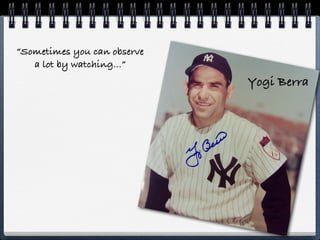
Yogi Berra
“Sometimes you can observe
   a lot by watching...”
                             Yogi Berra
“Sometimes you can observe
   a lot by watching...”
                              Yogi Berra
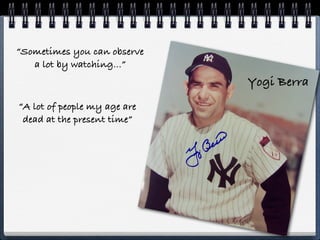
“A lot of people my age are
 dead at the present time”
“Sometimes you can observe
   a lot by watching...”
                                Yogi Berra
“A lot of people my age are
 dead at the present time”


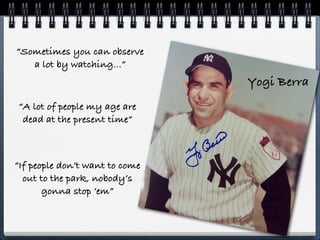
“If people don’t want to come
  out to the park, nobody’s
       gonna stop ‘em”
“Half the lies they tell me
       aren’t true”
“Half the lies they tell me
       aren’t true”


“99% of this game is half
        mental”
“Half the lies they tell me
       aren’t true”


 “99% of this game is half
         mental”


  “I want to thank all the
people that made this night
         necessary”
Appendix A:
The Need for Diversity
         Dr. Ken Boa and Bill Ibsen


     © Dr. Ken Boa and Bill Ibsen 2007. All Rights Reserved.
A Synthesis of Christian Spirituality


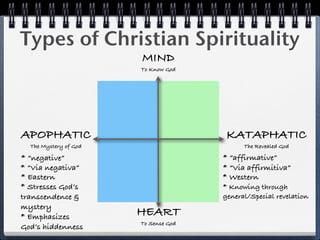
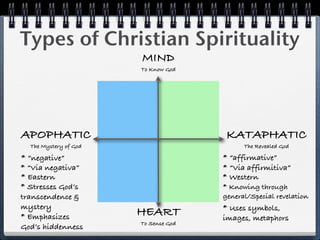
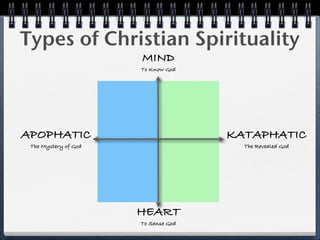
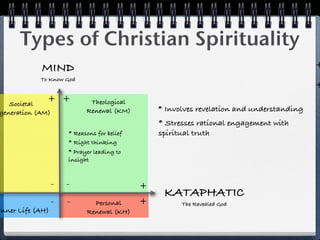
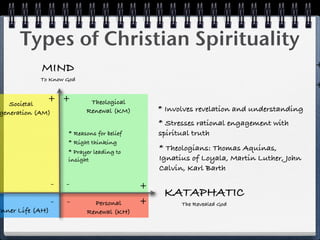
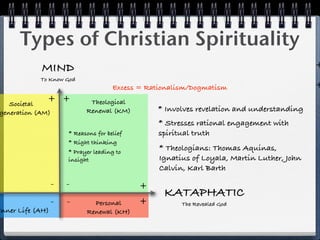
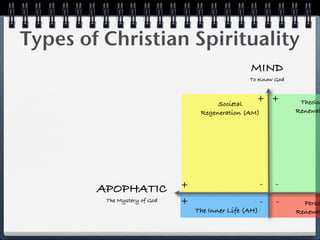
     Types of Christian Spirituality
A Synthesis of Christian Spirituality


     Types of Christian Spirituality
     Finding/Following Your Spiritual Path
Types of Christian Spirituality
Multi-Faceted Spiritual Life

Exchanged
   Life
Multi-Faceted Spiritual Life
                   Corporate
                  Spirituality
Exchanged
   Life
Multi-Faceted Spiritual Life
                    Corporate
                   Spirituality
Exchanged
   Life


     Warfare
    Spirituality
Multi-Faceted Spiritual Life
                    Corporate
                   Spirituality
Exchanged
   Life
                             Holistic
                           Spirituality


     Warfare
    Spirituality
Spiritual Growth:
One Size Does Not Fit All
Spiritual Growth:
One Size Does Not Fit All

                No formulas,
Spiritual Growth:
One Size Does Not Fit All

                No formulas,
                No recipes
Spiritual Growth:
One Size Does Not Fit All

                No formulas,
                No recipes
                No single panacea
Spiritual Growth:
One Size Does Not Fit All
Spiritual Growth:
One Size Does Not Fit All

Complementary components
Spiritual Growth:
One Size Does Not Fit All

Complementary components
  Symbiotic
Spiritual Growth:
One Size Does Not Fit All

Complementary components
  Symbiotic
  Divine-human dynamic
Spiritual Growth:
One Size Does Not Fit All

Complementary components
  Symbiotic
  Divine-human dynamic
  Dependence and discipline
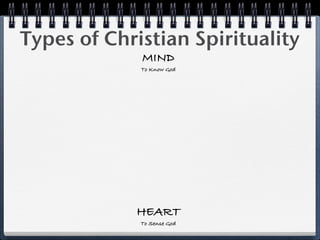
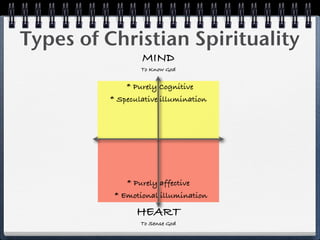
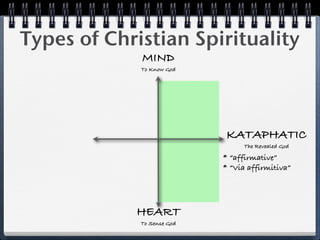
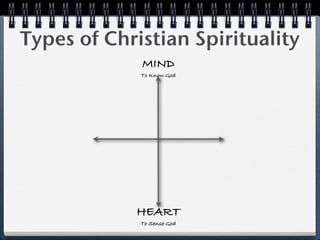
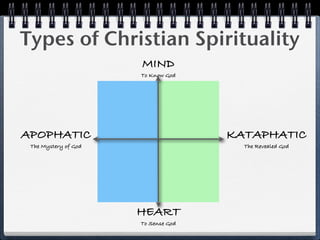
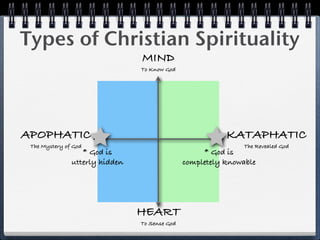
Types of Christian Spirituality
             MIND
             To Know God


            HEART
             To Sense God
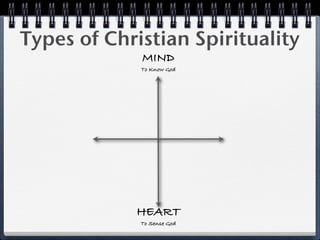
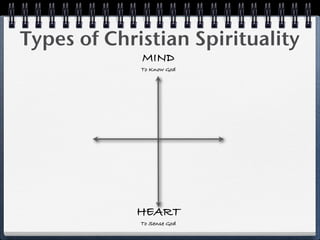
Types of Christian Spirituality
             MIND
             To Know God


            HEART
             To Sense God
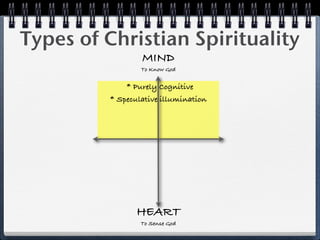
Types of Christian Spirituality
                 MIND
                 To Know God


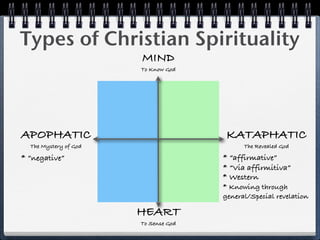
             * Purely Cognitive
         * Speculative illumination


                HEART
                 To Sense God
Types of Christian Spirituality
                 MIND
                 To Know God


             * Purely Cognitive
         * Speculative illumination


             * Purely affective
          * Emotional illumination

                HEART
                 To Sense God
Types of Christian Spirituality
             MIND
             To Know God


            HEART
             To Sense God
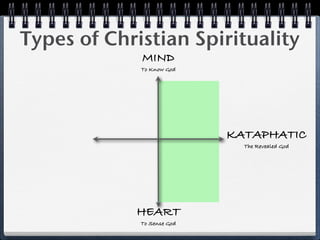
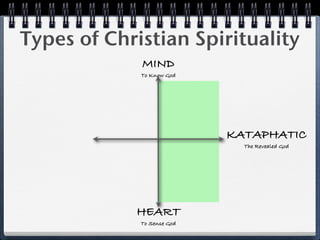
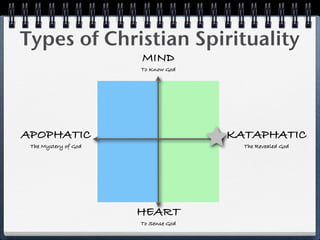
Types of Christian Spirituality
             MIND
             To Know God


                            KATAPHATIC
                              The Revealed God


            HEART
             To Sense God
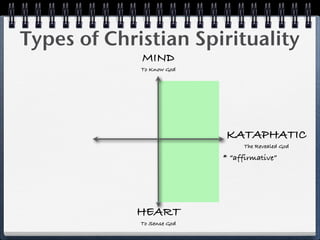
Types of Christian Spirituality
             MIND
             To Know God


                            KATAPHATIC
                                 The Revealed God

                            * “affirmative”


            HEART
             To Sense God
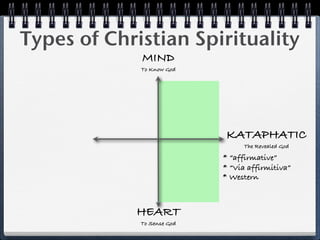
Types of Christian Spirituality
             MIND
             To Know God


                            KATAPHATIC
                                 The Revealed God

                            * “affirmative”
                            * “Via affirmitiva”


            HEART
             To Sense God
Types of Christian Spirituality
             MIND
             To Know God


                             KATAPHATIC
                                 The Revealed God

                            * “affirmative”
                            * “Via affirmitiva”
                            * Western


            HEART
             To Sense God
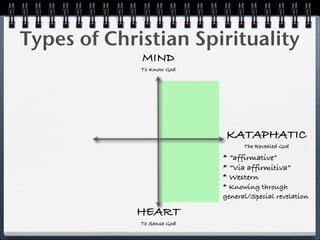
Types of Christian Spirituality
             MIND
             To Know God


                             KATAPHATIC
                                  The Revealed God

                            * “affirmative”
                            * “Via affirmitiva”
                            * Western
                            * Knowing through
                            general/Special revelation

            HEART
             To Sense God
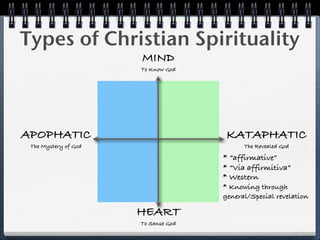
Types of Christian Spirituality
                      MIND
                      To Know God


APOPHATIC                             KATAPHATIC
 The Mystery of God                        The Revealed God

                                     * “affirmative”
                                     * “Via affirmitiva”
                                     * Western
                                     * Knowing through
                                     general/Special revelation

                      HEART
                      To Sense God
Types of Christian Spirituality
                       MIND
                       To Know God


APOPHATIC                              KATAPHATIC
  The Mystery of God                        The Revealed God

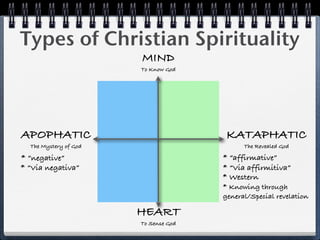
* “negative”                          * “affirmative”
                                      * “Via affirmitiva”
                                      * Western
                                      * Knowing through
                                      general/Special revelation

                       HEART
                       To Sense God
Types of Christian Spirituality
                       MIND
                       To Know God


APOPHATIC                              KATAPHATIC
  The Mystery of God                        The Revealed God

* “negative”                          * “affirmative”
* “Via negativa”                      * “Via affirmitiva”
                                      * Western
                                      * Knowing through
                                      general/Special revelation

                       HEART
                       To Sense God
Types of Christian Spirituality
                       MIND
                       To Know God


APOPHATIC                              KATAPHATIC
  The Mystery of God                        The Revealed God

* “negative”                          * “affirmative”
* “Via negativa”                      * “Via affirmitiva”
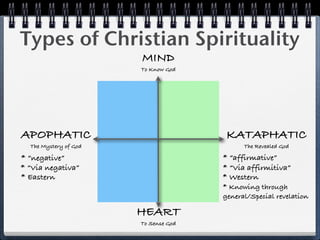
* Eastern                             * Western
                                      * Knowing through
                                      general/Special revelation

                       HEART
                       To Sense God
Types of Christian Spirituality
                       MIND
                       To Know God


APOPHATIC                              KATAPHATIC
  The Mystery of God                        The Revealed God

* “negative”                          * “affirmative”
* “Via negativa”                      * “Via affirmitiva”
* Eastern                             * Western
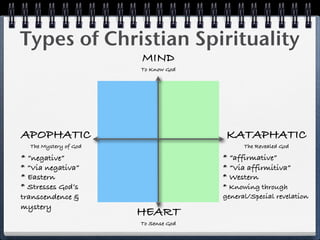
* Stresses God’s                      * Knowing through
transcendence &                       general/Special revelation
mystery
                       HEART
                       To Sense God
Types of Christian Spirituality
                       MIND
                       To Know God


APOPHATIC                              KATAPHATIC
  The Mystery of God                        The Revealed God

* “negative”                          * “affirmative”
* “Via negativa”                      * “Via affirmitiva”
* Eastern                             * Western
* Stresses God’s                      * Knowing through
transcendence &                       general/Special revelation
mystery
* Emphasizes           HEART
                       To Sense God
God’s hiddenness
Types of Christian Spirituality
                       MIND
                       To Know God


APOPHATIC                              KATAPHATIC
  The Mystery of God                        The Revealed God

* “negative”                          * “affirmative”
* “Via negativa”                      * “Via affirmitiva”
* Eastern                             * Western
* Stresses God’s                      * Knowing through
transcendence &                       general/Special revelation
mystery                               * Uses symbols,
* Emphasizes           HEART          images, metaphors
                       To Sense God
God’s hiddenness
Types of Christian Spirituality
             MIND
             To Know God


            HEART
             To Sense God
Types of Christian Spirituality
             MIND
             To Know God


                            KATAPHATIC
                              The Revealed God


            HEART
             To Sense God
Types of Christian Spirituality
                      MIND
                      To Know God


APOPHATIC                            KATAPHATIC
 The Mystery of God                    The Revealed God


                      HEART
                      To Sense God
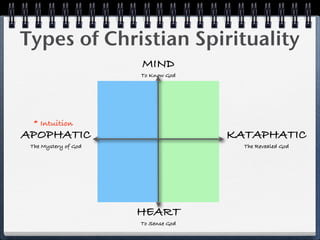
Types of Christian Spirituality
                      MIND
                      To Know God


  * Intuition
APOPHATIC                            KATAPHATIC
 The Mystery of God                    The Revealed God


                      HEART
                      To Sense God
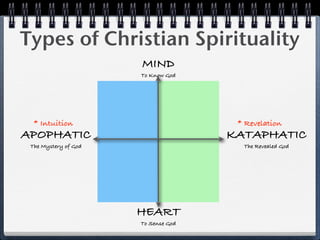
Types of Christian Spirituality
                      MIND
                      To Know God


  * Intuition                         * Revelation
APOPHATIC                            KATAPHATIC
 The Mystery of God                    The Revealed God


                      HEART
                      To Sense God
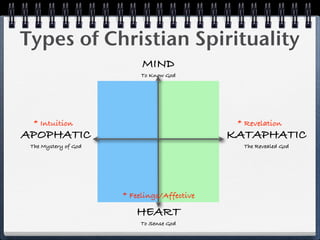
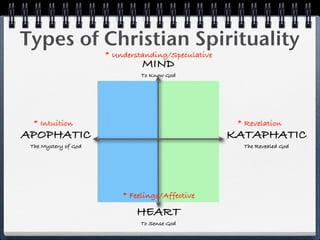
Types of Christian Spirituality
                           MIND
                           To Know God


  * Intuition                                 * Revelation
APOPHATIC                                    KATAPHATIC
 The Mystery of God                            The Revealed God


                      * Feelings/Affective

                         HEART
                           To Sense God
Types of Christian Spirituality
                      * Understanding/Speculative
                               MIND
                               To Know God


  * Intuition                                        * Revelation
APOPHATIC                                           KATAPHATIC
 The Mystery of God                                   The Revealed God


                          * Feelings/Affective

                             HEART
                               To Sense God
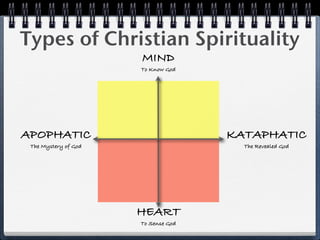
Types of Christian Spirituality
                      MIND
                      To Know God


APOPHATIC                            KATAPHATIC
 The Mystery of God                    The Revealed God


                      HEART
                      To Sense God
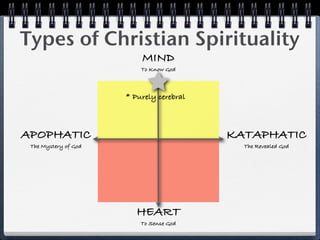
Types of Christian Spirituality
                          MIND
                          To Know God


                      * Purely cerebral


APOPHATIC                                 KATAPHATIC
 The Mystery of God                         The Revealed God


                         HEART
                          To Sense God
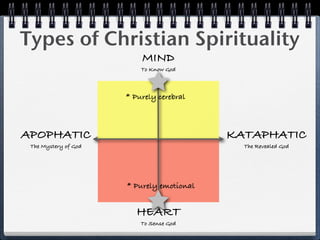
Types of Christian Spirituality
                          MIND
                          To Know God


                      * Purely cerebral


APOPHATIC                                  KATAPHATIC
 The Mystery of God                          The Revealed God


                      * Purely emotional


                         HEART
                          To Sense God
Types of Christian Spirituality
                      MIND
                      To Know God


APOPHATIC                            KATAPHATIC
 The Mystery of God                    The Revealed God


                      HEART
                      To Sense God
Types of Christian Spirituality
                      MIND
                      To Know God


APOPHATIC                            KATAPHATIC
 The Mystery of God                    The Revealed God


                      HEART
                      To Sense God
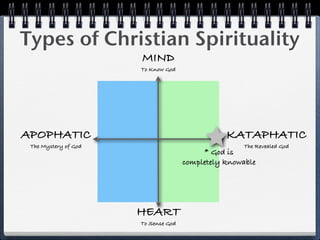
Types of Christian Spirituality
                      MIND
                      To Know God


APOPHATIC                                       KATAPHATIC
 The Mystery of God                                 The Revealed God
                                          * God is
                                     completely knowable


                      HEART
                      To Sense God
Types of Christian Spirituality
                      MIND
                      To Know God


APOPHATIC                                       KATAPHATIC
 The Mystery of God                                 The Revealed God
                                          * God is
                                     completely knowable


                      HEART
                      To Sense God
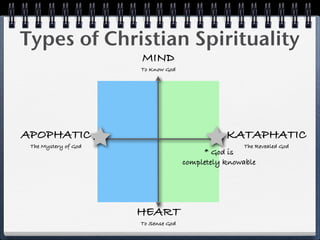
Types of Christian Spirituality
                                MIND
                                To Know God


APOPHATIC                                                 KATAPHATIC
 The Mystery of God                                           The Revealed God
                  * God is                          * God is
               utterly hidden                  completely knowable


                                HEART
                                To Sense God
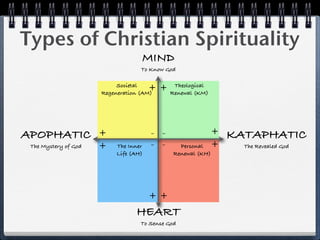
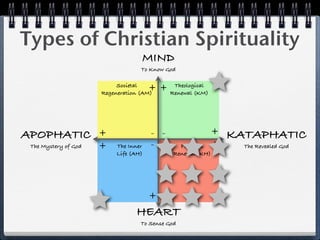
Types of Christian Spirituality
                                  MIND
                                  To Know God

                           Societal          Theological
                                      +
                      Regeneration (AM)
                                          + Renewal (KM)


APOPHATIC             +               - -                   +   KATAPHATIC
 The Mystery of God   +   The Inner   - -      Personal     +     The Revealed God
                          Life (AH)          Renewal (KH)


                                      ++
                                HEART
                                  To Sense God
Types of Christian Spirituality
                                  MIND
                                  To Know God

                           Societal          Theological
                                      +
                      Regeneration (AM)
                                          + Renewal (KM)


APOPHATIC             +               - -                   +   KATAPHATIC
 The Mystery of God   +   The Inner   - -      Personal     +     The Revealed God
                          Life (AH)          Renewal (KH)


                                      ++
                                HEART
                                  To Sense God
Types of Christian Spirituality
                                  MIND
                                  To Know God

                           Societal          Theological
                                      +
                      Regeneration (AM)
                                          + Renewal (KM)


APOPHATIC             +               - -                   +   KATAPHATIC
 The Mystery of God   +   The Inner   - -      Personal     +     The Revealed God
                          Life (AH)          Renewal (KH)


                                      ++
                                HEART
                                  To Sense God
Types of Christian Spirituality
                                  MIND
                                  To Know God

                           Societal          Theological
                                      +
                      Regeneration (AM)
                                          + Renewal (KM)


APOPHATIC             +               - -                   +   KATAPHATIC
 The Mystery of God   +   The Inner   - -      Personal     +     The Revealed God
                          Life (AH)          Renewal (KH)


                                      ++
                                HEART
                                  To Sense God
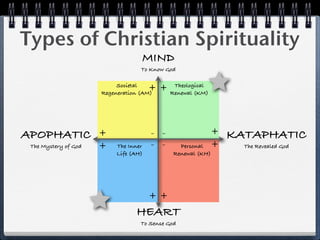
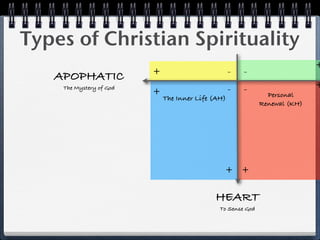
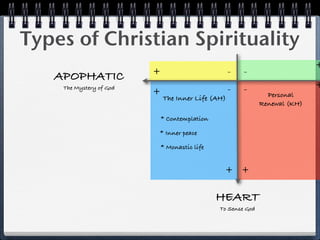
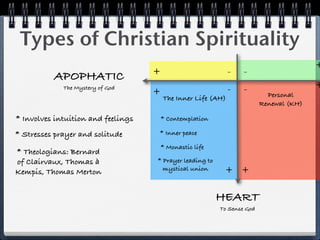
Types of Christian Spirituality
                                                                            +
                         +                         -   -
   APOPHATIC
    The Mystery of God                             -   -                    +
                         +                                     Personal
                             The Inner Life (AH)
                                                             Renewal (KH)


                                               + +

                                            HEART
                                              To Sense God
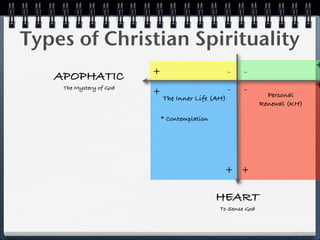
Types of Christian Spirituality
                                                                             +
                         +                         -   -
   APOPHATIC
    The Mystery of God                             -   -                     +
                         +                                      Personal
                             The Inner Life (AH)
                                                              Renewal (KH)

                             * Contemplation


                                                + +

                                               HEART
                                               To Sense God
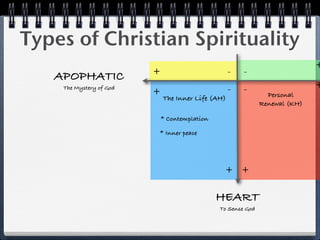
Types of Christian Spirituality
                                                                             +
                         +                         -   -
   APOPHATIC
    The Mystery of God                             -   -                     +
                         +                                      Personal
                             The Inner Life (AH)
                                                              Renewal (KH)

                             * Contemplation

                         * Inner peace


                                                + +

                                               HEART
                                               To Sense God
Types of Christian Spirituality
                                                                             +
                         +                         -   -
   APOPHATIC
    The Mystery of God                             -   -                     +
                         +                                      Personal
                             The Inner Life (AH)
                                                              Renewal (KH)

                             * Contemplation

                         * Inner peace

                             * Monastic life


                                                + +

                                               HEART
                                               To Sense God
Types of Christian Spirituality
                                                                             +
                         +                         -   -
   APOPHATIC
    The Mystery of God                             -   -                     +
                         +                                      Personal
                             The Inner Life (AH)
                                                              Renewal (KH)

                             * Contemplation

                         * Inner peace

                             * Monastic life

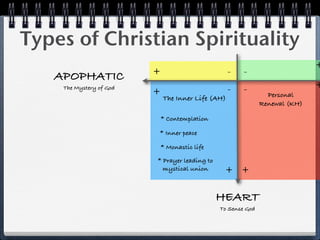
                         * Prayer leading to
                           mystical union       + +

                                               HEART
                                               To Sense God
Types of Christian Spirituality
                                                                                        +
                                    +                         -   -
          APOPHATIC
             The Mystery of God                               -   -                     +
                                    +                                      Personal
                                        The Inner Life (AH)
                                                                         Renewal (KH)

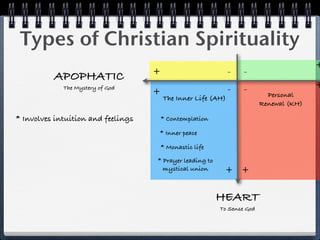
* Involves intuition and feelings       * Contemplation

                                    * Inner peace

                                        * Monastic life

                                    * Prayer leading to
                                      mystical union       + +

                                                          HEART
                                                          To Sense God
Types of Christian Spirituality
                                                                                        +
                                    +                         -   -
          APOPHATIC
             The Mystery of God                               -   -                     +
                                    +                                      Personal
                                        The Inner Life (AH)
                                                                         Renewal (KH)

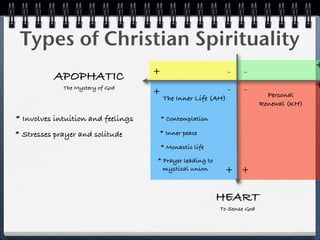
* Involves intuition and feelings       * Contemplation

* Stresses prayer and solitude      * Inner peace

                                        * Monastic life

                                    * Prayer leading to
                                      mystical union       + +

                                                          HEART
                                                          To Sense God
Types of Christian Spirituality
                                                                                        +
                                    +                         -   -
          APOPHATIC
             The Mystery of God                               -   -                     +
                                    +                                      Personal
                                        The Inner Life (AH)
                                                                         Renewal (KH)

* Involves intuition and feelings       * Contemplation

* Stresses prayer and solitude      * Inner peace

                                        * Monastic life
* Theologians: Bernard
of Clairvaux, Thomas à              * Prayer leading to
Kempis, Thomas Merton                 mystical union       + +

                                                          HEART
                                                          To Sense God
Types of Christian Spirituality
                                                                                              +
                                         +                         -    -
          APOPHATIC
             The Mystery of God                                    -    -                     +
                                         +                                       Personal
                                             The Inner Life (AH)
                                                                               Renewal (KH)

* Involves intuition and feelings            * Contemplation

* Stresses prayer and solitude             * Inner peace

                                             * Monastic life
* Theologians: Bernard
of Clairvaux, Thomas à                    * Prayer leading to
Kempis, Thomas Merton                       mystical union       + +
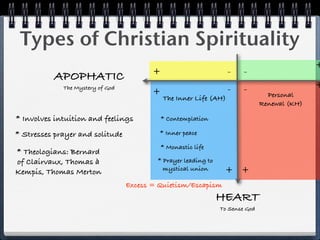
                                  Excess = Quietism/Escapism
                                                                HEART
                                                                To Sense God
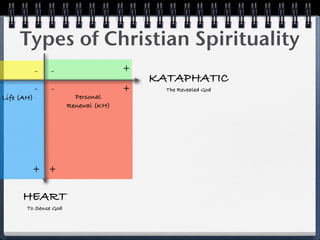
Types of Christian Spirituality
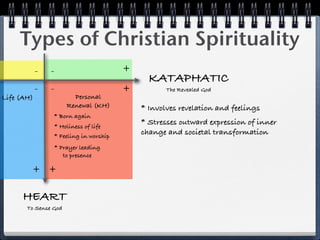
              -   -                    +
                                           KATAPHATIC
              -   -                    +     The Revealed God
r Life (AH)               Personal
                        Renewal (KH)


          + +

       HEART
         To Sense God
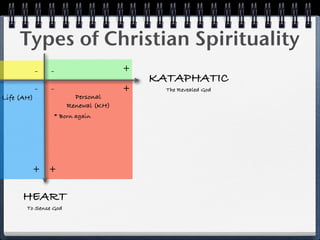
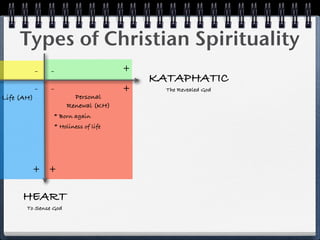
Types of Christian Spirituality
              -   -                    +
                                           KATAPHATIC
              -   -                    +     The Revealed God
r Life (AH)               Personal
                        Renewal (KH)
                  * Born again


          + +

       HEART
         To Sense God
Types of Christian Spirituality
              -   -                    +
                                           KATAPHATIC
              -   -                    +     The Revealed God
r Life (AH)               Personal
                        Renewal (KH)
                  * Born again
                  * Holiness of life


          + +

       HEART
         To Sense God
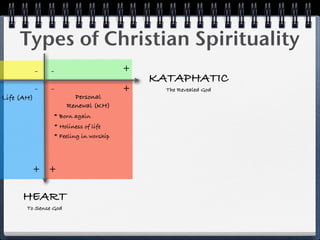
Types of Christian Spirituality
              -   -                      +
                                             KATAPHATIC
              -   -                      +     The Revealed God
r Life (AH)               Personal
                        Renewal (KH)
                  * Born again
                  * Holiness of life
                  * Feeling in worship


          + +

       HEART
         To Sense God
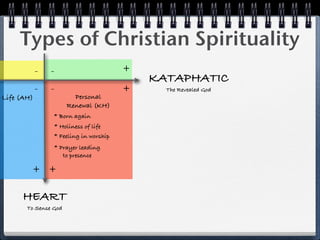
Types of Christian Spirituality
              -   -                      +
                                             KATAPHATIC
              -   -                      +     The Revealed God
r Life (AH)               Personal
                        Renewal (KH)
                  * Born again
                  * Holiness of life
                  * Feeling in worship
                  * Prayer leading
                     to presence

          + +

       HEART
         To Sense God
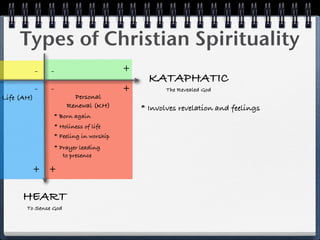
Types of Christian Spirituality
              -   -                      +
                                               KATAPHATIC
              -   -                      +          The Revealed God
r Life (AH)               Personal
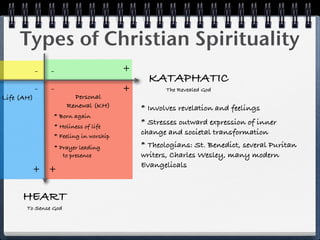
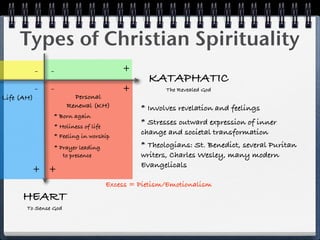
                        Renewal (KH)         * Involves revelation and feelings
                  * Born again
                  * Holiness of life
                  * Feeling in worship
                  * Prayer leading
                     to presence

          + +

       HEART
         To Sense God
Types of Christian Spirituality
              -   -                      +
                                               KATAPHATIC
              -   -                      +          The Revealed God
r Life (AH)               Personal
                        Renewal (KH)         * Involves revelation and feelings
                  * Born again
                  * Holiness of life
                                             * Stresses outward expression of inner
                  * Feeling in worship
                                             change and societal transformation
                  * Prayer leading
                     to presence

          + +

       HEART
         To Sense God
Types of Christian Spirituality
              -   -                      +
                                               KATAPHATIC
              -   -                      +          The Revealed God
r Life (AH)               Personal
                        Renewal (KH)         * Involves revelation and feelings
                  * Born again
                  * Holiness of life
                                             * Stresses outward expression of inner
                  * Feeling in worship
                                             change and societal transformation
                  * Prayer leading           * Theologians: St. Benedict, several Puritan
                     to presence             writers, Charles Wesley, many modern
                                             Evangelicals
          + +

       HEART
         To Sense God
Types of Christian Spirituality
              -   -                        +
                                                  KATAPHATIC
              -   -                        +           The Revealed God
r Life (AH)               Personal
                        Renewal (KH)            * Involves revelation and feelings
                  * Born again
                  * Holiness of life
                                                * Stresses outward expression of inner
                  * Feeling in worship
                                                change and societal transformation
                  * Prayer leading              * Theologians: St. Benedict, several Puritan
                     to presence                writers, Charles Wesley, many modern
                                                Evangelicals
          + +
                                       Excess = Pietism/Emotionalism
       HEART
         To Sense God
Types of Christian Spirituality
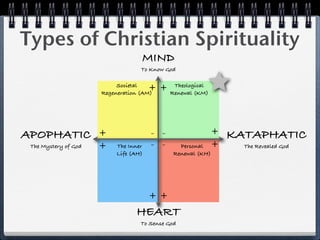
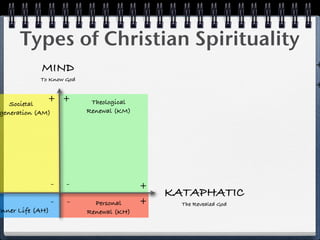
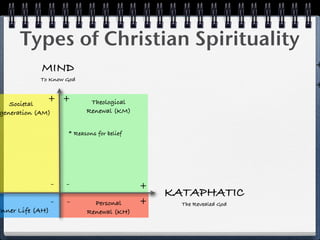
            MIND                                                  +
            To Know God
                                                                  +
   Societal
              + +          Theological
generation (AM)           Renewal (KM)


                  -   -                  +
                                             KATAPHATIC
                  -   -     Personal     +     The Revealed God
Inner Life (AH)           Renewal (KH)
Types of Christian Spirituality
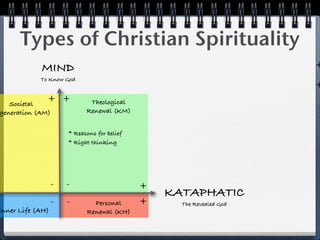
            MIND                                                      +
            To Know God
                                                                      +
   Societal
              + +            Theological
generation (AM)             Renewal (KM)


                      * Reasons for belief


                  -   -                      +
                                                 KATAPHATIC
                  -   -       Personal       +     The Revealed God
Inner Life (AH)             Renewal (KH)
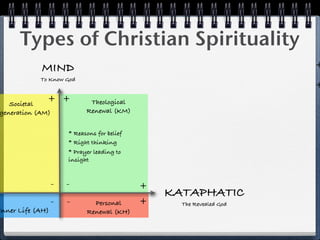
Types of Christian Spirituality
            MIND                                                      +
            To Know God
                                                                      +
   Societal
              + +            Theological
generation (AM)             Renewal (KM)


                      * Reasons for belief
                      * Right thinking


                  -   -                      +
                                                 KATAPHATIC
                  -   -       Personal       +     The Revealed God
Inner Life (AH)             Renewal (KH)
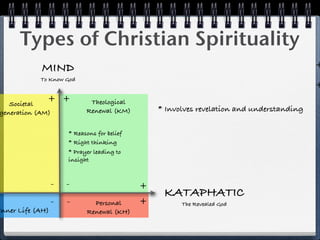
Types of Christian Spirituality
            MIND                                                      +
            To Know God
                                                                      +
   Societal
              + +            Theological
generation (AM)             Renewal (KM)


                      * Reasons for belief
                      * Right thinking
                      * Prayer leading to
                      insight


                  -   -                      +
                                                 KATAPHATIC
                  -   -       Personal       +     The Revealed God
Inner Life (AH)             Renewal (KH)
Types of Christian Spirituality
            MIND                                                                           +
            To Know God
                                                                                           +
   Societal
              + +            Theological
generation (AM)             Renewal (KM)         * Involves revelation and understanding

                      * Reasons for belief
                      * Right thinking
                      * Prayer leading to
                      insight


                  -   -                      +
                                                  KATAPHATIC
                  -   -       Personal       +         The Revealed God
Inner Life (AH)             Renewal (KH)
Types of Christian Spirituality
            MIND                                                                           +
            To Know God
                                                                                           +
   Societal
              + +            Theological
generation (AM)             Renewal (KM)         * Involves revelation and understanding
                                                 * Stresses rational engagement with
                      * Reasons for belief       spiritual truth
                      * Right thinking
                      * Prayer leading to
                      insight


                  -   -                      +
                                                  KATAPHATIC
                  -   -       Personal       +         The Revealed God
Inner Life (AH)             Renewal (KH)
Types of Christian Spirituality
            MIND                                                                           +
            To Know God
                                                                                           +
   Societal
              + +            Theological
generation (AM)             Renewal (KM)         * Involves revelation and understanding
                                                 * Stresses rational engagement with
                      * Reasons for belief       spiritual truth
                      * Right thinking
                      * Prayer leading to
                                                 * Theologians: Thomas Aquinas,
                      insight                    Ignatius of Loyala, Martin Luther, John
                                                 Calvin, Karl Barth
                  -   -                      +
                                                  KATAPHATIC
                  -   -       Personal       +         The Revealed God
Inner Life (AH)             Renewal (KH)
Types of Christian Spirituality
            MIND                                                                            +
            To Know God
                                      Excess = Rationalism/Dogmatism                        +
   Societal
              + +            Theological
generation (AM)             Renewal (KM)         * Involves revelation and understanding
                                                  * Stresses rational engagement with
                      * Reasons for belief        spiritual truth
                      * Right thinking
                      * Prayer leading to
                                                  * Theologians: Thomas Aquinas,
                      insight                     Ignatius of Loyala, Martin Luther, John
                                                  Calvin, Karl Barth
                  -   -                      +
                                                   KATAPHATIC
                  -   -       Personal       +          The Revealed God
Inner Life (AH)             Renewal (KH)
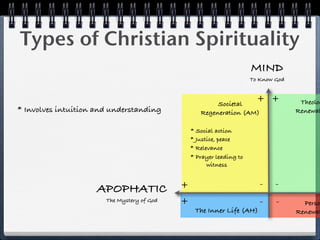
Types of Christian Spirituality
                                                  MIND
                                                  To Know God


                                        Societal
                                                    + +          Theolog
                                   Regeneration (AM)            Renewal


                              +                         -   -
        APOPHATIC
         The Mystery of God   +                         -   -     Perso
                                  The Inner Life (AH)           Renewal
Types of Christian Spirituality
                                                    MIND
                                                    To Know God


                                          Societal
                                                      + +          Theolog
                                     Regeneration (AM)            Renewal

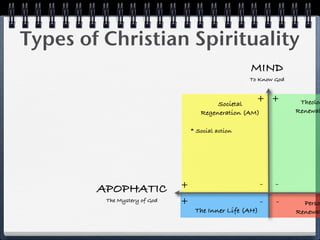
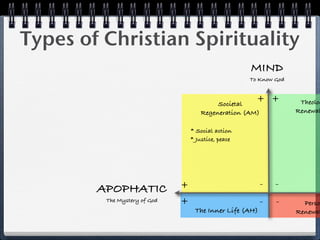
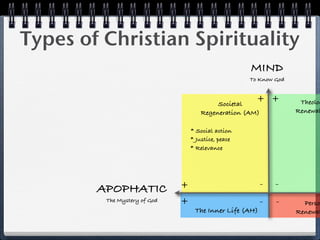
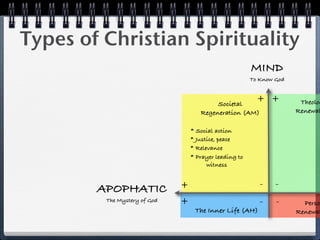
                                  * Social action


                              +                          -   -
        APOPHATIC
         The Mystery of God   +                          -   -      Perso
                                   The Inner Life (AH)            Renewal
Types of Christian Spirituality
                                                     MIND
                                                     To Know God


                                           Societal
                                                       + +          Theolog
                                      Regeneration (AM)            Renewal

                                  * Social action
                                  * Justice, peace


                              +                           -   -
        APOPHATIC
         The Mystery of God   +                           -   -      Perso
                                   The Inner Life (AH)             Renewal
Types of Christian Spirituality
                                                     MIND
                                                     To Know God


                                           Societal
                                                       + +          Theolog
                                      Regeneration (AM)            Renewal

                                  * Social action
                                  * Justice, peace
                                  * Relevance


                              +                           -   -
        APOPHATIC
         The Mystery of God   +                           -   -      Perso
                                   The Inner Life (AH)             Renewal
Types of Christian Spirituality
                                                        MIND
                                                        To Know God


                                          Societal
                                                          + +          Theolog
                                     Regeneration (AM)                Renewal

                                  * Social action
                                  * Justice, peace
                                  * Relevance
                                  * Prayer leading to
                                        witness


                              +                            -    -
        APOPHATIC
         The Mystery of God   +                            -    -       Perso
                                   The Inner Life (AH)                Renewal
Types of Christian Spirituality
                                                                      MIND
                                                                      To Know God


                                                        Societal
                                                                        + +          Theolog
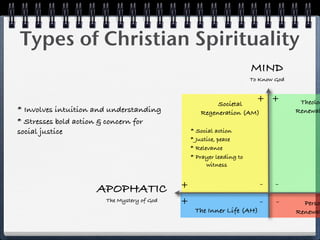
* Involves intuition and understanding             Regeneration (AM)                Renewal

                                                * Social action
                                                * Justice, peace
                                                * Relevance
                                                * Prayer leading to
                                                      witness


                                            +                            -    -
                    APOPHATIC
                       The Mystery of God   +                            -    -       Perso
                                                 The Inner Life (AH)                Renewal
Types of Christian Spirituality
                                                                      MIND
                                                                      To Know God


                                                        Societal
                                                                        + +          Theolog
* Involves intuition and understanding             Regeneration (AM)                Renewal
* Stresses bold action & concern for
social justice                                  * Social action
                                                * Justice, peace
                                                * Relevance
                                                * Prayer leading to
                                                      witness


                                            +                            -    -
                     APOPHATIC
                       The Mystery of God   +                            -    -       Perso
                                                 The Inner Life (AH)                Renewal
Types of Christian Spirituality
                                                                       MIND
                                                                       To Know God


                                                         Societal
                                                                         + +          Theolog
* Involves intuition and understanding              Regeneration (AM)                Renewal
* Stresses bold action & concern for
social justice                                   * Social action
                                                 * Justice, peace
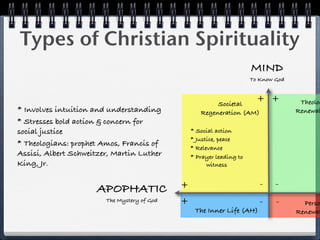
* Theologians: prophet Amos, Francis of
                                                 * Relevance
Assisi, Albert Schweitzer, Martin Luther         * Prayer leading to
King, Jr.                                              witness


                                             +                            -    -
                      APOPHATIC
                        The Mystery of God   +                            -    -       Perso
                                                  The Inner Life (AH)                Renewal
Types of Christian Spirituality
                                                                         MIND
                                                                         To Know God
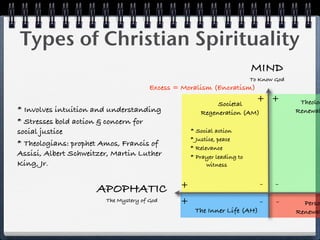
                                       Excess = Moralism (Encratism)

                                                           Societal
                                                                           + +          Theolog
* Involves intuition and understanding                Regeneration (AM)                Renewal
* Stresses bold action & concern for
social justice                                     * Social action
                                                   * Justice, peace
* Theologians: prophet Amos, Francis of
                                                   * Relevance
Assisi, Albert Schweitzer, Martin Luther           * Prayer leading to
King, Jr.                                                witness


                                               +                            -    -
                      APOPHATIC
                        The Mystery of God     +                            -    -       Perso
                                                    The Inner Life (AH)                Renewal
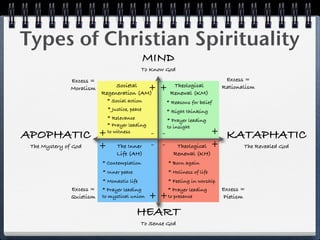
Types of Christian Spirituality
                                                 MIND
                                             To Know God
               Excess =                                                           Excess =
                               Societal               Theological
               Moralism                   +
                          Regeneration (AM)
                                                   + Renewal (KM)                Rationalism

                              * Social action           * Reasons for belief
                              * Justice, peace          * Right thinking
                              * Relevance               * Prayer leading
                              * Prayer leading          to insight
APOPHATIC                 +   to witness          - -                        +    KATAPHATIC
 The Mystery of God       +       The Inner       - -      Theological       +          The Revealed God
                                  Life (AH)               Renewal (KH)
                          * Contemplation               * Born again
                          * Inner peace                 * Holiness of life
                          * Monastic life               * Feeling in worship
               Excess =   * Prayer leading              * Prayer leading         Excess =
               Quietism   to mystical union      ++     to presence              Pietism

                                           HEART
                                             To Sense God
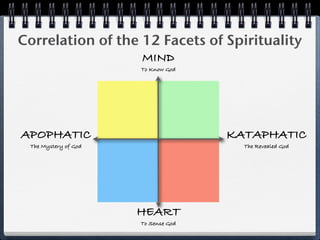
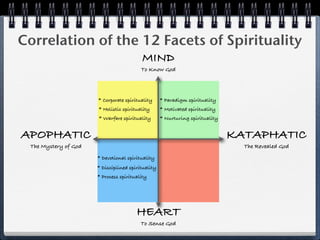
Correlation of the 12 Facets of Spirituality
                      MIND
                      To Know God


APOPHATIC                            KATAPHATIC
 The Mystery of God                    The Revealed God


                      HEART
                      To Sense God
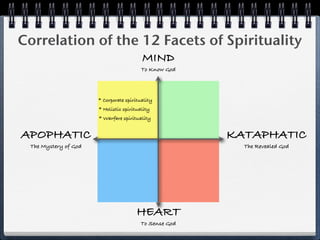
Correlation of the 12 Facets of Spirituality
                                         MIND
                                         To Know God


                      * Corporate spirituality
                      * Holistic spirituality
                      * Warfare spirituality


APOPHATIC                                              KATAPHATIC
 The Mystery of God                                      The Revealed God


                                       HEART
                                        To Sense God
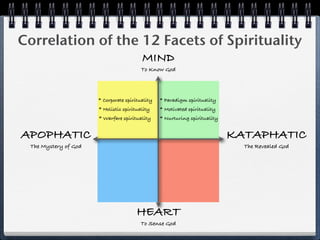
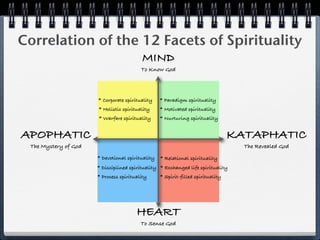
Correlation of the 12 Facets of Spirituality
                                         MIND
                                         To Know God


                      * Corporate spirituality   * Paradigm spirituality
                      * Holistic spirituality    * Motivated spirituality
                      * Warfare spirituality     * Nurturing spirituality


APOPHATIC                                                                   KATAPHATIC
 The Mystery of God                                                           The Revealed God


                                       HEART
                                        To Sense God
Correlation of the 12 Facets of Spirituality
                                         MIND
                                         To Know God


                      * Corporate spirituality     * Paradigm spirituality
                      * Holistic spirituality      * Motivated spirituality
                      * Warfare spirituality       * Nurturing spirituality


APOPHATIC                                                                     KATAPHATIC
 The Mystery of God                                                             The Revealed God
                      * Devotional spirituality
                      * Disciplined spirituality
                      * Process spirituality


                                       HEART
                                         To Sense God
Correlation of the 12 Facets of Spirituality
                                         MIND
                                         To Know God


                      * Corporate spirituality    * Paradigm spirituality
                      * Holistic spirituality     * Motivated spirituality
                      * Warfare spirituality      * Nurturing spirituality


APOPHATIC                                                                        KATAPHATIC
 The Mystery of God                                                                The Revealed God
                      * Devotional spirituality   * Relational spirituality
                      * Disciplined spirituality * Exchanged life spirituality
                      * Process spirituality      * Spirit-filled spirituality


                                       HEART
                                         To Sense God
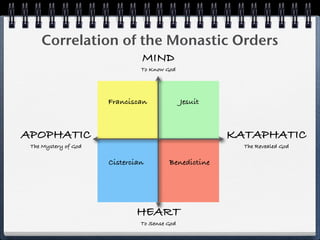
Correlation of the Monastic Orders
                               MIND
                               To Know God


                      Franciscan              Jesuit


APOPHATIC                                              KATAPHATIC
 The Mystery of God                                      The Revealed God

                      Cistercian        Benedictine


                              HEART
                               To Sense God
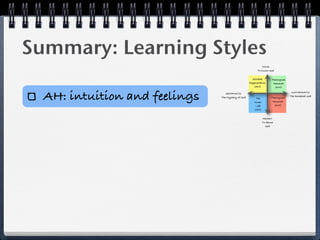
Summary: Learning Styles
                                                 MIND
                                              To Know God


                                          Societal        Theological
                                        Regeneration       Renewal
                                           (AM)             (KM)

                      APOPHATIC                                          KATAPHATIC
                   The Mystery of God                                   The Revealed God
                                            The          Theological
                                           Inner          Renewal
                                            Life           (KH)
                                           (AH)


                                                   HEART
                                                   To Sense
                                                     God
Summary: Learning Styles
                                                             MIND
                                                          To Know God


                                                      Societal        Theological
                                                    Regeneration       Renewal
                                                       (AM)             (KM)


  AH: intuition and feelings      APOPHATIC
                               The Mystery of God       The
                                                       Inner
                                                                     Theological
                                                                      Renewal
                                                                       (KH)
                                                                                     KATAPHATIC
                                                                                    The Revealed God


                                                        Life
                                                       (AH)


                                                               HEART
                                                               To Sense
                                                                 God
Summary: Learning Styles
                                                              MIND
                                                           To Know God


                                                       Societal        Theological
                                                     Regeneration       Renewal
                                                        (AM)             (KM)


  AH: intuition and feelings       APOPHATIC
                                The Mystery of God       The
                                                        Inner
                                                                      Theological
                                                                       Renewal
                                                                        (KH)
                                                                                      KATAPHATIC
                                                                                     The Revealed God


                                                         Life
                                                        (AH)


                                                                HEART


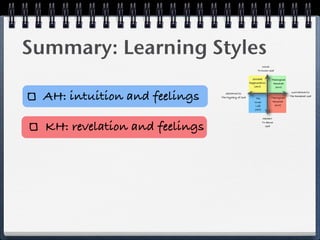
  KH: revelation and feelings
                                                                To Sense
                                                                  God
Summary: Learning Styles
                                                              MIND
                                                           To Know God


                                                       Societal        Theological
                                                     Regeneration       Renewal
                                                        (AM)             (KM)


  AH: intuition and feelings       APOPHATIC
                                The Mystery of God       The
                                                        Inner
                                                                      Theological
                                                                       Renewal
                                                                        (KH)
                                                                                      KATAPHATIC
                                                                                     The Revealed God


                                                         Life
                                                        (AH)


                                                                HEART


  KH: revelation and feelings
                                                                To Sense
                                                                  God


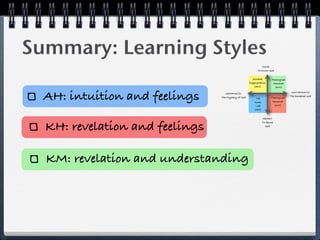
  KM: revelation and understanding
Summary: Learning Styles
                                                              MIND
                                                           To Know God


                                                       Societal        Theological
                                                     Regeneration       Renewal
                                                        (AM)             (KM)


  AH: intuition and feelings       APOPHATIC
                                The Mystery of God       The
                                                        Inner
                                                                      Theological
                                                                       Renewal
                                                                        (KH)
                                                                                      KATAPHATIC
                                                                                     The Revealed God


                                                         Life
                                                        (AH)


                                                                HEART


  KH: revelation and feelings
                                                                To Sense
                                                                  God


  KM: revelation and understanding

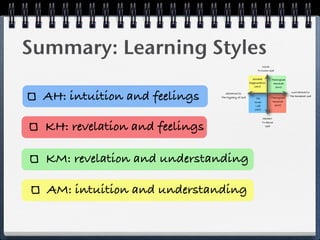
  AM: intuition and understanding
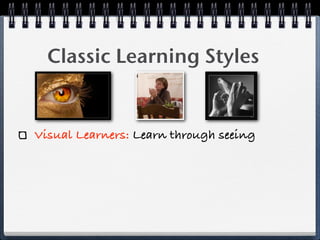
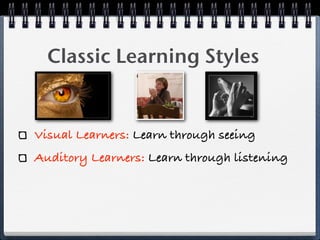
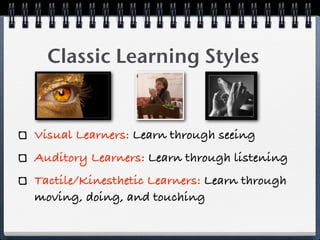
Classic Learning Styles


Visual Learners: Learn through seeing
Classic Learning Styles


Visual Learners: Learn through seeing
Auditory Learners: Learn through listening
Classic Learning Styles


Visual Learners: Learn through seeing
Auditory Learners: Learn through listening
Tactile/Kinesthetic Learners: Learn through
moving, doing, and touching
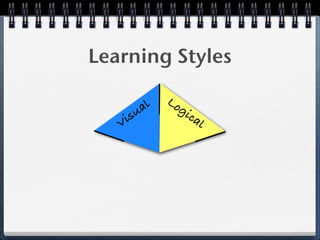
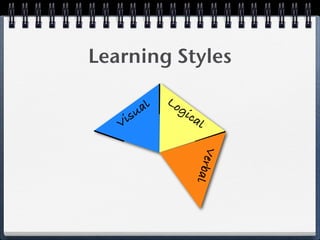
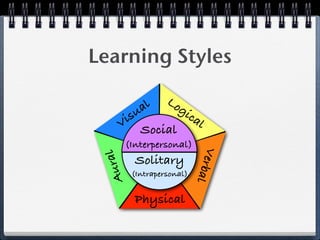
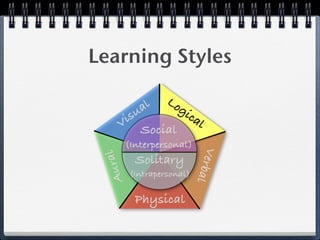
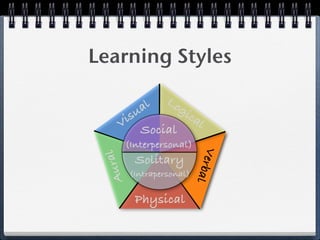
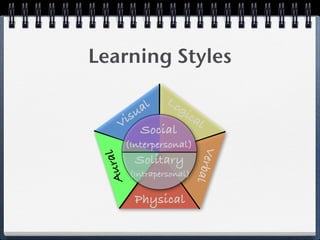
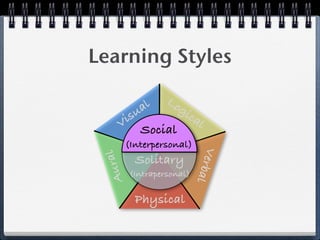
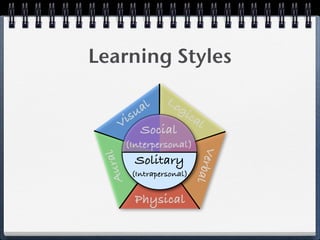
Learning Styles
Learning Styles

        al
    i su
   V
Learning Styles

             Lo
        al     gi
    i su          ca
                    l
   V
Learning Styles

             Lo
        al     gi
    i su          ca
                     l
   V


                    erb  V
                        al
Learning Styles

             Lo
        al     gi
    i su          ca
                     l
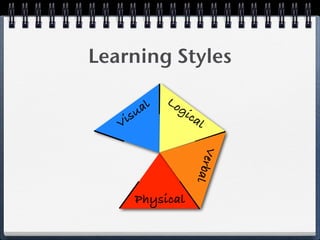
   V


                    erb  V
       Physical         al
Learning Styles

               Lo
          al     gi
      i su           ca
                       l
     V


                           V
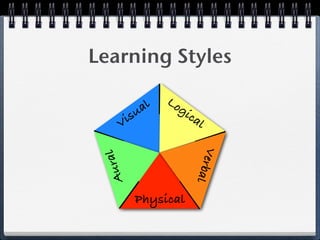
    ral


                      erb
 Au


          Physical        al
Learning Styles

               Lo
          al  gi
      i su       ca
                    l
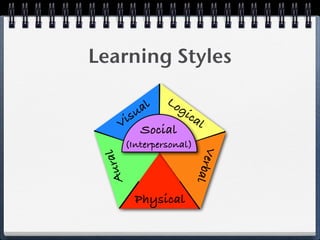
     V Social
      (Interpersonal)


                          V
    ral


                        erb
 Au


          Physical          al
Learning Styles

                   Lo
          al  gi
      i su       ca
                    l
     V Social
      (Interpersonal)


                              V
    ral


          Solitary


                            erb
 Au


          (Intrapersonal)


          Physical              al
Learning Styles
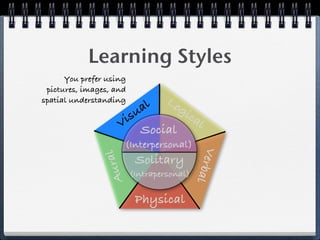
      You prefer using
 pictures, images, and
spatial understanding             Lo
                         al  gi
                     i su       ca
                                   l
                    V Social
                     (Interpersonal)


                                             V
                  ral


                          Solitary


                                           erb
               Au


                         (Intrapersonal)

                          Physical             al
Learning Styles

                   Lo
          al  gi
      i su       ca
                    l
     V Social
      (Interpersonal)


                              V
    ral


           Solitary


                            erb
 Au


          (Intrapersonal)

           Physical             al
Learning Styles
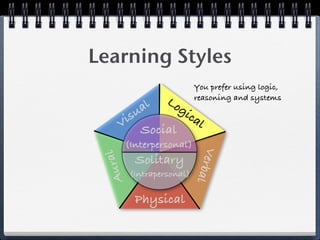
                            You prefer using logic,
                   Lo       reasoning and systems
          al  gi
      i su       ca
                    l
     V Social
      (Interpersonal)


                              V
    ral


           Solitary


                            erb
 Au


          (Intrapersonal)

           Physical             al
Learning Styles

                   Lo
          al  gi
      i su       ca
                    l
     V Social
      (Interpersonal)


                              V
    ral


           Solitary


                            erb
 Au


          (Intrapersonal)

           Physical             al
Learning Styles

                   Lo
          al  gi
      i su       ca
                    l
     V Social
      (Interpersonal)


                              V
    ral


           Solitary


                            erb
 Au


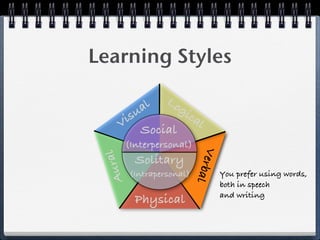
          (Intrapersonal)            You prefer using words,

                                al
                                     both in speech
                                     and writing
           Physical
Learning Styles

                   Lo
          al  gi
      i su       ca
                    l
     V Social
      (Interpersonal)


                              V
    ral


           Solitary


                            erb
 Au


          (Intrapersonal)

           Physical             al
Learning Styles

                            Lo
                   al  gi
               i su       ca
                             l
              V Social
                (Interpersonal)


                                       V
             ral


                    Solitary


                                     erb
          Au


                   (Intrapersonal)

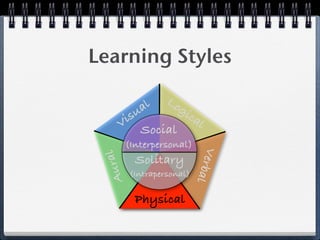
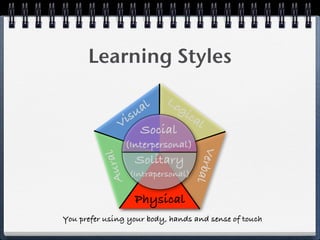
                    Physical             al
You prefer using your body, hands and sense of touch
Learning Styles

                   Lo
          al  gi
      i su       ca
                    l
     V Social
      (Interpersonal)


                              V
    ral


           Solitary


                            erb
 Au


          (Intrapersonal)

           Physical             al
Learning Styles

                                      Lo
                             al  gi
                         i su       ca
                                       l
                        V Social
                         (Interpersonal)


                                                 V
                       ral


                              Solitary


                                               erb
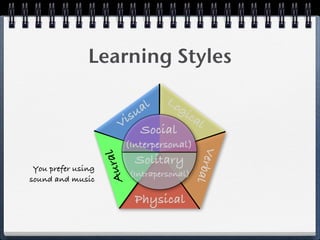
 You prefer using
                    Au


                             (Intrapersonal)

                                                   al
sound and music

                              Physical
Learning Styles

                   Lo
          al  gi
      i su       ca
                    l
     V Social
      (Interpersonal)


                              V
    ral


           Solitary


                            erb
 Au


          (Intrapersonal)

           Physical             al
Learning Styles
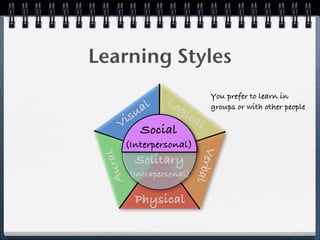
                                You prefer to learn in
                   Lo
          al  gi                groups or with other people
      i su       ca
                    l
     V Social
      (Interpersonal)


                              V
    ral


           Solitary


                            erb
 Au


          (Intrapersonal)

           Physical             al
Learning Styles

                   Lo
          al  gi
      i su       ca
                    l
     V Social
      (Interpersonal)


                              V
    ral


          Solitary


                            erb
 Au


          (Intrapersonal)


          Physical              al
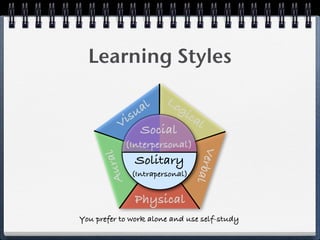
Learning Styles

                        Lo
               al  gi
           i su       ca
                         l
          V Social
            (Interpersonal)


                                   V
         ral


               Solitary


                                 erb
      Au


               (Intrapersonal)


               Physical              al
You prefer to work alone and use self-study
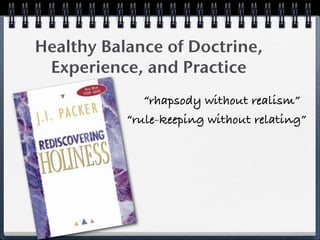
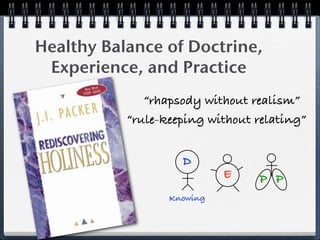
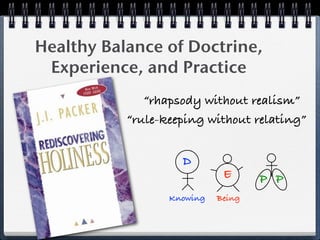
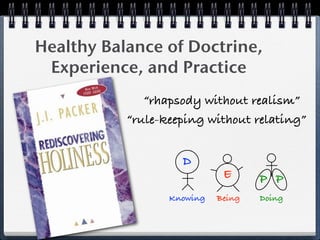
Healthy Balance of Doctrine,
 Experience, and Practice
Healthy Balance of Doctrine,
 Experience, and Practice
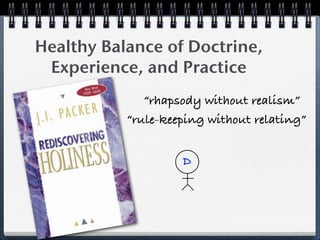
             “rhapsody without realism”
Healthy Balance of Doctrine,
 Experience, and Practice
              “rhapsody without realism”
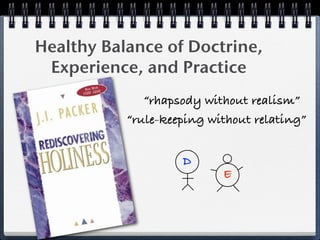
           “rule-keeping without relating”
Healthy Balance of Doctrine,
 Experience, and Practice
              “rhapsody without realism”
           “rule-keeping without relating”


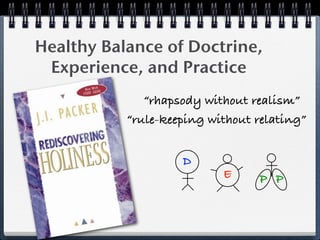
                    D
Healthy Balance of Doctrine,
 Experience, and Practice
              “rhapsody without realism”
           “rule-keeping without relating”


                    D
                           E
Healthy Balance of Doctrine,
 Experience, and Practice
              “rhapsody without realism”
           “rule-keeping without relating”


                    D
                           E     P P
Healthy Balance of Doctrine,
 Experience, and Practice
              “rhapsody without realism”
           “rule-keeping without relating”


                    D
                            E    P P
                  Knowing
Healthy Balance of Doctrine,
 Experience, and Practice
              “rhapsody without realism”
           “rule-keeping without relating”


                    D
                             E      P P
                  Knowing   Being
Healthy Balance of Doctrine,
 Experience, and Practice
              “rhapsody without realism”
           “rule-keeping without relating”


                    D
                             E      P P
                  Knowing   Being   Doing
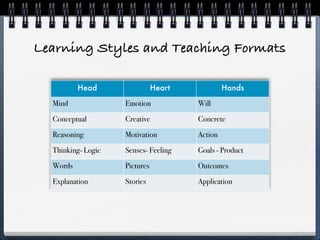
Learning Styles and Teaching Formats

          Head                 Heart            Hands
  Mind              Emotion            Will
  Conceptual        Creative           Concrete
  Reasoning         Motivation         Action
  Thinking- Logic   Senses- Feeling    Goals - Product
  Words             Pictures           Outcomes
  Explanation       Stories            Application
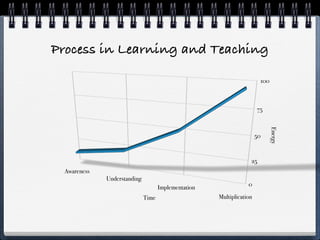
Process in Learning and Teaching

                                                                       100


                                                                      75


                                                                             Energy
                                                                      50


                                                                  25
 Awareness
             Understanding
                                                                 0
                                    Implementation
                             Time                    Multiplication
Finding Your Spiritual Path
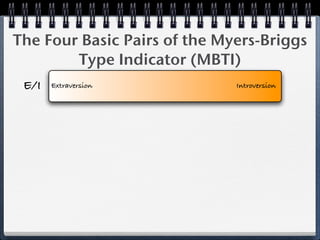
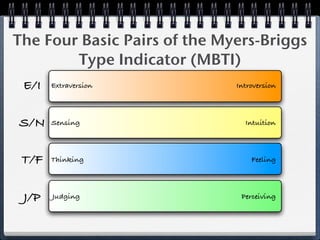
The Four Basic Pairs of the Myers-Briggs
        Type Indicator (MBTI)
 E/I   Extraversion           Introversion
The Four Basic Pairs of the Myers-Briggs
        Type Indicator (MBTI)
 E/I   Extraversion           Introversion


S/N    Sensing                  Intuition
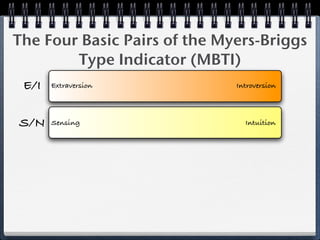
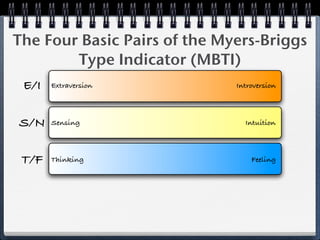
The Four Basic Pairs of the Myers-Briggs
        Type Indicator (MBTI)
 E/I   Extraversion           Introversion


S/N    Sensing                  Intuition


 T/F   Thinking                   Feeling
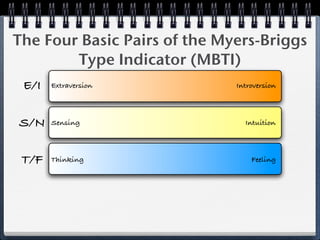
The Four Basic Pairs of the Myers-Briggs
        Type Indicator (MBTI)
 E/I   Extraversion           Introversion


S/N    Sensing                  Intuition


 T/F   Thinking                   Feeling


 J/P   Judging                 Perceiving
The Four Basic Pairs of the Myers-Briggs
        Type Indicator (MBTI)
 E/I   Extraversion           Introversion


S/N    Sensing                  Intuition


 T/F   Thinking                   Feeling
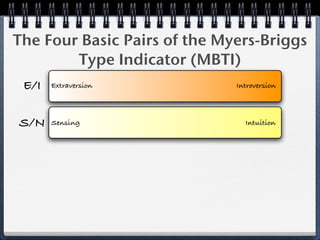
The Four Basic Pairs of the Myers-Briggs
        Type Indicator (MBTI)
 E/I   Extraversion           Introversion


S/N    Sensing                  Intuition
The Four Basic Pairs of the Myers-Briggs
        Type Indicator (MBTI)
 E/I   Extraversion           Introversion
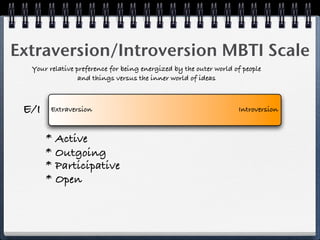
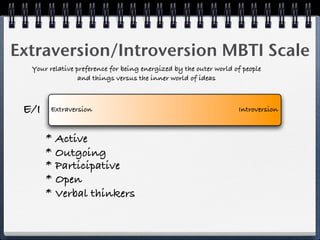
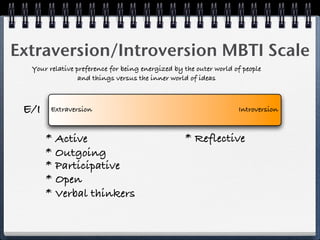
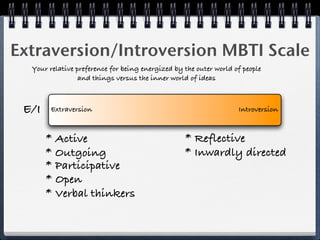
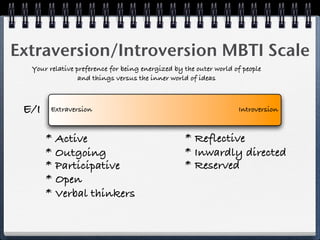
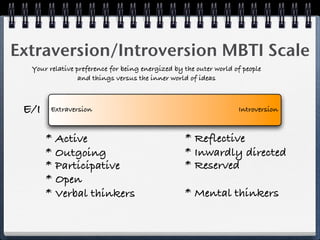
Extraversion/Introversion MBTI Scale
  Your relative preference for being energized by the outer world of people
                 and things versus the inner world of ideas


 E/I    Extraversion                                               Introversion
Extraversion/Introversion MBTI Scale
  Your relative preference for being energized by the outer world of people
                 and things versus the inner world of ideas


 E/I    Extraversion                                               Introversion


       * Active
Extraversion/Introversion MBTI Scale
  Your relative preference for being energized by the outer world of people
                 and things versus the inner world of ideas


 E/I    Extraversion                                               Introversion


       * Active
       * Outgoing
Extraversion/Introversion MBTI Scale
  Your relative preference for being energized by the outer world of people
                 and things versus the inner world of ideas


 E/I    Extraversion                                               Introversion


       * Active
       * Outgoing
       * Participative
Extraversion/Introversion MBTI Scale
  Your relative preference for being energized by the outer world of people
                 and things versus the inner world of ideas


 E/I    Extraversion                                               Introversion


       * Active
       * Outgoing
       * Participative
       * Open
Extraversion/Introversion MBTI Scale
  Your relative preference for being energized by the outer world of people
                 and things versus the inner world of ideas


 E/I    Extraversion                                               Introversion


       * Active
       * Outgoing
       * Participative
       * Open
       * Verbal thinkers
Extraversion/Introversion MBTI Scale
  Your relative preference for being energized by the outer world of people
                 and things versus the inner world of ideas


 E/I    Extraversion                                               Introversion


       * Active                                   * Reflective
       * Outgoing
       * Participative
       * Open
       * Verbal thinkers
Extraversion/Introversion MBTI Scale
  Your relative preference for being energized by the outer world of people
                 and things versus the inner world of ideas


 E/I    Extraversion                                               Introversion


       * Active                                   * Reflective
       * Outgoing                                 * Inwardly directed
       * Participative
       * Open
       * Verbal thinkers
Extraversion/Introversion MBTI Scale
  Your relative preference for being energized by the outer world of people
                 and things versus the inner world of ideas


 E/I    Extraversion                                               Introversion


       * Active                                   * Reflective
       * Outgoing                                 * Inwardly directed
       * Participative                            * Reserved
       * Open
       * Verbal thinkers
Extraversion/Introversion MBTI Scale
  Your relative preference for being energized by the outer world of people
                 and things versus the inner world of ideas


 E/I    Extraversion                                               Introversion


       * Active                                   * Reflective
       * Outgoing                                 * Inwardly directed
       * Participative                            * Reserved
       * Open
       * Verbal thinkers                          * Mental thinkers
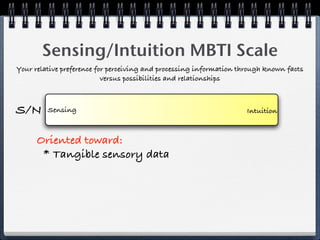
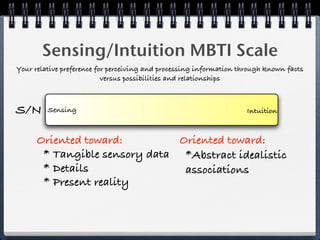
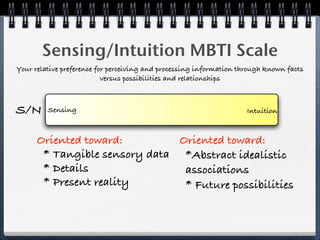
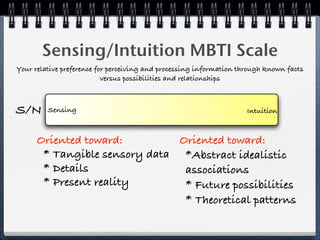
Sensing/Intuition MBTI Scale
Your relative preference for perceiving and processing information through known facts
                           versus possibilities and relationships


S/N      Sensing                                                     Intuition
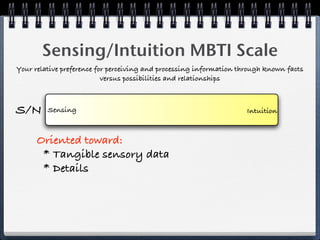
Sensing/Intuition MBTI Scale
Your relative preference for perceiving and processing information through known facts
                           versus possibilities and relationships


S/N      Sensing                                                     Intuition


      Oriented toward:
Sensing/Intuition MBTI Scale
Your relative preference for perceiving and processing information through known facts
                           versus possibilities and relationships


S/N      Sensing                                                     Intuition


      Oriented toward:
       * Tangible sensory data
Sensing/Intuition MBTI Scale
Your relative preference for perceiving and processing information through known facts
                           versus possibilities and relationships


S/N      Sensing                                                     Intuition


      Oriented toward:
       * Tangible sensory data
       * Details
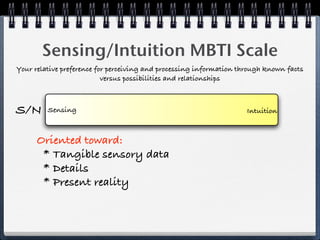
Sensing/Intuition MBTI Scale
Your relative preference for perceiving and processing information through known facts
                           versus possibilities and relationships


S/N      Sensing                                                     Intuition


      Oriented toward:
       * Tangible sensory data
       * Details
       * Present reality
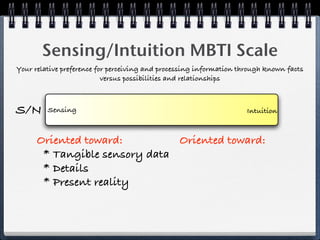
Sensing/Intuition MBTI Scale
Your relative preference for perceiving and processing information through known facts
                           versus possibilities and relationships


S/N      Sensing                                                     Intuition


      Oriented toward:         Oriented toward:
       * Tangible sensory data
       * Details
       * Present reality
Sensing/Intuition MBTI Scale
Your relative preference for perceiving and processing information through known facts
                           versus possibilities and relationships


S/N      Sensing                                                     Intuition


      Oriented toward:         Oriented toward:
       * Tangible sensory data *Abstract idealistic
       * Details                associations
       * Present reality
Sensing/Intuition MBTI Scale
Your relative preference for perceiving and processing information through known facts
                           versus possibilities and relationships


S/N      Sensing                                                     Intuition


      Oriented toward:         Oriented toward:
       * Tangible sensory data *Abstract idealistic
       * Details                associations
       * Present reality        * Future possibilities
Sensing/Intuition MBTI Scale
Your relative preference for perceiving and processing information through known facts
                           versus possibilities and relationships


S/N      Sensing                                                     Intuition


      Oriented toward:         Oriented toward:
       * Tangible sensory data *Abstract idealistic
       * Details                associations
       * Present reality        * Future possibilities
                                * Theoretical patterns
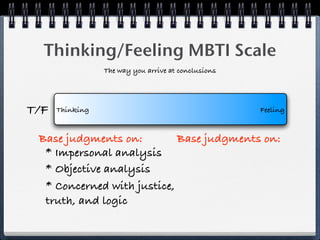
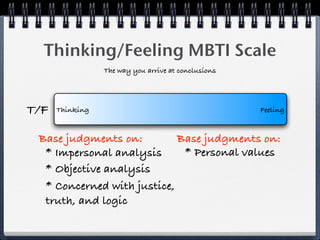
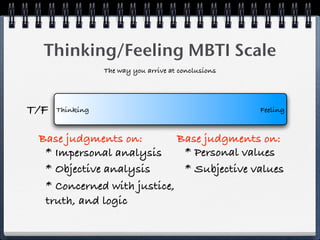
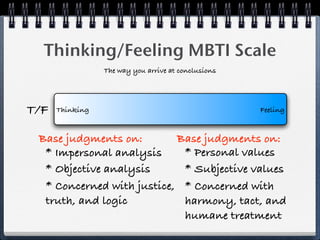
Thinking/Feeling MBTI Scale
                 The way you arrive at conclusions


T/F   Thinking                                       Feeling
Thinking/Feeling MBTI Scale
                 The way you arrive at conclusions


T/F   Thinking                                       Feeling


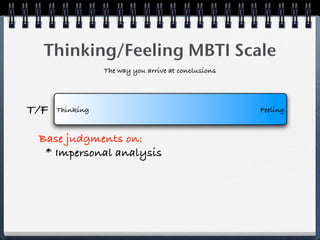
 Base judgments on:
Thinking/Feeling MBTI Scale
                 The way you arrive at conclusions


T/F   Thinking                                       Feeling


 Base judgments on:
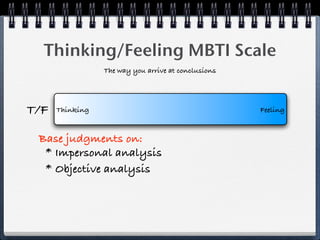
  * Impersonal analysis
Thinking/Feeling MBTI Scale
                 The way you arrive at conclusions


T/F   Thinking                                       Feeling


 Base judgments on:
  * Impersonal analysis
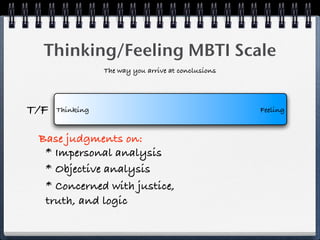
  * Objective analysis
Thinking/Feeling MBTI Scale
                 The way you arrive at conclusions


T/F   Thinking                                       Feeling


 Base judgments on:
  * Impersonal analysis
  * Objective analysis
  * Concerned with justice,
  truth, and logic
Thinking/Feeling MBTI Scale
                 The way you arrive at conclusions


T/F   Thinking                                       Feeling


 Base judgments on:         Base judgments on:
  * Impersonal analysis
  * Objective analysis
  * Concerned with justice,
  truth, and logic
Thinking/Feeling MBTI Scale
                 The way you arrive at conclusions


T/F   Thinking                                       Feeling


 Base judgments on:         Base judgments on:
  * Impersonal analysis      * Personal values
  * Objective analysis
  * Concerned with justice,
  truth, and logic
Thinking/Feeling MBTI Scale
                 The way you arrive at conclusions


T/F   Thinking                                       Feeling


 Base judgments on:         Base judgments on:
  * Impersonal analysis      * Personal values
  * Objective analysis       * Subjective values
  * Concerned with justice,
  truth, and logic
Thinking/Feeling MBTI Scale
                 The way you arrive at conclusions


T/F   Thinking                                       Feeling


 Base judgments on:        Base judgments on:
  * Impersonal analysis     * Personal values
  * Objective analysis      * Subjective values
  * Concerned with justice, * Concerned with
  truth, and logic          harmony, tact, and
                            humane treatment
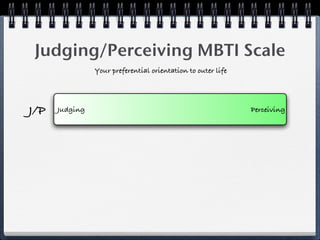
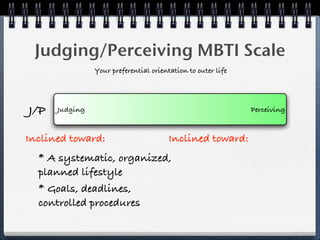
Judging/Perceiving MBTI Scale
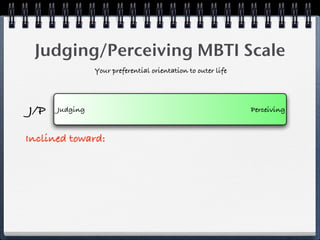
                Your preferential orientation to outer life


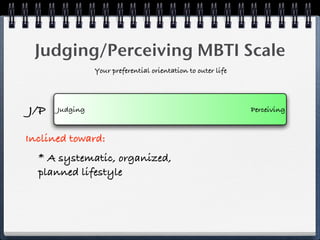
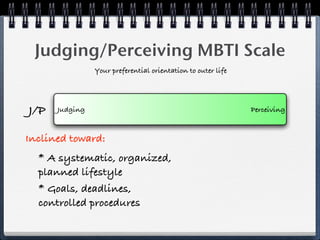
J/P   Judging                                                 Perceiving
Judging/Perceiving MBTI Scale
                Your preferential orientation to outer life


J/P   Judging                                                 Perceiving


Inclined toward:
Judging/Perceiving MBTI Scale
                Your preferential orientation to outer life


J/P   Judging                                                 Perceiving


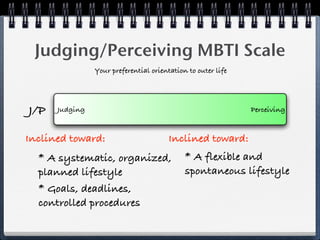
Inclined toward:
  * A systematic, organized,
  planned lifestyle
Judging/Perceiving MBTI Scale
                Your preferential orientation to outer life


J/P   Judging                                                 Perceiving


Inclined toward:
  * A systematic, organized,
  planned lifestyle
  * Goals, deadlines,
  controlled procedures
Judging/Perceiving MBTI Scale
                Your preferential orientation to outer life


J/P   Judging                                                 Perceiving


Inclined toward:                        Inclined toward:
  * A systematic, organized,
  planned lifestyle
  * Goals, deadlines,
  controlled procedures
Judging/Perceiving MBTI Scale
                Your preferential orientation to outer life


J/P   Judging                                                 Perceiving


Inclined toward:                        Inclined toward:
  * A systematic, organized,                 * A flexible and
  planned lifestyle                          spontaneous lifestyle
  * Goals, deadlines,
  controlled procedures
Judging/Perceiving MBTI Scale
                Your preferential orientation to outer life


J/P   Judging                                                 Perceiving


Inclined toward:                        Inclined toward:
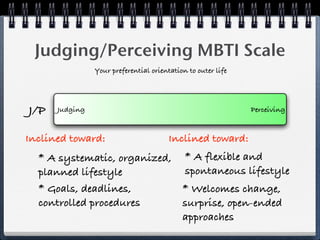
  * A systematic, organized, * A flexible and
  planned lifestyle          spontaneous lifestyle
  * Goals, deadlines,        * Welcomes change,
  controlled procedures      surprise, open-ended
                             approaches
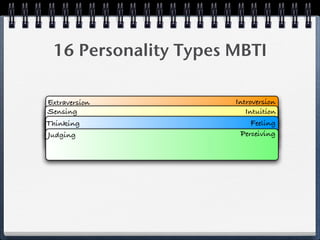
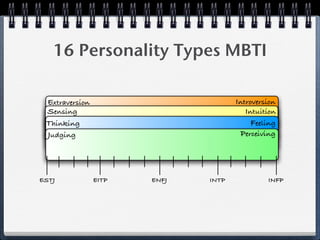
16 Personality Types MBTI

Extraversion          Introversion
Sensing                  Intuition
Thinking                   Feeling
Judging                Perceiving
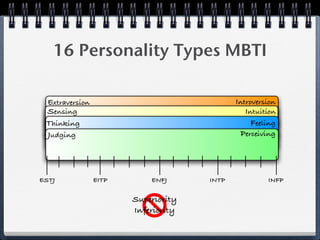
16 Personality Types MBTI

 Extraversion                        Introversion
 Sensing                                Intuition
 Thinking                                 Feeling
 Judging                              Perceiving


ESTJ            EITP   ENFJ   INTP            INFP
16 Personality Types MBTI

 Extraversion                               Introversion
 Sensing                                       Intuition
 Thinking                                        Feeling
 Judging                                     Perceiving


ESTJ            EITP       ENFJ      INTP            INFP

                       Superiority
                       Inferiority
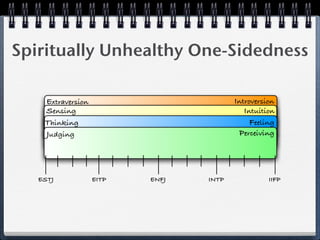
Spiritually Unhealthy One-Sidedness

    Extraversion                        Introversion
    Sensing                                Intuition
    Thinking                                 Feeling
    Judging                              Perceiving


   ESTJ            EITP   ENFJ   INTP             IIFP
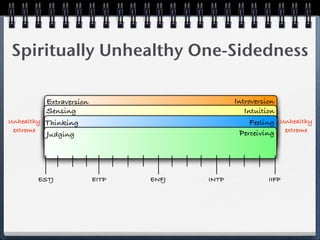
Spiritually Unhealthy One-Sidedness

            Extraversion                        Introversion
            Sensing                                Intuition
Unhealthy   Thinking                                 Feeling   Unhealthy
 extreme                                         Perceiving     extreme
            Judging


        ESTJ               EITP   ENFJ   INTP             IIFP
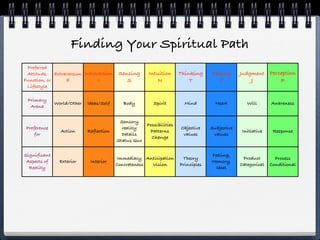
Finding Your Spiritual Path
 Preferred
 Attitude, Extraversion Introversion      Sensing     Intuition     Thinking     Feeling      Judgment Perception
Function, or    E             I              S            N             T           F             J        P
 Lifestyle

 Primary
              World/Other   Ideas/Self      Body        Spirit        Mind         Heart         Will       Awareness
  Arena


                                          Sensory
                                                    Possibilities
 Preference                                reality                  Objective    Subjective
                Action      Reflection               Patterns                                 Initiative     Response
     for                                   Details                   values       values
                                                      Change
                                         Status Quo

Significant                                                                      Feeling,
                                          Immediacy Anticipation     Theory                    Product        Process
 Aspects of     Exterior     Interior                                            Memory,
                                         Concreteness Vision        Principles                Categorical   Conditional
  Reality                                                                         Ideal
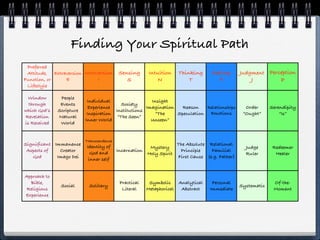
Finding Your Spiritual Path
 Preferred
 Attitude, Extraversion Introversion      Sensing       Intuition   Thinking       Feeling      Judgment Perception
Function, or    E             I              S              N           T             F             J        P
 Lifestyle

 Window        People
                           Individual                 Insight
  through      Events                     Society
                            Experience              Imagination   Reason   Relationships          Order      Serendipity
which God’s   Scripture                Institutions
                           Inspiration                  “The    Speculation Emotions             “Ought”         “Is”
Revelation    Natural                   “The Seen”
                          Inner World                 Unseen”
is Received    World


                          Transcendence
Significant Immanence                                               The Absolute Relational
                          Identity of                  Mystery                                    Judge       Redeemer
 Aspects of   Creator                     Incarnation                Principle    Familial
                            God and                   Holy Spirit                                 Ruler        Healer
   God       Imago Dei                                              First Cause (e.g. Father)
                           inner self


Approach to
  Bible,                                   Practical    Symbolic    Analytical     Personal                   Of-the-
               Social      Solitary                                                             Systematic
 Religious                                  Literal    Metaphorical  Abstract     Immediate                   Moment
Experience
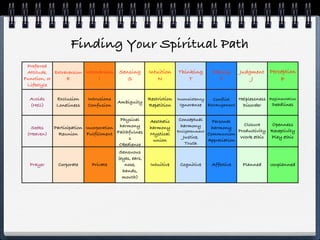
Finding Your Spiritual Path
 Preferred
 Attitude, Extraversion Introversion     Sensing       Intuition    Thinking       Feeling     Judgment Perception
Function, or    E             I             S              N            T             F            J        P
 Lifestyle

  Avoids     Exclusion     Intrusions                  Restriction Inconsistency Conflict  Helplessness Regimentation
                                        Ambiguity
  (Hell)     Loneliness    Confusion                   Repetition   Ignorance Estrangement   Disorder    Deadlines


                                         Physical      Aesthetic    Conceptual      Personal
                                                                                                 Closure    Openness
  Seeks     Participation Incorporation harmony        harmony       harmony       harmony
                                                                    Enlightenment              Productivity Receptivity
 (Heaven)     Reunion     Fulfillment Faithfulnes      Mystical                   Communion
                                             s                         Justice,                 Work ethic  Play ethic
                                                        union                     Appreciation
                                         Obedience                      Truth
                                         Sensuous
                                        (eyes, ears,
  Prayer      Corporate      Private       nose,        Intuitive    Cognitive    Affective     Planned     Unplanned
                                          hands,
                                          mouth)
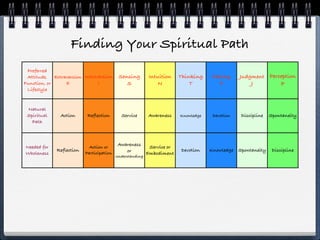
Finding Your Spiritual Path
 Preferred
 Attitude, Extraversion Introversion       Sensing         Intuition    Thinking     Feeling    Judgment Perception
Function, or    E             I               S                N            T           F           J        P
 Lifestyle


 Natural
 Spiritual    Action       Reflection       Service       Awareness     Knowledge    Devotion   Discipline   Spontaneity
   Path


                                           Awareness
Needed for                  Action or                      Service or
             Reflection                       or                        Devotion    Knowledge Spontaneity     Discipline
Wholeness                 Participation                   Embodiment
                                          Understanding
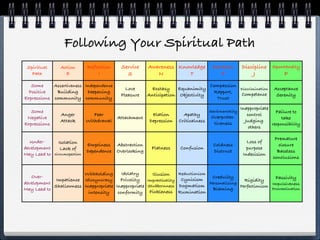
Following Your Spiritual Path
 Spiritual      Action       Reflection    Service      Awareness Knowledge           Devotion        Discipline Spontaneity
   Path           E               I          S             N         T                   F                 J         P
   Some     Assertiveness Independence                                               Compassion
                                             Love        Ecstasy     Equanimity                 Discrimination       Acceptance
  Positive   Building      Deepening                                                  Rapport,
                                           Pleasure     Anticipation Objectivity                Competence            Serenity
Expressions community community                                                        Trust

                                                                                                      Inappropriate
   Some                                                                              Sentimentality                   Failure to
                Anger           Fear                      Elation       Apathy                           control
 Negative                                 Attachment                                  Overprotec-                        take
                Attack       Withdrawal                  Depression   Criticalness                      Judging
Expressions                                                                            tiveness                     responsibility
                                                                                                          others

                                                                                                                      Premature
  Under-       Isolation                                                                                 Loss of
                             Emptiness    Abstraction                                  Coldness                        closure
development     Lack of                                  Flatness     Confusion                          purpose
                             Dependence   Overlooking                                  Distrust                        Baseless
May Lead to circumspection                                                                             Indecision
                                                                                                                     conclusions


                        Withholding      Idolatry     Illusion     Reductionism
   Over-                                                                         Credulity                    Passivity
             Impatience Idiosyncrasy    Frivolity   Impracticality Cynicism                     Rigidity
development                                                                     Personalizing               Impulsiveness
            Shallowness Inappropriate Inappropriate Stubbornness Dogmatism                    Perfectionism
May Lead to                                                                       Blaming                   Procrastination
                          intensity    conformity Fickleness Rumination
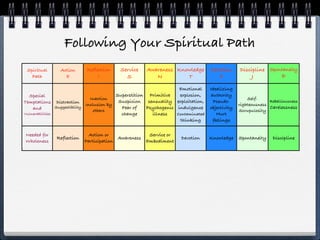
Following Your Spiritual Path
 Spiritual     Action      Reflection    Service    Awareness Knowledge         Devotion      Discipline Spontaneity
   Path          E              I          S           N         T                 F               J         P

                                                                 Emotional      Idealizing
  Special                               Superstition Primitive   explosion,      authority
                               Inaction                                                           Self-
Temptations Distraction Inclusion by Suspicion       sensuality exploitation,     Pseudo-                   Rebelliousness
                                                                                              righteousness
    and         Suggestibility            Fear of   Psychogenic indulgence      objectivity                 Carelessness
                                others                                                        Scrupulosity
Vulnerabilities                           change       illness  Contaminated        Hurt
                                                                 thinking         feelings

Needed for                   Action or              Service or
              Reflection                 Awareness                 Devotion     Knowledge     Spontaneity     Discipline
Wholeness                  Participation           Embodiment
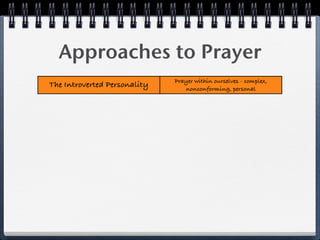
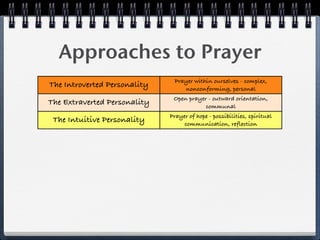
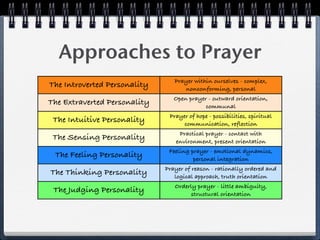
Approaches to Prayer
                              Prayer within ourselves - complex,
The Introverted Personality      nonconforming, personal
                              Open prayer - outward orientation,
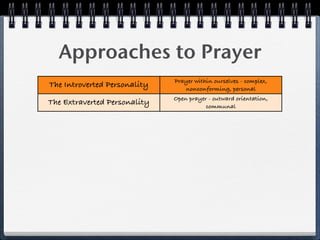
Approaches to Prayer
                              Prayer within ourselves - complex,
The Introverted Personality      nonconforming, personal
                              Open prayer - outward orientation,
The Extraverted Personality              communal
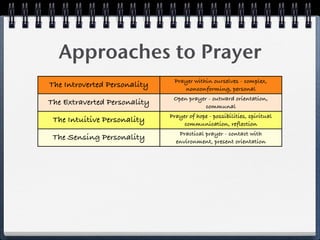
Approaches to Prayer
                               Prayer within ourselves - complex,
The Introverted Personality       nonconforming, personal
                               Open prayer - outward orientation,
The Extraverted Personality               communal
                              Prayer of hope - possibilities, spiritual
 The Intuitive Personality         communication, reflection
                                  Practical prayer - contact with
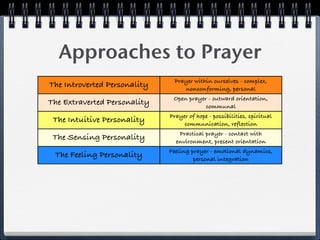
Approaches to Prayer
                               Prayer within ourselves - complex,
The Introverted Personality       nonconforming, personal
                               Open prayer - outward orientation,
The Extraverted Personality               communal
                              Prayer of hope - possibilities, spiritual
 The Intuitive Personality         communication, reflection
                                 Practical prayer - contact with
 The Sensing Personality        environment, present orientation
                              Feeling prayer - emotional dynamics,
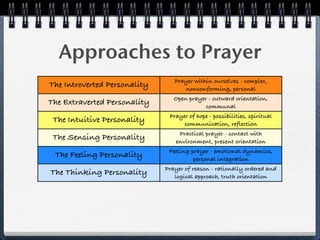
Approaches to Prayer
                                 Prayer within ourselves - complex,
The Introverted Personality         nonconforming, personal
                                 Open prayer - outward orientation,
The Extraverted Personality                 communal
                               Prayer of hope - possibilities, spiritual
 The Intuitive Personality          communication, reflection
                                  Practical prayer - contact with
 The Sensing Personality         environment, present orientation
                               Feeling prayer - emotional dynamics,
 The Feeling Personality                personal integration
                              Prayer of reason - rationally ordered and
Approaches to Prayer
                                 Prayer within ourselves - complex,
The Introverted Personality         nonconforming, personal
                                 Open prayer - outward orientation,
The Extraverted Personality                 communal
                               Prayer of hope - possibilities, spiritual
 The Intuitive Personality          communication, reflection
                                  Practical prayer - contact with
 The Sensing Personality         environment, present orientation
                               Feeling prayer - emotional dynamics,
 The Feeling Personality                personal integration
                              Prayer of reason - rationally ordered and
The Thinking Personality         logical approach, truth orientation
                                 Orderly prayer - little ambiguity,
Approaches to Prayer
                                 Prayer within ourselves - complex,
The Introverted Personality         nonconforming, personal
                                 Open prayer - outward orientation,
The Extraverted Personality                 communal
                               Prayer of hope - possibilities, spiritual
 The Intuitive Personality          communication, reflection
                                   Practical prayer - contact with
 The Sensing Personality          environment, present orientation
                               Feeling prayer - emotional dynamics,
 The Feeling Personality                personal integration
                              Prayer of reason - rationally ordered and
The Thinking Personality         logical approach, truth orientation
                                 Orderly prayer - little ambiguity,
 The Judging Personality              structural orientation
                              Lived prayer - accepts ambiguity, several
Approaches to Prayer
                                 Prayer within ourselves - complex,
The Introverted Personality         nonconforming, personal
                                 Open prayer - outward orientation,
The Extraverted Personality                 communal
                               Prayer of hope - possibilities, spiritual
 The Intuitive Personality          communication, reflection
                                   Practical prayer - contact with
 The Sensing Personality          environment, present orientation
                               Feeling prayer - emotional dynamics,
 The Feeling Personality                personal integration
                              Prayer of reason - rationally ordered and
The Thinking Personality         logical approach, truth orientation
                                 Orderly prayer - little ambiguity,
 The Judging Personality              structural orientation
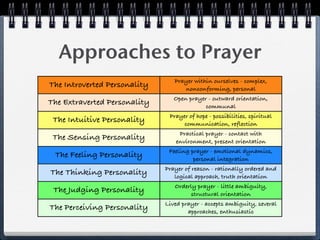
                              Lived prayer - accepts ambiguity, several
The Perceiving Personality            approaches, enthusiastic
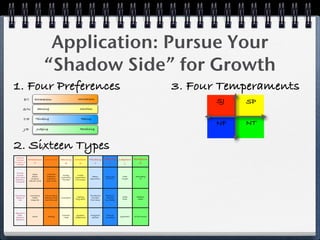
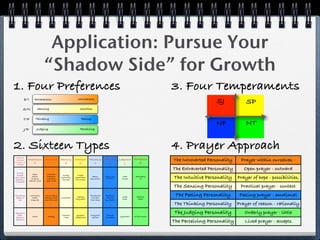
Application: Pursue Your
“Shadow Side” for Growth
Application: Pursue Your
             “Shadow Side” for Growth
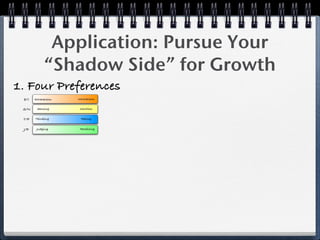
1. Four Preferences
 E/I   Extraversion   Introversion


 S/N    Sensing        Intuition


 T/F   Thinking         Feeling


 J/P    Judging        Perceiving
Application: Pursue Your
                                “Shadow Side” for Growth
1. Four Preferences
          E/I         Extraversion                                  Introversion


         S/N            Sensing                                       Intuition


         T/F          Thinking                                         Feeling


          J/P           Judging                                       Perceiving


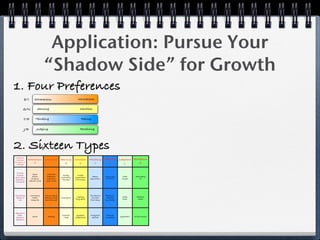
2. Sixteen Types
 Preferred
 Attitude,     Extraversion     Introversion      Sensing        Intuition      Thinking       Feeling Judgment Perception
Function, or
 Lifestyle
                    E                 I              S               N              T             F        J        P


 Window
                   People         Individual
  through                                            Society        Insight
                   Events          Experience                                     Reason       Relationships     Order       Serendipity
which God’s                                       Institutions   Imagination
                  Scripture       Inspiration                                   Speculation     Emotions        “Ought”          “Is”
Revelation                                         “The Seen”    “The Unseen”
                Natural World    Inner World
is Received


Significant      Immanence      Transcendence                                   The Absolute    Relational
                                                                  Mystery                                        Judge        Redeemer
 Aspects of        Creator      Identity of God   Incarnation                    Principle       Familial
                                                                 Holy Spirit                                     Ruler         Healer
   God            Imago Dei      and inner self                                 First Cause    (e.g. Father)


Approach to
  Bible,                                           Practical      Symbolic       Analytical     Personal
                   Social          Solitary                                                                    Systematic   Of-the-Moment
 Religious                                          Literal      Metaphorical     Abstract     Immediate
Experience
Application: Pursue Your
                                “Shadow Side” for Growth
1. Four Preferences                                                                                                                         3. Four Temperaments
          E/I         Extraversion                                  Introversion
                                                                                                                                                   SJ   SP
         S/N            Sensing                                       Intuition


         T/F          Thinking                                         Feeling
                                                                                                                                                  NF    NT
          J/P           Judging                                       Perceiving


2. Sixteen Types
 Preferred
 Attitude,     Extraversion     Introversion      Sensing        Intuition      Thinking       Feeling Judgment Perception
Function, or
 Lifestyle
                    E                 I              S               N              T             F        J        P


 Window
                   People         Individual
  through                                            Society        Insight
                   Events          Experience                                     Reason       Relationships     Order       Serendipity
which God’s                                       Institutions   Imagination
                  Scripture       Inspiration                                   Speculation     Emotions        “Ought”          “Is”
Revelation                                         “The Seen”    “The Unseen”
                Natural World    Inner World
is Received


Significant      Immanence      Transcendence                                   The Absolute    Relational
                                                                  Mystery                                        Judge        Redeemer
 Aspects of        Creator      Identity of God   Incarnation                    Principle       Familial
                                                                 Holy Spirit                                     Ruler         Healer
   God            Imago Dei      and inner self                                 First Cause    (e.g. Father)


Approach to
  Bible,                                           Practical      Symbolic       Analytical     Personal
                   Social          Solitary                                                                    Systematic   Of-the-Moment
 Religious                                          Literal      Metaphorical     Abstract     Immediate
Experience
Application: Pursue Your
                                “Shadow Side” for Growth
1. Four Preferences                                                                                                                         3. Four Temperaments
          E/I         Extraversion                                  Introversion
                                                                                                                                                               SJ             SP
         S/N            Sensing                                       Intuition


         T/F          Thinking                                         Feeling
                                                                                                                                                               NF             NT
          J/P           Judging                                       Perceiving


2. Sixteen Types                                                                                                                            4. Prayer Approach
 Preferred
 Attitude,     Extraversion     Introversion      Sensing        Intuition      Thinking       Feeling Judgment Perception                  The Introverted Personality    Prayer within ourselves -
Function, or        E                 I              S               N              T             F        J        P
                                                                                                                                                                           complex, nonconforming,
 Lifestyle

                                                                                                                                            The Extraverted Personality      Open prayer - outward
                                                                                                                                                                            orientation, communal
 Window
                   People         Individual

                                                                                                                                            The Intuitive Personality
  through                                            Society        Insight
which God’s
Revelation
                   Events
                  Scripture
                                   Experience
                                  Inspiration
                                                  Institutions
                                                   “The Seen”
                                                                 Imagination
                                                                 “The Unseen”
                                                                                  Reason
                                                                                Speculation
                                                                                               Relationships
                                                                                                Emotions
                                                                                                                 Order
                                                                                                                “Ought”
                                                                                                                             Serendipity
                                                                                                                                 “Is”                                     Prayer of hope - possibilities,
                Natural World    Inner World
                                                                                                                                                                           spiritual communication,
is Received

                                                                                                                                            The Sensing Personality        Practical prayer - contact
                                                                                                                                                                           with environment, present
Significant
 Aspects of
                 Immanence
                   Creator
                                Transcendence
                                Identity of God   Incarnation     Mystery
                                                                                The Absolute
                                                                                 Principle
                                                                                                Relational
                                                                                                 Familial        Judge        Redeemer
                                                                                                                                             The Feeling Personality       Feeling prayer - emotional
                                                                 Holy Spirit                                     Ruler         Healer

                                                                                                                                                                          Prayer of reasonpersonal
   God            Imago Dei      and inner self                                 First Cause    (e.g. Father)
                                                                                                                                                                              dynamics, - rationally
                                                                                                                                            The Thinking Personality
Approach to                                                                                                                                  The Judging Personality          ordered and logical
                                                                                                                                                                             Orderly prayer - little
  Bible,                                           Practical      Symbolic       Analytical     Personal
                   Social          Solitary                                                                    Systematic   Of-the-Moment
 Religious                                          Literal      Metaphorical     Abstract     Immediate
                                                                                                                                                                             ambiguity, structural
Experience
                                                                                                                                            The Perceiving Personality       Lived prayer - accepts
                                                                                                                                                                              ambiguity, several
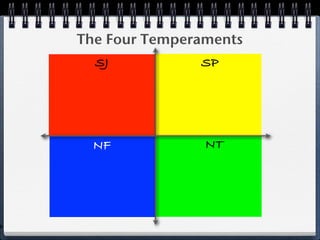
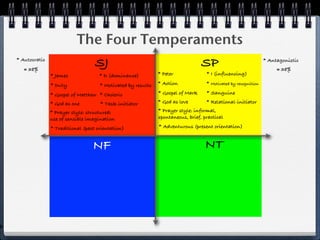
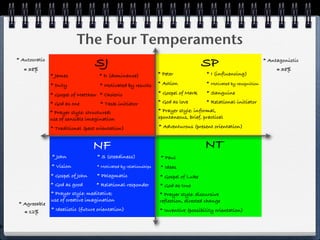
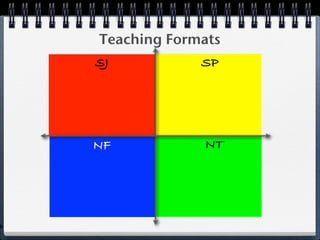
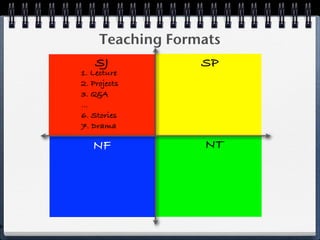
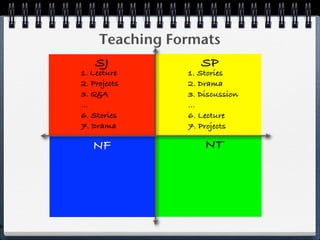
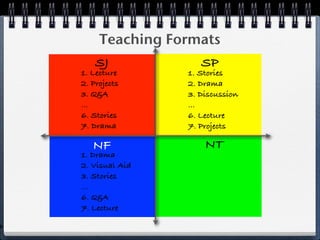
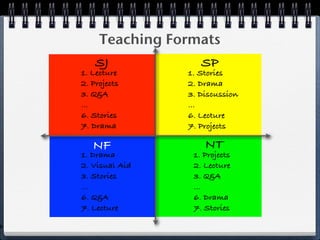
The Four Temperaments
      SJ           SP


      NF            NT


P
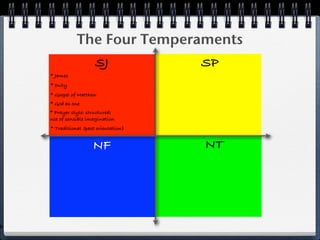
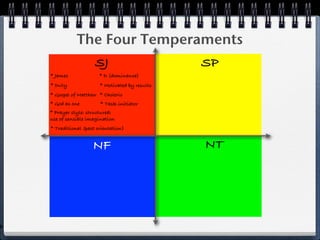
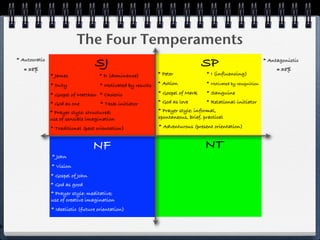
The Four Temperaments
                       SJ              SP
    * James
    * Duty
    * Gospel of Matthew
    * God as one
    * Prayer style: structured;
    use of sensible imagination
    * Traditional (past orientation)


                      NF               NT


P
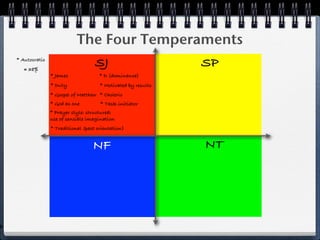
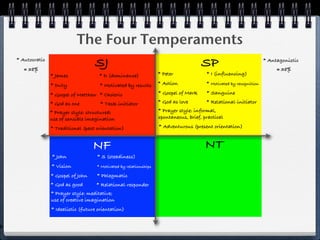
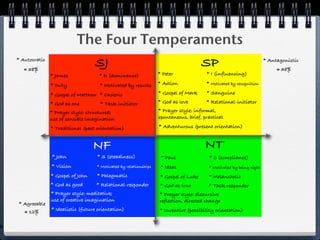
The Four Temperaments
                       SJ                         SP
    * James              * D (dominance)
    * Duty               * Motivated by results
    * Gospel of Matthew * Choleric
    * God as one         * Task-initiator
    * Prayer style: structured;
    use of sensible imagination
    * Traditional (past orientation)


                      NF                          NT


P
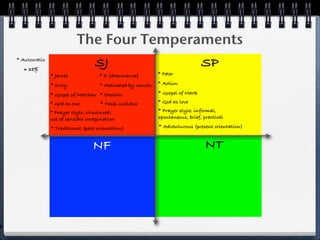
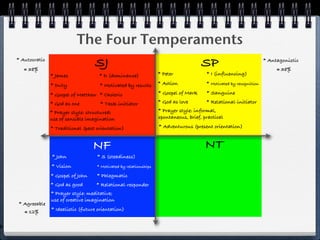
The Four Temperaments
    * Autocratic
       ≅ 38%
                                      SJ                         SP
                   * James              * D (dominance)
                   * Duty               * Motivated by results
                   * Gospel of Matthew * Choleric
                   * God as one         * Task-initiator
                   * Prayer style: structured;
                   use of sensible imagination
                   * Traditional (past orientation)


                                     NF                          NT


P
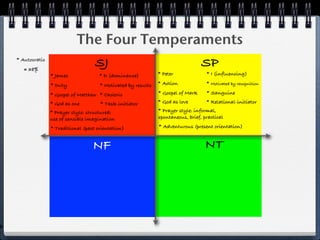
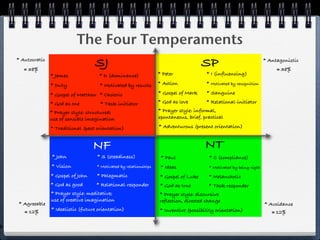
The Four Temperaments
    * Autocratic
       ≅ 38%
                                      SJ                                            SP
                   * James              * D (dominance)          * Peter

                   * Duty               * Motivated by results   * Action

                   * Gospel of Matthew * Choleric                * Gospel of Mark

                   * God as one         * Task-initiator         * God as love

                   * Prayer style: structured;                   * Prayer style: informal,
                   use of sensible imagination                   spontaneous, brief, practical

                   * Traditional (past orientation)              * Adventurous (present orientation)


                                     NF                                              NT


P
The Four Temperaments
    * Autocratic
       ≅ 38%
                                      SJ                                            SP
                   * James              * D (dominance)          * Peter              * I (influencing)

                   * Duty               * Motivated by results   * Action             * Motivated by recognition

                   * Gospel of Matthew * Choleric                * Gospel of Mark     * Sanguine

                   * God as one         * Task-initiator         * God as love        * Relational-initiator
                   * Prayer style: structured;                   * Prayer style: informal,
                   use of sensible imagination                   spontaneous, brief, practical

                   * Traditional (past orientation)              * Adventurous (present orientation)


                                     NF                                              NT


P
The Four Temperaments
    * Autocratic
       ≅ 38%
                                      SJ                                            SP                             * Antagonistic
                                                                                                                        ≅ 38%
                   * James              * D (dominance)          * Peter              * I (influencing)

                   * Duty               * Motivated by results   * Action             * Motivated by recognition

                   * Gospel of Matthew * Choleric                * Gospel of Mark     * Sanguine

                   * God as one         * Task-initiator         * God as love        * Relational-initiator
                   * Prayer style: structured;                   * Prayer style: informal,
                   use of sensible imagination                   spontaneous, brief, practical

                   * Traditional (past orientation)              * Adventurous (present orientation)


                                     NF                                              NT


P
The Four Temperaments
    * Autocratic
       ≅ 38%
                                      SJ                                            SP                             * Antagonistic
                                                                                                                        ≅ 38%
                   * James              * D (dominance)          * Peter              * I (influencing)

                   * Duty               * Motivated by results   * Action             * Motivated by recognition

                   * Gospel of Matthew * Choleric                * Gospel of Mark     * Sanguine

                   * God as one          * Task-initiator        * God as love        * Relational-initiator
                   * Prayer style: structured;                   * Prayer style: informal,
                   use of sensible imagination                   spontaneous, brief, practical

                   * Traditional (past orientation)              * Adventurous (present orientation)


                                      NF                                             NT
                   * John
                   * Vision
                   * Gospel of John
                   * God as good
                   * Prayer style: meditative;
                   use of creative imagination
                   * Idealistic (future orientation)


P
The Four Temperaments
    * Autocratic
       ≅ 38%
                                      SJ                                                 SP                             * Antagonistic
                                                                                                                             ≅ 38%
                   * James              * D (dominance)               * Peter              * I (influencing)

                   * Duty               * Motivated by results        * Action             * Motivated by recognition

                   * Gospel of Matthew * Choleric                     * Gospel of Mark     * Sanguine

                   * God as one          * Task-initiator             * God as love        * Relational-initiator
                   * Prayer style: structured;                        * Prayer style: informal,
                   use of sensible imagination                        spontaneous, brief, practical

                   * Traditional (past orientation)                   * Adventurous (present orientation)


                                      NF                                                  NT
                   * John              * S (steadiness)
                   * Vision            * Motivated by relationships

                   * Gospel of John    * Phlegmatic
                   * God as good       * Relational-responder
                   * Prayer style: meditative;
                   use of creative imagination
                   * Idealistic (future orientation)


P
The Four Temperaments
    * Autocratic
       ≅ 38%
                                      SJ                                                 SP                             * Antagonistic
                                                                                                                             ≅ 38%
                   * James              * D (dominance)               * Peter              * I (influencing)

                   * Duty               * Motivated by results        * Action             * Motivated by recognition

                   * Gospel of Matthew * Choleric                     * Gospel of Mark     * Sanguine

                   * God as one          * Task-initiator             * God as love        * Relational-initiator
                   * Prayer style: structured;                        * Prayer style: informal,
                   use of sensible imagination                        spontaneous, brief, practical

                   * Traditional (past orientation)                   * Adventurous (present orientation)


                                      NF                                                  NT
                   * John              * S (steadiness)
                   * Vision            * Motivated by relationships

                   * Gospel of John    * Phlegmatic
                   * God as good       * Relational-responder
                   * Prayer style: meditative;
                   use of creative imagination
    * Agreeable
      ≅ 12%        * Idealistic (future orientation)


P
The Four Temperaments
    * Autocratic
       ≅ 38%
                                      SJ                                                 SP                             * Antagonistic
                                                                                                                             ≅ 38%
                   * James              * D (dominance)               * Peter              * I (influencing)

                   * Duty               * Motivated by results        * Action             * Motivated by recognition

                   * Gospel of Matthew * Choleric                     * Gospel of Mark     * Sanguine

                   * God as one          * Task-initiator             * God as love        * Relational-initiator
                   * Prayer style: structured;                        * Prayer style: informal,
                   use of sensible imagination                        spontaneous, brief, practical

                   * Traditional (past orientation)                   * Adventurous (present orientation)


                                      NF                                                  NT
                   * John              * S (steadiness)                * Paul
                   * Vision            * Motivated by relationships    * Ideas
                   * Gospel of John    * Phlegmatic                   * Gospel of Luke
                   * God as good       * Relational-responder          * God as true
                   * Prayer style: meditative;                        * Prayer style: discursive
                   use of creative imagination                        reflection, directed change
    * Agreeable
      ≅ 12%        * Idealistic (future orientation)                  * Inventive (possibility orientation)


P
The Four Temperaments
    * Autocratic
       ≅ 38%
                                      SJ                                                 SP                              * Antagonistic
                                                                                                                              ≅ 38%
                   * James              * D (dominance)               * Peter              * I (influencing)

                   * Duty               * Motivated by results        * Action             * Motivated by recognition

                   * Gospel of Matthew * Choleric                     * Gospel of Mark     * Sanguine

                   * God as one          * Task-initiator             * God as love        * Relational-initiator
                   * Prayer style: structured;                        * Prayer style: informal,
                   use of sensible imagination                        spontaneous, brief, practical

                   * Traditional (past orientation)                   * Adventurous (present orientation)


                                      NF                                                  NT
                   * John              * S (steadiness)                * Paul               * C (compliance)
                   * Vision            * Motivated by relationships    * Ideas              * Motivated by being right
                   * Gospel of John    * Phlegmatic                   * Gospel of Luke      * Melancholic
                   * God as good       * Relational-responder          * God as true        * Task-responder
                   * Prayer style: meditative;                        * Prayer style: discursive
                   use of creative imagination                        reflection, directed change
    * Agreeable
      ≅ 12%        * Idealistic (future orientation)                  * Inventive (possibility orientation)


P
The Four Temperaments
    * Autocratic
       ≅ 38%
                                      SJ                                                 SP                              * Antagonistic
                                                                                                                              ≅ 38%
                   * James              * D (dominance)               * Peter              * I (influencing)

                   * Duty               * Motivated by results        * Action             * Motivated by recognition

                   * Gospel of Matthew * Choleric                     * Gospel of Mark     * Sanguine

                   * God as one          * Task-initiator             * God as love        * Relational-initiator
                   * Prayer style: structured;                        * Prayer style: informal,
                   use of sensible imagination                        spontaneous, brief, practical

                   * Traditional (past orientation)                   * Adventurous (present orientation)


                                      NF                                                  NT
                   * John              * S (steadiness)                * Paul               * C (compliance)
                   * Vision            * Motivated by relationships    * Ideas              * Motivated by being right
                   * Gospel of John    * Phlegmatic                   * Gospel of Luke      * Melancholic
                   * God as good       * Relational-responder          * God as true        * Task-responder
                   * Prayer style: meditative;                        * Prayer style: discursive
                   use of creative imagination                        reflection, directed change
    * Agreeable                                                                                                          * Avoidance
      ≅ 12%        * Idealistic (future orientation)                  * Inventive (possibility orientation)                 ≅ 12%


P
Teaching Formats
    SJ           SP


    NF           NT


P
Teaching Formats
             SJ              SP
    * Organized, practical
          material


            NF               NT


P
Teaching Formats
             SJ                       SP
    * Organized, practical   * Informal, aesthetic/
          material           artistic, spontaneous
                                    material


            NF                         NT


P
Teaching Formats
             SJ                       SP
    * Organized, practical   * Informal, aesthetic/
          material           artistic, spontaneous
                                    material


            NF                         NT
      * Creative, verbal
          material


P
Teaching Formats
             SJ                       SP
    * Organized, practical   * Informal, aesthetic/
          material           artistic, spontaneous
                                    material


            NF                         NT
      * Creative, verbal     * Logical and reflective
          material                  material


P
Teaching Formats
              SJ                         SP
     * Organized, practical     * Informal, aesthetic/
           material             artistic, spontaneous
                                       material
    Programatic and practical
           resources

              NF                          NT
        * Creative, verbal      * Logical and reflective
            material                   material


P
Teaching Formats
              SJ                         SP
     * Organized, practical     * Informal, aesthetic/
           material             artistic, spontaneous
                                       material
    Programatic and practical     Film, Drama, Arts
           resources

              NF                          NT
        * Creative, verbal      * Logical and reflective
            material                   material


P
Teaching Formats
              SJ                         SP
     * Organized, practical     * Informal, aesthetic/
           material             artistic, spontaneous
                                       material
    Programatic and practical     Film, Drama, Arts
           resources

              NF                          NT
        * Creative, verbal      * Logical and reflective
            material                   material

        Literature/Story


P
Teaching Formats
              SJ                         SP
     * Organized, practical     * Informal, aesthetic/
           material             artistic, spontaneous
                                       material
    Programatic and practical     Film, Drama, Arts
           resources

              NF                          NT
        * Creative, verbal      * Logical and reflective
            material                   material

        Literature/Story           Ideas/Apologetics


P
Teaching Formats
    SJ           SP


    NF           NT


P
Teaching Formats
        SJ            SP
    1. Lecture
    2. Projects
    3. Q&A
    ...
    6. Stories
    7. Drama

       NF             NT


P
Teaching Formats
        SJ             SP
    1. Lecture      1. Stories
    2. Projects     2. Drama
    3. Q&A          3. Discussion
    ...             ...
    6. Stories      6. Lecture
    7. Drama        7. Projects

       NF               NT


P
Teaching Formats
        SJ             SP
    1. Lecture      1. Stories
    2. Projects     2. Drama
    3. Q&A          3. Discussion
    ...             ...
    6. Stories      6. Lecture
    7. Drama        7. Projects

       NF               NT
    1. Drama
    2. Visual Aid
    3. Stories
    ...
    6. Q&A
    7. Lecture

P
Teaching Formats
        SJ             SP
    1. Lecture      1. Stories
    2. Projects     2. Drama
    3. Q&A          3. Discussion
    ...             ...
    6. Stories      6. Lecture
    7. Drama        7. Projects

       NF               NT
    1. Drama         1. Projects
    2. Visual Aid    2. Lecture
    3. Stories       3. Q&A
    ...              ...
    6. Q&A           6. Drama
    7. Lecture       7. Stories

P
SUCCESS
SUCCESS
          Simple
SUCCESS
          Simple
          Unexpected
SUCCESS
          Simple
          Unexpected
          Concrete
SUCCESS
          Simple
          Unexpected
          Concrete
          Credible
SUCCESS
          Simple
          Unexpected
          Concrete
          Credible
          Emotional
SUCCESS
          Simple
          Unexpected
          Concrete
          Credible
          Emotional
          Stories
The End
Reflections Ministries Resources
          Reflections - A free monthly teaching letter
Reflections Ministries Resources
          Reflections - A free monthly teaching letter
Reflections Ministries Resources
          Reflections - A free monthly teaching letter
Reflections Ministries Resources
          Reflections - A free monthly teaching letter
          KenBoa.org website - Daily Growth email and
          free text and audio resources
DVD Series
DVD Series
- Audio/visual presentations of crucial topics
DVD Series
- Audio/visual presentations of crucial topics
- $20 each
DVD Series
- Audio/visual presentations of crucial topics
- $20 each
- Call 800-DRAW NEAR (800-372-9632)
KENBOA.ORG


 KenBoa.org

 ken_boa

     Kenneth Boa

Learning Styles

  • 1.
    Learning Styles Dr. Ken Boa and Bill Ibsen © Dr. Ken Boa and Bill Ibsen 2007. All Rights Reserved.
  • 2.
  • 3.
    “Sometimes you canobserve a lot by watching...” Yogi Berra
  • 4.
    “Sometimes you canobserve a lot by watching...” Yogi Berra “A lot of people my age are dead at the present time”
  • 5.
    “Sometimes you canobserve a lot by watching...” Yogi Berra “A lot of people my age are dead at the present time” “If people don’t want to come out to the park, nobody’s gonna stop ‘em”
  • 7.
    “Half the liesthey tell me aren’t true”
  • 8.
    “Half the liesthey tell me aren’t true” “99% of this game is half mental”
  • 9.
    “Half the liesthey tell me aren’t true” “99% of this game is half mental” “I want to thank all the people that made this night necessary”
  • 10.
    Appendix A: The Needfor Diversity Dr. Ken Boa and Bill Ibsen © Dr. Ken Boa and Bill Ibsen 2007. All Rights Reserved.
  • 11.
    A Synthesis ofChristian Spirituality
  • 12.
    A Synthesis ofChristian Spirituality Types of Christian Spirituality
  • 13.
    A Synthesis ofChristian Spirituality Types of Christian Spirituality Finding/Following Your Spiritual Path
  • 14.
    Types of ChristianSpirituality
  • 15.
  • 16.
  • 17.
    Multi-Faceted Spiritual Life Corporate Spirituality Exchanged Life
  • 18.
    Multi-Faceted Spiritual Life Corporate Spirituality Exchanged Life Warfare Spirituality
  • 19.
    Multi-Faceted Spiritual Life Corporate Spirituality Exchanged Life Holistic Spirituality Warfare Spirituality
  • 20.
  • 21.
    Spiritual Growth: One SizeDoes Not Fit All No formulas,
  • 22.
    Spiritual Growth: One SizeDoes Not Fit All No formulas, No recipes
  • 23.
    Spiritual Growth: One SizeDoes Not Fit All No formulas, No recipes No single panacea
  • 24.
  • 25.
    Spiritual Growth: One SizeDoes Not Fit All Complementary components
  • 26.
    Spiritual Growth: One SizeDoes Not Fit All Complementary components Symbiotic
  • 27.
    Spiritual Growth: One SizeDoes Not Fit All Complementary components Symbiotic Divine-human dynamic
  • 28.
    Spiritual Growth: One SizeDoes Not Fit All Complementary components Symbiotic Divine-human dynamic Dependence and discipline
  • 29.
    Types of ChristianSpirituality MIND To Know God HEART To Sense God
  • 30.
    Types of ChristianSpirituality MIND To Know God HEART To Sense God
  • 31.
    Types of ChristianSpirituality MIND To Know God * Purely Cognitive * Speculative illumination HEART To Sense God
  • 32.
    Types of ChristianSpirituality MIND To Know God * Purely Cognitive * Speculative illumination * Purely affective * Emotional illumination HEART To Sense God
  • 33.
    Types of ChristianSpirituality MIND To Know God HEART To Sense God
  • 34.
    Types of ChristianSpirituality MIND To Know God KATAPHATIC The Revealed God HEART To Sense God
  • 35.
    Types of ChristianSpirituality MIND To Know God KATAPHATIC The Revealed God * “affirmative” HEART To Sense God
  • 36.
    Types of ChristianSpirituality MIND To Know God KATAPHATIC The Revealed God * “affirmative” * “Via affirmitiva” HEART To Sense God
  • 37.
    Types of ChristianSpirituality MIND To Know God KATAPHATIC The Revealed God * “affirmative” * “Via affirmitiva” * Western HEART To Sense God
  • 38.
    Types of ChristianSpirituality MIND To Know God KATAPHATIC The Revealed God * “affirmative” * “Via affirmitiva” * Western * Knowing through general/Special revelation HEART To Sense God
  • 39.
    Types of ChristianSpirituality MIND To Know God APOPHATIC KATAPHATIC The Mystery of God The Revealed God * “affirmative” * “Via affirmitiva” * Western * Knowing through general/Special revelation HEART To Sense God
  • 40.
    Types of ChristianSpirituality MIND To Know God APOPHATIC KATAPHATIC The Mystery of God The Revealed God * “negative” * “affirmative” * “Via affirmitiva” * Western * Knowing through general/Special revelation HEART To Sense God
  • 41.
    Types of ChristianSpirituality MIND To Know God APOPHATIC KATAPHATIC The Mystery of God The Revealed God * “negative” * “affirmative” * “Via negativa” * “Via affirmitiva” * Western * Knowing through general/Special revelation HEART To Sense God
  • 42.
    Types of ChristianSpirituality MIND To Know God APOPHATIC KATAPHATIC The Mystery of God The Revealed God * “negative” * “affirmative” * “Via negativa” * “Via affirmitiva” * Eastern * Western * Knowing through general/Special revelation HEART To Sense God
  • 43.
    Types of ChristianSpirituality MIND To Know God APOPHATIC KATAPHATIC The Mystery of God The Revealed God * “negative” * “affirmative” * “Via negativa” * “Via affirmitiva” * Eastern * Western * Stresses God’s * Knowing through transcendence & general/Special revelation mystery HEART To Sense God
  • 44.
    Types of ChristianSpirituality MIND To Know God APOPHATIC KATAPHATIC The Mystery of God The Revealed God * “negative” * “affirmative” * “Via negativa” * “Via affirmitiva” * Eastern * Western * Stresses God’s * Knowing through transcendence & general/Special revelation mystery * Emphasizes HEART To Sense God God’s hiddenness
  • 45.
    Types of ChristianSpirituality MIND To Know God APOPHATIC KATAPHATIC The Mystery of God The Revealed God * “negative” * “affirmative” * “Via negativa” * “Via affirmitiva” * Eastern * Western * Stresses God’s * Knowing through transcendence & general/Special revelation mystery * Uses symbols, * Emphasizes HEART images, metaphors To Sense God God’s hiddenness
  • 46.
    Types of ChristianSpirituality MIND To Know God HEART To Sense God
  • 47.
    Types of ChristianSpirituality MIND To Know God KATAPHATIC The Revealed God HEART To Sense God
  • 48.
    Types of ChristianSpirituality MIND To Know God APOPHATIC KATAPHATIC The Mystery of God The Revealed God HEART To Sense God
  • 49.
    Types of ChristianSpirituality MIND To Know God * Intuition APOPHATIC KATAPHATIC The Mystery of God The Revealed God HEART To Sense God
  • 50.
    Types of ChristianSpirituality MIND To Know God * Intuition * Revelation APOPHATIC KATAPHATIC The Mystery of God The Revealed God HEART To Sense God
  • 51.
    Types of ChristianSpirituality MIND To Know God * Intuition * Revelation APOPHATIC KATAPHATIC The Mystery of God The Revealed God * Feelings/Affective HEART To Sense God
  • 52.
    Types of ChristianSpirituality * Understanding/Speculative MIND To Know God * Intuition * Revelation APOPHATIC KATAPHATIC The Mystery of God The Revealed God * Feelings/Affective HEART To Sense God
  • 53.
    Types of ChristianSpirituality MIND To Know God APOPHATIC KATAPHATIC The Mystery of God The Revealed God HEART To Sense God
  • 54.
    Types of ChristianSpirituality MIND To Know God * Purely cerebral APOPHATIC KATAPHATIC The Mystery of God The Revealed God HEART To Sense God
  • 55.
    Types of ChristianSpirituality MIND To Know God * Purely cerebral APOPHATIC KATAPHATIC The Mystery of God The Revealed God * Purely emotional HEART To Sense God
  • 56.
    Types of ChristianSpirituality MIND To Know God APOPHATIC KATAPHATIC The Mystery of God The Revealed God HEART To Sense God
  • 57.
    Types of ChristianSpirituality MIND To Know God APOPHATIC KATAPHATIC The Mystery of God The Revealed God HEART To Sense God
  • 58.
    Types of ChristianSpirituality MIND To Know God APOPHATIC KATAPHATIC The Mystery of God The Revealed God * God is completely knowable HEART To Sense God
  • 59.
    Types of ChristianSpirituality MIND To Know God APOPHATIC KATAPHATIC The Mystery of God The Revealed God * God is completely knowable HEART To Sense God
  • 60.
    Types of ChristianSpirituality MIND To Know God APOPHATIC KATAPHATIC The Mystery of God The Revealed God * God is * God is utterly hidden completely knowable HEART To Sense God
  • 61.
    Types of ChristianSpirituality MIND To Know God Societal Theological + Regeneration (AM) + Renewal (KM) APOPHATIC + - - + KATAPHATIC The Mystery of God + The Inner - - Personal + The Revealed God Life (AH) Renewal (KH) ++ HEART To Sense God
  • 62.
    Types of ChristianSpirituality MIND To Know God Societal Theological + Regeneration (AM) + Renewal (KM) APOPHATIC + - - + KATAPHATIC The Mystery of God + The Inner - - Personal + The Revealed God Life (AH) Renewal (KH) ++ HEART To Sense God
  • 63.
    Types of ChristianSpirituality MIND To Know God Societal Theological + Regeneration (AM) + Renewal (KM) APOPHATIC + - - + KATAPHATIC The Mystery of God + The Inner - - Personal + The Revealed God Life (AH) Renewal (KH) ++ HEART To Sense God
  • 64.
    Types of ChristianSpirituality MIND To Know God Societal Theological + Regeneration (AM) + Renewal (KM) APOPHATIC + - - + KATAPHATIC The Mystery of God + The Inner - - Personal + The Revealed God Life (AH) Renewal (KH) ++ HEART To Sense God
  • 65.
    Types of ChristianSpirituality + + - - APOPHATIC The Mystery of God - - + + Personal The Inner Life (AH) Renewal (KH) + + HEART To Sense God
  • 66.
    Types of ChristianSpirituality + + - - APOPHATIC The Mystery of God - - + + Personal The Inner Life (AH) Renewal (KH) * Contemplation + + HEART To Sense God
  • 67.
    Types of ChristianSpirituality + + - - APOPHATIC The Mystery of God - - + + Personal The Inner Life (AH) Renewal (KH) * Contemplation * Inner peace + + HEART To Sense God
  • 68.
    Types of ChristianSpirituality + + - - APOPHATIC The Mystery of God - - + + Personal The Inner Life (AH) Renewal (KH) * Contemplation * Inner peace * Monastic life + + HEART To Sense God
  • 69.
    Types of ChristianSpirituality + + - - APOPHATIC The Mystery of God - - + + Personal The Inner Life (AH) Renewal (KH) * Contemplation * Inner peace * Monastic life * Prayer leading to mystical union + + HEART To Sense God
  • 70.
    Types of ChristianSpirituality + + - - APOPHATIC The Mystery of God - - + + Personal The Inner Life (AH) Renewal (KH) * Involves intuition and feelings * Contemplation * Inner peace * Monastic life * Prayer leading to mystical union + + HEART To Sense God
  • 71.
    Types of ChristianSpirituality + + - - APOPHATIC The Mystery of God - - + + Personal The Inner Life (AH) Renewal (KH) * Involves intuition and feelings * Contemplation * Stresses prayer and solitude * Inner peace * Monastic life * Prayer leading to mystical union + + HEART To Sense God
  • 72.
    Types of ChristianSpirituality + + - - APOPHATIC The Mystery of God - - + + Personal The Inner Life (AH) Renewal (KH) * Involves intuition and feelings * Contemplation * Stresses prayer and solitude * Inner peace * Monastic life * Theologians: Bernard of Clairvaux, Thomas à * Prayer leading to Kempis, Thomas Merton mystical union + + HEART To Sense God
  • 73.
    Types of ChristianSpirituality + + - - APOPHATIC The Mystery of God - - + + Personal The Inner Life (AH) Renewal (KH) * Involves intuition and feelings * Contemplation * Stresses prayer and solitude * Inner peace * Monastic life * Theologians: Bernard of Clairvaux, Thomas à * Prayer leading to Kempis, Thomas Merton mystical union + + Excess = Quietism/Escapism HEART To Sense God
  • 74.
    Types of ChristianSpirituality - - + KATAPHATIC - - + The Revealed God r Life (AH) Personal Renewal (KH) + + HEART To Sense God
  • 75.
    Types of ChristianSpirituality - - + KATAPHATIC - - + The Revealed God r Life (AH) Personal Renewal (KH) * Born again + + HEART To Sense God
  • 76.
    Types of ChristianSpirituality - - + KATAPHATIC - - + The Revealed God r Life (AH) Personal Renewal (KH) * Born again * Holiness of life + + HEART To Sense God
  • 77.
    Types of ChristianSpirituality - - + KATAPHATIC - - + The Revealed God r Life (AH) Personal Renewal (KH) * Born again * Holiness of life * Feeling in worship + + HEART To Sense God
  • 78.
    Types of ChristianSpirituality - - + KATAPHATIC - - + The Revealed God r Life (AH) Personal Renewal (KH) * Born again * Holiness of life * Feeling in worship * Prayer leading to presence + + HEART To Sense God
  • 79.
    Types of ChristianSpirituality - - + KATAPHATIC - - + The Revealed God r Life (AH) Personal Renewal (KH) * Involves revelation and feelings * Born again * Holiness of life * Feeling in worship * Prayer leading to presence + + HEART To Sense God
  • 80.
    Types of ChristianSpirituality - - + KATAPHATIC - - + The Revealed God r Life (AH) Personal Renewal (KH) * Involves revelation and feelings * Born again * Holiness of life * Stresses outward expression of inner * Feeling in worship change and societal transformation * Prayer leading to presence + + HEART To Sense God
  • 81.
    Types of ChristianSpirituality - - + KATAPHATIC - - + The Revealed God r Life (AH) Personal Renewal (KH) * Involves revelation and feelings * Born again * Holiness of life * Stresses outward expression of inner * Feeling in worship change and societal transformation * Prayer leading * Theologians: St. Benedict, several Puritan to presence writers, Charles Wesley, many modern Evangelicals + + HEART To Sense God
  • 82.
    Types of ChristianSpirituality - - + KATAPHATIC - - + The Revealed God r Life (AH) Personal Renewal (KH) * Involves revelation and feelings * Born again * Holiness of life * Stresses outward expression of inner * Feeling in worship change and societal transformation * Prayer leading * Theologians: St. Benedict, several Puritan to presence writers, Charles Wesley, many modern Evangelicals + + Excess = Pietism/Emotionalism HEART To Sense God
  • 83.
    Types of ChristianSpirituality MIND + To Know God + Societal + + Theological generation (AM) Renewal (KM) - - + KATAPHATIC - - Personal + The Revealed God Inner Life (AH) Renewal (KH)
  • 84.
    Types of ChristianSpirituality MIND + To Know God + Societal + + Theological generation (AM) Renewal (KM) * Reasons for belief - - + KATAPHATIC - - Personal + The Revealed God Inner Life (AH) Renewal (KH)
  • 85.
    Types of ChristianSpirituality MIND + To Know God + Societal + + Theological generation (AM) Renewal (KM) * Reasons for belief * Right thinking - - + KATAPHATIC - - Personal + The Revealed God Inner Life (AH) Renewal (KH)
  • 86.
    Types of ChristianSpirituality MIND + To Know God + Societal + + Theological generation (AM) Renewal (KM) * Reasons for belief * Right thinking * Prayer leading to insight - - + KATAPHATIC - - Personal + The Revealed God Inner Life (AH) Renewal (KH)
  • 87.
    Types of ChristianSpirituality MIND + To Know God + Societal + + Theological generation (AM) Renewal (KM) * Involves revelation and understanding * Reasons for belief * Right thinking * Prayer leading to insight - - + KATAPHATIC - - Personal + The Revealed God Inner Life (AH) Renewal (KH)
  • 88.
    Types of ChristianSpirituality MIND + To Know God + Societal + + Theological generation (AM) Renewal (KM) * Involves revelation and understanding * Stresses rational engagement with * Reasons for belief spiritual truth * Right thinking * Prayer leading to insight - - + KATAPHATIC - - Personal + The Revealed God Inner Life (AH) Renewal (KH)
  • 89.
    Types of ChristianSpirituality MIND + To Know God + Societal + + Theological generation (AM) Renewal (KM) * Involves revelation and understanding * Stresses rational engagement with * Reasons for belief spiritual truth * Right thinking * Prayer leading to * Theologians: Thomas Aquinas, insight Ignatius of Loyala, Martin Luther, John Calvin, Karl Barth - - + KATAPHATIC - - Personal + The Revealed God Inner Life (AH) Renewal (KH)
  • 90.
    Types of ChristianSpirituality MIND + To Know God Excess = Rationalism/Dogmatism + Societal + + Theological generation (AM) Renewal (KM) * Involves revelation and understanding * Stresses rational engagement with * Reasons for belief spiritual truth * Right thinking * Prayer leading to * Theologians: Thomas Aquinas, insight Ignatius of Loyala, Martin Luther, John Calvin, Karl Barth - - + KATAPHATIC - - Personal + The Revealed God Inner Life (AH) Renewal (KH)
  • 91.
    Types of ChristianSpirituality MIND To Know God Societal + + Theolog Regeneration (AM) Renewal + - - APOPHATIC The Mystery of God + - - Perso The Inner Life (AH) Renewal
  • 92.
    Types of ChristianSpirituality MIND To Know God Societal + + Theolog Regeneration (AM) Renewal * Social action + - - APOPHATIC The Mystery of God + - - Perso The Inner Life (AH) Renewal
  • 93.
    Types of ChristianSpirituality MIND To Know God Societal + + Theolog Regeneration (AM) Renewal * Social action * Justice, peace + - - APOPHATIC The Mystery of God + - - Perso The Inner Life (AH) Renewal
  • 94.
    Types of ChristianSpirituality MIND To Know God Societal + + Theolog Regeneration (AM) Renewal * Social action * Justice, peace * Relevance + - - APOPHATIC The Mystery of God + - - Perso The Inner Life (AH) Renewal
  • 95.
    Types of ChristianSpirituality MIND To Know God Societal + + Theolog Regeneration (AM) Renewal * Social action * Justice, peace * Relevance * Prayer leading to witness + - - APOPHATIC The Mystery of God + - - Perso The Inner Life (AH) Renewal
  • 96.
    Types of ChristianSpirituality MIND To Know God Societal + + Theolog * Involves intuition and understanding Regeneration (AM) Renewal * Social action * Justice, peace * Relevance * Prayer leading to witness + - - APOPHATIC The Mystery of God + - - Perso The Inner Life (AH) Renewal
  • 97.
    Types of ChristianSpirituality MIND To Know God Societal + + Theolog * Involves intuition and understanding Regeneration (AM) Renewal * Stresses bold action & concern for social justice * Social action * Justice, peace * Relevance * Prayer leading to witness + - - APOPHATIC The Mystery of God + - - Perso The Inner Life (AH) Renewal
  • 98.
    Types of ChristianSpirituality MIND To Know God Societal + + Theolog * Involves intuition and understanding Regeneration (AM) Renewal * Stresses bold action & concern for social justice * Social action * Justice, peace * Theologians: prophet Amos, Francis of * Relevance Assisi, Albert Schweitzer, Martin Luther * Prayer leading to King, Jr. witness + - - APOPHATIC The Mystery of God + - - Perso The Inner Life (AH) Renewal
  • 99.
    Types of ChristianSpirituality MIND To Know God Excess = Moralism (Encratism) Societal + + Theolog * Involves intuition and understanding Regeneration (AM) Renewal * Stresses bold action & concern for social justice * Social action * Justice, peace * Theologians: prophet Amos, Francis of * Relevance Assisi, Albert Schweitzer, Martin Luther * Prayer leading to King, Jr. witness + - - APOPHATIC The Mystery of God + - - Perso The Inner Life (AH) Renewal
  • 100.
    Types of ChristianSpirituality
  • 101.
    Types of ChristianSpirituality MIND To Know God Excess = Excess = Societal Theological Moralism + Regeneration (AM) + Renewal (KM) Rationalism * Social action * Reasons for belief * Justice, peace * Right thinking * Relevance * Prayer leading * Prayer leading to insight APOPHATIC + to witness - - + KATAPHATIC The Mystery of God + The Inner - - Theological + The Revealed God Life (AH) Renewal (KH) * Contemplation * Born again * Inner peace * Holiness of life * Monastic life * Feeling in worship Excess = * Prayer leading * Prayer leading Excess = Quietism to mystical union ++ to presence Pietism HEART To Sense God
  • 102.
    Correlation of the12 Facets of Spirituality MIND To Know God APOPHATIC KATAPHATIC The Mystery of God The Revealed God HEART To Sense God
  • 103.
    Correlation of the12 Facets of Spirituality MIND To Know God * Corporate spirituality * Holistic spirituality * Warfare spirituality APOPHATIC KATAPHATIC The Mystery of God The Revealed God HEART To Sense God
  • 104.
    Correlation of the12 Facets of Spirituality MIND To Know God * Corporate spirituality * Paradigm spirituality * Holistic spirituality * Motivated spirituality * Warfare spirituality * Nurturing spirituality APOPHATIC KATAPHATIC The Mystery of God The Revealed God HEART To Sense God
  • 105.
    Correlation of the12 Facets of Spirituality MIND To Know God * Corporate spirituality * Paradigm spirituality * Holistic spirituality * Motivated spirituality * Warfare spirituality * Nurturing spirituality APOPHATIC KATAPHATIC The Mystery of God The Revealed God * Devotional spirituality * Disciplined spirituality * Process spirituality HEART To Sense God
  • 106.
    Correlation of the12 Facets of Spirituality MIND To Know God * Corporate spirituality * Paradigm spirituality * Holistic spirituality * Motivated spirituality * Warfare spirituality * Nurturing spirituality APOPHATIC KATAPHATIC The Mystery of God The Revealed God * Devotional spirituality * Relational spirituality * Disciplined spirituality * Exchanged life spirituality * Process spirituality * Spirit-filled spirituality HEART To Sense God
  • 107.
    Correlation of theMonastic Orders MIND To Know God Franciscan Jesuit APOPHATIC KATAPHATIC The Mystery of God The Revealed God Cistercian Benedictine HEART To Sense God
  • 108.
    Summary: Learning Styles MIND To Know God Societal Theological Regeneration Renewal (AM) (KM) APOPHATIC KATAPHATIC The Mystery of God The Revealed God The Theological Inner Renewal Life (KH) (AH) HEART To Sense God
  • 109.
    Summary: Learning Styles MIND To Know God Societal Theological Regeneration Renewal (AM) (KM) AH: intuition and feelings APOPHATIC The Mystery of God The Inner Theological Renewal (KH) KATAPHATIC The Revealed God Life (AH) HEART To Sense God
  • 110.
    Summary: Learning Styles MIND To Know God Societal Theological Regeneration Renewal (AM) (KM) AH: intuition and feelings APOPHATIC The Mystery of God The Inner Theological Renewal (KH) KATAPHATIC The Revealed God Life (AH) HEART KH: revelation and feelings To Sense God
  • 111.
    Summary: Learning Styles MIND To Know God Societal Theological Regeneration Renewal (AM) (KM) AH: intuition and feelings APOPHATIC The Mystery of God The Inner Theological Renewal (KH) KATAPHATIC The Revealed God Life (AH) HEART KH: revelation and feelings To Sense God KM: revelation and understanding
  • 112.
    Summary: Learning Styles MIND To Know God Societal Theological Regeneration Renewal (AM) (KM) AH: intuition and feelings APOPHATIC The Mystery of God The Inner Theological Renewal (KH) KATAPHATIC The Revealed God Life (AH) HEART KH: revelation and feelings To Sense God KM: revelation and understanding AM: intuition and understanding
  • 113.
  • 114.
    Classic Learning Styles VisualLearners: Learn through seeing
  • 115.
    Classic Learning Styles VisualLearners: Learn through seeing Auditory Learners: Learn through listening
  • 116.
    Classic Learning Styles VisualLearners: Learn through seeing Auditory Learners: Learn through listening Tactile/Kinesthetic Learners: Learn through moving, doing, and touching
  • 117.
  • 118.
  • 119.
    Learning Styles Lo al gi i su ca l V
  • 120.
    Learning Styles Lo al gi i su ca l V erb V al
  • 121.
    Learning Styles Lo al gi i su ca l V erb V Physical al
  • 122.
    Learning Styles Lo al gi i su ca l V V ral erb Au Physical al
  • 123.
    Learning Styles Lo al gi i su ca l V Social (Interpersonal) V ral erb Au Physical al
  • 124.
    Learning Styles Lo al gi i su ca l V Social (Interpersonal) V ral Solitary erb Au (Intrapersonal) Physical al
  • 125.
    Learning Styles You prefer using pictures, images, and spatial understanding Lo al gi i su ca l V Social (Interpersonal) V ral Solitary erb Au (Intrapersonal) Physical al
  • 126.
    Learning Styles Lo al gi i su ca l V Social (Interpersonal) V ral Solitary erb Au (Intrapersonal) Physical al
  • 127.
    Learning Styles You prefer using logic, Lo reasoning and systems al gi i su ca l V Social (Interpersonal) V ral Solitary erb Au (Intrapersonal) Physical al
  • 128.
    Learning Styles Lo al gi i su ca l V Social (Interpersonal) V ral Solitary erb Au (Intrapersonal) Physical al
  • 129.
    Learning Styles Lo al gi i su ca l V Social (Interpersonal) V ral Solitary erb Au (Intrapersonal) You prefer using words, al both in speech and writing Physical
  • 130.
    Learning Styles Lo al gi i su ca l V Social (Interpersonal) V ral Solitary erb Au (Intrapersonal) Physical al
  • 131.
    Learning Styles Lo al gi i su ca l V Social (Interpersonal) V ral Solitary erb Au (Intrapersonal) Physical al You prefer using your body, hands and sense of touch
  • 132.
    Learning Styles Lo al gi i su ca l V Social (Interpersonal) V ral Solitary erb Au (Intrapersonal) Physical al
  • 133.
    Learning Styles Lo al gi i su ca l V Social (Interpersonal) V ral Solitary erb You prefer using Au (Intrapersonal) al sound and music Physical
  • 134.
    Learning Styles Lo al gi i su ca l V Social (Interpersonal) V ral Solitary erb Au (Intrapersonal) Physical al
  • 135.
    Learning Styles You prefer to learn in Lo al gi groups or with other people i su ca l V Social (Interpersonal) V ral Solitary erb Au (Intrapersonal) Physical al
  • 136.
    Learning Styles Lo al gi i su ca l V Social (Interpersonal) V ral Solitary erb Au (Intrapersonal) Physical al
  • 137.
    Learning Styles Lo al gi i su ca l V Social (Interpersonal) V ral Solitary erb Au (Intrapersonal) Physical al You prefer to work alone and use self-study
  • 138.
    Healthy Balance ofDoctrine, Experience, and Practice
  • 139.
    Healthy Balance ofDoctrine, Experience, and Practice “rhapsody without realism”
  • 140.
    Healthy Balance ofDoctrine, Experience, and Practice “rhapsody without realism” “rule-keeping without relating”
  • 141.
    Healthy Balance ofDoctrine, Experience, and Practice “rhapsody without realism” “rule-keeping without relating” D
  • 142.
    Healthy Balance ofDoctrine, Experience, and Practice “rhapsody without realism” “rule-keeping without relating” D E
  • 143.
    Healthy Balance ofDoctrine, Experience, and Practice “rhapsody without realism” “rule-keeping without relating” D E P P
  • 144.
    Healthy Balance ofDoctrine, Experience, and Practice “rhapsody without realism” “rule-keeping without relating” D E P P Knowing
  • 145.
    Healthy Balance ofDoctrine, Experience, and Practice “rhapsody without realism” “rule-keeping without relating” D E P P Knowing Being
  • 146.
    Healthy Balance ofDoctrine, Experience, and Practice “rhapsody without realism” “rule-keeping without relating” D E P P Knowing Being Doing
  • 147.
    Learning Styles andTeaching Formats Head Heart Hands Mind Emotion Will Conceptual Creative Concrete Reasoning Motivation Action Thinking- Logic Senses- Feeling Goals - Product Words Pictures Outcomes Explanation Stories Application
  • 148.
    Process in Learningand Teaching 100 75 Energy 50 25 Awareness Understanding 0 Implementation Time Multiplication
  • 149.
  • 150.
    The Four BasicPairs of the Myers-Briggs Type Indicator (MBTI) E/I Extraversion Introversion
  • 151.
    The Four BasicPairs of the Myers-Briggs Type Indicator (MBTI) E/I Extraversion Introversion S/N Sensing Intuition
  • 152.
    The Four BasicPairs of the Myers-Briggs Type Indicator (MBTI) E/I Extraversion Introversion S/N Sensing Intuition T/F Thinking Feeling
  • 153.
    The Four BasicPairs of the Myers-Briggs Type Indicator (MBTI) E/I Extraversion Introversion S/N Sensing Intuition T/F Thinking Feeling J/P Judging Perceiving
  • 154.
    The Four BasicPairs of the Myers-Briggs Type Indicator (MBTI) E/I Extraversion Introversion S/N Sensing Intuition T/F Thinking Feeling
  • 155.
    The Four BasicPairs of the Myers-Briggs Type Indicator (MBTI) E/I Extraversion Introversion S/N Sensing Intuition
  • 156.
    The Four BasicPairs of the Myers-Briggs Type Indicator (MBTI) E/I Extraversion Introversion
  • 157.
    Extraversion/Introversion MBTI Scale Your relative preference for being energized by the outer world of people and things versus the inner world of ideas E/I Extraversion Introversion
  • 158.
    Extraversion/Introversion MBTI Scale Your relative preference for being energized by the outer world of people and things versus the inner world of ideas E/I Extraversion Introversion * Active
  • 159.
    Extraversion/Introversion MBTI Scale Your relative preference for being energized by the outer world of people and things versus the inner world of ideas E/I Extraversion Introversion * Active * Outgoing
  • 160.
    Extraversion/Introversion MBTI Scale Your relative preference for being energized by the outer world of people and things versus the inner world of ideas E/I Extraversion Introversion * Active * Outgoing * Participative
  • 161.
    Extraversion/Introversion MBTI Scale Your relative preference for being energized by the outer world of people and things versus the inner world of ideas E/I Extraversion Introversion * Active * Outgoing * Participative * Open
  • 162.
    Extraversion/Introversion MBTI Scale Your relative preference for being energized by the outer world of people and things versus the inner world of ideas E/I Extraversion Introversion * Active * Outgoing * Participative * Open * Verbal thinkers
  • 163.
    Extraversion/Introversion MBTI Scale Your relative preference for being energized by the outer world of people and things versus the inner world of ideas E/I Extraversion Introversion * Active * Reflective * Outgoing * Participative * Open * Verbal thinkers
  • 164.
    Extraversion/Introversion MBTI Scale Your relative preference for being energized by the outer world of people and things versus the inner world of ideas E/I Extraversion Introversion * Active * Reflective * Outgoing * Inwardly directed * Participative * Open * Verbal thinkers
  • 165.
    Extraversion/Introversion MBTI Scale Your relative preference for being energized by the outer world of people and things versus the inner world of ideas E/I Extraversion Introversion * Active * Reflective * Outgoing * Inwardly directed * Participative * Reserved * Open * Verbal thinkers
  • 166.
    Extraversion/Introversion MBTI Scale Your relative preference for being energized by the outer world of people and things versus the inner world of ideas E/I Extraversion Introversion * Active * Reflective * Outgoing * Inwardly directed * Participative * Reserved * Open * Verbal thinkers * Mental thinkers
  • 167.
    Sensing/Intuition MBTI Scale Yourrelative preference for perceiving and processing information through known facts versus possibilities and relationships S/N Sensing Intuition
  • 168.
    Sensing/Intuition MBTI Scale Yourrelative preference for perceiving and processing information through known facts versus possibilities and relationships S/N Sensing Intuition Oriented toward:
  • 169.
    Sensing/Intuition MBTI Scale Yourrelative preference for perceiving and processing information through known facts versus possibilities and relationships S/N Sensing Intuition Oriented toward: * Tangible sensory data
  • 170.
    Sensing/Intuition MBTI Scale Yourrelative preference for perceiving and processing information through known facts versus possibilities and relationships S/N Sensing Intuition Oriented toward: * Tangible sensory data * Details
  • 171.
    Sensing/Intuition MBTI Scale Yourrelative preference for perceiving and processing information through known facts versus possibilities and relationships S/N Sensing Intuition Oriented toward: * Tangible sensory data * Details * Present reality
  • 172.
    Sensing/Intuition MBTI Scale Yourrelative preference for perceiving and processing information through known facts versus possibilities and relationships S/N Sensing Intuition Oriented toward: Oriented toward: * Tangible sensory data * Details * Present reality
  • 173.
    Sensing/Intuition MBTI Scale Yourrelative preference for perceiving and processing information through known facts versus possibilities and relationships S/N Sensing Intuition Oriented toward: Oriented toward: * Tangible sensory data *Abstract idealistic * Details associations * Present reality
  • 174.
    Sensing/Intuition MBTI Scale Yourrelative preference for perceiving and processing information through known facts versus possibilities and relationships S/N Sensing Intuition Oriented toward: Oriented toward: * Tangible sensory data *Abstract idealistic * Details associations * Present reality * Future possibilities
  • 175.
    Sensing/Intuition MBTI Scale Yourrelative preference for perceiving and processing information through known facts versus possibilities and relationships S/N Sensing Intuition Oriented toward: Oriented toward: * Tangible sensory data *Abstract idealistic * Details associations * Present reality * Future possibilities * Theoretical patterns
  • 176.
    Thinking/Feeling MBTI Scale The way you arrive at conclusions T/F Thinking Feeling
  • 177.
    Thinking/Feeling MBTI Scale The way you arrive at conclusions T/F Thinking Feeling Base judgments on:
  • 178.
    Thinking/Feeling MBTI Scale The way you arrive at conclusions T/F Thinking Feeling Base judgments on: * Impersonal analysis
  • 179.
    Thinking/Feeling MBTI Scale The way you arrive at conclusions T/F Thinking Feeling Base judgments on: * Impersonal analysis * Objective analysis
  • 180.
    Thinking/Feeling MBTI Scale The way you arrive at conclusions T/F Thinking Feeling Base judgments on: * Impersonal analysis * Objective analysis * Concerned with justice, truth, and logic
  • 181.
    Thinking/Feeling MBTI Scale The way you arrive at conclusions T/F Thinking Feeling Base judgments on: Base judgments on: * Impersonal analysis * Objective analysis * Concerned with justice, truth, and logic
  • 182.
    Thinking/Feeling MBTI Scale The way you arrive at conclusions T/F Thinking Feeling Base judgments on: Base judgments on: * Impersonal analysis * Personal values * Objective analysis * Concerned with justice, truth, and logic
  • 183.
    Thinking/Feeling MBTI Scale The way you arrive at conclusions T/F Thinking Feeling Base judgments on: Base judgments on: * Impersonal analysis * Personal values * Objective analysis * Subjective values * Concerned with justice, truth, and logic
  • 184.
    Thinking/Feeling MBTI Scale The way you arrive at conclusions T/F Thinking Feeling Base judgments on: Base judgments on: * Impersonal analysis * Personal values * Objective analysis * Subjective values * Concerned with justice, * Concerned with truth, and logic harmony, tact, and humane treatment
  • 185.
    Judging/Perceiving MBTI Scale Your preferential orientation to outer life J/P Judging Perceiving
  • 186.
    Judging/Perceiving MBTI Scale Your preferential orientation to outer life J/P Judging Perceiving Inclined toward:
  • 187.
    Judging/Perceiving MBTI Scale Your preferential orientation to outer life J/P Judging Perceiving Inclined toward: * A systematic, organized, planned lifestyle
  • 188.
    Judging/Perceiving MBTI Scale Your preferential orientation to outer life J/P Judging Perceiving Inclined toward: * A systematic, organized, planned lifestyle * Goals, deadlines, controlled procedures
  • 189.
    Judging/Perceiving MBTI Scale Your preferential orientation to outer life J/P Judging Perceiving Inclined toward: Inclined toward: * A systematic, organized, planned lifestyle * Goals, deadlines, controlled procedures
  • 190.
    Judging/Perceiving MBTI Scale Your preferential orientation to outer life J/P Judging Perceiving Inclined toward: Inclined toward: * A systematic, organized, * A flexible and planned lifestyle spontaneous lifestyle * Goals, deadlines, controlled procedures
  • 191.
    Judging/Perceiving MBTI Scale Your preferential orientation to outer life J/P Judging Perceiving Inclined toward: Inclined toward: * A systematic, organized, * A flexible and planned lifestyle spontaneous lifestyle * Goals, deadlines, * Welcomes change, controlled procedures surprise, open-ended approaches
  • 192.
    16 Personality TypesMBTI Extraversion Introversion Sensing Intuition Thinking Feeling Judging Perceiving
  • 193.
    16 Personality TypesMBTI Extraversion Introversion Sensing Intuition Thinking Feeling Judging Perceiving ESTJ EITP ENFJ INTP INFP
  • 194.
    16 Personality TypesMBTI Extraversion Introversion Sensing Intuition Thinking Feeling Judging Perceiving ESTJ EITP ENFJ INTP INFP Superiority Inferiority
  • 195.
    Spiritually Unhealthy One-Sidedness Extraversion Introversion Sensing Intuition Thinking Feeling Judging Perceiving ESTJ EITP ENFJ INTP IIFP
  • 196.
    Spiritually Unhealthy One-Sidedness Extraversion Introversion Sensing Intuition Unhealthy Thinking Feeling Unhealthy extreme Perceiving extreme Judging ESTJ EITP ENFJ INTP IIFP
  • 197.
    Finding Your SpiritualPath Preferred Attitude, Extraversion Introversion Sensing Intuition Thinking Feeling Judgment Perception Function, or E I S N T F J P Lifestyle Primary World/Other Ideas/Self Body Spirit Mind Heart Will Awareness Arena Sensory Possibilities Preference reality Objective Subjective Action Reflection Patterns Initiative Response for Details values values Change Status Quo Significant Feeling, Immediacy Anticipation Theory Product Process Aspects of Exterior Interior Memory, Concreteness Vision Principles Categorical Conditional Reality Ideal
  • 198.
    Finding Your SpiritualPath Preferred Attitude, Extraversion Introversion Sensing Intuition Thinking Feeling Judgment Perception Function, or E I S N T F J P Lifestyle Window People Individual Insight through Events Society Experience Imagination Reason Relationships Order Serendipity which God’s Scripture Institutions Inspiration “The Speculation Emotions “Ought” “Is” Revelation Natural “The Seen” Inner World Unseen” is Received World Transcendence Significant Immanence The Absolute Relational Identity of Mystery Judge Redeemer Aspects of Creator Incarnation Principle Familial God and Holy Spirit Ruler Healer God Imago Dei First Cause (e.g. Father) inner self Approach to Bible, Practical Symbolic Analytical Personal Of-the- Social Solitary Systematic Religious Literal Metaphorical Abstract Immediate Moment Experience
  • 199.
    Finding Your SpiritualPath Preferred Attitude, Extraversion Introversion Sensing Intuition Thinking Feeling Judgment Perception Function, or E I S N T F J P Lifestyle Avoids Exclusion Intrusions Restriction Inconsistency Conflict Helplessness Regimentation Ambiguity (Hell) Loneliness Confusion Repetition Ignorance Estrangement Disorder Deadlines Physical Aesthetic Conceptual Personal Closure Openness Seeks Participation Incorporation harmony harmony harmony harmony Enlightenment Productivity Receptivity (Heaven) Reunion Fulfillment Faithfulnes Mystical Communion s Justice, Work ethic Play ethic union Appreciation Obedience Truth Sensuous (eyes, ears, Prayer Corporate Private nose, Intuitive Cognitive Affective Planned Unplanned hands, mouth)
  • 200.
    Finding Your SpiritualPath Preferred Attitude, Extraversion Introversion Sensing Intuition Thinking Feeling Judgment Perception Function, or E I S N T F J P Lifestyle Natural Spiritual Action Reflection Service Awareness Knowledge Devotion Discipline Spontaneity Path Awareness Needed for Action or Service or Reflection or Devotion Knowledge Spontaneity Discipline Wholeness Participation Embodiment Understanding
  • 201.
    Following Your SpiritualPath Spiritual Action Reflection Service Awareness Knowledge Devotion Discipline Spontaneity Path E I S N T F J P Some Assertiveness Independence Compassion Love Ecstasy Equanimity Discrimination Acceptance Positive Building Deepening Rapport, Pleasure Anticipation Objectivity Competence Serenity Expressions community community Trust Inappropriate Some Sentimentality Failure to Anger Fear Elation Apathy control Negative Attachment Overprotec- take Attack Withdrawal Depression Criticalness Judging Expressions tiveness responsibility others Premature Under- Isolation Loss of Emptiness Abstraction Coldness closure development Lack of Flatness Confusion purpose Dependence Overlooking Distrust Baseless May Lead to circumspection Indecision conclusions Withholding Idolatry Illusion Reductionism Over- Credulity Passivity Impatience Idiosyncrasy Frivolity Impracticality Cynicism Rigidity development Personalizing Impulsiveness Shallowness Inappropriate Inappropriate Stubbornness Dogmatism Perfectionism May Lead to Blaming Procrastination intensity conformity Fickleness Rumination
  • 202.
    Following Your SpiritualPath Spiritual Action Reflection Service Awareness Knowledge Devotion Discipline Spontaneity Path E I S N T F J P Emotional Idealizing Special Superstition Primitive explosion, authority Inaction Self- Temptations Distraction Inclusion by Suspicion sensuality exploitation, Pseudo- Rebelliousness righteousness and Suggestibility Fear of Psychogenic indulgence objectivity Carelessness others Scrupulosity Vulnerabilities change illness Contaminated Hurt thinking feelings Needed for Action or Service or Reflection Awareness Devotion Knowledge Spontaneity Discipline Wholeness Participation Embodiment
  • 203.
  • 204.
    Approaches to Prayer Prayer within ourselves - complex, The Introverted Personality nonconforming, personal Open prayer - outward orientation,
  • 205.
    Approaches to Prayer Prayer within ourselves - complex, The Introverted Personality nonconforming, personal Open prayer - outward orientation, The Extraverted Personality communal
  • 206.
    Approaches to Prayer Prayer within ourselves - complex, The Introverted Personality nonconforming, personal Open prayer - outward orientation, The Extraverted Personality communal Prayer of hope - possibilities, spiritual The Intuitive Personality communication, reflection Practical prayer - contact with
  • 207.
    Approaches to Prayer Prayer within ourselves - complex, The Introverted Personality nonconforming, personal Open prayer - outward orientation, The Extraverted Personality communal Prayer of hope - possibilities, spiritual The Intuitive Personality communication, reflection Practical prayer - contact with The Sensing Personality environment, present orientation Feeling prayer - emotional dynamics,
  • 208.
    Approaches to Prayer Prayer within ourselves - complex, The Introverted Personality nonconforming, personal Open prayer - outward orientation, The Extraverted Personality communal Prayer of hope - possibilities, spiritual The Intuitive Personality communication, reflection Practical prayer - contact with The Sensing Personality environment, present orientation Feeling prayer - emotional dynamics, The Feeling Personality personal integration Prayer of reason - rationally ordered and
  • 209.
    Approaches to Prayer Prayer within ourselves - complex, The Introverted Personality nonconforming, personal Open prayer - outward orientation, The Extraverted Personality communal Prayer of hope - possibilities, spiritual The Intuitive Personality communication, reflection Practical prayer - contact with The Sensing Personality environment, present orientation Feeling prayer - emotional dynamics, The Feeling Personality personal integration Prayer of reason - rationally ordered and The Thinking Personality logical approach, truth orientation Orderly prayer - little ambiguity,
  • 210.
    Approaches to Prayer Prayer within ourselves - complex, The Introverted Personality nonconforming, personal Open prayer - outward orientation, The Extraverted Personality communal Prayer of hope - possibilities, spiritual The Intuitive Personality communication, reflection Practical prayer - contact with The Sensing Personality environment, present orientation Feeling prayer - emotional dynamics, The Feeling Personality personal integration Prayer of reason - rationally ordered and The Thinking Personality logical approach, truth orientation Orderly prayer - little ambiguity, The Judging Personality structural orientation Lived prayer - accepts ambiguity, several
  • 211.
    Approaches to Prayer Prayer within ourselves - complex, The Introverted Personality nonconforming, personal Open prayer - outward orientation, The Extraverted Personality communal Prayer of hope - possibilities, spiritual The Intuitive Personality communication, reflection Practical prayer - contact with The Sensing Personality environment, present orientation Feeling prayer - emotional dynamics, The Feeling Personality personal integration Prayer of reason - rationally ordered and The Thinking Personality logical approach, truth orientation Orderly prayer - little ambiguity, The Judging Personality structural orientation Lived prayer - accepts ambiguity, several The Perceiving Personality approaches, enthusiastic
  • 212.
  • 213.
    Application: Pursue Your “Shadow Side” for Growth 1. Four Preferences E/I Extraversion Introversion S/N Sensing Intuition T/F Thinking Feeling J/P Judging Perceiving
  • 214.
    Application: Pursue Your “Shadow Side” for Growth 1. Four Preferences E/I Extraversion Introversion S/N Sensing Intuition T/F Thinking Feeling J/P Judging Perceiving 2. Sixteen Types Preferred Attitude, Extraversion Introversion Sensing Intuition Thinking Feeling Judgment Perception Function, or Lifestyle E I S N T F J P Window People Individual through Society Insight Events Experience Reason Relationships Order Serendipity which God’s Institutions Imagination Scripture Inspiration Speculation Emotions “Ought” “Is” Revelation “The Seen” “The Unseen” Natural World Inner World is Received Significant Immanence Transcendence The Absolute Relational Mystery Judge Redeemer Aspects of Creator Identity of God Incarnation Principle Familial Holy Spirit Ruler Healer God Imago Dei and inner self First Cause (e.g. Father) Approach to Bible, Practical Symbolic Analytical Personal Social Solitary Systematic Of-the-Moment Religious Literal Metaphorical Abstract Immediate Experience
  • 215.
    Application: Pursue Your “Shadow Side” for Growth 1. Four Preferences 3. Four Temperaments E/I Extraversion Introversion SJ SP S/N Sensing Intuition T/F Thinking Feeling NF NT J/P Judging Perceiving 2. Sixteen Types Preferred Attitude, Extraversion Introversion Sensing Intuition Thinking Feeling Judgment Perception Function, or Lifestyle E I S N T F J P Window People Individual through Society Insight Events Experience Reason Relationships Order Serendipity which God’s Institutions Imagination Scripture Inspiration Speculation Emotions “Ought” “Is” Revelation “The Seen” “The Unseen” Natural World Inner World is Received Significant Immanence Transcendence The Absolute Relational Mystery Judge Redeemer Aspects of Creator Identity of God Incarnation Principle Familial Holy Spirit Ruler Healer God Imago Dei and inner self First Cause (e.g. Father) Approach to Bible, Practical Symbolic Analytical Personal Social Solitary Systematic Of-the-Moment Religious Literal Metaphorical Abstract Immediate Experience
  • 216.
    Application: Pursue Your “Shadow Side” for Growth 1. Four Preferences 3. Four Temperaments E/I Extraversion Introversion SJ SP S/N Sensing Intuition T/F Thinking Feeling NF NT J/P Judging Perceiving 2. Sixteen Types 4. Prayer Approach Preferred Attitude, Extraversion Introversion Sensing Intuition Thinking Feeling Judgment Perception The Introverted Personality Prayer within ourselves - Function, or E I S N T F J P complex, nonconforming, Lifestyle The Extraverted Personality Open prayer - outward orientation, communal Window People Individual The Intuitive Personality through Society Insight which God’s Revelation Events Scripture Experience Inspiration Institutions “The Seen” Imagination “The Unseen” Reason Speculation Relationships Emotions Order “Ought” Serendipity “Is” Prayer of hope - possibilities, Natural World Inner World spiritual communication, is Received The Sensing Personality Practical prayer - contact with environment, present Significant Aspects of Immanence Creator Transcendence Identity of God Incarnation Mystery The Absolute Principle Relational Familial Judge Redeemer The Feeling Personality Feeling prayer - emotional Holy Spirit Ruler Healer Prayer of reasonpersonal God Imago Dei and inner self First Cause (e.g. Father) dynamics, - rationally The Thinking Personality Approach to The Judging Personality ordered and logical Orderly prayer - little Bible, Practical Symbolic Analytical Personal Social Solitary Systematic Of-the-Moment Religious Literal Metaphorical Abstract Immediate ambiguity, structural Experience The Perceiving Personality Lived prayer - accepts ambiguity, several
  • 217.
  • 218.
    The Four Temperaments SJ SP * James * Duty * Gospel of Matthew * God as one * Prayer style: structured; use of sensible imagination * Traditional (past orientation) NF NT P
  • 219.
    The Four Temperaments SJ SP * James * D (dominance) * Duty * Motivated by results * Gospel of Matthew * Choleric * God as one * Task-initiator * Prayer style: structured; use of sensible imagination * Traditional (past orientation) NF NT P
  • 220.
    The Four Temperaments * Autocratic ≅ 38% SJ SP * James * D (dominance) * Duty * Motivated by results * Gospel of Matthew * Choleric * God as one * Task-initiator * Prayer style: structured; use of sensible imagination * Traditional (past orientation) NF NT P
  • 221.
    The Four Temperaments * Autocratic ≅ 38% SJ SP * James * D (dominance) * Peter * Duty * Motivated by results * Action * Gospel of Matthew * Choleric * Gospel of Mark * God as one * Task-initiator * God as love * Prayer style: structured; * Prayer style: informal, use of sensible imagination spontaneous, brief, practical * Traditional (past orientation) * Adventurous (present orientation) NF NT P
  • 222.
    The Four Temperaments * Autocratic ≅ 38% SJ SP * James * D (dominance) * Peter * I (influencing) * Duty * Motivated by results * Action * Motivated by recognition * Gospel of Matthew * Choleric * Gospel of Mark * Sanguine * God as one * Task-initiator * God as love * Relational-initiator * Prayer style: structured; * Prayer style: informal, use of sensible imagination spontaneous, brief, practical * Traditional (past orientation) * Adventurous (present orientation) NF NT P
  • 223.
    The Four Temperaments * Autocratic ≅ 38% SJ SP * Antagonistic ≅ 38% * James * D (dominance) * Peter * I (influencing) * Duty * Motivated by results * Action * Motivated by recognition * Gospel of Matthew * Choleric * Gospel of Mark * Sanguine * God as one * Task-initiator * God as love * Relational-initiator * Prayer style: structured; * Prayer style: informal, use of sensible imagination spontaneous, brief, practical * Traditional (past orientation) * Adventurous (present orientation) NF NT P
  • 224.
    The Four Temperaments * Autocratic ≅ 38% SJ SP * Antagonistic ≅ 38% * James * D (dominance) * Peter * I (influencing) * Duty * Motivated by results * Action * Motivated by recognition * Gospel of Matthew * Choleric * Gospel of Mark * Sanguine * God as one * Task-initiator * God as love * Relational-initiator * Prayer style: structured; * Prayer style: informal, use of sensible imagination spontaneous, brief, practical * Traditional (past orientation) * Adventurous (present orientation) NF NT * John * Vision * Gospel of John * God as good * Prayer style: meditative; use of creative imagination * Idealistic (future orientation) P
  • 225.
    The Four Temperaments * Autocratic ≅ 38% SJ SP * Antagonistic ≅ 38% * James * D (dominance) * Peter * I (influencing) * Duty * Motivated by results * Action * Motivated by recognition * Gospel of Matthew * Choleric * Gospel of Mark * Sanguine * God as one * Task-initiator * God as love * Relational-initiator * Prayer style: structured; * Prayer style: informal, use of sensible imagination spontaneous, brief, practical * Traditional (past orientation) * Adventurous (present orientation) NF NT * John * S (steadiness) * Vision * Motivated by relationships * Gospel of John * Phlegmatic * God as good * Relational-responder * Prayer style: meditative; use of creative imagination * Idealistic (future orientation) P
  • 226.
    The Four Temperaments * Autocratic ≅ 38% SJ SP * Antagonistic ≅ 38% * James * D (dominance) * Peter * I (influencing) * Duty * Motivated by results * Action * Motivated by recognition * Gospel of Matthew * Choleric * Gospel of Mark * Sanguine * God as one * Task-initiator * God as love * Relational-initiator * Prayer style: structured; * Prayer style: informal, use of sensible imagination spontaneous, brief, practical * Traditional (past orientation) * Adventurous (present orientation) NF NT * John * S (steadiness) * Vision * Motivated by relationships * Gospel of John * Phlegmatic * God as good * Relational-responder * Prayer style: meditative; use of creative imagination * Agreeable ≅ 12% * Idealistic (future orientation) P
  • 227.
    The Four Temperaments * Autocratic ≅ 38% SJ SP * Antagonistic ≅ 38% * James * D (dominance) * Peter * I (influencing) * Duty * Motivated by results * Action * Motivated by recognition * Gospel of Matthew * Choleric * Gospel of Mark * Sanguine * God as one * Task-initiator * God as love * Relational-initiator * Prayer style: structured; * Prayer style: informal, use of sensible imagination spontaneous, brief, practical * Traditional (past orientation) * Adventurous (present orientation) NF NT * John * S (steadiness) * Paul * Vision * Motivated by relationships * Ideas * Gospel of John * Phlegmatic * Gospel of Luke * God as good * Relational-responder * God as true * Prayer style: meditative; * Prayer style: discursive use of creative imagination reflection, directed change * Agreeable ≅ 12% * Idealistic (future orientation) * Inventive (possibility orientation) P
  • 228.
    The Four Temperaments * Autocratic ≅ 38% SJ SP * Antagonistic ≅ 38% * James * D (dominance) * Peter * I (influencing) * Duty * Motivated by results * Action * Motivated by recognition * Gospel of Matthew * Choleric * Gospel of Mark * Sanguine * God as one * Task-initiator * God as love * Relational-initiator * Prayer style: structured; * Prayer style: informal, use of sensible imagination spontaneous, brief, practical * Traditional (past orientation) * Adventurous (present orientation) NF NT * John * S (steadiness) * Paul * C (compliance) * Vision * Motivated by relationships * Ideas * Motivated by being right * Gospel of John * Phlegmatic * Gospel of Luke * Melancholic * God as good * Relational-responder * God as true * Task-responder * Prayer style: meditative; * Prayer style: discursive use of creative imagination reflection, directed change * Agreeable ≅ 12% * Idealistic (future orientation) * Inventive (possibility orientation) P
  • 229.
    The Four Temperaments * Autocratic ≅ 38% SJ SP * Antagonistic ≅ 38% * James * D (dominance) * Peter * I (influencing) * Duty * Motivated by results * Action * Motivated by recognition * Gospel of Matthew * Choleric * Gospel of Mark * Sanguine * God as one * Task-initiator * God as love * Relational-initiator * Prayer style: structured; * Prayer style: informal, use of sensible imagination spontaneous, brief, practical * Traditional (past orientation) * Adventurous (present orientation) NF NT * John * S (steadiness) * Paul * C (compliance) * Vision * Motivated by relationships * Ideas * Motivated by being right * Gospel of John * Phlegmatic * Gospel of Luke * Melancholic * God as good * Relational-responder * God as true * Task-responder * Prayer style: meditative; * Prayer style: discursive use of creative imagination reflection, directed change * Agreeable * Avoidance ≅ 12% * Idealistic (future orientation) * Inventive (possibility orientation) ≅ 12% P
  • 230.
    Teaching Formats SJ SP NF NT P
  • 231.
    Teaching Formats SJ SP * Organized, practical material NF NT P
  • 232.
    Teaching Formats SJ SP * Organized, practical * Informal, aesthetic/ material artistic, spontaneous material NF NT P
  • 233.
    Teaching Formats SJ SP * Organized, practical * Informal, aesthetic/ material artistic, spontaneous material NF NT * Creative, verbal material P
  • 234.
    Teaching Formats SJ SP * Organized, practical * Informal, aesthetic/ material artistic, spontaneous material NF NT * Creative, verbal * Logical and reflective material material P
  • 235.
    Teaching Formats SJ SP * Organized, practical * Informal, aesthetic/ material artistic, spontaneous material Programatic and practical resources NF NT * Creative, verbal * Logical and reflective material material P
  • 236.
    Teaching Formats SJ SP * Organized, practical * Informal, aesthetic/ material artistic, spontaneous material Programatic and practical Film, Drama, Arts resources NF NT * Creative, verbal * Logical and reflective material material P
  • 237.
    Teaching Formats SJ SP * Organized, practical * Informal, aesthetic/ material artistic, spontaneous material Programatic and practical Film, Drama, Arts resources NF NT * Creative, verbal * Logical and reflective material material Literature/Story P
  • 238.
    Teaching Formats SJ SP * Organized, practical * Informal, aesthetic/ material artistic, spontaneous material Programatic and practical Film, Drama, Arts resources NF NT * Creative, verbal * Logical and reflective material material Literature/Story Ideas/Apologetics P
  • 239.
    Teaching Formats SJ SP NF NT P
  • 240.
    Teaching Formats SJ SP 1. Lecture 2. Projects 3. Q&A ... 6. Stories 7. Drama NF NT P
  • 241.
    Teaching Formats SJ SP 1. Lecture 1. Stories 2. Projects 2. Drama 3. Q&A 3. Discussion ... ... 6. Stories 6. Lecture 7. Drama 7. Projects NF NT P
  • 242.
    Teaching Formats SJ SP 1. Lecture 1. Stories 2. Projects 2. Drama 3. Q&A 3. Discussion ... ... 6. Stories 6. Lecture 7. Drama 7. Projects NF NT 1. Drama 2. Visual Aid 3. Stories ... 6. Q&A 7. Lecture P
  • 243.
    Teaching Formats SJ SP 1. Lecture 1. Stories 2. Projects 2. Drama 3. Q&A 3. Discussion ... ... 6. Stories 6. Lecture 7. Drama 7. Projects NF NT 1. Drama 1. Projects 2. Visual Aid 2. Lecture 3. Stories 3. Q&A ... ... 6. Q&A 6. Drama 7. Lecture 7. Stories P
  • 244.
  • 245.
    SUCCESS Simple
  • 246.
    SUCCESS Simple Unexpected
  • 247.
    SUCCESS Simple Unexpected Concrete
  • 248.
    SUCCESS Simple Unexpected Concrete Credible
  • 249.
    SUCCESS Simple Unexpected Concrete Credible Emotional
  • 250.
    SUCCESS Simple Unexpected Concrete Credible Emotional Stories
  • 251.
  • 252.
  • 253.
    Reflections Ministries Resources Reflections - A free monthly teaching letter
  • 254.
    Reflections Ministries Resources Reflections - A free monthly teaching letter
  • 255.
    Reflections Ministries Resources Reflections - A free monthly teaching letter
  • 256.
    Reflections Ministries Resources Reflections - A free monthly teaching letter KenBoa.org website - Daily Growth email and free text and audio resources
  • 257.
  • 258.
    DVD Series - Audio/visualpresentations of crucial topics
  • 259.
    DVD Series - Audio/visualpresentations of crucial topics - $20 each
  • 260.
    DVD Series - Audio/visualpresentations of crucial topics - $20 each - Call 800-DRAW NEAR (800-372-9632)
  • 261.

Editor's Notes

  • #2 Image: Gardens of Villandry Chateau, France\n
  • #3 \n
  • #4 \n
  • #5 \n
  • #6 \n
  • #7 \n
  • #8 \n
  • #9 Image: Gardens of Villandry Chateau, France\n
  • #10 \n
  • #11 \n
  • #12 \n
  • #13 The facets of spirituality discussed in Conformed to His Image point to the centrality of the Lord Jesus Christ, and each of them adds a unique dimension to the gem of the spiritual life. Thus, it would be a mistake to reduce our understanding of the sanctification process to any one of these approaches, and yet this is commonly done. For instance, a number of writers who stress the truths of the exchanged life virtually ignore the need for the disciplines of the faith or the corporate aspects of spiritual growth. There are others who are so concerned about the reality of the spiritual warfare that they overlook the process of integrating our relationship with Christ in the routines of daily living. \nWhen we get excited about the power of the Holy Spirit, or about corporate worship, or about the spiritual disciplines, or about sharing our faith with others in a relational way, it is easy to focus so intently on the insights we have gained in one of these areas that we come to view this single approach as the panacea for spiritual development. This leads to a one-sidedness that leaves us vulnerable to the latent weaknesses of any of these approaches when carried too far. For instance, devotional spirituality left to itself can lead to an individualistic sentimentality, while disciplined spirituality left to itself can lead to an overemphasis on willpower and self-effort. \n
  • #14 The facets of spirituality discussed in Conformed to His Image point to the centrality of the Lord Jesus Christ, and each of them adds a unique dimension to the gem of the spiritual life. Thus, it would be a mistake to reduce our understanding of the sanctification process to any one of these approaches, and yet this is commonly done. For instance, a number of writers who stress the truths of the exchanged life virtually ignore the need for the disciplines of the faith or the corporate aspects of spiritual growth. There are others who are so concerned about the reality of the spiritual warfare that they overlook the process of integrating our relationship with Christ in the routines of daily living. \nWhen we get excited about the power of the Holy Spirit, or about corporate worship, or about the spiritual disciplines, or about sharing our faith with others in a relational way, it is easy to focus so intently on the insights we have gained in one of these areas that we come to view this single approach as the panacea for spiritual development. This leads to a one-sidedness that leaves us vulnerable to the latent weaknesses of any of these approaches when carried too far. For instance, devotional spirituality left to itself can lead to an individualistic sentimentality, while disciplined spirituality left to itself can lead to an overemphasis on willpower and self-effort. \n
  • #15 The facets of spirituality discussed in Conformed to His Image point to the centrality of the Lord Jesus Christ, and each of them adds a unique dimension to the gem of the spiritual life. Thus, it would be a mistake to reduce our understanding of the sanctification process to any one of these approaches, and yet this is commonly done. For instance, a number of writers who stress the truths of the exchanged life virtually ignore the need for the disciplines of the faith or the corporate aspects of spiritual growth. There are others who are so concerned about the reality of the spiritual warfare that they overlook the process of integrating our relationship with Christ in the routines of daily living. \nWhen we get excited about the power of the Holy Spirit, or about corporate worship, or about the spiritual disciplines, or about sharing our faith with others in a relational way, it is easy to focus so intently on the insights we have gained in one of these areas that we come to view this single approach as the panacea for spiritual development. This leads to a one-sidedness that leaves us vulnerable to the latent weaknesses of any of these approaches when carried too far. For instance, devotional spirituality left to itself can lead to an individualistic sentimentality, while disciplined spirituality left to itself can lead to an overemphasis on willpower and self-effort. \n
  • #16 The facets of spirituality discussed in Conformed to His Image point to the centrality of the Lord Jesus Christ, and each of them adds a unique dimension to the gem of the spiritual life. Thus, it would be a mistake to reduce our understanding of the sanctification process to any one of these approaches, and yet this is commonly done. For instance, a number of writers who stress the truths of the exchanged life virtually ignore the need for the disciplines of the faith or the corporate aspects of spiritual growth. There are others who are so concerned about the reality of the spiritual warfare that they overlook the process of integrating our relationship with Christ in the routines of daily living. \nWhen we get excited about the power of the Holy Spirit, or about corporate worship, or about the spiritual disciplines, or about sharing our faith with others in a relational way, it is easy to focus so intently on the insights we have gained in one of these areas that we come to view this single approach as the panacea for spiritual development. This leads to a one-sidedness that leaves us vulnerable to the latent weaknesses of any of these approaches when carried too far. For instance, devotional spirituality left to itself can lead to an individualistic sentimentality, while disciplined spirituality left to itself can lead to an overemphasis on willpower and self-effort. \n
  • #17 But when these approaches are fit together into a more comprehensive whole, they inform and balance one another. When we view them as complementary components, we are less inclined to think of them as formulas or recipes. Instead, each of the twelve facets is really a symbiotic, divine-human dynamic that requires both dependence and discipline. When we reduce these approaches to techniques, we miss the Augustinian truth that we come to God by love and not by navigation. It is essential to acknowledge the primacy of God’s grace over determined self-actualization, or we will deceive ourselves into thinking that our efforts and methods are the means of spiritual growth. As soon as we succumb to this illusion, we will try to control God by our formulas and routines.\nEven when we acknowledge that there are several legitimate and complementary approaches to growth in the spiritual life, there is a natural tendency to limit ourselves to the one that best fits our personality and to assume that if it works for us, it should work for others. And because of this tendency, many new believers are exposed to only one or two approaches, neither of which may be particularly helpful in view of their temperaments and predispositions. \n
  • #18 But when these approaches are fit together into a more comprehensive whole, they inform and balance one another. When we view them as complementary components, we are less inclined to think of them as formulas or recipes. Instead, each of the twelve facets is really a symbiotic, divine-human dynamic that requires both dependence and discipline. When we reduce these approaches to techniques, we miss the Augustinian truth that we come to God by love and not by navigation. It is essential to acknowledge the primacy of God’s grace over determined self-actualization, or we will deceive ourselves into thinking that our efforts and methods are the means of spiritual growth. As soon as we succumb to this illusion, we will try to control God by our formulas and routines.\nEven when we acknowledge that there are several legitimate and complementary approaches to growth in the spiritual life, there is a natural tendency to limit ourselves to the one that best fits our personality and to assume that if it works for us, it should work for others. And because of this tendency, many new believers are exposed to only one or two approaches, neither of which may be particularly helpful in view of their temperaments and predispositions. \n
  • #19 But when these approaches are fit together into a more comprehensive whole, they inform and balance one another. When we view them as complementary components, we are less inclined to think of them as formulas or recipes. Instead, each of the twelve facets is really a symbiotic, divine-human dynamic that requires both dependence and discipline. When we reduce these approaches to techniques, we miss the Augustinian truth that we come to God by love and not by navigation. It is essential to acknowledge the primacy of God’s grace over determined self-actualization, or we will deceive ourselves into thinking that our efforts and methods are the means of spiritual growth. As soon as we succumb to this illusion, we will try to control God by our formulas and routines.\nEven when we acknowledge that there are several legitimate and complementary approaches to growth in the spiritual life, there is a natural tendency to limit ourselves to the one that best fits our personality and to assume that if it works for us, it should work for others. And because of this tendency, many new believers are exposed to only one or two approaches, neither of which may be particularly helpful in view of their temperaments and predispositions. \n
  • #20 But when these approaches are fit together into a more comprehensive whole, they inform and balance one another. When we view them as complementary components, we are less inclined to think of them as formulas or recipes. Instead, each of the twelve facets is really a symbiotic, divine-human dynamic that requires both dependence and discipline. When we reduce these approaches to techniques, we miss the Augustinian truth that we come to God by love and not by navigation. It is essential to acknowledge the primacy of God’s grace over determined self-actualization, or we will deceive ourselves into thinking that our efforts and methods are the means of spiritual growth. As soon as we succumb to this illusion, we will try to control God by our formulas and routines.\nEven when we acknowledge that there are several legitimate and complementary approaches to growth in the spiritual life, there is a natural tendency to limit ourselves to the one that best fits our personality and to assume that if it works for us, it should work for others. And because of this tendency, many new believers are exposed to only one or two approaches, neither of which may be particularly helpful in view of their temperaments and predispositions. \n
  • #21 But when these approaches are fit together into a more comprehensive whole, they inform and balance one another. When we view them as complementary components, we are less inclined to think of them as formulas or recipes. Instead, each of the twelve facets is really a symbiotic, divine-human dynamic that requires both dependence and discipline. When we reduce these approaches to techniques, we miss the Augustinian truth that we come to God by love and not by navigation. It is essential to acknowledge the primacy of God’s grace over determined self-actualization, or we will deceive ourselves into thinking that our efforts and methods are the means of spiritual growth. As soon as we succumb to this illusion, we will try to control God by our formulas and routines.\nEven when we acknowledge that there are several legitimate and complementary approaches to growth in the spiritual life, there is a natural tendency to limit ourselves to the one that best fits our personality and to assume that if it works for us, it should work for others. And because of this tendency, many new believers are exposed to only one or two approaches, neither of which may be particularly helpful in view of their temperaments and predispositions. \n
  • #22 But when these approaches are fit together into a more comprehensive whole, they inform and balance one another. When we view them as complementary components, we are less inclined to think of them as formulas or recipes. Instead, each of the twelve facets is really a symbiotic, divine-human dynamic that requires both dependence and discipline. When we reduce these approaches to techniques, we miss the Augustinian truth that we come to God by love and not by navigation. It is essential to acknowledge the primacy of God’s grace over determined self-actualization, or we will deceive ourselves into thinking that our efforts and methods are the means of spiritual growth. As soon as we succumb to this illusion, we will try to control God by our formulas and routines.\nEven when we acknowledge that there are several legitimate and complementary approaches to growth in the spiritual life, there is a natural tendency to limit ourselves to the one that best fits our personality and to assume that if it works for us, it should work for others. And because of this tendency, many new believers are exposed to only one or two approaches, neither of which may be particularly helpful in view of their temperaments and predispositions. \n
  • #23 But when these approaches are fit together into a more comprehensive whole, they inform and balance one another. When we view them as complementary components, we are less inclined to think of them as formulas or recipes. Instead, each of the twelve facets is really a symbiotic, divine-human dynamic that requires both dependence and discipline. When we reduce these approaches to techniques, we miss the Augustinian truth that we come to God by love and not by navigation. It is essential to acknowledge the primacy of God’s grace over determined self-actualization, or we will deceive ourselves into thinking that our efforts and methods are the means of spiritual growth. As soon as we succumb to this illusion, we will try to control God by our formulas and routines.\nEven when we acknowledge that there are several legitimate and complementary approaches to growth in the spiritual life, there is a natural tendency to limit ourselves to the one that best fits our personality and to assume that if it works for us, it should work for others. And because of this tendency, many new believers are exposed to only one or two approaches, neither of which may be particularly helpful in view of their temperaments and predispositions. \n
  • #24 In recent years, these concerns have been addressed by writers who have sought to identify various types of Christian spirituality, and to relate these types to differing mental and emotional character traits. For example, Allan H. Sager in Gospel-Centered Spirituality adapted a phenomenology of spirituality developed by Urban T. Holmes in his important book, A History of Christian Spirituality. This typology involves both a horizontal and a vertical continuum. The vertical scale concerns a person’s relational orientation to God, and this can range from purely cognitive and speculative illumination of the mind at one end of the spectrum, to purely affective and emotional illumination of the heart at the opposite end of the spectrum. \n
  • #25 In recent years, these concerns have been addressed by writers who have sought to identify various types of Christian spirituality, and to relate these types to differing mental and emotional character traits. For example, Allan H. Sager in Gospel-Centered Spirituality adapted a phenomenology of spirituality developed by Urban T. Holmes in his important book, A History of Christian Spirituality. This typology involves both a horizontal and a vertical continuum. The vertical scale concerns a person’s relational orientation to God, and this can range from purely cognitive and speculative illumination of the mind at one end of the spectrum, to purely affective and emotional illumination of the heart at the opposite end of the spectrum. \n
  • #26 In recent years, these concerns have been addressed by writers who have sought to identify various types of Christian spirituality, and to relate these types to differing mental and emotional character traits. For example, Allan H. Sager in Gospel-Centered Spirituality adapted a phenomenology of spirituality developed by Urban T. Holmes in his important book, A History of Christian Spirituality. This typology involves both a horizontal and a vertical continuum. The vertical scale concerns a person’s relational orientation to God, and this can range from purely cognitive and speculative illumination of the mind at one end of the spectrum, to purely affective and emotional illumination of the heart at the opposite end of the spectrum. \n
  • #27 The horizontal scale concerns a person’s preferred means of pursuing the spiritual life, and this can range from a purely kataphatic orientation to a purely apophatic orientation. The term kataphatic is derived from a Greek word that means affirmative, and this refers to the tradition known as the via affirmativa, the way of affirmation. This tradition, more characteristic of the West, stresses the knowledge of God through general and special revelation. The term apophatic is derived from a Greek word that means negative, and this speaks of the tradition known as the via negativa, the way of negation. This tradition, more characteristic of the East, stresses God’s transcendence and mystery. Thus, a kataphatic style of spirituality uses symbols, images, and metaphors while an apophatic style emphasizes God’s hiddenness. \n\n
  • #28 The horizontal scale concerns a person’s preferred means of pursuing the spiritual life, and this can range from a purely kataphatic orientation to a purely apophatic orientation. The term kataphatic is derived from a Greek word that means affirmative, and this refers to the tradition known as the via affirmativa, the way of affirmation. This tradition, more characteristic of the West, stresses the knowledge of God through general and special revelation. The term apophatic is derived from a Greek word that means negative, and this speaks of the tradition known as the via negativa, the way of negation. This tradition, more characteristic of the East, stresses God’s transcendence and mystery. Thus, a kataphatic style of spirituality uses symbols, images, and metaphors while an apophatic style emphasizes God’s hiddenness. \n\n
  • #29 The horizontal scale concerns a person’s preferred means of pursuing the spiritual life, and this can range from a purely kataphatic orientation to a purely apophatic orientation. The term kataphatic is derived from a Greek word that means affirmative, and this refers to the tradition known as the via affirmativa, the way of affirmation. This tradition, more characteristic of the West, stresses the knowledge of God through general and special revelation. The term apophatic is derived from a Greek word that means negative, and this speaks of the tradition known as the via negativa, the way of negation. This tradition, more characteristic of the East, stresses God’s transcendence and mystery. Thus, a kataphatic style of spirituality uses symbols, images, and metaphors while an apophatic style emphasizes God’s hiddenness. \n\n
  • #30 The horizontal scale concerns a person’s preferred means of pursuing the spiritual life, and this can range from a purely kataphatic orientation to a purely apophatic orientation. The term kataphatic is derived from a Greek word that means affirmative, and this refers to the tradition known as the via affirmativa, the way of affirmation. This tradition, more characteristic of the West, stresses the knowledge of God through general and special revelation. The term apophatic is derived from a Greek word that means negative, and this speaks of the tradition known as the via negativa, the way of negation. This tradition, more characteristic of the East, stresses God’s transcendence and mystery. Thus, a kataphatic style of spirituality uses symbols, images, and metaphors while an apophatic style emphasizes God’s hiddenness. \n\n
  • #31 The horizontal scale concerns a person’s preferred means of pursuing the spiritual life, and this can range from a purely kataphatic orientation to a purely apophatic orientation. The term kataphatic is derived from a Greek word that means affirmative, and this refers to the tradition known as the via affirmativa, the way of affirmation. This tradition, more characteristic of the West, stresses the knowledge of God through general and special revelation. The term apophatic is derived from a Greek word that means negative, and this speaks of the tradition known as the via negativa, the way of negation. This tradition, more characteristic of the East, stresses God’s transcendence and mystery. Thus, a kataphatic style of spirituality uses symbols, images, and metaphors while an apophatic style emphasizes God’s hiddenness. \n\n
  • #32 The horizontal scale concerns a person’s preferred means of pursuing the spiritual life, and this can range from a purely kataphatic orientation to a purely apophatic orientation. The term kataphatic is derived from a Greek word that means affirmative, and this refers to the tradition known as the via affirmativa, the way of affirmation. This tradition, more characteristic of the West, stresses the knowledge of God through general and special revelation. The term apophatic is derived from a Greek word that means negative, and this speaks of the tradition known as the via negativa, the way of negation. This tradition, more characteristic of the East, stresses God’s transcendence and mystery. Thus, a kataphatic style of spirituality uses symbols, images, and metaphors while an apophatic style emphasizes God’s hiddenness. \n\n
  • #33 The horizontal scale concerns a person’s preferred means of pursuing the spiritual life, and this can range from a purely kataphatic orientation to a purely apophatic orientation. The term kataphatic is derived from a Greek word that means affirmative, and this refers to the tradition known as the via affirmativa, the way of affirmation. This tradition, more characteristic of the West, stresses the knowledge of God through general and special revelation. The term apophatic is derived from a Greek word that means negative, and this speaks of the tradition known as the via negativa, the way of negation. This tradition, more characteristic of the East, stresses God’s transcendence and mystery. Thus, a kataphatic style of spirituality uses symbols, images, and metaphors while an apophatic style emphasizes God’s hiddenness. \n\n
  • #34 The horizontal scale concerns a person’s preferred means of pursuing the spiritual life, and this can range from a purely kataphatic orientation to a purely apophatic orientation. The term kataphatic is derived from a Greek word that means affirmative, and this refers to the tradition known as the via affirmativa, the way of affirmation. This tradition, more characteristic of the West, stresses the knowledge of God through general and special revelation. The term apophatic is derived from a Greek word that means negative, and this speaks of the tradition known as the via negativa, the way of negation. This tradition, more characteristic of the East, stresses God’s transcendence and mystery. Thus, a kataphatic style of spirituality uses symbols, images, and metaphors while an apophatic style emphasizes God’s hiddenness. \n\n
  • #35 The horizontal scale concerns a person’s preferred means of pursuing the spiritual life, and this can range from a purely kataphatic orientation to a purely apophatic orientation. The term kataphatic is derived from a Greek word that means affirmative, and this refers to the tradition known as the via affirmativa, the way of affirmation. This tradition, more characteristic of the West, stresses the knowledge of God through general and special revelation. The term apophatic is derived from a Greek word that means negative, and this speaks of the tradition known as the via negativa, the way of negation. This tradition, more characteristic of the East, stresses God’s transcendence and mystery. Thus, a kataphatic style of spirituality uses symbols, images, and metaphors while an apophatic style emphasizes God’s hiddenness. \n\n
  • #36 The horizontal scale concerns a person’s preferred means of pursuing the spiritual life, and this can range from a purely kataphatic orientation to a purely apophatic orientation. The term kataphatic is derived from a Greek word that means affirmative, and this refers to the tradition known as the via affirmativa, the way of affirmation. This tradition, more characteristic of the West, stresses the knowledge of God through general and special revelation. The term apophatic is derived from a Greek word that means negative, and this speaks of the tradition known as the via negativa, the way of negation. This tradition, more characteristic of the East, stresses God’s transcendence and mystery. Thus, a kataphatic style of spirituality uses symbols, images, and metaphors while an apophatic style emphasizes God’s hiddenness. \n\n
  • #37 The horizontal scale concerns a person’s preferred means of pursuing the spiritual life, and this can range from a purely kataphatic orientation to a purely apophatic orientation. The term kataphatic is derived from a Greek word that means affirmative, and this refers to the tradition known as the via affirmativa, the way of affirmation. This tradition, more characteristic of the West, stresses the knowledge of God through general and special revelation. The term apophatic is derived from a Greek word that means negative, and this speaks of the tradition known as the via negativa, the way of negation. This tradition, more characteristic of the East, stresses God’s transcendence and mystery. Thus, a kataphatic style of spirituality uses symbols, images, and metaphors while an apophatic style emphasizes God’s hiddenness. \n\n
  • #38 The horizontal scale concerns a person’s preferred means of pursuing the spiritual life, and this can range from a purely kataphatic orientation to a purely apophatic orientation. The term kataphatic is derived from a Greek word that means affirmative, and this refers to the tradition known as the via affirmativa, the way of affirmation. This tradition, more characteristic of the West, stresses the knowledge of God through general and special revelation. The term apophatic is derived from a Greek word that means negative, and this speaks of the tradition known as the via negativa, the way of negation. This tradition, more characteristic of the East, stresses God’s transcendence and mystery. Thus, a kataphatic style of spirituality uses symbols, images, and metaphors while an apophatic style emphasizes God’s hiddenness. \n\n
  • #39 \n\n
  • #40 \n\n
  • #41 \n\n
  • #42 \n\n
  • #43 \n\n
  • #44 \n\n
  • #45 In reality, no one is purely cerebral with no emotion or solely heart without mind (the vertical scale). \n
  • #46 In reality, no one is purely cerebral with no emotion or solely heart without mind (the vertical scale). \n
  • #47 Similarly, no believer behaves as if God is utterly hidden or completely knowable (the horizontal scale). \n
  • #48 Similarly, no believer behaves as if God is utterly hidden or completely knowable (the horizontal scale). \n
  • #49 Similarly, no believer behaves as if God is utterly hidden or completely knowable (the horizontal scale). \n
  • #50 Similarly, no believer behaves as if God is utterly hidden or completely knowable (the horizontal scale). \n
  • #51 Instead, as the Types of Christian Spirituality chart shows, there is a wide range for diversity that incorporates elements from each of the types in manifold ways.\nA K+/M+ (high kataphatic/high mind) is very different in orientation and style from an A+/H+ (high apophatic/high heart). There are also differences within each quadrant; for example, within the K/H quadrant, there are nine combinations that range from a K-/H- to a K+/H+. \n\n\n
  • #52 Instead, as the Types of Christian Spirituality chart shows, there is a wide range for diversity that incorporates elements from each of the types in manifold ways.\nA K+/M+ (high kataphatic/high mind) is very different in orientation and style from an A+/H+ (high apophatic/high heart). There are also differences within each quadrant; for example, within the K/H quadrant, there are nine combinations that range from a K-/H- to a K+/H+. \n\n\n
  • #53 Instead, as the Types of Christian Spirituality chart shows, there is a wide range for diversity that incorporates elements from each of the types in manifold ways.\nA K+/M+ (high kataphatic/high mind) is very different in orientation and style from an A+/H+ (high apophatic/high heart). There are also differences within each quadrant; for example, within the K/H quadrant, there are nine combinations that range from a K-/H- to a K+/H+. \n\n\n
  • #54 Instead, as the Types of Christian Spirituality chart shows, there is a wide range for diversity that incorporates elements from each of the types in manifold ways.\nA K+/M+ (high kataphatic/high mind) is very different in orientation and style from an A+/H+ (high apophatic/high heart). There are also differences within each quadrant; for example, within the K/H quadrant, there are nine combinations that range from a K-/H- to a K+/H+. \n\n\n
  • #55 Instead, as the Types of Christian Spirituality chart shows, there is a wide range for diversity that incorporates elements from each of the types in manifold ways.\nA K+/M+ (high kataphatic/high mind) is very different in orientation and style from an A+/H+ (high apophatic/high heart). There are also differences within each quadrant; for example, within the K/H quadrant, there are nine combinations that range from a K-/H- to a K+/H+. \n\n\n
  • #56 Instead, as the Types of Christian Spirituality chart shows, there is a wide range for diversity that incorporates elements from each of the types in manifold ways.\nA K+/M+ (high kataphatic/high mind) is very different in orientation and style from an A+/H+ (high apophatic/high heart). There are also differences within each quadrant; for example, within the K/H quadrant, there are nine combinations that range from a K-/H- to a K+/H+. \n\n\n
  • #57 Instead, as the Types of Christian Spirituality chart shows, there is a wide range for diversity that incorporates elements from each of the types in manifold ways.\nA K+/M+ (high kataphatic/high mind) is very different in orientation and style from an A+/H+ (high apophatic/high heart). There are also differences within each quadrant; for example, within the K/H quadrant, there are nine combinations that range from a K-/H- to a K+/H+. \n\n\n
  • #58 Instead, as the Types of Christian Spirituality chart shows, there is a wide range for diversity that incorporates elements from each of the types in manifold ways.\nA K+/M+ (high kataphatic/high mind) is very different in orientation and style from an A+/H+ (high apophatic/high heart). There are also differences within each quadrant; for example, within the K/H quadrant, there are nine combinations that range from a K-/H- to a K+/H+. \n\n\n
  • #59 Instead, as the Types of Christian Spirituality chart shows, there is a wide range for diversity that incorporates elements from each of the types in manifold ways.\nA K+/M+ (high kataphatic/high mind) is very different in orientation and style from an A+/H+ (high apophatic/high heart). There are also differences within each quadrant; for example, within the K/H quadrant, there are nine combinations that range from a K-/H- to a K+/H+. \n\n\n
  • #60 Instead, as the Types of Christian Spirituality chart shows, there is a wide range for diversity that incorporates elements from each of the types in manifold ways.\nA K+/M+ (high kataphatic/high mind) is very different in orientation and style from an A+/H+ (high apophatic/high heart). There are also differences within each quadrant; for example, within the K/H quadrant, there are nine combinations that range from a K-/H- to a K+/H+. \n\n\n
  • #61 Instead, as the Types of Christian Spirituality chart shows, there is a wide range for diversity that incorporates elements from each of the types in manifold ways.\nA K+/M+ (high kataphatic/high mind) is very different in orientation and style from an A+/H+ (high apophatic/high heart). There are also differences within each quadrant; for example, within the K/H quadrant, there are nine combinations that range from a K-/H- to a K+/H+. \n\n\n
  • #62 Apophatic/Heart (A/H) spirituality involves both intuition and feelings, and this combination encourages a diligent pursuit of an inward consciousness of God that stresses prayer and solitude. Theologians of the inner life include Bernard of Clairvaux, Thomas à Kempis, and Cistercian monastics such as Thomas Merton. Taken too far, this form of spirituality can lead to quietism—a neglect of the world and an excessive introspection.\n\n
  • #63 Apophatic/Heart (A/H) spirituality involves both intuition and feelings, and this combination encourages a diligent pursuit of an inward consciousness of God that stresses prayer and solitude. Theologians of the inner life include Bernard of Clairvaux, Thomas à Kempis, and Cistercian monastics such as Thomas Merton. Taken too far, this form of spirituality can lead to quietism—a neglect of the world and an excessive introspection.\n\n
  • #64 Apophatic/Heart (A/H) spirituality involves both intuition and feelings, and this combination encourages a diligent pursuit of an inward consciousness of God that stresses prayer and solitude. Theologians of the inner life include Bernard of Clairvaux, Thomas à Kempis, and Cistercian monastics such as Thomas Merton. Taken too far, this form of spirituality can lead to quietism—a neglect of the world and an excessive introspection.\n\n
  • #65 Apophatic/Heart (A/H) spirituality involves both intuition and feelings, and this combination encourages a diligent pursuit of an inward consciousness of God that stresses prayer and solitude. Theologians of the inner life include Bernard of Clairvaux, Thomas à Kempis, and Cistercian monastics such as Thomas Merton. Taken too far, this form of spirituality can lead to quietism—a neglect of the world and an excessive introspection.\n\n
  • #66 Apophatic/Heart (A/H) spirituality involves both intuition and feelings, and this combination encourages a diligent pursuit of an inward consciousness of God that stresses prayer and solitude. Theologians of the inner life include Bernard of Clairvaux, Thomas à Kempis, and Cistercian monastics such as Thomas Merton. Taken too far, this form of spirituality can lead to quietism—a neglect of the world and an excessive introspection.\n\n
  • #67 Apophatic/Heart (A/H) spirituality involves both intuition and feelings, and this combination encourages a diligent pursuit of an inward consciousness of God that stresses prayer and solitude. Theologians of the inner life include Bernard of Clairvaux, Thomas à Kempis, and Cistercian monastics such as Thomas Merton. Taken too far, this form of spirituality can lead to quietism—a neglect of the world and an excessive introspection.\n\n
  • #68 Apophatic/Heart (A/H) spirituality involves both intuition and feelings, and this combination encourages a diligent pursuit of an inward consciousness of God that stresses prayer and solitude. Theologians of the inner life include Bernard of Clairvaux, Thomas à Kempis, and Cistercian monastics such as Thomas Merton. Taken too far, this form of spirituality can lead to quietism—a neglect of the world and an excessive introspection.\n\n
  • #69 Apophatic/Heart (A/H) spirituality involves both intuition and feelings, and this combination encourages a diligent pursuit of an inward consciousness of God that stresses prayer and solitude. Theologians of the inner life include Bernard of Clairvaux, Thomas à Kempis, and Cistercian monastics such as Thomas Merton. Taken too far, this form of spirituality can lead to quietism—a neglect of the world and an excessive introspection.\n\n
  • #70 Kataphatic/Heart (K/H) spirituality involves both revelation and feelings, and this combination encourages outward expression of inner change and transformation of society one life at a time. Proponents of personal renewal include St. Benedict, several Puritan writers, Charles Wesley, and many modern evangelicals. Taken too far, this form of spirituality can lead to pietism—an excessive emotionalism, experientialism, and an anti-intellectualism.\n\n
  • #71 Kataphatic/Heart (K/H) spirituality involves both revelation and feelings, and this combination encourages outward expression of inner change and transformation of society one life at a time. Proponents of personal renewal include St. Benedict, several Puritan writers, Charles Wesley, and many modern evangelicals. Taken too far, this form of spirituality can lead to pietism—an excessive emotionalism, experientialism, and an anti-intellectualism.\n\n
  • #72 Kataphatic/Heart (K/H) spirituality involves both revelation and feelings, and this combination encourages outward expression of inner change and transformation of society one life at a time. Proponents of personal renewal include St. Benedict, several Puritan writers, Charles Wesley, and many modern evangelicals. Taken too far, this form of spirituality can lead to pietism—an excessive emotionalism, experientialism, and an anti-intellectualism.\n\n
  • #73 Kataphatic/Heart (K/H) spirituality involves both revelation and feelings, and this combination encourages outward expression of inner change and transformation of society one life at a time. Proponents of personal renewal include St. Benedict, several Puritan writers, Charles Wesley, and many modern evangelicals. Taken too far, this form of spirituality can lead to pietism—an excessive emotionalism, experientialism, and an anti-intellectualism.\n\n
  • #74 Kataphatic/Heart (K/H) spirituality involves both revelation and feelings, and this combination encourages outward expression of inner change and transformation of society one life at a time. Proponents of personal renewal include St. Benedict, several Puritan writers, Charles Wesley, and many modern evangelicals. Taken too far, this form of spirituality can lead to pietism—an excessive emotionalism, experientialism, and an anti-intellectualism.\n\n
  • #75 Kataphatic/Heart (K/H) spirituality involves both revelation and feelings, and this combination encourages outward expression of inner change and transformation of society one life at a time. Proponents of personal renewal include St. Benedict, several Puritan writers, Charles Wesley, and many modern evangelicals. Taken too far, this form of spirituality can lead to pietism—an excessive emotionalism, experientialism, and an anti-intellectualism.\n\n
  • #76 Kataphatic/Heart (K/H) spirituality involves both revelation and feelings, and this combination encourages outward expression of inner change and transformation of society one life at a time. Proponents of personal renewal include St. Benedict, several Puritan writers, Charles Wesley, and many modern evangelicals. Taken too far, this form of spirituality can lead to pietism—an excessive emotionalism, experientialism, and an anti-intellectualism.\n\n
  • #77 Kataphatic/Heart (K/H) spirituality involves both revelation and feelings, and this combination encourages outward expression of inner change and transformation of society one life at a time. Proponents of personal renewal include St. Benedict, several Puritan writers, Charles Wesley, and many modern evangelicals. Taken too far, this form of spirituality can lead to pietism—an excessive emotionalism, experientialism, and an anti-intellectualism.\n\n
  • #78  Kataphatic/Mind (K/M) spirituality involves both revelation and understanding, and this combination encourages rational engagement with spiritual truth. Advocates of theological renewal include Thomas Aquinas, Ignatius of Loyola, Martin Luther, John Calvin, and Karl Barth. Taken too far, this form of spirituality can lead to rationalism—an overly dogmatic emphasis that stresses logic to the exclusion of mystery and propositional truth over against personal response. \n\n
  • #79  Kataphatic/Mind (K/M) spirituality involves both revelation and understanding, and this combination encourages rational engagement with spiritual truth. Advocates of theological renewal include Thomas Aquinas, Ignatius of Loyola, Martin Luther, John Calvin, and Karl Barth. Taken too far, this form of spirituality can lead to rationalism—an overly dogmatic emphasis that stresses logic to the exclusion of mystery and propositional truth over against personal response. \n\n
  • #80  Kataphatic/Mind (K/M) spirituality involves both revelation and understanding, and this combination encourages rational engagement with spiritual truth. Advocates of theological renewal include Thomas Aquinas, Ignatius of Loyola, Martin Luther, John Calvin, and Karl Barth. Taken too far, this form of spirituality can lead to rationalism—an overly dogmatic emphasis that stresses logic to the exclusion of mystery and propositional truth over against personal response. \n\n
  • #81  Kataphatic/Mind (K/M) spirituality involves both revelation and understanding, and this combination encourages rational engagement with spiritual truth. Advocates of theological renewal include Thomas Aquinas, Ignatius of Loyola, Martin Luther, John Calvin, and Karl Barth. Taken too far, this form of spirituality can lead to rationalism—an overly dogmatic emphasis that stresses logic to the exclusion of mystery and propositional truth over against personal response. \n\n
  • #82  Kataphatic/Mind (K/M) spirituality involves both revelation and understanding, and this combination encourages rational engagement with spiritual truth. Advocates of theological renewal include Thomas Aquinas, Ignatius of Loyola, Martin Luther, John Calvin, and Karl Barth. Taken too far, this form of spirituality can lead to rationalism—an overly dogmatic emphasis that stresses logic to the exclusion of mystery and propositional truth over against personal response. \n\n
  • #83  Kataphatic/Mind (K/M) spirituality involves both revelation and understanding, and this combination encourages rational engagement with spiritual truth. Advocates of theological renewal include Thomas Aquinas, Ignatius of Loyola, Martin Luther, John Calvin, and Karl Barth. Taken too far, this form of spirituality can lead to rationalism—an overly dogmatic emphasis that stresses logic to the exclusion of mystery and propositional truth over against personal response. \n\n
  • #84  Kataphatic/Mind (K/M) spirituality involves both revelation and understanding, and this combination encourages rational engagement with spiritual truth. Advocates of theological renewal include Thomas Aquinas, Ignatius of Loyola, Martin Luther, John Calvin, and Karl Barth. Taken too far, this form of spirituality can lead to rationalism—an overly dogmatic emphasis that stresses logic to the exclusion of mystery and propositional truth over against personal response. \n\n
  • #85  Apophatic/Mind (A/M) spirituality involves both intuition and understanding, and this combination encourages bold action and a concern for social justice. Champions of societal regeneration include the prophet Amos, Francis of Assisi, Albert Schweitzer, and Martin Luther King, Jr. Taken too far, this form of spirituality can lead to moralism—a mindset of cultural condemnation and an excessive emphasis on action over being. \nEncratism = an excessive concern for right behavior\n\n
  • #86  Apophatic/Mind (A/M) spirituality involves both intuition and understanding, and this combination encourages bold action and a concern for social justice. Champions of societal regeneration include the prophet Amos, Francis of Assisi, Albert Schweitzer, and Martin Luther King, Jr. Taken too far, this form of spirituality can lead to moralism—a mindset of cultural condemnation and an excessive emphasis on action over being. \nEncratism = an excessive concern for right behavior\n\n
  • #87  Apophatic/Mind (A/M) spirituality involves both intuition and understanding, and this combination encourages bold action and a concern for social justice. Champions of societal regeneration include the prophet Amos, Francis of Assisi, Albert Schweitzer, and Martin Luther King, Jr. Taken too far, this form of spirituality can lead to moralism—a mindset of cultural condemnation and an excessive emphasis on action over being. \nEncratism = an excessive concern for right behavior\n\n
  • #88  Apophatic/Mind (A/M) spirituality involves both intuition and understanding, and this combination encourages bold action and a concern for social justice. Champions of societal regeneration include the prophet Amos, Francis of Assisi, Albert Schweitzer, and Martin Luther King, Jr. Taken too far, this form of spirituality can lead to moralism—a mindset of cultural condemnation and an excessive emphasis on action over being. \nEncratism = an excessive concern for right behavior\n\n
  • #89  Apophatic/Mind (A/M) spirituality involves both intuition and understanding, and this combination encourages bold action and a concern for social justice. Champions of societal regeneration include the prophet Amos, Francis of Assisi, Albert Schweitzer, and Martin Luther King, Jr. Taken too far, this form of spirituality can lead to moralism—a mindset of cultural condemnation and an excessive emphasis on action over being. \nEncratism = an excessive concern for right behavior\n\n
  • #90  Apophatic/Mind (A/M) spirituality involves both intuition and understanding, and this combination encourages bold action and a concern for social justice. Champions of societal regeneration include the prophet Amos, Francis of Assisi, Albert Schweitzer, and Martin Luther King, Jr. Taken too far, this form of spirituality can lead to moralism—a mindset of cultural condemnation and an excessive emphasis on action over being. \nEncratism = an excessive concern for right behavior\n\n
  • #91  Apophatic/Mind (A/M) spirituality involves both intuition and understanding, and this combination encourages bold action and a concern for social justice. Champions of societal regeneration include the prophet Amos, Francis of Assisi, Albert Schweitzer, and Martin Luther King, Jr. Taken too far, this form of spirituality can lead to moralism—a mindset of cultural condemnation and an excessive emphasis on action over being. \nEncratism = an excessive concern for right behavior\n\n
  • #92  Apophatic/Mind (A/M) spirituality involves both intuition and understanding, and this combination encourages bold action and a concern for social justice. Champions of societal regeneration include the prophet Amos, Francis of Assisi, Albert Schweitzer, and Martin Luther King, Jr. Taken too far, this form of spirituality can lead to moralism—a mindset of cultural condemnation and an excessive emphasis on action over being. \nEncratism = an excessive concern for right behavior\n\n
  • #93 \n
  • #94 Using the twelve facets of spirituality that are presented in this book, we can draw a very general correlation between these facets and the four types of spirituality we have just discussed.\nClearly, these generalizations admit many exceptions, since there are aspects of each of the twelve facets that relate to each of the four quadrants above. But it is helpful to note, for example, that people with a K/H bent are far more likely to be drawn to exchanged life or Spirit-filled spirituality than they will be to corporate spirituality or an emphasis on social justice that is more characteristic of those with an A/M orientation. \n\n\n
  • #95 Using the twelve facets of spirituality that are presented in this book, we can draw a very general correlation between these facets and the four types of spirituality we have just discussed.\nClearly, these generalizations admit many exceptions, since there are aspects of each of the twelve facets that relate to each of the four quadrants above. But it is helpful to note, for example, that people with a K/H bent are far more likely to be drawn to exchanged life or Spirit-filled spirituality than they will be to corporate spirituality or an emphasis on social justice that is more characteristic of those with an A/M orientation. \n\n\n
  • #96 Using the twelve facets of spirituality that are presented in this book, we can draw a very general correlation between these facets and the four types of spirituality we have just discussed.\nClearly, these generalizations admit many exceptions, since there are aspects of each of the twelve facets that relate to each of the four quadrants above. But it is helpful to note, for example, that people with a K/H bent are far more likely to be drawn to exchanged life or Spirit-filled spirituality than they will be to corporate spirituality or an emphasis on social justice that is more characteristic of those with an A/M orientation. \n\n\n
  • #97 Using the twelve facets of spirituality that are presented in this book, we can draw a very general correlation between these facets and the four types of spirituality we have just discussed.\nClearly, these generalizations admit many exceptions, since there are aspects of each of the twelve facets that relate to each of the four quadrants above. But it is helpful to note, for example, that people with a K/H bent are far more likely to be drawn to exchanged life or Spirit-filled spirituality than they will be to corporate spirituality or an emphasis on social justice that is more characteristic of those with an A/M orientation. \n\n\n
  • #98 \n\n\n
  • #99 Intuitive: Subjective\nRevelation: Objective\nFeelings: Heart\nUnderstanding: Mind\n\nOne size won’t fit all when teaching a large audience; the more angles I take, the better.\nYou as a teacher will tend to fit more in one category than another.\n\nAH: Responds to film\nKH: \nHeart/Mind and Authority(Objective)/Intuition(Subjective)\n
  • #100 Intuitive: Subjective\nRevelation: Objective\nFeelings: Heart\nUnderstanding: Mind\n\nOne size won’t fit all when teaching a large audience; the more angles I take, the better.\nYou as a teacher will tend to fit more in one category than another.\n\nAH: Responds to film\nKH: \nHeart/Mind and Authority(Objective)/Intuition(Subjective)\n
  • #101 Intuitive: Subjective\nRevelation: Objective\nFeelings: Heart\nUnderstanding: Mind\n\nOne size won’t fit all when teaching a large audience; the more angles I take, the better.\nYou as a teacher will tend to fit more in one category than another.\n\nAH: Responds to film\nKH: \nHeart/Mind and Authority(Objective)/Intuition(Subjective)\n
  • #102 Intuitive: Subjective\nRevelation: Objective\nFeelings: Heart\nUnderstanding: Mind\n\nOne size won’t fit all when teaching a large audience; the more angles I take, the better.\nYou as a teacher will tend to fit more in one category than another.\n\nAH: Responds to film\nKH: \nHeart/Mind and Authority(Objective)/Intuition(Subjective)\n
  • #103 Visual Learners:\n\nlearn through seeing... .\n\nThese learners need to see the teacher's body language and facial expression to fully understand the content of a lesson. They tend to prefer sitting at the front of the classroom to avoid visual obstructions (e.g. people's heads). They may think in pictures and learn best from visual displays including: diagrams, illustrated text books, overhead transparencies, videos, flipcharts and hand-outs. During a lecture or classroom discussion, visual learners often prefer to take detailed notes to absorb the information.\n\nAuditory Learners:\n\nlearn through listening...\n\nThey learn best through verbal lectures, discussions, talking things through and listening to what others have to say. Auditory learners interpret the underlying meanings of speech through listening to tone of voice, pitch, speed and other nuances. Written information may have little meaning until it is heard. These learners often benefit from reading text aloud and using a tape recorder.\n\nTactile/Kinesthetic Learners:\n\nlearn through , moving, doing and touching... Tactile/Kinesthic - \n\nTactile/Kinesthetic persons learn best through a hands-on approach, actively exploring the physical world around them. They may find it hard to sit still for long periods and may become distracted by their need for activity and exploration. \n
  • #104 Visual Learners:\n\nlearn through seeing... .\n\nThese learners need to see the teacher's body language and facial expression to fully understand the content of a lesson. They tend to prefer sitting at the front of the classroom to avoid visual obstructions (e.g. people's heads). They may think in pictures and learn best from visual displays including: diagrams, illustrated text books, overhead transparencies, videos, flipcharts and hand-outs. During a lecture or classroom discussion, visual learners often prefer to take detailed notes to absorb the information.\n\nAuditory Learners:\n\nlearn through listening...\n\nThey learn best through verbal lectures, discussions, talking things through and listening to what others have to say. Auditory learners interpret the underlying meanings of speech through listening to tone of voice, pitch, speed and other nuances. Written information may have little meaning until it is heard. These learners often benefit from reading text aloud and using a tape recorder.\n\nTactile/Kinesthetic Learners:\n\nlearn through , moving, doing and touching... Tactile/Kinesthic - \n\nTactile/Kinesthetic persons learn best through a hands-on approach, actively exploring the physical world around them. They may find it hard to sit still for long periods and may become distracted by their need for activity and exploration. \n
  • #105 Visual Learners:\n\nlearn through seeing... .\n\nThese learners need to see the teacher's body language and facial expression to fully understand the content of a lesson. They tend to prefer sitting at the front of the classroom to avoid visual obstructions (e.g. people's heads). They may think in pictures and learn best from visual displays including: diagrams, illustrated text books, overhead transparencies, videos, flipcharts and hand-outs. During a lecture or classroom discussion, visual learners often prefer to take detailed notes to absorb the information.\n\nAuditory Learners:\n\nlearn through listening...\n\nThey learn best through verbal lectures, discussions, talking things through and listening to what others have to say. Auditory learners interpret the underlying meanings of speech through listening to tone of voice, pitch, speed and other nuances. Written information may have little meaning until it is heard. These learners often benefit from reading text aloud and using a tape recorder.\n\nTactile/Kinesthetic Learners:\n\nlearn through , moving, doing and touching... Tactile/Kinesthic - \n\nTactile/Kinesthetic persons learn best through a hands-on approach, actively exploring the physical world around them. They may find it hard to sit still for long periods and may become distracted by their need for activity and exploration. \n
  • #106 Source: http://pss.uvm.edu/pss162/learning_styles.html\n\nBody/Kinesthetic Intelligence\nThis intelligence is related to physical movement and the knowing/wisdom of the body. Including the brain's motor cortex, which control bodily motion. Body/kinesthetic intelligence is awakened through physical movement such as in various sports, dance, and physical exercises as well as by the expression of oneself through the body, such as inventing, drama, body language, and creative/interpretive dance.\nCapacities involved: --control of "voluntary" movements \n\n--control of "preprogrammed" movements \n\n--expanding awareness through the body \n\n--the mind and body connection \n\n--mimetic abilities \n\n--improved body functioning \nInterpersonal Intelligence\nThis intelligence operates primarily through person-to-person relationships and communication. Interpersonal intelligence is activated by person-to-person encounters in which such things as effective communication, working together with others for a common goal, and noticing distinctions among persons are necessary and important.\nCapacities involved: --effective verbal/non-verbal communication \n\n--sensitivity to other's moods, temperaments, motivations, and feelings \n\n--working cooperatively in a group \n\n--ability to discern other's underlying intentions and behavior \n\n--"passing over" into the perspective of another \n\n--creating and maintaining synergy \nIntra-personal Intelligence\nThis intelligence relates to inner states of being, self-reflection, metacognition (i.e. thinking about thinking), and awareness of spiritual realities. Intra-personal intelligence is awakened when we are in situations that cause introspection and require knowledge of the internal aspects of the self, such as awareness of our feelings, thinking processes, self-reflection, and spirituality.\nCapacities involved: --concentration of the mind\n\n--mindfulness\n\n--metacognition\n\n--awareness and expression of different feelings\n\n--transpersonal sense of the self\n\n--higher-order thinking and reasoning\nLogical/Mathematical lntelligence\nOften called "scientific thinking," this intelligence deals with inductive and deductive thinking/reasoning, numbers, and the recognition of abstract patterns. Logical mathematical intelligence is activated in situations requiring problem solving or meeting a new challenge as well as situations requiring pattern discernment and recognition.\nCapacities involved: --abstract pattern recognition\n\n--inductive reasoning\n\n--deductive reasoning \n\n--discerning relationships & connections\n\n--performing complex calculations\n\n--scientific reasoning\n \nMusical/Rhythmic Intelligence\nThis intelligence is based on the recognition is based on the recognition of tonal patterns, including various environmental sounds, and on a sensitivity to rhythm and beats. Musical/rhythmic intelligence is turned on by the resonance or vibrational effect of music and rhythm on the brain, including such things as the human voice, sounds from nature, musical instruments, percussion instruments, and other humanly produced sounds.\nCapacities involved: --appreciation for the structure of music\n\n--schemes or frames in the mind for hearing music\n\n--sensitivity to sounds \n\n--recognition, creation, and reproduction of melody/rhythm\n\n--sensing characteristic qualities of tone\n\n\nVerbal/Linguistic Intelligence\nThis intelligence, which is related to words and language both written and spoken, dominates most Western educational systems. Verbal linguistic intelligence is awakened by the spoken word, by reading someone's ideas thoughts, or poetry, or by writing one's own ideas, thoughts, or poetry, as well as by various kinds of humor such as "plays on words," jokes, and "twists" of the language.\nCapacities involved: --understanding order & meaning of words\n\n--convincing someone of a course of action\n\n--explaining, teaching, and learning \n\n--humor \n\n--memory & recall \n\n--"meta-linguistic" analysis \nVisual/Spatial Intelligence\nThis intelligence, which relies on the sense of sight and being able to visualize an object, includes the ability to create internal mental images/pictures. Visual/spatial intelligence is triggered by presenting the mind with and/or creating unusual, delightful, and colorful designs, patterns, shapes, and pictures, and engaging in active imagination through such things as visualization guided imagery, and pretending exercises.\nCapacities involved: --active imagination \n\n--forming mental images \n\n--finding your way in space \n\n--image manipulations \n\n--graphic representation\n\n--recognizing relationships of objects in space \n\n--accurate perception from different angles \n
  • #107 Source: http://pss.uvm.edu/pss162/learning_styles.html\n\nBody/Kinesthetic Intelligence\nThis intelligence is related to physical movement and the knowing/wisdom of the body. Including the brain's motor cortex, which control bodily motion. Body/kinesthetic intelligence is awakened through physical movement such as in various sports, dance, and physical exercises as well as by the expression of oneself through the body, such as inventing, drama, body language, and creative/interpretive dance.\nCapacities involved: --control of "voluntary" movements \n\n--control of "preprogrammed" movements \n\n--expanding awareness through the body \n\n--the mind and body connection \n\n--mimetic abilities \n\n--improved body functioning \nInterpersonal Intelligence\nThis intelligence operates primarily through person-to-person relationships and communication. Interpersonal intelligence is activated by person-to-person encounters in which such things as effective communication, working together with others for a common goal, and noticing distinctions among persons are necessary and important.\nCapacities involved: --effective verbal/non-verbal communication \n\n--sensitivity to other's moods, temperaments, motivations, and feelings \n\n--working cooperatively in a group \n\n--ability to discern other's underlying intentions and behavior \n\n--"passing over" into the perspective of another \n\n--creating and maintaining synergy \nIntra-personal Intelligence\nThis intelligence relates to inner states of being, self-reflection, metacognition (i.e. thinking about thinking), and awareness of spiritual realities. Intra-personal intelligence is awakened when we are in situations that cause introspection and require knowledge of the internal aspects of the self, such as awareness of our feelings, thinking processes, self-reflection, and spirituality.\nCapacities involved: --concentration of the mind\n\n--mindfulness\n\n--metacognition\n\n--awareness and expression of different feelings\n\n--transpersonal sense of the self\n\n--higher-order thinking and reasoning\nLogical/Mathematical lntelligence\nOften called "scientific thinking," this intelligence deals with inductive and deductive thinking/reasoning, numbers, and the recognition of abstract patterns. Logical mathematical intelligence is activated in situations requiring problem solving or meeting a new challenge as well as situations requiring pattern discernment and recognition.\nCapacities involved: --abstract pattern recognition\n\n--inductive reasoning\n\n--deductive reasoning \n\n--discerning relationships & connections\n\n--performing complex calculations\n\n--scientific reasoning\n \nMusical/Rhythmic Intelligence\nThis intelligence is based on the recognition is based on the recognition of tonal patterns, including various environmental sounds, and on a sensitivity to rhythm and beats. Musical/rhythmic intelligence is turned on by the resonance or vibrational effect of music and rhythm on the brain, including such things as the human voice, sounds from nature, musical instruments, percussion instruments, and other humanly produced sounds.\nCapacities involved: --appreciation for the structure of music\n\n--schemes or frames in the mind for hearing music\n\n--sensitivity to sounds \n\n--recognition, creation, and reproduction of melody/rhythm\n\n--sensing characteristic qualities of tone\n\n\nVerbal/Linguistic Intelligence\nThis intelligence, which is related to words and language both written and spoken, dominates most Western educational systems. Verbal linguistic intelligence is awakened by the spoken word, by reading someone's ideas thoughts, or poetry, or by writing one's own ideas, thoughts, or poetry, as well as by various kinds of humor such as "plays on words," jokes, and "twists" of the language.\nCapacities involved: --understanding order & meaning of words\n\n--convincing someone of a course of action\n\n--explaining, teaching, and learning \n\n--humor \n\n--memory & recall \n\n--"meta-linguistic" analysis \nVisual/Spatial Intelligence\nThis intelligence, which relies on the sense of sight and being able to visualize an object, includes the ability to create internal mental images/pictures. Visual/spatial intelligence is triggered by presenting the mind with and/or creating unusual, delightful, and colorful designs, patterns, shapes, and pictures, and engaging in active imagination through such things as visualization guided imagery, and pretending exercises.\nCapacities involved: --active imagination \n\n--forming mental images \n\n--finding your way in space \n\n--image manipulations \n\n--graphic representation\n\n--recognizing relationships of objects in space \n\n--accurate perception from different angles \n
  • #108 Source: http://pss.uvm.edu/pss162/learning_styles.html\n\nBody/Kinesthetic Intelligence\nThis intelligence is related to physical movement and the knowing/wisdom of the body. Including the brain's motor cortex, which control bodily motion. Body/kinesthetic intelligence is awakened through physical movement such as in various sports, dance, and physical exercises as well as by the expression of oneself through the body, such as inventing, drama, body language, and creative/interpretive dance.\nCapacities involved: --control of "voluntary" movements \n\n--control of "preprogrammed" movements \n\n--expanding awareness through the body \n\n--the mind and body connection \n\n--mimetic abilities \n\n--improved body functioning \nInterpersonal Intelligence\nThis intelligence operates primarily through person-to-person relationships and communication. Interpersonal intelligence is activated by person-to-person encounters in which such things as effective communication, working together with others for a common goal, and noticing distinctions among persons are necessary and important.\nCapacities involved: --effective verbal/non-verbal communication \n\n--sensitivity to other's moods, temperaments, motivations, and feelings \n\n--working cooperatively in a group \n\n--ability to discern other's underlying intentions and behavior \n\n--"passing over" into the perspective of another \n\n--creating and maintaining synergy \nIntra-personal Intelligence\nThis intelligence relates to inner states of being, self-reflection, metacognition (i.e. thinking about thinking), and awareness of spiritual realities. Intra-personal intelligence is awakened when we are in situations that cause introspection and require knowledge of the internal aspects of the self, such as awareness of our feelings, thinking processes, self-reflection, and spirituality.\nCapacities involved: --concentration of the mind\n\n--mindfulness\n\n--metacognition\n\n--awareness and expression of different feelings\n\n--transpersonal sense of the self\n\n--higher-order thinking and reasoning\nLogical/Mathematical lntelligence\nOften called "scientific thinking," this intelligence deals with inductive and deductive thinking/reasoning, numbers, and the recognition of abstract patterns. Logical mathematical intelligence is activated in situations requiring problem solving or meeting a new challenge as well as situations requiring pattern discernment and recognition.\nCapacities involved: --abstract pattern recognition\n\n--inductive reasoning\n\n--deductive reasoning \n\n--discerning relationships & connections\n\n--performing complex calculations\n\n--scientific reasoning\n \nMusical/Rhythmic Intelligence\nThis intelligence is based on the recognition is based on the recognition of tonal patterns, including various environmental sounds, and on a sensitivity to rhythm and beats. Musical/rhythmic intelligence is turned on by the resonance or vibrational effect of music and rhythm on the brain, including such things as the human voice, sounds from nature, musical instruments, percussion instruments, and other humanly produced sounds.\nCapacities involved: --appreciation for the structure of music\n\n--schemes or frames in the mind for hearing music\n\n--sensitivity to sounds \n\n--recognition, creation, and reproduction of melody/rhythm\n\n--sensing characteristic qualities of tone\n\n\nVerbal/Linguistic Intelligence\nThis intelligence, which is related to words and language both written and spoken, dominates most Western educational systems. Verbal linguistic intelligence is awakened by the spoken word, by reading someone's ideas thoughts, or poetry, or by writing one's own ideas, thoughts, or poetry, as well as by various kinds of humor such as "plays on words," jokes, and "twists" of the language.\nCapacities involved: --understanding order & meaning of words\n\n--convincing someone of a course of action\n\n--explaining, teaching, and learning \n\n--humor \n\n--memory & recall \n\n--"meta-linguistic" analysis \nVisual/Spatial Intelligence\nThis intelligence, which relies on the sense of sight and being able to visualize an object, includes the ability to create internal mental images/pictures. Visual/spatial intelligence is triggered by presenting the mind with and/or creating unusual, delightful, and colorful designs, patterns, shapes, and pictures, and engaging in active imagination through such things as visualization guided imagery, and pretending exercises.\nCapacities involved: --active imagination \n\n--forming mental images \n\n--finding your way in space \n\n--image manipulations \n\n--graphic representation\n\n--recognizing relationships of objects in space \n\n--accurate perception from different angles \n
  • #109 Source: http://pss.uvm.edu/pss162/learning_styles.html\n\nBody/Kinesthetic Intelligence\nThis intelligence is related to physical movement and the knowing/wisdom of the body. Including the brain's motor cortex, which control bodily motion. Body/kinesthetic intelligence is awakened through physical movement such as in various sports, dance, and physical exercises as well as by the expression of oneself through the body, such as inventing, drama, body language, and creative/interpretive dance.\nCapacities involved: --control of "voluntary" movements \n\n--control of "preprogrammed" movements \n\n--expanding awareness through the body \n\n--the mind and body connection \n\n--mimetic abilities \n\n--improved body functioning \nInterpersonal Intelligence\nThis intelligence operates primarily through person-to-person relationships and communication. Interpersonal intelligence is activated by person-to-person encounters in which such things as effective communication, working together with others for a common goal, and noticing distinctions among persons are necessary and important.\nCapacities involved: --effective verbal/non-verbal communication \n\n--sensitivity to other's moods, temperaments, motivations, and feelings \n\n--working cooperatively in a group \n\n--ability to discern other's underlying intentions and behavior \n\n--"passing over" into the perspective of another \n\n--creating and maintaining synergy \nIntra-personal Intelligence\nThis intelligence relates to inner states of being, self-reflection, metacognition (i.e. thinking about thinking), and awareness of spiritual realities. Intra-personal intelligence is awakened when we are in situations that cause introspection and require knowledge of the internal aspects of the self, such as awareness of our feelings, thinking processes, self-reflection, and spirituality.\nCapacities involved: --concentration of the mind\n\n--mindfulness\n\n--metacognition\n\n--awareness and expression of different feelings\n\n--transpersonal sense of the self\n\n--higher-order thinking and reasoning\nLogical/Mathematical lntelligence\nOften called "scientific thinking," this intelligence deals with inductive and deductive thinking/reasoning, numbers, and the recognition of abstract patterns. Logical mathematical intelligence is activated in situations requiring problem solving or meeting a new challenge as well as situations requiring pattern discernment and recognition.\nCapacities involved: --abstract pattern recognition\n\n--inductive reasoning\n\n--deductive reasoning \n\n--discerning relationships & connections\n\n--performing complex calculations\n\n--scientific reasoning\n \nMusical/Rhythmic Intelligence\nThis intelligence is based on the recognition is based on the recognition of tonal patterns, including various environmental sounds, and on a sensitivity to rhythm and beats. Musical/rhythmic intelligence is turned on by the resonance or vibrational effect of music and rhythm on the brain, including such things as the human voice, sounds from nature, musical instruments, percussion instruments, and other humanly produced sounds.\nCapacities involved: --appreciation for the structure of music\n\n--schemes or frames in the mind for hearing music\n\n--sensitivity to sounds \n\n--recognition, creation, and reproduction of melody/rhythm\n\n--sensing characteristic qualities of tone\n\n\nVerbal/Linguistic Intelligence\nThis intelligence, which is related to words and language both written and spoken, dominates most Western educational systems. Verbal linguistic intelligence is awakened by the spoken word, by reading someone's ideas thoughts, or poetry, or by writing one's own ideas, thoughts, or poetry, as well as by various kinds of humor such as "plays on words," jokes, and "twists" of the language.\nCapacities involved: --understanding order & meaning of words\n\n--convincing someone of a course of action\n\n--explaining, teaching, and learning \n\n--humor \n\n--memory & recall \n\n--"meta-linguistic" analysis \nVisual/Spatial Intelligence\nThis intelligence, which relies on the sense of sight and being able to visualize an object, includes the ability to create internal mental images/pictures. Visual/spatial intelligence is triggered by presenting the mind with and/or creating unusual, delightful, and colorful designs, patterns, shapes, and pictures, and engaging in active imagination through such things as visualization guided imagery, and pretending exercises.\nCapacities involved: --active imagination \n\n--forming mental images \n\n--finding your way in space \n\n--image manipulations \n\n--graphic representation\n\n--recognizing relationships of objects in space \n\n--accurate perception from different angles \n
  • #110 Source: http://pss.uvm.edu/pss162/learning_styles.html\n\nBody/Kinesthetic Intelligence\nThis intelligence is related to physical movement and the knowing/wisdom of the body. Including the brain's motor cortex, which control bodily motion. Body/kinesthetic intelligence is awakened through physical movement such as in various sports, dance, and physical exercises as well as by the expression of oneself through the body, such as inventing, drama, body language, and creative/interpretive dance.\nCapacities involved: --control of "voluntary" movements \n\n--control of "preprogrammed" movements \n\n--expanding awareness through the body \n\n--the mind and body connection \n\n--mimetic abilities \n\n--improved body functioning \nInterpersonal Intelligence\nThis intelligence operates primarily through person-to-person relationships and communication. Interpersonal intelligence is activated by person-to-person encounters in which such things as effective communication, working together with others for a common goal, and noticing distinctions among persons are necessary and important.\nCapacities involved: --effective verbal/non-verbal communication \n\n--sensitivity to other's moods, temperaments, motivations, and feelings \n\n--working cooperatively in a group \n\n--ability to discern other's underlying intentions and behavior \n\n--"passing over" into the perspective of another \n\n--creating and maintaining synergy \nIntra-personal Intelligence\nThis intelligence relates to inner states of being, self-reflection, metacognition (i.e. thinking about thinking), and awareness of spiritual realities. Intra-personal intelligence is awakened when we are in situations that cause introspection and require knowledge of the internal aspects of the self, such as awareness of our feelings, thinking processes, self-reflection, and spirituality.\nCapacities involved: --concentration of the mind\n\n--mindfulness\n\n--metacognition\n\n--awareness and expression of different feelings\n\n--transpersonal sense of the self\n\n--higher-order thinking and reasoning\nLogical/Mathematical lntelligence\nOften called "scientific thinking," this intelligence deals with inductive and deductive thinking/reasoning, numbers, and the recognition of abstract patterns. Logical mathematical intelligence is activated in situations requiring problem solving or meeting a new challenge as well as situations requiring pattern discernment and recognition.\nCapacities involved: --abstract pattern recognition\n\n--inductive reasoning\n\n--deductive reasoning \n\n--discerning relationships & connections\n\n--performing complex calculations\n\n--scientific reasoning\n \nMusical/Rhythmic Intelligence\nThis intelligence is based on the recognition is based on the recognition of tonal patterns, including various environmental sounds, and on a sensitivity to rhythm and beats. Musical/rhythmic intelligence is turned on by the resonance or vibrational effect of music and rhythm on the brain, including such things as the human voice, sounds from nature, musical instruments, percussion instruments, and other humanly produced sounds.\nCapacities involved: --appreciation for the structure of music\n\n--schemes or frames in the mind for hearing music\n\n--sensitivity to sounds \n\n--recognition, creation, and reproduction of melody/rhythm\n\n--sensing characteristic qualities of tone\n\n\nVerbal/Linguistic Intelligence\nThis intelligence, which is related to words and language both written and spoken, dominates most Western educational systems. Verbal linguistic intelligence is awakened by the spoken word, by reading someone's ideas thoughts, or poetry, or by writing one's own ideas, thoughts, or poetry, as well as by various kinds of humor such as "plays on words," jokes, and "twists" of the language.\nCapacities involved: --understanding order & meaning of words\n\n--convincing someone of a course of action\n\n--explaining, teaching, and learning \n\n--humor \n\n--memory & recall \n\n--"meta-linguistic" analysis \nVisual/Spatial Intelligence\nThis intelligence, which relies on the sense of sight and being able to visualize an object, includes the ability to create internal mental images/pictures. Visual/spatial intelligence is triggered by presenting the mind with and/or creating unusual, delightful, and colorful designs, patterns, shapes, and pictures, and engaging in active imagination through such things as visualization guided imagery, and pretending exercises.\nCapacities involved: --active imagination \n\n--forming mental images \n\n--finding your way in space \n\n--image manipulations \n\n--graphic representation\n\n--recognizing relationships of objects in space \n\n--accurate perception from different angles \n
  • #111 Source: http://pss.uvm.edu/pss162/learning_styles.html\n\nBody/Kinesthetic Intelligence\nThis intelligence is related to physical movement and the knowing/wisdom of the body. Including the brain's motor cortex, which control bodily motion. Body/kinesthetic intelligence is awakened through physical movement such as in various sports, dance, and physical exercises as well as by the expression of oneself through the body, such as inventing, drama, body language, and creative/interpretive dance.\nCapacities involved: --control of "voluntary" movements \n\n--control of "preprogrammed" movements \n\n--expanding awareness through the body \n\n--the mind and body connection \n\n--mimetic abilities \n\n--improved body functioning \nInterpersonal Intelligence\nThis intelligence operates primarily through person-to-person relationships and communication. Interpersonal intelligence is activated by person-to-person encounters in which such things as effective communication, working together with others for a common goal, and noticing distinctions among persons are necessary and important.\nCapacities involved: --effective verbal/non-verbal communication \n\n--sensitivity to other's moods, temperaments, motivations, and feelings \n\n--working cooperatively in a group \n\n--ability to discern other's underlying intentions and behavior \n\n--"passing over" into the perspective of another \n\n--creating and maintaining synergy \nIntra-personal Intelligence\nThis intelligence relates to inner states of being, self-reflection, metacognition (i.e. thinking about thinking), and awareness of spiritual realities. Intra-personal intelligence is awakened when we are in situations that cause introspection and require knowledge of the internal aspects of the self, such as awareness of our feelings, thinking processes, self-reflection, and spirituality.\nCapacities involved: --concentration of the mind\n\n--mindfulness\n\n--metacognition\n\n--awareness and expression of different feelings\n\n--transpersonal sense of the self\n\n--higher-order thinking and reasoning\nLogical/Mathematical lntelligence\nOften called "scientific thinking," this intelligence deals with inductive and deductive thinking/reasoning, numbers, and the recognition of abstract patterns. Logical mathematical intelligence is activated in situations requiring problem solving or meeting a new challenge as well as situations requiring pattern discernment and recognition.\nCapacities involved: --abstract pattern recognition\n\n--inductive reasoning\n\n--deductive reasoning \n\n--discerning relationships & connections\n\n--performing complex calculations\n\n--scientific reasoning\n \nMusical/Rhythmic Intelligence\nThis intelligence is based on the recognition is based on the recognition of tonal patterns, including various environmental sounds, and on a sensitivity to rhythm and beats. Musical/rhythmic intelligence is turned on by the resonance or vibrational effect of music and rhythm on the brain, including such things as the human voice, sounds from nature, musical instruments, percussion instruments, and other humanly produced sounds.\nCapacities involved: --appreciation for the structure of music\n\n--schemes or frames in the mind for hearing music\n\n--sensitivity to sounds \n\n--recognition, creation, and reproduction of melody/rhythm\n\n--sensing characteristic qualities of tone\n\n\nVerbal/Linguistic Intelligence\nThis intelligence, which is related to words and language both written and spoken, dominates most Western educational systems. Verbal linguistic intelligence is awakened by the spoken word, by reading someone's ideas thoughts, or poetry, or by writing one's own ideas, thoughts, or poetry, as well as by various kinds of humor such as "plays on words," jokes, and "twists" of the language.\nCapacities involved: --understanding order & meaning of words\n\n--convincing someone of a course of action\n\n--explaining, teaching, and learning \n\n--humor \n\n--memory & recall \n\n--"meta-linguistic" analysis \nVisual/Spatial Intelligence\nThis intelligence, which relies on the sense of sight and being able to visualize an object, includes the ability to create internal mental images/pictures. Visual/spatial intelligence is triggered by presenting the mind with and/or creating unusual, delightful, and colorful designs, patterns, shapes, and pictures, and engaging in active imagination through such things as visualization guided imagery, and pretending exercises.\nCapacities involved: --active imagination \n\n--forming mental images \n\n--finding your way in space \n\n--image manipulations \n\n--graphic representation\n\n--recognizing relationships of objects in space \n\n--accurate perception from different angles \n
  • #112 Source: http://pss.uvm.edu/pss162/learning_styles.html\n\nBody/Kinesthetic Intelligence\nThis intelligence is related to physical movement and the knowing/wisdom of the body. Including the brain's motor cortex, which control bodily motion. Body/kinesthetic intelligence is awakened through physical movement such as in various sports, dance, and physical exercises as well as by the expression of oneself through the body, such as inventing, drama, body language, and creative/interpretive dance.\nCapacities involved: --control of "voluntary" movements \n\n--control of "preprogrammed" movements \n\n--expanding awareness through the body \n\n--the mind and body connection \n\n--mimetic abilities \n\n--improved body functioning \nInterpersonal Intelligence\nThis intelligence operates primarily through person-to-person relationships and communication. Interpersonal intelligence is activated by person-to-person encounters in which such things as effective communication, working together with others for a common goal, and noticing distinctions among persons are necessary and important.\nCapacities involved: --effective verbal/non-verbal communication \n\n--sensitivity to other's moods, temperaments, motivations, and feelings \n\n--working cooperatively in a group \n\n--ability to discern other's underlying intentions and behavior \n\n--"passing over" into the perspective of another \n\n--creating and maintaining synergy \nIntra-personal Intelligence\nThis intelligence relates to inner states of being, self-reflection, metacognition (i.e. thinking about thinking), and awareness of spiritual realities. Intra-personal intelligence is awakened when we are in situations that cause introspection and require knowledge of the internal aspects of the self, such as awareness of our feelings, thinking processes, self-reflection, and spirituality.\nCapacities involved: --concentration of the mind\n\n--mindfulness\n\n--metacognition\n\n--awareness and expression of different feelings\n\n--transpersonal sense of the self\n\n--higher-order thinking and reasoning\nLogical/Mathematical lntelligence\nOften called "scientific thinking," this intelligence deals with inductive and deductive thinking/reasoning, numbers, and the recognition of abstract patterns. Logical mathematical intelligence is activated in situations requiring problem solving or meeting a new challenge as well as situations requiring pattern discernment and recognition.\nCapacities involved: --abstract pattern recognition\n\n--inductive reasoning\n\n--deductive reasoning \n\n--discerning relationships & connections\n\n--performing complex calculations\n\n--scientific reasoning\n \nMusical/Rhythmic Intelligence\nThis intelligence is based on the recognition is based on the recognition of tonal patterns, including various environmental sounds, and on a sensitivity to rhythm and beats. Musical/rhythmic intelligence is turned on by the resonance or vibrational effect of music and rhythm on the brain, including such things as the human voice, sounds from nature, musical instruments, percussion instruments, and other humanly produced sounds.\nCapacities involved: --appreciation for the structure of music\n\n--schemes or frames in the mind for hearing music\n\n--sensitivity to sounds \n\n--recognition, creation, and reproduction of melody/rhythm\n\n--sensing characteristic qualities of tone\n\n\nVerbal/Linguistic Intelligence\nThis intelligence, which is related to words and language both written and spoken, dominates most Western educational systems. Verbal linguistic intelligence is awakened by the spoken word, by reading someone's ideas thoughts, or poetry, or by writing one's own ideas, thoughts, or poetry, as well as by various kinds of humor such as "plays on words," jokes, and "twists" of the language.\nCapacities involved: --understanding order & meaning of words\n\n--convincing someone of a course of action\n\n--explaining, teaching, and learning \n\n--humor \n\n--memory & recall \n\n--"meta-linguistic" analysis \nVisual/Spatial Intelligence\nThis intelligence, which relies on the sense of sight and being able to visualize an object, includes the ability to create internal mental images/pictures. Visual/spatial intelligence is triggered by presenting the mind with and/or creating unusual, delightful, and colorful designs, patterns, shapes, and pictures, and engaging in active imagination through such things as visualization guided imagery, and pretending exercises.\nCapacities involved: --active imagination \n\n--forming mental images \n\n--finding your way in space \n\n--image manipulations \n\n--graphic representation\n\n--recognizing relationships of objects in space \n\n--accurate perception from different angles \n
  • #113 Visual/Spatial Intelligence\n\nThis intelligence, which relies on the sense of sight and being able to visualize an object, includes the ability to create internal mental images/pictures. Visual/spatial intelligence is triggered by presenting the mind with and/or creating unusual, delightful, and colorful designs, patterns, shapes, and pictures, and engaging in active imagination through such things as visualization guided imagery, and pretending exercises.\nCapacities involved: --active imagination \n\n--forming mental images \n\n--finding your way in space \n\n--image manipulations \n\n--graphic representation\n\n--recognizing relationships of objects in space \n\n--accurate perception from different angles \n
  • #114 Logical/Mathematical Intelligence\n\n ability to use reason, logic and numbers. These learners think conceptually in logical and numerical patterns making connections between pieces of information. Always curious about the world around them, these learner ask lots of questions and like to do experiments.\n\n Their skills include:\n\n problem solving, classifying and categorizing information, working with abstract concepts to figure out the relationship of each to the other, handling long chains of reason to make local progressions, doing controlled experiments, questioning and wondering about natural events, performing complex mathematical calculations, working with geometric shapes\n\n Possible career paths:\n\n Scientists, engineers, computer programmers, researchers, accountants, mathematicians\n\n
  • #115 Verbal/Linguistic Intelligence\n\n ability to use words and language. These learners have highly developed auditory skills and are generally elegant speakers. They think in words rather than pictures.\n\n Their skills include:\n\n listening, speaking, writing, story telling, explaining, teaching, using humor, understanding the syntax and meaning of words, remembering information, convincing someone of their point of view, analyzing language usage.\n\n Possible career interests:\n\n Poet, journalist, writer, teacher, lawyer, politician, translator\n\n\n
  • #116  Bodily/Kinesthetic Intelligence\n\n ability to control body movements and handle objects skillfully. These learners express themselves through movement. They have a good sense of balance and eye-hand co-ordination. (e.g. ball play, balancing beams). Through interacting with the space around them, they are able to remember and process information.\n\n Their skills include:\n\n dancing, physical co-ordination, sports, hands on experimentation, using body language, crafts, acting, miming, using their hands to create or build, expressing emotions through the body\n\n Possible career paths:\n\n Athletes, physical education teachers, dancers, actors, firefighters, artisans\n\n Musical/Rhythmic Intelligence\n\n ability to produce and appreciate music. These musically inclined learners think in sounds, rhythms and patterns. They immediately respond to music either appreciating or criticizing what they hear. Many of these learners are extremely sensitive to environmental sounds (e.g. crickets, bells, dripping taps).\n\n Their skills include:\n\n singing, whistling, playing musical instruments, recognizing tonal patterns, composing music, remembering melodies, understanding the structure and rhythm of music\n\n Possible career paths:\n\n musician, disc jockey, singer, composer\n\n
  • #117 Musical/Rhythmic Intelligence\n\nThis intelligence is based on the recognition is based on the recognition of tonal patterns, including various environmental sounds, and on a sensitivity to rhythm and beats. Musical/rhythmic intelligence is turned on by the resonance or vibrational effect of music and rhythm on the brain, including such things as the human voice, sounds from nature, musical instruments, percussion instruments, and other humanly produced sounds.\nCapacities involved: --appreciation for the structure of music\n\n--schemes or frames in the mind for hearing music\n\n--sensitivity to sounds \n\n--recognition, creation, and reproduction of melody/rhythm\n\n--sensing characteristic qualities of tone\n\n
  • #118 Social, Interpersonal Intelligence\n\n ability to relate and understand others. These learners try to see things from other people's point of view in order to understand how they think and feel. They often have an uncanny ability to sense feelings, intentions and motivations. They are great organizers, although they sometimes resort to manipulation. Generally they try to maintain peace in group settings and encourage co-operation.They use both verbal (e.g. speaking) and non-verbal language (e.g. eye contact, body language) to open communication channels with others.\n\n Their skills include:\n\n seeing things from other perspectives (dual-perspective), listening, using empathy, understanding other people's moods and feelings, counseling, co-operating with groups, noticing people's moods, motivations and intentions, communicating both verbally and non-verbally, building trust, peaceful conflict resolution, establishing positive relations with other people.\n\n Possible Career Paths:\n\n Counselor, salesperson, politician, business person\n\n
  • #119 Solitary, Intrapersonal Intelligence\n\nability to self-reflect and be aware of one's inner state of being. These learners try to understand their inner feelings, dreams, relationships with others, and strengths and weaknesses.\n\nTheir Skills include:\n\nRecognizing their own strengths and weaknesses, reflecting and analyzing themselves, awareness of their inner feelings, desires and dreams, evaluating their thinking patterns, reasoning with themselves, understanding their role in relationship to others\n\nPossible Career Paths:\n\nResearchers, theorists, philosophers\n
  • #120 In Rediscovering Holiness, J. I. Packer addresses the problem of “rhapsody without realism” and “rule-keeping without relating,” and argues that all of us, regardless of temperament and natural aptitude, need a healthy balance of doctrine, experience, and practice. We should ask God for the grace to give us the desire and power to choose this biblical combination of knowing, being, and doing. \nYour application will be person-specific. But its good to have a growing repertoire of techniques.\n
  • #121 In Rediscovering Holiness, J. I. Packer addresses the problem of “rhapsody without realism” and “rule-keeping without relating,” and argues that all of us, regardless of temperament and natural aptitude, need a healthy balance of doctrine, experience, and practice. We should ask God for the grace to give us the desire and power to choose this biblical combination of knowing, being, and doing. \nYour application will be person-specific. But its good to have a growing repertoire of techniques.\n
  • #122 In Rediscovering Holiness, J. I. Packer addresses the problem of “rhapsody without realism” and “rule-keeping without relating,” and argues that all of us, regardless of temperament and natural aptitude, need a healthy balance of doctrine, experience, and practice. We should ask God for the grace to give us the desire and power to choose this biblical combination of knowing, being, and doing. \nYour application will be person-specific. But its good to have a growing repertoire of techniques.\n
  • #123 In Rediscovering Holiness, J. I. Packer addresses the problem of “rhapsody without realism” and “rule-keeping without relating,” and argues that all of us, regardless of temperament and natural aptitude, need a healthy balance of doctrine, experience, and practice. We should ask God for the grace to give us the desire and power to choose this biblical combination of knowing, being, and doing. \nYour application will be person-specific. But its good to have a growing repertoire of techniques.\n
  • #124 In Rediscovering Holiness, J. I. Packer addresses the problem of “rhapsody without realism” and “rule-keeping without relating,” and argues that all of us, regardless of temperament and natural aptitude, need a healthy balance of doctrine, experience, and practice. We should ask God for the grace to give us the desire and power to choose this biblical combination of knowing, being, and doing. \nYour application will be person-specific. But its good to have a growing repertoire of techniques.\n
  • #125 In Rediscovering Holiness, J. I. Packer addresses the problem of “rhapsody without realism” and “rule-keeping without relating,” and argues that all of us, regardless of temperament and natural aptitude, need a healthy balance of doctrine, experience, and practice. We should ask God for the grace to give us the desire and power to choose this biblical combination of knowing, being, and doing. \nYour application will be person-specific. But its good to have a growing repertoire of techniques.\n
  • #126 In Rediscovering Holiness, J. I. Packer addresses the problem of “rhapsody without realism” and “rule-keeping without relating,” and argues that all of us, regardless of temperament and natural aptitude, need a healthy balance of doctrine, experience, and practice. We should ask God for the grace to give us the desire and power to choose this biblical combination of knowing, being, and doing. \nYour application will be person-specific. But its good to have a growing repertoire of techniques.\n
  • #127 In Rediscovering Holiness, J. I. Packer addresses the problem of “rhapsody without realism” and “rule-keeping without relating,” and argues that all of us, regardless of temperament and natural aptitude, need a healthy balance of doctrine, experience, and practice. We should ask God for the grace to give us the desire and power to choose this biblical combination of knowing, being, and doing. \nYour application will be person-specific. But its good to have a growing repertoire of techniques.\n
  • #128 \n\n
  • #129 \n\n
  • #130 \n
  • #131 A different, but equally helpful typology of spiritual orientations can be derived from the Myers-Briggs Type Indicator (MBTI). This preference indicator was adapted by Katharine Briggs and Isabel Myers from Carl G. Jung’s personality classifications in his book on Psychological Types. \n The MBTI uses four pairs of preferences, and each of these pairs forms a continuum:\n1. The extraversion/introversion (E/I) scale concerns a person’s relative preference for being energized by the outer world of people and things versus the inner world of ideas. Extraverts are active, outgoing, participative, open, and verbal thinkers. Introverts are reflective, inwardly directed, reserved, and mental thinkers. \n2. The sensing/intuition (S/N) scale concerns one’s relative preference for perceiving and processing information through known facts versus possibilities and relationships. Sensors are oriented toward tangible sensory data, details, and present reality. Intuitives are oriented toward abstract idealistic associations, future possibilities, and theoretical patterns. \n3. The thinking/feeling (T/F) preference concerns the way people arrive at conclusions. Thinkers base their judgments more on impersonal, objective analysis, and are concerned with justice, truth, and logic. Feelers base their judgments more on personal, subjective values, and are concerned with harmony, tact, and humane treatment.\n4. The judging/perceiving (J/P) scale concerns people’s preferential orientation to outer life. Judgers are more inclined toward a systematic, organized, and planned lifestyle that involves goals, deadlines, and controlled procedures. Perceivers are more inclined toward a flexible and spontaneous lifestyle that welcomes change, surprise, and open-ended approaches. \n\n
  • #132 A different, but equally helpful typology of spiritual orientations can be derived from the Myers-Briggs Type Indicator (MBTI). This preference indicator was adapted by Katharine Briggs and Isabel Myers from Carl G. Jung’s personality classifications in his book on Psychological Types. \n The MBTI uses four pairs of preferences, and each of these pairs forms a continuum:\n1. The extraversion/introversion (E/I) scale concerns a person’s relative preference for being energized by the outer world of people and things versus the inner world of ideas. Extraverts are active, outgoing, participative, open, and verbal thinkers. Introverts are reflective, inwardly directed, reserved, and mental thinkers. \n2. The sensing/intuition (S/N) scale concerns one’s relative preference for perceiving and processing information through known facts versus possibilities and relationships. Sensors are oriented toward tangible sensory data, details, and present reality. Intuitives are oriented toward abstract idealistic associations, future possibilities, and theoretical patterns. \n3. The thinking/feeling (T/F) preference concerns the way people arrive at conclusions. Thinkers base their judgments more on impersonal, objective analysis, and are concerned with justice, truth, and logic. Feelers base their judgments more on personal, subjective values, and are concerned with harmony, tact, and humane treatment.\n4. The judging/perceiving (J/P) scale concerns people’s preferential orientation to outer life. Judgers are more inclined toward a systematic, organized, and planned lifestyle that involves goals, deadlines, and controlled procedures. Perceivers are more inclined toward a flexible and spontaneous lifestyle that welcomes change, surprise, and open-ended approaches. \n\n
  • #133 A different, but equally helpful typology of spiritual orientations can be derived from the Myers-Briggs Type Indicator (MBTI). This preference indicator was adapted by Katharine Briggs and Isabel Myers from Carl G. Jung’s personality classifications in his book on Psychological Types. \n The MBTI uses four pairs of preferences, and each of these pairs forms a continuum:\n1. The extraversion/introversion (E/I) scale concerns a person’s relative preference for being energized by the outer world of people and things versus the inner world of ideas. Extraverts are active, outgoing, participative, open, and verbal thinkers. Introverts are reflective, inwardly directed, reserved, and mental thinkers. \n2. The sensing/intuition (S/N) scale concerns one’s relative preference for perceiving and processing information through known facts versus possibilities and relationships. Sensors are oriented toward tangible sensory data, details, and present reality. Intuitives are oriented toward abstract idealistic associations, future possibilities, and theoretical patterns. \n3. The thinking/feeling (T/F) preference concerns the way people arrive at conclusions. Thinkers base their judgments more on impersonal, objective analysis, and are concerned with justice, truth, and logic. Feelers base their judgments more on personal, subjective values, and are concerned with harmony, tact, and humane treatment.\n4. The judging/perceiving (J/P) scale concerns people’s preferential orientation to outer life. Judgers are more inclined toward a systematic, organized, and planned lifestyle that involves goals, deadlines, and controlled procedures. Perceivers are more inclined toward a flexible and spontaneous lifestyle that welcomes change, surprise, and open-ended approaches. \n\n
  • #134 A different, but equally helpful typology of spiritual orientations can be derived from the Myers-Briggs Type Indicator (MBTI). This preference indicator was adapted by Katharine Briggs and Isabel Myers from Carl G. Jung’s personality classifications in his book on Psychological Types. \n The MBTI uses four pairs of preferences, and each of these pairs forms a continuum:\n1. The extraversion/introversion (E/I) scale concerns a person’s relative preference for being energized by the outer world of people and things versus the inner world of ideas. Extraverts are active, outgoing, participative, open, and verbal thinkers. Introverts are reflective, inwardly directed, reserved, and mental thinkers. \n2. The sensing/intuition (S/N) scale concerns one’s relative preference for perceiving and processing information through known facts versus possibilities and relationships. Sensors are oriented toward tangible sensory data, details, and present reality. Intuitives are oriented toward abstract idealistic associations, future possibilities, and theoretical patterns. \n3. The thinking/feeling (T/F) preference concerns the way people arrive at conclusions. Thinkers base their judgments more on impersonal, objective analysis, and are concerned with justice, truth, and logic. Feelers base their judgments more on personal, subjective values, and are concerned with harmony, tact, and humane treatment.\n4. The judging/perceiving (J/P) scale concerns people’s preferential orientation to outer life. Judgers are more inclined toward a systematic, organized, and planned lifestyle that involves goals, deadlines, and controlled procedures. Perceivers are more inclined toward a flexible and spontaneous lifestyle that welcomes change, surprise, and open-ended approaches. \n\n
  • #135 A different, but equally helpful typology of spiritual orientations can be derived from the Myers-Briggs Type Indicator (MBTI). This preference indicator was adapted by Katharine Briggs and Isabel Myers from Carl G. Jung’s personality classifications in his book on Psychological Types. \n The MBTI uses four pairs of preferences, and each of these pairs forms a continuum:\n1. The extraversion/introversion (E/I) scale concerns a person’s relative preference for being energized by the outer world of people and things versus the inner world of ideas. Extraverts are active, outgoing, participative, open, and verbal thinkers. Introverts are reflective, inwardly directed, reserved, and mental thinkers. \n2. The sensing/intuition (S/N) scale concerns one’s relative preference for perceiving and processing information through known facts versus possibilities and relationships. Sensors are oriented toward tangible sensory data, details, and present reality. Intuitives are oriented toward abstract idealistic associations, future possibilities, and theoretical patterns. \n3. The thinking/feeling (T/F) preference concerns the way people arrive at conclusions. Thinkers base their judgments more on impersonal, objective analysis, and are concerned with justice, truth, and logic. Feelers base their judgments more on personal, subjective values, and are concerned with harmony, tact, and humane treatment.\n4. The judging/perceiving (J/P) scale concerns people’s preferential orientation to outer life. Judgers are more inclined toward a systematic, organized, and planned lifestyle that involves goals, deadlines, and controlled procedures. Perceivers are more inclined toward a flexible and spontaneous lifestyle that welcomes change, surprise, and open-ended approaches. \n\n
  • #136 A different, but equally helpful typology of spiritual orientations can be derived from the Myers-Briggs Type Indicator (MBTI). This preference indicator was adapted by Katharine Briggs and Isabel Myers from Carl G. Jung’s personality classifications in his book on Psychological Types. \n The MBTI uses four pairs of preferences, and each of these pairs forms a continuum:\n1. The extraversion/introversion (E/I) scale concerns a person’s relative preference for being energized by the outer world of people and things versus the inner world of ideas. Extraverts are active, outgoing, participative, open, and verbal thinkers. Introverts are reflective, inwardly directed, reserved, and mental thinkers. \n2. The sensing/intuition (S/N) scale concerns one’s relative preference for perceiving and processing information through known facts versus possibilities and relationships. Sensors are oriented toward tangible sensory data, details, and present reality. Intuitives are oriented toward abstract idealistic associations, future possibilities, and theoretical patterns. \n3. The thinking/feeling (T/F) preference concerns the way people arrive at conclusions. Thinkers base their judgments more on impersonal, objective analysis, and are concerned with justice, truth, and logic. Feelers base their judgments more on personal, subjective values, and are concerned with harmony, tact, and humane treatment.\n4. The judging/perceiving (J/P) scale concerns people’s preferential orientation to outer life. Judgers are more inclined toward a systematic, organized, and planned lifestyle that involves goals, deadlines, and controlled procedures. Perceivers are more inclined toward a flexible and spontaneous lifestyle that welcomes change, surprise, and open-ended approaches. \n\n
  • #137  The MBTI uses four pairs of preferences, and each of these pairs forms a continuum:\n1. The extraversion/introversion (E/I) scale concerns a person’s relative preference for being energized by the outer world of people and things versus the inner world of ideas. Extraverts are active, outgoing, participative, open, and verbal thinkers. Introverts are reflective, inwardly directed, reserved, and mental thinkers. \n2. The sensing/intuition (S/N) scale concerns one’s relative preference for perceiving and processing information through known facts versus possibilities and relationships. Sensors are oriented toward tangible sensory data, details, and present reality. Intuitives are oriented toward abstract idealistic associations, future possibilities, and theoretical patterns. \n3. The thinking/feeling (T/F) preference concerns the way people arrive at conclusions. Thinkers base their judgments more on impersonal, objective analysis, and are concerned with justice, truth, and logic. Feelers base their judgments more on personal, subjective values, and are concerned with harmony, tact, and humane treatment.\n4. The judging/perceiving (J/P) scale concerns people’s preferential orientation to outer life. Judgers are more inclined toward a systematic, organized, and planned lifestyle that involves goals, deadlines, and controlled procedures. Perceivers are more inclined toward a flexible and spontaneous lifestyle that welcomes change, surprise, and open-ended approaches. \n\n
  • #138  The MBTI uses four pairs of preferences, and each of these pairs forms a continuum:\n1. The extraversion/introversion (E/I) scale concerns a person’s relative preference for being energized by the outer world of people and things versus the inner world of ideas. Extraverts are active, outgoing, participative, open, and verbal thinkers. Introverts are reflective, inwardly directed, reserved, and mental thinkers. \n2. The sensing/intuition (S/N) scale concerns one’s relative preference for perceiving and processing information through known facts versus possibilities and relationships. Sensors are oriented toward tangible sensory data, details, and present reality. Intuitives are oriented toward abstract idealistic associations, future possibilities, and theoretical patterns. \n3. The thinking/feeling (T/F) preference concerns the way people arrive at conclusions. Thinkers base their judgments more on impersonal, objective analysis, and are concerned with justice, truth, and logic. Feelers base their judgments more on personal, subjective values, and are concerned with harmony, tact, and humane treatment.\n4. The judging/perceiving (J/P) scale concerns people’s preferential orientation to outer life. Judgers are more inclined toward a systematic, organized, and planned lifestyle that involves goals, deadlines, and controlled procedures. Perceivers are more inclined toward a flexible and spontaneous lifestyle that welcomes change, surprise, and open-ended approaches. \n\n
  • #139  The MBTI uses four pairs of preferences, and each of these pairs forms a continuum:\n1. The extraversion/introversion (E/I) scale concerns a person’s relative preference for being energized by the outer world of people and things versus the inner world of ideas. Extraverts are active, outgoing, participative, open, and verbal thinkers. Introverts are reflective, inwardly directed, reserved, and mental thinkers. \n2. The sensing/intuition (S/N) scale concerns one’s relative preference for perceiving and processing information through known facts versus possibilities and relationships. Sensors are oriented toward tangible sensory data, details, and present reality. Intuitives are oriented toward abstract idealistic associations, future possibilities, and theoretical patterns. \n3. The thinking/feeling (T/F) preference concerns the way people arrive at conclusions. Thinkers base their judgments more on impersonal, objective analysis, and are concerned with justice, truth, and logic. Feelers base their judgments more on personal, subjective values, and are concerned with harmony, tact, and humane treatment.\n4. The judging/perceiving (J/P) scale concerns people’s preferential orientation to outer life. Judgers are more inclined toward a systematic, organized, and planned lifestyle that involves goals, deadlines, and controlled procedures. Perceivers are more inclined toward a flexible and spontaneous lifestyle that welcomes change, surprise, and open-ended approaches. \n\n
  • #140  The MBTI uses four pairs of preferences, and each of these pairs forms a continuum:\n1. The extraversion/introversion (E/I) scale concerns a person’s relative preference for being energized by the outer world of people and things versus the inner world of ideas. Extraverts are active, outgoing, participative, open, and verbal thinkers. Introverts are reflective, inwardly directed, reserved, and mental thinkers. \n2. The sensing/intuition (S/N) scale concerns one’s relative preference for perceiving and processing information through known facts versus possibilities and relationships. Sensors are oriented toward tangible sensory data, details, and present reality. Intuitives are oriented toward abstract idealistic associations, future possibilities, and theoretical patterns. \n3. The thinking/feeling (T/F) preference concerns the way people arrive at conclusions. Thinkers base their judgments more on impersonal, objective analysis, and are concerned with justice, truth, and logic. Feelers base their judgments more on personal, subjective values, and are concerned with harmony, tact, and humane treatment.\n4. The judging/perceiving (J/P) scale concerns people’s preferential orientation to outer life. Judgers are more inclined toward a systematic, organized, and planned lifestyle that involves goals, deadlines, and controlled procedures. Perceivers are more inclined toward a flexible and spontaneous lifestyle that welcomes change, surprise, and open-ended approaches. \n\n
  • #141  The MBTI uses four pairs of preferences, and each of these pairs forms a continuum:\n1. The extraversion/introversion (E/I) scale concerns a person’s relative preference for being energized by the outer world of people and things versus the inner world of ideas. Extraverts are active, outgoing, participative, open, and verbal thinkers. Introverts are reflective, inwardly directed, reserved, and mental thinkers. \n2. The sensing/intuition (S/N) scale concerns one’s relative preference for perceiving and processing information through known facts versus possibilities and relationships. Sensors are oriented toward tangible sensory data, details, and present reality. Intuitives are oriented toward abstract idealistic associations, future possibilities, and theoretical patterns. \n3. The thinking/feeling (T/F) preference concerns the way people arrive at conclusions. Thinkers base their judgments more on impersonal, objective analysis, and are concerned with justice, truth, and logic. Feelers base their judgments more on personal, subjective values, and are concerned with harmony, tact, and humane treatment.\n4. The judging/perceiving (J/P) scale concerns people’s preferential orientation to outer life. Judgers are more inclined toward a systematic, organized, and planned lifestyle that involves goals, deadlines, and controlled procedures. Perceivers are more inclined toward a flexible and spontaneous lifestyle that welcomes change, surprise, and open-ended approaches. \n\n
  • #142  The MBTI uses four pairs of preferences, and each of these pairs forms a continuum:\n1. The extraversion/introversion (E/I) scale concerns a person’s relative preference for being energized by the outer world of people and things versus the inner world of ideas. Extraverts are active, outgoing, participative, open, and verbal thinkers. Introverts are reflective, inwardly directed, reserved, and mental thinkers. \n2. The sensing/intuition (S/N) scale concerns one’s relative preference for perceiving and processing information through known facts versus possibilities and relationships. Sensors are oriented toward tangible sensory data, details, and present reality. Intuitives are oriented toward abstract idealistic associations, future possibilities, and theoretical patterns. \n3. The thinking/feeling (T/F) preference concerns the way people arrive at conclusions. Thinkers base their judgments more on impersonal, objective analysis, and are concerned with justice, truth, and logic. Feelers base their judgments more on personal, subjective values, and are concerned with harmony, tact, and humane treatment.\n4. The judging/perceiving (J/P) scale concerns people’s preferential orientation to outer life. Judgers are more inclined toward a systematic, organized, and planned lifestyle that involves goals, deadlines, and controlled procedures. Perceivers are more inclined toward a flexible and spontaneous lifestyle that welcomes change, surprise, and open-ended approaches. \n\n
  • #143  The MBTI uses four pairs of preferences, and each of these pairs forms a continuum:\n1. The extraversion/introversion (E/I) scale concerns a person’s relative preference for being energized by the outer world of people and things versus the inner world of ideas. Extraverts are active, outgoing, participative, open, and verbal thinkers. Introverts are reflective, inwardly directed, reserved, and mental thinkers. \n2. The sensing/intuition (S/N) scale concerns one’s relative preference for perceiving and processing information through known facts versus possibilities and relationships. Sensors are oriented toward tangible sensory data, details, and present reality. Intuitives are oriented toward abstract idealistic associations, future possibilities, and theoretical patterns. \n3. The thinking/feeling (T/F) preference concerns the way people arrive at conclusions. Thinkers base their judgments more on impersonal, objective analysis, and are concerned with justice, truth, and logic. Feelers base their judgments more on personal, subjective values, and are concerned with harmony, tact, and humane treatment.\n4. The judging/perceiving (J/P) scale concerns people’s preferential orientation to outer life. Judgers are more inclined toward a systematic, organized, and planned lifestyle that involves goals, deadlines, and controlled procedures. Perceivers are more inclined toward a flexible and spontaneous lifestyle that welcomes change, surprise, and open-ended approaches. \n\n
  • #144  The MBTI uses four pairs of preferences, and each of these pairs forms a continuum:\n1. The extraversion/introversion (E/I) scale concerns a person’s relative preference for being energized by the outer world of people and things versus the inner world of ideas. Extraverts are active, outgoing, participative, open, and verbal thinkers. Introverts are reflective, inwardly directed, reserved, and mental thinkers. \n2. The sensing/intuition (S/N) scale concerns one’s relative preference for perceiving and processing information through known facts versus possibilities and relationships. Sensors are oriented toward tangible sensory data, details, and present reality. Intuitives are oriented toward abstract idealistic associations, future possibilities, and theoretical patterns. \n3. The thinking/feeling (T/F) preference concerns the way people arrive at conclusions. Thinkers base their judgments more on impersonal, objective analysis, and are concerned with justice, truth, and logic. Feelers base their judgments more on personal, subjective values, and are concerned with harmony, tact, and humane treatment.\n4. The judging/perceiving (J/P) scale concerns people’s preferential orientation to outer life. Judgers are more inclined toward a systematic, organized, and planned lifestyle that involves goals, deadlines, and controlled procedures. Perceivers are more inclined toward a flexible and spontaneous lifestyle that welcomes change, surprise, and open-ended approaches. \n\n
  • #145  The MBTI uses four pairs of preferences, and each of these pairs forms a continuum:\n1. The extraversion/introversion (E/I) scale concerns a person’s relative preference for being energized by the outer world of people and things versus the inner world of ideas. Extraverts are active, outgoing, participative, open, and verbal thinkers. Introverts are reflective, inwardly directed, reserved, and mental thinkers. \n2. The sensing/intuition (S/N) scale concerns one’s relative preference for perceiving and processing information through known facts versus possibilities and relationships. Sensors are oriented toward tangible sensory data, details, and present reality. Intuitives are oriented toward abstract idealistic associations, future possibilities, and theoretical patterns. \n3. The thinking/feeling (T/F) preference concerns the way people arrive at conclusions. Thinkers base their judgments more on impersonal, objective analysis, and are concerned with justice, truth, and logic. Feelers base their judgments more on personal, subjective values, and are concerned with harmony, tact, and humane treatment.\n4. The judging/perceiving (J/P) scale concerns people’s preferential orientation to outer life. Judgers are more inclined toward a systematic, organized, and planned lifestyle that involves goals, deadlines, and controlled procedures. Perceivers are more inclined toward a flexible and spontaneous lifestyle that welcomes change, surprise, and open-ended approaches. \n\n
  • #146  The MBTI uses four pairs of preferences, and each of these pairs forms a continuum:\n1. The extraversion/introversion (E/I) scale concerns a person’s relative preference for being energized by the outer world of people and things versus the inner world of ideas. Extraverts are active, outgoing, participative, open, and verbal thinkers. Introverts are reflective, inwardly directed, reserved, and mental thinkers. \n2. The sensing/intuition (S/N) scale concerns one’s relative preference for perceiving and processing information through known facts versus possibilities and relationships. Sensors are oriented toward tangible sensory data, details, and present reality. Intuitives are oriented toward abstract idealistic associations, future possibilities, and theoretical patterns. \n3. The thinking/feeling (T/F) preference concerns the way people arrive at conclusions. Thinkers base their judgments more on impersonal, objective analysis, and are concerned with justice, truth, and logic. Feelers base their judgments more on personal, subjective values, and are concerned with harmony, tact, and humane treatment.\n4. The judging/perceiving (J/P) scale concerns people’s preferential orientation to outer life. Judgers are more inclined toward a systematic, organized, and planned lifestyle that involves goals, deadlines, and controlled procedures. Perceivers are more inclined toward a flexible and spontaneous lifestyle that welcomes change, surprise, and open-ended approaches. \n\n
  • #147  The MBTI uses four pairs of preferences, and each of these pairs forms a continuum:\n1. The extraversion/introversion (E/I) scale concerns a person’s relative preference for being energized by the outer world of people and things versus the inner world of ideas. Extraverts are active, outgoing, participative, open, and verbal thinkers. Introverts are reflective, inwardly directed, reserved, and mental thinkers. \n2. The sensing/intuition (S/N) scale concerns one’s relative preference for perceiving and processing information through known facts versus possibilities and relationships. Sensors are oriented toward tangible sensory data, details, and present reality. Intuitives are oriented toward abstract idealistic associations, future possibilities, and theoretical patterns. \n3. The thinking/feeling (T/F) preference concerns the way people arrive at conclusions. Thinkers base their judgments more on impersonal, objective analysis, and are concerned with justice, truth, and logic. Feelers base their judgments more on personal, subjective values, and are concerned with harmony, tact, and humane treatment.\n4. The judging/perceiving (J/P) scale concerns people’s preferential orientation to outer life. Judgers are more inclined toward a systematic, organized, and planned lifestyle that involves goals, deadlines, and controlled procedures. Perceivers are more inclined toward a flexible and spontaneous lifestyle that welcomes change, surprise, and open-ended approaches. \n\n
  • #148  The MBTI uses four pairs of preferences, and each of these pairs forms a continuum:\n1. The extraversion/introversion (E/I) scale concerns a person’s relative preference for being energized by the outer world of people and things versus the inner world of ideas. Extraverts are active, outgoing, participative, open, and verbal thinkers. Introverts are reflective, inwardly directed, reserved, and mental thinkers. \n2. The sensing/intuition (S/N) scale concerns one’s relative preference for perceiving and processing information through known facts versus possibilities and relationships. Sensors are oriented toward tangible sensory data, details, and present reality. Intuitives are oriented toward abstract idealistic associations, future possibilities, and theoretical patterns. \n3. The thinking/feeling (T/F) preference concerns the way people arrive at conclusions. Thinkers base their judgments more on impersonal, objective analysis, and are concerned with justice, truth, and logic. Feelers base their judgments more on personal, subjective values, and are concerned with harmony, tact, and humane treatment.\n4. The judging/perceiving (J/P) scale concerns people’s preferential orientation to outer life. Judgers are more inclined toward a systematic, organized, and planned lifestyle that involves goals, deadlines, and controlled procedures. Perceivers are more inclined toward a flexible and spontaneous lifestyle that welcomes change, surprise, and open-ended approaches. \n\n
  • #149  The MBTI uses four pairs of preferences, and each of these pairs forms a continuum:\n1. The extraversion/introversion (E/I) scale concerns a person’s relative preference for being energized by the outer world of people and things versus the inner world of ideas. Extraverts are active, outgoing, participative, open, and verbal thinkers. Introverts are reflective, inwardly directed, reserved, and mental thinkers. \n2. The sensing/intuition (S/N) scale concerns one’s relative preference for perceiving and processing information through known facts versus possibilities and relationships. Sensors are oriented toward tangible sensory data, details, and present reality. Intuitives are oriented toward abstract idealistic associations, future possibilities, and theoretical patterns. \n3. The thinking/feeling (T/F) preference concerns the way people arrive at conclusions. Thinkers base their judgments more on impersonal, objective analysis, and are concerned with justice, truth, and logic. Feelers base their judgments more on personal, subjective values, and are concerned with harmony, tact, and humane treatment.\n4. The judging/perceiving (J/P) scale concerns people’s preferential orientation to outer life. Judgers are more inclined toward a systematic, organized, and planned lifestyle that involves goals, deadlines, and controlled procedures. Perceivers are more inclined toward a flexible and spontaneous lifestyle that welcomes change, surprise, and open-ended approaches. \n\n
  • #150  The MBTI uses four pairs of preferences, and each of these pairs forms a continuum:\n1. The extraversion/introversion (E/I) scale concerns a person’s relative preference for being energized by the outer world of people and things versus the inner world of ideas. Extraverts are active, outgoing, participative, open, and verbal thinkers. Introverts are reflective, inwardly directed, reserved, and mental thinkers. \n2. The sensing/intuition (S/N) scale concerns one’s relative preference for perceiving and processing information through known facts versus possibilities and relationships. Sensors are oriented toward tangible sensory data, details, and present reality. Intuitives are oriented toward abstract idealistic associations, future possibilities, and theoretical patterns. \n3. The thinking/feeling (T/F) preference concerns the way people arrive at conclusions. Thinkers base their judgments more on impersonal, objective analysis, and are concerned with justice, truth, and logic. Feelers base their judgments more on personal, subjective values, and are concerned with harmony, tact, and humane treatment.\n4. The judging/perceiving (J/P) scale concerns people’s preferential orientation to outer life. Judgers are more inclined toward a systematic, organized, and planned lifestyle that involves goals, deadlines, and controlled procedures. Perceivers are more inclined toward a flexible and spontaneous lifestyle that welcomes change, surprise, and open-ended approaches. \n\n
  • #151  The MBTI uses four pairs of preferences, and each of these pairs forms a continuum:\n1. The extraversion/introversion (E/I) scale concerns a person’s relative preference for being energized by the outer world of people and things versus the inner world of ideas. Extraverts are active, outgoing, participative, open, and verbal thinkers. Introverts are reflective, inwardly directed, reserved, and mental thinkers. \n2. The sensing/intuition (S/N) scale concerns one’s relative preference for perceiving and processing information through known facts versus possibilities and relationships. Sensors are oriented toward tangible sensory data, details, and present reality. Intuitives are oriented toward abstract idealistic associations, future possibilities, and theoretical patterns. \n3. The thinking/feeling (T/F) preference concerns the way people arrive at conclusions. Thinkers base their judgments more on impersonal, objective analysis, and are concerned with justice, truth, and logic. Feelers base their judgments more on personal, subjective values, and are concerned with harmony, tact, and humane treatment.\n4. The judging/perceiving (J/P) scale concerns people’s preferential orientation to outer life. Judgers are more inclined toward a systematic, organized, and planned lifestyle that involves goals, deadlines, and controlled procedures. Perceivers are more inclined toward a flexible and spontaneous lifestyle that welcomes change, surprise, and open-ended approaches. \n\n
  • #152  The MBTI uses four pairs of preferences, and each of these pairs forms a continuum:\n1. The extraversion/introversion (E/I) scale concerns a person’s relative preference for being energized by the outer world of people and things versus the inner world of ideas. Extraverts are active, outgoing, participative, open, and verbal thinkers. Introverts are reflective, inwardly directed, reserved, and mental thinkers. \n2. The sensing/intuition (S/N) scale concerns one’s relative preference for perceiving and processing information through known facts versus possibilities and relationships. Sensors are oriented toward tangible sensory data, details, and present reality. Intuitives are oriented toward abstract idealistic associations, future possibilities, and theoretical patterns. \n3. The thinking/feeling (T/F) preference concerns the way people arrive at conclusions. Thinkers base their judgments more on impersonal, objective analysis, and are concerned with justice, truth, and logic. Feelers base their judgments more on personal, subjective values, and are concerned with harmony, tact, and humane treatment.\n4. The judging/perceiving (J/P) scale concerns people’s preferential orientation to outer life. Judgers are more inclined toward a systematic, organized, and planned lifestyle that involves goals, deadlines, and controlled procedures. Perceivers are more inclined toward a flexible and spontaneous lifestyle that welcomes change, surprise, and open-ended approaches. \n\n
  • #153  The MBTI uses four pairs of preferences, and each of these pairs forms a continuum:\n1. The extraversion/introversion (E/I) scale concerns a person’s relative preference for being energized by the outer world of people and things versus the inner world of ideas. Extraverts are active, outgoing, participative, open, and verbal thinkers. Introverts are reflective, inwardly directed, reserved, and mental thinkers. \n2. The sensing/intuition (S/N) scale concerns one’s relative preference for perceiving and processing information through known facts versus possibilities and relationships. Sensors are oriented toward tangible sensory data, details, and present reality. Intuitives are oriented toward abstract idealistic associations, future possibilities, and theoretical patterns. \n3. The thinking/feeling (T/F) preference concerns the way people arrive at conclusions. Thinkers base their judgments more on impersonal, objective analysis, and are concerned with justice, truth, and logic. Feelers base their judgments more on personal, subjective values, and are concerned with harmony, tact, and humane treatment.\n4. The judging/perceiving (J/P) scale concerns people’s preferential orientation to outer life. Judgers are more inclined toward a systematic, organized, and planned lifestyle that involves goals, deadlines, and controlled procedures. Perceivers are more inclined toward a flexible and spontaneous lifestyle that welcomes change, surprise, and open-ended approaches. \n\n
  • #154  The MBTI uses four pairs of preferences, and each of these pairs forms a continuum:\n1. The extraversion/introversion (E/I) scale concerns a person’s relative preference for being energized by the outer world of people and things versus the inner world of ideas. Extraverts are active, outgoing, participative, open, and verbal thinkers. Introverts are reflective, inwardly directed, reserved, and mental thinkers. \n2. The sensing/intuition (S/N) scale concerns one’s relative preference for perceiving and processing information through known facts versus possibilities and relationships. Sensors are oriented toward tangible sensory data, details, and present reality. Intuitives are oriented toward abstract idealistic associations, future possibilities, and theoretical patterns. \n3. The thinking/feeling (T/F) preference concerns the way people arrive at conclusions. Thinkers base their judgments more on impersonal, objective analysis, and are concerned with justice, truth, and logic. Feelers base their judgments more on personal, subjective values, and are concerned with harmony, tact, and humane treatment.\n4. The judging/perceiving (J/P) scale concerns people’s preferential orientation to outer life. Judgers are more inclined toward a systematic, organized, and planned lifestyle that involves goals, deadlines, and controlled procedures. Perceivers are more inclined toward a flexible and spontaneous lifestyle that welcomes change, surprise, and open-ended approaches. \n\n
  • #155  The MBTI uses four pairs of preferences, and each of these pairs forms a continuum:\n1. The extraversion/introversion (E/I) scale concerns a person’s relative preference for being energized by the outer world of people and things versus the inner world of ideas. Extraverts are active, outgoing, participative, open, and verbal thinkers. Introverts are reflective, inwardly directed, reserved, and mental thinkers. \n2. The sensing/intuition (S/N) scale concerns one’s relative preference for perceiving and processing information through known facts versus possibilities and relationships. Sensors are oriented toward tangible sensory data, details, and present reality. Intuitives are oriented toward abstract idealistic associations, future possibilities, and theoretical patterns. \n3. The thinking/feeling (T/F) preference concerns the way people arrive at conclusions. Thinkers base their judgments more on impersonal, objective analysis, and are concerned with justice, truth, and logic. Feelers base their judgments more on personal, subjective values, and are concerned with harmony, tact, and humane treatment.\n4. The judging/perceiving (J/P) scale concerns people’s preferential orientation to outer life. Judgers are more inclined toward a systematic, organized, and planned lifestyle that involves goals, deadlines, and controlled procedures. Perceivers are more inclined toward a flexible and spontaneous lifestyle that welcomes change, surprise, and open-ended approaches. \n\n
  • #156  The MBTI uses four pairs of preferences, and each of these pairs forms a continuum:\n1. The extraversion/introversion (E/I) scale concerns a person’s relative preference for being energized by the outer world of people and things versus the inner world of ideas. Extraverts are active, outgoing, participative, open, and verbal thinkers. Introverts are reflective, inwardly directed, reserved, and mental thinkers. \n2. The sensing/intuition (S/N) scale concerns one’s relative preference for perceiving and processing information through known facts versus possibilities and relationships. Sensors are oriented toward tangible sensory data, details, and present reality. Intuitives are oriented toward abstract idealistic associations, future possibilities, and theoretical patterns. \n3. The thinking/feeling (T/F) preference concerns the way people arrive at conclusions. Thinkers base their judgments more on impersonal, objective analysis, and are concerned with justice, truth, and logic. Feelers base their judgments more on personal, subjective values, and are concerned with harmony, tact, and humane treatment.\n4. The judging/perceiving (J/P) scale concerns people’s preferential orientation to outer life. Judgers are more inclined toward a systematic, organized, and planned lifestyle that involves goals, deadlines, and controlled procedures. Perceivers are more inclined toward a flexible and spontaneous lifestyle that welcomes change, surprise, and open-ended approaches. \n\n
  • #157  The MBTI uses four pairs of preferences, and each of these pairs forms a continuum:\n1. The extraversion/introversion (E/I) scale concerns a person’s relative preference for being energized by the outer world of people and things versus the inner world of ideas. Extraverts are active, outgoing, participative, open, and verbal thinkers. Introverts are reflective, inwardly directed, reserved, and mental thinkers. \n2. The sensing/intuition (S/N) scale concerns one’s relative preference for perceiving and processing information through known facts versus possibilities and relationships. Sensors are oriented toward tangible sensory data, details, and present reality. Intuitives are oriented toward abstract idealistic associations, future possibilities, and theoretical patterns. \n3. The thinking/feeling (T/F) preference concerns the way people arrive at conclusions. Thinkers base their judgments more on impersonal, objective analysis, and are concerned with justice, truth, and logic. Feelers base their judgments more on personal, subjective values, and are concerned with harmony, tact, and humane treatment.\n4. The judging/perceiving (J/P) scale concerns people’s preferential orientation to outer life. Judgers are more inclined toward a systematic, organized, and planned lifestyle that involves goals, deadlines, and controlled procedures. Perceivers are more inclined toward a flexible and spontaneous lifestyle that welcomes change, surprise, and open-ended approaches. \n\n
  • #158  The MBTI uses four pairs of preferences, and each of these pairs forms a continuum:\n1. The extraversion/introversion (E/I) scale concerns a person’s relative preference for being energized by the outer world of people and things versus the inner world of ideas. Extraverts are active, outgoing, participative, open, and verbal thinkers. Introverts are reflective, inwardly directed, reserved, and mental thinkers. \n2. The sensing/intuition (S/N) scale concerns one’s relative preference for perceiving and processing information through known facts versus possibilities and relationships. Sensors are oriented toward tangible sensory data, details, and present reality. Intuitives are oriented toward abstract idealistic associations, future possibilities, and theoretical patterns. \n3. The thinking/feeling (T/F) preference concerns the way people arrive at conclusions. Thinkers base their judgments more on impersonal, objective analysis, and are concerned with justice, truth, and logic. Feelers base their judgments more on personal, subjective values, and are concerned with harmony, tact, and humane treatment.\n4. The judging/perceiving (J/P) scale concerns people’s preferential orientation to outer life. Judgers are more inclined toward a systematic, organized, and planned lifestyle that involves goals, deadlines, and controlled procedures. Perceivers are more inclined toward a flexible and spontaneous lifestyle that welcomes change, surprise, and open-ended approaches. \n\n
  • #159  The MBTI uses four pairs of preferences, and each of these pairs forms a continuum:\n1. The extraversion/introversion (E/I) scale concerns a person’s relative preference for being energized by the outer world of people and things versus the inner world of ideas. Extraverts are active, outgoing, participative, open, and verbal thinkers. Introverts are reflective, inwardly directed, reserved, and mental thinkers. \n2. The sensing/intuition (S/N) scale concerns one’s relative preference for perceiving and processing information through known facts versus possibilities and relationships. Sensors are oriented toward tangible sensory data, details, and present reality. Intuitives are oriented toward abstract idealistic associations, future possibilities, and theoretical patterns. \n3. The thinking/feeling (T/F) preference concerns the way people arrive at conclusions. Thinkers base their judgments more on impersonal, objective analysis, and are concerned with justice, truth, and logic. Feelers base their judgments more on personal, subjective values, and are concerned with harmony, tact, and humane treatment.\n4. The judging/perceiving (J/P) scale concerns people’s preferential orientation to outer life. Judgers are more inclined toward a systematic, organized, and planned lifestyle that involves goals, deadlines, and controlled procedures. Perceivers are more inclined toward a flexible and spontaneous lifestyle that welcomes change, surprise, and open-ended approaches. \n\n
  • #160  The MBTI uses four pairs of preferences, and each of these pairs forms a continuum:\n1. The extraversion/introversion (E/I) scale concerns a person’s relative preference for being energized by the outer world of people and things versus the inner world of ideas. Extraverts are active, outgoing, participative, open, and verbal thinkers. Introverts are reflective, inwardly directed, reserved, and mental thinkers. \n2. The sensing/intuition (S/N) scale concerns one’s relative preference for perceiving and processing information through known facts versus possibilities and relationships. Sensors are oriented toward tangible sensory data, details, and present reality. Intuitives are oriented toward abstract idealistic associations, future possibilities, and theoretical patterns. \n3. The thinking/feeling (T/F) preference concerns the way people arrive at conclusions. Thinkers base their judgments more on impersonal, objective analysis, and are concerned with justice, truth, and logic. Feelers base their judgments more on personal, subjective values, and are concerned with harmony, tact, and humane treatment.\n4. The judging/perceiving (J/P) scale concerns people’s preferential orientation to outer life. Judgers are more inclined toward a systematic, organized, and planned lifestyle that involves goals, deadlines, and controlled procedures. Perceivers are more inclined toward a flexible and spontaneous lifestyle that welcomes change, surprise, and open-ended approaches. \n\n
  • #161  The MBTI uses four pairs of preferences, and each of these pairs forms a continuum:\n1. The extraversion/introversion (E/I) scale concerns a person’s relative preference for being energized by the outer world of people and things versus the inner world of ideas. Extraverts are active, outgoing, participative, open, and verbal thinkers. Introverts are reflective, inwardly directed, reserved, and mental thinkers. \n2. The sensing/intuition (S/N) scale concerns one’s relative preference for perceiving and processing information through known facts versus possibilities and relationships. Sensors are oriented toward tangible sensory data, details, and present reality. Intuitives are oriented toward abstract idealistic associations, future possibilities, and theoretical patterns. \n3. The thinking/feeling (T/F) preference concerns the way people arrive at conclusions. Thinkers base their judgments more on impersonal, objective analysis, and are concerned with justice, truth, and logic. Feelers base their judgments more on personal, subjective values, and are concerned with harmony, tact, and humane treatment.\n4. The judging/perceiving (J/P) scale concerns people’s preferential orientation to outer life. Judgers are more inclined toward a systematic, organized, and planned lifestyle that involves goals, deadlines, and controlled procedures. Perceivers are more inclined toward a flexible and spontaneous lifestyle that welcomes change, surprise, and open-ended approaches. \n\n
  • #162  The MBTI uses four pairs of preferences, and each of these pairs forms a continuum:\n1. The extraversion/introversion (E/I) scale concerns a person’s relative preference for being energized by the outer world of people and things versus the inner world of ideas. Extraverts are active, outgoing, participative, open, and verbal thinkers. Introverts are reflective, inwardly directed, reserved, and mental thinkers. \n2. The sensing/intuition (S/N) scale concerns one’s relative preference for perceiving and processing information through known facts versus possibilities and relationships. Sensors are oriented toward tangible sensory data, details, and present reality. Intuitives are oriented toward abstract idealistic associations, future possibilities, and theoretical patterns. \n3. The thinking/feeling (T/F) preference concerns the way people arrive at conclusions. Thinkers base their judgments more on impersonal, objective analysis, and are concerned with justice, truth, and logic. Feelers base their judgments more on personal, subjective values, and are concerned with harmony, tact, and humane treatment.\n4. The judging/perceiving (J/P) scale concerns people’s preferential orientation to outer life. Judgers are more inclined toward a systematic, organized, and planned lifestyle that involves goals, deadlines, and controlled procedures. Perceivers are more inclined toward a flexible and spontaneous lifestyle that welcomes change, surprise, and open-ended approaches. \n\n
  • #163  The MBTI uses four pairs of preferences, and each of these pairs forms a continuum:\n1. The extraversion/introversion (E/I) scale concerns a person’s relative preference for being energized by the outer world of people and things versus the inner world of ideas. Extraverts are active, outgoing, participative, open, and verbal thinkers. Introverts are reflective, inwardly directed, reserved, and mental thinkers. \n2. The sensing/intuition (S/N) scale concerns one’s relative preference for perceiving and processing information through known facts versus possibilities and relationships. Sensors are oriented toward tangible sensory data, details, and present reality. Intuitives are oriented toward abstract idealistic associations, future possibilities, and theoretical patterns. \n3. The thinking/feeling (T/F) preference concerns the way people arrive at conclusions. Thinkers base their judgments more on impersonal, objective analysis, and are concerned with justice, truth, and logic. Feelers base their judgments more on personal, subjective values, and are concerned with harmony, tact, and humane treatment.\n4. The judging/perceiving (J/P) scale concerns people’s preferential orientation to outer life. Judgers are more inclined toward a systematic, organized, and planned lifestyle that involves goals, deadlines, and controlled procedures. Perceivers are more inclined toward a flexible and spontaneous lifestyle that welcomes change, surprise, and open-ended approaches. \n\n
  • #164  The MBTI uses four pairs of preferences, and each of these pairs forms a continuum:\n1. The extraversion/introversion (E/I) scale concerns a person’s relative preference for being energized by the outer world of people and things versus the inner world of ideas. Extraverts are active, outgoing, participative, open, and verbal thinkers. Introverts are reflective, inwardly directed, reserved, and mental thinkers. \n2. The sensing/intuition (S/N) scale concerns one’s relative preference for perceiving and processing information through known facts versus possibilities and relationships. Sensors are oriented toward tangible sensory data, details, and present reality. Intuitives are oriented toward abstract idealistic associations, future possibilities, and theoretical patterns. \n3. The thinking/feeling (T/F) preference concerns the way people arrive at conclusions. Thinkers base their judgments more on impersonal, objective analysis, and are concerned with justice, truth, and logic. Feelers base their judgments more on personal, subjective values, and are concerned with harmony, tact, and humane treatment.\n4. The judging/perceiving (J/P) scale concerns people’s preferential orientation to outer life. Judgers are more inclined toward a systematic, organized, and planned lifestyle that involves goals, deadlines, and controlled procedures. Perceivers are more inclined toward a flexible and spontaneous lifestyle that welcomes change, surprise, and open-ended approaches. \n\n
  • #165  The MBTI uses four pairs of preferences, and each of these pairs forms a continuum:\n1. The extraversion/introversion (E/I) scale concerns a person’s relative preference for being energized by the outer world of people and things versus the inner world of ideas. Extraverts are active, outgoing, participative, open, and verbal thinkers. Introverts are reflective, inwardly directed, reserved, and mental thinkers. \n2. The sensing/intuition (S/N) scale concerns one’s relative preference for perceiving and processing information through known facts versus possibilities and relationships. Sensors are oriented toward tangible sensory data, details, and present reality. Intuitives are oriented toward abstract idealistic associations, future possibilities, and theoretical patterns. \n3. The thinking/feeling (T/F) preference concerns the way people arrive at conclusions. Thinkers base their judgments more on impersonal, objective analysis, and are concerned with justice, truth, and logic. Feelers base their judgments more on personal, subjective values, and are concerned with harmony, tact, and humane treatment.\n4. The judging/perceiving (J/P) scale concerns people’s preferential orientation to outer life. Judgers are more inclined toward a systematic, organized, and planned lifestyle that involves goals, deadlines, and controlled procedures. Perceivers are more inclined toward a flexible and spontaneous lifestyle that welcomes change, surprise, and open-ended approaches. \n\n
  • #166  The MBTI uses four pairs of preferences, and each of these pairs forms a continuum:\n1. The extraversion/introversion (E/I) scale concerns a person’s relative preference for being energized by the outer world of people and things versus the inner world of ideas. Extraverts are active, outgoing, participative, open, and verbal thinkers. Introverts are reflective, inwardly directed, reserved, and mental thinkers. \n2. The sensing/intuition (S/N) scale concerns one’s relative preference for perceiving and processing information through known facts versus possibilities and relationships. Sensors are oriented toward tangible sensory data, details, and present reality. Intuitives are oriented toward abstract idealistic associations, future possibilities, and theoretical patterns. \n3. The thinking/feeling (T/F) preference concerns the way people arrive at conclusions. Thinkers base their judgments more on impersonal, objective analysis, and are concerned with justice, truth, and logic. Feelers base their judgments more on personal, subjective values, and are concerned with harmony, tact, and humane treatment.\n4. The judging/perceiving (J/P) scale concerns people’s preferential orientation to outer life. Judgers are more inclined toward a systematic, organized, and planned lifestyle that involves goals, deadlines, and controlled procedures. Perceivers are more inclined toward a flexible and spontaneous lifestyle that welcomes change, surprise, and open-ended approaches. \n\n
  • #167  The MBTI uses four pairs of preferences, and each of these pairs forms a continuum:\n1. The extraversion/introversion (E/I) scale concerns a person’s relative preference for being energized by the outer world of people and things versus the inner world of ideas. Extraverts are active, outgoing, participative, open, and verbal thinkers. Introverts are reflective, inwardly directed, reserved, and mental thinkers. \n2. The sensing/intuition (S/N) scale concerns one’s relative preference for perceiving and processing information through known facts versus possibilities and relationships. Sensors are oriented toward tangible sensory data, details, and present reality. Intuitives are oriented toward abstract idealistic associations, future possibilities, and theoretical patterns. \n3. The thinking/feeling (T/F) preference concerns the way people arrive at conclusions. Thinkers base their judgments more on impersonal, objective analysis, and are concerned with justice, truth, and logic. Feelers base their judgments more on personal, subjective values, and are concerned with harmony, tact, and humane treatment.\n4. The judging/perceiving (J/P) scale concerns people’s preferential orientation to outer life. Judgers are more inclined toward a systematic, organized, and planned lifestyle that involves goals, deadlines, and controlled procedures. Perceivers are more inclined toward a flexible and spontaneous lifestyle that welcomes change, surprise, and open-ended approaches. \n\n
  • #168 When these four preferential pairs are combined, they result in sixteen basic personality types ranging from ESTJ to INFP. But there are many nuances within each of these personality types, since each pair constitutes a continuum that can range, for example, from a strong E to a borderline E or I to a strong I. Thus, this typology allows for the uniqueness of each individual while offering insights into the way people can be grouped according to preferential patterns. (It should be noted that there is no hint of superiority or inferiority in these patterns, since they are based on personal preferences. Additional factors such as intelligence, abilities, skills, drive, and maturity add an enormous number of personality nuances.)\n\n\n
  • #169 When these four preferential pairs are combined, they result in sixteen basic personality types ranging from ESTJ to INFP. But there are many nuances within each of these personality types, since each pair constitutes a continuum that can range, for example, from a strong E to a borderline E or I to a strong I. Thus, this typology allows for the uniqueness of each individual while offering insights into the way people can be grouped according to preferential patterns. (It should be noted that there is no hint of superiority or inferiority in these patterns, since they are based on personal preferences. Additional factors such as intelligence, abilities, skills, drive, and maturity add an enormous number of personality nuances.)\n\n\n
  • #170 Those who follow Christ tend to gravitate toward the spiritual activities that nurture their preferential patterns. Up to a point, this is healthy since it provides great diversity within the unity of the body of Christ. But as M. Robert Mulholland Jr. observes in Invitation to a Journey, each of the four preferential pairs, when carried to either extreme (e.g., all T and no F or all F and no T) can lead to a spiritually unhealthy one-sidedness. For instance, when extraversion is carried too far, it can result in such an emphasis on the social dynamics of the spiritual life that there is no room for the depth that solitude and reflection can provide. Strong introverts, on the other hand, can avoid community and practice spiritual isolation. Similarly, strong thinkers can be too prone to a highly analytical and systematic approach to the spiritual life, while strong feelers can be vulnerable to sentimentality, emotionalism, and the quest for repeated experiential authentication. \n\n\n\n
  • #171 Earle C. Page, in connection with the Center for Applications of Psychological Type, has developed two helpful charts that illustrate several connections between the MBTI preferences and one’s spiritual orientation. The first of these, “Finding Your Spiritual Path,” is a useful diagnostic tool: Table A.3\n\n\n
  • #172 Earle C. Page, in connection with the Center for Applications of Psychological Type, has developed two helpful charts that illustrate several connections between the MBTI preferences and one’s spiritual orientation. The first of these, “Finding Your Spiritual Path,” is a useful diagnostic tool: Table A.3\n\n
  • #173 Earle C. Page, in connection with the Center for Applications of Psychological Type, has developed two helpful charts that illustrate several connections between the MBTI preferences and one’s spiritual orientation. The first of these, “Finding Your Spiritual Path,” is a useful diagnostic tool: Table A.3\n\n
  • #174 Earle C. Page, in connection with the Center for Applications of Psychological Type, has developed two helpful charts that illustrate several connections between the MBTI preferences and one’s spiritual orientation. The first of these, “Finding Your Spiritual Path,” is a useful diagnostic tool: Table A.3\n\n
  • #175 The second chart, “Following Your Spiritual Path,” points to the positive and negative spiritual expressions that are associated with the four preference pairs:\n\n\n
  • #176 The second chart, “Following Your Spiritual Path,” points to the positive and negative spiritual expressions that are associated with the four preference pairs:\n\n\n
  • #177 Several authors relate these personality styles to the practice of spirituality and distinctive approaches to prayer. In the following chart, I have summarized the prayer typology developed by Charles J. Keating in his book Who We Are Is How We Pray:\n\n
  • #178 Several authors relate these personality styles to the practice of spirituality and distinctive approaches to prayer. In the following chart, I have summarized the prayer typology developed by Charles J. Keating in his book Who We Are Is How We Pray:\n\n
  • #179 Several authors relate these personality styles to the practice of spirituality and distinctive approaches to prayer. In the following chart, I have summarized the prayer typology developed by Charles J. Keating in his book Who We Are Is How We Pray:\n\n
  • #180 Several authors relate these personality styles to the practice of spirituality and distinctive approaches to prayer. In the following chart, I have summarized the prayer typology developed by Charles J. Keating in his book Who We Are Is How We Pray:\n\n
  • #181 Several authors relate these personality styles to the practice of spirituality and distinctive approaches to prayer. In the following chart, I have summarized the prayer typology developed by Charles J. Keating in his book Who We Are Is How We Pray:\n\n
  • #182 Several authors relate these personality styles to the practice of spirituality and distinctive approaches to prayer. In the following chart, I have summarized the prayer typology developed by Charles J. Keating in his book Who We Are Is How We Pray:\n\n
  • #183 Several authors relate these personality styles to the practice of spirituality and distinctive approaches to prayer. In the following chart, I have summarized the prayer typology developed by Charles J. Keating in his book Who We Are Is How We Pray:\n\n
  • #184 Several authors relate these personality styles to the practice of spirituality and distinctive approaches to prayer. In the following chart, I have summarized the prayer typology developed by Charles J. Keating in his book Who We Are Is How We Pray:\n\n
  • #185 As an exercise, consider where you think you best fit in regard to the four preference pairs, the sixteen types, and the four temperaments. Then select an approach to spirituality or prayer that would draw you to a greater depth and balance by forcing you to stretch yourself in new and unfamiliar territory. The more you accept the need for this dynamic tension between affirming your natural dispositions and engaging in less preferred ways of being and doing, the more full-orbed and Christlike you will become in your spiritual journey. The Lord Jesus enjoyed the richness of a mystical union with His heavenly Father, but coupled this profound personal experience with social passion and engagement. \n\n
  • #186 As an exercise, consider where you think you best fit in regard to the four preference pairs, the sixteen types, and the four temperaments. Then select an approach to spirituality or prayer that would draw you to a greater depth and balance by forcing you to stretch yourself in new and unfamiliar territory. The more you accept the need for this dynamic tension between affirming your natural dispositions and engaging in less preferred ways of being and doing, the more full-orbed and Christlike you will become in your spiritual journey. The Lord Jesus enjoyed the richness of a mystical union with His heavenly Father, but coupled this profound personal experience with social passion and engagement. \n\n
  • #187 As an exercise, consider where you think you best fit in regard to the four preference pairs, the sixteen types, and the four temperaments. Then select an approach to spirituality or prayer that would draw you to a greater depth and balance by forcing you to stretch yourself in new and unfamiliar territory. The more you accept the need for this dynamic tension between affirming your natural dispositions and engaging in less preferred ways of being and doing, the more full-orbed and Christlike you will become in your spiritual journey. The Lord Jesus enjoyed the richness of a mystical union with His heavenly Father, but coupled this profound personal experience with social passion and engagement. \n\n
  • #188 As an exercise, consider where you think you best fit in regard to the four preference pairs, the sixteen types, and the four temperaments. Then select an approach to spirituality or prayer that would draw you to a greater depth and balance by forcing you to stretch yourself in new and unfamiliar territory. The more you accept the need for this dynamic tension between affirming your natural dispositions and engaging in less preferred ways of being and doing, the more full-orbed and Christlike you will become in your spiritual journey. The Lord Jesus enjoyed the richness of a mystical union with His heavenly Father, but coupled this profound personal experience with social passion and engagement. \n\n
  • #189 Using the twelve facets of spirituality that are presented in this book, we can draw a very general correlation between these facets and the four types of spirituality we have just discussed.\nClearly, these generalizations admit many exceptions, since there are aspects of each of the twelve facets that relate to each of the four quadrants above. But it is helpful to note, for example, that people with a K/H bent are far more likely to be drawn to exchanged life or Spirit-filled spirituality than they will be to corporate spirituality or an emphasis on social justice that is more characteristic of those with an A/M orientation. \nWhile there seems to be a broad correspondence between these four temperaments and the Performax Personal Profile System (DISC), I must stress that because of the uniqueness of each individual, there are many exceptions. For instance, a person with an NT temperament can be a high D (dominance) instead of a high C (compliance). It is also important to remember that no person is all one temperament, since each of us displays unique combinations and degrees of these personality qualities. But ideally, the personal and spiritual maturation process should move us in the direction of becoming a blended synthesis of all four temperaments, so that we can adapt to people and situations in increasingly flexible and appropriate ways.\n\n\n\n
  • #190 Using the twelve facets of spirituality that are presented in this book, we can draw a very general correlation between these facets and the four types of spirituality we have just discussed.\nClearly, these generalizations admit many exceptions, since there are aspects of each of the twelve facets that relate to each of the four quadrants above. But it is helpful to note, for example, that people with a K/H bent are far more likely to be drawn to exchanged life or Spirit-filled spirituality than they will be to corporate spirituality or an emphasis on social justice that is more characteristic of those with an A/M orientation. \nWhile there seems to be a broad correspondence between these four temperaments and the Performax Personal Profile System (DISC), I must stress that because of the uniqueness of each individual, there are many exceptions. For instance, a person with an NT temperament can be a high D (dominance) instead of a high C (compliance). It is also important to remember that no person is all one temperament, since each of us displays unique combinations and degrees of these personality qualities. But ideally, the personal and spiritual maturation process should move us in the direction of becoming a blended synthesis of all four temperaments, so that we can adapt to people and situations in increasingly flexible and appropriate ways.\n\n\n\n
  • #191 Using the twelve facets of spirituality that are presented in this book, we can draw a very general correlation between these facets and the four types of spirituality we have just discussed.\nClearly, these generalizations admit many exceptions, since there are aspects of each of the twelve facets that relate to each of the four quadrants above. But it is helpful to note, for example, that people with a K/H bent are far more likely to be drawn to exchanged life or Spirit-filled spirituality than they will be to corporate spirituality or an emphasis on social justice that is more characteristic of those with an A/M orientation. \nWhile there seems to be a broad correspondence between these four temperaments and the Performax Personal Profile System (DISC), I must stress that because of the uniqueness of each individual, there are many exceptions. For instance, a person with an NT temperament can be a high D (dominance) instead of a high C (compliance). It is also important to remember that no person is all one temperament, since each of us displays unique combinations and degrees of these personality qualities. But ideally, the personal and spiritual maturation process should move us in the direction of becoming a blended synthesis of all four temperaments, so that we can adapt to people and situations in increasingly flexible and appropriate ways.\n\n\n\n
  • #192 Using the twelve facets of spirituality that are presented in this book, we can draw a very general correlation between these facets and the four types of spirituality we have just discussed.\nClearly, these generalizations admit many exceptions, since there are aspects of each of the twelve facets that relate to each of the four quadrants above. But it is helpful to note, for example, that people with a K/H bent are far more likely to be drawn to exchanged life or Spirit-filled spirituality than they will be to corporate spirituality or an emphasis on social justice that is more characteristic of those with an A/M orientation. \nWhile there seems to be a broad correspondence between these four temperaments and the Performax Personal Profile System (DISC), I must stress that because of the uniqueness of each individual, there are many exceptions. For instance, a person with an NT temperament can be a high D (dominance) instead of a high C (compliance). It is also important to remember that no person is all one temperament, since each of us displays unique combinations and degrees of these personality qualities. But ideally, the personal and spiritual maturation process should move us in the direction of becoming a blended synthesis of all four temperaments, so that we can adapt to people and situations in increasingly flexible and appropriate ways.\n\n\n\n
  • #193 Using the twelve facets of spirituality that are presented in this book, we can draw a very general correlation between these facets and the four types of spirituality we have just discussed.\nClearly, these generalizations admit many exceptions, since there are aspects of each of the twelve facets that relate to each of the four quadrants above. But it is helpful to note, for example, that people with a K/H bent are far more likely to be drawn to exchanged life or Spirit-filled spirituality than they will be to corporate spirituality or an emphasis on social justice that is more characteristic of those with an A/M orientation. \nWhile there seems to be a broad correspondence between these four temperaments and the Performax Personal Profile System (DISC), I must stress that because of the uniqueness of each individual, there are many exceptions. For instance, a person with an NT temperament can be a high D (dominance) instead of a high C (compliance). It is also important to remember that no person is all one temperament, since each of us displays unique combinations and degrees of these personality qualities. But ideally, the personal and spiritual maturation process should move us in the direction of becoming a blended synthesis of all four temperaments, so that we can adapt to people and situations in increasingly flexible and appropriate ways.\n\n\n\n
  • #194 Using the twelve facets of spirituality that are presented in this book, we can draw a very general correlation between these facets and the four types of spirituality we have just discussed.\nClearly, these generalizations admit many exceptions, since there are aspects of each of the twelve facets that relate to each of the four quadrants above. But it is helpful to note, for example, that people with a K/H bent are far more likely to be drawn to exchanged life or Spirit-filled spirituality than they will be to corporate spirituality or an emphasis on social justice that is more characteristic of those with an A/M orientation. \nWhile there seems to be a broad correspondence between these four temperaments and the Performax Personal Profile System (DISC), I must stress that because of the uniqueness of each individual, there are many exceptions. For instance, a person with an NT temperament can be a high D (dominance) instead of a high C (compliance). It is also important to remember that no person is all one temperament, since each of us displays unique combinations and degrees of these personality qualities. But ideally, the personal and spiritual maturation process should move us in the direction of becoming a blended synthesis of all four temperaments, so that we can adapt to people and situations in increasingly flexible and appropriate ways.\n\n\n\n
  • #195 Using the twelve facets of spirituality that are presented in this book, we can draw a very general correlation between these facets and the four types of spirituality we have just discussed.\nClearly, these generalizations admit many exceptions, since there are aspects of each of the twelve facets that relate to each of the four quadrants above. But it is helpful to note, for example, that people with a K/H bent are far more likely to be drawn to exchanged life or Spirit-filled spirituality than they will be to corporate spirituality or an emphasis on social justice that is more characteristic of those with an A/M orientation. \nWhile there seems to be a broad correspondence between these four temperaments and the Performax Personal Profile System (DISC), I must stress that because of the uniqueness of each individual, there are many exceptions. For instance, a person with an NT temperament can be a high D (dominance) instead of a high C (compliance). It is also important to remember that no person is all one temperament, since each of us displays unique combinations and degrees of these personality qualities. But ideally, the personal and spiritual maturation process should move us in the direction of becoming a blended synthesis of all four temperaments, so that we can adapt to people and situations in increasingly flexible and appropriate ways.\n\n\n\n
  • #196 Using the twelve facets of spirituality that are presented in this book, we can draw a very general correlation between these facets and the four types of spirituality we have just discussed.\nClearly, these generalizations admit many exceptions, since there are aspects of each of the twelve facets that relate to each of the four quadrants above. But it is helpful to note, for example, that people with a K/H bent are far more likely to be drawn to exchanged life or Spirit-filled spirituality than they will be to corporate spirituality or an emphasis on social justice that is more characteristic of those with an A/M orientation. \nWhile there seems to be a broad correspondence between these four temperaments and the Performax Personal Profile System (DISC), I must stress that because of the uniqueness of each individual, there are many exceptions. For instance, a person with an NT temperament can be a high D (dominance) instead of a high C (compliance). It is also important to remember that no person is all one temperament, since each of us displays unique combinations and degrees of these personality qualities. But ideally, the personal and spiritual maturation process should move us in the direction of becoming a blended synthesis of all four temperaments, so that we can adapt to people and situations in increasingly flexible and appropriate ways.\n\n\n\n
  • #197 Using the twelve facets of spirituality that are presented in this book, we can draw a very general correlation between these facets and the four types of spirituality we have just discussed.\nClearly, these generalizations admit many exceptions, since there are aspects of each of the twelve facets that relate to each of the four quadrants above. But it is helpful to note, for example, that people with a K/H bent are far more likely to be drawn to exchanged life or Spirit-filled spirituality than they will be to corporate spirituality or an emphasis on social justice that is more characteristic of those with an A/M orientation. \nWhile there seems to be a broad correspondence between these four temperaments and the Performax Personal Profile System (DISC), I must stress that because of the uniqueness of each individual, there are many exceptions. For instance, a person with an NT temperament can be a high D (dominance) instead of a high C (compliance). It is also important to remember that no person is all one temperament, since each of us displays unique combinations and degrees of these personality qualities. But ideally, the personal and spiritual maturation process should move us in the direction of becoming a blended synthesis of all four temperaments, so that we can adapt to people and situations in increasingly flexible and appropriate ways.\n\n\n\n
  • #198 Using the twelve facets of spirituality that are presented in this book, we can draw a very general correlation between these facets and the four types of spirituality we have just discussed.\nClearly, these generalizations admit many exceptions, since there are aspects of each of the twelve facets that relate to each of the four quadrants above. But it is helpful to note, for example, that people with a K/H bent are far more likely to be drawn to exchanged life or Spirit-filled spirituality than they will be to corporate spirituality or an emphasis on social justice that is more characteristic of those with an A/M orientation. \nWhile there seems to be a broad correspondence between these four temperaments and the Performax Personal Profile System (DISC), I must stress that because of the uniqueness of each individual, there are many exceptions. For instance, a person with an NT temperament can be a high D (dominance) instead of a high C (compliance). It is also important to remember that no person is all one temperament, since each of us displays unique combinations and degrees of these personality qualities. But ideally, the personal and spiritual maturation process should move us in the direction of becoming a blended synthesis of all four temperaments, so that we can adapt to people and situations in increasingly flexible and appropriate ways.\n\n\n\n
  • #199 Using the twelve facets of spirituality that are presented in this book, we can draw a very general correlation between these facets and the four types of spirituality we have just discussed.\nClearly, these generalizations admit many exceptions, since there are aspects of each of the twelve facets that relate to each of the four quadrants above. But it is helpful to note, for example, that people with a K/H bent are far more likely to be drawn to exchanged life or Spirit-filled spirituality than they will be to corporate spirituality or an emphasis on social justice that is more characteristic of those with an A/M orientation. \nWhile there seems to be a broad correspondence between these four temperaments and the Performax Personal Profile System (DISC), I must stress that because of the uniqueness of each individual, there are many exceptions. For instance, a person with an NT temperament can be a high D (dominance) instead of a high C (compliance). It is also important to remember that no person is all one temperament, since each of us displays unique combinations and degrees of these personality qualities. But ideally, the personal and spiritual maturation process should move us in the direction of becoming a blended synthesis of all four temperaments, so that we can adapt to people and situations in increasingly flexible and appropriate ways.\n\n\n\n
  • #200 Using the twelve facets of spirituality that are presented in this book, we can draw a very general correlation between these facets and the four types of spirituality we have just discussed.\nClearly, these generalizations admit many exceptions, since there are aspects of each of the twelve facets that relate to each of the four quadrants above. But it is helpful to note, for example, that people with a K/H bent are far more likely to be drawn to exchanged life or Spirit-filled spirituality than they will be to corporate spirituality or an emphasis on social justice that is more characteristic of those with an A/M orientation. \nWhile there seems to be a broad correspondence between these four temperaments and the Performax Personal Profile System (DISC), I must stress that because of the uniqueness of each individual, there are many exceptions. For instance, a person with an NT temperament can be a high D (dominance) instead of a high C (compliance). It is also important to remember that no person is all one temperament, since each of us displays unique combinations and degrees of these personality qualities. But ideally, the personal and spiritual maturation process should move us in the direction of becoming a blended synthesis of all four temperaments, so that we can adapt to people and situations in increasingly flexible and appropriate ways.\n\n\n\n
  • #201 \n\n\n
  • #202 \n\n\n
  • #203 \n\n\n
  • #204 \n\n\n
  • #205 \n\n\n
  • #206 \n\n\n
  • #207 \n\n\n
  • #208 \n\n\n
  • #209 \n
  • #210 \n
  • #211 \n
  • #212 \n
  • #213 \n
  • #214 \n
  • #215 \n
  • #216 1. Lecture: Telling the Truth\n2. Stories: Finding Truth in Life\n3. Visual Aid: Picturing the Truth\n4. Questions and Answer: Clarifying the Truth\n5. Discussion: Learning the Truth Together\n6. Drama: Acting Out the Truth\n7. Projects: Putting Truth to Work\n\n\n
  • #217 1. Lecture: Telling the Truth\n2. Stories: Finding Truth in Life\n3. Visual Aid: Picturing the Truth\n4. Questions and Answer: Clarifying the Truth\n5. Discussion: Learning the Truth Together\n6. Drama: Acting Out the Truth\n7. Projects: Putting Truth to Work\n\n\n
  • #218 1. Lecture: Telling the Truth\n2. Stories: Finding Truth in Life\n3. Visual Aid: Picturing the Truth\n4. Questions and Answer: Clarifying the Truth\n5. Discussion: Learning the Truth Together\n6. Drama: Acting Out the Truth\n7. Projects: Putting Truth to Work\n\n\n
  • #219 1. Lecture: Telling the Truth\n2. Stories: Finding Truth in Life\n3. Visual Aid: Picturing the Truth\n4. Questions and Answer: Clarifying the Truth\n5. Discussion: Learning the Truth Together\n6. Drama: Acting Out the Truth\n7. Projects: Putting Truth to Work\n\n\n
  • #220 Made to Stick by Chip Heath and Dan Heath; Why Some Ideas Survive and Others Die\n
  • #221 Made to Stick by Chip Heath and Dan Heath; Why Some Ideas Survive and Others Die\n
  • #222 Made to Stick by Chip Heath and Dan Heath; Why Some Ideas Survive and Others Die\n
  • #223 Made to Stick by Chip Heath and Dan Heath; Why Some Ideas Survive and Others Die\n
  • #224 Made to Stick by Chip Heath and Dan Heath; Why Some Ideas Survive and Others Die\n
  • #225 Made to Stick by Chip Heath and Dan Heath; Why Some Ideas Survive and Others Die\n
  • #226 \n
  • #227 \n
  • #228 \n
  • #229 \n
  • #230 \n
  • #231 \n
  • #232 \n
  • #233 \n
  • #234 \n